1. Introduction
Understanding how humans perceive and relate to other living beings is central to effective sustainability education. However, our prevailing sensory and cognitive frameworks are deeply anthropocentric, limiting our capacity to fully recognize the complex interconnectedness that sustains all ecological systems [
1]. This limitation is not accidental; modern life, especially in urban contexts, reinforces this separation, often positioning humans as distant observers rather than creatures embedded in nature and presenting several ecological challenges. Addressing the severity of the current global ecological crisis caused by human activity requires a fundamental shift in pedagogy toward a relational worldview [
2,
3]. This shift necessitates moving beyond the traditional stewardship model, where humans are positioned to manage and care for nature, to embrace one that insists on decentering the human, viewing the world as a complex, active, and entangled, more-than-human assemblage [
4,
5]. Reconfiguring educational environments to foster this awareness is critical for achieving the socio-emotional goals of Education for Sustainable Development (ESD), specifically the cultivation of empathy, curiosity, and relational care [
5]. Innovative learning environments can help bridge this divide. For example, emerging technologies, such as Augmented Reality (AR), offer a unique capability to make often-invisible ecological experiences, and by extension, relationships visible. By doing so, AR offers new ways to experience multispecies interconnections and develop ecological literacy. Prior studies in sustainability and environmental education demonstrate that embodied and experiential learning fosters systems thinking and environmental care [
6,
7,
8]. Nevertheless, few existing learning environments allow learners to engage directly with the sensory and affective worlds of more-than-humans in their everyday lives.
The term more-than-human has been used across disciplines to challenge the assumption that humans stand apart from the rest of the living world. In the humanities, scholars such as Haraway [
9] use it to dissolve the binary between nature and culture, emphasizing relationships that are co-constitutive, partial, and always in the making. “Making kin” across species lines, in this view, extends the notion of relationality beyond human-centric family and social structures, foregrounding interdependence and reciprocity as conditions of life. In contrast, science writers and biologists such as Yong [
1] have approached the more-than-human through the lens of sensory experience, drawing on von Uexküll’s [
10] concept of the umwelt—an organism’s perceptual world, the narrow slice of reality accessible through its senses. Each species inhabits a distinct perceptual domain, and human perception, dominated by vision, captures only a fraction of the surrounding world. As Nagel [
11] famously argued, we can never fully know “what it is like to be a bat,” yet scientific and experiential efforts to understand other creatures’ umwelten expand our capacity for empathy and recognition of non-human agency. In the context of this paper, more-than-human indicates creatures other than humans whose experiences in nature are more than what humans can perceive. The term acknowledges that learning, perception, and meaning-making are distributed across humans, animals, tools, and settings. Therefore, by engaging with AR technologies that render non-human sensory worlds perceptible, this paper operationalizes the more-than-human as a lived, experiential practice of noticing, relating, and learning with others in common worlds [
4], beyond an idea.
This paper introduces Augmented Ecological Relating (AER) as a process in sustainability education that recognizes AR use in embodied inquiry (through physical, sensory, and affective engagement with one’s environment) to foster relational awareness between humans and their more-than-human companions. Specifically, we investigate how AR filters that simulate pet vision enable adolescents to notice and reflect on ecological complexity within their home environments. This technique acts as a direct pedagogical mechanism for decentering the learner’s perception, facilitating multispecies sense-making. Pets, as members of human households, provide accessible and affective entry points for exploring interspecies relationships, ethical care, and environmental awareness [
12]. During a virtual summer workshop, teens used AR filters to experience the world through their pets’ sensory perspectives, documenting their observations and reflections. Such a process of learning
with rather than
about animals encouraged participants to see the surroundings as microcosms of ecosystems of interdependent beings [
13,
14]. We argue that AER, relating to more-than-humans through AR, transforms everyday relationships into situated sites for ecological inquiry that can foster a robust, relational understanding of coexistence, responsibility, and care that supports the cognitive, socio-emotional, and behavioral goals of ESD [
5]. We describe AER as emergent attention to nature’s ecological and relational attributes. The term “ecological” draws attention to the interdependencies and interactions between species, their environments, and the broader ecosystems. The term “relational” highlights how beings, human and non-human, actively and dynamically engage with one another within these systems. Together, these terms foreground how relationships shape interactions, perceptions, and behaviors. Thus, AER facilitates and emphasizes recognizing the complex interplay within the co-dwelling ecosystems in which pets live.
Although prior research in sustainability education and multispecies learning has emphasized relationality and ethical care, much of this work is situated in formal educational settings or in encounters with wildlife and conservation education contexts. However, sustainability-oriented learning unfolds within everyday domestic environments as well, where human–more-than-human relationships are ongoing, and emotionally significant. At the same time, research on AR in sustainability education has primarily examined how AR helps learners visualize large-scale or adverse ecological events (reviewed below), rather than how AR might support relational engagement in everyday settings. We address this gap to expand our understanding of how learners might develop ecological awareness through sustained interaction with more-than-human beings in their immediate surroundings. To this end, we examine how adolescents’ engagements with pets, mediated through AR tools. can function as sites for relational, ecological inquiry. We pose two research questions that underscore the importance of AER:
How do these AR filter tools affect teenagers’ noticing and sensemaking of ecological and relational complexities in animal existence within the home ecosystem?
How does the teens’ noticing of ecological and relational complexities in pets’ lives shape their inquiry into and reflection on pets’ experiences?
In the following sections, we review existing research in this area, describe the study’s details and the paper’s analytical strategy, and detail the findings in response to the research questions. Finally, we discuss the findings’ importance and implications for the field.
3. Methods
3.1. Authors’ Positionality
Children and youth worldwide know cats and dogs as companion animals; through these companions, they become aware of various issues, from mammals’ life cycles and predator–prey relationships in nature to power dynamics within multispecies relationships at home. As individuals, the authors grew up in very different urban, global communities where human adults claimed the most power and authority, followed by children and pets. Pets, in turn, were more valuable than ‘other’ animals, such as animals we considered food, pests, etc. In these contexts, learning about pets was meant to minimize distress to animals and keep pets out of harm’s way rather than an area of legitimate scientific curiosity. Our analysis and analytical strategy that we share below sits at the intersection of the above factors, our current and past disciplinary affiliations, and our responsibility towards scientific integrity in analyzing the participants’ experiences at the workshop.
3.2. Recruitment
We recruited adolescents aged 13 to 18 through a university-run STEM mailing list. Youth on the mailing list had previously engaged in STEM summer programs and sought online summer camps. The summer camp was advertised with a focus on exploring the “secret lives of pets” and was free to participants based on its grant sponsorship. We required each participant to have at least one cat or dog, including fosters, and internet and computer access. Along with nine dogs and five cats, 13 adolescents joined the program. Two participants did not complete the workshop, and two others did not complete all workshop activities. In this paper, we analyze nine of the remaining participants’ work (see “Data Analysis” (
Section 3.4) below for the reasoning). All human and pet names are pseudonyms.
3.3. Study Design
The workshop was conducted in the summer of 2020, during the COVID-19 pandemic, as a virtual two-week-long engagement. Every workshop session was designed to situate scientific inquiry into pets’ sensory experiences at home. Every participant received a box of materials containing pet toys, cat or dog treats, and craft materials to support their remote participation. We held synchronous workshop sessions for an hour every day, five days a week, for both weeks. Each session began with a discussion topic and was followed by an overview of at-home activities that participants had to complete. The next day, participants shared the outcome of at-home activities.
We used work in the fields of Human– and Animal–Computer Interaction (HCI and ACI) to develop structured reflection tools that youth used to document pets’ interactions with artifacts and events in and around the home, and two AR filters, Doggy Vision and Kitty Vision [
12] that approximated selective color vision and acuity as experienced by dogs and cats, respectively. The filters were designed for the popular application Snapchat for use on mobile phone devices. We designed the first week of camp to foster youth investigating their pet’s senses and behaviors through perspective-taking and reflection. During this week, participants first engaged in a scavenger hunt of objects and places in and around their homes that appealed to them and their pets, and captured photographs of these using the filters. Next, during the synchronous workshop meeting, the participants explained to others the appeal of these objects and places. Together, the participants discussed how the world around them appeared differently to the pets and how these differences explained some aspects of the pets’ behavior at home. We dedicated the second week of camp for participants to work on co-design projects that enriched some aspects of their pets’ lives. We scaffolded participants’ observations of pets’ responses to their design by discussing and recording pets’ body language in general and in response to specific events. These structured explorations and reflections aided participants in scientific discovery in Week 1 and in supporting their co-design projects’ ideation, evaluation, and iteration in Week 2. We recorded all synchronous workshop sessions and post-workshop interviews with each of the nine participants. We facilitated several discussions using collaborative Google documents and breakout groups. Each participant also recorded their work in a personal Google Slides document called their Pet Blog. After the workshop ended, we interviewed each participant to learn more about their camp experiences. We saved participants’ Pet Blogs, including their notes, responses to prompts, and digital photographs.
3.4. Data Analysis
We present our findings in the qualitative research tradition of a case study meant to capture the complexity of the human youth–pet relationship at home and focus on the individual human–pet relationship, mediated by the AR tools, within the ecology of their home. We used multiple data sources (transcripts of the synchronous workshop sessions, pet blogs created by participants, and transcripts of post-workshop interviews) to fully develop a participant narrative account for each participant [
50,
51]. The multiple sources of information helped us analyze a real-life, contemporary bounded system over time through detailed, in-depth data collection [
52], helping us triangulate the participants’ interpretation of activities at the workshop.
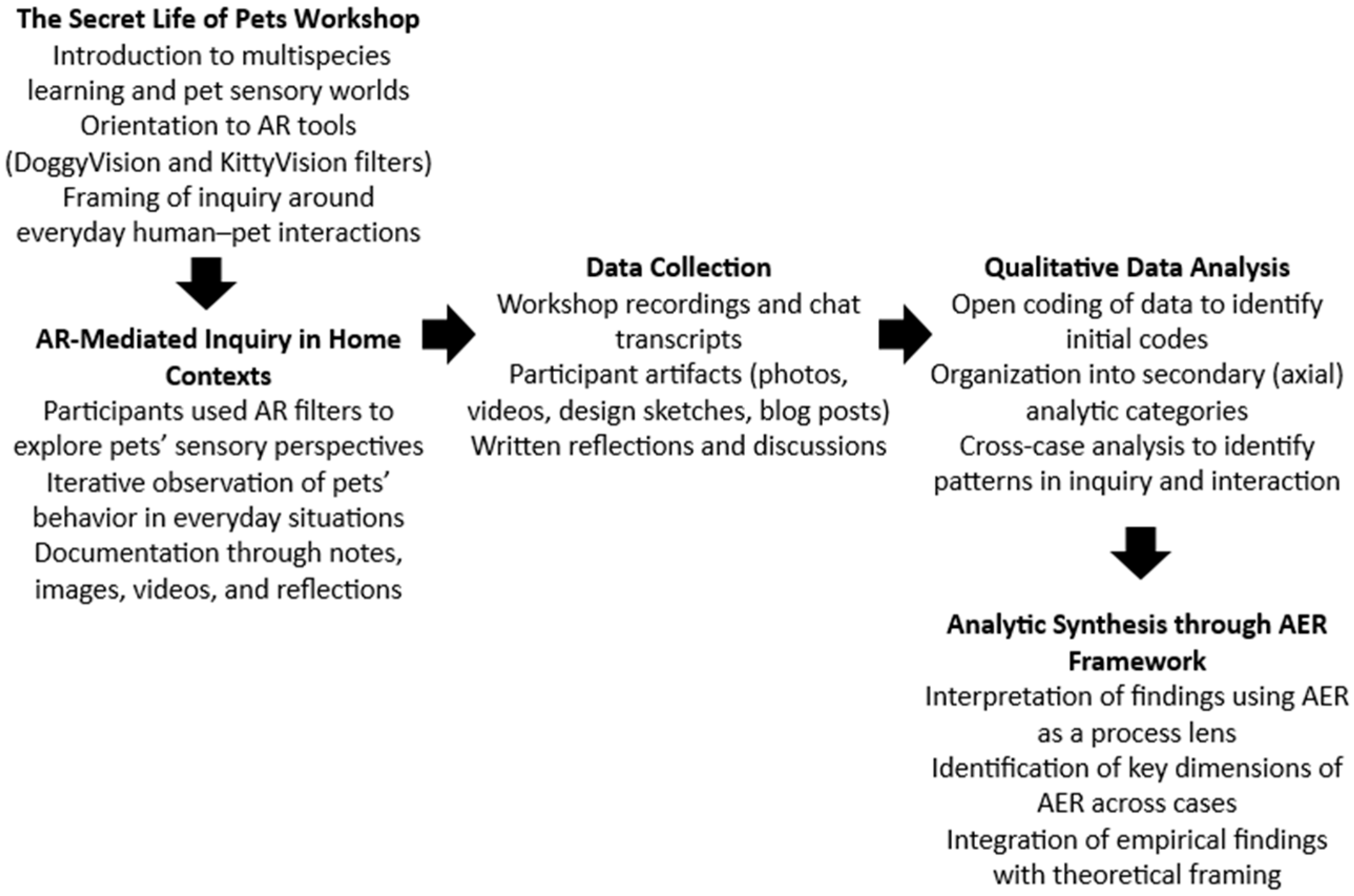
We began by open coding [
53] the participant cases to identify productive initial codes that would help us answer our research questions. Based on our goals aligned in the theoretical framework, we identified the following codes: talking about pets (likes, dislikes, quirks, habits, and indicators for each), talking about pets’ interactions (positive, neutral, problematic, indicator for each, and reason for thinking so), and finding out more about pets (reason for inquiry, suitable processes, knowledge of other things needed, rationale for process). This step helped us understand how the teens discussed their pets within the context of their unique relationship with the pets and their home setting. Next, we organized the codes into three secondary analytical, or axial categories (knowledge of pets, knowledge of context, and pets’ interactions at home) and simultaneously analyzed the observations following the AR filter use. This step is important because the participants studied their pets’ behavior in an everyday context. As a result, they deemed these aspects essential and worthy of detailing, given their direct relevance to everyday life at home and their evident presence in discussions about the pets. Therefore, analyzing the participants’ talk about the topics of the observations gave us details of their individual contexts, especially in relation to learning as the ability to notice increasingly complex interactions. In a final round of analysis, we identified the following themes that described their motivations for the observations: the importance of the events observed; the value added to pets’ life; and long- and short-term implications of the observed event.
Figure 1 previews these analytical steps.
Two researchers agreed on the salient actions, meanings, and forms of noticing, the initial codes, and their organization into secondary analytic categories (axial categories) that captured patterns across cases, including knowledge of pets, knowledge of context, and pets’ interactions at home. Disagreements were resolved through discussion and re-examination of the data, and analytic memos were used to track emerging interpretations and ensure consistency across cases. We report our findings related to these themes as possible implications and consequences of observations, a feeling of responsibility towards pets, and a sense of belonging and ownership.
We present six participants’ projects in
Table 1, selected for the distinctive nature of their inquiries. The three remaining participants conducted projects conceptually similar to those included here. To provide deeper insight into the processes of investigation and interpretation, we describe two participants’ projects in detail. Both participants, teen girls, developed projects that deepened their understanding of pet behavior through stepwise investigations, drawing on multiple observations to construct and articulate insights into their pets’ lives. The two cases also represent distinct orientations to companionship: one participant worked with a long-loved childhood pet, the other with foster kittens later adopted at the workshop’s end. These shared approaches, despite contrasting relationships, allow examination of variation in insight. Focusing on two participants enables a nuanced case analysis within this paper’s scope. Other participants’ projects also met the analytic criteria and are described in brief in
Table 1 and elsewhere [
12]. Overall, our qualitative analysis is descriptive and interpretive [
54], emphasizing commonalities and differences among participants as agents acting with tools and canine or feline others within their home ecosystems. The analytic dimensions presented in the findings emerged inductively through cross-case analysis of participants’ inquiries. are grounded in participants’ observations, reflections, and design decisions, and hence, resonate with our theoretical framing of AER.
By examining how AER unfolds across a small number of richly documented cases, we elaborate AER as a process, while making visible the kind of and opportunities for noticing that qualify as AER. The findings are intended to inform theory and design in contexts with similar relational and ecological characteristics, rather than to represent adolescents’ experiences more broadly.
4. Findings
4.1. AER Across Cases
Table 1 consolidates the projects participants designed and carried out open-ended investigations using DoggyVision and KittyVision AR filters, situating their learning within everyday routines and relational contexts. Their projects ranged from exploring pets’ sensory experiences (Luna & Rocco; Evee & Saskia) and play preferences (Siobhan & Tigger; Violet & Billie) to redesigning aspects of home environments to enhance comfort and safety (Adriana & Wally; Isabel & Leela). Across cases, participants demonstrated AER—the process of noticing, questioning, and interpreting multispecies relationships through embodied, tool-mediated inquiry. The use of AR filters encouraged participants to move beyond assumptions about their pets’ behavior and to consider how sensory, emotional, and environmental factors co-produce experience. Their projects evolved through iterative observation and reflection. guided by an attentiveness to the animals’ well-being. Together, these inquiries illustrate how simple, home-based investigations can transform everyday human–pet relationships into sites of ecological awareness and collaborative learning.
4.2. Luna and Rocco: Can a Dog Really Like to Watch TV?
In this section, we summarize participants’ experiences at the workshop, followed by two participant cases, Luna and Rocco, and Siobhan and Tigger, and our analysis of both cases. The findings are also consolidated in
Table 1 and
Table 2 and are supported by
Figure 2 and
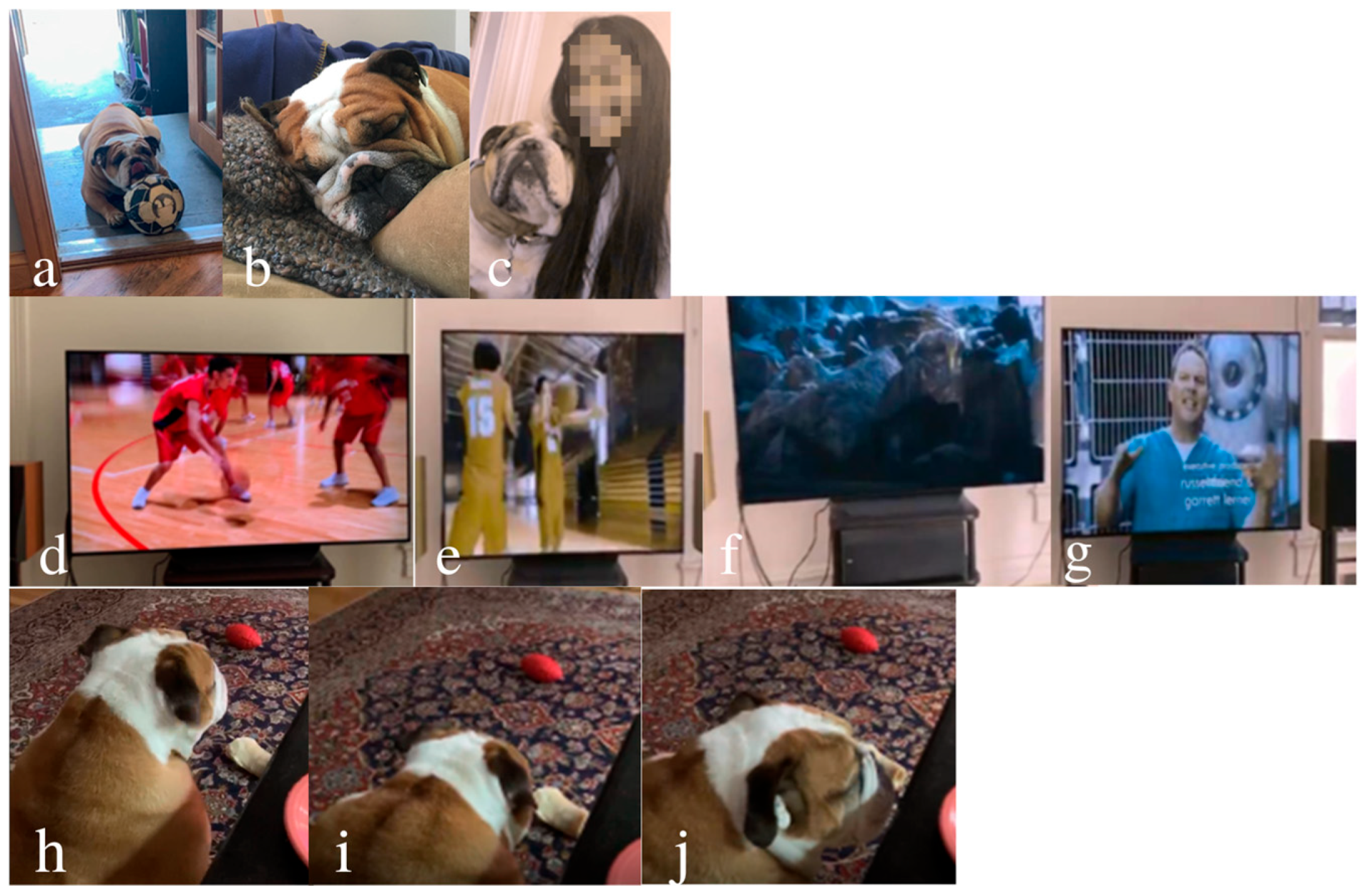
Figure 3. Specifically, Luna, a fifteen-year-old participant, observed that her four-year-old French bulldog, Rocco (
Figure 2a–c), appeared fascinated by television: “Rocco not only likes it but is super interested… won’t look away.” Curious about why, she designed an informal investigation using the DoggyVision AR filter to simulate Rocco’s visual perception. Having heard of TV programs for dogs [
55], Luna hypothesized that Rocco either enjoyed the social experience of watching with humans or the sensory content itself. “Rocco really likes these words and sounds because they result in positive things like playing or fun experiences.” Her first observation during family news time showed Rocco’s disinterest, suggesting that companionship alone did not explain his behavior. She then tested various shows, noting Rocco’s strong responses to specific stimuli: barking and buzzing sounds, images of dogs and balls, and rapid motion. “He’s intrigued by vibrating and buzzing sounds. He likes to chase bees.” Through the AR filter, Luna realized that blue objects appeared in sharper contrast than reds or yellows, leading her to infer that Rocco’s excitement might relate to his color perception. When Rocco watched scenes with dogs playing or barking, he sat alert, ears perked, occasionally barking at the screen (
Figure 2d–j).
Luna’s ongoing inquiry revealed how AR tools can mediate AER, in this case, a process of noticing, questioning, and reinterpreting interspecies relationships through embodied observation. By alternating between Rocco’s and her own perspectives, she recognized that understanding her pet required attentiveness to both sensory and contextual cues. Later, Luna expanded her investigation, testing whether Rocco’s excitement stemmed from associations with playtime. She concluded that his reactions reflected learned emotional links between certain sights and sounds and positive experiences. “I need to encourage Rocco to change what he thinks of (the sounds) and what will happen when he hears them.” Luna’s inquiry into Rocco’s behavior is detailed in
Figure 2.
4.3. Siobhan and Tigger: Cats Are Picky About Toys
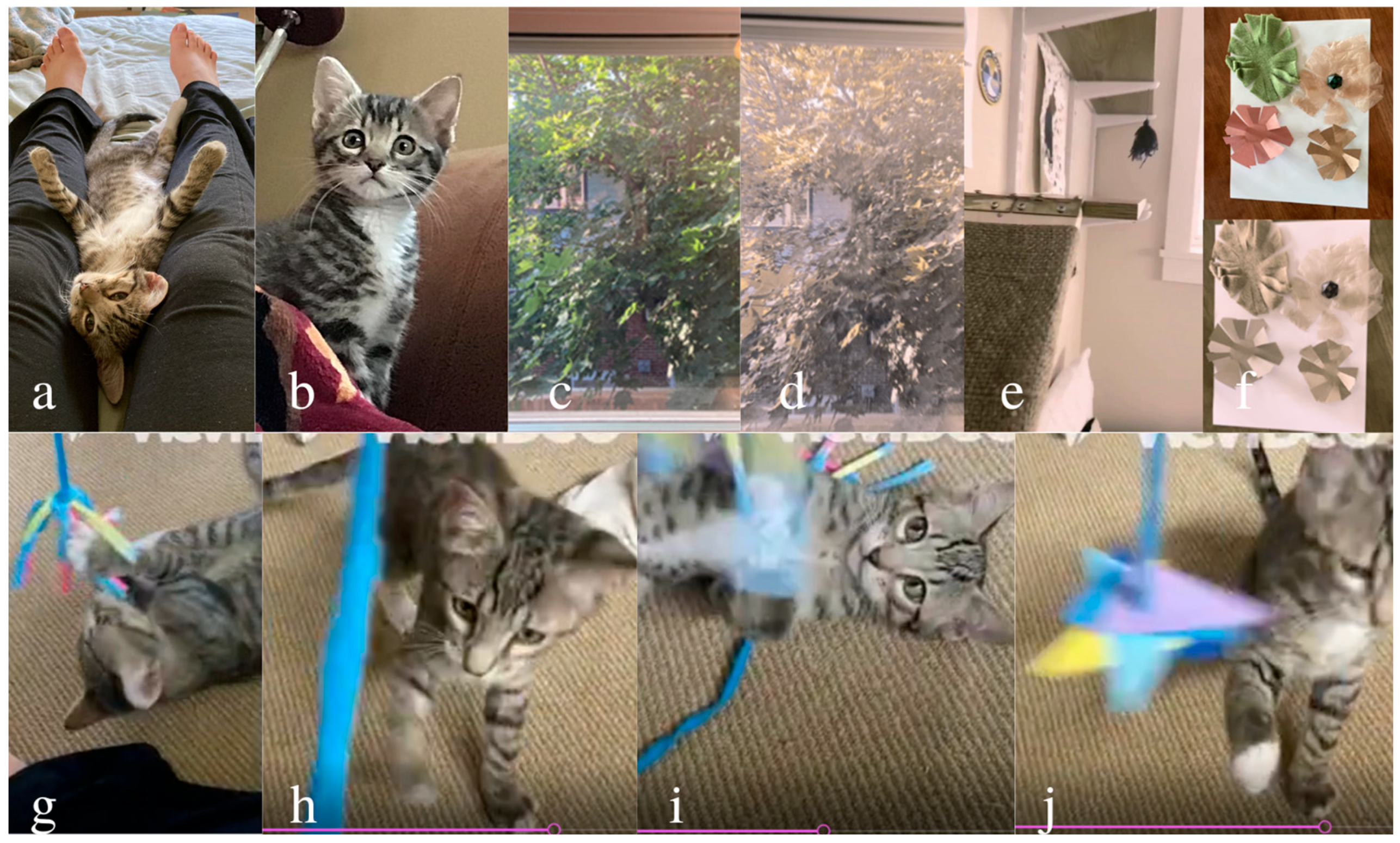
Siobhan, fifteen, considered herself a cat expert and felt responsible for helping others understand cats’ unique behaviors. After losing her childhood cat, Pippa, she fostered an eight-week-old kitten, Tigger (
Figure 3a,b), determined to study his preferences and make him comfortable. She noted that many people struggle to “get along with cats,” attributing this to a misunderstanding of feline cues, since, “Cats are generally picky about almost everything,” and, “Cats are different… you teach a cat to like people (in) the first few weeks of their lives.” Using the KittyVision AR filter, Siobhan investigated how Tigger perceived his surroundings. Watching him track birds outside the window (
Figure 3c,d), she realized that colors appeared muted—mostly shades of brown and blue—and that movement, rather than color, drew his attention. Through this embodied perspective, she began to see her room as part of Tigger’s perceptual ecosystem (
Figure 3e). She observed, “Clearly, colors don’t matter that much to cats, but texture probably affects (cats’ choice of toys),” to test her ideas, Siobhan created four versions of a flower-shaped toy from different materials: plastic, brown paper, construction paper, and felt (
Figure 3f). Controlling for color, she observed how texture and movement affected play. Tigger preferred toys that slid easily across the floor and produced soft sounds, using his claws “in a happy, loving way.” “He liked the ones he could bat easily across the floor.” Building on these observations, she designed a teaser wand with felt triangles, strings, and a bell (
Figure 3g–j) to appeal to Tigger’s hunting instincts. “Even though his vision is limited, his hearing and his smell are also adapted… for living in the wild.” Through AER, alternating between her own and the cat’s sensory viewpoints, Siobhan reframed play as a co-creative learning process. In this case, AR enabled her to recognize how texture, sound, and motion shape Tigger’s engagement and well-being. Her inquiry exemplified AER’s potential to transform everyday care into ecological understanding, fostering ethical care and responsibility, and systems awareness in human–animal relationships.
4.4. From Human–Pet Companionship to AER
Across the cases, participants’ observations demonstrate that learning with AR tools transformed ordinary human–pet companionship into AER, a way of understanding multispecies life as interconnected, dynamic, and context-dependent. Using the filters to view their homes through their pets’ senses, participants quickly realized that animals’ perceptions diverged sharply from their own. Colors, for example, held little meaning for the animals, whereas movement, sound, and texture emerged as key perceptual cues. These observations prompted participants to investigate how pets interpret and act within shared human environments, revealing that to understand their pets, they needed to understand the ecological system in which those pets lived.
Table 2 synthesizes the findings across all participant cases by identifying the key dimensions of AER that emerged through the teens’ inquiries. These shared processes characterize how participants learned with and about their pets through AR-mediated exploration. Each dimension represents a recurring pattern of interaction—such as observation, reflection, and care—that, together, define AER as a relational and embodied form of learning.
Table 2 links these conceptual dimensions to concrete examples from specific cases, illustrating how AER was enacted in practice: simple, everyday investigations evolved into complex, multispecies engagements, where learners became attuned to interdependence within their home ecosystems.
4.4.1. Pets’ Worlds Are Complex and Interconnected
Across the cases, participants used AR filters to investigate how their pets perceive and interact within shared domestic environments. Luna discovered that her dog Rocco experienced television primarily through sound and movement rather than visuals, prompting her to reconsider what “watching TV” might mean for a dog. Siobhan, observing her foster kitten Tigger, recognized that sensory and behavioral differences required patience and careful interpretation to support the kitten’s comfort and development. Violet’s experiments with Billie revealed that color alone did not explain toy preference; setting and familiarity also played key roles, while Adriana’s design of a resting crate for Wally showed how emotional states such as comfort or territoriality shaped her design decisions.
Each participant’s inquiry highlighted the web of relationships connecting humans, pets, technologies, and environments. Human expectations, animal personalities, household routines, and sensory conditions such as light, sound, and space formed interdependent systems influencing behavior. Isabel’s construction of an outdoor enclosure for her cats, Leela and Nigella, balanced safety with their need for exploration, illustrating how ethical and environmental considerations are inseparable. Similarly, Evee’s exploration of her cat, Saskia’s feeding behavior demonstrated how subtle factors, lighting, texture, and time of day, affected engagement. Through these inquiries, participants came to view learning not as isolated problem-solving but as relational system mapping, recognizing how each element of the home ecosystem shapes others.
4.4.2. Growing Understanding Beyond Companionship
Engaging with AR filters encouraged participants to reimagine their pets as co-learners and co-actors rather than passive companions. Luna’s iterative exploration of Rocco’s auditory responses reshaped her caregiving, making her more attuned to environmental noise and comfort. Siobhan’s design process evolved from casual play to systematic experimentation with texture, sound, and motion, fostering curiosity and trust. Violet, Adriana, Isabel, and Evee likewise refined their relationships through cycles of observation, testing, and reflection, developing care grounded not in sentiment but in sustained, evidence-based attention to animal agency and environmental interdependence. These projects demonstrate how, through AER, learners situate themselves within their own ecosystems, enabling them to perceive their pets’ sensory and behavioral experiences as part of a larger, entangled ecology. Through AER, participants moved beyond companionship toward co-constructed learning relationships characterized by curiosity, care, and contextual awareness. Their embodied, iterative inquiries demonstrate how technological mediation can expand ecological literacy, revealing the complexity of more-than-human life and positioning everyday human–animal relations as powerful entry points for reflective, relational learning.
4.5. Summary of Findings: AER Supported Learning
Across all cases, participants engaged in AER to examine pets’ activities in relation to the biological, technological, and social systems of their homes, refining their understanding through cycles of observation and reflection while acknowledging the partial and situated nature of their knowledge. Participants displayed a strong sense of ethical responsibility, recognizing that misinterpretation could affect their pets’ well-being. Their inquiries also revealed axiological reasoning, i.e., decisions guided by values as much as by knowledge. Luna adjusted her interpretations of Rocco’s reactions to ensure his comfort; Siobhan refined her toy designs to support Tigger’s development; Isabel balanced her cats’ safety with their autonomy; and Adriana prioritized Wally’s sense of security. Such choices distinguished their work from purely cognitive or technical exercises, framing AER as both a value-laden and ecological process. Our analysis shows that participants recognized the intricate networks linking humans, animals, technologies, and environments. AR tools made these interdependencies perceptible, helping participants see how sounds, movements, and spatial configurations co-produce behavior. Ultimately, AER represents a form of common-world inquiry, a dynamic, reflective, and ethically attuned engagement with the interdependencies that shape life within human–animal ecosystems.
5. Discussion & Implications
In this paper, we examined how adolescents used AR tools to engage in AER and explore the perceptual worlds of their pets and, in doing so, reconfigured their understanding of everyday human–animal relationships. Learners’ engagement in AER reflected a recognition that homes are multispecies ecosystems in which humans, animals, technologies, and materials coexist and co-shape one another. By situating inquiry in familiar settings and attending to sensory, emotional, and ethical dimensions, participants began to see learning about pets as relational and iterative, a process of interpreting and acting within entangled systems. The use of AR filters made visible aspects of animal perception normally inaccessible to humans, helping participants experience the world through another being’s sensory register. This perceptual shift fostered a form of relational attention grounded in empathy, attentiveness, and care. Participants’ inquiries illustrated how everyday relationships can become innovative learning environments when technologies invite learners to notice, question, and reflect on more-than-human experiences. Whereas prior work on AR in sustainability settings [
18,
19,
20] treated technology as representational or supplementary, AER foregrounds technological mediation as central to how relational, ethical, and ecological sense-making unfolds. Through such engagements, participants developed a deeper awareness of interdependence and the partial, situated nature of their knowledge. These findings illustrate how innovative learning environments for sustainability can be enacted through relational, multispecies inquiry embedded in everyday life and extend common worlds [
4] scholarship by showing how everyday domestic spaces can function as sites of sustained, relational inquiry when learners attend to more-than-human perception and agency.
5.1. AER as Tools for Critical Inquiry
Participants connected their inquiry to the values and consequences of their findings, prompting deeper reflection on their learning practices. Central questions emerged, such as “What defines the relationships between humans and more-than-human creatures?” and “How do we truly understand another being?” These questions required the teens to think in new ways, recognizing the ethical dimensions of interacting with the world. They grew comfortable with the idea that their knowledge of their pets was embedded within an ecosystem’s complex, entangled, and changing relationships. This perspective encouraged them to evaluate the potential gains, losses, and trade-offs of their actions from a relational standpoint, which is crucial for science learning [
56,
57]. This shift from a first-person perspective to a relational way of being [
58] represents a move from simply knowing about and acting on the world to knowing and acting with it, is key to AER and broadens the focus of technologically rich learning environments to include the complexities of epistemologies, tools, and practices. Embracing this relational way of being through accessible AR filters and other tools that reveal hidden experiences in nature can help learners explore the persistent hierarchies that shape what and how we know, emphasizing the importance of ongoing, human entanglements with nature as essential sites for learning. In this way, AER aligns with relational and care-centered accounts of science learning [
59], while extending them by showing how ethical reflection emerges through perceptual and embodied engagement mediated by digital tools.
Theoretically, this paper contributes AER as a process-oriented account of learning that integrates multispecies relations, embodied inquiry, and technological mediation. Methodologically, the paper demonstrates how fine-grained, qualitative analysis of AR-mediated inquiry in domestic settings can surface learning processes that are often overlooked. Practically, the paper suggests design principles for innovative learning environments that prioritize relational engagement, ethical reflection, and iterative sense-making over passively learning about more-than-human experiences. For educators and designers, the findings point to the value of situating learning in everyday contexts and using tools that invite learners to notice what is typically overlooked in human-centered environments.
5.2. Future Directions for AER
The study participants demonstrated a clear awareness of the elevated status of pet cats and dogs as animal companions, as reflected in their discussions about pet care, training, and the distinct needs of these animals compared to those of humans. Their involvement in the workshop suggests that these teens may have viewed pets as having a higher status than other animals, such as rodents, birds, and insects. These non-pet animals were perceived as part of nature—wild, often bothersome, and sometimes instigators of conflicts with their pets. In contrast, pets were considered integral to human culture, living in a hybrid existence within the larger ecosystem. This distinction raises essential questions about how children and youth might relate to other animals in their interactions. Many creatures entangled in everyday human lives, such as insects, rodents, and wild animals, do not enjoy the same social endorsement as pets, yet they have significant ecological implications. We ask: What might foster an ecological and relational understanding of non-domestic, more-than-human creatures? The AR filters used in our study can potentially reveal different ecologies to learners, prompting them to ask important questions and support their ability to relate to these creatures. However, inherited cultural attitudes and entanglements also shape how learners perceive and relate to these creatures. We find that tools like AR filters can play a crucial role in AER, revealing the roles and subjectivities of other species, and encouraging a shift towards more-than-human-centered perspectives. With thoughtful design and a commitment to ethical and just ways of thinking, such activity systems could serve as portals into multispecies worlding [
9,
60], where humans and diverse more-than-humans can examine, understand, and transform our shared ecosystems and ways of being together. We look forward to future explorations of productive tools and practices that enable these meaningful connections within informal learning and sustainability education.
6. Conclusions
Our findings extend prior research on embodied and relational learning by demonstrating how technological mediation can support sustained, everyday multispecies inquiry, rather than episodic or symbolic encounters. Consistent with studies emphasizing relational and ethical dimensions of sustainability learning, participants’ inquiries foregrounded care, responsibility, and interdependence. At the same time, AER extends this literature by specifying how perceptual decentering, enabled through AR, can afford iterative cycles of noticing and reflection within familiar environments, offering a concrete mechanism for enacting and studying relational learning in practice.
While AER offers a productive lens for examining multispecies learning, it also raises important tensions. First, AR filters inevitably involve approximation and interpretation, and there is a risk of anthropomorphic projection when learners attempt to infer animals’ experiences. Rather than resolving this tension, AER makes it visible, inviting learners to grapple with the limits of human understanding and to approach more-than-human perspectives with humility.
Second, the study foregrounds pets as accessible entry points for relational inquiry, but this focus also highlights persistent hierarchies among more-than-human beings. Finally, access to AR technologies is uneven, raising questions of equity. We emphasize that AER should be understood as a design orientation and learning process, not as a technology-dependent model; future work should explore how similar forms of relational inquiry might be supported through low-tech or community-based approaches.