1. Introduction
The global food system faces multiple, interrelated challenges that demand innovative, interdisciplinary, and sustainable solutions. With a rapidly growing population and increasing pressure on agricultural resources, postharvest losses have become a significant concern worldwide [
1]. According to the Food and Agriculture Organization, nearly one-third of all food produced for human consumption is lost or wasted each year, representing not only a waste of resources but also a missed opportunity to improve food security and environmental resilience. Addressing postharvest losses requires graduates with technical competence, critical thinking ability, and sustainability-oriented problem-solving skills. These competencies are at the heart of the United Nations Sustainable Development Goals (SDGs), particularly SDG 2 (Zero Hunger), SDG 12 (Responsible Consumption and Production), and SDG 13 (Climate Action) (
https://www.undp.org/sustainable-development-goals, accessed on 5 January 2026).
Along with Academic Quality Assurance needs, higher education institutions are increasingly called upon to contribute to these SDGs through teaching, research, and community engagement [
2,
3]. In this context, pedagogical innovation plays a crucial role in shaping the capacity of students to engage with real-world problems and design practical, evidence-based solutions. Traditional lecture-based teaching models, though effective for content delivery, often fall short in fostering the critical and creative skills necessary for sustainability-oriented professional practice. This limitation has encouraged universities worldwide to adopt more interactive and experiential pedagogies, such as problem-based learning (PBL), research-based learning (RBL), and project-based learning (PjBL) [
4,
5].
Among these, project-based learning offers unique potential for integrating research and education, particularly in applied science disciplines like food science, agricultural engineering, and postharvest technology. PBL emphasizes student-centered inquiry, collaboration, and reflection, key elements of experiential learning as described by Kolb [
6]. Students in PBL environments work on complex, authentic projects that require them to apply knowledge from multiple domains, design and conduct experiments, analyze data, and communicate their findings to diverse audiences. These activities closely mirror professional scientific practice and provide students with opportunities to develop a wide range of cognitive, technical, and interpersonal competencies [
7,
8].
However, despite extensive literature on PBL in higher education, there is limited research examining how course-based PBL in postharvest technology explicitly aligns with the Sustainable Development Goals and generates societal outcomes beyond the classroom. In particular, the existing studies tend to focus on student learning outcomes rather than the broader sustainability relevance of course-based projects.
In the College of Agricultural and Marine Sciences at Sultan Qaboos University (SQU), the integration of PBL into undergraduate teaching has been strategically aligned with institutional academic quality assurance and upgrading goals to promote sustainability, innovation, and community impact. Within the Department of Soils, Water and Agricultural Engineering (SWAE), the course Postharvest Technology and Quality Management has become central to this pedagogical transformation. The course implements a structured project-based approach in which students work in small groups to investigate real-life postharvest problems. Projects are selected based on their relevance to sustainability challenges and their potential alignment with specific SDGs. Students define problem statements, review relevant literature, design experimental procedures, and analyze results within a guided framework. This progression reflects what Healey and Jenkins [
9] described as a “research–teaching nexus,” where learning is driven by inquiry and scholarship rather than rote learning.
During the continuous evaluation process, these courses are regularly assessed to ensure alignment with learning objectives and sustainability goals. Some of the learning outcomes expected to satisfy course assessment needs are; Ability to identify, formulate, and solve complex engineering problems by applying principles of engineering, science, and mathematics; Ability to communicate effectively with a range of audiences; Ability to recognize ethical and professional responsibilities in relevant situations and contexts; Ability to function effectively on a team whose members together provide leadership, create a collaborative and inclusive environment, establish goals, plan tasks, and meet objectives; Ability to develop and conduct appropriate experimentation, analyze and interpret data, and use these judgment to draw conclusions; and Ability to acquire and apply new knowledge as needed, using appropriate learning strategies (
https://www.abet.org, accessed on 10 January 2026). Most existing studies focus on student learning outcomes rather than sustainability contributions.
Moreover, the integration of the SDGs within these project-based courses provides a unifying global framework for student learning and reflection. By explicitly connecting each project to relevant SDGs, instructors encourage students to situate their research within the broader sustainability agenda and to appreciate the social, economic, and environmental implications of their work. This study adopts a descriptive multiple-case approach to examine five representative student projects, focusing on their contribution to SDG-related challenges. The selected projects include mechanical damage assessment, edible coatings, hybrid drying systems, and computer-vision-based quality evaluation. This study addresses this gap by focusing on SDGs alignment in course-based projects. The objectives of this study are: (1) to analyze how course-based PBL projects align with the Sustainable Development Goals; and (2) to identify the types of societal outcomes generated through these projects. By focusing on SDGs alignment, this study contributes to the literature by demonstrating how undergraduate coursework can function as a mechanism for linking academic teaching with global sustainability priorities.
2. Project-Based Learning Framework in Pedagogy
Project-Based Learning (PBL) is a student-centered instructional method that situates learning in the context of complex, real-world problems and encourages students to construct knowledge through inquiry, experimentation, and reflection. In Agricultural engineering and postharvest education, PBL provides a bridge between theoretical principles and the applied challenges of food preservation, handling, and quality management. The structure of a Project-Based Learning (PBL) environment typically involves several key stages: defining a driving question or challenge, conducting research and experimentation, developing a tangible product or report, and presenting the outcomes to peers or external audiences. This sequence supports student-centered inquiry and active engagement with real-world problems, fostering deeper learning through authentic tasks [
8,
10]. Project-Based Learning (PBL) is particularly relevant in agricultural engineering because it mirrors the multidisciplinary and problem-solving nature of professional practice in these fields, where knowledge from engineering, biology, chemistry, and economics must be integrated. PBL helps students develop transferable skills by simulating real-world challenges, fostering critical thinking, innovation, and collaboration [
11,
12].
In the Department of Soils, Water and Agricultural Engineering at Sultan Qaboos University, the integration of PBL within the curriculum is strategically designed to complement Oman’s national vision (OMAN Vision 2040) for sustainable agricultural development. The pedagogical framework applied in SWAE courses is supported by three pillars: (1) authentic learning, (2) structured research design, and (3) reflective practice. Authentic learning ensures that students address real-world problems with tangible societal relevance. For instance, projects on extending the shelf life of tomatoes or improving the drying efficiency of herbs have direct implications for local farmers and food processors. Structured research design refers to the methodological platform that supports students through the stages of literature review, experimental setup, data collection, analysis, and interpretation. Faculty mentors provide guidance while allowing flexibility for innovation. Reflective practice, the third pillar, encourages students to critically assess their learning process, decisions, and outcomes. Reflection journals, peer feedback sessions, and oral presentations are used to strengthen metacognitive awareness and communication skills.
In the SWAE3203 course, PBL is implemented through small-group projects addressing real-life postharvest challenges such as food loss reduction, energy efficiency, and natural preservation methods. Students engage in collaborative problem solving, experimental design, and analysis, enabling the application of interdisciplinary knowledge. Overall, PBL provides a powerful pedagogical framework for embedding sustainability competencies in higher education by connecting theory with practice and fostering student agency toward sustainable development [
13,
14]. This section focuses on the applied implementation of PBL in postharvest education rather than extensive theoretical discussion.
3. Research Project Model
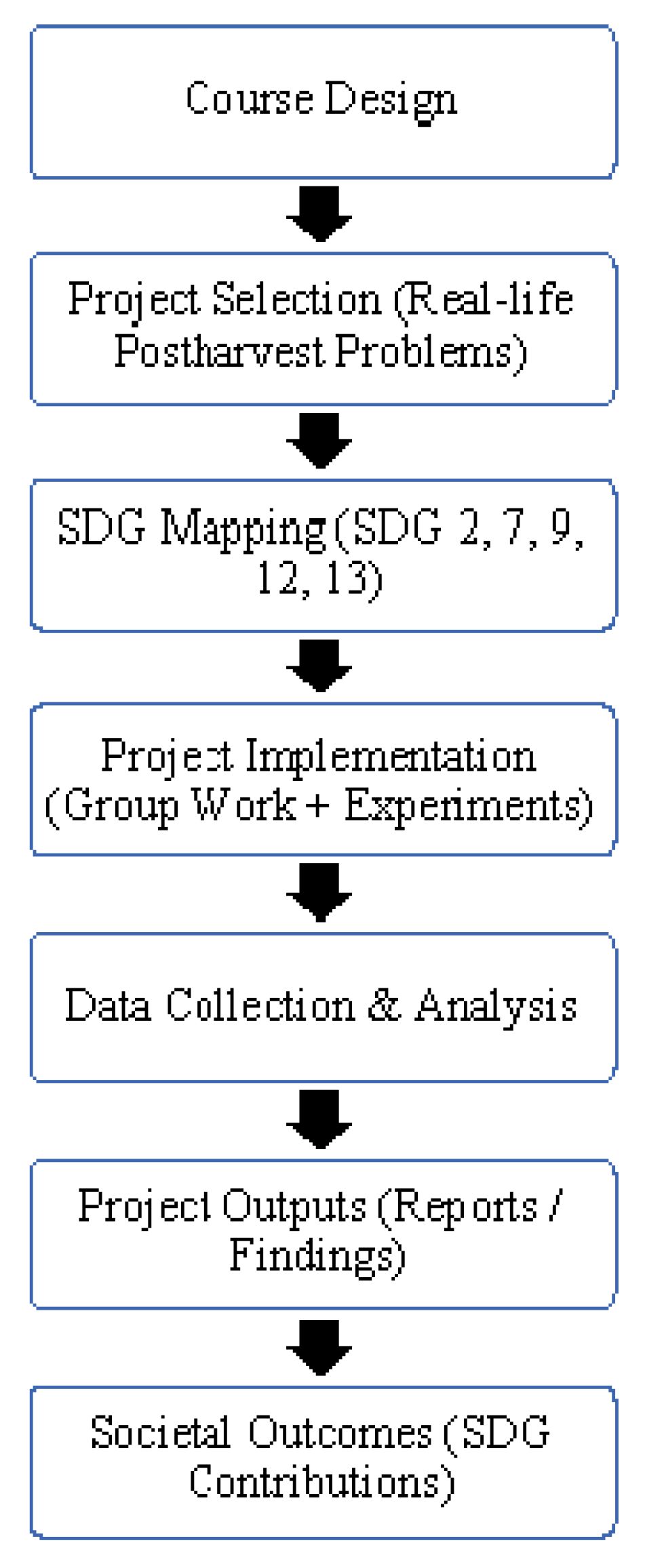
The Project serves as a culminating experience for students. It embodies the principles of project-based learning (PBL) by positioning students as researchers and innovators rather than passive recipients of information. This model bridges the gap between classroom instruction and real-world application, allowing students to demonstrate mastery of technical, analytical, and communication skills while addressing authentic postharvest challenges. The course carries three credit hours and extends over one academic semester, typically comprising 15 weeks. Students work in small groups of three to five members under the guidance of a faculty supervisor. The structure closely mirrors that of a scientific research process and is deliberately designed to scaffold students’ transition from learners to contributors of knowledge. The course follows several key phases: problem identification, the literature review, experimental design, data collection, analysis, report writing, and dissemination (
Figure 1). A qualitative cross-case analysis approach was employed to identify patterns in SDGs alignment and societal outcomes across the five projects.
3.1. Methodological Design and Analytical Approach
This study adopts a descriptive multiple-case study design focusing on five student projects implemented within the SWAE3203 course. Projects were selected based on their alignment with SDGs and their potential societal relevance rather than quantitative measurement of student learning outcomes. Data sources include student project reports, experimental outputs, and SDGs mapping conducted during the course. The analysis focuses on identifying sustainability challenges addressed, SDGs alignment, and resulting societal contributions. The study focuses on the societal relevance of course-based project outputs.
The methodological framework described above provides the basis for analyzing how course-based project-based learning is implemented within the SWAE3203 course. The following section (
Section 4) presents five representative case studies illustrating how students applied this framework to address real-world postharvest challenges aligned with SDGs.
3.2. Problem Identification and Proposal Development
The first stage involves selecting a project topic, usually derived from real-world agricultural or postharvest issues. Students are encouraged to propose research problems that have both local relevance and global significance, ensuring alignment with the Sustainable Development Goals (SDGs). Topics such as “the effect of mechanical damage on zucchini,” “infrared-hot air drying of curry leaves,” and “biodegradable coatings for tomatoes” exemplify this dual relevance. The proposal development stage trains students to define research objectives, formulate hypotheses, and design feasible methodologies, skills that are directly transferable to professional research environments.
3.3. Literature Review and Methodological Design
Once topics are approved, students conduct an extensive literature review to identify existing research gaps and establish a conceptual framework. Faculty mentors play a critical role at this stage by guiding students on research ethics, citation practices, and methodological rigor. The process encourages analytical reading and critical synthesis, helping students transition from information consumers to evaluators of evidence. Methodological design, including experimental setup and data collection protocols, is guided by the principle of reproducibility. Students learn to use analytical instruments, maintain laboratory notebooks, and adhere to safety and quality assurance standards.
3.4. Implementation, Data Analysis, and Reflection
During the mid-semester period, students execute their experiments, collect data, and conduct statistical analyses. Data analysis is often supported by tools such as Microsoft Excel, specialized software for image processing and drying kinetics modeling. Reflection is embedded into the process through progress meetings and interim presentations, which allow students to receive formative feedback and adjust their methods as necessary. This iterative process reflects Kolb’s experiential learning cycle, where students engage in concrete experience, reflection, conceptualization, and experimentation.
3.5. Reporting and Dissemination
This dissemination stage builds on the experiential learning process described in
Section 3.4, reinforcing students’ ability to reflect on and communicate their findings. In some cases, exceptional projects are further developed into peer-reviewed journal articles or conference papers with faculty co-authorship, illustrating how undergraduate research can contribute directly to scholarly output.
3.6. Assessment and Feedback
Assessment in Project-Based Learning (PBL) is continuous and multidimensional, focusing on both the learning process and the final product, also following the SLOs and accreditation framework. Evaluation criteria commonly include problem definition, research design, data quality, analytical rigor, teamwork, presentation skills, student engagement, ethical conduct, and reflection on learning. Rubric-based assessments are widely used to ensure transparency and consistency across projects while providing structured feedback that highlights strengths and areas for improvement [
15,
16]. Formative assessment and ongoing feedback are essential components that support iterative learning and help students adjust their approaches throughout the project [
17]. Self, peer, and co-assessment strategies also contribute to a more comprehensive evaluation by capturing individual contributions and promoting reflective practice [
15]. Overall, effective PBL assessment integrates multiple methods to measure cognitive, behavioral, and affective outcomes aligned with 21st-century skills such as creativity, collaboration, and critical thinking.
Research-based learning within project-based learning (PBL) emphasizes students’ learning as active researchers rather than passive recipients of knowledge, fostering critical thinking, self-directed learning, and innovation. This approach engages students in the full research process, formulating questions, collecting and analyzing data, and producing original work, thereby building competencies essential for lifelong learning and professional research roles [
18]. PBL’s flexible structure allows adaptation to diverse educational contexts while maintaining rigor through scaffolded guidance and authentic tasks [
19]. Overall, research-based learning operationalized through PBL prepares students for postgraduate study and professional research by embedding the scientific process into their educational experience.
Moreover, the course demonstrates how undergraduate education can serve as a driver for sustainability and innovation. Many of the projects directly address food security and resource management issues aligned with Oman’s Vision 2040. Through these experiences, students learn not only to solve technical problems but also to contextualize their findings within societal needs and environmental limits. This alignment between research, education, and sustainability goals exemplifies an effective pedagogical framework for 21st-century higher education. These assessment practices support iterative learning aligned with the experiential framework introduced in
Section 3.4.
4. Case Studies of Undergraduate Projects
Project-based learning (PBL) in the course has generated a diverse portfolio of student-led research addressing key sustainability challenges. These projects exemplify how undergraduate research can merge scientific inquiry with the Sustainable Development Goals (SDGs), reinforcing the relevance of classroom learning to real-world problems. These initiatives reflect a holistic pedagogical approach that integrates technical mastery, sustainability literacy, and scholarly communication.
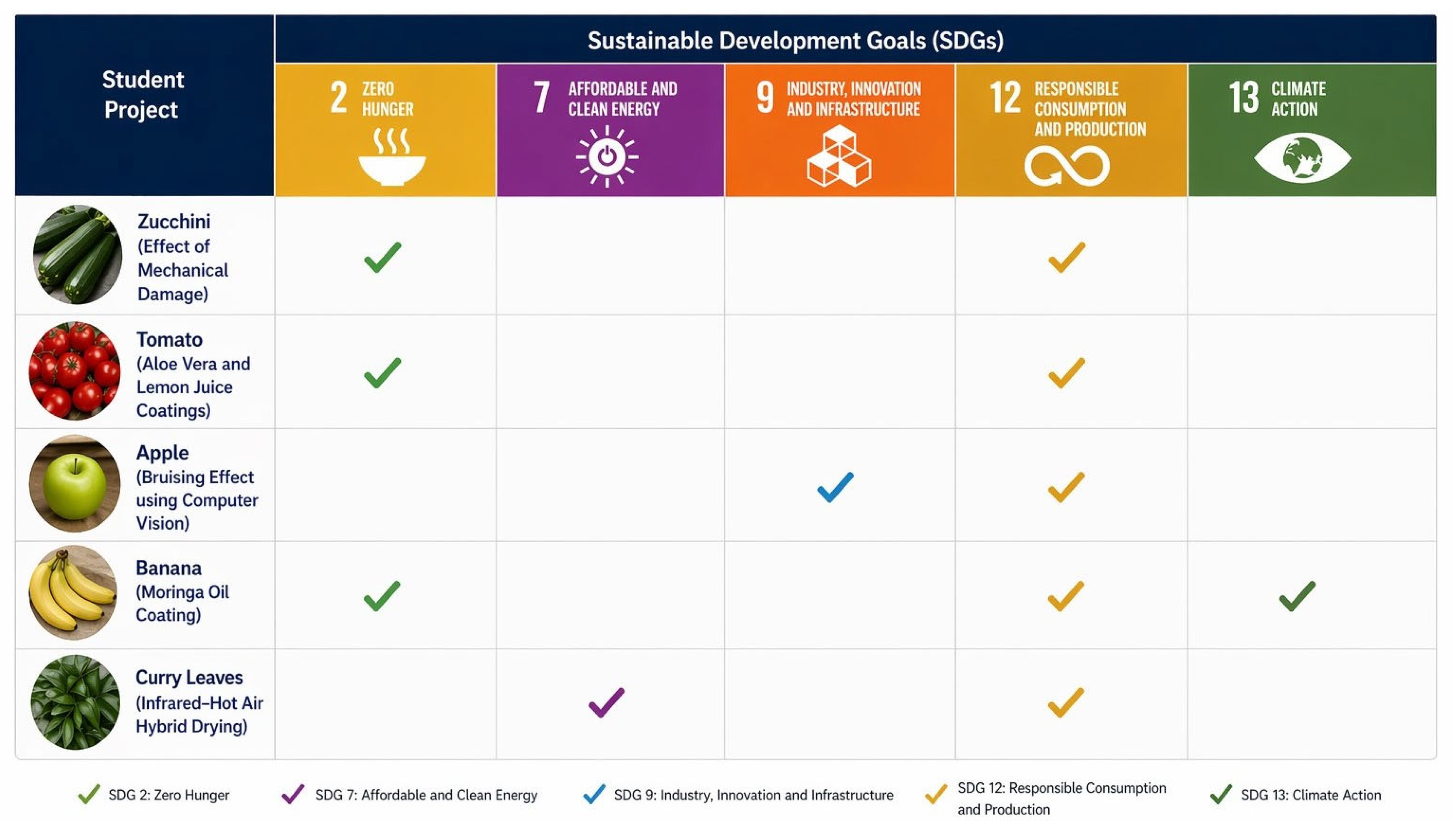
Each student project emerges from a process of collaborative brainstorming, problem identification, and iterative experimentation. Faculty mentors guide students to frame their work within sustainability contexts, encouraging reflection on both scientific and social impacts. The following case studies illustrate how undergraduate teams have applied theoretical knowledge to address challenges in postharvest loss reduction, preservation, and product quality while simultaneously aligning with global sustainability objectives (
Table 1).
4.1. The Effect of Mechanical Damage on the Quality of Zucchini
This project investigated how mechanical impacts during handling and transport affect the quality of zucchini. Using controlled drop tests and mechanical impact devices, students simulated handling conditions and measured resulting bruising, firmness loss, and color degradation. The study provided insights into the correlation between impact energy and product quality deterioration. By analyzing mechanical damage thresholds, the project contributed to SDG 12 (Responsible Consumption and Production) by promoting waste reduction through improved packaging and handling design. Severe mechanical damage resulted in weight loss up to 46.37% and TSS reduction to 5.4 Brix, indicating significant quality deterioration due to improper handling.
4.2. Effect of Aloe Vera and Lemon Juice Coatings on the Postharvest Quality and Shelf Life of Cherry Tomatoes
In this project, students explored natural alternatives to synthetic coatings by formulating blends of aloe vera gel and lemon juice. Tomatoes were coated, stored under ambient conditions, and monitored for weight loss, firmness, pH, and visual quality over time. The optimized aloe vera–lemon coating formulation effectively reduced moisture loss and delayed spoilage. Beyond technical findings, the project addressed SDG 2 (Zero Hunger) and SDG 12 (Responsible Consumption and Production) by extending the shelf life of perishable produce without chemical preservatives. Students gained practical experience in formulation, image processing, and quality evaluation. The optimized coating reduced weight loss from 27.1% in control samples to 18.8%, while maintaining firmness, demonstrating improved shelf-life performance.
4.3. Determination of Bruising Effect on Green Apple Quality
This study introduced students to the intersection of engineering and digital technology through the use of computer vision for non-destructive quality assessment. Students developed an imaging system to quantify bruise area and intensity using color analysis in ImageJ software (v. 1.53, National Institute of Health, Bethesda, MD, USA). The project illustrated how digital tools can support precision agriculture and postharvest quality control, directly aligning with SDG 9 (Industry, Innovation, and Infrastructure). Students enhanced their understanding of optics, image processing, and machine learning fundamentals while contributing to technological innovation for sustainable food systems. Severe bruising increased weight loss from 3.81% to 8.96%, while firmness decreased from 53.23 N to 21.64 N, indicating accelerated deterioration.
4.4. Examination of the Effect of Coating Bananas with Moringa Oil as a Postharvest Preservation Method
Recognizing the potential of natural bio-oils as environmentally friendly coatings, this project investigated the efficacy of moringa oil in preserving banana quality. Bananas were coated and stored at room temperature, with periodic measurement of ripening indicators such as peel color, firmness, and total soluble solids. The results demonstrated that moringa oil delayed ripening and minimized microbial decay. The project was notable for its integration of local resources and sustainability, contributing to SDG 2, SDG 12, and SDG 13 (Climate Action). It also highlighted ethical considerations in using biodegradable materials to replace synthetic chemicals in food preservation. Banana coating experiments using edible oil coatings demonstrated reduced moisture loss, delayed ripening, and improved retention of firmness and physicochemical properties such as pH and total soluble solids, indicating enhanced shelf-life stability.
4.5. Infrared–Hot Air Hybrid Drying of Curry Leaves
Energy efficiency and product quality were the focus of this project, which examined the drying kinetics of curry leaves using a hybrid infrared–hot air drying system. Students compared drying times, energy consumption, and color retention under different conditions. The study found that the hybrid system significantly improved drying efficiency while preserving chlorophyll content and aroma, aligning with SDG 7 (Affordable and Clean Energy) and SDG 12. The project fostered skills in experimental design, instrumentation, and data modeling, while promoting renewable energy applications in food processing. Hybrid infrared–hot air drying demonstrated faster moisture removal, reduced drying time, and improved preservation of color values (L*, a*, b*). These results indicate improved process efficiency and product quality retention.
These case studies collectively demonstrate how student-led PBL fosters technical innovation, sustainability awareness, and academic publication potential. Through real-world experimentation and reflection, students connect postharvest engineering with global goals, positioning SQU’s model as a context-specific example that may inform sustainability-oriented teaching practices in agricultural sciences. This multiple-case analysis demonstrates that integrating sustainability across diverse postharvest projects highlights the value of project-based learning as a structured mechanism for supporting the application of the Sustainable Development Goals within undergraduate education.
5. Mapping Project-Based Learning Outcomes to the Sustainable Development Goals
Integrating the United Nations Sustainable Development Goals (SDGs) into undergraduate education provides both a framework for global relevance and a tool for curriculum transformation. In the context of postharvest and Agricultural engineering education, mapping project-based learning (PBL) outcomes to the SDGs ensures that students’ research efforts address pressing societal and environmental priorities. The SDGs most relevant to postharvest education are SDG 2 (Zero Hunger), SDG 7 (Affordable and Clean Energy), SDG 9 (Industry, Innovation, and Infrastructure), SDG 12 (Responsible Consumption and Production), and SDG 13 (Climate Action). These goals encompass the key sustainability dimensions of food production, energy use, technological advancement, waste reduction, and environmental stewardship.
5.1. Societal Outcomes and SDG Alignment
The five projects demonstrate clear alignment with multiple SDGs, with SDG 12 (Responsible Consumption and Production) addressed in all cases. This indicates a strong emphasis on reducing postharvest losses and improving resource efficiency. Projects focusing on natural coatings and preservation methods contribute to SDG 2 (Zero Hunger) and SDG 12 by enhancing food availability and reducing waste. The hybrid drying project aligns with SDG 7 (Affordable and Clean Energy) by promoting energy-efficient processing. The computer vision-based quality assessment project contributes to SDG 9 through technological innovation in postharvest systems.
Figure 2 presents a cross-case comparison showing the contribution of each project to SDGs 2, 7, 9, 12, and 13. SDG 12 is consistently represented across all projects, highlighting the central role of postharvest education in addressing resource efficiency and food loss reduction. Alignment with specific SDGs was determined using qualitative criteria, including: (i) direct relevance of project objectives to SDG targets, (ii) observable sustainability outcomes such as reduction in food loss or energy use, and (iii) potential environmental or societal impact. For example, alignment with SDG 13 (Climate Action) was assigned when projects demonstrated improvements in energy efficiency or reductions in environmental impact.
5.2. Assessment Integration
Assessment of Sustainable Development Goals (SDGs) integration in project-based learning (PBL) typically combines instructor evaluation with student self-assessment, supported by faculty mentors who facilitate critical reflection on the project’s real contribution to sustainability rather than treating SDGs as abstract ideas. This approach aligns with the principle of constructive alignment, ensuring coherence between learning objectives, teaching activities, and assessment tasks to produce meaningful outcomes [
20]. Studies show that PBL can improve students’ knowledge and awareness of SDGs, although its impact on perceived relevance for future professional and personal contexts may be limited without deeper curriculum integration [
20,
21]. Rubric-based assessments and structured tools have been developed to systematically evaluate how projects align with specific SDGs, emphasizing justification and direct positive contributions to sustainability goals [
22]. Active learning methodologies within PBL also enhance motivation, academic results, and students’ understanding of SDGs related to energy, climate change, and quality education [
23]. SDG 12 emerges as the dominant theme across all projects, highlighting the central role of postharvest education in addressing resource efficiency and food loss reduction.
6. Educational Impact and Student Learning Outcomes
Projects provide opportunities for applying theoretical knowledge in practical contexts related to postharvest systems. Through hands-on research experiences and structured mentorship, students develop both technical competence and higher-order cognitive skills. Aligning course projects with the Sustainable Development Goals (SDGs) also promotes systems thinking, ethical awareness, and interdisciplinary collaboration, which are essential for addressing complex challenges in food systems and postharvest technology. These activities are aligned with internationally recognized Student Learning Outcomes (SLOs) commonly used in accreditation frameworks, including the ability to solve engineering problems, conduct experiments, communicate effectively, work in teams, and apply new knowledge.
PBL enables students to apply theoretical concepts in practical contexts, reinforcing knowledge in postharvest physiology, material science, and agricultural engineering. For example, students working on the hybrid drying of curry leaves gain experience in experimental design, operational control, and analysis of drying kinetics. Projects involving mechanical damage and bruising studies develop skills in impact testing, modeling, and quantitative data analysis. Similarly, work on natural coatings and moringa oil applications strengthens laboratory competencies related to formulation, microbial assessment, and shelf-life evaluation. These experiences support higher-order learning outcomes consistent with Bloom’s revised taxonomy, enabling students to progress from knowledge acquisition to analysis, synthesis, and innovation. The PBL model supports higher-order cognitive processes aligned with Bloom’s revised taxonomy by engaging students in analysis, evaluation, and creation. Systems thinking is developed as students analyze interconnected postharvest systems and evaluate trade-offs related to food quality, resource efficiency, and sustainability. Ethical awareness emerges through decision-making processes involving environmental impact, food security, and responsible resource use. These learning processes move students beyond knowledge acquisition toward synthesis, innovation, and informed decision-making. In the context of sustainable food systems, such experiential and problem-oriented learning further promotes critical reflection, interdisciplinary understanding, and the ability to translate sustainability concepts into practical solutions and actions [
24].
The approach also strengthens research and professional skills. Students communicate their findings through viva examinations, oral presentations, poster sessions, and structured research reports resembling journal articles. Continuous feedback from faculty and peers improves their ability to present scientific data clearly and effectively. In several cases, promising projects are further developed for conference presentations or peer-reviewed publications, providing students with early exposure to the research dissemination process. Collaborative work also cultivates teamwork, leadership, time management, and data integrity.
Engagement with authentic, real-world problems significantly increases student motivation. Many students perceive their research as contributing to food security and sustainable agricultural practices, which enhances their sense of purpose and confidence. Overall, integrating PBL into postharvest and agricultural engineering education at Sultan Qaboos University supports the application of technical knowledge in postharvest systems, while strengthening research capability, sustainability awareness, and professional readiness, preparing graduates to contribute effectively to research, industry, and sustainable food system development.
7. Pedagogical Reflections and Faculty Perspectives
The successful integration of project-based learning (PBL) in agricultural education depends heavily on reflective teaching practices and strong faculty mentorship that mediate between curriculum goals, student needs, and sustainability priorities. Faculty play a crucial role in shaping meaningful learning experiences by guiding students through practical, real-world projects that connect scientific knowledge with agricultural applications [
12]. Research shows that PBL enhances student engagement, motivation, and skill development in agricultural contexts by fostering critical thinking, problem-solving, and collaboration [
25]. Faculty reflections often highlight challenges related to logistics, cultural factors, and balancing academic rigor with hands-on learning, emphasizing the need for ongoing adaptation and support [
26]. Moreover, integrating community-based elements and interdisciplinary approaches within PBL strengthens its impact by linking theory to practice and addressing local agricultural issues. Overall, effective faculty mentorship combined with reflective teaching is key to maximizing the benefits of PBL in agricultural education programs.
7.1. Faculty as Facilitators of Inquiry
Faculty mentoring models encourage students to take intellectual risks and develop autonomy by providing support that balances guidance with freedom, fostering independence essential for innovation in scientific practice. Mentoring relationships promote autonomy through role modeling, encouragement, access to resources, advocacy, and reflective conversations that help students regulate their learning and decision-making [
27]. Autonomy-supportive mentoring enhances creativity and long-term professional growth, especially when mentees engage in exploration and self-directed learning during their training [
28]. Effective mentorship also involves building psychological safety and consistent reflective practices, enabling students to learn from experience and develop confidence in their abilities. However, mentors often need training to effectively support autonomy development, as uncertainty remains about how best to balance support with independence. Overall, mentoring that fosters autonomy and intellectual risk-taking is linked to improved critical thinking, creativity, and employability skills in higher education contexts. Faculty mentoring supports reflective and inquiry-based learning by guiding students through iterative feedback and independent problem-solving.
7.2. Assessment Challenges and Opportunities
Balancing consistency and flexibility in assessment is challenging due to the wide variation in project scope, methodology, and complexity, which complicates comparative evaluation. Regular calibration meetings among instructors are effective for maintaining fairness and aligning assessments with department-wide standards, supporting transparency and trust in the process [
29]. Transparent, criteria-based frameworks are essential for fostering student trust and encouraging constructive learning behaviors, as emphasized [
30,
31]. Flexible assessment strategies that offer students choice can enhance motivation and engagement, but require careful design to avoid issues like increased instructor workload and concerns about fairness. Research suggests that managing tensions between summative and formative assessments through a “both-and” approach can help address competing demands for consistency, flexibility, accountability, and learner needs. Overall, effective assessment balances structured criteria with adaptable elements to support diverse student needs while ensuring equity and rigor.
7.3. Pedagogical Lessons Learned
Project-based learning (PBL) at Sultan Qaboos University has transformed postharvest and agricultural education into a research-oriented, student-centered experience. By engaging undergraduates in authentic projects linked to real-world stakeholders, PBL strengthens critical thinking, problem-solving, and communication skills while aligning coursework with sustainability goals and the SDGs. Faculty play a pivotal role through structured mentoring, reflective dialog, and transparent assessment using rubrics and continuous feedback. Digital tools, including sensors, data analytics, and virtual platforms, further enrich learning and support hybrid delivery. Overall, SQU’s PBL framework provides a context-specific example of research-based learning that prepares graduates for innovation, lifelong learning, and community engagement.
8. Future Directions in Postharvest Education and Sustainability
As global challenges in food security, energy use, and environmental sustainability intensify, higher education must evolve to equip graduates with the skills needed to address complex agricultural and food system issues. The integration of PBL and sustainability principles within postharvest education at SQU provides a strong foundation, but continued innovation is necessary to sustain its impact. The consistent alignment with SDG 12 highlights opportunities for expanding resource-efficiency-focused projects. Future development of this model should focus on digital transformation, interdisciplinary collaboration, research dissemination, and institutional support.
Digital technologies can significantly enhance PBL by enabling smart learning environments. Tools such as data analytics, artificial intelligence, and the Internet of Things (IoT) can support real-time monitoring and analysis of postharvest processes. For example, IoT-based sensors can track temperature and humidity during drying experiments, while computer vision and machine learning can assist in detecting fruit bruising and predicting product quality. Virtual laboratories and cloud-based platforms can also support hybrid and online learning, increasing accessibility and resilience. While digital technologies such as IoT, artificial intelligence, and computer vision offer significant opportunities to enhance PBL, their implementation may be constrained by factors such as limited funding, access to technical infrastructure, and institutional capacity, particularly in resource-limited contexts. Addressing these challenges will be essential for ensuring the scalability and inclusivity of digitally enhanced PBL models.
Interdisciplinary collaboration will further strengthen sustainability-focused education. Projects involving engineering, environmental science, and economics students can address issues such as postharvest waste utilization and circular economy solutions. Expanding partnerships across SQU colleges and with industry or local producers will connect academic learning with real-world applications. Institutional support remains essential. Faculty training in sustainability pedagogy, digital tools, and PBL assessment will help maintain program quality. With adequate infrastructure, funding, and interdisciplinary collaboration, SQU’s model can serve as a regional example of sustainability-oriented agricultural education.
Limitations and Future Research
This study is limited by its descriptive design and lack of quantitative assessment of student learning outcomes or long-term impact. The findings are based on a single course at Sultan Qaboos University and may not be directly generalizable to other institutions or disciplines. Institutional factors such as laboratory infrastructure, faculty expertise, and curricular flexibility may influence the implementation of project-based learning in other settings. Future research should incorporate quantitative indicators such as pre- and post-course assessments of sustainability literacy, rubric-based evaluation of SDGs integration, and competency-based scoring frameworks. Longitudinal tracking of graduates’ engagement in sustainability-related careers or research could also provide insights into long-term educational impact. External disruptions such as the COVID-19 pandemic may also affect the implementation of experiential learning components, particularly those requiring laboratory access, fieldwork, and in-person collaboration. Such constraints may limit hands-on learning opportunities and require adaptation through hybrid or digital learning approaches.
9. Conclusions
This study demonstrates how course-based project-based learning in postharvest education can be aligned with the Sustainable Development Goals within a specific course context. The findings illustrate the potential role of undergraduate coursework in addressing sustainability-related challenges such as food loss, energy efficiency, and innovation in food systems. Through structured inquiry, mentorship, and experiential learning, students are encouraged to engage more actively in inquiry, experimentation, and sustainability-oriented problem solving. Within the course context, this approach supports the development of technical knowledge while fostering critical thinking, sustainability awareness, and professional responsibility. Experiences from the Postharvest Technology and Quality Management courses demonstrate how undergraduate research can effectively connect theory with practical application. Student projects address challenges related to food preservation, quality management, and resource efficiency. Aligning these projects with the SDGs provides a structured framework for integrating sustainability considerations into applied learning activities.
Through this process, students develop strong analytical, teamwork, and scientific communication skills while gaining key sustainability competencies such as systems thinking and ethical awareness. In some cases, projects have progressed toward research dissemination, indicating the potential for undergraduate learning activities to contribute to scholarly outputs. However, as the findings are based on a single course, they should be interpreted as context-specific. Further research across multiple courses and institutions is needed to evaluate the broader applicability and impact of this approach.