Developing a Framework for Measuring Circularity in Sustainable Tourism: A GSTC-Aligned Approach

Abstract
1. Introduction
- Conceptualize circularity within the tourism sector by adapting theoretical principles from broader service industries.
- Analyze how tourism stakeholders prioritize different dimensions of circularity across the industry’s value chain.
- Critically evaluate current methodologies and certification schemes to identify specific gaps in how they measure sustainability and circularity in tourism.
- Develop an original assessment framework that integrates circular metrics into the GSTC Criteria.
- Delineate the barriers to implementation and the role of digital technologies in facilitating a circular transition.
2. Conceptualizing Circularity in Tourism
2.1. Theoretical Foundations of Circular Economy in Service Industries
2.2. Key Dimensions of Circularity Relevant to Tourism Operations
2.3. Stakeholder Perspectives on Circularity in Tourism
3. Existing Approaches to Measuring Sustainability and Circularity in Tourism
3.1. Methodologies for Assessing Resource Flows and Waste Management in Tourism
3.2. Current Sustainability Indicators and Certification Schemes in Tourism
3.3. Gaps in Current Measurement Frameworks for Comprehensive Circularity Assessment
4. Developing a GSTC-Aligned Framework for Measuring Circularity in Sustainable Tourism
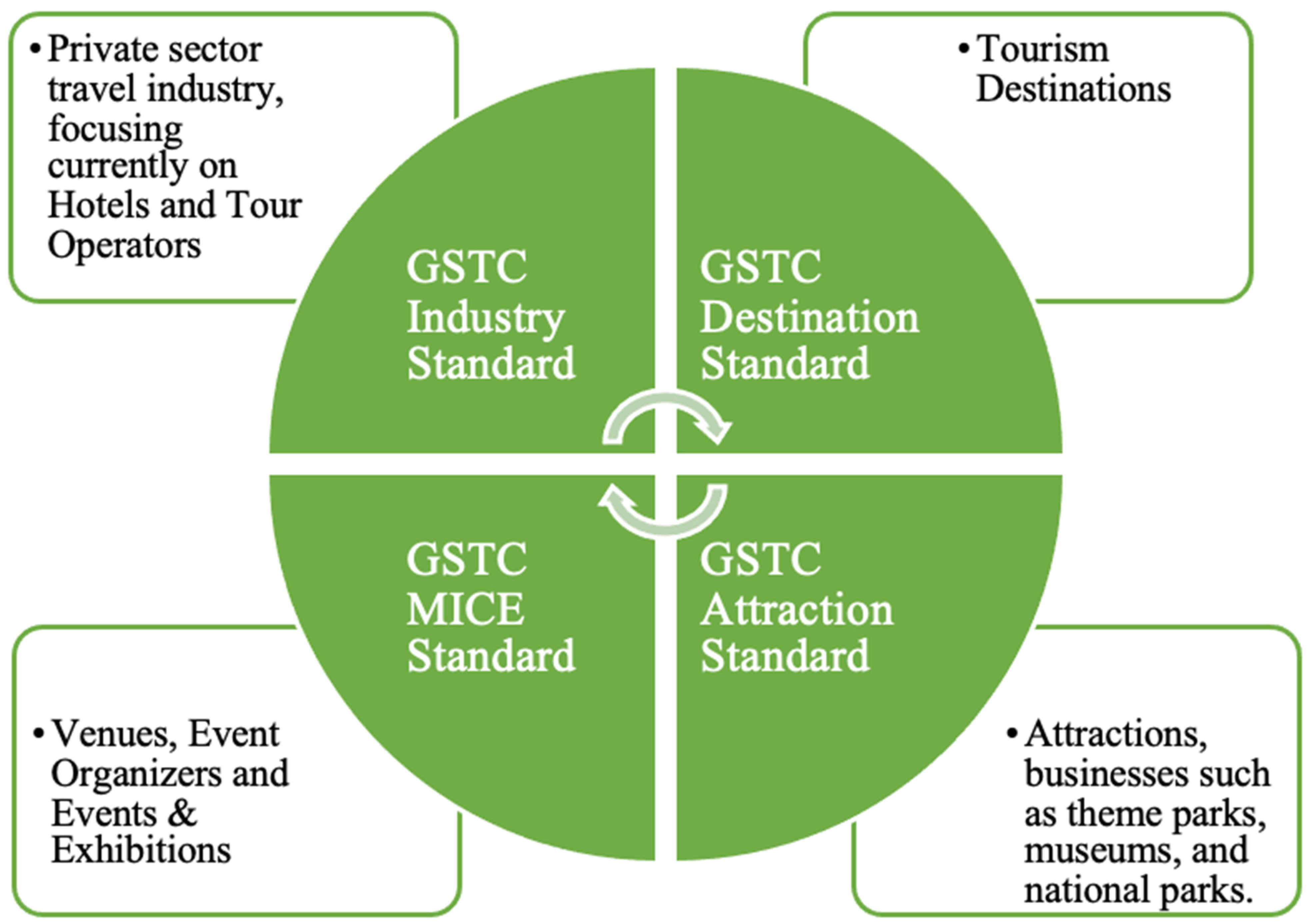
4.1. Level 1—The Foundational Layer: GSTC Standards as the Regulatory Core
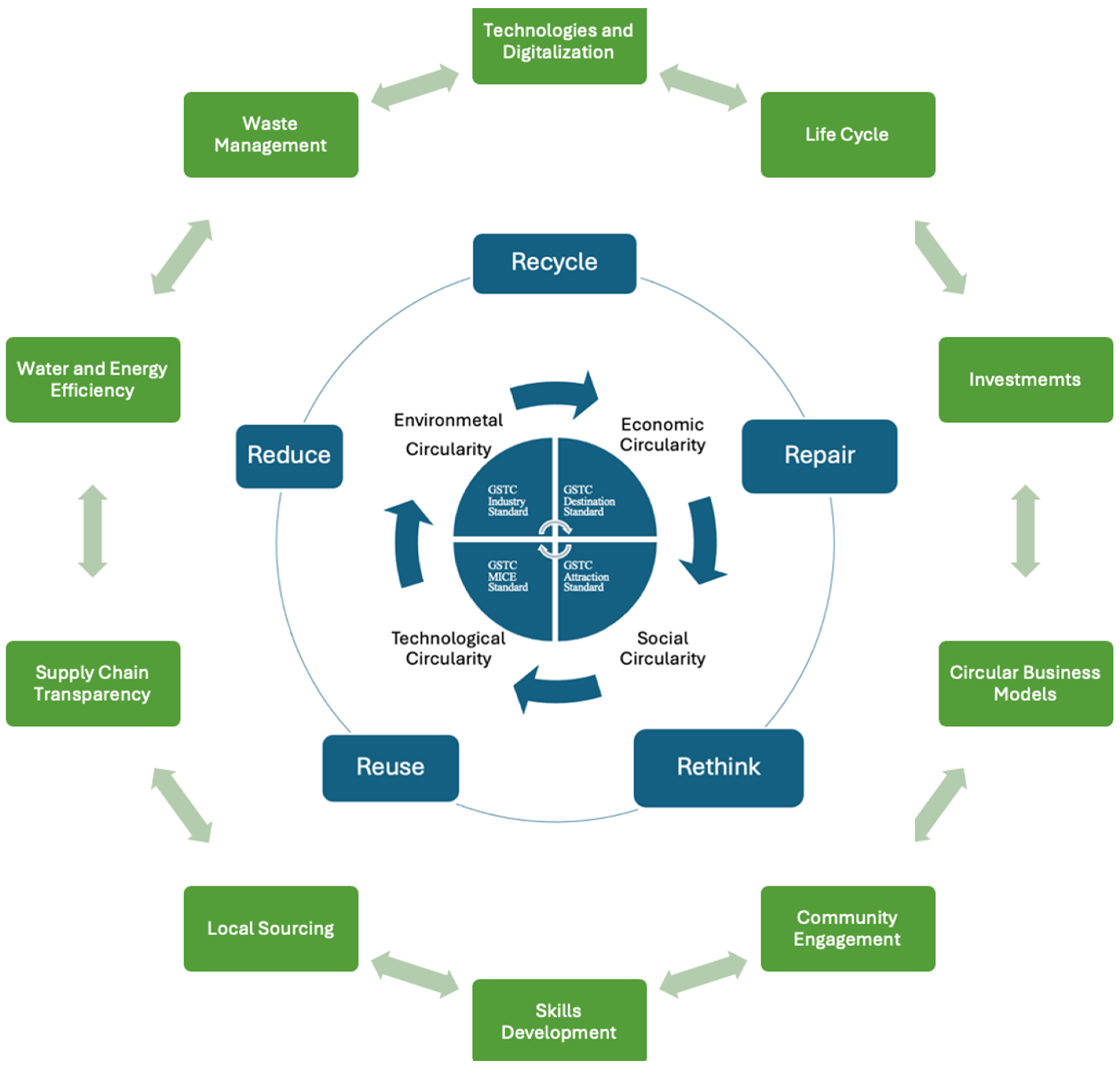
4.2. Level 2—The Strategic Layer: Multi-Dimensional Circularity
4.3. Level 3—The Operational Layer: Contextualizing Circular Economy Principles
4.4. Level 4—The Assessment Layer: Quantifying Performance via Indicators
5. Discussion
5.1. Barriers to Adopting Circularity Measurement in Tourism Businesses and Destinations
5.2. Practical Implementation and Data Requirements
5.3. Barriers and the Digital Catalyst
5.4. Limitations and Future Research Directions
6. Conclusions
Author Contributions
Funding
Institutional Review Board Statement
Informed Consent Statement
Data Availability Statement
Conflicts of Interest
Abbreviations
| GSTC | Global Sustainable Tourism Council |
| SDG | Sustainable Development Goal |
| CE | Circular Economy |
| EU | European Union |
| UNEP | United Nations Environment Programme |
| MICE | Meetings, Incentives, Conferences, Exhibitions |
| UNWTO | United Nations World Tourism Organization |
| ROI | Return on Investment |
| LCA | Life Cycle Assessment |
| MFA | Material Flow Analysis |
| GHG | Greenhouse Gas |
| AI | Artificial Intelligence |
| IoT | Internet of Things |
| SMEs | Small and Medium-Sized Enterprises |
| DMOs | Destinations management organizations |
References
- WTTC. WTTC and TRIP.COM Group Global Traveller Report Reveals Shift Towards Sustainable Travel. 2023. Available online: https://wttc.org/news/wttc-and-tripcom-group-global-traveller-report-reveals-shift-towards-sustainable-travel (accessed on 23 December 2025).
- UNDP. Tourism and the Sustainable Development Goals—Journey to 2030. Available online: http://www.e-unwto.org/doi/book/10.18111/9789284419401 (accessed on 4 December 2025).
- GSTC. GSTC Industry Criteria. Version 3 with Performance Indicators for Hotels and Accommodations and Corresponding SDGs. 2016. Available online: https://www.gstc.org/wp-content/uploads/GSTC-Industry-Criteria-for-Hotels-with-SDGs.pdf (accessed on 23 December 2025).
- GSTC. GSTC Destination Criteria. 2019. Available online: https://www.gstc.org/wp-content/uploads/GSTC-Destination-Criteria-v2.0.pdf (accessed on 20 December 2025).
- GSTC. GSTC Standards Overview. 2025. Available online: https://www.gstc.org/gstc-criteria/ (accessed on 20 December 2025).
- Ellen MacArthur Foundation. Towards a Circular Economy: Business Rationale for an Accelerated Transition. 2015. Available online: https://content.ellenmacarthurfoundation.org/m/4384c08da576329c/original/Towards-a-circular-economy-Business-rationale-for-an-accelerated-transition.pdf (accessed on 15 November 2025).
- Kirchherr, J.; Yang, N.-H.N.; Schulze-Spüntrup, F.; Heerink, M.J.; Hartley, K. Conceptualizing the circular economy (revisited): An analysis of 221 definitions. Resour. Conserv. Recycl. 2023, 194, 107001. [Google Scholar] [CrossRef]
- Dangi, T.; Petrick, J. Enhancing the role of tourism governance to improve collaborative participation, responsiveness, representation and inclusion for sustainable community-based tourism: A case study. Int. J. Tour. Cities 2021, 7, 1029–1048. [Google Scholar] [CrossRef]
- European Commission. New Circular Economy Action Plan—European Commission. 2020. Available online: https://ec.europa.eu/commission/presscorner/detail/en/ip_20_420 (accessed on 15 November 2025).
- OECD. The circular economy in cities and regions: Synthesis report. In OECD Urban Studies; OECD: Paris, France, 2020. [Google Scholar] [CrossRef]
- UNWTO. Addressing Plastic Pollution in Tourism Through Sustainable Procurement—Recommendations and Guidance; UNWTO: Madrid, Spain, 2022. [Google Scholar] [CrossRef]
- Moroz, M.; Labanauskaite, D. Circular economy principles at the sustainable tourism development: The actuality review. In Proceedings of the 15th International Scientific Conference “Business and Management 2025, Vilnius, Lithuania, 15–16 May 2025; VilniusTech: Vilnius, Lithuania, 2025. [Google Scholar] [CrossRef]
- Renfors, S.-M. Circular economy in tourism: Overview of recent developments in research. Matkailututkimus 2022, 18, 114834. [Google Scholar] [CrossRef]
- Strippoli, R.; Gallucci, T.; Ingrao, C. Circular economy and sustainable development in the tourism sector—An overview of the truly-effective strategies and related benefits. Heliyon 2024, 10, e36801. [Google Scholar] [CrossRef]
- Lestari, R.I.; Wachyuni, S.S.; Wardhana, I.W. Circular tourism: A “common good” perspective for creating inclusive and responsible economic sustainability. In Handbook of Sustainability in Tourism and Hospitality in Indonesia; Springer: Singapore, 2025; pp. 379–403. [Google Scholar] [CrossRef]
- Manniche, J.; Larsen, K.T.; Broegaard, R.B. The circular economy in tourism: Transition perspectives for business and research. Scand. J. Hosp. Tour. 2021, 21, 1921020. [Google Scholar] [CrossRef]
- Robaina, C.R.; Florido, C.; Jacob, M. Circular economy contributions to the tourism sector: A critical literature review. Sustainability 2020, 12, 4338. [Google Scholar] [CrossRef]
- Rodríguez-García, R. Analysis of integration of sustainability in sustainability certifications in the hotel industry. Front. Sustain. 2023, 4, 1116359. [Google Scholar] [CrossRef]
- Suhardono, S.; Phan, T.T.T.P.; Lee, C.-H.; Suryawan, W.K. Design strategies and willingness to pay for circular economy service policies in sustainable tourism. Environ. Chall. 2025, 18, 101081. [Google Scholar] [CrossRef]
- Valencia, M.; Bocken, N.; Loaiza, C.; Jaeger, S.D. The social contribution of the circular economy. J. Clean. Prod. 2023, 408, 137082. [Google Scholar] [CrossRef]
- Wu, C.S.; Tan, Z.S.; Lee, L.T.; Hoa, S.X. Corporate social responsibility in sustainable tourism development towards local culture. J. Sos. Sains Terap. Dan Ris. 2023, 11, 104–119. [Google Scholar] [CrossRef]
- Pearce, D.; Turner, R.K. Economics of Natural Resources and the Environment; Johns Hopkins University Press: Baltimore, MD, USA, 1990. [Google Scholar]
- Efeni, O.S.; Awa, E.; Mensah, H.; Gideon, D.N.-A.; Orukpe, G.O.; Bansimba, C.D. Digital transformation and circular economy integration: Pathways for sustainable business innovation. Ecol. Civiliz. 2025, 3, 10019. [Google Scholar] [CrossRef]
- Kaszás, N.; Keller, K.; Birkner, Z. Understanding circularity in tourism. Soc. Econ. 2022, 44, 65–82. [Google Scholar] [CrossRef]
- European Parliament. Circular Economy: Definition, Importance and Benefits. 2023. Available online: https://www.europarl.europa.eu/topics/en/article/20151201STO05603/circular-economy-definition-importance-and-benefits (accessed on 15 November 2025).
- UNEP. Building Circularity. Available online: https://www.unep.org/circularity (accessed on 10 December 2025).
- Economic Commission for Europe. Applying Principles of Circular Economy to Sustainable Tourism. The Ninth Environment for Europe Ministerial Conference: Substantive Thematic Documents. 2022. Available online: https://unece.org/sites/default/files/2022-05/CEP-SS_Sustainable_Tourism.IP_.03.e.pdf (accessed on 10 December 2025).
- Uvarova, I.; Atstaja, D.; Volkova, T.; Grasis, J.; Ozolina-Ozola, I. The typology of 60R circular economy principles and strategic orientation of their application in business. J. Clean. Prod. 2023, 409, 137189. [Google Scholar] [CrossRef]
- Fröhlich, E.; Steinbiß, K.; Schmiedeknecht, M.H.; Loza, A. The principle of reuse in circular economy: Trash is treasure. In Circular Economy in Sustainable Supply Chains; Springer: Cham, Switzerland, 2025; pp. 83–89. [Google Scholar] [CrossRef]
- Manniche, J.; Larsen, K.T.; Broegaard, R.B.; Holland, E. Destination: A circular tourism economy. In A Handbook for Transitioning Toward a Circular Economy Within; Centre for Regional and Tourism Research: Copenhagen, Denmark, 2017; Available online: https://circulareconomy.europa.eu/platform/sites/default/files/cirtoinno-handbook_eng-rev.-4.pdf (accessed on 13 December 2025).
- Ellen Macarthur Foundation. Reuse. Rethinking Packaging. 2019. Available online: https://content.ellenmacarthurfoundation.org/m/4363f6da65122068/original/Reuse-Rethinking-packaging.pdf (accessed on 22 December 2025).
- Godfrey, D.M.; Price, L.L.; Lusch, R.F. Repair, consumption, and sustainability: Fixing fragile objects and maintaining consumer practices. J. Consum. Res. 2021, 49, ucab067. [Google Scholar] [CrossRef]
- Scrucca, F.; Barberio, G.; Fantin, V.; Porta, P.L. Carbon footprint: Concept, methodology and calculation. In Carbon Footprint Case Studies; Springer: Singapore, 2021; pp. 1–31. [Google Scholar] [CrossRef]
- Šajn, N. Consumers and Repair of Products. European Parliamentary Research Service. 2019. Available online: https://www.europarl.europa.eu/RegData/etudes/BRIE/2019/640158/EPRS_BRI(2019)640158_EN.pdf (accessed on 15 November 2025).
- Eelager, M.P.; Dalbanjan, N.P.; Madihalli, S.; Madar, M.; Agadi, N.P.; Korganokar, K.; Kiran, B.K. Pathways to a sustainable future: Exploring the synergy between sustainability and circular economy. Sustain. Futures 2025, 10, 101208. [Google Scholar] [CrossRef]
- Papallou, E.; Katafygiotou, M.; Dimopoulos, T. Emerging sustainability trends in tourist facilities: A comparative assessment of multiple hotels and resorts. Sustainability 2024, 16, 3536. [Google Scholar] [CrossRef]
- Ramirez, A.; George, B. Plastic recycling and waste reduction in the hospitality industry: Current challenges and some potential solutions. Econ. Manag. Sustain. 2019, 4, 6–20. [Google Scholar] [CrossRef]
- Antikainen, R.; Baudry, R.; Gössnitzer, A.; Karppinen, T.K.M.; Kishna, M.; Montevecchi, F.; Müller, F.; Pinet, C.; Uggla, R. Circular Business Models: Product-Service Systems on the Way to a Circular Economy. EPA Network. 2021. Available online: https://www.researchgate.net/publication/366863656_Circular_business_models_Product-service_systems_on_the_way_to_a_circular_economy (accessed on 12 December 2025).
- Rosário, A.T.; Lopes, P.; Rosário, F.S. Sustainability and the circular economy business development. Sustainability 2024, 16, 6092. [Google Scholar] [CrossRef]
- Climate Action. The Future Is Circular: Rethinking Resources for a Sustainable Economy. 2025. Available online: https://www.climateaction.org/news/the-future-is-circular-rethinking-resources-for-a-sustainable-economy (accessed on 12 December 2025).
- Mamash, A.; Iyiola, K.; Aljuhmani, H.Y. The role of circular economy entrepreneurship, cleaner production, and green government subsidy for achieving sustainability goals in business performance. Sustainability 2025, 17, 3990. [Google Scholar] [CrossRef]
- Muslim, M.; Pelu, M.F.A. Corporate social responsibility: Best practices and industry comparisons. J. Bus. Manag. Res. 2023, 6, 27–42. [Google Scholar] [CrossRef]
- Schmiedeknecht, M.H. The principle of rethink in circular economy: Redefining business solutions. In Circular Economy in Sustainable Supply Chains; Springer: Cham, Switzerland, 2025; pp. 61–68. [Google Scholar] [CrossRef]
- Setyadi, A.; Pawirosumarto, S.; Damaris, A. Toward a resilient and sustainable supply chain: Operational responses to global disruptions in the post-COVID-19 era. Sustainability 2025, 17, 6167. [Google Scholar] [CrossRef]
- Papečkys, S.; Jasinskas, E. Tourism destination sustainability: The systematic literature review. Smart Tour. 2024, 5, 2484. [Google Scholar] [CrossRef]
- Shin, H.; Jo, Y.; Lee, S.; Park, J.; Cho, J.; Kim, H. ESG for sustainability in hospitality and tourism: A theoretical and practical review with a future research agenda. J. Travel Res. 2025, 65, 3–36. [Google Scholar] [CrossRef]
- Wani, M.J.G.; Loganathan, N.; Mujallim, A. The impact of sustainable development goals (SDGs) on tourism growth. Empirical evidence from G-7 countries. Cogent Soc. Sci. 2024, 10, 2397535. [Google Scholar] [CrossRef]
- Muscal, D.; Vranceanu, M.O.; Nastase, C. The circular economy and the role of stakeholders in the sustainability of tourism in Romania. Balk. J. Emerg. Trends Soc. Sci. 2025, 8, 29–39. [Google Scholar] [CrossRef]
- Bosone, M.; Nocca, F. Human circular tourism as the tourism of tomorrow: The role of travelers in achieving a more sustainable and circular tourism. Sustainability 2022, 14, 2218. [Google Scholar] [CrossRef]
- Sorin, F.; Einarsson, S. A Conceptual Framework for a Sustainable, Resilient and Future Proof Industry Transition. European Circular Economy in Travel and Tourism. 2020. Available online: https://circulareconomy.europa.eu/platform/sites/default/files/circular-economy-in-travel-and-tourism.pdf (accessed on 12 December 2025).
- Bennett, P. Survey of Travelers Finds 76% Want More Sustainable Options. World Economic Forum 2023. Available online: https://www.weforum.org/stories/2023/04/survey-of-travelers-finds-76-want-more-sustainable-options/ (accessed on 12 December 2025).
- Cabrera, J.M.; López-del-Pino, F. The 10 most crucial circular economy challenge patterns in tourism and the effects of COVID-19. Sustainability 2021, 13, 4940. [Google Scholar] [CrossRef]
- Carvalho, P.T.; Raimundo, R.J.; Lopes, J.D. Improving guest and owner satisfaction through a circular economy: An agritourism case study. Tour. Hosp. 2024, 5, 51. [Google Scholar] [CrossRef]
- Axhami, M.; Ndou, V.; Milo, V.; Scorrano, P. Creating value via the circular economy: Practices in the tourism sector. Adm. Sci. 2023, 13, 166. [Google Scholar] [CrossRef]
- Falsafi, A.; Togiani, A.; Colley, A.; Varis, J.; Horttanainen, M. Life cycle assessment in circular design process: A systematic literature review. J. Clean. Prod. 2025, 521, 146188. [Google Scholar] [CrossRef]
- Erol, I.; Neuhofer, I.O.; Dogru, T.; Oztel, A.; Searcy, C.; Yorulmaz, A.C. Improving sustainability in the tourism industry through blockchain technology: Challenges and opportunities. Tour. Manag. 2022, 93, 104628. [Google Scholar] [CrossRef]
- Zhang, Y.; Deng, B. Exploring the nexus of smart technologies and sustainable ecotourism: A systematic review. Heliyon 2024, 10, e31996. [Google Scholar] [CrossRef] [PubMed]
- Tuboalabo, A.; Buinwo, U.; Okatta, C.G.; Johnson, E.; Buinwi, J.A. Circular economy integration in traditional business models: Strategies and outcomes. Financ. Account. Res. J. 2024, 6, 1105–1123. [Google Scholar] [CrossRef]
- Sustainability Economics. The Circular Economy Transition: Why Businesses Can’t Afford to Stay Linear. 2025. Available online: https://www.sustainabilityeconomics.net/blogs/the-circular-economy-transition-why-businesses-cant-afford-to-stay-linear (accessed on 15 December 2025).
- Trevisan, A.H.; Lobo, A.; Guzzo, D.; de Vasconcelos Gomes, L.A.; Mascarenhas, J. Barriers to employing digital technologies for a circular economy: A multi-level perspective. J. Environ. Manag. 2023, 332, 117437. [Google Scholar] [CrossRef] [PubMed]
- Candeloro, G.; Tartari, M. Heritage-led sustainable development in rural areas: The case of Vivi Calascio community-based cooperative. Cities 2025, 161, 105920. [Google Scholar] [CrossRef]
- Godovykh, M.; Fyall, A.; Pizam, A. Exploring the impacts of tourism on the well-being of local communities. Sustainability 2025, 17, 5849. [Google Scholar] [CrossRef]
- Khan, I.A.; Haq, F.; Kiran, M.; Aziz, T. Circular economy and waste management: Transforming waste into resources for a sustainable future. Int. J. Environ. Sci. Technol. 2025, 22, 17327–17346. [Google Scholar] [CrossRef]
- Lijun, L.; Ahmed, E.M. The role of local communities in sustainable tourism development. Int. J. Manag. Sci. 2024, 3, 1–17. Available online: https://www.researchgate.net/publication/386292289_THE_ROLE_OF_LOCAL_COMMUNITIES_IN_SUSTAINABLE_TOURISM_DEVELOPMENT (accessed on 23 December 2025).
- Dionizi, B.; Kercini, D. Sustainable Business Models in Agritourism: An opportunity for Achieving SDGS and Circular Economy. J. Lifestyle SDGs Rev. 2025, 5, pe03957. [Google Scholar] [CrossRef]
- Rajčić, V.; Lin, Y.-H.; Laban, M.; Tsikaloudaki, K. Cultural and societal challenges for circular strategies implementation. Sustainability 2025, 17, 220. [Google Scholar] [CrossRef]
- Sharma, V.; Bumra, C.; Vats, V. Circular economy in tourism industry: A sustainable approach. In Advancing Sustainable Development Goals with Educational Technology; IGI Global Scientific Publishing: Hershey, PA, USA, 2024. [Google Scholar] [CrossRef]
- Li, L. The role of circular economy in achieving sustainable development goals: Evidence from E7 countries. Technol. Econ. Dev. Econ. 2025, 31, 23329. [Google Scholar] [CrossRef]
- Baloch, Q.B.; Shah, S.N.; Iqbal, N.; Sheeraz, M.; Asadullah, M.; Mahar, S.; Kjan, A.U. Impact of tourism development upon environmental sustainability: A suggested framework for sustainable ecotourism. Environ. Sci. Pollut. Res. 2022, 30, 5917–5930. [Google Scholar] [CrossRef]
- Đurić, Z.; Cvijanović, D.; Petek, V.; Topler, J.P. Sustainability struggle: Challenges and issues in managing sustainability and environmental protection in local tourism destinations practices—An overview. Sustainability 2025, 17, 7134. [Google Scholar] [CrossRef]
- Kuščer, K.; Peters, M.; Schönherr, S. Tourism policymaking in troubling times: Sustainability-driven challenges, implemented policies, and goals for sustainable development. Sustainability 2024, 16, 599. [Google Scholar] [CrossRef]
- European Commission. Life Cycle Assessment & the EF Methods Comprehensive Coverage of Impacts. Available online: https://green-forum.ec.europa.eu/green-business/environmental-footprint-methods/life-cycle-assessment-ef-methods_en (accessed on 2 January 2026).
- Myers, R.J.; Mason, A.R.; Wang, J.; Yayla, A.; Bide, T.; Petavratzi, E.; Hopkinson, P.; Lysaght, O.; Zils, M.; Calzadilla, A.; et al. Material Flow Analysis: Insights and Evidence from the NICER Programme. CE-Hub. 2025. Available online: https://ce-hub.org/wp-content/uploads/2025/01/2024BS022-–-NICER-Programme-Insight-Report-MFA-final.pdf (accessed on 2 January 2026).
- A Guide for Carbon Footprint Assessment (Initial Document to Understand Carbon Footprint Assessment). The Climate Change Secretariat Ministry of Mahaweli Development and Environment. 2016. Available online: https://www.climatechange.lk/Documents/A_Guide_for_Carbon_Footprint_Assessment.pdf (accessed on 16 December 2025).
- Antonova, N.; Ruiz-Rosa, I.; Mendoza-Jimenez, J. Water resource management in hotels using a sustainable balanced scorecard. Sustainability 2022, 14, 8171. [Google Scholar] [CrossRef]
- Hoekstra, A.Y.; Chapagain, A.K.; Aldaya, M.M.; Mekonnen, M.M. The water footprint assessment manual setting the global standard. Earthscan. 2011. Available online: https://www.waterfootprint.org/resources/TheWaterFootprintAssessmentManual_English.pdf (accessed on 2 January 2026).
- Herrero, C.C.; Laso, J.; Cristóbal, J.; Fullana-i-Palmer, P.; Albertí, J.; Fullana, M.; Herrero, A.; Margallo, M.; Aldaco, R. Tourism under a life cycle thinking approach: A review of perspectives and new challenges for the tourism sector in the last decades. Sci. Total Environ. 2022, 845, 157261. [Google Scholar] [CrossRef]
- Kachook, O. Guidance for Reusable Packaging. Understanding Goals and Assumptions in Order to Design a More Successful Reusable Packaging Program. Sustainable Packaging Coalition. 2022. Available online: https://sustainablepackaging.org/wp-content/uploads/2022/04/Guidance-for-Reusable-Packaging.pdf (accessed on 12 December 2025).
- Meegle. Material Flow Analysis. 2025. Available online: https://www.meegle.com/en_us/topics/circular-economy-modeling/material-flow-analysis (accessed on 30 November 2025).
- Moriguchi, Y.; Hashimoto, S. Material Flow Analysis and Waste Management. In Taking Stock of Industrial Ecology; Springer: Cham, Switzerland, 2016; pp. 247–262. [Google Scholar] [CrossRef]
- ISO. Carbon Footprint: Measuring and Reducing Our Environmental Impact. Available online: https://www.iso.org/renewable-energy/carbon-footprint (accessed on 3 December 2025).
- Laurent, A.; Olsen, S.I.; Hauschild, M.Z. Carbon footprint as environmental performance indicator for the manufacturing industry. CIRP Ann. 2010, 59, 37–40. [Google Scholar] [CrossRef]
- Life Cycle Initiative. Carbon Footprint. 2023. Available online: https://www.lifecycleinitiative.org/starting-life-cycle-thinking/life-cycle-approaches/carbon-footprint/ (accessed on 29 November 2025).
- Sala, S.; Bianchi, A.; Bligny, J.-C.; Bouraoui, F.; Castellani, V.; de Camillis, C.; Mubareka, S.; Vandecasteele, I.; Wolf, M.-A. Water Footprint in the Context of Sustainability Assessment; European Commission: Brussels, Belgium, 2023. [Google Scholar] [CrossRef]
- EarthCheck. About EarthCheck. Available online: https://earthcheck.org/about/ (accessed on 16 December 2025).
- Travelife. The Travelife Certification Requirements. Available online: https://travelifestaybetter.com (accessed on 10 December 2025).
- FEE. What is Blue Flag? 2022. Available online: https://static1.squarespace.com/static/55371ebde4b0e49a1e2ee9f6/t/63592f9cdeb2fd4420f17e7f/1755596953379/BF+and+SDGs+-+2022.pdf (accessed on 2 December 2025).
- Fair Trade Tourism Standard. Available online: https://www.fairtradetourism.org/public/assets/pdfs/FTTStandardPublic_Sep25.pdf (accessed on 1 December 2025).
- Biosphere. Discover the Biosphere Certification and Why It Is Unique. Available online: https://www.biospheretourism.com/en/a-global-recognition-for-your-sustainable-commitment/83 (accessed on 27 December 2025).
- Green Globe. Green Globe International Standard for Sustainable Tourism. Available online: https://www.greenglobe.com/criteria-indicators (accessed on 2 December 2025).
- Liu, Q.; Trevisan, A.H.; Yang, M.; Mascarenhas, J. A framework of digital technologies for the circular economy: Digital functions and mechanisms. Bus. Strategy Environ. 2022, 31, 2171–2192. [Google Scholar] [CrossRef]
- Averina, E.; Frishammar, J.; Parida, V. Assessing sustainability opportunities for circular business models. Bus. Strategy Environ. 2021, 31, 1464–1487. [Google Scholar] [CrossRef]
- Ferrer-Serrano, M.; Salesa, A. Revisiting the circular economy paradox: A Triple Bottom Line perspective. Sustain. Dev. 2025, 33, 7526–7545. [Google Scholar] [CrossRef]
- Li, Q.; Saelens, D.; Kayaçetin, N.C.; Aslano, R.; van Hoof, J.; Piccardo, C. A systematic literature review on circularity assessment indicators and frameworks in the built environment. Sustain. Prod. Consum. 2025, 58, 412–431. [Google Scholar] [CrossRef]
- Govalkar, A.B.; Rao, R. Energy efficiency, water conservation and waste management. In Habitats: Holistic Approaches to Building, Interiors and Technical Systems; Noble Science Press: Palm Coast, FL, USA, 2024. [Google Scholar] [CrossRef]
- OECD. The Circular Economy in Cities and Regions of the European Union. In OECD Urban Studies; OECD: Paris, France, 2025. [Google Scholar] [CrossRef]
- Ziegler, R.; Bauwens, T.; Roy, M.J.; Teasdale, S. Embedding circularity: Theorizing the social economy, its potential, and its challenges. Ecol. Econ. 2023, 214, 107970. [Google Scholar] [CrossRef]
- Laureti, L.; Costantiello, A.; Anobile, F.; Leogrande, A.; Magazzino, C. Waste management and innovation: Insights from Europe. Recycling 2024, 9, 82. [Google Scholar] [CrossRef]
- Styles, D.; Schönberger, H.; Galvez Martos, J.L. Best Environmental Management Practice in the Tourism Sector: Minimizing Energy Use in Tourist Accommodation; European Union: Brussels, Belgium, 2017. [Google Scholar] [CrossRef]
- UNEP FI. Financing Circularity: Demystifying Finance for Circular Economies. Available online: https://circulareconomy.europa.eu/platform/sites/default/files/2023-08/FinCir.pdf (accessed on 4 December 2025).
- Abubakar, A.K.; Gillam, L.; Sastry, N. The role of the Internet of Things (IoT) in achieving the United Nations (UN) Sustainable Development Goals (SDGs)—A systematic review. ACM Comput. Surv. 2025, 58, 3765516. [Google Scholar] [CrossRef]
- Chauhan, C.; Parida, V.; Dhir, A. Linking circular economy and digitalization technologies: A systematic literature review of past achievements and future promises. Technol. Forecast. Soc. Change 2022, 177, 121508. [Google Scholar] [CrossRef]
- Sousa, A.E.; Cardoso, P.; Dias, F. The use of Artificial Intelligence systems in tourism and hospitality: The tourists’ perspective. Adm. Sci. 2024, 14, 165. [Google Scholar] [CrossRef]
- Stroumpoulis, A.; Kopanaki, E.; Varelas, S. Role of artificial intelligence and big data analytics in smart tourism: A resource-based view approach. WIT Trans. Ecol. Environ. 2022, 256, 99–108. [Google Scholar] [CrossRef]
- Chauhan, N. Empowering communities and preserving heritage: Case studies on socially responsible travel through fair trade tourism. In Meaningful Tourism: Strategies and Future Development; Emerald Publishing: Leeds, UK, 2025. [Google Scholar] [CrossRef]
- Bandeira, G.L.; Marcos Ferasso, M.; Tortato, U. Circular economy maturity framework for SMEs. Resour. Conserv. Recycl. Adv. 2025, 27, 200275. [Google Scholar] [CrossRef]
- Puig-Denia, A.; Fernández-Yáñez, J.M.; Forés, B. Circular economy in the tourism sector from a family business perspective: The case of Iberostar. Sustain. Futures 2025, 9, 100617. [Google Scholar] [CrossRef]
- Adebayo, Y.; Ikevuje, A.H.U.; Mensah, J.K. Balancing stakeholder interests in sustainable project management: A circular economy approach. GSC Adv. Res. Rev. 2024, 20, 286–297. [Google Scholar] [CrossRef]
- Gonçalves, B.d.S.M.; de Carvalho, F.L.; Fiorini, P.d.C. Circular economy and financial aspects: A systematic review of the literature. Sustainability 2022, 14, 3023. [Google Scholar] [CrossRef]
- Hina, M.; Chauhan, C.; Kaur, P.; Kraus, S.; Dhir, A. Drivers and barriers of circular economy business models: Where we are now, and where we are heading. J. Clean. Prod. 2022, 333, 130049. [Google Scholar] [CrossRef]
- Technopolis Group; Fraunhofer ISI; Thinkstep; Wuppertal Institute. Regulatory Barriers for the Circular Economy. Available online: https://circulareconomy.europa.eu/platform/sites/default/files/2288_160713_regulary_barriers_for_the_circular_economy_accepted_hires_1.compressed.pdf (accessed on 15 December 2015).
- Astanakulov, O.; Balbaa, M.E.; Muslimakhov, S.; Khayitov, K. IoT innovations for transforming the future of tourism industry: Towards smart tourism systems. J. Intell. Syst. Internet Things 2024, 14, 140213. [Google Scholar] [CrossRef]
- Marasco, A.; Martino, M.D.; Magnotti, F.; Morvillo, A. Collaborative innovation in tourism and hospitality: A systematic review of the literature. Int. J. Contemp. Hosp. Manag. 2018, 30, 2364–2395. [Google Scholar] [CrossRef]



| Methodology | Measures: |
|---|---|
| LCA | Inputs (energy, materials) and outputs (emissions, waste) at each stage [72]. |
| MFA | Flows and stocks of materials within a defined system over time [73]. |
| Carbon Footprint Assessment | The total greenhouse gas (GHG) emissions caused directly and indirectly by an individual, organization, event, or product; emissions in terms of carbon dioxide equivalents (CO2e) [33,74]. |
| Water Footprint Assessment | The total volume of freshwater used to produce the goods and services consumed by an individual or community or produced by a business [75,76]. |
| Indicator | Measures: |
|---|---|
| Pillar 1: Environmental Impact & Resource Flow | |
| Life Cycle Assessment | Quantifies the environmental burden at every stage of the service life cycle. |
| Water & Energy Efficiency | Measures the reduction in consumption per guest night or service provided [95]. |
| Waste Management | Tracks the volume of waste diverted from landfills through recycling and composting [37,63,99]. |
| Pillar 2: Strategic Innovation & Digitalization | |
| Circular Business Models | Tracks the adoption of sharing-economy platform of “Product-as-a-Service” models [38,39]. |
| Investment in Circularity | Measures the financial resources allocated to CE [100]. |
| Technologies & Digitalization | Monitors the use of IoT, AI or smart sensors to optimize resource [38,50,101,102,103,104]. |
| Pillar 3: Socio-Economic Values and Equity | |
| Community Engagement | Evaluates the quality of local involvement in decision-making and benefit-sharing. |
| Skill Development | Measures the training provided to equipe employees and locals for circular tasks. |
| Local Sourcing | Tracks the proportion of goods/services procured from the local economy [14]. |
| Pillar 4: Supply Chain Integrity & Management | |
| Supply Chain Transparency | Assesses the extent to which the origin and impact of products are known and communicated. |
Disclaimer/Publisher’s Note: The statements, opinions and data contained in all publications are solely those of the individual author(s) and contributor(s) and not of MDPI and/or the editor(s). MDPI and/or the editor(s) disclaim responsibility for any injury to people or property resulting from any ideas, methods, instructions or products referred to in the content. |
© 2026 by the authors. Licensee MDPI, Basel, Switzerland. This article is an open access article distributed under the terms and conditions of the Creative Commons Attribution (CC BY) license.
Share and Cite
Moroz, M.; Labanauskaitė, D. Developing a Framework for Measuring Circularity in Sustainable Tourism: A GSTC-Aligned Approach. Sustainability 2026, 18, 2376. https://doi.org/10.3390/su18052376
Moroz M, Labanauskaitė D. Developing a Framework for Measuring Circularity in Sustainable Tourism: A GSTC-Aligned Approach. Sustainability. 2026; 18(5):2376. https://doi.org/10.3390/su18052376
Chicago/Turabian StyleMoroz, Maryna, and Daiva Labanauskaitė. 2026. "Developing a Framework for Measuring Circularity in Sustainable Tourism: A GSTC-Aligned Approach" Sustainability 18, no. 5: 2376. https://doi.org/10.3390/su18052376
APA StyleMoroz, M., & Labanauskaitė, D. (2026). Developing a Framework for Measuring Circularity in Sustainable Tourism: A GSTC-Aligned Approach. Sustainability, 18(5), 2376. https://doi.org/10.3390/su18052376