1. Introduction
The world has seen major changes in its financial structures due to the rapid adoption of AI and FinTech. Nowadays, all digital technologies, such as AI, depend on payment management, finance, adjustments, risk forecasting, and economic decision-making. By applying MEA, local financial institutions in both advanced and emerging economies enhanced operational efficiency, reduced transaction costs, improved the quality of financial services, and expanded financial inclusion through blockchain and cloud computing [
1,
2].
Digital technologies have transcended the traditional limits of fiscal space and permeated the everyday conduct of monetary policy across the G7 economies (the United States, Canada, Japan, Germany, France, Italy, and the United Kingdom). The increasing popularity of FinTech and artificial intelligence has changed the way central banks manage monetary policy transmission, as highlighted by the development of real-time payment systems, improvements in the measurement of inflation and economic activity, and an enhanced ability to monitor key systemic risks in real time [
3].
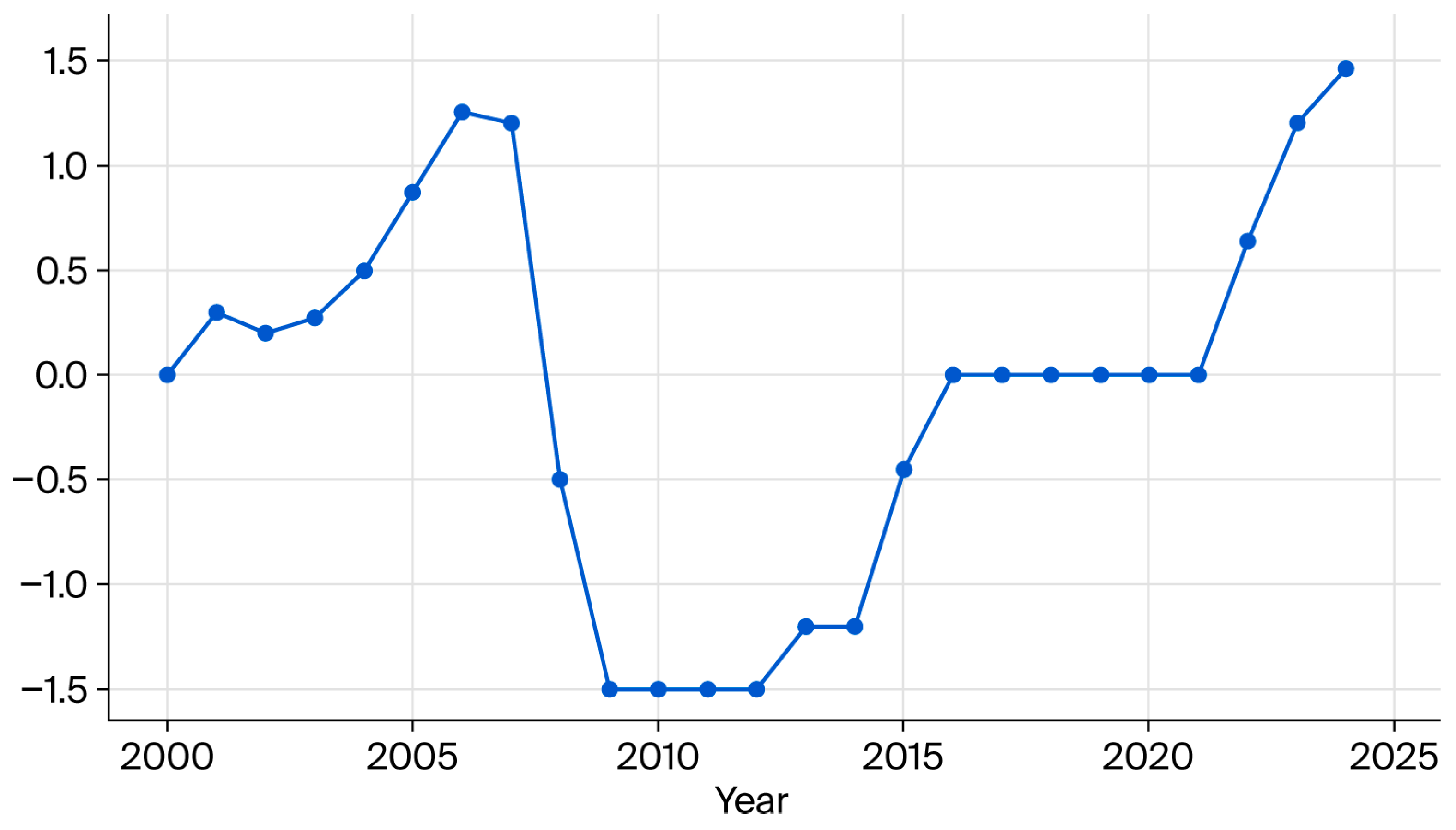
The G7 monetary policy index for 2000–2024, as shown in the graph below, presents a relatively periodic pattern. Central banks endeavor to resist disturbances to maintain a stable, low-inflation environment, and empirical evidence indicates that the index reflects this behavior. The indicator was expected to rise steadily before the financial crisis. Then, inflationary pressure occurred between 2003 and 2007. During the financial crisis, a major recession from 2008 to 2009 led to a sharp decline in the index. This was followed by a prolonged recession from 2010 to 2015, after which the indicator stabilized. From 2016 to 2019, the index entered a period of gradual policy normalization amid an improved economic environment (
Figure 1).
The G7 economies are the global economy’s dynamic center, accounting for a significant share of world GDP, international trade, and cross-border capital flows. Since the mid-20th century, they have spearheaded technological and innovative progress worldwide [
4,
5]. In the past two decades, even amid the rise of new economic forces, the G7 economies have continued to serve as a key reference point for examining the real economy, monetary policy, and technological change [
6,
7].
The real economy indicator reflects actual increases in domestic output, industrial output, output per worker, employment, and the unemployment rate, among others. Moreover, it considers the development of economic asset prices in terms of financial integrity and resilience to shocks [
8,
9]. This indicator reflects the performance of G7 economies over the period 2000–2024, which was marked by major developments: the rise of the communication and IT revolution; the shock of the global financial crisis of 2008 and the monetary policies that followed; the sovereign debt crisis in the eurozone; the COVID-19 pandemic; and the global inflation wave of 2021–2023 linked to supply chain bottlenecks and geopolitical disorders [
10,
11,
12,
13].
The rapid development of three interconnected areas, AI, FinTech, and technology, is prompting a reconsideration of the traditional monetary model based on inflation targeting through interest rates and monetary easing or tightening. A broader model is needed that accounts for new channels of monetary policy transmission and their effects on the real economy [
14,
15].
From 2000 to 2024, AI techniques have evolved, adopting qualitatively new approaches such as classic machine learning, deep learning, and large language models and applications, which have been widely used across various fields. Although the G7 economies began adopting AI at different speeds, its impact is clearly visible in their productivity, labor markets, and sectoral structures [
16,
17].
In developed economies, one central bank uses AI to enhance economic forecasting, another to analyze subject-specific texts, and yet another to enhance its supervision of systemic risks. Simply put, AI is not an input in the process. Several reports from central banks in advanced economies, such as the European Central Bank (ECB) and the Bank for International Settlements (BIS), have indicated the use of AI models to improve inflation and economic activity forecasts and to analyze large datasets in real time to better understand the dynamics of the real economy [
18].
These developments indicate that AI affects the real economy in two ways. First, major economic sectors are being transformed by manufacturing technology, becoming more powerful and efficient. Second, economic authorities, as policymakers, closely analyze real economy indicators to make highly precise monetary decisions. Incorporating AI into the G7’s money model analysis and economy performance index is essential for gaining insights into how to redesign the channels of monetary policy transmission in an intelligent digital economy [
19].
The financial technology industry focuses on integrating new technologies into the financial services sector, which offers a range of products. Various new-economy models include platforms such as electronic wallets, digital payments, peer-to-peer lending, and cryptocurrencies. FinTech can be described as a new revolution in how banking systems operate [
20].
There are notable trends in FinTech across G7 economies. First, payment cards, e-wallets, and smartphone payment solutions have grown rapidly, while cash usage has declined relatively in the G7 countries [
21]. Second, alternative funding platforms such as crowdfunding have challenged banks’ monopolistic financial intermediation to a limited extent. Third, the rise of encrypted assets and stablecoins has sparked widespread debate about the future of sovereign currencies and the security and stability of the monetary and financial system.
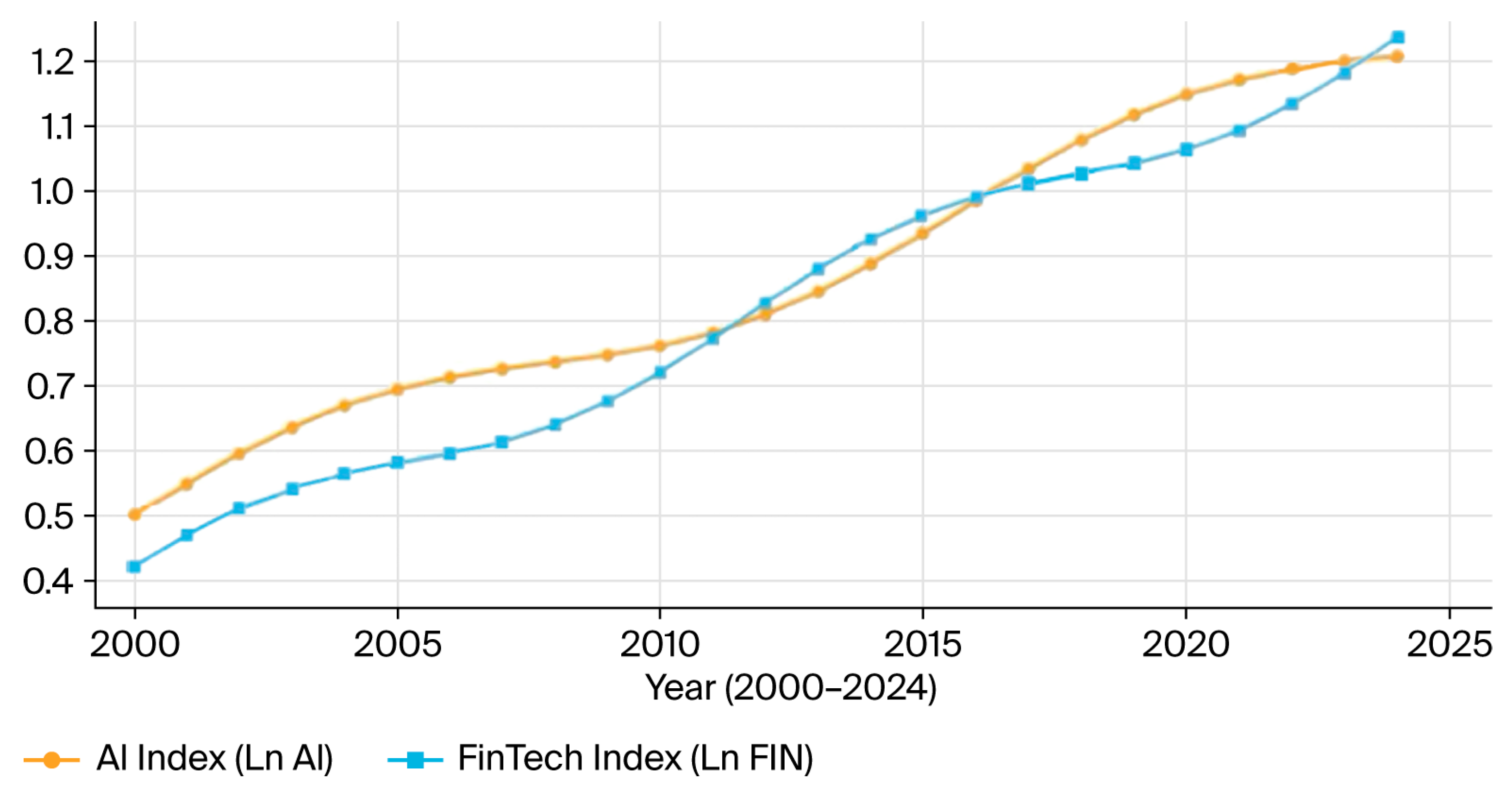
Figure 2 shows a simultaneous, rapid rise in both the AII index (Ln AI) and the Financial Technology Index (Ln FIN) in G7 countries from 2000 to 2024, reflecting a transition from traditional digital structures to advanced AI-based systems and financial innovation. In phase I (2000–2008), AI growth exceeded FinTech growth, driven by then-concentrated R&D investment and the expansion of computer infrastructure. During the global financial crisis (2008–2012), FinTech accelerated its growth due to rising demand for more efficient, transparent digital financial systems, while AI is gradually expanding as a tool for data analysis and risk management.
During the digital decade (2013–2019), the two series were closely aligned. The widespread adoption of smartphones and payment platforms has enhanced the role of FinTech, while AI techniques have become a fundamental part of financial institutions’ operational structures, from credit assessment to fraud control. In contrast, the period from 2015 to 2019 was relatively stable, with economic growth accompanied by technological upgrades. The charts reflect these levelling trends.
The convergent timing between the two indicators indicates a complementary, structural relationship between AI and financial technology in the G7 countries. AI represents analytical capacity and algorithms, while financial technology represents the applied channel that translates innovation into low-cost, highly efficient, realistic services.
Figure 2 also shows that technological development in G7 countries does not occur separately between AI and FinTech, but rather as a coherent system driven by data and algorithms and supported by a digital financial architecture. This implies that future policy formulation should adopt an integrative approach, recognizing that digital economic growth depends on the cumulative interaction between smart capabilities and financial technologies.
As the digital transformation and widespread adoption of financial technology has accelerated, it has become clear that digitalization has affected monetary policy transmission channels by changing the structure of markets and sectors, increasing the availability of big data, improving forecasting models, adjusting the relationship between inflation and economic activity through digital pricing channels and rivalry across platforms, and reconfiguring the demand for cash and traditional bank deposits [
22,
23,
24,
25].
Furthermore, some recent studies have proposed new monetary frameworks that use AI directly to design monetary policy rules, such as models that link monetary policy to real growth and credit using advanced machine learning algorithms. This enables more flexible and resilient rules than traditional rules, while also allowing the inclusion of issues such as digital and foreign currencies within the same framework [
26,
27].
In parallel, discussions among international forums and high-level G7 working groups on the economic and financial implications of AI and its impact on productivity, labor markets, and financial and monetary stability underscore the need to modernize monetary policy models. These models should use AI as an analytical and communication tool while considering ethical and regulatory risks [
28]. The development of this monetary knowledge means that the monetary model of advanced economies is being dynamically shaped by the continually evolving triad of the real economy, AI, and FinTech [
26].
Against this background, the economy performance index, AI-FinTech, and monetary models exhibited a multidirectional, interactive overlap in G7 countries from 2000 to 2024. It is therefore necessary to develop an analytical system for the real economy: an AI- and FinTech-integrated monetary model for the Indian economy, in collaboration with the G7 economies, which are leading this reform globally [
29,
30].
The impact of AI on growth, unemployment, and productivity has been investigated without considering how monetary policy interacts with these technical shifts. Similarly, analyses of financial technology and digital currencies from the perspectives of economic stability and inclusion lack a systematic connection to the real economy or indicators of growth and productivity within an integrated monetary model [
31]. Studies on digitalization and monetary policy have examined the impact of digital channels on monetary policy, but they have not explicitly incorporated artificial intelligence, financial technology, or variables into a single model that reflects the realities of the G7 economies from 2000 to 2024.
The importance of the proposed study is that it aims to develop an analytical/economic model that integrates real economy indices, artificial intelligence, financial technology, and monetary policy across G7 economies from 2000 to 2024. This approach enables the following: (1) dynamic analysis of the relationship between real growth and AI, considering major transformations (fiscal crisis, COVID-19 pandemic, and recent inflation wave); (2) exploration of the role of financial technology and digitization in adjusting monetary policy transmission channels and their impact on the real economy; (3) assessment of the extent to which the traditional monetary model needs to adapt or be reformulated to consider the new influences of AI and financial links on the real economy of G7 countries; (4) comparative evidence across G7 countries highlighting the differences in AI and financial technology strategies, the design and implementation of monetary policies, and their impact on fundamental economic indicators.
This study aims to contribute to the scientific debate on the future of monetary policy in the era of AI and digital economics by providing an applied framework that integrates real economic indicators, technological transformations, and monetary models for the period 2000–2024 in one of the world’s most significant economic clusters, the G7 economies. Since the 2008 global financial crisis, the 2020 COVID-19 pandemic, and energy and climate shocks, traditional monetary policy instruments, particularly the Taylor rule, have proven inadequate in explaining the actual monetary response or expectations of advanced economies [
32,
33]. Central banks, including the Bank of Japan, the Bank of England, the European Central Bank, and the Federal Reserve, are dependent on AI systems for predicting inflation and output, use big data to monitor financial markets, incorporate economic considerations in macro-risk assessments, and employ FinTech indicators to support monetary policy transitions. Therefore, there is a need to develop a new monetary reaction function based on these insights [
34].
Owing to structural differences in digital maturity, monetary autonomy, and the flexibility of the financial system between G7 countries, advanced quantitative methodologies, such as MMQR, are necessary to understand the disproportionate effects across different levels of economic performance. Accordingly, this study aims to analyze the role of AI and FinTech in reinventing monetary policy and enhancing economic performance in G7 countries, with a focus on the impact dynamics across policy distributions, rather than just averages. This will provide policymakers with a more accurate perspective on how to navigate the next phase of global digital transformation.
This study provides several theoretical, methodological, and applied contributions to the contemporary economic literature, particularly at the intersection of monetary policy, economy, financial development, digital economy, and governance. The most important contributions of this study are summarized as follows:
Theoretical reformulation of the monetary reaction function in an economic performance, fiscal, and technological context: This study contributes to reformulating the monetary reaction function in advanced economies by integrating non-traditional variables, such as AI, economic performance, and governance, into a model that explains monetary policy behavior. While most of the traditional literature focuses on the output gap, inflation, and interest rate as focal variables in the reaction function (Taylor-type rules), this study suggests a broader framework: transformation is not just a sectoral policy, but a monetary policy space due to its impact on risks, expectations, and macro stability; artificial intelligence changes the structure of information and the mechanisms of expectation in the economy, reflected in the efficiency of monetary policy; and FinTech and governance are institutional and financial structures that govern monetary policy transition channels. Therefore, this study closes a gap in the literature by providing an integrated conceptual model of economic performance, fiscal, and technological monetary policies in advanced economies.
Methodological contribution: This study contributes to the literature by applying the MMQR approach to a G7 database and linking it to the standard common integration model. The contributions are as follows: (1) This study applies the MMQR methodology to a G7 database to measure the impact of a set of economic performance, financial, and technological variables on monetary policy across its entire distribution rather than only focusing on the traditional average decline. This allows for monitoring across quantiles, a feature missing in many studies that rely on classical estimates (OLS, FE, and RE). (2) This study provides a double framework that combines an analysis of policy distribution (MMQR), capturing variables in weak, medium, and powerful monetary policy situations, and an analysis of long-term relationships (FMOLS/DOLS), verifying stable balance linkages between monetary policy and economic performance, financial, and technological determinants. Integrating these two methodologies makes an important methodological contribution by providing a replicable model for other studies that aim to measure short- and long-term impacts across the distribution.
Applied contributions: This study presents an updated, comprehensive pilot framework for G7 economies in the post-technological and environmental era, covering the period from 2000 to 2024. This period is characterized by accelerating digital and economic transformation, rising AI adoption, an escalating agenda for economic performance transformation, climate commitments, significant developments in financial and legislative structures, and real-world tests of monetary policy’s adaptability to economic and health crises. In this context, this study closes a clear gap in the literature that often separates studies of traditional monetary policy, economics, financial technology, and artificial intelligence. This study combines these axes into a single integrated framework. It provides quantitative results that offer policymakers in advanced economies practical evidence for designing monetary policy that accounts for economic performance, financial structure, and the technological environment.
Finally, this study provides an important policy contribution by translating the standard results into practical messages for central banks and policymakers. The ongoing technological revolution, spanning the Internet of Things, artificial intelligence, 5G communication infrastructure, blockchain, and other areas, is driving the development of new architectures. The current study has identified 28 links with the environmental sphere. Moreover, the inclusion of technology creates a circular, two-way causation, with implications for monetary policy.
This research used the MMQR methodology and second-generation tests to measure the distributional and dynamic linkages among digital, institutional, and economic variables from 2000 to 2024, thereby bridging an important knowledge gap and providing a more comprehensive explanation of economic transformations in advanced economies.
This research paper presents a theoretical framework and literature review and identifies a research gap in
Section 2.
Section 3 describes the methodology and data used.
Section 4 presents the test results for the CSD, CADF, CIPS, and Westerlund, along with the MMQR results across quantiles, highlighting the varying impacts at different levels of economic activity.
Section 5 provides the economic reasoning and explanations, relating outcomes to the G7’s monetary situation.
Section 6 presents the recommendations and policies, summarizes the most prominent results, and outlines the scientific contributions of the research and future directions for the study.
2. Literature Review
In G7 countries, the structure of the financial and monetary system has completely changed since the early years of the third millennium. New financial technology (FinTech) and artificial intelligence (AI) are on the rise, and the academic debate centers on how they affect economic growth, the mechanism of monetary policy transmission, and financial stability.
The literature from 2000 to 2024 varies distinctly in several aspects: (1) Studies linked FinTech to digital payments and economic growth in G7 countries. (2) Studies assessed the impact of FinTech and digital credit on the effectiveness of monetary policies and credit channels. (3) Studies focused on AI, productivity, and growth in advanced economies, including G7 countries. (4) Recent studies have discussed CBDCs and encrypted currencies and their role in restructuring monetary policy instruments. However, studies that explicitly integrate FinTech, AI, and G7 growth/performance indicators remain relatively limited, underscoring the scientific importance of this study.
A study by [
5] identifies drivers of finance using PMG-ARDL and CS-ARDL, employing a G7 panel dataset for 1996–2021. According to the findings, finance will increase significantly in both the short and long run, driven by natural resources, economic growth, population, trade openness, and education. Therefore, regional coordinated policies that link the sustainable management of resources, growth strategies, human capital development, and trade should be implemented to strengthen finance in G7 economies.
2.1. Studies Linked FinTech to Digital Payments and Economic Growth
One of the most important direct studies on G7 countries is the study by [
35], which examined the impact of non-monetary bank payments (cards, e-money, remittances, checks) on economic growth in Canada, Germany, Japan, France, Italy, the United Kingdom, and the United States during 2012–2020 using the Panel ARDL model. The results revealed a long-term positive relationship between the expansion of non-cash payments and real domestic products, indicating that payments made by cards, electronic money, and checks have a positive and significant impact in the short term. By contrast, the relationship with remittances was not significant in the short term. The study directly contributed to understanding how the transition to a less cash-dependent economy, an outcome of FinTech, leads to higher growth in G7 countries, suggesting that monetary policy must account for changes in payment behavior and the speed of cash channels.
Yağlıkara & Tekiner (2025) [
36] found that, in the G7 economies from 1995 to 2020, economic growth, energy consumption, and democracy were associated with higher ecological footprints, whereas the opposite was true for globalization and green technology.
Some studies have shown that monetary and fiscal policy responses during the COVID-19 pandemic have different implications for the performance of financial companies compared with traditional financial institutions, highlighting the sector’s sensitivity to the context of macroeconomic and monetary policy [
37,
38,
39]. In contrast, the expansion of financial technology has led central banks in advanced economies, including many G7 countries, to explore options for central bank digital currency (CBDC) and how traditional monetary policy objectives (price and financial stability) are aligned with rapid developments in payment systems and distributed record techniques [
3]. These transformations indicate that the structure of the financial system and, therefore, the channels of monetary policy transmission, have changed since 2000. This necessitates modernizing the analytical framework of the monetary model to align with the realities of financial technology and the digital economy [
3,
40]. Historically, advanced industrial economies transitioned from monetary mass-targeting models in the 1970s and 1980s to inflation-targeting models that used the short-term interest rate as a primary monetary policy tool [
41].
Recent studies by international organizations (such as the OECD) show that AI adoption in G7 countries can yield significant medium-term productivity gains, with outcomes varying across countries and sectors depending on the rate of AI adoption and the sectoral structure [
42]. Applied studies on group economies estimated potential increases in total factor productivity at different rates across countries, with lower gains in economies with traditional industrial structures (such as Italy and Japan) and higher gains in economies with a developed digital service sector (such as the United States and the United Kingdom) [
43]. Similarly, other studies suggest that AI is positively associated with economic growth; however, it also poses challenges for the labor market, such as job restructuring and increased demand for digital skills, which call for integrative policies across education, training, and the labor market [
44].
Early research on financial technology and G7 economies showed that the ICT boom in the 1990s and early 2000s contributed to rapid productivity growth, especially in the United States, the United Kingdom, France, and Canada [
45]. Simultaneously, the transition was relatively slow in Germany, Italy, and Japan. This context indicates that any analysis of the absolute economic index across G7 economies should systematically integrate technological transformation as a structural determinant of the growth path and the ability to absorb economic and financial shocks.
Xia & Liu (2024) [
46] analyzed the relationships among FinTech, natural resource returns, environmental regulation, and the environmental footprint of G7 economies during 2000–2020 using nonlinear standard models. Although primarily focused on environmental sustainability, the study shows that the evolution of FinTech in G7 countries is linked to improved efficiency in financial resource allocation and to the redirection of resources toward more sustainable activities. This enhances understanding of FinTech’s role in redirecting economic activity toward more sustainable growth, linking it not only to quantitative output growth but also to the core aspects of economic performance.
2.2. Studies Linked FinTech and Digital Credit to the Effectiveness of Monetary Policies
Hasan et al. (2024) [
47] examined the impact of the adoption of financial technology on the effectiveness of monetary policy transitions across a broad sample of advanced and emerging economies, using data on financial and real monetary indicators (output, prices, bank loans, and housing prices). The study found that FinTech generally reduces the effectiveness of monetary policy in affecting output, prices, and credit; that is, traditional policy channels become less sensitive to interest rate decisions as digital platforms and alternative sources of finance expand. The relationship between FinTech and monetary policy is not necessarily linear, as these findings show. However, FinTech contributes to financial inclusion and efficiency.
The study by [
48], using a panel VAR (vector autoregression) of 19 countries from 2005 to 2020, examined the responses of FinTech credit and bank credit to a monetary policy shock. The results suggest that bank credit is affected by an interest-rate shock more than FinTech credit. This means that monetary policy tightening is likely to put greater pressure on banks than on FinTech. The traditional credit channel is somewhat weakened by this pattern. Monetary policymakers in G7 countries, where the main global financial system is concentrated, therefore face a new financial architecture that requires complementary tools, especially macroprudential measures.
Yin & Edward (2025) [
49] show that natural resource rents and digital FinTech promote ecological footprints in the emerging markets (top 10) from 1995 to 2023, utilizing MMQR. The effects are greater in ecological-stress economies. Moreover, strong governance notably reduces the environmental costs of FinTech and resource rents. It confirms that institutions are a major channel of moderation. Resource rents and economic growth cause ecological pressure, according to the causality tests.
Moreover, Huang et al. (2022) [
50] examined the effect of Big Tech credit on monetary policy. The collective findings from payment platforms and digital finance suggest that these firms have significantly impacted the credit market. This was especially observed in developed economies. The study concluded that various factors are responsible for Big Tech’s credit activities, hindering the tracking of fiscal conditions and affecting the credit market’s response to interest rate shocks. These results indicate that technological innovation in financial services, as part of the FinTech revolution, reshapes the credit channel and, consequently, affects the relationships among monetary policy, economic growth, and financial stability in G7 countries.
Chen & David (2025) [
32] found that the roles of renewable energy, FinTech, and human capital matter during the initial and intermediate stages of AI development, with the former receding in cases where AI is developed using MMQR for G7 countries during 2000–2022. The consequences of economic growth are negative or weak. Therefore, the results imply that GDP growth alone is insufficient to guarantee technological progress and that economic growth, in the absence of productive institutions and supportive policies, is unlikely to produce these outcomes. The results primarily represent the moments of the frequency distribution in the short and medium runs.
Gaibulloev et al. (2025) [
51] improved the comparative analysis of the question, “Does your FinTech affect bank lending activity?” by examining differences between emerging and advanced economies. Their results showed that the expansion of FinTech in advanced economies was linked to the restructuring of the credit mix between banks and digital channels, which in turn affected risk-taking and the monetary policy response. This reinforces the hypothesis that G7 economies, as central hubs of FinTech, face multiple challenges in maintaining the effectiveness of traditional monetary policy instruments.
2.3. Studies Focused on AI, Productivity, and Growth in Advanced Economies
A study by [
52] on the impact of AI on productivity, distribution, and growth indicated that AI has the potential to revive productivity growth in advanced economies. However, it also creates distributional challenges and increases income and job inequalities. Within a more specific framework for G7 economies, Filippucci et al. (2025) [
53] presented an OECD working paper that estimated the expected gains in total productivity from AI adoption in G7 countries over a 10-year horizon. The study adopted a framework that links part- to macro-based corporate gains to AI, then to the sectoral level, and ultimately to macroeconomics.
According to the findings, countries that mainly specialize in AI-driven cognitive services (for instance, the United States and the United Kingdom) are likely to achieve further annual productivity gains. The anticipated benefits were assessed at 0.4–1.3 percentage points over one year. The other G7 countries recorded lower gains for various reasons, including their sectoral structures and, in some cases, more rapid adoption rates. These results confirm that AI has now become a structural growth engine in the G7. As a result, monetary policy is no longer only addressing the business cycle but also responding to structural changes in productivity and potential growth.
An analysis of AI density (the number of individual AI patents) and GDP in the study by [
54] supports the significance of AI density. A 10% increase in AI density results in a 0.3% increase in GDP. The impact is greater in high-income countries and other developing economies with a strong service sector.
Additionally, other studies [
55,
56,
57,
58] have shown that AI’s productivity gains may be substantial but depend on the pace of adoption and the quality of human capital. Although not overtly focused on monetary policy, this research demonstrates that technological transformation changes the paths of growth, unemployment, and inflation, that is, the variables that monetary policy targets in G7 nations.
Studies focusing on the role of FinTech in financial inclusion, development, and sustainability have also emerged. For example, Mashoene et al. (2025) [
59] examined the impact of FinTech on financial inclusion in 28 emerging and growing economies, showing that the expansion of digital services increases access to official financial services, thereby improving financial inclusion.
In addition, studies [
60,
61] on the role of FinTech in enhancing ecological efficiency in G20 countries suggest that FinTech can help direct funding toward more sustainable investments. Although these businesses are not confined to G7 economies, they highlight that FinTech has distributive and environmental dimensions beyond traditional growth indicators, which are increasingly important in the design of monetary and macroeconomic policies in advanced economies.
Gafsi (2025) [
3] proposed the GVAR model to analyze the impact of CBDCs on the global financial system, focusing on G20 countries. The study concluded that the broad adoption of central bank digital currencies may alter the nature of global liquidity and cross-border interest rate interactions. At the European level, recent discussions by organizations such as SUERF and CEPR on central bank digital currencies have shown that adjusting holding limits for individuals and companies is aimed at balancing payment convenience, ensuring a smooth monetary policy transition, and protecting financial stability.
Chen & David (2025) [
32] employed MMQR to analyze the roles of FinTech, economic growth, human capital, and renewable energy consumption in advancing AI development in G7 countries from 2000 to 2022. The study revealed that the impact of FinTech and AI growth is not linear and varies with the level of AI development. As FinTech becomes more important at advanced stages of AI adoption and growth, human capital plays a greater role at earlier stages. These results are an important starting point for our study, as they show that MMQR is well-suited to analyzing the interaction among FinTech, growth, and AI in G7 countries. However, they do not directly address monetary policy channels or broader welfare indicators, such as GEP, leaving room to expand the model to incorporate monetary policy.
2.4. Research Gap
Despite the rich literature, several significant gaps can be observed: (1) Most studies focus only on one aspect, such as FinTech, monetary policy, AI and growth, digital payments and growth, or CBDCs and financial stability. However, studies linking FinTech, artificial intelligence, and indicators of growth or underlying economic performance (such as GEP) within the monetary policy framework of G7 economies over a long period (2000–2024) remain scarce. (2) Focusing on traditional GDP, most studies, such as [
35,
54], measure the impact of FinTech and artificial intelligence on domestic productivity without incorporating alternative indicators of overall economic performance that include social, environmental, and institutional dimensions.
This is contrary to the growing theoretical and practical trend of using real economic performance indicators or essentials. (3) The weak explicit linkage to monetary policy is a limitation of G7 studies such as [
47,
48,
50], which focused on the effectiveness of monetary policy and credit channels under FinTech, but often used trans-international samples (including non-G7 countries) and did not systematically link these changes to indicators of well-being or real growth in G7 countries. (4) AI and FinTech are inadequate for a unified monetary policy transition model. The AI and growth literature [
53,
62] treats AI as a productive and structural engine, whereas FinTech studies focus on monetary policy and credit channels.
However, integration of the two remains an open area of research, given that FinTech increasingly depends on AI and large-scale analysis, especially in the context of G7 countries that lead these technological transformations. (5) Most studies cover partial periods between 2000 and 2024, such as 2005–2020 or 2012–2020. No comprehensive study covers the entire trajectory of digital, financial, and technological transformation in G7 countries from the beginning of the millennium to the post-COVID-19 period within a single framework that links FinTech, AI, monetary policy, and growth indicators. Therefore, research on the relationship between FinTech, AI, and economic growth indicators (GEP), considering G7 monetary policies from 2000 to 2024, addresses a clear research gap and contributes to developing an integrative framework that combines distinct aspects of the prior literature.
2.5. Research Questions
Since the conceptual and empirical experimentation is relatively complex and involves advanced econometric tools, it is important to formulate explicit research questions and hypotheses that guide a logical progression from theory to empiricism. The quantile-based perspective on which our empirical strategy rests is also reflected in our research questions and testable hypotheses. Based on the conceptual hierarchy in the theoretical framework, the study derives the following research questions.
Q1: How do artificial intelligence, financial technology, financial development, governance quality, and economic performance influence monetary policy effectiveness in G7 economies?
Q2: Do the effects of artificial intelligence, financial technology, financial development, governance quality, and economic performance on monetary policy effectiveness vary across different quantiles of the monetary policy index?
Q3: How does true economic performance affect the monetary policy outlook in G7 countries?
Q4: Are the long-run relationships between structural drivers, economic performance, and monetary policy of G7 economies stable over time?
These motivating questions lead us to use an innovative MMQR to capture distributional heterogeneity and classical FMOLS/DOLS to evaluate long-run cointegrating equilibrium relationships.
2.6. Hypotheses
AI technologies can boost productivity and efficiency through automation and data-driven decision-making; FinTech and financial development can improve financial intermediation and capital allocation; and the quality of governance conditions the efficacy of the structural drivers.
H1. Artificial intelligence (AI) has a positive and statistically significant effect on the effectiveness of monetary policy in G7 economies.
H2. Economic performance (GEP) has a positive and statistically significant effect on monetary policy effectiveness in G7 economies.
H3. Financial technology (FinTech) has a positive and statistically significant effect on monetary policy effectiveness in G7 economies.
H4. Financial development has a positive and statistically significant effect on monetary policy effectiveness in G7 economies.
H5. Governance quality significantly influences the effectiveness of monetary policy in G7 economies.
H6. The effects of artificial intelligence, economic performance, financial technology, financial development, and governance quality on monetary policy effectiveness are heterogeneous across quantiles of the monetary policy index.
2.7. Empirical Alignment
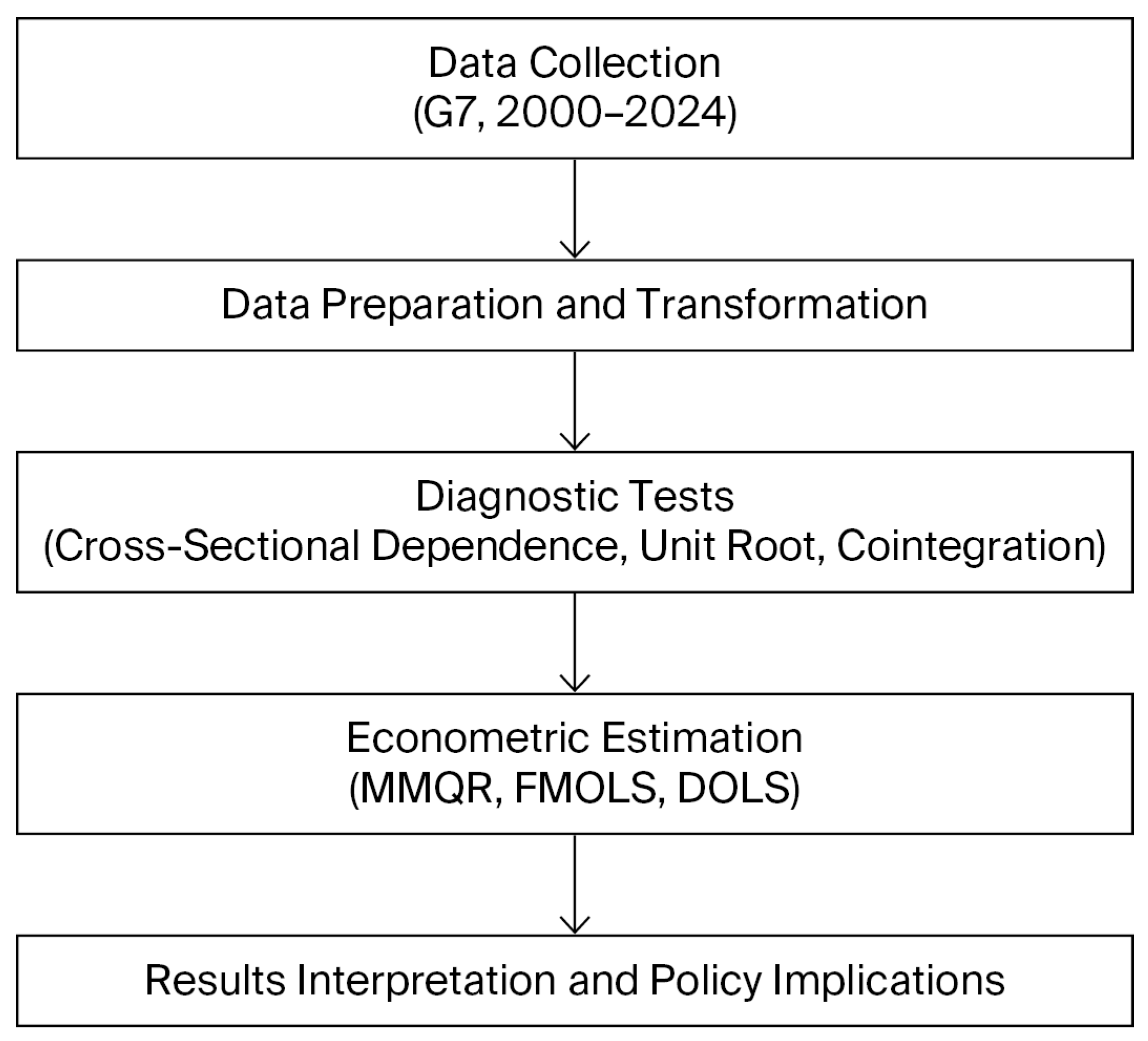
The empirical analysis proceeds as follows. First, cross-sectional dependence and panel cointegration tests are applied to establish the appropriate econometric framework. Second, MMQR is employed to test Hypotheses H1–H5 by examining how the effects of AI, FinTech, financial development, governance quality, and economic performance vary across different quantiles of monetary policy. Finally, FMOLS and DOLS are used to assess the long-run validity of Hypotheses H1–H5.
4. Results
Descriptive statistics for the study variables in the Group of Seven (G7) countries during 2000–2024 (
Table 2) show that the monetary policy index (ln MP) is characterized by moderate variance around a positive mean, reflecting notable differences in the degree of monetary policy tightening or expansion between countries over time. It is also shown that the variables of artificial intelligence (ln AI), economic performance (ln GEP), FinTech (ln FIN), and the depth of FinTech (ln FD) have relatively high values, which is consistent with the nature of G7 economies as advanced economies with well-developed financial, technological, and institutional infrastructures. However, governance (ln (GOV)) shows relatively limited variation across the countries, reflecting a high degree of convergence.
SCHT is a fundamental step (
Table 3) in standard analysis when a study involves multiple countries and multiple variables, especially in panel models that rely on nonlinear and distribution-based variable methodologies such as the Method of Moments Quantile Regression (MMQR). This procedure tests whether the economic relationships between AI, financial technology (FinTech), economic performance (GEP), monetary policy, financial development, and governance are the same across all G7 countries or differ in intensity and direction. The results indicate that both the
and
statistics have high values and strong statistical significance (
p-value = 0.000), leading to the rejection of the null hypothesis of slope homogeneity among the G7 economies.
Economically, this result reflects the fundamental logic of the G7; artificial intelligence (AI) varies across the G7. The US and Japan have more advanced innovation systems than Italy and Canada; therefore, the impact of AI on economic performance, emissions, and economic transformation varies across countries. FinTech (FIN), the digital infrastructure, and the legislative environment in Britain and Japan are more mature than in other G7 countries, making the impact of FinTech on development and sustainability asymmetric. Economic performance (GEP) varies across countries due to differences in productivity, investment in human capital, and the degree of economic openness. Monetary policy (MP) responses to inflation, growth, and economic cycles differ across the Fed, the Bank of Japan, the Bank of England, and other central banks, leading to different impacts on monetary policy instruments. Financial development (FD) is more advanced and regulated than in Italy and France, creating a natural difference in the relationships between emissions, growth, and innovation. Governance (GOV) varies across G7 countries, leading to different effects on economic performance and sustainability.
The results of the CSD test (
Table 4), with a [
67] CSD count of 12.405 and
p = 0.000, indicate a strong link among the G7 economies in the economic, financial, and technological variables during the period 2000–2024. These results indicate that shocks in AI, fiscal technology, monetary policy, financial development, and economic performance in any G7 country spread rapidly to the rest of the world through trade, investment, innovation, and financial interdependence, reflecting the integrated nature of G7 economies. The presence of this CTA excludes the use of first-generation tests and requires reliance on second-generation tests, such as CADF and CIPS, which account for interdependencies between economies. The CADF and CIPS results indicate that the time series of the variables considered are not stationary at this level. The CADF statistics indicate that variables such as AI, FinTech, MP, FD, GEP, and governance exhibit a long-term trend (I (1)) and are unstable around a constant average. This is consistent with the structural nature of these variables, which reflect technological growth, institutional development, the expansion of the financial sector, and the evolution of monetary policy in advanced economies.
Based on the above results, it is necessary to proceed with joint integration tests, such as the Westerlund test, then use long-term estimation models (FMOLS, DOLS), and finally use MMQR to analyze the full distribution of impacts. This approach is required because the variation in economic relationships between variables such as AI, FinTech, FD, governance, and monetary policy is not the same across economic performance levels. The results of the CSD, CADF, and CIPS are crucial steps toward building a coherent standard model that reflects the intertwined economic realities of G7 economies.
The results (
Table 5) of the Westerlund cointegration test with the values Gt = −3.899, Ga = −7.421, Pt = −14.633, and Pa = −21.339, all at
p = 0.000, suggest that there is a strong and coherent long-term relationship linking the variables in the G7 economies during the period 2000–2024. This indicates that AI, FinTech (GEP), monetary policy (MP), financial development (FD), and (Gov) have evolved together along a sustainable balance path, with effects that are structural and persistent rather than transitory.
The findings indicate that technological innovation, especially artificial intelligence and FinTech, is positively correlated with actual economic performance, financial system depth, and the sustainable stability of monetary policy in the near future. Governance is the underlying foundation of this equilibrium, as it facilitates investment in artificial intelligence and increases the efficiency of financial markets, thereby mirroring long-term economic performance.
The integration results show that the G7 economies have adopted an integrated model that combines technology, fiscal development, monetary policy, and real economic performance within a long-term structural relationship. This justifies using advanced methods, such as the MMQR approach, to capture variation in impacts across distributions and countries.
Estimating the Moments Quantile Regression (MMQR) model (
Table 6) for the monetary policy indicator (ln MP) at the quantiles (statistic = 0.10, 0.25, 0.50, 0.75, and 0.90) allows for monitoring heterogeneity in the effects of explanatory variables across different levels of monetary policy.
Table 7 summarizes the estimation results.
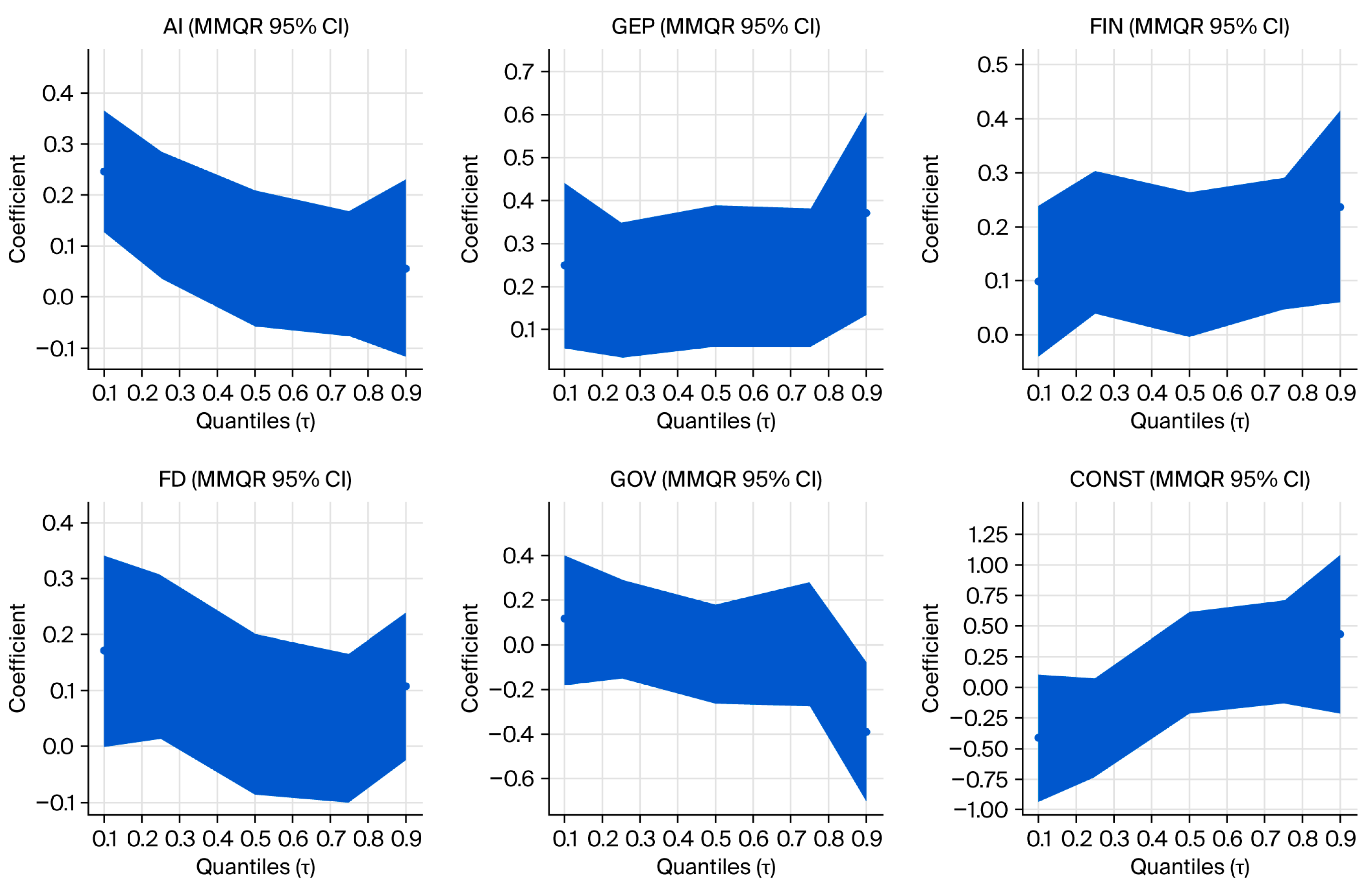
The results show that the coefficient (ln AI) is positive and statistically significant in the lower and middle quantiles of the monetary policy index (especially at τ = 0.10 and τ = 0.25) but loses statistical significance at higher quantiles. This indicates that expansion of the use of artificial intelligence is associated with significant improvement in the effectiveness of monetary policy in environments where monetary policy performance is weak or moderate, by improving the quality of information and expectations and reducing information asymmetry. However, the importance of these variables decreases at higher levels of monetary policy, where technological and institutional structures are already advanced, reducing the margin for additional improvement that artificial intelligence can provide.
The results also show that (ln GEP) is positive and statistically significant across all quantiles, with a significant increase in the absolute value of the coefficient at higher quantiles (especially τ = 0.75 and τ = 0.90). This means that improved economic performance is systematically associated with the effectiveness and stability of monetary policy, with the effect being greater at higher levels of monetary policy. The economic performance transition reduces the risk of energy and emissions shocks and improves asset quality, making it financially sensible. Consequently, central banks can implement more effective monetary policies without causing significant financial instability or inflation.
(Ln FIN) yielded positive and significant coefficients across most quantiles, with a clear upward pattern in the middle and upper quantiles. Therefore, deepening financial markets, diversifying financial instruments, and improving the efficiency of financial intermediation could enhance the potency of monetary policy transmission through both conventional and unconventional channels. As the value of the MP index increases, this feedback effect becomes quantitatively greater and qualitatively more meaningful. The most advanced capabilities of financial development in the system can make monetary policy more effective and turn it into real action. In examining financial development (ln FD), positive coefficients are observed across most quantiles, but statistical significance is less consistent than for financial development and economic performance.
In addition, the results show that governance transactions (ln GOV) exhibit more complex behavior: they are insignificant or weakly significant in the lower and middle quantiles, whereas a negative, significant coefficient appears in the higher quantiles (τ = 0.90) in some specifications. Monetary activities in industrialized countries exhibit extreme duality. Industrialized countries are characterized by strict institutional frameworks that may limit the flexibility of monetary policy for exceptional or unconventional measures, especially if they carry too high a cost in terms of effectiveness or credibility. While this pattern is certainly suggestive of such an interpretation, it requires careful further analysis and linkage to the details of the governance indicators employed and the nature of the institutional framework in each G7 country.
Moreover, the MMQR results highlight an apparent heterogeneity in the effects of explanatory variables on monetary policy across the conditional distribution of (ln MP). Although economic performance and financial development appear to have an increasing influence in the upper quantiles, the role of artificial intelligence is stronger in the lower and middle quantiles, with a relative decline in the upper quantiles. This indicates that the structure of the determinants of monetary policy varies with the monetary system itself. Technological factors play a greater role in filling information gaps and improving the effectiveness of policy instruments in the early or weaker stages of monetary performance. In advanced stages, economic performance and financial factors become the primary drivers of this performance’s sustainability.
The MMQR graph (
Figure 4) shows that the effects of explanatory variables differ significantly across the distribution of economic performance. AI, financial technology, and financial development play different roles in performance levels, while governance has a positive impact at low quantiles and becomes negative at higher quantiles. GEP also shows an increasing impact through distribution, reflecting the power of economic dynamics in higher-performing countries. Confidence intervals show that 95 percent of relationships are more stable at the low and middle quantiles, while uncertainty increases at higher quantiles.
To verify the robustness of the results and their insensitivity to the estimation method, FMOLS and DOLS models were used to estimate the long-term relationship between (ln MP) and the explanatory variables in a panel cointegration framework.
Table 7 illustrates the results of the robustness analysis (FMOLS and DOLS), which are consistent with the basic results of the MMQR model. This reinforces the conclusion that long-term relationships existed between the independent variables (AI, GEP, FinTech, FD, and GOV) and the monetary policy variable in G7 countries during 2000–2024.
First, both the FMOLS and DOLS estimates confirm the positive and statistically significant impacts of economic performance (ln GEP) and financial development (ln FIN), and the same result emerges strongly in the MMQR model at higher levels. This suggests that economic performance transformations and the evolution of the financial sector are linked to a stable, long-term relationship with monetary policy, underscoring the importance of economic performance transitions and advanced financial markets in supporting the efficiency of monetary policy in G7 economies.
Second, the FMOLS and DOLS results show that AI (ln AI) retains a positive effect in the long term, although its statistical power is relatively lower than that of the primary model. This reinforces the finding that AI’s effect on monetary policy is most evident when policy rates are low. In contrast, the long-term impact is relatively more stable but less meaningful. Third, we found that the earlier positive but weak significance of ln FD persists, consistent with the MMQR outcome. The positive value indicates that financial market depth fosters monetary policy resilience, although not to the same extent as economic performance or financial development. Fourth, governance (ln GOV) shows behavior quite similar to that observed in the upper quantiles of MMQR, from the beneficial impact of FMOLS to the detrimental impact of DOLS. It is important to clearly outline the essential qualities of governance.
Ultimately, the visible concordance between the FMOLS and DOLS findings and the MMQR findings reinforces the theoretical and economic model underpinning the analysis and implies that estimated associations are not simply a reflection of model sensitivity or data distributional properties but instead embody stable and explicable economic linkages, given the G7 economies and time context.
5. Discussion
The study’s findings show that economic performance, technological, financial, and institutional factors jointly affected the stylized facts of monetary policy in G7 economies during 2000–2024. The MMQR-based methodology, along with FMOLS/DOLS robustness tests, suggests that the relationships between the studied variables and monetary policy are nonlinear across different monetary conditions. However, these relationships are highly patterned and asymmetric along the conditional distribution.
According to the results, economic performance (ln GEP) improves the effectiveness of monetary policy, and this effect is significantly stronger at higher levels of monetary activity (ln MP). As a result, the G7 monetary policy framework has undergone a significant change. Most central banks are now operating, to various degrees, along the economic performance trajectory. High-quality economic performance growth reduces emissions and mitigates risks of energy and climate disasters, creating a less vulnerable economic environment. In this context, central banks will have more room to maneuver with their instruments without causing any unwanted impact on asset prices or inflation. The reason for this growing impact is based on sound economics: a more sustainable (less vulnerable) economy is more impactful and responsive.
As an efficient channel, ln FIN has a positive and dynamic effect on most of the variables. Its importance in the upper quartiles of monetary policy is also growing. Although the G7 financial system has large and complex monetary policy transmission channels, primarily interest rates, the bond market, and asset prices have larger impacts on economic activity. According to economists, this implies that the financial amplifier is effective, meaning that the financial sector not only transmits the cash signal but does so more strongly and reacts more quickly, particularly in the most integrated markets.
The impact of AI (Ln AI) is strong and evident at the lower and middle quantiles. However, in settings with weak monetary policy, AI’s impact is weaker at higher quantiles. This pattern indicates that central banks tend to benefit more from AI when market expectations are less anchored. In such cases, AI essentially acts as a corrective tool that enhances the efficiency of monetary policy. However, when the monetary system moves beyond the fragility phase and reaches high performance levels, the information gains from AI are relatively low because the environment already has the necessary analytical and institutional frameworks in place.
The depth of financial development (ln FD) and governance (ln GOV), whose importance varies across monetary situations, appears to play a positive but less impactful role than other determinants, namely, higher financial saturation in the G7. This finding is consistent with the literature, indicating that the depth of the financial sector has a greater impact on developing and transformed economies. Governance (ln (GOV)) shows weak or unstable significance, with a clear negative impact at the top quartile. This result clearly demonstrates that in monetary systems, strict institutional frameworks may reduce the flexibility of monetary policy and limit its ability to implement non-traditional measures. That is, governance works positively eventually but may impose short-term restrictions when the monetary system is at its peak.
Financial development (FD) plays a role in enhancing the effectiveness of monetary policy. Many studies have confirmed that the development of financial markets enhances the effectiveness of monetary policy transitions. The increasing role of financial development in the G7 makes monetary policy transmission channels more effective, as reflected by a higher functional FIN coefficient at higher quantiles, consistent with [
75,
76,
77,
78].
The results also support the literature that views AI as a new tool for monetary decision-making, improving predictive capacity, and reducing the information gap. However, this study reveals an additional dimension that many previous studies have not considered: AI’s impact is concentrated in low- and mid-performing monetary environments, while its relative impact on more stable, mature monetary systems is declining. This is consistent with recent institutional literature suggesting that the marginal impact of technology depends on the degree of information saturation [
79,
80,
81].
In contrast, this study reveals that the role of governance is not linear. Most of the literature assumes that its impact is limited or negative at higher levels of monetary activity, consistent with studies showing that strict regulatory frameworks may limit the flexibility of monetary responses in highly regulated economies [
82,
83,
84].
This study largely confirms prior findings on financial depth and the transformation of economic performance, while contributing to a deeper understanding of both concepts. Many studies use average values and do not highlight the variation in the impact of these variables across different monetary policy quantiles. Accordingly, the multivariate monetary base captures the emerging realities that characterize advanced economies in the 21st century and the direction of modern monetary policy.
6. Conclusions, Policy Implications, and Limitations
The aim of this research paper is to provide a comprehensive understanding of the simultaneous structural breaks in AI, real economic activity, financial development, the depth of the financial sector, and governance, and their effects on the monetary policy dynamics of G7 countries during 2000–2024. The study employed a macroeconomic framework. A highly advanced standard analysis was also adopted, using the MMQR methodology to quantitatively determine the magnitude of impact. By examining the conditional distribution of the monetary policy index, we explored inconsistencies in impact. The use of FMOLS and DOLS further strengthens the long-term estimates.
The results generally show that monetary policy (MP) in G7 economies is no longer governed exclusively by traditional factors (such as the output gap and inflation) but rather by a complex interaction between economic performance, financial, technological, and institutional determinants. Quantitative estimates indicate that economic performance (GEP) and FinTech (FIN) are two central pillars for improving monetary policy efficiency, with their impact increasing at higher levels than the monetary policy index. This suggests that more advanced economies following economic performance and financial transformation trajectories have greater scope for effective and sustainable monetary policy without creating significant imbalances in financial or environmental stability.
For the depth of the financial sector (FD), the results show a positive but limited impact regarding strength and significance compared with FinTech and economic performance. This can be explained by the high level of financial saturation in G7 countries, where variation in market depth is less able to explain differences in monetary policy effectiveness. Governance (GOV) has emerged as a composite institutional variable; its effect appears weak or unstable across most quantiles, with a negative impact in the highest quantiles. This suggests that in the long term, the strictness of institutional frameworks may limit the resilience of monetary policy in high-activity monetary systems. FMOLS and DOLS estimates confirm the strength of these results; they maintain the same signal trends and fundamental relationships and show long-term monetary integration between monetary policy and economic performance, financial development, and artificial intelligence.
The MMQR findings indicate dislocations across all quantiles, while FMOLS and DOLS capture the cointegrating equilibrium relationship, thereby enhancing the model’s statistical and economic validity. Therefore, the monetary policy of the G7 economies has become multifaceted, as economic, financial, and technological aspects now intersect with the traditional focus of central bank operations. Consequently, it is no longer possible to design an effective monetary policy in advanced economies without factoring in these structural dimensions; one must understand their dynamics to reinforce long-term monetary and financial stability.
The findings also indicate that AI is a supportive tool for implementing monetary policy in a less stable monetary environment, enhancing information quality and improving the precision of economic expectations.
The analysis indicates that the current institutional arrangements must be sufficiently flexible to enable central banks to respond to shocks in real time without governance constraints or limitations on policymakers’ powers to take corrective actions effectively. This study calls for developing countries to adopt a redesigned monetary framework that incorporates unconventional stock measures, including technology (FinTech) and economic financial development, into monetary policy rules. This approach aims to manage technological space, mitigate systemic risk, and enhance the central bank’s power to cope with future economic, climate, and financial shocks. Rapid structural changes highlight the need for a multi-dimensional monetary framework to make monetary policy less rigid and monetary management more efficient. A multidimensional monetary rule, the AI–Economic Performance–Finance Monetary Rule, is proposed to achieve this aim.
Regarding policy implications, the findings suggest that G7 monetary policy is no longer fully independent of the technology and finance sectors or structural changes but is increasingly dependent on structural determinants for price stability and monetary policy transitions. The study emphasizes that strengthening economic performance and the financial sector is essential to improving the efficiency of monetary policy instruments by reducing price volatility and macroeconomic risk while enhancing credit and production responses.
The study has analyzed the diversification in the use of optimal monetary policy across AI, monetary expertise, economic performance, governance quality, and monetary development in G7 countries. Nevertheless, the study faced the following major limitations. Initially, the research engaged country-level measures of digital adoption, institutional excess high quality, and the financial coverage transmission mechanism.
However, examining disparities in these indices across the country is useful for understanding heterogeneity. Moreover, although the MMQR approach uncovers crucial heterogeneity in the distribution, the empirical setup cannot control for possible endogeneity and dynamic feedback effects of technological progress and institutional quality on the effectiveness of monetary policy. Governance indicators cover a wide range of dimensions.


_Li.png)