Article

Sense of Place (SoP) and Soundscapes in an Urban Park in Shiraz: Could the S in SoP Stand for Sound Too?


1
School of Information Studies and CIRMMT, McGill University, Montreal, QC H3A 0G4, Canada
2
Department of Urban Planning and Design, Faculty of Art and Architecture, Shiraz University, Shiraz 7188637911, Iran
*
Author to whom correspondence should be addressed.
Sustainability 2026, 18(5), 2353; https://doi.org/10.3390/su18052353
Submission received: 31 December 2025 / Revised: 6 February 2026 / Accepted: 24 February 2026 / Published: 28 February 2026
(This article belongs to the Special Issue Urban Noise Control, Public Health and Sustainable Cities)

Abstract

The characteristics of green spaces might play a role in shaping the Sense of Place. However, few studies have investigated the relations between the design characteristics of green space and the SoP, and even fewer have accounted for the multi-sensory characteristics of green spaces. This study investigates the Sense of Place in an urban green space in Shiraz, in relation to its soundscapes both on site (n = 6) and in the lab (n = 17). Despite the limited equipment and sample size, the results from both methods of on-site and laboratory conditions converge towards the same conclusions: the SoP was perceived as being lower in parts of the parks located at the boundaries, particularly when unpleasant sounds from the surroundings (e.g., construction) could be heard. Moreover, we did not observe strong associations between sound and visual pleasantness. Finally, we found that the SoP was influenced both by memory representations and the immediate sensory experience. This exploratory study calls for further research on the contribution of the sensory experience, particularly sound-related factors to Sense of Place.

1. Introduction

Sense of Place (SoP) is an interdisciplinary concept used in geography, sociology, and environmental psychology to describe human–place bonding at individual and community levels [1,2,3,4,5]. Exploring the connection between people and places under the terminology of SoP encompasses a vast array of place-related concepts such as place attachment, place dependence, and place identity. The theoretical framework examined in this article considers the SoP as the umbrella concept and more general to concepts of place identity, attachment and social bonding [6,7,8]. The person, the physical setting, and the activities in the place shape the Sense of Place, which can be simplified in the tripartite model of Person, People, and Process (PPP) [3,4,9,10]. Hay (1998) further emphasizes the importance of the social context in shaping individual and collective identity [11]. Strengthening the SoP has been shown to result in positive place-protective behaviors and natural preservation actions by users [8,12,13,14]. A Sense of Place encourages behaviors aiming to preserve natural resources and the sustainable use of landscapes [8,13,15,16]. Despite the impact of the SoP on people’s willingness to protect the place and sustainable environments, research on this topic in the context of green spaces remains limited [14,17].
The presence of green spaces per se cannot guarantee higher levels of a SoP [18]. The characteristics of green spaces might play a role in shaping the SoP. However, few studies have investigated the relations between the design characteristics of green spaces and the SoP, and even fewer have accounted for the multi-sensory characteristics of green spaces. Specifically, the role of sound on the SoP has received scant attention in green spaces, though the soundscape (the acoustic environment as perceived in context) has been shown to contribute to the SoP in other types of urban spaces, such as cultural and historical districts, neighborhoods, and residential/tourist spaces [18,19,20,21]. Moreover, the SoP has been studied as a bond gradually shaped between the place and people over time, and the effect of “immediately perceived and sensory dimensions” has been under-shadowed in research [22].
At a theoretical level, the acoustic dimension is considered in the model of the environmental experience as a subset of place, and sound as a mediator between humans, their settings, and activities [23]. However, sound is mostly considered as noise or unwanted sound, and rarely in terms of its potential to enhance the SoP. The field of soundscape research considers sound as a resource that can have positive outcomes on health and well-being, complementing the traditional noise-control approach that focuses on minimizing the detrimental effects of unwanted sound, e.g., the study outlined in [24]. The soundscape is defined as the acoustic environment as perceived or experienced by people [25]. It can be investigated in different settings on site [26,27,28,29,30] or under laboratory conditions [31,32]. Soundscape research focuses on the perspective of city users to investigate the relationship between people, public spaces, and their acoustic environments [33].
Soundscape research has been conducted in a variety of environments, including indoor locations, natural and rural areas, urban public squares, and urban parks. In the context of urban green spaces, research has been done to identify the effect of sound sources on perception [29,34] and explore the correlation between soundscape and human behavior [35,36]. The Quality of the Urban Public Space Experience (QUPE) model has been proposed to synthesize the effect of the soundscape on sound-related evaluation, public space engagement (e.g., behavior), and the psychological outcome (e.g., restoration) in urban green spaces [28]. However, the relationship between the soundscape and SoP in green spaces has not been investigated to our knowledge. Our research aims to fill this gap by measuring the soundscape and SoP evaluations simultaneously in a green space.

1.1. Conceptual Framework

SoP theories and methodological frameworks have scarcely acknowledged the urban soundscape in the field, and only limited attempts have been made to study the role of sound on the SoP [18,19,20,21]. Evaluating the SoP is a crucial step for conducting effective urban transformations, as one of the most important aims of urban planning and design is to strengthen the bond between the person and the place. However, evaluating the SoP as a perceptual concept and identifying contributing factors remains an open challenge. This article aims to devise a methodology for evaluating the SoP and soundscape simultaneously in an urban green space.
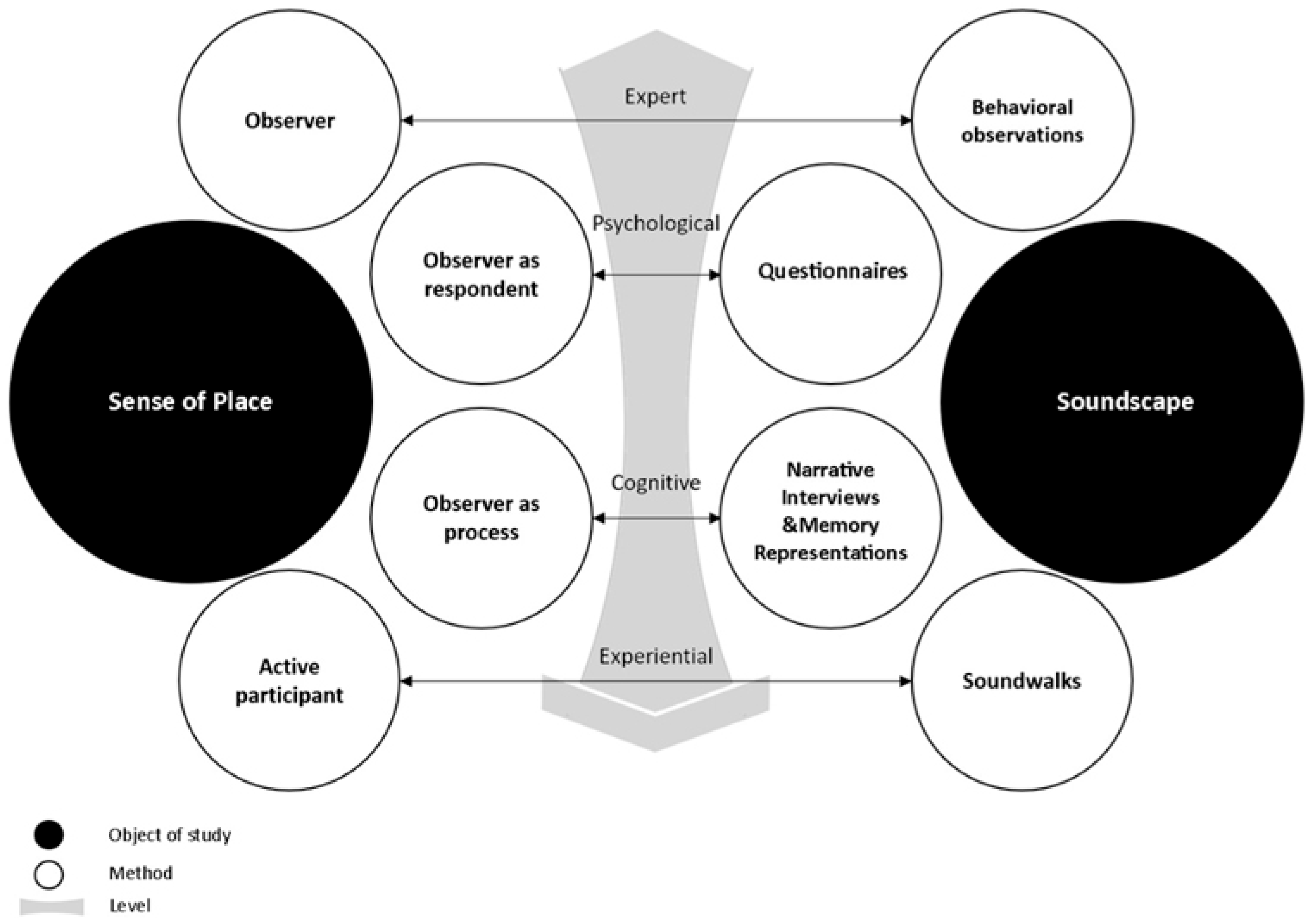
The soundscape is conceptually related and derived from the landscape; while the sounds in the space give the user a sense of their place [37]. The major similarity between soundscape and landscape research is that both of them move beyond the physical characteristics of the environment and aim to incorporate people’s perception into the research [38]. For evaluating both concepts together, we will rely on the primary model of landscape perception. Based on this model, the relationship between place and person could be studied under four different paradigms: expert, psychophysical, cognitive, and experiential, each having methods for studying the relationships between human models, landscape properties, and the outcomes of interactions between these two entities [39]. The current methods for evaluating the SoP can still be classified under these four paradigms, including on-site behavioral observations [40] conducted by the researchers (expert paradigm), or based on questionnaires [41,42,43] filled out by the respondents (psychological paradigm), or interviews [6,40] for capturing respondents’ perceptions (cognitive paradigm), or experiments such as visual or audio-visual simulations, virtual environments, augmented reality, and 3D geo-visualization [44,45] designed to study the SoP (experiential paradigm). The data analysis could rely on both qualitative and quantitative methods, as the SoP is about meaning and connections between people and places [46].
Similarly, soundscape methods can be classified into four categories [26] that can be used either on site or in laboratory settings: behavioral observations (on site) [28,47], questionnaires (in a laboratory setting and on site) [31,35,48], narrative interviews and memory representation [27,49,50], and soundwalks [51]. These four methods could be compared to the methods used in landscape perception (Figure 1).
The present study uses multiple methods to investigate the Sense of Place and soundscape jointly in the context of an urban green public space. The first phase relies on the soundwalk method derived from soundscape research to study participants’ experience in the actual green space, both in terms of the Sense of Place and soundscape. The second phase complements this with a laboratory evaluation to further investigate the Sense of Place and soundscape in controlled settings using an audio-visual reproduction of the different sections of the park. While the laboratory experiment is based on the short audio-visual reproduction of the space, it can be used to gather information about the immediate sensory experiences that are relevant to this research [22]. This experiment focuses on the understudied contributions of the sensory experience in relation to the SoP [22].
The two phases of research will answer the following questions: (1) What are the factors contributing to the SoP in the context of an urban green space in Shiraz? (2) Can the relationships among these factors and the SoP identified on site be confirmed in laboratory condition with more participants?

1.2. Context

Khold-E-Barin, meaning ‘Immortal Sublime Paradise,’ is an important green and urban park in central Shiraz. Today, it is used as a popular public space for relaxation, cultural events, and community gatherings, reflecting its ongoing role in residents’ lives. It is situated on the site of the historical Songhori Gardens. Founded in the 12th century by Atabek Sunqur ibn Mawdud (1148–1161), the first monarch of the Salghurids dynasty, the Songhori Gardens were renowned for their beauty, as noted in historical sources [52,53]. These gardens were established on lands located about a league to the west of the ancient city and are considered to be among the oldest gardens in Shiraz [54,55]. Today, Khold-E-Barin Park retains parts of the original gardens’ grounds, which contributes to a strong sense of place. Furthermore, due to urbanization and development in the second half of the 20th century, the park is now situated in a modern residential area.
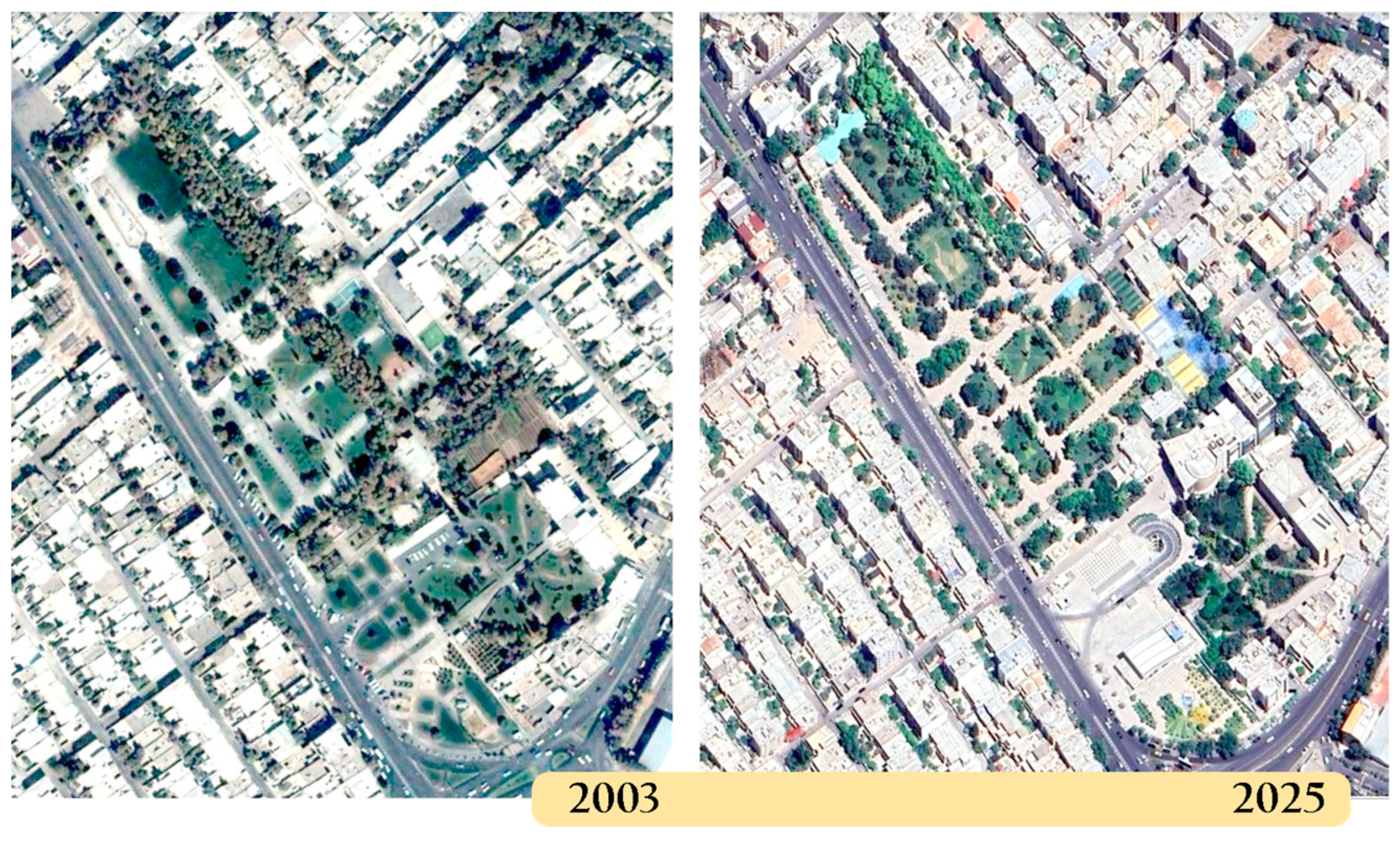
Officially, the land of the park is owned by the municipality of Shiraz. The buildings of the municipality zone 1 are adjacent to the park. During the last 20 years, many green spaces around the park have been demolished. This includes the park’s southern side, resulting in considerable shrinkage in its area (Figure 2). This place, a successful public space with a famous urban water clock, is currently under-shadowed due to the municipality’s shopping center. Other transformations have similarly aimed at the municipality’s development, including constructing new buildings and underground parking. The park’s plan is triangular, with its longest side adjacent to a one-way street, restricted since 2015. It is also surrounded by residential neighborhoods connected to the park through the alley on the east wing. This connection shapes the park’s secondary entrance, which is adjacent to a primary school. Green areas, water features, and cultural and recreational facilities are situated within the park.

2. Materials and Methods

2.1. Phase 1, On-Site Survey

  • Participants
The first phase relies on questionnaires administered on site to a group of 6 respondents (4 women and 2 men) exploring the park on foot. To ensure familiarity with the concepts of the Sense of Place, graduates of urban design, planning, and architecture were invited to participate. This group of participants was selected based on the study’s objective to construct relevant place-based factors related to the SoP and on the participants’ ability to clearly articulate their sensory experience in relation to the concept of a SoP, which was defined as ‘a place filled with meaning and distinguished from other spaces through emotional attachment’. Participants were selected to represent contrasting levels of familiarity with the park itself: half of the participants were familiar with the park, while the other half visited the park for the first time. The participants agreed to voluntarily take part in the research without compensation.
  • Procedure
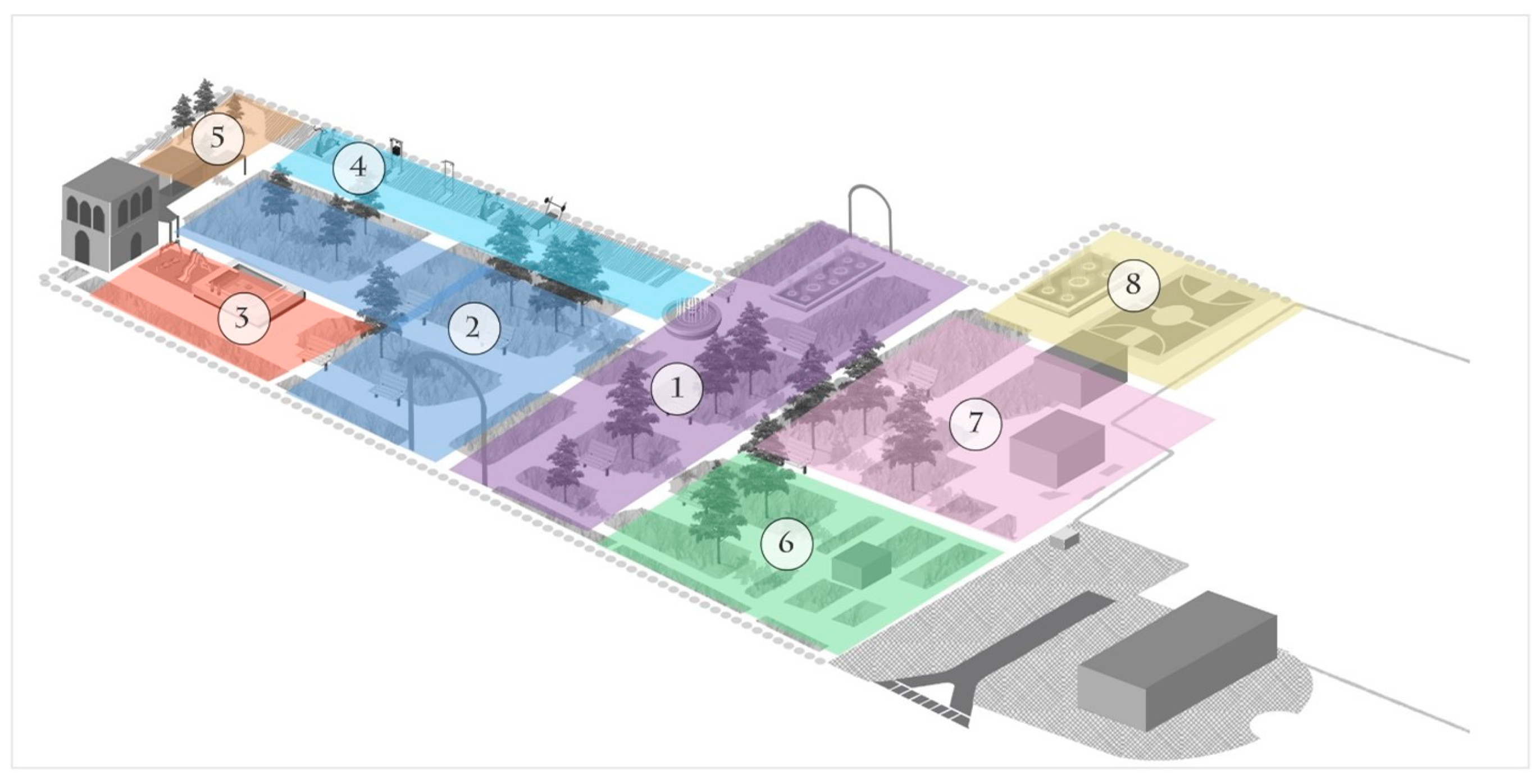
The questionnaire was self-administered on a working day, between 10 and 12 am. Participants were given a map (Figure 3) and asked to freely explore the entire park on their own. Their task was to identify the spots and areas evoking a positive SoP and describe their choices in terms of both the physical and psychological reasons. The session took close to two hours. The questions were as follows:
  • Select the places where you have a strong Sense of Place on the map.
  • Write down your reasons for selecting them (describe all the visual and non-visual characteristics).
Figure 3. 3D model of the park used by participants in phase one (the eight sections of the park are emergent from participant mapping).
Sustainability 18 02353 g003
  • Analysis
The qualitative analysis of the free-format answers relied on the constant comparison method from the grounded theory (GT) method, which has been used in both SoP and soundscape projects [27,56,57], to identify emerging categories through an inductive process. The coding process was conducted using MAXQDA (Berlin, Germany) to identify the core categories of the SoP in the context of this urban park. The categories and the relationships among categories remained stable across the six participants (an acceptable sample size for grounded theory studies [58]).
  • Results
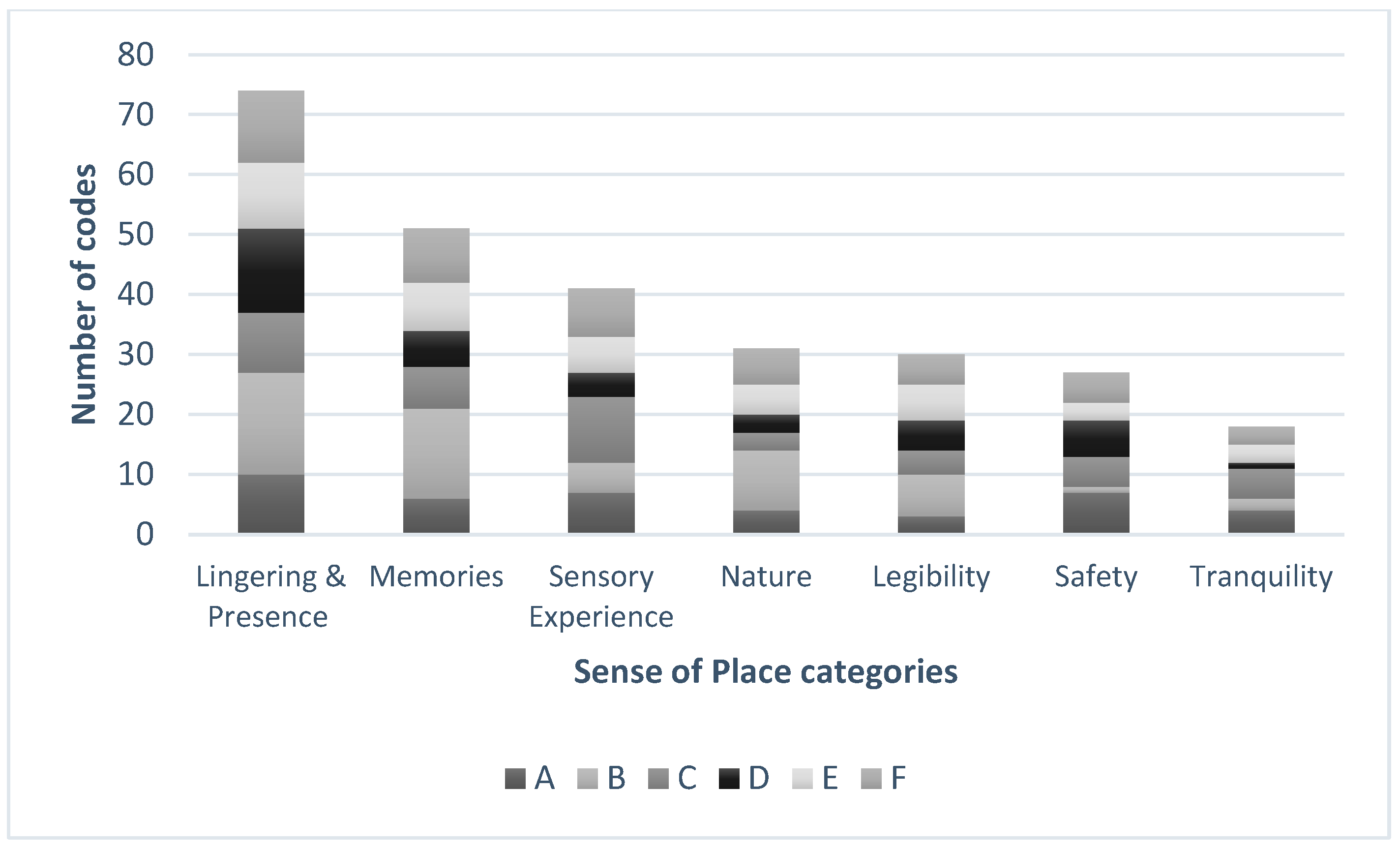
The qualitative analysis revealed core categories for the Sense of Place. Table 1 presents the categories along with their descriptions and sample quotations from participants. In total, 272 incidents were coded in all responses. The final categories mentioned by all participants refer to lingering and presence (74 occurrences), memories (51 occ.), sensory experience (41 occ.), nature (31 occ.), legibility (30 occ.), safety (27 occ.), and tranquility (18 occ.). Figure 4 illustrates the frequency of each category mentioned by the six participants (A–F).
Lingering and presence was most often mentioned as contributing to the SoP. Places with the highest mentions of features contributing to the SoP were described as affording different activities such as “sitting, eating, playing, talking by a variety of people from young to old, men and women”. Sounds mentioned included human sounds and activities such as “speaking, listening to music, talking, and laughing.” These places were mainly the points where people gathered. Participants reported wanting to spend time there for people watching. The second category, memories, was related to past experiences of the participants, regardless of their familiarity with the park, in reference to “school, children, and their parents, families, friends”. Interestingly, even when these features were not visible, hearing their sound contributed to the SoP (particularly in proximity to the nearby school). Overall, the sounds of the surrounding environments could be heard in the park by participants and affected their evaluations.
The sensory experience category refers to places that are pleasing based on their visual, sound, sensory, and aesthetic multisensory experience, such as “beautiful scenes, sound warmth, multi-layered sounds, the sound of music and people, cool breeze, the heat of sunshine.” This category was mentioned in different sections of the park by participants. Nature as a separate category refers to the presence of natural elements, including trees, water features (fountains), and animals (e.g., cats). The sounds mentioned include the “fountain sound, leaves rustling, birds singing”. The three remaining categories with fewer occurrences are legibility (building on Kevin Lynch’s definition of the term, about an environment that is easy to make sense of [59]), tranquility (calm and peaceful environments), and safety. They do not refer to sound except for tranquility, which includes references to acoustic comfort and natural sounds.
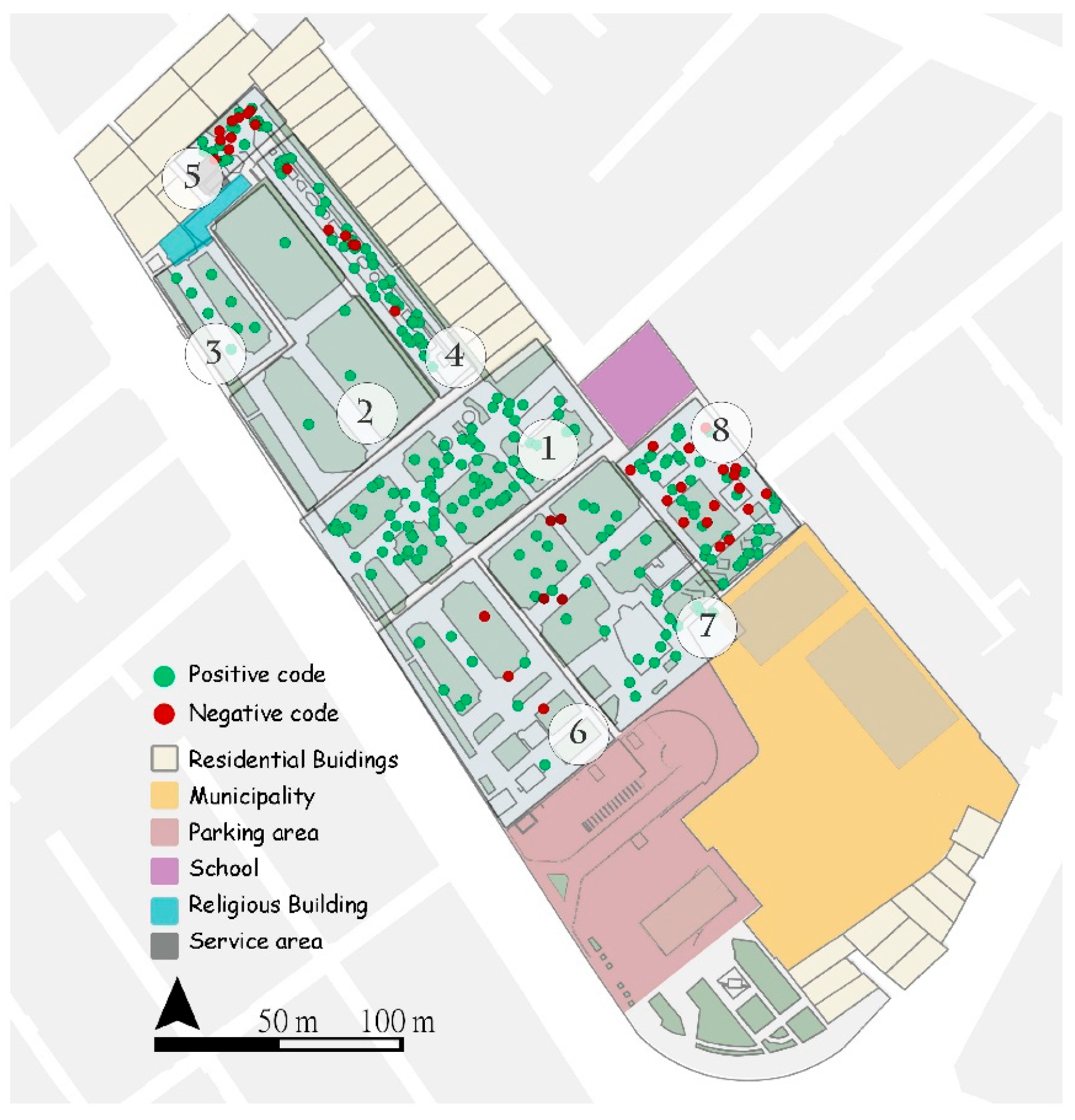
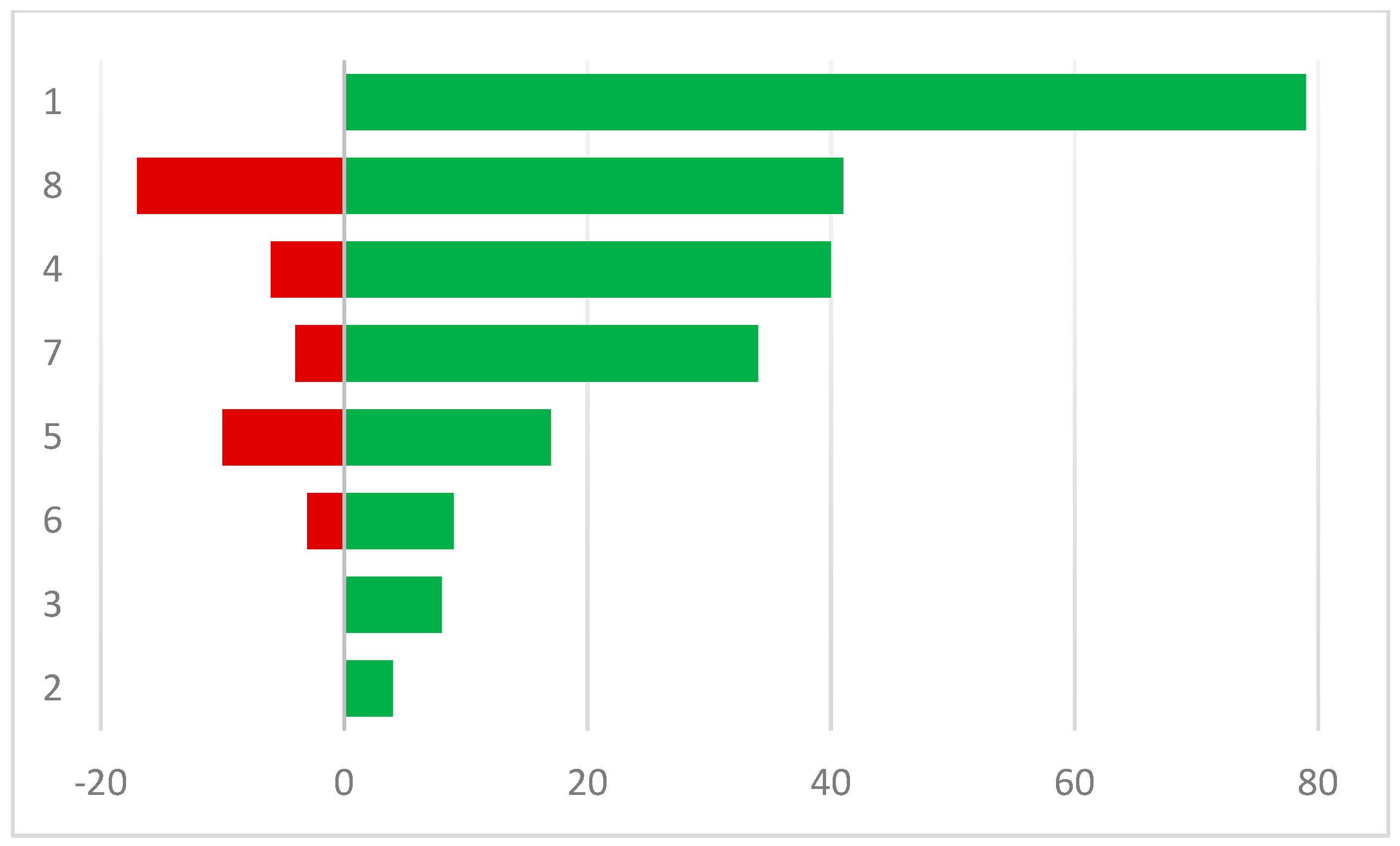
The spatial distribution of the free-format descriptions is visualized as a map in Figure 5. These include both positive (86% of all occurrences) and negative (14%) connotations, referring to the positive characteristics that contribute to the SoP and those that hinder it. The low proportion of negative mentions could partly be attributed to the study instructions, as participants were asked to identify sections with a high SoP but spontaneously reported factors hindering the SoP. The eight sections are the result of the accumulation of the spaces indicated on the map by participants (participants familiar with the park identified more sections). The distribution of negative and positive mentions assigned to each section is shown in Figure 6. Seventy percent of all negative mentions were assigned to sections 5 and 8, which are perceived as remote sections and are situated outside of the rectangular shape of the park.
Analyzing the distribution of positive and negative mentions across sections and categories of the Sense of Place, we identified factors contributing to or hindering the SoP and organized them into the three dimensions of the Quality of the Urban Public Space Experience [28], namely, sound-relation evaluation, public space engagement, and psychological outcomes. The results are presented in Table 2. Section 1, as the main place of people’s gathering, and a high number of people stopped and passed by, has the highest number of positive mentions (related to all factors of sound-related evaluation (e.g., people’s voices, music), Public space engagement (e.g., sitting, eating), and psychological outcomes (e.g., openness, excitement)) and did not include any negative mentions. Overall, the two places that are outside of the main parameters of the park (sections 5 and 8) are those with the highest rates of negative mentions. However, section 8 also had a high number of positive mentions, especially due to the positive role of the school, especially in sound forms, as the school is visually separated from the park, and participants could only hear the school and children’s voices. In the case of section number 5, the negative mentions regarding the sounds include construction noise, coming from residential developments around the park. The result shows that the surrounding environment has an impact on participants’ SoP.

2.2. Phase 2, Laboratory Experiment

  • Participants
The second phase consists of a laboratory experiment asking a larger sample of participants to evaluate audio-visual recordings of the different sections in terms of the SoP using the categories identified in the first phase, specifically the categories most often mentioned (lingering and presence, memories, sensory experience). Seventeen urban planning undergraduate students (10 women, 7 men) participated in the laboratory experiment. Out of these, 13 had visited and were familiar with the park. This is important as previous research on visualization methods and a SoP has shown better results for participants who were familiar with the context of the study [44,60].
  • Procedure
Audio-visual recordings of the different sections of the park were conducted on a weekday at the same time of the day as the first phase (between 10 am and noon), using a mobile phone (Samsung Galaxy A8, Samsung Electronics, Suwon, Republic of Korea), Easy Voice Recorder Pro (AUP, stereo, 20 s), and 180-degree panoramic pictures. To ensure that the recording included characteristics of the sections mentioned on site, we selected an excerpt that featured the factors contributing to the SoP based on the results of phase 1.
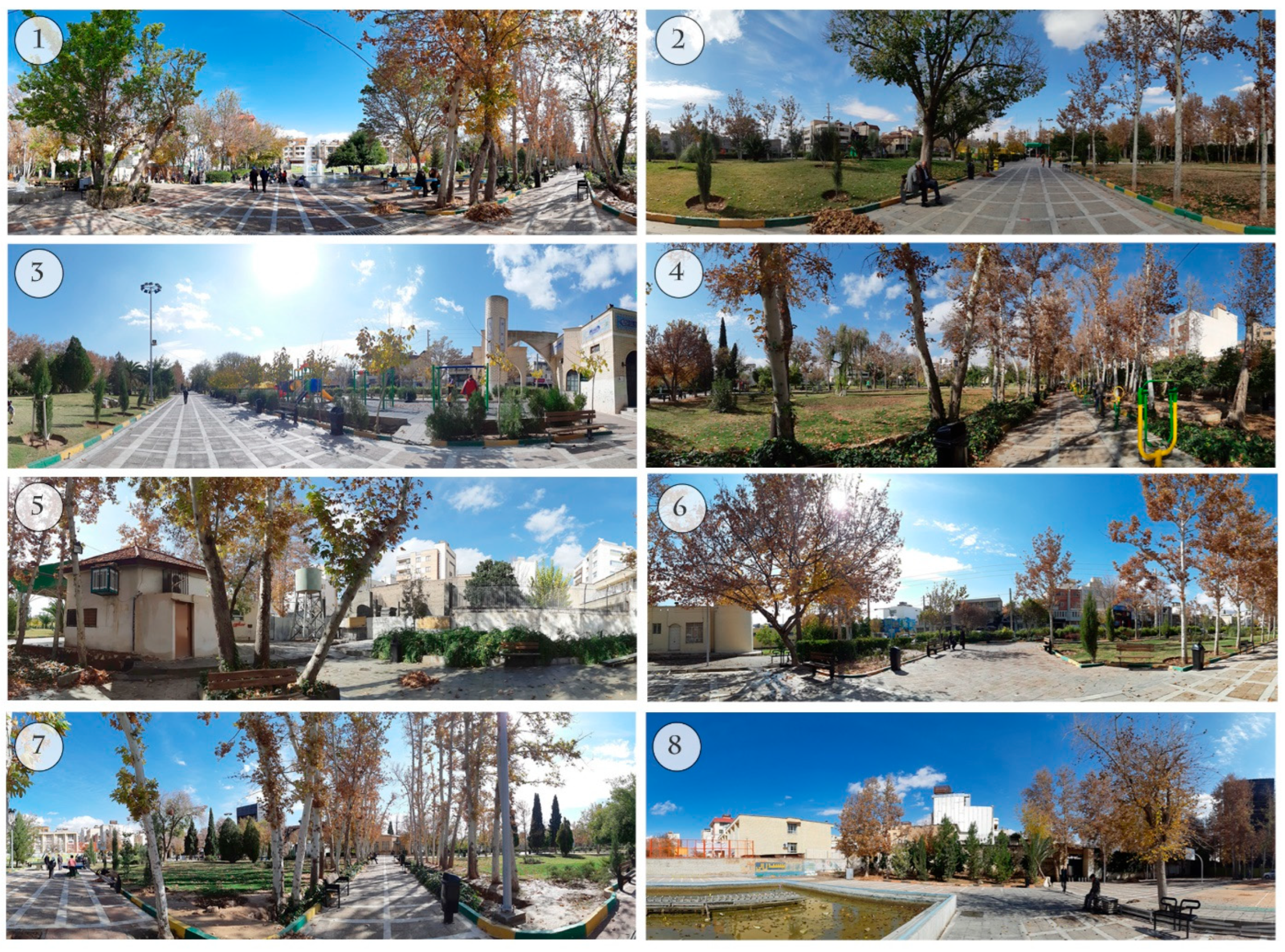
The experiment was conducted in a quiet room at the Department of Art and Architecture at Shiraz University and consisted of 8 trials corresponding to each of the 8 sections of the park. The sound was presented at a comfortable level over closed headphones (JBL Live 500BT, Harman International Industries, CA, USA). For each trial, participants were presented with a panoramic picture (shown in Figure 7) of a section along with the corresponding sound recording and asked to rate the audio-visual environment related to lingering and presence, memories, and sensory experience. The order of presentation of the trials was fixed across participants. The experiment took around 15 min to complete for each participant.
The 5-point Likert scale was phrased with strongly agree to strongly disagree statements, and the phrasing of the questions is shown in Table 3.
  • Analysis
We ran Spearman’s correlation test using R (RStudio/2025.09.2, Boston, MA, USA) to analyze the association between the SoP ratings and ratings along other scales of SoP categories (lingering and presence, memories, sensory experience [both sound and visual pleasantness]). To account for the repeated-measures structure, we conducted a repeated-measures correlation using the rmcorr package in R [61]. To investigate differences across sections in terms of the SoP ratings and SoP category ratings, a non-parametric MANOVA was conducted in R. When the MANOVA revealed significant effects of sections, a Friedman test was run for each of the 5 variables. If significant, it was followed by a post hoc test (Pairwise Wilcoxon rank-sum test with Holm correction) to determine which sections were different from one another. Missing data (0.5%) were replaced with the mean values for the corresponding variables.
  • Results
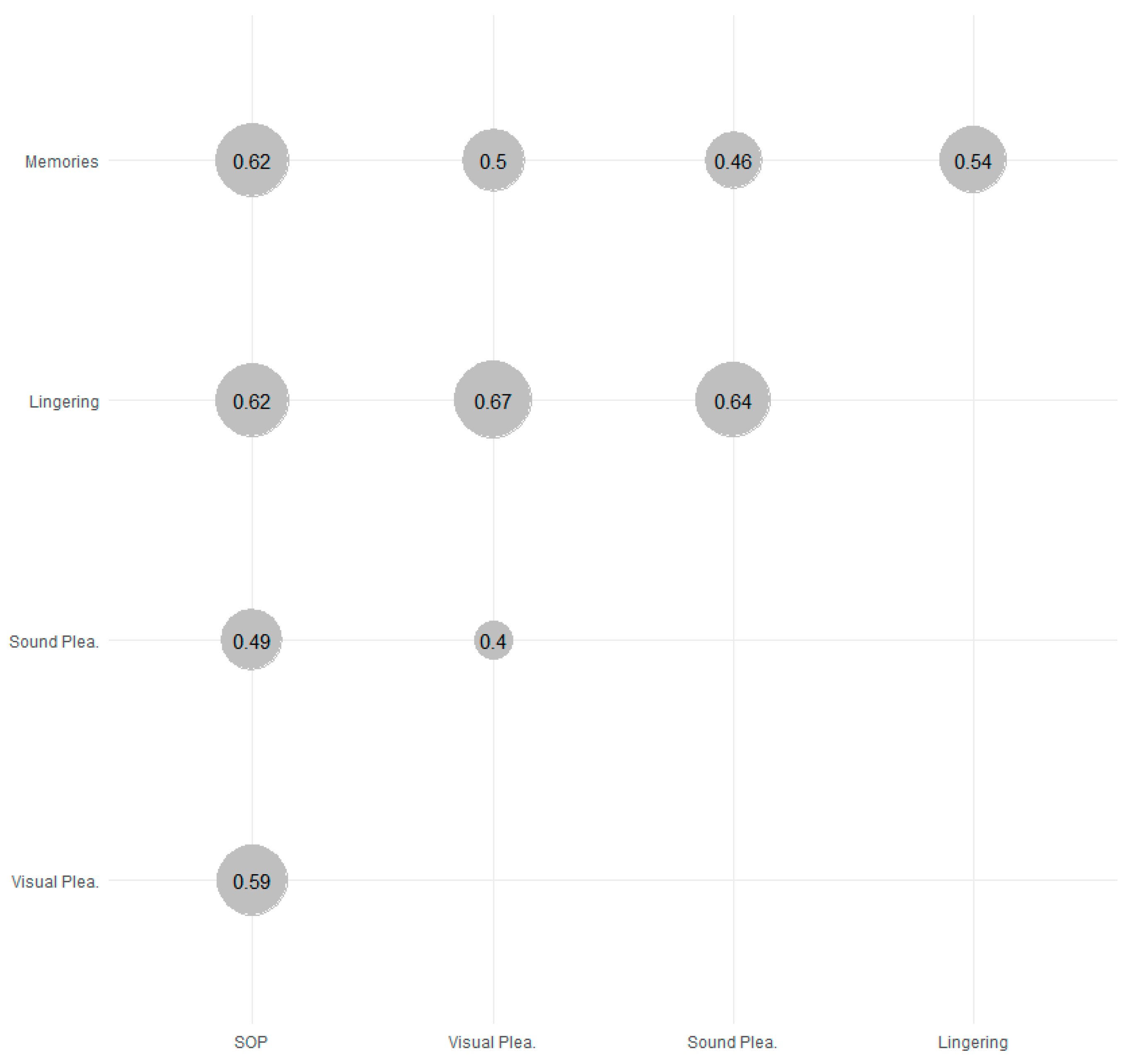
To measure the reliability of the variables and test the consistency of the Likert-scale items, Cronbach’s alpha was calculated. The scale demonstrated excellent reliability (α = 0.88, 95% CI [0.85, 0.91]), with all items positively contributing to the overall scale for the Sense of Place. The results of Spearman’s correlation coefficient indicate a significant positive relationship between the Sense of Place and all four variables (lingering and presence (r = 0.62, p < 0.001, r2 = 0.38), memories (r = 0.62, p < 0.001, r2 = 0.39), visual pleasantness (r = 0.59, p < 0.001, r2 = 0.35), and sound pleasantness (r = 0.49, p < 0.001, r2 = 0.23)). The variables are also significantly correlated with one another (Figure 8).
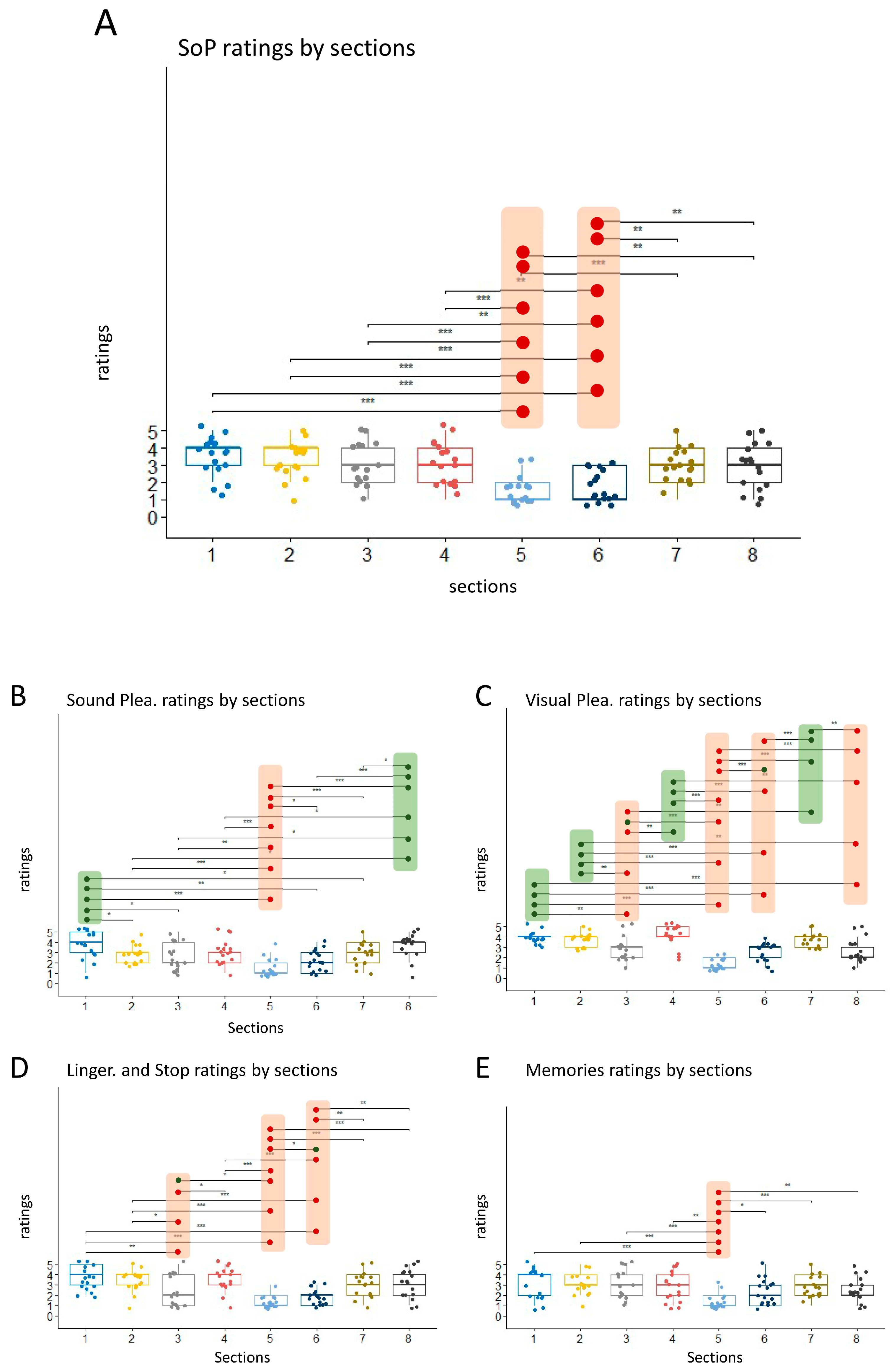
The results of the MANOVA reveal a significant effect of sections on the SoP ratings (F = 4.8678, p < 0.013). Friedman tests revealed significant differences in the SoP and all four variables across the eight sections, shown in Figure 9.
SoP ratings were significantly lower for sections 5 and 6 compared to all the other sections (Figure 9A). For other sections, we will focus on reporting at least three positive/negative significantly different variables with other sections (Figure 9A–E). Section 5 has significantly lower ratings for lingering and presence, memories, sound pleasantness, and visual pleasantness compared to all the other sections. Section 5 is the only section with memories ratings that were significantly lower than those of all of the other sections (Figure 9E). This section is adjacent to residential areas and exposed to construction noise, which could explain the low sound pleasantness. Moreover, the low visual pleasantness ratings could be attributed to the presence of the service areas of the religious center (e.g., restrooms) and a vacant building. The ratings for section 6 are significantly lower than more than three sections in terms of visual pleasantness (compared with sections 1, 2, 4, 7) (Figure 9C) and lingering and presence (with sections 1, 2, 4, 7, 8) (Figure 9D). This section is close to the boundaries of the park, main street, and municipality buildings, with little human presence, uneventful nature, and low SoP ratings. The lingering and presence ratings are also significantly lower for section 3 compared to three other sections (1, 2, 4) (Figure 9D).
Sections can be grouped into two categories based on visual pleasantness ratings: sections 1, 2, 4, and 7 have significantly higher ratings compared to sections 3, 5, 6, and 8 (Figure 9C). The sound pleasantness is higher for section 1 compared to five other sections and section 8 compared to six sections (Figure 9B). Section 8 is adjacent to the school, and children playing and singing can be heard in the recording. The visual pleasantness is rated lower in section 8 compared to all the other sections (Figure 9C). However, the SoP of section 8 is significantly different from the low-SoP sections (5 and 6). This could be interpreted as the independent effect of different variables (visual and sound pleasantness) on the SoP. Similarly, section 3 received low ratings for visual pleasantness and lingering (compared to four and three other places, respectively) and sound pleasantness ratings compared to sections 1 and 8. However, this space does not rank among the low-SoP sections. This may be explained by the fact that the space is perceived as a memorable place that has consistently served as a children’s playground over time.
Based on this phase of research, two sections with relatively higher ratings for SoP categories could be identified. Section 1, with significantly higher ratings for sound and visual pleasantness, and lingering (compared to three or more other sections), and section 2, with higher ratings for visual pleasantness and lingering (compared to three or more other sections). Section 1 also has the highest number of positive mentions in the first phase of the research. However, these spaces have relatively different sound characteristics, one dominated by people, and one dominated by nature.

3. Discussion

We reported on an evaluation of the SoP and soundscapes of a green space in Shiraz with participants in two phases, first on site and then in laboratory settings. We now compare the results between phases and identify the characteristics of the park sections with the highest and lowest SoP. Finally, we discuss factors contributing to the SoP, including not only the long-term relationship (through people’s memories and past experiences), but also their immediate sensory experience based on the visual and sound environments. We then provide practical implications for urban planning.

3.1. Comparison of Results from the First and Second Phases

In the first phase, we identified core categories of a Sense of Place through qualitative methods conducted on site. These are, in decreasing order of importance, as follows: lingering and presence, memories, sensory experience, nature, legibility, safety, and tranquility. Phase 1 allowed us to identify eight sections within the park and characterize the factors contributing to or hindering the SoP. A high SoP was associated with sound sources such as people talking, or natural sounds, behavioral characteristics such as playing, exercise, and psychological characteristics such as excitement. A low SoP, on the other hand, was associated with sound sources such as construction, traffic, and ventilation noise, and behavioral characteristics such as a lower number of people, and psychological characteristics such as a lack of safety.
The low-SoP group mainly consists of remote sections outside of the rectangular shape of the park and separated from it. These sections are surrounded by other land uses (residential and municipal buildings) and exposed to construction noise that can be heard in the park, resulting in a negative soundscape evaluation. However, the surrounding land uses can also impact the park’s soundscape positively: sources from the nearby school (e.g., children playing and singing) resulted in positive soundscape evaluations.
In the second phase, we investigate relationships across the SoP and the five SoP categories identified in phase 1 (lingering and presence, memories, sensory experience rated as visual and sound pleasantness). The weakest correlation among the SoP variables (lingering and presence, memories, sensory experience rated as visual and sound pleasantness) was observed between visual and sound pleasantness. Moreover, while a section showed significantly lower visual pleasantness compared to the others, it was not identified as belonging to a low-SoP group, likely because of pleasant sound sources (e.g., children playing and singing) that enhanced the overall experience. This suggests the potential of sound pleasantness to contribute to the SoP independently of visual pleasantness. The results are aligned with those of previous research regarding the independent nature of soundscape quality, which differs from other landscape values [62]. The quality of visual and sound pleasantness can be evaluated separately, and the presence of solely visual features, such as green spaces and vegetation, cannot guarantee calmness and tranquility in a place [48].
The two-phase methodology used in this study can be introduced as a method for studying the SoP and soundscape simultaneously, allowing for the identification of multi-sensory factors on site and evaluation of the results by a larger group of participants in a laboratory setting. Future studies could rely on complementary SoP measures to capture the multidimensionality of the concept and investigate the relationships with SoP categories (e.g., sound pleasantness). Moreover, we recommend randomizing or counterbalancing the order of presentation across participants to nullify order effects.
In our study, despite limited equipment (for recording and representation), the results from the first and second phases converge towards the same conclusions, which indicates that audio-visual reproduction might allow participants to perceive some environmental aspects in a manner comparable to on-site visits. Future directions include using more immersive audio-visual recording and reproduction techniques (with calibrated sound levels) to further enhance the ecological validity of laboratory settings and considering virtual reality to simulate different interventions [50,63,64], allowing us to evaluate the relative contributions of the different factors contributing to the Sense of Place. Additionally, future studies should examine the generalizability of these findings in larger samples.

3.2. Two Types of SoP

Two types of sections with high SoP ratings were identified. The first type had the highest ratings for lingering and presence, memories, sound, and visual pleasantness in the second phase of research. This is mainly due to the high number of users in place (e.g., the linear area between the primary and secondary entrances is one of the most prominent sections in the park). Due to the presence of people (both visitors and neighboring residents), sounds from human activities can be heard. This was also evident in the first phase of the research, through numerous positive mentions of participants on site, including people talking, laughing, and children playing. Overall, the soundscape characteristics of this kind of space and people’s high SoP in both phases are in line with the results of previous research showing that the presence of people is an important feature of a park’s soundscapes [36,56,65].
The second type of sections with a high SoP is dominated by natural elements. However, an important finding is that these spaces, with considerable grasslands and green coverage, that received high SoP ratings in the lab, were not spontaneously mentioned on site, suggesting that sounds of nature did not attract participants’ attention on site, contrary to human sounds. Indeed, while natural sounds were rarely mentioned, descriptions of human sounds were most common. The few references to natural features include the reference to an old weeping willow that was perceived as being the landmark of the park’s natural elements, which is visually and emotionally important for participants. Also, the lack of legibility in this section emphasizes the effect of similarity and monotony, primarily due to the park’s gridline pattern plan. To address this monotony and animate the space, public art could be considered. Recent research on sound installations in public spaces has indeed shown that situated sound art could shape urban soundscapes and reinforce the identify of public spaces [28,36,66].

3.3. SoP, Amalgamation Between Past and Present

Our results indicate that the Sense of Place is shaped both by the past (memory representations) and the present (immediate sensory experience) of a place. Also, rapid transformations of the site or its surroundings, physically or functionally, can result in a decreased SoP. This is in line with the findings of previous research, which focused on the importance of “sensory or immediately perceived meanings” in the SoP [22].
From a practical perspective, the results of this research can contribute to shaping the Sense of Place in urban public spaces. One way to improve the decision-making process, especially in Iran, would be to use participatory methods for engaging citizens, involving them in the design and evaluation of tactical solutions, and avoiding rapid transformations in environments. The park studied here had been transformed rapidly in recent years, especially through development in the areas around the park, which seems to have affected SoP evaluations. Another important finding was the lack of association between visual and sound pleasantness; while both contributed to SoP ratings, sound pleasantness seemed to do so independently of visual pleasantness. This highlights the potential benefits of sound interventions, including tactical temporary interventions (e.g., situation sound art) to enhance the SoP, especially in problematic areas.

4. Conclusions

We investigated the Sense of Place in an urban green space in Shiraz, in relation to its soundscapes in two phases. Phase 1 used an on-site survey with participants to identify factors contributing to the SoP, which were then further tested in an audio-visual laboratory experiment. The presented methodology is proposed as a way to study the SoP and soundscapes simultaneously. Overall, both on-site and audio-visual methods converge towards the same conclusions: the SoP was perceived as being lower in parts of the parks located at the boundaries, particularly when unpleasant sounds from the surroundings (e.g., construction) could be heard.
Land uses outside the park influence participants’ perceptions, and specifically sound pleasantness ratings, both in negative (e.g., construction noise) and positive (e.g., sounds of children playing) ways, depending on the sounds heard. We did not observe strong associations between sound and visual pleasantness, which suggests that they can contribute to the Sense of Place independently. Finally, we found that SoP was influenced both by memory representations and the immediate sensory experience.
Future directions include extending the investigation of the role of soundscape evaluation on the Sense of Place in other types of urban parks and in different urban contexts to determine the extent to which our findings are transferable to other settings. Moreover, future research should use more immersive audio-visual recording (e.g., spatial audio, virtual reality) and reproduction techniques to further enhance the ecological validity of laboratory settings. More comprehensive soundscape evaluations could be considered (e.g., Soundscape Quality Protocol (SSQP) [67]) to investigate their relationships with the SoP. Furthermore, while our research was limited to a small group of participants’ (students) evaluation of the green space, future trends should consider the perspective of park users and nearby residents.

Author Contributions

Conceptualization, N.I. and S.L.; methodology, all authors.; formal analysis, N.I.; writing—original draft preparation, N.I.; writing—review and editing, all authors.; supervision, S.L. and C.G. All authors have read and agreed to the published version of the manuscript.

Funding

This research received no external funding.

Institutional Review Board Statement

Ethical review and approval were waived for this study due to that in accordance with national and institutional regulations in effect, ethics approval was not required for non-clinical research conducted within the Faculty of Architecture and Urban Planning.

Informed Consent Statement

Informed consent for participation was not required in accordance with local legislation and institutional regulations governing this type of non-clinical research in Iran. Participants were nonetheless informed about the study and provided verbal consent prior to the experiment.

Data Availability Statement

The raw data supporting the conclusions of this article will be made available by the authors on request.

Acknowledgments

The authors would like to thank Sahand Athari for their contributions to an earlier iteration of this manuscript and all the participants of the study. The writing of this paper was supported by research grants from Canada’ Natural Sciences and Engineering Research Council to C.G. This manuscript is based on research initially undertaken for NI’s MA thesis and has since been substantially expanded, refined, and further developed.

Conflicts of Interest

The authors declare no conflicts of interest.

References

  1. Davenport, M.A.; Anderson, D.H. Getting From Sense of Place to Place-Based Management: An Interpretive Investigation of Place Meanings and Perceptions of Landscape Change. Soc. Nat. Resour. 2005, 18, 625–641. [Google Scholar] [CrossRef]
  2. Hu, M.; Chen, R. A Framework for Understanding Sense of Place in an Urban Design Context. Urban Sci. 2018, 2, 34. [Google Scholar] [CrossRef]
  3. Relph, E. Place and Placelessness, 3. Reprint; Research in Planning and Design; Pion Limited: London, UK, 1986. [Google Scholar]
  4. Smaldone, D.; Harris, C.; Sanyal, N. An Exploration of Place as a Process: The Case of Jackson Hole, WY. J. Environ. Psychol. 2005, 25, 397–414. [Google Scholar] [CrossRef]
  5. Tuan, Y. Space and Place: The Perspective of Experience; University of Minnesota Press: Minneapolis, MN, USA, 1977. [Google Scholar]
  6. Wartmann, F.M.; Purves, R.S. Investigating Sense of Place as a Cultural Ecosystem Service in Different Landscapes through the Lens of Language. Landsc. Urban Plan. 2018, 175, 169–183. [Google Scholar] [CrossRef]
  7. Jorgensen, B.S.; Stedman, R.C. Sense of Place as an Attitude: Lakeshore Owners Attitudes Toward Their Properties. J. Environ. Psychol. 2001, 21, 233–248. [Google Scholar] [CrossRef]
  8. Žlender, V.; Gemin, S. Testing Urban Dwellers’ Sense of Place towards Leisure and Recreational Peri-Urban Green Open Spaces in Two European Cities. Cities 2020, 98, 102579. [Google Scholar] [CrossRef]
  9. Canter, D.V. The Psychology of Place; Architectural Press: London, UK, 1977. [Google Scholar]
  10. Scannell, L.; Gifford, R. Defining Place Attachment: A Tripartite Organizing Framework. J. Environ. Psychol. 2010, 30, 1–10. [Google Scholar] [CrossRef]
  11. Hay, R. Sense of Place in Developmental Context. J. Environ. Psychol. 1998, 18, 5–29. [Google Scholar] [CrossRef]
  12. Cheng, T.-M.; Wu, H.C. How Do Environmental Knowledge, Environmental Sensitivity, and Place Attachment Affect Environmentally Responsible Behavior? An Integrated Approach for Sustainable Island Tourism. J. Sustain. Tour. 2015, 23, 557–576. [Google Scholar] [CrossRef]
  13. Halpenny, E.A. Pro-Environmental Behaviours and Park Visitors: The Effect of Place Attachment. J. Environ. Psychol. 2010, 30, 409–421. [Google Scholar] [CrossRef]
  14. Sakurai, R.; Ota, T.; Uehara, T. Sense of Place and Attitudes towards Future Generations for Conservation of Coastal Areas in the Satoumi of Japan. Biol. Conserv. 2017, 209, 332–340. [Google Scholar] [CrossRef]
  15. Gifford, R.; Nilsson, A. Personal and Social Factors That Influence Pro-Environmental Concern and Behaviour: A Review: Personal and Social Factors That Influence Pro-Environmental Behaviour. Int. J. Psychol. 2014, 49, 141–157. [Google Scholar] [CrossRef]
  16. Groshong, L.; Stanis, S.W.; Morgan, M.; Li, C.J. Place Attachment, Climate Friendly Behavior, and Support for Climate Friendly Management Action among State Park Visitors. Environ. Manag. 2020, 65, 98–110. [Google Scholar] [CrossRef] [PubMed]
  17. Stedman, R.C. Toward a Social Psychology of Place: Predicting Behavior from Place-Based Cognitions, Attitude, and Identity. Environ. Behav. 2002, 34, 561–581. [Google Scholar] [CrossRef]
  18. Escolà-Gascón, Á.; Dagnall, N.; Denovan, A.; Maria Alsina-Pagès, R.; Freixes, M. Evidence of Environmental Urban Design Parameters That Increase and Reduce Sense of Place in Barcelona (Spain). Landsc. Urban Plan. 2023, 235, 104740. [Google Scholar] [CrossRef]
  19. Chen, Z.; Jin, M.; Zuo, Y.; Ding, P.; Shi, X. The Effect of Soundscape on Sense of Place for Residential Historical and Cultural Areas: A Case Study of Taiyuan, China. Buildings 2024, 14, 1394. [Google Scholar] [CrossRef]
  20. Yang, L.; Liu, J.; Albert, C.; Guo, X. Exploring the Effects of Soundscape Perception on Place Attachment: A Comparative Study of Residents and Tourists. Appl. Acoust. 2024, 222, 110048. [Google Scholar] [CrossRef]
  21. Zhao, W.; Rui, Q.; Zhu, X.; Xu, H. Effect of Soundscape on Place Attachment for Historical Blocks: A Case Study of Harbin, China. Buildings 2023, 13, 607. [Google Scholar] [CrossRef]
  22. Raymond, C.M.; Kyttä, M.; Stedman, R. Sense of Place, Fast and Slow: The Potential Contributions of Affordance Theory to Sense of Place. Front. Psychol. 2017, 8, 1674. [Google Scholar] [CrossRef]
  23. Herranz-Pascual, K.; Aspuru, I.; Garcia, I. Proposed Conceptual Model of Environmental Experience as Framework to Study the Soundscape. In Inter-Noise and Noise-Con Congress and Conference Proceedings; Institute of Noise Control Engineering: Lisbon, Portugal, 2010. [Google Scholar]
  24. Brown, A.L.; Muhar, A. An Approach to the Acoustic Design of Outdoor Space. J. Environ. Plan. Manag. 2004, 47, 827–842. [Google Scholar] [CrossRef]
  25. ISO 12913-1:2014; Acoustics–Soundscape Part 1: Definition and conceptual framework. ISO: Geneva, Switzerland, 2014. Available online: https://www.iso.org/standard/52161.html (accessed on 2 May 2025).
  26. Aletta, F.; Lepore, F.; Kostara-Konstantinou, E.; Kang, J.; Astolfi, A. An Experimental Study on the Influence of Soundscapes on People’s Behaviour in an Open Public Space. Appl. Sci. 2016, 6, 276. [Google Scholar] [CrossRef]
  27. Davies, W.J.; Adams, M.D.; Bruce, N.S.; Cain, R.; Carlyle, A.; Cusack, P.; Hall, D.A.; Hume, K.I.; Irwin, A.; Jennings, P.; et al. Perception of Soundscapes: An Interdisciplinary Approach. Appl. Acoust. 2013, 74, 224–231. [Google Scholar] [CrossRef]
  28. Steele, D.; Bild, E.; Tarlao, C.; Guastavino, C. Soundtracking the Public Space: Outcomes of the Musikiosk Soundscape Intervention. Int. J. Environ. Res. Public. Health 2019, 16, 1865. [Google Scholar] [CrossRef] [PubMed]
  29. Szeremeta, B.; Zannin, P.H.T. Analysis and Evaluation of Soundscapes in Public Parks through Interviews and Measurement of Noise. Sci. Total Environ. 2009, 407, 6143–6149. [Google Scholar] [CrossRef]
  30. Zhang, X.; Ba, M.; Kang, J.; Meng, Q. Effect of Soundscape Dimensions on Acoustic Comfort in Urban Open Public Spaces. Appl. Acoust. 2018, 133, 73–81. [Google Scholar] [CrossRef]
  31. Guastavino, C. Categorization of Environmental Sounds. Can. J. Exp. Psychol. 2007, 60, 54–63. [Google Scholar] [CrossRef] [PubMed]
  32. Maculewicz, J.; Erkut, C.; Serafin, S. How Can Soundscapes Affect the Preferred Walking Pace? Appl. Acoust. 2016, 114, 230–239. [Google Scholar] [CrossRef]
  33. Bild, E.; Coler, M.; Pfeffer, K.; Bertolini, L. Considering Sound in Planning and Designing Public Spaces: A Review of Theory and Applications and a Proposed Framework for Integrating Research and Practice. J. Plan. Lit. 2016, 31, 419–434. [Google Scholar] [CrossRef]
  34. Axelsson, Ö.; Nilsson, M.E.; Hellström, B.; Lundén, P. A Field Experiment on the Impact of Sounds from a Jet-and-Basin Fountain on Soundscape Quality in an Urban Park. Landsc. Urban Plan. 2014, 123, 49–60. [Google Scholar] [CrossRef]
  35. Jo, H.I.; Jeon, J.Y. The Influence of Human Behavioral Characteristics on Soundscape Perception in Urban Parks: Subjective and Observational Approaches. Landsc. Urban Plan. 2020, 203, 103890. [Google Scholar] [CrossRef]
  36. Steele, D.; Fraisse, V.; Bild, E.; Guastavino, C. Bringing Music to the Park: The Effect of Musikiosk on the Quality of Public Experience. Appl. Acoust. 2021, 177, 107910. [Google Scholar] [CrossRef]
  37. Westerkamp, H. Bauhaus and Soundscape Studies—Exploring Connections and Differences. Bauhaus and Soundscape Studies—Exploring Connections and Differences. Available online: http://www.hildegardwesterkamp.ca/writings/writings-by/index.php (accessed on 15 December 2025).
  38. De Coensel, B.; Botteldooren, D. The Quiet Rural Soundscape and How to Characterize It. Acta Acust. United Acust. 2006, 92, 887–897. [Google Scholar]
  39. Zube, E.H.; Sell, J.L.; Taylor, J.G. Landscape Perception: Research, Application and Theory. Landsc. Plan. 1982, 9, 1–33. [Google Scholar] [CrossRef]
  40. Tian, E.; Wise, N. Dancing in Public Squares—Toward a Socially Synchronous Sense of Place. Leis. Sci. 2022, 47, 283–303. [Google Scholar] [CrossRef]
  41. Li, J.; Stoffelen, A.; Meijles, E.; Vanclay, F. Local People’s Sense of Place in Heavily Touristified Protected Areas: Contested Place Meanings around the Wulingyuan World Heritage Site, China. Landsc. Urban Plan. 2023, 237, 104792. [Google Scholar] [CrossRef]
  42. Semken, S.; Freeman, C.B. Sense of Place in the Practice and Assessment of Place-Based Science Teaching. Sci. Educ. 2008, 92, 1042–1057. [Google Scholar] [CrossRef]
  43. Stedman, R.C. Is It Really Just a Social Construction? The Contribution of the Physical Environment to Sense of Place. Soc. Nat. Resour. 2003, 16, 671–685. [Google Scholar] [CrossRef]
  44. Jaalama, K.; Fagerholm, N.; Julin, A.; Virtanen, J.-P.; Maksimainen, M.; Hyyppä, H. Sense of Presence and Sense of Place in Perceiving a 3D Geovisualization for Communication in Urban Planning—Differences Introduced by Prior Familiarity with the Place. Landsc. Urban Plan. 2021, 207, 103996. [Google Scholar] [CrossRef]
  45. Song, Y.; Wang, R.; Fernandez, J.; Li, D. Investigating Sense of Place of the Las Vegas Strip Using Online Reviews and Machine Learning Approaches. Landsc. Urban Plan. 2021, 205, 103956. [Google Scholar] [CrossRef]
  46. Larson, S.; De Freitas, D.M.; Hicks, C.C. Sense of Place as a Determinant of People’s Attitudes towards the Environment: Implications for Natural Resources Management and Planning in the Great Barrier Reef, Australia. J. Environ. Manag. 2013, 117, 226–234. [Google Scholar] [CrossRef] [PubMed]
  47. Bild, E.; Pfeffer, K.; Coler, M.; Rubin, O.; Bertolini, L. Public Space Users’ Soundscape Evaluations in Relation to Their Activities. An Amsterdam-Based Study. Front. Psychol. 2018, 9, 1593. [Google Scholar] [CrossRef]
  48. Sun, K.; De Coensel, B.; Filipan, K.; Aletta, F.; Van Renterghem, T.; De Pessemier, T.; Joseph, W.; Botteldooren, D. Classification of Soundscapes of Urban Public Open Spaces. Landsc. Urban Plan. 2019, 189, 139–155. [Google Scholar] [CrossRef]
  49. Cao, J.; Kang, J. A Perceptual Structure of Soundscapes in Urban Public Spaces Using Semantic Coding Based on the Grounded Theory. Int. J. Environ. Res. Public Health 2023, 20, 2932. [Google Scholar] [CrossRef]
  50. Tarlao, C.; Steele, D.; Guastavino, C. Assessing the Ecological Validity of Soundscape Reproduction in Different Laboratory Settings. PLoS ONE 2022, 17, e0270401. [Google Scholar] [CrossRef]
  51. Brambilla, G.; Gallo, V.; Asdrubali, F.; D’Alessandro, F. The Perceived Quality of Soundscape in Three Urban Parks in Rome. J. Acoust. Soc. Am. 2013, 134, 832–839. [Google Scholar] [CrossRef]
  52. Shirazi, F.-o.-D. Asar-e Ajam (The Land of Persia); Amirkabir: Tehran, Iran, 1894. [Google Scholar]
  53. Shirazi, Z. Shiraz Nameh (the Epistle of Shiraz); Iran Culture Foundation Publications: Tehran, Iran, 1971. [Google Scholar]
  54. Afsar, K. History of the Old Fabric of Shiraz (Tarikh-i Bafte-i Qadimi-i Shiraz); Society for the National Heritage of Iran Publications Series: Tehran, Iran, 1987. [Google Scholar]
  55. Aryanpoor, A. A Research on the Recognizing Iranian Gardens and the Historical Gardens of Shiraz; Yasaavoli: Tehran, Iran, 1987. [Google Scholar]
  56. Aletta, F.; Kang, J. Towards an Urban Vibrancy Model: A Soundscape Approach. Int. J. Environ. Res. Public Health 2018, 15, 1712. [Google Scholar] [CrossRef]
  57. Liu, F.; Kang, J. A Grounded Theory Approach to the Subjective Understanding of Urban Soundscape in Sheffield. Cities 2016, 50, 28–39. [Google Scholar] [CrossRef]
  58. Morse, J.M. Designing Funded Qualitative Research. In Handbook of Qualitative Research; Sage Publications, Inc.: Thousand Oaks, CA, USA, 1994; pp. 220–235. [Google Scholar]
  59. Lynch, K. The Image of the City; Massachusetts Institute of Technology: Cambridge, MA, USA, 1960. [Google Scholar]
  60. Inoue, T.; Manabe, R.; Murayama, A.; Koizumi, H. Landscape Value in Urban Neighborhoods: A Pilot Analysis Using Street-Level Images. Landsc. Urban Plan. 2022, 221, 104357. [Google Scholar] [CrossRef]
  61. Bakdash, J.Z.; Marusich, L.R. Repeated Measures Correlation. Front. Psychol. 2017, 8, 456. [Google Scholar] [CrossRef] [PubMed]
  62. Korpilo, S.; Nyberg, E.; Vierikko, K.; Nieminen, H.; Arciniegas, G.; Raymond, C.M. Developing a Multi-Sensory Public Participation GIS (MSPPGIS) Method for Integrating Landscape Values and Soundscapes of Urban Green Infrastructure. Landsc. Urban Plan. 2023, 230, 104617. [Google Scholar] [CrossRef]
  63. Tarlao, C.; Steele, D.; Blanc, G.; Guastavino, C. Interactive Soundscape Simulation as a Co-Design Tool for Urban Professionals. Landsc. Urban Plan. 2023, 231, 104642. [Google Scholar] [CrossRef]
  64. Yanaky, R.; Tyler, D.; Guastavino, C. City Ditty: An Immersive Soundscape Sketchpad for Professionals of the Built Environment. Appl. Sci. 2023, 13, 1611. [Google Scholar] [CrossRef]
  65. Filipan, K.; Boes, M.; De Coensel, B.; Lavandier, C.; Delaitre, P.; Domitrović, H.; Botteldooren, D. The Personal Viewpoint on the Meaning of Tranquility Affects the Appraisal of the Urban Park Soundscape. Appl. Sci. 2017, 7, 91. [Google Scholar] [CrossRef]
  66. Fraisse, V.; Tarlao, C.; Guastavino, C. Shaping City Soundscapes: In Situ Comparison of Four Sound Installations in an Urban Public Space. Landsc. Urban Plan. 2024, 251, 105173. [Google Scholar] [CrossRef]
  67. Axelsson, Ö.; Nilsson, M.E.; Berglund, B. A Principal Components Model of Soundscape Perception. J. Acoust. Soc. Am. 2010, 128, 2836–2846. [Google Scholar] [CrossRef] [PubMed]
Figure 1. Comparing methods for studying the Sense of Place and soundscape, adapted from [26,39].
Sustainability 18 02353 g001
Figure 2. Transformation of the park over the last 20 years.
Sustainability 18 02353 g002
Figure 4. Number of codes in categories of Sense of Place by each participant (A–F).
Sustainability 18 02353 g004
Figure 5. Map of positive and negative mentions distribution in sections.
Sustainability 18 02353 g005
Figure 6. Number of positive (Green) and negative (Red) mentions for each of the 8 sections.
Sustainability 18 02353 g006
Figure 7. Panoramic view of sections 1 to 8.
Sustainability 18 02353 g007
Figure 8. Spearman’s correlation scale ratings.
Sustainability 18 02353 g008
Figure 9. Results of the Friedman test for SoP and the five variables. Orange boxes indicate sections that differ significantly from more than three other sections in a negative direction, while green boxes indicate sections that differ significantly from more than three others in a positive direction. (p-values < 0.001, “***”, < 0.01, “**”,< 0.05, “*”).
Sustainability 18 02353 g009
Table 1. SoP categories.
Sense of Place CategoryDescriptionsSample Quotation from Participants (All Quotations Were Translated from Farsi by the Researchers.)
Lingering and PresenceReferring to human activities, diverse groups of people, events, and spaces that are pleasant to linger in “Many people linger in this space… There are a lot of sitting spaces that encouraged me to stop several times.” P1, Sec1
MemoriesEvoking past experiences with family and friends“These places remind me of my childhood. Sometimes you can hear children’s songs.” P2, Sec3
Sensory ExperienceReferring to the senses of vision, hearing, olfaction, and touch“This is the best place in the park, and I love it. The sound of water, a cool breeze in the summer, …” P3, Sec1
NatureReferring to green spaces, water, and animals“I can hear bird songs in this space.” P4, Sec2
LegibilityReferring to addressable spaces, landmarks “I like this pathway because of the three trees in the middle that provide an extended view and make it different from other pathways.” P5, Sec4
TranquilityReferring to calm and peaceful environments“In this place, the park becomes calm, tranquil. It becomes a park. A place that you come to sit and relax.” P3, Sec 7
SafetyReferring to socio-environmental characteristics such as visibility and nightlife“This space—because it is far away from the park’s entrance- is an empty and unsafe space.” P6, Sec5
Table 2. Descriptions of high and low SoP in sections organized into the three dimensions of QUPE model.
Sound-Related Evaluation Public Space EngagementPsychological Outcomes
Factors contributing to SoPSound sources: people’s voices, children, water, birds, music
Descriptors: diversity, warmth, layered sounds, memorable, everydayness (liveliness)
Sitting, lingering, playing, eating, reading, exercisingAttractiveness, restorativeness, openness, excitement
Factors hindering SoPSound sources: construction noise, automobile, ventilation noise
Descriptors: monotonous
Less people, passing rapidly, lower safetyRemoteness, dead spaces, sense of being lost
Table 3. Questionnaire items representing SoP and its respective categories.
SoP and Its Respective CategoriesPhrasing of the Questions (Likert Scale)
SoPI feel a strong Sense of Place in this place.
Lingering and PresenceI would like to stop and spend more time in the place.
MemoriesThis place reminds me of the memorable events in my life.
Sensory ExperienceVisual PleasantnessThe visual features of this place are pleasant for me.
Sound PleasantnessThe sounds of this place are pleasant for me.
Disclaimer/Publisher’s Note: The statements, opinions and data contained in all publications are solely those of the individual author(s) and contributor(s) and not of MDPI and/or the editor(s). MDPI and/or the editor(s) disclaim responsibility for any injury to people or property resulting from any ideas, methods, instructions or products referred to in the content.