Article

Upcycled PVC-Based Metamaterials for Low-Frequency Sound Absorption: Experimental and Analytical Investigation of Honeycomb-Enhanced Architectures


by
Giuseppe Ciaburro
1,* and
Virginia Puyana-Romero
2
1
Department of Engineering, Faculty of Engineering and Informatics, Pegaso University, 80143 Naples, Italy
2
Departamento de Ingeniería en Sonido y Acústica, Universidad de Las Américas, Quito 17513, Ecuador
*
Author to whom correspondence should be addressed.
Sustainability 2026, 18(5), 2342; https://doi.org/10.3390/su18052342
Submission received: 3 February 2026 / Revised: 23 February 2026 / Accepted: 26 February 2026 / Published: 28 February 2026
(This article belongs to the Special Issue Sustainable Materials for Building Envelopes)

Abstract

The treatment and management of waste in industrial processes remain a challenge, especially in material-intensive industries. In an attempt to mitigate this issue, sustainable architectural solutions focus extensively on the reuse of post-consumer waste in a bid to minimize environmental degradation. In this work, we propose a new acoustic metamaterial composed of three layers of reclaimed PVC diaphragms and a structured honeycomb core. The diaphragms were implemented on a hard frame in a manner that incorporates air gaps between layers and were tested using a portable impedance tube for setups including honeycomb panels behind diaphragms, in addition to setups including only air gaps, compared to diaphragms alone. The experimental and simulated results, using a transfer matrix approach, show a significantly improved low-frequency sound absorption performance within the 250–600 Hz band.

1. Introduction

The accelerated trend of urbanization and industrialization has engendered accelerated challenges associated with environmental sustainability, especially regarding the management of solid waste [1]. With the expanding trend of societies toward the implementation of circular economy approaches, the construction and architectural fields are currently under increasing stress to incorporate the use of techniques and strategies aimed at minimizing the negative effects on the environment. One of the biggest environmental risks associated with construction is the use of non-biodegradable materials, such as polyvinyl chloride (PVC), which is largely in use but is rarely adequately recycled [2]. Secondly, the management of urban noise pollution, particularly in the low-frequency band, is also a big challenge [3].
To overcome both environmental and acoustic issues, new materials with high innovation qualities and sustainability should be invented. One promising approach is the use of acoustic metamaterials [4]. These materials can be designed with a periodic or structured geometrical arrangement to manipulate sound waves beyond the capability of traditional sound absorbers. It is clear that metamaterials can provide strong sound absorption performance at low frequencies with minimal thickness and density [5]. Traditional porous or fibrous materials are generally effective at mid-to-high frequencies but perform poorly at low frequencies unless applied in impractically large thicknesses [6]. Therefore, membrane-type acoustic metamaterials that rely on resonance mechanisms have recently come into focus for applications targeting low-frequency noise issues [7]. In general, such designs feature a pre-stretched membrane in combination with cavities or other auxiliary structures that serve to dissipate incoming acoustic energy.
This paper presents an innovative approach that couples low-frequency acoustic performance to the reuse of materials. Accordingly, the presented metamaterial is composed of three layers of reused PVC membranes supported by a honeycomb structure. Recycling postconsumer or industrial PVC decreases landfill disposal and provides, at the same time, an economically affordable and durable material for acoustics applications. In particular, PVC offers high mechanical strength and acoustic impermeability, making it extremely suitable for resonance-based metamaterials, while in addition, its low biodegradability and the presence of toxic byproducts during incineration make it an excellent candidate for the upcycling process [8].
The structure comprises three PVC membranes fixed on hard frames, keeping certain air gaps between them, thus developing regions that affect acoustic behavior based on various reflections and resonances [9]. In other setups, honeycomb panels are fixed behind every membrane, contributing to additional regulation regarding wave propagation and absorption. Being semi-periodic and light, honeycomb core structures can efficiently trap and scatter acoustic waves [10].
The acoustic performance of the system was tested experimentally using an impedance tube, concentrating on the more problematic low-frequency region of 250–600 Hz. Several layouts were tested in order to determine the effect of the honeycomb backing and inter-membrane air gaps. The findings of these experiments were then compared with calculated predictions using the transfer matrix method (TMM), which is a common analysis technique for acoustic multilayers.
Although there are existing studies on membrane-based metamaterials designed with elastomer, latex, and composite layers [11], there are very limited studies regarding upcycled rigid plastics such as PVC combined with honeycombs [12]. The advantages of this method are its capability to vary the acoustics depending on membrane tension, interval, and geometry designed for different applications such as exterior and interior wall systems [13].
In addition to the scientific significance, this study has importance in terms of its practical and environmental aspects. The findings of this study clearly show that reprocessed industrial PVC can be effectively used for the fabrication of efficient sound-absorbing materials, especially for low-frequency noise reduction. In this regard, the proposed method of utilizing industrial waste for the fabrication of functional acoustic components can be considered a step toward sustainable waste management and the development of innovative engineering solutions. In this context, the proposed study can be seen as support for the principles of the circular economy, as it clearly demonstrates that instead of being landfilled or downcycled, discarded polymers can be effectively reintroduced into high-value products. Moreover, this study can be considered a starting point for future studies on waste-based acoustic metamaterials, which can encourage the investigation of other types of recycled materials and geometries.

2. Materials and Methods

For sound environment control and reverberation time reduction, sound-absorbing materials are widely used. The traditional sound-absorbing material works on the principle of sound energy dissipation using a network of pores or channels connected together [14]. As sound waves pass through the pores or channels, they encounter frictional forces due to interaction between the sound wave fronts and the inner surfaces of the pores/channels. This interaction results in sound wave intensity reduction due to conversion of sound wave intensity into heat [15]. The efficiency of sound absorption using this mechanism is highly dependent on the material’s porosity and surface area exposed to sound waves. Materials having higher pore density tend to work better as sound-absorbing materials. The sound-absorbing material is typically made up of fibrous media such as mineral or polyester fibers or granular media such as open-cell foams [16]. The sound-absorbing material’s efficiency depends on factors such as material thickness, material density, and connectivity among pores. At low frequencies, a significant amount of material thickness is often required for sound absorption. This may not be feasible in sound-absorbing applications where space is a constraint. To counter such drawbacks, membrane sound-absorbing materials were introduced. Unlike traditional sound-absorbing materials, membrane sound-absorbing materials work on sound wave resonance for sound reduction, particularly at low frequencies [17]. A thin sheet of material is placed on a cavity or a hard surface. The material tends to vibrate due to sound pressure. This mechanism converts sound wave intensity into mechanical vibrations. This sound-absorbing material is very efficient for noise reduction without increasing material bulk. This is a very useful sound-absorbing material for modern sound design applications [18].

2.1. Membrane-Based Metamaterials

Membrane-type metamaterials represent a quickly developing field in acoustic materials research [19,20,21,22]. These man-made materials are designed to manipulate, control, and suppress sound waves in a manner not achievable with natural materials. Unlike conventional sound absorbers based on fibrous materials or porous foams, where the primary mechanisms for sound attenuation involve viscous losses or heating, membrane metamaterials use resonant phenomena for efficient sound absorption at low frequencies with a small thickness [23].
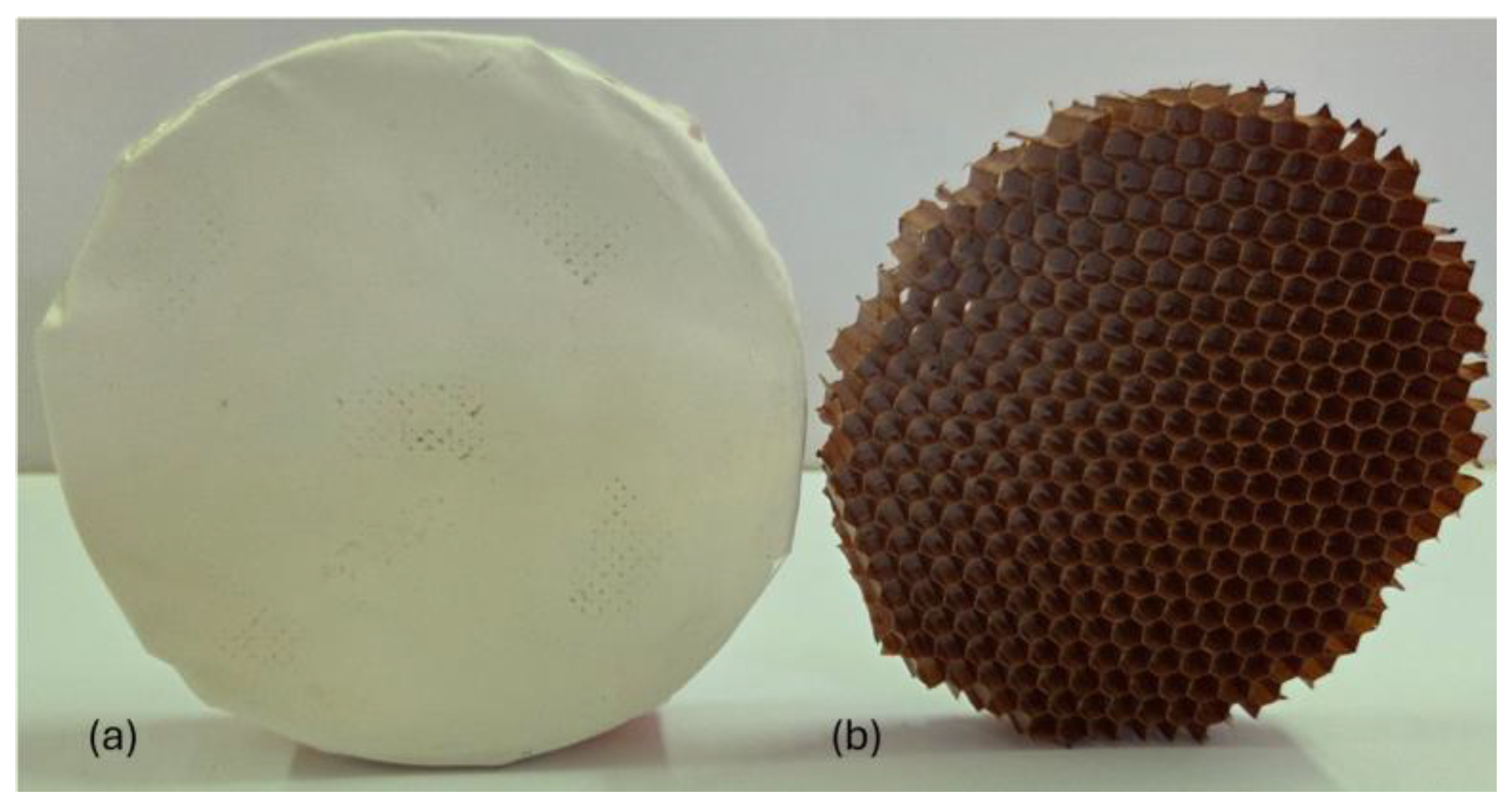
The idea of acoustic metamaterials is based on research initiated in optics and electromagnetism regarding metamaterials and their unique properties impossible to be observed in naturally existing materials, such as negative refraction and cloaking properties. For acoustic metamaterials, similar techniques are used to manipulate wave phenomena and are proven effective when implemented using membrane systems for achieving sub-wavelength phenomena and are very effective for frequency bands that are difficult to address traditionally [24]. A conventional membrane metamaterial is a thin and stretched membrane made from rubber, polymer, and plastic materials placed over a cavity or frame (see Figure 1a). When acoustic waves hit the membrane, local oscillations occur, resulting in resonances and impedance mismatch to absorb energy [25]. By adjusting membrane properties and settings, desired frequency bands can be absorbed, particularly low-frequency bands (between 100 and 1000 Hz).
One of the strengths of membrane systems is their ability to be more compact. Traditional sound absorbers would need to be about a quarter of a wavelength thick to effectively absorb sound. However, at lower frequencies, this would make them unreasonably thick [26]. This makes membrane metamaterials, which could offer the same or even better performance at a thickness that is only a small fraction of a wavelength, more desirable in applications where size is a concern, such as in transport or high-rise buildings [27]. Another desirable aspect of these systems is their ability to be tuned. This could be accomplished in a number of ways, including stacking membranes, adding mass inclusions such as a central disk or ring, or adding honeycomb cores. All these variations would add several resonances to a given system, which would allow for a desired absorption characteristic.
Recent studies have also investigated the application of sustainable materials or recycled materials in membrane metamaterials. Using materials like recycled PVC membranes, rubber sheets, or other types of recycled plastics helps overcome environmental issues while keeping costs low. Membrane-based acoustic metamaterials provide a good solution for low-frequency noise reduction. Their small size, controllable properties, and ability to be produced using eco-friendly methods make them a promising option for use in architectural acoustics, environmental noise reduction, or advanced noise reduction technology.

2.2. Honeycomb Core

Honeycomb core materials are engineered materials that are recognized by their peculiar cellular structure, derived from the natural hexagonal patterns found in beehives [28]. These materials are made up of a series of cells, usually hexagons, but also square and triangular, in a repeating lattice pattern [29]. The major advantage of honeycomb core materials is their high strength-to-weight ratio, making them particularly useful in applications that demand lightweight yet strong materials (Figure 1b). Honeycomb core materials were originally developed in the field of aero-space engineering, where it is essential to maximize the strength of a structure while minimizing its weight [30].
In materials engineering, honeycomb cores are used as the middle plane in sandwich materials placed between the stiff faces. This design greatly improves the bending stiffness of the sandwich while keeping the weight minimal. Shear loading is absorbed by the honeycomb core, while the faces support the bending load, making the sandwich act like a thick and heavy solid material [31]. Honeycomb cores provide design flexibility in terms of desired mechanical and physical properties, including cell dimensions, wall thickness, materials, and total honeycomb core thickness. Honeycomb cores can be made from aluminum alloys, aramid papers, thermoplastics, or recycled polymers according to the application needs of strength, high temperature, durability, or economics [32].
Recently, honeycomb structures have emerged as new interest areas for acoustics and vibration damping. In acoustic metamaterials, honeycomb cores introduce internal cavities that affect wave propagation. Their geometries can introduce impedance mismatches and resonances, which favor energy dissipation and noise damping. Their light-weight and customizable properties make them ideal for use in walls, ceilings, floors, and enclosures where performance, weight, and sustainability are of prime importance [33]. By incorporating membranes or thin films, honeycomb cores become backing components that favor absorption by employing hybrid principles such as cavity resonance, local resonance, and multiple internal reflections. Trapped air pockets can be viewed as springs in mass–spring–damper systems, addressing specified frequency bands [34].
Furthermore, honeycomb cores support sustainable design. Many modern cores use recycled or recyclable materials, reducing environmental impact and promoting circular economy principles. Versatile and high-performing, honeycomb structures extend well beyond structural applications. Their integration into acoustic systems offers opportunities for lightweight, tunable, and efficient sound-absorbing solutions, especially when paired with resonant elements such as membranes.

2.3. Specimen Preparation Process

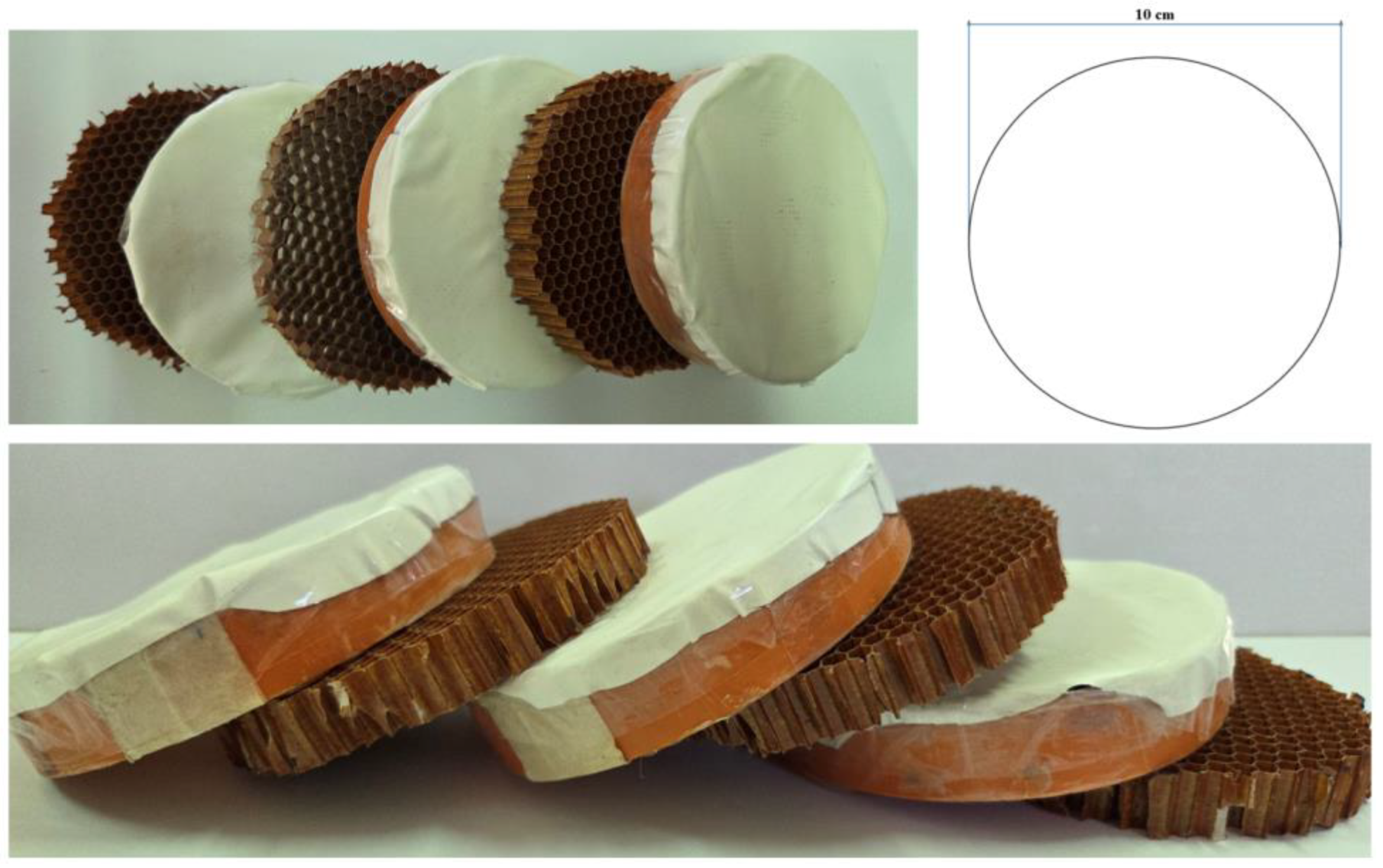
The samples used for acoustic analysis were carefully produced using lightweight and sustainable materials. The key material used in the production of the samples was a high-quality membrane made of 100% recycled polyvinyl chloride (PVC). The film has a mass per unit area of 0.18 g/m2 and a thickness of 0.18 mm and has superior impermeability and flame retardancy. The film does not contain harmful additives like phthalates, cadmium, mercury, and arsenic and is therefore considered eco-friendly compared to other polymers used in acoustic materials (Figure 2).
The membrane complies with the European fire classification standard EN 13501-1 [35] and is classified as B-s2,d0, according to the manufacturer’s certificate. This classification indicates that it is of limited contribution to the spread of fire (B), of medium production of smoke during combustion (s2), and does not produce droplets during combustion (d0). It is environmentally friendly and does not impact its mechanical and acoustic properties, making it ideal for use in noise control experiments.
The support system for the membrane was established using a rigid cylindrical frame made out of recycled PVC piping that is normally employed in thermal drainage systems. The pipe had a diameter of 100 mm, a thickness of 2 mm, a density of 1.5 g/cm3, and was cut into rings with a height of 13 mm to create a stable base for supporting the membranes without wrinkles or tension. These rings were cleaned and abraded before being placed on the support system.
The membranes were then carefully stretched over circular frames using a hot air stream to ensure even tension on the membrane. This resulted in a taut and consistent membrane that could serve as a resonator in the multi-layer acoustic structure (see Figure 2).
In addition to the membrane layer, a core layer was incorporated to simulate a sandwich panel configuration. While there are many materials available—including foams, expanded polystyrenes, or wood-based materials—a honeycomb core structure was considered based on its weight and efficient use of materials. The honeycombs in this study are composed of hexagonal cells made of aramid paper, which are known for their high performance and low weight. The idea is to strike an optimal balance between weight and rigidity for this application, which is applicable in both sound absorption and structural applications. The hexagonal structure facilitates equal weight distribution and efficient dissipation of vibrational loads. The choice of aramid paper, which is usually processed from aromatic polyamides such as Kevlar, provides excellent compression and fatigue properties and enhances fire-resistance properties, making it suitable for use in advanced composite materials for sound absorption and damping (Figure 2).
The design of the honeycomb core was influenced by natural hexagonal patterns. It provides excellent compressive strength values along with positive values of acoustic impedance, requiring low material usage. The core was placed at the rear of each membrane layer, with membranes in direct contact with the core or with an adjustable air gap in between. The design aimed to study the different acoustics of each scenario.
The dimensions of every honeycomb were carefully aligned to match the cylindrical frame. Different configurations were set to place layers of honeycombs at the rear of every membrane or to alternate them with empty spaces for research on variations due to core structure influences on total sound absorption capability.

2.4. Measurement of the Sound Absorption Coefficient

To determine to what extent this new material absorbs sound, we conducted a test for its Sound Absorption Coefficient (SAC) in accordance with ISO 10534-2:2023 [36]. This measurement of SAC is critical in determining to what extent a surface can absorb incoming sound energy as opposed to reflecting it, which has been known to affect acoustic environments. SAC has significant importance in fields such as acoustic design in buildings as well as in car design.
It employed a standing wave tube, termed an impedance tube, a technique accepted as the best approach for analyzing acoustics in a laboratory setup. In an impedance tube setup, a plane acoustic wave is transmitted through a cylindrical pipe with the pressure measured at two points using microphones. Based on these measurements, the incident and reflected waves can be calculated to derive the normal-incidence sound absorption coefficient.
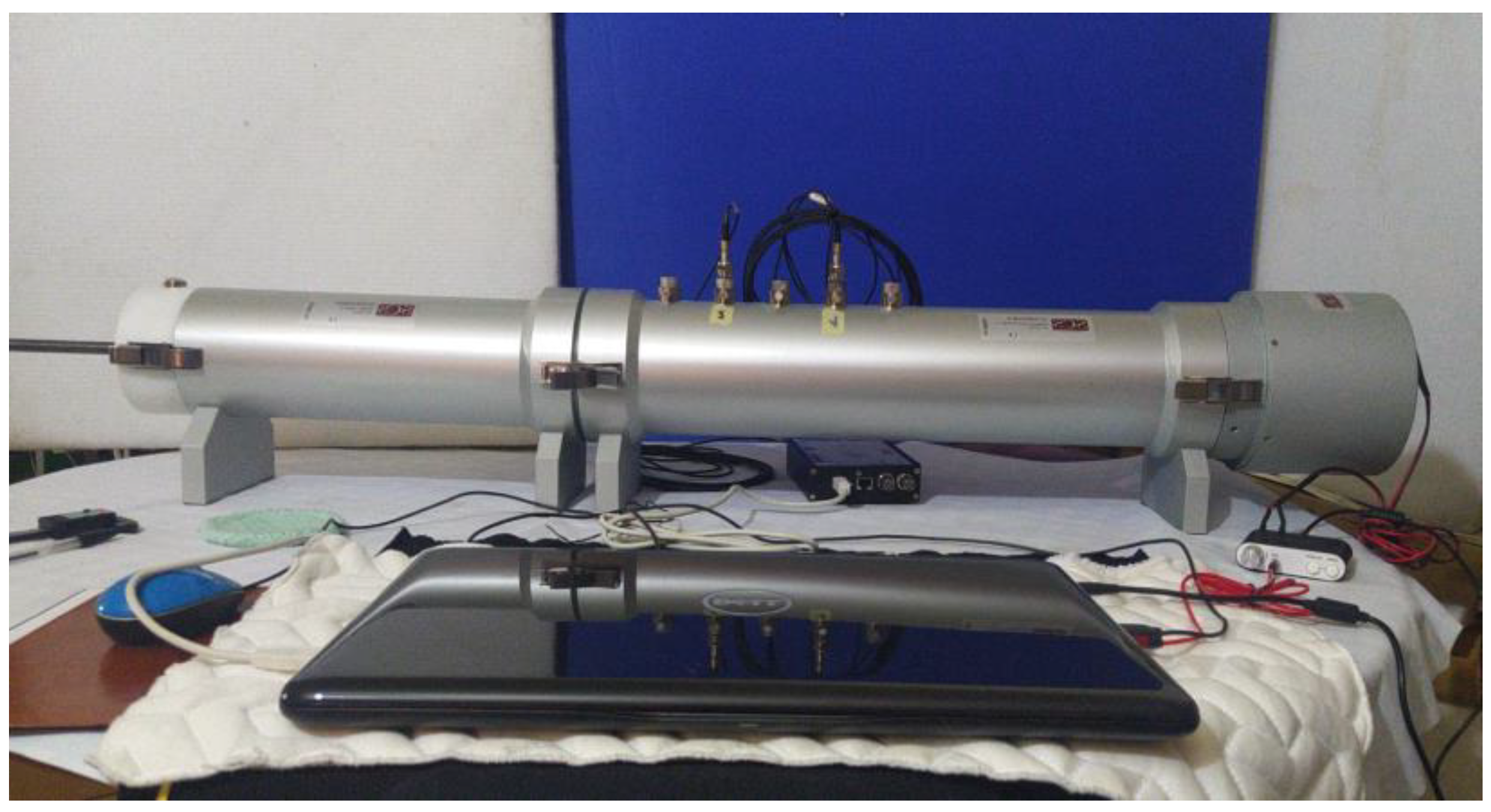
For our research, we used the standardized impedance tube with a reference number SCS 9020B/K (see Figure 3), with an internal diameter of 100 mm and an extended length of 560 mm, which allows analysis up to 2000 Hz with sufficient accuracy. Two precision ¼ inch microphones with a distance of 50 mm are provided for monitoring the pressure variation in the acoustic field with high efficiency above 200 Hz.
The impedance tube is based on the principle of interference in a standing wave. When the sound waves propagate into the impedance tube, they intersect the test sample at one end, resulting in both reflected and transmitted waves. Using two locations in the impedance tube, measured by two microphones, the two-microphone transfer function technique analyzes the specimen’s complex acoustic impedance and its corresponding sound absorption coefficient. These experiments utilize broadband random noise as a source that equally covers the entire frequency range.
All specimens were prepared with a uniform thickness of 4 cm. This is a design strategy intended to closely resemble real-world applications. The membrane specimens were carefully fitted within the tube to avoid any air leakage, since disparities may cause significant errors in the tests. The test environment is maintained at a constant temperature of 25 °C and a relative humidity of 50%. This is compliant with ISO 10534-2:2023 [36] standards. Changes in test conditions are also documented.
The accuracy of measurements depends not only on the device being used but also on strictly following certain procedures mentioned in the protocol. The protocol requires following careful calibration and positioning procedures for both the microphones and samples to ensure minimal uncertainty in the results. Some other factors like the use of the tube and any variation in the shape of the sample could also impact accuracy, as these factors might generate certain distortions in measurements.
The obtained data provide very valuable information regarding the acoustic properties of this particular material, particularly when incidence is normal. The results obtained are used for determining material properties as well as designing for applications where effective sound management is required—for example, theaters, offices, transport interior designs, and industrial designs. The obtained results are also used to validate the efficiency and potential applications of this particular material in acoustic engineering applications.
The acoustic absorption was measured under normal incidence using an impedance tube, which provides controlled and repeatable conditions for material characterization. Although the response may vary slightly for oblique incidence, the dominant absorption mechanism—governed by the membrane–cavity resonance—is expected to remain similar, with only moderate shifts in peak frequency and absorption magnitude.

2.5. Simulation Based on Transfer Matrix Method (TMM) and Elastic Membrane Coupled with Honeycomb Structure and Rigid Wall

After determining the acoustic properties of each material, the next step of the research entailed the development of a computational model of the formed metamaterial employing the Transfer Matrix Method (TMM). The Transfer Matrix Method is a reliable technique applied in acoustic research to study the interaction of sound waves with layers of materials. This approach is very effective for the analysis of metamaterials consisting of multiple layers of materials with different mechanical and acoustic properties [37].
This specific study employed the TMM to model the sound absorption characteristics of a newly created metamaterial with a sandwich structure. The material consists of layers of a PVC membrane interspersed with a honeycomb core on a hard backing. The sound is modeled as a plane wave propagating in one dimension only—perpendicular to the surface. The layers are assumed to be acoustically homogeneous and isotropic. The material properties include mass density, speed of sound (or complex wave number), and characteristic impedance. These were measured using a combination of experiments and theoretical models, as well as the dynamics of membranes modeled using elastic membrane theory [38].
For each layer of the stack, the relationship between the acoustic pressure and particle velocity across the front surface and the back surface of the layer is captured in the form of a transfer matrix, Ti, representing the wave associated with the layer [39]. In this way, the total acoustic effect of the layered metamaterial structure can be modeled:
p i 0 u i 0 = T i p i d i u i d i
T i = c o s k i d i j Z i s i n k i d i j 1 Z i s i n k i d i c o s k i d i
In this context, di represents the thickness of the i-th layer, ki is the complex wave number, Zi denotes the complex characteristic impedance of that layer, and the imaginary unit is indicated by j. The use of complex values for both ki and Zi enables the model to account for energy dissipation mechanisms such as material damping and visco-thermal losses—factors that are particularly important when dealing with porous or acoustically lossy materials [40].
To model the entire multilayer system, the overall transfer matrix Ttotal is constructed by successively multiplying the individual transfer matrices of each layer in the order they appear in the structure. This cumulative matrix captures the full acoustic response of the composite system:
T t o t a l = i = 1 N T i
This matrix establishes the relationship between the acoustic pressure and particle velocity at the front surface of the sample—typically the point of wave incidence in setups like a Kundt’s tube or impedance tube—and those at the rear boundary [41]. In this configuration, the terminal surface is modeled as acoustically rigid, meaning that the particle velocity at that boundary is assumed to be zero (u = 0):
p in u in = T total p rigid 0
This boundary condition allows us to solve for the input impedance of the system, from which the complex reflection coefficient RR can be computed as:
R = Z in Z 0 Z in + Z 0
where Z in = p in / u in and Z 0 are the characteristic impedances of air. Finally, the normal-incidence sound absorption coefficient α is calculated as:
α = 1 R 2
This is a quantity measured over a broad band of frequencies and gives the fraction of incident acoustic energy absorbed by a material: a showcase for its broad-band behavior. Based on the proven Transfer Matrix Method transduced from membrane materials, we established an intricate design involving an elastic membrane, a honeycomb core, and an elastic backing. This design reflects the actual structure of the metamaterials in question, which comprise an elastic membrane resting on top of a structural cavity containing hexagonal units topped with an elastic surface [42]. The model generalizes the TMM approach for multiple layers, with each layer having every component (membrane, honeycomb, air cavity, and solid wall) defined by its own transfer matrix. The elastic membrane is modeled as a mass–spring–damper system in order to correctly simulate the resonant phenomena exhibited in panel systems as a result of vibrations. The honeycomb layering, which is of known thickness, is modeled using an equivalent porous medium characterized by its effective acoustic parameters (mass, stiffness, and viscous losses). The honeycomb layering model may assume either a homogeneous block or a system of connected cavities. The solid wall is assumed as a boundary condition of total reflection (with Z = ∞), leading to standing waves and characteristic system resonances.
Such a multilayer model provides a realistic simulation of a metamaterial’s overall acoustic properties with a strong focus on its normal-incidence sound absorption coefficient (α) and its resonances, as well as acoustic/mechanical property interconversions between layers. The model parameters—membrane areal mass (m), spring constant (k), damping coefficient (c), and honeycomb acoustic properties—were carefully adjusted to show good agreement with the experimental results and demonstrated promising results over the frequency range from 400 to 1600 Hz. The addition of honeycomb properties to this model is an important step and also provides a strong foundation for future modeling and designs of effective sound-absorbing metamaterials.

3. Results

3.1. Evaluation of Sound Absorption Coefficient

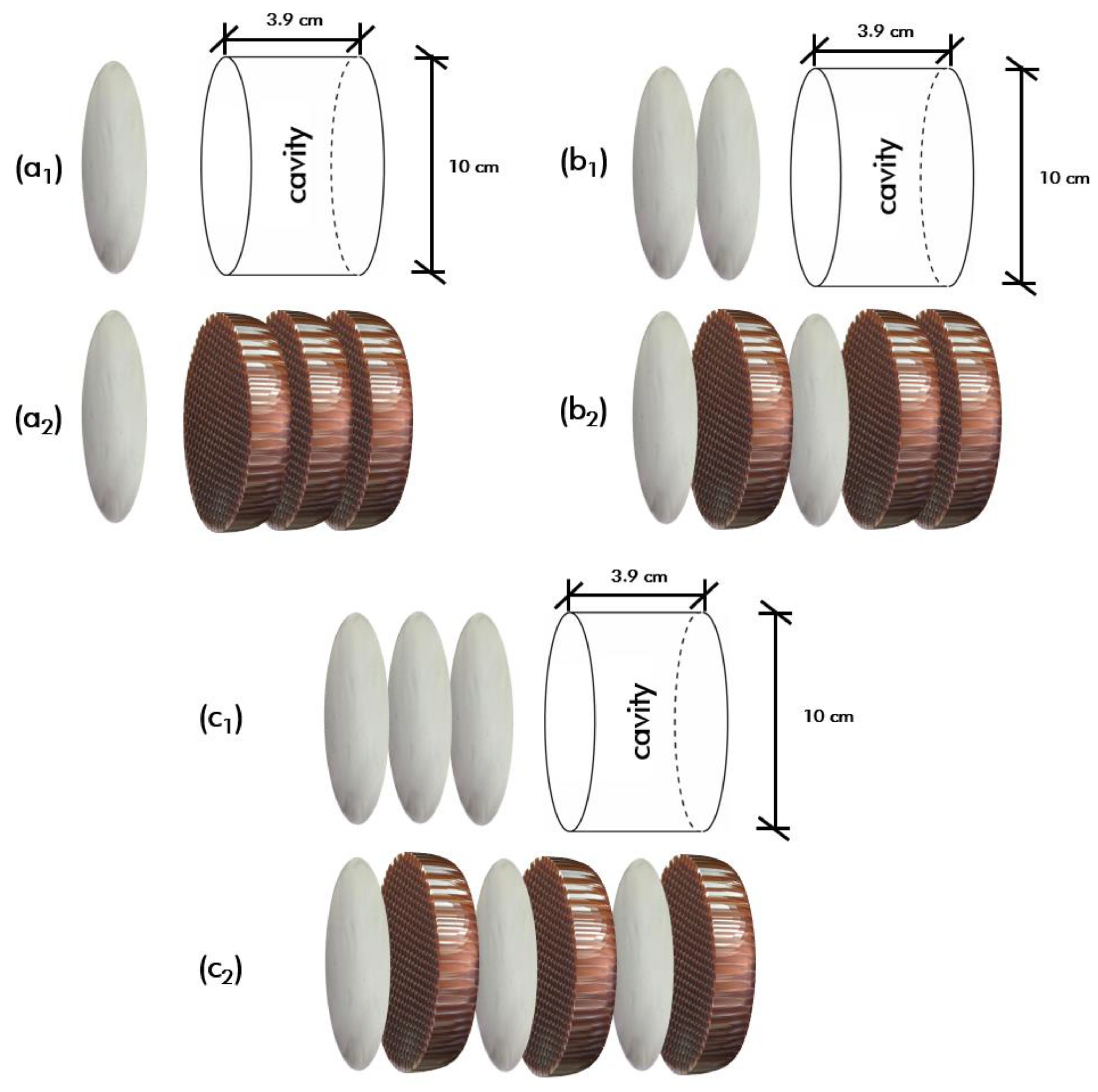
Laboratory tests were carried out in an acoustic tube, as described by ISO 10534-2:2023 [36], to measure the corresponding sound absorption coefficient under normal incidence. Three types of samples were produced, and they included a flexible PVC membrane that was mounted over a rigid PVC frame (Figure 4).
Samples were layered vertically and positioned within an impedance tube, sometimes featuring honeycomb configurations to modify the acoustic behavior of the system.
The metamaterial was tested in various layering patterns to analyze how it impacted the acoustic behavior. During each test run, a unit cell or a group of cells was placed inside the tube. In order to obtain consistent results, each test arrangement was performed ten times, with the test material removed or replaced after each test. This resulted in a filtering process in which data points representing insignificant values were eliminated, and the mean was calculated from the important data points [43].
Each unit cell, 13 mm thick, was stacked together to obtain the final 39 mm thick structure. Each cell comprises a membrane (0.18 mm thick) attached to a frame and a back cavity of approximately 13 mm, which is important for the creation of the resonance effect of sound absorption. In one of the designs, the cavity was filled with aramid paper honeycomb core material to examine the effect of membrane elasticity on the cell core damping properties (Figure 4).
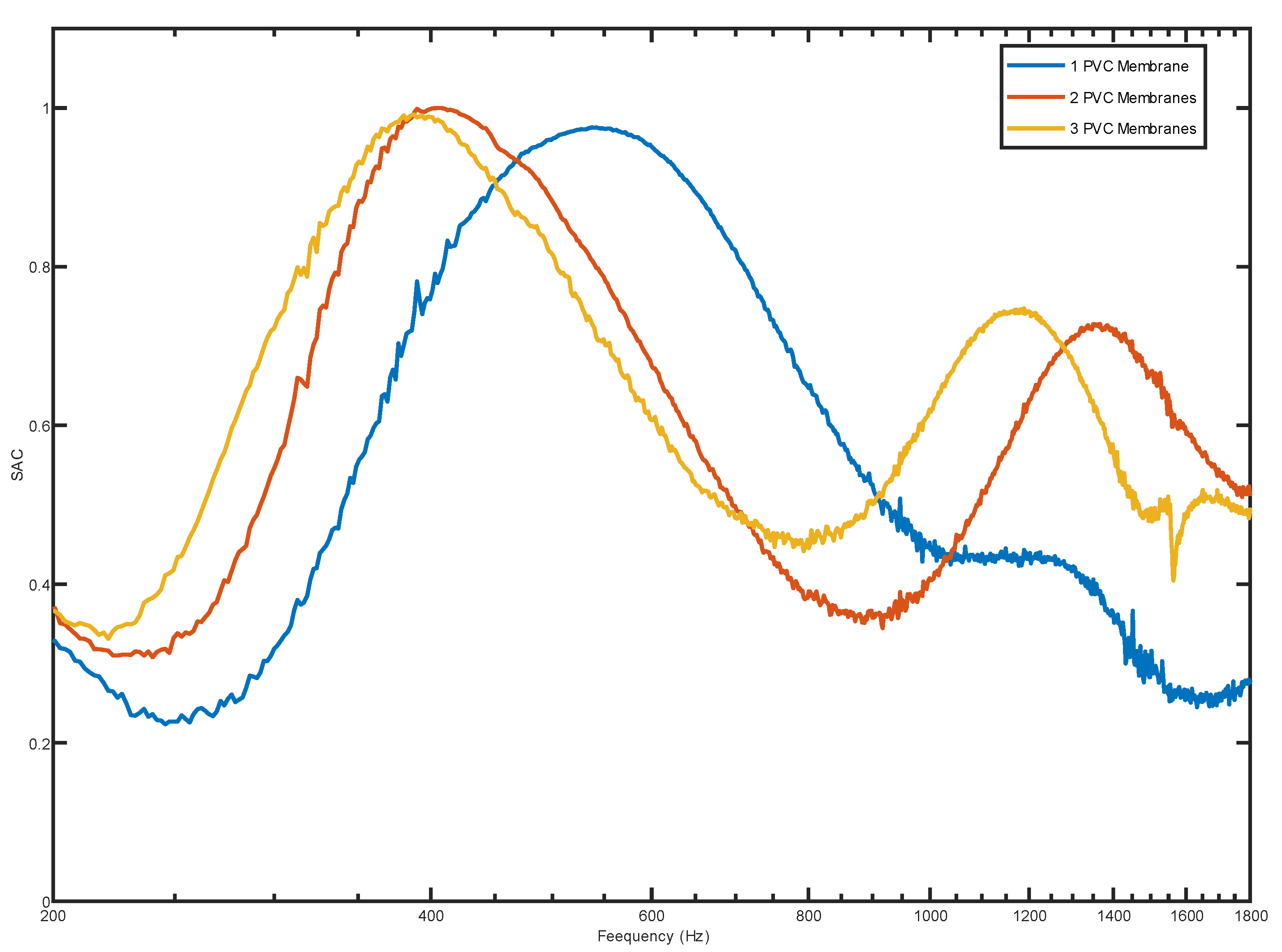
The graph in Figure 5 illustrates the experimental results obtained for the different metamaterial layouts, explaining the variation in the sound absorption coefficient. The results obtained from the experiment clearly indicate that the presence or absence of a honeycomb structure significantly impacts the sound-absorptive ability associated with each layout.
The graphs indicate a variation in the intensity as well as the range of sound frequencies at which the sound absorption peaks. This indicates that the layers of honeycomb significantly contribute to increasing the reduction of sound intensity at specific frequencies.
Compared with structures without honeycomb, the ones containing honeycomb structures exhibit greater absorption capabilities, especially in the mid-low frequency range. This suggests that the honeycomb structure has more pathways for energy dissipation, possibly as a result of both resonant phenomena and viscous damping in the holes. For structures consisting only of membranes or membranes with holes, there are fewer absorption capabilities, as well as restricted effective frequency bands.
From the perspective of all the response curves, the above figure successfully conveys information about how the structural design parameters, like the number of membrane layers used or the incorporation of honeycombs in the structure, tend to impact the ability of the resulting material to absorb incident sound waves. Such observations are essential for modifying the designs of acoustic metamaterials to achieve the desired objectives of sound reduction. The experimental observations form the backbone of all analyses in the subsequent sections.
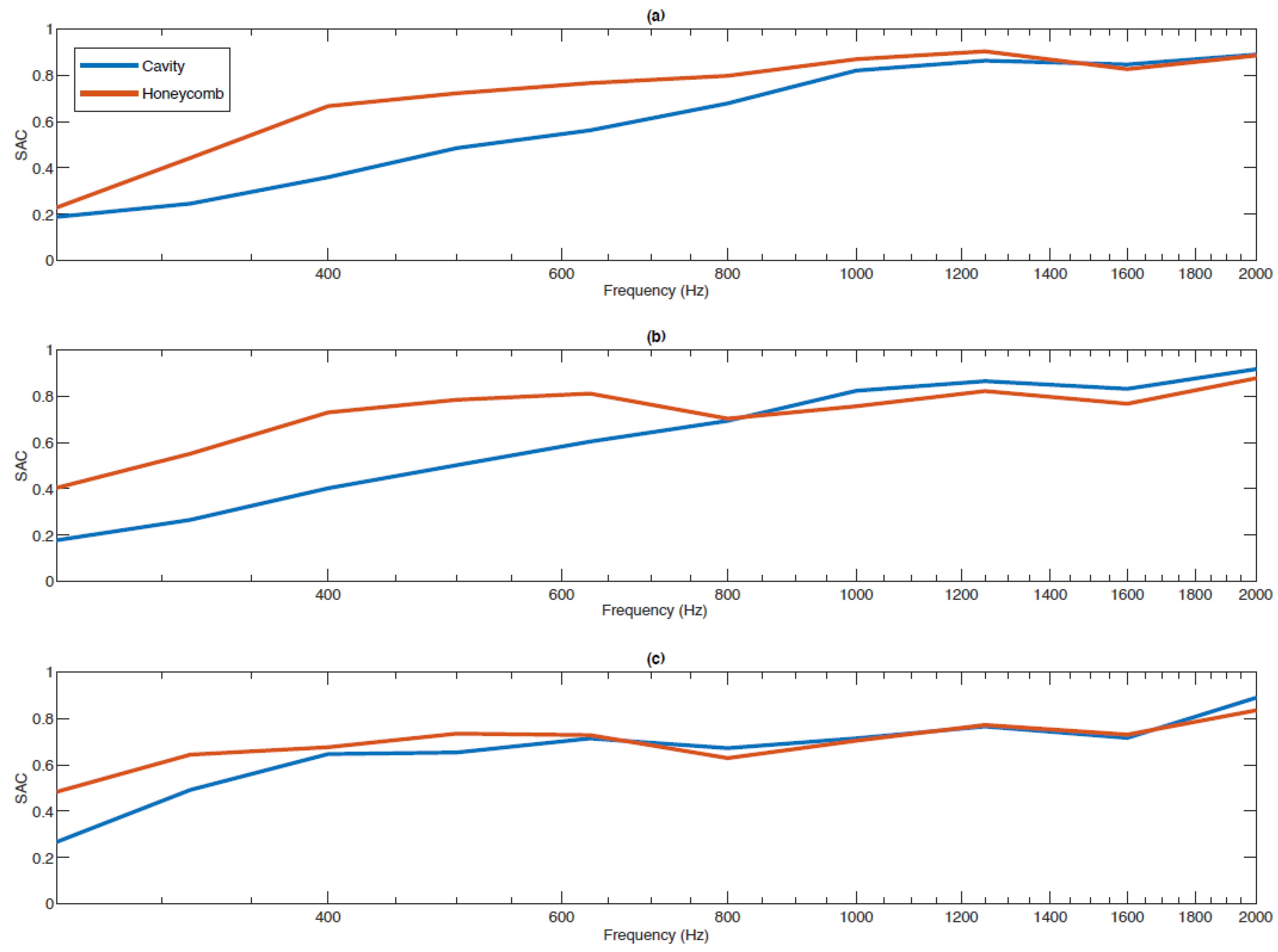
Figure 5 reveals the values of the sound absorption coefficient that were experimentally measured using the impedance tube in one-third octave bands. Each line corresponds to a different sample configuration. In Figure 5a, we can observe the behavior of the SAC of a configuration that includes a single PVC membrane along with three layers of honeycomb, which has a total thickness of 39 mm. This sample configuration is contrasted with another 39 mm sample that includes a PVC membrane along with a simple air cavity. Based on the experimental measurements, it is evident that the inclusion of the honeycomb layout within the air cavity positioned behind the PVC membrane substantially increases acoustic absorption in the medium–low frequency range of around 250 Hz–1 kHz. The increase is most pronounced around 400 Hz, where the layout of the honeycomb has a considerably greater SAC value than that of the air cavity.
This enhancement can be explained by the physical processes the honeycomb induces. The cellular materials increase the acoustic resistance caused by the porous structure, damping the motion of the oscillating air particles. The thin, periodically arrayed walls raise the viscous damping forces between the fluid and solid surfaces, thereby converting acoustic energy into heat. Moreover, the honeycomb modulates the resonance of the rear cavity, which, in turn, modifies the interaction between the membrane and the enclosed air during the combined vibrations.
This complexity behaves as an acoustic filter, which obstructs the passage of sound and favors the focusing of acoustic energy into specified frequency ranges. This, in turn, excites multiple resonances that increase the dissipation of energy at lower frequencies, which are difficult to handle by porous materials alone. Finally, the bending oscillations of the membrane, combined with the local stiffness introduced by the honeycomb, generate structure-induced meta-resonances, which further enhance the absorption coefficient. The term “meta-resonances” describes resonance phenomena that originate from the designed architecture of a material rather than from the properties of a single, homogeneous substance. In other words, these resonances emerge due to the interaction between different components of the metamaterial—such as a membrane coupled with a honeycomb structure—rather than from the intrinsic characteristics of the material itself. This structural interplay creates additional resonant behaviors that can be tuned to enhance specific performance features, such as low-frequency sound absorption. All these observations provide evidence for the use of internal geometries to maximize the performance of acoustic membrane materials at specific frequencies or frequency bands [44].
Figure 5b shows the acoustic absorption coefficient (SAC) for the configuration consisting of two PVC membranes and three honeycomb layers: one positioned immediately behind the first membrane and two placed beyond the second. This characterized configuration was compared with a configuration of equal thickness containing two membranes and a simple air cavity. The results show that the insertion of the honeycomb structure significantly improves the acoustic absorption at frequencies between 250 Hz and 800 Hz, with a peak difference around 400 Hz. This increase can be attributed to several synergistic mechanisms related to the interaction between the membranes, the cellular structure and the trapped air.
First, the integration of the honeycomb structure between the two membranes introduces a decoupled multilayer system, in which each layer contributes to adapting the acoustic pressure field between the membranes. The first honeycomb layer acts as a dissipative medium in proximity to the first membrane, increasing the specific resistance and promoting the conversion of sound energy into heat through viscous friction and internal losses. The two subsequent layers, downstream of the second membrane, contribute to introducing further acoustic discontinuities and impedance variations that promote multiple reflection phenomena and wavefront attenuation. Furthermore, the presence of the two membranes promotes the generation of multiple local resonances, which, in combination with the modular geometry of the honeycomb, allows the activation of meta-resonant modes even in reduced thicknesses. This makes this configuration particularly effective in mitigating low-frequency noise, where traditional porous materials perform less well [45].
Figure 5c displays the SAC behavior for the configuration featuring three PVC membranes interleaved with three honeycomb layers, with each honeycomb layer placed directly behind its corresponding membrane. This multilayer arrangement, keeping the overall thickness of the sample unchanged, was compared with a similar configuration in the number of membranes and thickness, but containing a simple air cavity. The findings indicate enhanced sound absorption for the honeycomb configuration within the 250–600 Hz frequency range. The maximum increase is observed to be around 250 Hz. However, compared to the previous configurations, the gap between the two solutions is reduced and tends to move towards lower frequencies.
This behavior can be interpreted considering the combined effect of the internal segmentation of the cavity and the sequential arrangement of the materials. The insertion of multiple membrane–honeycomb interfaces creates a series of acoustically decoupled sub-cavities, which introduce local resonance conditions at different frequencies. These distributed resonances contribute to a higher dissipative efficiency at low frequencies, exploiting viscous friction, multiple reflections and structural losses. However, the presence of three membranes can also lead to a higher overall stiffness of the system, which tends to damp some of the most effective vibrational modes at mid-frequencies. Furthermore, the increased number of interfaces can produce destructive interference or less efficient coupling, reducing the net gain in terms of absorption compared to simpler but better-balanced configurations.
Overall, the three-membrane, three-honeycomb configuration confirms the effectiveness of the internal structure in managing low-frequency noise but suggests the need for layout optimization to maximize performance over a wider frequency range [46].
Figure 6 depicts the sound absorption coefficient (SAC) measurement results of three proposed upcycled PVC acoustic metamaterial configurations: (i) a design composed of a single PVC membrane and a triple-layer honeycomb core, (ii) a design composed of a two-PVC-membrane structure coupled with three layers of honeycombs, and (iii) a design composed of a triple-PVC-membrane structure in conjunction with three layers of honeycombs. These results make it possible to determine how the increase in the number of PVC membrane layers affects the sound absorption coefficient.
The first observation that is relevant to this problem is the gradual downtrend in the values of the peaks associated with the increasing number of membranes. The single-membrane design has peaks at a higher frequency compared to the dual- and triple-membrane designs in the low-frequency range. These results can be directly linked to the increase in the mass-compliance system due to the added membranes and the air pockets in between.
The unit membrane–cavity–honeycomb is considered a coupled resonator for each design, and the increasing number of membranes results in the increase in the equivalent mass and the change in the spring constant. As a result, the resonance condition governing maximum acoustic energy dissipation occurs at lower frequencies, consistent with classical membrane-type metamaterial theory.
Apart from the frequency shift, it is noticeable that with the rise in the number of PVC-based membranes, the magnitude of the maximum sound absorption coefficient also increases. Though it has already been observed that in the single-membrane case, there is considerable enhancement in absorption in the low-frequency area, in the case of dual-membrane and triple-membrane structures, higher maximum SAC is achieved, very close to unity in certain frequency spans. This is because of the cumulative dissipation mechanisms in the multilayer structure. Every layer in this structure is responsible for viscous and structural losses, while in addition, because of its honeycomb core, there are further losses in the form of thermo-viscous dissipation in its tiny cells.
In the configuration with a single PVC membrane coupled with three honeycomb sections, the location of the absorption peak is determined by both material properties and geometry. The membrane has a mass per unit area of 0.18 g/m2 and a thickness of 0.18 mm, which define its bending stiffness and resonance behavior. The presence of the three honeycomb layers modifies the local stiffness and supports additional structure-induced meta-resonances. The combination of the membrane and honeycomb geometry produces a sound absorption peak at 600 Hz, illustrating how the interplay between the membrane’s characteristics and the honeycomb architecture governs the frequency and magnitude of the acoustic response.
Another important feature evident from Figure 6 is the increasing number of absorption resonances with the increasing number of layers. In the single-layer structure, there is one prominent resonance mode, whereas in the two- and three-membrane systems, there are several absorption resonances spread over the lower frequency region. This behavior can be attributed to the interaction between various modes associated with the combination of membrane and cavity systems. Each membrane contributes its own degree of freedom, allowing multiple connected resonant modes. These interact with the sound field in the impedance tube, resulting in a number of well-separated frequency bands wherein air impedance is properly matched and sound absorption is maximized.
The honeycomb layers play a central role in shaping the resonances. Their structured porosity, unlike simple air cavities, increases the surface area, enhancing viscous and thermal losses. This interaction with the membrane improves vibration damping and stabilizes the resonance frequency, preventing overly sharp absorption peaks. In multi-membrane configurations, these effects contribute to broader and more stable absorption bands, providing a significant advantage for practical noise control applications.
From the design point of view, the observed trends highlight how the proposed architecture allows for tunable low-frequency absorption simply by acting on the number of membrane layers while maintaining the same global thickness and material typology. This modularity is of particular relevance in sustainable building applications, where optimized performance often needs to be achieved without growing material consumption or structural depth. The use of upcycled PVC membranes further reinforces the environmental value of the proposed solution: high acoustic performance is achieved thanks to the proper management of waste materials.
Finally, the trends observed in the experiment in Figure 6 are generally in good agreement with the analytical results for the transfer matrix solution. The model has effectively described the downward movement of resonances and the splitting of the resonances into several absorption peaks with increasing numbers of membranes, verifying the correctness of the physical model adopted. This helps to ensure that the improved low-frequency absorption characteristic is mostly dependent on the resonances between the membranes and the honeycomb structure rather than any physical model.
In conclusion, Figure 6 illustrates and exemplifies the significant impact of adding more PVC membrane layers to the honeycomb-structured metamaterial by indicating (i) a positive shift in the frequency of absorption, (ii) the progression to higher values for the SAC, and (iii) the existence of multiple peaks within the absorption field, thus ascertaining an effective use for the newly designed PVC-based metamaterial within the field of low-frequency sound absorption.

3.2. Simulation of the Acoustic Behavior of the Metamaterial

To support and interpret the experimental results obtained with the impedance tube, a numerical simulation of the acoustic behavior of the metamaterial was performed using the Transfer Matrix Method (TMM). The developed model studies a multilayer configuration consisting of elastic membranes coupled to a honeycomb structure and a rigid back wall. In particular, the system is represented as a succession of acoustically reactive layers, where the membrane is modeled as a frequency-dependent complex impedance, while the honeycomb layer is treated as a homogeneous dissipative medium, characterized by equivalent acoustic resistance and reactance.
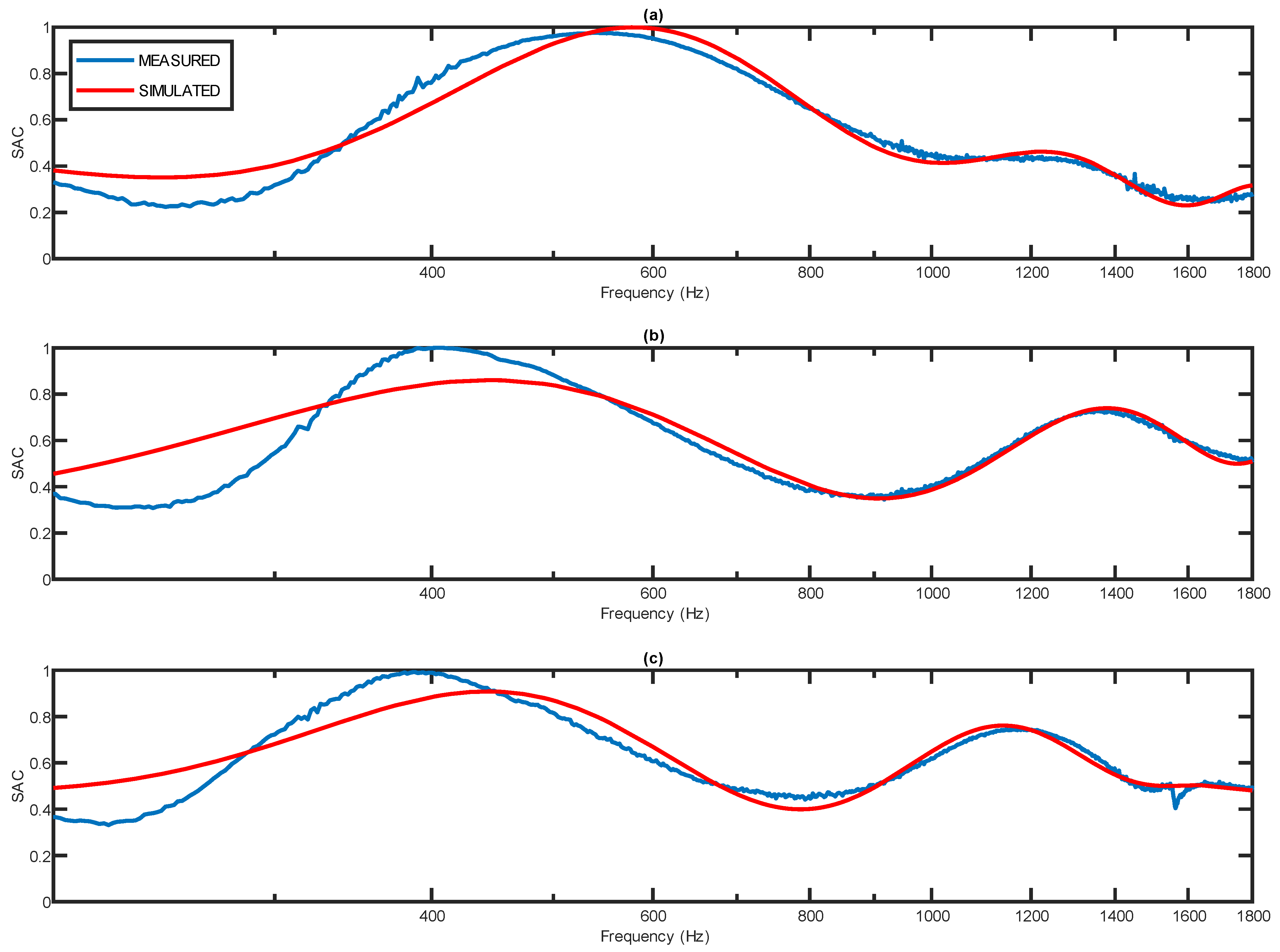
Figure 7 shows a comparison between the simulated and measured values for the different configurations. The aim of the simulation was to predict the sound absorption coefficient of the metamaterial as a function of frequency, evaluating the influence of the different configurations (number of membranes, thickness of the layers, relative position of the elements) and comparing the results with experimental measurements. The model also allows identification of the main physical mechanisms responsible for absorption, such as flexural resonances of the membranes, viscous losses inside the honeycomb and acoustic interferences between the various layers. The results obtained provide useful indications for the optimized design of the material and for the extension of its use to specific application contexts [47].
Figure 7 presents a comparison between the results obtained through numerical simulation and the experimental data for the different metamaterial configurations analyzed. Each curve reported represents the sound absorption coefficient (SAC) for a specific arrangement of the specimens, highlighting the behavior of the system as a function of frequency. For the configuration consisting of a single PVC membrane and three honeycomb layers (Figure 7a), the simulation performed using the transfer matrix method (TMM) reproduces a bell-shaped trend of the absorption coefficient, consistent with what was observed experimentally.
The simulated maximum peak is in the same frequency band as the measured one but has a slightly lower intensity. This discrepancy can be attributed to several factors. First, the model assumes ideal conditions, such as perfect adhesion between the layers, homogeneity of the materials and the absence of construction tolerances, which can introduce additional dissipative effects that are not modeled. Furthermore, the real membrane behavior may include nonlinear contributions, local deformations or viscoelastic damping phenomena that are not fully captured by the simplified model [48,49].
Nevertheless, the good qualitative agreement between simulation and measurement confirms the validity of the approach adopted to describe the main acoustic mechanisms of the system, in particular the role of the membrane vibrational resonance coupled to the dissipative structure of the honeycomb. The observed bell-shaped behavior reflects the interaction between the membrane mass and the acoustic resistance introduced by the honeycomb, which acts as a dissipative element and contributes to the attenuation of the incident sound wave. The model therefore proves to be a useful tool to predict and optimize the acoustic behavior of the metamaterial in the design phase [50,51].
For the configuration consisting of two PVC membranes and three honeycomb layers (Figure 7b), the numerical model based on the transfer matrix method (TMM) returns a trend of the sound absorption coefficient characterized by two distinct peaks, thus describing a double-resonance frequency response. This behavior is consistent with the experimental data, which also show two maxima in the same frequency range [52].
However, some differences can be found in the specific comparison between simulation and measurement. The first simulated peak has a lower amplitude than the experimental value and is slightly shifted towards higher frequencies. Similarly, the second peak also occurs at a slightly higher frequency, but with a higher intensity than the measurement [53]. These discrepancies can be mainly attributed to simplifications of the model, which does not consider any inhomogeneities in the materials, imperfect adhesions between the layers or additional losses related to local structural phenomena. Furthermore, effects such as modal coupling between the membranes or nonlinear viscoelastic behaviors are not fully represented in the adopted linear model [54].
From a physical point of view, the presence of two distinct peaks is justified by the resonant nature of the configuration: the two membranes act as vibrating masses coupled to intermediate cavities partially filled by the honeycomb, which acts as a dissipative and reactive element. The standing waves that arise inside the structure trigger multiple resonance phenomena, whose behavior is strongly influenced by the dimensions of the cavities, the stiffness of the membranes and the dissipative characteristics of the honeycomb. Overall, the model provides a reliable qualitative description of the acoustic behavior of the metamaterial, confirming its effectiveness as a predictive tool for performance optimization [55,56].
In the configuration with three PVC membranes and three honeycomb layers, positioned alternately between each pair of membranes (Figure 7c), the numerical simulation using the transfer matrix method (TMM) returns a trend of the sound absorption coefficient characterized by a double-peak response, consistent with what was observed experimentally. Both peaks are in the same frequency range as the measurements, although with some differences in the intensities and peak frequencies.
In particular, the first simulated peak has a lower amplitude than the measured one and is slightly shifted towards higher frequencies, while the second peak is also more contained in amplitude but located at a slightly lower frequency than the corresponding experimental value. These discrepancies can be explained by considering the approximations inherent in the model: the assumption of perfectly homogeneous materials, the absence of complex structural losses, and the linearization of the dynamic behavior of the membranes, which may exhibit viscoelastic damping phenomena, geometric nonlinearities or more complex modal couplings [57,58].
From a physical point of view, the double-peaked behavior can be interpreted as the result of multiple resonances generated by the three membranes, which act as flexible masses coupled to cavities and dissipative layers. Each membrane introduces its own natural frequency of vibration, and the presence of honeycomb layers between the membranes favors both the attenuation by viscous friction and the modulation of the resonance conditions of the system. The interaction between these components produces a complex behavior, in which the resonances overlap and interfere, generating absorptions distributed over a wider frequency range than in previous configurations [59,60].
In conclusion, the model shows a good qualitative consistency with experimental data, confirming the validity of the simulative approach for the prediction and design of multilayer acoustic metamaterials.
A further aspect that deserves discussion concerns the balance between acoustic performance, manufacturing complexity, and practical applicability of the proposed configuration. Although the introduction of honeycomb layers and multiple membranes inevitably increases the structural complexity compared with a single-membrane absorber, the adopted solution remains compatible with common manufacturing practices. Honeycomb cores are widely used in lightweight sandwich panels and are commercially available in a variety of materials and geometries at relatively low cost. Their integration with thin membranes can be achieved using standard bonding techniques or simple mechanical assembly, without requiring specialized fabrication processes. From this perspective, the proposed structure should be interpreted as an extension of established panel technologies rather than a configuration that demands complex or expensive production methods. In addition, the use of modular layers provides a certain degree of design flexibility. The number of membranes, the cavity depth, and the properties of the honeycomb core can be adjusted according to the target frequency range and application constraints. While it is true that increasing the number of layers introduces additional resonances, this characteristic is intentionally exploited to enlarge the effective absorption bandwidth. In many practical noise-control applications, broadband behavior is more desirable than a single high absorption peak, particularly when dealing with low-frequency noise where conventional porous materials are less effective. It is also important to note that the overall thickness of the proposed configurations remains limited, which is a relevant parameter for real installations such as building elements, acoustic panels, or retrofitting interventions. Therefore, the efficiency of the system should not be evaluated solely in terms of the number of structural elements, but rather in relation to the achievable bandwidth, structural weight, and feasibility of implementation. This perspective places the present study within the context of applied research aimed at identifying practical design solutions.
The current study presents some limitations that should be acknowledged. In multi-membrane configurations, such as the triple-membrane system, the honeycomb’s contribution to low-frequency absorption diminishes due to increased local stiffness and the limited damping capacity of the material. While the honeycomb stabilizes resonance and prevents overly sharp peaks, it reduces the relative effect of viscous losses. Additionally, the Transfer Matrix Method (TMM) used for simulations treats the honeycomb as an effective dissipative medium, neglecting its complex anisotropic and frequency-dependent behavior. This simplification leads to discrepancies in peak amplitudes compared to experiments. Future work will explore refined modeling and characterization to address these limitations.

4. Conclusions

The present study focused on the acoustic analysis and characterization of PVC membrane metamaterials integrated with honeycomb structures. The main objective was to evaluate the sound-absorbing performances of these multilayer configurations, including the influence of a variable number of membranes and of the presence of honeycomb layers, both through experimental measurements with an impedance tube and through a numerical model based on the transfer matrix method (TMM) that couples the elastic dynamics of the membranes to the honeycomb structure and to the rigid back wall. The goal was to provide an integrated framework that could guide the design of efficient, lightweight and thin acoustic metamaterials, able to effectively absorb noise, especially in the medium-low frequencies, traditionally difficult to treat. The experimental results obtained highlighted a clear improvement in the sound-absorbing properties of the configurations integrating honeycomb layers compared to empty air cavities. Specifically, incorporating the honeycomb structure led to a marked increase in the sound absorption coefficient (SAC) within the mid-to-low frequency range (250–1000 Hz), with peak values occurring around 250–400 Hz depending on the configuration. The most marked effect was observed in the configuration with a single membrane and three layers of honeycomb, where the porous structure increased the acoustic resistance, favoring the dissipation of sound energy through viscous friction and internal losses. The addition of additional membranes instead generated more complex responses, with the appearance of multiple peaks due to the resonance of the coupled membranes, modulated by the presence of the dissipative layers. In particular, the configuration with two membranes and three honeycombs showed a double peak trend in the frequency range studied, while with three membranes an even more complex response emerged, with a double peak and a more extensive absorption distribution. In parallel, simulations conducted with the TMM model qualitatively confirmed the experimentally observed trends, showing good agreement in the position of the absorption peaks and in the general trend of the SAC curves. The model was able to effectively capture the membrane dynamics and the interaction with the honeycomb structure, although showing some quantitative discrepancies in the amplitudes and shifts in the peak frequencies. These differences are attributable to the simplifications required in the model, such as the assumption of ideal materials, the absence of complex nonlinear dissipative effects and the manufacturing tolerances that inevitably occur in physical specimens. However, the ability of the model to reproduce multiple resonant phenomena and the crucial role of the porous structure in modulating the acoustic resistance confirms its validity as a predictive design tool.
The work shows great potential applications of these honeycomb membrane metamaterials in fields such as architectural and industrial projects, primarily in reducing noise in confined environments where the challenge of reducing noise in these environments is of utmost priority. Using a combination of a membrane and a lightweight dissipative material as a core, we can develop a sound-absorbing material in a compact form, best suited for reducing noise in interior as well as interior compartments of machines, cars, and other electronic devices. The system can be varied by altering the number of membranes as well as the thickness of the honeycomb materials.
Looking forward, there are quite a few ways this technology could be developed. Externally, it might be possible to experiment with membranes composed of different materials or those using viscoelastic damping in various ways in order to improve absorption and dynamic stability even further. The addition of sensors for time- and space-resolved acoustic measurements and corresponding methods for active control might result in smart materials that dynamically respond to changing noise conditions in real-time. From a theoretical development angle, it should be possible to improve predictions using the transfer matrix approach by incorporating nonlinear phenomena, more complex viscoelastic damping models, or fluid dynamics interactions. Finally, the influence of varying cavity widths in combination with the honeycomb structure will be investigated. This approach could potentially broaden the absorption bandwidth by introducing multiple resonances, enhancing low-frequency performance, and providing a more versatile design strategy for upcycled PVC-based metamaterials targeting efficient and tunable sound absorption.
Finally, the methodology developed in this study can be extended to acoustic metamaterials with other types of dissipative or geometric structures, such as three-dimensional lattices or multilayer composite materials, thus widening the field of application and the possibility of innovation in the field of noise control. The synergy between experimentation, modeling and design offers an effective approach to address current challenges in noise mitigation, with potentially significant implications in the civil, industrial and transport sectors.

Author Contributions

Conceptualization, G.C.; sample fabrication, G.C. and V.P.-R.; sample measurements, G.C.; formal analysis, G.C.; writing—original draft preparation, G.C. and V.P.-R.; software, G.C.; writing—review and editing, G.C. and V.P.-R. All authors have read and agreed to the published version of the manuscript.

Funding

This research received no external funding.

Institutional Review Board Statement

Not applicable.

Informed Consent Statement

Not applicable.

Data Availability Statement

The data presented in this study are available on request from the corresponding author.

Conflicts of Interest

The authors declare no conflicts of interest.

References

  1. Raihan, A. A review of the potential opportunities and challenges of the digital economy for sustainability. Innov. Green Dev. 2024, 3, 100174. [Google Scholar] [CrossRef]
  2. Babaei-Ghazvini, A.; Vafakish, B.; Patel, R.; Falua, K.J.; Dunlop, M.J.; Acharya, B. Cellulose nanocrystals in the development of biodegradable materials: A review on CNC resources, modification, and their hybridization. Int. J. Biol. Macromol. 2024, 258, 128834. [Google Scholar] [CrossRef]
  3. Haapakangas, A.; Hongisto, V.; Hyönä, J.; Kokko, J.; Keränen, J. Effects of unattended speech on performance and subjective distraction: The role of acoustic design in open-plan offices. Appl. Acoust. 2014, 86, 1–16. [Google Scholar] [CrossRef]
  4. Arjunan, A.; Baroutaji, A.; Robinson, J.; Vance, A.; Arafat, A. Acoustic metamaterials for sound absorption and insulation in buildings. Build. Environ. 2024, 251, 111250. [Google Scholar] [CrossRef]
  5. Aydın, G.; San, S.E. Breaking the limits of acoustic science: A review of acoustic metamaterials. Mater. Sci. Eng. B 2024, 305, 117384. [Google Scholar] [CrossRef]
  6. Li, S.; Zhang, H.; Li, S.; Wang, J.; Wang, Q.; Cheng, Z. Advances in hierarchically porous materials: Fundamentals, preparation and applications. Renew. Sustain. Energy Rev. 2024, 202, 114641. [Google Scholar] [CrossRef]
  7. Du, C.; Song, S.; Bai, H.; Wu, J.; Liu, K.; Lu, Z. An investigation on synergistic resonances of membrane-type acoustic metamaterial with multiple masses. Appl. Acoust. 2024, 220, 109988. [Google Scholar] [CrossRef]
  8. Edo, G.I.; Ndudi, W.; Ali, A.B.M.; Yousif, E.; Zainulabdeen, K.; Onyibe, P.N.; Ekokotu, H.A.; Isoje, E.F.; Igbuku, U.A.; Essaghah, A.E.A.; et al. Poly (vinyl chloride)(PVC): An updated review of its properties, polymerization, modification, recycling, and applications. J. Mater. Sci. 2024, 59, 21605–21648. [Google Scholar] [CrossRef]
  9. Ait-Touchente, Z.; Khellaf, M.; Raffin, G.; Lebaz, N.; Elaissari, A. Recent advances in polyvinyl chloride (PVC) recycling. Polym. Adv. Technol. 2024, 35, e6228. [Google Scholar] [CrossRef]
  10. Shi, P.; Chen, Y.; Wei, J.; Xie, T.; Feng, J.; Sareh, P. Design and low-velocity impact behavior of an origami-bellow foldcore honeycomb acoustic metastructure. Thin-Walled Struct. 2024, 197, 111607. [Google Scholar] [CrossRef]
  11. Ge, Y.; Xue, J.; Liu, L.; Wan, H.; Yang, Y. Advances in multiple assembly acoustic structural design strategies for honeycomb composites: A review. Mater. Today Commun. 2024, 38, 108013. [Google Scholar] [CrossRef]
  12. Akbari-Farahani, F.; Ebrahimi-Nejad, S. From defect mode to topological metamaterials: A state-of-the-art review of phononic crystals & acoustic metamaterials for energy harvesting. Sens. Actuators A Phys. 2024, 365, 114871. [Google Scholar]
  13. Chen, J.; Huang, J.; An, M.; Hu, P.; Xie, Y.; Wu, J.; Chen, Y. Application of machine learning on the design of acoustic metamaterials and phonon crystals: A review. Smart Mater. Struct. 2024, 33, 073001. [Google Scholar] [CrossRef]
  14. Huang, X.; Yang, B. Towards novel energy shunt inspired vibration suppression techniques: Principles, designs and applications. Mech. Syst. Signal Process. 2023, 182, 109496. [Google Scholar] [CrossRef]
  15. Ravandi, M.R.G.; Mardi, H.; Langari, A.A.A.; Mohammadian, M.; Khanjani, N. A review on the acoustical properties of natural and synthetic noise absorbents. Open Access Libr. J. 2015, 2, e1598. [Google Scholar] [CrossRef]
  16. Abdellah, M.Y.; Sadek, M.G.; Alharthi, H.; Abdel-Jaber, G.T. Mechanical, thermal, and acoustic properties of natural fibre-reinforced polyester. Proc. Inst. Mech. Eng. Part E J. Process Mech. Eng. 2024, 238, 1436–1448. [Google Scholar] [CrossRef]
  17. Frommhold, W.; Fuchs, H.V.; Sheng, S. Acoustic performance of membrane absorbers. J. Sound Vib. 1994, 170, 621–636. [Google Scholar] [CrossRef]
  18. Xu, H.; Kong, D. A thin-film acoustic metamaterial absorber with tunable sound absorption characteristics. J. Acoust. Soc. Am. 2023, 153, 3493–3500. [Google Scholar] [CrossRef]
  19. Jiang, R.; Shi, G.; Huang, C.; Zheng, W.; Li, S. Acoustic insulation characteristics and optimal design of membrane-type metamaterials loaded with asymmetric mass blocks. Materials 2023, 16, 1308. [Google Scholar] [CrossRef]
  20. Yang, Z.; Mei, J.; Yang, M.; Chan, N.H.; Sheng, P. Membrane-type acoustic metamaterial with negative dynamic mass. Phys. Rev. Lett. 2008, 101, 204301. [Google Scholar] [CrossRef]
  21. Xu, Q.; Qiao, J.; Sun, J.; Zhang, G.; Li, L. A tunable massless membrane metamaterial for perfect and low-frequency sound absorption. J. Sound Vib. 2021, 493, 115823. [Google Scholar] [CrossRef]
  22. Langfeldt, F.; Riecken, J.; Gleine, W.; von Estorff, O. A membrane-type acoustic metamaterial with adjustable acoustic properties. J. Sound Vib. 2016, 373, 1–18. [Google Scholar] [CrossRef]
  23. Jakšić, Z.; Obradov, M.; Jakšić, O. Bio-inspired nanomembranes as building blocks for nanophotonics, plasmonics and metamaterials. Biomimetics 2022, 7, 222. [Google Scholar] [CrossRef]
  24. Ciaburro, G.; Puyana-Romero, V. Sustainable Membrane-Based Acoustic Metamaterials Using Cork and Honeycomb Structures: Experimental and Numerical Characterization. Buildings 2025, 15, 2763. [Google Scholar] [CrossRef]
  25. Li, H.-Z.; Liu, X.-C.; Liu, Q.; Li, S.; Yang, J.-S.; Tong, L.-L.; Shi, S.-B.; Schmidt, R.; Schröder, K.-U. Sound insulation performance of double membrane-type acoustic metamaterials combined with a Helmholtz resonator. Appl. Acoust. 2023, 205, 109297. [Google Scholar] [CrossRef]
  26. Yan, H.; Xie, S.; Zhang, F.; Jing, K.; He, L. Sound absorption performance of honeycomb metamaterials inspired by mortise-and-tenon structures. Appl. Acoust. 2025, 228, 110292. [Google Scholar] [CrossRef]
  27. Guo, J.; Fang, Y.; Qu, R.; Zhang, X. Development and progress in acoustic phase-gradient metamaterials for wavefront modulation. Mater. Today 2023, 66, 321–338. [Google Scholar] [CrossRef]
  28. Wang, D.; Xie, S.C.; Yang, S.C.; Li, Z. Sound absorption performance of acoustic metamaterials composed of double-layer honeycomb structure. J. Cent. South Univ. 2021, 28, 2947–2960. [Google Scholar] [CrossRef]
  29. Ciaburro, G.; Iannace, G.; Romero, V.P. Optimizing controlled-resonance acoustic metamaterials with perforated plexiglass disks, honeycomb structures, and embedded metallic masses. Fibers 2025, 13, 11. [Google Scholar] [CrossRef]
  30. Gai, X.L.; Guan, X.W.; Cai, Z.N.; Li, X.H.; Hu, W.C.; Xing, T.; Wang, F. Acoustic properties of honeycomb like sandwich acoustic metamaterials. Appl. Acoust. 2022, 199, 109016. [Google Scholar] [CrossRef]
  31. Gai, X.L.; Li, X.H.; Guan, X.W.; Xing, T.; Cai, Z.N.; Hu, W.C. Study on Acoustic Properties of Helmholtz-Type Honeycomb Sandwich Acoustic Metamaterials. Materials 2025, 18, 1600. [Google Scholar] [CrossRef]
  32. Chen, Y.; Shao, Z.; Wei, J.; Feng, J.; Sareh, P. Geometric design and performance analysis of a foldcore sandwich acoustic metastructure for tunable low-frequency sound absorption. Finite Elem. Anal. Des. 2024, 235, 104150. [Google Scholar] [CrossRef]
  33. Gao, Z.; Ma, Q.; Yang, J.; Shen, C.; Meng, H. Origami-based acoustic metamaterial for low-frequency adjustable sound absorption. J. Sound Vib. 2025, 618, 119334. [Google Scholar] [CrossRef]
  34. Sheng, P.; Fang, X.; Dai, L.; Yu, D.; Wen, J. Synthetical vibration reduction of the nonlinear acoustic metamaterial honeycomb sandwich plate. Mech. Syst. Signal Process. 2023, 185, 109774. [Google Scholar] [CrossRef]
  35. EN 13501-1; Fire Classification of Construction Products and Building Elements. Part 1: Classification Using Data from Reaction to Fire Tests. CEN: Brussels, Belgium, 2018.
  36. EN ISO 10534-2; Acoustics—Determination of Sound Absorption Coefficient and Impedance in Impedance Tubes—Part 2: Transfer-Function Method. ISO: Geneva, Switzerland, 2023.
  37. Dell, A.; Krynkin, A.; Horoshenkov, K.V. The use of the transfer matrix method to predict the effective fluid properties of acoustical systems. Appl. Acoust. 2021, 182, 108259. [Google Scholar] [CrossRef]
  38. Shahsavari, H.; Talebitooti, R.; Kornokar, M. Analysis of wave propagation through functionally graded porous cylindrical structures considering the transfer matrix method. Thin-Walled Struct. 2021, 159, 107212. [Google Scholar] [CrossRef]
  39. Bancel, T.; Houdouin, A.; Annic, P.; Rachmilevitch, I.; Shapira, Y.; Tanter, M.; Aubry, J.F. Comparison between ray-tracing and full-wave simulation for transcranial ultrasound focusing on a clinical system using the transfer matrix formalism. IEEE Trans. Ultrason. Ferroelectr. Freq. Control 2021, 68, 2554–2565. [Google Scholar] [CrossRef]
  40. Rui, X.; Zhang, J.; Wang, X.; Rong, B.; He, B.; Jin, Z. Multibody system transfer matrix method: The past, the present, and the future. Int. J. Mech. Syst. Dyn. 2022, 2, 3–26. [Google Scholar] [CrossRef]
  41. Jiménez, N.; Umnova, O.; Groby, J.P. (Eds.) The Transfer Matrix Method in Acoustics. In Acoustic Waves in Periodic Structures, Metamaterials, and Porous Media; Springer International Publishing: Cham, Switzerland, 2021; pp. 103–164. [Google Scholar]
  42. Wen, G.; Zhang, S.; Wang, H.; Wang, Z.-P.; He, J.; Chen, Z.; Liu, J.; Xie, Y.M. Origami-based acoustic metamaterial for tunable and broadband sound attenuation. Int. J. Mech. Sci. 2023, 239, 107872. [Google Scholar] [CrossRef]
  43. Ciaburro, G.; Iannace, G. Numerical simulation for the sound absorption properties of ceramic resonators. Fibers 2020, 8, 77. [Google Scholar] [CrossRef]
  44. Kumar, S.; Jin, H.; Lim, K.M.; Lee, H.P. Comparative analysis of machine learning algorithms on prediction of the sound absorption coefficient for reconfigurable acoustic meta-absorbers. Appl. Acoust. 2023, 212, 109603. [Google Scholar] [CrossRef]
  45. Ciaburro, G.; Puyana-Romero, V.; Iannace, G.; Jaramillo-Cevallos, W.A. Characterization and modeling of corn stalk fibers tied with clay using support vector regression algorithms. J. Nat. Fibers 2022, 19, 7141–7156. [Google Scholar] [CrossRef]
  46. Rastegar, N.; Ershad-Langroudi, A.; Parsimehr, H.; Moradi, G. Sound-absorbing porous materials: A review on polyurethane-based foams. Iran. Polym. J. 2022, 31, 83–105. [Google Scholar] [CrossRef]
  47. Ciaburro, G.; Romero, V.P.; Iannace, G.; Bravo Moncayo, L. Improving Acoustic Properties of Sandwich Structures Using Recycled Membrane and HoneyComb Composite (RMHCC). Buildings 2024, 14, 2878. [Google Scholar] [CrossRef]
  48. Xie, Y.; Wang, J.; Li, X. Investigation into the sound insulation performance of layered membrane-type acoustic metamaterials enhanced by damping. Appl. Acoust. 2025, 239, 110860. [Google Scholar] [CrossRef]
  49. Ciaburro, G.; Puyana-Romero, V. Experimental Study of an Acoustic Metamaterial Combining Ceramic Fiber Layers and Honeycomb Cores. J. Build. Eng. 2026, 120, 115368. [Google Scholar] [CrossRef]
  50. Fediuk, R.; Amran, M.; Vatin, N.; Vasilev, Y.; Lesovik, V.; Ozbakkaloglu, T. Acoustic properties of innovative concretes: A review. Materials 2021, 14, 398. [Google Scholar] [CrossRef]
  51. Cummer, S.A.; Christensen, J.; Alù, A. Controlling sound with acoustic metamaterials. Nat. Rev. Mater. 2016, 1, 16001. [Google Scholar] [CrossRef]
  52. Gao, N.; Zhang, Z.; Deng, J.; Guo, X.; Cheng, B.; Hou, H. Acoustic metamaterials for noise reduction: A review. Adv. Mater. Technol. 2022, 7, 2100698. [Google Scholar] [CrossRef]
  53. Bravo-Moncayo, L.; Puyana-Romero, V.; Chávez, M.; Ciaburro, G. Improving Building Acoustics with Coir Fiber Composites: Towards Sustainable Construction Systems. Sustainability 2025, 17, 6306. [Google Scholar] [CrossRef]
  54. Zhang, J.; Hu, B.; Wang, S. Review and perspective on acoustic metamaterials: From fundamentals to applications. Appl. Phys. Lett. 2023, 123, 010502. [Google Scholar] [CrossRef]
  55. Chen, S.; Fan, Y.; Fu, Q.; Wu, H.; Jin, Y.; Zheng, J.; Zhang, F. A review of tunable acoustic metamaterials. Appl. Sci. 2018, 8, 1480. [Google Scholar] [CrossRef]
  56. Liao, G.; Luan, C.; Wang, Z.; Liu, J.; Yao, X.; Fu, J. Acoustic metamaterials: A review of theories, structures, fabrication approaches, and applications. Adv. Mater. Technol. 2021, 6, 2000787. [Google Scholar] [CrossRef]
  57. Ciaburro, G.; Iannace, G. Membrane-type acoustic metamaterial using cork sheets and attached masses based on reused materials. Appl. Acoust. 2022, 189, 108605. [Google Scholar] [CrossRef]
  58. Yao, D.; Zhang, J.; Lei, J.; Zhao, Z.; Zhang, Y.; Zhao, Y.; Pang, J.; Li, J. A comprehensive review of acoustic metamaterials: Applications and challenges for lightweight noise control in large-scale transportation. Mater. Des. 2025, 260, 115002. [Google Scholar] [CrossRef]
  59. Song, S.; Zhang, S.; Liu, X.; Du, C.; Dong, H.W.; Lu, Z. Advances and integration of noise reduction materials and structures: A review of porous materials and acoustic metamaterials. J. Appl. Phys. 2025, 138, 033103. [Google Scholar] [CrossRef]
  60. Comandini, G.; Ouisse, M.; Ting, V.P.; Scarpa, F. Architected acoustic metamaterials: An integrated design perspective. Appl. Phys. Rev. 2025, 12, 011340. [Google Scholar] [CrossRef]
Figure 1. (a) Reused PVC-based membrane; (b) Honeycomb core structure.
Sustainability 18 02342 g001
Figure 2. Membrane and honeycomb arranged in a sandwich structure. The membrane consists of a PVC ring obtained from a pipe with a diameter of 100 mm, a thickness of 2 mm, a density of 1.5 g/cm3, and cut to a height of 13 mm. The honeycomb core has a diameter of 100 mm, hexagonal cells of 4 mm, and a thickness of 13 mm.
Sustainability 18 02342 g002
Figure 3. Impedance tube used for measuring the normal-incidence sound absorption coefficient (Model SCS, Type 9020B/K).
Sustainability 18 02342 g003
Figure 4. Various structural arrangements of the metamaterial: (a1) Single membrane paired with a cavity; (a2) Single membrane combined with a triple honeycomb layer (each layer with a thickness of 13 mm); (b1) Dual membrane configuration paired with a cavity; (b2) Dual membranes integrated with three honeycomb layers; (c1) Three membranes coupled with a cavity; (c2) Triple membrane structure with three honeycomb layers.
Sustainability 18 02342 g004
Figure 5. Comparison of paired configurations for the three explored systems: single membrane, two membranes, and three membranes. Each pair contrasts a configuration with a honeycomb structure and one with a cavity, highlighting the effects of the honeycomb on the acoustic response: (a) single membrane; (b) two membranes; (c) three membranes.
Sustainability 18 02342 g005
Figure 6. Measured sound absorption coefficient (SAC) as a function of frequency for the proposed PVC-based acoustic metamaterial in three configurations: single membrane with triple honeycomb core (one PVC membrane), dual membranes with three honeycomb layers (two PVC membranes), and triple membrane structure with three honeycomb layers (three PVC membranes).
Sustainability 18 02342 g006
Figure 7. Assessment of simulation accuracy through measured values: (a) single PVC membrane and three honeycomb layers; (b) two PVC membranes and three honeycomb layers; (c) three PVC membranes and three honeycomb layers.
Sustainability 18 02342 g007
Disclaimer/Publisher’s Note: The statements, opinions and data contained in all publications are solely those of the individual author(s) and contributor(s) and not of MDPI and/or the editor(s). MDPI and/or the editor(s) disclaim responsibility for any injury to people or property resulting from any ideas, methods, instructions or products referred to in the content.