1. Introduction
The rapid expansion of generative artificial intelligence has created a new category of digital space that is increasingly reshaping how humans experience, conceptualize, and represent nature [
1,
2]. In actual fact, mediated landscapes are being constructed by diffusion models using large visual datasets that contain images to be used for tourism promotions or any kind of environmental communication/wellbeing application/digital leisure platform [
3,
4,
5]. These developments have direct implications for sustainable tourism strategies that increasingly rely on digital and AI-generated representations of nature, often without clear empirical evidence that such representations reproduce the psychological functions associated with real or immersive natural environments [
6].
As digital environments increasingly substitute or mediate encounters with nature, they carry growing implications for human wellbeing, sustainable tourism design and equitable access to restorative experiences. With rising visual sophistication, such environments are often implicitly assumed to reproduce the emotional, experiential, and restorative effects of real natural settings or high-fidelity immersive simulations, despite lacking key conditions under which these effects have been theoretically established [
7,
8]. However, despite their accelerating cultural and commercial presence, no empirical evidence currently verifies whether AI-generated nature can activate the psychological mechanisms specified by established theories of nature experience, or whether those mechanisms presuppose immersive and multisensory conditions that AI-generated environments structurally lack.
The existing literature documents robust pathways through which natural environments influence human emotion, cognition and wellbeing [
9,
10]. Stress Recovery Theory [
11] and Attention Restoration Theory [
12] show that real nature reliably produces coordinated affective and cognitive benefits—mechanisms central to wellbeing enhancement and to sustainability frameworks that emphasize the psychological value of nature contact. Recent research using virtual reality demonstrates that immersive digital nature can reproduce many of these outcomes only when environments are multisensory, ecologically coherent, and support embodied interaction [
13,
14,
15,
16]. This has inspired yet another wave of optimism in technologically mediated environments among widening global disparities in access to nature and as support for wellbeing-oriented strategies within sustainable tourism and environmental planning. A key assumption shared across all these domains is that if an environment is sufficiently realistic, then surely some generalized version underlies restorative and affective mechanisms presumed to be inside it.
To clarify the conceptual framing of this study, the term emotional ecology is used here to describe the patterned configuration and interrelation of perceptual, affective, and cognitive responses that emerge in relation to a given environment, rather than isolated emotional reactions. Emotional ecology is not introduced as a new emotional theory, but as an analytical reframing that integrates insights from environmental psychology, affective atmosphere research, and immersive media studies, all of which conceptualize emotions as environmentally situated and relational rather than purely internal states [
17,
18]. Within this framing, wellbeing-related outcomes depend not on visual realism alone, but on the degree to which environmental cues support coherent affective–cognitive integration.
To avoid conceptual slippage, it is necessary to distinguish analytically between three categories of landscape experience that are frequently conflated in the literature but rest on fundamentally different experiential assumptions: real natural environments, immersive virtual environments, and AI-generated landscapes. Real natural environments provide multisensory, embodied, and ecologically grounded experiences, while immersive virtual environments can approximate some of these mechanisms through sensorimotor coupling, spatial continuity, and interactive affordances. AI-generated landscapes, by contrast, constitute a qualitatively different category. They are visually simulated, non-immersive environments that lack multisensory input, embodied interaction, and sustained spatial presence. As such, they operate primarily at the level of perceptual and cognitive representation rather than lived environmental experience. These structural differences preclude any automatic assumption that psychological mechanisms established in real or immersive virtual nature will transfer unchanged to AI-generated environments. Precisely for this reason, established theories are not extended by analogy in this study, but are instead used as reference models to empirically test where, how, and to what extent their mechanisms fail under conditions of visual simulation.
AI-generated landscapes differ fundamentally from real and VR nature. They lack multisensory depth, do not afford embodied interaction, and are constructed by computation rather than through ecological or sensorimotor input [
19]. This leaves an unresolved empirical question regarding whether AI-generated nature operates within the same experiential category as real or immersive virtual environments governed by established psychological mechanisms or instead constitutes a distinct category that exposes the boundary conditions of those mechanisms and requires revised theoretical modeling. Against this backdrop, the study is guided by the following overarching research question: To what extent do the psychological mechanisms identified by established theories of nature experience—developed in real and immersive virtual environments—transfer to AI-generated landscapes under conditions of purely visual, non-immersive simulation?
There has been no theoretical inquiry into this question despite synthetic landscapes burgeoning, let alone any empirical test. In such a context, this paper studies how people perceive and respond to AI-generated nature on six constructs distilled from the most influential frameworks of environmental psychology and immersive media research: Perceived Naturalness, Sense of Presence, Affective Attunement, Emotional Resonance, Restorative Quality and Cognitive Restoration. Using a large international sample (n = 1021) and a structural equation modeling approach, the study tests whether the causal pathways established in nature-based and VR-based theories hold in synthetic environments.
Instead of taking for granted the automatic transferability to AI-generated environments of well-established mechanisms of nature experiences, a critical test is provided here. Hypotheses are formulated explicitly to test the transferability of causal structures identified in real and immersive virtual environments under conditions where their core assumptions—immersion, multisensory input, and embodied interaction—are structurally absent. Importantly, the absence of these relationships would not indicate model failure, but rather empirical evidence of theoretical boundary conditions when established nature-experience mechanisms are transferred to AI-generated environments. This study contributes to the literature in three major ways. First, it is the first study to systematically and empirically evaluate experiences with AI-generated nature, not as some secondary aspect of real or virtual nature but as a possible new environmental category forming its own psychological structures. Second, very explicit tests based on Stress Recovery Theory, Attention Restoration Theory and presence-based models reveal sharp limits in the applicability of these theories by showing exactly where they break down in their transfer to AI-constructed environments.
Third, the study introduces a theoretical notion of fragmented experiential pathways. The term fragmented experiential pathways refers to a configuration in which perceptual, affective, and cognitive responses are internally coherent at the measurement level, yet remain weakly integrated or structurally decoupled at the structural level, failing to form a unified experiential sequence. This conceptualization is analytically aligned with models of affective–cognitive integration that emphasize coherence, binding, or flow across experiential domains, while explicitly foregrounding conditions under which such integration fails rather than succeeds. Similar concerns regarding decoupled or partial integration of perceptual, affective, and cognitive processes have been discussed in cognitive science and human–computer interaction research on integrative processing, presence, and mediated experience, particularly in visually rich but non-immersive environments [
20,
21,
22,
23]. In this sense, fragmentation denotes a patterned and structurally constrained mode of engagement under conditions of reduced sensory, embodied, and ecological input, rather than experiential absence or random noise.
In other words, AI-generated landscapes create parallel but weakly connected perceptual, emotional and cognitive responses instead of the integrated experiential sequences characteristic of natural and immersive environments. This represents a theoretically significant reframing that lays the groundwork for future research on AI-mediated environmental experience. Conceptually, fragmented experiential pathways can be situated in relation to existing models of affective–cognitive integration that emphasize coherence, binding, or flow across experiential domains. Whereas theories of emotional coherence, integrative processing, or flow presuppose synchronized perceptual, affective, and cognitive engagement, the present findings indicate a systematic failure of such synchronization under visually simulated, non-immersive conditions. Fragmentation, in this sense, does not reflect experiential absence or random noise, but a structurally constrained mode of engagement characteristic of AI-generated environments. In so doing, this study provides an acute conceptualization of how synthetic environments shape human experience, highlights the psychological constraints imposed by visual realism in digitally mediated nature, and contributes to current debates within tourism and environmental psychology concerning digital aesthetics and human–AI interaction research. The results therefore hold direct relevance for wellbeing-centered destination design and digital sustainability practices by demonstrating the risks of overstating restorative and wellbeing effects in visually simulated environments, and by clarifying the limited but potentially complementary role synthetic landscapes may play alongside, rather than in place of, real natural environments.
2. Literature Review and Hypothesis Development
The following hypotheses are derived from well-established frameworks in environmental psychology and immersive media research. Crucially, these frameworks are not adopted as explanatory models assumed to hold in AI-generated environments. Instead, they are deliberately mobilized as theoretical reference points whose causal assumptions are subjected to empirical stress-testing under conditions that explicitly violate their original premises. Accordingly, the hypotheses are formulated as theory-transfer propositions rather than confirmatory hypotheses. Their purpose is not to demonstrate that established mechanisms apply to AI-generated nature, but to test whether, where, and to what extent such mechanisms fail when ecological grounding, multisensory input, and embodied interaction are absent. As conditional propositions, these hypotheses are empirically refutable: their support would indicate partial theory transfer, while their non-support constitutes systematic evidence of theoretical boundary conditions.
The present manuscript reports a single, self-contained empirical study based on one dataset and one integrated analytical procedure. All stages of the research process—including conceptual framing, hypothesis development, data collection, measurement validation, and structural modeling—are fully reported in this article, and no analyses have been omitted due to space limitations. The number of hypotheses reflects the decomposition of an integrated experiential system into analytically testable components, rather than the presence of multiple independent studies or research phases.
2.1. Perceived Naturalness and Restorative Quality
Perceived naturalness represents a foundational construct in environmental psychology and refers to the extent to which individuals experience an environment as visually coherent, ecologically plausible and aligned with the structural features of real nature [
24,
25,
26]. Research consistently shows that environments judged as more natural evoke stronger affective and cognitive benefits [
27]. Stress Recovery Theory presents the idea that natural places set off evolutionarily based affective responses to ecological cues—such as vegetation, water, or depth gradients—that quickly facilitate emotional recovery [
28]. A parallel argument is advanced by Attention Restoration Theory, which claims that attentional recovery is supported by environments perceived as coherent, softly fascinating and effortlessly engaging qualities strongly related to perceived naturalness [
29,
30]. Empirical works further show that perceived naturalness is a strong predictor of feeling relaxed and balanced emotionally with low arousal of stress together with clarity in cognition [
31,
32,
33].
Restorative effects also line up virtually in such simulations: More VR settings rated high on visual naturalness or ecological believability are what technically return stronger restorative responses than settings rated low on any abstract or minimal realism digital setting [
34]. Realism supports mean spatial and ecological organization covalently bonded to structure. It has been found that even just one sensory modality being engaged can strongly support a restorative process-based state effect in coherent structures across modalities [
35,
36]. Perceived initial AI environment naturalness may play the same small roll, providing visual coherence beneath emotional ease and perceptual comfort [
37]. Users might not get multisensory affordances from synthetic landscapes or embodied interaction but they could still form restorative impressions if cues resemble ones found in real nature [
38]. Perceiving an AI-generated scene as recognizably natural may thus be a necessary, though not sufficient, condition for restorative effects, which makes this construct particularly suitable for examining theory transfer. The following hypothesis is formulated as a conditional test of whether visually mediated naturalness alone is sufficient to activate restorative mechanisms in the absence of multisensory and embodied experience. Importantly, examining this relationship in AI-generated landscapes does not presuppose the validity of restorative theory, but explicitly tests whether visually mediated naturalness alone can activate mechanisms originally grounded in embodied, multisensory experience. On this basis, the following hypothesis is proposed:
H1. If restorative mechanisms identified in environmental psychology are transferable to AI-generated environments, Perceived Naturalness will positively influence Restorative Quality.
2.2. Sense of Presence as a Driver of Emotional and Restorative Responses
Presence is defined as a sense of being there inside the mediated environment. Presence has become one of the most important concepts in studies dealing with digital immersion and virtual experiences [
39]. The present paper conceptualizes presence not only at the level where perceptual realism is attained but also as a psychological state transformation, such that users temporarily lose awareness of any external world and orient their attention, feelings, and thoughts toward the mediated environment [
40,
41]. This makes possible higher intensity for affective responses together with deeper engagement accompanied by perceived plausibility or authenticity concerning digitally created scenes [
42]. Concerning virtual nature experiences, it can be found right at the core between both emotional effects as well as restorative ones [
43]. Empirical studies demonstrate that immersive nature environments associated with high presence tend to elicit stronger emotional responses, improved mood regulation and more effective stress recovery than low-presence simulations [
44]. Presence can be understood as a gateway mechanism: When users experience a sense of being both spatially and psychologically present, affectively aligned, and attentively engaged, they are more likely to achieve restorative outcomes [
45,
46]. Even when only a single sensory channel—such as vision—is involved, a sufficiently strong sense of presence may enable environmental cues to be processed at a deeper level, leading to more pronounced emotional and cognitive responses. In the context of AI-generated nature, however, this gateway function cannot be taken for granted. Instead, it requires explicit empirical examination.
In immersive virtual environments, presence functions as a central gateway through which perceptual realism is translated into affective and restorative outcomes. In AI-generated environments, however, the structural conditions that typically sustain this gateway are substantially weakened. Accordingly, the present study does not assume the operation of presence-based mechanisms but explicitly examines whether presence retains any functional influence under non-immersive, visually simulated conditions. Presence is therefore treated as a conditional gateway mechanism whose relevance may diminish or dissolve in the absence of multisensory input and embodied interaction.
H2. If presence-based mechanisms identified in environmental psychology and immersive media research are transferable to AI-generated environments, Sense of Presence will positively influence Restorative Quality.
H3. If presence functions as an affective gateway in AI-generated environments, Sense of Presence will positively influence Emotional Resonance.
2.3. Affective Attunement and Emotional Resonance
Affective attunement refers to the extent to which an individual’s emotional state becomes aligned with the atmosphere or affective tone of an environment [
47]. Environmental psychology thus defines attunement as being a state that forms one component of an emotionally meaningful experience with nature [
48]. Greater connectedness, perceived significance, and a sense of environmental belonging result when the individual gets “in tune” or feels emotionally attuned to the landscape. This alignment gives higher perceived meaning to the encounter and makes for greater emotional investment [
49]. Affective attunement in digital environments means a mode of response to visually mediated spaces, increasing mood congruency and intensity of emotional salience [
50,
51,
52]. Attunement is amplification: It makes clearer and stronger the visibility or detectability of an emotional reaction even without multisensory stimulation. Emotional resonance—in terms of how strongly, deeply, and lastingly one feels emotionally—would be a downstream outcome of such alignment [
53,
54,
55]. Whether similar amplification mechanisms work with AI-generated nature remains an open empirical question. The following hypothesis explores whether affective amplification mechanisms documented in natural and immersive environments remain operative when emotional engagement is driven primarily by visual–symbolic cues. Importantly, this hypothesis does not presume that affective attunement mechanisms documented in natural or immersive environments operate in AI-generated nature, but tests whether visually and symbolically mediated cues are sufficient to produce emotional amplification in the absence of multisensory engagement.
H4. If affective attunement operates as a driver of emotional integration in AI-mediated nature, Affective Attunement will positively influence Emotional Resonance.
2.4. Perceived Naturalness and Affective Alignment
Perceived naturalness is not only a visual judgment but acts as an affective cue in emotional engagement with the environment. Previous research shows that environments which are judged to be authentic, ecologically coherent or lifelike seem to provide stronger affective responses because they are perceived to be more meaningful, aesthetically harmonious and self-relevant [
56,
57]. Naturalness thus operates as an early-stage perceptual filter, facilitating affective alignment in real and simulated nature. In AI-generated landscapes, however, the affective signaling function of naturalness cannot be presumed, given the absence of ecological grounding and multisensory affordances. This makes the naturalness–attunement relationship a critical target for theory-transfer testing. Importantly, the proposed link between perceived naturalness and affective attunement is not treated as theoretically given in AI-generated landscapes but is examined as a boundary condition test of whether naturalness retains any affective signaling capacity without ecological grounding or embodied interaction.
H5. If perceived naturalness functions as an affective cue in AI-generated landscapes, Perceived Naturalness will positively influence Affective Attunement.
2.5. Cognitive Restoration and Its Links to Environmental Experience
Cognitive restoration refers to the replenishment of depleted attentional resources and the alleviation of mental fatigue—processes extensively documented in natural environments due to their structural complexity, soft fascination and capacity to promote effortless attention [
58]. In natural and immersive virtual settings, cognitive restoration is typically embedded within an integrated experiential system, co-occurring with perceptual realism, affective alignment and immersive presence [
59,
60]. Cognitive restoration is addressed as a relational construct the experiential dimensional pathways must explicitly articulate, and whether it remains integrated within such human experiential pathways in AI-generated environments is both theoretically uncertain and empirically untested. The question about the integration of other dimensions with cognitive restoration can thus be raised here. Importantly, cognitive restoration is not assumed to remain embedded within an integrated experiential system in AI-generated environments but is examined exploratorily to determine whether it continues to co-vary with perceptual, affective, and presence-related dimensions or becomes structurally decoupled under reduced experiential conditions.
H6. To the extent that cognitive restoration remains integrated within experiential pathways in AI-generated environments, Cognitive Restoration will be positively associated with the other experiential constructs.
2.6. Conditions of Theory Transfer to AI-Generated Landscapes
The theories drawn upon in this study—Stress Recovery Theory, Attention Restoration Theory, and presence-based models—were originally developed to explain experiences rooted in embodied, multisensory, and ecologically grounded environments. Their application to AI-generated landscapes therefore cannot be assumed a priori. In real natural environments, restorative and affective mechanisms emerge through coordinated sensory input, spatial continuity, and sustained bodily engagement. In immersive virtual environments, partial transfer of these mechanisms has been demonstrated only under conditions of high sensory richness, interactive affordances, and strong presence induction. AI-generated landscapes meet none of these foundational conditions. Across immersive media and VR restoration research, an often implicit working assumption is that higher perceptual realism and environmental richness strengthen presence and emotional engagement, thereby increasing the likelihood of restorative outcomes [
16,
29,
34,
38,
39]. These conditions are not met in AI-generated landscapes. What may transfer are isolated perceptual or affective cues—such as visual coherence or symbolic recognizability—but not the integrated experiential systems on which established theories are predicated. Accordingly, the present study does not treat these theories as fully applicable explanatory frameworks, but as reference models whose causal structures are subjected to empirical stress-testing. The hypotheses are thus designed to identify which theoretical pathways, if any, remain operative under radically reduced experiential conditions, and where established mechanisms systematically fail. Non-support of hypothesized relationships is therefore interpreted as evidence of theoretical boundary conditions rather than as empirical inadequacy.
Analytically, this pattern corresponds to what is referred to in this study as fragmented experiential pathways. Drawing on logic implicit in integrative processing, affective coherence, and binding-based accounts of experience, such models typically assume that perceptual, affective, and cognitive responses cohere into a unified experiential structure. In the present study, however, this assumption is tested empirically rather than presupposed: The SEM results reveal internally coherent measurement structures alongside systematically decoupled structural relationships. Fragmentation is therefore introduced as an analytic descriptor derived from the observed dissociation between measurement coherence and structural non-integration, rather than as a new explanatory theory of emotion or cognition.
Several alternative theoretical perspectives could be applied to the study of AI-generated landscapes, including media-effects approaches focused on narrative transportation or visual persuasion, aesthetic-response models centered on hedonic evaluation, or technology-acceptance frameworks explaining user engagement with digital systems. However, these approaches primarily account for evaluative judgments, liking, or adoption intentions, rather than for the integrated perceptual–affective–cognitive mechanisms that underpin restoration and wellbeing claims. Because the central aim of this study is to examine whether established nature-experience mechanisms transfer to synthetic environments, environmental psychology and immersive media frameworks were intentionally selected as the most theoretically demanding reference models for boundary testing. Alternative perspectives are therefore acknowledged but not adopted as primary explanatory frameworks in this initial theory-transfer analysis.
For clarity, a side-by-side conceptual comparison of real natural environments, immersive virtual environments, and AI-generated landscapes across key experiential dimensions relevant for theory transfer is provided in
Table 1.
2.7. Conceptual Framework and Model Development
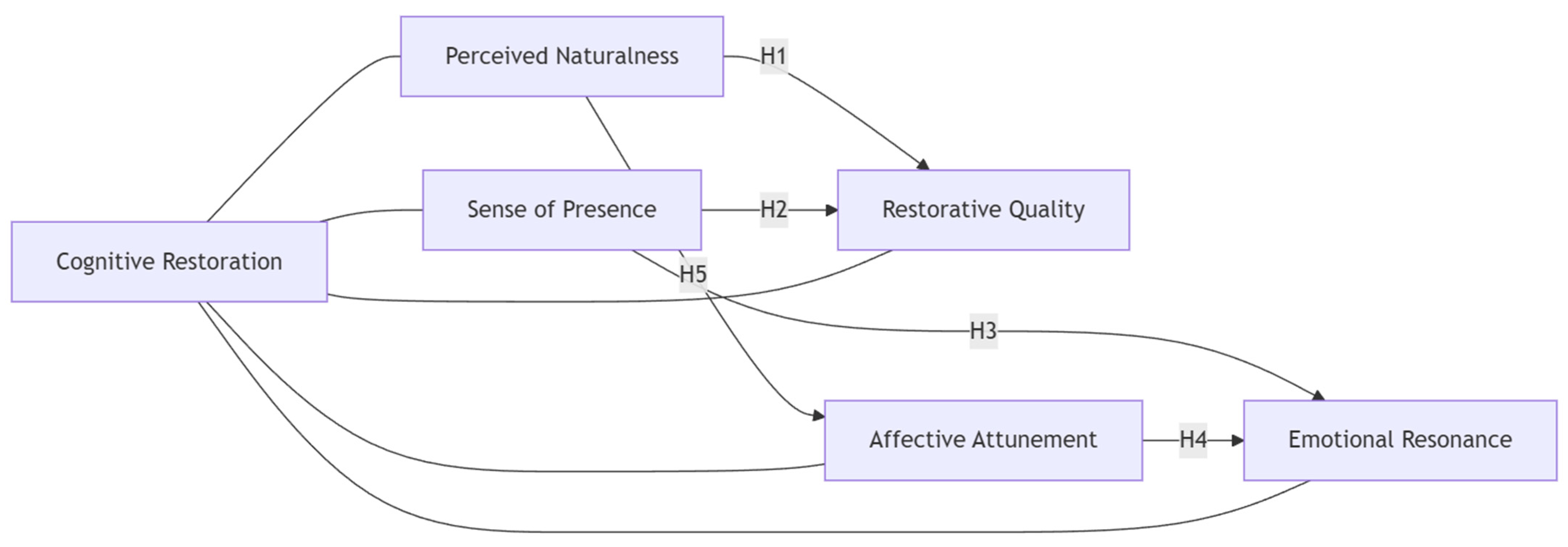
Building on the preceding theory-transfer logic, this study develops a conceptual framework that does not presume theoretical validity in AI-generated environments but instead operationalizes established mechanisms as directional propositions subject to empirical stress-testing. The model is deliberately structured to examine whether causal linkages that are robust in real natural environments and, under specific conditions, in immersive virtual nature remain operative when “nature” is presented as a visually simulated, non-interactive AI-generated landscape. The framework integrates six constructs identified as central across environmental psychology and immersive media research: Perceived Naturalness, Sense of Presence, Affective Attunement, Emotional Resonance, Restorative Quality, and Cognitive Restoration. In established accounts of nature experience, perceptual cues such as naturalness and experiential states such as presence function as upstream conditions that may enable affective alignment and deeper emotional resonance, which in turn co-occur with restorative outcomes. In the present study, these assumptions are not treated as confirmed causal chains but as conditional pathways whose presence (or absence) indicates the boundaries of theory transfer.
Accordingly, the conceptual model specifies naturalness-based transfer routes from Perceived Naturalness to Restorative Quality (H1) and to Affective Attunement (H5); presence-based gateway routes from Sense of Presence to Restorative Quality (H2) and to Emotional Resonance (H3); affective integration from Affective Attunement to Emotional Resonance (H4); and the expected pattern of experiential integration in which Cognitive Restoration should covary with the remaining experiential constructs to the extent that an integrated system is present (H6). By specifying these paths explicitly, the model provides a transparent link between theoretical premises and hypotheses while retaining the central analytic commitment of the study: that non-support is theoretically informative and indicates where established mechanisms fail to extend to visually simulated AI-generated landscapes. The resulting conceptual model is presented in
Figure 1, which summarizes the hypothesized pathways as conditional tests of theory transfer to AI-generated landscapes.
Figure 1 illustrates the hypothesized relationships (H1–H5) derived from environmental psychology and immersive media frameworks. Cognitive Restoration is modeled as an exploratory construct connected to all other experiential dimensions (H6) in order to test whether it remains integrated within the experiential system under AI-generated conditions. H6 does not represent a single directional causal path, but a boundary-testing hypothesis examining the systemic integration versus fragmentation of cognitive restoration in visually simulated environments. By explicitly identifying which experiential mechanisms fail to transfer to AI-generated landscapes, the framework provides a theoretical basis for discussions on digital safety and sustainable tourism experience design. Clarifying the limits of restorative and affective effects in visually simulated nature is essential for preventing misleading wellbeing claims and for positioning AI-generated landscapes as complementary, rather than substitutive, elements alongside natural environments.
3. Materials and Methods
This study is methodologically designed to examine perceptual and cognitive responses to AI-generated landscapes rather than immersive or embodied environmental experience. Participants engage with visually simulated environments in a non-interactive, non-multisensory format, allowing the analysis to isolate visually mediated experiential mechanisms without presuming the operation of immersion-based or sensorimotor processes characteristic of real or high-fidelity virtual nature.
The epistemological foundation of this study is based on critical realism, the perspective that psychological experiences are rooted in deep mechanisms which may or may not be activated depending on environmental conditions. Synthetic landscapes have their own structural properties and are therefore synthetic experiences; rather than viewing AI-generated nature as either equal to real nature or less than real nature allows recognition of this fact. Accordingly, the study design intentionally restricts sensory input and interaction to visual stimuli, ensuring that any observed relationships reflect visually mediated mechanisms rather than immersive or embodied processes. This makes it particularly appropriate for research where well-established constructs (e.g., presence, naturalness or restoration) are being tested within some technologically new context because both observable empirical regularities and unobservable causal processes underlying them can be acknowledged by such a framework. In the current work reported here this provides one coherent way through which very small/negligible structural relationships found within SEM models can be interpreted. The lack of integrated experiential pathways is not interpreted as a ‘failure of pathways’ but, more fundamentally, as evidence of different underlying mechanisms operating in AI-generated environments. This is consistent with critical realism’s foundational preoccupation with boundary conditions: contexts or circumstances where an established theory ceases to be applicable and is therefore at the limits of its explanatory scope. The framing of AI-generated nature within this paradigm supports the broader conceptual claim in this study: Synthetic environments are a different experiential domain, not governed by causal structures applicable to real or VR immersive nature, but by computational, aesthetic and sensory constraints specific to AI-generated imagery. This is the theoretical orientation grounding and inspiring the introduction of new concepts such as fragmented paths to experience.
Participants were recruited from Prolific Academic, the international platform widely used in behavioral science, psychology and tourism research due to its rigorous demographic targeting and identity verification features as well as high data-quality standards. Fieldwork was carried out between August 2025 and November 2025, thus ensuring temporal stability of the sample while reducing any potential risk associated with short-term sampling bias. A total of 1021 adults completed the survey. Eligibility criteria required respondents to be aged eighteen years or older; fluent speakers/users of English language; and regular users of digital media (thereby ensuring baseline familiarity for technologically mediated environments consistent with the study’s focus on AI-generated nature landscapes). The participation was anonymous and modestly compensated. All online research ethics standards were fully adhered to in collecting this dataset, which is both demographically and behaviorally diversified, thereby providing a firm basis for examining the extent to which synthetic nature is variably perceived. Gender distribution is balanced (48.2% male; 51.8% female). The age profile is centered on younger and early middle-aged adults, with 57.7% between 18 and 35 years, while older groups are also meaningfully represented. Educational attainment is high: 56.9% hold a college or faculty degree and 18.2% possess postgraduate qualifications, indicating a sample capable of engaging with complex digital visual content.
Geographically, participants come primarily from the United States (32.8%) and the United Kingdom (25%), with additional representation from Canada, Australia, Germany and the Netherlands, providing cultural breadth relevant to interpretations of digital and AI-generated nature. Behavioral characteristics further position the sample as technologically engaged: 55.8% use digital devices for at least five hours per day, reflecting extensive exposure to visual and interactive media. Contact with natural environments varies, with 31.8% spending time outdoors occasionally and 44.3% often or very often. Experience with immersive technologies also varies widely: 18.4% regularly use VR/AR/360° environments, 35.2% do so occasionally, while others have limited or no prior exposure. Familiarity with CGI and AI-generated images is moderate to high across the sample. Overall, the sample constitutes an internationally distributed, digitally active and educationally well-equipped population with heterogeneous exposure to both natural and digital environments. Although participants were recruited internationally, the sample predominantly reflects respondents from Western, high-income, and digitally mature societies (e.g., the United States, the United Kingdom, and Western Europe). The findings should therefore be interpreted as representative of Western cultural contexts rather than as globally generalizable.
The original questionnaire consisted of 36 statements designed to capture participants’ immediate perceptual, emotional, and cognitive reactions to AI-generated natural landscapes. The item pool was newly developed for this study and was not adopted from a single existing validated scale nor directly adapted from a prior instrument. Item formulations were informed by established constructs reported in environmental psychology and restorative environment research, including Stress Recovery Theory and Attention Restoration Theory [
11,
12], perceived naturalness and visual realism [
19,
20,
21], and affective responses to environments [
43,
50,
61]. No predefined categories or dimensional structure were imposed at the questionnaire stage, and all statements were presented in a single unified list to avoid priming or signaling theoretical expectations. All items used the same Likert-type scale, allowing the structure of experiential responses to emerge empirically rather than being specified a priori. Exploratory factor analysis therefore constituted the first formal step in identifying the latent structure of responses to AI-generated landscapes. The full item pool (36 items) is reported in
Appendix A, while the subset of 25 items retained after EFA is transparently identifiable through primary factor loadings in
Table 2 and is consistently used in the CFA and SEM models (
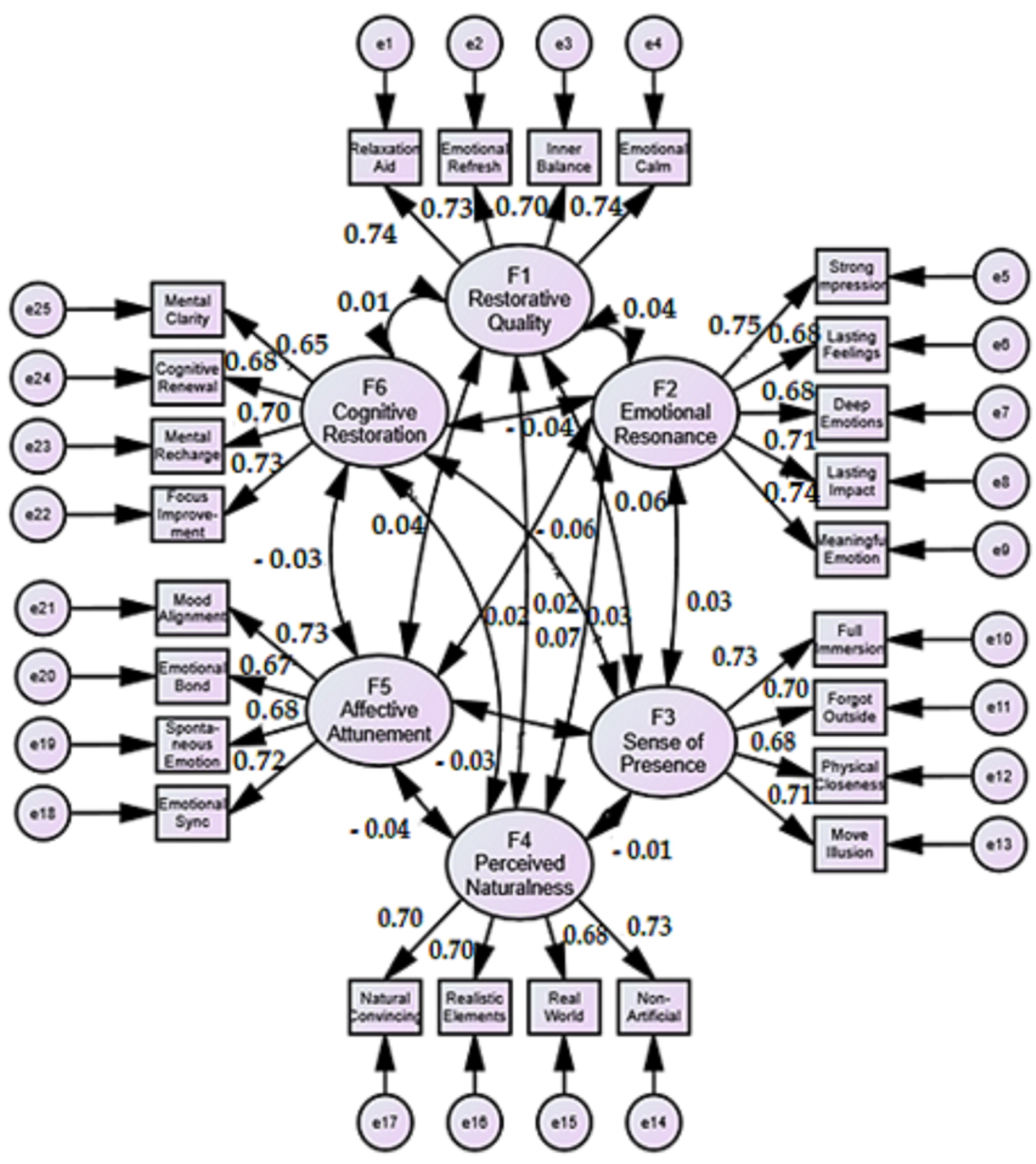
Figure 2).
The study employed a set of AI-generated images depicting generic natural environments (e.g., forests, water bodies, mountainous terrain, and open natural scenes). All images were generated using a text-to-image diffusion model (Stable Diffusion) and a standardized prompt structure to ensure consistency in visual style, perspective, lighting, and resolution. The generated scenes depicted non-specific natural settings and deliberately excluded animals, human figures, identifiable landmarks, or culturally coded elements in order to minimize narrative or semantic priming. The stimuli consisted exclusively of static, two-dimensional images presented in a non-interactive format; they were neither panoramic nor dynamic and did not include immersive, navigable, or animated features. The images were used solely as visual stimuli and were not intended to represent specific destinations, ecosystems, or real-world locations. The images were not pre-tested using a separate pilot sample, as pre-selecting stimuli based on perceived naturalness, emotional impact, or aesthetic appeal would have introduced selection bias and implicitly optimized the images toward expected experiential responses. Given the study’s theory-transfer and boundary-testing orientation, the use of non-curated, typical AI-generated imagery was considered methodologically more appropriate. A representative example of the AI-generated visual stimulus used in the study is provided in
Appendix B.
The study employed a single-condition design in which all participants were exposed exclusively to AI-generated visual stimuli. No comparative conditions involving real natural environments or immersive virtual environments were included. This design choice was intentional and aligned with the study’s primary objective of isolating and examining visually mediated experiential mechanisms in AI-generated landscapes. However, it also constitutes a methodological limitation, as the absence of comparison conditions precludes direct causal contrasts between AI-generated, real, and immersive virtual nature within the same experimental framework.
A set of multivariate statistical analyses was conducted for checking the dimensions, reliability, and structure of properties in the tool. The adequacy of sampling and strength of inter-item correlations were checked by the Kaiser–Meyer–Olkin (KMO) measure and Bartlett’s Test of Sphericity. Further analysis involved an exploratory factor analysis (EFA), using maximum likelihood estimation with a varimax rotation to latent factors within this dataset; based on empirical performance criteria, 25 items were retained for further analyses, which included a confirmatory factor analytic (CFA) check on measurement model validation, where standardized loadings as well average variance extracted (AVE) were used to assess convergent validity, while composite reliability (CR) evaluated internal consistency and the Fornell–Larcker criterion together with the HTMT ratio assessed discriminant validities between constructs. Structural equation modeling applied testing to the hypothesized six construct relationships.
Structural equation modeling was not used to confirm any presumed causal chains but rather as an empirical test of the transferability and boundary conditions of well-known environmental psychology mechanisms in AI-generated environments. The results regarding model adequacy are reported based on a battery of fit indices: χ2/df, GFI, AGFI, CFI, TLI, IFI, RMSEA, SRMR, AIC and ECVI, in addition to Hoelter’s critical N. All analyses strictly followed established psychometric and SEM standards for robustness in providing a detailed check on both measurement properties and structural patterns lying beneath experiential responses to AI-generated nature. All preliminary statistical analyses, including descriptive statistics and exploratory factor analysis, were conducted using IBM SPSS Statistics (Version 28, IBM Corp., Armonk, NY, USA). Confirmatory factor analysis and structural equation modeling were performed using IBM SPSS AMOS (Version 28, IBM Corp., Armonk, NY, USA).
4. Results
The KMO value of 0.874 indicates that the data have a strong degree of common variance and are well-suited for factor analysis. Bartlett’s Test of Sphericity is highly significant (χ2 = 12,889.071, df = 630, p < 0.001), confirming that the correlation matrix is not an identity matrix. Taken together, these results show that the dataset has adequate inter-item correlations and a solid structure for extracting latent factors.
The factor-analytic results presented in
Table 2 indicate a clear six-factor solution with eigenvalues above 1.0, jointly explaining 56.69% of the total variance in the initial extraction. After rotation, variance is evenly distributed across the six factors, with each accounting for approximately 7–8% of the explained variance. This, again, is an indication of the fact that there is no overly dominating factor in the structure and that the factors are conceptually different but adequately correlated, warranting their being measured within the same framework. Therefore,
Table 2 provides very strong empirical evidence for dimensions in instruments measuring perceptual, emotional and cognitive responses to landscapes—here specifically AI-generated ones.
The six-factor structure presented in
Table 3 reflects a coherent set of psychological processes through which participants engaged with the AI-generated landscape.
Restorative Quality captures the perceived capacity of the environment to reduce stress and promote relaxation, suggesting that synthetic nature can partially reproduce affective benefits commonly associated with natural settings.
Emotional Resonance refers to the intensity and persistence of emotional responses, indicating that the scenes were not merely momentarily enjoyable but capable of leaving more enduring impressions.
Sense of Presence describes the extent to which participants experienced a feeling of being situated within the digital environment, perceiving themselves as psychologically and perceptually engaged with the scene rather than as detached observers.
Perceived Naturalness captures participants’ assessments of visual realism and ecological plausibility, suggesting that the AI-generated imagery was able to reproduce cues commonly associated with authentic natural environments.
Affective Attunement refers to the immediate emotional alignment with the atmosphere of the scene, indicating that participants’ moods tended to shift in response to the affective tone conveyed by the landscape.
Cognitive Restoration, in turn, reflects perceived improvements in mental clarity and reductions in cognitive fatigue, pointing to the potential of synthetic nature to support forms of cognitive refreshment similar to those reported in studies of restorative natural settings. Taken together, these factors indicate that AI-generated landscapes can elicit a diverse range of emotional, perceptual, and cognitive responses, operating not simply as visual depictions but as environments that afford meaningful experiential engagement.
In line with the theory-transfer logic underpinning the study, the structural model was examined to determine whether causal relationships established in environmental psychology and immersive media research also operate in the context of AI-generated nature. Within this approach, the presence—or absence—of significant structural paths represents the key empirical test. As shown in
Figure 2, none of the hypothesized relationships (H1–H6) receive empirical support. This pattern, therefore, does not indicate any model misspecification or errors in measurement but instead indicates that causal mechanisms well documented in real natural and immersive virtual environments do not extend to AI-generated environments. The standardized path coefficients between the latent constructs are consistently very small, from −0.06 to 0.07, thus showing the absence of any significant directional relationships among Perceived Naturalness, Sense of Presence, Affective Attunement, Emotional Resonance, Restorative Quality and Cognitive Restoration. At the same time all observed indicators load strongly on their respective factors, which confirms measurement reliability but leaves the latent dimensions largely disconnected at a structural level. Restorative Quality has near-zero associations with all other constructs while Cognitive Restoration is revealed as the most isolated dimension, having no substantive overlap with either perceptual or affective components.
Despite the absence of structural associations, the model demonstrates excellent global fit across all indices. The chi-square value is non-significant (χ2 = 266.396, df = 260, p = 0.379), with a χ2/df ratio of 1.025, indicating strong absolute fit. All incremental fit indices exceed recommended thresholds (GFI = 0.980, AGFI = 0.975, CFI = 0.999, TLI = 0.999, IFI = 0.999), and the RMSEA is exceptionally low (0.005; PCLOSE = 1.000), reflecting a highly accurate approximation to the data. Parsimony-adjusted measures (PNFI = 0.837; PCFI = 0.866) and information criteria (AIC = 396.396; ECVI = 0.389) further support model adequacy, while the Hoelter values (1144 at p = 0.05) indicate robust model stability. Collectively, these results show that although the experiential dimensions of synthetic nature are internally consistent, they do not converge into an integrated psychological response but instead form largely disconnected perceptual, emotional, and cognitive pathways.
Table 4 summarizes the standardized path coefficients, significance levels, and support status for all tested hypotheses (H1–H6).
The results presented in
Table 5 show that all constructs demonstrate satisfactory internal consistency, with composite reliability values ranging from 0.78 to 0.84. These coefficients exceed the recommended threshold of 0.70, indicating that the indicators within each factor consistently measure their respective latent dimensions. The AVE values, which fall between 0.48 and 0.53, are slightly below the conventional benchmark of 0.50 for some constructs; however, given that all standardized loadings are above 0.65, the constructs still exhibit adequate convergent validity. As noted in prior methodological guidelines, marginal AVE values are acceptable when supported by strong loadings and reliable composite scores. Taken together, the CR and AVE indicators reported in
Table 5 confirm that the measurement model demonstrates coherent convergent validity and is suitable for subsequent confirmatory and structural analyses.
The discriminant validity assessment presented in
Table 6 and
Table 7 provides clear evidence that the six latent constructs are empirically distinct. In
Table 6, the square roots of AVE for all constructs (ranging from 0.692 to 0.726) exceed the corresponding inter-construct correlations, which remain very low in magnitude. This pattern satisfies the Fornell–Larcker criterion and indicates that each construct explains more variance in its own indicators than it shares with any other construct. Such a configuration demonstrates that Restorative Quality, Emotional Resonance, Sense of Presence, Perceived Naturalness, Affective Attunement, and Cognitive Restoration represent conceptually and statistically separable dimensions of experience. The HTMT values reported in
Table 7 further reinforce this conclusion. All HTMT ratios fall between 0.01 and 0.07, well below conservative thresholds commonly applied in behavioral and tourism research. These exceptionally low values indicate that the constructs do not suffer from conceptual overlap or excessive shared variance and that discriminant validity is strongly supported. Together, the results in
Table 6 and
Table 7 confirm that the six-factor measurement model demonstrates a high degree of discriminant clarity, providing a robust basis for subsequent confirmatory and structural analyses.
5. Discussion
The purpose of the discussion is not to reinterpret the empirical results as partial confirmations of established theories, but to explain why and under what conditions these theories fail to operate in AI-generated environments. By returning explicitly to the assumptions embedded in environmental psychology and immersive media frameworks, the discussion situates the observed non-support of hypotheses within the structural limitations of AI-generated landscapes, rather than attributing it to empirical or methodological insufficiency. The observed decoupling is not merely a null finding; it specifies a risk condition for practice: Visually plausible AI nature can trigger strong single-domain impressions (e.g., naturalness or resonance) without activating the integrated mechanisms that typically underpin restoration in real or high-immersion environments. This creates a predictable gap between promised wellbeing outcomes and actual psychological functioning, making expectation management and non-misleading wellbeing claims a core dimension of digital safety in tourism and environmental communication. For sustainable tourism experience design, the results support positioning AI-generated landscapes as complementary (ambient, narrative, symbolic) rather than substitutive restorative environments, unless multisensory and embodied affordances are deliberately introduced.
The present findings show that the causal mechanisms outlined in H1–H6 do not transfer to AI-generated content. This pattern diverges from established evidence in real-nature research showing linked pathways from environmental cues to affect regulation and restoration (SRT/ART) [
11,
12,
23,
25], and from virtual nature studies where restorative outcomes are more likely under conditions of heightened presence and environmental richness [
7,
8,
16,
29]. Instead of activating integrated perceptual, affective, and restorative pathways normally found in natural environments or high-fidelity virtual simulations, experiences with AI-generated landscapes are structurally disconnected responses which challenge a central assumption within environmental psychology (and biophilia research as well as VR-based restoration studies): There is an organized progression linking perceived naturalness/presence/affective alignment/cognitive restoration. This trajectory has been repeatedly observed in multisensory-coherent, ecologically structured, spatially legible, and atmospherically rich environments according to large bodies of previous work—even visually mediated representations tend to preserve such linkages when environmental cues approximate real-world structural complexity. Yet, when these theoretically established mechanisms are examined explicitly as theory-transfer propositions, as articulated in H1–H6, the structural model exposes a systematic decoupling of experiential processes that take place within AI-generated environments. In line with non-support for H1 and H5, perceived naturalness fails to initiate restorative or affective attunement pathways. Consistent with the rejection of H2 and H3, presence does not serve as a gateway mechanism linking perceptual realism to emotional resonance or restorative quality. This contrasts with immersive-media and VR evidence in which presence is theorized and observed as a core mediator translating realism and environmental richness into affective and cognitive outcomes [
16,
34,
38,
39]. The non-support of H4 further indicates that affective attunement measurable as an independent experiential response does not translate into deeper emotional integration. Finally, the absence of significant associations predicted in H6 shows that cognitive restoration is largely standing alone rather than being embedded within an integrated experiential system. Importantly, the measurement model confirms that participants could reliably judge visual naturalness and report distinct affective and cognitive states (i.e., constructs are psychometrically coherent), yet the near-zero structural paths indicate that visual plausibility alone is insufficient to trigger the integrated restorative dynamics predicted by SRT/ART and presence-based accounts [
11,
12,
19,
20,
21,
23,
25,
29].
That makes theoretical sense with the background of currently dominant frameworks on nature experience. They were developed regarding environments that provide multisensory affordances, ecological legibility, and embodied orientation cues—an environment in which deep restorative or affective responses are dependent not on visual realism but cross-modal signals between spatial coherence and atmospheric qualities that allow for either embodied or imaginative engagement. AI can generate visually plausible nature; however, it lacks the ecological and multisensory anchors that typically support embodied orientation and cross-modal coherence. In this context, perceived “naturalness” is more plausibly interpreted as a surface-level visual judgment rather than an entry point into the integrated affective–restorative mechanisms described by SRT/ART and immersive-media models [
11,
12,
16,
23,
25].
Such judgments lack the ecological and multisensory grounding required to activate the causal mechanisms specified by theory-transfer hypotheses, thereby revealing clear boundary conditions for contemporary nature-experience theories. In the present study, these boundary conditions are operationally defined by (1) purely visual exposure, (2) absence of multisensory input, (3) absence of embodied navigation or interaction, and (4) limited spatial continuity typical of static or semi-static AI imagery [
11,
12,
16,
29,
38,
39]. Instead of developing a coherent experiential progression beginning with perception and presence then affective and cognitive outcomes, the response to AI nature is experientially fragmented into weakly connected components. This allows for synthetic landscapes to be interpreted as a qualitatively distinct category of experience, rather than viewing them as some technologically limited or diluted version of real nature or fully immersive virtual nature. Algorithmic environments operate at the level of experience according to logic that is fundamentally different from those settings which, in this case, are ecological. From this perspective, AI-generated landscapes should be understood as environments constrained by computational aesthetics and visual plausibility rather than by ecological or embodied affordances. These constraints explain why established theories remain partially recognizable at the level of isolated constructs yet fail to generate the integrated causal dynamics they predict.
Rather than interpreting this fragmentation as a deficit relative to established nature-experience models, the findings point toward the contours of a distinct experiential framework for AI-generated environments. A future model of AI-mediated nature experience would not assume a linear or hierarchical progression from perception to restoration. Instead, it would conceptualize visual plausibility, affective response, presence, and cognitive outcomes as partially autonomous experiential modules that may co-occur without structural integration. In such a framework, perceived naturalness functions primarily as a surface-level aesthetic judgment rather than as an entry point into embodied or restorative processes. When elicited, presence operates as a perceptual state rather than as a mediating mechanism, while affective and cognitive responses emerge episodically rather than cumulatively. The model would therefore be characterized by modularity, weak coupling, and non-convergent experiential pathways rather than by integrated restorative dynamics. Importantly, this proposed orientation does not constitute a fully specified alternative theory, but an empirically grounded direction for future conceptual development. Its primary contribution lies in shifting analytical attention from transfer-based assumptions toward environment-specific experiential logic. By foregrounding fragmentation, modularity, and surface-oriented engagement as core properties of AI-generated landscapes, such a framework would allow future research to explicitly theorize psychological responses to computational environments without measuring them against ecological or immersive benchmarks. In this sense, the present findings do not replace SRT, ART, or presence-based models, but delineate the conditions under which a different theoretical vocabulary becomes necessary.
From a broader critical and post-humanist perspective, the observed fragmentation of experience is consistent with scholarship on technologically mediated environments and algorithmic aesthetics, which emphasizes that synthetic environments are not neutral representations but computational assemblages structured by data regimes, optimization logic, and surface-oriented visual coherence. Critical media and post-humanist theorists argue that such environments privilege legibility, recognizability, and aesthetic plausibility over embodied continuity and ecological depth, resulting in experiences that are perceptually convincing yet experientially shallow. Within this view, affective and cognitive responses are not expected to integrate into coherent experiential wholes, but to remain modular, episodic, and weakly coupled. AI-generated landscapes thus exemplify a broader condition of algorithmic mediation in which emotional experience is shaped by representational surfaces rather than by lived environmental engagement. This perspective helps explain why visually plausible AI environments elicit parallel but disconnected perceptual, affective, and cognitive responses, reinforcing the interpretation of fragmentation as a structural property of synthetic environments rather than an empirical anomaly [
1,
3,
18,
36,
39].
The reframing has important implications for breaking through the models which work with a general flow from perceptual input to affective and restorative output regardless of environmental provenance. These implications reinforce the need for cautious claims and complementary deployment of AI-generated landscapes in tourism and wellbeing contexts. If AI-generated environments elicit fragmented and weakly integrated experiential responses, their uncritical deployment as substitutes for nature-based or immersive experiences may produce mismatches between intended wellbeing outcomes and actual psychological effects. From a sustainability perspective, this underscores the need for caution in positioning visually realistic synthetic landscapes as functionally equivalent to natural environments within tourism, wellbeing, or environmental communication contexts. Among other things, the findings specify visual realism as insufficient to trigger the automatic psychological functioning typically attributed to nature across tourism, environmental communication, digital wellbeing, and experiential design domains. Without multisensory grounding and ecological affordances, atmospheric coherence alone cannot sustain fully integrated emotional–cognitive pathways. The contribution thus operates on two levels: first, by empirically refining restoration- and presence-based theories through the specification of conditions under which their core mechanisms fail to transfer; and second, by providing a theoretically guided interpretation of non-integrative experiential domains, thereby extending nature-experience theory by empirically specifying its boundary conditions in AI-mediated environments.
To clarify these contrasts across environmental modalities, a conceptual comparison of experiential dynamics in real nature, immersive virtual environments, and AI-generated landscapes is provided in the
Supplementary Material (Table S1).
5.1. Theoretical Contributions
This paper examines whether mechanisms derived from environmental psychology and immersive media research can be meaningfully applied to AI-generated representations of nature. Rather than assuming that experiential processes operate uniformly across different environmental forms, the findings demonstrate that the causal links typically connecting perceived naturalness, presence, affective attunement, and cognitive restoration do not carry over to computationally generated landscapes. In this respect, the results mark a clear boundary on the applicability of established theories such as Stress Recovery Theory (SRT), Attention Restoration Theory (ART), and presence-based models of immersion. What emerges is a distinct type of experience in which perceptual, affective, and cognitive responses remain confined to their respective domains without consolidating into an integrated psychological system. Although these responses are internally coherent, they lack higher-order structural integration. This finding directly challenges an often-implicit assumption in immersive-media and virtual restoration research that perceptual realism and environmental richness can, via presence, reliably translate into engaged emotion and restorative outcomes [
16,
29,
34,
38,
39]. In AI-generated nature, perceived naturalness, sense of presence, and affective attunement function primarily as parallel experiential states rather than as interdependent components of a unified experiential pathway. Restoration, accordingly, is revealed to be limited in its reliance on visual plausibility alone as a trigger mechanism.
Taken together, these results indicate that AI-generated nature should not be understood as a weakened or incomplete version of real or immersive virtual environments. Instead, it constitutes a qualitatively distinct experiential category shaped by computational aesthetics, perceptual plausibility thresholds, and the absence of multisensory ecological affordances. Recognizing this distinction provides a productive foundation for future theoretical work aimed at understanding engagements with increasingly prevalent AI-mediated environments and clarifying where the boundaries of existing nature-experience theories lie. The primary theoretical contribution of this study therefore lies not in confirming established models, but in delineating the conditions under which their core mechanisms fail to transfer.
5.2. Managerial and Practical Implications
The findings have important practical implications for tourism, wellness, environmental communication and digital experience design. Many contemporary applications—including virtual nature rooms, AI-based wellbeing tools, immersive marketing systems and digital sustainability campaigns—operate on the premise that visually compelling AI-generated landscapes can substitute for nature-based experiences. Within the scope of this study, digital safety is understood not in technical or cybersecurity terms, but as psychological safety and expectation management—specifically, the avoidance of misleading wellbeing claims and experiential overpromising when deploying AI-generated landscapes in tourism, wellness, and sustainability contexts. The present results indicate that this assumption is not empirically supported. While AI-generated environments may offer aesthetic, atmospheric or symbolic value, they do not deliver immersive presence, emotional integration or restorative benefits comparable to those associated with authentic natural environments or high-fidelity virtual reality. For wellness and hospitality contexts, AI-generated landscapes should therefore be positioned as ambient or supportive design elements rather than as restorative interventions. Destination marketers are advised to treat AI-generated content as complementary narrative or visual material, not as experiential replacements for natural attractions or immersive VR experiences. Developers of digital wellbeing platforms and experiential design systems should consider incorporating multisensory, interactive or embodied components if deeper psychological engagement or attentional recovery is a desired outcome. From a sustainable tourism governance perspective, substituting direct nature encounters with purely visual AI-generated environments risks weakening the experiential foundations that support long-term destination stewardship, pro-environmental attitudes and wellbeing-oriented sustainability strategies. When emotional wellbeing or cognitive restoration is the primary objective, practitioners should prioritize authentic nature exposure, high-immersion virtual environments or multisensory design strategies over purely visual AI-generated landscapes.
Beyond tourism and hospitality applications, these findings have direct implications for fields such as affective computing, environmental psychology, and digital mental health design. For affective computing systems that rely on visual cues to infer emotional states, the results caution against assuming that visually realistic nature content reliably reflects or induces integrated affective responses. From an environmental psychology perspective, the findings underscore that classical restoration mechanisms remain contingent on multisensory and embodied environmental conditions, limiting their applicability to purely visual AI-generated settings. In the context of digital mental health design, the results suggest that visually plausible AI nature should not be positioned as a standalone restorative intervention, but rather as an ambient or supportive element within broader, multisensory or interaction-rich wellbeing strategies. Explicit recognition of these constraints is essential for avoiding experiential overpromising and for ensuring psychological safety in the design of AI-mediated wellbeing applications.
5.3. Limitations
Several limitations of this study should be acknowledged. To begin with, the analysis focused on AI-generated nature presented through static or semi-static visual stimuli. It is therefore possible that more dynamic, interactive, or multimodal AI environments would give rise to different experiential patterns. In a similar vein, the study relied on self-report measures, which capture subjective evaluations but offer limited insight into physiological or non-conscious processes related to restoration and affective engagement. It should also be noted that individual differences—such as levels of digital literacy, sensory imagination, or cultural background—may play an important role in shaping responses to synthetic landscapes. Although the sample was relatively large and diverse, future research could address these moderating factors more directly and systematically. Finally, the study deliberately employed theoretical models originally developed for natural and immersive virtual environments in order to explore their transferability. While this theory-transfer approach proved analytically useful, it may not fully capture the experiential logic specific to AI-generated environments. Alternative conceptual frameworks may therefore be better suited for understanding the distinctive ways in which synthetic nature is experienced. These limitations are consistent with the exploratory, theory-probing orientation of the study. Consequently, the results should not be directly generalized to real-world tourism settings or to applied destination experiences involving physical presence, multisensory engagement, or prolonged exposure. The study instead delineates theoretical and experiential boundaries specific to visually simulated AI-generated nature under experimental conditions.
5.4. Future Research Directions
Future research could move beyond purely visual representations and explore whether multisensory AI-generated environments—such as those incorporating soundscapes, ambient cues, haptic feedback, or procedurally generated ecosystems—are capable of producing more integrated psychological responses. In addition, studies that focus on interactive or adaptive AI landscapes may help clarify whether greater user agency or forms of embodied navigation contribute to deeper experiential engagement and stronger causal integration. At a conceptual level, further theoretical work is needed to develop frameworks that are explicitly tailored to computational and synthetic environments. Such efforts might draw on emerging notions such as synthetic ecology, perceptual plausibility thresholds, algorithmic atmosphere, or AI-mediated aesthetic resonance. Longitudinal approaches could also be valuable, as they would allow researchers to examine how repeated or prolonged exposure to AI-generated nature shapes experiential responses over time. Finally, comparative studies that place real, immersive virtual, and AI-generated environments side by side would help to more clearly delineate the boundaries, overlaps, and distinctive characteristics of each experiential category.
6. Conclusions
This study shows that AI-generated representations of nature do not activate the integrated perceptual, emotional, and restorative mechanisms typically associated with real natural settings or high-fidelity virtual environments. Although the measurement model indicates strong internal coherence within perceptual, affective, and cognitive dimensions, the lack of structural connections among these dimensions suggests that synthetic nature operates as a qualitatively different form of experience. Rather than giving rise to the coordinated psychological pathways described in environmental psychology and virtual reality research, AI-generated landscapes appear to elicit experiential responses that remain fragmented and do not consolidate into deeper psychological states. These findings call into question the widely held assumption that visual realism alone is sufficient to substitute for ecological or immersive environments when the goal is to support psychological wellbeing. By highlighting the limits of visual plausibility—and the absence of multisensory, ecological, and atmospheric grounding—the study helps explain why AI-generated landscapes diverge from established models of restoration, presence, and affective engagement. Seen in this light, AI-generated nature is better understood not as a reduced or incomplete version of natural or virtual environments, but as an emerging experiential category with its own internal logic and psychological structure. Importantly, these conclusions apply specifically to visually simulated, non-immersive AI-generated landscapes as examined in this study and should not be generalized to more dynamic, interactive, or multisensory forms of synthetic nature, which may engage different experiential mechanisms.
These findings also underscore the importance of expectation management and psychological digital safety, as positioning visually plausible AI-generated landscapes as restorative substitutes risks creating systematic mismatches between promised and actual wellbeing outcomes in tourism and wellness contexts. As AI-generated environments become more prevalent across tourism, wellness, and digital experience design, recognizing this experiential distinctiveness becomes increasingly important. Rather than proposing AI-generated landscapes as substitutes for natural or immersive environments, this study should be understood as a theoretical probe that maps the boundaries of applicability of established nature-experience frameworks when transferred to synthetic contexts. In doing so, it offers an initial, deliberately limited step toward theorizing AI-mediated environmental experience—one that foregrounds constraints and conditions of operation alongside potential roles, rather than assuming functional equivalence with ecological or immersive nature.




 ,
,