Article

Assessment of Population Parameters for Fisheries Management in a Pressured Ecosystem: A Case Study of Sapanca Lake (Türkiye)

by
Nurgül Şen Özdemir
1,*,
Erdinç Aydın
2 and
Teoman Özgür Sökmen
3
1
Department of Veterinary Medicine, Vocational School of Food, Agriculture and Livestock, Bingöl University, 12000 Bingöl, Türkiye
2
Sakarya Directorate of Provincial Agriculture and Forestry, Republic of Türkiye Ministry of Agriculture and Forestry, 54000 Sakarya, Türkiye
3
Department of Veterinary Medicine, Çayırlı Vocational School, Erzincan Binali Yıldırım University, 24500 Erzincan, Türkiye
*
Author to whom correspondence should be addressed.
Sustainability 2026, 18(5), 2322; https://doi.org/10.3390/su18052322
Submission received: 13 November 2025 / Revised: 12 February 2026 / Accepted: 17 February 2026 / Published: 27 February 2026

Abstract

Sapanca Lake is a tectonic freshwater lake ecosystem whose water balance and ecological integrity are increasingly threatened by urbanization, pollution, climate change, and declining water levels. To assess recent changes in the fish community, length–weight relationships (LWRs), condition factors (CFs), sex ratios (F/M), and standing stock biomass estimates were determined for eight fish species (Blicca bjoerkna, Scardinius erythrophthalmus, Carassius gibelio, Esox lucius, Silurus glanis, Perca fluviatilis, Abramis brama and Cyprinus carpio) sampled between December 2024 and April 2025. According to standing stock biomass assessments, Cyprinus carpio showed the highest biomass (297.67 tons), while Abramis brama had the lowest (22.72 tons). Most species showed positive allometric growth (b > 3), suggesting generally favorable feeding conditions. In contrast, the main predatory species, E. lucius (b = 2.89) and Silurus glanis (b = 0.21), exhibited negative allometric growth, likely due to limitations in food availability and prey abundance. The CF values were generally >1, indicating good physiological status; however, lower CF values in A. brama (1.18) and B. bjoerkna (1.19) suggest species-specific ecological limitations. Sex ratio analysis revealed pronounced female dominance across species, ranging from complete female dominance (F/M = 1/0) in Carassius gibelio to a female-biased ratio of 1/0.04 in Scardinius erythrophthalmus, likely driven by seasonal sampling effects, sex-specific behavior, and species-specific reproductive strategies. Overall, the results indicate increasing trophic imbalance and ecological stress in Sapanca Lake, emphasizing the need for standing stock biomass assessments and ecosystem-focused fisheries management in tectonic lakes under hydrological pressure.

1. Introduction

Sapanca Lake is a tectonic freshwater lake located in the eastern part of the Marmara Region in Türkiye, with reed beds along its shoreline [1]. The lake is fed by surface precipitation, streams and groundwater from its bottom due to its faulted geological structure. The Çark River, which originates from the northeastern end of the lake, contributes to its constantly renewed hydrological regime by emptying into the Sakarya River [2]. Sapanca Lake is used for fishing and recreation, as well as for drinking water [3]. However, the lake and its surroundings are under significant pressure due to illegal construction, rapid urbanization, and pollution, which disrupts the lake’s water balance and increases the pressure on it [4]. Although Sapanca is the smallest district in the Sakarya province, its population has grown by 26% over the past 23 years, reaching 46,080 inhabitants [5]. Furthermore, the population can triple during the summer months due to local and foreign tourists [6].
Monitoring studies have been initiated to limit such threats to the lake basin ecosystem [7]. Sustainability is being damaged by increasing pollution and activities that are excessive with regard to the number of fish that can be caught, resulting in a decrease in the age and size of fish and the number that can be caught. As long as there is sufficient food and a suitable habitat, sustainability is ensured through the replacement of individuals removed due to hunting and natural causes [8]. Length and weight data are two important components of fish species biology at both the individual and population levels. This is particularly important for the effective management and development of fish populations [9]. Therefore, determining fish stocks and analyzing parameters such as length, weight, and condition factors will contribute significantly to the sustainable conduct of these monitoring studies. In this respect, stock estimation studies are important. Declines in the populations of some species due to overfishing and the destruction of breeding areas can be evidenced by changes in fish abundance and size [10].
In fisheries biology, LWRs are useful for converting length–weight equations into growth–weight equations for use in stock assessment models, as well as for estimating stock biomass from limited sample sizes [11]. They are also used to estimate growth type (isometric or allometric) from fish length and weight [12], to assess fish condition, and to compare the historical characteristics and living conditions of fish species in different regions [13]. These values are important for yield per fry analysis in stock assessment studies [14]. They can also provide important details about climatic and environmental changes, as well as adjustments to people’s subsistence practices [15]. Alongside LWRs, the condition factor (CF) is used to estimate the interaction between biotic and abiotic factors affecting the physiological condition of a fish. The CF enables the collection of information on stock composition, life history, growth, maturity, and production [16]. It also facilitates comparisons between species and populations, as well as the estimation of fish population health [17].
In this respect, LWRs and CF are effective tools in fisheries biology for informing sustainable fisheries management guidelines for natural water resources [16]. In this study, our aim was to estimate the LWRs of fish species obtained from Sapanca Lake, evaluate the CF, determine the suitability and quantity of the fish population stocks in Sapanca Lake, and determine the fishing techniques and conditions necessary for protecting these stocks. This information will contribute to the management and protection of this water resource, allowing comparisons to be made between the current and future states of the natural populations of these economically important fish species. It will also help us to determine the necessary fishing techniques and conditions in Sapanca Lake, which has a dynamic ecosystem.

2. Materials and Methods

2.1. Sampling Area

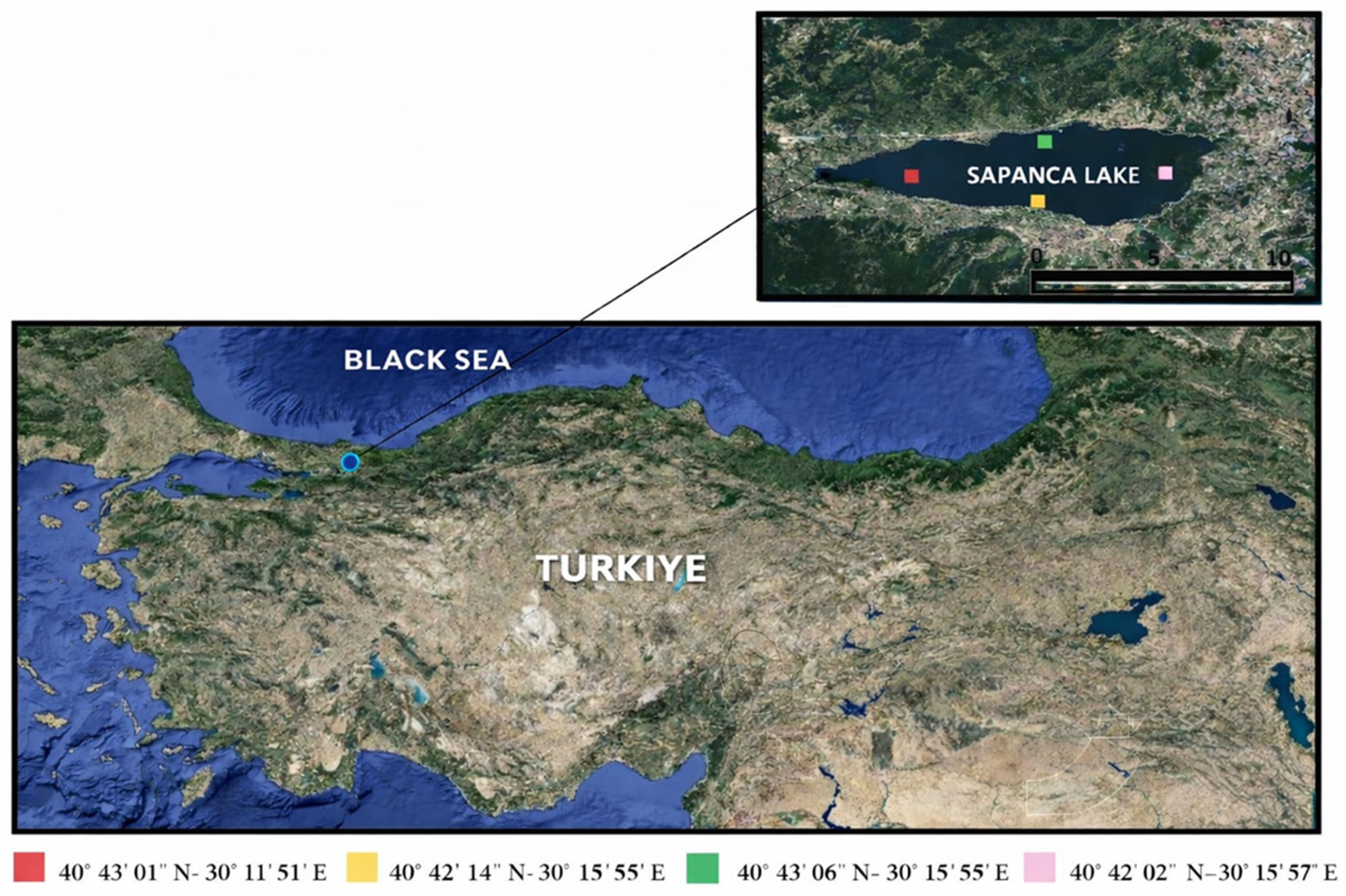
Sapanca Lake is located within the borders of Sakarya Province (40°43′ N 30°15′ E/40.717° N 30.250° E), and its catchment area covers 251 km2. The lake has a surface area of 46 km2, a length of 16 km from east to west and 5 km from north to south, a maximum depth of 55 m, and an average depth of 25.6 m. It is located in the eastern part of the Marmara Region of Türkiye (Figure 1). It is fed by small streams descending from the mountains, including Keçi Creek, Istanbul Creek, Mahmudiye Creek, Kuruçay Creek, Karaçay Creek, Balıkhane Creek, Maden Creek and Arifiye Creek, as well as by springs on the lake bed. The lake water flows into the Sakarya River via Çark Creek from the eastern end [18]. It is located 12 km west of Sakarya, in the eastern half of a long depression connecting the Adapazarı Plain to the Gulf of Izmit [19,20].

2.2. Sample Collection

The study was carried out using plain galsama gillnets with mesh sizes of 32, 40, 50, 80, and 100 mm. Galsama gillnets are fish-catching devices that trap a fish by forcing its head through the mesh, but not its entire body. When it attempts to escape, it becomes caught by its gills. To catch a fish, the mesh size must be larger than the fish’s head and smaller than its body. Furthermore, while galsama gillnets optimally catch individuals of a certain size, they catch proportionally fewer smaller and larger individuals; when the fish exceed this size, the gillnets’ effectiveness approaches zero [21,22]. Therefore, although the nets exhibited size selectivity, this factor was not considered in the calculations in the present study. Instead, the stock estimates were based on the biomass of the size classes to which the gillnets are most sensitive. As a result, the values reported in this study reflect the biomass of the size classes to which the nets are sensitive during a specific time period (December 2024 and January, February, March, and April 2025), rather than the total stock biomass of the lake. Samplings were conducted at four stations, selected to represent the entire lake area, during December 2024 and January, February, March, and April 2025 (Figure 1). Five sets of single-layer gillnets made of monofilament material (0.20 mm polyamide) were used in the study. The Donam factor (E) was 0.50 for both the cork and lead collars. The total length of the nets used in the study was approximately 250 m, with one size of net measuring approximately 50 m. Table 1 shows the total area of the nets used in the fishery to determine the catchable stock of fish, based on estimates of the biomass present at the time of sampling. In addition, the water temperature, oxygen, salinity, electrical conductivity (EC), and pH values were measured from the sampling areas of the lake using the PCE-PHD Data Logger throughout the sampling period, and average values were taken (Table 2).
Gillnets were laid in the water close to sunset and left for approximately 12 h before being collected in the early morning (between 06:00 and 07:00 a.m). The areas where fishing took place were sandy, muddy and clayey, with meadows, and the depths at which the nets were dropped varied between 5 and 6 m, depending on the study area. The fish samples caught in the gillnets were counted and grouped according to mesh size. The number of species caught in each net was recorded, and the samples were stored in an ice box in a cold environment for the necessary measurements. In this study, eight fish species (Blicca bjoerkna Linnaeus, 1758; Scardinius erythrophthalmus Linnaeus, 1758; Carassius gibelio Bloch, 1782; Esox lucius Linnaeus, 1758; Silurus glanis Linnaeus, 1758; Perca fluviatilis Linnaeus, 1758; Cyprinus carpio Linnaeus, 1758; and Abramis brama Linnaeus, 1758) were collected from commercial fishermen in Sapanca Lake following the researchers’ standardized sampling protocol, including sampling time, procedure, gillnet type, and gillnet depth. Among these species, P. fluviatilis, Silurus glanis, and E. lucius were identified as the most commercially important [23,24].

2.3. Biometrics, Stock Estimation, and Analytical Procedures

The biometrics of fish captured by the gillnets were compiled separately for each net, and the total standing stock biomass was estimated [25]. The total length (TL) was measured to the nearest millimeter (mm) using a fish measuring board, and the total weight (TW) was determined using a digital balance (Weightlab WL-3002L, Shanghai, China) with an accuracy of 0.1 grams (g).
The surface area covered by a single gillnet (Ai, m2) was calculated as the product of net width and net length:
A i = w i   l i ,
where wi is the net width (m), and li is the net length (m).
The total area covered by all the gillnets was obtained as follows:
A t o t a l = i = 1 n   A i
Assuming that all fish A a l l t o t a l within the gillnet-covered area were susceptible to capture, the unit-area yield for sub-region j was calculated as follows:
Y j = C j A t o t a l   ( k g h a ) ,
where C j is the average catch (kg) obtained in sub-region j .
The biomass for sub-region j was then estimated as follows:
B j = Y j   A j ,
where A j is the total area of sub-region j (m2) and B j is expressed in tons.

2.4. Length–Weight Relationships (LWRs), Condition Factor (CF), and Sex Ratio

The relationship between total length (TL, cm) and total weight (TW, g) was analyzed using linear regression, and the length–weight relationships (LWRs) were expressed by the model TW = aTLb [26]:
T W = a   T L   b ,
where TW is total weight (g), TL is total length (cm), a is the intercept, and b is the allometric growth exponent. The degree of association between variables was evaluated using the coefficient of determination (R2) [27].
Fulton’s condition factor (CF) was calculated to assess the individual condition of the fish, assuming that heavier fish at a given length are in better condition [28,29]:
C F = 100   T W T L 3
where TW is the total weight (g), and TL is the total length (cm).
Sex was determined by macroscopic examination of the gonads after dissection. Individuals with paired, elongated, whitish testes were classified as males, whereas those with larger, lobulated, yellow to orange ovaries containing visible oocytes were classified as females. The gonadal morphology and coloration were evaluated following standard ichthyological procedures described in the literature [26,30].
The sex ratio (female/male) was calculated as follows:
S e x   r a t i o = F M ,
and the female frequency (F %) was calculated as follows:
F   % = 100   F F + M ,
where F denotes the number of females, and M denotes the number of males.

2.5. Statistical Analysis

Associations among variables were evaluated using Spearman’s rank correlation. Group differences were tested with independent-samples Student’s t -tests. A chi-square ( χ 2 ) test assessed whether the female-to-male ratio deviated from expected proportions. Differences in CF among species were evaluated by one-way ANOVA ( p < 0.05 ). All analyses were conducted in MINITAB 21.
The departure of b from isometry ( b = 3 ) was tested as follows [31]:
t s =   b 3   S b ,
where t s is the test statistic and S b is the standard error of b . Growth was interpreted as isometric if b = 3.0 , negative allometric if b < 3.0 , and positive allometric if b > 3.0 . The statistical significance of departures from isometry was determined using t s and the 95% confidence interval (CI) of b [32].

3. Results

3.1. Estimation of Total Biomass of the Fish Species

Among the studied species, Cyprinus carpio was the most abundant species in terms of the number of individuals (n = 157) and also exhibited the highest estimated biomass per unit area and total biomass (66.15 kg·ha−1; 297.67 tons). This was followed by E. lucius (n = 55), which showed a high biomass per unit area (53.92 kg·ha−1) and a total biomass of 242.66 tons. In contrast, Abramis brama was the least abundant species (n = 12) and displayed the lowest biomass values both per unit area (5.05 kg·ha−1) and in total biomass (22.72 tons). Scardinius erythrophthalmus ranked seventh among the species in terms of biomass, with 28 individuals recorded, a biomass of 7.83 kg·ha−1 per unit area, and an estimated total biomass of 35.25 tons during the sampling period (Table 3). Overall, species differed markedly in both numerical abundance and biomass contribution, indicating that dominant species in terms of biomass were not always the most numerous.

3.2. Length–Weight Relationships (LWRs) and Condition Factor (CF)

A total of 494 fish samples were collected from Sapanca Lake during the study period. The average total length (TL), total weight (TW), length–weight relationship (LWR) parameters (a and b), coefficient of determination (R2), growth type, condition factor (CF), and sex rate values for each species are given in Table 4. P. fluviatilis had the lowest mean total length and weight (23 cm and 217 g, respectively), while Silurus glanis had the highest (58 cm and 1640 g, respectively). The b value ranged from 0.82 to 3.73 (Silurus glanis to P. fluviatilis, respectively). Silurus glanis and E. lucius showed negative allometric growth (b < 3), whereas the other six species showed positive allometric growth (b > 3) (Table 4). Carassius gibelio ranked in first place with 1.99, and Cyprinus carpio was in second place with 1.47, among the fish with the best CF values in Sapanca Lake. Statistically, a significant difference was found among the fish species in terms of CF values. The most significant differences in CF were between Carassius gibelio and the other species. On the other hand, A. brama, E. lucius, Silurus glanis, Scardinius erythrophthalmus, P. fluviatilis, and Cyprinus carpio showed similar CF characteristics. The difference in their CF values was not statistically significant (p < 0.05). The difference in their CF values was not statistically significant (p < 0.05). Additionally, the lowest R2 values were in Silurus glanis (0.82), Cyprinus carpio (0.89), and P. fluviatilis (0.90), whereas the highest R2 values were in Carassius gibelio (0.98), Scardinius erythrophtalmus (0.96), and A. brama (0.95). E lucius and B. bjoerkna had the same R2 value, 0.93 (Table 4).

4. Discussion

People have fished to meet their nutritional needs as the population has grown since the first years of humanity. This has led to an increase in fishing, which in turn has caused important problems such as water pollution, unregulated fishing, and damage to fish stocks. Controlled and conscious fishing is essential for conserving fish populations and ensuring their long-term survival [33]. It has been well recognized that Sapanca Lake has been experiencing severe water loss in recent years due to increasing drought and climate change pressures. Shortly after the completion of the present study, which was conducted between December 2024 and April 2025, the lake water level declined to approximately 28.5 m by December 2025, representing one of the lowest levels ever recorded. This critical reduction led to shoreline retreats of up to 15–20 m in certain areas, rendering many piers and coastal structures nonfunctional. These pronounced hydromorphological changes clearly indicate that Lake Sapanca has undergone one of the driest periods of the past 60–65 years, highlighting serious risks to the lake’s sustainability both as a drinking water resource and as a natural freshwater ecosystem [34,35].
Previous studies conducted in Sapanca Lake have demonstrated that patterns of species dominance vary depending on whether assessments are based on commercial landings, numerical abundance, or biomass. Several studies have reported that E. lucius, one of the most economically important fish species in the lake, dominates commercial fisheries, accounting for up to 31.25% of total catches, followed by Cyprinus carpio (25%) and Scardinius erythrophthalmus (18.75%), whereas other species contribute relatively little to total landings [7,36]. In contrast, studies focusing on numerical abundance have revealed a different structure of the fish community. For example, Scardinius erythrophthalmus was identified as the most numerically abundant species, comprising 24.4% of the catch, followed by Blicca bjoerkna (22.98%), while E. lucius contributed only 7.37% to total abundance; Cyprinus carpio and Silurus glanis accounted for 1.10% and 0.52%, respectively [37]. Similarly, Rutilus rutilus, B. bjoerkna, and Coregonus albula have been consistently reported as the most numerically abundant species in the lake, despite their relatively low contribution to commercial catches [7]. In the present study, however, biomass-based estimates revealed a markedly different pattern. The highest total biomass was recorded for Cyprinus carpio (297.67 tons; 27.47% of total biomass; n = 157), reflecting the combined effects of high numerical abundance and moderate-to-high individual body mass. This was followed by E. lucius (242.66 tons; 22.39% of total biomass; n = 55), which contributed disproportionately to total biomass despite its relatively low abundance, owing to its large individual body size. In contrast, A. brama (22.72 tons; 2.10% of total biomass; n = 12) and Scardinius erythrophthalmus (35.25 tons; 3.25% of total biomass; n = 28) exhibited the lowest biomass values, consistent with their low abundance and smaller average body weights. From a biological perspective, these differences reflect species-specific life-history strategies and trophic roles: large predatory species such as E. lucius tend to achieve biomass dominance primarily through somatic growth, whereas omnivorous species such as Cyprinus carpio attain high biomass through population density. In addition, the relatively low biomass of Scardinius erythrophthalmus compared to earlier reports may be associated with increased fishing pressure in recent years, as this species has been intensively exploited and increasingly marketed for human consumption in tourist areas surrounding the lake. Methodological factors may also contribute to these patterns, as gillnet selectivity favors the capture of larger-bodied individuals, potentially underrepresenting small-bodied but numerically abundant species. Overall, these results highlight the importance of integrating both biomass- and abundance-based metrics in fisheries assessments to more accurately capture population structure and exploitation dynamics. In this context, numerical abundance and biomass represent different dimensions of community structure, demonstrating that biomass-based patterns may be dominated by a small number of large-bodied species, even when these species are not numerically abundant, whereas numerically dominant small-bodied species may contribute relatively little to total biomass [38]. This distinction is particularly relevant for interpreting biomass estimates of large predatory fishes such as E. lucius, which may exhibit high biomass values despite relatively low numerical abundance.
The LWRs of fish species may vary temporally or spatially with length range; reproductive activities; or environmental conditions such as temperature and water quality, food quality, food availability, disease, and competition (39). In this study, the LWR parameters (a, b), coefficient of determination (R2), growth type and CF values were determined separately for each fish species. The “a” value in the LWR equation of fish species indicates the average condition of the individuals, and the “b” value indicates the growth type of the fish according to the conditions [39]. In the LWR equations of fish species, if the b value is equal to 3, it indicates isometric growth (I); if it is greater than 3, it indicates positive allometric growth A(+); and if it is less than 3, it indicates negative allometric growth A(−) [40]. In the present study, the predominance of b > 3 in most species (Carassius gibelio, B. bjoerkna, A. brama, P. fluviatilis, Cyprinus carpio, and Scardinius erythrophthalmus) indicates that positive allometric growth is dominant, with weight increasing faster than length in individuals. This suggests that food availability in Sapanca Lake is generally sufficient and that the energy intake can be effectively allocated to somatic growth and energy storage. In contrast, the b < 3 values observed in E. lucius and Silurus glanis indicate that growth in predatory species is strongly influenced by prey availability, trophic structure, and species-specific feeding strategies. Variations in the a coefficient among species reflect differences in body shape and condition, while the high R2 values calculated for most species demonstrate the reliability and consistency of the length–weight relationship models. The CF values further indicate that the overall physiological status of the populations is relatively good, although condition appears to be sensitive to species-specific ecological traits and environmental pressures.
A previous study [41] conducted in the same research area (Sapanca Lake) between January and May 2003 reported that E. lucius showed positive allometric growth. The present study was conducted on fish samples taken between December 2024 and April 2025. The sampling periods were almost identical, and it is possible that this change in the pike, one of the most valuable species of freshwater fish in Türkiye, may also be due to changes in the lake’s conditions over time, as many studies report that E. lucius shows negative allometric growth. Furthermore, aquatic keystone predators (piscivorous predators) at the top of the food web, such as E. lucius, can strongly impact the structure, function, and biodiversity of aquatic habitats, such as freshwater and coastal ecosystems [42]. This makes them good predators, and over time, this trait can cause them to grow taller, slimmer, and heavier. Positive growth occurs when anabolism exceeds catabolism, causing fish to become larger or deeper-bodied as they increase in length. Negative growth occurs when catabolism exceeds anabolism, causing fish to become thinner as they increase in weight [43]. Silurus glanis is an invasive species in oligotrophic deep lakes [44] such as Sapanca Lake. A review of previous studies has shown that Silurus glanis exhibits both negative and positive allometric growth. In this study in Sapanca Lake, although it exhibits negative allometric growth, it has a very low b value (0.21). These findings can be attributed to several factors. Firstly, sampling was conducted at the beginning of the breeding season, when newly recruited individuals had not yet reached sexual maturity, and when full gonadal development and the reproductive potential of Silurus glanis peak later in April [45]. In addition, gillnets with a mesh size of 100 mm were used in this study. Adult Silurus glanis individuals generally exceeding 1 m have been reported [46]. Moreover, Silurus glanis is characterized by a relatively large head morphology, which likely reduces its susceptibility to the sampling gear employed. Consequently, larger adult individuals were probably underrepresented in the collected samples, as the representation of large and small fish varies depending on the sampling methods employed. Sampling gear selectivity can bias length-based representation because different gears tend to sample specific size classes more effectively than others [47]. This represents a methodological limitation of the study. Consequently, the measured values in Silurus glanis predominantly represent the LWR parameters of smaller, pre-adult individuals.
As shown in Table 4, the growth form of the species used in this study varies from that in the other studies. Similarly to this study, many studies have emphasized that B. bjoerkna showed positive allometric growth [23,41,48,49]. There have also been studies indicating that B. bjoerkna showed negative allometric growth [24,50,51]. It was emphasized that the b value of B. bjoerkna was lower in eutrophic and relatively shallow lakes, and this species was found in shallow parts of warm lakes with vegetation [51]. It is known that changes in b values in the same species or in different species can be due to various factors. The growth patterns of species can vary among different populations of the same species or within the same population in different years, depending on food availability [12]; water quality [52]; biological, temporal, and sampling factors [53]; fish condition; season [54,55]; diet; sex; health; habitat; gonadal maturity; preservation techniques; stomach fullness; and region [56,57,58]. Therefore, differences may occur in the same species across different regions and even in different years of the same period.
The LWR and b values obtained in this study, when compared with those reported from different habitats in the literature (Table 5), indicate that fish growth patterns are strongly shaped by environmental conditions. The broad range of b values reported for the same species across habitats (≈2.0–3.7) demonstrates that growth can shift between isometric, positive, and negative allometry depending on local ecological conditions. In contrast, the predominance of b values greater than 3 in the populations examined here (e.g., Carassius gibelio, B. bjoerkna, A. brama, P. fluviatilis, Cyprinus carpio, and Scardinius erythrophthalmus) suggests that weight gain exceeds length increase, indicating dominant positive allometric growth. This pattern likely reflects favorable habitat conditions, including adequate food availability, efficient energy allocation to somatic growth and lipid storage, and metabolically suitable environmental factors such as temperature, water quality, and trophic structure. Consistent with our findings, previous studies have associated elevated b values in freshwater ecosystems with good feeding conditions and high habitat quality [12,59]. Conversely, the relatively low b values (<3) observed for predatory species such as E. lucius and Silurus glanis in some lentic and lotic systems support the view that growth in piscivorous fishes is closely linked to prey availability, trophic dynamics, and ontogenetic dietary shifts [12,40,59]. Notably, lower b values reported in Table 5 are frequently associated with ecosystems experiencing environmental stress, increased competition, or reduced water quality, reinforcing the interpretation of LWR parameters as indirect indicators of ecosystem health. Overall, the high R2 values and relatively elevated b estimates obtained in this study suggest homogeneous size structure and relatively stable environmental conditions, emphasizing that variations in LWRs should be interpreted in conjunction with habitat characteristics, food-web structure, reproductive period, and prevailing environmental pressures, in addition to species-specific life-history traits [12,59].
In Sapanca Lake, there were fish in better condition, such as Carassius gibelio, which ranks first with 1.99, and Cyprinus carpio, which ranks second with 1.47. The introduction of a species into a new habitat can be devastating. Carassius gibelio is known as a successful invasive species due to its high reproductive capacity and tolerance to environmental changes. Owing to these characteristics, it can become the dominant species in the new habitat in a very short time [91]. The pressure of Carassius gibelio probably affects the fitness of the other species. Carassius gibelio shows positive allometric growth (b = 3.15) and has the highest R2 value of 0.98, indicating a high correlation between length and weight. Cyprinus carpio, which had the second-highest CF, has a wide CF range (1.3–3.59) when compared to the values reported by some studies (Table 5). Sapanca Lake’s Cyprinus carpio has an average value of almost 1.47 (1.12–3.14). The reason for this wide CF range is, of course, that it is one of the most common freshwater fish in the world [92] and that it is a hardy fish, able to withstand large fluctuations in temperature. Furthermore, it has a wide adaptability to changing climate and environmental conditions, as well as different feed availability. It is omnivorous and consumes available nutrients. It can tolerate changing oxygen levels in the water [93]. The lowest mean CF values in Lake Sapanca were found in A. brama (1.18; 0.89–1.62) and B. bjoerkna (1.19; 0.86–2.16). The values closest to those in the present study were documented by Aydın et al. [24] in Çaltıcak Lake in the same region (Table 5). Similar to the b values, the observed differences in CF values can be attributed to factors such as the fish’s feeding regime, seasonal timing, heavier female ovaries, the organisms consumed, feeding behavior, biological characteristics, and environmental disturbances [74]. Differences in CF may be due to a combination of one or more of these factors [58]. The CF values of these species during the sampling period indicate that Sapanca Lake provided rich food resources and suitable environmental conditions for the fish species examined in this study, because the CF value is greater than 1.
A high coefficient of determination (R2) value indicated that the model used for the analysis fits the data and confirms the model’s suitability [86]. The regression analysis showed that the length of Carassius gibelio, A. brama, P. fluviatilis, Cyprinus carpio, and Scardinius erythrophthalmus correlated more strongly with weight than did the length of E. lucius and B. bjoerkna (p < 0.05) in Sapanca Lake (Table 4).
This study also evaluated the sex ratios of fish species in Sapanca Lake during the sampling season. A sex population estimate is the abundance of any sex under natural conditions at a given time. Knowing the sex ratio of fish is important for ensuring proportional catches of the two sexes and provides essential information for assessing the reproductive potential of a population [94]. Additionally, sex ratio is an important characteristic of fish populations because it depends on the reproduction, growth, or stagnation of specific species [95]. Under normal conditions, generations generally contain equal numbers of individuals of different sexes, resulting in a 1:1 sex ratio. This ratio can vary during different periods of the year due to different environmental factors and spawning [96]. Deviations from this ratio are commonly observed during winter and early spring, when reproductive migration, gonadal development, and sex-specific behavior can influence catch composition [97]. Females often become more vulnerable to capture during these periods due to increased feeding activity and physiological changes associated with oocyte development, whereas males may exhibit different habitat use or reduced catchability [98,99]. This can also be explained by the characteristic female dominance and gynogenesis observed in European Carassius gibelio populations. The European Carassius gibelio population (Poland) was bisexual, with a female/male ratio of 3.1:1. Triploid and diploid populations were in a 1:1 ratio. The sex ratio among diploids was strikingly even; most males (78.8%) were diploid, and the remainder, surprisingly, were triploid. The sex and ploidy ratios suggest that Carassius gibelio exhibits both gynogenesis and bisexual reproduction [100]. Similarly, in the Galabovo region of Bulgaria, the sex composition of Carassius gibelio populations was determined to be predominantly female (99.30%), witha very low proportion of males (0.70%) [101]. We think that for such reasons, the expected 1:1 ratio was not achieved in the present study, and the combination of winter–spring sampling and gynogenesis likely contributed to the extreme deviation from the expected sex ratio in this species. When female frequency was examined, the proportion of females (%) was 100% in Carassius gibelio, 78% in E. lucius, 67% in B. bjoerkna, 67% in A. brama, 83% in P. fluviatilis, 94% in Cyprinus carpio, 96% in Scardinius erythrophthalmus, and 93% in Silurus glanis. This showed that the females were more abundant than the males in the sampling periods. This suggested that the factors listed above, the breeding season and especially gynogenesis in Carassius gibelio are more influential. In addition, only female individuals of Carassius gibelio were observed during the sampling period. Consequently, this species was not included in the chi-square test, as the absence of males makes the sex ratio data unsuitable for the test and ensures more reliable results. The chi-square (χ2) test showed a significant deviation of sex ratios from the expected distribution across seven species (χ2 = 46.79, df = 6, p = 0.0001, p < 0.001). The χ2 test indicated an important significant difference in sex ratio (the proportion of females to males) in all the fish species (χ2 = 12.28, p = 0.001). The consistent female bias observed across groups suggests non-random structuring of the population, potentially influenced by biological traits or sampling selectivity. Furthermore, the restriction of sampling to the December–April period represents a clear seasonal limitation. Such seasonality may influence sex-specific patterns in length–weight relationships, condition factor, and sex ratios, as the observed female dominance could be associated with spawning aggregations, seasonal growth dynamics, or sex-dependent habitat use reported for many freshwater fish species [30,40].

5. Conclusions

This study provides an updated, biomass-based assessment of the fish community in Lake Sapanca, revealing clear shifts in stock structure, growth patterns, and population condition under increasing environmental and exploitation pressures. The highest standing stock biomass was estimated for Cyprinus carpio and E. lucius, whereas A. brama and Scardinius erythrophthalmus exhibited markedly low stock levels. These findings demonstrate that biomass-based rankings may diverge substantially from numerical abundance patterns, particularly for large-bodied species.
Positive allometric growth (b > 3) predominated in most species, indicating generally favorable feeding conditions and energy allocation to somatic growth. In contrast, the key predatory species E. lucius and Silurus glanis exhibited negative allometric growth, suggesting heightened sensitivity to prey availability, trophic restructuring, and cumulative environmental stress. Despite its high biomass contribution, the low numerical abundance and reduced growth performance of E. lucius indicate a potentially vulnerable population state.
Condition factor analyses showed that invasive or opportunistic species, particularly Carassius gibelio and Cyprinus carpio, were in comparatively good physiological condition, highlighting a concerning combination of strong invasive performance and weakened top-predator growth. This pattern suggests an increasing trophic imbalance within the lake ecosystem.
Overall, the results indicate that Sapanca Lake is experiencing a convergence of declining predator performance, elevated invasive species success, and hydrological stress. Effective management should therefore prioritize the protection of large predatory species, the regulation of invasive and opportunistic stocks, and the integrated use of biomass- and abundance-based metrics in stock assessments to support long-term ecosystem stability.

Author Contributions

Experimenting: N.Ş.Ö., E.A. and T.Ö.S.; Data analysis: N.Ş.Ö. and E.A.; Manuscript writing: N.Ş.Ö. and E.A. All authors have read and agreed to the published version of the manuscript.

Funding

This research received no external funding.

Institutional Review Board Statement

Not applicable.

Informed Consent Statement

Not applicable.

Data Availability Statement

The data will be made available on request.

Acknowledgments

We would like to thank the Sakarya Ministry of Agriculture and Forestry of the Republic of Türkiye and the fisheries branch directorate staff for their support in technical matters and in the preparation and use of the infrastructure during the study.

Conflicts of Interest

The authors declare no conflict of interest.

References

  1. Koşal, S. Qualitative and Quantitative Seasonal Changes in the Benthic Fauna of Sapanca Lake. Master’s Thesis, Institute of Science, Department of Aquaculture, Istanbul University, İstanbul, Türkiye, 2002. (In Turkish) [Google Scholar]
  2. Ertürk, O. Geology, Mineralogical and Geochemical Analysis of Sapanca Lake Bottom Sediments. Ph.D. Thesis, Institute of Science, Istanbul University, Istanbul, Türkiye, 1994. [Google Scholar]
  3. Albay, M.; Akçaalan, R. Factors influencing the phytoplankton steady state assemblages in a drinking-water reservoir (Ömerli Reservoir, Istanbul). Hydrobiologia 2003, 502, 85–95. [Google Scholar] [CrossRef] [Scilit]
  4. Akıner, M.E.; Akıner, I. Water quality analysis of drinking water resource Lake Sapanca and suggestions for the solution of the pollution problem in the context of sustainable environment approach. Sustainability 2021, 13, 3917. [Google Scholar] [CrossRef] [Scilit]
  5. TUIK. Turkish Statistical Institute. 2024. Available online: https://www.tuik.gov.tr/ (accessed on 9 January 2026).
  6. Yılmazer, B. Carrying Capacity in Sapanca Destination: A Research on Tourist Satisfaction and The Perception of Local Community. Master’s Thesis, T.C. Sakarya University of Applied Sciences Graduate Education Institute, Serdivan/Sakarya, Türkiye, 2022; 120p. [Google Scholar]
  7. Ilhan, A.; Saç, G.; Gaygusuz, Ö.; Akalın, S.; Topkara, E.T.; İlhan, D.; Gaygusuz, Ç.G.; Sarı, H.M. Fish species composition and seasonal variations in Lake Sapanca and its tributaries. EgeJFAS 2024, 41, 286–294. [Google Scholar] [CrossRef] [Scilit]
  8. Erdem, Y. A Study on the Selectivity of Plain Seine Nets in Sea Bass Fishing. Ph.D. Thesis, Ondokuz Mayıs University, Institute of Natural Sciences, Sinop, Türkiye, 1996. [Google Scholar]
  9. Das, P.; Jana, A.; Sit, G.; Mandal, B.; Chanda, A. Length-weight relationships and condition factors of Mystus vittatus (Hamilton, 1822) in natural and culture habitat. EgeJFAS 2024, 41, 179–186. [Google Scholar] [CrossRef] [Scilit]
  10. Gaygusuz, Ö.; Tarkan, A.S.; Gaygusuz, Ç.G. Fish Fauna and Fishery Evaluation of Sapanca Lake. Turk. J. Biosci. Collect. 2025, 9, 19–38. [Google Scholar] [CrossRef] [Scilit]
  11. Filiz, H.; Bilge, G. Length–weight relationships of 24 fish species from the North Aegean Sea, Turkey. J. Appl. Ichthyol. 2004, 20, 431–432. [Google Scholar] [CrossRef] [Scilit]
  12. Ricker, W.E. Computation and interpretation of biological statistics for fish populations. Bull. Fish. Res. Board Can. 1977, 41, 154–155. [Google Scholar]
  13. Hossain, M.S.; Hein, L.; Rip, F.I.; Dearing, J.A. Integrating ecosystem services and climate change responses in coastal wetlands development plans for Bangladesh. Mitig. Adapt. Strateg. Glob. Change 2015, 20, 241–261. [Google Scholar] [CrossRef] [Scilit]
  14. Alam, M.S.; Liu, Q.; Schneider, P.; Mozumder, M.M.H.; Chowdhury, M.Z.R.; Uddin, M.M.; Barua, S. Length-Based Stock Assessment for the Data-Poor Bombay Duck Fishery from the Northern Bay of Bengal Coast, Bangladesh. J. Mar. Sci. Eng. 2022, 10, 213. [Google Scholar] [CrossRef] [Scilit]
  15. Pauly, D. A mechanism for the juvenile-to-adult transition in fishes. ICES J. Mar. Sci. 1984, 41, 280–284. [Google Scholar] [CrossRef] [Scilit]
  16. Rajput, V.; Dipanshu, G.R. Length-weight relationship and condition factor of fresh water fish from Himalayan state. Octa J. Biosci. 2019, 7, 74–78. [Google Scholar]
  17. Kara, A.; Bayhan, B. Length-weight and length-length relationships of the bogue Boops boops (Linneaus, 1758) in Izmir Bay (Aegean Sea of Turkey). Belg. J. Zool. 2008, 138, 154–157. [Google Scholar]
  18. Ceylan, M.A. Hydrology of Lake Sapanca. Master’s Thesis, Institute of Social Sciences, Department of Physical Geography, Istanbul University, Istanbul, Türkiye, 1990. (In Turkish) [Google Scholar]
  19. Munsuz, N.; Ünver, İ.; Çaycı, G. Turkish Waters; Ankara University Faculty of Agriculture Publications: Ankara, Türkiye, 1999; No:1005; 479p. (In Turkish) [Google Scholar]
  20. Yıldırım, H. Sapanca Lake Crossing of the North Anatolian Fault System and Its Effects. Master’s Thesis, Dokuz Eylül University, Institute of Science, Izmir, Türkiye, 2002. [Google Scholar]
  21. Hamley, J.M. Review of Gillnets Selectivity. J. Fish. Res. Board Can. 1975, 32, 1943–1969. [Google Scholar] [CrossRef] [Scilit]
  22. Aydın, M.; Düzgüneş, E. Selectivity of gillnets used in the Bodrum Peninsula. In Proceedings of the National Water Days (Ulusal Su Günleri), Antalya, Türkiye, 16–18 May 2007. Turk. J. Aquat. Life 2007, 3, 456–466. (In Turkish) [Google Scholar]
  23. Reis, İ.; Cerim, H.; Ateş, C. Length-weight relationship of 13 fish species from the Lower Sakarya River, Turkey. Aquat. Sci. Eng. 2019, 34, 86–89. [Google Scholar] [CrossRef] [Scilit]
  24. Aydın, E.; Şen Özdemir, N.; Sökmen, T.Ö. Length-weight Relationships and Condition Factors of Çaltıcak (Taşkısığı) Lake (Sakarya, Turkiye) Fish Species. Acta Aquat. Turc. 2024, 20, 298–311. [Google Scholar] [CrossRef] [Scilit]
  25. Avşar, D.; Özyurt, E.; Çiçek, H.; Özutok, M. A study on the biomass estimation of the carp (Cyprinus carpio Linnaeus, 1978) and pike-perch (Sander lucioperca Bogustkaya-Naseka, 1996) inhabiting in Seyhan dam Lake. In Proceedings of the 11th National Aquaculture Symposium, Hatay, Türkiye, 4–6 September 2001; pp. 103–118. [Google Scholar]
  26. Bagenal, T.B.; Tesch, F.W. Age and growth. In Methods for Assessment of Fish Production in Freshwaters; IBP Handbook: Oxford, UK, 1978; Volume 3, pp. 101–136. [Google Scholar]
  27. Santos, M.N.; Gaspar, M.B.; Vasconcelos, P.; Monteiro, C.C. Weight–length relationships for 50 selected fish species of the Algarve coast (southern Portugal). Fish. Res. 2002, 59, 289–295. [Google Scholar] [CrossRef] [Scilit]
  28. Fulton, T.W. The Sovereignty of the Sea: An Historical Account of the Claims of England to the Dominion of the British Seas, and of the Evolution of the Territorial Waters; William Blackwood and Sons: Edinburgh/London, UK, 1911; 799p. [Google Scholar]
  29. Sheikh, Z.A.; Ahmed, I. Length-weight relationship and condition factor of Schizothorax plagiostomus found in River Jhelum from Kashmir valley. J. Ecophysiol. Occup. Health 2018, 18, 66–72. [Google Scholar] [CrossRef] [Scilit]
  30. Brown-Peterson, N.J.; Wyanski, D.M.; Saborido-Rey, F.; Macewicz, B.J.; Lowerre-Barbieri, S.K. A standardized terminology for describing reproductive development in fishes. Mar. Coast. Fish. 2011, 3, 52–70. [Google Scholar] [CrossRef] [Scilit]
  31. Sokal, R.R.; Rohlf, F.J. Introduction to Biostatistics, 2nd ed.; Dover Publications, Inc.: Mineola, NY, USA, 2009; 363p. [Google Scholar]
  32. Zar, J.H. BiostatisticalAnalysis; Prentice Hall: NewJersey, NJ, USA, 2010. [Google Scholar]
  33. Kocataş, A. Ecology and Environmental Biology; Textbook (Ege University Fisheries Faculty): Izmir, Türkiye, 2004; Volume 142, 597p. (In Turkish) [Google Scholar]
  34. General Directorate of State Hydraulic Works (DSİ). Sapanca Lake Water Level Monitoring and Drought Assessment Report (Institutional Monitoring Report); Ministry of Agriculture and Forestry, Republic of Türkiye: Ankara, Türkiye, 2024. Available online: https://www.dsi.gov.tr (accessed on 10 January 2026).
  35. Daily Sabah. Water Level in Lake Sapanca Drops to Record Low Amid Drought. Daily Sabah, December 2025.
  36. Ongan, T. South Marmara Region Inland Fisheries Development and Water Resources Inventory Project; Istanbul University Rectorate, Hydrobiology Research Institute: Sapanca, Türkiye, 1982; Publication No. 1. (In Turkish) [Google Scholar]
  37. Karabatak, M.; Okgerman, H.A. A preliminary study on the composition, population abundance and length distribution of economic fish species in Sapanca Lake., Turkey. Istanb. Univ. J. Fish. 2002, 13, 81–88. (In Turkish) [Google Scholar]
  38. Henderson, P.A.; Magurran, A.E. Linking species abundance distributions in numerical abundance and biomass through simple assumptions about community structure. Proc. R. Soc. B Biol. Sci. 2010, 277, 1561–1570. [Google Scholar] [CrossRef] [Scilit]
  39. Avşar, D. Balıkçılık Biyolojisi ve Populasyon Dinamiği; Yayın No. 20; Baki Kitap ve Yayınevi: Adana, Türkiye, 1998; 303p. [Google Scholar]
  40. Wootton, R.J. Ecology of Teleost Fishes; Springer: Dordrecht, The Netherlands, 2012; Volume 1, 404p. [Google Scholar]
  41. Tarkan, A.S.; Gaygusuz, Ö.; Acıpınar, H.; Gürsoy, Ç.; Özuluğ, M. Length-weight relationship of fishes from the Marmara region (NW-Turkey). J. Appl. Ichthyol. 2006, 22, 271–273. [Google Scholar] [CrossRef] [Scilit]
  42. Nilsson, P.A.; Ranåker, L.; Hulthén, K.; Nilsson-Örtman, V.; Brönmark, C.; Brodersen, J. First-season growth and food of YOY pike (Esox lucius) are habitat specific within a lake. Fish. Res. 2023, 259, 106563. [Google Scholar] [CrossRef] [Scilit]
  43. Olopade, O.A.; Taiwo, I.O.; Ogunbanwo, A.E. Length-weight relationship and condition factor of Leuciscus niloticus (De Joahhis, 1853) from Epe Lagoon, Lagos State, Nigeria. Ege J. Fish. Aquat. Sci. 2015, 32, 165–168. [Google Scholar] [CrossRef] [Scilit]
  44. Antognazza, C.M.; Costantini, T.; Campagnolo, M.; Zaccara, S. One year monitoring of ecological interaction of Silurus glanis in a novel invaded oligotrophic deep lake (Lake Maggiore). Water 2022, 14, 105. [Google Scholar] [CrossRef] [Scilit]
  45. Yazici, R.; Yilmaz, M.; Yazicioğlu, O. Reproduction properties of Wels catfish (Silurus glanis, L., 1758) inhabiting Sıddıklı Reservoir. LimnoFish 2018, 4, 112–117. [Google Scholar] [CrossRef] [Scilit]
  46. Alp, A.; Kara, C.; Büyükçapar, H.M. Reproductive biology in a native European catfish, Silurus glanis L., 1758, population in Menzelet Reservoir. Turk. J. Vet. Anim. Sci. 2004, 28, 613–622. [Google Scholar]
  47. Wagner, T.; Li, Y. Does incorporating gear selectivity during macroscale investigations of fish growth reduce size-selective sampling bias in parameter estimates? Can. J. Fish. Aquat. Sci. 2019, 76, 2089–2101. [Google Scholar] [CrossRef] [Scilit]
  48. Yılmaz, S.; Yazıcıoğlu, O.; Yazıcı, R.; Polat, N. Age, growth and reproductive period of white bream, Blicca bjoerkna (L., 1758) in Lake Ladik, Turkey. LimnoFish 2015, 1, 9–18. [Google Scholar] [CrossRef] [Scilit]
  49. Jamali, H.; Paydarb, M.; Radmehrc, B.; Salmah, I.; Dadrasniaa, A. Prevalence and antimicrobial resistance of Staphylococcus aureus isolated from raw milk and dairy products. Food Control 2015, 18, 383–388. [Google Scholar] [CrossRef] [Scilit]
  50. Şaşı, H.; Berber, S. Age, growth and some biological characteristics of white bream (Blicca bjoerkna L., 1758) in Uluabat Lake, in northwestern of Anatolia. Asian J. Anim. Vet. Adv. 2012, 7, 262–267. [Google Scholar] [CrossRef] [Scilit]
  51. Litvinenko, V.; Kotovska, G.; Buzevitch, O.; Khrystenko, D. Length-weight relationship and condition factors of white bream (Blicca bjoerkna (Linnaeus, 1758)) from the Kyiv Reservoir. AACL Bioflux 2021, 14, 3283–3290. [Google Scholar]
  52. Mommsen, T.P. Growth and metabolism. In The Physiology of Fishes, 2nd ed.; Evans, D.H., Ed.; CRC Press: Boca Raton, FL, USA, 1998; pp. 65–97. [Google Scholar]
  53. Mehanna, S.F.; Farouk, A.E. Length-Weight Relationship of 60 Fish Species From the Eastern Mediterranean Sea, Egypt (GFCM-GSA26). Front. Mar. Sci. 2021, 8, 625422. [Google Scholar] [CrossRef] [Scilit]
  54. Haimovici, M.; Velasco, G. Length weight relationship of marine fishes from southern Brazil. ICLARM Quart. 2000, 23, 19–23. [Google Scholar]
  55. Teixeira, E.C.; Silva, V.E.L.; Fabré, N.N.; Batista, V.S. Length–weight relationships for four stingray species from the tropical Atlantic Ocean. J. Appl. Ichthyol. 2017, 33, 594–596. [Google Scholar] [CrossRef] [Scilit]
  56. Esmaeili, H.R. Biology of an Exotic Fish Silver Carp Hypophthalmichthys molitrix valenciennes from Gobindsagar Reservoir Himachal Pradesh India. Ph.D. Thesis, Panjab University, Chandigarh, India, 2001. [Google Scholar]
  57. Sadeghi, R.; Esmaeili, H.R. Length-weight relationships of three gobiid species (Perciformes: Gobiidae) along the Iranian intertidal coast of the Persian Gulf and Makran Sea. J. Appl. Ichthyol. 2018, 34, 1233–1234. [Google Scholar] [CrossRef] [Scilit]
  58. Al Jufaili, S.M.; Sayyadzadeh, G.; Jawad, L.; Esmaeili, H.R. Length-weight relationships of five fish species from the inland waters of Oman. Iran. J. Ichthyol. 2021, 8, 62–66. [Google Scholar] [CrossRef]
  59. Froese, R. Cube law, condition factor and weight–length relationships: History, meta-analysis and recommendations. J. Appl. Ichthyol. 2006, 22, 241–253. [Google Scholar] [CrossRef] [Scilit]
  60. Saç, G.; Okgerman, H. Büyükçekmece Rezervuarı (İstanbul, Türkiye)’ndaki bazı balık türlerinin boy-ağırlık ve boy-boy ilişkileri ile kondisyon faktörleri. LimnoFish 2016, 2, 43–48. [Google Scholar] [CrossRef] [Scilit]
  61. Moradinasab, G.; Daliri, M.; Ghorbani, R.; Paighambari, S.Y.; Davoodi, R. Length-weight and length-length relationships, Relative condition factor and Fulton condition factor of Five Cyprinid species in Anzali wetland, southwest of the Caspian Sea. Caspian J. Env. Sci. 2012, 10, 25–31. [Google Scholar]
  62. Saylar, Ö.; Gül, G.; Yılmaz, M.; Gül, A. Some Biological Features of Tinca tinca Population in Asartepe Reservoir (Ankara). J. Agric. Sci. Technol. B 2018, 8, 466–471. [Google Scholar] [CrossRef] [Scilit]
  63. Apaydın Yağcı, M.A.; Alp, A.; Yağcı, A.; Uysal, R.; Bilgin, F.; Cesur, M.; Yeğen, V. Length-weight relationships of ten fish species from Lake Eğirdir, Turkey. J. Anatol. Environ. Anim. Sci. 2022, 7, 105–109. [Google Scholar] [CrossRef] [Scilit]
  64. Şimşek, E.; Kale, S. Length-weight relationship and condition factor of Prussian carp (Carassius gibelio, Bloch, 1782) from Asi River. J. Agric. Prod. 2022, 3, 69–77. [Google Scholar] [CrossRef] [Scilit]
  65. Ilhan, A.; Sarı, H.M. Length-weight relationships of fish species in Marmara Lake, West Anatolia, Turkey. Croat. J. Fish. 2015, 73, 30–32. [Google Scholar] [CrossRef] [Scilit]
  66. Çiçek, E.; Seçer, B.; Sungur, S.; Eagderi, S.; Bahçeci, H. Length-weight relationships and condition factors of eight exotic fish species from Turkey. Turk. J. Water Sci. Manag. 2022, 6, 260–274. [Google Scholar] [CrossRef] [Scilit]
  67. Kahraman, A.E.; Göktürk, D.; Aydin, E. Length-weight relationships of five fish species from the Sakarya River, Turkey. Annu. Res. Rev. Biol. 2014, 4, 2476–2483. [Google Scholar] [CrossRef] [Scilit]
  68. Küçük, F.; Güçlü, S.S. Growth and food of pike (Esox lucius L., 1758) population in Lake Çapal. Acta Aquat. Turc. 2004, 2, 32–38. [Google Scholar]
  69. Uysal, R.; Apaydın Yağci, M.; Yeğen, V.; Cesur, M.; Yağci, A.; Çetinkaya, S.; Bostan, H. Growth Properties of European Catfish (Silurus glanis L., 1758) Population in Iznik Lake (Bursa-Turkey). Süleyman Demirel Univ. J. Nat. Appl. Sci. 2009, 13, 221–228. [Google Scholar] [CrossRef]
  70. Altındağ, A.; Yiğit, S.; Ahıska, S.; Özkurt, Ş. The Growth Features of Pike (Esox lucius L., 1758) in Dam Lake Kesikköprü. Turk. J. Zool. 1999, 23, 901–910. [Google Scholar]
  71. Yazıcıoğlu, O.; Yılmaz, S.; Polat, N. The growth feature of pike, Esox lucius L., 1758 inhabiting Lake Ladik. Acta Biol. Turc. 2024, 37, J4:1-8. [Google Scholar]
  72. Simon, J.; Lewin, W.C.; Fladung, E. Length–weight relations for 19 freshwater fish species (Actinopterygii) from the lowland Elbe River, Germany. Acta Ichthyol. Piscat. 2023, 53, 129–135. [Google Scholar] [CrossRef] [Scilit]
  73. Yılmaz, S.; Yazıcıoğlu, O.; Erbaşaran, M.; Esen, S.; Zengin, M.; Polat, N. Length-weight relationship and relative condition factor of white bream, Blicca bjoerkna (L., 1758), from Lake Ladik, Turkey. J. Black Sea/Mediterr. Environ. 2012, 18, 380–387. [Google Scholar]
  74. Okgerman, H.C.; Elp, M.; Atasağun, S. The growth and reproduction of white bream (Blicca bjoerkna L. 1758) in an oligo-mesotrophic lake in northwest Anatolia (Sapanca, Turkey). Turk. J. Biol. 2012, 36, 125–134. [Google Scholar] [CrossRef] [Scilit]
  75. Yurchenko, V.V.; Morozov, A.A. Data on length-weight relationships and mean condition factor for Abramis brama and Perca fluviatilis. Data Brief 2020, 29, 105204. [Google Scholar] [CrossRef] [Scilit] [PubMed]
  76. Khristenko, D.S.; Kotovska, G.O. Length-weight relationship and condition factors of freshwater bream Abramis brama (Linnaeus, 1758) from the Kremenchug Reservoir, Middle Dnieper. Turk. J. Fish. Aquat. Sci. 2017, 17, 71–77. [Google Scholar] [CrossRef]
  77. Mounia, T.; Ramzi, H.; Mohamed, C.B.; Houda, B.; Nouha, K. Length-Weight Relationships of the Bream Abramis brama (Linnaeus, 1758) in Beni-Haroun Dam of Mila City (North-East Of Algeria). J. Bioresour. Manag. 2022, 9, 3. [Google Scholar]
  78. Saygin, S.; Yilmaz, S.; Yazicioglu, O.; Polat, N. Biological characteristics of European perch (Perca fluviatilis L; 1758) inhabiting Lake Ladik (Samsun, Turkey). Croat. J. Fish. 2016, 74, 141–148. [Google Scholar] [CrossRef] [Scilit]
  79. Yılmaz, S.; Polat, N.; Yazıcıoğlu, O. Length-Weight and Length-Length Relationships of Common Carp (Cyprinus carpio L., 1758) Inhabiting Inland Waters of Samsun Province. Black Sea J. Sci. 2010, 1, 39–47. [Google Scholar]
  80. Birecikligil, S.S.; Çiçek, E.; Öztürk, S.; Seçer, B.; Celepoğlu, Y. Length-length, length-weight relationship and condition factor of fishes in Nevşehir Province, Kızılırmak River Basin (Turkey). Acta Biologica. Turc. 2016, 29, 72–77. [Google Scholar]
  81. Varga, D.; Müller, T.; Tóth, B.; Hancz, C. Length-weight relationship of the endemic dwarf carp (Cyprinus carpio L., 1758) living in thermal Lake Hévíz, Hungary. AACL Bioflux 2021, 14, 2791–2796. [Google Scholar]
  82. Tanır, Ö.Z. Length-weight relationships and Fulton’s condition factor of common carp (Cyprinus carpio L., 1758) from Tercan Dam Lake, Eastern Anatolia, Turkey. Erzincan Univ. J. Sci. Technol. 2020, 13, 609–619. [Google Scholar] [CrossRef] [Scilit]
  83. Widad, A.; Omar, S.; Yousria, G.; Islem, B.M. Evaluating Growth, Reproductive Indices and Environmental Adaptability of the Common Carp (Cyprinus carpio) in Mechraa Sfa Dam, Tiaret Region, Algeria. Egypt. J. Aquat. Biol. Fish. 2015, 29, 1437–1450. [Google Scholar] [CrossRef] [Scilit]
  84. Yılmaz, Ö.; Cerim, H. Some Population Parameters of Cyprinus carpio (L., 1758) From Yeşilırmak (Samsun, Turkiye). Acta Nat. Sci. 2022, 3, 126–136. [Google Scholar] [CrossRef] [Scilit]
  85. Okgerman, H. Seasonal variations in the length-weight relationship and condition factor of rudd (Scardinius erythrophthalmus L.) in Sapanca Lake. Int. J. Zool. Res. 2005, 1, 6–10. [Google Scholar] [CrossRef] [Scilit]
  86. Aminisarteshnizi, M.; Moyo, N.A. Condition Factor and Length-Weight Relationship of Scardinius erythrophthalmus (Linnaeus, 1758) in Anzali Lagoon. Pak. J. Biol. Sci. 2022, 25, 899–904. [Google Scholar] [CrossRef] [Scilit]
  87. Erguden, S.A.; Goksu, M.Z.L. Age, growth and sex ratio of tench Tinca tinca (L., 1758) in Seyhan Dam Lake, Turkey. J. Appl. Ichthyol. 2010, 26, 546–549. [Google Scholar] [CrossRef] [Scilit]
  88. Alp, A.; Kara, C.; Üçkardeş, F.; Carol, J.; García-Berthou, E. Age and growth of the European catfish (Silurus glanis) in a Turkish Reservoir and comparison with introduced populations. Rev. Fish Biol. Fish. 2011, 21, 283–294. [Google Scholar] [CrossRef] [Scilit]
  89. Yüngül, M.; Karaman, Z.; Dörücü, M. Age and some growth characteristics of Catfish (Silurus glanis Linnaeus, 1758) in habiting Çelik Lake. Aquac. Stud. 2014, 2014, 73–84. [Google Scholar]
  90. Yılmaz, S.; Yılmaz, M.; Polat, N. Evaluation of different bony structures to age of catfish (Silurus glanis L., 1758) inhabiting Altinkaya Dam Lake (Samsun-Turkey). Sci. Eng. J Fırat Univ 2007, 19, 7–11. [Google Scholar] [CrossRef] [Scilit]
  91. Yerli, S.; Mangıt, F.; Emiroğlu, Ö.; Yeğen, V.; Uysal, R.; Ünlü, E.; Alp, A.; Buhan, E.; Yıldırım, T.; Zengin, M. Distribution of Invasive Carassius gibelio (Bloch, 1782) (Teleostei: Cyprinidae) in Turkey. Turk. J. Fish. Aquat. Sci. 2014, 14, 581–590. [Google Scholar] [CrossRef]
  92. Vilizzi, L. Age determination in common carp Cyprinus carpio: History, relative utility of ageing structures, precision and accuracy. Rev. Fish Biol. Fish. 2018, 28, 461–484. [Google Scholar] [CrossRef] [Scilit]
  93. Food and Agriculture Organization of the United Nations. State of World Fisheries and Aquaculture 2008; FAO Fisheries and Aquaculture Department: Rome, Italy, 2009; p. 196. [Google Scholar]
  94. Vazzoler, A.E.A.M. Reproduction biology of teleostean fishes: Theory and practice. Mar. EDUEM B. Soc. Icht. 1996, 169. [Google Scholar]
  95. Budakov, L. Predlog za Zaštitu Prirodnog Dobra Koviljsko-Petrovaradinski Rit Kao Specijalnog Rezervata Prirode [A Proposal for Protection of Natural Resource Koviljsko-Petrovaradinski Rit as a Special Nature Reserve]; Zavod za Zaštitu Prirode Srbije: Beograd, Srbija, 1995. (In Serbian) [Google Scholar]
  96. Lujić, J.; Kostić, D.; Bjelić-Čabrilo, O.; Popović, E.; Miljanović, B.; Marinović, Z.; Marković, G. Ichthyofauna composition and population parameters of fish species from the special nature reserve” Koviljsko-Petrovaradinski Rit”(Vojvodina, Serbia). Turk. J. Fish. Aquat. Sci. 2013, 13. [Google Scholar] [CrossRef]
  97. Helfman, G.S.; Collette, B.B.; Facey, D.E.; Bowen, B.W. The Diversity of Fishes: Biology, Evolution, and Ecology; Wiley-Blackwell: Oxford, UK, 2009. [Google Scholar]
  98. Samsun, N.; Kalaycı, F.; Samsun, O. Seasonal variation in length, weight, and sex distribution of turbot (Scophthalmus maeoticus) in the Sinop region (Black Sea) of Turkey. Turk. J. Zool. 2007, 31, 371–378. [Google Scholar]
  99. Passos, C.; Tassino, B.; Reyes, F.; Rosenthal, G.G. Seasonal variation in female mate choice and operational sex ratio in wild populations of an annual fish, Austrolebias reicherti. PLoS ONE 2014, 9, e101649. [Google Scholar] [CrossRef] [Scilit]
  100. Przybył, A.; Przybylski, M.; Spoz, A.; Juchno, D.; Szabelska, A.; Kowalewska, K.; Boroń, A. Sex, size and ploidy ratios of Carassius gibelio from Poland. Aquat. Invasions 2020, 15, 335–354. [Google Scholar] [CrossRef] [Scilit]
  101. Zhelev, Z.; Boyadzhiev, P.; Angelov, M. Analysis of size-age, sexual structure and condition of populations of Carassius gibelio (Pisces: Cyprinidae) from two water basins in Galabovo region (southern Bulgaria). Trak. J. Sci. 2015, 2, 185–195. [Google Scholar] [CrossRef] [Scilit]
Figure 1. Sampling area, Sapanca Lake.
Sustainability 18 02322 g001
Table 1. Total area of used gillnets.
Gillnet Mesh Size (mm)Surface Area of All the Gillnets
(ha)
Gillnet Length
(m)
Number of Meshes per Gillnet DepthGillnet Depths
(m)
Surface Area of Gillnets
(ha)
320.13150503.200.016
4050504.000.020
5050505.000.025
8050506.000.030
10050508.000.040
Table 2. Water parameters (temperature, salinity, EC, DO, pH) for Sapanca Lake.
Sampling PeriodsWater Parameters
Temperature ± SD (°C)Dissolved Oxygen ± SD (mg/L)pH ± SDSalinity
(ppt)
EC
(µS/cm)
December9.5 ± 1.456.84 ± 2.007.36 ± 0.620.13 ± 0.01299.57 ± 32.94
January8.6 ± 1.357.84 ± 2.007.46 ± 0.620.12 ± 0.02219.67 ± 20.98
February9.6 ± 1.408.94 ± 2.008.16 ± 0.620.10 ± 0.0219.67 ± 22.95
March12.6 ± 0.309.94 ± 3.127.16 ± 0.520.11 ± 0.02259.67 ± 21.95
April14.6 ± 0.309.84 ± 3.129.16 ± 0.570.11 ± 0.02249.67 ± 21.95
Table 3. Total biomass of fish species in Sapanca Lake during the sampling period.
Fish SpeciesnNTotal Fish Weight (kg)Average Fish Weight
(kg [N − 1]−1)
Biomass of the Unit Area (kg ha−1)Total
Biomass (tons)
Carassius gibelio911267.216.1146.64209.87
Esox lucius551277.707.0653.92242.66
Bilicca bjoerkna461230.312.7821.0394.65
Abramis brama12127.270.665.0522.72
Perca fluviatilis901221.231.9314.7366.29
Cyprinus carpio1571295.328.6766.15297.67
Scardinus erythrophthalmus281211.291.037.8335.25
Silurus glanis151237.993.4526.37118.64
TOTAL494 348.3231.69241.721087.75
n = Sample size, N = Number of gillnet sets (deployments and retrievals).
Table 4. Mean LWR parameters of the fish species in Sapanca Lake (p < 0.05).
SpeciesnMean TL ± SDMean TW ± SDabR2B (SE)95% ClStudent t Test of bMean CF ± SDLWR EquationsGrowth TypepF/M
Carassius gibelio9131.80 ± 6.85737.42 ± 403.770.0123.150.983.6843.09–57.7112.881.99 ± 0.20TW = 0.012L3.15A(+)0.001 *1/0
Esox lucius5544.81 ± 11.761412.79 ± 824.220.0202.890.93202.00−422–386−0.111.34 ± 0.35TW = 0.020L2.8A(−)0.921/0.28
Bilicca. bjoerkna4636.32 ± 7.57657.19 ± 408.430.0043.330.9342.00−95.70–73.5−0.341.19 ± 0.28TW = 0.004L3.33A(+)0.741/0.48
Abramis brama1235.73 ± 6.11606.15 ± 351.360.0013.600.955.0113.88–35.954.371.18 ± 0.210TW = 0.001L3.60A(+)0.01 *1/0.33
Perca fluviatilis9023.39 ± 3.83216.70 ± 172.1480.0013.730.902.836.00–17.263.041.45 ± 0.49TW = 0.001L3.73A(+)0.003 *1/0.2
Cyprinus carpio15733.55 ± 5.15607.13 ± 372.190.0073.230.890.8916.33–19.8317.041.47 ± 0.32TW = 0.007L3.23A(+)0.001 *1/0.06
Scardinus erythrophthalmus2830.53 ± 3.32403.13 ± 149.460.0053.300.960.6511.53–14.1915.211.35 ± 0.11TW = 0.005L3.30A(+)0.001 *1/0.04
Silurus glanis1557.81 ± 4.432532.75 ± 264.2370660.820.21229.79−224.00–761.001.161.35 ± 0.29TW = 7066L0.21A(−)0.2671/0.07
n = Sample size, TL = Total length (cm), TW = total weight (g), a = intercept, b = slope, Cl = confidence intervals, R2 = Coefficient of determination, CF = Fulton’s condition factor, GT = growth type, A(+):positive allometric growth, and A(−): negative allometric growth, * = <0.05, Regression analysis results are significant, F/M = Sex rate-Female/Male.
Table 5. Mean length–weight relationship parameters of the fish species in different locations reported by different authors (p < 0.05).
SpeciesnL (cm)
(Min–Max)
W (g)
(Min–Max)
Length–Weight ParametersGrowth
Type
LocationCFReferences
abR2
Carassius gibelio3635.20–30.20-0.0083.250.99A(+)İznik Lake-[34]
9511.30–35.50-0.0222.880.90A(−)Anzali Wetlands1.55[60]
3959.90–34.5016.17–774.400.0123.110.99A(+)Büyükçekmece Lake1.72[61]
461.90–36.50113.00–984.000.0193.040.88A(+)Aşartepe Dam Lake2.03[62]
1799.30–32.4013.76–592.750.0262.870.97A(−)Sakarya River-[23]
39876.90–38.203.70–1266.000.0113.170.98A(+)Eğirdir Lake-[63]
8810.2–29.819.47–408.590.0133.080.96A(+)Asi River1.76[64]
6414.20–40.2058.00–1420.000.0103.230.99A(+)Çaltıcak Lake0.21–2.57[24]
7303–35.70-0.0093.180.99A(+)Ömerli Dam Lake-[41]
3635.20–30.20-0.0083.250.99A(+)İznik dam lake-[41]
22136.80–27.504.90–372.200.01732.970.98A(−)Marmara Lake-[65]
1597.6–25.57.60–246.430.01303.0600.97A(+)Euphrates River-[66]
Esox lucius1326.3–57.6-0.0033.210.97A(+)Sapanca Lake-[41]
4840.20–76.30689.40–3421.500.0662.480.94A(−)Sakarya River-[67]
31122.50–33.39101.50–319.810.0232.720.95A(−)Çapalı Lake0.88[68]
31322.80–66.0092.90–3342.000.0033.210.98A(+)Işıklı Dam Lake0.87[69]
10016.5–53.4260.00–1870.000.0362.690.998A(−)Kesikköprü Dam Lake0.86–1.04[70]
4427.20–259.80153.16–1353.120.00972.910.93A(−)Sakarya River-[23]
3931.10–73.00180.00–2480.000.0023.320.96A(+)Çaltıcak Lake0.54–0.87[24]
20425.50–70.50115.00–3174.000.00353.210.98A(+)Ladik lake0.78[71]
6525.30–82.501.00–38510.0063.0010.99IElbe River-[72]
Bilicca bjoerkna19612.00–21.20-0.0073.180.90A(+)Sapanca Lake-[41]
43413.20–27.8022.80–259.000.0043.360.97A(+)Ladik Lake1.59[73]
43413.87–18.7242.90–112.300.0073.320.97A(+)Ladik Lake1.49–1.78[48]
12508.00–30.00-0.0332.930.97A(−)Kyiv Reservoir2.68[51]
3506.60–24.30-0.0043.390.97A(+)Sapanca Lake1.12[74]
1837.40–18.506.78–124.160.1152.580.81A(−)Uluabat Lake1.27–2.87[50]
5476.20–30.403.15–311.150.0153.120.96A(+)Sakarya River-[23]
39213.70–27.8026.00–289.00-3.441 × 10⁻⁶A(+)Aras Dam Lake-[49]
70810.80–52.0010.00–1650.000.0232.770.93A(−)Çaltıcak lake0.23–2.11[24]
28713.30–39.000.20–660.000.0063.230.98A(+)Elbe River-[72]
Abramis brama2120.9–39.70-0.0053.350.99A(+)Terkos Dam Lake-[41]
18421.50–45.00228.00–2044.000.0282.910.97A(−)Volga River2.01–2.15[75]
14314.30–53.7033.35–1977.480.0073.120.97A(+)Sakarya River-[27]
142014.00–56.0050.00–5600.000.0103.210.98A(+)Middle Dnieper2.21[76]
7228.10–44.608.00–1790.000.0093.180.99A(+)Ladik Lake1.59[48]
1926.60–46.50172.00–1156.000.0132.940.91A(−)Çaltıcak Lake0.89–1.59[24]
14119.50–38.00-0.1842.060.69A(−)Beni- Haroun Dam0.31[77]
44903.80–56.500.5–22820.012.970.98A(−)Elbe River-[72]
Perca fluviatilis117.20–21.20-0.0083.200.98A(+)Büyükçekmece Lake-[41]
6895.90–29.301.37–449.000.0063.260.99A(+)Büyükçekmece Lake1.24[63]
8588.20–27.507.16–365.200.0053.360.98A(+)Ladik Lake1.28[78]
10711.40–28.7020.45–370.510.0152.940.93A(−)Sakarya River-[23]
12810.50–26.2020.00–615.000.00963.240.989A(+)Volga River1.72–2.25[75]
34383.30–43.500.30–14380.0043.340.987A(+)Elbe River-[72]
1814.60–26.7055.30–230.000.6401.730.88A(−)Çaltıcak Lake0.91–2.37[24]
Cyprinus carpio14221.10–77.60152.00–70450.0262.830.99A(−)Altınkaya Dam Lake-[79]
3624.80–44.3225.00–1315.000.0202.900.98IKaraboğaz Lake-[79]
30212.20–42.4034.95–1177.040.0013.140.93A(+)Kızılırmak River1.52[80]
3429.0–68.9012.00–5050.000.0332.780.96A(−)Ganga River1.48–1.61[9]
929.30–26.3024.00–385.000.0682.680.97A(−)Heviz Lake1.65–3.59[81]
19011.2–55.530.3–2860.50.0532.720.97A(+)Tercan Dam Lake2.15[82]
12037.00–43.00765.00–1415.006.9820.250.66A(−)Mechraa Sfa Dam2.05[83]
40224.90–46.50226.70–1369.500.0162.940.94IYeşilırmak1.3[84]
Scardinus erythrophthalmus40913.00–34.9020.00–61990.0043.73-A(+)Sapanca Lake1.24[85]
197.80–22.90-0.0083.210.99A(+)Sapanca Lake-[41]
1416.40–17.70-0.0063.360.96A(+)Anzali Wetlands1.40[60]
3056.90–27.00-0.0083.170.98A(+)Büyükçekmece Lake1.38[62]
4310.20–30.2013.46–364.670.0093.150.99A(+)Sakarya River-[23]
2709.40–17.9011.98–98.500.0063.290.96A(+)Anzali Lagoon1.58–2.30[86]
1444.80–28.001.00–2590.0073.170.995A(+)Elbe River-[72]
15916.10–30.0042.00–326.400.0132.990.90IÇaltıcak Lake0.12–1.59[24]
Silurus glanis6422.50–86.7066.10–5987.600.0033.220.99A(+)Sakarya River-[67]
2120.5–250.0-0.0322.570.96A(−)Seyhan Dam Lake-[87]
25792.7–101.86578.2–9041.100.0102.010.97A(−)Menzelet Reservoir-[88]
6648.50–68.32704.00–6560.000.00043.060.96A(+)Çelik Lake0.58[89]
10824.80–67.9092.40–2066.500.0053.020.99A(+)İznik Lake0.60[69]
12833.80–103.00165.00–7600.000.0072.990.99IAltınkaya Dam Lake0.63[90]
3540.70–83.00422.00–3142.000.0132.810.97A(−)Çaltıcak Lake0.62[24]
Disclaimer/Publisher’s Note: The statements, opinions and data contained in all publications are solely those of the individual author(s) and contributor(s) and not of MDPI and/or the editor(s). MDPI and/or the editor(s) disclaim responsibility for any injury to people or property resulting from any ideas, methods, instructions or products referred to in the content.