1. Introduction
Global food systems are entering a period of profound and persistent instability. Recent crises—including the COVID-19 pandemic, the Russia–Ukraine war, climate-induced extreme weather events, and repeated supply-chain disruptions—have revealed the structural fragility of food security strategies centered on productivity expansion and trade-based stabilization [
1,
2,
3]. These shocks are no longer episodic but increasingly overlapping, exposing food systems to compounded risks across production, logistics, and consumption.
At the same time, many advanced economies are undergoing sustained population decline, rapid aging, and regional depopulation. These demographic shifts fundamentally alter the social, economic, and institutional conditions under which food systems operate. Rather than representing a temporary adjustment or a reduction in scale, demographic shrinkage constitutes a long-term structural transformation that destabilizes the labor base, fiscal capacity, and spatial organization of food systems [
4,
5].
In response to these developments, this paper intervenes in three strands of literature.
First, it engages with recent food security research that has increasingly shifted toward resilience-oriented frameworks in response to systemic shocks, while arguing that this literature remains insufficiently attentive to demographic constraints shaping long-term food system viability [
2,
6].
Second, it contributes to sustainability transitions scholarship—particularly the Multi-Level Perspective (MLP)—by extending its application beyond energy and climate systems to agri-food systems and by conceptualizing demographic shrinkage as a landscape-level structural pressure influencing regime stability and niche emergence [
7,
8].
Third, it engages with demographic research on population decline and aging, integrating these insights into analyses of socio-technical transformation in food systems, an area where such integration remains limited.
Building on this literature, the paper develops an analytical framework that integrates demographic shrinkage into the MLP and employs Japan as an illustrative early mover to examine how sustained population change destabilizes incumbent food regimes and creates space for food-technology niches. On this basis, the study advances Food Security 3.0 as a theoretical contribution to sustainability research, redefining food security as a problem of systemic resilience, strategic self-reliance, and integrated governance under conditions of demographic shrinkage.
National food security has historically been conceptualized under assumptions of population growth, rising productivity, and expanding markets. The four pillars articulated by the Food and Agriculture Organization (FAO)—availability, access, stability, and utilization—were similarly developed within a growth-oriented paradigm [
9]. However, East Asian economies such as South Korea and Japan are now confronting a fundamentally different and largely irreversible condition characterized by ultra-low fertility, rapid population aging, and population decline [
9].
South Korea exemplifies this transition at an unprecedented pace. In 2024, its total fertility rate fell to 0.74, while the share of the population aged 65 and older exceeded 20 percent, marking entry into a super-aged society [
10]. The total population has already begun to contract, placing the country on a sustained shrinkage trajectory [
11]. These changes are most acutely manifested in the agricultural sector, where the average age of farmers has reached approximately 68 years and younger entrants remain extremely limited [
12]. As a result, demographic pressures undermine not only agricultural production but also the broader food system, including processing, logistics, distribution, and consumption. These pressures are further compounded by climate-induced yield volatility, increasing pest and disease outbreaks, and water scarcity [
13,
14].
Despite these transformations, prevailing food security strategies have largely failed to integrate demographic change in a systematic manner. Policies continue to emphasize domestic production expansion, maintenance of production capacity, and import diversification. Yet under conditions of labor contraction and regional depopulation, strategies premised on expanding agricultural inputs are increasingly untenable. At the same time, the reliability of import-based security has been weakened by geopolitical tensions, export restrictions, and climate stress affecting major suppliers [
1,
15]. Together, these trends suggest that the foundational assumptions underpinning conventional food security strategies are increasingly misaligned with demographic reality.
A similar limitation characterizes much of the rapidly expanding literature on food technology. While recent studies examine smart farming, automation, alternative proteins, and AI-driven supply-chain management, they often adopt a technology-centered perspective focused on feasibility and market potential [
16,
17]. Relatively little attention has been paid to the socio-demographic conditions—particularly population decline and aging—that render such technologies structurally necessary rather than merely innovative. Consequently, analyses that situate food technology within the broader transition context of shrinking societies remain scarce [
18].
Against this backdrop, this study addresses three interrelated research questions.
First, how does a shrinking society characterized by population decline and rapid aging structurally destabilize existing food security systems?
Second, under these conditions, can food technology function not merely as a supplementary or efficiency-enhancing tool, but as a core infrastructure enabling systemic transition in food security?
Third, according to what principles should food security be redefined in shrinking societies, and how can this redefinition be extended to questions of governance, intergenerational responsibility, and a new social contract?
The academic contributions of this study are threefold. First, it reconceptualizes demographic shrinkage not as an exogenous background variable but as a landscape-level structural pressure that destabilizes incumbent agri-food regimes. Second, it theorizes food technology as transitional infrastructure, rather than as a collection of isolated innovations or industrial policy instruments. Third, it reframes food security from a narrow concern with production and imports into a broader question of systemic resilience, governance integration, and intergenerational justice.
While the analysis is anchored in the East Asian context, particularly South Korea and Japan, the proposed framework is applicable to other economies facing similar combinations of demographic shrinkage and high import dependence, including Taiwan and Singapore. More broadly, the study offers theoretical and policy-relevant insights for rethinking food security strategies in an era marked by climate uncertainty and demographic shrinkage.
The remainder of the paper is structured as follows.
Section 2 reviews recent scholarship on food security under systemic shocks, sustainability transitions, and demographic shrinkage.
Section 3 develops the analytical framework integrating the MLP with demographic change.
Section 4 presents Food Security 3.0 as a theoretical contribution to sustainability research.
Section 5 discusses theory-informed policy implications, and the final section concludes with directions for future research.
2. Literature Review: Food Security, Sustainability Transitions, and Demographic Shrinkage
Recent scholarship increasingly recognizes that global food systems are entering an era of structural instability rather than episodic disruption. A series of overlapping crises—including the COVID-19 pandemic, the Russia–Ukraine war, climate-induced extreme weather events, and escalating geopolitical tensions—have revealed fundamental vulnerabilities in food systems that were previously assumed to be stable. These developments have prompted a reorientation of food security research away from production maximization and trade efficiency toward questions of resilience, systemic risk, and governance under uncertainty [
3,
6].
Building on these developments, this study intervenes in three interrelated strands of literature. First, it engages with recent food security research that conceptualizes resilience as a central organizing principle in the face of systemic shocks. Second, it draws on sustainability transitions scholarship—particularly the Multi-Level Perspective (MLP)—that seeks to explain how socio-technical systems undergo structural transformation beyond the energy sector. Third, it addresses an emerging but still fragmented body of work on demographic shrinkage, aging, and regional depopulation, arguing that these demographic dynamics constitute a critical yet under-theorized structural condition shaping food system transitions. By integrating this literature, the study identifies a conceptual gap and positions Food Security 3.0 as a theory-driven contribution to sustainability research.
2.1. Food Security Under Systemic Shocks: From Stability to Resilience
Over the past five years, food security research has increasingly converged on the notion that global food systems are exposed to compounding and interacting shocks rather than isolated disturbances. Empirical analyses demonstrate that disruptions in one domain—such as conflict, climate extremes, or public health crises—often cascade across production, logistics, and consumption, amplifying vulnerability at the system level [
6,
14].
This literature documents how long-standing assumptions about the buffering role of international markets have been undermined. Concentration among major exporting countries, export restrictions during crises, and climate-related yield volatility have collectively weakened the reliability of trade-based food security strategies [
3]. As a result, scholars increasingly frame food security as a problem of resilience: the capacity of food systems to absorb shocks, adapt to evolving conditions, and maintain core functions over time.
Importantly, recent work emphasizes that resilience is not a purely technical attribute but a socio-institutional property. Studies highlight trade-offs between efficiency and redundancy, global integration and local buffering, short-term optimization and long-term adaptability [
2]. In this view, resilience depends on governance arrangements, infrastructure investment, and social coordination, rather than on production volumes alone.
However, despite this conceptual shift, much of the resilience-oriented literature implicitly assumes the continued availability of labor, capital, and institutional capacity. While shocks are foregrounded, slow-moving structural transformations, particularly demographic change, are often treated as background variables. This limits the explanatory power of existing frameworks in societies where population decline and aging are already reshaping the foundations of food production and distribution.
2.2. Sustainability Transitions and the Multi-Level Perspective Beyond Energy
Sustainability transition research offers a complementary lens for understanding transformations in food systems. Among various approaches, the Multi-Level Perspective (MLP) has become a dominant framework for analyzing how socio-technical systems transition through interactions between niche innovations, incumbent regimes, and broader landscape pressures.
Although initially developed to study energy transitions, recent scholarship has extended the MLP to agri-food systems, recognizing food as a complex socio-technical domain integrating biological processes, technological infrastructures, institutional rules, and cultural practices [
8,
19]. In contrast to energy systems, food systems are deeply embedded in everyday life and spatially dispersed across rural and urban contexts, making transitions particularly sensitive to social and demographic conditions.
Recent MLP-based studies of agri-food systems highlight the role of policy coordination, market structures, and technological niches in driving transformation. Digital agriculture, automation, alternative proteins, and data-driven logistics are increasingly analyzed as niche innovations that challenge incumbent regimes organized around labor-intensive farming, global commodity trade, and centralized supply chains [
15,
20].
Nevertheless, sustainability transitions research has largely privileged environmental drivers—such as climate change and resource scarcity—as landscape pressures, while giving limited analytical attention to demographic change. Population aging and decline are rarely theorized as forces that actively destabilize regimes and shape transition trajectories. This omission is particularly consequential for food systems, where labor availability, land management, and regional viability are directly affected by demographic trends.
2.3. Demographic Shrinkage as a Structural Condition for Food Systems
Demographic shrinkage has emerged as a defining feature of many advanced economies, particularly in East Asia and parts of Europe. Population decline, rapid aging, and regional depopulation are no longer projections but structural realities with far-reaching implications for economic and social systems.
Recent demographic research documents how shrinking societies face persistent labor shortages, fiscal pressures, and spatial reorganization [
21]. In the food system context, these dynamics manifest in the aging of agricultural workers, the abandonment of farmland, and the erosion of local production capacity. Such trends directly challenge the feasibility of production-centered food security strategies that presuppose abundant labor and stable rural communities.
Despite these realities, food security research has seldom integrated demographic shrinkage into its core analytical frameworks. Aging is often discussed in relation to welfare systems or labor markets, while food systems are analyzed as if demographic conditions were static. This disconnect obscures the ways in which demographic change fundamentally alters the parameters of resilience and transition.
From a socio-technical perspective, demographic shrinkage can be conceptualized as a landscape-level pressure operating cumulatively over time. Unlike acute shocks, demographic change gradually reshapes incentives, capacities, and institutional expectations, eroding the stability of incumbent regimes. In food systems, this process reduces the viability of labor-intensive production, increases dependence on imports, and strains governance structures designed for larger populations.
Recognizing demographic shrinkage as a structural condition rather than an exogenous trend allows for a more comprehensive understanding of food system vulnerability and transformation. It also highlights the need to reconsider normative assumptions embedded in food security policy, including expectations regarding self-sufficiency, efficiency, and intergenerational equity.
2.4. Technology Niches and Governance Under Shrinkage Conditions
A growing body of recent literature examines the role of technological innovation in enhancing food system resilience. Studies in Technological Forecasting and Social Change and Nature Food emphasize how digital technologies, automation, and data analytics can mitigate labor shortages, improve supply chain visibility, and enhance adaptive capacity under uncertainty [
15,
18].
Similarly, research on alternative proteins highlights their potential to decouple food security from land- and labor-intensive livestock systems, while raising new governance and regulatory challenges [
5,
17]. These technologies are increasingly framed not merely as efficiency-enhancing tools, but as infrastructural components capable of reconfiguring food systems.
At the same time, governance scholars argue that technological niches alone cannot deliver food system transformation without institutional integration. Recent studies in Food Policy and Sustainability underscore the limitations of siloed, ministry-centered governance and call for integrated food system governance that coordinates agriculture, industry, technology, environment, welfare, and regional policy [
22,
23].
However, existing research often treats technology adoption and governance reform as separate domains. Few studies explicitly examine how demographic shrinkage conditions the interaction between technological niches and governance structures. As a result, the literature lacks a unified framework for understanding how food systems transition when both environmental pressures and demographic shrinkage are simultaneously at play.
2.5. Analytical Gap and Theoretical Contribution
Taken together, recent scholarship reveals a significant analytical gap. Food security research increasingly emphasizes resilience but remains insufficiently attentive to demographic constraints. Sustainability transitions research provides powerful tools for analyzing systemic change yet rarely incorporates population shrinkage as a landscape-level force. Demographic studies document the realities of aging and decline but remain weakly connected to analyses of socio-technical transformation in food systems.
This study addresses this gap by integrating these strands into a single analytical framework. By conceptualizing demographic shrinkage as a landscape-level structural pressure within the MLP, and by theorizing food technology as transitional infrastructure rather than isolated innovation, the study reframes food security as a problem of systemic resilience and governance under demographic shrinkage. This integration provides the conceptual foundation for the Food Security 3.0 framework developed in the following sections, positioning it as a theoretical contribution to sustainability research rather than a descriptive policy report.
3. Research Design and Methodology
This study adopts a conceptual and theory-driven research design to examine how food security should be redefined under conditions of demographic shrinkage and structural transition. Rather than conducting empirical hypothesis testing, the purpose of the study is to develop an integrated analytical framework that connects demographic change, socio-technical transitions, and food security governance. This approach is appropriate given the study’s primary objective: to advance a theoretical contribution that clarifies emerging structural challenges and proposes a new conceptual lens—Food Security 3.0—for analyzing food systems in shrinking societies.
3.1. Conceptual Research Design
Conceptual research plays a critical role in sustainability studies by synthesizing the fragmented literature, clarifying underlying assumptions, and proposing analytical frameworks capable of guiding future empirical inquiry [
24,
25]. In contexts characterized by slow-moving structural transformations—such as population decline, rapid aging, and regional depopulation—conceptual analysis is particularly valuable, as these dynamics often precede the availability of comprehensive or comparable empirical data.
Accordingly, this study does not seek to measure the short-term effects of specific policies or technologies. Instead, it focuses on identifying structural mechanisms through which demographic shrinkage destabilizes incumbent agri-food regimes and reshapes the conditions under which food security strategies operate. The methodological emphasis is therefore placed on theory synthesis and framework construction, rather than on statistical inference or causal estimation.
3.2. Literature Selection and Analytical Scope
The analysis draws on a structured review of recent interdisciplinary scholarship published primarily between 2018 and 2025. The selected time interval (2018–2025) reflects a period during which three structural developments became particularly salient in food-system scholarship: the intensification of systemic shocks (including the COVID-19 pandemic and the Russia–Ukraine war), the acceleration of demographic shrinkage in advanced economies—especially in East Asia—and the rapid expansion of sustainability transitions research beyond the energy sector. This period captures the convergence of demographic, geopolitical, and climate-related pressures that motivate the analytical framework developed in this study. The review was therefore organized around three analytically distinct but interrelated bodies of:
- (1)
food security research addressing systemic shocks, resilience, and supply-chain vulnerability;
- (2)
sustainability transitions scholarship, with particular attention to applications of the Multi-Level Perspective (MLP) beyond energy systems; and
- (3)
demographic research on population decline, aging, and regional contraction in advanced economies.
Priority was given to peer-reviewed articles published in journals such as Sustainability, Food Policy, Global Food Security, Nature Food, and Technological Forecasting and Social Change, as well as to recent reports by international organizations where relevant. Earlier foundational studies were selectively included to establish conceptual baselines, while the analytical emphasis remained on recent contributions reflecting current debates on food systems, sustainability transitions, and demographic change.
The initial search, conducted through Scopus, Web of Science, and Google Scholar using combinations of keywords such as “food security,” “resilience,” “sustainability transitions,” “Multi-Level Perspective,” and “demographic shrinkage,” yielded approximately 80 publications published between 2018 and 2025. After screening abstracts and full texts for thematic relevance, conceptual rigor, and analytical alignment with the study’s objectives, approximately 50 publications were retained for detailed analysis.
Publications were excluded if they (1) focused narrowly on technical case applications without broader conceptual implications, (2) addressed food security or demographic change in isolation without theoretical integration, or (3) fell outside the defined temporal scope unless they constituted foundational theoretical contributions.
This structured and selective review process was intended to ensure analytical coherence rather than exhaustive coverage, consistent with the conceptual and theory-building objectives of the study.
3.3. Analytical Framework Construction
Building on the reviewed literature, the study constructs an analytical framework that integrates demographic shrinkage into the Multi-Level Perspective on socio-technical transitions [
7]. Within this framework, demographic shrinkage—characterized by population decline, rapid aging, and regional depopulation—is conceptualized as a landscape-level structural pressure that cumulatively destabilizes incumbent food regimes.
The framework specifies how this landscape pressure interacts with regime-level institutions, production systems, and governance arrangements, and how food-technology niches emerge as potential sources of system reconfiguration. In this context, food technologies such as smart and automated agriculture, AI-enabled supply chains, and alternative protein systems are theorized as transitional infrastructure, rather than as isolated innovations or sector-specific tools.
This analytical process culminates in the formulation of the Food Security 3.0 framework, which synthesizes the transition logic into three interrelated axes: resilience-centered food security, strategic self-reliance, and integrated food-system governance.
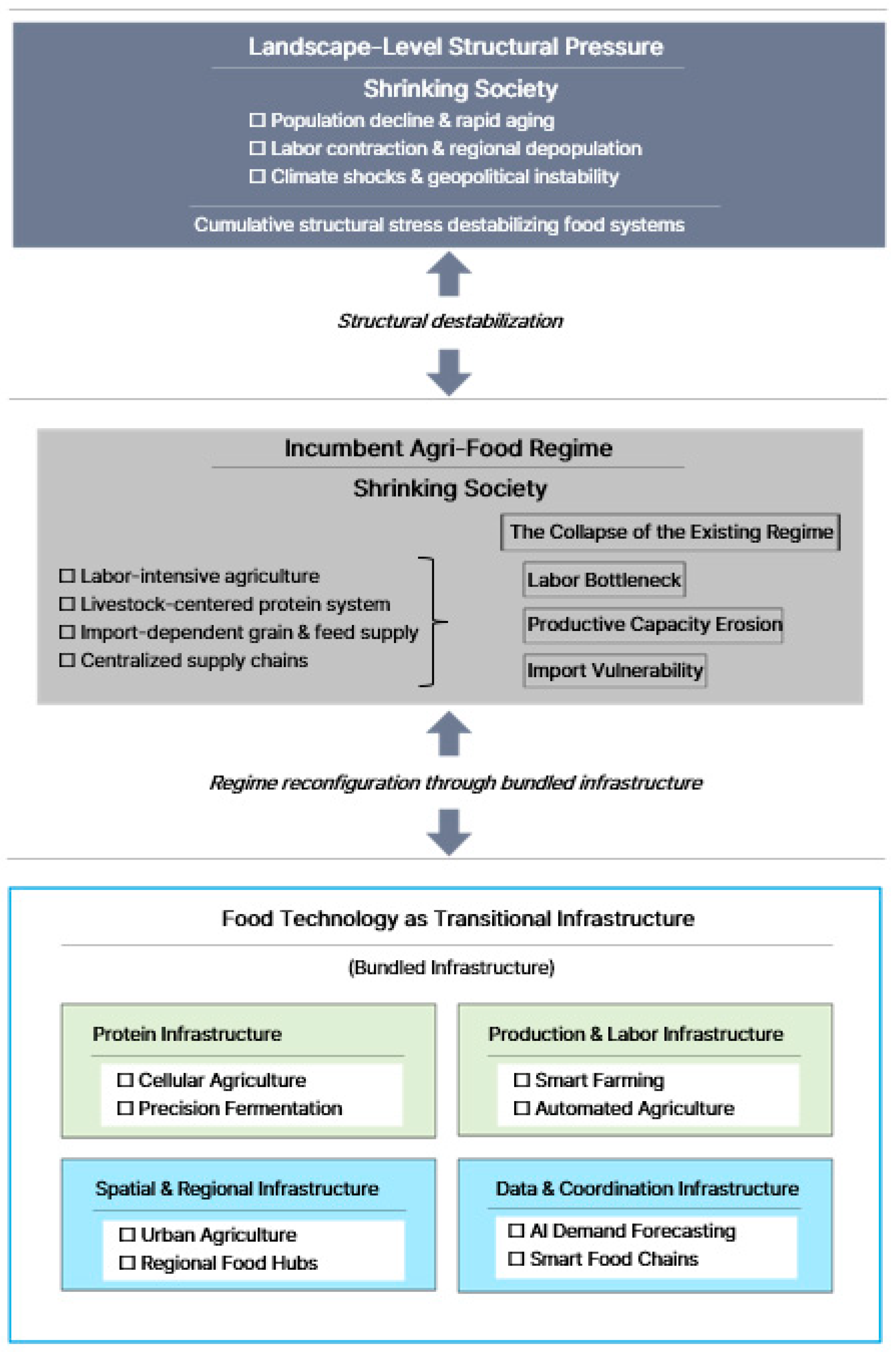
Figure 1 and
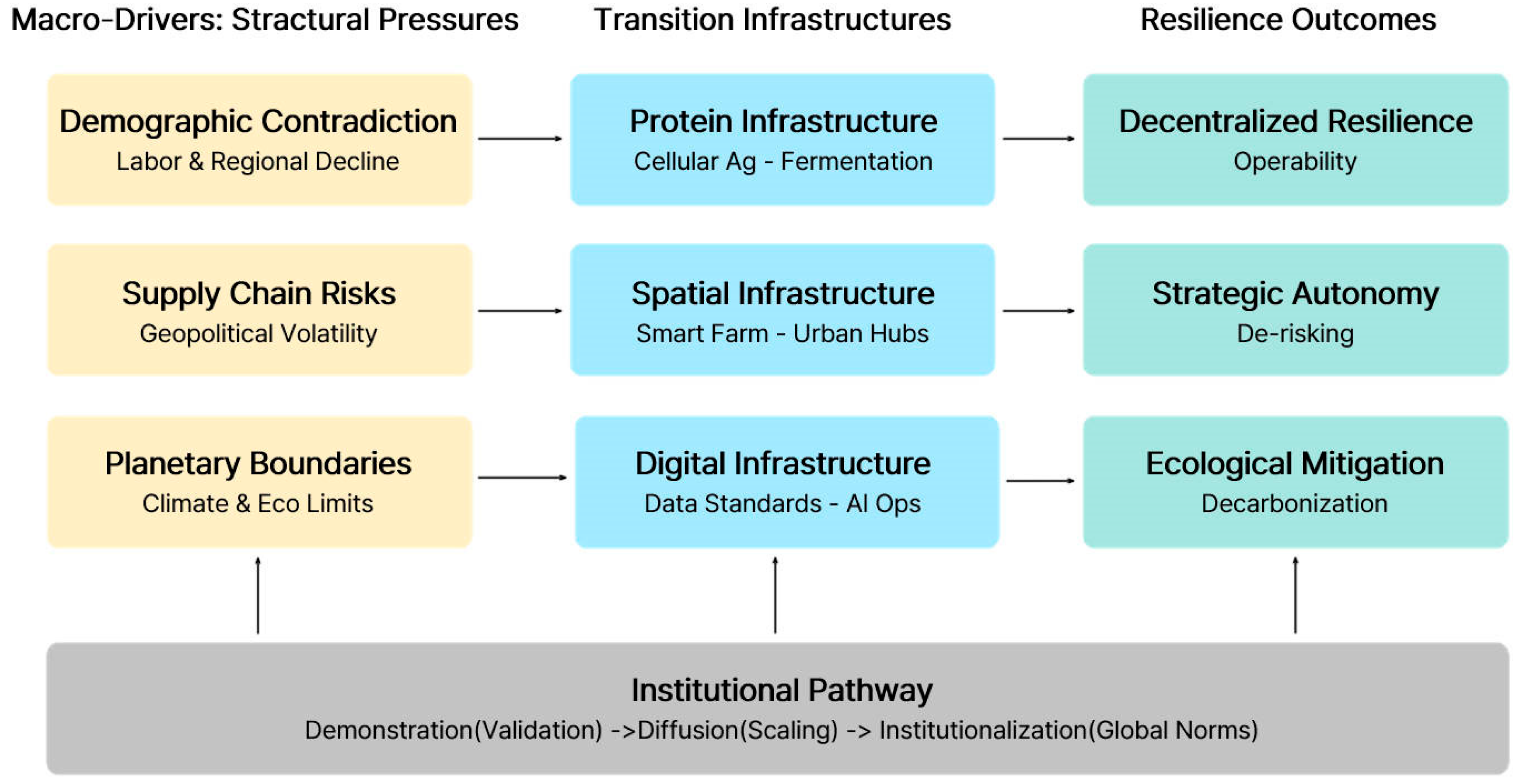
Figure 2 are used to visualize this framework and to clarify the relationship between demographic pressures, socio-technical transitions, and governance design.
3.4. Japan and South Korea as Illustrative Contexts of Shrinkage-Induced Transition
While the study is not designed as a comparative case analysis, Japan is employed heuristically as an illustrative early mover in the transition to a shrinking society. Japan’s earlier experience with population decline and agricultural labor contraction provides an analytically useful context for observing how demographic shrinkage operates as a cumulative structural pressure on food systems over time.
Importantly, Japan is not treated as a benchmark for policy success or failure, nor is the analysis intended to evaluate specific policy outcomes. Rather, the Japanese case supports the conceptual argument by illustrating general mechanisms of regime destabilization and niche emergence under prolonged demographic stress. This heuristic use of illustrative cases is consistent with established methodological approaches in conceptual and theory-driven research [
26].
Extending this illustrative logic, South Korea represents a later but more accelerated trajectory under conditions of compressed demographic transition. Rapid fertility decline and swift entry into a super-aged society have intensified labor contraction in agriculture and heightened concerns regarding long-term food system viability. Compared to Japan’s gradual adjustment, South Korea faces a shorter institutional adaptation window, thereby amplifying the relevance of food-technology niches and governance integration as transitional responses.
As with Japan, South Korea is incorporated analytically to illuminate how differing speeds of demographic shrinkage shape regime destabilization dynamics and transition pressures within food systems, rather than to evaluate country-specific policy outcomes.
3.5. Limitations and Implications for Future Research
As a conceptual and theory-driven study, this analysis does not empirically test the Food Security 3.0 framework or quantify its effects. This limitation is intentional and reflects the study’s focus on framework development rather than empirical validation. The proposed framework is intended to inform and structure future research, including comparative empirical studies, policy experiments, and institutional design analyses.
By explicitly articulating its methodological approach and limitations, the study positions Food Security 3.0 as a starting point for subsequent empirical inquiry rather than as a definitive empirical assessment. The framework does not claim predictive certainty; instead, it offers a theoretically grounded analytical lens designed to guide future empirical testing and policy experimentation. In this sense, the methodology adopted here aligns with the broader role of conceptual research in advancing sustainability science under conditions of structural uncertainty and long-term transformation.
4. Analytical Framework: Demographic Shrinkage and Socio-Technical Transitions in Food Systems
Building on the research design outlined in the previous section, this section develops the core analytical framework of the study by integrating demographic shrinkage into the Multi-Level Perspective (MLP) in order to explain food system transitions under conditions of population decline and rapid aging. The MLP has been widely applied to sustainability transitions driven by environmental pressures and technological change, particularly in energy and industrial systems [
7,
27]. More recently, scholars have extended the framework to agri-food systems, emphasizing the socio-technical complexity of food production, distribution, and consumption [
8,
19,
28]. Building on this literature, this study argues that demographic shrinkage constitutes a distinctive landscape-level structural pressure that has been insufficiently theorized within sustainability transitions research.
4.1. Demographic Shrinkage as a Landscape-Level Structural Pressure
Within the MLP, landscape pressures refer to exogenous developments that unfold beyond the direct control of regime actors and gradually reshape the context in which socio-technical systems operate. These pressures typically include climate change, macroeconomic restructuring, and geopolitical instability [
7]. This study extends the concept by conceptualizing demographic shrinkage—characterized by sustained population decline, rapid aging, and regional depopulation—as a cumulative structural force that systematically undermines the stability of food systems.
Recent demographic research demonstrates that population aging and decline are no longer marginal phenomena but structural conditions shaping advanced economies, particularly in East Asia and parts of Europe [
21,
29]. In food systems, these trends manifest through declining agricultural labor availability, accelerated farm exit, and increasing difficulty in maintaining production infrastructure [
6]. Unlike acute shocks, demographic shrinkage operates incrementally, altering incentives, capacities, and institutional expectations over extended periods.
By treating demographic shrinkage as a landscape-level condition rather than a background trend, the framework highlights how food system vulnerability is produced endogenously. This perspective helps explain why conventional food security strategies—such as output expansion or import diversification—lose effectiveness in shrinking societies, even in the absence of immediate crises [
3].
4.2. Regime Destabilization Under Shrinkage Conditions
In the MLP, regimes represent dominant configurations of technologies, policies, institutions, and actor networks that stabilize existing systems. In the context of food systems, incumbent regimes have historically been organized around productivity growth, specialization, and global trade integration, relying on stable labor supplies, viable rural economies, and predictable import channels [
2].
Under demographic shrinkage, however, these regime foundations become increasingly fragile. Aging agricultural workforces reduce the feasibility of labor-intensive production models, while regional depopulation undermines the maintenance of farmland and local supply chains [
21]. At the same time, fiscal pressures associated with aging societies constrain public investment in agriculture and rural infrastructure, weakening regime problem-solving capacity [
14].
Importantly, regime destabilization under demographic shrinkage unfolds gradually rather than abruptly. Instead of triggering immediate breakdown, demographic pressures erode regime legitimacy and performance over time, producing a prolonged period of tension during which incumbent strategies persist despite declining effectiveness. This slow destabilization is a defining feature of shrinkage-induced transitions and distinguishes them from transitions driven primarily by sudden environmental or technological shocks.
4.3. Illustrative Shrinkage Trajectories: Japan and South Korea
Japan provides an analytically valuable context for observing these dynamics, not as a benchmark for policy success or failure, but as an illustrative early mover in the transition toward a shrinking society. Japan entered the trajectory of population decline and rapid aging earlier than most advanced economies, allowing the cumulative effects of demographic shrinkage on food systems to materialize sooner and more visibly [
21].
In Japan, sustained population aging and agricultural labor decline have progressively undermined the viability of traditional production-centered food security strategies. The average age of agricultural workers has reached the late 60s, while younger cohorts have exited agriculture at accelerating rates [
29]. As a result, maintaining existing production capacity has become increasingly difficult, even under continued policy support. These demographic constraints have coincided with heightened exposure to external supply risks, deepening the fragility of the incumbent food regime [
6].
In response to these structural pressures, Japan has expanded investment in agricultural robotics, smart-farming platforms, and digital field-management systems aimed at mitigating labor shortages and stabilizing production capacity. Policy discussions have also included regulatory review and public–private experimentation related to alternative proteins and controlled-environment agriculture, reflecting attempts to sustain food supply under conditions of demographic shrinkage and aging [
30]. These initiatives demonstrate how technological niches increasingly function as infrastructural adaptations to structural labor scarcity rather than as purely efficiency-driven innovations.
South Korea represents a contrasting but analytically complementary trajectory. Although it entered population decline later than Japan, its demographic transition has been markedly compressed. Rapid fertility decline and swift entry into a super-aged society have intensified labor shortages in agriculture and shortened the institutional adaptation window. Similar pressures have prompted the promotion of smart agriculture clusters, digitalized supply-chain monitoring systems, and strategic protein self-sufficiency initiatives as part of broader food system adaptation efforts [
31,
32,
33]. Given the accelerated pace of demographic shrinkage, these measures have been framed not only as modernization strategies but as structural responses to labor decline and regional depopulation.
Within the MLP framework, the Japanese and South Korean cases together illustrate how demographic shrinkage operates as a landscape-level structural pressure that destabilizes regime-level arrangements and opens space for alternative socio-technical configurations. As labor-intensive production becomes less viable, food-technology niches—such as agricultural automation, smart farming systems, and alternative protein technologies—gain relevance as infrastructural responses to long-term structural constraints [
15,
17,
20].
Crucially, this study does not evaluate the effectiveness of specific national policies in either case. Rather, Japan and South Korea are employed heuristically to illuminate how differing temporal trajectories of demographic shrinkage shape transition pressures within food systems. In this sense, both cases function as observational windows for identifying shrinkage-induced transition dynamics rather than as comparative case studies designed to generalize from country-specific policy outcomes.
Compared to Japan’s gradual adjustment, South Korea faces more immediate structural pressures on production capacity and regional viability, further amplifying the relevance of food-technology niches and integrated governance mechanisms as transitional responses [
34].
Taken together, the Japanese and South Korean trajectories illustrate how demographic shrinkage operates as a landscape-level structural pressure that destabilizes incumbent food regimes and conditions the scope of socio-technical transition. Consistent with the conceptual design of this study, both cases are employed heuristically to illuminate general mechanisms of shrinkage-induced transition rather than to evaluate country-specific policy performance.
4.4. Food Technology Niches as Transitional Infrastructure
In sustainability transitions research, niches are understood as protected spaces in which innovations develop before challenging incumbent regimes [
7]. Under demographic shrinkage, food-technology niches perform a distinctive role by compensating for declining labor capacity, reconfiguring spatial relations between production and consumption, and enhancing resilience under constrained conditions.
Recent studies emphasize that digital agriculture, automation, and data-driven supply chains can mitigate labor shortages and improve adaptive capacity in agri-food systems [
15,
20]. Similarly, research on alternative proteins highlights their potential to decouple food security from land- and labor-intensive livestock systems, while raising new regulatory and governance challenges [
5,
17].
This framework conceptualizes food technology not as a collection of isolated tools, but as transitional infrastructure that enables regime reconfiguration under structural constraints. Food-technology niches gain momentum not simply because they outperform incumbent practices in terms of efficiency or cost, but because they address systemic vulnerabilities—such as labor scarcity, coordination failure, and import exposure—that incumbent food regimes under demographic shrinkage can no longer manage effectively.
The Multi-Level Perspective (MLP) is particularly suitable for analyzing food systems because food security is inherently a socio-technical problem in which technology, labor, land, institutions, and consumption practices are tightly interlinked across multiple spatial and governance scales. Unlike sector-specific systems, food systems simultaneously integrate production, processing, distribution, and consumption, making them especially sensitive to slow-moving structural pressures, such as demographic shrinkage, rather than to short-term shocks alone.
Figure 1 visualizes the core argument of this section by situating food technology within the MLP framework. Rather than treating smart agriculture, alternative proteins, or AI-based supply chains as discrete innovations, the figure conceptualizes food technology as a bundled form of transitional infrastructure that mediates between landscape-level demographic pressures and regime-level food system reconfiguration. In this context, the MLP serves as an analytical framework for explaining how demographic change destabilizes incumbent food regimes and creates conditions under which food-technology niches can emerge and scale as transitional infrastructure. This analytical foundation provides the conceptual bridge to the Food Security 3.0 framework developed in the following section.
4.5. From Analytical Framework to Food Security 3.0
By integrating demographic shrinkage into the MLP, this analytical framework clarifies how landscape-level population change destabilizes incumbent food regimes, how niche innovations emerge as infrastructural responses to structural constraints, and why governance integration becomes a central requirement for transition. This framework provides the theoretical foundation for Food Security 3.0, which reconceptualizes food security as a problem of systemic resilience, strategic self-reliance, and integrated governance in shrinking societies.
The following section builds directly on this analytical foundation to articulate Food Security 3.0 as a theory-driven contribution to sustainability research. In doing so, it translates the preceding MLP-based framework into a normative and conceptual reframing of food security under conditions of demographic shrinkage, rather than presenting a descriptive policy proposal.
5. Food Security 3.0 as a Theoretical Contribution to Sustainability Research
This section advances Food Security 3.0 as a theoretical contribution to sustainability research rather than as a descriptive policy framework. Building on the MLP-based analytical framework developed in the preceding sections, Food Security 3.0 reconceptualizes food security under conditions of demographic shrinkage by integrating insights from food-system resilience, sustainability transitions, and socio-technical governance. In doing so, it challenges growth-oriented and production-centered assumptions embedded in conventional food security paradigms and offers a transition-oriented redefinition suited to aging and shrinking societies.
5.1. Reframing Food Security: From Output Optimization to Systemic Resilience
Food Security 3.0 is not merely an incremental update of existing food security frameworks, but a conceptual rearticulation grounded in a fundamentally different structural context. Historically, food security frameworks have evolved in response to dominant global conditions. Food Security 1.0 emerged in an era of scarcity and focused on caloric availability and production expansion [
33,
35,
36]. Food Security 2.0 developed under conditions of globalization and emphasized access, market integration, and trade-based stabilization [
37,
38,
39].
Table 1 summarizes this evolutionary trajectory by contrasting the core problem framings, dominant assumptions, governance orientations, and theoretical character of Food Security 1.0, 2.0, and 3.0. Food Security 3.0 departs from both paradigms by responding to a new structural condition: demographic shrinkage combined with systemic shocks [
14,
40,
41,
42]. Under conditions of population decline, aging, labor scarcity, and geopolitical uncertainty, food security can no longer be sustained through production growth or trade diversification alone. Instead, it must be reconceptualized as a problem of systemic resilience, transitional infrastructure, and integrated governance.
In this sense, Food Security 3.0 represents a theory-driven framework that reframes food security not as an output-oriented policy goal, but as a socio-technical transition challenge in shrinking societies.
Conventional food security frameworks have largely conceptualized security in terms of output sufficiency, price stability, and trade efficiency, emphasizing productivity growth and global market integration [
9,
43]. While such approaches remain relevant in expanding or demographically stable contexts, recent scholarship increasingly demonstrates their limitations under conditions of systemic shocks and structural constraints [
2,
3].
Food Security 3.0 shifts the analytical focus from production capacity to systemic resilience, defined as the ability of food systems to maintain core functions under conditions of cumulative stress, uncertainty, and long-term structural change. Rather than asking “how much food can be produced,” the framework foregrounds the question of “how reliably food systems can operate” when labor availability, fiscal capacity, and regional viability are progressively eroded.
This reconceptualization aligns with the recent resilience-oriented food security literature [
2,
44,
45], while also extending it by explicitly incorporating demographic shrinkage as a core conditioning factor. In doing so, Food Security 3.0 reframes food security as a dynamic property of socio-technical systems rather than as a static outcome of production and trade. This conceptual differentiation clarifies that Food Security 3.0 is not a policy slogan, but a theory-driven framework responding to a historically novel structural condition.
Table 1.
Evolution of Food Security Paradigms: From 1.0 to 3.0.
Table 1.
Evolution of Food Security Paradigms: From 1.0 to 3.0.
| Category | Food Security 1.0 | Food Security 2.0 | Food Security 3.0 |
|---|
| Historical context | Post-war food shortages; population growth | Globalization; expansion of international trade | Population decline, rapid aging, and compound systemic crises |
| Core problem framing | Absolute food scarcity | Access, affordability, and price stability | Long-term system sustainability and resilience |
| Dominant assumptions | Expandable production capacity | Stability of global trade and markets | Contraction of labor, regions, and institutional capacity |
| Primary strategy | Increasing production volumes | Import diversification and market integration | Resilience-centered system redesign |
| Role of technology | Auxiliary tool for production | Efficiency-enhancing instrument | Transitional infrastructure enabling system reconfiguration |
| Governance orientation | Agriculture-centered governance | Trade- and market-centered governance | Integrated food-system governance |
| Theoretical character | Policy framework | Hybrid policy–analytical framework | Socio-technical transition theory |
Table 2 presents indicative operational indicators for Food Security 3.0 intended to guide future comparative and empirical research. These indicators are not used for measurement or hypothesis testing in the present study. Rather, they serve to illustrate how the theoretical dimensions of Food Security 3.0—resilience-centered design, strategic self-reliance, and integrated governance—can be translated into empirically observable variables across countries and regions.
By proposing these indicators, the study clarifies the analytical content of Food Security 3.0 and demonstrates its potential applicability in future cross-national comparison, policy experimentation, and institutional analysis. The table therefore functions as a bridge between conceptual theory-building and subsequent empirical validation, rather than as an evaluative framework applied in this paper.
These indicators are presented for illustrative purposes and do not constitute an exhaustive or prescriptive measurement framework.
Table 3 summarizes the minimum governance architecture required to operationalize Food Security 3.0. Rather than prescribing a uniform institutional model, the table identifies core governance functions that must be fulfilled to enable resilience-centered food security, strategic self-reliance, and integrated system coordination under demographic shrinkage. These elements are presented as modular design components that can be adapted to different national and regional contexts.
5.2. Strategic Self-Reliance Under Demographic Shrinkage
A second theoretical contribution of Food Security 3.0 lies in its redefinition of self-reliance. Traditional food security debates often frame self-sufficiency and trade dependence as opposing strategies. However, recent crises—including export restrictions, geopolitical conflict, and climate-induced supply volatility—have revealed the fragility of excessive reliance on global markets [
6,
14].
Food Security 3.0 introduces the concept of strategic self-reliance, which prioritizes selective vulnerability reduction over maximal self-sufficiency. Rather than advocating autarky, this approach emphasizes buffering the most shock-exposed domains—such as staple foods, protein supply, and critical inputs—while maintaining engagement with international markets where resilience gains can be achieved.
From a theoretical perspective, strategic self-reliance reframes food security as a problem of risk governance under constraint, rather than as a question of aggregate output. This perspective is particularly salient in shrinking societies, where demographic decline limits both domestic production capacity and the fiscal resources required to sustain expansive trade-based strategies [
21].
5.3. Food Technology as Transitional Infrastructure
A central theoretical innovation of Food Security 3.0 is its reconceptualization of food technology as transitional infrastructure. The existing literature often treats food technologies—such as automation, digital agriculture, and alternative proteins—as discrete innovations or industrial policy instruments [
15,
17]. Food Security 3.0 instead theorizes these technologies as infrastructural components that enable regime reconfiguration under demographic constraint.
Within the MLP framework, food-technology niches gain momentum not merely because they enhance efficiency, but because they address structural mismatches between incumbent regimes and shrinking societal conditions. Automation mitigates labor scarcity, digital systems enhance coordination under uncertainty, and alternative proteins reduce dependence on land- and labor-intensive livestock systems [
5,
20].
By framing food technology as transitional infrastructure, Food Security 3.0 bridges sustainability transitions theory and food security scholarship. It provides a conceptual explanation for why technological innovation becomes increasingly central to food security—not as a supplementary tool, but as a foundational element of system resilience in shrinking societies.
5.4. Integrated Governance and Intergenerational Responsibility
Food Security 3.0 further advances a governance-oriented reinterpretation of food security. Conventional food policies are often fragmented across ministries and sectors, reflecting administrative boundaries rather than system interdependencies. Recent studies in Sustainability and Food Policy highlight how such fragmentation undermines coherent food-system transitions [
22,
23].
Under conditions of demographic shrinkage, governance integration becomes not merely desirable but structurally necessary. As aging societies face fiscal constraints and intensified policy trade-offs, siloed governance reduces the capacity of food systems to adapt coherently. Food Security 3.0 therefore emphasizes integrated food-system governance that coordinates agriculture, industry, technology, environment, welfare, and regional policy.
Moreover, by explicitly incorporating intergenerational responsibility, the framework extends food security debates into the normative domain of sustainability. Decisions regarding food systems in shrinking societies redistribute burdens and benefits across generations, regions, and social groups. Food Security 3.0 thus situates food security within a broader social contract that links technological change, regional resilience, and intergenerational justice [
47].
Building on the MLP framework illustrated in
Figure 1,
Figure 2 translates the analytical logic of socio-technical transition under demographic shrinkage into the Food Security 3.0 framework by specifying its core objectives, infrastructural components, and governance principles. While
Figure 1 focuses on explaining how landscape-level demographic pressures destabilize incumbent food regimes and enable niche emergence,
Figure 2 operationalizes this logic for food systems, linking demographic shrinkage to concrete transition axes that are directly relevant for policy design and institutional reform. In this sense, Food Security 3.0 can be understood as an application of the MLP that bridges theoretical analysis and governance-oriented system design.
Taken together, Food Security 3.0 contributes to sustainability research in three theoretical respects. First, it extends food security scholarship by embedding resilience within a socio-technical transition framework that explicitly accounts for demographic shrinkage. Second, it advances sustainability transitions theory by conceptualizing population decline and aging as landscape-level structural pressures shaping regime destabilization and niche emergence. Third, it offers a governance-oriented reinterpretation of food security that integrates technology, demographics, and intergenerational responsibility.
By articulating these contributions, Food Security 3.0 positions food security not as a sectoral policy issue, but as a central challenge of sustainability transitions in shrinking societies.
6. Policy Implications: Governing Food Security Transitions in Shrinking Societies
The Food Security 3.0 framework offers a set of analytically grounded policy implications for governing food systems under conditions of demographic shrinkage. Rather than presenting a menu of policy instruments, this section translates the theoretical insights developed in previous sections into governance principles that respond to structural demographic constraints, systemic risk, and long-term sustainability challenges. In doing so, it situates food security policy within broader debates on resilience governance, sustainability transitions, and intergenerational justice.
6.1. Reorienting Policy Objectives: From Output Targets to Resilience Metrics
The first policy implication concerns the redefinition of policy objectives and evaluation criteria. Conventional food security policies have relied heavily on production volumes, self-sufficiency ratios, and price stability as key indicators of success [
9,
43]. However, recent research increasingly demonstrates that such indicators are poorly suited to capturing food-system performance under systemic shocks and long-term structural constraints [
2,
3].
Food Security 3.0 suggests that policy objectives should shift toward resilience-oriented metrics, including the ability of food systems to absorb disruptions, adapt to labor scarcity, and recover from supply-chain shocks. Studies in Global Food Security and Sustainability highlight that resilience is shaped not only by production capacity but also by redundancy, diversity, and institutional coordination [
2,
45]. For shrinking societies, where demographic decline erodes the feasibility of sustained output expansion, resilience metrics offer a more realistic basis for policy assessment.
Operationally, this implies expanding policy evaluation frameworks to include indicators such as dependency on critical inputs, recovery time after disruption, and exposure to concentrated import sources. By embedding such metrics into food security governance, policymakers can better align objectives with structural demographic realities.
6.2. Strategic Self-Reliance as Risk Governance Under Demographic Constraint
A second implication concerns the governance of self-reliance. Recent crises—including the COVID-19 pandemic and geopolitical conflicts—have prompted renewed interest in food self-sufficiency [
47]. Yet the literature cautions against simplistic returns to autarky, emphasizing instead the importance of managing interdependence and systemic risk [
1,
14].
Food Security 3.0 advances strategic self-reliance as a policy principle grounded in selective vulnerability reduction. Rather than maximizing domestic production across all food categories, policymakers are encouraged to identify domains where external dependence poses disproportionate risk and where domestic buffering or technological substitution is feasible. This approach aligns with recent work on risk-based food security governance, which emphasizes prioritization and strategic targeting over uniform policy expansion [
6].
In shrinking societies, demographic constraints further reinforce the need for such selectivity. Declining labor availability and fiscal capacity limit the scope for broad-based production support, making targeted intervention both more efficient and more sustainable. Strategic self-reliance thus reframes food security policy as a form of risk governance rather than as a pursuit of aggregate self-sufficiency [
48].
6.3. Public Policy and Food Technology as Transitional Infrastructure
A third policy implication concerns the role of public policy in shaping food-technology trajectories. While innovation policy has traditionally focused on productivity gains and competitiveness, recent sustainability scholarship emphasizes the infrastructural role of technology in enabling systemic transitions [
7,
49].
Food Security 3.0 conceptualizes food technology as transitional infrastructure, suggesting that public policy should prioritize technologies that address structural constraints associated with demographic shrinkage. Empirical studies indicate that automation, digital agriculture, and data-driven logistics can mitigate labor shortages and enhance coordination under uncertainty [
15,
20]. Similarly, alternative protein technologies are increasingly discussed as pathways to reduce dependence on land- and labor-intensive livestock systems, albeit with significant governance and regulatory implications [
5,
17].
From a policy perspective, this implies shifting from isolated innovation incentives toward infrastructural investment strategies that emphasize scalability, interoperability, and long-term governance. Standard-setting, data governance, and regulatory coherence become central policy tasks, ensuring that technological niches can integrate into incumbent food systems rather than remain fragmented pilot projects.
6.4. Integrated Food-System Governance Under Shrinkage Conditions
A fourth implication concerns governance integration. The recent literature consistently highlights that fragmented governance structures undermine the effectiveness of food-system transitions by impeding coordination across policy domains [
22,
23]. Under demographic shrinkage, such fragmentation becomes increasingly costly, as fiscal constraints intensify and policy trade-offs sharpen.
Food Security 3.0 underscores the need for integrated food-system governance that links agriculture, industry, technology, environment, welfare, and regional development. This approach resonates with emerging calls for “whole-of-system” governance in sustainability transitions, which emphasize alignment across sectors and scales [
21].
Importantly, governance integration must operate both horizontally and vertically. Regional and local governments play a critical role in managing the spatial consequences of demographic decline, including farmland abandonment and uneven service provision. National policy frameworks must therefore combine strategic coordination with local flexibility, enabling regionally differentiated transition pathways within an overarching governance architecture.
6.5. Intergenerational Responsibility and the Political Sustainability of Food Policy
Finally, Food Security 3.0 foregrounds the intergenerational dimension of food security governance. In shrinking societies, food-system investments increasingly involve trade-offs between present costs and future benefits, raising questions of political legitimacy and distributive justice. Sustainability scholars argue that ignoring intergenerational considerations undermines the long-term viability of policy reform [
47,
50].
By framing food security as part of a broader intergenerational social contract, Food Security 3.0 highlights the need for institutional mechanisms that incorporate long-term perspectives into decision-making. This includes transparency regarding future risks, participatory processes that account for diverse generational interests, and policy designs that distribute transition costs more equitably over time.
Embedding intergenerational responsibility within food security governance not only enhances normative coherence but also strengthens political sustainability by aligning food-system transitions with broader societal expectations of fairness and responsibility.
7. Conclusions: Food Security 3.0 as a Theoretical and Governance Framework for Shrinking Societies
This study contributes theoretically to sustainability research by reconceptualizing food security under conditions of demographic shrinkage and compound systemic risk. Moving beyond conventional paradigms centered on production expansion or trade-based stabilization, the paper advances Food Security 3.0 as a socio-technical transition framework that integrates demographic decline, resilience-oriented system design, and governance transformation. By embedding population aging, labor contraction, and regional depopulation within the Multi-Level Perspective, the study demonstrates how demographic shrinkage operates as a landscape-level structural pressure that destabilizes incumbent food regimes and reshapes transition pathways.
A central contribution of this study lies in theorizing food technology as transitional infrastructure rather than as a collection of discrete innovations. Technologies such as smart and automated agriculture, alternative proteins, and AI-enabled supply chains are shown to gain relevance not merely through efficiency gains, but because they address structural vulnerabilities—labor scarcity, climate volatility, and import dependence—that incumbent food systems under shrinkage conditions can no longer manage effectively. In this sense, food technology functions as an enabling condition for regime reconfiguration rather than as an auxiliary policy tool.
The analysis also clarifies the analytical role of national experiences without resorting to comparative case-study logic. Japan is employed as an early mover to illuminate the cumulative effects of demographic shrinkage on food systems, while South Korea represents a later-but-faster trajectory under accelerated demographic and geopolitical pressures. Together, these trajectories provide analytical leverage for identifying general mechanisms of shrinkage-induced transition, rather than for evaluating country-specific policy outcomes. This distinction reinforces the conceptual scope of the study and avoids unwarranted generalization from national cases.
Importantly, the study extends beyond theory-building by outlining pathways for future empirical and policy-oriented research.
Table 2 translates the core dimensions of Food Security 3.0 into indicative operational indicators, demonstrating how the framework may be applied in comparative research, policy experimentation, and institutional analysis. These indicators are presented as illustrative rather than prescriptive, serving to bridge conceptual integration and empirical validation. In parallel,
Table 3 specifies the minimum governance architecture required to operationalize Food Security 3.0, identifying key design elements—coordination, data and risk management, regulatory pathways, regional capacity, finance, and justice—that must be addressed to enable integrated food-system governance in shrinking societies.
Taken together, these contributions underscore that food security in shrinking societies cannot be secured through incremental adjustment alone. Instead, it requires a systemic reconfiguration that combines resilience-centered design, strategic self-reliance, and integrated governance under demographic shrinkage. In this respect, Food Security 3.0 offers a shrinkage-sensitive reinterpretation of sustainable food systems, aligning food security with broader debates on intergenerational justice, public responsibility, and socio-technical transition.
Finally, although this study is deliberately conceptual and theory-driven, it provides a structured point of departure for future research. Comparative empirical studies, policy pilots, and institutional design analyses are needed to test and refine the Food Security 3.0 framework across diverse demographic and governance contexts. By articulating both its theoretical foundations and its pathways for application, this study aims to contribute to a more realistic and sustainable understanding of food security in an era defined not by growth, but by demographic contraction and systemic uncertainty.