1. Introduction
The impact of transport infrastructure on residential property values is a key component of land value–capture policies, which are emerging as an innovative form of infrastructure funding [
1]. Accessibility improvements (e.g., via the opening of a new train station, or via the enhancement of services provided) can generate a wide array of benefits to transport and non-transport users. These issues are gaining attention with the advent of new opportunities located in the area of the stations to accommodate new emerging mobility solutions such as autonomous vehicles [
2] and urban air taxis [
3]. Interventions in railways station, whether through the creation of new hubs or the revamping of existing ones, can have significant impacts on passengers’ demand [
4], travelers’ perceptions [
5], travel times [
5], and accessibility [
6,
7], inducing an increase in passenger volumes and fostering the modal shift from cars to public transport [
8].
Additionally, investments in transportation hubs not only produces direct transport-related benefits (e.g., travel time reductions) but also tends to have additional non-transport benefits (e.g., increase in economic activity) that extend beyond the transportation system itself. In fact, the improved accessibility of an area can stimulate economic activities, increasing its attractiveness for residents and businesses, leading to increased property values in the surroundings of the new or regenerated hub.
The arising of these indirect effects, known as Wider Economic Impacts (WEIs), occurs because the transport system, being an imperfect market, cannot capitalize the full benefit (or cost) of investment (or divestment) in transport infrastructure and services; thus, this change is absorbed by external systems like the job market and the real estate market, impacting job opportunities, wages, agglomeration, productivity, etc. [
9].
Understanding the impact of multimodal and railway hubs on real estate prices is particularly important for designing interventions that promote urban regeneration and value uplift, while protecting affordability and mitigating displacement pressures, caused by speculation and early-stage gentrification that can potentially arise even before the project’s completion [
10].
Real estate markets are a key topic of empirical studies on the Wider Economic Impacts (WEIs) of transport interventions, as proximity to transport services and infrastructure is often associated with higher property values [
11]. This relationship has been a central topic in urban economics since its early theoretical foundations. Seminal contributions by Alonso [
12] formalized the trade-off between space and accessibility, while Rosen [
13] provided a rigorous framework for analysing real estate as a differentiated good, whose price reflects the combined effect of its attributes.
Building on these foundations, Hedonic Price Modelling (HPM) has become one of the most prominent approaches for estimating how transport infrastructure, accessibility, and land-use characteristics are capitalized into real estate market. By decomposing observed prices into the contribution of multiple attributes, HPM offers a consistent framework for quantifying transport-related value uplift and supporting value capture policies [
13,
14]. The hedonic framework has also been applied beyond real estate markets. For example, Cartenì et al. [
15] use a hedonic-based approach within a discrete choice modelling framework to analyse the perceived value of High-Speed Rail service attributes in Italy.
Empirical evidence on transport-related impacts on property values has been largely produced using cross-sectional hedonic regressions. Numerous studies document positive capitalization effects of rail accessibility using cross-sectional HPMs across different contexts. For instance, Gu [
16] finds positive effects mainly in suburban areas of Beijing, and Anantsuksomsri and Tontisirin [
17] identify substantial premiums around metro stations in Bangkok. Similar evidence is found in developed contexts, including Helsinki [
18] and Massachusetts [
19]. Overall, these studies confirm that cross-sectional HPM represents a robust and widely accepted methodology for capturing average accessibility effects on real estate values.
At the same time, the literature has highlighted the importance of accounting for spatial dependence and heterogeneity in housing markets. Spatial econometric extensions of hedonic models address these issues by explicitly modelling spatial autocorrelation [
20,
21,
22]. More recent contributions adopt local modelling approaches, such as Geographically Weighted Regression, to capture spatially varying capitalization effects [
1,
23,
24]. While these methods provide valuable insights into local heterogeneity, they are data-intensive and less suited to large-scale applications.
Land-Use and Transport Interaction (LUTI) models treat real estate prices as an endogenous outcome of the interaction between accessibility, location choices, and land-use dynamics [
25]. However, their comprehensiveness comes at the cost of extensive datasets and detailed behavioural calibration.
Overall, this body of literature highlights a trade-off between model complexity, data requirements, and policy applicability. In this context, cross-sectional hedonic models remain a pragmatic and effective approach for large-scale assessments of transport-induced real estate value capitalization.
The literature also shows that the magnitude and direction of the impact that transport has on real estate can vary widely. Across studies, explanatory variables from real estate prices modelling generally fall into four categories:
Property characteristics,
Land use features,
Accessibility to transport and urban amenities,
Socioeconomic context characteristics.
Table 1 indicates that empirical studies most frequently rely on property characteristics and accessibility-related measures when modeling housing prices. Accessibility-related variables, particularly proximity to railway and light railway lines, major road networks, and public transport facilities, are consistently used and have been shown to be a key contributing factor to housing price estimation [
11]. Empirical evidence supports the positive relationship between railway accessibility and housing prices. Chen et al. [
26] find that housing prices increase as the distance between residential properties and high-speed railway stations decreases. Similarly, Bao and Mok [
27] show that property prices in West Kowloon increased following the development of the high-speed railway system connecting Hong Kong to mainland China.
In addition to accessibility-related variables, economic and social variables, such as GDP per capita, income levels, and crime rates, are sometimes included in modeling specifications, underscoring their contextual role in shaping housing market responses. Di Ruocco [
28] further highlights that population size, income per capita, and employment rates contribute significantly to higher residential property prices in areas located near transit stations.
Table 1.
Summary of variables impacting property prices.
Table 1.
Summary of variables impacting property prices.
| Variable Category | Variable | Sources |
|---|
| Property characteristics | Area size, floor area, lot size, gross building, Number of stories | [11,22,29,30,31,32,33,34,35,36,37,38,39] |
| Central air conditioning and facilities (garage, view, pool) | [11,22,29,31,32,39,40,41] |
| House age; building grade | [11,26,29,30,32,33,36,39,40,41] |
| Number of rooms; Number of bedrooms; Number of bathrooms; Number of stories | [22,26,29,30,32,35,36,39,40,42,43,44] |
| Land use features | Greening ratio; % covered by trees; air/noise pollution | [37,40] |
| Street frontage | [22,42,45] |
| Road characteristics (width; Number of intersections) Parking facilities | [39,40,41,45] |
| Zoning: commercial; residential | [34,41,45,46] |
| Land-use pattern: mixed use | [34,40] |
| Accessibility to transport and urban amenities | Distance to HSR station/Walking distance along street network to railway station | [22,30,31,32,34,35,39,40,41,42,44,46,47,48] |
| Distance to main road | [30,33,42,44] |
| Distance to light railway line | [29,30,31,32,33,37,39,40,42,44] |
| Distance from highway | [32,36,37,40,42,43,47] |
| Distance from highway exit | [32,41] |
| Distance to bus/metro stop; BRT | [22,29,31,32,33,39,40,42,44,47,48] |
| Distance to city center/CBD | [22,29,32,33,35,40,41,42,43,44,45,46,47] |
| Distance to school | [26,32,38,39,46] |
| Distance to park | [26,28,36,37,38,39,48] |
| Distance to cultural attractions | [39] |
| Distance to river/located at the beach | [22] |
| Distance to hospital/medical center | [33] |
| Located in provincial capital/city center | [22,32] |
| Job accessibility | [22,33] |
| Nearest study station | [38,39,46] |
| Socioeconomic context | % housing units occupied by renters/homeowners | [29,32,43,47] |
| % college-educated | [32] |
| Population density; population growth rate | [22,29,33,37,43] |
| Income; median income | [29,30,32,33,43,45,48,49] |
| Employment density | [22,33,40,47,49] |
| Violent/property crime rate; crime density | [29,39,43,47,48,49] |
| Race/ethnicity (% White, Asian, Black; minority %) | [22,30,32,33,42,47,48] |
| Tax rate | [48] |
Despite a growing body of international research on the Wider Economic Impacts (WEIs) of railway infrastructure, evidence for the Italian context has mainly developed around systemic and macroeconomic analyses rather than property market effects. Several studies have examined the territorial implications of High-Speed Rail (HSR) in terms of accessibility and equity. Cavallaro et al. [
50] and Bruzzone et al. [
51] analyse spatial and social equity outcomes associated with HSR deployment and alternative network configurations, highlighting differentiated impacts across territories. On the other hand, Cascetta et al. [
52] provide a ten-year ex-post evaluation of the Italian HSR system, documenting significant improvements in national accessibility, measurable contributions to per capita GDP growth, and non-negligible effects on regional equity patterns.
However, while these contributions offer a robust assessment of the broader economic and accessibility impacts of rail investments, the link between railway infrastructure characteristics and property value dynamics remains largely unexplored at a systemic national scale.
This limited integration between transport and real estate analysis in Italy is partly attributable to structural data constraints, fragmented institutional sources and heterogeneous property market data. As a consequence, empirical research has traditionally been confined to localized or corridor-specific case studies.
Some studies have nevertheless investigated the relationship between rail infrastructure and property prices in selected Italian contexts. Pagliara and Papa [
53] provide early evidence from the Naples metropolitan area, identifying higher residential values within station catchment areas. More recent research has focused primarily on HSR-related effects. Pagliara [
54] also explores inter-city development dynamics along HSR corridors, while Di Ruocco et al. [
55] apply panel-data hedonic models to estimate residential price premiums associated with proximity to major HSR stations, with subsequent extensions examining heterogeneous effects across cities and market segments [
56]. Although methodologically sound, these studies remain concentrated on specific metropolitan areas or HSR corridors; as a result, a comprehensive and nationwide assessment of how the Italian railway system is capitalized into residential property values is still lacking.
This study addresses this gap by providing a systemic, large-scale analysis of the relationship between railway station characteristics and residential property values across Italy. A Hedonic Price Modelling (HPM) framework, featuring both observed and latent variables, is applied to a nationwide cross-sectional dataset covering 985 railway stations.
The objective of this research is twofold: first, to bridge the highlighted literature gap in the Italian context; second, to provide railway infrastructure managers with robust empirical insights into how railway infrastructure, land use, and socioeconomic features are capitalized into residential property values within a heterogeneous national setting. By quantifying the differential capitalization effects associated with transport, socioeconomic and local features of all the stations, the study aims to support more informed investment prioritization, asset management strategies, and station area development policies. In particular, the results can assist infrastructure managers in identifying where service and infrastructural upgrades are most likely to generate measurable real estate value uplift.
The remainder of the paper is structured as follows.
Section 2 describes the data and the modelling framework.
Section 3 presents the estimation results, while
Section 4 discusses the main findings in relation to the existing literature and highlights relevant policy implications.
Section 5 concludes the paper.
2. Methods and Data
Section 2 is organized as follows: the dataset used for model estimation is described in
Section 2.1; the representativeness of the dataset with respect to “station population” is discussed in
Section 2.2, while the methodological approach is introduced in
Section 2.3.
2.1. The Dataset
The cross-sectional dataset provides a comprehensive representation of railway stations and their surrounding contexts in Italy, at year 2023. It includes 985 railway stations, corresponding to approximately 43% of the total stations managed by Rete Ferroviaria Italiana (RFI), the national railway infrastructure manager.
The selection of the stations is grounded in two principal criteria: statistical representativeness (as detailed in
Section 2.2) and territorial independence. With specific reference to the latter, stations were identified to ensure that their respective catchment areas can be reasonably considered as functionally and spatially distinct within the broader urban context. Accordingly, each observation is intended to capture, to the greatest extent possible, a localized context that does not substantially overlap with adjacent station areas or other specific urban environments.
Each observation in the dataset refers to a single station and its surroundings, described through a set of variables related to three main categories:
Railway services and multimodal accessibility,
Socio-economic context (at the municipal level),
Land-use features.
The data extraction process involved clipping an area with a 1 km radius from every station, with the purpose of approximating a 15 min pedestrian isochrone that defines the station’s surroundings. Data on land-use features was extracted, as well as on railway and multimodal transport services considering the station itself. Additionally, municipal-level socioeconomic variables, namely GDP per capita and tourist orientation, were extracted from national open-source data sources (Istituto Nazionale di Statistica (ISTAT), IstatData.
https://esploradati.istat.it/databrowser/ (accessed on 17 February 2025)).
Residential real estate prices in the stations’ surroundings (variable name: “compr_res”) were instead extracted from the Osservatorio del Mercato Immobiliare (OMI) database (Osservatorio del Mercato Immobiliare (OMI), Quotazioni Immobiliari.
https://www.agenziaentrate.gov.it/portale/schede/fabbricatiterreni/omi/banche-dati/quotazioni-immobiliari (accessed on 25 January 2025)). The extracted values average at around 1280 €/m
2, showing a slight overall variability across the dataset (standard deviation accounts to 750.9 €/m
2).
Each station features a classification label, as defined by RFI, which reflects the relative importance, size, and functionality of each railway node in the national transport system. Classes range from Main Hubs, the major national or international hubs, to Local stations, serving primarily regional or commuter traffic. Intermediate categories include Hub, Major, Plus, and Local Plus.
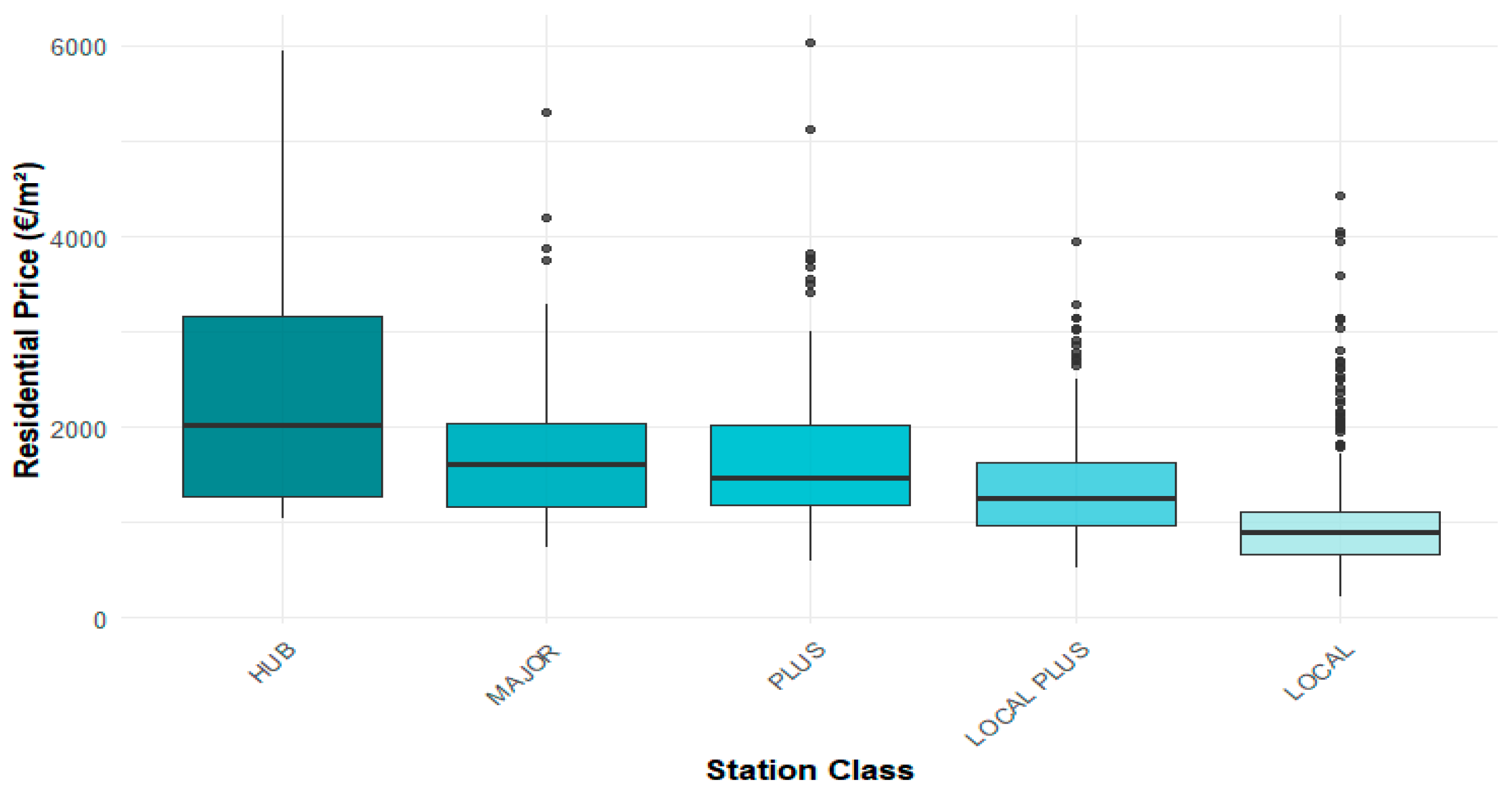
Residential property prices vary systematically across station classes. Higher-tier stations (Hub and Major) are associated with higher average prices, while lower-tier stations (Local Plus and Local) exhibit lower prices. This pattern reflects a clear price gradient corresponding to station hierarchy, indicating that proximity to more important stations is linked to higher property values. Additionally, it is worth noting that, as per the multimodal service analysis presented in
Figure 1, high-tier stations are located in denser and more populated urban centers, where demand for housing is high, and so are prices.
Table 2 provides an overview of the variables describing railway services and multimodal accessibility, extracted for each station in the dataset. The number of daily trains per service type is present; these are “Regionale” (train_reg), “Regionale Veloce” (train_regv), “InterCity” (train_ic), “Alta Velocità” (train_av). These service types represent the incremental service offer that national and regional railway operators provide at each station, and they are hereby presented in the following order: from the most basic service (“Regionale”, the short-distance, commuter service), to the most exclusive one (“Alta Velocità”, the long-distance, high-speed, business travel service).
“Regionale” train frequencies show substantial variation across stations, with a mean of 37, and a maximum of 363, indicating that some stations function as major regional hubs while many serve more limited services. In contrast, “Alta Velocità” (AV) and “InterCity” (IC) trains are less frequent at most stations, with first quartile values of zero, reflecting the concentration of these services at a smaller number of major stations, though maximum values reach 89 AV and 35 IC trains, respectively, for the busiest nodes.
The combined railway service offered by each station, together with its placement in the national network, is reflected in the train catchment area attribute, which measures the number of stations reachable within a one-hour threshold. The average catchment area is 17.
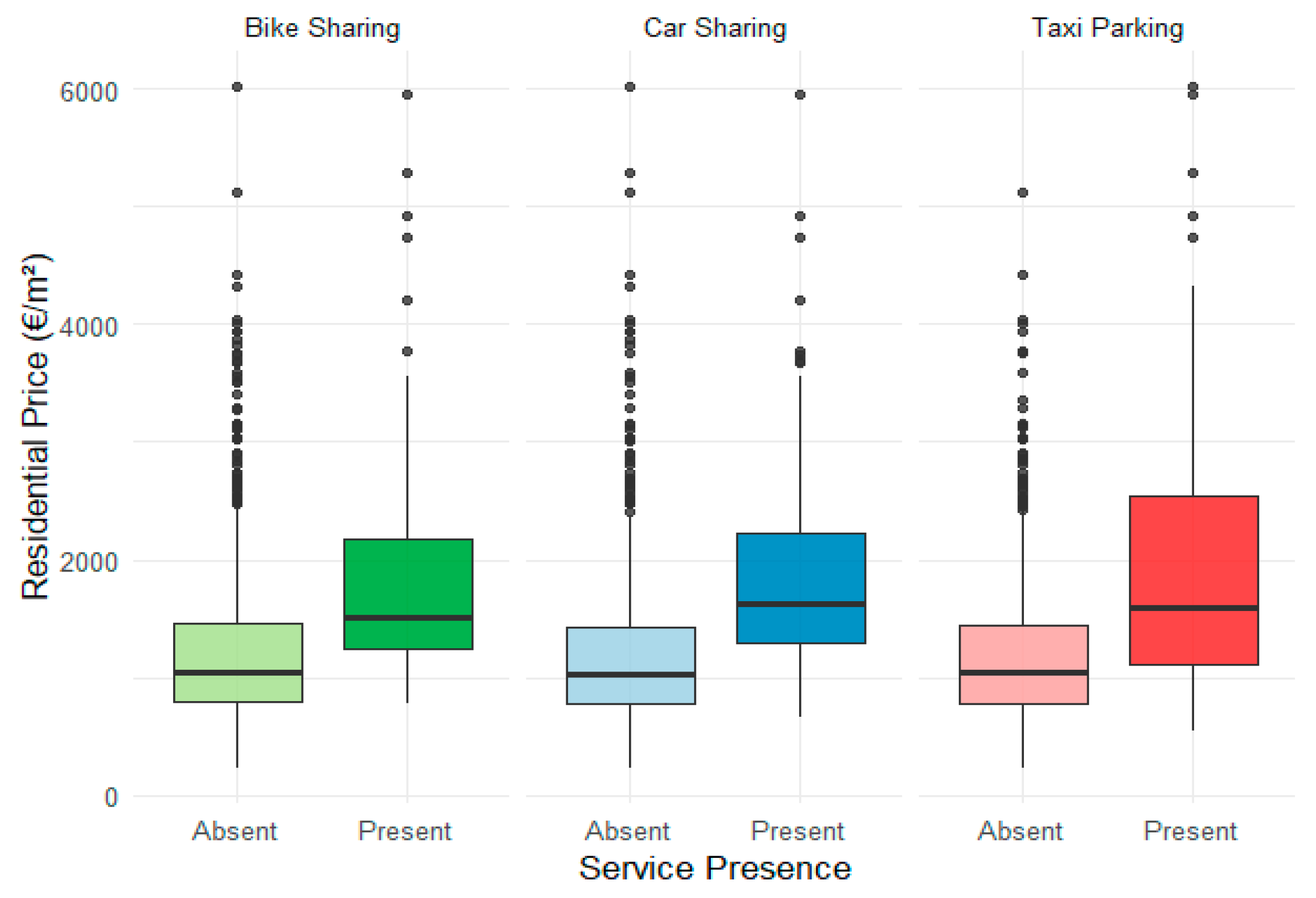
Regarding multimodal accessibility, stations can be characterized by the presence of car-sharing and bike-sharing services, along with dedicated parking spaces bikes and for taxis. Car-sharing services are present at roughly 12.89% of stations, while bike-sharing services and dedicated bike parking are less common, available at 3.45% and 7.61% of stations. Taxi parking is slightly more widespread, present at about 11.88% of stations.
As expected, shared mobility services are mostly found at higher-tier stations, reflecting the contemporary urban mobility supply of services. Interestingly, residential prices tend to be higher where these services are available (
Figure 2).
The socioeconomic context variables are shown in
Table 3. They represent municipal-level features, namely GDP per capita and tourist orientation. The latter attribute represents the predominant nature of tourism that a specific municipality experiences. A total of 12 different classes are identified, ranging from big cities and areas with low or no tourist significance, to area with a seaside, cultural, or mountain tourism orientation. The largest share of stations (52%) falls into the “non-touristic” category.
The inclusion of tourist orientation aims to account for the strong heterogeneity in tourism-related attractiveness that characterizes the Italian context, where tourism plays a structural role in shaping territorial dynamics and accessibility patterns [
57]. Several railway stations, for instance, serve municipalities experiencing substantial tourist flows (e.g., Venezia Santa Lucia, Roma Termini), making it relevant to distinguish between touristic and non-touristic contexts when modelling residential property values. Tourist orientation data were obtained from the Italian National Statistical Institute (ISTAT), which provides a detailed classification of municipalities based on their dominant tourism type. For representativeness and statistical robustness, some of the original ISTAT categories were aggregated into broader classes. While this aggregation reduces the level of detail in capturing tourism characteristics at the municipal level, it allows for a more consistent and robust representation of tourism type across the national dataset.
It is necessary to remark that this tourism variable captures the predominant type of tourism rather than its magnitude, given the absence of detailed information on tourism intensity (e.g., number of visitors or overnight stays) at a spatial resolution suitable for the scope of this analysis.
Further data limitations were encountered in relation to socioeconomic variables capturing territorial disparities between Northern and Southern Italy. Although regional controls were tested, they did not emerge as statistically significant and were therefore not retained in the final model specification.
The land use features (
Table 4) describe the local context surrounding each railway station. Catchment areas describe the spatial reach of different transport modes in a relatively given time constraint. The 20 min car catchment area is the largest among modes, averaging 217 km
2, while bicycle and walking catchment areas (both in 15 min thresholds) are much smaller, highlighting the different mobility ranges. Although perceptions of catchment areas related to active mobility have been identified in the literature as relevant (see, for instance [
58,
59]), it is worth nothing that the dataset contains, in this respect, only objective and directly measured data. Proximity to key urban attraction poles is also considered, namely distances to hospitals and universities. Similarly, public amenities such as services, schools, and commercial activities are counted around each station. Total number of residents and employees is also included.
2.2. Comparison Between the Sample and the Population
Table 5 compares the distribution of stations in the sample database with the full RFI network. No Main Hub stations are included due to their very small number in the RFI network (<30), which would imply handling an unrepresentative sample for the purpose of this work.
To assess geographic representativeness,
Table 6 compares the spatial distribution of stations across Italian macro-areas (North, Center, South) between the sample and the full RFI network. The sample, as per the previous station class comparison, closely mirrors the full network: 51% of stations are in the North, 24% in the Center, and 25% in the South.
2.3. Methods
Railway stations influence socio-economic and land use dynamics through indirect and partly unobservable mechanisms (e.g., perceived accessibility, residential attractiveness, etc.), which are only partially reflected in observable characteristics (e.g., daily train frequencies, number of commercial services, etc.). To model these complex relationships, latent variable techniques are commonly employed, as they allow abstract and multidimensional constructs to be integrated into quantitative empirical models.
This study adopts a HPM framework, based on a Multiple Linear Regression (MLR) model that combines both observed and latent variables to estimate the impact of railway stations on residential property prices. Although MLR models may be limited in their ability to identify strict causal relationships, they offer a transparent, easily implementable, and highly replicable methodological approach, making them particularly suitable for empirical analyses aimed at extracting policy-relevant insights. Accordingly, several explanatory dimensions are modelled through a combination of observed variables and latent constructs derived from observed indicators using factor analysis techniques. Latent variables are used to represent complex and non-directly observable concepts, such as station accessibility, or residential attractiveness, that are typically measured through multiple correlated indicators. The identification of these latent dimensions follows a two-step procedure.
First, Exploratory Factor Analysis (EFA) is employed to explore the underlying structure of the observed variables and to identify groups of indicators that exhibit common variance, suggesting the presence of shared latent constructs. Subsequently, Confirmatory Factor Analysis (CFA) is used to validate the resulting factor structure by explicitly specifying the relationships between observed indicators and their corresponding latent variables (i.e., the factor loadings).
Once estimated, the latent variables are then incorporated as explanatory features in the MLR model.
The MLR model aims to model housing prices by a combination of observed variables and latent factors, reflecting both accessibility features of a railway hub and land use characteristics of its surroundings. The general specification can be expressed as:
where
is the estimated residential property price (in €/m2) of an area surrounding station i;
is the intercept;
and are the estimated regression parameters;
represents the observed variables;
represents the latent variables derived from factor analysis;
is the error term.
3. Results
Table 7 reports the estimation results of the MLR model used to assess the impact of transport-related, socioeconomic, and land use features on residential property prices in station surroundings. Overall, the estimated model indicated a good fit to the observed real estate values (Adjusted R
2 = 0.888).
Confirmatory Factor Analysis (CFA) was employed to identify and validate latent dimensions underlying transport supply, accessibility, and urban context variables. The CFA allowed assessing the internal coherence of each latent construct and the contribution of the observed indicators to the corresponding latent dimension.
Table 8 reports the estimated CFA loadings, including both unstandardized and standardized coefficients. Latent variable scales are identified by fixing one loading per construct, and all estimated loadings are statistically significant (
p < 0.01). Unstandardized loadings reflect the original measurement scale of the observed indicators and are reported for transparency purposes only. Standardized loadings are instead used to interpret the latent constructs and to construct the CFA-based composite latent variables included in the regression model. Model fit statistics from the CFA are reported for diagnostic purposes. As expected, given the large sample size, the chi-square test rejects the null hypothesis of perfect fit. Global fit indices indicate a moderate overall fit (CFI = 0.82; TLI = 0.80; RMSEA = 0.095; SRMR = 0.085); however, it is worth mentioning that, in this research, the CFA is not intended as a fully fledged structural equation model, but as a dimensionality-reduction tool supporting only the construction of latent variables used in the regression analysis.
Socioeconomic conditions emerge as one of the main drivers of residential property values. GDP per capita exerts a strong and highly significant positive effect (β = 0.038, t-value = 24.349), confirming that wealthier areas are systematically associated with higher housing prices. This effect is further amplified in seaside municipalities through an interaction effect (β = 0.012, t-value = 8.38). On the other hand, in non-touristic areas the positive effect of GDP is slightly dampened by a negative coefficient (β = −0.006, t-value = −5.489).
The Residential Attractiveness latent feature represents a proxy of the quality of the area by combining the presence of services, schools, commercial activities, and population density. The estimated contribution to residential property prices is positive and highly significant (β = 0.392, t-value = 8.861), confirming that the real estate market capitalizes the availability of urban amenities. Distance to attraction poles, such as hospitals and universities, shows that distance to key urban functions gives a negative contribution to real estate prices (β = −0.004, t-value = −3.323).
Railway accessibility is shown to provide a substantial influence on residential property prices. The Railway Centrality and Connectivity feature, constituted by both the frequency of “Regionale” trains and the average 1 h spatial reach of the station’s daily connections, has a positive effect on prices (β = 4.211, t-value = 8.32). This result suggests that housing markets value not only the presence of railway services per se, but also the degree to which a station is well integrated into the broader railway system. In addition, the availability of long-distance railway services (Long Distance Railway Supply feature) shows an even stronger positive impact (β = 10.681, t-value = 4.394), suggesting that there is a demand for living near stations with high-tier service types.
Car catchment areas, a proxy of the incidence and performance of road infrastructure, is associated with a negative coefficient (β = −1.099, t-value = −6.951). This effect is further amplified in the vicinity of Major and Hub stations through an interaction term (β = −1.324, t-value = −3.94), suggesting that in these predominantly dense contexts, car-oriented accessibility may be perceived as a disamenity, possibly due to congestion and noise negative perceptions. Private parking also shows a generally negative effect (β = −0.003, t-value = −3.481), although this relationship varies by station class. The model suggests that in lower-density contexts, parking remains a valued amenity, as in areas surrounding Local stations, for instance, the availability of private parking exerts a small but positive effect (β = 0.005, t-value = 2.019).
Multimodal mobility services, on the other hand, are deemed valuable in peripheral and suburban real estate markets. The Sharing Services variable, in Local and Local Plus station types, exhibits a positive coefficient (β = 82.373, t-value = 19.795). This interesting outcome suggests that even in low-density urban contexts, the presence of innovative mobility services, such as car-sharing, bike-sharing, and taxi facilities, is positively capitalized, likely due to their role in providing convenient last-mile options in areas usually characterized by low levels of public transport accessibility.
4. Discussion
Overall, the results highlight that residential property values around railway stations in Italy reward railway connectivity, multimodality, availability of urban amenities, and proximity to key urban functions, while penalizing car-dependent environments and peripheral, poorly integrated station areas.
Higher levels of railway connectivity and service provision, particularly in terms of network centrality and long-distance rail supply, are consistently associated with higher housing prices, confirming that real estate markets capitalize the perceived benefits of improved accessibility and reduced reliance on private car use.
Multimodal accessibility emerges as a complementary and highly relevant factor. The availability of shared mobility services and last-mile facilities is positively capitalized by the housing market, with particularly strong effects observed around Local and Local Plus stations. In these contexts, where transport options are typically more limited, multimodality appears to substantially enhance perceived accessibility and neighborhood attractiveness, generating price premiums comparable to, or even larger than, those observed in high-tier urban stations.
Conversely, car-oriented accessibility, proxied by larger car catchment areas, is associated with lower residential property values. This negative relationship is especially pronounced around major stations, suggesting that traffic-related externalities, and land consumption tend to outweigh the benefits of road accessibility around major transport hubs. Importantly, this relationship does not imply that road accessibility is intrinsically undesirable. Rather, the negative association captured by the car catchment variable reflects the broader characteristics of car-dependent urban environment, where extensive road infrastructure, land take, and traffic-related externalities tend to dominate, particularly in suburban contexts. This interpretation is consistent with evidence on perceived utility of urban amenities in the context of residential location choices, showing that proximity to major road infrastructures is often negatively valued in the immediate surroundings, with utility increasing as distance grows within approximately 1 km [
60].
When compared with the existing literature on Italian empirical analyses, the results of this study both confirm and extend previous evidence on the relationship between rail accessibility and residential property values. Consistent with early urban rail studies, such as Pagliara and Papa [
53], the analysis confirms that improved rail accessibility is capitalized into higher residential prices, particularly within station catchment areas.
The findings are also aligned with more recent contributions focusing on High-Speed Rail, which document measurable price premiums associated with proximity to HSR stations and improved long-distance accessibility [
55].
At the same time, this study expands the scope of existing evidence in several directions. First, by adopting a wider perspective that includes both regional rail and high-speed services, the results show that capitalization effects are not limited to HSR corridors or metropolitan hubs. Second, the analysis reveals that accessibility and multimodality are often particularly pronounced around Local and Local Plus stations, suggesting that “ordinary” stations located in suburban or lower-density contexts can generate substantial residential value gains when embedded in a well-integrated transport system.
Moreover, while previous studies primarily emphasize proximity effects to major stations, the present results highlight the importance of service provision, network connectivity, and last-mile multimodal integration as key drivers of real estate dynamics. In this regard, the study complements and extends recent findings on heterogeneous effects across city size and station typologies [
56], offering a broader interpretation of how different components of the railway system influence the residential real estate market in Italy.
From the perspective of a railway infrastructure manager, the results highlight the strategic importance of actively managing station areas not only as transport nodes, but as assets capable of generating real estate value. Rather than focusing solely on traditional infrastructure expansion, the evidence suggests that targeted improvements in service quality and multimodal integration can directly enhance the attractiveness and residential market performance inside station catchment areas.
The model reveals a strong capitalization potential associated with multimodality. The presence of shared mobility services at railway stations emerges as a strong driver of value uplift in the areas. Facilitating the operations of shared mobility providers (e.g., through dedicated pick-up and drop-off areas) can therefore represent a relatively cost-effective intervention capable of increasing the perceived accessibility and market values of a station area.
This effect is particularly pronounced for Local and Local Plus stations. While shared mobility services are typically concentrated in dense urban cores, the results indicate that their marginal contribution to property values is even stronger around lower-tier and suburban stations, where alternative transport options are more limited. For a railway infrastructure manager, extending last-mile solutions in these contexts may represent an effective strategy to unlock latent real estate value in these underperforming areas.
Finally, the findings underscore the relevance of railway service frequency, quality, and network connectivity. Improvements in service levels, including increased frequencies, long-distance connections, and network centrality, are consistently valued into housing prices. This suggests that investments aimed at improving railway service levels can generate significant real estate value uplifts even in the absence of new infrastructure deployment.
Overall, the results indicate that station areas should be treated, not only as transport nods, but also as strategic assets whose value can be enhanced by promoting railway service quality and multimodal integration. Connectivity, frequency, and shared mobility, especially around Local and Local Plus stations, are expected to generate measurable and significant real estate value uplift. Systematic monitoring of property portfolios around stations can support investment prioritization, directing resources where accessibility improvements are most effectively capitalized and economic returns are highest.
5. Conclusions
This study investigates the Wider Economic Impacts (WEIs) of multimodal railway hubs in Italy, focusing on residential property values. A dataset containing information on about 985 Italian railway stations was leveraged to estimate a residential property price model based on a Multivariate Linear Regression (MLR) with latent variables. The analysis provides a systemic assessment of railway–real estate interactions that goes beyond the predominant focus on High-Speed Rail (HSR) corridors and major metropolitan hubs. In doing so, the study contributes new empirical evidence on how different components of the Italian railway system influence residential location patterns and housing market dynamics.
The results highlight that higher levels of railway connectivity and service provision, particularly in terms of network centrality and long-distance rail supply, are associated with higher housing prices, confirming that real estate markets value improved accessibility. Multimodal accessibility further reinforces this effect, as the availability of shared mobility services is positively capitalized by the housing market. Conversely, car-oriented accessibility, proxied by larger car catchment areas, is associated with lower residential property values, reflecting the prevalence of traffic-related externalities and land consumption in car-dependent urban environments rather than a negative valuation of road accessibility per se.
A key contribution of this study lies in highlighting the differentiated impacts of station typologies in price constitution. While capitalization effects around high-tier stations are consistent with existing Italian evidence, the results show that accessibility and multimodality effects are often particularly pronounced around Local and Local Plus stations. In these suburban or lower-density contexts, where transport options are more limited, relatively small improvements in service provision and multimodal integration can generate substantial residential value gains. This finding extends previous studies of the Italian context by demonstrating that local stations, when embedded in a well-integrated transport system, can play a strategic role in shaping real estate dynamics beyond HSR corridors.
From a policy perspective, the findings suggest that railway infrastructure managers, as well as public authorities, can leverage WEIs through coordinated transport and land-use strategies. Investments aimed at improving railway service quality, frequency, and network connectivity are expected to generate significant real estate value uplifts, even in the absence of new physical infrastructure. In particular, extending shared and last-mile mobility solutions to Local and Local Plus stations emerges as a cost-effective strategy to enhance accessibility and unlock value in suburban contexts.
Some limitations related to data structure, modelling choices, and sample composition should be taken into account when interpreting the results. First, the dataset is cross-sectional and does not consist of spatially contiguous observations. The railway stations included in the sample are geographically dispersed across the national territory and represent territorially distinct and functionally independent catchment areas. For this reason, the empirical framework does not explicitly incorporate spatial econometric specifications based on formal adjacency structures. Similarly, the absence of a longitudinal temporal dimension does not allow for backcasting validation or for assessing the model’s predictive performance over time. The findings should therefore be interpreted as cross-sectional relationships capturing structural associations at a given point in time.
Second, the adoption of a MLR framework with latent variables is consistent with the objective of providing an interpretable and replicable analytical tool. While this approach does not aim at establishing strict causal effects, it allows for the systematic assessment of the relationships between transport, land-use, socioeconomic factors, and residential property values. The modelling strategy therefore prioritizes transparency and policy relevance over causal identification in a narrow econometric sense.
Third, although the dataset reflects the overall structure of the Italian railway network, it includes a larger share of lower-tier stations (Local and Local Plus), which constitute the majority of nodes nationwide. Main Hub stations were excluded due to their limited numerical representativeness within the population. As a result, the findings are more directly applicable to medium- and lower-tier stations, which nonetheless represent the predominant configuration of the national system.
Further research prospects include the integration of georeferenced data in order to estimate geographically weighted regression models, allowing the spatial heterogeneity of parameter estimates to be explicitly accounted for. This would enable a more detailed assessment of how the capitalization of transport and land use characteristics varies with proximity to stations and across different local contexts. In addition, extending the dataset to include other real estate categories (e.g., commercial and tertiary properties) and multiple time periods would enable a more comprehensive assessment of railway infrastructure impacts on the broader property market, while also allowing for backcasting validation to test and enhance the model’s predictive robustness.