Article

Mediating Effect of Civic Engagement in CSR Effects on Mining Community Infrastructure: Evidence from Ghana


by
Hayford Adjei
1,
Dennis Yao Dzansi
2,* and
Victor Yawo Atiase
3
1
Faculty of Management Sciences, Central University of Technology, Bloemfontein 9301, Free State, South Africa
2
Entrepreneurship Development Unit, Faculty of Management Sciences, Central University of Technology, Bloemfontein 9301, Free State, South Africa
3
Department of Accounting and Finance, Faculty of Business and Law, Leicester Castle Business School, De Montfort University, Leicester LE1 9BH, UK
*
Author to whom correspondence should be addressed.
Sustainability 2026, 18(5), 2293; https://doi.org/10.3390/su18052293
Submission received: 23 January 2026 / Revised: 14 February 2026 / Accepted: 25 February 2026 / Published: 27 February 2026
(This article belongs to the Section Economic and Business Aspects of Sustainability)

Abstract

The study investigates the influence of CSR diversity and inclusion, CSR expenditure, and civic engagement on infrastructure sufficiency in gold mining host communities in Ghana. Utilizing a positivist paradigm and cross-sectional data collection from 400 residents in seven mining communities, PLS-SEM is utilized by the study to test direct and mediating relationships. The findings imply that CSR diversity and inclusion have a significantly positive association with infrastructure sufficiency, whereas CSR expenditure does not affect infrastructure sufficiency. CSR civic engagement also works as an important predictor of infrastructure sufficiency. The CSR civic engagement played a positive mediating role between CSR diversity and inclusion and infrastructure sufficiency. CSR civic engagement mediated the relationship between CSR spending and infrastructure sufficiency in the host mining communities in Ghana. The results contribute to the social exchange theory, showing that perceived fairness and inclusiveness motivate positive community responses. The study also advances empowerment theory and fills a gap in the literature by identifying civic engagement as an important mechanism through which communities can transform CSR inputs into grassroots development impacts. The paper provides practical and policy implications for a more inclusive, transparent, and empowerment-based co-branding CSR approach.

1. Introduction

Corporate social responsibility (CSR) has emerged as a central mechanism through which extractive-sector firms negotiate their social license to operate and respond to increasing stakeholder expectations for equitable, sustainable, and participatory community development [1]. In gold-mining regions where state capacity is uneven, and public infrastructure provision remains inadequate, CSR operates not only as a voluntary corporate initiative but also as a complementary governance instrument shaping local welfare, infrastructure expansion, and development trajectories [2]. In Ghana, CSR has become deeply embedded in the livelihoods and expectations of host mining communities, particularly as mining-induced disruptions to land, water systems, and social cohesion intensify demands for infrastructural redress and inclusive development [3].
CSR diversity and inclusion [4] and CSR expenditure [5] have gained increasing prominence in scholarly and policy discussions, yet remain comparatively underexamined in empirical research. Ref. [6] conceptualizes CSR diversity and inclusion as the extent to which mining companies embed principles of representativeness, fairness, and participation in community engagement and decision-making processes. Ref. [7] also contends that inclusion and diversity are more than mere normative aspirations; they are key to the effectiveness of CSR, ensuring that marginalized groups engage in setting development priorities and oversight into how CSR is carried out.
CSR expenditure is the money spent by mining companies on social and environmental initiatives, which acts as an obvious indication of a company’s concern for the community [8]. Ref. [9] argues that in host mining regions, CSR expenditure contributes heavily to the sufficiency of infrastructure investment by paying for schools, clinics, water systems, roads, and sanitation facilities. These are investments that at least partially redress longstanding deficiencies in the provision of public services, most prominently where state capacity is limited [10]. Strategically planned and community priority-led CSR expenditure enhances the availability of vital services, fosters local development gains, and mitigates adverse mining-related socio-economic dislocation [10].
While it is increasingly being acknowledged that CSR diversity and inclusion, as well as CSR expenditure, are relevant for community infrastructure outcomes [7,9], there is still considerable uncertainty about the mechanisms through which these forms of CSR contribute to meaningful and equitable infrastructure development in Ghana’s host mining communities. In Ghana, these host mining communities are still characterized by persistent infrastructural gaps, poor water systems, the deplorable state of roads, and little access to health and education facilities, despite huge CSR investments [11]. On the one hand, weak participation by marginalized groups, low community awareness of CSR obligations, and limited capacity to negotiate with mining companies tend to hinder the effectiveness and accountability of CSR programs [12].
In this light, CSR civic engagement could be an important but woefully understudied mediating variable. Ref. [13] posits that civic engagement can play a critical role in transforming how CSR diversity and inclusion employment practices are translated into infrastructure sufficiency through enhancing local knowledge, rights awareness, and increasing citizens’ capacity to demand transparent and inclusive project delivery. Nevertheless, in the case of Ghana, there has been little empirical attention to how CSR civic engagement mediates MNCs’ CSR community relations, an oversight that fails to account for why CSR projects often do not match community needs or create environmentally resilient infrastructure, thereby creating a research gap. It is important to fill this gap because knowledge of the impact of CSR civic engagement could help illuminate how CSR initiatives can be more inclusive of multiple voices, accountable, and developmental in mining-affected communities [14]. Our study provides empirical evidence to the literature on sustainable development in mining regions, as it confirms the beneficial role of CSR civic engagement in connecting corporate investments with community infrastructure needs. Our study contributes to an understanding of how participatory CSR processes improve accountability, inclusion, and environmental sensitivity, which lead to improved development effectiveness and sustainability from infrastructure development in mining-affected communities.
This study is therefore conducted to achieve the following objectives.
  • To examine the effect of CSR inclusion and diversity on infrastructure sufficiency among host mining communities;
  • To examine the effect of CSR expenditure on infrastructure sufficiency among host mining communities;
  • To assess the effect of CSR civic engagement on infrastructure sufficiency among host mining communities;
  • To examine the mediating effect of CSR civic engagement on the relationship between CSR inclusion and diversity on infrastructure sufficiency among host mining communities;
  • To examine the mediating effect of CSR civic engagement on the relationship between CSR expenditure on infrastructure sufficiency among host mining communities.

2. Theory and Hypotheses Development

2.1. Theoretical Framing

This study is underpinned by two complementary theories, namely the social exchange theory and the empowerment theory. Social exchange theory has evolved from the original theories of George Homans, Peter Blau, and Richard Emerson, who contended that social behavior is pre-conditioned by negotiations, transactions, or bargaining between individuals and/or groups to maximize rewards while minimizing costs [15]. The fundamental tenets of SET, reciprocity, fairness, perceived value, and cost–benefit appraisal offer a theoretical model to explain how relationships are formed, maintained, or declined within the organization and community settings [16]. Reciprocity claims that the party who takes beneficial actions is responded to favorably and leads to a cycle of trust, cooperation, and obligation [17]. Ref. [18] stipulates that fairness addresses stakeholders’ perception of what is fair in the exchange, where relationships improve when distributors and facilitators feel benefits distributed are proportionate, and it does not favour or disfavor within the distribution channel. Perceived value is not solely a function of material output. It is also based on relation, understood in terms of the stakeholder’s determinations about what are relational, symbolic, and emotional benefits, generating an evaluation around how useful and relevant the transaction is to their welfare [19]. Cost–benefit analysis pertains to the extent to which the resources, risks, and costs invested in a relationship are worthwhile based on what is received in return [20]. These tenets in the CSR context mean that communities are more likely to work with companies if their CSR projects are open, inclusive, and offer real social or environmental value [21]. As a result, SET stresses the need for CSR initiatives that focus on establishing equilibrium between mutually beneficial exchanges to maintain long-term positive community–corporate relationships [21]. For testing how inclusion and diversity in CSR, as well as CSR expenditure, affect infrastructure sufficiency in Ghana’s host mining communities, we argue that SET is justified. The SET model proposes that stakeholders judge the relationship in terms of perceived equity, fairness, and worth. When mining companies encourage community-wide, inclusive, and diverse participation in decision-making, fairness is more visible to communities that are then better disposed to reciprocate with cooperation that makes infrastructure contributions beneficially effective, whereas sufficient and visible CSR disbursement contributes to value enhancement and trust strengthening, therefore supporting the community takeover of the infrastructure project and sense of ownership. In so doing, SET offers a consistent view on how fair CSR transactions become better infrastructural outcomes.
The theory of empowerment is a central construct in social work, psychology, education, and community development, focusing on enhancing personal, interpersonal, and political power so that people and communities can improve their situation. According to [22], the empowerment theory focuses on power, voice, participation, and control. They also speak to the larger concept that people do well when they can shape decisions impacting their lives and resist structures that constrain them [23]. Julian Rappaport proposed empowerment theory as a core construct for community psychology and emphasized that people and communities will recognize themselves what their requirements should be [24]. Understanding empowerment as a theoretical concept, Marc Zimerman further elaborated by looking at the psychological aspects of empowerment through belief in one’s ability to make some form of change [24]. Several interrelated principles encompass some of the core concepts of the empowerment theory. First, empowerment assumes that power is essential to human functioning and can be fostered, shared, and transferred [25]. It is just as necessary to find and confront power imbalances like those in social, political, or economic situations [25]. Second, empowerment involves action and agency: individuals and communities both need to be part of decisions that impact them directly [26]. Third, the importance of critical consciousness is evident as workers need to know about the social, political, and economic context influencing their lives to be able to act [27]. Fourth, the theory takes a strength-based approach, emphasizing positive attributes and strengths rather than undesirable characteristics [28]. Key empowerment dimensions are personal (boosting self-confidence and self-knowledge), relational (positive relations and cooperation), and collective or political (collective action organizing and structural changes [29]). Empowerment theory provides support to the mediational role of CSR civic engagement through the assertion that higher levels of knowledge, agency, and participation allow communities a greater direct benefit from corporate outcomes. Where organizations undertake CSR in diversity and inclusion, civic engagement provides marginalized populations with the kind of exposure and advocacy by which to influence decisions on infrastructure needs. Such critical awareness, on the one hand, enables multiple actors to question how injustice is perpetuated through the unequal distribution of resources. In the same vein, CSR expenditure drives greater infrastructure sufficiency, where civic participation arms communities with the necessary competencies to participate and monitor, as well as influence, how resources are used. Through increasing individual, relational, and collective empowerment, civic engagement becomes the process through which CSR initiatives are translated into more efficient and equitable infrastructure outcomes.
Empowerment theory complements the social exchange theory (SET) by taking relational logic further, into a more participatory and developmental dynamic. In this regard, while SET elucidates how CSR initiatives are received as fair, equitable, and valuable for promoting communities’ reciprocal disposition to trust and cooperate in return, empowerment theory makes sense of a form of reciprocity as meaningful and sustainable. The empowerment theory explains that, with growing information, voice, and civic participation, communities become empowered to impact decision-making processes, track resource distribution, and long-term infrastructure deliverables. In this way, empowerment theory complements SET by explaining the process by which fair CSR exchanges, in turn, result in effective, inclusive, and sustainable infrastructural development in host mining communities. Social exchange theory (SET) explains that CSR diversity and inclusion have an impact on infrastructure sufficiency due to the positive influence of inclusive practice on fairness and equitable treatment signaling, which in turn motivates communities to reciprocate cooperation, support, and stewardship of programs. Similarly, the SET explains that CSR expenditure could impact upon infrastructure sufficiency when financial investment is seen as rewarding and fair in exchange. Such benefits lead to community trust, credibility, and participation, which all contribute towards infrastructure sufficiency. Consequently, the perceived fairness of inclusion policies and financial inputs reinforces reciprocal actions, leading to better infrastructure sufficiency outcomes. Thus, social exchange theory explains Hypotheses 1 and 2. Moreover, empowerment theory explains Hypotheses 3–5 by clarifying the association between CSR civic engagement and infrastructure sufficiency as well as the mediating role of CSR civic engagement on the relationships between CSR diversity and inclusion, CSR expenditure, and infrastructure sufficiency. Through inclusive participation and resource investment, communities gain knowledge, agency, and monitoring capacity. This empowerment enables them to influence decisions and oversee implementation, ensuring that CSR initiatives translate into more effective, sustainable, and equitable infrastructure development outcomes.

2.2. Diversity and Inclusion

CSR diversity and inclusion is the embedding of fairness, representation, and equitable participation into corporate social responsibility processes [30]. Ref. [31] posits that CSR diversity and inclusion cover the engagement of disadvantaged groups, such as women, young people, people living with disabilities, and minority ethnic groups, among others, in the design, prioritization, and accountability of development interventions. Ref. [32] indicates that inclusive CSR enhances legitimacy, develops trust, and instigates the way in which community needs are incorporated into planning. In host mining communities, where the marginalized are usually not involved in decision-making regarding land use, compensation, and development, CSR diversity and inclusion can be a tool to moderate inequalities in mining and reduce elite capture [33]. Ref. [34] argues that inclusive CSR leads to developmental outcomes, including increased participation and fairer distribution of resources between stakeholders, while simultaneously strengthening the social license to operate a mining company.

2.3. CSR Expenditure

CSR expenditure is defined as the financial and material resources used by a company for social, economic, and environmental development [35]. More than a financial investment, it is also a strategic device for proving accountability and mitigating adverse impacts, as well as creating benefits to host mining communities to enhance sustainability [36]. In mining localities, CSR expenditure is most often channeled into the provision of infrastructure such as schools, clinics, boreholes, and roads, and so on [37]. However, evidence shows that expenditure alone on CSR is not sufficient to make an impact and itself also requires to be backed by good governance and inclusive participation [38]. Investment, when well-coordinated and based on real community consultation, can also underpin the equitable sharing of benefits and contribute to a ‘social license to operate’ in host-mining communities [39].

2.4. CSR Civic Engagement

CSR civic engagement is an initiative performed by companies or organizations that work in partnership with a corporate agent and support local understanding, knowledge, and capacity to participate in CSR governance processes [40]. It assists citizens to appreciate CSR allocations and the details of projects and provides feedback constructively, and also allows for more meaningful participation in decision-making [41]. According to [42], in the construction of critical consciousness, civic participation allows communities to review whether CSR projects address real local needs. It is further empowering in the mining host communities since it provides an opportunity for these people to gain access to information [42]. It assists with the complexities of permitting and environmental regulations, and it empowers residents to advocate for the equitable distribution of mining CSR benefits and oversight of infrastructure [43]. Civic engagement is a critical ingredient in transparency and the adequacy of infrastructure by including more people and curbing elite capture [43]. It also lays the basis for CSR governance that better incorporates accountability and inclusiveness.

2.5. Infrastructure Sufficiency

Infrastructure sufficiency reflects the degree to which basic public utilities such as water systems, sanitation facilities, the road network, and schools and medical services are available to meet the needs of a given community [44]. It is a basic requirement for health, social inclusion, and the environment [45], especially in places where there has been a lack of government investment. Sufficient infrastructure is a prerequisite for the provision of daily living, renewable drinking water, and reduces the inequity gap by allowing everyone to attain basic services, as well as enabling individuals’ income-generating activities [46,47]. Under conditions of fast change or environmental threats, the demand for infrastructure will be even more pressing, and anchoring will be even more necessary for stability [48,49]. In the presence of adequate infrastructure, communities are more able to succeed in both social and economic terms, whereas if infrastructure is inadequate, development obstacles and social tensions can be exacerbated [50].

2.6. Hypothesis Development

Empirical analysis consistently reinforces the importance of CSR diversity and inclusion in ensuring that community infrastructure development in mining regions is adequate, relevant to needs, and fair [51]. According to [52], comprehensive CSR frameworks enhance the complementarity of company-driven interventions with the diversified needs of host communities in an environment characterized by social and economic deprivation. Inclusive representation of complicated fractions, including women, youth, and marginalized households, ensures that infrastructure priorities are influenced by the everyday realities of a community of people [53]. Ref. [51] also shows that organizations with stronger diversity and inclusion commitments can more cohesively integrate stakeholder expectations into the allocation of CSR resources, leading to more sustainable development outcomes. Ref. [54] suggests that community engagement during CSR planning is important for ensuring the appropriateness, utilization, and long-term sustainability of community infrastructure projects. Ref. [55] notes that, if decision-making is restricted to local elites, then CSR-funded infrastructure frequently strays away from community needs and production inefficiencies may occur, resulting in discontent. Further, ref. [56] demonstrate that CSR interventions based on a diverse representation of stakeholders produce more legitimate, contextual, and socially embedded infrastructure results. From studies conducted by [51,52,53,54,55,56], it is hypothesized that:
H1. 
There is a significant positive relationship between CSR diversity and inclusion and infrastructure sufficiency among host mining communities.
Research has shown that CSR investment is an important approach to improve the community infrastructure and achieve sustainable development in mining areas. Ref. [57] shows that targeted social investment in education, health, and community care greatly improves community wellness, which reflects on the developmental nature of well-targeted financial engagements. The effect of CSR spending, however, is contingent upon broader institutional settings [57]. Ref. [58] highlights the need for significant government involvement in creating cohesive CSR frameworks to ensure that mining companies’ financial contributions contribute more appropriately to national and local sustainability goals. Ref. [1] finds that joint planning between mining institutions and the host community increases the relevance and elasticity of CSR-sponsored infrastructure projects. To promote a more standardized assessment, Ref. [59] developed a CSR index specific to mining, which allows for stronger evaluation of infrastructure contributions. In addition, Ref. [60] finds that CSR expenditure on mining-related projects can considerably enhance local infrastructure sufficiency when tailored to fit into the community’s needs. Based on studies conducted by [1,57,58,59,60], we hypothesize that:
H2. 
There is a significant positive relationship between CSR expenditure and infrastructure sufficiency among host mining communities.
CSR civic engagement has been found to provide community members with the information and skills needed for meaningful participation in local governance and resource management activities [61]. Ref. [62] shows that enhanced citizen participation consciousness leads to a more enlightened and activated citizenry, which can articulate development priorities, as well as demand for inclusive governance. Ref. [42] asserts that communities with higher levels of civic education could monitor project delivery and make corporations responsible for development intervention programs, particularly in the choice of infrastructure and resource allocation. Similarly, ref. [63] further contends that civic empowerment not only leads to accessible educational opportunities but also promotes a more favorable community development in general and therefore reinforces the transformative potential of CSR. Ref. [61] states that civil engagement promotes synergy among communities, companies, and local governments, as well as enhancing responsiveness to community demands. Supporting evidence from [64,65] stresses that CSR civic engagement increases transparency and promotes inclusivity and sustainability of CSR-induced infrastructural development. Corroborating findings based on [64,65] indicate that CSR civic engagement creates transparency, guarantees fair participation in CSR-induced infrastructure development, and enhances the sustainability of such. Inspired by [61,62,63,64,65,66], this study postulates that:
H3. 
There is a significant positive relationship between CSR civic engagement and infrastructure sufficiency of host mining communities.
A body of literature has emerged from recent studies that draw attention to the influence of diversity and inclusion in CSR-engaged activities on fostering civic and participatory participation for infrastructure-based CSR activities [14,67,68]. Ref. [69] demonstrates that proactive strategic CSR-diversity and inclusion-based integration lowers community–company conflict by developing authentic stakeholder engagement, instilled by civic awareness, conducive to the introduction of more inclusive infrastructure development. Ref. [70] also adds that, when inclusive stakeholder engagement models through civic participation in South African mining are used, it greatly improves community infrastructure development. The mediating effect of civic engagement is also accounted for by [61], who argues that, regarding CSR diversity and inclusion policies, considering campaigns within the community, civic engagement will lead to active community participation, as well as better infrastructure development. This association is also corroborated by the findings of [66] in a similar study that sheds insights on nurturing equity civic engagement programs from CSR diversity and inclusion, which will result in better infrastructure development. Ref. [70] reported from studies by [61,67,68,69]. Based on these insights, we hypothesize that:
H4. 
CSR civic engagement mediates the relationship between CSR inclusion and diversity and infrastructure sufficiency in host mining communities.
Empirical evidence indicates that CSR civic engagement is significantly relevant as a mediating variable for CSR expenditure towards community infrastructure sufficiency in mining communities [71]. Ref. [72] observes that corporate social responsibility programs in mining help build community resilience because the local population acquires civic practices and knowledge, which translate into higher local infrastructure outcomes. Ref. [73] argues that education-focused CSR initiatives help to drive local economic growth, highlighting the potential of socially oriented investments that are beyond CSR investment in infrastructure development. Ref. [69] finds that strategically designed CSR civil engagement mechanisms reduce community–input conflict and, consequently, create a more enabling environment for infrastructure building. Moreover, civil society-centered CSR initiatives also have a much wider developmental purpose, as [64] demonstrates that such schemes improve educational completion and contribute to the necessary infrastructure upon which long-term sustainability depends. Ref. [1] also shows that investment in effective CSR enhances community well-being and helps to create the stakeholder alignment conditions necessary for infrastructural sufficiency. Furthermore, ref. [71] points out that community trust is critical in the CSR process. It indicates that, with a faithful and transparent civic education mechanism underpinned by communities, infrastructural development yields positive results. Based on studies conducted by [64,71,72,73], the study hypothesizes that:
H5. 
CSR civic engagement mediates the relationship between CSR expenditure and infrastructure sufficiency among host mining communities.

2.7. Conceptual Framework

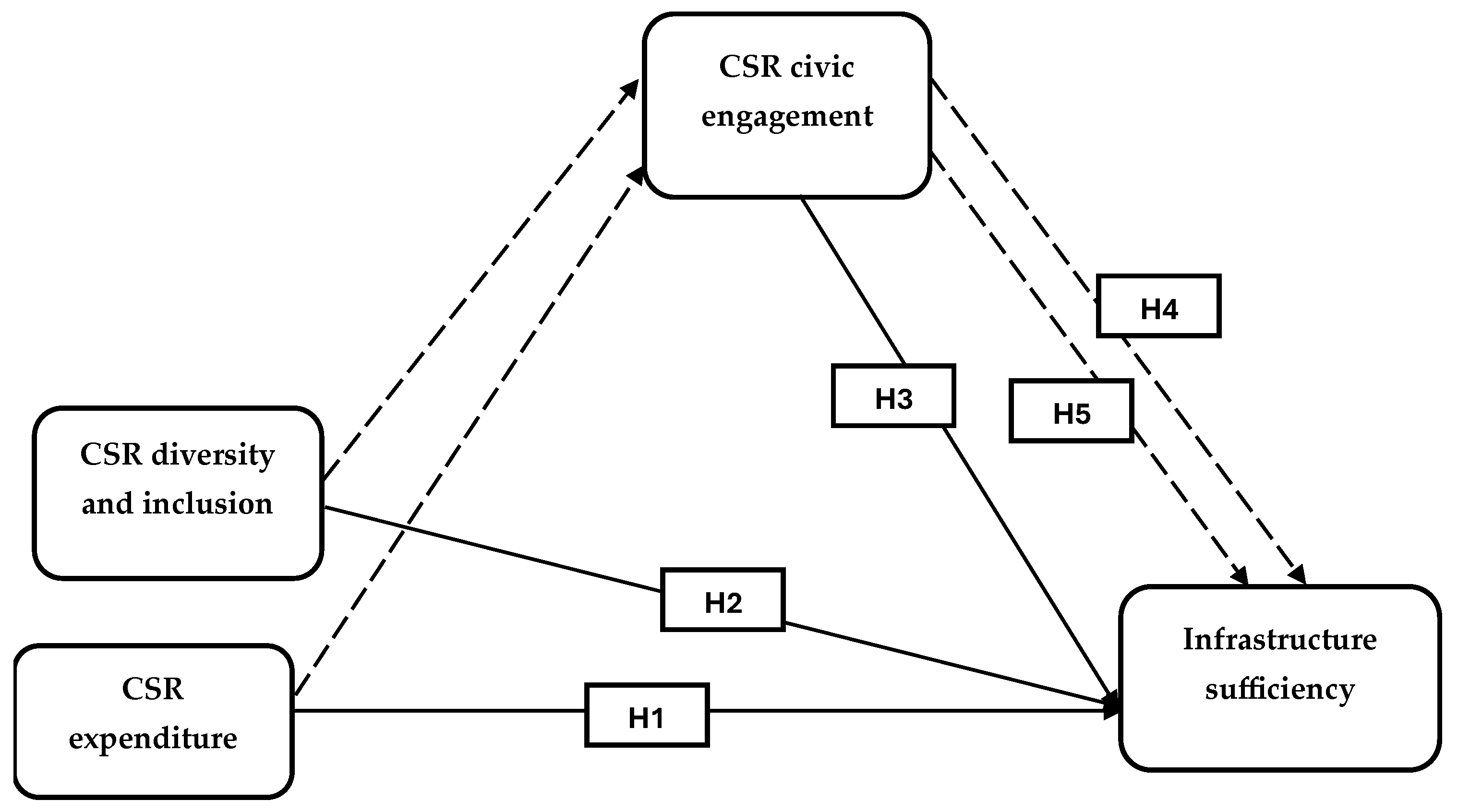
The conceptual framework (research model) as shown in Figure 1, dwells on the social exchange theory, the empowerment theory, and the relevant empirical literature to test for three (3) direct effects (H1–H3) and two (2) mediating effects among the variables under investigation. The direct effects examined relationships between CSR diversity and inclusion and infrastructure sufficiency (H1), CSR expenditure and infrastructure sufficiency (H2), and CSR civic engagement and infrastructure sufficiency (H3). Mediating relationships examined the mediating role of CSR civic engagement on the relationships between CSR diversity and inclusion on infrastructure sufficiency (H4), as well as CSR expenditure and infrastructure sufficiency (H5).

3. Materials and Methods

The study employed a positivist paradigm, based on the ontological belief that social phenomena hold objective reality and are empirically observable [74]. The positivist paradigm provides a foundation for a deductive approach that is suitable to test the relationships between CSR inclusion and diversity, CSR expenditure, CSR civic engagement, and infrastructure sufficiency in host mining communities in Ghana. A cross-sectional design was used to collect data at one point in time among residents of mining host communities in Ghana [75]. The research was conducted in the Ahafo Region of Ghana. It was restricted to seven mining host communities located within the Asutifi North and Tano North Districts, both of which are affected by the activities of Newmont Gold Mining Company, as the main large-scale mining company operating within these two districts. The overall total beneficiary community population is 39,125 individuals who are direct beneficiaries or beneficiaries participating in CSR activities in these communities. The target population for the research, therefore, includes 39,125 residents in these seven communities, thereby meeting the study requirements and achieving higher external validity.
A stratified random sample method was used [76], with stratification of the target population into seven geographical areas. This approach allowed for representativeness and coverage of all community clusters possible and prevented the strange sampling bias typically noted in population-based CSR research [76]. Based on [77], the minimum sample size of 396 was calculated at a confidence level of 95% and a margin of error of 5%.
A structured questionnaire was used to obtain primary data, as it was considered appropriate for obtaining the views of a large geographically dispersed population [78]. The questionnaire featured five sections (see Appendix A). The Section 1 examined the demographic profile of respondents, which comprised their gender, age, educational level, and marital status. The Section 2 asked questions on CSR diversity and inclusion, while the Section 3 asked questions on CSR expenditure. The Section 4 asked questions on CSR civic engagement. The Section 5 asked questions on infrastructure sufficiency. All constructs were rated on a five (5) point Likert scale where 1 = Strongly Disagree, 2 = Disagree, 3 = Neutral, 4 = Agree, and 5 = Strongly Agree. Questionnaires were self-administered in-person in the seven (7) communities in the Asutifi North and Tano North Districts of Ghana. Data was collected in five months, with face-to-face self-administered structured questionnaires. The questionnaire was pre-tested among a sample of residents to check for clarity, reliability, and context relevance before the main data collection. We obtained approval from local officials and community leaders. Since the questionnaires were gathered from the same respondents, using the same questionnaires, there was the potential for common method bias. To address potential common method bias concerns, Harman’s test was conducted using the Statistical Package for Social Sciences (SPSS) software version 28. Harman’s test was used to test whether a single latent factor explains much of the covariance among construct items or not. In this regard, an Exploratory Factor Analysis (EFA) using the principal component analysis (PCA) method was conducted on all items of the constructs, namely CSR diversity and inclusion, CSR expenditure, CSR civic education, and infrastructure sufficiency. The result from Harman’s test, as indicated in Table 1 below, showed that 31.85% of the first factor was explained, which is lower than 50% and therefore shows that there is no problem with common method bias.
Data was analyzed using Statistical Package for Social Sciences (SPSS) version 28, which was used for data coding, data entry, and the conduct of descriptive statistics, such as frequencies and percentages for the demographic variables. Partial least squares (PLS) structural equation modeling (SEM) using the Smart PLS 4 was adopted to test for the direct and mediating relationships among the constructs under investigation.
The demographic profile of respondents shows a relatively balanced gender distribution, with males representing 54% and females 46%, which suggests that both genders are well represented in the study. Respondents between 25–35 years form the majority (23.5%), closely followed by the 35–45 years group, comprising 22.5%. Youths under 25 years account for 19% of those surveyed. Meanwhile, older adults aged 45–55 accounted for 17.8%, and those over 55 years accounted for 17.3%. The level of education differs widely between participants. Whereas 16% have no formal education and 18% have attained primary education, 26.8% have attained secondary education, 15.8% have attained vocational/technical education, and lastly, 23.5% of these claimed to have tertiary level education. This variation suggests that respondents have different levels of understanding and evaluating CSR. For marital status, married respondents constitute the majority (37.3%), and single respondents constitute 34.3%. The proportion of participants who are divorced or separated is 15.8%, and widowed is 12.8%. This distribution sparsely exposes a combination of family types and responsibilities that could impact expectations and perceptions regarding community infrastructure and CSR initiatives.

4. Results

This section presents results on model assessment, as well as direct and mediating effects for partial least squares (PLS) structural equation modeling (SEM) using Smart PLS 4 software.

4.1. Indicator Reliability

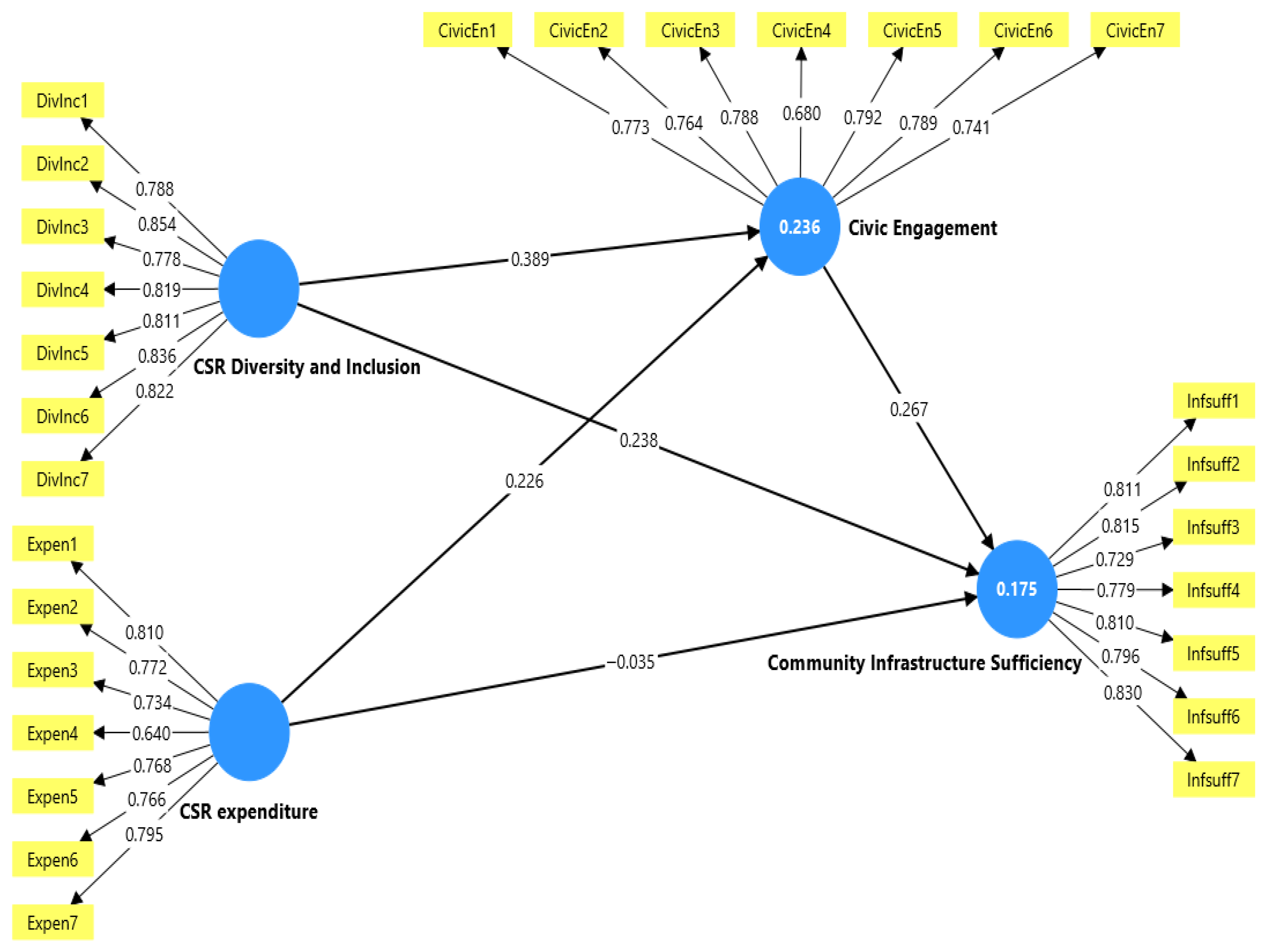
Table 2 reveals that all factor loadings are above acceptable levels, indicating high item indicator reliability between the constructs. Items loaded on CSR Expenditure are from 0.640 to 0.810, indicating satisfactory indicator reliability. The civic engagement subscale items load best (0.680–0.792), indicating acceptable indicator reliability. CSR diversity and inclusion demonstrate very good loadings (0.778–0.854), indicating a strong indicator reliability. The infrastructure sufficiency items also demonstrate good loadings (0.729–0.830), showing strong indicator reliability.

4.2. Internal Consistency Reliability and Convergent Validity

Table 3 shows that there is a strong level of internal consistency reliability for all constructs, since Cronbach’s alpha varies between 0.879 and 0.916, and the composite reliability is higher than the required value of 0.90 concerning the variables included in this study. Convergent validity is also supported, as all AVE values (0.573–0.665) exceed the minimum threshold value of 0.50, indicating that convergent validity is attained.

4.3. Discriminant Validity Using HTMT

Table 4 reveals that the HTMT for all constructs is within the range of 0.122 and 0.473, which is much lower than the threshold value of 0.85. This shows that discriminant validity was established between all pairs of constructs. CSR expenditure, civic engagement, diversity and inclusion, and infrastructure sufficiency were empirically different, with evidence supporting that one construct is different from the other regarding their constructs posited in the model.

4.4. R-Square

Table 5 shows that the predictors CSR diversity and inclusion and CSR expenditure explain 23.6% of the variance in civic engagement. For infrastructure sufficiency, the predictors explain 17.5% of the variance, reflecting a modest but meaningful predictive influence. We attest that the modest predictive explanatory power of 17.5% for infrastructure sufficiency is possible because of other potential factors, such as government capital investment, district assembly capacity, regulatory enforcement, population growth, and geographical remoteness, which have the potential to affect CSR initiatives among mining communities in Ghana.

4.5. F-Square (Effect Size)

An F-square value of 0.02 (see Table 5) is usually regarded as a small effect, 0.15 is a moderate effect, and 0.35 represents a large effect. However, the link between diversity and inclusion and civic engagement (f2 = 0.190) has a medium effect, indicating that diversity and inclusion are significant drivers of civic engagement. The effect size for the relationship between civic engagement and infrastructure sufficiency is 0.066, while the relationship between CSR expenditure and civic engagement was 0.064, which are small yet substantial effects. The small effect on infrastructure sufficiency (f2 = 0.056) is likewise shown by diversity and inclusion. CSR expenditure has, on the other hand, a very small effect (f2 = 0.001) on infrastructure sufficiency.

4.6. Collinearity

Collinearity is assessed using the variance inflation factor (VIF) as shown in Table 6. VIF values less than 5.0 and 3.0 indicate that there is little collinearity to be concerned about, but values greater than that produce a multicollinearity problem among the model variables. As indicated in Table 7, there is no single value of VIF that exceeded the cut-off point of >5.0, since all VIF values ranged between 1.680 and 2.964. This means that multicollinearity is not an issue in the measurement model. Each indicator has a unique contribution to its latent construct, and there are no redundancies.

4.7. Hypotheses Testing Results

The results (see Figure 2 and Table 8) showed that CSR diversity and inclusion have a strong and positive direct effect on infrastructure sufficiency (β = 0.238, p < 0.001). Hypothesis 1 was therefore supported. In contrast, CSR expenditure shows no significant direct effect on infrastructure sufficiency (β = −0.035, p = 0.607). Hence, Hypothesis 2 was not supported. Civic engagement demonstrates a significant positive effect on infrastructure sufficiency (β = 0.267, p < 0.001), which supports Hypothesis 3. The study supports Hypothesis 4, as CSR civic engagement positively mediates the relationship between CSR diversity and inclusion and infrastructure sufficiency (β = 0.104, p < 0.001). Finally, it was found that CSR civic engagement mediates the relationship between CSR expenditure and infrastructure sufficiency (β = 0.060, p = 0.003) among host mining communities in Ghana. Hypothesis 5 is therefore supported. This finding is novel to our study because it indicates indirect-only mediation, since the prior relationship between CSR expenditure and infrastructure sufficiency was non-significant. We explain that this is possible within the context of mining communities in Ghana because financial allocation alone, which characterizes CSR expenditure, could lack resident participatory alignment and accountability. The mediation of CSR civic engagement emphasizes that CSR expenditure, channeled through active community involvement through resident insights and monitoring capacity, enhances infrastructure sufficiency.

5. Discussion

The finding on the first objective, which showed that a significant positive relationship exists between CSR diversity and inclusion and infrastructure sufficiency in host mining communities, was consistent with the previous literature and the social exchange theory. According to [52], comprehensive CSR frameworks enhance the complementarity of company-driven interventions with the diversified needs of host communities in an environment characterized by social and economic deprivation. Inclusive representation of complicated fractions, including women, youth, and marginalized households, ensures that infrastructure priorities are influenced by the everyday realities of a community of people [53]. Ref. [51] also shows that organizations with stronger diversity and inclusion commitments are able to more cohesively integrate stakeholder expectations into the allocation of CSR resources, leading to more sustainable development outcomes. This relationship is clearly justified through the lens of social exchange theory (SET). Inclusive CSR behaviors are regarded as a signifier of fairness, respect, and recognition, and are pillars of positive mutual exchange. When communities believe that their heterogeneous views are being recognized and incorporated into CSR decisions, then they will interpret the CSR–community relationship as equitable. It builds trust, goodwill, and cooperation for mutually participating in infrastructure projects. By contrast, where there is a lack of diversity and inclusion, perceived injustice erodes trust and the social fabric, resulting in decreased community support for arrangements in place, as well as infrastructure. We posit that CSR diversity and inclusion dynamics influence infrastructure sufficiency in that involving marginal groups in decision-making optimally reflects women, youth, and minority needs. Widespread participation increases local relevance, legitimacy, and sustainability. To enhance CSR effectiveness, therefore, mining companies must institutionalize inclusive planning committees; local government authorities should ensure transparent monitoring mechanisms are in place; traditional leaders must work to guarantee inclusion and equitable representation; and community-based organizations need to build civic capacity for greater accountability and long-term infrastructure maintenance.
The finding on the second objective indicated that a non-significant relationship exists between CSR expenditure and community infrastructure sufficiency, which was not consistent with the previous literature. This is because the previous literature by the authors of [57] shows that targeted social investment in education, health, and community care greatly improves community wellness, which reflects on the developmental nature of well-targeted financial engagements. The effect of CSR spending, however, is contingent upon broader institutional settings [57]. Ref. [58] highlights the need for significant government involvement in creating cohesive CSR frameworks to ensure that mining companies’ financial contributions contribute more appropriately to national and local sustainability goals. Ref. [1] finds that joint planning between mining institutions and the host community increases relevance and elasticity of CSR-sponsored infrastructure projects. This non-significant result reflects an attenuation in perceived exchange based on social exchange theory. The imbalance in the exchange relationship is perceived by communities when CSR expenditure does not result in tangible or meaningful infrastructure. In the absence of clear benefits, the assumed value of CSR expenditure loses credibility and trust, as relationships are impaired. Thus, SET accounts for why spending that is not fair, transparent, or responsive produces poor infrastructure outputs. Our study contends that the non-significant relationship between CSR expenditure and infrastructure sufficiency in mining communities in Ghana reflects the need for stronger CSR governance and synchrony with resident inputs and oversight. In this regard, to ensure improvement in CSR effectiveness, mining firms should adopt participatory budgeting and transparent reporting standards. Furthermore, district assemblies should also strengthen monitoring and evaluation mechanisms, while traditional authorities also ensure equitable project selection. Moreover, community groups should actively track implementation to reduce elite capture and enhance CSR accountability among mining communities in Ghana.
The result on the third objective, which showed that a significant positive relationship exists between civic engagement and community infrastructure sufficiency, was supported by the previous literature and the empowerment theory. Studies of [62] indicate that greater consciousness of the role of citizens in participation only results in a more enlightened and engaged citizenry, a citizenry that can articulate development needs and demand for inclusive governance. Ref. [42] contends that societies would have influence over the delivery of projects and put pressure on corporations to fulfil the proclaimed development intervention programs, particularly in terms of subsidizing infrastructure priorities and the allocation of resources. Similarly, ref. [63] further contends that civic empowerment not only leads to accessible educational opportunities but also promotes a more favorable community development in general and, therefore, reinforces the transformative potential of CSR. Ref. [61] states that civil engagement promotes synergy among communities, companies, and local governments, as well as enhances responsiveness to community demands. Supporting evidence from [64,65] stresses that CSR civic engagement increases the transparency, promotes inclusivity, and sustainability of CSR-induced infrastructural development. The theory of empowerment provides a strong theoretical foundation for interpreting this discovery. It is around agency, meaningful participation, critical consciousness, and capacity building—the so-called civic disposition that equips one to engage. In this way, by virtue of greater knowledge, organizational capacity development, and collective action taking, civic engagement empowers communities to shape CSR practices, challenge injustices, and co-produce infrastructure outcomes. We posit that in host mining communities in Ghana, resident participation is associated with infrastructure sufficiency by promoting needs recognition, monitoring, and accountability. Resident engagement in town hall meetings, local committees, and traditional governance structures could allow people to advocate for the responsible use of resources. To achieve this, we recommend that mining companies must establish resident consultation as a transparent and mainstream process and communicate on their CSR initiative status regularly. District assemblies must mainstream participatory information systems into local governance structures. Community-based organizations also need to develop oversight capacity. This coordinated response will increase visibility, decrease abandoned CSR project risk, and provide sustainable infrastructural results.
The significant mediating effect of CSR civic engagement between the relationship of CSR diversity and inclusion and infrastructure sufficiency is consistent with recent empirical research. Ref. [69] demonstrates that proactive strategic CSR- diversity and inclusion-based integration lowers community–company conflict through developing authentic stakeholder engagement, instilled by civic awareness, that is conducive to the introduction of more inclusive infrastructure development. Ref. [70] also adds that, when inclusive stakeholder engagement models through civic participation in South African mining are used, it greatly improves community infrastructure development. The mediating effect of civic engagement is also accounted for by [61], who argues that, regarding CSR diversity and inclusion policies, considering campaigns within the community, civic engagement will lead to active community participation, as well as better infrastructure development. Empowerment theory provides a strong theoretical foundation for understanding this finding. It emphasizes agency, meaningful participation, critical consciousness, and capacity building, which are built through civic engagement. In the process, and through improved knowledge, organizational capacity development, and joint efforts to act, civic engagement empowers communities to influence CSR practices, contest injustices, and co-produce infrastructure outcomes. We argue that, while CSR diversity and inclusion increase representation in host mining communities, it is civic engagement that successfully translates various forms of inclusiveness into tangible infrastructure sufficiency outcomes. To be more effective, mining companies need to formalize inclusionary consultation mechanisms, district assemblies entrench participatory oversight systems, traditional rulers guarantee proportional representation, and local communities develop the ability to monitor CSR initiative outcomes. Planned and sustained actions can help to better match inclusive CSR initiatives with priority needs through civic education mechanisms, which in turn, can enhance infrastructure sufficiency and long-term sustainability.
The result that CSR civic engagement mediates the link between CSR expenditure and the sufficiency of infrastructure is in line with empirical studies and empowerment theory. Ref. [72] suggests that CSR programs in mining promote resilience by providing the population with civic practices and knowledge that result in increased local infrastructure. Ref. [73] suggests that education-oriented CSR programs have supported local economic growth, and this also indicates the potential of social investments, such as CSR investment in infrastructure development. Ref. [69] finds that strategically designed CSR civil engagement mechanisms reduce community–input conflict and consequently create a more enabling environment for infrastructure building. Moreover, civil society-centered CSR initiatives also have a much wider developmental purpose, as [64] demonstrates that such schemes improve educational completion and contribute to the necessary infrastructure upon which long-term sustainability depends. The empowerment theory can explain this mediating relationship. In the absence of agency, participation, and critical consciousness, such important dimensions of empowerment cannot determine resource allocation or see CSR resources translate into tangible infrastructure. Community agencies’ empowerment dimensions are reinforced by civic engagement, making development processes more accountable and enabling communities to co-govern them. Based on this result, we contend that CSR expenditure does not directly enhance infrastructure sufficiency unless community civic education is integrated. In the host mining communities in Ghana, CSOs’ civil participation is a leverage to regulate that resources are allocated to their priority needs, managed transparently, and monitored effectively. We therefore recommend that mining companies must introduce participatory budgeting and publicly disclose spending. Moreover, district assemblies must institutionalize community-led monitoring mechanisms, while traditional leaders need to enable inclusive oversight. CSOs should work to build financial literacy and accountability to enhance resident participation in CSR initiative implementation to enhance infrastructure efficiency.
The study has the following theoretical and practical implications. In terms of theory, the results indicating that CSR diversity and inclusion significantly enhance community infrastructural adequacy advance social exchange theory by providing evidence that reciprocity in community–corporate ties is motivated not only by instrumental gains but also through perceived fairness, respect, and inclusive engagement. This expands the theory by suggesting that inclusiveness functions as a relational reward and reinforces trust in and motivation for cooperative community behavior, thus applying SET to institutional exchanges in mining communities. Secondly, the findings that suggest that CSR expenditure has no direct and significant impact on infrastructure sufficiency advance the social exchange theory to demonstrate that physical resources alone are insufficient to elicit a positive response. However, rather, reciprocity is dependent upon transparency and fair sharing in accordance with community interest. This advances the social exchange theory by demonstrating that within high-power-asymmetry situations, communities do not ascribe value to an exchange based on monetary motivations but rather based on the community’s perception of fairness and level of involvement. The findings of this study that civic participation has a positive effect on infrastructure sufficiency offer support for empowerment theory, which posits that having the ability and willingness to participate, along with critical consciousness, leads to influence in community decisions. This advances the theory by demonstrating that civic capacity is not only complementary but fundamental to successful CSR-driven development. The findings indicate that civic engagement mediates CSR diversity and inclusion, and infrastructural sufficiency, extending the empowerment theory by demonstrating how empowering processes are activated via civic learning. This further operationalizes the empowerment theory by regarding civic engagement as a concrete mechanism through which inclusive CSR leads to community power in decision-making. The findings that civic engagement mediates the relationship between CSR expenditure and infrastructure sufficiency strengthen empowerment theory by providing evidence that financial contributions only generate developmental outcomes when local populations are endowed with capabilities to interpret, negotiate, and monitor CSR. These further advance the empowerment theory by placing civic engagement as a structural empowerment mechanism that is a necessary requirement to translate CSR inputs into sustainable infrastructure outputs in host mining communities.
The findings suggest several practical implications for mining companies, community leaders, policy makers, and development practitioners operating within host mining communities. First, the finding that CSR diversity and inclusion had a positive effect on infrastructure sufficiency suggests that mining companies should focus their efforts on the inclusive processes of CSR, which actively involve women, youth, and marginalized groups in decision-making. That implies moving from tokenistic consultation to institutionalized mechanisms of participation that will enable diverse voices in designing and delivering community infrastructure by mining companies. Second, the non-significant effect of CSR investment on infrastructure sufficiency implies that a mere increase in financial spending is not a guarantee for development impact in host mining communities. This implies that mining companies must, thus, improve transparency, deliberate planning, and community oversight mechanisms so that expenditure becomes more aligned with local needs. This involves, among other things, publishing CSR budgets, establishing community monitoring committees, and adopting participatory budgeting practices. Third, the importance of civic engagement implies that capacity-building programs, such as civic engagement, training, and community sensitizing, must be at the core of CSR approaches. An increase in civic competencies will enable the host mining communities to express development needs, control project implementation, and demand responsibility from companies. Fourth, the mediating role of civic engagement suggests a future necessity to propel mining corporations to invest in long-term educational interventions that foster community agency and empower residents to participate meaningfully. These could range from literacy classes, local governance workshops, and sessions about environmental rights and social rights. Further, integration of civic engagement and participatory governance models into mining legislation can help to ensure that CSR is translated into sustainable development infrastructure. Reinforcing local government–community–company collaboration can help to institutionalize these gains and enhance longer-term development trajectories in host mining communities.
From the implications, we recommend the following. First, mining firms should institutionalize participatory CSR decision-making processes that genuinely integrate women, youth, and other marginalized people in the identification and prioritization of infrastructure issues. Setting up community advisory boards or participatory planning forums would help ensure that CSR diversity and inclusion translate to infrastructure results based on the realities of communities. Second, mining companies need to enhance transparency and accountability around CSR spending. Releasing CSR budgets and the application of participatory budgeting processes and having community monitors for infrastructure projects will foster trust and ensure the money is well spent. Third, corporations should also ensure long-term investment in civil engagement and capacity-building measures. These should include governance training, rights education activities, and community leadership training aimed at preparing citizens with the needed skills for meaningful participation, oversight, and decision-making in development processes connected to CSR. Finally, the government regulators should stipulate in the mining sector CSR policies that could be linked to civic engagement and participatory governance approaches. This would also institutionalize empowerment and inclusion within CSR actualization, rather than relying on the goodwill of corporate entities.

6. Conclusions

We conclude that the effectiveness of CSR to enhance social infrastructure sufficiency in host mining communities is determined by not only resources but, most importantly, inclusion and the civic ability of community members. CSR diversity and inclusion proved to be a significant and consistent influencer of infrastructure sufficiency, highlighting the importance of equality in participation and representation on development outcomes within host mining communities.
We also conclude that civic engagement featured prominently, both as an independent contributor to infrastructure sufficiency and as a mediating variable through which CSR activities, especially diversity and inclusion and CSR expenditure, yield meaningful community outcomes. In contrast, CSR expenditure did not exert a direct effect, indicating that financial resources need to be empowered and well-informed communities, as well as enabling them to be meaningfully involved if development must be realized and sustained. These results thus suggest that mining companies need to integrate participatory, transparent, and empowering practices into their CSR design to achieve transformative outcomes.
The study was confronted with the following limitations. First, a cross-sectional research design limits the study’s ability to infer causality among CSR diversity and inclusion, CSR expenditure, civic engagement, and infrastructure sufficiency over time. Second, the study is based solely on self-reported data from community participants and could be confronted with possible response biases, such as social desirability or recall biases. Third, the study was limited to a mining company’s host communities in Ghana and thus may not be generalizable to other areas or extractive industries with varying socio-political landscapes. Finally, only a quantitative research approach was used, and therefore, the richness of community experiences and perceptions might not be entirely covered. Based on these limitations, we recommend the following future research directions.
First, future researchers should use longitudinal approaches to analyze the dynamics between CSR diversity inclusion, CSR expenditure, civic engagement, and infrastructure sufficiency. Such studies would yield more robust causal evidence and capture the effects of CSR interventions over a longer period of time. Second, future research should consider multi-source data collection methods using mining company, local government, and civil society sources. This would also minimize the dependence on self-reporting and strengthen the validity of results. Third, cross-sectional comparisons of several mining companies or regions within and outside Ghana would enhance the generalizability of findings and show context specificity in the implementation of CSR. Finally, mixed-method studies using quantitative data and qualitative interviews or focus groups might offer a greater understanding of community attitudes, power relations, and the everyday experience of civic engagement.

Author Contributions

Conceptualization, H.A., D.Y.D., and V.Y.A.; methodology, H.A., D.Y.D., and V.Y.A.; validation, H.A., D.Y.D., and V.Y.A.; formal analysis, H.A., D.Y.D., and V.Y.A.; H.A., D.Y.D., and V.Y.A.; resources, H.A. and D.Y.D.; data curation, H.A.; writing—original draft preparation, H.A.; writing—review and editing, D.Y.D. and V.Y.A.; visualization, H.A.; supervision, D.Y.D. and V.Y.A.; project administration, D.Y.D.; funding acquisition, D.Y.D. All authors have read and agreed to the published version of the manuscript.

Funding

This research received no external funding.

Institutional Review Board Statement

The study was conducted in accordance with the Declaration of Helsinki, and approved by the Faculty of Management Sciences Research Ethics Committee of The Central University of Technology, Free State, South Africa (protocol code FMSEC080922 and 6 May 2024 of approval).

Informed Consent Statement

Informed consent was obtained from all subjects involved in the study.

Data Availability Statement

The datasets for the current study are not publicly available due to confidentiality agreements with research participants but are available from the corresponding author upon reasonable request.

Acknowledgments

The paper is developed based on an unpublished wider Ph.D. thesis submitted to the Central University of Technology, Free State, South Africa, titled “Gold mining, corporate social responsibility and the sustainable well-being of host communities in the Ahafo Region, Ghana”.

Conflicts of Interest

The authors have no known competing financial interests or personal relationships that could influence the work reported in this paper.

Appendix A

Please use ✔ mark where applicable, and please use a black ink pen.
SECTION A: DEMOGRAPHICS
1.Gender(1) Male(2) Female
2.Age (years)(1) 25 and below(2) 25–35(3) 35–45(4) 45–55(5) 55+
3.Highest education(1) No formal education(2) Primary(3) Secondary(4) Technical/Vocational(5) Tertiary
4.Marital status(1) Married(2) Divorced/separated(3) Widow(4) Single
Please indicate your level of agreement with the following statements with a tick mark ()
Section B: CSR Diversity and InclusionStrongly Disagree
1
Disagree
2
Neutral
3
Agree
4
Strongly Agree
5
5. The mining company promotes diversity and inclusion within its workforce.(1)(2)(3)(4)(5)
6. The CSR initiatives by the mining company actively address the unique needs of diverse groups within the community.(1)(2)(3)(4)(5)
7. The community members feel that there are equal opportunities for employment and participation in CSR programs.(1)(2)(3)(4)(5)
8. The mining company fosters a culture that values and celebrates diversity within the workforce in their CSR activities.(1)(2)(3)(4)(5)
9. Diverse perspectives are considered in the planning and execution of CSR projects by the mining company.(1)(2)(3)(4)(5)
10. The employees and community members perceive a fair and inclusive work environment.(1)(2)(3)(4)(5)
11. The mining company supports initiatives that promote diversity and inclusion in the local community.(1)(2)(3)(4)(5)
SECTION C: CSR ExpenditureStrongly Disagree
1
Disagree
2
Neutral
3
Agree
4
Strongly Agree
5
12. The mining company allocates a portion of its budget to CSR activities.(1)(2)(3)(4)(5)
13. The community members are aware of the financial commitment the mining company makes toward CSR activities.(1)(2)(3)(4)(5)
13. There is transparency in the accounting and reporting of CSR expenditure by the mining company.(1)(2)(3)(4)(5)
14. The community members believe that the allocated funds for CSR initiatives are effectively utilized.(1)(2)(3)(4)(5)
15. The mining company’s financial support for CSR projects is consistent over time.(1)(2)(3)(4)(5)
16. The community perceives that CSR expenditure by the mining company has a tangible and positive impact on the community members.(1)(2)(3)(4)(5)
SECTION D: CSR Civic EngagementStrongly Disagree
1
Disagree
2
Neutral
3
Agree
4
Strongly Agree
5
17. The mining company encourages civic participation and involvement in community affairs through its CSR initiatives.(1)(2)(3)(4)(5)
18. The members generally feel motivated to participate in community initiatives due to the mining company’s CSR efforts.(1)(2)(3)(4)(5)
19. There is an increase in community-led projects and activities supported by the mining company in their CSR initiatives.(1)(2)(3)(4)(5)
20. The mining company enhances its sense of civic responsibility in the community through its CSR initiatives.(1)(2)(3)(4)(5)
21. The mining company actively collaborates with local community organisations to promote civic engagement.(1)(2)(3)(4)(5)
22. The residents generally believe that they have a voice in shaping the future of their community through the mining company’s CSR programs.(1)(2)(3)(4)(5)
SECTION E: Infrastructural self-sufficiencyStrongly Disagree
1
Disagree
2
Neutral
3
Agree
4
Strongly Agree
5
23. The CSR activities of the mining company have contributed to the infrastructural development in the community.(1)(2)(3)(4)(5)
24. The residents perceive improvements in local infrastructure and amenities due to CSR initiatives by the mining company.(1)(2)3)(4)(5)
25. The mining company supports projects that enhance community access to basic amenities (e.g., water, and electricity).(1)(2)(3)(4)(5)
26. There has been an improvement in transportation infrastructure within the community as a result of the mining company’s CSR efforts.(1)(2)(3)(4)(5)
27. The community members believe that the CSR projects initiated by the mining company have positively impacted on the overall infrastructural self-sufficiency.(1)(2)(3)(4)(5)
28. The mining company collaborates with local authorities to address infrastructural needs in the community.(1)(2)(3)(4)(5)
29. The community members feel confident in the resilience and sustainability of local infrastructure projects undertaken by the mining company.(1)(2)(3)(4)(5)

References

  1. Attah, A.; Amoah, P. The extractive industry and expectations of resource benefits: Does CSR promote community well-being? Corp. Gov. Int. J. Bus. Soc. 2023, 23, 1437–1453. [Google Scholar] [CrossRef]
  2. Nyamadi, V.M. The Role of Corporate Social Responsibility in Sustainable Development in Ghana: A Critical Perspective on Anglogold Ashanti Ghana. Doctoral Dissertation, University of South Africa, Pretoria, South Africa, 2020. [Google Scholar]
  3. Nartey, S.; Manu, F.A. Host communities’ infrastructural development expectations of multinational mining companies in Ghana’s mining industry. Afr. J. Manag. 2023, 9, 259–282. [Google Scholar] [CrossRef]
  4. Gould, R.; Harris, S.P.; Mullin, C.; Jones, R. Disability, diversity, and corporate social responsibility: Learning from recognized leaders in inclusion. J. Vocat. Rehabil. 2020, 52, 29–42. [Google Scholar] [CrossRef]
  5. Bhattacharyya, A.; Rahman, M.L. Mandatory CSR expenditure and stock return. Meditari Account. Res. 2020, 28, 951–975. [Google Scholar] [CrossRef]
  6. Laskin, A.V.; Kresic, K. Inclusion as a component of CSR and a brand connection strategy. In Public Relations for Social Responsibility: Affirming DEI Commitment with Action; Emerald Publishing Limited: Leeds, UK, 2021; pp. 149–163. [Google Scholar] [CrossRef]
  7. Mullin, C.; Gould, R.; Harris, S.P.; Jones, R. Updated trends in disability, diversity, and corporate social responsibility. J. Vocat. Rehabil. 2024, 61, 157–174. [Google Scholar] [CrossRef] [PubMed]
  8. Garg, A.; Gupta, P.K. Mandatory CSR expenditure and firm performance: Evidence from India. S. Asian J. Bus. Stud. 2020, 9, 235–249. [Google Scholar] [CrossRef]
  9. Umar, U.H.; Jibril, A.I.; Musa, S. Board attributes and CSR expenditure before and during COVID-19. J. Financ. Report. Account. 2023, 21, 800–819. [Google Scholar] [CrossRef]
  10. Kumar, S.; Singh, G. Does mandatory CSR expenditure regulation matter to promoters? Empirical evidence from India. Meditari Account. Res. 2023, 31, 1325–1351. [Google Scholar] [CrossRef]
  11. Ofori, R.; Takyi, S.A.; Amponsah, O.; Gagakuma, D. Mining-induced displacement and resettlement in Ghana: An assessment of the prospects and challenges in selected mining communities. Soc. Netw. Anal. Min. 2023, 13, 61. [Google Scholar] [CrossRef]
  12. Ayitey, J.Z.; Okyere, M.; Gyamfi-Yeboah, F. Assessing the living conditions of mining-induced resettled persons: The case of Ahafo South resettlement communities, Ghana. J. Sustain. Min. 2025, 24, 408–423. [Google Scholar] [CrossRef]
  13. Ahmad, I.; Islam, M.R. Empowerment and participation: Key strategies for inclusive development. In Building Strong Communities: Ethical Approaches to Inclusive Development; Emerald Publishing Limited: Leeds, UK, 2024; pp. 47–68. [Google Scholar] [CrossRef]
  14. Santoso, T.I.; Octavenda, C.P.; Alamsyah, M.N. Corporate Social Responsibility and Community Empowerment in the Mining Sector: Post-Mining Closure and Sustainable Development in Gunung Pongkor, Indonesia. Int. J. Islam. Bus. Manag. Rev. 2025, 5, 125–136. [Google Scholar] [CrossRef]
  15. Ahmad, R.; Nawaz, M.R.; Ishaq, M.I.; Khan, M.M.; Ashraf, H.A. Social exchange theory: Systematic review and future directions. Front. Psychol. 2023, 13, 1015921. [Google Scholar] [CrossRef] [PubMed]
  16. Wallenburg, C.M.; Handfield, R. Social exchange theory. In Handbook of Theories for Purchasing, Supply Chain and Management Research; Edward Elgar Publishing: Cheltenham, UK, 2022; pp. 267–282. [Google Scholar] [CrossRef]
  17. Yamao, S. Social exchange theory. In A Guide to Key Theories for Human Resource Management Research; Edward Elgar Publishing: Cheltenham, UK, 2024; pp. 274–279. [Google Scholar] [CrossRef]
  18. Meira, J.V.D.S.; Hancer, M. Using the social exchange theory to explore the employee-organization relationship in the hospitality industry. Int. J. Contemp. Hosp. Manag. 2021, 33, 670–692. [Google Scholar] [CrossRef]
  19. Stafford, L.; Kuiper, K. Social exchange theories: Calculating the rewards and costs of personal relationships. In Engaging Theories in Interpersonal Communication; Routledge: London, UK, 2021; pp. 379–390. [Google Scholar]
  20. Nasrolahi Vosta, L.; Jalilvand, M.R. Electronic trust-building for hotel websites: A social exchange theory perspective. J. Islam. Mark. 2023, 14, 2689–2714. [Google Scholar] [CrossRef]
  21. Jahan, N.; Kim, S.W. Understanding online community participation behavior and perceived benefits: A social exchange theory perspective. PSU Res. Rev. 2021, 5, 85–100. [Google Scholar] [CrossRef]
  22. Joo, D.; Woosnam, K.M.; Strzelecka, M.; Boley, B.B. Knowledge, empowerment, and action: Testing the empowerment theory in a tourism context. J. Sustain. Tour. 2020, 28, 69–85. [Google Scholar] [CrossRef]
  23. Shin, H.; Perdue, R.R.; Pandelaere, M. Managing customer reviews for value co-creation: An empowerment theory perspective. J. Travel Res. 2020, 59, 792–810. [Google Scholar] [CrossRef]
  24. Sharma, M.; Sharma, S.K. Theoretical framework for digital payments in rural India: Integrating UTAUT and empowerment theory. In International Working Conference on Transfer and Diffusion of IT; Springer: Berlin/Heidelberg, Germany, 2019; pp. 212–223. [Google Scholar] [CrossRef]
  25. Christens, B.D. Community Power and Empowerment; Oxford University Press: Oxford, UK, 2019. [Google Scholar]
  26. Shankar, A.; Sundar, S.; Smith, G. Agency-based empowerment interventions: Efforts to enhance decision-making and action in health and development. J. Behav. Health Serv. Res. 2019, 46, 164–176. [Google Scholar] [CrossRef]
  27. Pillen, H.; McNaughton, D.; Ward, P.R. Critical consciousness development: A systematic review of empirical studies. Health Promot. Int. 2020, 35, 1519–1530. [Google Scholar] [CrossRef]
  28. Bryant, J.; Bolt, R.; Botfield, J.R.; Martin, K.; Doyle, M.; Murphy, D.; Graham, S.; Newman, C.E.; Bell, S.; Aggleton, P.; et al. Beyond deficit: ‘Strengths-based approaches’ in Indigenous health research. Sociol. Health Illn. 2021, 43, 1405–1421. [Google Scholar] [CrossRef]
  29. Ros-Sanchez, T.; Lidon-Cerezuela, M.B.; Lopez-Benavente, Y.; Abad-Corpa, E. Promoting empowerment and self-care in older women through participatory action research: Analysis of the process of change. J. Adv. Nurs. 2023, 79, 2224–2235. [Google Scholar] [CrossRef] [PubMed]
  30. Maier, C.D.; Ravazzani, S. Bridging diversity management and CSR in online external communication. Corp. Commun. Int. J. 2019, 24, 269–286. [Google Scholar] [CrossRef]
  31. Fitzsimmons, S.; Özbilgin, M.F.; Thomas, D.C.; Nkomo, S. Equality, diversity, and inclusion in international business: A review and research agenda. J. Int. Bus. Stud. 2023, 54, 1402–1422. [Google Scholar] [CrossRef]
  32. Van Bommel, H.M.; Hubers, F.; Maas, K.E.H. Prominent themes and blind spots in diversity and inclusion literature: A bibliometric analysis. J. Bus. Ethics 2024, 192, 487–499. [Google Scholar] [CrossRef]
  33. Scelles, N.; Inoue, Y.; Perkin, S.J.; Valenti, M. Social impact assessment of corporate social responsibility initiatives: Evaluating the social return on investment of an inclusion offer. J. Bus. Ethics 2025, 197, 613–629. [Google Scholar] [CrossRef]
  34. Suciu, M.C.; Noja, G.G.; Cristea, M. Diversity, social inclusion and human capital development as fundamentals of financial performance and risk mitigation. Amfiteatru Econ. 2020, 22, 742–757. [Google Scholar] [CrossRef]
  35. Bhattacharyya, A.; Rahman, M.L. Mandatory CSR expenditure and firm performance. J. Contemp. Account. Econ. 2019, 15, 100163. [Google Scholar] [CrossRef]
  36. Widiastuty, E.; Soewarno, N. CSR expenditure and company performance: Charity or signal? Evidence from Indonesia. Qual. Innov. Prosper. 2019, 23, 22–37. [Google Scholar] [CrossRef]
  37. Bose, S.; Saha, A.; Abeysekera, I. The value relevance of corporate social responsibility expenditure: Evidence from regulatory decisions. Abacus 2020, 56, 455–494. [Google Scholar] [CrossRef]
  38. George, A.K.; Kayal, P.; Maiti, M. Nexus of corporate social responsibility expenditure (CSR) and financial performance: Indian banks. Q. Rev. Econ. Finance 2023, 90, 190–200. [Google Scholar] [CrossRef]
  39. Bhagawan, P.; Mukhopadhyay, J.P. Does mandatory expenditure on CSR affect firm value? Empirical evidence from Indian firms. J. Account. Lit. 2025, 47, 525–546. [Google Scholar] [CrossRef]
  40. Coelho, M.; Menezes, I. University social responsibility, service learning, and students’ personal, professional, and civic education. Front. Psychol. 2021, 12, 617300. [Google Scholar] [CrossRef] [PubMed]
  41. Alfirević, N.; Arslanagić-Kalajdžić, M.; Lep, Ž. The role of higher education and civic involvement in converting young adults’ social responsibility to prosocial behavior. Sci. Rep. 2023, 13, 2559. [Google Scholar] [CrossRef] [PubMed]
  42. Hanif, M.; Zaakiyyah, H.K.A. The Role of civic education in enhancing community welfare through social participation. Technopreneurship Educ. Dev. Rev. 2024, 1, 125–132. [Google Scholar]
  43. Skarmeas, D.; Leonidou, C.N.; Saridakis, C.; Musarra, G. Pathways to civic engagement with big social issues: An integrated approach. J. Bus. Ethics 2020, 164, 261–285. [Google Scholar] [CrossRef]
  44. Aleixo, B.; Pena, J.L.; Heller, L.; Rezende, S. Infrastructure is a necessary but insufficient condition to eliminate inequalities in access to water: Research of a rural community intervention in Northeast Brazil. Sci. Total Environ. 2019, 652, 1445–1455. [Google Scholar] [CrossRef]
  45. Ponce, L.L. From Self-Sufficiency and International Collaboration to Participatory Regenerative Infrastructures. In The City Is an Ecosystem: Sustainable Education, Policy, and Practice; Taylor & Francis: Abingdon, UK, 2022. [Google Scholar]
  46. Guidotti, R.; Gardoni, P.; Rosenheim, N. Integration of physical infrastructure and social systems in communities’ reliability and resilience analysis. Reliab. Eng. Syst. Saf. 2019, 185, 476–492. [Google Scholar] [CrossRef]
  47. Hira, A.; Busumtwi-Sam, J. Improving mining community benefits through better monitoring and evaluation. Resour. Policy 2021, 73, 102138. [Google Scholar] [CrossRef]
  48. Segerstedt, E.; Abrahamsson, L. Diversity of livelihoods and social sustainability in established mining communities. Extr. Ind. Soc. 2019, 6, 610–619. [Google Scholar] [CrossRef]
  49. Yu, H.; Zahidi, I.; Fai, C.M.; Liang, D.; Madsen, D.Ø. Elevating community well-being in mining areas: The proposal of the mining area sustainability index (MASI). Environ. Sci. Eur. 2024, 36, 71. [Google Scholar] [CrossRef]
  50. Umar, M.O.; Oladimeji, O.; Ajayi, J.O.; Akindemowo, A.O.; Eboseremen, B.O.; Obuse, E.; Ayodeji, D.C.; Erigha, E.D. Building Technical Communities in Low-Infrastructure Environments: Strategies, Challenges, and Success Metrics. Int. J. Multidiscip. Futur. Dev. 2021, 2, 51–62. [Google Scholar] [CrossRef]
  51. Wilson, S.A. Measuring the effectiveness of corporate social responsibility initiatives in diamond mining areas of Sierra Leone. Resour. Policy 2022, 77, 102651. [Google Scholar] [CrossRef]
  52. Spiller, B.; Htun, T.; Shah, K. Community Engagement and Participatory Inclusion in Mining: Challenges, Barriers, and Opportunities. Working Paper 2025, 25-08. Available online: https://creativecommons.org/licenses/by-nc-nd/4.0/ (accessed on 20 January 2026).
  53. Serfontein-Jordaan, M.; Dlungwane, S. Achieving sustainable corporate social responsibility outcomes: A multiple case study in the South African mining industry. Communitas 2022, 27, 1–20. [Google Scholar] [CrossRef]
  54. McKay, C. Effective Evaluation or Ineffective Assent? How SDG Stamping Undermines Effective Evaluation of Environmental CSR Efforts and Board Diversity in the Mining Industry. 2025. Available online: https://library2.smu.ca/handle/01/32244 (accessed on 20 January 2026).
  55. Matikainen, L.M. Enhancing Sustainability in the Mining Industry Through Stakeholder Engagement. Master’s Dissertation, Tampere University, Tampere, Finland, 2020. [Google Scholar]
  56. Georgiadou, M.C.; Mulholland, C.; Fitton, S. Social Value and Corporate Social Responsibility (CSR) Through Inclusive Stakeholder Engagement in the UK Architecture, Engineering, and Construction (AEC) Sector. Corp. Soc. Responsib. Environ. Manag. 2025, 32, 8661–8673. [Google Scholar] [CrossRef]
  57. Shubita, M.; Ahmed, S.; Essel-Paintsil, M. The economic impact of corporate social responsibility on the development of indigenous communities: Evidence from Ghana’s mining sector. Int. J. Organ. Anal. 2023, 31, 196–214. [Google Scholar] [CrossRef]
  58. Jackson, S.; Poelzer, G.; Poelzer, G.; Noble, B. Mining and sustainability in the circumpolar North: The role of government in advancing corporate social responsibility. Environ. Manag. 2023, 72, 37–52. [Google Scholar] [CrossRef]
  59. Bascompta, M.; Sanmiquel, L.; Vintró, C.; Yousefian, M. Corporate social responsibility index for mine sites. Sustainability 2022, 14, 13570. [Google Scholar] [CrossRef]
  60. Mehahad, M.S.; Bounar, A. Phosphate mining, corporate social responsibility and community development in the Gantour Basin, Morocco. Extr. Ind. Soc. 2020, 7, 170–180. [Google Scholar] [CrossRef]
  61. Irogbo, P.U. Corporate social responsibility programmes and civic engagement among residents in Asaba, Delta State. Int. J. Intellect. Discourse 2024, 7, 145–155. [Google Scholar]
  62. Ajaps, S.O.; Obiagu, A.N. Increasing civic engagement through civic education: A Critical Consciousness Theory Perspective. J. Cult. Values Educ. 2021, 4, 64–87. [Google Scholar] [CrossRef]
  63. Fusheini, K.; Tuuli, M.M.; Salia, H. Corporate Social Responsibility (CSR) Effect on Teaching and Learning: Evidence from an Emerging Economy. Int. J. Innov. Teach. Learn. 2023, 9, 1–19. [Google Scholar] [CrossRef]
  64. Mohan, V.T.; Shivalingappa, B.P. Corporate Social Responsibility and Sustainable Development: An Empirical Analysis of the Influence of CSR Initiatives on Education in Karnataka. Available online: https://www.sdmimd.ac.in/iec2023 (accessed on 20 January 2026).
  65. Thelma, C.C. Civic education and national development: A comprehensive analysis of Zambia. Asian J. Educ. Soc. Stud. 2024, 50, 170–190. [Google Scholar] [CrossRef]
  66. NR, M.A.M.; Fauziyah, N.N. Corporate Social Responsibility as a Catalyst for Equitable Education: Evidence from Rural Development Programs in Emerging Economies and Rural Areas. J. Econ. Financ. Stud. 2025, 1, 148–159. [Google Scholar]
  67. Bansal, S.; Singh, S.; Nangia, P.; Chanaliya, N.; Sala, D. Sustaining the Mining Industry: A Review Research on the Role of Corporate Social Responsibility Initiatives. Available online: https://papers.ssrn.com/sol3/papers.cfm?abstract_id=4947946 (accessed on 20 January 2026).
  68. Woźniak, J.; Jurczyk, W. Social and environmental activities in the Polish mining region in the context of CSR. Resour. Policy 2020, 65, 101554. [Google Scholar] [CrossRef]
  69. Avant, D.; Finn, D.; Olsen, T.D. Can CSR strategy mediate conflict over extraction? Evidence from two mines in Peru. World Dev. 2023, 170, 106323. [Google Scholar] [CrossRef]
  70. Dlamini, W.B.; Dubihlela, J. Corporate social responsibility and stakeholder engagement strategies for mining business success and community development: A conceptual framework for South African mining. J. Contemp. Manag. 2025, 22, 1–31. [Google Scholar] [CrossRef]
  71. Inusah, F. An Investigation into the Relationships Between Corporate Social Responsibility, Community-Company Trust, Corporate Performance and Social Performance: A Case of Petrochemical Industry and Community in Ghana. Doctoral Dissertation, CQUniversity, Sydney, Australia, 2020. [Google Scholar]
  72. Zainuddin Rela, I.; Awang, A.H.; Ramli, Z.; Taufik, Y.; Md Sum, S.; Muhammad, M. Effect of corporate social responsibility on community resilience: Empirical evidence in the nickel mining industry in Southeast Sulawesi, Indonesia. Sustainability 2020, 12, 1395. [Google Scholar] [CrossRef]
  73. Kumar, A.; Gupta, J.; Das, N. Community resilience, corporate social responsibility and local economic development: The case of coal mining in India. Extr. Ind. Soc. 2022, 11, 101120. [Google Scholar] [CrossRef]
  74. Park, Y.S.; Konge, L.; Artino, A.R., Jr. The positivism paradigm of research. Acad. Med. 2020, 95, 690–694. [Google Scholar] [CrossRef]
  75. Fischer, H.E.; Boone, W.J.; Neumann, K. Quantitative research designs and approaches. In Handbook of Research on Science Education; Routledge: London, UK, 2023; pp. 28–59. [Google Scholar]
  76. Nguyen, T.D.; Shih, M.H.; Srivastava, D.; Tirthapura, S.; Xu, B. Stratified random sampling from streaming and stored data. Distrib. Parallel Databases 2021, 39, 665–710. [Google Scholar] [CrossRef]
  77. Yamane, T. Statistics: An Introductory Analysis, 2nd ed.; Harper and Row: New York, NY, USA, 1967; Available online: https://www.sciepub.com/reference/180098 (accessed on 20 January 2025).
  78. Kishore, K.; Jaswal, V.; Kulkarni, V.; De, D. Practical guidelines to develop and evaluate a questionnaire. Indian Dermatol. Online J. 2021, 12, 266–275. [Google Scholar] [CrossRef]
Figure 1. The research model. Note: Solid lines represent direct hypothesized relationships (H1–H3). Dashed lines represent mediating relationships (H4 and H5).
Sustainability 18 02293 g001
Figure 2. PLS-SEM results for direct and mediating relationships.
Sustainability 18 02293 g002
Table 1. Harman’s single-factor test.
ComponentInitial EigenvaluesExtraction Sums of Squared Loadings
Total% of VarianceCumulative %Total% of VarianceCumulative %
17.00831.85431.8547.00831.85431.854
23.64116.55148.4053.64116.55148.405
32.43911.08659.4912.43911.08659.491
41.1765.34464.8351.1765.34464.835
50.8543.88068.716
60.7993.63372.348
70.6953.16075.508
80.6192.81378.322
90.5842.65680.978
100.4792.17983.157
110.4692.13085.287
120.4281.94887.234
130.4081.85689.090
140.3551.61390.703
150.3481.58192.284
160.3201.45693.740
170.2871.30595.045
180.2641.20196.246
190.2321.05797.303
200.2100.95298.255
210.1940.88399.138
220.1900.862100.000
Extraction method: principal component analysis.
Table 2. Factor loadings of variables.
VariableCSR ExpenditureCivic EngagementDiversity and InclusionInfrastructure Sufficiency
CivicEn1 0.773
CivicEn2 0.764
CivicEn3 0.788
CivicEn4 0.680
CivicEn5 0.792
CivicEn6 0.789
CivicEn7 0.741
DivInc1 0.788
DivInc2 0.854
DivInc3 0.778
DivInc4 0.819
DivInc5 0.811
DivInc6 0.836
DivInc7 0.822
Expen10.810
Expen20.772
Expen30.734
Expen40.640
Expen50.768
Expen60.766
Expen70.795
Infsuff1 0.811
Infsuff2 0.815
Infsuff3 0.729
Infsuff4 0.779
Infsuff5 0.810
Infsuff6 0.796
Infsuff7 0.830
Table 3. Cronbach alpha, compositive reliability and AVE values on variables.
VariableCronbach’s AlphaComposite Reliability (rho_a)Composite Reliability (rho_c)Average Variance Extracted (AVE)
CSR expenditure0.8800.9070.9030.573
Civic Engagement0.8790.8820.9060.580
Diversity and Inclusion0.9160.9200.9330.665
Infrastructure Sufficiency0.9040.9080.9240.634
Table 4. HTMT values of variables.
PathHeterotrait–Monotrait Ratio (HTMT)
Civic Engagement CSR expenditure0.317
Diversity and Inclusion CSR expenditure0.200
Diversity and Inclusion Civic Engagement0.473
Infrastructure Sufficiency CSR expenditure0.122
Infrastructure Sufficiency Civic Engagement0.399
Infrastructure Sufficiency Diversity and Inclusion0.374
Note: The double arrow (↔) is intentionally used to indicate the non-directional association between constructs in the HTMT analysis.
Table 5. R-square statistics.
VariableR-SquareR-Square Adjusted
Civic Engagement0.2360.232
Infrastructure Sufficiency0.1750.169
Table 6. Collinearity statistics using Variance Inflation Factor (VIF) values.
VariableVIF
CivicEn12.172
CivicEn22.076
CivicEn31.996
CivicEn41.680
CivicEn51.982
CivicEn62.257
CivicEn71.950
DivInc12.299
DivInc22.932
DivInc32.181
DivInc42.407
DivInc52.418
DivInc62.796
DivInc72.457
Expen12.253
Expen22.140
Expen32.268
Expen42.187
Expen52.264
Expen61.982
Expen72.141
Infsuff12.827
Infsuff22.964
Infsuff31.917
Infsuff41.964
Infsuff52.258
Infsuff62.413
Infsuff72.641
Table 7. F-square values.
PathF-Square
Civic Engagement Infrastructure Sufficiency0.066
CSR expenditure Civic Engagement0.064
CSR expenditure Infrastructure Sufficiency0.001
Diversity and Inclusion Civic Engagement0.190
Diversity and Inclusion Infrastructure Sufficiency0.056
Note: The single arrow (→) is intentionally used to indicate the directional structural path in the model.
Table 8. Direct and mediating effects.
Direct Effectsβ-Valuet-Statisticsp-ValuesDecision
H1: CSR Diversity and Inclusion → Community Infrastructure Sufficiency0.2383.9240.000Supported
H2: CSR expenditure → Community Infrastructure Sufficiency−0.0350.5140.607Not supported
H3: Civic Engagement → Community Infrastructure Sufficiency0.2674.4120.000Supported
Mediating Effectsβ-Valuet-Statisticsp-ValuesDecision
H4: CSR Diversity and Inclusion → Civic Engagement → Community Infrastructure Sufficiency0.1043.9130.000Supported
H5: CSR expenditure → Civic Engagement → Community Infrastructure Sufficiency0.0602.9450.003Supported
Note: The arrow (→) is used to indicate the hypothesized directional relationship between variables.
Disclaimer/Publisher’s Note: The statements, opinions and data contained in all publications are solely those of the individual author(s) and contributor(s) and not of MDPI and/or the editor(s). MDPI and/or the editor(s) disclaim responsibility for any injury to people or property resulting from any ideas, methods, instructions or products referred to in the content.