_Li.png)
The Digital Economy and Flexible Employment Quality: Empirical Evidence from China



Abstract
1. Introduction
2. Literature Review
2.1. Studies on the Digital Economy and Flexible Employment
2.2. Existing Research Gaps and Marginal Contributions of This Paper
3. Theoretical Framework
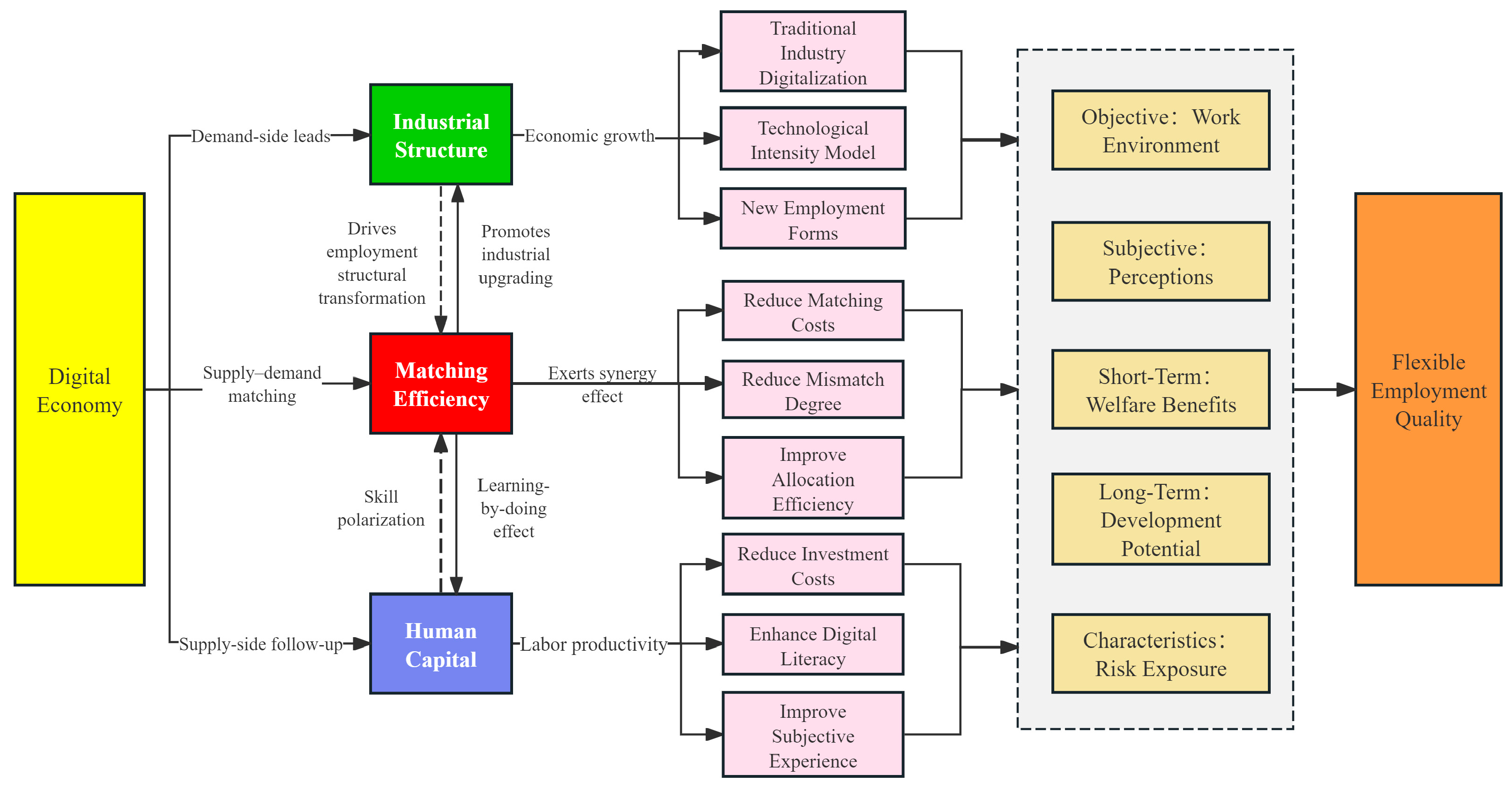
3.1. Digital Economy, Industrial Structure, and Flexible Employment Quality
3.2. Digital Economy, Human Capital, and Flexible Employment Quality
3.3. Digital Economy, Matching Efficiency, and Flexible Employment Quality
4. Method and Data
4.1. Empirical Method
4.2. Variable Selection and Description
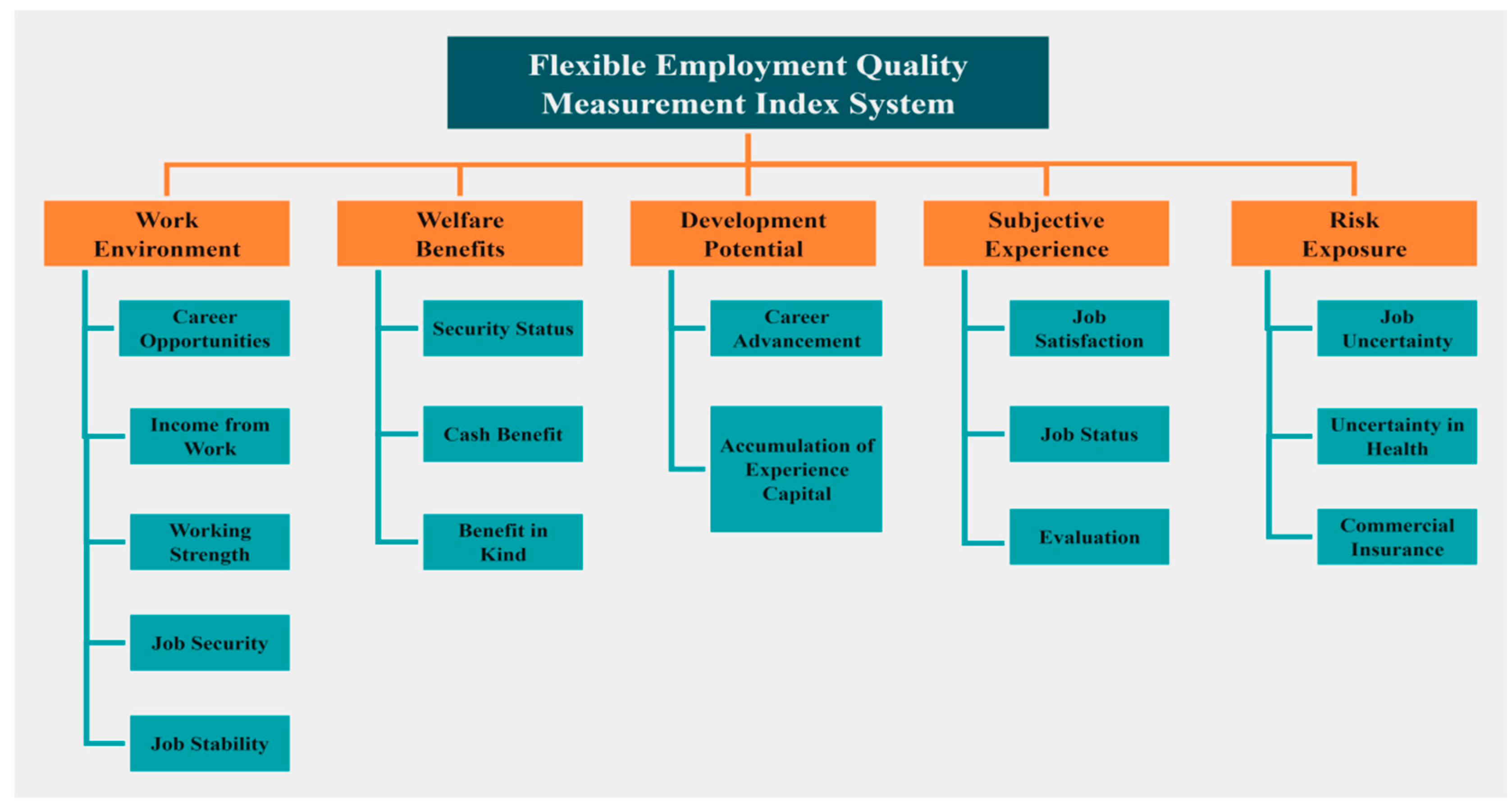
4.2.1. Dependent Variable: Flexible Employment Quality (qfe)
4.2.2. Core Explanatory Variables: Digital Economy (Deindex)
4.2.3. Mediating Variables
Industrial Structure
Human Capital
Matching Efficiency (Match)
4.2.4. Controlled Variables
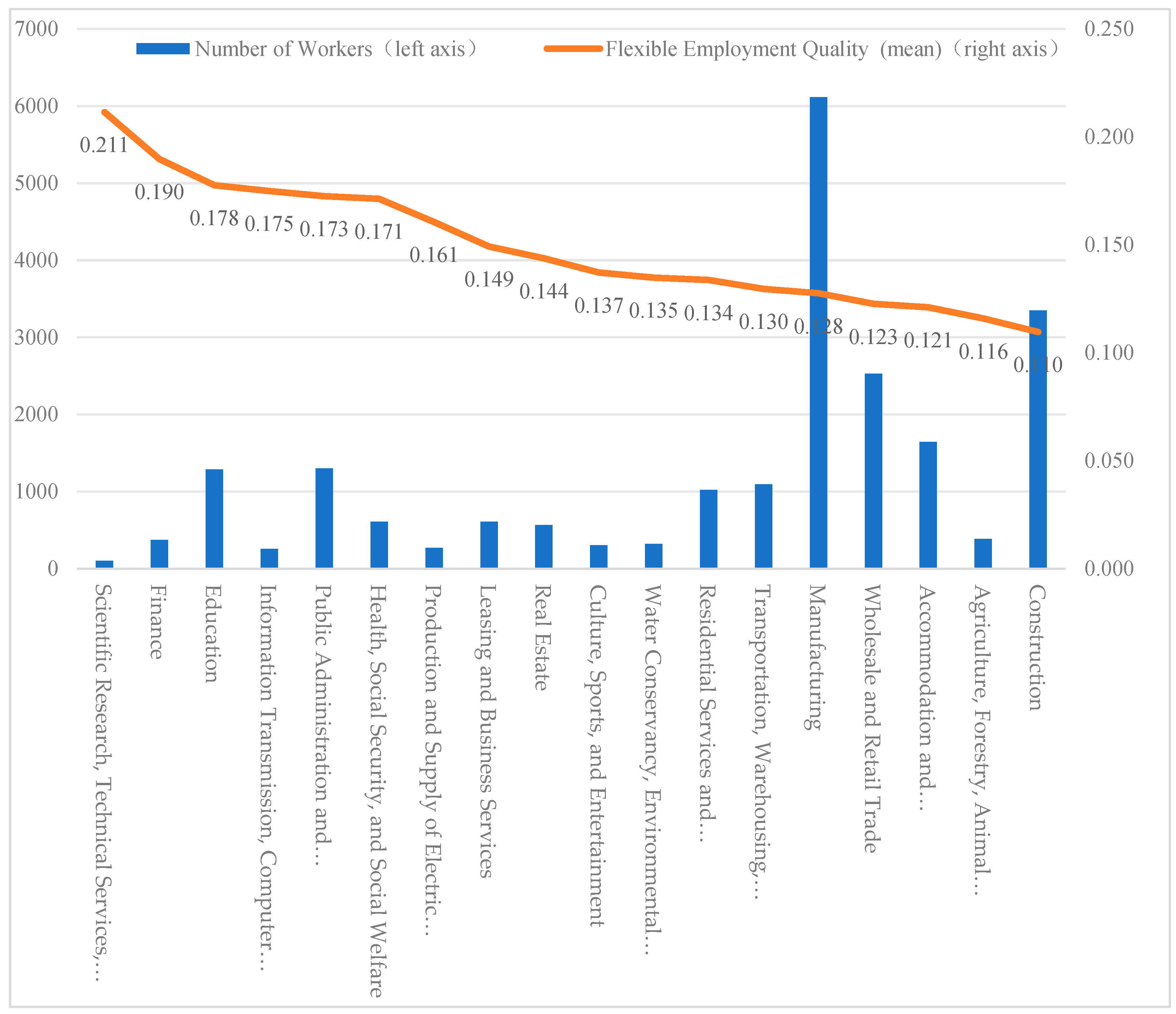
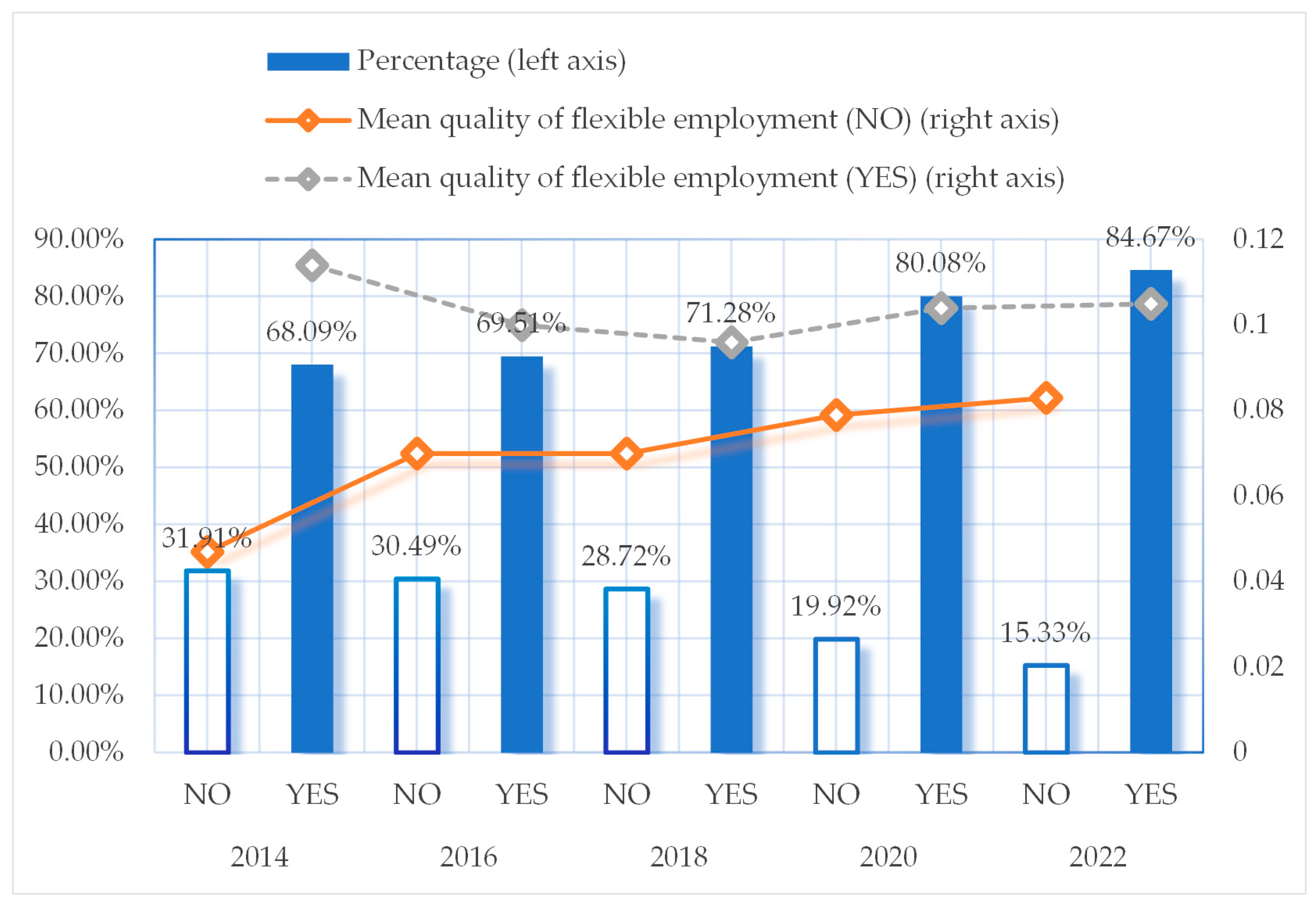
4.3. Data Sources and Descriptive Statistics
5. Empirical Results
5.1. Baseline Results
5.2. Endogeneity Test
5.3. Robustness Test
5.4. Heterogeneity Analysis
5.4.1. Individual Level
5.4.2. Family Level
5.4.3. Regional Level
6. Further Discussion: Spatial and Temporal Heterogeneity
6.1. Industrial Structure Mechanism Test
6.2. Human Capital Mechanism Test
6.3. Matching Efficiency Mechanism Test
7. Conclusions and Implications
7.1. Research Conclusions
7.2. Policy Implications
7.3. Limitations and Future Research Directions
Author Contributions
Funding
Institutional Review Board Statement
Informed Consent Statement
Data Availability Statement
Conflicts of Interest
Appendix A

| Primary Indicator | Secondary Indicator | Calculation Method | Direction |
|---|---|---|---|
| Work environment | Career opportunities | How many other jobs have you held in total (0–30)? | Forward direction |
| Income from work | Logarithm of total annual income (RMB). | Forward direction | |
| Working strength | Weekly working hours (hours). | Negative direction | |
| One-way commute time (minutes) (0–240 min). | Negative direction | ||
| Job security | Where is the main workplace for this job (flexible = 1; inflexible = 0)? | Forward direction | |
| Job stability | Is a labor contract signed? Yes = 1; No = 0. | Forward direction | |
| Welfare benefits | Security status | What types of insurance are covered by this job? Pension, medical, unemployment, work-related injury, and maternity insurance each count for 1 point, with none being 0. | Forward direction |
| Cash benefit | What cash benefits does this job offer? Transportation, meal, housing, and holiday benefits each count as 1 point, with none counted as 0. | Forward direction | |
| Benefit in kind | This job offers benefits in kind: free breakfast, lunch, and dinner; free accommodation; company-provided car or shuttle; and shopping cards or vouchers. Each item counts as 1 point, with no 0 points awarded. | Forward direction | |
| Development potential | Career advancement | Which of the following promotions is awarded for this job? Administrative promotion or technical title promotion is assigned a value of 1, and neither is assigned a value of 0. | Forward direction |
| Accumulation of experience capital | Work experience and income interaction term. | Forward direction | |
| Subjective experience | Job satisfaction | How satisfied are you with this job? 1. Very dissatisfied; 2. Not very satisfied 3. Average; 4. Relatively satisfied; 5. Very satisfied. | Forward direction |
| Job status | Is your income in the local area? 1 indicates very low, 5 indicates very high, and values range between 1 and 5. | Forward direction | |
| How would you rate your social standing locally? 1 indicates very low, 5 indicates very high, and values range between 1 and 5. | Forward direction | ||
| Evaluation | Life satisfaction: 1 means very dissatisfied, 5 means very satisfied, and scores range from 1 to 5. | Forward direction | |
| Confidence in one’s future: 1 indicates no confidence, 5 indicates very confident, and values range between 1 and 5. | Forward direction | ||
| Risk exposure | Job uncertainty | Expected probability of unemployment. | Negative direction |
| Uncertainty in healthcare spending | Sudden health expenditure. | Negative direction | |
| Commercial insurance uncertainty | Commercial paper face value. | Negative direction |
Appendix B
| Primary Indicator | Secondary Indicator | Tertiary Indicator | Unit | Attribute | Data Sources |
|---|---|---|---|---|---|
| Digital infrastructure | Network-based coverage | Optical cable line density | km/square km | Forward direction | State Statistical Bureau |
| Mobile phone base station density | Per square kilometer | Forward direction | |||
| Proportion of administrative villages with Internet broadband services | % | Forward direction | |||
| User access capability | Mobile penetration rate | Department/100 people | Forward direction | ||
| Internet users as a percentage of the Permanent population | % | Forward direction | |||
| Per capita telecom traffic | CNY/person | Forward direction | |||
| Digital industrialization | Size of the core digital industry | Software revenue | 100 million | Forward direction | |
| Information transmission, software, and information technology service industry Employees in urban units | Thousands of people | Forward direction | EPS database | ||
| Digital innovation capability | Full-time equivalent of r&d staff in high-tech enterprises | Per person/year | Forward direction | ||
| Number of granted patent applications | Piece | Forward direction | |||
| Development of digital transaction | Digital transaction basis | Number of domain names | Thousands | Forward direction | |
| Number of websites owned by the Enterprise | Individual | Forward direction | |||
| Ipv4 address count | Thousands | Forward direction | EPS database | ||
| Number of web pages | Thousands | Forward direction | State Statistical Bureau | ||
| Digital transaction effect | Number of enterprises engaged in e-commerce transactions | Individual | Forward direction | EPS database | |
| E-commerce sales | 100 million | Forward direction | |||
| Per capita express delivery volume | Items/person | Forward direction | |||
| Industrial digitization | Industrial convergence empowerment | Total index of integration of informatization and industrialization | / | Forward direction | Blue Book on the Evaluation of the Integration and Development Level of Informatization and Industrialization in China |
| Comprehensive development level | Digital inclusive finance composite index | / | Forward direction | Peking University Digital Inclusive Finance Index |
Appendix C
| Industry Type | Industry Category |
|---|---|
| Labor-intensive | Agriculture, forestry, animal husbandry and fishery; construction; wholesale and retail trade; accommodation and food services; labor-intensive manufacturing industries (including food processing, beverage manufacturing, tobacco products, textiles, textile apparel, footwear and hat manufacturing, leather, fur, feather and down products, wood processing, bamboo, rattan, palm and straw products, furniture manufacturing, paper and paper products, printing and recording media reproduction, cultural, educational and sports equipment manufacturing, rubber products, plastic products, non-metallic mineral products, waste resource and recycled material recycling, handicrafts, and other manufacturing sectors) |
| Capital-intensive | Warehousing and postal services, real estate, capital-intensive manufacturing (petroleum processing, coking and nuclear fuel processing, chemical raw materials and chemical products manufacturing, chemical fiber manufacturing, ferrous metal smelting and rolling, non-ferrous metal smelting and rolling, metal products manufacturing, general equipment manufacturing, specialized equipment manufacturing, transportation equipment manufacturing, electrical machinery, and equipment manufacturing) |
| Skill-intensive | Modern service industries (including information transmission, software and IT services, finance, leasing and business services, scientific research and technical services, education, healthcare and social work, culture, sports and entertainment, water conservancy, environmental and public facility management, public administration, social security and social organizations, international organizations, and other service sectors), as well as technology-intensive manufacturing industries (such as pharmaceutical manufacturing; production of communication equipment, computers, and other electronic devices; and manufacturing of instruments, meters, and cultural and office machinery). |
Appendix D
| Primary Indicator | Secondary Indicator | Tertiary Indicator |
|---|---|---|
| Tool Literacy | Use the device to access the internet | Do you use a mobile device to access the internet? |
| Do you use a computer to access the internet? | ||
| Technology Application Literacy | Do you have digital transaction skills? | Do you shop online? |
| Do you have digital entertainment skills? | Online entertainment | |
| Do you have digital learning skills? | Is it online learning? | |
| Information Literacy | Cognition of network value | The importance of the network in daily life |
References
- WORLD BANK. World Bank Annual Report 2021: From Crisis to Green, Resilient, and Inclusive Recovery; World Bank: Washington, DC, USA, 2021; Available online: https://documents.worldbank.org/en/publication/documents-reports/documentdetail/120541633011500775 (accessed on 1 October 2021).
- New Beijing Think Tank. Research Report on the Development of Flexible Employment in the Digital Economy. 2026. Available online: https://m.bjnews.com.cn/detail/1750053120168068.html (accessed on 16 June 2025).
- China Academy of Information and Communications Technology. China Digital Economy Development Research Report. 2024. Available online: https://www.caict.ac.cn/kxyj/qwfb/bps/202408/P020240830315324580655.pdf (accessed on 16 August 2024).
- Liu, W.; Suzuki, Y.; Du, S. Ensemble learning algorithms based on easyensemble sampling for financial distress prediction. Ann. Oper. Res. 2025, 346, 2141–2172. [Google Scholar] [CrossRef] [Scilit]
- Liu, W.; Suzuki, Y.; Du, S. Forecasting the stock price of listed innovative SMEs using machine learning methods based on Bayesian optimization: Evidence from China. Comput. Econ. 2024, 63, 2035–2068. [Google Scholar] [CrossRef] [Scilit]
- Meekes, J.; Hassink, W.H. Gender differences in job flexibility: Commutes and working hours after job loss. J. Urban Econ. 2022, 129, 103425. [Google Scholar] [CrossRef] [Scilit]
- Rafner, J.; Dellermann, D.; Hjorth, A.; Verasztó, D.; Kampf, C.; Mackay, W.; Sherson, J. Deskilling, upskilling, and reskilling: A case for hybrid intelligence. Morals Mach. 2021, 1, 24–39. [Google Scholar] [CrossRef] [Scilit]
- Smith, M.; Burchell, B.; Fagan, C. Job quality in Europe. Ind. Relations J. 2008, 39, 586–603. [Google Scholar] [CrossRef] [Scilit]
- Kalleberg, A.L. Good Jobs, Bad Jobs; Russell Sage Foundation: New York, NY, USA, 2013; ISBN 9780871544803. [Google Scholar]
- Kalleberg, A.L.; Vaisey, S. Pathways to a good job: Perceived work quality among the machinists in North America. Br. J. Ind. Relations 2005, 43, 431–454. [Google Scholar] [CrossRef] [Scilit]
- ILO. Employment and Decent Work for Peace and Resilience Recommendation, 2017 (No. 205). Available online: https://www.ilo.org/resource/ilc/106/employment-and-decent-work-peace-and-resilience-recommendation-2017-no-205 (accessed on 16 June 2017).
- Bales, K.; Bogg, A.; Novitz, T. Voice’ and ‘choice’ in modern working practices: Problems with the Taylor review. Ind. Law J. 2018, 47, 46–75. [Google Scholar] [CrossRef] [Scilit]
- Burtch, G.; Carnahan, S.; Greenwood, B.N. Can you gig it? An empirical examination of the gig economy and entrepreneurial activity. Manag. Sci. 2018, 64, 5497–5520. [Google Scholar] [CrossRef] [Scilit]
- Aroles, J.; Cecez-Kecmanovic, D.; Dale, K.; Kingma, S.F.; Mitev, N. New ways of working (NWW): Workplace transformation in the digital age. Inf. Organ. 2021, 31, 100378. [Google Scholar] [CrossRef] [Scilit]
- Bauernschuster, S.; Falck, O.; Woessmann, L. Surfing Alone? The Internet and Social Capital: Evidence from an Unforeseeable Technological Mistake. J. Public Econ. 2014, 117, 73–89. [Google Scholar] [CrossRef] [Scilit]
- Rubery, J.; Grimshaw, D.; Keizer, A.; Johnson, M. Challenges and Contradictions in the ‘Normalising’ of Precarious Work. Work Employ. Soc. 2018, 32, 509–527. [Google Scholar] [CrossRef] [Scilit]
- Wood, A.J.; Graham, M.; Lehdonvirta, V.; Hjorth, I. Good Gig, Bad Gig: Autonomy and Algorithmic Control in the Global Gig Economy. Work Employ. Soc. 2019, 33, 56–75. [Google Scholar] [CrossRef] [Scilit]
- Aghion, P.; Antonin, C.; Bunel, S. Artificial intelligence, growth and employment: The role of policy. Econ. Stat. Econ. Stat. 2019, 510–512, 149–164. [Google Scholar] [CrossRef] [Scilit]
- Giuntella, O.; Lu, Y.; Wang, T. How do workers adjust to robots? Evidence from China. Econ. J. 2025, 666, 637–652. [Google Scholar] [CrossRef] [Scilit]
- Autor, D.; Salomons, A. Is Automation Labor Share-Displacing? Productivity Growth, Employment, and the Labor Share; Brookings Paperson Economic Activity; The Johns Hopkins University: Baltimore, MD, USA, 2018. [Google Scholar]
- Koutsimpogiorgos, N.; Van Slageren, J.; Herrmann, A.M.; Frenken, K. Conceptualizing the gig economy and its regulatory problems. Policy Internet 2020, 12, 525–545. [Google Scholar] [CrossRef] [Scilit]
- Zhan, Y.; Yang, S. Does internet use improve employment?—Empirical evidence from China. PLoS ONE 2024, 19, e0301465. [Google Scholar] [CrossRef] [Scilit] [PubMed]
- Picatoste, X.; Mesquita, A.; González-Laxe, F. Gender wage gap, quality of earnings and gender digital divide in the European context. Empirica 2023, 50, 301–321. [Google Scholar] [CrossRef] [Scilit]
- Huang, N.; Burtch, G.; Hong, Y.; Pavlou, P.A. Unemployment and Worker Participation in the Gig Economy: Evidence from an Online Labor Market. Inf. Syst. Res. 2020, 31, 431–448. [Google Scholar] [CrossRef] [Scilit]
- Stanton, C.T.; Thomas, C. Who Benefits from Online Gig Economy Platforms? Am. Econ. Rev. 2025, 115, 1857–1895. [Google Scholar] [CrossRef] [Scilit]
- Autor, D.; Dorn, D.; Katz, L.F.; Patterson, C.; Van Reenen, J. The Fall of the Labor Share and the Rise of Superstar Firms. Q. J. Econ. 2020, 135, 645–709. [Google Scholar] [CrossRef] [Scilit]
- Myhill, K.; Richards, J.; Sang, K. Job quality, fair work and gig work: The lived experience of gig workers. Int. J. Hum. Resour. Manag. 2021, 19, 4110–4135. [Google Scholar] [CrossRef] [Scilit]
- Berg, J.; Green, F.; Nurski, L.; Spencer, D.A. Risks to job quality from digital technologies: Are industrial relations in Europe ready for the challenge? Eur. J. Ind. Relations 2023, 29, 347–365. [Google Scholar] [CrossRef] [Scilit]
- Xiang, S.; Li, Y. Digital Economic Development and Employment Welfare Improvement: A Perspective Based on Capabilities. Labor Econ. Res. 2025, 13, 52–76. [Google Scholar]
- Zhang, G.; Deng, J.; Zhang, F. The Impact of China’s Population Aging on the Upgrading and Transformation of Manufacturing Industry. China Popul. Sci. 2021, 4, 33–44+126–127. [Google Scholar]
- GB/T 4754-2011; National Economic Industry Classification. National Bureau of Statistics: Beijing, China, 2018.
- Chen, X.; Yang, X. The Impact of Digital Economic Development on Industrial Structure Upgrading: A Study Based on Grey Correlation Entropy and Dissipative Structure Theory. Reform 2021, 3, 26–39. [Google Scholar]
- Sun, H.; Liu, H.; Zhang, M. Digital Technology Innovation and Income Stability of the Middle-Income Group. Stud. Econ. Manag. 2026, 47, 116–130. [Google Scholar]
- Wang, J.; Zhu, T.; Guo, Q. Digital Economy, Search Friction and Non-Agricultural Employment. Econ. Res. J. 2025, 8, 76–94. [Google Scholar]
- Bai, P.; Lin, S. Industrial Digitalization and Labor Skill Matching under the Background of New Quality Productivity. Econ. Res. J. 2025, 10, 37–56. [Google Scholar]
- Yang, H.; Li, C.; Sun, Z. The impact mechanism of work experience on the income of flexible workers: Evidence from China. Sustainability 2023, 15, 16422. [Google Scholar] [CrossRef] [Scilit]
- Chen, Z.; Yan, H.; Zhang, J. The Impact of Digital Economy on Residents’ Subjective Well-being—An Empirical Study Based on CGSS Micro Data. Stat. Decis. 2025, 41, 94–99. [Google Scholar] [CrossRef]
- He, Z.; Song, X. The Mechanism and Enlightenment of Digital Economy in Promoting Employment: Thoughts After the Outbreak of Epidemic. Economist 2020, 5, 58–68. [Google Scholar] [CrossRef]
- Nunn, N.; Qian, N. US food aid and civil conflict. Am. Econ. Rev. 2014, 104, 1630–1666. [Google Scholar] [CrossRef] [Scilit]
- Sui, S.; Xia, Z. The Differentiation Effect of Employment Quality in the Development of Digital Economy: An Analysis from the Perspective of Labor Skills and Regional Heterogeneity. J. Chongqing Univ. (Soc. Sci. Ed.) 2025, 1–17. [Google Scholar]
- Liu, W.; Suzuki, Y.; Zhang, R. High-speed rail construction, heterogeneity, and firm value in Chinese SMEs. Appl. Econ. Lett. 2025, 1–10. [Google Scholar] [CrossRef] [Scilit]
- Liu, W.; Suzuki, Y. Stock liquidity, financial constraints, and innovation in Chinese SMEs. Financ. Innov. 2025, 10, 91. [Google Scholar] [CrossRef] [Scilit]
- Liu, W.; Suzuki, Y. Corporate governance, institutional ownership, and stock liquidity of SMEs: Evidence from China. Asia-Pac. J. Account. Econ. 2025, 32, 299–328. [Google Scholar] [CrossRef] [Scilit]
- Hafkin, N.J.; Huyer, S. Women and gender in ICT statistics and indicators for development. Inf. Technol. Int. Dev. 2007, 4, 25–41. [Google Scholar] [CrossRef] [Scilit]
- Jiang, T. Mediating and moderating effects in causal inference empirical research. China Ind. Econ. 2022, 5, 100–120. [Google Scholar] [CrossRef]
- Buera, F.J.; Kaboski, J.P.; Rogerson, R.; Vizcaino, J.I. Skill-Biased Structural Change. Rev. Econ. Stud. 2022, 2, 592–625. [Google Scholar] [CrossRef] [Scilit]
- Acemoglu, D. Technical change, inequality, and the labor market. J. Econ. Lit. 2002, 40, 7–72. [Google Scholar] [CrossRef]
- Romer, P.M. Human capital and growth: Theory and evidence. In Carnegie-Rochester Conference Series on Public Policy; North-Holland: Amsterdam, The Netherlands, 1989; Volume 31, pp. 291–334. [Google Scholar]
- Card, D. The causal effect of education on earnings. Handb. Labor Econ. 1999, 3, 1801–1863. [Google Scholar]
- Acemoglu, D.; Restrepo, P. Robots and jobs: Evidence from US labor markets. J. Political Econ. 2020, 128, 2188–2244. [Google Scholar] [CrossRef] [Scilit]
- Wang, J. Can digital literacy improve income mobility? Evidence from China. Telecommun. Policy 2025, 49, 102960. [Google Scholar] [CrossRef] [Scilit]
- Meng, X. Unemployment, consumption smoothing, and precautionary saving in urban China. J. Comp. Econ. 2003, 31, 465–485. [Google Scholar] [CrossRef] [Scilit]
- Xiao, H.; Ge, W. The Impact and Mechanism of Flexicurity Uncertainty on Fertility Behavior. Zhejiang Acad. J. 2025, 5, 226–237. [Google Scholar] [CrossRef]
- Zhang, L.; Yi, X.; Yang, B. Commercial Insurance, Digital Economy and People’s Sense of Happiness under the Background of Common Prosperity Goal: Empirical Evidence from Household Survey Data. Stud. Financ. Econ. Sci. 2022, 37, 42–60. Available online: http://dianda.cqvip.com/Qikan/Article/Detail?id=7107113590&from=Qikan_Article_Detail (accessed on 1 January 2026).


| Type of Variable | Variable Name | Symbol | No. | Mean | Standard Deviation | Lowest Value | Crest Value |
|---|---|---|---|---|---|---|---|
| Explained variable | Quality of Flexible Employment | qfe | 16,281 | 0.138 | 0.103 | 0.009 | 0.748 |
| Explanatory variable | Digital Economy | deindex | 16,281 | 0.207 | 0.133 | 0.042 | 0.613 |
| Individual-level control variables | Age | age | 16,281 | 38.19 | 11.884 | 18 | 65 |
| Sex | gen | 16,281 | 0.552 | 0.497 | 0 | 1 | |
| Hukou | hukou | 16,281 | 0.795 | 0.404 | 0 | 1 | |
| Political Status | communist | 16,281 | 0.03 | 0.17 | 0 | 1 | |
| Health | health | 16,281 | 3.304 | 1.096 | 1 | 5 | |
| Marriage | marriage | 16,281 | 0.759 | 0.428 | 0 | 1 | |
| Household-level control variables | Size of Family Population | fml | 16,281 | 4.108 | 2.018 | 1 | 15 |
| Child Eependency Ratio | childr | 16,281 | 0.307 | 0.424 | 0 | 6 | |
| Age Dependency Ratio | elderr | 16,281 | 0.127 | 0.307 | 0 | 3 | |
| Savings | sav | 16,281 | 65,929.133 | 197,303.42 | 0 | 7,000,000 | |
| Informal Finance | unfinance | 16,281 | 0.137 | 0.344 | 0 | 1 | |
| Bank Advance | bankloan | 16,281 | 0.109 | 0.311 | 0 | 1 | |
| Regional characteristic control variable | Jobless Rate | unemploy | 16,281 | 3.153 | 0.642 | 1.35 | 5.15 |
| Urban Economic Density | codensity | 16,281 | 5244.769 | 11,808.369 | 60.311 | 76,987.586 | |
| Metavariable | Industrial Structure | Industrial1 Industrial2 | 16,281 16,281 | 0.109 242.735 | 0.068 9.544 | 0.024 222.5 | 0.264 283.8 |
| Human Capital | Human1 Human1 | 5976 16,281 | 0.065 1.924 | 0.466 0.834 | 1.723 0.993 | 1.124 5.302 | |
| Atching Efficiency | Match1 Match1 | 14,963 14,963 | 0.014 0.771 | 1.493 0.620 | 8.714 4.994 | 5.988 0 |
| Variables | (1) | (2) | (3) | (4) |
|---|---|---|---|---|
| OLS | FE | RE | MFE | |
| deindex | 0.033 *** | 0.060 ** | 0.044 *** | 0.163 ** |
| (4.34) | (2.27) | (5.70) | (2.44) | |
| age | −0.001 *** | 0.004 *** | −0.001 *** | −0.001 |
| (−14.23) | (6.28) | (−13.03) | (−0.22) | |
| gen | 0.008 *** | −0.004 | 0.008 *** | −0.003 |
| (4.97) | (−0.11) | (4.42) | (−0.10) | |
| hukou | −0.021 *** | −0.002 | −0.020 *** | −0.003 |
| (−9.86) | (−0.30) | (−9.20) | (−0.59) | |
| communist | 0.027 *** | 0.039 ** | 0.028 *** | 0.038 ** |
| (5.38) | (2.28) | (5.89) | (2.06) | |
| health | 0.002 *** | 0.003 * | 0.003 *** | 0.003 * |
| (3.41) | (1.84) | (3.50) | (1.85) | |
| marriage | 0.009 *** | 0.011 | 0.010 *** | 0.011 |
| (3.90) | (1.62) | (4.15) | (1.49) | |
| fml | −0.000 | 0.002 * | −0.000 | 0.001 |
| (−0.33) | (1.68) | (−0.83) | (1.14) | |
| childr | 0.000 | −0.001 | 0.001 | −0.002 |
| (0.09) | (−0.25) | (0.39) | (−0.51) | |
| elderr | −0.005 * | −0.008 | −0.004 | −0.008 |
| (−1.95) | (−1.49) | (−1.42) | (−1.46) | |
| sav | 0.000 *** | 0.000 ** | 0.000 *** | 0.000 ** |
| (5.87) | (1.99) | (9.56) | (2.06) | |
| unfinance | −0.007 *** | −0.000 | −0.006 ** | −0.000 |
| (−3.00) | (−0.04) | (−2.41) | (−0.00) | |
| bankloan | 0.025 *** | 0.006 | 0.023 *** | 0.005 |
| (9.22) | (1.44) | (8.77) | (1.08) | |
| unemploy | −0.002 | 0.001 | −0.001 | −0.000 |
| (−1.29) | (0.31) | (−0.83) | (−0.07) | |
| ecodensity | 0.000 *** | −0.000 | 0.000 *** | −0.000 |
| (5.96) | (−0.51) | (6.14) | (−0.49) | |
| _cons | 0.169 *** | −0.059 * | 0.165 *** | 0.127 |
| (24.29) | (−1.81) | (23.06) | (0.61) | |
| individual fixation | YES | YES | ||
| Fixed time | NO | YES | ||
| Province fixed | NO | YES | ||
| Obs. | 16,281 | 16,281 | 16,281 | 9154 |
| Variables | IV1 | IV2 | IV3 | |||
|---|---|---|---|---|---|---|
| deindex | qfe | deindex | qfe | deindex | qfe | |
| Instrumental variable | 0.011 *** (9.44) | 0.001 *** (15.63) | 0.001 *** (9.86) | |||
| deindex | 0.185 *** (8.32) | 0.641 *** (8.41) | 0.878 *** (6.48) | |||
| _cons | 0.423 *** (28.74) | 0.105 *** (9.31) | 0.372 *** (46.33) | −0.087 *** (−2.63) | 0.385 *** (46.82) | −0.186 *** (−3.24) |
| Controlled variable | YES | YES | YES | YES | YES | YES |
| Individual fixation | YES | YES | YES | YES | YES | YES |
| Fixed time | YES | YES | YES | YES | YES | YES |
| Province fixed | YES | YES | YES | YES | YES | YES |
| Anderson canon. corr.LM statistic | 1784.687 | 211.614 | 85.910 | |||
| Cragg–Donald Wald F-statistic | 667.396 | 214.190 | 86.281 | |||
| Obs. | 16,281 | 16,281 | 16,281 | 16,281 | 16,281 | 16,281 |
| Variables | (1) | (2) | (3) | (4) | (5) | (6) |
|---|---|---|---|---|---|---|
| Fractional Logit Model | Tobit Model | PCA Method for Measuring Digital Economy Index | Remove Outliers | Lagged Explanatory Variable | Relaxing the Age Boundary | |
| dy/dx Deindex | 0.283 *** (4.39) | 0.041 *** (5.43) | 0.035 *** (2.76) | 0.164 ** (2.45) | 0.178 *** (2.69) | 0.174 *** (2.64) |
| Pseudo r2/r2 | 0.0049 | 0.585 | 0.585 | 0.585 | 0.586 | |
| sigma_u | 0.051 *** (35.18) | |||||
| sigma_e | 0.087 *** (105.51) | |||||
| Controlled variable | YES | YES | YES | YES | ||
| Individual fixation | YES | YES | YES | YES | ||
| Fixed time | YES | YES | YES | YES | ||
| Province fixed | YES | YES | YES | YES | ||
| Obs. | 16,281 | 16,281 | 9154 | 9154 | 9154 | 9282 |
| Variables | (1) | (2) | (3) | (4) | (5) | |||||
|---|---|---|---|---|---|---|---|---|---|---|
| Sex Heterogeneity | Skill Heterogeneity | Age Heterogeneity | Heterogeneity of the Family Dependency Ratio | Regional Heterogeneity | ||||||
| Female | Male | Low | High | 36–65 | 18–35 | Low | High | Northwest Side | Southeastern Side | |
| Digital economy | 0.011 (0.12) | 0.301 *** (3.19) | 0.186 *** (2.63) | 0.066 (0.27) | 0.104 (1.20) | 0.274 ** (2.33) | 0.187 *** (2.62) | −0.399 (−0.72) | 9.456 * (1.85) | 0.161 ** (2.38) |
| r2 | 0.579 | 0.594 | 0.569 | 0.617 | 0.579 | 0.594 | 0.586 | 0.704 | 0.593 | 0.586 |
| Controlled variable | YES | YES | YES | YES | YES | YES | YES | YES | YES | YES |
| Individual fixation | YES | YES | YES | YES | YES | YES | YES | YES | YES | YES |
| Fixed time | YES | YES | YES | YES | YES | YES | YES | YES | YES | YES |
| Province fixed | YES | YES | YES | YES | YES | YES | YES | YES | YES | YES |
| Obs. | 4069 | 5070 | 7815 | 1145 | 4802 | 3840 | 8829 | 108 | 1022 | 7998 |
| Variables | (1) | (2) | (3) | (4) | (5) |
|---|---|---|---|---|---|
| Industrial Structure | Heterogeneous Coefficient of Industrial Structure | Lagging First-Generation Digital Economy | The Measurement of the Digital Economy via PCA | Digital Economy Excluding the Outliers | |
| deindex | 0.375 *** | 14.406 *** | 0.375 *** | ||
| (20.09) | (8.89) | (20.09) | |||
| deindex_lag | 0.356 *** | ||||
| (19.46) | |||||
| Deindex_pca | 0.067 *** | ||||
| (18.12) | |||||
| _cons | 0.220 *** | 224.925 *** | 0.239 *** | 0.223 *** | 0.220 *** |
| (4.81) | (35.63) | (4.94) | (4.83) | (4.81) | |
| r2 | 0.951 | 0.953 | 0.951 | 0.951 | 0.951 |
| Controlled variable | YES | YES | YES | YES | YES |
| Individual fixation | YES | YES | YES | YES | YES |
| Fixed time | YES | YES | YES | YES | YES |
| Province fixed | YES | YES | YES | YES | YES |
| Obs. | 9154 | 9154 | 9154 | 9154 | 9154 |
| Human Capital | Labor Average Human Capital | Expand the Age Range | The Measurement of the Digital Economy via PCA | Digital Economy Excluding the Outliers | |
|---|---|---|---|---|---|
| deindex | 1.511 ** | 0.392 *** | 1.494 ** | 1.527 ** | |
| (2.40) | (5.56) | (2.37) | (2.43) | ||
| deindex2 | 0.311 ** | ||||
| (2.62) | |||||
| _cons | 8.512 | −0.733 ** | 8.508 | 8.077 | 8.518 |
| (0.95) | (−2.31) | (0.94) | (0.88) | (0.95) | |
| r2 | 0.776 | 0.999 | 0.777 | 0.776 | 0.776 |
| Controlled variable | YES | YES | YES | YES | YES |
| Individual fixation | YES | YES | YES | YES | YES |
| Fixed time | YES | YES | YES | YES | YES |
| Province fixed | YES | YES | YES | YES | YES |
| Obs. | 1892 | 1892 | 1896 | 1892 | 1892 |
| Variables | Matching Efficiency 1 | Matching Efficiency 2 | Lagging First-Generation Digital Economy | Digital Economy Excluding the Outliers | Expand the Age Range |
|---|---|---|---|---|---|
| deindex | 5.883 *** (7.92) | 0.530 * (1.84) | 5.883 *** (7.92) | 5.978 *** (8.11) | |
| deindex_lag | 6.971 *** (8.67) | ||||
| _cons | −5.881 ** (−2.00) | −0.288 (−0.27) | −6.142 ** (−2.09) | −5.881 ** (−2.00) | −5.620 * (−1.92) |
| r2 | 0.575 | 0.806 | 0.577 | 0.575 | 0.577 |
| Controlled variable | YES | YES | YES | YES | YES |
| Individual fixation | YES | YES | YES | YES | YES |
| Fixed time | YES | YES | YES | YES | YES |
| Province fixed | YES | YES | YES | YES | YES |
| Obs. | 8070 | 8070 | 8070 | 8070 | 8180 |
Disclaimer/Publisher’s Note: The statements, opinions and data contained in all publications are solely those of the individual author(s) and contributor(s) and not of MDPI and/or the editor(s). MDPI and/or the editor(s) disclaim responsibility for any injury to people or property resulting from any ideas, methods, instructions or products referred to in the content. |
© 2026 by the authors. Licensee MDPI, Basel, Switzerland. This article is an open access article distributed under the terms and conditions of the Creative Commons Attribution (CC BY) license.
Share and Cite
Guan, Y.; Deng, J.; Liu, W.; Suzuki, Y. The Digital Economy and Flexible Employment Quality: Empirical Evidence from China. Sustainability 2026, 18, 2254. https://doi.org/10.3390/su18052254
Guan Y, Deng J, Liu W, Suzuki Y. The Digital Economy and Flexible Employment Quality: Empirical Evidence from China. Sustainability. 2026; 18(5):2254. https://doi.org/10.3390/su18052254
Chicago/Turabian StyleGuan, Yuzhu, Jingjing Deng, Wei Liu, and Yoshihisa Suzuki. 2026. "The Digital Economy and Flexible Employment Quality: Empirical Evidence from China" Sustainability 18, no. 5: 2254. https://doi.org/10.3390/su18052254
APA StyleGuan, Y., Deng, J., Liu, W., & Suzuki, Y. (2026). The Digital Economy and Flexible Employment Quality: Empirical Evidence from China. Sustainability, 18(5), 2254. https://doi.org/10.3390/su18052254