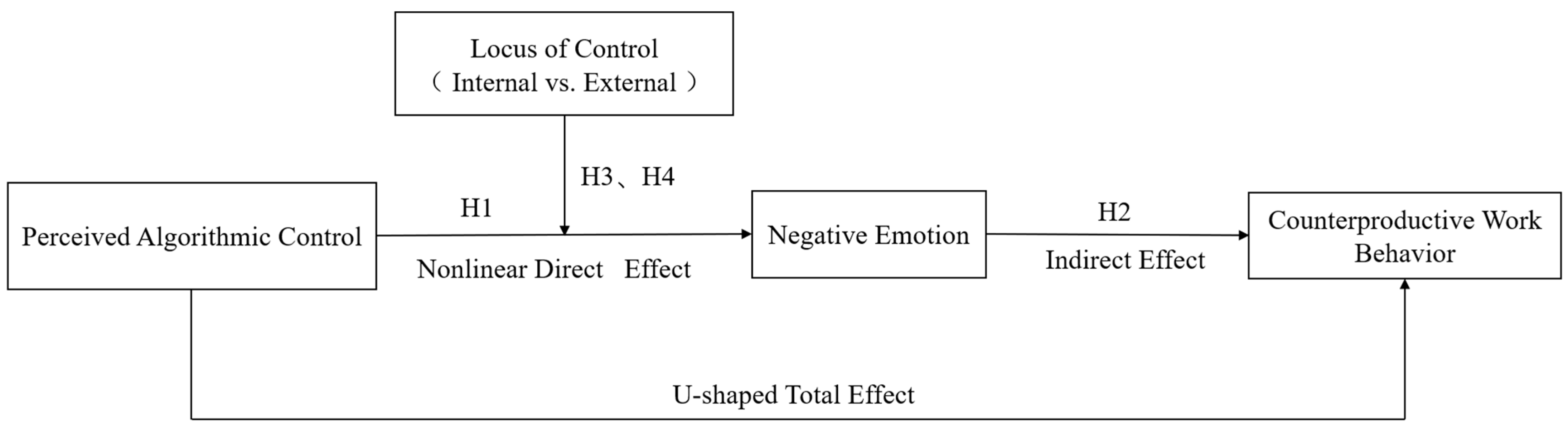


Research on the Nonlinear Mechanism of Gig Workers’ Perception of Algorithmic Control and Their Counterproductive Work Behaviors
Abstract
1. Introduction
2. Theoretical Foundations and Research Hypothesis
2.1. Theoretical Foundations
2.2. The Relationship Between Perception Algorithm Control and Negative Emotions
2.3. The Relationship Between Negative Emotions and Counterproductive Work Behavior
2.4. The Moderating Role of Locus of Control
3. Methods
3.1. This Research Subjects and Sample Characteristics
3.2. Variable Measurement
4. Results
4.1. Common Method Bias Test
4.2. Confirmatory Factor Analysis
4.3. Descriptive and Correlation
4.4. Hypothesis Testi
5. Discussion
5.1. Theoretical Contributions
5.2. Practical Implications
5.3. Limitations and Future Research
Author Contributions
Funding
Institutional Review Board Statement
Informed Consent Statement
Data Availability Statement
Acknowledgments
Conflicts of Interest
References
- Chen, Q.; Jiang, D.; Liu, T. The different influences of loyalty versus ability on employee counterproductive work behavior. Soft Sci. 2022, 36, 1001–8409. [Google Scholar]
- Kuhn, K.M.; Maleki, A. Micro-Entrepreneurs, Dependent Contractors, and Instaserfs: Understanding Online Labor Platform Workforces. Acad. Manag. Perspect. 2017, 31, 183–200. [Google Scholar] [CrossRef]
- Li, S.Q.; Zhang, Z.B.; Zhao, W.W.; Zhang, J. Research on the Formation Mechanism of Social Deviant Behaviors of Gig Workers from an Algorithmic Control Perspectiv. Strategy Manag. 2024, 44, 96–104. [Google Scholar] [CrossRef]
- Li, C.; Lin, C.-L.; Chin, T. How Does the Paradoxical Leadership of Cross-Border e-Commerce (CBEC) Gig Workers Influence Chinese Company Performance: The Role of Psychological Well-Being. Sustainability 2022, 14, 12307. [Google Scholar] [CrossRef]
- Xu, H.; Yu, Y.; Zhang, Y. Birth of the Rider: Digital Platforms, Targeted Matching and Job Creation. China Ind. Econ. 2024, 114–132. [Google Scholar] [CrossRef]
- Ashford, S.J.; Caza, B.B.; Reid, E.M. From surviving to thriving in the gig economy: A research agenda for individuals in the new world of work. Res. Organ. Behav. 2018, 38, 23–41. [Google Scholar] [CrossRef]
- Christie, N.; Ward, H. The health and safety risks for people who drive for work in the gig economy. J. Transp. Health 2019, 13, 115–127. [Google Scholar]
- Feng, X.; Zhan, J. Research on Labor Process in Platform Economy in the Age of AI—Taking the Take-away Riders as an Example. J. Soc. Dev. 2019, 3, 61–83. [Google Scholar]
- Oviedo-Trespalacios, O.; Rubie, E.; Haworth, N. Risky business: Comparing the riding behaviours of food delivery and private bicycle riders. Accid. Anal. Prev. 2022, 177, 106820. [Google Scholar] [CrossRef] [PubMed]
- Shen, Q.; Zhang, J. MFTFormer: Meteorological-Frequency-Temporal Transformer with Block-Aligned Fusion for Traffic Flow Prediction. Res. Sq. 2026. preprint. [Google Scholar]
- Liu, D.; Shen, Q.; Liu, J. The Health-Wealth Gradient in Labor Markets: Integrating Health, Insurance, and Social Metrics to Predict Employment Density. Computation 2026, 14, 22. [Google Scholar] [CrossRef]
- Lang, J.J.; Yang, L.F.; Cheng, C.; Cheng, X.Y.; Chen, F.Y. Are algorithmically controlled gig workers deeply burned out? An empirical study on employee work engagement. BMC Psychol. 2023, 11, 354. [Google Scholar] [CrossRef]
- Duggan, J.; Sherman, U.; Carbery, R.; McDonnell, A. Algorithmic management and app-work in the gig economy: A research agenda for employment relations and HRM. Hum. Resour. Manag. J. 2020, 30, 114–132. [Google Scholar] [CrossRef]
- Wood, A.J.; Graham, M.; Lehdonvirta, V.; Hjorth, I. Good Gig, Bad Gig: Autonomy and Algorithmic Control in the Global Gig Economy. Work Employ. Soc. 2019, 33, 56–75. [Google Scholar] [CrossRef]
- Pignot, E. Who is pulling the strings in the platform economy? Accounting for the dark and unexpected sides of algorithmic control. Organization 2023, 30, 140–167. [Google Scholar] [CrossRef]
- Waldkirch, M.; Bucher, E.; Schou, P.K.; Grünwald, E. Controlled by the algorithm, coached by the crowd—How HRM activities take shape on digital work platforms in the gig economy. Int. J. Hum. Resour. Manag. 2021, 32, 2643–2682. [Google Scholar] [CrossRef]
- Möhlmann, M.; Zalmanson, L.; Henfridsson, O.; Gregory, R.W. Algorithmic management of work on online labor platforms: When matching meets control. MIS Q. 2021, 45, 1999–2022. [Google Scholar] [CrossRef]
- Pei, J.; Liu, S.; Cui, X.; Zhang, Z.; Ge, C. Dose algorithmic control motivates gig workers to offer the proactive services?—Based on the perspective of work motivation. Nankai Bus. Rev. 2024, 24, 104–117. [Google Scholar]
- Grant, A.M.; Nurmohamed, S.; Ashford, S.J.; Dekas, K. The performance implications of ambivalent initiative: The interplay of autonomous and controlled motivations. Organ. Behav. Hum. Decis. Process. 2011, 116, 241–251. [Google Scholar] [CrossRef]
- Cram, W.A.; Wiener, M.; Tarafdar, M.; Benlian, A. Examining the Impact of Algorithmic Control on Uber Drivers’ Technostress. J. Manag. Inf. Syst. 2022, 39, 426–453. [Google Scholar] [CrossRef]
- Hajiheydari, N.; Delgosha, M.S. Investigating engagement and burnout of gig-workers in the age of algorithms: An empirical study in digital labor platforms. Inf. Technol. People 2024, 37, 2489–2522. [Google Scholar] [CrossRef]
- Kellogg, K.C.; Valentine, M.A.; Christin, A. Algorithms at Work: The New Contested Terrain of Control. Acad. Manag. Ann. 2020, 14, 366–410. [Google Scholar] [CrossRef]
- Shevchuk, A.; Strebkov, D.; Davis, S.N. The Autonomy Paradox: How Night Work Undermines Subjective Well-Being of Internet-Based Freelancers. Ilr Rev. 2019, 72, 75–100. [Google Scholar] [CrossRef]
- Yu, P.J.L.S.Z.Z.X. Good algorithms, bad algorithms: Research on the gig workers′ overwork under the algorithmic logic. J. Ind. Eng. Eng. Manag. 2024, 38, 101–115. [Google Scholar]
- Lv, C.L.; Cao, Y.D.; Feng, Y.; Fan, L.L.; Zhang, J.Y.; Song, Y.H.; Liu, H.; Gao, G.G. Crosslinked Vinyl-Capped Polyoxometalates to Construct a Three-Dimensional Porous Inorganic–Organic Catalyst to Effectively Suppress Polysulfide Shuttle in Li–S Batteries. Adv. Energy Mater. 2025, 8, 1. [Google Scholar] [CrossRef]
- Lazarus, R.S. Progress on a cognitive-motivational-relational theory of emotion. Am. Psychol. 1991, 46, 819. [Google Scholar] [CrossRef] [PubMed]
- Cacciotti, G.; Hayton, J.C.; Mitchell, J.R.; Giazitzoglu, A. A reconceptualization of fear of failure in entrepreneurship. J. Bus. Ventur. 2016, 31, 302–325. [Google Scholar] [CrossRef]
- Jianping, F.Z.L.S.P.J.N.P.Z. Nonlinear Influence of Perceived Algorithmic Control on Gig Workers′ Safety Performance. J. Manag. Sci. 2023, 36, 75–88. [Google Scholar]
- Wenhai, H.; Jingqin, S. Dissipation-driven Adaptation: The Dominant Logic of Digital Innovation—Based on an Online Ride-hailing Platform’s Longitudinal Case Study. Manag. Rev. 2023, 35, 320. [Google Scholar]
- Pei, J.; Liu, S.; Cui, X.; Qu, J. Perceived algorithmic control of gig workers: Conceptualization, measurement and verification the impact on service performance. Nankai Bus. Rev. 2021, 24, 14–27. [Google Scholar]
- Qiuyun, G.T.G. Algorithmic Control, Facades of Conformity and Gig Workers’ Service Performance: The Moderating Effects of Perception of Challenge and Hindrance Stress. Manag. Rev. 2024, 36, 194–205. [Google Scholar]
- Rotter, J.B. Generalized expectancies for internal versus external control of reinforcement. Psychol. Monogr. Gen. Appl. 1966, 80, 1. [Google Scholar] [CrossRef]
- Bellesia, F.; Mattarelli, E.; Bertolotti, F.; Sobrero, M. Algorithmic embeddedness and the ‘gig’characteristics model: Examining the interplay between technology and work design in crowdwork. J. Manag. Stud. 2025, 62, 2673–2706. [Google Scholar] [CrossRef]
- Ashford, S.J.; Wellman, N.; Sully de Luque, M.; De Stobbeleir, K.E.; Wollan, M. Two roads to effectiveness: CEO feedback seeking, vision articulation, and firm performance. J. Organ. Behav. 2018, 39, 82–95. [Google Scholar] [CrossRef]
- Parent-Rocheleau, X.; Parker, S.K. Algorithms as work designers: How algorithmic management influences the design of jobs. Hum. Resour. Manag. Rev. 2022, 32, 100838. [Google Scholar] [CrossRef]
- Gandini, A. Labour process theory and the gig economy. Hum. Relat. 2019, 72, 1039–1056. [Google Scholar] [CrossRef]
- Yaru, W.W.L.B.L. The Double-edged Effect of Job Gamification on Job Involvement of Gig Workers: The Role of Flow Experience and Overwork. Nankai Bus. Rev. 2022, 25, 159–171. [Google Scholar]
- Li, W.; Lu, Y.; Hu, P.; Gupta, S. Work engagement of online car-hailing drivers: The effects of platforms’ algorithmic management. Inf. Technol. People 2024, 37, 1423–1448. [Google Scholar] [CrossRef]
- Zhang, L.Z.; Yang, J.; Zhang, Y.M.; Xu, G.H. Gig worker’s perceived algorithmic management, stress appraisal, and destructive deviant behavior. PLoS ONE 2023, 18, e0294074. [Google Scholar] [CrossRef] [PubMed]
- Yue, Z.L.L.X.H.R.C. The Negative Effect of Algorithmic Management in Online Labor Platform and Its Control Strategies: The Perspective of Technological Affordances of Algorithms. Hum. Resour. Dev. China 2022, 39, 8–22. [Google Scholar]
- Shanshi, L.; Jialiang, P.; Chuyan, Z. Is the platform work autonomous? The effect of online labor platform algorithm management on job autonomy. Foreign Econ. Manag. 2021, 43, 51–67. [Google Scholar]
- Spector, P.E.; Fox, S. The stressor-emotion model of counterproductive work behavior. In Counterproductive Work Behavior: Investigations of Actors and Targets; American Psychological Association: Washington, DC, USA, 2005; pp. 151–174. [Google Scholar]
- Yuxin, Z.J.L. A Comment on the Theories againt Productive Behavior. Acad. Res. J. 2008, 80–90. [Google Scholar] [CrossRef]
- Zhang, L.; Duan, Y.; Wang, Y.; Pineda, E.; Yang, Y.; Pelletier, J.-M.; Wada, T.; Kato, H.; Crespo, D.; Qiao, J. Creep and recovery behavior of metallic glasses in a global strain approach within transition state theory. Acta Mech. Sin. 2026, 42, 425311. [Google Scholar] [CrossRef]
- Feng, L. Literature Review and Future Study of Counterproductive Behavior. China Labor 2015, 66, 99–104. [Google Scholar]
- Shin, D.; Park, Y.J. Role of fairness, accountability, and transparency in algorithmic affordance. Comput. Hum. Behav. 2019, 98, 277–284. [Google Scholar] [CrossRef]
- Lu, S.; Liang, L.; Liu, Y. Effect of Abusive Supervision on Counterproductive Work Behavior—The Chain Mediated Role of Negative Emotion and Ego Depletion. Sci. Technol. Dev. 2020, 16, 192–198. [Google Scholar]
- Azeem, M.U.; Mehmood, I.; Haq, I.U.; Nasho Ah-Pine, E. When do challenge-hindrance stressors differentially effect employees’ ability to meet work deadlines? Can. J. Adm. Sci./Rev. Can. Des. Sci. L’administration 2025, 42, 110–124. [Google Scholar] [CrossRef]
- He, Q. A Unified Metric Architecture for AI Infrastructure: A Cross-Layer Taxonomy Integrating Performance, Efficiency, and Cost. arXiv 2025, arXiv:2511.21772. [Google Scholar]
- Phillips, J.M.; Gully, S.M. Role of goal orientation, ability, need for achievement, and locus of control in the self-efficacy and goal-setting process. J. Appl. Psychol. 1997, 82, 792–802. [Google Scholar] [CrossRef]
- Frazier, P.; Keenan, N.; Anders, S.; Perera, S.; Shallcross, S.; Hintz, S. Perceived Past, Present, and Future Control and Adjustment to Stressful Life Events. J. Personal. Soc. Psychol. 2011, 100, 749–765. [Google Scholar] [CrossRef]
- Watson, D.; Clark, L.A.; Tellegen, A. Development and validation of brief measures of positive and negative affect: The PANAS scales. J. Personal. Soc. Psychol. 1988, 54, 1063–1070. [Google Scholar] [CrossRef]
- Qiu, L.; Zheng, X.; Wang, Y. Revision of the positive affect and negative affect scale. Chin. J. Appl. Psychol. 2008, 14, 249–254. [Google Scholar]
- Spector, P.E. Development of the work locus of control scale. J. Occup. Psychol. 1988, 61, 335–340. [Google Scholar] [CrossRef]
- Bennett, R.J.; Robinson, S.L. Development of a measure of workplace deviance. J. Appl. Psychol. 2000, 85, 349. [Google Scholar] [CrossRef]
- Speilberger, C. STAXI-2: State-Trait Anger Expression Inventory-2: Professional Manual; Psychological Assessment Resources: Lutz, FL, USA, 1999. [Google Scholar]
- Luo, Y.; Zhang, D.; Liu, Y.; Liu, Y. Reliability and validity of the Chinese version of trait anger scale in college students. Chin. Ment. Health J. 2011, 25, 700–704. [Google Scholar]
- Zhonglin, D.T.W. Statistical approaches for testing common method bias: Problems and suggestions. J. Psychol. Sci. 2020, 43, 215. [Google Scholar]
- Podsakoff, P.M.; Organ, D.W. Self-reports in organizational research: Problems and prospects. J. Manag. 1986, 12, 531–544. [Google Scholar] [CrossRef]
- Lv, C.; Lv, X.-l.; Wang, Z.; Zhao, T.; Tian, W.; Zhou, Q.; Zeng, L.; Wan, M.; Liu, C. A focal quotient gradient system method for deep neural network training. Appl. Soft Comput. 2025, 184, 113704. [Google Scholar] [CrossRef]
- Man Tang, P.; Koopman, J.; McClean, S.T.; Zhang, J.H.; Li, C.H.; De Cremer, D.; Lu, Y.; Ng, C.T.S. When conscientious employees meet intelligent machines: An integrative approach inspired by complementarity theory and role theory. Acad. Manag. J. 2022, 65, 1019–1054. [Google Scholar] [CrossRef]
- Fornell, C.; Larcker, D.F. Structural Equation Models with Unobservable Variables and Measurement Error: Algebra and Statistics. J. Mark. Res. 1981, 18, 382–388. [Google Scholar] [CrossRef]
- Aiken, L.S.; West, S.G.; Reno, R.R. Multiple Regression: Testing and Interpreting Interactions; SAGE: Thousand Oaks, CA, USA, 1991. [Google Scholar]
- Petriglieri, G.; Ashford, S.J.; Wrzesniewski, A. Agony and Ecstasy in the Gig Economy: Cultivating Holding Environments for Precarious and Personalized Work Identities. Adm. Sci. Q. 2019, 64, 124–170. [Google Scholar] [CrossRef]
- Newman, D.T.; Fast, N.J.; Harmon, D.J. When eliminating bias isn’t fair: Algorithmic reductionism and procedural justice in human resource decisions. Organ. Behav. Hum. Decis. Process. 2020, 160, 149–167. [Google Scholar] [CrossRef]
- Vallas, S.; Schor, J.B. What do platforms do? Understanding the gig economy. Annu. Rev. Sociol. 2020, 46, 273–294. [Google Scholar] [CrossRef]
- Rui, S.; Yuan, Y.; Qiuhua, Z.; Lijun, C.; Kun, Z. Double-Edged Sword Effect of Perceived Algorithmic Control on Emotional Exhaustion of Gig Workers: Based on a Legitimacy Judgment Perspective. J. Syst. Manag. 2024, 33, 1373. [Google Scholar]
- Caza, B.B.; Reid, E.M.; Ashford, S.J.; Granger, S. Working on my own: Measuring the challenges of gig work. Hum. Relat. 2022, 75, 2122–2159. [Google Scholar] [CrossRef]
- Xue, F.; Jin, S. Artificial Intelligence Adoption, Innovation Efficiency, and Governance Mechanisms: Evidence from China. Systems 2025, 13, 1062. [Google Scholar] [CrossRef]


| Model | Description | χ2 | ||||||
|---|---|---|---|---|---|---|---|---|
| Four-factor | PAC, TA, LOC, NA | 953.181 | 659 | 1.446 | 0.973 | 0.971 | 0.0452 | 0.034 |
| Three-factor | PAC + TA, LOC, NA | 3597.930 | 662 | 5.435 | 0.727 | 0.710 | 0.1595 | 0.107 |
| Two-factor | PAC + TA + NA, LOC | 4439.558 | 664 | 6.686 | 0.649 | 0.628 | 0.1660 | 0.122 |
| Single-factor | PAC + TA + LOC + NA | 5066.616 | 665 | 7.619 | 0.591 | 0.567 | 0.1673 | 0.131 |
| Variable | 1 | 2 | 3 | 4 | 5 | 6 | 7 | 8 | AVE | CR |
|---|---|---|---|---|---|---|---|---|---|---|
| 1. PAC | -- | 0.615 | 0.946 | |||||||
| 2. LOC | 0.304 ** | -- | 0.511 | 0.891 | ||||||
| 3. NA | 0.155 * | 0.771 ** | -- | 0.441 | 0.879 | |||||
| 4. CWB | 0.151 ** | 0.610 ** | 0.714 ** | -- | - | - | ||||
| 5. TA | 0.172 ** | 0.557 ** | 0.712 ** | 0.682 ** | -- | 0.506 | 0.898 | |||
| 6. Gender | 0.137 ** | −0.096 | −0.148 ** | −0.145 ** | −0.132 ** | -- | ||||
| 7. Age | −0.09 | 0.162 ** | 0.232 ** | 0.230 ** | 0.210 ** | −0.084 | -- | |||
| 8. Education level | 0.136 ** | −0.331 ** | −0.447 ** | −0.410 ** | −0.418 ** | 0.171 ** | −0.311 ** | -- | ||
| Mean | 36.748 | 22.33 | 29.273 | 40.9 | 29.831 | 1.332 | 3.212 | 2.665 | ||
| Standard deviation | 10.699 | 8.309 | 7.486 | 13.092 | 11.162 | 0.472 | 1.267 | 1.094 |
| Variable | NA | CWB | ||||||||
|---|---|---|---|---|---|---|---|---|---|---|
| M 1 | M 2 | M 3 | M 4 | M 5 | M 6 | M 7 | M 8 | M 9 | M 10 | |
| PAC | 0.084 * | 0.318 ** | 0.254 ** | 0.173 ** | 0.173 ** | 0.083 * | 0.396 ** | 0.223 ** | ||
| PAC2 | 0.527 ** | 0.382 ** | 0.519 ** | 0.525 ** | 0.706 ** | 0.418 ** | ||||
| LOC | 0.439 ** | 0.532 ** | 0.417 ** | |||||||
| NA | 0.546 ** | |||||||||
| PAC x LOC | 0.020 | 0.027 | ||||||||
| PAC2 x LOC | 0.064 * | |||||||||
| CWB | ||||||||||
| TA | 0.634 ** | 0.609 ** | 0.418 ** | 0.193 ** | 0.186 * | 0.192 ** | 0.610 ** | 0.586 ** | 0.330 ** | 0.102 ** |
| Gender | −0.035 | −0.046 | −0.051 | −0.028 | −0.026 | −0.023 | −0.037 | −0.048 | −0.056 * | −0.028 |
| Age | 0.049 | 0.055 | 0.049 | 0.028 | 0.027 | 0.027 | 0.058 | 0.065 | 0.056 * | 0.029 |
| Education Level | −0.151 ** | −0.169 ** | −0.107 ** | −0.018 | −0.015 | −0.017 | −0.131 ** | −0.148 ** | −0.065 * | −0.070 |
| 0.534 | 0.540 | 0.724 | 0.901 | 0.901 | 0.902 | 0.489 | 0.495 | 0.824 | 0.907 | |
| — | 0.006 | 0.184 | 0.117 | 0.000 | 0.001 | — | 0.006 | 0.330 | 0.082 | |
| 108.77 ** | 5.24 * | 251.92 ** | 671.82 ** | 1.08 | 5.33 * | 90.78 ** | 4.61 * | 710.02 ** | 331.87 ** | |
| Variable | |||
|---|---|---|---|
| Low Perception Algorithm Control | Moderate Perception Algorithm Control | High Perception Algorithm Control | |
| Low control point | −0.522 ** | 0.136 | 0.240 ** |
| High control point | −0.608 ** | 0.298 ** | 0.317 ** |
| Variable | CWB | |||
|---|---|---|---|---|
| Low Control Point | High Control Point | |||
| Indirect Effect | 95% Confidence Interval | Indirect Effect | 95% Confidence Interval | |
| Low perception algorithm control | −0.309 | (−0.411, −0.218) | −0.359 | (−0.447, −0.260) |
| Moderate perception algorithm control | 0.086 | (−0.020, 0.186) | 0.189 | (0.122, 0.270) |
| High perception algorithm control | 0.201 | (0.140, 0.268) | 0.265 | (0.191, 0.327) |
Disclaimer/Publisher’s Note: The statements, opinions and data contained in all publications are solely those of the individual author(s) and contributor(s) and not of MDPI and/or the editor(s). MDPI and/or the editor(s) disclaim responsibility for any injury to people or property resulting from any ideas, methods, instructions or products referred to in the content. |
© 2026 by the authors. Licensee MDPI, Basel, Switzerland. This article is an open access article distributed under the terms and conditions of the Creative Commons Attribution (CC BY) license.
Share and Cite
Liu, R.; Fan, H. Research on the Nonlinear Mechanism of Gig Workers’ Perception of Algorithmic Control and Their Counterproductive Work Behaviors. Sustainability 2026, 18, 2244. https://doi.org/10.3390/su18052244
Liu R, Fan H. Research on the Nonlinear Mechanism of Gig Workers’ Perception of Algorithmic Control and Their Counterproductive Work Behaviors. Sustainability. 2026; 18(5):2244. https://doi.org/10.3390/su18052244
Chicago/Turabian StyleLiu, Rong, and Hui Fan. 2026. "Research on the Nonlinear Mechanism of Gig Workers’ Perception of Algorithmic Control and Their Counterproductive Work Behaviors" Sustainability 18, no. 5: 2244. https://doi.org/10.3390/su18052244
APA StyleLiu, R., & Fan, H. (2026). Research on the Nonlinear Mechanism of Gig Workers’ Perception of Algorithmic Control and Their Counterproductive Work Behaviors. Sustainability, 18(5), 2244. https://doi.org/10.3390/su18052244