Article

Research on the Nonlinear Mechanism of Gig Workers’ Perception of Algorithmic Control and Their Counterproductive Work Behaviors
Business School, Hohai University, Nanjing 211100, China
*
Author to whom correspondence should be addressed.
Sustainability 2026, 18(5), 2244; https://doi.org/10.3390/su18052244
Submission received: 20 January 2026 / Revised: 17 February 2026 / Accepted: 22 February 2026 / Published: 26 February 2026

Abstract

Against the backdrop of the rapid development of the platform economy, gig workers’ mental health and behavior impact both individual well-being and the long-term sustainability of platform operations. Based on the cognitive appraisal theory of emotion, this study reveals the nonlinear psychological mechanism through which perceived algorithmic management influences gig workers’ behavior. Using hierarchical regression and Bootstrap analysis on data from 385 Chinese gig workers, we examine mediating and moderating effects. The findings indicate that a U-shaped relationship between them: both excessively low and high algorithmic control intensify counterproductive behaviors, while moderate control suppresses them. Negative emotions mediate this effect, uncovering the mechanism by which algorithmic control influences behavior through emotional pathways. Locus of control moderates this relationship: externally controlled workers are more sensitive to algorithmic changes, amplifying the U-shaped effect, while internally controlled workers buffer negative emotions, reducing counterproductive behaviors. This study extends the cognitive appraisal theory of emotion to the context of algorithmic management, revealing the threshold effect of perceived control and the moderating role of individual attribution tendencies. It provides theoretical guidance for platform enterprises to optimize algorithmic design and guide gig workers’ behavior, thereby facilitating the coordinated development of dual sustainability for both gig workers and platform operations.

1. Introduction

With the rapid expansion of digital platforms, the gig economy has emerged as a significant component of the global labor market. Particularly propelled by the pandemic, the number of gig workers has witnessed exponential growth, profoundly transforming traditional employment relationship models [1,2,3,4,5]. However, as gig workers frequently move around in urban streets and alleys [6], counterproductive work behaviors (CWB) such as running red lights, riding against traffic flow, speeding, and severe conflicts with clients have become increasingly prevalent [7,8,9,10]. These behaviors not only escalate management costs and legal risks for platforms but also pose threats to urban traffic, public safety, and environmental sustainability. The current situation has become unsustainable [11]. Although CWB has been extensively studied in traditional organizational contexts, attention to its causes and mechanisms in the gig economy remains severely lacking.
Digital platforms rely on algorithmic technology to conduct real-time supervision, task allocation, and performance evaluation of gig workers, a process known as algorithmic control [12,13]. Platforms regard algorithmic control as a core tool for enhancing efficiency, providing standardized and high-quality services, and replacing traditional human resource management functions [14,15,16]. However, there are significant divergences in academic research regarding the outcomes of algorithmic control. On the one hand, some studies emphasize that algorithms can induce flow experiences, a sense of fairness, and intrinsic motivation through immediate feedback, gamification design, and personalized challenges, thereby promoting positive work behaviors [17,18,19]. On the other hand, a substantial body of evidence indicates that algorithmic control can trigger technological stress, job insecurity, and a sense of deprived autonomy [20,21,22], and may even lead to emotional exhaustion and high-risk coping behaviors [23,24,25]. This contradiction suggests that algorithmic control is not a purely technological tool but rather an organizational control mechanism filled with inherent tensions and controversies.
Most existing research implicitly assumes a linear relationship between algorithmic control and workers’ behaviors—either good or bad. This linear assumption not only fails to explain the aforementioned contradictory evidence but also overlooks the perceptual differences among workers regarding algorithmic control and their nonlinear psychological processing. In fact, food delivery riders may experience a sense of accomplishment when receiving high-performance feedback, yet they may also suffer from emotional exhaustion under continuous high-pressure surveillance. The same algorithmic system can trigger vastly different behavioral responses in individuals with varying levels of perception. Therefore, simply viewing algorithmic control as a source of stress or motivation is insufficient to explain its complex mechanisms in shaping the behaviors of gig workers. There is an urgent need to transcend linear thinking and construct a theoretical model capable of accommodating nonlinear relationships.
This study is the first to propose and empirically test the nonlinear relationship between perceived algorithmic control and counterproductive work behaviors (CWBs) within the context of the gig economy, offering novel insights into understanding the contradictory outcomes of algorithmic control. Second, by incorporating locus of control theory into the study of algorithmic control, this research reveals how individual attributional traits shape the cognitive appraisal process of algorithmic control, aligning with Lazarus’s theory that “the same stimulus can be perceived differently by different individuals” [26] and extending the application of locus of control theory to digital work settings. Third, by integrating cognitive appraisal theory with locus of control theory, this study constructs a comprehensive explanatory chain of situation–cognition–emotion–behavior, providing not only empirical evidence for sustainable human resource management on platforms but also theoretical references for future research to explore the individual fit of platform algorithmic management.

2. Theoretical Foundations and Research Hypothesis

2.1. Theoretical Foundations

According to the cognitive appraisal theory of emotion, when individuals face stimuli in the work environment, they do not passively accept them but rather assign meaning to these stimuli through cognitive appraisal, which subsequently triggers specific emotional responses and coping behaviors [27]. This theory provides a fundamental framework for this study to understand the complex relationship between perceived algorithmic control and counterproductive work behavior.
Perceived algorithmic control refers to gig workers’ cognitive and perceptual understanding of the degree of algorithmic control [3], reflecting practitioners’ personalized and internalized interpretations of platform service standards, behavioral norms, and reward and punishment policies [28]. Negative affect (NA) encompasses emotional states such as anger, anxiety, frustration, and burnout. Based on the cognitive appraisal theory of emotion, different levels of perceived algorithmic control create varying stress environments, thereby differentially influencing emotions [29,30].
When perceived algorithmic control is at a low level, gig workers face cognitive ambiguity and resource depletion due to insufficient control. When gig workers lack a clear understanding of platform norms, it may lead to poor service performance [29], generating emotions such as frustration and disappointment. Algorithms are supposed to provide behavioral expectations and work support [31], but gig workers are unable to effectively utilize these functions and instead have to expend additional effort to understand the algorithmic system. According to conservation of resources theory, when individuals invest resources without obtaining expected returns, it generates stress and emotional exhaustion. Therefore, as perceived algorithmic control rises from extremely low to moderate levels, gig workers gradually gain clear behavioral expectations and algorithmic support, and negative emotions show a slow decline.
When perceived algorithmic control is at a moderate level, gig workers can effectively utilize algorithmic support functions. When they perceive algorithmic control as a manageable challenge, the initial appraisal identifies it as challenge stress—algorithms provide clear task guidance, immediate feedback, and performance incentives, which are interpreted as external support conducive to achieving work goals. In the secondary appraisal, individuals believe they possess sufficient coping resources, such as experience, skills, and autonomous scheduling space, enabling them to interact positively with the algorithmic system. At this point, negative affect levels are low, and positive emotions may even arise from task completion. However, when perceived algorithmic control exceeds a critical threshold, cognitive appraisal undergoes a qualitative change: algorithmic monitoring is redefined as threat stress—continuous location tracking, second-by-second dispatch logic, non-negotiable delivery deadlines, and penalty mechanisms such as de-ranking for low scores make practitioners perceive that their dominance over the work process is being stripped away by the algorithmic system. More critically, the outcome of the secondary appraisal reverses: individuals find that they cannot meet the algorithm’s escalating demands through increased effort or skill enhancement, leading to a sharp decline in perceived control. When individuals realize that “no matter how hard I try, I cannot control the algorithm’s evaluation of me or task allocation,” cognitive dissonance and a sense of powerlessness begin to accumulate [27].
Lazarus explicitly states that perceived control is a core variable in the appraisal stage, determining not only whether a situation is interpreted as a challenge or a threat but also the intensity and duration of subsequent emotional responses [26]. When perceived control is completely depleted, negative affect rapidly accumulates in individuals. At this point, counterproductive behaviors are activated as emotional catharsis or passive resistance strategies in response to the threat—behaviors such as running red lights, giving malicious reviews, and conflicts with customers are essentially attempts by practitioners on the verge of losing control to regain symbolic control over the work process.
Lazarus further points out that the appraisal process is influenced by personal traits [26]. In the context of algorithmic control, this study selects locus of control as a moderating variable: internal locus of control individuals tend to attribute outcomes to themselves, while external locus of control individuals attribute them to external factors [32]. The core characteristic of algorithmic control is its opacity [22], which activates practitioners’ need for attribution—internal locus of control individuals seek explanations in their own behavior, while external locus of control individuals attribute it to uncontrollable factors. Bellesia et al. found that differences in practitioners’ interpretations of algorithmic scores directly determine their emotional responses [33]. Ashford et al. noted that gig workers’ ability to effectively cope with challenges depends on their cognitive abilities [34]. Therefore, locus of control has unique explanatory power in the highly uncertain context of algorithmic control.
In summary, based on an integrated framework of cognitive appraisal theory and locus of control theory, this study proposes a complete nonlinear mediation-moderation model: perceived algorithmic control drives the nonlinear accumulation of negative affect in gig workers by influencing their cognitive appraisal process, thereby inducing counterproductive work behavior as an emotion-focused coping strategy; locus of control alters the inflection point position and curvature intensity of the U-shaped curve by moderating the decay rate of perceived control in the secondary appraisal. This mechanism transcends the limitations of linear assumptions and provides a theoretical basis for determining the “appropriateness boundary” and “individualized intervention” of algorithmic governance in the gig economy.

2.2. The Relationship Between Perception Algorithm Control and Negative Emotions

When gig workers have a low level of perceived algorithmic control, they lack a clear understanding of the service standards and behavioral norms set and advocated by the platform. This may result in low customer satisfaction ratings and poor service performance in their work [29], leading to stress responses and the generation of negative emotions such as frustration and disappointment. Algorithmic programs provide gig workers with behavioral expectations related to their service roles, helping them deliver high-quality services and obtain satisfactory customer evaluations. Additionally, algorithmic programs can track and record gig workers’ work processes during interactions with them, learning from their behavioral data to guide their behaviors in subtle and informal ways [31]. However, gig workers with a low level of perceived algorithmic control may not effectively utilize these supportive functions of the algorithm. They may even need to expend time and effort to understand the algorithmic system, requiring more effort to complete tasks, which consumes a significant amount of their personal resources and induces negative emotions such as anxiety and burnout.
As gig workers’ perceived algorithmic control increases from a low to a moderate level, their understanding of the platform’s service standards, behavioral guidelines, and reward and punishment measures gradually deepens, clarifying the behavioral expectations for their service roles. Gig workers with a moderate level of perceived algorithmic control can obtain corresponding technical support from the algorithmic system, such as voice navigation and route planning for ride-hailing drivers, which can reduce the resources consumed in completing tasks [35]. The algorithmic system also provides timely feedback and evaluation of gig workers’ service quality, enabling them to have a clearer understanding of their service context and current state, guiding them to promptly correct and improve their service behaviors [36]. Platform algorithmic systems also set personalized goals for each gig worker based on their profiles, enhancing their work engagement through interesting work designs [21,37], such as badge rewards, additional allowances, and riding challenges on ride-hailing platforms. Gig workers with a moderate level of perceived algorithmic control perceive lower levels of stress and are more likely to view perceived algorithmic control as a challenging stressor, stimulating intrinsic motivation [38]. They are more likely to enjoy the fun brought by the algorithmic system’s gamified design and symbolic rewards [39], generating positive emotions such as a sense of accomplishment and joy, and increasing work engagement.
Gig workers with a high level of perceived algorithmic control, on the other hand, may, on the contrary, experience negative emotions such as fatigue and anxiety. The algorithmic system, based on computer programs, allocates tasks, manages performance, and provides rewards and incentives. It continuously tracks gig workers’ labor processes, closely evaluates their service attitudes and behaviors, and rewards or punishes them based on order completion and customer feedback evaluations [24]. Gig workers with a high level of perceived algorithmic control can understand the algorithm’s task allocation, reward and punishment mechanisms, and evaluation system. However, driven by the platform algorithm’s incentive mechanisms, in order to obtain better performance evaluations and higher actual earnings, gig workers have to submit to the algorithm, engaging in “self-exploitation” and increasing their labor intensity [40]. At this point, the algorithmic system shifts from a supportive role to a controlling role. Gig workers who are under close supervision and control by the algorithmic system for extended periods may experience job burnout and emotional exhaustion, leading to decreased performance and the emergence of a work paradox [41]. At this time, gig workers perceive higher levels of stress and are more inclined to view perceived algorithmic control as a hindrance stressor, generating negative emotions such as anger and anxiety, which in turn lead to counterproductive work behaviors. In summary, this paper proposes the following hypothesis:
Hypothesis 1.
There is a positive U-shaped relationship between perceived algorithmic control and negative emotions.

2.3. The Relationship Between Negative Emotions and Counterproductive Work Behavior

Productive behavior, when contrasted, refers to actions that are intended to benefit the organization or its stakeholders (such as customers, colleagues, supervisors, etc.). Conversely, any intentional behavior exhibited by an individual that harms or intends to harm the legitimate rights and interests of the organization or its stakeholders is termed CWB or anti-productivity behavior. CWB encompasses a variety of specific forms, ranging from minor acts of withdrawal (including absence, tardiness, and resignation) and verbal aggression to more severe acts such as sabotage and theft [42,43,44]. The key characteristic of CWB is that the behavior must be intentional, rather than accidental [45].
When gig workers have a low level of perceived algorithmic control, their lack of clarity regarding the work standards expected by the platform, coupled with the limited support they receive from the algorithmic system, leads to lower service performance. This, in turn, triggers stress responses and induces negative emotions such as anxiety and frustration [46]. During the coping stage, individuals may resort to CWB as a means of dealing with the stress [47].
Second, as gig workers’ perceived algorithmic control transitions from a low to a moderate level, they gradually gain clarity on the service attitudes and behaviors expected by the platform. They also receive assistance from the algorithmic programs, enabling them to achieve better work performance and derive enjoyment from the platform’s gamified designs. At this point, gig workers perceive lower levels of stress and are more inclined to view it as a challenging stressor, reducing the likelihood of generating negative emotions. Consequently, the emotional episode concludes, and the probability of CWB occurring is low.
Finally, during the transition of gig workers’ perceived algorithmic control from a moderate to a high level, they tend to perceive the algorithmic system as more controlling rather than informative [20]. They experience higher levels of stress and are more inclined to view the perceived algorithmic control as a hindrance stressor, generating negative emotions such as anxiety and anger [48,49]. This increases the likelihood of CWB occurring. In summary:
Hypothesis 2.
Perceived algorithmic control exhibits a positive U-shaped influence on counterproductive work behavior through negative emotions.

2.4. The Moderating Role of Locus of Control

According to locus of control theory, individuals can be categorized into two types: those with an internal locus of control at work and those with an external locus of control at work. Individuals with an internal locus of control, when faced with setbacks and failures, are more inclined to seek reasons from within themselves, which motivates them to work harder and results in a higher sense of self-efficacy in their jobs [49,50]. They exhibit stronger intrinsic work motivation, lower turnover intentions compared to those with an external locus of control, and are less likely to experience negative emotions such as frustration and anxiety [51]. In contrast, individuals with an external locus of control at work typically attribute failures to external factors like bad luck. They tend to have weaker achievement motivation, lower self-efficacy, lower intrinsic work motivation, higher work stress, and are more prone to negative emotions such as dissatisfaction and anxiety. In summary, this study proposes the following hypotheses:
Hypothesis 3.
Locus of control plays a moderating role between perceived algorithmic control and negative emotions. For gig workers with a high external locus of control, the impact of perceived algorithmic control on their negative emotions is more pronounced. For gig workers with a low external locus of control, the impact of perceived algorithmic control on their negative emotions is more moderate.
Hypothesis 4.
Locus of control moderates the relationship between perceived algorithmic control and counterproductive work behavior by regulating the relationship between gig workers’ perceived algorithmic control and their negative emotions. For gig workers with a high external locus of control, the impact of perceived algorithmic control on counterproductive work behavior is more significant. For gig workers with a low external locus of control, the impact of perceived algorithmic control on counterproductive work behavior is more moderate.
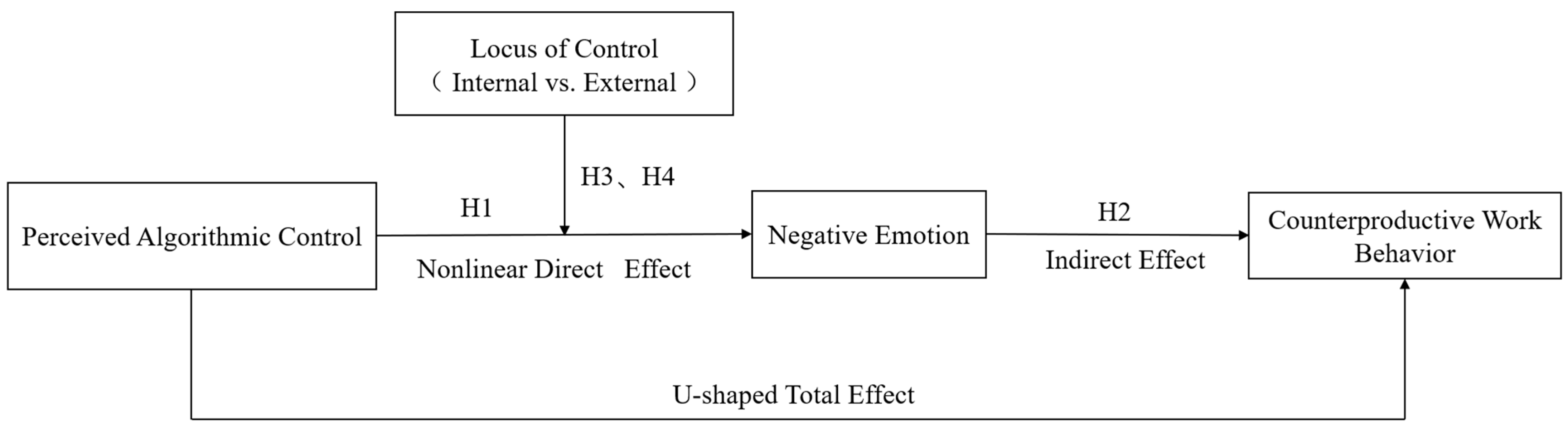
In summary, the theoretical model of this study is shown in Figure 1.

3. Methods

3.1. This Research Subjects and Sample Characteristics

This study has received formal approval from the Ethics Committee of Hohai University and strictly adheres to the ethical principles for research involving human subjects as established in the Declaration of Helsinki. The research employed an online questionnaire survey method, with the informed consent form placed on the first page of the questionnaire. All participants took part in the survey on the basis of full understanding and voluntary consent, and their personal information and data have been strictly confidential in accordance with relevant regulations.
This study selected two types of gig workers in China—food delivery riders and ride-hailing drivers—as the research subjects. These practitioners primarily rely on internet platforms to achieve supply-demand matching, involving platform types such as instant delivery platforms (e.g., Meituan Takeout, Ele.me) and ride-hailing platforms (e.g., Didi Chuxing). This study selected two categories of gig workers in China—food delivery riders and ride-hailing drivers—as the research subjects. A combination of online and offline methods was employed for random sampling. We distributed the questionnaire online through the Wenjuanxing website and simultaneously conducted offline surveys, such as distributing questionnaires at rest areas where food delivery riders gather. A total of 402 questionnaires were collected. After excluding those with excessively short completion times, obvious patterns, or seemingly random responses, 385 valid questionnaires were obtained.
Descriptive statistical analysis of the 385 questionnaire data revealed that there were 257 male gig workers, accounting for 66.75%, and 128 female gig workers, ac-counting for 33.25%. The results indicated that in the two gig occupations of food de-livery riders and ride-hailing drivers, the male population accounted for a relatively high proportion. The age distribution of the sample gig workers was mainly concentrated in the 18–30 age group, with 251 individuals, accounting for 65.19%. In terms of education level, 61 individuals had a junior high school education or below, accounting for 15.84%; 122 individuals had a high school/technical secondary school education, accounting for 31.69%; 98 individuals had a junior college education, accounting for 25.45%; and 93 individuals had a bachelor’s degree, accounting for 25.16%. Eleven individuals had a master’s degree or above, accounting for 2.86%. The results suggested that the education levels of food delivery riders and ride-hailing drivers in these two gig occupations were generally low, which aligns with the actual situation.

3.2. Variable Measurement

All scales used in this study employed the Likert 5-point scoring method, with scores ranging from 1 to 5 representing “strongly disagree/not at all applicable” to “strongly agree/completely applicable”.
Perceived Algorithmic Control: The scale for perceived algorithmic control among gig workers, proposed by Pei Jialiang et al. [20], was utilized. This scale comprises three dimensions: “perceived algorithmic normative guidance”, “perceived algorithmic tracking and evaluation” and “perceived algorithmic behavioral constraints”, totaling 11 items. The Cronbach’s α for this scale is 0.940.
Negative Emotions: The scale developed by Watson et al. [52] and revised by Qiu Lin et al. [53] in 2008 was adopted. The adapted scale is more suitable for the Chinese social context. Nine vocabulary words expressing negative emotions were selected, and participants were asked to choose adjectives based on their actual situations over the past 1–2 weeks, using the Likert 5-point scale to indicate the intensity of their emotions. The Cronbach’s α for this scale is 0.943.
Locus of Control Measurement: The brief version of the Work Locus of Control Scale proposed by Spector [54] was used to measure internal vs. external locus of control at work. This scale includes 8 items and emphasizes the type of psychological locus of control in the workplace, offering greater directionality. Higher scores indicate a stronger tendency towards an external locus of control at work. The Cronbach’s α for this scale is 0.928.
Counterproductive Work Behavior: The scale developed by Bennett and Robinson [55] was chosen. This scale categorizes CWB into two dimensions: organizational deviance and interpersonal deviance, totaling 15 items. Based on the actual research questions of this study, 14 items from the scale were selected and slightly adapted, including 7 interpersonal deviance items and 7 organizational deviance items. The Cronbach’s α for this scale is 0.957.
Control Variables: Research has found that trait anger (abbreviated as TA) is a personality trait that significantly influences CWB [36]. To exclude the influence of trait anger, this study controlled for the age, gender, education level, years of employment, and trait anger of the selected sample population. The scale developed by Spielberge [56] and revised by Luo Yali, Zhang Dajun et al. [57] was used. The Cronbach’s α for this scale is 0.941.
Among them, since the original scales for locus of control and counterproductive work behavior were developed in English, we first engaged bilingual experts to translate them into Chinese and then had independent translators back-translate them into English. The research team compared the back-translated versions with the original versions, eliminated discrepancies through discussion and revision, and ultimately finalized the Chinese questionnaires. This translation-back-translation procedure ensured the semantic and conceptual accuracy of the measurement tools in the Chinese context.

4. Results

4.1. Common Method Bias Test

This study employed two approaches for examination: Harman’s single-factor test and the unmeasured latent method factor (ULMF) approach. First, the results of Harman’s single-factor test indicated that the measurement items did not converge into a single factor, and the first principal component explained 40.234% of the variance, which did not exceed the recommended threshold of 50% [58,59,60]. Second, this study utilized AMOS 27.0 to conduct the ULMF test. A five-factor model was constructed by incorporating a common method bias factor for examination. The fit indices for the model were as follow: χ 2 = 928.141 ,   d f = 658 ,   C F I = 0.975 ,   T L I = 0.973 ,   S R M R = 0.0411 ,   R M S E A = 0.033 . Compared to the four-factor model, the CFI of the five-factor model only increased by 0.002 from the hypothesized model, which is below the standard of 0.050 [45]. Based on the combined results of these two methods, this study does not suffer from a severe common method bias issue.

4.2. Confirmatory Factor Analysis

To evaluate the validity of the measurement model and the degree of discrimination among key latent variables, this study employed confirmatory factor analysis (CFA) to systematically examine the fit between the data and the theoretical model. Given that the outcome variable, CWB, is not a latent variable, this study conducted CFA on four latent variables: perceived algorithmic control, locus of control, negative emotions, and trait anger [61]. The results of the examination are presented in Table 1. By synthesizing various fit indices. The results indicate that there is good discriminant validity among the variables, suggesting that they represent four distinct constructs.

4.3. Descriptive and Correlation

In this study, SPSS 27.0 was employed to conduct descriptive statistical analysis and correlation analysis on five variables: perceived algorithm control, counterproductive work behavior, negative emotions, locus of control, and trait anger. The results are presented in Table 2. From the perspective of correlation coefficients, perceived algorithm control showed a significant positive correlation with negative emotions, with r = 0.155   and   p < 0.010 . Negative emotions were significantly positively correlated with counterproductive work behavior, with r = 0.714   and   p < 0.010 . Additionally, locus of control demonstrated a significant positive correlation with negative emotions, with r = 0.771   and   p < 0.010 . The correlations among the variables generally aligned with our expectations.
In SPSS, we calculated the factor loadings for the measurement items of each latent variable and substituted them into the formulas to compute the Average Variance Extracted (AVE) and Composite Reliability (CR). The results are as follows: except for Negative Affect (NA), the AVE values for all other latent variables are greater than 0.5. Although the AVE for NA is less than 0.5, its Composite Reliability (CR) exceeds 0.6. According to the research by Fornell and Larcker, the convergent validity of the construct is still considered acceptable [62].

4.4. Hypothesis Testi

To eliminate the influence of multicollinearity, this study conducted mean-centering treatment on the control variables, independent variables, and moderating variables prior to regression analysis. Subsequently, the squared term of perceived algorithmic control, the interaction term between perceived algorithmic control and locus of control, as well as the interaction terms between the squared term of perceived algorithmic control and locus of control were constructed using the processed data. Finally, hierarchical regression analysis was conducted using these constructed variables via the PROCESS macro developed by Professor Andrew F. Hayes from the Department of Psychology. Further examination of each model using VIF revealed that all VIF values ranged between 0 and 4, and the tolerance values were all greater than 0.2, indicating no significant multicollinearity issues among the variables. The regression results are presented in Table 3.
Model 2 introduced the perceived algorithm control variable on the basis of Model 1, with β = 0.527 and p < 0.050 , indicating that the regression coefficient reached a significant level. Model 3 incorporated the squared term of perceived algorithm control on the basis of Model 2, and the results showed that the coefficient of the squared term reached a significant level, with β = 0.527   a n d   p < 0.010 , suggesting a possible positive U-shaped nonlinear relationship between the two. The calculated inflection point was −0.276, which fell within the range of the perceived algorithm control variable (−2.033, 1.706). In summary, when gig workers’ perceived algorithm control increased from a low to a moderate level, their negative emotions showed a downward trend; when perceived algorithm control continued to rise from a moderate to a high level, negative emotions turned to an upward trend. Thus, Hypothesis 1 was verified.
Model 8 introduced perceived algorithm control on the basis of Model 7. Model 9 incorporated the squared term of perceived algorithm control on the basis of Model 8, with β = 0.706   a n d   p < 0.010 , indicating a possible positive U-shaped relationship between perceived algorithm control and gig workers’ counterproductive work behaviors. The calculated inflection point of Model 9 was −0.256, which was within the range of perceived algorithm control (−2.033, 1.706). Therefore, a positive U-shaped relationship existed between perceived algorithm control and CWBs. Model 10 introduced negative emotions on the basis of Model 9, with β = 0.546   a n d   p < 0.010 , indicating that negative emotions had a significant positive impact on CWBs. Although the regression coefficient of the squared term of perceived algorithm control decreased, it remained significant, with β = 0.418   a n d   p < 0.010 . This suggested that negative emotions played a partial mediating role between perceived algorithm control and gig workers’ CWBs. To verify the impact of negative emotions on CWBs, this study conducted a separate model test for the two, yielding β = 1.512   a n d   p < 0.010 , indicating that negative emotions had a significant positive impact on CWBs. Further examination using the bootstrap method revealed significant regression results, with β = 0.073 ,   p < 0.010 , and a 95% confidence interval of [0.005, 0.141], excluding 0, indicating that the indirect effect of perceived algorithm control on CWBs through negative emotions was significant. In summary, negative emotions mediated the relationship between perceived algorithm control and CWBs, and Hypothesis 2 was verified.
As shown in the results of Model 6 in Table 3, the interaction term between the squared term of perceived algorithm control and locus of control had a significant positive impact on negative emotions, with β = 0.064   a n d   p < 0.050 , proving that locus of control played a moderating role between perceived algorithm control and negative emotions. Hypothesis 3 was preliminarily verified.
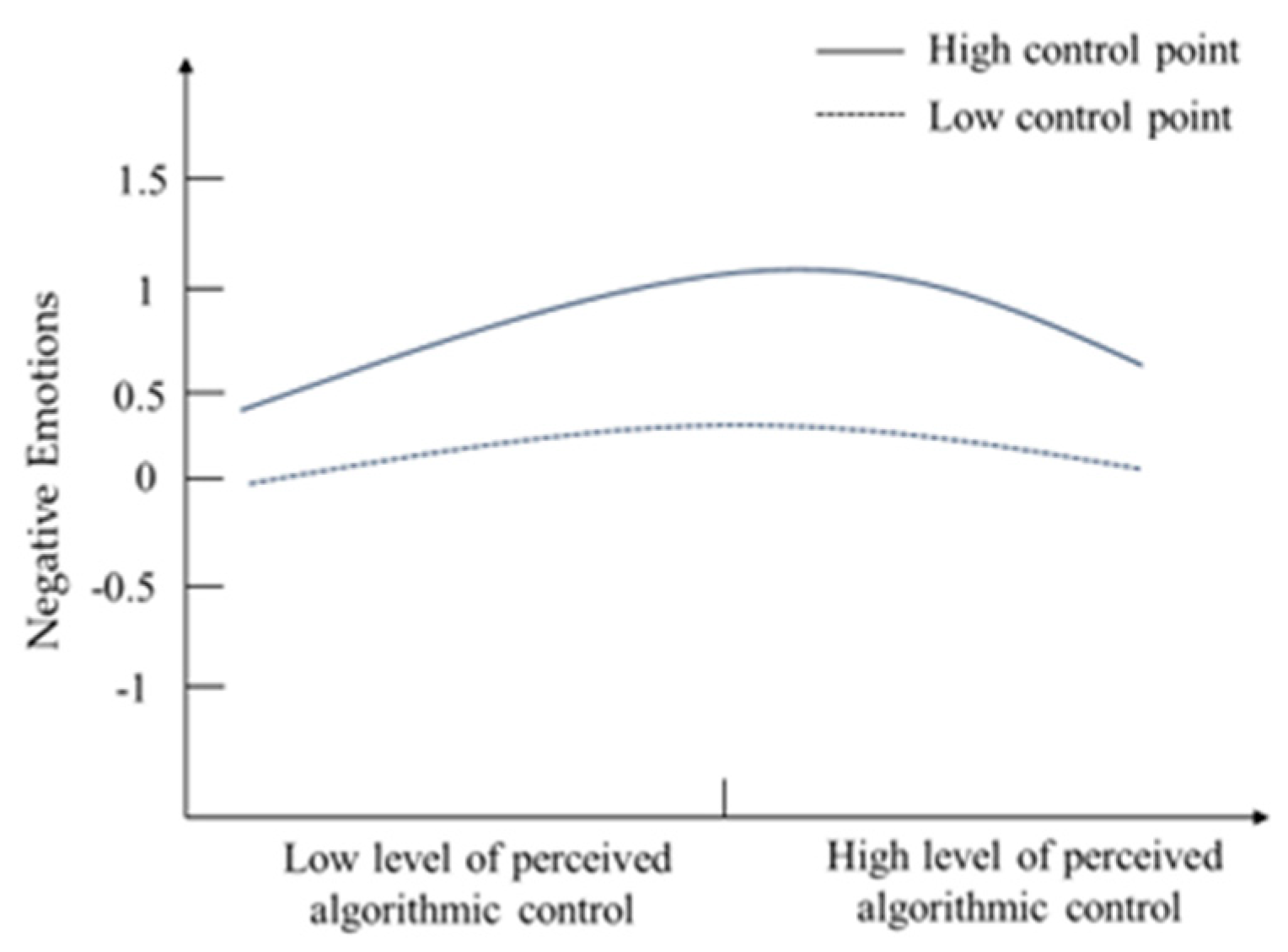
To further confirm the moderating effect of locus of control on the relationship between perceived algorithm control and negative emotions, this study used the simple slope test method to analyze the moderating role of locus of control. Locus of control was divided into high and low levels based on adding and subtracting one standard deviation. The results, as shown in Table 4, indicated that under a high locus of control, the moderating effect of perceived algorithm control on the positive U-shaped relationship with negative emotions was stronger; under a low locus of control, the moderating effect was weaker or even insignificant. Thus, Hypothesis 3 was verified. To better illustrate the moderating effect of trait self-control, this study drew a moderating effect graph with reference to the research by Aiken et al. [63], as shown in Figure 2.
To test Hypothesis 4, this study employed the bootstrap method for analysis, and the results are presented in Table 5.
As shown in Table 5, low-level perceived algorithm control has a significant negative indirect impact on gig workers’ CWBs through negative emotions. When gig workers’ perceived algorithm control rises to a moderate or high level, this indirect impact shifts to a positive direction. Under a low locus of control, the indirect effects of both high and low levels of perceived algorithm control on gig workers’ CWBs are relatively weak, while the impact of a moderate level of perceived algorithm control on gig workers’ CWBs is not significant. In summary, gig workers with a low locus of control, indicating an internal locus of control in the work context, exhibit a weaker response to the positive effect of perceived algorithm control on CWBs. In contrast, gig workers with a high locus of control, suggesting an external locus of control in the work context, demonstrate a stronger reaction to the influence of perceived algorithm control on CWBs. Therefore, Hypothesis 4 is verified.

5. Discussion

This study systematically examines, from the perspective of emotional cognitive appraisal theory, the impact mechanism of gig workers’ perceived algorithmic control on their counterproductive work behaviors, arriving at the following core conclusions.
First, there exists a U-shaped curve relationship between perceived algorithmic control and counterproductive work behaviors. Compared to gig workers who perceive either excessively high or low levels of algorithmic control, those at moderate levels are less likely to engage in counterproductive work behaviors. This finding breaks through the linear assumption of the effects of algorithmic control, revealing the existence of an “optimal control range” for algorithms as a management mechanism. From the perspective of cognitive appraisal theory, low perceived algorithmic control induces negative emotions due to cognitive ambiguity and resource depletion, while high perceived algorithmic control exacerbates emotional exhaustion due to a loss of control and perceived threats. In contrast, moderate perceived algorithmic control enables workers to appraise algorithmic control as a manageable challenge, maintaining emotional balance. The implication is that when platforms excessively pursue maximum efficiency, their control measures may go too far, ultimately undermining the psychological sustainability of workers.
Second, negative emotions mediate the relationship between perceived algorithmic control and counterproductive work behaviors. Perceived algorithmic control influences gig workers’ negative emotions through a U-shaped curve effect, which in turn affects their counterproductive work behaviors. This finding reveals the emotional mechanism underlying the U-shaped relationship: negative emotions serve as a psychological switch that transforms algorithmic control into behavioral responses. Both low and high perceived algorithmic control accumulate negative emotions through different cognitive pathways, but both ultimately lead to an increased risk of counterproductive behaviors. From a sustainability perspective, the continuous accumulation of negative emotions directly erodes workers’ psychological sustainability, thereby threatening the overall stability of the workforce.
Third, locus of control moderates the relationship between perceived algorithmic control and negative emotions. For externally controlled gig workers, the U-shaped effect of perceived algorithmic control on negative emotions is more pronounced, whereas for internally controlled workers, this moderating effect is relatively weaker. This finding reveals the differential effects of individual attribution tendencies in an algorithmic environment: externally controlled workers are more sensitive to changes in algorithmic control, more prone to attribution confusion when control is insufficient, and more likely to fall into a sense of powerlessness when control is excessive. In contrast, internally controlled workers, due to their inherent beliefs in control, can maintain emotional stability within a broader range of perceived algorithmic control. This suggests that platforms need to consider individual differences in algorithmic governance, providing clearer rule explanations and positive feedback for externally controlled workers, while granting appropriate autonomy to internally controlled workers to stimulate their intrinsic motivation.
In summary, by revealing the U-shaped relationship, emotional mediation mechanism, and individual trait modulation, this study demonstrates that there exists an optimal intensity range for algorithmic control, and this range varies according to individual attribution tendencies. This finding provides empirical support and theoretical guidance for platforms to achieve a dynamic balance between efficiency and sustainability.

5.1. Theoretical Contributions

First, this study hypothesized and validated a U-shaped relationship between gig workers’ perceived algorithmic control and their CWBs, thereby expanding the existing research on algorithmic control. Most studies on the gig economy predominantly focus on gig workers’ work experiences within algorithm-controlled environments, such as the positive impacts of perceived fairness [64,65], perceived autonomy [66,67], and work stress [32] on gig workers’ job performance, proactive service, and other aspects. However, there is relatively less research on the negative behaviors of gig workers. From the perspective of gig workers, this study concentrates on the influence of perceived algorithmic control on their CWBs and proposes a possible nonlinear relationship between algorithmic control and CWBs at different levels of perceived algorithmic control. The research findings indicate that both excessively high and low levels of perceived algorithmic control can increase the likelihood of CWBs among gig workers. We have introduced a non-linear governance logic into algorithmic management theory—that is, algorithmic control is not necessarily better when higher or lower; instead, there exists an optimal control range. Only a moderate level of perceived algorithmic control has the most optimal effect in mitigating the occurrence of CWBs among gig workers.
Second, this study applies the cognitive appraisal theory of emotions to the research field of the gig economy, elucidating the mechanism through which perceived algorithmic control influences gig workers’ CWBs. With the rapid development of digital technologies, algorithmic control has emerged as a prevalent external control mechanism in the contemporary gig economy [22]. Traditionally, interpersonal conflicts between supervisors and subordinates have evolved into systemic conflicts between algorithmic systems and gig workers in this economic model. From the perspective of the cognitive appraisal theory of emotions, this study systematically explains the formation mechanism of this novel type of conflict and its behavioral consequences. Specifically, the research analyzes how gig workers’ perceived algorithmic control triggers specific negative emotions such as anger and anxiety, which in turn serve as key mediating factors driving CWBs. Furthermore, the study examines the moderating role of gig workers’ locus of control tendencies in their evaluation processes [68]. Through this theoretical framework, the study not only expands the application boundaries of the cognitive appraisal theory of emotions within the context of the digital economy but also provides a new explanatory path for understanding labor-management conflicts in the gig economy.
Third, this study incorporates locus of control into the research model, revealing distinct response mechanisms of gig workers to algorithmic control. The findings indicate that internally controlled workers tend to appraise algorithmic challenges as manageable opportunities for growth, whereas externally controlled workers are more likely to perceive them as uncontrollable threats. This moderating mechanism not only validates Lazarus’s core proposition that “the appraisal process is influenced by individual traits” but also introduces an agentic perspective into algorithmic management research—namely, that workers are not passive recipients of algorithms; instead, their attribution tendencies profoundly shape the actual consequences of algorithmic control [68]. By uncovering the moderating effect of locus of control at the inflection point of the U-shaped curve, this study provides a theoretical basis for “individual adaptability” in algorithmic governance, enriching interdisciplinary discussions on digital governance, psychological applications, and algorithmic control in platform enterprises [69].
Fourth, this study integrates psychological sustainability, labor sustainability, and platform sustainability into its theoretical framework. The study finds that the nonlinear impact of perceived algorithmic control on negative emotions directly relates to gig workers’ psychological sustainability, namely, their ability to maintain mental health and emotional stability under long-term high-pressure work conditions. The accumulation of counterproductive behaviors at the individual level converges into overall labor unsustainability, characterized by high turnover rates, low occupational identity, and intergenerational transmission of work poverty [6]. From the platform’s perspective, the design logic of algorithmic control not only affects short-term operational efficiency but also determines the platform’s social sustainability, that is, its ability to achieve a dynamic balance between efficiency and ethical [22]. By embedding these three dimensions of sustainability into the explanation of the U-shaped mechanism, this study provides a theoretical integration framework for shifting algorithmic management research from a short-term performance orientation to a long-term sustainable development orientation.

5.2. Practical Implications

Based on the research findings, this study provides platform enterprises with a practical roadmap for setting algorithmic design thresholds and dynamically adapting to individual differences.
First, establish an appropriate range for algorithmic control based on the U-shaped influence mechanism between perceived algorithmic control (PAC) and counterproductive work behavior (CWB). The study reveals a U-shaped relationship between PAC and CWB, indicating the existence of an optimal control range. Platforms should transform the abstract concept of “maintaining moderate PAC” into quantifiable management thresholds. Specific operations include: (1) Establishing a PAC dynamic monitoring system: Embed a simplified PAC scale within the app to track the distribution of PAC scores among workers in real time; (2) Identifying empirical thresholds for U-shaped inflection points: Determine, through historical data regression analysis, the critical PAC value at which workers’ CWB begins to rise significantly on the platform, setting this as a warning threshold; (3) Implementing segmented intervention strategies: When workers’ PAC falls below the lower threshold, trigger cognitive support interventions, such as pushing short videos explaining algorithmic rules, novice operation guides, and customer service hotline access, to help workers understand algorithmic logic and reduce cognitive ambiguity. When workers’ PAC exceeds the upper threshold, trigger stress interventions, such as reducing the density of order push notifications for that worker, enforcing rest reminders, and pushing mental health self-assessments and support resources. This dynamic adjustment mechanism translates the concept of “moderate control” into executable algorithmic design.
Second, embed sustainability into algorithmic design and establish a collaborative management framework for triple sustainability. Platforms should shift from an “efficiency-first” to an “efficiency-and-sustainability-balanced” algorithmic design logic. (1) Order allocation algorithms: While pursuing the shortest delivery times, dynamically adjust the difficulty coefficient of individual orders based on workers’ historical working hours, consecutive order counts, complaint records, and other data to prevent a cliff-like decline in perceived control due to continuous high-pressure orders; (2) Incorporate psychological sustainability indicators (e.g., self-assessments of emotional state), labor sustainability indicators (e.g., worker retention rates), and platform sustainability indicators (e.g., traffic violation rates, customer complaint rates) into the evaluation criteria for algorithmic iterations, rather than focusing solely on order completion rates. Establish a collaborative management framework for sustainability to avoid short-sighted decisions that optimize efficiency at the expense of sustainability.
Third, develop a full-cycle management roadmap for workers based on locus of control. The study finds that locus of control significantly moderates the emotional effects of PAC, which platforms can translate into a management tool throughout the entire process of “recruitment-training-intervention.” (1) Rapid screening during recruitment: Embed a simplified locus of control scale when workers join the platform, using test results as a basis for algorithmic grouping. For externally controlled new workers, provide clearer task guidance, more frequent positive feedback, and gentler penalty thresholds in the initial stages to help them establish a sense of control. For internally controlled workers, grant appropriate autonomy and provide challenging goals to stimulate their intrinsic motivation. (2) Attribution training modules after onboarding: Develop micro-courses to guide workers in identifying their attribution patterns through case comparisons and provide cognitive restructuring exercises to transition from external to internal control. Research indicates that locus of control is somewhat malleable, and short-term interventions can guide workers to develop more adaptive attribution tendencies. (3) Trigger mechanisms for dynamic interventions: When the system detects an increased risk of CWB among workers, such as consecutive complaints or an increase in speeding records, automatically push attribution prompts—e.g., “You have received several negative reviews recently, which may be related to congestion caused by large-scale events in the business district. We have optimized your delivery time limit.” By reframing uncontrollable events as controllable or explainable, this alleviates the accumulation of negative emotions among externally controlled workers.
In summary, by translating abstract theoretical recommendations into practically executable algorithmic designs, this study provides platform enterprises with a roadmap for achieving a dynamic balance between efficiency and sustainability.

5.3. Limitations and Future Research

In addition to its theoretical contributions and practical implications, this study also has several limitations.
First, the survey respondents in this study were primarily focused on food delivery riders and ride-hailing drivers. Although these two groups constitute significant components of the gig economy, gig workers also encompass a diverse range of individuals, including crowdsourced workers, freelancers, and domestic service personnel. The manifestations of algorithmic control and the ways in which workers perceive it may vary across different gig work scenarios. Therefore, future research should incorporate a broader sample to test the generalizability of the conclusions.
Second, this study collected cross-sectional data through questionnaires, which may lead to common method bias. Although we manually reviewed all questionnaires and confirmed data quality through Harman’s single-factor test and confirmatory factor analysis, the cross-sectional design still cannot entirely rule out the possibility of reversed causality. Future research could adopt longitudinal tracking or cross-validation with multi-source data (such as objective platform records).
Lastly, the impact of privacy and trust issues on data quality. Counterproductive work behaviors involve sensitive information, and workers may exhibit defensive reactions due to concerns about privacy breaches. Although this study repeatedly emphasized anonymity and data confidentiality in the questionnaires and reviewed the collected data, self-reported measures may still not entirely avoid subjective biases. Future research could enhance reliability by incorporating situational experiments or using de-identified data from platforms.

Author Contributions

Conceptualization, R.L. and H.F.; methodology, R.L. and H.F.; software, H.F.; validation, R.L. and H.F.; formal analysis, R.L. and H.F.; investigation, R.L. and H.F.; resources, R.L. and H.F.; data curation, R.L. and H.F.; writing—original draft preparation, R.L. and H.F.; writing—review and editing, R.L. and H.F.; visualization, R.L. and H.F.; supervision, R.L. and H.F.; project administration, R.L. and H.F.; funding acquisition, R.L. and H.F. All authors have read and agreed to the published version of the manuscript.

Funding

This research received no external funding.

Institutional Review Board Statement

This study has obtained ethical approval from the Ethics Committee of Hohai University (approval date: [24 October 2024]). The research was conducted in strict accordance with the ethical principles outlined in the Declaration of Helsinki.

Informed Consent Statement

Informed consent was obtained from all subjects involved in the study.

Data Availability Statement

The data are not publicly available due to privacy. The data presented in this paper are available upon request from the corresponding author.

Acknowledgments

We want to thank all those who contributed to this study.

Conflicts of Interest

The authors declare no conflicts of interest.

References

  1. Chen, Q.; Jiang, D.; Liu, T. The different influences of loyalty versus ability on employee counterproductive work behavior. Soft Sci. 2022, 36, 1001–8409. [Google Scholar]
  2. Kuhn, K.M.; Maleki, A. Micro-Entrepreneurs, Dependent Contractors, and Instaserfs: Understanding Online Labor Platform Workforces. Acad. Manag. Perspect. 2017, 31, 183–200. [Google Scholar] [CrossRef]
  3. Li, S.Q.; Zhang, Z.B.; Zhao, W.W.; Zhang, J. Research on the Formation Mechanism of Social Deviant Behaviors of Gig Workers from an Algorithmic Control Perspectiv. Strategy Manag. 2024, 44, 96–104. [Google Scholar] [CrossRef]
  4. Li, C.; Lin, C.-L.; Chin, T. How Does the Paradoxical Leadership of Cross-Border e-Commerce (CBEC) Gig Workers Influence Chinese Company Performance: The Role of Psychological Well-Being. Sustainability 2022, 14, 12307. [Google Scholar] [CrossRef]
  5. Xu, H.; Yu, Y.; Zhang, Y. Birth of the Rider: Digital Platforms, Targeted Matching and Job Creation. China Ind. Econ. 2024, 114–132. [Google Scholar] [CrossRef]
  6. Ashford, S.J.; Caza, B.B.; Reid, E.M. From surviving to thriving in the gig economy: A research agenda for individuals in the new world of work. Res. Organ. Behav. 2018, 38, 23–41. [Google Scholar] [CrossRef]
  7. Christie, N.; Ward, H. The health and safety risks for people who drive for work in the gig economy. J. Transp. Health 2019, 13, 115–127. [Google Scholar]
  8. Feng, X.; Zhan, J. Research on Labor Process in Platform Economy in the Age of AI—Taking the Take-away Riders as an Example. J. Soc. Dev. 2019, 3, 61–83. [Google Scholar]
  9. Oviedo-Trespalacios, O.; Rubie, E.; Haworth, N. Risky business: Comparing the riding behaviours of food delivery and private bicycle riders. Accid. Anal. Prev. 2022, 177, 106820. [Google Scholar] [CrossRef] [PubMed]
  10. Shen, Q.; Zhang, J. MFTFormer: Meteorological-Frequency-Temporal Transformer with Block-Aligned Fusion for Traffic Flow Prediction. Res. Sq. 2026. preprint. [Google Scholar]
  11. Liu, D.; Shen, Q.; Liu, J. The Health-Wealth Gradient in Labor Markets: Integrating Health, Insurance, and Social Metrics to Predict Employment Density. Computation 2026, 14, 22. [Google Scholar] [CrossRef]
  12. Lang, J.J.; Yang, L.F.; Cheng, C.; Cheng, X.Y.; Chen, F.Y. Are algorithmically controlled gig workers deeply burned out? An empirical study on employee work engagement. BMC Psychol. 2023, 11, 354. [Google Scholar] [CrossRef]
  13. Duggan, J.; Sherman, U.; Carbery, R.; McDonnell, A. Algorithmic management and app-work in the gig economy: A research agenda for employment relations and HRM. Hum. Resour. Manag. J. 2020, 30, 114–132. [Google Scholar] [CrossRef]
  14. Wood, A.J.; Graham, M.; Lehdonvirta, V.; Hjorth, I. Good Gig, Bad Gig: Autonomy and Algorithmic Control in the Global Gig Economy. Work Employ. Soc. 2019, 33, 56–75. [Google Scholar] [CrossRef]
  15. Pignot, E. Who is pulling the strings in the platform economy? Accounting for the dark and unexpected sides of algorithmic control. Organization 2023, 30, 140–167. [Google Scholar] [CrossRef]
  16. Waldkirch, M.; Bucher, E.; Schou, P.K.; Grünwald, E. Controlled by the algorithm, coached by the crowd—How HRM activities take shape on digital work platforms in the gig economy. Int. J. Hum. Resour. Manag. 2021, 32, 2643–2682. [Google Scholar] [CrossRef]
  17. Möhlmann, M.; Zalmanson, L.; Henfridsson, O.; Gregory, R.W. Algorithmic management of work on online labor platforms: When matching meets control. MIS Q. 2021, 45, 1999–2022. [Google Scholar] [CrossRef]
  18. Pei, J.; Liu, S.; Cui, X.; Zhang, Z.; Ge, C. Dose algorithmic control motivates gig workers to offer the proactive services?—Based on the perspective of work motivation. Nankai Bus. Rev. 2024, 24, 104–117. [Google Scholar]
  19. Grant, A.M.; Nurmohamed, S.; Ashford, S.J.; Dekas, K. The performance implications of ambivalent initiative: The interplay of autonomous and controlled motivations. Organ. Behav. Hum. Decis. Process. 2011, 116, 241–251. [Google Scholar] [CrossRef]
  20. Cram, W.A.; Wiener, M.; Tarafdar, M.; Benlian, A. Examining the Impact of Algorithmic Control on Uber Drivers’ Technostress. J. Manag. Inf. Syst. 2022, 39, 426–453. [Google Scholar] [CrossRef]
  21. Hajiheydari, N.; Delgosha, M.S. Investigating engagement and burnout of gig-workers in the age of algorithms: An empirical study in digital labor platforms. Inf. Technol. People 2024, 37, 2489–2522. [Google Scholar] [CrossRef]
  22. Kellogg, K.C.; Valentine, M.A.; Christin, A. Algorithms at Work: The New Contested Terrain of Control. Acad. Manag. Ann. 2020, 14, 366–410. [Google Scholar] [CrossRef]
  23. Shevchuk, A.; Strebkov, D.; Davis, S.N. The Autonomy Paradox: How Night Work Undermines Subjective Well-Being of Internet-Based Freelancers. Ilr Rev. 2019, 72, 75–100. [Google Scholar] [CrossRef]
  24. Yu, P.J.L.S.Z.Z.X. Good algorithms, bad algorithms: Research on the gig workers′ overwork under the algorithmic logic. J. Ind. Eng. Eng. Manag. 2024, 38, 101–115. [Google Scholar]
  25. Lv, C.L.; Cao, Y.D.; Feng, Y.; Fan, L.L.; Zhang, J.Y.; Song, Y.H.; Liu, H.; Gao, G.G. Crosslinked Vinyl-Capped Polyoxometalates to Construct a Three-Dimensional Porous Inorganic–Organic Catalyst to Effectively Suppress Polysulfide Shuttle in Li–S Batteries. Adv. Energy Mater. 2025, 8, 1. [Google Scholar] [CrossRef]
  26. Lazarus, R.S. Progress on a cognitive-motivational-relational theory of emotion. Am. Psychol. 1991, 46, 819. [Google Scholar] [CrossRef] [PubMed]
  27. Cacciotti, G.; Hayton, J.C.; Mitchell, J.R.; Giazitzoglu, A. A reconceptualization of fear of failure in entrepreneurship. J. Bus. Ventur. 2016, 31, 302–325. [Google Scholar] [CrossRef]
  28. Jianping, F.Z.L.S.P.J.N.P.Z. Nonlinear Influence of Perceived Algorithmic Control on Gig Workers′ Safety Performance. J. Manag. Sci. 2023, 36, 75–88. [Google Scholar]
  29. Wenhai, H.; Jingqin, S. Dissipation-driven Adaptation: The Dominant Logic of Digital Innovation—Based on an Online Ride-hailing Platform’s Longitudinal Case Study. Manag. Rev. 2023, 35, 320. [Google Scholar]
  30. Pei, J.; Liu, S.; Cui, X.; Qu, J. Perceived algorithmic control of gig workers: Conceptualization, measurement and verification the impact on service performance. Nankai Bus. Rev. 2021, 24, 14–27. [Google Scholar]
  31. Qiuyun, G.T.G. Algorithmic Control, Facades of Conformity and Gig Workers’ Service Performance: The Moderating Effects of Perception of Challenge and Hindrance Stress. Manag. Rev. 2024, 36, 194–205. [Google Scholar]
  32. Rotter, J.B. Generalized expectancies for internal versus external control of reinforcement. Psychol. Monogr. Gen. Appl. 1966, 80, 1. [Google Scholar] [CrossRef]
  33. Bellesia, F.; Mattarelli, E.; Bertolotti, F.; Sobrero, M. Algorithmic embeddedness and the ‘gig’characteristics model: Examining the interplay between technology and work design in crowdwork. J. Manag. Stud. 2025, 62, 2673–2706. [Google Scholar] [CrossRef]
  34. Ashford, S.J.; Wellman, N.; Sully de Luque, M.; De Stobbeleir, K.E.; Wollan, M. Two roads to effectiveness: CEO feedback seeking, vision articulation, and firm performance. J. Organ. Behav. 2018, 39, 82–95. [Google Scholar] [CrossRef]
  35. Parent-Rocheleau, X.; Parker, S.K. Algorithms as work designers: How algorithmic management influences the design of jobs. Hum. Resour. Manag. Rev. 2022, 32, 100838. [Google Scholar] [CrossRef]
  36. Gandini, A. Labour process theory and the gig economy. Hum. Relat. 2019, 72, 1039–1056. [Google Scholar] [CrossRef]
  37. Yaru, W.W.L.B.L. The Double-edged Effect of Job Gamification on Job Involvement of Gig Workers: The Role of Flow Experience and Overwork. Nankai Bus. Rev. 2022, 25, 159–171. [Google Scholar]
  38. Li, W.; Lu, Y.; Hu, P.; Gupta, S. Work engagement of online car-hailing drivers: The effects of platforms’ algorithmic management. Inf. Technol. People 2024, 37, 1423–1448. [Google Scholar] [CrossRef]
  39. Zhang, L.Z.; Yang, J.; Zhang, Y.M.; Xu, G.H. Gig worker’s perceived algorithmic management, stress appraisal, and destructive deviant behavior. PLoS ONE 2023, 18, e0294074. [Google Scholar] [CrossRef] [PubMed]
  40. Yue, Z.L.L.X.H.R.C. The Negative Effect of Algorithmic Management in Online Labor Platform and Its Control Strategies: The Perspective of Technological Affordances of Algorithms. Hum. Resour. Dev. China 2022, 39, 8–22. [Google Scholar]
  41. Shanshi, L.; Jialiang, P.; Chuyan, Z. Is the platform work autonomous? The effect of online labor platform algorithm management on job autonomy. Foreign Econ. Manag. 2021, 43, 51–67. [Google Scholar]
  42. Spector, P.E.; Fox, S. The stressor-emotion model of counterproductive work behavior. In Counterproductive Work Behavior: Investigations of Actors and Targets; American Psychological Association: Washington, DC, USA, 2005; pp. 151–174. [Google Scholar]
  43. Yuxin, Z.J.L. A Comment on the Theories againt Productive Behavior. Acad. Res. J. 2008, 80–90. [Google Scholar] [CrossRef]
  44. Zhang, L.; Duan, Y.; Wang, Y.; Pineda, E.; Yang, Y.; Pelletier, J.-M.; Wada, T.; Kato, H.; Crespo, D.; Qiao, J. Creep and recovery behavior of metallic glasses in a global strain approach within transition state theory. Acta Mech. Sin. 2026, 42, 425311. [Google Scholar] [CrossRef]
  45. Feng, L. Literature Review and Future Study of Counterproductive Behavior. China Labor 2015, 66, 99–104. [Google Scholar]
  46. Shin, D.; Park, Y.J. Role of fairness, accountability, and transparency in algorithmic affordance. Comput. Hum. Behav. 2019, 98, 277–284. [Google Scholar] [CrossRef]
  47. Lu, S.; Liang, L.; Liu, Y. Effect of Abusive Supervision on Counterproductive Work Behavior—The Chain Mediated Role of Negative Emotion and Ego Depletion. Sci. Technol. Dev. 2020, 16, 192–198. [Google Scholar]
  48. Azeem, M.U.; Mehmood, I.; Haq, I.U.; Nasho Ah-Pine, E. When do challenge-hindrance stressors differentially effect employees’ ability to meet work deadlines? Can. J. Adm. Sci./Rev. Can. Des. Sci. L’administration 2025, 42, 110–124. [Google Scholar] [CrossRef]
  49. He, Q. A Unified Metric Architecture for AI Infrastructure: A Cross-Layer Taxonomy Integrating Performance, Efficiency, and Cost. arXiv 2025, arXiv:2511.21772. [Google Scholar]
  50. Phillips, J.M.; Gully, S.M. Role of goal orientation, ability, need for achievement, and locus of control in the self-efficacy and goal-setting process. J. Appl. Psychol. 1997, 82, 792–802. [Google Scholar] [CrossRef]
  51. Frazier, P.; Keenan, N.; Anders, S.; Perera, S.; Shallcross, S.; Hintz, S. Perceived Past, Present, and Future Control and Adjustment to Stressful Life Events. J. Personal. Soc. Psychol. 2011, 100, 749–765. [Google Scholar] [CrossRef]
  52. Watson, D.; Clark, L.A.; Tellegen, A. Development and validation of brief measures of positive and negative affect: The PANAS scales. J. Personal. Soc. Psychol. 1988, 54, 1063–1070. [Google Scholar] [CrossRef]
  53. Qiu, L.; Zheng, X.; Wang, Y. Revision of the positive affect and negative affect scale. Chin. J. Appl. Psychol. 2008, 14, 249–254. [Google Scholar]
  54. Spector, P.E. Development of the work locus of control scale. J. Occup. Psychol. 1988, 61, 335–340. [Google Scholar] [CrossRef]
  55. Bennett, R.J.; Robinson, S.L. Development of a measure of workplace deviance. J. Appl. Psychol. 2000, 85, 349. [Google Scholar] [CrossRef]
  56. Speilberger, C. STAXI-2: State-Trait Anger Expression Inventory-2: Professional Manual; Psychological Assessment Resources: Lutz, FL, USA, 1999. [Google Scholar]
  57. Luo, Y.; Zhang, D.; Liu, Y.; Liu, Y. Reliability and validity of the Chinese version of trait anger scale in college students. Chin. Ment. Health J. 2011, 25, 700–704. [Google Scholar]
  58. Zhonglin, D.T.W. Statistical approaches for testing common method bias: Problems and suggestions. J. Psychol. Sci. 2020, 43, 215. [Google Scholar]
  59. Podsakoff, P.M.; Organ, D.W. Self-reports in organizational research: Problems and prospects. J. Manag. 1986, 12, 531–544. [Google Scholar] [CrossRef]
  60. Lv, C.; Lv, X.-l.; Wang, Z.; Zhao, T.; Tian, W.; Zhou, Q.; Zeng, L.; Wan, M.; Liu, C. A focal quotient gradient system method for deep neural network training. Appl. Soft Comput. 2025, 184, 113704. [Google Scholar] [CrossRef]
  61. Man Tang, P.; Koopman, J.; McClean, S.T.; Zhang, J.H.; Li, C.H.; De Cremer, D.; Lu, Y.; Ng, C.T.S. When conscientious employees meet intelligent machines: An integrative approach inspired by complementarity theory and role theory. Acad. Manag. J. 2022, 65, 1019–1054. [Google Scholar] [CrossRef]
  62. Fornell, C.; Larcker, D.F. Structural Equation Models with Unobservable Variables and Measurement Error: Algebra and Statistics. J. Mark. Res. 1981, 18, 382–388. [Google Scholar] [CrossRef]
  63. Aiken, L.S.; West, S.G.; Reno, R.R. Multiple Regression: Testing and Interpreting Interactions; SAGE: Thousand Oaks, CA, USA, 1991. [Google Scholar]
  64. Petriglieri, G.; Ashford, S.J.; Wrzesniewski, A. Agony and Ecstasy in the Gig Economy: Cultivating Holding Environments for Precarious and Personalized Work Identities. Adm. Sci. Q. 2019, 64, 124–170. [Google Scholar] [CrossRef]
  65. Newman, D.T.; Fast, N.J.; Harmon, D.J. When eliminating bias isn’t fair: Algorithmic reductionism and procedural justice in human resource decisions. Organ. Behav. Hum. Decis. Process. 2020, 160, 149–167. [Google Scholar] [CrossRef]
  66. Vallas, S.; Schor, J.B. What do platforms do? Understanding the gig economy. Annu. Rev. Sociol. 2020, 46, 273–294. [Google Scholar] [CrossRef]
  67. Rui, S.; Yuan, Y.; Qiuhua, Z.; Lijun, C.; Kun, Z. Double-Edged Sword Effect of Perceived Algorithmic Control on Emotional Exhaustion of Gig Workers: Based on a Legitimacy Judgment Perspective. J. Syst. Manag. 2024, 33, 1373. [Google Scholar]
  68. Caza, B.B.; Reid, E.M.; Ashford, S.J.; Granger, S. Working on my own: Measuring the challenges of gig work. Hum. Relat. 2022, 75, 2122–2159. [Google Scholar] [CrossRef]
  69. Xue, F.; Jin, S. Artificial Intelligence Adoption, Innovation Efficiency, and Governance Mechanisms: Evidence from China. Systems 2025, 13, 1062. [Google Scholar] [CrossRef]
Figure 1. Theoretical model.
Sustainability 18 02244 g001
Figure 2. Moderating effects of locus of control.
Sustainability 18 02244 g002
Table 1. Results of confirmatory factor analysis.
ModelDescriptionχ2 d f χ 2 / d f C F I T L I S R M R R M S E A
Four-factorPAC, TA, LOC, NA953.1816591.4460.9730.9710.04520.034
Three-factorPAC + TA, LOC, NA3597.9306625.4350.7270.7100.15950.107
Two-factorPAC + TA + NA, LOC4439.5586646.6860.6490.6280.16600.122
Single-factorPAC + TA + LOC + NA5066.6166657.6190.5910.5670.16730.131
Note: “+” indicates the merging of factors.
Table 2. Descriptive analysis and correlation test.
Variable12345678AVECR
1. PAC-- 0.6150.946
2. LOC0.304 **-- 0.5110.891
3. NA0.155 *0.771 **-- 0.4410.879
4. CWB0.151 **0.610 **0.714 **-- --
5. TA0.172 **0.557 **0.712 **0.682 **-- 0.5060.898
6. Gender0.137 **−0.096−0.148 **−0.145 **−0.132 **--
7. Age−0.090.162 **0.232 **0.230 **0.210 **−0.084--
8. Education level0.136 **−0.331 **−0.447 **−0.410 **−0.418 **0.171 **−0.311 **--
Mean36.74822.3329.27340.929.8311.3323.2122.665
Standard deviation10.6998.3097.48613.09211.1620.4721.2671.094
Note: * p   <   0.050 , ** p   <   0.010 .
Table 3. Results of hierarchical regression analysis.
VariableNACWB
M 1M 2M 3M 4M 5M 6M 7M 8M 9M 10
PAC 0.084 *0.318 **0.254 **0.173 **0.173 ** 0.083 *0.396 **0.223 **
PAC2 0.527 **0.382 **0.519 **0.525 ** 0.706 **0.418 **
LOC 0.439 **0.532 **0.417 **
NA 0.546 **
PAC x LOC 0.0200.027
PAC2 x LOC 0.064 *
CWB
TA0.634 **0.609 **0.418 **0.193 **0.186 *0.192 **0.610 **0.586 **0.330 **0.102 **
Gender−0.035−0.046−0.051−0.028−0.026−0.023−0.037−0.048−0.056 *−0.028
Age0.0490.0550.0490.0280.0270.0270.0580.0650.056 *0.029
Education
Level
−0.151 **−0.169 **−0.107 **−0.018−0.015−0.017−0.131 **−0.148 **−0.065 *−0.070
R 2 0.5340.5400.7240.9010.9010.9020.4890.4950.8240.907
R 2 0.0060.1840.1170.0000.0010.0060.3300.082
F 108.77 **5.24 *251.92 **671.82 **1.085.33 *90.78 **4.61 *710.02 **331.87 **
Note: * p   <   0.050 , ** p   <   0.010 .
Table 4. Simple sope test.
Variable β
Low Perception Algorithm ControlModerate Perception Algorithm ControlHigh Perception Algorithm Control
Low control point−0.522 **0.1360.240 **
High control point−0.608 **0.298 **0.317 **
Note: **   p   <   0.010 .
Table 5. Test results of moderated mediation effect.
VariableCWB
Low Control PointHigh Control Point
Indirect Effect95% Confidence IntervalIndirect Effect95% Confidence Interval
Low perception
algorithm control
−0.309(−0.411, −0.218)−0.359(−0.447, −0.260)
Moderate perception
algorithm control
0.086(−0.020, 0.186)0.189(0.122, 0.270)
High perception
algorithm control
0.201(0.140, 0.268)0.265(0.191, 0.327)
Disclaimer/Publisher’s Note: The statements, opinions and data contained in all publications are solely those of the individual author(s) and contributor(s) and not of MDPI and/or the editor(s). MDPI and/or the editor(s) disclaim responsibility for any injury to people or property resulting from any ideas, methods, instructions or products referred to in the content.