Article

Stability Analysis of Green Manufacturing Innovation Ecosystem Based on Symbiotic Stochastic Evolutionary Game

School of Management Engineering, Qingdao University of Technology, Qingdao 266520, China
*
Author to whom correspondence should be addressed.
Sustainability 2026, 18(5), 2243; https://doi.org/10.3390/su18052243
Submission received: 7 January 2026 / Revised: 10 February 2026 / Accepted: 23 February 2026 / Published: 26 February 2026

Abstract

In the modern era, the green manufacturing innovation ecosystem is vital for promoting sustainable development. It significantly contributes to achieving carbon peak and carbon neutrality goals. Current research regarding the coevolution of the green manufacturing innovation ecosystem predominantly utilizes deterministic models. These models do not account for the inherent stochasticity present in interactions within the innovation ecosystem, and they also neglect quantitative analyses pertaining to ecosystem resilience and stability mechanisms. This study explores the core mechanisms that drive the stability of the green manufacturing innovation ecosystem. It is based on theories of ecology and innovation. This study employs the Lotka–Volterra model to characterize the stochastic evolutionary process of symbiotic interactions among innovation groups. Compared to deterministic models, the stochastic approach has significant advantages. It captures the inherent uncertainties of human behavior and subjective decision-making. Additionally, it accounts for dynamic environmental changes. This approach provides more realistic insights into the evolution of green manufacturing innovation ecosystems amid complex conditions. The findings yield three key conclusions. First, the mutualistic symbiosis model is more stable than other models. This includes independent, competitive, parasitic, and commensal symbiosis models. This stability underscores the mutualistic model’s critical role in sustaining the ecosystem’s development. Second, the return time for a mutualistic symbiosis ecosystem is notably shorter than for a stochastic interaction ecosystem. This indicates that mutualistic symbiosis is more effective in fostering growth within the green manufacturing innovation ecosystem. Third, participant relationships in this ecosystem are complex. They encompass competitive, parasitic, and commensal dynamics, among others. Furthermore, the ecosystem’s resilience improves as the rate of mutually beneficial interactions increases. These findings provide direct policy and management guidance for optimizing the symbiotic mechanisms of green manufacturing innovation ecosystems, enhancing ecosystem resilience, and advancing carbon peaking and carbon neutrality goals.

1. Introduction

As global ecological and environmental challenges rise, sustainable development has gained prominence. It is now a key focus in national development strategies worldwide. Important documents have emerged in support of this cause. The United Nations Framework Convention on Climate Change, the Kyoto Protocol, and the Paris Agreement advocate for rapid global progress toward sustainability. China plays a significant role in this effort. It is the world’s second-largest economy and the largest carbon emitter. Therefore, China has made bold pledges. The nation aims to reach peak emissions before 2030 and carbon neutrality before 2060 [1]. Green manufacturing (GM) aims to reduce environmental impacts. It also focuses on improving resource efficiency in industrial production systems. As an advanced production model, GM works in harmony with ecological civilization. It seeks to minimize environmental emissions. This is achieved through the comprehensive integration of green processes and principles. These elements permeate the entire manufacturing supply chain [2]. GM offers substantial long-term benefits. These benefits include reduced environmental impact, improved resource efficiency, and enhanced regulatory compliance. However, it also comes with considerable costs. Enterprises face substantial risks when adopting these practices. Additionally, the timelines for achieving returns on investment can be lengthy. Balancing these factors is crucial for successful implementation [3]. The claim that individual enterprises cannot ensure effective implementation is important. This assertion highlights the need for collaborative innovation. Diverse groups must be involved in this process. These groups include universities, independent researchers, and various innovation organizations. Collaboration fosters a more effective and comprehensive approach to innovation. It allows for the sharing of ideas and resources [4]. International trends indicate that establishing an innovation ecosystem (IE) greatly accelerates the development of GM. Within this ecosystem, the relationships among innovation groups play a crucial role. These interactive relationships are essential for the ecosystem’s success. They foster collaboration and idea sharing. Effective collaboration can lead to faster innovation and improved results [5]. The establishment of a green manufacturing innovation ecosystem (GMIE) is crucial. It allows for the exploration of dynamic evolutionary patterns among innovation groups. This exploration ensures stability within the ecosystem. Additionally, effectively stimulating collective intelligence is essential. These are key strategies for meeting carbon peak and carbon neutrality objectives. By focusing on these areas, stakeholders can drive meaningful change.
This paper aims to deepen our understanding of symbiotic evolution within the GMIE. It also seeks to clarify the patterns of symbiotic evolution among its diverse groups. To achieve this, the study uses the Lotka–Volterra nonlinear dynamic model from ecology. This model helps establish a dynamic framework for understanding symbiotic evolution in the GMIE. The study analyzes interactions between competitive and cooperative innovation groups. It looks at how these interactions affect the overall evolution of the system. This analysis articulates the principles guiding symbiotic evolution within the ecosystem. The contributions of this study are significant. First, it examines the patterns of symbiotic evolution among innovation groups. This contribution enhances synergetics theory and promotes collaborative innovation. Second, the research in enterprises uses Gaussian white noise to study symbiotic evolution amid stochastic disturbances. Third, it uses numerical analysis to simulate the evolution processes among innovation groups. This approach aims to reveal the underlying patterns of collective intelligence emergence in GMIE. Overall, the study contributes to advancing research on the evolution of these ecosystems.

2. Literature Review

2.1. Green Manufacturing

GM is a key strategy for fostering sustainable development. It aims to balance social progress, economic growth, and ecological conservation [6,7]. This approach has garnered significant academic interest. Many researchers have explored its conceptual frameworks and driving factors [8,9], laying the groundwork for subsequent analyses of the GMIE in this study.

2.1.1. Conceptual Framework of Green Manufacturing

GM is defined as a holistic strategy. It involves integrating environmental considerations into mechanical manufacturing processes. Enterprises utilize technological optimization to achieve energy conservation. They also focus on reducing consumption, pollution, and carbon emissions. The goal is to promote overall green development [10]. This strategy emphasizes a lifecycle-oriented perspective. It considers environmental impacts throughout all stages of a product’s existence. GM does not limit itself to end-of-pipe solutions. Instead, it includes aspects like product design, material selection, and manufacturing processes [11,12]. Moreover, GM addresses product use, recycling, and final disposal. Its aim is to minimize negative environmental effects. It also seeks to reduce resource consumption across the entire lifecycle of a product. This comprehensive approach ultimately fosters a more sustainable future [13]. This lifecycle perspective lies at the core of the GM value proposition, aligning closely with the circular economy principles that underpin the GMIE discussed below.

2.1.2. Driving Factors of Green Manufacturing

The adoption of GM is driven by the complex interplay of internal and external factors [14]. It is not dominated by any single category [15]. This directly shapes the collaborative logic of GMIE. Internal drivers form the foundation of an organization’s commitment to GM [16]. Management’s awareness fosters a green organizational culture. It integrates green management into core business strategies. This helps gain competitive advantages and advance sustainable development [17]. Brand positioning further strengthens internal drivers [18]. As consumer environmental awareness continues to grow, companies leverage targeted advertising and creative marketing to build robust green brand images [19,20]. This approach enhances customer satisfaction, bolsters competitive advantages, and comprehensively improves sustainability performance [21]. External factors serve as powerful catalysts, complementing internal drivers to jointly propel the adoption of GM. Government initiatives such as tax incentives, subsidies, and regulatory pressures significantly influence corporate investment decisions and profitability, guiding manufacturing enterprises toward sustainable development [22,23]. Amidst the reshaping of globalization, customer demands have driven the need for eco-friendly products [24]. Public sensitivity to environmental issues continues to rise [25], and stakeholders exert increasing pressure on businesses to improve production processes and enhance sustainability [26]. Moreover, market competition compels companies to adopt green management as a strategic tool for achieving long-term success [27]. This synergy between internal and external drivers underscores the necessity of building a collaborative ecosystem to coordinate the efforts of multiple stakeholders, which is the core focus of this study.

2.2. Green Manufacturing Innovation Ecosystem

The advancement of GM relies heavily on the combined effects of management and technological innovations. These innovations are supported by strong knowledge exchange and collaboration among multiple stakeholders within a dynamic IE [28,29,30]. The IE acts as a flexible framework. It focuses on a core value proposition. This proposition emphasizes the co-creation and sharing of value among various groups throughout the innovation process [31]. A key feature of a strong IE is its ability to expand boundaries. This expansion allows for the inclusion of diverse stakeholders, resources, and knowledge across traditional organizational and sectoral boundaries [32]. The GMIE merges essential elements of GM and IE. It emphasizes technological breakthroughs in GM and promotes collaborative innovation among multiple principals. This approach is forward-looking and aims to enhance the GM sector [2]. The main goal is to create a collaborative environment. In this environment, stakeholders—including enterprises, research institutions, and governments—work together to promote and advance green technologies and practices [2]. Collaboration occurs at different levels among these groups. Enterprises play a pivotal role by adopting green innovation technologies. Their actions help accelerate sustainable development [33]. Nevertheless, the adoption rate for these technologies is often low. This underscores the necessity for strong models to encourage organizations to implement green initiatives [34]. Research highlights the need to understand how green innovation evolves in small and medium-sized manufacturing enterprises. This understanding is crucial for facilitating their participation in sustainable practices [35]. Scientific research institutions support this effort by creating new green technologies. They also provide the theoretical frameworks necessary for implementing sustainable practices [2]. Governments play a vital role as well. They guide and support green technology innovation through environmental regulations and incentive strategies [36]. Thus, the GMIE is a dynamic and complex concept. It requires a comprehensive strategy that combines policy support, technological advancement, inter-organizational collaboration, and a commitment to circular economy principles. Such a strategy is essential for driving sustainable development in the manufacturing sector [7].
Existing research has effectively defined the conceptual boundaries of GMIE and identified key drivers for its adoption. However, these studies primarily focus on individual factors or organizational-level practices, lacking exploration of how these elements dynamically interact among multiple stakeholders. To fill this gap, it is necessary to adopt a symbiotic coevolution modeling approach. This methodology can capture the interdependencies among stakeholders—such as enterprises, URI, and independent researchers—within the GMIE, as well as the coevolution of internal and external drivers over time. By simulating this symbiotic relationship, this study can better elucidate strategies to overcome obstacles in GM implementation, facilitate optimized collaboration among multiple stakeholders, and ultimately improve the sustainability level of the manufacturing sector. This aligns with the core objective of exploring the operational mechanisms of GMIE.

3. Methods

3.1. Basic Model

The Lotka–Volterra model was developed by Lotka and Volterra in the early 20th century. This model offers a mathematical framework for studying population dynamics. It specifically addresses predator-prey and competitive interactions in ecological systems [37]. The Lotka–Volterra model originates from ecology. However, its analytical capabilities have allowed it to be applied in various fields. One such field is economic management. The model helps analyze complex interactions there. It examines evolutionary processes involving technology, knowledge, and information. Additionally, it draws parallels through the concept of bionics [28,38]. The LV model can be expressed by the following equation:
d N i d t = r i N i 1 + j = 1 n a i j N j N j m       i , j = 1 , 2 , , n .
Here, r i represents the population growth rate of species i . The term N i indicates the population size of species i . The variable N j m denotes the maximum population size of species j . The interaction coefficient of species j with species i is represented by a i j . The matrix A = a i j is known as the interaction matrix. When i = j , a i i captures intraspecific interactions. When i j , a i j reflects inter-population relationships. All interactions within a population are proportional. Intraspecific interaction a i i is scaled to unity such that a i i = 1 . The main forms of interspecific relationships are as follows: mutualistic interaction ( a i j > 0 , a j i > 0 ), competitive interaction ( a i j < 0 , a j i < 0 ), parasitic interaction ( a i j a j i < 0 ).

3.2. Theoretical Framework

The GMIE represents a sophisticated framework for advancing GM through sustainable technological innovation and resource allocation. It is conceptually distinct from traditional models like industrial clusters or innovation networks due to its unique emphasis on green value co-creation, closed-loop synergy between ecological groups and environmental factors, and the intrinsic role of sustainability as both a means and an end [39,40]. This positions GMIE firmly within the theoretical domain of ecological innovation studies, underscoring systemic interdependence, multi-actor coordination, and circular value chains [41,42].
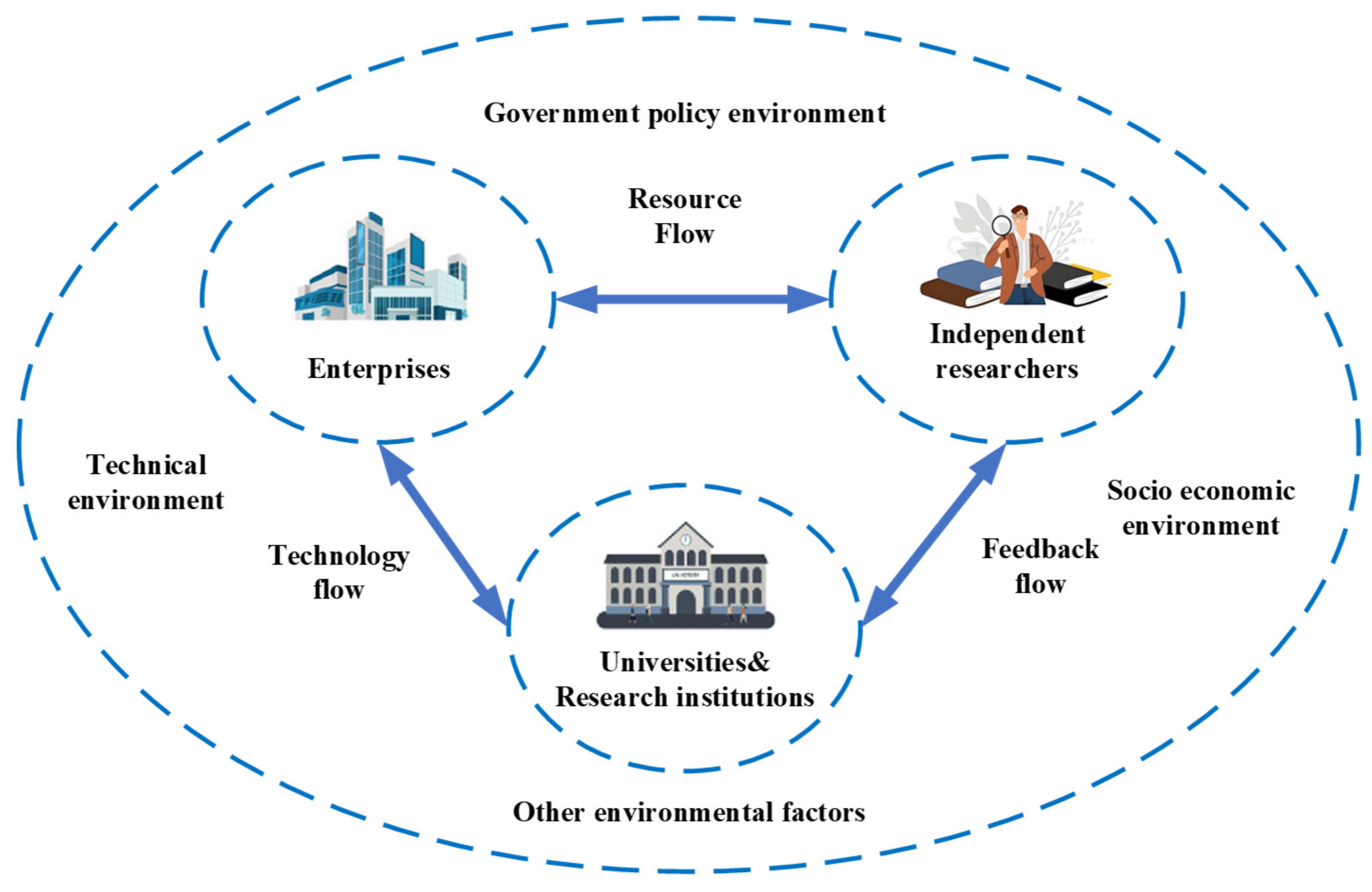
The GMIE framework consists of two interconnected components: core innovation groups and supporting environmental factors [43]. Core groups include enterprises, URI, and independent researchers. Each of these groups has distinct but complementary roles within the ecosystem [44]. URIs function as primary technology supply hubs. They utilize their advanced research and development capabilities to create and transfer specialized GM technologies [45]. Examples of these technologies include low-carbon production processes and circular material technologies [46]. Enterprises play a critical role as the primary implementers of GM practices [47]. They act as resource integrators by consolidating technology, talent, and funding from URI, independent researchers, and other stakeholders. This facilitates the translation of theoretical innovations into practical GM applications [48]. Independent researchers serve as demand feedback bridges. They provide URI with valuable insights into technological optimization needs and industry challenges [49]. This feedback helps ensure that academic research aligns closely with industrial practices.
Core groups interact through three interconnected mechanisms: technology supply, resource integration, and demand feedback [50]. Together, these form a closed-loop interactive system. The technology supply mechanism utilizes URI. These institutions facilitate knowledge spillovers and promote technology transfer to enterprises. The resource integration mechanism allows enterprises to gather resources from multiple stakeholders. This consolidation supports the implementation of GM practices [51]. The demand feedback mechanism creates a two-way communication channel. It connects grassroots practices, often led by independent researchers, with academic R&D at URI. This closed-loop synergy drives the stability and innovation capacity of GMIE. It sets GMIE apart from fragmented collaboration models that lack iterative feedback [49].
The supportive environmental factors of GMIE include three key dimensions: government policy support, technological advancement, and socioeconomic conditions [44]. Each of these dimensions provides essential safeguards for the operation of core actor networks. Government policies, such as green subsidies and carbon emission regulations, play a vital role. They guide and regulate groups within the ecosystem and provide necessary incentives through established institutional frameworks [52]. Socioeconomic environments also contribute significantly. Factors like market demand for green products and resource availability provide critical resources and market drivers. The technological environment further supports these efforts. The maturity of renewable energy technologies and the availability of digital manufacturing tools enhance the feasibility of implementing GMIE. Unlike traditional innovation models, where environmental factors exert a unidirectional influence, the elements within the GMIE interact in a bidirectional manner. For example, policy adjustments can reshape strategies for resource integration [53]. In turn, technological breakthroughs in renewable energy can inspire updates to policies.
This integrated structure includes core participants, interaction mechanisms, and supportive environments. Together, they allow the GMIE to flourish. This success stems from an efficient exchange of technology, resources, and feedback [52]. The continuous flow of these elements promotes sustainable development within the ecosystem. It also enhances GM practices. This occurs by aligning research and development directions with industrial needs and policy objectives. The theoretical model presented in this study (Figure 1) integrates these essential components and their interactions. It defines the boundaries, internal structure, and interaction rules of the GMIE. This model offers a cohesive theoretical foundation for future mathematical modeling.

3.3. Symbiotic Evolution Models of GMIE

3.3.1. Stochastic Modified Lotka–Volterra Models

Recent scientific research strongly supports the idea that GMIEs resemble natural ecosystems. These studies show that innovation communities have evolutionary traits similar to biological populations [2,47,54]. They include interdependence, adaptive growth, and dynamic interactions with their environment [47]. This ecological analogy offers a useful framework for understanding the complexity of GMIE. It shifts the focus from isolated groups to the systemic interactions among them [54].
First, the core epistemological assumption that the density-dependent growth and interactions of GMIE groups functionally resemble biological populations is fundamental to understanding innovation communities [55]. From an ecological standpoint, the development of innovation groups within the GMIE is constrained by environmental carrying capacity. This capacity is influenced by factors such as technological maturity, resource availability, and institutional frameworks. These elements resemble the limitations faced by biological populations reliant on habitat resources. This parallel justifies employing the logistic growth principle, which is a key element of the Lotka–Volterra model, to describe the dynamics of GMIE groups [56]. Both systems exhibit density-dependent growth patterns. As each innovation group nears the ecosystem’s carrying capacity, growth begins to slow. For instance, enterprises’ green innovation growth is constrained by the technology supply from URI or the market demand for sustainable products. This assumption allows the model to encapsulate the essential systemic characteristics of GMIE. Growth, stability, and evolution stem from the interactions between the innovation community and both its internal and external environments [45].
Second, the Lotka–Volterra model examines symbiotic, competitive, and parasitic relationships among populations. This focus has been applied to groups within the GMIE. This extension is based on the idea that interactions among GMIE actors can be represented as quantifiable reciprocal relationships [45]. This representation is essential for mathematical formalization. For example, the symbiotic relationship between technology providers (URI) and technology adopters (enterprises) resembles mutualistic interactions in natural ecosystems [57]. In this scenario, both parties gain from collaboration. URI receives validation for its technological practices, while enterprises benefit from innovative inputs. Similarly, competitive relationships can arise when enterprises compete for the limited R&D resources offered by URI [44]. These dynamics mirror interspecific competition found in ecology. This abstraction allows the model to quantify the strength of interactions among GMIE participants. This quantification is vital for analyzing how their dynamic equilibrium influences ecosystem stability.
Third, the limitations of ecological analogies, specifically the Lotka–Volterra model, in capturing the complexities of various socioeconomic and technological systems are significant, as they often fail to account for unique human behaviors, subjective decision-making, and dynamic environmental shifts [58]. The classical Lotka–Volterra models describe the dynamic interplay between predators and prey or between competing species through a set of ordinary differential equations, revealing oscillatory or exclusionary dynamics based on mass-action principles. These models are characterized by parameters like intrinsic growth rates, carrying capacities, and competition coefficients, which represent density-dependent interactions. However, human-driven systems involve factors that are difficult to quantify within this framework [59]. For instance, innovator behavior is influenced by psychological elements, creativity, and strategic choices that go beyond simple density-dependent growth or competition parameters [60]. Managerial decisions are inherently subjective and driven by a multitude of non-linear factors, including risk perception, organizational culture, and individual biases, which are not easily reducible to the coefficients of Lotka–Volterra equations [61]. Moreover, the assumption of stable environmental factors at carrying capacities in classical ecological models often deviates from the reality of dynamic environments, particularly in GMIE [62]. These environments are frequently marked by sudden, nonlinear changes, technological disruptions, and unforeseen market shifts [62]. Traditional Lotka–Volterra frameworks, which predict stable cycles or equilibria under deterministic conditions, are insufficient for capturing these rapid, unpredictable shifts. Stochasticity, particularly the introduction of Gaussian white noise, has been proposed as a method to account for random fluctuations in growth rates, thereby making the models more robust to real-world uncertainties [63]. As a result, the research formulates a stochastic modified Lotka–Volterra model relevant to the GMIE.
Thus, according to the logistic equation, the dynamic evolution equation of GMIE is proposed as follows:
d N e d t = N e r e + α 1 d ω t 1 N e N e m + a u e N u N u m + a f e N f N f m       N e 0 = N e 0 d N u d t = N u r u + α 2 d ω t 1 N u N u m + a e u N e N e m + a f u N f N f m       N u 0 = N u 0 d N f d t = N f r f + α 3 d ω t 1 N f N f m + a e f N e N e m + a u f N u N u m       N f 0 = N f 0
In this formula, α i d ω t denotes the stochastic disturbance acting on r i , where ω t is a standard one-dimensional Brownian motion satisfying ω t N 0 , t , and α i represents the intensity of Gaussian white noise. The variables N e , N u , and N f denote the population sizes of core enterprises, URI, and independent researchers, respectively, within the GMIE. Additionally, the maximum sustainable population sizes for each stakeholder group, subject to constraints imposed by constrained system resources, are designated as N e m , N u m , and N f m , respectively. The original population sizes for all three groups are denoted as N e 0 , N u 0 , and N f 0 , respectively. The growth rates of the core enterprise, URI, and independent researcher populations are denoted as r e , r u , and r f , respectively. a u e signifies the coefficient of influence from URI on enterprises. a u f denotes the coefficient of influence from URI on independent researchers. a f e quantifies the coefficient of influence from independent researchers on enterprises. a f u illustrates the coefficient of influence from independent researchers on URI. a e f reflects the coefficient of influence of enterprises on independent researchers. a e u assesses the coefficient of influence of enterprises on URI. The notations are summarized in Table 1.
The interrelationships among innovation groups include:
(1) Independent symbiosis ( a i j = 0 ): The three groups develop independently without mutual interference.
(2) Competitive symbiosis ( a i j < 0 ): The three groups compete for homogeneous innovation resources, leading to mutual harm for all parties involved.
(3) Parasitic symbiosis ( a i j a j i < 0 ): A positive symbiotic coefficient indicates a beneficiary group, while a negative coefficient indicates a disadvantaged group.
(4) Commensal symbiosis ( a i j a j i = 0 , a i j + a j i > 0 ): A positive symbiotic coefficient indicates a beneficiary group, whereas a coefficient of zero denotes a neutral group.
(5) Mutualistic symbiosis ( a i j > 0 ): All three groups benefit.

3.3.2. Stability Analysis

(1) The impact of interaction strength on the stability of GMIE.
To analyze model stability, we derive the Jacobian matrix of the three—group symbiotic evolution model as follows. We also use Mathematica to solve differential equations.
J 1 = d N e / d t d N e d N e / d t d N u d N e / d t d N f d N u / d t d N e d N u / d t d N u d N u / d t d N f d N f / d t d N e d N f / d t d N u d N f / d t d N f ,
where
d N e / d t d N e = r e + α 1 d ω t 1 2 N e N e m + a u e N u N u m + a f e N f N f m ,
d N e / d t d N u = a u e N e N u m r e + α 1 d ω t ,
d N e / d t d N f = a f e N e N f m r e + α 1 d ω t ,
d N u / d t d N e = a e u N u N e m r u + α 2 d ω t ,
d N u / d t d N u = r u + α 2 d ω t 1 2 N u N u m + a e u N e N e m + a f u N f N f m ,
d N u / d t d N f = a f u N u N f m r u + α 2 d ω t ,
d N f / d t d N e = a e f N f N e m r f + α 3 d ω t ,
d N f / d t d N u = a u f N f N u m r f + α 3 d ω t ,
d N f / d t d N f = r f + α 3 d ω t 1 2 N f N f m + a e f N e N e m + a u f N u N u m .
Combined with d N e d t = d N u d t = d N f d t = 0 , eight equilibrium points for the evolution of the GMIE can be obtained, namely E 1 = 0 , 0 , 0 , E 2 = N e m , 0 , 0 , E 3 = 0 , N u m , 0 , E 4 = 0 , 0 , N f m , E 5 = 0 , N u m 1 + a f u 1 a f u a u f , N f m 1 + a u f 1 a u f a f u , E 6 = N e m 1 + a f e 1 a f e a e f , 0 , N f m 1 + a e f 1 a e f a f e , E 7 = N e m 1 + a u e 1 a u e a e u , N u m 1 + a e u 1 a e u a u e , 0   E 8 = N e * , N u * , N f * , where N e * = N e m D e / D , N u * = N u m D u / D , N f * = N f m D f / D ,
D e = a f u a u f a f e a u f a f u a u e a f e a u e 1 , D u = a f e a e f a e f a f u a f e a e u a f u a e u 1 D f = a u e a e u a e u a u f a u e a e f a u f a e f 1 ,
D = a u e a e u + a f e a e f + a f u a u f + a f e a e u a u f + a f u a e f a u e 1 .
This analysis examines the equilibrium states of eight balance points among groups in the GMIE. Table 2 presents these equilibrium states. E 1 signals excessive competition among enterprises, URI, and independent researchers. This competition can become vicious. Ultimately, it may collapse the GMIE. E 2 , E 3 , and E 4 depict different scenarios. In E 2 , enterprises achieve absolute dominance in competition. They capture the entire market share within the ecosystem. This dominance forces URI and independent researchers to withdraw. In E 3 , URI takes the lead in competition. They gain complete market control, pushing enterprises and independent researchers out of the ecosystem. E 4 shows independent researchers gaining total dominance. Their success in competition leads to the exclusion of enterprises and URI from the ecosystem. Let us consider E 2 as an example. When E 2 serves as an evolutionary stable equilibrium point, three conditions must hold true. Specifically, the corresponding values satisfy λ 21 < 0 , λ 22 < 0 , and λ 23 < 0 . This results in a e u < 1 and   a e f < 1 . Under these specific conditions, the impact of enterprises on URI and independent researchers becomes negative. Consequently, the competitiveness of these institutions and researchers diminishes. Enterprises then dominate resource allocation within the GMIE. As a result, enterprises reach the system’s maximum capacity. Ultimately, URI and independent researchers withdraw from the GMIE. E 5 , E 6 , and E 7 illustrate scenarios where only two of the three groups can succeed. These groups include enterprises, URI, and independent researchers. As a result, one group will ultimately have a scale of zero in the GMIE. For example, E 5 functions as an evolutionary stable equilibrium point. It must first meet certain criteria: det J 5 < 0 and t r J 5 < 0 . This situation indicates a mutually beneficial and symbiotic relationship between URI and independent researchers. On the other hand, E 8 reveals a different dynamic. It represents a state of equilibrium achieved through the interaction of enterprises, URI, and independent researchers within the GMIE. The states E 1 E 7 are unfavorable for the healthy development of the GMIE. Therefore, this paper focuses solely on investigating the evolutionary patterns of the GMIE under state E 8 . The stability criteria for equilibrium points are derived from the Jacobian matrix [64]. To achieve stability at E 8 , det J 8 < 0 and tr J 8 < 0 must be met. These stability conditions can be summarized as a i j < 1 , where i j   , i , j = e , u , f .
(2) The influence of eigenvalues in the main matrix on the stability of GMIE.
In the development of the GMIE, both external and internal disturbances are inevitable. These disturbances can include changes in environmental conditions and variations in GMIE parameters. When the GMIE is unstable, disturbances can cause innovation groups to deviate from their equilibrium operating point. Over time, even after the disturbance resolves, it may be impossible to return to the original equilibrium state. Consequently, analyzing the stability of the GMIE is essential. Proposing measures to maintain system stability will support the sustainable development of this ecosystem. A matrix represents a linear transformation. The sign of its eigenvalues indicates the direction of this transformation. By analyzing the eigenvalues of the main matrix in the GMIE, we can assess the system’s stability. Therefore, setting J 1 = 0 yields the following equation:
N e N e m + a u e N u N u m + a f e N f N f m = 1 N u N u m + a e u N e N e m + a f u N f N f m = 1 N f N f m + a e f N e N e m + a u f N u N u m = 1 X 1 + a u e X 2 + a f e X 3 = 1 X 2 + a e u X 1 + a f u X 3 = 1 X 3 + a e f X 1 + a u f X 2 = 1 .
In Equation (4), setting A = 1 a u e a f e a e u 1 a f u a e f a u f 1 , X = X 1 X 2 X 3 , B = 1 1 1 leads to the expression A X = B . When A < 0 , the GMIE possesses a unique stable evolutionary equilibrium solution E N e * , N u * , N f * , where N i * > 0 . As noted by Stone [65], this paper combines the Lotka–Volterra model with the main matrix to analyze the local stability of the GMIE. The equivalent Jacobian matrix J 2 is represented as J 2 = D A . When we set the differential time to zero, we arrive at the equilibrium condition N i = N i * , where N i * > 0 , ensuring all elements remain positive. This condition is essential for the existence of the GMIE. Here, D = d i a g N 1 * , N 2 * , , N n * denotes the diagonal matrix of the steady-state equilibrium N i * , and the eigenvalues of J 2 are λ i . The largest eigenvalue is defined as λ i m , λ i m = max λ i . If the eigenvalues appear as complex numbers, we also find that λ i m = max Re λ i . Utilizing the Routh–Hurwitz criterion [65], we discover that when λ i m < 0 , the equilibrium point of the innovation ecosystem is locally stable. Research by Pimm [66] defines local stability as the ecosystem’s ability to return to equilibrium after minor disturbances. We can quantify resilience stability through λ i m . A lower λ i m indicates higher core stability, which in turn suggests greater resilience of the ecosystem. Based on Stone’s findings [65], the relationship between the eigenvalues of the ecosystem’s state space matrix and the equilibrium population size can be expressed as λ i N i * . In conclusion, the time it takes for the ecosystem to recover to equilibrium after slight disturbances is determined by the maximum eigenvalue λ i m and its corresponding eigenvector.

4. Simulation Analysis of Symbiotic Evolution in GMIE

This paper utilizes MATLAB R2019b for analysis. It assigns values to parameters according to the E 8 stability condition, defined as a i j < 1 . The study conducts simulation analyses for both deterministic and stochastic logistic models. Enterprises, URI, and independent researchers maintain close ties to the market. They exhibit a high sensitivity to market dynamics. The growth rates assigned to enterprises, URI, and independent researchers are r e = 0.3 , r u = 0.2 , and r f = 0.1 , respectively. To reduce randomness, the study averages the simulation results of the stochastic logistic model over 50 Monte Carlo simulations. Detailed parameter assignments are presented in Table 3.

4.1. Scale Evolution Trends of Innovation Groups in GMIE

4.1.1. Independent Symbiosis

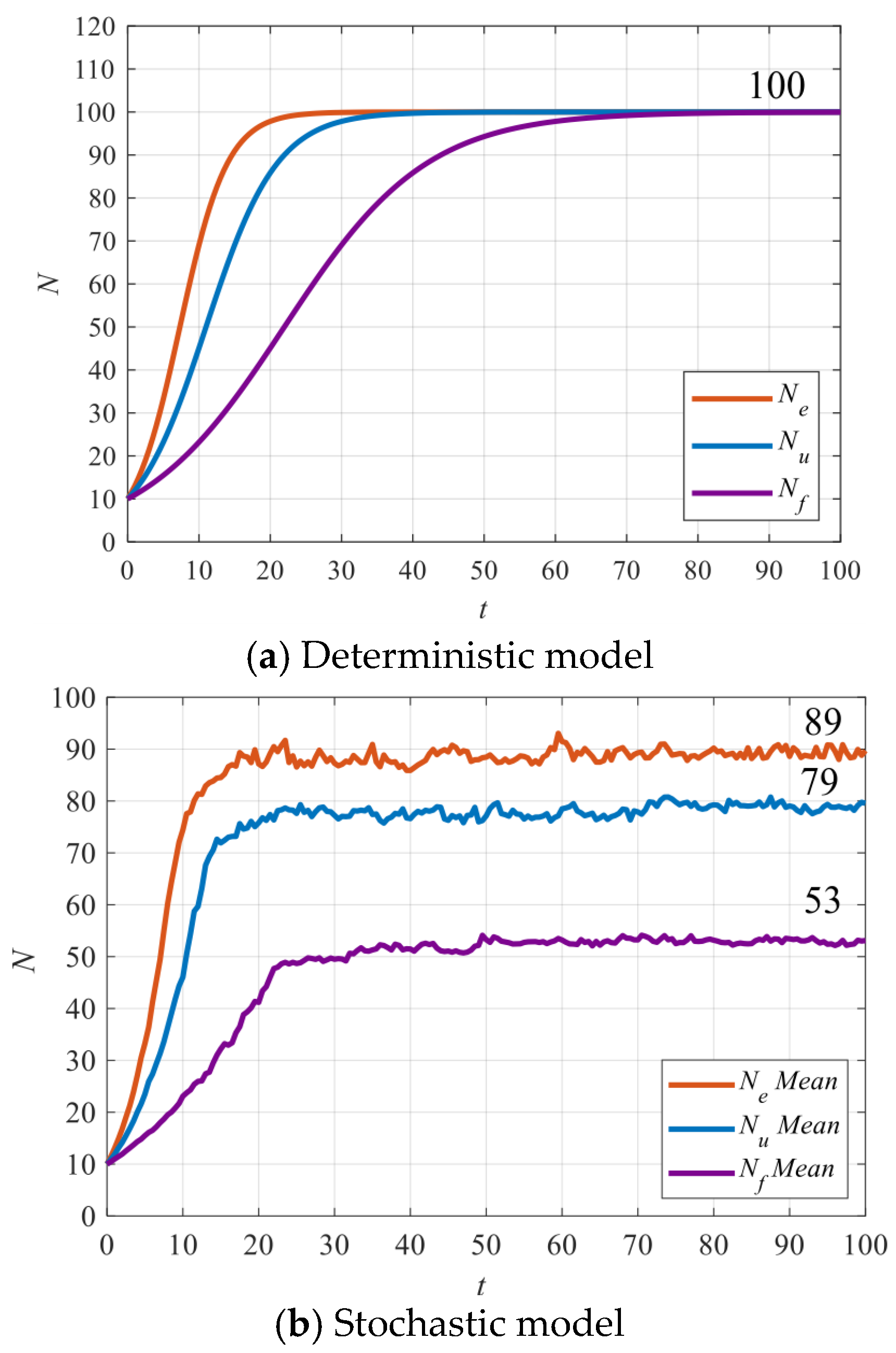
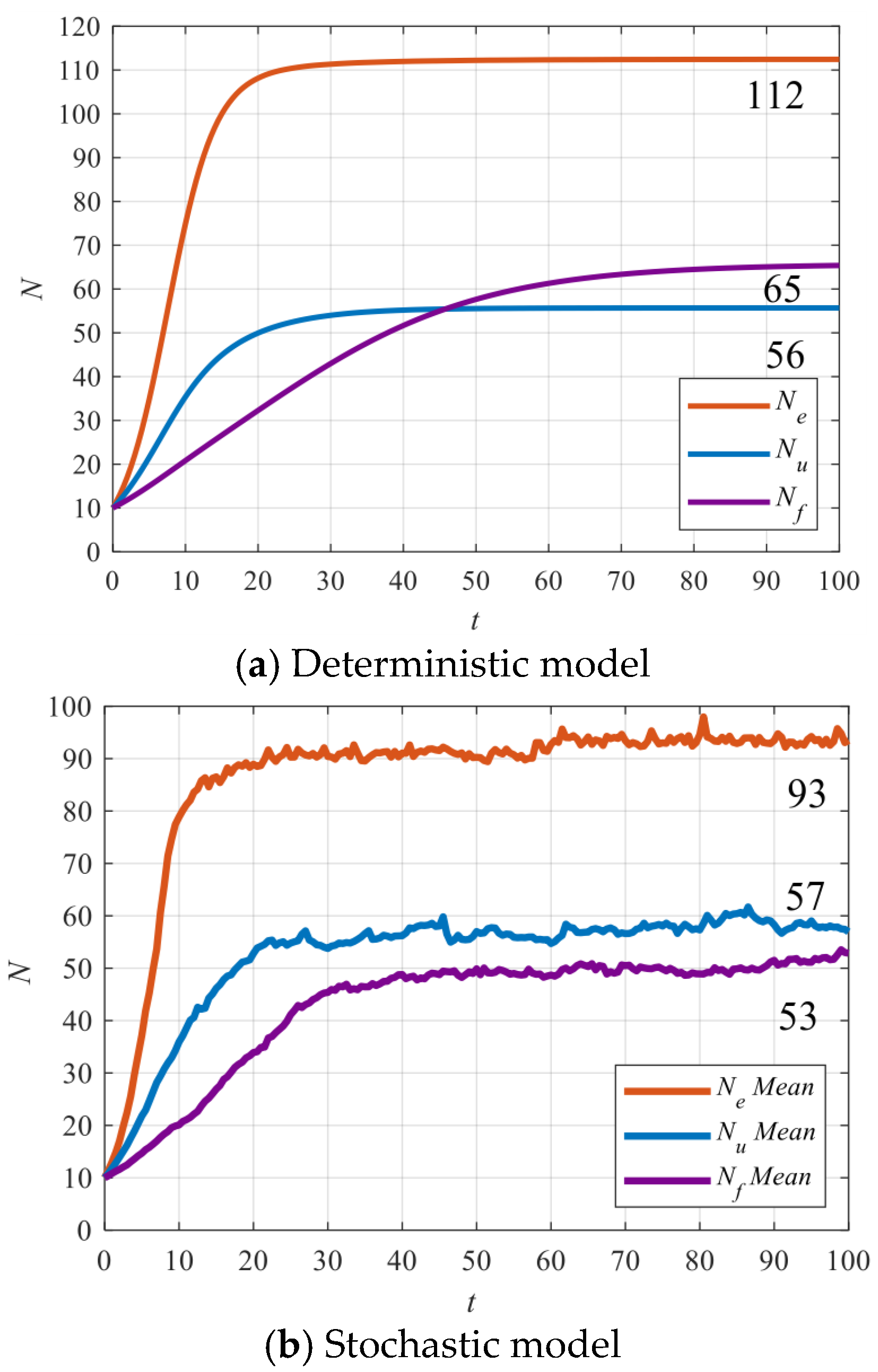
In the GMIE, three types of innovation groups exist. These groups—enterprises, URI, and independent researchers—maintain independent relationships. This means they do not have direct connections, do not influence one another, and remain relatively independent. In this context, we assign values a u e = 0 , a u f = 0 , a f e = 0 , a f u = 0 , a e f = 0 , and a e u = 0 . Their corresponding evolutionary trajectories are shown in Figure 2. Figure 2 illustrates the evolutionary dynamics of heterogeneous innovation groups within the GMIE under independent symbiosis. It juxtaposes results from the deterministic Logistic model (Figure 2a) and the stochastic Logistic model (Figure 2b). The deterministic model suggests that the growth of enterprises, URI, and independent researchers depends solely on their intrinsic growth rates. According to this model, all three groups would ultimately reach the GMIE’s maximum carrying capacity of 100. In contrast, the development of these innovation groups is influenced by stochastic disturbances. Factors such as subjective sentiment and social discourse play a significant role. Therefore, the stochastic Logistic model reveals a different outcome. In this model, none of the three groups achieves the ecosystem’s maximum scale. They stabilize at 89 for enterprises, 79 for URI, and 53 for independent researchers. This finding highlights the vulnerability of independent researchers. They are the most affected group by random shocks. Their relative weakness in innovation competitiveness limits their ability to resist pressures from enterprises. Enterprises frequently recruit independent researchers into their in-house R&D teams. This trend ultimately results in independent researchers becoming the smallest group within the GMIE. These contrasting outcomes between the two models provide an empirical basis for analyzing the resilience of the GMIE. They also shed light on the generation of collective intelligence within the ecosystem. The findings emphasize the varying robustness of different innovation groups to uncertainty, identifying independent researchers as the most fragile node in the ecosystem.

4.1.2. Competitive Symbiosis

Within the GMIE, the three types of innovation groups engage in competitive relationships. They compete for limited resources essential for GMIE. This competition restricts all parties involved, leading to negative outcomes, specifically a u e < 0 , a u f < 0 , a f e < 0 , a f u < 0 , a e f < 0 , and a e u < 0 . According to the E 8 stability condition, enterprises can achieve a larger market share in resource competition. Consequently, the interaction coefficient intensities of enterprises with URI and independent researchers are relatively large. When assigning the values a u e = 0.2 , a e u = 0.4 , a f e = 0.02 , a e f = 0.3 , a f u = 0.01 , and a u f = 0.01 , we can observe the evolutionary trajectory illustrated in Figure 3. Figure 3 delves into the evolutionary characteristics of GMIE groups within the context of competitive symbiosis among populations. The results demonstrate that, under both deterministic and stochastic Logistic models, no group reaches its upper scale limit. Their growth is driven by intrinsic growth rates and constrained by cross-group inhibitory pressures. Mild antagonistic interactions among groups foster an overall upward growth trend for all three groups, preventing total elimination. However, there are notable differences between the two models. In the deterministic model, enterprises initially grow but then face a slight decline due to resource competition with URI and independent researchers. The latter two groups endure more intense suppression from enterprises, leading to slower development. In contrast, the stochastic model reveals that independent researchers encounter the most volatile development trajectories. This volatility exacerbates their inherent developmental instability. Theoretically, these findings expand on the insights from Figure 2. They indicate that intergroup strategic coordination influences the GMIE’s response to both deterministic competition and stochastic disturbances. The slight decline in enterprise scale observed in the deterministic model points to suboptimal intergroup coordination. While resource competition might yield short-term efficiency gains, it hampers the growth of complementary innovators. This, in turn, undermines the ecosystem’s long-term resilience. Moreover, the increased volatility experienced by independent researchers in the stochastic model highlights the need for targeted coordination mechanisms. Such mechanisms can include resource support policies and collaborative innovation platforms aimed at stabilizing vulnerable groups. By enhancing targeted coordination, the GMIE can reduce the dual negative impacts of intergroup suppression and random disturbances. This approach can help balance the competitive advantages of dominant groups, like enterprises, with the exploratory innovation flexibility of subordinate groups, such as URI and independent researchers. Ultimately, it lays a strong foundation for generating collective intelligence to advance sustainable innovation goals.

4.1.3. Parasitic Symbiosis

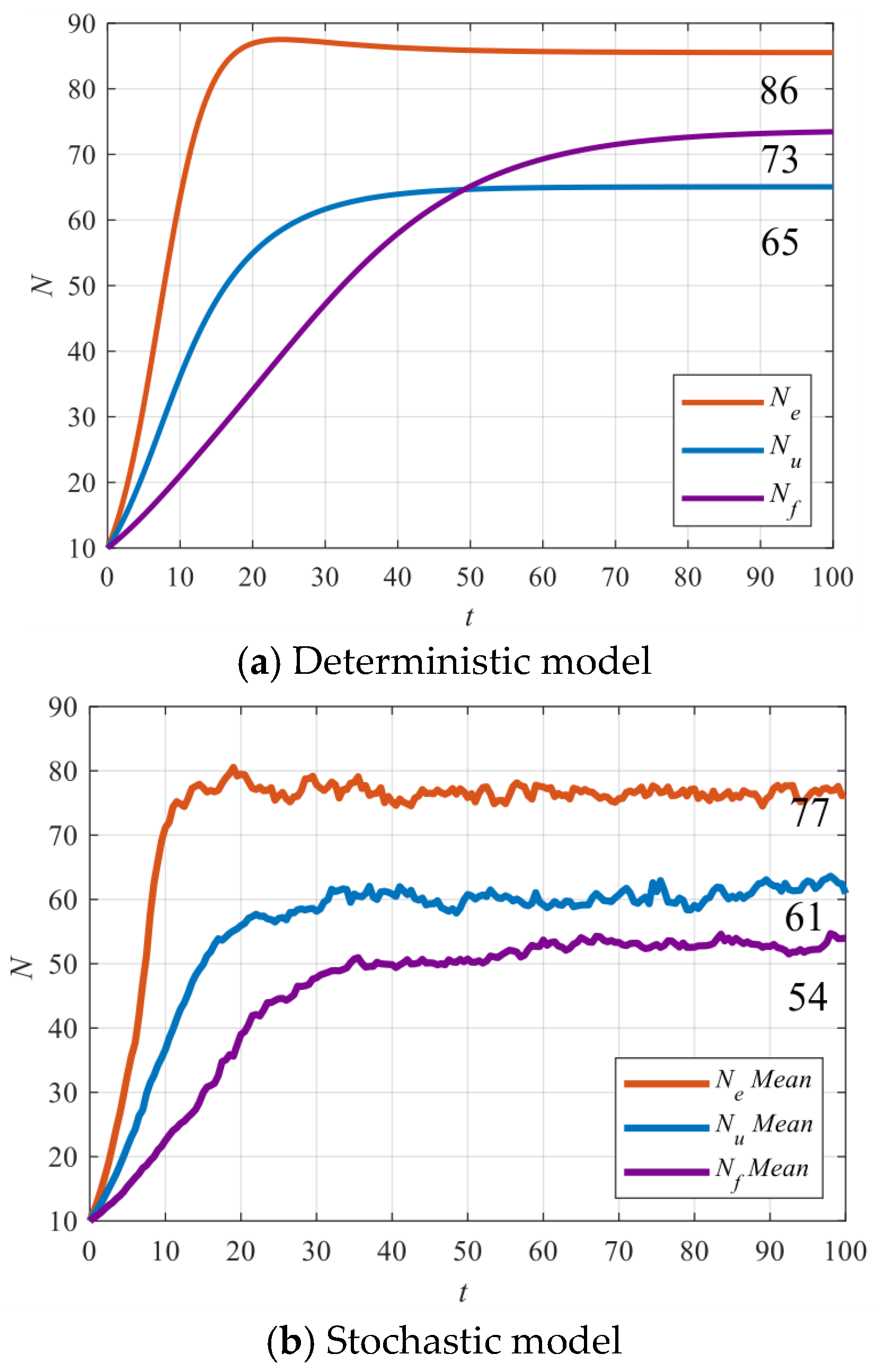
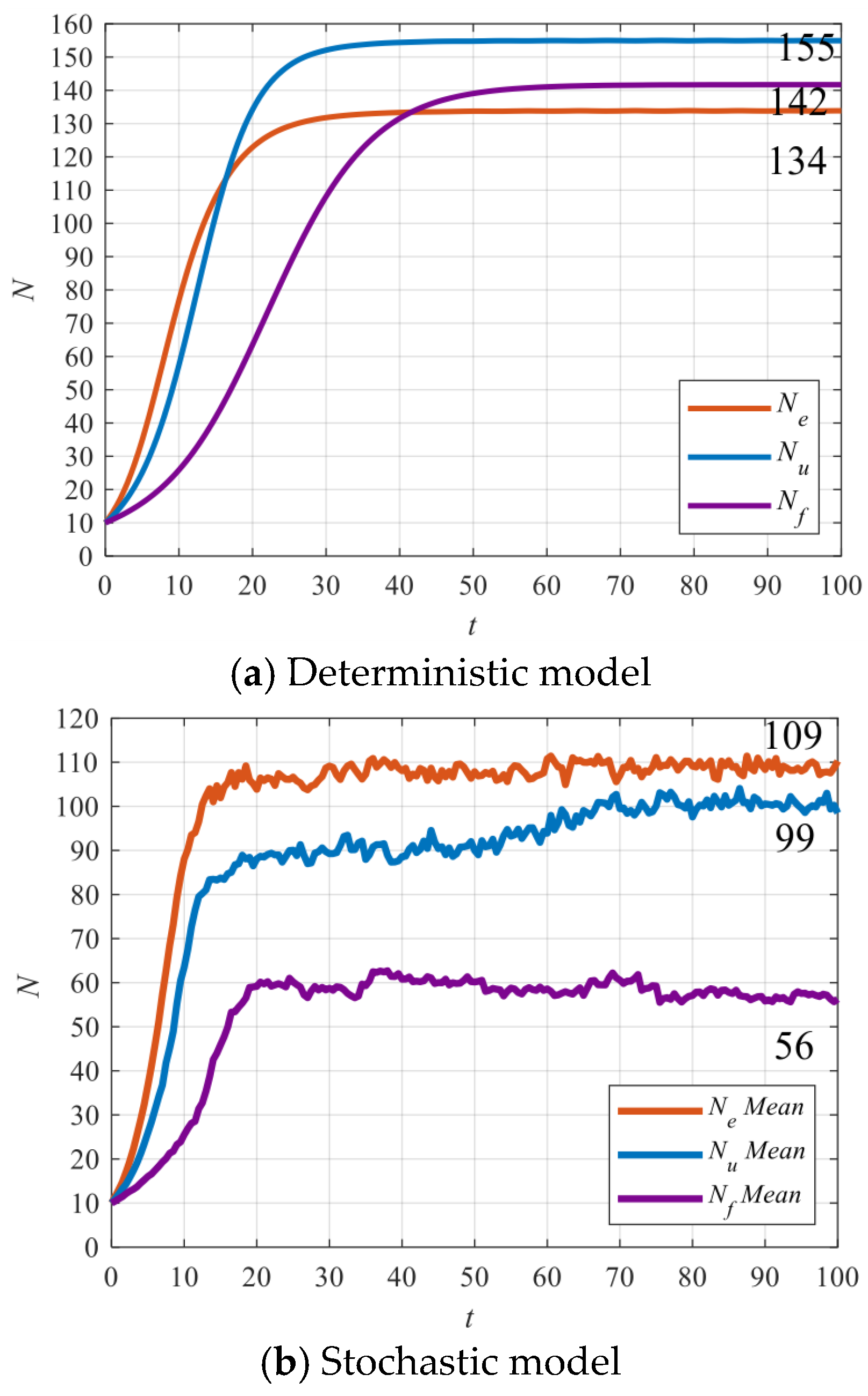
In the GMIE, the interactions among the three types of innovation groups are often parasitic. Typically, one party benefits at the expense of another. This dynamic leads to a situation where a i j a j i < 0 . With the parameters set at a u e = 0.2 , a e u = 0.4 , a f e = 0.02 , a e f = 0.3 , a f u = 0.01 , and a u f = 0.01 , enterprises tend to exploit the innovation resources of both URI and independent researchers. Additionally, URI might also exploit resources from independent researchers. Figure 4 explores the evolutionary trajectory of the GMIE under a scenario of parasitic symbiosis. In this context, enterprises function as the parasitic groups, while URI and independent researchers are the exploited parties. The deterministic model presented in Figure 4a illustrates that enterprises can achieve steady growth. In some cases, they even surpass the GMIE’s maximum carrying capacity. Meanwhile, URI and independent researchers face significant challenges. They suffer from the depletion of resources for GM innovation, resulting in slow growth and unrealized potential. When stochastic uncertainties are introduced, as shown in Figure 4b, this evolutionary pattern changes. Both enterprises and independent researchers experience a reduction in scale, while URI sees a modest increase. This increase can be credited to supportive government policies. These policies help secure the position of URI within the GMIE, thereby preserving the ecosystem’s basic innovation vitality and stability. These findings reveal the inherent vulnerabilities present in innovation ecosystems dominated by parasitic relationships. They highlight the crucial importance of targeted coordination for enhancing ecosystem sustainability. Within the deterministic framework, excessive expansion by corporations diminishes the innovative capabilities of dependent groups. This undermines the overall resilience of the GMIE. On the other hand, while stochastic disturbances may curb excessive corporate expansion, they can also heighten the vulnerability of independent researchers. Government support for URI acts as an effective coordination tool. It reduces the negative spillover effects resulting from parasitic exploitation and helps maintain basic stability within the GMIE. However, this support does not fundamentally address the structural imbalances in resource allocation within the ecosystem. To foster collective intelligence and ensure sustainable development, the GMIE needs to transition from a model of parasitic coordination to one based on mutually beneficial strategic collaboration. This transition requires limiting excessive resource extraction by enterprises, safeguarding the innovation resources of URI and independent researchers, and reshaping the ecosystem’s collective learning processes. By leveraging the complementary strengths of all participants, the GMIE can enhance its long-term adaptability and stability.

4.1.4. Commensal Symbiosis

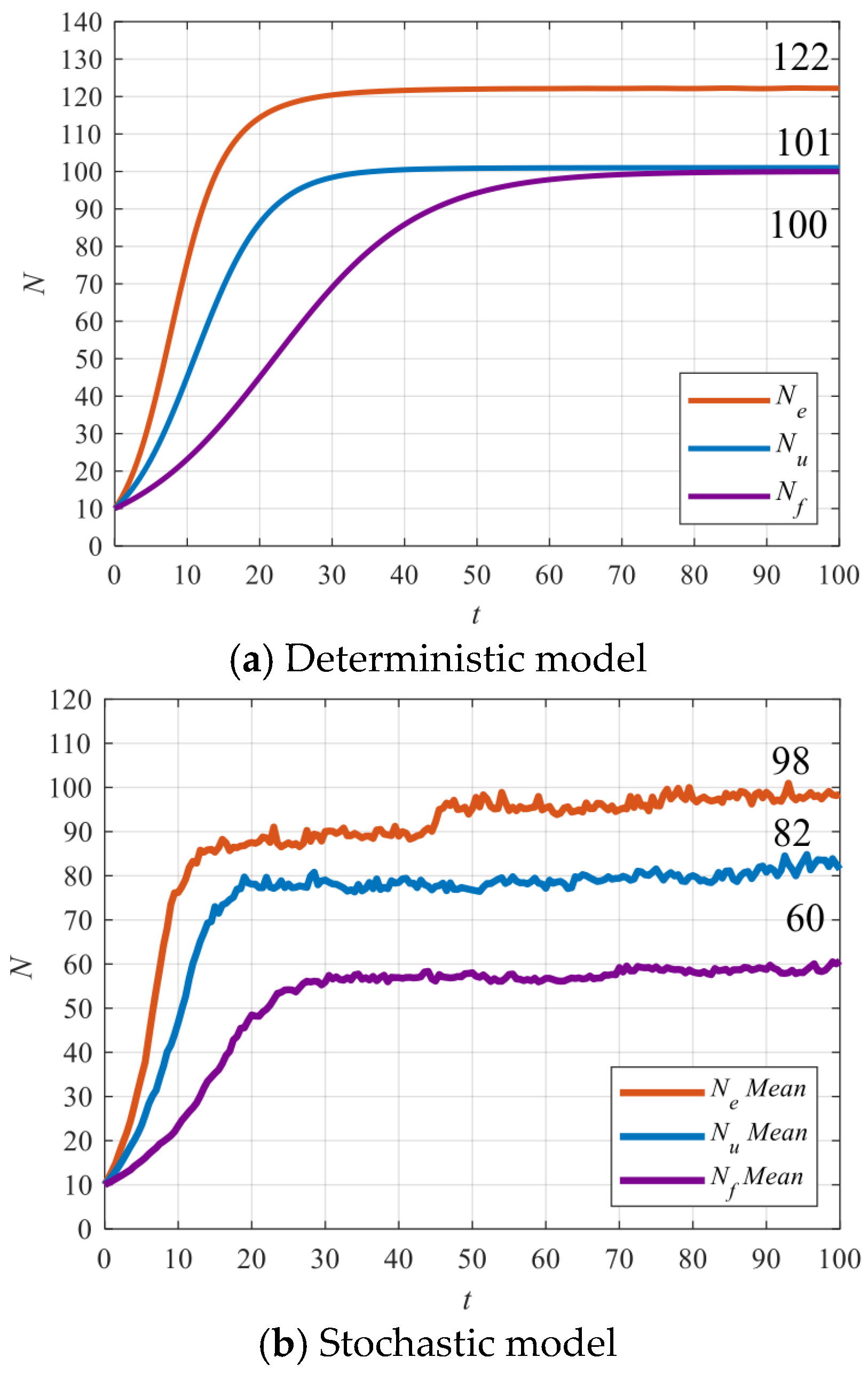
In the GMIE, three types of innovation groups engage in a mutually beneficial relationship. Each group’s benefit occurs without harming the others. This relationship is mathematically represented as a i j a j i = 0 ,   a i j + a j i > 0 . In this context, a u e = 0.2 , a e u = 0 , a f e = 0.02 , a e f = 0 , a f u = 0.01 , and a u f = 0 . URI works alongside independent researchers. They help enterprises access vital innovation resources within the ecosystem. At the same time, independent researchers enhance institutions’ access to these resources. Figure 5 explores the evolutionary characteristics of the GMIE under commensal symbiosis. In this scenario, enterprises benefit from the ecosystem without negatively impacting URI and independent researchers. The deterministic model in Figure 5a illustrates how enterprises gather abundant innovation resources with minimal resistance. As a result, they quickly surpass the GMIE’s carrying capacity of 100, reaching 122. Meanwhile, URI and independent researchers develop unhindered, achieving their maximum capacity as well. This evolutionary trend remains consistent in the stochastic Logistic model, showing no significant deviations in the development paths of the three groups. The commensalism-based mutual benefit model highlights the crucial role of strategic coordination. This coordination enhances the GMIE’s resilience to uncertainty. Independent researchers, who typically face fluctuating growth due to random challenges or parasitic relationships, achieve stability through commensalism. At the same time, the rapid growth of enterprises depends on a reliable supply of resources from integrated URI and independent researchers. In this arrangement, URI and independent researchers gain institutional support and access to resources, which mitigates their developmental risks. This stable commensal relationship ensures the ongoing collective learning processes within the GMIE. No participant faces obstacles to development or elimination. Consequently, the ecosystem maintains a consistent output of innovation and adaptive capacity.

4.1.5. Mutualistic Symbiosis

In the GMIE, three types of innovation groups engage in mutually beneficial symbiotic relationships. These relationships create interdependence among the groups. The conditions for these relationships are as follows: a u e > 0 , a u f > 0 , a f e > 0 , a f u > 0 , a e f > 0 , and a e u > 0 . With specific values of a u e = 0.2 , a e u = 0.4 , a f e = 0.02 , a e f = 0.3 , a f u = 0.01 , and a u f = 0.01 , we see a distinct evolutionary trajectory illustrated in Figure 6. Figure 6a highlights that, according to the deterministic Logistic model, all innovation groups exhibit synergistic symbiosis. Enterprises, URI, and independent researchers experience sustained development. They ultimately exceed their individual upper limits of scale. Scale expansion is influenced by the interaction coefficient a i j . A larger absolute value of a i j corresponds to a greater increase in the upper limit of the scale for the respective actor. When we compare Figure 2 and Figure 6, we note that the stochastic Logistic model reveals that all types of innovation groups reach their maximum scale under mutually beneficial symbiotic relationships. This suggests that such relationships represent the optimal evolutionary path for the GMIE. These findings integrate and deepen insights from previous analyses. They confirm that mutually beneficial strategic coordination serves as the foundation for stabilizing the GMIE’s coordination system. This coordination fosters collective intelligence and drives sustainable innovation growth. In contrast to the structural fragility seen in parasitic ecosystems and the limited stability of commensal ecosystems, mutualistic synergistic symbiosis creates a self-reinforcing virtuous cycle within the GMIE. Reciprocal collaboration among diverse groups enhances the ecosystem’s collective learning efficiency. This improvement boosts innovation output and strengthens the GMIE’s resilience to unexpected disturbances. This resilient coordination system adapts to the scale expansion of dominant enterprises. At the same time, it preserves the innovative vitality of all key participants, including URI and independent researchers. This approach effectively avoids the trade-offs and resource imbalances typical in parasitic and commensal symbiotic relationships.
For constructing a sustainable GMIE, these findings offer clear theoretical guidance. The design of intergroup coordination mechanisms should prioritize mutualistic symbiosis. It is essential to balance the competitive and cooperative demands of various innovation groups. Additionally, the ecosystem’s institutional design must protect vulnerable groups, such as independent researchers. By establishing a systematic and mutually beneficial strategic coordination mechanism, the GMIE can leverage the strengths of different participants. This includes harnessing the competitive advantages of enterprises, the basic research capabilities of URI, and the innovative explorations of independent researchers. Together, these elements can create a synergistic innovation pattern that utilizes complementary strengths. Ultimately, this approach fosters a self-reinforcing virtuous cycle. In this cycle, collective learning enhances innovation efficiency, while increased efficiency strengthens the resilience of the ecosystem. This synergy can lead to long-term adaptive stability and sustainable development within the green manufacturing innovation ecosystem.

4.2. Stability and Resilience of the GMIE

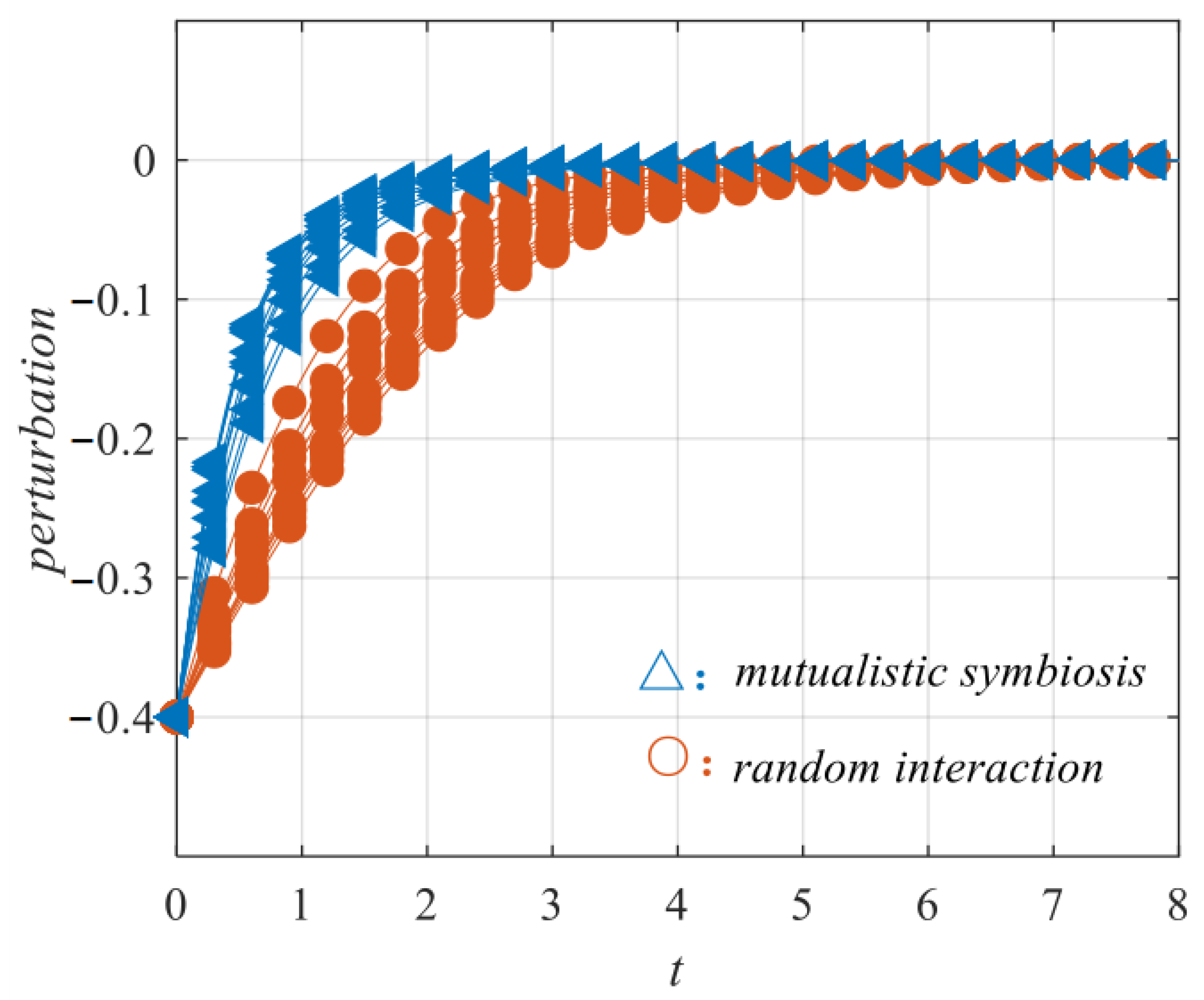
The GMIE resembles natural ecosystems in its dynamics. It follows the principle of survival of the fittest. In this ecosystem, older groups exit while new ones continually emerge. Figure 7 illustrates the trajectory of the Lotka–Volterra model. This model shows how the ecosystem recovers equilibrium when the number of GM innovators decreases. This decrease occurs over a short period due to a minor pulse disturbance. In the simulations, the “○” symbol represents an innovation ecosystem with randomly assigned interaction coefficients. These coefficients can be positive or negative, leading to various relationships like competitive or parasitic interactions. For this simulation, parameters were set to E a i j = 0 , and σ = 0.05 . The system underwent stochastic simulations ten times. The “△” symbol indicates an innovation ecosystem characterized by stochastic positive-positive interactions. These interactions create mutualistic relationships. Again, parameters were set to E a i j = 0.1 , and σ = 0.05 , with ten stochastic simulations conducted. Figure 7 reveals an important finding. In all simulations, an initial suppression of innovation agents by 0.4 units led to a gradual fading of the pulse disturbance over time. However, ecosystems based on purely mutualistic interactions recovered significantly faster than those with stochastic interactions.
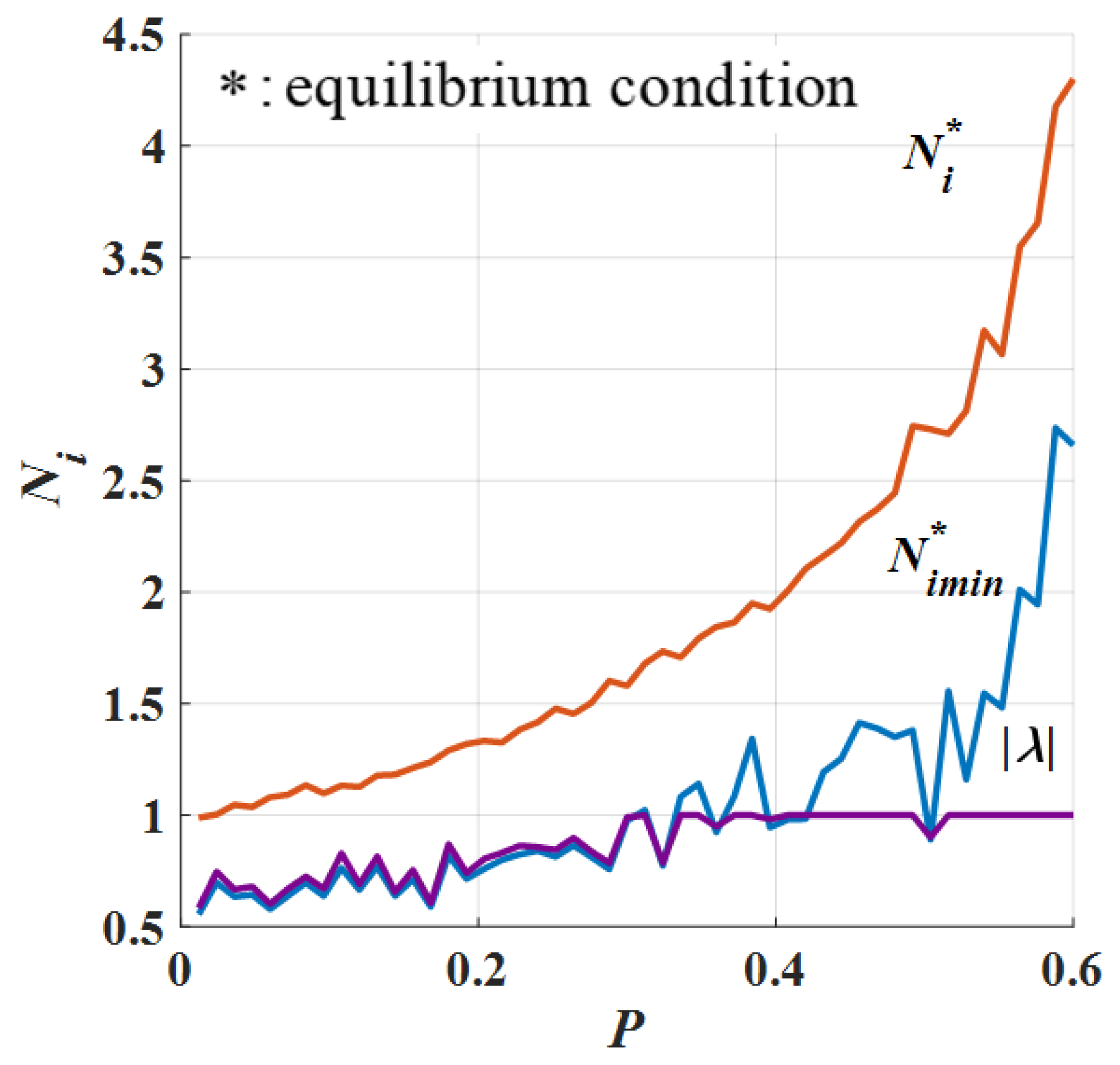
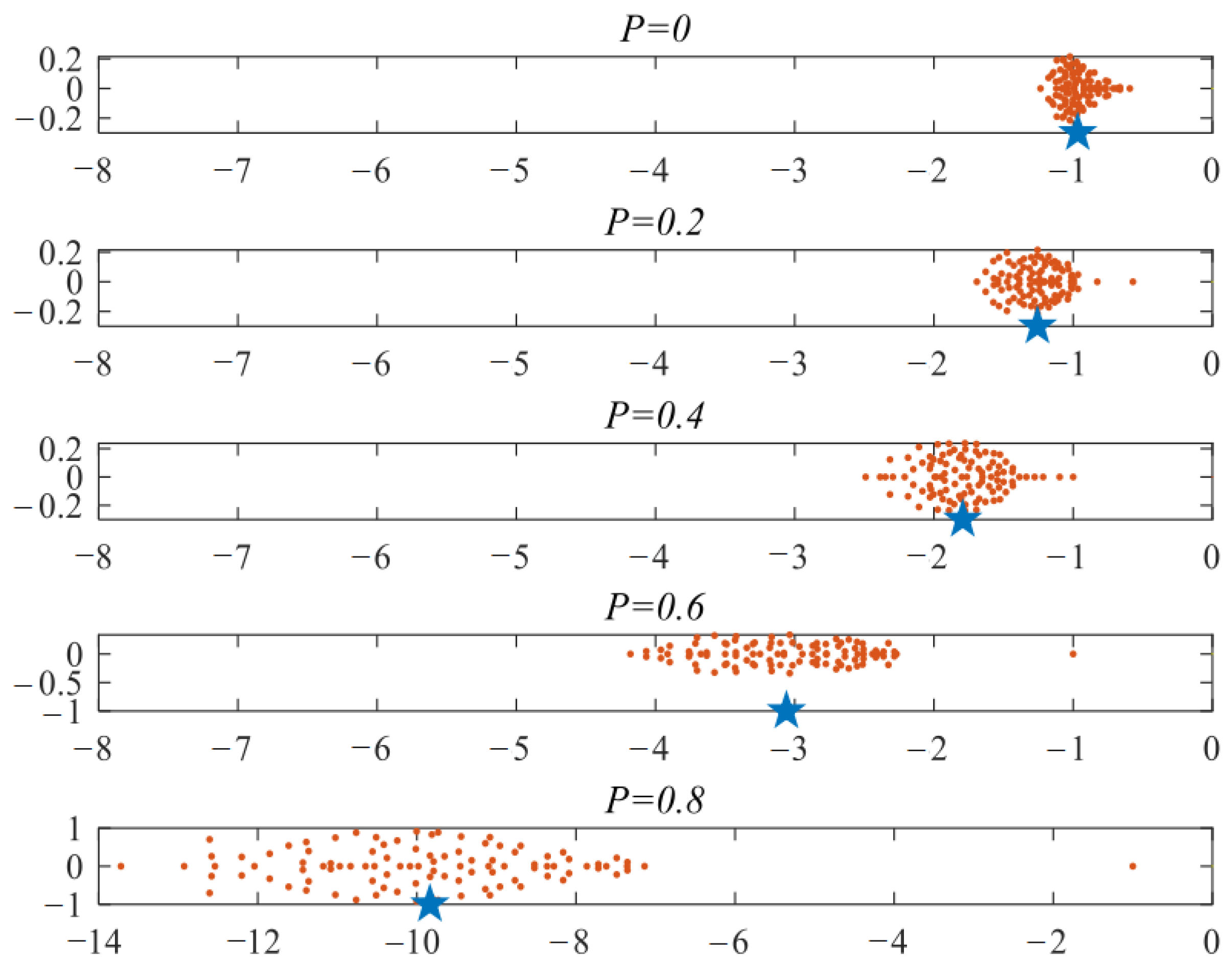
The GMIE includes various innovation groups. These groups consist of N e enterprise innovation groups, N u URI innovation groups, and N f independent researcher innovation groups. Each group displays heterogeneity. This diversity exists among enterprises, URI, and independent researchers. To study this ecosystem, the simulation models the evolutionary dynamics of n distinct innovation groups. Relationships between groups are complex rather than singular. Multiple interactions occur simultaneously. These include competitive, parasitic, and mutualistic symbiosis. Figure 8 illustrates the connection between the proportion of mutualistic symbiosis and system stability. The bulk eigenvalues (orange dots) are contained within an ellipse whose center approaches the average equilibrium level, where N i * plotted as blue stars. In this simulation, only the proportion of mutualistic symbiosis, designated as P , is fixed. All other interactions are randomized. A total of 100 simulations were repeated to calculate the mean values. The specific parameters set for these simulations included n = 100 , σ = 0.02 , and r = 1 . The results shown in Figure 8 indicate that an increase in the proportion of mutualistic symbiosis P leads to a rise in the maximum eigenvalue λ max i of the group matrix. This outcome suggests that a higher level of mutualistic symbiosis among groups enhances the system’s resilience. Additionally, as the mutualistic symbiosis ratio P increases, the sizes of groups also grow. The stability effect of quantity indicates that a higher equilibrium number of innovation groups contributes to the robust stability of the GMIE.
Figure 9 shows the curve depicting the equilibrium state as a function of the proportion of mutualistic symbiosis. As shown in Figure 8, for each value of P , the minimum equilibrium value N i min * of the populations (blue line) is a good approximation of the critical eigenvalue λ (purple line) within the regime where N i min * < 1 . Outside this regime, for higher values of P, the critical eigenvalue equals λ = 1 . The orange and blue lines indicate that special attention must be paid when mutualistic interactions exceed a certain threshold, as this may lead to population explosions and compromised viability. Clearly, the constraint N i * < 1 must be imposed to prevent population blow-up, and viability is lost when N i * 1 . These factors are critical in constraining the viability of mutualistic systems.
From the perspective of system stability and resilience, this finding reinforces the idea that mutually beneficial strategic coordination is central to an ecosystem’s resilience against external disturbances. The simulations show a gradual dissipation of pulse disturbances across all scenarios. This outcome highlights the inherent adaptive capacity of GMIE. Mutualistic relationships enhance this adaptive capacity. They create self-stabilizing feedback loops that boost resilience. Faster recovery preserves the structural integrity of ecosystems. It also ensures the continuous generation of collective intelligence. This ongoing generation prevents the loss of innovative momentum that can occur due to prolonged disturbances. This indicates that when constructing GMIE, priority should be given to adopting mutually beneficial coordination mechanisms. Such mechanisms not only enhance the ecosystem’s resilience against external disturbances but also maintain robust collective learning processes, laying a solid foundation for long-term, stable and sustainable innovation and development.

4.3. Parameter Sensitivity Analysis

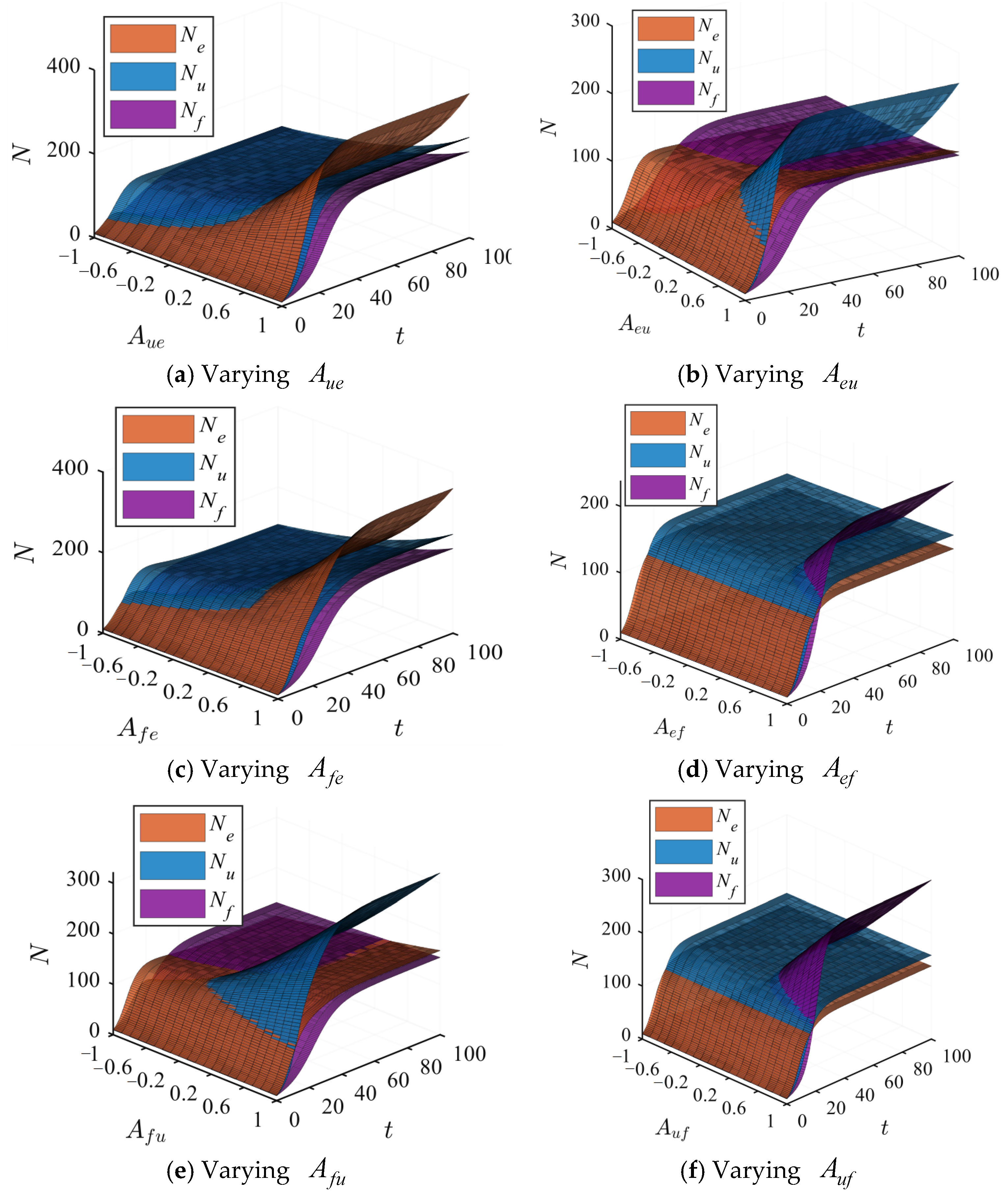
The above research indicates that mutualistic symbiosis represents the optimal evolutionary pathway for GMIE, and the collective success of these groups depends on the interaction coefficient. This section examines the temporal dynamic response of innovation-driven groups when interaction coefficients change. Figure 10 illustrates the evolving relationships over time ( t ) and the interaction coefficient ( A i j ) among three types of innovation groups. These groups include enterprises ( N e , orange), URI ( N u , blue), and independent researchers ( N f , purple). The coefficient A i j is defined within the range A i j 1 , 1 .
As shown in Figure 10a–f, the enterprise groups demonstrate the highest sensitivity to the interaction coefficient A u e and A f e . With an increase in A u e or A f e , the interaction between enterprise groups and their competitors will shift from competitive to mutually beneficial, leading to a gradual expansion of the equilibrium scale of enterprise groups. In contrast, the URI groups show the greatest sensitivity to the interaction coefficients A e u and A f u . As A e u or A f u increases, their relationship shifts from competitive to mutually beneficial. Consequently, the equilibrium size of the URI groups gradually expands. The independent researcher groups, meanwhile, demonstrate the highest sensitivity to the interaction coefficients A e f and A u f . As A e f or A u f increases, their interaction patterns have also shifted from competition to mutual benefit, leading to a gradual expansion in the equilibrium size of the independent researcher groups.

5. Conclusions

The study establishes a detailed framework for understanding GMIE. It utilizes principles from symbiosis theory, particularly the Lotka–Volterra equations. The investigation focuses on symbiotic relationships among innovation groups, including enterprises, URI, and independent researchers. The findings yield several key insights that are relevant for policymakers, business strategists, and researchers interested in innovation ecosystems.
(1) Under independent symbiosis, independent researchers face significant risks from random disturbances within the GMIE. They demonstrate the lowest equilibrium scale (53) in the random model. This heightened vulnerability arises from their weaker competitiveness in innovation and their sensitivity to the absorption of corporate talent. To ensure that independent researchers continue to contribute effectively to the GMIE innovation ecosystem, it is essential to prioritize targeted support and resource allocation. This approach will help mitigate random disturbances and stabilize their role within the GMIE.
(2) Under competitive symbiosis, neither deterministic nor stochastic logic models suggest that enterprises, URI, or independent researchers have hit their upper limits. This indicates there is inherent growth potential within the GMIE. The phenomenon of asymmetric suppression shows that enterprises can suppress others more significantly. Additionally, the stochastic instability affecting independent researchers highlights the competitive imbalances present among these groups. By optimizing competitive mechanisms, we can reduce the unequal pressures of suppression. This strategy can unlock the ecosystem’s growth potential and stabilize vulnerable groups, such as independent researchers.
(3) Under parasitic symbiosis, enterprises benefit at the expense of URI and independent researchers. This is evident from resource exploitation patterns identified in deterministic models. Stochastic models also show uneven scaling changes that reflect this imbalance. Such parasitic dynamics threaten the long-term sustainability of the GMIE. Therefore, it is crucial to promote balanced intergroup relationships. Policymakers must create regulatory frameworks to limit exploitative practices. They should also enhance support for vulnerable groups, including URI and independent researchers. This support will ensure that these groups develop in a way that aligns with the ecosystem’s overall stability and innovation capacity.
(4) Under commensal symbiosis, enterprises experience rapid scale expansion, exceeding ecosystem constraints to reach a level of 122. This growth occurs with support from URI and independent researchers. The significant synergistic effects in the GMIE arise from this collaboration. Specifically, URI and independent researchers play a resource-facilitating role that allows enterprises to expand without suppressing other groups. By fostering supportive interactions among these groups, we can unleash the ecosystem’s innovative potential. This approach will accelerate the growth of core participants while maintaining stability among non-beneficiary groups.
(5) Under mutualistic symbiosis, all innovation groups, including enterprises, URI, and independent researchers, exceed their size constraints. This enables them to achieve maximum scale. Both deterministic and stochastic logistic models support this observation. The mutual success of these groups is mediated by interaction coefficients. This finding confirms that reciprocal symbiosis is the best evolutionary pathway for GMIE. It highlights that collaborative interactions improve overall innovation output. Additionally, these interactions strengthen the long-term sustainability of the ecosystem. This offers a valuable framework for enhancing intergroup relations within innovation ecosystems.
(6) Ecosystems with purely mutualistic interactions recover more quickly from pulse disturbances than those with random interactions. This observation confirms that reciprocal relationships enhance resilience in GMIE. In these ecosystems, mutualistic synergies boost both disturbance resistance and recovery capacity. By prioritizing mutualistic interactions, we can strengthen ecosystem stability. This approach enables faster recovery from external disturbances and supports long-term innovation. These findings align with the optimal evolutionary path identified for GMIE.
(7) Relationships among groups in these ecosystems vary. Multiple interactions, including competition, parasitic, and mutualistic symbiosis, etc., can occur simultaneously. Mutualistic symbiosis proportion is a key regulator of ecosystem stability. Increasing this proportion enhances resilience. This finding emphasizes that prioritizing quality in mutualistic symbiosis, rather than just quantity, is crucial. It optimizes the long-term sustainability and growth of GMIE. These results validate previous conclusions that reciprocal symbiosis is the optimal evolutionary pathway for ecosystems.
Overall, this study lays the groundwork for future research into GMIE. It emphasizes the importance of strategically managing inter-group relationships. The implications for sustainable innovation practices and policymaking are significant. Stakeholders should pursue cooperative frameworks that benefit all participants. This approach will help create a more vibrant and resilient ecosystem for GMIE.

6. Managerial Implication

To support the steady advancement of the GMIE, this paper offers valuable management insights.
(1) For independent relationships. Independent researchers often experience significant vulnerability to random disruptions. It is imperative to allocate more resources to independent researchers and ensure the stability of their work. Policymakers should implement targeted support mechanisms. These mechanisms could include stable, long-term research funding. They might also include risk mitigation funds and shared technical infrastructure platforms. Such measures will strengthen the resilience of independent researchers. This increased stability will help ensure their continued contributions to core green innovation. Advancing low-carbon technology R&D relies on these contributions.
(2) For competitive relationships. Many enterprises, URI, and independent researchers have not yet reached their full potential in the current competitive environment. To address this, policymakers can create competitive incentive frameworks. These frameworks might include tiered reward competitions for green innovation. They may also prioritize market access for efficient low-carbon technologies. Such measures can stimulate healthy competition among participants. This competition will encourage them to optimize their capabilities. Ultimately, it will promote iterative low-carbon innovation within the ecosystem.
(3) For parasitic relationships. Policymakers should establish institutional frameworks that promote constructive group interactions. The proposed frameworks should include clear guidelines to prevent exploitation by enterprises. Equitable benefit distribution should be emphasized as a fundamental principle. Additionally, there must be mandatory mechanisms for sharing benefits derived from green innovations. These frameworks should establish auditing systems to monitor resource extraction during collaborative projects. Regular assessments of ecosystem dynamics will promote timely identification of exploitative practices. This will help strengthen accountability among all stakeholders involved. Moreover, imposing strict penalties for exploitation is essential. Such measures will protect the interests of knowledge producers. They will also ensure the sustainability of low-carbon innovation supply chains.
(4) For commensal relationships. Policymakers and managers should leverage the potential synergies that arise when commensal interactions approach scale limitations. They should promote supportive interaction platforms. Examples of these platforms include industry-academia-research matching services and green technology incubators. These platforms will facilitate resource spillovers from leading innovative enterprises to other participants. This approach will accelerate the adoption of low-carbon technologies. It will also enhance innovation efficiency across the entire ecosystem.
(5) For mutualistic relationships. Mutualistic relationships drive collective prosperity and enhance ecosystem resilience. They enable faster recovery from disturbances compared to systems with random interactions. Therefore, promoting these synergies should be a priority. To achieve this, several measures can be implemented. Funding green innovation projects can encourage collaboration among various stakeholders. Additionally, offering tax incentives for reciprocal partnerships will support these efforts. Establishing cooperative governance committees can help coordinate interests among different parties. By implementing these strategies, we can foster a stable, low-carbon ecosystem. This approach will also strengthen disturbance resilience.
(6) For multi-relationship coordination. Policymakers should recognize that multiple interactions coexist in ecosystems. These interactions include independence, competition, parasitism, commensalism, and mutualism. Research shows that more mutually beneficial relationships enhance ecosystem sustainability. Therefore, a holistic governance approach is essential. This approach involves designing a policy mix. The mix should aim to deter parasitic behaviors and guide competition toward low-carbon objectives. Additionally, it should prioritize mutually beneficial cooperation among stakeholders. The ultimate goal is to increase the proportion of mutualistic interactions. By doing this, we can align GMIE with long-term carbon peak and climate neutrality targets.

7. Research Gaps and Future Prospects

This study has some limitations. First, we have only considered three groups in the GMIE. In reality, multiple symbiotic groups exist and can influence their symbiotic evolutionary mechanisms. Future research should consider other groups, such as governments and regulators. Second, this model has limitations in GMIE groups with different participant compositions. The innovation ecosystem has three core groups. If any core group is missing, the model’s fundamental assumptions no longer hold. For example, independent researchers may be absent, leaving only enterprises and URI. In such cases, simulation results cannot reflect the ecosystem’s actual evolutionary characteristics. Third, the model assumes that stochastic disturbances are both stochastic and non-directional. This includes stochastic fluctuations in subjective sentiment and social discourse. However, in empirical situations where disturbances are directional and persistent, the model’s effectiveness weakens. For instance, prolonged policy tightening or significant technological breakthroughs can affect the accuracy of the model’s predictions related to ecosystem evolution.

Author Contributions

Data curation: N.L. Formal analysis: N.L. Funding acquisition: N.L. Investigation: N.L. Methodology: Y.W. Project administration: Y.W. Resources: Y.W. Software: N.L. Supervision: N.L. Validation: N.L. and Y.W. Visualization: N.L. Writing—original draft: N.L. Writing—review and editing: Y.W. All authors have read and agreed to the published version of the manuscript.

Funding

This research was funded by the Natural Science Foundation of Shandong Province, grant number ZR2025QC761.

Institutional Review Board Statement

Not applicable.

Informed Consent Statement

Not applicable.

Data Availability Statement

The original contributions presented in this study are included in the article. Further inquiries can be directed to the corresponding author.

Conflicts of Interest

The authors declare no conflicts of interest.

Abbreviations

The following abbreviations are used in this manuscript:
GMGreen manufacturing
IEInnovation ecosystem
GMIEGreen manufacturing innovation ecosystem
URIUniversities and research institutions

References

  1. Bai, X.; Zhang, Z. Does the digital innovation ecosystem promote green technology innovation? Evidence from 264 cities in China. Technol. Soc. 2025, 83, 102977. [Google Scholar] [CrossRef]
  2. Qin, H.; Zou, H.; Sun, J. Incentive strategy of dual innovation balance in green manufacturing innovation ecosystem: Based on hierarchical structure of innovation subject. PLoS ONE 2023, 18, e0291811. [Google Scholar] [CrossRef]
  3. Hassan, M.F. The Role of Using Green Manufacturing as One of the Requirements for Sustainable Development in Reducing Costs. Int. Acad. J. Account. Financ. Manag. 2023, 10, 64–71. [Google Scholar] [CrossRef]
  4. Zhou, Y.; Lan, J. Impact of Lighting Enterprise Innovation Performance from the Perspective of Collaborative Innovation Network. Light Eng. 2025, 33, 88–99. [Google Scholar] [CrossRef] [PubMed]
  5. Canbul, A.; Çemberci, M. The role of collaborative innovation networks in the relationship between firms’ innovation capabilities and firm performance. Middle East J. Manag. 2024, 11, 127–151. [Google Scholar] [CrossRef]
  6. Sharma, K.; Arora, R.; Nangia, R.; Singel, R.; Dharmveer; Dixit, S. Effects of green manufacturing and technological innovations on sustainable development. Mater. Today Proc. 2022, 69, 266–270. [Google Scholar] [CrossRef]
  7. Huiling, L.; Dan, L. Value chain reconstruction and sustainable development of green manufacturing industry. Sustain. Comput. Inform. Syst. 2020, 28, 100418. [Google Scholar] [CrossRef]
  8. Loong, A.H.; Lada, S.; Kehui, W.; Bui, C.J.; Xinyue, L. Examining influential elements impacting performance in sustainable manufacturing within malaysian enterprise: A conceptual analysis. Malays. J. Bus. Econ. MJBE 2024, 11, 90–101. [Google Scholar] [CrossRef]
  9. Khalili, A.; Ismail, M.Y.; Abdulrazak, S.N. Exploring the interrelationships between green manufacturing practices and Malaysian green sustainable performance. Int. J. Product. Qual. Manag. 2023, 38, 1. [Google Scholar] [CrossRef]
  10. Leong, W.D.; Lam, H.L.; Ng, W.P.Q.; Lim, C.H.; Tan, C.P.; Ponnambalam, S.G. Lean and green manufacturing—A review on its applications and impacts. Process Integr. Optim. Sustain. 2019, 3, 5–23. [Google Scholar] [CrossRef]
  11. Garretson, I.C.; Mani, M.; Leong, S.; Lyons, K.W.; Haapala, K.R. Terminology to support manufacturing process characterization and assessment for sustainable production. J. Clean. Prod. 2016, 139, 986–1000. [Google Scholar] [CrossRef]
  12. Wei, Y.; Yang, M.; Chien, M. Green Manufacturing. In Flat Panel Display Manufacturing; John Wiley & Sons, Inc.: Hoboken, NJ, USA, 2018; pp. 441–455. [Google Scholar] [CrossRef]
  13. Abdul-Azeez, O.Y.; Nwabekee, U.S.; Agu, E.E.; Ijomah, T.I. Sustainability in product life cycle management: A review of best practices and innovations. Int. J. Appl. Res. Soc. Sci. 2024, 6, 2018–2043. [Google Scholar] [CrossRef]
  14. Javed, H.; Du, J.; Farooq Islam, M. Unpacking organizational capabilities and green Innovation for sustainable Performance: The role of environmental regulations in manufacturing industry. J. Clean. Prod. 2025, 507, 145453. [Google Scholar] [CrossRef]
  15. Waqas, M.; Qingfeng, M.; Ahmad, N.; Iqbal, M. Green brands, customer satisfaction and sustainable performance in the Chinese manufacturing industry. Manag. Decis. 2023, 61, 3545–3572. [Google Scholar] [CrossRef]
  16. Subramaniam, R.; Susairaj, M.; Mohapatra, S. The role of green organisational culture in moderating the relationship between environmental CSR activities and green brand image of organisations. Int. J. Enterp. Netw. Manag. 2025, 16, 162–178. [Google Scholar] [CrossRef]
  17. Azhari, A.; Rahmat, M.R.A.; Ridha, A. Green Management as The Key to Competitive Advantage: A Corporate Strategy Perspective in 2024. Econ. Bus. J. ECBIS 2024, 2, 467–476. [Google Scholar] [CrossRef]
  18. Batool, S.; Arshad, M.R.; Gul, R.; Shahid, M. Role of Green Customer Value, Awareness of Environmental Consequences, Green Brand Positioning and Attitude Toward Green Brand in Influencing Green Purchase Intention. Int. J. Soc. Sci. Entrep. 2023, 3, 605–621. [Google Scholar] [CrossRef]
  19. Zameer, H.; Wang, Y.; Yasmeen, H. Reinforcing green competitive advantage through green production, creativity and green brand image: Implications for cleaner production in China. J. Clean. Prod. 2020, 247, 119119. [Google Scholar] [CrossRef]
  20. Ramadhani Abanan, M.Z.; Isharina, I.K. Pengaruh Green Creativity Terhadap Green Competitive Advantage Dengan Mediasi Green Brand Image. Reviu Akunt. Manaj. Bisnis 2024, 4, 157–169. [Google Scholar] [CrossRef]
  21. Eksandy, A.; Murtanto; Arsjah, R.J. Green Competitive Advantage Moderate:Environmental Performance, Corporate Image and Corporate Social Performance on Economic Performance. Int. J. Sci. Technol. Manag. 2021, 2, 1468–1478. [Google Scholar] [CrossRef]
  22. Li, J.; Sun, R. How tax incentives impact corporate green transformation: Evidence from China’s tax survey data. J. Clean. Prod. 2025, 521, 146279. [Google Scholar] [CrossRef]
  23. Shi, Y.; Ge, J. The role of government fiscal and tax incentives in green technology innovation and enterprise development: Implications for human health and hygiene. Front. Public Health 2025, 12, 1502856. [Google Scholar] [CrossRef] [PubMed]
  24. Timah, B.P.; Chukwu, G.J. Tax Incentives Influence on Corporate Earnings: Evidence from Quoted Manufacturing Companies In Nigeria. Arch. Bus. Res. 2021, 9, 182–194. [Google Scholar] [CrossRef]
  25. Aguado, S.; Alvarez, R.; Domingo, R. Model of efficient and sustainable improvements in a lean production system through processes of environmental innovation. J. Clean. Prod. 2013, 47, 141–148. [Google Scholar] [CrossRef]
  26. Nguyen-Viet, B. The impact of green marketing mix elements on green customer based brand equity in an emerging market. Asia-Pac. J. Bus. Adm. 2022, 15, 96–116. [Google Scholar] [CrossRef]
  27. Nguyen, H.; Onofrei, G.; Yang, Y.; Pham, H.; Wiengarten, F.; Nkhoma, M. Handling customer green pressures: The mediating role of process innovation among export-oriented manufacturing industries. Bus. Strategy Environ. 2022, 32, 2312–2326. [Google Scholar] [CrossRef]
  28. Li, K.; Wang, X.; Liang, Q.; Li, Y. Research on symbiosis models in manufacturing innovation ecosystems. Environ. Technol. Innov. 2025, 39, 104285. [Google Scholar] [CrossRef]
  29. Wu, S.; Ning, L.; Mu, S. Exploring the nexus between technological collaboration and green innovation: The role of corporate R&D structure and managerial orientation. J. Bus. Res. 2025, 199, 115561. [Google Scholar] [CrossRef]
  30. Chappert, C.; Fernandez, A.; Leyva-de La Hiz, D.I. How to Collaborate for Green Innovation? A Perspective From Innovation Ecosystems. Acad. Manag. Proc. 2025, 2025, 10406. [Google Scholar] [CrossRef]
  31. Reed, M.; Langford, J. Ecosystem Innovation. In The University Partnership Playbook; Liverpool University Press: Liverpool, UK, 2021; p. 29. [Google Scholar] [CrossRef]
  32. Baldwin, C.Y.; Bogers, M.L.A.M.; Kapoor, R.; West, J. Focusing the ecosystem lens on innovation studies. Res. Policy 2024, 53, 104949. [Google Scholar] [CrossRef]
  33. Ullah, S.; Khan, F.U.; Ahmad, N. Promoting sustainability through green innovation adoption: A case of manufacturing industry. Environ. Sci. Pollut. Res. 2021, 29, 21119–21139. [Google Scholar] [CrossRef] [PubMed]
  34. Shahzad, M.; Qu, Y.; Rehman, S.U.; Zafar, A.U. Adoption of green innovation technology to accelerate sustainable development among manufacturing industry. J. Innov. Knowl. 2022, 7, 100231. [Google Scholar] [CrossRef]
  35. Song, Z.; Zhu, J.; Shi, J. Evolution Analysis of Green Innovation in Small and Medium-Sized Manufacturing Enterprises. Systems 2023, 11, 95. [Google Scholar] [CrossRef]
  36. Zhang, T.; Zhou, J.; Wang, M.; Ren, K.; Imran, M.; Wang, R. Cultivation Mechanism of Green Technology Innovation in Manufacturing Enterprises Under Environmental Regulations in China. Front. Environ. Sci. 2022, 10, 926896. [Google Scholar] [CrossRef]
  37. Guowei, S.; Qiwu, C.; Bo, S. A new mathematical model of interspecific competition—An expansion of the classical Lotka-Volterra competition equations. Ecol. Model. 1991, 58, 273–284. [Google Scholar] [CrossRef]
  38. Liu, Y.; Li, M.; Feng, H.; Feng, N. Technological cooperation or competition? optimal strategies of incumbent and entrant in ICT markets. Omega 2024, 125, 103037. [Google Scholar] [CrossRef]
  39. Bertassini, A.C.; Zanon, L.G.; Azarias, J.G.; Gerolamo, M.C.; Ometto, A.R. Circular Business Ecosystem Innovation: A guide for mapping stakeholders, capturing values, and finding new opportunities. Sustain. Prod. Consum. 2021, 27, 436–448. [Google Scholar] [CrossRef]
  40. Gamidullaeva, L.; Finogeev, A.; Lychagin, K.; Vasin, S. Study of regional innovation ecosystem based on the big data intellectual analysis. Int. J. Bus. Innov. Res. 2020, 23, 313–337. [Google Scholar] [CrossRef]
  41. Chaparro-Banegas, N.; Mas-Tur, A.; Roig-Tierno, N. Driving research on eco-innovation systems: Crossing the boundaries of innovation systems. Int. J. Innov. Stud. 2023, 7, 218–229. [Google Scholar] [CrossRef]
  42. Marques-McEwan, M.; Xu, B.; Bititci, U.S.; Jiang, M. Unveiling the rules for creating circular business ecosystems: A case study in the chemical industry. J. Clean. Prod. 2023, 427, 139185. [Google Scholar] [CrossRef]
  43. Bendig, D.; Kleine-Stegemann, L.; Gisa, K. The green manufacturing framework—A systematic literature review. Clean. Eng. Technol. 2023, 13, 100613. [Google Scholar] [CrossRef]
  44. Zeng, J.; Chen, X.; Liu, Y.; Cui, R.; Zhao, P. How does the enterprise green innovation ecosystem collaborative evolve? Evidence from China. J. Clean. Prod. 2022, 375, 134181. [Google Scholar] [CrossRef]
  45. Yin, S.; Zhang, N.; Li, B.; Dong, H. Enhancing the effectiveness of multi-agent cooperation for green manufacturing: Dynamic co-evolution mechanism of a green technology innovation system based on the innovation value chain. Environ. Impact Assess. Rev. 2021, 86, 106475. [Google Scholar] [CrossRef]
  46. Zhuang, T.; Zhou, H.; Sun, Q. Ushering in industrial forces for teaching-focused university-industry collaboration in China: A resource-dependence perspective. Stud. High. Educ. 2024, 49, 2357–2375. [Google Scholar] [CrossRef]
  47. Ghazinoory, S.; Nasri, S.; Afshari-Mofrad, M.; Moghadam, N.T. National Innovation Biome (NIB): A novel conceptualization for innovation development at the national level. Technol. Forecast. Soc. Change 2023, 196, 122834. [Google Scholar] [CrossRef]
  48. Guo, Y.; Bruno, G.; Zhang, D.; Han, K. Analysis of low-carbon technology innovation efficiency and its influencing factors based on triple helix theory: Evidence from new energy enterprises in China. Heliyon 2023, 9, e20308. [Google Scholar] [CrossRef]
  49. Corvello, V.; Felicetti, A.M.; Steiber, A.; Alänge, S. Start-up collaboration units as knowledge brokers in Corporate Innovation Ecosystems: A study in the automotive industry. J. Innov. Knowl. 2023, 8, 100303. [Google Scholar] [CrossRef]
  50. Zhao, R.; Peng, L.; Zhao, Y.; Feng, Y. Coevolution mechanisms of stakeholder strategies in the green building technologies innovation ecosystem: An evolutionary game theory perspective. Environ. Impact Assess. Rev. 2024, 105, 107418. [Google Scholar] [CrossRef]
  51. Lee, M.; Choi, H.; Roh, T. Is institutional pressure the driver for green business model innovation of SMEs? Mediating and moderating roles of regional innovation intermediaries. Technol. Forecast. Soc. Change 2024, 209, 123814. [Google Scholar] [CrossRef]
  52. Yang, Z.; Chen, H.; Du, L.; Lin, C.; Lu, W. How does alliance-based government-university-industry foster cleantech innovation in a green innovation ecosystem? J. Clean. Prod. 2021, 283, 124559. [Google Scholar] [CrossRef]
  53. Chen, D.; Fu, M.; Wang, L. Study on the symbiosis evolution mechanism of the digital innovation ecosystem: Considering government regulation. Kybernetes 2025, 54, 3023–3039. [Google Scholar] [CrossRef]
  54. Fadeikina, N.; Malina, S. Development of theoretical views on the categories «ecosystem» and «innovation ecosystem». Sib. Financ. Sch. 2021, 2, 103–111. [Google Scholar] [CrossRef]
  55. Shaw, D.R.; Allen, T. Studying innovation ecosystems using ecology theory. Technol. Forecast. Soc. Change 2018, 136, 88–102. [Google Scholar] [CrossRef]
  56. Deng, Q.; Long, Y. Symbiotic evolution in regional green innovation ecosystems: A Lotka-Volterra model analysis of China’s provincial. Ecol. Model. 2025, 508, 111244. [Google Scholar] [CrossRef]
  57. Zhang, R.; Tai, H.; Cao, Z.; Wei, C.; Cheng, K. Green innovation ecosystem evolution: Diffusion of positive green innovation game strategies on complex networks. J. Innov. Knowl. 2024, 9, 100500. [Google Scholar] [CrossRef]
  58. Clark, A.T.; Neuhauser, C. Harnessing uncertainty to approximate mechanistic models of interspecific interactions. Theor. Popul. Biol. 2018, 123, 35–44. [Google Scholar] [CrossRef]
  59. Damgaard, C.; Weiner, J. The need for alternative plant species interaction models. J. Plant Ecol. 2021, 14, 771–780. [Google Scholar] [CrossRef]
  60. Fu, Z.; Wang, L.; Guo, W.; Zheng, Q.; Shi, L. Population evolution analysis in collective intelligence design ecosystem. Adv. Eng. Inform. 2023, 56, 101967. [Google Scholar] [CrossRef]
  61. Wei, X.; Chen, L. Structural power distribution between family and non-family executives and innovation performance in family firms. J. Innov. Knowl. 2023, 8, 100304. [Google Scholar] [CrossRef]
  62. Wang, Q.; Zu, L. Dynamical Analysis of a Delayed Stochastic Lotka–Volterra Competitive Model in Polluted Aquatic Environments. Qual. Theory Dyn. Syst. 2024, 23, 80. [Google Scholar] [CrossRef]
  63. Reichenbach, T. Coexistence versus extinction in the stochastic cyclic Lotka-Volterra model. Phys. Rev. E 2006, 74, 051907. [Google Scholar] [CrossRef] [PubMed]
  64. Hartman, P. Ordinary Differential Equations; Society for Industrial and Applied Mathematics: Philadelphia, PA, USA, 2002; Available online: https://epubs.siam.org/doi/pdf/10.1137/1.9780898719222.bm (accessed on 21 November 2025).
  65. Stone, L. The stability of mutualism. Nat. Commun. 2020, 11, 2648. [Google Scholar] [CrossRef] [PubMed]
  66. Pimm, S.L. The complexity and stability of ecosystems. Nature 1984, 307, 321–326. [Google Scholar] [CrossRef]
Figure 1. A theoretical model for the symbiotic evolution of GMIE.
Sustainability 18 02243 g001
Figure 2. Evolution results under independent symbiosis.
Sustainability 18 02243 g002
Figure 3. Evolution results subject to competitive symbiosis.
Sustainability 18 02243 g003
Figure 4. Evolution results subject to parasitic symbiosis.
Sustainability 18 02243 g004
Figure 5. Evolution results subject to commensal symbiosis.
Sustainability 18 02243 g005
Figure 6. Evolution results subject to mutualistic symbiosis.
Sustainability 18 02243 g006
Figure 7. Resilience of the GMIE.
Sustainability 18 02243 g007
Figure 8. The Impact of Mutual Benefit and Symbiosis Proportion on the GMIE. Notes: Orange dots denote bulk eigenvalues; blue stars denote average eigenvalues.
Sustainability 18 02243 g008
Figure 9. The Functional Relationship Between Mutualistic Symbiosis Ratios and Equilibrium States. Notes: Blue line denotes the minimum equilibrium value of the populations; purple line denotes the critical eigenvalue; orange line denotes the bulk eigenvalues.
Sustainability 18 02243 g009
Figure 10. Temporal Dynamics of Innovation Groups Under Varying A i j .
Sustainability 18 02243 g010
Table 1. Notations used in the dynamic evolution of GMIE.
ParametersDescription
i , j i = e , u , f , j = e , u , f , i j
e Enterprises
u URI
f Independent researchers
N i The population sizes of i
N i m The maximum sustainable population sizes of i
N i 0 The original population sizes of i
r i The growth rates of i
a i j The symbiotic coefficient of i on j
Table 2. Equilibrium points and stability conditions for the three—group symbiotic evolution model in GMIE.
Local Equilibrium PointsEigenvaluesESS Conditions
E 1 λ 11 = r e   λ 12 = r u   λ 13 = r f None
E 2 λ 21 = r e   λ 22 = r u 1 + a e u = U 1
λ 23 = r f 1 + a e f = F 1
a e u < 1
a e f < 1
E 3 λ 31 = r e 1 + a u e = E 1   λ 32 = r u
λ 33 = r f 1 + a u f = F 2
a u e < 1
a u f < 1
E 4 λ 41 = r e 1 + a f e = E 2   λ 42 = r u 1 + a f u = U 2
λ 43 = r f
a f e < 1
a f u < 1
E 5 λ 51 = r e D e a f u a u f 1
λ 52 = F 2 + U 2 F 2 U 2 2 + 4 F 2 U 2 a f u a u f 2 a f u a u f 1
λ 53 = F 2 + U 2 + F 2 U 2 2 + 4 F 2 U 2 a f u a u f 2 a f u a u f 1
λ 51 < 0
λ 52 < 0
λ 53 < 0
E 6 λ 61 = r u D u a e f a f e 1
λ 62 = E 2 + F 1 E 2 F 1 2 + 4 E 2 F 1 a e f a f e 2 a e f a f e 1
λ 63 = E 2 + F 1 + E 2 F 1 2 + 4 E 2 F 1 a e f a f e 2 a e f a f e 1
λ 61 < 0
λ 62 < 0
λ 63 < 0
E 7 λ 71 = r f D f a e u a u e 1
λ 72 = E 1 + U 1 E 1 U 1 2 + 4 E 1 U 1 a e u a u e 2 a e u a u e 1
λ 73 = E 1 + U 1 + E 1 U 1 2 + 4 E 1 U 1 a e u a u e 2 a e u a u e 1
λ 71 < 0
λ 72 < 0
λ 73 < 0
E 8 det J 8 = r e r f r u D e D f D u D 2
t r J 8 = r u D u + r e D e + r f D f D
det J 8 < 0
t r J 8 < 0
Table 3. Parameter Assignment.
N e m N u m N f m N e 0 N u 0 N f 0
100100100101010
r e r u r f
0.30.20.1
Disclaimer/Publisher’s Note: The statements, opinions and data contained in all publications are solely those of the individual author(s) and contributor(s) and not of MDPI and/or the editor(s). MDPI and/or the editor(s) disclaim responsibility for any injury to people or property resulting from any ideas, methods, instructions or products referred to in the content.