Predicting Net Primary Productivity Using Geographically Weighted Machine Learning: A Comparative Study in the Eastern Sahel



Abstract
1. Introduction
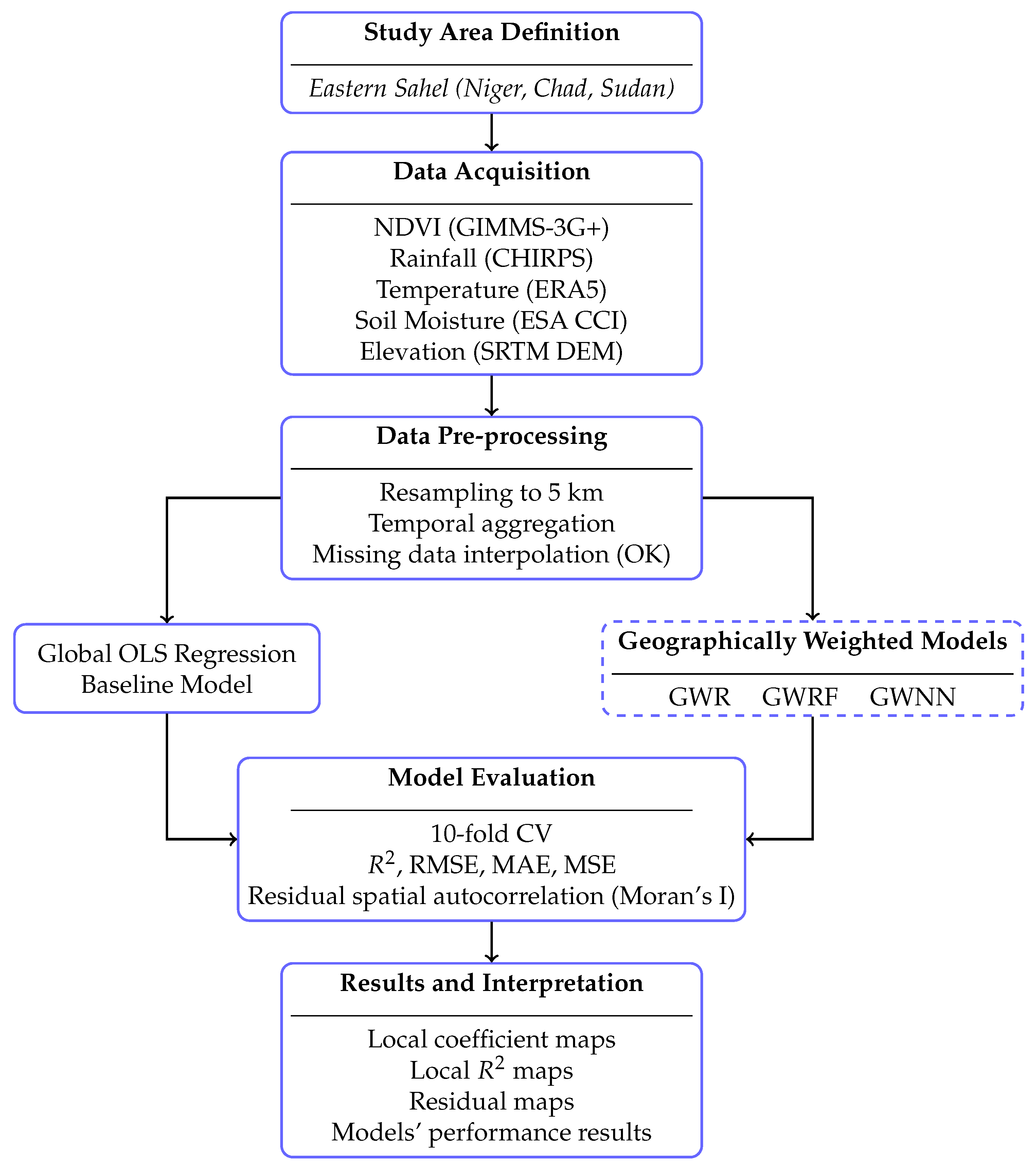
2. Materials and Methods
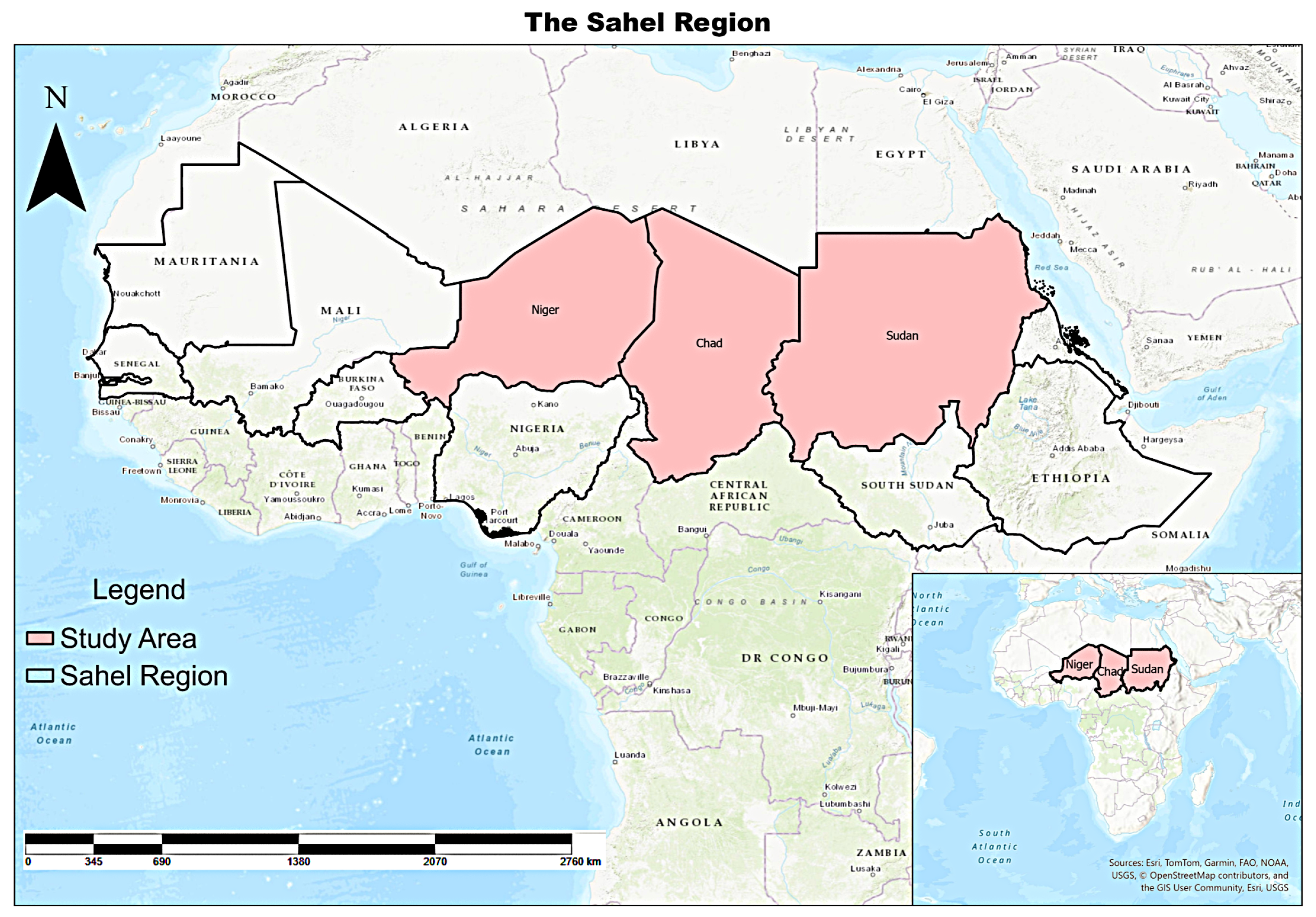
2.1. Study Area
2.2. Data Acquisition and Pre-Processing
2.3. Methods
2.3.1. Geographically Weighted Regression
2.3.2. Geographically Weighted Random Forests
- is the output at data point i,
- B is the RF’s total number of trees,
- is the spatial weight for tree b at data point i,
- is the prediction of the b-th tree for the input variables ,
- is the residual term.
2.3.3. Geographically Weighted Neural Networks
- is the output at location i,
- f is the activation function,
- is the k-th input variable at location i,
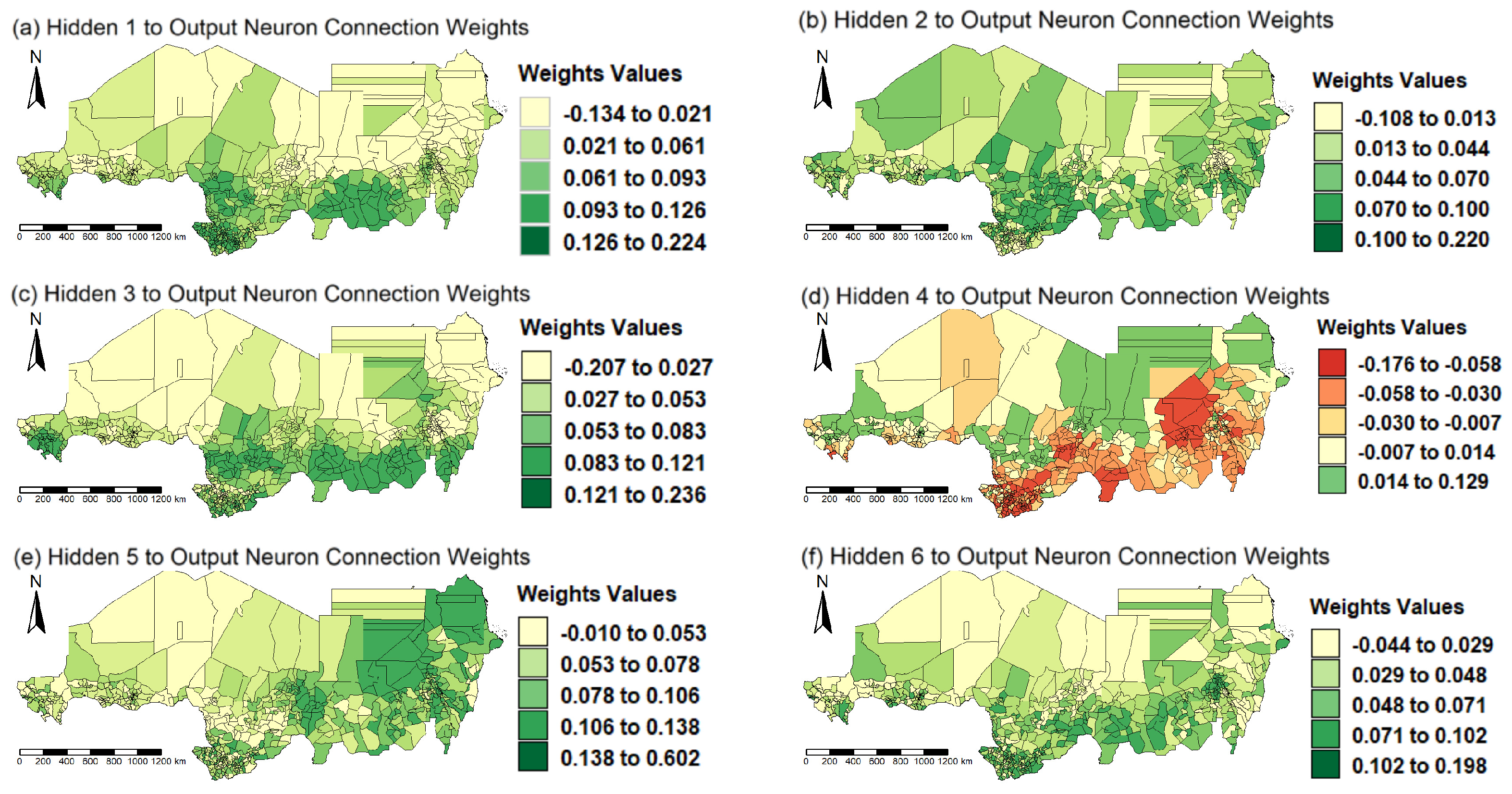
- and are the location-specific weights and biases for the j-th neuron in the hidden layer,
- and are the location-specific weights and biases for the k-th neuron in the input layer connecting to the j-th neuron in the hidden layer.
2.4. Model Set-Up
2.5. Spatial Autocorrelation
2.6. Predictive Performance
3. Results
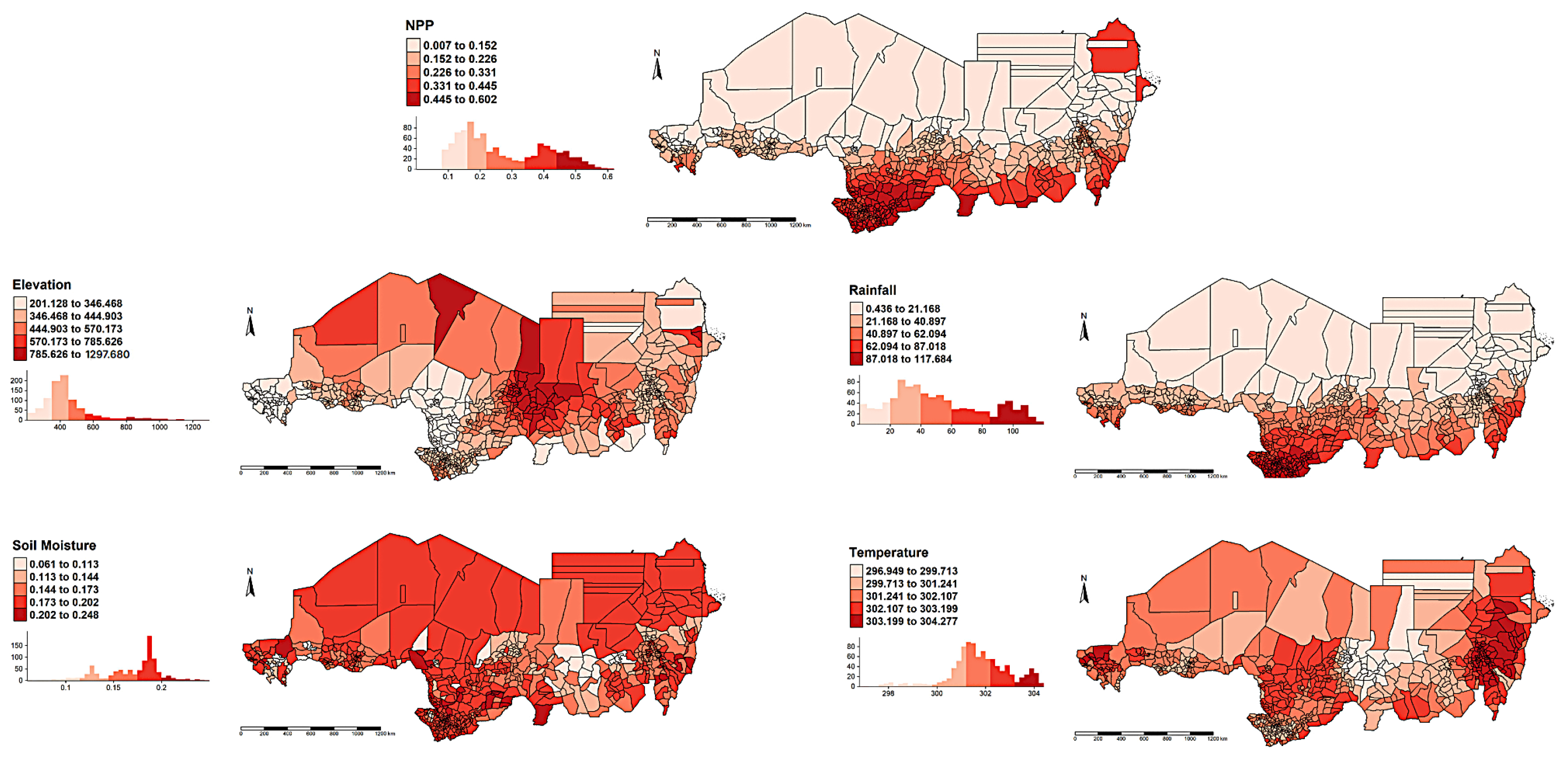
3.1. Exploratory Data Summary and Spatial Distribution
3.2. Global OLS
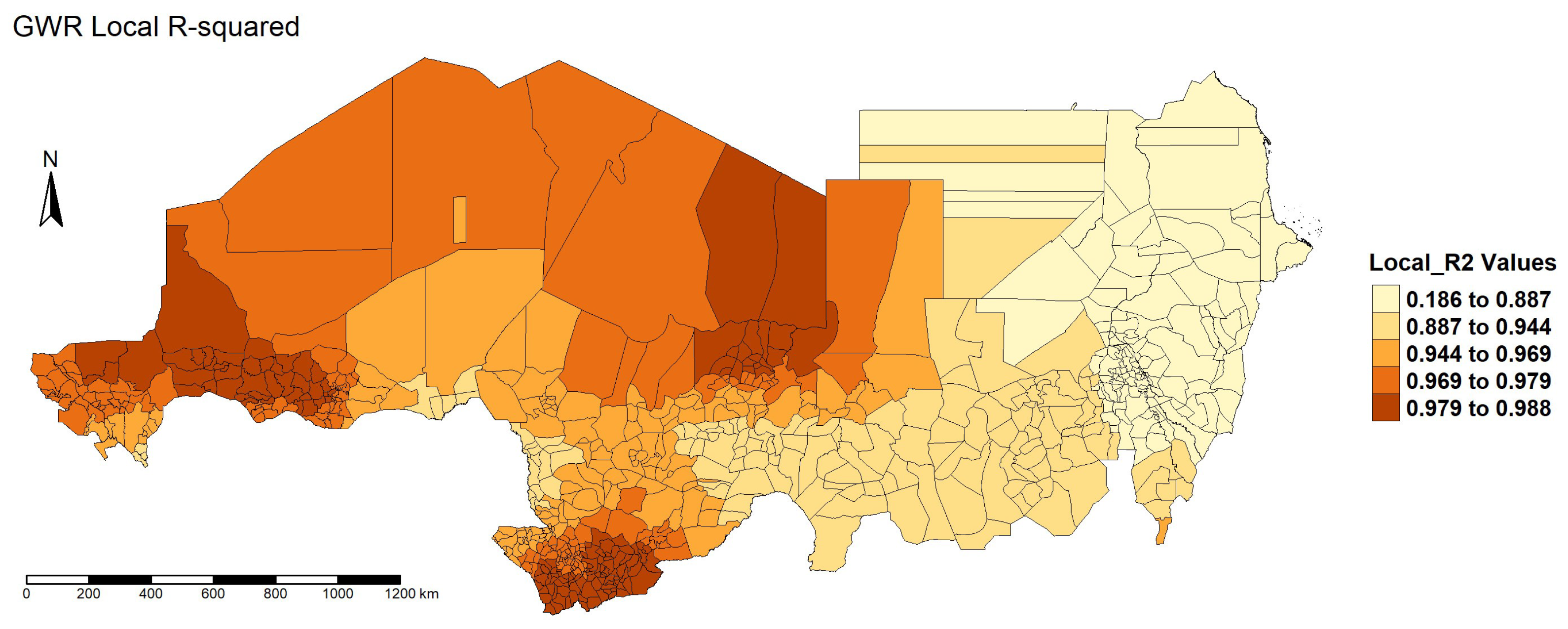
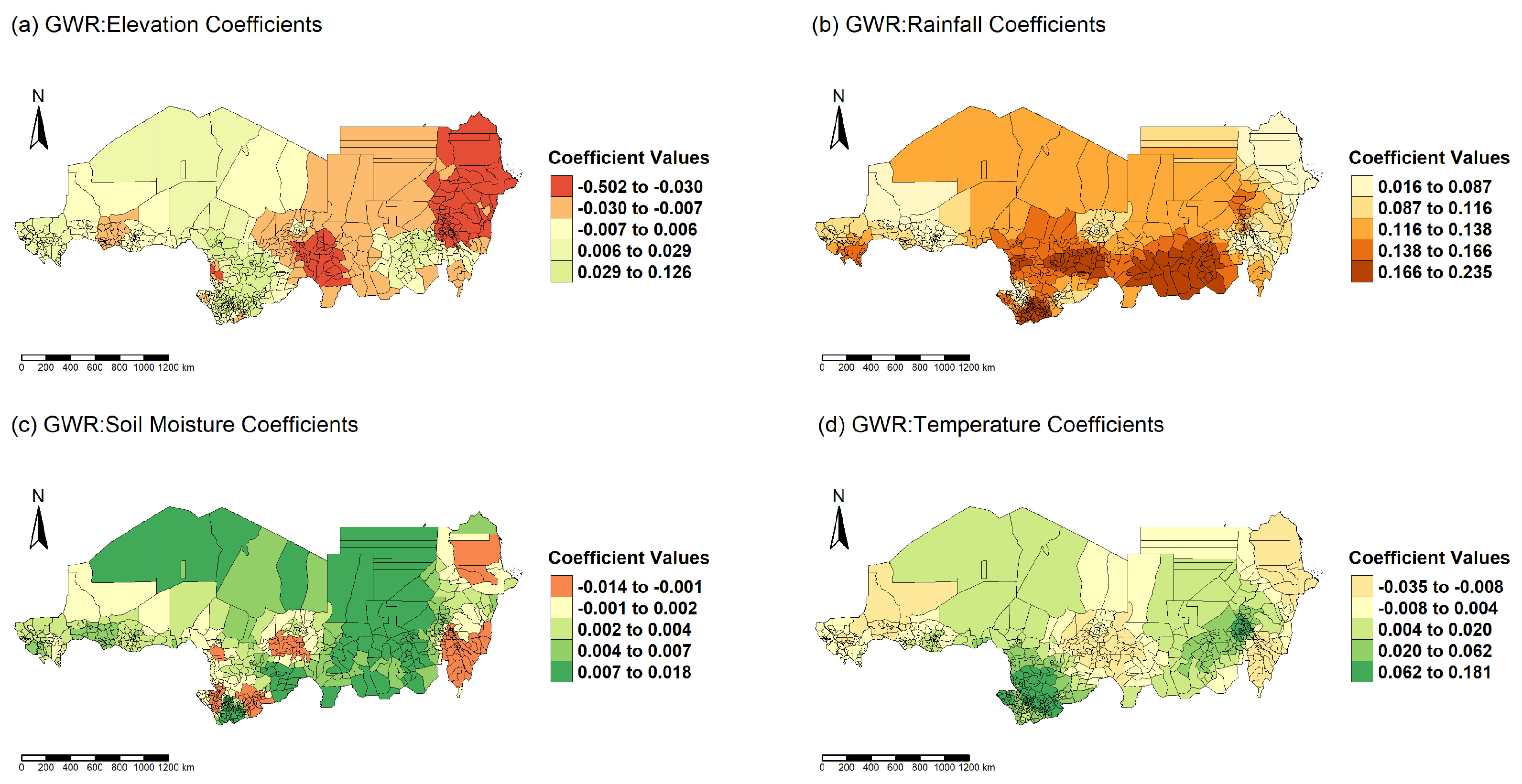
3.3. Geographically Weighted Regression
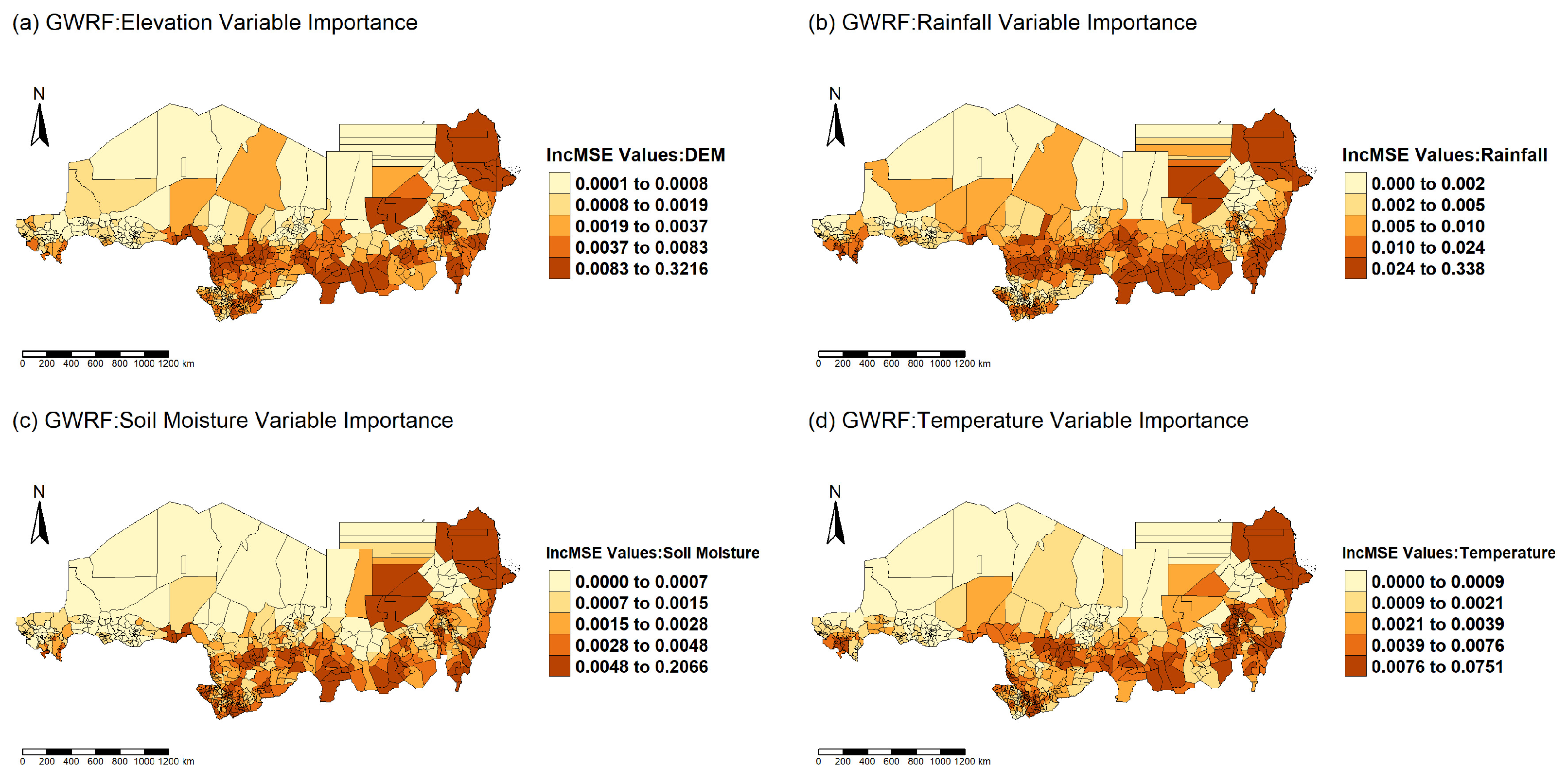
3.4. Geographically Weighted Random Forests
3.5. Geographically Weighted Neural Networks
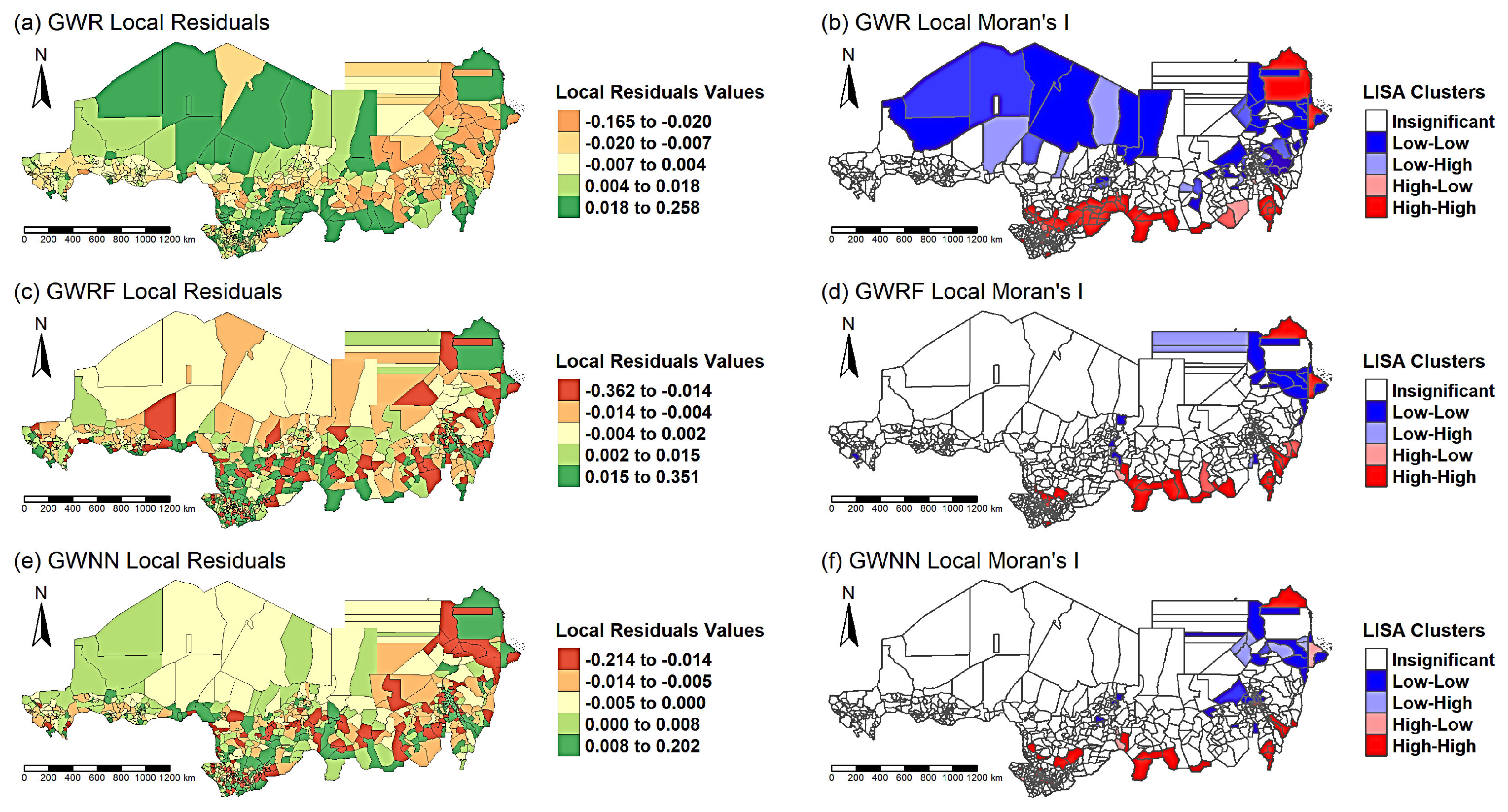
3.6. Spatial Autocorrelation
3.7. Predictive Performance
4. Discussion
5. Conclusions
Author Contributions
Funding
Data Availability Statement
Conflicts of Interest
References
- Abdi, A.; Seaquist, J.; Tenenbaum, D.; Eklundh, L.; Ardö, J. The supply and demand of net primary production in the Sahel. Environ. Res. Lett. 2014, 9, 094003. [Google Scholar] [CrossRef]
- Debburman, P. Estimation of Net Primary Productivity: An Introduction to Different Approaches. In Spatial Modeling in Forest Resources Management; Springer: Cham, Switzerland, 2021; pp. 33–69. [Google Scholar] [CrossRef]
- Zhou, Z.; Qin, D.; Chen, L.; Jia, H.; Yang, L.; Dai, T. Novel model for NPP prediction based on temperature and land use changes: A case in Sichuan and Chongqing, China. Ecol. Indic. 2022, 145, 109724. [Google Scholar] [CrossRef]
- Turner, D.; Koerper, G.; Harmon, M.; Lee, J. A Carbon Budget for Forests of the Conterminous United States. Ecol. Appl. 1995, 5, 421–436. [Google Scholar] [CrossRef]
- Guo, H.; Zhang, Y.; Shao, Y.; Chen, W.; Chen, F.; Li, M. Cloning, expression and characterization of a novel cold-active and organic solvent-tolerant esterase from Monascus ruber M7. Extremophiles 2016, 20, 451–459. [Google Scholar] [CrossRef]
- Nemani, R.; Keeling, C.; Hashimoto, H.; Jolly, W.; Piper, S.; Tucker, C.; Myneni, R.; Running, S. Climate-Driven Increases in Global Terrestrial Net Primary Production from 1982 to 1999. Science 2003, 300, 1560–1563. [Google Scholar] [CrossRef]
- Wang, G.; Peng, W.; Zhang, L.; Zhang, J. Quantifying the impacts of natural and human factors on changes in NPP using an optimal parameters-based geographical detector. Ecol. Indic. 2023, 155, 111018. [Google Scholar] [CrossRef]
- Li, C.; Li, X.; Luo, D.; He, Y.; Chen, F.; Zhang, B.; Qin, Q. Spatiotemporal Pattern of Vegetation Ecology Quality and Its Response to Climate Change between 2000–2017 in China. Sustainability 2021, 13, 1419. [Google Scholar] [CrossRef]
- Piao, S.; Ciais, P.; Huang, Y.; Shen, Z.; Peng, S.; Li, J.; Zhou, L.; Liu, H.; Ma, Y.; Ding, Y.; et al. The impacts of climate change on water resources and agriculture in China. Nature 2010, 467, 43–51. [Google Scholar] [CrossRef]
- Wang, X.; Piao, S.; Ciais, P.; Friedlingstein, P.; Myneni, R.; Cox, P.; Heimann, M.; Miller, J.; Peng, S.; Tao, W.; et al. A two-fold increase of carbon cycle sensitivity to tropical temperature variations. Nature 2014, 506, 212–215. [Google Scholar] [CrossRef]
- Nicholson, S.; Davenport, M.; Malo, A. A comparison of the vegetation response to rainfall in the Sahel and East Africa, using normalized difference vegetation index from NOAA AVHRR. Clim. Change 1990, 17, 209–241. [Google Scholar] [CrossRef]
- Huber, S.; Fensholt, R.; Rasmussen, K. Water availability as the driver of vegetation dynamics in the African Sahel from 1982–2007. Glob. Planet. Change 2011, 76, 186–195. [Google Scholar] [CrossRef]
- Mbow, C.; Halle, M.; Fadel, R.; Thiaw, I. Land resources opportunities for a growing prosperity in the Sahel. Curr. Opin. Environ. Sustain. 2021, 48, 85–92. [Google Scholar] [CrossRef]
- Sakor, B.Z. Is Demography a threat to peace and security in the Sahel? Springer: Cham, Switzerland, 2020. [Google Scholar]
- Pomposi, C.; Kushnir, Y.; Giannini, A. Moisture budget analysis of SST-driven decadal Sahel precipitation variability in the twentieth century. Clim. Dyn. 2014, 44, 3303–3321. [Google Scholar] [CrossRef]
- Blunden, J.; Boyer, T.P. State of the climate in 2021. Bull. Am. Meteorol. Soc. 2022, 103, S1–S465. [Google Scholar] [CrossRef]
- Lu, X.Y.; Chen, X.; Zhao, X.L.; Lv, D.J.; Zhang, Y. Assessing the impact of land surface temperature on urban net primary productivity increment based on geographically weighted regression model. Sci. Rep. 2021, 11, 22282. [Google Scholar] [CrossRef]
- Xiao, X.; Wang, Q.; Guan, Q.; Zhang, Z.; Yan, Y.; Mi, J.; Enqi, Y. Quantifying the nonlinear response of vegetation greening to driving factors in Longnan of China based on machine learning algorithm. Ecol. Indic. 2023, 151, 110277. [Google Scholar] [CrossRef]
- Fotheringham, A.S.; Brunsdon, C.; Charlton, M. Geographically Weighted Regression: The Analysis of Spatially Varying Relationships; John Wiley & Sons: Chichester, UK, 2002. [Google Scholar]
- Wang, Q.; Ni, J.; Tenhunen, J. Application of a Geographically-Weighted Regression Analysis to Estimate Net Primary Production of Chinese Forest Ecosystems. Glob. Ecol. Biogeogr. 2005, 14, 379–393. [Google Scholar] [CrossRef]
- Li, J.; Bi, M.; Wei, G. Investigating the Impacts of Urbanization on Vegetation Net Primary Productivity: A Case Study of Chengdu–Chongqing Urban Agglomeration from the Perspective of Townships. Land 2022, 11, 2077. [Google Scholar] [CrossRef]
- Yang, C.; Zhai, G.; Fu, M.; Sun, C. Spatiotemporal characteristics and influencing factors of net primary production from 2000 to 2021 in China. Environ. Sci. Pollut. Res. 2023, 30, 91084–91094. [Google Scholar] [CrossRef]
- Wheeler, D.; Tiefelsdorf, M. Multicollinearity and Correlation Among Local Regression Coefficients in Geographically Weighted Regression. J. Geogr. Syst. 2005, 7, 161–187. [Google Scholar] [CrossRef]
- Santos, F.; Graw, V.; Bonilla-Bedoya, S. A geographically weighted random forest approach for evaluate forest change drivers in the Northern Ecuadorian Amazon. PLoS ONE 2019, 14, e0226224. [Google Scholar] [CrossRef] [PubMed]
- Hagenauer, J.; Helbich, M. A geographically weighted artificial neural network. Int. J. Geogr. Inf. Sci. 2021, 36, 215–235. [Google Scholar] [CrossRef]
- Xu, C.; Li, Y.; Hu, J.; Yang, X.; Sheng, S.; Liu, M. Evaluating the difference between the normalized difference vegetation index and net primary productivity as the indicators of vegetation vigor assessment at landscape scale. Environ. Monit. Assess. 2011, 184, 1275–1286. [Google Scholar] [CrossRef] [PubMed]
- Pinzon, J.; Pak, E.; Tucker, C.; Bhatt, U.; Frost, G.; Macander, M. Global Vegetation Greenness (NDVI) from AVHRR GIMMS-3G+, 1981–2022; ORNL DAAC: Oak Ridge, TN, USA, 2023.
- Funk, C.; Peterson, P.; Landsfeld, M.; Pedreros, D.; Verdin, J.; Shukla, S.; Husak, G.; Rowland, J.; Harrison, L.; Hoell, A.; et al. The climate hazards infrared precipitation with stations—A new environmental record for monitoring extremes. Sci. Data 2015, 2, 150066. [Google Scholar] [CrossRef]
- Hersbach, H.; Bell, B.; Berrisford, P.; Hirahara, S.; Horányi, A.; Muñoz Sabater, J.; Nicolas, J.; Peubey, C.; Radu, R.; Schepers, D.; et al. The ERA5 global reanalysis. Q. J. R. Meteorol. Soc. 2020, 146, 1999–2049. [Google Scholar] [CrossRef]
- Gruber, A.; Dorigo, W.; Crow, W.; Wagner, W. Triple Collocation-Based Merging of Satellite Soil Moisture Retrievals. IEEE Trans. Geosci. Remote Sens. 2017, 55, 6780–6792. [Google Scholar] [CrossRef]
- Gruber, A.; Scanlon, T.; van der Schalie, R.; Wagner, W.; Dorigo, W. Evolution of the ESA CCI Soil Moisture climate data records and their underlying merging methodology. Earth Syst. Sci. Data 2019, 11, 717–739. [Google Scholar] [CrossRef]
- Jarvis, A.; Reuter, H.; Nelson, A.; Guevara, E. Hole-filled seamless SRTM data V4. Int. Cent. Trop. Agric. 2008, 62, 283–294. [Google Scholar]
- Wang, Q.; He, H.; Liu, K.; Zong, S.; Du, H. Comparing simulated tree biomass from daily, monthly, and seasonal climate input of terrestrial ecosystem model. Ecol. Model. 2023, 483, 110420. [Google Scholar] [CrossRef]
- Bae, B.; Kim, H.; Lim, H.; Liu, Y.; Han, L.; Freeze, P. Missing data imputation for traffic flow speed using spatio-temporal cokriging. Transp. Res. Part C Emerg. Technol. 2018, 88, 124–139. [Google Scholar] [CrossRef]
- Wackernagel, H. Ordinary kriging. In Multivariate Geostatistics: An Introduction with Applications; Springer: Berlin/Heidelberg, Germany, 2003; pp. 79–88. [Google Scholar]
- Chung, S.Y.; Venkatramanan, S.; Elzain, H.E.; Selvam, S.; Prasanna, M. Supplement of missing data in groundwater-level variations of peak type using geostatistical methods. In GIS and Geostatistical Techniques for Groundwater Science; Elsevier: Vienna, Austria, 2019; pp. 33–41. [Google Scholar]
- Raza, O.; Mansournia, M.A.; Foroushani, A.; Naieni, K. Geographically Weighted Regression Analysis: A Statistical Method to Account for Spatial Heterogeneity. Arch. Iran. Med. 2019, 22, 155–160. [Google Scholar]
- Thapa, R.B.; Estoque, R.C. Geographically weighted regression in geospatial analysis. In Progress in Geospatial Analysis; Springer: Berlin/Heidelberg, Germany, 2012; pp. 85–96. [Google Scholar]
- Gollini, I.; Lu, B.; Charlton, M.; Brunsdon, C.; Harris, P. GWmodel: An R Package for Exploring Spatial Heterogeneity Using Geographically Weighted Models. J. Stat. Softw. 2015, 63, 1–50. [Google Scholar] [CrossRef]
- Sulekan, A.; Jamaludin, S.S.S. Review on Geographically Weighted Regression (GWR) approach in spatial analysis. Malays. J. Fundam. Appl. Sci. 2020, 16, 173–177. [Google Scholar] [CrossRef]
- Charlton, M.; Fotheringham, S.; Brunsdon, C. Geographically Weighted Regression; White paper; National Centre for Geocomputation, National University of Ireland Maynooth: Kildare, Ireland, 2009. [Google Scholar]
- Georganos, S.; Grippa, T.; Gadiaga, A.; Linard, C.; Lennert, M.; Vanhuysse, S.; Mboga, N.; Wolff, E.; Kalogirou, S. Geographical Random Forests: A Spatial Extension of the Random Forest Algorithm to Address Spatial Heterogeneity in Remote Sensing and Population Modelling. Geocarto Int. 2019, 36, 121–136. [Google Scholar] [CrossRef]
- Wu, D.; Zhang, Y.; Xiang, Q. Geographically weighted random forests for macro-level crash frequency prediction. Accid. Anal. Prev. 2024, 194, 107370. [Google Scholar] [CrossRef]
- Su, Z.; Lin, L.; Xu, Z.; Chen, Y.; Yang, L.; Hu, H.; Lin, Z.; Wei, S.; Sisheng, L. Modeling the Effects of Drivers on PM2.5 in the Yangtze River Delta with Geographically Weighted Random Forest. Remote Sens. 2023, 15, 3826. [Google Scholar] [CrossRef]
- Lotfata, A.; Georganos, S. Spatial machine learning for predicting physical inactivity prevalence from socioecological determinants in Chicago, Illinois, USA. J. Geogr. Syst. 2023, 26, 461–481. [Google Scholar] [CrossRef]
- Georganos, S.; Kalogirou, S. A Forest of Forests: A Spatially Weighted and Computationally Efficient Formulation of Geographical Random Forests. ISPRS Int. J. Geo-Inf. 2022, 11, 471. [Google Scholar] [CrossRef]
- Lu, B.; Brunsdon, C.; Charlton, M.; Harris, P. Geographically weighted regression with parameter-specific distance metrics. Int. J. Geogr. Inf. Sci. 2016, 31, 982–998. [Google Scholar] [CrossRef]
- Wang, Z.; Wang, Y.; Wu, S.; Du, Z. House Price Valuation Model Based on Geographically Neural Network Weighted Regression: The Case Study of Shenzhen, China. ISPRS Int. J. Geo-Inf. 2022, 11, 450. [Google Scholar] [CrossRef]
- Du, Z.; Wang, Z.; Wu, S.; Zhang, F.; Liu, R. Geographically neural network weighted regression for the accurate estimation of spatial non-stationarity. Int. J. Geogr. Inf. Sci. 2020, 34, 1353–1377. [Google Scholar] [CrossRef]
- Dai, Z.; Wu, S.; Wang, Y.; Hongye, Z.; Zhang, F.; Huang, B.; Du, Z. Geographically convolutional neural network weighted regression: A method for modeling spatially non-stationary relationships based on a global spatial proximity grid. Int. J. Geogr. Inf. Sci. 2022, 36, 2248–2269. [Google Scholar] [CrossRef]
- Lu, B.; Harris, P.; Charlton, M.; Brunsdon, C. The GWmodel R package: Further Topics for Exploring Spatial Heterogeneity using Geographically Weighted Models. Geo-Spat. Inf. Sci. 2014, 17, 85–101. [Google Scholar] [CrossRef]
- Leung, Y.; Mei, C.; Zhang, W.X. Statistical Tests for Spatial Nonstationary Based on the Geographically Weighted Regression Model. Environ. Plan. A 2000, 32, 9–32. [Google Scholar] [CrossRef]
- Griffith, D. What is Spatial Autocorrelation? Reflections on the Past 25 Years of Spatial Statistics. Espace Geogr. 1992, 21, 265–280. [Google Scholar] [CrossRef]
- Overmars, K.; Koning, G.; Veldkamp, A. Spatial Autocorrelation in Multi-Scale Land Use Models. Ecol. Model. 2003, 164, 257–270. [Google Scholar] [CrossRef]
- Kowe, P.; Mushore, T.D.; Ncube, A.; Nyenda, T.; Mutowo, G.; Chinembiri, T.; Traoré, M.; Kizilirmak, G. Impacts of the spatial configuration of built-up areas and urban vegetation on land surface temperature using spectral and local spatial autocorrelation indices. Remote Sens. Lett. 2022, 13, 1222–1235. [Google Scholar] [CrossRef]
- Gething, P.W.; Atkinson, P.M.; Noor, A.M.; Gikandi, P.W.; Hay, S.I.; Nixon, M.S. A local space–time kriging approach applied to a national outpatient malaria data set. Comput. Geosci. 2007, 33, 1337–1350. [Google Scholar] [CrossRef]
- Bivand, R.; Wong, D.W.S. Comparing implementations of global and local indicators of spatial association. TEST 2018, 27, 716–748. [Google Scholar] [CrossRef]
- Bivand, R. R Packages for Analyzing Spatial Data: A Comparative Case Study with Areal Data. Geogr. Anal. 2022, 54, 488–518. [Google Scholar] [CrossRef]
- Chicco, D.; Warrens, M.; Jurman, G. The coefficient of determination R-squared is more informative than SMAPE, MAE, MAPE, MSE and RMSE in regression analysis evaluation. PeerJ Comput. Sci. 2021, 7, e623. [Google Scholar] [CrossRef]
- Bivand, R. Geographically weighted regression. CRAN Task View: Analysis of Spatial Data; Springer: Berlin/Heidelberg, Germany, 2017. [Google Scholar]
- Oyana, T.J.; Margai, F. Using statistical measures to analyze data distributions. In Spatial Analysis: Statistics, Visualization, and Computational Methods; CRC Press: Boca Raton, FL, USA, 2015; pp. 55–86. [Google Scholar]
- Khan, S.N.; Li, D.; Maimaitijiang, M. A Geographically Weighted Random Forest Approach to Predict Corn Yield in the US Corn Belt. Remote Sens. 2022, 14, 2843. [Google Scholar] [CrossRef]
- Liang, M.; Laifu, Z.; Wu, S.; Yilin, Z.; Dai, Z.; Wang, Y.; Qi, J.; Chen, Y.; Du, Z. A High-Resolution Land Surface Temperature Downscaling Method Based on Geographically Weighted Neural Network Regression. Remote Sens. 2023, 15, 1740. [Google Scholar] [CrossRef]
- Tian, F.; Brandt, M.; Liu, Y.; Verger, A.; Tagesson, T.; Diouf, A.; Rasmussen, K.; Mbow, C.; Wang, Y.; Fensholt, R. Remote sensing of vegetation dynamics in drylands: Evaluating vegetation optical depth (VOD) using AVHRR NDVI and in situ green biomass data over West African Sahel. Remote Sens. Environ. 2016, 177, 265–276. [Google Scholar] [CrossRef]
- Fensholt, R.; Rasmussen, K.; Nielsen, T.; Mbow, C. Evaluation of earth observation based long term vegetation trends—Intercomparing NDVI time series trend analysis consistency of Sahel from AVHRR GIMMS, Terra MODIS and SPOT VGT data. Remote Sens. Environ. 2009, 113, 1886–1898. [Google Scholar] [CrossRef]









| Data | Variables | Unit | Source | Format | Spatial Resolution |
|---|---|---|---|---|---|
| Climate | Rainfall | mm | CHIRPS | TIF file (.tif) | 5 km |
| Temperature | K | ECMWF | NetCDF (.nc) | 5 km | |
| Soil | Soil Moisture | m3/m3 | ESACCI | NetCDF (.nc) | 5 km |
| Topography | Elevation | m | SRTM | TIF file (.tif) | 5 km |
| Vegetation Indices | NDVI | - | AVHRR | NetCDF-4 (.nc4) | 5 km |
| Variables | Missing Value % |
|---|---|
| NDVI/NPP | 2.23 |
| Soil Moisture | 3.30 |
| Elevation | 7.03 |
| Rainfall | 0.00 |
| Temperature | 1.81 |
| Variable | Min | Max | Mean | Median | SD |
|---|---|---|---|---|---|
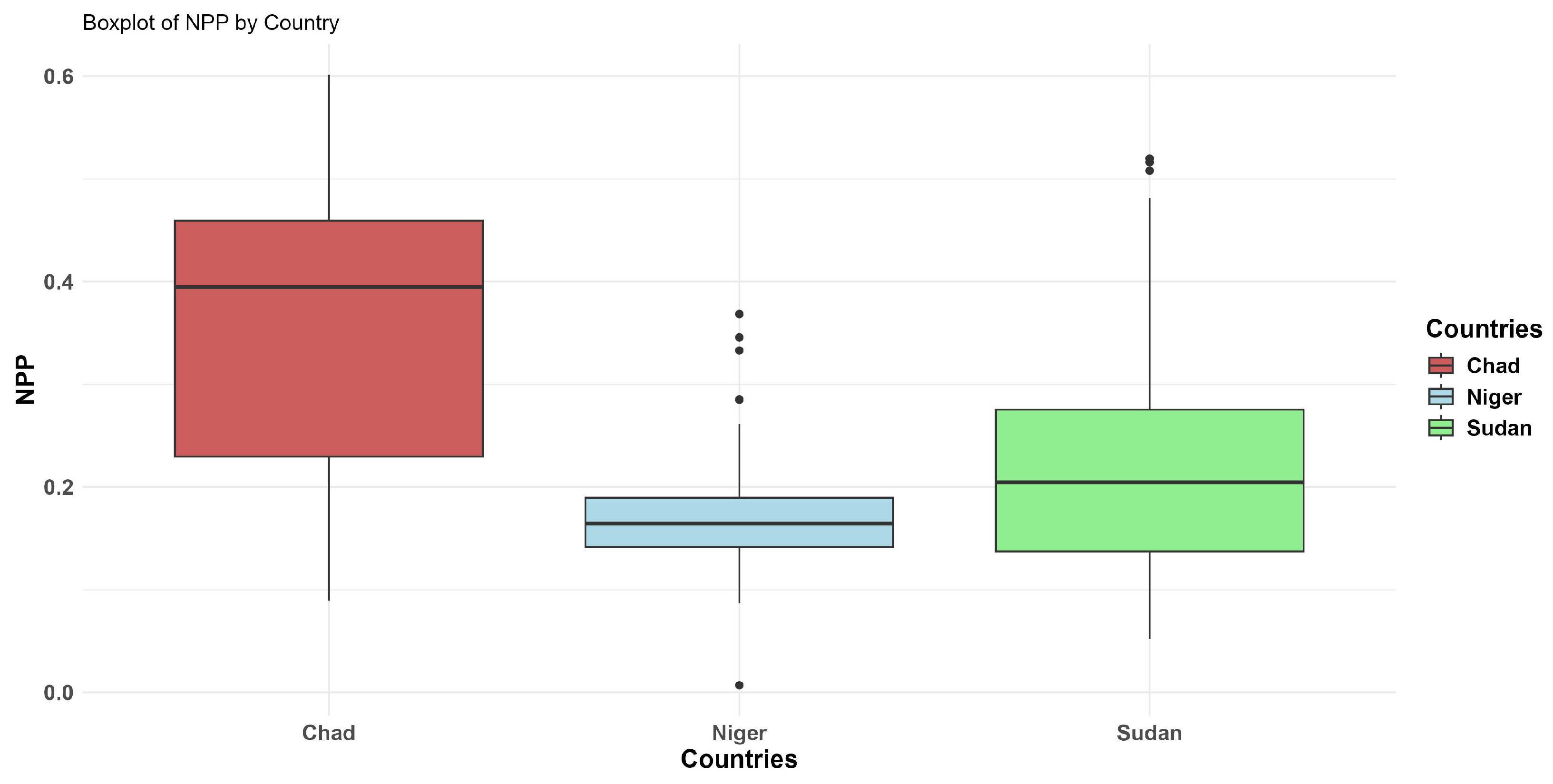
| NPP | 0.006 | 0.602 | 0.272 | 0.228 | 0.135 |
| Soil Moisture (m3/m3) | 0.061 | 0.248 | 0.169 | 0.181 | 0.031 |
| Elevation (m) | 201.13 | 1297.68 | 447.12 | 411.36 | 160.69 |
| Temperature (K) | 269.95 | 304.28 | 301.77 | 301.70 | 1.26 |
| Rainfall (mm) | 0.44 | 117.68 | 50.86 | 44.42 | 30.50 |
| Variable | Coefficient | Std Error | t-Statistic | p-Value |
|---|---|---|---|---|
| Intercept | 0.272211 | 0.001783 | 152.630 | <2 × |
| DEM | 0.010649 | 0.002396 | 4.445 | 9.82 × |
| Soil | 0.012330 | 0.001880 | 6.559 | 8.96 × |
| Rainfall | 0.122999 | 0.002011 | 61.174 | <2 × |
| Temp | 0.017131 | 0.002407 | 7.117 | 2.19 × |
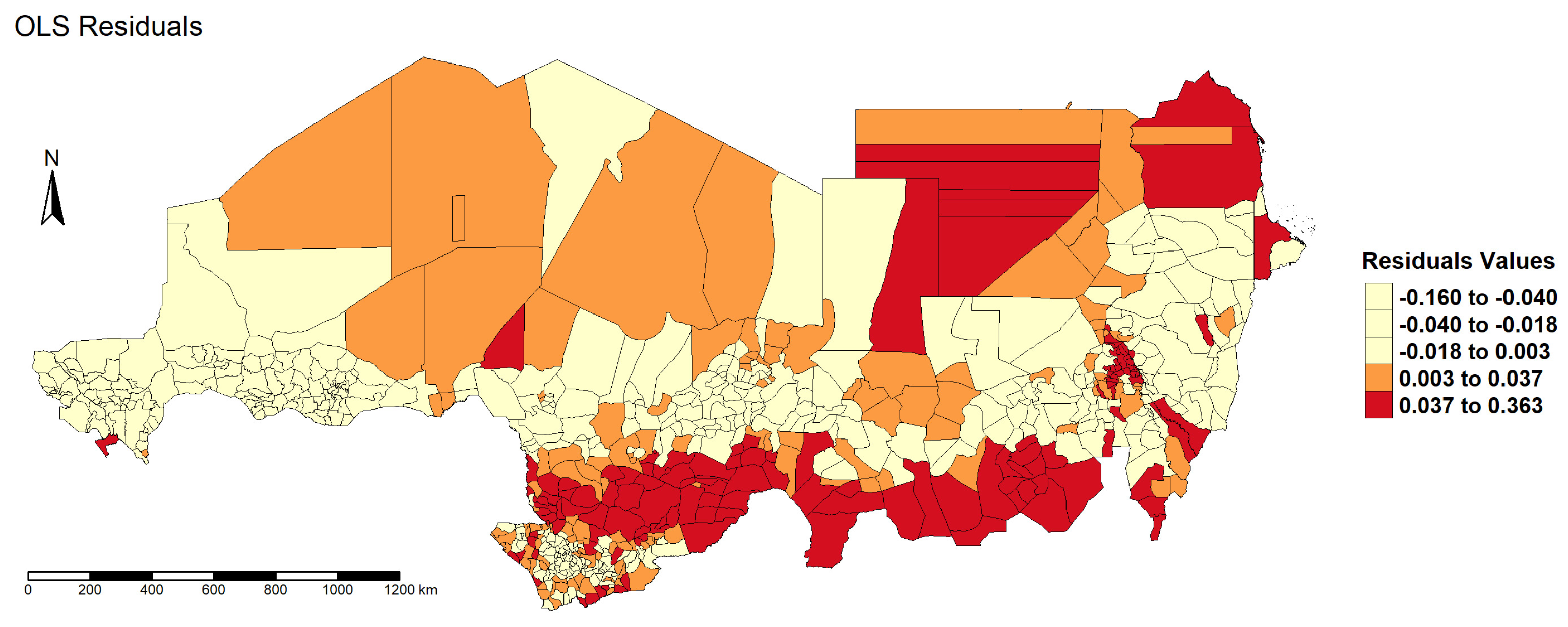
| Adjusted | 0.8354 |
| Min | 1st Qu. | Median | Mean | 3rd Qu. | Max | F3 Test (p-Value) | Global OLS | |
|---|---|---|---|---|---|---|---|---|
| Intercept | 0.0304 | 0.2182 | 0.2703 | 0.2582 | 0.2965 | 0.4116 | 1.50 × | 0.272211 |
| DEM | −0.5019 | −0.0209 | −0.0001 | −0.0115 | 0.0194 | 0.1259 | 4.37 × | 0.010649 |
| Soil Moisture | −0.0136 | 0.0002 | 0.0027 | 0.0030 | 0.0063 | 0.0183 | 2.90 × | 0.012330 |
| Rainfall | 0.0155 | 0.0940 | 0.1279 | 0.1280 | 0.1583 | 0.2352 | 4.34 × | 0.122999 |
| Temperature | −0.0350 | −0.0055 | 0.0103 | 0.0260 | 0.0522 | 0.1815 | 2.62 × | 0.017131 |
| Rank | RF | GWRF | |||||
|---|---|---|---|---|---|---|---|
| Variable | Global Feature Importance | Variable | Local Feature Importance (IncMSE) | ||||
| Min | Max | Mean | Std | ||||
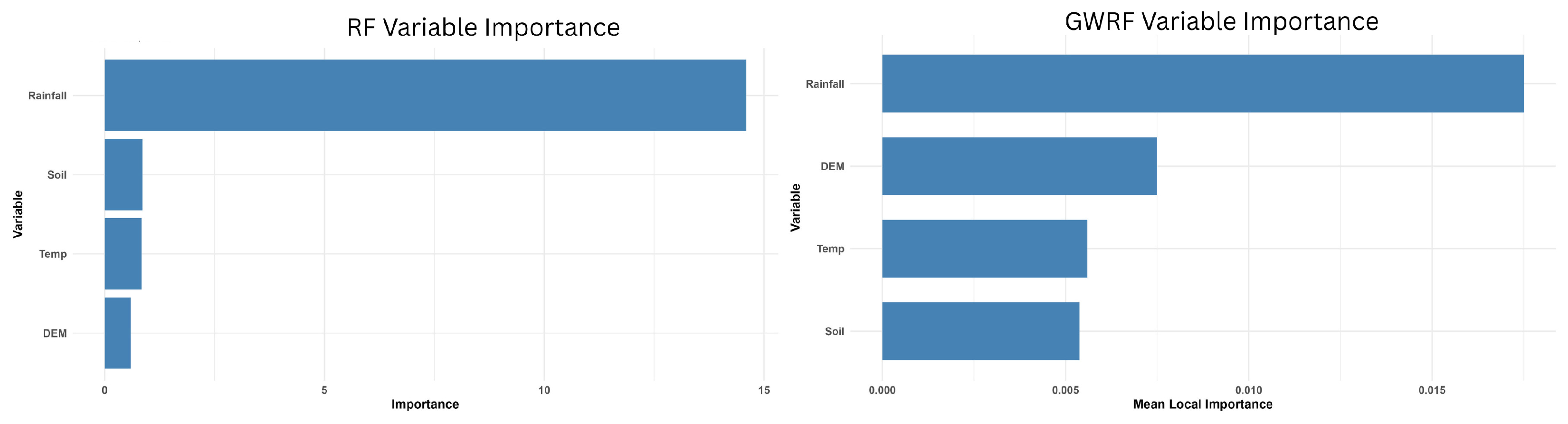
| 1 | Rainfall | 14.5951 | Rainfall | 0.3379 | 0.0175 | 0.0331 | |
| 2 | Soil Moisture | 0.8620 | DEM | 0.3216 | 0.0075 | 0.0212 | |
| 3 | Temperature | 0.8408 | Temperature | 0.0751 | 0.0056 | 0.0084 | |
| 4 | DEM | 0.5900 | Soil Moisture | 0.2066 | 0.0054 | 0.0173 | |
| 0.8985 | 0.9376 | ||||||
| MSE | 0.0018 | 0.001 | |||||
| The Local Value of | % of Counties |
|---|---|
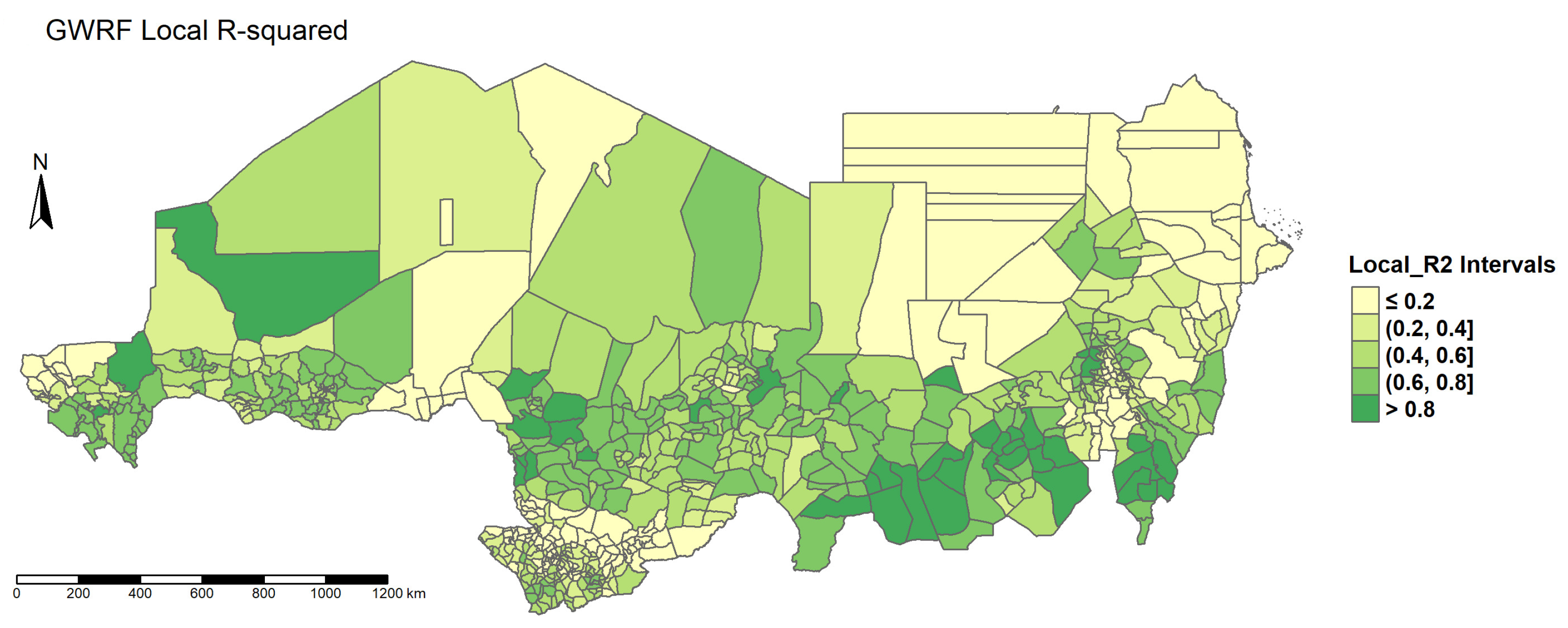
| ≤0.2 | 22.04 |
| (0.2, 0.4) | 16.30 |
| (0.4, 0.6) | 27.69 |
| (0.6, 0.8) | 27.26 |
| >0.8 | 6.71 |
| Model | Global Moran’s I | p-Value |
|---|---|---|
| GWR | 0.1750 | 2.2 × |
| GWRF | −0.0352 | 0.9958 |
| GWNN | −0.0004 | 0.4810 |
| OLS | RF | NN | GWR | GWRF | GWNN | |
|---|---|---|---|---|---|---|
| MSE | 0.0030 | 0.0018 | 0.0023 | 0.0015 | 0.0013 | 0.0012 |
| RMSE | 0.0542 | 0.0429 | 0.0474 | 0.0371 | 0.0337 | 0.0333 |
| MAE | 0.0392 | 0.0270 | 0.0324 | 0.0243 | 0.0191 | 0.0205 |
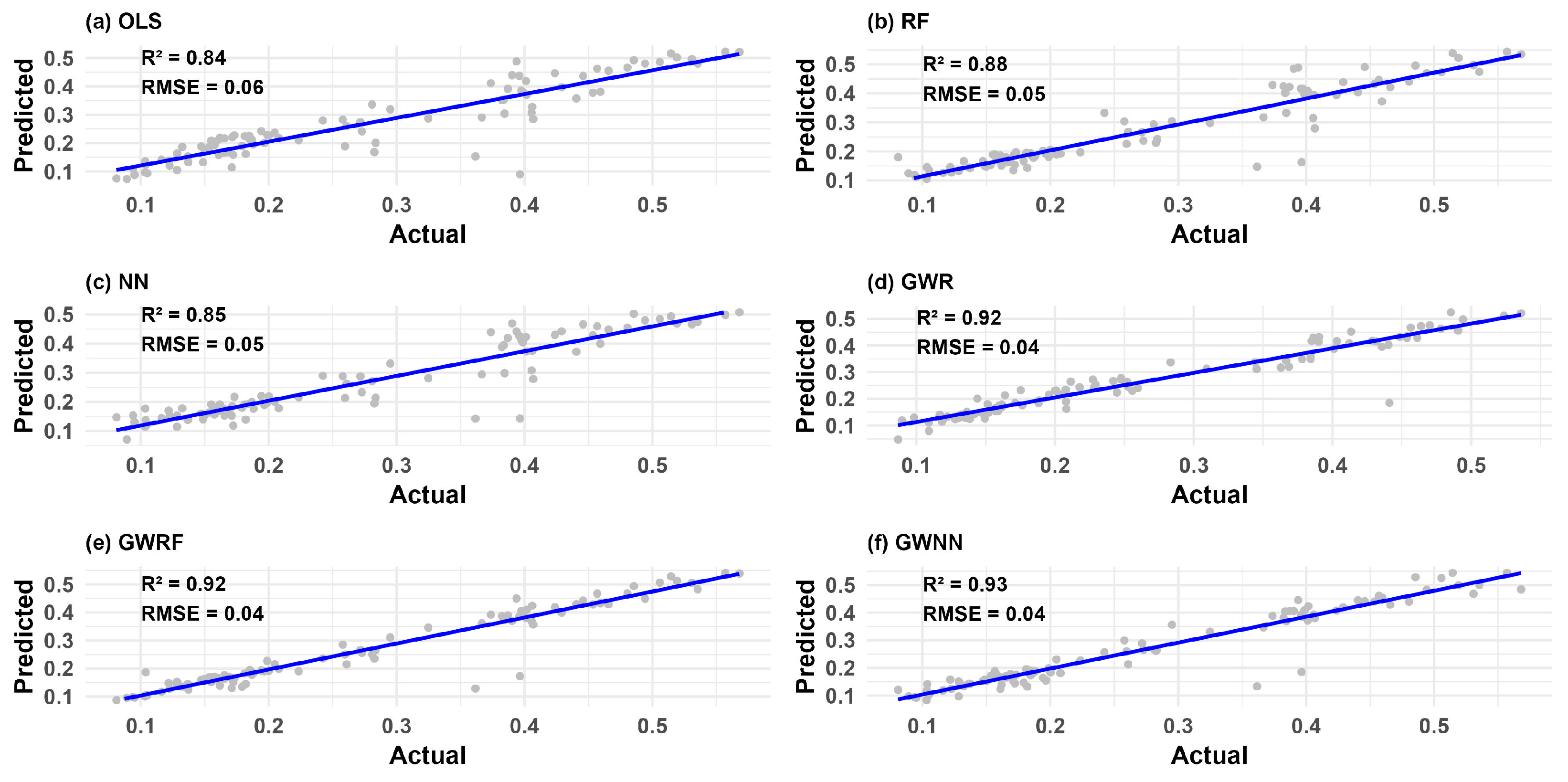
| 0.8378 | 0.9008 | 0.8755 | 0.9207 | 0.9308 | 0.9360 |
Disclaimer/Publisher’s Note: The statements, opinions and data contained in all publications are solely those of the individual author(s) and contributor(s) and not of MDPI and/or the editor(s). MDPI and/or the editor(s) disclaim responsibility for any injury to people or property resulting from any ideas, methods, instructions or products referred to in the content. |
© 2026 by the authors. Licensee MDPI, Basel, Switzerland. This article is an open access article distributed under the terms and conditions of the Creative Commons Attribution (CC BY) license.
Share and Cite
Letsela, K.; Mlambo, F.; Adam, E. Predicting Net Primary Productivity Using Geographically Weighted Machine Learning: A Comparative Study in the Eastern Sahel. Sustainability 2026, 18, 2217. https://doi.org/10.3390/su18052217
Letsela K, Mlambo F, Adam E. Predicting Net Primary Productivity Using Geographically Weighted Machine Learning: A Comparative Study in the Eastern Sahel. Sustainability. 2026; 18(5):2217. https://doi.org/10.3390/su18052217
Chicago/Turabian StyleLetsela, Kopano, Farai Mlambo, and Elhadi Adam. 2026. "Predicting Net Primary Productivity Using Geographically Weighted Machine Learning: A Comparative Study in the Eastern Sahel" Sustainability 18, no. 5: 2217. https://doi.org/10.3390/su18052217
APA StyleLetsela, K., Mlambo, F., & Adam, E. (2026). Predicting Net Primary Productivity Using Geographically Weighted Machine Learning: A Comparative Study in the Eastern Sahel. Sustainability, 18(5), 2217. https://doi.org/10.3390/su18052217