How Green Technology and Company Green Commitment Affect SME Internationalization Performance Through Eco-Innovation: The Moderator of Government Support Programs


Abstract
1. Introduction
2. Literature Review and Hypothesis Development
2.1. Theoretical Foundations
2.2. Direct Effects: Green Technology, Company Green Commitment, and Internationalization Performance
2.3. Indirect Effects: The Mediating Role of Eco-Innovation
2.4. The Moderating Role of Government Support Programs
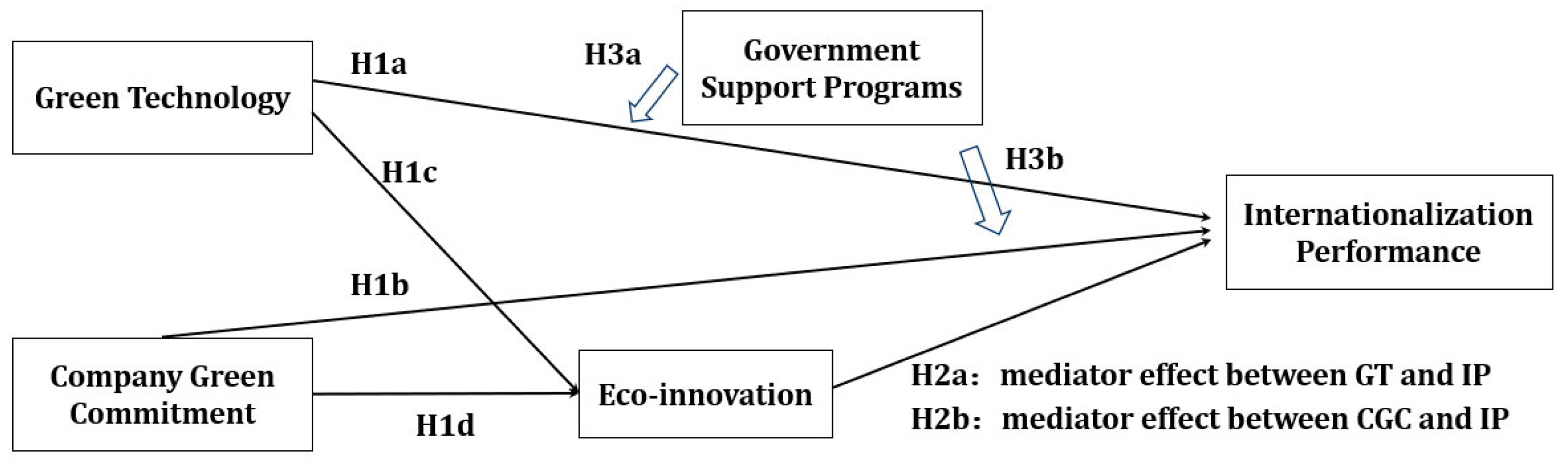
2.5. Integrated Conceptual Model
3. Methodology
3.1. Research Design and Sample
3.2. Measures
3.3. Analytical Approach
4. Results
4.1. Descriptive Statistics
4.2. Measurement Model Validation
4.3. Structural Model and Hypothesis Testing
5. Discussion
5.1. Theoretical Implications
5.2. Practical Implications
5.3. Limitations and Future Research Directions
5.4. Conclusions
Author Contributions
Funding
Institutional Review Board Statement
Informed Consent Statement
Data Availability Statement
Conflicts of Interest
Abbreviations
| SME | Small and Medium Enterprises |
| IP | Internationalization Performance |
| GT | Green Technology |
| CGC | Company Green Commitment |
| EI | Eco Innovation |
| GSP | Government Support Programs |
Appendix A
| Particular(s) | Answer(s) | |||||
| 1. Gender | 口Male | |||||
| 口Female | ||||||
| 2. Age | 口<28 Years | |||||
| 口29–44 Years | ||||||
| 口45–60 Years | ||||||
| 口>61 Years | ||||||
| 3. Highest Education Level | 口High School | |||||
| 口Diploma | ||||||
| 口Bachelor’s Degree | ||||||
| 口Master’s Degree or Higher | ||||||
| 4. Establishment of Organization | 口1–5 Years | |||||
| 口5–10 Years | ||||||
| 口>10 Years | ||||||
| 5. Number of Employees | 口1–20 | |||||
| 口21–300 | ||||||
| 口301–1000 | ||||||
| 6. Engaged in International Import/Export Business | 口Yes | |||||
| 口No | ||||||
| 7. Industry Type | 口Coal/Steel | |||||
| 口Electronic Product | ||||||
| 口Others | ||||||
| Below are the measurement items | ||||||
| No. | Statement | 1 | 2 | 3 | 4 | 5 |
| Internationalization Performance | ||||||
| 1 | Our company achieved growth in international sales. | 口 | 口 | 口 | 口 | 口 |
| 2 | Our company achieved international net profit margin. | 口 | 口 | 口 | 口 | 口 |
| 3 | Our company achieved international growth profit margin. | 口 | 口 | 口 | 口 | 口 |
| 4 | Our company achieved growth in international operations ROI. | 口 | 口 | 口 | 口 | 口 |
| 5 | Our company achieved growth in the international market share. | 口 | 口 | 口 | 口 | 口 |
| 6 | Our international customers are satisfied with our products and services. | 口 | 口 | 口 | 口 | 口 |
| 7 | Our international business reputation is considered good. | 口 | 口 | 口 | 口 | 口 |
| 8 | Our company achieved growth in the introduction of new products and services in the international market. | 口 | 口 | 口 | 口 | 口 |
| Green Technology | ||||||
| 1 | Our company has set specific green technology implementation goals. | 口 | 口 | 口 | 口 | 口 |
| 2 | Our company has a dedicated team responsible for the implementation of green technology. | 口 | 口 | 口 | 口 | 口 |
| 3 | Our company is committed to investing in the latest green technology. | 口 | 口 | 口 | 口 | 口 |
| 4 | Our company strictly implements environmental protection standards and regulations during the production process. | 口 | 口 | 口 | 口 | 口 |
| 5 | Our company regularly evaluates and improves the implementation of green technology. | 口 | 口 | 口 | 口 | 口 |
| 6 | Our company’s employees have received training related to green technology. | 口 | 口 | 口 | 口 | 口 |
| Company Green Commitment | ||||||
| 1 | Our staff cares about the environmental concerns of our company. | 口 | 口 | 口 | 口 | 口 |
| 2 | The environmental concern of our company means a lot to our staff. | 口 | 口 | 口 | 口 | 口 |
| 3 | Our staff feel a sense of duty to support the environmental efforts of our company. | 口 | 口 | 口 | 口 | 口 |
| 4 | Our staff feel as if our company’s environmental problems are their own. | 口 | 口 | 口 | 口 | 口 |
| 5 | Our staff feel personally attached to the environmental concerns of our company. | 口 | 口 | 口 | 口 | 口 |
| 6 | Our staff strongly values the environmental efforts of our company. | 口 | 口 | 口 | 口 | 口 |
| 7 | Our staff would feel guilty about not supporting the environmental efforts of our company. | 口 | 口 | 口 | 口 | 口 |
| Eco-innovation | ||||||
| 1 | Our company is improving and designing environmentally friendly packaging (e.g., using fewer paper and plastic materials) for existing and new products. | 口 | 口 | 口 | 口 | 口 |
| 2 | Our company chooses materials for the product that consume the least amount of energy and resources for conducting the product development or design. | 口 | 口 | 口 | 口 | 口 |
| 3 | Our company uses the smallest possible amount of materials to create the product when conducting the product development or design. | 口 | 口 | 口 | 口 | 口 |
| 4 | Our company deliberately evaluates whether the product is easy to recycle, reuse and decompose when conducting the product development or design. | 口 | 口 | 口 | 口 | 口 |
| 5 | Low energy consumption such as water, electricity, gas and petrol during production use/disposal. | 口 | 口 | 口 | 口 | 口 |
| 6 | Recycling, reuse and remanufacture of material. | 口 | 口 | 口 | 口 | 口 |
| 7 | Use of cleaner technology to generate savings and prevent pollution (e.g., energy, water and waste). | 口 | 口 | 口 | 口 | 口 |
| 8 | The manufacturing process of my company effectively reduces the emission of hazardous substances or waste. | 口 | 口 | 口 | 口 | 口 |
| 9 | The manufacturing process of my company reduces the use of raw materials. | 口 | 口 | 口 | 口 | 口 |
| 10 | Our firm’s management frequently utilizes innovative systems to manage eco-innovation. | 口 | 口 | 口 | 口 | 口 |
| 11 | Our firm’s management often collects information on eco-innovation trends. | 口 | 口 | 口 | 口 | 口 |
| 12 | Our firm’s management often actively engages in eco-innovation activities. | 口 | 口 | 口 | 口 | 口 |
| 13 | Our firm’s management often communicates eco-innovation information with employees. | 口 | 口 | 口 | 口 | 口 |
| 14 | Our firm’s management often invests a high ratio of R&D in eco-innovation. | 口 | 口 | 口 | 口 | 口 |
| 15 | Our firm’s management often communicates experiences among various departments involved in eco-innovation. | 口 | 口 | 口 | 口 | 口 |
| Government Support Program | ||||||
| 1 | Our company believes that we have adequate financial assistance in China to aid SMEs. | 口 | 口 | 口 | 口 | 口 |
| 2 | Our company utilizes available credit scheme services to get supplemental financing for our business operations. | 口 | 口 | 口 | 口 | 口 |
| 3 | Our company uses the trade finance facilities from export service agents who buy products and resell them in international markets. | 口 | 口 | 口 | 口 | 口 |
| 4 | Our company believes that the government grants are easily accessible and available to provide additional finances. | 口 | 口 | 口 | 口 | 口 |
| 5 | Our company believes the National Microfinance Policy supports our firm’s business operations. | 口 | 口 | 口 | 口 | 口 |
| 6 | Our company believes that there are potential agents and distributors in international markets to facilitate our business operations. | 口 | 口 | 口 | 口 | 口 |
| 7 | Our company believes that the current government policy objectives are relevant to our firm’s business operations. | 口 | 口 | 口 | 口 | 口 |
| 8 | Our company utilizes the one-stop business advice center services. | 口 | 口 | 口 | 口 | 口 |
| 9 | Our company believes we have adequate non-financial assistance to aid SMEs. | 口 | 口 | 口 | 口 | 口 |
| 10 | Our company utilizes services from a local trade advisor. | 口 | 口 | 口 | 口 | 口 |
| 11 | Employees in our company regularly attend export training seminars. | 口 | 口 | 口 | 口 | 口 |
References
- Hojnik, J.; Ruzzier, M.; Manolova, T.S. Internationalization and economic performance: The mediating role of eco-innovation. J. Clean. Prod. 2018, 171, 1312–1323. [Google Scholar] [CrossRef]
- Su, F.; Khan, Z.; Kyu Lew, Y.; Il Park, B.; Shafi Choksy, U. Internationalization of Chinese SMEs: The role of networks and global value chains. BRQ Bus. Res. Q. 2020, 23, 141–158. [Google Scholar] [CrossRef]
- Rehman, S.U. SMEs internationalization! Market intelligence and entrepreneurial orientation influence on international performance: A moderation model. Bus. Process Manag. J. 2024, 31, 54–73. [Google Scholar] [CrossRef]
- Ndiaye, N.; Razak, L.A.; Nagayev, R.; Ng, A. Demystifying small and medium enterprises’ (SMEs) performance in emerging and developing economies. Borsa Istanb. Rev. 2018, 18, 269–281. [Google Scholar] [CrossRef]
- Qiong, X.; Hizam-Hanafiah, M.; Yifu, X.; Wenwen, X.; Hamid, R.A.; Juhdi, N.H. Sustainable Development in Chinese SMEs: A Comprehensive Approach to Innovation and Management. J. Ecohumanism 2024, 3, 14056–14068. [Google Scholar] [CrossRef]
- Wang, M.; Li, Y.; Cao, X. How Climate Commitment Impact Green Technology Innovation in Enterprises: From the Perspectives of Cross-border Knowledge Search and Digital Transformation. J. Knowl. Econ. 2025, 16, 17940–17970. [Google Scholar] [CrossRef]
- Bhatti, S.M.; Al Mamun, A.; Wu, M.; Naznen, F.; Kanwal, S.; Makhbul, Z.K.M. Modeling the significance of green orientation and culture on green innovation performance: Moderating effect of firm size and green implementation. Env. Sci. Pollut. Res. Int. 2023, 30, 99855–99874. [Google Scholar] [CrossRef]
- Hameed, Z.; Naeem, R.M.; Misra, P.; Chotia, V.; Malibari, A. Ethical leadership and environmental performance: The role of green IT capital, green technology innovation, and technological orientation. Technol. Forecast. Soc. Change 2023, 194, 122739. [Google Scholar] [CrossRef]
- Yi, G. From green entrepreneurial intentions to green entrepreneurial behaviors: The role of university entrepreneurial support and external institutional support. Int. Entrep. Manag. J. 2020, 17, 963–979. [Google Scholar] [CrossRef]
- Adomako, S.; Tran, M.D. Sustainable environmental strategy, firm competitiveness, and financial performance: Evidence from the mining industry. Resour. Policy 2022, 75, 102515. [Google Scholar] [CrossRef]
- Tan, K.; Siddik, A.B.; Sobhani, F.A.; Hamayun, M.; Masukujjaman, M. Do Environmental Strategy and Awareness Improve Firms’ Environmental and Financial Performance? The Role of Competitive Advantage. Sustainability 2022, 14, 10600. [Google Scholar] [CrossRef]
- Demirel, P.; Li, Q.C.; Rentocchini, F.; Tamvada, J.P. Born to be green: New insights into the economics and management of green entrepreneurship. Small Bus. Econ. 2017, 52, 759–771. [Google Scholar] [CrossRef]
- Kócziás, C.; Demirel, P. The impact of green skills and green capabilities on firms’ financial performance: A systematic literature review. J. Innov. Knowl. 2025, 10, 100846. [Google Scholar] [CrossRef]
- Shah, S.H.A.; Al-Ghazali, B.M.; Bhatti, S.; Aman, N.; Fahlevi, M.; Aljuaid, M.; Hasan, F. The Impact of Perceived CSR on Employees’ Pro-Environmental Behaviors: The Mediating Effects of Environmental Consciousness and Environmental Commitment. Sustainability 2023, 15, 4350. [Google Scholar] [CrossRef]
- Silva, S.E.; Corrêa, S.F.; Monnerat, C.S. The role of green processes in supporting the transition to a sustainable future. Sustain. Futures 2025, 10, 101034. [Google Scholar] [CrossRef]
- Shayegh, S.; Reissl, S.; Roshan, E.; Calcaterra, M. An assessment of different transition pathways to a green global economy. Commun. Earth Environ. 2023, 4, 448. [Google Scholar] [CrossRef]
- Singh, V.K.; Keshari, A.; Singh, D.; Singh, P.C.; Gautam, A. Green export strategies and SMEs export performance: Mediating roles of innovation, readiness, and activities. J. Innov. Entrep. 2024, 13, 87. [Google Scholar] [CrossRef]
- Zhu, S.; Liu, L. Green institutional investors and corporate green innovation: Evidence from Chinese listed companies. Int. Rev. Econ. Financ. 2025, 103, 104476. [Google Scholar] [CrossRef]
- Elia, S.; Kafouros, M.; Buckley, P.J. The role of internationalization in enhancing the innovation performance of Chinese EMNEs: A geographic relational approach. J. Int. Manag. 2020, 26, 100801. [Google Scholar] [CrossRef]
- Albakri, M.; Wood-Harper, T. Revisiting Critical Systems Thinking: Enhancing the Gaps Through Sustainability and Action Methodologies. Syst. Res. Behav. Sci. 2024, 42, 157–170. [Google Scholar] [CrossRef]
- Putri, A.N.A.; Hermawan, P.; Mirzanti, I.R.; Meadows, M.; Sadraei, R. Unpacking green growth in SMEs: A framework for dynamic capabilities, value co-creation, and sustainable performance. Sustain. Futures 2025, 10, 100840. [Google Scholar] [CrossRef]
- Wernerfelt, B. A Resource-based View of the Firm. Strateg. Manag. J. 1984, 5, 171–180. [Google Scholar] [CrossRef]
- Gueler, M.S.; Schneider, S. The resource-based view in business ecosystems: A perspective on the determinants of a valuable resource and capability. J. Bus. Res. 2021, 133, 158–169. [Google Scholar] [CrossRef]
- Dhrubo, A.M. Integrating the Resource-Based View with Integral Theory: Toward a Holistic Typology of Organizational Resources. Philos. Manag. 2025, 24, 287–314. [Google Scholar] [CrossRef]
- Liang, H.; Hussain, M.; Iqbal, A. The Dynamic Role of Green Innovation Adoption and Green Technology Adoption in the Digital Economy: The Mediating and Moderating Effects of Creative Enterprise and Financial Capability. Sustainability 2025, 17, 3176. [Google Scholar] [CrossRef]
- Hoang, H.T.; Pham, N.T.; Seet, P.-S.; Jones, J.; Ho, N.T.T. Top management green commitment and employee in-role green performance: An emerging economy study. Sustain. Futures 2025, 9, 100432. [Google Scholar] [CrossRef]
- Xia, D.; Zhang, M.; Yu, Q.; Tu, Y. Developing a framework to identify barriers of Green technology adoption for enterprises. Resour. Conserv. Recycl. 2019, 143, 99–110. [Google Scholar] [CrossRef]
- Costantini, V.; Crespi, F. Environmental regulation and the export dynamics of energy technologies. Ecol. Econ. 2008, 66, 447–460. [Google Scholar] [CrossRef]
- Hu, J.; Wang, Z.; Lian, Y.; Huang, Q. Environmental Regulation, Foreign Direct Investment and Green Technological Progress-Evidence from Chinese Manufacturing Industries. Int. J. Env. Res. Public Health 2018, 15, 221. [Google Scholar] [CrossRef]
- Wang, X.; Cho, S.-H.; Scheller-Wolf, A. Green Technology Development and Adoption: Competition, Regulation, and Uncertainty—A Global Game Approach. Manag. Sci. 2021, 67, 201–219. [Google Scholar] [CrossRef]
- Wang, Y.; Liu, Y.; Chen, X.H. Green technology innovation, ESG ratings and corporate sustainable performance: Empirical evidence from listed semiconductor companies in China. Int. Rev. Econ. Financ. 2025, 99, 104061. [Google Scholar] [CrossRef]
- Zhang, Y.; Sun, J.; Yang, Z.; Wang, Y. Critical success factors of green innovation: Technology, organization and environment readiness. J. Clean. Prod. 2020, 264, 121701. [Google Scholar] [CrossRef]
- Sahoo, S.; Kumar, A.; Upadhyay, A. How do green knowledge management and green technology innovation impact corporate environmental performance? Understanding the role of green knowledge acquisition. Bus. Strategy Environ. 2023, 32, 551–569. [Google Scholar] [CrossRef]
- Niamat, R.; Qureshi, F.H. Dynamic Capabilities and Environmental Performance of High-Tech SMEs in Pakistan—The Role of Eco-Innovation and Female Executives. Organizacija 2025, 58, 158–174. [Google Scholar] [CrossRef]
- Bamidele Micheal, O.; Amarachi Queen, O.-P.; Onyeka Chrisanctus, O.; Nsisong Louis, E.-U.; Somto Emmanuel, E. Conceptualizing green business practices in SMEs for sustainable development. Int. J. Manag. Entrep. Res. 2024, 6, 3778–3805. [Google Scholar] [CrossRef]
- Rozghon, O.V.; Oliukha, V.H. “Green” Technologies as an Indicator of Sustainability, Sustainable Development, and Growth in the Innovation Potential of SMEs. Sci. Innov. 2025, 21, 107–131. [Google Scholar] [CrossRef]
- Xia, D.; Chen, B.; Zheng, Z. Relationships among circumstance pressure, green technology selection and firm performance. J. Clean. Prod. 2015, 106, 487–496. [Google Scholar] [CrossRef]
- Fu, Y.; Wu, X.; Wang, Z. Internationalization rhythm and innovation performance: The effects of internationalization speed, organizational slack, and competitive intensity. Int. Bus. Rev. 2024, 33, 102274. [Google Scholar] [CrossRef]
- Haddoud, M.Y.; Onjewu, A.-K.E.; Nowiński, W. Environmental commitment and innovation as catalysts for export performance in family firms. Technol. Forecast. Soc. Change 2021, 173, 121085. [Google Scholar] [CrossRef]
- Zhang, X.; Song, Y.; Zhang, M. Exploring the relationship of green investment and green innovation: Evidence from Chinese corporate performance. J. Clean. Prod. 2023, 412, 137444. [Google Scholar] [CrossRef]
- Cheng, Q.; Lin, A.-P.; Yang, M. Green innovation and firms’ financial and environmental performance: The roles of pollution prevention versus control. J. Account. Econ. 2025, 79, 101706. [Google Scholar] [CrossRef]
- Becker, B. Green Innovation Strategies, Innovation Success, and Firm Performance—Evidence from a Panel of Spanish Firms. Sustainability 2023, 15, 1656. [Google Scholar] [CrossRef]
- Song, Y.; Zhang, Z.; Sahut, J.-M.; Rubin, O. Incentivizing green technology innovation to confront sustainable development. Technovation 2023, 126, 102788. [Google Scholar] [CrossRef]
- Song, A.; Rasool, Z.; Nazar, R.; Anser, M.K. Towards a greener future: How green technology innovation and energy efficiency are transforming sustainability. Energy 2024, 290, 129891. [Google Scholar] [CrossRef]
- Mohd Saman, N.R.; Mahmud, N.; Mat Nor, N.; Kamaludin, M.A. Green Innovation and SMEs’ Sustainability Performance: A Comprehensive Review. PaperASIA 2025, 41, 28–38. [Google Scholar] [CrossRef]
- Cheah, J.S.S.; Ng, C.-H.; Fianto, B.A.; Teoh, A.P.; Gan, C.; Anisha, A.I.I.N. Green innovation as a strategic imperative for sustainable business performance: Evidence from Malaysian industries during the COVID-19 pandemic. J. Clean. Prod. 2024, 470, 143355. [Google Scholar] [CrossRef]
- Hazarika, N.; Zhang, X. Evolving theories of eco-innovation: A systematic review. Sustain. Prod. Consum. 2019, 19, 64–78. [Google Scholar] [CrossRef]
- Fan, Q.; Abbas, J.; Zhong, Y.; Pawar, P.S.; Adam, N.A.; Alarif, G.B. Role of organizational and environmental factors in firm green innovation and sustainable development: Moderating role of knowledge absorptive capacity. J. Clean. Prod. 2023, 411, 137262. [Google Scholar] [CrossRef]
- Janahi, N.A.; Durugbo, C.M.; Al-Jayyousi, O.R. Eco-innovation strategy in manufacturing: A systematic review. Clean. Eng. Technol. 2021, 5, 100343. [Google Scholar] [CrossRef]
- Oduro, S. Eco-innovation and SMEs’ sustainable performance: A meta-analysis. Eur. J. Innov. Manag. 2024, 27, 248–279. [Google Scholar] [CrossRef]
- Nakku, V.B.; Agbola, F.W.; Miles, M.P.; Mahmood, A. The interrelationship between SME government support programs, entrepreneurial orientation, and performance: A developing economy perspective. J. Small Bus. Manag. 2019, 58, 2–31. [Google Scholar] [CrossRef]
- Abu, N.; da Silva, F.P.; Vieira, P.R. Government support for SMEs in the Fintech Era: Enhancing access to finance, survival, and performance. Digit. Bus. 2025, 5, 100099. [Google Scholar] [CrossRef]
- Jayeola, O.; Sidek, S.; Sanyal, S.; Hasan, S.I.; An, N.B.; Mofoluwa Ajibade, S.S.; Phan, T.T.H. Government financial support and financial performance of SMEs: A dual sequential mediator approach. Heliyon 2022, 8, e11351. [Google Scholar] [CrossRef]
- Andrade, R.D.; Benfica, V.C.; de Oliveira, H.V.E.; Suchek, N. Investigating green jobs and sustainability in SMEs: Beyond business operations. J. Clean. Prod. 2025, 486, 144477. [Google Scholar] [CrossRef]
- Park, S.; Lee, I.H.; Kim, J.E. Government support and small- and medium-sized enterprise (SME) performance: The moderating effects of diagnostic and support services. Asian Bus. Manag. 2019, 19, 213–238. [Google Scholar] [CrossRef]
- National Bureau of Statistics of China. Statistical Classification Method for Large, Medium, Small and Micro Enterprises. 2017. Available online: https://www.stats.gov.cn/xxgk/tjbz/gjtjbz/202008/t20200811_1782335.html (accessed on 15 January 2025).
- Hair, J.F.; Risher, J.J.; Sarstedt, M.; Ringle, C.M. When to use and how to report the results of PLS-SEM. Eur. Bus. Rev. 2019, 31, 2–24. [Google Scholar] [CrossRef]
- Henseler, J.; Ringle, C.M.; Sinkovics, R.R. The use of partial least squares path modeling in international marketing. In New Challenges to International Marketing; Emerald Group Publishing Limited: Bingley, UK, 2009; Volume 20, pp. 277–319. [Google Scholar]
- Guo, M.; Wang, J.; Liu, H.; Zhai, H. Analyzing the role of digital technology to enhance firms’ green innovation resilience: A moderated mediation model. Int. J. Prod. Econ. 2025, 288, 109720. [Google Scholar] [CrossRef]
- Batool, F.; Mohsin, M.; Alwadi, B.M. Green Innovation and Environmental Performance: The Moderating Roles of Governance and Policy. World 2025, 6, 29. [Google Scholar] [CrossRef]
- Wan, Q.; Ye, J.; Zheng, L.; Tan, Z.; Tang, S. The impact of government support and market competition on China’s high-tech industry innovation efficiency as an emerging market. Technol. Forecast. Soc. Change 2023, 192, 122585. [Google Scholar] [CrossRef]



| Constructs | Items | Source |
|---|---|---|
| Internationalization Performance (IP) | 1. Our company achieved growth in international sales. | [3] |
| 2. Our company achieved international net profit margin. | ||
| 3. Our company achieved international growth profit margin. | ||
| 4. Our company achieved growth in international operations ROI. | ||
| 5. Our company achieved growth in the international market share. | ||
| 6. Our international customers are satisfied with our products and services. | ||
| 7. Our international business reputation is considered good. | ||
| 8. Our company achieved growth in the introduction of new products and services in the international market. | ||
| Green Technology (GT) | 1. Our company has set specific green technology implementation goals. | [8,25] |
| 2. Our company has a dedicated team responsible for the implementation of green technology. | ||
| 3. Our company is committed to investing in the latest green technology. | ||
| 4. Our company strictly implements environmental protection standards and regulations during the production process. | ||
| 5. Our company regularly evaluates and improves the implementation of green technology. | ||
| 6. Our company’s employees have received training related to green technology. | ||
| Company Green Commitment (CGC) | 1. Our staff cares about the environmental concerns of our company. | [14] |
| 2. The environmental concern of our company means a lot to our staff. | ||
| 3. Our staff feel a sense of duty to support the environmental efforts of our company. | ||
| 4. Our staff feel as if our company’s environmental problems are their own. | ||
| 5. Our staff feel personally attached to the environmental concerns of our company. | ||
| 6. Our staff strongly values the environmental efforts of our company. | ||
| 7. Our staff would feel guilty about not supporting the environmental efforts of our company. | ||
| Eco-innovation (EI) | 1. Our company is improving and designing environmentally friendly packaging (e.g., using fewer paper and plastic materials) for existing and new products. | [1] |
| 2. Our company chooses materials for the product that consume the least amount of energy and resources for conducting the product development or design. | ||
| 3. Our company uses the smallest possible amount of materials to create the product when conducting the product development or design. | ||
| 4. Our company deliberately evaluates whether the product is easy to recycle, reuse and decompose when conducting the product development or design. | ||
| 5. Low energy consumption such as water, electricity, gas and petrol during production use/disposal. | ||
| 6. Recycling, reuse and remanufacture of material. | ||
| 7. Use of cleaner technology to generate savings and prevent pollution (e.g., energy, water and waste). | ||
| 8. The manufacturing process of my company effectively reduces the emission of hazardous substances or waste. | ||
| 9. The manufacturing process of my company reduces the use of raw materials. | ||
| 10. Our firm’s management frequently utilizes innovative systems to manage eco-innovation. | ||
| 11. Our firm’s management often collects information on eco-innovation trends. | ||
| 12. Our firm’s management often actively engages in eco-innovation activities. | ||
| 13. Our firm’s management often communicates eco-innovation information with employees. | ||
| 14. Our firm’s management often invests a high ratio of R&D in eco-innovation. | ||
| 15. Our firm’s management often communicates experiences among various departments involved in eco-innovation. | ||
| Government Support Programs (GSP) | 1. Our company believes that we have adequate financial assistance to aid SMEs. | [51] |
| 2. Our company utilizes available credit scheme services to get supplemental financing for our business operations. | ||
| 3. Our company uses the trade finance facilities from export service agents who buy products and resell them in international markets. | ||
| 4. Our company believes that the government grants are easily accessible and available to provide additional finances. | ||
| 5. Our company believes the National Microfinance Policy supports our firm’s business operations. | ||
| 6. Our company believes that there are potential agents and distributors in international markets to facilitate our business operations. | ||
| 7. Our company believes that the current government policy objectives are relevant to our firm’s business operations. | ||
| 8. Our company utilizes the one-stop business advice center services. | ||
| 9. Our company believes we have adequate non-financial assistance to aid SMEs. | ||
| 10. Our company utilizes services from a local trade advisor. | ||
| 11.Employees in our company regularly attend export training seminars. |
| Characteristics | Category | Frequency | Percentage (%) |
|---|---|---|---|
| Establishment of Organization | 1–5 years | 164 | 71% |
| 5–10 years | 51 | 22% | |
| >10 years | 16 | 7% | |
| Number of Employees | 21–300 | 99 | 43% |
| 301–1000 | 132 | 57% | |
| Gender | Female | 122 | 53% |
| Male | 109 | 47% | |
| Age | <28 years | 14 | 6% |
| 29–44 years | 189 | 82% | |
| 45–60 years | 28 | 12% | |
| Highest Education Level | Bachelor’s Degree | 132 | 57% |
| Master’s Degree or Higher | 79 | 34% | |
| Diploma | 16 | 7% | |
| College Education | 4 | 2% | |
| Industry type | Coal/Steel | 70 | 30.3% |
| Electronic product | 71 | 30.7% | |
| Others | 90 | 39.0% |
| Construct | Items | Loadings | VIF | Cronbach’s Alpha | Composite Reliability | Average Variance Extracted |
|---|---|---|---|---|---|---|
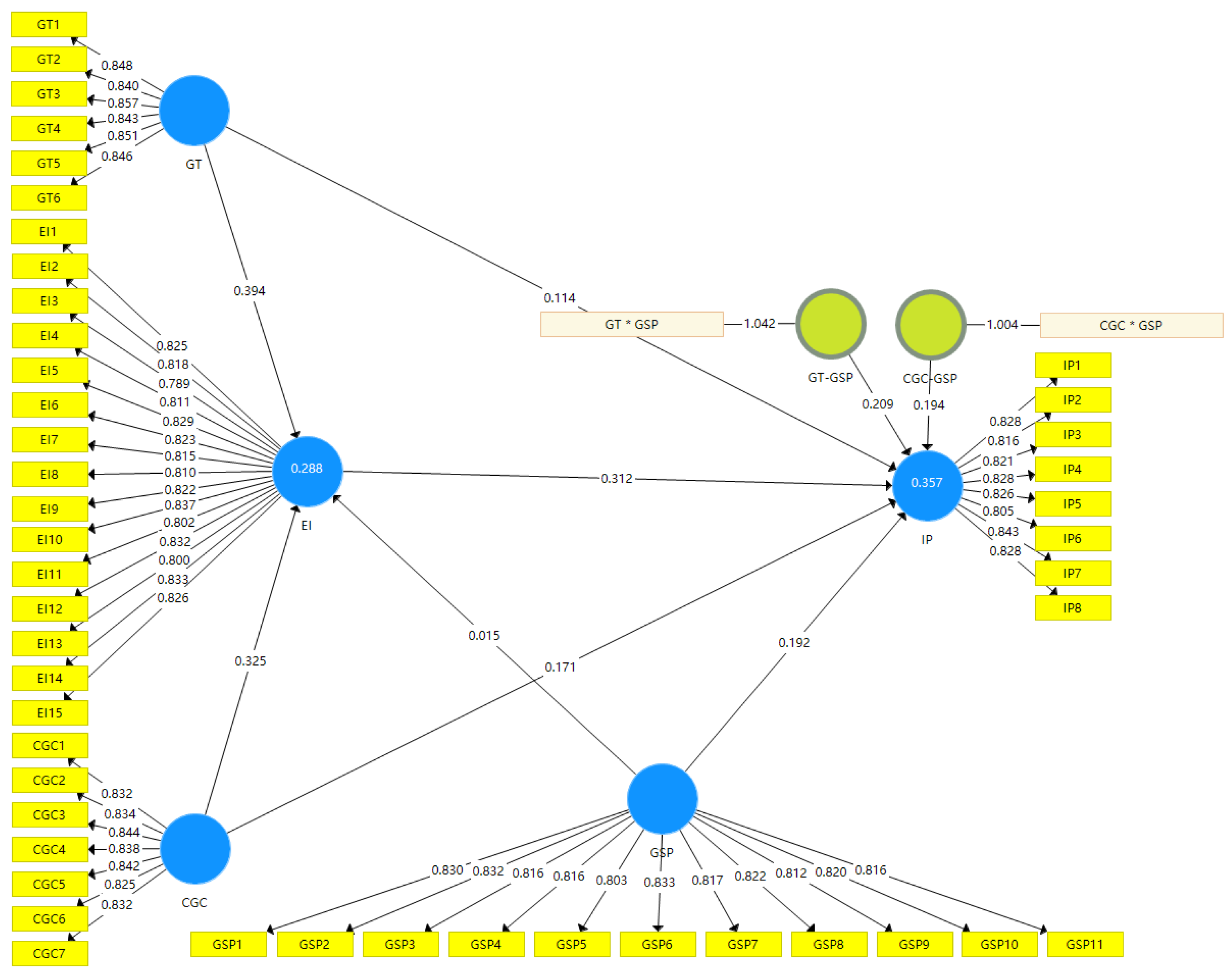
| Internationalization Performance (IP) | IP1 | 0.828 | 2.484 | 0.933 | 0.944 | 0.68 |
| IP2 | 0.816 | 2.388 | ||||
| IP3 | 0.821 | 2.391 | ||||
| IP4 | 0.828 | 2.496 | ||||
| IP5 | 0.826 | 2.491 | ||||
| IP6 | 0.805 | 2.249 | ||||
| IP7 | 0.843 | 2.655 | ||||
| IP8 | 0.828 | 2.448 | ||||
| Green Technology (GT) | GT1 | 0.848 | 2.525 | 0.922 | 0.939 | 0.718 |
| GT2 | 0.84 | 2.445 | ||||
| GT3 | 0.857 | 2.603 | ||||
| GT4 | 0.843 | 2.556 | ||||
| GT5 | 0.851 | 2.541 | ||||
| GT6 | 0.846 | 2.51 | ||||
| Company Green Commitment (CGC) | CGC1 | 0.832 | 2.447 | 0.928 | 0.942 | 0.698 |
| CGC2 | 0.834 | 2.441 | ||||
| CGC3 | 0.844 | 2.52 | ||||
| CGC4 | 0.838 | 2.526 | ||||
| CGC5 | 0.842 | 2.455 | ||||
| CGC6 | 0.825 | 2.433 | ||||
| CGC7 | 0.832 | 2.498 | ||||
| Eco-innovation (EI) | EI1 | 0.825 | 2.761 | 0.965 | 0.968 | 0.67 |
| EI2 | 0.818 | 2.744 | ||||
| EI3 | 0.789 | 2.403 | ||||
| EI4 | 0.811 | 2.619 | ||||
| EI5 | 0.829 | 2.819 | ||||
| EI6 | 0.823 | 2.762 | ||||
| EI7 | 0.815 | 2.656 | ||||
| EI8 | 0.81 | 2.651 | ||||
| EI9 | 0.822 | 2.761 | ||||
| EI10 | 0.837 | 2.989 | ||||
| EI11 | 0.802 | 2.529 | ||||
| EI12 | 0.832 | 2.952 | ||||
| EI13 | 0.8 | 2.485 | ||||
| EI14 | 0.833 | 2.922 | ||||
| EI15 | 0.826 | 2.852 | ||||
| Government Support Programs (GSP) | GSP1 | 0.83 | 2.64 | 0.951 | 0.958 | 0.672 |
| GSP2 | 0.832 | 2.713 | ||||
| GSP3 | 0.816 | 2.563 | ||||
| GSP4 | 0.816 | 2.472 | ||||
| GSP5 | 0.803 | 2.471 | ||||
| GSP6 | 0.833 | 2.883 | ||||
| GSP7 | 0.817 | 2.736 | ||||
| GSP8 | 0.822 | 2.627 | ||||
| GSP9 | 0.812 | 2.481 | ||||
| GSP10 | 0.82 | 2.503 | ||||
| GSP11 | 0.816 | 2.569 |
| Variables | IP | GT | CGC | EI | GSP |
|---|---|---|---|---|---|
| IP | 0.829 | ||||
| GT | 0.342 | 0.836 | |||
| CGC | 0.352 | 0.105 | 0.823 | ||
| EI | 0.487 | 0.4 | 0.289 | 0.813 | |
| GSP | 0.156 | 0.064 | 0.1 | −0.007 | 0.822 |
| Variables | IP | GT | CGC | EI | GSP | GSP*GT | GSP*CGC |
|---|---|---|---|---|---|---|---|
| IP | |||||||
| GT | 0.266 | ||||||
| CGC | 0.339 | 0.1 | |||||
| EI | 0.464 | 0.45 | 0.382 | ||||
| GSP | 0.268 | 0.105 | 0.166 | 0.108 | |||
| GSP*GT | 0.225 | 0.104 | 0.063 | 0.023 | 0.027 | ||
| GSP*CGC | 0.214 | 0.065 | 0.036 | 0.033 | 0.033 | 0.106 |
| Path | Beta | SD | T-Values | p-Values | Decision |
|---|---|---|---|---|---|
| GT → IP | 0.114 | 0.046 | 2.476 | 0.014 | Significant |
| CGC → IP | 0.171 | 0.039 | 4.326 | 0.000 | Significant |
| GT →EI | 0.394 | 0.041 | 9.682 | 0.000 | Significant |
| CGC → EI | 0.325 | 0.047 | 6.96 | 0.000 | Significant |
| GT*GSP → IP | 0.209 | 0.054 | 3.851 | 0.000 | Significant |
| CGC*GSP → IP | 0.194 | 0.033 | 5.935 | 0.000 | Significant |
| Path | Beta | SD | T-Values | p-Values | Decision |
|---|---|---|---|---|---|
| GT → EI → IP | 0.123 | 0.024 | 5.2 | 0 | Significant |
| CGC → EI → IP | 0.101 | 0.022 | 4.709 | 0 | Significant |
| Path | Beta | SD | T-Values | p-Values | Decision |
|---|---|---|---|---|---|
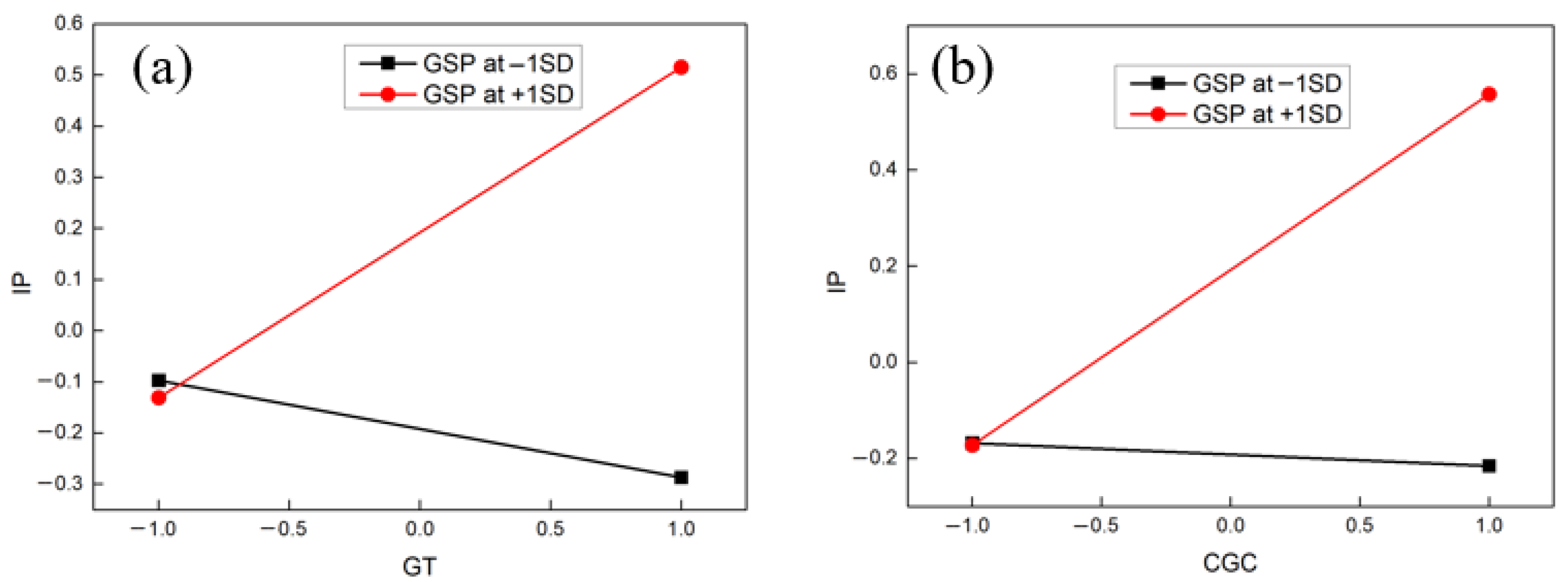
| GT → IP GSP at +1 SD | 0.323 | 0.067 | 4.816 | 0 | Significant |
| GT → IP GSP at −1 SD | −0.094 | 0.076 | 1.242 | 0.214 | Insignificant |
| CGC → IP GSP at +1 SD | 0.365 | 0.047 | 7.82 | 0 | Significant |
| CGC → IP GSP at −1 SD | −0.023 | 0.057 | 0.41 | 0.682 | Insignificant |
| Dependent Variables | Q2 |
|---|---|
| EI | 0.199 |
| IP | 0.236 |
| Relationships | f2 Value | Effect Size |
|---|---|---|
| CGC → EI | 0.144 | Small to medium |
| CGC → IP | 0.038 | Small to medium |
| GT → EI | 0.215 | Medium to large |
| GT → IP | 0.0016 | Small |
Disclaimer/Publisher’s Note: The statements, opinions and data contained in all publications are solely those of the individual author(s) and contributor(s) and not of MDPI and/or the editor(s). MDPI and/or the editor(s) disclaim responsibility for any injury to people or property resulting from any ideas, methods, instructions or products referred to in the content. |
© 2026 by the authors. Licensee MDPI, Basel, Switzerland. This article is an open access article distributed under the terms and conditions of the Creative Commons Attribution (CC BY) license.
Share and Cite
Wang, J.; Afendi, N.A.b.; Ali Imran Bin Kamarudin, M. How Green Technology and Company Green Commitment Affect SME Internationalization Performance Through Eco-Innovation: The Moderator of Government Support Programs. Sustainability 2026, 18, 2213. https://doi.org/10.3390/su18052213
Wang J, Afendi NAb, Ali Imran Bin Kamarudin M. How Green Technology and Company Green Commitment Affect SME Internationalization Performance Through Eco-Innovation: The Moderator of Government Support Programs. Sustainability. 2026; 18(5):2213. https://doi.org/10.3390/su18052213
Chicago/Turabian StyleWang, Jinghui, Noor Afzainiza binti Afendi, and Muhamad Ali Imran Bin Kamarudin. 2026. "How Green Technology and Company Green Commitment Affect SME Internationalization Performance Through Eco-Innovation: The Moderator of Government Support Programs" Sustainability 18, no. 5: 2213. https://doi.org/10.3390/su18052213
APA StyleWang, J., Afendi, N. A. b., & Ali Imran Bin Kamarudin, M. (2026). How Green Technology and Company Green Commitment Affect SME Internationalization Performance Through Eco-Innovation: The Moderator of Government Support Programs. Sustainability, 18(5), 2213. https://doi.org/10.3390/su18052213