Article

Mapping Total and Embodied Environmental Impacts in Flemish Buildings

Building Physics Research Group, Faculty of Engineering and Architecture, Ghent University, Sint Pietersnieuwstraat 41 B4, 9000 Ghent, Belgium
*
Author to whom correspondence should be addressed.
Sustainability 2026, 18(5), 2190; https://doi.org/10.3390/su18052190
Submission received: 2 February 2026 / Revised: 17 February 2026 / Accepted: 20 February 2026 / Published: 25 February 2026
(This article belongs to the Collection Sustainable Buildings and Energy Performance)

Abstract

The environmental impact and overall sustainability of buildings is commonly evaluated through life-cycle assessments. Yet, building professionals often lack a clear understanding of the magnitude and distribution of associated impacts. Therefore, this study analyses the embodied impact in particular, as the relative share of the embodied impact increases in the context of highly energy-efficient buildings. This paper draws on a dataset of 108 single-family dwellings, 10 multi-family buildings, and 8 non-residential buildings. First, the balance between embodied and operational impacts is quantified. Subsequently, the study identifies the contribution of building elements and bill-of-quantities categories, and the influence of material choices. For single-family dwellings, this is followed by a stepwise reduction analysis to demonstrate how material choices can mitigate embodied impacts. Finally, the cases are benchmarked against European thresholds. Results show that an average share of 62–72% and 47% originates from embodied emissions, for residential and non-residential buildings, respectively. Floors represent the largest contributors across all building types. The slab on grade dominates in SFHs and internal floors in multi-storey buildings. In addition, interior finishes and structures also account for significant embodied impacts. Furthermore, for single-family dwellings, informed material selection can reduce embodied impacts by up to 60%.

1. Introduction

1.1. Whole Life-Cycle Perspective of Buildings

An urgent worldwide effort is required to mitigate the escalating effects of climate change. Among the key contributors to global CO2 emissions is the building sector, which accounts for 37% of the total emissions released into the atmosphere. In addition, the building sector is also responsible for 50% of all extracted materials, 35% of waste generation, and 50% of the total energy consumption [1,2]. Residential buildings alone cover two-thirds of the buildings’ energy consumption [2]. Within this framework, the European Union has defined climate targets that serve as a roadmap towards carbon neutrality by 2050 [3]. To align with these climate neutrality objectives, it is crucial to intensify efforts to reduce the energy consumption as well as the emissions and the overall environmental impact of building materials. In response, the recast of the Energy Performance of Buildings Directive (EPBD) mandates that, from 2030 onwards, member states must ensure the assessment of whole life-cycle carbon emissions for all new buildings, alongside the development of national roadmaps and the establishment of limit values [4]. However, the building sector is not on track to follow this roadmap towards climate neutrality and to reduce its emissions sufficiently [3]. Notably, Verhaeghe et al. [5] demonstrated in their study that despite the increasing energy efficiency, several planetary boundaries, including climate change, fossils for resource use, minerals and metals for resource use, and freshwater ecotoxicity, are being exceeded due to our current construction practices.
Life-cycle assessment (LCA) is a commonly applied approach to assess the environmental impact of buildings, encompassing both the operational and embodied performance. In order to lower the carbon footprint of our building stock, enhancing energy efficiency remains a key priority. Moreover, multiple studies indicate that as operational energy demand decreases, the relative importance of a building’s embodied environmental impact increases. The embodied impact is related to the production, use, and end-of-life impact of the building materials used [6,7]. In a study by Röck et al. [6], the material contribution of residential buildings accounts for 20–25% of the total environmental impact when current energy performance regulations are met. As operational energy use decreases, the relative contribution of the materials increases, reaching 45–50% for highly energy-efficient buildings. In exceptional cases, it can exceed 90%, underscoring the importance of material selection. Similarly, Mirabella et al. [7] reported an embodied impact of 60% for low-energy buildings. The relative contribution of the materials further increases when considering the energy performance gap, i.e., the difference between a building’s calculated and actual energy savings [8]. Decorte et al. [8] emphasize that theoretical energy consumption tends to be overestimated, with actual consumption being considerably lower as a result of occupant behaviour.
As planetary boundaries are increasingly exceeded and embodied impacts gain prominence, this study prioritizes the embodied dimension rather than operational performance.

1.2. Main Contributors to Embodied Emissions

Multiple studies provide insights into the building elements (e.g., walls, roofs, etc.) that predominantly drive embodied impacts and emissions [9,10,11,12,13]. Le Den et al. [9] identify floors as the most significant contributor of building elements. The slab on grade and internal floors each account for approximately 20% of the total embodied emissions. These are followed by external walls (12%), roofs (10%), and technical installations (10%). Comparable results are reported in a study by Sobota et al. [10]. Floors account for 22.9% of the total embodied emissions. The combined contribution of the roof and external wall amounts to 27%. Only the relative share associated with technical installations increases to 21%, which is consistent with the 27% share reported in a study by Röck et al. [11]. Furthermore, a study by Andersen et al. [12] indicates that building envelope components, such as the slab on grade, external walls, and roofs, constitute the principal contributors to the embodied impact. In addition, Zimmermann et al. [13] demonstrate a substantial variation in the emissions associated with individual building elements. This variation depends on both the building typology and the specific construction assemblies employed.

1.3. Benchmarking and Embodied Emission Reductions

In pursuit of the 2050 climate objectives, several European countries have already integrated or plan to integrate obligatory life-cycle assessments into their building codes, sometimes including limit values as in the Netherlands, France, Finland and Denmark [4,14,15]. Furthermore, several studies have concentrated on establishing benchmark values for Belgium, Germany and Norway. However, these have not yet been incorporated into national policy frameworks [16,17,18]. Table 1 gives an overview of the obtained or research values, including the embodied and operational impact. Notably, each country applies its own methodology for assessing emissions from (residential) buildings, complicating the comparability of benchmark values.
The regulatory benchmark limits for France, Finland, and Denmark are broadly aligned [14]. In Denmark, a distinction is made between the limit value set by the 2023 building regulations (i.e., the value in Table 1) and the limit value defined by the voluntary CO2 class. This voluntary target of 8 kg CO2-eq/m2/y has been introduced as a more stringent threshold than a mandatory requirement and aims to encourage the building sector to adopt more environmentally friendly practices [12]. Benchmark values used as reference points, as seen in studies [16,17,18], are typically derived by estimating the environmental impact of a sample of building cases. The median value is adopted as the reference value, implying that 50% of the cases still exhibit a higher impact. This underscores the need for clear guidelines aimed at systematically reducing environmental impacts across the sector.
As contemporary construction practices continue to exceed several planetary boundaries, the development and implementation of low-impact solutions has become increasingly important. Such approaches may also contribute to the systematic reduction in benchmark values in the future. Multiple studies compared the life-cycle environmental impact of circular strategies, such as reuse, bio-based and demountable materials, to conventional, linear strategies [19,20,21,22,23]. Devos et al. [19] study the environmental savings of reusing bricks and found a reduction potential of 72–75%. In a study of Vasishta et al. [20] a carbon reduction of 48% for a prefabricated building compared to a building constructed in situ was found. Ben-Alon et al. [21] reported that natural wall assemblies achieved reductions in embodied emissions of 60–82% and of 20–80% in life-cycle emissions. Although studies suggest that circular strategies can yield environmental benefits, such outcomes are not always guaranteed. This underscores the importance of selecting appropriate materials rather than adopting circular strategies in a manner devoid of clear evaluative criteria. Cascione et al. [22] compared a circular bio-based wall panel with conventional timber and steel-frame alternatives, demonstrating that the circular option exhibited 27–99% higher life-cycle emissions over a single service life. Furthermore, Khadim et al. [23] concluded that strategies characterised by higher levels of circularity do not necessarily yield improvements in environmental performance.

1.4. Research Goal, Scope, and Steps

Through discussions with Flemish building practitioners, such as architects and contractors, it becomes clear that they often lack hands-on knowledge on how to effectively reduce the environmental impact and emissions of their building projects. In addition, existing LCA tools are frequently ambiguous and difficult to use. In order to realise meaningful environmental and emission reductions, it is first necessary to obtain a clear understanding of where the principal environmental impact and CO2 emissions within a building are situated.
Therefore, the overall aim of this study is to examine the environmental impact and CO2 emissions of current construction practices in Belgium to explore how this differs between residential and non-residential buildings and to provide clear insights into how they can be reduced. This leads to the following objectives: (a) identifying which building elements (e.g., walls, floors, and roofs) and which bill-of-quantities categories (e.g., structure, insulation, and finishings) contribute most significantly to the environmental impact; (b) examining the influence of material choices; (c) analysing the relative shares of embodied and operational impacts; (d) exploring and evaluating potential strategies to reduce environmental impacts and emissions; and (e) comparing the environmental performance against existing benchmarks and limit values. The outcomes of an LCA are highly sensitive to the assumptions made throughout the assessment process. Consequently, the results should be interpreted with an estimated uncertainty margin of approximately 20% [24].
First, this paper explores the total environmental impact and carbon emissions of 108 single-family houses (SFHs), 10 multi-family houses (MFHs) and 8 non-residential buildings. The 108 SFHs consist of 36 detached, 36 semi-detached and 36 terraced dwellings. This entails calculating the environmental impact and carbon emissions associated with the building elements and technical installations (embodied impact), and operational energy use. This enables an examination of how these impacts and emissions are distributed according to the building’s typology. Furthermore, an assessment of embodied environmental impacts and embodied carbon emissions is conducted by integrating two dimensions: the proportional contribution of individual building elements and the categorisation within the bill-of-quantities. The building element and bill-of-quantities categories representing the largest material shares are identified as having the greatest potential for embodied impact reductions. In addition, the influence of material selection in single-family dwellings is analysed in detail.
Second, the study adopts a stepwise modification approach to investigate the reduction potential of construction materials through a series of incremental strategies aimed at lowering the embodied impact of single-family dwellings. Each strategy yields a corresponding percentage of reduction. The initial steps focus exclusively on current Belgian construction practices, while subsequent steps incorporate advanced techniques aligned with circular economy and broader sustainability principles. These include the implementation of dry building assemblies, reused components, and bio-based materials.
Third, all cases are benchmarked against European reference values and limit thresholds, providing insights into whether the Belgian construction sector remains within the planetary boundary for global warming potential (GWP). Furthermore, circular cases are also benchmarked to reveal the potential of the circular economy, emphasising the impact of implementing these strategies on reducing embodied emissions.

2. Materials and Methods

2.1. LCA Methodology

To evaluate the environmental impact of newly built residential and non-residential buildings, a life-cycle assessment (LCA) is performed with the software SimaPro (v10.2) [25]. This assessment applies the methodology used in the Belgian LCA tool named TOTEM. This Belgian tool was developed by the three Belgian regions as a support instrument to assist building professionals in estimating the environmental impact of their buildings [26]. A 60-year reference study period is considered. This represents the life span of a building, from the construction to the demolition of the building. The functional unit at the element level is defined as 1 m2 of building element. At the building level, the functional unit is the gross floor area (GFA) of the building. This study encompasses both envelope and internal elements as well as technical installations. Envelope elements refer to external walls, the slab on grade, roofs, external doors, and windows. In contrast, internal elements are internal walls, internal floors, and internal doors. Furthermore, the life-cycle inventory incorporates data from the Ecoinvent 3.11 ‘cut-off’ database [27]. All data are applicable to the European context, excluding Switzerland. Additionally, the results will be expressed in millipoints (mPt) or Points and in tons or kg CO2-equivalent, with a main focus on Points to avoid burden shifting. The results in Points refer to an aggregated single score, applying the Product Environmental Footprint (PEF) normalization and weighting factors from EN 15804 + A2 [26,28]. Biogenic carbon is excluded from the study by applying the 0/0 approach, i.e., the uptake and release of biogenic carbon are equal to 0.
This study considers the production (A1-A3), construction (A4-A5), replacement (B4), operational energy use (B6), and end-of-life (C1-C4) stages. The embodied impact represents all the mentioned stages, excluding module B6. Assumptions, such as those regarding transport means and distances, life spans of materials, and end-of-life scenarios, are in line with the TOTEM methodology [26]. For the calculation of the environmental impact and carbon emissions of reused materials, the production stage (A1-A3) is assumed to be zero, as these materials have already been manufactured in a previous life cycle. The study considers ex situ reuse and includes the following life-cycle stages: transportation to the new site (A4), on-site construction (A5), replacements (B4), and end-of-life processes (C1-C4). Furthermore, to assess the impact of a building element (e.g., an external wall), the embodied impact of 1 m2 of that element is extrapolated to the building level. The embodied impact of the technical installations is accounted for in a simplified manner. In all residential cases, a heat pump combined with underfloor heating is assumed. The ventilation system varies: single-family dwellings are equipped with a type-D ventilation system, whereas multi-family houses utilize a type-C one. In contrast, in the non-residential cases, the technical installations are excluded from the study, as information about the installation types is missing. This implies that a comparison of the embodied impact between residential and non-residential cases is only possible when the technical installations are excluded from the results.
The operational impact is calculated in two ways, depending on the building type. For residential buildings, as detailed information about the energy consumption is lacking, the operational energy use is calculated in a simplified manner based on the Equivalent Heating Degree Days (EHDDs) method [29] over a 60-year service life. Transmission and ventilation losses are multiplied by 1200 equivalent degree days and subsequently divided by the overall system efficiency to determine the final energy demand. Multiplying this final energy demand by the environmental impact factor of the respective energy source and with the study period yields the operational environmental impact, which constitutes an underestimation due to the simplified EHDD method. Table 2 presents the environmental impact and GWP values for each energy source (both gas and electricity). The dataset for natural gas reflects European averages dated 2011, while for electricity use, the Belgian electricity mix from 2019 is assumed. This is based on available data in Ecoinvent 3.11 [27].
In contrast, for most non-residential cases, an Energy Performance of Buildings (EPB) calculation is available. Based on these data, the environmental impact of module B6 can be assessed following the Flemish Energy Performance of Buildings Directive (EPBD) method, a semi-stationary monthly heat balance method [30]. This approach allows to assess the impact of the operational energy use based on heating, cooling, domestic hot water, and auxiliary energy (e.g., electricity for fans and pumps) [29]. The derived data for the final energy use per case is listed in Table 3. In a next step, these data are multiplied by the reference study period and the environmental impact per MJ, depending on the energy source (presented in Table 2).
The differing modelling approaches applied to the operational impact of residential and non-residential buildings make it impossible to compare their operational impacts. Consequently, within this paper only a comparison of the embodied impacts of these buildings is made.

2.2. Case Studies

This section outlines the case studies considered in this research. A total of 108 single-family dwellings, 10 multi-family buildings, and 8 non-residential buildings are analysed. These cases are provided by Flemish contractors as part of the ongoing research project ‘COOCK+ MI2B—Milieu-impact als motor voor duurzame innovatie bij bouwbedrijven’ and are representative of the building stock in Flanders. Single-family houses were selected based on their size, in accordance with the dimensions of contemporary housing as reported in the EPB data. This section begins with a description of the single-family houses (SFHs) and multi-family houses (MFHs), followed by a description of the non-residential buildings.

2.2.1. Single-Family Houses

Typology and Geometry
Nine recently constructed SFHs in Flanders are selected: three detached, three semi-detached, and three terraced dwellings. For each typology, one small, one medium, and one large SFH is selected, based on the reported floor areas of recently built dwellings in the publicly accessible EPB database [31]. Table 4 presents the gross floor area of each SFH. Detached dwellings generally exhibit the largest gross floor area, followed by semi-detached and, subsequently, terraced dwellings. Nevertheless, the sample includes one notable exception: the smallest semi-detached SFH possesses a greater floor area than the smallest detached SFH. This discrepancy arises from the variation in floor areas within each size category, which results in partial overlap between the typologies. Although both cases belong to the correct size category, the detached dwelling lies at the lower end of the category’s floor-area range, while the semi-detached dwelling lies at the upper end.
For each SFH, an additional variant featuring an alternative roof configuration is included; specifically, dwellings with pitched roofs are duplicated with flat roofs and vice versa. Consequently, the study encompasses 18 SFHs. Each of these 18 dwellings is subjected to three impact scenarios per construction method at the element level, namely masonry or timber assemblies characterized by high, medium, and low environmental impacts. The assemblies per impact scenario are described below. A uniform impact scenario is applied across all building elements within a given SFH. Thus, a wall constructed with a masonry assembly exhibiting high embodied impact is combined exclusively with other masonry assemblies of building elements with similarly high embodied impact. This approach results in a total of 108 SFHs, differentiated by building typology, size, roof type, construction method, and material specifications.
Building Elements
As masonry and timber-frame construction represent the two predominant methods for SFHs in Flanders, a distinction is made between these construction methods. For each method, typical assemblies for building elements, such as floors, roofs, and walls, are defined. These assemblies are based on a recent study by Decorte [32], which inventoried commonly used structural, insulation, and finishing materials for single-family dwellings. In addition to Decorte’s work [32], calcium silicate bricks were included as a structural material for external and internal walls in masonry construction. The structural, insulation, and finishing materials are combined into technically feasible assemblies with a constant thermal transmittance per element, targeting a U-value of 0.18 W/(m2K) for all envelope components. This ensures compliance with the EPBD requirements for new buildings in Belgium. For each assembly, the embodied environmental impact is calculated and is expressed in mPt/m2. These assemblies are ranked according to their embodied impact, enabling the selection of configurations with the highest, lowest, and median impacts for each building element. This ranking defines three impact scenarios per construction method at the element level, which are applied to the SFHs. Although the number of assemblies per element is limited to three variants, selecting the lowest and highest variant provides a range within which all other assemblies are situated. This approach ensures that even with a restricted set of assemblies, meaningful conclusions can be drawn regarding the environmental impact and sustainability performance of different assemblies. The assemblies of the building elements per category are included in Appendix A, and their embodied impact is summarized in Table 5 and Table 6. Certain elements, such as exterior doors, interior doors, and garage doors, are represented by a single variant, i.e., no distinction is made based on construction method or impact scenario.

2.2.2. Multi-Family Houses

In total, ten MFHs are analysed. The majority of the cases originate from the TOTEM tool (v2026.1) [29], which itself draws on data from the Flemish EPB database [30]. The remaining case is provided by a Flemish contractor. Table 7 presents the key building characteristics for each building.
In contrast to the SFHs, the MFHs are assessed using their actual construction assemblies rather than using material scenarios. The nine TOTEM-library cases show largely comparable assemblies with only minor variations. The building assemblies are included in Appendix B.
Floors: Most cases use ceramic tiles as floor finishing material; the remainder apply natural stone. PUR is the predominant insulation material, occasionally supplemented by PS or XPS. All ground floors consist of in situ reinforced concrete slabs. Intermediate floors are either in situ concrete slabs or precast systems, such as hollow-core slabs or beam-and-block systems.
Walls: External, internal, basement, and party walls are primarily constructed from ceramic masonry blocks, with one case using calcium silicate blocks as the structural element. In exceptional instances, a single external wall is constructed using timber or steel framing, aerated concrete blocks, or in situ concrete instead of ceramic masonry. Basement walls use hollow concrete blocks. Insulation materials include EPS, PUR, and mineral wool. Internal finishes are plaster and paint; external finishes vary, including brickwork, fibre cement, aluminium or zinc cladding, external plaster, and ceramic or fibre cement slates.
Roofs: All cases include flat roofs. Four also feature pitched roofs. Flat roofs typically consist of concrete structural layers with PUR insulation and bituminous waterproofing, with occasional terraces or fibre cement finishes. Pitched roofs use timber rafters with glass wool insulation, internal plasterboard, and external ceramic tiles or fibre cement slates.
Windows and doors: External doors are mostly glazed with PVC frames, though timber and aluminium also occur. Window frames follow similar material choices. All cases use double glazing, except one with triple glazing. Internal doors are MDF. In one case, the garage door consists of aluminium and PUR insulation.
Case AP_GB features in situ cast concrete or ceramic masonry walls, with an external plaster over EPS insulation and limited use of prefabricated concrete panels. Floors incorporate cement screed with EPS granulates and concrete slabs or hollow-core slabs. Flat roofs use similar structural systems with PUR insulation and are finished with timber finishing or a green roof. Windows have aluminium frames with double glazing; external doors combine aluminium and timber; and internal doors are timber.

2.2.3. Non-Residential Buildings

Each non-residential building was recently constructed and differs according to its function and construction method. The building functions include an office building, a primary school, an assisted-living complex, three childcare facilities, an industrial warehouse combined with office space, and a circular hub functioning as a storage facility in combination with offices. All cases were provided by Flemish contractors. Despite the limited number of cases supplied, they offer a representative cross-section of typical construction methods and building functions within the Flemish context. Half of the cases employ a conventional solid construction approach, using concrete slabs and ceramic masonry. The three childcare facilities, by contrast, adopt timber construction: two are built using solid timber (CLT), while one applies a timber-frame system. The industrial warehouse is constructed using a steel frame. The circular case prioritises material reuse, demountable connections, and bio-based materials. The building assemblies per building element are included in Appendix C. Table 8 provides an overview of the cases, including information on their function, construction method, gross floor area, and abbreviations used throughout the results of the study.

3. Results

In this section, the results are presented using the aggregated score, expressed in Points. The results expressed in GWP are also addressed in this section, but the graphs are provided in the Appendix D.

3.1. Environmental Impact Assessment

This first section focuses on the total environmental impact (i.e., embodied impact of materials and technical installations, and operational impact) of all cases, encompassing both residential and non-residential buildings. Subsequently, the analysis examines the operational impact in greater depth. For non-residential buildings, an additional distinction is made between heating, cooling, domestic hot water (DHW), and auxiliary energy, all of which are discussed below. Not all non-residential cases are equipped with information on their final energy use by the contractors, such as WH and CH. Therefore, the environmental impact associated with operational energy use could not be defined, and these cases are excluded from the graphs comparing both the total environmental impact and the operational impact. Finally, the embodied impact is examined. This analysis is divided into two parts: one addressing the contribution of individual building elements, and another focusing on the contribution of the bill-of-quantities categories. Both approaches yield the same underlying results but present them through different analytical lenses. This approach provides insights into which building elements and bill-of-quantities categories have the largest share in the environmental impact.

3.1.1. Environmental Impact of Building Materials and Operational Energy Use

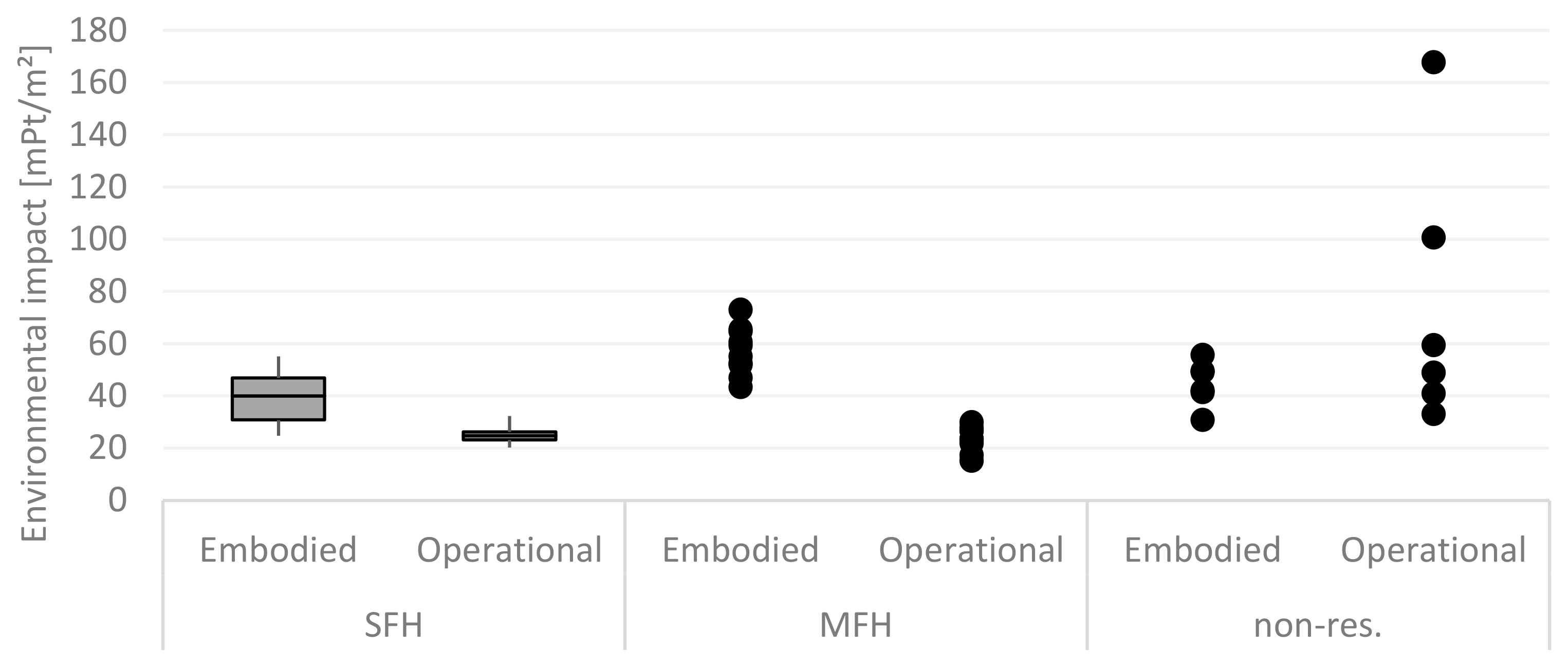
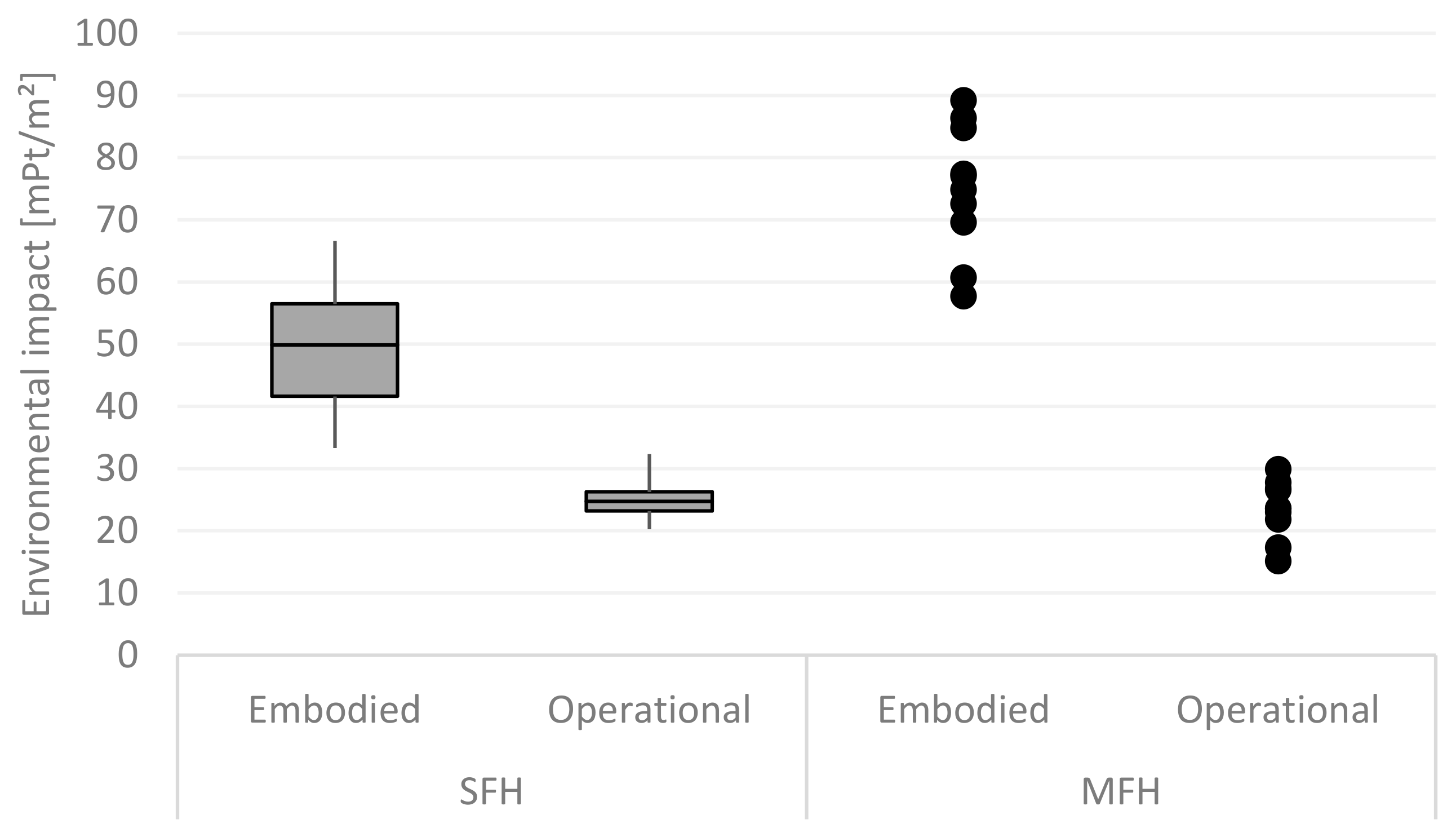
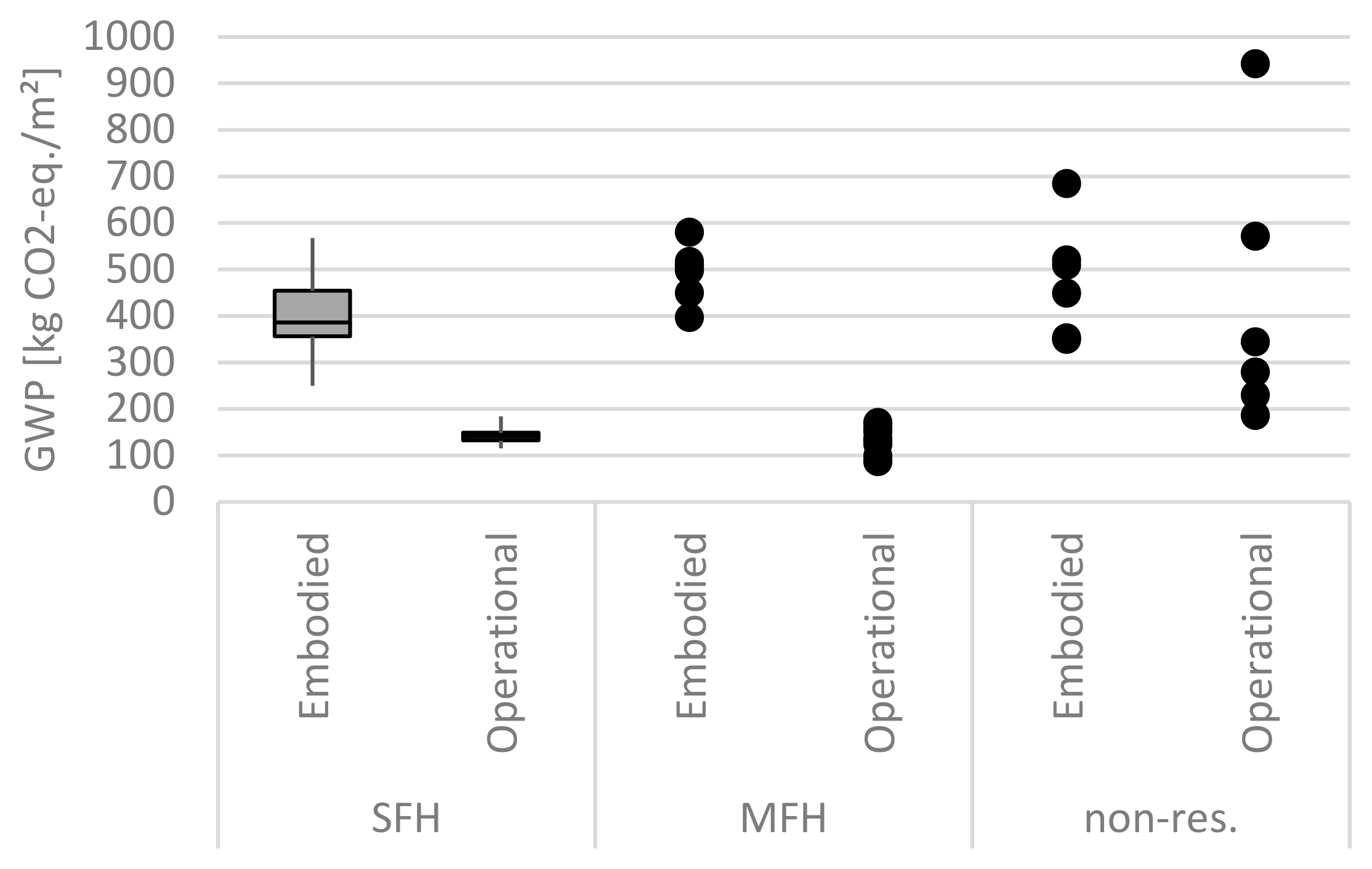
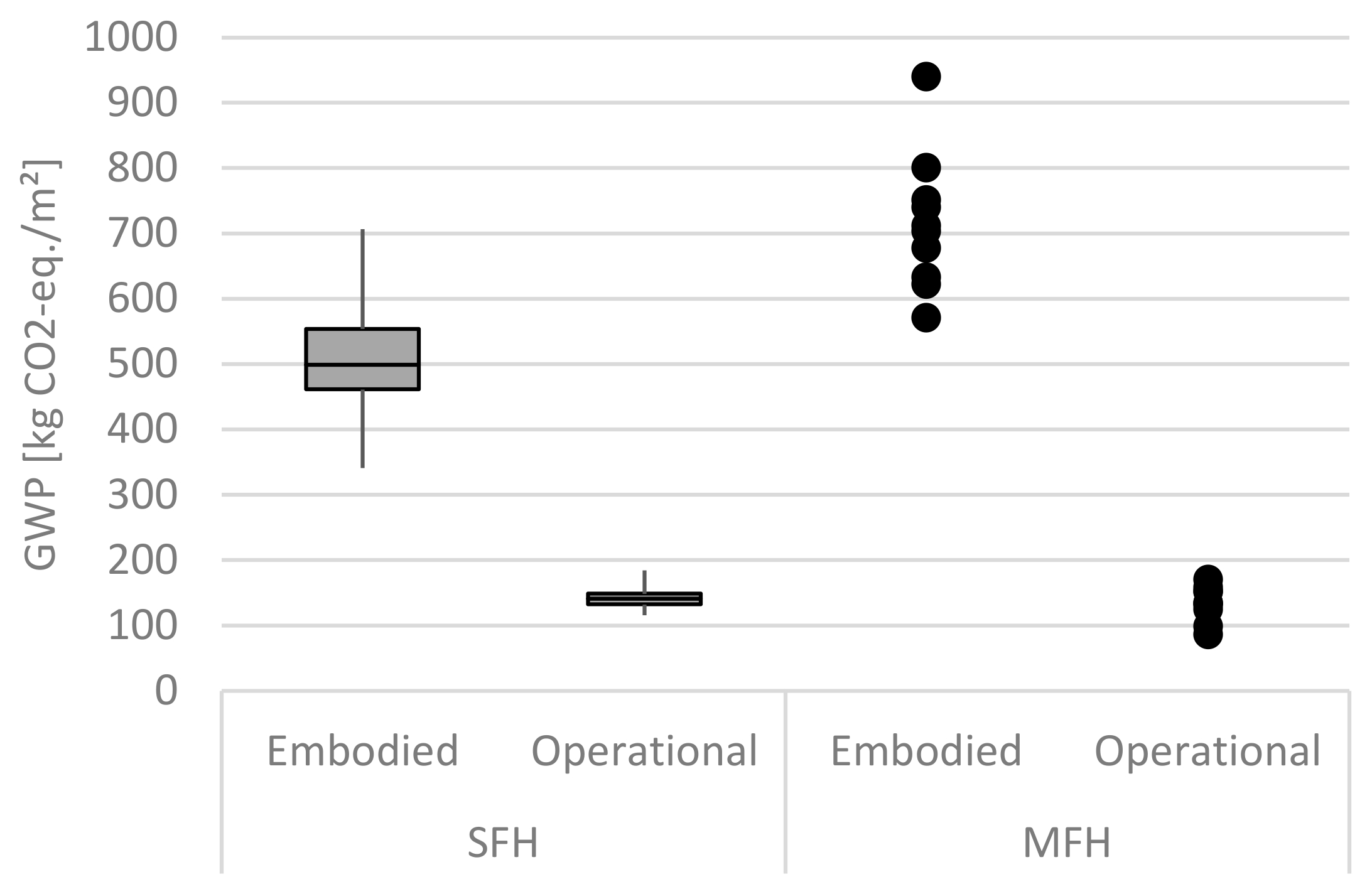
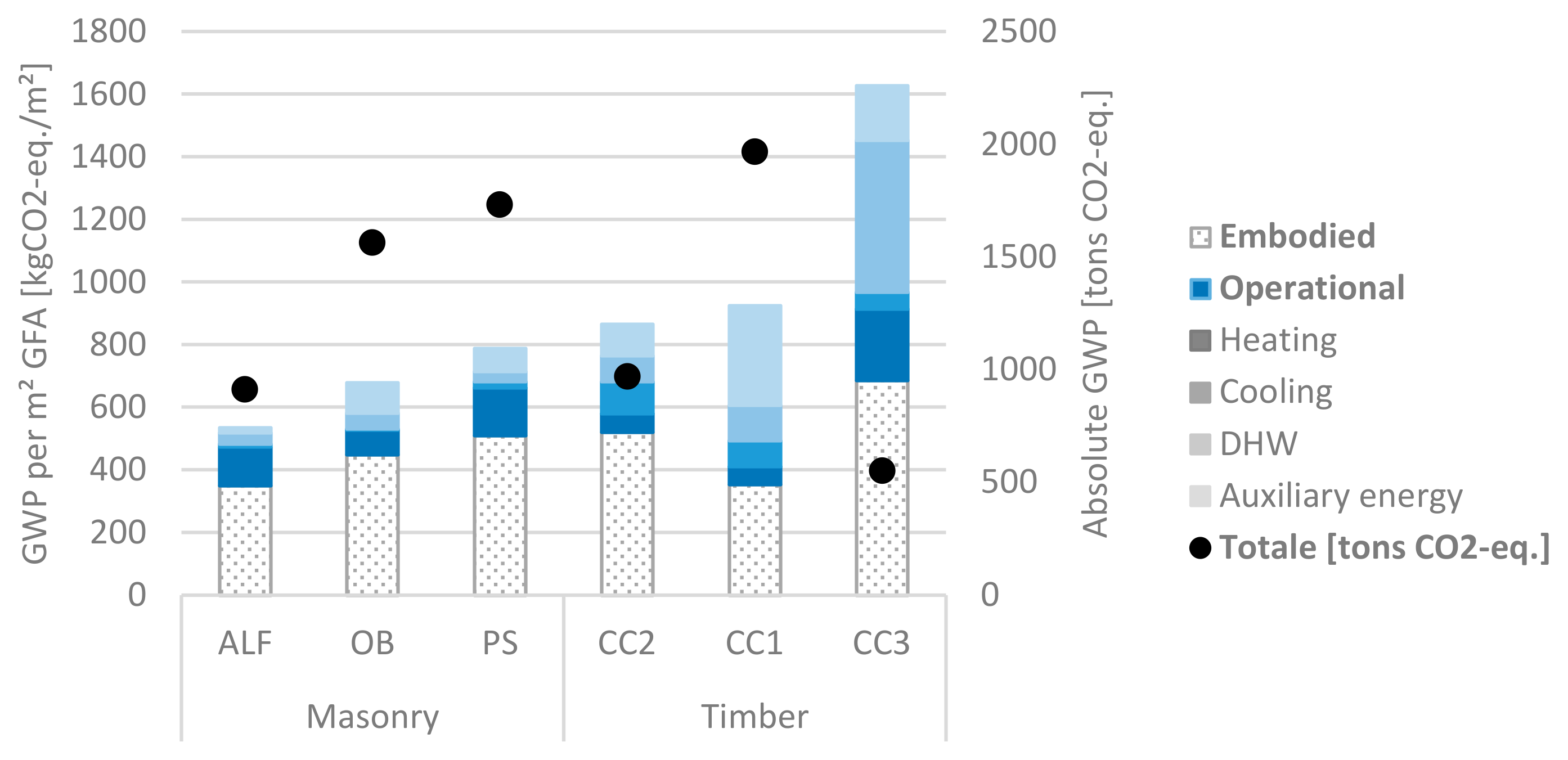
Figure 1 and Figure A1 (in Appendix D) present the environmental impact or carbon emissions of building materials and operational energy use for all cases, disaggregated into residential (SFHs and MFHs) and non-residential categories. The embodied impact of the technical installations is not included in this assessment, as there are no available data for the non-residential cases. A direct comparison between the operational impact of the residential and non-residential results is not possible, as the operational impact for each sector is derived from different sets of energy-use components. Nevertheless, presenting them side by side provides an initial indication of their relative magnitude. For the residential cases, only the impact of heating is considered, which leads to an underestimation of the total operational impact. In the non-residential cases, the assessment additionally accounts for cooling, DHW production, and auxiliary energy.
For SFHs, the total impact ranges from 46 to 84 mPt/m2, corresponding to 380 to 740 kg CO2-eq/m2. For MFHs, the impact increases to between 67 and 103 mPt/m2, or 555 to 731 kg CO2-eq/m2. The higher values are observed in non-residential cases, where the impact varies from 64 to 223 mPt/m2, equivalent to 535 to 1626 kg CO2-eq/m2.
On average, 62% [49%, 70%] of the total environmental impact in SFHs is attributed to embodied impacts. When considering GWP, this share increases to 72% [62%, 80%]. The reduction in the operational impact can be explained by the low carbon intensity of electricity required for the heat pump to operate. When technical installations are included in Figure 2 and Figure A2 (in Appendix D), the share of embodied impacts rises to 66% for the environmental impact and 78% for GWP. Moreover, in MFHs, the share of embodied impacts is higher due to more material-intensive building assemblies of these cases. The embodied contribution averages 72% [61%, 77%] for the total environmental impact and 79% [71%, 85%] for GWP. When technical installations are included (Figure 2 and Figure A2), these shares increase further to 77% and 84%, respectively. In contrast to the residential cases, non-residential buildings exhibit substantial variation in operational impacts, as discussed in the following section. Due to the higher operational impact, because of the EPB methodology, the relative share of the embodied impact decreases to 47% [25%, 50%] for the total environmental impact and to 62% [38%, 66%] for GWP.

3.1.2. Operational Impact

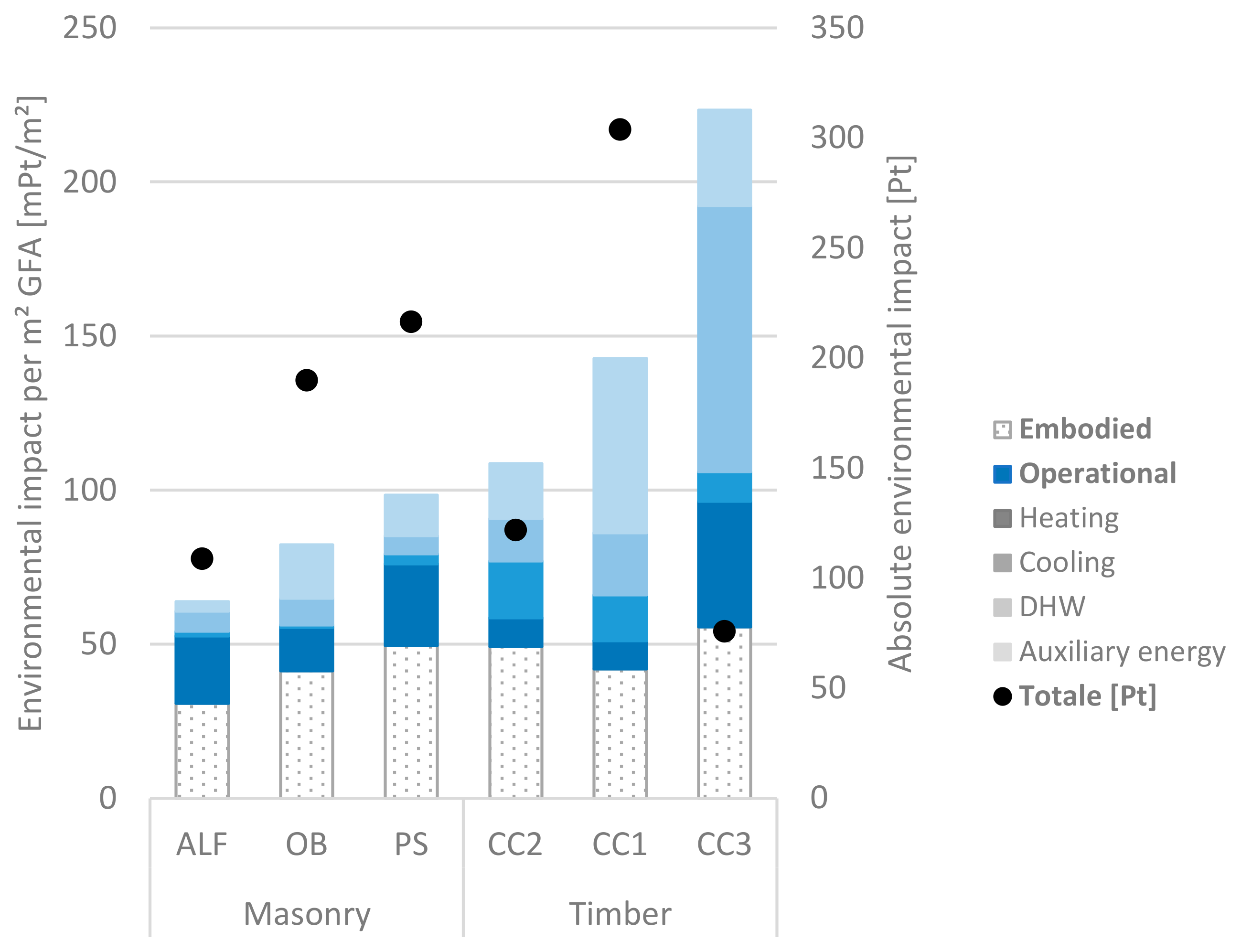
The energy use in a building is highly dependent on user behaviour and is therefore difficult to estimate theoretically. In the residential cases, cooling, DHW, and auxiliary energy are not taken into account, whereas these components are included in the non-residential assessments. Figure 3 and Figure A3 (in Appendix D) illustrate the relative magnitude of the different operational share. The industrial warehouse (WH) and the circular hub (CH) are excluded from this analysis, as there is no information about their operational energy use.
The operational impact exhibits wide variation, ranging from 33 to 168 mPt/m2, or 186 to 942 kg CO2-eq./m2. For both the total environmental impact and GWP, the contribution of the operational impact is highest in CC3 and lowest in ALF. The low contribution in the assisted-living facility can be attributed to the goal of achieving an energy-performance level equivalent to that of residential new-build standards. The high operational contribution in CC3 is primarily related to its small building size. Because the total operational impact is distributed over a relatively small gross floor area, the resulting normalised impact per square meter is substantially higher. Compared with the other typologies, the contribution of DHW is also higher in childcare facilities, as it includes the preparation of warm meals. In addition, auxiliary energy represents a significant share. The elevated auxiliary energy contribution in childcare centres is linked both to the building’s care-related function with 24/7 occupancy and to the default values applied for the energy consumption of circulation pumps in the EPBD calculation. Cooling likewise accounts for a larger share in childcare centres. Finally, substantial differences are observed across typologies in the contribution of space heating. These differences are partly driven by the heating demand, as in ALF and CC3, and partly by the low efficiency of gas boilers used as the primary heating system, such as in PS. Overall, the EPBD reports show variation to the extent that certain aspects were calculated using detailed methods or default values in the Flemish EPBD tool, which affects the reported final energy consumption and the corresponding operational impacts or emissions.

3.1.3. Embodied Impact

Building Elements and Technical Installations
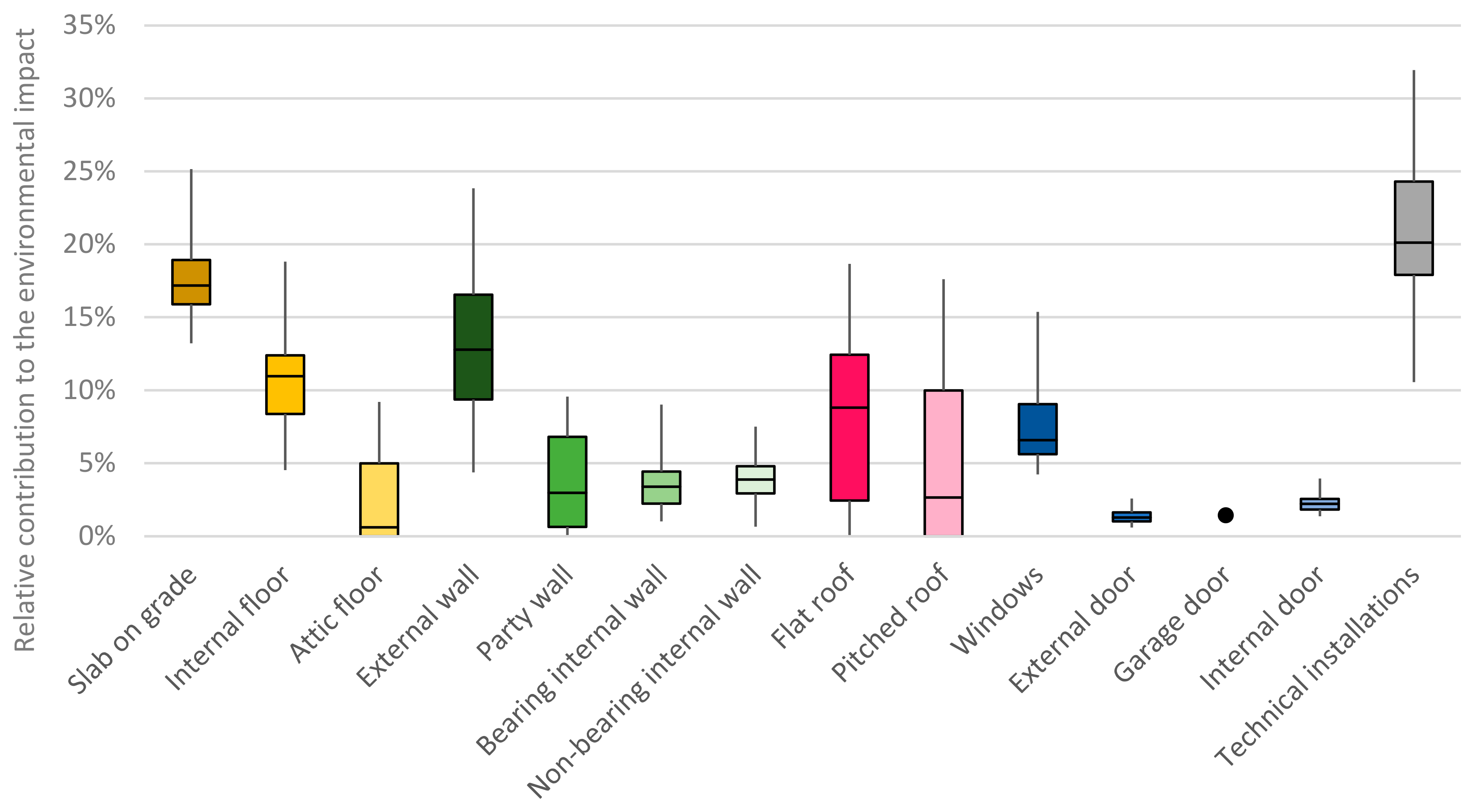
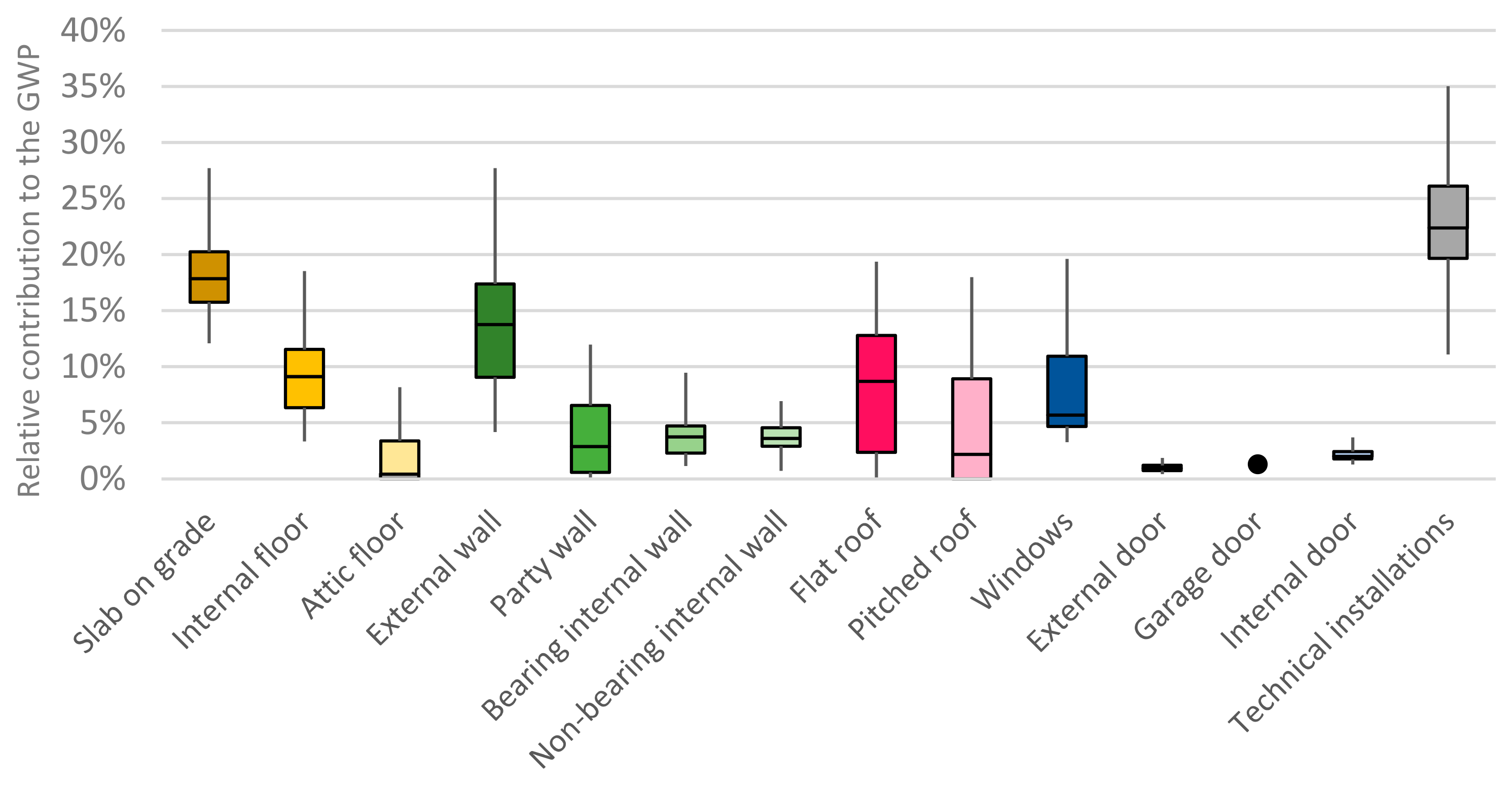
Figure 4 and Figure A4 (in Appendix D) present the relative contribution of the individual building elements and technical installations to the embodied environmental impact and, respectively, the GWP of SFHs. Within the scope of technical installations, both heating and ventilation systems are taken into account. The figures clearly indicate which elements account for the largest share of the impact, as well as the spread observed per category. Both figures yield highly consistent trends, demonstrating that the dominant contributing elements are comparable across impact indicators.
The embodied impact, including technical installations, ranges from 33.3 to 66.6 mPt/m2, or 341.1 to 708.9 kg CO2-eq/m2. Both figures clearly show that technical installations constitute the largest contributors compared to individual building elements. On average, these systems account for up to 20% and 24% of the embodied environmental impact and GWP, respectively. Floors represent the next most significant contributors, with the slab on grade being the dominant source of impact; the average contribution amounts to 17% for the environmental impact and 18% for GWP. This is attributed to the high environmental impact of the structure and floor finishing materials, which is further discussed in this section. Moreover, envelope elements, such as exterior walls (13%), roofs (7%), and windows (6%), exhibit higher contributions than the interior elements of a dwelling. This is attributed to the heavier structural materials and the greater material quantities required for the construction of envelope components. In the case of windows, the elevated contribution is primarily due to the substantial embodied impact associated with window frames.
In addition, the building elements exhibit substantial variability in their embodied impact. This variation is primarily driven by the selected material scenarios and differences in element surface areas. This is particularly evident for exterior walls, where the contribution strongly depends on the dwelling type: detached houses are surrounded by exterior walls on all sides, whereas terraced houses have exterior walls on only two sides, resulting in a considerably smaller exterior wall area. Furthermore, roofs exhibit an analogous pattern. Each case study features a single roof typology, either a flat roof or a pitched roof. When a particular roof type is absent in a given case, its corresponding roof surface area is zero. Consequently, the absent roof type also contributes zero to the calculated environmental impact or carbon emissions.
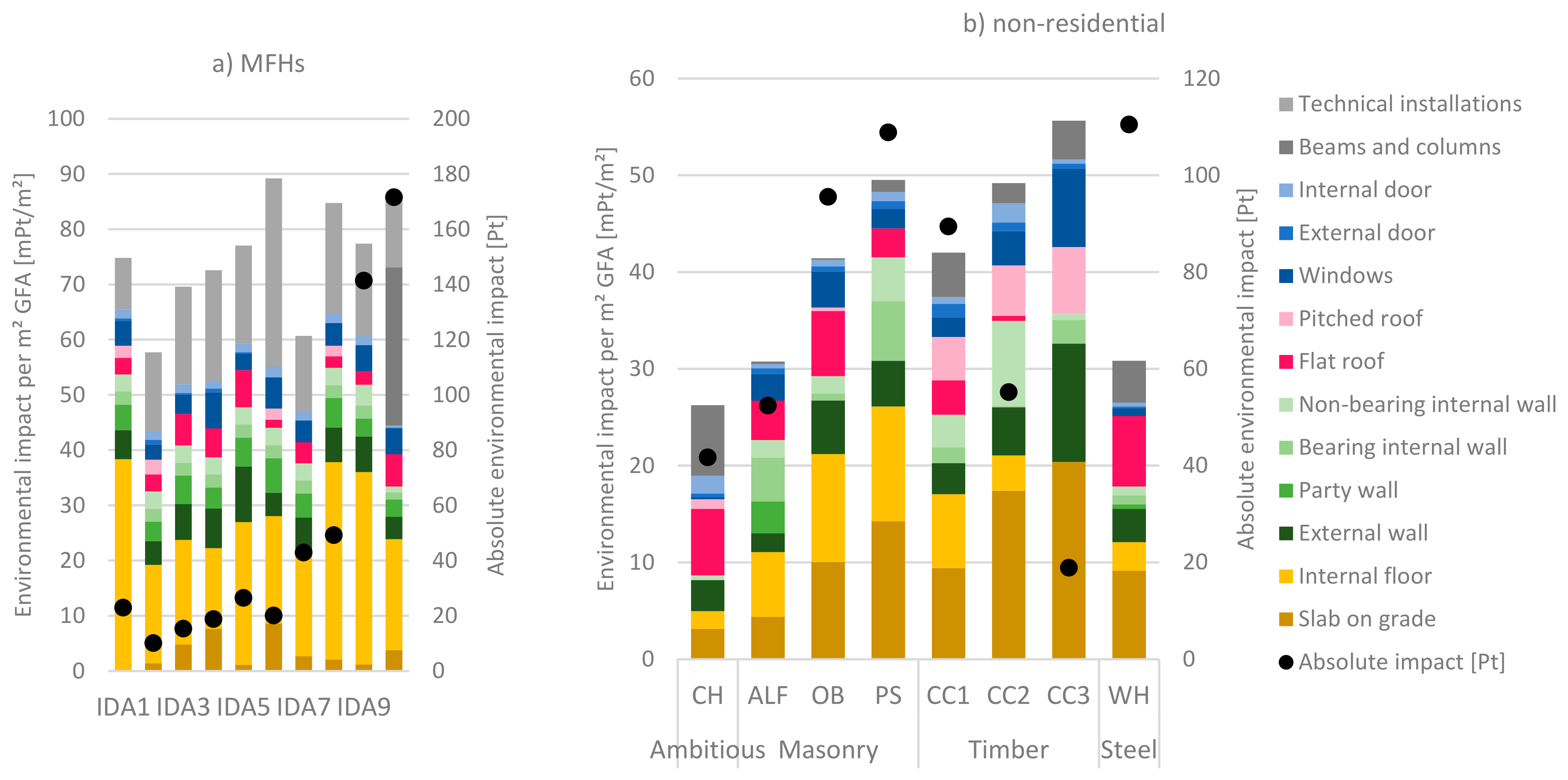
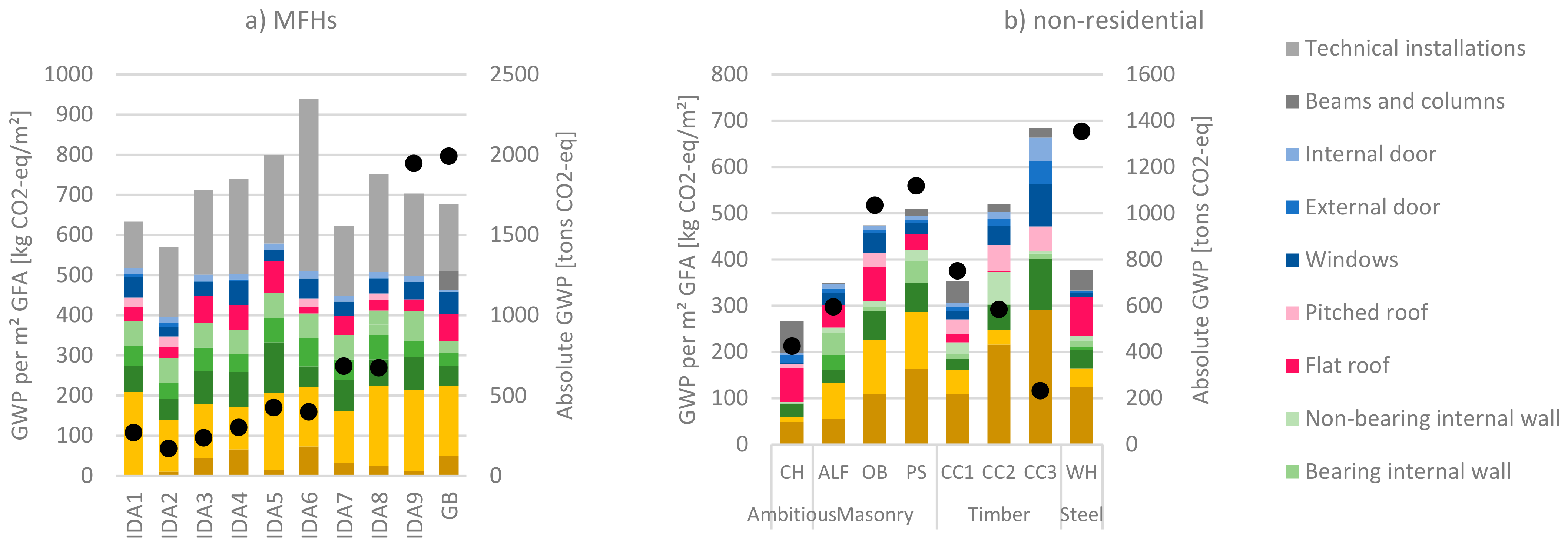
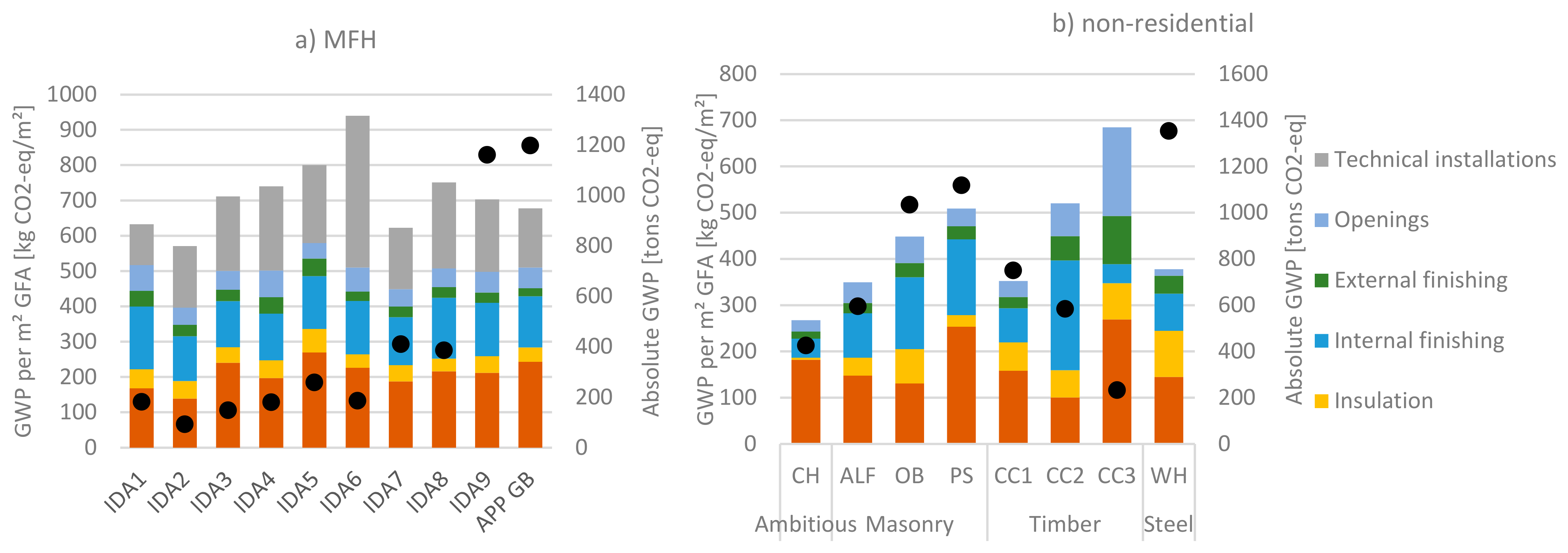
An analogous analysis is conducted for the MFHs and the non-residential cases. Figure 5 and Figure A5 (in Appendix D) identify the building elements with the largest contributions. Due to the limited number of cases and consequently data points, the contribution is represented by disaggregating the embodied impact by building elements and technical installations. In general, MFHs and non-residential buildings are larger than SFHs, which implies a greater quantity of construction materials used. Consequently, these typologies exhibit a higher absolute embodied impact, ranging from 10.1 to 171.5 Pt or 92.4 to 1160.8 tons CO2-eq for MFHs, and from 18.9 to 115.2 Pt or 232.3 to 1353.5 tons CO2-eq for non-residential buildings. The impact also shows a wider spread compared to SFHs. To enable a meaningful comparison across building types and typologies, the results are additionally presented as normalised values per GFA.
Figure 5a further indicates that technical installations and floors contribute substantially to the environmental impact. On average, technical installations account for 17%. For GWP, this share increases to 29%, as technical installations consist largely of metal components, which are associated with a high CO2 intensity. In contrast to SFHs, internal floors instead of the slab on grade represent the largest share within these typologies, with an average contribution of 31%. This can be explained by the geometry of the building combining multiple dwelling units within a single building distributed across several floors. In combination with the heavier structural components required compared to SFHs, this results in an increased overall impact of these buildings. For GWP, the share of internal floors decreases to 23%. However, some MFHs lack a slab on grade, which is attributed to the modelling approach used. Because the basement is not included in the model, the floor located above the basement is not classified as a slab on grade but is instead treated as an internal floor. In addition, for case GB, the element category of beams and columns exceeds the contribution of the internal floors. The beams and columns account for one third of the total embodied impact, which is attributable to the heavy concrete structural elements that generate a substantial environmental burden. Moreover, for the MFH cases, the exterior walls account for an average share of 8% to the environmental impact and 11% to the GWP. The remaining building elements exhibit results similar to those observed for SFHs.
Figure 5b highlights floor structures as the dominant contributors to the embodied impact of the non-residential cases. For timber and steel construction, this is primarily attributable to the slab on grade (12–42%), whereas in masonry both the slab on grade (14–32%) and internal floors (22–27%) constitute major contributors. This underscores the substantial impact associated with concrete floor systems. In addition, ceramic tiles and vinyl finishes further increase the overall impact of floors. The high impact of ceramic tiles is linked to their production process, while vinyl flooring has a relatively short service life of 15 years, resulting in an increased impact due to multiple replacements over the building’s lifespan. Second, the walls contribute substantially, with shares ranging from 17% to 38%. The contributions of external and internal walls show a similar spread (6–22%). Although the impact of an internal wall is typically lower than that of an external wall, the total surface area of internal walls in the buildings is generally larger. Third, windows contribute between 1% and 14%, with this share being strongly dependent on the total window surface area and impact of the window frames. The roofs also exhibit a substantial contribution, ranging from 6% to 26%, due to the presence of concrete slabs or CLT. Moreover, in contrast to the MFHs, the share of the beams and columns remains limited within the total embodied impact.
When comparing the environmental impact and CO2 emissions of the ambitious circular hub (CH) with the other non-residential cases, it becomes evident that the use of smart material strategies, such as reused and bio-based materials, proves beneficial. It is important, however, to select materials with a low embodied impact, as not all circular alternatives, such as bio-based materials, necessarily outperform conventional materials. Both the absolute and the normalized impacts show a reduction relative to the other cases. Only the absolute impact of CC3 is lower, which can be attributed to its small GFA and consequently limited material use. From this, we can conclude that reduced material consumption, thoughtful material selections, and compact building designs all yield clear environmental advantages.
Bill-of-Quantities Categories
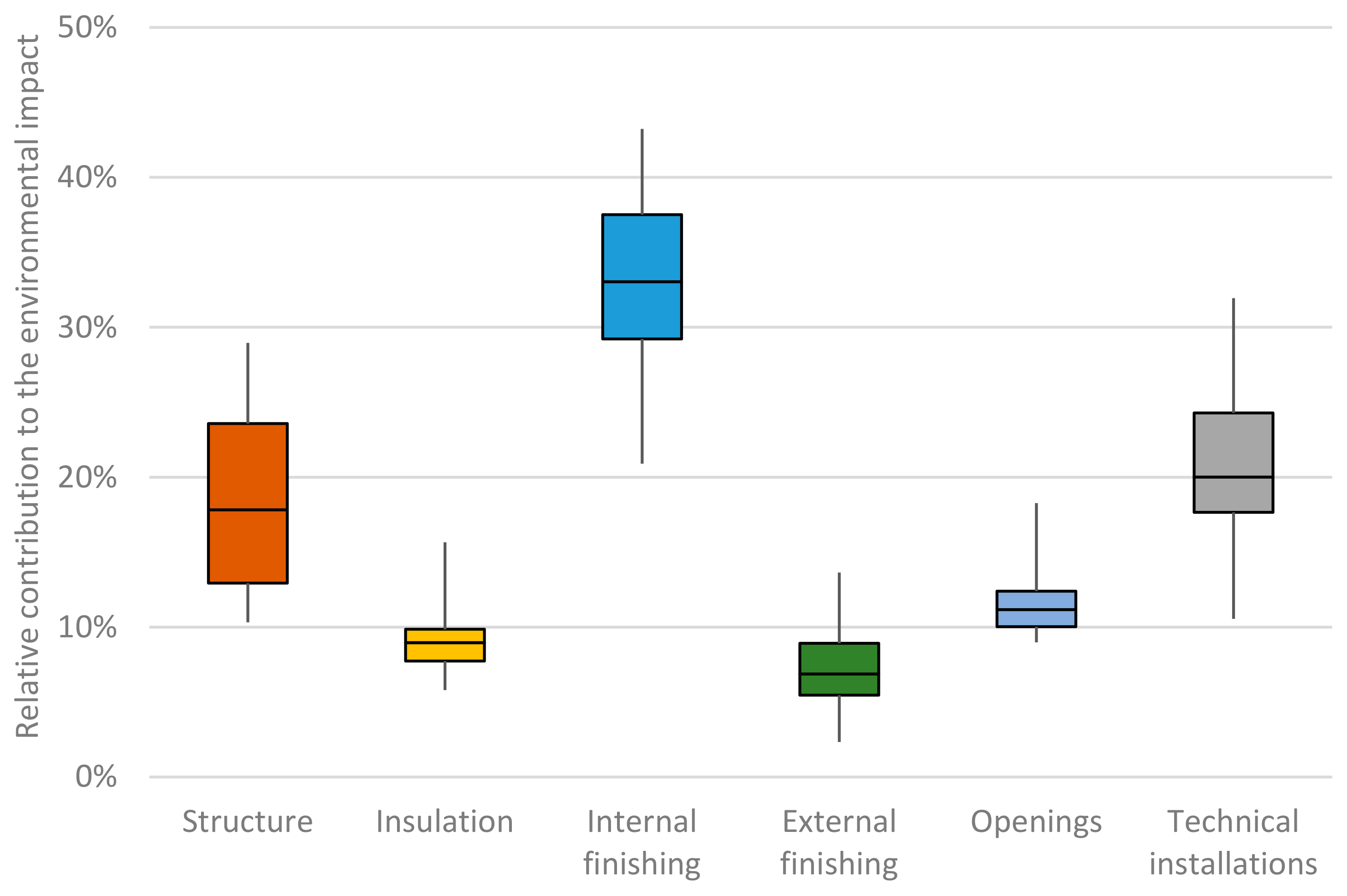
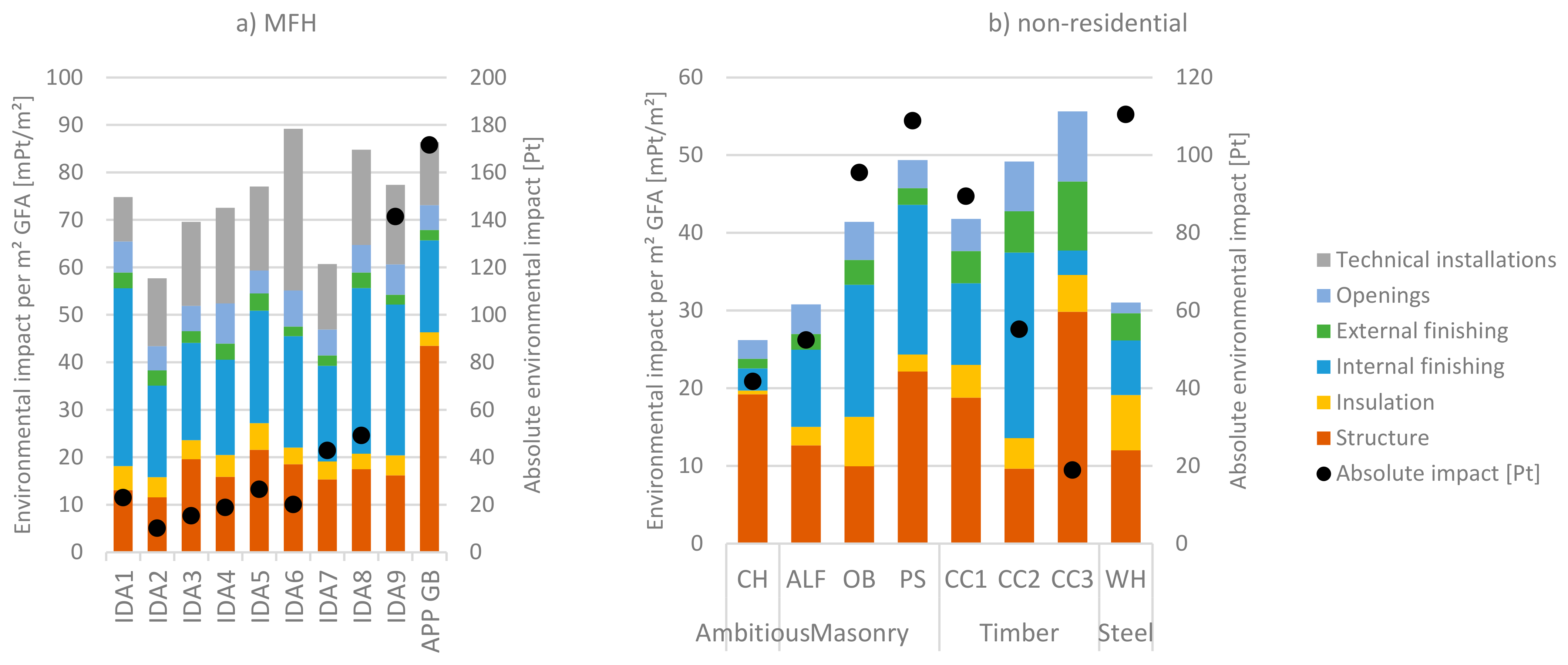
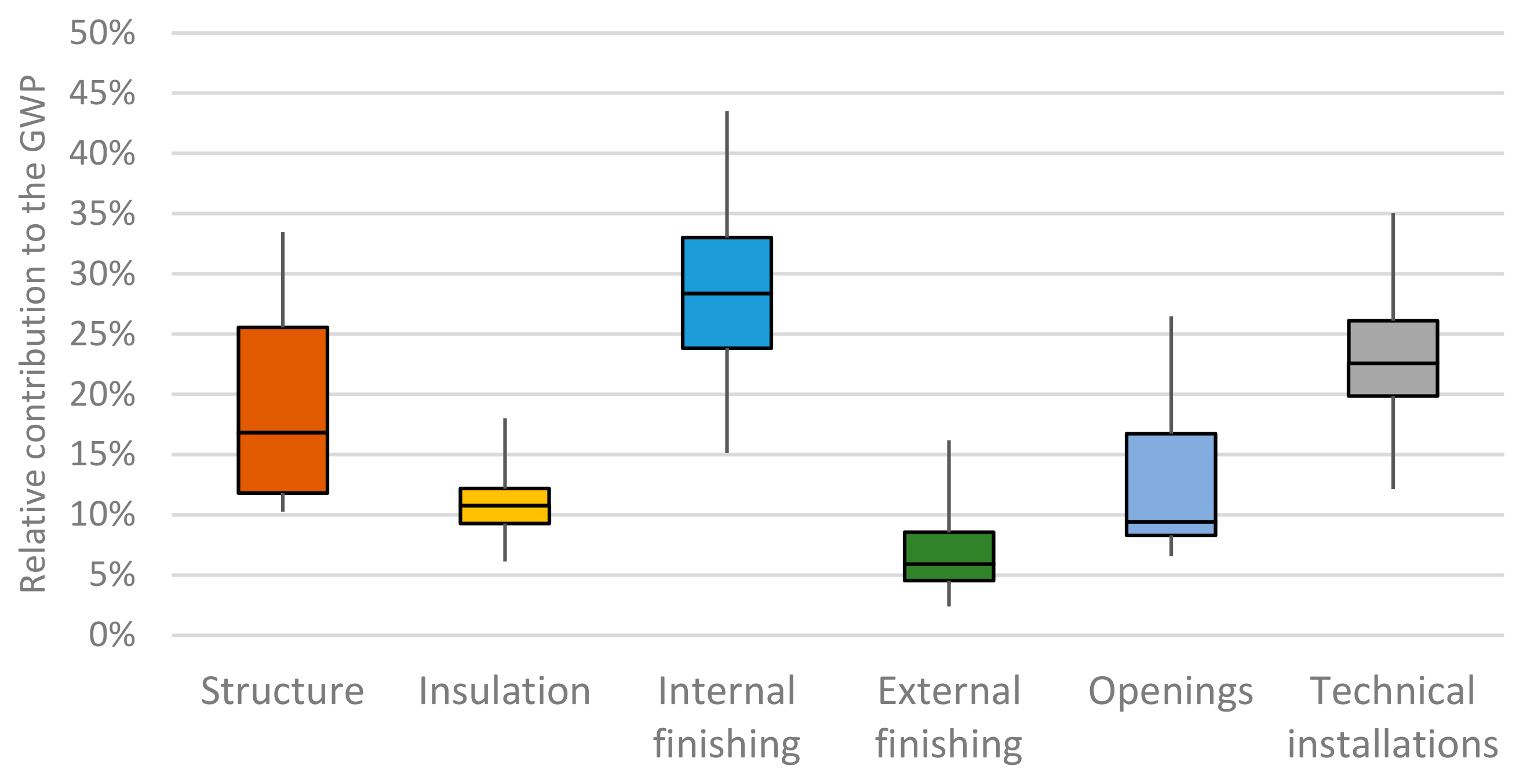
In Figure 6 and Figure 7, the embodied impact is presented; however, in this case the bill-of-quantities categories, such as structure, insulation, interior finishing and exterior finishing, and technical installations are identified as having the largest contributions. This categorisation is introduced in response to the interests of the intended audience, such as contractors. For both the residential and non-residential cases, interior finishes constitute one third of the total embodied impact. As previously noted, this is primarily driven by the floor finishes, although paint layers also contribute substantially. Owing to their short service life of 10 years, five replacements are accounted for over the building’s life cycle. In timber-frame construction, the share of interior finishes increases further due to the additional requirement for battens and panels to support the finishing layers. In exceptional cases, the structure or the technical installations exceed the contribution of interior finishing. When considering CO2 emissions in Figure A6 (in Appendix D), the share of internal finishes decreases. In the MFHs (Figure A7 (in Appendix D)), this is due to the CO2-intensive materials of the structure and the technical installations exceeding the contribution of the interior finishes.
Moreover, in general, the structure and technical installations are substantial contributors. On the one hand, the MFHs display a similar contribution from the structural elements and technical installations. On the other hand, in the non-residential cases, the contribution of the structure exceeds the share of the internal finishes. On average, the contribution accounts for up to half of the embodied impact, as heavy materials with high embodied impacts, such as concrete and CLT, are present in substantial quantities. This share will decrease if technical installations will be added to the analysis of the non-residential cases. In exceptional cases where the structure is left exposed, such as in CC3, this share can increase to as much as 80%.
Finally, the contribution of the remaining three bill-of-quantities categories—openings, insulation, and exterior finishes—is considerably lower. Overall, these categories exhibit similar results (an average of 10%) and ranges. From this analysis, it can be concluded that prioritizing interventions in materials used for the structure, internal finishing, and materials used for technical installations is essential for achieving the most substantial reductions in environmental impact.
Influence of Material Choice
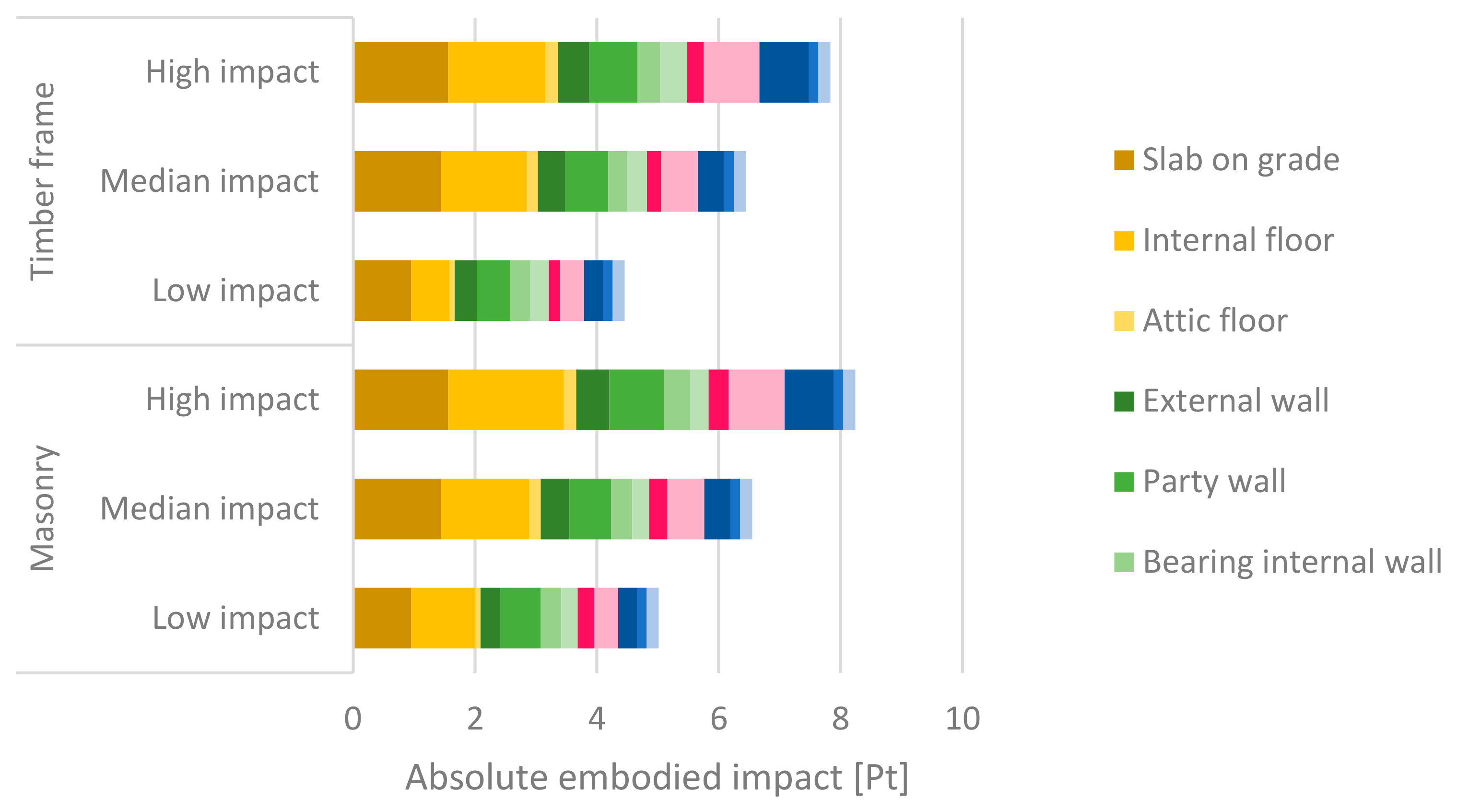
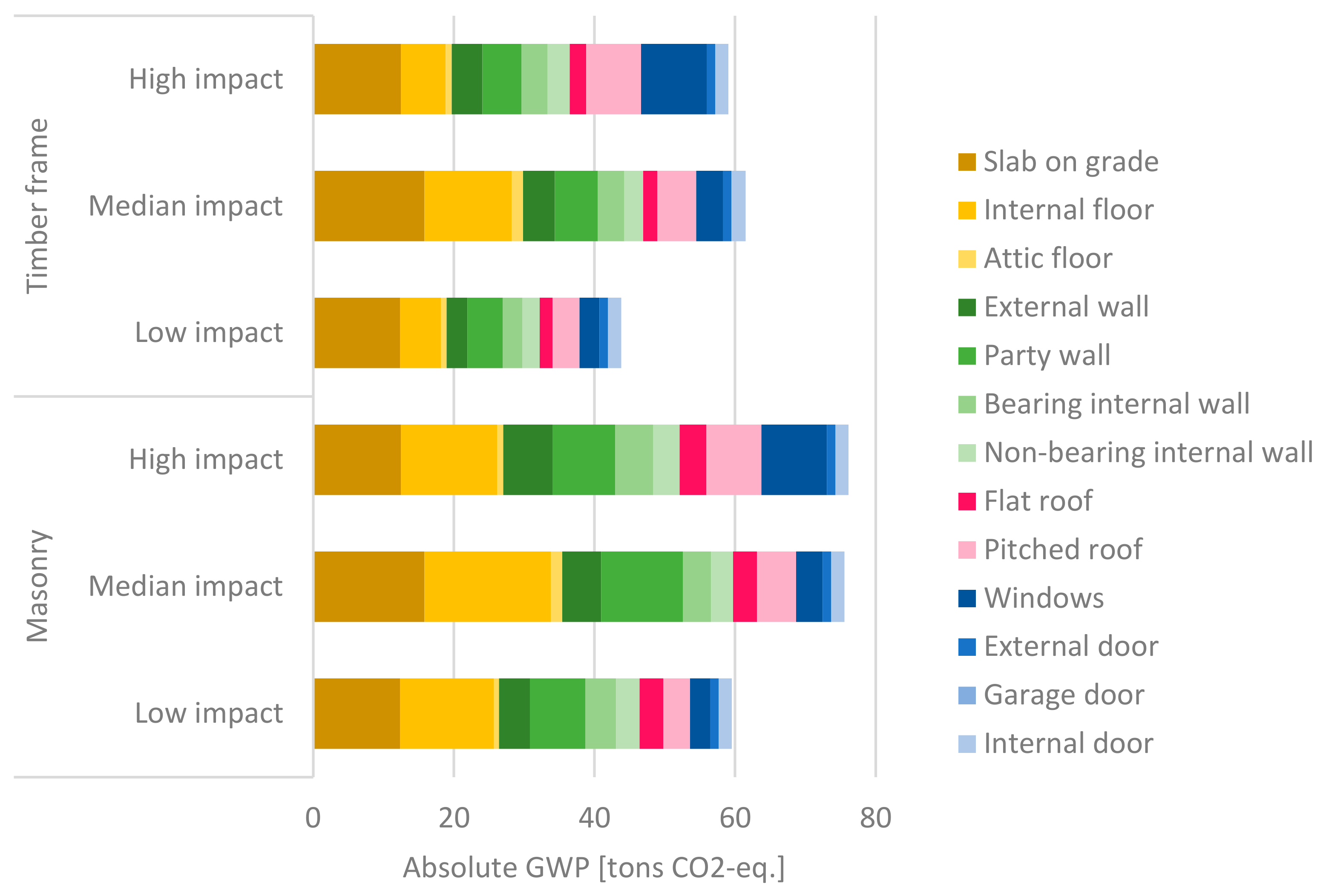
This section examines the embodied impact of a terraced dwelling in relation to variations in construction methods, i.e., masonry or timber-frame construction, and impact scenarios of the materials, i.e., low, median or high-impact scenarios. Figure 8 identifies the influence of the material choices and demonstrates that the difference between masonry construction and timber-frame construction is minor when assessed within the same material scenario. In contrast, comparing different material scenarios within a single construction method reveals substantially larger variations. This indicates that both construction methods can achieve a lower environmental impact, provided that appropriate material choices are made. Consequently, material selection exerts a stronger influence on reducing the environmental impact than the choice between masonry and timber-frame construction.
When considering the GWP, as shown in Figure A8 (in Appendix D), the difference between the construction methods becomes more pronounced, although it remains smaller than the variation observed between impact scenarios. This can be attributed to the lower CO2 emissions associated with wood-based materials compared to mineral-based materials, such as concrete and bricks. In the aggregated environmental score, however, this advantage is offset by the land-use indicator, which is significantly higher for timber-frame construction. Consequently, a comparison of the environmental impact and GWP may lead to different conclusions, particularly in relation to land-use impacts associated with timber. A noteworthy observation concerns the lower GWP of the high-impact scenario compared to the median-impact scenario presented in Figure A8. This can be explained by the fact that the material scenarios were defined on the basis of environmental impacts. A construction assembly with a high environmental impact does not necessarily correspond to an assembly with high carbon emissions.

3.2. Embodied Reduction Potential Through Circular Strategies

3.2.1. Framework for the Stepwise Reduction

The reduction potential of the embodied environmental impact is assessed through a stepwise optimalisation of a reference scenario. This section focuses exclusively on SFHs. Consequently, three dwellings which differ in typology, i.e., detached, semi-detached, and terraced dwelling, are selected. The three dwellings are provided by a flat roof and are classified as the medium-sized dwellings of this paper. In addition, by applying both masonry and timber-frame assemblies to each of the three case studies, a total of six case studies were obtained. The reference scenario (S0—REF) is based on masonry or timber-frame assemblies with commonly used materials with high embodied impacts. Table 9 and Table 10 provide an overview of the reference scenario (S0—REF) and the other reduction scenarios for each construction method. The reduction steps are derived from the preceding analyses, focusing on the elements and bill-of-quantities categories with the largest contributions. These components exhibit the greatest potential for optimisation. Each step modifies the assembly of building elements, which is primarily defined from an environmental perspective.
Each step introduces targeted material substitutions while maintaining the thermal transmittance (U-value) of all building elements. This ensures that the operational impact remains constant and that differences in the embodied impact can be fairly compared.
The previous analyses show that the floor finishes constitute a substantial share of the embodied impact. Consequently, in the first reduction step (S1—FLOOR), only the floor finishes are modified. Ceramic floor tiles on the slab on grade and internal floors are replaced by parquet, while ceramic tiles are retained in wet rooms, such as kitchens and bathrooms. In step 2 (S2—LOW), the structural and insulation materials are additionally substituted with lower-impact alternatives, as these bill-of-quantities categories have the largest contributions to the embodied impact. The low-impact alternatives are derived from the commonly used materials identified in the assemblies described in Section 2.2.1. For masonry, calcium silicate bricks are replaced by hollow concrete blocks, and concrete slabs by hollow concrete slabs. In addition, EPS is selected as the insulation material. In timber-frame construction, SLS is used, and glass wool is replaced by stone wool. Furthermore, in both construction methods, aluminium window frames are substituted with timber frames. In the third reduction step (S3—DRY), the focus addresses the high environmental impact associated with concrete elements. Therefore, the concrete slab of flat roofs and internal floors in masonry is replaced by timber beams. For both construction methods, an analogous modification is applied to the slab on grade: the concrete slab is retained, while the cement screed is substituted with a PP-grid into which recycled cork granulates are incorporated. This is a newly introduced product available on the Belgian construction market [33]. In step four (S4—FINISHES), the focus shifts to the substantial contribution of interior finishes to the embodied impact, referring specifically to interior finishing materials other than floor finishes. Interior finishing layers are omitted where technically and aesthetically feasible. For horizontal building elements, such as flat roofs and internal floors, the structure is therefore left exposed on the underside. In step five (S5—BIO), bio-based solutions are introduced for both the external wall and slab on grade. The external wall is redesigned as a timber-frame assembly insulated with wood wool and finished with timber cladding attached on a wood-fibre board. For the slab on grade, the concrete slab is replaced by seashells, which also provide an insulating function. An Elka Strong Board (ESB) is installed above this layer to allow for the integration of the PP-grid. ESB is selected because this panel material exhibits properties comparable to OSB, while achieving a lower environmental score, thereby contributing to improved sustainability performance. In the final step (S6—REUSE), reused materials with potential in current construction practice are incorporated [34]. These include reclaimed ceramic tiles, ceramic façade bricks, parquet flooring, and timber cladding. The assemblies described in steps 3, 4, 5 and 6 were validated through consultations with contractors as part of the research project [35], ensuring their technical feasibility and alignment with sustainability-oriented construction practices.

3.2.2. Results of the Stepwise Reduction

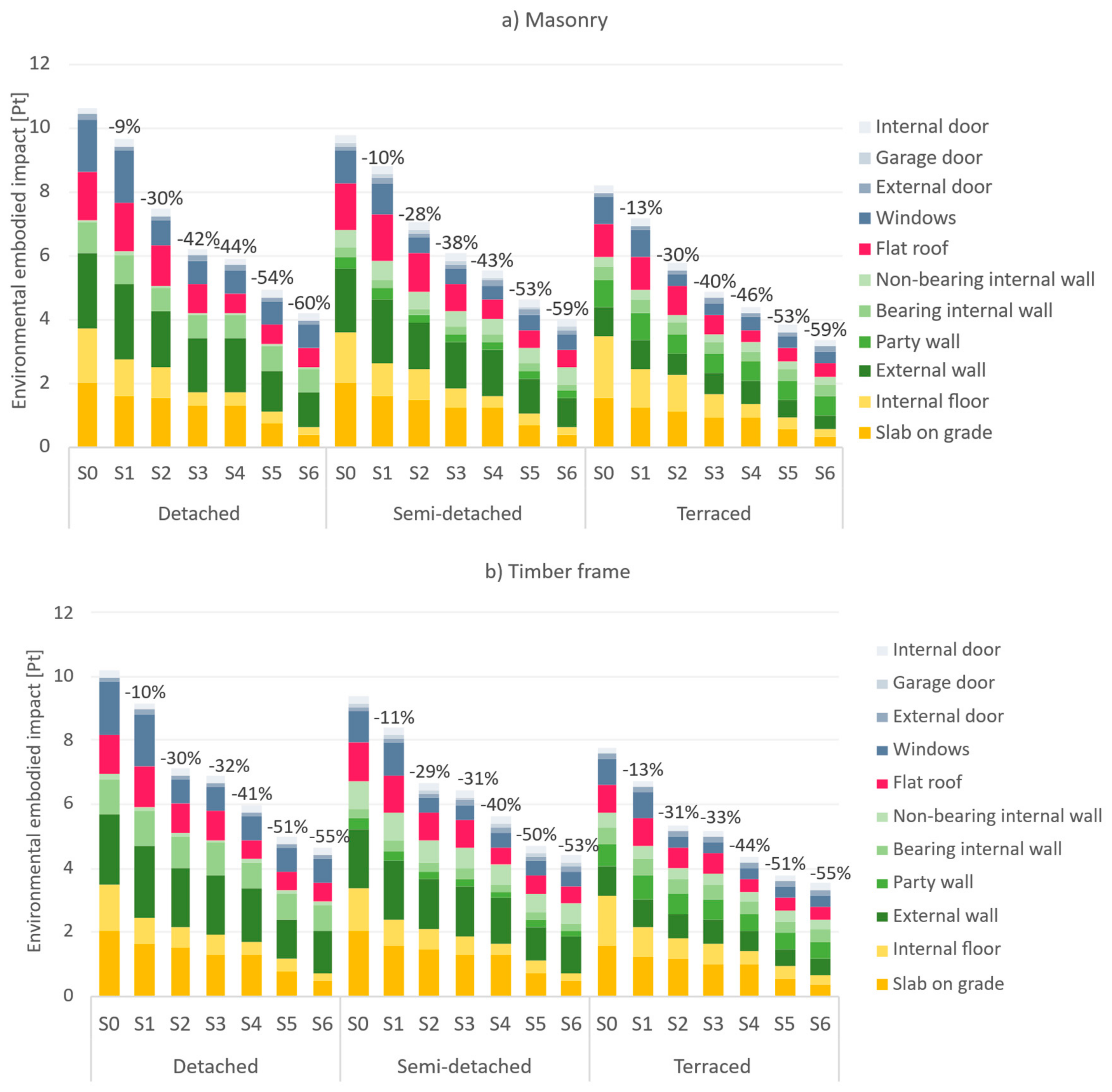
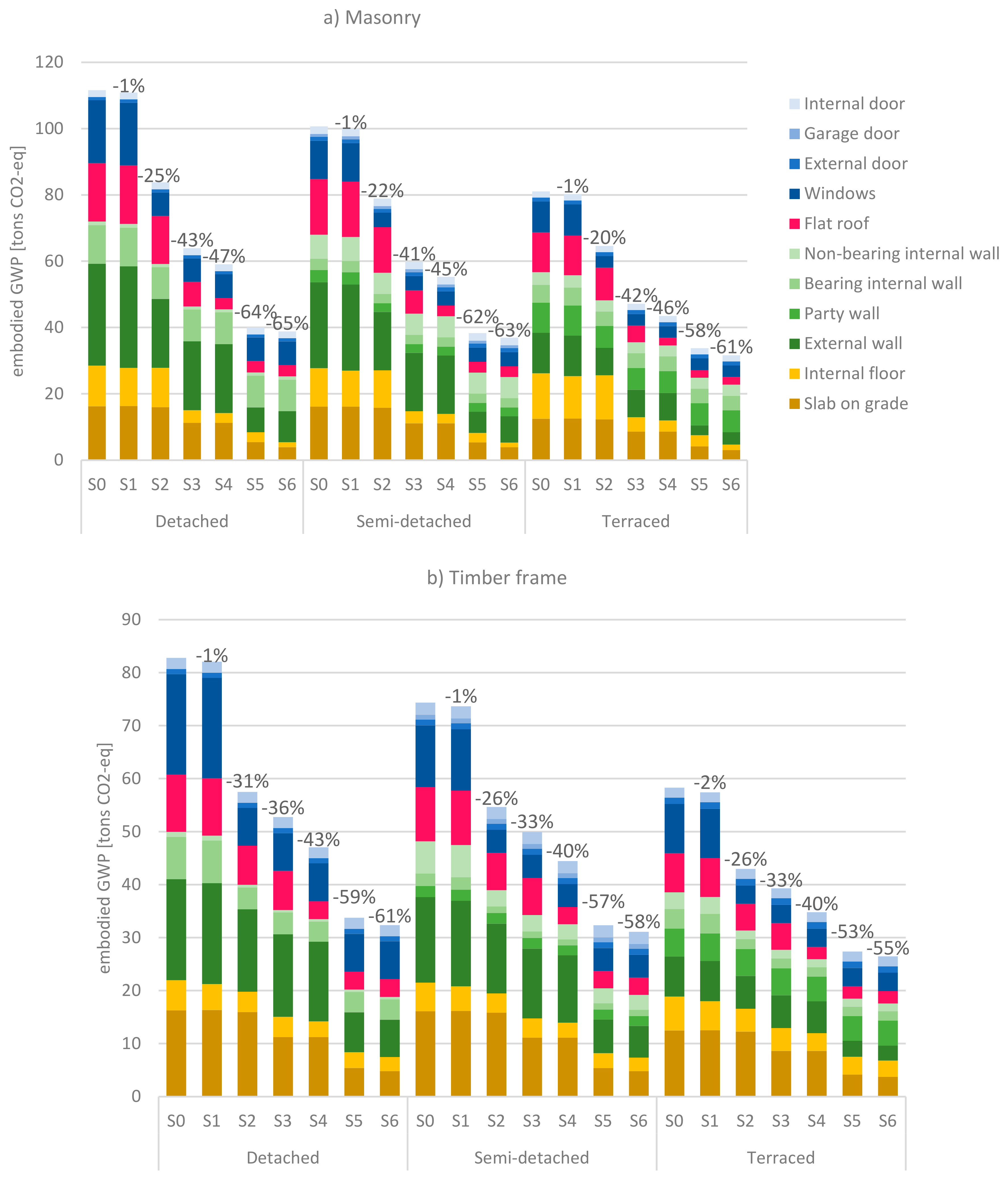
Figure 9 and Figure A9 (in Appendix D) present the percentage of the environmental gains per optimization step relative to the reference scenario. The magnitude of the gains is comparable across the different typologies. However, substantial discrepancies emerge when comparing the results for the environmental impact and GWP. To avoid burden shifting, the primary focus is placed on reducing the environmental impact. Consequently, this may result in smaller reduction percentages for GWP.
The transition to parquet flooring (S1—FLOOR) yields a maximum reduction potential of 13% in the environmental impact, whereas its effect on CO2 emissions is negligible. The varnish layer, which requires renewal every five years, contributes substantially to CO2 emissions. Consequently, the impact of the varnish largely offsets the benefits associated with the wooden parquet itself. Subsequently, step 2 (S2—LOW) results in an impact reduction of up to 30% for masonry and 31% for timber-frame construction. For GWP, the reduction potential reaches a maximum of 25% and 31%, respectively. The external walls and windows account for the largest share of these gains. In the following step (S3—DRY), the reduction potential is greater for masonry than timber-frame construction, amounting to a maximum of 42% and 33%. Similarly, for GWP, this step yields reductions of 43% and 36%. This is attributed to the replacements of concrete slabs with wooden beams and the cement screed with the PP-grid system, which is characterized by both a low environmental and emission impact. As a result, the reductions are primarily observed in flat roofs and internal floors. The subsequent step (S4—FINISHES) also affects flat roofs and internal floors, as the interior finishing layers are removed from the assembly. This leads to a maximum reduction of 46% for masonry and 44% for timber-frame construction, which is consistent with the corresponding GWP results.
When bio-based and reused materials are introduced, the reduction potential exceeds 50%. By adapting the slab on grade and external walls to a bio-based assembly (S5—BIO), a reduction of 54% for masonry and 51% for timber-frame construction are achieved. For GWP, the reduction potential is even higher, 64% and 59%, respectively. Moreover, flat roofs can be adapted to a bio-based assembly. Within Belgian building practices, such a roof assembly typically comprises a bituminous waterproofing membrane, stone wool insulation, a vapor barrier, SLS beams filled with cellulose fibres, and an interior finishing layer. Nevertheless, the environmental impact assessment at the element level indicates that this configuration does not yield a reduction compared to step 4 (S4—FINISHES), in which the structure remains exposed, and the insulation is positioned above them. This finding illustrates that the adoption of bio-based materials does not automatically guarantee a lower environmental impact. Therefore, a critical and well-informed selection of materials remains imperative.
In the final step (S6—REUSE), the gains are greater for masonry. This is due to the lower impact of reclaimed ceramic tiles compared to reclaimed parquet flooring. The same pattern is observed for reclaimed façade bricks and reclaimed wooden cladding. This is attributable to the shorter life span of wooden materials and consequently their higher replacement frequency. Only for GWP does reclaimed-wood cladding outperform reclaimed bricks. Ultimately, this results in a 60% reduction in environmental impacts for masonry and 55% for timber-frame construction, while the corresponding reductions for GWP amounts to 65% and 61%.

3.3. Benchmarks for Total Carbon Emissions

In this section, the total (embodied + operational) emissions are evaluated against established European benchmark values, comprising frameworks developed in France, Finland, and Denmark [14], alongside total reference values applicable to residential buildings in Belgium [16]. The analysis focuses exclusively on the total benchmark values, as these are already embedded within the regulatory framework of the respective countries. Belgium is included as an additional reference point, reflecting the study’s emphasis on contemporary Belgian construction practices.
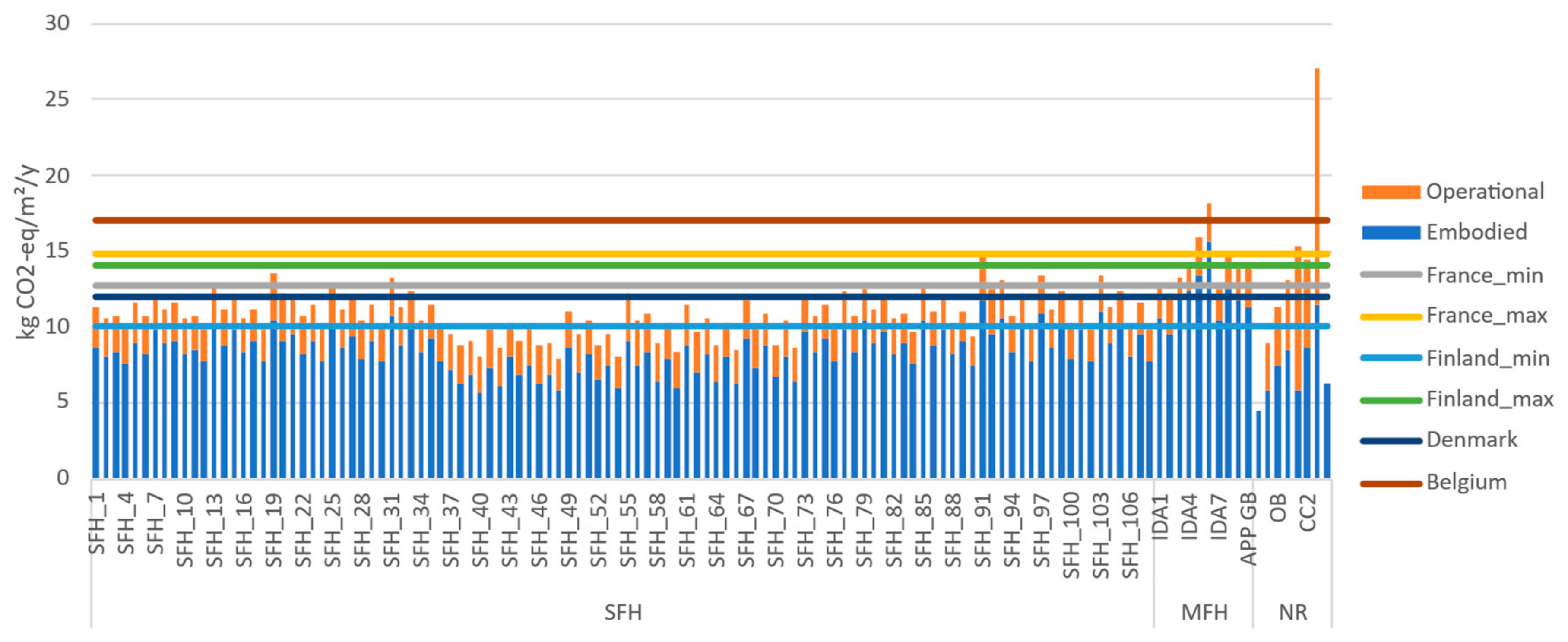
Figure 10 presents a comparison of the total emissions of the cases with the existing benchmark and limit values. In the residential cases, the embodied emissions comprise the material impacts associated with the building elements as well as the technical systems. In the non-residential cases, only the material contributions of the building elements are considered.
The Belgian reference value is derived from the combined embodied and operational impact of residential buildings [16]. When comparing the case study results, it becomes clear that the emissions of both the residential and non-residential cases fall below this benchmark value of 17 kg CO2-eq/m2/year. Only the two cases exceed this threshold, namely AP_IDA6 (MFH) and CC3 (NR). For AP_IDA6, the higher impact can be attributed to the limited gross floor area in combination with the large number of internal floors, which substantially increases the embodied impact (see Section Building Elements and Technical Installations). In case of CC3, the elevated impact is primarily due to the relatively small gross floor area over which the emissions are distributed. The Danish benchmark value, 12 kg CO2-eq/m2/year, applies to both residential and non-residential buildings [14]. The results indicate that 71% of the cases comply with this threshold. This proportion increases when compared with other benchmark values. Relative to the minimum (12.8 CO2-eq/m2/year [14]) and maximum French benchmark values (14.8 CO2-eq/m2/year [14]), 87% and 97% of the cases, respectively, meet the corresponding requirements. Furthermore, relative to the maximum Finnish benchmark value (14 CO2-eq/m2/year [14]), 94% of the cases comply with this threshold. The minimum Finnish benchmark value (10 CO2-eq/m2/year [14]), however, represents the most stringent requirement. When compared with this Finnish value, only 27% of the cases meet the criterion. These compliant cases are primarily single-family dwellings that employ construction assemblies with low embodied emissions.
This section demonstrates that the case studies perform comparatively well against the European benchmark values. The findings further underscore the critical role of material choice, as the use of materials with low embodied emissions allows for compliance with even the most stringent benchmark requirements.

4. Discussion

If building actors aim to reduce the environmental impact of their building projects, an understanding of where the greatest environmental impact occurs and how the associated impacts can be mitigated is necessary. Therefore, this study relies on a relatively limited number of cases. In particular, the SFHs exhibit only limited variation in design parameters, such as the geometry and layouts. However, its strength lies in the fact that these cases are based on real projects. For multi-family and non-residential buildings, the analysis also draws on real building projects and their actual building assemblies.
A limitation regarding the technical installations in residential buildings is that identical systems are assumed for every dwelling. As a result, the analysis does not capture how the embodied impact may vary between different technical installations. In addition, technical installations in non-residential buildings are excluded from this study due to a lack of available data, which may lead to an underestimation of the building’s total embodied impact. Furthermore, the operational energy use of residential buildings is calculated using the equivalent heating degree days method, whereas for non-residential buildings, it is determined through a more detailed calculation procedure. Consequently, the results for residential and non-residential buildings cannot be compared on a one-to-one basis.
In Belgium, regulatory requirements focus exclusively on limiting operational energy use. As a consequence, the proportion of embodied environmental impacts appears to be relatively high in the overall results. Comparing the results with the findings of Röck et al. [6] and Mirabelle et al. [7], the outcomes align with those reported for low-energy buildings. In addition, comparable results are found in the literature regarding the contribution of building elements and embodied impacts of technical installations [9,10,11,12,13]. Similar to the findings of Zimmermann et al. [13], the building elements exhibit a substantial spread in the distribution of their contribution. In line with a study by Andersen et al. [12], envelope elements emerge as the most dominant building elements in the embodied impact. Furthermore, floors provide the largest share of the total embodied contribution, with a magnitude comparable to the 20% reported by Le Den et al. [9]. Moreover, technical installations show a contribution similar to the results in studies by Sobota et al. [10] and Röck et al. [11].
The optimalisation scenarios are based on a specific set of choices, although alternative options would also have been possible. The selected scenarios focus on the materials used in the building envelope. Insulation levels and the selection of technical installations were not included in the scope of this research, even though they could likewise have been considered. Moreover, this study is deliberately decoupled from material cost considerations, even though cost remains a highly influential factor in contemporary construction practices. Future research would benefit from integrating cost assessments with the environmental performance of building materials. Such an approach would enable a systemic trade-off between cost and LCA outcomes, thereby providing a stronger basis for motivating specific material choices. In addition, this study highlights the potential benefits of bio-based materials. However, as demonstrated in some studies [22,23], such benefits are not inherent to all bio-based construction assemblies. In this analysis, only bio-based solutions for the slab on grade and the exterior wall are considered, as these configurations demonstrably reduce the environmental impact. The analysis also includes a bio-based assembly for flat roofs. However, this alternative does not demonstrate a lower environmental impact than a conventional configuration in which the structure remains exposed. This underscores the need for a carefully considered and context-specific implementation of bio-based materials.
Furthermore, a comparison between the total emissions of the case studies and the European benchmark values provides a generally favourable representation of current Belgian construction practices. However, this interpretation must be approached with caution, as the simplified calculation method for operational emissions in the residential cases and the exclusion of the embodied emissions of technical installations in non-residential cases may lead to an underestimation of the total impacts. Consequently, this could result in lower compliance with the European benchmarks. In addition, benchmark values are also highly sensitive to the assumption made within an LCA, such as the included life-cycle stages. Given that this study does not address these aspects in detail, further research is necessary.
The findings of this study carry several important policy implications for the development of future embodied carbon regulations. The analysis demonstrates that material choice exerts a greater influence on the environmental impact than the selected construction method. This indicates that policy frameworks should prioritize material-specific requirements. Furthermore, the identification of dominant contributors at both building element and bill-of-quantities levels suggests that regulatory efforts would benefit from targeting these impact hotspots. In addition, the stepwise evaluation of reduction strategies at the building level highlights the necessity of integrating iterative, LCA assessments into regulatory procedures to ensure that proposed design changes translate into meaningful reductions. Finally, by comparing the modelled cases with existing benchmark values, the study provides empirical evidence to calibrate realistic carbon thresholds for both residential and non-residential buildings.

5. Conclusions

For architects and contractors, it is essential to gain insights into the principal contributors to overall environmental impacts. Based on real buildings in Flanders, this study aims to provide insights that are specifically grounded in the Flemish context. In SFHs, 62% of the total environmental impact is due to embodied impacts. In MFHs, this share increases to 66%, whereas in non-residential buildings, it decreases to 47%. The study shows that material selection exerts a substantial influence on the magnitude of embodied impacts. Both masonry and timber-frame construction, the two most commonly applied construction methods in Flanders, can achieve comparatively low-impact building assemblies. Therefore, the choice of materials is more critical than the choice of construction method.
The principal contributors to buildings’ embodied environmental impacts are technical installations and floors. In SFHs and low-rise buildings, the slab on grade accounts for a substantial share of the embodied impact. In contrast, in MFHs and mid-rise buildings, internal floors become the dominant contributor. The considerable contribution of floors is primarily driven by the high impacts associated with both floor finishes and structural components. Other envelope elements, such as external walls and roofs, also show significant contributions in both residential and non-residential buildings. By contrast, the impact of interior elements remains relatively limited. Similar to floors, the embodied impact of the other elements, envelope and interior elements, is largely determined by interior finishes and structural materials. The remaining bill-of-quantities categories—insulation, exterior finishes, and openings—show comparable contributions and remain relatively limited in comparison to the structure and interior finishes.
The building elements and bill-of-quantities categories with the highest contributions therefore represent the components with the greatest potential for reducing a building’s embodied impact. In SFHs, replacing the floor finish with a low-impact alternative results in a reduction potential of 13%. When this intervention is complemented by changes in structure and insulation materials, the reduction potential increases to 35%. The introduction of dry construction systems for both the structure and interior finishes further raises this potential to 42%. In addition to adapting interior finishes, ceiling finishes can be omitted, leaving the structural beams exposed. This strategy increases the achievable reduction potential to 46%. Finally, the application of bio-based and reclaimed materials leads to a total reduction potential of 60%. The effectiveness of bio-based and reclaimed materials is also evident in the circular hub case, a non-residential building, which demonstrates a substantially lower environmental impact compared to the other case studies.

Author Contributions

Conceptualisation, M.H. and M.S.; methodology, M.H. and Y.D.; software, M.H.; validation, M.H., M.S. and Y.D.; formal analysis, M.H.; investigation, M.H.; resources, M.H.; data curation, M.H.; Writing—original draft preparation, M.H.; writing—review and editing, Y.D. and M.S.; visualisation; M.H.; supervision, M.S.; project administration, M.S.; funding acquisition, M.S. All authors have read and agreed to the published version of the manuscript.

Funding

This research was funded by Flanders Innovation & Entrepreneurship (VLAIO), HCB.2023.0467.

Institutional Review Board Statement

Not applicable.

Informed Consent Statement

Not applicable.

Data Availability Statement

All data supporting the results reported can be requested through the email address of the first author.

Acknowledgments

This study is part of the ongoing research project “COOCK+ MI2B—Milieu-Impact als Motor voor duurzame Innovatie bij Bouwbedrijven”. We show our gratitude to the Flemish companies and contractors who collaborate in collecting case studies.

Conflicts of Interest

The authors declare no conflict of interest.

Abbreviations

The following abbreviations are used in this manuscript:
LCALife-cycle assessment
GWPGlobal warming potential
PEFProduct environmental footprint
EHDDsEquivalent heating degree days
EPBEnergy performance of buildings
EPBDEnergy performance of building directives
SFHSingle-family house
MFHMulti-family house
PURPolyurethane
PSPolystyrene
XPSExtruded polystyrene
PVCPolyvinyl chloride
MDFMedium-density fibre board
CLTCross-laminated timber
DHWDomestic hot water
PPPolypropylene
ESBElka strong board
OSBOriented strand board

Appendix A. Building Assemblies of Building Elements per Material Scenario for SFHs

Table A1. Overview of assemblies per building component and material scenario for masonry construction.
LowMediumHigh
External wall
- Paint, 0.1 mm
- Gypsum plaster, 12 mm
- Hollow concrete blocks, 140 mm
- Cement mortar, 140 mm
- EPS, 200 mm
- External plaster, 7 mm
- Paint, 0.1 mm
- Gypsum plaster, 12 mm
- Hollow ceramic bricks, 140 mm
- Cement mortar, 140 mm
- Stone wool, 220 mm
- Plaster, 7 mm
- Stone strips, 20 mm
- Cement mortar, 20 mm
- Paint, 0.1 mm
- Gypsum plaster, 12 mm
- Calcium silicate bricks, 150 mm
- Cement mortar, 150 mm
- PUR, 120 mm
- Moderately ventilated cavity, 30 mm
- Ceramic façade brick, 90 mm
- Cement mortar, 90 mm
Party wall
- Paint, 0.1 mm
- Gypsum plaster, 12 mm
- Hollow concrete blocks, 140 mm
- Cement mortar, 140 mm
- Stone wool, 40 mm
- Gypsum plaster, 12 mm
- Paint, 0.1 mm
- Paint, 0.1 mm
- Gypsum plaster, 12 mm
- Hollow ceramic bricks, 140 mm
- Cement mortar, 140 mm
- Stone wool, 30 mm
- Hollow ceramic bricks, 140 mm
- Cement mortar, 140 mm
- Gypsum plaster, 12 mm
- Paint, 0.1 mm
- Paint, 0.1 mm
- Gypsum plaster, 12 mm
- Calcium silicate bricks, 150 mm
- Cement mortar, 150 mm
- Glass wool, 40 mm
- Calcium silicate bricks, 150 mm
- Cement mortar, 150 mm
- Gypsum plaster, 12 mm
- Paint, 0.1 mm
Bearing internal wall
- Paint, 0.1 mm
- Gypsum plaster, 12 mm
- Hollow concrete blocks, 140 mm
- Cement mortar, 140 mm
- Gypsum plaster, 12 mm
- Paint, 0.1 mm
- Paint, 0.1 mm
- Gypsum plaster, 12 mm
- Hollow ceramic bricks, 140 mm
- Cement mortar, 140 mm
- Gypsum plaster, 12 mm
- Paint, 0.1 mm
- Paint, 0.1 mm
- Gypsum plaster, 12 mm
- Calcium silicate bricks, 150 mm
- Cement mortar, 150 mm
- Gypsum plaster, 12 mm
- Paint, 0.1 mm
Non-bearing internal wall
- Paint, 0.1 mm
- Gypsum plaster, 12 mm
- Hollow concrete blocks, 90 mm
- Cement mortar, 90 mm
- Gypsum plaster, 12 mm
- Paint, 0.1 mm
- Paint, 0.1 mm
- Gypsum plaster, 12 mm
- Hollow ceramic bricks, 90 mm
- Cement mortar, 90 mm
- Gypsum plaster, 12 mm
- Paint, 0.1 mm
- Paint, 0.1 mm
- Gypsum plaster, 12 mm
- Calcium silicate bricks, 90 mm
- Cement mortar, 90 mm
- Gypsum plaster, 12 mm
- Paint, 0.1 mm
Flat roof
- Bitumen roofing, 9 mm
- EPS, 180 mm
- Vapour barrier
- Cement screed, 50 mm
- Concrete topping, 30 mm
- Hollow concrete slab, 120 mm
- Gypsum plaster, 12 mm
- Paint, 0.1 mm
- EPDM, 6 mm
- PUR, 120 mm
- Vapour barrier
- Cement screed, 50 mm
- Concrete topping, 100 mm
- Wide concrete slab, 50 mm
- Gypsum plaster, 12 mm
- Paint, 0.1 mm
- EPDM, 6 mm
- Stone wool, 210 mm
- Vapour barrier
- Cement screed, 50 mm
- Concrete slab, 150 mm
- Gypsum plaster, 12 mm
- Paint, 0.1 mm
Pitched roof
- Concrete roof tile, 12 mm
- Battens, 32 mm
- Counter battens, 20 mm
- Roofing membrane
- SLS beams, 220 mm
- Stone wool, 220 mm
- PE foil
- Battens, 22 mm
- Gypsum board, 12.5 mm
- Paint, 0.1 mm
- Ceramic roof tile, 15 mm
- Battens, 32 mm
- Counter battens, 20 mm
- Fibre board, 22 mm
- FJI beams, 200 mm
- Stone wool, 200 mm
- PE foil
- Battens, 22 mm
- Gypsum board, 12.5 mm
- Paint, 0.1 mm
- Fibre cement roof tiles, 4 mm
- Battens, 32 mm
- Counter battens, 20 mm
- Fibre board, 22 mm
- LVL beams, 200 mm
- Glass wool, 200 mm
- Battens, 22 mm
- Gypsum board, 12.5 mm
- Paint, 0.1 mm
Slab on grade
- Parquet, 23 mm
- Cement screed with EPS granulates, 50 mm
- PE foil
- EPS, 150 mm
- Cement screed, 40 mm
- Concrete slab, 150 mm
- PE foil
- Compacted sand, 140 mm
- Laminate, 13 mm
- Cement screed with EPS granulates, 50 mm
- PE foil
- PUR, 100 mm
- Concrete slab, 150 mm
- PE foil
- Compacted sand, 140 mm
- Ceramic tiles, 13 mm
- Cement screed, 50 mm
- PE foil
- Stone wool, 160 mm
- Cement screed, 40 mm
- Concrete slab, 150 mm
- PE foil
- Compacted sand, 140 mm
Internal floor
- Parquet, 23 mm
- Cement screed, 50 mm
- Concrete topping, 30 mm
- Hollow concrete slab, 120 mm
- Gypsum plaster, 12 mm
- Paint, 0.1 mm
- Vinyl, 3 mm
- Cement screed, 50 mm
- Concrete topping, 100 mm
- Wide concrete slab, 50 mm
- Gypsum plaster, 12 mm
- Paint, 0.1 mm
- Ceramic tiles, 13 mm
- Cement screed, 50 mm
- Concrete slab, 150 mm
- Gypsum plaster, 12 mm
- Paint, 0.1 mm
Attic floor
- Parquet, 23 mm
- Particle board, 18 mm
- SLS beams, 220 mm
- Gypsum board, 12.5 mm
- Paint, 0.1 mm
- Laminate, 13 mm
- OSB, 18 mm
- FJI beams, 220 mm
- Particle board, 18 mm
- Paint, 0.1
- Ceramic tiles, 13 mm
- Multiplex, 18 mm
- LVL beams, 220 mm
- Gypsum board, 12.5 mm
- Paint, 0.1
Table A2. Overview of assemblies per building component and material scenario for timber-frame construction.
LowMediumHigh
External wall
- Paint, 0.1 mm
- Gypsum board, 12.5 mm
- PE foil
- Particle board, 18 mm
- SLS beams, 220 mm
- Stone wool, 220 mm
- Fibre board, 22 mm
- Battens, 38 mm
- Wooden cladding, 20 mm
- Paint, 0.1 mm
- Gypsum board, 12.5 mm
- OSB, 18 mm
- FJI beams, 200 mm
- Glass wool, 200 mm
- Fibre board, 22 mm
- Moderately ventilated cavity, 30 mm
- Ceramic façade brick, 90 mm
- Cement mortar, 90 mm
- Paint, 0.1 mm
- Gypsum board, 12.5 mm
- Multiplex, 18 mm
- LVL beams, 200 mm
- Glass wool, 200 mm
- Fibre board, 22 mm
- Battens, 38 mm
- Fibre cement board, 8 mm
Party wall
- Paint, 0.1 mm
- Gypsum board, 12.5 mm
- PE foil
- Particle board, 18 mm
- SLS beams, 90 mm
- Stone wool, 90 mm
- Non-ventilated cavity, 30 mm
- SLS beams, 90 mm
- Stone wool, 90 mm
- Particle board, 18 mm
- PE foil
- Gypsum board, 12.5 mm
- Paint, 0.1 mm
- Paint, 0.1 mm
- Gypsum board, 12.5 mm
- OSB, 18 mm
- FJI beams, 200 mm
- Stone wool, 200 mm
- Non-ventilated cavity, 30 mm
- FJI beams, 200 mm
- Stone wool, 200 mm
- OSB, 18 mm
- Gypsum board, 12.5 mm
- Paint, 0.1 mm
- Paint, 0.1 mm
- Gypsum board, 12.5 mm
- Multiplex, 18 mm
- LVL beams, 90 mm
- Glass wool, 90 mm
- Non-ventilated cavity, 30 mm
- LVL beams, 90 mm
- Glass wool, 90 mm
- Multiplex, 18 mm
- Gypsum board, 12.5 mm
- Paint, 0.1 mm
Bearing internal wall
- Paint, 0.1 mm
- Gypsum board, 12.5 mm
- Particle board, 18 mm
- SLS beams, 120 mm
- Particle board, 18 mm
- Gypsum board, 12.5 mm
- Paint, 0.1 mm
- Paint, 0.1 mm
- Gypsum board, 12.5 mm
- OSB, 18 mm
- FJI beams, 200 mm
- Stone wool, 200 mm
- OSB, 18 mm
- Gypsum board, 12.5 mm
- Paint, 0.1 mm
- Paint, 0.1 mm
- Gypsum board, 12.5 mm
- Multiplex, 18 mm
- LVL beams, 120 mm
- Glass wool, 120 mm
- Multiplex, 18 mm
- Gypsum board, 12.5 mm
- Paint, 0.1 mm
Non-bearing internal wall
- Paint, 0.1 mm
- Gypsum board, 12.5 mm
- Particle board, 18 mm
- SLS beams, 90 mm
- Particle board, 18 mm
- Gypsum board, 12.5 mm
- Paint, 0.1 mm
- Paint, 0.1 mm
- Gypsum board, 12.5 mm
- Particle board, 18 mm
- SLS beams, 90 mm
- Glass wool, 90 mm
- Particle board, 18 mm
- Gypsum board, 12.5 mm
- Paint, 0.1 mm
- Paint, 0.1 mm
- Gypsum board, 12.5 mm
- Multiplex, 18 mm
- LVL beams, 90 mm
- Glass wool, 90 mm
- Multiplex, 18 mm
- Gypsum board, 12.5 mm
- Paint, 0.1 mm
Flat roof
- Bitumen roofing, 9 mm
- EPS, 170 mm
- Vapour barrier
- Particle board, 18 mm
- SLS beams, 220 mm
- Battens, 22 mm
- Gypsum board, 12.5 mm
- Paint, 0.1 mm
- EPDM, 6 mm
- PUR, 110 mm
- Vapour barrier
- OSB, 18 mm
- FJI beams, 220 mm
- Battens, 22 mm
- Gypsum board, 12.5 mm
- Paint, 0.1 mm
- EPDM, 6 mm
- Stone wool, 200 mm
- Vapour barrier
- Multiplex, 18 mm
- LVL beams, 220 mm
- Battens, 22 mm
- Gypsum board, 12.5 mm
- Paint, 0.1 mm
Pitched roof
- Concrete roof tile, 12 mm
- Battens, 32 mm
- Counter battens, 20 mm
- Roofing membrane
- SLS beams, 220 mm
- Stone wool, 220 mm
- PE foil
- Battens, 22 mm
- Gypsum board, 12.5 mm
- Paint, 0.1 mm
- Ceramic roof tile, 15 mm
- Battens, 32 mm
- Counter battens, 20 mm
- Fibre board, 22 mm
- FJI beams, 200 mm
- Stone wool, 200 mm
- PE foil
- Battens, 22 mm
- Gypsum board, 12.5 mm
- Paint, 0.1 mm
- Fibre cement roof tiles, 4 mm
- Battens, 32 mm
- Counter battens, 20 mm
- Fibre board, 22 mm
- LVL beams, 200 mm
- Glass wool, 200 mm
- Battens, 22 mm
- Gypsum board, 12.5 mm
- Paint, 0.1 mm
Slab on grade
- Parquet, 23 mm
- Cement screed with EPS granulates, 50 mm
- PE foil
- EPS, 150 mm
- Cement screed, 40 mm
- Concrete slab, 150 mm
- PE foil
- Compacted sand, 140 mm
- Laminate, 13 mm
- Cement screed with EPS granulates, 50 mm
- PE foil
- PUR, 100 mm
- Concrete slab, 150 mm
- PE foil
- Compacted sand, 140 mm
- Ceramic tiles, 13 mm
- Cement screed, 50 mm
- PE foil
- Stone wool, 160 mm
- Cement screed, 40 mm
- Concrete slab, 150 mm
- PE foil
- Compacted sand, 140 mm
Internal floor
- Parquet, 23 mm
- Particle board, 18 mm
- SLS beams, 220 mm
- Gypsum board, 12.5 mm
- Paint, 0.1 mm
- Laminate, 13 mm
- OSB, 18 mm
- FJI beams, 220 mm
- Particle board, 18 mm
- Paint, 0.1
- Ceramic tiles, 13 mm
- Multiplex, 18 mm
- LVL beams, 220 mm
- Gypsum board, 12.5 mm
- Paint, 0.1
Attic floor
- Parquet, 23 mm
- Particle board, 18 mm
- SLS beams, 220 mm
- Gypsum board, 12.5 mm
- Paint, 0.1 mm
- Laminate, 13 mm
- OSB, 18 mm
- FJI beams, 220 mm
- Particle board, 18 mm
- Paint, 0.1
- Ceramic tiles, 13 mm
- Multiplex, 18 mm
- LVL beams, 220 mm
- Gypsum board, 12.5 mm
- Paint, 0.1

Appendix B. Building Assemblies of Building Elements for MFHs

Table A3. Overview of assemblies per building component for AP_IDA1, AP_IDA2, and AP_IDA3.
AP_IDA1AP_IDA2AP_IDA3
External wall 1
- Paint, 0.1 mm
- Gypsum plaster, 10 mm
- Hollow ceramic bricks, 140 mm
- Cement mortar, 140 mm
- PUR, 120 mm
- Moderately ventilated cavity, 20 mm
- Ceramic façade bricks, 90 mm
- Cement mortar, 90 mm
- Paint, 0.1 mm
- Gypsum plaster, 10 mm
- Hollow ceramic bricks, 140 mm
- Cement mortar, 140 mm
- EPS, 40 mm
- EPS, 40 mm
- EPS, 100 mm
- External plaster, 7 mm
- Hollow concrete blocks, 190 mm
- Cement mortar, 190 mm
- Bitumen, 2 mm
- Cavity membrane
- Proofing sheet PP
External wall 2
//- Paint, 0.1 mm
- Gypsum plaster, 10 mm
- Hollow ceramic bricks, 140 mm
- Cement mortar, 140 mm
- PUR, 120 mm
- Moderately ventilated cavity, 20 mm
- Ceramic façade bricks, 90 mm
- Cement mortar, 90 mm
External wall 3
//- Paint, 0.1 mm
- Gypsum plaster, 10 mm
- Hollow ceramic bricks, 140 mm
- Cement mortar, 140 mm
- PUR, 120 mm
- Battens, 2 × 32 mm
- Fibre cement tiles, 4 mm
Party wall
- Paint, 0.1 mm
- Gypsum plaster, 10 mm
- Hollow ceramic bricks, 140 mm
- Cement mortar, 140 mm
- Glass wool, 40 or 50 mm
- Hollow ceramic bricks, 140 mm
- Cement mortar, 140 mm
- Gypsum plaster, 10 mm
- Paint, 0.1 mm
- Paint, 0.1 mm
- Gypsum plaster, 10 mm
- Hollow ceramic bricks, 140 mm
- Cement mortar, 140 mm
- Glass wool, 50 mm
- Hollow ceramic bricks, 140 mm
- Cement mortar, 140 mm
- Gypsum plaster, 10 mm
- Paint, 0.1 mm
- Paint, 0.1 mm
- Gypsum plaster, 10 mm
- Hollow ceramic bricks, 140 mm
- Cement mortar, 140 mm
- Glass wool, 20 mm
- Hollow ceramic bricks, 140 mm
- Cement mortar, 140 mm
- Gypsum plaster, 10 mm
- Paint, 0.1 mm
Bearing internal wall 1
- Paint, 0.1 mm
- Gypsum plaster, 10 mm
- Hollow ceramic bricks, 140 mm
- Cement mortar, 140 mm
- Gypsum plaster, 10 mm
- Paint, 0.1 mm
- Paint, 0.1 mm
- Gypsum plaster, 10 mm
- Hollow ceramic bricks, 140 mm
- Cement mortar, 140 mm
- Gypsum plaster, 10 mm
- Paint, 0.1 mm
- Paint, 0.1 mm
- Gypsum plaster, 10 mm
- Hollow ceramic bricks, 140 mm
- Cement mortar, 140 mm
- Gypsum plaster, 10 mm
- Paint, 0.1 mm
Bearing internal wall 2
/- Paint, 0.1 mm
- Gypsum plaster, 10 mm
- Hollow ceramic bricks, 140 mm
- Cement mortar, 140 mm
- PUR, 100 mm
- Ceramic brick, 90 mm
- Cement mortar, 90 mm
/
Non-bearing internal wall
- Paint, 0.1 mm
- Gypsum plaster, 10 mm
- Hollow ceramic bricks, 90 mm
- Cement mortar, 90 mm
- Gypsum plaster, 10 mm
- Paint, 0.1 mm
- Paint, 0.1 mm
- Gypsum plaster, 10 mm
- Hollow ceramic bricks, 90 mm
- Cement mortar, 90 mm
- Gypsum plaster, 10 mm
- Paint, 0.1 mm
- Paint, 0.1 mm
- Gypsum plaster, 10 mm
- Hollow ceramic bricks, 90 mm
- Cement mortar, 90 mm
- Gypsum plaster, 10 mm
- Paint, 0.1 mm
Flat roof 1
- Bitumen roofing, 7 mm
- PUR, 80 mm
- PUR, 80 mm
- Vapour barrier
- Cement screed, 60 mm
- Concrete topping, 50 mm
- Hollow concrete slab, 120 mm
- Gypsum plaster, 10 mm
- Paint, 0.1 mm
- Bitumen roofing, 7 mm
- PUR, 100 mm
- Vapour barrier
- OSB, 18 mm
- Softwood, 50 mm
- SLS beams, 180 mm
- Battens, 22 mm
- Paint, 0.1 mm
- Concrete tiles, 60 mm
- Tile carriers, 50 mm
- Bitumen roofing, 7 mm
- PUR, 120 mm
- Vapour barrier, 3 mm
- Cement screed, 50 mm
- Concrete slab, 160 mm
- Gypsum plaster, 10 mm
- Paint, 0.1 mm
Flat roof 2
//- Bitumen roofing, 7 mm
- PUR, 120 mm
- Vapour barrier, 3 mm
- Cement screed, 50 mm
- Concrete slab, 160 mm
- Gypsum plaster, 10 mm
- Paint, 0.1 mm
Pitched roof
- Ceramic roof tiles, 38 mm
- Battens, 27 mm
- Counter battens, 20 mm
- Fibre cement board, 3 mm
- SLS beams, 180 mm
- Glass wool, 180 mm
- PE foil
- Battens, 47 mm
- Gypsum board, 12.5 mm
- Paint, 0.1 mm
- Fibre cement tiles, 4 mm
- Battens, 27 mm
- Counter battens, 20 mm
- Wood fibre board, 22 mm
- SLS beams, 180 mm
- Glass wool, 180 mm
- PE foil
- Battens, 22 mm
- Gypsum board, 12.5 mm
- Paint, 0.1 mm
/
Slab on grade 1—remark: floor located above the basement is not classified as a slab on grade
/- Ceramic tiles, 10 mm
- Cement screed, 70 mm
- PUR, 140 mm
- PE foil
- Concrete slab, 150 mm
- Compacted sand, 140 mm
- Concrete slab, 150 mm
- Compacted sand, 140 mm
Slab on grade 2—remark: floor located above the basement is not classified as a slab on grade
//- Ceramic tiles, 10 mm
- Cement screed, 70 mm
- PUR, 80 mm
- PE foil
- Concrete slab, 150 mm
- Compacted sand, 140 mm
Internal floor 1
- Natural stone tiles, 20 mm
- Cement screed, 70 or 100 mm
- PUR, 80 mm
- PE foil
- Concrete topping, 40 or 60 mm
- Hollow concrete slab, 120 mm
- Gypsum plaster, 10 mm
- Paint, 0.1 mm
- Ceramic tiles, 10 mm
- Cement screed, 70 mm
- Concrete slab, 150 mm
- Gypsum plaster, 12 mm
- Paint, 0.1 mm
- Ceramic tiles, 10 mm
- Cement screed, 60 mm
- PUR, 50 mm
- PE foil
- Concrete slab, 160 mm
- Gypsum plaster, 10 mm
- Paint, 0.1 mm
Internal floor 2
- Natural stone tiles, 20 mm
- Cement screed, 70 mm
- Concrete topping, 40 mm
- Hollow concrete slab, 120 mm
- Gypsum plaster, 10 mm
- Paint, 0.1 mm
- Ceramic tiles, 10 mm
- Cement screed, 70 mm
- PE foil
- PUR, 140 mm
- PE foil
- Concrete slab, 150 mm
- Ceramic tiles, 10 mm
- Cement screed, 60 mm
- Concrete slab, 160 mm
- Gypsum plaster, 10 mm
- Paint, 0.1 mm
Internal floor 3
- Natural stone tiles, 20 mm
- Cement screed, 70 or 100 mm
- PE foil
- PUR, 100 or 120 mm
- PE foil
- Concrete topping, 60 mm
- Hollow concrete slab, 120 mm
- Ceramic tiles, 10 mm
- Cement screed, 70 mm
- PE foil
- PUR, 140 mm
- PE foil
- EPS, 100 mm
- EPS, 40 mm
- EPS, 40 mm
- Mineral plaster, 7 mm
- Ceramic tiles, 10 mm
- Cement screed, 50 mm
- PE foil
- PUR, 80 mm
- PE foil
- Concrete topping, 40 mm
- Hollow concrete slab, 120 mm
Internal floor 4
/- Ceramic tiles, 10 mm
- Concrete slab, 200 mm
- EPS, 100 mm
- EPS, 40 mm
- EPS, 40 mm
- Mineral plaster, 7 mm
/
Table A4. Overview of assemblies per building component for AP_IDA4, AP_IDA5, and AP_IDA6.
AP_IDA4AP_IDA5AP_IDA6
External wall 1
- Paint, 0.1 mm
- Gypsum plaster, 15 mm
- Poured concrete, 140 mm
- Battens, 40 mm
- Glass wool, 40 mm
- Fibre cement board, 8 mm
- Hollow concrete blocks, 190 mm
- Cement mortar, 190 mm
- Bitumen, 2 mm
- Cavity membrane
- Proofing sheet PP
- Paint, 0.1 mm
- Gypsum plaster, 10 mm
- Insulated ceramic bricks, 140 mm
- Cement mortar, 140 mm
- Battens, 90 mm
- Stone wool, 90 mm
- Battens, 90 mm
- Stone wool, 90 mm
External wall 2
- Paint, 0.1 mm
- Gypsum plaster, 15 mm
- Poured concrete, 140 mm
- PUR, 70 mm
- PE foil
- Battens, 40 or 60 mm
- Fibre cement board, 8 mm
- Paint, 0.1 mm
- Gypsum plaster, 10 mm
- Steel profiles, 32 mm
- PUR, 60 mm
- PUR, 40 cm
- PE foil
- Aluminium profiles, 40 mm
- Aluminium sheet, 1.8 mm
- Paint, 0.1 mm
- Gypsum plaster, 10 mm
- Insulated ceramic bricks, 140 mm
- Cement mortar, 140 mm
- PUR, 100 mm
External wall 3
- Paint, 0.1 mm
- Gypsum plaster, 10 mm
- Hollow ceramic bricks, 140 mm
- Cement mortar, 140 mm
- PUR, 120 mm
- Moderately ventilated cavity, 20 mm
- Ceramic façade bricks, 100 mm
- Cement mortar, 100 mm
- Paint, 0.1 mm
- Gypsum plaster, 10 mm
- Insulated ceramic bricks, 140 mm
- Cement mortar, 140 mm
- EPS, 130 mm
- External plaster, 7 mm
- Paint, 0.1 mm
- Gypsum plaster, 10 mm
- Insulated ceramic bricks, 140 mm
- Cement mortar, 140 mm
- Stone wool, 90 mm
- Stone wool, 60 mm
- Moderately ventilated cavity, 20 mm
- Ceramic façade bricks, 100 mm
- Cement mortar, 100 mm
External wall 4
/- Paint, 0.1 mm
- Gypsum plaster, 10 mm
- Insulated ceramic bricks, 140 mm
- Cement mortar, 140 mm
- PUR, 100 mm
- Moderately ventilated cavity, 20 mm
- Ceramic façade brick, 90 mm
- Cement mortar, 90 mm
- Paint, 0.1 mm
- Gypsum board, 12.5 mm
- Battens, 22 mm
- PE foil
- SLS beams, 220 mm
- Glass wool, 220 mm
- Wood fibre board, 22 mm
- Battens, 20 mm
- Battens, 26 mm
- Ceramic tiles, 38 mm
External wall 5
//- PUR, 100 mm
Party wall 1
- Paint, 0.1 mm
- Gypsum plaster, 15 mm
- Hollow ceramic bricks, 140 mm
- Cement mortar, 140 mm
- Glass wool, 40 mm
- Hollow ceramic bricks, 140 mm
- Cement mortar, 140 mm
- Gypsum plaster, 15 mm
- Paint, 0.1 mm
- Paint, 0.1 mm
- Gypsum plaster, 10 mm
- Insulated ceramic bricks, 140 mm
- Cement mortar, 140 mm
- Glass wool, 70 mm
- Insulated ceramic bricks, 140 mm
- Cement mortar, 140 mm
- Gypsum plaster, 10 mm
- Paint, 0.1 mm
- Paint, 0.1 mm
- Gypsum plaster, 10 mm
- Insulated ceramic bricks, 140 mm
- Cement mortar, 140 mm
- Glass wool, 20 mm
- Not ventilated cavity, 20 mm
- Insulated ceramic bricks, 140 mm
- Cement mortar, 140 mm
- Gypsum plaster, 10 mm
- Paint, 0.1 mm
Party wall 2
/- Paint, 0.1 mm
- Gypsum plaster, 10 mm
- Hollow ceramic bricks, 100 mm
- Cement mortar, 100 mm
- Hollow ceramic bricks, 100 mm
- Cement mortar, 100 mm
- Glass wool, 20 mm
- Hollow ceramic bricks, 140 mm
- Cement mortar, 140 mm
- Gypsum plaster, 10 mm
- Paint, 0.1 mm
- Paint, 0.1 mm
- Gypsum plaster, 10 mm
- Insulated ceramic bricks, 140 mm
- Cement mortar, 140 mm
- Glass wool, 20 mm
- Insulated ceramic bricks, 140 mm
- Cement mortar, 140 mm
- Gypsum plaster, 10 mm
- Paint, 0.1 mm
Bearing internal wall 1
- Paint, 0.1 mm
- Gypsum plaster, 10 mm
- Hollow ceramic bricks, 140 mm
- Cement mortar, 140 mm
- Gypsum plaster, 10 mm
- Paint, 0.1 mm
- Paint, 0.1 mm
- Gypsum plaster, 10 mm
- Insulated ceramic bricks, 140 mm
- Cement mortar, 140 mm
- Stone wool, 60 mm
- Gypsum board, 15 mm
- Paint, 0.1 mm
- Paint, 0.1 mm
- Gypsum plaster, 10 mm
- Hollow ceramic bricks, 140 mm
- Cement mortar, 140 mm
- Gypsum plaster, 10 mm
- Paint, 0.1 mm
Bearing internal wall 2
- Paint, 0.1 mm
- Gypsum plasterboard, 12.5 mm
- PUR, 120 mm
- Poured concrete, 150 mm
- Paint, 0.1 mm
- Gypsum plaster, 10 mm
- Hollow ceramic bricks, 140 mm
- Cement mortar, 140 mm
- Gypsum plaster, 10 mm
- Paint, 0.1 mm
/
Non-bearing internal wall
- Paint, 0.1 mm
- Gypsum plaster, 10 mm
- Hollow ceramic bricks, 90 mm
- Cement mortar, 90 mm
- Gypsum plaster, 10 mm
- Paint, 0.1 mm
- Paint, 0.1 mm
- Gypsum plaster, 10 mm
- Hollow ceramic bricks, 90 mm
- Cement mortar, 90 mm
- Gypsum plaster, 10 mm
- Paint, 0.1 mm
- Paint, 0.1 mm
- Gypsum plaster, 10 mm
- Hollow ceramic bricks, 90 mm
- Cement mortar, 90 mm
- Gypsum plaster, 10 mm
- Paint, 0.1 mm
Flat roof 1
- Fibre cement board, 8 mm
- Battens, 40 mm
- PUR, 40 mm
- Concrete slab, 140 mm
- Gypsum plaster, 15 mm
- Paint, 0.1 mm
- Bitumen roofing, 7 mm
- PUR, 120 mm
- Vapour barrier
- Concrete slab, 150 mm
- Gypsum plaster, 10 mm
- Paint, 0.1 mm
- PUR, 100 mm
Flat roof 2
- Fibre cement board, 8 mm
- Battens, 60 mm
- PE foil
- PUR, 70 mm
- Concrete slab, 140 mm
- Gypsum plaster, 15 mm
- Paint, 0.1 mm
/- Fibre cement board, 8 mm
- PUR, 100
- Vapour barrier
- Cement screed, 20 mm
- Concrete slab, 180 mm
- Gypsum plaster, 10 mm
- Paint, 0.1 mm
Flat roof 3
- Bitumen roofing, 7 mm
- PUR, 120 or 140 mm
- Vapour barrier
- Cement screed, 80 mm
- Concrete slab, 200 mm
- Gypsum plaster, 10 mm
- Paint, 0.1 mm
//
Flat roof 4
- Concrete terrace tiles, 60 mm
- Tile carrier, 50 mm
- Bitumen roofing, 7 mm
- PUR, 140 mm
- Vapour barrier
- Cement screed, 80 mm
- Concrete slab, 200 mm
- Gypsum plaster, 10 mm
- Paint, 0.1 mm
//
Pitched roof
//- Ceramic roof tiles, 38 mm
- Battens, 26 mm
- Counter battens, 20 mm
- Wood fibre board, 22 mm
- SLS beams, 220 mm
- Glass wool, 220 mm
- Vapour barrier
- Battens, 22 mm
- Gypsum board, 12.5 mm
- Paint, 0.1 mm
Slab on grade 1— remark: floor located above the basement is not classified as a slab on grade
- Ceramic tiles, 10 mm
- Cement screed, 90 mm
- PUR, 100 mm
- PE foil
- Concrete slab, 300 mm
- Compacted sand, 140 mm
- Concrete slab, 150 mm
- Compacted sand, 140 mm
- Ceramic tiles, 10 mm
- Cement screed, 60 mm
- PUR, 100 mm
- Vapour barrier
- Concrete slab, 300 mm
- Compacted sand, 140
Internal floor 1
- Ceramic tiles, 10 mm
- Cement screed, 80 mm
- PUR, 40 mm
- PE foil
- Concrete slab, 200 mm
- Gypsum plaster, 15 mm
- Paint, 0.1 mm
- Ceramic tiles, 10 mm
- Cement screed, 60 mm
- PE foam, 6 mm
- EPS, 80 or 100 mm
- PE foil
- Concrete slab, 150 mm
- Gypsum plaster, 10 mm
- Paint, 0.1 mm
- Ceramic tiles, 10 mm
- Cement screed, 60 mm
- Cement screed with EPS granulates, 50 mm
- Concrete slab, 180 mm
- Gypsum plaster, 10 mm
- Paint, 0.1 mm
Internal floor 2
- Ceramic tiles, 10 mm
- Cement screed, 80 mm
- Concrete slab, 200 mm
- Gypsum plaster, 15 mm
- Paint, 0.1 mm
- Ceramic tiles, 10 mm
- Cement screed, 60 mm
- Concrete slab, 150 mm
- Gypsum plaster, 10 mm
- Paint, 0.1 mm
- Ceramic tiles, 10 mm
- Cement screed, 60 mm
- PUR, 50 mm
- PE foil
- Concrete slab, 180 mm
- Gypsum plaster, 10 mm
- Paint, 0.1 mm
Internal floor 3
- Ceramic tiles, 10 mm
- Cement screed, 80 mm
- PUR, 40 mm
- PE foil
- Concrete slab, 140 mm
- Battens, 40 mm
- PUR, 40 mm
- Fibre cement board, 8 mm
- Ceramic tiles, 10 mm
- Cement screed, 60 mm
- PE foam, 6 mm
- EPS, 100 mm
- PE foil
- Concrete slab, 150 mm
- PUR, 120 mm
- OSB, 18 mm
- Ceramic tiles, 10 mm
- Cement screed, 60 mm
- Concrete slab, 180 mm
- Gypsum plaster, 10 mm
- Paint, 0.1 mm
Internal floor 4
- Ceramic tiles, 10 mm
- Cement screed, 80 mm
- PUR, 40 mm
- PE foil
- Concrete slab, 140 mm
- PUR, 70 mm
- Battens, 36 mm
- Fibre cement board, 8 mm
- Ceramic tiles, 10 mm
- Cement screed, 50 mm
- PE foil
- PUR, 60 mm
- PE foil
- Concrete slab, 150 mm
- PUR, 100 mm
Table A5. Overview of assemblies per building component for AP_IDA7, AP_IDA8, AP_IDA9, and AP_GB.
AP_IDA7AP_IDA8AP_IDA9AP_GB
External wall 1
- Hollow concrete blocks, 190 mm
- Cement mortar, 190 mm
- Bitumen, 2 mm
- Cavity membrane
- Proofing sheet PP
- Hollow concrete blocks, 190 mm
- Cement mortar, 190 mm
- Bitumen, 2 mm
- Cavity membrane
- Proofing sheet PP
- Hollow concrete blocks, 190 mm
- Cement mortar, 190 mm
- Bitumen, 2 mm
- Cavity membrane
- Proofing sheet PP
- Paint, 0.1 mm
- Gypsum plaster, 12 mm
- Hollow ceramic bricks, 140 mm
- Cement mortar, 140 mm
- EPS, 200 mm
- External plaster, 7 mm
External wall 2
- Paint, 0.1 mm
- Gypsum plaster, 10 mm
- Insulated ceramic bricks, 140 mm
- Cement mortar, 140 mm
- PUR, 120 mm
- Moderately ventilated cavity, 30 mm
- Ceramic façade brick, 90 mm
- Cement mortar, 90 mm
- Paint, 0.1 mm
- Lime plaster, 10 mm
- Hollow ceramic bricks, 140 mm
- Cement mortar, 140 mm
- PUR, 100 mm
- Moderately ventilated cavity, 20 mm
- Fibre cement board, 8 mm
- Paint, 0.1 mm
- Gypsum plaster, 10 mm
- Calcium silicate blocks, 140 mm
- Cement mortar, 140 mm
- PUR, 120 mm
- Moderately ventilated cavity, 30 mm
- Ceramic façade brick, 90 mm
- Cement mortar, 90 mm
- Paint, 0.1 mm
- Gypsum plaster, 12 mm
- Poured concrete, 140 mm
- EPS, 200 mm
- External plaster, 7 mm
External wall 3
/- Paint, 0.1 mm
- Lime plaster, 10 mm
- Hollow ceramic bricks, 140 mm
- Cement mortar, 140 mm
- PUR, 100 mm
- Moderately ventilated cavity, 20 mm
- Ceramic façade brick, 90 mm
- Cement mortar, 90 mm
/- Paint, 0.1 mm
- Gypsum plaster, 12 mm
- Hollow ceramic bricks, 140 mm
- Cement mortar, 140 mm
- PUR, 120 mm
- Prefabricated concrete panel, 100 mm
External wall 4
/- Paint, 0.1 mm
- Gypsum board, 12.5 mm
- Battens, 22 mm
- PE foil
- OSB, 18 mm
- SLS beams, 220 mm
- Glass wool, 180 mm
- OSB, 18 mm
- PE foil
- Not ventilated cavity, 20 mm
- Batens, 20 mm
- Fibre cement board, 8 mm
/- Poured concrete, 400 mm
- PE foil
External wall 5
/- Paint, 0.1 mm
- Lime plaster, 10 mm
- Hollow ceramic bricks, 140 mm
- Cement mortar, 140 mm
- PUR, 100 mm
- Battens, 26 mm
- Battens, 15 mm
- Zinc sheet, 0.8 mm
//
Party wall 1
- Paint, 0.1 mm
- Gypsum plaster, 10 mm
- Insulated ceramic bricks, 140 mm
- Cement mortar, 140 mm
- PUR, 120 mm
- Insulated ceramic bricks, 140 mm
- Cement mortar, 140 mm
- Gypsum plaster, 10 mm
- Paint, 0.1 mm
- Paint, 0.1 mm
- Lime plaster, 10 mm
- Hollow ceramic bricks, 140 mm
- Cement mortar, 140 mm
- Stone wool, 30 mm
- Hollow ceramic bricks, 140 mm
- Cement mortar, 140 mm
- Lime plaster, 10 mm
- Paint, 0.1 mm
- Paint, 0.1 mm
- Gypsum plaster, 10 mm
- Calcium silicate blocks, 140 mm
- Cement mortar, 140 mm
- Stone wool, 40 mm
- Calcium silicate blocks, 140 mm
- Cement mortar, 140 mm
- Gypsum plaster, 10 mm
- Paint, 0.1 mm
- Paint, 0.1 mm
- Gypsum plaster, 12 mm
- Poured concrete, 250 mm
- Metal stud, 60 mm
- Stone wool, 60 mm
- OSB, 20 mm
- Gypsum board, 12.5 mm
- Paint, 0.1 mm
Party wall 2
- Paint, 0.1 mm
- Gypsum plaster, 10 mm
- Insulated ceramic bricks, 140 mm
- Cement mortar, 140 mm
- Stone wool, 40 mm
- Insulated ceramic bricks, 140 mm
- Cement mortar, 140 mm
- Gypsum plaster, 10 mm
- Paint, 0.1 mm
//- Paint, 0.1 mm
- Gypsum plaster, 12 mm
- Poured concrete, 150 mm
- Stone wool, 50 mm
- Hollow ceramic, bricks 140 mm
- Cement mortar, 140 mm
- Gypsum plaster, 12 mm
- Paint, 0.1 mm
Part wall 3
///- Paint, 0.1 mm
- Gypsum plaster, 12 mm
- Hollow ceramic bricks, 140 mm
- Cement mortar, 140 mm
- Stone wool, 50 mm
- Hollow ceramic bricks, 140 mm
- Cement mortar, 140 mm
- Gypsum plaster, 12 mm
- Paint, 0.1 mm
Bearing internal wall 1
- Paint, 0.1 mm
- Gypsum plaster, 10 mm
- hollow ceramic bricks, 140 mm
- Cement mortar, 140 mm
- Gypsum plaster, 10 mm
- Paint, 0.1 mm
- Paint, 0.1 mm
- Gypsum plaster, 10 mm
- hollow ceramic bricks, 140 mm
- Cement mortar, 140 mm
- Gypsum plaster, 10 mm
- Paint, 0.1 mm
- Paint, 0.1 mm
- Gypsum plaster, 12 mm
- Calcium silicate blocks, 140 mm
- Cement mortar, 140 mm
- Gypsum plaster, 12 mm
- Paint, 0.1 mm
- Paint, 0.1 mm
- Gypsum plaster, 12 mm
- Hollow ceramic bricks, 140 mm
- Cement mortar, 140 mm
- Gypsum plaster, 12 mm
- Paint, 0.1 mm
Bearing internal wall 2
- Paint, 0.1 mm
- Gypsum plaster, 10 mm
- Cellular concrete blocks, 150 mm
- Cement mortar, 150 mm
- Gypsum plaster, 10 mm
- Paint, 0.1 mm
- Paint, 0.1 mm
- Lime plaster, 10 mm
- Hollow ceramic bricks, 140 mm
- Cement mortar, 140 mm
- PUR, 40 mm
- Lime plaster, 10 mm
- Paint, 0.1 mm
- Poured concrete, 150 mm
- Stone wool, 40 mm
- Poured concrete, 150 mm
- Paint, 0.1 mm
- Gypsum plaster, 12 mm
- Hollow concrete blocks, 140 or 190 mm
- Cement mortar, 140 or 190 mm
- Gypsum plaster, 12 mm
- Paint, 0.1 mm
Bearing internal wall 3
///- Paint, 0.1 mm
- Gypsum plaster, 12 mm
- Poured concrete, 150 mm
- Gypsum plaster, 12 mm
- Paint, 0.1 mm
Bearing internal wall 4
///- Paint, 0.1 mm
- Gypsum plaster, 12 mm
- Poured concrete, 150 mm
- XPS, 200 mm
- Gypsum plaster, 12 mm
- Paint, 0.1 mm
Bearing internal wall 5
///- Paint, 0.1 mm
- Gypsum plaster, 12 mm
- Hollow ceramic bricks, 140 mm
- Cement mortar, 140 mm
- XPS, 200 mm
- Aerated concrete, 100 mm
- Gypsum plaster, 12 mm
- Paint, 0.1 mm
Non-bearing internal wall
- Paint, 0.1 mm
- Gypsum plaster, 10 mm
- hollow ceramic bricks, 90 mm
- Cement mortar, 90 mm
- Gypsum plaster, 10 mm
- Paint, 0.1 mm
- Paint, 0.1 mm
- Gypsum plaster, 10 mm
- hollow ceramic bricks, 90 mm
- Cement mortar, 90 mm
- Gypsum plaster, 10 mm
- Paint, 0.1 mm
- Paint, 0.1 mm
- Gypsum plaster, 12 mm
- Calcium silicate blocks, 100 mm
- Cement mortar, 100 mm
- Gypsum plaster, 12 mm
- Paint, 0.1 mm
- Paint, 0.1 mm
- Gypsum plaster, 12 mm
- Hollow ceramic bricks, 90 mm
- Cement mortar, 90 mm
- Gypsum plaster, 12 mm
- Paint, 0.1 mm
Flat roof 1
- Bitumen roofing, 7 mm
- EPS, 200 mm
- Cement screed with EPS granulates, 60 mm
- Concrete topping, 40 mm
- Hollow concrete slab, 120 mm
- Gypsum plaster, 10 mm
- Paint, 0.1 mm
- Bitumen roofing, 7 mm
- PUR, 160 mm
- Vapour barrier
- Cement screed, 80 mm
- Concrete topping, 40 mm
- Hollow concrete slab, 120 mm
- Lime plaster, 10 mm
- Paint, 0.1 mm
- Bitumen roofing, 7 mm
- PUR, 100 mm
- PUR, 100 mm
- Vapour barrier
- Cement screed, 50 mm
- Concrete slab, 180 mm
- Gypsum plaster, 10 mm
- Paint, 0.1 mm
- Substrate, 50 mm
- PS board, 50 mm
- PE foil
- PE foil
- PE foil
- EPDM roofing
- PUR, 160 mm
- Vapour barrier
- Concrete topping, 50 mm
- Hollow concrete slab, 150 mm
- Gypsum plaster, 12 mm
- Paint, 0.1 mm
Flat roof 2
- Bitumen roofing, 7 mm
- PUR, 160 mm
- Vapour barrier
- Cement screed, 40 mm
- Concrete topping, 40 mm
- Hollow concrete slab, 120 mm
- Gypsum plaster, 10 mm
- Paint, 0.1 mm
//- Wooden planks, 19 mm
- Tile carrier, 35 mm
- EPDM roofing
- PUR, 160 mm
- Vapour barrier
- Cement screed, 30 mm
- Concrete slab, 200 mm
- Gypsum plaster, 12 mm
- Paint, 0.1 mm
Pitched roof
/- Paint, 0.1 mm
- Gypsum board, 12.5 mm
- Battens, 22 mm
- PE foil
- SLS beams, 220 mm
- Glass wool, 220
- OSB, 18 mm
- Battens, 20 mm
- Battens, 26 mm
- Ceramic roof tiles, 38 mm
//
Slab on grade 1—remark: floor located above the basement is not classified as a slab on grade
- Concrete slab, 150 mm
- Compacted sand, 140 mm
- Concrete slab, 150 mm
- Compacted sand, 140 mm
- Concrete slab, 150 mm
- Compacted sand, 140 mm
- Polished concrete, 350 mm
- Concrete slab, 50 mm
- PE foil
- Compacted sand, 140 mm
Slab on grade 2—remark: floor located above the basement is not classified as a slab on grade
//- Natural stone tiles, 20 mm
- Cement screed, 70 mm
- PE foil
- Concrete topping, 50 mm
- Concrete slab, 180 mm
- XPS, 100 mm
- PE foil
- Compacted sand, 140 mm
- PE foil
/
Internal floor 1
- Ceramic tiles, 10 mm
- Cement screed, 100 mm
- PUR, 50 mm
- PE foil
- Concrete topping, 40 mm
- Concrete slab, 200 mm
- EPS, 60 mm
- External plaster, 7 mm
- Natural stone tiles, 20 mm
- Cement screed, 70 mm
- PE foam, 6 mm
- Cement screed with EPS granulates, 60 mm
- Concrete topping, 50 mm
- Hollow concrete slab, 120 mm
- PUR, 100 mm
- Battens, 38 mm
- Softwood, 22 mm
- Natural stone tiles, 20 mm
- Cement screed, 70 mm
- Resol, 5 mm
- PUR, 60 mm
- PE foil
- Concrete slab, 180 mm
- Gypsum plaster, 10 mm
- Paint, 0.1 mm
- Ceramic tiles, 10 mm
- Cement screed, 70 mm
- Cement screed with EPS granulates, 60 mm
- Concrete topping, 50 mm
- Hollow concrete slab, 150 or 250 mm
- Gypsum plaster, 12 mm
- Paint, 0.1 mm
Internal floor 2
- Ceramic tiles, 10 mm
- Cement screed, 60 mm
- Cement screed with EPS granulates, 100 mm
- Concrete topping, 40 mm
- Hollow concrete slab, 120 mm
- Gypsum plaster, 10 mm
- Paint, 0.1 mm
- Natural stone tiles, 20 mm
- Cement screed, 70 mm
- PE foam, 6 mm
- PE foil
- Cement screed with EPS granulates, 60 mm
- Concrete slab, 160 mm
- Gypsum plaster, 10 mm
- Paint, 0.1 mm
- Natural stone tiles, 20 mm
- Cement screed, 70 mm
- Resol, 5 mm
- PUR, 60 mm
- PE foil
- Concrete slab, 180 mm
- PUR, 30 mm
- PUR, 90 mm
- Gypsum plaster, 10 mm
- Paint, 0.1 mm
/
Internal floor 3
- Ceramic tiles, 10 mm
- Cement screed, 60 mm
- Concrete topping, 40 mm
- Hollow concrete slab, 120 mm
- Gypsum plaster, 10 mm
- Paint, 0.1 mm
- Natural stone tiles, 20 mm
- Cement screed, 70 mm
- Concrete slab, 160 mm
- Lime plaster, 10 mm
- Paint, 0.1 mm
- Natural stone tiles, 20 mm
- Cement screed, 70 mm
- PE foil
- PUR, 100 mm
- PE foil
- Concrete slab, 180 mm
/
Internal floor 4
- Ceramic tiles, 10 mm
- Cement screed, 60 mm
- PE foil
- PUR, 120 mm
- PE foil
- Concrete topping, 40 mm
- Hollow concrete slab, 120 mm
- Natural stone tiles, 20 mm
- Cement screed, 70 mm
- PE foil
- PUR, 100 mm
- PE foil
- Concrete topping, 50 mm
- Hollow concrete slab, 120 mm
- Natural stone tiles, 20 mm
- Cement screed, 70 mm
- Concrete slab, 180 mm
- Gypsum plaster, 10 mm
- Paint, 0.1 mm
/

Appendix C. Building Assemblies of Building Elements for Non-Residential Buildings

Table A6. Overview of assemblies per building component for PS, OB, and ALF.
PSOBALF
External wall 1
- Paint, 0.1 mm
- Gypsum plaster, 12 mm
- Calcium silicate bricks, 150 or 180 mm
- Cement mortar, 150 or 180 mm
- Stone wool, 180 mm
- Moderately ventilated cavity, 30 mm
- Ceramic façade brick, 90 mm
- Cement mortar, 90 mm
- Paint, 0.1 mm
- Gypsum plaster, 12 mm
- Calcium silicate bricks, 150 mm
- Cement mortar, 150 mm
- PUR, 160 mm
- Moderately ventilated cavity, 70 mm
- Prefabricated concrete tiles, 100 mm
- Paint, 0.1 mm
- Gypsum plaster, 12 mm
- Calcium silicate bricks, 150 mm
- Cement mortar, 150 mm
- EPS, 140 mm
- Ceramic façade brick, 90 mm
- Cement mortar, 90 mm
External wall 2
- Paint, 0.1 mm
- Gypsum plaster, 12 mm
- Hollow concrete blocks, 140 or 190 mm
- Cement mortar, 140 or 190 mm
- Stone wool, 180 mm
- Moderately ventilated cavity, 30 mm
- Ceramic façade brick, 90 mm
- Cement mortar, 90 mm
- Paint, 0.1 mm
- Gypsum plaster, 12 mm
- Hollow ceramic bricks, 140 mm
- Cement mortar, 140 mm
- PUR, 110 mm
- Moderately ventilated cavity, 70 mm
- Prefabricated concrete tiles, 100 mm
/
Party wall 1
//- Paint, 0.1 mm
- Gypsum plaster, 12 mm
- Calcium silicate bricks, 150 mm
- Cement mortar, 150 mm
- Stone wool, 50 mm
- Calcium silicate bricks, 150 mm
- Cement mortar, 150 mm
- Gypsum plaster, 12 mm
- Paint, 0.1 mm
Party wall 2
//- Paint, 0.1 mm
- Gypsum board, 12.5 mm
- Metal stud, 80 mm
- Stone wool, 75 mm
- EPS, 50 mm
- Stone wool, 75 mm
- Metal stud, 80 mm
- Gypsum board, 12.5 mm
- Paint, 0.1 mm
Bearing internal wall 1
- Paint, 0.1 mm
- Gypsum plaster, 12 mm
- Hollow concrete blocks, 140 or 190 mm
- Cement mortar, 140 or 190 mm
- Gypsum plaster, 12 mm
- Paint, 0.1 mm
- Paint, 0.1 mm
- Gypsum plaster, 12 mm
- Hollow concrete blocks, 140 mm
- Cement mortar, 140 mm
- Gypsum plaster, 12 mm
- Paint, 0.1 mm
- Paint, 0.1 mm
- Gypsum plaster, 12 mm
- Calcium silicate bricks, 150 or 200 mm
- Cement mortar, 150 or 200 mm
- Gypsum plaster, 12 mm
- Paint, 0.1 mm
Bearing internal wall 2
- Paint, 0.1 mm
- Gypsum plaster, 12 mm
- Calcium silicate brick, 150 mm
- Cement mortar, 150 mm
- Gypsum plaster, 12 mm
- Paint, 0.1 mm
- Paint, 0.1 mm
- Gypsum plaster, 12 mm
- Calcium silicate brick, 150 or 215 mm
- Cement mortar, 150 or 215 mm
- Gypsum plaster, 12 mm
- Paint, 0.1 mm
- Paint, 0.1 mm
- Gypsum plaster, 12 mm
- Calcium silicate bricks, 150 mm
- Cement mortar, 150 mm
- Metal stud, 40 mm
- Stone wool, 40 mm
- Gypsum board, 2 × 12.5 mm
- Paint, 0.1 mm
Bearing internal wall 3
- Paint, 0.1 mm
- Gypsum board, 12.5 mm
- OSB, 18 mm
- Metal stud, 85 mm
- Glass wool, 85 mm
- OSB, 18 mm
- Gypsum board, 12.5 mm
- Paint, 0.1 mm
//
Non-bearing internal wall 1
- Paint, 0.1 mm
- Gypsum board, 12.5 mm
- Metal stud, 125 mm
- Glass wool, 125 mm
- Gypsum board, 12.5 mm
- Paint, 0.1 mm
- Paint, 0.1 mm
- Gypsum board, 12.5 mm
- Timber frame, 105 mm
- Stone wool, 105 mm
- Gypsum board, 12.5 mm
- Paint, 0.1 mm
- Paint, 0.1 mm
- Gypsum plaster, 12 mm
- Calcium silicate bricks, 100 mm
- Cement mortar, 100 mm
- Gypsum plaster, 12 mm
- Paint, 0.1 mm
Non-bearing internal wall 2
//- Paint, 0.1 mm
- Gypsum board, 2 × 12.5 mm
- Metal stud, 50 mm
- Stone wool, 50 mm
- Gypsum board, 2 × 12.5 mm
- Paint, 0.1 mm
Flat roof 1
- Bitumen roofing, 6 mm
- PIR, 160 mm
- Vapour barrier
- Cement screed, 50 or 80 mm
- Concrete topping, 80 mm
- Hollow concrete slab, 270 or 320 mm
- Gypsum plaster, 12 mm
- Paint, 0.1 mm
- Bitumen roofing, 6 mm
- PUR, 200 mm
- Vapour barrier
- OSB, 18 mm
- Wooden slope, 25 mm
- Timber frame, 150 mm
- Stone wool, 150 mm
- Gypsum board, 12.5 mm
- Paint, 0.1 mm
- EPDM, 6 mm
- EPS, 140 mm
- Vapour barrier
- Cement screed, 100 mm
- Concrete topping, 50 mm
- Hollow concrete slab, 150 mm
- Gypsum plaster, 12 mm
- Paint, 0.1 mm
Flat roof 2
- Bitumen roofing, 6 mm
- PIR, 160 mm
- Vapour barrier
- Perforated steel deck, 1 mm
- Bitumen roofing, 6 mm
- PUR, 200 mm
- Vapour barrier
- Concrete slab, 200 mm
- Gypsum plaster, 12 mm
- Paint, 0.1 mm
- Ceramic terrace tiles, 13 mm
- Tile carrier, 50 mm
- EPDM, 6 mm
- EPS 140, mm
- Vapour barrier
- Cement screed, 100 mm
- Concrete topping, 50 mm
- Hollow concrete slab, 150 mm
- Gypsum plaster, 12 mm
- Paint, 0.1 mm
Flat roof 3
- Concrete terrace tiles, 6 mm
- Tile carrier, 50 mm
- Bitumen roofing, 6 mm
- PIR, 160 mm
- Vapour barrier
- Cement screed, 50 mm
- Concrete topping, 50 mm
- Hollow concrete slab, 150 mm
- Gypsum plaster, 12 mm
- Paint, 0.1 mm
- Bitumen roofing, 6 mm
- PUR, 200 mm
- Vapour barrier
- Aerated concrete, 100 mm
- Concrete slab, 200 mm
- Gypsum plaster, 12 mm
- Paint, 0.1 mm
- EPDM, 6 mm
- EPS, 140 mm
- Vapour barrier
- Concrete topping, 70 mm
- Hollow concrete slab, 150 mm
Flat roof 4
- Substrate, 40 mm
- Stone wool, 25 mm
- PS board, 7 mm
- Bitumen roofing, 6 mm
- PIR, 160 mm
- Vapour barrier
- Cement screed, 50 mm
- Concrete topping, 50 mm
- Hollow concrete slab, 150 mm
- Gypsum plaster, 12 mm
- Paint, 0.1 mm
- Bitumen roofing, 6 mm
- PUR, 200 mm
- Vapour barrier
- Aerated concrete, 100 mm
- OSB, 18 mm
- Timber frame, 150 mm
/
Flat roof 5
/- Substrate, 70 mm
- PE foil
- PE foil
- PUR, 40 mm
- Vapour barrier
- OSB, 18 mm
- Wooden slope, 25 mm
- Timber frame, 180 mm
- Stone wool, 180 mm
- Gypsum board, 12.5 mm
- Paint, 0.1 mm
/
Pitched roof
/- Bitumen roofing, 6 mm
- PUR, 200 mm
- Vapour barrier
- Concrete slab, 150 mm
- Gypsum plaster, 12 mm
- Paint, 0.1 mm
/
Slab on grade 1
- Linoleum, 3 mm
- Cement screed, 87.5 mm
- XPS, 10 mm
- Foam concrete, 60 mm
- Concrete topping, 50 mm
- Hollow concrete slab, 270 mm
- PE foil
- Compacted sand, 140 mm
- Ceramic tile, 13 mm
- Cement screed, 80 mm
- PE foil
- PUR, 80 mm
- Aerated concrete, 60 mm
- Concrete slab, 200 mm
- PE foil
- Compacted sand, 140 mm
- Click vinyl, 13 mm
- Cement screed, 80 mm
- PE foil
- Aerated concrete, 140 mm
- Concrete slab, 350 mm
- PE foil
- Compacted sand, 140 mm
Slab on grade 2
- Linoleum, 3 mm
- Cement screed, 87.5 mm
- XPS, 10 mm
- Foam concrete, 60 mm
- Concrete slab, 350 mm
- PE foil
- Mortar, 50 mm
- Nylon tiles, 13 mm
- Cement screed, 80 mm
- PE foil
- PUR, 80 mm
- Aerated concrete, 60 mm
- Concrete slab, 200 mm
- PE foil
- Compacted sand, 140 mm
- Ceramic tiles, 13 mm
- Cement screed, 80 mm
- PE foil
- Aerated concrete, 140 mm
- Concrete slab, 350 mm
- PE foil
- Compacted sand, 140 mm
Slab on grade 3
- Ceramic tiles, 13 mm
- Cement screed, 80 mm
- XPS, 10 mm
- Foam concrete, 110 mm
- Concrete slab, 350 mm
- PE foil
- Mortar 50, mm
//
Slab on grade 4
- Ceramic tiles, 13 mm
- Cement screed, 80 mm
- XPS, 10 mm
- Foam concrete, 40 mm
- Concrete topping, 50 mm
- Hollow concrete slab, 150 mm
- PE foil
- Mortar, 50 mm
//
Internal floor 1
- Ceramic tiles, 13 mm
- Cement screed, 80 mm
- XPS, 10 mm
- Aerated concrete, 40 mm
- Concrete topping, 50 mm
- Hollow concrete slab, 150 or 270 mm
- Gypsum plaster, 12 mm
- Paint, 0.1 mm
- Ceramic tiles, 13 mm
- Cement screed, 70 mm
- PE foil
- PE foil
- Concrete topping, 50 mm
- Hollow concrete slab, 115 mm
- Gypsum plaster, 12 mm
- Paint, 0.1 mm
- Click vinyl, 13 mm
- Cement screed, 70 mm
- PE foil
- Aerated concrete, 120 mm
- Concrete topping, 50 mm
- Hollow concrete slab, 150 mm
- Gypsum plaster, 12 mm
- Paint, 0.1 mm
Internal floor 2
- Vinyl, 13 mm
- Cement screed, 80 mm
- XPS, 10 mm
- Aerated concrete, 60 mm
- Concrete topping, 50 mm
- Hollow concrete slab, 150 or 270 mm
- Gypsum plaster, 12 mm
- Paint, 0.1 mm
- Nylon tiles, 13 mm
- Cement screed, 70 mm
- PE foil
- PE foil
- Concrete topping, 50 mm
- Hollow concrete slab, 115 mm
- Gypsum plaster, 12 mm
- Paint, 0.1 mm
- Ceramic tiles, 13 mm
- Cement screed, 70 mm
- PE foil
- Aerated concrete, 120 mm
- Concrete topping, 50 mm
- Hollow concrete slab, 150 mm
- Gypsum plaster, 12 mm
- Paint, 0.1 mm
Table A7. Overview of assemblies per building component for CC1, CC2, and CC3.
CC1CC2CC3
External wall 1
- CLT, 120 mm
- Wood fibre board, 160 mm
- Moderately ventilated cavity, 30 mm
- Concrete, blocks 90 mm
- Cement mortar, 90 mm
- Paint, 0.1 mm
- Gypsum board, 12.5 mm
- Wood wool, 64 mm
- OSB, 18 mm
- Timber frame, 180 mm
- Straw, 180 mm
- Wood fibre board, 35 mm
- PE foil
- Battens, 2 × 35 mm
- Fibre cement board, 16 mm
- CLT, 100 mm
- FJI beams, 330 mm
- Wood wool, 330 mm
- Wood fibre board, 16 mm
- Battens, 30 mm
- Fibre cement board, 12 mm
External wall 2
- CLT, 120 mm
- Wood fibre board, 160 mm
- PE foil
- Battens, 2 × 50 mm
- Wooden cladding, 20 mm
//
External wall 3
- Wooden finishing, 20 mm
- CLT, 120 mm
- Wood fibre board, 160 mm
- PE foil
- Battens, 2 × 50 mm
- Wooden cladding, 20 mm
//
Bearing internal wall 1
- CLT, 120 mm- Paint, 0.1 mm
- Gypsum board, 12.5 mm
- Hollow concrete blocks, 140 mm
- Cement mortar, 140 mm
- Battens, 35 mm
- Gypsum board, 12.5 mm
- Paint, 0.1 mm
- CLT, 100 mm
Bearing internal wall 2
- Poured concrete, 150 mm//
Non-bearing internal wall
- Paint, 0.1 mm
- Gypsum board, 2 × 12.5 mm
- Timber frame, 40, 80, 100 or 170 mm
- Stone wool, 40, 80, 100 or 170 mm
- Gypsum board, 2 × 12.5 mm
- Paint, 0.1 mm
- Paint, 0.1 mm
- Gypsum board, 12.5 mm
- MDF board, 16 mm
- Timber frame, 75 mm
- Wood wool, 75 mm
- MDF board, 16 mm
- Gypsum board, 12.5 mm
- Paint, 0.1 mm
- MDF board, 65 mm
Flat roof
- Ceramic terrace tiles, 13 mm
- Tile carrier, 40 mm
- Bitumen roofing, 6 mm
- EPS, 250 or 300 mm
- Vapour barrier
- CLT, 130 mm
- Ceramic terrace tiles, 13 mm
- Tile carrier, 40 mm
- PE foil
- EPS, 140 mm
- Vapour barrier
- OSB, 18 mm
- Wooden slope, 20 mm
- Wooden beams, 240 mm
- Wooden beams, 155 mm
- Fibre cement board, 15 mm
- Paint, 0.1 mm
/
Pitched roof 1
- Substrate, 40 mm
- Stone wool, 7 mm
- PS board, 7 mm
- PE foil
- Bitumen roofing, 6 mm
- CLT, 200 mm
- Substrate, 80 mm
- PE foil
- EPS, 200 mm
- Vapour barrier
- OSB, 18 mm
- Wooden beams, 240 mm
- Stone wool, 6 mm
- Wood wool cement board, 25 mm
- Galvanised steel, deck 1 mm
- Counter battens, 30 mm
- Sub roof, 22 mm
- FJI beams, 330 mm
- Wood wool, 330 mm
- PE foil
- CLT, 50 mm
Pitched roof 2
- Substrate, 40 mm
- Stone wool, 7 mm
- PS board 7 mm
- PE foil
- Bitumen roofing, 6 mm
- EPS, 100 mm
- Vapour barrier
- CLT, 140 mm
//
Pitched roof 3
- Bitumen roofing, 6 mm
- EPS, 100 or 160 mm
- Vapour barrier
- CLT, 140 mm
//
Slab on grade 1
- Parquet, 23 mm
- Cement screed, 80 mm
- XPS, 10 mm
- PE foil
- Aerated concrete, 30 or 150 mm
- Concrete topping, 60 mm
- Concrete slab, 170 mm
- PE foil
- Compacted sand
- Vinyl, 3 mm
- Cement screed, 80 mm
- PE foil
- EPS, 120 mm
- PE foil
- Cement screed, 50 mm
- Concrete slab, 200 mm
- PE foil
- Compacted sand, 140 mm
- Polished concrete, 100 mm
- PE foil
- XPS, 120 mm
- Concrete slab, 480 mm
- PE foil
- Compacted sand, 140 mm
Slab on grade 2
- Ceramic tiles, 13 mm
- Cement screed, 80 mm
- XPS, 10 mm
- PE foil
- Aerated concrete, 150 mm
- Concrete topping, 60 mm
- Concrete slab, 170 mm
- PE foil
- Compacted sand
//
Slab on grade 3
- Polished concrete, 300 mm
- XPS, 100 mm
- Concrete slab, 150 mm
- PE foil
- Compacted sand, 140 mm
//
Internal floor 1
- Ceramic tiles, 13 mm
- Cement screed, 80 mm
- PE foil
- Stone wool, 40 mm
- Gravel, 40 mm
- PE foil
- CLT, 200 or 220 mm
- Vinyl, 3 mm
- Gypsum fibre board, 2 × 15 mm
- Stone wool, 30 mm
- OSB, 22 mm
- Timber frame, 240 mm
- Wooden beams, 155 mm
- Calcium silicate board, 15 mm
- Paint, 0.1 mm
/
Internal floor 2
- Parquet, 23 mm
- Cement screed, 80 mm
- PE foil
- Stone wool, 40 mm
- Gravel, 40 mm
- PE foil
- CLT, 200 or 220 mm
//
Internal floor 3
- Parquet, 23 mm
- Cement screed, 80 mm
- XPS, 10 mm
- PE foil
- Aerated concrete, 30 mm
- Concrete topping, 60 mm
- Hollow concrete slab, 170 mm
- Paint, 0.1 mm
//
Internal floor 4
- Parquet, 23 mm
- Cement screed, 80 mm
- PE foil
- Stone wool, 40 mm
- Gravel, 40 mm
- PE foil
- CLT, 200 mm
- EPS, 120 mm
- PE foil
- Battens, 2 × 105 mm
- Wooden cladding, 20 mm
//
Table A8. Overview of assemblies per building component for WH and CH.
WHCH
External wall 1
- Prefabricated concrete board, 100 or 110 mm
- PUR, 90 mm
- Prefabricated concrete board, 60 mm
- Concrete blocks, 800 mm
External wall 2
- Prefabricated concrete board, 100 or 110 mm
- PUR, 100 mm
- Steel board, 1 mm
- PUR, 100 mm
- Steel board, 1 mm
- Clay plaster, 20 mm
- Straw, 200 mm
- Timber frame, 200 mm
- Lime plaster, 20 mm
External wall 3
- Prefabricated concrete board, 60 mm
- PUR, 100 mm
- Corrugated sheet
/
Party wall
- Prefabricated concrete board, 120 mm
- PUR, 50 mm
- Prefabricated concrete board, 90 mm
/
Bearing internal wall 1
- Paint, 0.1 mm
- Gypsum plaster, 12 mm
- Hollow ceramic bricks, 140 mm
- Cement mortar, 140 mm
- Gypsum plaster, 12 mm
- Paint, 0.1 mm
/
Bearing internal wall 2
- Prefabricated concrete board, 200 mm
- Steel board, 1 mm
- PUR, 60 mm
- Steel board, 1 mm
/
Bearing internal wall 3
- Prefabricated concrete board, 140 or 200 mm/
Non-bearing internal wall 1
- Paint, 0.1 mm
- Gypsum plaster, 12 mm
- Hollow ceramic bricks, 90 mm
- Cement mortar, 90 mm
- Gypsum plaster, 12 mm
- Paint, 0.1 mm
- Paint, 0.1 mm
- Gypsum board, 2 × 12.5 mm
- Metal stud, 50 mm
- Stone wool, 50 mm
- Gypsum board, 2 × 12.5 mm
- Paint, 0.1 mm
Non-bearing internal wall 2
/- Clay plaster, 12 mm
- Timber frame, 130 mm
- Straw, 130 mm
- Clay plaster, 12 mm
Non-bearing internal wall 3
/- Clay plaster, 12 mm
- Timber frame, 125 mm
- Straw, 125 mm
Flat roof 1
- Substrate, 70 mm
- PE foil
- PE foil
- Bitumen roofing, 6 mm
- PUR, 160 mm
- Vapour barrier
- Concrete topping, 65 mm
- Hollow concrete slab, 265 mm
- Gypsum plaster, 12 mm
- Paint, 0.1
- Concrete tile, 6 mm
- Terrace tile carrier, 180 mm
- Fibre board, 22 mm
- Galvanised steel, 120 mm
Flat roof 2
- PVC roofing, 6 mm
- PUR, 160 mm
- Vapour barrier
- Steel deck, 1 mm
- Plastic sheeting, 2 mm
- Galvanised steel, 20 mm
Pitched roof 1
/- Reused fibre cement corrugated slab, 6,5 mm
- Fibre board, 22 mm
- Timber frame, 330 mm
- Straw, 200 mm
- Clay plaster, 12 mm
Pitched roof 2
/- Plastic sheeting, 2 mm
- Galvanised steel, 20 mm
Slab on grade 1
- Ceramic tiles, 13 mm
- Cement screed, 80 mm
- PE foil
- PUR, 120 mm
- Concrete slab, 180 mm
- PE foil
- Compacted sand, 140 mm
- Concrete tiles, 400 mm
- PE foil
- Compacted sand, 140 mm
Slab on grade 2
- Vinyl, 13 mm
- Cement screed, 80 mm
- PE foil
- PUR, 120 mm
- Concrete slab, 180 mm
- PE foil
- Compacted sand, 140 mm
- Concrete floor tiles, 150 mm
- Compressed earth, 50 mm
- PE foil
- Compacted sand, 140 mm
Slab on grade 3
- Polished concrete slab, 180 mm
- PE foil
- XPS, 120 mm
- PE foil
- Compacted sand, 140 mm
/
Slab on grade 4
- Polished concrete slab, 180 mm
- PE foil
- EPS, 120 mm
- PE foil
- Compacted sand, 140 mm
/
Slab on grade 5
- Polished concrete slab, 180 mm
- PE foil
- Compacted sand, 140 mm
/
Internal floor 1
- Ceramic tiles, 13 mm
- Cement screed, 80 mm
- PE foil
- Concrete topping, 75 mm
- Hollow concrete slab, 265 mm
- Gypsum plaster, 12 mm
- Paint, 0.1 mm
- Compressed earth, 30 mm
- OSB, 12 mm
- Wooden beams, 250 or 400 mm
- Straw, 75 or 150 mm
- Clay plaster, 12 mm
Internal floor 4
- Vinyl, 13 mm
- Cement screed, 80 mm
- PE foil
- Concrete topping, 75 mm
- Hollow concrete slab, 265 mm
- Gypsum plaster, 12 mm
- Paint, 0.1 mm
/
Internal floor 5
- Nylon tiles, 13 mm
- Cement screed, 80 mm
- PE foil
- Concrete topping, 75 mm
- Hollow concrete slab, 265 mm
- Gypsum plaster, 12 mm
- Paint, 0.1 mm
/
Internal floor 6
- Concrete topping, 90 mm
- Concrete slab, 200 mm
/
Internal floor 7
- Concrete topping, 90 or 100 mm
- Hollow concrete slab, 150 or 265 mm
/

Appendix D. Results in GWP

Figure A1. GWP of building materials and operational energy of all cases, expressed in kg CO2-eq/m2. Operational impacts for residential cases are calculated using the equivalent heating degree days method, whereas impacts for non-residential cases are derived from final energy use.
Sustainability 18 02190 g0a1
Figure A2. GWP of embodied impact, including building materials and technical installations, and operational impact of all SFHs and MFHs, expressed in kg CO2-eq/m2.
Sustainability 18 02190 g0a2
Figure A3. Environmental impact of building materials and operational energy of six non-residential cases, with the operational impact broken down in shares of the different building services, expressed in kg CO2-eq/m2 (right Y-axis). The scatter points represent the absolute GWP in tons CO2-eq (left Y-axis).
Sustainability 18 02190 g0a3
Figure A4. Relative contribution of building elements and technical installations to the embodied GWP of SFHs.
Sustainability 18 02190 g0a4
Figure A5. (a) The embodied GWP of MFHs, distributed across building elements and technical installations. (b) The embodied GWP of non-residential buildings, distributed across building elements. The bars represent the normalized GWP per m2 (left Y-axis), whereas the scatter plot displays the absolute GWP (right Y-axis).
Sustainability 18 02190 g0a5
Figure A6. Relative contribution of bill-of-quantities categories to the embodied GWP of SFHs.
Sustainability 18 02190 g0a6
Figure A7. (a) The embodied GWP of MFHs, distributed across bill-of-quantities categories and technical installations. (b) The embodied GWP of non-residential buildings, distributed across bill-of-quantities categories. The bars represent the normalized GWP per m2 (left Y-axis), whereas the scatter plot displays the absolute GWP (right Y-axis).
Sustainability 18 02190 g0a7
Figure A8. Graphical representation of the absolute GWP of an average terraced dwelling based on the impact scenarios for masonry and timber-frame construction. An additional distinction is made between the individual building components.
Sustainability 18 02190 g0a8
Figure A9. Stepwise reduction potential of absolute GWP for (a) masonry and (b) timber-frame construction.
Sustainability 18 02190 g0a9

References

  1. ECESP. Circular Buildings and Infrastructure—State of Play Report ECESP Leadership Group on Buildings and Infrastructure 2021; United Nations Environment Programme (UNEP): Nairobi, Kenya, 2022. [Google Scholar]
  2. Neumann, T.; Hahn, F. Behavioural Factors Influencing the Uptake of Energy Efficiency in Residential Buildings Netherlands: CE Delft; 2023 [Updated 2023–03–14; cited Pages: 99]. Available online: https://policycommons.net/artifacts/4770146/behavioural-factors-influencing-the-uptake-of-energy-efficiency-in-residential-buildings/ (accessed on 11 January 2026).
  3. UNEP. 2022 Global Status Report for Buildings and Construction: Towards a Zero-Emission, Efficient and Resilient Buildings and Construction Sector; United Nations Environment Programme (UNEP): Nairobi, Kenya, 2022. [Google Scholar]
  4. BPIE. How to Establish Whole Life Carbon Benchmarks: Insights and Lessons Learned from Emerging Approaches in Ireland, Czechia and Spain; BPIE (Buildings Performance Institute Europe): Brussels, Belgium, 2024. [Google Scholar]
  5. Verhaeghe, R.; Mouton, L.; Trigaux, D.; Allacker, K. Carrying capacity-based benchmarks for Belgian residential buildings. J. Environ. Manag. 2024, 370, 122914. [Google Scholar] [CrossRef] [PubMed]
  6. Röck, M.; Saade, M.R.M.; Balouktsi, M.; Rasmussen, F.N.; Birgisdottir, H.; Frischknecht, R.; Habert, G.; Lützkendorf, T.; Passer, A. Embodied GHG emissions of buildings—The hidden challenge for effective climate change mitigation. Appl. Energy 2020, 258, 114107. [Google Scholar] [CrossRef]
  7. Mirabella, N.; Röck, M.; Saade, M.R.M.; Spirinckx, C.; Bosmans, M.; Allacker, K.; Passer, A. Strategies to Improve the Energy Performance of Buildings: A Review of Their Life Cycle Impact. Buildings 2018, 8, 105. [Google Scholar] [CrossRef]
  8. Decorte, Y.; Steeman, M.; Van Den Bossche, N. Integrating the Energy Performance Gap into Life Cycle Assessments of Building Renovations. Sustainability 2024, 16, 7792. [Google Scholar] [CrossRef]
  9. Le Den, X.; Steinmann, J.; Kovacs, A.; Kockat, J.; Toth, Z.; Röck, M.; Allacker, K. Supporting the development of a roadmap for the reduction of whole life carbon of buildings. In Ramboll; BPIE (Buildings Performance Institute Europe): Brussels, Belgium, 2023. [Google Scholar]
  10. Sobota, M.; Driessen, I.; Holländer, M. Carbon-Based Design: Onderzoek naar de Milieu-Impact van de Woningbouw; Circulairebouweconomie.nl: Utrecht, The Netherlands, 2022. [Google Scholar]
  11. Röck, M.; Sørensen, A. Towards Embodied Carbon Benchmarks for Buildings in Europe: Setting the Baseline: A Bottom-Up Approach; Ramboll: Brussels, Belgium, 2022. [Google Scholar]
  12. Andersen, C.M.E.; Garnow, A.; Sørensen, C.G.; Wittchen, A.; Stranddorf, L.K.; Hoxha, E.; Rasmussen, F.N.; Birgisdóttir, H. Whole Life Carbon Impact of: 45 Timber Buildings; Contract No.: 10; Aalborg Universitet: Aalborg, Denmark, 2023. [Google Scholar]
  13. Zimmermann, R.K.; Andersen, C.M.E.; Kanafani, K.; Birgisdottir, H. Whole Life Carbon Assessment of 60 Buildings: Possibilities to Develop Benchmark Values for LCA of Buildings; Contract No.: 12; Aalborg Universitet: Aalborg, Denmark, 2021. [Google Scholar]
  14. One Click LCA. Embodied Carbon Benchmarks for European Buildings; One Click LCA: Helsinki, Finland, 2021. [Google Scholar]
  15. W/E adviseurs. ‘Principes en parameters—Milieuprestatie Gebouwen (MPG)’: Op basis van ervaringen in 2012–2016; Stichting Nationala Milieudatabase: Rijswijk, The Netherlands, 2017. [Google Scholar]
  16. Mouton, L.; Ramon, D.; Trigaux, D.; Allacker, K.; Crawford, R.H. Life cycle environmental benchmarks for Flemish dwellings. Environmental Research: Infrastruct. Sustain. 2024, 4, 015005. [Google Scholar] [CrossRef]
  17. Braune, A.; Ekhvaia, L.; Quante, K. Benchmarks für die Treibhausgasemissionen der Gebäudekonstruktion: Ergebnisse einer Studie mit 50 Gebäuden; DGNB: Stuttgart, Germany, 2021. [Google Scholar]
  18. Wiik, M.; Selvig, E.; Fuglseth, M.; Lausselet, C.; Resch, E.; Andresen, I.; Brattebø, H.; Hahn, U. GHG emission requirements and benchmark values for Norwegian buildings. IOP Conf. Ser. Earth Environ. Sci. 2020, 588, 022005. [Google Scholar] [CrossRef]
  19. Devos, K.; Devlieger, L.; Steeman, M. (Eds.) Reuse of Bricks: Analysis of the Environmental Impact and Financial Costs. Multiphysics and Multiscale Building Physics; Springer Nature: Singapore, 2025. [Google Scholar]
  20. Vasishta, T.; Hashem Mehany, M.; Killingsworth, J. Comparative life cycle assesment (LCA) and life cycle cost analysis (LCCA) of precast and cast–in–place buildings in United States. J. Build. Eng. 2023, 67, 105921. [Google Scholar] [CrossRef]
  21. Ben-Alon, L.; Loftness, V.; Harries, K.A.; Cochran Hameen, E. Life cycle assessment (LCA) of natural vs conventional building assemblies. Renew. Sustain. Energy Rev. 2021, 144, 110951. [Google Scholar] [CrossRef]
  22. Cascione, V.; Roberts, M.; Allen, S.; Dams, B.; Maskell, D.; Shea, A.; Walker, P.; Emmitt, S. Integration of life cycle assessments (LCA) in circular bio-based wall panel design. J. Clean. Prod. 2022, 344, 130938. [Google Scholar] [CrossRef]
  23. Khadim, N.; Agliata, R.; Han, Q.; Mollo, L. From circularity to sustainability: Advancing the whole building circularity indicator with Life Cycle Assessment (WBCI-LCA). Build. Environ. 2025, 269, 112413. [Google Scholar] [CrossRef]
  24. Gids Duurzame Gebouwen Brussels. TOTEM-Tool. 2025. Available online: https://gidsduurzamegebouwen.brussels/totem-een-belgische-tool-voor-het-optimaliseren-van-milieuprestaties-van-gebouwen/totem-tool (accessed on 11 January 2026).
  25. SimaPro. LCA Software for Informed Changemakers. 2026. Available online: https://simapro.com/ (accessed on 11 January 2026).
  26. OVAM. TOTEM: Tool to Optimise the Total Environmental Impact of Materials. 2025. Available online: https://www.totem-building.be/ (accessed on 11 January 2026).
  27. Ecoinvent. Ecoinvent—Database. Available online: https://ecoinvent.org/database/ (accessed on 11 January 2026).
  28. CEN/TC 350. NBN EN 15804:2012+A2:2019; Sustainability of construction works—Environmental product declarations—Core rules for the product category of construction products. European Committee for Standardization: Brussels, Belgium, 2019. Available online: https://www.nbn.be/en (accessed on 11 January 2026).
  29. Trigaux, D.; Lam, W.C. Environmental Profile of Buildings [Update 2023]; OVAM: Mechelen, Belgium, 2023; Available online: https://www.totem.be/ (accessed on 11 January 2026).
  30. VEKA. EPB Eisen: Vlaams Energie- en Klimaatagentschap. 2025. Available online: https://www.vlaanderen.be/epb-pedia/epb-plichtig-toepassing-en-eisen/epb-eisen (accessed on 11 January 2026).
  31. VEKA. Energieprestatiedatabank. Available online: https://www.vlaanderen.be/epb-pedia/werken-als-verslaggever/energieprestatiedatabank (accessed on 11 January 2026).
  32. Decorte, Y. Three Pathways Towards a Sustainable Transition of Flemish Dwellings: What Are the Shifts in the Environmental Trade-Off? Ph.D. Thesis, Ghent University, Ghent, Belgium, 2024. [Google Scholar]
  33. Staenis. CircoFloor Vloeropbouwen. 2026. Available online: https://www.staenis.com/nl-BE/Floors/DryCircFloorStructures (accessed on 11 January 2026).
  34. Interreg North-West Europe. FCRBE—Facilitating the Circulation of Reclaimed Building Elements in Northwestern Europe. 2018. Available online: https://vb.nweurope.eu/projects/project-search/fcrbe-facilitating-the-circulation-of-reclaimed-building-elements-in-northwestern-europe/ (accessed on 11 January 2026).
  35. Embuild Vlaanderen. COOCK Milieu-Impact als Motor voor Duurzame Innovatie bij Bouwbedrijven (MI2B): Vlaio. Available online: https://www.embuildvlaanderen.be/projecten/milieu-impact-als-motor-voor-duurzame-innovatie-bij-bouwbedrijven/ (accessed on 11 January 2026).
Figure 1. Environmental impact of building materials and operational energy of all cases, expressed in mPt/m2. Operational impacts for residential cases were calculated using the equivalent heating degree days method, whereas impacts for non-residential cases are derived from final energy use.
Sustainability 18 02190 g001
Figure 2. Environmental impact of embodied impacts, including building materials and technical installations, and operational impact of all SFHs and MFHs, expressed in mPt/m2.
Sustainability 18 02190 g002
Figure 3. Environmental impact of building materials and operational energy of six non-residential cases, with the operational impact broken down in shares of the different building services, expressed in mPt/m2 (right Y-axis). The scatter points represent the absolute environmental impact in Pt (left Y-axis).
Sustainability 18 02190 g003
Figure 4. Relative contribution of building elements and technical installations to the embodied environmental impact of SFHs.
Sustainability 18 02190 g004
Figure 5. (a) The embodied impact of MFHs, distributed across building elements and technical installations. (b) The embodied impact of non-residential buildings, distributed across building elements. The bars represent the normalised impact per m2 (left Y-axis), whereas the scatter plot displays the absolute environmental impact (right Y-axis).
Sustainability 18 02190 g005
Figure 6. Relative contribution of bill-of-quantities categories to the embodied environmental impact of SFHs.
Sustainability 18 02190 g006
Figure 7. (a) The embodied impact of MFHs, distributed across bill-of-quantities categories and technical installations. (b) The embodied impact of non-residential buildings, distributed across bill-of-quantities categories. The bars represent the normalized impact per m2 (left Y-axis), whereas the scatter plot displays the absolute environmental impact (right Y-axis).
Sustainability 18 02190 g007
Figure 8. Graphical representation of the absolute embodied impact of an average terraced dwelling based on the impact scenarios for masonry and timber-frame construction. An additional distinction is made between the individual building components.
Sustainability 18 02190 g008
Figure 9. Stepwise reduction potential of absolute embodied environmental impacts for (a) masonry and (b) timber-frame construction.
Sustainability 18 02190 g009
Figure 10. Total (embodied + operational) emissions plotted against benchmark values from European countries. SFH = single-family house, MFH = multi-family house, NR = non-residential.
Sustainability 18 02190 g010
Table 1. National benchmarks for embodied and total (embodied + operational) carbon emissions.
ReferenceCountryEmbodiedTotalRemarks
One Click LCA [14]France/12.8–14.8 kg CO2-eq/m2/yDecreasing every three years
One Click LCA [14]Finland/10–14 kg CO2-eq/m2/yFrom 2025, depending on the building type
One Click LCA [14]Denmark/12 kg CO2-eq/m2/yFrom 2023 and decreasing every two years
Mouton et al. [16]Belgium10 kg CO2-eq/m2/y17 kg CO2-eq/m2/y/
Braune et al. [17]Germany8.7 kg CO2-eq
/m2/y
//
Wiik et al. [18]Norway6.6 kg CO2-eq/m2/y//
W/E adviseurs [15]The Netherlands *33 €/m2 **
24 €/m2 ***
//
* In the Netherlands, a different indicator is used to establish benchmark values. ** Benchmark value for residential buildings. *** Benchmark value for office buildings.
Table 2. Environmental impact per MJ of each energy source, expressed in mPt and kg CO2-eq.
Energy SourceAggregated Impact [mPt]GWP [kg CO2-eq.]
Gas3.66 × 10−36.82 × 10⁻²
Electricity8.76 × 10−35.00 × 10⁻²
Table 3. Summary of the final energy use of the non-residential cases, expressed in MJ.
Case StudyHeatingCoolingDHWAuxiliary EnergyEnergy Source
Primary school284.21414.94626.77759.954Gas + electricity
Office building67.4383.28741.93882.760Electricity
Assisted-living facility77.0196.08322.53911.116Electricity
Child care centre 1138.61042.831119.40441.377Gas + electricity
Child care centre 228.6656.78660.72021.771Gas + electricity
Child care centre 3257.79865.54088.376249.728Electricity
Table 4. Gross floor areas of the nine recently built Flemish SFHs, categorized by dwelling typology and building size.
TypologySmall [m2]Medium [m2]High [m2]
Detached151243342
Semi-detached157201226
Terraced139164195
Table 5. Environmental impact per square metre of building element for masonry construction by impact scenario, expressed in mPt/m2.
Building ElementLowMedianHigh
Slab on grade12.3118.6120.17
Internal floor9.9313.6717.80
Attic floor5.9413.2515.01
External wall6.8910.0311.47
Party wall4.394.535.95
Bearing internal wall6.276.437.77
Non-bearing internal wall5.455.556.25
Flat roof12.8714.1915.66
Pitched roof5.278.1212.30
Window14.1619.8737.32
External door30.3030.3030.30
Internal door11.5011.5011.50
Garage door16.7516.7516.75
Table 6. Environmental impact per square meter of building element for timber-frame construction by impact scenario, expressed in mPt/m2.
Building ElementLowMedianHigh
Slab on grade12.3118.6120.17
Internal floor5.9413.2515.01
Attic floor5.9413.2515.01
External wall7.649.6910.73
Party wall3.704.655.27
Bearing internal wall6.088.289.51
Non-bearing internal wall6.016.679.01
Flat roof8.9010.7312.84
Pitched roof5.278.1212.30
Window14.1619.8737.32
External door30.3030.3030.30
Internal door11.5011.5011.50
Garage door16.7516.7516.75
Table 7. Summary of the key building characteristics of the MFHs.
Apartment BuildingConstruction MethodGFA [m2]Number of FloorsNumber of Users
AP_IDA1Masonry35129
AP_IDA2Masonry23326
AP_IDA3Masonry29639
AP_IDA4Masonry359411
AP_IDA5Masonry446314
AP_IDA6Masonry365516
AP_IDA7Masonry914322
AP_IDA8Masonry760427
AP_IDA9Masonry2332972
AP_GBMasonry1970446
Table 8. Overview of the recently built non-residential cases.
TypologyAbbreviationConstruction MethodGFA [m2]Number of Floors
Primary schoolPSMasonry21982
Office buildingOBMasonry23063
Assisted-living facilityALFMasonry17043
Childcare centre 1CC1Solid timber (CLT)21293
Childcare centre 2CC2Timber frame11222
Childcare centre 3CC3Solid timber (CLT)3391
Industrial warehouseWHSteel frame35832
Circular hubCHTimber frame15904
Table 9. Overview of the building assemblies, categorized by the bill-of-quantities categories, for each reduction step, starting from the masonry reference building. Materials that differ from the previous scenario are highlighted in colour.
Reduction Scenario—MasonryStructureInsulationFinishingOpenings
S0—REF- Calcium silicate brick
- Concrete slab
- PUR
- Stone wool
- Ceramic façade brick
- Ceramic tiles
- Cement screed
- Triple glazing
- Aluminium frame
S1—FLOOR- Calcium silicate brick
- Concrete slab
- PUR
- Stone wool
- Ceramic façade brick
- Parquet
- Cement screed
- Triple glazing
- Aluminium frame
S2—LOW- Hollow concrete blocks
- Hollow concrete slab
- Concrete slab
- EPS
- Stone wool
- Ceramic façade brick
- Parquet
- Cement screed
- Triple glazing
- Wooden frame
S3—DRY- Hollow concrete blocks
- SLS beams
- Concrete slab
- EPS
- Stone wool
- Recycled cork granulates
- Ceramic façade brick
- Parquet
- PP-grid
- Triple glazing
- Wooden frame
S4—FINISHES- Hollow concrete blocks
- Exposed SLS beams
- Concrete slab
- Stone wool
- Recycled cork granulates
- Ceramic façade brick
- Parquet
- PP-grid
- Triple glazing
- Wooden frame
S5—BIO- SLS
- Exposed SLS beams
- Seashells
- Stone wool
- Recycled cork granulates
- Wood wool
- Wooden cladding
- Parquet
- PP-grid
- Triple glazing
- Wooden frame
S6—REUSE- SLS
- Exposed SLS beams
- Seashells
- Stone wool
- Recycled cork granulates
- Wood wool
- Reclaimed ceramic façade brick
- Reclaimed ceramic tiles
- PP-grid
- Triple glazing
- Wooden frame
Table 10. Overview of the building assemblies, categorized by the bill-of-quantities categories, for each reduction step, starting from the timber-frame reference building. Materials that differ from the previous scenario are highlighted in colour.
Reduction Scenario—Timber FrameStructureInsulationFinishingOpenings
S0—REF- LVL
- Concrete slab
- Glass wool- Multiplex
- Fibre-cement board
- Ceramic tiles
- Cement screed
- Triple glazing
- Aluminium frame
S1—FINISH- LVL
- Concrete slab
- Glass wool- Multiplex
- Fibre-cement board
- Parquet
- Cement screed
- Triple glazing
- Aluminium frame
S2—LOW- SLS
- Concrete slab
- Stone wool
- EPS
- Multiplex
- Fibre-cement board
- Parquet
- Cement screed
- Triple glazing
- Wooden frame
S3—DRY- SLS
- Concrete slab
- Stone wool
- Recycled cork granulates
- Multiplex
- Fibre-cement board
- Parquet
- PP-grid
- Triple glazing
- Wooden frame
S4—FINISH- SLS
- Exposed SLS beams
- Concrete slab
- Stone wool
- Recycled cork granulates
- Particle board
- Fibre-cement board
- Parquet
- PP-grid
- Triple glazing
- Wooden frame
S5—BIO- SLS
- Exposed SLS beams
- Seashells
- Stone wool
- Recycled cork granulates
- Wood wool
- Particle board
- Wooden cladding
- Parquet
- PP-grid
- Triple glazing
- Wooden frame
S6—REUSE- SLS
- Exposed SLS beams
- Seashells
- Stone wool
- Recycled cork granulates
- Wood wool
- Particle board
- Reclaimed wooden cladding
- Reclaimed parquet flooring
- PP-grid
- Triple glazing
- Wooden frame
Disclaimer/Publisher’s Note: The statements, opinions and data contained in all publications are solely those of the individual author(s) and contributor(s) and not of MDPI and/or the editor(s). MDPI and/or the editor(s) disclaim responsibility for any injury to people or property resulting from any ideas, methods, instructions or products referred to in the content.