Article

Enhancing Sustainability Consciousness in Higher Education: Impacts of Artificial Intelligence-Integrated Sustainable Engineering Education

1
Office of the President, Nantong University, Nantong 226019, China
2
School of Automotive and Transportation Engineering, Hefei University of Technology, Hefei 230009, China
3
Department of Traffic Engineering and Key Laboratory of Road and Traffic Engineering Ministry of Education, Tongji University, Shanghai 201804, China
4
School of Transportation, Southeast University, Nanjing 211189, China
*
Author to whom correspondence should be addressed.
Sustainability 2026, 18(4), 2124; https://doi.org/10.3390/su18042124
Submission received: 30 December 2025 / Revised: 13 February 2026 / Accepted: 14 February 2026 / Published: 21 February 2026

Abstract

Engineering education is increasingly shaped by two converging developments: accelerating sustainability transitions and rapid advances in artificial intelligence (AI). However, in many application-oriented undergraduate programs, sustainability learning remains fragmented, methodologically limited, and weakly connected to authentic engineering decision-making. To address this gap, this study proposes AI-SEE (Artificial Intelligence-Integrated Sustainable Engineering Education), a pedagogical framework that integrates AI across the curriculum as both a cognitive scaffold and a resource for system-level analysis. Emphasizing human–AI collaboration, AI-SEE is designed to be feasible and scalable within application-oriented higher education contexts. The framework comprises four interrelated pillars: intelligence-driven, green-empowered, responsibility-leading, and practice-integrated. Drawing on an empirical case from transportation-related programs at Nantong University, the study employs a qualitative comparative design and conducts semi-structured interviews with 144 undergraduates at the end of their eighth semester (control group n = 70; pilot group n = 74). Interview data were analyzed using thematic analysis informed by constructivist grounded theory and the Gioia coding approach. The findings suggest that participation in AI-SEE is associated with differentiated patterns of sustainability consciousness. At the knowledge level, students reported more systematic and interdisciplinary understandings that extended beyond environmentally reductionist perspectives to include life-cycle thinking, social equity, and long-term considerations. At the attitudinal level, students described enhanced ethical reflexivity and evolving professional self-concepts, shifting from a focus on technical execution toward broader value-oriented roles. At the behavioral level, students reported more extensive knowledge-to-action translation across personal, academic, and career-related domains. Overall, AI-SEE provides a transferable pedagogical pathway for integrating AI into engineering education to support the development of sustainability consciousness in higher education.

1. Introduction

As the world confronts increasingly complex global challenges, engineering education is undergoing a profound paradigm shift. Escalating climate change, ecosystem degradation, and rapid digitalization have exposed the limitations of traditional models that prioritize efficiency maximization and linear economic growth. In response to these challenges, the United Nations’ 2030 Agenda for Sustainable Development—articulated through 17 Sustainable Development Goals (SDGs)—offers a comprehensive framework for reorienting global development trajectories. Several SDGs, including SDG 7 (Affordable and Clean Energy), SDG 9 (Industry, Innovation and Infrastructure), SDG 11 (Sustainable Cities and Communities), and SDG 13 (Climate Action), are fundamentally dependent on engineering innovation and technological advancement. Consequently, engineering education is no longer confined to the transmission of technical knowledge and skills; rather, it is increasingly recognized as a critical driver of sustainable societal transformation [1,2].
Despite this global shift, engineering education in many developing countries—particularly those at advanced stages of industrialization—continues to face persistent structural constraints. These constraints are commonly reflected in an overemphasis on technical proficiency at the expense of ethical reflection, a preference for theoretical instruction over experiential learning, and a focus on individual skill acquisition rather than systems-oriented thinking. In China, application-oriented undergraduate institutions constitute the primary training pathway for engineering practitioners. Closely aligned with local economic development goals and immediate industrial needs, these institutions tend to prioritize operational skills and short-term employability. Although such an orientation supports graduates’ rapid entry into the workforce, it often overlooks the development of systems thinking, interdisciplinary integration, and sustainability-oriented values. Consequently, students may have limited capacity to identify environmental externalities, social equity implications, and long-term ecological consequences embedded within complex engineering systems, which constrains their ability to act as responsible agents in processes of sustainable transformation [3,4].
Although a growing body of research has underscored the importance of Education for Sustainable Development (ESD) in higher education, empirical evidence regarding the effectiveness of specific pedagogical interventions remains limited [5]. At its core, ESD moves beyond conventional didactic approaches by fostering critical thinking, collaborative problem-solving, and an integrative understanding of the interdependencies among environmental, social, and economic dimensions. However, existing pedagogical approaches—such as project-based learning, problem-based learning, or experiential learning—often face practical constraints when addressing sustainability challenges characterized by high system complexity, large-scale data dependency, and dynamic feedback loops. These constraints limit students’ ability to explore long-term consequences, cross-sectoral trade-offs, and non-linear interactions that are central to real-world sustainability decision-making.
Central to ESD is the development of sustainability consciousness, which encompasses individuals’ cognitive awareness of sustainability issues, value-based identification with sustainability principles, and intrinsic motivation to engage in responsible behavior. This form of consciousness extends beyond knowledge acquisition to include attitudinal transformation and behavioral commitment, thereby constituting a psychological foundation for systemic change. Recent studies suggest that fostering such higher-order consciousness requires learning environments capable of simulating complex systems, visualizing hidden externalities, and supporting iterative scenario exploration—capacities that are difficult to achieve through traditional pedagogical tools alone [6,7].
Concurrently, a new wave of technological development—driven by generative artificial intelligence (AI), machine learning, and big data analytics—is fundamentally reshaping engineering practice. AI technologies have significantly enhanced capabilities in product design, process optimization, and decision support, while simultaneously redefining the boundaries of professional engineering work. Beyond efficiency gains, recent research highlights AI’s unique educational potential in enabling system-level simulation, real-time data analytics, and adaptive feedback, thereby allowing learners to engage with sustainability problems that are otherwise too complex, large-scale, or abstract to be meaningfully addressed in conventional classroom settings [6,8,9]. In particular, AI-supported simulation-based learning environments have been shown to enhance learners’ capacity to explore dynamic system behaviors, assess long-term and cross-sectoral impacts, and receive personalized, real-time feedback, which deepens understanding of complex sustainability issues and supports higher-order learning outcomes [6]. On the one hand, algorithm-driven automation has substantially improved the accuracy and efficiency of tasks such as energy efficiency forecasting, fault diagnosis, and resource scheduling. On the other hand, the widespread adoption of AI has also raised concerns regarding the potential marginalization of human engineers, underscoring the need to reposition AI in education not merely as an efficiency-enhancing tool, but as a means of strengthening human judgment, ethical reasoning, and system-level decision-making [8,9].
As design solutions become increasingly automated, questions arise concerning how engineers can sustain their distinctive professional value. This tension is particularly salient in application-oriented universities, where students trained primarily in low-level operational skills—such as routine CAD drafting or basic PLC programming—face heightened risks of substitution by automation. Conversely, an uncritical pursuit of advanced AI technologies may lead to “technological hollowing”, characterized by diminished ethical reflection, insufficient consideration of socio-ecological consequences, and a lack of systemic implementation perspectives. Against this dual backdrop, AI emerges not merely as an instructional tool but as a potentially necessary pedagogical mediator that can bridge abstract sustainability principles and concrete engineering decisions by supporting systems thinking, ethical trade-off analysis, and knowledge-to-action translation.
In China, these challenges are further intensified by pressing national strategic priorities. The announcement of the “dual-carbon” goals—carbon peaking before 2030 and carbon neutrality before 2060—signals that a comprehensive green transition has become a central national agenda. Achieving these targets is estimated to require the sustained cultivation of over one million engineering professionals annually, equipped with competencies in low-carbon technologies, circular economy principles, and life-cycle assessment. In parallel, since 2017, the Ministry of Education has advanced the “New Engineering Education” initiative, which emphasizes future-oriented curricula, interdisciplinary integration, and collaborative talent development to better align engineering education with rapid technological change and evolving societal needs. Within this policy context, application-oriented undergraduate institutions—situated at the intersection of national strategies and local industrial practices—face an urgent imperative to explore innovative educational models that integrate advanced technologies while systematically strengthening students’ sustainability consciousness.
Building on this context, the present study aims to design, implement, and empirically examine an innovative educational framework termed AI-SEE (Artificial Intelligence–Integrated Sustainable Engineering Education). Rather than reiterating the well-established claim that sustainability education is fragmented, this study responds to a more specific gap identified in existing empirical research: the limited understanding of how sustainability consciousness is structurally cultivated through pedagogical processes, and particularly how emerging digital technologies such as artificial intelligence mediate systems thinking and the translation of sustainability knowledge into action.
The primary objective of the study is therefore to investigate how the deep integration of artificial intelligence into sustainable engineering education can systematically enhance students’ sustainability consciousness, encompassing sustainability-related knowledge, attitudes, and behavioral intentions. The AI-SEE framework embeds AI technologies into curricular content, pedagogical processes, and assessment practices. Instead of positioning AI merely as an instructional aid, AI-SEE conceptualizes AI as a cognitive augmentation platform and a scenario simulation engine capable of generating authentic and complex sustainability challenges. Through immersive and data-driven learning environments, the framework is designed to support students’ ability to perceive systemic interdependencies, critically reflect on ethical trade-offs, and connect abstract sustainability principles with concrete engineering decisions.
Accordingly, this study addresses two focused research questions:
  • How can an AI-SEE educational model be effectively designed and operationalized within engineering disciplines to mediate systems thinking and sustainability-oriented decision-making?
  • How does the AI-SEE model influence different dimensions of students’ sustainability consciousness, particularly the progression from knowledge acquisition to attitudinal change and behavioral intention?
This study makes three key contributions. First, it advances the literature on Education for Sustainable Development by shifting the analytical focus from whether sustainability education is fragmented to how sustainability consciousness is formed through integrated, process-oriented pedagogical mechanisms. Second, it contributes to emerging research at the intersection of artificial intelligence and sustainability education by empirically demonstrating how AI can function as a cognitive scaffold that mediates systems thinking, ethical reflection, and knowledge-to-action translation, rather than serving merely as a technical tool. Third, drawing on empirical evidence from application-oriented engineering education, the study provides theoretically grounded insights into how higher education can cultivate future professionals as active agents of sustainability transitions.
Beyond pedagogical innovation in engineering education, the study also provides a practical pathway for advancing Responsible Management Education (RME). By engaging students with complex, real-world sustainability challenges, the AI-SEE framework supports the development of key competencies—including problem-solving, interdisciplinary collaboration, and ethical reflection—thereby laying a foundation for SDG-aligned and system-oriented decision-making in future professional practice.
The remainder of this paper is organized as follows. First, the theoretical foundations of sustainability consciousness and its three core dimensions—knowledge, attitudes, and behavior—are outlined. Second, the design principles and implementation pathways of the AI-SEE framework are introduced. Third, the paper reports empirical evidence derived from in-depth interviews, supplemented by a case study conducted within transportation-related programs at Nantong University. Finally, the discussion section analyzes the mechanisms through which the AI-SEE model enables or constrains the development of students’ sustainability consciousness.

2. Theoretical Background

2.1. Sustainability Consciousness

Sustainability consciousness is widely recognized as a central outcome of Education for Sustainable Development (ESD), reflecting individuals’ cognitive, affective, and behavioral orientations toward sustainability-related issues [10]. Rather than representing a single attribute, sustainability consciousness manifests through coordinated changes in what individuals know, how they evaluate sustainability issues, and how they act in relevant contexts. Salas-Zapata et al. [11] argue that such changes are most clearly observed through improvements in sustainability-related knowledge, shifts in attitudes, and modifications in behavior. Building on the integrative framework proposed by Gericke et al. [12], this study conceptualizes sustainability consciousness as comprising three interrelated dimensions—knowledge, attitudes, and behavior—which together shape individuals’ perceptions of and responses to sustainability challenges.
This conceptualization aligns closely with Bloom’s classical Knowledge–Skills–Attitudes (KSA) model, which organizes learning outcomes into cognitive, psychomotor, and affective domains. Extending the KSA framework to the context of ESD, Laasch et al. [13] introduced the notion of sustainability competencies, defined as individuals’ capacity to address complex sustainability problems through the integrated mobilization of knowledge, skills, and attitudes. More broadly, the competency-based perspective adopted in ESD has been formalized through several influential sustainability competency frameworks. For example, Wiek et al. [14] identified five key sustainability competencies—systems-thinking competence, anticipatory competence, normative competence, strategic competence, and interpersonal competence—which together capture the capacities required to understand and intervene in complex sustainability challenges. Similarly, UNESCO’s ESD framework emphasizes competencies such as critical thinking, systems thinking, normative reflection, and collaborative problem-solving as essential learning outcomes for sustainability-oriented education [15]. Recent international policy frameworks, including the OECD Learning Compass 2030, further highlight the integration of knowledge, skills, attitudes, and values in enabling learners to act responsibly in complex, uncertain, and sustainability-relevant contexts [16].
From this perspective, sustainability consciousness can be understood as the individual-level psychological manifestation of these sustainability competencies. It reflects how sustainability-related knowledge, values, and action orientations are internalized, interpreted, and enacted by learners, thereby functioning as a critical mediating construct between competency-oriented educational inputs and sustainability-oriented behavior in practice.

2.2. Knowledge

Sustainability knowledge refers to individuals’ understanding of the environmental, social, and economic dimensions of sustainability and the interconnections among them [10]. It encompasses knowledge of ecosystem functioning, sustainable practices, and the institutional and structural constraints that hinder sustainable development [11]. A substantial body of empirical research indicates that sustainability-oriented curricula can enhance students’ sustainability knowledge and ecological literacy [17,18,19], while also increasing awareness of and concern for sustainability-related issues [20,21]. In particular, the systematic integration of sustainability content into undergraduate curricula has been shown to yield durable gains in students’ knowledge bases [22].
However, learning outcomes related to sustainability knowledge are not uniformly positive. Jung et al. [23] reported that students who completed sustainability-related courses did not consistently outperform their peers on objective knowledge assessments and, in some cases, even reported lower levels of perceived knowledge. This discrepancy suggests a weak alignment between subjective self-assessments and objective measures of sustainability knowledge. By contrast, other studies have documented significant increases in students’ perceived sustainability knowledge following targeted educational interventions [24,25]. These divergent findings indicate that course design quality, instructional strategies, and assessment approaches play a critical role in shaping knowledge-related outcomes.
Beyond the accumulation of factual knowledge, sustainability education has been shown to facilitate deeper conceptual restructuring. Gal [26] argued that sustainability courses can correct misconceptions and promote systems thinking by encouraging students to recognize interdependencies within social–ecological systems. Empirical evidence suggests that such courses foster holistic understanding while strengthening critical and creative thinking skills [27]. Students gradually shift from narrow or single-dimensional interpretations of sustainability toward more integrative and pluralistic conceptualizations [26,28]. Similar cognitive paradigm shifts have been reported across disciplinary contexts, with students demonstrating the ability to articulate both concrete and abstract sustainability concepts [29]. Moreover, discipline-specific courses contribute to the development of complex sustainability knowledge in fields such as engineering [30] and textiles [31]. Course themes, assignments, and project-based learning activities further shape how students evaluate key sustainability elements and apply knowledge in practice [32,33].
Empirical research further indicates that both the extent of sustainability-related coursework and the pedagogical approaches employed play a critical role in shaping students’ sustainability knowledge. Briens et al. [34] report that students exposed to a greater number of sustainability-focused courses tend to develop more comprehensive and integrative understandings of sustainability concepts. Interdisciplinary curricula, in particular, facilitate knowledge transfer across disciplinary boundaries and support integrative learning processes. Moreover, pedagogical models that combine active learning strategies with explicit sustainability framing have been shown to be especially effective in fostering deeper knowledge internalization and sustained sustainability awareness [35].

2.3. Attitudes

Sustainability attitudes refer to individuals’ value orientations, emotional responses, and evaluative judgments concerning environmental, social, and economic sustainability issues [36]. These attitudes encompass environmental responsibility, value identification, willingness to act, and affective engagement [11]. Numerous empirical studies have reported associations between sustainability education and more positive sustainability attitudes [26,37]. Students frequently report increased enthusiasm, inspiration, and a heightened sense of social responsibility following course participation [28,38]. Prior studies have documented outcomes such as strengthened environmental concern, respect for sustainability principles, emotional engagement, and increased self-efficacy related to sustainability [10,39,40]. Moreover, students’ outlook on sustainability challenges often becomes more optimistic, accompanied by reduced feelings of helplessness [28].
Attitudinal change appears to be further reinforced when sustainability education incorporates real-world problem contexts [40] or experiential and extracurricular learning activities [38]. Nevertheless, empirical findings are not entirely consistent. Some studies report limited or insignificant effects of sustainability education on attitudes [23,41], while others observe only marginal improvements in specific domains, such as attitudes toward food waste reduction [42]. These mixed findings have been discussed in relation to factors such as course intensity, pedagogical depth, student engagement, and individual background characteristics.

2.4. Behavior

Sustainability behavior refers to observable actions that align with sustainability values in specific personal or social contexts [43]. Such behaviors encompass both everyday lifestyle choices and broader forms of civic or collective participation [11]. While behavioral change is frequently identified as a core objective of sustainability education, existing studies report heterogeneous outcomes across behavioral domains. Several studies report improvements in behaviors closely related to course content, such as energy use, consumption patterns, and household practices [29,44,45]. Ryu and Brody [46] found that behaviors related to transportation choices and discretionary consumption are more amenable to change, whereas housing and dietary practices tend to be more resistant.
Conversely, existing research suggests that certain sustainability-related behaviors—such as water and energy conservation or reductions in unsustainable consumption—are relatively easier for students to adopt, whereas behaviors involving transportation substitution, recycling, and waste reduction tend to present greater challenges [47]. Whitener et al. [45] further underscore the complexity of behavioral outcomes by documenting simultaneous reductions in students’ greenhouse gas and land-use footprints alongside increases in water footprints, thereby illustrating the trade-offs and unintended consequences that may accompany sustainability-oriented behavior change.
Evidence also indicates that sustained behavioral transformation is more likely in domains where students possess strong intrinsic motivation or where a single action yields multiple co-benefits [32]. However, student engagement is often concentrated on incremental or low-cost sustainability-related actions, with relatively limited participation in systemic or transformative practices. [48]. Jung et al. [23] similarly reported limited behavioral impacts of sustainability education. Several studies have examined pedagogical designs that combine experiential learning, critical reflection, and action-oriented components in sustainability education [49]. Prior research has emphasized the role of emotional engagement, practical capability, and real-world learning contexts in sustainability-related behavioral engagement.

3. The AI-SEE Pedagogical Model

3.1. Core Concept and System Structure

This study proposes AI-SEE (Artificial Intelligence–Integrated Sustainable Engineering Education) as a pedagogical framework tailored to the needs of application-oriented undergraduate institutions in China, while being informed by international practices in engineering education reform. AI-SEE is not conceived as a simple combination of “AI + sustainable engineering education.” Rather, it emphasizes the process-wide integration of AI across curriculum design, teaching and learning activities, assessment, and continuous improvement.
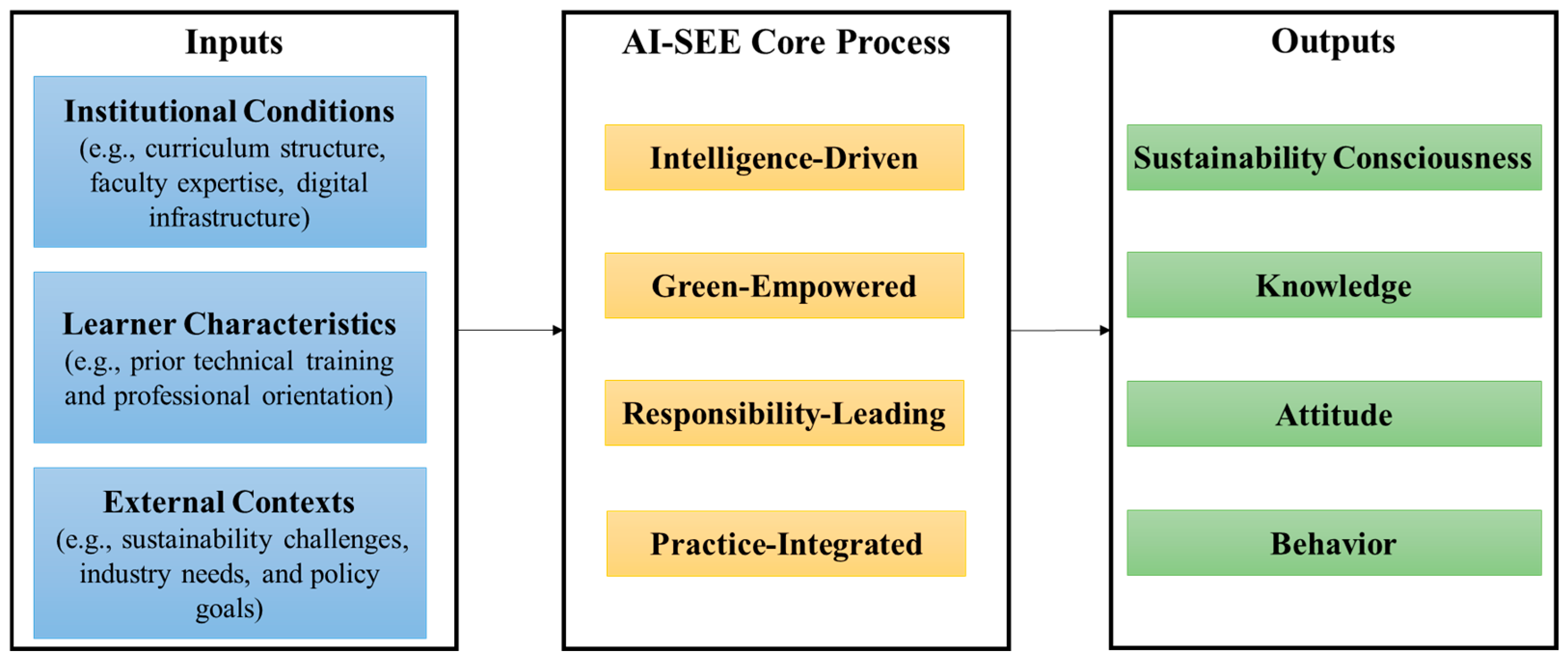
From a systems perspective, AI-SEE is explicitly structured around an input–process–output logic (Figure 1). The primary inputs include institutional conditions (e.g., curriculum structure, faculty expertise, digital infrastructure), learner characteristics (e.g., prior technical training and professional orientation), and external contexts (e.g., sustainability challenges, industry needs, and policy goals). The core pedagogical process is operationalized through four mutually reinforcing pillars—intelligence-driven, green-empowered, responsibility-leading, and practice-integrated—which together constitute an integrated learning system. The intended outputs are the progressive development of students’ sustainability-related knowledge, attitudes, and behavioral orientations, conceptualized in this study as sustainability consciousness.
Four design principles distinguish AI-SEE. First, AI is embedded throughout the educational lifecycle to support data-rich learning, iterative feedback, and adaptive instruction. Second, AI is framed not merely as an instructional aid but as a cognitive scaffold and system-optimization resource that supports students’ problem formulation, analysis, and decision-making. Third, the model prioritizes human–AI collaboration, explicitly positioning engineers—and, by extension, engineering students—as accountable agents of judgment rather than passive recipients of algorithmic outputs. Fourth, AI-SEE is designed with feasibility, scalability, and sustainability in mind, ensuring that the model can be implemented and maintained within resource-constrained, practice-oriented higher education contexts. Methodologically, the development of AI-SEE draws on a combination of curriculum mapping, iterative instructional design, AI-enabled learning analytics, and reflective evaluation. These tools support the alignment between pedagogical objectives, learning activities, and assessment, and enable continuous refinement of the model based on student feedback and learning evidence. Structurally, AI-SEE is organized around four mutually reinforcing pillars—intelligence-driven, green-empowered, responsibility-leading, and practice-integrated—which together form a dynamic system for cultivating the competencies required of sustainable engineering professionals in the AI era.

3.2. The Four Pillars of AI-SEE

3.2.1. Intelligence-Driven

The intelligence-driven pillar positions AI as an enabling infrastructure for learning rather than an optional add-on. AI is embedded across the teaching process to support data acquisition, analysis, modeling, feedback, and system simulation. For instance, students are guided to use Python-3.14 based workflows to collect and analyze open datasets (e.g., urban energy consumption and traffic flows), thereby strengthening information literacy and structured data analysis skills. In predictive tasks, machine learning methods are applied to forecast building cooling loads and electric vehicle electricity demand, fostering students’ capacity for data-driven reasoning and evidence-based argumentation. AI is also used to enhance formative assessment. Natural language processing techniques can support preliminary review of laboratory reports and design proposals and generate individualized feedback, improving instructional responsiveness and efficiency. For complex, interconnected engineering problems, digital twin approaches are introduced to simulate scenarios such as microgrid operations and campus energy dispatch, helping students develop an understanding of nonlinearity, uncertainty, and controllability in socio-technical systems. The intended outcome is not limited to tool proficiency. Rather, this pillar aims to cultivate higher-order cognitive abilities—particularly problem structuring, model interpretation, and critical validation—so that students can use AI as a scaffold for rigorous problem solving. In this way, engineering learning is progressively shifted from experience-driven routines toward more data-informed and evidence-based practices.

3.2.2. Green-Empowered

The green-empowered pillar embeds sustainability principles into the full lifecycle of engineering design and implementation, positioning environmental and social considerations as decision criteria rather than post hoc constraints. Lifecycle assessment (LCA) methods are systematically integrated into learning activities to help students quantify differences in resource use, carbon emissions, and ecological impacts across materials and design alternatives, thereby strengthening awareness of environmental costs and trade-offs. Carbon accounting tools are further used for project-level footprinting, enabling students to evaluate emissions-reduction potential from prototyping to system integration. The pillar also encourages design innovation informed by circular economy principles—for example, developing recycled construction materials from plastic waste or designing systems for industrial waste-heat recovery—thereby reinforcing closed-loop resource thinking. Importantly, “green” is defined in an expanded sense that includes equity and justice considerations. In energy-related projects, students are encouraged to examine the affordability and infrastructure accessibility of clean energy solutions in rural areas so that technical interventions do not inadvertently exacerbate social inequalities. Through this pillar, AI-SEE fosters engineers who evaluate solutions not only in terms of technical performance but also environmental sustainability and social inclusiveness.

3.2.3. Responsibility-Leading

The responsibility-leading pillar focuses on ethical awareness and value-based judgment, responding to the governance and accountability challenges associated with AI-enabled engineering systems. As algorithms increasingly shape engineering decisions, ethical risks—including dilemmas in autonomous driving, labor displacement associated with automation, and privacy concerns in data-intensive applications—have become more salient, warranting explicit curricular attention. Within AI-SEE, engineering ethics is established as a required component of the curriculum. Learning activities are organized around representative cases, with structured discussion and debate guiding students to examine tensions between technological innovation and humanistic values. Concepts from the philosophy of technology are incorporated to support reflection on foundational questions, such as whether technological progress necessarily aligns with social progress and how efficiency-oriented optimization should be balanced against ecological security and public welfare. This pillar also promotes global citizenship by helping students situate local engineering practices within global contexts of climate governance, resource flows, and sustainability transitions. In parallel, cross-cultural communication is developed to strengthen students’ readiness for collaboration in international engineering environments. Through lectures, thematic seminars, and role-play-based deliberation, ethical reasoning is practiced as a situated competence rather than treated as abstract principles.

3.2.4. Practice-Integrated

The practice-integrated pillar connects classrooms with industry and communities, establishing a feedback loop between learning and authentic problem solving. Traditional engineering education often relies on laboratory simulations or hypothetical projects, which may limit students’ exposure to uncertainty, stakeholder diversity, and implementation constraints. AI-SEE therefore emphasizes that learning tasks should culminate in action within real contexts. Implementation pathways include partnerships with industrial parks and manufacturing enterprises for energy efficiency diagnostics and low-carbon retrofit projects, enabling students to participate in solution design and evaluation under practical constraints. Students may also support township governments or village organizations with distributed photovoltaic site selection and grid-connection planning, completing integration tasks that require balancing technical, economic, and institutional requirements. In collaboration with environmental non-governmental organizations, students engage in social innovation projects such as plastic reduction initiatives and intelligent waste-sorting system design, strengthening public service competence and civic engagement. Capstone and graduation projects are systematically sourced from industrial challenges and pressing societal issues to enhance applicability and knowledge transfer. By engaging with competing objectives, constrained resources, and real stakeholder expectations, students can develop resilience, systems thinking, and integrative coordination capabilities. Accordingly, this pillar functions both as the culminating stage of competence development and as a key evaluative lens through which the effectiveness of the AI-SEE pedagogical model can be examined.

4. Methodology

4.1. Research Design

Sustainability consciousness is a multidimensional and dynamically constructed psychological state that involves intertwined cognitive, affective, and behavioral processes. Capturing its development therefore requires methodological approaches capable of eliciting individuals’ lived experiences and meaning-making trajectories. Qualitative methods are well-suited to this purpose and have been widely applied in sustainability education research due to their capacity to reveal subjective interpretations and latent patterns [10]. Accordingly, this study adopted semi-structured interviews as the primary data collection method to conduct a comparative qualitative evaluation of students’ sustainability-related knowledge, attitudes, and behaviors upon completion of the eighth semester (i.e., the second semester of the fourth undergraduate year).
Rather than adopting a quasi-experimental or causal-impact design, the study was explicitly framed as a comparative qualitative inquiry between two student cohorts who experienced different curricular arrangements. The analytical focus is placed on students’ reported experiences, perceptions, and reflections, rather than on measured or quantified effects. This design choice reflects the exploratory aim of the study, which seeks to understand how students interpret, internalize, and articulate sustainability-related learning experiences under different pedagogical conditions, rather than to estimate causal effects or effect sizes. Importantly, the methodological design was explicitly informed by the conceptual structure of the AI-SEE pedagogical model. The comparative qualitative approach was adopted to examine whether and how students’ reported learning experiences and developmental trajectories align with the four core pillars of AI-SEE—intelligence-driven, green-empowered, responsibility-leading, and practice-integrated. In this sense, the methodology serves as a model-informed qualitative validation strategy, enabling an empirical examination of the internal coherence and experiential plausibility of the AI-SEE framework, rather than a test of causal effectiveness.
The interview protocol was developed through an extensive review of the literature and iteratively refined based on pilot interviews. This process ensured that the questions were theoretically grounded while remaining responsive to the study context. The final interview guide comprised 20 questions (see Appendix A), organized around the core dimensions of sustainability consciousness and addressing themes such as knowledge acquisition, value judgment, ethical reflection, and behavioral intention. In addition, the interview questions were designed to map explicitly onto the conceptual elements of the AI-SEE model. For example, questions addressing data-driven reasoning and system modeling corresponded to the intelligence-driven pillar; items related to lifecycle thinking and environmental–social trade-offs reflected the green-empowered pillar; ethical reflection and responsibility awareness aligned with the responsibility-leading pillar; and questions on real-world application and stakeholder engagement corresponded to the practice-integrated pillar. All interviews followed a standardized procedure: participants from both groups were interviewed at the same time point and responded to an identical sequence of core questions to enhance comparative interpretability, while follow-up probes were flexibly employed to explore emergent issues in greater depth.
Data were analyzed using thematic analysis informed by constructivist grounded theory principles [50]. This approach emphasizes the co-construction of meaning between researchers and participants and supports inductive theory building rather than hypothesis testing. Through constant comparison across interview transcripts, recurring concepts were identified, refined, and progressively abstracted into higher-level categories. Data collection and analysis proceeded iteratively until theoretical saturation was reached, defined as the point at which additional interviews no longer generated substantively new insights.
Crucially, the analytic procedure was structured to assess the extent to which emergent themes could be meaningfully interpreted within the theoretical architecture of the AI-SEE model. The identification of second-order themes and aggregate dimensions therefore functioned not only as a descriptive analysis of student experiences but also as an empirical means of examining the conceptual adequacy and internal consistency of the four-pillar model. The resulting themes should therefore be interpreted as analytically grounded patterns of perception and meaning-making, rather than as evidence of causal impact or effectiveness.
This study adhered strictly to established ethical guidelines for educational research. All participants provided written informed consent after receiving a full explanation of the study’s purpose and procedures and were informed of their right to withdraw at any time without penalty. Confidentiality was rigorously protected: interview recordings and transcripts were used solely for academic analysis and stored on encrypted devices. These measures ensured participants’ autonomy and privacy and enhanced the credibility and ethical integrity of the study.

4.2. Study Context and Sample Selection

The study was conducted among undergraduate students enrolled in transportation-related programs at Nantong University, with the aim of evaluating the effects of the AI-SEE model on students’ sustainability consciousness. Transportation engineering constitutes a representative engineering discipline in which professional practice is closely tied to resource efficiency, environmental coordination, and system-level decision-making. As such, it provides a suitable empirical context for examining the educational effectiveness of AI-SEE.
The sample consisted of 144 transportation engineering students from the 2021 cohort across seven administrative classes. This cohort was selected because all students shared a common institutional context, admission criteria, and disciplinary background while being exposed to different curricular arrangements during their undergraduate training, thereby enabling meaningful qualitative comparison while minimizing contextual heterogeneity. According to the instructional arrangement, students were assigned to one of two groups. The control group (n = 70) followed a conventional engineering education curriculum, whereas the pilot group (n = 74) was systematically exposed to the AI-SEE model. The two groups were comparable in terms of admission performance, prerequisite coursework, and gender composition, supporting the validity of between-group comparisons. To protect anonymity, participants were coded in the results section as R1–R70 for the control group and P1–P74 for the pilot group.

4.3. Data Collection and Analysis Procedures

All interviews were audio-recorded and transcribed verbatim by trained research assistants following a standardized transcription protocol. Each transcript comprised approximately 250–350 words and preserved participants’ original expressions, including colloquial features, to facilitate nuanced semantic analysis. Despite the relatively large number of participants, the study adopted a qualitatively driven analytic strategy, prioritizing depth over breadth to capture subtle processes of meaning transformation, cognitive restructuring, and behavioral evolution across students’ learning trajectories.
Semi-structured interviews were considered sufficient for the purposes of this study because sustainability consciousness involves subjective interpretation, reflective judgment, and internally negotiated value orientations that are not easily observable or quantifiable. Compared with questionnaire-based surveys—which may constrain responses to predefined categories and overlook unanticipated meanings—interviews allow participants to articulate their reasoning processes, emotional responses, and experiential narratives in their own terms, making them particularly suitable for examining complex and non-linear educational change [51].
Participants were encouraged to reflect on their learning experiences under either the conventional curriculum or the AI-SEE framework, with particular emphasis on how pedagogical approaches influenced their understanding of sustainability concepts, attitudinal orientations, and concrete behavioral choices. While sustainable engineering education has been examined in prior studies, the longer-term mechanisms through which AI-enabled pedagogical models shape learners’ development remain insufficiently understood. Constructivist grounded theory is especially appropriate for such exploratory inquiries, as it allows theoretical insights to emerge from empirical data and captures latent changes that are difficult to detect using standardized instruments [52].
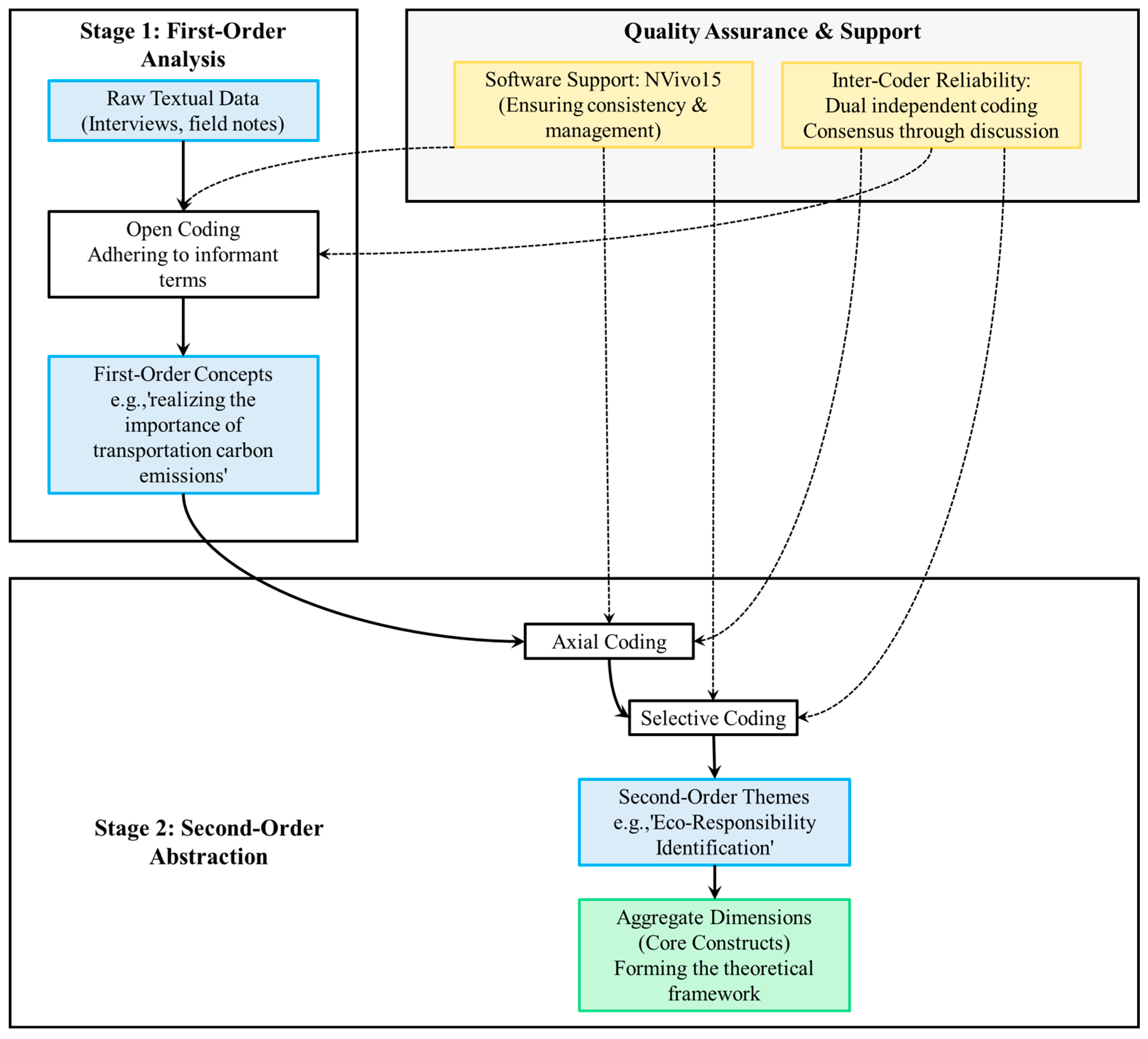
Data analysis followed the two-stage coding procedure proposed by Gioia et al. [53] and was guided by constructivist grounded theory principles to enhance analytical rigor and methodological transparency. Within this framework, the classical grounded theory coding operations of open, axial, and selective coding were not treated as separate sequential stages but were systematically embedded within the two-stage Gioia analytical structure, consistent with established qualitative research practice [54]. In the first stage, open coding was conducted through line-by-line examination of interview transcripts to identify first-order concepts that closely reflected participants’ own language and lived experiences. These first-order concepts captured concrete learning processes and perceptual shifts (e.g., “becoming aware of transportation-related carbon emissions” or “questioning conventional efficiency-oriented design standards”) and were intentionally kept close to the empirical data to avoid premature abstraction. In the second stage, axial and selective coding were applied based on constant comparative analysis to examine relationships among first-order concepts across interviews and between the control and pilot groups. Conceptually related first-order codes were systematically clustered and elevated into more abstract second-order themes that represented recurring patterns of meaning, such as “identification with ecological responsibility”, “emergence of critical reflection”, and “development of interdisciplinary integration capacity”. These second-order themes were then further integrated, through selective coding, into a smaller set of aggregate dimensions that captured the core explanatory constructs through which the AI-SEE model exerted its influence on students’ sustainability-related knowledge, attitudes, and behaviors (see Figure 2). Data collection and analysis proceeded iteratively. Theoretical saturation was considered achieved when successive interviews no longer generated substantively new first-order concepts nor altered the conceptual relationships among second-order themes and aggregate dimensions, indicating sufficient conceptual stability and analytical depth.
All coding and data management were supported by NVivo 15 software. To enhance analytical reliability, two researchers independently coded the data, and discrepancies were resolved through discussion until consensus was achieved.
Finally, several methodological limitations should be acknowledged. The study relies on self-reported interview data collected at a single time point, which may be subject to recall bias and social desirability effects. In addition, although the sample size is relatively large for qualitative research, the single-institution and single-discipline context limits the generalizability of the findings. Future research could adopt mixed-method or longitudinal designs and incorporate multiple institutions or engineering disciplines to further strengthen external validity.

5. Results

5.1. Sustainability Knowledge

5.1.1. Control Group

In the control group, sustainability knowledge was primarily acquired through fragmented content embedded in general education or discipline-related courses (e.g., Ideological and Moral Cultivation and Rule of Law, Introduction to the Major and Professional Ethics, and Principles of Urban Planning). Sustainability-related topics—such as energy conservation, emissions reduction, and low-carbon mobility—were typically perceived by students as technical indicators or policy background, with limited conceptual integration (see Table 1). As one student reflected, “I used to think ‘sustainability’ just meant driving less and planting more trees; it wasn’t until right before graduation that I realized it also involves social equity and intergenerational justice” (#R23). This quotation reflects students’ retrospective self-assessment of their prior understanding, rather than an externally evaluated level of competence.
Although most control-group students could correctly identify the three pillars of sustainability (environmental, social, and economic), their self-reported application was largely confined to environmental considerations. In transportation-related discussions, attention tended to focus on carbon emissions control and energy efficiency, while issues such as public transport accessibility, resource circularity, and life-cycle costs were rarely mentioned. With respect to methodological tools for sustainability assessment (e.g., life-cycle assessment [LCA] and carbon footprint accounting), most students reported only cursory familiarity and limited confidence in independent application, without claiming procedural mastery.

5.1.2. Pilot Group

In contrast, students in the pilot group described their knowledge construction as more systematic, interdisciplinary, and application-oriented (see Table 2). Under the intelligence-driven pillar, AI was frequently described as a “cognitive scaffold” for problem solving. Many students referred to experiences in the AI-enabled course Transportation Big Data Analysis and Processing, where Python-based tools were used to scrape and analyze open datasets (e.g., bus ridership) and to develop predictive models. One student noted that these experiences “made me see, for the first time, the social behavioral patterns behind the data” (#P6), while another emphasized that “AI is no longer a black-box tool; it helps us identify problems and test hypotheses as a cognitive assistant” (#P34).
The green-empowered pillar was frequently mentioned as helping students conceptualize sustainability as an operational lens rather than an abstract slogan. Nearly all pilot-group students reported being able to apply LCA to compare long-term ecological impacts of alternative pavement materials or vehicle propulsion technologies, as well as to use carbon accounting tools for project-level mitigation assessment. For example, when describing an energy-efficiency optimization plan for a logistics park, one participant stated, “We didn’t just calculate electricity savings; we also assessed the social value of reduced commuting time for workers” (#P64). Several students also reflected on perceived ‘hidden inequities’ in engineering interventions—for instance, the potential of elevated expressways to intensify spatial segregation in low-income communities. At the same time, students explicitly acknowledged structural limitations of the AI-SEE model, including perceived entry barriers to AI tools, limited hands-on time for methodological internalization, and partial disconnection between ethics instruction and routine engineering decision-making. These reflections point to heterogeneous and uneven learning experiences rather than uniformly positive outcomes.

5.2. Sustainability Attitudes

5.2.1. Control Group

Most control-group students expressed general support for sustainability but tended to frame it as an external obligation or a macro-level concern (see Table 3). Statements such as “I know we should protect the environment, but that’s more the responsibility of government and companies” (#R63) suggest limited personal or professional identification with sustainability responsibilities. Even among students who had participated in volunteer activities, few perceived a connection between their future professional roles and social responsibility. Statements such as “I never thought transportation engineers could influence social equity” (#R45) were typical.
Regarding AI, many students articulated techno-optimistic views centered on efficiency, with relatively little spontaneous reflection on ethical risks. While they anticipated efficiency gains from intelligent systems, they rarely questioned risks such as algorithmic bias or job displacement. Remarks such as “As long as the system runs fast and dispatching is accurate, that’s enough” (#R61) reflect a predominantly utilitarian orientation and limited value-based evaluation of technology.

5.2.2. Pilot Group

In the pilot group, students described attitudinal development as a multi-layered process involving emotional responses and emerging reflections on professional identity, rather than as a linear or uniform change. The “see-and-be-shocked” effect associated with the intelligence-driven pillar was particularly salient (see Table 4). When students uncovered, through data analysis, that metro station layouts deviated markedly from commuting patterns of low-income populations, several described feeling “shocked and even ashamed” (#P4, #P18, #P32). One participant noted, “It turns out our transportation system has been neglecting certain groups” (#P42). Such data-driven encounters with structural inequality were perceived by students as critical moments that prompted reconsideration of fairness in technical systems, as articulated in their reflections.
The green-empowered pillar was commonly described by students as strengthening their awareness of ecological responsibility and supporting value reflection. In a circular-economy simulation project involving the reuse of waste tires in road construction, students developed enduring cognitive habits: “Now whenever I see any material, I think: where will it end up?” (#P52). This quotation illustrates how sustainability considerations became salient in students’ everyday cognitive schemas, as reported in interviews, rather than indicating objectively verified value internalization.
The responsibility-leading pillar further fostered ethical reflexivity. A thematic lecture titled “Who Is Responsible for Transportation Algorithms?” stimulated sustained discussion, with students questioning whether “the optimal solution is necessarily the fairest solution”. Some articulated new professional identities, describing transportation engineers as “ethical translators” who bridge public values and technical systems (#P13). These statements reflect students’ evolving interpretations of professional roles, rather than a confirmed or stabilized identity shift.
Practice integration also generated strong affective engagement. One student recalled participation in a rural transit optimization project: “When I saw elderly people walking several kilometers along mountain roads to wait for a bus, I finally understood what the ‘last mile’ really means” (#P68). Direct exposure to real-world contexts was described by students as transforming sustainability from an abstract concept into an embodied experience, as perceived in hindsight.
Nevertheless, some students reported psychological tension between ideals and perceived labor market realities. As one student explained, “I want to work on green transportation, but I’m worried the job market doesn’t need people like that” (#P11). These concerns suggest that while sustainability-related value orientations were activated in students’ reflections, they had not yet fully stabilized into enduring professional identities, a limitation that warrants cautious interpretation.

5.3. Sustainability Behavior

5.3.1. Control Group

In the control group, behavioral change was primarily limited to everyday practices, such as reducing single-use products or choosing public transportation (see Table 5). Although students reported actions like “bringing a reusable water bottle” or “taking the metro”, few connected these behaviors to their emerging professional identities. In consumption-related decisions, only a small number of students referred to considering eco-labels or socially responsible brands.
At the academic level, most capstone projects were described as focusing on conventional technical optimization (e.g., signal timing improvements), with limited explicit reference to sustainability objectives. While some students participated in short-term volunteer activities, none reported sustained engagement after course completion or initiated sustainability-related advocacy. These accounts suggest that behavioral engagement was often situational and externally prompted, as described by students themselves, rather than embedded in long-term commitments.

5.3.2. Pilot Group

In contrast, students in the pilot group described a stronger perceived alignment between sustainability-related knowledge, attitudes, and behavioral practices across lifestyle choices, academic engagement, and career aspirations (see Table 6). At the individual level, many students reported frequent use of public transport, shared mobility, or cycling; engagement in second-hand exchanges; or deliberate avoidance of fast-fashion consumption. Several participants also mentioned tracking personal carbon footprints or using MaaS-related applications to estimate travel emissions.
At the academic level, sustainability considerations were deeply embedded in learning activities. All pilot-group capstone projects included explicit sustainability objectives, such as LCA-based material selection for urban rail systems or accessible bus application design for persons with disabilities. Seven students further developed their theses into funded research projects. One student-developed “bus service equity evaluation mini-program” was reportedly piloted by a local public transport operator, which students perceived as an early form of knowledge transfer, rather than as a verified policy outcome.
In terms of career intentions, corporate social responsibility emerged as an important criterion for employment choice. More than 60% of students prioritized firms engaged in green infrastructure or low-carbon mobility, and some expressed willingness to accept lower salaries in exchange for value alignment. As one student stated, “I don’t want to work for a company that only pursues traffic volume and speed” (#P57).
Students also acted as agents of social diffusion. Several shared project outputs on social media, organized campus plastic-reduction initiatives, or explained carbon footprint concepts to family members. One participant noted, “My parents now choose greener modes for short trips because I showed them our low-carbon mobility survey report” (#P18). Importantly, students also referred to perceived real-world relevance as a source of motivational reinforcement. For instance, participants described receiving feedback from industrial partners or local authorities during practice-integrated projects. In one case, students reported that recommendations from an industrial energy-diagnostic project were discussed by the host organization, while another feeder-bus connection proposal entered a local government pilot discussion. These accounts reflect students’ perceptions of impact, rather than independently verified system-level changes.
At the same time, students acknowledged multiple constraints on behavioral continuity. High levels of engagement were often described as dependent on institutional scaffolding, such as course requirements or project support. Implementation barriers—including funding shortages and policy constraints—were also mentioned as limiting factors. Several participants further noted that uneven interdisciplinary communication skills occasionally constrained collaboration with community stakeholders. These reflections indicate that behavioral translation remained context-dependent and contingent, rather than uniformly sustained.

6. Discussion

By comparing a pilot cohort exposed to the AI-SEE model with a control cohort receiving conventional engineering education across sustainability knowledge, attitudes, and behavior, this study offers a theoretically grounded interpretation of how AI-integrated pedagogy reshapes students’ sustainability consciousness. Importantly, the findings do not merely replicate existing claims in the Education for Sustainable Development (ESD) literature but help to clarify why and under what conditions sustainability learning moves beyond fragmented awareness toward more integrated, enduring forms of knowledge, value orientation, and action. At the same time, prior reviews emphasize that evidence on ESD outcomes—especially attitudinal and behavioral change—remains heterogeneous and sometimes weak, with persistent “knowledge–action” translation gaps in higher education contexts [55,56,57].

6.1. Reframing Knowledge Construction: From Fragmented Awareness to Systemic and Actionable Understanding

Prior ESD research has consistently shown that sustainability-oriented curricula can enhance students’ sustainability knowledge and ecological literacy [17,18,22]. However, the literature also documents persistent limitations: knowledge gains are often uneven, remain environmentally reductionist, or fail to translate into procedural competence [11,23]. The present findings speak directly to this tension. Recent evidence syntheses similarly note that sustainability education initiatives in higher education frequently improve declarative understanding more readily than they develop robust systems-thinking and actionable competence, particularly when learners lack sustained opportunities to apply analytical tools in authentic decision contexts [58].
Consistent with earlier studies, students in both cohorts were able to articulate the three pillars of sustainability. Yet, only pilot-group students demonstrated the capacity to use this framework as an analytical and decision-making lens. This supports prior observations that sustainability understanding often collapses into environmental concerns when teaching lacks an integrative structure [26]. Within the AI-SEE model, this difference can be attributed primarily to the Intelligence-Driven and Green-Empowered pillars, which jointly reposition sustainability knowledge as an analytical and evaluative resource rather than as background information. What distinguishes AI-SEE is not the introduction of sustainability content per se, but the way in which AI-enabled tools—particularly LCA, carbon accounting, and data-driven modeling—functioned as epistemic mediators that made trade-offs, interdependencies, and long-term consequences analytically visible.
From the perspective of sustainability consciousness theory [12], this represents a shift from declarative knowledge (“knowing about sustainability”) to evaluative and procedural knowledge (“knowing how and why sustainability matters in decisions”). The intelligence-driven pillar further enhanced epistemic authenticity by allowing students to interrogate real-world datasets and uncover structural patterns—such as inequitable transit accessibility—that are difficult to grasp through abstract instruction alone. This aligns with Gal and Gan’s [27] argument that systems thinking emerges when learners are confronted with interdependencies embedded in social–ecological systems.
At the same time, the reported “technology anxiety” and partial detachment of ethics instruction echo earlier concerns that methodological sophistication can introduce new forms of exclusion [23]. This resonates with recent empirical work showing that ESD initiatives may yield differentiated learning benefits across students depending on prior skills, scaffolding intensity, and sustained practice time, thereby producing uneven competence development even when overall perceptions are positive [59].
Collectively, these patterns clarify how AI-SEE can be operationalized to mediate systems thinking and sustainability-oriented decision-making: not by adding more sustainability content, but by embedding AI-enabled analytical tools as structured mediators that render system feedback, trade-offs, and long-term consequences visible within discipline-specific tasks.

6.2. Attitudinal Awakening: Identity Reconstruction Through Resonant Learning Experiences

The ESD literature generally reports positive effects of sustainability education on attitudes, including increased concern, motivation, and perceived responsibility [10,37]. Yet, empirical results remain mixed, with some studies reporting weak or insignificant attitudinal change [23,41]. The present findings help reconcile these inconsistencies by highlighting the processual nature of attitudinal development. Recent higher-education reviews likewise emphasize that attitudinal outcomes are highly sensitive to pedagogical design, often remaining superficial when sustainability is framed as general advocacy rather than as a personally meaningful and professionally relevant dilemma embedded in real systems [57].
Rather than following a linear “knowledge → attitude” pathway, attitudinal change in the pilot group unfolded through an interactive sequence of cognitive disruption, ethical reflection, and affective engagement. Data-driven encounters with inequality functioned as what Salas-Zapata et al. [11] describe as value-relevant triggers, making abstract sustainability issues emotionally salient. These processes are closely aligned with the Responsibility-Leading pillar of the AI-SEE model, which explicitly frames sustainability challenges as ethical and societal questions rather than purely technical optimization problems. Responsibility-leading components then provided interpretive frameworks—through ethical deliberation and philosophical questioning—that enabled students to make sense of these disruptions beyond efficiency-based logics. Crucially, these experiences contributed to a reconfiguration of professional identity. Echoing Chen’s (2019) [28] observation that sustainability education fosters agency, pilot-group students increasingly framed themselves as actors responsible for translating societal values into technical systems. This identity reconstruction reflects the intended function of the Responsibility-Leading component: positioning future engineers as moral and civic agents embedded in socio-technical systems.
However, students’ concerns about labor market constraints underscore a limitation also noted in the literature: value awakening does not automatically translate into stable identity without structural reinforcement [48]. Recent synthesis work similarly stresses that higher education can stimulate sustainability-oriented identity narratives, but the durability of such narratives depends on whether institutional and labor-market environments offer credible pathways for sustained practice and recognition [60].
These findings sharpen our understanding of how AI-SEE relates to sustainability consciousness progression: attitudes are strengthened not simply through “more knowledge”, but through resonant experiences where AI-enabled analysis surfaced inequities and ethical tensions, enabling students to internalize responsibility as part of an emerging professional self-concept.

6.3. Strengthening Behavioral Translation: From Individual Habits to Social Spillovers

Behavioral outcomes represent the most contested dimension in sustainability education research. While some studies report changes in energy use or consumption patterns, others find that behavior remains largely resistant or limited to low-cost actions [23,47]. The present findings contribute to this debate by showing that behavioral translation is more likely when learning is embedded in authentic, consequential contexts. This aligns with recent higher-education evidence that behavior-related outcomes are the most difficult to sustain and verify, with common reliance on self-report and frequent attenuation once course-based scaffolding is removed—contributing to mixed conclusions in the ESD evaluation literature [61].
Compared with the control group’s incremental lifestyle adjustments, pilot-group students demonstrated behavioral engagement across multiple levels—personal, academic, professional, and social. This aligns with Cole et al.’s [31] argument that sustained behavioral change occurs when actions generate multiple co-benefits and visible outcomes. Within the AI-SEE framework, such translation is primarily enabled by the Practice-Integrated pillar, which situates learning within real stakeholder environments and exposes students to implementation constraints and feedback mechanisms.
Notably, the emergence of social diffusion effects extends prior behavioral research, which has largely focused on individual actions. Students acting as communicators within families and peer networks suggest that sustainability consciousness may propagate beyond the immediate educational setting, supporting the view that education can function as a catalyst for broader societal learning. In relation to the mixed evidence base, this “spillover” pathway may help explain why some interventions show limited individual behavior change yet still generate broader social influence through peer/family communication and early stakeholder engagement [62].
Nevertheless, consistent with earlier findings [48], behavioral sustainability remained contingent on institutional and policy conditions. Once formal scaffolding was removed, maintaining high-intensity engagement became challenging. These constraints point to a structural “translation gap” between educational innovation and real-world socio-technical systems—an issue that future ESD research must address more explicitly. Importantly, this study does not claim verified behavioral “effects”; rather, it provides a comparative account of how students describe behavioral intentions and practices under different curricular conditions, consistent with the qualitative evaluation framing.
The results suggest that AI-SEE may support movement from knowledge/attitude to behavioral intention and practice when practice-integrated experiences create real stakeholders, constraints, and feedback—conditions repeatedly identified as critical in the literature for narrowing the education–action gap.

6.4. Theoretical Contributions and Practical Implications

Building explicitly on the empirical patterns analyzed in the preceding discussion, this study contributes to the sustainability consciousness literature by clarifying how AI-integrated pedagogy can structure the co-development of knowledge, attitudes, and behavioral orientations within engineering education. Rather than treating these dimensions as parallel or sequential learning outcomes, the findings highlight the importance of their coordinated formation through pedagogical design.
From a theoretical perspective, the study conceptualizes sustainability consciousness as a processual and relational construct that emerges through the interaction between epistemic tools, value-oriented reflection, and situated practice. In this regard, AI-SEE functions not as an additive instructional innovation but as an integrative architecture that aligns analytical capability, ethical deliberation, and action-oriented learning within discipline-specific contexts. This perspective extends existing sustainability competency frameworks by illustrating how such competencies may be operationalized through concrete pedagogical mechanisms rather than remaining at an abstract or normative level.
From a practical perspective, the findings point to several design considerations for application-oriented institutions seeking to integrate artificial intelligence into sustainability education. First, AI-enabled learning environments require intentional scaffolding to reduce access barriers and prevent the reproduction of new forms of exclusion. Second, ethical reasoning is most effective when embedded directly within discipline-specific decision contexts, rather than treated as a standalone or peripheral component. Third, sustained development of sustainability consciousness depends on practice pathways that connect curricular activities with real implementation settings and feedback from external stakeholders. Collectively, these considerations underscore the need to view AI-enabled sustainability education as a system-level educational intervention, rather than a collection of isolated teaching techniques.

7. Conclusions and Limitations

7.1. Conclusions

This study proposes and empirically examines AI-SEE as a systematic pedagogical framework tailored to application-oriented engineering education. Structured around four synergistic pillars—intelligence-driven, green-empowered, responsibility-leading, and practice-integrated—AI-SEE embeds artificial intelligence deeply into instructional content, learning processes, and authentic problem contexts. By moving beyond an instrumental “AI-as-a-tool” orientation, the framework supports the processual and relational development of students’ sustainability consciousness within engineering education.
Drawing on a qualitative comparative analysis of undergraduate students in transportation-related programs, the findings illustrate how AI-SEE is associated with differentiated patterns across sustainability-related knowledge, attitudes, and behavioral orientations. At the knowledge dimension, AI-SEE is linked to a shift from fragmented and environmentally reductionist understandings toward more systemic and decision-oriented sustainability cognition, in which life-cycle thinking, social equity considerations, and long-term system impacts are explicitly incorporated into engineering problem framing. At the attitudinal dimension, the interaction between intelligence-driven data encounters, green-empowered evaluative frameworks, and responsibility-leading ethical reflection fosters emotionally salient learning experiences and sustained value deliberation, contributing to emerging professional self-understandings in which engineers are framed not only as technical problem-solvers but also as ethical and social value coordinators. At the behavioral dimension, AI-SEE is associated with richer descriptions of knowledge-to-action translation, extending beyond personal lifestyle adjustments to academic choices, early career intentions, and social communication, with practice-integrated learning contexts playing a critical role in sustaining perceived agency under real-world constraints.
Taken together, these findings suggest that AI-SEE should be understood not as a discrete pedagogical technique, but as a systemic educational intervention aligned with sustainability transition objectives. By integrating AI-enabled analysis, sustainability evaluation, ethical reasoning, and real-world engagement, AI-SEE contributes to the cultivation of future engineers as agents of socio-technical and ecosocial transition, capable of navigating the intersections of technological innovation, environmental responsibility, and social justice.
From a broader perspective, this study highlights the role of higher education institutions as key institutional actors in sustainability transitions, not only by transmitting technical knowledge but also by shaping professional identities, value orientations, and repertoires of action that are essential for long-term socio-technical and ecosocial transformation. Overall, AI-SEE offers a transferable and theoretically grounded reference for engineering disciplines more broadly, particularly those characterized by high resource intensity and strong societal embeddedness. By articulating an educational pathway that integrates AI-enabled analysis, sustainability evaluation, ethical reasoning, and practice-based engagement, the framework contributes to the cultivation of future engineers who are technically competent, ethically grounded, and oriented toward systemic and transformative change.

7.2. Limitations

Several limitations should be acknowledged. First, this study adopts a single-institution, single-discipline qualitative case design, focusing on transportation engineering students at one application-oriented university in China. While this context provides a rich and policy-relevant setting for examining how AI-integrated pedagogy shapes sustainability consciousness, caution is required when generalizing the empirical findings across disciplines, institution types, or cultural contexts. Moreover, the single-institution setting limits the ability to capture institutional heterogeneity in curriculum design, faculty engagement, and learning cultures, which may condition students’ learning experiences. Importantly, however, the AI-SEE framework itself is not intended to be context-bound to China. Rather, it is conceptually informed by international developments in engineering education reform and sustainability education, and the Chinese case serves as an illustrative and empirically grounded implementation context. Future studies are therefore encouraged to test the transferability and contextual adaptation of AI-SEE across multiple universities, engineering disciplines, and national education systems, thereby strengthening the generalizability of the framework.
Second, although the study captures rich and reflective accounts at the point of graduation, it relies primarily on self-reported interview data collected at a single time point. The absence of multiple informants (e.g., instructors, curriculum designers, or workplace supervisors) means that the findings primarily reflect students’ subjective perceptions rather than triangulated assessments of learning outcomes. In addition, self-reported data may be subject to recall bias and social desirability effects.
Third, the lack of longitudinal follow-up further constrains the ability to assess whether reported changes in sustainability-related knowledge, attitudes, and behavioral orientations persist over time or translate into sustained professional practice. Longitudinal research tracking graduates into the workforce would provide valuable insights into the durability of educational impacts and the conditions under which sustainability consciousness is enacted in real-world engineering contexts. Future research could therefore adopt mixed-method designs that combine qualitative interviews with surveys, learning analytics, or behavioral indicators, as well as longitudinal or panel studies that follow students across key educational and career transitions. Such approaches would enable more robust triangulation of findings and a deeper understanding of how AI-integrated pedagogical interventions interact with institutional, organizational, and labor-market contexts over time.

Author Contributions

Conceptualization, F.L. and T.T.; Data curation, H.W. and F.L.; Funding acquisition, T.T.; Investigation, F.L. and T.T.; Methodology, F.L., H.W. and Y.G.; Resources, T.T.; Software, H.W. and Y.G.; Supervision, T.T.; Validation, F.L. and Y.G.; Visualization, F.L. and Y.G.; Writing—original draft, F.L., H.W. and T.T.; Writing—review and editing, F.L. and T.T. All authors have read and agreed to the published version of the manuscript.

Funding

This study was supported by the Jiangsu Provincial Teaching Reform Research Project in Higher Education (2025JGZZ41), the Special Project on Teaching Reform of Public Fundamental Courses in Science and Engineering for Undergraduate Universities in Jiangsu Province (2024LGJK003), the 2024 Higher Education Scientific Research Planning Project of Chinese Association of Higher Education (24KC0404), and the 2022–2024 Annual Educational Science Research Projects of China Institute of Communications Education (JT2022ZD055).

Institutional Review Board Statement

The study was conducted in accordance with the Declaration of Helsinki and approved by the Institutional Review Board (or Ethics Committee) of Nantong University Ethics Committee (protocol code 2025NTEC105 and 8 May 2025 of approval).

Informed Consent Statement

Informed consent was obtained from all subjects involved in the study.

Data Availability Statement

The original contributions presented in this study are included in the article. Further inquiries can be directed to the corresponding author.

Conflicts of Interest

The authors declare that they have no known competing financial interests or personal relationships that could have appeared to influence the work reported in this paper.

Appendix A

  • Could you describe your overall understanding of “sustainable development”? In particular, in the context of transportation engineering or transport systems, what key elements do you think it includes? (Prompts: the environmental–social–economic triple bottom line; resource consumption, carbon emissions, equity in transport systems.)
  • Looking back on your learning experience, in which courses or learning activities did you first engage with sustainability concepts in a systematic way? How were these concepts presented? (Probe: conventional courses vs. AI-SEE integrated courses; differences in how knowledge was delivered.)
  • When learning about transport system optimization or infrastructure design, do you proactively consider environmental impacts or social responsibility? If yes, when did this way of thinking begin to form, and what courses or experiences influenced it?
  • In your coursework, have you used AI-related techniques (e.g., Python-based data analysis, machine-learning prediction, digital-twin simulation) to address practical problems related to transportation or energy? Please provide an example. (Probe: depth of application in the pilot group; for the control group, whether similar ideas were considered but not implemented.)
  • When you used AI tools to work with real-world data (e.g., urban traffic flows, energy monitoring data), how did this help you understand how complex systems operate? Did it change the way you make decisions? (Probe: whether AI functioned as a “cognitive scaffold” and fostered data-driven thinking.)
  • How do you view the role of AI in future transport systems? How should AI serve sustainable development goals, rather than being used solely to maximize efficiency? (Probe: value judgment and internalization of human–AI collaboration.)
  • When completing engineering project design or evaluating alternatives, have you used methods such as life-cycle assessment (LCA) or carbon footprint accounting to assess environmental impacts? If yes, please describe the situation; if not, what do you see as the main barriers?
  • Beyond reducing carbon emissions, have you considered social equity issues associated with engineering solutions? For example, in public transport planning, do you consider accessibility for low-income groups or remote areas? Were these considerations self-initiated or guided by coursework?
  • Could you share a “green innovation” example that impressed you (either from a class project or a real-world case)? Why did it stand out to you, and what sustainability logic did it reflect?
  • As a future transportation engineer, what social responsibilities do you think you should take on beyond technical duties—especially in relation to AI automation, data privacy, and job displacement?
  • Have you participated in discussions, debates, or case analyses related to engineering ethics, philosophy of technology, or social responsibility? If yes, which experience left the deepest impression on you, and how did it influence your understanding of the relationship between “good technology” and a “good society”?
  • In the context of global climate change, do you perceive a role for Chinese engineers in global sustainability governance? How do you think domestic engineering practice should respond to this responsibility?
  • Have you participated in projects where you applied what you learned to real-world contexts—for example, providing energy-saving recommendations to companies, designing low-carbon mobility solutions for communities, or collaborating with non-profit organizations? Please describe one experience in detail. (Prompts: stakeholder interaction, real-world constraints, multi-objective coordination.)
  • In your capstone project or other integrative practice, was your topic influenced by sustainability issues? If yes, what motivated that choice? Was it inspired by a particular course or instructor?
  • Did collaboration with companies, government agencies, or non-profit organizations help you see the gap between theory and practice more clearly? How did this experience shape your expectations for your future career path?
  • Comparing your first year with your current situation, what notable changes do you think have occurred in your sustainability consciousness? Have these changes been mainly in knowledge, attitudes, or everyday behavior?
  • Since taking relevant courses, have your daily habits changed—for example, in travel mode choices, consumption decisions, or resource conservation? Please provide specific examples.
  • In your future job search, would you prioritize employers that emphasize environmental protection, social responsibility, or sustainability strategies? Why or why not?
  • Do you intend to continue participating in sustainability-related activities in the future, such as volunteering, public advocacy, further study, or R&D in green transportation technologies? If yes, what has motivated this intention?
  • Finally, could you summarize your current understanding of a “responsible transportation engineer” using a few keywords? How far do you think you are from this ideal, and what additional support would you need?

References

  1. Gutierrez-Bucheli, L.; Kidman, G.; Reid, A. Sustainability in engineering education: A review of learning outcomes. J. Clean. Prod. 2022, 330, 129734. [Google Scholar] [CrossRef]
  2. Narong, D.K.; Hallinger, P. Traversing the evolution of research on engineering education for sustainability: A bibliometric review (1991–2022). Sustainability 2024, 16, 641. [Google Scholar] [CrossRef]
  3. Mittal, P.; Bansal, R. Empowering Students as Agents of Change: Building a Culture of Sustainability in Higher Education Institutions. In Community Engagement for Sustainable Practices in Higher Education: From Awareness to Action; Springer Nature: Cham, Switzerland, 2024; pp. 261–276. [Google Scholar]
  4. Narong, D.K. A system-based framework for engineering education as sustainable development. Eur. J. Eng. Educ. 2024, 49, 911–927. [Google Scholar] [CrossRef]
  5. Hassan, M.M.; Ahmad, A.R. Systematic literature review on the sustainability of higher education institutions (HEIs): Dimensions, practices and research gaps. Cogent Educ. 2025, 12, 2549789. [Google Scholar] [CrossRef]
  6. Leal Filho, W.; Kim, E.; Borsatto, J.M.L.S.; Marcolin, C.B. Using artificial intelligence in sustainability teaching and learning. Environ. Sci. Eur. 2025, 37, 124. [Google Scholar] [CrossRef]
  7. Henriksen, D.; Mishra, P.; Stern, R. Creative learning for sustainability in a world of AI: Action, mindset, values. Sustainability 2024, 16, 4451. [Google Scholar] [CrossRef]
  8. Dai, C.P.; Ke, F. Educational applications of artificial intelligence in simulation-based learning: A systematic mapping review. Comput. Educ. Artif. Intell. 2022, 3, 100087. [Google Scholar] [CrossRef]
  9. Strielkowski, W.; Grebennikova, V.; Lisovskiy, A.; Rakhimova, G.; Vasileva, T. AI-driven adaptive learning for sustainable educational transformation. Sustain. Dev. 2025, 33, 1921–1947. [Google Scholar] [CrossRef]
  10. Kalsoom, Q.; Khanam, A. Inquiry into sustainability issues by preservice teachers: A pedagogy to enhance sustainability consciousness. J. Clean. Prod. 2017, 164, 1301–1311. [Google Scholar] [CrossRef]
  11. Salas-Zapata, W.A.; Rios-Osorio, L.A.; Cardona-Arias, J.A. Knowledge, attitudes and practices of sustainability: Systematic review 1990–2016. J. Teach. Educ. Sustain. 2018, 20, 46–63. [Google Scholar] [CrossRef]
  12. Gericke, N.; Boeve-de Pauw, J.; Berglund, T.; Olsson, D. The sustainability consciousness questionnaire: The theoretical development and empirical validation of an evaluation instrument for stakeholders working with sustainable development. Sustain. Dev. 2019, 27, 35–49. [Google Scholar] [CrossRef]
  13. Laasch, O.; Moosmayer, D.C.; Antonacopoulou, E.P. The interdisciplinary responsible management competence framework: An integrative review of ethics, responsibility, and sustainability competences. J. Bus. Ethics 2023, 187, 733–757. [Google Scholar] [CrossRef]
  14. Wiek, A.; Withycombe, L.; Redman, C.L. Key competencies in sustainability: A reference framework for academic program development. Sustain. Sci. 2011, 6, 203–218. [Google Scholar] [CrossRef]
  15. Rieckmann, M. Education for Sustainable Development Goals: Learning Objective; UNESCO Publishing: Paris, France, 2017. [Google Scholar]
  16. OECD. Learning Compass 2030: A Series of Concept Notes; OECD Publishing: Paris, France, 2019. [Google Scholar]
  17. Durmuş, E.; Kınacı, M.K. Opinions of social studies teacher education students about the impact of environmental education on ecological literacy. Rev. Int. Geogr. Educ. Online 2021, 11, 482–501. [Google Scholar] [CrossRef]
  18. Gulacar, O.; Zowada, C.; Burke, S.; Nabavizadeh, A.; Bernardo, A.; Eilks, I. Integration of a sustainability-oriented socio-scientific issue into the general chemistry curriculum: Examining the effects on student motivation and self-efficacy. Sustain. Chem. Pharm. 2020, 15, 100232. [Google Scholar] [CrossRef]
  19. Li, W.; Lee, P.K.; Chan, J.C.; Tan, H. Cultivating environmentally responsible citizens in a local university in Hong Kong-evaluating the cognitive, attitudinal, and behavioral outcomes. Int. Res. Geogr. Environ. Educ. 2020, 29, 301–315. [Google Scholar] [CrossRef]
  20. Nousheen, A.; Zai, S.A.Y.; Waseem, M.; Khan, S.A. Education for sustainable development (ESD): Effects of sustainability education on pre-service teachers’ attitude towards sustainable development (SD). J. Clean. Prod. 2020, 250, 119537. [Google Scholar] [CrossRef]
  21. Novo-Corti, I.; Badea, L.; Tirca, D.M.; Aceleanu, M.I. A pilot study on education for sustainable development in the Romanian economic higher education. Int. J. Sustain. High. Educ. 2018, 19, 817–838. [Google Scholar] [CrossRef]
  22. Sammalisto, K.; Sundström, A.; Von Haartman, R.; Holm, T.; Yao, Z. Learning about sustainability-what influences students’ self-perceived sustainability actions after undergraduate education? Sustainability 2016, 8, 510. [Google Scholar] [CrossRef]
  23. Jung, Y.; Park, K.; Ahn, J. Sustainability in higher education: Perceptions of social responsibility among university students. Soc. Sci. 2019, 8, 90. [Google Scholar] [CrossRef]
  24. Hicks, A.L. The role of community-based learning in teaching about industrial ecology and sustainability in the context of engineering education: A case study from the field. J. Ind. Ecol. 2022, 26, 1136–1146. [Google Scholar] [CrossRef]
  25. Savelyeva, T.; Douglas, W. Global consciousness and pillars of sustainable development: A study on self-perceptions of the first-year university students. Int. J. Sustain. High. Educ. 2017, 18, 218–241. [Google Scholar] [CrossRef]
  26. Gal, A. From recycling to sustainability principles: The perceptions of undergraduate students studying early childhood education of an education for sustainability course. Int. J. Sustain. High. Educ. 2023, 24, 1082–1104. [Google Scholar] [CrossRef]
  27. Gal, A.; Gan, D. Transformative sustainability education in higher education: Activating environmental understanding and active citizenship among professional studies learners. J. Transform. Educ. 2020, 18, 271–292. [Google Scholar] [CrossRef]
  28. Chen, K. Transforming environmental values for a younger generation in Taiwan: A participatory action approach to curriculum design. J. Futures Stud. 2019, 23, 79–96. [Google Scholar]
  29. Sivapalan, S.; Clifford, M.J.; Speight, S. Engineering education for sustainable development: Using online learning to support the new paradigms. Australas. J. Eng. Educ. 2016, 21, 61–73. [Google Scholar] [CrossRef]
  30. Ben-Zvi-Assaraf, O.; Ayal, N. Harnessing the environmental professional expertise of engineering students-the course: “Environmental management systems in the industry”. J. Sci. Educ. Technol. 2010, 19, 532–545. [Google Scholar] [CrossRef]
  31. Kim, S.; Koo, J.; Lee, C.J.; Yoon, E.S. Optimization of Korean energy planning for sustainability considering uncertainties in learning rates and external factors. Energy 2012, 44, 126–134. [Google Scholar] [CrossRef]
  32. Cole, L.B.; Quinn, J.; Ktruk, A.; Johson, B. Promoting green building literacy through online laboratory experiences. Int. J. Sustain. High. Educ. 2019, 20, 264–287. [Google Scholar] [CrossRef]
  33. Moubareck, C.A. The effectiveness of project-based learning on Emirati undergraduate students in a microbiology course. Learn. Teach. High. Educ. Gulf Perspect. 2022, 18, 95–106. [Google Scholar] [CrossRef]
  34. Briens, E.C.; Chiu, Y.; Braun, D.; Verma, P.; Fiegel, G.; Pompeii, B.; Singh, K. Assessing sustainability knowledge for undergraduate students in different academic programs and settings. Int. J. Sustain. High. Educ. 2023, 24, 69–95. [Google Scholar] [CrossRef]
  35. Mintz, K.; Tal, T. The place of content and pedagogy in shaping sustainability learning outcomes in higher education. Environ. Educ. Res. 2018, 24, 207–229. [Google Scholar] [CrossRef]
  36. Kalsoom, Q. ESD Literacy-Based Model for Preservice Elementary Teachers: A Focus on Critical and Environmental Consciousness and Effective Teacher Development. Doctoral Dissertation, Lahore College for Women University, Lahore, Pakistan, 2019. [Google Scholar]
  37. Franklin, K.; Halvorson, S.J.; Brown, F. Impacts of service learning on tourism students’ sustainability competencies in conflict-affected Bamyan, Afghanistan. Int. J. Sustain. High. Educ. 2023, 24, 1328–1346. [Google Scholar] [CrossRef]
  38. Balakrishnan, B.; Tochinai, F.; Kanemitsu, H.; Al-Talbe, A. Education for sustainable development in Japan and Malaysia: A comparative study among engineering undergraduates. Int. J. Sustain. High. Educ. 2021, 22, 891–908. [Google Scholar] [CrossRef]
  39. Cheng, Z.; Watson, S.L.; Watson, W.R.; Janakiraman, S. Attitudinal learning in large-enrollment classrooms: A case study. TechTrends 2019, 64, 158–171. [Google Scholar] [CrossRef]
  40. Probst, L.; Bardach, L.; Kamusingize, D.; Templer, N.; Ogwali, H.; Owamani, A.; Adugna, B.T. A transformative university learning experience contributes to sustainability attitudes, skills and agency. J. Clean. Prod. 2019, 232, 648–656. [Google Scholar] [CrossRef]
  41. El-Kholei, A.O.; Yassein, G.A. Embedding sustainability and SDGs in architectural and planning education: Reflections from a KAP survey, Egypt. ArchNet-IJAR 2023, 17, 459–477. [Google Scholar] [CrossRef]
  42. Alattar, M.A.; Morse, J.L. Poised for change: University students are positively disposed toward food waste diversion and decrease individual food waste after programming. Foods 2021, 10, 510. [Google Scholar] [CrossRef]
  43. Schrader, P.G.; Lawless, K.A. The knowledge, attitudes, & behaviors approach how to evaluate performance and learning in complex environments. Perform. Improv. 2004, 43, 8–15. [Google Scholar] [CrossRef]
  44. Malan, H.; Amsler Challamel, G.; Silverstein, D.; Hoffs, C.; Spang, E.; Pace, S.A.; Jay, J.A. Impact of a scalable, multi-campus “foodprint” seminar on college students’ dietary intake and dietary carbon footprint. Nutrients 2020, 12, 2890. [Google Scholar] [CrossRef]
  45. Whitener, V.A.; Cook, B.; Spielbauer, I.; Nguyen, P.K.; Jay, J.A. Impact of a college course on the sustainability of student diets in terms of the planetary boundaries for climate change and land, water, nitrogen and phosphorus use. Front. Sustain. Food Syst. 2021, 5, 677002. [Google Scholar] [CrossRef]
  46. Ryu, H.C.; Brody, S.D. Examining the impacts of a graduate course on sustainable development using ecological footprint analysis. Int. J. Sustain. High. Educ. 2006, 7, 158–175. [Google Scholar] [CrossRef]
  47. Merritt, E.; Hale, A.; Archambault, L. Changes in pre-service teachers’ values, sense of agency, motivation and consumption practices: A case study of an education for sustainability course. Sustainability 2019, 11, 155. [Google Scholar] [CrossRef]
  48. Mudaliar, P.; McElroy, M.; Brenner, J.C. The futility and fatality of incremental action: Motivations and barriers among undergraduates for environmental action that matters. J. Environ. Stud. Sci. 2022, 12, 133–148. [Google Scholar] [CrossRef]
  49. Misseyanni, A.; Marouli, C.; Papadopoulou, P. How teaching affects student attitudes towards the environment and sustainability in higher education: An instructors’ perspective. Eur. J. Sustain. Dev. 2020, 9, 172. [Google Scholar] [CrossRef]
  50. Keane, E.; Thornberg, R. (Eds.) The Routledge International Handbook of Constructivist Grounded Theory in Educational Research; Taylor & Francis: Abingdon, UK, 2024. [Google Scholar]
  51. Sandelowski, M.; Barroso, J. Handbook for Synthesizing Qualitative Research; Springer Publishing Company: Berlin/Heidelberg, Germany, 2007. [Google Scholar]
  52. Wuest, J. Grounded theory: The method. In Nursing Research: A Qualitative Perspective, 5th ed.; Jones & Bartlett Learning: Burlington, MA, USA, 2012; pp. 225–256. [Google Scholar]
  53. Gioia, D.A.; Corley, K.G.; Hamilton, A.L. Seeking qualitative rigor in inductive research: Notes on the Gioia methodology. Organ. Res. Methods 2013, 16, 15–31. [Google Scholar] [CrossRef]
  54. Glaser, B.G.; Strauss, A.L. Grounded theory. In Strategien Qualitativer Forschung; Huber: Bern, Switzerland, 1998. [Google Scholar]
  55. Latella, P.; Veltri, S. Analysing Higher Education Institutions’ Role in Sustainable Development Goals: A Systematic Literature Review Analysis and Future Directions. Bus. Ethics Environ. Resp. 2025; early view. [Google Scholar] [CrossRef]
  56. Fia, M.; Ghasemzadeh, K.; Paletta, A. How higher education institutions walk their talk on the 2030 agenda: A systematic literature review. High. Educ. Policy 2022, 35, 599–632. [Google Scholar] [CrossRef]
  57. Kioupi, V.; Voulvoulis, N. The contribution of higher education to sustainability: The development and assessment of sustainability competences in a university case study. Educ. Sci. 2022, 12, 406. [Google Scholar] [CrossRef]
  58. Baena-Morales, S.; Merma-Molina, G.; Ferriz-Valero, A. Integrating education for sustainable development in physical education: Fostering critical and systemic thinking. Int. J. Sustain. High. Educ. 2023, 24, 1915–1931. [Google Scholar] [CrossRef]
  59. Olsson, D.; Gericke, N.; Boeve-de Pauw, J. The effectiveness of education for sustainable development revisited–a longitudinal study on secondary students’ action competence for sustainability. Environ. Educ. Res. 2022, 28, 405–429. [Google Scholar] [CrossRef]
  60. Lim, W.M.; Homer, S.T. Do the young truly embrace sustainability? Evidence of the (un)willingness paradox of sustainability and implications for responsible management education and research. Int. J. Manag. Educ. 2026, 24, 101281. [Google Scholar] [CrossRef]
  61. Probst, L. Higher education for sustainability: A critical review of the empirical evidence 2013–2020. Sustainability 2022, 14, 3402. [Google Scholar] [CrossRef]
  62. Behn, O.; Wichmann, J.; Leyer, M.; Schilling, A. Spillover effects in environmental behaviors: A scoping review about its antecedents, behaviors, and consequences. Curr. Psychol. 2025, 44, 3665–3689. [Google Scholar] [CrossRef]
Figure 1. AI-SEE pedagogical model.
Sustainability 18 02124 g001
Figure 2. Example for the coding process.
Sustainability 18 02124 g002
Table 1. Codes and illustrative quotes on sustainability knowledge (control group).
Codes Quotes
Understanding “I used to think ‘sustainability’ just meant driving less and planting more trees; it wasn’t until right before graduation that I realized it also involves social equity and intergenerational justice.” #R23
Attention “This course made me pay attention to climate change, like driving less and saving electricity. I guess it raised my awareness a bit.” #R12
Learn more “I didn’t think much about these issues before. Now at least I know sustainability isn’t just about planting trees—there are other aspects.” #R33
Uncovering misconceptions “I always thought advanced technology alone could solve environmental problems, but later I realized policy and social acceptance are also crucial.” #R41
Recognition “I started to realize my consumption habits matter too—for example, too much takeout packaging is definitely not environmentally friendly.” #R18
Food for thought “Sometimes I wonder whether the plans we make are really fair to everyone, but I haven’t looked into it deeply.” #R56
More complex knowledge “The instructor mentioned life-cycle assessment. It sounded important, but we didn’t really practice it, so I still don’t know how to use it.” #R39
Problem-solving ability “When facing congestion, my first reaction is still to widen roads or add signals. I didn’t think about approaches like resource circulation.” #R30
Table 2. Codes and illustrative quotes on sustainability knowledge (pilot group).
Codes Quotes
Understanding “I now understand sustainability isn’t a single goal—it’s about balancing ecological burdens, economic benefits, and social inclusion.” #P14
More complex knowledge “Through project practice, I no longer see corporate CSR as just publicity; I can see the carbon accounting data and the real impacts behind it.” #P22
Critical thinking “I don’t easily believe ‘green product’ labels anymore—I check the sources of raw materials and whether the production process is truly low-carbon.” #P45
Alternative thinking “If we don’t rely on elevated highways to reduce congestion, could we optimize bus networks and job–housing balance instead? This way of thinking came from the course.” #P31
Creative and imaginative thinking “AI simulations made me think about dynamic pricing to shift travel peaks—saving energy while improving user experience. It felt like a new world opened up.” #P67
Problem-solving ability “When designing the logistics park plan, we optimized energy use and also considered nighttime noise impacts on residents—this was truly multidimensional coordination.” #P63
Learn more “The course motivated me to learn more about ‘just transition,’ especially how to protect vulnerable groups from negative impacts of green policies.” #P53
Uncovering misconceptions “I used to assume electric buses are 100% green, but LCA showed battery production and the electricity mix are key bottlenecks.” #P40
Recognition “As a future engineer, I realize every technical choice carries ethical responsibility—we can’t only look at efficiency.” #P33
Food for thought “Should autonomous driving prioritize passengers or pedestrians? I kept thinking for days about justice principles behind algorithms.” #P29
Ability to cooperate “During our carbon footprint analysis, urban planning teammates reminded us to consider route accessibility in rural delivery—something I hadn’t thought of.” #P19
Communication skills “When presenting our green transport plan to non-expert judges, I learned how to translate technical language into a value proposition the public can understand.” #P71
Attention “Now when I see an urban project, my first reaction is: what are its life-cycle emissions, and was there public participation?” #P8
Table 3. Codes and illustrative quotes on sustainability attitudes (control group).
Codes Quotes
Openness “Now I pay attention to waste sorting and I’m willing to learn about environmental news.” #R36
Curiosity “When I saw EV chargers installed on campus, I wondered whether they really help, but I didn’t look into it much.” #R44
Sensitization “I know climate change is a big deal—TV talks about it every day.” #R29
Motivation/inspiration “I heard from seniors that working in new energy companies is cool, so I’ve thought about it.” #R51
Development of demand “I’m starting to feel I should buy less fast fashion, but when there’s a discount, I still can’t resist.” #R67
Guilt “Sometimes I feel guilty about all the plastic boxes from takeout… but it’s convenient.” #R58
Increasing responsibility “I think the government and big companies should be responsible for emission reductions; individuals can’t do much.” #R69
Future action plans “If my future company has environmental projects, I might participate.” #R47
Table 4. Codes and illustrative quotes on sustainability attitudes (pilot group).
Codes Quotes
Shock effect “When I found metro stations are on average 3.2 km away from low-income communities, I was truly shocked—our system design is so unfair.” #P4
Sensitization “Now when I look at any transport plan, my first reaction is: can vulnerable groups access it?” #P32
Change in values/new values “I used to think optimal dispatch means minimum travel time; now I think ‘minimizing exclusion’ is real optimization.” #P57
Increasing responsibility “As a future transport designer, I have no right to ignore any group’s mobility needs.” #P25
Enthusiasm/optimism “Although the challenges are huge, I believe we can use technology to create more inclusive cities.” #P73
Developing a community attitude/sense of social responsibility “During the rural route project, I kept thinking about that grandmother who walks four kilometers every day to catch a bus.” #P68
Enquiry “Now I actively check how cities abroad design ethical frameworks for autonomous driving.” #P37
Motivation/inspiration “Seeing the test road made from waste tires that can last ten years convinced me circular economy is not just a slogan.” #P52
Future action plans “I plan to apply for ESG-related roles in public transit or smart-city sectors to driveinstitutional change.” #P70
Reduction in feelings of helplessness “I used to think climate issues are too big for individuals; now I know every design choice carries weight.” #P22
Guilt “When I realized most ‘classic cases’ in our courses are based on commuting patterns of middle- and high-income groups, I felt we were reproducing bias.” #P35
Table 5. Codes and illustrative quotes on sustainability behaviors (control group).
Codes Quotes
Changing transport habits “I try to take the metro or ride shared bikes, mainly to save money and avoid congestion.” #R23
Water and energy saving “We have an electricity meter in the dorm, so everyone remembers to turn off lights; otherwise we pay more.” #R16
“I shower for a shorter time—not only for the environment but also because water is expensive.” #R45
Reducing pollution “When buying coffee, I bring my own cup, and sometimes I even get a discount.” #R31
Minimizing the purchase “I buy less impulsively now, especially clothes; I don’t wear them many times anyway.” #R41
Informed decision-making “If two products are similar, I choose the one with simpler packaging.” #R59
Collection of information “If I see carbon neutrality news, I read a bit, but I don’t specifically look up data.” #R64
Table 6. Codes and illustrative quotes on sustainability behaviors (pilot group).
Codes Quotes
Changing transport habits “I commute by bus plus cycling and use a MaaS app to record the carbon emissions of each trip.” #P8
Reducing the ecological footprint “I love imported avocados, but knowing air freight has high emissions, I decided to eat less or not buy them.” #P35
Minimizing the purchase “This year I bought nothing during the 11.11 sale. I made a repair list—fixing old shoes instead of replacing them.” #P44
Choosing sustainable products “I check recycling policies and modular design before buying electronics.” #P53
Rejection of non-sustainable products “I no longer order from delivery platforms that only chase speed and ignore rider safety.” #P66
Sustainable food shopping “I buy local seasonal vegetables to reduce energy use from cold-chain transport.” #P39
Water and energy saving “I installed a smart plug in the dorm to monitor standby power and taught roommates how to save electricity.” #P21
Informed decision-making “When my family bought a car, I compared hybrids and BEVs for a long time and chose the model with higher battery recyclability.” #P57
Helping society “Our study group built an accessible bus route inquiry tool for people with disabilities and piloted it in the community.” #P70
Sharing with others “I posted our transport carbon accounting report online; several friends said they started tracking their footprints too.” #P15
Collection of information “I regularly check updates to international standards for transport emissions to keep my thesis data current.” #P40
Conscious employment “I don’t want to work for a company that only pursues traffic volume and algorithmic efficiency—that’s not the city I want to build.” #P57
Disclaimer/Publisher’s Note: The statements, opinions and data contained in all publications are solely those of the individual author(s) and contributor(s) and not of MDPI and/or the editor(s). MDPI and/or the editor(s) disclaim responsibility for any injury to people or property resulting from any ideas, methods, instructions or products referred to in the content.