An Integrated Algal Biorefinery Approach for Wastewater Treatment and Biomass Valorisation

 ,
,  , ,
, ,  ,
,  and
and 
Abstract
1. Introduction
2. Algal Biotechnology and Cultivation
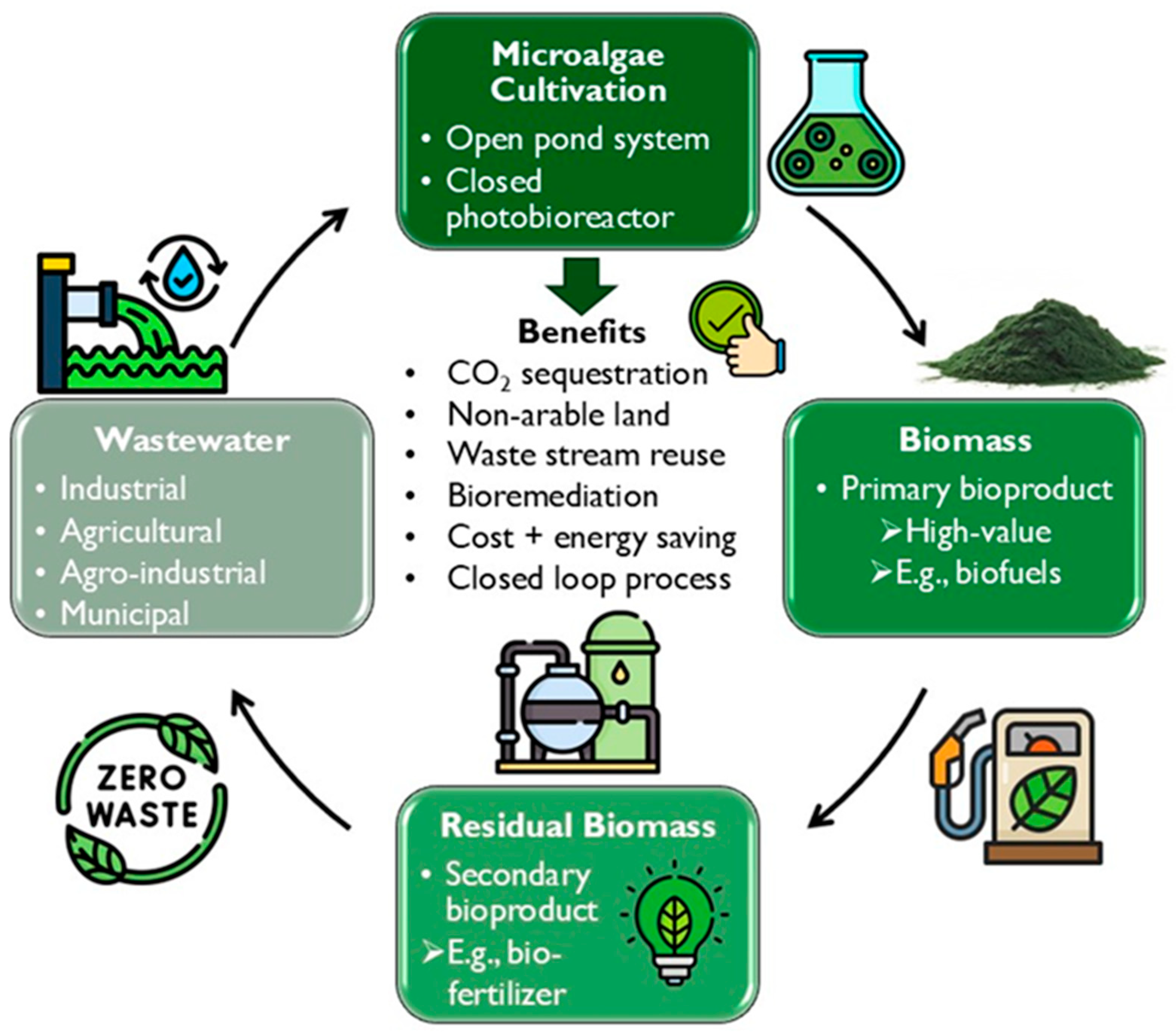
3. Integrated Algal Systems for Waste Valorisation
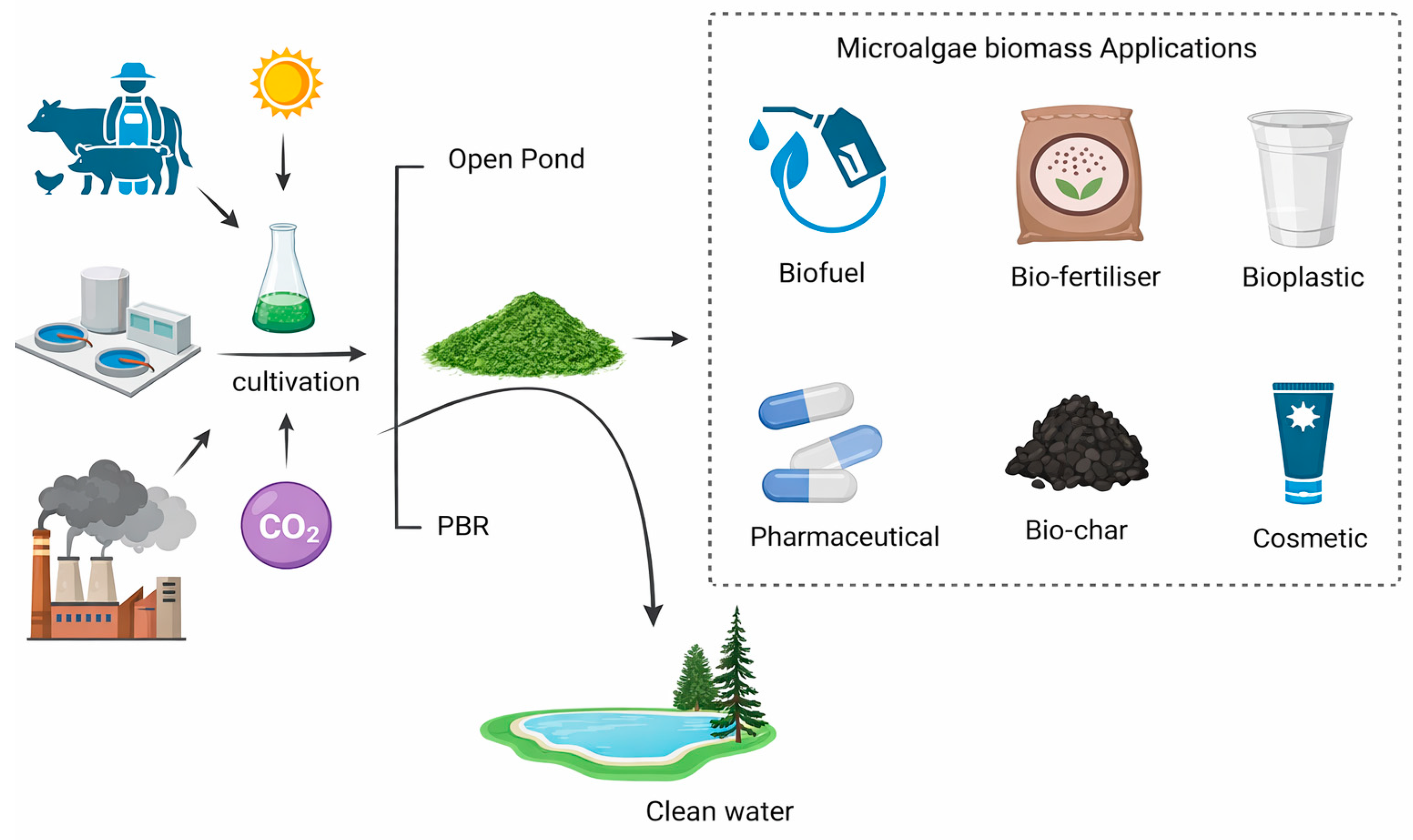
4. The Algal Biorefinery: From Waste to Value
4.1. Microalgae Cultivation in Domestic Wastewater
4.2. Dairy Wastewater
4.3. Sugar Mill Wastewater
4.4. Slaughterhouse Wastewater
4.5. Paper/Pulp Wastewater
4.6. Aquaculture Wastewater
4.7. Produced Water
4.8. Tannery Wastewater

| Wastewater | Microalgae | Removal Efficiency (%) | References | |||
|---|---|---|---|---|---|---|
| N (%) | P (%) | COD (%) | BOD (%) | |||
| Aquaculture WW | S. obliquus | NO3− = 77.77 NH4+ = 68.09 NO2− = 73.83 TON = 68.09 | PO43− = ~100 | 42 | - | [68] |
| C. sorokiniana | NO3− = 75.76 NH4+ = 67.89 NO2− = 81.79 TON = 67.89 | PO43− = ~100 | 69 | - | ||
| A. falcatus | NO3− = 80.85 NH4+ = 75.029 NO2− = 99.73 TON = 75.03 | PO43− = 98.52 | 61 | - | ||
| 75%Raw WW+ 25% algae harvested effluent | T. obliquus | NO3− = 72.63 NH4+ = 93.59 | PO43− = 97.59 | 75.18 | - | [2] |
| Paper pulp industrial WW | T. obliquus | NH4+ = 92.81 NO2− = 92.37 NO3− = 89.37 | PO43− = 72.87 | 80 | [67] | |
| Aquaculture and Pulp WW | C. vulgris | TN = 76.5 | TP = 92.7 | 75.5 | [96] | |
| Tannery WW | Chlorella sp. | NO3− = >90 NH4+ = >90 | PO43− = 77.5 | >90 | >90 | [97] |
| Cattle WW | S. obliquus | NH4+ = 98–99 | PO43− = 69–77.65 | 65–70 | - | [98] |
| Brewery effluent | S. obliquus | TN = 88 | TP = 30 | 71 | - | [99] |
| Brewery WW | S, obliquus | TN = 20.8 | - | 57.7 | [100] | |
| Dairy WW | C. vulgaris | TN = 77 | TP = 78 | 92 | 77 | [101] |
| Real Textile WW | C. vulgaris | NO3− = 60 | TP = 42 | 45 | [102] | |
| Raw WW | C. vulgaris | NH4+ = 94.36 | PO43− = 88.37 | - | - | [103] |
| Domestic WW | S. obliquus | TN = 98.54 | PO43− = 97.9 | 76.3 | - | [4] |
| Slaughterhouse WW | Chlorella and Scenedesmus | TN = 99 NO3− = 90–95 NH4+ = 98–99 | TP = 90–95 PO43 = 98–99 | 99 | 99 | [104] |
| Agricultural runoff | Synechocystis sp., Cf Oocystis sp., and Ulothrix sp. | NH4+ = 93 NO3− = 54 | PO43− = 100 | - | - | [105] |
| Poultry abattoir WW | Tertaselmis suecica | NO3− = 98 | PO43− = 79.9 | 94.5 | 94.3 | [106] |
| Micractinium reisseri | NO3− = 95.4 | PO43− = 64.6 | 86.2 | 84.7 | ||
5. Microalgae for Carbon Neutrality
6. Valorisation of Microalgae Biomass Cultivated in the Waste Stream
6.1. Bioplastics
6.2. Food/Feed
6.3. Biochar
6.4. Fertiliser
7. Use of Molecular Techniques for Enhancing Algal Systems for Wastewater Management
7.1. Genetic Engineering for Enhanced Algal Performance
7.1.1. Engineering Algal Metabolism for Remediation and Valorisation
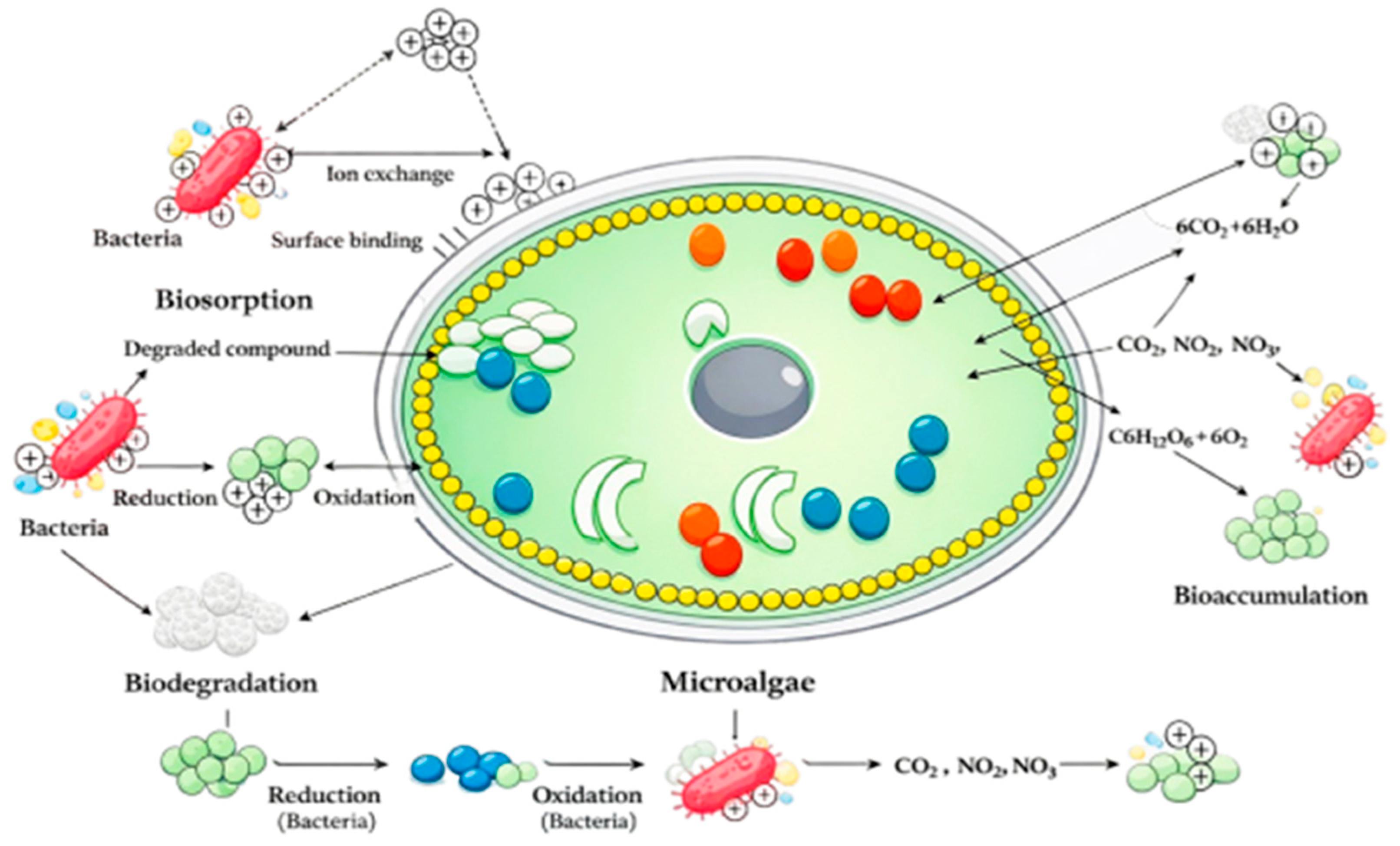
7.1.2. Augmented Heavy Metal Biosorption and Tolerance
7.1.3. Improved Algal Harvesting and Productive Consortia
7.2. Molecular Techniques for Consortia Analysis
7.3. Prospects and Persistent Challenges
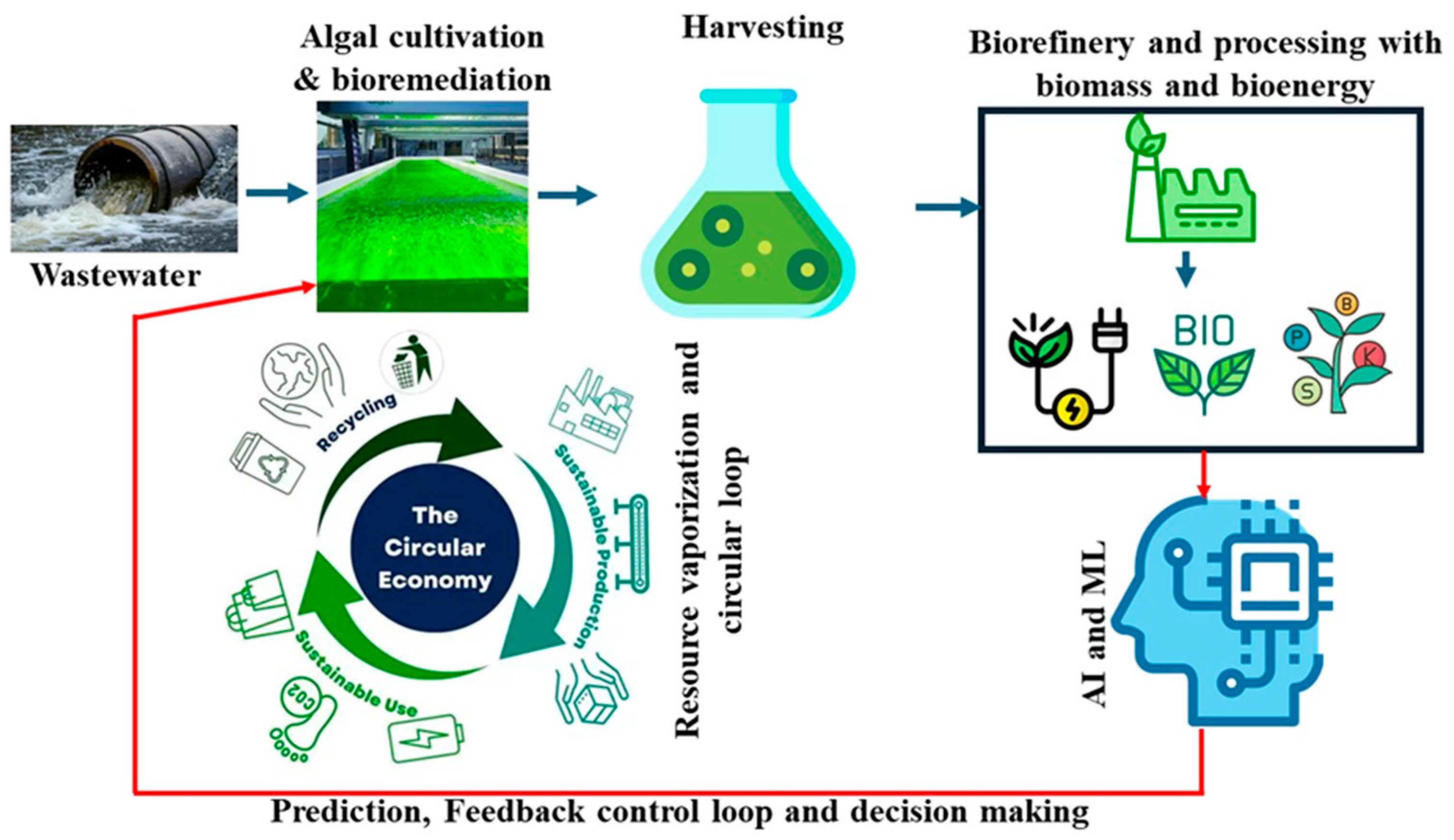
8. Use of AI in Circular Economy and Integrated Algal Systems for Wastewater Management
9. Challenges and Future Perspectives
- Most current research focuses on nutrient removal efficiency and biomass production at the laboratory scale using either real or synthetic wastewater. However, there is a critical need to translate these laboratory findings into real-world conditions to demonstrate practical wastewater treatment.
- Selection of an appropriate algal strain and determining the optimal inoculum concentration are crucial. An algal species that performs well in domestic wastewater may not necessarily be effective for treating other industrial wastewater.
- Application of molecular and bioinformatics tools to identify resilient algae–bacteria consortia that improve wastewater treatment and biomass production.
- Application of AI- and ML-based predictive models to simulate microalgae-driven wastewater treatment processes and optimise valuable biomass production across different wastewater treatment plants.
- Future studies should incorporate Life Cycle Assessment (LCA) and Techno-Economic Analysis (TEA) to provide a comprehensive understanding of the environmental impacts and economic feasibility of microalgae-based wastewater treatment systems. Integrating LCA &TEA will provide a realistic picture of the system’s sustainability, scalability, and potential for implementation under natural operational conditions.
10. Conclusions
Author Contributions
Funding
Institutional Review Board Statement
Informed Consent Statement
Data Availability Statement
Acknowledgments
Conflicts of Interest
Abbreviations
| COD | Chemical oxygen demand |
| TOC | Total organic carbon |
| BOD | Biological oxygen demand |
| PHA | Polyhydroxyalkanoates |
| AI | Artificial Intelligence |
| ML | Machine learning |
| IOT | Inter of things |
References
- Hassan, H.; Ansari, F.A.; Ingle, K.N.; Singh, K.; Bux, F. Commercial products and environmental benefits of algal diversity. In Biodivers. Bioeconomy; Elsevier: Amsterdam, The Netherlands, 2024; pp. 475–502. [Google Scholar]
- Hassan, H.; Ansari, F.A.; Rawat, I.; Bux, F. Unlocking the potential of microalgae: Cultivation in algae recycled effluent with domestic wastewater for enhancing biomass, bioenergy production and CO2 sequestration. J. Water Proc. Eng. 2024, 68, 106499. [Google Scholar] [CrossRef] [Scilit]
- Ansari, F.A.; Nasr, M.; Guldhe, A.; Gupta, S.K.; Rawat, I.; Bux, F. Techno-economic feasibility of algal aquaculture via fish and biodiesel production pathways: A commercial-scale application. Sci. Total Environ. 2020, 704, 135259. [Google Scholar] [CrossRef] [Scilit] [PubMed]
- Gupta, S.K.; Ansari, F.A.; Shriwastav, A.; Sahoo, N.K.; Rawat, I.; Bux, F. Dual role of Chlorella sorokiniana and Scenedesmus obliquus for comprehensive wastewater treatment and biomass production for bio-fuels. J. Clean. Prod. 2016, 115, 255–264. [Google Scholar] [CrossRef] [Scilit]
- Abinandan, S.; Shanthakumar, S. Challenges and opportunities in application of microalgae (Chlorophyta) for wastewater treatment: A review. Renew. Sustain. Energy Rev. 2015, 52, 123–132. [Google Scholar] [CrossRef] [Scilit]
- Prasad, R.; Gupta, S.K.; Shabnam, N.; Oliveira, C.Y.B.; Nema, A.K.; Ansari, F.A.; Bux, F. Role of microalgae in global CO2 sequestration: Physiological mechanism, recent development, challenges, and future perspective. Sustainability 2021, 13, 13061. [Google Scholar] [CrossRef] [Scilit]
- Chew, K.W.; Chia, S.R.; Show, P.L.; Yap, Y.J.; Ling, T.C.; Chang, J.-S. Effects of water culture medium, cultivation systems and growth modes for microalgae cultivation: A review. J. Taiwan Inst. Chem. Eng. 2018, 91, 332–344. [Google Scholar] [CrossRef] [Scilit]
- Borowitzka, M.A. Algal biotechnology. In The Algae World; Springer: Berlin/Heidelberg, Germany, 2015; pp. 319–338. [Google Scholar]
- Satya, A.D.M.; Cheah, W.Y.; Yazdi, S.K.; Cheng, Y.-S.; Khoo, K.S.; Vo, D.-V.N.; Bui, X.D.; Vithanage, M.; Show, P.L. Progress on microalgae cultivation in wastewater for bioremediation and circular bioeconomy. J. Environ. Res. 2023, 218, 114948. [Google Scholar] [CrossRef] [Scilit]
- Chen, G.; Zhao, L.; Qi, Y. Enhancing the productivity of microalgae cultivated in wastewater toward biofuel production: A critical review. Appl. Energy 2015, 137, 282–291. [Google Scholar] [CrossRef] [Scilit]
- Aitken, D.; Bulboa, C.; Godoy-Faundez, A.; Turrion-Gomez, J.L.; Antizar-Ladislao, B. Life cycle assessment of macroalgae cultivation and processing for biofuel production. J. Clean Prod. 2014, 75, 45–56. [Google Scholar] [CrossRef] [Scilit]
- Chen, H.; Zhou, D.; Luo, G.; Zhang, S.; Chen, J. Macroalgae for biofuels production: Progress and perspectives. Renew. Sustain. Energy Rev. 2015, 47, 427–437. [Google Scholar] [CrossRef] [Scilit]
- Arancon, R.A.D.; Lin, C.S.K.; Chan, K.M.; Kwan, T.H.; Luque, R. Advances on waste valorization: New horizons for a more sustainable society. Energy Sci. Eng. 2013, 1, 53–71. [Google Scholar] [CrossRef] [Scilit]
- Chen, Y.; Sun, L.-P.; Liu, Z.-H.; Martin, G.; Sun, Z. Integration of waste valorization for sustainable production of chemicals and materials via algal cultivation. In Chemistry and Chemical Technologies in Waste Valorization; Springer: Berlin/Heidelberg, Germany, 2017; pp. 151–188. [Google Scholar]
- Arora, K.; Kaur, P.; Kumar, P.; Singh, A.; Patel, S.K.S.; Li, X.; Yang, Y.-H.; Bhatia, S.K.; Kulshrestha, S. Valorisation of wastewater resources into biofuel and value-added products using microalgal system. Front. Energy Res. 2021, 9, 646571. [Google Scholar] [CrossRef] [Scilit]
- Zhu, L. Biorefinery as a promising approach to promote microalgae industry: An innovative framework. Renew. Sustain. Energy Rev. 2015, 41, 1376–1384. [Google Scholar] [CrossRef] [Scilit]
- Mehariya, S.; Goswami, R.K.; Verma, P.; Lavecchia, R.; Zuorro, A. Integrated approach for wastewater treatment and biofuel production in microalgae biorefineries. Energies 2021, 14, 2282. [Google Scholar] [CrossRef] [Scilit]
- Bhattacharya, M.; Goswami, S. Microalgae—A green multi-product biorefinery for future industrial prospects. Biocatal. Agric. Biotechnol. 2020, 25, 101580. [Google Scholar] [CrossRef] [Scilit]
- Zabochnicka, M.; Krzywonos, M.; Romanowska-Duda, Z.; Szufa, S.; Darkalt, A.; Mubashar, M. Algal biomass utilization toward circular economy. Life 2022, 12, 1480. [Google Scholar] [CrossRef] [Scilit]
- Boguniewicz-Zablocka, J.; Klosok-Bazan, I.; Naddeo, V. Water quality and resource management in the dairy industry. Environ. Sci. Pollut. Res. 2019, 26, 1208–1216. [Google Scholar] [CrossRef] [Scilit]
- Ahmad, T.; Aadil, R.M.; Ahmed, H.; ur Rahman, U.; Soares, B.C.; Souza, S.L.; Pimentel, T.C.; Scudino, H.; Guimarães, J.T.; Esmerino, E.A.; et al. Treatment and utilisation of dairy industrial waste: A review. Trends Food Sci. Technol. 2019, 88, 361–372. [Google Scholar] [CrossRef] [Scilit]
- Das, P.; Paul, K.K. A Review on Different Treatment Possibilities of Dairy Wastewater. Theor. Found. Chem. Eng. 2023, 57, 563–580. [Google Scholar] [CrossRef] [Scilit]
- Licata, M.; Farruggia, D.; Tuttolomondo, T.; Iacuzzi, N.; Leto, C.; Di Miceli, G. Seasonal response of vegetation on pollutants removal in constructed wetland system treating dairy wastewater. Ecol. Eng. 2022, 182, 106727. [Google Scholar] [CrossRef] [Scilit]
- Ramsuroop, J.; Gutu, L.; Ayinde, W.B.; Basitere, M.; Manono, M.S. A review of biological processes for dairy wastewater treatment and the effect of physical parameters which affect their efficiency. Water 2024, 16, 537. [Google Scholar] [CrossRef] [Scilit]
- Parde, D.; Behera, M. Challenges of wastewater and wastewater management. In Sustainable Industrial Wastewater Treatment and Pollution Control; Springer Nature: Singapore, 2023; pp. 229–255. [Google Scholar]
- Kaur, N. Different treatment techniques of dairy wastewater. Groundw. Sustain. Dev. 2021, 14, 100640. [Google Scholar] [CrossRef] [Scilit]
- Ali, S.K. Evaluation of the physical and chemical treatment of wastewater for the dairy industry. J. Eng. 2022, 28, 1–12. [Google Scholar] [CrossRef] [Scilit]
- How, S.W.; Nittami, T.; Ngoh, G.C.; Curtis, T.P.; Chua, A.S.M. An efficient oxic-anoxic process for treating low COD/N tropical wastewater: Startup, optimization and nitrifying community structure. Chemosphere 2020, 259, 127444. [Google Scholar] [CrossRef] [Scilit]
- Fernández-Arévalo, T.; Lizarralde, I.; Fdz-Polanco, F.; Pérez-Elvira, S.I.; Garrido, J.M.; Puig, S.; Poch, M.; Grau, P.; Ayesa, E. Quantitative assessment of energy and resource recovery in wastewater treatment plants based on plant-wide simulations. Water Res. 2017, 118, 272–288. [Google Scholar] [CrossRef] [Scilit]
- Turan, M. Influence of filtration conditions on the performance of nanofiltration and reverse osmosis membranes in dairy wastewater treatment. Desalination 2004, 170, 83–90. [Google Scholar] [CrossRef] [Scilit]
- Luo, J.; Ding, L.; Wan, Y.; Paullier, P.; Jaffrin, M.Y. Fouling behavior of dairy wastewater treatment by nanofiltration under shear-enhanced extreme hydraulic conditions. Sep. Purif. Technol. 2012, 88, 79–86. [Google Scholar] [CrossRef] [Scilit]
- Gong, Y.W.; Zhang, H.X.; Cheng, X.N. Treatment of dairy wastewater by two-stage membrane operation with ultrafiltration and nanofiltration. Water Sci. Technol. 2012, 65, 915–919. [Google Scholar] [CrossRef] [Scilit]
- Al-Tayawi, A.N.; Gulyás, N.S.; Gergely, G.; Fazekas, Á.F.; Szegedi, B.; Hodúr, C.; Lennert, J.R.; Kertész, S. Enhancing ultrafiltration performance for dairy wastewater treatment using a 3D printed turbulence promoter. Environ. Sci. Res. 2023, 30, 108907–108916. [Google Scholar] [CrossRef] [Scilit] [PubMed]
- Kiani, H.; Azimi, Y.; Li, Y.; Mousavi, M.; Cara, F.; Mulcahy, S.; McDonnell, H.; Blanco, A.; Halim, R. Nitrogen and phosphate removal from dairy processing side-streams by monocultures or consortium of microalgae. J. Biotechnol. 2023, 361, 1–11. [Google Scholar] [CrossRef] [Scilit]
- Singh, P.; Mohanty, S.S.; Mohanty, K. Comprehensive assessment of microalgal-based treatment processes for dairy wastewater. Front. Bioeng. Biotechnol. 2024, 12, 425933. [Google Scholar] [CrossRef] [Scilit] [PubMed]
- Sial, A.; Zhang, B.; Zhang, A.; Liu, K.; Imtiaz, S.A.; Yashir, N. Microalgal–Bacterial Synergistic Interactions and Their Potential Influence in Wastewater Treatment: A Review. BioEnergy Res. 2021, 14, 723–738. [Google Scholar] [CrossRef] [Scilit]
- Phyu, K.K.; Zhi, S.; Liang, J.; Yang, Z.; Zhao, R.; Liu, J.; Cao, Y.; Wang, H.; Zhang, K. Biomass growth, nutrient removal, and microbial community dynamics in mono-, Co-, and sequential culture of screened cyanobacteria with microalgae for dairy wastewater treatment. Bioresour. Technol. 2026, 439, 133329. [Google Scholar] [CrossRef] [Scilit] [PubMed]
- Pandey, A.; Srivastava, S.; Kumar, S. Scenedesmus sp. ASK22 cultivation using simulated dairy wastewater for nutrient sequestration and biofuel production: Insight into fuel properties and their blends. Biomass Conver. Bioref. 2024, 14, 3305–3317. [Google Scholar] [CrossRef] [Scilit]
- Hampannavar, U.S.; Shivayogimath, C.B. Anaerobic treatment of sugar industry wastewater by Upflow anaerobic sludge blanket reactor at ambient temperature. Int. J. Environ. Sci. 2010, 1, 631–639. [Google Scholar]
- Fito, J.; Tefera, N.; Kloos, H.; Van Hulle, S.W.H. Anaerobic treatment of blended sugar industry and ethanol distillery wastewater through biphasic high-rate reactor. J. Environ. Sci. Health Part A 2018, 53, 676–685. [Google Scholar] [CrossRef] [Scilit]
- Nájera-Aguilar, H.A.; Mayorga-Santis, R.; Gutiérrez-Hernández, R.F.; Araiza-Aguilar, J.A.; Martínez-Salinas, R.I.; García-Lara, C.M.; Rojas-Valencia, M.N. Aged refuse filled bioreactor using like a biological treatment for sugar mill wastewater. Sugar Tech 2021, 23, 201–208. [Google Scholar] [CrossRef] [Scilit]
- Sibisi, S.; Mogany, T.; Bux, F.; Rawat, I. Development and performance of microalgae-based symbiotic systems for high-strength chemical oxygen demand wastewater treatment from the sugar mills. Algal Res. 2024, 84, 103773. [Google Scholar] [CrossRef] [Scilit]
- Sydney, E.B.; Neto, C.J.D.; de Carvalho, J.C.; de Souza Vandenberghe, L.P.; Sydney, A.C.N.; Letti, L.A.J.; Karp, S.G.; Soccol, V.T.; Woiciechowski, A.L.; Medeiros, A.B.P.; et al. Microalgal biorefineries: Integrated use of liquid and gaseous effluents from bioethanol industry for efficient biomass production. Bioresour. Technol. 2019, 292, 121955. [Google Scholar] [CrossRef] [Scilit]
- de Godoi, L.A.G.; Camiloti, P.R.; Bernardes, A.N.; Sanchez, B.L.S.; Torres, A.P.R.; da Conceição Gomes, A.; Botta, L.S. Seasonal variation of the organic and inorganic composition of sugarcane vinasse: Main implications for its environmental uses. Environ. Sci. Pollut. Res. 2019, 26, 29267–29282. [Google Scholar] [CrossRef] [Scilit]
- Jiang, Y.; Chen, X.; Wang, Z.; Deng, H.; Qin, X.; Huang, L.; Shen, P. Potential application of a newly isolated microalga Desmodesmus sp. GXU-A4 for recycling Molasses vinasse. Chemosphere 2023, 328, 138616. [Google Scholar] [CrossRef] [Scilit]
- Montalvo, G.E.B.; Thomaz-Soccol, V.; Vandenberghe, L.P.S.; Carvalho, J.C.; Faulds, C.B.; Bertrand, E.; Prado, M.R.M.; Bonatto, S.J.R.; Soccol, C.R. Arthrospira maxima OF15 biomass cultivation at laboratory and pilot scale from sugarcane vinasse for potential biological new peptides production. Bioresour. Technol. 2019, 273, 103–113. [Google Scholar] [CrossRef] [Scilit] [PubMed]
- Oliveira, B.G.; Carvalho, J.L.N.; Chagas, M.F.; Cerri, C.E.P.; Cerri, C.C.; Feigl, B.J. Methane emissions from sugarcane vinasse storage and transportation systems: Comparison between open channels and tanks. Atmos. Environ. 2017, 159, 135–146. [Google Scholar] [CrossRef] [Scilit]
- Fuess, L.T.; Garcia, M.L.; Zaiat, M. Seasonal characterization of sugarcane vinasse: Assessing environmental impacts from fertirrigation and the bioenergy recovery potential through biodigestion. Sci. Total Environ. 2018, 634, 29–40. [Google Scholar] [CrossRef] [Scilit]
- Mamani Condori, M.A.; Jove, M.D.C.; Morales, S.F.A.; Llayqui, N.E.V.; Ángeles, R.; Lebrero, R.; García-Camacho, F. Sustainable treatment of sugarcane vinasse using Chlorella sp. in scalable airlift flat-panel photobioreactors: Nutrient removal and biomass valorization. Environ. Sci. Pollut. Res. 2025, 32, 11708–11726. [Google Scholar] [CrossRef] [Scilit] [PubMed]
- Catone, C.M.; Ripa, M.; Geremia, E.; Ulgiati, S. Bio-products from algae-based biorefinery on wastewater: A review. J. Environ. Manag. 2021, 293, 112792. [Google Scholar] [CrossRef] [Scilit]
- Ummalyma, S.B.; Sahoo, D.; Pandey, A. Resource recovery through bioremediation of wastewaters and waste carbon by microalgae: A circular bioeconomy approach. Environ. Sci. Pollut. Res. 2021, 28, 58837–58856. [Google Scholar] [CrossRef] [Scilit]
- Ramirez, N.N.V.; Farenzena, M.; Trierweiler, J.O. Growth of microalgae Scenedesmus sp. in ethanol vinasse. Braz. Arch. Biol. Technol. 2014, 57, 630–635. [Google Scholar] [CrossRef] [Scilit]
- Johns, M.R. Developments in wastewater treatment in the meat processing industry: A review. Bioresour. Technol. 1995, 54, 203–216. [Google Scholar] [CrossRef] [Scilit]
- OECD. OECD-FAO Agricultural Outlook 2020–2029; OECD Publishing: Paris, France, 2020. [Google Scholar]
- Hoekstra, A.Y.; Chapagain, A.K. Water footprints of nations: Water use by people as a function of their consumption pattern. Water Resour. Manag. 2006, 21, 35–48. [Google Scholar] [CrossRef] [Scilit]
- Ng, M.; Dalhatou, S.; Wilson, J.; Kamdem, B.P.; Temitope, M.B.; Paumo, H.K.; Djelal, H.; Assadi, A.A.; Nguyen-Tri, P.; Kane, A. Characterization of Slaughterhouse Wastewater and Development of Treatment Techniques: A Review. Processes 2022, 10, 1300. [Google Scholar] [CrossRef] [Scilit]
- Mousavi, S.A.; Khodadoost, F. Effects of detergents on natural ecosystems and wastewater treatment processes: A review. Environ. Sci. Pollut. Res. 2019, 26, 26439–26448. [Google Scholar] [CrossRef] [Scilit]
- Sau, A.; Ghosh, S.; Kandar, B.; Ghanta, K.C.; Baltrėnaitė-Gedienė, E.; Dutta, S. Enhanced slaughterhouse wastewater treatment: A comparative approach with phycoremediation and adsorption. J. Indian Chem. Soc. 2024, 101, 101499. [Google Scholar] [CrossRef] [Scilit]
- Abdelhay, A.; Othman, A.A.; Albsoul, A. Treatment of slaughterhouse wastewater using high-frequency ultrasound: Optimization of operating conditions by RSM. Environm. Technol. 2021, 42, 4170–4178. [Google Scholar] [CrossRef] [Scilit]
- Kothari, R.; Azam, R.; Bharti, A.; Goria, K.; Allen, T.; Ashokkumar, V.; Pathania, D.; Singh, R.P.; Tyagi, V.V. Biobased treatment and resource recovery from slaughterhouse wastewater via reutilization and recycling for sustainable waste approach. J. Water Proc. Eng. 2024, 58, 104712. [Google Scholar] [CrossRef] [Scilit]
- Abirama, V.; Mohamed, R.M.S.R.; Al-Gheethi, A.; Abdul Malek, M.; Kassim, A.H.M. Meat processing wastewater Phycoremediation by Botryococcus sp.: A biokinetic study and a techno-economic analysis. Sep. Sci. Technol. 2021, 56, 577–591. [Google Scholar] [CrossRef] [Scilit]
- Saleh, D.G.; Ibrahim, M.M.; El-Sayed, A.B.; Mostafa, E. Phycoremediation of slaughterhouse wastewater using microalgae for nutrient recovery and biodiesel production. Egypt. J. Chem. 2022, 65, 1283–1289. [Google Scholar] [CrossRef] [Scilit]
- Singh, A.K.; Kumar, A.; Chandra, R. Environmental pollutants of paper industry wastewater and their toxic effects on human health and ecosystem. Bioresour. Technol. Rep. 2022, 20, 101250. [Google Scholar] [CrossRef] [Scilit]
- Kumar, V.; Malyan, S.K.; Apollon, W.; Verma, P. Valorization of pulp and paper industry waste streams into bioenergy and value-added products: An integrated biorefinery approach. Renew. Energy 2024, 228, 120566. [Google Scholar] [CrossRef] [Scilit]
- Kumar, A.; Singh, A.K.; Ahmad, S.; Chandra, R. Optimization of laccase production by Bacillus sp. strain AKRC01 in presence of agro-waste as effective substrate using Response Surface Methodology. J. Pure Appl. Microbiol. 2020, 14, 351–362. [Google Scholar] [CrossRef] [Scilit]
- Satiro, J.; Gomes, A.; Florencio, L.; Simões, R.; Albuquerque, A. Effect of microalgae and bacteria inoculation on the startup of bioreactors for paper pulp wastewater and biofuel production. J. Environ. Manag. 2024, 362, 121305. [Google Scholar] [CrossRef] [Scilit]
- Bagchi, S.K.; Patnaik, R.; Rawat, I.; Prasad, R.; Bux, F. Beneficiation of paper-pulp industrial wastewater for improved outdoor biomass cultivation and biodiesel production using Tetradesmus obliquus (Turpin) Kützing. Renew. Energy 2024, 222, 119848. [Google Scholar] [CrossRef] [Scilit]
- Ansari, F.A.; Guldhe, A.; Gupta, S.K.; Rawat, I.; Bux, F. Improving the feasibility of aquaculture feed by using microalgae. Environ. Sci. Pollut. Res. 2021, 28, 43234–43257. [Google Scholar] [CrossRef] [Scilit] [PubMed]
- Tomasi, I.T.; Santos, I.; Gozubuyuk, E.; Santos, O.; Boaventura, R.A.; Botelho, C.M. A sustainable solution for aquaculture wastewater treatment: Evaluation of tannin-based and conventional coagulants. Chemosphere 2025, 377, 144320. [Google Scholar] [CrossRef] [Scilit]
- Chu, G.; Wang, Q.; Song, C.; Liu, J.; Zhao, Y.; Lu, S.; Zhang, Z.; Jin, C.; Gao, M. Platymonas helgolandica-driven nitrogen removal from mariculture wastewater under different photoperiods: Performance evaluation, enzyme activity and transcriptional response. Bioresour. Technol. 2023, 372, 128700. [Google Scholar] [CrossRef] [Scilit]
- Gong, W.; Guo, L.; Huang, C.; Xie, B.; Jiang, M.; Zhao, Y.; Zhang, H.; Wu, Y.; Liang, H. A systematic review of antibiotics and antibiotic resistance genes (ARGs) in mariculture wastewater: Antibiotics removal by microalgal-bacterial symbiotic system (MBSS), ARGs characterization on the metagenomic. Sci. Total Environ. 2024, 930, 172601. [Google Scholar] [CrossRef] [Scilit]
- Ende, S.; Henjes, J.; Spiller, M.; Elshobary, M.; Hanelt, D.; Abomohra, A. Recent advances in recirculating aquaculture systems and role of microalgae to close system loop. Bioresour. Technol. 2024, 407, 131107. [Google Scholar] [CrossRef] [Scilit] [PubMed]
- Yakamercan, E.; Turco, R.F.; Nas, B.; Hussain, A.S.; Aygun, A.; Meador, L.; Simsek, H. Optimizing electrochemical methods for fish wastewater treatment in recirculating aquaculture systems. J. Water Process Eng. 2024, 66, 105891. [Google Scholar] [CrossRef] [Scilit]
- Borg-Stoveland, S.; Draganovic, V.; Spilling, K.; Gabrielsen, T.M. Successful growth of coastal marine microalgae in wastewater from a salmon recirculating aquaculture system. J. Appl. Phycol. 2024, 36, 2851–2861. [Google Scholar] [CrossRef] [Scilit]
- Ansari, F.A.; Singh, P.; Guldhe, A.; Bux, F. Microalgal cultivation using aquaculture wastewater: Integrated biomass generation and nutrient remediation. Algal Res. 2017, 21, 169–177. [Google Scholar] [CrossRef] [Scilit]
- Guldhe, A.; Ansari, F.A.; Singh, P.; Bux, F. Heterotrophic cultivation of microalgae using aquaculture wastewater: A biorefinery concept for biomass production and nutrient remediation. Ecol. Eng. 2017, 99, 47–53. [Google Scholar] [CrossRef] [Scilit]
- Shahbaz, M.; Rashid, N.; Saleem, J.; Mackey, H.; McKay, G.; Al-Ansari, T. A review of waste management approaches to maximise the sustainable value of waste from the oil and gas industry and potential for the State of Qatar. Fuel 2023, 332, 126220. [Google Scholar] [CrossRef] [Scilit]
- Andrade, B.B.; de Souza, C.O.; Miranda, N.H.; dos Santos França, J.; Lombardi, A.T.; Silva, S.M.; de Jesus Assis, D.; da Silva, J.B.A.; Chinalia, F.A.; Cardoso, L.G. Integrated microalgae biorefinery using produced water: Simultaneous obtaining of biomass, biofuels and exopolysaccharides. Algal Res. 2025, 90, 104140. [Google Scholar] [CrossRef] [Scilit]
- Da Silva, V.L.; Ribeiro, L.S.; de Oliveira Freitas, J.C.; da Silva, D.N.N.; de Carvalho, L.S.; Rodrigues, M.A.F.; Wanderley; Neto, A.D.O. Application of SDS surfactant microemulsion for removal of filter cake of oil-based drilling fluid: Influence of cosurfactant. J Petr. Explore. Prod. Technol. 2020, 10, 2845–2856. [Google Scholar] [CrossRef] [Scilit]
- Hasanzadeh, R.; Abbasi Souraki, B.; Pendashteh, A.; Khayati, G.; Ahmadun, F.-R. Application of isolated halophilic microorganisms suspended and immobilised on walnut shells as biocarriers for the treatment of oilfield produced water. J. Hazard. Mater. 2020, 400, 123197. [Google Scholar] [CrossRef] [Scilit]
- Ahmadizadeh, R.; Shokrollahzadeh, S.; Latifi, S.M.; Samimi, A.; Pendashteh, A. Application of halophilic microorganisms in osmotic membrane bioreactor (OMBR) for reduction of volume and organic load of produced water. J. Water Proc. Eng. 2020, 37, 101422. [Google Scholar] [CrossRef] [Scilit]
- Cavalcanti Pessôa, L.; Pinheiro Cruz, E.; Mosquera Deamici, K.; Bomfim Andrade, B.; Santana Carvalho, N.; Rocha Vieira, S.; Alves da Silva, J.B.; Magalhães Pontes, L.A.; Oliveira de Souza, C.; Druzian, J.I.; et al. A review of microalgae-based biorefineries approach for produced water treatment: Barriers, pretreatments, supplementation, and perspectives. J. Environ. Chem. Eng. 2022, 10, 108096. [Google Scholar] [CrossRef] [Scilit]
- Nagarajan, D.; Lee, D.-J.; Chen, C.-Y.; Chang, J.-S. Resource recovery from wastewaters using microalgae-based approaches: A circular bioeconomy perspective. Bioresour. Technol. 2020, 302, 122817. [Google Scholar] [CrossRef] [Scilit]
- Pires, J.C.M.; Alvim-Ferraz, M.C.M.; Martins, F.G.; Simoes, M. Wastewater treatment to enhance the economic viability of microalgae culture. Environ. Sci. 2013, 20, 5096–5105. [Google Scholar] [CrossRef] [Scilit] [PubMed]
- Parsy, A.; Guyoneaud, R.; Lot, M.-C.; Baldoni-Andrey, P.; Périé, F.; Sambusiti, C. Impact of salinities, metals and organic compounds found in saline oil & gas produced water on microalgae and cyanobacteria. Ecotoxicol. Environ. Saf. 2022, 234, 113351. [Google Scholar] [CrossRef] [Scilit] [PubMed]
- Khairuddin, N.F.M.; Khan, N.; Sankaran, S.; Farooq, W.; Ahmad, I.; Aljundi, I.H. Produced water treatment by semi-continuous sequential bioreactor and microalgae photobioreactor. Bioresour. Bioprocess. 2024, 11, 56. [Google Scholar] [CrossRef] [Scilit]
- Al Subaie, H.A.; Khairuddin, N.F.; Tahir, M.N.; Alhaddad, M.A.; Faruque, M.O.; Razzak, S.A.; Chanbasha, B.; Shamsi, A.M.; Kamal, M.S.; Farooq, W. Microalgae-Based Treatment of Produced Water: A Comparison between Synthetic and a Representative Real Produced Water. Results Eng. 2025, 27, 106679. [Google Scholar] [CrossRef] [Scilit]
- Berhe, S.; Leta, S. Anaerobic co-digestion of tannery waste water and tannery solid waste using two-stage anaerobic sequencing batch reactor: Focus on performances of methanogenic step. J. Mater. Cycles Waste Manag. 2018, 20, 1468–1482. [Google Scholar] [CrossRef] [Scilit]
- Fitch, A.; Balderas-Hernandez, P.; Ibanez, J.G. Electrochemical technologies combined with physical, biological, and chemical processes for the treatment of pollutants and wastes: A review. J. Environ. Chem. Eng. 2022, 10, 107810. [Google Scholar] [CrossRef] [Scilit]
- Mousset, E.; Trellu, C.; Olvera-Vargas, H.; Pechaud, Y.; Fourcade, F.; Oturan, M.A. Electrochemical technologies coupled with biological treatments. Curr. Opin. Electrochem. 2021, 26, 100668. [Google Scholar] [CrossRef] [Scilit]
- Gonçalves, A.L.; Pires, J.C.M.; Simões, M. A review on the use of microalgal consortia for wastewater treatment. Algal Res. 2017, 24, 403–415. [Google Scholar] [CrossRef] [Scilit]
- Molinuevo-Salces, B.; Riaño, B.; Hernández, D.; Cruz García-González, M. Microalgae and Wastewater Treatment: Advantages and Disadvantages. In Microalgae Biotechnology for Development of Biofuel and Wastewater Treatment; Springer: Singapore, 2019; pp. 505–533. [Google Scholar]
- Devi, A.; Verma, M.; Saratale, G.D.; Saratale, R.G.; Ferreira, L.F.R.; Mulla, S.I.; Haragava, R.N. Microalgae: A green eco-friendly agents for bioremediation of tannery wastewater with simultaneous production of value-added products. Chemosphere 2023, 336, 139192. [Google Scholar] [CrossRef] [Scilit]
- Nambukrishna, V.; Singaram, J. Investigation on Tannery Wastewater as Feedstock for Marine Microalgae in biofuel production. Tierärztliche Prax. 2020, 40, 989–997. [Google Scholar]
- Rajalakshmi, A.M.; Silambarasan, T.; Dhandapani, R. Small scale photo bioreactor treatment of tannery wastewater, heavy metal biosorption and CO2 sequestration using microalga Chlorella sp.: A biodegradation approach. Appl. Water Sci. 2021, 11, 108. [Google Scholar] [CrossRef] [Scilit]
- Daneshvar, E.; Antikainen, L.; Koutra, E.; Kornaros, M.; Bhatnagar, A. Investigation on the feasibility of Chlorella vulgaris cultivation in a mixture of pulp and aquaculture effluents: Treatment of wastewater and lipid extraction. Bioresour. Technol. 2018, 255, 104–110. [Google Scholar] [CrossRef] [Scilit]
- Urbina-Suarez, N.A.; Salcedo-Pabón, C.J.; Contreras-Ropero, J.E.; López-Barrera, G.L.; García-Martínez, J.B.; Barajas-Solano, A.F.; Machuca-Martínez, F. Biotechnological strategy for tannery wastewater treatment: Bicarbonate/H2O2 oxidation integrated with microalgae cultivation. Case Stud. Chem. Environ. Eng. 2025, 11, 101060. [Google Scholar] [CrossRef] [Scilit]
- de Mendonça, H.V.; Ometto, J.P.H.B.; Otenio, M.H.; Marques, I.P.R.; Dos Reis, A.J.D. Microalgae-mediated bioremediation and valorization of cattle wastewater previously digested in a hybrid anaerobic reactor using a photobioreactor: Comparison between batch and continuous operation. Sci. Total Environ. 2018, 633, 1–11. [Google Scholar] [CrossRef] [Scilit]
- Ferreira, A.; Ribeiro, B.; Ferreira, A.F.; Tavares, M.L.; Vladic, J.; Vidović, S.; Cvetkovic, D.; Melkonyan, L.; Avetisova, G.; Goginyan, V.; et al. Scenedesmus obliquus microalga-based biorefinery—From brewery effluent to bioactive compounds, biofuels and biofertilizers–aiming at a circular bioeconomy. Biofuels Bioprod. Biorefin. 2019, 13, 1169–1186. [Google Scholar] [CrossRef] [Scilit]
- Mata, T.M.; Melo, A.C.; Simões, M.; Caetano, N.S. Parametric study of a brewery effluent treatment by microalgae Scenedesmus obliquus. Bioresour. Technol. 2012, 107, 151–158. [Google Scholar] [CrossRef] [Scilit]
- Handayani, T.; Mulyanto, A.; Priyanto, F.E.; Nugroho, R. Utilization of dairy industry wastewater for nutrition of microalgae Chlorella vulgaris. J. Phys. Conf. Ser. 2020, 1655, 012123. [Google Scholar] [CrossRef] [Scilit]
- Younas, M.; Rehman, F.; Al Zuhair, S.; Ahmed, F.; Muzafar, M.; Awad, A.; Asif, M.; Javed, F. Synergistic approach to industrial wastewater treatment: Combining plasmolysis and microalgae cultivation. Chem. Eng. Process. Process Intensif. 2025, 209, 110198. [Google Scholar] [CrossRef] [Scilit]
- Chaleshtori, S.N.; Shamskilani, M.; Babaei, A.; Behrang, M. Municipal wastewater treatment and fouling in microalgal-activated sludge membrane bioreactor: Cultivation in raw and treated wastewater. J. Water Proc. Eng. 2022, 49, 103069. [Google Scholar] [CrossRef] [Scilit]
- Bedane, D.T.; Asfaw, S.L. Performance evaluation of a two-phase anaerobic reactor coupled with microalgae photobioreactors for slaughterhouse wastewater treatment in Ethiopia. Biomass Conver. Bioref. 2025, 15, 5659–5671. [Google Scholar] [CrossRef] [Scilit]
- García-Galán, M.J.; Monllor-Alcaraz, L.S.; Postigo, C.; Uggetti, E.; de Alda, M.L.; Diez-Montero, R.; García, J. Microalgae-based bioremediation of water contaminated by pesticides in peri-urban agricultural areas. Environ. Pollut. 2020, 265, 114579. [Google Scholar] [CrossRef] [Scilit] [PubMed]
- Devrajani, S.K. A sustainable microalgal cultivation approach for the treatment of poultry abattoir wastewater and biofuel production. Environ. Monitor. Assess. 2025, 197, 1038. [Google Scholar] [CrossRef] [Scilit] [PubMed]
- Ighalo, J.O.; Dulta, K.; Kurniawan, S.B.; Omoarukhe, F.O.; Ewuzie, U.; Eshiemogie, S.O.; Ojo, A.U.; Abdullah, S.R.S. Progress in microalgae application for CO2 sequestration. Clean. Chem. Eng. 2022, 3, 100044. [Google Scholar] [CrossRef] [Scilit]
- Tripathi, S.; Choudhary, S.; Meena, A.; Poluri, K.M. Carbon capture, storage, and usage with microalgae: A review. Environ. Chem. Lett. 2023, 21, 2085–2128. [Google Scholar] [CrossRef] [Scilit]
- Xu, P.; Li, J.; Qian, J.; Wang, B.; Liu, J.; Xu, R.; Chen, P.; Zhou, W. Recent advances in CO2 fixation by microalgae and its potential contribution to carbon neutrality. Chemosphere 2023, 319, 137987. [Google Scholar] [CrossRef] [Scilit] [PubMed]
- Rafiq, A.; Morris, C.; Schudel, A.; Gheewala, S. Life Cycle Assessment of Microalgae-Based Products for Carbon Dioxide Utilization in Thailand: Biofertilizer, Fish Feed, and Biodiesel. F1000Research 2025, 13, 1503. [Google Scholar] [CrossRef] [Scilit]
- Sarwer, A.; Hamed, S.M.; Osman, A.I.; Jamil, F.; Al-Muhtaseb, A.A.H.; Alhajeri, N.S.; Rooney, D.W. Algal biomass valorization for biofuel production and carbon sequestration: A review. Environ. Chem. Lett. 2022, 20, 2797–2851. [Google Scholar] [CrossRef] [Scilit]
- Kumar, K.; Dasgupta, C.N.; Nayak, B.; Lindblad, P.; Das, D. Development of suitable photobioreactors for CO2 sequestration addressing global warming using green algae and cyanobacteria. Bioresour. Technol. 2011, 102, 4945–4953. [Google Scholar] [CrossRef] [Scilit]
- Andrews, F.; Faulkner, M.; Toogood, H.S.; Scrutton, N.S. Combinatorial Use of Environmental Stresses and Genetic Engineering to Increase Ethanol Titres in Cyanobacteria. Biotechnol. Biofuels 2021, 14, 240. [Google Scholar] [CrossRef] [Scilit]
- Madadi, R.; Maljaee, H.; Serafim, L.S.; Ventura, S.P.M. Microalgae as contributors to produce biopolymers. Mar. Drugs 2021, 19, 466. [Google Scholar] [CrossRef] [Scilit]
- Semba, T.; Sakai, Y.; Sakanishi, T.; Inaba, A. Greenhouse gas emissions of 100% bio-derived polyethylene terephthalate on its life cycle compared with petroleum-derived polyethylene terephthalate. J. Clean. Prod. 2018, 195, 932–938. [Google Scholar] [CrossRef] [Scilit]
- Venkatachalam, H.; Palaniswamy, R. Bioplastic World: A review. J. Adv. Sci. Res. 2020, 11, 43–53. [Google Scholar]
- Park, H.; He, H.; Yan, X.; Liu, X.; Scrutton, N.S.; Chen, G.Q. PHA is not just a bioplastic! Biotechnol. Adv. 2024, 71, 108320. [Google Scholar] [CrossRef] [Scilit]
- Naser, A.Z.; Deiab, I.; Darras, B.M. Poly (lactic acid) (PLA) and polyhydroxyalkanoates (PHAs), green alternatives to petroleum-based plastics: A review. RSC Adv. 2021, 11, 17151–17196. [Google Scholar] [CrossRef] [Scilit] [PubMed]
- Cheah, W.Y.; Er, A.C.; Aiyub, K.; Mohd, Y.N.H.; Ngan, S.L.; Chew, K.W.; Khoo, K.S.; Ling, T.C.; Juan, J.C.; Ma, Z.; et al. Current status and perspectives of algae-based bioplastics: A reviewed potential for sustainability. Algal Res. 2023, 71, 103078. [Google Scholar] [CrossRef] [Scilit]
- Afreen, R.; Tyagi, S.; Singh, G.P.; Singh, M. Challenges and perspectives of polyhydroxyalkanoate production from microalgae/Cyanobacteria and bacteria as microbial factories: An assessment of hybrid biological System. Front. Bioeng. Biotechnol. 2019, 9, 624885. [Google Scholar] [CrossRef] [Scilit]
- Chong, J.W.R.; Yew, G.Y.; Khoo, K.S.; Ho, S.H.; Show, P.L. Recent advances on food waste pretreatment technology via microalgae for source of polyhydroxyalkanoates. J. Environ. Manag. 2021, 293, 112782. [Google Scholar] [CrossRef] [Scilit]
- Kavitha, G.; Kurinjimalar, C.; Sivakumar, K.; Kaarthik, M.; Aravind, R.; Palani, P.; Rengasamy, R. Optimization of polyhydroxybutyrate production utilizing wastewater as nutrient source by Botryococcus braunii Kütz using response surface methodology. Int. J. Biol. Macromol. 2016, 93, 534–542. [Google Scholar] [CrossRef] [Scilit] [PubMed]
- Kumari, P.; Kiran, B.R.; Mohan, S.V. Polyhydroxybutyrate production by Chlorella sorokiniana SVMIICT8 under nutrient-deprived mixotrophy. Bioresour. Technol. 2022, 354, 127135. [Google Scholar] [CrossRef] [Scilit]
- García, G.; Sosa-Hernández, J.E.; Rodas-Zuluaga, L.I.; Castillo-Zacarías, C.; Iqbal, H.; Parra-Saldívar, R. Accumulation of PHA in the microalgae Scenedesmus sp. under nutrient-deficient conditions. Polymers 2020, 13, 131. [Google Scholar] [CrossRef] [Scilit]
- Pezzolesi, L.; Samorì, C.; Zoffoli, G.; Xamin, G.; Simonazzi, M.; Pistocchi, R. Semi-continuous production of polyhydroxybutyrate (PHB) in the Chlorophyta Desmodesmus communis. Algal Res. 2003, 74, 103196. [Google Scholar] [CrossRef] [Scilit]
- Chaudry, S.; Hurtado-McCormick, V.; Cheng, K.Y.; Willis, A.; Speight, R.; Kaksonen, A.H. Microalgae to bioplastics—Routes and challenges. Clean. Eng. Technol. 2025, 25, 100922. [Google Scholar] [CrossRef] [Scilit]
- Lee, S.Y.; Lee, J.S.; Sim, S.J. Cost-effective production of bioplastic polyhydroxybutyrate via introducing heterogeneous constitutive promoter and elevating acetyl-Coenzyme A pool of rapidly growing cyanobacteria. Bioresour. Technol. 2024, 394, 130297. [Google Scholar] [CrossRef] [Scilit]
- Kusmayadi, A.; Leong, Y.K.; Yen, H.W.; Huang, C.Y.; Chang, J.S. Microalgae as sustainable food and feed sources for animals and humans–biotechnological and environmental aspects. Chemosphere 2021, 271, 129800. [Google Scholar] [CrossRef] [Scilit]
- Bhalamurugan, G.L.; Valerie, O.; Mark, L. Valuable bioproducts obtained from microalgal biomass and their commercial applications: A review. Environ. Eng. Res. 2018, 23, 229–241. [Google Scholar] [CrossRef] [Scilit]
- Yu, B.S.; Pyo, S.; Lee, J.; Han, K. Microalgae: A multifaceted catalyst for sustainable solutions in renewable energy, food security, and environmental management. Microb. Cell Fact. 2024, 23, 308. [Google Scholar] [CrossRef] [Scilit] [PubMed]
- Khan, S.; Das, P.; Thaher, M.I.; AbdulQuadir, M.; Mahata, C.; Al Jabri, H. Utilization of nitrogen-rich agricultural waste streams by microalgae for the production of protein and value-added compounds. Current Opin. Green Sustain. Chem. 2023, 41, 100797. [Google Scholar] [CrossRef] [Scilit]
- Das, B.D.; Bhattarai, A. The versatility of algae in addressing the global sustainability challenges. Front. Bioeng. Biotechnol. 2025, 13, 1621817. [Google Scholar] [CrossRef] [Scilit]
- Gupta, R.; Mishra, N.; Singh, G.; Mishra, S.; Lodhiyal, N. Microalgae cultivation and value-based products from wastewater: Insights and applications. Blue Biotechnol. 2024, 1, 20. [Google Scholar] [CrossRef] [Scilit]
- Patras, D.; Moraru, C.V.; Socaciu, C. Bioactive ingredients from microalgae: Food and feed applications. Bull. UASVM Food Sci. Technol. 2019, 76, 1–9. [Google Scholar] [CrossRef] [Scilit]
- Thoré, E.S.; Schoeters, F.; De Cuyper, A.; Vleugels, R.; Noyens, I.; Bleyen, P.; Van Miert, S. Waste is the new wealth–recovering resources from poultry wastewater for multifunctional microalgae feedstock. Front. Environ. Sci. 2021, 9, 679917. [Google Scholar] [CrossRef] [Scilit]
- Wang, Q.; Jeheeb, R.; Higgins, B. Waste to fish feed: Producing aquatic crustaceans using microalgae cultured from wastewater. Algal Res. 2025, 92, 104378. [Google Scholar] [CrossRef] [Scilit]
- Gorzelnik, S.A.; Zhu, X.; Angelidaki, I.; Koski, M.; Valverde-Pérez, B. Daphnia magna as biological harvesters for green microalgae grown on recirculated aquaculture system effluents. Sci. Total Environ. 2023, 873, 162247. [Google Scholar] [CrossRef] [Scilit]
- Khatoon, H.; Banerjee, S.; Syahiran, M.S.; Noordin, N.B.M.; Bolong, A.M.A.; Endut, A. Re-use of aquaculture wastewater in cultivating microalgae as live feed for aquaculture organisms. Desalination Water Treat. 2016, 57, 29295–29302. [Google Scholar] [CrossRef] [Scilit]
- de Paula Pereira, A.S.A.; Silva, T.A.; Magalhães, I.B.; Ferreira, J.; Braga, M.Q.; Lorentz, J.F.; Assemany, P.P.; do Couto, E.D.A.; Calijuri, M.L. Biocompounds from wastewater-grown microalgae: A review of emerging cultivation and harvesting technologies. Sci. Total Environ. 2024, 920, 170918. [Google Scholar] [CrossRef] [Scilit] [PubMed]
- Sirohi, R.; Kumar, M.; Vivekanand, V.; Shakya, A.; Tarafdar, A.; Singh, R.; Sawarkar, A.D.; Hoang, A.T.; Pandey, A. Integrating biochar in anaerobic digestion: Insights into diverse feedstocks and algal biochar. Environ. Technol. Innov. 2024, 36, 103814. [Google Scholar] [CrossRef] [Scilit]
- Zhang, X.; Kaštyl, J.; Casas-Luna, M.; Havlíček, L.; Vondra, M.; Brummer, V.; Sukačová, K.; Máša, V.; Teng, S.Y.; Neugebauer, P. Microalgae-derived nanoporous biochar for ammonia removal in sustainable wastewater treatment. J. Environ. Chem. Eng. 2022, 10, 108514. [Google Scholar] [CrossRef] [Scilit]
- Zhuang, G.; Ye, Y.; Zhao, J.; Zhou, C.; Zhu, J.; Li, Y.; Zhang, J.; Yan, X. Valorization of Phaeodactylum tricornutum for integrated preparation of diadinoxanthin and fucoxanthin. Bioresour. Technol. 2023, 385, 129412. [Google Scholar] [CrossRef] [Scilit] [PubMed]
- de Morais, E.G.; da Silveira, J.T.; Schüler, L.M.; de Freitas, B.C.B.; Costa, J.A.V.; de Morais, M.G.; Ferrer, I.; Barreira, L. Biomass valorization via pyrolysis in microalgae-based wastewater treatment: Challenges and opportunities for a circular bioeconomy. J. Appl. Phycol. 2023, 35, 2689–2708. [Google Scholar] [CrossRef] [Scilit]
- Li, Y.; Fan, M.; Yu, B.; Wang, C.; Yu, X.; Ding, J.; Qin, G.; Yan, L.; Yin, K.; Wang, L. Amorphous molybdenum sulfide nanosheets composed of [Mo3S13] 2-active-site motifs for enhancing conversion of Fe3+/Fe2+ in Fenton reaction under neutral condition. Chem. Eng. J. 2024, 495, 153463. [Google Scholar] [CrossRef] [Scilit]
- Lu, H.; Liu, Y.; Chinnathambi, A.; Almoallim, H.S.; Jhanani, G.K.; Brindhadevi, K.; Boomadevi, P.; Xia, C. Production and utilization of the Chlorella vulgaris microalgae biochar as the fuel pellets combined with mixed biomass. Fuel 2024, 355, 129395. [Google Scholar] [CrossRef] [Scilit]
- Nageshwari, K.; Chang, S.X.; Balasubramanian, P. Integrated electrocoagulation-flotation of microalgae to produce Mg-laden microalgal biochar for seeding struvite crystallization. Sci. Rep. 2022, 12, 11463. [Google Scholar] [CrossRef] [Scilit]
- Sun, Y.Y.; Gössling, S.; Hem, L.E.; Iversen, N.M.; Walnum, H.J.; Scott, D.; Oklevik, O. Can Norway become a net-zero economy under scenarios of tourism growth? J. Clean. Prod. 2022, 363, 132414. [Google Scholar] [CrossRef] [Scilit]
- Khan, A.A.; Gul, J.; Naqvi, S.R.; Ali, I.; Farooq, W.; Liaqat, R.; AlMohamadi, H.; Štěpanec, L.; Juchelková, D. Recent progress in microalgae-derived biochar for the treatment of textile industry wastewater. Chemosphere 2022, 306, 135565. [Google Scholar] [CrossRef] [Scilit]
- Hou, C.; Zhao, J.; Huang, B.; Zhou, X.; Zhang, Y. Microalgae-based technologies for carbon neutralization and pollutant remediation: A comprehensive and systematic review. Resour. Conserv. Recycl. 2024, 202, 107323. [Google Scholar] [CrossRef] [Scilit]
- Álvarez-González, A.; Uggetti, E.; Serrano, L.; Gorchs, G.; Ferrer, I.; Díez-Montero, R. Can microalgae grown in wastewater reduce the use of inorganic fertilizers? J. Environ. Manag. 2022, 323, 116224. [Google Scholar] [CrossRef] [Scilit]
- Khan, S.; Thaher, M.; Abdulquadir, M.; Faisal, M.; Mehariya, S.; Al-Najjar, M.A.; Al-Jabri, H.; Das, P. Utilization of microalgae for urban wastewater treatment and valorization of treated wastewater and biomass for biofertilizer applications. Sustainability 2023, 15, 16019. [Google Scholar] [CrossRef] [Scilit]
- Sharma, G.K.; Khan, S.A.; Shrivastava, M.; Bhattacharyya, R.; Sharma, A.; Gupta, D.K.; Kishore, P.; Gupta, N. Circular economy fertilization: Phycoremediated algal biomass as biofertilizers for sustainable crop production. J. Environ. Manag. 2021, 287, 112295. [Google Scholar] [CrossRef] [Scilit]
- Ronga, D.; Biazzi, E.; Parati, K.; Carminati, D.; Carminati, E.; Tava, A. Microalgal biostimulants and biofertilisers in crop productions. Agronomy 2019, 9, 192. [Google Scholar] [CrossRef] [Scilit]
- Parmar, P.; Kumar, R.; Neha, Y.; Srivatsan, V. Microalgae as next generation plant growth additives: Functions, applications, challenges and circular bioeconomy based solutions. Front. Plant Sci. 2023, 14, 1073546. [Google Scholar] [CrossRef] [Scilit]
- Pooja, K.; Priyanka, V.; Rao, B.C.S.; Raghavender, V. Cost-effective treatment of sewage wastewater using microalgae Chlorella vulgaris and its application as bio-fertilizer. Energy Nexus 2022, 7, 100122. [Google Scholar] [CrossRef] [Scilit]
- de Paula Pereira, A.S.A.; Magalhães, I.B.; Ferreira, J.; de Siqueira Castro, J.; Calijuri, M.L. Microalgae organomineral fertilizer production: A life cycle approach. Algal Res. 2023, 71, 103035. [Google Scholar] [CrossRef] [Scilit]
- Musetsho, P.; Renuka, N.; Guldhe, A.; Singh, P.; Pillay, K.; Rawat, I.; Bux, F. Valorization of poultry litter using Acutodesmus obliquus and its integrated application for lipids and fertilizer production. Sci. Total Environ. 2021, 796, 149018. [Google Scholar] [CrossRef] [Scilit]
- Dziosa, K.; Makowska, M. Biochar from Chlorella sp. algae as a plant growth activator. Sci. Rep. 2025, 15, 20700. [Google Scholar] [CrossRef] [Scilit]
- Ashokkumar, V.; Chen, W.H.; Kamyab, H.; Kumar, G.; Al-Muhtaseb, A.A.; Ngamcharussrivichai, C. Cultivation of microalgae Chlorella sp. in municipal sewage for biofuel production and utilization of biochar derived from residue for the conversion of hematite iron ore (Fe2O3) to iron (Fe)–Integrated algal biorefinery. Energy 2019, 189, 116128. [Google Scholar] [CrossRef] [Scilit]
- Jivani, F.; Patwardhan, S.; Shinde, A.; Nayak, M.; Guldhe, A. Process-intensified in-situ transesterification of wastewater-grown Marvania coccoides biomass using immobilized lipase for biodiesel production. Chem. Eng. Process-Process Intensif. 2025, 219, 110580. [Google Scholar] [CrossRef] [Scilit]
- Almaraz-Delgado, A.L.; Flores-Uribe, J.; Pérez-España, V.H.; Salgado-Manjarrez, E.; Badillo-Corona, J.A. Production of Therapeutic Proteins in the Chloroplast of Chlamydomonas reinhardtii. AMB Express 2014, 4, 57. [Google Scholar] [CrossRef] [Scilit]
- Brenner, K.; You, L.; Arnold, F.H. Engineering Microbial Consortia: A New Frontier in Synthetic Biology. Trends Biotechnol. 2008, 26, 483–489. [Google Scholar] [CrossRef] [Scilit]
- Singh, S.; Prasad, S.M.; Bashri, G. Fate and Toxicity of Nanoparticles in Aquatic Systems. Acta Geochim. 2023, 42, 63–76. [Google Scholar] [CrossRef] [Scilit]
- El-Sheekh, M.; El-Dalatony, M.M.; Thakur, N.; Zheng, Y.; Salama, E.-S. Role of Microalgae and Cyanobacteria in Wastewater Treatment: Genetic Engineering and Omics Approaches. Int. J. Environ. Sci. Technol. 2022, 19, 2173–2194. [Google Scholar] [CrossRef] [Scilit]
- Zhao, W.; Tian, K.; Zhang, L.; Tang, Y.; Chen, R.; Zheng, X.; Zhao, M. Harnessing an Algae–Bacteria Symbiosis System: Innovative Strategies for Enhancing Complex Wastewater Matrices Treatment. Sustainability 2025, 17, 7104. [Google Scholar] [CrossRef] [Scilit]
- Debnath, S. Characterization of Extracellular Proteins to Explore Their Role in Bio-Flocculation for Harvesting Algal Biomass for Wastewater Treatment. In The Role of Microalgae in Wastewater Treatment; Springer: Singapore, 2019; pp. 229–266. [Google Scholar]
- Sousa, J.F.; Amaro, H.M.; Ribeirinho-Soares, S.; Esteves, A.F.; Salgado, E.M.; Nunes, O.C.; Pires, J.C.M. Native Microalgae-Bacteria Consortia: A Sustainable Approach for Effective Urban Wastewater Bioremediation and Disinfection. Microorganisms 2024, 12, 1421. [Google Scholar] [CrossRef] [Scilit]
- Khan, M.I.; Shin, J.H.; Kim, J.D. The Promising Future of Microalgae: Current Status, Challenges, and Optimization of a Sustainable and Renewable Industry for Biofuels, Feed, and Other Products. Microb. Cell Fact. 2018, 17, 36. [Google Scholar] [CrossRef] [Scilit]
- Balzano, S.; Sardo, A.; Blasio, M.; Chahine, T.B.; Dell’Anno, F.; Sansone, C.; Brunet, C. Microalgal Metallothioneins and Phytochelatins and Their Potential Use in Bioremediation. Front. Microbiol. 2020, 11, 517. [Google Scholar] [CrossRef] [Scilit]
- Tripathi, S.; Poluri, K.M. Metallothionein-and Phytochelatin-Assisted Mechanism of Heavy Metal Detoxification in Microalgae. In Approaches to the Remediation of Inorganic Pollutants; Hasanuzzaman, M., Ed.; Springer: Singapore, 2021; pp. 323–344. ISBN 978-981-15-6221-1. [Google Scholar]
- Raize, O.; Argaman, Y.; Yannai, S. Mechanisms of Biosorption of Different Heavy Metals by Brown Marine Macroalgae. Biotechnol. Bioeng. 2004, 87, 451–458. [Google Scholar] [CrossRef] [Scilit]
- Cheng, S.Y.; Show, P.-L.; Lau, B.F.; Chang, J.-S.; Ling, T.C. New Prospects for Modified Algae in Heavy Metal Adsorption. Trends Biotechnol. 2019, 37, 1255–1268. [Google Scholar] [CrossRef] [Scilit]
- Nowicka, B. Heavy Metal–Induced Stress in Eukaryotic Algae—Mechanisms of Heavy Metal Toxicity and Tolerance with Particular Emphasis on Oxidative Stress in Exposed Cells and the Role of Antioxidant Response. Environ. Sci Pollut. Res. Int. 2022, 29, 16860–16911. [Google Scholar] [CrossRef] [Scilit]
- Ortiz-Marquez, J.C.F.; Do Nascimento, M.; de los Angeles Dublan, M.; Curatti, L. Association with an Ammonium-Excreting Bacterium Allows Diazotrophic Culture of Oil-Rich Eukaryotic Microalgae. Appl. Environ. Microbiol. 2012, 78, 2345–2352. [Google Scholar] [CrossRef] [Scilit]
- Takei-Idiaquez, D.H.; Yupanqui-Morales, F.M.; Chavez-Alberto, A.D.; Ulloa-Osorio, A.; Díaz-Pillasca, H.B.; Ramírez-Viena, L.; Falcón-Cerna, A.N.; Pesantes-Rojas, C.R. A Panoramic Review of DNA Barcoding in Microalgae: Applications and Challenge in the Urgency of Its Use in Peru. Salud Cienc. Tecnol. 2024, 4, 1136. [Google Scholar] [CrossRef] [Scilit]
- Kim, Y.-S.; Yun, H.-S.; Lee, J.-H.; Lee, K.-L.; Choi, J.-S.; Won, D.H.; Kim, Y.J.; Kim, H.-S.; Yoon, H.-S. Comparison of Metabarcoding and Microscopy Methodologies to Analyze Diatom Communities in Five Estuaries Along the Southern Coast of the Korean Peninsula. Microb. Ecol. 2024, 87, 95. [Google Scholar] [CrossRef] [Scilit]
- Qi, F.; Jia, Y.; Mu, R.; Ma, G.; Guo, Q.; Meng, Q.; Yu, G.; Xie, J. Convergent Community Structure of Algal–Bacterial Consortia and Its Effects on Advanced Wastewater Treatment and Biomass Production. Sci. Rep. 2021, 11, 21118. [Google Scholar] [CrossRef] [Scilit]
- Krohn-Molt, I.; Wemheuer, B.; Alawi, M.; Poehlein, A.; Güllert, S.; Schmeisser, C.; Pommerening-Röser, A.; Grundhoff, A.; Daniel, R.; Hanelt, D.; et al. Metagenome Survey of a Multispecies and Alga-Associated Biofilm Revealed Key Elements of Bacterial-Algal Interactions in Photobioreactors. Appl. Environ. Microbiol. 2013, 79, 6196–6206. [Google Scholar] [CrossRef] [Scilit]
- Durham, B.P.; Sharma, S.; Luo, H.; Smith, C.B.; Amin, S.A.; Bender, S.J.; Dearth, S.P.; Van Mooy, B.A.S.; Campagna, S.R.; Kujawinski, E.B.; et al. Cryptic Carbon and Sulfur Cycling between Surface Ocean Plankton. Proc. Natl. Acad. Sci. USA 2015, 112, 453–457. [Google Scholar] [CrossRef] [Scilit]
- Li, D.; Liu, R.; Chu, Y.; Wang, Q.; He, M.; Wang, C. Physiological and Transcriptomic Responses of Microalgal-Bacterial Co-Culture Reveal Nutrient Removal and Lipid Production during Biogas Slurry Treatment. Bioresour. Technol. 2025, 416, 131810. [Google Scholar] [CrossRef] [Scilit]
- Yu, Q.; Chen, X.; Ai, S.; Wang, X.; He, J.; Gao, Z.; Meng, C.; Xi, L.; Ge, B.; Huang, F. Comprehensive Transcriptomic and Metabolomic Insights into Simultaneous CO2 Sequestration and Nitrate Removal by the Chlorella vulgaris and Pseudomonas sp. Consortium. Environ. Res. 2024, 259, 119540. [Google Scholar] [CrossRef] [Scilit]
- Yuan, A.; Wang, B.; Li, J.; Lee, J.H.W. A Low-Cost Edge AI-Chip-Based System for Real-Time Algae Species Classification and HAB Prediction. Water Res. 2023, 233, 119727. [Google Scholar] [CrossRef] [Scilit]
- Syed, T.; Krujatz, F.; Ihadjadene, Y.; Hamedi, H.; Mädler, J.; Urbas, L. A Review on Machine Learning Approaches for Microalgae Cultivation Systems. Comput. Biol. Med. 2024, 172, 108248. [Google Scholar] [CrossRef] [Scilit]
- Webster, L.J.; Villa-Gomez, D.; Brown, R.; Clarke, W.; Schenk, P.M. A Synthetic Biology Approach for the Treatment of Pollutants with Microalgae. Front. Bioeng. Biotechnol. 2024, 12, 1379301. [Google Scholar] [CrossRef] [Scilit]
- Brophy, J.A.N.; Voigt, C.A. Principles of Genetic Circuit Design. Nat. Methods 2014, 11, 508–520. [Google Scholar] [CrossRef] [Scilit]
- Sebesta, J.; Xiong, W.; Guarnieri, M.T.; Yu, J. Biocontainment of Genetically Engineered Algae. Front. Plant Sci. 2022, 13, 839446. [Google Scholar] [CrossRef] [Scilit]
- Beacham, T.A.; Sweet, J.B.; Allen, M.J. Large Scale Cultivation of Genetically Modified Microalgae: A New Era for Environmental Risk Assessment. Algal Res. 2017, 25, 90–100. [Google Scholar] [CrossRef] [Scilit]
- Sundui, B.; Ramirez Calderon, O.A.; Abdeldayem, O.M.; Lázaro-Gil, J.; Rene, E.R.; Sambuu, U. Applications of machine learning algorithms for biological wastewater treatment: Updates and perspectives. Clean Technol. Environ. Policy 2021, 23, 127–143. [Google Scholar] [CrossRef] [Scilit]
- Jha, K.; Doshi, A.; Patel, P.; Shah, M. A comprehensive review on automation in agriculture using artificial intelligence. Art. Intel. Agric. 2019, 2, 1–12. [Google Scholar] [CrossRef] [Scilit]
- Ali, Y.A.; Awwad, E.M.; Al-Razgan, M.; Maarouf, A. Hyperparameter search for machine learning algorithms for optimizing the computational complexity. Processes 2023, 11, 349. [Google Scholar] [CrossRef] [Scilit]
- Guo, H.N.; Wu, S.B.; Tian, Y.J.; Zhang, J.; Liu, H.T. Application of machine learning methods for the prediction of organic solid waste treatment and recycling processes: A review. Bioresour. Technol. 2021, 319, 124114. [Google Scholar] [CrossRef] [Scilit]
- Singh, V.; Mishra, V. Evaluation of the effects of input variables on the growth of two microalgae classes during wastewater treatment. Water Res. 2022, 213, 118165. [Google Scholar] [CrossRef] [Scilit]
- Zhou, L.; Pan, S.; Wang, J.; Vasilakos, A.V. Machine learning on big data: Opportunities and challenges. Neurocomputing 2017, 237, 350–361. [Google Scholar] [CrossRef] [Scilit]
- Ansari, F.A.; Nasr, M.; Rawat, I.; Bux, F. Artificial neural network and techno-economic estimation with algae-based tertiary wastewater treatment. J. Water Process Eng. 2021, 40, 101761. [Google Scholar] [CrossRef] [Scilit]
- Hossain, S.Z.; Sultana, N.; Jassim, M.S.; Coskuner, G.; Hazin, L.M.; Razzak, S.A.; Hossain, M.M. Soft-computing modeling and multiresponse optimization for nutrient removal process from municipal wastewater using microalgae. J. Water Process Eng. 2022, 45, 102490. [Google Scholar] [CrossRef] [Scilit]
- Coşgun, A.; Günay, M.E.; Yıldırım, R. Exploring the critical factors of algal biomass and lipid production for renewable fuel production by machine learning. Renew. Energy 2021, 163, 1299–1317. [Google Scholar] [CrossRef] [Scilit]
- Otálora, P.; Guzmán, J.L.; Acién, F.G.; Berenguel, M.; Reul, A. Microalgae classification based on machine learning techniques. Algal Res. 2021, 55, 102256. [Google Scholar] [CrossRef] [Scilit]
- Harmon, J.; Mikami, H.; Kanno, H.; Ito, T.; Goda, K. Accurate classification of microalgae by intelligent frequency-division-multiplexed fluorescence imaging flow cytometry. OSA Contin. 2020, 3, 430–440. [Google Scholar] [CrossRef] [Scilit]
- Liu, J.Y.; Zeng, L.H.; Ren, Z.H.; Du, T.M.; Liu, X. Rapid in situ measurements of algal cell concentrations using an artificial neural network and single-excitation fluorescence spectrometry. Algal Res. 2020, 45, 101739. [Google Scholar] [CrossRef] [Scilit]
- Tang, D.Y.; Chew, K.W.; Ting, H.Y.; Sia, Y.H.; Gentili, F.G.; Park, Y.K.; Banat, F.; Culaba, A.B.; Ma, Z.; Show, P.L. Application of regression and artificial neural network analysis of Red-Green-Blue image components in prediction of chlorophyll content in microalgae. Bioresour. Technol. 2023, 370, 128503. [Google Scholar] [CrossRef] [Scilit]
- Khoo, C.G.; Dasan, Y.K.; Lam, M.K.; Lee, K.T. Algae biorefinery: Review on a broad spectrum of downstream processes and products. Bioresour. Technol. 2019, 292, 121964. [Google Scholar] [CrossRef] [Scilit]
- Ching, P.M.L.; Mayol, A.P.; San, J.J.L.G.; Calapatia, A.M.; So, R.H.; Sy, C.L.; Ubando, A.T.; Culaba, A.B. AI methods for modeling the vacuum drying characteristics of Chlorococcum infusionum for algal biofuel production. Process Integr. Optim. Sustain. 2021, 5, 247–256. [Google Scholar] [CrossRef] [Scilit]
- Pilario, K.E.S.; Ching, P.M.L.; Calapatia, A.M.A.; Culaba, A.B. Predicting drying curves in algal biorefineries using Gaussian process autoregressive models. Digital Chem. Eng. 2022, 4, 100036. [Google Scholar] [CrossRef] [Scilit]
- Kumar, S.; Jain, S.; Kumar, H. Performance evaluation of adaptive neuro-fuzzy inference system and response surface methodology in modeling biodiesel synthesis from jatropha–algae oil. Energy Sources Part A Recovery Util. Environ. Eff. 2018, 40, 3000–3008. [Google Scholar]
- Muhammad, G.; Ngatcha, A.D.P.; Lv, Y.; Xiong, W.; El-Badry, Y.A.; Asmatulu, E.; Xu, J.; Alam, M.A. Enhanced biodiesel production from wet microalgae biomass optimized via response surface methodology and artificial neural network. Renew. Energy 2022, 184, 753–764. [Google Scholar] [CrossRef] [Scilit]
- Zhu, C.; Ji, Y.; Du, X.; Kong, F.; Chi, Z.; Zhao, Y. A smart and precise mixing strategy for efficient and cost-effective microalgae production in open ponds. Sci. Total Environ. 2022, 852, 158515. [Google Scholar] [CrossRef] [Scilit]
- Tham, P.E.; Ng, Y.J.; Vadivelu, N.; Lim, H.R.; Khoo, K.S.; Chew, K.W.; Show, P.L. Sustainable smart photobioreactor for continuous cultivation of microalgae embedded with Internet of Things. Bioresour. Technol. 2022, 346, 126558. [Google Scholar] [CrossRef] [Scilit]
- Lee, J.S.; Sung, Y.J.; Sim, S.J. Kinetic analysis of microalgae cultivation utilizing 3D-printed real-time monitoring system reveals potential of biological CO2 conversion. Bioresour. Technol. 2022, 364, 128014. [Google Scholar] [CrossRef] [Scilit]
- Correa, I.; Drews, P.; Botelho, S.; de Souza, M.S.; Tavano, V.M. Deep learning for microalgae classification. In Proceedings of the 16th IEEE International Conference on Machine Learning and Applications (ICMLA), Cancun, Mexico, 18–21 December 2017; IEEE: Piscataway, NJ, USA, 2017; pp. 20–25. [Google Scholar]
- LeCun, Y.; Bengio, Y.; Hinton, G. Deep learning. Nature 2015, 521, 436–444. [Google Scholar] [CrossRef] [Scilit]
- Hernández-Pérez, L.G.; Sánchez-Tuirán, E.; Ojeda, K.A.; El-Halwagi, M.M.; Ponce-Ortega, J.M. Optimization of microalgae-to-biodiesel production process using a metaheuristic technique. ACS Sustain. Chem. Eng. 2019, 7, 8490–8498. [Google Scholar] [CrossRef] [Scilit]
- Lim, H.R.; Khoo, K.S.; Chia, W.Y.; Chew, K.W.; Ho, S.H.; Show, P.L. Smart microalgae farming with internet-of-things for sustainable agriculture. Biotechnol. Adv. 2022, 57, 107931. [Google Scholar] [CrossRef] [Scilit]
- Peter, A.P.; Chew, K.W.; Pandey, A.; Lau, S.Y.; Rajendran, S.; Ting, H.Y.; Munawaroh, H.S.H.; Van Phuong, N.; Show, P.L. Artificial intelligence model for monitoring biomass growth in semi-batch Chlorella vulgaris cultivation. Fuel 2023, 333, 126438. [Google Scholar] [CrossRef] [Scilit]
- Olabi, A.G.; Shehata, N.; Sayed, E.T.; Rodriguez, C.; Anyanwu, R.C.; Russell, C.; Abdelkareem, M.A. Role of microalgae in achieving sustainable development goals and circular economy. Sci. Total Environ. 2023, 854, 158689. [Google Scholar] [CrossRef] [Scilit]
- Sutherland, D.L.; McCauley, J.; Labeeuw, L.; Ray, P.; Kuzhiumparambil, U.; Hall, C.; Doblin, M.; Nguyen, L.N.; Ralph, P.J. How microalgal biotechnology can assist with the UN Sustainable Development Goals for natural resource management. Curr. Res. Environ. Sustain. 2021, 3, 100050. [Google Scholar] [CrossRef] [Scilit]


| Factor | Description | Impact on CO2 Fixation | References |
|---|---|---|---|
| Temperature | Species-specific optimal range for enzymatic activity. | Deviations reduce photosynthetic performance. | [107] |
| Species Selection | Different strains vary in photosynthetic efficiency and CO2 tolerance. | Robust and indigenous strains (e.g., Chlorella, Scenedesmus) perform better. | [107] |
| Light Intensity & Quality | Adequate light drives photosynthesis; the blue/red spectrum is most effective. | Too low → reduced growth; too high → photoinhibition. | [111] |
| CO2 Concentration & Delivery | Optimal CO2 supply enhances assimilation; excessive CO2 causes acidification. | Balanced supply maximises fixation efficiency. | [107,112] |
| Nutrient Availability | Nitrogen, phosphorus, and trace elements are essential for biomass synthesis. | Limitation reduces CO2 uptake; excess improves growth. | [112] |
| Cultivation System Design | Open ponds vs. photobioreactors: effects of control over conditions. | Closed systems → higher fixation; open ponds → lower cost but less efficient. | [111] |
| Mixing & Hydrodynamics | Ensures uniform light exposure and gas transfer. | Poor mixing leads to localised depletion and inhibits fixation. | [112] |
| Gas Composition | Flue gas impurities such as NOx and SOx can inhibit growth. | Pretreatment or tolerant strains are vital for industrial integration. | [111,112] |
| Genetic & Metabolic Engineering | Improves photosynthetic pathways and stress tolerance. | Improves carbon fixation and biomass productivity. | [113] |
| Microalgae | Growth Medium | Application | Comment | References |
|---|---|---|---|---|
| S. obliquus | BG11 | Fish feed supplement | Adding less than 7.5% microalgae improves fish growth and nutritional content. | [3] |
| A. obliquus | Poultry litter and domestic wastewater | fertiliser | Algae residual used as a fertiliser for mung bean crops showed improvement in plant growth and soil microbial activity. | [157] |
| Microalgae | Wastewater | fertiliser | Microalgae-based fertiliser demonstrated positive impacts in 10 out of 11 impact categories. Wastewater-grown microalgal biomass has potential as a sustainable alternative to mineral fertilisers, potentially contributing to greener agriculture. | [150] |
| Chlorella sp. | - | Biochar for plant growth activator | Biochar from Chlorella sp. acts as a seed growth stimulant, with potential for sustainable agriculture and environmental protection. | [158] |
| T. obliquus | 75% raw wastewater 25% recycled effluent | CO2 sequestration, biomethane potential, and HHV | Highest CO2 fixation rate of 0.19 gCO2/L/d, theoretical biochemical methane potential of 471.54 mL CH4/g vs. and high heating value of 21.52 Kg/J were obtained | [2] |
| T. obliquus | Paper pulp industrial Wastewater | Biodiesel | Utilising paper-pulp industrial wastewater for T. obliquus growth provides a sustainable solution for both energy generation and wastewater treatment. | [67] |
| Chlorella sp. and Sargassum | Municipal wastewater | Biodiesel and biochar | The lipid was converted to biodiesel, and the residual biomass left after lipid extraction was used for biochar application. This illustrates a low-cost microalgae-based biorefinery approach for producing bioenergy and biochar residues. | [159] |
| Marvania coccoides | Optimised wastewater | Biodiesel | The ex situ and in situ transesterification methods using immobilised lipase showed significantly higher FAME yields of 91.95% and 72.5%. | [160] |
| Target Trait | Molecular Strategy | Example Gene/Enzyme Target | Desired Outcome | References |
|---|---|---|---|---|
| Nutrient assimilation | Overexpression of transporters | Ammonium transporters, Phosphate permeases | Increased nitrogen/phosphorus removal efficiency and biomass yield. | [164] |
| Biofuel production | Metabolic engineering, gene knockout | Diacylglycerol acyltransferase (DGAT), Carbohydrate metabolism enzymes | Redirect carbon flux to enhance lipid (for biodiesel) or carbohydrate (for bioethanol) production. | [164,168] |
| Heavy metal tolerance and biosorption | Overexpression of chelators and cell wall modifiers | Metallothioneins (MTs), Phytochelatins (PCs), Alginate biosynthesis genes | Enhanced metal binding capacity, sequestration, and tolerance to HM-induced oxidative stress. | [169,170,171,172] |
| Oxidative stress tolerance | Overexpression of antioxidants | Superoxide dismutase, Catalase | Improved algal resilience and performance in HM streams containing HMs and POPs. | [173] |
| Harvesting efficiency | Heterologous expression of flocculation genes | FLO1, FLO5 (from S. cerevisiae) | Induction of self-flocculating phenotypes, reducing reliance on energy-intensive centrifugation and chemical flocculants. | [166] |
Disclaimer/Publisher’s Note: The statements, opinions and data contained in all publications are solely those of the individual author(s) and contributor(s) and not of MDPI and/or the editor(s). MDPI and/or the editor(s) disclaim responsibility for any injury to people or property resulting from any ideas, methods, instructions or products referred to in the content. |
© 2026 by the authors. Licensee MDPI, Basel, Switzerland. This article is an open access article distributed under the terms and conditions of the Creative Commons Attribution (CC BY) license.
Share and Cite
Ansari, F.A.; Hassan, H.; Al-Ouweini, A.S.S.; Chabukdhara, M.; Shakya, A.; Sheik, A.G.; Alghamdi, S.; Naser, I.; Waqas, S.; Ahmad, I. An Integrated Algal Biorefinery Approach for Wastewater Treatment and Biomass Valorisation. Sustainability 2026, 18, 2123. https://doi.org/10.3390/su18042123
Ansari FA, Hassan H, Al-Ouweini ASS, Chabukdhara M, Shakya A, Sheik AG, Alghamdi S, Naser I, Waqas S, Ahmad I. An Integrated Algal Biorefinery Approach for Wastewater Treatment and Biomass Valorisation. Sustainability. 2026; 18(4):2123. https://doi.org/10.3390/su18042123
Chicago/Turabian StyleAnsari, Faiz Ahmad, Humeira Hassan, Abdulwahab Said Salim Al-Ouweini, Mayuri Chabukdhara, Amita Shakya, Abdul Gaffar Sheik, Samar Alghamdi, Insaf Naser, Sharjeel Waqas, and Irshad Ahmad. 2026. "An Integrated Algal Biorefinery Approach for Wastewater Treatment and Biomass Valorisation" Sustainability 18, no. 4: 2123. https://doi.org/10.3390/su18042123
APA StyleAnsari, F. A., Hassan, H., Al-Ouweini, A. S. S., Chabukdhara, M., Shakya, A., Sheik, A. G., Alghamdi, S., Naser, I., Waqas, S., & Ahmad, I. (2026). An Integrated Algal Biorefinery Approach for Wastewater Treatment and Biomass Valorisation. Sustainability, 18(4), 2123. https://doi.org/10.3390/su18042123