Life Cycle Assessment of a Domestic Rainwater Harvesting System: A Case Study of Poland


Abstract
1. Introduction
2. Materials and Methods
2.1. Description of Case Study Installation
2.2. LCA Method
2.2.1. Goals and Scope
2.2.2. Functional Unit
2.2.3. Impact Categories
2.2.4. Life Cycle Inventory
2.2.5. Data Quality Assessment
2.2.6. Monte Carlo Simulation
2.3. Limitations of the Study
3. Results and Discussion
3.1. Toxicity Impact Analysis
3.2. Component Impact Analysis
3.3. Monte Carlo Simulation
4. Conclusions
Author Contributions
Funding

Institutional Review Board Statement
Informed Consent Statement
Data Availability Statement
Acknowledgments
Conflicts of Interest
Abbreviations
| LCA | Life Cycle Assessment |
| DRWH | Domestic Rainwater Harvesting |
| HDPE | High-Density Polyethylene |
| DQA | Data Quality Assessment |
| RWH | Rainwater Harvesting |
| ACH | Air-conditioning Condensate Harvesting |
| LCC | Life Cycle Cost |
| LDPE | Low-Density Polyethylene |
| LCI | Life Cycle Inventory |
| LCIA | Life Cycle Impact Assessment |
| PVC | Polyvinyl Chloride |
| FU | Functional Unit |
| TDS | Total Dissolved Solids |
| ORP | Redox Potential |
| R | Reliability |
| C | Completeness |
| T | Temporal Correlation |
| G | Geographical Correlation |
| F | Future Technological Correlation |
References
- Amani, S.; Rezaee, M. Implementing a Rainwater Harvesting System in an Arid Region with an LCA Approach. Int. J. Environ. Sci. Technol. 2024, 22, 4731–4748. [Google Scholar] [CrossRef]
- Martins Vaz, I.C.; Istchuk, R.N.; Oneda, T.M.S.; Ghisi, E. Sustainable Rainwater Management and Life Cycle Assessment: Challenges and Perspectives. Sustainability 2023, 15, 12133. [Google Scholar] [CrossRef]
- Ramm, K.; Smol, M. Water Reuse—Analysis of the Possibility of Using Reclaimed Water Depending on the Quality Class in the European Countries. Sustainability 2023, 15, 12781. [Google Scholar] [CrossRef]
- Leong, J.Y.C.; Balan, P.; Chong, M.N.; Poh, P.E. Life-Cycle Assessment and Life-Cycle Cost Analysis of Decentralised Rainwater Harvesting, Greywater Recycling and Hybrid Rainwater-Greywater Systems. J. Clean. Prod. 2019, 229, 1211–1224. [Google Scholar] [CrossRef]
- Szołdrowska, D.; Włóka, D.; Smol, M. Circular Economy of Water: Rainwater Harvesting (RWH) and Reuse Solutions. Desalination Water Treat. 2025, 323, 101257. [Google Scholar] [CrossRef]
- Campisano, A.; Butler, D.; Ward, S.; Burns, M.J.; Friedler, E.; DeBusk, K.; Fisher-Jeffes, L.N.; Ghisi, E.; Rahman, A.; Furumai, H.; et al. Urban Rainwater Harvesting Systems: Research, Implementation and Future Perspectives. Water Res. 2017, 115, 195–209. [Google Scholar] [CrossRef]
- Ghimire, S.R.; Johnston, J.M.; Ingwersen, W.W.; Hawkins, T.R. Life Cycle Assessment of Domestic and Agricultural Rainwater Harvesting Systems. Environ. Sci. Technol. 2014, 48, 4069–4077. [Google Scholar] [CrossRef]
- Ghimire, S.R.; Johnston, J.M.; Ingwersen, W.W.; Sojka, S. Life Cycle Assessment of a Commercial Rainwater Harvesting System Compared with a Municipal Water Supply System. J. Clean. Prod. 2017, 151, 74–86. [Google Scholar] [CrossRef]
- Santos, L.; Brás, I.; Ferreira, M.; Domingos, I.; Ferreira, J. Life Cycle Assessment of Green Space Irrigation Using Treated Wastewater: A Case Study. Sustainability 2024, 16, 5696. [Google Scholar] [CrossRef]
- Rodrigues, A.M.; Formiga, K.T.M.; Milograna, J. Integrated Systems for Rainwater Harvesting and Greywater Reuse: A Systematic Review of Urban Water Management Strategies. Water Supply 2023, 23, 4112–4125. [Google Scholar] [CrossRef]
- Teston, A.; Ghisi, E.; Vaz, I.C.M.; Scolaro, T.P.; Severis, R.M. Modular Life Cycle Assessment Approach: Environmental Impact of Rainwater Harvesting Systems in Urban Water Systems. Sci. Total Environ. 2024, 908, 168281. [Google Scholar] [CrossRef] [PubMed]
- Ghimire, S.R.; Johnston, J.M.; Garland, J.; Edelen, A.; Ma, X.; Jahne, M. Life Cycle Assessment of a Rainwater Harvesting System Compared with an AC Condensate Harvesting System. Resour. Conserv. Recycl. 2019, 146, 536–548. [Google Scholar] [CrossRef] [PubMed]
- Gómez-Monsalve, M.; Domínguez, I.C.; Yan, X.; Ward, S.; Oviedo-Ocaña, E.R. Environmental Performance of a Hybrid Rainwater Harvesting and Greywater Reuse System: A Case Study on a High Water Consumption Household in Colombia. J. Clean. Prod. 2022, 345, 131125. [Google Scholar] [CrossRef]
- Marinoski, A.K.; Ghisi, E. Environmental Performance of Hybrid Rainwater-Greywater Systems in Residential Buildings. Resour. Conserv. Recycl. 2019, 144, 100–114. [Google Scholar] [CrossRef]
- Rashid, A.R.M.; Bhuiyan, M.A.; Pramanik, B.; Jayasuriya, N. Life Cycle Assessment of Rainwater Harvesting System Components—To Determine Environmentally Sustainable Design. J. Clean. Prod. 2021, 326, 129286. [Google Scholar] [CrossRef]
- Liu, Z.; Chen, W.; Zhang, J. Study on the Performance Temporal Variation of Rainwater Harvesting Systems Based on the Dynamic Change of Rainfall Pattern and Domestic Water Demands. Sci. Rep. 2024, 14, 23566. [Google Scholar] [CrossRef]
- Khan, M.S.; Imteaz, M.A. Future Performance of Rainwater Tanks and Impacts on Weather Variability under Climate Change Scenarios. Environ. Sci. 2022, 8, 2629–2640. [Google Scholar] [CrossRef]
- Liao, M.C.; Sung, W.P.; Li, Y. Investigating Rainwater Harvesting System Efficiency in Taiwan: A Study on Constructing Precipitation Variation Indicators and Assessing Climate Change Impact. In Natural Resources Forum; Blackwell Publishing Ltd.: Oxford, UK, 2024. [Google Scholar] [CrossRef]
- Baran-Gurgul, K.; Wałęga, A. Seasonal and Regional Patterns of Streamflow Droughts in Poland: A 50-Year Perspective. Sustainability 2025, 17, 7531. [Google Scholar] [CrossRef]
- Smol, M.; Szołdrowska, D.; Andrunik, M.; Marcinek, P.; Dziedzic, J.; Chabhadiya, K.; Ramm, K.; Włóka, D.; Rybak, W.; Tomczak-Wandzel, R.; et al. Water Reuse in Circular Economy; Smol, M., Ed.; MEERI, PAS: Krakow, Poland, 2024. [Google Scholar]
- ISO 14040:2006; Environmental Management—Life Cycle Assessment—Principles and Framework. Available online: https://www.iso.org/standard/37456.html (accessed on 24 June 2025).
- McNamara, G.; Fitzsimons, L.; Horrigan, M.; Phelan, T.; Delaure, Y.; Corcoran, B.; Doherty, E.; Clifford, E. Life Cycle Assessment of Wastewater Treatment Plants in Ireland. J. Sustain. Dev. Energy Water Environ. Syst. 2016, 4, 216–233. [Google Scholar] [CrossRef]
- Raghuvanshi, S.; Bhakar, V.; Sowmya, C.; Sangwan, K.S. Waste Water Treatment Plant Life Cycle Assessment: Treatment Process to Reuse of Water. Procedia CIRP 2017, 61, 761–766. [Google Scholar] [CrossRef]
- Alves, D.; Teixeira, R.; Baptista, J.; Briga-Sá, A.; Matos, C. Optimal Rainwater Harvesting System for a Commercial Building: A Case Study Focusing on Water and Energy Efficiency. Sustainability 2025, 17, 4584. [Google Scholar] [CrossRef]
- Regulation—2020/741—EN—EUR-Lex. Available online: https://eur-lex.europa.eu/legal-content/EN/TXT/?uri=CELEX%3A32020R0741&qid=1769770557126 (accessed on 30 January 2026).
- BEES. Available online: https://ws680.nist.gov/Bees/(A(46lcImbI3AEkAAAAZmRjNjBhM2EtN2Q5Yy00MjlhLWI1YmItNzdjNDBjOWU0YjJjr4F4pZu_KUixUJ99Gh5S4g6m-jI1))/default.aspx (accessed on 30 January 2026).
- Lawler, W.; Alvarez-Gaitan, J.; Leslie, G.; Le-Clech, P. Comparative Life Cycle Assessment of End-of-Life Options for Reverse Osmosis Membranes. Desalination 2015, 357, 45–54. [Google Scholar] [CrossRef]
- Ciroth, A. Refining the Pedigree Matrix Approach in Ecoinvent. GreenDelta. 2012. Available online: https://2-0-lca.com/publications/show/refining-the-pedigree-matrix-approach-in-ecoinvent/ (accessed on 3 December 2025).
- Kartikasari, I.B.; Santoso, R.I.B. Impact of Drinking Water Treatment Process Using Life Cycle Assessment (LCA) to Minimize Environmental Impact Risk. J. Soc. Res. 2023, 2, 3218–3230. [Google Scholar] [CrossRef]
- Benavides, P.T.; Lee, U.; Zarè-Mehrjerdi, O. Life Cycle Greenhouse Gas Emissions and Energy Use of Polylactic Acid, Bio-Derived Polyethylene, and Fossil-Derived Polyethylene. J. Clean. Prod. 2020, 277, 124010. [Google Scholar] [CrossRef]
- Morelli, B.; Hawkins, T.R.; Niblick, B.; Henderson, A.D.; Golden, H.E.; Compton, J.E.; Cooter, E.J.; Bare, J.C. Critical Review of Eutrophication Models for Life Cycle Assessment. Environ. Sci. Technol. 2018, 52, 9562–9578. [Google Scholar] [CrossRef] [PubMed]
- Abu Laila, I.; Seddiq, A.; Shaban, M.; Masri, A.; Mortula, M.M.; Atabay, S.; Dhin, L. Comparative Life Cycle Assessment of High-Density Polyethylene and Glass Reinforced Epoxy Pipes in Sharjah, United Arab Emirates. Front. Sustain. Cities 2025, 7, 1648885. [Google Scholar] [CrossRef]
- McKee, S.M.; Chatzisymeon, E. Assessing the Environmental Sustainability of Light Emitting Diodes and Conventional Blacklight Lamps for the Treatment of Bisphenol-A in Water. Environ. Impact Assess. Rev. 2022, 97, 106886. [Google Scholar] [CrossRef]
- MacIsaac, S.A.; Rauch, K.D.; Prest, T.; Simons, R.M.; Gagnon, G.A.; Stoddart, A.K. Improved Disinfection Performance for 280 Nm LEDs over 254 Nm Low-Pressure UV Lamps in Community Wastewater. Sci. Rep. 2023, 13, 7576. [Google Scholar] [CrossRef]
- Szołdrowska, D.; Smol, M. The Current State of Water Resources in Poland—Possibilities of Water Reuse and Management by the Circular Economy. Desalination Water Treat. 2025, 323, 101287. [Google Scholar] [CrossRef]



| Elements | Description | Input | Unit | Service Life (Years) | Database |
|---|---|---|---|---|---|
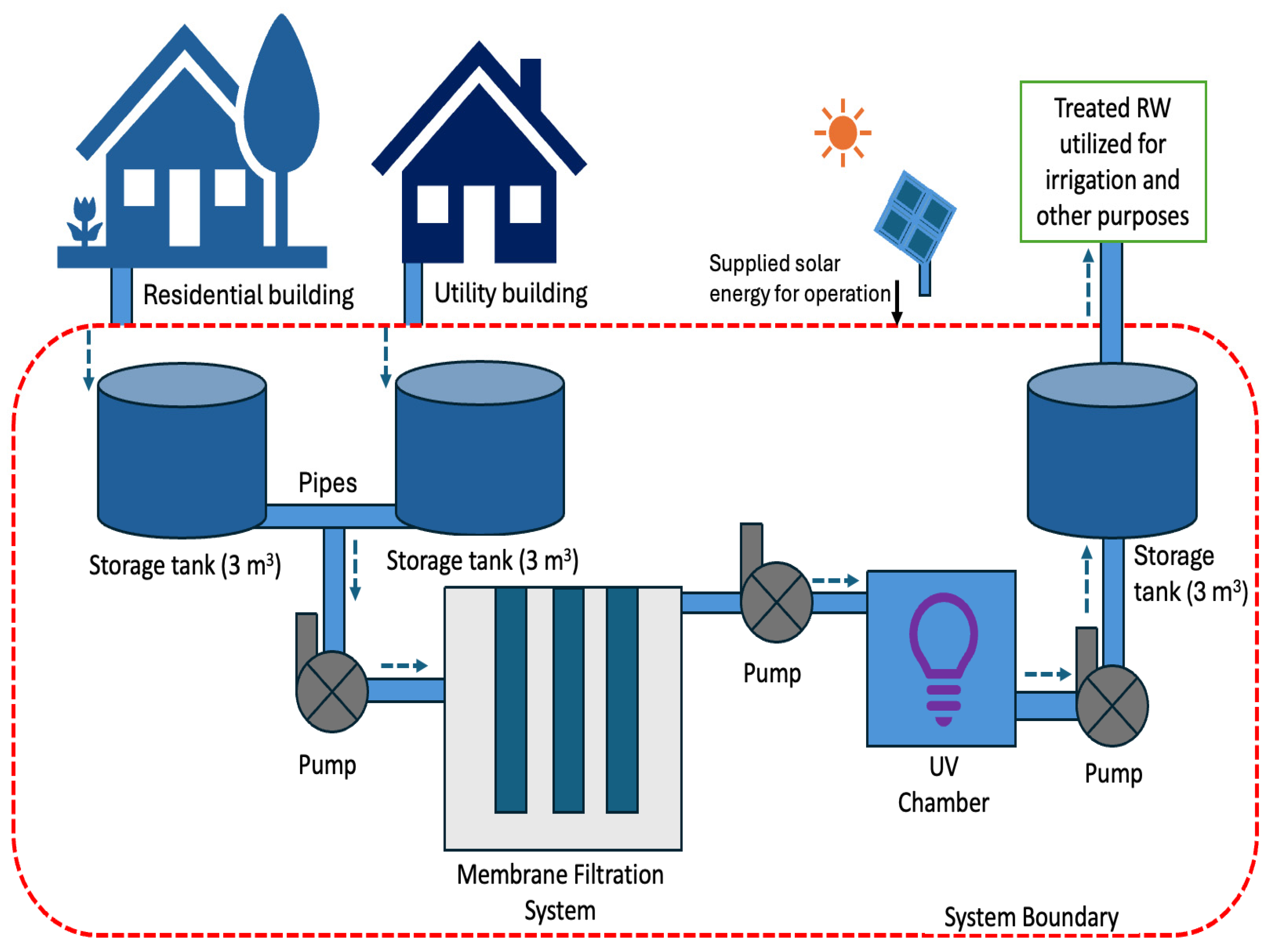
| Collected RW | RW collection from residential and utilities building | 1.2 | m3 | Not applicable | Measured |
| Total electricity usage | Use of solar energy | 47.27 | kWh/m3 | Not applicable | Measured |
| HDPE water tanks | 3 storage tanks of 3 m3 each | 312 | kg | 50 | Ecoinvent 3.11 |
| Pipes | PVC pipes of 30 m length and 32 mm diameter | 18.14 | kg | 50 | Modified from NIST [26] |
| Pump | 3 pumps | 3 | Item | 25 | Ecoinvent 3.11 |
| Membranes Filters | 3 membranes | 3.918 | Kg | 10 | Modified from Lawler et al. [27] |
| UV lamp | 1 lamp | 1 | Item | 25 | Ecoinvent 3.11 |
| Elements | Description | Output | Unit | Service life (years) | References |
| Treated RW | RW storage after the filtration process | 1 | m3 | Not applicable | Measured |
| Water loss | Water loss during the filtration process and distribution | 0.2 | m3 | Not applicable | Measured |
| Impact Category | Reference Unit | R | C | T | G | F | Overall Score | Data Quality Rating |
|---|---|---|---|---|---|---|---|---|
| Acidification: terrestrial | kg SO2-Eq | 3 | 3 | 5 | 4 | 3 | 3.6 | Poor |
| Climate change | kg CO2-Eq | 3 | 3 | 4 | 4 | 2 | 3.2 | Fair |
| Ecotoxicity: freshwater | kg 1.4-DCB-Eq | 1 | 1 | 3 | 1 | 1 | 1.4 | Excellent |
| Ecotoxicity: marine | kg 1.4-DCB-Eq | 1 | 1 | 3 | 1 | 1 | 1.4 | Excellent |
| Ecotoxicity: terrestrial | kg 1.4-DCB-Eq | 3 | 2 | 5 | 3 | 2 | 3.0 | Fair |
| Energy resources: non-renewable, fossil | kg oil-Eq | 1 | 1 | 2 | 1 | 1 | 1.2 | Excellent |
| Eutrophication: freshwater | kg P-Eq | 1 | 1 | 5 | 1 | 1 | 1.8 | Good |
| Eutrophication: marine | kg N-Eq | 1 | 1 | 4 | 2 | 1 | 1.8 | Good |
| Human toxicity: carcinogenic | kg 1.4-DCB-Eq | 1 | 1 | 2 | 1 | 1 | 1.2 | Excellent |
| Human toxicity: non-carcinogenic | kg 1.4-DCB-Eq | 1 | 1 | 4 | 1 | 1 | 1.6 | Good |
| Ionizing radiation | kBq Co-60-Eq | 1 | 1 | 5 | 1 | 1 | 1.8 | Good |
| Land use | m2*a crop-Eq | 2 | 3 | 4 | 3 | 2 | 2.8 | Fair |
| Material resources: metals/minerals | kg Cu-Eq | 2 | 2 | 4 | 1 | 1 | 2.0 | Good |
| Ozone depletion | kg CFC-11-Eq | 3 | 3 | 4 | 3 | 2 | 3.0 | Fair |
| Particulate matter formation | kg PM2.5-Eq | 3 | 3 | 5 | 4 | 3 | 3.6 | Poor |
| Photochemical oxidant formation: human health | kg NOx-Eq | 3 | 3 | 4 | 4 | 2 | 3.2 | Fair |
| Photochemical oxidant formation: terrestrial ecosystems | kg NOx-Eq | 3 | 3 | 4 | 4 | 2 | 3.2 | Fair |
| Water use | m3 | 3 | 3 | 4 | 3 | 2 | 3.0 | Fair |
| Impact Category | Reference Unit | Result |
|---|---|---|
| Acidification: terrestrial | kg SO2-Eq | 3.549536 |
| Climate change | kg CO2-Eq | 1387.85 |
| Ecotoxicity: freshwater | kg 1.4-DCB-Eq | 44.82811 |
| Ecotoxicity: marine | kg 1.4-DCB-Eq | 60.066 |
| Ecotoxicity: terrestrial | kg 1.4-DCB-Eq | 2798.972 |
| Energy resources: non-renewable, fossil | kg oil-Eq | 712.7573 |
| Eutrophication: freshwater | kg P-Eq | 0.446889 |
| Eutrophication: marine | kg N-Eq | 0.046031 |
| Human toxicity: carcinogenic | kg 1.4-DCB-Eq | 135.8299 |
| Human toxicity: non-carcinogenic | kg 1.4-DCB-Eq | 1490.804 |
| Ionizing radiation | kBq Co-60-Eq | 25.99765 |
| Land use | m2*a crop-Eq | 11.31704 |
| Material resources: metals/minerals | kg Cu-Eq | 3.331223 |
| Ozone depletion | kg CFC-11-Eq | 0.000364 |
| Particulate matter formation | kg PM2.5-Eq | 2.020856 |
| Photochemical oxidant formation: human health | kg NOx-Eq | 3.019736 |
| Photochemical oxidant formation: terrestrial ecosystems | kg NOx-Eq | 3.381912 |
| Water use | m3 | 5.997082 |
| Impact Category | Reference Unit | Mean | Standard Deviation | CV | Median | 5% Percentile | 95% Percentile |
|---|---|---|---|---|---|---|---|
| Acidification: terrestrial | kg SO2-Eq | 3.56 | 0.36 | 10.11 | 3.53 | 3.00 | 4.17 |
| Climate change | kg CO2-Eq | 1389.62 | 128.98 | 9.28 | 1377.55 | 1191.21 | 1618.72 |
| Ecotoxicity: freshwater | kg 1.4-DCB-Eq | 45.11 | 11.32 | 25.09 | 43.42 | 30.12 | 65.01 |
| Ecotoxicity: marine | kg 1.4-DCB-Eq | 60.44 | 15.18 | 25.12 | 58.39 | 40.62 | 87.07 |
| Ecotoxicity: terrestrial | kg 1.4-DCB-Eq | 2799.69 | 533.71 | 19.06 | 2716.67 | 2066.50 | 3810.06 |
| Energy resources: non-renewable. fossil | kg oil-Eq | 713.65 | 66.90 | 9.37 | 708.79 | 610.63 | 830.28 |
| Eutrophication: freshwater | kg P-Eq | 0.45 | 0.22 | 48.89 | 0.40 | 0.21 | 0.83 |
| Eutrophication: marine | kg N-Eq | 0.05 | 0.00 | 0.00 | 0.05 | 0.04 | 0.05 |
| Human toxicity: carcinogenic | kg 1.4-DCB-Eq | 135.54 | 128.80 | 95.03 | 118.37 | 67.76 | 239.74 |
| Human toxicity: non-carcinogenic | kg 1.4-DCB-Eq | 1483.73 | 505.68 | 34.08 | 1378.31 | 873.75 | 2457.46 |
| Ionizing radiation | kBq Co-60-Eq | 26.32 | 32.78 | 124.54 | 15.26 | 3.71 | 87.97 |
| Land use | m2*a crop-Eq | 11.46 | 27.33 | 238.48 | 16.17 | −18.54 | 28.64 |
| Material resources: metals/minerals | kg Cu-Eq | 3.32 | 0.55 | 16.57 | 3.26 | 2.52 | 4.29 |
| Ozone depletion | kg CFC-11-Eq | 0.00 | 0.00 | 0 | 0.00 | 0.00 | 0.00 |
| Particulate matter formation | kg PM2.5-Eq | 2.02 | 0.17 | 8.42 | 2.02 | 1.75 | 2.34 |
| Photochemical oxidant formation: human health | kg NOx-Eq | 3.03 | 0.31 | 10.23 | 3.00 | 2.56 | 3.57 |
| Photochemical oxidant formation: terrestrial ecosystems | kg NOx-Eq | 3.39 | 0.37 | 10.91 | 3.36 | 2.84 | 4.05 |
| Water use | m3 | 6.00 | 0.58 | 9.67 | 5.97 | 5.05 | 6.98 |
Disclaimer/Publisher’s Note: The statements, opinions and data contained in all publications are solely those of the individual author(s) and contributor(s) and not of MDPI and/or the editor(s). MDPI and/or the editor(s) disclaim responsibility for any injury to people or property resulting from any ideas, methods, instructions or products referred to in the content. |
© 2026 by the authors. Licensee MDPI, Basel, Switzerland. This article is an open access article distributed under the terms and conditions of the Creative Commons Attribution (CC BY) license.
Share and Cite
Chabhadiya, K.; Włóka, D.; Smol, M. Life Cycle Assessment of a Domestic Rainwater Harvesting System: A Case Study of Poland. Sustainability 2026, 18, 2111. https://doi.org/10.3390/su18042111
Chabhadiya K, Włóka D, Smol M. Life Cycle Assessment of a Domestic Rainwater Harvesting System: A Case Study of Poland. Sustainability. 2026; 18(4):2111. https://doi.org/10.3390/su18042111
Chicago/Turabian StyleChabhadiya, Karan, Dariusz Włóka, and Marzena Smol. 2026. "Life Cycle Assessment of a Domestic Rainwater Harvesting System: A Case Study of Poland" Sustainability 18, no. 4: 2111. https://doi.org/10.3390/su18042111
APA StyleChabhadiya, K., Włóka, D., & Smol, M. (2026). Life Cycle Assessment of a Domestic Rainwater Harvesting System: A Case Study of Poland. Sustainability, 18(4), 2111. https://doi.org/10.3390/su18042111