Article

Beyond a Dichotomous Variable: A New Framework and Integrated Model for Assessing Villagers’ Relocation Intentions in Coal Mining Subsidence Areas


1
School of Mechanics and Civil Engineering, China University of Mining and Technology, Xuzhou 221116, China
2
College of Architecture and Urban Planning, Tongji University, Shanghai 200092, China
*
Author to whom correspondence should be addressed.
Sustainability 2026, 18(4), 2103; https://doi.org/10.3390/su18042103
Submission received: 16 January 2026 / Revised: 15 February 2026 / Accepted: 19 February 2026 / Published: 20 February 2026

Abstract

Resource-dependent development worldwide imposes considerable environmental costs and challenges to regional sustainability, particularly through forming coal mining subsidence areas (CMSAs). Nonetheless, villagers’ relocation intentions within the CMSA remain underexplored. Additionally, previous research on individuals’ relocation intentions has predominantly conceptualized it as a dichotomous variable, overlooking its intrinsic elements. This work aims to explore constitutive elements of relocation intention by developing a universal conceptual framework from the perspective of individuals’ subjective preferences and establishing an integrated model for empirical evaluation. This model combines the analytical hierarchy process (AHP), exploratory factor analysis (EFA), technique for order of preference by similarity to ideal solution (TOPSIS), and obstacle degree model (ODM). Data were collected from the Pan’an Lake CMSA in Xuzhou, China. Results identified core elements of villagers’ relocation intentions, including indicators about houses/farmland destruction at origin and housing quality/services at destination. Notably, we discovered a paradox: aspects expected to deter relocation garner greater attention as intention strengthens. This study advances sustainable relocation governance by exploring internal constitutive elements of individual relocation intention rather than defining it as a dichotomous variable. Additionally, it enhances the evaluation efficiency by determining objective indicator weights from the exploratory factor analysis.

1. Introduction

Coal mining subsidence areas (CMSAs) refer to the regions suffering from subsidence due to underground coal mining. This phenomenon results in waterlogging and damage to buildings, infrastructure, and natural landforms, posing significant challenges to the affected communities and the environment [1,2]. Thus, extensive research has been conducted for the treatment of the CMSA in countries including the United States, Germany, Russia, Poland, India, and China [3,4,5,6,7,8]. For instance, CNY 4.1 billion was allocated in China in 2021 to treat the CMSA, more than double that of 2018 [9].
Nevertheless, most existing studies merely concentrate on technological dimensions, such as disaster prevention, ecological restoration, and resource utilization [4,8,10]. Yet, relatively few have paid attention to the relocation of aborigines in the CMSA. In fact, the strategic relocation constitutes an essential element of an effective treatment plan, especially given the proximity of many coal mines to rural communities. Failure to implement the timely relocation of local villagers leads to serious risks to their safety. In addition, unreasonable relocation programs that disregard villagers’ relocation intentions can intensify villager–government conflicts and hinder overall CMSA treatment [11,12]. Therefore, understanding villagers’ relocation intentions is essential to reconciling such conflicts, facilitating smoother relocation processes, and promoting human-centric CMSA treatment.
Existing research on relocation intention has predominantly centered on identifying influencing factors, including sense of community, residential dissatisfaction, educational level, and residential distance [13,14,15]. However, relocation intention in these studies is often conceptualized merely as a dichotomous variable, namely, whether to relocate or not. Such a simplistic operationalization fails to capture the multidimensional nature and neglects the analysis of its constituent elements. This oversimplification may compromise the precision of both measurement and empirical findings.
Previous research about evaluation models often entails the development of various scales, such as those measuring the organic food consumption experience, site selection criteria for salt cavern energy storage, and the scale for citizens’ sense of gain [16,17,18]. However, researchers often overlook the information contained in the reliability and validity tests, particularly in the exploratory factor analysis. Instead, they rely on additional, external methods to assign weights [18]. This practice not only introduces redundant procedures but also compromises evaluation efficiency.
To fill the critical void in research on detailed indicators and comprehensive evaluation models of the relocation intentions among villagers in the CMSA, this paper endeavors: (1) to develop a conceptual framework for the intrinsic constituent elements of individuals’ relocation intentions; (2) to establish an integrated evaluation model using the exploratory factor analysis to determine indicator weights; and (3) to empirically explore and assess villagers’ relocation intentions in the CMSA.
This paper includes the following sections: Section 2 reviews the theoretical grounding for villagers’ relocation intentions in the CMSA and methods for the evaluation of the relocation intention. Section 3 detailed the draft indicators, the integrated evaluation model, and the questionnaire design. The research area and data collection are described in Section 4. Section 5 demonstrates the final indicators and empirical results. Section 6 discusses differences in the comprehensive weight, villagers’ relocation intentions, and relative obstacles. Further, we propose several policy implications for human-centric relocation strategies. Section 7 provides a summary of this research.

2. Literature Review

2.1. Concept of Relocation Intentions of Villagers in the CMSA

Extant literature on relocation intentions can be broadly categorized into two distinct paradigms: voluntary relocation and forced relocation. The first paradigm encompasses research on those choosing to relocate of their own accord, driven by personal or economic incentives. These studies span various contexts, including rural-to-urban migrations, intra-urban moves [13], transitions to senior living communities [19], seasonal relocations [20], and departures from megacities [14]. In this paradigm, residents’ relocation intentions are fundamentally linked to their aspirations for an improved quality of life [14].
In contrast, the second paradigm focuses on the circumstances where individuals or organizations are compelled to relocate due to external pressures, such as environmental degradation or policy mandates. These works involve the movement of small-scale businesses in urban residential neighborhoods [21], forced evacuation during armed conflict [22], and other climate-related hazards [15]. People’s relocation intentions in this paradigm are primarily driven by their desire to escape the adverse environment [15]. The relocation intentions among villagers in the CMSA fall under the category of forced relocation, representing the second paradigm. Hence, villagers’ relocation intentions in the CMSA refer to their yearning to leave their residential place in the CMSA in response to threats of waterlogging, lack of resources, and collapse of buildings, infrastructure, and natural landforms [1,15,23]. Despite the significance of this issue, the existing literature on villagers’ relocation intentions in the CMSA remains notably lacking.

2.2. Conceptual Framework for the Elements of Individuals’ Relocation Intention

Previous theories on relocation intention have predominantly concentrated on detecting potential factors and relevant influencing mechanisms. In these studies, demographic, household, housing, and socioeconomic characteristics are commonly identified as determinants of residents’ relocation intentions [13,14,24,25,26,27]. Additionally, institutional factors are involved in the framework established by Song and Wu [14]. Some studies indicate that employment status and opportunities constitute a significant factor influencing residents’ relocation intentions [27,28]. Compared to the static factors detected in the above theories, several scholars emphasize dynamic life events and trajectories based on the life-course theory [25,29]. While existing theories largely foreground personal or environmental factors, a distinct strand of inquiry addresses the nature of relocation itself, which conceptualizes it as a function of the destination’s pull and the origin’s push. This perspective is systematically captured by the push–pull (PP) model, a seminal theoretical framework in population movements [30]. Yet, this theory overlooks the constraints that prevent individuals or organizations from leaving the origin place and moving into the destination region. To address this limitation, the two-way push–pull (TWPP) model has been proposed. This theory has facilitated the identification of factors influencing pre-service teachers’ career intentions [31].
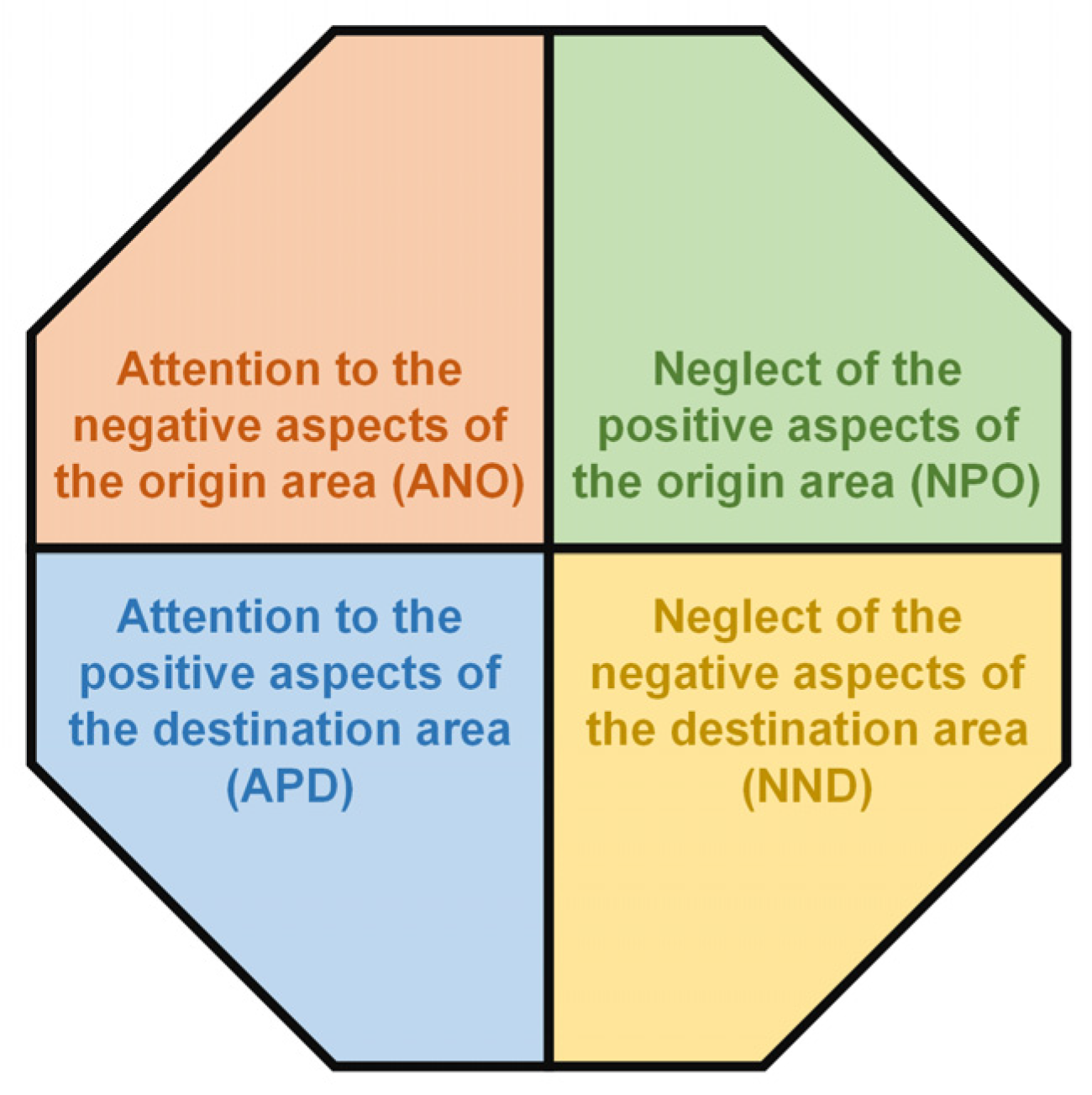
Nevertheless, a prevailing limitation in the aforementioned theories is their overwhelming focus on objective factors, overlooking the subjective foundations of relocation as a strategic life decision. In response, some studies have incorporated psychological variables to enhance the explanatory framework, such as individuals’ perceptions, aspirations, and preferences [24,26,27]. Although these scholars notice the importance of subjective factors to shape relocation intention, they do not advance toward a constitutive analysis of relocation intention’s internal composition. The relocation intention in these studies is often conceptualized merely as a dichotomous variable, namely, whether to relocate or not. Until now, there still remains the absence of a systematic, construct-driven framework that elucidates the fundamental elements comprising relocation intention. Researchers have posited that individuals will devote more attention to relevant strategic considerations when they intend to accomplish specific goals. For example, students gearing up for open-book examinations will exhibit heightened attention to knowledge integration during lectures than those preparing for closed-book examinations [32]. Consequently, this study distinctively characterized individuals’ relocation intention in terms of their subjective preference, namely as selective attention to, or neglect of, various aspects related to the origin and destination places. Meanwhile, a universal conceptual framework was developed for the intrinsic constituent elements of individuals’ relocation intentions, as depicted in Figure 1. This framework involves four categories: attention to the negative aspects of the origin area (ANO), neglect of the positive aspects of the origin area (NPO), attention to the positive aspects of the destination area (APD), and neglect of the negative aspects of the destination area (NND). Specifically, the relocation intention (characterized as goal-directed selective attention and neglect) must pertain to evaluations of two key loci (the origin and the destination), each possessing two attribute valences (positive and negative). An individual’s psychological orientation toward any attribute is fundamentally binary (to attend to it or to neglect it). However, not all combinations constitute intention toward relocation. Individual relocation intention is manifested by their subjective preference that weakens attachment to the origin (attending to its negatives/ANO or neglecting its positives/NPO) and/or strengthens attraction to the destination (attending to its positives/APD or neglecting its negatives/NND). The four other logical combinations (e.g., attending to origin positives) would reflect intention to stay, not relocate. Thus, the ANO-NPO-APD-NND set is both exhaustive of all preference pathways leading to relocation and mutually exclusive in its categorization of distinct attentional foci. Accordingly, villagers’ relocation intentions in the CMSA can be further explored based on this framework.

2.3. Methods for the Evaluation of the Relocation Intention

Evaluation-based research usually comprises two primary aspects: ascertaining the weights and the evaluation. In weight determination, the analytical hierarchy process (AHP) is one of the most commonly used methods [16]. Nonetheless, this approach is usually criticized for relying too much on subjective judgments. To remedy this deficit, the entropy weight method (EWM) has been proposed to enhance the accuracy of evaluations. The integration of these two methodologies (also called the AHP-EWM) is frequently employed to assign the comprehensive weights of evaluation indicators [17]. However, researchers often fail to fully utilize the information contained in the reliability and validity tests when employing the AHP-EWM in studies involving scale development. This oversight complicates the evaluation process and reduces its efficiency. For instance, these scholars have to employ another specific method (e.g., the EWM) to ascertain the objective weight of the indicators in their studies [18]. Actually, the exploratory factor analysis (EFA) in the validity tests already provides information about the relative contribution of each indicator to the latent construct. More precisely, factor loadings from EFA reflect the strength of association between each observed indicator and the underlying dimension. Drawing on established practices in multi-criteria decision analysis, these loadings can be transformed to derive objective weights [33]. Thus, this research attempted to determine the comprehensive weights required for the evaluation by combining the AHP and EFA.
As for the evaluation, the fuzzy comprehensive evaluation method (FCEM) stands out as a widely adopted approach [34,35]. Yet, the intricate computation involved in FCEM can reduce the overall evaluation efficiency [36]. In contrast, the technique for order of preference by similarity to ideal solution (TOPSIS) offers a straightforward computation and is easily understood. Moreover, the TOPSIS is not constrained by the number of criteria, allowing for a flexible and comprehensive evaluation framework [37]. To ensure clear and intuitive outcomes, this study employed the TOPSIS for assessing individual relocation intentions [18]. Additionally, the obstacle degree model (ODM) has been proposed to identify the key obstacle factors, facilitating a deeper analysis of the evaluation results [38]. Therefore, this study endeavored to evaluate individuals’ relocation intentions by integrating the TOPSIS and ODM.

3. Methodology

3.1. An Integrated AHP-EFA-TOPSIS-ODM for the Evaluation of Relocation Intention

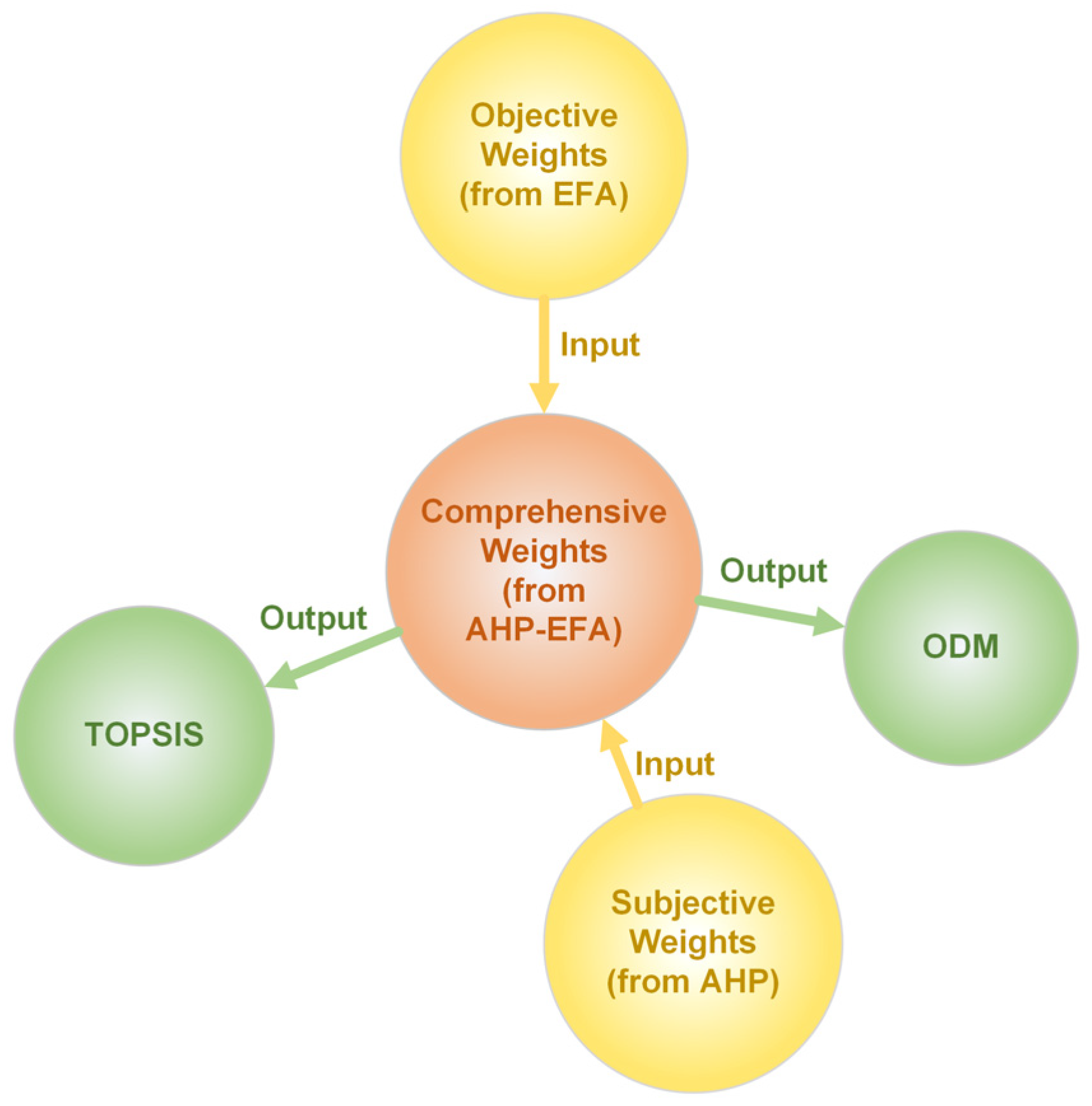
This work developed an integrated model (named the AHP-EFA-TOPSIS-ODM) for the evaluation of relocation intention, as shown in Figure 2. In this model, the objective weights and subjective weights coexist in the same dimension of weight calculation, while the TOPSIS and ODM operate in another dimension termed evaluation. These four methods are linked through the comprehensive weights. Each method serves a specific and non-redundant function within the analytical model. Specifically, the AHP is employed to capture subjective expert judgments on indicator importance, which cannot be derived from data alone. The EFA validates the construct’s structure and derives objective weights from empirical response patterns, addressing the limitation of purely subjective weighting. The comprehensive weights are calculated by combining the subjective weights from the AHP and the objective weights from the EFA, which are essential for further evaluation of the TOPSIS and ODM. The TOPSIS is then applied to synthesize the comprehensive weights with indicator scores, producing an intuitive ranking of relocation intentions. Finally, ODM complements TOPSIS by diagnosing key indicators hindering individual relocation intention, offering actionable insights for policy intervention that a mere ranking cannot provide.
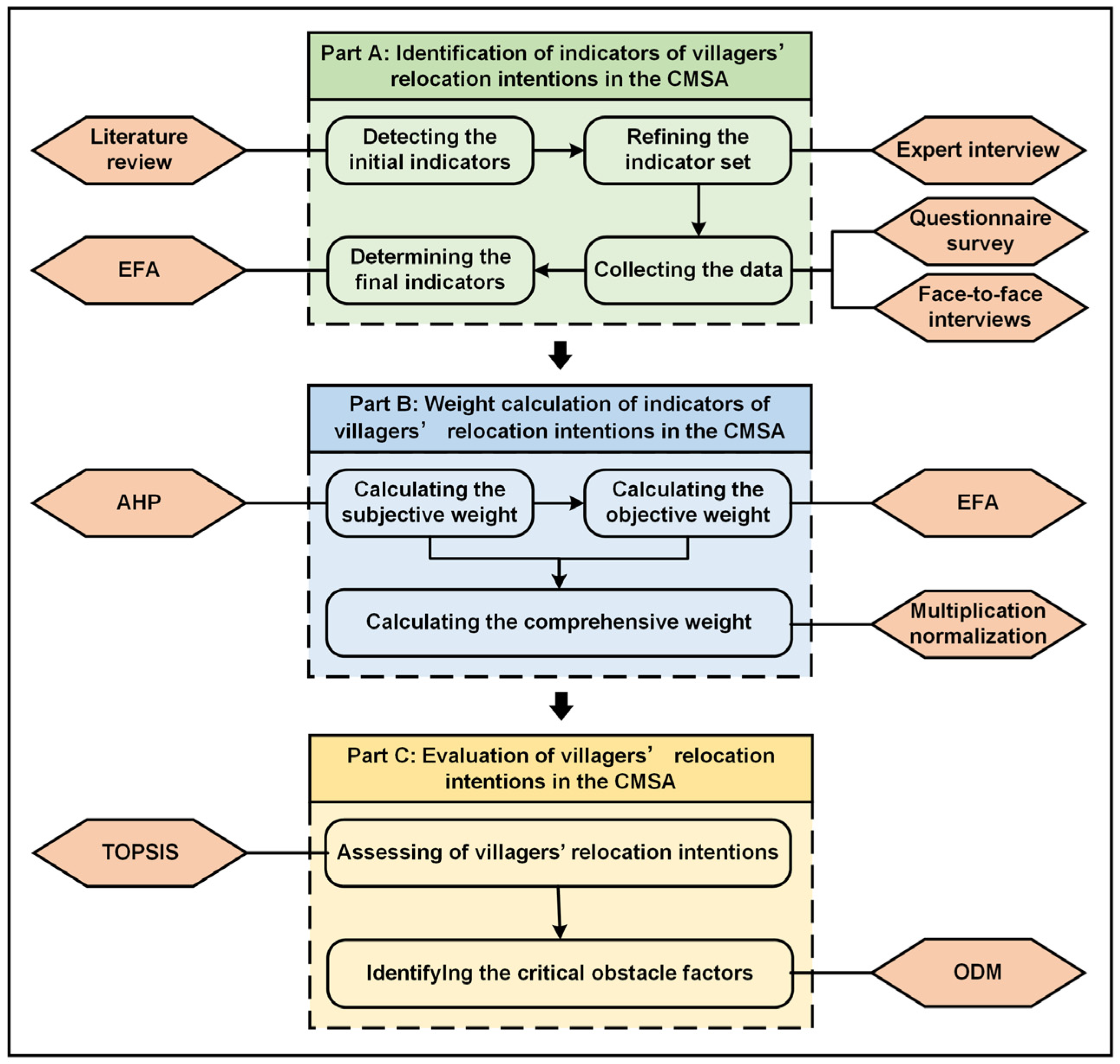
Figure 3 illustrates the technical framework of this research. First, indicators of villagers’ relocation intentions in the CMSA are identified by the literature review, the expert interview, the questionnaire survey, face-to-face interviews, and EFA. Second, the comprehensive weight of indicators of villagers’ relocation intentions in the CMSA is calculated through the AHP, EFA, and multiplication normalization. Third, villagers’ relocation intentions in the CMSA are evaluated via the TOPSIS and ODM.

3.2. Draft Indicators of Villagers’ Relocation Intentions in the CMSA

There were two steps for identifying the draft indicators of villagers’ relocation intentions in this study. First, the initial indicators were detected via an extensive literature review structured around the conceptual framework for villagers’ relocation intentions in the CMSA established in Section 2.2. In detail, all referenced literature originated from the Web of Science Core Collection database, with primary keywords being coal mining subsidence area or relocation intention. Nine highly correlated literature sources were referenced for the identification of the draft indicators [39]. Second, nineteen experts were consulted to refine the indicator set to ensure the content validity of the corresponding scale. These experts possessed considerable experience in the fields of project management, urban and rural planning, and public administration and policy. They were invited to evaluate the importance of the draft indicators using a five-point Likert-type scale ranging from 1 (extremely unimportant) to 5 (extremely important). All of the indicators achieved the identity of important or extremely important from more than 60% of the experts. Thus, the panel of experts chose not to discard any of the preliminary indicators identified. Instead, they opted to refine the descriptive details of each indicator to enhance clarity and precision. Ultimately, a draft including twenty-three indicators was successfully formulated. Detailed information regarding the experts and draft indicators is outlined in Tables S1 and S2 of Supplementary File S1.

3.3. Dimension of Weight Calculation

3.3.1. Subjective Weight

The subjective weight for the indicators was calculated through the AHP in this work, encompassing four principal steps: First, fifteen additional experts, shown in Table S3 of Supplementary File S1, were convened to build initial judgment matrices. They pairwise assessed the relative importance of the final indicators (determined in Section 5.2) using a standard scale presented in Table S4 of Supplementary File S1 [40]. Second, the final judgment matrix (Formula (1)) was derived through the geometric averaging method according to the initial judgment matrices. Third, the subject weight of the indicators was computed by the arithmetic average method (Formula (2)). Fourth, the consistency of the final judgment matrix was assessed [41]. The random consistency index ( R I ) is ascertained in light of Table S5 of Supplementary File S1 [42]. The value of the consistency ratio ( C R ) should be less than 0.1 to ensure a logically coherent matrix [18]. Otherwise, the expert would be suggested to revise their judgment matrix.
A = a 11 a 12 a 1 n a 21 a 22 a 2 n a n 1 a n 2 a n n
w A i = 1 n j = 1 n a i j k = 1 n a k j
where a i j ( i , j = 1, 2, …,   n ) refers to the importance of the i -th indicator in comparison to the j -th indicator; A represents the n -order judgment matrix consisting of the elements a i j ( a i j = 1 when i = j ); w A i denotes the subject weight of the i -th indicator.

3.3.2. Objective Weight

There were three steps in this research to determine the objective weight of the indicators with the application of EFA [33]. Above all, we calculated the coefficients of indicators within the linear combinations for all factors (i.e., categories of the indicators) by dividing each loading by the square root of its associated eigenvalue after the rotation, as shown in Formula (3). In this step, the rotated factor loadings of each indicator and the eigenvalues of each factor post-rotation are obtained from the final version of the scale after necessary iterations. Next, the comprehensive score coefficients of the indicators were derived by Formula (4). The variance contribution rates of each factor after the rotation in this formula are also derived from the final version of the scale. Finally, the objective weight of the indicators was ascertained after the normalization of the comprehensive score coefficients, as detailed in Formula (5).
σ h i = β h i α h
γ i = h = 1 l φ h σ h i h = 1 l φ h
w o i = γ i i = 1 m γ i
In these equations, β h i ( h = 1, 2, …, l ; i = 1, 2, …,   m ) represents the rotated factor loading of each indicator; l is the number of all factors; m denotes the count of all indicators; α h means the eigenvalue of each factor after the rotation; σ h i refers to the coefficients of the indicators in the linear combination for each factor; φ h represents the variance contribution rate of each factor after the rotation; γ i denotes the comprehensive score coefficient of each indicator; w o i means the objective weight of each indicator.

3.3.3. Comprehensive Weight

The ultimate subjective weight for specific indicators was determined using the Formulas (6). Furthermore, the method of multiplication normalization (Formula (7)) offers a more effective balance between subjective and objective weights than addition normalization [18]. Hence, the comprehensive weight of the specific indicators was computed through multiplication normalization.
w s i = w A i 1 w A i 2
w c i = w s i w o i i = 1 m w s i w o i
where w A i 1 and w A i 2 ( i = 1, 2, …,   m ) are initial subject weights of the specific categories and indicators ascertained from Formula (2);   m refers to the count of all indicators; w s i represents the final subject weight of the specific indicators; w i denotes the comprehensive weight of the specific indicators.

3.4. Dimension of Evaluation

3.4.1. Evaluation of Villagers’ Relocation Intentions

The TOPSIS was applied to the assessment of villagers’ relocation intentions in this work, involving five steps [43,44]. The normalization of the raw data was omitted in this research, given that villagers’ relocation intentions were measured by a five-point Likert-type scale (elaborated in Section 3.5). Consequently, the first step was to calculate the mean value of villagers’ relocation intentions in each region (shown in Section 4.1). Subsequently, the weighted matrix of villagers’ relocation intentions was derived through Formula (8). In addition, the optimal and worst solutions for villagers’ relocation intentions were determined utilizing Formulas (9) and (10). Further, the Euclidean distances of each scheme from both the optimal and worst schemes were computed by Formulas (11) and (12) [45]. Last, the overall relocation intention for each region was evaluated and ranked by formula (13).
WR = ( w r p i ) v × m = ( r p i × w c i )
w r i + = max w r 1 i , w r 2 i , , w r v i
w r i = m i n w r 1 i , w r 2 i , , w r v i
D p + = i = 1 m w r p i w r i + 2
D p = i = 1 m w r p i w r i 2
R I p = D p D p + + D p
In these equations, w c i ( i = 1, 2, …, m ) means the comprehensive weight from Formula (10); r p i ( p = 1, 2, …, v ) is the mean value of villagers’ relocation intentions in each region for the i -th indicator; v refers to the count of all regions; W R represents the weighted matrix; w r i + and w r i denote the optimal and worst value of the i -th indicator; D p + is the Euclidean distance between the vector of the mean value of relocation intention in the p -th region and the optimal solution, and D p means the opposite; R I p (0 ≤ R I p ≤ 1) refers to the overall relocation intention of the p -th region.

3.4.2. Identification of Obstacle Factors

The ODM was employed in this study to further identify the critical obstacle factors after the evaluation of villagers’ relocation intentions [46]. The requisite formulas are as follows. Note that the TOPSIS and ODM modules operate in a parallel, rather than strictly sequential, manner regarding their input data. Both modules utilize the same foundational datasets, namely the raw mean scores ( r p i ) and comprehensive weights ( w c i ). TOPSIS processes these scores directly without normalization, while the ODM independently applies its own normalization procedure (as shown in Formula (16)). This design ensures that any potential computational discrepancies in one module (e.g., TOPSIS ranking) are not propagated to the other (ODM diagnosis), as they share only the common input data and weights, not internal results.
R i + = m a x r 1 i , r 2 i , , r v i
R i = m i n r 1 i , r 2 i , , r v i
S R p i = r p i R i R i + R i
I p i = 1 S R p i
O p i = w c i I p i i = 1 m w c i I p i
where R i + and R i ( i = 1, 2, …, m ) represent the maximum and minimum of the mean values of villagers’ relocation intentions among the regions for the i -th indicator; S R p i ( p = 1, 2, …, v ) denotes the standardized value of r p i ; I p i is the indicator deviation; w c i means the comprehensive weight from the Formula (7); O p i refers to the obstacle degree of the i -th indicator in the p -th region.

3.5. Questionnaire Design

Supplementary File S2 contains a questionnaire designed to gather raw data for the detection of final indicators (mentioned in Section 3.3.1) and assessment of villagers’ relocation intentions. The following provides a detailed description of the questionnaire’s composition:
  • A concise introduction outlining the purpose of this survey.
  • Questions of the draft indicators of respondents’ relocation intentions identified in Section 3.2 (attention to the destruction of villagers’ farmland, neglect of lifestyle changes, etc.). These questions are meticulously specific to ensure that subjects have a clear understanding and accurate responses [47]. Responses to these questions are gauged on a five-point Likert-type scale ranging from 1 (strongly disagree) to 5 (strongly agree).
  • Demographic and foundational attributes of respondents (gender, age before relocation, etc.).
  • A question regarding the respondents’ village of origin to pinpoint target subjects.

4. Case Study

4.1. Research Area

In this study, the Pan’an Lake CMSA in Xuzhou City, China, is selected as the research area due to three reasons.
First, the area of the CMSA of Pan’an Lake was notably vast, posing significant ecological and social challenges. The Jiawang District of Xuzhou City, where the Pan’an Lake CMSA lies, was designated as one of the third group of resource-exhausted cities in China in 2011. The mining activities resulted in the formation of the Pan’an Lake CMSA spanning an area of 1160 hectares. This region is recognized as the largest and most severely affected CMSA in the Jiawang District, leading to broken roads, flooded villages, and the collapse of local farmland [48,49].
Second, the Pan’an Lake CMSA stands out as a paragon of successful treatment among the CMSAs in China. The local government has invested two billion CNY in the treatment of the Pan’an Lake CMSA. This area was converted into a national wet park and was included in the list of 4A-level scenic areas in China in 2014 [48].
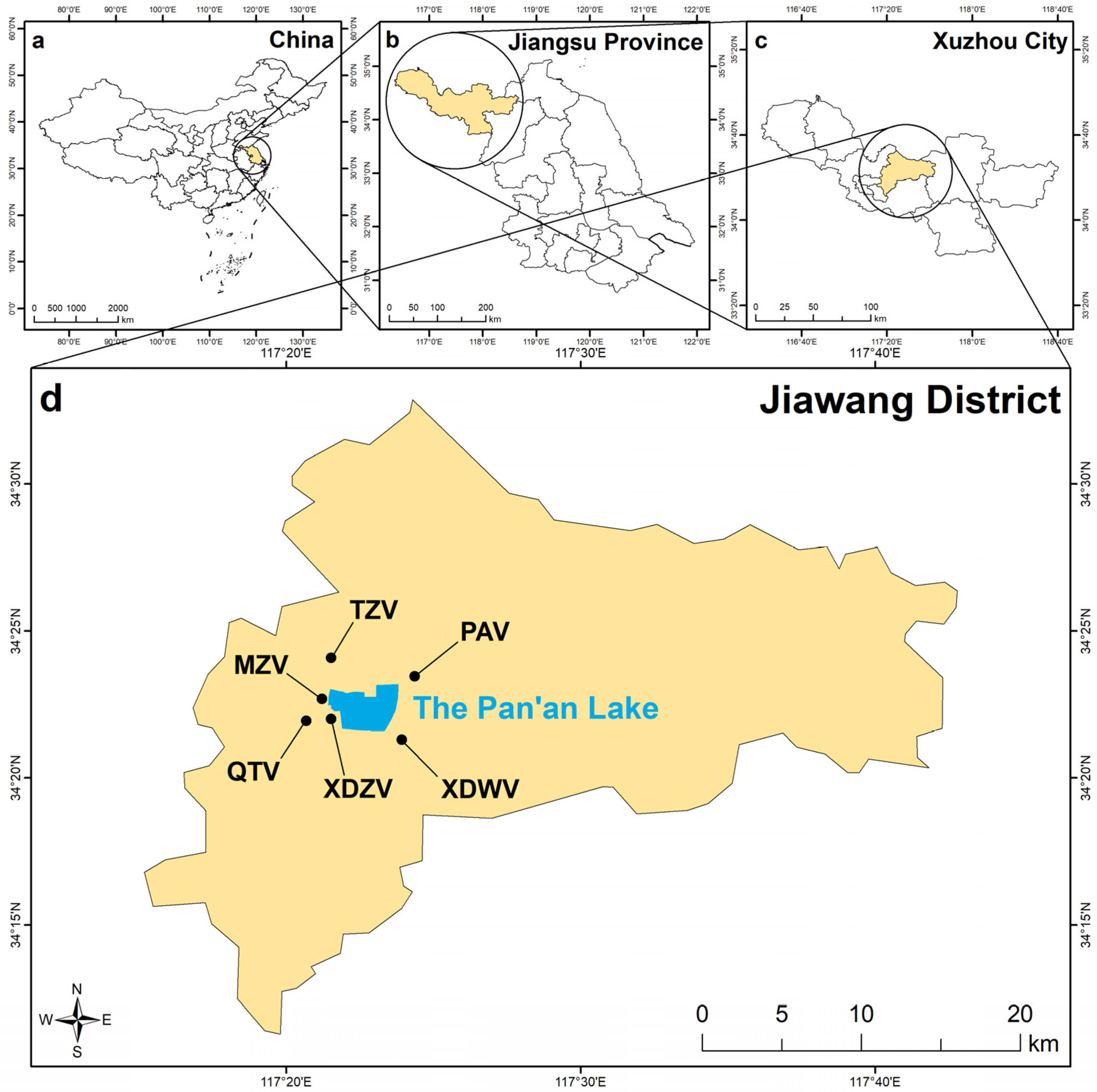
Third, the relocation intentions of villagers were diversified due to the sheer scale of the population impacted by the Pan’an Lake CMSA. There were approximately 3000 households from six villages involved in the relocation around this region. These villages are the Xiduanzhuang Village (XDZV), Pan’an Village (PAV), Mazhuang Village (MZV), Xidawu Village (XDWV), Quantai Village (QTV), and Tangzhuang Village (TZV) [49].
The uniqueness of the Pan’an Lake CMSA case lies in its specific transformation from a dangerous, large-scale subsidence area to a national wet park. This context creates strong and complex impacts on stakeholders’ relocation intentions, such as those from themselves, the environment, and the government. Hence, it provides an ideal and real-world scenario to demonstrate the capability of the AHP-EFA-TOPSIS-ODM to explore the diversity of individuals’ relocation intentions. Accordingly, this research targets villagers from the six villages involved in the relocation near the Pan’an Lake CMSA to ensure a diverse and representative sample. The current locations of these villages are detailed in Figure 4.

4.2. Data Collection

Data for this study were collected through field investigation in the six villages in April 2024. This period was selected due to the fewer restrictions on population movement in the post-pandemic era in China. To elaborate, questionnaires were distributed to local villagers through direct face-to-face interviews to ensure the reliability and authenticity of the data. Each respondent was provided with a specific explanation of the questionnaire if they had any questions [47]. These interviews also helped with the collection of some meaningful information and details.
Earlier research found that 300 samples were sufficient to produce reliable factor analysis outcomes [50]. Thus, a total of 400 questionnaires were distributed to target villagers through stratified sampling, considering potential invalid questionnaires. We successfully gathered 369 (>300) valid responses from the villagers, reflecting an effective recovery rate of 92.25%.

5. Results

5.1. Demographic and Foundational Attributes

Table 1 offers an overview of the demographic and foundational attributes of the respondents. Among the subjects, female villagers (63.41%) were appreciably more than male villagers (36.59%). Most of the people were over 35 years old before relocation, which accounted for 81.57% in total. Informed by face-to-face interviews, residents in the Pan’an Lake CMSA were predominantly female, middle-aged, and elderly individuals, due to the migration of the younger workforce in search of employment opportunities beyond the local area. Consequently, the above demographic findings are reasonable. In addition, those with a minor child before their relocation (73.44%) were fairly higher than those without (26.56%). The majority of the respondents (86.45%) were healthy before moving to the resettlement site. A great deal of villagers (91.60%) reported a tenure of over a decade in their previous residences. Additionally, there was a relatively balanced distribution of participants among the target villages, underscoring the representative coverage of the relocation population in this study.

5.2. Final Indicators of Villagers’ Relocation Intentions in the CMSA

This work determined the final indicators of villagers’ relocation intentions through the reliability tests and the EFA with the application of SPSS 26.0 (IBM Corp, Armonk, NY, USA).
The results of the reliability tests are presented in Table S6 in Supplementary File S1. In more detail, the values of Cronbach’s α for the four categories are higher than the benchmark of 0.7. This means that all draft indicators demonstrate good levels of internal consistency and pass the reliability tests [51].
Table S7 in Supplementary File S1 displays the final version of the scale of villagers’ relocation intentions after three iterations of the EFA. More specifically, the Kaiser–Meyer–Olkin (KMO) value exceeds the threshold of 0.7, and Bartlett’s test of sphericity yields a significant result (p < 0.001). Therefore, the indicators in the scale are suitable for factor analyses [52]. The explained variance is 67.258% in total for the four categories. The indicator of attention to the conversion of villagers’ farmland into photovoltaic power facilities is excluded (communality < 0.4) to increase the validity of the scale [53]. Moreover, the indicator of neglect of the social exclusion at the resettlement site is ruled out since there is more than one factor loading higher than 0.4 in this item [54]. As a whole, the final version of the scale reveals desirable construct validity. Hence, twenty-one final indicators of villagers’ relocation intentions in the CMSA are detected in Table 2.

5.3. Dimension of Weight Calculation

5.3.1. Subjective Weight for Assessing Villagers’ Relocation Intentions in the CMSA

The subject weight of the categories and indicators calculated through the AHP is shown in Table S8 in Supplementary File S1. The C R values of all final judgment matrices fall below 0.01, confirming their logical coherence. Among all indicators, ANO2 is assigned the highest ultimate subjective weight at 0.147, whereas NPO3 receives the lowest at 0.016.

5.3.2. Objective Weight for Assessing Villagers’ Relocation Intentions in the CMSA

Table S9 in Supplementary File S1 contains the objective weight of the indicators calculated by the EFA. To elaborate, APD4 (0.074) garners the maximum object weight within all indicators, while NND3 (0.013) is allocated the minimum.

5.3.3. Comprehensive Weight for Assessing Villagers’ Relocation Intentions in the CMSA

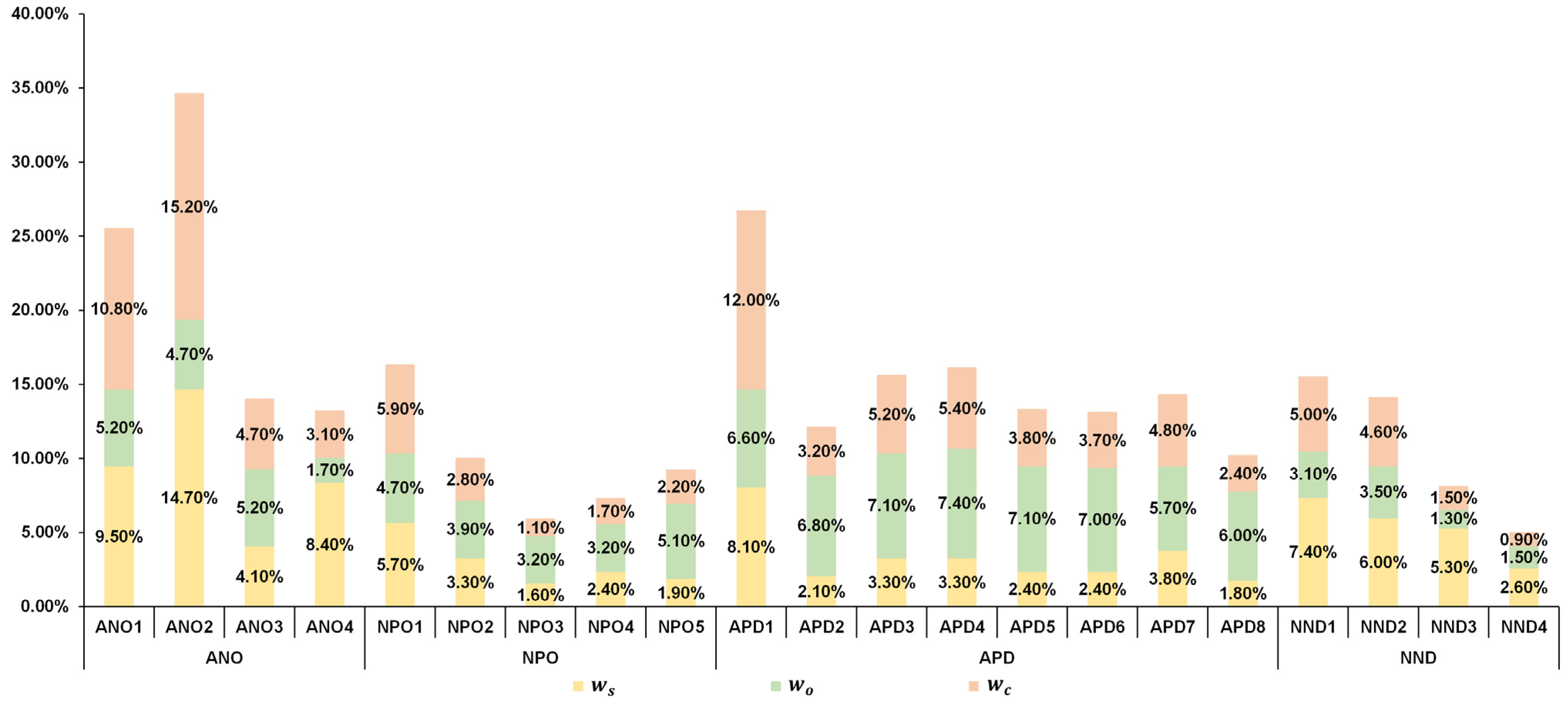
The comprehensive weight of the indicators can be found in Table S10 in Supplementary File S1. In more detail, ANO2 (0.152), APD1 (0.120), and ANO1 (0.108) secure the highest comprehensive weight among all indicators, whereas NND4 (0.009), NPO3 (0.011), and NND3 (0.015) hold the lowest. In aggregate, the indicators within the ANO and APD categories demonstrate higher comprehensive weights compared to the other two categories.
Figure 5 provides a visual depiction of the distribution across the three types of weights.

5.4. Dimension of Evaluation

5.4.1. Villagers’ Relocation Intentions in the Pan’an Lake CMSA

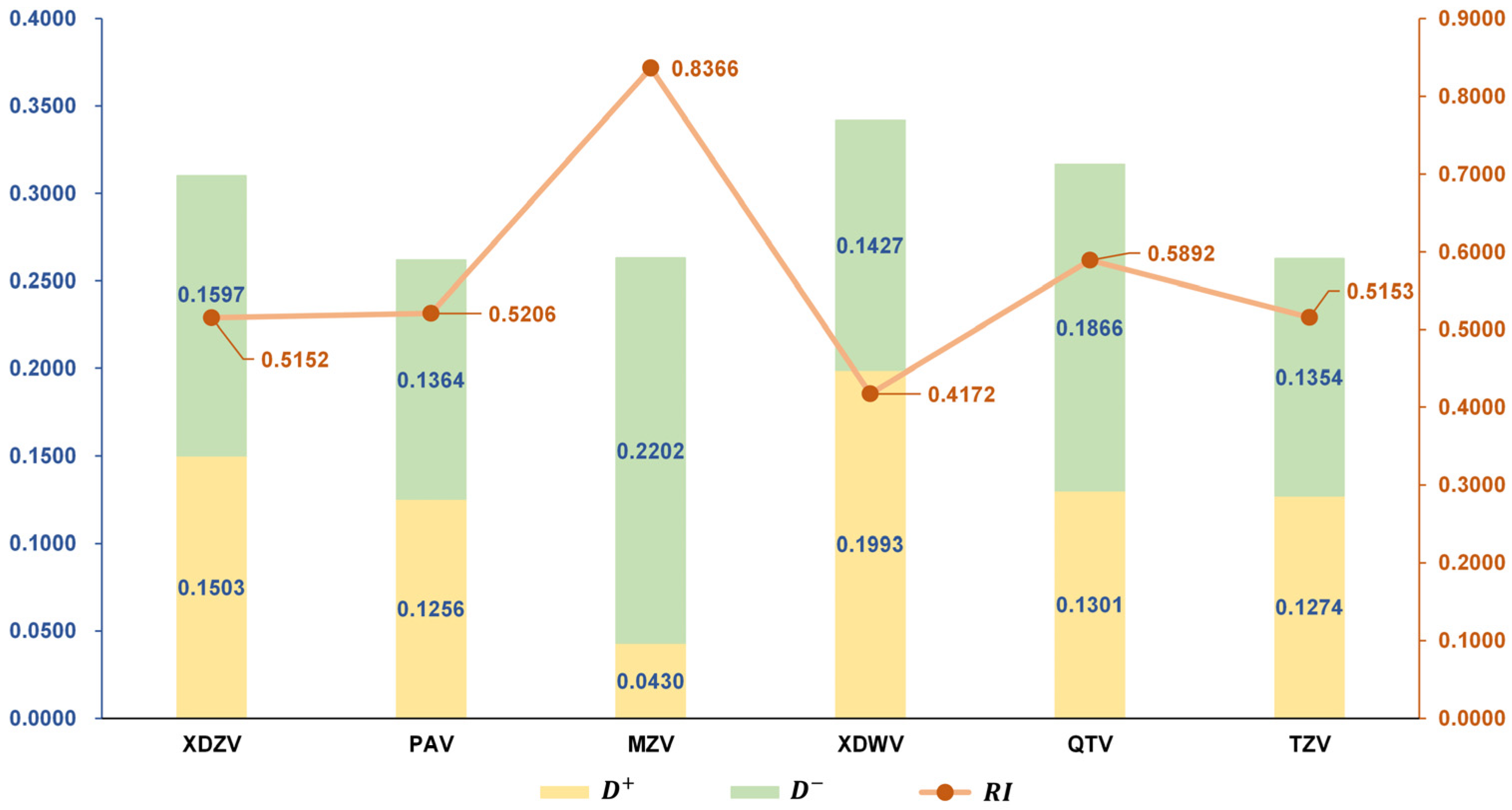
The mean values of villagers’ relocation intentions across the six villages are outlined in Table S11 in Supplementary File S1. Further, the outcomes of the TOPSIS are calculated according to these mean values, as depicted in Figure 6. Notably, the overall relocation intention of the MZV ( R I = 0.8366) is the distinctively highest among these six villages. In contrast, the XDWV ( R I = 0.4172) exhibits the lowest level of overall relocation intention across the six villages. In addition, the remaining four villages demonstrate a significant similarity in their overall relocation intentions, with values ranging from 0.5 to 0.6.

5.4.2. Obstacle Factors of Villagers’ Relocation Intentions in the Pan’an Lake CMSA

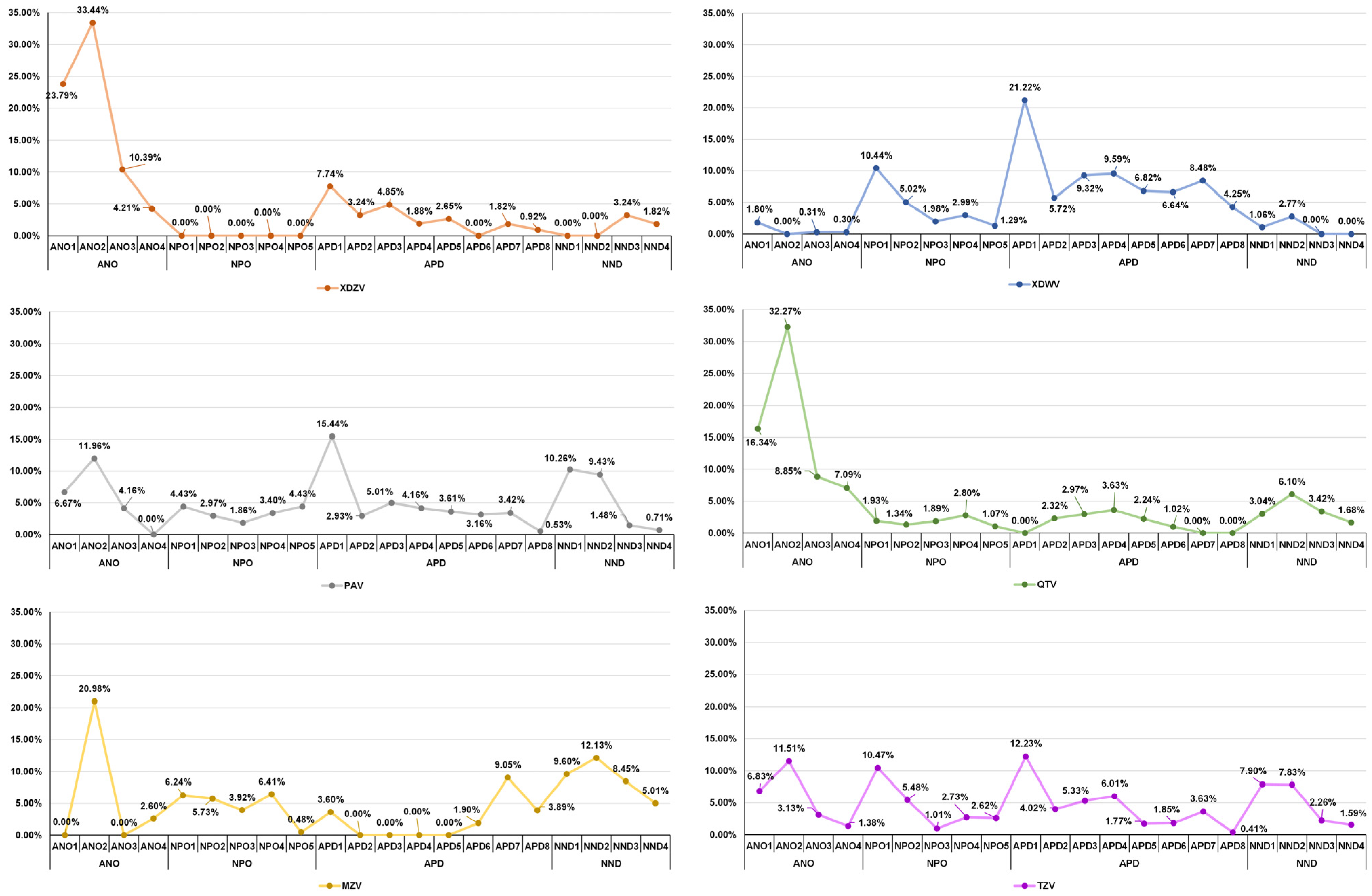
Figure 7 illustrates the obstacle degree of each indicator in the six villages.
The obstacle factors of villagers’ relocation intentions in the XDZV and QTV mainly originate from the category of ANO. In these two villages, the obstacle degrees of the ANO2 and ANO1 are extremely higher than the other indicators. Moreover, the obstacle degree of the APD1 is relatively higher in the XDZV, while the NND2 presents a relatively elevated obstacle degree in the QTV compared to indicators outside the ANO category.
The PAV and TZV show similar distributions of obstacles influencing villagers’ relocation intentions. In these villages, the most pronounced obstacle factors are consistently identified as APD1, ANO2, NND1, and NND2. Additionally, NPO1 emerges as a significant obstacle in the TZV. However, the obstacle degree of this indicator does not reach the same level of significance in the PAV.
For the MZV, the indicators that impede villagers’ relocation intentions are predominantly found within the categories of NND and NPO, such as NND2, NND1, and NND3. Nevertheless, notable obstacles are also present in the other two categories, exemplified by ANO2 and APD7.
In the XDWV, the indicators in the categories of APD and NPO consist of the primary obstacle factors to villagers’ relocation intentions. These indicators include the APD1, NPO1, APD4, APD3, and APD7.
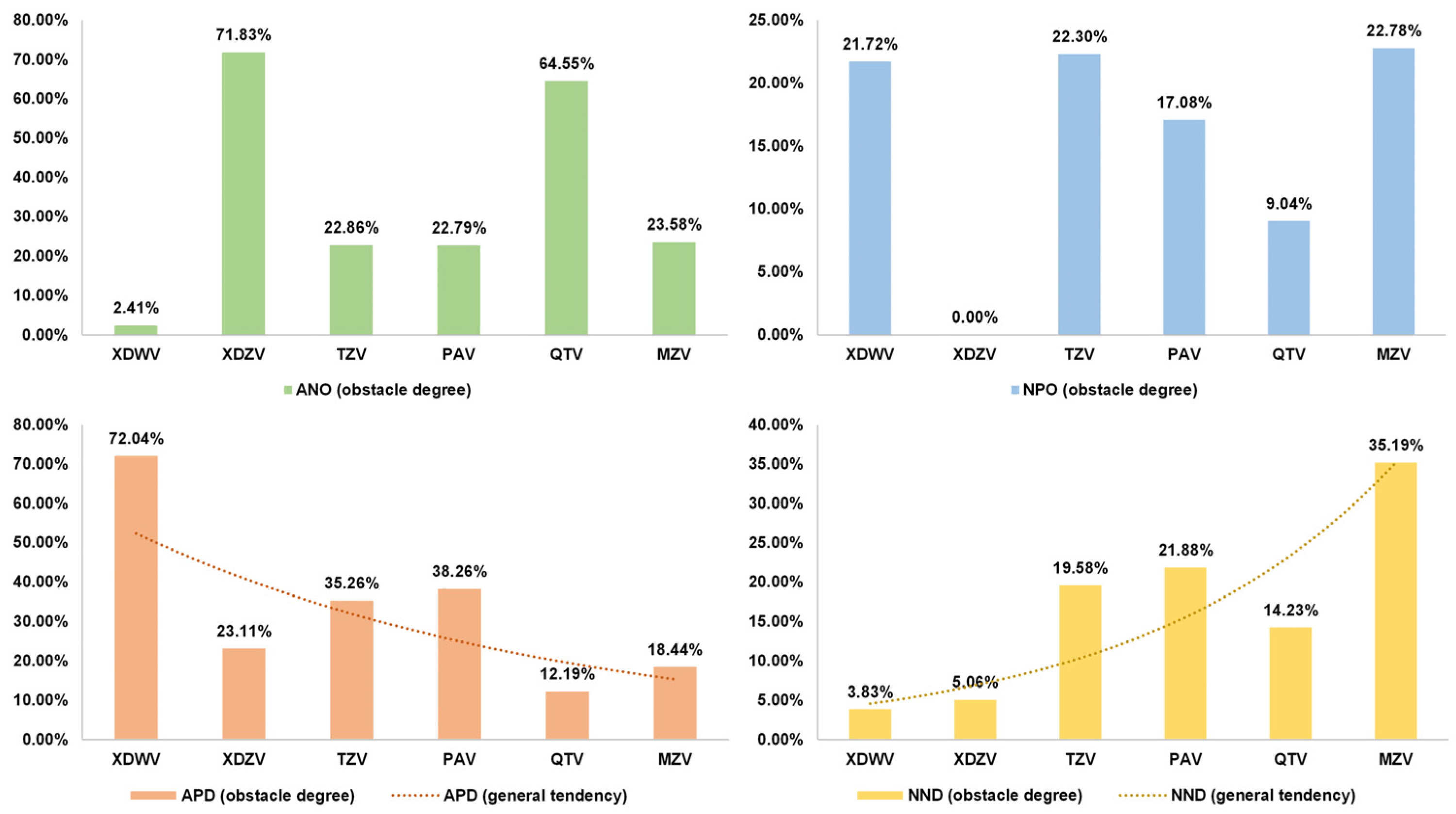
Importantly, the obstacle degree of the category of the APD exhibits a general decline as aggregate relocation intention increases across the six villages. Conversely, the category of the NND demonstrates an obviously inverse relationship. Yet, neither the ANO nor the NPO shows a clear directional tendency in relation to the varying levels of relocation intention. This distinct divergence is visually summarized in Figure 8.

6. Discussion

6.1. Differences in the Comprehensive Weight of Villagers’ Relocation Intention Indicators in the CMSA

The analysis in Section 5.3.3 reveals that the ANO and APD categories make a greater contribution to villagers’ relocation intentions than the other two categories. This finding aligns with both the TWPP and PP models. Indeed, the ANO and APD categories were the initial categories detected in the PP model for interpreting influences on individuals’ relocation intentions [30]. Subsequently, the NPO and NND categories were integrated into the PP model, thereby expanding it to the more comprehensive TWPP model [60].
As for specific indicators, villagers’ relocation intentions are notably shaped by their attention to the destruction of their houses and farmland, as well as the quality of houses and fundamental services at the resettlement site. This correlation is logical, as the direct impact of the CMSA is the destruction of residential and agricultural properties. Furthermore, according to Maslow’s Hierarchy of Needs, individuals prioritize fulfilling their essential physiological and safety demands before other higher-level needs [61]. Consequently, it is reasonable to place more comprehensive weight on the indicators relevant to housing quality and fundamental services.

6.2. Differences in Villagers’ Relocation Intentions Among the Six Villages

Within the comparative analysis of the six villages, inhabitants in the MZV demonstrate a significantly higher level of relocation intention, whereas those in the XDWV show a considerably lower level.
Interview findings disclosed that the mining activities near the MZV had some negative effects on villagers’ daily life before the relocation took place. For instance, the detonations within the mines caused their homes to tremble, and the explosions were audibly discernible to the villagers. This had declined the villagers’ sense of safety. In addition, the pre-relocation living conditions in the MZV were markedly poor because of the soot, contrasting with the clean environment observed at the resettlement site [48,49]. Accordingly, villagers in the MZV were more likely to relocate to ensure their safety and housing quality.
Conversely, the houses and farmland in the XDWV experienced less severe damage before, if any. This circumstance necessitated that XDWV villagers bear part of the cost of constructing new residences, a burden that reduced their relocation intentions. These villagers built their new houses in the original places. Even though their new houses had already cracked by the time of our interviews, they remained committed to rebuilding there again rather than moving out. These circumstances led to the XDWV villagers’ lowest relocation intention among the six villages.
A majority of villagers across the other four villages had reported dissatisfaction with the housing quality at their respective resettlement locations. For example, there was no insulation applied to the exterior walls of the new dwellings in the XDZV, resulting in thermal inefficiency and discomfort. Meanwhile, these new residences were not equipped with elevators. As a result, some elderly villagers in the XDZV with limited mobility opted to live on the lower floors, which suffered from poor lighting and ventilation. Additionally, residences allocated to the villagers in the PAV were situated within another subsidence area cushioned with coal gangue, which failed to inspire a sense of safety among the inhabitants. Furthermore, villagers in the TZV were dissatisfied with the domestic water in the resettlement site due to its high hardness levels. Nonetheless, the resettlement subsidies or houses compensated the villagers among the four villages were deemed relatively acceptable, thereby mitigating the negative impact on the relocation intentions of these stakeholders.
In addition, villagers from XDZV and TZV have reported conflicts with the local government. Those unprepared to relocate were not properly resettled. The conflict between the government and relevant stakeholders during the relocation is a global problem, no matter of Asia, Europe, America, or Africa. This conflict often stems from controversial compensation programs characterized by unsatisfactory compensation levels (like the XDWV), lack of formal agreements (as observed in the TZV), and unreasonable requests for compensation from the residents. Among these characteristics, there is a correlation on occasion between insufficient compensation allocated to residents and the improper handling of the compensation funds. The above compensation programs will accelerate the distrust and further conflicts between the authorities and stakeholders. In addition, the non-independence of the local court and flawed legislation may serve as catalysts that exacerbate these conflicts [62,63].

6.3. Differences in the Obstacle Factors of Villagers’ Relocation Intentions Among the Six Villages

According to Section 5.4.2, the obstacles to villagers’ relocation intentions in the six villages are mainly from the categories of ANO, APD, and NND.
Among the detailed indicators, the ANO1, ANO2, and APD1 are the main obstacle indicators for most of the villages. This is because these three indicators have the highest comprehensive weight. However, the obstacle factors of the XDWV concentrate on the category of APD rather than ANO. This can be confirmed in our interviews. We found that villagers in the XDWV paid more attention to the housing quality and service facilities at the resettlement site rather than the impact of subsidence on their old houses. They hoped to build their new house using advanced techniques, such as employing cement instead of stone powder or bricks they utilized before as construction materials. Moreover, the APD1 is not identified as a primary impediment factor for the MZV and QTV. This is highly likely due to the enhanced environment and facilities at the resettlement site.
For the other indicators without the highest comprehensive weight, the obstacle factors depend on the distinct characteristics of each village. In the category of ANO, the ANO3 emerges as the primary obstacle for the XDZV and QTV, likely due to less damage to the rural road systems in these areas. The ANO4 is detected as the principal obstacle for the QTV, potentially attributed to relatively sufficient water and power supply before the relocation [63]. For the category of the NPO, the NPO1 is the predominant obstacle for the XDWV and TZV. A potential reason is that the subsidence-affected land was reclaimed, allowing villagers to continue relying on agriculture for livelihoods in their original settlements [48]. In the APD category, the APD3 and APD4 emerge as the primary obstacles for the XDZV and XDWV, possibly due to inadequate medical services and transportation facilities at resettlement sites. According to our interview, the majority of villagers were middle-aged or elderly before relocation. As such, they may prioritize essential services and facilities. These findings support prior studies emphasizing the crucial importance of accessible medical services and mobility for creating age-friendly communities [55]. Additionally, these middle-aged and elderly villagers faced employment challenges after the mine closures and farmland destruction. This situation may serve as an explanation for considering the APD7 as an obstacle factor for the MZV and XDWV. For the NND category, the NND1 and NND2 were detected as obstacles for the PAV, MZV, TZV, and QTV, probably arising from the insufficient subsidy provided to the villagers. This was a common phenomenon during our interview, especially compared to the high cost of building or buying a new house. For example, villagers from the PAV and TZV reported that they needed to pay significant extra fees to move into the new houses. Furthermore, the Pan’an Lake National Wet Park has contributed to the prosperity of the local tourism industry (particularly in the MZV), following the enhancement of the price level. This enhancement can result in a higher living cost for nearby villagers. Therefore, it is logical for the NND3 to emerge as an obstacle factor for the MZV [48].
Remarkably, a counterintuitive yet clear pattern emerged considering the obstacle degrees of the APD and NND. As aggregate relocation intention increased across the villages, the obstacle degree of the APD decreased, while that of the NND increased paradoxically. This indicates that with higher relocation propensity, villagers simultaneously assign greater attention to both the positive attributes and the negative drawbacks of the destination. While the diminishing salience of the APD aligns with intuitive expectations, the heightened salience of the NND presents a theoretical paradox: aspects that should deter relocation attract more attention as the relocation intention strengthens. This phenomenon can be interpreted by the Prospect Theory, which suggests that most people tend to avoid risks when receiving profits [64]. However, the net increase in relocation intention indicates a faster accumulation of attention to positive attributes than to negative drawbacks. This is quite reasonable in the context of forced relocation in the CMSA due to villagers’ relatively strong willingness to escape the hazardous living environment.

6.4. Policy Implications

First, policymakers in the CMSA are suggested to develop tailored relocation plans according to the distinctive characteristics of each village. Priority should be given to the ANO and APD categories, as they significantly determine the overall relocation intentions of villagers. These indicators include those about the destruction of houses and farmland at the original settlements, as well as housing quality (such as safety, comfort, and cleanliness) and essential services (like medical and transportation facilities) at the resettlement sites [55].
Second, the local government should strengthen communication with evictees, striving to address the legitimate needs of villagers. For instance, a public agency connecting the authorities with stakeholders can be established to foster trust in the government. This strategy can further harmonize interests, reduce conflicts, and achieve collaborative governance for all involved [63].
Third, it is necessary to enhance anti-corruption efforts within local authorities. The principles of transparency and accountability must be integral to compensation management. Additionally, the independence of the local judiciary should be improved to effectively prevent conflicts and ensure equal negotiation between evictors and the evicted [62,63].
Notably, these implications are framed within the context of China’s existing legal and policy framework concerning land acquisition, relocation, and rural governance. While the core principles (e.g., tailored planning, transparent communication, and accountable governance) are universally relevant for relocation projects, their specific implementation would require adaptation to the distinct legal, institutional, and socio-cultural contexts of other countries.

7. Conclusions

This work develops a universal conceptual framework for the constituent elements of individuals’ relocation intentions from the perspective of subjective preference. This framework involves four categories: the ANO, NPO, APD, and NND. Further, we propose an integrated AHP-EFA-TOPSIS-ODM to evaluate individuals’ relocation intentions. This model encompasses two dimensions: weight calculation and evaluation. The AHP and EFA are utilized for the weight calculation, while the TOPSIS and ODM are used for the evaluation. Six villages in the Pan’an Lake CMSA in Xuzhou City were selected for the empirical analysis to explore villagers’ relocation intentions in the CMSA using the AHP-EFA-TOPSIS-ODM. We finally identified twenty-one indicators of villagers’ relocation intentions in the CMSA, along with their relative comprehensive weight. Results indicate that the ANO and APD categories form core elements of villagers’ relocation intentions in the CMSA, especially indicators about the destruction of houses and farmland at the original settlements, as well as housing quality and essential services at the resettlement sites. In addition, this study reveals the disparities among the six villages and the corresponding obstacles. Villagers’ relocation intention is generally highest in the MZV and lowest in the XDWV. Moreover, the primary obstacles arise from the categories of ANO, APD, and NND. Crucially, we found a theoretical paradox: aspects expected to deter relocation garner greater attention as the relocation intention strengthens.
The study advances sustainable relocation governance by exploring internal constitutive elements of individual relocation intention rather than defining it as a dichotomous variable. It achieves this by proposing a universal conceptual framework from the perspective of individuals’ subjective preference, namely, their selective attention to and neglect of various aspects related to the origin and destination places. Furthermore, it utilizes the exploratory factor analysis to determine the objective weight, which improves the efficiency of evaluation-based studies involving scale development. In addition, this work helps the government to implement human-centered relocation strategies, thereby fostering the voluntary relocation of villagers.
While the AHP-EFA-TOPSIS-ODM is universally applicable to assess individuals’ relocation evaluations, its input, the indicator hierarchy, needs to be tailored to accommodate various relocation scenarios. Remarkably, the sample demographics of this case, reflecting a higher proportion of female, middle-aged, and elderly individuals, are representative of the de facto population remaining in these villages, as younger individuals often out-migrate for employment. While this may influence perspectives on employment and mobility, it accurately reflects the perceptions of the core population facing imminent relocation decisions. The findings should be interpreted within this contextual demographic. Future research could purposively sample a broader demographic to further generalize findings.

Supplementary Materials

The following supporting information can be downloaded at: https://www.mdpi.com/article/10.3390/su18042103/s1, Supplementary File S1: Data supporting this study; Supplementary File S2: Questionnaire on villagers’ relocation intentions in coal mining subsidence areas.

Author Contributions

Conceptualization, J.C. and C.C.; methodology, J.C. and C.C.; software, J.C. and C.C.; validation, J.C. and C.C.; formal analysis, J.C. and C.C.; investigation, J.C.; resources, C.C.; data curation, J.C. and C.C.; writing—original draft preparation, J.C. and C.C.; writing—review and editing, J.C. and C.C.; visualization, J.C.; supervision, J.C. and C.C.; project administration, J.C. and C.C.; funding acquisition, J.C. and C.C. All authors have read and agreed to the published version of the manuscript.

Funding

This research was funded by the National Natural Science Foundation of China (Grant No. 52378071), the Postgraduate Research & Practice Innovation Program of Jiangsu Province (Grant No. KYCX24_2960), and the Graduate Innovation Program of China University of Mining and Technology (Grant No. 2024WLJCRCZL059).

Institutional Review Board Statement

Our study qualifies for an exemption from formal ethical approval in accordance with the official Chinese legislation “Ethical Review Measures for Life Sciences and Medical Research Involving Humans”. This regulation was jointly issued and implemented in 2023 by the National Health Commission, the Ministry of Education, the Ministry of Science and Technology, and the National Administration of Traditional Chinese Medicine. Specifically, Article 32 of this regulation stipulates that ethical review may be exempted for research involving human data or information, provided that it “does not cause harm to the human body, does not involve sensitive personal information, or commercial interests.” Our study aligns precisely with these conditions: Nature of the Research: Our study is an anonymous questionnaire survey focusing on villagers’ relocation intentions in coal mining subsidence areas. It does not involve any medical or physiological sensitive topics, nor any experimental interventions. Use of Anonymous Data: The research is based entirely on anonymous questionnaire data. No personally identifiable information (such as name, ID number, contact details, or precise address) was collected at any stage. Minimal Risk: The study presents no more than minimal risk to participants. It is non-interventional, and the content does not pertain to sensitive personal information, commercial interests, or any topics that could cause social or psychological harm, thus falling under the exemption category as per the national regulation.

Informed Consent Statement

Informed consent was secured from all respondents involved in this study.

Data Availability Statement

The data underpinning this study’s findings are available for review in Supplementary File S1.

Acknowledgments

Deep appreciation is expressed by the authors to the editors and reviewers for their constructive feedback and invaluable assistance in refining the manuscript. We extend our sincere gratitude to the following individuals for their inestimable contributions to data collection and supervision. They are Meng Guan, Liang Li, Qiaoling Yi, Zhuoyue Zhang, Yan Zhu, Xuefei Luo, Zhenglai Feng, Shaoli Chen, Shixiong Chen, Gangjia Chen, Deli Sun, Yaning Qiao, Zhi Li, Yingchao Wang, Jinjian Ji, Linxiu Wang, Wenshun Wang, and Jin Guo.

Conflicts of Interest

The authors declare that there are no conflicts of interest to disclose about this study.

References

  1. Wang, M.; Sun, M.; Zhao, Y.; Shi, Y.; Sun, S.; Wang, S.; Zhou, Y.; Chen, L. Seasonal Changes of Soil Microbiota and Its Association with Environmental Factors in Coal Mining Subsidence Area. AMB Express 2023, 13, 147. [Google Scholar] [CrossRef]
  2. Zhang, X.; Chen, X.; Zhou, Y.; Chen, Y.; Long, L.; Hu, P. Prediction of the Temporal and Spatial Evolution of Subsidence Waters in the Huainan Mining Area Based on the CA–Markov Model. Environ. Dev. Sustain. 2025, 27, 17307–17327. [Google Scholar] [CrossRef]
  3. Tuncay, D.; Tulu, I.B.; Klemetti, T. Verification of 3D Numerical Modeling Approach for Longwall Mines with a Case Study Mine from the Northern Appalachian Coal Fields. Min. Metall. Explor. 2021, 38, 447–456. [Google Scholar] [CrossRef]
  4. Kruszewski, M.; Montegrossi, G.; Balcewicz, M.; de Los Angeles Gonzalez de Lucio, G.; Igbokwe, O.A.; Backers, T.; Saenger, E.H. 3D in Situ Stress State Modelling and Fault Reactivation Risk Exemplified in the Ruhr Region (Germany). Geomech. Energy Environ. 2022, 32, 100386. [Google Scholar] [CrossRef]
  5. Rybnikova, L.S.; Rybnikov, P.A.; Smirnov, A.Y. Post-Mining of Chelyabinsk Coal Basin (Russia): The Effects of Mine Flooding. Mine Water Environ. 2023, 42, 472–488. [Google Scholar] [CrossRef]
  6. Buczyńska, A.; Blachowski, J. Proposal of a New Mining and Geology Impact Factor (MaGIF) Index for the Study of Post-Mining Environment. CATENA 2023, 232, 107463. [Google Scholar] [CrossRef]
  7. Prakash, A.; Bharti, A.K.; Paul, A. Multiphase Assessment of Post-Mining Effect on Railway Structures: A Case Study of Jharia Coalfield. J. Earth Syst. Sci. 2023, 132, 154. [Google Scholar] [CrossRef]
  8. Li, S.; Zhao, Y.; Xiao, W.; Yellishetty, M.; Yang, D. Identifying Ecosystem Service Bundles and the Spatiotemporal Characteristics of Trade-Offs and Synergies in Coal Mining Areas with a High Groundwater Table. Sci. Total Environ. 2022, 807, 151036. [Google Scholar] [CrossRef]
  9. National Development and Reform Commission. National Development and Reform Commission Issues 2021 Central Budget Investment Plan to Support Transformation and Development of Coal Mining Subsidence Areas and Independent Industrial and Mining Areas. Available online: https://www.ndrc.gov.cn/fggz/fgzy/xmtjd/202105/t20210514_1279973.html (accessed on 16 December 2023).
  10. Jiang, C.; Liu, D.; Jiang, C.; Wang, Q.; Sadat-Noori, M.; Li, H. Tracing Groundwater Discharge into a Coal Mining Subsidence Lake in Eastern China: Observations from Water Stable (ΔD and Δ18O) and Radon (222Rn) Isotopes. Appl. Geochem. 2023, 156, 105757. [Google Scholar] [CrossRef]
  11. Zhang, W. Shanxi Hunyuan’s Response to “Villagers Living in Dangerous Houses in Coal Mining Subsidence Area”: As Soon as Possible to Move, Strictly Investigate the Dereliction. Available online: https://www.thepaper.cn/newsDetail_forward_2254799 (accessed on 22 December 2023).
  12. Li, J. Who Is at Fault for the Geologic Disaster? The Government and the Coal Mine Are Both Responsible. Available online: https://www.chinacourt.org/article/detail/2020/09/id/5466375.shtml (accessed on 23 December 2023).
  13. Wang, D.; He, S.; Webster, C.; Zhang, X. Unravelling Residential Satisfaction and Relocation Intention in Three Urban Neighborhood Types in Guangzhou, China. Habitat Int. 2019, 85, 53–62. [Google Scholar] [CrossRef]
  14. Song, Z.; Wu, Y. Effects of Residential Push–Pull Factors on Tenants’ Intentions to Relocate from Megacities: Evidence from a Beijing, China Survey. Habitat Int. 2022, 129, 102663. [Google Scholar] [CrossRef]
  15. Tan, J.; Zhou, K.; Peng, L.; Lin, L. The Role of Social Networks in Relocation Induced by Climate-Related Hazards: An Empirical Investigation in China. Clim. Dev. 2022, 14, 1–12. [Google Scholar] [CrossRef]
  16. Liang, A.R.D.; Wang, T.S.; Yeh, Y.C.; Hsiao, T.Y. Measuring Organic Food Consumption Experience: Scale Development and Validation. Br. Food J. 2025, 127, 389–412. [Google Scholar] [CrossRef]
  17. Bai, W.; Shi, X.; Yang, C.; Zhu, S.; Wei, X.; Li, Y.; Liu, X. Assessment of the Potential of Salt Mines for Renewable Energy Peaking in China. Energy 2024, 300, 131577. [Google Scholar] [CrossRef]
  18. Yu, L.; Li, D.; Mao, L.; Zhou, S.; Feng, H. Towards People-Centric Smart Cities: A Comparative Evaluation of Citizens’ Sense of Gain in Pilot Cities in China. J. Clean. Prod. 2024, 434, 140027. [Google Scholar] [CrossRef]
  19. Chaulagain, S.; Pizam, A.; Wang, Y.; Severt, D.; Oetjen, R. Factors Affecting Seniors’ Decision to Relocate to Senior Living Communities. Int. J. Hosp. Manag. 2021, 95, 102920. [Google Scholar] [CrossRef]
  20. Felix, R.; Sheng, X.; Ngo, A.N. How Political Identity and Attitudinal Spillover Matter for Consumption of Place: Evidence from Winter Migrants in the United States. J. Consum. Behav. 2022, 21, 1075–1091. [Google Scholar] [CrossRef]
  21. Beckers, P.; Sleutjes, B. Neighbourhood Spatial Order, the Local Economy and Firm Mobility in Urban Areas of the Netherlands. Int. J. Urban Reg. Res. 2014, 38, 2103–2122. [Google Scholar] [CrossRef]
  22. Vitman- Schorr, A.; Ben Tov, M.; Hagbi, L.; Freidus, L.; Shenaar-Golan, V.; Segal, M. Evacuation Experiences of Older Adults during Armed Conflict: Community, Place Attachment, and Well-Being. J. Environ. Psychol. 2025, 107, 102754. [Google Scholar] [CrossRef]
  23. Shang, H.; Zhan, H.; Ni, W.; Liu, Y.; Gan, Z.; Liu, S. Surface Environmental Evolution Monitoring in Coal Mining Subsidence Area Based on Multi-Source Remote Sensing Data. Front. Earth Sci. 2022, 10, 790737. [Google Scholar] [CrossRef]
  24. Li, C.; He, S. Too Privileged to Move? Neighbourhood Perception and Relocation Intention in China’s Gated Communities. Tijdschr. Econ. Soc. Geogr. 2024, 115, 691–705. [Google Scholar] [CrossRef]
  25. Dovbischuk, T.; Kley, S. The Call of the Green: The Role of Green Spaces in Residential Relocations across the Life Course in Germany. Popul. Space Place 2024, 30, e2810. [Google Scholar] [CrossRef]
  26. Twerefou, D.K.; Abeney, J.O.; Tete Larbi, R.; Dovie, D.B.K. To Live with Floods or Not: Intersectionality of Drivers of Urban Households’ Adaptation and Relocation Intentions. J. Flood Risk Manag. 2024, 17, e13015. [Google Scholar] [CrossRef]
  27. Nanor, M.A. Determinants of Households Residential Mobility Decision in Kumasi Ghana. Environ. Dev. Sustain. 2025, 2025, 1–19. [Google Scholar] [CrossRef]
  28. Versigghel, J.; Ermagun, A.; Hook, H.; De Vos, J.; Witlox, F. The New Commute: Is Teleworking Stimulating Residential and Workplace Relocations? J. Transp. Geogr. 2026, 130, 104471. [Google Scholar] [CrossRef]
  29. Poku-Boansi, M.; Tuffuor, J.P.; Asibey, M.O. A Life-Course Approach to Assessing Residential Mobility Dynamics in Selected Immigrant Communities in Kumasi, Ghana. Habitat Int. 2024, 143, 102971. [Google Scholar] [CrossRef]
  30. Liu, D.; Liu, Q.; Morgan, W.J. Why Do Chinese Overseas Doctoral Graduates Return to China? The Push-Pull Factors and the Influence of Gender and Gender Norms. Popul. Space Place 2024, 30, e2789. [Google Scholar] [CrossRef]
  31. Cheung, A.C.K.; Yuen, T.W.W. Examining the Motives and the Future Career Intentions of Mainland Chinese Pre-Service Teachers in Hong Kong. High. Educ. 2016, 71, 209–229. [Google Scholar] [CrossRef]
  32. Hong, S.; Go, B.; Rho, J.; An, S.; Lim, C.; Seo, D.G.; Ihm, J. Effects of a Blended Design of Closed-Book and Open-Book Examinations on Dental Students’ Anxiety and Performance. BMC Med. Educ. 2023, 23, 25. [Google Scholar] [CrossRef]
  33. Chen, Z.; Zhang, X.; Lee, J. Combining PCA-AHP Combination Weighting to Prioritize Design Elements of Intelligent Wearable Masks. Sustainability 2023, 15, 1888. [Google Scholar] [CrossRef]
  34. Chen, Y.; Zhou, H.; Zhang, H.; Du, G.; Zhou, J. Urban Flood Risk Warning under Rapid Urbanization. Environ. Res. 2015, 139, 3–10. [Google Scholar] [CrossRef] [PubMed]
  35. Ma, X.; Weng, S.; Zhao, J.; Liu, H.; Huang, H. Investigating Spatio-Temporal Characteristics and Influencing Factors for Green Energy Consumption in China. Geosci. Front. 2024, 15, 101672. [Google Scholar] [CrossRef]
  36. Lin, L.; Xia, Y.; Wu, D. A Hybrid Fuzzy Multiple Criteria Decision-Making Approach for Comprehensive Performance Evaluation of Tunnel Boring Machine Disc Cutter. Comput. Ind. Eng. 2020, 149, 106793. [Google Scholar] [CrossRef]
  37. Yuan, X.; Song, W. Evaluating Technology Innovation Capabilities of Companies Based on Entropy- TOPSIS: The Case of Solar Cell Companies. Inf. Technol. Manag. 2022, 23, 65–76. [Google Scholar] [CrossRef]
  38. Wu, X.; Hu, F. Analysis of Ecological Carrying Capacity Using a Fuzzy Comprehensive Evaluation Method. Ecol. Indic. 2020, 113, 106243. [Google Scholar] [CrossRef]
  39. Zhang, Z.; Wang, Q.; Liu, Z.; Chen, Q.; Guo, Z.; Zhang, H. Renew Mineral Resource-Based Cities: Assessment of PV Potential in Coal Mining Subsidence Areas. Appl. Energy 2023, 329, 120296. [Google Scholar] [CrossRef]
  40. Saaty, R.W. The Analytic Hierarchy Process—What It Is and How It Is Used. Math. Model. 1987, 9, 161–176. [Google Scholar] [CrossRef]
  41. Yagmahan, B.; Yılmaz, H. An Integrated Ranking Approach Based on Group Multi-Criteria Decision Making and Sensitivity Analysis to Evaluate Charging Stations under Sustainability. Environ. Dev. Sustain. 2023, 25, 96–121. [Google Scholar] [CrossRef]
  42. Saaty, T.L. A Scaling Method for Priorities in Hierarchical Structures. J. Math. Psychol. 1977, 15, 234–281. [Google Scholar] [CrossRef]
  43. Chen, L.; Li, X.; Kang, X.; Liu, W.; Wang, M. Analysis of the Cooperative Development of Multiple Systems for Urban Economy-Energy-Carbon: A Case Study of Chengdu-Chongqing Economic Circle. Sustain. Cities Soc. 2024, 108, 105395. [Google Scholar] [CrossRef]
  44. Fan, R.; Zhang, H.; Gao, Y. The Global Cooperation in Asteroid Mining Based on AHP, Entropy and TOPSIS. Appl. Math. Comput. 2023, 437, 127535. [Google Scholar] [CrossRef]
  45. Yang, Y.; Liu, D.; Xu, R.; Li, Z.; Shi, C.; Zhu, X.; Sun, X. Full Title: The Performance Evaluation of Marine Ecological Civilization Construction (MECC): A Case Study of Coastal Cities in Jiangsu Province, China. Ocean Coast. Manag. 2024, 254, 107174. [Google Scholar] [CrossRef]
  46. Li, G.; Guo, Y.; Jiang, H.; Kong, L.; Zhou, Y.; Wang, W. Green Ship Evaluation Based on Improved AHP-FCE-ODM Model from the Perspective of Shipbuilding Supply Chain. Int. J. Logist. Res. Appl. 2025, 28, 763–783. [Google Scholar] [CrossRef]
  47. Tan, Y.; He, J.; Han, H.; Zhang, W. Evaluating Residents’ Satisfaction with Market-Oriented Urban Village Transformation: A Case Study of Yangji Village in Guangzhou, China. Cities 2019, 95, 102394. [Google Scholar] [CrossRef]
  48. Yao, X. Xuzhou, Jiangsu Province: The Coal Mining Subsidence Area Has Been Transformed into a Large Garden. Available online: http://energy.people.com.cn/n1/2017/1215/c71661-29708174.html (accessed on 23 August 2024).
  49. Xue, L.; Wang, X. A Case of Realizing the Value of Ecological Products: Ecological Restoration of Pan’an Lake Coal Mining Subsidence Area. Available online: https://mp.weixin.qq.com/s?__biz=MzA5MjMxMzMwMw==&mid=2649989538&idx=1&sn=8cc99c22d6ff1e97a06d4ff5197b9ddb&chksm=8868021abf1f8b0c0945f6a40d42324e9230586290370b8097fe35c74f0853bd5e844d299041#rd (accessed on 26 August 2024).
  50. Comrey, A.L.; Lee, H.B. A First Course in Factor Analysis; Psychology Press: New York, NY, USA, 2013. [Google Scholar]
  51. Cerri, J.; Serra, E.; Stefanuto, A.; Mori, E. The “IAS Management Attitude” Scale: A Tool for Measuring Consensus between Experts and Practitioners in Invasion Biology. Biol. Invasions 2024, 26, 3271–3279. [Google Scholar] [CrossRef]
  52. Shehadeh, E.A.; Al-Bayatti, A.H.; Ali Bingöl, M. Evaluating Self-Reported Pedestrian Behaviour and Investigating Factors Influencing Road Interactions in Jordan. Transp. Res. Part F Traffic Psychol. Behav. 2024, 105, 222–245. [Google Scholar] [CrossRef]
  53. Lopes, L.W.; da Silva, A.C.F.; da Silva, I.M.; de Paiva, M.A.A.; Silva, S.I.d.N.; Almeida, L.N.A.; Ribeiro, V.V. Evidence of Internal Consistency in the Spectrographic Analysis Protocol. J. Voice 2022, 36, 445–456. [Google Scholar] [CrossRef]
  54. Howard, K.; Garvey, G.; Anderson, K.; Dickson, M.; Viney, R.; Ratcliffe, J.; Howell, M.; Gall, A.; Cunningham, J.; Whop, L.J.; et al. Development of the What Matters 2 Adults (WM2A) Wellbeing Measure for Aboriginal and Torres Strait Islander Adults. Soc. Sci. Med. 2024, 347, 116694. [Google Scholar] [CrossRef]
  55. E, J.; Xia, B.; Chen, Q.; Buys, L.; Susilawati, C.; Burton, L.O. Ageing-in-Place at Naturally Occurring Retirement Communities (NORCs): A Case Study on Bribie Island, Australia. Buildings 2024, 14, 266. [Google Scholar] [CrossRef]
  56. Wang, Y.; Zheng, G.; Zhao, Y.; Bo, H.; Li, C.; Dong, J.; Wang, Y.; Yan, S.; Zhang, F.; Liu, J. Different Bacterial and Fungal Community Patterns in Restored Habitats in Coal-Mining Subsidence Areas. Environ. Sci. Pollut. Res. 2023, 30, 104304–104318. [Google Scholar] [CrossRef]
  57. Bai, L.; Yang, Y.; Shi, Z.; Zou, Y.; Zhou, H.; Jia, J. Improvement of Low-Fertility Soils from a Coal Mining Subsidence Area by Immobilized Nitrogen-Fixing Bacteria. Processes 2022, 10, 1185. [Google Scholar] [CrossRef]
  58. Sun, J.; Yuan, X.; Liu, H.; Liu, G.; Zhang, G. Emergy Evaluation of a Swamp Dike-Pond Complex: A New Ecological Restoration Mode of Coal-Mining Subsidence Areas in China. Ecol. Indic. 2019, 107, 105660. [Google Scholar] [CrossRef]
  59. Smith, K.G.; Paudyal, V.; MacLure, K.; Forbes-McKay, K.; Buchanan, C.; Wilson, L.; MacLeod, J.; Smith, A.; Stewart, D. Relocating Patients from a Specialist Homeless Healthcare Centre to General Practices: A Multi-Perspective Study. Br. J. Gen. Pract. 2018, 68, e105–e113. [Google Scholar] [CrossRef]
  60. Yang, L.; Gai, Y.; Zhang, A. A Study on the Professionalization of Young Part-Time Farmers Based on Two-Way Push–Pull Model. Sustainability 2023, 15, 13791. [Google Scholar] [CrossRef]
  61. Chi, O.H.; Chi, C.G.; Deng, D.S.; Price, M.M. Wellness on the Go: Motivation-Based Segmentation of Wellness Hotel Customers in North America. Int. J. Hosp. Manag. 2024, 119, 103725. [Google Scholar] [CrossRef]
  62. Zhou, W.; Peng, Y.; Bao, H. Regular Pattern of Judicial Decision on Land Acquisition and Resettlement: An Investigation on Zhejiang’s 901 Administrative Litigation Cases. Habitat Int. 2017, 63, 79–88. [Google Scholar] [CrossRef]
  63. Liu, L.; Xu, Z. Collaborative Governance: A Potential Approach to Preventing Violent Demolition in China. Cities 2018, 79, 26–36. [Google Scholar] [CrossRef]
  64. Jin, C.; Li, B.; Jansen, S.J.T.; Boumeester, H.J.F.M.; Boelhouwer, P.J. Young Talents’ Settlement Decisions in China’s Metropolises: An Integrated Prospect Theory Framework. Popul. Space Place 2025, 31, e70099. [Google Scholar] [CrossRef]
Figure 1. Conceptual framework for the intrinsic constituent elements of individuals’ relocation intentions.
Sustainability 18 02103 g001
Figure 2. The AHP-EFA-TOPSIS-ODM for the evaluation of the relocation intention.
Sustainability 18 02103 g002
Figure 3. Technical framework of this research.
Sustainability 18 02103 g003
Figure 4. Overview of the research area: (a) position of Jiangsu Province in eastern China, (b) position of Xuzhou City in Jiangsu Province, (c) position of the Jiawang District of Xuzhou City, and (d) positions of villages involved in the relocation near the Pan’an Lake CMSA.
Sustainability 18 02103 g004
Figure 5. Weights of the final indicators.
Sustainability 18 02103 g005
Figure 6. Results of the TOPSIS.
Sustainability 18 02103 g006
Figure 7. Obstacle degrees of the final indicators.
Sustainability 18 02103 g007
Figure 8. The obstacle degree and general tendency of four categories (villages are ranked from left to right in ascending order of residents’ relocation intentions).
Sustainability 18 02103 g008
Table 1. The demographic and foundational attributes of the respondents.
ItemOptionFrequencyPercentage
(N = 369)
GenderFemale23463.41%
Male13536.59%
Age before relocationLess than 18 years old71.90%
18–35 years old6116.53%
36–45 years old8823.85%
46–69 years old16745.26%
More than 70 years old4612.47%
Whether have a minor child before relocationNo9826.56%
Yes27173.44%
Health status before relocationVery bad00.00%
Bad143.79%
Neutral369.76%
Good26070.46%
Very good5915.99%
Length of residence before relocationLess than 5 years61.63%
5–10 years256.78%
11–20 years9325.20%
21–30 years10027.10%
More than 30 years14539.30%
VillageXDZV8823.85%
PAV6016.26%
MZV6216.80%
XDWV5514.91%
QTV5414.63%
TZV5013.55%
Table 2. A list of the final indicators of villagers’ relocation intentions in the CMSA.
CategoryCodeIndicatorCodeSource
Attention to the negative aspects of the origin area (ANO)ANOAttention to the destruction of villagers’ farmlandANO1[24,55]
Attention to the destruction of villagers’ housesANO2[24,55]
Attention to the destruction of the rural road systemANO3[24,55]
Attention to the lack of resourcesANO4[55]
Neglect of the positive aspects of the origin area (NPO)NPONeglect of the treatment of villagers’ farmland for crop cultivationNPO1[56,57]
Neglect of the conversion of villagers’ farmland into livestock and aquaculture farmsNPO2[58]
Neglect of the increase in local tourism resourcesNPO3[55]
Neglect of the improvement of the local ecological environmentNPO4[24,55]
Neglect of the loss of villagers’ previous social networksNPO5[15,24]
Attention to the positive aspects of the destination area (APD)APDAttention to the improved housing quality at the resettlement siteAPD1[24,55]
Attention to the elderly care services provided at the resettlement siteAPD2[55]
Attention to the medical services provided at the resettlement siteAPD3[24,55]
Attention to the transportation facilities provided at the resettlement siteAPD4[29,55]
Attention to the educational facilities provided at the resettlement siteAPD5[24,55]
Attention to the commercial facilities provided at the resettlement siteAPD6[29,55]
Attention to the employment opportunities provided at the resettlement siteAPD7[24,29]
Attention to the entrepreneurial opportunities provided at the resettlement siteAPD8[24,29]
Neglect of the negative aspects of the destination area (NND)NNDNeglect of the inadequate resettlement subsidyNND1[55]
Neglect of the cost of building or buying a new houseNND2[29,55]
Neglect of the higher living costs than beforeNND3[24,55]
Neglect of lifestyle changesNND4[55,59]
Disclaimer/Publisher’s Note: The statements, opinions and data contained in all publications are solely those of the individual author(s) and contributor(s) and not of MDPI and/or the editor(s). MDPI and/or the editor(s) disclaim responsibility for any injury to people or property resulting from any ideas, methods, instructions or products referred to in the content.