Article

Beyond Building Structure: Estimating the Material Stock of Mechanical, Electrical and Plumbing Systems


1
Chair of Sustainable Construction, Institute of Construction and Infrastructure Management, ETH Zürich, Stefano-Franscini-Platz 5, 8093 Zürich, Switzerland
2
Chair of Environmental Systems Design, Institute of Environmental Engineering, ETH Zürich, Laura-Hezner-Weg 7, 8093 Zürich, Switzerland
3
Institute for Sustainability and Energy in Buildings, Department of Architecture, Civil Engineering and Geomatic, FHNW, 4132 Muttenz, Switzerland
*
Author to whom correspondence should be addressed.
Sustainability 2026, 18(4), 2093; https://doi.org/10.3390/su18042093
Submission received: 26 January 2026 / Revised: 10 February 2026 / Accepted: 12 February 2026 / Published: 19 February 2026

Abstract

Current national-scale building stock models mainly focus on structural materials, overlooking the significant resource potential of Mechanical, Electrical, and Plumbing (MEP) systems. These systems are resource-intensive and contain standardized components with high-value materials such as copper and steel, yet their potential remains largely untapped due to fragmented data. This study introduces the novel systematic framework to estimate MEP components at high granularity and national scale. It integrates harmonized public data, machine-learning imputation (>90% accuracy under sparse conditions), and parametric rules reflecting building type, energy system, and construction decade. A Swiss case study yields scalable material stock estimates and lifespan-based turnover projections, showing strong consistency with existing GHG benchmarks. The framework highlights contrasting patterns across regions and building types, indicating where policy and industry can upscale reuse and recovery. Its modular design enables transferability and integration with circular economy planning and material-efficiency targets.

1. Introduction

The environmental pressure from construction activities is growing [1,2,3], the circular economy concept has been promoted as a potential solution to it [4,5,6]. It promotes strategies such as reuse, repair, remanufacturing, and recycling, while also stressing waste avoidance, i.e., extending the lifespan of buildings rather than demolishing them. However, to identify circular opportunities, high-quality data on the composition, quantity, and location of building materials are essential [7,8]. Building stock modeling has been widely adopted to provide such data, helping decision makers identify resource hotspots and plan ahead [7,9,10,11,12], primarily focusing on structural systems and aggregated material classes, with limited resolution for building service components. It usually follows two established approaches: bottom-up and top-down. Bottom-up models give detailed insights but require large resources; top-down models are more scalable but lack the resolution needed for component-level or decade-specific estimates. Both approaches have already been commonly used in the estimation of material stocks and flows for building structural systems, i.e., the concrete and rebar, brick, structural steel and wood [13,14,15,16].
However, while building stock modeling has been extensively applied to structural systems as mentioned above, only a limited number of studies have addressed building services or technical systems, and mostly in an indirect or aggregated way. Existing studies that attempt to estimate the stock of service components typically rely on top-down or material-intensity-based approaches, often using aggregated floor area or functional type as proxies for service material quantities (e.g., [17,18,19,20]. In addition, some studies have derived service system material stocks indirectly from input–output or demolition waste data rather than from component-level inventories. While these studies provide valuable first-order estimates at national or regional scales, they do not resolve component-level distributions, system configurations, or spatial variability within buildings [17,18,19,20,21]. As argued by Hashimoto, modeling future demolition waste must consider missing stock (unrecorded materials) and dissipated stock (materials dispersed from traceable flows) to avoid discrepancies between estimated and actual waste quantities [22,23]. Several studies have further emphasized the need to include system-level materials in MFA to develop a more comprehensive CE strategy [22,24,25]. Mechanical, electrical and plumbing systems (could be referred as MEP in the later text) components can account for anywhere from 4% of embodied impacts in residential buildings to 46% in offices, depending on scope and regional context [26,27,28,29,30]. In contrast to structural MFA, which focuses on load-bearing materials such as concrete, steel, and masonry, building service systems comprise heterogeneous, rapidly evolving components whose quantities and configurations are weakly correlated with gross building mass or area alone. These systems are not only energy-intensive but also contain standardized, high-value materials (e.g., copper, steel) that are easier to recover than heavy structural components made from concrete.
The problem is that without a reliable method to quantify and locate these resources, their potential for a circular economy remains untapped [31,32,33]. This is a critical blind spot that prevents effective resource management and strategic planning. Data on these components is rarely available publicly. Even in construction design companies working with building information models (BIM), details on HVAC or electrical systems are often left out, and post-construction additions, i.e., plumbing fixtures, heating distributors, are almost never recorded in digital models. As a result, there is no building stock that systematically includes MEP systems at component level as publicly available or digital data is scarce.
This lack of information also discourages reuse, even though reuse is prioritized in circular economy strategies [4,34]. Without prior data, architects and contractors must manually inspect demolition sites to identify reusable components. In practice, most MEP materials end up in construction and demolition waste (CDW) treatment plants, where they are usually sent to recycling. Recycling often downgrades material quality, consumes additional energy, and may occur even when MEP components still have service life left. At many facilities, components require manual separation, which partly explains why reuse remains rare [35].
In addition, MEP components generally have shorter lifespans than structural systems, with replacements often occurring independently of the original building construction cycle, and their specifications often evolve rapidly in response to shifting regulations, technological innovations, and consumer preferences [36,37]. For example, plumbing systems in older buildings typically used metal components [38,39,40,41], whereas newer buildings increasingly rely on plastics such as polyvinyl chloride (PVC) [42]. The temporal and regional variability of MEP materials underscore the need for an agile framework that considers local practices and captures shifting component prevalence over time.
Machine learning has been increasingly applied in building stock modeling to predict missing or incomplete data. However, most existing applications are still small in scale and focus primarily on structural components extracted from detailed floor plans [43,44,45,46]. This approach often excludes older buildings without digital documentation, resulting in underestimated national-level material stocks. In parallel, large-scale machine learning (ML) has also been widely adopted in Urban Building Energy Modeling (UBEM), which faces similar challenges in bottom-up, data-driven analysis of energy systems [13,14,16,47,48]. Studies in both fields have employed techniques such as big data analytics, decision trees, and artificial neural networks (ANNs) to improve the estimation of building material composition [49,50,51,52]
While ML is good at predicting missing attributes from observed patterns [53,54], it is not possible to use it directly for MEP components’ prediction due to lack of available data.
Luckily, MEP design and installation typically follow standardized patterns defined by codes and practices, which are quite dependent on building parameters as confirmed by local building system designers. This makes them suitable for parametric modeling. Although parametric approaches have been used to characterize structural system stocks [32,55,56], their application to MEP has so far been limited.
Therefore, by understanding how parametric modeling can capture key building geometries and how machine learning can address data gaps, this study combines the two approaches to bridge a major blind spot in large-scale material stock modeling. The standardized nature of MEP system design, when paired with machine learning–based data imputation, provides a promising path for reliable estimation. Current ML based building stock modeling and parametric model based ones are happening in isolation: ML alone cannot reconstruct unrecorded MEP data, and parametric rules alone cannot fill large-scale data gaps. Combining these two strategies, based on domain knowledge and engineering principles [55], offers the potential to produce estimates that capture rapid changes in components.
This study presents a new framework for estimating material stocks in building service systems, addressing a major gap in current building stock modeling research. To date, very few building stock studies explicitly include service systems such as heating, ventilation, plumbing, or electrical installations. Those that do typically rely on aggregated assumptions, for instance, applying industry-average material intensity factors (e.g., kg/m2 from databases such as ecoinvent or regional LCI datasets), rather than capturing component-level variability. While such top-down approaches provide useful national-scale estimates, they overlook the substantial heterogeneity of MEP components across building types, construction periods, and energy systems.
The framework introduced here offers an initial step toward systematically integrating service system materials into building stock modeling. It builds from component-level inventories and system logic, providing a scalable yet more detailed approach to estimating the materials embedded in MEP systems.
By applying the framework to the Swiss building stock, this study generates initial national estimates of material quantities in MEP systems, identifies key resource hotspots, and demonstrates how service system data can support the planning and implementation of circular economy strategies in the built environment. This serves as a starting point for developing more consistent, data-driven assessments of MEP material stocks and their contribution to circular resource management in future building stock studies.

2. Methods

Building stock modeling is a data-driven approach that helps decision-makers understand how materials are distributed across buildings, both across space and over time. While previous studies have estimated building material stocks using material intensity factors, hybrid MFA approaches, or UBEM-based assessments, these methods typically focus on structural elements, energy demand, or aggregated material flows. Component-level modeling of MEP systems at the national scale remains limited due to fragmented data availability and system heterogeneity. This integrated framework for MEP stock estimation was designed to fill this gap.
Of course, the first step is to identify the right data sources. Because the goal is to develop a generalizable approach, the framework relies on publicly available datasets, so that countries with similar building information can also use the same method. The key information typically includes common parameters such as building height, width, category, construction year, and energy system, all of which are often available in most national databases worldwide.
However, even national databases that register every building with a unique ID rarely provide complete information. For example, in the Swiss case study, some fields in national databases are partially empty: around 2.6% of building records lack building area, 18.8% lack perimeter and height, and about 30–40% are missing energy source or living space information. Despite these gaps, the overall coverage of over 50% for key parameters still gives strong confidence to perform prediction and imputation for missing values, while prioritizing data sources with reliable authentic coverage.

2.1. Framework Overview

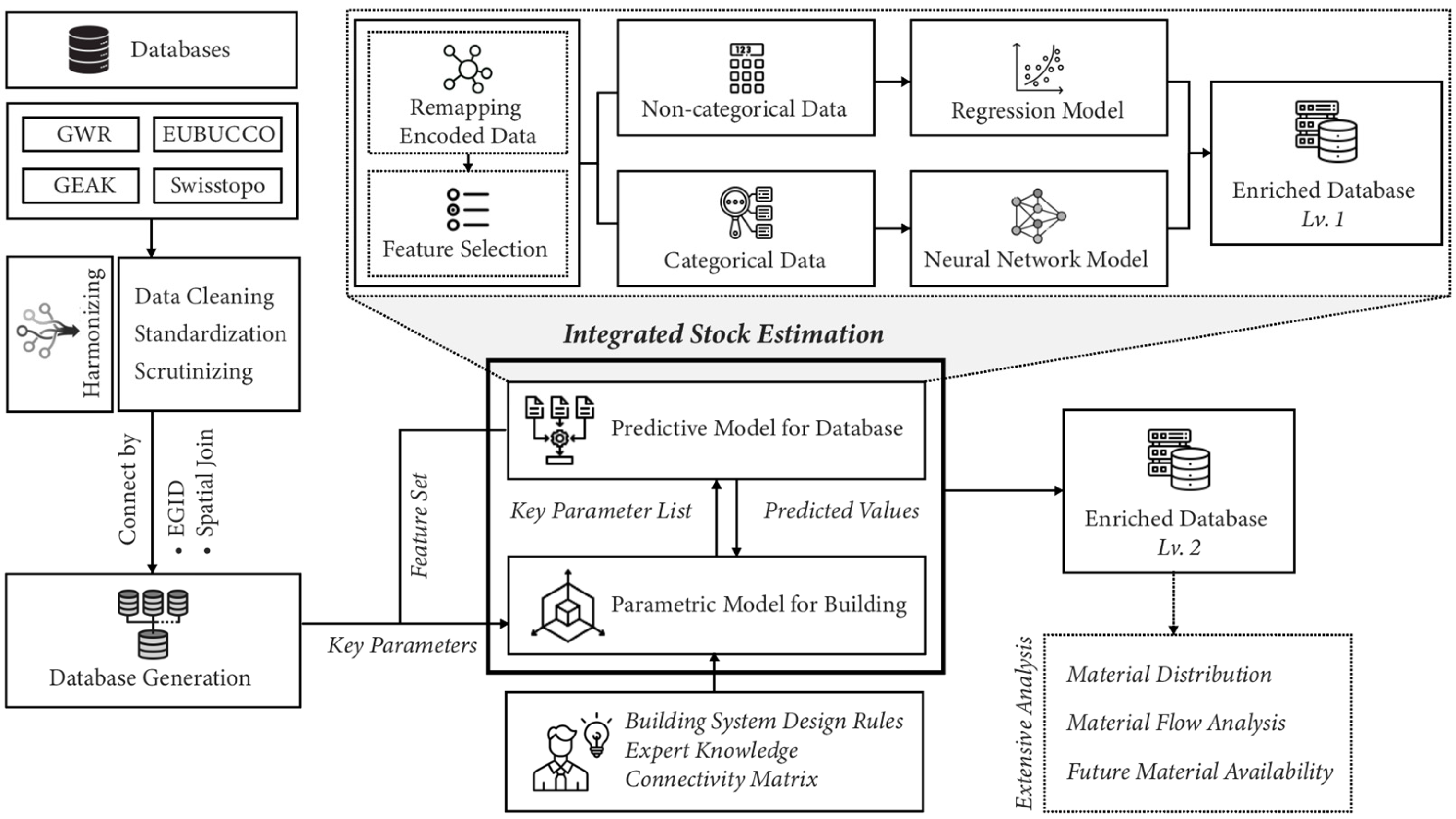
As shown in Figure 1, the framework starts by bringing together many different types of building data, such as geometry, age, energy label, and location, from various Swiss and European sources. Since each dataset uses its own format and structure, the first step is to clean and harmonize them so that they can link to each other.
This harmonization means checking and standardizing how each piece of information is written (for example, making sure building types or years use the same format), and then connecting them using shared identifiers, either a unique building ID or spatial information (the exact coordinates on a map). This “spatial join” ensures that all data referring to the same building are merged together, so in the end, each building becomes a single record in a large, consistent database with many columns describing its different characteristics.
Once this harmonized database is prepared, the framework moves through a multi-step process:
  • Data Completion: A machine learning–based imputation process fills in missing information, improving both the completeness and reliability of the database, even when detailed local data are limited. Numerical features (like building area or height) are predicted using regression models, while categorical features (such as building use or heating type) are estimated through neural networks. The result is an enriched database where missing values are consistently filled.
  • Rule-Based Estimation: The next step applies parametric design rules derived from building system design knowledge and expert input. These rules estimate the presence and scale of MEP systems and link them to corresponding material intensities, depending on the building’s type and function.
  • Dynamic Variation: Material intensities are treated as time- and technology-dependent, varying with building type, energy system, and construction decade. This enables the model to reflect evolving design practices instead of relying on static averages.
With this enriched dataset, the framework can estimate how much material, i.e., copper, steel, or plastic, is contained in different MEP components across the Swiss building stock. The results can then be analyzed to map material distribution, trace future material flows in renovation or demolition scenarios, and assess recovery potential.
Although the framework was first applied in Switzerland, its modular and data-driven design makes it easily adaptable to other national contexts, provided that comparable building and geographic data are available.
Overall, this framework serves as a powerful tool for decision-makers, policymakers, and researchers who aim to identify hidden material hotspots within building stocks. By quantifying the materials locked in MEP systems, it supports long-term circular economy strategies such as reuse, recycling, and material substitution. It can also give access to estimate the greenhouse gas emissions linked to MEP materials, keeping results consistent and comparable across regions.

2.2. Data Sources and Harmonization

As mentioned above, building information for the framework was drawn from several publicly available datasets, which together provide a rich foundation for characterizing the Swiss building stock while minimizing the need for generalized assumptions. The main data sources include:
  • Bundesamt für Statistik Eidg. Gebäude- und Wohnungsregister (GWR), Swiss Federal Building and Housing Register: maintained by the Federal Statistical Office (BFS), this register covers 1.78 million residential buildings and 4.74 million apartments, offering detailed information on building types, structures, and spatial attributes [57,58]
  • Der Gebäudeenergieausweis der Kantone (GEAK), Cantonal Building Energy Certificate database: part of the national Building Energy Certificate program, GEAK provides energy efficiency, envelope performance, and renovation data for ~130,000 buildings.
  • EUBUCCO, European Building Stock Characteristics database: includes over 2 million Swiss buildings, supplying geometric attributes such as footprint and floor area [59].
  • Swisstopo, Swiss Federal Office of Topography: provides 3D geospatial and geometric data to supplement other sources [57].
All records were merged into one unified and standardized database. Each building was matched and aligned using the federal building ID (EGID) wherever available. When this identifier was missing (as in EUBUCCO), a spatial match was performed based on geographic coordinates, linking each record to the nearest building polygon within 50 m. The results were visually checked to ensure alignment accuracy.
To strengthen the robustness of the modeling, variables with lower missing-data rates and higher reliability were prioritized, while those prone to inconsistencies or outliers were excluded. The final set of parameters used in the model includes:
  • Building geometries (gross floor area, height, width, length): for system sizing
  • Number of floors: affects vertical distribution system design
  • Number of residents, apartments, rooms, and kitchens: determines fixture quantities and service load
  • Living space per apartment: supports heated area estimation
  • Construction year or renovation year: applies time-based material composition rules
  • Building category—used to select appropriate parametric models (see Section 2.4)
  • Heating system information: provides the baseline for component availability
Further details on data preparation and model parameterization are provided in the Supplementary Information.

2.3. Machine Learning-Based Data Imputation

Significant data gaps in existing databases make it difficult to estimate component- and material-level stock. As mentioned earlier, several key parameters in the databases still have 2.6–40% missing values. To address this, we developed a variable-specific ML imputation strategy tailored to the type of data involved.
All variables were first classified as either continuous (e.g., floor area, number of rooms) or categorical (e.g., heating system type, building use). Continuous variables were imputed using the XGBoost (v1.7.6) regression framework [60], which performs well in numerical prediction tasks, while categorical variables were handled by a deep feedforward neural network implemented in PyTorch (v1.12.1) [61]. This combination allowed us to capture both structured numerical relationships and nonlinear interactions common in categorical features.
For each variable with missing values (the target), a set of relevant predictors should be identified from other attributes in the dataset (such as geometry, building use, location, and energy system type) to perform the imputation. Predictors were selected through a two-stage, feedback-driven process. In the first stage, positive values from correlation analysis offer a preliminary insight into predictors with strong relevance and multicollinearity [62,63]. In the second stage, these predictors were manually screened to ensure that they are contextually meaningful. Counterintuitive relations, i.e., strong correlation between the location of building and number of rooms of the building, which might be caused by spatial clustering or data bias, were removed to prevent overfitting and misinterpretation. This refinement process could improve both the reliability and generalizability of the imputation models.
For continuous variables, the XGBoost models were configured with 500 estimators, a maximum tree depth of 3, and a learning rate of 0.1 to ensure stable convergence. Models were trained using an 80/20 train–test split, and performance was evaluated using the coefficient of determination (R2).
For categorical variables, the neural network included 8 fully connected hidden layers with batch normalization and ReLU activation functions. Dropout regularization was applied to mitigate overfitting. The model used a batch size of 12,800 and was trained for 100 epochs, with output dimensions matching the number of unique categories in each target variable. The Adam optimizer (learning rate = 1 × 10⁻³) and a ReduceLROnPlateau scheduler were applied to fine-tune the learning rate and improve convergence stability. Training and testing accuracies were monitored across epochs to ensure generalization.
Imputed values were then reintegrated into the main dataset. Variables with low predictive performance (e.g., low R2 or test accuracy) were excluded from analyses. Within the framework workflow, ML-based predictions were used only when necessary, the following parametric model are built upon authentic data and tries to minimize reliance on assumptions.

2.4. Parametric Model

The second core component of framework is the parametric model, which estimates material quantities based on architectural logic, design rules and literature review. Building codes, standard design norms, and published guidelines were cross-checked with input from HVAC, plumbing, and electrical design specialists who helped validate the methodology.
The parameter definitions were informed by literature review, professional experience and expert consultation. The first author has prior experience as an HVAC designer on international projects, providing practical insights into system configurations and component characteristics. In addition, informal consultations were conducted with three engineers specializing in plumbing, ventilation, and electrical systems to verify design assumptions against typical Swiss building practices. Lifespan values were drawn from published studies [64], industry guidelines, and widely used standards across North America and Europe (see Table S6 in the Supplementary Information). These combined sources of information were used to define parameter ranges, component lifespan assumptions, construction period categorizations, etc.
The parametric model combines empirical inputs from standards and guidelines with heuristic rules required for stock-scale estimation in data-scarce conditions. Simplifications such as assuming one radiator per heated room or a fixed heat-demand density (80 W/m2) are used as representative central values rather than building-specific design parameters. Given the limited climate variation in Switzerland, climatic differentiation is not explicitly modeled, and the impact of these assumptions is assessed through sensitivity analysis (Section 3.2). In the Swiss context, residential buildings dominate the building stock, but rarely include complex cooling or ventilation systems. Table S1 (see Supplementary Materials) summarizes common components across four major systems: heating, electrical, plumbing, and centralized HVAC. The Swiss case study focuses on components with high circularity potential. Priority was given to those with strong reuse prospects, such as radiators, boilers, heat pumps, air ducts, water pipes, electrical cables, and plumbing fixtures, based on their disassembly feasibility, metallic content, and prevalence on the current reuse markets. The framework can be extended to other components once their design logic is defined.

2.4.1. Connectivity Matrix

Connectivity matrices are commonly used in engineering to describe how different parts of a system are linked [65,66]. In this study, they were used to combine expert knowledge and design logic within the framework. Each matrix defines how energy sources, building types, and system components are connected. The links are expressed in binary form, where “1” means the connection is typically present and “0” means it is absent or uncertain. This method makes the model easier to update and adjust for different regions or time periods.
Table 1 shows typical system configurations in Switzerland. For example, buildings using oil, gas, wood, electricity, or district heating usually have radiators connected to boilers or water heaters, which deliver heat through piping systems [67,68].
A matrix was developed to link building categories (residential, commercial, institutional, and others) with their typical system components (see Table 2). This simplification adopts the top-down approach’s way of thinking to model MEP systems, which makes the model not only realistic but also reducing computational cost and complexity. Data on boilers and heat pumps were taken directly from the actual database.

2.4.2. Temporal Differentiation

Buildings constructed between the 1940s and 1990s are now reaching the end of their service life, so they are likely to be demolished or heavily renovated. Their heating and MEP systems typically reflect the design standards of those times. For example, the type of radiator often depends on the heating system used, which has changed significantly over the decades. This decade-based grouping shows how building construction periods affect its heating systems and energy performance [76,77,78]. Similarly, our framework (see Table 3) links each component type and material to its typical installation decade to capture shifts in design practice and service lifespan. This makes it possible to estimate material stocks even when detailed MEP data are missing. The same logic applies to other systems, such as water pipes, where materials and sizes strongly depend on when they were installed. By combining these time-based patterns with available data on building systems, the model provides more dynamic estimates of potentially recoverable material stocks, which is easily customizable for different energy systems and construction eras even in different context.

2.5. Material Stock Estimation

The Swiss building database has several advantages. It is publicly accessible, based on reliable government data that is regularly updated. In addition to geometric information, it also includes housing registry data such as the number of inhabitants and rooms, which allows for useful cross-checks. For example, when estimating heating demand, it is possible to compare both the heated floor area and the number of rooms. In practice, most living rooms, bedrooms, kitchens, and bathrooms each have at least one radiator. This cross-checking helps to validate the predictions from the parametric model and increases confidence in the results.
The development of the parametric model is demonstrated using radiators as an example, detailed formulations for other systems are provided in the Supplementary Information. The model assumes that the number of radiators per heated room depends on the type and presence of the heating system. The total weight of radiators in a building i denoted as W r a d ( i ) is calculated as:
W r a d ( i ) = C r a d ( i ) × N r a d ( i ) ×   w r a d ( t ( i ) )
where C r a d ( i ) is the radiator availability indicator, N r a d ( i ) is the number of radiators per building and w r a d ( t ( i ) ) is the unit weight of radiator based on the installation year of building system components t ( i ) retrieved from database and mapped to the system installation decade (from Table 3). The radiator availability indicator C r a d ( i ) is defined by:
C r a d ( i ) = C e n e r g y ( i ) · C b u i l d i n g ( i )
With C e n e r g y ( i ) indicating the presence of compatible energy sources (e.g., oil, gas, wood), and C b u i l d i n g ( i ) indicating suitability by building type (e.g., residential = 1, others = 0). Thus:
C r a d ( i ) = 1 ,     i f   e n e r g y   a n d   b u i l d i n g   t y p e   c o n d i t i o n s   a r e   m e t 0 ,     o t h e r w i s e
The number of radiators per heated building is estimated based on either heated area, number of rooms, or heating demand, assuming one radiator per room [89]. The total number of radiators in a building i is given by:
N r a d ( i ) = u n i t s N r a d , u n i t i
where N r a d , u n i t i represents the number of radiators estimated at the unit level (e.g., per dwelling). The variable N r a d , u n i t i is determined as the maximum of two values:
N r a d , u n i t i = m a x A u n i t i · H L C R C ,   α · N r o o m i + N k i t c h e n i
where
A u n i t i : area of the living space of apartment, retrieved from database;
H L C : heat loss rate, which is assumed to be 80 W/m2 for an average insulated building;
R C : radiator capacity, assumed to be 1.5 kW;
α : number of radiators per room, assumed to be 1;
N r o o m i : total number of rooms excluding kitchen;
N k i t c h e n i : total number of kitchens, retrieved from database.
More details are provided in the Supplementary Information.
The study calculated the total material stock and associated GHG emissions using a consistent, tiered approach. First, the total mass of a specific material m for each individual building i within a certain building category c was determined by summing the mass of that material from all relevant components c o m p . This value is represented as:
M a s s i ,   c , m = c o m p Q i , c o m p , c , m
Next, the total mass of each material for the entire building category was calculated by aggregating the masses from all individual buildings within that category. This gives us the total mass of material m for building category c .
T o t a l M a s s c , m = i M a s s i , c , m
Following the material stock calculation, GHG emissions could be determined by aggregating the total mass of each material type across all building categories and multiplying it by its corresponding emission factor E F m , sourced from established databases such as Ecoinvent v3.10.1 and IPCC 2021 [90]:
E m = T o t a l M a s s m × E F m
T o t a l M a s s m = c T o t a l M a s s c , m
The full component inventory considered in the framework extends beyond the representative examples discussed in the main text and includes additional heating, ventilation, plumbing, and electrical elements (e.g., boilers, pumps, valves, sanitary fixtures, ventilation devices, and electrical equipment). The corresponding component definitions, parameter assumptions, and material compositions are documented in Tables S1–S6 of the Supplementary Materials, drawing on standard building-service literature and technical sources, including boilers [91,92], pumps and valves [93,94], air-duct systems [95,96,97,98], plumbing components [99,100,101,102,103,104,105], and sanitary fixtures [106,107,108,109,110].

3. Results

3.1. Predictor Selection and Correlation Analysis

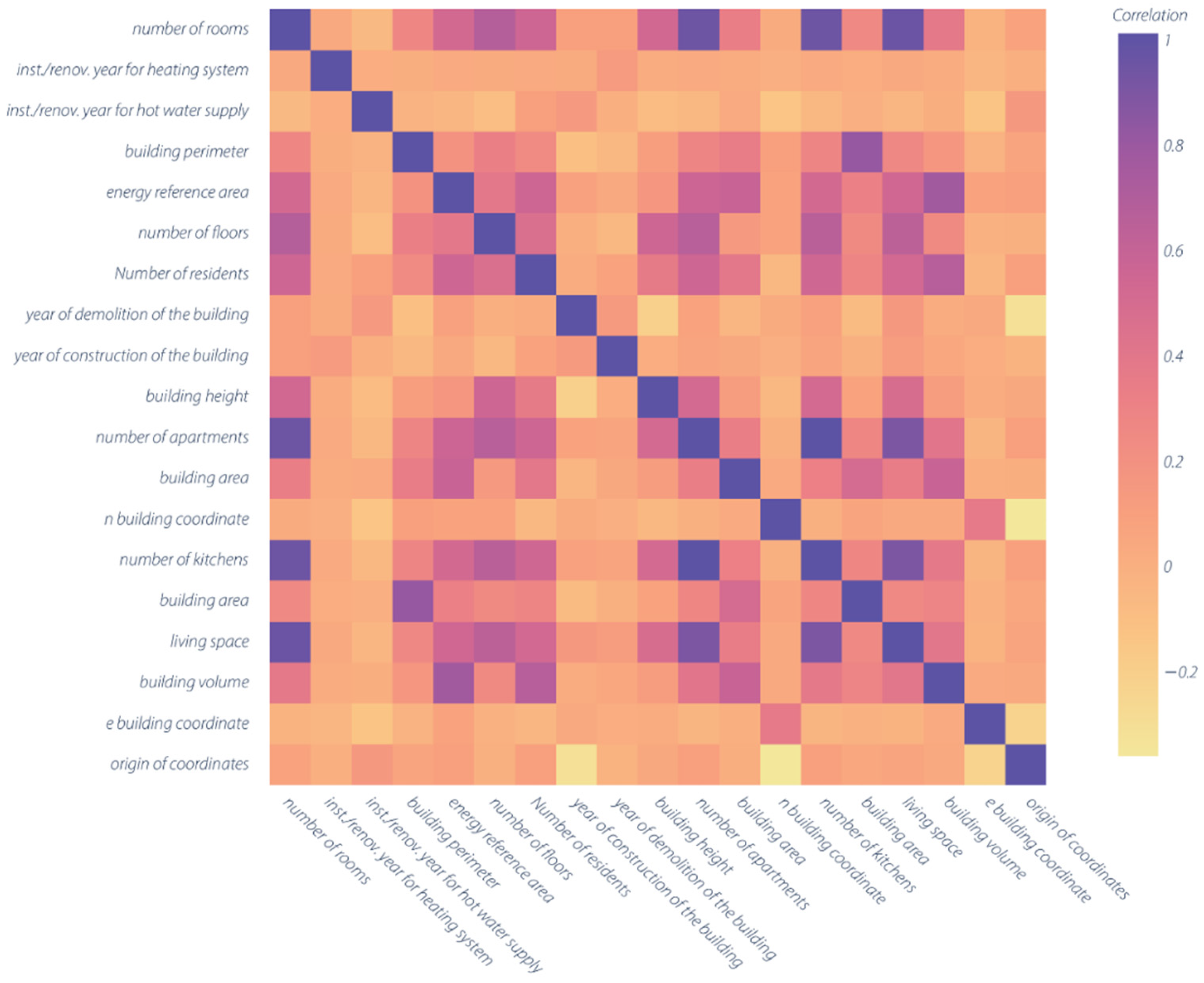
As mentioned in Section 2.3, predictor selection started with a correlation analysis. The correlation heatmap (Figure 2) shows how different building parameters relate to each other, including both positive and negative associations. As expected, building area, number of rooms, and number of floors were strongly correlated with total living space, while the system installation or renovation year showed weak or negative correlations, suggesting these variables are largely independent from others.
Some unexpected correlations were also found. For example, the matrix showed unusually strong links between building location (coordinate origins) and variables such as number of room or demolition year, relationships that have no theoretical basis in infrastructure planning logic. These effects might result from local clustering (for instance, similar urban layouts within certain districts) or data artifacts (such as missing or incomplete records in specific areas). Such variables were excluded to avoid misleading patterns.

3.2. Predictive Performance and Uncertainty Assessment

To evaluate the robustness of framework under data scarcity, we assessed the performance of the regression and neural network models used for data imputation. Continuous variables were evaluated using R2, and categorical variables by classification accuracy (results see Tables S7 and S8, Supplementary Materials).
Key building attributes—such as floor area, perimeter, number of rooms, and living space—exhibited strong predictive performance (R2 often >0.9). Scatter plots and feature importance diagrams further supported model interpretability (Figure S1, Supplementary Materials).
For categorical variables, the neural network model achieved high accuracy (>90%) for attributes like hot water energy source and construction type. However, more complex categories such as building class and heat generator type showed moderate accuracy, indicating potential for further tuning or additional features.
To assess how uncertainties from ML-based imputation affect MEP stock estimates, we conducted a sensitivity analysis focusing on imputed variables that directly enter the parametric radiator sizing rules. One-at-a-time perturbation shows that total radiator mass is most sensitive to the number of rooms, with changes of around ±5%. Sensitivity to heated floor area is lower, around ±2 to 4%, while kitchen classification has only a minor effect below 2%.
A lightweight Monte Carlo analysis was then performed by perturbing all imputed inputs simultaneously. At the aggregated stock level, total radiator mass remains highly stable, with a 5th to 95th percentile range of approximately ±0.35% around the baseline estimate (Table S10, Supplementary Materials). This indicates that uncertainty from imputed inputs mainly affects individual buildings, while aggregation and rule-based constraints limit its influence on stock-level results.
In addition, a separate local sensitivity analysis was carried out to examine uncertainties related to the design of the parametric rules. Each key assumption was perturbed by ±20% while keeping all other parameters constant (Table S11, Supplementary Materials). Unit weight assumptions affect total mass proportionally, as expected. Spatial allocation assumptions, such as the number of radiators per room, have the strongest influence on both component counts and total mass. In contrast, thermal proxy parameters and reconciliation rules show limited impact on aggregated results.

3.3. Visualization of Material Stocks Within Current Infrastructure

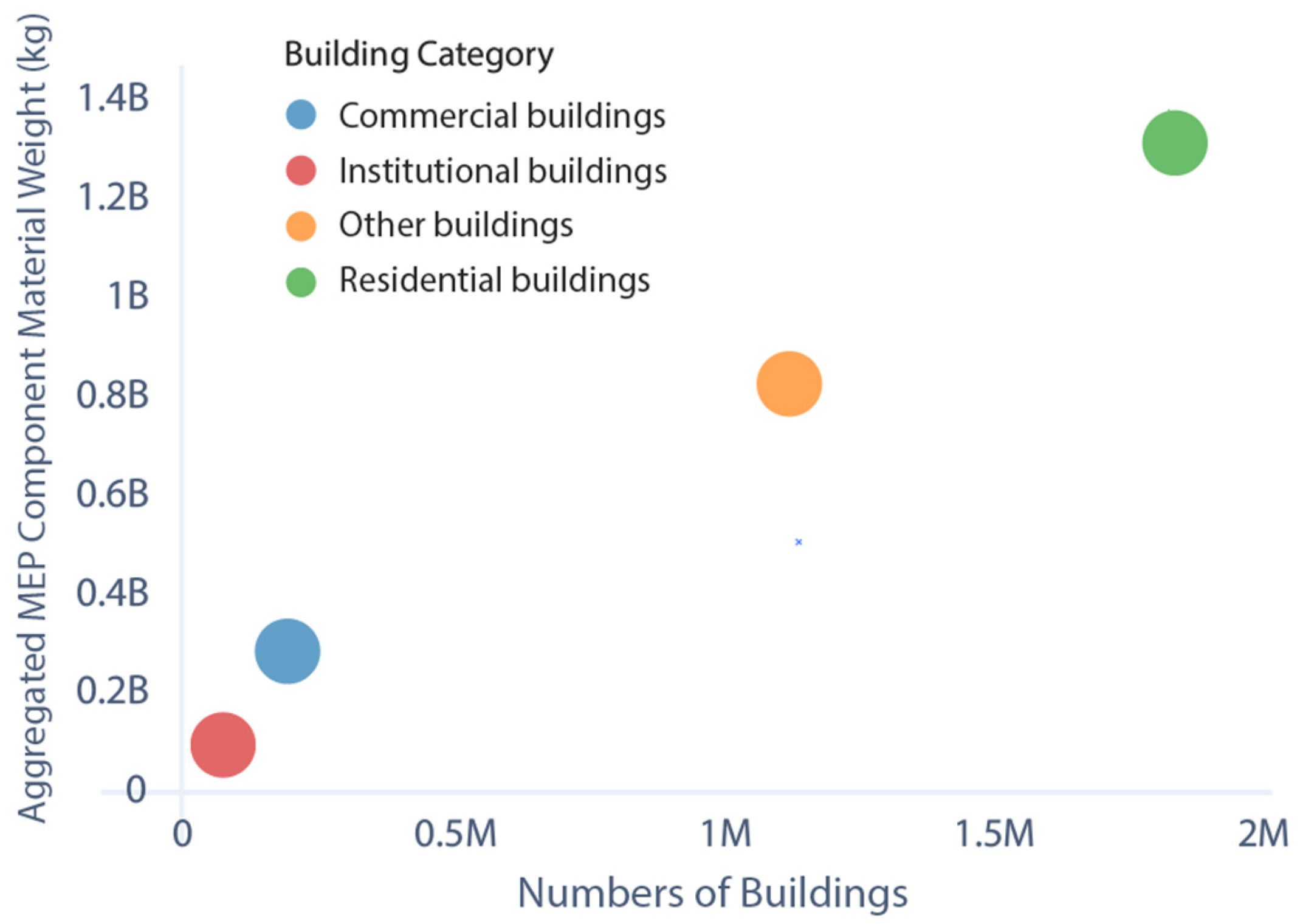
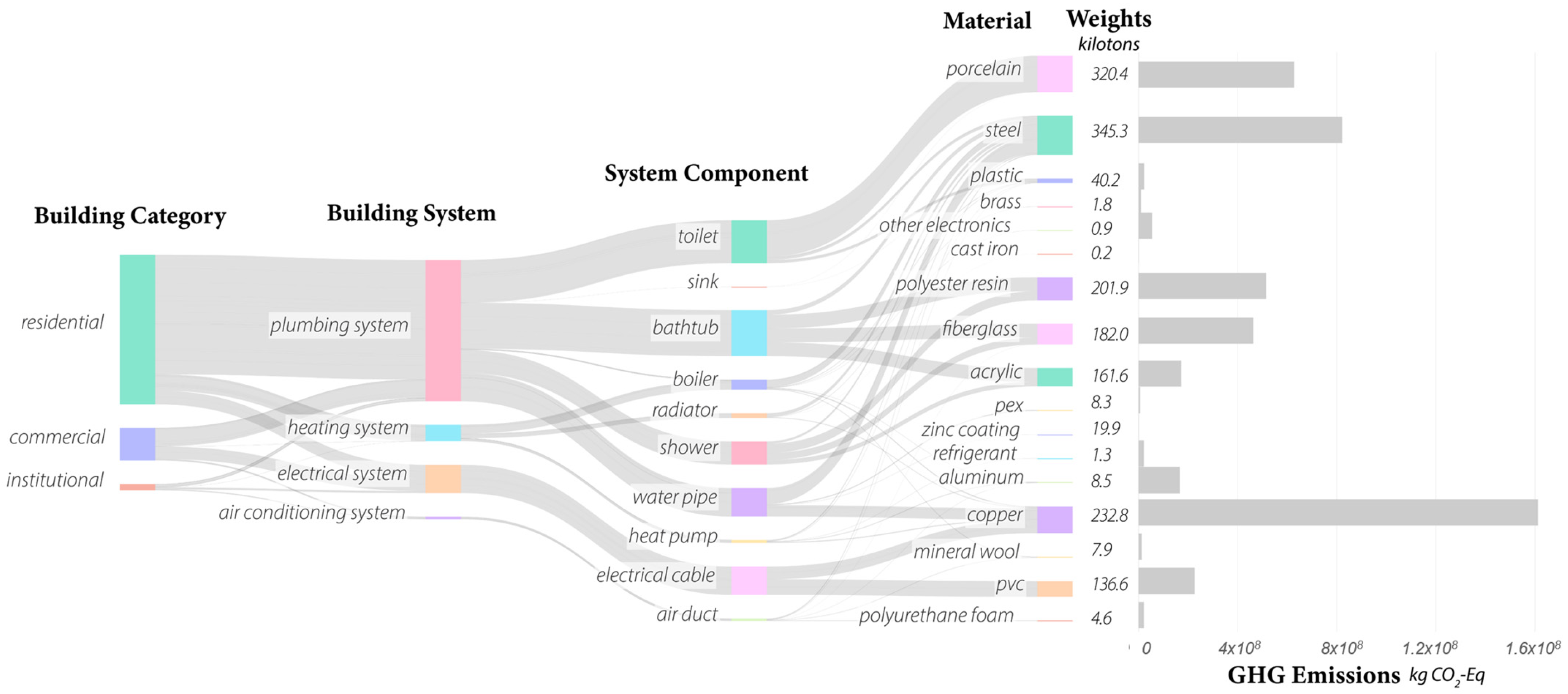
Based on Section 2, the framework successfully estimated material stocks for MEP components using existing national datasets and key building parameters, and subsequently derived their associated GHG emissions. This subsection focuses on demonstrating how these results can be visualized through the framework, showing its potential to help decision-makers quickly identify major environmental hotspots in a straightforward manner, without the need to go through the very technical methodology part. To show how materials are distributed within the Swiss building stock, Figure 3 compares total MEP material use across residential, commercial, institutional, and other buildings, while Figure 4 visualize the flows from building categories to systems, components, and materials, presenting a more detailed breakdown of them.
In Figure 3, residential buildings make up the largest share of total material stock, both in building numbers and overall quantity, showing their strong influence on national material demand. Commercial and institutional buildings use smaller total amounts but rely on a wider range of materials.
Figure 4 shows a Sankey diagram generated with the proposed framework, illustrating the distribution of mechanical, electrical, and plumbing materials across building categories, systems, and components in the Swiss building stock. Residential buildings account for the largest share of total material stock, both in number and overall quantity, reflecting their dominant role in national material demand. Commercial and institutional buildings contribute smaller totals but exhibit a broader mix of system types and materials.
The diagram highlights the most resource-intensive materials within each building type. Residential buildings consume the most copper, steel, plastics, and cast iron, while institutional buildings show higher shares of fiberglass and polyurethane foam in ventilation systems. The “other” category, though small in building count, displayed unusually high material volumes and was excluded from detailed analysis for clarity.
Although the analysis is static, it still reflects temporal variation through the age distribution of components. Older systems tend to use PVC or cast iron, while newer ones increasingly rely on plastics such as PEX or advanced composites. This material shift explains differences in reuse and recycling potential, as well as replacement priority across building vintages.
Plumbing systems and sanitary fixtures, especially ceramics in pre-1990 homes, account for a substantial share of total mass, while heating and ventilation systems contribute most to embodied GHG emissions due to their high steel and copper content. Porcelain stands out as a durable, stable material suitable for circular reuse.
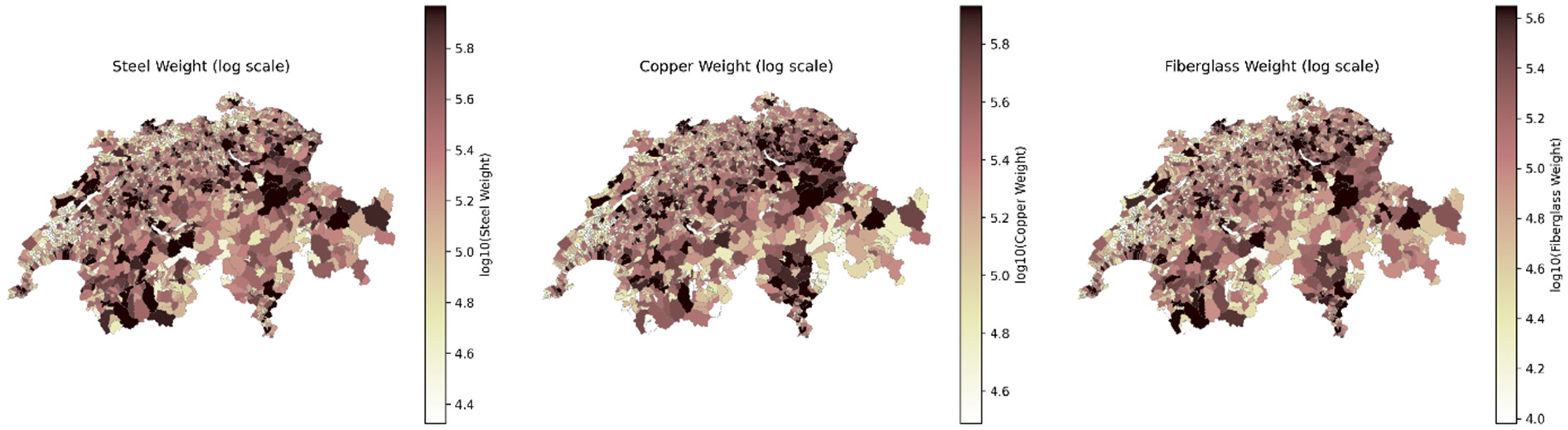
We could aggregate building-level material estimates to the municipality level as shown in Figure 5, summing the total mass of each material (steel, copper, and fiberglass). To better visualize the wide range of values, the results were plotted on a logarithmic scale.
Across all three materials, higher sums are concentrated in large urban municipalities and along major transport or industrial zones, while smaller alpine and rural municipalities fall on the lower end. Steel and fiberglass display similar spatial patterns, reflecting their strong association with HVAC and ductwork systems that scale with total floor area and building complexity. Copper is also concentrated in urban areas, mainly through plumbing and electrical networks, but its pattern is slightly more scattered, influenced by older infrastructure in dense city cores.
The maps prove framework’s ability to visualize the results: municipalities with more buildings and denser systems hold a disproportionately larger share of recoverable material stocks. These could offer practical guidance for planning logistics and identify prioritized locations to set up collection or reuse hubs.
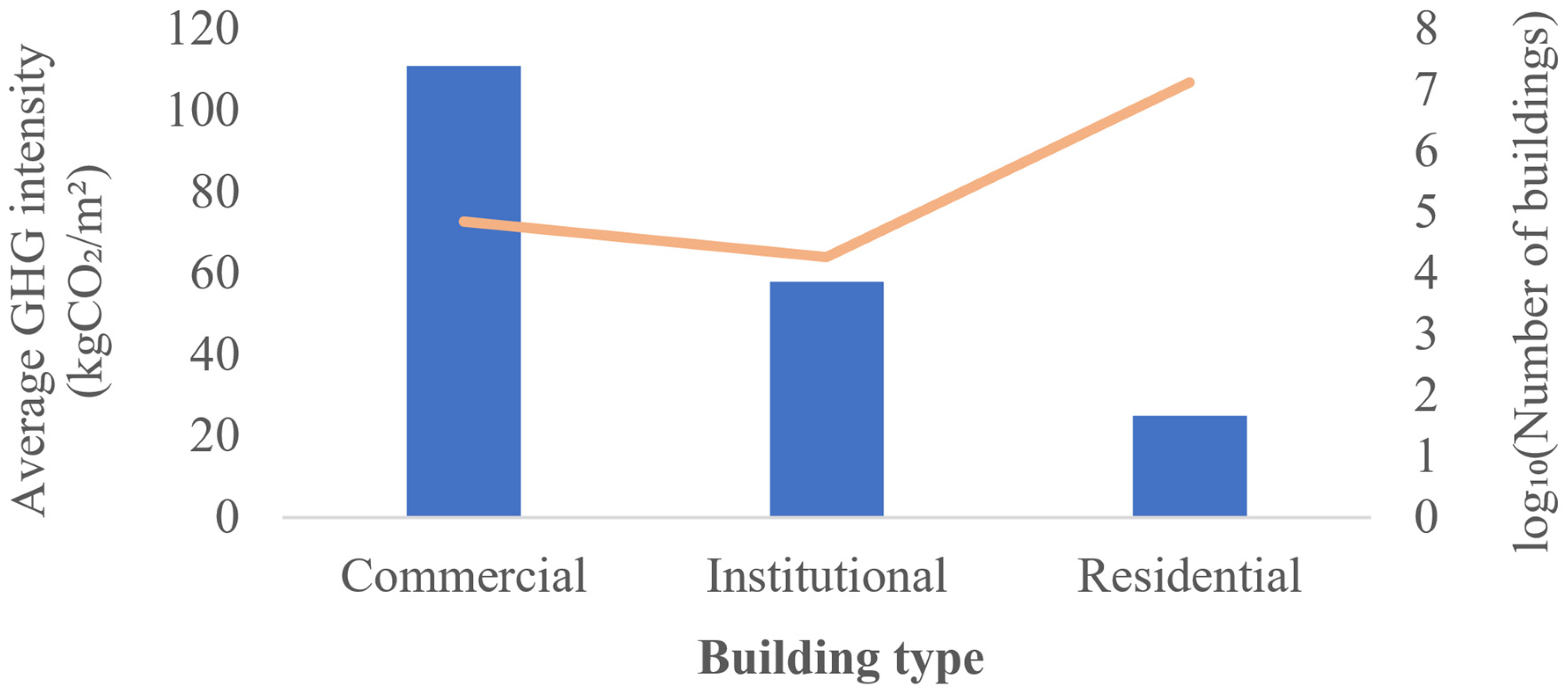
To check if the results are comparable to benchmark GHG emissions from existing studies on MEP components, it is necessary to generate average GHG emissions per building. The framework-generated building material data were first cleaned and harmonized to ensure comparability across building types. Based on the material masses and per-unit GHG emission factors from Ecoinvent 3.10.1 (Table S9), the total and area-normalized GHG emissions were calculated for each building. To minimize the influence of outliers, results were clipped between the 10th and 90th percentiles. The grouped analysis shows that commercial buildings have the highest average GHG intensity per square meter (~110 kgCO2-eq/m2), followed by institutional buildings (~60 kgCO2-eq/m2), while residential buildings exhibit the lowest values (~25 kgCO2-eq/m2).
As illustrated in Figure 6, the bar chart represents the average area-normalized GHG intensity for each building type, whereas the curve line (right axis, log10 scale) indicates the number of buildings in each category. Although residential buildings dominate in quantity, their GHG intensity remains significantly lower. The “other” category was excluded due to its heterogeneous composition and some extreme values.

3.4. Estimating Future Material Availability from Component Lifespans

The framework was further applied to estimate how the existing MEP material stock may translate into future material availability based on component lifespans and installation periods. The analysis covers buildings constructed between 1930 and 2020, excluding pre-1930 structures (typically preserved as heritage) and post-2020 ones still in early service stages. Average component lifespans are used as expected values at the building-stock level, rather than as deterministic replacement points for individual components.
The framework is designed to be adaptable: where reliable data on system renovations or component replacements become available, these can be directly integrated to refine the projections. In the absence of such data at the national scale, literature-based lifespan values are used as a practical approximation.
This analysis adds a temporal layer to the current stock-based exploration. It focuses on the composition and age distribution of existing MEP components to indicate when these embedded materials may gradually return to circulation.
Component lifespans were derived from two main sources:
While simplified, this method offers a practical way to link existing stock data with prospective material availability under current data limitations.
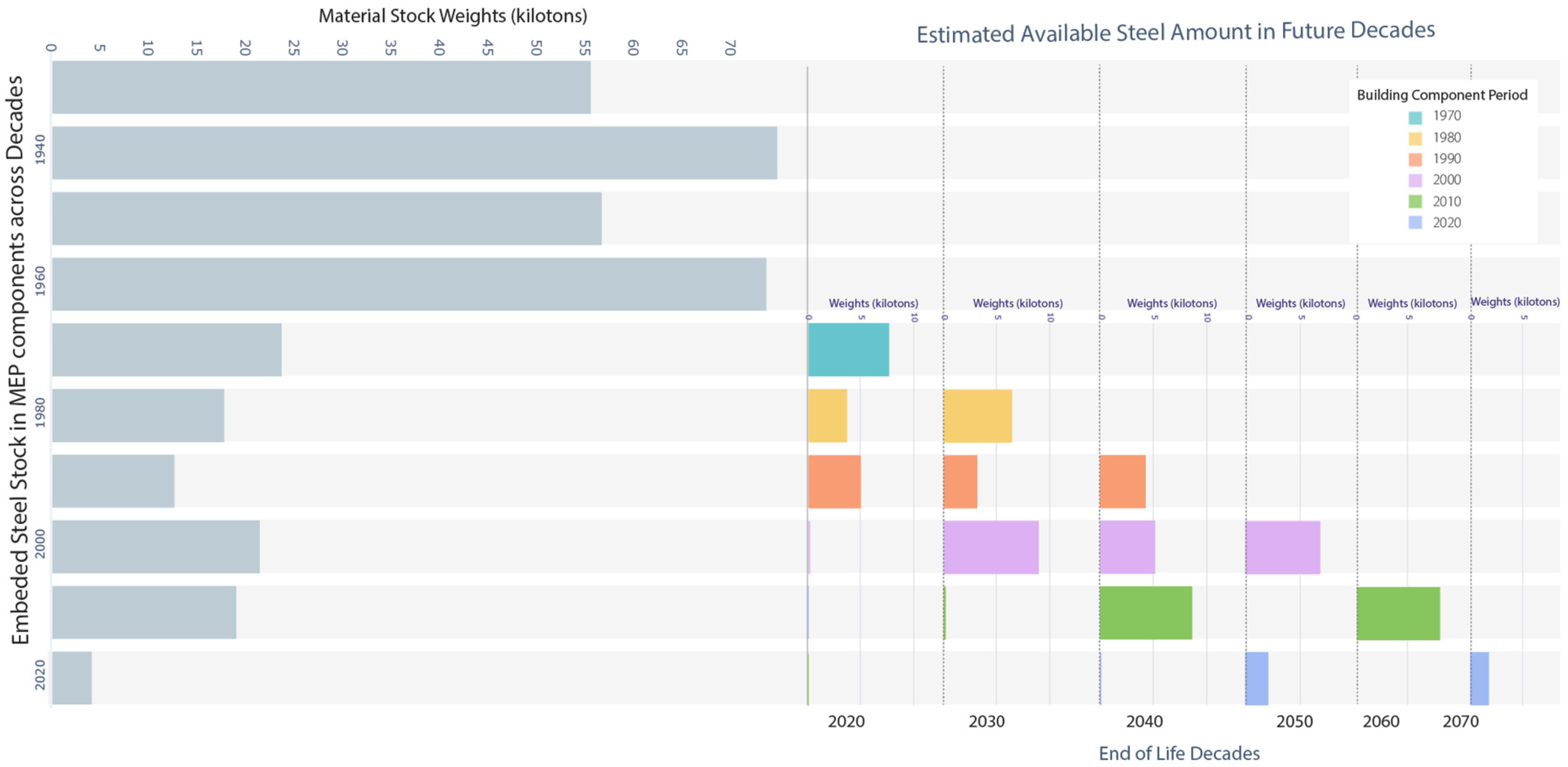
Steel was selected as an illustrative example because of its dominant share within MEP systems and well-documented lifecycle data [36,115,116]. Building on the previous flow diagram (Figure 4), which showed that most material mass originates from plumbing and heating components, Figure 7 traces how these component-level stocks evolve over time. The left panel shows how steel accumulated in Swiss MEP systems from 1930 to 2020. Although the estimates are approximate, the timeline clearly reflects waves of construction activity, especially the post-war boom of the 1940s–1960s, when radiators, boilers, and piping systems were installed at large scale. The right panel projects when this embedded steel is expected to reach end-of-life based on typical component lifespans. Most of the steel installed between the 1980s and 2000s is likely to be decommissioned between 2030 and 2050, illustrating the usual time lag between construction and material recovery.
These patterns can inform circular economy planning by indicating when significant volumes of recoverable steel are likely to re-enter circulation. In total, Swiss MEP systems currently contain more than 300 kilotons of steel, yet only a small portion will become available in the near term. This shows that existing in-use stocks, especially those locked in long-lived service components, represent a strategic starting point for planning future recovery and circular construction initiatives.

4. Discussion

With potential shortages of critical materials ahead [117], the smart use of embedded recoverable resources will be essential for sustainable infrastructure planning. The often-overlooked MEP components are gaining more attention because they are resource-intensive despite their much smaller weight compared to structural systems [29]. Knowing where these resources are located is essential for planning reuse or recycling strategies. In this study, we proposed a framework which merges parametric modeling with machine learning to fill missing data and estimate building system material stocks at scale and at component level.

4.1. Framework Performance and Contribution

To date, national-scale estimates of MEP material stocks with component-level granularity remain limited, particularly for approaches that integrate machine learning with parametric system modeling. The framework developed here fills this gap by linking incomplete building-level information with component-level installation logic to infer missing data and connect fragmented datasets. Supervised algorithms (XGBoost for continuous variables and neural networks for categorical ones) were used to predict unobserved attributes such as living space or number of rooms, both showing strong predictive accuracy.
Unlike most building stock models that directly predict material quantities from limited metrics, this framework introduces an intermediate “installation logic” layer that reflects how MEP systems are actually configured. This structure makes the workflow more transparent and computationally efficient, reducing the need for highly complex black-box models.
For the representative components analyzed (radiators, boilers, heat pumps, air ducts, water pipes, electrical cables, and plumbing fixtures), the calculated GHG emissions based on estimated material intensities average about 25 kg CO2-eq/m2 for residential and 111 kg CO2-eq/m2 for commercial buildings. These results are broadly consistent with published benchmarks, which typically range between 30 and 75 kg CO2-eq/m2 for residential and 120–145 kg CO2-eq/m2 for office buildings [30,36,115,118,119]. This agreement is largely explained by methodological similarities, as most benchmark studies also rely on aggregated material intensities and floor-area-based scaling rather than measured component inventories. Where differences occur, they can be attributed to system boundary choices, particularly the exclusion of auxiliary components and cooling-related subsystems in the present framework. The slightly lower values found here are expected, likely representing a conservative lower bound, since the current framework excludes certain auxiliary components such as control panels, valves, and small fans.
Several factors contribute to this conservative bias. First, compared to studies that infer MEP materials from material densities, demolition waste statistics or input–output tables [17,19,21], the framework currently models only key components rather than full systems. Second, building-level MEP installation data remain limited in Switzerland due to privacy restrictions, meaning that construction year was used as a proxy for system age. This can lead to underestimation of older, more material-intensive installations. Third, the typical Swiss building stock relies heavily on radiator-based heating without centralized cooling, which inherently involves less ductwork and cabling than systems in regions dominated by large-scale HVAC or central air conditioning.
It is important to note that this reliance on benchmark-based validation is not a methodological shortcut, but rather a response to the fact that data on MEP systems are widely limited. Unlike structural materials, MEP components are typically installed, replaced, and upgraded independently over a building’s lifetime and are therefore rarely documented in BIMs or national building registries. As a result, bottom-up validation using measured component quantities is currently not feasible at the national scale, not only in Switzerland but also in most international contexts.
Given this constraint, coherence checks against independent national benchmarks and published stock-level studies provide an appropriate preliminary validation for large-scale building stock modeling. The consistent trends observed across building categories suggest that the framework delivers reasonable order-of-magnitude estimates, even without detailed component-level installation data.
High-level, top-down approaches based on average material intensities tend to average out differences across components, regions, building types, and construction periods. In contrast, component-level estimation helps reveal where differences originate, for instance, there could be higher HVAC shares in commercial buildings or higher densities of plumbing fixtures in residential buildings. Given the dominance of residential buildings in Switzerland, the initial component selection is aligned with a residential baseline and does not yet include some components typical of other building types. Therefore, the current component set likely leads to an underestimation of total material stocks and associated GHG impacts. But this could be expanded once more empirical data is collected.
While comparisons with literature-based benchmarks provide a useful first-order validation at the stock level, they do not constitute independent verification of component-level estimates. As with any large-scale bottom-up model developed under incomplete data conditions, compensating errors cannot be fully excluded. Certain components may be underestimated, such as auxiliary elements (e.g., control units or small fans) that are not explicitly modeled, while others may be overestimated due to simplified installation rules or conservative assumptions. At an aggregated level, these opposing effects may partially offset each other and result in apparent agreement with published benchmarks.
Uncertainty is further introduced by the use of proxy variables where direct installation data are unavailable. For example, using construction year as a proxy for installation age when installation data is unavailable may lead to misestimation, as in reality older, heavier components (such as radiators) might have been replaced by lighter, modern systems. The framework therefore uses recorded information whenever available, with proxy-based estimation applied only as a fallback. As more detailed installation or replacement data become available, these uncertainties can be reduced without altering the underlying framework logic.

4.2. Material-Specific Recovery and Circularity Potential

While our study estimates the mass and embodied GHG emissions of various materials, these materials differ in their actual circularity potential, depending on how easily they can be recovered, and subsequently recycled, reused, or refurbished.
Copper and steel were highlighted as materials with the highest cumulative GHG emissions. Although reuse of steel components could cut greenhouse gas emissions by 60–80% compared with recycling or new production [120], the reuse of MEP components such as radiators remains rare in practice, less than 5% [121,122]. Sector-specific studies show that reuse of building service components is largely confined to small, niche second-hand markets rather than mainstream recovery pathways.
This limited uptake reflects both technological and systemic factors. From a technology perspective, older radiators are often incompatible with current heating system trends, which increasingly favor low-temperature systems, heat pumps, and underfloor heating. From a system perspective, the recycling chain for metals in Switzerland is highly mature, with recycling rates for steel and copper already exceeding 75–90%, making material recovery a more established and economically efficient pathway than component reuse. These metals have well-established recovery markets, yet the predominant end-of-life strategy remains recycling. For example, in Switzerland, metal recycling rates already reach 75–90%, supported by well-established collection systems [123].
Empirical investigations of construction and demolition waste treatment further indicate that service components are typically dismantled only to the extent required for metal recovery, with limited separation at component level due to time constraints, manual labor requirements, and liability concerns at CDW facilities [122,123,124].
As a result, reuse of radiators and other steel-based MEP components remains marginal, despite their theoretical reuse potential. A similar pattern is observed for porcelain components such as bathtubs, which exhibit high cumulative embodied emissions but face limited reuse due to handling difficulties, esthetic preferences, and a lack of standardized secondary markets.
Polymer-based components such as plastic pipes pose different challenges. Even though single-material thermoplastic pipes like PVC, PE, and PP are technically fully recyclable, their actual recovery rate is still low. Most are only reaching the end of their first service life, and separate collection systems for these materials are still rare [125,126]. As a result, plastic piping contributes little to circular material flows in practice and is usually downcycled into low-grade aggregates or sent to landfill.
These examples point to a broader pattern. While recycling and reuse are beneficial for circularity, and, in most cases, provide greater environmental benefits, their large-scale implementation is often limited by design and market barriers. The actual circularity potential is determined by factors such as how easily something can be disassembled, its physical condition, whether it fits modern systems, and whether there is a functioning second-hand market. Integrating these insights into the framework presented in this work would make it possible to estimate not only embodied emissions but also secondary material flows and upscale reuse opportunities, linking building-stock modeling more directly with circular economy and planned strategies.

4.3. Outlook

Internal cross-validation showed that the framework performs consistently, but broader testing with real-world data will be an important next step. External validation could be improved if empirical installation or maintenance data become available in the future, for instance through collaboration with housing management companies. As such data are typically not publicly accessible and may remain confidential, the framework is designed to allow assumptions and parameters to be easily tuned once empirical evidence becomes available, for example by incorporating additional measured data such as cable lengths or duct volumes.
At the same time, the framework is intentionally transparent and flexible. By separating data-driven imputation from rule-based installation logic, it allows assumptions to be clearly adjusted based on local expertise and data availability. While Switzerland provides a data-rich testbed for this study, the framework is designed to function even when detailed building data are unavailable. To support application in other national contexts, we therefore define a Minimum Functional Data Set consisting of the following core attributes:
(i)
Primary Geometries: Basic descriptors of building size, such as footprint area and height or number of floors.
(ii)
Functional Classification: A coarse building use or typology classification.
(iii)
Temporal Indicators: Aggregated construction or renovation periods expressed in broad time bands.
(iv)
Internal Scale Proxies: Simple indicators of occupancy or internal density, such as average dwelling size or the number of dwellings.
These inputs, often derived from cadastral data, satellite-based products, or statistical averages, are sufficient for the machine-learning module to impute missing attributes.
Furthermore, the modular parametric design facilitates regional customization. For instance, while the Swiss building stock is largely characterized by radiator-based heating without active cooling, other regions may rely more heavily on centralized HVAC systems. In such cases, the same framework can be applied by updating the connectivity matrix and installation assumptions, rather than retraining the entire model.
Another key next step is to translate the quantified material stocks into realistic recovery and reuse flows. This requires integrating component-specific recovery rates that reflect market and technological conditions, which are currently insufficiently documented for MEP systems.
Future research efforts can build on the presented work by integrating the static model with projections of new construction and records of building renovation to establish a dynamic stock with scenario-based circularity analysis of materials within building service systems. As national databases begin to include more detailed MEP information, the framework can be expanded to cover additional components such as lighting, control panels, or secondary ducts.

5. Conclusions

This study presents a transparent and adaptable framework for estimating material stocks in building systems when data are fragmented or incomplete. It focuses on the often-overlooked “black box” of MEP components, which make up a small fraction of total building mass but are highly resource-intensive and contribute significantly to embodied carbon. To date, no large-scale dataset exists for them worldwide.
The proposed framework is one of the first systematic attempts to model material stocks and flows within MEP systems. By combining machine-learning imputation with parametric modeling and expert knowledge, the framework enables structured, component-level assessments across different building types and system configurations.
It also supports spatial visualization and scenario interpretation, helping planners locate material hotspots and prioritize cities for action. By linking stock estimates with greenhouse-gas indicators, it creates a foundation for resource management under the circular economy goals. Beyond static estimation, the setup allows it to incorporate typological and temporal dimensions, captures how MEP materials evolve over time and when recoverable resources may re-enter circular loops.
Validation against existing MEP stock studies shows consistent greenhouse-gas estimates, supporting its use as a potential lower-bound reference. Future work should focus on empirical validation through collaboration with housing agencies and facility managers to record more details on components installation datasets and keep good track of them. Expanding regional design rules and localized datasets will further strengthen its contextual adaptability. With continued refinement, the framework could become a practical decision-support tool for material recovery, decarbonization, and sustainable construction planning.
Validation against existing MEP stock studies shows consistent greenhouse gas estimates, supporting the use of the framework as a conservative, lower-bound reference under current data constraints. Future work can further strengthen the approach through empirical validation, for example via collaboration with housing agencies or facility management actors to access more detailed installation or maintenance records. Expanding regional design rules and localized datasets would also enhance its contextual applicability.
Despite ongoing limitations in data availability, this study demonstrates that meaningful progress can still be made toward understanding MEP material stocks at scale and at a higher level of detail. Rather than seeing data gaps only as constraints, we also take this challenge as a motivation to develop methods that operate under realistic conditions, i.e., when MEP data cannot be retrieved. In this sense, the work is intended as a starting point rather than a final solution. By making individual MEP components visible at the stock level, it aims to stimulate further research, encourage closer collaboration between researchers and data holders, and raise awareness of the importance of MEP systems in sustainability and circular economy discussions.

Supplementary Materials

The following supporting information can be downloaded at: https://www.mdpi.com/article/10.3390/su18042093/s1, Figure S1: Actual vs. Predicted Values for Number of Apartments; Figure S2: Feature Importance Rankings for Model Predictors of Living Space; Figure S3: Training and Testing Accuracy Curve for Energy/Heating Source Model; Figure S4: Feature Attribution for ML-Based Imputation of Living Space (SHAP Analysis); Table S1: Overview of Components in Building Systems; Table S2: Material Composition and Density of Air Ducts by Construction Year; Table S3: Pipe Materials and Specifications by Construction Year; Table S4: Pipe Sizing Based on Occupancy and Building Type; Table S5: Material Composition and Unit Weight for Sanitary Fixtures; Table S6: Assigned Component Lifespans Used in the Framework; Table S7: Key Parametric Assumptions Used for Stock-Scale MEP Material Estimation; Table S8: R-Squared Values for Non-Categorical Building Metrics Prediction; Table S9: Neural Network Model Accuracy for Categorical Building Metrics; Table S10: One-at-a-Time (OAT) Sensitivity Analysis of Aggregated Radiator Mass; Table S11: One-at-a-Time Sensitivity Analysis of Radiator Stock Estimates (Parametric Assumptions); Table S12: GHG Emissions Calculated Based on Ecoinvent 3.10.1 and IPCC 2021.

Author Contributions

Conceptualization, S.X., K.K. and G.H.; methodology, S.X.; software, S.X.; validation, S.X.; formal analysis, S.X.; investigation, S.X.; resources, G.H.; data curation, S.X.; writing—original draft preparation, S.X.; writing—review and editing, K.K., E.Z.E. and G.H.; visualization, S.X. and E.Z.E.; supervision, E.Z.E. and G.H.; project administration, G.H.; funding acquisition, G.H. All authors have read and agreed to the published version of the manuscript.

Funding

This research received no external funding.

Data Availability Statement

Framework is publicly accessible to encourage future work on building system material estimation: https://github.com/shuyanxiong/CFC_WP2 (accessed on 11 February 2026).

Acknowledgments

This research was conducted at the Future Cities Lab Global at ETH Zurich. The Future Cities Lab Global is supported and funded by the National Research Foundation, Prime Minister’s Office, Singapore, under its Campus for Research Excellence and Technological Enterprise (CREATE) program and ETH Zurich (ETHZ), with additional contributions from the National University of Singapore (NUS), Nanyang Technological University (NTU), Singapore and the Singapore University of Technology and Design (SUTD). This research received no external funding and the APC was funded by ETH Zurich. The processing of geometrical data is conducted by Chair of Ecological Systems Design, ETHZ. Special thanks to Carlo Schmid and Stefanie Hellweg for helpful discussions. Appreciation is also extended to Huiying Zhang for supervision and support on ML. During the preparation of this manuscript/study, the authors used ChatGPT 5 for the purposes of proofreading and improving the original manuscript. The authors have reviewed and edited the output and take full responsibility for the content of this publication.

Conflicts of Interest

The authors declare no conflicts of interest.

Abbreviations

The following abbreviations are used in this manuscript:
ANNArtificial Neural Network
BIMBuilding Information Modeling
BSMBuilding Stock Modeling
CECircular Economy
CDWConstruction and Demolition Waste
EGIDFederal Building Identifier (Switzerland)
GHGGreenhouse Gas
GWRSwiss Federal Building and Housing Register
HVACHeating, Ventilation, and Air Conditioning
LCALife Cycle Assessment
LCILife Cycle Inventory
MFAMaterial Flow Analysis
MEPMechanical, Electrical, and Plumbing
MLMachine Learning
PDPPartial Dependence Plot
PVCPolyvinyl Chloride
R2Coefficient of Determination
UBEMUrban Building Energy Modeling
XGBoostExtreme Gradient Boosting

References

  1. OECD. Global Material Resources Outlook to 2060; OECD: Paris, France, 2019. [Google Scholar]
  2. Meglin, R.; Kytzia, S.; Habert, G. Regional Circular Economy of Building Materials: Environmental and Economic Assessment Combining Material Flow Analysis, Input-Output Analyses, and Life Cycle Assessment. J. Ind. Ecol. 2022, 26, 562–576. [Google Scholar] [CrossRef]
  3. De Wolf, C.; Hoxha, E.; Fivet, C. Comparison of Environmental Assessment Methods When Reusing Building Components: A Case Study. Sustain. Cities Soc. 2020, 61, 102322. [Google Scholar] [CrossRef]
  4. MacArthur, E.; Zumwinkel, K.; Stuchtey, M.R. Growth Within: A Circular Economy Vision for a Competitive Europe; Ellen MacArthur Foundation: Isle of Wight, UK, 2015. [Google Scholar]
  5. Ghisellini, P.; Ripa, M.; Ulgiati, S. Exploring Environmental and Economic Costs and Benefits of a Circular Economy Approach to the Construction and Demolition Sector. A Literature Review. J. Clean. Prod. 2018, 178, 618–643. [Google Scholar] [CrossRef]
  6. Stahel, W.R. The Circular Economy. Nature 2016, 531, 435–438. [Google Scholar] [CrossRef] [PubMed]
  7. Mohammadiziazi, R.; Bilec, M.M. Building Material Stock Analysis Is Critical for Effective Circular Economy Strategies: A Comprehensive Review. Environ. Res. Infrastruct. Sustain. 2022, 2, 032001. [Google Scholar] [CrossRef]
  8. Li, X.; Song, L.; Liu, Q.; Ouyang, X.; Mao, T.; Lu, H.; Liu, L.; Liu, X.; Chen, W.; Liu, G. Product, Building, and Infrastructure Material Stocks Dataset for 337 Chinese Cities between 1978 and 2020. Sci. Data 2023, 10, 228. [Google Scholar] [CrossRef]
  9. Augiseau, V.; Barles, S. Studying Construction Materials Flows and Stock: A Review. Resour. Conserv. Recycl. 2017, 123, 153–164. [Google Scholar] [CrossRef]
  10. Famuyibo, A.A.; Duffy, A.; Strachan, P. Developing Archetypes for Domestic Dwellings—An Irish Case Study. Energy Build. 2012, 50, 150–157. [Google Scholar] [CrossRef]
  11. Heisel, F.; McGranahan, J.; Ferdinando, J.; Dogan, T. High-Resolution Combined Building Stock and Building Energy Modeling to Evaluate Whole-Life Carbon Emissions and Saving Potentials at the Building and Urban Scale. Resour. Conserv. Recycl. 2022, 177, 106000. [Google Scholar] [CrossRef]
  12. Hong, T.; Malik, J.; Langevin, J.; Liu, Z.; Yan, D. Ten Questions on Building Stock Modeling to Inform Energy Efficiency and Sustainability. Build. Environ. 2025, 284, 113465. [Google Scholar] [CrossRef]
  13. Bertin, I.; Mesnil, R.; Jaeger, J.-M.; Feraille, A.; Le Roy, R. A BIM-Based Framework and Databank for Reusing Load-Bearing Structural Elements. Sustainability 2020, 12, 3147. [Google Scholar] [CrossRef]
  14. Lismont, A.; Allacker, K. Turning the Existing Building Stock into a Resource Mine: Proposal for a New Method to Develop Building Stock Models. IOP Conf. Ser. Earth Environ. Sci. 2019, 323, 012070. [Google Scholar] [CrossRef]
  15. Soonsawad, N.; Martinez, R.M.; Schandl, H. Material Demand, and Environmental and Climate Implications of Australia’s Building Stock: Current Status and Outlook to 2060. Resour. Conserv. Recycl. 2022, 180, 106143. [Google Scholar] [CrossRef]
  16. Verellen, E.; Allacker, K. Developing a Building Stock Model to Enable Clustered Renovation—The City of Leuven as Case Study. Sustainability 2022, 14, 5769. [Google Scholar] [CrossRef]
  17. Deetman, S.; Marinova, S.; van der Voet, E.; van Vuuren, D.P.; Edelenbosch, O.; Heijungs, R. Modelling Global Material Stocks and Flows for Residential and Service Sector Buildings towards 2050. J. Clean. Prod. 2020, 245, 118658. [Google Scholar] [CrossRef]
  18. Augiseau, V.; Kim, E. Spatial Characterization of Construction Material Stocks: The Case of the Paris Region. Resour. Conserv. Recycl. 2021, 170, 105512. [Google Scholar] [CrossRef]
  19. Liang, H.; Zhang, B.; Qian, X.; Chen, Y.; Luo, Y.; Huang, Y.; Sun, L.; Zhou, C.; Long, J.; Dong, L. Building Material Stocks and Embodied Carbon Dataset for Two Urban Agglomerations in China from 2000 to 2020. Sci. Data 2025, 12, 930. [Google Scholar] [CrossRef]
  20. Haberl, H.; Wiedenhofer, D.; Schug, F.; Frantz, D.; Virág, D.; Plutzar, C.; Gruhler, K.; Lederer, J.; Schiller, G.; Fishman, T.; et al. High-Resolution Maps of Material Stocks in Buildings and Infrastructures in Austria and Germany. Environ. Sci. Technol. 2021, 55, 3368–3379. [Google Scholar] [CrossRef]
  21. Wang, T.; Berrill, P.; Zimmerman, J.B.; Rao, N.D.; Min, J.; Hertwich, E.G. Improved Copper Circularity as a Result of Increased Material Efficiency in the U.S. Housing Stock. Environ. Sci. Technol. 2022, 56, 4565–4577. [Google Scholar] [CrossRef]
  22. Alavi, N.; Shirmardi, M.; Babaei, A.; Takdastan, A.; Bagheri, N. Waste Electrical and Electronic Equipment (WEEE) Estimation: A Case Study of Ahvaz City, Iran. J. Air Waste Manag. Assoc. 2015, 65, 298–305. [Google Scholar] [CrossRef]
  23. Hashimoto, S.; Tanikawa, H.; Moriguchi, Y. Framework for Estimating Potential Wastes and Secondary Resources Accumulated within an Economy—A Case Study of Construction Minerals in Japan. Waste Manag. 2009, 29, 2859–2866. [Google Scholar] [CrossRef]
  24. Streeck, J.; Wieland, H.; Pauliuk, S.; Plank, B.; Nakajima, K.; Wiedenhofer, D. A Review of Methods to Trace Material Flows into Final Products in Dynamic Material Flow Analysis: Comparative Application of Six Methods to the United States and EXIOBASE3 Regions, Part 2. J. Ind. Ecol. 2023, 27, 457–475. [Google Scholar] [CrossRef]
  25. Moriguchi, Y.; Hashimoto, S. Material Flow Analysis and Waste Management. In Taking Stock of Industrial Ecology; Clift, R., Druckman, A., Eds.; Springer International Publishing: Cham, Switzerland, 2016; pp. 247–262. [Google Scholar]
  26. Hoxha, E.; Maierhofer, D.; Saade, M.R.M.; Passer, A. Influence of Technical and Electrical Equipment in Life Cycle Assessments of Buildings: Case of a Laboratory and Research Building. Int. J. Life Cycle Assess. 2021, 26, 852–863. [Google Scholar] [CrossRef]
  27. Passer, A.; Kreiner, H.; Maydl, P. Assessment of the Environmental Performance of Buildings: A Critical Evaluation of the Influence of Technical Building Equipment on Residential Buildings. Int. J. Life Cycle Assess. 2012, 17, 1116–1130. [Google Scholar] [CrossRef]
  28. Rasmussen, F.N.; Ganassali, S.; Zimmermann, R.K.; Lavagna, M.; Campioli, A.; Birgisdóttir, H. LCA Benchmarks for Residential Buildings in Northern Italy and Denmark—Learnings from Comparing Two Different Contexts. Build. Res. Inf. 2019, 47, 833–849. [Google Scholar] [CrossRef]
  29. A BIM-Based Framework for Quantifying Embodied Emissions from MEP Systems in Building Life Cycle Assessments|E3S Web of Conferences. Available online: https://www.e3s-conferences.org/articles/e3sconf/abs/2024/92/e3sconf_bsn2024_02001/e3sconf_bsn2024_02001.html (accessed on 19 August 2025).
  30. Roberts, M.; Ouellet-Plamondon, C.; Raftery, P. Embodied Carbon in Mechanical, Electrical, and Plumbing Systems: A Critical Literature Review. Build. Environ. 2025, 275, 112823. [Google Scholar] [CrossRef]
  31. Bosché, F.; Ahmed, M.; Turkan, Y.; Haas, C.T.; Haas, R. The Value of Integrating Scan-to-BIM and Scan-vs-BIM Techniques for Construction Monitoring Using Laser Scanning and BIM: The Case of Cylindrical MEP Components. Autom. Constr. 2015, 49, 201–213. [Google Scholar] [CrossRef]
  32. Wang, B.; Yin, C.; Luo, H.; Cheng, J.C.P.; Wang, Q. Fully Automated Generation of Parametric BIM for MEP Scenes Based on Terrestrial Laser Scanning Data. Autom. Constr. 2021, 125, 103615. [Google Scholar] [CrossRef]
  33. Guo, J.; Wang, Q.; Park, J.-H. Geometric Quality Inspection of Prefabricated MEP Modules with 3D Laser Scanning. Autom. Constr. 2020, 111, 103053. [Google Scholar] [CrossRef]
  34. European Commission. PEFCR Guidance Document-Guidance for the Development of Product Environmental Footprint Category Rules (PEFCRs); Version 6.3; European Commission: Brussels, Belgium, 2017. [Google Scholar]
  35. Mahadevan, M. Enabling Value Recovery of HVAC Systems Towards a Circular Built Environment-Status Quo and Challenges. Master’s Thesis, ETH Zurich, Zurich, Switzerland, 2023. Available online: https://sc.ibi.ethz.ch/en/education/stundent-theses/master-theses/completed-master-theses/meera-mahadevan.html (accessed on 1 February 2026).
  36. Rodriguez, B.X.; Huang, M.; Lee, H.W.; Simonen, K.; Ditto, J. Mechanical, Electrical, Plumbing and Tenant Improvements over the Building Lifetime: Estimating Material Quantities and Embodied Carbon for Climate Change Mitigation. Energy Build. 2020, 226, 110324. [Google Scholar] [CrossRef]
  37. The Evolution of MEP Technologies and Trends; GDI Engineering: Erie, PA, USA, 2024; Available online: https://gdiengdesign.com/the-evolution-of-mep-technologies-and-trends/ (accessed on 1 February 2026).
  38. How Lightweight Solutions Can Change the Construction Industry. Available online: https://www.azom.com/article.aspx?ArticleID=21605 (accessed on 4 October 2023).
  39. Sanchez, B.; Rausch, C.; Haas, C.; Hartmann, T. A Framework for BIM-Based Disassembly Models to Support Reuse of Building Components. Resour. Conserv. Recycl. 2021, 175, 105825. [Google Scholar] [CrossRef]
  40. Xiong, S.; Escamilla, E.Z.; Habert, G. Accessing Hidden Material Flows in the Swiss Built Environment: A Parametric Predictive Model for Building Systems’ Components Reuse Estimation. IOP Conf. Ser. Earth Environ. Sci. 2024, 1363, 012049. [Google Scholar] [CrossRef]
  41. Vanegas, P.; Peeters, J.R.; Cattrysse, D.; Tecchio, P.; Ardente, F.; Mathieux, F.; Dewulf, W.; Duflou, J.R. Ease of Disassembly of Products to Support Circular Economy Strategies. Resour. Conserv. Recycl. 2018, 135, 323–334. [Google Scholar] [CrossRef] [PubMed]
  42. European Council of Vinyl Manufacturers. PVC in Building and Construction; The European Council of Vinyl Manufacturers: Brussels, Belgium, 2026; Available online: https://pvc.org/applications/building-and-construction/ (accessed on 1 February 2026).
  43. D’Alonzo, V.; Novelli, A.; Vaccaro, R.; Vettorato, D.; Albatici, R.; Diamantini, C.; Zambelli, P. A Bottom-up Spatially Explicit Methodology to Estimate the Space Heating Demand of the Building Stock at Regional Scale. Energy Build. 2020, 206, 109581. [Google Scholar] [CrossRef]
  44. Bielik, M.; Zhang, L.; Schneider, S. Big Data, Good Data, and Residential Floor Plans: Feature Selection for Maximizing the Information Value and Minimizing Redundancy in Residential Floor Plan Data Sets. In Computer-Aided Architectural Design. INTERCONNECTIONS: Co-Computing Beyond Boundaries; Turrin, M., Andriotis, C., Rafiee, A., Eds.; Communications in Computer and Information Science; Springer Nature Switzerland: Cham, Switzerland, 2023; Volume 1819, pp. 607–622. [Google Scholar]
  45. u, W.; Xue, F.; Li, M. Building Feature-Based Machine Learning Regression to Quantify Urban Material Stocks: A Hong Kong Study. J. Ind. Ecol. 2023, 27, 336–349. [Google Scholar] [CrossRef]
  46. Ji, Q.; Bi, Y.; Makvandi, M.; Deng, Q.; Zhou, X.; Li, C. Modelling Building Stock Energy Consumption at the Urban Level from an Empirical Study. Buildings 2022, 12, 385. [Google Scholar] [CrossRef]
  47. Pasichnyi, O.; Wallin, J.; Kordas, O. Data-Driven Building Archetypes for Urban Building Energy Modelling. Energy 2019, 181, 360–377. [Google Scholar] [CrossRef]
  48. Neale, A.; Kummert, M.; Bernier, M. Development of a Bottom-up White-Box Building Stock Energy Model for Single-Family Dwellings. J. Build. Perform. Simul. 2022, 15, 735–756. [Google Scholar] [CrossRef]
  49. Sobhkhiz, S.; Taghaddos, H.; Rezvani, M.; Ramezanianpour, A.M. Utilization of Semantic Web Technologies to Improve BIM-LCA Applications. Autom. Constr. 2021, 130, 103842. [Google Scholar] [CrossRef]
  50. Chen, H.M.; Chang, K.C.; Lin, T.H. A Cloud-Based System Framework for Performing Online Viewing, Storage, and Analysis on Big Data of Massive BIMs. Autom. Constr. 2016, 71, 34–48. [Google Scholar] [CrossRef]
  51. Froemelt, A.; Buffat, R.; Hellweg, S. Machine Learning Based Modeling of Households: A Regionalized Bottom-up Approach to Investigate Consumption-Induced Environmental Impacts. J. Ind. Ecol. 2020, 24, 639–652. [Google Scholar] [CrossRef]
  52. Karka, P.; Papadokonstantakis, S.; Kokossis, A. Predictive LCA—A Systems Approach to Integrate LCA Decisions Ahead of Design. In Computer Aided Chemical Engineering; Kiss, A.A., Zondervan, E., Lakerveld, R., Özkan, L., Eds.; 29 European Symposium on Computer Aided Process Engineering; Elsevier: Amsterdam, The Netherlands, 2019; Volume 46, pp. 97–102. [Google Scholar]
  53. Domingos, P. A Few Useful Things to Know about Machine Learning. Commun. ACM 2012, 55, 78–87. [Google Scholar] [CrossRef]
  54. A Comprehensive Review of Handling Missing Data: Exploring Special Missing Mechanisms. Available online: https://arxiv.org/html/2404.04905v1 (accessed on 9 May 2025).
  55. Negendahl, K.; Barholm-Hansen, A.; Andersen, R. Parametric Stock Flow Modelling of Historical Building Typologies. Buildings 2022, 12, 1423. [Google Scholar] [CrossRef]
  56. Pei, W.; Stouffs, R. Parametric Archetype: A Synthetic Digital Method of Building Material Stock Representation Based on Distance Measurement. In Proceedings of the 43rd Annual Conference of the Association for Computer Aided Design in Architecture, Denver, CO, USA, 21–28 October 2023; Association for Computer Aided Design in Architecture: Fargo, ND, USA, 2023. [Google Scholar]
  57. Swiss Geoportal. Available online: https://map.geo.admin.ch (accessed on 30 November 2023).
  58. Oraiopoulos, A.; Hsieh, S.; Schlueter, A. Energy Futures of Representative Swiss Communities Under the Influence of Urban Development, Building Retrofit, and Climate Change. Sustain. Cities Soc. 2023, 91, 104437. [Google Scholar] [CrossRef]
  59. Milojevic-Dupont, N.; Wagner, F.; Nachtigall, F.; Hu, J.; Brüser, G.B.; Zumwald, M.; Biljecki, F.; Heeren, N.; Kaack, L.H.; Pichler, P.-P.; et al. EUBUCCO v0.1: European Building Stock Characteristics in a Common and Open Database for 200+ Million Individual Buildings. Sci. Data 2023, 10, 147. [Google Scholar] [CrossRef] [PubMed]
  60. Chen, T.; Guestrin, C. XGBoost: A Scalable Tree Boosting System. In Proceedings of the 22nd ACM SIGKDD International Conference on Knowledge Discovery and Data Mining, San Francisco, CA, USA, 13–17 August 2016; Association for Computing Machinery: New York, NY, USA, 2016; pp. 785–794. [Google Scholar]
  61. Paszke, A.; Gross, S.; Massa, F.; Lerer, A.; Bradbury, J.; Chanan, G.; Killeen, T.; Lin, Z.; Gimelshein, N.; Antiga, L.; et al. PyTorch: An Imperative Style, High-Performance Deep Learning Library. In Advances in Neural Information Processing Systems 32, Proceedings of the NeurIPS 2019, Vancouver, BC, Canada, 8--14 December 2019; Curran Associates, Inc.: Red Hook, NY, USA, 2019; pp. 8024–8035. [Google Scholar]
  62. Çukur, H.; Binol, H.; Uslu, F.S.; Kalaycı, Y.; Bal, A. Cross Correlation Based Clustering for Feature Selection in Hyperspectral Imagery. In Proceedings of the 2015 9th International Conference on Electrical and Electronics Engineering (ELECO), Bursa, Turkey, 26–28 November 2015; pp. 232–236. [Google Scholar]
  63. Farahani, R. Feature Selection Based on Cross-Correlation for the Intrusion Detection System. Secur. Commun. Netw. 2020, 2020, 8875404. [Google Scholar] [CrossRef]
  64. Goulouti, K.; Padey, P.; Galimshina, A.; Habert, G.; Lasvaux, S. Uncertainty of Building Elements’ Service Lives in Building LCA & LCC: What Matters? Build. Environ. 2020, 183, 106904. [Google Scholar] [CrossRef]
  65. Mengis, N.; Keller, D.P.; Oschlies, A. Systematic Correlation Matrix Evaluation (SCoMaE)—A Bottom–up, Science-Led Approach to Identifying Indicators. Earth Syst. Dyn. 2018, 9, 15–31. [Google Scholar] [CrossRef]
  66. Magrans de Abril, I.; Yoshimoto, J.; Doya, K. Connectivity Inference from Neural Recording Data: Challenges, Mathematical Bases and Research Directions. Neural Netw. 2018, 102, 120–137. [Google Scholar] [CrossRef]
  67. Simms, D. How Do Radiator Heaters Work? (2023 Guide). Available online: https://todayshomeowner.com/hvac/guides/how-do-radiator-heaters-work/ (accessed on 24 October 2023).
  68. Differences Between Types of Home Heating Systems. Available online: https://www.thespruce.com/types-of-home-heating-systems-1824772 (accessed on 24 October 2023).
  69. Geothermal Heat Pumps|WBDG—Whole Building Design Guide. Available online: https://www.wbdg.org/resources/geothermal-heat-pumps?utm_source=chatgpt.com (accessed on 12 May 2025).
  70. Kägi, T.; Waldburger, L.; Kern, C.; Roberts, G.; Zschokke, M.; Conte, F.; Weber, L.; Spörri, A. Life Cycle Inventories of Heating Systems; BAFU: Bern, Switzerland, 2021. [Google Scholar]
  71. Introduction to Gas Distribution. Available online: https://www.swagelok.com/en/blog/introduction-gas-distribution (accessed on 12 May 2025).
  72. Jeandaux, C.; Videau, J.-B.; Prieur-Vernat, A. Life Cycle Assessment of District Heating Systems in Europe: Case Study and Recommendations. Sustainability 2021, 13, 11256. [Google Scholar] [CrossRef]
  73. Jorio, L. How to Cool Homes Sustainably in Sweltering Weather; SWI swissinfo.ch: Bern, Switzerland, 2023; Available online: https://www.swissinfo.ch/eng/sci-tech/how-to-cool-homes-sustainably-in-sweltering-weather/48711678 (accessed on 1 February 2026).
  74. Leupi, S. More Heat Pumps and Less Oil: How the Swiss Heat Their Homes; SWI swissinfo.ch: Bern, Switzerland, 2024; Available online: https://www.swissinfo.ch/eng/climate-solutions/more-heat-pumps-and-less-oil-how-the-swiss-heat-their-homes/88226331 (accessed on 1 February 2026).
  75. How Is Heating Provided in Switzerland Today? Available online: https://www.energyscope.ch/en/questions/how-is-heating-provided-in-switzerland-today/ (accessed on 12 May 2025).
  76. Aksözen, M.; Hassler, U.; Rivallain, M.; Kohler, N. Mortality Analysis of an Urban Building Stock. Build. Res. Inf. 2017, 45, 259–277. [Google Scholar] [CrossRef]
  77. Aksoezen, M.; Daniel, M.; Hassler, U.; Kohler, N. Building Age as an Indicator for Energy Consumption. Energy Build. 2015, 87, 74–86. [Google Scholar] [CrossRef]
  78. Sasso, F.; Chambers, J.; Patel, M.K. Space Heating Demand in the Office Building Stock: Element-Based Bottom-up Archetype Model. Energy Build. 2023, 295, 113264. [Google Scholar] [CrossRef]
  79. Steel Panel Radiator: The Path to Success in the Global Market. Available online: https://uterm.ua/en/news/steel-panel-radiator-the-path-to-success-in-the-global-market/1000/ (accessed on 1 February 2026).
  80. AKLIMAT. Development of Radiators Through History. Available online: https://www.aklimat.si/en/history-of-radiators/ (accessed on 1 February 2026).
  81. The History of Cast Iron Radiators. Available online: https://www.periodhousestore.co.uk/blog/the-history-of-cast-iron-radiators.html (accessed on 12 May 2025).
  82. Zehnder Group. Air, Space and Time; Zehnder Group: Gränichen, Switzerland, 2021. [Google Scholar]
  83. How Long Do Cast Iron Radiators Last?|Trads. Available online: https://www.tradscastironradiators.co.uk/blog/how-long-do-cast-iron-radiators-last/ (accessed on 12 May 2025).
  84. Calibayan, S. Column Radiators: Ultimate Guide to Efficient Home Heating|Benefits & Style Options. 2024. Available online: https://ukconstructionblog.co.uk/2024/08/14/stylish-and-efficient-the-benefits-of-column-radiators/ (accessed on 1 February 2026).
  85. 600 × 608 mm Raw Metal Lacquered Horizontal Traditional 3 Column Radiator. Available online: https://www.radiatoroutlet.co.uk/600-x-608mm-raw-metal-lacquered-horizontal-traditional-3-column-radiator (accessed on 12 May 2025).
  86. How Much Do Cast Iron Radiators Weigh? The Ultimate Guide—Radiatorplus. Available online: https://radiatorplus.ie/how-much-do-cast-iron-radiators-weigh-the-ultimate-guide/ (accessed on 12 May 2025).
  87. The History of the Radiator—The Radiator Centre. Available online: https://www.theradiatorcentre.com/post/the-history-of-the-radiator/ (accessed on 12 May 2025).
  88. The History of Cast Iron Radiators|Publications—Editorial. Available online: https://www.thevictorianemporium.com/publications/editorial/article/the-history-of-cast-iron-radiators (accessed on 12 May 2025).
  89. The Surprising World of Swiss Apartment Life. Available online: https://www.wanderwego.com/home/14-things-about-swiss-apartments (accessed on 12 May 2025).
  90. Ecoinvent v3.10—Ecoinvent. Available online: https://ecoinvent.org/ecoinvent-v3-10/ (accessed on 22 January 2025).
  91. Boiler Size Calculator—What Size Boiler Do I Need? Available online: https://heatable.co.uk/boiler-advice/what-size-boiler-for-my-home (accessed on 27 October 2023).
  92. EG Series 6 Gas Boiler. Available online: https://www.weil-mclain.com/products/eg-series-6-gas-boiler (accessed on 27 October 2023).
  93. Hall, F.; Greeno, R. Building Services Handbook, 8th ed.; Routledge: London, UK, 2015; ISBN 978-1-315-75212-9. [Google Scholar]
  94. A Complete Breakdown of the Plumbing System Components—Premium Residential Valves and Fittings Factory. Available online: https://plumberstar.com/a-complete-breakdown-of-the-plumbing-system-components/ (accessed on 13 May 2025).
  95. Bhatia, A. HVAC Ducting: Principles and Fundamentals. PDH Online. Available online: https://pdhonline.com/courses/m246/m246content.pdf (accessed on 15 May 2025).
  96. Understanding Different Air Duct Materials | Beltway. Available online: https://beltwayhvac.com/understanding-different-air-duct-materials/?utm_source=chatgpt.com (accessed on 15 May 2025).
  97. North American Insulation Manufacturers Association (NAIMA). A Guide to Insulated HVAC Duct Systems; NAIMA: Alexandria, VA, USA; Available online: https://insulationinstitute.org/wp-content/uploads/2015/11/AH121.pdf (accessed on 15 May 2025).
  98. Environmental Heating & Air Solutions. The Lifespan of Different Types of Air Ducts. 2024. Available online: https://ehasolutions.com/the-lifespan-of-different-types-of-air-ducts/ (accessed on 15 May 2025).
  99. Three Steps to Sizing Plumbing Piping Systems | C1S Blog. Available online: https://c1sinc.com/blog/three-steps-size-plumbing-piping-systems (accessed on 7 November 2023).
  100. ANSI Steel Pipe Schedule 40 Chart: Dimensions, Weights & Specifications. Available online: https://www.engineeringtoolbox.com/ansi-steel-pipes-d_305.html (accessed on 15 May 2025).
  101. ASTM B306 Copper Tubes for Drain, Waste and Vent—Dimensions and Working Pressures. Available online: https://www.engineeringtoolbox.com/copper-tube-astm-306-d_1083.html (accessed on 15 May 2025).
  102. ASTM F876—PEX Tube—Dimensions. Available online: https://www.engineeringtoolbox.com/ASTM-F876-PEX-tube-d_2139.html (accessed on 15 May 2025).
  103. National Association of Plumbing-Heating-Cooling Contractors (PHCC). National Standard Plumbing Code: Sizing the Building Water Supply System; PHCC: Falls Church, VA, USA, 2009; Available online: https://lorisweb.com/CMGT235/DIS12/Sizing%20the%20Building%20Water%20Supply%20System.pdf (accessed on 15 May 2025).
  104. Consulting-Specifying Engineer. Sizing Domestic Water Pipes. 2018. Available online: https://www.csemag.com/sizing-domestic-water-pipes/ (accessed on 15 May 2025).
  105. Water Service Line—Sizing. Available online: https://www.wheaton.il.us/842/Water-Service-Line---Sizing?utm_source=chatgpt.com (accessed on 15 May 2025).
  106. Zarook, A. Average Toilet Weight: How Much Does a Toilet Weigh? Solid Toilet, 2019. Available online: https://www.solidtoilet.com/toilet-weight/ (accessed on 15 May 2025).
  107. Porcelain Sink by Dream Bath. Available online: https://www.specifiedby.com/dreambath/porcelain-sink (accessed on 15 May 2025).
  108. Sandringham Stainless Steel Kitchen Sink | Kitchen Sinks | Commercial Stainless Steel | Bluebook. Available online: https://www.idealspec.co.uk/catalogue/bluebook/commercial-stainless-steel/sinks/sandringham-stainless-steel-kitchen-sink_p5667_a7941.html (accessed on 15 May 2025).
  109. Acrylic vs. Fiberglass Bathtubs: What’s the Difference? Available online: https://www.angi.com/articles/acrylic-vs-fiberglass-tubs.htm (accessed on 15 May 2025).
  110. Santos, V. Understanding Shower Base Weight Ratings: Acrylic vs Tile Shower Bases. Newline, 10 August 2024. [Google Scholar]
  111. CDW Engineering. Average Life Expectancies. Available online: https://www.cdwengineering.com/average-life-expectancies/ (accessed on 13 May 2025).
  112. Davis, A.; Quintana-Gallardo, A.; Martí Audí, N.; Guillén Guillamón, I. The Impact of Lifespan Assumptions in LCA: Comparing the Replacement of Building Parts versus Building Layers—A Housing Case Study. Energy Build. 2025, 326, 115050. [Google Scholar] [CrossRef]
  113. InterNACHI’s Standard Estimated Life Expectancy Chart for Homes. Available online: https://www.nachi.org/life-expectancy.htm (accessed on 13 May 2025).
  114. Service Life of Materials. Available online: https://oneclicklca.zendesk.com/hc/en-us/articles/360015065139-Service-Life-of-Materials (accessed on 13 May 2025).
  115. Salwathura, K.A.; Shabani, F. Evaluating Environmental Impacts: Embodied Carbon Assessment of Ventilation, Electrical, and Plumbing Systems in Swedish School Architecture: A Case Study from Hedda Gymnasium in Lund, Sweden. Master’s Thesis, Department of Building and Environmental Technology, Division of Energy and Building Design, Lund University, Lund, Sweden, 2024. Available online: https://lup.lub.lu.se/student-papers/search/publication/9161808 (accessed on 1 February 2026).
  116. Federal Office for the Environment (FOEN). Studien Wirtschaft Und Konsum. Available online: https://www.bafu.admin.ch/de/studien-wirtschaft-und-konsum (accessed on 11 February 2026).
  117. S&P Global. The Future of Copper: Will the Looming Supply Gap Short-Circuit the Energy Transition? S&P Global: New York, NY, USA, 2022. [Google Scholar]
  118. Rabani, M.; Madessa, H.B.; Ljungström, M.; Aamodt, L.; Løvvold, S.; Nord, N. Life Cycle Analysis of GHG Emissions from the Building Retrofitting: The Case of a Norwegian Office Building. Build. Environ. 2021, 204, 108159. [Google Scholar] [CrossRef]
  119. Henderson, H. Hiding in Plain Sight: Embodied Carbon MEP Systems; Canadian Architect: Toronto, ON, Canada, 2024; Available online: https://www.canadianarchitect.com/hiding-in-plain-sight-embodied-carbon-mep-systems/ (accessed on 1 February 2026).
  120. Berglund-Brown, J.; Ochsendorf, J. Reusing Heavy-Section Steel in Buildings: Carbon Reduction Potential and Material Availability. J. Archit. Eng. 2025, 31, 04025020. [Google Scholar] [CrossRef]
  121. Honic, M.; Kovacic, I.; Rechberger, H. Improving the Recycling Potential of Buildings through Material Passports (MP): An Austrian Case Study. J. Clean. Prod. 2019, 217, 787–797. [Google Scholar] [CrossRef]
  122. Akanbi, L.A.; Oyedele, L.O.; Akinade, O.O.; Ajayi, A.O.; Davila Delgado, M.; Bilal, M.; Bello, S.A. Salvaging Building Materials in a Circular Economy: A BIM-Based Whole-Life Performance Estimator. Resour. Conserv. Recycl. 2018, 129, 175–186. [Google Scholar] [CrossRef]
  123. Federal Office for the Environment (FOEN). Raw Materials, Waste and the Circular Economy: In Brief. Available online: https://www.bafu.admin.ch/en/state-wastemanagement (accessed on 11 February 2026).
  124. Coelho, A.; de Brito, J. Influence of Construction and Demolition Waste Management on the Environmental Impact of Buildings. Waste Manag. 2012, 32, 532–541. [Google Scholar] [CrossRef]
  125. Shamsuyeva, M.; Endres, H.-J. Plastics in the Context of the Circular Economy and Sustainable Plastics Recycling: Comprehensive Review on Research Development, Standardization and Market. Compos. Part C Open Access 2021, 6, 100168. [Google Scholar] [CrossRef]
  126. Plastics Industry Pipe Association of Australia. Recycled Content in Plastic Pipes; Plastics Industry Pipe Association of Australia: North Lakes, QLD, Australia, 2022; Available online: https://www.pipa.com.au/resource/recycled-content-in-plastic-pipes/ (accessed on 1 February 2026).
Figure 1. Workflow Diagram of Framework Development for MEP components (abbreviation detailed in Section 2.2).
Sustainability 18 02093 g001
Figure 2. Correlation Heatmap of Key Predictors for Building Metrics. Note: The color gradient ranges from dark purple to bright yellow, displaying the correlation matrix of key parameters. A value of 1 indicates a perfect positive linear relationship, while below-zero values reflect negative associations.
Sustainability 18 02093 g002
Figure 3. MEP Material Distribution Across Building Categories.
Sustainability 18 02093 g003
Figure 4. MEP Material Flows Across Building Categories, Systems, Components, and Material: potential weights generated with framework.
Sustainability 18 02093 g004
Figure 5. Municipal Distribution of Building System Material Stocks in Switzerland.
Sustainability 18 02093 g005
Figure 6. Average GHG Intensity and Building Count by Type (log10 scale).
Sustainability 18 02093 g006
Figure 7. Projected Circular Steel Availability from MEP components by End-of-Life Decades.
Sustainability 18 02093 g007
Table 1. Mapping Common Components to Energy Sources for Heating Systems. Estimates based on the Swiss Federal Office for the Environment (BAFU) “Life Cycle Inventories of Heating Systems” and online resources [69,70,71,72].
Key Components
Energy SourceRadiatorBoilerHeat PumpFlueSolar CollectorsStorage TankCHP UnitOil Storage TankBoreholesGas Supply LineConnection
Oil11010001000
Gas11010010001
Geothermal10100100101
Wood11010000000
Electricity11000000001
District Heating10000100011
Solar Energy10001100001
Other10000100001
Table 2. Categorization of Building Systems and Components by Building Categories. Estimates derived from online resources [73,74,75].
Building Categories
Building SystemComponentCommercialInstitutionalResidentialOthers
Heating SystemRadiator0010
Ventilation SystemAir Duct1100
Plumbing SystemWater Pipe1111
Electrical SystemElectrical Cable1111
Plumbing SystemSink/Toilet1111
Plumbing SystemBathtub/Shower0010
Table 3. Chronological Overview of Radiator Types, Materials, and Lifespans by Decade. Note: Paint excluded due to negligible weight (~1.5%) and limited relevance to material recovery. Data from online sources and product model estimates [79,80,81,82,83,84,85,86,87,88].
Decade1940s1950s1960s1970s1980s1990s
Typecast iron radiatorsteel panel radiatorconvector radiatorcolumn radiatorsteel panel radiatorlow surface temperature radiator
Main Materialcast ironsteelsteelcast ironsteelsteel
Unit Weight702030802040
Lifespan503030303030
Disclaimer/Publisher’s Note: The statements, opinions and data contained in all publications are solely those of the individual author(s) and contributor(s) and not of MDPI and/or the editor(s). MDPI and/or the editor(s) disclaim responsibility for any injury to people or property resulting from any ideas, methods, instructions or products referred to in the content.