


Abstract
The rapid aging of China’s rural labor force is reshaping agricultural production and may complicate the transition toward greener development. Yet whether—and through what channels—labor aging hampers green agricultural transformation (GAT) remains insufficiently understood. Drawing on provincial panel data from 2012 to 2023, this study employs fixed-effects models to empirically investigate the relationship between rural labor aging and GAT, while also examining the moderating role of digitalization. The empirical findings reveal a robust negative association between rural labor aging and GAT, and this finding remains robust to alternative specifications as well as endogeneity treatments. Mechanism tests indicate that aging may constrain GAT by weakening regional innovation capacity, slowing fertilizer reduction, and limiting the expansion of scale operations. Moreover, digital village construction significantly mitigates the detrimental impact of aging on GAT. This buffering role is heterogeneous, with stronger mitigation observed in provinces characterized by more severe aging and higher levels of economic development. Overall, the evidence highlights the potential of digital tools and rural digital infrastructure to sustain GAT in an aging society.
1. Introduction
Population aging is jeopardizing sustainable agricultural development [1]. While a growing body of literature has examined the economic impacts of rural aging, the conclusions remain debated. One strand of research posits that rural labor aging may stifle technology adoption and reduce agricultural production efficiency through physical decline, decreased learning ability, and increased risk aversion, thereby exerting a negative impact on agricultural development [2,3]. Relevant evidence has been verified in Japan, South Korea, and some developing countries [4,5,6,7]. Conversely, the “induced innovation” hypothesis suggests that labor aging may promote the adjustment of the structure of agricultural factors, driving capital deepening and the accumulation of other factors, such as inducing mechanization and technological substitution, thereby partially alleviating labor constraints [8,9,10]. Nevertheless, in the long run, aging is not conducive to the advancement of agricultural mechanization [11]. Consequently, the nexus between aging and agricultural development appears complex and context-dependent [12]. However, the existing literature primarily centers on single dimensions such as agricultural output, production efficiency, or food security, with scant attention paid to GAT, a comprehensive goal that balances economic performance and environmental performance.
GAT not only requires improving production efficiency but also emphasizes resource conservation, environmental friendliness, and long-term sustainability. Its realization highly depends on green technology innovation, optimization of input structures, and transformation of operation methods. Previous studies have noted that technological innovation is an important driver of green agriculture [13], fertilizer consumption is positively correlated with agricultural carbon emissions [14], and expanding the scale of agricultural production can promote green agricultural development [15]. Rural labor aging may systematically constrain the process of GAT by suppressing regional innovation capabilities, weakening fertilizer reduction behaviors, and hindering appropriate scale operations. Nevertheless, a systematic theoretical framework and empirical evidence elucidating the underlying mechanisms remain scarce.
Concurrently, the rapid ascent of digitalization offers a new perspective for re-examining the relationship between aging and GAT. Digitalization has become a core feature of the new stage of agricultural development [16]. Existing studies have confirmed that the digital economy can effectively promote high-quality agricultural development [17], and the level of digitalization is significantly positively correlated with agricultural productivity [18]. In the specific context of green transformation, digital technology directly suppresses agricultural carbon intensity and injects new momentum into sustainable agricultural development by promoting agricultural green technology changes, optimizing resource allocation in the food supply chain, and reducing resource waste [19,20,21,22]. Therefore, strengthening the application of digital technology in the agri-food chain has become a key measure to achieve sustainable agriculture [23]. However, whether and how digitalization moderates the impact of rural labor aging on GAT remains lacking in direct empirical testing in existing research.
Despite extensive research on rural demographics, a distinct gap remains in the literature at the intersection of aging, digitalization, and green farming. Existing studies have predominantly focused on the impact of aging on single-dimension indicators, such as agricultural labor productivity or carbon emissions. However, GAT is a systemic concept that integrates both production efficiency and environmental sustainability, which cannot be fully captured by traditional productivity metrics alone. The literature that explicitly examines the impact of aging on GAT—specifically considering the comprehensive balance between inputs, desired outputs, and undesired environmental outputs—remains limited. Furthermore, while digital technology is recognized as a driver of modernization, its specific role as a moderator in alleviating the friction between an aging workforce and green transformation warrants further investigation.
Consequently, this study focuses on the Chinese context to address these research gaps, as China provides a representative setting for examining these dynamics. On the one hand, the country is undergoing a rapid and profound aging of its rural labor force, which remains dominated by smallholders. Specifically, the proportion of rural workers aged over 65 surged to 24.34% in 2023, compared to just 13.07% in 2012. On the other hand, the past decade has witnessed a national acceleration in digital village construction, deepening the integration of digital technologies into agricultural production and governance. By December 2024, the number of rural internet users had reached 313 million, an increase of 114.38% compared to 2012.
This study contributes to the literature in three ways. First, distinct from prior research focused on partial productivity, we assess the net impact of aging on the comprehensive GAT index, extending the analytical boundary from efficiency to sustainable transformation. Second, we unpack the black box of transmission mechanisms by verifying three distinct channels: innovation capacity suppression, fertilizer reduction constraints, and scale operation limits. Third, by integrating digitalization into the framework, we provide novel evidence that digital village construction acts as a critical buffer, identifying a viable policy lever to counteract demographic headwinds in an aging society.
The remainder of this article is organized as follows: Section 2 elaborates on the theoretical mechanisms and research hypotheses; Section 3 details the research design, covering data sources, variable selection, and model setting; Section 4 presents the empirical results using the two-way fixed model, followed by robustness tests, endogeneity treatment, and mechanism analysis; Section 5 is the discussion section; Section 6 discusses the results and policy implications of this study.
2. Theoretical Analysis and Research Hypotheses
2.1. The Effect of Rural Labor Aging on GAT
Currently, the issue of rural labor aging is becoming increasingly prominent, and its impact on green agricultural development is primarily reflected in three aspects. First, aging precipitates a depreciation in farmers’ health capital, thereby directly constraining the labor supply for green agricultural production. As farmers age, their physical resilience and fitness deteriorate markedly, making it difficult for them to undertake the heavy labor and fine management required by green agriculture. This problem is particularly prominent in western China: affected by the urban-rural dual economic structure, a large number of young and middle-aged laborers in western rural areas have migrated to cities and towns. Agricultural production is gradually dominated by elderly farmers. The deepening degree of aging further leads to insufficient labor input required for green and low-carbon agriculture, directly constraining the advancement of green agricultural production [24,25]. Second, the low education level of elderly farmers constrains the adoption and application of green production technologies. Due to the limited popularization of early rural education, the years of schooling of elderly farmers are generally lower than those of the younger generation. This human capital deficit hinders GAT mainly through two aspects: On the one hand, insufficient education leads to a weak perception of climate change among elderly farmers, who believe its impact on agricultural production is limited, thus lacking the motivation to actively adopt environmental protection technologies to cope with climate risks [26]. On the other hand, the gap in cultural levels reduces the learning and mastery ability of elderly farmers regarding green and clean production technologies, and their value cognition of green production behaviors also significantly lags behind that of young farmers [27]. Third, the weak risk tolerance of elderly farmers weakens their willingness to invest in GAT. Elderly farmers need to balance agricultural production inputs with old-age security, resulting in relatively limited agricultural investment capabilities [28]. However, GAT is inseparable from additional inputs in the introduction of green production technologies and the ecological protection of cultivated land. Such inputs are characterized by high initial costs and long return cycles, which contradict the risk preferences and financial constraints of elderly farmers, ultimately constraining the advancement of GAT [29]. However, it is worth noting that the impact of rural labor aging on GAT is not absolutely negative but rather exhibits certain context-dependent features. Drawing on the Induced Technical Change Theory, labor scarcity caused by aging might stimulate a compensatory effect, forcing the substitution of labor with capital (e.g., mechanization). If this substitution is dominated by green and efficient machinery, it could theoretically promote agricultural technological progress. Nevertheless, in the current context of China’s smallholder economy, the physical limitations and cognitive barriers of the aging workforce often outweigh this compensatory effect, resulting in a net negative impact. Therefore, while acknowledging potential non-linear complexities, we maintain that the dominant trend is more likely to be negative. Based on this, the following hypothesis was proposed:
H1.
Rural labor aging may hinder GAT.
2.2. The Main Mechanisms of Rural Labor Aging on GAT
2.2.1. The Innovation Capability Mechanism
Technological innovation is an important driving force for GAT. Its development level directly determines the R&D breakthroughs and promotion and application efficiency of agricultural green technologies. However, rural labor aging may inhibit regional innovation capability, thereby hindering the process of GAT. Although rural aging is inherently a micro-level demographic phenomenon, it profoundly influences regional innovation capacity through mechanisms of market demand and human capital accumulation. On the demand side, the aging farming population typically exhibits a lower willingness to adopt new technologies. This reluctance shrinks the market demand for green agricultural innovations, thereby dampening the R&D incentives of regional enterprises. On the supply side, the outflow of young, high-quality labor weakens the overall human capital stock required for regional innovation. Theoretically, labor scarcity might stimulate induced mechanization [30]. However, in the context of China’s smallholder economy, this potential positive effect is overshadowed by the “human capital deficit.” First, the outflow of high-quality labor weakens the talent pool required for regional R&D, while rising social security expenditures crowd out fiscal investments in agricultural innovation [31,32]. Second, elderly farmers act as “laggards” in technology diffusion. Their cognitive limitations and risk aversion shrink the market demand for green technologies, stifling the commercialization and iterative upgrading of agricultural innovations [25,33]. Thus, the supply-side drain on talent combined with demand-side inertia creates a “double squeeze” on innovation capacity. In addition, although aging may promote technological changes in machine substitution for labor in the short term, the adaptability of elderly farmers to machine operation is poor, which will suppress the in-depth application and iterative upgrading of agricultural machinery technologies in the long run [11,34]. Accordingly, the following hypothesis was proposed:
H2a.
Rural labor aging affects GAT by stifling regional innovation capability.
2.2.2. The Fertilizer Reduction Mechanism
Fertilizer reduction is one of the core measures of GAT. Its core goal is to reduce the dependence of agricultural production on chemical fertilizers, alleviate ecological and environmental problems such as nutrient loss, watershed pollution, and soil quality degradation caused by excessive application of fertilizers, and thereby solve the dilemma of green efficiency loss in traditional agricultural development [35]. However, there is a natural contradiction between the production decision-making preferences of elderly farmers and the demand for fertilizer reduction. Elderly farmers have long relied on traditional agricultural production models, have insufficient cognition and low acceptance willingness regarding green fertilization technologies such as new environmentally friendly fertilizers and soil testing and formulated fertilization, and are more inclined to use familiar traditional fertilization methods to ensure yields [7,26,36]. The “labor-fertilizer” substitution effect triggered by labor shortages further weakens the possibility of fertilizer reduction. Agricultural management in China is characterized primarily by smallholders. Under this management model, there is a clear substitution relationship between labor input and fertilizer input: When the family labor supply is sufficient, farmers are more inclined to increase yields through labor-intensive methods such as intensive cultivation, manual weeding, and organic fertilizer returning; when labor is insufficient, farmers often choose to increase fertilizer input as a compensation means for labor shortage to maintain output levels. With the advancement of urbanization, a large number of young and middle-aged rural laborers have transferred to cities. Although some migrant workers may have accumulated knowledge of green agricultural technologies, which is theoretically conducive to promoting fertilizer reduction [37], targeted education and policy support are still needed [38]. In reality, most young and middle-aged laborers choose to settle and work in cities for a long time and no longer participate in agricultural production, making it difficult for their technical knowledge to be translated into fertilizer reduction actions in actual production. Elderly farmers remaining in rural areas are more likely to compensate for labor shortages by increasing fertilizer application, ultimately leading to difficulties in advancing fertilizer reduction and constraining GAT. Existing studies have confirmed that rural aging leads to a 3% increase in environmental pollution effects related to fertilizer loss, causing a significant negative impact on the agricultural ecological environment [1]. Based on this, the following hypothesis was proposed:
H2b.
Rural labor aging affects GAT by undermining efforts toward fertilizer reduction.
2.2.3. The Scale Operation Mechanism
Land fragmentation reduces the marginal productivity of agricultural labor and is detrimental to GAT [39]. A larger scale of cultivated land management is conducive to reducing fertilizer application [40] and partially offsetting the negative impact of cultivated land fragmentation on land use efficiency [41]. However, the “labor capacity constraints” and “land attachment” of elderly households form a dual constraint, directly constraining land scale operation. From the perspective of labor, affected by the decline in physical strength and energy, elderly households find it difficult to undertake the high-intensity labor required for large-scale agricultural production and are more inclined to retain small plots of land for operation [42]. From the perspective of land attachment, rural land carries the emotional sustenance and survival security cognition of elderly farmers, making their willingness to transfer land low. At the same time, elderly farmers tend to rely on traditional production methods, reducing the possibility of participating in large-scale agriculture [34]. Existing studies have found an inverted U-shaped relationship between labor aging and land inflow, meaning that aging may promote land concentration in the early stage, but as the degree of aging deepens, the willingness to transfer in gradually weakens, and the scale of transfer in is limited [43]. There is a U-shaped relationship between aging and land outflow: early aging restricts land transfer, but as the degree of aging deepens, farmers are forced to transfer out land due to a lack of successor labor [44]. Land transfer contributes to agricultural green total factor productivity [45]. However, in developing countries, imperfect land transfer markets hinder land transfer. Aging causes farmers to abandon farming or reduce the scale of operation rather than transfer land, which significantly increases the area of abandoned cultivated land and exacerbates the inefficient allocation of land resources [46]. This phenomenon is particularly prominent in areas with more non-agricultural employment opportunities, leading to idle land resources and a decline in intensification levels [47]. Green agricultural technologies usually require continuous land management and long-term investment, and the phenomenon of abandonment directly weakens the application scenarios of such technologies. Based on this, the following hypothesis was proposed:
H2c.
Rural labor aging affects GAT by constraining the scale of agricultural operation.
2.3. The Moderating Role of Digitalization
Theoretically, digital technology not only plays an important role in promoting GAT but may also play a moderating role in the process of labor aging constraining GAT. The digital economy can significantly promote the improvement of the level of green agricultural development, and this effect becomes more significant over time [48]. Digital transformation is a key factor in promoting sustainable development goals [49]. Regarding GAT, digital technology promotes it through the dual mechanisms of “efficiency enhancement” and “carbon reduction.”
In terms of promoting agricultural efficiency, digital technology promotes sustainable economic growth by empowering the improvement of rural human capital [50]. Specifically, it plays a key role in optimizing labor resource allocation and improving labor utilization efficiency [51]. By bridging information silos, digital solutions provide new learning pathways for the elderly workforce, effectively breaking through traditional experience constraints. Furthermore, these tools enhance farm productivity by streamlining logistics and market information services [52]. Digital transformation also promotes the productivity improvement of agricultural enterprises [53].
In terms of promoting agricultural carbon reduction, digital technology promotes agricultural carbon emission reduction by optimizing resource utilization efficiency and reconstructing low-carbon production models. First, digitalization promotes technological innovation and facilitates green agricultural production. The development of the rural digital economy improves agricultural production efficiency, reduces resource waste and environmental pollution by promoting the innovation and application of green technologies [54], and also reduces carbon emissions from cultivated land use [55]. With the improvement of low-carbon technology innovation levels, the promoting effect of digital technology on agricultural ecological transformation will become more prominent [56]. Second, digitalization reduces agricultural carbon emissions by optimizing resource allocation. With the promotion and application of digital technologies, agricultural production resource allocation is optimized, and the agricultural industrial structure is upgraded, thereby reducing agricultural carbon emission intensity. It also generates spatial spillover effects on surrounding areas, further reducing agricultural carbon emissions in surrounding areas [57]. Agricultural digital transformation is conducive to promoting the upgrading of agricultural industrial structure and agricultural scale operation, thereby promoting green agricultural development [58]. The digital economy significantly reduces agricultural carbon intensity by promoting agricultural economic development and advancing agricultural scientific and technological progress [59]. According to the analysis above, the following hypothesis was proposed:
H3.
Digital village construction plays a moderating role in the process of rural labor aging affecting GAT.
3. Research Design
3.1. Data Sources
Taking 2012 as the starting year, and comprehensively considering the completeness and availability of data, this paper excludes data from Tibet, Hong Kong, Macau, and Taiwan. Finally, panel data consisting of 360 samples from 30 provinces (autonomous regions and municipalities) in China from 2012 to 2023 were selected as the research object. The macro data used for the main variables were derived from the China Statistical Yearbook, China Rural Statistical Yearbook, and China Population and Employment Statistical Yearbook, supplemented by data published by provincial statistical agencies. Some missing data were filled in using the interpolation method. Meanwhile, to mitigate the impact of heteroscedasticity, the natural logarithm was taken for relevant variables.
3.2. Variable Selection
3.2.1. Dependent Variable
This study adopts GAT as the dependent variable. Fundamentally, we conceptualize GAT, not merely as static ecological efficiency, but as a structural evolutionary process of the agricultural production mode. While efficiency focuses on optimizing the input-output ratio within a given framework, transformation entails a fundamental paradigm shift from a resource-intensive, high-emission model to a sustainable, low-carbon trajectory. To capture this qualitative shift, we referred to existing research [15,43,60] and constructed a comprehensive evaluation system that specifically integrates resource constraints (Labor, Land, Water, Fertilizer, Machinery) with dual-target outputs (Economic Growth as desired vs. Carbon Emissions as undesired). This specific indicator configuration reflects the core essence of transformation: the decoupling of agricultural economic growth from environmental degradation. By penalizing high carbon emissions and resource over-consumption, the index measures the extent to which a region has successfully reconfigured its factor allocation towards the green frontier, rather than simply maximizing yield. Specifically, the system consists of five input indicators and two output indicators, as shown in Table A1. Notably, we selected agricultural carbon emissions as the undesired output. This choice is predicated on the fact that carbon emissions serve as a direct quantitative proxy for the negative environmental externalities of farming.
Given that traditional DEA models often neglect undesirable outputs and fail to address issues of input redundancy and output shortfalls, this study employs the Super-SBM model with undesired outputs to measure GAT index. This method not only overcomes the limitation where efficiency scores are capped at 1 but also comprehensively accounts for the slacks of input and output variables. It effectively resolves the issue of distinguishing among multiple Decision Making Units (DMUs) that lie simultaneously on the efficiency frontier, thereby yielding more robust and scientific measurement results. The mathematical expression of the model is as follows:
In Equations (1) and (2), represents the GAT index. When , it indicates that the DMU has achieved an efficient state; conversely, when , the DMU is considered to be in an inefficient state. The variable denotes the total number of DMUs. Each DMU consists of input indicators, desirable output indicators, and undesirable output indicators. The variables , and represent the elements within the input, desirable output, and undesirable output matrices, respectively.
3.2.2. Core Independent Variable
This paper selects the degree of rural labor aging as the core independent variable. Setting 65 years old as the starting point for calculating aging, the formula for calculating the degree of rural labor aging is as follows:
In Equation (3), denotes the degree of aging of the rural labor, denotes the number of rural elderly laborers (aged 65 and over), and denotes the number of rural laborers aged 15 to 64. The rural labor aging level of each province is calculated based on relevant data from the China Population and Employment Statistical Yearbook from 2012 to 2023.
3.2.3. Mediating Variables
Based on the previous analysis, innovation level, fertilizer reduction, and scale operation may be the main channels through which rural labor aging affects GAT. Therefore, this paper selects the following three mediating variables:
- Number of invention patent applications: This serves as a proxy for regional innovation capacity (inn). We acknowledge that employing aggregate patent data as a proxy has limitations, as it includes non-agricultural innovations. However, we argue that this metric is justifiable and appropriate for the GAT context for two reasons. First, the mechanism of “Technological Convergence.” Modern green agriculture is increasingly cross-disciplinary, relying heavily on advancements in machinery, chemical engineering, and digital technologies. These innovations typically originate from the broader industrial ecosystem rather than isolated agricultural research institutes. Thus, a region’s overall invention capacity determines the technological supply frontier available to agricultural producers. Second, the “Spillover Effect.” According to Innovation Ecosystem Theory, high-innovation regions provide essential knowledge spillovers, infrastructure, and technical talent pools that benefit the agricultural sector. Consequently, while this proxy may contain noise from unrelated sectors, it effectively captures the macro-innovation environment that is a prerequisite for green agricultural transformation.
- Fertilizer application per worker: This measures the level of fertilizer reduction (fr). It is calculated as the ratio of regional total fertilizer application to the number of employees in the primary industry. It is widely recognized that excessive fertilizer use is a primary cause of agricultural non-point source pollution. To control its use, China has implemented the “Action for Zero Growth of Chemical Fertilizer Use” for years as a key measure to promote green agricultural development. Therefore, the per capita fertilizer application indicator can effectively reflect the regional level of fertilizer reduction.
- Cultivated land per worker: This serves as a proxy for the scale of agricultural operations (so). It is calculated as the ratio of total crop sown area to the number of employees in the primary industry. By using agricultural labor as the accounting dimension, this indicator intuitively reflects the matching relationship between labor and land in agricultural production, making it a core quantitative metric for assessing the scale of regional agricultural operations.
3.2.4. Moderating Variable
This paper selects digital village construction as the moderating variable. Over the past two decades, digital technologies have rapidly permeated all aspects of rural production and daily life in China. Referring to prior studies [19,61], we established a comprehensive evaluation index system for this variable, which comprises 10 indicators across three dimensions. Subsequently, we employed the entropy weight method to calculate the specific development levels. The detailed measurement metrics are listed in Table A2.
3.2.5. Control Variables
To ensure estimation accuracy, we selected the control variables listed below based on established theoretical frameworks and production contexts:
- Proportion of Primary Industry (ppi): Measured by the ratio of the added value of the primary industry to the regional GDP. A larger ratio indicates a more important status of agriculture in the regional economy. Changes in economic structure may affect GAT; thus, it is included as a control variable.
- Resource Consumption (rc): Measured by the usage of agricultural diesel oil. In agricultural production, greater resource consumption implies a greater impact on GAT.
- Education Level (edu): Measured by the average years of schooling of the rural labor force. The level of education not only directly affects agricultural production methods and efficiency but also determines farmers’ cognition of GAT and their attitude towards green agricultural technologies.
- Agricultural Mechanization (am): Measured by the total power of agricultural machinery per hectare of cultivated land. Agricultural mechanization has a certain substitution effect on rural labor, so it is included to control for its influence.
- Regional Economic Development (red): Measured by the regional per capita GDP. The level of regional economic development affects investment in GAT.
- Fiscal Support for Agriculture (afs): Measured by the ratio of local fiscal expenditure on agriculture, forestry, and water affairs to the general budget expenditure. Fiscal support is used to control for government intervention in GAT.
- Environmental Regulation Intensity (eri): Measured by the ratio of local fiscal expenditure on environmental protection to the general budget expenditure. The government can influence agricultural green development through environmental regulation measures.
The descriptive statistics of the main variables are shown in Table 1.
Table 1.
Descriptive statistics of main variables (N = 360).
3.3. Model Specification
In order to empirically test the impact of rural labor aging on GAT, this study constructs the following benchmark regression model:
In Equation (4), i denotes province; t denotes year; is GAT index of province i in year t; is the degree of rural labor aging of province i in year t; is the control variable; and represent province and year fixed effects, respectively; represents the random error term.
Then, to verify the impact path of rural labor aging on GAT, this study adopts the stepwise regression method to test for mediating effects. Equations (5) and (6) were constructed to test the mediating effects.
In Equations (5) and (6), denotes the mediating variables to be tested, including inn, fr, and so.
Finally, in order to test the moderating effect of digitization in the process of rural labor aging on GAT, this study introduces the interaction term of digital village construction and rural labor aging on the basis of the benchmark regression model. Equation (7) defines the regression model:
In Equation (7), denotes the digital village construction level, and the meanings of the other variables are consistent with those described above.
4. Empirical Results and Analysis
4.1. Benchmark Regression Results
This study employs a two-way fixed effects model for estimation and uses heteroscedasticity-robust standard errors. Unless otherwise specified, the processing method in the subsequent sections is consistent with this. The results in Table 2 indicate a robust negative relationship. The coefficient of rla in the baseline Model 2 is −2.271 (p < 0.01), implying that a one-unit increase in the rural labor aging rate leads to a substantial 2.271-unit decline in the GAT index. This magnitude confirms that the demographic shift acts as a formidable economic impediment to China’s agricultural green transformation, rather than a mere statistical fluctuation. Additionally, Model 3 tests for non-linear relationships; the statistically insignificant squared term confirms that this adverse impact is linear and persistent. The above results verify the basic hypothesis H1.
Table 2.
Benchmark regression results of rural labor aging and GAT.
4.2. Robustness Tests
4.2.1. Alternative Dependent Variable
We re-calculated the GAT index using the Super-SBM model under Variable Returns to Scale (VRS) assumptions, rather than the baseline Constant Returns to Scale (CRS). This adjustment accounts for the significant scale heterogeneity among Chinese agricultural operators. The results in Model 4 show that the adverse impact of aging remains statistically significant and negative. This reveals that the aging drag on green transformation persists regardless of whether scale efficiency is assumed to be constant or variable.
4.2.2. Alternative Standard Errors
Considering that agricultural production conditions often exhibit spatial clustering and temporal continuity within provinces, we re-estimated the model using standard errors clustered at the provincial level. As shown in Model 5, the coefficient remains significant at the 1% level. This confirms that our findings are not driven by serial autocorrelation or within-group dependence, demonstrating high statistical reliability.
4.2.3. Winsorization Treatment
To mitigate the influence of extreme values (outliers), this study performs winsorization on relevant continuous variables at the 1% and 99% quantiles. The regression results after winsorization, reported in Model 6, show that the regression coefficient is negative and significant at the 1% level. This implies that the negative impact of rural labor aging on GAT is robust.
4.2.4. Excluding Municipalities
The unit of analysis in this study is at the provincial level. Considering that municipalities directly under the Central Government (Beijing, Tianjin, Shanghai, and Chongqing) possess significant economic and political specificities, their characteristics of rural and agricultural development may differ substantially from those of other provinces. Therefore, this study excludes the samples of municipalities to conduct a robustness test. Model 7 reports the regression results of the subsample. Notably, the absolute value of the coefficient rises to −2.965, suggesting that in representative agricultural provinces, the detrimental influence of aging is even more pronounced than in the full sample.
Regression results of the models in the robustness test are provided in Table 3.
Table 3.
Robustness test results.
4.3. Addressing Endogeneity Issues
4.3.1. Instrumental Variable (IV) Method
First, this study innovatively employs the rural elderly dependency ratio as an IV. Evidently, this indicator is strongly correlated with population aging but does not directly affect the agricultural production system. The rationale is that, as a demographic indicator, it reflects the family care burden that constrains labor allocation, yet it does not enter the agricultural production function as a material input, nor does it directly determine green technical efficiency. Admittedly, unobserved regional factors remain a potential concern; however, our model explicitly controls for economic and fiscal variables, thereby ruling out confounding factors. Consequently, the instrument satisfies the exogeneity condition. Data for the rural elderly dependency ratio are derived from the China Population and Employment Statistical Yearbook. Models 8 and 9 report the regression results of the Two-Stage Least Squares (IV-2SLS) method. In Model 8, the coefficient of the IV is significantly positive, indicating that the higher the rural labor aging coefficient, the higher the local rural elderly dependency ratio. Meanwhile, the Kleibergen–Paap Wald rk LM statistic is 80.589, passing the under-identification test. In Model 9, the coefficient of rla is significantly negative at the 1% significance level, indicating that the basic conclusion of this study remains valid.
Second, we adopt the one-period lagged coefficient of rural labor aging as the second IV. Demographic trends typically exhibit strong path dependence; thus, the value from the previous period strongly predicts the current level. Simultaneously, historical demographic data is unlikely to directly determine current GAT performance, thereby satisfying the exogeneity assumption. Models 10 and 11 report the IV-2SLS regression results. The first-stage results yield a coefficient of 0.517 for L.rla, confirming that past aging significantly drives the current demographic structure. This validates the strong correlation between the instrument and the core explanatory variable. Meanwhile, the Kleibergen–Paap rk LM statistic is 33.31, indicating no under-identification problem with the IV. Model 11 reports the second-stage regression results, where the aging coefficient is −3.385 and significant at the 1% level, indicating that the basic conclusions of this study remain robust after accounting for endogeneity issues.
Regression results of IV method are provided in Table 4.
Table 4.
Regression results of IV method.
4.3.2. Propensity Score Matching
Considering that the level of GAT may be endogenous to provincial characteristics, to further mitigate endogeneity, this study employs the Propensity Score Matching (PSM) method. Specifically, the degree of rural labor aging (rla) is sorted in descending order, setting the 30% quantile as the cutoff point. Samples with rural labor aging higher than this cutoff are assigned to the treatment group, while the remaining samples constitute the control group. All control variables are selected as matching covariates. Propensity scores are calculated using a logit model, and 1:4 nearest neighbor matching is applied, excluding unmatched samples. Finally, the relationship between rural labor aging and GAT is re-verified using the matched samples.
Model 12 reports the regression results using nearest neighbor matching. The coefficient of the core explanatory variable rla is significantly negative at the 1% level, indicating the robustness of the study’s basic conclusion. Furthermore, caliper matching, radius matching, and kernel matching were also conducted. Models 13–15 report the corresponding results, where the coefficient of rural labor aging remains significantly negative, demonstrating that the basic conclusions hold true after PSM.
Regression results of PSM method are provided in Table 5.
Table 5.
Regression results of PSM method.
4.4. Mechanism Analysis
4.4.1. The Innovation Level Mechanism
The analysis of this study indicates that rural labor aging may affect the level of GAT by impeding the innovation level. Given this, this study further empirically explores the channel mechanism of the innovation level. Models 16 and 17 report the results of the mediating effect test for innovation level improvement. In Model 16, the coefficient of rla is negative at the 1% significance level, indicating that rural labor aging significantly hinders the innovation level. This implies that an aging workforce faces cognitive barriers in learning and adopting new technologies. Model 17 reports that the coefficient of rla is −0.982 and significant at the 1% significance level, indicating that the innovation level has a mediating effect between rural labor aging and GAT. Therefore, hypothesis H2a is verified.
4.4.2. The Fertilizer Reduction Mechanism
As hypothesized, elderly farmers may compensate for labor losses by increasing fertilizer application, thereby hindering GAT. Given this, this study empirically explores the mechanistic role of agricultural fertilizer application amount. Models 18 and 19 report the results of the mediating effect test for fertilizer reduction. The results show a positive correlation between aging and fertilizer intensity. Since fertilizer input is a component of the GAT measurement, the impact of fertilizer reduction on GAT might involve a mechanical correlation. So we recalculated the GAT index by excluding fertilizer inputs and subsequently re-verified the mediating mechanism of fertilizer reduction. The results (Models 20) show that the mechanism of chemical fertilizers remains robust. This confirms the factor substitution logic: elderly farmers, constrained by physical limitations, resort to increasing chemical fertilizer inputs as a substitute for labor-intensive field management. Therefore, hypothesis H2b is verified.
4.4.3. The Operation Scale Mechanism
Finally, regarding the scale of operation, we examine whether it plays a mediating role in the impact of rural labor aging on GAT. The results (Models 21 and 22) suggest that aging households are prone to a “smallholder lock-in” effect, where land fragmentation prevents the adoption of mechanical and green scale-technologies, further entrenching inefficient production modes. Therefore, hypothesis H2c is verified.
Regression results of the mechanisms are provided in Table 6.
Table 6.
Regression results of the mechanisms.
4.5. Analysis of Heterogeneity
4.5.1. Regional Heterogeneity
China possesses a vast territory characterized by significant regional disparities in development and diverse agricultural production conditions, with the population primarily concentrated in the eastern and central regions. Consequently, the impact of rural labor aging on GAT may exhibit regional heterogeneity. To verify this hypothesis, this paper divides the sample provinces into eastern, central, and western regions based on geographical location and conducts a regional heterogeneity test. Models 23–25 report the results of the regional heterogeneity test. With the exception of the central region, the coefficients of the core explanatory variable are significantly negative in both the eastern and western subsamples. Notably, the absolute value of the coefficient in the western region is approximately ten times that of the eastern region. Furthermore, we incorporated the interaction term between aging and the region to further validate regional differences. The results (Model 26) show that the western region is more affected than the eastern region, while the central region is least affected. A plausible explanation is that the western region experiences a more severe outflow of young labor, coupled with deeper aging and fragmented small-scale farming. These factors amplify the adverse effect of rural labor aging on GAT in this region.
4.5.2. Heterogeneity of Environmental Regulation
In 2012, China formally incorporated “Ecological Civilization Construction” into its overall national development layout. Since then, the intensity of environmental regulations across various sectors, including agriculture, has been strengthened. However, due to disparities in regional development levels and fiscal capacities, the intensity of environmental regulation varies across regions. In areas with different regulatory intensities, non-green behaviors in agricultural production are subject to varying degrees of constraints, thereby yielding distinct green development outcomes. Therefore, we ranked the environmental regulation intensity of each province and divided them into high and low groups based on the median, to examine the differences in the impact of aging on GAT in different regions. Models 27 and 28 report these findings. The findings elucidate that in regions with high environmental regulation intensity, farmers’ non-green production behaviors are more likely to be constrained. This serves to alleviate the detrimental impact of aging on green development.
Regression results of heterogeneity analysis are provided in Table 7.
Table 7.
Regression results of heterogeneity analysis.
4.6. The Mitigating Effect of Digital Village Construction
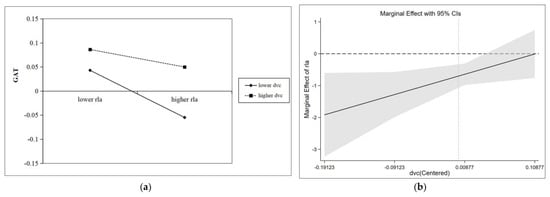
To examine whether digital village construction mitigates the inhibitory effect of rural labor aging on GAT, we test its moderating role in this process. As shown in Table 8, the regression coefficient of the interaction term between rural labor aging and digitalization is 7.683 and significant at the 5% level. Notably, the sign of this interaction term is opposite to that of the main effect. This indicates that digital advancement functions as a positive moderator, effectively weakening the negative impact of aging. Thus, hypothesis H3 is verified.
Table 8.
Regression results of moderating effect.
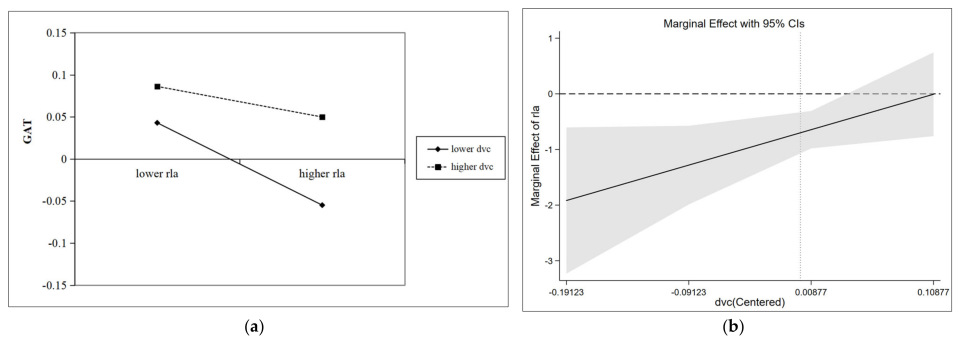
To facilitate a clearer understanding of the buffering capacity of digital village construction, we visualized its moderating effect. In Figure 1a, the solid line represents the scenario with low levels of digital village construction. It exhibits a steep downward slope, indicating that in the absence of digital empowerment, rural labor aging poses a substantial obstacle to GAT. In contrast, the dashed line represents the scenario with high levels of digital village construction. The slope of this line is notably flatter, suggesting that in highly digitized regions, this adverse effect is significantly attenuated. Figure 1b further demonstrates that the mitigating effect of digitalization exhibits increasing marginal returns; in scenarios with high digitalization, the negative impact can be almost completely offset. These visual findings confirm that digital village construction acts as an effective buffer, weakening the structural tension between the aging workforce and GAT.
Figure 1.
The moderating effect of digital village construction. (a) The simple slope plot; (b) Marginal effects and confidence intervals. The horizontal dashed line represents the reference line of zero effect, the vertical dashed line marks the reference line for the mean of digitalization, and the dashed lines indicate the 95% confidence intervals.
This study further examines the heterogeneity of the moderating effect of digital village construction. Table 9 reports the outcomes across regions with varying degrees of labor aging (Models 31–32) and economic development levels (Models 33–34). The results indicate that its moderating role is significant only in regions characterized by severe aging and developed economies. A plausible explanation is that the labor substitution effect of digital technology becomes more pronounced as the aging degree rises. Furthermore, economically developed regions possess stronger capacities for digital investment, enabling digital infrastructure to function more effectively in agricultural production.
Table 9.
Regression results of heterogeneity test of moderating effects.
5. Discussion
Interpreted through the lens of Human Capital Theory, our empirical findings confirm that the aging workforce constitutes a structural barrier to GAT. The depreciation of physical and cognitive capital inherent in an aging population fundamentally conflicts with the knowledge-intensive nature of green transformation. Unlike traditional farming, the green transition is a socio-technical transformation requiring complex ecological practices. The “aging drag” observed in our study thus reflects the friction between a deteriorating human capital base and an upgrading technological regime. The conclusions of this paper have been widely validated across regions. In terms of developed economies, a study in Hokkaido, Japan, indicates that aging is associated with a decline in agricultural production vitality [4], while research in South Korea indicates that it induces a decrease in technical efficiency [5]; both align with the inhibitory logic revealed in this paper. Regarding developing economies, studies in Thailand and Malaysia have similarly confirmed a negative correlation between aging and the adoption rates of sustainable agricultural practices [7,62]. However, it is important to note that the aforementioned countries are predominantly characterized by smallholder farming, sharing demographic structures and agricultural endowments similar to those of China. This similarity likely contributes to the consistency in the observed impact of aging. In contrast, in countries with large-scale agriculture, labor shortages triggered by aging are more easily mitigated through labor substitution facilitated by mature capital markets. For instance, the European Union emphasizes the use of digital technologies to address agricultural labor shortages [49]. In China, however, land fragmentation drives up the transaction costs of mechanized operations, thereby hindering aging farmers from adopting green, scale-based technologies.
While our results validate three transmission channels, they do not operate at the same hierarchical level. We argue that constraints on scale operation constitute the foundational barrier. Without land consolidation, the application scenarios for green technology are structurally limited. On this basis, the other two mechanisms operate across different temporal dimensions. In the short term, the “fertilizer reduction constraint” acts as an immediate behavioral response: elderly farmers, facing physical decline, resort to chemical overuse as a compensatory substitute for labor-intensive management. In the long term, the innovation suppression constitutes a persistent structural barrier. According to Innovation Diffusion Theory, the aging population acts as “laggards” in the diffusion curve, shrinking the market demand for green R&D and slowing the generational renewal of agricultural knowledge. Thus, aging hinders GAT through a pathway of “short-term chemical dependence” superimposed on “long-term innovation stagnation.”
Our analysis confirms that digitalization buffers the negative impact of aging, yet this optimism must be tempered with a critical perspective. The mitigating effect of digitalization exhibits significant heterogeneity; its intensity is closely related to regional economic development levels and the degree of aging, a characteristic that further clarifies the applicable scenarios for digitalization to empower green agricultural transformation. Digitalization is not a panacea; its effectiveness is contingent upon infrastructure, human capital, and the institutional environment. Economically developed regions typically possess more robust digital infrastructure, higher digital literacy among farmers, and sounder supporting institutions, providing critical support for digitalization to function effectively. In high-aging regions, where elderly farmers have become the absolute main body of agricultural production, their limitations in physical strength and technical cognition likely impose more urgent constraints on green transformation, thereby offering higher marginal utility for digital tools to substitute for labor. Importantly, the potential of digitalization must be balanced against the digital divide facing elderly farmers. Elderly farmers often encounter cognitive barriers when using digital technologies, suggesting that the availability of technology does not equate to effective adoption. If digital tools lack age-inclusive designs, digitalization may inadvertently exacerbate inequality, creating a new exclusion mechanism where the most vulnerable elderly groups are left further behind in the green transformation.
6. Conclusions
GAT is a crucial issue in interdisciplinary research involving agriculture, resources, and the environment. From the perspective of human capital, this study empirically investigates the association between rural labor aging and GAT, its mechanisms of action, and the moderating effect of digital village construction, providing empirical evidence for understanding the relationship between demographic structural changes and sustainable agricultural development. This study identifies a structural tension between the deepening aging of the rural labor force and the urgent imperatives of Green Agricultural Transformation (GAT). Our empirical evidence confirms that, without intervention, aging constitutes a formidable barrier to green development due to innovation suppression and scale limitations. However, digitalization emerges as a critical “buffer tool”, capable of effectively mitigating these negative externalities. This suggests that the solution lies not in reversing demographic trends, but in restructuring the agricultural production system through digital empowerment. Looking forward, digital village construction, as an innovative solution, is poised to play an increasingly vital role in the process of agricultural green transformation. Governments should anticipate trends in agricultural labor aging and prioritize the development of ‘age-inclusive’ digital technologies—such as smart farming tools with simplified interfaces and voice controls—to lower the cognitive barriers for elderly farmers. Furthermore, a lifecycle skills training system should be established to prevent the “digital divide” from exacerbating the “green divide”.
Limitations and Future Research: First, regarding data granularity, this study relies on provincial macro-data, which may mask individual behavioral heterogeneity. Future research should utilize micro-household survey data to explore the specific decision-making processes of aging farmers regarding fertilizer reduction and technology adoption. Second, regarding dynamic effects, as aging progresses, its impact may exhibit non-linear thresholds. Future studies could employ dynamic panel models to identify potential “tipping points” where the negative impact might stabilize or reverse. Third, regarding digital dimensions, we treated digitalization as a composite index. Future scholars are encouraged to disentangle specific dimensions (e.g., e-commerce vs. IoT adoption) to pinpoint which specific digital tools are most effective in compensating for labor aging.
Author Contributions
For this paper, B.Z. and C.L. conceived and designed the research frame-work; B.Z. and X.Z. analyzed the data and contributed the analysis tools of this paper; B.Z. and C.L. wrote the paper; all authors revised the paper several times. All authors have read and agreed to the published version of the manuscript.
Funding
This research was funded by the Natural Sciences Foundation of Guangxi Province (grant No. 2024GXNSFAA010201) and the Basic Scientific Research Special Project of Guangxi Academy of Agricultural Sciences (grant No. 2025YP060, grant No. 2026YT174, grant No. 2026YT175).
Institutional Review Board Statement
Not applicable.
Informed Consent Statement
Not applicable.
Data Availability Statement
The data presented in this study are available upon request from the corresponding author.
Conflicts of Interest
The authors declare no conflicts of interest.
Appendix A
Table A1.
Measurement indicators of GAT index.
Table A2.
Evaluation indicator system for digital village construction level.
References
- Ren, C.C.; Zhou, X.Y.; Wang, C.; Guo, Y.L.; Diao, Y.; Shen, S.S.; Reis, S.; Li, W.Y.; Xu, J.M.; Gu, B.J. Ageing threatens sustainability of smallholder farming in China. Nature 2023, 616, 96–103. [Google Scholar] [CrossRef] [Scilit] [PubMed]
- Cutler, J.; Wittmann, M.K.; Abdurahman, A.; Hargitai, L.D.; Drew, D.; Husain, M.; Lockwood, P.L. Ageing is associated with disrupted reinforcement learning whilst learning to help others is preserved. Nat. Commun. 2021, 12, 13. [Google Scholar] [CrossRef] [Scilit] [PubMed]
- Rigg, J.; Phongsiri, M.; Promphakping, B.; Salamanca, A.; Sripun, M. Who will tend the farm? Interrogating the ageing Asian farmer. J. Peasant Stud. 2020, 47, 306–325. [Google Scholar] [CrossRef] [Scilit]
- Usman, M.; Sawaya, A.; Igarashi, M.; Gayman, J.J.; Dixit, R. Strained agricultural farming under the stress of youths’ career selection tendencies: A case study from Hokkaido (Japan). Humanit. Soc. Sci. Commun. 2021, 8, 8. [Google Scholar] [CrossRef] [Scilit]
- Seok, J.H.; Moon, H.; Kim, G.; Reed, M.R. Is aging the important factor for sustainable agricultural development in Korea? Evidence from the relationship between aging and farm technical efficiency. Sustainability 2018, 10, 15. [Google Scholar] [CrossRef] [Scilit]
- Szabo, S.; Apipoonyanon, C.; Pramanik, M.; Tsusaka, T.W.; Leeson, K. Agricultural productivity, aging farming workforce, sustainable agriculture, and Well-Being: Household survey data from central Thailand. Front. Sustain. Food Syst. 2021, 5, 6. [Google Scholar] [CrossRef] [Scilit]
- Adnan, N.; Nordin, S.M.; Anwar, A. Transition pathways for Malaysian paddy farmers to sustainable agricultural practices: An integrated exhibiting tactics to adopt green fertilizer. Land Use Policy 2020, 90, 26. [Google Scholar] [CrossRef] [Scilit]
- Shen, D.H.; Liang, H.M.; Shi, W.F. Rural population aging, capital deepening, and agricultural labor productivity. Sustainability 2023, 15, 12. [Google Scholar] [CrossRef] [Scilit]
- Sharma, J.K.; Kumar, N.; Singh, N.P.; Santal, A.R. Phytoremediation technologies and their mechanism for removal of heavy metal from contaminated soil: An approach for a sustainable environment. Front. Plant Sci. 2023, 14, 13. [Google Scholar] [CrossRef] [Scilit]
- Tang, W.; Zhou, F.M.; Peng, L.L.; Xiao, M. Does agricultural productive service promote Agro-ecological efficiency? Evidence from China. Therm. Sci. 2023, 27, 2109–2118. [Google Scholar] [CrossRef] [Scilit]
- Guo, L.L.; Song, Y.T.; Zhao, S.; Tang, M.Q.; Guo, Y.L.; Su, M.Y.; Li, H.J. Dynamic linkage between aging, mechanizations and carbon emissions from agricultural production. Int. J. Environ. Res. Public Health 2022, 19, 22. [Google Scholar] [CrossRef] [Scilit]
- Apipoonyanon, C.; Szabo, S.; Tsusaka, T.W.; Leeson, K.; Gunawan, E.; Kuwornu, J.K.M. Socio-economic and environmental barriers to increased agricultural production: New evidence from central Thailand. Outlook Agric. 2021, 50, 178–187. [Google Scholar] [CrossRef] [Scilit]
- Zhang, M.; Fang, K.; Zhang, D.T.; Zeng, D.J. Relationship between the evaluation of agricultural scientific and technological innovation capacity and the influencing factors of green agriculture. PLoS ONE 2023, 18, 17. [Google Scholar] [CrossRef] [Scilit] [PubMed]
- Guo, L.L.; Zhao, S.; Song, Y.T.; Tang, M.Q.; Li, H.J. Green finance, chemical fertilizer use and carbon emissions from agricultural production. Agriculture 2022, 12, 18. [Google Scholar] [CrossRef] [Scilit]
- Wang, L.; Tang, J.Y.; Tang, M.Q.; Su, M.Y.; Guo, L.L. Scale of operation, financial support, and agricultural green total factor productivity: Evidence from China. Int. J. Environ. Res. Public Health 2022, 19, 18. [Google Scholar] [CrossRef] [Scilit] [PubMed]
- Lioutas, E.D.; Charatsari, C. Innovating digitally: The new texture of practices in Agriculture 4.0. Sociol. Rural. 2022, 62, 250–278. [Google Scholar] [CrossRef] [Scilit]
- Li, Q.; Liu, Z.J. The spatiotemporal impact of digital economy on high-quality agricultural development: Evidence from China. Sustainability 2024, 16, 2814. [Google Scholar] [CrossRef] [Scilit]
- Bocean, C.G. A cross-sectional analysis of the relationship between digital technology use and agricultural productivity in EU countries. Agriculture 2024, 14, 519. [Google Scholar] [CrossRef] [Scilit]
- Zhang, H.S.; Guo, K.T.; Liu, Z.; Ji, Z.Y.; Yu, J.N. How has the rural digital economy influenced agricultural carbon emissions? Agricultural green technology change as a mediated variable. Front. Environ. Sci. 2024, 12, 1372500. [Google Scholar] [CrossRef] [Scilit]
- Zhu, Y.; Wang, X.Y.; Zheng, G. Blessing or curse? The impact of digital technologies on carbon efficiency in the agricultural sector of China. Sustainability 2023, 15, 5613. [Google Scholar] [CrossRef] [Scilit]
- Du, X.X.; Wang, X.J.; Hatzenbuehler, P. Digital technology in agriculture: A review of issues, applications and methodologies. China Agric. Econ. Rev. 2023, 15, 95–108. [Google Scholar] [CrossRef] [Scilit]
- Yao, W.; Sun, Z. The impact of the digital economy on high-quality development of agriculture: A China case study. Sustainability 2023, 15, 5745. [Google Scholar] [CrossRef] [Scilit]
- MacPherson, J.; Voglhuber-Slavinsky, A.; Olbrisch, M.; Schöbel, P.; Dönitz, E.; Mouratiadou, I.; Helming, K. Future agricultural systems and the role of digitalization for achieving sustainability goals. A review. Agron. Sustain. Dev. 2022, 42, 18. [Google Scholar] [CrossRef] [Scilit] [PubMed]
- Song, H.E.; Jiang, C.Y.; Sun, Z.M. Unveiling the nexus between rural population aging, technical efficiency, and carbon emissions in Chinese agriculture. PLoS ONE 2024, 19, e0300124. [Google Scholar] [CrossRef] [Scilit]
- Zhang, Y.Q.; Dong, Q.Y.; Ma, G.F. Effects of rural population aging on agricultural carbon emissions in China. Sustainability 2023, 15, 16. [Google Scholar] [CrossRef] [Scilit]
- Araujo, F.S.M.; Fantucci, H.; Lima, S.H.D.; de Abreu, M.C.S.; Santos, R.M. Modeling Canadian farmer’s intention to adopt eco-friendly agricultural inputs and practices. Reg. Environ. Change 2022, 22, 12. [Google Scholar] [CrossRef] [Scilit]
- Liu, J.; Du, S.C.; Fu, Z.T. The impact of rural population aging on farmers’ cleaner production behavior: Evidence from five provinces of the North China plain. Sustainability 2021, 13, 16. [Google Scholar] [CrossRef] [Scilit]
- Wang, L.L.; Luo, D.M.; Zhang, Y.S. Rural aging, land markets, and farm operations in China. Appl. Econ. Lett. 2026, 33, 177–184. [Google Scholar] [CrossRef] [Scilit]
- Wang, X.H.; Ma, Y.F.; Li, H.; Xue, C.X. The effect of non-cognitive ability on farmer’s ecological protection of farmland: Evidence from major tea producing areas in China. Int. J. Environ. Res. Public Health 2022, 19, 15. [Google Scholar] [CrossRef] [Scilit]
- Zhang, C.M.; Zhang, J.C.; Fu, Z.Y.; Tian, M.M. A study on the impact of population aging on the agricultural socialized services. Agriculture 2025, 15, 18. [Google Scholar] [CrossRef] [Scilit]
- Liu, Y.; Jia, M.D. The impact of population aging on green innovation: An empirical analysis based on inter-provincial data in China. Sustainability 2023, 15, 18. [Google Scholar] [CrossRef] [Scilit]
- Zhang, X.T.; Li, Y.N. Impacts of aging and social security expenditure on regional green innovation. Financ. Res. Lett. 2025, 78, 8. [Google Scholar] [CrossRef] [Scilit]
- Sui, F.J.; Yang, Y.S.; Zhao, S.Z. What affects the production technology of labor-intensive agricultural industries in the context of labor aging? An empirical study based on the garlic production in lanling. Sustainability 2022, 14, 16. [Google Scholar] [CrossRef] [Scilit]
- Ji, M.B.; Ying, J.; Shao, X.Y.; Tian, Y.H. An empirical examination of aging’s ramifications on large-scale agriculture: China’s perspective. Econ.-Open Access Open-Assess. E-J. 2024, 18, 11. [Google Scholar] [CrossRef] [Scilit]
- Sun, C.W.; Xu, S.; Xu, M.J. What causes green efficiency losses in Chinese agriculture? A perspective based on input redundancy. Technol. Forecast. Soc. Change 2023, 197, 10. [Google Scholar] [CrossRef] [Scilit]
- Kimbi, S.B.; Onodera, S.I.; Ishida, T.; Saito, M.; Tamura, M.; Tomozawa, Y.; Nagasaka, I. Nitrate contamination in groundwater: Evaluating the effects of demographic aging and depopulation in an Island with intensive citrus cultivation. Water 2022, 14, 19. [Google Scholar] [CrossRef] [Scilit]
- Zhang, R.X.; Luo, L.; Liu, Y.Y.; Fu, X.H. Impact of labor migration on chemical fertilizer application of citrus Growers: Empirical evidence from China. Sustainability 2022, 14, 14. [Google Scholar] [CrossRef] [Scilit]
- Mihai, M.; Mihai, V.C.; Pocol, C.B.; Ursa, A.; Dumitras, D.E. Young Romanian farmers’ perspective and behavior toward fertilizer use in view of the European Union’s farm to fork sustainable strategy. Sustainability 2025, 17, 30. [Google Scholar] [CrossRef] [Scilit]
- Lu, H.; Xie, H.L.; Yao, G.R. Impact of land fragmentation on marginal productivity of agricultural labor and non-agricultural labor supply: A case study of Jiangsu, China. Habitat Int. 2019, 83, 65–72. [Google Scholar] [CrossRef] [Scilit]
- Song, W.H.; Ye, C.H. Impact of the cultivated-land-management scale on fertilizer reduction-empirical evidence from the countryside of China. Land 2022, 11, 15. [Google Scholar] [CrossRef] [Scilit]
- Hu, X.H.; Lin, X.X.; Wen, G.H.; Zhou, Y.; Zhou, H.; Lin, S.Q.; Yue, D.Y. The impact of cultivated land fragmentation on farmers’ ecological efficiency of cultivated land use based on the moderating and mediating effects of the cultivated land management scale. Land 2024, 13, 16. [Google Scholar] [CrossRef] [Scilit]
- Zhang, Q.F.; Wu, M.L. The decline and transformation of smallholders in Chinese agriculture: National trends. J. Peasant Stud. 2024, 53, 485–512. [Google Scholar] [CrossRef] [Scilit]
- Liu, Y.; Song, X.Z.; Huang, S.W.; Xu, M.Q. Research on the impact of population aging on agricultural sustainable development. Sustainability 2025, 17, 19. [Google Scholar] [CrossRef] [Scilit]
- Li, C.Z.; Li, X.L.; Wang, J.X.; Feng, T.C. Impacts of aging agricultural labor force on land transfer: An empirical analysis based on the China family panel studies. Land 2023, 12, 15. [Google Scholar] [CrossRef] [Scilit]
- Meng, M.C.; Mu, S.Y.; Cao, Y.Q. A study on the impact of ageing and agricultural infrastructure construction on the agricultural green total factor productivity. Agric. Econ. 2025, 71, 113. [Google Scholar] [CrossRef] [Scilit]
- Huang, Y.; Elahi, E.; You, J.S.; Sheng, Y.H.; Li, J.W.; Meng, A.C. Land use policy implications of demographic shifts: Analyzing the impact of aging rural populations on agricultural carbon emissions in China. Land Use Policy 2024, 147, 15. [Google Scholar] [CrossRef] [Scilit]
- Zhang, R.; Zhang, L.L.; He, M.J.; Wang, Z.Z. Spatial association network and driving factors of agricultural eco-efficiency in the Hanjiang River Basin, China. Agriculture 2023, 13, 16. [Google Scholar] [CrossRef] [Scilit]
- Hong, M.Y.; Tian, M.J.; Wang, J. The impact of digital economy on green development of agriculture and its spatial spillover effect. China Agric. Econ. Rev. 2023, 15, 708–726. [Google Scholar] [CrossRef] [Scilit]
- Varzaru, A.A. Unveiling digital transformation: A catalyst for enhancing food security and achieving sustainable development goals at the European Union level. Foods 2024, 13, 1226. [Google Scholar] [CrossRef] [Scilit]
- Hosan, S.; Karmaker, S.C.; Rahman, M.M.; Chapman, A.J.; Saha, B.B. Dynamic links among the demographic dividend, digitalization, energy intensity and sustainable economic growth: Empirical evidence from emerging economies. J. Clean. Prod. 2022, 330, 129858. [Google Scholar] [CrossRef] [Scilit]
- Jia, X.M. Digital economy, factor allocation, and sustainable agricultural development: The perspective of labor and capital misallocation. Sustainability 2023, 15, 4418. [Google Scholar] [CrossRef] [Scilit]
- Deichmann, U.; Goyal, A.; Mishra, D. Will digital technologies transform agriculture in developing countries? Agric. Econ. 2016, 47, 21–33. [Google Scholar] [CrossRef] [Scilit]
- Zhou, Z.Q.; Liu, W.Y.; Wang, H.L.; Yang, J.Y. The impact of environmental regulation on agricultural productivity: From the perspective of digital transformation. Int. J. Environ. Res. Public Health 2022, 19, 794. [Google Scholar] [CrossRef] [Scilit]
- Zhang, Y.D.; Fan, X.M.; Cao, Y.Y.; Xue, J.H. Exploring symbiosis: Innovatively unveiling the interplay between the cold chain logistics of fresh agricultural products and the ecological environment. Agriculture 2024, 14, 21. [Google Scholar] [CrossRef] [Scilit]
- Li, J.; Sun, Z.C.; Zhou, J.; Sow, Y.; Cui, X.F.; Chen, H.P.; Shen, Q.L. The impact of the digital economy on carbon emissions from cultivated land use. Land 2023, 12, 665. [Google Scholar] [CrossRef] [Scilit]
- Hou, J.; Zhang, M.Y.; Li, Y. Can digital economy truly improve agricultural ecological transformation? New insights from China. Humanit. Soc. Sci. Commun. 2024, 11, 153. [Google Scholar] [CrossRef] [Scilit]
- Wang, W.; Mei, T.T. Research on the effect of digital economy development on the carbon emission intensity of agriculture. Sustainability 2024, 16, 1457. [Google Scholar] [CrossRef] [Scilit]
- Xu, N.; Zhao, D.S.; Zhang, W.J.; Liu, M.; Zhang, H. Does digital transformation promote agricultural carbon productivity in China? Land 2022, 11, 1966. [Google Scholar] [CrossRef] [Scilit]
- Zhong, R.X.; He, Q.; Qi, Y.B. Digital economy, agricultural technological progress, and agricultural carbon intensity: Evidence from China. Int. J. Environ. Res. Public Health 2022, 19, 6488. [Google Scholar] [CrossRef] [Scilit]
- Su, G.F.; Chen, Z.; Li, W.; Xia, X.L. Study on the impact of the rural population aging on agricultural total factor productivity in China. Agriculture 2024, 14, 2175. [Google Scholar] [CrossRef] [Scilit]
- Li, H.B.; Xie, S.H.; Su, M.W. Does digital technology innovation promote low-carbon development in agriculture?: A spatial econometric analysis based on 31 provinces in China. Environ. Sci. Pollut. Res. 2024, 31, 4478–4499. [Google Scholar] [CrossRef] [Scilit]
- Szabo, S.; Apipoonanon, C.; Pramanik, M.; Leeson, K.; Singh, D.R. Perceptions of an ageing agricultural workforce and farmers’ productivity strategies: Evidence from Prachinburi Province, Thailand. Outlook Agric. 2021, 50, 294–304. [Google Scholar] [CrossRef] [Scilit]

Disclaimer/Publisher’s Note: The statements, opinions and data contained in all publications are solely those of the individual author(s) and contributor(s) and not of MDPI and/or the editor(s). MDPI and/or the editor(s) disclaim responsibility for any injury to people or property resulting from any ideas, methods, instructions or products referred to in the content. |
© 2026 by the authors. Licensee MDPI, Basel, Switzerland. This article is an open access article distributed under the terms and conditions of the Creative Commons Attribution (CC BY) license.