1. Introduction
Forest protection is a pressing issue today, linked not only to climate protection but also to biodiversity conservation and the governance of international commodity trade. According to the report prepared by the FAO in 2020, the world’s forest area consists of 4.06 billion hectares (10.0 billion acres), which accounts for 31% of the total land area. Tropical forests accounted for 45% of the total forest area, while Brazil accounted for almost 12% of the world’s total forest cover [
1]. The conversion of forests for agricultural and industrial purposes, as well as the exploitation of forest resources, generates sustained pressure to reduce forest cover.
Recent estimates indicate that forest loss remains substantial and is geographically concentrated rather than evenly distributed. Global forest loss in 2024 has been estimated at roughly 8.1 million hectares; the long-term rate in the last decade, in the order of 10.9 million ha/year [
2]. In addition, 6.7 million hectares of tropical primary forests were lost in 2024, the highest annual level in at least two decades and 80% higher than in 2023, while Brazil accounted for about 42% of the total loss of tropical primary forests in 2024 [
3].
The above data show that the problem of deforestation is neither a marginal phenomenon nor a uniformly distributed spatial phenomenon. This is undoubtedly a process of large global scale, but at the same time strongly geographically concentrated, which is particularly evident in the example of data on Brazil and the deforestation of tropical forests located in the area of this country’s borders. The increasing loss of forest cover, including the record loss of primary forests in the tropical zone, indicates that the policy and regulatory instruments in place remain insufficient in the face of the pressures that are generated by global agricultural and forestry supply chains. Of particular importance is the fact that a significant part of this loss is concentrated in a limited number of countries and regions, including Brazil [
3].
The Amazon rainforest is considered one of the most significant biomes for regulating the global climate. Due to the continuous pressure from commodity value chains [
4], it may be losing its ability to self-sustain [
5]. Thus, different external political and economic pressures have been applied to some Brazilian value chains (e.g., cattle, soy cultivation), to curb this process [
6]. Although both large markets of the EU and China are attractive outlets for Brazilian produce (especially commodities), it also positions them as significant pressure on the Amazon rainforest.
For the EU, addressing deforestation is embedded in broader climate and sustainability commitments, including the European Green Deal and the legally binding pathway toward climate neutrality [
7,
8]. This context became particularly salient during the negotiation process of the prospective EU–Mercosur Partnership Agreement (EMPA), which would deepen EU–Mercosur commodity trade [
9] and thus heighten the relevance of examining how deforestation risks are governed in supply chains.
Recent demand-side initiatives—most prominently the EU’s Deforestation Regulation (EUDR)—have reinforced a compliance-centered approach to “imported deforestation”, emphasizing traceability, due diligence, and cut-off-date verification at the product and firm level [
10]. However, the spatial organization of sourcing across subnational frontiers has received comparatively less attention. Against this background, a key question remains insufficiently addressed: whether demand-side governance translates into changes in the geography of sourcing, or whether it primarily reshapes how sourcing is documented and verified. This distinction matters because deforestation pressures are geographically concentrated in specific bioregions and jurisdictions [
11,
12,
13]. As a result, governance may strengthen documentation and monitoring without necessarily reducing exposure to frontier regions where risks are perceived to be high. Understanding whether and how trade governance reshapes the geography of sourcing is therefore crucial for assessing both environmental risk exposure and the distributional burdens of compliance along supply chains.
This paper examines the spatial organization of Brazil’s export flows to its two major trading partners, the EU and China, focusing on Brazil’s Legal Amazon (BLA) as a key commodity frontier. BLA is a legally defined macro-region comprising the territory within nine federative states—widely used in policy and monitoring frameworks [
14]. We ask whether these trade partners exhibit different degrees of frontier dependence and how such patterns evolve over time. The next section develops a theoretical framework that links contrasting trade governance regimes to competing expectations about spatial avoidance, frontier dependence, and compliance-driven consolidation.
Despite a growing body of research on trade in Amazonian commodities and its impact on deforestation, there is a clear gap in the literature linking multilevel spatial analysis with detailed tracking of indirect supply channels. Most existing studies rely on aggregated export data or simple correlation analyses, which do not allow for distinguishing between regulatory effects and the structural advantages of frontier regions, nor do they identify causal relationships between trade and land use. There is also a lack of research comparing different export destinations, such as the EU and China, in the context of the regulatory frameworks and auditing requirements that shape sourcing patterns. This article addresses this gap by providing an empirical analysis of frontier-linked relationships in the BLA, taking into account intermediate suppliers and spatial differentiation in trade with the EU and China, and interpreting the results in light of transnational governance theory and legal acts such as the EUDR.
2. Trade Regimes, Frontiers and Deforestation Risk
To understand how different trade regimes may shape environmental risk exposure and compliance burdens, it is essential to consider the spatial organization of commodity trade, particularly through the lens of resource frontiers. In world-systems theory [
15], frontiers constitute a cornerstone of capitalist value chains. These frontiers are zones of extraction and land conversion, typically located in the peripheries, i.e., mainly developing countries. The peripheries supply core markets with cheap resources while bearing disproportionate socio-environmental costs. These regions are often characterized by weak state presence, contested property rights, and the coexistence of informal and formal economic practices [
16,
17,
18]. The BLA region exemplifies such a frontier. Its commodity production—most notably cattle ranching, soy cultivation, logging, and mining—has become a structural feature of global trade, while simultaneously concentrating environmental degradation and social conflict within the region [
19].
At the same time, the concept of the Amazon frontier itself occupies a central yet contested place in the literature on deforestation, land-use change, and political economy. Rather than referring to a single, universally accepted spatial unit, the frontier is conceptualized through multiple analytical lenses. These outlooks emphasize different spatial, economic, social, and governance dimensions. This plurality reflects the fact that the frontier is not a fixed boundary, but a historically contingent and evolving phenomenon.
One perspective defines the Amazon frontier as a spatial and political margin located at the edges of national territory, characterized by weak state presence, contested property rights, and episodic violence. In this view, frontiers are peripheral zones perceived as distant or “other” by the national core. The frontiers are often described as “lawless lands” where formal institutions coexist with informal and coercive mechanisms of control [
20,
21]. Thus, are territorially bounded but politically unstable, shaped by cycles of settlement, conflict, and partial state incorporation.
A second one approaches the frontier from a political economy perspective, emphasizing processes of capital accumulation and land appropriation. Here, the frontier is defined less as a place than as a mechanism through which public or weakly regulated lands are transferred into private hands and converted into spaces of extractive and agricultural production [
22]. Deforestation plays a constitutive role in this process, functioning both as a material transformation and as a legal-symbolic act that legitimizes land claims, often framed as land “improvement” [
23]. In this view, the frontier is inherently dynamic, driven by speculation, infrastructure expansion, and integration into commodity markets.
A third perspective conceptualizes the frontier as an evolutionary land-use trajectory, highlighting its internal heterogeneity and temporal dynamics. Empirical studies identify successive stages of frontier development. These stages range from pioneer fronts dominated by spontaneous settlement, through transitional phases, to consolidated frontiers characterized by capital-intensive agribusiness and export orientation [
24,
25]. Related typologies distinguish between pre-frontier, active frontier, and post-frontier zones based on deforestation intensity and land-use change rates, alongside the well-documented “boom-and-bust” development patterns associated with frontier expansion [
26]. These approaches stress that frontier status varies across space and time.
More recent contributions emphasize the frontier as a governance- and demand-driven space, shaped by global value chains, international demand, and evolving regulatory regimes. External market pressure, such as growing demand for soy driven by China, has generated new axes of frontier expansion and reconfigured spatial patterns of land-use change [
27]. At the same time, frontiers increasingly extend into protected areas and Indigenous territories, becoming sites of tension between conservation and extraction [
22,
28]. This literature also documents a shift from “contested frontiers” toward so-called “green frontiers,” in which production persists under sustainability standards, traceability requirements, and new forms of governance rather than through spatial retreat [
21].
Taken together (see
Table 1), these perspectives underline that the Amazon frontier is understood as a dynamic, heterogeneous, and multi-dimensional phenomenon, rather than a single, sharply defined spatial unit. At the same time, this conceptual diversity implies that no single empirical operationalization can fully capture frontier dynamics across scales and dimensions. For this study, which focuses on trade governance, sourcing geography, and destination-specific dependence, the frontier is therefore operationalized in
Section 3 as a jurisdictional proxy corresponding to the legally defined BLA region. This choice reflects the role of BLA as a historically and institutionally recognized frontier space in Brazilian policy, deforestation monitoring, and international governance debates, rather than an assumption of uniform deforestation intensity within the region.
Into this frontier context enter the distinct regulatory logics of Brazil’s major trading partners. The EU’s influence is often described through the Brussels Effect [
29]: access to the EU market is mediated by compliance with standards that can be externalized along supply chains. Importantly, this externalization can also pressure partner countries to adjust domestic legal and administrative frameworks so that producers remain eligible for EU market access [
30,
31,
32,
33,
34]. Companies, in turn, may align with these standards even where EU law is not directly enforceable on the ground, because compliance becomes a market-access condition embedded in buyer requirements and contractual relations. In principle, such compliance-oriented governance—reinforced by reputational pressures and private standards—should incentivize risk-sensitive sourcing and could, in a stylized expectation, encourage the spatial avoidance of high-risk frontiers. The EU’s anti-deforestation agenda, most recently advanced through the EUDR and complemented by timber legality governance instruments such as FLEGT, exemplifies this logic by centering traceability, due diligence, and verifiable deforestation-risk controls for soy, beef, timber, and other commodities [
10,
35].
By contrast, China’s trade regime is commonly characterized by scale-driven sourcing and an emphasis on supply security, connectivity, and long-term commodity flows, rather than explicit environmental conditionality [
36,
37]. This governance logic—sometimes referred to as a Beijing Effect—may prioritize volume and reliability, often supported by state-backed investments in extraction, logistics, and transport infrastructure that stabilize commodity corridors and reduce transaction frictions [
32,
34,
38,
39]. It can be compatible with sourcing from a wide range of geographical locations, including frontier regions, when they offer competitive supply conditions. At the same time, precisely because it privileges scale and connectivity over place-based conditionality, it may also facilitate portfolio diversification across multiple supplying areas—potentially diluting dependence on any single frontier region—an empirical ambiguity we address through destination-specific spatial concentration measures.
However, this dichotomy may be overly simplistic, particularly regarding the assumed efficacy of the European model [
33]. The effectiveness of compliance-based governance is debated in the Global Value Chain (GVC) literature [
40]. Critical scholarship argues that stringent sustainability requirements—whether public or private—can function as non-tariff barriers by creating substantial fixed costs related to documentation, traceability, audits, and certification [
41,
42,
43]. These costs often generate economies of scale that favor large, capitalized, and highly “auditable” producers and intermediaries, potentially excluding smaller actors [
40]. In frontier contexts, this implies a competing mechanism: regulatory and market pressure may not necessarily trigger spatial avoidance, but rather consolidate trade relationships with the most sophisticated suppliers capable of demonstrating compliance, who may be embedded in established frontier regions. We refer to this tension as a spatial blind spot of compliance-based governance: instruments designed to exclude deforestation at the product/plot level do not automatically imply changes in the spatial distribution of sourcing. In this sense, even ambitious due-diligence regimes may improve verifiability while leaving frontier geographies structurally “available” to compliant suppliers—thereby potentially stabilizing rather than displacing sourcing from regions such as BLA. One of the key problems of analyses concerning the origin of raw materials from Brazil is the insufficient coverage of actual supply channels, particularly where raw materials are not exported directly from producers to end users (the EU or China), but flow through intermediary countries or indirect trading partners [
44]. The role of third countries as intermediaries in global trade in raw materials is important from a practical point of view, as a significant proportion of Brazilian raw materials (especially soybeans and forest products) may pass through trading platforms or transit countries before reaching their final consumers. Such indirect turnover, which is not easily captured in standard statistics, may also affect the interpretation of trade dependencies and the actual impact of the EU-Mercosur agreement on Brazil’s direct export dependence on individual markets. In addition, goods laundering (e.g., cattle laundering) is becoming a significant problem. This process involves moving products (including cattle and soybeans) from farms subject to embargoes or located in illegally deforested areas to ‘clean’ farms that have export certificates. Monitoring systems often track only the direct supplier, ignoring the intermediate links, which leads to an underestimation of the ecological footprint of exports [
45].
Taken together, these regimes suggest competing spatial implications: compliance may induce avoidance, but may also consolidate sourcing in auditable frontier enclaves; meanwhile, scale-driven connectivity may either deepen frontier reliance or diversify sourcing across multiple regions.
Building on the contrast between the EU’s compliance-oriented governance and China’s scale-driven sourcing logic, we formulate three competing expectations:
H1. Exports of raw materials from BLA to the EU show a lower relative frontier-linked dependence (RCR) than exports to China in every commodity group (agriculture, forestry, mining).
H2. Trade expansion and growth in the volume of agricultural raw material exports may increase deforestation, as evidenced by a measurable positive correlation between these phenomena.
H3. (Competing expectation—compliance-driven consolidation): Alternatively, compliance and traceability requirements—arising from both public regulation and private standards—may consolidate sourcing toward suppliers and regions that are easier to document and audit. Under this mechanism, compliance-based governance may improve product-level assurances without necessarily inducing spatial avoidance of frontier regions.
To assess these expectations empirically, we translate the theoretical notions of spatial avoidance and frontier dependence into a destination-specific measure of BLA sourcing and examine its evolution over time across commodity groups.
3. Data and Methods
The empirical analysis was based on the official Brazilian foreign trade database COMEX STAT from 2002–2024 [
46], disaggregated by product category, its origin (Brazil overall, or the nine states of the BLA administrative region, Acre, Amapá, Amazonas, Maranhão, Mato Grosso, Pará, Rondônia, Roraima, and Tocantins), and destination (EU or China), expressed in net weight (tonnes), being a more proper proxy for the physical impact than monetary measures, even due to the fluctuating value of money. The use of physical trade data allows the analysis to focus on material flows and extraction-related pressures rather than price dynamics, but it also implies that trade is observed only up to the first point of export from Brazil, without capturing subsequent re-exports, transshipments, or downstream processing outside the country. It is important to note that the BLA region is not synonymous with the Amazon Rainforest; it encompasses the entire Amazon biome but also significant portions of the Cerrado biome (savanna), particularly in transitional states such as Mato Grosso and Tocantins [
47]. Accordingly, BLA is used in this study as a jurisdictional and governance-relevant proxy for frontier exposure rather than as a strictly biome-specific measure of deforestation pressure. This choice reflects the fact that Brazilian deforestation monitoring, environmental enforcement, and trade reporting are institutionally organized around BLA, while acknowledging the resulting spatial heterogeneity within the region. The aggregated data for the EU considered the membership changes, both accession and exit, while China was treated as a single unit destination. Some long-term dynamics, especially those associated with mining, cannot be fully captured in such a short timeframe.
For environmental-risk contextualisation, trade trends were log-correlated with PRODES annual satellite-based estimates of clear-cut deforestation in Brazil’s Legal Amazon [
48]. This correlation analysis is intended as a descriptive validation exercise rather than as a test of causal relationships between trade and deforestation, given the well-documented presence of temporal lags, speculative land clearing, and indirect land-use change processes [
46]. Special COMEX STAT categories (e.g., “Foreign”, “Re-exportation”, “Non-declared”, “Border consumption”) were excluded to ensure consistency between numerator and denominator. Only exports attributed to Brazil’s 27 federative units were retained. To construct commodity categories (agriculture, forestry, mining), international standard Harmonised Systems (HS) categories reflected in the COMEX STAT were applied [
49]. HS is especially well-suited for the extraction pressure/trade-flow, as it is organised around physical characteristics and the origin of goods rather than the final product, also allowing for the exclusion of more processed products (
Table 2). While aggregation at the HS-group level necessarily combines products with heterogeneous environmental impacts, it enables consistent comparison across destinations and over time and aligns with the study’s focus on trade structure rather than commodity-specific ecological effects.
Other classification methods available in the COMEX STAT database, such as Broad Economic Categories (BEC), the Standard International Trade Classification (SITC), or the International Standard Industrial Classification (ISIC), are less appropriate for such analysis, as they focus on the end-use products (BEC) or on economic structure and sectoral analysis (SITC and ISIC), thus obscuring the linkage between deforestation and the commodity extraction activities. Accordingly, HS-based aggregation is used as a proxy for extractive pressure rather than as a direct measure of deforestation impacts, which remain beyond the scope of this analysis. And while such methods cannot guarantee investigating a direct link between the progressing deforestation and resource extraction, they may function as a deforestation-related proxy for the extractive pressures on the Amazon biome region. Yet, this analysis focuses more on the trade structures rather than the environmental impacts.
For the assessment of the commodity sourcing concentration from the BLA, we applied the Relative Concentration Ratio (RCR) defined as:
where
denotes exports of commodity group
from BLA states in year
, and
denotes Brazil’s total exports (being a sum of exports from all 27 federative states) of the same commodity group to the same destination in the same year. RCR is conceptually analogous to a destination-specific location quotient and captures relative spatial dependence rather than absolute trade volumes. The closer the ratio to zero, the lesser dependence of the researched trading destination (at first to the whole world, and later to the compared trading partners: the EU or China) on the BLA frontier region, while the closer it is to 100 (%), the higher the trading partner relies on BLA biome states. For the total Brazilian export to the world in 2010, the RCR exceeded 100%, particularly for forestry products, as the national totals were underreported relative to the state-level exports. Such values are retained for transparency but interpreted as statistical artefacts rather than substantively meaningful indicators of extreme frontier dependence, with analytical emphasis placed on temporal patterns rather than point estimates.
To complement the RCR spatial analysis, this research utilized the Compound Annual Growth Rate (CAGR) for both the BLA biome and for the whole of Brazil, for each commodity group sold to China or the EU, allowing this analysis to distinguish changes in spatial concentration and differential growth dynamics. The compound annual growth rate (CAGR) is calculated as:
where
denotes the initial value of exports,
denotes the final value of exports,
is the number of years between
and
. CAGR is used as a descriptive indicator of medium-term growth dynamics and is not treated as a behavioral or causal growth model. Given its sensitivity to endpoint values, CAGR results are interpreted in conjunction with full time-series evidence rather than as standalone measures of performance. CAGR is expressed as a percentage and captures the average annual growth rate over a specified period, assuming compound growth. Combining both RCR and CAGR allows comparison of the changes in the growth scale with spatial dependence, especially nuances between different EU and Chinese sourcing strategies.
The relations between deforestation and commodity groups’ export are tested using Pearson correlations normalised through logarithmisation of the said variables. First contemporaneous correlation relating the same-year movements between commodity exports and industrial deforestation rates was applied. It was defined as:
where
denotes annual clear-cut deforestation in BLA (km
2) in year
,
denotes export volume (net weight) originating in BLA in year
,
is the natural logarithm.
Due to the lagged nature of commodity exports to forest clearance (ca. one year for agricultural and forestry products), the correlation was repeated with a one-year lag. Although illegal mines can export after only one year of clearing, our study does not account for these long-term lags. The lagged association is defined as:
where
denotes export volumes in the preceding year. This formulation tests whether export activity precedes deforestation outcomes, consistent with production-cycle and land-conversion dynamics. The one-year lag reflects the minimum plausible temporal separation between clearing and export activity for agricultural and forestry commodities, while acknowledging that longer and more heterogeneous lags may exist. These correlation analyses serve a boundary and validation function, helping to rule out mechanical short-term associations between trade and deforestation rather than to infer causality.
During the preparation of this manuscript, the authors used GenAI to verify the accuracy of the data.
This study has several limitations that should be considered when interpreting the results. First, destination-specific trade analysis based on physical export data is limited by the inability to track indirect exports and downstream processing. COMEX STAT records exports only to their first point of exit from Brazil and does not capture further processing, which may reduce the visibility of frontier-linked raw materials in destination-specific flows. As a result, Relative Concentration Ratio (RCR) values should be interpreted as conservative measures of direct sourcing dependence rather than comprehensive consumption-based footprints.
Second, the analysis is descriptive and comparative in nature and does not aim to identify causal effects of specific policies, regulatory instruments, or investment flows. Governance mechanisms are therefore discussed interpretively, and the results assess consistency with competing expectations rather than providing causal attribution.
Finally, while mining commodities are included for completeness, their interpretation differs from agriculture and forestry due to higher capital intensity, longer project cycles, and stronger geological constraints. Accordingly, mining plays a secondary role in evaluating the study’s governance-based hypotheses, which primarily concern land-use-intensive supply chains.
4. Results
This section reports empirical patterns of frontier dependence (RCR), export growth (CAGR), and correlations between Brazil’s export volumes to the world and PRODES deforestation for the BLA region. We begin with a descriptive baseline of BLA’s role in Brazil’s export profile.
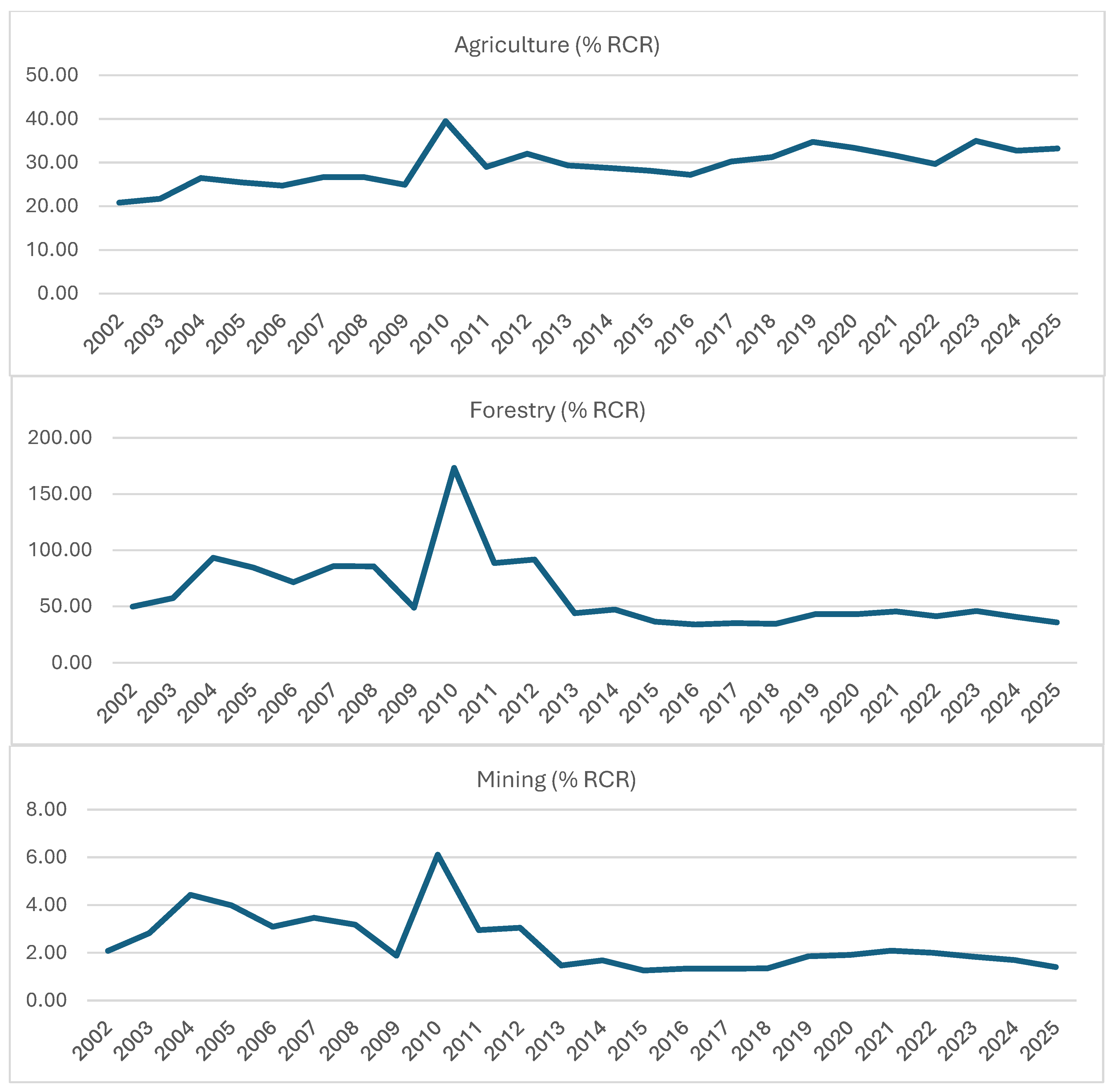
Figure 1 shows BLA’s share in Brazil’s total exports by commodity group (all destinations combined). Forestry displays markedly higher shares than mining, while agriculture remains consistently elevated over time.
It should be added that for the total Brazilian export to the world in 2010, the RCR exceeded 100%, particularly for forestry products, as the national totals were underreported relative to the state-level exports. Such values are retained for transparency but interpreted as statistical artefacts rather than substantively meaningful indicators of extreme frontier dependence, with analytical emphasis placed on temporal patterns rather than point estimates.
Table 3 reports the average RCR for three commodity group exports from BLA to the EU and China. What is surprising, the EU exhibits relative frontier dependence significantly higher in every commodity group as compared to China, especially in forestry. For agricultural commodities, the EU exhibits significantly higher frontier dependence, with an average RCR of 39.3%, compared to 24.7% for China. A similar pattern appeared in forestry products, where the EU’s average RCR (11.6%) was more than five times higher than that of China (2.2%). In mining, frontier dependence was high for both partners, but remained somewhat higher for the EU (38.5%) than for China (32.2%). These differences are striking, given the EU’s emphasis on deforestation risk in trade, and China’s ambivalence to environmental conditionality. Rather than sourcing proportionally less from BLA, the EU consistently relies more heavily on the frontier region than China.
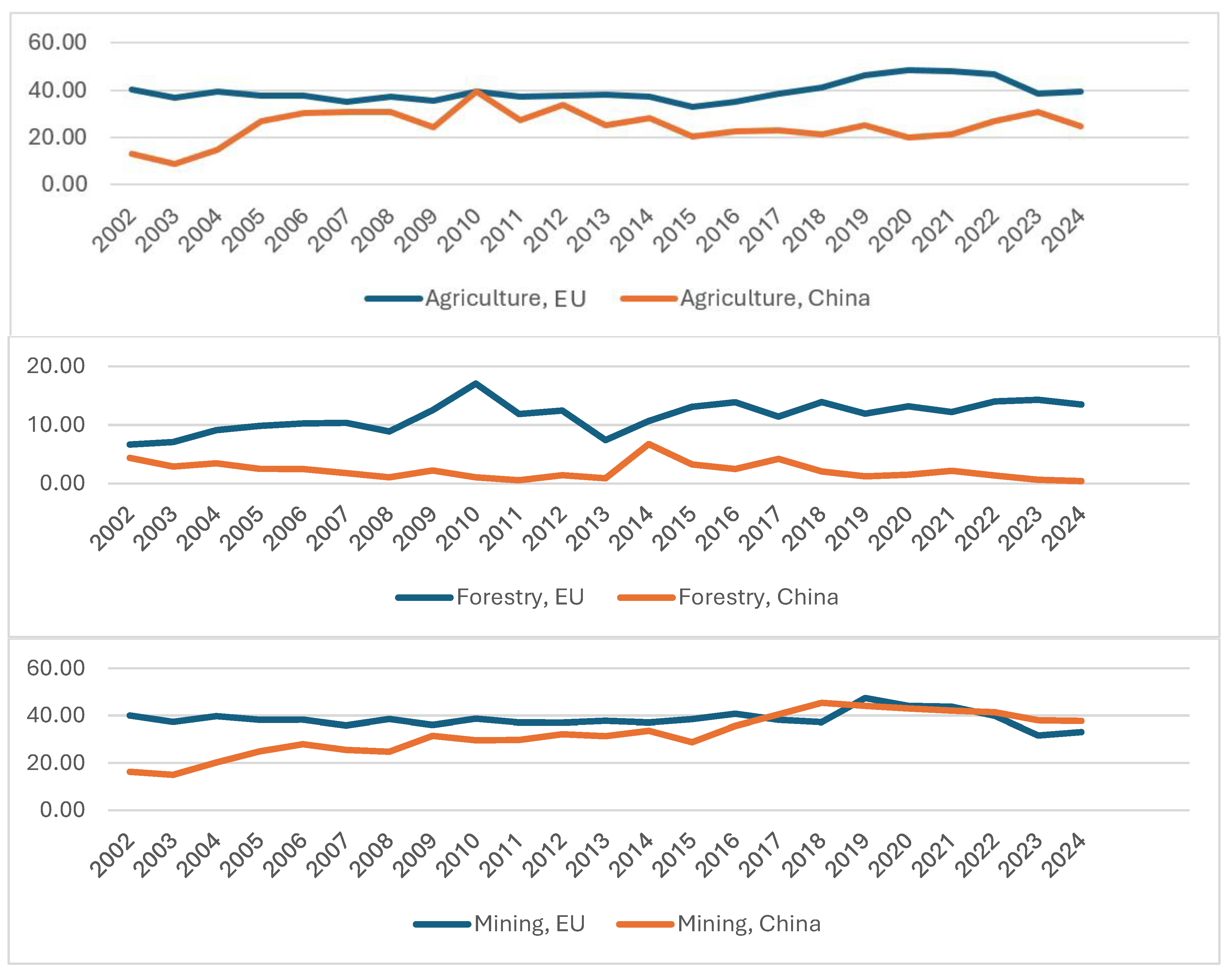
Figure 2 traces the frontier commodity dependence changes over time, revealing distinct spatial sourcing trajectories.
For agricultural commodities, the EU sourcing from BLA remains high throughout the period, fluctuating along a narrow band, showing the consolidation in BLA rather than regional diversification. By contrast, China’s agricultural RCR declines gradually over time, suggesting a relative reorientation of sourcing toward non-frontier Brazilian regions.
A contrasting picture between Chinese and EU sourcing can be observed among the forestry commodities, of which both were highly dependent on the frontier in the early 2000s. While China in over a decade sharply decreased its dependence on the frontier regarding this product group, the EU, although lowering the early period dependence, has stabilised at a higher level.
Finally, mining shows less variation over time—especially for the EU—reflecting higher capital and time intensity, as well as geographical resource constraints. However, Chinese sourcing of mining commodities from the BLA region, despite growth until the latter half of the 2010s, shows a decrease in the subsequent years.
Table 4 presents descriptive statistics for the RCR data shown in
Figure 2. The summary statistics indicate that frontier dependence differs not only in average levels but also in temporal variability across destinations and commodity groups. In agriculture, the EU exhibits higher average frontier dependence than China, with relatively moderate dispersion, suggesting a stable reliance on BLA sourcing over time. China’s agricultural RCR, while lower on average, shows substantially greater variability, reflecting more pronounced temporal shifts in sourcing patterns. In forestry, both destinations display lower mean RCR values, with China exhibiting particularly low and stable frontier dependence, consistent with limited and declining direct sourcing from BLA. In contrast, mining shows high average frontier dependence for both destinations, but with markedly greater variability for China, indicating episodic or project-driven sourcing rather than a stable spatial pattern. Overall, the dispersion measures suggest that differences in mean frontier dependence are not driven by isolated outliers but reflect structurally distinct sourcing dynamics over time, reinforcing the descriptive interpretation of RCR as a measure of persistent spatial exposure rather than short-term fluctuation.
To complement the relative concentration trajectories,
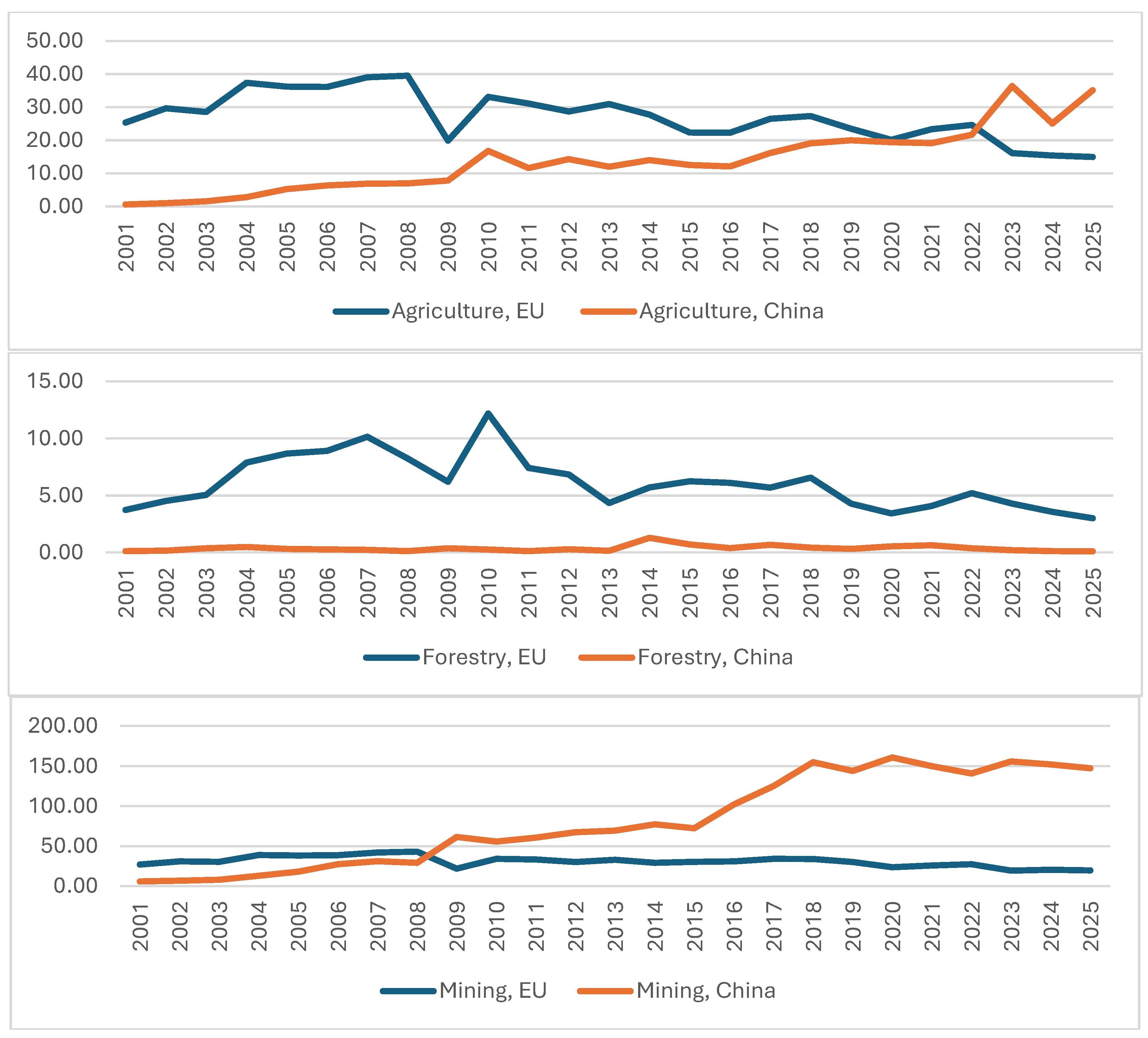
Figure 3 reports absolute export volumes originating in BLA and destined for the EU and China (mn tonnes) across agriculture, forestry, and mining. In forestry, exports from BLA to China remain consistently lower than exports to the EU throughout the study period. In agriculture, exports to the EU dominate for most of the sample, but China overtakes the EU in absolute BLA-sourced volumes in the late period (around 2023). In mining, China becomes the dominant destination already by 2009 and remains substantially higher thereafter, with a marked expansion during the mid-to-late 2010s.
Table 5 reports compound annual growth rates (CAGR) for exports to the EU and China, comparing Brazil as a whole (27 states) with BLA (9 states). Exports to China grow strongly at the national level across all commodity groups; within BLA, growth is sector-specific—frontier-linked exports expand faster than the national benchmark in agriculture (15.03% vs. 11.90%) and mining (14.60% vs. 10.50%), while forestry exports from BLA to China slightly decline (−1.16%) despite positive national growth (9.46%). This is consistent with the interpretation that China’s relatively lower frontier dependence in RCR terms should not be interpreted as weak engagement: frontier-linked volumes can grow rapidly even when relative concentration declines. By contrast, exports to the EU contract at both the national and BLA levels across all commodity groups, with the steepest national decline in forestry (−4.03%) compared to a milder contraction from BLA (−1.03%). Together with
Figure 2 and
Figure 3, these growth patterns underscore that frontier dependence (RCR) must be interpreted alongside sector-specific volume dynamics, rather than inferring spatial reorientation from scale effects alone.
Table 6 reports Pearson correlations between PRODES annual clear-cut deforestation (km
2) and BLA export volumes (log-transformed), measured contemporaneously (same-year). No statistically significant positive correlations are observed; the only positive association approaching conventional thresholds is agriculture exports to the EU (r = 0.361,
p = 0.090). In contrast, several statistically significant negative correlations are identified, most notably for exports to China in agriculture (r = −0.708,
p < 0.001) and mining (r = −0.692,
p < 0.001), as well as for total mining exports (r = −0.584,
p = 0.003). Overall, the results do not show a statistically significant positive correlation between export volumes and deforestation in the short term (contemporaneous or one-year lag). However, this lack of direct statistical association does not imply an absence of causality, as land conversion often precedes export-grade production by longer timeframes.
To explore temporal ordering,
Table 7 reports correlations between PRODES deforestation in year t and total BLA export volumes lagged by one year (t − 1), using both Pearson and Spearman coefficients. The lagged results remain predominantly negative. Mining shows a statistically significant negative lagged correlation in the Pearson specification (r = −0.516,
p = 0.014), while agriculture exhibits marginally significant negative correlations (Pearson
p = 0.066; Spearman
p = 0.069). Taken together, the contemporaneous and lagged correlations suggest that variation in export volumes is not positively aligned with annual clear-cut deforestation as captured by PRODES over the study period; where significant associations exist, they are negative and concentrated in specific commodity–destination pairs.
Overall, the correlation tests do not indicate a positive contemporaneous or lagged association between BLA export volumes and PRODES deforestation; where significant relationships appear, they are negative and commodity-specific.
5. Discussion
The empirical juxtaposition of the EU’s compliance-oriented “Brussels Effect” and China’s scale-driven “Beijing Effect” reveals a counterintuitive spatial reality within the BLA frontier. Overall, the evidence provides limited support for H1 (EU spatial avoidance): EU-linked trade does not display a sustained reduction in frontier dependence over the study period. H2 (China’s higher frontier dependence) is also not supported in relative terms: China’s frontier dependence (as captured by RCR) is generally lower than the EU’s, although trajectories differ by commodity group and over time. The pattern that best fits the results is H3 (compliance-driven consolidation): compliance and traceability requirements—arising from public regulation and private standards—may stabilize or consolidate sourcing within established frontier zones, improving product-level assurances without necessarily inducing geographic retreat from BLA. Importantly, these patterns reflect direct trade relationships between Brazilian regions and importing partners rather than ultimate consumption footprints, which may be further reshaped by re-exports and downstream processing beyond the scope of the present data. These comparative mechanisms and empirical patterns are summarized in
Table 8.
A central implication is that regulatory ambition and reputational pressure do not automatically translate into spatial avoidance of high-deforestation-risk jurisdictions. In the Brussels Effect framework, market access is conditioned on compliance with standards, and compliance pressure can diffuse beyond EU borders [
29,
33]. Yet such diffusion often operates through product- and firm-level verification—documentation, traceability, auditing, and due diligence—rather than through explicit territorial restrictions on where commodities should be sourced [
33,
43]. This helps interpret the “spatial blind spot” suggested by the results. Demand-side governance may substantially tighten monitoring and verification while leaving sourcing geographies largely intact, particularly when frontier regions are already deeply integrated into export channels.
Under these conditions, compliance requirements can generate economies of scale in verification. The costs of due diligence, auditability, and documentation tend to favor large, capitalized producers and supply-chain nodes able to provide consistent and verifiable records, creating economies of scale in compliance [
40,
41,
42]. In Brazil, despite the existence of the Rural Environmental Registry (CAR), research documents persistent problems with overlapping claims, informal land use, and uneven enforcement, which can complicate the provision and validation of geolocation and legality information along supply chains [
50,
51]. Rather than inducing a spatial exit from BLA, compliance pressure may therefore concentrate EU-linked sourcing among the most auditable suppliers operating in consolidated frontier zones. Importantly, this does not imply that due diligence is misguided. It may improve product-level assurances and reduce certain risks. However, it may be insufficient to induce geographic shifts toward lower-risk regions or restoration landscapes unless accompanied by explicit spatial incentives and territorial policy instruments.
At the same time, attributing observed consolidation patterns solely or directly to compliance and traceability requirements would overstate the causal claims supported by the present analysis. Several alternative explanations merit consideration. First, consolidation may reflect pre-existing supply chain infrastructure and historical trade specialization within BLA. Long-established export corridors, logistics networks, slaughterhouses, grain silos, and port access in frontier states, particularly in Mato Grosso and Pará, may structurally favor continued sourcing from these regions regardless of regulatory pressure, implying infrastructural path dependence rather than regulatory consolidation. Second, the use of broad commodity groupings may mask compositional shifts within categories, such that consolidation at the group level reflects changing product mixes rather than compliance dynamics alone. Third, the comparatively lower and declining frontier dependence observed in China-linked trade may partly reflect strategic spatial diversification into non-frontier production regions, particularly the Cerrado biome, reducing relative reliance on BLA without implying reduced engagement in land-use-intensive commodity sourcing overall. These mechanisms are not mutually exclusive and may operate alongside governance-based effects.
China’s sourcing patterns point to a different mechanism. While the Beijing Effect is often framed as scale-driven sourcing with limited environmental conditionality, the results do not support the expectation that China is more frontier-dependent than the EU in relative terms (H2). Instead, China’s frontier dependence (RCR) is often lower and, in selected sectors, declines over time. This should not be interpreted as weak engagement or an inherently “greener” strategy. Interpreting these dynamics requires reading relative dependence (RCR) together with absolute frontier-linked volumes: RCR captures relative spatial exposure, while volumes capture trade scale, and the two may move differently across sectors and over time. In this study, China-related exports expand rapidly at the national level, while frontier-linked dynamics within BLA are sector-specific—strong in agriculture and mining but declining in forestry—suggesting that a lower or declining RCR may reflect broad expansion across multiple production regions rather than a deliberate retreat from frontier extraction, even as frontier-linked volumes remain substantial in particular sectors.
The correlation analysis provides limited evidence that annual export expansions coincide with annual PRODES clear-cut deforestation at the aggregate BLA level. No statistically significant positive contemporaneous correlations are observed; where significant associations appear, they are negative and concentrated in specific commodity–destination pairs. Lagged correlations (t − 1) remain predominantly negative, indicating that frontier-linked exports are not a simple same-year proxy for deforestation intensity. These patterns are consistent with deforestation dynamics driven by speculative land clearing and indirect land use change (ILUC), which often occur well before commodities enter the export stream, rendering short-term correlations insufficient to capture the full environmental footprint [
52,
53]. Accordingly, significant negative correlations, particularly for China, should not be interpreted as evidence of environmentally benign trade effects, but rather as reflecting temporal lags, spatial displacement, and frontier dynamics that decouple export flows from contemporaneous deforestation outcomes. Nonetheless, they reinforce the broader point that trade-related frontier exposure (captured by RCR and volumes) should not be equated mechanically with annual deforestation outcomes.
Taken together, the findings speak to the design and expectations of demand-side environmental governance. Instruments such as the EUDR can plausibly strengthen traceability and verification and thus reduce product-level risk, yet still fall short of inducing spatial reallocation away from high-risk frontiers if spatial targeting is not explicit. This matters in a context where deforestation pressures are spatially concentrated and where EU–Mercosur trade may deepen under EMPA, despite ongoing political and societal contestation around the agreement [
54]: trade expansion raises the stakes of whether governance affects where commodities are sourced or primarily how sourcing is documented [
11,
12]. A key implication is complementarity: demand-side regulation may be more effective when paired with spatially explicit measures—jurisdictional approaches, incentives for sourcing from degraded lands, cooperation on land-tenure transparency, and targeted support for verified low-risk territories [
53,
55]. Without such spatial targeting, demand-side regimes may unintentionally stabilize trade ties with auditable producers in frontier regions rather than shifting pressures away from sensitive biomes.
6. Conclusions
This study reveals a counterintuitive pattern in the political economy of “imported deforestation”: despite stricter sustainability governance, the EU exhibits persistently higher frontier dependence on BLA than China across key commodity groups. This challenges the assumption that regulatory stringency automatically translates into the spatial avoidance of high-risk regions. Instead, the results provide the strongest support for the consolidation hypothesis, suggesting that the Brussels Effect—operating through traceability and due diligence requirements and their associated compliance costs—may favor established, capitalized producers embedded in consolidated frontier zones, rather than inducing a geographic shift away from the biome. By contrast, China’s state-led, scale-driven sourcing is associated with lower and, in selected sectors, declining frontier dependence in RCR terms, even as overall trade expands substantially, highlighting that changes in relative frontier exposure cannot be inferred from trade scale alone. Overall, the diverging trajectories of RCR between the two partners highlight that compliance-centered governance (EU) and scale- and infrastructure-oriented sourcing dynamics (China) can be linked to distinct spatial outcomes in commodity procurement.
The findings have important implications for the implementation of the EU Deforestation Regulation and the prospective deepening of EU–Mercosur trade. A regulatory architecture focused on product-level compliance (traceability to the plot) may create a “spatial blind spot”: it can strengthen verification and assurances within supply chains without necessarily reducing the aggregate economic exposure to frontier sourcing. Without complementary instruments that explicitly address spatial allocation—such as incentives for sourcing from degraded lands outside critical biomes, jurisdictional approaches, or stronger territorial governance cooperation—demand-side regulation may inadvertently stabilize trade linkages with highly auditable producers in frontier regions.
More broadly, tackling imported deforestation requires recognizing that sourcing geography is shaped not only by environmental criteria but also by compliance costs, economies of scale, and infrastructure. Future strategies may therefore benefit from combining verification rigor with spatially explicit measures aimed at de-concentrating pressure from sensitive biomes.
The correlation analysis is intended as a descriptive assessment of co-movements between exports and deforestation, rather than as a test of causal relationships. Given the complexity of land-use dynamics, trade flows, and policy interventions, simple bivariate correlations may not be enough to isolate causal effects and may reflect confounding factors, reverse causality, or shared underlying trends. Accordingly, the results are interpreted as indicative associations rather than evidence of direct trade-driven deforestation. Future research could build on this descriptive analysis by employing multivariate or causal inference approaches, such as panel regressions with appropriate controls, lag structures, or quasi-experimental designs, to more rigorously assess the relationship between trade dynamics and deforestation outcomes.
This study is subject to several methodological limitations that should be considered when interpreting the results. First, frontier exposure is operationalized using the BLA administrative region, which does not fully coincide with the Amazon biome and includes heterogeneous land-use contexts. As a result, the analysis captures exposure to a governance-relevant frontier jurisdiction rather than biome-specific deforestation pressure. Second, frontier dependence is defined as a jurisdictionally defined, state-level operationalization due to data constraints, which precludes differentiation between active and consolidated frontier areas within BLA. Third, the use of physical trade data captures commodities only to their first point of export from Brazil and does not account for indirect land-use effects, potentially taming destination-specific frontier exposure. Finally, the analysis is descriptive and comparative in nature and does not aim to identify causal relationships between trade dynamics and deforestation outcomes. These limitations do not undermine the study’s core contribution but delimit the scope of conclusions and suggest caution in generalizing the results beyond the specific spatial and institutional context examined.
Although the correlation tests do not indicate a positive contemporaneous or lagged association between BLA export volumes and PRODES deforestation, the results highlight the complexity of trade and environment linkages, pointing to the limitations of simple bilateral analyses. For transnational governance theory, this implies the need to consider indirect supply channels and regulatory mechanisms at multiple levels. For policymakers, this suggests that effective implementation of regulations such as the EUDR requires spatially targeted interventions, monitoring of entire supply chains, and integration of trade data with local deforestation indicators.