Article

Maxent Modeling of Habitat Suitability for Alpine Musk Deer (Moschus chrysogaster) and Blue Sheep (Pseudois nayaur) in the Typical Canyons of the Sanjiangyuan Region


1
School of Water Resources and Hydropower Engineering, Xi’an University of Technology, Xi’an 710000, China
2
Institute of Ecology and Environment, Powerchina Northwest Engineering Corporation Limited, Xi’an 710065, China
3
Division of Ecology, China Institute of Geo-Environmental Monitoring, Beijing 100081, China
*
Author to whom correspondence should be addressed.
Sustainability 2026, 18(4), 1976; https://doi.org/10.3390/su18041976
Submission received: 29 October 2025 / Revised: 26 November 2025 / Accepted: 27 January 2026 / Published: 14 February 2026

Abstract

Habitat degradation and fragmentation driven by climate change and human activities are major threats to wildlife, particularly in the ecologically sensitive Sanjiangyuan region on the Qinghai–Tibet Plateau. Alpine musk deer (Moschus chrysogaster) and blue sheep (Pseudois nayaur), two key ungulate species, face severe habitat challenges due to these environmental pressures. Understanding their habitat requirements and distribution patterns is critical for developing effective conservation strategies. This study applied the Maximum Entropy (MaxEnt) model to predict the habitat suitability of alpine musk deer and blue sheep in the characteristic canyons of the Sanjiangyuan region. Data from 55 infrared camera traps and 26 environmental variables, including climate, topography, land use, and human disturbance, were analyzed. The results indicated that annual mean temperature, altitude, temperature annual range, and distance to water were the most influential factors for both species. The suitable habitats for alpine musk deer and blue sheep were limited, covering only 9.61% and 10.84% of the study area, respectively. These areas were primarily distributed along the main stream of the Yellow River and its primary tributary canyons. The limited availability of high-quality habitats underscores the vulnerability of these species to ongoing habitat degradation and fragmentation. To effectively protect ungulate populations, we suggest continuously monitoring the trends of critical habitats, strengthening the protection of existing habitats, and improving the current conservation systems. The findings provide critical insights for conservation planning and management in the Sanjiangyuan region.

1. Introduction

Over recent decades, climate warming and intensified human activities have driven widespread habitat degradation and fragmentation, which may threaten wildlife diversity and long-term population persistence [1,2,3,4]. Large- and medium-sized ungulates are often sensitive to environmental change and depend on relatively continuous, high-quality habitats for foraging, reproduction, and predator avoidance [5,6,7]. Poaching for meat, hides, and musk pods [8], overgrazing [9], and construction of roads and railways [10] have likely caused substantial habitat loss and fragmentation in many mountain regions [11]. When habitats shrink, become subdivided, or decline in quality, population sizes and ranges may contract, with potential negative effects on ecosystem structure and functioning [3,10,12]. Alpine ecosystems, characterized by harsh climate, low productivity, and limited resilience, are particularly difficult to restore once disturbed and are therefore viewed as priority yet challenging regions for biodiversity conservation under global change [6,13,14].
The Qinghai–Tibet Plateau, known as the “Third Pole” and the “Water Tower of Asia,” plays a key role in regulating regional and even global climate and hydrological processes [15,16]. The Sanjiangyuan region, located in the interior of the plateau, contains the headwaters of the Yangtze, Yellow, and Lancang (Mekong) rivers and serves as an important ecological security barrier in China [13]. It is also a core demonstration area for the national park system [17]. The region harbors rich wildlife resources, including several ungulate species that influence vegetation dynamics and act as key prey for large carnivores in high-elevation ecosystems [4,13]. At the same time, this high, cold, and dry region with fragile ecosystems appears increasingly affected by climate warming, grazing, transportation infrastructure, and tourism [4,10,18,19]. These pressures may jointly contribute to localized habitat degradation and fragmentation, especially in landscape units that are already spatially constrained.
Typical canyon belts, where river valleys and mountains intersect, represent such a landscape unit in Sanjiangyuan [20,21]. Steep terrain, pronounced vertical zonation, and complex microtopography create highly heterogeneous habitat conditions [22]. Under these conditions, suitable habitats tend to occur in narrow bands or small patches along river corridors and slopes [23]. Once disturbed, these limited areas may have amplified impacts on ungulate populations that rely on canyon environments as movement corridors, foraging sites, or refuges [13,24]. Understanding how key ungulate species respond to climatic, topographic, hydrological, and anthropogenic gradients within these canyon systems may therefore be crucial for designing effective conservation measures and for refining spatial management within the national park.
Alpine musk deer (Moschus chrysogaster) and blue sheep (Pseudois nayaur) are two representative high-altitude ungulates in the Sanjiangyuan region [7,13]. Alpine musk deer, endemic to China and listed as a national Class I protected species, typically inhabits high-elevation coniferous forests, shrublands, and embedded alpine meadow patches, and appears to require relatively concealed and quiet environments [7,25,26]. Due to habitat degradation and human disturbance, its wild populations may have declined in parts of its range, which underscores its conservation importance [7,27,28]. Blue sheep primarily occupy high-elevation mountain grasslands and rocky cliffs and are a typical mountain ungulate of the Qinghai–Tibet Plateau [29,30]. As a main prey species for large carnivores such as snow leopards, wolves (Canis lupus), and brown bears (Ursus arctos), blue sheep likely play a fundamental role in maintaining alpine food webs and ecosystem functioning [18,31,32]. Although emblematic species such as Tibetan antelope (Pantholops hodgsonii) and Przewalski’s gazelle (Procapra przewalskii) have received substantial research attention [4,13,33], studies on the habitat preferences and distribution patterns of alpine musk deer and blue sheep in Sanjiangyuan, particularly at the canyon scale, remain relatively limited.
Species distribution models (SDMs), especially the Maximum Entropy (MaxEnt) model based on ecological niche theory, have been widely used in wildlife conservation and protected area planning [13,31,33,34]. By relating species presence-only records to environmental predictors, MaxEnt can estimate the spatial pattern of potentially suitable habitats [35,36]. The model generally requires modest sample sizes, can accommodate complex and nonlinear responses, and has shown good performance in habitat suitability assessments, identification of priority conservation areas, and projections under climate change scenarios [37,38]. Meanwhile, camera trapping has become an important tool for monitoring wildlife in high-altitude regions, providing occurrence data with relatively high spatial and temporal resolution for elusive species [39,40]. Combining camera-trap records with climate, topographic, land use, hydrological, and human disturbance variables in a unified MaxEnt framework may offer a refined understanding of habitat suitability and key environmental drivers for wild animals in typical canyon systems [41,42].
Against this background, this study focuses on typical canyons in the Sanjiangyuan region. We integrate occurrence records of alpine musk deer and blue sheep from 60 camera traps with 26 environmental variables describing climate, topography, land use, hydrology, and human activities, and apply the MaxEnt model to quantify habitat suitability for both species. Specifically, we aim to: (1) identify and quantify key environmental variables that may influence habitat suitability for alpine musk deer and blue sheep, (2) reveal the spatial patterns of suitable habitats for both species at the canyon scale, and propose targeted management recommendations. This work is expected to provide a more nuanced understanding of habitat selection and spatial distribution patterns of high-altitude ungulates in typical canyon landscapes, and to offer scientific and spatial support for the conservation of alpine musk deer, blue sheep, and other key species in Sanjiangyuan region.

2. Materials and Methods

2.1. Study Area

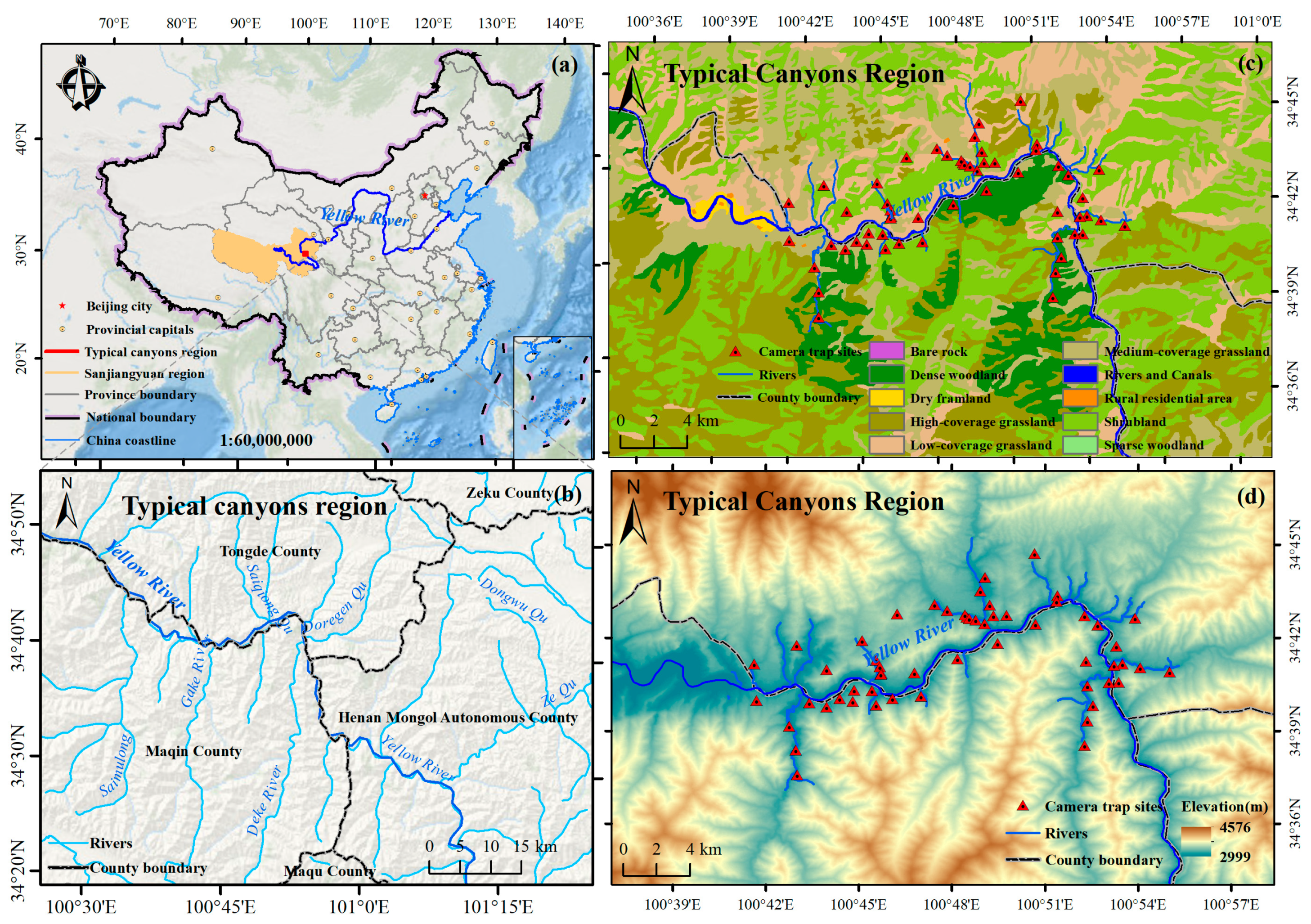
The study was conducted in a typical canyon section of the upper Yellow River within the Sanjiangyuan Region on the northeastern Qinghai–Tibet Plateau, China. The area extends from 100°17′ E to 101°25′ E and from 34°16′ N to 34°58′ N, covering 7418.62 km2, with a mean elevation of 3623 m. The river network includes the main stem of the Yellow River and several tributaries, such as the Saimulong, Saiqiongqu, Saiqianqu, Gake River, Deke River, Duoergenqu, Zequ, Galongduo, Yongqu, and Dongwuqu catchments (Figure 1a,b). Administratively, the study area encompasses Xiuma Township, Hebei Township, and Tangu Town in Tongde County (Hainan Tibetan Autonomous Prefecture), Lajia Town in Maqin County (Golog Tibetan Autonomous Prefecture), as well as Ningmute Town in Henan Mongolian Autonomous County and Ningxiu Township in Zeku County (Huangnan Tibetan Autonomous Prefecture).
The region has a plateau continental climate, with a cold season dominated by the Tibetan Plateau High Pressure system and a warm season influenced by the Indian Ocean monsoon, creating pronounced environmental gradients [43]. The mean annual air temperature is approximately 0 °C, mean annual precipitation is about 580.2 mm, and annual potential evaporation reaches around 1304.5 mm. Topography is highly diverse and consists of plateau surfaces, high mountains, intermontane and lake basins, and a dense, deeply incised river network (Figure 1c,d). Vegetation shows clear altitudinal zonation and is dominated by coniferous–broadleaf mixed forest, cold-temperate coniferous forest, alpine shrubland, alpine meadow, and alpine steppe.
Previous field surveys indicate that the study area supports rich wildlife assemblages (Table S1). Ungulates include blue sheep (Pseudois nayaur), red deer (Cervus canadensis), alpine musk deer (Moschus chrysogaster), Chinese serow (Capricornis milneedwardsii), and wild boar (Sus scrofa). Rodents and lagomorphs such as the Himalayan marmot (Marmota himalayana), Siberian chipmunk (Tamias sibiricus), and plateau hare (Lepus oiostolus), galliform birds, snow leopard (Panthera uncia), Eurasian lynx (Lynx lynx), wolf (Canis lupus), red fox (Vulpes vulpes), and Chinese desert cat (Felis bieti) have all been recorded, indicating high conservation value of this canyon landscape.

2.2. Species Distribution Data Collection

From May 2023 to February 2024, we conducted field surveys in seven typical canyons within the Sanjingyuan region (Figure 1c,d). We deployed 60 infrared camera traps (Ltl-C180; Beijing Dingxing Technology Co., Ltd., Beijing, China) to collect occurrence data for alpine musk deer and blue sheep. Cameras were strategically placed over 500 m apart to ensure spatial independence and reduce spatial autocorrelation [40,44]. They were mounted on trees or sturdy structures approximately 0.5 m above the ground to capture medium to large terrestrial mammals.
Cameras were programmed with moderate sensitive sensor setting to capture three photos and a 15 s video upon activation, operating 24 h per day. The cameras were checked every month to replace batteries and memory cards as needed. No bait or attractants were used to avoid influencing animal behaviors and to obtain unbiased data on species occurrence.
Photographs and videos were reviewed and summarized by sites, date, and time at each camera placement. To ensure independence of photographic capture events, we defined a detection event as one or more photographs a species within a 30 min interval at a given camera [45]. The number of effective camera-trap days was calculated as the duration between the camera setup date and the date of the last functioning record, accounting for any malfunctions based on date stamp. We calculated the Photographic Rate (PR) to compare detection frequencies among different wild ungulate species. The PR for each species at each camera site was calculated using the formula:
PR = (Number of independent detections/Number of camera-trap days) × 100.

2.3. Collection and Filtering of Environment Variables

Our models required two primary datasets: the geographic coordinates of species occurrence points and 26 environmental variables encompassing climate, terrain, land cover, and human disturbance factors (Table 1). Climate data, representing averages from 1970–2000, were sourced from WorldClim version 2.1 [46], providing 19 bioclimatic variables at a spatial resolution of approximately 1 km. Digital Elevation Model (DEM) data were obtained from NASA’s Alaska Satellite Facility (ASF) at a 12.5 m resolution. We derived slope and aspect layers data using ArcGIS 10.6 (Esri, Redlands, CA, USA) Spatial Analyst tools. Human disturbance variables, including distances to roads, villages, and water bodies, were calculated using Euclidean distance ArcGIS based on data from the National Catalogue Service for Geographic Information. These variables serve as proxies for human activity intensity. Land cover data were sourced from the European Space Agency (ESA) 2021 WorldCover dataset [47], which classifies land use into 11 categories relevant to our study area.
All environmental layers were resampled to a spatial resolution of 30 m to match the finest resolution among the datasets and ensure consistency. Coordinates were projected to WGS 1984 UTM Zone 47N. The data were converted to ASCII format for integration into the modeling software.
Multicollinearity among environmental variables can adversely affect model performance and interpretation [48]. To reduce multicollinearity, we conducted pairwise Pearson correlation analyses using the “Band Collection Statistics tool” in ArcGIS 10.6. The variables with high correlation (|r| ≥ 0.80) were eliminated, and those with low correlation and more biological implications were introduced into the model operation, so as to improve the accuracy of the simulation results of the niche model [49]. In parallel, we used the jackknife test of variable importance in MaxEnt to evaluate the relative contribution of all 26 predictors. Variables with zero or negligible jackknife contribution were discarded. For variables with |r| < 0.80, those with consistently low contribution to predicted suitability were also removed, and only predictors with clear biological meaning and appreciable explanatory power were retained for the final models.
Finally, combining correlation screening and jackknife results, we selected 11 environmental predictors (BIO1, BIO2, BIO7, BIO12, altitude, slope, aspect, land-cover type, and distances to villages, roads, and water). These variables have been widely used and shown to be important in previous SDM studies in the Sanjiangyuan region and on the Qinghai–Tibet Plateau, particularly for large mammals and other vertebrates [4,13,17,31,50,51].

2.4. Model Parameter Optimization

To ensure the accuracy and reliability of our species distribution models for alpine musk deer and blue sheep, we undertook a comprehensive model parameter optimization process. Recognizing the potential biases such as overfitting, sampling bias, and variable selection bias, we employed the R package (version 4.0.5) kuenm for meticulous model calibration and selection [52]. The kuenm package facilitates the generation and evaluation of multiple candidate models with varying parameter settings, enhancing the robustness and reproducibility of ecological niche modeling [53]. We generated candidate models for each species by systematically combining different configurations of Feature Classes (FC) and Regularization Multipliers (RM). Specifically, the RM ranged from 0.5 to 6 in increments of 0.5, resulting in 12 distinct RM settings. The FC encompassed Linear (L), Quadratic (Q), Product (P), Threshold (T), and Hinge (H) features, leading to 31 unique FC combinations.
For model selection, we applied the OR_AICc criterion, combining statistical significance, omission rate, and model parsimony [53]. Model performance was evaluated using partial receiver operating characteristic (partial ROC), omission rate (OR), and the small-sample corrected Akaike information criterion (AICc). We first used partial ROC to test whether models performed better than random, retaining only those with a mean AUC ratio significantly greater than 1 (p < 0.05) [54]. We then examined the omission rate at a 5% training presence threshold and discarded models with OR ≥ 5% [55]. Among the remaining models that met both significance and omission criteria, we compared AICc values, ranked models by ΔAICc, and selected the model with the lowest AICc (ΔAICc = 0) as the best-supported model for habitat suitability predictions [56].

2.5. Habitat Suitability Model

We used the MaxEnt software (v. 3.4.3) to model the habitat suitability for alpine musk deer and blue sheep [34]. To account for variability due to random data partitioning and to obtain stable predictions, we ran 10 bootstrap replicates, using 75% of the occurrence records for training and 25% for testing in each run. The final suitability maps and statistics were based on the average output across the 10 replicates [35].
We assessed model calibration and the relative importance of environmental predictors using the jackknife test and response curves provided by MaxEnt [57]. For each species, we examined the training gain when a variable was used in isolation and the decrease in training gain when that variable was omitted, thereby evaluating the contribution of each environmental factor to the distribution of alpine musk deer and blue sheep.
Model predictive performance was evaluated using the area under the receiver operating characteristic curve (AUC). AUC values range from 0 to 1, with values closer to 1 indicating better discrimination between suitable and unsuitable conditions. Generally, AUC < 0.5 is considered very poor, 0.5–0.6 poor, 0.6–0.7 average, 0.7–0.8 good, 0.8–0.9 very good, and 0.9–1.0 excellent [4,58].
The logical output of MaxEnt is a habitat suitability map, and a suitability index ranging from 0 to 1, with higher values representing higher degree of habitat quality for the species. We used the average threshold of maximum training sensitivity plus specificity as the split point. Combined with the actual distribution of alpine musk deer and blue sheep, the habitat quality was classified into four grades according to its suitability score: Unsuitability (0–0.20); Low suitability (0.20–0.50); Moderate suitability (0.40–0.70); High suitability (0.70–1.00).
All data processing and analyses were conducted using standard software and packages, including ArcGIS 10.6, MaxEnt 3.4.3, and R version 4.0.5 with the kuenm package.

3. Results

3.1. Camera Monitoring of Ungulates

In the study area, among the 60 monitoring sites in study area, 5 sites were excluded from data collection due to camera damage, malfunction, or theft, resulting in data from 55 monitoring sites. From May 2023 to February 2024, over a total of 14,465 camera-trap days (with an average monitoring duration of 263 ± 19 days per site), we recorded 3594 captures, obtaining 3329 independent detection events of five ungulate species (Table 2). Significant differences were found photographic rate (PR) per 100 camera trap days among the five ungulate species (df = 4, p < 0.001; Table 2). The PR values, from highest to lowest, were as follows: alpine musk deer, blue sheep, red deer, Chinese serow, and wild boar. The PR values for alpine musk deer and blue sheep were significantly higher than those of the other three ungulate species (p < 0.05), but there was no significant difference between the PR values of wild alpine musk deer and blue sheep (p > 0.05).
The alpine musk deer is listed as a national First-Class Key Protected Wild Animal, valuated as Endangered (EN) on the IUCN Red List and Critically Endangered (CR) on China’s Red List, included in CITES Appendix II. Blue sheep and red deer are assessed as Least Concern globally, but both are nationally Second-Class Key Protected Wild Animal. Four of the five monitored ungulates are at least nationally protected in China.

3.2. Model Performance

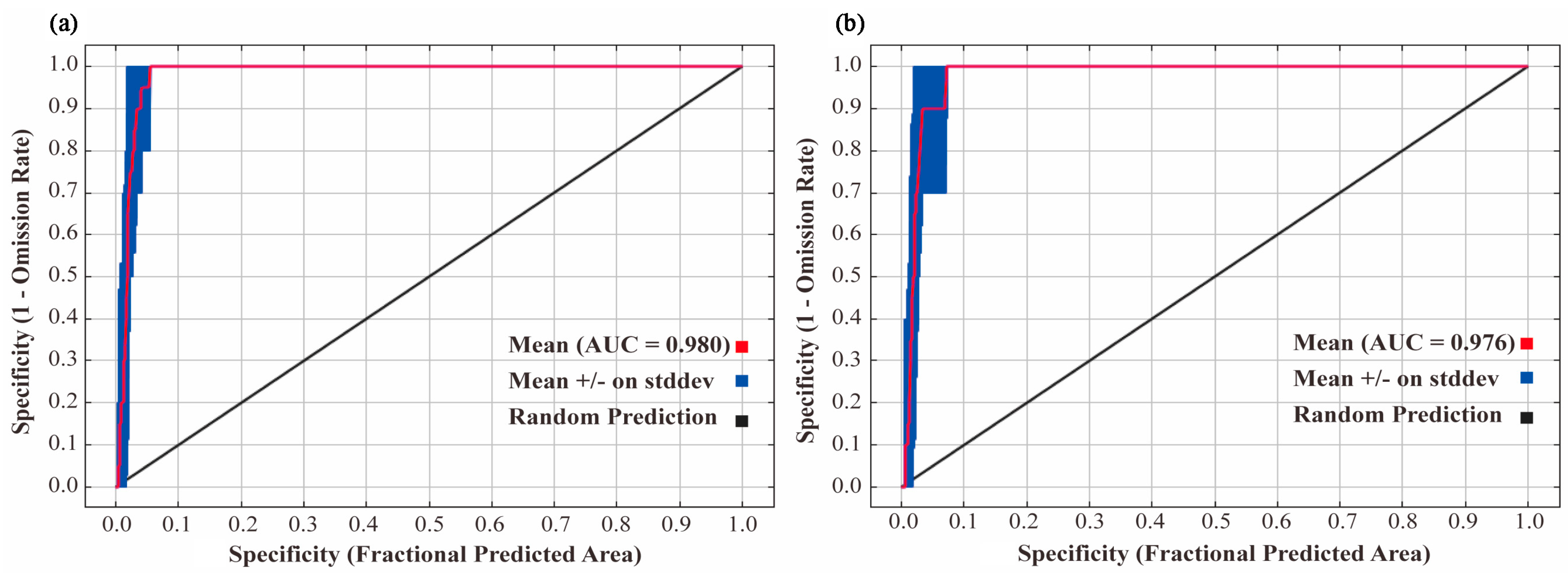
The best models incorporated combinations of linear, quadratic, and product features (LQP), with regularization multipliers of β = 2 for alpine musk deer and β = 2.5 for blue sheep. The average training AUC values for alpine musk deer and blue sheep were 0.984 and 0.981, respectively, and the average test AUC values were 0.980 and 0.976 (Figure 2). The standard deviations of the training AUC values were 0.009 and 0.011, indicating low variability across the 10 replicate runs. All AUC values exceeded 0.9, demonstrating that the MaxEnt models output reached excellent levels. The model results could accurately reflect the habitat suitability of alpine musk deer and blue sheep in the study area.

3.3. Effects of Environmental Variables

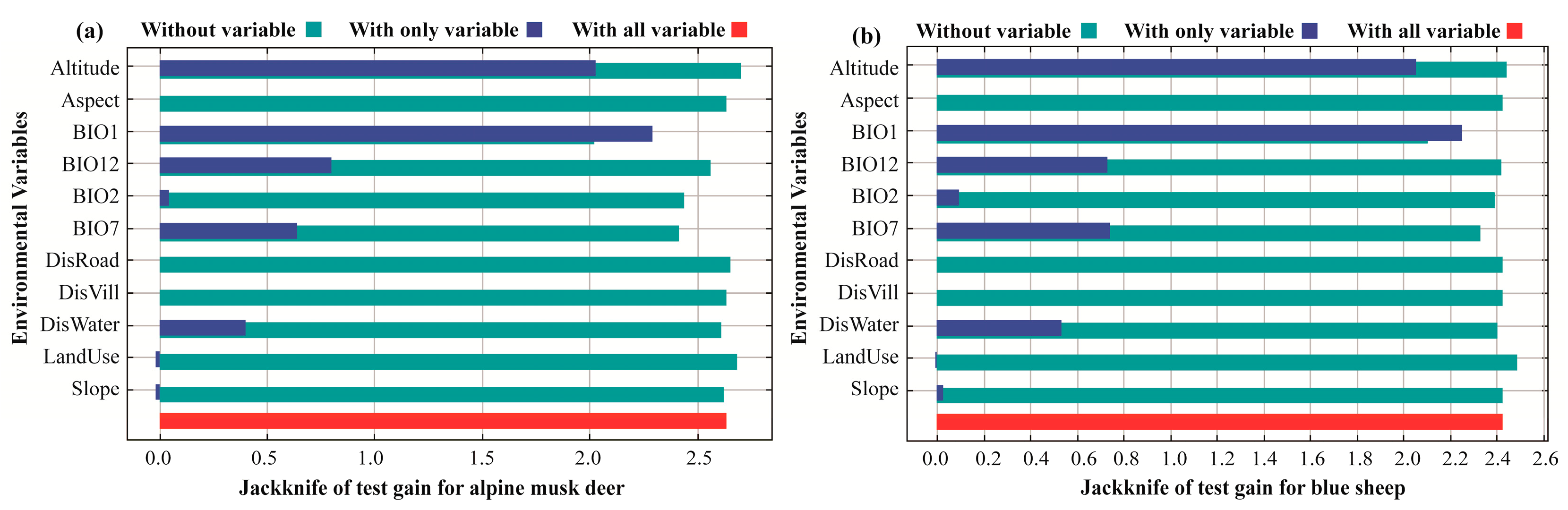
The jackknife test results showed that annual mean temperature (BIO1), altitude, temperature annual range (BIO7), and distance to water (DisWater) were the four most important environmental variables in predicting habitat suitability for both ungulate species (Figure 3). “With only variable” showed that the variables with higher gains, when added in isolation, were BIO1, altitude, annual precipitation (BIO12), and BIO7, indicating that these variables may have the most useful information on their own. “Without variable” showed that, when omitted from the model, the variables with more gain lost were BIO1, DisWater, BIO7, and BIO2, indicating that these variables may have more information compared to other variables.
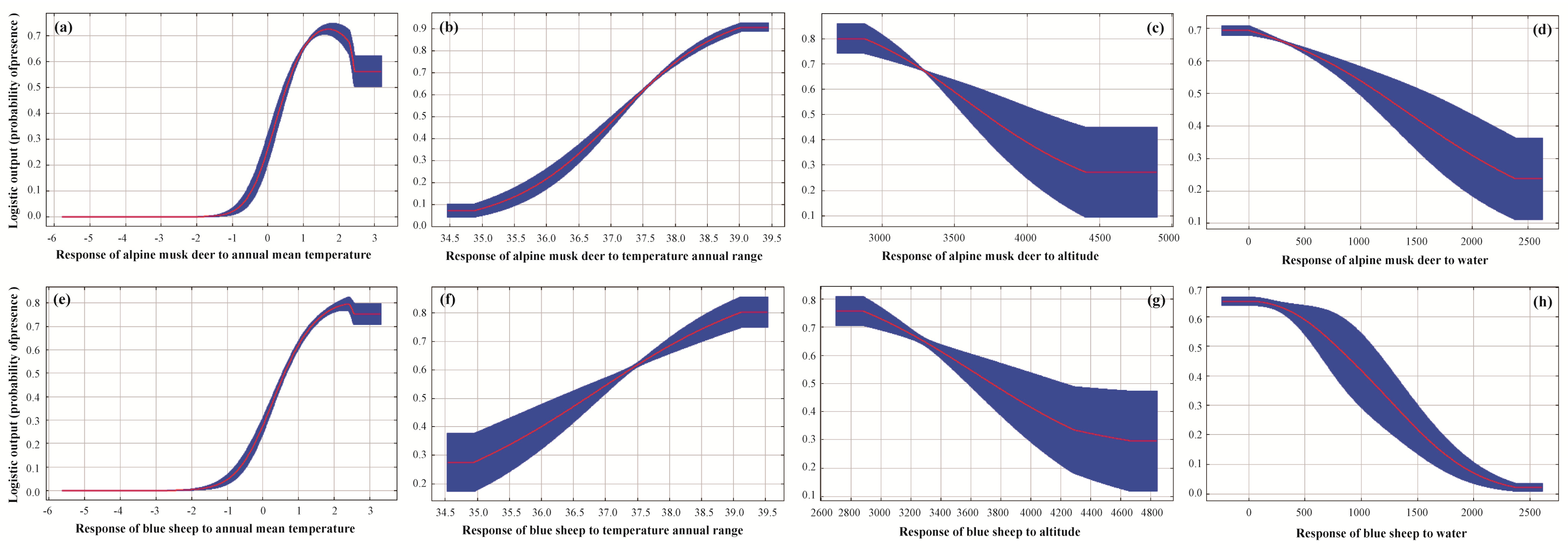
The response curves of single environmental variables clarified the threshold relationships between environmental variables and the presence probability of alpine musk deer and blue sheep within the study area (Figure 4). The peak of the response curves represents the maximum probability of presence, and ranges where the presence probability exceeds 0.5 are considered suitable habitats. Due to the geographical limitations of the study area, the results reflect trends rather than absolute thresholds, as the full range of environmental conditions is not represented.
Specifically, for alpine musk deer, the optimal range of annual mean temperature was 0.6–3.1 °C, with the highest probability of occurrence near 1.7 °C (Figure 4a). Temperature annual range demonstrated a rising trend in occurrence probability, with suitability significantly improving above 37 °C and stabilizing around 40 °C (Figure 4b). Altitude exhibited a decreasing trend, with the suitable range being 2600–3700 m, beyond 4400 m, the probability of occurrence declined to a minimum and stabilized (Figure 4c). Distance to water was also crucial for alpine musk deer, with the highest probability of occurrence within 0–1100 m from water sources. The probability decreased as the distance increased, indicating a preference for areas close to water (Figure 4d).
For blue sheep, similar patterns were observed. The optimal range of annual mean temperature was 0.6–3.1 °C, with the highest probability of occurrence near 2.2 °C (Figure 4e). Temperature annual range showed continuous increase in suitability beyond 37 °C, stabilizing around 40 °C (Figure 4f). Altitude had a similar trend to that of alpine musk deer, with the highest probability of occurrence within the 2600–3700 m range, and a stable decline beyond 4400 m (Figure 4g). The suitability related to distance to water peaked within 0–800 m, rapidly declining as the distance increased; beyond 2400 m, the probability of occurrence approached zero, emphasizing the importance of proximity to water sources for habitat selection (Figure 4h).

3.4. Habitat Suitability

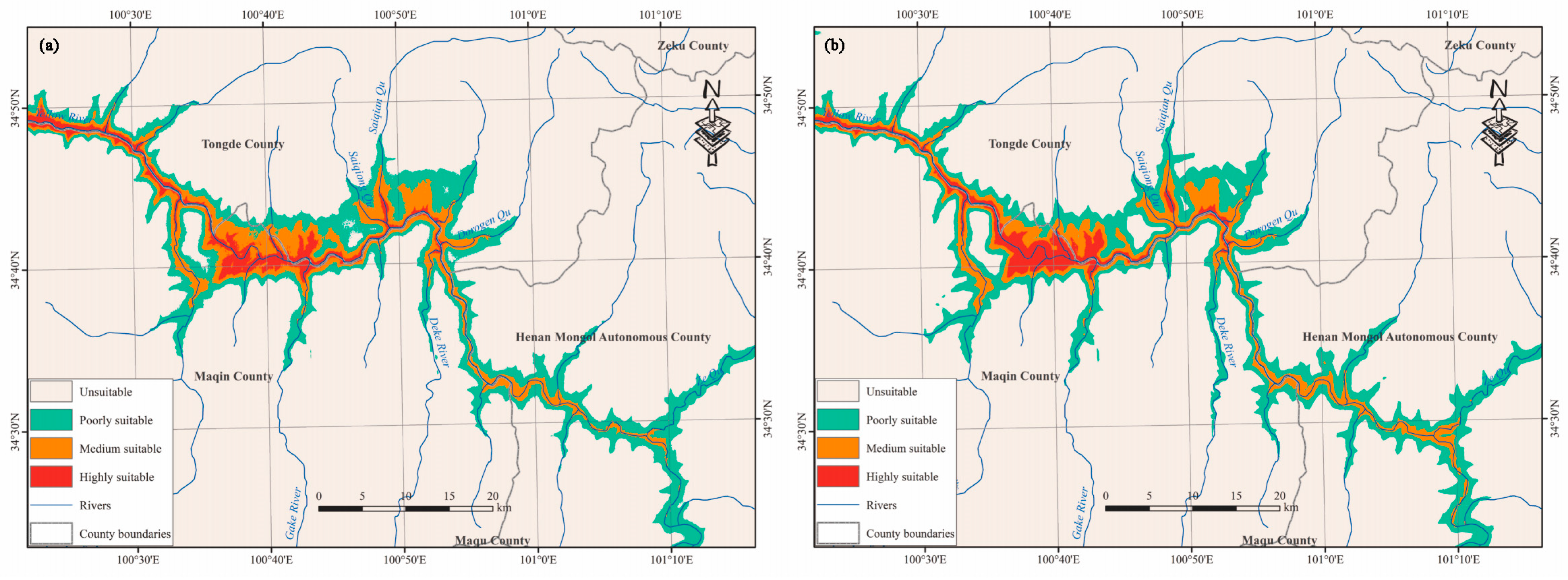
Most of the study area was unsuitable habitats for alpine musk deer and blue sheep, with suitable habitats accounting for only about 10% (Figure 5; Table 3). Specifically, poorly suitable habitat covered 451.58 km2 (6.09%) for alpine musk deer and 544.98 km2 (7.35%) for blue sheep; medium-suitability habitat accounted for 182.26 km2 (2.46%) and 171.06 km2 (2.31%), and highly suitable habitat for only 79.26 km2 (1.07%) and 87.74 km2 (1.18%), respectively (Table 3). The combined proportion of high- and medium-suitability habitats was similar for the two species (approximately 3–4% of the study area), while blue sheep had a slightly larger extent of poorly suitable habitat and alpine musk deer a slightly larger extent of medium suitability.
Spatially, the highly suitable and moderately suitable areas were primarily distributed along the main stream of the Yellow River and its primary tributary canyons, reflecting the species’ preference for these ecological zones (Figure 5). These habitats formed narrow, elongated belts along canyon bottoms and adjacent lower slopes, and habitat suitability declined rapidly with increasing distance from the river channels and towards higher ridges and interfluves. Several core patches with high suitability were located near confluences of major tributaries such as the Saiqiong Qu, Saimulong and Deke Rivers, which were interconnected by bands of poorly suitable habitat along the river valleys. Overall, alpine musk deer and blue sheep showed broadly similar spatial patterns, with a high degree of overlap of suitable habitats in the main canyon systems, forming continuous river–mountain corridors.

4. Discussion

4.1. Relationship Between Environmental Variables and Spatial Distribution of Ungulates

Our study identified annual mean temperature (BIO1), altitude, temperature annual range (BIO7), and distance to water as the four most influential environmental variables affecting the habitat suitability for both alpine musk deer and blue sheep (Figure 3). The optimal range of annual mean temperature for both species was found to be between 0.6 °C and 3.1 °C, with the highest occurrence probabilities near 1.7 °C for alpine musk deer and 2.2 °C for blue sheep (Figure 4a,e). The preference for such temperature conditions suggests physiological adaptations to cold environments, which is consistent with previous studies indicating that alpine ungulates are well-adapted to cooler climates [60,61,62]. These temperature ranges likely reflect a balance between maintaining body heat in a cold climate and avoiding excessive energetic costs, and outside this band, thermoregulatory and metabolic demands may rise and reduce habitat suitability [63,64].
The temperature annual range (BIO7) showed that both species favor areas with significant temperature fluctuations, with suitability improving above 37 °C and stabilizing around 40 °C (Figure 4b,f). This preference for areas with large temperature variations is characteristic of the Qinghai–Tibet Plateau’s climate, where high diurnal temperature ranges are common due to the region’s high elevation and low air density [62,65]. Previous work suggests that such conditions shape forage phenology, plant quality and thus foraging opportunities for ungulates [51,63,65]. In our study area, the combination of cool annual means and pronounced temperature ranges may therefore indicate microclimatic conditions that favor both adequate growing seasons for forage and tolerable thermal environments for medium-sized endotherms.
Altitude played a significant role in habitat suitability, with both species showing the highest occurrence probabilities between 2600 m and 3700 m (Figure 4c,g). Beyond 4400 m, the probability of occurrence declined sharply. This altitude range aligns with findings from Shen et al. [7] and Tan et al. [66], who reported that alpine musk deer and blue sheep are predominantly distributed in mountainous terrains at similar elevations. The specific altitude preferences are likely linked to the availability of suitable vegetation types, such as coniferous forests and shrublands for alpine musk deer [7,67,68], and open alpine meadows for blue sheep [50,69].
Proximity to water sources was also a crucial factor, with the highest occurrence probabilities within 0–1100 m for alpine musk deer and 0–800 m for blue sheep (Figure 4d,h). Beyond these distances, the probability of occurrence decreased markedly, emphasizing the importance of water availability in their habitat selection. This finding aligns with previous research, such as Shi et al. [4], which identified the distance from water sources, particularly lakes, as a dominant factor influencing the distribution of many ungulate species on the Qinghai–Tibet Plateau. Some studies have shown that lots of species have the behaviors of staying near the water sources [4,63]. Water sources not only provide hydration but also support lush vegetation, offering forage and cover from predators [63,70].

4.2. Habitat Suitability and Conservation

Our habitat suitability analysis revealed that suitable habitats for alpine musk deer and blue sheep account for only about 10% of the study area (Table 3; Figure 5). Highly suitable habitats are primarily distributed along the main stream of the Yellow River and its primary tributary canyons. These areas offer optimal environmental conditions and resources, including abundant forage from dense forests and shrublands, and rugged terrain that provides shelter and escape from predators [22,71]. The extreme scarcity and strong spatial aggregation of high-quality habitats indicate that these canyon systems function as key habitat cores and movement corridors for regional ungulate populations [6]. In particular, several highly suitable “core patches” near the confluences of the Saiqiong Qu, Saimulong and Deke Rivers may serve as important breeding or wintering areas and should be considered priority targets for conservation.
Despite the limited extent of suitable habitats, they are critical for the survival of these species. High-quality habitats, defined as areas with high and medium suitability, represent a substantial share within the suitability classifications, accounting for 36.7% for alpine musk deer and 32.2% for blue sheep (Table 3). At the same time, blue sheep occupy a somewhat larger area of low-suitability habitat, reflecting their greater use of open slopes and rocky terrain [30,31], whereas alpine musk deer are more closely associated with inner side-valleys and more sheltered canyon sections [25,67]. This overlap reinforces the role of canyon habitats as multi-species key areas, but it may also increase sensitivity to resource competition and human disturbance where space is limited [4,51,72].
However, human activities pose significant threats to the habitats of alpine musk deer and blue sheep [19,71]. Overgrazing by livestock leads to competition for food and space, potentially degrading the quality of the habitat [73]. Evidence of grazing and associated disturbances was observed at all monitored sites. Additionally, signs of poaching activities, such as old snares and makeshift barricades, indicate illegal hunting pressures on these populations [74,75]. Such activities not only reduce population sizes but also disrupt normal behavioral patterns and habitat use [51,75,76].

4.3. Integrated Conservation and Research Strategies

Our results imply that identified high- and medium-suitability patches, together with the belts that connect them along the Yellow River and key tributaries, should be explicitly incorporated into protected-area and land-use planning. In areas where existing or planned infrastructure (e.g., hydropower, roads, tourism facilities) overlaps with core habitats, it may be necessary to establish functional buffer zones or ecological corridors to maintain connectivity and reduce barrier effects [75,77]. Developing ecological corridors can counteract fragmentation, allowing species to track environmental change and maintaining long-term population viability [51,77]. Enhancing connectivity is particularly important for preserving genetic diversity and facilitating natural movements between patches, including seasonal migrations and dispersal, which underpin the resilience of ungulate populations [51,78].
At the same time, effective management of key anthropogenic pressures is essential. In high-suitability habitats, grazing intensity and timing could be regulated to reduce competition with wild ungulates and prevent further grassland degradation, for instance through rotational grazing or seasonal resting [19,79]. New infrastructure and tourism development should be subject to rigorous environmental impact assessment focused explicitly on corridor integrity and cumulative effects. Anti-poaching measures need to be strengthened through more frequent patrols, systematic removal of snares and traps, and stricter penalties for illegal hunting [11,73]. Continuous monitoring and research are required to support adaptive management, evaluate the effectiveness of conservation interventions, and enable timely adjustments when conditions or threats change [80].
Our study highlights the importance of specific environmental variables for alpine musk deer and blue sheep, but the limited geographical extent means that the full range of conditions they occupy is not represented. Future studies should incorporate larger geographical areas and consider additional environmental variables, such as soil type, vegetation cover (e.g., NDVI), and human disturbance indices, to provide a more comprehensive understanding of these species’ habitat requirements [7,31,38]. Moreover, conservation strategies should be explicitly informed by future climate change scenarios. In the headwater regions of the Yellow and Yangtze Rivers, mean annual temperature has risen by about 0.17–0.20 °C per decade, implying that the thermal windows identified here may shift upslope or into more sheltered inner canyons [65,81]. Anticipating these shifts by identifying potential future refugia and “climate corridors,” and reserving ecological space in such areas before intensive development occurs, will be crucial for maintaining viable populations of alpine musk deer and blue sheep under continued warming.

5. Conclusions

This study combined camera-trap data and MaxEnt modeling to assess habitat suitability for alpine musk deer and blue sheep in the typical canyons of the Sanjiangyuan region. We found that suitable habitats for both species are limited (≈10% of the landscape) and strongly concentrated along the upper Yellow River. Critically, annual mean temperature (BIO1), altitude, temperature annual range (BIO7), and distance to water (DisWater) as pivotal environmental determinants of habitat suitability. These canyon corridors therefore appear to function as critical habitat cores and movement routes for nationally protected ungulates, with important implications for zoning in the Sanjiangyuan region, grazing management, infrastructure planning and anti-poaching efforts. Our analysis is constrained by the restricted geographic extent, the use of presence-only data and a limited set of environmental variables. Future research should extend to larger spatial scales, incorporate additional predictors, explicitly integrate climate-change scenarios and detection-based models, and further explore multi-species connectivity to support long-term, adaptive conservation planning.

Supplementary Materials

The following supporting information can be downloaded at: https://www.mdpi.com/article/10.3390/su18041976/s1. Table S1: The camera footage from typical canyons in the Sanjiangyuan region captured the species list.

Author Contributions

Conceptualization, L.N., P.L. and J.M.; methodology, L.N., P.L. and Z.H.; investigation, L.N., P.L. and Z.H.; data curation, L.N. and Z.H.; formal analysis, L.N. and Z.H.; visualization, L.N. and Z.H.; writing—original draft preparation, L.N. and Z.H.; writing—review and editing, P.L. and J.M.; supervision, J.M.; project administration, J.M.; funding acquisition, L.N. and P.L. All authors have read and agreed to the published version of the manuscript.

Funding

Key Research and Development Projects of Shaanxi Province (2025GH-YBXM-066).

Institutional Review Board Statement

Not applicable.

Informed Consent Statement

Not applicable.

Data Availability Statement

The data presented in this study are available on request from the corresponding author.

Conflicts of Interest

Authors Le Niu and Ping Li were employed by PowerChina Northwest Engineering Corporation Limited. Authors Zhenzhen Hao and Junyong Ma were employed by the China Institute of Geo-Environmental Monitoring. The authors declare that this study was conducted in the absence of any commercial or financial relationships that could be construed as a potential conflict of interest.

References

  1. Hald-Mortensen, C. The Main Drivers of Biodiversity Loss: A Brief Overview. J. Ecol. Nat. Resour. 2023, 7, 000346. [Google Scholar] [CrossRef]
  2. Pörtner, H.; Scholes, R.J.; Agard, J.; Archer, E.; Arneth, A.; Bai, X.M.; Barnes, D.; Burrows, M.; Chan, L.; Cheung, W.L.; et al. Scientific Outcome of the IPBES–IPCC Co-Sponsored Workshop on Biodiversity and Climate Change; IPBES Secretariat: Bonn, Germany, 2021. [Google Scholar] [CrossRef]
  3. Haddad, N.M.; Brudvig, L.A.; Clobert, J.; Davies, K.F.; Gonzalez, A.; Holt, R.D.; Lovejoy, T.E.; Sexton, J.O.; Austin, M.P.; Collins, C.D.; et al. Habitat fragmentation and its lasting impact on Earth’s ecosystems. Sci. Adv. 2015, 1, e1500052. [Google Scholar] [CrossRef]
  4. Shi, F.N.; Liu, S.L.; An, Y.; Sun, Y.X.; Zhao, S.; Liu, Y.X.; Li, M.Q. Climatic factors and human disturbance influence ungulate species distribution on the Qinghai–Tibet Plateau. Sci. Total Environ. 2023, 869, 161681. [Google Scholar] [CrossRef]
  5. Kauffman, M.J.; Aikens, E.O.; Esmaeili, S.; Kaczensky, P.; Middleton, A.; Monteith, K.L.; Morrison, T.A.; Mueller, T.; Sawyer, H.; Goheen, J.R. Causes, consequences, and conservation of ungulate migration. Annu. Rev. Ecol. Evol. Syst. 2021, 52, 453–478. [Google Scholar] [CrossRef]
  6. Zweifel-Schielly, B.; Kreuzer, M.; Ewald, K.C.; Suter, W. Habitat selection by an Alpine ungulate: The significance of forage characteristics varies with scale and season. Ecography 2009, 32, 103–113. [Google Scholar] [CrossRef]
  7. Shen, L.Q.; Gao, H.X.; Wu, J.Y.; Wang, G.; Liu, R.; Qi, J.; Zhang, X.Y.; Zhang, A.P.; Chen, L.; Zhang, Y.Z.; et al. Birth-site habitat selection of wild alpine musk deer (Moschus chrysogaster) in the northeastern Qing–Tibetan Plateau of China. Biologia 2022, 78, 141–147. [Google Scholar] [CrossRef]
  8. Dhyani, S. Are Himalayan ecosystems facing hidden collapse? Assessing the drivers and impacts of change to aid conservation, restoration and conflict resolution challenges. Biodivers. Conserv. 2023, 32, 3731–3764. [Google Scholar] [CrossRef]
  9. Harris, R.B. Rangeland degradation on the Qinghai-Tibetan plateau: A review of the evidence of its magnitude and causes. J. Arid Environ. 2010, 74, 1–12. [Google Scholar] [CrossRef]
  10. Zhuo, Y.Y.; Xu, W.X.; Wang, M.Y.; Chen, C.; da Silva, A.A.; Yang, W.K.; Ruckstuhl, K.E.; Alves, J. The effect of mining and road development on habitat fragmentation and connectivity of khulan (Equus hemionus) in Northwestern China. Biol. Conserv. 2022, 275, 109770. [Google Scholar] [CrossRef]
  11. Somu, Y.; Selvaraj, P. Human–Wild Animal Conflict. In Animal Welfare-New Insights; IntechOpen: London, UK, 2023. [Google Scholar] [CrossRef]
  12. Sawyer, H.; Kauffman, M.J.; Middleton, A.D.; Morrison, T.A.; Nielson, R.M.; Wyckoff, T.B. A framework for understanding semi-permeable barrier effects on migratory ungulates. J. Appl. Ecol. 2013, 50, 68–78. [Google Scholar] [CrossRef]
  13. Jiang, F.; Zhang, J.J.; Song, P.F.; Qin, W.; Wang, H.J.; Cai, Z.Y.; Gao, H.M.; Liu, D.X.; Li, B.; Zhang, T.Z. Identifying priority reserves favors the sustainable development of wild ungulates and the construction of Sanjiangyuan National Park. Ecol. Evol. 2022, 12, e9464. [Google Scholar] [CrossRef]
  14. Grabherr, G.; Gottfried, M.; Pauli, H. Climate Change Impacts in Alpine Environments. Geogr. Compass 2010, 4, 1133–1153. [Google Scholar] [CrossRef]
  15. Oli, K.P.; Pandey, M.R. The Horizon of the Third Pole: Mapping Future Scenarios and Strategic Responses. Environ. Policy Law 2024, 54, 266–275. [Google Scholar] [CrossRef]
  16. Xue, J.; Li, Z.X.; Feng, Q.; Gui, J.; Zhang, B.J. Spatiotemporal variations of water conservation and its influencing factors in ecological barrier region, Qinghai–Tibet Plateau. J. Hydrol. Reg. Stud. 2022, 42, 101164. [Google Scholar] [CrossRef]
  17. Ma, B.R.; Zeng, W.; Xie, Y.; Wang, Z.; Hu, G.; Li, Q.; Cao, R.; Zhuo, Y.; Zhang, T. Boundary delineation and grading functional zoning of Sanjiangyuan National Park based on biodiversity importance evaluations. Sci. Total Environ. 2022, 825, 154068. [Google Scholar] [CrossRef]
  18. Li, J.; Yin, H.; Wang, D.J.; Jiagong, Z.L.; Lu, Z. Human–snow leopard conflicts in the Sanjiangyuan Region of the Tibetan Plateau. Biol. Conserv. 2013, 166, 118–123. [Google Scholar] [CrossRef]
  19. Wei, W.; Zhang, K.; Zhou, J. Review and prospect of human-land relationship in Three River Headwaters region: Based on the perspective of people, events, time and space. Adv. Earth Sci. 2020, 35, 26–37. [Google Scholar] [CrossRef]
  20. Yang, Z.J.; Pang, B.; Dong, W.F.; Li, D.H.; Huang, Z.Y. Interaction of landslide spatial patterns and river canyon landforms: Insights into the Three Parallel Rivers Area, southeastern Tibetan Plateau. Sci. Total Environ. 2024, 914, 169935. [Google Scholar] [CrossRef]
  21. Wang, J.A.; Liang, S.L.; Shi, P.J. Topography and Landforms. In The Geography of Contemporary China; World Regional Geography Book Series; Springer: Cham, Switzerland, 2022. [Google Scholar] [CrossRef]
  22. Zhang, L.; Li, T.J.; Wang, G.Q.; Kwang, J.S.; Nittrouer, J.A.; Fu, X.D.; Parker, G. How canyons evolve by incision into bedrock: Rainbow Canyon, Death Valley National Park, United States. Proc. Natl. Acad. Sci. USA 2020, 117, 14730–14737. [Google Scholar] [CrossRef]
  23. Riitters, K.H.; O’Neill, R.V.; Jones, K.B. Assessing habitat suitability at multiple scales: A landscape-level approach. Biol. Conserv. 1997, 81, 191–202. [Google Scholar] [CrossRef]
  24. Bolger, D.T.; Newmark, W.D.; Morrison, T.A.; Doak, D.F. The need for integrative approaches to understand and conserve migratory ungulates. Ecol. Lett. 2008, 11, 63–77. [Google Scholar] [CrossRef]
  25. National Forestry and Grassland Administration. National List Key Protected Wild Animal China. Available online: https://www.forestry.gov.cn/main/5461/20210205/122418860831352.html (accessed on 21 October 2025).
  26. Harris, R. Moschus chrysogaster. In The IUCN Red List of Threatened Species; International Union for Conservation of Nature (IUCN): Gland, Switzerland, 2016; p. e.T13895A61977139. [Google Scholar] [CrossRef]
  27. Zhang, Z.R.; Wang, X.Q.; Su, Y.; Hu, T.; Duo, H.; Yang, Y.; Aorigele; Zhang, J.; Teng, L.; Liu, Z. Assessing population status and influencing factors of alpine musk deer in patchy habitats: Implications for conservation strategies. Glob. Ecol. Conserv. 2024, 54, e03134. [Google Scholar] [CrossRef]
  28. Yang, Q.S.; Meng, X.X.; Xia, L.; Feng, Z.J. Conservation status and causes of decline of musk deer (Moschus spp.) in China. Biol. Conserv. 2003, 109, 333–342. [Google Scholar] [CrossRef]
  29. Jiang, Z.L.; Migmar, W.D. Review on the study of blue sheep (Pseudois nayaur). Chin. J. Ecol. 2020, 39, 2426–2435. [Google Scholar]
  30. Gao, H.; Li, N.; Huang, Y.; Liu, Z. Taxonomic status of Chinese blue sheep (Pseudois nayaur): New evidence of a distinct subspecies. Integr. Zool. 2019, 15, 202–212. [Google Scholar] [CrossRef]
  31. Bao, S.W.; Yang, F. Influences of climate change and land use change on the habitat suitability of Bharal in the Sanjiangyuan District, China. Int. J. Environ. Res. Public Health 2022, 19, 17082. [Google Scholar] [CrossRef]
  32. Harris, R.B. Pseudois nayaur. In The IUCN Red List of Threatened Species; International Union for Conservation of Nature (IUCN): Gland, Switzerland, 2014; p. e.T61513537A64313015. [Google Scholar] [CrossRef]
  33. Liu, T.; Jiang, Z.G.; Wang, W.; Wang, G.Y.; Song, X.R.; Xu, A.C.; Li, C.L. Changes in habitat suitability and population size of the endangered Przewalski’s gazelle. Glob. Ecol. Conserv. 2023, 43, e02465. [Google Scholar] [CrossRef]
  34. Phillips, S.J.; Anderson, R.P.; Schapire, R.E. Maximum entropy modeling of species geographic distributions. Ecol. Model. 2006, 190, 231–259. [Google Scholar] [CrossRef]
  35. Phillips, S.J.; Dudík, M. Modeling of species distributions with MAXENT: New extensions and a comprehensive evaluation. Ecography 2008, 31, 161–175. [Google Scholar] [CrossRef]
  36. Phillips, S.J.; Anderson, R.P.; Dudík, M.; Schapire, R.E.; Blair, M.E. Opening the black box: An open-source release of Maxent. Ecography 2017, 40, 887–893. [Google Scholar] [CrossRef]
  37. Elith, J.; Phillips, S.J.; Hastie, T.; Dudík, M.; Chee, Y.E.; Yates, C.J. A statistical explanation of MaxEnt for ecologists. Divers. Distrib. 2011, 17, 43–57. [Google Scholar] [CrossRef]
  38. Northrup, J.M.; Vander Wal, E.; Bonar, M.; Fieberg, J.; Laforge, M.P.; Leclerc, M.; Prokopenko, C.; Gerber, B.D. Conceptual and methodological advances in habitat-selection modeling: Guidelines for ecology and evolution. Ecol. Appl. 2022, 32, e02470. [Google Scholar] [CrossRef]
  39. Xu, Y.; Wang, B.; Gu, X.D.; Song, D.Z.; Yang, B. Camera trapping reveals area of conservation significance for large and medium-sized mammals on the eastern Tibetan Plateau. Oryx 2022, 56, 137–144. [Google Scholar] [CrossRef]
  40. Xiao, Z.S.; Xiao, W.H.; Wang, T.M.; Li, S.; Lian, X.M.; Song, D.Z.; Deng, X.Q.; Zhou, Q.H. Wildlife monitoring and research using camera-trapping technology across China: The current status and future issues. Biodivers. Sci. 2022, 30, 22451. [Google Scholar] [CrossRef]
  41. Hurtado, C.; Hemming, V.; Burton, C. Comparing wildlife habitat suitability models based on expert opinion with camera trap detections. Conserv. Biol. 2023, 37, e14113. [Google Scholar] [CrossRef] [PubMed]
  42. Bai, D.F.; Chen, P.J.; Atzeni, L.; Cering, L.; Li, Q.; Shi, K. Assessment of habitat suitability of the snow leopard (Panthera uncia) in Qomolangma National Nature Reserve based on MaxEnt modeling. Zool. Res. 2018, 39, 373–386. [Google Scholar] [CrossRef] [PubMed]
  43. Jin, Z.; You, Q.L.; Wu, F.Y.; Sun, B.; Cai, Z.Y. Changes of climate and climate extremes in the Three-Rivers’ Headwaters region over the Tibetan Plateau during the past 60 years. Trans. Atmos. Sci. 2020, 43, 1042–1055. [Google Scholar]
  44. Burton, A.C.; Neilson, E.; Moreira, D.; Ladle, A.; Steenweg, R.; Fisher, J.T.; Bayne, E.; Boutin, S. Wildlife camera trapping: A review and recommendations for linking surveys to ecological processes. J. Appl. Ecol. 2015, 52, 675–685. [Google Scholar] [CrossRef]
  45. Rowcliffe, J.M.; Field, J.; Turvey, S.T.; Carbone, C. Estimating animal density using camera traps without the need for individual recognition. J. Appl. Ecol. 2008, 45, 1228–1236. [Google Scholar] [CrossRef]
  46. Fick, S.E.; Hijmans, R.J. WorldClim 2: New 1 km spatial resolution climate surfaces for global land areas. Int. J. Climatol. 2017, 37, 4302–4315. [Google Scholar] [CrossRef]
  47. ESA. ESA WorldCover 10 m 2020 v100; European Space Agency: Paris, France, 2021; Available online: https://esa-worldcover.org/en (accessed on 21 October 2025).
  48. Dormann, C.F.; Elith, J.; Bacher, S.; Buchmann, C.; Carl, G.; Carré, G.; García Marquéz, J.R.; Gruber, B.; Lafourcade, B.; Leitão, P.J.; et al. Collinearity: A review of methods to deal with it and a simulation study evaluating their performance. Ecography 2013, 36, 27–46. [Google Scholar] [CrossRef]
  49. Braunisch, V.; Coppes, J.; Arlettaz, R.; Suchant, R.; Schmid, H.; Bollmann, K. Selecting from correlated climate variables: A major source of uncertainty for predicting species distributions under climate change. Ecography 2013, 36, 971–983. [Google Scholar] [CrossRef]
  50. Chi, X.W.; Jiang, F.; Gao, H.M.; Qin, W.; Wu, T.; Zhang, J.J.; Cai, Z.Y.; Zhang, T.Z. Habitat suitability analysis of snow leopard (Panthera uncia) and bharal (Pseudois nayaur) in the Sanjiangyuan National Park. Acta Theriol. Sin. 2019, 39, 397–409. [Google Scholar]
  51. Liang, J.C.; Ding, Z.F.; Jiang, Z.G.; Yang, X.J.; Xiao, R.B.; Singh, P.B.; Hu, Y.M.; Guo, K.J.; Zhang, Z.X.; Hu, H.J. Climate change, habitat connectivity, and conservation gaps: A case study of four ungulate species endemic to the Tibetan Plateau. Landsc. Ecol. 2021, 36, 1071–1087. [Google Scholar] [CrossRef]
  52. Cobos, M.E.; Peterson, A.T.; Barve, N.; Osorio-Olvera, L. kuenm: An R package for detailed development of ecological niche models using Maxent. PeerJ 2019, 7, e6281. [Google Scholar] [CrossRef]
  53. Warren, D.L.; Seifert, S.N. Ecological niche modeling in Maxent: The importance of model complexity and the performance of model selection criteria. Ecol. Appl. 2011, 21, 335–342. [Google Scholar] [CrossRef]
  54. Peterson, A.T.; Papeş, M.; Soberón, J. Rethinking receiver operating characteristic analysis applications in ecological niche modeling. Ecol. Model. 2008, 213, 63–72. [Google Scholar] [CrossRef]
  55. Fielding, A.H.; Bell, J.F. A review of methods for the assessment of prediction errors in conservation presence/absence models. Environ. Conserv. 1997, 24, 38–49. [Google Scholar] [CrossRef]
  56. Burnham, K.P.; Anderson, D.R. Model Selection and Multimodel Inference: A Practical Information-Theoretic Approach; Springer-Verlag: New York, NY, USA, 2002. [Google Scholar]
  57. Lobo, J.M.; Jiménez-Valverde, A.; Real, R. AUC: A misleading measure of the performance of predictive distribution models. Glob. Ecol. Biogeogr. 2008, 17, 145–151. [Google Scholar] [CrossRef]
  58. Swets, J.A. Measuring the Accuracy of Diagnostic Systems. Science 1988, 240, 1285–1293. [Google Scholar] [CrossRef]
  59. Jiang, Z.G.; Jiang, J.P.; Wang, Y.Z.; Zhang, E.; Zhang, Y.Y.; Li, L.L.; Xie, F.; Cai, B.; Cao, L.; Zheng, G.M. Red List of China’s Vertebrates. Biodivers. Sci. 2016, 24, 500–551. [Google Scholar] [CrossRef]
  60. Cao, Q.L.; Pukazhenthi, B.S.; Bapodra, P.; Lowe, S.; Bhatnagar, Y.V. Equid Adaptations to Cold Environments. In The Equids; Fascinating Life Sciences; Prins, H.H.T., Gordon, I.J., Eds.; Springer: Cham, Switzerland, 2023. [Google Scholar] [CrossRef]
  61. Anderwald, P.; Campell Andri, S.; Palme, R. Reflections of ecological differences? Stress responses of sympatric Alpine chamois and red deer to weather, forage quality, and human disturbance. Ecol. Evol. 2021, 11, 15740–15753. [Google Scholar] [CrossRef]
  62. Huang, J.P.; Zhou, X.J.; Wu, G.X.; Xu, X.D.; Zhao, Q.Y.; Liu, Y.M.; Duan, A.; Xie, Y.K.; Ma, Y.M.; Zhao, P.; et al. Global climate impacts of land-surface and atmospheric processes over the Tibetan Plateau. Rev. Geophys. 2023, 61, e2022RG000771. [Google Scholar] [CrossRef]
  63. Veldhuis, M.P.; Kihwele, E.S.; Cromsigt, J.P.G.M.; Ogutu, J.O.; Hopcraft, J.G.C.; Owen-Smith, N.; Olff, H. Large herbivore assemblages in a changing climate: Incorporating water dependence and thermoregulation. Ecol. Lett. 2019, 22, 1536–1546. [Google Scholar] [CrossRef]
  64. Hebblewhite, M.; Merrill, E.H. Trade-offs between predation risk and forage differ between migrant strategies in a migratory ungulate. Ecology 2009, 90, 3445–3454. [Google Scholar] [CrossRef]
  65. Ren, Y.J.; Cui, J.X.; Wan, S.Q.; Liu, M.; Chen, Z.H.; Liao, Y.F.; Wang, J.J. Climate change impacts on central China and adaptation measures. Adv. Clim. Change Res. 2023, 4, 215–222. [Google Scholar] [CrossRef]
  66. Tan, K.; Li, D.P.; Li, N.; Fang, Y.H.; Li, Y.P.; Xiao, W. The discontinuous elevational distribution of an ungulate at the regional scale: Implications for speciation and conservation. Animals 2021, 11, 3565. [Google Scholar] [CrossRef]
  67. Zhang, L.X.; Sun, Z.Y.; An, B.; Zhang, D.X.; Chen, L. Alpine musk deer (Moschus chrysogaster) adjusts to a human-dominated semi-arid mountain ecosystem. Animals 2022, 12, 3061. [Google Scholar] [CrossRef]
  68. Nandy, S.; Lakshmi, M.N.; Kushwaha, S.P.S. Habitat suitability analysis of Himalayan musk deer (Moschus leucogaster) in part of Western Himalaya, India. J. Indian Soc. Remote Sens. 2020, 48, 1523–1533. [Google Scholar] [CrossRef]
  69. Bhattacharya, A.; Chatterjee, N.; Singh, R.G.; Habib, B. Blue sheep resource selection in alpine grasslands of a western Himalayan landscape—A point process approach. Zool. Stud. 2020, 59, e11. [Google Scholar] [CrossRef] [PubMed]
  70. Sumner, E.; Venn, S. Plant Responses to Changing Water Supply and Availability in High Elevation Ecosystems: A Quantitative Systematic Review and Meta-Analysis. Land 2021, 10, 1150. [Google Scholar] [CrossRef]
  71. Li, X.; Bleisch, W.V.; Jiang, X. Effects of ethnic settlements and land management status on species distribution patterns: A case study of endangered musk deer (Moschus spp.) in northwest Yunnan, China. PLoS ONE 2016, 11, e0155042. [Google Scholar] [CrossRef]
  72. Zhang, R.M.; Shi, J.B.; Zhang, J.M.; Wang, D.Y. Spatial Partitioning Among Three Sympatric Ungulates in the Tibetan Plateau: Identifying Critical Variables. Integr. Zool. 2025, early view. [Google Scholar] [CrossRef] [PubMed]
  73. Yu, H.; Liu, B.T.; Wang, G.X.; Zhang, T.Z.; Yang, Y.; Lu, Y.Q.; Xu, Y.X.; Huang, M.; Yang, Y.; Zhang, Y. Grass-livestock balance-based grassland ecological carrying capability and sustainable strategy in the Yellow River Source National Park, Tibet Plateau, China. J. Mt. Sci. 2021, 18, 2201–2211. [Google Scholar] [CrossRef]
  74. Hering, R.; Hauptfleisch, M.; Jago, M.; Smith, T.; Kramer-Schadt, S.; Stiegler, J.; Blaum, N. Don’t stop me now: Managed fence gaps could allow migratory ungulates to track dynamic resources and reduce fence-related energy loss. Front. Ecol. Evol. 2022, 10, 907079. [Google Scholar] [CrossRef]
  75. Xu, W.J.; Dejid, N.; Herrmann, V.; Sawyer, H.; Middleton, A.D. Barrier behaviour analysis (BaBA) reveals extensive effects of fencing on wide-ranging ungulates. J. Appl. Ecol. 2021, 58, 690–698. [Google Scholar] [CrossRef]
  76. Hannah, L.; Midgley, G.F.; Lovejoy, T.; Bond, W.J.; Bush, M.; Lovett, J.C.; Scott, D.; Woodward, F.I. Conservation of biodiversity in a changing climate. Conserv. Biol. 2002, 16, 264–268. [Google Scholar] [CrossRef]
  77. Salviano, I.R.; Gardon, F.R.; dos Santos, R.F. Ecological corridors and landscape planning: A model to select priority areas for connectivity maintenance. Landsc. Ecol. 2021, 36, 3311–3328. [Google Scholar] [CrossRef]
  78. Dolker, S.; Jabin, G.; Singh, S.K.; Joshi, B.D.; Singh, V.K.; Dalui, S.; Chandra, K.; Sharma, L.K.; Thakur, M. Landscape genetics identified conservation priority areas for blue sheep (Pseudois nayaur) in the Indian Trans-Himalayan Region. Sci. Rep. 2023, 13, 18152. [Google Scholar] [CrossRef]
  79. Zhou, K.; Wu, J.; Liu, H. Spatio-temporal estimation of the anthropogenic environmental stress intensity in the Three-River-Source National Park region, China. J. Clean. Prod. 2021, 318, 128476. [Google Scholar] [CrossRef]
  80. Wu, X.Y.; Dong, S.K.; Liu, S.L.; Su, X.K.; Han, Y.H.; Shi, J.B.; Zhang, Y.; Zhao, Z.Z.; Sha, W.; Zhang, X.; et al. Predicting the shift of threatened ungulates’ habitats with climate change in Altun Mountain National Nature Reserve of the Northwestern Qinghai-Tibetan Plateau. Clim. Change 2017, 142, 331–344. [Google Scholar] [CrossRef]
  81. Rawat, A.; Kumar, D.; Khati, B.S. A review on climate change impacts, models, and its consequences on different sectors: A systematic approach. J. Water Clim. Change 2023, 15, 104–126. [Google Scholar] [CrossRef]
Figure 1. Location of the typical canyon’s region in the upper Yellow River and distribution of camera-trap sites in the Sanjiangyuan region, China. (a) Location of the study area within China and within the Sanjiangyuan region. (b) Hydrographic network and county boundaries within the study area. (c) Land-cover map of the typical canyons region and the distribution of camera trap sites. (d) Elevation of the typical canyons region and the distribution of camera trap sites.
Sustainability 18 01976 g001
Figure 2. The receiver operating characteristic (ROC) curves of MaxEnt model for alpine musk deer (a) and blue sheep (b).
Sustainability 18 01976 g002
Figure 3. Jackknife test of variables importance in the MaxEnt model of alpine musk deer (a) and blue sheep (b). Dark blue bars represent the model gain when using only that variable (With only variable), light blue bars represent the model gain when excluding that variable (Without variable), and the red bar represents the model gain when using all variables (With all variables). Descriptions of environmental variables are provided in Table 1.
Sustainability 18 01976 g003
Figure 4. Response curves of important environmental variables in the distribution model for alpine musk deer and blue sheep, i.e., annual mean temperature (BIO1) (a,e), temperature annual range (BIO7) (b,f), altitude (c,g), and distance to water (d,h). The response curves show the mean response (red) and one standard deviation (blue) of the ten replicated MaxEnt runs.
Sustainability 18 01976 g004
Figure 5. Habitat suitability maps of alpine musk deer (a) and blue sheep (b) in typical canyons of the Sanjiangyuan region.
Sustainability 18 01976 g005
Table 1. The 26 environmental variables and their descriptions used in the MaxEnt models.
CategoryAbbreviationVariable DescriptionSource
Climate variablesBIO1Annual mean temperatureWorldClim
(http://www.worldclim.com/, accessed on 15 October 2025)
BIO2Mean diurnal range
BIO3Isothermality (BIO2/BIO7)
BIO4Temperature seasonality
BIO5Max temperature of warmest month
BIO6Min temperature of coldest month
BIO7Temperature annual range (BIO5-BIO6)
BIO8Mean temperature of wettest quarter
BIO9Mean temperature of driest quarter
BIO10Mean temperature of warmest quarter
BIO11Mean temperature of coldest quarter
BIO12Annual precipitation
BIO13Precipitation of wettest month
BIO14Precipitation of driest month
BIO15Precipitation seasonality
BIO16Precipitation of wettest quarter
BIO17Precipitation of driest quarter
BIO18Precipitation of warmest quarter
BIO19Precipitation of coldest quarter
Terrain variablesAltitudeAltitudeDEM data from ASF of the Distributed Active Archive Centers (DAAC) (https://search.asf.alaska.edu/, accessed on 15 October 2025)
SlopeSlope
AspectAspect
Land useLandUseLand cover typeESA Worldwide
(https://esa-worldcover.org/en, accessed on 15 October 2025)
Human activityDisVillDistance to villagesNational Catalogue Service for Geographic Information
(https://www.webmap.cn/, accessed on 15 October 2025)
DisRoadDistance to roads
DisWaterDistance to water
Table 2. Basic information on the survey and monitoring of wild ungulates in typical canyons of the Sanjiangyuan region. Different lowercase superscript letters in the photographic rate column indicate significant differences among species based on Duncan’s multiple range test (p < 0.05).
Species NameNo. of SitesCamera DaysNo. of Independent DetectionsPhotographic Rate
(Mean ± SD)
IUCN
Red List A
China’s
Red List B
CITES CLKPWA D
Alpine Musk Deer
(Moschus chrysogaster)
4611,340159814.09 ± 12.39 aENCRIII
Blue Sheep
(Pseudois nayaur)
4110,414138613.31 ± 12.35 aLCLCIIII
Red Deer
(Cervus canadensis)
2154602344.29 ± 4.37 bLCENII
Chinese Serow
(Capricornis milneedwardsii)
102350492.09 ± 5.04 bNEVUIII
Wild boar
(Sus scrofa)
61578251.58 ± 2.19 bLCLC
A IUCN Red List: International Union for Conservation of Nature Red List of Threatened Species (https://www.iucnredlist.org/, accessed on 15 October 2025). EN: Endangered; LC: Least Concern; NE: Not Evaluated. B China’s Red List: Red List of China’s Vertebrates [59]. CR: Critically Endangered; VU: Vulnerable. C CITESL: Appendices I, II, and III of the Convention on International Trade in Endangered Species of Wild Fauna and Flora (effective from 2017). D LKPWA: List of Key Protected Wild Animals in China 2021. Class I and II correspond to national First-Class and Second-Class Key Protected Wild Animals, respectively.
Table 3. Areas of habitats of different suitability levels for alpine musk deer and blue sheep in the Sanjiangyuan region.
RankAlpine Musk DeerBlue Sheep
Area (km2)Percentage (%)Area (km2)Percentage (%)
Highly suitable79.261.0787.741.18
Medium suitable182.262.46171.062.31
Poorly suitable451.586.09544.987.35
Unsuitable6705.2790.396614.5889.16
Disclaimer/Publisher’s Note: The statements, opinions and data contained in all publications are solely those of the individual author(s) and contributor(s) and not of MDPI and/or the editor(s). MDPI and/or the editor(s) disclaim responsibility for any injury to people or property resulting from any ideas, methods, instructions or products referred to in the content.