Article

Renewable Montmorillonite-Based Antibacterial Functionalization of Particleboards for Sustainable and Healthy Indoor Environments

1
Key Laboratory of Wooden Material Science and Application, Beijing Forestry University, Ministry of Education, Beijing 100083, China
2
Beijing Key Laboratory of Wood Science and Engineering, Beijing Forestry University, Beijing 100083, China
3
Beijing Products Quality Supervision and Inspection Institute, Key Laboratory of Furniture Health and Intelligent Quality Safety, State Administration for Market Regulation, Beijing 101300, China
*
Author to whom correspondence should be addressed.
These authors contributed equally to this work.
Sustainability 2026, 18(4), 1966; https://doi.org/10.3390/su18041966
Submission received: 5 January 2026 / Revised: 5 February 2026 / Accepted: 12 February 2026 / Published: 13 February 2026
(This article belongs to the Special Issue Sustainable Homes of Tomorrow: Innovations in Materials and Design)

Abstract

Wood-based particleboards are a key component of sustainable building materials due to their renewable and low-carbon nature. However, their susceptibility to microbial contamination poses a significant challenge to indoor environmental quality and durability, limiting their alignment with the principles of a healthy and circular built environment. In this study, a sustainable antibacterial modification strategy was developed by employing natural montmorillonite (MMT) as a renewable mineral carrier to address the challenge. A synergistic antibacterial agent (Cu2+/ZnO@MMT-O) was engineered via ion exchange and co-precipitation, effectively immobilizing Cu2+ ions and ZnO nanoparticles within the MMT structure. This process preserved the layered structure of the carrier while simultaneously enhancing its specific surface area and mesoporosity. Antibacterial tests revealed that the Cu2+/ZnO@MMT-O exhibited markedly higher antibacterial activity against Escherichia coli and Staphylococcus aureus than single-component counterparts, indicating a pronounced synergistic effect. At an additive loading of 1.25%, the particleboards exhibited antibacterial rates exceeding 99% against both tested bacteria, while their mechanical properties (MOR 10.65 MPa, MOE 2304.40 MPa, and IB 0.29 MPa) and dimensional stability (24 h TS 16.31%) compliant with national standards. Overall, this work presents a practical and sustainable approach to enhancing the hygienic performance of renewable wood composites through the integration of mineral carriers with synergistic nanoscale antibacterial mechanisms, thereby contributing to healthier indoor environments and the development of green and healthy residential materials.

1. Introduction

With growing concern for health and material safety in built environments, the demand for antibacterial artificial boards in furniture manufacturing, interior decoration, and construction applications has increased rapidly in recent years [1,2]. Indoor environments, where people spend the majority of their time, play a critical role in determining overall well-being, and the microbial contamination of interior materials has been increasingly recognized as an important factor affecting indoor environmental quality and occupant health [3]. Wood-based materials, owing to their renewability, low embodied energy, and favorable carbon footprint, are widely regarded as promising candidates for sustainable housing and eco-friendly interior systems [4,5]. Their broad application in flooring, wall panels, and furniture makes their hygienic performance particularly relevant to long-term indoor health and safety. As one of the most widely used wood-based panels, particleboard is particularly vulnerable to bacterial contamination in humid, warm, or pollution-prone environments, which not only shortens its service life but may also pose potential risks to human health [6]. Therefore, developing antibacterial particleboard with reliable antibacterial efficacy and satisfactory physical and mechanical performance is of considerable practical importance for promoting healthier, safer, and more sustainable indoor living environments, as well as for improving material durability and resource efficiency in residential building systems.
In recent years, the research and application of antibacterial agents for wood-based panels have increased considerably, and they can generally be divided into two main categories, namely organic antibacterial agents and inorganic antibacterial agents [7]. Although organic antibacterial agents exhibit strong initial antibacterial activity, their poor thermal stability, susceptibility to aging and degradation, possible induction of bacterial resistance, and potential environmental safety concerns limit their suitability for high-temperature hot-pressing processes and long-term service conditions in wood-based panel production [8,9,10]. This has prompted growing interest in inorganic antibacterial agents. Inorganic systems based on metal ions or metal oxides inhibit bacterial growth through mechanisms such as controlled ion release and oxidative stress, and are recognized for their high temperature resistance, long-term antibacterial stability, and extended service life, making them more compatible with hot-pressing processes and prolonged application scenarios in wood-based panels [11,12]. Among these inorganic systems, metal ions such as Cu2+, Zn2+, and Ag+, as well as metal oxides such as CuO, ZnO, and TiO2, are currently the most widely used and extensively studied antibacterial components [13,14]. However, when these ions or nano-oxides exist in a free state within the material, they are prone to migration or uncontrolled release during service. This not only weakens their long-term antibacterial durability but may also pose potential ecological and health risks, thereby limiting their sustainable application. To address this issue, loading metal ions or metal oxides onto structurally stable inorganic carriers with strong adsorption capacity is considered an effective strategy for enhancing antibacterial efficiency, improving release controllability, and ensuring long-term safety [15].
Montmorillonite (MMT), a typical layered silicate mineral, possesses a large specific surface area, high cation exchange capacity, good thermal stability, and excellent modification and loading capabilities, which make it an ideal carrier for inorganic antibacterial agents [16,17]. Previous studies have demonstrated that loading metal ions or metal oxides onto montmorillonite can provide materials with stable antibacterial properties, showing effective inhibitory activity against common pathogenic bacteria such as Escherichia coli (E. coli) and Staphylococcus aureus (S. aureus) [18,19,20,21]. Moreover, further research has proposed the synergistic introduction of two metal antibacterial components into the montmorillonite structure, such as copper/zinc co-loaded systems. Such systems enable the simultaneous occurrence of ion-release and oxidative-stress mechanisms at the interface, resulting in more pronounced synergistic antibacterial effects and more persistent activity than single-metal systems [22]. To date, these composite inorganic antibacterial systems have shown promising application potential in polymer films, antibacterial coatings, and biomedical materials [23,24]. However, research on the application of such composite inorganic antibacterial systems in particleboard is still relatively limited, especially the lack of analysis and exploration of their dispersion behavior, structural stability, and sustainable antibacterial potential in the board.
Based on this, organically modified montmorillonite was used in this study as a carrier, and a composite antibacterial montmorillonite material synergistically loaded with Cu2+ and ZnO (Cu2+/ZnO@MMT-O) was prepared by ion exchange and co-precipitation. This material was then incorporated into particleboard to fabricate antibacterial particleboards. The microstructural characteristics of the prepared antibacterial material, as well as its dispersion stability, thermal stability, and effects on the mechanical properties of the particleboard, were systematically investigated. In addition, the antibacterial performance of both the antibacterial agent and the particleboard was evaluated. This study aims to provide a sustainable material design approach for developing wood-based panels with antibacterial functionality.

2. Materials and Methods

2.1. Materials

Montmorillonite (MMT) was purchased from County Shanlin Stone Language Mineral Products Co., Ltd. (Guzhang, China). Absolute ethanol (C2H5OH), octadearyl dimethyl ammonium chloride (OTAC), zinc chloride (ZnCl2), sodium hydroxide (NaOH), and copper(II) sulfate pentahydrate (CuSO4·5H2O) were obtained from Tianjin Zhiyuan Chemical Co., Ltd. (Tianjin, China). Poplar particles were provided by Shandong Outai Decoration Materials Co., Ltd. (Jining, China), and isocyanates were purchased from Shandong Fengyuan New Materials Technology Co., Ltd. (Linyi, China). LB nutrient agar was purchased from Qingdao Haibo Biotechnology Co., Ltd. (Qingdao, China). Escherichia coli (CCTCC AB 2010020) and Staphylococcus aureus (CCTCC AB 2012883) were supplied by the China Center for Type Culture Collection (Beijing, China).

2.2. Cationic Modification of MMT

Cationic surface modification of montmorillonite was carried out as follows. First, 10 g of montmorillonite was dispersed in 200 mL of an ethanol–water mixture (9:1, v/v) and mechanically stirred for 15–30 min to allow sufficient swelling. Subsequently, an ethanol–water solution of OTAC, added at an amount equivalent to the cation exchange capacity of montmorillonite (CEC = 101.4 cmol/kg), was introduced into the suspension. The mixture was then refluxed at 80 °C for 6 h. After completion of the reaction, the product was allowed to stand at room temperature for 12 h, followed by filtration and washing. The obtained solid was dried at 105 °C for 48 h, ground, and sieved through a 100-mesh screen to yield the cationically modified montmorillonite, denoted as MMT-O.

2.3. Preparation of Cu2+/ZnO@MMT-O Agents

ZnCl2 was weighed at 2.5 times the CEC of MMT, and NaOH was added at 1.2 times the mass of ZnCl2. The reagents were dissolved in 150 mL of deionized water and transferred to a three-necked flask. The mixture was stirred in a constant-temperature water bath at 80 °C for 24 h, during which a milky, turbid suspension gradually formed. Subsequently, 5 g of MMT-O was introduced into the reaction system, and the suspension was further reacted under constant shaking at 70 °C for 24 h. After completion of the reaction, the product was collected by centrifugation, and the supernatant was discarded. The solid was repeatedly washed with deionized water until the washings reached neutral pH. The obtained material was dried in an oven at 70 °C overnight, followed by grinding and sieving through a 200-mesh standard sieve to yield the ZnO-loaded montmorillonite antibacterial composite, denoted as ZnO@MMT-O.
CuSO4·5H2O was weighed at 2.0 equivalents relative to the CEC of MMT and dissolved in 150 mL of deionized water in a three-necked flask. Subsequently, 5 g of MMT-O or ZnO@MMT-O was added, and the suspension was stirred at 80 °C for 24 h. After reaction, the mixture was aged at room temperature for 6 h. The solid product was collected by vacuum filtration and repeatedly washed with deionized water until no Cu2+ ions were detected in the filtrate. The obtained filter cake was dried in an oven at 105 °C overnight, followed by grinding in an agate mortar and sieving through a 200-mesh standard sieve. As a result, a Cu2+-loaded montmorillonite antibacterial agent (Cu2+@MMT-O) and a Cu2+/ZnO synergistically loaded composite (Cu2+/ZnO@MMT-O) were obtained.

2.4. Preparation of Cu2+/ZnO@MMT-O-Based Antibacterial Particleboards

The antibacterial particleboards were prepared by a hot-pressing method. The target density of the particleboards was 0.7 g/cm3, with dimensions of 300 × 300 × 10 mm. First, a certain amount of poplar particles were weighed according to the target density. A pre-prepared antibacterial agent dispersion was uniformly sprayed onto the particle surfaces under continuous mixing. The antibacterial agent was added at contents of 0, 0.50%, 0.75%, 1.00%, 1.25%, and 1.50%, based on the mass of the wood particles. Subsequently, 8% isocyanate adhesive was added and further thoroughly mixed. The evenly mixed shavings were laid and shaped to obtain a pre-pressed slab, followed by hot pressing at 150 °C for 470 s to produce antibacterial particleboards. After hot pressing, the boards were cooled at room temperature and left to stabilize for subsequent characterization.

2.5. Characterization

The microstructures of the samples were observed using a field-emission scanning electron microscope (SEM, S-3400N, Hitachi, Tokyo, Japan) and a transmission electron microscope (TEM, HT7800, Hitachi, Tokyo, Japan). The pore structure characteristics were analyzed using an automated specific surface area and porosity analyzer (ASAP 2460, Micromeritics, Norcross, GA, USA). The elemental contents of the samples were determined by inductively coupled plasma optical emission spectrometry (ICP-OES, 5110, Agilent, Santa Clara, CA, USA). The crystalline structures of the samples were analyzed by X-ray diffraction ( XRD-6000X, Shimadzu, Kyoto, Japan) using Cu Kα radiation, with a scanning rate of 5°/min over a 2θ range of 10–90°. The chemical structures were characterized by Fourier transform infrared spectroscopy (FTIR, Nicolet 6700, Thermo Fisher Scientific, Waltham, MA, USA ) in the range of 4000–500 cm−1. Thermogravimetric analysis (TG, TAQ50, TA Instruments, New Castle, DE, USA) was conducted to evaluate the thermal stability of the samples under a nitrogen atmosphere from room temperature to 600 °C at a heating rate of 10 °C/min.
The mechanical properties of the particleboards were measured using a universal testing machine (MWW-10E, Ruima Machinery Equipment Co., Ltd., Jinan, China). Prior to testing, the boards were conditioned for 7 days. The testing methods for the mechanical properties, including modulus of rupture (MOR), modulus of elasticity (MOE), and internal bond strength (IB), as well as the physical property thickness swelling (TS), followed the procedures specified in the Chinese national standard GB/T 17657-2022 [25]. For each formulation, five specimens were tested for each property, and the results are reported as mean values with standard deviations.

2.6. Evaluation of Antibacterial Performance

The antibacterial activity of the samples was evaluated using the agar diffusion method. NB nutrient agar was first heated to dissolve completely and then sterilized in an autoclave at 121 °C and 103.4 kPa for 20 min. After sterilization, the medium was cooled to approximately 40 °C and poured into sterile Petri dishes to prepare agar plates. Bacterial suspensions of Escherichia coli and Staphylococcus aureus were prepared by serial dilution to a final concentration of 5.0 × 10⁵ CFU /mL. Subsequently, 200 μL of each bacterial suspension was uniformly spread onto the surface of the agar plates. The sterile filter paper discs loaded with the antibacterial agents were placed at the center of the agar plates, which were then incubated in a constant-temperature and -humidity chamber at 37 °C and 95% relative humidity for 24 h. After incubation, the diameters of the inhibition zones formed around the discs were measured using a digital vernier caliper. The antibacterial performance of the materials was assessed by comparing the inhibition zone diameters of the different samples.
The minimum inhibitory concentration (MIC) and minimum bactericidal concentration (MBC) are commonly used quantitative parameters to evaluate the antibacterial and bactericidal performance of antimicrobial materials. MIC is defined as the lowest concentration of an antimicrobial agent that inhibits visible bacterial growth, whereas MBC refers to the lowest concentration capable of killing bacteria. In this study, the antibacterial activity of the prepared samples was evaluated using the broth dilution method recommended by the Clinical and Laboratory Standards Institute (CLSI). The samples were dispersed to obtain suspensions with final concentrations of 0.0625, 0.125, 0.25, 0.5, 1.0, 2.0, 3.0, 4.0, and 5.0 mg/mL. Subsequently, culture medium and bacterial inoculum were added to each test tube to achieve an initial bacterial concentration of 1–2 × 10⁶ CFU/mL. After thorough vortex mixing, the tubes were incubated at 37 °C with shaking at 100 rpm for 24 h. The MIC was determined as the lowest sample concentration at which the broth remained clear with no visible turbidity after incubation. To further determine the MBC, 100 μL of the supernatant from tubes showing no visible bacterial growth was spread onto solid agar plates and incubated at 37 °C for an additional 24 h. The lowest concentration at which no bacterial colonies were observed, or fewer than five colonies were detected, was recorded as the MBC. All experiments were performed in triplicate.
The antibacterial performance of particleboards was evaluated according to LY/T 1926–2020 (Test method for evaluating the antibacterial performance of wood (bamboo)-based panels and products) [26]. Antibacterial particleboards were cut into specimens with dimensions of 50 × 50 mm, sterilized by ultraviolet irradiation for 5 min, and placed in sterile Petri dishes with the test surface facing upward. Bacterial suspensions were prepared with concentrations of 2.5 × 10⁵–1.0 × 10⁶ CFU/mL, and 0.5 mL of the suspension was pipetted onto the surface of each specimen, followed by covering with a polyethylene film (40 × 40 mm). The samples were incubated at 35 °C and a relative humidity of ≥90% for 24 h. After incubation, the specimens and polyethylene films were repeatedly rinsed with 20 mL of phosphate-buffered saline. The resulting wash solution was spread onto plate count agar and incubated at 35 °C and a relative humidity of ≥90% for an additional 18 h. The number of bacterial colonies was then counted. The antibacterial rate (R) was calculated according to the following equation:
R   =   B     C B   ×   100 %
where B and C represent the average colony numbers of the control group and the experimental group, respectively.

3. Results and Discussion

3.1. Preparation and Microstructure Characterization of Cu2+/ZnO@MMT-O Agents

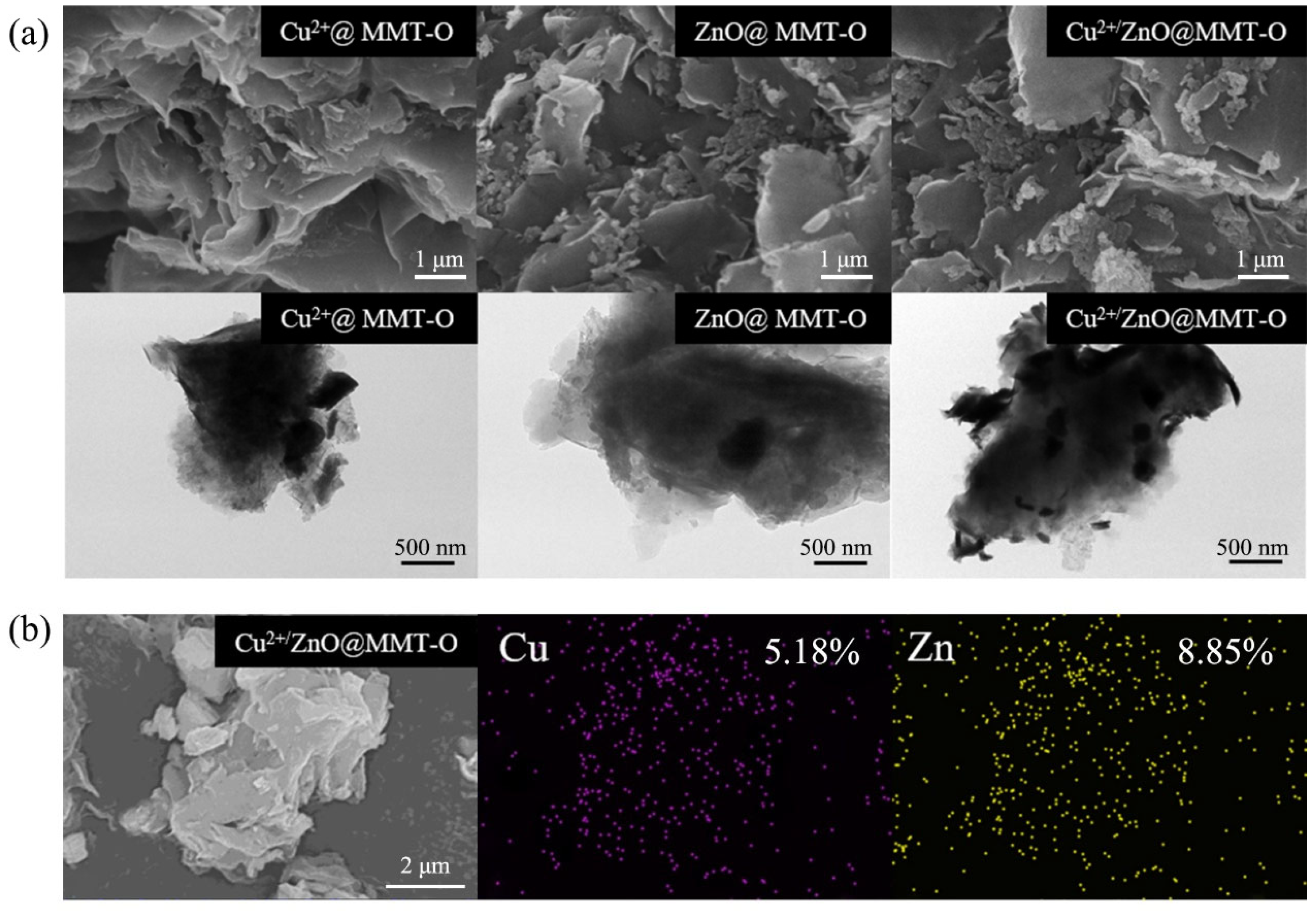
To improve the compatibility between montmorillonite and the polymer matrix and to expand its interlayer spacing for uniform nanoscale dispersion and effective interfacial bonding [27,28], montmorillonite was first subjected to cationic surface modification to obtain organo-modified montmorillonite (MMT-O). On this basis, a montmorillonite-based antibacterial agent synergistically loaded with Cu2+ and ZnO (Cu2+/ZnO@MM-O) was successfully constructed via ion exchange and co-precipitation. To investigate the effects of different loading strategies on the microstructural characteristics and performance of the antibacterial agents, the morphological features of singly loaded and synergistically loaded montmorillonite were examined and compared using scanning electron microscopy (SEM) and transmission electron microscopy (TEM). As shown in Figure 1a, the morphologies of the Cu2+@MMT-O, ZnO@MMT-O, and Cu2+/ZnO@MM-O all retain the typical stacked lamellar structure of montmorillonite, exhibiting loose and overlapping layered features at the micrometer scale. Compared with the singly loaded systems, Cu2+/ZnO@MMT-O displays a more expanded and loosened interlayer structure, indicating that the synergistic incorporation of Cu2+ and ZnO promotes interlayer exfoliation without disrupting the intrinsic layered framework of montmorillonite. In addition, SEM images reveal that Cu2+/ZnO@MMT-O exhibits a markedly increased number of fine particles distributed on the lamellar surfaces and within the interlayer regions compared with the singly loaded samples, which can be attributed to ZnO nanoparticles. TEM observations further indicate that the synergistically loaded composite contains abundant nanoscale particles with high electron contrast located on the montmorillonite platelets, while no obvious large-scale agglomerates are observed. Compared with the ZnO@MMT-O, Cu2+/ZnO@MMT-O displays a higher particle density on the clay surfaces, suggesting that the synergistic loading strategy facilitates a more efficient immobilization of active components on the montmorillonite matrix. The phenomenon is likely associated with the structural relaxation and increased surface accessibility induced by the intercalation of Cu2+ ions, which provides additional anchoring sites for ZnO nanoparticles [29].
To further verify the loading state of the metallic components, EDS analysis was performed on Cu2+/ZnO@MMT-O (Figure 1b). The results confirm the successful presence of both Cu and Zn elements, which are distributed across the montmorillonite platelet surfaces and interlayer regions. Quantitative EDS mapping analysis indicates Cu and Zn contents of 5.18% and 8.85%, respectively. For a more accurate determination of the metal loadings, the sample was further subjected to microwave digestion followed by inductively coupled plasma (ICP) analysis. The measured loadings of Cu and Zn were 6.23% and 9.53%, respectively, which are in good agreement with the EDS results. These results further demonstrate the successful incorporation of both metallic components into the modified montmorillonite and confirm their relative proportion within the composite.
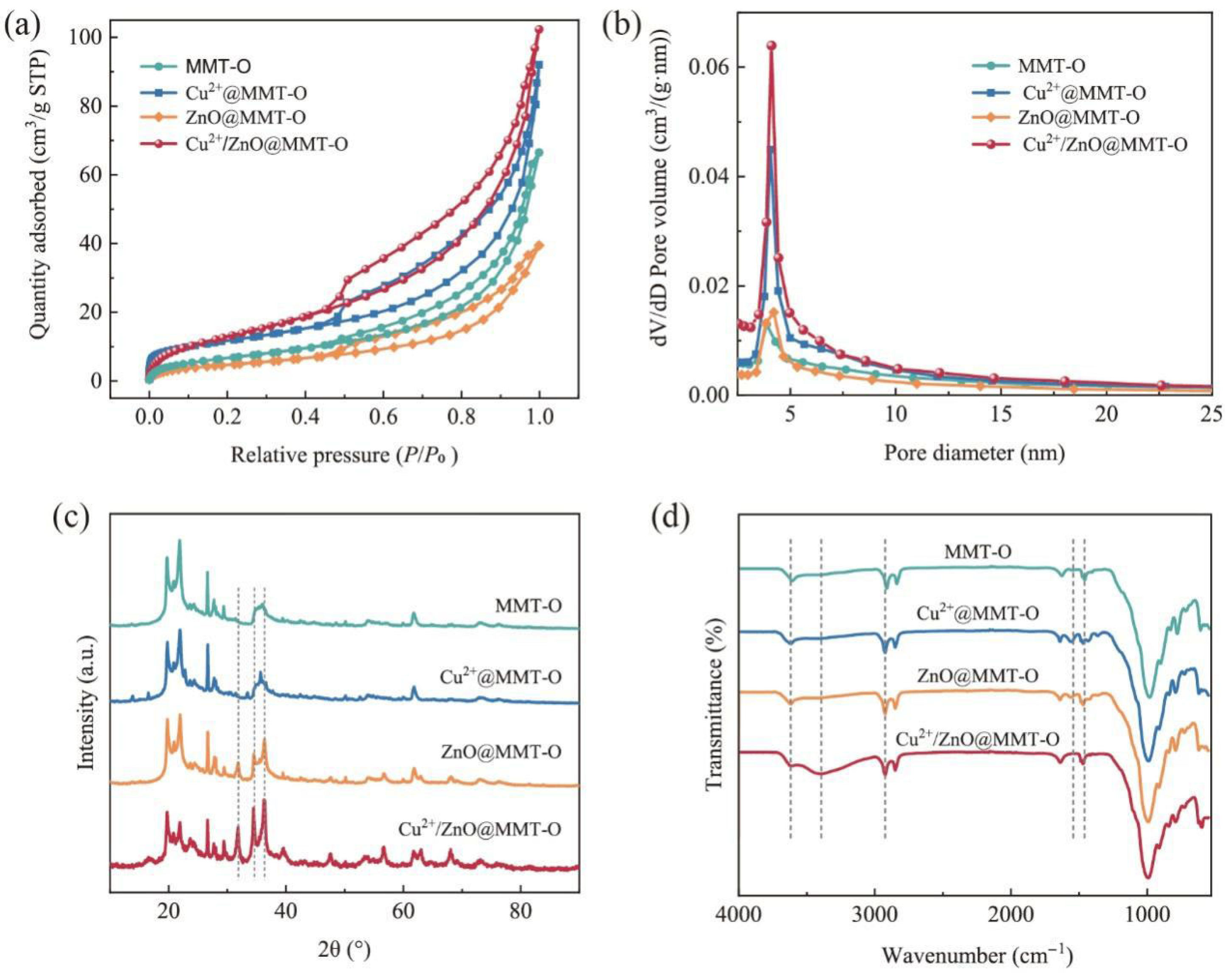
Nitrogen adsorption–desorption measurements were conducted to evaluate the pore structure of the montmorillonite-based antibacterial materials (Figure 2a). All samples exhibit isotherms close to the IUPAC type IV profile, indicating typical mesoporous characteristics for MMT-O and its modified products. More pronounced hysteresis loops appear after loading Cu2+ and ZnO, suggesting that the pore channels are dominated by open lamellar or slit-like mesopores. Among the samples, Cu2+/ZnO@MMT-O shows the most evident hysteresis loop, followed by Cu2+@MMT-O, whereas ZnO@MMT-O is relatively weaker, implying improved pore connectivity and mesostructured development after synergistic loading. The pore size distribution (Figure 2b) reveals that the pore diameters are mainly concentrated within 2–10 nm, with a distinct peak at approximately 4 nm. Compared with Cu2+@MMT-O and ZnO@MMT-O, Cu2+/ZnO@MMT-O exhibits a sharper and more intense peak, suggesting that the co-loading strategy favors a more concentrated and uniform pore size distribution. This phenomenon may be associated with the interlayer expansion caused by Cu2+ incorporation, which increases accessible mesopores, and the selective deposition of ZnO nanoparticles within the lamellar and slit-like pores, mitigating pore collapse and maintaining mesostructured integrity. The BET results in Table 1 further quantify these structural evolutions. Cu2+/ZnO@MMT-O reaches a specific surface area of 50.870 m2/g, higher than Cu2+@MMT-O (41.690 m2/g) and ZnO@MMT-O (18.230 m2/g), with a pore volume increase to 0.169 cm3/g. Although partial pore blockage cannot be completely excluded, the enhanced interlayer accessibility and additional anchoring sites for ZnO nanoparticles result in an overall increase in surface area and pore volume. The improved textural properties provide more accessible active sites and higher adsorption capacity, thereby establishing a favorable structural basis for the enhanced antibacterial performance of the synergistically loaded Cu2+/ZnO@MMT-O.

3.2. Crystalline and Chemical Structure Characterization of Cu2+/ZnO@MMT-O Agents

To analyze the crystalline and chemical structures of the materials, XRD and FTIR characterizations were performed. As shown in Figure 2c, the characteristic peaks of Cu2+@MMT-O remain essentially consistent with those of MMT-O, with only slight variations in peak intensity, indicating that the introduction of Cu2+ does not disrupt the layered crystalline structure of montmorillonite. No diffraction signals corresponding to metallic Cu or copper oxides are observed, and combined with the EDS results, it can be inferred that copper primarily exists in a highly dispersed ionic state at the surface or within the interlayer sites. For ZnO@MMT-O and Cu2+/ZnO@MMT-O, the intrinsic diffraction peaks of the montmorillonite matrix are still clearly retained, demonstrating that the co-loading of ZnO and Cu2+ likewise preserves the host lattice structure. Meanwhile, new reflections appearing at 2θ = 31.8°, 34.5°, and 36.3°, indexed to the (100), (002), and (101) planes of ZnO [30], confirm the successful deposition and structural loading of ZnO onto the MMT-O.
FTIR analysis further verified the interfacial chemical structure (Figure 2d). The absorption band at 3600–3620 cm−1 corresponds to the stretching vibration of interlayer Al–OH/Si–OH groups, while the Si–O–Si/Si–O–Al framework vibrations in the 1030–990 cm−1 region remain unchanged before and after loading, indicating that the layered silicate backbone of montmorillonite is preserved [31]. The bands at 2930–2840 and 1470 cm−1, originating from the –CH2 vibrations of OTAC chains introduced during organic modification [32,33], show no significant shift in the Cu2+- and ZnO-loaded samples, suggesting that the organic intercalation environment is not disrupted by metal incorporation. The characteristic absorption band at ~1541 cm−1 can be attributed to the bending vibration associated with the quaternary ammonium cation head group –N+(CH3)3 [34]. This band remains visible in the Cu2+@MMT-O and ZnO@MMT-O samples, indicating that the introduction of a single metal component does not compromise the intercalation structure formed by OTAC. However, this peak is significantly weakened or even disappears in the Cu2+/ZnO@MMT-O sample, suggesting that the synergistic co-loading of Cu2+ and ZnO induces a reconstruction of the interlayer interfacial environment, which may be related to the redistribution of hydrogen-bonding interactions and electrostatic forces under the co-existence of both metal species [35,36]. Overall, the co-introduction of Cu2+ and ZnO does not alter the intrinsic crystalline and chemical structures of montmorillonite; rather, it achieves stable metal loading and simultaneously regulates the interlayer microenvironment while maintaining structural integrity. This structural regulation provides a foundation for the improved stability and enhanced antibacterial performance of the composite material.

3.3. Antibacterial Performance of Cu2+/ZnO@MMT-O Agents

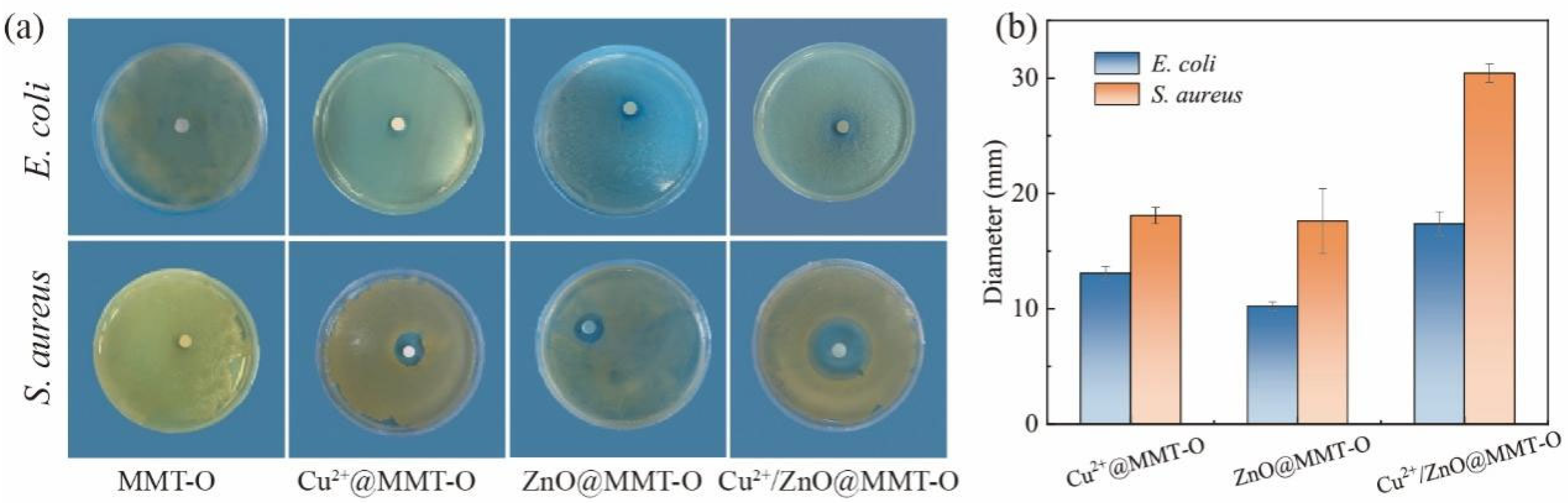
Cu2+ and ZnO are widely used inorganic antibacterial agents with recognized inhibitory and bactericidal activity against various bacteria. When loaded onto a montmorillonite carrier, these active species endow the modified montmorillonite with pronounced antibacterial properties. As shown in Figure 3, the inhibition zone assay demonstrates that pristine MMT-O exhibits no antibacterial activity, whereas the single-component samples of Cu2+@MMT-O and ZnO@MMT-O produce distinct inhibition zones around the bacterial colonies. This indicates that either Cu2+ or ZnO immobilized on montmorillonite can effectively impart antibacterial capability to the material. In comparison, the co-loaded Cu2+/ZnO@MMT-O sample forms significantly larger and sharper inhibition zones against both E. coli and S. aureus, clearly outperforming the single-component systems. These results confirm the presence of a synergistic antibacterial effect between Cu2+ and ZnO, whereby their simultaneous loading onto montmorillonite markedly enhances the overall inhibition of bacterial growth.
The MIC values provide a quantitative comparison of the antibacterial efficiencies of the different samples, as shown in Table 2. The MIC of Cu2+@MMT-O against both E. coli and S. aureus is 0.50 mg/mL, whereas that of ZnO@MMT-O decreases to 0.25 mg/mL, indicating that ZnO affords more effective growth inhibition. In contrast, the synergistically loaded Cu2+/ZnO@MMT-O exhibits a further reduction in MIC to 0.125 mg/mL for both bacterial strains, which is significantly lower than that of the single-component systems. This result demonstrates that the co-loading of Cu2+ and ZnO does not simply produce an additive effect; instead, a genuine synergistic interaction markedly enhances antibacterial efficiency at an equivalent dosage. MBC measurements were conducted to further evaluate the bactericidal capability, as summarized in Table 3. The MBC values of the individual Cu2+ or ZnO-loaded montmorillonite samples range from 3–4 mg/mL, while the Cu2+/ZnO@MMT-O composite achieves a substantially lower MBC of 1 mg/mL against both bacteria. These findings confirm that the synergistic system not only improves bacterial growth suppression but also provides a more efficient bactericidal effect, highlighting its clear advantage in practical antibacterial applications.
Mechanistically, the enhanced antibacterial performance can be attributed to the complementary roles of the two active species. Cu2+ interacts with negatively charged sites on the bacterial cell wall and membrane, disrupting membrane permeability and interfering with enzymatic metabolic pathways [37]. ZnO induces localized oxidative stress upon cell contact, leading to membrane damage and intracellular component oxidation, resulting in efficient inhibition toward both Gram-positive and Gram-negative bacteria [38,39]. In the synergistic Cu2+/ZnO@MMT-O system, these effects act in concert through multi-site interaction with bacterial targets, while the MMT-O carrier facilitates a more uniform dispersion of active species and increases their effective contact probability with cells [40,41]. As a result, efficient bacterial inhibition and killing can be achieved at comparatively lower dosages.

3.4. Dispersion and Structural Stability of Cu2+/ZnO@MMT-O in Particleboard

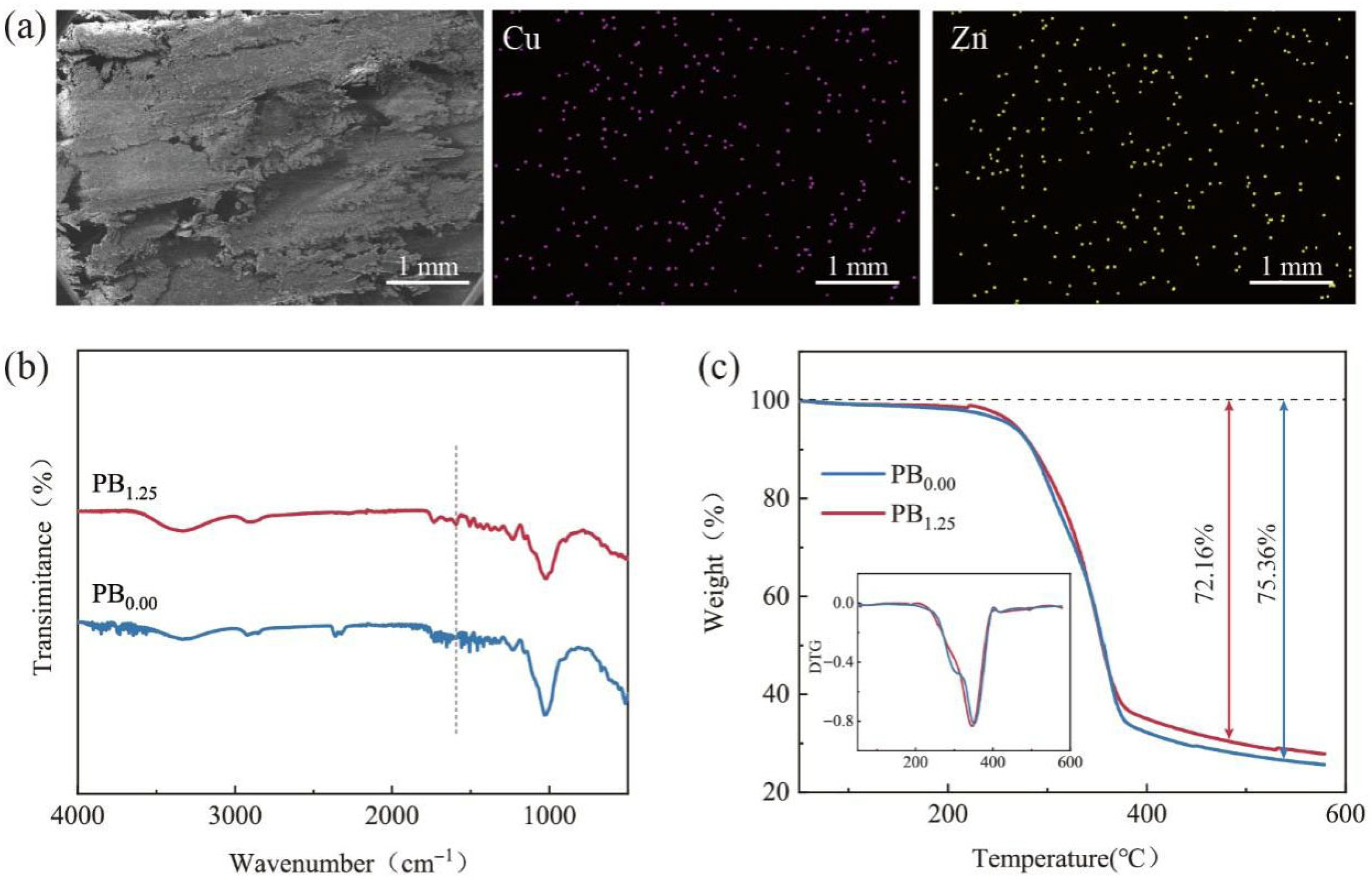
The antibacterial particleboard was fabricated by uniformly blending the Cu2+/ZnO@MMT-O agent with poplar particles, followed by hot pressing. Since the dispersion state of the antibacterial agent significantly affects the antimicrobial performance, achieving a homogeneous distribution of Cu2+/ZnO@MMT-O is essential for maximizing its synergistic activity. SEM–EDS mapping (Figure 4a) confirms that Cu and Zn elements are uniformly dispersed throughout the board, indicating effective distribution of the antibacterial agent within the particle matrix.
To further examine the chemical stability of the agent during the hot-pressing process, FTIR spectra were collected on particleboards with 1.25% and without the added agent (PB1.25 and PB0.00). As shown in Figure 4b, the characteristic absorption bands of montmorillonite and the organic OTAC chains are retained without the appearance of new functional groups, suggesting that Cu2+/ZnO@MMT-O maintains its structural integrity and exhibits good interfacial compatibility with the particleboard matrix. Thermal stability was evaluated via TG analysis, as it directly determines the active retention of the antibacterial components during manufacturing. As depicted in Figure 4c, in the range of 0–190 °C, no significant mass change is observed, confirming that the antibacterial agent remains stable at the hot-pressing temperature (150 °C). Notably, PB1.25 exhibits a reduced decomposition rate within 200–325 °C compared to PB0.00. Meanwhile, the final mass loss of PB0.00 reaches 75.36%, while that of PB1.25 decreases to 72.16%, indicating that the incorporation of Cu2+/ZnO@MMT-O effectively suppresses thermal degradation and thereby enhances the overall thermal stability of the particleboard. Overall, the agent maintains structural stability and antimicrobial activity within the processing temperature window, demonstrating suitability for industrial hot-press applications.

3.5. The Influence of Cu2+/ZnO@MMT-O on the Mechanical Properties of Particleboard

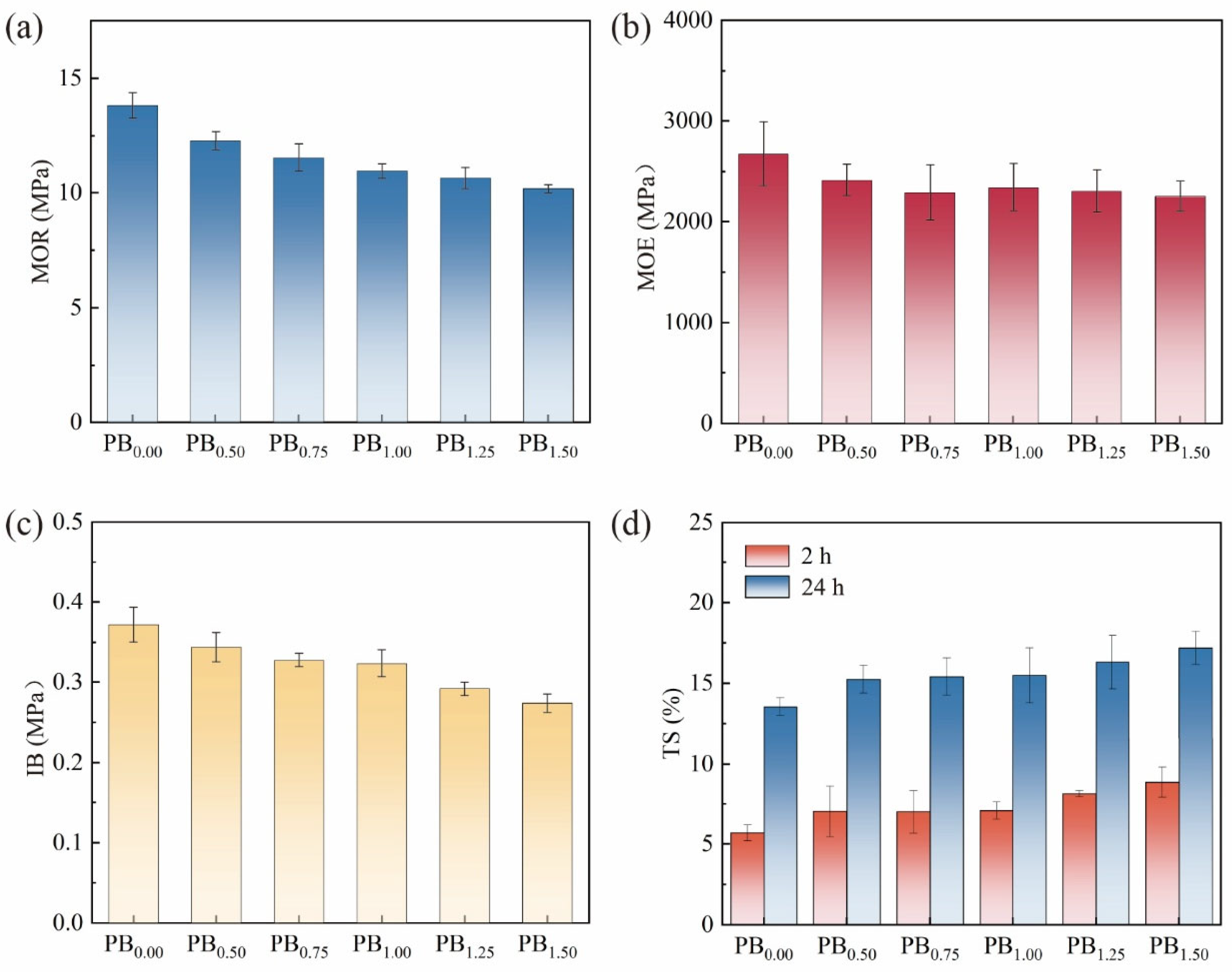
To evaluate the influence of the Cu2+/ZnO@MMT-O antibacterial agent on particleboard properties, both mechanical performance and dimensional stability were measured under different addition levels according to GB/T 17657-2022, and the results are shown in Figure 5. Specifically, the modulus of rupture (MOR) indicates the transverse load-resisting capacity of the board, the modulus of elasticity (MOE) characterizes the resistance of a material to deformation within the elastic deformation stage, and internal bond strength (IB) reflects the internal cohesion between particles and is therefore crucial for judging the effectiveness of adhesive bonding [42]. They exhibit consistent variation trends with increasing additive content. The values of MOR, MOE, and IB for the control board PB0.00 are 13.82 MPa, 2672.00 MPa, and 0.37 MPa, respectively. As the Cu2+/ZnO@MMT-O antibacterial agent increased, all three indices showed a gradual decline. When the additive content reaches 1.50%, MOR and MOE decrease to 10.19 MPa and 2251.20 MPa, while IB drops to 0.27 MPa. This decreasing trend may be associated with the introduction of the antibacterial agent, whose presence could influence the curing behavior of the adhesive or the interfacial bonding state [43], thereby reducing the effective interfacial bonding strength under the current processing conditions. Similar trends have also been reported in previous studies [44]. Nevertheless, when the additive content is reduced to 1.25% or below, the mechanical performance of the boards remains at an acceptable level. Specifically, PB1.25 exhibits MOR, MOE, and IB values of 10.65 MPa, 2304.40 MPa, and 0.29 MPa, respectively. According to the Chinese national standard GB/T 4897-2015 [45], the required physical and mechanical properties of particleboard as summarized in Table 4. The MOR and IB values meet the requirements for general purpose boards (Type P1), while the MOE satisfies the criteria for load-bearing boards (Type P3). Overall, boards with an additive content of ≤1.25% comply with the relevant standard requirements and maintain acceptable mechanical performance.
The water resistance and dimensional stability of the boards were further evaluated by measuring thickness swelling (TS) after 2 h and 24 h of water immersion (Figure 5d). The PB0.00 exhibits 2 h TS and 24 h TS values of 5.69% and 13.55%, respectively. With increasing additive content, both TS values exhibit an overall upward trend, rising to 8.88% (2 h) and 17.20% (24 h) for PB1.50. This suggests that the incorporation of the antibacterial agent may partially reduce the water resistance and dimensional stability of the particleboard. In conjunction with the reduced IB values, it can be inferred that interfacial bonding within the board is weakened and that the continuity of the adhesive network is adversely affected [46]. This condition may create localized microstructural discontinuities or defects, thereby providing potential pathways for water ingress and ultimately leading to increased thickness swelling [47]. Despite this increase, the measured TS values remain within the allowable limits specified in GB/T 4897-2015, and the 24 h TS values comply with the requirements for P3-type boards, indicating that acceptable dimensional stability is still maintained.
In summary, the incorporation of Cu2+/ZnO@MMT-O provides antibacterial functionality without exceeding the permissible limits of national standards, although accompanied by a degree of mechanical attenuation and decreased water resistance. Therefore, optimizing the additive content is essential to balance antibacterial efficacy with mechanical performance and dimensional stability, ensuring both functional improvement and practical applicability.

3.6. Antibacterial Performance of Cu2+/ZnO@MMT-O-Based Particleboard

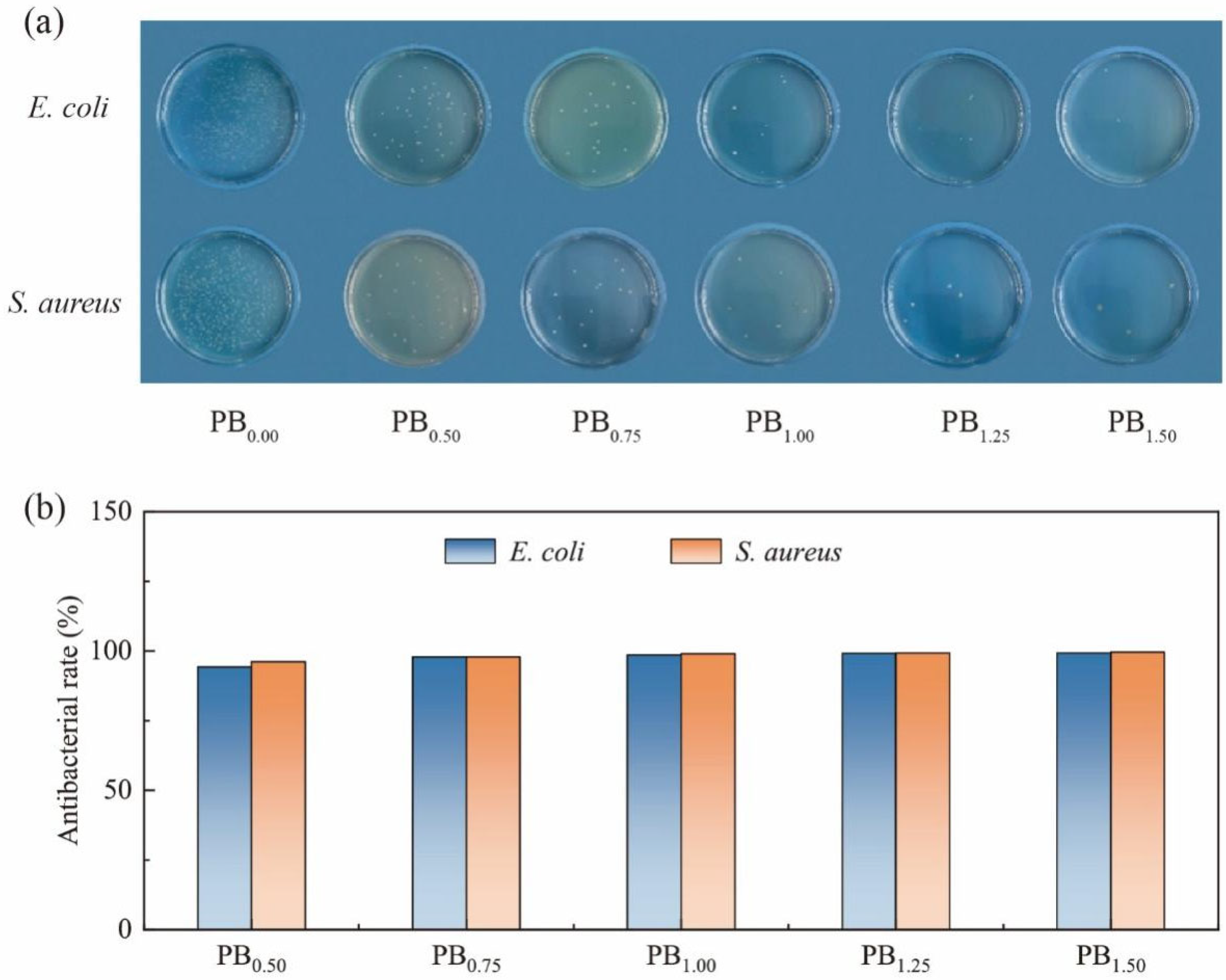
To evaluate the antibacterial performance of Cu2+/ZnO@MMT-O in particleboards, the film-covering method was used to assess bacterial inhibition under different addition levels (0–1.5%). The results show that, compared with the control board, the number of bacterial colonies decreases significantly as the additive content increases (Figure 6a). At levels of 1.25–1.5%, E. coli and S. aureus almost cease to form visible colonies, indicating a notably enhanced antibacterial effect. The quantitative results in Figure 6b further confirm this trend, as the antibacterial rate continuously increases with higher additive content. When the addition reaches 1.25%, the antibacterial rate against both bacterial species reaches 99%. According to the standard LY/T 1926-2020 for antibacterial performance classification of wood-based materials, an antibacterial rate of ≥99% corresponds to a strong antibacterial grade. Therefore, the Cu2+/ZnO@MMT-O-based particleboard exhibits excellent antibacterial performance and effectively suppresses the growth of common pathogenic bacteria.

4. Conclusions

In this work, a Cu2+/ZnO synergistically loaded montmorillonite antibacterial system was developed and its applicability in particleboard was systematically evaluated. The results demonstrate that Cu2+ ions and ZnO nanoparticles can be effectively immobilized on the montmorillonite surface, providing favorable conditions for antibacterial activity. Compared with single-component systems, the combined loading exhibits significantly improved antibacterial performance against E. coli and S. aureus, demonstrating a pronounced synergistic effect. When incorporated into particleboard, the antibacterial agent exhibits good dispersion and thermal stability under hot-pressing conditions. Particleboards containing 1.25% Cu2+/ZnO@MMT-O achieve a 99% antibacterial rate while maintaining acceptable mechanical and physical performance. Overall, this work presents a sustainable antibacterial solution for wood-based panels, offering a practical pathway toward producing particleboards that are both more durable and environmentally responsible. Building on this foundation, the design strategy and evaluation framework established here can be extended to other wood composites and interior building materials, providing a useful reference for the development of functional materials that balance antibacterial performance with structural integrity.

Author Contributions

Conceptualization, Y.P.; Methodology, J.Z.; Validation, J.Z. and Y.L.; Formal analysis, H.S., S.W. and J.H.; Investigation, J.Z. and J.H.; Resources, H.G. and Y.L.; Data curation, Y.P., J.Z. and H.S.; Writing—original draft preparation, Y.P. and J.Z.; Writing—review and editing, Y.P., D.Z. and Y.L.; Visualization, H.S. and S.W.; Supervision, H.G. and D.Z.; Project administration, Y.L.; Funding acquisition, H.G. and Y.L. All authors have read and agreed to the published version of the manuscript.

Funding

This research was funded by the Key Laboratory of Furniture Health and Intelligent Quality Safety, State Administration for Market Regulation (KLFHIQS2025-05), the national-level promotion projects of scientific and technological achievements in forestry and grassland (2023133135), and the Project of the Fundamental Research Funds for the Central Universities of Beijing Forestry University (CGZH202505). The authors would like to thank the Innovation Platform for High-Value Utilization of Forest Resources at Beijing Forestry University for the SEM, TEM, XRD, and TG analysis.

Institutional Review Board Statement

Not applicable.

Informed Consent Statement

Not applicable.

Data Availability Statement

The original contributions presented in this study are included in the article. Further inquiries can be directed to the corresponding author.

Conflicts of Interest

The authors declare no conflicts of interest.

References

  1. Zhou, P.; Li, X.; Zhou, J.; Wang, Y.; Lu, Y.; Jiang, Z. Microcapsules loaded with essential oil: Enhancing the hydrophobic and antifungal properties of wood-based panels. Ind. Crops Prod. 2025, 225, 120471. [Google Scholar] [CrossRef]
  2. Guo, N.; Cheng, X.; Yang, S.; Li, G.; Chu, F. A functionalization approach of decorative poplar veneer accomplished via reactive dyeing followed by in-situ synthesis of ZnO-Ag nanoparticles. Appl. Surf. Sci. 2025, 682, 161668. [Google Scholar] [CrossRef]
  3. He, J.; Fan, Z.; Jiang, Q.; Sun, J.; Zhang, F.; Fang, X.; Liu, Y.; Guo, H.; Song, Y. Antimicrobial bilayer nanocapsules based on biopolymer encapsulation of camphor essential oil for wood-plastic composites environmental friendliness and safety enhancement. Constr. Build. Mater. 2025, 491, 142799. [Google Scholar] [CrossRef]
  4. Ji, X.; Zhang, J.; Sun, S.; Zhao, Z. Development and evaluation of a novel fructose-based bio-adhesive for plywood applications. Constr. Build. Mater. 2025, 499, 144064. [Google Scholar] [CrossRef]
  5. Jia, M.; Wang, Y.; Qi, Y.; Ji, X.; Zhao, Z.; Sun, S. Synthesis and characterization of a novel eco-friendly adhesive for plywood composed by vinyl acetate-ethylene copolymer emulsion and polyvinyl alcohol. Sustain. Chem. Pharm. 2025, 45, 102014. [Google Scholar] [CrossRef]
  6. Xu, S.; Hui, C.; Liu, K.; Zhou, X.; Zhang, S.; Kong, W.; Li, C. Formaldehyde-free mycelium composites production from spent mushroom substrates for particleboard substitution: Physical, antimicrobial, and environmental assessments. Chem. Eng. J. 2024, 482, 102014. [Google Scholar] [CrossRef]
  7. Lee, K.Y.; Lee, H.; Shin, H.S.; Ryu, D.H.; Yeo, H.; Ju, H.M.; Jang, D.Y.; Koo, Y.J.; Lee, S.H.; Lim, K.M.; et al. Migration of organic and inorganic antimicrobials from antimicrobial-labeled food packaging and probabilistic risk assessment implications. Food Packag. Shelf Life 2025, 52, 102014. [Google Scholar] [CrossRef]
  8. Santoro, O.; Izzo, L. Antimicrobial Polymer Surfaces Containing Quaternary Ammonium Centers (QACs): Synthesis and Mechanism of Action. Int. J. Mol. Sci. 2024, 25, 7587. [Google Scholar] [CrossRef]
  9. Alkarri, S.; Bin Saad, H.; Soliman, M. On Antimicrobial Polymers: Development, Mechanism of Action, International Testing Procedures, and Applications. Polymers 2024, 16, 771. [Google Scholar] [CrossRef]
  10. He, J.; Fan, Z.; Jiang, Q.; Yang, X.; Sun, J.; Pang, Y.; Fang, X.; Zhang, D.; Li, Y.; Liu, Y.; et al. Sustainable natural bio-antimicrobial: Composition, bacteriostatic activity, and antibacterial strategy of Cinnamomum camphora essential oil. Ind. Crops Prod. 2025, 233, 121493. [Google Scholar] [CrossRef]
  11. Zheng, K.; Setyawati, M.I.; Leong, D.T.; Xie, J. Antimicrobial silver nanomaterials. Coord. Chem. Rev. 2018, 357, 1–17. [Google Scholar]
  12. Graham, C.; Mezzadrelli, A.; Senaratne, W.; Pal, S.; Thelen, D.; Hepburn, L.; Mazumder, P.; Pruneri, V. Towards transparent and durable copper-containing antimicrobial surfaces. Commun. Mater. 2024, 5, 39. [Google Scholar] [CrossRef]
  13. Gao, D.; Li, Y.; Lyu, B.; Jin, D.; Ma, J. Silicone quaternary ammonium salt based nanocomposite: A long-acting antibacterial cotton fabric finishing agent with good softness and air permeability. Cellulose 2019, 27, 1055–1069. [Google Scholar] [CrossRef]
  14. Teng, F.; Yuan, J.; Tian, P.; Zhang, Q.; Du, X.; Li, C.; Wang, W. Study on the ion-exchange copper-loaded antibacterial glasses. Ceram. Int. 2022, 48, 32798–32803. [Google Scholar] [CrossRef]
  15. Lu, Z.; Gao, J.; He, Q.; Wu, J.; Liang, D.; Yang, H.; Chen, R. Enhanced antibacterial and wound healing activities of microporous chitosan-Ag/ZnO composite dressing. Carbohydr. Polym. 2017, 156, 460–469. [Google Scholar]
  16. Zhang, J.; Tan, H.; Deng, X.; Li, M.; Jian, S.; Li, G. Preparation of organic montmorillonite supported TiO2 and its application in methylene blue removal. Constr. Build. Mater. 2022, 341, 127762. [Google Scholar] [CrossRef]
  17. Roy, A.; Joshi, M.; Butola, B.S.; Malhotra, S. Antimicrobial and toxicological behavior of montmorillonite immobilized metal nanoparticles. Mater. Sci. Eng. C 2018, 93, 704–715. [Google Scholar] [CrossRef]
  18. Yan, Y.; Li, C.; Wu, H.; Du, J.; Feng, J.; Zhang, J.; Huang, L.; Tan, S.; Shi, Q. Montmorillonite-Modified Reduced Graphene Oxide Stabilizes Copper Nanoparticles and Enhances Bacterial Adsorption and Antibacterial Activity. ACS Appl. Bio Mater. 2019, 2, 1842–1849. [Google Scholar] [CrossRef]
  19. Roy, A.; Joshi, M.; Butola, B.S. Preparation and antimicrobial assessment of zinc-montmorillonite intercalates based HDPE nanocomposites: A cost-effective and safe bioactive plastic. J. Clean. Prod. 2019, 212, 1518–1525. [Google Scholar] [CrossRef]
  20. Zou, Y.H.; Wang, J.; Cui, L.Y.; Zeng, R.C.; Wang, Q.Z.; Han, Q.X.; Qiu, J.; Chen, X.B.; Chen, D.C.; Guan, S.K.; et al. Corrosion resistance and antibacterial activity of zinc-loaded montmorillonite coatings on biodegradable magnesium alloy AZ31. Acta Biomater. 2019, 98, 196–214. [Google Scholar] [CrossRef]
  21. Nouri, A.; Yaraki, M.T.; Ghorbanpour, M.; Agarwal, S.; Gupta, V.K. Enhanced Antibacterial effect of chitosan film using Montmorillonite/CuO nanocomposite. Int. J. Biol. Macromol. 2018, 109, 1219–1231. [Google Scholar] [CrossRef]
  22. Jiao, L.; Lin, F.; Cao, S.; Wang, C.; Wu, H.; Shu, M.; Hu, C. Preparation, characterization, antimicrobial and cytotoxicity studies of copper/zinc- loaded montmorillonite. J. Anim. Sci. Biotechnol. 2017, 8, 27. [Google Scholar] [CrossRef] [PubMed]
  23. Korniy, S.; Danyliak, M.-O.; Lavrys, S. Preparation and properties of modified montmorillonite by zinc-phosphate for anticorrosion applications in protective coatings. Mater. Chem. Phys. 2025, 335, 130537. [Google Scholar] [CrossRef]
  24. Sun, X.; Liang, H.; Wang, H.; Meng, N.; Jin, S.; Zhou, N. Silk fibroin/polyvinyl alcohol composite film loaded with antibacterial AgNP/polydopamine-modified montmorillonite; characterization and antibacterial properties. Int. J. Biol. Macromol. 2023, 251, 126368. [Google Scholar] [CrossRef] [PubMed]
  25. GB/T 17657-2022; Test Methods of Evaluating the Properties of Wood-Based Panels and Surface Decorated Wood-Based Panels. State Administration for Market Regulation. Standardization Administration of China: Beijing, China, 2022. Available online: https://openstd.samr.gov.cn/bzgk/gb/newGbInfo?hcno=E226E85A85187C4A30E1A60C3171D6C5 (accessed on 1 February 2026).
  26. LY/T 1926-2020; Test Method for Evaluating the Antibacterial Performance of Wood (Bamboo)-Based Panels and Products. National Forestry and Grassland Administration of China: Beijing, China, 2020. Available online: https://www.scribd.com/document/715148945/Lyt-1926-2020 (accessed on 1 February 2026).
  27. Zhang, L.L.; Zaoui, A.; Sekkal, W.; Zheng, Y.Y. Interlayer adsorption of cationic dye on cationic surfactant-modified and unmodified montmorillonite. J. Hazard. Mater. 2023, 442, 130107. [Google Scholar] [CrossRef]
  28. Liu, C.; Liu, W.; He, S.; Jiang, C.; Xie, Y.; Yang, M.; Shi, H.; Wang, Z. Highly exfoliated epoxy/clay nanocomposites filled with novel cationic fluorinated polyacrylate modified montmorillonite: Morphology and mechanical properties. Polym. Compos. 2019, 40, 4266–4280. [Google Scholar] [CrossRef]
  29. Yu, L.; He, T.; Yao, J.; Xu, W.; Peng, S.; Feng, P.; Shuai, C. Cu ions and cetyltrimethylammonium bromide loaded into montmorillonite: A synergistic antibacterial system for bone scaffolds. Mater. Chem. Front. 2022, 6, 103–116. [Google Scholar] [CrossRef]
  30. Orie, K.J.; Okocha, B.I. Biosynthesis and antimicrobial studies of zinc oxide nanoparticles of Vernonia amygdalina Leaf with varying concentration of zinc oxide. Inorg. Chem. Commun. 2024, 162, 112178. [Google Scholar] [CrossRef]
  31. Bezerra, E.; Santos Albuquerque, W.A.; Neres Filho, A.J.; Lins, A.; Barbosa, R.; Almeida, L.C.; Medina-Carrasco, S.; Orta Cuevas, M.D.M.; Osajima, J.A.; Trigueiro, P.; et al. Hydrothermal Synthesis of ZnO@MnO2-Montmorillonite Nanocomposites: Influence of Molarity on Structural, Optical, and Photocatalytic Performance toward Ciprofloxacin Degradation under Variable Conditions. ACS Omega 2025, 10, 44461–44474. [Google Scholar] [CrossRef]
  32. Costanza-Robinson, M.S.; Payne, E.M.; Dellinger, E.; Fink, K.; Bunt, R.C.; Littlefield, M.; Mejaes, B.A.; Morris, R.K.; Pincus, L.N.; Wilcox, E.H. Influence of water saturation on interlayer properties of HDTMA-, HDTMP-, and HDPy-modified montmorillonite organoclays. Appl. Clay Sci. 2024, 247, 107188. [Google Scholar] [CrossRef]
  33. Mahmoodi, N.M.; Taghizadeh, A.; Taghizadeh, M.; Azimi Shahali Baglou, M. Surface modified montmorillonite with cationic surfactants: Preparation, characterization, and dye adsorption from aqueous solution. J. Environ. Chem. Eng. 2019, 7, 103243. [Google Scholar] [CrossRef]
  34. Wei, R.; Mo, Y.; Fu, D.; Liu, H.; Xu, B. Organo-Montmorillonite Modified by Gemini Quaternary Ammonium Surfactants with Different Counterions for Adsorption toward Phenol. Molecules 2023, 28, 2021. [Google Scholar] [CrossRef] [PubMed]
  35. Torres Sánchez, R.M.; Fernández Solarte, A.M.; Morantes, C.F. Effect of hexadecyltrimethyl-ammonium loaded montmorillonite on the Cu adsorption: Adsorption surface sites involved. Mater. Sci. 2019, 1, 10004. [Google Scholar] [CrossRef]
  36. Liu, L.; Zhang, C.; Jiang, W.; Li, X.; Dai, Y.; Jia, H. Understanding the sorption behaviors of heavy metal ions in the interlayer and nanopore of montmorillonite: A molecular dynamics study. J. Hazard. Mater. 2021, 416, 125976. [Google Scholar] [CrossRef]
  37. Ermini, M.L.; Voliani, V. Antimicrobial Nano-Agents: The Copper Age. ACS Nano 2021, 15, 6008–6029. [Google Scholar] [CrossRef]
  38. Gudkov, S.V.; Burmistrov, D.E.; Serov, D.A.; Rebezov, M.B.; Semenova, A.A.; Lisitsyn, A.B. A Mini Review of Antibacterial Properties of ZnO Nanoparticles. Front. Phys. 2021, 9, 641481. [Google Scholar] [CrossRef]
  39. Krol, A.; Pomastowski, P.; Rafinska, K.; Railean-Plugaru, V.; Buszewski, B. Zinc oxide nanoparticles: Synthesis, antiseptic activity and toxicity mechanism. Adv. Colloid Interface Sci. 2017, 249, 37–52. [Google Scholar] [CrossRef]
  40. Chen, S.; Guo, Y.; Zhong, H.; Chen, S.; Li, J.; Ge, Z.; Tang, J. Synergistic antibacterial mechanism and coating application of copper/titanium dioxide nanoparticles. Chem. Eng. J. 2014, 256, 238–246. [Google Scholar] [CrossRef]
  41. Ma, G.; Liang, X.; Li, L.; Qiao, R.; Jiang, D.; Ding, Y.; Chen, H. Cu-doped zinc oxide and its polythiophene composites: Preparation and antibacterial properties. Chemosphere 2014, 100, 146–151. [Google Scholar] [CrossRef]
  42. Maksymiuk, G.; Jeżo, A.; Rižikovs, J. Selected physical and mechanical properties of particleboards manufactured with addition of Betula bark post-extraction residues. Eur. J. Wood Wood Prod. 2024, 82, 1981–1992. [Google Scholar] [CrossRef]
  43. Khorramabadi, L.A.; Behrooz, R.; Kazemi, S. Effects of nanoclay modification with aminopropyltriethoxysilane (APTES) on the performance of urea–formaldehyde resin adhesives. BioResources 2023, 18, 5417–5434. [Google Scholar] [CrossRef]
  44. Reinprecht, L.; Iždinský, J.; Vidholdová, Z.; Bechelany, M. Biological Resistance and Application Properties of Particleboards Containing Nano-Zinc Oxide. Adv. Mater. Sci. Eng. 2018, 2018, 2680121. [Google Scholar] [CrossRef]
  45. GB/T 4897-2015; Particleboard. General Administration of Quality Supervision, Inspection and Quarantine of the People’s Republic of China. Standardization Administration of China: Beijing, China, 2015. Available online: https://www.chinesestandard.net/PDF.aspx/GBT4897-2015 (accessed on 1 February 2026).
  46. Mazaheri, M.; Moghimi, H.; Taheri, R.A. Urea impregnated multiwalled carbon nanotubes; a formaldehyde scavenger for urea formaldehyde adhesives and medium density fiberboards bonded with them. J. Appl. Polym. Sci. 2021, 139, 51445. [Google Scholar] [CrossRef]
  47. Tufan, M.Z.; Özel, C.; Üner, B. Investigation of the effect of using multi-walled carbon nanotubes with various glues on particleboard properties using response surface methodology. Constr. Build. Mater. 2025, 473, 140971. [Google Scholar] [CrossRef]
Figure 1. (a) SEM and TEM of Cu2+@MMT-O, ZnO@MMT-O, and Cu2+/ZnO@MMT-O. (b) EDS of Cu2+/ZnO@MMT-O.
Sustainability 18 01966 g001
Figure 2. (a) N2 adsorption–desorption isotherm, (b) pore size distribution, (c) XRD, and (d) FTIR spectrums of MMT-O, Cu2+@MMT-O, ZnO@MMT-O, and Cu2+/ZnO@MMT-O.
Sustainability 18 01966 g002
Figure 3. (a) Inhibition zone assay results of MMT-O, Cu2+@MMT-O, ZnO@MMT-O, and Cu2+/ZnO@MMT-O. (b) The diameters of the bacterial inhibition zone of Cu2+@MMT-O, ZnO@MMT-O, and Cu2+/ZnO@MMT-O.
Sustainability 18 01966 g003
Figure 4. (a) SEM micrographs and EDS elemental mapping of the particleboard incorporated with Cu2+/ZnO@MMT-O. (b) FITR spectra of PB0.00 and PB1.25. (c) TG and DTG results of PB0.00 and PB1.25.
Sustainability 18 01966 g004
Figure 5. The (a) MOR, (b) MOE, (c) IB, and (d) TS of particleboards with different Cu2+/ZnO@MMT-O addition levels.
Sustainability 18 01966 g005
Figure 6. (a) The antibacterial activity of Cu2+/ZnO@MMT-O-based particleboard. (b) The antibacterial rate of Cu2+/ZnO@MMT-O-based particleboard.
Sustainability 18 01966 g006
Table 1. Specific surface area, pore volume, and pore size of the MMT-O, Cu2+@MMT-O, ZnO@MMT-O, and Cu2+/ZnO@MMT-O.
SampleSpecific Surface Area (m2/g)Pore Volume
(cm3/g)
Pore Size
(nm)
MMT-O26.0600.10912.640
Cu2+@MMT-O41.6900.14513.340
ZnO@MMT-O18.2300.06411.420
Cu2+/ZnO@MMT-O50.8700.16910.200
Table 2. Minimum inhibitory concentrations (MICs) of samples against E.coli and S. aureus.
SampleMIC Against E. coli
(mg/mL)
MIC Against S. aureus
(mg/mL)
MMT-O>5.000>5.000
Cu2+@MMT-O0.5000.500
ZnO@MMT-O0.2500.250
Cu2+/ZnO@MMT-O0.1250.125
Table 3. Minimum bactericidal concentrations (MBCs) of samples against E. coli and S. aureus.
SampleMBC Against E. coli
(mg/mL)
MBC Against S. aureus
(mg/mL)
MMT-O>5>5
Cu2+@MMT-O43
ZnO@MMT-O33
Cu2+/ZnO@MMT-O11
Table 4. Summary of the requirements for specified mechanical and swelling properties of particleboards (thickness range: 6–13 mm) for use in dry conditions (GB/T 4897-2015).
TypePhysical and Mechanical Properties
MOR (MPa)MOE (MPa)IB (MPa)2 h TS (%)24 h TS (%)
P110.50-0.28--
P211.001800.000.408.00-
P315.002200.000.40-19.00
P420.003100.000.60-16.00
Note: The values of MOR, MOE, and IB represent the minimum required limits, whereas the values of TS represent the maximum allowable limits.
Disclaimer/Publisher’s Note: The statements, opinions and data contained in all publications are solely those of the individual author(s) and contributor(s) and not of MDPI and/or the editor(s). MDPI and/or the editor(s) disclaim responsibility for any injury to people or property resulting from any ideas, methods, instructions or products referred to in the content.