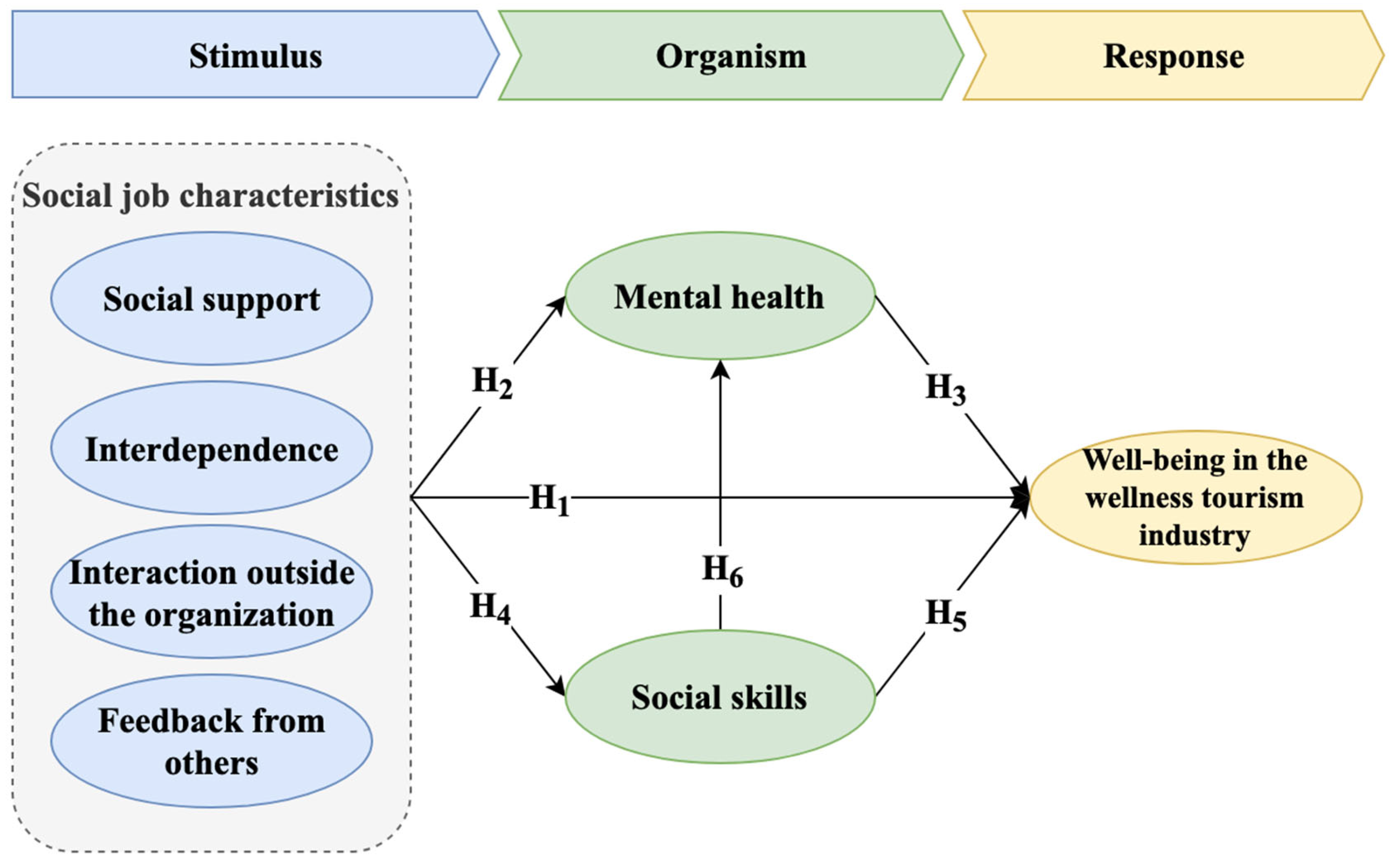
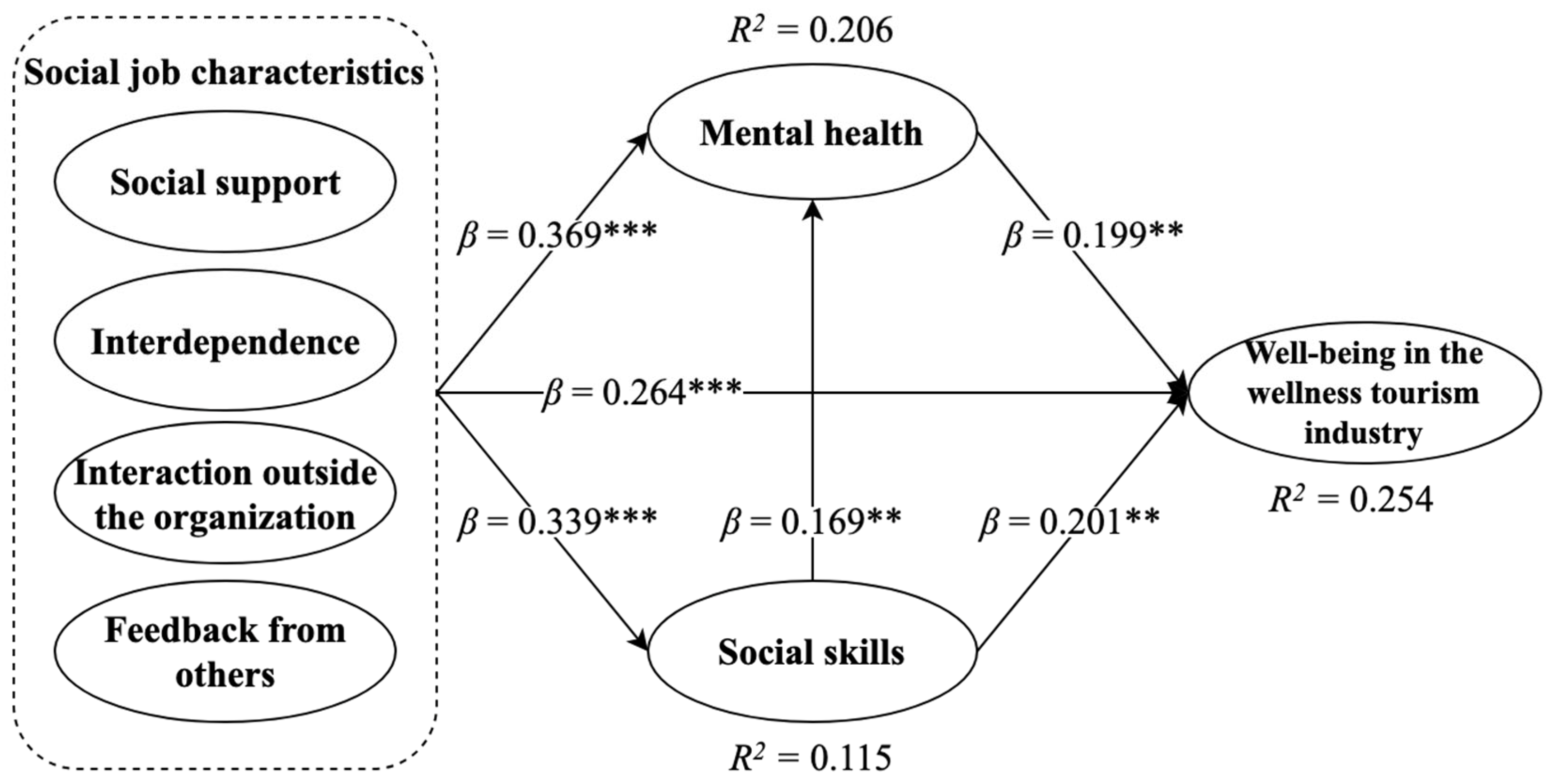
Transformative Tourism Labor: The Wellness Healer’s Quest for Well-Being



Abstract
1. Introduction
2. Literature Review and Hypothesis Construction
2.1. Stimulus-Organism-Response (SOR) Framework
2.2. Wellness Healers in Wellness Tourism
2.3. Wellness Tourism Context: Social Job Characteristics and Wellness Healers’ Well-Being
2.4. Wellness Healers’ Mental Health
2.5. Wellness Healers’ Social Skills
3. Methodology
3.1. Research Approach and Design
3.2. Measurement Instrument
3.3. Data Collection and Sampling
3.4. Data Analysis Procedure
4. Findings and Discussion
4.1. Measurement Model Assessment
4.2. Structural Model Assessment and Hypothesis Testing
4.3. Discussion of SEM Results
4.4. Fuzzy-Set Qualitative Comparative Analysis
4.4.1. Data Calibration
4.4.2. Necessary Analysis and Truth Table Construction
4.4.3. Discussion of fsQCA Results
5. Conclusions and Implications
5.1. Conclusions
5.2. Theoretical Implications
5.3. Practical Implications
5.4. Limitations and Future Research Directions
Author Contributions
Funding
Institutional Review Board Statement
Informed Consent Statement
Data Availability Statement
Acknowledgments
Conflicts of Interest
Appendix A

| Construct | Items | Sources | |
|---|---|---|---|
| Social job characteristics | Social support |
| [23,53] |
| |||
| |||
| |||
| Interdependence |
| ||
| |||
| |||
| Interaction outside the organization |
| ||
| |||
| |||
| |||
| Feedback from others |
| ||
| |||
| |||
| Mental health |
| [54] | |
| |||
| |||
| |||
| |||
| Social skills |
| [55] | |
| |||
| |||
| |||
| |||
| Well-being in the wellness tourism industry |
| [56,57] | |
| |||
| |||
| |||
| Demographic | Item | Frequency | Percent (%) |
|---|---|---|---|
| Gender | Male | 97 | 31.1 |
| Female | 215 | 68.9 | |
| Age | 18–29 | 98 | 31.4 |
| 30–39 | 168 | 53.9 | |
| 40–49 | 39 | 12.5 | |
| 50–59 | 5 | 1.6 | |
| ≥60 | 2 | 0.6 | |
| Education | Professional certificate | 126 | 40.4 |
| Advanced Diploma | 164 | 52.6 | |
| Bachelor’s degree | 20 | 6.4 | |
| Master’s degree or above | 2 | 0.6 | |
| Annual income (RMB) | ≤50,000 | 5 | 1.6 |
| 50,001–65,000 | 180 | 57.7 | |
| 65,001–85,000 | 90 | 28.8 | |
| 85,001–105,000 | 28 | 9.0 | |
| ≥105,000 | 9 | 2.9 |
References
- Cham, B.S.; Boeing, A.A.; Wilson, M.K.; Griffin, M.A.; Jorritsma, K. Endurance in extreme work environments. Organ. Psychol. Rev. 2021, 11, 343–364. [Google Scholar] [CrossRef]
- Voigt, C.; Brown, G.; Howat, G. Wellness tourists: In search of transformation. Tour. Rev. 2011, 66, 16–30. [Google Scholar] [CrossRef]
- Boublil, E. Healing the Lifeworld: On personal and collective individuation. Cont. Philos. Rev. 2022, 55, 469–485. [Google Scholar] [CrossRef]
- Watson, T.; Waters, R.; Watts, L.; Hodgson, D. Exploring the Challenges of Empathy in a Therapeutic Context: An Interpretative Phenomenological Analysis. Qual. Health Res. 2025, 10497323251331460. [Google Scholar] [CrossRef] [PubMed]
- Peng, C.; Zou, Y.-G.; Jin, D. Wellness tourism healing: A systematic review unveiling how cultural symbolic experiences influence health recovery. Tour. Rev. 2025. ahead-of-print. [Google Scholar] [CrossRef]
- Gedecho, E.K.; Kim, S. Mental health and well-being in tourism scholarship: A Horizon 2050 paper. Tour. Rev. 2024, 80, 108–120. [Google Scholar] [CrossRef]
- Wong, A.K.F.; Kim, S.; Gamor, E.; Koseoglu, M.A.; Liu, Y. Advancing Employees’ Mental Health and Psychological Well-being Research in Hospitality and Tourism: Systematic Review, Critical Reflections, and Future Prospects. J. Hosp. Tour. Res. 2025, 49, 1014–1031. [Google Scholar] [CrossRef]
- Nicholls, H.; Nicholls, M.; Tekin, S.; Lamb, D.; Billings, J. The impact of working in academia on researchers’ mental health and well-being: A systematic review and qualitative meta-synthesis. PLoS ONE 2022, 17, e0268890. [Google Scholar] [CrossRef]
- Frost, J.H.; Ooi, N.; Van Dijk, P.A. ‘Is he going to be sleazy?’ Women’s experiences of emotional labour connected to sexual harassment in the spa tourism industry. J. Sustain. Tour. 2022, 30, 2765–2784. [Google Scholar] [CrossRef]
- Zhuang, X.; Wang, Y. Social support and travel: Enhancing relationships, communication, and understanding for travel companions. Int. J. Tour. Res. 2024, 26, e2712. [Google Scholar] [CrossRef]
- Mikulić, J.; Vizek, M.; Stojčić, N.; Payne, J.E.; Čeh Časni, A.; Barbić, T. The effect of tourism activity on housing affordability. Ann. Tour. Res. 2021, 90, 103264. [Google Scholar] [CrossRef]
- Sandal, G.M.; van deVijver, F.J.R.; Smith, N. Psychological Hibernation in Antarctica. Front. Psychol. 2018, 9, 2235. [Google Scholar] [CrossRef]
- Hu, C.; Hu, X.; Liu, H. Making friends with tourists before the group tour: A study of guide-tourist pre-tour interactions based on the social situation framework. Int. J. Tour. Res. 2024, 26, e2704. [Google Scholar] [CrossRef]
- Cassell, E.J. The Nature of Healing: The Modern Practice of Medicine; Oxford University Press: Oxford, UK, 2012. [Google Scholar]
- Ryan, C.; Zhang, X.N. Tourist Experiences: Insights from Psychology; Channel View Publications: Bristol, UK, 2024. [Google Scholar]
- Russell, J.A.; Mehrabian, A. Distinguishing anger and anxiety in terms of emotional response factors. J. Consult. Clin. Psychol. 1974, 42, 79. [Google Scholar] [CrossRef]
- Yen, Y.-S. Job demands and technology overload influencing work stress in organizations during the COVID-19 pandemic. Aslib J. Inf. Manag. 2022, 76, 170–188. [Google Scholar] [CrossRef]
- Wu, C.-M.; Chen, T.-J. Psychological contract fulfillment in the hotel workplace: Empowering leadership, knowledge exchange, and service performance. Int. J. Hosp. Manag. 2015, 48, 27–38. [Google Scholar] [CrossRef]
- Grandey, A.A. Emotional regulation in the workplace: A new way to conceptualize emotional labor. J. Occup. Health Psychol. 2000, 5, 95. [Google Scholar] [CrossRef]
- Smith, M.; Puczkó, L. Health, Tourism and Hospitality: Spas, Wellness and Medical Travel; Routledge: Abingdon, UK, 2014. [Google Scholar]
- Mueller, H.; Kaufmann, E.L. Wellness tourism: Market analysis of a special health tourism segment and implications for the hotel industry. J. Vacat. Mark. 2001, 7, 5–17. [Google Scholar] [CrossRef]
- Brotheridge, C.M.; Grandey, A.A. Emotional Labor and Burnout: Comparing Two Perspectives of “People Work”. J. Vocat. Behav. 2002, 60, 17–39. [Google Scholar] [CrossRef]
- Morgeson, F.P.; Humphrey, S.E. The Work Design Questionnaire (WDQ): Developing and validating a comprehensive measure for assessing job design and the nature of work. J. Appl. Psychol. 2006, 91, 1321. [Google Scholar] [CrossRef]
- Lin, Y.-S.; Huang, W.-S.; Yang, C.-T.; Chiang, M.-J. Work–leisure conflict and its associations with well-being: The roles of social support, leisure participation and job burnout. Tour. Manag. 2014, 45, 244–252. [Google Scholar] [CrossRef]
- Pisanti, R.; van der Doef, M.; Maes, S.; Lazzari, D.; Bertini, M. Job characteristics, organizational conditions, and distress/well-being among Italian and Dutch nurses: A cross-national comparison. Int. J. Nurs. Stud. 2011, 48, 829–837. [Google Scholar] [CrossRef] [PubMed]
- Ng, T.W.H.; Sorensen, K.L. Toward a Further Understanding of the Relationships Between Perceptions of Support and Work Attitudes:A Meta-Analysis. Group Organ. Manag. 2008, 33, 243–268. [Google Scholar] [CrossRef]
- Minges, M. Generalized and Crisis-Specific Self-Efficacy, Burnout, and Secondary Traumatic Stress in the Behavioral Health Crisis Workforce; The George Washington University: Washington, DC, USA, 2025. [Google Scholar]
- Suedfeld, P.; Steel, G.D. The Environmental Psychology of Capsule Habitats. Annu. Rev. Psychol. 2000, 51, 227–253. [Google Scholar] [CrossRef]
- Bakker, A.B.; Demerouti, E. Job demands–resources theory: Taking stock and looking forward. J. Occup. Health Psychol. 2017, 22, 273. [Google Scholar] [CrossRef]
- Mark, G.; Smith, A.P. Occupational stress, job characteristics, coping, and the mental health of nurses. Br. J. Health Psychol. 2012, 17, 505–521. [Google Scholar] [CrossRef]
- Panchal, J. Tourism, wellness and feeling good: Reviewing and studying Asian spa experiences. In Tourist Experience and Fulfilment; Routledge: Abingdon, UK, 2013; pp. 72–87. [Google Scholar]
- Lee-Anant, C.; Kungwansith, P. Rejuvenate, return, repeat: Motivation, satisfaction, and intention to revisit in Thai massage tourism. Int. J. Spa Wellness 2025, 1–22. [Google Scholar] [CrossRef]
- Hogreve, J.; Iseke, A.; Derfuss, K. The Service-Profit Chain: Reflections, Revisions, and Reimaginations. J. Serv. Res. 2022, 25, 460–477. [Google Scholar] [CrossRef]
- Cahill, J.; Cullen, P.; Gaynor, K. The case for change: Aviation worker wellbeing during the COVID 19 pandemic, and the need for an integrated health and safety culture. Cogn. Technol. Work 2023, 25, 75–117. [Google Scholar] [CrossRef]
- Yang, J.Y.; Paek, S.; Kim, T.; Lee, T.H. Health tourism: Needs for healing experience and intentions for transformation in wellness resorts in Korea. Int. J. Contemp. Hosp. Manag. 2015, 27, 1881–1904. [Google Scholar] [CrossRef]
- Luthans, F.; Youssef-Morgan, C.M.; Avolio, B.J. Psychological Capital and Beyond; Oxford University Press: Oxford, UK, 2015. [Google Scholar]
- Hobfoll, S.E. The Influence of Culture, Community, and the Nested-Self in the Stress Process: Advancing Conservation of Resources Theory. Appl. Psychol. 2001, 50, 337–421. [Google Scholar] [CrossRef]
- Gartenberg, C.; Prat, A.; Serafeim, G. Corporate Purpose and Financial Performance. Organ. Sci. 2019, 30, 1–18. [Google Scholar] [CrossRef]
- Patel, C. An Analysis of Jean Lave and Etienne Wenger’s Situated Learning: Legitimate Peripheral Participation; Macat Library: London, UK, 2018. [Google Scholar] [CrossRef]
- Bodhi, R.; Joshi, Y.; Singh, A. How does social media use enhance employee’s well-being and advocacy behaviour? Findings from PLS-SEM and fsQCA. Acta Psychol. 2024, 251, 104586. [Google Scholar] [CrossRef]
- Morgeson, F.P.; Delaney-Klinger, K.; Hemingway, M.A. The Importance of Job Autonomy, Cognitive Ability, and Job-Related Skill for Predicting Role Breadth and Job Performance. J. Appl. Psychol. 2005, 90, 399–406. [Google Scholar] [CrossRef]
- Riggio, R.E. Social Skills in the Workplace. In The Wiley Encyclopedia of Personality and Individual Differences: Volume IV: Clinical, Applied, and Cross-Cultural Research; Wiley: Hoboken, NJ, USA, 2020; Volume 4, pp. 527–531. [Google Scholar] [CrossRef]
- Zeynel, E. An investigation on Hope and life satisfaction of employees in the aviation sector in new Normal era. J. Aviat. 2023, 7, 133–140. [Google Scholar] [CrossRef]
- Mahdon, M.; Gerbasi, A. The Influence of Networks on Workers’ Well-Being. In The Social Capital Imperative: Revealing, Developing, and Leveraging Organizational Networks; Oxford University Press: Oxford, UK, 2025; pp. 119–146. [Google Scholar] [CrossRef]
- Altman, I. Social Penetration: The Development of Interpersonal Relationships; Rinehart & Winston: New York, NY, USA, 1973. [Google Scholar]
- Saravanamuttu, R.; Pyke, J. Interaction: Case managers and social skills teaching. Psychiatr. Rehabil. J. 2003, 27, 79–82. [Google Scholar] [CrossRef]
- Deci, E.L.; Olafsen, A.H.; Ryan, R.M. Self-Determination Theory in Work Organizations: The State of a Science. Annu. Rev. Organ. Psychol. Organ. Behav. 2017, 4, 19–43. [Google Scholar] [CrossRef]
- Mittal, S.; Kanwal, P.; Dang, T.T. Impact of Workplace Social Connections on Employee Wellbeing and Happiness. In Insights on Wellbeing and Happiness in the Workplace; IGI Global Scientific Publishing: Hershey, PA, USA, 2025; pp. 109–130. [Google Scholar] [CrossRef]
- Majeed, S.; Gon Kim, W. Emerging trends in wellness tourism: A scoping review. J. Hosp. Tour. Insights 2022, 6, 853–873. [Google Scholar] [CrossRef]
- Bollen, K.A.; Pearl, J. Eight Myths About Causality and Structural Equation Models. In Handbook of Causal Analysis for Social Research; Morgan, S.L., Ed.; Springer: Dordrecht, The Netherlands, 2013; pp. 301–328. [Google Scholar] [CrossRef]
- Woodside, A.G. Moving beyond multiple regression analysis to algorithms: Calling for adoption of a paradigm shift from symmetric to asymmetric thinking in data analysis and crafting theory. J. Bus. Res. 2013, 66, 463–472. [Google Scholar] [CrossRef]
- Greckhamer, T.; Furnari, S.; Fiss, P.C.; Aguilera, R.V. Studying configurations with qualitative comparative analysis: Best practices in strategy and organization research. Strateg. Organ. 2018, 16, 482–495. [Google Scholar] [CrossRef]
- Lin, P.M.C.; Au, W.C.W.; Baum, T.; Xia, S.J. Effects of social job characteristics on gig workers’ well-being: The mediating role of off-the-job embeddedness. Int. J. Hosp. Manag. 2025, 130, 104241. [Google Scholar] [CrossRef]
- Berwick, D.M.; Murphy, J.M.; Goldman, P.A.; Ware, J.E.; Barsky, A.J.; Weinstein, M.C. Performance of a Five-Item Mental Health Screening Test. Med. Care 1991, 29, 169–176. [Google Scholar] [CrossRef]
- Riggio, R.E. Assessment of basic social skills. J. Personal. Soc. Psychol. 1986, 51, 649. [Google Scholar] [CrossRef]
- Zheng, X.; Zhu, W.; Zhao, H.; Zhang, C. Employee well-being in organizations: Theoretical model, scale development, and cross-cultural validation. J. Organ. Behav. 2015, 36, 621–644. [Google Scholar] [CrossRef]
- Diener, E.; Wirtz, D.; Biswas-Diener, R.; Tov, W.; Kim-Prieto, C.; Choi, D.-w.; Oishi, S. New Measures of Well-Being. In Assessing Well-Being: The Collected Works of Ed Diener; Diener, E., Ed.; Springer: Dordrecht, The Netherland, 2009; pp. 247–266. [Google Scholar] [CrossRef]
- Hair, J.F., Jr.; Hult, G.T.M.; Ringle, C.M.; Sarstedt, M.; Danks, N.P.; Ray, S. Partial Least Squares Structural Equation Modeling (PLS-SEM) Using R: A Workbook; Springer Nature: Cham, Switzerland, 2021. [Google Scholar] [CrossRef]
- Hu, L.T.; Bentler, P.M. Cutoff criteria for fit indexes in covariance structure analysis: Conventional criteria versus new alternatives. Struct. Equ. Model. A Multidiscip. J. 1999, 6, 1–55. [Google Scholar] [CrossRef]
- Fuller, C.M.; Simmering, M.J.; Atinc, G.; Atinc, Y.; Babin, B.J. Common methods variance detection in business research. J. Bus. Res. 2016, 69, 3192–3198. [Google Scholar] [CrossRef]
- Hair, J.F.; Risher, J.J.; Sarstedt, M.; Ringle, C.M. When to use and how to report the results of PLS-SEM. Eur. Bus. Rev. 2019, 31, 2–24. [Google Scholar] [CrossRef]
- Cronbach, L.J. Coefficient Alpha and the Internal Structure of Tests. Psychometrika 1951, 16, 297–334. [Google Scholar] [CrossRef]
- Nunnally, J.C. An Overview of Psychological Measurement. In Clinical Diagnosis of Mental Disorders: A Handbook; Wolman, B.B., Ed.; Springer: New York, NY, USA, 1978; pp. 97–146. [Google Scholar] [CrossRef]
- Peterson, R.A. A Meta-Analysis of Cronbach’s Coefficient Alpha. J. Consum. Res. 1994, 21, 381–391. [Google Scholar] [CrossRef]
- Chin, W.W. The Partial Least Squares Approach to Structural Equation Modeling. In Modern Methods for Business Research; Psychology Press: Hove, UK, 1998; pp. 295–336. [Google Scholar]
- Hair, J.F.; Black, W.C.; Babin, B.J.; Anderson, R.E.; Tatham, R.L. Multivariate Data Analysis; Cengage Learning: Hampshire, UK, 2019. [Google Scholar]
- Kline, R.B. Book Review: Psychometric theory (3rd ed.). J. Psychoeduc. Assess. 1999, 17, 275–280. [Google Scholar] [CrossRef]
- Fornell, C.; Larcker, D.F. Evaluating structural equation models with unobservable variables and measurement error. J. Mark. Res. 1981, 18, 39–50. [Google Scholar] [CrossRef]
- Henseler, J.; Ringle, C.M.; Sarstedt, M. A new criterion for assessing discriminant validity in variance-based structural equation modeling. J. Acad. Mark. Sci. 2015, 43, 115–135. [Google Scholar] [CrossRef]
- Ragin, C.C. Redesigning Social Inquiry: Fuzzy Sets and Beyond; University of Chicago press: Chicago, IL, USA, 2009. [Google Scholar]
- Cohen, J. Statistical Power Analysis for the Behavioral Sciences; Routledge: New York, NY, USA, 2013. [Google Scholar] [CrossRef]
- Hayes, A.F. Introduction to Mediation, Moderation, and Conditional Process Analysis: A Regression-Based Approach; Guilford Publications: New York, NY, USA, 2022. [Google Scholar]
- Cohen, J.; Cohen, P.; West, S.G.; Aiken, L.S. Applied Multiple Regression/Correlation Analysis for the Behavioral Sciences; Routledge: New York, NY, USA, 2013. [Google Scholar] [CrossRef]
- Chemali, Z.; Ezzeddine, F.L.; Gelaye, B.; Dossett, M.L.; Salameh, J.; Bizri, M.; Dubale, B.; Fricchione, G. Burnout among healthcare providers in the complex environment of the Middle East: A systematic review. BMC Public Health 2019, 19, 1337. [Google Scholar] [CrossRef] [PubMed]
- Schneider, C.Q.; Wagemann, C. Set-Theoretic Methods for the Social Sciences: A Guide to Qualitative Comparative Analysis; Cambridge University Press: Cambridge, UK, 2012. [Google Scholar]
- Fiss, P.C. Building Better Causal Theories: A Fuzzy Set Approach to Typologies in Organization Research. Acad. Manag. J. 2011, 54, 393–420. [Google Scholar] [CrossRef]
- Rihoux, B. Qualitative Comparative Analysis (QCA) and Related Systematic Comparative Methods: Recent Advances and Remaining Challenges for Social Science Research. Int. Sociol. 2006, 21, 679–706. [Google Scholar] [CrossRef]


| Fit Index | χ2/df | SRMR | RMSEA | CFI | TLI |
|---|---|---|---|---|---|
| Measuring standard | <3 | <0.05 | <0.05 | >0.9 | >0.9 |
| Construct/Items | Mean | S.D. | Factor Loadings | |
|---|---|---|---|---|
| Social job characteristics (SJC) | Social support (SOC) | |||
| SOC 1 | 4.679 | 1.85 | 0.827 | |
| SOC 2 | 4.548 | 1.83 | 0.800 | |
| SOC 3 | 4.564 | 1.828 | 0.833 | |
| SOC 4 | 4.631 | 1.766 | 0.833 | |
| Interdependence (INT) | ||||
| IN 1 | 4.657 | 1.78 | 0.808 | |
| IN 2 | 4.734 | 1.755 | 0.807 | |
| IN 3 | 4.715 | 1.759 | 0.833 | |
| Interaction outside the organization (IOO) | ||||
| IOO 1 | 4.619 | 1.7 | 0.824 | |
| IOO 2 | 4.628 | 1.777 | 0.826 | |
| IOO 3 | 4.561 | 1.83 | 0.834 | |
| IOO 4 | 4.647 | 1.753 | 0.785 | |
| Feedback from others (FFO) | ||||
| FFO 1 | 4.516 | 1.796 | 0.828 | |
| FFO 2 | 4.471 | 1.822 | 0.840 | |
| FFO 3 | 4.545 | 1.816 | 0.816 | |
| Mental health (MH) | ||||
| MH 1 | 4.362 | 1.695 | 0.769 | |
| MH 2 | 4.394 | 1.716 | 0.840 | |
| MH 3 | 4.324 | 1.742 | 0.807 | |
| MH 4 | 4.558 | 1.636 | 0.784 | |
| MH 5 | 4.535 | 1.734 | 0.771 | |
| Social skills (SS) | ||||
| SS 1 | 4.298 | 1.707 | 0.782 | |
| SS 2 | 4.269 | 1.564 | 0.778 | |
| SS 3 | 4.288 | 1.723 | 0.802 | |
| SS 4 | 4.208 | 1.688 | 0.753 | |
| SS 5 | 4.279 | 1.703 | 0.798 | |
| Well-being in the wellness tourism industry (WB) | ||||
| WB 1 | 4.196 | 1.78 | 0.785 | |
| WB 2 | 4.308 | 1.816 | 0.821 | |
| WB 3 | 4.333 | 1.844 | 0.811 | |
| WB 4 | 4.327 | 1.807 | 0.833 | |
| Construct | Cronbach’s Alpha | CR | AVE | Fornell–Larcker Criterion/HTMT | ||||||
|---|---|---|---|---|---|---|---|---|---|---|
| SOC | INT | IOO | FFO | MH | SS | WB | ||||
| SOC | 0.893 | 0.894 | 0.678 | 0.823 | 0.564 | 0.595 | 0.628 | 0.344 | 0.287 | 0.317 |
| INT | 0.857 | 0.857 | 0.666 | 0.565 | 0.816 | 0.500 | 0.627 | 0.291 | 0.236 | 0.255 |
| IOO | 0.889 | 0.890 | 0.668 | 0.594 | 0.500 | 0.817 | 0.644 | 0.327 | 0.243 | 0.345 |
| FFO | 0.868 | 0.867 | 0.686 | 0.629 | 0.628 | 0.647 | 0.828 | 0.364 | 0.276 | 0.345 |
| MH | 0.895 | 0.895 | 0.631 | 0.334 | 0.288 | 0.322 | 0.364 | 0.794 | 0.294 | 0.375 |
| SS | 0.887 | 0.888 | 0.613 | 0.288 | 0.237 | 0.242 | 0.279 | 0.293 | 0.783 | 0.345 |
| WB | 0.886 | 0.886 | 0.660 | 0.321 | 0.259 | 0.350 | 0.349 | 0.371 | 0.349 | 0.812 |
| Effect Types | β (p-Value) | 95% CI | Results |
|---|---|---|---|
| SJC → MH →WB (Indirect effect 1) | 0.087 (0.010 **) | [0.033, 0.169] | Partial mediation |
| SJC → SS →WB (Indirect effect 2) | 0.081 (0.008 **) | [0.033, 0.157] | Partial mediation |
| SJC → SS → MH → WB (Indirect effect 3) | 0.014 (0.078 ns) | [0.003, 0.038] | Not supported |
| Total indirect effect | 0.182 (0.000 ***) | [0.106, 0.297] | |
| Direct effect | 0.313 (0.001 **) | [0.130, 0.492] | |
| Total effect | 0.495 (0.000 ***) | [0.351, 0.671] |
| Conditions | High WB | Low WB | ||
|---|---|---|---|---|
| Consistency | Coverage | Consistency | Coverage | |
| SOC | 0.641 | 0.622 | 0.464 | 0.462 |
| ~SOC | 0.445 | 0.447 | 0.620 | 0.639 |
| INT | 0.638 | 0.615 | 0.477 | 0.472 |
| ~INT | 0.452 | 0.457 | 0.611 | 0.634 |
| IOO | 0.666 | 0.636 | 0.460 | 0.451 |
| ~IOO | 0.425 | 0.435 | 0.628 | 0.659 |
| FFO | 0.643 | 0.626 | 0.459 | 0.459 |
| ~FFO | 0.445 | 0.445 | 0.626 | 0.643 |
| MH | 0.665 | 0.637 | 0.453 | 0.445 |
| ~MH | 0.421 | 0.428 | 0.631 | 0.659 |
| SS | 0.635 | 0.621 | 0.456 | 0.457 |
| ~SS | 0.444 | 0.443 | 0.621 | 0.636 |
| Configuration | Solutions | ||
|---|---|---|---|
| S1 | S2 | S3 | |
| Social support | ⬤ | ⬤ | |
| Interdependence | ● | ⬤ | |
| Interaction outside the organization | ⬤ | ⬤ | ⬤ |
| Feedback from others | ● | ● | |
| Mental health | ⬤ | ⬤ | ⬤ |
| Social skills | ⬤ | ⬤ | ⬤ |
| Raw coverage | 0.313 | 0.313 | 0.308 |
| Unique coverage | 0.025 | 0.025 | 0.019 |
| Consistency | 0.856 | 0.853 | 0.837 |
| Solution coverage | 0.358 | ||
| Solution consistency | 0.847 | ||
Disclaimer/Publisher’s Note: The statements, opinions and data contained in all publications are solely those of the individual author(s) and contributor(s) and not of MDPI and/or the editor(s). MDPI and/or the editor(s) disclaim responsibility for any injury to people or property resulting from any ideas, methods, instructions or products referred to in the content. |
© 2026 by the authors. Licensee MDPI, Basel, Switzerland. This article is an open access article distributed under the terms and conditions of the Creative Commons Attribution (CC BY) license.
Share and Cite
Zhang, S.; Huang, Z.; Peng, K.-L.; Yao, Y. Transformative Tourism Labor: The Wellness Healer’s Quest for Well-Being. Sustainability 2026, 18, 1965. https://doi.org/10.3390/su18041965
Zhang S, Huang Z, Peng K-L, Yao Y. Transformative Tourism Labor: The Wellness Healer’s Quest for Well-Being. Sustainability. 2026; 18(4):1965. https://doi.org/10.3390/su18041965
Chicago/Turabian StyleZhang, Songxue, Zhilun (Alan) Huang, Kang-Lin Peng, and Yibin Yao. 2026. "Transformative Tourism Labor: The Wellness Healer’s Quest for Well-Being" Sustainability 18, no. 4: 1965. https://doi.org/10.3390/su18041965
APA StyleZhang, S., Huang, Z., Peng, K.-L., & Yao, Y. (2026). Transformative Tourism Labor: The Wellness Healer’s Quest for Well-Being. Sustainability, 18(4), 1965. https://doi.org/10.3390/su18041965