1. Introduction
Chemical hazards are among the most persistent and complex threats to modern societies. Natural disasters, such as earthquakes or floods [
1], or human-made activities, including industrial accidents [
2], transportation incidents [
3], and deliberate acts like terrorism [
4], can have devastating consequences for human health, ecosystems, and infrastructure. Increasing urbanisation, technological interdependence, and climate-induced volatility further intensify the challenge of ensuring effective chemical hazard response.
Education and training for chemical hazard response are shaped by four core operational constraints: time pressure, uncertainty, teamwork, and procedural/psychomotor precision [
5,
6,
7]. Responders are required to perform safety-critical actions under rapidly changing conditions, often in coordinated teams and with limited tolerance for error. Such demands necessitate training formats that go beyond knowledge acquisition and support embodied action, coordination, and decision-making under stress.
In response to the constraints, immersive training environments are increasingly proposed as alternatives to conventional instructional formats. Among available solutions, the Cave Automatic Virtual Environment (CAVE) is proposed as a suitable setting for collaborative chemical hazard response training. Unlike head-mounted virtual reality systems, CAVE enables multiple participants to remain co-present within a shared physical and virtual space, supporting collective, scenario-based training without isolating users [
8]. Such a configuration allows mistake-driven and repeatable practice under controlled conditions and is particularly relevant for response training that depends on teamwork, shared situational awareness, and physical engagement.
An immersive environment alone does not guarantee effective learning. Prior work on embedded training systems and experiential learning demonstrates that learning in complex, high-risk contexts requires explicit instructional structure to organise experience, reflection, and iterative practice [
9,
10,
11]. Without such structure, immersive technologies risk remaining pedagogically under-specified despite technical sophistication.
To address this design challenge, a conceptual model for CAVE-based chemical hazard response training is proposed, grounded in a four-dimensional instructional design framework. Drawing on Illeris’s theory of learning [
12], the model integrates cognitive, emotional, social, and psychomotor learning dimensions to reflect the multifaceted nature of response performance [
13]. Instantiation of these dimensions is achieved through explicit scenario-control logic linking scenario phases and events to expected actions, observable indicators, and feedback mechanisms, enabling structured facilitation within a shared immersive environment. The same logic supports guided reflection and iterative refinement of performance. Transfer to operational practice remains an evaluable outcome in future implementation.
Beyond instructional considerations, immersive training environments may offer sustainability-related advantages by reducing reliance on physical materials, lowering logistical demands, and limiting training-related waste when compared with large-scale field exercises. From a conceptual perspective, such characteristics correspond to selected United Nations Sustainable Development Goals, including SDG 3 (Good Health and Well-Being) and SDG 4 (Quality Education), while scenario-based response training in shared environments may further relate to SDG 11 (Sustainable Cities and Communities) and SDG 16 (Peace, Justice and Strong Institutions) [
14]. In this study, alignment with the SDGs is treated as a design-oriented correspondence; sustainability impact is not quantified.
The study reports a conceptual framework and design artefacts supported by expert-based content appraisal. Empirical outcomes at the learner level are reserved for a subsequent pilot and controlled evaluation. A core contribution of the work lies in formalising scenario-control logic as an explicit instructional design component for immersive chemical hazard response training in multi-user CAVEs. The proposed framework specifies how collaborative performance can be structured and facilitated within a shared embodied training space, positioning CAVE as a pedagogically organised learning environment embedded within a sustainability-oriented design perspective.
The study is guided by the following research question:
How can immersive CAVE systems be utilised to foster collaborative, mistake-driven chemical hazard training that advances Sustainable Development Goals (SDGs 3, 4, 11, and 16)?
Methodologically, the study follows a design-oriented approach structured into five phases.
Section 2 provides the conceptual and literature-based background motivating the proposed framework.
Section 3 (Materials and Methods) outlines the design-oriented methodology used to derive and structure the proposed conceptual model.
Section 4 reports the resulting design artefacts, including the conceptual framework and an illustrative scenario-based instantiation.
Section 5 discusses the implications of the proposed model for sustainability-oriented chemical hazard response training, highlights its conceptual and practical limitations, and identifies directions for future research.
Section 6 concludes the study by summarising the main contributions and outlining next steps, including pilot implementation and empirical evaluation.
2. Review of Educational Solutions Supporting Training on Chemical Hazards—Filling the Gap
A literature review was conducted using Scopus and Web of Science to characterise the current landscape of immersive technologies applied to chemical hazard education. The review was intentionally non-exhaustive; the aim was to assess whether existing studies address immersive training solutions directly relevant to chemical hazard response and to identify conceptual and design-related gaps, with particular attention to collaborative CAVE-based approaches and sustainability-oriented instructional frameworks.
The following search strings were applied:
Scopus: TITLE-ABS-KEY (“chemical safety” OR “hazardous substances” OR “CBRN” OR “chemical incident”) AND TITLE-ABS-KEY (training OR education OR simulation) AND TITLE-ABS-KEY (“virtual reality” OR “immersive technology” OR cave OR “mixed reality” OR “extended reality” OR “augmented reality” OR XR) AND PUBYEAR > 2019 AND PUBYEAR < 2026.
Web of Science: TS = (“chemical safety” OR “hazardous substances” OR “CBRN” OR “chemical incident”) AND TS = (training OR education OR simulation) AND TS = (“virtual reality” OR “immersive technology” OR CAVE OR “mixed reality” OR “extended reality” OR “augmented reality” OR XR) AND PY = (2020–2025).
A search conducted in September 2025 produced 16 documents in Scopus and 14 in Web of Science. After deduplication, 21 unique publications were retained, of which 20 were considered conceptually relevant following manual screening. The modest size of the corpus was intentional, as the objective was to prioritise conceptual relevance to chemical hazard response and immersive training design, rather than to provide a statistically representative overview of immersive technologies across unrelated domains. The selected time window reflects the maturation of immersive training technologies.
Research in this domain spans several strands. In chemical hazard response, Raimbaud et al. (2025) [
15] presented a VR system designed for chemists, utilising physiological monitoring and sensory cues to enhance response in chemical incidents. Lee et al. (2024) [
16] developed a VR-based decontamination facility simulator for healthcare settings, while Chang et al. (2022) [
17] confirmed that VR-based disaster simulations enhance emergency nurses’ response and attitudes.
In laboratory contexts, Lu et al. (2021) [
18] implemented VR
2E
2C to enable remote chemistry training on topics requiring high safety and fault tolerance. Similarly, Srinivasan et al. (2022) [
19] reviewed the use of VR in chemical safety in laboratories and industries, highlighting the development of systematic approaches to measure the effectiveness in achieving the planned training outcomes. Additionally, Ng et al. (2024) [
20] demonstrated that VR can serve as a substitute for traditional oversight during laboratory safety inspections. Xu et al. (2023) [
21] experimentally evaluated a VR-based platform for chemical production safety, finding that although learning outcomes were comparable to those in traditional lectures, VR enhanced learner engagement, presence, and safety attitudes.
CBRN training demonstrates broader applications. Lamberti et al. (2021) [
22] built a multi-user VR system for the Italian Air Force to simulate team-based CBRN emergencies. Schönauer et al. (2020) [
23] developed a mixed-reality platform enabling physical-object interaction for collaborative training scenarios. Gawlik-Kobylińska et al. (2021) [
24] proposed a model that utilises immersive technologies to support testing and validation of 3D-printed CBRN devices, thereby integrating training with defence manufacturing. Altan et al. (2022) [
25] designed serious games for CBRN-e training across VR, MR, and PC environments. Maciejewski et al. (2020) [
26] uniquely explored the use of CAVEs in CBRN training, demonstrating their strength in simulating shared space, body movement, and group interaction. Pavel et al. (2021) [
27] applied immersive methods in the A-CINCH project to teach nuclear and radiochemistry, emphasising collaboration and accessibility. Panasiuk et al. (2023) [
28] emphasise the value of conducting virtual experiments involving hazardous substances or scenarios that would be too dangerous, impractical, or prohibitively expensive to perform in real-world settings. With reference to CBRN training, studies worth mentioning address radiological visualisation and perception. Maraggi et al. (2019) [
29] introduced AR overlays for radiological incident awareness, while Nam et al. (2025) [
30] combined VR/AR in a training simulator for radiation emergency medicine. McGee et al. (2024) [
31] compared different spatial visualisation techniques for radiation exposure using AR in data-driven scenarios. Complementing these approaches, Dziuba et al. (2024) [
32] developed and tested a VR training simulator to strengthen servicemen’s decision-making under CBRN conditions. Using a scenario based on the Zaporizhzhia Nuclear Power Plant, their educational experiment demonstrated that VR training produced significantly higher decision-making accuracy than traditional video-based instruction. Regal et al. (2022) [
33] introduced the VERTIgO project to promote European-level standardisation of VR-based CBRN training, and in a follow-up study (2023) [
34], the work was expanded to address challenges such as future training needs, ethical and safety requirements, evaluation, and the integration of tangible tools.
At the narrative level, the reviewed studies cluster around several thematic strands, including chemical hazard response, laboratory safety, and CBRN training. For clarity, these strands and their representative publications are summarised in
Table 1.
Across the reviewed literature, several recurring patterns are visible that are directly relevant to instructional design in chemical hazard training. Studies employing multi-user VR and CAVE-based systems emphasise the role of co-presence, shared spatial reference, and embodied interaction in supporting teamwork and coordinated action in CBRN and emergency response contexts (e.g., [
22,
23,
26]). Research on chemical safety education further underlines the importance of repeatable practice, controlled exposure to error, and structured feedback in high-risk training environments (e.g., [
18,
19,
21]). While cognitive (e.g., [
20]), emotional, and social dimensions of learning (e.g., [
25]) are frequently addressed in immersive training designs, psychomotor aspects—central to decontamination procedures and equipment handling (e.g., [
29]), and coordinated movement (e.g., [
26])—are addressed implicitly rather than formulated as explicit instructional targets. In addition, requirements-driven studies on VR training in the CBRN domain highlight the need for trainer-facing scenario control and structured feedback workflows, including pausing, rewinding, and after-action review, as a prerequisite for effective evaluation and learning support (e.g., [
34]).
Despite the growing body of research on immersive VR and AR applications for chemical and CBRN training, the reviewed literature reveals a persistent gap at the level of instructional design. Existing studies predominantly prioritise technological fidelity, task simulation, or isolated performance indicators, while integrated instructional logic, collaborative learning dynamics, and mistake-driven pedagogical mechanisms in shared immersive environments receive comparatively limited attention. Response is typically treated as an implicit outcome of immersive applications rather than as an explicitly designed instructional construct. Moreover, CAVE-based systems are rarely examined as pedagogical environments in their own right, and sustainability considerations, when present, tend to remain implicit rather than structurally embedded in training design.
Within the corpus identified through the Scopus and Web of Science searches, no study integrates collaborative CAVE-based training, explicit scenario control logic, a four-dimensional learning design (cognitive, emotional, social, and psychomotor), and alignment with the Sustainable Development Goals within a single, coherent conceptual framework. An identified gap concerns pedagogical and design-related aspects. Addressing this gap, the study proposes a design-oriented conceptual framework linking immersive affordances with instructional decision-making and sustainability-oriented objectives.
3. Materials and Methods
Section 3 outlines the methodological rationale for developing the proposed conceptual model for immersive chemical hazard response training.
Section 3.1 details the design-oriented methodology, describing the sequential phases guiding model development, including training requirements, environmental specification, instructional design structuring, sustainability alignment, and preliminary expert appraisal (content review).
Section 3.2 introduces an illustrative use case used to instantiate the model at the scenario-design level and to demonstrate how the design assumptions were translated into a coherent training scenario.
3.1. Design-Oriented Methodology
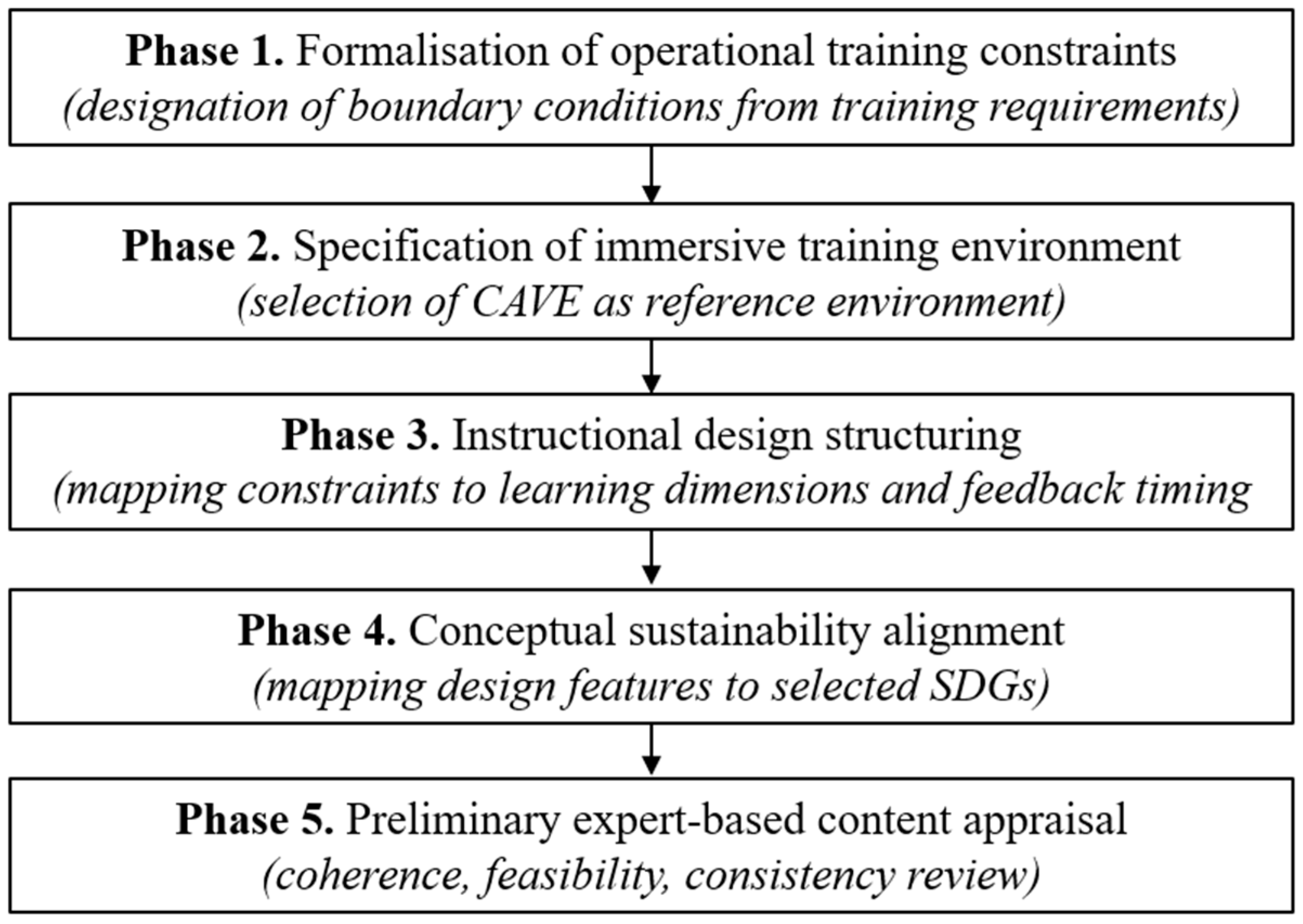
Model development followed a five-phase design-oriented process comprising: (1) formalisation of operational training constraints (boundary conditions designated from training requirements), (2) specification of the immersive training environment, (3) instructional design structuring, (4) conceptual alignment with Sustainable Development Goals, and (5) preliminary expert appraisal (content review).
To ensure transparency and reproducibility, the design process followed a structured decision protocol, including: (i) identifying key operational training features and designating non-negotiable operational training constraints; (ii) selecting immersive affordances required to enact them; (iii) interpreting each constraint in relation to primary learning dimensions; (iv) specifying feedback timing (immediate versus post-phase) based on the nature of observable behaviours; (v) translating constraints into scenario control points (events, triggers, and expected actions); (vi) mapping scenario features to SDGs as design correspondences; and (vii) conducting expert appraisal and incorporating revisions.
Phase 1: Formalisation of operational training constraints.
Phase 1 formalised four core operational training constraints characterising chemical hazard response contexts—decision-making under time pressure, exposure to uncertainty, coordinated teamwork, and strict procedural and psychomotor precision. The constraints were derived from training requirements and defined as pre-established operational boundary conditions grounded in domain practice and doctrine, guiding subsequent instructional design decisions. The constraints were treated as fixed boundary conditions for design decisions rather than as variables intended for empirical measurement.
Phase 2: Specification of the immersive training environment.
An immersive training environment was selected in response to the formalised constraints defined in Phase 1. Cave Automatic Virtual Environment (CAVE) technology was chosen as a representative immersive setting due to its capacity to support shared spatial presence, full-body interaction, real-time collaboration, and safe repetition of high-risk procedures. Environmental affordances provided by CAVE systems defined the technical and interactional boundaries within which the training model was constructed.
Phase 3: Instructional design structuring.
Instructional design decisions were formulated to align learning activities with both the operational training requirements and the affordances of the immersive environment. The model adopts a four-dimensional instructional structure integrating cognitive, emotional, social, and psychomotor learning processes. The structure reflects the interdependence of decision-making, stress management, teamwork, and embodied procedural execution in chemical hazard response training.
Phase 4: Sustainability alignment.
Sustainability considerations were incorporated through conceptual alignment with selected Sustainable Development Goals. Mapping focused on the relationship between immersive training processes and objectives related to health protection, quality education, urban resilience, and institutional response. Alignment was applied as a design principle guiding model development rather than as an assessment of impact.
Phase 5: Preliminary expert-based content appraisal
The final methodological step involved a preliminary expert appraisal (content review) of the conceptual model. Specialists in immersive training, safety education, and instructional design reviewed the framework to assess internal coherence, feasibility, and consistency across training requirements, environmental configuration, instructional structure, and sustainability alignment. Appraisal outcomes informed minor refinements prior to finalisation of the model.
Empirical testing with learners was intentionally excluded from the present study. Evaluation of training effectiveness and transfer to operational practice is planned for a subsequent research phase, including a pilot implementation conceptualised as a quasi-experimental follow-up study.
Figure 1 summarises the design logic and phase structure underlying the development of the proposed conceptual framework.
3.1.1. Operational Training Constraints Grounded in Training Requirements
Training for chemical incident response in real-world conditions is characterised by four core requirements: operation under time pressure, exposure to uncertainty, the need for coordinated teamwork, and strict procedural accuracy in the execution of safety measures. First responders and civil protection personnel work in environments where incomplete information, dynamic conditions, and high consequences of error are the norm. Effective training, therefore, requires integrating procedural knowledge with embodied action, situational awareness, and continuous communication.
Such conditions place simultaneous demands on several interrelated capacities. Decision-making must occur rapidly and often under ambiguous circumstances. Emotional regulation is required to manage stress and exposure to risk. Team coordination depends on clear communication, role awareness, and shared situational understanding. Procedural accuracy relies on precise psychomotor execution of safety-critical actions, including the proper use of personal protective equipment and adherence to decontamination procedures. Training that addresses only technical correctness without accounting for these combined demands remains insufficient for chemical hazard response.
The operational requirements informed the design assumptions of the proposed training model. Learning activities were structured to support decision-making under time pressure, stress regulation in uncertain conditions, collaborative action within teams, and repeated hands-on practice to achieve procedural accuracy. A controlled training setting that allows safe learning from errors without real-world consequences was treated as essential for developing these competencies in an integrated manner.
To operationalise the training requirements, an illustrative use case was defined as a methodological instrument rather than as an empirical intervention. The use case translates operational demands into a structured scenario framework and supports design appraisal. It was specified as a self-contained, repeatable, and adaptable training module characterised by the following parameters:
Target group: First responders, civil protection trainees, and students in safety-related programmes;
Training goals: Procedural accuracy, situational decision-making under time pressure, and safe execution of chemical decontamination procedures;
Structure: A multi-phase immersive scenario integrating briefing, action, and reflection;
Delivery format: A moderated session lasting approximately 45–60 min;
Evaluation logic: Embedded feedback mechanisms that support reflection and facilitate the facilitator’s observation.
A detailed description of the scenario structure and training phases is provided in
Section 4 as part of the expert-appraised conceptual model.
Training requirements (time pressure, uncertainty, teamwork, and procedural accuracy) define the instructional problem space; selected key operational training features are designated as operational training constraints (boundary conditions), which serve as the starting point for decisions regarding the immersive environment and instructional structure.
3.1.2. Immersive Environment (CAVE)
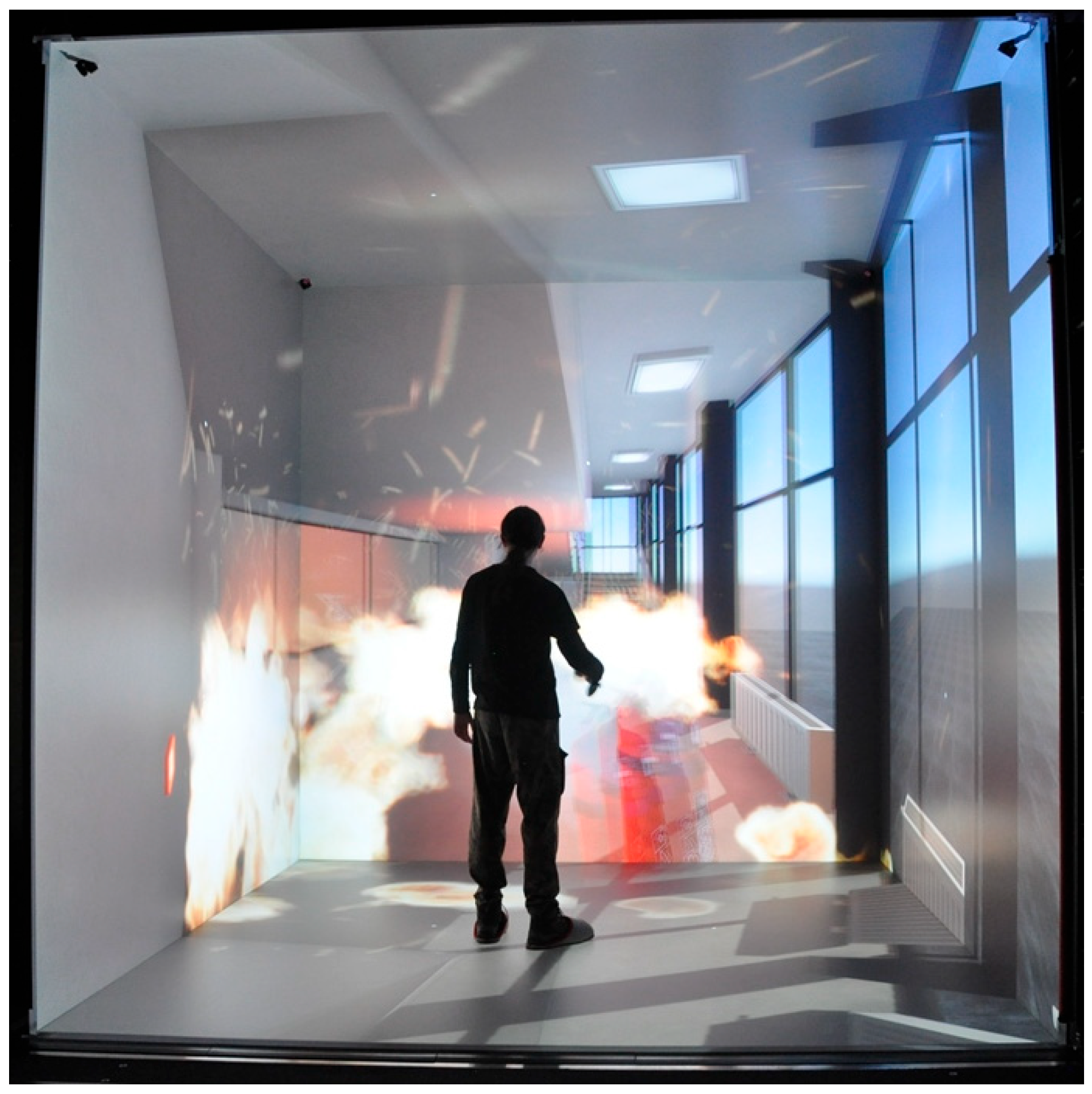
Immersive simulation is planned to be implemented within the BigCAVE system at the Immersive 3D Visualisation Lab, of Gdańsk University of Technology (Gdańsk, Poland). BigCAVE is a multi-person, multi-screen, high-resolution 3D system designed for immersive and interactive exploration of virtual environments. Six projection surfaces—four vertical walls, floor, and ceiling—each measure 3.4 m × 3.4 m and employ rear-projected stereoscopic visuals combined with surround sound to create a continuous spatial experience.
Head-tracking technology ensures that imagery is rendered from the user’s perspective, maintaining spatial consistency and depth perception, and correcting parallax for multiple participants. Participants use stereoscopic 3D glasses and can move freely within the enclosed space, performing coordinated actions and gestures that are tracked by optical and inertial systems. Such a configuration supports full-body interaction and real-time collaboration, unlike individual head-mounted displays (HMDs), which isolate users.
Integrated audiovisual feedback, adaptive difficulty, and embedded assessment tools are treated as design targets for a controlled learning environment. The described configuration supports reproducibility in comparable CAVE facilities featuring six-sided projection geometry, head tracking, and multi-user co-presence.
Figure 2 illustrates the spatial configuration and key interaction components of the CAVE system.
From a methodological perspective, the described CAVE configuration defines the environmental conditions required for Phase 2 of the design process. The multi-user, shared spatial setup enables safe learning from errors by supporting the rehearsal of safety-critical actions, observation of incorrect responses, and procedural repetition without real-world consequences. High-fidelity visualisation and real-time system response provide immediate feedback, while the collective spatial setting facilitates shared situational awareness and coordinated team action. Within the methodological framework, the CAVE functions as an enabling condition for instantiating training requirements at the scenario-design level.
3.1.3. Four-Dimensional Instructional Design (4D ID)
The learning dimensions integrated into the conceptual model are based on Illeris’s [
12] typology, which distinguishes three interrelated aspects of learning: cognitive, emotional, and social.
The cognitive dimension focuses, among others, on acquiring knowledge and developing analytical, critical-thinking, and decision-making skills [
35,
36,
37]. In the CAVE-based training scenario, participants are exposed to realistic chemical hazard situations that require selecting appropriate personal protective equipment (PPE), interpreting threat indicators, and following step-by-step decontamination protocols. The immersive environment enables repetition and active engagement, enhancing procedural knowledge and cognitive flexibility.
The emotional dimension addresses motivation, engagement, and the learner’s affective response [
38,
39,
40]. It involves regulating stress [
41], sustaining attention [
42], and fostering emotional resilience under pressure [
43]. Immersive simulations in CAVE provide psychologically safe, yet emotionally engaging contexts that mimic the stress and urgency of real-life emergencies. By creating emotionally charged but controlled scenarios, the model helps build mental resilience, increase learner motivation, and reinforce the perceived relevance and seriousness of safety protocols.
The social dimension emphasises collaboration, communication, and shared responsibility [
44,
45,
46]. It involves coordinating actions, exchanging information, and building mutual awareness among participants [
47]. Unlike individual VR headsets, CAVE allows participants to train together in a shared physical and virtual space. This supports the development of interpersonal coordination, real-time information sharing, and collective decision-making—skills essential to effective team performance during chemical emergencies.
The so-called “learning triangle” integrates multiple theories and perspectives across three learning domains into a unified model. According to Illeris’s framework, the cognitive domain also encompasses psychomotor learning, expressed through physical interaction, performance of safety procedures, and the development of muscle memory [
48,
49,
50]. In emergency and safety education, psychomotor learning is frequently emphasised as a distinct category [
51,
52,
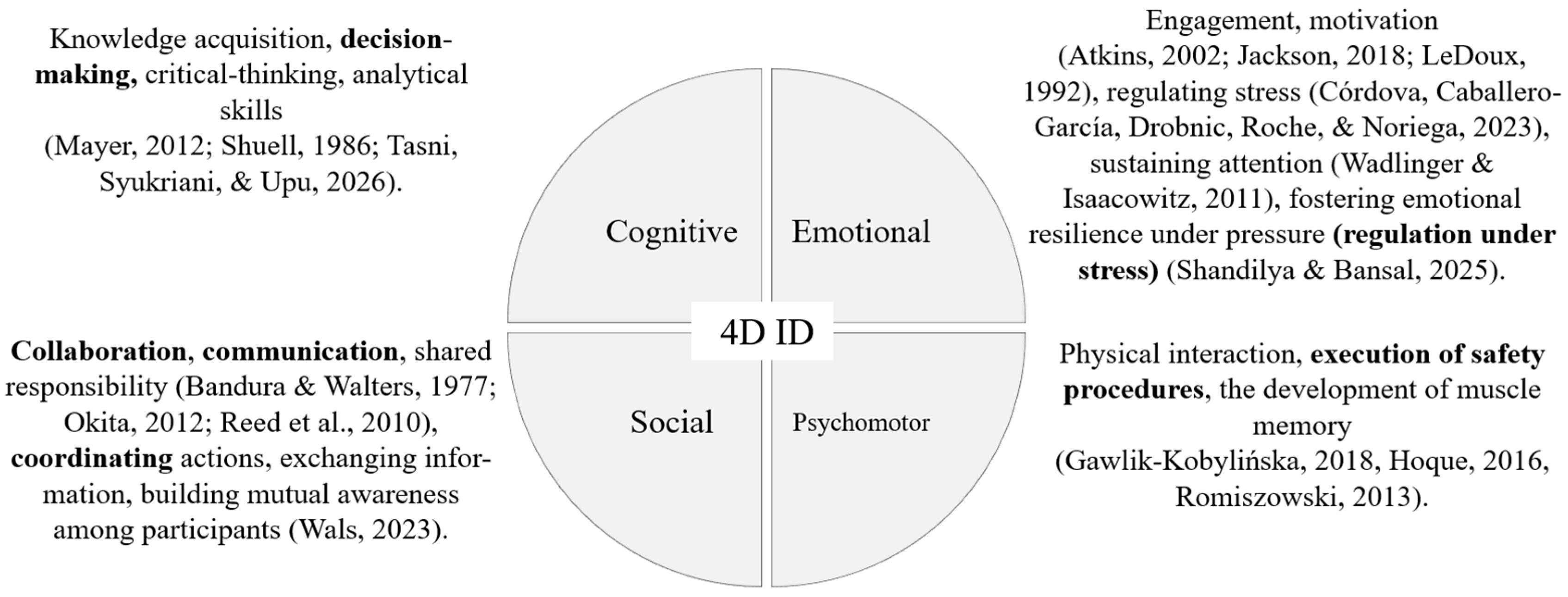
53]. Similarly, chemical hazard response requires practical, hands-on engagement. Learners must physically perform safety procedures—including donning personal protective equipment (PPE), carrying out decontamination steps, and navigating hazardous zones with precision and coordination. For this reason, differentiating the psychomotor dimension clarifies how procedural performance complements cognitive understanding, emotional regulation under stress, and social collaboration. The resulting four-dimensional structure (
Figure 3) embodies a holistic view of learning that connects knowing, feeling, acting, and collaborating. Through embodiment, repetition, and realistic spatial feedback, the model fosters procedural fluency, situational awareness, and adaptive expertise essential in high-risk operational contexts.
From a methodological perspective, the four-dimensional instructional design constitutes Phase 3 of the design process by mapping operational training constraints onto structured learning functions within the immersive environment. Cognitive processes address decision-making under time pressure and situational assessment; emotional processes relate to stress exposure and regulation; social processes correspond to coordination, communication, and shared situational awareness; and the psychomotor dimension is expressed through embodied execution of safety-critical actions. In this configuration, the four-dimensional structure (
Figure 3) provides a clear instructional logic linking operational training demands with immersive environmental affordances.
Treating the psychomotor dimension as explicit is not merely a terminological extension. In chemical hazard training, procedural failures (e.g., PPE donning/doffing errors) have immediate safety consequences and therefore require in-scenario observables and immediate corrective cues, rather than primarily cognitive or reflective feedback.
Potential construct overlap between stress regulation and decision-making is recognised in high-pressure training contexts, where both processes may be concurrently activated by time constraints and uncertainty. Within the proposed framework, decision-making is treated as action selection and sequencing under operational constraints, whereas stress regulation refers to maintaining functional performance despite affective and physiological load. Future empirical validation may therefore rely on separable behavioural indicators and formal tests of discriminant validity; however, such analyses lie beyond the scope of the present design-oriented study.
3.1.4. SDG Alignment
An integral part of the methodological design was mapping scenario components to the selected Sustainable Development Goals (SDGs). The step supported alignment of the conceptual model with pedagogical and technical requirements as well as with broader sustainability objectives. The mapping considered how the training design and intended learning functions align with:
SDG 3 (Good Health and Well-Being): Improving safety and reducing exposure to hazards;
SDG 4 (Quality Education): Integrating immersive and collaborative learning methods;
SDG 11 (Sustainable Cities and Communities): Strengthening response and resilience capacities;
SDG 16 (Peace, Justice, and Strong Institutions): Supporting institutional frameworks for coordinated emergency response.
In methodological terms, the mapping served as a bridge between the educational design of the scenario and its societal relevance, providing a structured framework for subsequent interpretation of results. The mapping approach follows established practice in sustainability pedagogy, where expert-based conceptual alignment is applied to ensure conceptual consistency between learning frameworks and the Sustainable Development Goals [
55,
56,
57].
SDG alignment informed specific instructional design decisions in the model. For SDG3, the model prioritises safe, repeatable rehearsal of safety-critical procedures supported by immediate corrective cues. For SDG4, it specifies a moderated, team-based scenario workflow with structured debriefing as a core instructional mechanism. For SDG11, the model includes an urban public-service context as the reference setting for the training instantiation. For SDG16, it embeds role allocation and coordination routines aligned with institutional response protocols.
3.1.5. Preliminary Expert-Based Content Appraisal of the Conceptual Framework
To examine internal coherence and practical feasibility of the proposed conceptual framework, a preliminary expert-based content appraisal was conducted. The appraisal addressed conceptual consistency, implementation feasibility, and alignment across operational training constraints, instructional design logic, immersive environment configuration, and sustainability considerations, without constituting an empirical evaluation of training effectiveness or learning outcomes.
The expert panel comprised five senior specialists, selected through purposive sampling to ensure complementary expertise relevant to the study’s scope. The panel included: (i) two researchers and practitioners in immersive and virtual reality-based training systems with over fifteen years of experience in designing, implementing, and evaluating simulation environments for safety-critical applications; (ii) an academic specialist in chemical safety and emergency response education with more than twelve years of experience in professional training and curriculum development; and (iii) an expert in instructional design and learning theory with over ten years of experience in the design, assessment, and review of technology-supported learning frameworks; (iv) one specialist in human factors and applied psychology in safety-critical systems, with over ten years of experience in analysing cognitive load, stress regulation, decision-making, and human–system interaction in simulated or high-risk operational environments. Selection criteria included documented experience in immersive or simulation-based training for safety-critical domains, domain relevance to chemical hazard response or instructional design, a minimum of ten years of professional/academic practice, and prior participation in expert panels or framework reviews. Panel members were contacted individually via email and received the appraisal package electronically (PDF). No panel member held a supervisory, financial, or contractual role in the laboratory hosting the reference CAVE system, and no conflicts of interest were declared. Appraisal materials comprised: (a) a structured written description of the illustrative CAVE-based training scenario (including scenario phases and control logic), (b) a schematic representation of the four-dimensional instructional design structure, (c) a summary table outlining conceptual alignment with SDGs 3, 4, 11, and 16, and (d) written instructions for completing the appraisal form (
Supplementary Materials S1). Appraisal addressed three predefined criteria: (i) pedagogical consistency across cognitive, emotional, social, and psychomotor learning dimensions; (ii) adequacy of the CAVE configuration for collaborative, mistake-driven training under conditions of time pressure and uncertainty; and (iii) conceptual validity and coherence of the SDG alignment. Experts were instructed to assess conceptual adequacy and internal coherence of the framework. Ratings were provided using a four-point relevance scale (1 = not relevant, 4 = highly relevant). Item-Level Content Validity Index (I-CVI) values and the Scale-Level Content Validity Index (S-CVI/Ave) were calculated in Microsoft Excel for Microsoft 365 (Microsoft Corporation, Redmond, WA, USA; accessed 18 December 2025) to quantify expert agreement, with a threshold of 0.80 indicating acceptable content validity. In addition to quantitative scorings, experts provided qualitative comments, which were thematically synthesised and used to refine scenario sequencing, feedback timing, and facilitator guidance prior to finalisation of the conceptual framework. The rating sheet and scale descriptors are provided as
Supplementary Materials.
The combination of quantitative indices and qualitative expert feedback strengthened the methodological transparency of the study and supported the internal coherence and feasibility of the proposed framework as a design-oriented contribution. The applied appraisal procedure serves as an initial verification step appropriate to the study’s conceptual scope and does not constitute empirical model validation or evaluation of learning outcomes.
3.2. Scenario-Based Instantiation (Illustrative Use Case)
The scenario-based instantiation (illustrative use case) serves as a methodological instrument for translating the conceptual model into a repeatable design artefact rather than an empirical intervention. Its purpose is to exemplify how the design assumptions specified in the methodological framework can be instantiated in a coherent training scenario and to support appraisal of the framework’s internal logic.
The instantiation is framed as a simulated chemical incident occurring in a public facility. It is specified as a self-contained, repeatable, and adaptable training module that reflects typical conditions for chemical hazard response. Scenario construction integrates the operational training constraints formalised in Phase 1, the immersive environment specified in Phase 2, the four-dimensional instructional structure defined in Phase 3, and the sustainability alignment introduced in Phase 4. The resulting scenario also functions as the reference object for the preliminary expert-based content appraisal conducted in Phase 5.
At a general level, the use case is characterised by the following parameters:
Target group: Civil protection trainees, first responders, and students enrolled in safety- or emergency-related programmes;
Training goals: Development of procedural accuracy, situational decision-making under time pressure, and safe execution of chemical decontamination procedures;
Delivery format: A moderated immersive training session lasting approximately 45–60 min;
Structure: A multi-phase scenario combining briefing, action, and guided reflection;
Evaluation logic: Embedded feedback mechanisms supporting facilitator observation and learner reflection.
For design purposes, the multi-phase scenario is structured into four sequential phases reflecting the typical operational flow of chemical incident response: (1) incident alert and situational assessment, (2) PPE donning and team preparation, (3) entry and primary decontamination, and (4) exit and secondary decontamination.
A condensed representation of the scenario, together with phase-based mapping to the components of the conceptual model, is provided in
Section 4.
Section 4 reports the scenario as a design artefact that instantiates decision-making under pressure, coordination demands, and procedural execution within an immersive setting, thereby supporting expert review and conceptual appraisal without implying evaluation of learning outcomes or effectiveness.
4. Results
Results are reported as design artefacts rather than performance or effectiveness measures. In accordance with the adopted design-based methodology, the section presents structured design outcomes corresponding to each methodological phase (Phases 1–5), including conceptual artefacts, their scenario-based instantiation, and the outcomes of the preliminary expert appraisal. Together, these results address the research question by articulating how immersive CAVE-based training can be systematically designed to support chemical hazard response under real-world operational constraints, with particular emphasis on scenario structure and control logic.
4.1. Phase 1 Outcome: Formalisation of Operational Boundary Conditions
The outcome of Phase 1 was the formalisation of four core operational training constraints characteristic of chemical hazard response contexts: decision-making under time pressure, exposure to uncertainty, coordinated teamwork, and strict procedural and psychomotor precision. The constraints were defined as boundary conditions inherent to chemical hazard training and were not treated as variables to be optimised.
As foundational design outcomes, these constraints provide a structuring logic for subsequent phases by delineating the non-negotiable demands that training scenarios must reproduce in order to maintain operational realism. Treating these elements as boundary conditions ensures that instructional decisions remain grounded in the practical realities of chemical emergency response.
4.2. Phase 2 Outcome: Immersive Environmental Enabling Conditions (CAVE Affordances)
Phase 2 specified the immersive environmental enabling conditions required to enact the operational constraints in a safe, repeatable, and collaborative manner. A CAVE-based environment was defined as the enabling infrastructure due to its capacity to support shared spatial presence, full-body interaction, real-time collaboration, and high-fidelity visualisation without isolating participants from one another.
As a design outcome, the immersive environment functions as a facilitating condition rather than an instructional driver. Its role is to allow trainees to collectively experience time pressure, uncertainty, coordination demands, and procedural requirements while enabling learning from errors without real-world consequences. These affordances support repeated practice and facilitator-led observation while maintaining physical co-presence and shared situational awareness.
4.3. Phase 3 Outcome: Four-Dimensional Instructional Structuring and Design Mechanisms
Phase 3 mapped the operational training constraints onto a four-dimensional instructional design framework (4D ID) encompassing cognitive, emotional, social, and psychomotor learning dimensions. Rather than isolating individual dimensions, the model emphasises their coordinated activation, with specific instructional priorities emerging depending on the nature of each operational constraint.
Each constraint was translated into scenario-level instructional conditions and feedback mechanisms, forming the internal design logic of the conceptual model. While all four learning dimensions may co-occur during scenario execution, particular dimensions are intentionally foregrounded to address dominant operational demands and to guide the timing and form of instructional feedback.
Instructional structuring constitutes a key design outcome by explicitly linking real-world operational constraints with differentiated instructional mechanisms. The resulting mapping is summarised in
Table 2, which illustrates how each constraint is enacted within the scenario and how feedback is predominantly structured across learning dimensions.
Although explicit instructional feedback for time pressure, uncertainty, and teamwork is primarily delivered during the debriefing phase, these constraints are implicitly reinforced during scenario execution through task structure, role dependencies, and system dynamics. In contrast, procedural and psychomotor precision requires immediate in-scenario cues to support embodied learning, error correction, and motor sequence acquisition.
This structured mapping provides the instructional basis for the scenario-control logic introduced in the subsequent phase, where constraints, learner actions, and feedback mechanisms are integrated into a coherent, scenario-based instantiation.
4.4. Phase 4 Outcome: Conceptual Sustainability Alignment
Phase 4 established a design-oriented alignment between the core instructional mechanisms of the framework and selected Sustainable Development Goals (SDGs) relevant to chemical hazard response. The alignment is treated as an internal design property rather than an external assessment of sustainability impact, and it reflects an intentional correspondence between training logic and broader societal objectives.
The framework focuses on SDG 3 (Good Health and Well-Being), SDG 4 (Quality Education), SDG 11 (Sustainable Cities and Communities), and SDG 16 (Peace, Justice, and Strong Institutions). These goals were selected due to their relevance to emergency response, institutional capacity building, and high-quality professional education. The conceptual correspondence is summarised in
Table 3, which links key features of the CAVE-based training scenario to SDG-related objectives at the level of instructional design.
The mapping presented in
Table 3 represents a conceptual design correspondence and does not constitute an empirical assessment of sustainability outcomes.
4.5. Phase 5 Outcome: Preliminary Expert-Based Content Appraisal
Phase 5 reports the outcomes of a preliminary, design-oriented expert-based content appraisal, conducted in accordance with the methodological assumptions outlined in
Section 3. The appraisal focused on internal coherence, practical feasibility, and conceptual consistency of the proposed framework, rather than on training effectiveness or learner performance outcomes.
Quantitative analysis indicated a preliminary level of agreement among the five experts. Item-level content validity indices (I-CVI) ranged from 0.80 to 1.00, while the scale-level index (S-CVI/Ave) reached 0.93, indicating satisfactory content coherence of the proposed framework and exceeding the commonly accepted threshold of 0.80 for content validity in exploratory expert-based reviews. A summary of expert ratings is provided in
Table 4.
Following the individual rating procedure, the experts participated in a brief consensus-oriented review round, during which divergent assessments were discussed and clarifications regarding scenario sequencing and facilitation logic were introduced. This iterative refinement supported a shared interpretation of the framework and strengthened its internal consistency beyond the quantitative indices alone.
Qualitative feedback complemented the quantitative ratings and primarily concerned refinement of transitions between scenario phases and clarification of facilitator guidance during reflective debriefing. These suggestions were incorporated into the final version of the framework.
4.6. Scenario-Based Instantiation of the Conceptual Framework
In line with the methodological assumptions outlined in
Section 3.2, the framework is presented through a scenario-based instantiation presented as a design artefact rather than an empirical intervention.
The condensed scenario specifies the control logic underlying the framework by linking events and triggers to expected trainee actions, observable indicators, and facilitation-oriented feedback mechanisms (
Table 5).
The scenario control logic identifies facilitation-relevant decision points and observable behaviours required for design transparency and expert appraisal, without implying empirical evaluation of learning effectiveness or training outcomes.
4.7. Consolidated Conceptual Framework (Synthesis of Phases 1–5)
The outcomes of Phases 1–5 were integrated into a consolidated, expert-informed conceptual framework for immersive chemical hazard response training. The framework synthesises operational training constraints, immersive enabling conditions, four-dimensional instructional structuring, conceptual sustainability alignment, and the results of the preliminary expert-based content appraisal.
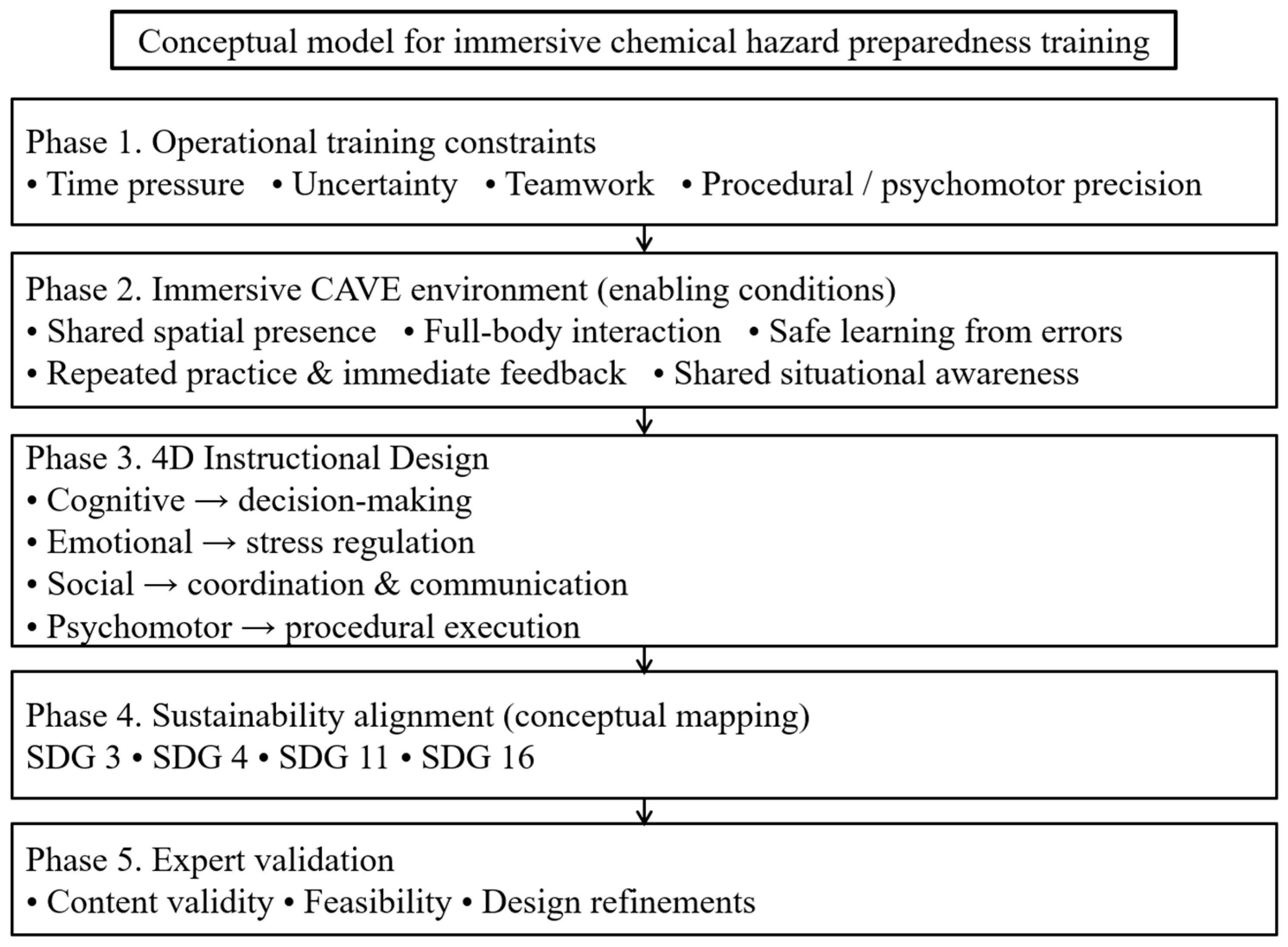
Figure 4 presents the consolidated framework together with its scenario-based instantiation, illustrating the integration of the five methodological phases in addressing the research question.
The framework integrates operational training constraints, CAVE-based immersive affordances, and four learning dimensions (cognitive, emotional, social, psychomotor), expressed as a scenario-based design artefact conceptually aligned with SDGs 3, 4, 11, and 16.
5. Discussion
The conceptual model developed in this study illustrates how CAVE-based immersive training can be conceptually structured for chemical hazard response through a pedagogically robust and sustainability-oriented approach that integrates mistake-driven learning, collaboration, and four key learning domains: cognitive, emotional, social, and psychomotor. Rather than demonstrating training effectiveness, the model provides a structured design logic for integrating procedural execution, real-time decision-making, teamwork, and structured reflection within immersive scenarios. Such multidimensional learning processes are widely recognised as critical in high-stakes environments where errors carry serious consequences. From a design perspective, the proposed framework also assumes a multi-level safety-exit logic, whereby immediate in-scenario cues, facilitator-triggered pauses, and scenario termination thresholds are embedded to prevent repeated procedural failures or escalating stress from inducing psychological overload during immersive training. From an educational perspective, this logic supports learning design by explicitly structuring immersive chemical hazard training around learning processes—cognitive, emotional, social, and psychomotor—rather than around technical task execution alone, thereby positioning immersive training as a sustainability-oriented instructional framework.
Empirical evidence from recent studies supports the theoretical rationale underlying the proposed design assumptions. For instance, Raimbaud (2025) [
15] and Dziuba (2024) [
32] reported measurable improvements in decision-making and stress management, while Abbas et al. (2023, 2024) [
58,
59] provided data confirming the ecological and operational benefits of immersive training. These findings do not validate the present model; they provide contextual support by situating the design assumptions within an established empirical literature.
Compared with other VR-based approaches, CAVE-based training may reduce selected logistical and material burdens associated with traditional field exercises, while maintaining experiential depth and fidelity [
54,
60]. The ability to repeatedly simulate complex, high-risk scenarios without material degradation supports cost-efficient, inclusive, and environmentally responsible training [
18,
61,
62]. Prior research has increasingly highlighted sustainability-related aspects of immersive training, including reduced emissions, lower material consumption, and improved scalability. For example, Lyu et al. (2023) [
63] proposed an intelligent emergency command system integrating VR and AI for hazardous chemical response, underscoring adaptability and sustainability in decision-making. Abbas et al. (2023, 2024) [
58,
59] further emphasised the environmental advantages of immersive methods, showing that VR-based training reduces emissions and waste, thus positioning immersive technologies as effective tools for sustainable emergency education.
The relevance of the proposed CAVE-based framework should be interpreted in relation to alternative training formats commonly used in chemical hazard response. CAVEs support shared physical co-presence, facilitator-led observation, and collective situational awareness, which are particularly conducive to team-based coordination, embodied psychomotor learning, and structured reflection during mistake-driven training. At the same time, CAVE systems require dedicated infrastructure, controlled physical space, and institutional resources, which may limit their applicability in some organisational contexts. While CAVE-based training offers advantages for collaborative and embodied learning, its infrastructural and operational requirements imply higher fixed costs compared with portable VR solutions. The present study does not include a cost-effectiveness or sensitivity analysis comparing CAVE-, HMD-, and MR-based training formats, as such an analysis would require empirical performance data beyond the scope of this design-oriented contribution.
By contrast, head-mounted display (HMD)-based VR solutions offer greater scalability and portability, making them suitable for individual or distributed training scenarios. However, such systems often introduce participant isolation, reduced visibility of peer actions, and challenges in real-time facilitation, which may constrain collaborative learning and team coordination in complex emergency response tasks. Tabletop and live field exercises provide high physical realism and direct interaction with real equipment. However, they are associated with substantial material costs, logistical complexity, safety risks, and limited repeatability, which restrict their use for frequent, mistake-driven rehearsal of hazardous procedures.
From this perspective, the proposed CAVE-based model should be understood as a complementary training format rather than a universal solution, occupying a design space between individually oriented immersive VR systems and resource-intensive live exercises.
Embedding immersive training design within the Sustainable Development Goals framework extends existing discussions on sustainability-oriented instructional design. Alignment with SDG 3 (Good Health and Well-Being), SDG 4 (Quality Education), SDG 11 (Sustainable Cities and Communities), and SDG 16 (Peace, Justice, and Strong Institutions) frames immersive training in relation to institutional response, inclusive learning, and sustainability-oriented capacity building.
Design-oriented character of the proposed framework imposes clear limitations. First, the literature review, which served to inform the conceptual background and design rationale of the model, was intentionally restricted to peer-reviewed publications indexed in Scopus and Web of Science from 2020–2025 in order to prioritise recent conceptual and design-oriented contributions. This scope excludes selected conference proceedings (e.g., IEEE/ACM) and non-English grey literature, which may be addressed in future empirical and comparative studies to further reduce potential publication bias. Second, the model has not yet been empirically tested in operational training settings, which precludes conclusions regarding learning effectiveness, behavioural transfer, or long-term impact. The preliminary expert-based content appraisal addressed internal coherence and feasibility but does not substitute for empirical validation. Additionally, the technological requirements of CAVE systems may limit their applicability in resource-constrained institutions, and the SDG alignment remains conceptual rather than a quantitatively verified contribution to sustainability outcomes.
Although the present study is conceptual in nature, the proposed framework is formulated in a way that allows for systematic empirical validation in future work. Such validation would primarily concern construct clarity and discriminant validity among the four instructional dimensions, with particular attention to the potential overlap between cognitive decision-making and emotional stress regulation under time pressure. Future empirical studies should therefore rely on clearly defined operational indicators for each dimension and distinguish between observable decision outcomes, affective regulation processes, social coordination behaviours, and psychomotor execution of procedures. Analytical approaches such as confirmatory factor analysis or alternative competing models (e.g., three-factor or cognitive–affective structures) could be employed to test dimensional separability. Importantly, such validation efforts fall outside the scope of the present contribution, which focuses on articulating a transparent, design-oriented instructional logic rather than on demonstrating training effectiveness.
Future research should prioritise empirical pilot studies examining learning outcomes such as procedural accuracy, stress regulation, teamwork coordination, and retention over time. Comparative studies may further investigate the relative strengths of CAVE-based training compared with HMD-based VR and live exercises, and explore how emerging technologies—such as artificial intelligence or adaptive feedback systems—could enhance instructional personalisation and scenario control (and, where appropriate, incorporate quantitative sustainability-related indicators to evaluate environmental and organisational impacts of different training formats).
6. Conclusions
The study examined how immersive CAVE systems can be structured at the design level to support collaborative, mistake-driven training for chemical hazard response within a conceptual sustainability framing in relation to selected Sustainable Development Goals (SDGs 3, 4, 11, and 16). The contribution is conceptual and instructional, not evaluative.
The proposed framework specifies how training scenarios can be constructed and facilitated, rather than assessing their effectiveness. Its core contribution lies in formalising scenario control logic, linking operational constraints to concrete design elements: events and triggers, expected trainee actions, observable behaviours, and feedback timing. These elements are explicitly connected to cognitive, emotional, social, and psychomotor learning processes within a shared CAVE, making instructional and facilitation decisions transparent and reproducible.
Alignment with the Sustainable Development Goals is treated as a design reference, indicating how immersive chemical hazard training may be framed in relation to health protection, education quality, institutional response, and coordinated response capacities. This alignment does not constitute an assessment of sustainability impact and should be interpreted as a structuring lens rather than an outcome claim.
Expert appraisal suggested internal coherence and preliminary implementability of the framework, given consistency across instructional structure, immersive affordances, and scenario logic. Owing to the limited scope of the appraisal, no claims are made regarding learning effectiveness, behavioural transfer, or operational impact.
Consistent with the limitations discussed in
Section 5 (Discussion), future work should focus on empirical pilot implementation and comparative evaluation of the proposed design logic. Within these clearly defined limits, the study offers a bounded, conceptually grounded reference model for the design and facilitation of immersive chemical-hazard response training.