Review

Role of the Circular Economy Framework for Sustainable Waste Management and Climate Change Mitigation


by
Stephen James Ijimdiya
1,
Muthukrishna Vellaisamy Kumarasamy
1,2,*,
Joy Tuoyo Adu
1 and
Dinagarapandi Pandi
1
1
Civil Engineering Programme, School of Engineering, University of KwaZulu-Natal, Durban 4041, South Africa
2
Saveetha School of Engineering, Saveetha Institute of Medical and Technical Sciences, Chennai 600072, India
*
Author to whom correspondence should be addressed.
Sustainability 2026, 18(4), 1946; https://doi.org/10.3390/su18041946
Submission received: 29 October 2025 / Revised: 22 December 2025 / Accepted: 26 December 2025 / Published: 13 February 2026

Abstract

The rapid increase in global waste generation and its associated greenhouse gas (GHG) emissions pose increasing challenges to sustainable development and climate mitigation. Current estimations indicate that municipal solid waste generation will increase from approximately 2.3 billion tonnes in 2023 to nearly 3.8 billion tonnes by 2050, with waste-generated emissions, mainly methane, accounting for an important share of bi-temporal climate impact. This review examines the circular economy (CE) as a systemic framework for transforming waste management practices to reduce emissions while improving resource efficiency. Based on a structured narrative synthesis of more than 170 peer-reviewed studies and authoritative international reports, the paper evaluates CE-integrated strategies for waste prevention, recycling, recovery, and valorization. Reported estimates suggest that integrating CE principles into waste management systems could reduce proected GHG emissions growth by approximately 30–39% by 2050 through material efficiency gains, energy savings, landfill diversion, and organic waste valorization. Sector-specific considerations, including applications in high-emission industries such as the energy and chemical sectors, highlight both the mitigation potential and technical constraints of CE implementation. Overall, the review demonstrates that CE-based waste management can deliver quantifiable climate benefits when supported by appropriate policies, technologies, and context-specific system design.

1. Introduction

1.1. Background

Global waste generation has extended to unparalleled heights, causing major environmental, economic, and social challenges. Municipal solid waste (MSW) generation is estimated to rise from roughly 2.3 billion tonnes in 2023 to nearly 3.8 billion tonnes by 2050, and this can be attributed to population growth, increased industrialization, and consumption patterns that are not in line with sustainable goals [1]. This huge waste generation will result in serious environmental and economic problems, as the cost of controlling it is set to increase globally from USD 252 billion in 2020 to over USD 640 billion annually by 2050 if this trend continues [1]. This rise in financial burden emphasizes the weakness of existing waste systems, particularly in low- and middle-income areas where collection and treatment volume remain insufficient [2]. Beyond its scale, waste generation directly impacts climate change. For instance, landfilling of organic waste is a main cause of methane emissions, a greenhouse gas that has a global warming potential of about 28–36 times more carbon dioxide (CO2) gases released over 100 years [3]. Additionally, open burning of waste, mostly in developing countries, releases black carbon, a short-term pollutant, which contributes significantly to immediate climate change, affects health conditions, and is considered more harmful than CO2 [4,5]. Therefore, waste management systems are increasingly acknowledged as a serious involvement socket for greenhouse gas mitigation in national and global climate approaches.
Although the availability of various waste management methods designed to reduce environmental impacts is prevalent, linear economic models based on production, consumption, disposal, and removal have proven to be basically unsustainable. These models encourage the exhaustion of resources, unnecessary waste generation, and contribute to environmental degradation [6,7]. In particular, the linear model supports dependence on unprocessed inputs and high-carbon means of production, contributing to both scarcities of resources and overall emissions [8]. On the flip side, substitute systemic methods underline resource efficiency, waste prevention, and material recovery as ways toward sustainability. In this case, the circular economy (CE) has materialized as a strategic retort to the limits of linear waste management systems. CE supports the preservation of material value via reuse, recycling, and reformative design, permitting materials and products to continue in circulation for a long time [9,10]. Research shows that recycling and material recovery, mostly for materials like paper, metals, and plastics, can result in significant energy savings and reduced greenhouse gas emissions as compared to major production from raw materials [11,12]. In addition, the integration of CE into urban waste management has the potential to reduce greenhouse gases by up to 39% by 2050 via waste prevention, organic waste valorization, and reduced dependence on landfilling [13].
Although the CE frameworks are progressively discussed in several sustainability and waste management studies, it is being treated in a general way without the integration of CE concepts with waste management, climate mitigation, and sector-specific technical facts, most especially in industries with high emissions like chemical and energy [14]. This review discloses that gap by producing evidence from CE theory, waste systems engineering, and climate policy, giving an integrated outlook on how CE- based waste management strategies can produce measurable greenhouse gas decreases. By placing CE as a technically practical and climate-related framework instead of merely a resource-efficiency idea, this review supports the scientific basis for CE-driven waste management involvement.

1.2. Perspective of CE

The circular economy is a philosophy that considers growth as reducing dependence on already scarce resources. Contrary to the current linear economy model, CE emphasizes the reuse, recycle, and manufacture of materials to form a closed system, such that less waste is generated and environmental degradation is reduced [15]. CE is now gaining relevance as a better sustainable option to the present economic models [15].

1.2.1. Defining the CE

There is no universally accepted definition of circular economy, but the major thrust lies in circularity and the sustainability of materials. The European Commission [16] defines it as ‘an economy where the cost of products, materials, and resources is fixed in the economy for as long as imagined, and the production of waste is reduced’. According to the Ellen MacArthur Foundation [17], “it is the system of the industry that restores and redevelops by design”. Kirchherr et al. [18] delimit it to “a system of the economy that substitutes the end of a product’s life with reducing, reusing, recycling, and improving materials in the production or distribution, and consumption processes”. This implies that the circular economy covers environmental, economic, and social dimensions, entailing sustainability and efficiency as its foundation and main focus.

1.2.2. Core Principles of CE

The Circular Economy model works based on the following principles:
  • Waste/product and pollution system design should be carried out to prevent the production of waste and pollution [19].
  • Products/materials should be kept in continuous use to prolong their life through reuse, repair, and recycling [20].
  • Practices that increase natural resources, like composting and ecosystem renewal, should be encouraged [20].
  • The circular economy reconsiders value chains and business models through logical thinking that requires innovation [21].
  • The circular economy gives priority to the use of renewable energy and sustainable use of resources [22].
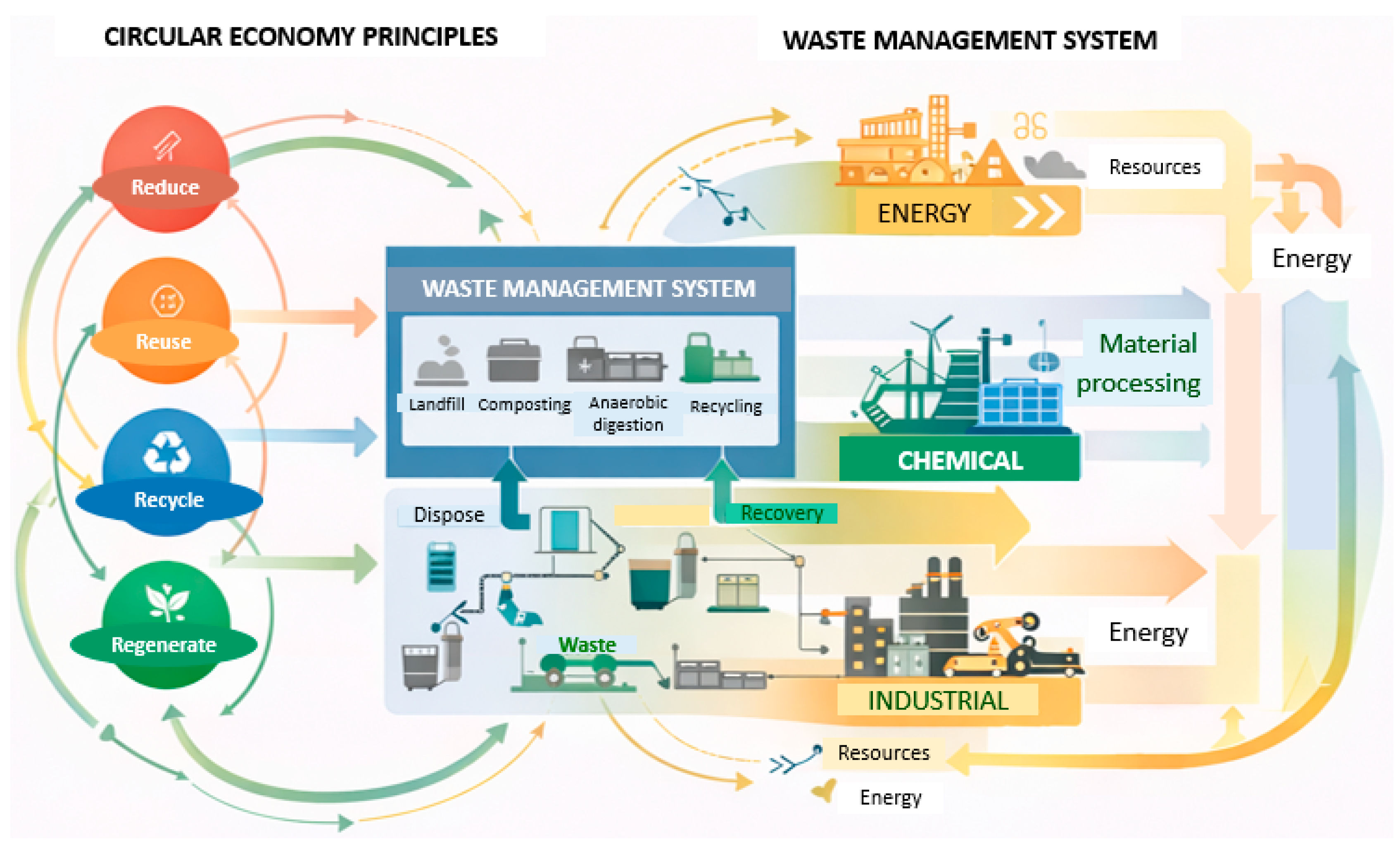
CE principles emphasize reducing material inputs, extending product lifecycles, recovering value from waste, and regenerating natural systems. When embedded within waste management systems, these principles operate through interconnected material and energy flows supported by feedback mechanisms across multiple sectors. Figure 1 presents a conceptual framework explaining how CE principles—reduce, reuse, recycle, and regenerate—are rooted within waste management systems through material and energy response loops connecting industrial, energy, and chemical sectors.

1.2.3. The CE as a Response to Environmental and Social Challenges

The global economy is currently confronted by serious environmental challenges, such as climate change, biodiversity loss, scarcity of resources, and pollution, to mention a few [23]. CE tackles environmental and resource challenges mainly by curtailing resource extraction, reducing pollution, and closing material loops. Each action or principle contributes directly to the sustainability of the environment. The CE model provides a general and logical response to these challenges by reforming economic events to support ecological rims as follows:
  • Dealing with the scarcity of resources and the security of materials: CE makes best use of present materials, thereby increasing the security of materials [24].
  • Cutting down on greenhouse gas emissions: CE encourages energy productivity and lessens greenhouse gas emissions [12].
  • Curtailing waste and pollution: CE converts waste into resources and cuts down on pollution [8].
  • Improving economic effectiveness and Innovation: CE promotes innovation, cost productivity, and market benefit [25].
  • Supporting social presence and creating jobs: CE generates employment opportunities through recycling, repair, and service-based models [26].

1.3. Scope and Limitations

This review centers around the assumption that realizing sustainable waste management and significant climate mitigation entails a systemic transition from linear models of production and disposal to circular, sustainable, and waste-minimizing systems. The study also assumes CE strategies impact several interrelated areas—technological, environmental, economic, policy, and sector-specific—and that comprehending these connections is critical for measuring the practical possibility and climate benefits of CE implementation. These assumptions steered the choice of thematic areas examined in the manuscript. Even though this review highlights the role of CE strategies for sustainable waste management and climate mitigation, it also identifies the fact that their implementation is subject to technical, economic, and institutional limitations, which are examined in other sections. This review adopts a system-level perspective on CE-driven waste management and climate mitigation across different sectors. Although it does not give a detailed sector-by-sector techno–economic analysis, a directed discussion of high-emission and waste-intensive industries, mainly the energy and chemical sectors, is conducted where sector-specific waste streams, hazardous materials, and continuous production limitations analytically impact the application of CE strategies.

1.4. Objectives of the Review

The primary objective of this review is to evaluate how CE principles, strategies, and technologies can increase sustainable waste management while contributing to quantifiable decreases in greenhouse gas emissions. To achieve this objective, the review synthesizes insights from CE theory, waste systems engineering, climate mitigation frameworks, and industry-specific technical pathways. Consideration is also given to high-emission sectors like the energy and chemical industries, where CE implementation has both substantial prospects and operational issues.
The review scope covers the following:
  • The conceptual and theoretical foundations of the CE;
  • The integration of CE in contemporary waste management hierarchies;
  • Material flow systems and technological involvements that enable emission reductions;
  • The contribution of CE approaches to climate mitigation, as well as emissions reduction possibilities;
  • Aiding policy, economic, and digital drivers;
  • Current barriers and future outlooks.
In general, it bridges conceptual CE discussions with technical evidence and applied considerations, presenting an inclusive and integrated outlook on how CE strategies can be used as a practical pathway for attaining climate-resilient and sustainable waste management systems.

1.5. Literature Search and Selection Criteria

This review embraces an organized narrative approach to study the role of CE frameworks in sustainable waste management and climate change mitigation. A methodical search was carried out using major scientific databases, including Scopus, and ScienceDirect, to ensure a detailed and qualitative analysis. The search approach used combinations of keywords connected to circular economy, waste management, and climate change, including “circular economy”, “waste management”, “resource recovery”, “greenhouse gas emissions”, “climate mitigation”, “industrial waste”, and “life cycle assessment”. The search approach was led by the assumption that the implementation of CE is fundamentally interdisciplinary and collaborative and hence entails combining perspectives from environmental engineering, industrial ecology, and sustainability science. Peer-reviewed journal articles, authoritative reports from international organizations like IPCC, UNEP, World Bank, and high-impact review papers published between 2000 and 2025 were deliberated. Studies were included if they (i) clearly addressed CE principles, (ii) studied waste management systems or material recovery paths, and (iii) delivered qualitative or quantitative understandings of environmental or climate impacts. Conference abstracts, non-peer-reviewed articles, and studies that are not applicable to CE or waste systems were not included.
To improve methodological accuracy and repetition, recovered accounts were screened on the basis of titles and then by full-text search. Identical records were removed, and regressive reference tracing was carried out to recognize additional applicable studies. This structured collection process confirms transparency, reproducibility, and broad coverage of the literature and at the same time maintains the integrity of a technical review [27,28].
Therefore, this review follows a structured narrative review method, enabling interdisciplinary synthesis, at the same time preserving methodological transparency and thoroughness.

2. Theoretical Foundation of the Circular Economy

2.1. Historic Development

The concept of the CE originated several decades ago, drawing on diverse ideas and environmental perspectives. Its origin is traceable to the 1960s and 1970s, as a result of the increasing consciousness of ecological risks and the necessity for more sustainable management of resources [29]. The work of Kenneth Boulding on The Economics of the Coming Spaceship Earth (1966) hypothesized the notion of a closed-loop economy where material inputs and waste outputs are reduced, forming the bedrock of CE.
In the years 1980s and 1990s, theories like industrial ecology and cradle-to-grave design received attention. Industrial ecology presented the correlation between industrial systems and natural ecosystems, where waste from one practice benefits the input for another [30]. The cradle-to-grave method, promoted by McDonough and Braungart [31], underscores the design of materials with their whole life cycle in mind, encouraging materials that can be continuously cycled in either biological or technical loops.
The word ‘Circular Economy’ became more conventional in the early 2000s, most especially in China’s policy framework. The Chinese government added the principles of the circular economy into its national development policy in 2002, intending to increase resource productivity and reduce pollution [32]. In Europe, the circular economy received importance with the European Commission’s Circular Economy Action Plan [16], which underscored sustainable material design, prevention of waste, and resource productivity throughout the economy of the European Union. Generally, the idea of CE is grounded in many disciplines: ecological economics, systems thinking, and the theory of sustainable development [33].

2.2. Pillars and Strategies of CE

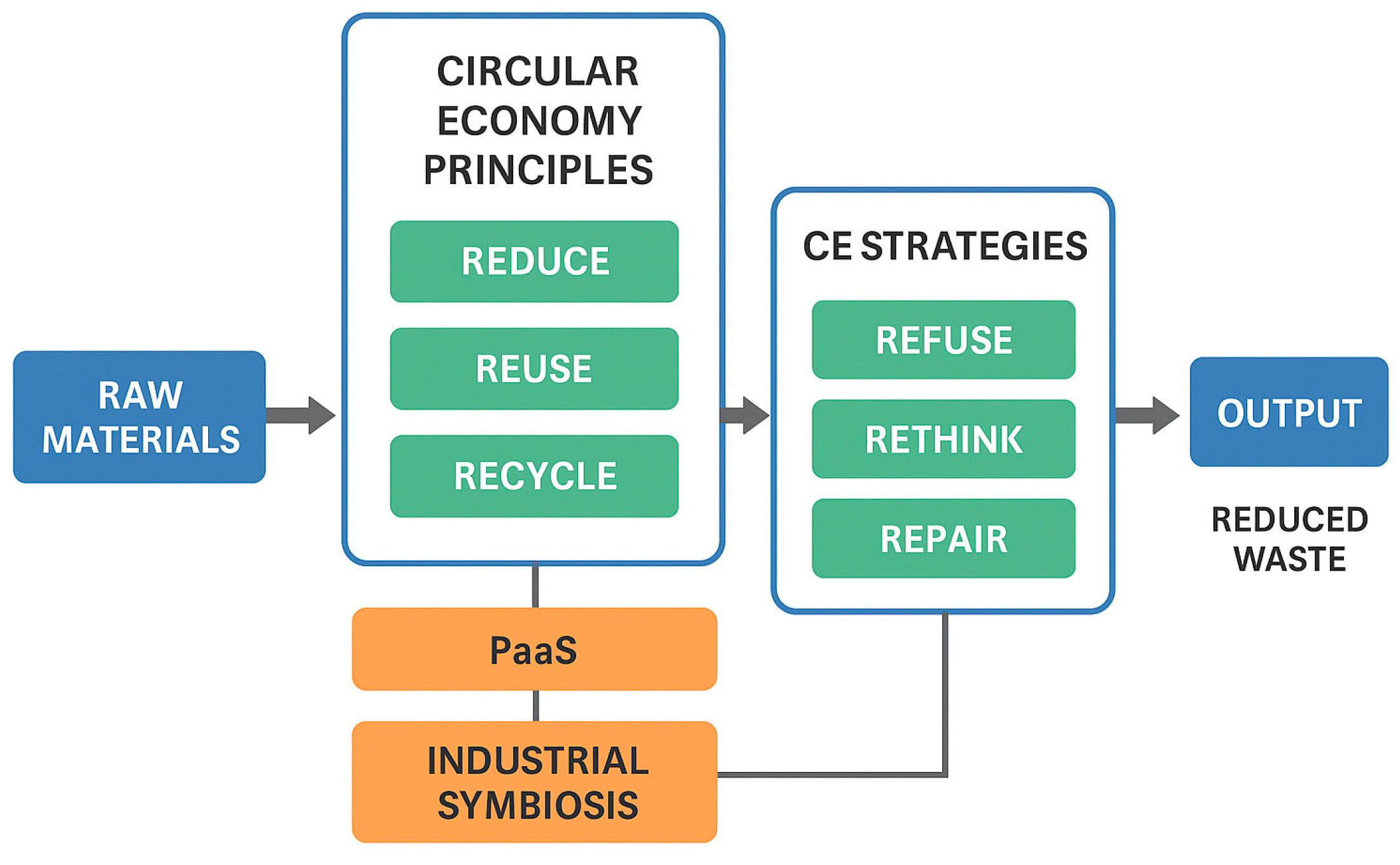
The real-world application of CE is directed by an order of approaches usually shortened to the 3Rs: Reduce, Reuse, and Recycle. These central ideologies are designed to reduce resource input and waste output [34], though the contemporary understanding of circular economy goes past the 3Rs, integrating wider approaches such as Reuse, Rethink, Repair, Remanufacture, Repurpose, and Recuperate [35]. These extended approaches are usually shown as a fragment of the ‘10Rs’ framework and reveal a deeper move to product longevity, material optimization, and complete improvement. Two innovative business models are fundamental to CE:
  • Product-as-a-Service (PaaS): this model changes the attention from product possession to admittance, where clients pay for the service that a product offers rather than the product itself. For instance, enterprises like Philips offer lighting as a service instead of selling light bulbs. This motivates producers to produce strong, repairable, and recyclable products [36].
  • Industrial synergy: this approach involves the teamwork between industries where the waste or by-products of one practice function as the raw materials for another. Kalundborg, Denmark, is a main instance of a positive industrial synergy system that has considerably reduced emissions and resource depletion [37].
Instead of aiding merely as conceptual frameworks, CE models such as the 3Rs/10Rs grading, Product-as-a-Service (PaaS), and cradle-to-cradle design basically modify material and energy streams within industrial systems, in that way impacting waste generation and greenhouse gas (GHG) emissions. Technologically, multi-level strategies (e.g., refuse, reduce, and rethink) lead to the utmost emissions declines by averting material mining and major processing, which are usually the most energy-demanding phases of product life cycles [38].
PaaS models encourage producers to use resilient materials, integrated designs, and prognostic maintenance technologies (e.g., sensors and digital twins), prolonging product lifespans and decreasing material output. Empirical studies show that extending product lifespans by 20–30% can reduce lifecycle emissions by up to 25%, particularly for energy-intensive goods such as electronics and appliances [39]. Similarly, repair and remanufacturing technologies, enabled by standardized components and advanced disassembly processes, significantly reduce waste flows while retaining up to 80% of the embodied energy of original products [40].
Cradle-to-cradle and engineering synergy frameworks further redesign waste streams by permitting circular material recovery and multi-sector resource exchange. Industrial enablers such as material flow analysis (MFA), actual waste categorization, and process combination permit industrial secondary products (e.g., fly ash, waste heat, digestate) to replace raw materials, decreasing landfill disposal and related methane emissions [41]. In such systems, waste is converted into a subordinate resource, directly reducing overall emissions at the system level.
On the other hand, basic strategies such as recycling, even though important, regularly convey lesser emission decreases, owing to energy necessities for collection, sorting, and reprocessing. Innovative recycling technologies (e.g., chemical recycling, solvent-based separation, pyrolysis) can increase material recovery rates, but their climate benefits are strongly dependent on energy sources and process efficiency [42]. As a result, CE frameworks underline waste prevention and lifespan extension even more over phase-out recycling. As displayed in Figure 2, CE principles are explained in practice through combined strategies and business models that simplify circular material and energy flows.

2.3. Performance Measure and Pointers of CE

Evaluating the usefulness and evolution of CE approaches needs vigorous parameters and pointers. Some parameters have been established to calculate diverse facets of circularity at product, organizational, and macroeconomic levels, as follows:
  • The Material Circularity Indicator (MCI) established by the Ellen MacArthur Foundation and Granta Design. It measures the degree to which material flows of a product are recuperative or reformative by design, on the basis of factors such as virgin against recycled input, product lifetime, and the value of output [43]. The MCI takes into consideration four major components:
    • Fraction of virgin feedstock (V).
    • Fraction of content of the material recycled (R).
    • Fraction of output of the material reused/recycled (E).
    • Product lifecycle utility (U) in relation to industry coverage.
The MCI can be calculated thus:
L i n e a r   F l o w   I n d e x L F I = V + W R
where W = unrecovered waste portion
At that point:
U t i l i t y   F a c t o r   X   =   u P u a v
Lastly, the MCI is given as
M C I = 1 L F I 2 X
where LFI = fraction of virgin material + unrecovered waste − recycled content, and X = ratio of product lifespan to industry average.
Higher MCI indicates reduced dependency on virgin materials, lower waste generation, and, indirectly, lower emissions due to avoided primary production.
A correction factor is useful to make sure MCI is within 0–1, with 1 considered as completely circular and 0 completely linear.
  • Life Cycle Assessment (LCA) is another thoughtful way used to assess the environmental effects of materials and methods during the course of their life cycle, from raw material removal to disposal. Though conventionally used in linear systems, it can be adjusted for circular systems by adding metrics for resource productivity, waste decline, and unimportant material usage [44]. Although traditional LCA does not have a specific formula for determining the ‘circularity’ of a material, revised circular LCA comprises indicators such as Resource Efficiency (RE) and Recycled Content (RC). These LCA-interrelated metrics permit contrast between circular and linear product systems.
    (a)
    Resource Efficiency (RE)
    R E =   F u n c t i o n a l   o u t p u t T o t a l   m a t e r i a l   i n p u t  
    In this case, a higher value of RE means a more efficient use of material
    (b)
    Recycled Content (RC)
    R C = M a s s   o f   r e c y c l e d   f e e d s t o c k T o t a l   p r o d u c t   m a s s
    (c)
    End-of-Lifecycle Recovery Rate (RR)
    R R =   M a s s   r e c o r v e r e d     a t   e n d o f l i f e c y c l e T o t a l   m a s s   o f   p r o d u c t  
These metrics quantify how efficiently materials are utilized and recovered, enabling assessment of GHG emission reductions due to reduced primary resource extraction [45].
Other key parameters include the following:
  • Circular Economy Performance Indicators (CEPIs): CEPIs evaluate resource productivity, recycling rates, and waste intensity at organizational or sectoral levels [46]. These consist of parts such as resource efficiency, rates of recycling, and the amount of waste generation. These systems of measurements are used to quantify efficiency, not to calculate circularity; nonetheless, they are commonly used in a policy framework [46]. Key metrics for CEPI formulas include the following:
    (a)
    Resource Productivity (RP)
    R P =   G D P D o m e s t i c   M a t e r i a l   C o n s u m p t i o n     ( D M C )
    (b)
    Recycling Rate (RR)
    R R = R e c y c l e d   w a s t e T o t a l   w a s t e   g e n e r a t e d  
    (c)
    Waste Generation Intensity (WGI)
    W G I = T o t a l   w a s t e   P o p u l a t i o n   o r   G D P
CEPIs provide macro-level insights into material efficiency, waste minimization, and economic circularity, linking directly to emission mitigation strategies [47].
Material Flow Analysis (MFA): MFA indicators assist in measuring and envisioning the physical flows of materials in a system, finding wastefulness and chances for circular intrusions. These indicators give insight into the circularity of natural or sector-level circularity [48]. Major formulas for indicators are the following:
(a)
Circularity Rate (CR)
C R = S e c o n d a r y   r e c y c l e d   m a t e r i a l   u t i l i z e d   i n   a   s y s t e m T o t a l   m a t e r i a l   i n p u t e d   i n   a   s y s t e m
(b)
Stock Accumulation (SA)
S A = I n p u t s O u t p u t s  
(c)
Dependency Ratio (DR)
D R =   I m p o r t s D o m e s t i c   E x t r a c t i o n  
MFA helps visualize material loops and quantify potential emission reductions by identifying where waste can be reintegrated into production [49].
Circularity Gap Indicator (CGI): this metric assesses the amount of the global economy that is circular, giving a macro-level perspective, and is usually applied in cities, nations, and globally [50]. CGI, as of 2023, was estimated to be approximately 72%, which shows that most of the world is considered highly linear. The CGI is calculated thus:
C G I =   T o t a l   m a t e r i a l s   r e c y c l e d   a n d   r e u s e d   T o t a l   m a t e r i a l   i n p u t e d   i n t o   t h e   e c o n o m y
CGI provides a macro-level perspective on circularity, and highlights how linear material flows contribute to emissions and resource depletion [51].
Table 1 summarizes the various CE indicators. Developing consistent, sector-precise, and accessible metrics remains a task. Nevertheless, precise measurement tools are needed for making policy and business plans, and for following progress to sustainability goals.

3. Waste Management in CE Framework

3.1. CE in Waste Hierarchy

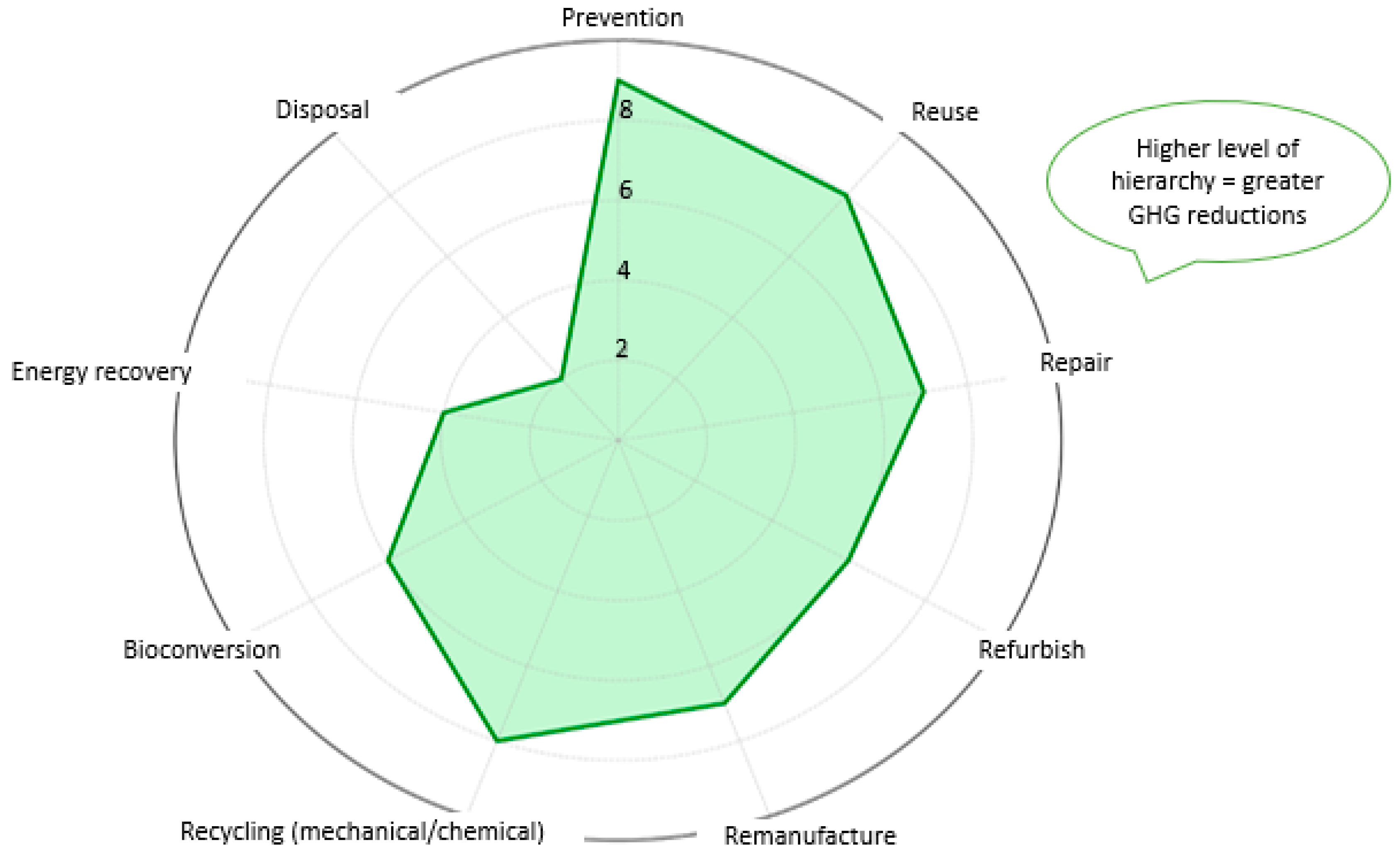
The waste hierarchy (Figure 3) functions as a guiding principle for sustainable waste management. CE redefines this hierarchy by prioritizing systemic resource efficiency over downstream solutions. In a circular economy structure, this pyramid is rearranged to emphasize waste prevention and reuse, and as a result, make the most of resource productivity and reduce environmental impacts [52]. Prevention has to do with the generation of waste at the design and production levels using environmentally friendly design, product life postponement, and consumption models that are sustainable [53].
Reuse has to do with product repair, renovation, and remanufacturing, extending product lifecycles, and lessening the demand for raw material. Mechanical and chemical recycling are vital to improving materials for rehabilitation into construction cycles. Recovery, like energy recovery using anaerobic digestion or incineration with energy detention, serves as a last-option valorization stage. Disposal into landfill is the least preferred option, and is not accepted in the circular economy associated guidelines. Circular economy motivated guidelines gradually include Extended Producer Responsibility (EPR) and product stewardship structures to move liability to producers, encouraging upstream design for recyclability and reparability [54].

3.2. Material Flow Analysis in Major Sectors

Material flow analysis (MFA) is a major means in the implementation of circular economy. Table 2 shows the material flow analysis in the main sectors. It gives the picture and quantity of the stock of materials that flows across different stages of the product life cycle. It pinpoints areas for intervention and discloses the possibility of closed material circles [55].
  • Packaging: packaging waste is one of the most persistent CE challenges. The global plastic value chain shows low circularity, with about ~9% of plastic waste being recycled, and the rest either being landfilled, incinerated, or outflowing into the environment [56]. This low recovery amount is mostly a result of the prevalence of transitory plastic packaging materials such as PET, HDPE, and LDPE, which are vastly susceptible to contamination, downcycling, and degradation. Even though mechanical recycling is conventional, it is frequently mired by contamination, breakdown of polymer properties, and the downcycling of materials into inferior products. Chemical recycling methods such as pyrolysis, depolymerization, and solvolysis are gradually accepted as key in overcoming contamination and renewing monomers or chemical input materials, hence allowing accurate closed-loop cycles [57]. Moreover, design innovations like mono-material packaging, digital watermarks, and eco-labeling can considerably advance collection and recyclability [58]. MFA studies also identify packaging as one of the main areas, besides the construction and automotive sectors, where interventions can produce the highest fundamental impact [56].
  • Electronics: e-waste is one of the fastest emerging and direst waste streams, globally. It embodies a valuable material flow, comprising metals like gold, silver, copper, and important rare earth elements needed for renewable energy technologies, batteries, and electronics production. Despite its importance, only 17.4% of global e-waste is properly collected and recycled in environmentally rigorous conditions, and the rest either landfilled, casually processed, or lost in the overall waste stream [59,60]. MFA enables tracking of electronic components across their life cycle—from production, consumption, and collection to end-of-life disposal. Such insights are critical in designing collection systems, refurbishment schemes, and urban mining strategies that optimize recovery rates and minimize environmental externalities. CE involvement in electronics management must synchronize policy, design, and technology. Extended producer responsibility (EPR) systems embolden producers to collect used devices, generating incentives for integrated design, repairability, and reuse of components. Environmentally designed approaches, such as removing unsafe additives, integrated architectures, and standardized borders, will enable easier repair, progress, and recovery. Additionally, advanced recycling approaches like hydrometallurgy, bioleaching, and pyrometallurgy allow the recovery of valuable and rare earth metals, reducing dependence on original extraction [60]. By introducing circularity into electronics supply chains, it is possible to concurrently mitigate environmental burdens and lessen reliance on virgin materials.
  • Food and Agriculture: food waste and agricultural waste remains consist mainly of organic matter and nutrients. About one-third of all food generated globally is wasted. This amounts to 1.3 billion tonnes yearly [61]. MFA in food systems shows wastefulness across the supply chain, from manufacture to consumption. When not properly managed, these wastes contribute to methane emissions, a powerful GHG, and result in the loss of surrounding resources like water and energy [62]. CE-motivated valorization approaches, comprising anaerobic digestion, bioconversion, and composting, can produce biogas, fertile soil amendments, and even substitute proteins [63]. Moreover, source interventions such as enhanced storage, digital boards for redistribution, and changes in consumer behavior are needed to reduce the generation of waste in the first instance.
  • Construction: construction and demolition waste (CDW) comprise one of the principal waste streams globally, predominantly encompassing concrete, metals, and timber. A key obstacle is the varied and miscellaneous nature of CDW, which obscures sorting and recovery. Nevertheless, CE prospects lie in design for disassembly, reuse of structural components, and careful demolition practices that preserve the quality of material. Additionally, recycled collections and ancillary raw materials can considerably balance virgin extraction, contributing to climate mitigation (European Environment Agency [64]).
  • Textiles: textile waste shows challenges related to mixed fibers, synthetic microfibers, and excessive fast-fashion making. Fiber separation equipment is unfledged, and hence, the recycling of mixed fabrics into superior-quality fibers is inadequate. CE involvements center on fiber-to-fiber recycling—mechanical and chemical, bio-based textiles, and circular business models like rental, resale, and repair services [65]. Tackling microfiber pollution also involves innovation in washing technologies and textile finishing.
The analysis of these combined sectors reveals that even though CE offers prospects for recovery of waste and resource use, each sector faces distinctive challenges—such as contamination in packaging, informal recycling in e-waste, nutrient loss in food waste, material diversity in construction and demolition waste, and fiber separation issues in textiles. However, there are strong opportunities for cross-sectional collaboration. For example, remains from food-waste bioconversion could be used in the production of bio-based textile fibers, whereas recycled plastics from packaging could be used as inputs in construction composites. These connections reveal the systemic nature of the CE, where waste from one sector becomes a resource for another, resulting in more resilient, low-carbon, and resource-efficient systems.

3.3. Waste Management Innovations in the Circular Economy

Innovation plays a critical role in transitioning to a CE, particularly in the conversion of waste into valuable resources. Table 3 presents the technological innovations supporting CE-based waste management. However, the success of these technologies is impacted by technical limitations such as process efficiencyand emission exchanges, and energy requirements change with scale.
The use of sophisticated sensors for sorting, mechanical and chemical recycling, and conversion of wastes using biological means, is important in making circular economy principles operational in managing waste. The sorting of waste using optical and AI-based technologies improves the secondary materials [66]. The use of mechanical means for the recycling of materials physically offers prospects, but could face restrictions as a result of contamination [67]. Chemical recycling, like pyrolysis and gasification, is useful in recovering materials that are difficult to recycle [57]. The conversion of waste using biological techniques like anaerobic digestion and black soldier fly processing helps in recovering energy and nutrients from organic waste [68]. Pyrolysis changes organic waste into bio-oil and syngas, giving value in combined waste-to-energy systems [69].
Mechanical recycling mostly has the lowest energy intensity and GHG emissions as compared to other recycling alternatives, as long as purity of material is high and conveyance expanses are restricted [70]. Life-cycle assessments constantly demonstrate that mechanical recycling of plastics can lessen GHG emissions by 30–80%, as compared to raw polymer production, though these benefits drop abruptly with emergent contamination and downward cycling [71].
In comparison, chemical recycling procedures are intrinsically energy-demanding owing to the high temperatures and endothermic reactions prerequisite to break polymer chains. Pyrolysis and gasification usually function at temperatures exceeding 400–800 °C, resulting in higher energy depletion and related emissions, except when joined with renewable energy sources or operational heat-addition systems [72]. Thermodynamic controls, together with entropy generation and conversion inadequacies, limit general material and energy recovery yields, underscoring the essentials for process optimization and addition within industrial energy systems [73]. However, when applied to non-recyclable waste streams, chemical recycling can provide overall climate advantages by balancing fossil-based feedstocks in petrochemical manufacture [74].
Biological treatment paths such as anaerobic digestion usually display lesser process energy requirements, though their emission performance is dependent intensely on methane detention efficiency and management of digestate [75]. Inefficient systems can result in elusive methane emissions that considerably offset climate benefits [76]. Innovative process control and gas capture technologies are, as a result, important for exploiting both circularity and climate mitigation results.

3.4. Case Studies of CE Waste Management Models

Some regions and countries have achieved success in including the principles of the circular economy in their waste management frameworks. Table 4 shows the summary of the comparative analysis of CE waste management models across countries.
The European Union (EU) is one of the most established states in the implementation of CE plans. Through its Circular Economy Action Plan, the Waste Framework Directive, and the Plastics Strategy, the EU has provided full regulatory and policy frameworks for the circulation of material [77]. Successes comprise municipal recycling rates above 50% in top states such as Germany and Austria, together with a stated 11% reduction in dependence on landfill between 2010 and 2023 [78]. Main structures of the EU model comprise controlling harmonization, the implementation of mandatory eco-design standards under the Eco-design for Sustainable Products Regulation (ESPR), and the emergent use of Digital Product Passports (DPPs) to advance traceability of resources across supply chains [79,80]. Nonetheless, challenges continue, mainly in the irregular advancement among Member States, with numerous weaker economies at risk of missing the 2025 municipal and packaging-waste recycling targets, mainly as a result of infrastructural cracks and weak implementation of extended producer responsibility [81,82]. These differences highlight the necessity for upgrading measures and investment maintenance to ensure reasonable implementation of CE objectives across the Union [82].
In China, CE policies have been established through the Circular Economy Promotion Law, eco-industrial park plans, and borders such as the National Sword Policy that barred imports of inferior recyclables [83]. The official recycling of waste electrical and electronic equipment (WEEE) has stretched rapidly, increasing from ~10.1 million units in 2012 to ~87.85 million units in 2021 for five main classes (TVs, ACs, refrigerators, washing machines, and PCs), with official recycling amounts exceeding 40% [84]. Industrial synergy initiatives in regions such as Tianjin demonstrate the potential of centralized CE planning. However, an insistent dependence on the informal recycling sector and regional enforcement differences limit uniformity across provinces [85,86].
The Netherlands is a member of the members’ state of the European Union, but is considered a separate case study because its national-level CE initiatives, governance structures, and performance metrics offer deeper perceptions that match the bigger EU-wide outlook, owing to her detailed national policy differences. Although the EU provides an all-embracing regulatory framework like the Circular Economy Action Plan (CEAP), the Waste Framework Directive (WFD), and the Ecodesign for Sustainable Product Regulation (ESPR), the Netherlands has cutting-edge country-specific CE strategies that go significantly past EU-wide obligation. The Netherlands has positioned itself as a CE leader, targeting 100% circularity by 2050. Provisional areas include halving primary abiotic raw material use by 2030 [87]. In spite of early progress like the approval of circular procurement policies and the implementation of zero-waste pilots, current valuations propose that the country is not yet on the path to meet its 2030 target [88]. Its circular material-use level (~24.5%) is somewhat high as compared to the EU average, but inadequate for its determined goals [89]. The Dutch model stands out for accentuating multi-stakeholder partnership and city-level CE roadmaps, but its dependency on international supply chains poses challenges for scaling a completely circular system.
Mutually, these case studies show that although the EU prioritizes regulatory organization, China centers on industrial synergy and integrated design, and the Netherlands stresses innovation and partnership, shared challenges continue. These include irregular implementation (EU, China), informal waste handling (China), and dependence on international trade (Netherlands). Meanwhile, each model suggests lessons that can be adapted: the EU’s implementation mechanisms, China’s scaling capability, and the Netherlands’ combined innovations show that mixed, context-thoughtful approaches are important to attaining strong, low-carbon, and resource-efficient CE systems.
The success and borders of CE-based waste management models in the countries mentioned can be mapped out as combining governance design, policy implementation ability, market enticements, and socio-technical position. For instance, In the European Union, achievement is mainly as a result of robust harmonization of regulation, recycling goals that are bounded by law, and extended producer obligation structures that adopt waste management costs into the design of products. On the other hand, the same layered governance that permits harmonization also contributes to irregular results, since implementation capability and application differ considerably amongst member states, mostly in emerging economies.
China’s model makes evident that regional governance and significant state investment can speedily hasten CE infrastructure implementation, particularly from end-to-end of eco-industrial parks and industrial synergy. The usefulness of this line lies in its capability to line up CE goals with national industrial policy and economic development. However, determined dependence on informal recycling segments and erratic regional implementation sideline environmental performance and traceability of material, specifying that centralized approaches alone are inadequate without harmonizing market mechanisms and social inclusion policies.
In the Netherlands, success is principally due to robust institutional harmonization, stakeholder engagement, and investigation at the city and regional stages, buttressed by circular procurement and invention-responsive policy frameworks. However, challenges abound in scaling resident successes on a national scale and decreasing necessity on inclusive material supply chains, which limits total decreases in use of virgin material. These outcomes point to the fact that CE usefulness capitalizes on the fact that regulatory precision, economic motivations, implementation ability, and shareholder involvement are at the same time present, and that the absence of any one of these essentials can considerably impact boundary performance. Summarily, CE results are not dependent on policy ambition alone, but on the level of placement between governance structures, market inclination, technological capacity, and social engagement. This explains why no solitary model can be generally replicated, and underlines the need for tailored CE strategies rather than a generic policy approach.

3.5. CE in the Energy and Chemical Industry

The energy and chemical sectors are major contributors to total greenhouse gas emissions and the generation of harmful waste materials, accounting for almost 30% of global industrial CO2 emissions, which emphasizes their essential role in climate mitigation efforts [90]. CE application in these sectors demands more than just a general recycling approach, but rather technical solutions. Attaining circularity can be through ways like the chemical recycling of plastics to naphtha or the addition of oils generated during the process of pyrolysis into steam crackers [91,92], the reuse of solvents recovered from closed loops [93], and hydrometallurgical retrieval of dangerous metals from used hydrotreating catalysts [94]. Other major ways for increasing circularity and decreasing the demand for energy are process-strengthening methods like reactive distillation, membrane reactors, and heat-integration networks [95]. Moreover, evolving CE implementation, such as closed-loop process-water systems, bio-based feedstock replacement, and the reuse of CO2 as a chemical feedstock (for example, methanol synthesis or polymer precursors), further validates the potential for circularity within fundamental reaction pathways.
Notwithstanding this, the implementation of CE in the chemical industry is limited by continuous extensive production models that involve constant purity of feedstock, stringent control of contamination, and consistent process flow [96]. These limitations hinder the direct addition of secondary raw materials. Harmful waste streams like sludges from refineries, tar remains/residues, expended catalysts, and wastewater which is high in salt content need specific CE-compatible ways like vitrification, zero-liquid-discharge systems, advanced oxidation, gasification, and metal recovery [97]. Additionally, the long lifetime of process equipment, constricted process integration, and high thermochemical constancy requirements requires CE strategies to be well-matched with continuous and high-cost operations, frequently depending on digital monitoring, predictive maintenance, modular retrofits to avoid process interruptions, including AI-based process control, IoT sensors, and digital twins, to conserve process constancy while improving circularity. Addressing these limitations and prospects is critical for translating CE values into industrially actionable approaches.

4. CE Strategies in Mitigating Climate Change

4.1. Emissions from Waste Treatment Processes

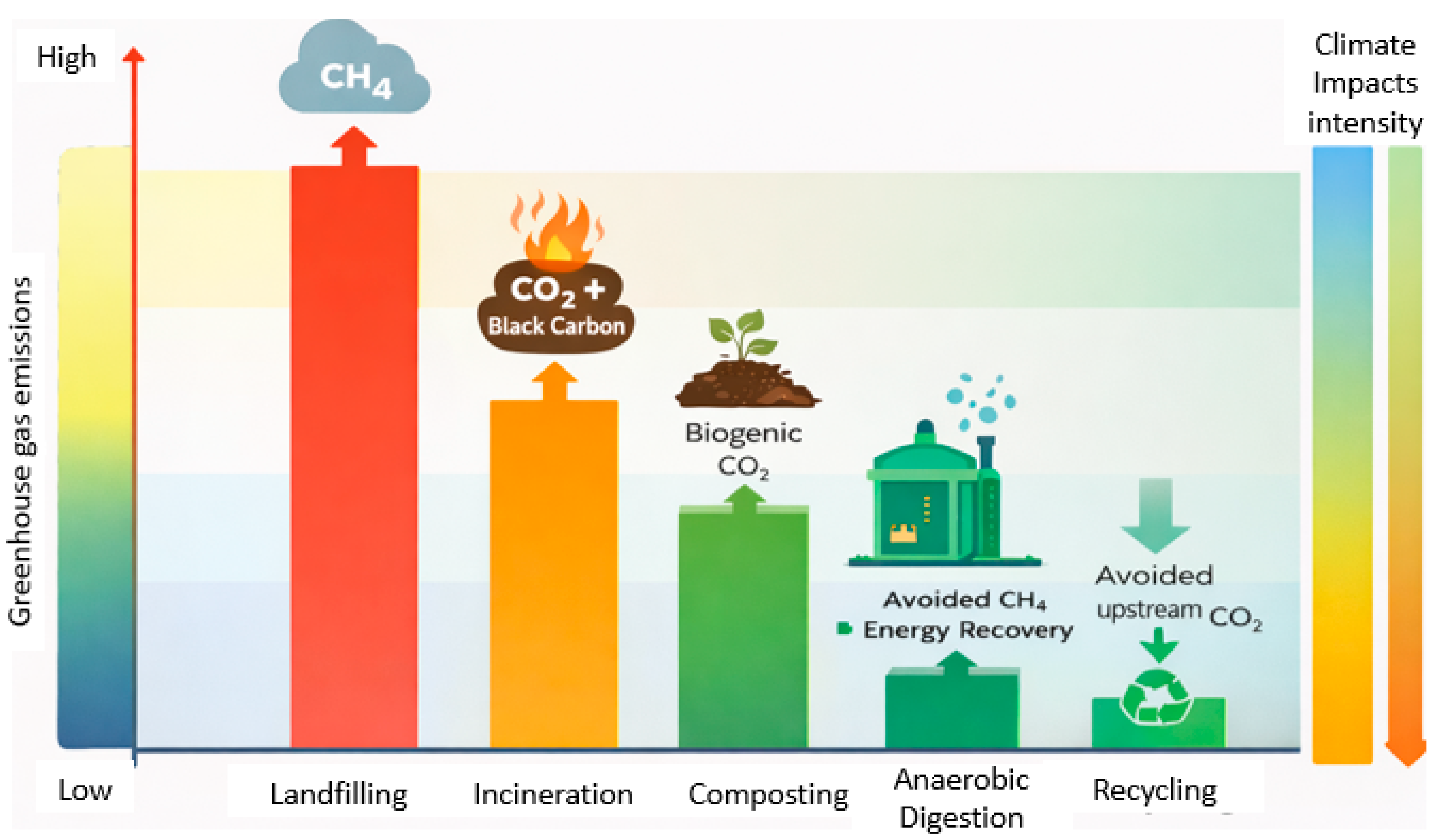
Waste management contributes significantly to global GHG emissions, particularly methane (CH4), carbon dioxide (CO2), and nitrous oxide (N2O), which are mainly emitted from landfills, the treatment of wastewater, and the burning of waste. Approximately 3% of total human-influenced GHG emissions come from waste, with methane from landfills representing a considerable portion due to the anaerobic decay of organic matter [98]. While this percentage seems reasonable in comparison to other sectors like energy or transport, the high warming potential of methane and the likely progression of MSW in urban areas present the sector as a serious part of climate mitigation strategies [99].
Methane emissions from landfills are the main problem, considering the methane has a global warming potential (GWP) 28–36 times more than CO2 over 100 years and more than 80 times greater over 20 years [100,101]. These emissions add explicitly to proximate climate warming, worsening reaction mechanisms like the increase in heatwaves, changes in precipitation forms, and the quickening of polar ice melt [102]. Moreover, landfill leachates are discharged and volatile organic compounds can interact with atmospheric chemistry, contributing ultimately to the development of the tropospheric ozone, a strong climate propeller and air pollutant [103].
Incineration reduces the volume of waste, but mostly releases CO2 and may produce pollutants like dioxins and furans if not well controlled [104]. The CO2 produced from incineration, particularly when fossil-derived plastics form a large part of the waste stream, adds to atmospheric carbon burdens. Equally, open burning of waste majorly releases CO2, although it may also release dioxins and furans, contingent on the type of waste and the effectiveness of the burning method [105]. In addition, open burning also produces black carbon, a momentary climate pollutant with a GWP hundreds of times more than CO2 in shorter periods [106]. Black carbon deposit on ice and snow speeds up albedo loss, and promotes increasing global warming and regional climate disorder [107].
Conversely, composting and anaerobic digestion have lower emissions profiles, though both can produce high GWP gases like CH4 and N2O in inadequate conditions. However, controlled aerobic composting and circular anaerobic digestion process with accurate gas-capture equipment can lessen these emissions efficiently [108,109]. Also, recycling, though not a direct treatment method for organic waste, can ultimately lessen emissions by avoiding the need for virgin material mining and handling, which usually require high energy, thereby dropping source carbon footprints [110]. Generally, emissions from waste systems not only contribute to the global carbon budget, but also increase climate-associated threats like a rise in sea level, loss of biodiversity, and food and water security. Controlling emissions from waste sectors is hence an important strategy for global climate-change mitigation.
Figure 4 compares the greenhouse gas emission profiles of major waste treatment pathways, demonstrating the comparative climate impacts of landfilling, incineration, recycling, composting, and anaerobic digestion. The contrast highlights the mitigation potential of CE-aligned paths, mostly those related to industrial and high-emission waste streams.

4.2. Reduction in Carbon via Circular Economy

Circular economy principles are employed to close material loops and reduce input of resources and environmental side effects, as well as greenhouse gas emissions. Different circular economy strategies are usually used in the management of waste to reduce emissions, as well as material exchange, recovery of energy, composting, and production of biochar. Material exchange via recycling and reuse considerably lessens greenhouse gas emissions. For example, recycling aluminum saves up to 95% of the energy that is needed to produce it from raw bauxite, whereas recycling plastics can save energy of up to 60–70% as compared to pure plastic manufacture [111,112]. Replacing traditional construction materials with recycled aggregate materials or industrial wastes also leads to declines in tangible carbon emissions [113].
The saving of energy is one principal benefit of the idea of the circular economy. Take, for example, waste-to-energy burning to recover energy, which can transfer fossil fuel utilization in the generation of electricity, though the amount of energy that will be recovered is vastly reliant on the composition of the feedstock material and efficiency of the energy recovery system [114]. Also, anaerobic digestion of organic waste not only hinders organic waste from going into landfills, but could produce biogas, a renewable source of energy that can substitute natural gas [115].

4.3. Accounting for Carbon in the Circular Economy

The addition of circular economy approaches into nationwide carbon accounting structures and climate strategies is not only a promising, but a fast-emerging area of concern. Outmoded greenhouse gas accounts time and again play down the mitigation possibility of circular economy approaches because they center primarily on direct emissions within sectoral borders, and do not consider life-cycle emissions and avoided emissions from material substitution and recycling [116,117].
In order to close this gap, new structures are developing to include circular economy actions into carbon accounting. To cite an instance, the European Union’s Circular Economy Action Plan inspires member states to measure greenhouse gas savings from the prevention of waste, reuse, and recycling under extended producer responsibility (EPR) and eco-design strategies [118]. Also, the addition of circular economy policies into Nationally Determined Contributions (NDCs) under the Paris Agreement is being encouraged by organizations like the Ellen MacArthur Foundation [119], which underscores the fact that circularity in material flows can decrease global greenhouse gas emissions by 20–30%. Accounting for carbon in the circular economy entails a change from process-based accounts to consumption-based or systems-based accounting methods, which reflect upstream and downstream emissions through product life cycles [120]. Such methods are mainly vital for circular economy approaches that depend on worldwide supply chains and transboundary material flows.
Conventional tools and procedures, such as Material Flow Analysis (MFA), Life Cycle Assessment (LCA), and Hybrid Input–Output (IO) models, are progressively being used to assess the carbon impacts of circular economy involvement on urban, local, and nationwide scales [121,122]. Even though these approaches offer vigorous awareness into the environmental impacts of waste systems, they have certain procedural limitations like direct assumptions, absence of vigorous temporal resolution, and feeble incorporation of behavioral factors [123,124]. These limitations highlight the fact that no single approach is enough for capturing the complete range of CE’s role in carbon mitigation; consequently, there is a need for a combination of frameworks [125].
Recent advances in carbon accounting approaches go beyond traditional tools. Dynamic Material Flow Analysis (DMFA) permits investigators to find resource stocks and flows in time, thus detecting “carbon lock-ins” connected with long-lasting structure and predicting impending waste-associated emissions [126]. Likewise, Environmentally Extended Multi-Regional Input–Output (EE-MRIO) models detail the cosmopolitan nature of material trade and consumption-based emissions, offering insights into the carbon embodied in imports and exports [127]. These methodologies are progressively applicable for countries with high dependence on material imports, where consumption-based emissions can deviate considerably from production-based records.
Furthermore, evolving behavioral and systems-based modelling tools offer capable leeway. Agent-Based Modelling (ABM) can mimic household-, industrial-, and policy-performer connections to evaluate the adoption and dispersal of CE approaches, allowing examination of diverse behavioral reactions to interferences like recycling orders or carbon estimating [128]. Similarly, System Dynamics Modelling (SDM) is current in capturing response loops, delays, and anomalies in waste–energy–emission systems, offering a vibrant perception on the lasting impacts of CE procedures [129].
Globally, Integrated Assessment Models (IAMs), which have been extensively utilized to evaluate pathways to attain 1.5 °C and 2 °C goals, are now being expanded to include CE involvement, comprising resource efficiency, material replacement, and waste valorization [130]. By implementing CE approaches into IAMs, investigators and policymakers can assess their total contributions to global climate stabilization efforts and lessen dependence on harmful emission technologies. Lastly, Product Environmental Footprint (PEF) tools developed by the European Commission offer uniform, product-level carbon accounting frameworks that can improve the parity and adaptability of CE approaches at both industry and policy levels [131]. Jointly, these tools change carbon accounting from a stationary, reviewing application into a dynamic, systemic, and progressive framework. Their adoption into general GHG lists and climate policies can advance the recognition of CE approaches as genuine mitigation ways under the Paris Agreement. Nevertheless, procedural coordination and the availability of data are a serious challenge for safeguarding uniformity across countries and sectors.

5. Implementation of the Circular Economy

In order to transition to a circular economy, there is a need for a multidimensional and combined method that is driven by robust supporting factors. These factors comprise both policy and regulatory frameworks, economic instruments, stakeholder engagement, and scientific novelties and innovations. Each of these factors is important in creating the general changes that are necessary for a successful transition from linear to circular models of production and consumption.

5.1. Policy and Regulatory Frameworks

Policy and regulation are the foundation upon which the circular economy is implemented by building the supporting environment, setting the needed goals, and promoting innovation. National and regional circular-economy frameworks provide a plan for lasting visions, objectives, and priority sectors. For example, the European Union’s Circular Economy Action Plan under the European Green Deal has set a pattern by forming governmental and non-governmental actions that advance the principles of circular economy across the lifecycle of products [132].
Extended Producer Responsibility (EPR) is one of the foundational controlling mechanisms for the circular economy. It makes it mandatory for producers to take up responsibility for the management of their product’s final life, and, by so doing, encourage eco-design and reduce the generation of waste. Nations like Japan, Germany, and South Korea have employed robust EPR systems that have considerably improved rates of recycling and resource recovery [133]. The taxes and bans placed on landfilling are other monitoring levers that discourage the disposal of recyclable and biodegradable waste, thus encouraging other waste management strategies like reuse, recycling, and composting. For instance, Sweden’s landfill tax has led to a significant reduction in landfilling, with over 99% of domestic waste now being recycled or used for energy recovery [134].

5.2. Economic Levers

Economic motivations and deterrents are crucial for adopting environmental externalities and promoting savings in circular economy practices. Green Public Procurement (GPP) is a mandatory policy tool that enables governments to order the acquisition of environmentally desirable goods and services. GPP can encourage important market demand for circular products and services, as seen in countries like the Netherlands and Finland, where green earning is included in national circular economy plans [135].
Carbon valuing mechanisms, plus carbon taxes and emission exchange systems, incentivize emission drops and energy efficiency advances across supply chains. By allocating a cost to carbon emissions, these tools encourage firms to embrace resource-effective and low-carbon technologies important to circular economy models [136]. Additionally, directed grants and economic incentives for circular economy innovations, like tax credits for material recycling services or low-interest loans for sustainable product design, can lessen economic risks connected with circular economy transitions, mostly for small and medium-sized enterprises. Investment in CE launches and expansion is also increasing, regularly sustained by green bonds and impact investment assets. These economic tools station capital into projects that add to CE results like closed-loop recycling, bio-based materials, and the circular product as a service model [137].

5.3. Engagement with Stakeholders

The general nature of CE requires the dynamic engagement of different participants, like governments, industry, academia, and indigenous communities. Governments play a directing part by developing policy consistency, promoting cross-sectoral teamwork, and funding research and development in circular advances. Additionally, local governments are gradually using household-level motivations to boost circular practices. Instances include pay-as-you-throw (PAYT) curricula, reductions for households operating specialized home composters, and discounts for purchasing refillable items or products that are repairable. Such economic tools allow citizens to directly reduce the cost of municipal waste management.
Public–private partnerships (PPPs) have been shown to be effective in building CE infrastructure, such as industrial cooperation parks and waste-to-energy services.
Industries play a pivotal role in the implementation of CE practices at the operating level. Prominent companies are rewriting business models to incorporate circular principles such as remanufacturing, hiring, and reverse logistics. For example, Philips and HP have embraced product-as-a-service models, moving from title to service delivery, thus decreasing the material amount [138,139].
Academic institutes contribute via research, education, and innovation. Different disciplines, circular-economy research centers, and university–industry alliances are aiding the development of innovative materials, life-cycle assessment tools, and circular economy metrics. Furthermore, capacity-building creativities like curricula focused on the circular economy and training programs are promoting a workforce prepared for the circular transition [140]. Communities and civil society organizations (CSOs) also play a significant part by promoting behavioral change and pinpointing CE initiatives. Community-driven repair workshops, zero-waste actions, and indigenous exchange organizations illustrate common circular economy actions, regularly supported by community policies and non-governmental organizations [141].
Several positive CE-oriented systems globally depend on inclusive citizen cooperation reinforced by regulatory and economic tools. Obligatory waste-sorting systems, employed in countries like Germany, South Korea, and Slovenia, have been revealed to immensely improve rates of material recovery and reduction of contaminants in recyclables [142]. These systems depend on a strong guiding principle, color-coded bins, and municipal administration to guarantee compliance. Deposit-return schemes (DRS) for beverage containers, extensively approved in the EU, form strong economic motivations for households to return PET bottles, cans, and glass containers, by contributing refunds per unit. DRS has attained return rates beyond 90% in countries like Norway and Lithuania [143].

5.4. Innovation and Digitalization

Technological innovation and digitalization are pivotal facilitators of the circular economy, improving the efficiency of resources, traceability of products, and optimization of systems. Digital technologies like Artificial Intelligence (AI), the Internet of Things (IoT), and blockchain are principal to this change. AI is being engaged in predictive maintenance, intelligent sorting of waste, and enhanced logistics during recycling processes. For instance, machine-learning algorithms can pinpoint components that are valuable at the end of the life of electronics, allowing efficient recovery of material [144]. IoT devices enable actual checking of the use of the product and the generation of waste, aiding circular interventions that are data-driven, like automatic record management and tracking of waste [145].
Blockchain technology safeguards transparency and tracking through supply chains by tightly recording dealings and material flows. This is mainly helpful for confirming recycled content, guaranteeing compliance with extended producer-responsibility regulations, and allowing product permits that notify consumers about product source, structure, and recyclability [146]. Digital platforms and markets are also evolving to enable the exchange of resources, reuse of products, and collaborative consumption. Examples include B2B platforms for industrial cooperation, digital twins for circular product design, and networked membership applications that extend the lifecycles of products [147].

6. Obstacles and Challenges

Despite the potential of CE strategies, their implementation is restricted by numerous factors that hinder practicability and scalability. Some of these factors include the high energy amount required for certain recycling and recovery processes, thermodynamic productivity restrictions that constrain material and energy recovery vintages, feedstock purity necessities for inferior materials, and challenges connected with mixing circular processes into extensive uninterrupted industrial systems. Additionally, the practical development of unindustrialized CE technologies, infrastructure accessibility, and process constancy necessities also impact their environmental performance and climate mitigation potential. Identifying these limitations is necessary for avoiding lack of nuance and for aligning CE strategies with accurate engineering and functioning situations. This section discusses specific obstacles and challenges that limit the implementation of CE, in detail.

6.1. Technical and Structural Limitations

Technical and infrastructural shortages result in a major barrier to the application of circular approaches, especially in developing nations. Many places lack suitable recycling amenities, waste segregation systems, and innovative material-recovery skills, which are essential for allowing high-quality circular flows [110,148]. For example, poor sorting and collection structures regularly result in the pollution of recyclable materials, and, subsequently, in lower-quality secondary raw materials, low market value, and increased rates of landfills and burning.
The lack of uniform processes and inadequate digital infrastructure hinders the growth of reverse logistics, product tracking, and lifecycle data structure, which are essential for circular supply chains [149]. Innovative technologies like AI, IoT, and blockchain could potentially enable the actual monitoring of waste and tracking of materials, but their implementation is limited due to cost, skills gaps, and compatibility issues. Besides, several industrial processes were designed based on a linear “take–make–dispose” approach, making upgrading or changing current systems with circular options both expensive and technically difficult. The change necessitates not only upgrades to infrastructure, but also innovation in product design, materials engineering, and rebuilding technologies [150].
Another serious technical and infrastructural issue in several countries is the lack of standardized and clear labelling of packaging waste. Products are often marked with vague or confusing signs, like the “green dot”, which consumers wrongly understand as signifying recyclability [151]. This discrepancy across producers and counties causes contamination in recycling streams and raises the costs of processing. Furthermore, evolving materials, such as multilayer packaging, biopolymers, and composite materials, are frequently promoted as circular; however, most of them currently lack practical, scalable recycling or composting pathways. Therefore, these materials are commonly landfilled or incinerated because current waste-management systems cannot process their mixed structures, additives, or unsuitable polymer combinations [152].

6.2. Economic and Market Limitations

Economic constraints play an important role in preventing the change to circularity. One of the main issues is the lack of financial motivations and the domination of linear economic models that highlight temporary profits over lasting sustainability. In many cases, non-recycled materials cost less than those recycled, due to market subsidizations, economies of scale, or the lack of environmental cost internalization [153]. Small and medium-sized enterprises, which form the support of many economies, regularly lack the money and risk-appetite to invest in circular innovations or green technologies [154]. Moreover, the lack of mature subordinate markets for recycled materials restricts demand, depressing investment in recycling set-up and circular business models.
Price instability in ancillary raw-material markets is also a challenge, as it makes it difficult for businesses to strategize and scale processes. For example, inconsistent oil prices directly influence the affordability of recycled plastics compared to new ones [155]. Also, the lack of consistent certifications and product quality assurance for recycled materials further weakens market assurance and trust of consumers. Public procurement systems and savings structures also remain subjective toward linear infrastructure, stressing the need for circular principles in green financing mechanisms and public–private corporations [156].

6.3. Institutional and Policy Fissures

Institutional breakup and policy disorganization are among the most prevalent problems that hinder the implementation of the circular economy. Many governments do not have inclusive circular economy plans, or the current strategies do not align well across sectors like waste management, energy, agriculture, and industrial growth [157]. Furthermore, strategies frequently focus intently on end-of-life recycling instead of encouraging upstream prevention, product design, and complete innovation. In some nations, governing frameworks are obsolete or unclear, and are unable to give clear descriptions, tasks, and implementation mechanisms for the practices of the circular economy. For example, the grouping of waste resources as “hazardous” or “non-waste” frequently lacks precision, hindering their reuse or cross-boundary trade [158].
Weak institutional ability and exploitation can further grind down the efficiency of CE programs, particularly in LMICs. Inadequate monitoring, poor implementation of environmental standards, and a lack of inter-agency organization can lead to policy operation gaps [159]. There is also a need for policies that encourage innovation and entrepreneurship in the circular economy, like tax inducements for eco-design, subsidies for circular startups, and governing sandboxes for model projects. Also, without incorporating CE into nationwide development and climate plans, the efforts remain disjointed and less impactful.

6.4. Behavioral and Social Sprints

Social and cultural factors considerably impact the success of CE changes, frequently acting as indirect but deeply rooted obstacles. Consumer behaviors such as overconsumption, low input in recycling programs, and opposition to product-reuse models (for example, overhauled electronics or shared services), are the main problems to demand-side circularity [160].
Absence of awareness of, and education about, CE principles among consumers, industries, and legislators is a frequent challenge. Studies have reported that many investors are not familiar with circular policies like product-as-a-service, cradle-to-cradle design, or industrial synergy [161]. This knowledge gap hinders the implementation of CE practices, even when organizational and policy support are present. Traditional defiance of waste, cleanliness, and possession also plays a part. In some cultures, there is dishonor associated with second-hand things or products that are produced from recycled materials, which restricts market infiltration [162]. Also, the “offhand culture” encouraged by reckless fashion, single-use packaging, and planned desuetude opposes the central philosophy of CE. Possibly the most underrated barrier to the implementation of CE is the lack of consumer knowledge, awareness, and commitment to circular practices. Consumers often fail to properly segregate waste at source, even when there is the availability of infrastructure, which results in high rates of contamination that weaken the efficiency of recycling [163].
In many cultures, waste management is still perceived as the responsibility of the government instead of a collective common responsibility. This attitude pointedly limits the participation of households in composting, source-segregation, and reuse structures [164]. Public education campaigns are inadequate, inconsistent, or poorly implemented, leaving big knowledge gaps across groups of the population. Overcoming these social obstacles needs complete changes in education, marketing, and public engagement. Communal innovation, pushing techniques, and alertness promotions can help change values and practices to more sustainable consumption and production designs.

7. Future View and Research Directions

7.1. Total Integration of CE and Climate Policy

One of the foremost needs is the complete integration of the principles of the circular economy into domestic and global climate policies. At present, climate frameworks, like Nationally Determined Contributions (NDCs) under the Paris Agreement, regularly manage the mitigation possibility of circular policies, concentrating mainly on renewable energy and efficiency measures [165]. Nonetheless, studies have established that CE practices like material reuse, recycling, and product-life extension can considerably lessen GHG emissions across numerous sectors, as well as construction, transportation, and food systems [166]. Incorporating CE into climate policy needs the bringing together of waste management, industrial strategy, and environmental guidelines. For example, life-cycle-centered strategy tools and carbon rating mechanisms can be extended to include resource productivity metrics [167]. Moreover, international bodies must encourage policy unity by supporting CE strategies with the Sustainable Development Goals (SDGs) and climate adaptation efforts.

7.2. CE in Developing Economies and Informal Sectors

The CE changeover must be all-encompassing and circumstance-specific, particularly for developing economies where informal sectors dominate handling of waste and resource recovery. In many developing countries, informal pickers of waste add considerably to recycling efforts, but remain disregarded in policy and structure development [168]. A fair changeover requires formal acknowledgement, communal protections, and capacity building for these players.
Developing economies face distinctive challenges, as well as inadequate institutional capacity, financial limitations, and a lack of technical structure [169], though these areas also present prospects for advancing into circular practices, avoiding the linear industrial paths of the Overall North. Trial initiatives in Africa and Asia show that dispersed CE models like community-centered composting or moderate plastics recycling can produce great environmental and socio-economic benefits when sustained by supporting policies and funding [170]. We therefore call for research on CE scalable models that consider indigenous socio-economic dynamics and integrate the voices of informal sector investors. Relative situation studies and South–South information exchange will be important in familiarizing CE strategies with various overall frameworks.

7.3. Circular Design and Sustainable Consumption

The upstream addition of circularity through design novelty and change in consumer behavior is another serious area that requires innovation. Circular design involves the development of products that are strong, flexible, repairable, and recyclable, ensuring the efficiency of resources and prolonging the life cycles of products [150]. This method must be rooted in the starting point of products and sustained by digital tools like product passports and material-tracing systems.
Similarly essential is the advancement of sustainable consumption designs such as demand-side measures like product-as-a-service models, mutual-economy platforms, and consumer education. This can help decouple economic development from resource use, [171], though behavioral apathy, cultural inclinations, and affordability are still major barriers to extensive acceptance. To spread circular design and consumption, research across many disciplines is needed to bridge design thinking, social science, and lifecycle engineering. Regulatory tools like Extended Producer Responsibility (EPR), eco-labeling, and green procurement policies must also be cultivated to encourage source circularity.

7.4. Call for Interdisciplinary Research and All-Inclusive Assessment

The intricacy of CE enactment and its link with climate and sustainability goals requires complete, collaborative approaches. Current CE valuations frequently lack uniformity and overlook complete responses, balances, and reflection effects [172]. For example, recycling creativity may reduce waste but increase energy consumption and emissions in the supply chain. We therefore call on future research to highlight the growth of joined assessment models that synchronize material flow analysis (MFA), life cycle assessment (LCA), and system dynamics. These tools should be able to assess not only environmental effects, but also social and economic consequences, through numerous measures and time distances. Furthermore, CE research should be collaboratively produced with stakeholders, comprising legislators, industries, the public, and informal players, to ensure importance and applicability. Research across disciplines and laboratories can serve as trial platforms for testing CE innovations and governance mechanisms in practical settings.

8. Conclusions

This review provides a comprehensive synthesis of existing studies on integrating the circular economy (CE) framework into sustainable waste management as a strategic pathway for climate change mitigation. By examining theoretical basics, operational practices, and enabling mechanisms, the review reveals that CE can transform production and consumption structures while lessening greenhouse gas (GHG) emissions. The circular economy offers a strong platform for the reduction of environmental impacts and the enablement of climate resilience. Including the principles of the circular economy into waste management will result in significant reductions in greenhouse gas emissions and also promote economic and material efficiency. Notwithstanding this, a supportive policy and governing environment, financial motivations, cross-sector collaboration, and the employment of digital technologies are essential to its effective implementation. In realizing its full benefits and implementation, challenges like technical restrictions, economic and policy reservations, and social resistance, mainly in developing and informal regions, must be overcome.
Beyond synthesizing existing studies, the review contributes scientifically by framing the circular economy as an integrated climate mitigation approach instead of just a waste management concept. Through linking the principles of CE together with emissions mitigation strategies, sector-focused engineering solutions, and climate change policy tools, the review gives an inclusive framework for understanding how CE can support computable progress in the direction of climate goals. The review also discusses CE in high-emission sectors, such as the chemical and energy industries, which are scarcely considered in the literature.
Future work should emphasize evolving quantifiable CE–GHG indicators, modelling CE possibility in continuous industrial processes, and integrating CE approaches into national climate strategies. Prioritizing digitalization (together with digital twins, AI-driven tracking, and decentralized material tracking) and interdisciplinary collaboration will be important for scaling CE in energy and emission-intensive industries. Consolidating these parts will guarantee CE transitions from a conceptual ideal into a real-world, sector-specific climate resilience and waste-system revolution model.
In summary, the objectives of this review were fully realized. The analysis combined CE theory, waste management practices, a roadmap to decarbonization, and sector-focused technical approaches, indicating how CE strategies can promote CE and reduce emissions. By leveraging technological innovations, policy support, practical challenges, and the needs of future research, the review provides an inclusive assessment consistent with the stated objectives.

Author Contributions

Conceptualization, S.J.I. and M.V.K.; validation, S.J.I., M.V.K., J.T.A. and D.P.; investigation, S.J.I. and M.V.K.; writing—original draft preparation, S.J.I.; writing—review and editing, S.J.I., M.V.K., J.T.A. and D.P.; visualization, M.V.K., J.T.A. and D.P.; supervision, M.V.K. and J.T.A.; project administration, M.V.K. and J.T.A.; funding acquisition, M.V.K. All authors have read and agreed to the published version of the manuscript.

Funding

This research was funded by National Research Foundation, South Africa, through the NRF SARChI Chair (Waste and Climate Change).

Data Availability Statement

No new data were created.

Acknowledgments

Authors acknowledge all the support from the University of KwaZulu-Natal and the National Research Foundation, South Africa, for this research.

Conflicts of Interest

The authors declare no conflicts of interest. The funders had no role in the design of the study; in the collection, analyses, or interpretation of data; in the writing of the manuscript; or in the decision to publish the results.

Abbreviations

The following abbreviations are used in this manuscript:
CECircular economy
GHGGreenhouse gas
MSWMunicipal solid waste
LCALife Cycle Assessment
CEPIsCircular Economy Performance Indicators
MFAMaterial Flow Analysis
PETPolyethylene Terephthalate
HDPEHigh-Density Polyethylene
LDPELow-Density Polyethylene
EPRExtended producer responsibility
CDWConstruction and demolition waste
ESPREcodesign for Sustainable Products Regulation
IOInput–Output
EE-MRIOEnvironmentally Extended Multi-Regional Input–Output
ABMAgent-Based Modelling
SDMSystem Dynamics Modelling
IAMsIntegrated Assessment Models
PEFProduct Environmental Footprint
GPPGreen public procurement
PPPsPublic–private partnerships (PPPs)
CSOsCommunities and civil society organizations
AIArtificial Intelligence
IoTInternet of Things
NDCsNationally Determined Contributions
SDGsSustainable Development Goals
MCIMaterial Circularity Indicator
RCRecycled Content
REResource Efficiency
RRRecovery Rate
RPResources Productivity
WGIWaste Generation Intensity
SAStock Accumulation
DRDependency Ratio
CIGCircularity Indicator Gap

References

  1. United Nations Environment Programme (UNEP). Global Waste Management Outlook 2024; UNEP: Nairobi, Kenya, 2024. Available online: https://www.unep.org/resources/global-waste-management-outlook-2024 (accessed on 20 November 2025).
  2. Sakaya, R.; Niwagaba, C.B.; Katukiza, A.Y.; Lüthi, C. Influence of National Government and Development Partners on Uganda’s Water, Sanitation, and Solid Waste Services Delivery: A Review. World Water Policy 2025, 11, 939–952. [Google Scholar] [CrossRef]
  3. Kiehbadroudinezhad, M.; Merabet, A.; Hosseinzadeh-Bandbafha, H. Landfill source of greenhouse gas emission. In Advances and Technology Development in Greenhouse Gases: Emission, Capture and Conversion; Elsevier: Amsterdam, The Netherlands, 2024; pp. 123–145. [Google Scholar]
  4. Reyna-Bensusan, N.; Wilson, D.C.; Davy, P.M.; Fuller, G.W.; Fowler, G.D.; Smith, S.R. Experimental measurements of black carbon emission factors to estimate the global impact of uncontrolled burning of waste. Atmos. Environ. 2019, 213, 629–639. [Google Scholar] [CrossRef]
  5. Hadei, M.; Yousefian, F. Global Air Quality and Climate Change. In Air Pollution, Air Quality, and Climate Change; Elsevier: Amsterdam, The Netherlands, 2025; pp. 175–197. [Google Scholar]
  6. Hidalgo, D.; Martín-Marroquín, J.M.; Corona, F. A multi-waste management concept as a basis towards a circular economy model. Renew. Sust. Energy Rev. 2019, 111, 481–489. [Google Scholar] [CrossRef]
  7. Zhang, Z.; Malik, M.Z.; Khan, A.; Ali, N.; Malik, S.; Bilal, M. Environmental impacts of hazardous waste, and management strategies to reconcile circular economy and eco-sustainability. Sci. Total Environ. 2022, 807, 150856. [Google Scholar] [CrossRef] [PubMed]
  8. Ji, M.; Li, J.; Zhang, M. What Drives the Agricultural Carbon Emissions for Low-Carbon Transition? Evidence from China. Environ. Impact Assess. Rev. 2024, 105, 107440. [Google Scholar] [CrossRef]
  9. Reddy, V.V.; Kumar, P.; Rao, A.L.N.; Kumar, R.; Singh, S.; Asha, V.; Kareem, S.H. Waste to wealth generation: Innovative methodologies in resource utilization and minimization in circular economy. In E3S Web of Conferences; EDP Sciences: Les Ulis, France, 2023; Volume 453, p. 1035. [Google Scholar] [CrossRef]
  10. Korhonen, J.; Honkasalo, A.; Seppälä, J. Circular economy: The concept and its limitations. Ecol. Econ. 2018, 143, 37–46. [Google Scholar] [CrossRef]
  11. Yang, M.; Chen, L.; Wang, J.; Msigwa, G.; Osman, A.I.; Fawzy, S.; Rooney, D.W.; Yap, P.S. Circular economy strategies for combating climate change and other environmental issues. Environ. Chem. Lett. 2023, 21, 55–80. [Google Scholar] [CrossRef]
  12. Van Ewijk, S.; Stegemann, J.A.; Ekins, P. Global life cycle paper flows, recycling metrics, and material efficiency. J. Ind. Ecol. 2018, 22, 686–693. [Google Scholar] [CrossRef]
  13. Yamada, K.; Ii, R.; Yamamoto, M.; Ueda, H.; Sakai, S. Japan’s greenhouse gas reduction scenarios toward net zero by 2050 in the material cycles and waste management sector. J. Mater. Cycles Waste Manag. 2023, 25, 1807–1823. [Google Scholar] [CrossRef]
  14. Bouramdane, A.A. How Can Multi-Criteria Decision-Making Optimize Adaptation Strategies for Climate Change-Induced Migration? Afr. Cities J. 2025, 5, 119–158. [Google Scholar] [CrossRef]
  15. Kirchherr, J.; Yang, N.H.N.; Schulze-Spüntrup, F.; Heerink, M.J.; Hartley, K. Conceptualizing the circular economy (revisited): An analysis of 221 definitions. Resour. Conserv. Recycl. 2023, 194, 107001. [Google Scholar] [CrossRef]
  16. European Commission. Closing the Loop—An EU Action Plan for the Circular Economy; COM (2015) 614 Final; European Commission: Brussels, Belgium, 2015. [Google Scholar]
  17. Ellen MacArthur Foundation. Towards the Circular Economy: Economic and Business Rationale for an Accelerated Transition; Ellen MacArthur Foundation: Cowes, UK, 2013. [Google Scholar]
  18. Kirchherr, J.; Reike, D.; Hekkert, M. Conceptualizing the circular economy: An analysis of 114 definitions. Resour. Conserv. Recycl. 2017, 127, 221–232. [Google Scholar] [CrossRef]
  19. Tambovceva, T.; Titko, J. Introduction to Circular Economy; Ekonomikas un Kultūras Augstskola: Riga, Latvia, 2020. [Google Scholar]
  20. Kandpal, V.; Jaswal, A.; Santibanez Gonzalez, E.D.; Agarwal, N. Circular economy principles: Shifting towards sustainable prosperity. In Sustainable Energy Transition: Circular Economy and Sustainable Financing for Environmental, Social and Governance (ESG) Practices; Springer: Cham, Switzerland, 2024; pp. 125–165. [Google Scholar]
  21. Ishaq, S.; Tanveer, U.; Hoang, T.G.; Wamba Samuel, F. From linear to circular: Capabilities, defensive reasoning and supply chain collaborations in manufacturers’ circular economy transition. Br. J. Manag, 2025; Online. [Google Scholar] [CrossRef]
  22. Wang, Y.; He, Y.; Gao, X. Synergizing Renewable Energy and Circular Economy Strategies: Pioneering Pathways to Environmental Sustainability. Sustainability 2025, 17, 1801. [Google Scholar] [CrossRef]
  23. Calisto Friant, M.; Vermeulen, W.J.; Salomone, R. Transition to a sustainable circular society: More than just resource efficiency. Circ. Econ. Sustain. 2024, 4, 23–42. [Google Scholar] [CrossRef]
  24. Petelin, E. Security Priorities in Circular Economy: A Conceptual Review. Sustain. Prod. Consum. 2024, 47, 655–669. [Google Scholar] [CrossRef]
  25. Jensen, H.H., 3rd. R–Revamping Business Through Repair. In Circular Economy Opportunities and Pathways for Manufacturers: Manufacturing Renewed; Springer Nature Switzerland: Cham, Switzerland, 2025; pp. 137–160. [Google Scholar]
  26. Jensen, H.H. Circular Economy as a Catalyst for Innovation and Growth. In Circular Economy Opportunities and Pathways for Manufacturers: Manufacturing Renewed; Springer: Cham, Switzerland, 2025; pp. 429–442. [Google Scholar]
  27. Grant, M.J.; Booth, A. A typology of reviews: An analysis of 14 review types and associated methodologies. Health Inf. Libr. J. 2009, 26, 91–108. [Google Scholar] [CrossRef]
  28. Snyder, H. Literature review as a research methodology: An overview and guidelines. J. Bus. Res. 2019, 104, 333–339. [Google Scholar] [CrossRef]
  29. Geissdoerfer, M.; Savaget, P.; Bocken, N.M.P.; Hultink, E.J. The circular economy—A new sustainability paradigm? J. Clean. Prod. 2017, 143, 757–768. [Google Scholar] [CrossRef]
  30. Lowe, E.A.; Evans, L.K. Industrial ecology and industrial ecosystems. J. Clean. Prod. 1995, 3, 47–53. [Google Scholar] [CrossRef]
  31. McDonough, W.; Braungart, M. Cradle to Cradle: Remaking the Way We Make Things; North Point Press: New York, NY, USA, 2002. [Google Scholar]
  32. Yuan, Z.; Bi, J.; Moriguichi, Y. The Circular Economy: A New Development Strategy in China. J. Ind. Ecol. 2006, 10, 1–2. [Google Scholar] [CrossRef]
  33. De Angelis, R.; Ianulardo, G. Circular economy principles as a basis for a sustainability management theory: A systems thinking and moral imagination approach. Bus. Strategy Environ. 2024, 33, 4861–4870. [Google Scholar] [CrossRef]
  34. Mirzaei, S.; Shokouhyar, S. Applying a thematic analysis in identifying the role of circular economy in sustainable supply chain practices. Environ. Dev. Sustain. 2023, 25, 4691–4722. [Google Scholar] [CrossRef]
  35. Khaw-ngern, K.; Peuchthonglang, P.; Klomkul, L.; Khaw-ngern, C. The 9Rs strategies for the circular economy 3.0. Psychol. Educ. J. 2021, 58, 1440–1446. [Google Scholar] [CrossRef]
  36. Moura, P.B.D.S. Circular Economy’s Role in Waste Reduction and New Business Generation. Master’s Thesis, ISCTE—Lisbon University Institute, Lisbon, Portugal, 2023. [Google Scholar]
  37. Capucha, F.; Henriques, J.; Ferrão, P.; Iten, M.; Margarido, F. Analysing industrial symbiosis implementation in European cement industry: An applied life cycle assessment perspective. Int. J. Life Cycle Assess. 2023, 28, 516–535. [Google Scholar] [CrossRef]
  38. Creutzig, F.; Simoes, S.G.; Leipold, S.; Berrill, P.; Azevedo, I.; Edelenbosch, O.; Wilson, C. Demand-Side Strategies Key for Mitigating Material Impacts of Energy Transitions. Nat. Clim. Change 2024, 14, 561–572. [Google Scholar] [CrossRef]
  39. Kutscher, C.F.; Milford, J.B.; Kreith, F. Principles of Sustainable Energy Systems; CRC Press: Boca Raton, FL, USA, 2025. [Google Scholar]
  40. Khan, W.A.; Esat, V.; Hammad, M.; Ali, H.; Zafar, M.Q.; Ali, R. Remanufacturing. In Computer Aided Engineering Design and Manufacturing: A Fourth Industrial Revolution Perspective; Springer: Cham, Switzerland, 2025; pp. 187–211. [Google Scholar]
  41. Soni, A.; Gupta, S.K.; Rajamohan, N.; Yusuf, M. Waste-to-Energy Technologies: A Sustainable Pathway for Resource Recovery and Materials Management. Mater. Adv. 2025, 6, 4598–4622. [Google Scholar] [CrossRef]
  42. Xu, Z.; Sanchez-Rivera, K.; Granger, C.; Zhou, P.; Munguia-Lopez, A.D.C.; Ikegwu, U.M.; Huber, G.W. Solvent-Based Plastic Recycling Technologies. Nat. Chem. Eng. 2025, 2, 407–423. [Google Scholar] [CrossRef]
  43. Jiang, L. Measuring Product-Level Circularity Performance Based on the Material Circularity Indicator: An Economic Value-Based Metric with the Indicator of Residual Value. Master’s Thesis, University of Twente, Enschede, The Netherlands, 2020. [Google Scholar]
  44. Brändström, J.; Saidani, M. Comparison between circularity metrics and LCA: A case study on circular economy strategies. J. Clean. Prod. 2022, 371, 133537. [Google Scholar] [CrossRef]
  45. Sonderegger, T.; Berger, M.; Alvarenga, R.; Bach, V.; Cimprich, A.; Dewulf, J.; Young, S.B. Mineral Resources in Life Cycle Impact Assessment—Part I: A Critical Review of Existing Methods. Int. J. Life Cycle Assess. 2020, 25, 784–797. [Google Scholar] [CrossRef]
  46. Sánchez-Ortiz, J.; Rodríguez-Cornejo, V.; Del Río-Sánchez, R.; García-Valderrama, T. Indicators to Measure Efficiency in Circular Economies. Sustainability 2020, 12, 4483. [Google Scholar] [CrossRef]
  47. Munonye, W.C. Towards Circular Economy Metrics: A Systematic Review. Circ. Econ. Sustain. 2025, 5, 4093–4135. [Google Scholar] [CrossRef]
  48. Nakamura, S. Material Flow Analysis. In A Practical Guide to Industrial Ecology by Input-Output Analysis: Matrix-Based Calculus of Sustainability; Springer International Publishing: Cham, Switzerland, 2023; pp. 285–334. [Google Scholar]
  49. Velenturf, A.P.; Archer, S.A.; Gomes, H.I.; Christgen, B.; Lag-Brotons, A.J.; Purnell, P. Circular Economy and the Matter of Integrated Resources. Sci. Total Environ. 2019, 689, 963–969. [Google Scholar] [CrossRef] [PubMed]
  50. Corona, B.; Shen, L.; Reike, D.; Carreón, J.R.; Worrell, E. Towards sustainable development through the circular economy—A review and critical assessment on current circularity metrics. Resour. Conserv. Recycl. 2019, 151, 104498. [Google Scholar] [CrossRef]
  51. de Souza, V.M.; Fröhling, M.; Pigosso, D.C.A. A Multi-Level Resource Circularity Index Based on the European Union’s Circular Economy Monitoring Framework. Waste Biomass Valorization 2024, 15, 615–636. [Google Scholar] [CrossRef]
  52. Pires, A.; Martinho, G. Waste hierarchy index for circular economy in waste management. Waste Manag. 2019, 95, 298–305. [Google Scholar] [CrossRef] [PubMed]
  53. Westkämper, E. Life cycle management and assessment: Approaches and visions towards sustainable manufacturing (keynote paper). CIRP Ann. 2000, 49, 501–526. [Google Scholar] [CrossRef]
  54. Frisk Jonsson, E.; Kylin, J. Towards a Circular Economy, Enabling the Development of Circular Products by Investigating Additional Parameters in a Profitability Mode. Master’s Thesis, Chalmers University of Technology, Gothenburg, Sweden, 2024. [Google Scholar]
  55. De Angelis, R.; Howard, M.; Miemczyk, J. Supply Chain Management and the Circular Economy: Towards the Circular Supply Chain. Prod. Plan. Control 2018, 29, 425–437. [Google Scholar] [CrossRef]
  56. Goga, T. A Life Cycle-Based Investigation into the Potential of a Circular and Low-Carbon Plastics Economy in South Africa. Ph.D. Thesis, University of Cape Town, Cape Town, South Africa, 2024. Available online: http://hdl.handle.net/11427/40950 (accessed on 18 February 2025).
  57. Jeswani, H.; Krüger, C.; Russ, M.; Horlacher, M.; Antony, F.; Hann, S.; Azapagic, A. Life cycle environmental impacts of chemical recycling via pyrolysis of mixed plastic waste in comparison with mechanical recycling and energy recovery. Sci. Total Environ. 2021, 769, 144483. [Google Scholar] [CrossRef]
  58. de Jong, E.; Goumans, I.; Visser, R.; Puente, Á.; Gruter, G.J. The opportunities and challenges of biobased packaging solutions. Polymers 2025, 17, 2217. [Google Scholar] [CrossRef]
  59. Vuppaladadiyam, S.S.V.; Thomas, B.S.; Kundu, C.; Vuppaladadiyam, A.K.; Duan, H.; Bhattacharya, S. Can e-waste recycling provide a solution to the scarcity of rare earth metals? An overview of e-waste recycling methods. Sci. Total Environ. 2024, 924, 171453. [Google Scholar] [CrossRef]
  60. Baldé, C.P.; Forti, V.; Gray, V.; Kuehr, R.; Stegmann, P. The Global E-Waste Monitor 2017; United Nations University, International Telecommunication Union, International Solid Waste Association: Bonn, Germany; Geneva, Switzerland; Vienna, Austria, 2017. Available online: https://ewastemonitor.info (accessed on 18 February 2025).
  61. Abbade, E.B. Estimating the nutritional loss and the feeding potential derived from food losses worldwide. World Dev. 2020, 134, 105038. [Google Scholar] [CrossRef]
  62. Urugo, M.M.; Teka, T.A.; Gemede, H.F.; Mersha, S.; Tessema, A.; Woldemariam, H.W.; Admassu, H. A comprehensive review of current approaches on food waste reduction strategies. Compr. Rev. Food Sci. Food Saf. 2024, 23, e70011. [Google Scholar] [CrossRef]
  63. Vasileiadou, A. From Organic Wastes to Bioenergy, Biofuels, and Value-Added Products for Urban Sustainability and Circular Economy: A review. Urban Sci. 2024, 8, 121. [Google Scholar] [CrossRef]
  64. Kopsidas, O.N.; Giakoumatos, S.D.V. Economics of Recycling and Recovery. Nat. Resour. 2021, 12, 73–90. [Google Scholar] [CrossRef]
  65. Sandin, G.; Peters, G.M. Environmental impact of textile reuse and recycling–A review. J. Clean. Prod. 2018, 184, 353–365. [Google Scholar] [CrossRef]
  66. Lakhouit, A. Revolutionizing Urban Solid Waste Management with AI and IoT: A Review of Smart Solutions for Waste Collection, Sorting, and Recycling. Results Eng. 2025, 25, 104018. [Google Scholar] [CrossRef]
  67. Dumée, L.F. Circular materials and circular design—Review on challenges towards sustainable manufacturing and recycling. Circ. Econ. Sustain. 2022, 2, 9–23. [Google Scholar] [CrossRef]
  68. Liu, T.; Klammsteiner, T.; Dregulo, A.M.; Kumar, V.; Zhou, Y.; Zhang, Z.; Awasthi, M.K. Black soldier fly larvae for organic manure recycling and its potential for a circular bioeconomy: A review. Sci. Total Environ. 2022, 833, 155122. [Google Scholar] [CrossRef]
  69. Gad, M.S.; Panchal, H.; Ağbulut, Ü. Waste to energy: An experimental comparison of burning the waste-derived bio-oils produced by transesterification and pyrolysis methods. Energy 2022, 242, 122945. [Google Scholar] [CrossRef]
  70. Roosen, M.; Tonini, D.; Albizzati, P.F.; Caro, D.; Cristóbal, J.; Lase, I.S.; De Meester, S. Operational Framework to Quantify “Quality of Recycling” across Different Material Types. Environ. Sci. Technol. 2023, 57, 13669–13680. [Google Scholar] [CrossRef]
  71. Gabisa, E.W.; Ratanatamskul, C.; Gheewala, S.H. Recycling of Plastics as a Strategy to Reduce Life Cycle GHG Emission, Microplastics and Resource Depletion. Sustainability 2023, 15, 11529. [Google Scholar] [CrossRef]
  72. Ungureanu, N.; Vlăduț, N.V.; Biriș, S.Ș.; Gheorghiță, N.E.; Ionescu, M. Biomass Pyrolysis Pathways for Renewable Energy and Sustainable Resource Recovery: A Critical Review of Processes, Parameters, and Product Valorization. Sustainability 2025, 17, 7806. [Google Scholar] [CrossRef]
  73. Yasuri, A.K. Harnessing Entropy: Innovations in Energy Efficiency and Sustainability. Sustain. Futures 2025, 10, 100952. [Google Scholar] [CrossRef]
  74. Chari, S.; Paulillo, A.; Materazzi, M. Exploring the Potential of Chemical Recycling Using a Distributed Model in the UK—A Life Cycle Assessment Perspective. Waste Manag. 2025, 199, 13–24. [Google Scholar]
  75. Timonen, K.; Sinkko, T.; Luostarinen, S.; Tampio, E.; Joensuu, K. Life Cycle Assessment of Anaerobic Digestion: Emission Allocation for Energy and Digestate. J. Clean. Prod. 2019, 235, 1567–1579. [Google Scholar] [CrossRef]
  76. Oyewunmi, T. Natural Gas in a Carbon-Constrained World: Examining the Role of Institutions in Curbing Methane and Other Fugitive Emissions. La. State Univ. J. Energy Law Resour. 2021, 9, 87. [Google Scholar]
  77. Agovino, M.; Cerciello, M.; Musella, G.; Garofalo, A. European waste management regulations and the transition towards circular economy: A shift-and-share analysis. J. Environ. Manag. 2024, 354, 120423. [Google Scholar] [CrossRef]
  78. Solomatina, I. Waste management as an element of reverse logistics in the circular economy. Management/Vadyba 2025, 41, 71. [Google Scholar]
  79. European Commission. Ecodesign for Sustainable Products Regulation (ESPR). 2024. Available online: https://commission.europa.eu/energy-climate-change-environment/standards-tools-and-labels/products-labelling-rules-and-requirements/ecodesign-sustainable-products-regulation_en (accessed on 20 November 2025).
  80. Council of the EU. Products Fit for the Green Transition: Council and Parliament Conclude a Provisional Agreement on the Ecodesign Regulation. 2023. Available online: https://www.consilium.europa.eu/en/press/press-releases/2023/12/05/products-fit-for-the-green-transition-council-and-parliament-conclude-a-provisional-agreement-on-the-ecodesign-regulation (accessed on 20 November 2025).
  81. Kamali Saraji, M.; Torabi, M. Progress Towards a Circular Economy. A Comparative Analysis of EU Member States. Sustainability 2025, 17, 8448. [Google Scholar] [CrossRef]
  82. European Commission. Circular Economy: Commission Recommends Actions to Boost Recycling in 18 Member States at Risk of Missing Waste Targets. 2023. Available online: https://cyprus.representation.ec.europa.eu/news/circular-economy-commission-recommends-actions-boost-recycling-18-member-states-risk-missing-waste-2023-06-08_en (accessed on 20 November 2025).
  83. Schulz, Y.; Lora-Wainwright, A. In the Name of Circularity: Environmental Improvement and Business Slowdown in a Chinese Recycling Hub. Worldw. Waste 2019, 2, 1–13. [Google Scholar] [CrossRef]
  84. Deng, Y.; Wu, W.; Zhang, X.; Li, S.; Song, X.; Wang, J. Overview of China’s waste electrical and electronic equipment recycling in the last two decades. Sustainability 2024, 16, 10683. [Google Scholar] [CrossRef]
  85. Izuchukwu Precious, O.; Zino Izu, O.; Frank Chudi, A.; Theresa Ojevwe, A.; Chinwe Sheila, N. Evaluating the Success of Circular Economy Models in Reducing Waste: Evidence from Europe and China. Am. J. Biol. Nat. Sci. 2025, 2, 72–96. [Google Scholar]
  86. Guo, J. Explaining Industrial Cluster Evolution: A Case Study of E-Waste Clusters in China. Doctoral Dissertation, University of Southampton, Southampton, UK, 2025. [Google Scholar]
  87. Longsdorf, S.; Duin, L. The Circular Economy and Its Impact on Developing and Emerging Countries; Ecologic Institute: Berline, Germany, 2022; Available online: https://www.ecologic.eu/sites/default/files/publication/2022/50068-Circular-Economy-and-Developing-Countries-final.pdf (accessed on 27 October 2025).
  88. PBL Netherlands Environmental Assessment Agency. Integral Circular Economy Report 2025: Assessment for the Netherlands 2025; PBL: The Hague, The Netherlands, 2025; Available online: https://www.pbl.nl/en/publications/integral-circular-economy-report-2025-summary (accessed on 27 October 2025).
  89. European Environment Agency (EEA); PBL Netherlands Environmental Assessment Agency. Circular Economy Country Profile 2024—Netherlands; European Environment Agency: Copenhagen, Denmark, 2024; Available online: https://www.eea.europa.eu/en/topics/in-depth/circular-economy/country-profiles-on-circular-economy/circular-economy-country-profiles-2024/netherlands_2024-ce-country-profile_final.pdf (accessed on 27 October 2025).
  90. Bian, R.; Zhang, T.; Zhao, F.; Chen, J.; Liang, C.; Li, W.; Yuan, L. Greenhouse Gas Emissions from Waste Sectors in China during 2006–2019: Implications for Carbon Mitigation. Process Saf. Environ. Prot. 2022, 161, 488–497. [Google Scholar] [CrossRef]
  91. Caballero, M.; Sroisamut, T.; Kiss, A.A.; Somoza-Tornos, A. Integrating Chemical Recycling into Brownfield Processes: Waste Polyethylene Pyrolysis and Naphtha Steam Cracking. Syst. Control Trans. 2025, 4, 668–673. [Google Scholar] [CrossRef]
  92. Surendhran, R. Catalyst Development and Reaction Engineering for Chemical Upgrading of Emerging Feedstocks. Ph.D. Thesis, University of Delaware, Newark, DE, USA, 2024. [Google Scholar]
  93. Dehiya, B.S. Recycling within the Chemical Industry: The Circular Economy Approach—Industrial Perspectives. In Energy Materials; CRC Press: Boca Raton, FL, USA, 2024; pp. 329–346. [Google Scholar]
  94. Le, M.N.; Lee, M.S. A Review on Hydrometallurgical Processes for the Recovery of Valuable Metals from Spent Catalysts and Life Cycle Analysis Perspective. Miner. Process. Extr. Metall. Rev. 2021, 42, 335–354. [Google Scholar] [CrossRef]
  95. Reddy, C.C. Applications and Potential of Process Intensification in Chemical Process Industries. In Control and Safety Analysis of Intensified Chemical Processes; Wiley-VCH: Weinheim, Germany, 2024; pp. 15–46. [Google Scholar]
  96. Walmsley, T.G.; Ong, B.H.; Klemeš, J.J.; Tan, R.R.; Varbanov, P.S. Circular Integration of Processes, Industries, and Economies. Renew. Sustain. Energy Rev. 2019, 107, 507–515. [Google Scholar] [CrossRef]
  97. Rahman, H.U.; Khan, M.; Ditta, A. Recent Advances in Sustainable Waste Management Practices. In Bioremediation and Nanotechnology for Climate Change Mitigation; Springer: Berlin/Heidelberg, Germany, 2025; pp. 103–136. [Google Scholar] [CrossRef]
  98. Singh, A.; Tirpude, A.; Mathew, N.; Arfin, T. Gaseous Emissions from Solid Waste Disposal. In Waste Derived Carbon Nanomaterials; American Chemical Society: Washington, DC, USA, 2025; Volume 1, pp. 95–114. [Google Scholar]
  99. Kaza, S.; Yao, L.; Bhada-Tata, P.; Van Woerden, F. What a Waste 2.0: A Global Snapshot of Solid Waste Management to 2050; World Bank Publications: Washington, DC, USA, 2018. [Google Scholar]
  100. Mor, S.; Ravindra, K. Municipal solid waste landfills in lower- and middle-income countries: Environmental impacts, challenges and sustainable management practices. Process Saf. Environ. Prot. 2023, 174, 510–530. [Google Scholar] [CrossRef]
  101. Manheim, D.C.; Yeşiller, N.; Hanson, J.L.; Blake, D.R. Climate impacts of landfill gas emissions: Analysis for 20-year and 100-year time horizons. Waste Manag. 2024, 186, 318–330. [Google Scholar] [CrossRef] [PubMed]
  102. Shukla, P.R.; Skeg, J.; Buendia, E.C.; Masson-Delmotte, V.; Pörtner, H.O.; Roberts, D.C.; Zhai, P.; Slade, R.; Connors, S.; van Diemen, R.; et al. Climate Change and Land: An IPCC Special Report on Climate Change, Desertification, Land Degradation, Sustainable Land Management, Food Security, and Greenhouse Gas Fluxes in Terrestrial Ecosystems; IPCC: Geneva, Switzerland, 2019. [Google Scholar]
  103. Salami, L.; Popoola, L.T. A comprehensive review of atmospheric air pollutants assessment around landfill sites. Air Soil Water Resour. 2023, 16, 11786221221145379. [Google Scholar] [CrossRef]
  104. Singh, D.; Wohlleben, W.; Roche, R.D.L.T.; White, J.C.; Demokritou, P. Thermal decomposition/incineration of nano-enabled coatings and effects of nanofiller/matrix properties and operational conditions on byproduct release dynamics: Potential environmental health implications. NanoImpact 2019, 13, 44–55. [Google Scholar] [CrossRef]
  105. Bano, A. Direct environmental pollution from solid waste. In Waste-to-Energy; Elsevier: Amsterdam, The Netherlands, 2025; pp. 249–269. [Google Scholar] [CrossRef]
  106. Nartey, B.A. A Study of Short-Lived Climate Pollutants Associated with Solid Waste Management Activities in Accra. Doctoral Dissertation, University of Ghana, Accra, Ghana, 2019. [Google Scholar]
  107. Zhang, Z.; Zhou, L.; Zhang, M. A progress review of black carbon deposition on Arctic snow and ice and its impact on climate change. Adv. Polar Sci. 2024, 35, 178–191. [Google Scholar] [CrossRef]
  108. Dietrich, M.; Fongen, M.; Foereid, B. Anaerobic digestion affecting nitrous oxide and methane emissions from the composting process. Bioresoure Technol. Rep. 2021, 15, 100752. [Google Scholar] [CrossRef]
  109. Elsayed, A.; Kakar, F.L.; Abdelrahman, A.M.; Ahmed, N.; AlSayed, A.; Zagloul, M.S.; Elbeshbishy, E. Enhancing anaerobic digestion efficiency: A comprehensive review on innovative intensification technologies. Energy Convers. Manag. 2024, 320, 118979. [Google Scholar] [CrossRef]
  110. Srivastava, A.; Pandey, S.; Shahwal, R.; Sur, A. Recycling of Waste into Useful Materials and Their Energy Applications. In Microbial Niche Nexus Sustaining Environmental Biological Wastewater and Water-Energy-Environment Nexus; Springer: Cham, Switzerland, 2025; pp. 251–296. [Google Scholar]
  111. Trowell, K.A.; Goroshin, S.; Frost, D.L.; Bergthorson, J.M. Aluminum and its role as a recyclable, sustainable carrier of renewable energy. Appl. Energy 2020, 275, 115112. [Google Scholar] [CrossRef]
  112. Shen, L.; Worrell, E. Plastic recycling. In Handbook of Recycling; Elsevier: Amsterdam, The Netherlands, 2024; pp. 497–510. [Google Scholar]
  113. Almusaed, A.; Yitmen, I.; Myhren, J.A.; Almssad, A. Assessing the impact of recycled building materials on environmental sustainability and energy efficiency: A comprehensive framework for reducing greenhouse gas emissions. Buildings 2024, 14, 1566. [Google Scholar] [CrossRef]
  114. Lisbona, P.; Pascual, S.; Pérez, V. Waste to energy: Trends and perspectives. Chem. Eng. J. Adv. 2023, 14, 100494. [Google Scholar] [CrossRef]
  115. Atelge, M.R.; Krisa, D.; Kumar, G.; Eskicioglu, C.; Nguyen, D.D.; Chang, S.W.; Unalan, S. Biogas production from organic waste: Recent progress and perspectives. Waste Biomass Valorization 2020, 11, 1019–1040. [Google Scholar] [CrossRef]
  116. Munir, M.T.; Naqvi, M.; Li, B. A converging path: A decade’s reflection on net zero emissions and the circular economy. Front. Energy Res. 2024, 12, 1332174. [Google Scholar] [CrossRef]
  117. García-Navarro, J.; Poltronieri, O.C.C. Circular economy and GHG emissions, current situation. In Circular Economy on Energy and Natural Resources Industries: New Processes and Applications to Reduce, Reuse and Recycle Materials and Decrease Greenhouse Gases Emissions; Springer International Publishing: Cham, Switzerland, 2024; pp. 1–18. [Google Scholar] [CrossRef]
  118. Pouikli, K. Concretising the role of extended producer responsibility in European Union waste law and policy through the lens of the circular economy. In ERA Forum; Springer: Berlin/Heidelberg, Germany, 2020; Volume 20, pp. 491–508. [Google Scholar] [CrossRef]
  119. Ellen MacArthur Foundation. Completing the Picture: How the Circular Economy Tackles Climate Change; Ellen MacArthur Foundation: Cowes, UK, 2021; Available online: https://ellenmacarthurfoundation.org/completing-the-picture (accessed on 20 November 2025).
  120. Papageorgiou, A.; Björklund, A.; Sinha, R.; de Almeida, M.L.R.; Steubing, B. Coupling material and energy flow analysis with life cycle assessment to support circular strategies at the urban level. Int. J. Life Cycle Assess. 2024, 29, 1209–1228. [Google Scholar] [CrossRef]
  121. Talwar, S. Circular Economy Initiatives in Indian Manufacturing: An Ecosystem View. Doctoral Dissertation, Macquarie University, Sydney, Australia, 2021. [Google Scholar]
  122. Boral, S.; Black, L.; Velis, C. Conceptualizing Systems Thinking and Complexity Modelling for Circular Economy Quantification: A Systematic Review and Critical Analysis. Res. Sq. 2025, preprint. [Google Scholar]
  123. Guinée, J.B.; Heijungs, R.; Huppes, G.; Zamagni, A.; Masoni, P.; Buonamici, R.; Rydberg, T. Life cycle assessment: Past, present, and future. Environ. Sci. Technol. 2011, 45, 90–96. [Google Scholar] [CrossRef]
  124. Brunner, P.H.; Rechberger, H. Handbook of Material Flow Analysis: For Environmental, Resource, and Waste Engineers; CRC Press: Boca Raton, FL, USA, 2016. [Google Scholar]
  125. Gautam, P.; Salunke, D.; Lad, D.; Gautam, A. Convergent synergy of carbon capture within the circular economy paradigm: A nexus for realizing multifaceted sustainable development goals. Carbon Res. 2025, 4, 3. [Google Scholar] [CrossRef]
  126. Liu, L.; Qu, J.; Li, X.; Liao, Q.; Niu, Y. Review of material flow analysis and its application under carbon neutralization target: A bibliometric perspective. Carbon Footpr. 2024, 3, 3. [Google Scholar] [CrossRef]
  127. Yuan, Y.; Zhao, Y.; Yang, H.; Chong, C.H.; Ma, L.; Chang, S.; Li, Z. Mapping the transmission of carbon emission responsibility among multiple regions from the perspective of the energy supply chain: EA-MRIO method and a case study of China. Sustainability 2025, 17, 8166. [Google Scholar] [CrossRef]
  128. Walzberg, J.; Frayret, J.M.; Eberle, A.L.; Carpenter, A.; Heath, G. Agent-based modeling and simulation for the circular economy: Lessons learned and path forward. J. Ind. Ecol. 2023, 27, 1227–1238. [Google Scholar] [CrossRef]
  129. Costa, D.G.D. A Systems View on Circular Economy Transitions: Examining the Deceleration of Resource Flows. Doctoral Dissertation, Universidade de São Paulo, São Paulo, Brazil, 2020. [Google Scholar]
  130. Van Vuuren, D.P.; Stehfest, E.; Gernaat, D.E.; Van Den Berg, M.; Bijl, D.L.; De Boer, H.S.; Daioglou, V.; Doelman, J.C.; Edelenbosch, O.Y.; Harmsen, M.; et al. Alternative pathways to the 1.5 °C target reduce the need for negative emission technologies. Nat. Clim. Chang. 2018, 8, 391–397. [Google Scholar] [CrossRef]
  131. Mäkinen, M. Impact Assessment of Product Development in the Circular Economy. Master’s Thesis, Lappeenranta–Lahti University of Technology LUT, Lappeenranta, Finland, 2023. Available online: https://lutpub.lut.fi/handle/10024/166587 (accessed on 20 November 2025).
  132. European Commission. A New Circular Economy Action Plan for a Cleaner and More Competitive Europe; COM (2020) 98 Final; European Commission: Brussels, Belgium, 2020. [Google Scholar]
  133. Van Yken, J.; Boxall, N.J.; Cheng, K.Y.; Nikoloski, A.N.; Moheimani, N.R.; Kaksonen, A.H. E-Waste Recycling and Resource Recovery: A Review on Technologies, Barriers and Enablers with a Focus on Oceania. Metals 2021, 11, 1313. [Google Scholar] [CrossRef]
  134. Bergquist, A.K.; Lindmark, M.; Petrusenko, N. Creating value out of waste: The transformation of the Swedish waste and recycling sector, 1970s–2010s. Bus. Hist. Rev. 2023, 97, 3–31. [Google Scholar] [CrossRef]
  135. Alhola, K.; Ryding, S.O.; Salmenperä, H.; Busch, N.J. Exploiting the Potential of Public Procurement: Opportunities for Circular Economy. J. Ind. Ecol. 2019, 23, 96–109. [Google Scholar] [CrossRef]
  136. World Bank. State and Trends of Carbon Pricing 2023; World Bank Group: Washington, DC, USA, 2023; Available online: https://openknowledge.worldbank.org/handle/10986/39796 (accessed on 21 November 2025).
  137. Ellen MacArthur Foundation. Financing the Circular Economy: Capturing the Opportunity; Ellen MacArthur Foundation: Cowes, UK, 2022; Available online: https://ellenmacarthurfoundation.org (accessed on 20 November 2025).
  138. Verleye, K.; De Keyser, A.; Raassens, N.; Alblas, A.A.; Lit, F.C.; Huijben, J.C. Pushing forward the transition to a circular economy by adopting an actor engagement lens. J. Serv. Res. 2024, 27, 69–88. [Google Scholar] [CrossRef]
  139. Woldeyes, T.D. Emerging Circular Economy Business Models in the Waste Electrical and Electronic Equipment (WEEE) Sector. Ph.D. Thesis, University of Padova, Padova, Italy, 15 April 2024. Available online: https://hdl.handle.net/11577/3514284 (accessed on 20 November 2025).
  140. Trevisan, A.H.; Boscarato, A.; Acerbi, F.; Terzi, S.; Sassanelli, C. Enhancing Circular Economy education and training for the manufacturing sector: A holistic skills framework. J. Environ. Manag. 2025, 380, 124982. [Google Scholar] [CrossRef]
  141. Atabakifardtehrani, Y. Exploring Barriers in Promoting Circular Economy Practices: Insights on Consumer Durable Goods in Remote and Indigenous Communities in Newfoundland and Labrador. Ph.D. Thesis, Memorial University of Newfoundland, St. John’s, NL, Canada, 2025. [Google Scholar]
  142. Ameer, M.J. A Comparative Study of Waste Management Systems in Developing Countries and Western World: Observations from Pakistan, Finland, Sweden, and Germany. Bachelor’s Thesis, Centria University of Applied Sciences, Kokkola, Finland, 2025. Available online: https://urn.fi/URN:NBN:fi:amk-2025052918136 (accessed on 20 November 2025).
  143. Reshetnikova, I.; Lieskovska, V.; Polous, O.; Murin, V. The Importance of the Deposit-Return System of Packaging in the Circular Economy System: Slovak Innovation Experience for Ukraine. Mark. Manag. Innov. 2025, 16, 1–14. [Google Scholar] [CrossRef]
  144. Simaei, E.; Rahimifard, S. AI-based decision support system for enhancing end-of-life value recovery from e-wastes. Int. J. Sustain. Eng. 2024, 17, 80–96. [Google Scholar] [CrossRef]
  145. Turskis, Z.; Šniokienė, V. IoT-Driven Transformation of Circular Economy Efficiency: An Overview. Math. Comput. Appl. 2024, 29, 49. [Google Scholar] [CrossRef]
  146. Saberi, S.; Kouhizadeh, M.; Sarkis, J.; Shen, L. Blockchain Technology and Its Relationships to Sustainable Supply Chain Management. Int. J. Prod. Res. 2019, 57, 2117–2135. [Google Scholar] [CrossRef]
  147. Lieder, M.; Rashid, A. Towards Circular Economy Implementation: A Comprehensive Review in Context of Manufacturing Industry. J. Clean. Prod. 2016, 115, 36–51. [Google Scholar] [CrossRef]
  148. Kumar, R.; Kamboj, N.; Mitra, D.; Ray, A. Strengthening Local Communities Through Advanced Recycling Technology for Sustainable Growth. In AI Technologies for Enhancing Recycling Processes; IGI Global Scientific Publishing: Hershey, PA, USA, 2025; pp. 393–420. [Google Scholar]
  149. Jean, G. Effect of E-Supply Chain Coordination on Reverse Logistics and Circular Supply Chains; Preprint or Working Paper. October 2024. Available online: https://www.researchgate.net/publication/384883079_Effect_of_E-supply_Chain_Coordination_on_Reverse_Logistics_and_Circular_Supply_Chains (accessed on 20 November 2025).
  150. Bocken, N.M.P.; de Pauw, I.; Bakker, C.; van der Grinten, B. Product design and business model strategies for a circular economy. J. Ind. Prod. Eng. 2016, 33, 308–320. [Google Scholar] [CrossRef]
  151. Raźniewska, M. Compostable Packaging Waste Management—Main Barriers, Reasons, and the Potential Directions for Development. Sustainability 2022, 14, 3748. [Google Scholar] [CrossRef]
  152. Ciawi, Y.; Tonyes, S.G.; Dwipayanti, N.M.U. Multilayer Packaging Recycling: Challenges, Current Practices, and Future Prospects. Acad. Environ. Sci. Sustain. 2025, 2, 1–12. [Google Scholar] [CrossRef]
  153. Van Beukering, P.J. Recycling, International Trade and the Environment; Springer Science & Business Media: Dordrecht, The Netherlands, 2001. [Google Scholar]
  154. Dey, P.K.; Malesios, C.; De, D.; Budhwar, P.; Chowdhury, S.; Cheffi, W. Circular Economy to Enhance Sustainability of Small and Medium Sized Enterprises. In Supply Chain Sustainability in Small and Medium Sized Enterprises; Routledge: London, UK, 2022; pp. 10–45. [Google Scholar]
  155. Tejaswini, M.S.S.R.; Pathak, P.; Ramkrishna, S.; Ganesh, P.S. A comprehensive review on an integrative approach for sustainable management of plastic waste and its associated externalities. Sci. Total Environ. 2022, 825, 153973. [Google Scholar] [CrossRef]
  156. Sönnichsen, S.D.; Clement, J. Review of green and sustainable public procurement: Towards circular public procurement. J. Clean. Prod. 2020, 245, 118901. [Google Scholar] [CrossRef]
  157. Schröder, P. Promoting a Just Transition to an Inclusive Circular Economy; Royal Institute of International Affairs: London, UK, 2020; pp. 1–33. [Google Scholar]
  158. Thapa, K. Closing the Circular Economy Loophole: On Fair Governance for European Waste Exports. Ph.D. Thesis, Utrecht University, Utrecht, The Netherlands, 2023. [Google Scholar]
  159. Nasriani, I. Systemic Barriers and Strategic Solutions in Waste Governance. Sinergi Int. J. Account. Tax. 2024, 2, 239–251. [Google Scholar] [CrossRef]
  160. Chapman, D.A.; Eyckmans, J.; Van Acker, K. The impact of demand-side strategies to enable a more circular economy in private car mobility. Sustain. Prod. Consum. 2024, 49, 263–275. [Google Scholar] [CrossRef]
  161. Zahran, S. Investigating the nexus between green supply chain practices and sustainable waste management in advancing the circular economy. Sustainability 2024, 16, 3566. [Google Scholar] [CrossRef]
  162. Panju, M. What Goes Around Comes Around? The Sustainability Paradox of Second-Hand Clothing Marketplaces in a Cross-Cultural Context. East Afr. J. Interdiscip. Studies. 2024, 7, 1–27. [Google Scholar] [CrossRef]
  163. Getanda, K.O. Managing Plastic Waste Crisis in Kenyan Urban Centers with Circular Economy Approach; Tampere University of Applied Sciences: Tampere, Finland, 2023. Available online: https://urn.fi/URN:NBN:fi:amk-2023121135847 (accessed on 20 November 2025).
  164. Hirschhorn, J.; Jackson, T.; Baas, L. Towards Prevention—The Emerging Environmental Management Paradigm. In Clean Production Strategies: Developing Preventive Environmental Management in the Industrial Economy; CRC Press: Boca Raton, FL, USA, 2024; pp. 125–142. [Google Scholar]
  165. Dewasiri, N.J.; Gnanapala, W.K.A.C.; Rathnasiri, M.S.H.; Yadav, M.; Tewari, L.M.; Mishra, U. The way forward for net zero: Aligning nationally determined contributions (NDCs) and holistic sustainable development in South Asia. In Transition Towards a Sustainable Future: Net Zero Policies and Environmental Sustainability; Springer: Singapore, 2024; pp. 95–116. [Google Scholar] [CrossRef]
  166. Mora, P.; Fernandez, F.G.A. (Eds.) Circular Economy on Energy and Natural Resources Industries: New Processes and Applications to Reduce, Reuse and Recycle Materials and Decrease Greenhouse Gases Emissions; Springer Nature: Cham, Switzerland, 2024. [Google Scholar]
  167. Picardo, A.; Soltero, V.M.; Peralta, E. Life Cycle Assessment of Sustainable Road Networks: Current State and Future Directions. Buildings 2023, 13, 2648. [Google Scholar] [CrossRef]
  168. Almansour, M.; Akrami, M. Towards Zero Waste: An In-Depth Analysis of National Policies, Strategies, and Case Studies in Waste Minimisation. Sustainability 2024, 16, 10105. [Google Scholar] [CrossRef]
  169. Debrah, J.K.; Teye, G.K.; Dinis, M.A.P. Barriers and Challenges to Waste Management Hindering the Circular Economy in Sub-Saharan Africa. Urban Sci. 2022, 6, 57. [Google Scholar] [CrossRef]
  170. Oyinlola, M.; Kolade, O.; Schröder, P.; Odumuyiwa, V.; Rawn, B.; Wakunuma, K.; Abolfathi, S. The environment for a digitally enabled circular plastics economy in Africa: Lessons from cross-sectional stakeholder engagements. J. Strategy Manag. 2024. [Google Scholar] [CrossRef]
  171. Mont, O.; Heiskanen, E. Breaking the stalemate of sustainable consumption with industrial ecology and a functional perspective. Ecol. Econ. 2015, 116, 12–20. [Google Scholar] [CrossRef]
  172. Oliveira, M.; Miguel, M.; van Langen, S.K.; Ncube, A.; Zucaro, A.; Fiorentino, G.; Genovese, A. Circular Economy and the Transition to a Sustainable Society: Integrated Assessment Methods for a New Paradigm. Circ. Econ. Sustain. 2021, 1, 99–113. [Google Scholar] [CrossRef]
Figure 1. Conceptual framework of circular economy principles within waste management systems [1].
Sustainability 18 01946 g001
Figure 2. Conceptual framework showing CE principles, strategies, and enabling business models.
Sustainability 18 01946 g002
Figure 3. CE waste hierarchy (The scale represents relative effectiveness).
Sustainability 18 01946 g003
Figure 4. Greenhouse gas emission profiles of major waste treatment paths [100,101].
Sustainability 18 01946 g004
Table 1. CE Indicators.
IndicatorFormulaScaleEnvironmental Relevance
MCI1 − LFI/(2X)ProductCircularity, condensed virgin material usage
LCA (RE, RC, RR)ProportionsProduct/SystemResource efficiency, condensed lifespan emissions
CEPIs (RP, RR, WGI)ProportionsSector/NationalWaste decrease, material output
MFA (CR, SA, DR)ProportionsSector/NationalMaterial loops, emission discount prospective
CGIRecycled and reused/over-all inputGlobal/NationalTotal circularity, system-level emission mitigation
Table 2. Material Flow in Major Sectors.
SectorGenerated WasteMain MaterialsCurrent ChallengesCE Prospects
PackagingPlasticPolyethylene Terephthalate (PET), High-Density Polyethylene (HDPE), Low-Density Polyethylene (LDPE)Contamination, down cyclingChemical recycling, design for recyclability
ElectronicsE-wasteRare earths, valuable metals, plasticsInformal processing, toxicityUrban mining, modular design, producer responsibility
Agriculture and FoodFood wasteOrganic matter, water, nutrientsMethane emissions, nutrient lossAnaerobic digestion, composting, bioplastics
ConstructionConstruction and demolition wasteConcrete, metals, timberMixed streams, low recycling rateCareful demolition, reuse of aggregates
TextilesTextile wasteCotton, polyester, blendsFiber separation, microfibersFiber-to-fiber recycling, bio-based textiles
Shipbuilding and Marine vessels (e.g., yachts, large boats)Ship parts, scraps, hulls, superstructuresGlass-fiber armored plastics (GFRP), carbon fiber compounds, resins, metalsScarce recycling alternative for composites; harmful resin additives; lack of controlling frameworksHigh-temperature pyrolysis for fiber retrieval; mechanical milling for filler applications; design for dismantling; composite replacement strategies
Renewable Energy Structures (wind turbines, photovoltaics)Spoilt turbine blades, nacelles, PV panelsGlass fiber composites, carbon fibers, epoxy resins, rare earth magnets, silicon cells, aluminum framesCompound blades are difficult to recycle; landfill bans are evolving; PV modules hold poisonous materials (Pb, Cd)Solvolysis and pyrolysis for composite retrieval; circular PV design; closed-loop glass recycling; remanufacturing of turbine materials; digital-twin asset supervision
Table 3. Waste Management Technologies Based on CE.
TechnologyDescriptionArea of ApplicationContribution
of CE
DemeritsReferences
Waste sorting (AI/optical)Automatic sorting using sophisticated sensors, optical, and AI-based systemsMSW, plasticsImproves the efficiency of recyclingHigh cost; involves maintenance and a skilled process[66]
Mechanical recyclingPhysical reprocessing of materialsPlastics, textilesEncourages closed-loop cycles and reuseLoss of quality due to contamination; inadequate recyclability after several cycles[67]
Chemical recyclingDepolymerization and re-synthesisDiverse plastic streams, compositesDisables contamination problems, supports materials difficult to recycleHigh energy contribution; possible environmental impacts from residues[58]
BioconversionUse of microbes of micro-organisms/insectsFood waste, agricultural remainsTransforms organics into compost, bioenergy, and proteins Influenced by the type of feedstock, requires optimization of process parameters[68]
PyrolysisThermal decomposition of organic waste into bio-oil, syngas, and charPlastics, diverse organic wasteOffers importance in waste-to-energy and the recovery of materialsCostly set-up; involves pre-sorting control of emissions [69]
Table 4. Comparative Analysis of CE Waste Management Models.
RegionMain Plans/PoliciesSuccessesCE Model ElementChallenges
European Union (EU)Circular Economy Action Plan (2020); Waste Framework Order; Plastics Policy; Extended Producer Responsibility (EPR)Municipal recycling rates > 50% in top states; 11% decline in landfill reliance (2010–2023)Governing organization; environmentally friendly design standards; material passports; inverse logisticsIrregular enactment among member states; defiance cracks in weaker economies
ChinaCircular Economy Promotion Law; National Sword policy (2018); CE model cities and environmentally friendly industrial parksOfficial collection of ~65% e-waste; extensive industrial synergy in parksIntegrated governance; top-down arrangement investment; industrial synergyCasual recycling continues; regional differences in implementation and defiance
NetherlandsNational CE Plan (100% CE by 2050); Circular procurement strategies; City-level CE blueprint A 32% decline in raw material use since 2010; effective zero-waste areasMulti-investor partnership; indigenous testing; community commitmentUpgrading local attainments nationally; managing echo effects; reliance on global supply chains
Disclaimer/Publisher’s Note: The statements, opinions and data contained in all publications are solely those of the individual author(s) and contributor(s) and not of MDPI and/or the editor(s). MDPI and/or the editor(s) disclaim responsibility for any injury to people or property resulting from any ideas, methods, instructions or products referred to in the content.