1. Introduction
In response to challenges brought on by climate change, governments and organizations worldwide are increasingly integrating digital technologies into sustainable development initiatives [
1]. China has positioned low-carbon development and digital transformation as national strategic priorities [
2]. Against this backdrop, an array of consumer-oriented low-carbon applications has emerged within the industry, primarily designed to encourage low-carbon consumer behaviors and mitigate carbon emissions in production and daily life. However, constrained by technological limitations, these initiatives have yet to coalesce into a systematic, intelligent service ecosystem [
3,
4]. Digital low-carbon applications (DLCAs) integrating digital technology with green development leverage digital technologies to deliver energy-saving and emission-reduction benefits through resource sharing, intelligent control, and behavioral visualization [
5]. Ant Forest, for instance, converts users’ low-carbon consumption behaviors into virtual energy, which has engaged over 700 million participants and reduced carbon emissions by 12 million metric tons [
6]. Similarly, Beijing Mobility-as-a-Service (MaaS) integrates multiple transportation modes to provide users with seamless “door-to-door” low-carbon mobility solutions, serving over 4.5 million daily users and achieving cumulative carbon emission reductions of 550,000 metric tons as of 2024 [
7]. However, DLCAs face substantial user attrition post-adoption. Vrain et al. (2022) [
8], drawing on survey data from UK consumers, found that approximately 30% of users discontinued the use of 16 DLCAs within one year; similarly, 50% of Ant Forest users disengaged after planting their first tree [
9]. Thus, DLCA long-term success hinges critically on continuance behavior [
10].
As an emerging paradigm for addressing global environmental challenges, DLCAs have attracted considerable scholarly attention. Extant research on DLCAs, primarily grounded in Diffusion of Innovations theory, has examined the drivers of initial adoption, including innovation attributes [
11,
12], individual characteristics [
8], and social influence [
13,
14], alongside societal implications such as norm formation and low-carbon behavior cultivation [
5,
15]. While this body of work has advanced the understanding of DLCA diffusion and adoption, incentive mechanisms have demonstrated limited efficacy. Prior research has identified key drivers of DLCA user churn: users disengage due to “disenchantment of attributes” when features fail to meet expectations or lose appeal [
8]. These findings highlight the pressing need for more effective incentive mechanisms to foster sustained DLCA usage.
Reward strategies have gained increasing attention in research on continuance behavior. Plangger et al. (2022) [
16] demonstrated, using exercise data from wearable fitness devices, that staged rewards significantly enhance continued fitness app usage compared to one-time rewards. Mehr et al. (2025) [
17] established that streak rewards promote continuance behaviors by strengthening users’ goal commitment. Moreover, research on reward strategies has advanced across diverse domains, including app user engagement [
16], online interaction [
18], offline shopping participation [
19], and charitable giving [
20]. Given DLCAs’ unique combination of environmental purpose and gamification, reward mechanisms warrant further investigation.
Based on reward tangibility and value, rewards can be categorized as immaterial or material. Immaterial rewards—such as points, experience levels, and badges—lack direct economic value but enhance consumers’ sense of enjoyment and accomplishment. Material rewards—including discounts and redeemable points—provide tangible economic benefits [
21]. Yet their relative effectiveness remains contested. Hwang and Choi (2020) [
22] found immaterial rewards enhance enjoyment and loyalty more effectively. Paschmann et al. (2024) [
21], analyzing user data from a market research app, found immaterial rewards outperform material rewards in app commercial value at zero marginal cost. Conversely, immaterial rewards may induce goal closure, generating negative spillover effects on subsequent behaviors [
23]. These conflicting findings suggest that reward type effectiveness may be contingent on other contextual factors. Self-determination theory posits that sustained motivation requires satisfying autonomy, competence, and relatedness needs [
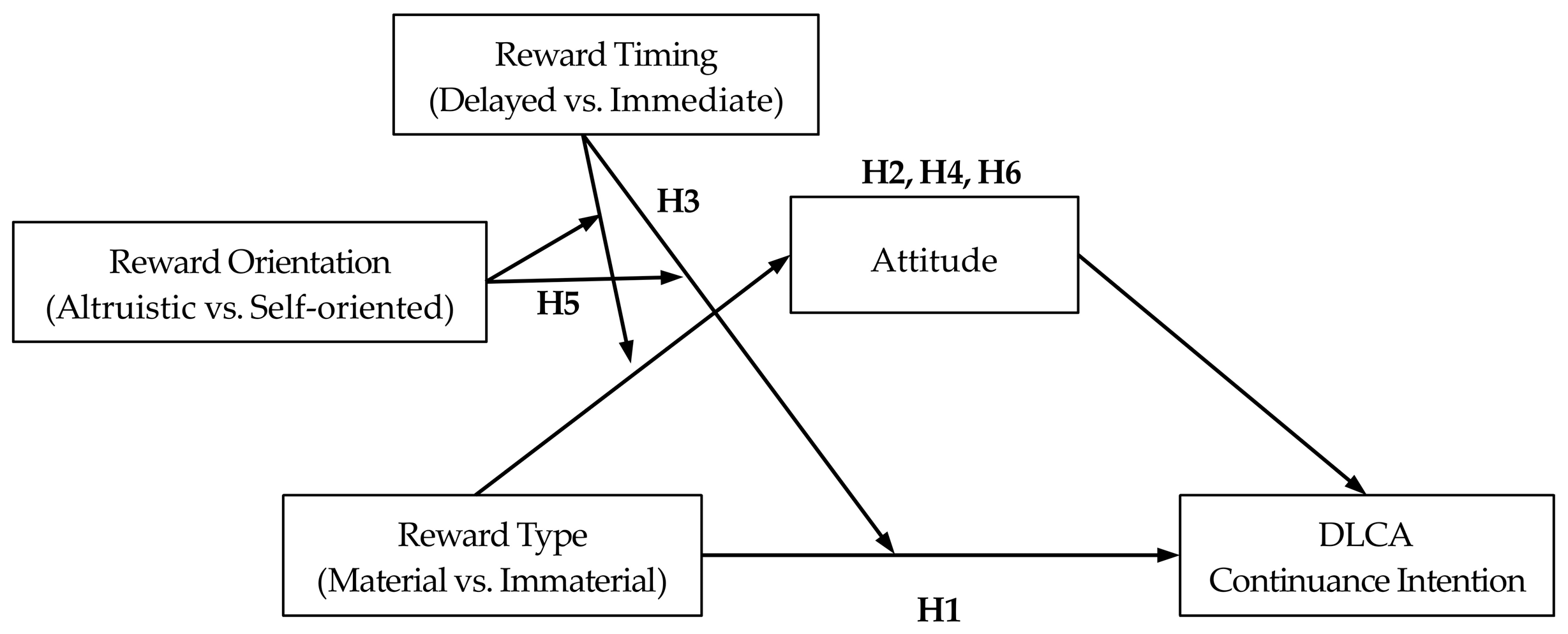
24]. Reward timing (when rewards are delivered) may activate autonomy and competence, while reward orientation (the value attribution and motivational direction of rewards) may activate relatedness—positioning both as potentially critical contextual moderators of reward type effectiveness.
Accordingly, this research investigates: (1) whether material or immaterial rewards more effectively enhance continuance intention in DLCA contexts; (2) whether reward timing and orientation moderate the effect of particular reward types, and through what mechanisms. Using a quantitative experimental design, we recruited 1062 participants through Credamo (
https://www.credamo.com/#/, accessed on 29 January 2026). Participants were drawn from provinces across China. Upon completion of the experiment, each participant received compensation of 1 RMB. Following exposure to experimental stimuli, participants completed manipulation check items, control variable items, attitude items, DLCA continuance intention items, and demographic items. Statistical analyses included
t-tests, chi-square tests, ANCOVA, and PROCESS. Experiment 1 (
N = 257) employed a between-group design with reward type (immaterial rewards vs. material rewards). Experiment 2 (
N = 268) utilized a 2 (reward type: immaterial rewards vs. material rewards) × 2 (reward timing: delayed reward vs. immediate reward) between-subjects design. Experiment 3 (
N = 409) employed a 2 (reward type: immaterial rewards vs. material rewards) × 2 (reward timing: delayed reward vs. immediate reward) × 2 (reward orientation: altruistic rewards vs. self-oriented rewards) between-subjects design. The results demonstrated that effects were replicated across the three distinct DLCA contexts. This research elucidates how reward strategies influence DLCA continuance intention, extends construal level theory, and provides actionable guidance for firms designing sustainable incentive systems.
4. Experiment 1
4.1. Experimental Design
Experiment 1 employed a between-group design with reward type (immaterial rewards vs. material rewards) to examine the effect of reward type on DLCA continuance intention. In recent years, major financial institutions—including China Merchants Bank, China Construction Bank, and Ping An Bank—have intensified their green finance innovations by developing personal carbon ledgers. To incentivize low-carbon behaviors, these banks offer lifestyle benefits such as bike-sharing passes and discount coupons, or engage users through gamified features including virtual tree-planting, digital collectibles, and constellation exploration. Accordingly, we designed an experimental scenario simulating consumer interaction with a bank’s personal carbon ledger platform. To control for brand familiarity, we created a fictitious bank named “Yuerong Bank”.
4.2. Pretest
The pretest aimed to validate stimuli for reward types. Stimulus materials, adapted from Paschmann et al. (2024) [
21], were modeled after existing personal carbon ledger platforms. Participants read the following scenario: “Yuerong Bank has launched a personal Carbon Ledger service that records your low-carbon activities. Today, you used the app to transfer funds and pay utility bills online, reducing 9 g of carbon emissions”. Participants then viewed images of the Carbon Ledger interface, including reward information and motivational feedback. In the immaterial rewards condition, the interface displayed levels, experience points, badges, and leaderboard rankings, accompanied by the feedback: “Congratulations! You earned 5 Starlight! You are about to reach Level 2! Keep up the great work and unlock more achievements!” In the material rewards condition, the interface displayed redeemable benefits with the feedback: “Congratulations! You earned 5 Starlight! You can now redeem a ¥5 discount! Keep going to earn more rewards!”
Forty-two participants were recruited from Credamo (male: 38.10%; aged 21–30: 47.60%; bachelor’s degree: 42.86%; monthly income 5001–10,000 RMB: 47.62%). Manipulation effectiveness was verified using a single item: “After practicing low-carbon actions through Carbon Ledger, I would receive primarily…” (1 = “recognition and level advancement,” 7 = “tangible economic benefits”). A t-test revealed that participants in the immaterial rewards condition scored significantly lower than those in the material rewards condition (Mimmaterial = 2.10, SD = 1.14; Mmaterial = 5.67, SD = 0.97; t (40) = −10.98, p < 0.001), confirming successful manipulation and validating the stimuli for the main experiment.
4.3. Procedure
Using G*Power 3.1.9.7 indicated that 200 participants were required to achieve a statistical power of 1 − β = 0.80 at α = 0.05 with a medium effect size (f = 0.4). We recruited 257 participants from Credamo (male: 37.35%; aged 31–40: 44.60%; bachelor’s degree: 38.95%; monthly income 5001–10,000 RMB: 43.19%).
Experimental procedure. First, participants read introductory information about the app and imagined using the Carbon Ledger platform. Second, participants were randomly assigned to either the immaterial rewards or material rewards condition and viewed the corresponding Carbon Ledger interface and feedback images (identical to the pretest). Finally, participants completed manipulation check items, attitude items, continuance intention items, and demographic questions.
Measures. Control variables included: Carbon Ledger evaluation (1 = “strongly disagree,” 7 = “strongly agree”), familiarity (1 = “very unfamiliar,” 7 = “very familiar”), prior usage experience (1 = “yes,” 2 = “no”), environmental attitude (1 = “strongly disagree,” 7 = “strongly agree”), and reward preference (1 = “rewards offering virtual recognition and enjoyment,” 7 = “rewards providing direct economic benefits”). Attitude was measured using eight items, including “The Carbon Ledger platform is useful for recording and managing my carbon reduction” and “I enjoy using the Carbon Ledger to track my low-carbon behaviors” (
α = 0.83). DLCA continuance intention was assessed using three items adapted from Bhattacherjee (2001) [
51]: “I intend to continue using the Carbon Ledger in the future,” “I am willing to continue using the Carbon Ledger in the future,” and “I will maintain or increase my frequency of using the Carbon Ledger” (
α = 0.79).
4.4. Results
Manipulation check. t-test results confirmed the successful manipulation of reward type, with participants in the immaterial rewards group scoring significantly lower than those in the material rewards group (Mimmaterial = 2.28, SD = 1.41; Mmaterial = 5.56, SD = 1.42; t (255) = −18.62, p < 0.001). No significant between-group differences emerged for control variables (ps > 0.05).
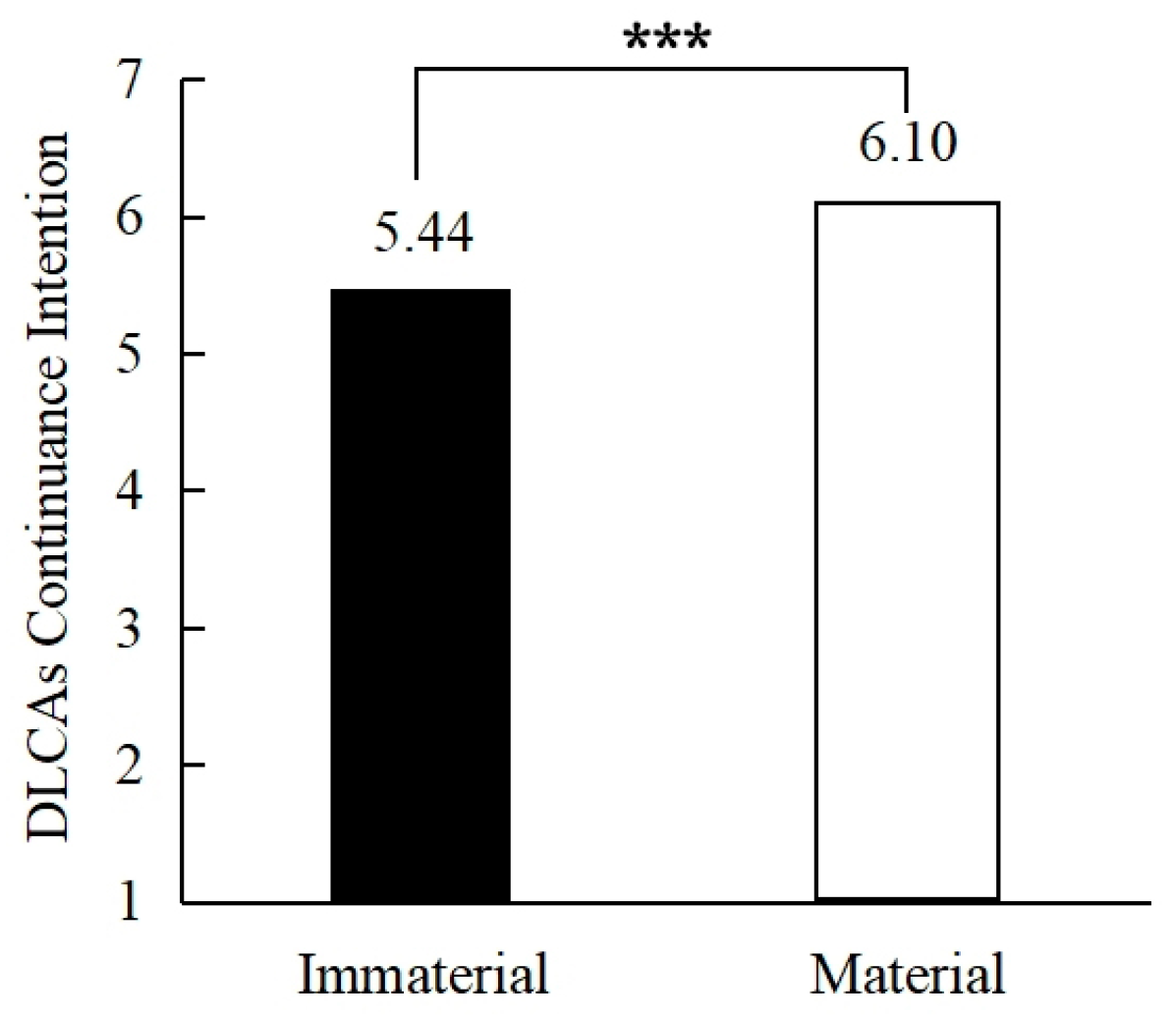
Main effect. ANCOVA with covariates revealed that (illustrated in
Figure 2), compared to material rewards, immaterial rewards yielded significantly lower DLCA continuance intention (
Mimmaterial = 5.44,
SD = 0.74;
Mmaterial = 6.10,
SD = 0.60;
F(1, 250) = 69.78,
p < 0.001,
η2 = 0.22), supporting H1.
Mediation analysis. PROCESS was used to test the mediating role of attitude (Model 4, 5000 resamples, 95% confidence interval). The indirect effect through attitude was significant (β = 0.503, LLCI = 0.361, ULCI = 0.657, excluded zero), supporting H2.
Discussion. Experiment 1 demonstrates that, relative to material rewards, immaterial rewards lead to lower DLCA continuance intention. Attitude mediates this effect. These findings support H1 and H2.
5. Experiment 2
5.1. Experimental Design
Experiment 2 employed a 2 (reward type: immaterial rewards vs. material rewards) × 2 (reward timing: delayed reward vs. immediate reward) between-subjects design to examine how reward timing moderates the effect of reward type on DLCA continuance intention. MaaS platforms such as Beijing MaaS, Suitongpiao MaaS, and Suishenxing APP integrate multiple transportation modes, including the subway, bus, walking, cycling, private vehicles, and ride-hailing services, along with features such as one-click ride-hailing and smart parking. These platforms recommend personalized mobility solutions while recording and quantifying the carbon emission impact of individual travel behavior. Regarding the distribution timing of customer benefits such as low-carbon gifts and privileges, platforms design rewards with varying delivery schedules—some available immediately upon earning, others unlocked only after accumulation over time. We used the fictitious brand “Simple Travel”.
5.2. Pretest
The pretest aimed to validate the effectiveness of stimuli for reward timing. The pretest aimed to validate both manipulations. Following the reward timing paradigm demonstrated by Sharif and Woolley (2022) [
33], participants were encouraged to complete a 60-day low-carbon travel challenge. In the delayed reward condition, participants were informed: “Rewards become available starting from Day 30; after persisting for 30 days, each day of travel earns 2 points”. In the immediate reward condition, participants were informed: “By persisting throughout, you can earn rewards every day; each day of low-carbon travel earns 1 point”. Both reward timing strategies yielded identical total rewards of 60 points. Manipulation was verified through the item: “After using Simple Travel for low-carbon travel, the timing of my reward was: (1 = ‘received after a period of time [after 30 days],’ 2 = ‘received immediately,’ 3 = ‘unclear’)”.
The pretest recruited 41 participants from Credamo (male: 36.59%; aged 31–40: 43.90%; bachelor’s degree: 46.34%; monthly income 5001–10,000 RMB: 34.15%). Chi-square test results indicated that among the 24 participants in the delayed reward group, 23 selected “received after a period of time” and 1 selected “unclear”; among the 17 participants in the immediate reward group, all selected “received immediately” (χ2 = 41.00, p < 0.001), confirming successful manipulation. These results validated the materials for use as stimuli in the main experiment.
5.3. Procedure
Using G*Power 3.1.9.7 indicated that 210 participants were required to achieve a statistical power of 1 − β = 0.95 at α = 0.05 with a medium effect size (f = 0.25). The main experiment recruited 268 participants from Credamo (male: 42.54%; aged 31–40: 38.06%; bachelor’s degree: 54.48%; monthly income 5001–10,000 RMB: 38.06%).
The experimental scenario read: “City S, where you reside, has launched an integrated green mobility platform—Simple Travel—the city’s first official app for tracking green travel carbon emission reductions. Today, you have just completed a green travel trip using Simple Travel”. Participants were then randomly assigned to one of four experimental conditions. They viewed the app interface and feedback information images. Apart from adapting the scenario to the Simple Travel context and incorporating the reward timing manipulation (consistent with the pretest design), the experimental procedure largely followed that of Experiment 1. Attitude (α = 0.87) and DLCA continuance intention (α = 0.86) were measured using the same items from Experiment 1.
5.4. Results
Manipulation checks. t-test results confirmed that the immaterial rewards group scored significantly lower than the material rewards group (Mimmaterial = 2.63, SD = 1.70; Mmaterial = 5.32, SD = 1.56; t (266) = −13.45, p < 0.001), indicating the successful manipulation of reward type. Chi-square test results showed that among 136 participants in the delayed reward group, 135 selected “received after a period of time” and 1 selected “unclear”; among 132 participants in the immediate reward group, 130 selected “received immediately” and 2 selected “unclear” (χ2 = 265.33, p < 0.001), confirming successful manipulation of reward timing. No between-group differences emerged for control variables (ps > 0.05).
Main effect. ANCOVA results indicated that, compared to material rewards, immaterial rewards led to lower DLCA continuance intention (Mimmaterial = 5.39, SD = 1.06; Mmaterial = 5.68, SD = 0.92; F (1, 261) = 5.95, p < 0.05, η2 = 0.02), providing additional support for H1.
Mediation effect. PROCESS was again employed to test the mediating effect of attitude (Model 4, 5000 resamples, 95% confidence interval). Results confirmed that the indirect effect through attitude was significant (β = 0.242, LLCI = 0.035, ULCI = 0.443, excluded zero), providing further support for H2.
Moderation effect. Two-way ANOVA results revealed a significant main effect of reward type (
F (1, 264) = 8.07,
p < 0.01), a non-significant main effect of reward timing (
F (1, 264) = 1.81,
p > 0.05), and a significant interaction between reward type and reward timing (
F (1, 264) = 57.44,
p < 0.001). This interaction remained significant after including control variables (
F (1, 259) = 45.02,
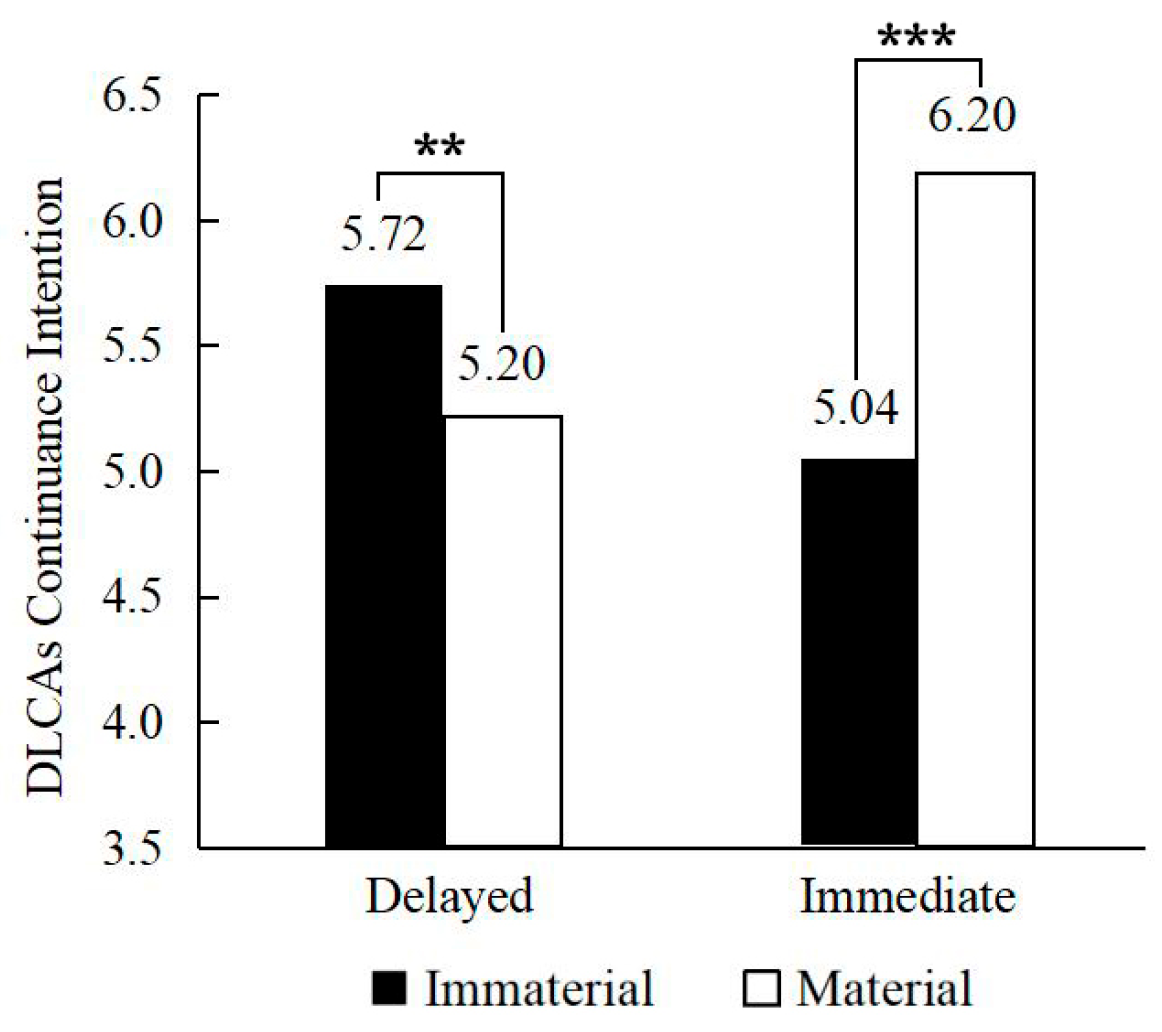
p < 0.001). Simple effects analysis (illustrated in
Figure 3) revealed that under the delayed reward condition, immaterial rewards enhanced continuance intention more effectively than material rewards (
F (1, 264) = 11.40,
p < 0.01,
η2 = 0.04), supporting H3a. Conversely, under the immediate reward condition, material rewards enhanced continuance intention more effectively than immaterial rewards (
F (1, 264) = 53.48,
p < 0.001,
η2 = 0.17), supporting H3b. Thus, H3 was confirmed.
Moderated Mediation Analysis. PROCESS (Model 8; 5000 resamples; 95% confidence interval) revealed a significant index of moderated mediation (Index = 1.64, LLCI = 1.26, ULCI = 2.02, excluded zero). Specifically, the indirect effect via attitude was significant both under the delayed reward condition (LLCI = −0.823, ULCI = −0.307, excluded zero) and under the immediate reward condition (LLCI = 0.819, ULCI = 1.351, excluded zero). These results support H6.
Discussion. Experiment 2 replicated and extended the findings from Experiment 1 within a different DLCA context, offering more robust evidence for H1 and H2. Furthermore, the moderating role of reward timing in the relationship between reward type and DLCA continuance intention was empirically validated, thereby confirming H3 and H4.
6. Experiment 3
6.1. Experimental Design
We conducted a 2 (reward type: immaterial rewards vs. material rewards) × 2 (reward timing: delayed reward vs. immediate reward) × 2 (reward orientation: altruistic rewards vs. self-oriented rewards) between-subjects experiment to examine whether the interactive effect of reward type and reward timing on DLCA continuance intention varies as a function of reward orientation. The experimental context featured a food surplus blind-box platform—an emerging sustainable consumption model in the food domain. Platforms such as Magic Bag, Zero Food Waste, and PACK-AGE enable merchants to sell near-expiration food products in discounted blind-box formats, thereby encouraging consumers to reduce food waste and contribute to carbon emission reduction while also fostering sustained user engagement through community-building initiatives. These platforms typically offer rewards that benefit either the individual user or broader social causes. We used the fictitious brand “Green Food Box”.
6.2. Pretest
Drawing on Hwang and Choi’s (2020) [
22] experimental paradigm for reward orientation, we developed graphic and textual stimuli featuring the food surplus blind-box platform. The altruistic rewards condition emphasized social benefits, displaying a “My Philanthropy Record” module that included metrics such as the number of charitable activities participated in, charity blind boxes redeemed, and total points donated. The description read: “Join the Food Conservation Challenge to earn more Wheat Grains; when your donated Wheat Grains reach the designated threshold, the platform will allocate charitable funds to designated public welfare projects”. The self-oriented rewards condition emphasized personal benefits, displaying a “My Achievement Record” module that included metrics such as number of blind boxes redeemed, carbon reduction badges earned, and money saved. The description read: “Join the Food Conservation Challenge to earn more Wheat Grains; when your accumulated Wheat Grains reach the designated threshold, you can unlock badges, improve your food conservation ranking, and redeem coupons and merchandise”.
We recruited 45 participants from Credamo (male: 46.67%; aged 21–30: 48.89%; bachelor’s degree: 48.89%; monthly income 5001–10,000 RMB: 40.00%) for the pretest. Manipulation effectiveness was assessed using a single item: “The rewards allow me to obtain virtual incentives or economic benefits rather than helping those in need in society” (1 = “strongly disagree,” 7 = “strongly agree”). A t-test revealed that ratings in the altruistic rewards condition were significantly lower than those in the self-oriented rewards condition (Maltruistic = 2.05, SD = 1.16; Mself-oriented = 4.46, SD = 1.82; t (39.56) = −5.37, p < 0.001), confirming successful manipulation of reward orientation. These materials were thus deemed suitable for the main experiment.
6.3. Procedure
Using G*Power 3.1.9.7 indicated that 327 participants were required to achieve a statistical power of 1 − β = 0.95 at α = 0.05 with a small-to-medium effect size (f = 0.2). We recruited 409 participants from Credamo (male: 43.28%; aged 21–30: 38.63%; bachelor’s degree: 65.04%; monthly income 5001–10,000 RMB: 34.23%).
The experimental scenario read: “Green Food Box is a leading domestic platform for reducing food waste, promoting a low-carbon sustainable lifestyle through minimizing food surplus. Today, you purchased a food blind box on Green Food Box, successfully reducing 100 g of carbon emissions”. Participants were randomly assigned to one of eight experimental conditions (experimental group design is presented in
Table A1). Reward orientation was manipulated as described in the pretest. Regarding reward timing manipulation, because Experiment 2 focused on MaaS usage, where travel behavior exhibits strong daily routines, whereas Experiment 3 involved food surplus blind box platforms, where user engagement is comparatively sporadic, we adjusted the total task duration to 30 days and correspondingly set the delayed reward activation to Day 15 to better align with behavioral patterns in this context. All other procedures followed those established in Experiments 1 and 2. Attitudes (
α = 0.83) and DLCA continuance intention (
α = 0.86) were measured using the same items from Experiment 1.
6.4. Results
Manipulation checks. t-test results confirmed successful manipulations: participants in the immaterial rewards condition rated rewards significantly lower on immaterial than those in the material rewards condition (Mimmaterial = 1.74, SD = 1.06; Mmaterial = 6.20, SD = 0.91; t (407) = −45.72, p < 0.001); participants in the altruistic rewards condition rated rewards significantly lower on self-orientation than those in the self-oriented rewards condition (Maltruistic = 2.68, SD = 1.58; Mself-oriented = 4.90, SD = 1.69; t (407) = −13.67, p < 0.001). Chi-square analysis verified the successful manipulation of reward timing: among the 204 participants in the delayed reward condition, 202 correctly identified that “rewards would be received after a period of time,” while 2 selected “unclear”; all 205 participants in the immediate reward condition correctly identified that “rewards would be received immediately” (χ2 = 409.00, p < 0.001). No between-group differences emerged for control variables (ps > 0.05).
Moderation effect. Three-way ANOVA revealed a significant main effect of reward type (
F (1, 401) = 6.89,
p < 0.01), non-significant main effects of reward timing (
F (1, 401) = 0.14,
p > 0.05) and reward orientation (
F (1, 401) = 0.02,
p > 0.05), and a significant three-way interaction among reward type, reward timing, and reward orientation on DLCA continuance intention (
F (1, 401) = 17.02,
p < 0.001,
η2 = 0.04). This interaction remained robust after controlling for covariates (
F (1, 394) = 18.35,
p < 0.001,
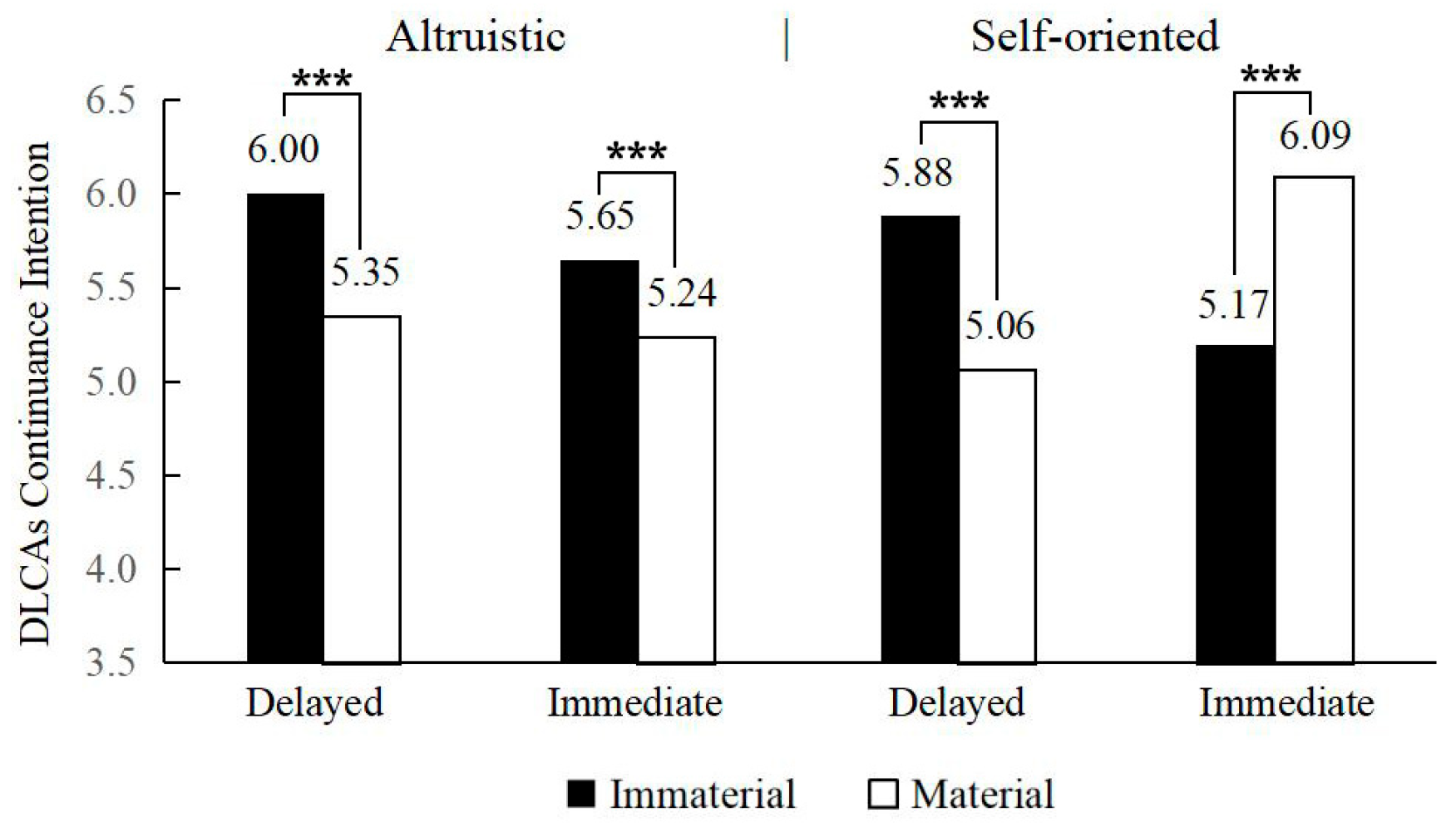
η2 = 0.05). Simple effects analyses (illustrated in
Figure 4) revealed the following patterns: In the self-oriented rewards condition, when rewards were delayed, immaterial rewards generated significantly higher DLCA continuance intention than material rewards (
F (1, 401) = 25.30,
p < 0.001,
η2 = 0.06); when rewards were immediate, material rewards elicited significantly higher DLCA continuance intention than immaterial rewards (
F (1, 401) = 20.21,
p < 0.001,
η2 = 0.05), supporting H5a. In the altruistic rewards condition, regardless of reward timing, immaterial rewards consistently led to higher DLCA continuance intention than material rewards (
F (1, 401) = 5.05,
p < 0.05,
η2 = 0.01;
F (1, 401) = 12.60,
p < 0.001,
η2 = 0.03), supporting H5b. These findings validate H5.
Moderated Mediation Analysis. We employed PROCESS (Model 12; 5000 resamples; 95% confidence interval) to examine whether attitude mediated the three-way interaction among reward type, reward timing, and reward orientation. Results revealed a significant index of moderated mediation (Index = −1.25, LLCI = −1.85, ULCI = −0.68, excluded zero). In the self-oriented rewards condition, the indirect effect via attitude was significant both under delayed reward (LLCI = 0.414, ULCI = 0.997, excluded zero) and immediate reward conditions (LLCI = −0.926, ULCI = −0.346, excluded zero). In the altruistic rewards condition, the indirect effect via attitude was likewise significant under both delayed reward (LLCI = −0.824, ULCI = −0.201, excluded zero) and immediate reward conditions (LLCI = −0.896, ULCI = −0.294, excluded zero). These results support H6.
Discussion. Experiment 3 provided support for H5 and H6. For the self-oriented reward condition, immaterial (vs. material) rewards are more effective at enhancing DLCA continuance intention when rewards are delayed, whereas material (vs. immaterial) rewards are more effective when rewards are immediate. For the altruistic reward condition, immaterial rewards consistently outperform material rewards in fostering continuance intention regardless of reward timing. Furthermore, this three-way interaction is fully mediated by attitude.
7. Discussion and Conclusions
7.1. Discussion
First, immaterial rewards lead to lower DLCA continuance intention compared to material rewards. Specifically, material rewards are more likely to fit consumers’ prevailing level of construal than intangible immaterial rewards, thereby enhancing the perceived feasibility and attractiveness of usage behavior and strengthening continuance intention. Furthermore, immaterial rewards trigger the green licensing effect, leading consumers to perceive that they have already fulfilled their environmental responsibility by obtaining such rewards. This finding is consistent with the demonstrated effectiveness of material rewards during user acquisition and behavior initiation stages in commercial practice [
28]. For instance, Ruzeviciute and Kamleitner (2017) [
29] demonstrated that material rewards with tangible economic value—such as discounts and cash vouchers—effectively enhance trial rates and usage retention during the initial phase of loyalty programs. Thus, in the emerging digital low-carbon market, direct and quantifiable economic value constitutes an essential foundation for driving sustained consumer engagement. This conclusion extends the application of CLT to the low-carbon marketing domain, providing a novel theoretical perspective for understanding sustained low-carbon consumption behavior and suggesting that pro-environmental behavior does not emerge spontaneously but may require external economic stimulation during the initial formation stage.
Second, reward timing moderates the effect of reward type on DLCA continuance intention, and this moderating effect is further qualified by reward orientation. Under self-oriented rewards, consumers focus primarily on maximizing personal benefits; consequently, construal fit between immaterial rewards and delayed timing, as well as between material rewards and immediate timing, more effectively enhances DLCA continuance intention. This finding illuminates the psychological mechanism underlying the construal fit effect in reward strategies: when the levels of construal for reward type and reward timing are congruent, delayed rewards (temporally distant) fit immaterial rewards (abstract), while immediate rewards (temporally proximal) fit material rewards (concrete). Conversely, under altruistic reward conditions, immaterial rewards generate greater continuance intention regardless of whether rewards are delayed or immediate. This occurs because altruistic rewards activate consumers’ social identity motivation [
35], shifting attention toward the social value of behavior rather than personal benefits. The prosocial attributes inherent in immaterial rewards fit altruistic motivation, and their influence supersedes the interest-driven effects of material rewards [
22]. Moreover, when the core meaning of behavior is explicitly framed as altruistic, introducing material rewards may compromise the moral purity of the behavior and even produce a motivation crowding-out effect [
49]. This finding extends the application of the social distance dimension within CLT, demonstrating that altruistic rewards (greater social distance) fit immaterial rewards (abstract). Moreover, by incorporating the motivation crowding-out theory, this conclusion reveals that immaterial rewards under an altruistic orientation prevent external rewards from undermining intrinsic environmental motivation, suggesting that excessive or inappropriate material incentives may not only prove ineffective but also erode long-term behavioral commitment. This offers a novel theoretical perspective for understanding incentive compatibility across different social distances.
Finally, attitude mediates the relationship between reward strategies and DLCA continuance. Different reward strategy configurations activate distinct cognitive processing pathways and emotional response patterns, ultimately influencing behavioral intention through attitude formation. This finding explains how extrinsic incentives transform into intrinsic drivers, extending the Stimulus–Organism–Response (SOR) framework to the DLCA context [
43]. Moreover, by examining attitude within the CLT framework, this research provides empirical support for understanding differences in attitude formation mechanisms across psychological distances, responding to calls for investigating the underlying mechanisms of low-carbon consumption behavior [
52].
7.2. Conclusions
Grounded in CLT, this study addresses three fundamental questions in reward strategy design through a series of experiments: what to reward, when to reward, and how to orient value attribution and motivational direction. We systematically investigate how reward type, reward timing, and reward orientation jointly shape DLCA continuance intention, offering novel theoretical insights into the psychological mechanisms underlying sustained consumer engagement with DLCAs. Three principal findings emerge from this investigation: (1) immaterial rewards lead to lower DLCA continuance intention compared to material rewards; (2) reward timing moderates the effect of reward type on DLCA continuance intention, and this moderating effect is further qualified by reward orientation; (3) attitude mediates the relationship between reward strategies and DLCA continuance.
7.3. Managerial Implications
Our analysis of reward type, timing, and orientation yields actionable guidance for the design of DLCA reward strategies. First, firms should dynamically align reward types with distribution timing. During acquisition, short-term tasks, or reactivation phases, material rewards combined with immediate reward delivery—such as instant cashback—effectively capture attention and stimulate initial engagement. Conversely, immaterial rewards paired with delayed reward delivery (e.g., exclusive badges, tiered status, and leaderboard rankings) better cultivate long-term habits and foster consumers’ identification with environmental values. Second, reward value attribution should reinforce intrinsic motivation and meaning perception. For DLCAs emphasizing altruistic rewards, immaterial rewards—environmental contribution rankings, virtual certificates, and community recognition—should predominate to strengthen environmental identity and moral achievement while preventing crowding-out of altruistic motivation. When material rewards are necessary, they should be framed as environmental outcomes (e.g., “Your carbon reduction converted to charitable donations”) rather than direct exchanges. For apps emphasizing self-oriented rewards, firms should combine material rewards and immaterial rewards strategically across the user lifecycle. Finally, reward design should transcend short-term behavioral stimulation to cultivate enduring consumer attitudes. Effective rewards enhance both cognitive evaluations of functional utility and affective attachment. Visual feedback mechanisms (carbon footprint reports, contribution maps) render environmental impact tangible, while gamification elements (challenges, narratives, and social interactions) deepen engagement. When deploying material rewards, firms should facilitate meaning internalization, enabling users to interpret external incentives as affirmation of their pro-environmental identity.
7.4. Limitations and Future Research
While this study systematically examines the mechanisms through which reward strategies influence DLCA continuance intention, several limitations warrant acknowledgment. First, regarding methodology, this study employs experimental scenarios to simulate user interactions with DLCAs. Although this approach effectively controls for extraneous variables and ensures internal validity, discrepancies may exist between experimental scenarios and real-world usage contexts. Future research could complement experimental findings with field studies using actual DLCAs, employing surveys, in-depth interviews, and behavioral tracking to collect data, thereby providing a comprehensive analysis of reward strategy effectiveness in naturalistic settings and strengthening external validity and practical applicability.
Second, concerning variable measurement, this study assessed continuance intention through self-report measures. While this approach facilitates efficient data collection, self-reports are susceptible to social desirability bias—participants may overestimate their continuance intention to present themselves as environmentally conscious, resulting in potential discrepancies between reported intentions and actual behaviors. Future research could employ behavioral tracking methodologies, recording actual usage data to measure continuance behavior, thereby improving measurement precision.
Finally, with respect to the theoretical model, this research focuses on three core dimensions of reward strategy without incorporating other potentially influential variables beyond reward strategies (e.g., environmental consciousness intensity, app usage habits, personal values, professional background, and hobbies). Future research could integrate these variables into the theoretical framework to further enrich our understanding of DLCA continuance intention.