The Diffusion Mechanism of Blockchain Technology for Power Sector Carbon Emission Data Supervision from the Perspective of Sustainable Development
Abstract
1. Introduction
2. Theoretical Foundation and Hypotheses Development
2.1. Theoretical Foundation
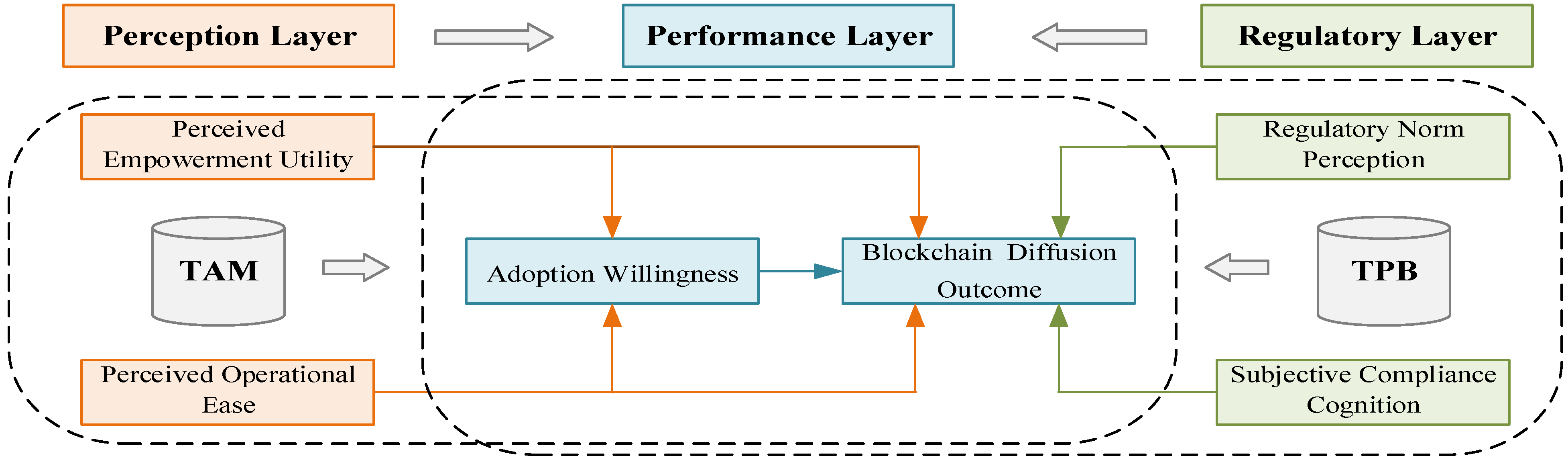
2.2. Hypotheses Development
3. Methodology
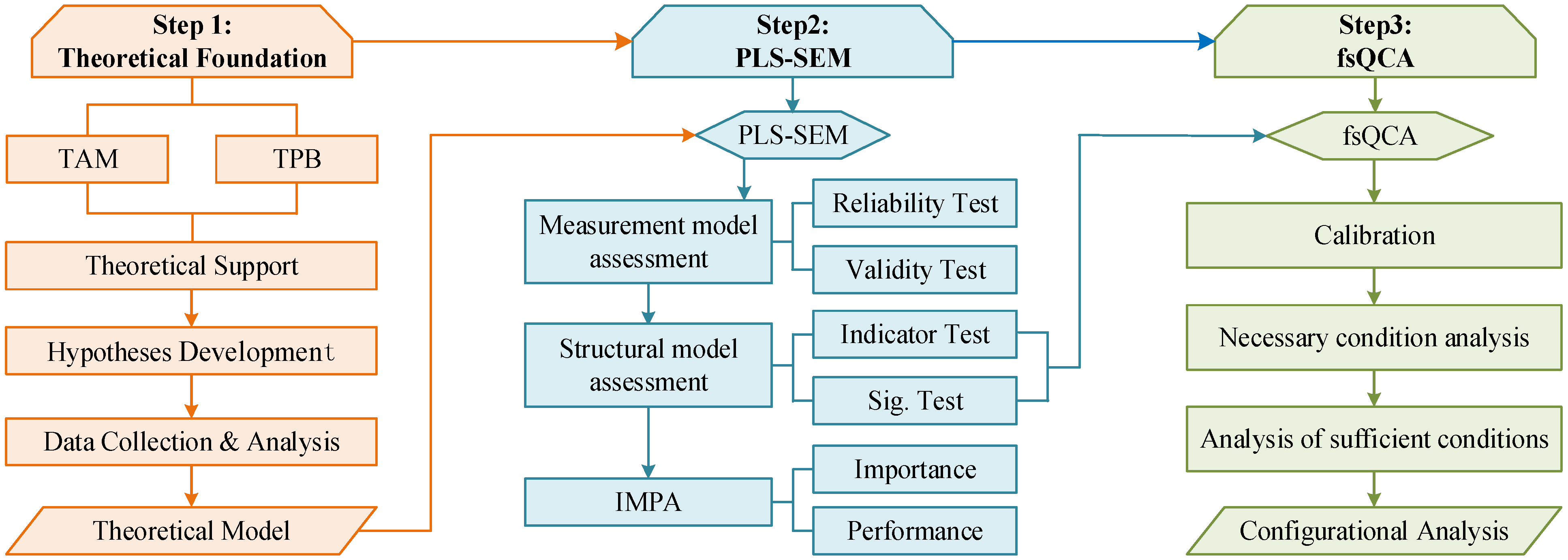
3.1. Research Design
3.2. Data Collection and Analysis
3.3. PLS-SEM Method
3.4. fsQCA Method
4. Results
4.1. Normality, Bias and Robustness Analysis
4.2. PLS-SEM Results
4.2.1. Measurement Model Assessment
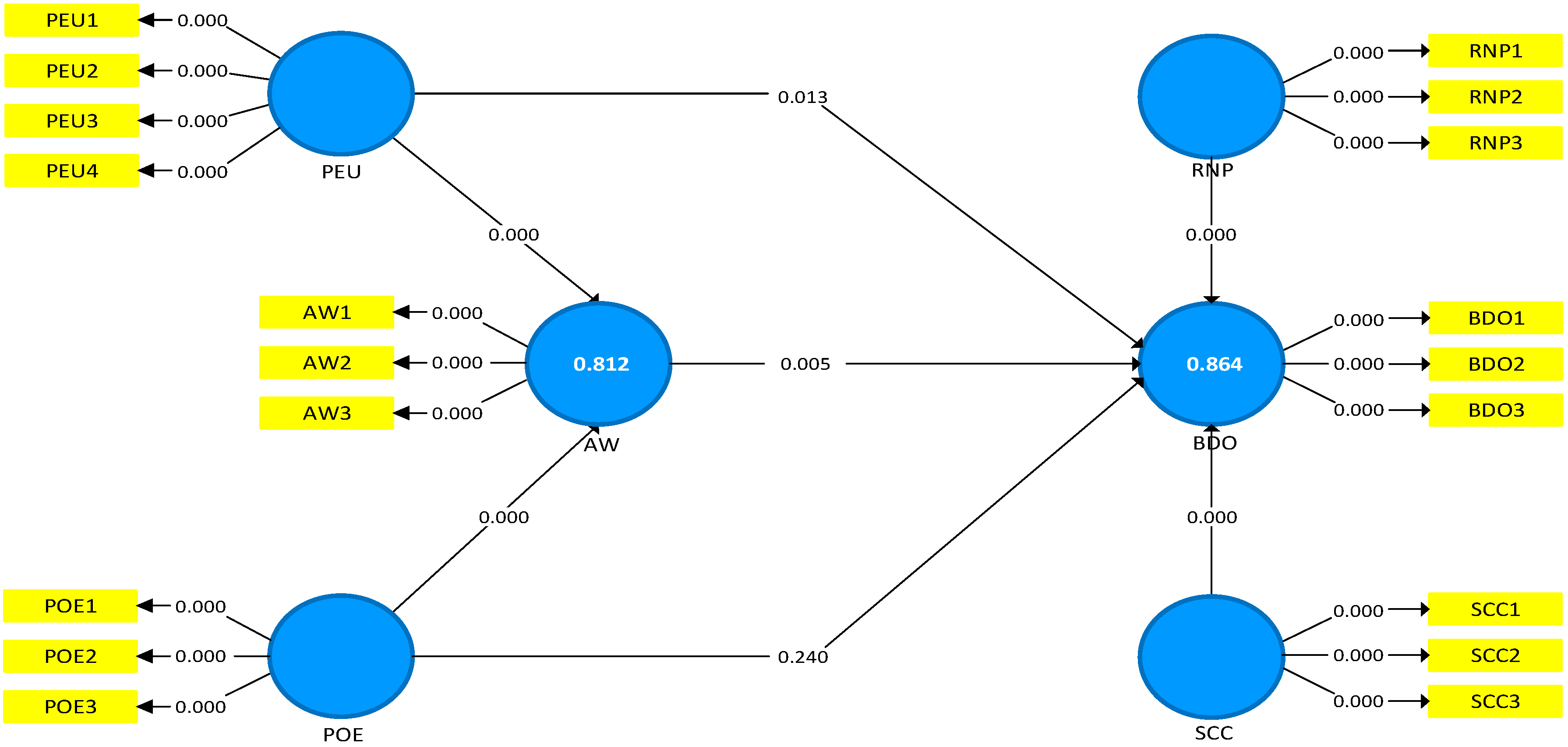
4.2.2. Structural Model Assessment
4.2.3. Importance Performance Map Analysis (IPMA)
4.3. fsQCA Results
4.3.1. Calibration
4.3.2. Necessary Condition Analysis
4.3.3. Sufficient Conditions Analysis
5. Discussion
5.1. Diffusion Effects of Multiple Key Factors
5.2. Clarification of Diffusion Mechanism
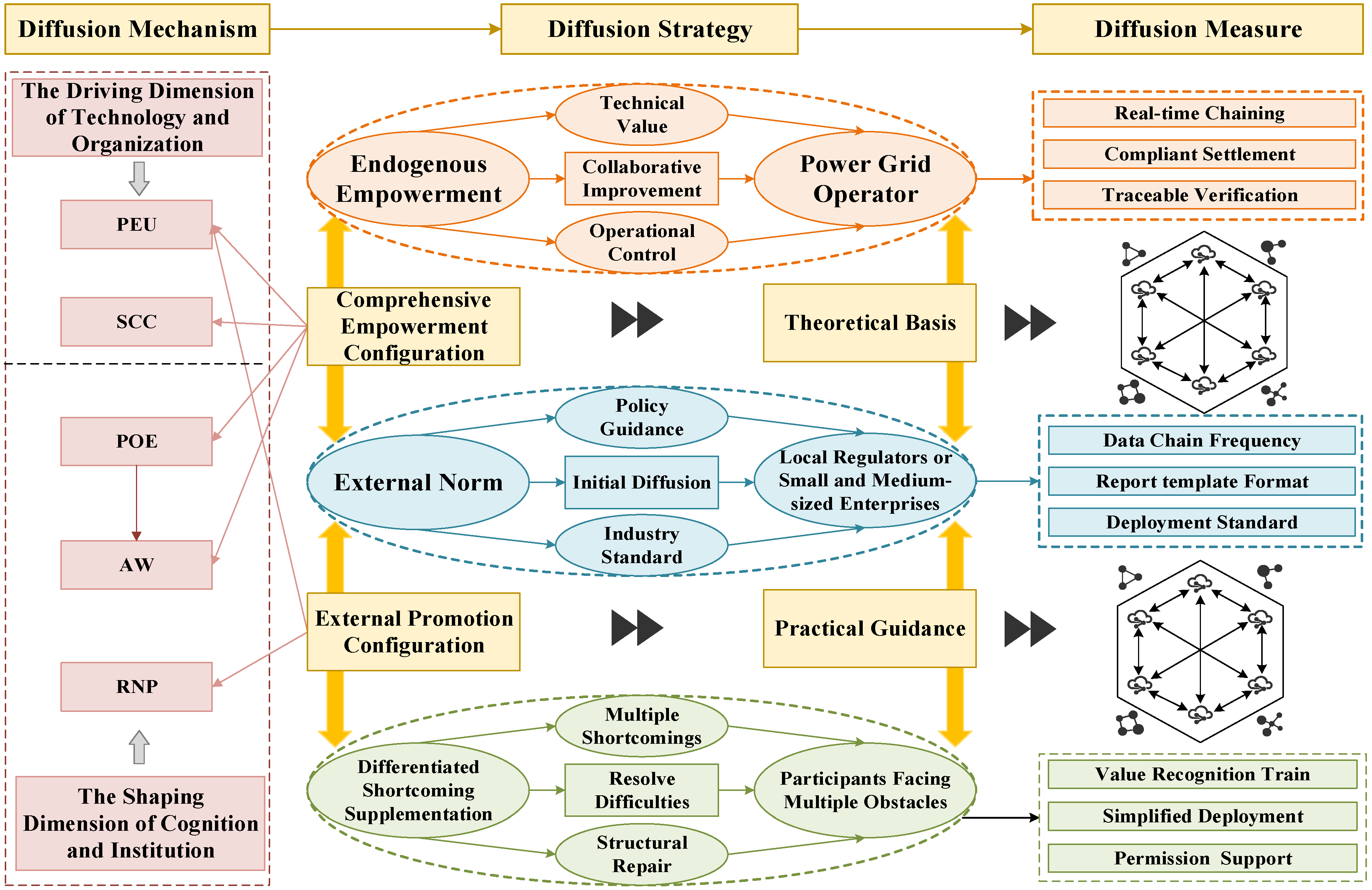
5.3. BCT Diffusion Strategy Framework
6. Conclusions
Supplementary Materials
Author Contributions
Funding
Institutional Review Board Statement
Informed Consent Statement
Data Availability Statement
Conflicts of Interest
Appendix A
| Latent Variable | Observed Variable | 1 | 2 | 3 | 4 | 5 | 6 | 7 | 8 | 9 | 10 | 11 | 12 | 13 |
| Error Reduction (PEU2) | √ | √ | √ | √ | √ | √ | √ | √ | ||||||
| Data Sharing (PEU3) | √ | √ | √ | √ | ||||||||||
| Decision Support (PEU4) | √ | √ | √ | √ | √ | √ | ||||||||
| Perceived Operational Ease (POE) | Easy Maintenance (POE1) | √ | √ | √ | √ | √ | ||||||||
| Clear Interface (POE2) | √ | √ | √ | √ | √ | |||||||||
| Process Compatibility(POE3) | √ | √ | √ | √ | √ | |||||||||
| Regulatory Norm Perception (RNP) | Policy Promotion(RNP1) | √ | √ | √ | √ | √ | √ | |||||||
| Industry Trend (RNP2) | √ | √ | √ | √ | √ | √ | ||||||||
| Public Expectation (RNP3) | √ | √ | √ | √ | √ | |||||||||
| System Control Capability (SCC) | Resource Support (SCC1) | √ | √ | √ | √ | |||||||||
| Workflow Clarity (SCC2) | √ | √ | √ | √ | √ | √ | ||||||||
| Learning Capability (SCC3) | √ | √ | √ | √ | ||||||||||
| Adoption Willingness (AW) | Recommendation (AW1) | √ | √ | √ | √ | |||||||||
| Continuous Adoption (AW2) | √ | √ | √ | √ | ||||||||||
| Proactive Updating (AW3) | √ | √ | √ | √ | √ | |||||||||
| Blockchain Diffusion Outcome (BDO) | Fairness Improvement (BDO1) | √ | √ | √ | √ | |||||||||
| Efficiency Enhancement (BDO2) | √ | √ | √ | √ | √ | √ | ||||||||
| Coordination Enhancement (BDO3) | √ | √ | √ | √ | ||||||||||
| Notes: The numbers 1–13 refer to the key literature sources on which the corresponding indicators are theoretically grounded: 1-[54]; 2-[26]; 3-[10]; 4-[8]; 5-[62]; 6-[56]; 7-[60]; 8-[59]; 9-[63]; 10-[57]; 11-[58]; 12-[64]; 13-[53]. | ||||||||||||||
Appendix B
- Part I: Personal Information1. What is your gender?☐Male ☐Female2. How long have you been working?☐1–4 years ☐5–7 years ☐≥8 years3. What is your position?☐Technical Staff ☐General Manager ☐Senior Manager4. What is your educational background?☐Bachelor ☐Postgraduate ☐Other
- Part II: Factors Affecting the BCT Diffusion in PS-CED Supervision
| Unimportant 1 | Slightly Important 2 | Moderately Important 3 | Very Important 4 | Extremely Important 5 | ||
| PEU: Perceived Enabling Utility (PEU) of BCT in PS-CED supervision. | ||||||
| 1 | BCT can enhance the speed and responsiveness of carbon emission data verification and uploading for power enterprises. | |||||
| 2 | The application of BCT can effectively reduce the probability of errors in carbon emission data. | |||||
| 3 | BCT enables the secure sharing of carbon emission data across multiple departments. | |||||
| 4 | The data foundation provided by BCT supports managers in making compliance-oriented decisions. | |||||
| POE: Perceived Operational Ease (POE) of BCT in PS-CED supervision. | ||||||
| 1 | BCT system interface is user-friendly for operators or designated personnel to input and access carbon emission data. | |||||
| 2 | BCT system can operate compatibly with the existing carbon asset management system or power plant EMS system in the organization. | |||||
| 3 | The maintenance and operational requirements of BCT do not impose additional burdens on routine carbon data management tasks. | |||||
| RNP: Perceived influence of policy guidance, industry development, and social pressure on BCT. | ||||||
| 1 | Current policies in the power sector support the integration of BCT into the carbon emission supervision framework. | |||||
| 2 | Enterprises such as power grid companies have gradually initiated pilot applications of BCT in PS-CED supervision. | |||||
| 3 | The public and regulatory authorities demand enterprises to provide trustworthy carbon emission data. | |||||
| SCC: The extent to which organizations and employees in the power sector perceive a sense of control over the usability and operability of BCT systems. | ||||||
| 1 | Our organization possesses the necessary data collection infrastructure and network platform environment required for BCT system. | |||||
| 2 | Our internal approval processes and access control mechanisms can support data uploading and node operations on BCT system. | |||||
| 3 | We are able to master the basic usage of BCT system in carbon emission monitoring, reporting, and verification processes. | |||||
| AW: The proactive introduction and sustained application of BCT in PS-CED supervision. | ||||||
| 1 | Applying the BCT system for record-keeping, on-chain registration, and traceability of carbon emission data in power enterprises. | |||||
| 2 | Proactively introducing the BCT platform for data management in compliance verification, carbon trading registration, and related tasks. | |||||
| 3 | Willing to recommend BCT regulatory practical experience to other power units or similar regulatory agencies. | |||||
| BDO: The actual outcomes of BCT in PS-CED supervision, including improvements in fairness, efficiency, and collaborative processes. | ||||||
| 1 | The organization has implemented and operated the BCT system in carbon monitoring, quota management, or compliance processes. | |||||
| 2 | The BCT system has improved the completeness and efficiency of carbon emission data from collection and verification to reporting. | |||||
| 3 | The application of BCT has enhanced data trust and collaboration between power enterprises and regulatory bodies. | |||||
- Part III: Open-ended Questions
References
- Zhao, X.-G.; Lu, W.; Wang, W.; Hu, S. The Impact of Carbon Emission Trading on Green Innovation of China’s Power Industry. Environ. Impact Assess. Rev. 2023, 99, 107040. [Google Scholar]
- Li, Y.W.; Yang, X.X.; Du, E.S.; Liu, Y.L.; Zhang, S.X.; Yang, C.; Zhang, N.; Liu, C. A Review on Carbon Emission Accounting Approaches for the Electricity Power Industry. Appl. Energy 2024, 359, 122681. [Google Scholar] [CrossRef]
- Li, G.H.; Niu, M.M. How Does the Carbon Trading Scheme Promote the Decarbonization of China’s Power Sector? J. Environ. Plan. Manag. 2025, 68, 1969–1996. [Google Scholar] [CrossRef]
- Gao, B.X.; Kong, X.Y.; Liu, G.H.; Xiang, T.C.; Gao, Y.; Luo, S.; Wang, Y. Monitoring High-Carbon Industry Enterprise Emission in Carbon Market: A Multi-Trusted Approach Using Externally Available Big Data. J. Clean Prod. 2024, 466, 142729. [Google Scholar] [CrossRef]
- Li, Y.B.; Liu, C.; Wang, J.N.; Wang, Y.; Yang, X.Q.; Li, Y. Data Fraud in the Carbon Emissions Trading Market: A Tripartite Evolutionary Game Analysis from China. Util. Policy 2024, 91, 101848. [Google Scholar] [CrossRef]
- Ma, G.S.; Duan, M.S. Double Counting of Emission Reductions Undermines the Credibility of Corporate Mitigation Claims. Environ. Sci. Technol. 2024, 58, 11247–11255. [Google Scholar] [CrossRef]
- Luu, N.H.; Le, C.; Luu, H.N.; Nguyen, D.T.K. Does Mandatory Greenhouse Gas Emissions Reporting Program Deter Corporate Greenwashing? J. Environ. Manag. 2025, 373, 123740. [Google Scholar] [CrossRef]
- Parhamfar, M.; Sadeghkhani, I.; Adeli, A.M. Towards the Net Zero Carbon Future: A Review of Blockchain-Enabled Peer-to-Peer Carbon Trading. Energy Sci. Eng. 2024, 12, 1242–1264. [Google Scholar] [CrossRef]
- Zhang, T.Y.; Feng, T.T.; Cui, M.L. Smart Contract Design and Process Optimization of Carbon Trading Based on Blockchain: The Case of China’s Electric Power Sector. J. Clean Prod. 2023, 397, 136509. [Google Scholar] [CrossRef]
- Wen, R.X.; Tian, W.; Liu, H.Y.; Lin, W.J.; Zhou, X.Z.; Li, X.R. Intelligent Carbon Metering and Settlement Method of New Power System Based on Blockchain Technology. Energies 2024, 17, 5601. [Google Scholar] [CrossRef]
- Punia, A.; Gulia, P.; Gill, N.S.; Rani, D.; Kaushik, D.; Sabry, A.; Hassan, M.M.; Shukla, P.K. The Security and Vulnerability Issues of Blockchain Technology: A Swoc Analysis. Peer-to-Peer Netw. Appl. 2025, 18, 173. [Google Scholar] [CrossRef]
- Abulibdeh, A.; Jawarneh, R.N.; Al-Awadhi, T.; Abdullah, M.M.; Abulibdeh, R.; El Kenawy, A.M. Assessment of Carbon Footprint in Qatar’s Electricity Sector: A Comparative Analysis across Various Building Typologies. Renew. Sustain. Energy Rev. 2024, 189, 114022. [Google Scholar] [CrossRef]
- Islam, S.; Islam, M.J.; Hossain, M.; Noor, S.; Kwak, K.S.; Islam, S.M.R. A Survey on Consensus Algorithms in Blockchain-Based Applications: Architecture, Taxonomy, and Operational Issues. IEEE Access 2023, 11, 39066–39082. [Google Scholar] [CrossRef]
- Andreoulaki, I.; Papapostolou, A.; Marinakis, V. Evaluating the Barriers to Blockchain Adoption in the Energy Sector: A Multicriteria Approach Using the Analytical Hierarchy Process for Group Decision Making. Energies 2024, 17, 1278. [Google Scholar] [CrossRef]
- Zheng, Z.B.; Xie, S.A.; Dai, H.N.; Chen, X.P.; Wang, H.M. Blockchain Challenges and Opportunities: A Survey. Int. J. Web Grid Serv. 2018, 14, 352–375. [Google Scholar] [CrossRef]
- Boumaiza, A.; Maher, K. Leveraging Blockchain Technology to Enhance Transparency and Efficiency in Carbon Trading Markets. Int. J. Electr. Power Energy Syst. 2024, 162, 110225. [Google Scholar] [CrossRef]
- Andoni, M.; Robu, V.; Flynn, D.; Abram, S.; Geach, D.; Jenkins, D.; McCallum, P.; Peacock, A. Blockchain Technology in the Energy Sector: A Systematic Review of Challenges and Opportunities. Renew. Sustain. Energy Rev. 2019, 100, 143–174. [Google Scholar] [CrossRef]
- Venkatesh, V.; Davis, F.D. A Theoretical Extension of the Technology Acceptance Model: Four Longitudinal Field Studies. Manag. Sci. 2000, 46, 186–204. [Google Scholar] [CrossRef]
- Ajzen, I. The Theory of Planned Behavior: Frequently Asked Questions. Hum. Behav. Emerg. Tech. 2020, 2, 314–324. [Google Scholar] [CrossRef]
- Babaei, A.; Tirkolaee, E.B.; Kia, R.; Sezer, N.S. Assessing the Efficiency of Blockchain Adoption in Renewable Energy Supply Chains in Ideal and Non-Ideal Scenarios. Energy 2025, 330, 136782. [Google Scholar] [CrossRef]
- Deng, N.Q.; Gong, Y.; Wang, J. Promoting Blockchain Technology in Low-Carbon Management to Achieve Firm Performance from a Socio-Economic Perspective: Empirical Evidence from China. J. Clean Prod. 2024, 448, 141686. [Google Scholar] [CrossRef]
- Chittipaka, V.; Kumar, S.; Sivarajah, U.; Bowden, J.L.H.; Baral, M.M. Blockchain Technology for Supply Chains Operating in Emerging Markets: An Empirical Examination of Technology-Organization-Environment (Toe) Framework. Ann. Oper. Res. 2023, 327, 465–492. [Google Scholar] [CrossRef]
- Liu, N.; Ye, Z.L. Empirical Research on the Blockchain Adoption—Based on Tam. Appl. Econ. 2021, 53, 4263–4275. [Google Scholar] [CrossRef]
- Cheng, M.Y.; Chong, H.Y. Understanding the Determinants of Blockchain Adoption in the Engineering-Construction Industry: Multi-Stakeholders’ Analyses. IEEE Access 2022, 10, 108307–108319. [Google Scholar] [CrossRef]
- Li, Z.W.; Xu, X.H.; Bai, Q.G.; Chen, C.; Wang, H.W.; Xia, P. Implications of Information Sharing on Blockchain Adoption in Reducing Carbon Emissions: A Mean-Variance Analysis. Transp. Res. E Logist. Transp. Rev. 2023, 178, 103254. [Google Scholar] [CrossRef]
- Boumaiza, A. A Blockchain-Centric P2p Trading Framework Incorporating Carbon and Energy Trades. Energy Strateg. Rev. 2024, 54, 101466. [Google Scholar] [CrossRef]
- Jiang, T.Q.; Luo, H.X.; Yang, K.; Sun, G.; Yu, H.F.; Huang, Q.; Vasilakos, A.V. Blockchain for Energy Market: A Comprehensive Survey. Sustain. Energy Grids Netw. 2025, 41, 101614. [Google Scholar] [CrossRef]
- Liang, T.P.; Kohli, R.; Huang, H.C.; Li, Z.L. What Drives the Adoption of the Blockchain Technology? A Fit-Viability Perspective. J. Manag. Inform. Syst. 2021, 38, 314–337. [Google Scholar] [CrossRef]
- Ameyaw, E.E.; Edwards, D.J.; Kumar, B.; Thurairajah, N.; Owusu-Manu, D.; Oppong, G.D. Critical Factors Influencing Adoption of Blockchain-Enabled Smart Contracts in Construction Projects. J. Constr. Eng. Manag. 2023, 149, 04023003. [Google Scholar] [CrossRef]
- Komulainen, R.; Nätti, S. Barriers to Blockchain Adoption: Empirical Observations from Securities Services Value Network. J. Bus. Res. 2023, 159, 113714. [Google Scholar] [CrossRef]
- Pooja, P.; Chikhale, M.M.; Dhir, S. Uncovering the Strategic Potential of Blockchain Technology Adoption: A Systematic Literature Review. Strateg. Change 2025, 34, 151–180. [Google Scholar] [CrossRef]
- Falwadiya, H.; Dhingra, S. Blockchain Technology Adoption in Government Organizations: A Systematic Literature Review. J. Glob. Oper. Strateg. Sourc. 2022, 15, 473–501. [Google Scholar] [CrossRef]
- Zhang, Y.; Tavalaei, M.M.; Parry, G.; Zhou, P. Evolution or Involution? A Systematic Literature Review of Organisations’ Blockchain Adoption Factors. Technol. Forecast. Soc. Change 2024, 208, 123710. [Google Scholar] [CrossRef]
- Hair, J.F.; Sarstedt, M.; Ringle, C.M.; Mena, J.A. An Assessment of the Use of Partial Least Squares Structural Equation Modeling in Marketing Research. J. Acad. Mark. Sci. 2012, 40, 414–433. [Google Scholar] [CrossRef]
- Rigdon, E.E. Rethinking Partial Least Squares Path Modeling: In Praise of Simple Methods. Long Range Plan. 2012, 45, 341–358. [Google Scholar] [CrossRef]
- Sarstedt, M.; Hair, J.F.; Ringle, C.M.; Thiele, K.O.; Gudergan, S.P. Estimation Issues with Pls and Cbsem: Where the Bias Lies! J. Bus. Res. 2016, 69, 3998–4010. [Google Scholar] [CrossRef]
- Davvetas, V.; Diamantopoulos, A.; Zaefarian, G.; Sichtmann, C. Ten Basic Questions About Structural Equations Modeling You Should Know the Answers to—But Perhaps You Don’t. Ind. Mark. Manag. 2020, 90, 252–263. [Google Scholar] [CrossRef]
- Salonen, A.; Zimmer, M.; Keränen, J. Theory Development in Servitization through the Application of Fsqca and Experiments. Int. J. Oper. Prod. Manag. 2021, 41, 746–769. [Google Scholar] [CrossRef]
- Tóth, Z.; Thiesbrummel, C.; Henneberg, S.C.; Naudé, P. Understanding Configurations of Relational Attractiveness of the Customer Firm Using Fuzzy Set Qca. J. Bus. Res. 2015, 68, 723–734. [Google Scholar] [CrossRef]
- Sukhov, A.; Friman, M.; Olsson, L.E. Unlocking Potential: An Integrated Approach Using Pls-Sem, Nca, and Fsqca for Informed Decision Making. J. Retail. Consum. Serv. 2023, 74, 103424. [Google Scholar] [CrossRef]
- Rasoolimanesh, S.M.; Ringle, C.M.; Sarstedt, M.; Olya, H. The Combined Use of Symmetric and Asymmetric Approaches: Partial Least Squares-Structural Equation Modeling and Fuzzy-Set Qualitative Comparative Analysis. Int. J. Contemp. Hosp. Manag. 2021, 33, 1571–1592. [Google Scholar] [CrossRef]
- Yap, B.W.; Sim, C.H. Comparisons of Various Types of Normality Tests. J. Stat. Comput. Simul. 2011, 81, 2141–2155. [Google Scholar] [CrossRef]
- Hossain, M.I.; Jamadar, Y.; Islam, M.F.; Rashed, M.; Akter, T. Environmental Sustainability Practices in Smes: Insights from Integrated Pls-Sem and Fsqca Approaches. J. Clean. Prod. 2025, 503, 145185. [Google Scholar] [CrossRef]
- Rouder, J.N.; Engelhardt, C.R.; McCabe, S.; Morey, R.D. Model Comparison in Anova. Psychon. Bull. Rev. 2016, 23, 1779–1786. [Google Scholar] [CrossRef]
- Hair, J.F.; Risher, J.J.; Sarstedt, M.; Ringle, C.M. When to Use and How to Report the Results of Pls-Sem. Eur. Bus. Rev. 2019, 31, 2–24. [Google Scholar] [CrossRef]
- Henseler, J.; Ringle, C.M.; Sarstedt, M. A New Criterion for Assessing Discriminant Validity in Variance-Based Structural Equation Modeling. J. Acad. Mark. Sci. 2015, 43, 115–135. [Google Scholar] [CrossRef]
- Ringle, C.M.; Sarstedt, M. Gain More Insight from Your Pls-Sem Results the Importance-Performance Map Analysis. Ind. Manag. Data Syst. 2016, 116, 1865–1886. [Google Scholar] [CrossRef]
- Acquah, I.S.K.; Naude, M.J.; Sendra-García, J. Supply Chain Collaboration in the Petroleum Sector of an Emerging Economy: Comparing Results from Symmetrical and Asymmetrical Approaches. Technol. Forecast. Soc. Change 2021, 166, 120568. [Google Scholar] [CrossRef]
- Kaya, B.; Abubakar, A.M.; Behravesh, E.; Yildiz, H.; Mert, I.S. Antecedents of Innovative Performance: Findings from Pls-Sem and Fuzzy Sets (Fsqca). J. Bus. Res. 2020, 114, 278–289. [Google Scholar] [CrossRef]
- Fiss, P.C. Building Better Causal Theories: A Fuzzy Set Approach to Typologies in Organization Research. Acad. Manag. J. 2011, 54, 393–420. [Google Scholar] [CrossRef]
- Skarmeas, D.; Leonidou, C.N.; Saridakis, C. Examining the Role of Csr Skepticism Using Fuzzy-Set Qualitative Comparative Analysis. J. Bus. Res. 2014, 67, 1796–1805. [Google Scholar] [CrossRef]
- Baig, M.I.; Yadegaridehkordi, E. Exploring Moderating Role of Blockchain Adoption on Economic and Environmental Sustainability of Organizations: A Sem-Fsqca Technique. Sustain. Dev. 2024, 32, 3824–3839. [Google Scholar] [CrossRef]
- Upadhyay, A.; Mukhuty, S.; Kumar, V.; Kazancoglu, Y. Blockchain Technology and the Circular Economy: Implications for Sustainability and Social Responsibility. J. Clean. Prod. 2021, 293, 126130. [Google Scholar] [CrossRef]
- Mofatteh, M.Y.; Davallou, R.; Ishimwe, C.N.; Divekar, S.S.; Valilai, O.F. Developing a Blockchain Based Supply Chain CO2 Footprint Tracking Framework Enabled by Iot. Int. J. Adv. Comput. Sci. Appl. 2024, 15, 7–12. [Google Scholar] [CrossRef]
- Centobelli, P.; Cerchione, R.; Del Vecchio, P.; Oropallo, E.; Secundo, G. Blockchain Technology for Bridging Trust, Traceability and Transparency in Circular Supply Chain. Inf. Manag. 2022, 59, 103508. [Google Scholar] [CrossRef]
- Zhu, J.H.; Feng, T.W.; Lu, Y.; Jiang, W.B. Using Blockchain or Not? A Focal Firm’s Blockchain Strategy in the Context of Carbon Emission Reduction Technology Innovation. Bus. Strateg. Environ. 2024, 33, 3505–3531. [Google Scholar] [CrossRef]
- Ju, C.H.; Shen, Z.H.; Bao, F.G.; Weng, P.T.; Xu, Y.H.; Xu, C.H. A Novel Credible Carbon Footprint Traceability System for Low Carbon Economy Using Blockchain Technology. Int. J. Environ. Res. Public Health 2022, 19, 10316. [Google Scholar] [CrossRef]
- Han, S.Z.; Zhang, H.S.; Li, H.; Xun, Z. Digital Transformation and Carbon Emission Reduction: The Moderating Effect of External Pressure and Support. J. Clean. Prod. 2025, 500, 145108. [Google Scholar] [CrossRef]
- Chen, Y.; Feng, Y.T.; Lai, K.H.; Zhu, Q.H. Value of Blockchain for Scope 3 Carbon Disclosure: The Moderating Role of Data Processing Technologies. Int. J. Prod. Econ. 2025, 279, 109445. [Google Scholar] [CrossRef]
- Fernando, Y.; Rozuar, N.H.M.; Mergeresa, F. The Blockchain-Enabled Technology and Carbon Performance: Insights from Early Adopters. Technol. Soc. 2021, 64, 101507. [Google Scholar] [CrossRef]
- Guo, Y.H.; Wan, Z.G.; Cheng, X.Z. When Blockchain Meets Smart Grids: A Comprehensive Survey. High-Confid. Comput. 2022, 2, 100059. [Google Scholar] [CrossRef]
- Alzoubi, Y.I.; Mishra, A. Green Blockchain—A Move Towards Sustainability. J. Clean. Prod. 2023, 430, 139541. [Google Scholar] [CrossRef]
- Fernando, Y.; Tseng, M.L.; Wahyuni-Td, I.S.; Sroufe, R.; Mohd-Zailani, N.I.A. Blockchain Technology Adoption for Carbon Trading and Energy Efficiency: Iso Manufacturing Firms in Malaysia. Int. J. Logist. Res. Appl. 2023, 26, 1556–1577. [Google Scholar] [CrossRef]
- De Dutta, S.; Prasad, R. Digitalization of Global Cities and the Smart Grid. Wirel. Pers. Commun. 2020, 113, 1385–1395. [Google Scholar] [CrossRef]

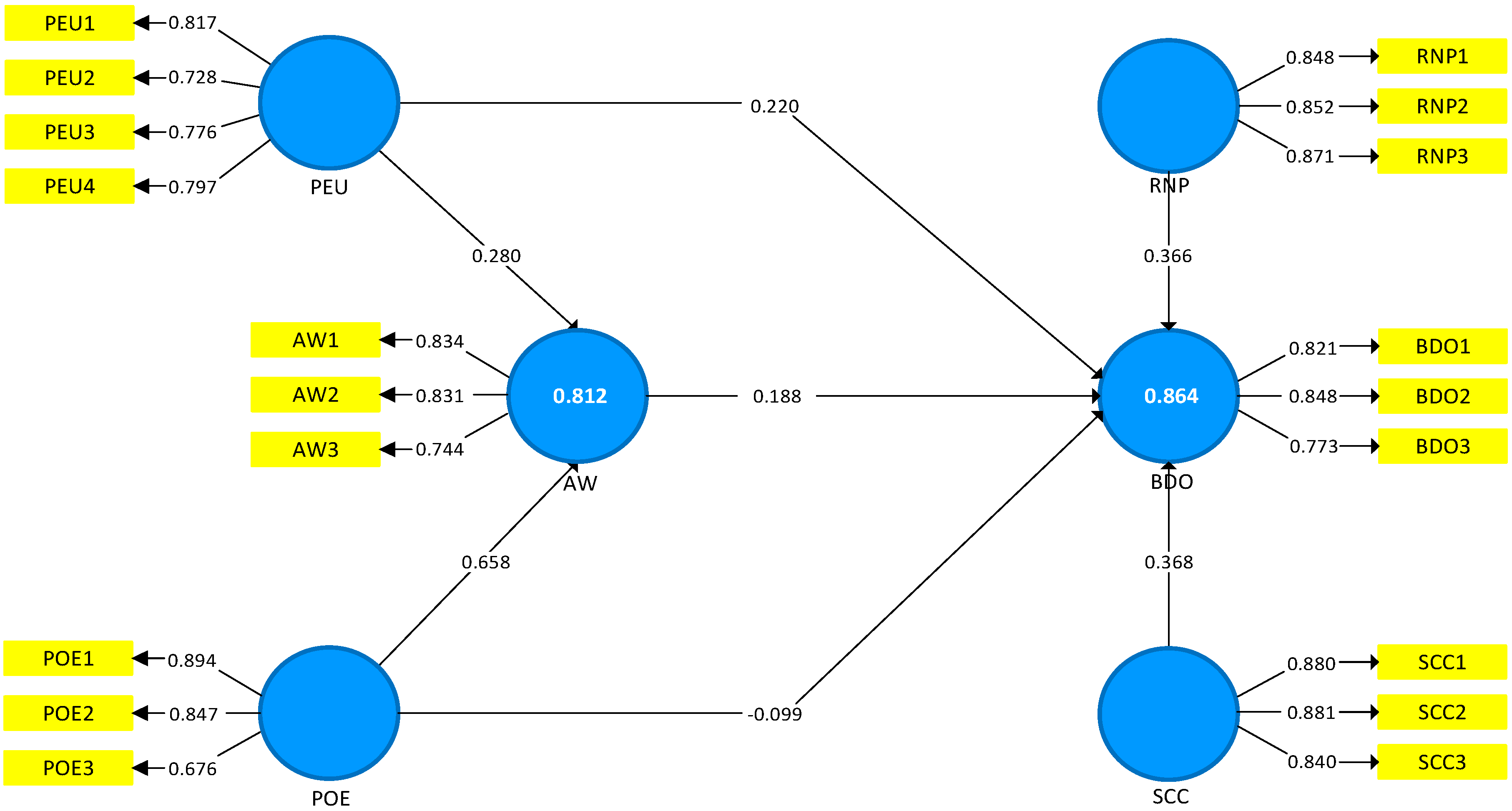

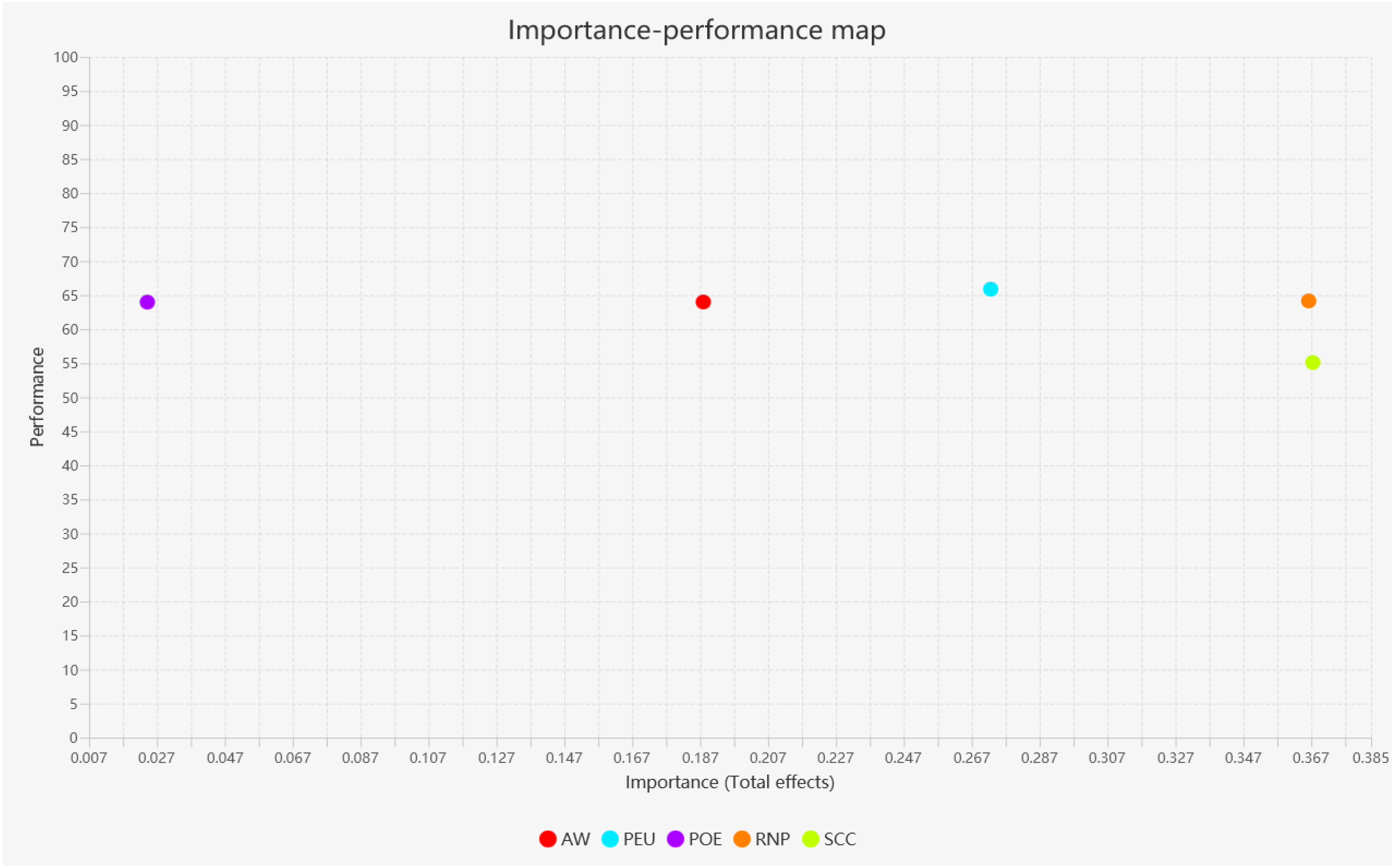


| Variable | Categorization | Number | Percentage | Variable | Categorization | Number | Percentage |
|---|---|---|---|---|---|---|---|
| Gender | Male | 136 | 54.2% | Position | Technical staff | 93 | 37% |
| General Manager | 84 | 33.5% | |||||
| Female | 115 | 45.8% | Senior Manager | 74 | 29.5% | ||
| Work Experience | 1–4 years | 84 | 33.5% | Educational Background | Bachelor | 97 | 38.6% |
| 5–7 years | 96 | 38.2% | Postgraduate | 69 | 27.5% | ||
| ≥8 years | 71 | 28.3% | Other | 85 | 33.9% |
| Normality | ||||||
| Latent Variable | Kolmogorov–Smirnov | Shapiro–Wilk | ||||
| Statistic | Df | Sig. | Statistic | Df | Sig. | |
| PEU | 0.246 | 251 | 0 | 0.86 | 251 | 0 |
| POE | 0.174 | 251 | 0 | 0.937 | 251 | 0 |
| AW | 0.218 | 251 | 0 | 0.907 | 251 | 0 |
| RNP | 0.177 | 251 | 0 | 0.941 | 251 | 0 |
| SCC | 0.168 | 251 | 0 | 0.941 | 251 | 0 |
| BDO | 0.218 | 251 | 0 | 0.919 | 251 | 0 |
| Non-response Bias | ||||||
| Latent Variable | First Thirty | Last Thirty | ||||
| Mean | SD | Mean | SD | |||
| PEU | 3.491 | 0.712 | 3.642 | 0.704 | ||
| POE | 3.891 | 0.638 | 3.976 | 0.775 | ||
| AW | 3.659 | 0.645 | 3.833 | 0.607 | ||
| RNP | 3.614 | 0.634 | 3.502 | 0.653 | ||
| SCC | 3.707 | 0.521 | 3.568 | 0.627 | ||
| BDO | 3.688 | 0.707 | 3.577 | 0.743 | ||
| Latent Variable | Gender | Position | Related Work Experience | Educational Background | ||||
|---|---|---|---|---|---|---|---|---|
| F-Value | p-Value | F-Value | p-Value | F-Value | p-Value | F-Value | p-Value | |
| PEU | 0.961 | 0.328 | 0.349 | 0.706 | 0.085 | 0.919 | 0.025 | 0.975 |
| POE | 2.383 | 0.124 | 0.706 | 0.611 | 0.919 | 0.979 | 0.975 | 0.949 |
| AW | 0.504 | 0.478 | 0.494 | 0.887 | 0.021 | 0.631 | 0.052 | 0.884 |
| RNP | 1.365 | 0.244 | 0.611 | 0.582 | 0.979 | 0.905 | 0.949 | 0.918 |
| SCC | 0.833 | 0.362 | 0.120 | 0.831 | 0.461 | 0.864 | 0.123 | 0.987 |
| BDO | 1.133 | 0.288 | 0.887 | 0.352 | 0.631 | 0.866 | 0.884 | 0.831 |
| Latent Variable | Cronbach’s Alpha | Composite Reliability (rho_a) | Average Variance Extracted | Observed Variable | Factor Loadings | VIF |
|---|---|---|---|---|---|---|
| AW | 0.726 | 0.734 | 0.647 | AW1 | 0.834 | 1.549 |
| AW2 | 0.831 | 1.520 | ||||
| AW3 | 0.744 | 1.311 | ||||
| BDO | 0.747 | 0.758 | 0.664 | BDO1 | 0.821 | 2.056 |
| BDO2 | 0.848 | 1.910 | ||||
| BDO3 | 0.773 | 1.214 | ||||
| SCC | 0.835 | 0.839 | 0.752 | SCC1 | 0.880 | 2.133 |
| SCC2 | 0.881 | 2.012 | ||||
| SCC3 | 0.840 | 1.778 | ||||
| POE | 0.733 | 0.761 | 0.658 | POE1 | 0.894 | 2.056 |
| POE2 | 0.847 | 1.910 | ||||
| POE3 | 0.676 | 1.214 | ||||
| PEU | 0.786 | 0.792 | 0.609 | PEU1 | 0.817 | 1.964 |
| PEU2 | 0.728 | 1.716 | ||||
| PEU3 | 0.776 | 1.666 | ||||
| PEU4 | 0.797 | 1.626 | ||||
| RNP | 0.819 | 0.822 | 0.734 | RNP1 | 0.848 | 2.133 |
| RNP2 | 0.852 | 2.012 | ||||
| RNP3 | 0.871 | 1.778 |
| Variable | BI | DD | PBC | PBU | PU | SN |
|---|---|---|---|---|---|---|
| AW | 0.848 | |||||
| BDO | 0.744 | 0.817 | ||||
| SCC | 0.529 | 0.667 | 0.867 | |||
| POE | 0.713 | 0.577 | 0.558 | 0.855 | ||
| PEU | 0.727 | 0.619 | 0.624 | 0.782 | 0.840 | |
| RNP | 0.517 | 0.598 | 0.723 | 0.707 | 0.611 | 0.856 |
| Variable | R2 | Q2 Predict | RMSE | MAE | Exogenous Variables | f2 |
|---|---|---|---|---|---|---|
| AW | 0.812 | 0.804 | 0.447 | 0.307 | PEU | 0.774 |
| POW | 0.140 | |||||
| BDO | 0.864 | 0.845 | 0.397 | 0.282 | PEU | 0.348 |
| POE | 0.012 | |||||
| RNP | 0.060 | |||||
| SCC | 0.311 |
| Hypotheses | Path Coefficient | T-Values | p-Values | Decision |
|---|---|---|---|---|
| AW → BDO | 0.188 | 2.803 | 0.005 | Supported |
| SCC → BDO | 0.368 | 6.416 | 0.000 | Supported |
| POE → AW | 0.658 | 10.921 | 0.000 | Supported |
| POE → BDO | −0.099 | 1.174 | 0.240 | Not Supported |
| PEU → AW | 0.280 | 4.439 | 0.000 | Supported |
| PEU → BDO | 0.220 | 2.481 | 0.013 | Supported |
| RNP → BDO | 0.366 | 5.818 | 0.000 | Supported |
| POE → AW → BDO | 0.124 | 2.831 | 0.005 | Supported |
| PEU → AW → BDO | 0.053 | 2.119 | 0.034 | Supported |
| Variable | Importance | Performance |
|---|---|---|
| AW | 0.188 | 64.001 |
| SCC | 0.368 | 55.125 |
| POE | 0.024 | 63.978 |
| PEU | 0.273 | 65.888 |
| RNP | 0.366 | 64.159 |
| Variable | N | Min | Max | Mean | S.D. | Fully-Out (10%) | Cross-Over (50%) | Fully-In (90%) |
|---|---|---|---|---|---|---|---|---|
| PEU | 251 | 1 | 5 | 3.6434 | 0.712 | −0.901 | −0.182 | 1.933 |
| POE | 251 | 1 | 5 | 3.6799 | 0.725 | −1.383 | −0.040 | 1.833 |
| AW | 251 | 1 | 5 | 3.6985 | 0.713 | −1.420 | −0.069 | 1.834 |
| RNP | 251 | 1 | 5 | 3.7304 | 0.651 | −1.124 | −0.096 | 1.952 |
| SCC | 251 | 1 | 5 | 3.6587 | 0.705 | −0.928 | −0.466 | 1.911 |
| BDO | 251 | 1 | 5 | 3.7118 | 0.652 | −1.080 | −0.111 | 1.986 |
| Configurational Constructs | High BDO | Configurational Constructs | Low BDO | ||
|---|---|---|---|---|---|
| Consistency | Coverage | Consistency | Coverage | ||
| AW | 0.841 | 0.760 | AW | 0.485 | 0.567 |
| ~AW | 0.521 | 0.439 | ~AW | 0.795 | 0.866 |
| SCC | 0.893 | 0.777 | SCC | 0.477 | 0.537 |
| ~SCC | 0.469 | 0.409 | ~SCC | 0.802 | 0.907 |
| POE | 0.839 | 0.775 | POE | 0.481 | 0.575 |
| ~POE | 0.540 | 0.446 | ~POE | 0.811 | 0.867 |
| PEU | 0.855 | 0.822 | PEU | 0.421 | 0.524 |
| ~PEU | 0.505 | 0.403 | ~PEU | 0.857 | 0.884 |
| RNP | 0.847 | 0.837 | RNP | 0.425 | 0.543 |
| ~RNP | 0.538 | 0.420 | ~RNP | 0.873 | 0.881 |
| Configuration | High DD | Low DD | ||||
|---|---|---|---|---|---|---|
| 1 | 2 | 3 | 4 | 5 | 6 | |
| AW | ● | ⊗ | • | ⊗ | ⊗ | |
| SCC | ● | • | ⊗ | ⊗ | • | |
| POE | ● | ⊗ | ⊗ | • | ||
| PEU | ● | ● | ⊗ | ⊗ | ||
| RNP | ● | ⊗ | ⊗ | |||
| Raw Coverage | 0.695 | 0.285 | 0.438 | 0.665 | 0.698 | 0.306 |
| Unique Coverage | 0.454 | 0.043 | 0.034 | 0.038 | 0.060 | 0.007 |
| Consistency | 0.937 | 0.926 | 0.964 | 0.969 | 0.974 | 0.978 |
| Overall Solution Coverage | 0.739 | 0.802 | ||||
| Overall Solution Consistency | 0.928 | 0.946 | ||||
Disclaimer/Publisher’s Note: The statements, opinions and data contained in all publications are solely those of the individual author(s) and contributor(s) and not of MDPI and/or the editor(s). MDPI and/or the editor(s) disclaim responsibility for any injury to people or property resulting from any ideas, methods, instructions or products referred to in the content. |
© 2026 by the authors. Licensee MDPI, Basel, Switzerland. This article is an open access article distributed under the terms and conditions of the Creative Commons Attribution (CC BY) license.
Share and Cite
Li, L.; Xu, W.; Song, K.; Xiu, C.; Zhu, R. The Diffusion Mechanism of Blockchain Technology for Power Sector Carbon Emission Data Supervision from the Perspective of Sustainable Development. Sustainability 2026, 18, 1902. https://doi.org/10.3390/su18041902
Li L, Xu W, Song K, Xiu C, Zhu R. The Diffusion Mechanism of Blockchain Technology for Power Sector Carbon Emission Data Supervision from the Perspective of Sustainable Development. Sustainability. 2026; 18(4):1902. https://doi.org/10.3390/su18041902
Chicago/Turabian StyleLi, Lihong, Weimao Xu, Kun Song, Ce Xiu, and Rui Zhu. 2026. "The Diffusion Mechanism of Blockchain Technology for Power Sector Carbon Emission Data Supervision from the Perspective of Sustainable Development" Sustainability 18, no. 4: 1902. https://doi.org/10.3390/su18041902
APA StyleLi, L., Xu, W., Song, K., Xiu, C., & Zhu, R. (2026). The Diffusion Mechanism of Blockchain Technology for Power Sector Carbon Emission Data Supervision from the Perspective of Sustainable Development. Sustainability, 18(4), 1902. https://doi.org/10.3390/su18041902