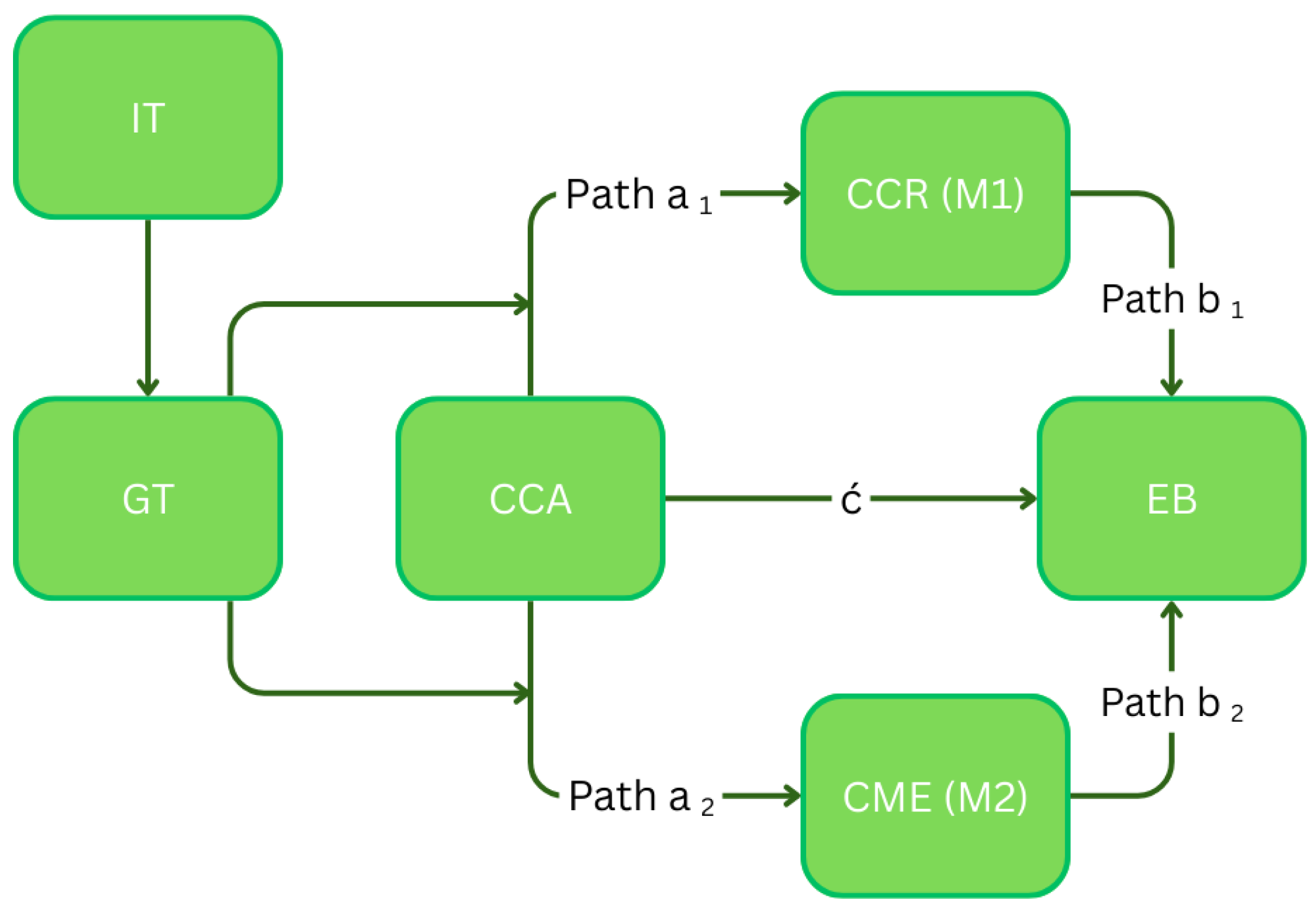
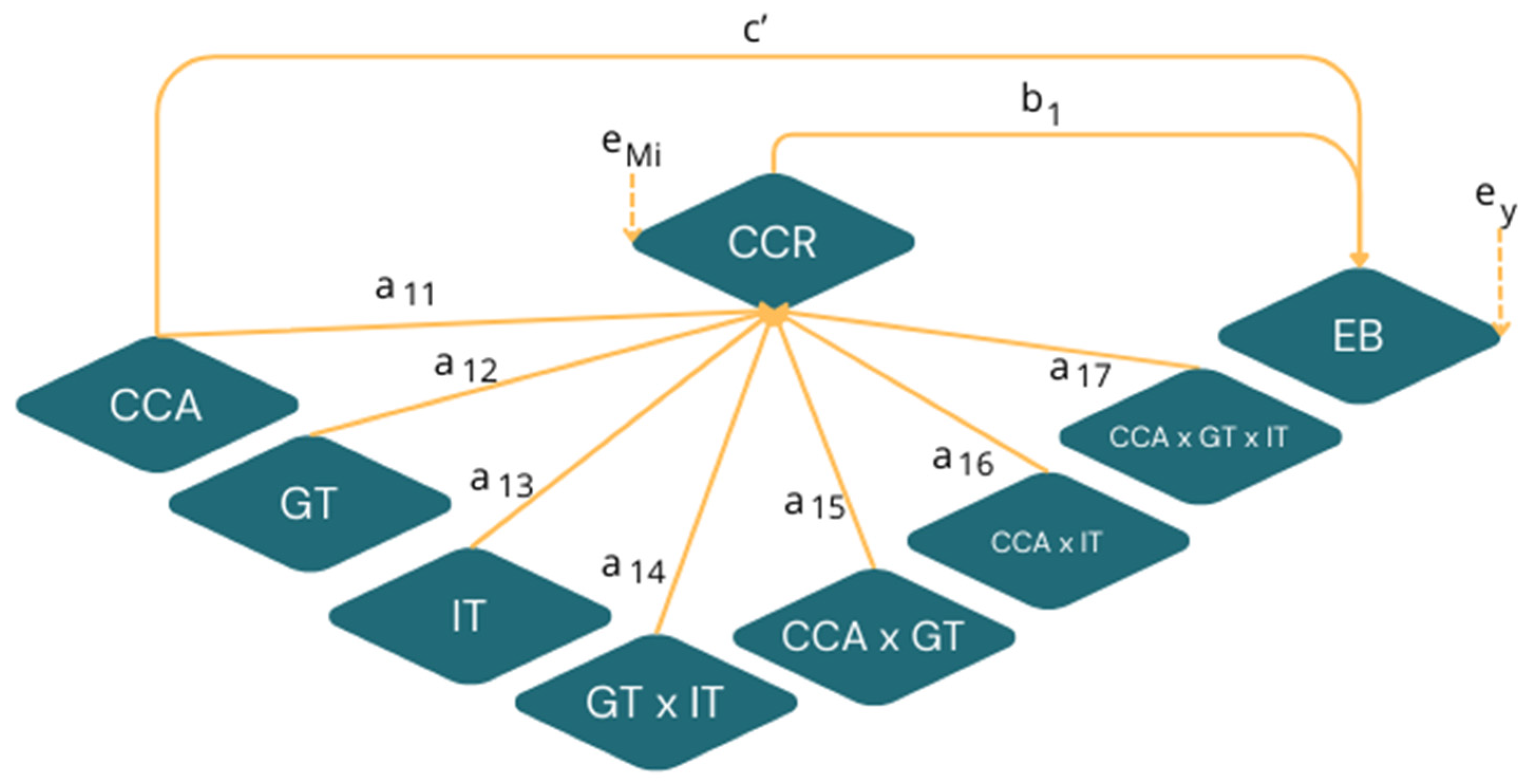
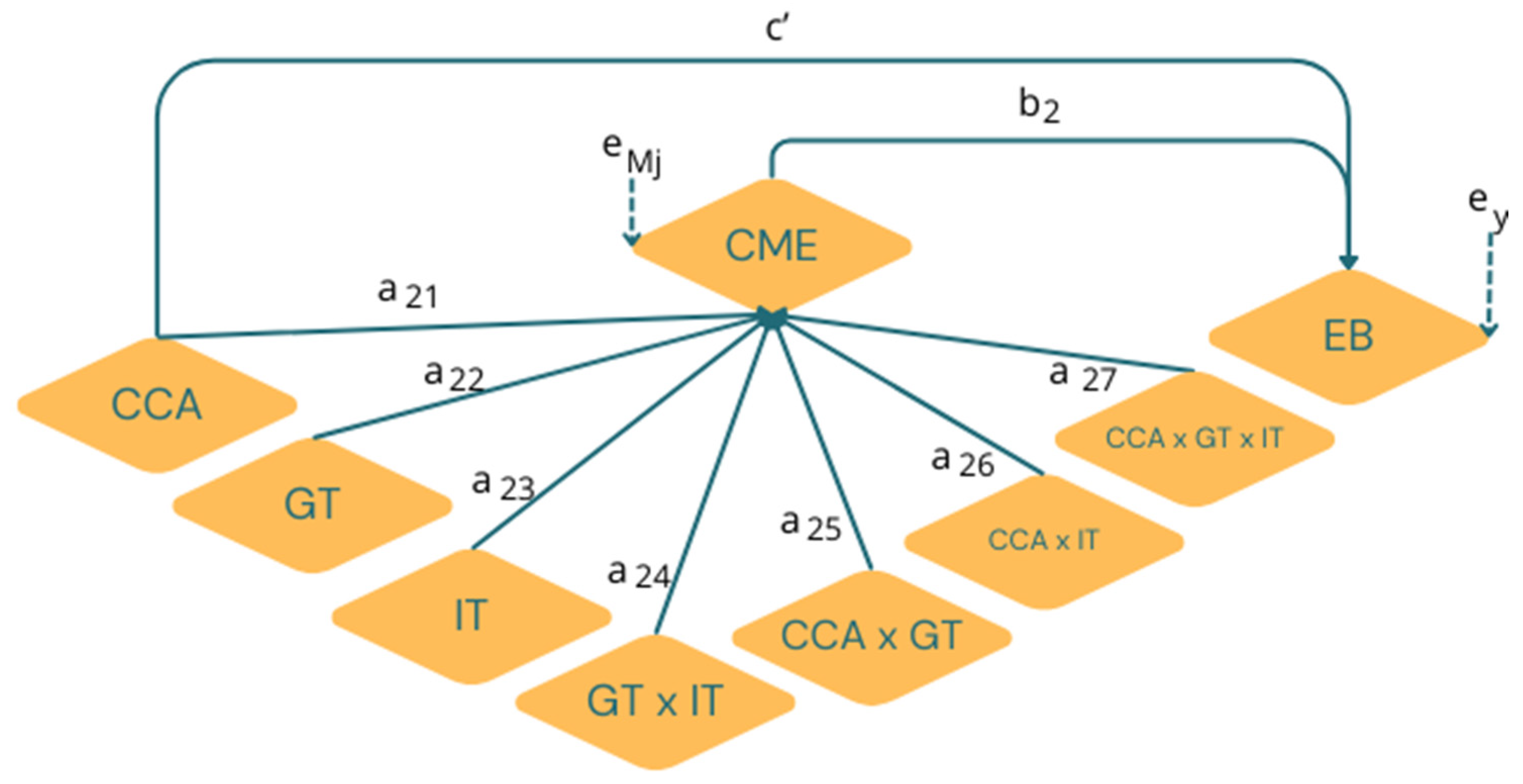
The Conditional Effect of Trust on Generation Z’s Environmental Behaviour: A Path Analysis Perspective


Abstract
1. Introduction
2. Literature Review and Research Background
2.1. Theoretical Integration and Proposed Research Hypotheses
2.2. Research Hypotheses
2.2.1. Climate Change Awareness (CCA) as Initiator
2.2.2. Climate Change Risk (CCR) as a Mediator
2.2.3. Community Engagement (CME) as a Mediator
2.2.4. Institutional and Individual Trust as Moderators
3. Method and Data
3.1. Survey Instrument
3.2. Sampling and Data Collection
3.3. Data Analysis
3.4. Statistical Approach
4. Results
4.1. Moderated–Moderated Mediation Analysis
4.1.1. Prediction of Climate Change Risk Perception (CCR)
4.1.2. Prediction of Community Engagement (CME)
4.1.3. Prediction of Environmental Behaviour (EB)
4.2. Conditional Indirect Effects
4.3. SuEvaluation of the Conceptual Model
5. Discussion
5.1. The Awareness–Risk Perception Gap in Generation Z
5.2. Risk Perception as a Weak Driver of Environmental Behaviour
5.3. Direct Role of Awareness in Shaping Environmental Behaviour
5.4. Community Engagement as the Central Behavioural Mechanism
5.5. The Conditional Role of Trust: Understanding Institutional and Generalised Trust
5.6. Generation Z in Low-Trust, Post-Transitional Context
5.7. Implications and Contribution
5.8. Study Limitations
6. Conclusions
Supplementary Materials
Author Contributions
Funding
Institutional Review Board Statement
Informed Consent Statement
Data Availability Statement
Conflicts of Interest
Abbreviations
| CCA | Climate Change Awareness |
| CCR | Climate Change Risk |
| CCRPM | Climate Change Risk Perception Model |
| CME | Community Engagement |
| EB | Environmental Behaviour |
| EU | European Union |
| GT | Generalised Trust (interpersonal trust) |
| IMMM | Index of Moderated–Moderated Mediation |
| IT | Institutional Trust |
| SEM | Structural Equation Modelling |
| WTP | Willingness to Pay |
| YEEP | Youth Environmental Engagement Model |
References
- Smith, E.K.; Mayer, A. A social trap for the climate? Collective action, trust and climate change risk perception in 35 countries. Glob. Environ. Change 2018, 49, 140–153. [Google Scholar] [CrossRef]
- Adger, W.N. Social Capital, Collective Action, and Adaptation to Climate Change. In Der Klimawandel; Voss, M., Ed.; VS Verlag für Sozialwissenschaften: Wiesbaden, Germany, 2010; pp. 327–345. [Google Scholar]
- Bamberg, S.; Rees, J.; Seebauer, S. Collective climate action: Determinants of participation intention in community-based pro-environmental initiatives. J. Environ. Psychol. 2015, 43, 155–165. [Google Scholar] [CrossRef]
- Slovic, P. Perception of risk. Science 1987, 236, 280–285. [Google Scholar] [CrossRef]
- Fairbrother, M. Trust and Public Support for Environmental Protection in Diverse National Contexts. Sociol. Sci. 2016, 3, 359–382. [Google Scholar] [CrossRef]
- Bonfanti, R.C.; Ruggieri, S.; Schimmenti, A. Psychological Trust Dynamics in Climate Change Adaptation Decision-Making Processes: A Literature Review. Sustainability 2024, 16, 3984. [Google Scholar] [CrossRef]
- Dimitrova, R.; Musso, P.; Naudé, L.; Zahaj, S.; Solcova, I.P.; Stefenel, D.; Uka, F.; Jordanov, V.; Jordanov, E.; Tavel, P. National collective identity in transitional societies: Salience and relations to life satisfaction for youth in South Africa, Albania, Bulgaria, the Czech Republic, Kosovo and Romania. J. Psychol. Afr. 2017, 27, 150–158. [Google Scholar] [CrossRef]
- Salguero, R.B.; Bogueva, D.; Marinova, D. Australia’s university Generation Z and its concerns about climate change. Sustain. Earth Rev. 2024, 7, 8. [Google Scholar] [CrossRef]
- Spadaro, G.; Gangl, K.; Van Prooijen, J.W.; Van Lange, P.A.M.; Mosso, C.O. Enhancing feelings of security: How institutional trust promotes interpersonal trust. PLoS ONE 2020, 15, e0237934. [Google Scholar] [CrossRef] [PubMed]
- van Eck, C.W.; Mulder, B.C.; van der Linden, S. Climate Change Risk Perceptions of Audiences in the Climate Change Blogosphere. Sustainability 2020, 12, 7990. [Google Scholar] [CrossRef]
- van der Linden, S. On the relationship between personal experience, affect and risk perception: The case of climate change. Eur. J. Soc. Psychol. 2014, 44, 430–440. [Google Scholar] [CrossRef]
- van der Linden, S. The social-psychological determinants of climate change risk perceptions: Towards a comprehensive model. J. Environ. Psychol. 2015, 41, 112–124. [Google Scholar] [CrossRef]
- van der Linden, S.; Leiserowitz, A.; Rosenthal, S.; Maibach, E. Inoculating the Public against Misinformation about Climate Change. Glob. Chall. 2017, 1, 1600008. [Google Scholar] [CrossRef]
- Farrokhi, M.; Khankeh, H.; Amanat, N.; Kamali, M.; Fathi, M. Psychological aspects of climate change risk perception: A content analysis in Iranian context. J. Educ. Health Promot. 2020, 9, 346. [Google Scholar] [CrossRef] [PubMed]
- Sattler, D.N.; Graham, J.M.; Whippy, A.; Atienza, R.; Johnson, J. Developing a Climate Change Risk Perception Model in the Philippines and Fiji: Posttraumatic Growth Plays Central Role. Int. J. Environ. Res. Public Health 2023, 20, 1518. [Google Scholar] [CrossRef] [PubMed]
- Davis, L.F.; Ramírez-Andreotta, M.D. Participatory Research for Environmental Justice: A Critical Interpretive Synthesis. Environ. Health Perspect. 2021, 129, 026001. [Google Scholar] [CrossRef]
- Oinonen, I.; Paloniemi, R. Understanding and measuring young people’s sustainability actions. J. Environ. Psychol. 2023, 91, 102124. [Google Scholar] [CrossRef]
- Riemer, M.; Lynes, J.; Hickman, G. A model for developing and assessing youth-based environmental engagement programmes. Environ. Educ. Res. 2014, 20, 552–574. [Google Scholar] [CrossRef]
- Stuart, D.; Gunderson, R.; Petersen, B. The climate crisis as a catalyst for emancipatory transformation: An examination of the possible. Int. Sociol. 2020, 35, 433–456. [Google Scholar] [CrossRef]
- Stuart, D.; Petersen, B.; Gunderson, R. Shared pretenses for collective inaction: The economic growth imperative, COVID-19, and climate change. Globalizations 2022, 19, 408–425. [Google Scholar] [CrossRef]
- Almeida, P.; González, L.R.; Flores, E.O.; Curry, V.; Padilla, A. The building blocks of community participation in local climate meetings. npj Clim. Action 2023, 2, 37. [Google Scholar] [CrossRef]
- Fergen, J.T.; Bergstrom, R.D.; Steinman, A.D.; Johnson, L.B.; Twiss, M.R. Community capacity and climate change in the Laurentian Great Lakes Region: The importance of social, human, and political capital for community responses to climate-driven disturbances. J. Environ. Plan. Manag. 2022, 67, 993–1012. [Google Scholar] [CrossRef]
- Kaçani, K.; Kokthi, E.; López-Bonilla, L.M.; González-Limón, M. Social tipping and climate change: The moderating role of social capital in bridging the gap between awareness and action. J. Int. Dev. 2024, 36, 2537–2556. [Google Scholar] [CrossRef]
- Ariestya, A.; Paramitha, G.; Elmada, M.A.G. Climate change awareness of gen z: The influence of frame and jargon on online news. J. Studi Komun. 2022, 6, 753–770. [Google Scholar] [CrossRef]
- Juma-Michilena, I.J.; Ruiz-Molina, M.E.; Gil-Saura, I.; Belda-Miquel, S. An analysis of the factors influencing pro-environmental behavioural intentions on climate change in the university community. Econ. Res.-Ekon. Istraživanja 2023, 36, 2264373. [Google Scholar] [CrossRef]
- Juma-Michilena, I.J.; Ruiz-Molina, M.E.; Gil-Saura, I.; Belda-Miquel, S. Pro-environmental behaviours of generation Z: A cross-cultural approach. Int. Rev. Public Nonprofit Mark. 2024, 21, 1–29. [Google Scholar] [CrossRef]
- Venghaus, S.; Henseleit, M.; Belka, M. The impact of climate change awareness on behavioral changes in Germany: Changing minds or changing behavior? Energy Sustain. Soc. 2022, 12, 8. [Google Scholar] [CrossRef]
- Tao, W.; Tian, S.; Sunny Tsai, W.H.; Seelig, M.I. The Power of Emotional Appeal in Motivating Behaviors to Mitigate Climate Change among Generation Z. J. Nonprofit Public Sect. Mark. 2024, 36, 37–64. [Google Scholar] [CrossRef]
- Spychalski, B. Socio-cultural factors shaping the attitude of Generation Z and Generation Alpha youth towards quality. J. Sustain. Dev. Transp. Logist. 2023, 8, 298–311. [Google Scholar] [CrossRef]
- Restrepo-Mieth, A.; Perry, J.; Garnick, J.; Weisberg, M. Community-based participatory climate action. Glob. Sustain. 2023, 6, e14. [Google Scholar] [CrossRef]
- Baum, C.M.; Gross, C. Sustainability policy as if people mattered: Developing a framework for environmentally significant behavioral change. J. Bioecon. 2017, 19, 53–95. [Google Scholar] [CrossRef]
- Elia, A. Interactive effects of citizen trust and cultural values on pro-environmental behaviors: A time-lag study from Indonesia. Heliyon 2022, 8, e09139. [Google Scholar]
- Harring, N.; Jagers, S.C. Should we trust in values? Explaining public support for pro-environmental taxes. Sustainability 2013, 5, 210–227. [Google Scholar] [CrossRef]
- Marquart-Pyatt, S.T. Environmental Trust: A Cross-Region and Cross-Country Study. Soc. Nat. Resour. 2016, 29, 1032–1048. [Google Scholar] [CrossRef]
- Kartseva, A.; Minin, V.; Ranta-Korhonen, T.; Nurmi, E.; Belyakov, V. Environmental education of Z generation students for sustainable development of rural areas (the example of the Russian-Finnish project Luga-Balt-2). E3S Web Conf. 2021, 296, 08017. [Google Scholar] [CrossRef]
- Loy, L.S.; Spence, A. Reducing, and bridging, the psychological distance of climate change. J. Environ. Psychol. 2020, 67, 101388. [Google Scholar] [CrossRef]
- Maiella, R.; La Malva, P.; Marchetti, D.; Pomarico, E.; Di Crosta, A.; Palumbo, R.; Cetara, L.; Di Domenico, A.; Verrocchio, M.C. The Psychological Distance and Climate Change: A Systematic Review on the Mitigation and Adaptation Behaviors. Front. Psychol. 2020, 11, 568899. [Google Scholar] [CrossRef] [PubMed]
- Spence, A.; Poortinga, W.; Pidgeon, N. The Psychological Distance of Climate Change: Psychological Distance of Climate Change. Risk Anal. 2012, 32, 957–972. [Google Scholar] [CrossRef]
- Druen, P.B.; Zawadzki, S.J. Escaping the Climate Trap: Participation in a Climate-Specific Social Dilemma Simulation Boosts Climate-Protective Motivation and Actions. Sustainability 2021, 13, 9438. [Google Scholar] [CrossRef]
- Rabaa, S.; Geisendorf, S.; Wilken, R. Why Change Does (not) Happen: Understanding and Overcoming Status Quo Biases in Climate Change Mitigation. Z. Umweltpolit. Umweltr. 2022, 45, 100–134. [Google Scholar]
- Daskalopoulou, I. Individual-Level Evidence on the Causal Relationship Between Social Trust and Institutional Trust. Soc. Indic. Res. 2019, 144, 275–298. [Google Scholar] [CrossRef]
- Torney-Purta, J. Patterns in the Civic Knowledge, Engagement, and Attitudes of European Adolescents: The IEA Civic Education Study. Eur. J. Educ. 2002, 37, 129–141. [Google Scholar] [CrossRef]
- Kaçani, K.; Kokthi, E.; González-Limón, M.; López-Bonilla, L.M. From Collective Norms to Personal Responsibility: Integrating TPB and SDT to Explain Green Banking Behaviors in a Transitional Society. Bus. Strategy Dev. 2025, 8, e70229. [Google Scholar] [CrossRef]
- Coutts, J.J.; Hayes, A.F.; Jiang, T. Easy Statistical Mediation Analysis with Distinguishable Dyadic Data. J. Commun. 2019, 69, 612–649. [Google Scholar] [CrossRef]
- Hayes, A.F.; Montoya, A.K. A Tutorial on Testing, Visualizing, and Probing an Interaction Involving a Multicategorical Variable in Linear Regression Analysis. Commun. Methods Meas. 2017, 11, 1–30. [Google Scholar] [CrossRef]
- Hayes, A.F. Partial, conditional, and moderated moderated mediation: Quantification, inference, and interpretation. Commun. Monogr. 2018, 85, 4–40. [Google Scholar] [CrossRef]
- Igartua, J.J.; Hayes, A.F. Mediation, Moderation, and Conditional Process Analysis: Concepts, Computations, and Some Common Confusions. Span. J. Psychol. 2021, 24, e49. [Google Scholar] [CrossRef]
- Bradley, G.L.; Babutsidze, Z.; Chai, A.; Reser, J.P. The role of climate change risk perception, response efficacy, and psychological adaptation in pro-environmental behavior: A two nation study. J. Environ. Psychol. 2020, 68, 101410. [Google Scholar] [CrossRef]
- Karlsson, S.; Lindström, A. Is Knowledge Enough?: A Qualitative Study Investigating the Knowledge-Action Gap of Environmental Science Students. 2020. Available online: https://www.diva-portal.org/smash/record.jsf?pid=diva2:1448520 (accessed on 14 December 2025).
- Ricart, S.; Gandolfi, C.; Castelletti, A. Climate change awareness, perceived impacts, and adaptation from farmers’ experience and behavior: A triple-loop review. Reg. Environ. Change 2023, 23, 82. [Google Scholar] [CrossRef]
- Jacobson, L.; Åkerman, J.; Giusti, M.; Bhowmik, A. Tipping to Staying on the Ground: Internalized Knowledge of Climate Change Crucial for Transformed Air Travel Behavior. Sustainability 2020, 12, 1994. [Google Scholar] [CrossRef]
- Margariti, K.; Hatzithomas, L.; Boutsouki, C. Elucidating the Gap between Green Attitudes, Intentions, and Behavior through the Prism of Greenwashing Concerns. Sustainability 2024, 16, 5108. [Google Scholar] [CrossRef]
- Steynor, A.; Pasquini, L. Using a Climate Change Risk Perceptions Framing to Identify Gaps in Climate Services. Front. Clim. 2022, 4, 782012. [Google Scholar] [CrossRef]
- Kokthi, E.; Guri, G.; Muco, E. Assessing the applicability of geographical indications from the social capital analysis perspective: Evidences from Albania. Econ. Sociol. 2021, 14, 32–53. [Google Scholar] [CrossRef]
- Barnett, J.; Adger, W.N. Climate change, human security and violent conflict. Political Geogr. 2007, 26, 639–655. [Google Scholar] [CrossRef]
- Bassiouni, D.H.; Hackley, C. “Generation Z” children’s adaptation to digital consumer culture: A critical literature review. J. Cust. Behav. 2014, 13, 113–133. [Google Scholar] [CrossRef]
- Trittin-Ulbrich, H.; Scherer, A.G.; Munro, I.; Whelan, G. Exploring the dark and unexpected sides of digitalization: Toward a critical agenda. Organization 2021, 28, 8–25. [Google Scholar] [CrossRef]
- Gifford, R. The dragons of inaction: Psychological barriers that limit climate change mitigation and adaptation. Am. Psychol. 2011, 66, 290–302. [Google Scholar] [CrossRef] [PubMed]



| Demographics | Value | Frequency | Frequency Percentage |
|---|---|---|---|
| Gender | Female | 156 | 60 |
| Male | 104 | 40 | |
| Age | 18–25 | 224 | 86 |
| Over 25 | 36 | 14 | |
| Educational Level | High School | 52 | 20.2 |
| Graduate | 188 | 72.9 | |
| Postgraduate | 18 | 7 | |
| Employment status | Unemployed | 84 | 32 |
| Employed | 102 | 39 | |
| Students | 74 | 28 | |
| Monthly incomes in Albanian Lek (ALL) | 15,000–30,000 | 24 | 9.3 |
| 31,000–60,000 | 50 | 19.4 | |
| 61,000–90,000 | 68 | 26.4 | |
| 91,000–120,000 | 50 | 19.4 | |
| 120,000+ | 66 | 25.6 |
| Construct | Number of Items | Cronbach’s Alpha |
|---|---|---|
| Community engagement (CME) | 6 | 0.789 |
| Climate change awareness (CCA) | 6 | 0.909 |
| Climate change risk perceptions (CCR) | 4 | 0.789 |
| Environmental behaviour | 2 | 0.859 |
| Variables | Mean | St Deviation |
|---|---|---|
| Institutional trust (IT) is analysed through the following statements (1 = strongly disagree to 5 strongly agree): | ||
| Most politicians are in politics only for personal gain | 3.87 | 1.197 |
| Most of the time you believe the government is doing what is right. | 2.31 | 1.254 |
| State institutions manage tax revenues effectively | 2.38 | 1.165 |
| To be a good citizen is important to (CME) | ||
| Always participate in voting | 3.14 | 1.295 |
| Monitoring of government activities | 3.67 | 1.146 |
| Being active in community affairs | 4.12 | 1.102 |
| Pay taxes regularly | 4.16 | 0.986 |
| To help other citizens who are in worse condition than you are | 3.64 | 1.295 |
| To protect the environment | 4.52 | 0.809 |
| The generalised trust—Suppose someone from the village/town/city had to go away for a while, along with their family. In whose charge could they leave “their house”? | 2.05 | 0.652 |
| Climate change awareness (CCA) (1 = Not at all aware, 5 = Very much aware) | ||
| Are you aware of the dangers posed by vehicle emissions to people’s health? | 3.61 | 1.298 |
| Are you aware that using chemical fertilisers and pesticides will cause environmental damage? | 3.73 | 1.295 |
| Are you aware of the dangers of air pollution? | 4.12 | 1.102 |
| Are you informed about the dangers of water pollution? | 4.02 | 1.126 |
| Are you aware of the dangers of insufficient green space? | 3.76 | 1.265 |
| Are you informed about the damage caused by the degradation of cultivated land quality? | 3.23 | 1.358 |
| Climate change and risk perceptions (CCR) (1 = not serious at all, 5 = very serious) | ||
| If extreme weather occurs in your area, how serious is the impact on your life? | 3.32 | 1.254 |
| If a geological disaster occurs in your area, how serious is the impact on your life? | 3.55 | 1.308 |
| If vegetation destruction occurs in your area, how serious is the impact on people’s lives? | 3.41 | 1.251 |
| If there is a water shortage in your area, how serious is the impact on your life? | 4.40 | 0.904 |
| Environmental behaviour EB (1 = strongly to disagree to 5 = strongly agree) | ||
| I would agree to pay an environmental contribution if the money were to be used for the environment | 3.60 | 1.352 |
| I would agree to pay an environmental tax if the money were to be used for the environment | 3.68 | 1.314 |
| Outcome | Predictor | β | SE | t | p |
|---|---|---|---|---|---|
| CCR | CCA | 0.063 | 0.312 | 0.2 | 0.841 |
| GT | −0.242 | 0.61 | −0.40 | 0.692 | |
| IT | 1.01 | 0.571 | 1.77 | 0.078 | |
| CCA × GT | 0.091 | 0.149 | 0.61 | 0.542 | |
| CCA × IT | −0.192 | 0.138 | −1.40 | 0.163 | |
| GT × IT | −0.446 | 0.28 | −1.59 | 0.113 | |
| CCA × GT × IT | 0.074 | 0.067 | 1.1 | 0.272 | |
| Model R2 | 0.145 | ||||
| CME | CCA | 1.643 | 0.381 | 4.32 | <0.001 |
| GT | 1.401 | 0.744 | 1.88 | 0.061 | |
| IT | 2.635 | 0.695 | 3.79 | <0.001 | |
| CCA × GT | −0.455 | 0.181 | −2.51 | 0.013 | |
| CCA × IT | −0.740 | 0.168 | −4.41 | <0.001 | |
| GT × IT | −1.005 | 0.342 | −2.94 | 0.004 | |
| CCA × GT × IT | 0.282 | 0.082 | 3.44 | <0.001 | |
| Model R2 | 0.209 | ||||
| EB | CCA | 0.404 | 0.074 | 5.47 | <0.001 |
| CCR | −0.074 | 0.089 | −0.82 | 0.41 | |
| CME | 0.124 | 0.072 | 1.71 | 0.088 | |
| Model R2 | 0.141 |
| Hypothesis | Pathway | Expected Effect | Result | Decision |
|---|---|---|---|---|
| H1 | CCA → CCR | + | β = 0.063, p = 0.841 | Rejected |
| H2 | CCR → EB | + | β = −0.074, p = 0.410 | Rejected |
| H3 | CCA → EB | + | β = 0.404, p < 0.001 | Supported |
| H4 | CCA → CME | + | β = 1.643, p < 0.001 | Supported |
| H5 | CME → EB | + | β = 0.124, p = 0.088 | Not supported (marginal) |
| H6.1 | CCA × IT → CCR | + | β = −0.192, p = 0.163 | Rejected |
| H6.2 | CCA × GT → CCR | + | β = 0.091, p = 0.542 | Rejected |
| H6 | CCA × IT × GT → CCR | + | β = 0.074, p = 0.272 | Rejected |
| H7.1 | CCA × IT → CME | − | β = −0.740, p < 0.001 | Supported |
| H7.2 | CCA × GT → CME | − | β = −0.455, p = 0.013 | Supported |
| H7 | CCA × IT × GT → CME | + | β = 0.282, p < 0.001 | Supported |
Disclaimer/Publisher’s Note: The statements, opinions and data contained in all publications are solely those of the individual author(s) and contributor(s) and not of MDPI and/or the editor(s). MDPI and/or the editor(s) disclaim responsibility for any injury to people or property resulting from any ideas, methods, instructions or products referred to in the content. |
© 2026 by the authors. Licensee MDPI, Basel, Switzerland. This article is an open access article distributed under the terms and conditions of the Creative Commons Attribution (CC BY) license.
Share and Cite
Danaj, A.; Zoto, O.; Kokthi, E.; Gura, K.S. The Conditional Effect of Trust on Generation Z’s Environmental Behaviour: A Path Analysis Perspective. Sustainability 2026, 18, 1871. https://doi.org/10.3390/su18041871
Danaj A, Zoto O, Kokthi E, Gura KS. The Conditional Effect of Trust on Generation Z’s Environmental Behaviour: A Path Analysis Perspective. Sustainability. 2026; 18(4):1871. https://doi.org/10.3390/su18041871
Chicago/Turabian StyleDanaj, Adela, Oltjana Zoto, Elena Kokthi, and Kriselda Sulcaj Gura. 2026. "The Conditional Effect of Trust on Generation Z’s Environmental Behaviour: A Path Analysis Perspective" Sustainability 18, no. 4: 1871. https://doi.org/10.3390/su18041871
APA StyleDanaj, A., Zoto, O., Kokthi, E., & Gura, K. S. (2026). The Conditional Effect of Trust on Generation Z’s Environmental Behaviour: A Path Analysis Perspective. Sustainability, 18(4), 1871. https://doi.org/10.3390/su18041871