Article

Efficiency and Mechanism of Naproxen Degradation in the Mo/Fe3+/H2O2 System

1
Key Laboratory of Yellow River Water Environment in Gansu Province, School of Environmental and Municipal Engineering, Lanzhou Jiaotong University, Lanzhou 730070, China
2
Changjiang Basin Ecology and Environment Monitoring and Scientific Research Center, Changjiang Basin Ecology and Environment Administration, Ministry of Ecology and Environment, Wuhan 430010, China
3
Hubei Key Laboratory of Intelligent Monitoring, Early Warning and Protection for Basin Aquatic Ecology, Wuhan 430010, China
4
Zhejiang Environmental Science Research Institute Co., Ltd., Hangzhou 311100, China
5
Hubei Key Laboratory of Multi-Media Pollution Cooperative Control in Yangtze Basin, Hubei Provincial Engineering Research Center for Water Quality Safety and Pollution Control, School of Environmental Science and Engineering, Huazhong University of Science and Technology, Wuhan 430074, China
*
Authors to whom correspondence should be addressed.
Sustainability 2026, 18(4), 1870; https://doi.org/10.3390/su18041870
Submission received: 20 December 2025 / Revised: 29 January 2026 / Accepted: 5 February 2026 / Published: 12 February 2026

Abstract

Naproxen (NPX) is a widely occurring, refractory organic contaminant that cannot be removed by conventional water treatment processes. In response to the growing environmental pollution caused by NPX, an innovative and highly efficient green degradation method has been developed, designed on the principles of sustainability to promote long-term ecosystem health and advance a circular economy. In this study, using zero-valent molybdenum as a catalyst in combination with trivalent iron (Fe3+) and hydrogen peroxide (H2O2), we constructed a Mo/Fe3+/H2O2 system to treat NPX-contaminated water. The effects of solution pH, H2O2 concentration, Fe3+ concentration, Mo dosage, and co-existing water-matrix constituents (Cl, HCO3, PO43−, NO3, and humic acid (HA)) on NPX removal were investigated; reactive species were identified; and the reusability of Mo as well as its performance under the continuous-flow condition were evaluated. The results showed that the optimal pH was 3 and the appropriate Fe3+ dosage is 100 µM. With 500 µM H2O2, 87.9% of NPX was removed within 7 min, and a moderate increase in Fe3+ concentration, together with a suitable H2O2 level, enhanced the removal efficiency. HCO3, Cl, and HA exerted slight inhibition, whereas PO43− markedly suppressed NPX degradation. Recycling tests and the 6 h continuous-flow treatment demonstrated excellent reusability and stability of Mo. Quenching experiments revealed that HO and Fe(IV) were the dominant reactive species responsible for NPX degradation.

1. Introduction

Non-steroidal anti-inflammatory drugs (NSAIDs), belonging to the ubiquitous pharmaceuticals and personal care products (PPCPs), are widely used for treating disorders such as headaches and arthritis [1,2,3]. Naproxen (NPX), a representative NSAID, is poorly removed in conventional water treatment processes [4] and has been a frequently detected component in the effluents of Chinese wastewater treatment plants [5]. Its recalcitrant biodegradability leads to its widespread environmental occurrence [6], where it undergoes continuous migration and accumulation, posing potential threats to aquatic ecosystems and human health [7,8]. Fenton and Fenton-like processes, which primarily use H2O2 as the oxidant, demonstrate good efficiency for removing organic pollutants that are difficult to degrade by traditionally activated sludge processes [9,10,11,12,13]. Iron-based catalysts can effectively activate H2O2 to generate highly reactive free radicals for degrading organic pollutants [14] and are widely applied in Fenton and Fenton-like systems. However, the conventional activated sludge process exhibits poor efficacy in the degradation of NPX, which possesses a stable aromatic structure. In contrast, the Fenton reaction can achieve relatively favorable degradation performance. Nevertheless, it is associated with several limitations, including a relatively narrow applicable pH range (typically below 3.0) and slow regeneration of iron ions, which renders ferric iron in the system more susceptible to precipitation and consequently leads to the accumulation of iron sludge [15]. To address these limitations, reducing agents can be introduced into the Fenton system to promote the conversion of Fe3+ to Fe2+, thereby enabling continuous activation of H2O2. Molybdenum (Mo) plays a synergistic catalytic role in the system. The reactive sites it possesses can accelerate the regeneration of iron ions, thereby reducing iron sludge and speeding up the reaction process. Mo and its compounds have attracted widespread attention due to their excellent physical and chemical properties [16,17,18,19]. Studies have shown that molybdenum disulfide (MoS2) can effectively activate persulfate to degrade sulfamethoxazole [20,21,22]. It is reported that Mo sites with varied oxidation states and oxygen vacancies favor peroxymonosulfate (PMS) activation and the formation of critical singlet oxygen (1O2). Furthermore, H2O2 is known to decompose into reactive oxygen species (ROS) on MoS2 surfaces. Given these findings, it is reasonable to speculate that elemental Mo may also exhibit excellent catalytic potential in H2O2-based systems. The elemental form of Mo possesses more reactive sites and holds great potential for enhancing the efficiency of Fenton treatment [23,24,25].
This study employs elemental molybdenum powder (Mo) as a co-catalyst to construct a Mo/Fe3+/H2O2 system, using NPX as the target pollutant. This system treats NPX-contaminated wastewater, directly advancing the sustainability of water cycles and contributing to a closed-loop water management model. The effects of solution pH, H2O2 concentration, Fe3+ concentration, naproxen concentration, and water quality parameters (Cl, HCO3, PO43−, humic acid) on the degradation efficiency of naproxen in this system were investigated. The reusability of Mo and its stability in continuous flow experiments were tested. Additionally, quenching experiments were conducted to explore the reactive species present in the reaction system and their contributions to NPX degradation. The findings present a promising alternative for the oxidative degradation of organic pollutants in Fenton and Fenton-like systems, thereby advancing the development of advanced oxidation technologies. While much attention has been focused on fabricating composite materials to enhance synergistic effects, investigating the heterogeneous reactions within the Mo/Fe3+/H2O2 system can provide novel insights and foundational data for the design of such composites.

2. Materials and Methods

2.1. Materials

All reagents used in the experiments were of analytical grade or higher. Naproxen (NPX), anhydrous ferric sulfate (Fe2(SO4)3), humic acid (HA), methyl phenyl sulfoxide (PMSO), and phenyl methyl sulfone (PMSO2) were purchased from Aladdin Reagent Co., Ltd. (Shanghai, China) Tert-butanol (TBA), 30% hydrogen peroxide (H2O2), glacial acetic acid, sodium sulfate (Na2SO4), sodium dihydrogen phosphate (NaH2PO4), disodium hydrogen phosphate (Na2HPO4), and sodium thiosulfate (Na2S2O3) were purchased from Sinopharm Chemical Reagent Co., Ltd. (Shanghai, China) Methanol (MeOH) and acetonitrile were purchased from Tedia. The ultrapure water (18 MΩ-cm) used in all chemical solutions was produced by a water purifier (Micro Pure UV, Thermo Fisher Scientific, Niederelbert, Germany).

2.2. Method

All experiments were conducted at room temperature (25 ± 1 °C) in 100 mL conical flasks placed in a constant-temperature water bath. First, the NPX stock solution was added to the reactor, followed by the Mo powder and H2O2. The initial pH was quickly adjusted to 3 using H2SO4 and NaOH. Finally, the Fe3+ solution was added to the conical flask, and the magnetic stirrer was set to 600 r/min. At specified time intervals (At 30 s, 1 min, 2 min, 3 min, 5 min, 7 min), 1 mL of the reaction mixture was collected and mixed with excess Na2S2O3 as a quenching agent. In the quenching experiments with MeOH and TBA, NPX was first added, followed by the oxidant H2O2. The reaction was then initiated by the simultaneous addition of Fe3+ and Mo powder, with samples taken at 30 s, 1, 2, 3, 5, and 7 min.
For the experiment designed to trap high-valent iron species, PMSO was introduced first, followed by H2O2. The reaction was immediately (within 2 s) started by concurrently adding Fe3+ and Mo powder, with sampling conducted at the same time intervals. Each experimental group was performed with at least two replicates.
After the reaction, the Mo material was filtered and separated, then dried. This material was subsequently used for NPX degradation cycling experiments. In a pure-water background, a 180 mm × 300 mm spherical condenser tube was filled with sponge material loaded with Mo powder, and a continuous-flow experiment was carried out at a flow rate of 0.5 L/h with a hydraulic retention time of 10 min.

2.3. Analytical Method

NPX, PMSO, and PMSO2 were measured using a high-performance liquid chromatograph (Shimadzu LC-20, Shimadzu Corporation, Nishinokyo Kuwabara-cho, Nakagyo-ku, Kyoto 604-8511, Japan) equipped with a Shim-pack GIST C18-AQ column (5 µm, 250 mm × 4.6 mm). The HPLC conditions for NPX analysis were as follows: mobile phase consisting of 0.1% acetic acid and acetonitrile at a ratio of 55:45, flow rate set at 0.2 mL/min, injection volume of 5.0 µL, and detection wavelength of 231 nm. For PMSO and PMSO2, the conditions were: mobile phase of 0.1% acetic acid and acetonitrile (55:45), flow rate of 0.2 mL/min, injection volume of 5.0 µL, with simultaneous detection of PMSO and PMSO2 absorption intensities at wavelengths of 215 nm and 230 nm, respectively.

3. Results and Discussion

3.1. Degradation Effect of NPX Under Different Systems

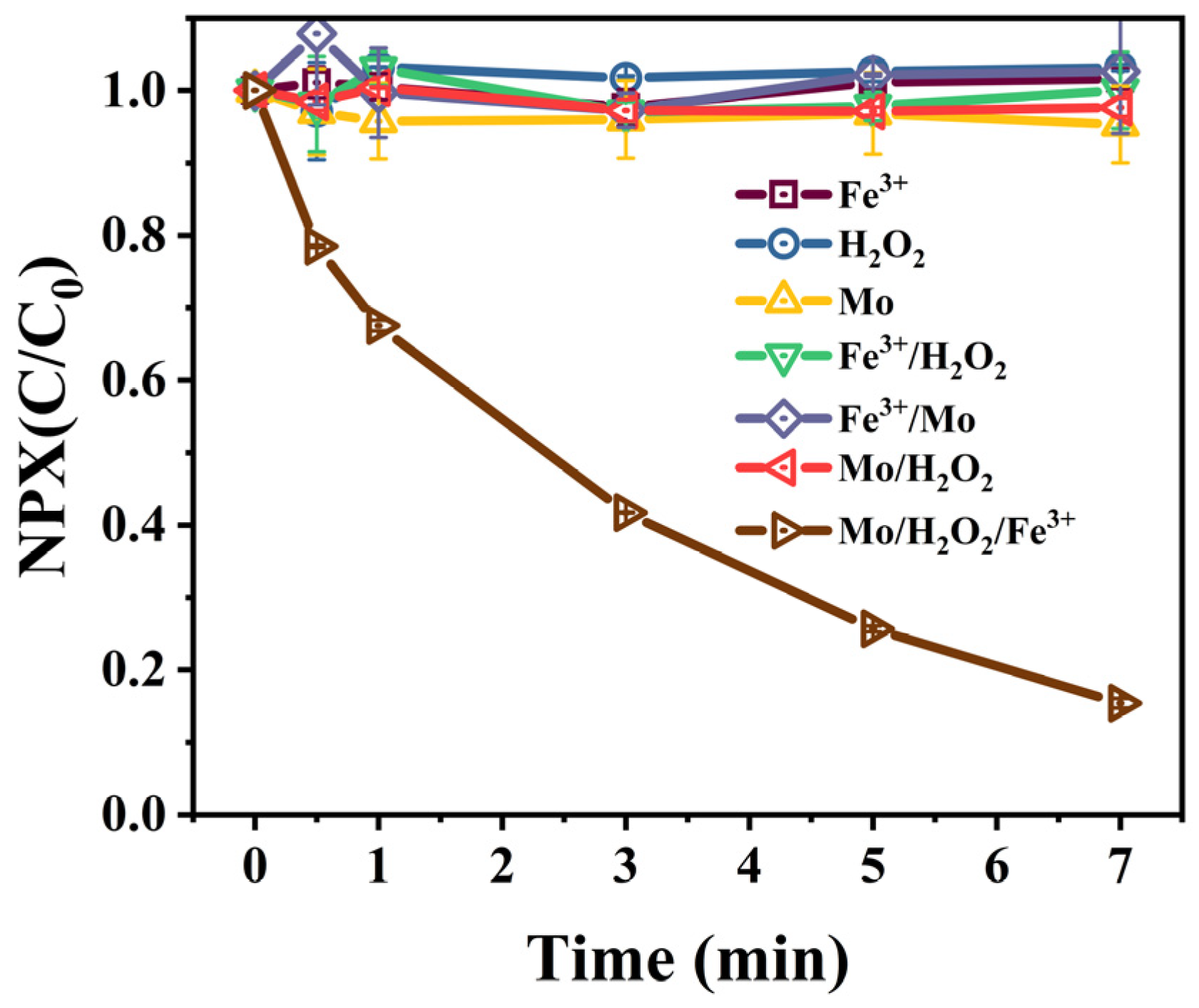
As shown in Figure 1, the degradation rates of NPX after 7 min of mixing with Fe3+, H2O2, or Fe3+/H2O2 were 1%, 0%, and 0%, respectively. Only a marginal 3% increase in the degradation rate was observed upon adding Mo powder, either alone or to Fe3+ or H2O2, which was attributed to the adsorption by Mo powder. This suggested that Mo adsorption was minimal and can be considered negligible. When Mo powder was introduced into the Fe3+/H2O2 system, the degradation rate of NPX reached as high as 87.9% within 7 min. This indicates that the Mo/Fe3+/H2O2 system can effectively degrade NPX, which is because Mo promotes the reduction in Fe3+ to Fe2+. The increased Fe concentration in turn accelerates the activation of H2O2, thereby generating more free radicals that rapidly degrade NPX through oxidation [26]. The degradation process of NPX by the Mo/Fe3+/H2O2 system was fitted, and the reaction conformed to first-order kinetics. The calculated apparent rate constant Kobs was 0.4504 min−1 (R2 = 0.98) (Figure S1). The kinetic equation is shown as Equation (1) [27].
l n C C 0 = K o b s t
where
  • c is the concentration of NPX in the solution at any given time, in μM;
  • c 0 is the initial concentration of NPX, in μM;
  • Kobs is the apparent rate constant, in min−1;
  • t is the reaction time, in min.
Figure 1. The Effect of Different Reaction Systems on the Removal of NPX. Conditions: [Mo]0 = 0.1 g/L, [H2O2]0 = 500 μM, [Fe3+]0 = 100 μM, pH = 3.0 ± 0.1, temperature 25 ± 1 °C.
Sustainability 18 01870 g001

3.2. The Removal Efficiency of NPX with Changes in Single Reaction Conditions

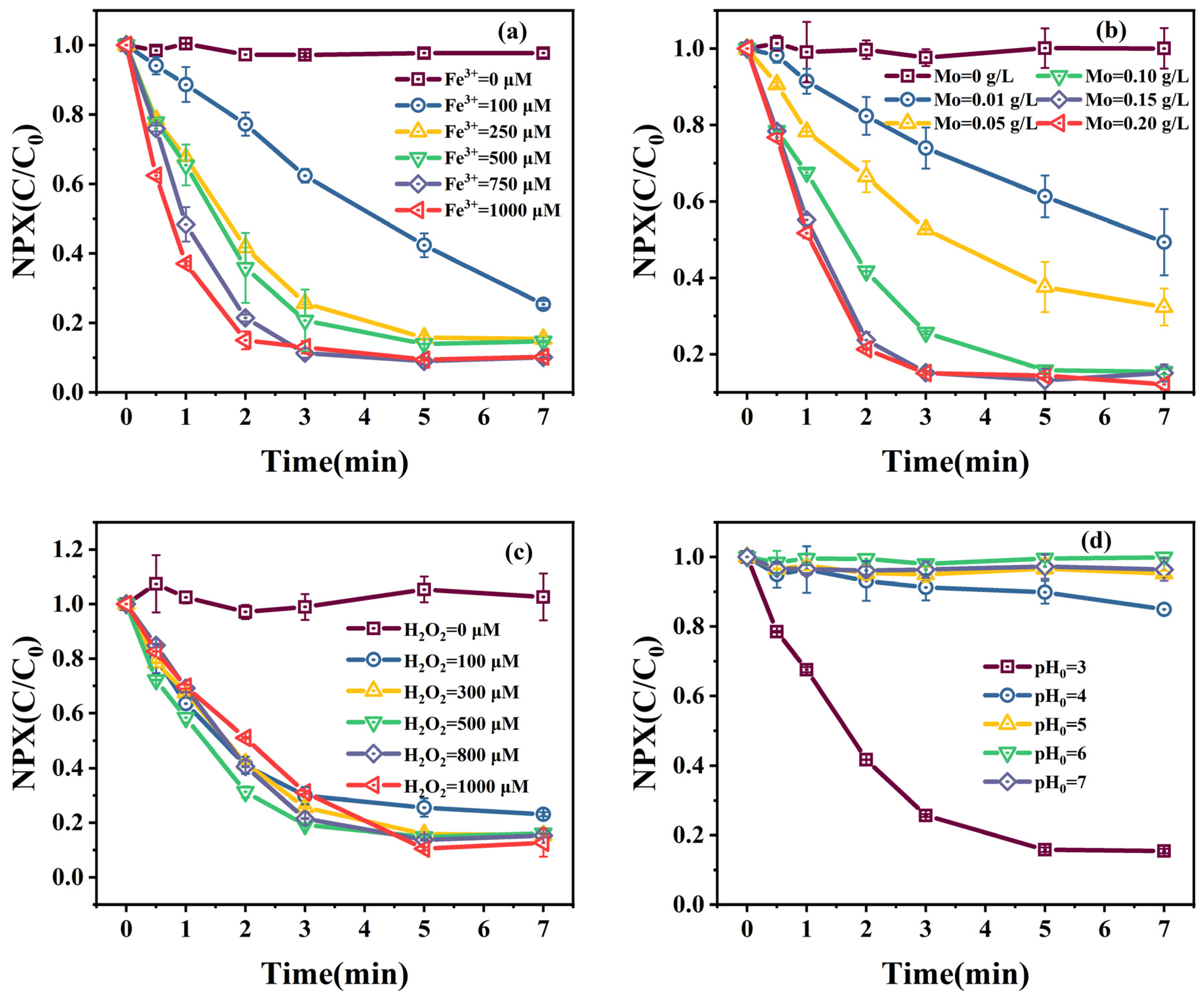
When the Fe3+ dosage was gradually increased from 50 μM to 1000 μM, the reaction progressively accelerated. As shown in Figure 2a, the degradation rate within 7 min gradually increased, and Kobs rose from 0.1950 min−1 to 0.9554 min−1 (Figure S2a). High concentrations of Fe3+ significantly enhanced the reaction rate, which is attributed to the increased reaction rate with Mo powder, thereby accelerating the generation of Fe2+ and improving the catalytic efficiency of the reaction. However, excessive Fe3+ poses potential risks: an excessively high generation rate of HO may trigger mutual quenching of free radicals, which could reduce the utilization efficiency of H2O2. To minimize Fe3+ pollution and improve H2O2 utilization, lower concentrations of Fe3+ should be selected. For subsequent experiments, 100 μM Fe3+ was chosen for the following study.
The dosage of Mo powder directly affects the available surface area of the reaction system. When the Mo dosage ranged from 0 to 0.1 g/L, the removal rate of NPX within 7 min increased with the higher Mo dosage, and Kobs rose from 0.1034 min−1 to 0.4504 min−1 (Figure S2b), indicating a significant enhancement in degradation efficiency (Figure 2b). This improvement is attributed to the increased available surface area between the Mo powder and the reaction system as the dosage increases, which accelerates the conversion of ferric iron (Fe3+) to ferrous iron (Fe2+). This, in turn, promotes the activation of hydrogen peroxide (H2O2), generating more reactive species. However, when the Mo dosage was further increased to 0.15 g/L, Kobs remained around 0.67 min−1 (Figure S2b), and further increases did not lead to additional improvement in degradation efficiency. This may be because, at Mo dosages above 0.15 g/L, the rate of Fe2+ generation already exceeds the rate at which Fe2+ activates H2O2. Thus, the overall reaction rate becomes limited by the Fe2+-activated H2O2 process, and further increasing the Mo dosage does not accelerate the reaction. To minimize Mo powder consumption, a dosage of 0.1 g/L was selected for subsequent experiments.
H2O2 is activated by Fe2+ and serves as the direct source of reactive species in the system. Its dosage directly affects the degradation rate of NPX. To some extent, an adequate amount of H2O2 can enhance the thoroughness of pollutant degradation. Therefore, exploring the appropriate H2O2 concentration is of great significance for achieving optimal degradation effects and cost control. In this context, based on the baseline reaction conditions, the effects of different H2O2 concentrations were investigated. As shown in Figure 2c, when the H2O2 dosage increased from 100 μM to 500 μM, the NPX removal rate gradually improved from 55% to 85%, and Kobs increased from 0.4074 min−1 to 0.4504 min−1 (Figure S2c). However, further increases in H2O2 dosage provided limited additional improvement in the degradation efficiency. Excessive H2O2 can lead to the self-disproportionation pathway in the Fenton reaction, which quenches hydroxyl radicals, specifically by reacting with HO to generate HO2 with a lower redox potential, as shown in Equation (2) [27,28]. High concentrations of H2O2 also offer limited economic benefits. Considering both cost-effectiveness and treatment efficiency, 500 μM H2O2 was selected for subsequent experiments [29].
An appropriate pH is crucial for enhancing the treatment efficiency of the Fenton-like system. Excessively high pH can lead to the hydrolysis of Fe3+, reducing the concentration of iron ions in the system and slowing down the reaction rate. The results indicated that the system achieved optimal treatment efficiency at pH = 3 (Figure 2d). Under neutral or alkaline conditions, Fe3+ underwent significant hydrolysis, leading to an excessively low concentration of iron ions in the system and inhibiting the reaction. On the other hand, a higher concentration of H+ can interact with Mo powder to generate more active sites, thereby promoting the conversion of Fe3+ to Fe2+. Figure 2d demonstrates that the performance at pH 3 is significantly stronger than that at higher pH levels. Although the system does not achieve a breakthrough across a broader pH range, it exhibits superior reaction kinetics and removal efficiency. Therefore, pH 3 was selected as the benchmark condition for the reaction to achieve optimal removal performance.
The concentration of NPX directly influences the consumption of reactive species. As shown in Figure S4, the degradation efficiency decreases with increasing NPX concentration.
H O + H 2 O 2 = H 2 O + H O O

3.3. Identification of Active Species

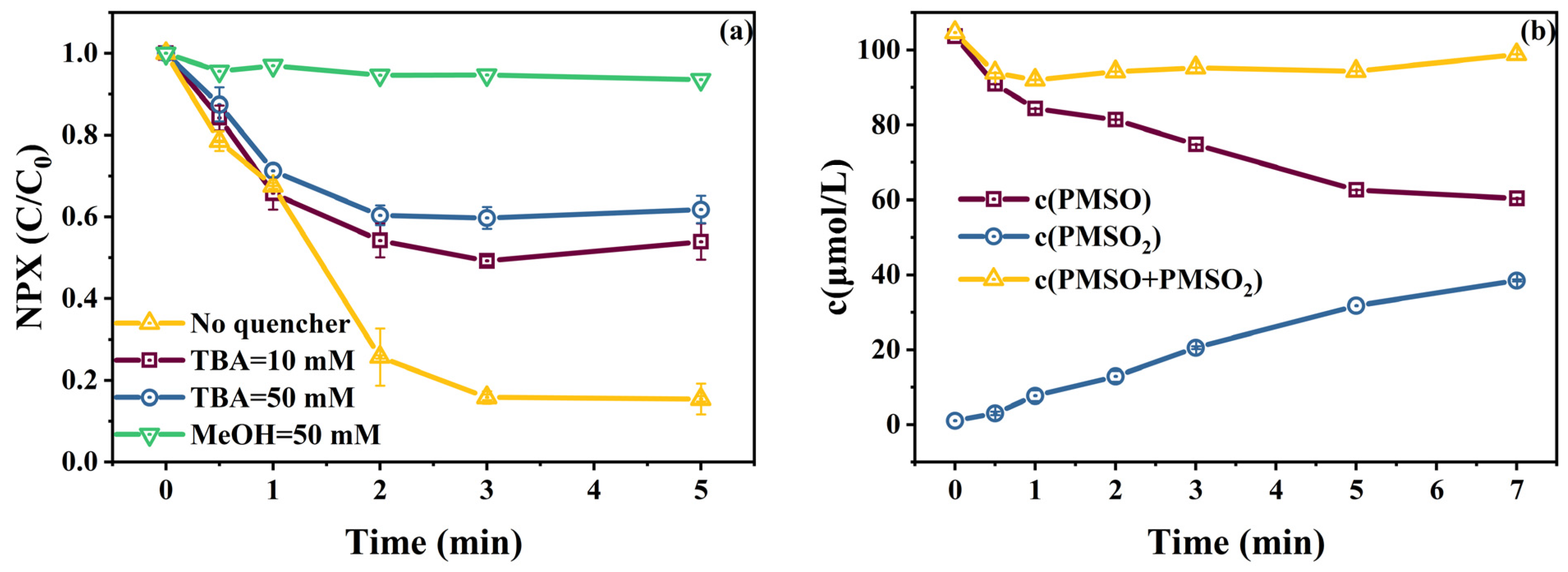
Quenching experiments were conducted to identify the reactive species generated in the system. Based on the references, I anticipated the possible presence of hydroxyl radicals and high-valent iron in the system [30]. When excessive amounts of TBA and MeOH were added separately to quench the reactive species generated in the system. As shown in Figure 3a, NPX degradation was almost completely inhibited after adding MeOH, indicating that all reactive species in the system were completely quenched. TBA can scavenge hydroxyl radicals (HO) [31]. When 10 mM TBA was added, the degradation efficiency was 52%. Increasing the TBA concentration to 50 mM resulted in a degradation efficiency of 40%. Since a five-fold increase in concentration only inhibited degradation by 12%, it can be concluded that hydroxyl radicals in the system were effectively scavenged at 50 mM TBA. Under this condition, a degradation efficiency of 40% was still achieved, indicating the presence of active species other than hydroxyl radicals in the system. PMSO can be oxidized by high-valent iron to form PMSO2 [32]. To this end, 100 μM PMSO was added to the system, and the concentrations of PMSO and PMSO2 were monitored over time (Figure 3b). The results showed that the concentration of PMSO gradually decreased to 60 μM, while the concentration of PMSO2 synchronously increased to 38 μM. The total concentration of PMSO and PMSO2 was maintained at approximately 100 μM, indicating the presence of high-valent iron in the system. These findings demonstrate that both HO and Fe(IV) exist in the reaction system and play significant roles [33]. The possible reactions involved are as follows; [26,28,29,34,35,36]:
6 F e 3 + + M o 6 F e 2 + + M o 6 +
H + + H 2 O 2 + F e 2 + H O + F e 3 + + H 2 O
F e 3 + + H 2 O 2 F e O 2 + + H 2 O
F e 3 + + H 2 O 2 F e 2 + + H O 2 + H +
F e 3 + + H O 2 F e 2 + + O 2 + H +

3.4. Impact of Water Quality Parameters

Natural water contains various ions and organic substances, which can influence the activation of H2O2 in Fenton-like reactions. Under the baseline conditions—including a reaction temperature of 25 ± 1 °C, NPX concentration of 10 μM, Mo dosage of 0.1 g/L, H2O2 concentration of 500 μM, Fe3+ concentration of 10 μM, and pH0 of 3.0 ± 0.1—the effects of different water quality parameters (Cl, HCO3, PO43−, NO3 and HA) on the oxidation performance of the system were investigated.
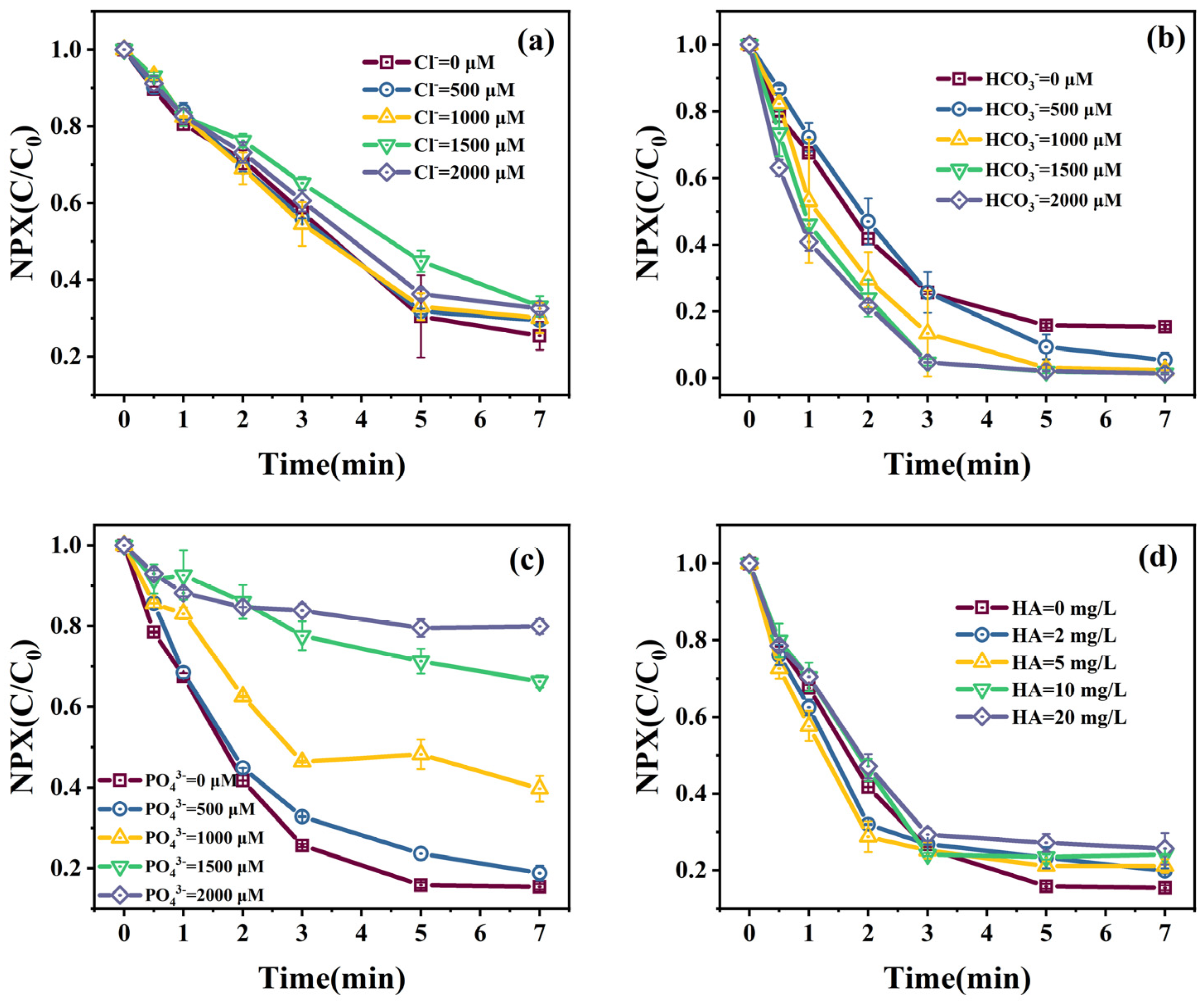
As shown in Figure 4a, Cl slightly inhibited NPX degradation. The possible reactions of Cl in water are as follows (Equations (8)–(12) [37,38]). When the dosage reaches 0.5 mmol/L, the degradation efficiency decreases from 85% to 71% (Figure 4a). Cl can scavenge HO, generating less reactive species such as Cl and Cl2•−, thereby reducing the degradation rate when Cl is introduced.
In contrast, HCO3 significantly promotes the reaction. At a dosage of 2 mmol/L, the degradation efficiency increases from 87.9% to 99.5% (Figure 4b), and the Kobs value rises from 0.4504 min−1 to 0.9868 min−1 within 3 min (Figure S3a). In water, HCO3 may react with HO (Equations (13) and (14) [39,40]), producing HCO3 and CO3•−, which likely contribute to enhancing NPX degradation, HCO3 is considered to promote the Fenton reaction through its complexation potential [41].
PO43− markedly inhibits NPX degradation. As the PO43− dosage increases, the degradation efficiency continuously declines. At a dosage of 2 mmol/L, the degradation efficiency drops to 20% (Figure 4c) with Kobs decreasing to 0.0577 min−1 (Figure S3d). The possible reaction (Equation (15)) suggests that PO43− increases the concentration of H2PO4, which reacts with Fe3+ to form precipitates, reducing the concentration of iron ions in the system and leading to decreased NPX degradation efficiency.
Humic acid (HA) in water can scavenge free radicals, affecting the NPX degradation. HA at a concentration of 2 mg/L reduced the degradation efficiency by 4% (Figure 4d) with no significant change in Kobs during the first three minutes of the reaction. Even with increasing HA dosage, the NPX degradation efficiency can still reach 75%, indicating that HA has a relatively minor impact on the system.
The toxicity was assessed using the luminescent bacteria method after the reaction was conducted in ultrapure water. As shown in Figure S6, the toxicity generated was low, only slightly reducing the number of luminescent bacteria.
C l + H O C l H O
C l H O + H + C l + H 2 O
C l + C l C l 2
C l 2 + C l 2 2 C l
C l 2 ( a q ) + H 2 O H O C l + H + + C l
H C O 3 + H O H C O 3 + O H
H C r 3 C O 3 + H
F e 3 + + H 2 P O 4 F e P O 4 + 2 H +

3.5. Continuous Flow Experiment

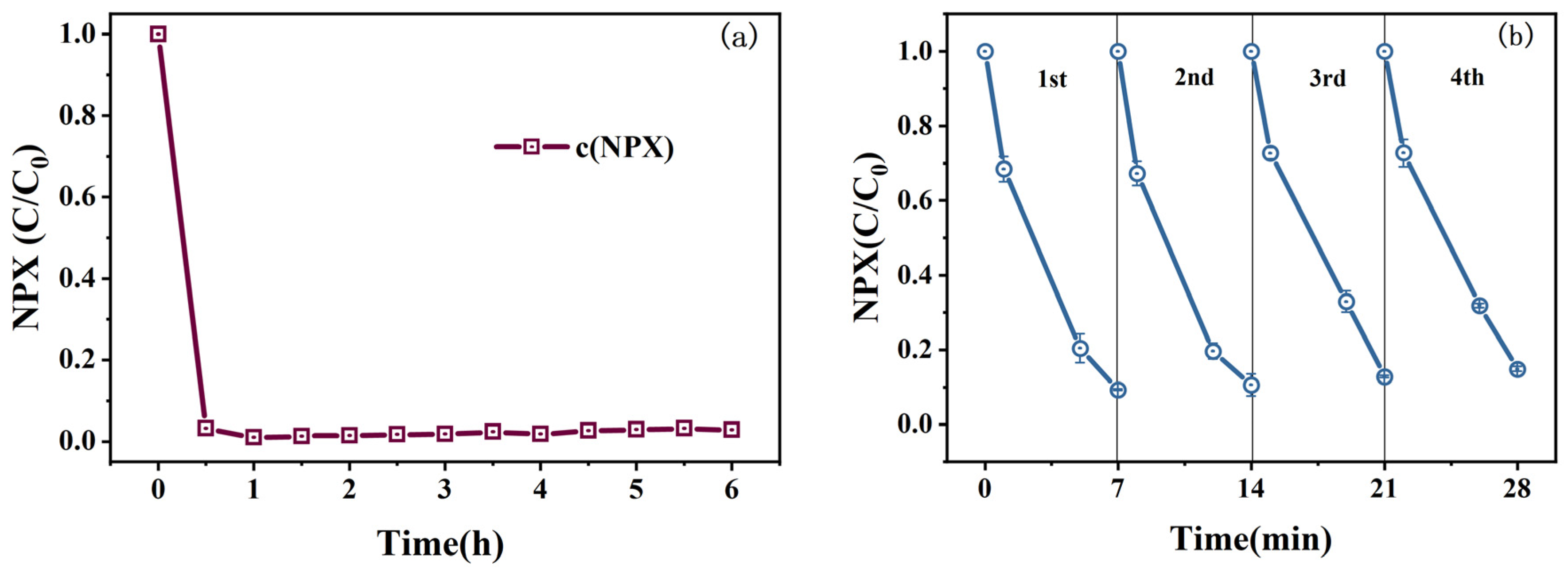
To investigate the catalytic stability of the Mo material, a continuous-flow experiment was designed. The Mo material was loaded onto the surface of a sponge, packed into a condenser tube, and a solution containing 30 μM NPX, 300 μM Fe3+, and 1500 μM H2O2 was introduced. Samples were collected at the outlet every 30 min. The flow rate was set at 0.5 L/h with a hydraulic retention time of 10 min. As shown in Figure 5a, the degradation efficiency stabilized at 97% within 30 min of operation and remained consistent between 97% and 98% over the subsequent 6 h. The results indicate that the Mo/Fe3+/H2O2 system exhibits excellent performance in degrading NPX under continuous-flow conditions, with Mo powder demonstrating good catalytic stability.
To investigate the reusability of the Mo material, four-cycle experiments were designed. Under the conditions of a Mo dosage of 0.1 g/L, Fe3+ dosage of 100 μM, initial H2O2 concentration of 500 μM, initial NPX concentration of 10 μM, initial pH of 3.0, and reaction temperature of 25 °C, the reaction was carried out for 7 min. After the reaction, the solution was filtered under vacuum, and the filter paper was rinsed with pure water to obtain the Mo powder suspension. The steps of vacuum filtration and rinsing with pure water were repeated several times, and the material was then placed in a vacuum drying oven for 12 h. The dried Mo powder obtained after the reaction was used for the next cycle of experiments. As shown in Figure 5b, the results indicate that after four cycles, the degradation efficiency can still reach 90%, demonstrating that Mo powder exhibits excellent reusability.
To evaluate the practical applicability of the reaction, secondary effluent from the Tangxun Lake Wastewater Treatment Plant in Wuhan, Hubei Province, was treated, and the total organic carbon (TOC) was measured afterward. As shown in Figures S5 and S7, the system also achieved favorable performance in real water, with a relatively low TOC level remaining after the reaction.

4. Conclusions

Under optimal conditions, the Mo/Fe(III)/H2O2 system achieved an NPX removal efficiency of 87.9%. The degradation performance was enhanced with increasing initial concentrations of Fe(III) and Mo, whereas an excessive dosage of H2O2 somewhat reduced the degradation efficiency. The reaction followed pseudo-first-order kinetics, with an apparent rate constant of 0.4074 min−1 within the first 3 min. Mechanistic investigations revealed that the main reactive species generated in the system were high-valent iron (Fe(IV)) and hydroxyl radicals (HO), both contributing to the oxidative degradation of NPX. Assessment of environmental factors indicated that Cl and humic acid (HA) consumed a portion of the radicals, leading to a slight decrease in NPX degradation; in the presence of 2 mM Cl or HA, the degradation efficiency decreased to 71% and 75%, respectively. In contrast, HCO3 improved the degradation, reaching 99.5% at a dosage of 2 mM. Phosphate (PO43−) markedly inhibited NPX degradation by reacting with Fe(III), which reduced the available iron concentration in the system, resulting in a degradation efficiency of only 20% at 2 mM PO43−. Furthermore, molybdenum powder exhibited excellent reusability, maintaining high catalytic activity during prolonged operation (6 h) and over multiple consecutive cycles (4 cycles).

Supplementary Materials

The following supporting information can be downloaded at: https://www.mdpi.com/article/10.3390/su18041870/s1, Figure S1: The Effect of Different Reaction Systems on the Removal of NPX; Figure S2: In the Mo/Fe3+/ H2O2 system, the pseudo-first-order kinetic fitting results for the degradation of NPX are shown under different Fe3+ concentrations (a), different Mo powder dosages (b), and different H2O2 dosages (c); Figure S3: In the Mo/Fe3+/H2O2 system, the pseudo-first-order kinetic fitting results under the conditions of adding different ions: HCO3 (a), Cl (b), HA (c), and PO43 (d); Figure S4: The degradation of different concentrations of NPX in the Mo/Fe3+/ H2O2 system; Figure S5: The figure shows the variation in NPX concentration during its degradation in secondary effluent by the Mo/Fe3+/ H2O2 system with different H2O2 concentrations; Figure S6: Survival of bioluminescent bacteria (as indicated by relative luminescence) in the toxicity test reagent after mixing with water samples collected at different reaction times; Figure S7: TOC levels in the secondary effluent after treatment by the Mo/Fe3+/ H2O2 system under different H2O2 concentrations.

Author Contributions

G.W.: Investigation, Writing—Original Draft, Data Curation, Methodology, Validation. J.D.: Formal Analysis, Methodology. R.Z.: Methodology, Resources. Z.W.: Project Administration, Supervision. P.X.: Supervision, Writing—review and editing. H.L.: Formal Analysis, Software, Visualization. Z.C.: Methodology, Data Curation. Y.C.: Methodology, Formal Analysis. H.Z.: Funding Acquisition, Supervision. All authors have read and agreed to the published version of the manuscript.

Funding

The authors are grateful for the financial assistance received through the Gansu Province Higher Education Institutions Industry Support Program Project, under Grant 2023CYZC-36.

Institutional Review Board Statement

Not applicable.

Informed Consent Statement

Not applicable.

Data Availability Statement

The original contributions presented in this study are included in the Supplementary Material. Further inquiries can be directed to the corresponding authors.

Conflicts of Interest

Author Ruixin Zeng was employed by Zhejiang Environmental Science Research Institute Co., Ltd., Hangzhou, Zhejiang, 311100, China. The remaining authors declare that the research was conducted in the absence of any commercial or financial relationships that could be construed as a potential conflict of interest.

Abbreviations

The following abbreviations are used in this manuscript:
NPXNaproxen
HAHumic acid
NSAIDsNon-steroidal anti-inflammatory drugs
PPCPsPharmaceuticals and personal care products
PMSOMethyl phenyl sulfoxide
PMSO2Phenyl methyl sulfone
TBATert-butanol

References

  1. Sheikhi, S.; Javid, A.; Aslani, H.; Yazdi, N.B.; Dehghani, M.H. Removal of Non-Steroidal Anti-Inflammatory Drugs (NSAIDs) from Aqueous Solution by Ultrasound-Based AOPs: A Systematic Review. J. Environ. Chem. Eng. 2025, 13, 117065. [Google Scholar] [CrossRef]
  2. Wang, Q.; Li, S.; Wang, X.; Li, Z.; Zhan, Y.; Chen, C. Efficient Degradation of 4-Acetamidoantipyrin Using a Thermally Activated Persulfate System. Sustainability 2022, 14, 14300. [Google Scholar] [CrossRef]
  3. Wang, X.; Zhu, S.; Dai, A.; Lin, Z.; Xie, Y.; Zhou, Q.; Qiu, Y.; Zhang, C.; Yi, X.; Huang, M. Enhancement of the Radical Pathway-Dominated Degradation of Imidacloprid in PMS-AOP by 1T-MoS2-Based Dual-Atom Catalyst: Synergistic Catalysis by Fe and Ni atoms1T-MoS2. Chem. Eng. J. 2025, 512, 162063. [Google Scholar] [CrossRef]
  4. Silva, J.A. Advanced Oxidation Process in the Sustainable Treatment of Refractory Wastewater: A Systematic Literature Review. Sustainability 2025, 17, 3439. [Google Scholar] [CrossRef]
  5. Boyd, G.R.; Zhang, S.; Grimm, D.A. Naproxen Removal from Water by Chlorination and Biofilm Processes. Water Res. 2005, 39, 668–676. [Google Scholar] [CrossRef]
  6. Yu, D.; Liao, Q.; Li, X.; Liu, F.; Huang, J.; Guan, H.; Huang, Y. The Effect and Mechanism of Fe-Modified Coffee Grounds Hydrothermal Carbon on the Mass Transfer Efficiency of PMS and H2O2 Advanced Oxidation. J. Water Process Eng. 2025, 76, 108121. [Google Scholar] [CrossRef]
  7. Tomul, F.; Arslan, Y.; Kabak, B.; Trak, D.; Kendüzler, E.; Lima, E.C.; Tran, H.N. Peanut Shells-Derived Biochars Prepared from Different Carbonization Processes: Comparison of Characterization and Mechanism of Naproxen Adsorption in Water. Sci. Total Environ. 2020, 726, 137828. [Google Scholar] [CrossRef]
  8. Tenorio-Chávez, P.; Cerro-López, M.; Castro-Pastrana, L.I.; Ramírez-Rodrigues, M.M.; Orozco-Hernández, J.M.; Gómez-Oliván, L.M. Effects of Effluent from a Hospital in Mexico on the Embryonic Development of Zebrafish, Danio Rerio. Sci. Total Environ. 2020, 727, 138716. [Google Scholar] [CrossRef]
  9. Siedlecka, E.; Wieckowska, A.; Stepnowski, P. Influence of Inorganic Ions on MTBE Degradation by Fenton’s Reagent. J. Hazard. Mater. 2007, 147, 497–502. [Google Scholar] [CrossRef]
  10. Dagnew, M.; Xue, Q.; Zhang, J.; Wang, Z.; Zhou, A.; Li, M.; Zhao, C. A Review of Various Advanced Oxidation Techniques for Pesticide Degradation for Practical Application in Aqueous Environments. Sustainability 2025, 17, 4710. [Google Scholar] [CrossRef]
  11. Zhang, Q.; Zheng, D.; Bai, B.; Ma, Z.; Zong, S. Insight into Antibiotic Removal by Advanced Oxidation Processes (AOPs): Performance, Mechanism, Degradation Pathways, and Ecotoxicity Assessment. Chem. Eng. J. 2024, 500, 157134. [Google Scholar] [CrossRef]
  12. Singh, V.; Gupta, S.P.; Samanta, S.K. Water Resource Rejuvenation via AOP Based Degradation of Pharmaceuticals Extensively Used during COVID-19. J. Water Process Eng. 2024, 67, 106137. [Google Scholar] [CrossRef]
  13. Jamil, T. Role of Advance Oxidation Processes (AOPs) in Textile Wastewater Treatment: A Critical Review. Desalination Water Treat. 2024, 318, 100387. [Google Scholar] [CrossRef]
  14. Sun, J.-H.; Sun, S.-P.; Sun, J.-Y.; Sun, R.-X.; Qiao, L.-P.; Guo, H.-Q.; Fan, M.-H. Degradation of Azo Dye Acid Black 1 Using Low Concentration Iron of Fenton Process Facilitated by Ultrasonic Irradiation. Ultrason. Sonochem. 2007, 14, 761–766. [Google Scholar] [CrossRef]
  15. Zhang, S.; Yang, J.; Wang, H.; Zhang, S. Enhanced Photo Fenton-like AOP by N-Doped and Cu–Fe Loaded Biochar for Efficient Sulfamethoxazole Removal: Economic Synthesis, Catalytic, Performance and Mechanism. Chemosphere 2025, 385, 144543. [Google Scholar] [CrossRef]
  16. Dong, C.; Bao, Y.; Xing, M.; Anpo, M.; Zhang, J. Dual-Functional Mo2C Quantum Dots Enriched N-Doped Graphitic Carbon Layers in Advanced Oxidation Processes (AOPs). Appl. Catal. A Gen. 2023, 649, 118963. [Google Scholar] [CrossRef]
  17. Jiang, T.; Cai, C.; Peng, H.; Li, J.; Fu, X.; Nie, C.; Ao, Z. Insight into the Piezo-Activation of Peroxymonosulfate by 1T/2H-MoS2: Piezopotential Boosting the Formation of Mo-Peroxymonosulfate Complexes as the Major Reactive Species. Chem. Eng. J. 2025, 520, 165824. [Google Scholar] [CrossRef]
  18. Zhao, H.; Zhang, C.; Shi, W.; Yang, C.; Liu, Y.; Zhang, B. Mechanistic Dominance of High-Valent Mo-Oxo Species in the Heterogeneous Selective Degradation of Micropollutants by Picolinate-MoS2/Peroxymonosulfate System. Sep. Purif. Technol. 2026, 385, 136463. [Google Scholar] [CrossRef]
  19. Guo, C.; Li, Y.; Gu, J.; Yu, C.; Wan, J.; Pan, J.; Wang, L. Unraveling the Co-Catalytic Mechanism in Fenton-like Reaction with Diatomic Fe/Mo Catalysts: Accelerating the Fe(II)/Fe(III) Conversion and PAA Efficient Activation. Water Res. 2025, 287, 124473. [Google Scholar] [CrossRef]
  20. Wang, J.; Wang, S. Activation of Persulfate (PS) and Peroxymonosulfate (PMS) and Application for the Degradation of Emerging Contaminants. Chem. Eng. J. 2018, 334, 1502–1517. [Google Scholar] [CrossRef]
  21. Tian, H.; Cui, K.; Sun, S.; Li, H.; Chen, X. Construction of Acidic Microenvironments to Overcome the pH Dependence of Iron-Based Catalysts and Application to the Degradation of Micropollutants by AOPs. Chem. Eng. J. 2024, 488, 150934. [Google Scholar] [CrossRef]
  22. Fang, H.; Guo, H.; Feng, X.; Chen, Z.; Ji, W.; Au, C.-T. Facile Synthesis of Defect-Rich Interfacial Mo/MoO2 for Efficient Peroxymonosulfate Activation and Refractory Pollutants Degradation. Environ. Pollut. 2024, 361, 124788. [Google Scholar] [CrossRef] [PubMed]
  23. Yu, H.; Liu, Y.; Cong, S.; Xia, S.; Zou, D. Review of Mo-Based Materials in Heterogeneous Catalytic Oxidation for Wastewater Purification. Sep. Purif. Technol. 2023, 312, 123345. [Google Scholar] [CrossRef]
  24. Hajji, M.; Jebbari, N.; Ajili, M.; Garcia-Loureiro, A.; Vidu, R.; Kamoun, N. Advanced Oxidation Processes (AOPs): Navigating from MOS to COS and X-COS Systems—Unraveling Strategies, Tackling Challenges, and Pioneering Advances. Opt. Mater. 2024, 152, 115399. [Google Scholar] [CrossRef]
  25. Wang, Q.; Yang, H.; Lin, S.; Ji, W.; Zhang, S.; Wang, W.; Yu, J.; Gao, J.; Fan, X. Fe-Mo Bimetallic-Doped Mulch-Straw Based Biochar Activating Peroxodisulfate for Efficient Degradation of Antibiotics in Water. Desalination Water Treat. 2025, 322, 101158. [Google Scholar] [CrossRef]
  26. Da, Y.; Gu, X.; Wang, Y.; Lu, X.; Xie, G.; Zhang, L.; Liu, S.; Zhao, X.; Tian, J.; Xiao, Y.; et al. Electron Transfer Enhancing Fe2+/Fe3+ Cycle by Persistent Free Radicals (PFRs) Contained Biochars to Active H2O2 for PNP Degradation. Surf. Interfaces 2025, 72, 107344. [Google Scholar] [CrossRef]
  27. Wang, T.; Wu, Q.Y.; Wang, W.L.; Wang, Q.; Chen, Z.; Wu, Q.; Hu, H. Degradation of Methylisothiazolinone by UV/Chlorine Advanced Oxidation Process. Chin. J. Environ. Eng. 2017, 11, 21–26. [Google Scholar] [CrossRef]
  28. Brillas, E. A Review on the Application of Single and Combined Fenton, Photo-Fenton, and Electrochemical Advanced Oxidation Processes to Remove Diclofenac from Aqueous Media. J. Environ. Chem. Eng. 2025, 13, 115443. [Google Scholar] [CrossRef]
  29. Ziembowicz, S.; Kida, M. The Optimization of Advanced Oxidation Processes for the Degradation of Industrial Pollutants. Sustainability 2025, 17, 1908. [Google Scholar] [CrossRef]
  30. Tian, Q.; Chang, J.; Yu, B.; Jiang, Y.; Gao, B.; Yang, J.; Li, Q.; Gao, Y.; Xu, X. Co-Catalysis Strategy for Low-Oxidant-Consumption Fenton-like Chemistry: From Theoretical Understandings to Practical Applications and Future Guiding Strategies. Water Res. 2024, 267, 122488. [Google Scholar] [CrossRef]
  31. Pham, A.N.; Xing, G.; Miller, C.J.; Waite, T.D. Fenton-like Copper Redox Chemistry Revisited: Hydrogen Peroxide and Superoxide Mediation of Copper-Catalyzed Oxidant Production. J. Catal. 2013, 301, 54–64. [Google Scholar] [CrossRef]
  32. Shao, B.; Dong, H.; Sun, B.; Guan, X. Role of Ferrate(IV) and Ferrate(V) in Activating Ferrate(VI) by Calcium Sulfite for Enhanced Oxidation of Organic Contaminants. Environ. Sci. Technol. 2019, 53, 894–902. [Google Scholar] [CrossRef] [PubMed]
  33. Xiao, C.; Liu, J.; Hu, Y.; Tang, C.; Cheng, J.; Chen, Y.; Zhu, X.; Wang, G.; Xie, J.; Ai, L. Enhanced Co-Catalytic Fenton Degradation of Sulfamethoxazole by Partitional Reaction with H2O2 Intermittent Addition: From Theoretical Research to Practical Application. J. Water Process Eng. 2025, 78, 108799. [Google Scholar] [CrossRef]
  34. Feng, C.; Zhang, H.; An, X.; Guo, J.; Zhang, J.; Shi, Y.; Liu, Y.; Zhou, P.; He, C.; Xiong, Z.; et al. Enhanced Fe(III)/Fe(II) Circulation and H2O2 Utilization in an Efficient Solid–Liquid-Interfacial Fenton-like Reaction over the Sulfur Quantum Dots Co-Catalyst at Neutral pH. Chem. Eng. J. 2025, 515, 163548. [Google Scholar] [CrossRef]
  35. Nichela, D.A.; Donadelli, J.A.; Caram, B.F.; Haddou, M.; Rodriguez Nieto, F.J.; Oliveros, E.; García Einschlag, F.S. Iron Cycling during the Autocatalytic Decomposition of Benzoic Acid Derivatives by Fenton-like and Photo-Fenton Techniques. Appl. Catal. B Environ. 2015, 170–171, 312–321. [Google Scholar] [CrossRef]
  36. Liu, X.; Wang, C.; Zhu, T.; Lv, Q.; Che, D. Simultaneous Removal of SO2 and NO with OH from the Catalytic Decomposition of H2O2 over Fe-Mo Mixed Oxides. J. Hazard. Mater. 2021, 404, 123936. [Google Scholar] [CrossRef]
  37. Buxton, G.V.; Greenstock, C.L.; Helman, W.P.; Ross, A.B. Critical Review of Rate Constants for Reactions of Hydrated Electrons, Hydrogen Atoms and Hydroxyl Radicals (⋅OH/⋅O in Aqueous Solution). J. Phys. Chem. Ref. Data 1988, 17, 513–886. [Google Scholar] [CrossRef]
  38. Jayson, G.G.; Parsons, B.J.; Swallow, A.J. Some Simple, Highly Reactive, Inorganic Chlorine Derivatives in Aqueous Solution. Their Formation Using Pulses of Radiation and Their Role in the Mechanism of the Fricke Dosimeter. J. Chem. Soc. Faraday Trans. 1 1973, 69, 1597. [Google Scholar] [CrossRef]
  39. Fayyaz, A.; Saravanakumar, K.; Talukdar, K.; Kim, Y.; Yoon, Y.; Park, C.M. Catalytic Oxidation of Naproxen in Cobalt Spinel Ferrite Decorated Ti3C2Tx MXene Activated Persulfate System: Mechanisms and Pathways. Chem. Eng. J. 2021, 407, 127842. [Google Scholar] [CrossRef]
  40. Chang, H.; Chen, C.; Wang, G. Characteristics of C-, N-DBPs Formation from Nitrogen-Enriched Dissolved Organic Matter in Raw Water and Treated Wastewater Effluent. Water Res. 2013, 47, 2729–2741. [Google Scholar] [CrossRef]
  41. Zhang, X.; Ma, D.; Zhu, X. Insights into Bicarbonate Enhanced Heterogeneous Fenton Catalyzed by Co/Cu/Zeolite for Degradation of Rhodamine B. Environ. Eng. Res. 2023, 29, 230095. [Google Scholar] [CrossRef]
Figure 2. Impact of (a) initial Fe3+, (b) Mo dosage, (c) H2O2 dosage, (d) initial pH on NPX elimination in the Mo/Fe3+/H2O2 process. Conditions: [H2O2]0 = 500 μM except for (c), [Fe3+]0 = 100 μM except for (a), [Mo]0 = 0.1 g/L except for (b), pH0 = 3.0 ± 0.1 except for (d), [NPX]0 = 10 μM, temperature 25 ± 1 °C.
Sustainability 18 01870 g002
Figure 3. (a) Quenching effects of TBA and MeOH on NPX degradation. (b) Consumption of PMSO, formation of PMSO2, and the evolution of the sum of PMSO and PMSO2 in the Mo/Fe3+/H2O2 system Experimental conditions: pH0 = 3.0 ± 0.1. temperature 25 ± 1 °C. [H2O2]0 = 500 μM, [Fe3+]0 = 500 μM, [PMSO]0 = 100 μM except for (b), [NPX]0 = 10 μM except for (a).
Sustainability 18 01870 g003
Figure 4. Impact of (a) Cl dosage; (b) HCO3 dosage; (c) PO43− dosage; (d) HA dosage on NPX elimination in the Mo/Fe3+/H2O2 process. Conditions: [H2O2]0 = 500 μM, [Fe3+]0 = 100 μM, [Mo]0 = 0.1 g/L, [NPX]0 = 10 μM, pH0 = 3.0 ± 0.1, temperature 25 ± 1 °C.
Sustainability 18 01870 g004
Figure 5. (a) The variation in degradation rate of NPX in the continuous flow with time, (b) The degradation rate of NPX in multiple cyclic experiments. Experimental conditions: pH0 = 3.0 ± 0.1. temperature 25 ± 1 °C. [H2O2]0 = 500 μM, [NPX]0 = 100 μM, [Fe3+]0 = 100 μM, [Mo]0 = 0.1 g/L. Hydraulic retention time: 10 min for (a).
Sustainability 18 01870 g005
Disclaimer/Publisher’s Note: The statements, opinions and data contained in all publications are solely those of the individual author(s) and contributor(s) and not of MDPI and/or the editor(s). MDPI and/or the editor(s) disclaim responsibility for any injury to people or property resulting from any ideas, methods, instructions or products referred to in the content.