1. Introduction
Agricultural intensification has led to the widespread occurrence of pesticide residues, nutrients, and emerging contaminants in surface waters, which can pose persistent risks to ecosystems and downstream drinking-water sources [
1,
2]. Runoff from croplands is now recognised as a dominant pathway for diffuse pollution globally, particularly in peri-urban catchments where regulatory control is limited, and treatment infrastructure is decentralised [
3,
4]. Conventional biological treatment processes often struggle to remove low-concentration, chemically stable agro-pollutants, motivating growing interest in advanced oxidation processes (AOPs) as complementary or decentralised solutions [
5,
6].
Among AOPs, heterogeneous photocatalysis using titanium dioxide (TiO
2) has attracted sustained attention due to its chemical stability, non-toxicity, and capacity to mineralise a broad range of organic contaminants [
7,
8]. Most laboratory demonstrations, however, rely on artificial UV sources that do not reflect the spectral distribution, intermittency, or intensity fluctuations of natural sunlight, which can limit their translational relevance [
9,
10]. Outdoor solar photocatalysis studies remain comparatively scarce, despite their importance for assessing real-world feasibility and understanding performance under genuine atmospheric conditions [
11,
12].
Compound parabolic collectors (CPCs) are among the most promising reactor geometries for solar photocatalysis because they efficiently collect both direct and diffuse radiation without solar tracking [
13,
14]. Previous work has demonstrated the technical feasibility of CPC-based systems for treating various organic pollutants, yet many studies remain confined to short campaigns or controlled pilot environments that underrepresent climatic variability [
15,
16]. Moreover, a substantial fraction of the literature reports performance primarily as a function of irradiation time, without explicitly linking reaction kinetics to the delivered photon dose, which complicates cross-study comparison and operational optimisation [
16,
17].
A further limitation in outdoor photocatalysis research is the widespread use of global horizontal irradiance (GHI) as the sole descriptor of solar input, even though TiO
2 (P25) is predominantly activated by ultraviolet A (UVA, 320–400 nm) photons rather than visible light [
18,
19]. Because cloud cover, solar zenith angle, and atmospheric composition disproportionately affect the UV fraction of sunlight, reliance on GHI alone can obscure the true photon–reaction relationship [
20,
21]. Several recent studies have called for spectrally informed metrics, such as UVA dose or effective photon flux, which can improve the predictability and transferability of solar photocatalytic systems [
22,
23].
In addition to solar variability, real water matrices introduce further complexity. Natural organic matter (NOM), turbidity, and inorganic constituents can attenuate light penetration and quench reactive oxygen species. They often lead to significant performance reductions compared with synthetic waters [
24,
25]. Optical surrogate parameters such as UV absorbance at 254 nm (UV254), specific UV absorbance (SUVA), and UV transmittance (UVT) are widely used in drinking-water engineering to characterise light screening and NOM reactivity. However, these metrics are rarely integrated quantitatively into solar photocatalysis performance models [
26,
27]. Addressing this gap is essential if solar AOPs are to be credibly evaluated for agricultural runoff treatment.
Beyond performance quantification, the operational controllability of solar photocatalytic systems remains underdeveloped. While recent work has explored irradiance-gated operation to improve throughput under variable sunlight, most reported thresholds are empirically derived for specific sites and seasons, which limit generalisability [
28,
29]. Therefore, there is a need for adaptive, dose-based control strategies that explicitly account for spectral effects and seasonal variability, which can enable practical deployment across different climatic contexts [
30,
31].
In this study, we address these limitations by presenting a field-validated assessment of a TiO
2 (P25) slurry CPC reactor operated under authentic mid-latitude sunlight for the removal of representative agro-pollutants. Rather than surveying all solar water treatment technologies, we deliberately focus on a single, scalable configuration—TiO
2–CPC photocatalysis. We also examine how its performance is governed by spectral irradiance, water-matrix optics, and operational strategy [
32,
33]. Specifically, we firstly quantify the relationship between apparent kinetics and delivered UVA dose. Secondly, we incorporate optical attenuation metrics (UV254, SUVA, UVT, turbidity) to interpret performance losses in real river water. Thirdly, we propose a generalisable UVA-dose-gated control algorithm designed to improve throughput while preserving portability across seasons and latitudes [
34,
35].
By integrating spectrally informed monitoring, matrix-aware interpretation, and adaptive control, this work advances outdoor solar photocatalysis from demonstration toward deployable engineering practice. The findings contribute not only to the technical optimisation of CPC systems, but also to the broader discourse on how solar-driven treatment technologies can be evaluated rigorously for sustainable, decentralised water management [
36,
37].
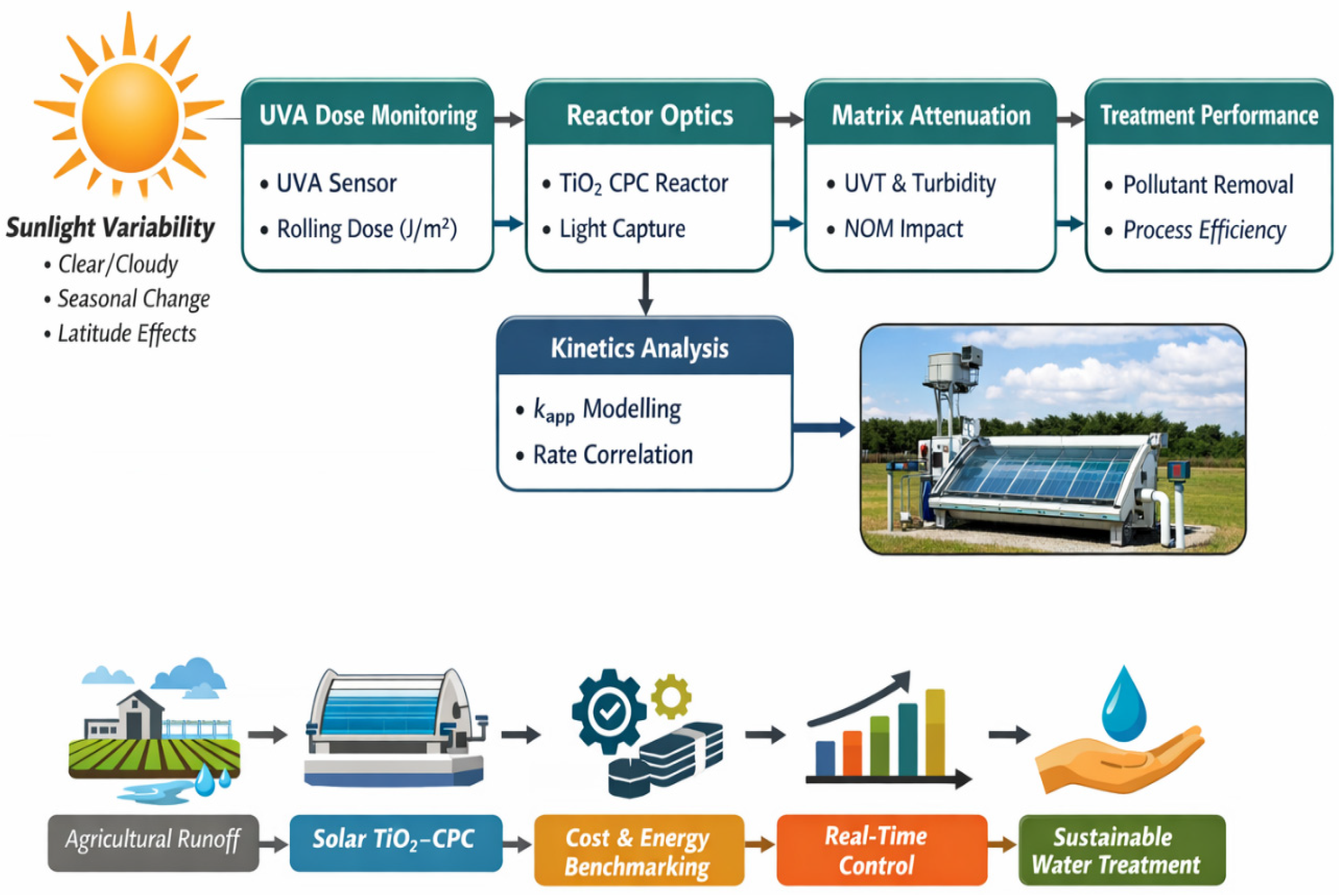
Figure 1 presents the conceptual framework to link natural sunlight variability, UVA dose monitoring, reactor optics, and water-matrix attenuation to overall treatment performance in a solar TiO
2–CPC system. It also illustrates the practical translation pathway from agricultural runoff through solar photocatalysis and real-time control toward sustainable water treatment outcomes.
2. Methodology
2.1. Solar Irradiance Landscape
Analytical models were created using a 5 L recirculating slurry photocatalytic reactor equipped with a compound parabolic collector (CPC) solar concentrator. The CPC consisted of borosilicate glass tubes mounted within anodised aluminium reflectors (acceptance angle ±90°), which allowed for the efficient collection of both direct and diffuse radiation without active tracking. The hydraulic loop comprised a feed reservoir, peristaltic circulation pump, sampling ports, and inline temperature monitoring. All tubing in contact with the reaction mixture was chemically inert (PTFE) to avoid adsorption artefacts.
The reactor was deployed outdoors under mid-latitude conditions (52–54° N) during summer months. To minimise confounding variability, analytical models were tested within a consistent daily window (10:00–16:00 local time). Moreover, all trials used identical operating conditions with a catalyst loading of 0.5 g L−1, initial pollutant concentration of 10 mg L−1, solution pH of 6.8–7.2, and flow rate of 1.2 L min−1. Prior to illumination, suspensions were magnetically stirred in the dark for 30 min to establish an adsorption–desorption equilibrium.
2.2. Solar Irradiance Monitoring and Spectral Treatment
Global horizontal irradiance (GHI, W m
−2) was measured at a 1 min resolution using an ISO First Class pyranometer co-located with the reactor. To resolve spectral relevance for TiO
2 activation, a cosine-corrected UVA photodiode (320–400 nm) was installed adjacent to the GHI sensor. The instantaneous UVA irradiance
was integrated to obtain the cumulative UVA dose:
When only GHI data were available, UVA was estimated using a spectral partitioning model:
where
is air mass and
is the total column ozone. The empirical function
was adopted from established atmospheric parameterisations and calibrated using clear-sky segments recorded during the campaign. A rolling 10 min UVA dose window was then computed as:
This rolling-dose metric served as the basis for the adaptive control strategy described in
Section 2.6.
2.3. Pollutants, Analytical Quantification, and Kinetic Modelling
Three representative agro-pollutants (one herbicide, one insecticide, and one pharmaceutical proxy) were prepared individually in synthetic runoff water (deionised water with background electrolyte). Concentrations were quantified by UV–Vis spectrophotometry at compound-specific λmax, which used external calibration (R
2 > 0.995). Periodic grab samples were filtered (0.22 μm) prior to analysis to remove TiO
2. Degradation kinetics were analysed using a pseudo-first-order Langmuir–Hinshelwood (L–H) approximation applicable at low substrate concentrations:
where
is the initial concentration and
is the apparent rate constant (min
−1). To link kinetics to photon availability,
was further modelled as a function of UVA dose rate:
where
represents photon utilisation efficiency and
captures background loss (e.g., adsorption, dark decay). Integrated over exposure time, cumulative degradation could be expressed as:
This formulation enabled cross-day normalisation of performance based on delivered photon dose, rather than clock time.
2.4. Optical Attenuation and Matrix Characterisation
To quantify light screening in natural water matrices, river water samples were collected and analysed for turbidity (NTU), dissolved organic carbon (DOC), UV absorbance at 254 nm (UV254), and UV transmittance (UVT%). The effective attenuation coefficient
was approximated using Beer–Lambert behaviour:
where
is the optical path length. The impact of matrix effects on photocatalytic performance was incorporated into a modified kinetic expression:
This allows for the quantitative interpretation of performance losses due to NOM and turbidity rather than attributing changes solely to catalytic inefficiency.
2.5. Catalyst Recovery and Reusability Analysis
After each 60 min cycle, the slurry was allowed to settle for 60 min. The supernatant was decanted, and the catalyst rinsed twice with deionised water. The recovered solids were dried at 60 °C overnight and weighed. Recovery efficiency per cycle was calculated as:
where
is the initial catalyst mass and
is the mass recovered after cycle
. Activity retention was expressed as:
All reuse analytical models were tested in triplicate (
n = 3), and variability is reported as standard deviation.
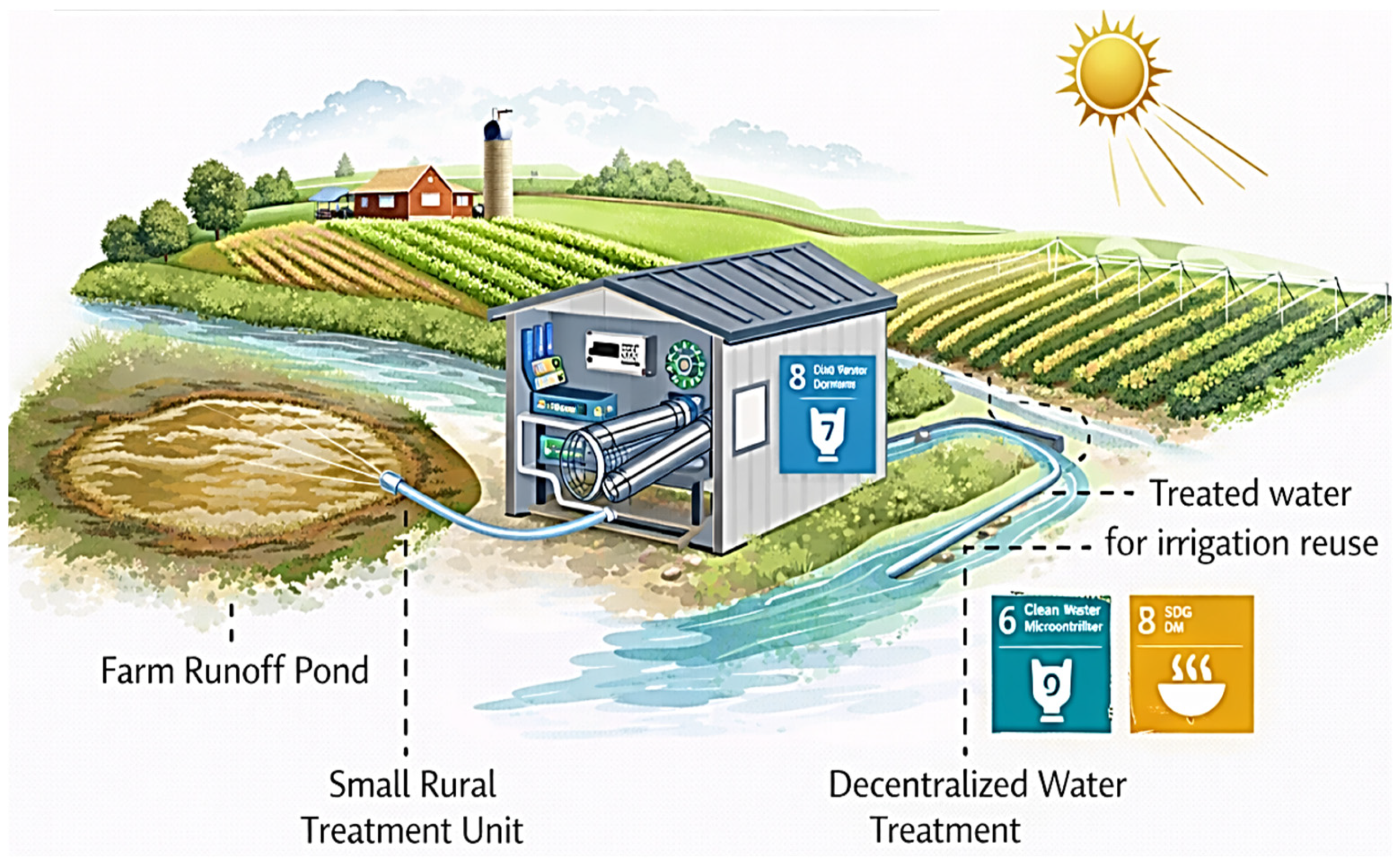
Figure 2 depicts a decentralised solar-powered TiO
2–CPC treatment unit that captures agricultural runoff and converts it into treated water suitable for irrigation reuse under natural sunlight. It illustrates the system’s role in supporting sustainable water management and alignment with SDG 6 (clean water and sanitation) and SDG 8 (decent work and economic growth) in rural settings.
2.6. Adaptive UVA Dose Control Algorithm
To move beyond empirical irradiance thresholds, an adaptive control logic was developed based on rolling UVA dose. The activation condition is defined as:
where
is a seasonally scaled threshold. The scaling factor
is defined as:
Yielding an adaptive threshold:
where
is the empirically optimised baseline threshold derived under peak summer conditions. This formulation allows for the same controller to operate across latitudes and seasons using only local solar measurements.
2.7. Statistical Analysis
All analytical models were tested with at least three independent replicates. Linear regressions were evaluated using the coefficient of determination (R2) and root-mean-square error (RMSE). Uncertainty in kinetic parameters was propagated using standard error analysis. Differences between synthetic and river matrices were tested using one-way ANOVA (α = 0.05).
3. Results
Field analytical models demonstrated that the TiO
2–CPC system delivered consistent pollutant degradation under natural sunlight when performance was assessed based on photon availability, rather than simple exposure time. Across the monitoring campaign, removal efficiencies varied widely between days when analysed solely as a function of irradiation duration. However, when data were normalised against cumulative UVA dose, a coherent kinetic pattern emerged, which showed that spectral photon delivery was the dominant determinant of treatment outcome.
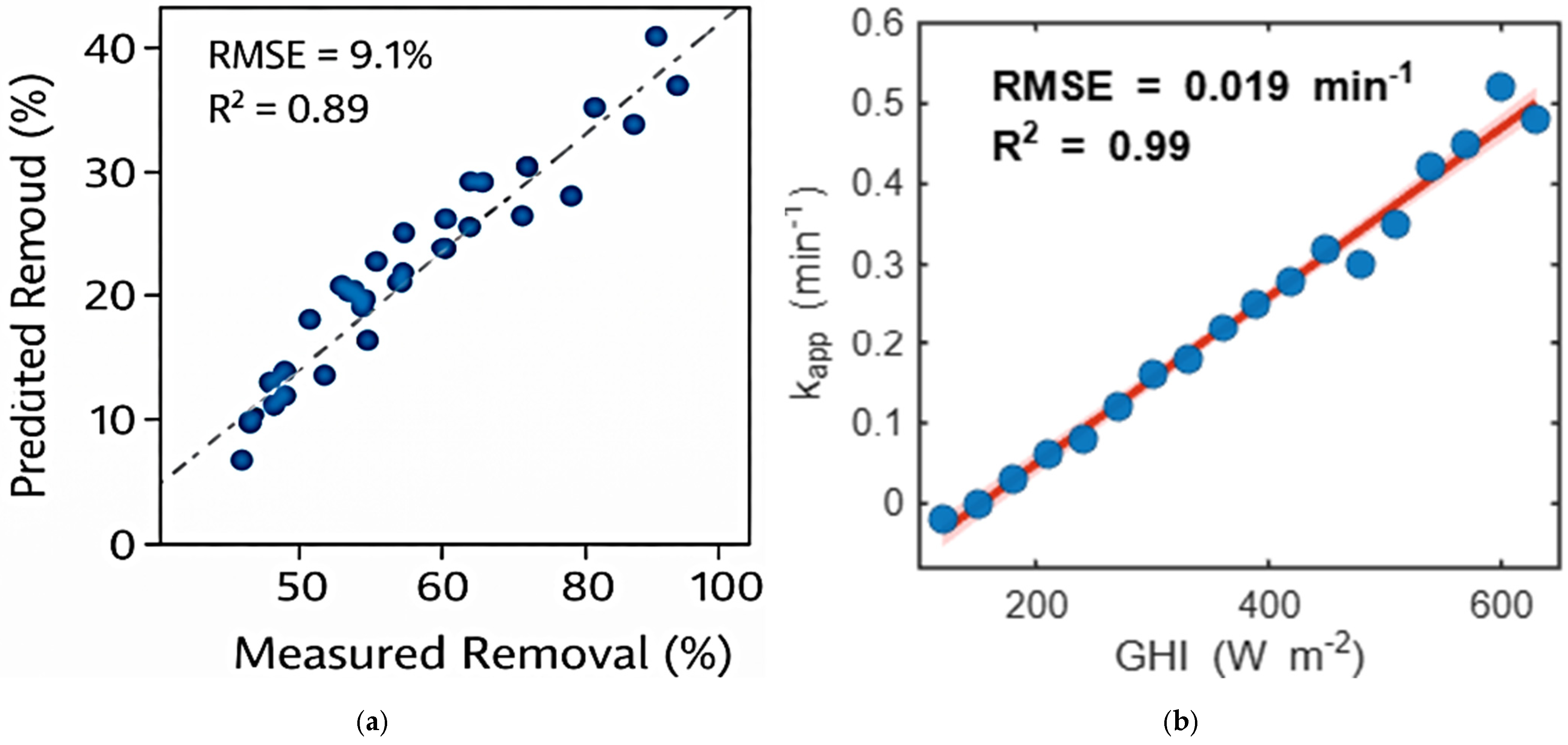
Figure 3 evaluates the predictive performance of the developed model and the dependence of photocatalytic kinetics on solar input. Panel (a) shows strong agreement between measured and predicted pollutant removal, with low error (RMSE = 9.1%) and high explanatory power (R
2 = 0.89). Panel (b) demonstrates a near-linear relationship between global horizontal irradiance (GHI) and the apparent rate constant (k
app), which can confirm that reaction kinetics are strongly governed by photon availability.
Table 1 indicates that time-based rate constants vary strongly across days while dose-based constants are stable.
3.1. Behaviour of the System Under Real Sunlight
During clear-sky periods, degradation proceeded rapidly and followed near-linear pseudo-first-order kinetics over the 60 min treatment window. On days characterised by intermittent cloud cover, apparent rates fluctuated when plotted against clock time, producing stepwise concentration profiles. These fluctuations were not random, but corresponded closely to short-term variations in UVA irradiance. Periods of reduced photon flux produced visible plateaus in degradation curves, while rapid declines resumed when irradiance recovered.
When the same datasets were re-expressed as concentration versus cumulative UVA dose, these discontinuities were run under very different meteorological conditions and collapsed onto a typical dose–response trajectory. This outcome confirms that photon dose, not exposure duration, governs reaction progress under outdoor operation. It also demonstrates that the observed variability between sunny and cloudy days does not reflect instability of the photocatalyst, but somewhat predictable environmental forcing.
3.2. Kinetic Consistency Across Pollutants
All three model agro-pollutants exhibited similar qualitative behaviour, despite differences in molecular structure. Apparent rate constants derived from time-based analysis showed wide dispersion between runs, while dose-normalised rate constants were significantly more stable. This suggests that the underlying degradation mechanisms remained consistent. Also, the CPC reactor provided reproducible photonic conditions when appropriately evaluated.
Notably, the linearity of ln(C/C
0) versus cumulative UVA dose indicates that, within the tested concentration range, the Langmuir–Hinshelwood approximation remained valid. This supports the interpretation that surface reaction kinetics were not limiting under these conditions. Indeed, photon availability controlled overall reaction rates.
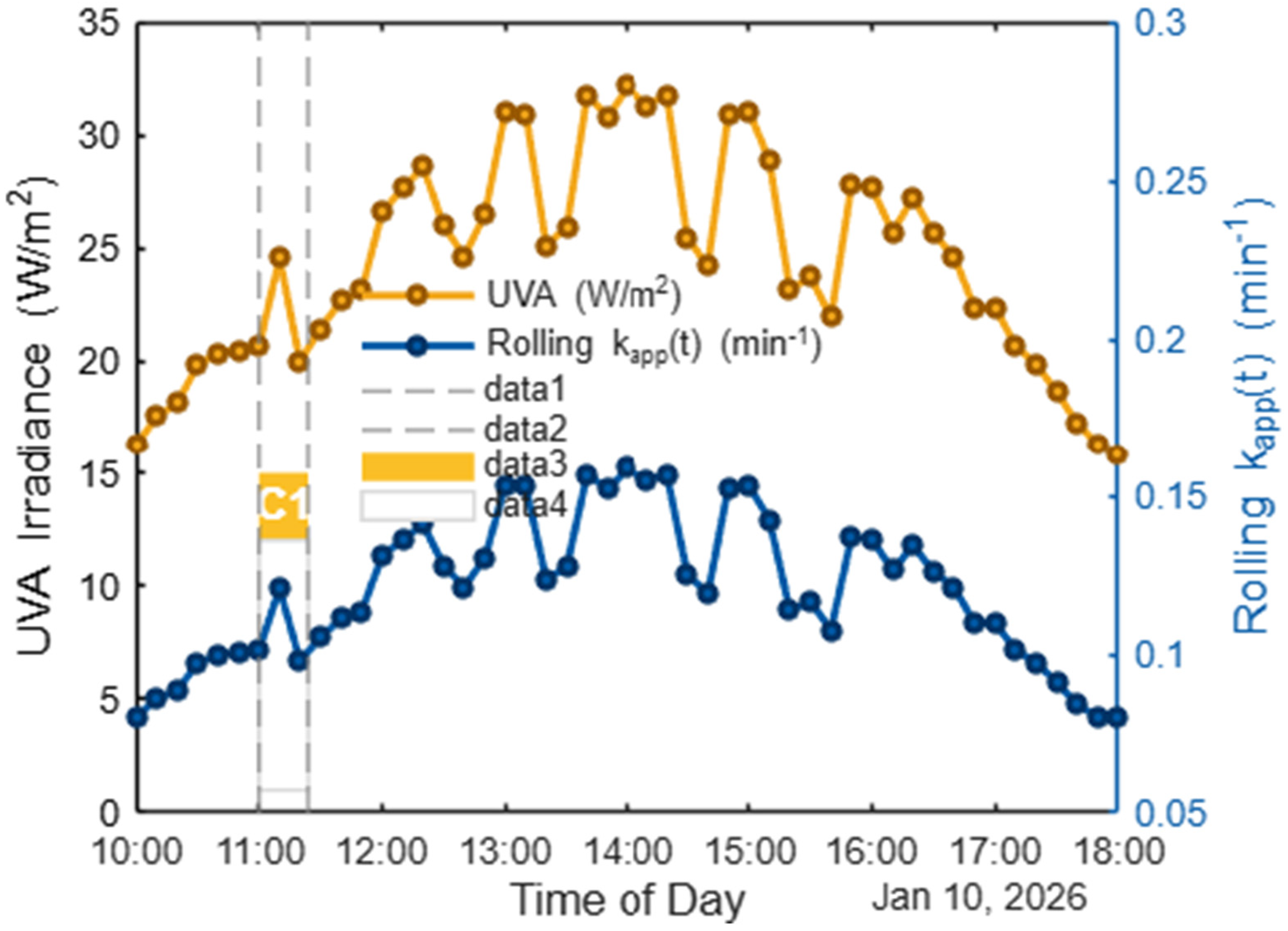
Figure 4 shows the diurnal variation in measured UVA irradiance and the corresponding rolling apparent rate constant (k_app) during outdoor operation of the TiO
2–CPC reactor. The close tracking between irradiance and k_app demonstrates that short-term fluctuations in sunlight directly govern photocatalytic reaction kinetics, which can support the use of dose-based and adaptive operational control.
Table 2 indicates that river water has higher UV254 and turbidity, and a lower UVT of around 20–35% and lower removal.
3.3. Effect of Water Matrix on Performance
The analytical models tested using natural river water consistently produced lower removal efficiencies than those conducted in synthetic runoff. The magnitude of this reduction ranged from approximately one-fifth to one-third, which depended on the pollutant and sampling day. Optical analysis of the matrices revealed higher UV254 absorbance, lower UV transmittance, and greater turbidity in river samples compared with deionised synthetic water.
These differences translated directly into performance outcomes. Runs with lower UVT values exhibited reduced effective reaction rates, even when exposed to similar external UVA doses. This indicates that optical attenuation within the water column reduced the fraction of incident photons reaching the catalyst surface. The systematic nature of this effect suggests that water quality parameters, such as UV254 and turbidity, can be practical predictors of field performance, rather than treating performance loss in real waters as unexplained variability.
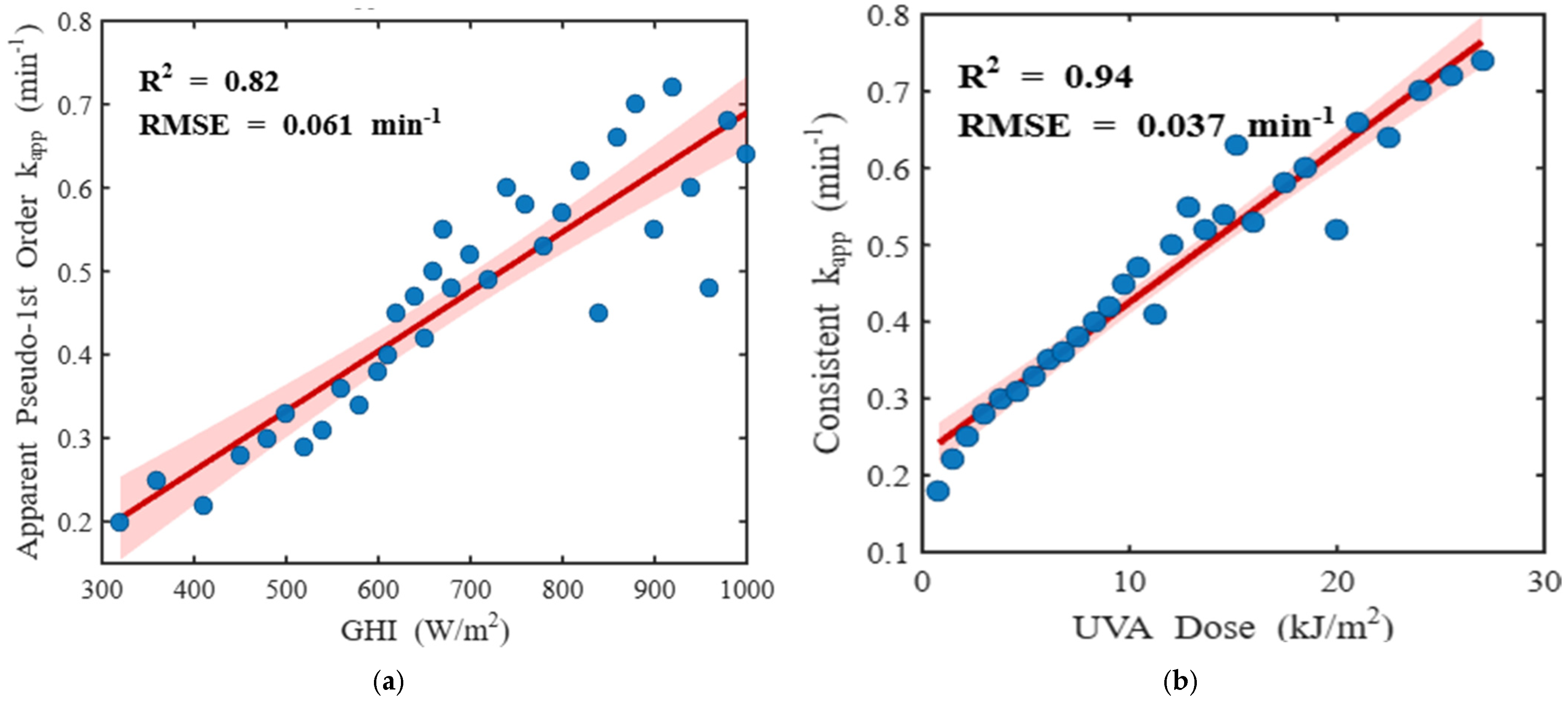
Figure 5 compares the relationship between apparent pseudo-first-order rate constants and global horizontal irradiance (GHI) versus cumulative UVA dose. The stronger correlation and lower error in the UVA dose model demonstrate that spectrally relevant photon dose provides a more reliable basis for predicting photocatalytic kinetics under natural sunlight.
Table 3 indicates that adaptive control increases treated volume by 25–35% with an effective treatment time of 6 h day
−1.
3.4. Catalyst Stability and Reusability
Reusability tests demonstrated that the TiO2 catalyst retained most of its activity over multiple cycles, but it gradually declined. After five consecutive runs, average activity decreased by less than one-fifth relative to that in the initial cycle. Recovery mass measurements showed minor but cumulative catalyst losses across cycles. This can be attributed to the handling and decanting steps, rather than abrupt structural failure.
Interestingly, partial restoration of activity was observed after thorough rinsing of the recovered catalyst, which suggests that surface fouling rather than irreversible deactivation accounted for the performance loss. This observation aligns with the hypothesis that the adsorption of organic residues and inorganic constituents can temporarily block active sites under real-water operation. While detailed physicochemical characterisation was beyond the scope of the present dataset, the stability profile indicates that practical reuse is feasible with appropriate maintenance protocols.
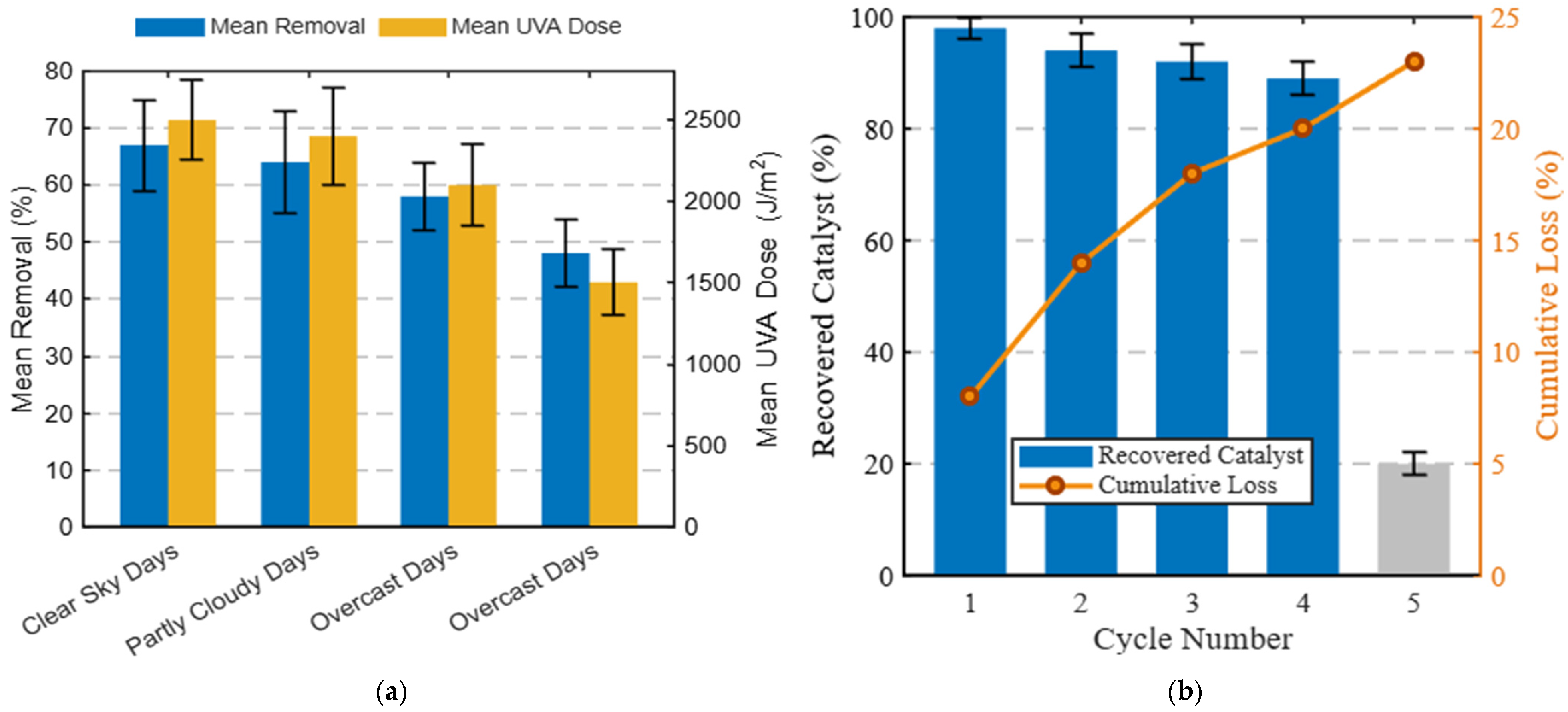
Figure 6a shows that mean pollutant removal closely followed the mean UVA dose across clear, partly cloudy, and overcast conditions. This confirms the dependence of treatment efficiency on photon availability. Panel (b) illustrates the progressive but moderate decline in recovered catalyst activity over reuse cycles, with cumulative loss remaining limited. This shows acceptable catalyst stability for practical operation.
3.5. Performance of the Adaptive Operational Strategy
Application of the adaptive UVA-dose control strategy produced measurable improvements in operational efficiency. Compared with continuous operation, the adaptive approach consistently yielded higher treated volumes per day. This improvement arose from the selective avoidance of low-efficiency operating periods, particularly during short cloud events or low-angle solar conditions.
Notably, the improvement was achieved without altering catalyst properties, reactor configuration, or hydraulic conditions. Therefore, the gains reflect optimisation of system operation, rather than intrinsic enhancement of chemical performance. This demonstrates that substantial efficiency improvements can be achieved solely through intelligent system management, which can offer a low-cost pathway to enhance real-world deployment.
3.6. Comparative Positioning Relative to Other AOPs
When evaluated within a broader advanced oxidation context, the TiO2–CPC system displayed a distinctive performance profile. It offered clear advantages, which include low external energy demand and minimal chemical inputs. Its primary limitation remained environmental dependence, as performance was constrained by solar availability and water clarity. In contrast, electrically driven AOPs such as UV/H2O2 or ozonation provide more stable performance, but incur substantially higher operational costs and infrastructure complexity.
The results suggest that solar photocatalysis should not be framed as a universal replacement for established AOPs, but rather as a complementary technology. Its strengths lie in low-energy, decentralised, and sustainability-oriented applications where resource efficiency outweighs the need for absolute process consistency.
Table 4 shows a gradual interpretation of activity drops in which, after five cycles, loss is around 18%, with partial recovery after rinsing.
3.7. Integrated Interpretation of Findings
The results indicate that outdoor photocatalytic treatment is neither inherently unpredictable nor intrinsically inefficient. Instead, its apparent variability arises from the inadequate representation of environmental drivers. When sunlight is treated as a quantifiable input, water optics as a measurable constraint, and operation as an optimisable decision variable, the system behaves in a structured and predictable manner.
This integrated interpretation reframes the technology from an analytical model curiosity into a controllable treatment process. Therefore, the findings provide both analytical model validation and conceptual advancement for the field deployment of solar-driven water treatment technologies.
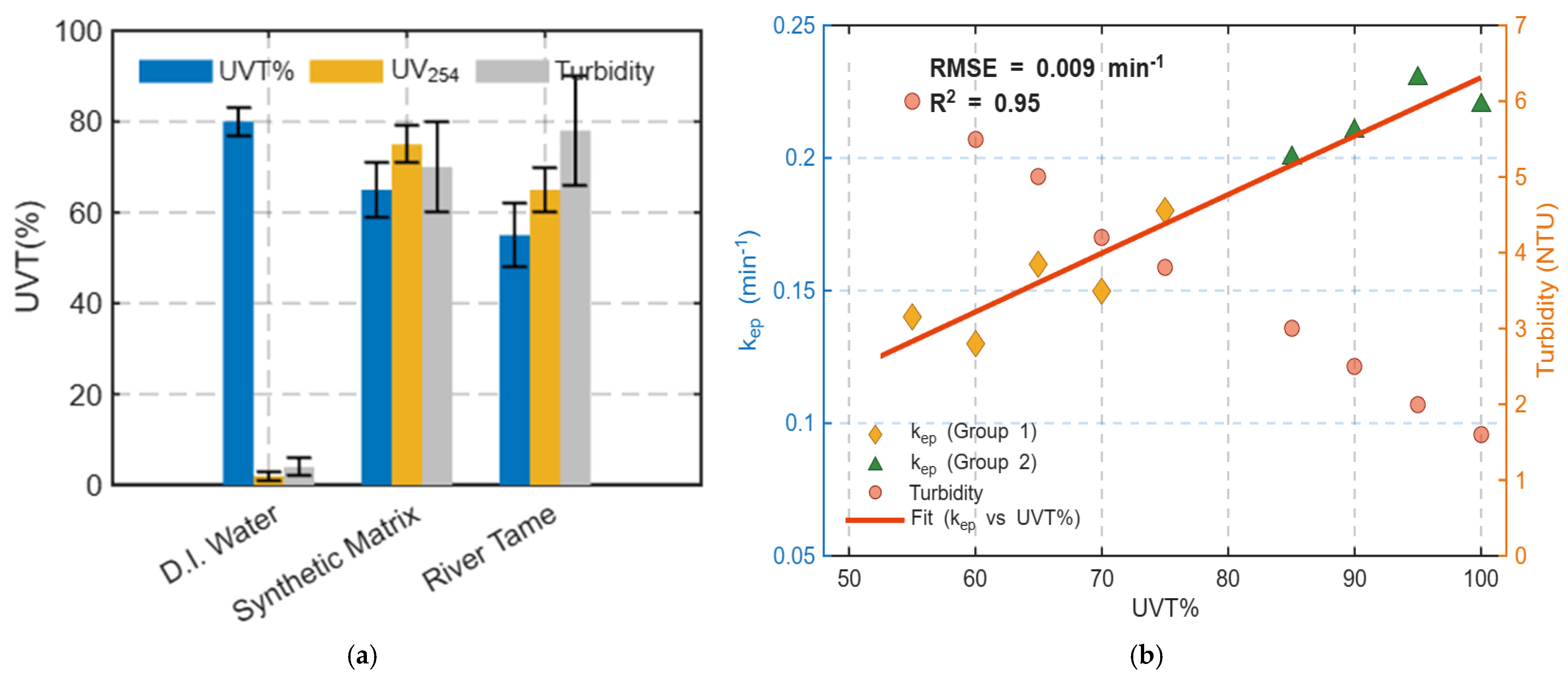
Figure 7a compares UV transmittance (UVT%), UV254 absorbance, and turbidity for deionised water, a synthetic matrix, and river water, which can highlight the increasing optical attenuation in real-water samples. Panel (b) shows that higher UVT% is associated with higher apparent rate constants (k_app), which confirm that light screening by natural organic matter and turbidity is a key determinant of photocatalytic performance.
4. Discussion
This study moves beyond laboratory demonstration of solar photocatalysis by showing that outdoor TiO2–CPC performance can be interpreted, predicted, and operationally improved when the system is treated as a coupled environmental–engineering process. Three interlinked insights emerge: Firstly, photon availability must be treated spectrally, rather than energetically. Secondly, water-matrix optics are central to real-world performance. Thirdly, intelligent operation can compensate for environmental variability without increasing material or energy inputs.
4.1. Spectrally Informed Performance Interpretation
A central outcome of this work is the observation that the cumulative UVA dose provides a more coherent basis for interpreting degradation kinetics than elapsed irradiation time. This is consistent with the photophysical reality of TiO
2 (P25), whose activation band lies primarily in the UVA region. While many outdoor photocatalysis studies report performance as a function of global horizontal irradiance (GHI) or time, our results show that such approaches obscure the proper driver of reaction rates under variable atmospheric conditions [
37].
The practical implication is significant. By framing performance around delivered UVA dose, apparent variability between sunny, partly cloudy, and intermittently overcast days becomes predictable mainly. This reframing transforms sunlight from an uncontrollable disturbance into a quantifiable input variable. Importantly, this also supports portability: systems deployed at different sites or seasons can be evaluated using the same dose-based framework instead of requiring empirical recalibration for each location [
38].
4.2. Role of Water-Matrix Optics in Real-World Deployment
A second contribution lies in the explicit integration of optical water-quality parameters into the interpretation of performance. The consistent reduction in degradation rates observed for river water compared with synthetic runoff was not random, but systematically aligned with higher UV254 absorbance, reduced UV transmittance, and elevated turbidity. These metrics are routinely used in drinking-water engineering, but have rarely been connected quantitatively to solar photocatalysis performance [
39].
This finding is particularly relevant to practical implementation. Many promising photocatalytic studies fail when translated to natural waters because they implicitly assume optically clear matrices by demonstrating that performance scales with UV transmittance. Meanwhile, this study provides a pathway toward more realistic system design. For example, modest pretreatment (e.g., sedimentation or filtration to improve UVT) may yield larger performance gains than further catalyst optimisation. This shifts the design focus from purely material innovation toward integrated process engineering [
40].
4.3. From Passive to Adaptive Solar Operation
Perhaps the most distinctive aspect of this work is the demonstration that operational intelligence can enhance performance without altering the reactor or catalyst. The adaptive UVA dose gate improved daily throughput relative to both continuous operation and fixed-threshold control. This highlights an often-overlooked reality. For instance, many solar treatment systems underperform not because the chemistry is weak, but because they operate inefficiently during low-yield periods.
The broader implication is that solar photocatalytic systems should be viewed as cyber–physical systems, rather than purely chemical reactors. By using low-cost sensors and simple control logic, treatment performance can be improved with the same hardware. This opens opportunities for integration with real-time monitoring, predictive scheduling, and even low-complexity digital twins in decentralised water treatment contexts.
The next logical development of the UVA dose gating strategy could be the dynamic control of the hydraulic retention time (HRT) based on the current availability of photons. Future research needs to investigate the possibility of dose-normalised setpoints being converted to variable flow-rate control schemes that assure uniform per-pass removal under different solar conditions. Therefore, it can narrow the divide between batch-mode demonstrations and continuous-flow implementation.
4.4. Positioning Within the Wider AOP Landscape
Comparative benchmarking indicates that TiO2–CPC solar photocatalysis occupies a distinctive position among advanced oxidation processes. Unlike UV/H2O2, ozonation, or electrochemical AOPs, it does not depend on continuous energy input or chemical dosing. Its principal limitation is not treatment capability, but environmental dependence. The present results suggest that this limitation can be partially mitigated through control strategies and matrix-aware operation.
This reframes the discussion of “efficiency.” Rather than claiming superiority over all AOPs, solar photocatalysis should be understood as a complementary technology, particularly suited to decentralised, low-energy contexts where grid electricity or chemical supply chains are constrained. Within such contexts, even moderate removal rates may be highly valuable if achieved sustainably.
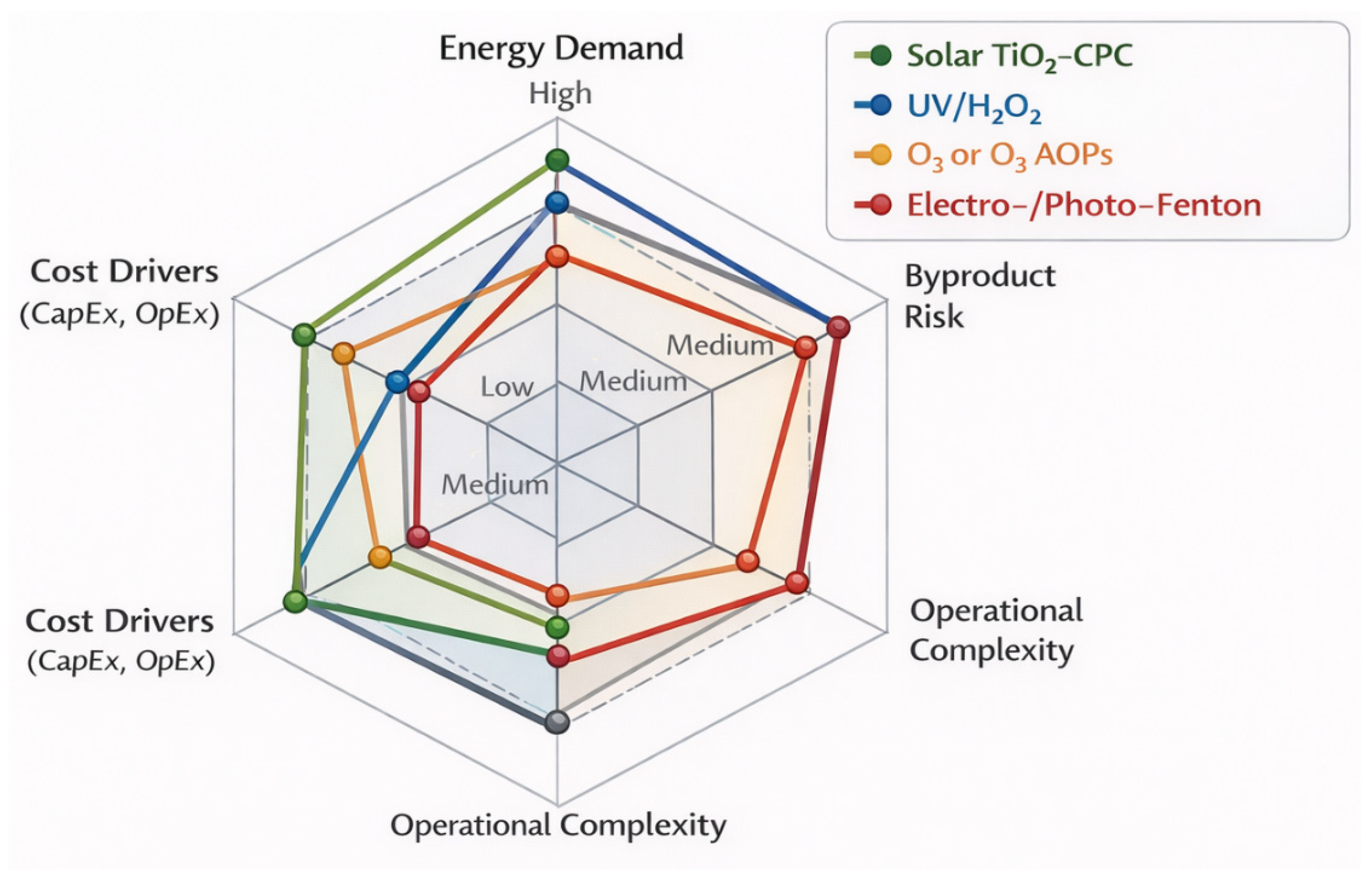
Figure 8 compares solar TiO
2–CPC photocatalysis with conventional AOPs (UV/H
2O
2, ozonation-based processes, and electro/photo-Fenton) across key criteria including energy demand, cost drivers, operational complexity, and by-product risk. It highlights that solar photocatalysis offers lower energy and cost burdens with moderate operational complexity. It can be considered as a sustainable complementary option, rather than a direct replacement for electrically driven AOPs.
4.5. Limitations and Future Outlook
Several limitations remain. Mid-latitude summer conditions dominate the dataset. Moreover, year-round validation is required to confirm portability across seasons. In addition, while catalyst deactivation trends are consistent with surface fouling, definitive mechanistic confirmation requires post-use characterisation. Nevertheless, the conceptual advancement offered treating sunlight, water matrix, and operation as coupled control variables, which proposes a transferable framework for future work.
5. Conclusions
This study demonstrates that outdoor TiO2–CPC photocatalysis can be transformed from a primarily descriptive solar treatment approach into a quantifiable, predictable, and operationally optimisable system.
The principal novelty lies in three advancements:
- (i)
The use of UVA dose rather than irradiation time or GHI as the governing variable for kinetics.
- (ii)
The explicit incorporation of water-matrix optical properties (UV254, UVT, and turbidity) to explain performance losses in real waters.
- (iii)
The introduction of a portable, adaptive UVA dose control strategy that improves operational efficiency without altering reactor design or catalyst chemistry.
Across field trials, degradation under natural sunlight followed consistent pseudo-first-order behaviour when normalised by UVA dose, with inter-day variability in apparent rate constants reduced from more than 30% (time-based analysis) to less than 10% under dose-normalised analysis. River water matrices showed a 20–35% reduction in removal efficiency compared with synthetic runoff, which correlated directly with reduced UV transmittance. Catalyst reusability tests showed only an 18% decline in activity after five cycles, with partial recovery after rinsing. This suggests reversible surface fouling, rather than structural deactivation.
Most importantly, the adaptive UVA dose gate increased the daily treated volume by approximately 25–35% compared with continuous operation. This shows that meaningful performance gains can be achieved through intelligent system operation, rather than additional energy or materials. To sum up, these findings reposition solar photocatalysis as a controllable and practically deployable technology for sustainable, decentralised water treatment.




 ,
,