Development of a Compass Framework to Achieve an Agile and Sustainable Supply Network


Abstract
1. Introduction
1.1. Motivation
1.2. Aim and Scope
2. Literature Review on Implementation of I4.0 Principles in Supply Chains
- Technology-centric focus: Most publications emphasize digital technologies (IoT, CPS, AI and automation) while neglecting organizational, cultural, human and sustainability dimensions.
- Lack of holistic integration: Existing frameworks rarely integrate strategy, processes, technologies, systems, ways of working, culture and sustainability into a unified model.
- Few framework proposals: Although some frameworks related to the DX of the SC have been developed, they remain limited and largely theoretical, lacking empirical validation.
- Barriers to implementation: Key barriers include misalignment between corporate strategy and DX, resistance to change, insufficient training, SC complexity, high costs and investment requirements, and risks associated with cybersecurity.
- Limited connection with sustainability: Although sustainability is recognized as essential, most I4.0 frameworks fail to operationalize its integration into SC transformation.
- Guides SC organizations in aligning their corporate strategies associated with incorporation of I4.0 principles.
- Integrates technological, organizational, human, and sustainability perspectives.
- Provides a clear, practical, and actionable structure.
- Supports the development of SCs that are simultaneously agile, resilient, and sustainable.
3. Foundations for the Development of the Agile and Sustainable Supply Network Compass
- Understanding the relationship between the DX and sustainability concepts.
- Integrating strategy, technology, processes, people and sustainability into a unified conceptual model that encompasses the entire SC.
- Mapping the framework against existing models for the implementation of I4.0 within a specific company.
3.1. Digital Transformation and Sustainability—Theoretical Foundation
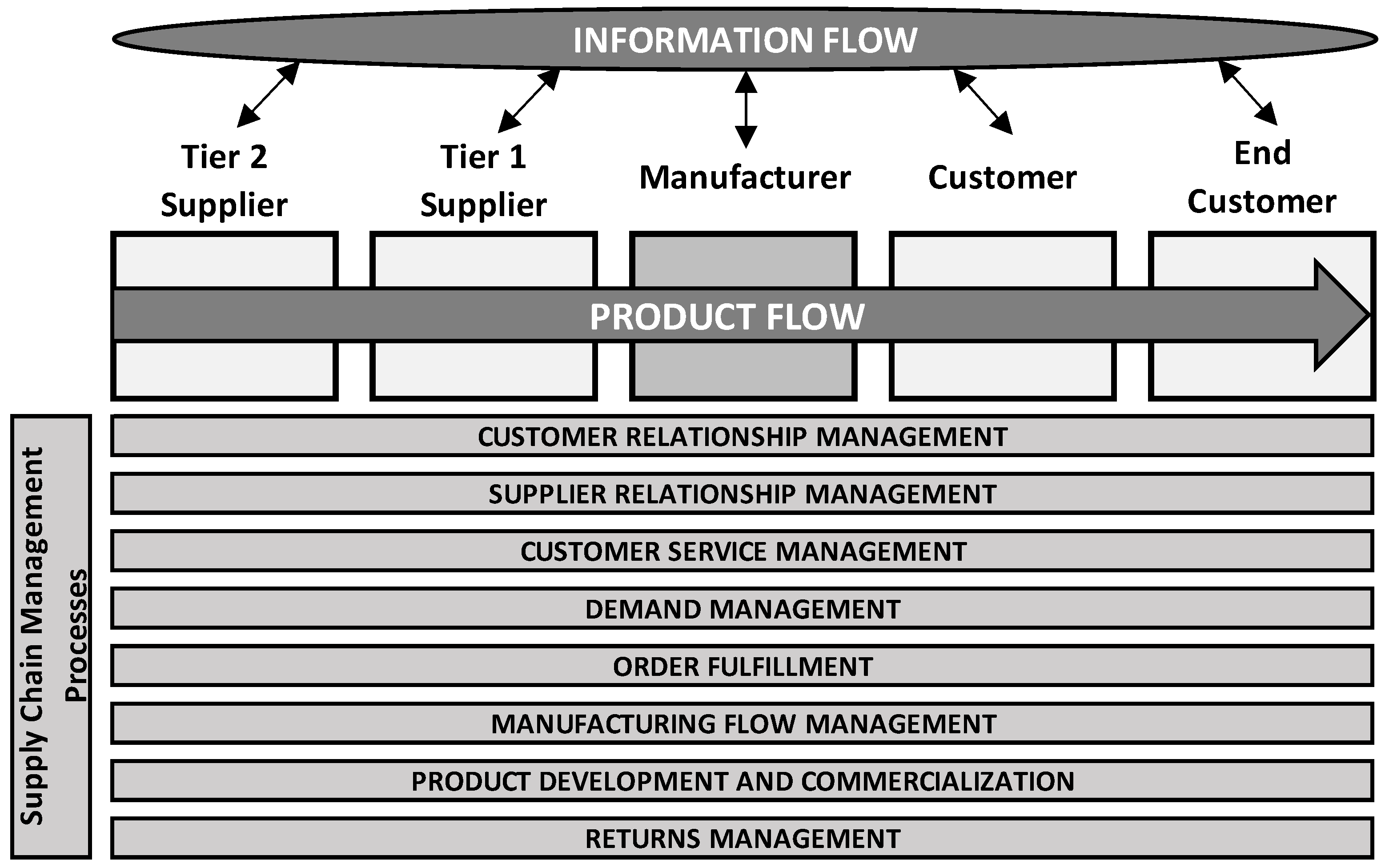
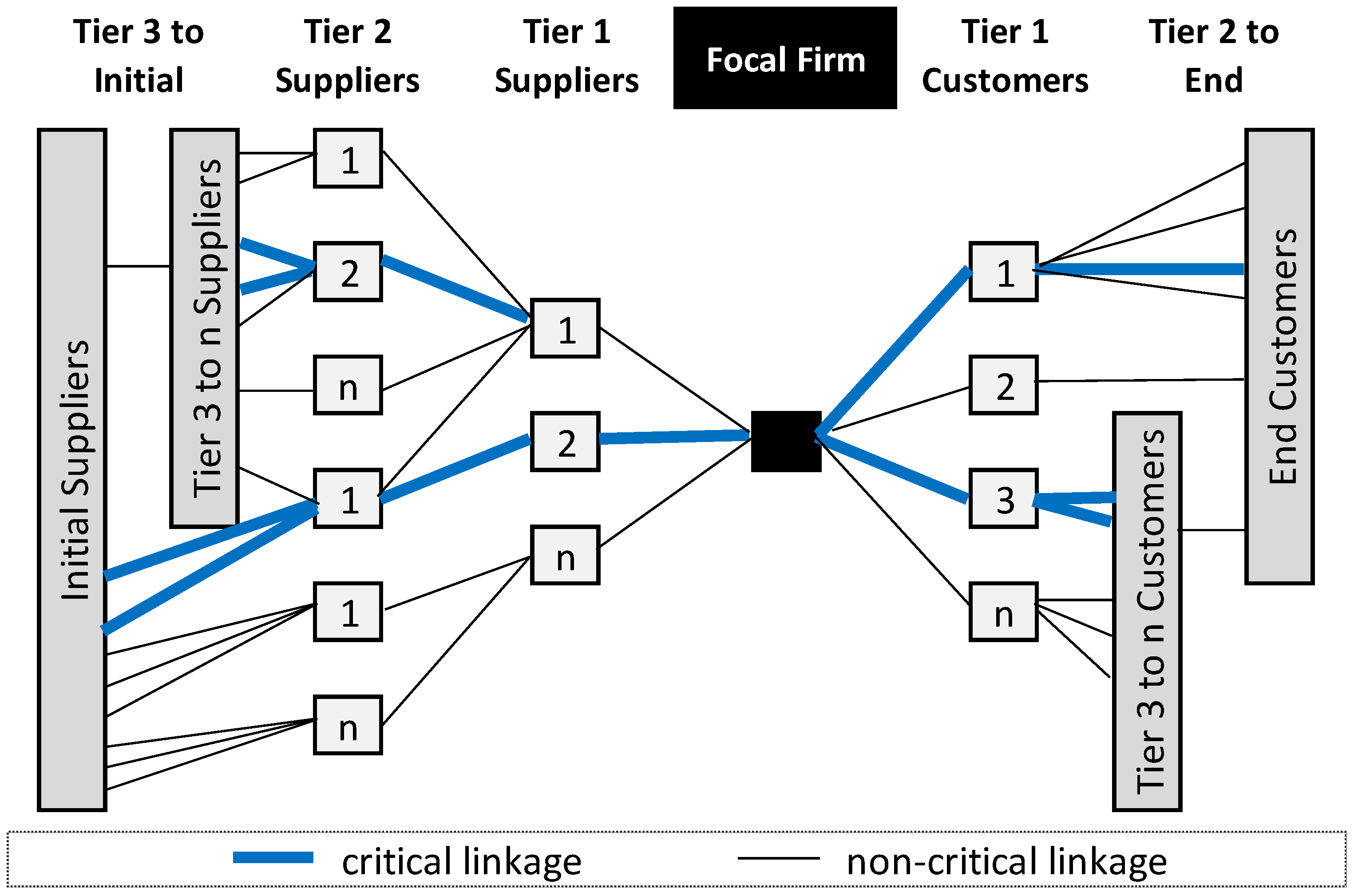
- Competition no longer occurs between individual companies, but rather between entire SCs [8].
- Today’s global world forces companies to move towards sustainable development in terms of social, economic, and environmental sustainability. Companies strive to achieve competitive advantages by achieving sustainability in their processes [1].
- The main purpose of DX is to achieve agility through data acquisition, the creation of knowledge, and the ability to make rapid decisions to become more competitive [9].
- Sustainability and innovation are recognized as strategic levers for global economic development [2].
- Economic: Increased production driven by reduced cycle times, enabled by faster and more advanced production systems; higher flexibility; shorter lead times; greater automation; and improved information sharing.
- Environmental: Lower fuel consumption, reduced CO2 emissions and minimized waste generation.
- Social: Creation of new job structures, changes in work practices resulting from technological advancements, improved company reputation, and the development of dynamic SC networks.
3.2. From the SC to the Supply Network
3.3. Managing Digital Transformation (DX) Through a Holistic Approach
- Industry 4.0 Vision: The model is grounded in a clear vision of what it means to achieve DX maturity within a company. The goal is to generate knowledge from data in order to transform the company into a learning and agile organization and enable rapid decision-making and adaptation processes through every part of the business and across all business process areas [6].
- Maturity levels: Building on this vision, the model’s approach is based on a succession of maturity stages, which help companies navigate their way through every stage in the transformation, from the basic requirements for I4.0 to full implementation. The path comprises six development stages:
- Computerization: This stage focuses on introducing basic digital tools and systems to improve efficiency and data availability at the task or process level.
- Connectivity: At this stage, different digital systems, machines, and applications are connected to allow data exchange across processes and organizational units.
- Visibility: The goal is to make relevant data visible across the organization, supporting monitoring, tracking, and basic performance analysis.
- Transparency: Data is contextualized and analyzed to explain why events occur, enabling deeper insights into process behavior and performance drivers.
- Predictive Capacity: Advanced analytics and predictive models are used to forecast demand, failures, or performance trends, supporting proactive decision-making.
- Adaptability: In this stage, systems and processes can dynamically adjust based on predictions and predefined rules, enhancing agility and resilience.
- Digital capabilities: Each stage builds on the previous one and describes the digital capabilities required to reach it.
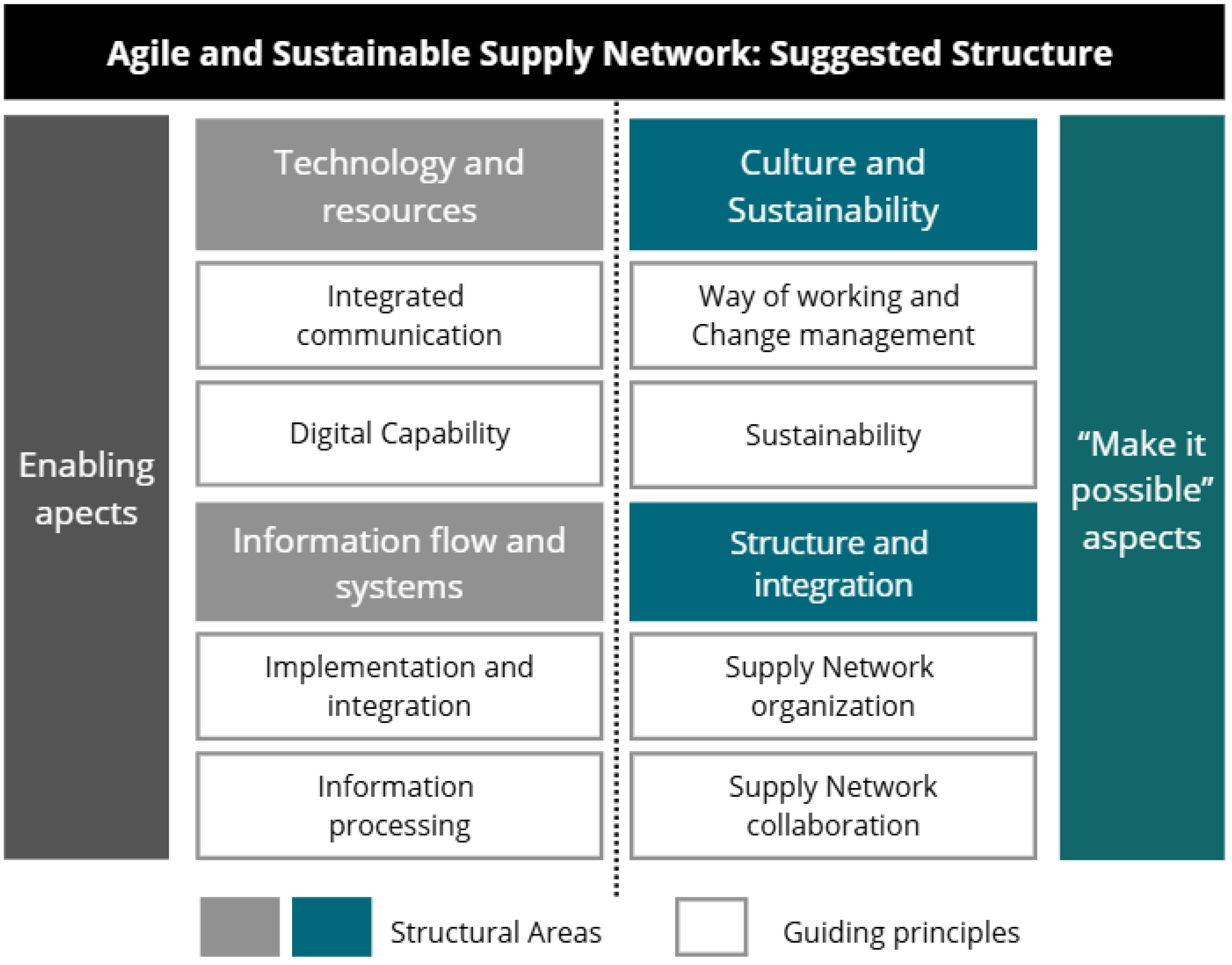
- Structural areas and guiding principles: Digital capabilities are associated with four structural areas: resources, information systems, culture, and organizational structure. As capabilities mature within each structural area, they evolve into guiding principles that characterize how the organization advances toward higher stages of digital transformation. Specifically, capabilities related to resources are reflected in the guiding principles of structured communication and digital capability; within information systems, they evolve toward system integration and information processing; capabilities embedded in culture emphasize willingness to change and social collaboration; and those associated with organizational structure give rise to organic internal organization and dynamic collaboration within value networks.
- Functional areas and processes: In the I4.0 Maturity Index, the capabilities are investigated separately for each of a company’s functional areas: Development, Production, Logistics, Services, and Marketing and Sales. The specific maturity stage of each capability may be different for different functional areas and the business processes contained within them.
- Corporate and Digital Strategy: The use of the Index involves the identification of the current maturity stage of digital capabilities in the different functional areas and the definition of the target development stage that the company wishes to attain at the end of the transformation process, in alignment with its corporate strategy.
- Technology and resources: Integrated communication and digital capability.
- Information flows and systems: System implementation and integration, and information processing.
- Culture and sustainability: Ways of working and change management, and sustainability orientation.
- Structure and integration: Supply network organization and supply network collaboration.
4. The Agile and Sustainable Supply Network Compass
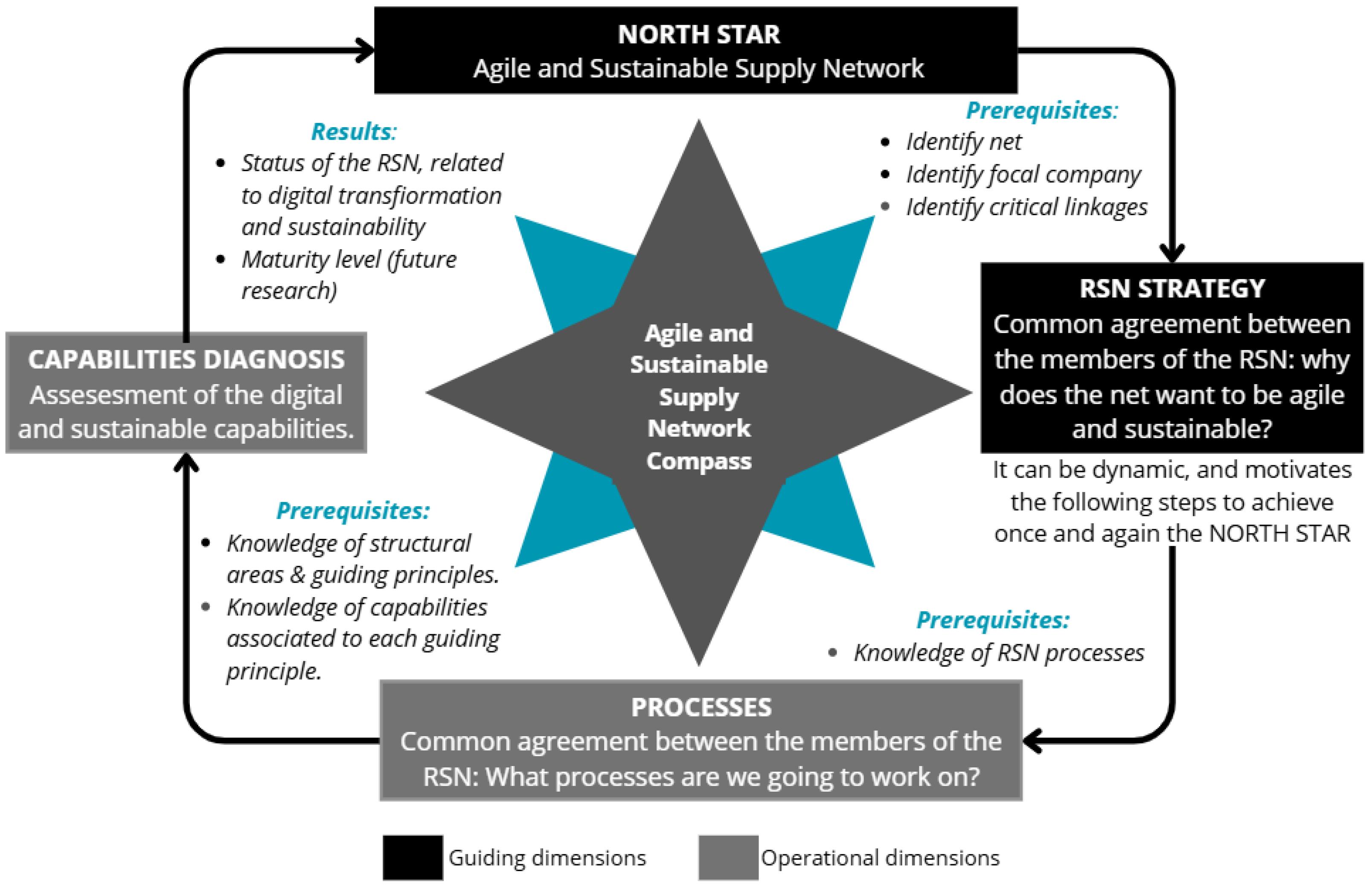
4.1. North Star
- Fact 1: As mentioned before, both DX and sustainability are key drivers of competitiveness and, therefore, of global economic development. Since competition now takes place between entire SCs, both dimensions must coexist and evolve together. The trade-off between DX and sustainability must be continuously analyzed in an integrated manner, and it is essential that both DX and sustainability are embedded in the SC strategy.
- Fact 2: On the other hand, an isolated company does not achieve the same levels of efficiency, agility, or compliance with the Sustainable Development Goals (Appendix B)—particularly SDG 8 (Decent Work and Economic Growth), SDG 9 (Industry, Innovation and Infrastructure), SDG 12 (Responsible Consumption and Production), and SDG 13 (Climate Action)—as it would when collaborating within a network [20].
4.2. Supply Chain Strategy
4.3. Identification of Processes
4.4. Capability Diagnosis
5. Summary
6. Discussion
6.1. Theoretical Contributions
- Holistic Integration: The Compass unifies aspects that are typically treated separately—DX, sustainability, processes, culture, and organizational strategy—offering a truly integrated perspective.
- Conceptual Advancement: It reinforces the argument that DX and sustainability must co-evolve within supply networks, contributing to emerging discussions around sustainable digitalization.
- Framework Development: By grounding the Compass in a structured synthesis of the literature and SC management theories, and by positioning maturity models such as I4.0 Maturity Index as supporting references, the paper provides a conceptual framework on which future maturity models and assessment tools may be built.
6.2. Practical Contributions
- Actionable Guidance: The Compass equips organizations with a structured and actionable approach to initiate transformation aligned with shared objectives.
- Strategic Alignment: It emphasizes the definition of a common digital and sustainability strategy at the RSN level, coordinated by the focal firm.
- Process-Centric Approach: It encourages organizations within the SC to prioritize cross-functional processes driving value creation, enabling targeted development of digital and sustainability capabilities.
6.3. Limitations
- Throughout the development of this paper, both Lambert’s process and the I4.0 Maturity Index were proposed, as they were considered sufficiently aligned with the intended purpose. Although other approaches to SC management and DX maturity were reviewed, only the aforementioned models were analyzed in depth.
- The framework is conceptual and requires empirical validation.
- The definition of maturity levels and capabilities, while feasible, remains outside the scope of this study.
6.4. Future Research
- Empirical testing of the Compass in real RSNs.
- Identification and definition of capabilities under each structural area.
- Development of maturity levels and an assessment tool.
- Integration of the Compass into a complete roadmap for DX and sustainability implementation in an RSN.
- In-depth analysis of network governance structures, power asymmetries, and revenue distribution mechanisms and their influence on network-level digital and sustainability transformation.
7. Conclusions
Author Contributions
Funding
Data Availability Statement
Conflicts of Interest
Abbreviations
| I4.0 | Industry 4.0 |
| DX | Digital Transformation |
| SC | Supply Chain |
| SCs | Supply Chains |
| CPS | Cyber–Physical Systems |
| IoT | Internet of Things |
| CPSL | Conference on Production Systems and Logistics |
| Acatech | German Academy of Science and Engineering |
| RSN | Reduced Supply Network |
Appendix A. Umbrella Review: Purpose, Systematic Literature Reviews (SRLs) Analyzed and Main Conclusions
Appendix A.1. Purpose
Appendix A.2. Systematic Literature Reviews Analyzed
- SRL 1:Büyüközkan, G.; Göçer, F. Digital supply chain: Literature review and a proposed framework for future research. Comput. Ind. 2018, 97, 157–177. https://doi.org/10.1016/j.compind.2018.02.010 [21].
- SRL 2:Chauhan, C.; Singh, A. A review of Industry 4.0 in supply chain management studies. J. Manuf. Technol. Manag. 2020, 31, 863–886 [22].
- SRL 3:Sony, M.; Naik, S. Key ingredients for evaluating Industry 4.0 readiness for organizations: A literature review. Benchmarking 2020, 27, 2213–2232. https://doi.org/10.1108/BIJ-09-2018-0284 [23].
- SRL 4:Núñez-Merino, M.; Maqueira-Marín, J.M.; Moyano-Fuentes, J.; Martínez-Jurado, P.J. Information and digital technologies of Industry 4.0 and Lean supply chain management: A systematic literature review. Int. J. Prod. Res. 2020, 58, 5034–5061. https://doi.org/10.1080/00207543.2020.1743896 [24].
- SRL 5:Ansari, Z. A systematic literature review on adoption of Industry 4.0 in supply chain. Int. J. Res. Appl. Sci. Eng. Technol. 2020, 8, 60–67. https://doi.org/10.22214/ijraset.2020.31250 [25].
- SRL 6:Zekhnini, K.; Cherrafi, A.; Bouhaddou, I.; Benghabrit, Y.; Garza-Reyes, J.A. Supply chain management 4.0: A literature review and research framework. Benchmarking 2021, 28, 465–501. https://doi.org/10.1108/BIJ-04-2020-0156 [26].
- SRL 7:Tiwari, S. Supply chain integration and Industry 4.0: A systematic literature review. Benchmarking 2021, 28, 990–1030. https://doi.org/10.1108/BIJ-08-2020-0428 [27].
- SRL 8:Hellweg, F.; Lechtenberg, S.; Hellingrath, B.; Thomé, A.M.T. Literature review on maturity models for digital supply chains. Braz. J. Oper. Prod. Manag. 2021, 18, 1–14. https://doi.org/10.14488/BJOPM.2021.022 [28].
- SRL 9:Jahani, N.; Sepehri, A.; Vandchali, H.R.; Tirkolaee, E.B. Application of Industry 4.0 in the procurement processes of supply chains: A systematic literature review. Sustainability 2021, 13, 7520. https://doi.org/10.3390/su1314752 [29].
- SRL 10:Naseem, M.H.; Yang, J. Role of Industry 4.0 in supply chains sustainability: A systematic literature review. Sustainability 2021, 13, 9544. https://doi.org/10.3390/su13179544 [2].
- SRL 11:Weerabahu, W.M.S.K.; Samaranayake, P.; Nakandala, D.; Hurriyet, H. Digital supply chain research trends: A systematic review and a maturity model for adoption. Benchmarking 2022, in press. https://doi.org/10.1108/BIJ-12-2021-0782 [30].
- SRL 12:Bentaher, C.; Rajaa, M. Supply chain management 4.0: A literature review and research framework. Eur. J. Bus. Manag. Res. 2022, 7, 117–127. https://doi.org/10.24018/ejbmr.2022.7.1.1246 [31].
- SRL 13:Deepu, T.S.; Ravi, V. A review of literature on implementation and operational dimensions of supply chain digitalization: Framework development and future research directions. Int. J. Inf. Manag. Data Insights 2023, 3, 100156. https://doi.org/10.1016/j.jjimei.2023.100156 [32].
Appendix A.3. Main Conclusions
- There is still a tendency to treat the issue from a technological perspective, leaving aside other aspects that are part of the holistic view.
- The development of frameworks or maturity models is still in the initial and theoretical phase. There are still few publications that propose a framework or maturity model for the implementation of I4.0 in the SC.
- When it comes to the development of a roadmap that guides SCs in the implementation of digital capabilities associated with I4.0, no proposals were found.
- There are still barriers to overcome in order to start and advance in the SC digital transformation process. These barriers are associated with several lines of work and represent big challenges to the SC’s progress.
- Detected GAPs are an issue that has been highly investigated. The most frequent gap, mentioned by 6 of the 13 SLRs, is “the empirical validation of the proposed frameworks and maturity models”, confirming that this issue needs to be addressed. The second most frequent gaps concern “the need of developing a framework or maturity model to guide the SC in the digital transformation process”, “the need of considering this process from a holistic perspective”, and the need to “study the relationship of SCM4.0 with sustainability”. Each of these gaps is mentioned in 5 SLRs.
Appendix B. Sustainable Development Goals
- No Poverty;
- Zero Hunger;
- Good Health and Well-Being;
- Quality Education;
- Gender Equality;
- Clean Water and Sanitation;
- Affordable and Clean Energy;
- Decent Work and Economic Growth;
- Industry, Innovation and Infrastructure;
- Reduced Inequalities;
- Sustainable Cities and Communities;
- Responsible Consumption and Production;
- Climate Action;
- Life Below Water;
- Life on Land;
- Peace, Justice and Strong Institutions;
- Partnerships for the Goals.
References
- Vial, G. Understanding digital transformation: A review and a research agenda. J. Strateg. Inf. Syst. 2019, 28, 118–144. [Google Scholar] [CrossRef]
- Naseem, M.H.; Yang, J. Role of Industry 4.0 in supply chains sustainability: A systematic literature review. Sustainability 2021, 13, 9544. [Google Scholar] [CrossRef]
- Sony, M.; Naik, S. Industry 4.0 integration with socio-technical systems theory: A systematic review and proposed theoretical model. Technol. Soc. 2019, 61, 101248. [Google Scholar] [CrossRef]
- Wieland, A. Dancing the supply chain: Toward transformative supply chain management. J. Supply Chain Manag. 2021, 57, 58–73. [Google Scholar] [CrossRef]
- Palandella, L.; Muñoz, L.P.; Ruiz, A. Implementation of Industry 4.0 principles in the supply chain: An umbrella review on the state of the art and challenges. In Proceedings of the Conference on Production Systems and Logistics, Honolulu, HI, USA, 12–17 July 2024; pp. 666–675. [Google Scholar] [CrossRef]
- Schuh, G.; Anderl, R.; Dumitrescu, R.; Krüger, A.; ten Hompel, M. (Eds.) Industrie 4.0 Maturity Index: Managing the Digital Transformation of Companies (Update 2020); acatech—National Academy of Science and Engineering: Munich, Germany, 2020. [Google Scholar]
- United Nations Global Compact. Supply Chain Sustainability: A Practical Guide for Continuous Improvement, 2nd ed.; United Nations Global Compact: New York, NY, USA, 2015; Available online: https://unglobalcompact.org/library/205 (accessed on 11 January 2026).
- Li, S.; Ragu-Nathan, B.; Ragu-Nathan, T.S.; Subba Rao, S. The impact of supply chain management practices on competitive advantage and organizational performance. Omega 2006, 34, 107–124. [Google Scholar] [CrossRef]
- Muñoz, L.P.; Hagemann, M.; Palandella, L.; Cagliari, P. Maturity SCAN 4.0: An analysis and discussion of results from the scanning of digital capabilities adopted in Argentinian CPG companies. In Proceedings of the Conference on Production Systems and Logistics, Stellenbosch, South Africa, 14–17 November 2023; pp. 854–863. [Google Scholar] [CrossRef]
- Lambert, D. Supply Chain Management. In Supply Chain Management: Processes, Partnerships, Performance, 4th ed.; Supply Chain Management Institute: Sarasota, FL, USA, 2014; Chapter 1. [Google Scholar]
- Carter, C.R.; Rogers, D.S.; Choi, T.Y. Toward the theory of the supply chain. J. Supply Chain Manag. 2015, 51, 89–97. [Google Scholar] [CrossRef]
- Fritz, M.M.C. A supply chain view of sustainability management. Clean. Prod. Lett. 2022, 3, 100023. [Google Scholar] [CrossRef]
- Chevalier, J.M.; Buckles, D.J. SAS2: A Guide to Collaborative Inquiry and Social Engagement; SAGE Publications/IDRC: Ottawa, ON, Canada, 2008. [Google Scholar] [CrossRef]
- Reed, M.S.; Graves, A.; Dandy, N.; Posthumus, H.; Hubacek, K.; Morris, J.; Prell, C.; Quinn, C.H.; Stringer, L.C. Who’s in and why? A typology of stakeholder analysis methods for natural resource management. J. Environ. Manag. 2009, 90, 1933–1949. [Google Scholar] [CrossRef]
- Angreani, L.S.; Vijaya, A.; Wicaksono, H. Systematic literature review of Industry 4.0 maturity model for manufacturing and logistics sectors. Procedia Manuf. 2020, 52, 337–343. [Google Scholar] [CrossRef]
- Schumacher, A.; Erol, S.; Sihn, W. A maturity model for assessing Industry 4.0 readiness and maturity of manufacturing enterprises. Procedia CIRP 2016, 52, 161–166. [Google Scholar] [CrossRef]
- Schuh, G.; Anderl, R.; Dumitrescu, R.; Krüger, A.; ten Hompel, M. (Eds.) Using the Industrie 4.0 Maturity Index in Industry: Current Challenges, Case Studies and Trends; acatech—National Academy of Science and Engineering: Munich, Germany, 2020. [Google Scholar]
- Zeller, V.; Hocken, C.; Stich, V. acatech Industrie 4.0 Maturity Index—A multidimensional maturity model. In Advances in Production Management Systems—APMS 2018; Springer: Berlin/Heidelberg, Germany, 2018; pp. 105–113. [Google Scholar] [CrossRef]
- Storolli, W.G.; Makiya, I.K.; César, F.I.G. Maturity Index of Industry 4.0—Bosch Brazil Case. Int. J. Manag. Res. Econ. 2023, 3, 34–48. [Google Scholar] [CrossRef]
- Mariani, L.; Trivellato, B.; Martini, M.; Marafioti, E. Achieving Sustainable Development Goals through collaborative innovation: Evidence from four European initiatives. J. Bus. Ethics 2022, 180, 1075–1095. [Google Scholar] [CrossRef]
- Büyüközkan, G.; Göçer, F. Digital supply chain: Literature review and a proposed framework for future research. Comput. Ind. 2018, 97, 157–177. [Google Scholar] [CrossRef]
- Chauhan, C.; Singh, A. A review of Industry 4.0 in supply chain management studies. J. Manuf. Technol. Manag. 2020, 31, 863–886. [Google Scholar] [CrossRef]
- Sony, M.; Naik, S. Key ingredients for evaluating Industry 4.0 readiness for organizations: A literature review. Benchmarking 2020, 27, 2213–2232. [Google Scholar] [CrossRef]
- Núñez-Merino, M.; Maqueira-Marín, J.M.; Moyano-Fuentes, J.; Martínez-Jurado, P.J. Information and digital technologies of Industry 4.0 and Lean supply chain management: A systematic literature review. Int. J. Prod. Res. 2020, 58, 5034–5061. [Google Scholar] [CrossRef]
- Ansari, Z. A systematic literature review on adoption of Industry 4.0 in supply chain. Int. J. Res. Appl. Sci. Eng. Technol. 2020, 8, 60–67. [Google Scholar] [CrossRef]
- Zekhnini, K.; Cherrafi, A.; Bouhaddou, I.; Benghabrit, Y.; Garza-Reyes, J.A. Supply chain management 4.0: A literature review and research framework. Benchmarking 2021, 28, 465–501. [Google Scholar] [CrossRef]
- Tiwari, S. Supply chain integration and Industry 4.0: A systematic literature review. Benchmarking 2021, 28, 990–1030. [Google Scholar] [CrossRef]
- Hellweg, F.; Lechtenberg, S.; Hellingrath, B.; Thomé, A.M.T. Literature review on maturity models for digital supply chains. Braz. J. Oper. Prod. Manag. 2021, 18, 1–14. [Google Scholar] [CrossRef]
- Jahani, N.; Sepehri, A.; Vandchali, H.R.; Tirkolaee, E.B. Application of Industry 4.0 in the procurement processes of supply chains: A systematic literature review. Sustainability 2021, 13, 7520. [Google Scholar] [CrossRef]
- Weerabahu, W.M.S.K.; Samaranayake, P.; Nakandala, D.; Hurriyet, H. Digital supply chain research trends: A systematic review and a maturity model for adoption. Benchmarking 2022. [Google Scholar] [CrossRef]
- Bentaher, C.; Rajaa, M. Supply chain management 4.0: A literature review and research framework. Eur. J. Bus. Manag. Res. 2022, 7, 117–127. [Google Scholar] [CrossRef]
- Deepu, T.S.; Ravi, V. A review of literature on implementation and operational dimensions of supply chain digitalization: Framework development and future research directions. Int. J. Inf. Manag. Data Insights 2023, 3, 100156. [Google Scholar] [CrossRef]


Disclaimer/Publisher’s Note: The statements, opinions and data contained in all publications are solely those of the individual author(s) and contributor(s) and not of MDPI and/or the editor(s). MDPI and/or the editor(s) disclaim responsibility for any injury to people or property resulting from any ideas, methods, instructions or products referred to in the content. |
© 2026 by the authors. Licensee MDPI, Basel, Switzerland. This article is an open access article distributed under the terms and conditions of the Creative Commons Attribution (CC BY) license.
Share and Cite
Palandella, L.; Perea Muñoz, L.; Ruiz, A. Development of a Compass Framework to Achieve an Agile and Sustainable Supply Network. Sustainability 2026, 18, 1865. https://doi.org/10.3390/su18041865
Palandella L, Perea Muñoz L, Ruiz A. Development of a Compass Framework to Achieve an Agile and Sustainable Supply Network. Sustainability. 2026; 18(4):1865. https://doi.org/10.3390/su18041865
Chicago/Turabian StylePalandella, Lucila, Lourdes Perea Muñoz, and Angel Ruiz. 2026. "Development of a Compass Framework to Achieve an Agile and Sustainable Supply Network" Sustainability 18, no. 4: 1865. https://doi.org/10.3390/su18041865
APA StylePalandella, L., Perea Muñoz, L., & Ruiz, A. (2026). Development of a Compass Framework to Achieve an Agile and Sustainable Supply Network. Sustainability, 18(4), 1865. https://doi.org/10.3390/su18041865