Sustaining Well-Being in the Post-Crisis Era: Minimizing Conflict Through Autonomy, Resilience, and Informational Support Among SME Employees


Abstract
1. Introduction
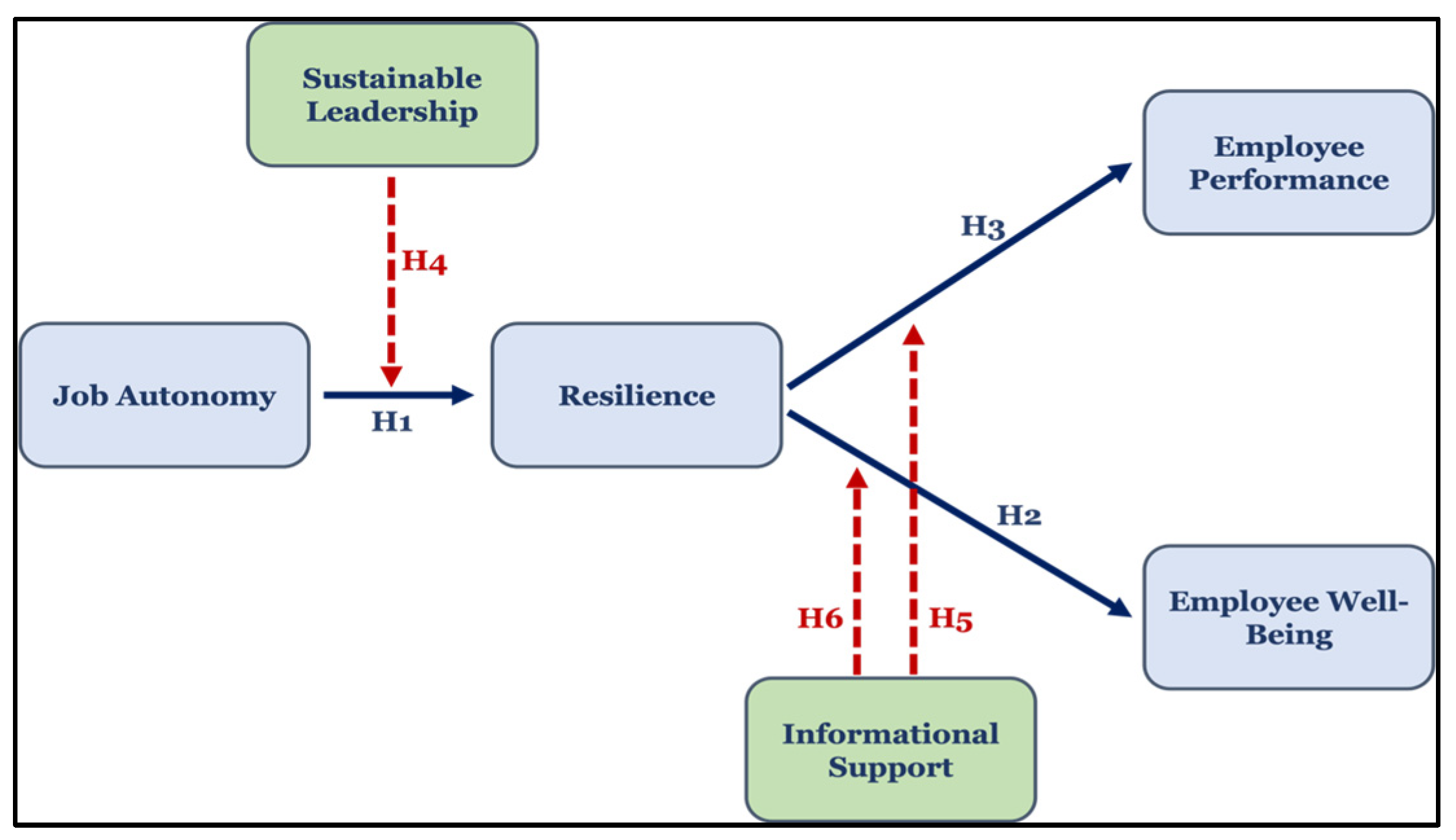
- What is the influence of job autonomy on employee resilience for employees in Lebanese SMEs in the post-crisis context?
- What is the influence of employee resilience on employee performance and well-being?
- Does sustainable leadership moderate the association between job autonomy and employee resilience?
- Does informational support moderate the association between employee resilience and employee outcomes, specifically performance and well-being?
2. Literature Review
2.1. Job Autonomy and Employee Resilience
2.2. Employee Resilience and Employee Well-Being
2.3. Employee Resilience and Employee Performance
2.4. Impact of Sustainable Leadership
2.5. Impact of Informational Support in Post-Crisis
3. Methodology
3.1. Research Design
3.2. Data Sampling and Collection
3.3. Measurement
4. Findings
5. Discussion
6. Conclusions and Recommendations
7. Limitations and Future Research
Funding
Institutional Review Board Statement
Informed Consent Statement
Data Availability Statement
Conflicts of Interest
Appendix A

| Statement | 1 SD | 2 D | 3 N | 4 A | 5 SA | |
|---|---|---|---|---|---|---|
| ||||||
| Work Scheduling Autonomy | ||||||
| 1. | The job allows me to make my own decisions about how to schedule my work. | ☐ | ☐ | ☐ | ☐ | ☐ |
| 2. | The job allows me to decide on the order in which things are done on the job. | ☐ | ☐ | ☐ | ☐ | ☐ |
| 3. | The job allows me to plan how I do my work. | ☐ | ☐ | ☐ | ☐ | ☐ |
| Decision-Making Autonomy | ||||||
| 4. | The job gives me a chance to use my personal initiative or judgment in carrying out the work. | ☐ | ☐ | ☐ | ☐ | ☐ |
| 5. | The job allows me to make a lot of decisions on my own. | ☐ | ☐ | ☐ | ☐ | ☐ |
| 6. | The job provides me with significant autonomy in making decisions. | ☐ | ☐ | ☐ | ☐ | ☐ |
| Work Methods Autonomy | ||||||
| 7. | The job allows me to make decisions about what methods I use to complete my work. | ☐ | ☐ | ☐ | ☐ | ☐ |
| 8. | The job gives me considerable opportunity for independence and freedom in how I do the work. | ☐ | ☐ | ☐ | ☐ | ☐ |
| 9. | The job allows me to decide on my own how to go about doing my work. | ☐ | ☐ | ☐ | ☐ | ☐ |
| ||||||
| 10. | I effectively collaborate with others to handle challenges at work. | ☐ | ☐ | ☐ | ☐ | ☐ |
| 11. | I successfully manage a high workload for long periods of time. | ☐ | ☐ | ☐ | ☐ | ☐ |
| 12. | I resolve crises competently at work. | ☐ | ☐ | ☐ | ☐ | ☐ |
| 13. | I learn from mistakes and improve the way I do my job. | ☐ | ☐ | ☐ | ☐ | ☐ |
| 14. | I re-evaluate my performance and continually improve the way I do my work. | ☐ | ☐ | ☐ | ☐ | ☐ |
| 15. | I seek assistance at work when I need specific resources. | ☐ | ☐ | ☐ | ☐ | ☐ |
| 16. | I effectively respond to feedback, even criticism. | ☐ | ☐ | ☐ | ☐ | ☐ |
| 17. | I approach managers when I need their support. | ☐ | ☐ | ☐ | ☐ | ☐ |
| 18. | I use change at work as an opportunity for growth. | ☐ | ☐ | ☐ | ☐ | ☐ |
| ||||||
| 19. | My supervisor/co-workers often share their expertise and knowledge with me. | ☐ | ☐ | ☐ | ☐ | ☐ |
| 20. | My supervisor/co-workers often provide me with different perspectives and viewpoints. | ☐ | ☐ | ☐ | ☐ | ☐ |
| 21. | My supervisor/co-workers do not help me with hints or cues for new ideas (r). | ☐ | ☐ | ☐ | ☐ | ☐ |
| 22. | My supervisor/co-workers seldom offer information and alternatives for solving problems (r). | ☐ | ☐ | ☐ | ☐ | ☐ |
| 23. | My supervisor/co-workers often contribute new ideas about how to solve problems at work. | ☐ | ☐ | ☐ | ☐ | ☐ |
| ||||||
| 24. | In the past months, I felt motivated. | ☐ | ☐ | ☐ | ☐ | ☐ |
| 25. | In the past months, I felt energetic. | ☐ | ☐ | ☐ | ☐ | ☐ |
| 26. | In the past months, I felt enthusiastic. | ☐ | ☐ | ☐ | ☐ | ☐ |
| 27. | In the past months, I felt lively. | ☐ | ☐ | ☐ | ☐ | ☐ |
| 28. | In the past months, I felt joyful. | ☐ | ☐ | ☐ | ☐ | ☐ |
| 29. | In the past months, I felt cheerful. | ☐ | ☐ | ☐ | ☐ | ☐ |
| ||||||
| 30. | I am able to meet job objectives well. | ☐ | ☐ | ☐ | ☐ | ☐ |
| 31. | I am happy with my overall job performance. | ☐ | ☐ | ☐ | ☐ | ☐ |
| 32. | I am able to meet performance standards to the organizational level of expectations. | ☐ | ☐ | ☐ | ☐ | ☐ |
| 33. | I am happy with my technical competencies. | ☐ | ☐ | ☐ | ☐ | ☐ |
| 34. | I am always able to meet specific job responsibilities. | ☐ | ☐ | ☐ | ☐ | ☐ |
| ||||||
| 35. | My leader creates sustainable learning conditions and takes care to preserve them. | ☐ | ☐ | ☐ | ☐ | ☐ |
| 36. | My leader develops, rather than exhausts, the human resources that work with them. | ☐ | ☐ | ☐ | ☐ | ☐ |
| 37. | My leader supports his subordinates and collaborators in their personal/career growth. | ☐ | ☐ | ☐ | ☐ | ☐ |
| 38. | My leader leaves out the superfluous by focusing the resources on the crucial aspects of work. | ☐ | ☐ | ☐ | ☐ | ☐ |
References
- Kemayel, L. Success factors of Lebanese SMEs: An empirical study. Procedia-Soc. Behav. Sci. 2015, 195, 1123–1128. [Google Scholar] [CrossRef]
- Baumann, H. Bringing the state and political economy back in: Consociationalism and crisis in Lebanon. Natl. Ethn. Politics 2024, 30, 85–102. [Google Scholar] [CrossRef]
- Gade, T.; Selvik, K.; Zaza Dit Yafawi, K. How Lebanon’s security sector works amidst state collapse. Mediterr. Politics 2025, 1–35. [Google Scholar] [CrossRef]
- Maalouf, J.; Miklian, J.; Hoelscher, K. Business survival strategies in a polycrisis: SME experiences from Beirut, Lebanon. Bus. Horizons 2025, 68, 461–477. [Google Scholar] [CrossRef]
- Chang, R. The impact of employees’ health and well-being on job performance. J. Educ. Humanit. Soc. Sci. 2024, 29, 372–378. [Google Scholar] [CrossRef]
- Atan, A.; Gelirli, N. Resilience and Grit for Sustainable Well-Being at Work: Evidence from High-Pressure Service Organizations. Sustainability 2025, 17, 7486. [Google Scholar] [CrossRef]
- Bardoel, E.A.; Pettit, T.M.; De Cieri, H.; McMillan, L. Employee resilience: An emerging challenge for HRM. Asia Pac. J. Hum. Resour. 2014, 52, 279–297. [Google Scholar] [CrossRef]
- Britt, T.W.; Crane, M.; Hodson, S.E.; Adler, A.B. Effective and ineffective coping strategies in a low-autonomy work environment. J. Occup. Health Psychol. 2016, 21, 154. [Google Scholar] [CrossRef]
- Inyang, B.J. Defining the role engagement of small and medium-sized enterprises (SMEs) in corporate social responsibility (CSR). Int. Bus. Res. 2013, 6, 123. [Google Scholar] [CrossRef]
- Alameddine, M.; Bou-Karroum, K.; Ghalayini, W.; Abiad, F. Resilience of nurses at the epicenter of the COVID-19 pandemic in Lebanon. Int. J. Nurs. Sci. 2021, 8, 432–438. [Google Scholar] [CrossRef]
- Ghazzawi, R.; Bender, M.; Daouk-Öyry, L.; Van De Vijver, F.J.; Chasiotis, A. Job crafting mediates the relation between creativity, personality, job autonomy and well-being in Lebanese nurses. J. Nurs. Manag. 2021, 29, 2163–2174. [Google Scholar] [CrossRef] [PubMed]
- Blaique, L.; Ismail, H.N.; Aldabbas, H. Organizational learning, resilience and psychological empowerment as antecedents of work engagement during COVID-19. Int. J. Product. Perform. Manag. 2023, 72, 1584–1607. [Google Scholar] [CrossRef]
- Ahsan, M.J.; Khawaja, S. Sustainable leadership impact on environmental performance: Exploring employee well-being, innovation, and organizational resilience. Discov. Sustain. 2024, 5, 317. [Google Scholar] [CrossRef]
- Iqbal, Q.; Piwowar-Sulej, K. Sustainable leadership, environmental turbulence, resilience, and employees’ wellbeing in SMEs. Front. Psychol. 2022, 13, 939389. [Google Scholar] [CrossRef]
- Akinwalere, S.; Chang, K.; Barbhuiya, S. Sustainability-Embedded Leadership for Successful Change Management. Sustainability 2025, 17, 7973. [Google Scholar] [CrossRef]
- Adams, M.; Comber, S. Knowledge transfer for sustainable innovation: A model for academic-industry interaction to improve resource efficiency within SME manufacturers. J. Innov. Manag. Small Medium Enterp. 2013, 2013, 1. [Google Scholar] [CrossRef]
- Saragih, S. The effects of job autonomy on work outcomes: Self efficacy as an intervening variable. Int. Res. J. Bus. Stud. 2011, 4, 203–215. [Google Scholar] [CrossRef]
- Hobfoll, S.E. Conservation of resources: A new attempt at conceptualizing stress. Am. Psychol. 1989, 44, 513. [Google Scholar] [CrossRef]
- Hobfoll, S.E.; Halbesleben, J.; Neveu, J.P.; Westman, M. Conservation of resources in the organizational context: The reality of resources and their consequences. Annu. Rev. Organ. Psychol. Organ. Behav. 2018, 5, 103–128. [Google Scholar] [CrossRef]
- Ryan, R.M.; Deci, E.L. Self-determination theory and the facilitation of intrinsic motivation, social development, and well-being. Am. Psychol. 2000, 55, 68. [Google Scholar] [CrossRef]
- Liaquat, S.; Escartín, J. Systems Intelligence and Job Autonomy in Managing Stressors and Performance: A Time-Lagged Study in Multinational Firms. Sustainability 2025, 17, 3125. [Google Scholar] [CrossRef]
- Hartmann, S.; Weiss, M.; Newman, A.; Hoegl, M. Resilience in the workplace: A multilevel review and synthesis. Appl. Psychol. 2020, 69, 913–959. [Google Scholar] [CrossRef]
- Nie, T.; Tian, M.; Cai, M.; Yan, Q. Job autonomy and work meaning: Drivers of employee job-crafting behaviors in the VUCA times. Behav. Sci. 2023, 13, 493. [Google Scholar] [CrossRef] [PubMed]
- Pan, L.; Kao, K.Y.; Hsu, H.H.; Thomas, C.L.; Cobb, H.R. Linking job autonomy to helping behavior: A moderated mediation model of transformational leadership and mindfulness. Curr. Psychol. 2024, 43, 19370–19385. [Google Scholar] [CrossRef]
- Choi, J. The mediating effect of positive psychological capital between autonomous work environment and self-directed behavior: Evidence from South Korea. Hum. Resour. Dev. Int. 2020, 23, 46–65. [Google Scholar] [CrossRef]
- Connor, K.M.; Davidson, J.R. Development of a new resilience scale: The Connor-Davidson resilience scale (CD-RISC). Depress. Anxiety 2003, 18, 76–82. [Google Scholar] [CrossRef]
- Wang, Y.; Ummar, R.; Qureshi, T.M.; Ul Haq, J.; Bonn, M.A. Employee sustainability: How green practices drive employee well-being and citizenship behavior. Sustainability 2025, 17, 936. [Google Scholar] [CrossRef]
- Lightsey, O.R., Jr. Resilience, meaning, and well-being. Couns. Psychol. 2006, 34, 96–107. [Google Scholar] [CrossRef]
- Tugade, M.M.; Fredrickson, B.L. Resilient individuals use positive emotions to bounce back from negative emotional experiences. J. Personal. Soc. Psychol. 2004, 86, 320. [Google Scholar] [CrossRef]
- Bai, B. Exploring Sustainable HRM Through the Lens of Employee Wellbeing. Sustainability 2025, 17, 5646. [Google Scholar] [CrossRef]
- Mantas-Jiménez, S.; Lluch-Canut, M.T.; Roldán-Merino, J.; Reig-Garcia, G.; Juvinyà-Canal, D. Resilience and job satisfaction among out-of-hospital emergency medical service professionals: A cross-sectional multi-centric study. J. Nurs. Manag. 2022, 30, 2084–2092. [Google Scholar] [CrossRef] [PubMed]
- Meeusen, V.; Gatt, S.P.; Barach, P.; Van Zundert, A. Occupational Well-Being, Resilience, Burnout, and Job Satisfaction of Surgical Teams. In Handbook of Perioperative and Procedural Patient Safety; Elsevier: Amsterdam, The Netherlands, 2024; pp. 205–229. [Google Scholar]
- Robertson, I.T.; Cooper, C.L.; Sarkar, M.; Curran, T. Resilience training in the workplace from 2003 to 2014: A systematic review. J. Occup. Organ. Psychol. 2015, 88, 533–562. [Google Scholar] [CrossRef]
- Joyce, S.; Shand, F.; Tighe, J.; Laurent, S.J.; Bryant, R.A.; Harvey, S.B. Road to resilience: A systematic review and meta-analysis of resilience training programmes and interventions. BMJ Open 2018, 8, e017858. [Google Scholar] [CrossRef] [PubMed]
- Zábó, V.; Lehoczki, A.; Buda, A.; Varga, P.; Fekete, M.; Fazekas-Pongor, V.; Ungvari, Z.; Moizs, M.; Giovannetti, G.; Loscalzo, Y.; et al. The role of burnout prevention in promoting healthy aging: Frameworks for the Semmelweis Study and Semmelweis-EUniWell Workplace Health Promotion Program. Geroscience 2025, 47, 6377–6398. [Google Scholar] [CrossRef]
- Hessari, H.; Daneshmandi, F.; Busch, P.; Smith, S. Mitigating cyberloafing through employee adaptability: The roles of temporal leadership, teamwork attitudes and competitive work environment. Asia-Pac. J. Bus. Adm. 2025, 17, 303–336. [Google Scholar] [CrossRef]
- Afrin, S.; Asyraf Bin Mohd Kassim, M.; Yusof, M.F.; Hassan, M.S.; Islam, M.A.; Khairuddin, K.N.B. Investigating the determinants of employee performance for sustainability: A study on the Bangladesh insurance industry. Sustainability 2023, 15, 5674. [Google Scholar] [CrossRef]
- Cooper, B.; Wang, J.; Bartram, T.; Cooke, F.L. Well-being-oriented human resource management practices and employee performance in the Chinese banking sector: The role of social climate and resilience. Hum. Resour. Manag. 2019, 58, 85–97. [Google Scholar] [CrossRef]
- Dhoopar, A.; Sihag, P.; Kumar, A.; Suhag, A.K. Organizational resilience and employee performance in COVID-19 pandemic: The mediating effect of emotional intelligence. Int. J. Organ. Anal. 2022, 30, 130–155. [Google Scholar] [CrossRef]
- Lu, Y.; Zhang, M.M.; Yang, M.M.; Wang, Y. Sustainable human resource management practices, employee resilience, and employee outcomes: Toward common good values. Hum. Resour. Manag. 2023, 62, 331–353. [Google Scholar] [CrossRef]
- Srimongkolkul, P.; Boriraj, J.; Wongsansukcharoen, J. Effects of authentic leadership, employee resilience, job satisfaction, and innovative work behavior on employee work performance in transport and logistics of Thailand. Cogent Bus. Manag. 2025, 12, 2511282. [Google Scholar] [CrossRef]
- Anastasopoulou, A.; Vraimaki, E.; Trivellas, P. Recovery for resilience: The mediating role of work–life balance on the quality of life of women employees. Sustainability 2023, 15, 12877. [Google Scholar] [CrossRef]
- Prieto, L.; Talukder, M.F. Resilient agility: A necessary condition for employee and organizational sustainability. Sustainability 2023, 15, 1552. [Google Scholar] [CrossRef]
- Skinner, E.; Pitzer, J.; Brule, H. The Role of Emotion in Engagement, Coping, and the Development of Motivational Resilience. In International Handbook of Emotions in Education; Routledge: Abingdon, UK, 2014; pp. 331–347. [Google Scholar]
- Kašpárková, L.; Vaculík, M.; Procházka, J.; Schaufeli, W.B. Why resilient workers perform better: The roles of job satisfaction and work engagement. J. Workplace Behav. Health 2018, 33, 43–62. [Google Scholar] [CrossRef]
- Bakker, A.B.; Demerouti, E. The job demands-resources model: State of the art. J. Manag. Psychol. 2007, 22, 309–328. [Google Scholar] [CrossRef]
- Shatté, A.; Perlman, A.; Smith, B.; Lynch, W.D. The positive effect of resilience on stress and business outcomes in difficult work environments. J. Occup. Environ. Med. 2017, 59, 135–140. [Google Scholar] [CrossRef]
- Vanhove, A.J.; Herian, M.N.; Perez, A.L.; Harms, P.D.; Lester, P.B. Can resilience be developed at work? A meta-analytic review of resilience-building programme effectiveness. J. Occup. Organ. Psychol. 2016, 89, 278–307. [Google Scholar] [CrossRef]
- Jang, E.; Kim, Y.C. Autonomy Constrained: The Dynamic Interplay Among Job Autonomy, Work Engagement, and Innovative Behavior Under Performance Pressure. Adm. Sci. 2025, 15, 97. [Google Scholar] [CrossRef]
- Avery, G.; Bergsteiner, H. Sustainable Leadership: Honeybee and Locust Approaches; Routledge: Abingdon, UK, 2012. [Google Scholar]
- Liao, Y. Sustainable leadership: A literature review and prospects for future research. Front. Psychol. 2022, 13, 1045570. [Google Scholar] [CrossRef]
- Lewandowska, A.; Ullah, Z.; AlDhaen, F.S.; AlDhaen, E.; Yakymchuk, A. Enhancing organizational social sustainability: Exploring the effect of sustainable leadership and the moderating role of micro-level CSR. Sustainability 2023, 15, 11853. [Google Scholar] [CrossRef]
- Hallinger, P.; Suriyankietkaew, S. Science mapping of the knowledge base on sustainable leadership, 1990–2018. Sustainability 2018, 10, 4846. [Google Scholar] [CrossRef]
- Li, M.; Liu, W.; Han, Y.; Zhang, P. Linking empowering leadership and change-oriented organizational citizenship behavior: The role of thriving at work and autonomy orientation. J. Organ. Change Manag. 2016, 29, 732–750. [Google Scholar] [CrossRef]
- Aravidou, K.; Triantari, S.; Zervas, I. Sustainable Leadership and Conflict Management: Insights from Greece’s Public Sector. Sustainability 2025, 17, 2248. [Google Scholar] [CrossRef]
- Nielsen, K.; Nielsen, M.B.; Ogbonnaya, C.; Känsälä, M.; Saari, E.; Isaksson, K. Workplace resources to improve both employee well-being and performance: A systematic review and meta-analysis. Work Stress 2017, 31, 101–120. [Google Scholar] [CrossRef]
- Madjar, N. Emotional and informational support from different sources and employee creativity. J. Occup. Organ. Psychol. 2008, 81, 83–100. [Google Scholar] [CrossRef]
- Cohen, S.; Wills, T.A. Stress, social support, and the buffering hypothesis. Psychol. Bull. 1985, 98, 310. [Google Scholar] [CrossRef]
- Sarkar, S.; Osiyevskyy, O. Organizational change and rigidity during crisis: A review of the paradox. Eur. Manag. J. 2018, 36, 47–58. [Google Scholar] [CrossRef]
- Nguyen, P.T.; Rafferty, A.E.; Xerri, M.J. The Impact of Personal and Change Event Characteristics on Employee Wellbeing via Uncertainty and Insecurity. Organ. Psychol. Rev. 2025, 15, 181–208. [Google Scholar] [CrossRef]
- Zakhem, N.B.; Farmanesh, P.; Zargar, P.; Kassar, A. Wellbeing during a pandemic: An empirical research examining autonomy, work-family conflict and informational support among SME employees. Front. Psychol. 2022, 13, 890265. [Google Scholar] [CrossRef]
- Cullen, K.L.; Edwards, B.D.; Casper, W.C.; Gue, K.R. Employees’ adaptability and perceptions of change-related uncertainty: Implications for perceived organizational support, job satisfaction, and performance. J. Bus. Psychol. 2014, 29, 269–280. [Google Scholar] [CrossRef]
- Teixeira, N.; Pereira, L.; Vinhas da Silva, R. Macroeconomic Determinants of Subjective Well-Being in Portugal: Pathways to Social Sustainability. Sustainability 2025, 17, 6888. [Google Scholar] [CrossRef]
- Keskin, H.; Tatoglu, E.; Akgün, A.E.; Balak, D. Unveiling the nexus of organizational intelligence, resilience capacity and financial performance. Manag. Decis. 2025. ahead of print. [Google Scholar] [CrossRef]
- Jiang, H.; Men, R.L. Creating an engaged workforce: The impact of authentic leadership, transparent organizational communication, and work-life enrichment. Commun. Res. 2017, 44, 225–243. [Google Scholar] [CrossRef]
- Faul, F.; Erdfelder, E.; Lang, A.G.; Buchner, A. G*Power 3: A flexible statistical power analysis program for the social, behavioral, and biomedical sciences. Behav. Res. Methods 2007, 39, 175–191. [Google Scholar] [CrossRef]
- Hair, J.F., Jr.; Howard, M.C.; Nitzl, C. Assessing measurement model quality in PLS-SEM using confirmatory composite analysis. J. Bus. Res. 2020, 109, 101–110. [Google Scholar] [CrossRef]
- Podsakoff, P.M.; MacKenzie, S.B.; Lee, J.Y.; Podsakoff, N.P. Common method biases in behavioral research: A critical review of the literature and recommended remedies. J. Appl. Psychol. 2003, 88, 879. [Google Scholar] [CrossRef] [PubMed]
- Kock, N. Common method bias in PLS-SEM: A full collinearity assessment approach. Int. J. E-Collab. IJEC 2015, 11, 1–10. [Google Scholar] [CrossRef]
- Morgeson, F.P.; Humphrey, S.E. The Work Design Questionnaire (WDQ): Developing and validating a comprehensive measure for assessing job design and the nature of work. J. Appl. Psychol. 2006, 91, 1321. [Google Scholar] [CrossRef]
- Näswall, K.; Malinen, S.; Kuntz, J.; Hodliffe, M. Employee resilience: Development and validation of a measure. J. Manag. Psychol. 2019, 34, 353–367. [Google Scholar] [CrossRef]
- Singh, S.K. Territoriality, task performance, and workplace deviance: Empirical evidence on role of knowledge hiding. J. Bus. Res. 2019, 97, 10–19. [Google Scholar] [CrossRef]
- Arnold, K.A.; Turner, N.; Barling, J.; Kelloway, E.K.; McKee, M.C. Transformational leadership and psychological well-being: The mediating role of meaningful work. J. Occup. Health Psychol. 2007, 12, 193. [Google Scholar] [CrossRef]
- Di Fabio, A.; Peiró, J.M. Human Capital Sustainability Leadership to promote sustainable development and healthy organizations: A new scale. Sustainability 2018, 10, 2413. [Google Scholar] [CrossRef]
- Hair, J.F.; Hult, G.T.M.; Ringle, C.M.; Sarstedt, M.; Thiele, K.O. Mirror, mirror on the wall: A comparative evaluation of composite-based structural equation modeling methods. J. Acad. Mark. Sci. 2017, 45, 616–632. [Google Scholar] [CrossRef]
- Fornell, C.; Larcker, D.F. Evaluating structural equation models with unobservable variables and measurement error. J. Mark. Res. 1981, 18, 39–50. [Google Scholar] [CrossRef]
- Henseler, J.; Ringle, C.M.; Sarstedt, M. A new criterion for assessing discriminant validity in variance-based structural equation modeling. J. Acad. Mark. Sci. 2015, 43, 115–135. [Google Scholar] [CrossRef]
- Voorhees, C.M.; Brady, M.K.; Calantone, R.; Ramirez, E. Discriminant validity testing in marketing: An analysis, causes for concern, and proposed remedies. J. Acad. Mark. Sci. 2016, 44, 119–134. [Google Scholar] [CrossRef]
- Rumjaun, A.; Narod, F. Social Learning Theory—Albert Bandura. In Science Education in Theory and Practice: An Introductory Guide to Learning Theory; Springer Nature Switzerland: Cham, Switzerland, 2025; pp. 65–82. [Google Scholar]
- Maisonneuve, F.; Galy, A.; Groulx, P.; Chênevert, D.; Grady, C.; Coderre-Ball, A.M. Managing Resilience and Exhaustion Among Health Care Workers Through Psychological Self-Care: The Impact of Job Autonomy in Interaction With Role Overload. J. Healthc. Leadersh. 2025, 17, 63–73. [Google Scholar] [CrossRef]
- Johnson, S.; Robertson, I.; Cooper, C.L. Improving Psychological Well-Being: Personal Development and Resilience. In WELL-BEING: Productivity and Happiness at Work; Springer International Publishing: Cham, Switzerland, 2017; pp. 111–123. [Google Scholar]
- Suratman, A.; Suhartini, S.; Palupi, M.; Dihan, F.N.; Muhlison, M.B. The impact of psychological climate and self-resilience on employee performance during the COVID-19 pandemic: An empirical study in Indonesia. J. Asian Financ. Econ. Bus. JAFEB 2021, 8, 1019–1029. [Google Scholar]
- Matusik, J.G.; Ferris, D.L.; Johnson, R.E. The PCMT model of organizational support: An integrative review and reconciliation of the organizational support literature. J. Appl. Psychol. 2022, 107, 329. [Google Scholar] [CrossRef]
- Jolly, P.M.; Kong, D.T.; Kim, K.Y. Social support at work: An integrative review. J. Organ. Behav. 2021, 42, 229–251. [Google Scholar] [CrossRef]
- Sukri, S.F.; Salleh, N.H.M.; Jeevan, J.; Gabarre, S.; Al-Gasawneh, J.A.; Ngah, A.H. Should women in logistics stay or switch? An application of the moderating effect of work-life balance in the self-determination theory to Malaysian young women. Int. J. Popul. Stud. 2025, 11, 92–106. [Google Scholar] [CrossRef]
- Li, J.; Huang, C.; Yang, Y.; Liu, J.; Lin, X.; Pan, J. How nursing students’ risk perception affected their professional commitment during the COVID-19 pandemic: The mediating effects of negative emotions and moderating effects of psychological capital. Humanit. Soc. Sci. Commun. 2023, 10, 195. [Google Scholar] [CrossRef]
- Xi, M.; Chen, Y.; Jiang, K. All Roads Lead to Rome? A Contingent Configurational Perspective of HRM Systems and Organizational Effectiveness. Pers. Psychol. 2025, 78, 491–517. [Google Scholar] [CrossRef]

| Constructs | Sub-Dimensions | Indicators | Outer Loadings | Alpha | Rho A | CR | AVE |
|---|---|---|---|---|---|---|---|
| Job Autonomy | Work Scheduling | WS1 | 0.725 | 0.841 | 0.836 | 0.891 | 0.732 |
| WS2 | 0.931 | ||||||
| WS3 | 0.877 | ||||||
| WS4 | 0.704 | ||||||
| Decision Making | DM1 | 0.804 | 0.783 | 0.829 | 0.776 | 0.748 | |
| DM2 | 0.865 | ||||||
| DM3 | 0.846 | ||||||
| DM4 | 0.942 | ||||||
| Work Methods | WM1 | 0.868 | 0.735 | 0.747 | 0.733 | 0.729 | |
| WM2 | 0.762 | ||||||
| WM3 | 0.811 | ||||||
| WM4 | 0.985 | ||||||
| Employee Resilience | - | ER1 | 0.825 | 0.806 | 0.834 | 0.852 | 0.787 |
| ER2 | 0.756 | ||||||
| ER3 | 0.755 | ||||||
| ER4 | 0.882 | ||||||
| ER5 | 0.816 | ||||||
| ER6 | 0.812 | ||||||
| ER7 | 0.746 | ||||||
| ER8 | 0.834 | ||||||
| Informational Support | - | ES1 | 0.876 | 0.892 | 0.928 | 0.862 | 0.585 |
| ES 2 | 0.809 | ||||||
| ES3 | 0.808 | ||||||
| ES4 | 0.736 | ||||||
| Sustainable Leadership | - | SL1 | 0.709 | 0.774 | 0.758 | 0.733 | 0.680 |
| SL2 | 0.882 | ||||||
| SL3 | 0.709 | ||||||
| SL4 | 0.769 | ||||||
| Employee Performance | - | EP1 | 0.844 | 0.801 | 0.909 | 0.842 | 0.581 |
| EP2 | 0.887 | ||||||
| EP3 | 0.801 | ||||||
| EP4 | 0.727 | ||||||
| EP5 | 0.736 | ||||||
| Employee Well-Being | - | WB1 | 0.852 | 0.877 | 0.851 | 0.863 | 0.741 |
| WB2 | 0.826 | ||||||
| WB3 | 0.877 | ||||||
| WB4 | 0.753 | ||||||
| WB5 | 0.776 | ||||||
| WB6 | 0.891 | ||||||
| WB7 | 0.711 |
| JA | ER | IS | SL | EP | |
|---|---|---|---|---|---|
| JA | |||||
| ER | 0.736 | ||||
| IS | 0.609 | 0.655 | |||
| SL | 0.701 | 0.704 | 0.692 | ||
| EP | 0.688 | 0.805 | 0.556 | 0.583 | |
| WB | 0.743 | 0.745 | 0.561 | 0.589 | 0.738 |
| Effects | Relations | β | t-Statistics | Ƒ2 | Decision |
|---|---|---|---|---|---|
| Direct | |||||
| H1 | JA → ER | 0.312 | 5.311 *** | 0.129 | Supported |
| H2 | ER → WB | 0.421 | 6.892 *** | 0.158 | Supported |
| H3 | ER → EP | 0.306 | 5.243 *** | 0.122 | Supported |
| Interaction | |||||
| H4 | JA*SL → ER | 0.342 | 1.251 * | 0.117 | Rejected |
| H5 | ER*IS → EP | 0.337 | 1.206 * | 0.113 | Rejected |
| H6 | ER*IS → WB | 0.321 | 1.193 * | 0.109 | Rejected |
| R2ER = 0.38/Q2ER = 0.22 R2EP = 0.47/Q2EP = 0.29 R2WB = 0.61/Q2WB = 0.37 SRMR: 0.027; NFI: 0.953 | |||||
Disclaimer/Publisher’s Note: The statements, opinions and data contained in all publications are solely those of the individual author(s) and contributor(s) and not of MDPI and/or the editor(s). MDPI and/or the editor(s) disclaim responsibility for any injury to people or property resulting from any ideas, methods, instructions or products referred to in the content. |
© 2026 by the author. Licensee MDPI, Basel, Switzerland. This article is an open access article distributed under the terms and conditions of the Creative Commons Attribution (CC BY) license.
Share and Cite
Bou Zakhem, N. Sustaining Well-Being in the Post-Crisis Era: Minimizing Conflict Through Autonomy, Resilience, and Informational Support Among SME Employees. Sustainability 2026, 18, 1862. https://doi.org/10.3390/su18041862
Bou Zakhem N. Sustaining Well-Being in the Post-Crisis Era: Minimizing Conflict Through Autonomy, Resilience, and Informational Support Among SME Employees. Sustainability. 2026; 18(4):1862. https://doi.org/10.3390/su18041862
Chicago/Turabian StyleBou Zakhem, Najib. 2026. "Sustaining Well-Being in the Post-Crisis Era: Minimizing Conflict Through Autonomy, Resilience, and Informational Support Among SME Employees" Sustainability 18, no. 4: 1862. https://doi.org/10.3390/su18041862
APA StyleBou Zakhem, N. (2026). Sustaining Well-Being in the Post-Crisis Era: Minimizing Conflict Through Autonomy, Resilience, and Informational Support Among SME Employees. Sustainability, 18(4), 1862. https://doi.org/10.3390/su18041862