1. Introduction
Urban farming is increasingly recognised as a key activity in sustainable city development, able to address the interplay between challenges such as food production [
1,
2], the improvement of green infrastructure, adaptation to the impact of climate change [
3,
4,
5,
6,
7], and social cohesion [
8]. Therefore, it represents an opportunity to improve the built environment with which it is linked, depending on the degree of connection [
9]. Among the strategies proposed to enhance local food production, building-integrated agriculture has the potential to valorise building surfaces while simultaneously contributing to the building’s environmental performance [
10,
11,
12]. Sustainable urban design requires thinking about the urban system not just in a traditional way, but from a different perspective: not merely as an energy-intensive and consumptive organism but as a productive system capable of supplying energy, food, and water, according to the circular urban management approach [
13,
14]. This paper explores how the synergy between buildings and productive systems, specifically in terms of heat and food production, represents an opportunity not only to reduce energy demand but also to produce horticultural crops. It is part of the method proposed by the bilateral research initiative Bize_ur Farm, coordinated by the Politecnico di Milano and the Singapore Institute of Technology. It was developed under the ‘Progetti di Grande Rilevanza’ program (2023–2025) and partially funded by the Italian Ministry of Foreign Affairs and International Cooperation and Singapore’s A*STAR Agency. Building-integrated greenhouses (BIGH) doubling as production and passive energy devices are a “renewed paradigm” in circular architecture and urban regeneration, with a growing number of examples, particularly in Northern Europe and the Netherlands [
15]. Literature reviews of rooftop greenhouses and building-integrated agriculture report that systems are increasing in scale, diversity, and acceptance, especially in large cities and commercial operations [
16,
17]. This growing interest is justified by BIGH’s contributions to food security and local production [
15], use of unused spaces and circular resources such as excess heat and wastewater [
6], the well-being and urban regeneration by providing greenery and social spaces that effectively improve the perceived quality of dense urban areas [
18], and urban sustainability and climate goals [
19,
20].
In fact, evidence shows how bioclimatic greenhouses attached to existing buildings can significantly reduce a building’s annual heating energy demand. A simulation using a single-family house in a Mediterranean climate found energy savings above 13% [
21], while a study in a semi-arid climate achieved energy demand cuts of 20.6% (heating) and 10.9% (cooling) through the parametrisation and optimisation of the greenhouse depth, glass type, thermal mass, and glass surface slope [
22]. A study of glazed additions on detached houses in three climates reported total heating–cooling savings ranging from 21% (cold coastal) to 40% (warm continental), depending on insulation level and the number/position of glazed additions [
23].
This is especially true for poorly insulated buildings, while studies of rooftop additions in a highly insulated building suggest that such interventions may also lead, in a temperate subtropical climate, to slight yearly energy increases [
24]. This is mainly due to the overheating risk associated with such technologies. Automated vent control and dynamic shading, such as PV blinds or internal shading, are essential to maintain summer comfort and preserve annual savings [
21,
22,
23].
Plants can play an essential role in managing greenhouse temperatures by helping maintain summer comfort and preserve net annual savings through evapotranspirative cooling [
25]. In addition, plants help go beyond simple energy-saving goals and introduce Building-integrated agriculture (BIA) practices that double greenhouses as productive devices.
To support the design of building-integrated agriculture (BIA), several performance-based optimisation (BPO) frameworks have emerged over the past few years. Previous studies successfully integrated parametric modelling in Rhinoceros and Grasshopper to balance conflicting goals, such as maximising crop yields and electricity generation from BIPV shading devices [
26,
27]. However, these studies frequently rely on regional standards or generic performance benchmarks. For instance, optimisation criteria in tropical contexts often prioritise solar protection in line with context-specific building codes. On the other hand, it is possible to utilise spatial Daylight Autonomy (sDA) without linking optimisation to precise targets expressed by normative requirements [
28].
Other studies are performed at a neighbourhood scale, emphasising the impact of neighbouring buildings on solar availability, but avoid dynamic biological obstacles, such as trees, which can limit possible shape extension and cast shadows on the facade [
29,
30].
Although one study differentiates among room types (e.g., bedrooms and living rooms) [
27], most optimisation models apply daylight thresholds uniformly across floor plans. In that sense, a lack of filtering logic that uses room types as a hard constraint to protect the specific lighting needs of habitable spaces while maximising the architectural potential of the greenhouse envelope can be observed.
The objective of this paper is to propose an operational design optimisation workflow for building-integrated greenhouses, useful for both energy saving and food production, replicable across the European Union, and that maximises the solar irradiance of the glass facade while adhering to site-specific and regulatory constraints. This work fills the aforementioned research gaps by:
Maximising sun hours on windows as a fast and replicable criterion to guarantee interior light comfort.
Expanding Environmental Complexity: Incorporating trees not only as shading obstacles but as physical barriers that define the “maximum possible extension” of the greenhouse structure, moving beyond the masonry-centric models in current studies.
Applying generative form-finding processes and comparing design solutions based on performance statistical analysis.
2. Data and Methods
This chapter outlines the methodological workflow used to design and evaluate building-integrated agricultural devices in the selected case study. It defines the input data and modelling assumptions (geometry, envelope stratigraphy, infiltration, systems, and local climate), and describes the two-phase simulation:
The generative optimisation framework used to generate and rank facade configurations based on radiation and sun-hours objectives.
An energy-, temperature-, and relative humidity-based evaluation to measure the effectiveness of the optimal solution as both an energy-saving and a food-production device.
The pipeline adopted (
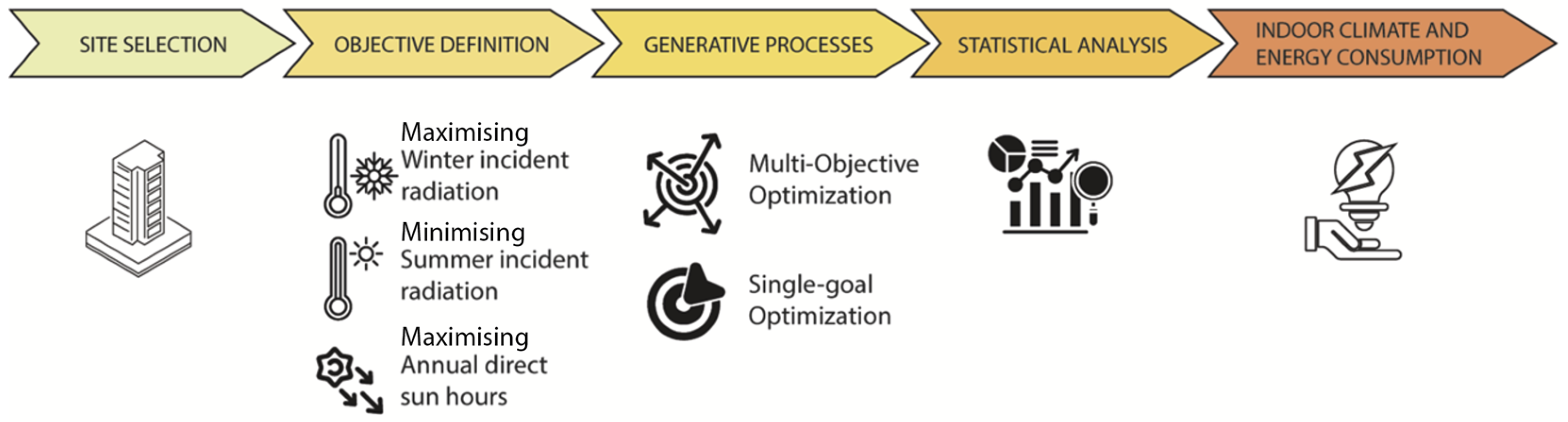
Figure 1) starts with selecting the case study area and building. Generative form-finding processes require a clear definition of the objectives to be achieved to manipulate a shape. The present methodology’s simulation objectives can be tuned on three parameters: winter incident radiation, summer incident radiation, and annual direct sun hours. Through the methodology, these parameters can be weighted or set to be maximised or minimised. Specifically, the form-finding generative phase is performed using two approaches, each treating the three parameters differently: multi-objective optimisation (MOO), optimising all three variables, and single-goal optimisation.
Two statistical analyses are then used to determine whether the generated design solutions yield distinguishable performance outcomes:
Through an Analysis of Variance (ANOVA) test, it is possible to check whether at least one simulated design solution is distinguishable from the others and, based on the objective, how they diverge.
A Tukey’s HSD post-hoc test performs pairwise comparisons to determine which solutions are statistically distinguishable for a given variable.
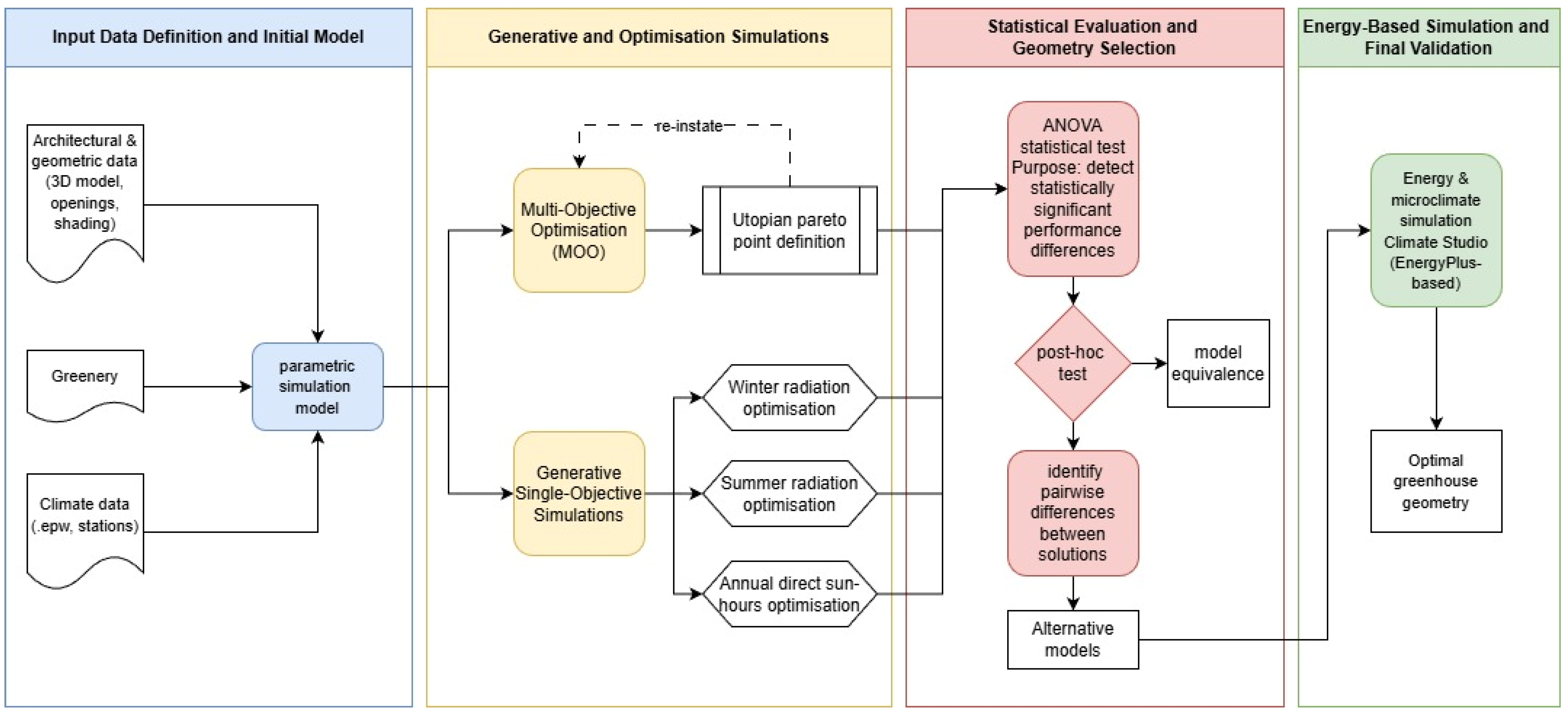
Such statistical analyses allow for identification of the best option, which is then verified through indoor climate and building-scale energy consumption simulations. This final simulation provides insight into the effects of the selected hypothesis on the building’s energy consumption and on the expected temperature and relative humidity within the greenhouse as key parameters for plantations. In fact, through the procedure, it is possible to match simulated/expected temperature and humidity ranges across the year to establish suitable plantations. These five steps constitute a funnel process for evaluating alternatives and selecting the most efficient one (
Figure 2).
2.1. Data
To design effective building-integrated agricultural devices and measure their efficacy and impact on the existing building, it is essential to understand the architectural configuration, spatial organisation, operational dynamics, and user patterns. This information can be derived from both direct and indirect data and measurements. To conduct the procedure, a 3D model of the building featuring all necessary subdivisions (at the flat or room level), transparent openings, and shading elements (such as balconies) is required. Furthermore, knowledge of both the building envelope stratigraphy and heating/cooling systems is necessary to model its energy performance.
Climate data can be obtained directly from specifically placed weather stations or climate data repositories, and it is also available as an ‘epw’ weather file retrieved from the Climate Studio database.
2.2. Multi-Objective Optimisation Methodology
The modelling and form-finding phase relied on Rhinoceros 8 with Grasshopper 1.0.0008 as the core software and used Ladybug and Honeybee 1.9.0 as a climate simulator. The multi-objective optimisation (MOO) was performed with Octopus 0.4, developed by Robert Vierlinger at the University of Applied Arts Vienna, in collaboration with Bollinger + Grohmann Engineers [
31,
32,
33], while the Grasshopper-integrated generative engine Galapagos was used as a single-goal optimiser.
While winter solar radiation is evaluated from 21 November to 21 January, the method controls summer solar radiation from 21 May to 21 July. Direct sunlight exposure is also computed year-round. The study examines how solar radiation affects the glass outside the greenhouse in both summer and winter. It also determines how much direct sunlight the homes’ windows receive. The model naturally creates more slab surfaces by pushing the floor boundaries toward the glass facade’s mesh; the calculation of sunlight exposure accounts for the differing shading effects from these additional surfaces. The MOO framework is configured to approximate the Pareto front using the Hypervolume-based Evolutionary Algorithm (HypE), which employs the hypervolume indicator to quantify the objective space dominated by a set of non-dominated solutions with respect to a given reference point [
34]. A Pareto-optimal solution is defined as a non-dominated solution for which no objective can be improved without deteriorating at least one of the others. HypE ranks solutions according to their marginal contribution to the dominated hypervolume, hence encouraging both convergence toward the Pareto front and diversity within the population throughout the evolutionary process by using the hypervolume contribution of particular solutions as a selection criterion.
To avoid peaks in high and low values and inhomogeneity among the apartments, the simulation objectives are calculated based on the average
μ, the standard deviation
δ, the average of the worst conditions (High and Low), and the ratio of zero-values radiation points or zero sun-hours areas compared to the whole surfaces. For summer,
H10 is the average of the 10% higher-radiation results, while for winter,
L10 is the average of the 10% lower-radiation results. These two values are used in the following equations (1, 2, 3, 4) to enhance the Pareto evaluation by discarding shapes with extreme values that are not highlighted by a simple average-based evaluation. The use of standard deviation in the equations helps avoid or reduce inequalities in the irradiance and sun hours provided to the greenhouse and apartments, thereby reducing differences in the facade areas.
where
Z (1) is the ratio of the zero-values amount compared to the total amount of the analysis results;
Os,
Ow,
Od, (2), (3), (4) are respectively the summer, winter, and sun-hours objectives. By adopting a multiplicative zero-ratio penalty, optimisation explicitly penalises facade configurations that produce locally null radiation or sun-hours values, ensuring that solutions with favourable averages but spatially ineffective regions are discarded. For the MOO simulation, all objectives were consistently reformulated as minimisation functions to comply with Octopus’s optimisation convention. This formulation follows previous studies that integrate dispersion-sensitive metrics into optimisation objectives to reduce performance inequalities across housing units [
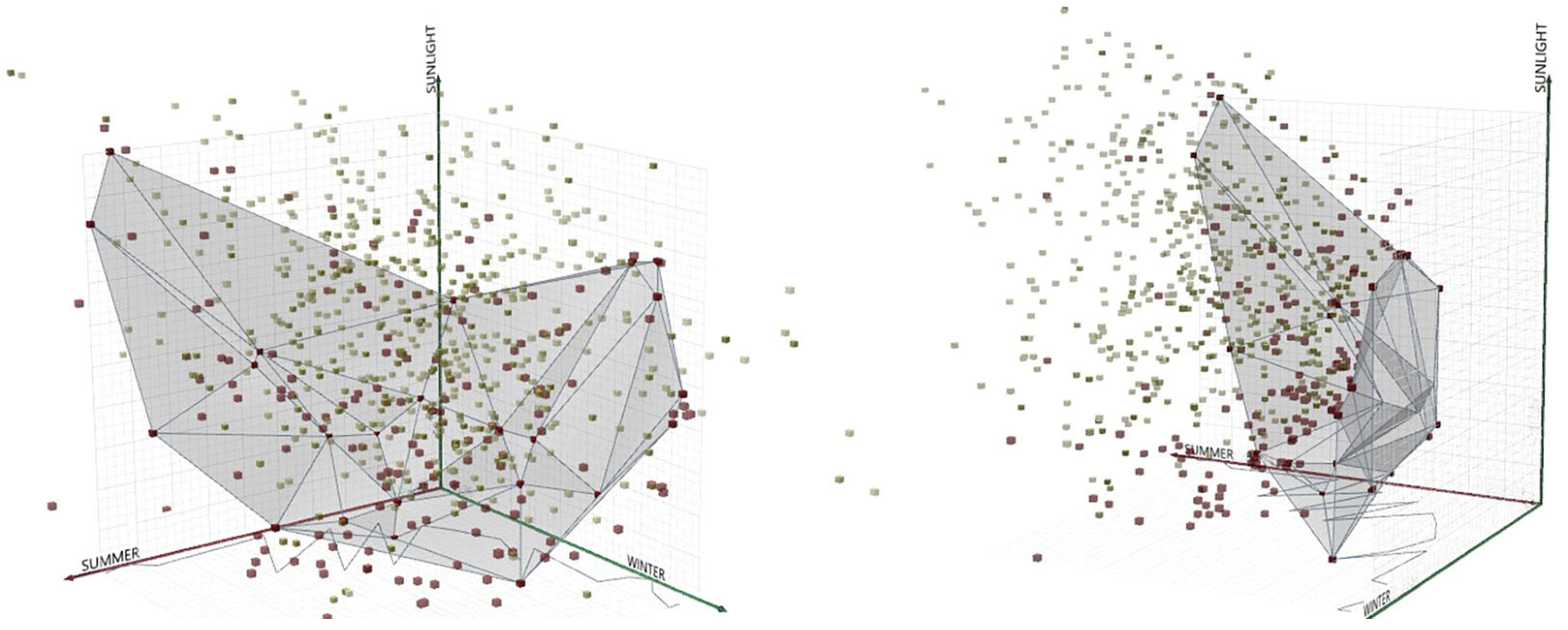
35]. The three values obtained from the previous equations are used in Octopus to identify undominated solutions at each generation. What can be observed thanks to the optimiser is the so-called Pareto front, a boundary defined by the best options found across generations. A Python 3.10v script was coded to calculate the “utopian point,” defined as the minimum coordinates of all Pareto-optimal solutions across generations (5), and found the closest solution to this point (6), (7), (8).
Using the index of the closest solution to the utopian point, it was possible to extract the control points parameters to reinstate the related geometry for further analysis.
2.3. Energy-Based Simulation Methodology
The energy model is performed with Climate Studio (v2.2) [
36], an EnergyPlus (23.1)-based plugin for the Rhinoceros 8.0 software. Such an instrument allows for both building-scale energy simulations and zone-specific microclimate evaluations. In fact, the methodology focuses on comparing the optimised scenarios selected in the previous phase based on their energy performance (the heating savings they guarantee to the building to which they are attached) and their indoor climate (to provide the best conditions for farming). The indoor climate parameters assessed are temperature (°C) and relative humidity (%). In fact, besides solar radiation intake, which is already maximised in the previous steps, humidity and temperature are considered the most important factors for indoor plant growth [
37]. In that sense, the simulation’s output values can provide both an overall indication of whether the modelled greenhouse is suitable for plantation by not providing excessively high or low temperatures, and specific indications on which plantations can grow, and in which specific time of the year.
The Greenhouses are modelled with the following characteristics, which are widely diffused parameters:
Transparent surfaces were modelled as two clear glass panels with a Visible Transmittance (Tvi = 0.812) that ensures a relatively low emissivity.
To enable optimal passive cooling and ventilation, the greenhouse is modelled considering 90% of the facade surface area as operable windows.
Ventilation through windows opening is set dynamically to activate with greenhouse interior temperatures above 20 °C.
Introducing a dynamic interior shading system that activates each time the incident radiation of the facade is higher than 100 W/m2 to avoid overheating in the summer months.
For the purposes of the present study, such conditions are adopted as fixed because the goal is to identify the optimal greenhouse geometry based on the three radiation and sun-hours parameters. Varying parameters beyond shape would confound the analysis, making it difficult to distinguish the impact of geometry from that of other greenhouse characteristics.
3. Case Study Application
3.1. Site Selection and Definition
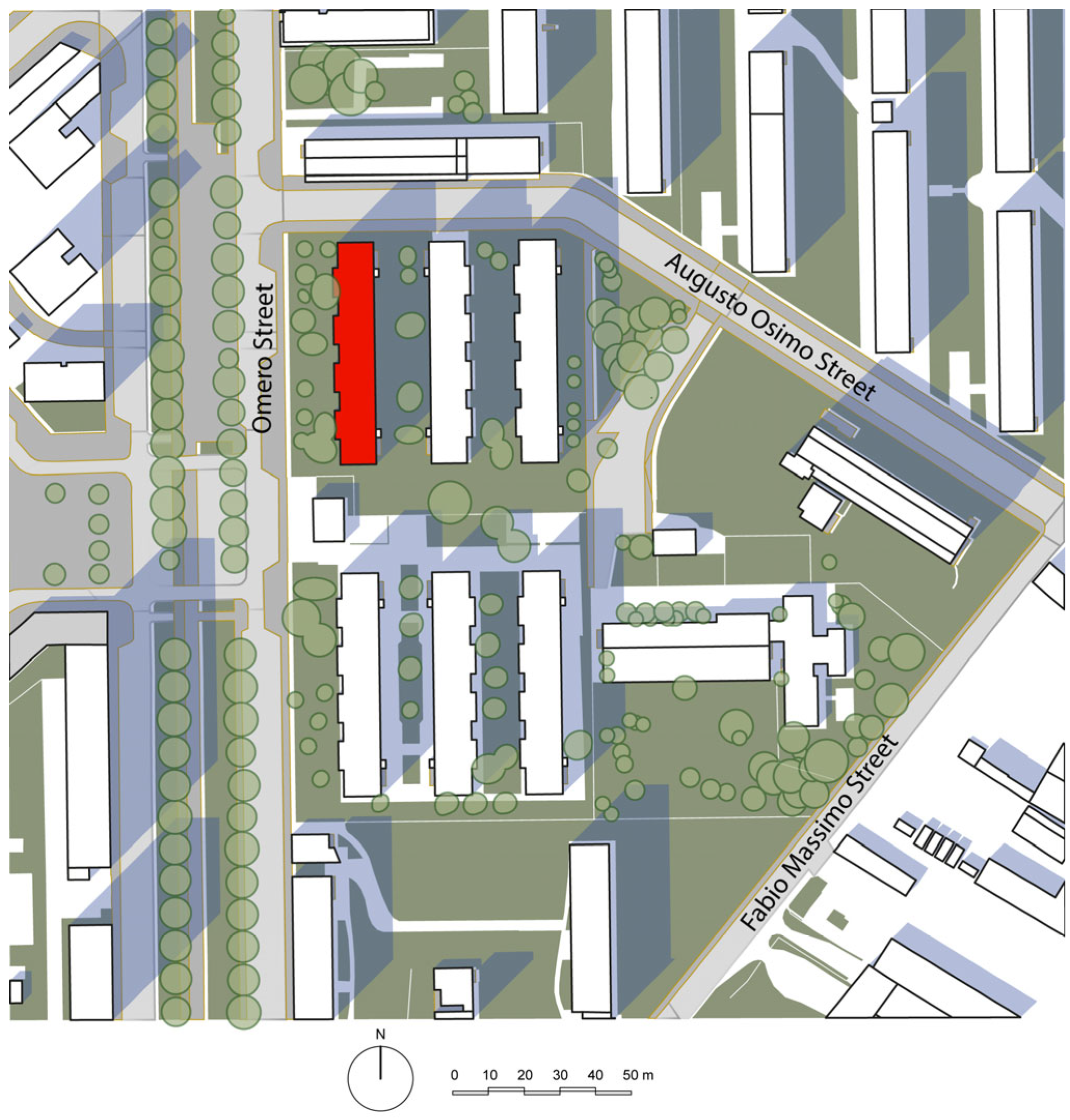
As proof of concept, the workflow is applied to design a greenhouse on the facade of an existing building. This social housing block is one of the case studies proposed in the Bize_ur Farm research project. This type of building is common in Milan; it is characterised by low architectural quality, equally low energy performance, and suboptimal orientation. All these characteristics make it interesting to evaluate and allow the proposal of a series of very pronounced transformative hypotheses. The estate is located in the Corvetto neighbourhood, within the south-east quadrant of Milan, Italy. The residential block was completed in 1953, as part of a six-identical-building development (
Figure 3). Each building is five stories tall and includes a raised ground floor. The buildings are divided into two fenced plots that create a semi-private urban environment. From an urban planning perspective, the complex shows where the Corvetto area is headed. The residential building reflects mid-century planning aims for reasonably priced, high-density housing. Although the east–west orientation of the structure ensures consistent lighting and ventilation in every apartment, this arrangement poses a challenge for the design of facade greenhouses, as south-facing surfaces are usually better suited for greenhouses incorporated into a building. The housing complex has not undergone major repairs over the years; only a few units have had their windows or air conditioning updated. The structure has non-insulated load-bearing walls, and ten units are spread across each floor, served by four vertical staircases. The floor plan combines three apartment typologies: four 45 m
2 units at the building’s southern and northern ends, and a combination of a 50 m
2 and a 60 m
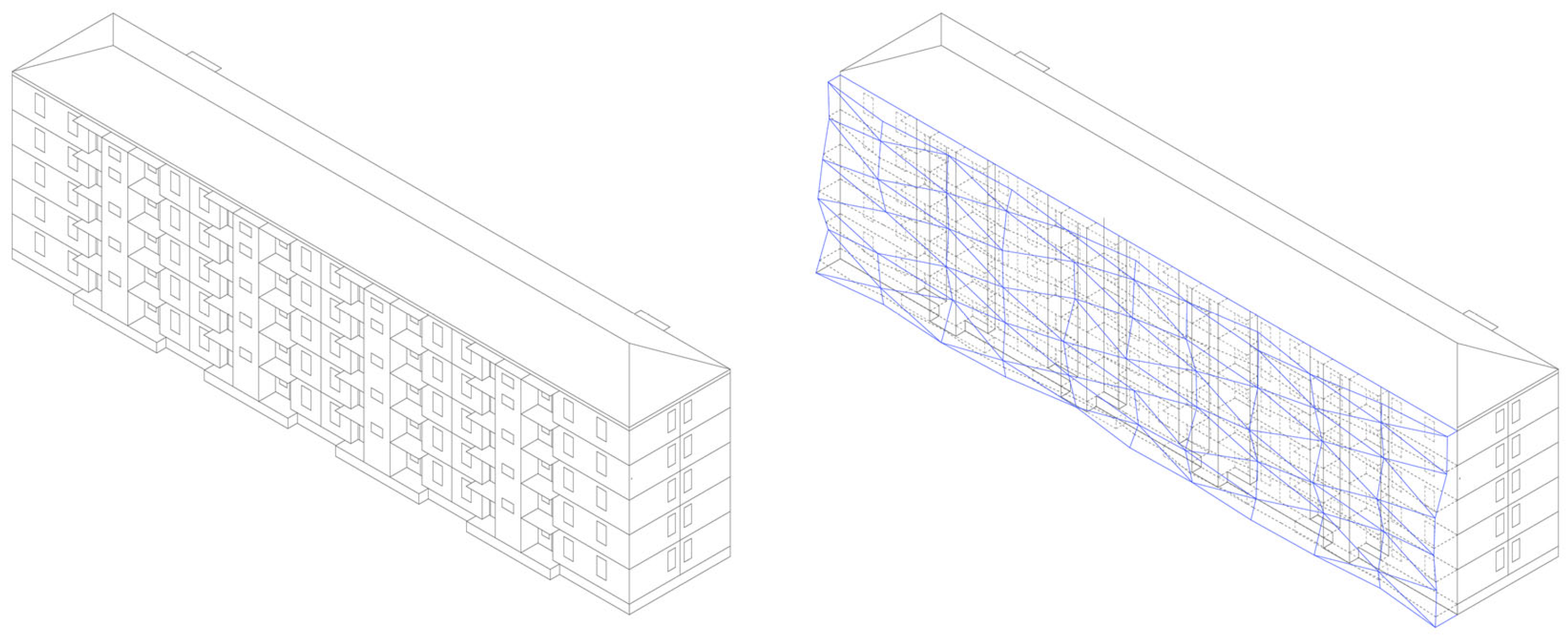
2 unit in the middle. The six buildings are mirrored along their north–south axis, with the living rooms, which are connected to balconies, facing either the west (as in the case-study building) or the east. Context definition included modelling the case-study building by replicating the volumes of the apartments, windows, glass doors, balconies, and the canopies of the evergreen and deciduous plants surrounding the buildings (
Figure 4).
Geometric data necessary to reconstruct the digital spatial model was obtained from the company responsible for managing the estate. The stratigraphy of the building envelope (both opaque and transparent elements) was reconstructed by direct visual inspection, in situ measurements, and comparison with similar residential buildings in the same geographical context and construction period [
38]. In addition to those presented in 2.4, additional fixed and case-specific parameters have been introduced. The infiltration rate (air changes per hour—ACH) can be estimated from the envelope’s observed condition, with reference values typically ranging from 0.2 ACH for tightly sealed structures to 2 ACH for leaky buildings. The value for the current condition was set to 1. Information on heating systems was gathered through on-site surveys and technical documentation also provided by the estate management, which allowed us to identify equipment models and establish their coefficient of performance (COP).
The present work is based on weather data from station 160,800 (LIML) in the IGDG database, located in Milano Linate. The years considered in the weather file are 2004–2018.
3.2. Objectives Definition
The simulation’s objectives were defined to provide the best possible conditions for plant growth and to avoid overheating of the building, based on the case-study area’s climate characteristics. Milan’s climate is typically classified as temperate (Cfa), with some continental characteristics. Its summers are hot and characterised by recurrent heatwaves, which call for “deactivating” the greenhouse in warm months to limit overheating. Winters are cool to cold, with frequent cold-air pooling, which in turn requires maximising solar intake during these periods. Winter is also frequently characterised by low insolation due to persistent cloud/fog layers, while summer typically provides higher solar input. To ensure adequate sun access to the apartments, despite the volumetric addition, the simulation maximises the sun-hours incident on the building’s openings throughout the year.
3.3. Generative Process
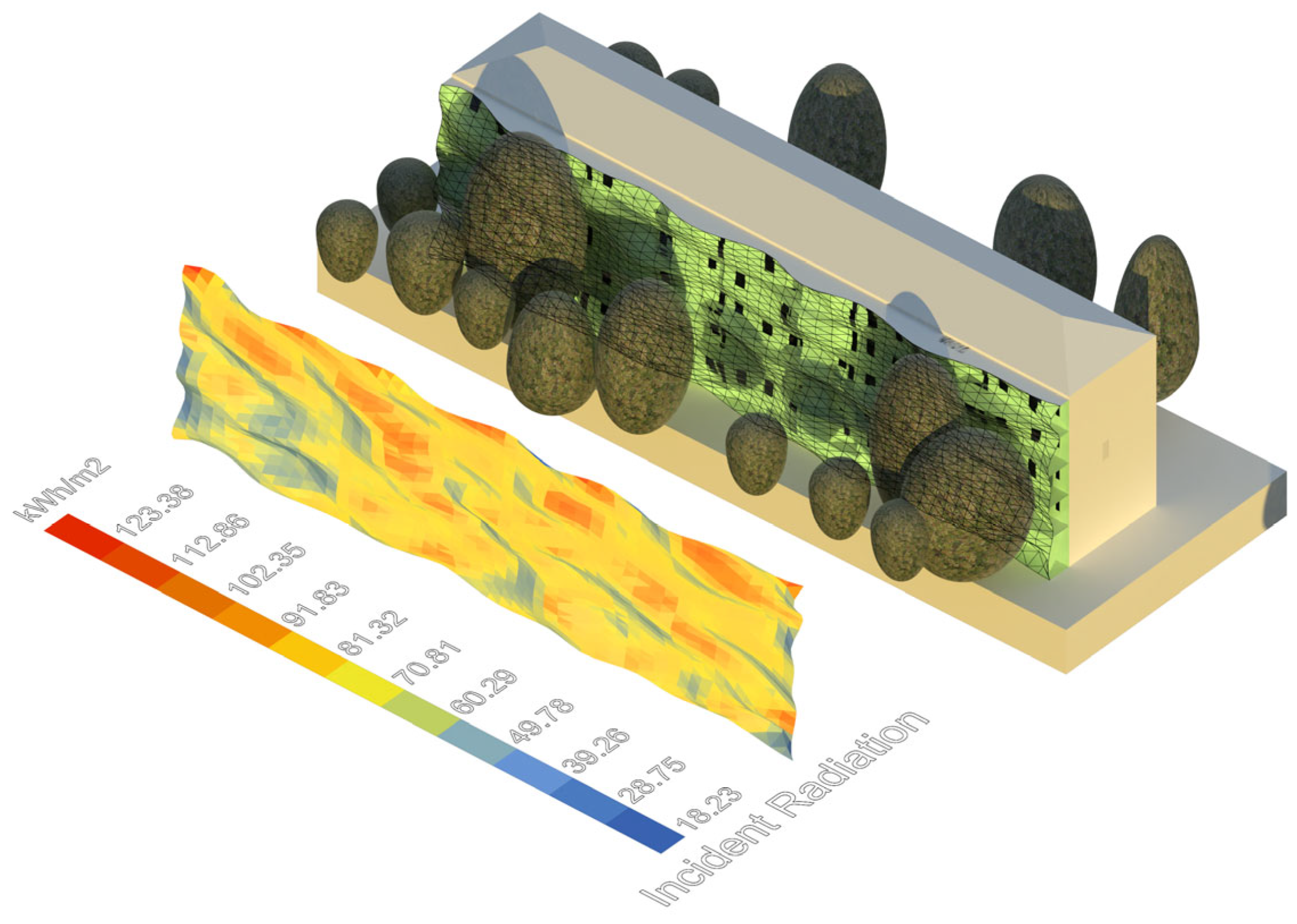
The present work tested four different design proposals: (i) Pareto Optimum through multi-objective optimisation; (ii) Winter incident radiation minimisation; (iii) Annual direct sun-hours maximisation; (iv) Summer incident radiation minimisation. All these conditions have been managed using generative approaches to identify the best-performing shape aligned with the aims. Generative systems take control of geometric deformations by moving the shape control points. Therefore, it is mandatory to establish movement constraints. First, due to local regulations, a maximum of 1.5 m offset from the original facade has been imposed. The presence of trees in front of the buildings has been considered using a ray-casting method that tracks the maximum distance to the tree canopy before a collision occurs. A double-curvature surface is then rebuilt using points generated by the generative engine and eventually discretised into triangular panels. For this purpose, a set of multipliers applied to each movement vector is set as a transformative genome under generative engine control.
3.4. Statistical Analysis
To identify a valuable design solution among a range of choices, it is important to check whether the performance differences are significant. An ANOVA test determined whether at least one solution is statistically different from the others. When the test identified a distinguishable solution with a confidence threshold of 0.05, a Tukey HSD test was used to determine whether pairs differ at the same confidence threshold and to assess the difference in average values between the two solutions.
For each simulation framework, a correlation matrix was computed to assess the consistency of the proposed solutions between the winter and summer configurations, i.e., to evaluate whether the effects of shape on the performance indicators are coherent across seasonal conditions. Normality was assessed using the Shapiro–Wilk test, and the correlation measure was automatically selected between Pearson’s and Spearman’s coefficients accordingly. Only statistically significant correlations (p-value < 0.05) were retained for further analysis. To process data for ANOVA, Tukey, and correlations, the methodology proposes a Python script using the following libraries: SciPy and statsmodels. Whether a solution pair is consistently identified as divergent across the different significant variables, it is processed in the energy-based simulation to find the most effective design solution.
3.5. Energy and Indoor Climate-Based Simulation
After identifying the best option based on radiation and sun hours, this section focuses on verifying this solution. The building’s physical and technological characteristics are discussed in
Section 3.1. were modelled in Climate Studio. Internal heat gains were assessed based on standard residential occupancy schedules, while an average occupancy per m
2 was considered by subdividing the number of registered inhabitants for the building’s total surface area. The parameters presented in
Section 2.3 have been assigned to the identified greenhouse geometry.
As a baseline, and especially to evaluate the potential energy-saving benefits for the residential building from the introduction of greenhouses, the building’s current state was also modelled. The current state and post-greenhouse addition state are represented in
Figure 4.
4. Results
Four design solutions are obtained using one MOO (
Figure 5 and
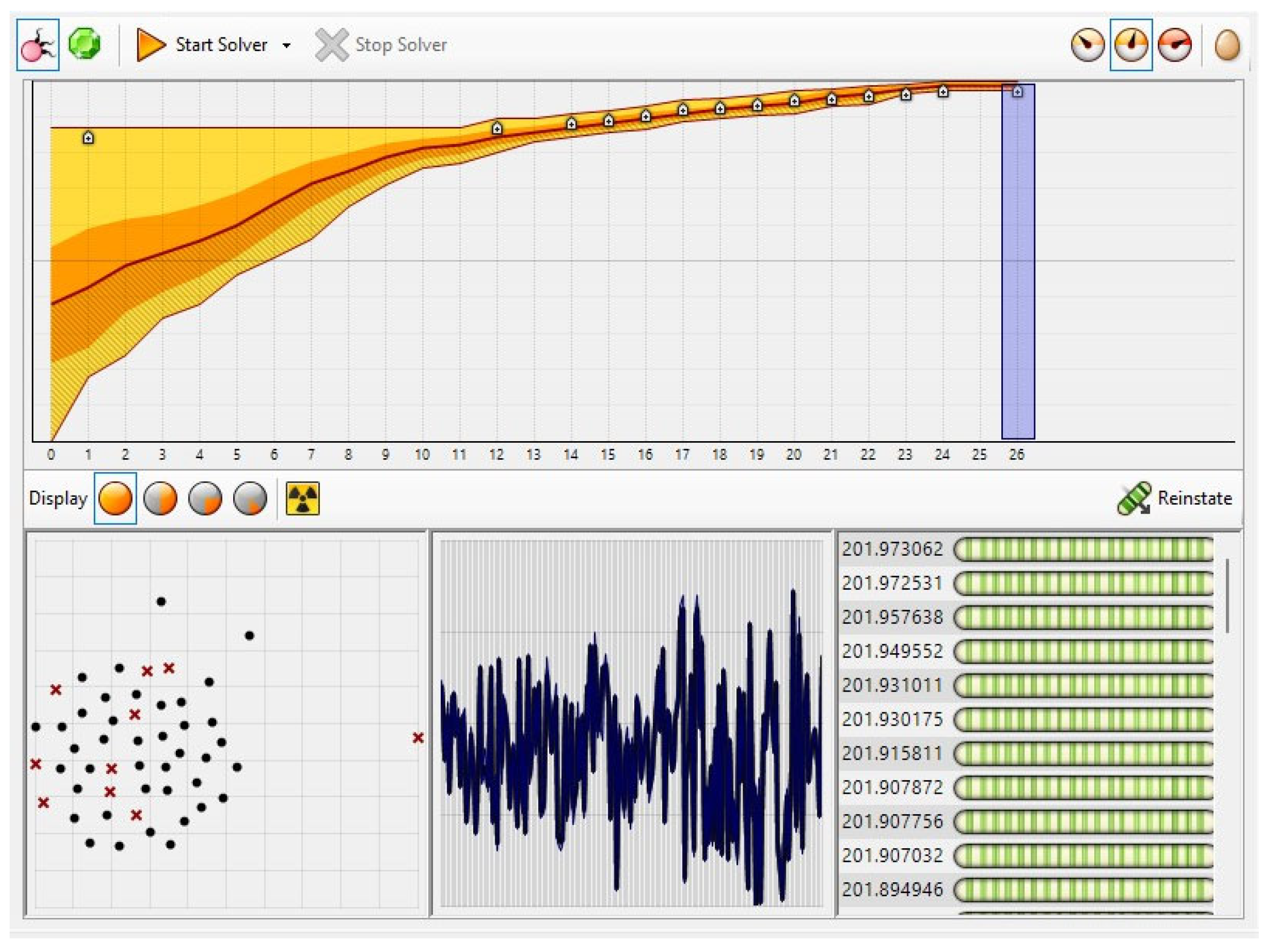
Figure 6) and three single-goal processes (
Figure 7). For each solution, the work collected incident radiation values (kWh/m
2) for each triangular panel on the glass facade and direct sun hours for each apartment glass opening for the three objectives (
Table 1): summer radiation, winter radiation, and annual sun hours. The summer single-goal solution (oriented to minimising summer radiation only) has the lowest level of direct sunlight, while the sunlight single-goal and MOO are the two highest in terms of sun hours. The MOO is also the one that better minimises summer radiation. As expected, the single-goal winter radiation is the one that best maximises the level of incident radiation in winter. The ANOVA test determines whether the four design solutions generate distinguishable conditions (
Table 2), finding that all of them overlap in terms of annual sun hours, while incident radiation in summer and winter differs at least for one solution. To deepen our understanding of which pairs overlap, the Tukey HSD test is adopted (
Table 3). Regarding the incident radiation in summer, the only two solutions that do not overlap are the MOO and the single-goal winter, implying that the distribution of values on the panels does not follow the same behaviour. Instead, for winter radiation, all couples produce different conditions, except for the single-goal winter–summer comparison.
Treating the two seasonal responses as separate outcomes in each design solution, the methodology examines the correlation between the effects of geometry on incident radiation under summer and winter conditions to explore the relationship between form and performance further.
Table 4 shows just the statistically significant (
p-value < 0.05) correlations between summer and winter incident radiation. Though with varying degrees, all correlations are positive: the multi-objective optimisation (MOO) has the greatest correlations, followed by the single-objective summer optimisation and single-objective sun-hours.
Based on the results of the Tukey’s HSD tests, only one pair of simulation strategies is statistically distinguishable and non-overlapping under both summer and winter radiation conditions. All other simulation pairs exhibit statistically overlapping outcomes in at least one season and would therefore introduce redundancy in a subsequent analysis. Accordingly, only the MOO and the single-objective winter radiation solutions are retained as suitable for the subsequent indoor energy consumption simulations. Given the significant and positive correlation observed between summer and winter radiation metrics, the final selection was guided by the seasonal condition in which performance differences are more critical. The MOO scenario was therefore selected, as it achieves significantly lower median and mean summer irradiation while maintaining comparable solar hours intake and winter irradiation relative to the alternative solution (
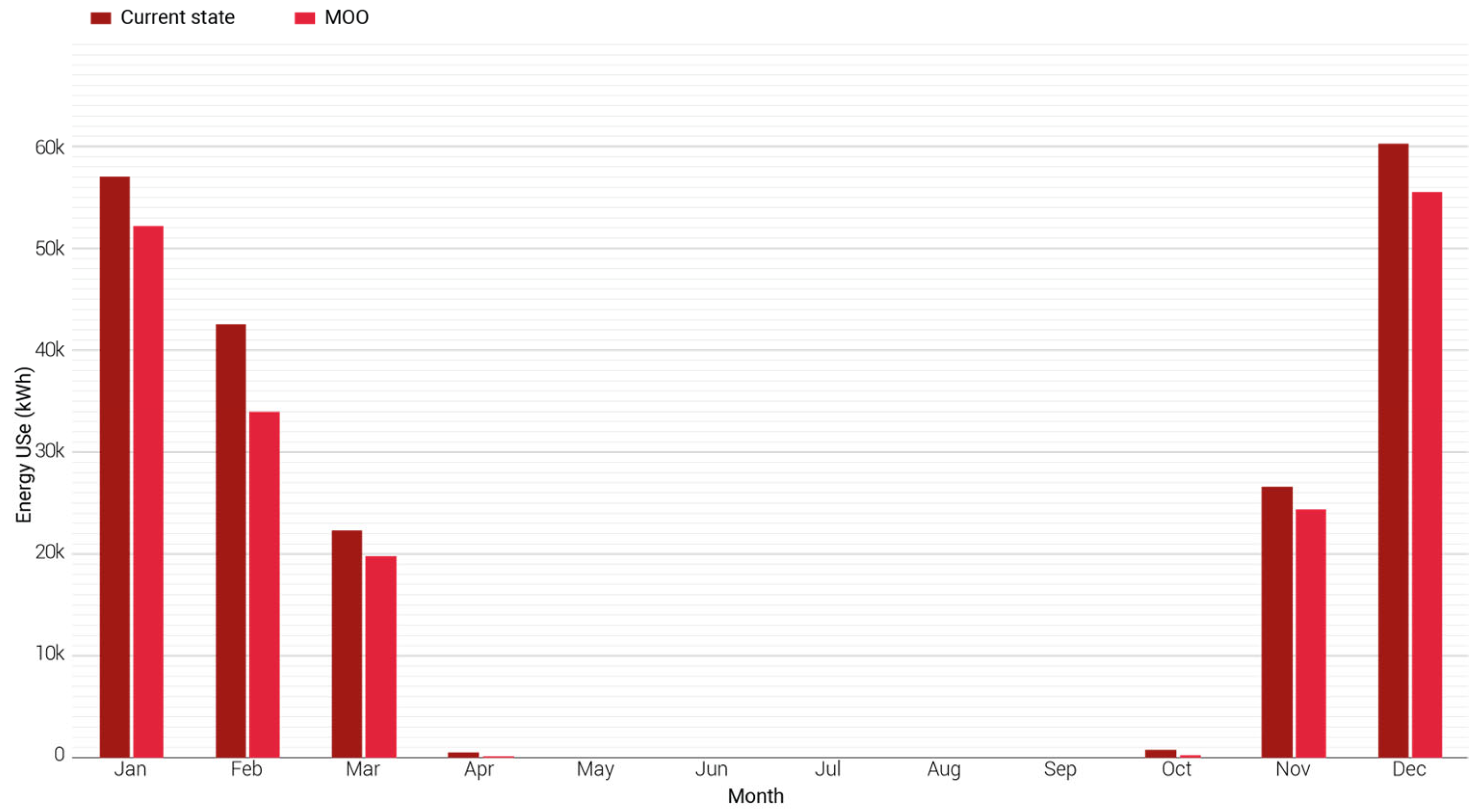
Table 1). Such a choice is fundamental to limiting the risk of summer overheating. The energy and indoor climate simulations show that the proposed greenhouse can guarantee significant energy savings in heating demand compared to the existing building condition, especially in February (with savings above 20%) and March (with more than 11% reduction). Overall, the MOO scenario provides 11.33% savings across the year (
Figure 8).
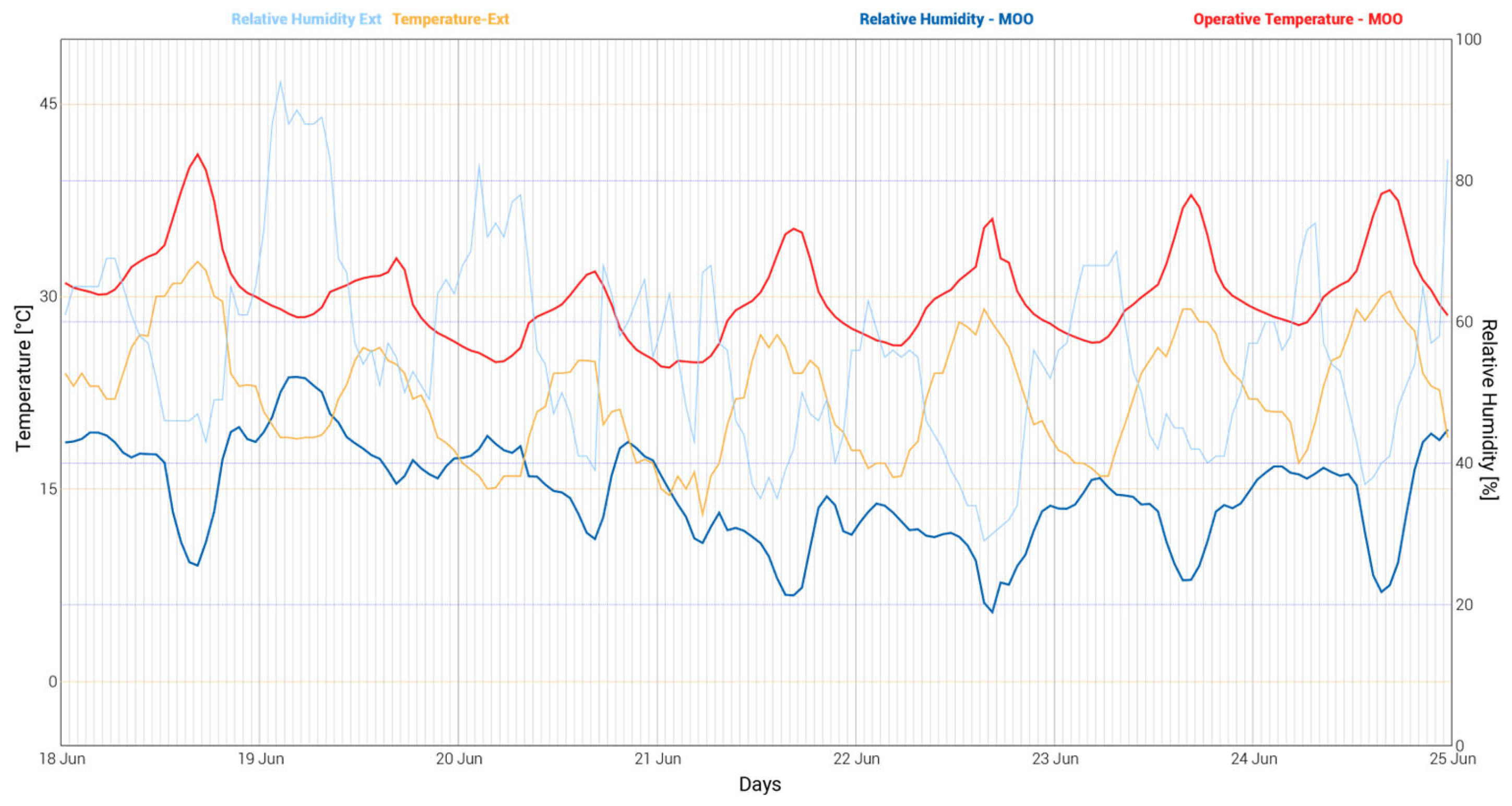
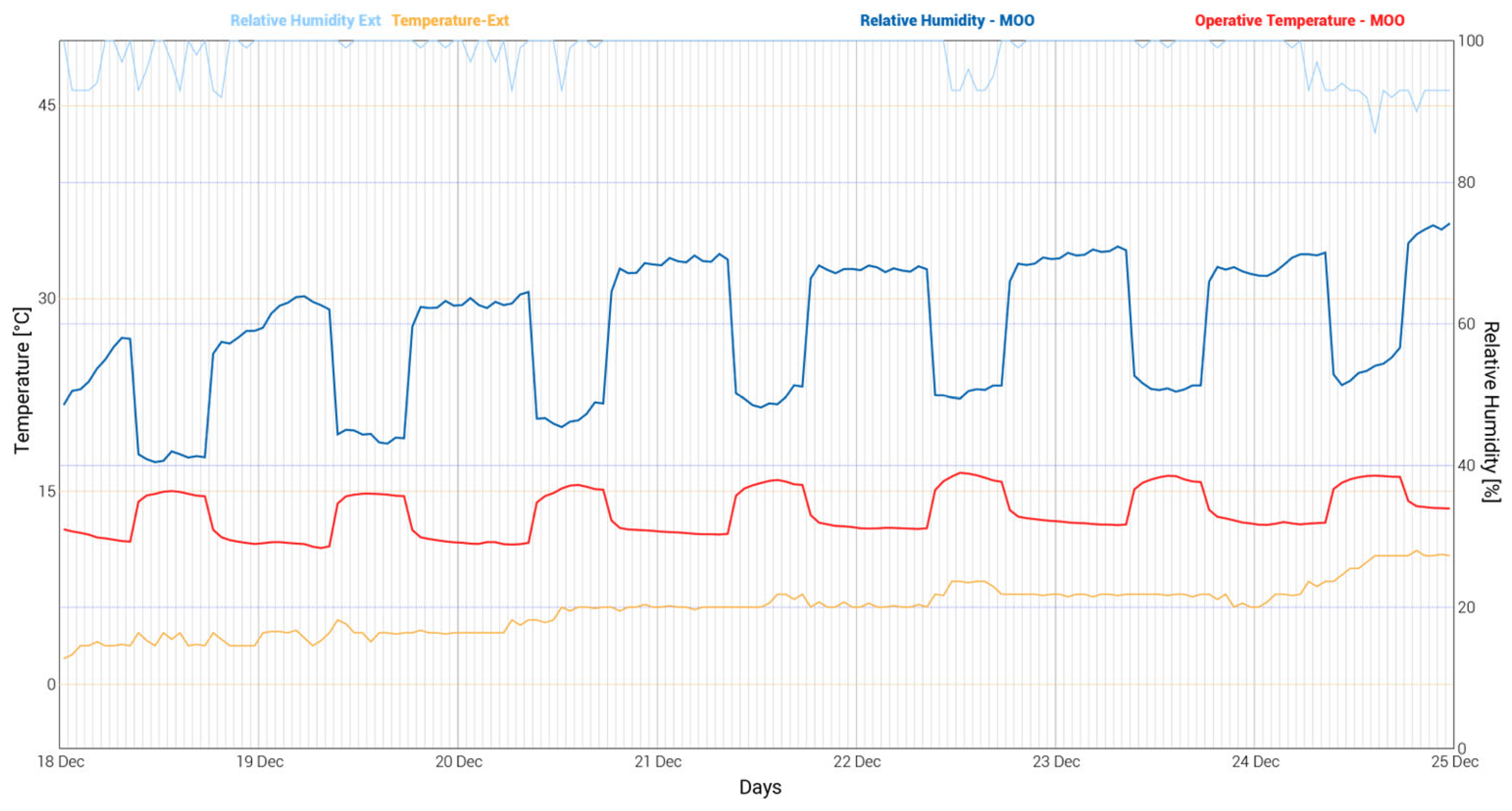
The simulated MOO scenario’s greenhouse heating energy demand, indoor temperatures, and relative humidity are presented in
Figure 8 and
Figure 9. The simulation effectively validates the benefits of the addition even during the extreme conditions represented by the two solstices. In fact, during the summer solstice week, temperatures never exceed the outside temperature by more than 5 °C, meaning that natural ventilation and shading devices effectively reduce the risk of overheating. Such a result is essential to maintain adequate comfort conditions in the housing units. The benefits are also visible in winter (
Figure 10), when the temperatures inside the greenhouse are up to 10 °C higher than outside and consistently oscillate between 17 °C and 10 °C, providing conditions for prolonged plantings throughout the year. In a hydroponic cultivation scenario, such temperatures allow growing several local crops. In the winter season, the proposed greenhouse design is suitable, for instance, for the cultivation of lettuce, whose optimal temperatures range between 15 and 22 °C [
39]. For summer, tomatoes (18–26 °C) [
40] and basil (18–27 °C) [
39] are among the possible crops.
5. Discussion
Two different generative approaches (MOO vs. single goal) were tested for three aims: (i) maximising winter incident radiation; (ii) maximising sun hours in the apartments; (iii) minimising summer incident radiation. MOO used the Pareto-optimal concept to balance the three aims, whereas the single-goal simulations have been deliberately focused on one aim each. All the simulations used synthetic values that embed and compose the average, the standard deviation, the number of values equal to zero, and the average of the top or bottom 10% (depending on the aims). Considering these aspects together, we wanted to obtain design conditions without excessive variabilities and consequent energy supply inequalities.
The four design solutions have been checked using ANOVA and the Tukey HSD test to determine whether they are equivalent or significantly different, and which diverge. The MOO solution exhibits the biggest degree of pairwise dependence between environmental variables among the tested optimisation methods, with several statistically significant correlations; Single-objective solutions exhibit less interaction among the variables. The way the optimiser’s engine works, which always compares the three goals to find the Pareto Optimum, probably causes MOO to have a higher correlation than other solutions. The observed correlation in the single-goal solutions (sunlight and summer) is probably connected to the times of the year with the greatest sunlight exposure. Among the two design solutions whose values do not overlap statistically in both summer and winter settings, the MOO scenario was chosen for the indoor temperature and energy usage simulation. The findings of the climate and energy simulation support the veracity of the approach since the plan effectively offers ideal thermal circumstances in both summer and winter. Moreover, the simulation allowed for estimating the potential energy-saving benefits of implementing the scenario in real life.
6. Conclusions
The architectural form optimisation highlighted in the research presented in this paper enhances interaction between the building and an integrated device that serves a dual function: enabling horticultural cultivation on the building’s facade and improving the building’s overall energy performance. On the one hand, for example, solar radiation incident on the facade of the transparent envelope allows heat to be transferred into the occupied space; on the other hand, once solar radiation decreases, the occupied space transfers warm air to the greenhouse, thereby mitigating temperature drops that could otherwise damage the plants. The selected building exhibits several critical issues that pose a significant challenge; however, through parametric optimisation processes, these issues can be substantially reduced, representing an opportunity to rehabilitate the building from an architectural standpoint. In choosing a multi-objective approach instead of a single-objective one, a designer should consider whether a real balance and linkage of the aims is needed, or whether there is a hierarchy among the aims, and whether satisfying some of them can be considered secondary. Applying MOO should be preferred when no objective is negligible, while being conscious that this implies that no extreme maximisation of the goals is always possible. Otherwise, a single-goal approach is to be selected if the other goals are optional.
The multi-objective optimisation (MOO) approach led to stronger coupling among environmental variables, as evidenced by multiple statistically significant correlations and the highest overall correlation magnitude. In contrast, single-objective optimisation strategies showed weaker pairwise relationships.
It is fundamental to perform thermal and energy simulations on the outputs of the first part of the methodology to control and verify the attainment of adequate thermal conditions for both plants and humans. This is especially important in existing buildings, such as the present paper case study, since they might not be equipped to handle changing thermal loads, especially in summer.
The procedure can be replicated in different contexts, eventually customising the priority of the three main parameters, and especially summer and winter radiation, based on the local climate specificities of the additional case study. For example, in Nordic countries, summer radiation is less relevant than the maximisation of the winter radiation. For the same logic, also the technology of the envelope should be reconsidered based on the geographic area under exam, without needing to modify the core framework of the procedure. Future steps, with the collaboration of the estate managers and one of the families living there, will involve empirical validation and calibration of the procedure. A possible approach to this would involve producing a 1:1 scale mockup of the greenhouse of the size of one apartment to measure the apartment energy savings, greenhouse interior temperature and humidity, and identify correlations among the simulated and real-life values. Despite a feasibility assessment being outside the scope of the present performance-driven study, and demanded for future development of the research, several steps have been taken towards a cost-aware design, such as a discretisation of the facade in mostly the same-sized triangular panels, to limit the amount of non-standard panelisation and increase the manufacturability of the envelope with low-cost solutions. Furthermore, the additional space provided to the apartments and the architecturally coherent block-scale addition of the new envelope, along with the improved envelope thermal performance, will translate into higher real estate values. Besides these aspects, a future full feasibility assessment will have to be discussed in terms of the greenhouse lifecycle, and factoring also maintenance/operational costs, the long-run energy savings guaranteed by the addition, and the value of the food grown by the inhabitants over the years.
This study proposes an operational and design-oriented workflow where building-integrated greenhouse retrofits must reconcile competing objectives (winter and summer, solar radiation optimisation, and apartment sun-hours access) under real constraints, and is complemented by a thermal and energy verification step that provides both info on the expected energy savings for the building and the verification of adequate cultivations in the greenhouse. In addition to the aforementioned aspects, the procedure successfully complements the existing literature by integrating site-specific constraints into the generative process, reducing sun access inequalities across apartments through dispersion-sensitive objective formulations, and providing a transparent selection protocol (ANOVA and Tukey analysis).
Author Contributions
Conceptualisation, V.D., M.C., C.B.S. and E.L.; methodology, V.D., G.S. and E.L.; data curation: E.L. and G.S.; formal analysis, E.L. and G.S.; investigation, V.D., E.L. and G.S.; software, G.S. and E.L.; visualisation, G.S. and E.L.; resources: V.D. and E.L.; writing—original draft preparation, V.D., G.S. and E.L.; writing—review and editing, V.D., E.L. and S.-C.C.; project administration, V.D., M.C., C.B.S. and S.-C.C.; supervision, V.D. and E.L.; funding acquisition, V.D., M.C. and C.B.S. All authors have read and agreed to the published version of the manuscript.
Funding
This paper reports parts of the research project “Bize_ur Farm: Building Integrated Zero Emission Urban Farming towards sustainable farmscape in Milan and Singapore,” funded jointly by the Italian Ministry of Foreign Affairs and International Cooperation (MAECI) Project no. SG23GR02 and the Singapore Agency for Science, Technology and Research (A*STAR) First Executive Programme of Scientific and Technological Cooperation (Italy–Singapore), project no. R23I0IR035.
Institutional Review Board Statement
Not applicable.
Informed Consent Statement
Not applicable.
Data Availability Statement
Data are available on request and belong to wider, funded ongoing research.
Conflicts of Interest
The authors declare no conflicts of interest. The funders had no role in the design of the study; in the collection, analyses, or interpretation of data; in the writing of the manuscript; or in the decision to publish the results.
Abbreviations
The following abbreviations are used in this manuscript:
| BIA | Building-Integrated Agriculture |
| BIGH | Building-Integrated Greenhouses |
| BPO | Performance-Based Optimisation |
| sDA | spatial Daylight Autonomy |
| MOO | Multi-Objective Optimisation |
| ACH | Air Changes per Hour |
| HypE | Hypervolume-Based Evolutionary Algorithm |
| ANOVA | Analysis of Variance |
References
- Moustier, P.; Girardet, H.; Gündel, S.; Waibel, H.; Bourque, M.; Deutsche Stiftung für Internationale Entwicklung (Eds.) Growing Cities, Growing Food: Urban Agriculture on the Policy Agenda. A Reader on Urban Agriculture; DSE-ZEL: Feldafing, Germany, 2000; ISBN 978-3-934068-25-4. [Google Scholar]
- Payen, F.T.; Evans, D.L.; Falagán, N.; Hardman, C.A.; Kourmpetli, S.; Liu, L.; Marshall, R.; Mead, B.R.; Davies, J.A.C. How Much Food Can We Grow in Urban Areas? Food Production and Crop Yields of Urban Agriculture: A Meta-Analysis. Earth’s Future 2022, 10, e2022EF002748. [Google Scholar] [CrossRef] [PubMed]
- Deksissa, T.; Trobman, H.; Zendehdel, K.; Azam, H. Integrating Urban Agriculture and Stormwater Management in a Circular Economy to Enhance Ecosystem Services: Connecting the Dots. Sustainability 2021, 13, 8293. [Google Scholar] [CrossRef]
- Iungman, T.; Cirach, M.; Marando, F.; Pereira Barboza, E.; Khomenko, S.; Masselot, P.; Quijal-Zamorano, M.; Mueller, N.; Gasparrini, A.; Urquiza, J.; et al. Cooling Cities through Urban Green Infrastructure: A Health Impact Assessment of European Cities. Lancet 2023, 401, 577–589. [Google Scholar] [CrossRef] [PubMed]
- Žuvela-Aloise, M.; Koch, R.; Buchholz, S.; Früh, B. Modelling the Potential of Green and Blue Infrastructure to Reduce Urban Heat Load in the City of Vienna. Clim. Change 2016, 135, 425–438. [Google Scholar] [CrossRef]
- Muñoz-Liesa, J.; Royapoor, M.; López-Capel, E.; Cuerva, E.; Rufí-Salís, M.; Gassó-Domingo, S.; Josa, A. Quantifying Energy Symbiosis of Building-Integrated Agriculture in a Mediterranean Rooftop Greenhouse. Renew. Energy 2020, 156, 696–709. [Google Scholar] [CrossRef]
- Susca, T.; Zanghirella, F.; Del Fatto, V. Building Integrated Vegetation Effect on Micro-Climate Conditions for Urban Heat Island Adaptation. Lesson Learned from Turin and Rome Case Studies. Energy Build. 2023, 295, 113233. [Google Scholar] [CrossRef]
- Blasco-Sánchez, C.; Martínez-Pérez, F.J. Huertos Urbanos, Infraestructura Verde y Urbanismo: Una Relación Histórica Con Capacidad Renovadora. Ciudad. Territ. Estud. Territ. 2025, 57, 127–142. [Google Scholar] [CrossRef]
- D’Ostuni, M.; Zaffi, L.; Appolloni, E.; Orsini, F. Understanding the Complexities of Building-Integrated Agriculture. Can Food Shape the Future Built Environment? Futures 2022, 144, 103061. [Google Scholar] [CrossRef]
- Tucci, F.; Altamura, P.; Pani, M.M. Modulating urban dynamics from a climate perspective–In-between spaces and climate neutrality. Int. J. Archit. Art Des. 2023, 14, 204–215. [Google Scholar] [CrossRef]
- Giachetta, A. Solar Retrofitting in Social Housing: A Case Study in Savona. TECHNE—J. Technol. Archit. Environ. 2012, 4, 366–373. [Google Scholar] [CrossRef]
- Herzog, T.; Battisti, A.; Tucci, F. Experimentation on Social Housing between Energy Environmental Efficiency and Low Cost. TECHNE—J. Technol. Archit. Environ. 2012, 4, 343–354. [Google Scholar] [CrossRef]
- Chrysoulakis, N.; de Castro, E.A.; Moors, E.J. (Eds.) Understanding Urban Metabolism: A Tool for Urban Planning; Routledge: Abingdon, UK; Oxon: New York, NY, USA, 2015; ISBN 978-0-415-83511-4. [Google Scholar]
- Valverde, J.-M.; Avilés-Palacios, C. Circular Economy as a Catalyst for Progress towards the Sustainable Development Goals: A Positive Relationship between Two Self-Sufficient Variables. Sustainability 2021, 13, 12652. [Google Scholar] [CrossRef]
- D’Ostuni, M.; Zou, T.; Sermarini, A.; Zaffi, L. Integrating Greenhouses into Buildings: A Renewed Paradigm for Circular Architecture and Urban Regeneration. Sustainability 2024, 16, 10685. [Google Scholar] [CrossRef]
- Muñoz-Liesa, J.; Toboso-Chavero, S.; Mendoza Beltran, A.; Cuerva, E.; Gallo, E.; Gassó-Domingo, S.; Josa, A. Building-Integrated Agriculture: Are We Shifting Environmental Impacts? An Environmental Assessment and Structural Improvement of Urban Greenhouses. Resour. Conserv. Recycl. 2021, 169, 105526. [Google Scholar] [CrossRef]
- Drottberger, A.; Zhang, Y.; Yong, J.W.H.; Dubois, M.-C. Urban Farming with Rooftop Greenhouses: A Systematic Literature Review. Renew. Sustain. Energy Rev. 2023, 188, 113884. [Google Scholar] [CrossRef]
- Merzhievskay, N.; Dunaievska, A. Integrated Greenhouse Module as One of the Promising Areas for the Development of Greenhouse Structures. Archit. Stud. 2023, 9, 7–19. [Google Scholar] [CrossRef]
- Muñoz-Liesa, J.; Royapoor, M.; Cuerva, E.; Gassó-Domingo, S.; Gabarrell, X.; Josa, A. Building-Integrated Greenhouses Raise Energy Co-Benefits through Active Ventilation Systems. Build. Environ. 2022, 208, 108585. [Google Scholar] [CrossRef]
- Nadal, A.; Llorach-Massana, P.; Cuerva, E.; López-Capel, E.; Montero, J.I.; Josa, A.; Rieradevall, J.; Royapoor, M. Building-Integrated Rooftop Greenhouses: An Energy and Environmental Assessment in the Mediterranean Context. Appl. Energy 2017, 187, 338–351. [Google Scholar] [CrossRef]
- Kaliakatsos, D.; Nicoletti, F.; Paradisi, F.; Bevilacqua, P.; Arcuri, N. Evaluation of Building Energy Savings Achievable with an Attached Bioclimatic Greenhouse: Parametric Analysis and Solar Gain Control Techniques. Buildings 2022, 12, 2186. [Google Scholar] [CrossRef]
- Abedini, M.H.; Sarkardehi, E.; Bagheri Sabzevar, H. Investigating Effective Parameters for Enhancing Energy Efficiency with an Attached Solar Greenhouse in Residential Buildings: A Case Study in Tabriz, Iran. Asian J. Civ. Eng. 2025, 26, 1257–1271. [Google Scholar] [CrossRef]
- Krstić, H.; Ranđelović, D.; Jovanović, V.; Mančić, M.; Stoiljković, B. Contribution of Glazed Additions as Passive Elements of the Reduction in Energy Consumption in Detached Houses. Buildings 2025, 15, 2715. [Google Scholar] [CrossRef]
- Hugo, J.; Du Plessis, C.; Masenge, A. Retrofitting Southern African Cities: A Call for Appropriate Rooftop Greenhouse Designs as Climate Adaptation Strategy. J. Clean. Prod. 2021, 312, 127663. [Google Scholar] [CrossRef]
- Latini, A.; Campiotti, C.A.; Bibbiani, C.; De Rossi, P. Influence of Plant Evapotranspiration Process on the Summer Cooling of a Solar Bioclimatic Greenhouse Internal Environment. In Proceedings of the 2024 IEEE International Conference on Environment and Electrical Engineering and 2024 IEEE Industrial and Commercial Power Systems Europe (EEEIC/I&CPS Europe), Rome, Italy, 17–20 June 2024; pp. 1–6. [Google Scholar]
- Hao, W.; Tablada, A.; Shi, X.; Wang, L.; Meng, X. Efficiency Analysis of the Photovoltaic Shading and Vertical Farming System by Employing the Artificial Neural Network (ANN) Method. Buildings 2023, 14, 94. [Google Scholar] [CrossRef]
- Tablada, A.; Kosorić, V.; Huang, H.; Chaplin, I.K.; Lau, S.-K.; Yuan, C.; Lau, S.S.-Y. Design Optimization of Productive Façades: Integrating Photovoltaic and Farming Systems at the Tropical Technologies Laboratory. Sustainability 2018, 10, 3762. [Google Scholar] [CrossRef]
- Tsay, Y.-S.; Wu, M.-S.; Lin, C.-H. An Integrated User Interface of Assessment and Optimization for Architectural Façade Shading Designs in Taiwan. Buildings 2022, 12, 2116. [Google Scholar] [CrossRef]
- Ghazal, I.; Mansour, R.; Davidová, M. AGRI|gen: Analysis and Design of a Parametric Modular System for Vertical Urban Agriculture. Sustainability 2023, 15, 5284. [Google Scholar] [CrossRef]
- Benis, K.; Reinhart, C.; Ferrão, P. Development of a Simulation-Based Decision Support Workflow for the Implementation of Building-Integrated Agriculture (BIA) in Urban Contexts. J. Clean. Prod. 2017, 147, 589–602. [Google Scholar] [CrossRef]
- Shan, R.; Junghans, L. Multi-Objective Optimization for High-Performance Building Facade Design: A Systematic Literature Review. Sustainability 2023, 15, 15596. [Google Scholar] [CrossRef]
- Toutou, A.; Fikry, M.; Mohamed, W. The Parametric Based Optimization Framework Daylighting and Energy Performance in Residential Buildings in Hot Arid Zone. Alex. Eng. J. 2018, 57, 3595–3608. [Google Scholar] [CrossRef]
- Alsukkar, M.; Ibrahim, A.; Eltaweel, A. Multi-Objective Optimization of Daylighting Systems for Energy Efficiency and Thermal-Visual Comfort in Buildings: A Review. Build. Environ. 2026, 288, 113921. [Google Scholar] [CrossRef]
- Cao, Y.; Smucker, B.J.; Robinson, T.J. On Using the Hypervolume Indicator to Compare Pareto Fronts: Applications to Multi-Criteria Optimal Experimental Design. J. Stat. Plan. Inference 2015, 160, 60–74. [Google Scholar] [CrossRef]
- Gaspar-Cunha, A.; Covas, J.A. Robustness in Multi-Objective Optimization Using Evolutionary Algorithms. Comput. Optim. Appl. 2008, 39, 75–96. [Google Scholar] [CrossRef]
- Solemma LLC. Climate Studio, v2.2; Solemma LLC: Cambridge, MA, USA, 2025. [Google Scholar]
- Sabudin, S.; Zafri, M.A.; Seri, S.M.; Mohammed, A.N.; Mohideen Batcha, M.F. Indoor Environment Analysis for Optimum Lettuce Growth in Indoor Farming. J. Adv. Res. Fluid Mech. Therm. Sc. 2025, 132, 192–204. [Google Scholar] [CrossRef]
- Corrado, V.; Ballarini, I.; Corgnati, S.P. Building Typoogy Brochure—Italy; TABULA; Politecnico di Torino: Torino, Italy, 2014. [Google Scholar]
- Boyhan, G.E.; Granberry, D.; Kelley, W.T. Greenhouse Vegetable Production; University of Georgia: Athens, GA, USA, 2009. [Google Scholar]
- Heuvelink, E. Tomatoes; CABI: Wallingford, UK, 2005; ISBN 978-1-84593-149-0. [Google Scholar]
Figure 1.
Research pipeline, from case study site selection toward generative modelling, statistical analysis, and climate and energy verification.
Figure 1.
Research pipeline, from case study site selection toward generative modelling, statistical analysis, and climate and energy verification.
Figure 2.
Simulation and analysis sequence: first phase establishes model parameters; second phase implies MOO and generative single-objective simulation; third phase applies ANOVA and Tukey HSD tests for finding significant difference among alternative models excluding overlapping solutions; last phase involves energy microclimate simulation to deepen alternative models’ performances and identify the best one.
Figure 2.
Simulation and analysis sequence: first phase establishes model parameters; second phase implies MOO and generative single-objective simulation; third phase applies ANOVA and Tukey HSD tests for finding significant difference among alternative models excluding overlapping solutions; last phase involves energy microclimate simulation to deepen alternative models’ performances and identify the best one.
Figure 3.
Case-study area in the south-east of Milan (Italy). In red, the specific case-study building where the greenhouse facade is simulated.
Figure 3.
Case-study area in the south-east of Milan (Italy). In red, the specific case-study building where the greenhouse facade is simulated.
Figure 4.
Axonometric drawing of the case-study building in its current condition (left) and with the greenhouse addition (right).
Figure 4.
Axonometric drawing of the case-study building in its current condition (left) and with the greenhouse addition (right).
Figure 5.
MOO process. Simulation of incident radiation under winter conditions and geometric modelling based on tree obstruction. The deciduous trees were not considered as shadow-casting elements in the winter simulation.
Figure 5.
MOO process. Simulation of incident radiation under winter conditions and geometric modelling based on tree obstruction. The deciduous trees were not considered as shadow-casting elements in the winter simulation.
Figure 6.
3D chart (two points of view) of the Pareto solutions (dots) collected at different simulated generations. Red dots correspond to elite solutions, those that persist across the generations. On the three axes: summer, winter, and annual sunlight objectives. The grey mesh represents the Pareto front.
Figure 6.
3D chart (two points of view) of the Pareto solutions (dots) collected at different simulated generations. Red dots correspond to elite solutions, those that persist across the generations. On the three axes: summer, winter, and annual sunlight objectives. The grey mesh represents the Pareto front.
Figure 7.
Galapagos generative system reaching the asymptote condition for winter score maximisation.
Figure 7.
Galapagos generative system reaching the asymptote condition for winter score maximisation.
Figure 8.
Comparison of heating energy demand across the current building state and the MOO scenario.
Figure 8.
Comparison of heating energy demand across the current building state and the MOO scenario.
Figure 9.
Average operative temperature and relative humidity in the summer solstice week. In the figure, such values can be compared with the corresponding outside conditions.
Figure 9.
Average operative temperature and relative humidity in the summer solstice week. In the figure, such values can be compared with the corresponding outside conditions.
Figure 10.
Average operative temperature and relative humidity in the MOO scenario greenhouse for the winter solstice week.
Figure 10.
Average operative temperature and relative humidity in the MOO scenario greenhouse for the winter solstice week.
Table 1.
Data summary for all generative solutions. Rows with G_ are generated with single-goal Galapagos, MOO is the multi-objective optimisation solution.
Table 1.
Data summary for all generative solutions. Rows with G_ are generated with single-goal Galapagos, MOO is the multi-objective optimisation solution.
| Solution | Variable | Mean | Min | Max | Median | Std |
|---|
| G_summer | Summer rad. | 108.4 | 3.54 | 260.71 | 112.51 | 55.09 |
| G_summer | Sun hrs. | 435.37 | 0 | 1202 | 437 | 302.01 |
| G_summer | Winter rad. | 64.78 | 34.87 | 87.69 | 66.05 | 8.38 |
| G_sun | Summer rad. | 107.85 | 1.17 | 308.47 | 104.22 | 60.85 |
| G_sun | Sun hrs. | 455.33 | 0 | 1323 | 450 | 315.25 |
| G_sun | Winter rad. | 63.3 | 23.91 | 106.71 | 63.72 | 13.93 |
| G_winter | Summer rad. | 109.92 | 4.33 | 285.42 | 112.84 | 56.99 |
| G_winter | Sun hrs. | 439.25 | 0 | 1195 | 437 | 308.14 |
| G_winter | Winter rad. | 65.13 | 36.84 | 94.92 | 66.64 | 8.36 |
| MOO | Summer rad. | 104.84 | 0 | 329.07 | 99.97 | 63.24 |
| MOO | Sun hrs. | 443.15 | 0 | 1324 | 390 | 334.32 |
| MOO | Winter rad. | 61.45 | 18.23 | 123.38 | 61.32 | 15.52 |
Table 2.
ANOVA test for the three objectives considering single-goal and MOO solutions. Annual sun hours do not show any statistically significant differences among the solutions.
Table 2.
ANOVA test for the three objectives considering single-goal and MOO solutions. Annual sun hours do not show any statistically significant differences among the solutions.
| Index | Sum_sq | Df | F | PR (>F) | Variable |
|---|
| C (Solution) | 21,472.90 | 3.00 | 49.78 | 0.00 | winter rad. |
| Residual | 1,464,784.73 | 10,187.00 | | | winter rad. |
| C (Solution) | 34,612.67 | 3.00 | 3.30 | 0.02 | summer rad. |
| Residual | 35,614,888.51 | 10,187.00 | | | summer rad. |
| C (Solution) | 37,852.68 | 3.00 | 0.13 | 0.94 | sun hrs. |
| Residual | 66,189,592.21 | 667.00 | | | sun hrs. |
Table 3.
Tukey HSD test of solution pairs for the two variables identified in the ANOVA test. Rows with “true” values are statistically different couples. All the others can be considered equivalent.
Table 3.
Tukey HSD test of solution pairs for the two variables identified in the ANOVA test. Rows with “true” values are statistically different couples. All the others can be considered equivalent.
| Group1 | Group2 | Variable | Reject | p-Adj | Mean_Group1 | Mean_Group2 | Mean_Diff |
|---|
| G_winter | MOO | summer rad | TRUE | 0.01 | 109.92 | 104.84 | 5.08 |
| G_summer | MOO | summer rad | False | 0.14 | 108.40 | 104.84 | 3.56 |
| G_sun | MOO | summer rad | False | 0.27 | 107.85 | 104.84 | 3.01 |
| G_summer | G_sun | summer rad | False | 0.99 | 108.40 | 107.85 | 0.55 |
| G_summer | G_winter | summer rad | False | 0.79 | 108.40 | 109.92 | −1.52 |
| G_sun | G_winter | summer rad | False | 0.60 | 107.85 | 109.92 | −2.07 |
| G_winter | MOO | winter rad. | TRUE | 0.00 | 65.13 | 61.45 | 3.68 |
| G_summer | MOO | winter rad. | TRUE | 0.00 | 64.78 | 61.45 | 3.33 |
| G_sun | MOO | winter rad. | TRUE | 0.00 | 63.30 | 61.45 | 1.85 |
| G_summer | G_sun | winter rad. | TRUE | 0.00 | 64.78 | 63.30 | 1.48 |
| G_summer | G_winter | winter rad. | False | 0.73 | 64.78 | 65.13 | −0.35 |
| G_sun | G_winter | winter rad. | TRUE | 0.00 | 63.30 | 65.13 | −1.83 |
Table 4.
Correlations for the two variables selected from the ANOVA test identified as statistically significant (p-value < 0.05).
Table 4.
Correlations for the two variables selected from the ANOVA test identified as statistically significant (p-value < 0.05).
| Solution | Variable_1 | Variable_2 | Correlation | p_Value |
|---|
| MOO | summer rad. | winter rad. | 0.40 | 0.00 |
| G_sun | summer rad. | winter rad. | 0.30 | 0.00 |
| G_summer | summer rad. | winter rad. | 0.22 | 0.00 |
| Disclaimer/Publisher’s Note: The statements, opinions and data contained in all publications are solely those of the individual author(s) and contributor(s) and not of MDPI and/or the editor(s). MDPI and/or the editor(s) disclaim responsibility for any injury to people or property resulting from any ideas, methods, instructions or products referred to in the content. |




 ,
,