Systematic Review

Remote Sensing Data for Estimating Groundwater Recharge: A Systematic Review

by
Thaise Suanne Guimarães Ferreira
* and
José Almir Cirilo
Technology Center, Federal University of Pernambuco, Caruaru 55014-900, Brazil
*
Author to whom correspondence should be addressed.
Sustainability 2026, 18(4), 1830; https://doi.org/10.3390/su18041830
Submission received: 16 January 2026 / Revised: 7 February 2026 / Accepted: 9 February 2026 / Published: 11 February 2026
(This article belongs to the Section Sustainable Water Management)

Abstract

This study aims to systematically review the existing literature on the use of data derived from remote sensing products to estimate groundwater recharge. The terms “recharge”, “remote sensing product data”, “remote sensing data”, “groundwater”, and “recharge estimation” were used as keywords in the Web of Science and Scopus databases. A total of 27 articles were analyzed, highlighting the use of different precipitation and evapotranspiration products for estimating potential recharge. This review emphasizes the potential of products such as CHIRPS and TRMM for precipitation and MODIS for evapotranspiration, as well as other remote sensing datasets that have shown good performance in their applications. The studies demonstrate the high feasibility of applying remote sensing to estimate groundwater recharge and indicate how its use can enhance the quality and reliability of the results obtained.

1. Introduction

The exponential growth of urban and rural populations, surface water scarcity during dry seasons, climate change, urbanization, deforestation, land degradation, and the expansion of irrigation systems have raised concerns about the sustainable management of groundwater resources [1,2].
Quantifying recharge is a fundamental step in any groundwater resource management study. However, recharge is a complex natural process that depends on a wide range of factors—such as rainfall intensity and duration, climatic conditions, soil type, and land use characteristics [3,4,5]—which exhibit considerable temporal and spatial variability. Its quantification varies by orders of magnitude globally, especially with the intensification of climate change [6,7].
Understanding the spatial and temporal variability of water balance components is essential for the efficient, equitable, and sustainable management of groundwater [8]. However, estimating recharge is challenging because it cannot be measured directly and is strongly affected by measurement uncertainties and the misuse of assumptions [9,10,11].
Innovative technologies such as remote sensing and geographic information systems (GIS) have played an important role in supporting water resource management [12]. The use of remote sensing data offers significant advantages due to its widespread spatial coverage, free accessibility, and near real-time availability, enabling continuous groundwater monitoring at multiple scales [13].
Remote sensing combined with geoprocessing techniques has provided alternative approaches for aquifer monitoring, offering advantages in terms of operational cost, processing speed, continuity, and spatial and temporal coverage [14,15,16].
In this context, it is essential to distinguish between remote sensing data and remote sensing methods, as both play complementary roles in groundwater recharge estimation. Remote sensing data refer to products derived from orbital sensors, which provide spatially continuous representations of key hydrological variables [17], such as precipitation (e.g., TRMM, IMERG, and CHIRPS), evapotranspiration (MOD16 and GLEAM), vegetation indices (NDVI and LAI), soil moisture (SMAP and AMSR-E), and variations in groundwater storage (GRACE). These products are frequently used as substitutes for in situ observations. In contrast, remote sensing methods encompass the algorithms and analytical approaches employed to transform raw radiometric measurements, such as reflectance and brightness temperature, into hydrologically meaningful variables, including energy balance-based models and evapotranspiration estimation algorithms [18], such as SEBAL, SSEB, SEBS, and the MOD16 algorithm itself. This distinction is particularly relevant because, while some studies rely on consolidated orbital products as input data for hydrological models or water balance approaches [19,20,21,22], others adopt a more active use of remote sensing by integrating these methods into model parameterization, multivariate calibration, and validation [23,24,25,26]. In both cases, remote sensing enhances the spatial representation of hydrological processes and reduces exclusive dependence on point-based observations, especially in regions with low hydrometeorological monitoring density.
Several components of water balance, such as precipitation and evapotranspiration—both essential for recharge estimation—can be derived from remote sensing products. These datasets can serve as input for a range of existing recharge estimation methods and also support the development of new methodologies.
Groundwater recharge has been commonly estimated using a set of well-established hydrological models that differ in structure, spatial representation, and data requirements. Conceptual water-balance approaches, such as the Soil Water Balance (SWB) model [27], estimate recharge as the residual of precipitation, evapotranspiration, and soil water storage, which is particularly suitable for regional-scale assessments and long-term analyses. Semi-distributed models, including SWAT (Soil and Water Assessment Tool) [26,28] and WetSpass-M [24,29], explicitly represent land use, soil properties, and topography, allowing the spatial differentiation of infiltration, surface runoff, and evapotranspiration processes. Fully distributed and physically based models, such as MIKE SHE [30], provide a more detailed description of surface–subsurface interactions by solving governing equations of water flow in both saturated and unsaturated zones, albeit at the cost of higher data and computational demands. At national or continental scales, integrated modeling frameworks such as the DK model [23] have been applied to simulate groundwater recharge consistently over large domains, often relying on remote sensing-derived products for model forcing and calibration. Accordingly, the selection of a hydrological model is strongly dependent on the study objectives, spatial and temporal scales, data availability, and the level of process representation required.
In addition to approaches explicitly based on hydrological models, several studies that employ remote sensing for groundwater recharge estimation are grounded in the characterization of the physical and hydrological properties of soils, which directly control infiltration and percolation processes in the unsaturated zone. These approaches exploit satellite-derived variables related to soil moisture, texture, and vegetation cover, enabling a spatially distributed representation of variability in infiltration capacity and recharge potential. Products from missions such as SMAP and SMOS provide surface soil moisture estimates [20], while optical and thermal sensors, including Landsat and MODIS, support the derivation of surface attributes associated with soil hydraulic behavior [21,23,24,26,27]. When integrated with pedological information and empirical or semi-empirical relationships, these variables enable the delineation of recharge zones and the assessment of potential or relative recharge, particularly in data-scarce regions, playing a relevant complementary role to hydrological modeling.
This paper aims to analyze the use of remote sensing products as data sources for estimating groundwater recharge using different methodologies. The study presents a systematic literature review designed to summarize the current state of knowledge through the search, identification, selection, and critical evaluation of scientific articles. Its objective is to deepen the understanding of remote sensing data sources used in recharge estimation, highlight their potential applications across methodologies, and identify trends and research gaps to guide future studies.

2. Methodology

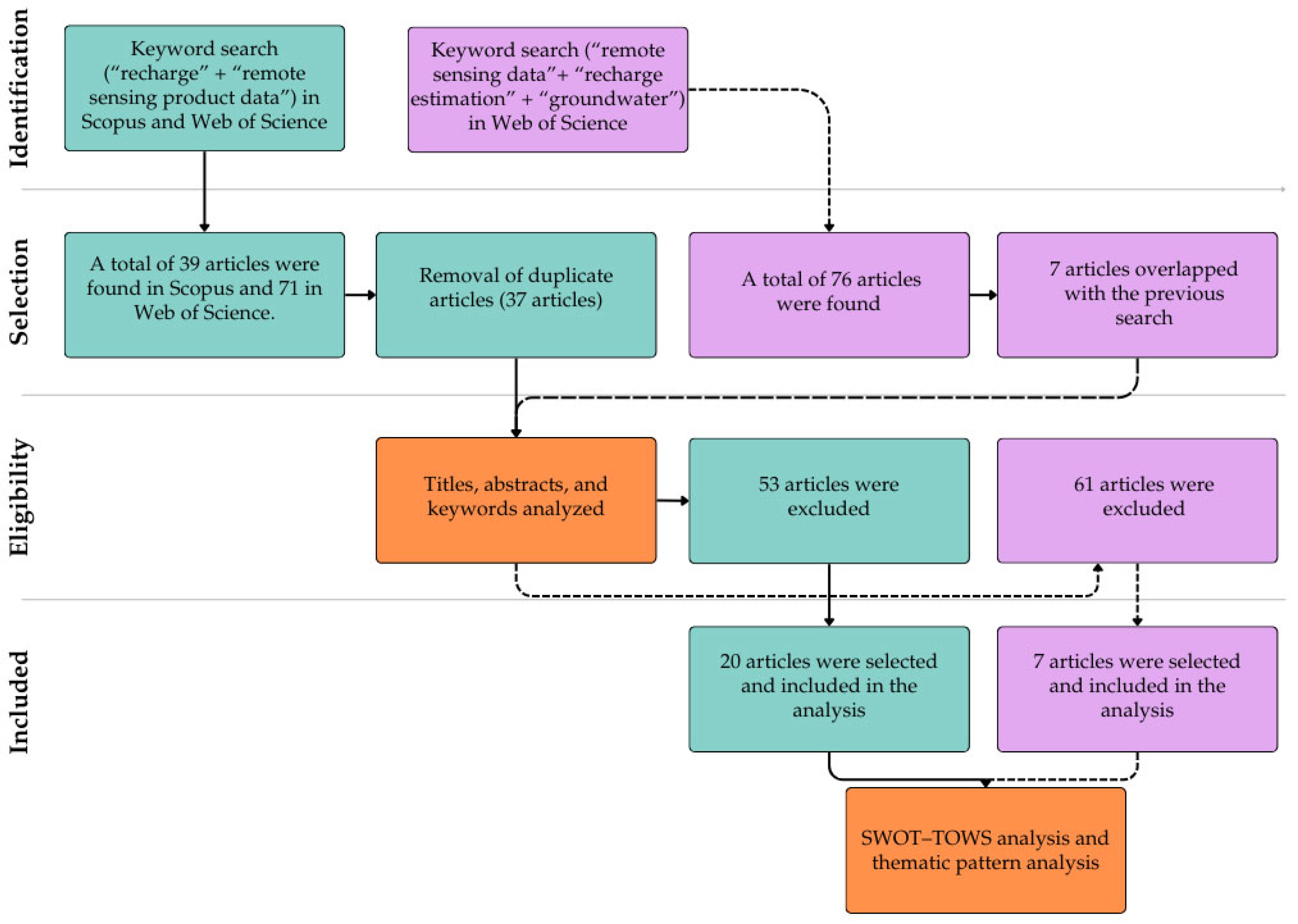
In a systematic review, explicit and structured methods are applied to identify, select, and critically evaluate the most relevant studies within a given field. In this review, the Preferred Reporting Items for Systematic Reviews and Meta-Analyses (PRISMA) method was employed [31]. PRISMA provides a minimum set of evidence-based items for conducting systematic reviews and meta-analyses, summarized in a flow diagram that illustrates the information process through the different phases of a systematic review [32]. The flow diagram consists of four stages: identification, screening, eligibility, and inclusion. The flowchart used in this review is shown in Figure 1. The PRISMA 2020 flow diagram for updated systematic reviews, which includes searches of databases, registers, and other sources, is included in the Supplementary Materials of this article.
In the first stage of the literature review, the keywords “recharge” and “remote sensing product data” were used in the Scopus and Web of Science (WoS) databases, considering only papers written in English. Thirty-nine articles were retrieved from Scopus and seventy-one from WoS, totaling 110 records. In the second stage, 37 duplicates were identified and removed, resulting in 73 unique publications.
In the subsequent stage, the titles, abstracts, and keywords of the remaining studies were screened for relevance and adherence to the proposed theme. Only studies that employed remote sensing-derived products as direct substitutes for variables traditionally obtained from in situ observations—such as precipitation and evapotranspiration—were included in this review for the purpose of groundwater recharge estimation. This criterion was adopted to ensure that remote sensing played a central and active role in recharge quantification, rather than a merely complementary one, thereby allowing a consistent assessment of the potential of orbital data to overcome hydrometeorological data scarcity across different hydroclimatic settings. Consequently, studies in which remote sensing products were used only in an ancillary or illustrative manner, without directly replacing or spatially representing key variables of the groundwater water balance, were excluded.
After this process, 20 articles met the eligibility criteria and were included in this systematic review. To expand the evidence base of the systematic review, an additional bibliographic search was conducted in WoS using the keywords “remote sensing data”, “groundwater”, and “recharge estimation”. This strategy resulted in the identification of 76 potentially relevant articles. After assessing overlap with the previous search, 7 studies were found to have already been included in the initial review stage, while 7 new articles fully met the eligibility criteria and were incorporated into the final analysis. In total, this systematic review comprises the analysis of 27 studies. The selected studies were categorized according to thematic patterns relevant to the evaluation of remote sensing data use in groundwater studies.
Additionally, a SWOT–TOWS analysis was conducted to identify the advantages (strengths and opportunities) and disadvantages (weaknesses and threats) related to the topic. The SWOT analysis organizes information about the research object into four categories and explores the relationships among them: Strengths, Weaknesses, Opportunities, and Threats. While strengths and weaknesses are internal factors, opportunities and threats are external. Strengths enable the exploitation of opportunities and the mitigation of threats [33], whereas weaknesses increase risks and hinder the effective use of favorable development opportunities [34].
TOWS is an extension of the traditional SWOT analysis. Unlike the basic approach, which considers interactions from the inside out, the TOWS framework examines whether identified opportunities can enhance benefits and mitigate disadvantages, and whether potential threats can intensify weaknesses or undermine advantages [34].
The SWOT–TOWS analysis provided an overview of the strategic directions for using remote sensing data in groundwater recharge estimation, based on the studies selected in this review. It also highlighted trends and research gaps that can guide future investigations.

3. Results

3.1. State of the Art

Groundwater dynamics are not always apparent, yet aquifers must be sufficiently recharged to ensure that groundwater continues to sustain ecosystems and water resources in the future [35]. In most regions, groundwater recharge rates remain uncertain due to limited field measurements and the lack of validation of large-scale recharge models [36,37,38]. Therefore, reliable information on recharge is essential for the sustainable management of groundwater resources.
The importance of estimating groundwater recharge has led to the development of four main methodological approaches: (a) process-based methods; (b) tracer-based methods; (c) water balance methods; and (d) numerical modeling. The selection of an appropriate approach depends on the applicable spatial and temporal scale [6]. However, the limitations associated with water balance and numerical modeling—particularly the difficulty of accurately quantifying discharge components and the high uncertainties involved in parameterization—restrict their use for precise groundwater recharge estimation at local scales.
The incorporation of remote sensing data into these methodologies has recently emerged as a powerful tool for improving study quality, owing to its wide spatial coverage, free availability, and near real-time accessibility [13,39].
Early large-scale applications of remote sensing for groundwater recharge estimation primarily relied on simplified residual water balance approaches, with evapotranspiration representing the dominant source of uncertainty. Szilagyi et al. (2011) [40] spatially mapped mean annual groundwater recharge in the Sand Hills region, Nebraska, USA, using a simplified water balance approach (Vadose Zone Water Balance) based on remote sensing data. MODIS land surface temperature products were used to estimate evapotranspiration. The regional mean groundwater recharge was estimated at approximately 73 ± 73 mm·yr−1, exhibiting high spatial variability. The highest values occurred in the southeastern sector of the study area, reaching up to 200 ± 85 mm·yr−1, while the lowest values were observed in the western portion, with minima on the order of 40 ± 59 mm·yr−1. Although the large uncertainty range reflects the limitations of residual formulations dominated by evapotranspiration errors, this application demonstrated the feasibility of mapping recharge patterns at regional scales using satellite data.
Subsequent studies advanced these concepts by embedding remote sensing-derived variables within physically based hydrological models, enabling recharge to be simulated as an internal flux rather than solely as a residual term. Githui, Selle, and Thayalakumaran (2012) [25] applied the SWAT model along with evapotranspiration data derived from remote sensing to estimate groundwater recharge in an irrigated watershed in Southeastern Australia. Using evapotranspiration data from MODIS, the model simulated the watershed’s water balance considering precipitation, irrigation, surface runoff, evapotranspiration, and recharge. The authors calibrated SWAT using flow and evapotranspiration data derived from SEBAL. The agreement with observed data—showing a correlation of 0.87 for evapotranspiration—demonstrated that MODIS-derived data can enhance recharge estimation by providing more detailed spatial and temporal information. While model performance remains sensitive to evapotranspiration parameterization, this approach marked an important transition toward physically consistent recharge simulations constrained by remote sensing observations.
Műnch et al. (2013) [41] investigated the use of remote sensing data to quantify groundwater recharge in the Campo de Areia region, located in the northern part of South Africa’s Western Cape Province. Data from the ARC-ISCW precipitation product, ETMODIS and MOD16 evapotranspiration datasets, and the Pitman model were employed. Recharge was estimated as the difference between precipitation and evapotranspiration, assuming negligible surface runoff. The results showed that ARC-ISCW precipitation correlated well with station data. In contrast, ETMODIS underestimated evapotranspiration compared to MOD16—by up to 30% during wetter years—leading to lower recharge estimates and suggesting potential water stress in the region. These findings highlighted the growing need to critically assess the internal consistency of satellite-derived precipitation and evapotranspiration products before their use in recharge estimation.
To enhance spatial realism, subsequent research incorporated correction factors reflecting aquifer vulnerability and landscape controls. Szilagyi and Jozsa (2013) [42] used MODIS sensor data to estimate groundwater recharge in Nebraska, United States. Recharge was estimated as the difference between mean annual precipitation—derived from PRISM data—and evapotranspiration obtained from MODIS images using the Priestley–Taylor equation. Recharge estimates were then adjusted using an aquifer vulnerability factor obtained from the DRASTIC model. The study confirmed previous recharge estimates based on baseflow analysis while offering higher spatial resolution. Overall, the approach proved effective for large-scale groundwater recharge estimation. Although the vulnerability adjustment introduces additional empirical assumptions, it represents a pragmatic strategy to reconcile remote sensing-based recharge estimates with hydrogeological context.
As the number of available satellite products increased, uncertainty propagation across modeling chains became a central research focus. Knoche et al. (2014) [43] evaluated how uncertainties in hydrological modeling, arising from the use of different satellite-derived precipitation and temperature datasets, affect recharge estimates. The study area included the Awash and Kessem River basins in central Ethiopia. Three precipitation products—TRMM 3B42 V6, TRMM 3B42 V7, and CMORPH—and two temperature products—MOD11C1 and GLDAS—were tested. Two hydrological models were employed: J2000-g (semi-distributed) and J2000 (fully distributed). The results identified CMORPH as the most reliable precipitation product for recharge estimation, particularly when applied in the semi-distributed model. These findings underscore that uncertainties in input datasets can outweigh structural model differences, emphasizing the importance of data selection in satellite-driven recharge assessments.
In arid and semi-arid regions, multi-sensor integration emerged as a strategy to identify focused recharge zones and infiltration-controlled processes. Milewski et al. (2014) [26] indicate that the integration of multiple remote sensing products with hydrological modeling enables the quantitative estimation of groundwater recharge in arid regions. The authors applied the SWAT model to simulate the hydrological balance of the Raudhatain watershed in Kuwait. Precipitation, a key variable for recharge generation, was obtained from the TRMM 3B42.v6 product (0.25° × 0.25°, 3-hourly, aggregated to daily), which constitutes the primary input to the SWAT model. Soil moisture was represented using AMSR-E sensor data (0.25°, daily), employed for the indirect verification and validation of infiltration and recharge events. Landsat TM imagery (28.5 m) supported Normalized Difference Vegetation Index (NDVI) derivation and the identification of areas of temporary surface water accumulation, enabling spatial validation of infiltration versus runoff dominance. AVHRR data (1.1 km) were used to confirm precipitation events detected by TRMM, while the ASTER Digital Elevation Model (30 m) was applied to characterize topography and identify depressions, supporting the spatial regionalization of recharge and the identification of areas potentially favorable to the formation of groundwater lenses. Recharge estimates represent long-term average hydrological conditions for the period 1998–2009. The estimated mean annual total groundwater recharge was 1.27 × 10⁸ m3·yr−1, corresponding to approximately 24% of total precipitation over the analyzed period. In topographic depressions associated with groundwater lens formation, annual recharge was estimated at 8.17 × 10⁶ m3·yr−1, highlighting the importance of these features in concentrating infiltration fluxes.
Lucas et al. (2015) [22] used remote sensing data to estimate recharge in an outcrop zone of the Guarani Aquifer System and compared these estimates with traditional field-based methods. TRMM precipitation data were combined with MOD16 evapotranspiration data estimated via the Penman–Monteith equation. For validation, precipitation and evapotranspiration data were collected from a local weather station, along with groundwater level measurements from 11 monitoring wells. Recharge was calculated using the water balance method based on both satellite and field data, as well as the Water Table Fluctuation (WTF) method. The water balance approach estimated average recharge at 537 mm/year using remote sensing data, compared to 469 mm/year from field data, while the WTF method yielded an average of 311 mm/year. Comparative validation against traditional field-based methods became increasingly important to assess the credibility of remote sensing-based recharge estimates.
Liaqat et al. (2016) [21] demonstrate that the incorporation of remote sensing data enhances the spatial consistency of evapotranspiration in distributed hydrological models, indirectly affecting simulated groundwater recharge patterns. MODIS Level 3 products, including surface albedo (MCD43B3), leaf area index (MOD15A2), and NDVI (MOD13A2), were used to estimate actual evapotranspiration using the Surface Energy Balance System (SEBS) algorithm in Southeastern Punjab Province, Pakistan. The results indicate that groundwater recharge estimates are highly sensitive to the spatial representation of actual evapotranspiration, with improved spatial coherence of evapotranspiration leading to a redistribution of recharge patterns. These findings emphasize that model calibrations based solely on streamflow can mask internal inconsistencies in the water balance, thereby indirectly biasing groundwater recharge estimates.
In data-scarce semi-arid basins, simplified water balance approaches continued to be evaluated against groundwater-level-based methods. Coelho et al. (2017) [12] estimated groundwater recharge using remote sensing data in the Ipanema River Basin, Northeastern Brazil—a semi-arid region with scarce hydrological data. The water balance method (WBM) was employed, estimating recharge as the residual between precipitation, actual evapotranspiration, and surface runoff, and comparing results with the WTF method. TRMM data were used for precipitation, and actual evapotranspiration was estimated via the SEBAL algorithm using MODIS imagery. The WBM results slightly underestimated recharge compared to the WTF method, with average differences of 30 mm in 2011 and 15.9 mm in 2012. The correlation between both estimates was satisfactory, particularly for the wetter year, underscoring the importance of accounting for uncertainties related to data resolution and methodological limitations.
Gemitzi, Ajami, and Richnow (2017) [44] employed the SWAT hydrological model to estimate groundwater recharge rates in the Vosvozis River Basin, Northeastern Greece, using MODIS data as model input. The calibrated SWAT model simulated actual recharge and evapotranspiration from 2005 to 2015. Based on model results, two empirical equations were developed to estimate monthly recharge—one using SWAT-simulated evapotranspiration and another using remotely sensed evapotranspiration. While this empirical formulation offers a pragmatic pathway for extending recharge estimates beyond the original modeling framework, the resulting correlations remain inherently conditioned by the SWAT parameterization and calibration strategy; nevertheless, the comparable performance of equations driven by simulated and satellite-derived evapotranspiration (R = 0.82 and 0.72, respectively) supports the potential use of MODIS-based products as first-order proxies for groundwater recharge estimation in data-scarce basins.
Shu, Li, and Lei (2018) [30] analyzed how different data sources affect recharge estimation in the Haihe Plain, China, using the MIKE SHE hydrological model. Precipitation and global radiation data from the FY-2C satellite were incorporated into the model. The satellite-based simulation overestimated recharge compared to the model using conventional station data—269 mm/year versus 64 mm/year in 2006—mainly due to higher precipitation volumes detected in the satellite dataset, which increased soil infiltration. This discrepancy highlights that, although satellite-derived climate inputs can enhance spatial coverage and internal consistency in distributed models, their direct assimilation without bias correction may propagate systematic overestimation of recharge; nonetheless, the results underscore the sensitivity of recharge estimates to precipitation forcing and reinforce the potential of remote sensing products when appropriately calibrated and integrated within physically based modeling frameworks.
Fallatah et al. (2019) [45] used TRMM precipitation data to simulate potential recharge in the Saq Aquifer System, Arabian Peninsula, applying a SWAT-based water balance model. The model indicated that 51% (approximately 19.2 km3) of the aquifer’s mean annual precipitation contributes to potential recharge. The authors also estimated recharge using GRACE satellite data based on changes in terrestrial water storage, obtaining an average rate of approximately 5.21 km3/year. While the substantial contrast between SWAT-derived potential recharge and GRACE-based estimates reveals the sensitivity of recharge quantification to methodological assumptions and spatial scales, the combined use of surface water balance and satellite gravimetry provides complementary constraints on regional groundwater dynamics, strengthening confidence in the identification of long-term recharge signals despite uncertainties in their absolute magnitudes.
Ruggieri et al. (2019) [46] applied MODIS remote sensing products, specifically MOD16A3, to estimate annual actual evapotranspiration, complemented by auxiliary use of NDVI, in the karst aquifers of the Southern Apennines, Italy. These datasets have a spatial resolution of 1 km and an annual temporal resolution, covering the period from 2000 to 2014, and were used as direct inputs to a regional climatic water balance. Groundwater recharge was indirectly estimated as the difference between precipitation and actual evapotranspiration, and the results were compared with classical empirical methods (Turc, Thornthwaite, and Coutagne). The mean annual recharge estimated using MODIS data was approximately 448 mm·yr−1, consistent with estimates obtained from empirical methods, which ranged from 437 to 533 mm·yr−1.
Silva, Manzione, and Albuquerque Filho (2019) [47] estimated groundwater recharge potential in the region of Águas de Santa Bárbara, São Paulo State, Brazil, using actual evapotranspiration data calculated by the SAFER algorithm from MODIS and Sentinel-2 satellite images. Recharge potential was estimated through the water balance method and used to model groundwater levels in the area. The results showed recharge potentials ranging from 15% to 50% of annual precipitation, depending on land use. The groundwater level model was validated using data from 46 monitoring wells, of which 36 had R2 values above 0.92 and RMSE below 20%, demonstrating the potential of integrating remote sensing data into groundwater modeling. Although the wide range of estimated recharge reflects the strong sensitivity of water balance approaches to land-use representation and evapotranspiration retrievals, the robust validation against observed groundwater levels lends credibility to the spatial patterns identified and supports the operational use of remote sensing-based recharge estimates at the local scale.
Zhang, Xin, and Zhou (2020) [48] compared two satellite precipitation products, TMPA 3B42V7 and PERSIANN-CDR, with ground-based data to assess their ability to estimate groundwater recharge through SWAT modeling in the Biliu River Reservoir Basin. The results showed that TMPA 3B42V7 provided recharge estimates (10.5% of precipitation) closer to the observed values (13.9%), while PERSIANN-CDR overestimated recharge (19%). In terms of temporal and spatial variability, TMPA 3B42V7 better captured seasonal infiltration dynamics, whereas PERSIANN-CDR struggled with extreme precipitation events, leading to potential underestimation of recharge. These findings highlight that discrepancies in recharge estimates are primarily driven by uncertainties in satellite precipitation products rather than by the hydrological model itself, while also indicating that careful product selection can substantially improve the reliability of recharge simulations in data-limited basins.
Soltani et al. (2021) [23] propose the systematic integration of remote sensing-derived variables into both the parameterization and calibration of the national hydrological model of Denmark (DK model), with direct impacts on the simulation of evapotranspiration and, consequently, groundwater recharge. The study employs MODIS products to derive the NDVI (MOD13A1, 500 m spatial resolution, 16-day temporal resolution) and actual evapotranspiration estimated from MOD16 (1 km spatial resolution, 8-day temporal resolution). NDVI is used to derive key model parameters, such as leaf area index, crop coefficient, and effective rooting depth. The MOD16 product is applied as a reference for the evaluation and calibration of simulated evapotranspiration patterns. Spatial differences in simulated recharge exceeded 100 mm·yr−1 in some regions, driven primarily by changes in the representation of evapotranspiration derived from remote sensing products. While the magnitude of these differences underscores the sensitivity of recharge estimates to remotely sensed evapotranspiration, the approach illustrates how satellite data can reduce parameter subjectivity and improve the internal consistency of large-scale hydrological models when applied in a structured calibration framework.
Santarosa et al. (2021) [49] estimated groundwater recharge in the outcrop zone of the Guarani Aquifer System, located in the state of São Paulo, Brazil, using the Spatial Recharge Method (SRM). The SRM combines precipitation and evapotranspiration data estimated from satellite imagery with the empirical Curve Number (CN) method to calculate surface runoff and, consequently, potential recharge. Data from the TRMM and GLDAS remote sensing products were used for precipitation and evapotranspiration, respectively. The results were compared with those obtained for the area using two traditional methods: the Water Table Fluctuation (WTF) method and the Hydrograph Separation Method (HSM). The SRM estimated recharge ranging from 11% to 26% of total precipitation, while the WTF method yielded values between 10% and 36%, and the HSM between 10.6% and 24.9%. Although the SRM relies on simplified runoff parameterizations, its consistency with independent field-based methods suggests that remote sensing-driven spatial recharge approaches can provide reliable first-order estimates at regional scales.
Barbosa et al. (2022a) [19] estimated groundwater recharge rates in aquifers of Southern Niger, West Africa, combining GRACE satellite data with the Water Table Fluctuation (WTF) method. Groundwater storage anomalies derived from GRACE were used to estimate recharge. Estimated recharge rates ranged from 4 to 9.2 cm/year in the Iullemeden Basin and 2.9 to 7.6 cm/year in the Chad Basin, consistent with values reported in previous regional studies. Despite the coarse spatial resolution inherent to GRACE observations, the agreement with previously reported regional estimates reinforces the suitability of satellite gravimetry for constraining long-term recharge rates in extensive and data-scarce aquifer systems.
Barbosa et al. (2022b) [20] proposed a water balance-based approach using satellite products to estimate groundwater recharge in João Pessoa, Paraíba, Brazil. The study used IMERG (GPM) precipitation data, MODIS (MOD16) evapotranspiration data with the Penman-Monteith equation, SMAP soil moisture data, and surface runoff estimated using the Curve Number method. Validation using the WTF method indicated annual recharge rates between 219 mm (2016) and 302 mm (2017), with good correlation (0.68–0.83) but slight underestimation (PBIAS between −13% and −9%). While residual biases reflect uncertainties in evapotranspiration and runoff estimation, the multi-sensor framework demonstrates how combining complementary remote sensing products can improve the robustness of recharge estimates in urbanized coastal settings.
Babaei and Ketabchi (2022) [24] aimed to estimate the spatiotemporal variability of groundwater recharge in the Rafsanjan aquifer, Iran, using a distributed model driven by remote sensing data. Evapotranspiration was derived from Landsat 8 imagery using the SEBAL and SSEB algorithms, while spectral indices such as NDVI, NDWI, and MNDWI were employed to characterize land use and land cover at a spatial resolution of 30 m and monthly temporal aggregation. These products were used both as model inputs and for indirect calibration and validation of evapotranspiration. Modeling was performed using the WetSpass-M model, which estimates recharge indirectly on a cell-by-cell basis by integrating precipitation, surface runoff, observation well levels, and agricultural irrigation information over an area of approximately 4,300 km2 for the period 2009–2016. The results indicate a mean annual recharge of approximately 102 MCM·yr−1 associated with precipitation, increasing to about 417 MCM·yr−1 when irrigation contributions are considered, highlighting the dominant role of agricultural practices in controlling regional recharge dynamics. Although the strong influence of irrigation highlights potential challenges in separating natural and anthropogenic recharge components, the results clearly demonstrate the dominant role of agricultural practices in controlling recharge dynamics in intensively managed aquifers.
Barbosa et al. (2023) [50] applied a combination of GRACE-derived groundwater storage anomalies and the WTF method to estimate groundwater recharge in the Goulbi Maradi alluvial aquifer (Southern Niger). The results were consistent with previous studies, validating the use of GRACE data for regional groundwater assessments. This convergence across independent investigations suggests that, despite methodological simplifications, GRACE-based approaches can reliably capture the order of magnitude of recharge in large alluvial systems under semi-arid conditions.
González-Ortigoza, Hernández-Espriú, and Arciniega-Esparza (2023) [27] estimated groundwater recharge in the Mexico Basin using the Soil–Water-Balance (SWB) model based on precipitation, temperature, land use, and soil properties from remote sensing data and global sources. Four approaches were configured: (1) use of climate data from ground stations; (2) CHIRPS precipitation data; (3) CHIRPS precipitation data with bias correction; and (4) CHIRPS precipitation data and global temperature from Daymet. In addition, the model was calibrated using river flow data and evapotranspiration derived from MODIS, GLEAM, and TerraClimate remote sensing products. The results showed that configuration (3) performed best, with the lowest error and highest correlation with observed data. Model (4) also showed consistent results. These results emphasize that bias correction and product selection are critical steps for improving the reliability of satellite-driven recharge models, particularly in highly heterogeneous basins where precipitation errors propagate nonlinearly into recharge estimates.
Belay et al. (2024) [29] assessed the applicability of global remote sensing datasets for groundwater recharge estimation in data-scarce regions, comparing them with traditional point-based methods such as WTF and the Chloride Mass Balance (CMB) method. The study was conducted in the Upper Beles Basin, Ethiopia, using the WetSpass model with input from CHIRPS (precipitation) and TerraClimate (evapotranspiration, temperature, and wind speed). Average annual recharge was estimated at 420 mm (WTF), 308 mm (CMB), and 365 mm (WetSpass), with a 72% correlation between the WetSpass and WTF results. Although discrepancies among methods persist, the relatively high agreement confirms that remote sensing-based models can provide credible recharge estimates in regions where traditional hydrogeological data are scarce or unavailable.
Santarosa et al. (2024) [51] investigated the use of two remote sensing-based techniques to estimate the potential recharge of aquifers, focusing on the Guarani and Bauru aquifer systems in Western São Paulo state, Brazil. The study applied the Potential Recharge (PR) method, which is based on a pixel-scale water balance using precipitation and evapotranspiration data from GPM and GLDAS, respectively, and the Groundwater Storage (GWS) method, which adapts the WTF approach to estimate recharge from daily variations in groundwater storage using GRACE data. The potential recharge estimated with the PR method ranged from 236.3 mm/year to 883.1 mm/year, while the GWS method produced values ranging from 114.5 mm/year to 284.5 mm/year. The authors noted that, although the PR method tends to overestimate recharge, it provides a scalable and replicable approach to water balance analysis. Conversely, the GWS method yields more conservative and realistic estimates, offering a more appropriate framework for sustainable groundwater management.
Yang et al. (2024) [28] applied two methodologies to estimate groundwater recharge in Jiamusi, Heilongjiang Province, China: the SWAT model and a remote sensing water balance approach. The SWAT model was calibrated using monthly streamflow data from two hydrological stations, while the remote sensing approach used TRMM precipitation, MOD16A2GF evapotranspiration, and GLADS-2.1 surface runoff datasets. Between 2010 and 2016, SWAT estimated an average recharge of 6.1 × 10⁹ m3, whereas the remote sensing approach yielded 5.3 × 10⁹ m3, both indicating consistent results and reinforcing the potential of satellite-derived data for groundwater modeling.
The integration of remote sensing products with water balance and groundwater flow models has been increasingly adopted to estimate aquifer recharge in regions characterized by limited availability of observational data. In the Metropolitan Region of Recife (MRR), a densely urbanized coastal aquifer system, Ferreira and Cirilo (2025) [52] developed a regional numerical groundwater flow model (MODFLOW-2005 implemented in FREEWAT) to investigate the dynamics of the Beberibe, Cabo, and Barreiras aquifers over the period 2004–2023. Recharge was indirectly estimated using the conceptual soil water balance model BALSEQ, forced by precipitation data from the CHIRPS dataset and potential evapotranspiration computed using the Penman–Monteith formulation. This approach enabled the spatial representation of recharge as a function of land use and land cover and soil hydraulic properties. The results indicate that direct recharge from precipitation is insufficient to offset abstraction rates in the confined aquifers, with vertical and lateral fluxes from overlying formations constituting the dominant recharge pathways. Although the study demonstrates the feasibility of using remote sensing-based inputs for recharge parameterization in regional-scale models, uncertainties associated with evapotranspiration estimates, spatial precipitation variability, and the lack of independent recharge validation constrain the reliability of absolute recharge quantification, particularly in coastal urban environments affected by overexploitation and saline intrusion.
Growing attention has been directed toward the role of evapotranspiration uncertainty in residual water balance approaches for groundwater recharge estimation, especially in mountainous catchments subject to strong topographic controls. In this context, Sebbar et al. (2026) [53] demonstrate that the absence of explicit topographic corrections in thermal remote sensing-derived evapotranspiration products can compromise water balance closure and lead to physically inconsistent recharge estimates. By comparing widely used global datasets (WaPOR and SSEBop) with a topographically corrected evapotranspiration framework that accounts for slope, aspect, and terrain-induced shading (ET_TOPO+), the authors show that systematic biases in evapotranspiration propagate directly into the residual water balance term, resulting in persistently negative and hydrologically implausible mean recharge values. Their findings indicate that incorporating topographic corrections substantially improves the spatial and temporal consistency of evapotranspiration estimates and yields recharge patterns that are more consistent with regional hydrogeological constraints, reinforcing evapotranspiration as the dominant source of uncertainty in residual-based recharge assessments in complex terrain.
Table 1 presents a synthesis of the studies included and discussed in this review that applied remote sensing techniques to estimate groundwater recharge. It compiles information on the citations, study areas, databases used, and the main thematic patterns investigated. This systematization allows the identification of the most recurrent approaches in recharge quantification, highlighting differences among climatic and geological contexts, as well as the diversity of products and methods employed. From this comparative analysis, it is possible to understand current trends, limitations, and the potential of using remote sensing data for the spatial and temporal estimation of aquifer recharge.

3.2. SWOT-TOWS Analysis

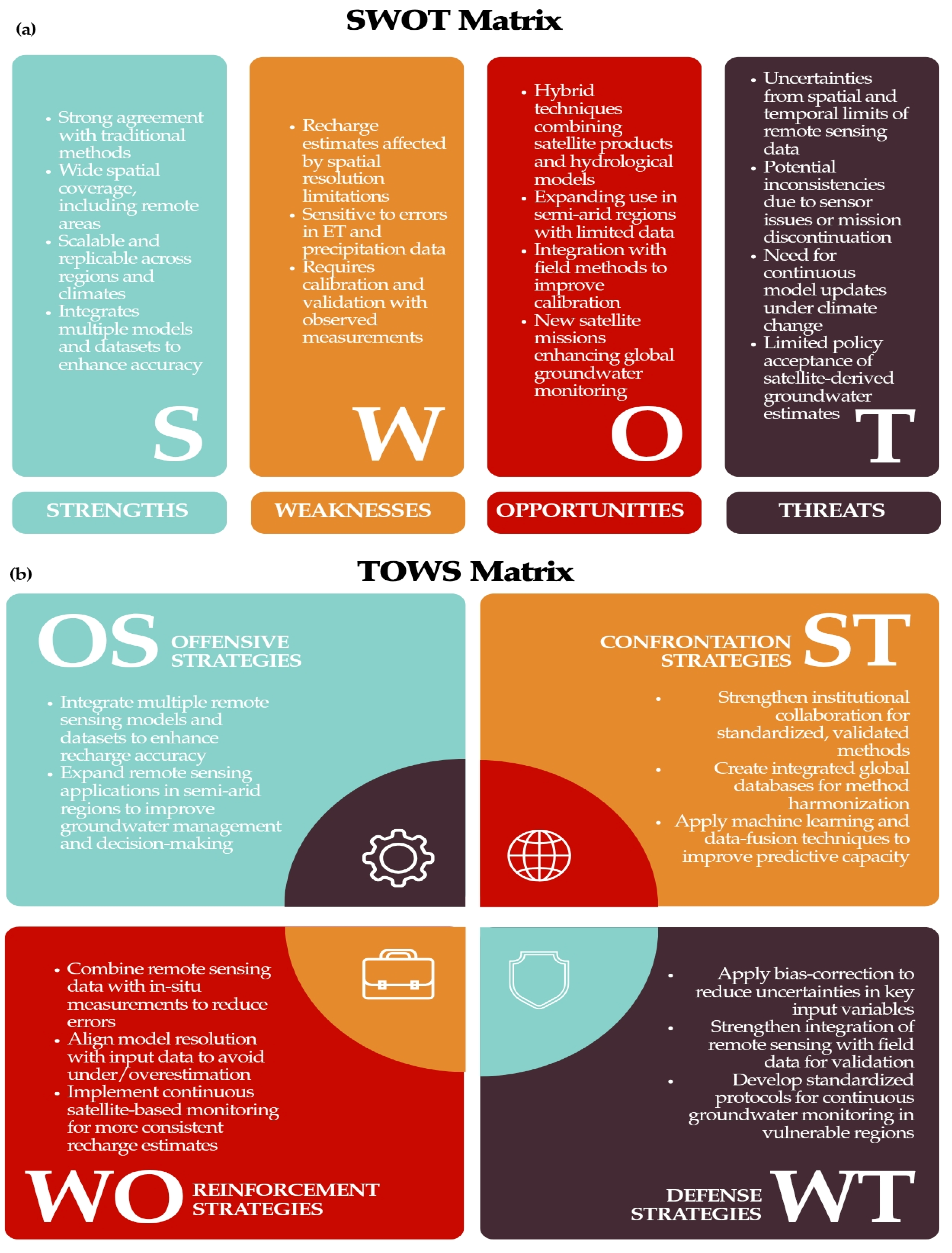
This section presents the SWOT–TOWS analysis for the use of remote sensing data in estimating groundwater recharge. Based on the reviewed articles, the strengths, weaknesses, opportunities, and threats associated with this approach were identified, along with possible strategies to maximize its benefits and minimize potential risks. The resulting matrix enables the formulation of strategies that: (i) leverage strengths to exploit opportunities; (ii) use strengths to counteract threats; (iii) overcome weaknesses through opportunities; and (iv) mitigate threats by addressing weaknesses. This structured framework provides strategic support for the development and refinement of remote sensing-based methodologies applied to groundwater recharge estimation. The resulting SWOT and TOWS matrices are presented in Figure 2a and Figure 2b, respectively.

4. Discussion

4.1. Use of Remote Sensing Products in Groundwater Recharge Estimation

The analyzed studies demonstrate that remote sensing products have been widely used as primary data sources for groundwater recharge estimation, particularly in regions with scarce hydrometeorological and hydrogeological information. In general, these products are employed to represent key components of the water balance, such as precipitation, evapotranspiration, soil moisture, and land use and land cover, which are subsequently integrated into distributed or semi-distributed hydrological models or spatially explicit water balance approaches.
Models such as SWAT, WetSpass, MIKE SHE, SWB, and DK-model recurrently appear in the literature [23,25,27,44,45], indicating that the main role of remote sensing data is generally not the direct estimation of recharge, but rather the provision of spatially distributed variables that enable a more realistic representation of hydrological processes.
In this context, Soltani et al. (2021) [23] robustly demonstrate that the systematic incorporation of remote sensing-derived variables in both model parameterization and calibration leads to substantial changes in simulated evapotranspiration patterns and, consequently, in recharge estimates. Similarly, Liaqat et al. (2016) [21] show that improvements in the spatial coherence of evapotranspiration estimated from MODIS products directly affect the spatial redistribution of recharge, even when recharge is not an explicit modeling objective.
At regional and watershed scales, the use of satellite-based data has proven particularly relevant for capturing the spatial heterogeneity of infiltration and evapotranspiration processes, an aspect often neglected in approaches based solely on point measurements or streamflow-based calibration. In mountainous environments, the direct application of global evapotranspiration products may introduce systematic topography-related biases, thereby compromising groundwater recharge estimates [53].

4.2. Sensitivity of Recharge Estimates to Precipitation and Evapotranspiration Products

The comparative analysis of the reviewed studies indicates that recharge estimates are highly sensitive to the choice of precipitation and evapotranspiration products. Studies show that different satellite-based precipitation products can lead to significant differences in estimated recharge rates, including cases of substantial overestimation when compared to ground-based observations [26,30,41,48].
In the study by Milewski et al. (2014) [26], for example, the use of TRMM 3B42 as the primary precipitation input to the SWAT model was decisive for the magnitude of the estimated recharge, which reached approximately 24% of total precipitation in the Raudhatain Basin, Kuwait. Indirect validation using soil moisture data (AMSR-E) and the identification of topographic depressions from DEMs indicate that recharge sensitivity is not restricted to precipitation volume alone, but also to how infiltration processes are spatially represented.
Products such as TRMM, IMERG, CHIRPS, and PERSIANN-CDR exhibit distinct performance depending on climatic region, rainfall regime, and the occurrence of extreme events. In particular, Zhang et al. (2020) [48] highlight that TMPA 3B42V7 was more effective in capturing the seasonal variability of infiltration, whereas PERSIANN-CDR showed limitations in representing intense events, directly affecting recharge estimates.
Similarly, evapotranspiration estimates derived from different remote sensing-based algorithms (MOD16, SEBAL, SSEB, SEBS, GLEAM) show considerable variability. Studies demonstrate that even small differences in evapotranspiration representation can lead to variations of several tens of millimeters per year in groundwater recharge estimates, particularly when recharge is calculated as a residual term of the water balance [21,23,53].
The sensitivity of recharge to uncertainties in water balance components is also evident in regional urban-scale studies. Ferreira and Cirilo (2025) [52] showed that relatively minor variations in evapotranspiration and precipitation estimates significantly affect simulated vertical fluxes and, consequently, computed drawdowns, reinforcing that indirectly estimated recharge inherits the cumulative uncertainties of the input datasets.

4.3. Integration with Hydrological Models and Validation Against Traditional Methods

A large portion of the reviewed studies emphasize that the reliability of recharge estimates increases when remote sensing data are integrated into hydrological models, calibrated and validated using independent observations. Studies such as Githui et al. (2012) [25], Gemitzi et al. (2017) [44], Babaei and Ketabchi (2022) [24], and Yang et al. (2024) [28] demonstrate that calibration using streamflow, groundwater levels, or observed evapotranspiration significantly improves the robustness of the results.
Comparison with traditional methods—such as the water table fluctuation (WTF) method, chloride mass balance (CMB), and hydrograph separation—is a recurrent and essential practice. Studies conducted in Brazil [12,20,22,49,51] report satisfactory correlations between remote sensing-based approaches and conventional methods, although systematic differences are often observed. These differences are mainly associated with contrasting spatial scales, simplifying assumptions in the models, and inherent limitations of orbital products.
For instance, Ruggieri et al. (2019) [46] show that recharge estimates based on MODIS MOD16A3 are consistent with classical methods such as Turc, Thornthwaite, and Coutagne, with values ranging from 437 to 533 mm·yr−1, reinforcing the physical consistency of remote sensing-based estimates in karst aquifers. However, Liaqat et al. (2016) [21] warn that calibrations based exclusively on streamflow may mask internal inconsistencies in the water balance, leading to spatially incoherent recharge patterns, even when overall hydrological performance is considered satisfactory.

4.4. Scale Issues, Uncertainties, and Error Propagation

A critical aspect identified in the literature is the influence of spatial and temporal scale on recharge estimates. Remote sensing products exhibit spatial resolutions ranging from hundreds of meters to tens of kilometers, which may be incompatible with local recharge processes. This limitation is particularly relevant in heterogeneous aquifers or systems controlled by specific geomorphological features.
Knoche et al. (2014) [43] highlight that the combination of different precipitation products and hydrological models can result in substantially different recharge estimates, evidencing uncertainty propagation along the modeling chain. Studies such as Szilagyi et al. (2011) [42] and Milewski et al. (2014) [26] report high spatial variability in recharge, with differences exceeding 150 mm·yr−1 within the same region, associated with topography, land use, and soil properties. At larger scales, GRACE-based studies [19,50,51] partially overcome these limitations, but present constraints regarding application to smaller areas due to sensor resolution.
In basins with complex terrain, the spatial resolution of thermal data and the lack of topographic corrections can amplify uncertainty propagation, leading to hydrologically inconsistent recharge estimates, as demonstrated by Sebbar et al. (2026) [53] in the Moroccan High Atlas.
These findings reinforce that uncertainty propagation throughout the modeling chain—from orbital products to model parameters—must be explicitly considered when interpreting recharge estimates.

4.5. Implications for Sustainability and Water Resources Management

From a sustainability perspective, the analyzed studies indicate that the use of remote sensing data provides a viable, replicable, and cost-effective alternative for groundwater recharge estimation, particularly in arid and semi-arid regions or areas with low hydrological monitoring density. The ability to periodically update estimates and assess temporal trends is especially relevant in the context of climate change and increasing pressure on aquifers.
Studies show that irrigation-related recharge can significantly exceed natural recharge, highlighting that agricultural practices must be explicitly incorporated into hydrological models when the objective is sustainable groundwater management [24,25]. The capacity to spatially map concentrated recharge areas, such as topographic depressions [26], represents strategic information for land-use planning and recharge zone protection.
From a management perspective, studies such as Ferreira and Cirilo (2025) [52] show that inadequate interpretation of groundwater recharge can lead to misleading diagnoses regarding aquifer sustainability. In the case of the Recife Metropolitan Region, the modeling results indicated a chronic imbalance between recharge and abstraction, with drawdowns exceeding 100 m, highlighting the need to protect recharge zones, restrict groundwater exploitation, and consider managed aquifer recharge strategies, particularly in coastal urban environments vulnerable to saline intrusion.
The integration of remote sensing products with emerging techniques such as artificial intelligence and data assimilation represents a promising trend for reducing uncertainties and improving recharge estimates in future studies.

4.6. Strategic Analysis of Remote Sensing-Based Groundwater Recharge Estimation Using the SWOT–TOWS Matrix

The application of the SWOT–TOWS matrix to the reviewed studies enables an integrated strategic interpretation of methodological advances, structural limitations, and future pathways associated with the use of remote sensing in groundwater recharge estimation, complementing the technical analysis presented in the previous sections.
The identified strengths synthesize the main consensuses reported in the literature: the reliability of recharge estimates when compared with traditional methods, the ability to represent the spatial variability of hydrological processes, and the feasibility of application over large areas and regions with scarce observed data. These aspects, discussed in detail in Section 4.1, Section 4.3 and Section 4.4, indicate that remote sensing has become an essential data basis for regional-scale recharge studies, particularly when integrated with hydrological and hydrogeological models.
Conversely, the weaknesses highlighted by the matrix reinforce structural limitations already evidenced in sensitivity and scale analyses. The strong dependence of recharge estimates on the choice of precipitation and evapotranspiration products, as well as the constraints imposed by the spatial resolution of orbital data, constitute critical factors affecting the robustness of results, especially in local-scale studies. In this sense, the matrix does not introduce new limitations, but rather systematizes those previously discussed as key elements to be mitigated in future applications.
The opportunities identified by the TOWS analysis point to a methodological paradigm shift: remote sensing moves beyond its traditional role as a mere source of input data and increasingly assumes an active role in physical parameterization, multivariate calibration, and uncertainty assessment of models. This trend, already observed in recent studies, expands the potential applicability of these methodologies in management-oriented contexts, particularly in arid and semi-arid regions, where recharge is highly spatially heterogeneous and strongly influenced by anthropogenic activities such as agricultural irrigation.
The threats, in turn, are mainly associated with factors external to the models, including dependence on specific orbital products, discontinuity of satellite missions, changes in processing algorithms, and challenges related to the institutional acceptance of results. These elements pose risks to operational application and to the effective incorporation of recharge estimates into public policies, requiring greater methodological standardization, transparency in uncertainty analysis, and integration with observed data.
Taken together, the SWOT–TOWS matrix highlights that progress in remote sensing-based groundwater recharge estimation depends less on the availability of new products and more on the strengthening of methodological strategies that reconcile innovation with scientific rigor. The systematic exploitation of strengths and opportunities—such as multivariate integration, multivariate calibration, and the use of long-term time series—combined with the mitigation of the identified weaknesses and threats, is essential to consolidate these approaches as reliable tools to support sustainable groundwater management.

4.7. Critical Synthesis and Future Perspectives

Overall, the literature indicates that remote sensing products do not replace field measurements but play a fundamental role as complementary data sources for groundwater recharge estimation. Recent studies show that the primary contribution of remote sensing lies in improving the spatial coherence of evapotranspiration and precipitation, directly affecting both the magnitude and spatial distribution of recharge.
Future advances in the field depend on the development of integrated approaches that combine multiple orbital products, multivariate calibration, independent validation, and explicit uncertainty analysis, as well as strengthening the link between recharge estimation and decision-making in sustainable groundwater management.

5. Conclusions

Estimation of groundwater recharge while accounting for its spatial and temporal variability is a central element for the sustainable and efficient management of groundwater resources, particularly in regions subject to water scarcity, intensified land use, and climate change. The reviewed literature consistently demonstrates that the use of remote sensing products constitutes a robust and promising approach to support recharge quantification, especially by enabling the spatially distributed representation of key components of the water balance, such as precipitation, evapotranspiration, soil moisture, and land use and land cover.
Advances observed are mainly driven by the integration of orbital data with distributed hydrological and hydrogeological models, which allow the spatial heterogeneity of infiltration and evapotranspiration processes—often neglected by approaches based exclusively on point measurements—to be effectively captured. Recent studies show that remote sensing exerts a direct influence on both the magnitude and the spatial distribution of recharge, primarily through improvements in the representation of evapotranspiration, the estimation of which has proven to be one of the most sensitive factors in closing the groundwater balance.
Despite these advances, relevant challenges persist, particularly those related to uncertainties in remote sensing products, dependence on the spatial and temporal scales of the data, and limited availability of independent recharge validation. The review indicates that calibrations based solely on surface runoff may mask internal inconsistencies in the water balance, reinforcing the need for multivariate calibration strategies and systematic comparison with traditional recharge estimation methods. Additionally, the suitability of orbital products to the hydroclimatic and geomorphological context of the study area remains a critical factor for the reliability of the results.
Overall, the observed trend points toward the strengthening of integrated approaches that combine multiple remote sensing products, calibrated hydrological models, explicit uncertainty analysis, and observational validation whenever possible. With ongoing advances in satellite technologies, increased spatial and temporal resolution of available products, and the incorporation of emerging techniques such as data assimilation and artificial intelligence, groundwater recharge estimates are expected to become progressively more accurate, reliable, and applicable for decision support in the sustainable management of groundwater resources.
Although providing a consistent synthesis of the use of remote sensing products in groundwater recharge estimation, this review has some limitations. The selection of studies was restricted to those that explicitly employed remote sensing products as substitutes for traditionally observed variables, which may have excluded relevant indirect or complementary approaches. In addition, the diversity of spatial scales, hydrological models, and calibration strategies among the analyzed studies limits direct comparisons and the generalization of results. Finally, the recurrent lack of independent recharge validation in the reviewed literature necessitates caution in interpreting the reported estimates and highlights the need for further methodological and observational advances in future research.

Supplementary Materials

The following supporting information can be downloaded at https://www.mdpi.com/article/10.3390/su18041830/s1. PRISMA 2020 flow diagram for updated systematic reviews which included searches of databases, registers and other sources.

Author Contributions

Conceptualization, T.S.G.F. and J.A.C.; methodology, T.S.G.F.; software, T.S.G.F.; validation, T.S.G.F.; formal analysis, T.S.G.F.; investigation, T.S.G.F.; resources, T.S.G.F.; data curation, T.S.G.F.; writing—original draft preparation, T.S.G.F.; writing—review and editing, J.A.C.; visualization, J.A.C.; supervision, J.A.C. All authors have read and agreed to the published version of the manuscript.

Funding

Alagoas–Pernambuco Network for Urban Flood Monitoring and Early Warning (REALPE)” (CNPq Project No. 406550/2022-0).

Institutional Review Board Statement

Not available.

Informed Consent Statement

Not available.

Data Availability Statement

The data presented in this study are available on request from the corresponding authors.

Acknowledgments

The authors are grateful to CAPES for the doctoral scholarship and to the Brazilian National Council for Scientific and Technological Development (CNPq) for funding the publication of this research (Project No. 406550/2022-0).

Conflicts of Interest

The authors declare no conflicts of interest.

References

  1. Ayenew, T. Numerical Groundwater Flow Modeling of the Central Main Ethiopian Rift Lakes Basin. SINET Ethiop. J. Sci. 2001, 24, 167–184. [Google Scholar] [CrossRef]
  2. Yu, Z.; Yang, K.; Luo, Y.; Shang, C. Spatial-Temporal Process Simulation and Prediction of Chlorophyll-a Concentration in Dianchi Lake Based on Wavelet Analysis and Long-Short Term Memory Network. J. Hydrol. 2020, 582, 124488. [Google Scholar] [CrossRef]
  3. Jiménez-Martínez, J.; Longuevergne, L.; Le Borgne, T.; Davy, P.; Russian, A.; Bour, O. Temporal and Spatial Scaling of Hydraulic Response to Recharge in Fractured Aquifers: Insights from a Frequency Domain Analysis. Water Resour. Res. 2013, 49, 3007–3023. [Google Scholar] [CrossRef]
  4. Scanlon, B.R.; Keese, K.E.; Flint, A.L.; Flint, L.E.; Gaye, C.B.; Edmunds, W.M.; Simmers, I. Global Synthesis of Groundwater Recharge in Semiarid and Arid Regions. Hydrol. Process. 2006, 20, 3335–3370. [Google Scholar] [CrossRef]
  5. Smerdon, B.D. A Synopsis of Climate Change Effects on Groundwater Recharge. J. Hydrol. 2017, 555, 125–128. [Google Scholar] [CrossRef]
  6. Kalu, I.; Ndehedehe, C.E.; Ferreira, V.G.; Janardhanan, S.; Currell, M.; Crosbie, R.S.; Kennard, M.J. Remote Sensing Estimation of Shallow and Deep Aquifer Response to Precipitation-Based Recharge Through Downscaling. Water Resour. Res. 2024, 60, e2024WR037360. [Google Scholar] [CrossRef]
  7. de Vries, J.J.; Simmers, I. Groundwater Recharge: An Overview of Process and Challenges. Hydrogeol. J. 2002, 10, 5–17. [Google Scholar] [CrossRef]
  8. Gebremeskel, G.; Kebede, A. Spatial Estimation of Long-Term Seasonal and Annual Groundwater Resources: Application of WetSpass Model in the Werii Watershed of the Tekeze River Basin, Ethiopia. Phys. Geogr. 2017, 38, 338–359. [Google Scholar] [CrossRef]
  9. Adhikari, R.K.; Yilmaz, A.G.; Mainali, B.; Dyson, P.; Imteaz, M.A. Methods of Groundwater Recharge Estimation under Climate Change: A Review. Sustainability 2022, 14, 15619. [Google Scholar] [CrossRef]
  10. Kumar, P.J.S.; Schneider, M.; Elango, L. The State-of-the-Art Estimation of Groundwater Recharge and Water Balance with a Special Emphasis on India: A Critical Review. Sustainability 2022, 14, 340. [Google Scholar] [CrossRef]
  11. Martos-Rosillo, S.; González-Ramón, A.; Jiménez-Gavilán, P.; Andreo, B.; Durán, J.J.; Mancera, E. Review on Groundwater Recharge in Carbonate Aquifers from SW Mediterranean (Betic Cordillera, S Spain). Environ. Earth Sci. 2015, 74, 7571–7581. [Google Scholar] [CrossRef]
  12. Coelho, V.H.R.; Montenegro, S.; Almeida, C.N.; Silva, B.B.; Oliveira, L.M.; Gusmão, A.C.V.; Freitas, E.S.; Montenegro, A.A.A. Alluvial Groundwater Recharge Estimation in Semi-Arid Environment Using Remotely Sensed Data. J. Hydrol. 2017, 548, 1–15. [Google Scholar] [CrossRef]
  13. Ahamed, A.; Knight, R.; Alam, S.; Pauloo, R.; Melton, F. Assessing the Utility of Remote Sensing Data to Accurately Estimate Changes in Groundwater Storage. Sci. Total Environ. 2022, 807, 150635. [Google Scholar] [CrossRef] [PubMed]
  14. Crosbie, R.S.; Davies, P.; Harrington, N.; Lamontagne, S. Ground Truthing Groundwater-Recharge Estimates Derived from Remotely Sensed Evapotranspiration: A Case in South Australia. Hydrogeol. J. 2015, 23, 335–350. [Google Scholar] [CrossRef]
  15. Baalousha, H.M.; Barth, N.; Ramasomanana, F.H.; Ahzi, S. Groundwater Recharge Estimation and Its Spatial Distribution in Arid Regions Using GIS: A Case Study from Qatar Karst Aquifer. Model. Earth Syst. Environ. 2018, 4, 1319–1329. [Google Scholar] [CrossRef]
  16. Li, B.; Rodell, M.; Kumar, S.; Beaudoing, H.K.; Getirana, A.; Zaitchik, B.F.; de Goncalves, L.G.; Cossetin, C.; Bhanja, S.; Mukherjee, A.; et al. Global GRACE Data Assimilation for Groundwater and Drought Monitoring: Advances and Challenges. Water Resour. Res. 2019, 55, 7564–7586. [Google Scholar] [CrossRef]
  17. Xu, X.; Li, J.; Tolson, B.A. Progress in Integrating Remote Sensing Data and Hydrologic Modeling. Prog. Phys. Geogr. Earth Environ. 2014, 38, 464–498. [Google Scholar] [CrossRef]
  18. Schmugge, T.J.; Kustas, W.P.; Ritchie, J.C.; Jackson, T.J.; Rango, A. Remote Sensing in Hydrology. Adv. Water Resour. 2002, 25, 1367–1385. [Google Scholar] [CrossRef]
  19. Barbosa, S.A.; Pulla, S.T.; Williams, G.P.; Jones, N.L.; Mamane, B.; Sanchez, J.L. Evaluating Groundwater Storage Change and Recharge Using GRACE Data: A Case Study of Aquifers in Niger, West Africa. Remote Sens. 2022, 14, 1532. [Google Scholar] [CrossRef]
  20. Barbosa, L.R.; Coelho, V.H.R.; Gusmão, A.C.V.L.; Fernandes, L.A.; da Silva, B.B.; Galvão, C.d.O.; Caicedo, N.O.L.; da Paz, A.R.; Xuan, Y.; Bertrand, G.F.; et al. A Satellite-Based Approach to Estimating Spatially Distributed Groundwater Recharge Rates in a Tropical Wet Sedimentary Region despite Cloudy Conditions. J. Hydrol. 2022, 607, 127503. [Google Scholar] [CrossRef]
  21. Liaqat, U.W.; Awan, U.K.; McCabe, M.F.; Choi, M. A Geo-Informatics Approach for Estimating Water Resources Management Components and Their Interrelationships. Agric. Water Manag. 2016, 178, 89–105. [Google Scholar] [CrossRef]
  22. Lucas, M.; Oliveira, P.T.S.; Melo, D.C.D.; Wendland, E. Evaluation of Remotely Sensed Data for Estimating Rechargeto an Outcrop Zone of the Guarani Aquifer System (South America). Hydrogeol. J. 2015, 23, 961–969. [Google Scholar] [CrossRef]
  23. Soltani, M.; Bjerre, E.; Koch, J.; Stisen, S. Integrating Remote Sensing Data in Optimization of a National Water Resources Model to Improve the Spatial Pattern Performance of Evapotranspiration. J. Hydrol. 2021, 603, 127026. [Google Scholar] [CrossRef]
  24. Babaei, M.; Ketabchi, H. Determining Groundwater Recharge Rate with a Distributed Model and Remote Sensing Techniques. Water Resour. Manag. 2022, 36, 5401–5423. [Google Scholar] [CrossRef]
  25. Githui, F.; Selle, B.; Thayalakumaran, T. Recharge Estimation Using Remotely Sensed Evapotranspiration in an Irrigated Catchment in Southeast Australia. Hydrol. Process. 2012, 26, 1379–1389. [Google Scholar] [CrossRef]
  26. Milewski, A.; Sultan, M.; Al-Dousari, A.; Yan, E. Geologic and Hydrologic Settings for Development of Freshwater Lenses in Arid Lands. Hydrol. Process. 2014, 28, 3185–3194. [Google Scholar] [CrossRef]
  27. González-Ortigoza, S.; Hernández-Espriú, A.; Arciniega-Esparza, S. Regional Modeling of Groundwater Recharge in the Basin of Mexico: New Insights from Satellite Observations and Global Data Sources. Hydrogeol. J. 2023, 31, 1971–1990. [Google Scholar] [CrossRef]
  28. Yang, X.; Dai, C.; Liu, G.; Li, C. Research on the Jiamusi Area’s Shallow Groundwater Recharge Using Remote Sensing and the SWAT Model. Appl. Sci. 2024, 14, 7220. [Google Scholar] [CrossRef]
  29. Belay, A.S.; Yenehun, A.; Nigate, F.; Tilahun, S.A.; Dessie, M.; Moges, M.M.; Chen, M.; Fentie, D.; Adgo, E.; Nyssen, J.; et al. Estimation of Spatially Distributed Groundwater Recharge in Data-Scarce Regions. J. Hydrol. Reg. Stud. 2024, 56, 102072. [Google Scholar] [CrossRef]
  30. Shu, Y.; Li, H.; Lei, Y. Modelling Groundwater Flow with MIKE SHE Using Conventional Climate Data and Satellite Data as Model Forcing in Haihe Plain, China. Water 2018, 10, 1295. [Google Scholar] [CrossRef]
  31. Page, M.J.; McKenzie, J.E.; Bossuyt, P.M.; Boutron, I.; Hoffmann, T.C.; Mulrow, C.D.; Shamseer, L.; Tetzlaff, J.M.; Akl, E.A.; Brennan, S.E.; et al. The PRISMA 2020 Statement: An Updated Guideline for Reporting Systematic Reviews. BMJ 2021, 372, n71. [Google Scholar] [CrossRef]
  32. PRISMA. PRISMA Transparent Reporting of Systematic Reviews and Meta-Analyses. Available online: http://www.prisma-statement.org/ (accessed on 14 August 2021).
  33. Kordana, S.; Pochwat, K.; Słyś, D.; Starzec, M. Opportunities and Threats of Implementing Drain Water Heat Recovery Units in Poland. Resources 2019, 8, 88. [Google Scholar] [CrossRef]
  34. Gürel, E.; Tat, M. SWOT Analysis: A Theoretical Review. J. Int. Soc. Res. 2011, 4, 346–370. [Google Scholar] [CrossRef]
  35. Gleeson, T.; Wada, Y.; Bierkens, M.F.P.; Van Beek, L.P.H. Water Balance of Global Aquifers Revealed by Groundwater Footprint. Nature 2012, 488, 197–200. [Google Scholar] [CrossRef]
  36. Berghuijs, W.R.; Luijendijk, E.; Moeck, C.; van der Velde, Y.; Allen, S.T. Global Recharge Data Set Indicates Strengthened Groundwater Connection to Surface Fluxes. Geophys. Res. Lett. 2022, 49, e2022GL099010. [Google Scholar] [CrossRef]
  37. Li, B.; Rodell, M.; Peters-Lidard, C.; Erlingis, J.; Kumar, S.; Mocko, D. Groundwater Recharge Estimated by Land Surface Models: An Evaluation in the Conterminous United States. J. Hydrometeorol. 2021, 22, 499–522. [Google Scholar] [CrossRef]
  38. Müller Schmied, H.; Caceres, D.; Eisner, S.; Flörke, M.; Herbert, C.; Niemann, C.; Asali Peiris, T.; Popat, E.; Theodor Portmann, F.; Reinecke, R.; et al. The Global Water Resources and Use Model WaterGAP v2.2d: Model Description and Evaluation. Geosci. Model Dev. 2021, 14, 1037–1079. [Google Scholar] [CrossRef]
  39. Ahamed, A.; Knight, R.; Alam, S.; Morphew, M.; Susskind, T. Remote Sensing-Based Estimates of Changes in Stored Groundwater at Local Scales: Case Study for Two Groundwater Subbasins in California’s Central Valley. Remote Sens. 2023, 15, 2100. [Google Scholar] [CrossRef]
  40. Szilagyi, J.; Zlotnik, V.A.; Gates, J.B.; Jozsa, J. Mapping Mean Annual Groundwater Recharge in the Nebraska Sand Hills, USA. Hydrogeol. J. 2011, 19, 1503–1513. [Google Scholar] [CrossRef]
  41. Műnch, Z.; Conrad, J.E.; Gibson, L.A.; Palmer, A.R.; Hughes, D. Satellite Earth Observation as a Tool to Conceptualize Hydrogeological Fluxes in the Sandveld, South Africa. Hydrogeol. J. 2013, 21, 1053–1070. [Google Scholar] [CrossRef]
  42. Szilagyi, J.; Jozsa, J. MODIS-Aided Statewide Net Groundwater-Recharge Estimation in Nebraska. Groundwater 2013, 51, 735–744. [Google Scholar] [CrossRef]
  43. Knoche, M.; Fischer, C.; Pohl, E.; Krause, P.; Merz, R. Combined Uncertainty of Hydrological Model Complexity and Satellite-Based Forcing Data Evaluated in Two Data-Scarce Semi-Arid Catchments in Ethiopia. J. Hydrol. 2014, 519, 2049–2066. [Google Scholar] [CrossRef]
  44. Gemitzi, A.; Ajami, H.; Richnow, H.H. Developing Empirical Monthly Groundwater Recharge Equations Based on Modeling and Remote Sensing Data—Modeling Future Groundwater Recharge to Predict Potential Climate Change Impacts. J. Hydrol. 2017, 546, 1–13. [Google Scholar] [CrossRef]
  45. Fallatah, O.A.; Ahmed, M.; Cardace, D.; Boving, T.; Akanda, A.S. Assessment of Modern Recharge to Arid Region Aquifers Using an Integrated Geophysical, Geochemical, and Remote Sensing Approach. J. Hydrol. 2019, 569, 600–611. [Google Scholar] [CrossRef]
  46. Ruggieri, G.; Allocca, V.; Borfecchia, F.; De Vita, P. Groundwater Recharge Estimation in Karst Aquifers of Southern Apennines (Italy) by Integration of Remotely Sensed Data. Rend. Online Della Soc. Geol. Ital. 2019, 41, 97–101. [Google Scholar] [CrossRef]
  47. Silva, C.O.F.; Manzione, R.L.; Albuquerque Filho, J.L. Combining Remotely Sensed Actual Evapotranspiration and GIS Analysis for Groundwater Level Modeling. Environ. Earth Sci. 2019, 78, 462. [Google Scholar] [CrossRef]
  48. Zhang, L.; Xin, Z.; Zhou, H. Assessment of TMPA 3B42V7 and PERSIANN-CDR in Driving Hydrological Modeling in a Semi-Humid Watershed in Northeastern China. Remote Sens. 2020, 12, 3133. [Google Scholar] [CrossRef]
  49. Santarosa, L.V.; Gastmans, D.; Sitolini, T.P.; Kirchheim, R.E.; Betancur, S.B.; de Oliveira, M.E.D.; Campos, J.C.V.; Manzione, R.L. Assessment of Groundwater Recharge along the Guarani Aquifer System Outcrop Zone in São Paulo State (Brazil): An Important Tool towards Integrated Management. Environ. Earth Sci. 2021, 80, 95. [Google Scholar] [CrossRef]
  50. Barbosa, S.A.; Jones, N.L.; Williams, G.P.; Mamane, B.; Begou, J.; Nelson, E.J.; Ames, D.P. Exploiting Earth Observations to Enable Groundwater Modeling in the Data-Sparse Region of Goulbi Maradi, Niger. Remote Sens. 2023, 15, 5199. [Google Scholar] [CrossRef]
  51. Santarosa, L.V.; Pinto, G.V.F.; Blandón Luengas, J.S.; Gastmans, D. Remote Sensing to Quantify Potential Aquifer Recharge as a Complementary Tool for Groundwater Monitoring. Hydrol. Sci. J. 2024, 69, 2455–2465. [Google Scholar] [CrossRef]
  52. Ferreira, T.S.G.; Cirilo, J.A. Water Balance Estimates and Piezometric Level Lowering Based on Numerical Modeling and Remote Sensing Data in the Recife Metropolitan Region—Pernambuco (Brazil). Water 2025, 17, 1616. [Google Scholar] [CrossRef]
  53. Sebbar, B.E.; Simonneaux, V.; Khabba, S.; Chehbouni, A.; Merlin, O. Assessing the Groundwater Recharge of a Steep-Sided Catchment from Thermal-Derived Evapotranspiration Estimates: Usefulness of Methods for Correcting Topographical Effects. J. Hydrol. 2026, 664, 134457. [Google Scholar] [CrossRef]
Figure 1. Flowchart of the PRISMA methodology adopted in this literature review.
Sustainability 18 01830 g001
Figure 2. (a) SWOT and (b) TOWS analysis for the use of remote sensing data in estimating groundwater recharge.
Sustainability 18 01830 g002
Table 1. Studies, study areas, remote sensing datasets, and thematic patterns of the selected papers.
ReferenceNº of CitationsStudy AreaData UsedThematic Patterns
Use of Hydrological ModelsComparison with Traditional MethodsDevelopment of Methodologies Based on Remote SensingUse for Calibration and Validation
Szilagyi et al. (2011) [40]115Sand Hills, Nebraska, EUAMODIS (evapotranspiration)
Githui, Selle, and Thayalakumaran (2012) [25]60Southeast AustraliaMODIS (evapotranspiration)
Műnch et al. (2013) [41]44Campo de Areia, South AfricaARC-ISCW (precipitation), ETMODIS, MOD16, Pitman (evapotranspiration)
Szilagyi and Jozsa (2013) [42]53Nebraska, USAPRISM (precipitation), MODIS (evapotranspiration)
Knoche et al. (2014) [43]68Awash and Kessem Rivers, EthiopiaTRMM 3B42V6/V7, CMORPH (precipitation), MOD11C1, and GLDAS (temperature)
Milewski et al. (2014) [26]26Raudhatain Basin, KuwaitTRMM (precipitation), AMSR-E, Landsat TM (NDVI), AVHRR, ASTER
Lucas et al. (2015) [22]42Guarani Aquifer, BrazilTRMM (precipitation), MOD16
Liaqat et al. (2016) [21]15Punjab, PakistanMODIS L3 (albedo, LAI, NDVI)
Coelho et al. (2017) [12]94Ipanema River Basin, BrazilTRMM (precipitation), MODIS (evapotranspiration)
Gemitzi, Ajami, and Richnow (2017) [44]79Vosvozis River, GreeceMODIS (evapotranspiration)
Shu, Li, and Lei (2018) [30]14Haihe Plain, ChinaFY-2C (precipitation and global radiation)
Fallatah et al. (2019) [45]64Saq Aquifer, Arabian PeninsulaTRMM (precipitation), GRACE (groundwater storage)
Ruggieri et al. (2019) [46]0Karst aquifers of the Southern Apennines, ItalyMOD16A3 (evapotranspiration and NDVI)
Silva, Manzione, and Albuquerque Filho (2019) [47]13Águas de Santa Bárbara, BrazilMODIS and Sentinel-2 (evapotranspiration)
Zhang, Xin, and Zhou, (2020) [48]18Biliu River, ChinaTMPA 3B42V7 and PERSIANN-CDR (precipitation)
Soltani et al. (2021) [23]27DenmarkMOD13A1 (NDVI), MOD16 (evapotranspiration),
Santarosa et al. (2021) [49]21Guarani Aquifer, BrazilTRMM (precipitation), GLDAS (evapotranspiration)
Barbosa et al. (2022a) [19]39Southern Niger, West AfricaGRACE (groundwater storage)
Barbosa et al. (2022b) [20]5João Pessoa, BrazilIMERG (precipitation), MOD16 (evapotranspiration), SMAP (soil moisture)
Babaei & Ketabchi (2022) [24]13Rafsanjan Aquifer, IrãLandsat 8 (NDVI, NDWI, MNDWI),
Barbosa et al. (2023) [50]3Goulbi Maradi Aquifer, NígerGRACE (groundwater storage)
González-Ortigoza, Hernández-Espriú, and Arciniega-Esparza (2023) [27]5Mexico BasinCHIRPS (precipitation), Daymet (temperature), MODIS/GLEAM/TerraClimate (evapotranspiration)
Belay et al. (2024) [29]0Upper Beles Basin, EthiopiaCHIRPS (precipitation), TerraClimate (evapotranspiration, temperature, wind)
Santarosa et al. (2024) [51]0Guarani and Bauru aquifers, BrazilIMERG (precipitation), GLDAS (evapotranspiration), GRACE (groundwater storage)
Yang et al. (2024) [28]0Jiamusi, ChinaTRMM (precipitation), MOD16A2GF (evapotranspiration), GLADS-2.1 (surface runoff),
Ferreira and Cirilo (2025) [52]1Metropolitan Region of Recife, BrazilCHIRPS (precipitation)
Sebbar et al. (2026) [53]0Rheraya basin, MarrocoMOD11A1 (LST and surface emissivity), MOD03(solar zenith angle), MOD06_L2(cloud cover), MCD43A3 (albedo), MOD13A2 (NDVI), WaPOR and SSEBop (evapotranspiration)
Disclaimer/Publisher’s Note: The statements, opinions and data contained in all publications are solely those of the individual author(s) and contributor(s) and not of MDPI and/or the editor(s). MDPI and/or the editor(s) disclaim responsibility for any injury to people or property resulting from any ideas, methods, instructions or products referred to in the content.