


Weed Diversity and Associated Entomofauna in High-Andean Organic Pastures

 ,
,  , ,
, ,  ,
,  , , and
Abstract
1. Introduction
2. Materials and Methods
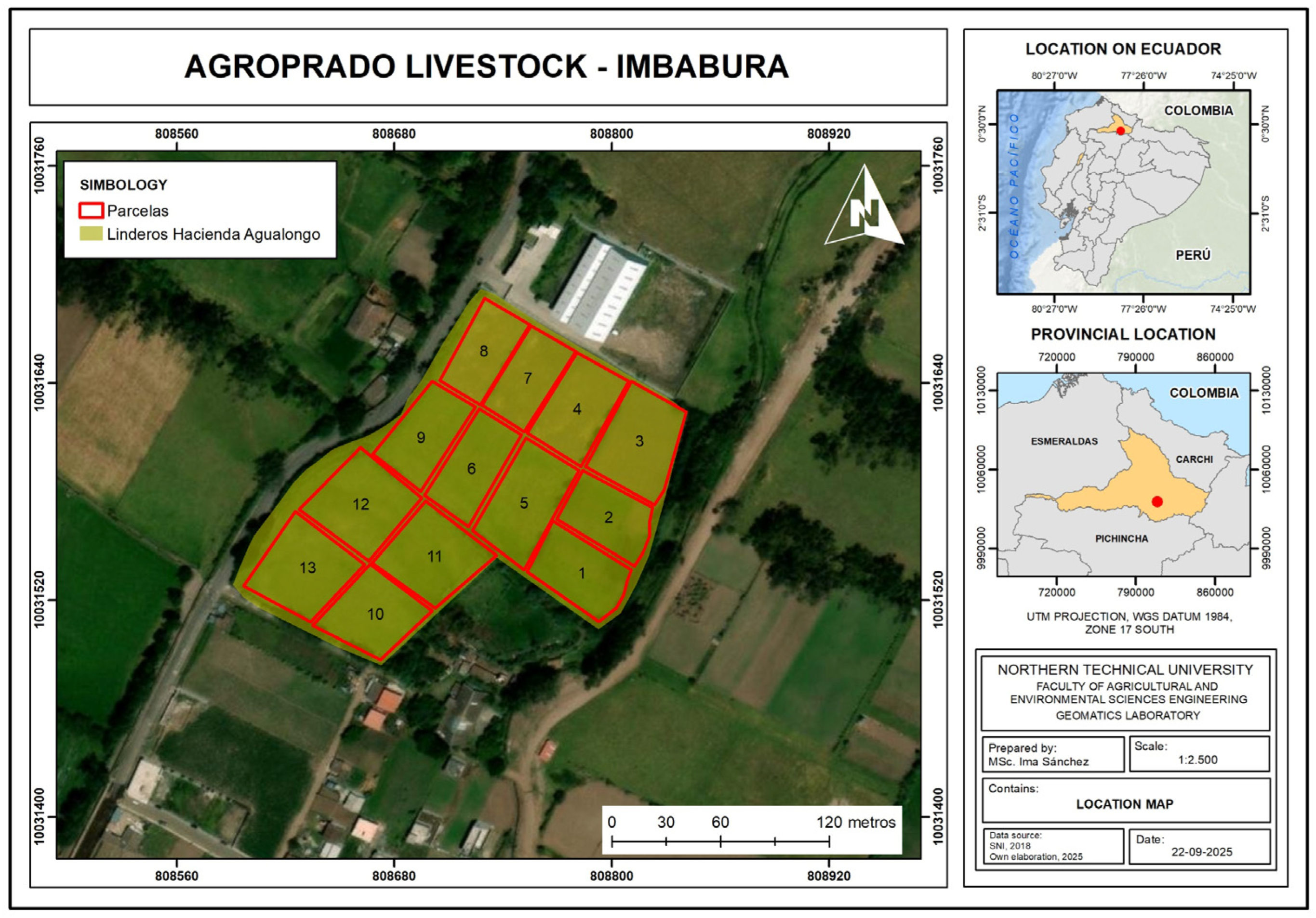
2.1. Area of Study
2.2. Sampling Methodology
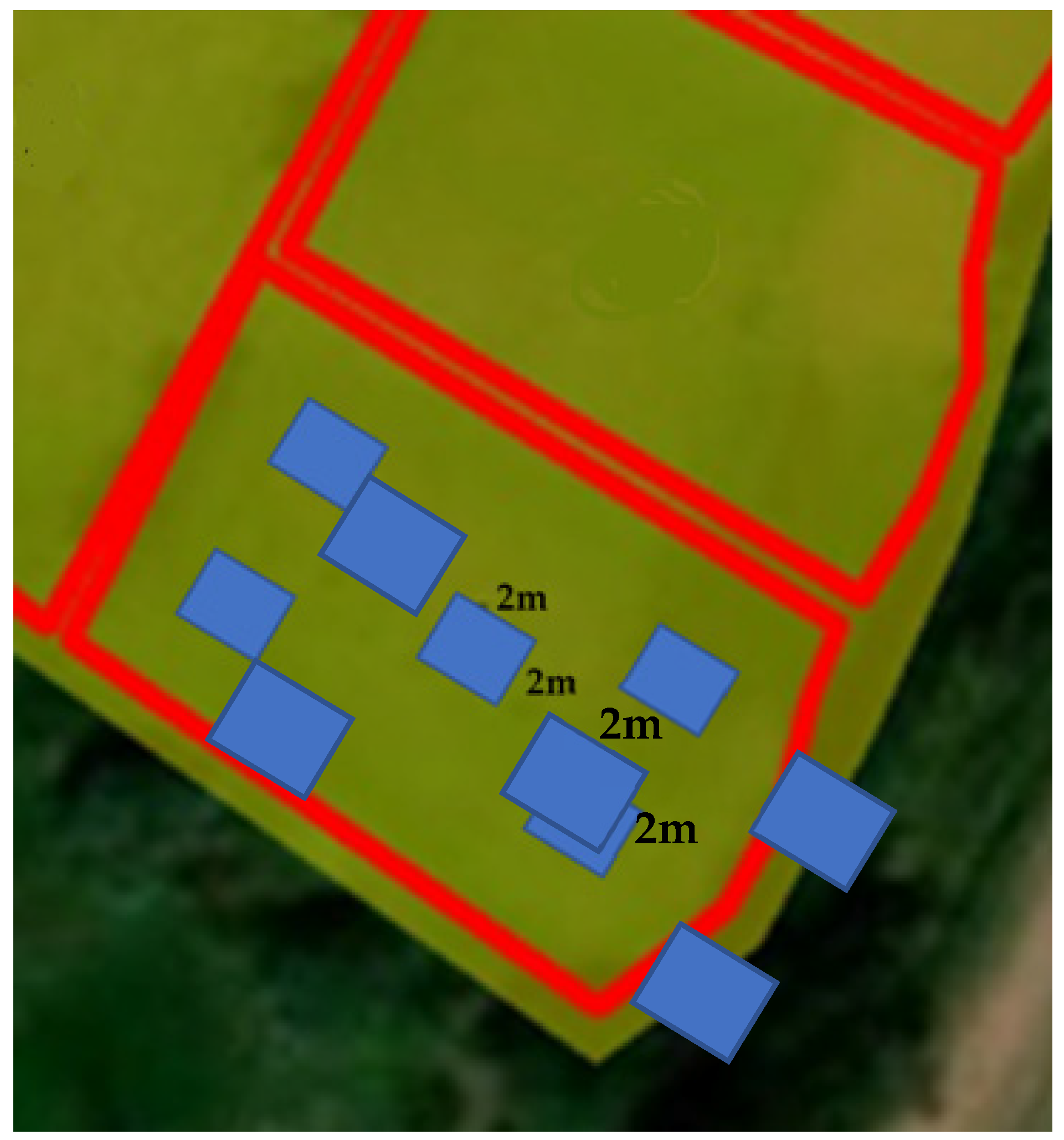
2.2.1. Weed Sampling
2.2.2. Insect Sampling
2.3. Data Analysis
3. Results
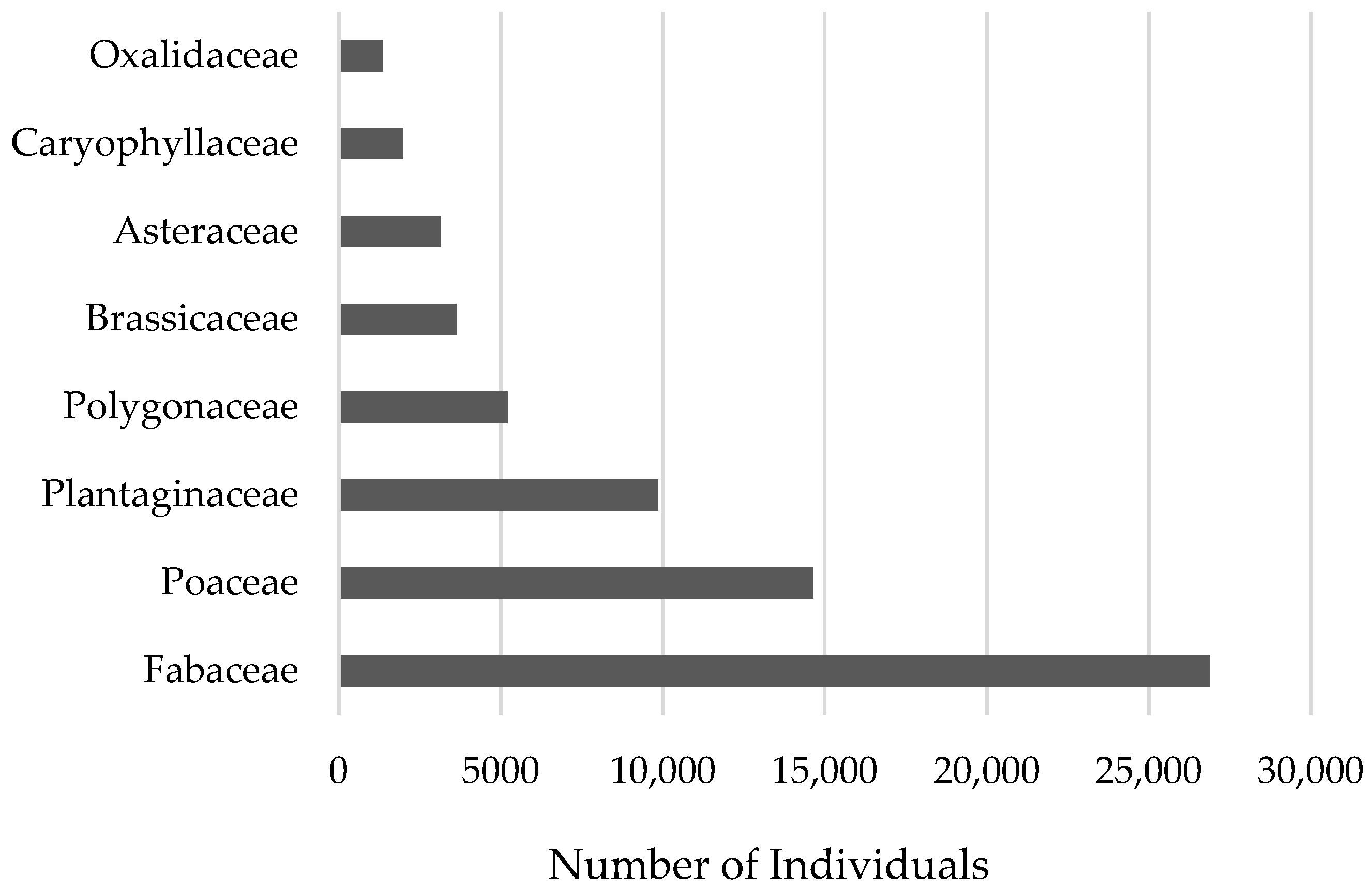
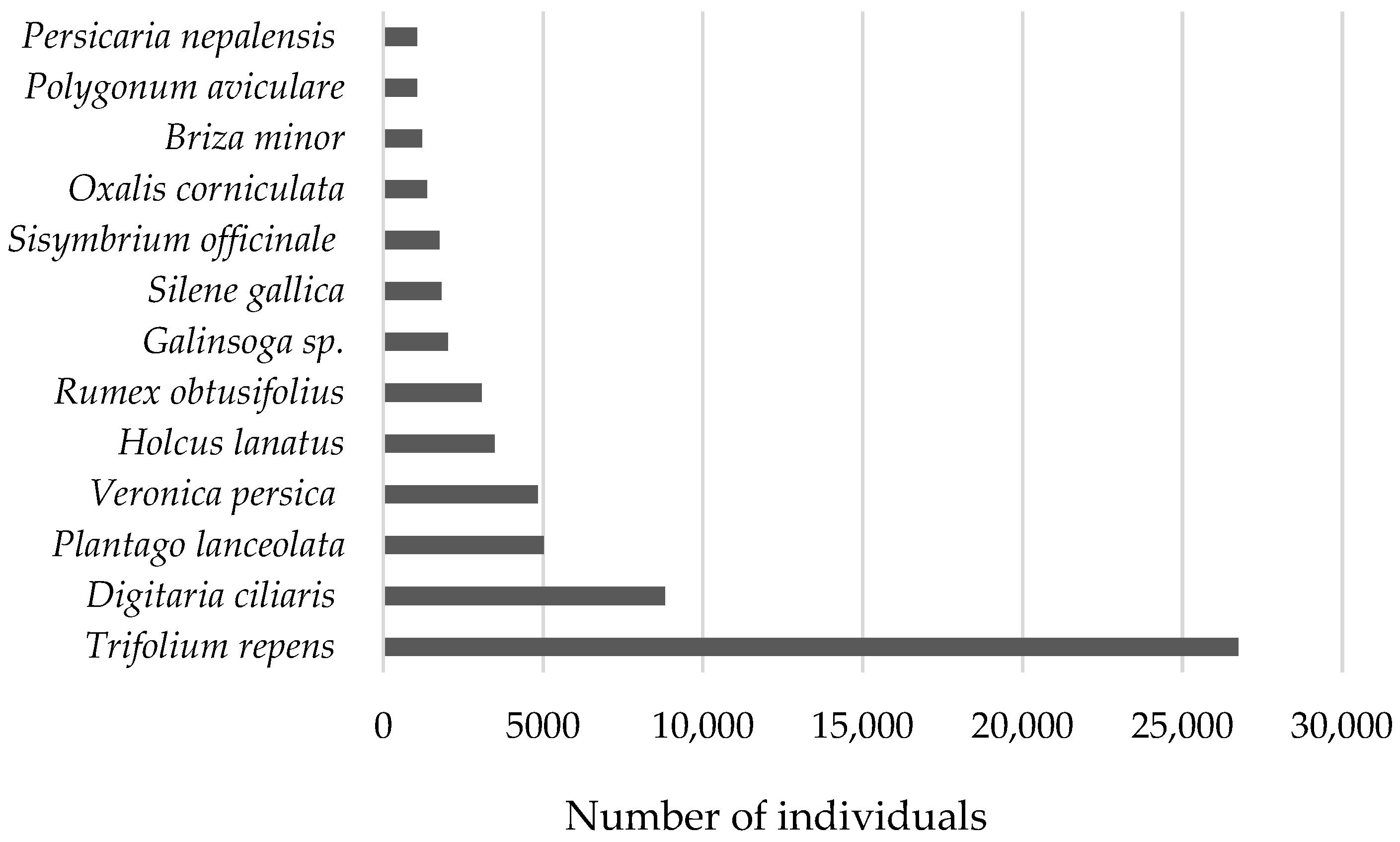
3.1. Weed Composition and Diversity
3.2. Entomofauna Dynamics
4. Discussion
5. Conclusions
Author Contributions
Funding
Institutional Review Board Statement
Informed Consent Statement
Data Availability Statement
Acknowledgments
Conflicts of Interest
References
- León, R.; Bonifaz, N.; Gutiérrez, F. Pastos y Forrajes del Ecuador Siembra y Producción de Pasturas/Pastures and Forages of Ecuador: Sowing and Production of Pastures; AbyaYala: Quito, Ecuador, 2018; Available online: https://www.researchgate.net/publication/365964335_PASTOS_Y_FORRAJES_DEL_ECUADOR (accessed on 28 August 2025).
- Instituto Nacional de Estadísticas y Censo (INEC). Encuesta de Superficie y Producción Agropecuaria Continua-ESPAC/Continuous Agricultural Area and Production Survey-ESPAC. 2023. Available online: https://www.ecuadorencifras.gob.ec/encuesta-de-superficie-y-produccion-agropecuaria-continua-2020/ (accessed on 28 August 2025).
- Alemán, F.; Quezada, J.B.; Garmendia, M. Flora Arvense Y Ruderal del Pacífico Y Centro de Nicaragua/Weed and Ruderal Flora of the Pacific and Central Nicaragua, 1st ed.; Universidad Nacional Agraria: Managua, Nicaragua, 2012. [Google Scholar]
- Díaz-Díaz, Y.; Blanco-Valdés, Y. Las arvenses como indicador microbiológico del suelo/Weeds as a microbiological soil indicator. Cultiv. Trop. 2022, 43, e12. Available online: https://ediciones.inca.edu.cu/index.php/ediciones/article/view/1648 (accessed on 28 August 2025).
- Aguirre-Mendoza, Z.; Jaramillo-Díaz, N.; Quizhpe-Coronel, W. Arvenses Asociadas a Cultivos Y Pastizales del Ecuador; Universidad Nacional de Loja: Loja, Ecuador, 2019. [Google Scholar]
- Carvalho, L.B. Plantas daninhas, 1st ed.; Lages, S.C., Ed.; UNESP: São Paulo, Brasil, 2013; Available online: https://www.fcav.unesp.br/Home/departamentos/fitossanidade/leonardobiancodecarvalho/livro_plantasdaninhas.pdf (accessed on 5 September 2025).
- Cifuentes, L.M.; Sepúlveda-Nieto, M.D.P.; Gómez, G.D. Arvenses asociadas a sistemas de pasturas en la zona Baja del Departamento del Quindío/Weeds associated with pasture systems in the low zone of the Department of Quindío. Rev. Investig. Univ. Quindío 2012, 23, 101–111. [Google Scholar] [CrossRef]
- Sklenář, P.; Balslev, H. Superpáramo plant species diversity and phytogeography in Ecuador. Flora-Morphol. Distrib. Funct. Ecol. Plants 2005, 200, 416–433. [Google Scholar] [CrossRef]
- Cavieres, L.A.; Llambí, L.D.; Anthelme, F.; Hofstede, R.; Arroyo, M.T. High-Andean vegetation under environmental change: A continental synthesis. Annu. Rev. Environ. Resour. 2025, 50, 219–245. [Google Scholar] [CrossRef]
- Duchicela, S.A.; Llambí, L.D.; Bonnesoeur, V.; Román-Dañobeytia, F. Pastoralism in the high tropical Andes: A review of the effect of grazing intensity on plant diversity and ecosystem services. Appl. Veg. Sci. 2024, 27, e12791. [Google Scholar] [CrossRef]
- Quinteros-Gómez, Y.; Macedo-Bedoya, J.; Santos-Linares, V.; Angeles-Alvarez, F.; Gómez-Ticerán, D.; Campos-De la Cruz, J.; Solis Sarmiento, J.; Salinas-Inga, A.; Valencia-Saavedra, Z. Floristic diversity and distribution pattern along an altitudinal gradient in the Central Andes: A case study of Cajatambo, Peru. Plants 2024, 13, 3328. [Google Scholar] [CrossRef] [PubMed]
- Blanco, Y.; Leyva, Á. Abundancia y diversidad de especies de arvenses en el cultivo de maíz (Zea mays, L.) precedido de un barbecho transitorio después de la papa (Solanum tuberosum L.)/Abundance and diversity of weed species in maize (Zea mays L.) preceded by a transitory fallow after potato (Solanum tuberosum L.). Cultiv. Trop. 2010, 31, 12–16. Available online: https://ediciones.inca.edu.cu/index.php/ediciones/article/view/91/pdf (accessed on 28 August 2025).
- Agüero-Alvarado, R.; Rodríguez-Ruiz, A.M.; González-Lutz, M.I.; Portuguez-García, P.; Brenes-Prendas, S. Abundancia y cobertura de arvenses bajo manejo convencional y orgánico de café y banano/Weed abundance and ground cover under conventional or organic management of coffee and banana. Agron. Mesoam. 2018, 29, 85–93. Available online: https://www.redalyc.org/journal/437/43754020008/html/ (accessed on 4 September 2025). [CrossRef]
- Schonbeck, M. An Ecological Understandisg of Weeds; eOrganic: Online Publication, 2009; pp. 1–15. Available online: https://eorganic.org/node/2314 (accessed on 28 August 2025).
- Tscharntke, T.; Klein, A.M.; Kruess, A.; Steffan-Dewenter, I.; Thies, C. Landscape perspectives on agricultural intensification and biodiversity–ecosystem service management. Ecol. Lett. 2005, 8, 857–874. [Google Scholar] [CrossRef]
- Debinski, D.M. Insects in Grassland Ecosystems. In Rangeland Wildlife Ecology and Conservation, 1st ed.; McNew, L.B., Dahlgren, D.K., Beck, J.L., Eds.; Springer International Publishing: Cham, Switzerland, 2023; pp. 897–929. [Google Scholar]
- Angelo, M.J. La seguridad alimentaria, la agricultura industrializada y un cambio climático mundial: Perspectivas en Estados Unidos y Cuba/Food Security, Industrialized Agriculture, and Global Climate Change: Perspectives in the United States and Cuba. Fla. J. Int. Law 2017, 29, 133S–158S. Available online: https://scholarship.law.ufl.edu/cgi/viewcontent.cgi?article=1037&context=fjil (accessed on 1 September 2025).
- Blanco, Y.; Leyva, Á. Las arvenses en el agroecosistema y sus beneficios agroecológicos como hospederas de enemigos naturales/Weeds in the agroecosystem and their agroecological benefits as hosts for natural enemies. Cultiv. Trop. 2007, 28, 21–28. Available online: https://www.redalyc.org/pdf/1932/193217731003.pdf (accessed on 5 September 2025).
- Blanco, Y. El rol de las arvenses como componente en la biodiversidad de los agroecosistemas/The role of weed species as a biodiversity component in agroecosystems. Cultiv. Trop. 2016, 37, 34–56. Available online: https://ediciones.inca.edu.cu/index.php/ediciones/article/view/1292 (accessed on 28 August 2025).
- Álvarez, M.; Córdoba, S.; Escobar, F.; Fagua, G.; Gast, F.; Mendoza, H.; Ospina, M.; Umaña, A.M.; Villarreal, H. Manual de Métodos Para el Desarrollo de Inventarios de Biodiversidad/Manual of Methods for the Development of Biodiversity Inventories, 2nd ed.; Instituto de Investigación de Recursos Biológicos Alexander von Humboldt: Bogotá, Colombia, 2006; 236p, Available online: https://sib.gob.ar/archivos/IAVH-00288.pdf (accessed on 28 August 2025).
- Taraborelli, P.A.; Carrasco, N.; Malaspina, M.; Domínguez, M.C.; Belaus, A.; López, A.; Scavone, A.S.; Barbera, A.; Zamora, M.Y. Evaluation of agrobiodiversity and its trophic interactions as an indicator of sustainability in productive systems. Open J. Environ. Biol. 2022, 7, 6–13. [Google Scholar] [CrossRef]
- Triplehorn, C.A.; Jhonson, N.F. Borror and DeLong’s Introduction to the Study of Insects, 7th ed.; Thomson-Brooks/Cole: Belmont, CA, USA, 2005; 864p, Available online: https://artropodosuniquindio.wordpress.com/wp-content/uploads/2012/08/borror-the-study-of-insect1.pdf (accessed on 1 September 2025).
- Moreno, C. Métodos para Medir la Biodiversidad/Methods for Measuring Biodiversity, 1st ed.; Gorfi, S.A., Ed.; Sociedad Entomológica Aragonesa: Saragoza, Spain, 2001. [Google Scholar]
- Guzmán-Mendoza, R.; Hernández-Hernández, V.; Salas-Araiza, M.D.; Núñez- Palenius, H.G. Plantas arvenses en tres monocultivos de bajío, México/Diversity of weeds species in three monocultures from Bajio, Mexico. Polibotánica 2022, 53, 69–85. [Google Scholar] [CrossRef]
- Fried, G.; Kazakou, E.; Gaba, S. Trajectories of weed communities explained by traits associated with species’ response to management practices. Agric. Ecosyst. Environ. 2012, 158, 9–19. [Google Scholar] [CrossRef]
- Murgueitio, E.; Calle, Z.; Uribe, F.; Calle, A.; Solorio, B. Native trees and shrubs for the productive rehabilitation of tropical cattle ranching lands. For. Ecol. Manag. 2011, 261, 1654–1663. [Google Scholar] [CrossRef]
- Herridge, D.F.; Peoples, M.B.; Boddey, R.M. Global inputs of biological nitrogen fixation in agricultural systems. Plant Soil 2008, 311, 1–18. [Google Scholar] [CrossRef]
- Suter, M.; Connolly, J.; Finn, J.A.; Loges, R.; Kirwan, L.; Sebastià, M.T.; Lüscher, A. Nitrogen yield advantage from grass–legume mixtures is robust over a wide range of legume proportions and environmental conditions. Glob. Change Biol. 2015, 21, 2424–2438. [Google Scholar] [CrossRef]
- Blaix, C.; Moonen, A.C.; Dostatny, D.F.; Izquierdo, J.; Le Corff, J.; Morrison, J.; Von Redwitz, C.; Schumacher, M.; Weaterman, P.R. Quantification of regulating ecosystem services provided by weeds in annual cropping sustems using a systematic map approach. Weed Res. 2018, 58, 151–164. [Google Scholar] [CrossRef]
- Tiddens, T. The Language of Weeds; Chicago Botanic Garden: Glencoe, IL, USA, 2019. [Google Scholar]
- Lüscher, A.; Mueller-Harvey, I.; Soussana, J.F.; Rees, R.M.; Peyraud, J.L. Potential of legume-based grassland–livestock systems in Europe: A review. Grass Forage Sci. 2014, 69, 206–228. [Google Scholar] [CrossRef]
- Consejo Nacional de Ciencia y Tecnología-CONACYT; Gobierno de México. Manejo Ecológico Integral de Arvenses en México/Integrated Ecological Weed Management in Mexico. Boletín Cent. Investig. Biológicas 2023, 24, 17. [Google Scholar]
- Suárez, C.E.; Estelrich, H.D.; Siri, J.I. Flora arvense y su relación con los sistemas de producción agrícola en la provincia de La Pampa/Tillage systems and their relationship with thw weed flora in La Pampa province, Argentina. Semiárida 2022, 32, 9–25. Available online: https://cerac.unlpam.edu.ar/index.php/semiarida/article/view/5697 (accessed on 29 August 2025). [CrossRef]
- Hao, J.H.; Qiang, S.; Chrobock, T.; van Kleunen, M.; Liu, Q.Q. A test of Baker’s Law: Breeding systems of invasive species of Asteraceae in China. Biol. Invasions 2011, 13, 571–580. [Google Scholar] [CrossRef]
- Oliva, M.; Collazos, R.; Vásquez, H.; Rubio, K.; Maicelo, J.L. Composición florística de especies herbáceas forrajeras en praderas naturales de las principales microcuencas ganaderas de la región Amazonas/Floristic composition of herbaceous forage species in natural prairies of the main livestock watersheds of the Amazon region. Sci. Agropecu. 2019, 10, 109–117. Available online: http://www.scielo.org.pe/pdf/agro/v10n1/a12v10n1.pdf (accessed on 5 September 2025).
- Ochoa, J.A.; Salazar, C.A. Diversidad y Abundancia de Malezas Presentes en Pasturas de las Zonas Ganaderas de la Parroquia Chorocopte-Cañar. Bachelor Thesis, Universidad de Cuenca, Cuenca, Ecuador, 2023. Available online: https://rest-dspace.ucuenca.edu.ec/server/api/core/bitstreams/401b9d17-4559-4126-8d38-2d0dcef81f67/content (accessed on 5 September 2025).
- Tooker, J.F.; Hauser, M.; Hanks, L.M. Floral host plants of Syrphidae and Tachinidae (Diptera) of central Illinois. Ann. Entomol. Soc. Am. 2006, 99, 96–112. [Google Scholar] [CrossRef]
- Singh, D.; Chaudhary, P.; Taunk, J.; Singh, C.K.; Singh, D.; Singh, R.S.; Aski, M.; Singh, N.; Raje, R.S.; Singh, S. Advances in Fabaceae for abiotic stress resilience: From ‘omics’ to Artificial Intelligence. Int. J. Mol. Sci. 2021, 22, 10535. [Google Scholar] [CrossRef] [PubMed]
- Viera, W.; Mejía, P.; Noboa, M.; Obando, J.; Sotomayor, A.; Vásquez, W.; Viteri, P. Arvenses asociadas a los cultivos de naranjilla y tomate de árbol. Ecuad. Calid. 2015, 2, 41–47. Available online: https://repositorio.iniap.gob.ec/server/api/core/bitstreams/d244ebfc-87ed-49b2-8511-3a2c75007bd2/content (accessed on 28 August 2025).
- Jones, E.A.; Contreras, D.J.; Everman, W.J. Digitaria ciliaris, Digitaria ischaemum, and Digitaria sanguinalis. In Biology and Management of Problematic Crop Weed Species, 1st ed.; Chauhan, B.S., Ed.; Academic Press: London, UK, 2021; pp. 173–195. Available online: https://www.sciencedirect.com/science/article/abs/pii/B9780128229170000148 (accessed on 28 August 2025).
- Ueda, M.U.; Endo, A.; Ochiai, R.; Hongo, M.; Kaito, A.; Okada, H.; Asai, M. Above- and belowground adaptations of three Digitaria species inhabiting different land use types in rural areas. Plant Ecol. 2025, 226, 529–538. [Google Scholar] [CrossRef]
- Pancorbo-Olivera, M.; Torres-Guevara, J.; Casas, A.; Parra, F. Plantas comestibles silvestres y arvenses en dos comunidades campesinas de los andes centrales de Perú/Wild edible plants and weeds in two peasant communities of the central Andes of Peru. Rev. Etnobiología 2020, 18, 8–36. [Google Scholar]
- Sides, S. Weeds as Soil Indicators. Mother Earth News. 2012. Available online: https://www.motherearthnews.com/organic-gardening/soil-indicators-zmaz87jazgoe/#ixzz3PMv6lTbH.aspx#ixzz3PMv6lTbH (accessed on 5 September 2025).
- Carlesi, S.; Barberi, P. Weeds as Soil Bioindicators: How to Sample and Use Data. FertilCrop and European Network. 2017. Available online: https://www.researchgate.net/profile/Paolo-Barberi/publication/320711035_Weeds_as_soil_bioindicators_How_to_sample_and_use_data/links/59f70191458515547c233435/Weeds-as-soil-bioindicators-How-to-sample-and-use-data.pdf (accessed on 28 August 2025).
- Maughan, C.; Amos, D. Weeds as Bioindicators a Farmer’s Field Guide, 1st ed.; Pearl Moss Press: Edinburgh, UK, 2022; 19p. [Google Scholar] [CrossRef]
- Merino, V.M.; Aguilar, R.; Piña, L.F.; Garriga, M.; Ostria-Gallardo, E.; López, M.D.; Noriega, F.; Campos, J.; Navarrete, S.; Rivero, M.J. Regrowth dynamics and morpho-physiological characteristics of Plantago lanceolata under different defoliation frequencies and intensities. PLoS ONE 2024, 19, e0310009. [Google Scholar] [CrossRef]
- Ministerio da Agricultura; Pecuária e Abastecimiento. Fichas Agroecológicas: Tecnologias Apropriadas Para Produção Orgânica, 1st ed.; Ministerio da Agricultura; Pecuária e Abastecimiento: Brasilia, Brasil, 2016; 217p.
- Ranieri, G. As Plantas Bioindicadoras. Não é Tudomato!/Bioindicator Plants. It’s Not All About Vegetation! Blog Matos de Comer. Available online: http://www.matosdecomer.com.br/2015/08/as-plantas-bioindicadoras-nao-e-tudo.html (accessed on 30 August 2025).
- Zaller, J.G. Ecology and non-chemical control of Rumex crispus and R. obtusifolius (Polygonaceae): A review. Weed Res. 2004, 44, 414–432. [Google Scholar] [CrossRef]
- Forest, I.; Craven, D.; Connolly, J.; Loreau, M.; Schmid, B.; Bezemer, T.M.; Bonin, C.; Brelheide, H.; de Luca, A.; Griffin, J.N.; et al. Biodiversity increases the resistance of ecosystem productivity to climate extremes. Nature 2015, 526, 574–577. [Google Scholar] [CrossRef]
- Altieri, M.A.; Nicholls, C.I. Biodiversity and Pest Management in Agroecosystems; CRC Press: Boca Raton, FL, USA, 2004. [Google Scholar] [CrossRef]
- Stireman, J.O.; O’Hara, J.E.; Wood, D.M. Tachinidae: Evolution, behavior, and ecology. Annu. Rev. Entomol. 2006, 51, 525–555. [Google Scholar] [CrossRef]
- Barahona-Segovia, R.M.; Domingo-Melo, A.; More, M.; Mulieri, P.A. Moscas (Diptera) Y su Rol en la Polinización/Flies (Diptera) and Their Role in Pollination. In Ciencia Ciudadana Y Polinizadores de América del Sur, 1st ed.; Pirani, N., Zattara, E.E., Eds.; Editora Cubo: Sao Carlos, Brasil, 2022; pp. 81–86. Available online: https://doi.editoracubo.com.br/10.4322/978-65-86819-21-2.100001.es.pdf (accessed on 28 August 2025).
- Wratten, S.D.; Gillespie, M.; Decourtye, A.; Mader, E.; Desneux, N. Pollinator habitat enhancement: Benefits to other ecosystem services. Agric. Ecosyst. Environ. 2012, 159, 112–122. [Google Scholar] [CrossRef]
- Winkler, K.; Wäckers, F.; Bukovinszkine-Kiss, G.; van Lenteren, J. Sugar resources are vital for Diadegma semiclausum fecundity under field conditions. Basic Appl. Ecol. 2005, 7, 133–140. [Google Scholar] [CrossRef]
- Landis, D.A.; Wratten, S.D.; Gurr, G.M. Habitat management to conserve natural enemies of arthropod pests in agriculture. Annu. Rev. Entomol. 2000, 45, 175–201. [Google Scholar] [CrossRef] [PubMed]
- Llumiluisa, V. Identificación de la entomofauna en el Transecto n°7 Parte B (Pastos) Cantón Pujilí, Provincia Cotopaxi. Bachelor Thesis, Universidad Técnica de Cotopaxi, Latacunga, Ecuador, 2017. Available online: https://repositorio.utc.edu.ec/server/api/core/bitstreams/41bdf5c9-6410-48d5-b95f-e04fb62d3682/content (accessed on 5 September 2025).
- MacLaren, C.; Storkey, J.; Menegat, A.; Metcalfe, H.; Dehen-Schumutz, K. An ecological future for weed science to sustain crop production and the environment. A review. Agron. Sustain. Dev. 2020, 40, 24. [Google Scholar] [CrossRef]


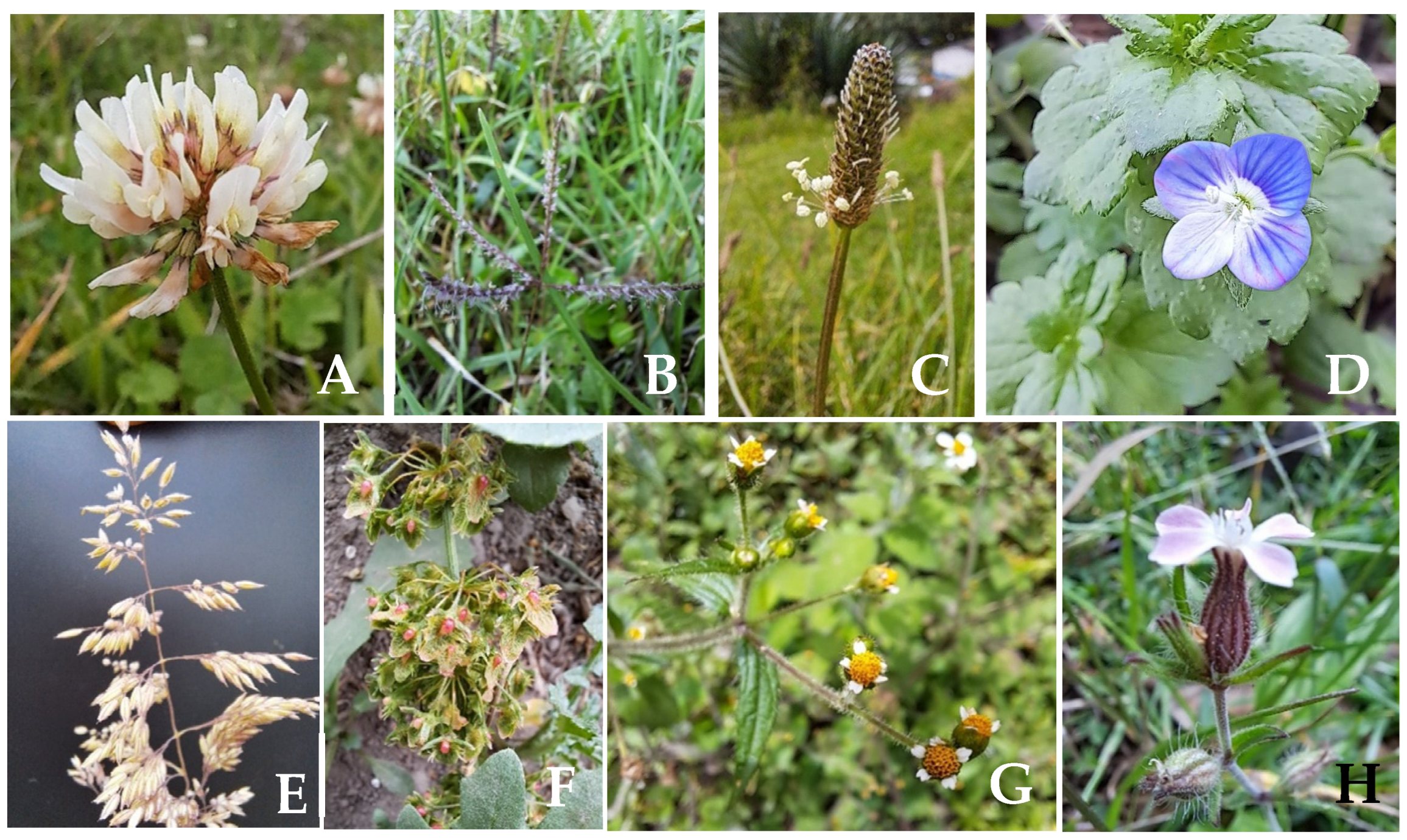


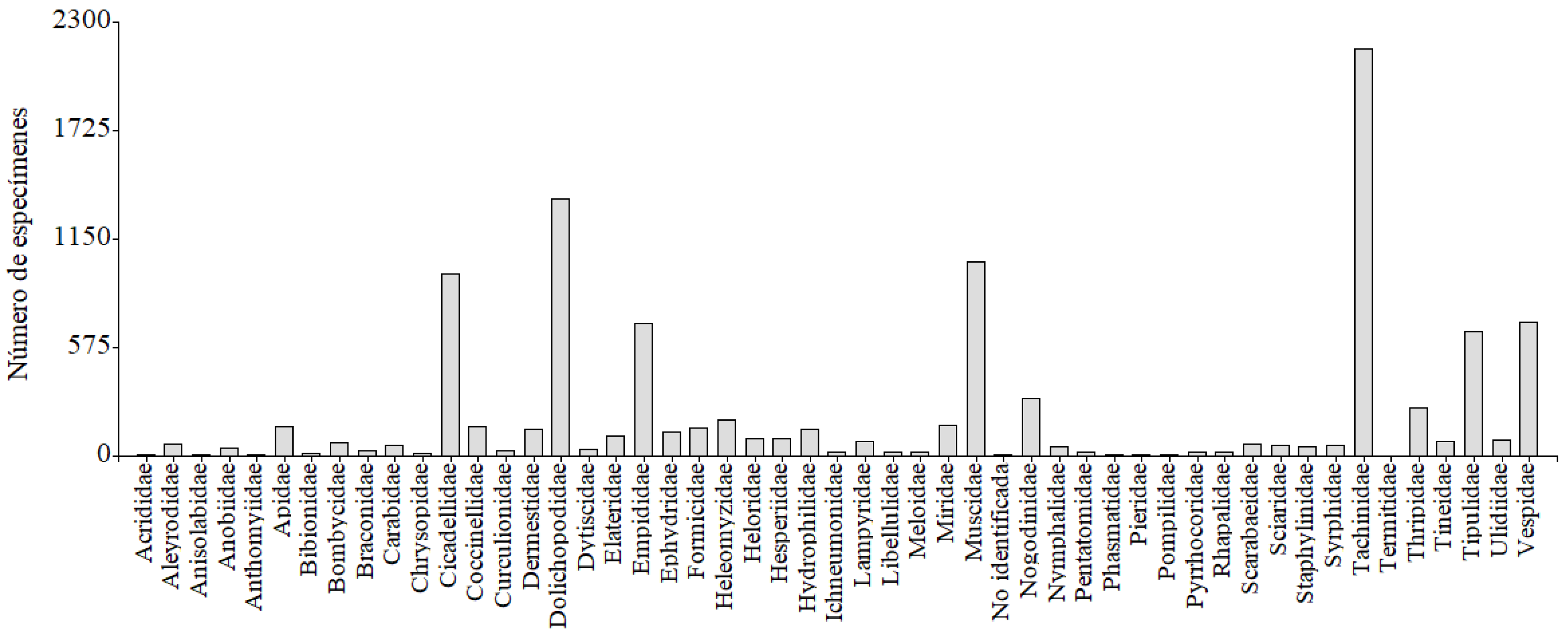


| Botanical Family | Species | Absolute Abundance | Individuals/m2 |
|---|---|---|---|
| Fabaceae | Trifolium repens L. | 26,742 | 102.854 |
| Poaceae | Digitaria ciliaris (Retz.) Koeler | 8819 | 33.919 |
| Plantaginaceae | Plantago lanceolata L. | 5021 | 19.312 |
| Plantaginaceae | Veronica persica Poir. | 4844 | 18.631 |
| Poaceae | Holcus lanatus L. | 3489 | 13.419 |
| Polygonaceae | Rumex obtusifolius L. | 3087 | 11.873 |
| Asteraceae | Galinsoga sp. | 2022 | 7.777 |
| Caryophyllaceae | Silene gallica L. | 1817 | 6.988 |
| Brassicaceae | Sisymbrium officinale (L.) Scop | 1765 | 6.788 |
| Oxalidaceae | Oxalis corniculata L. | 1368 | 5.262 |
| Poaceae | Briza minor L. | 1216 | 4.677 |
| Polygonaceae | Polygonum aviculare L. | 1065 | 4.096 |
| Polygonaceae | Persicaria nepalensis (Meisn.) Miyabe | 1063 | 4.088 |
| Brassicaceae | Raphanus sp. | 969 | 3.727 |
| Asteraceae | Galinsoga quadriradiata Ruiz & Pav. | 901 | 3.465 |
| Brassicaceae | Cotula australis (Sieber ex Spreng.) Hook.f. | 807 | 3.104 |
| Poaceae | Poa annua L. | 722 | 2.777 |
| Poaceae | Paspalum candidum (Flüggé) Kunth | 278 | 1.069 |
| Rubiaceae | Sherardia arvensis L. | 220 | 0.846 |
| Araliaceae | Hydrocotyle bonplandii A. Rich | 160 | 0.615 |
| Asteraceae | Taraxacum officinale (L.) Weber ex F.H.Wigg. | 157 | 0.604 |
| Fabaceae | Medicago lupulina L. | 111 | 0.427 |
| Caryophyllaceae | Cerastium arvense L. | 108 | 0.415 |
| Brassicaceae | Capsella bursa-pastoris (L.) Medik. | 96 | 0.369 |
| Commelinaceae | Commelina erecta L. | 83 | 0.319 |
| Malvaceae | Fuertesimalva limensis (L.) Fryxel | 80 | 0.308 |
| Poaceae | Lolium multiflorum Lam. | 58 | 0.223 |
| Onagraceae | Oenothera pubescens Willd. ex Spreng. | 57 | 0.219 |
| Juncaceae | Juncus imbricatus Laharpe | 47 | 0.181 |
| Fabaceae | Medicago polymorpha L. | 46 | 0.177 |
| Caryophyllaceae | Stellaria media (L.) Vill. | 40 | 0.154 |
| Primulaceae | Anagallis arvensis L. | 37 | 0.142 |
| Poaceae | Anthoxanthum odoratum L. | 34 | 0.131 |
| Caryophyllaceae | Spergula arvensis L. | 33 | 0.127 |
| Poaceae | Avena sativa L. | 32 | 0.123 |
| Asteraceae | Sonchus oleraceus (L.) L. | 31 | 0.119 |
| Cyperaceae | Cyperus brevifolius (Rottb.) Hassk. | 27 | 0.104 |
| Cyperaceae | Cyperus strigosus L. | 23 | 0.088 |
| Montiaceae | Calandrinia menziesii (Hook.) Torr. & A. Gray | 20 | 0.077 |
| Asteraceae | Acmella oppositifolia (Lam.) R.K.Jansen | 18 | 0.069 |
| Asteraceae | Gnaphalium sp. | 17 | 0.065 |
| Lamiaceae | Lamium purpureum L. | 16 | 0.062 |
| Verbenaceae | Verbena litoralis Kunth | 15 | 0.058 |
| Asteraceae | Bidens sp. | 9 | 0.035 |
| Rosaceae | Rubus sp. | 8 | 0.031 |
| Amaranthaceae | Amaranthus sp. | 6 | 0.023 |
| Cyperaceae | Carex sp. | 6 | 0.023 |
| Asteraceae | Erigeron canadensis L. | 4 | 0.015 |
| Polygonaceae | Muehlenbeckia hastulata (Sm.) I.M.Johnst. | 4 | 0.015 |
| Fabaceae | Dalea coerulea (L.f.) Schinz & Thell. | 2 | 0.008 |
| Iridaceae | Sisyrinchium micranthum Cav. | 2 | 0.008 |
| Asteraceae | Baccharis latifolia (Ruiz & Pav.) Pers | 1 | 0.004 |
| Chenopodiaceae | Chenopodium murale L. | 1 | 0.004 |
| Solanaceae | Browallia americana L | 1 | 0.004 |
| Solanaceae | Solanum tettense Klotzsch | 1 | 0.004 |
Disclaimer/Publisher’s Note: The statements, opinions and data contained in all publications are solely those of the individual author(s) and contributor(s) and not of MDPI and/or the editor(s). MDPI and/or the editor(s) disclaim responsibility for any injury to people or property resulting from any ideas, methods, instructions or products referred to in the content. |
© 2026 by the authors. Licensee MDPI, Basel, Switzerland. This article is an open access article distributed under the terms and conditions of the Creative Commons Attribution (CC BY) license.
Share and Cite
Sánchez de Céspedes, I.-S.; Chagna Aguirre, J.A.; Morales Males, M.A.; León-Espinoza, M.E.; Chalampuente-Flores, D.; Prado, J.K.; Giménez de Azcárate, J.; Castillo Carrillo, C. Weed Diversity and Associated Entomofauna in High-Andean Organic Pastures. Sustainability 2026, 18, 1828. https://doi.org/10.3390/su18041828
Sánchez de Céspedes I-S, Chagna Aguirre JA, Morales Males MA, León-Espinoza ME, Chalampuente-Flores D, Prado JK, Giménez de Azcárate J, Castillo Carrillo C. Weed Diversity and Associated Entomofauna in High-Andean Organic Pastures. Sustainability. 2026; 18(4):1828. https://doi.org/10.3390/su18041828
Chicago/Turabian StyleSánchez de Céspedes, Ima-Sumac, Jhadyra Anahí Chagna Aguirre, María Angélica Morales Males, Mónica Eulalia León-Espinoza, Doris Chalampuente-Flores, Julia K. Prado, Joaquín Giménez de Azcárate, and Carmen Castillo Carrillo. 2026. "Weed Diversity and Associated Entomofauna in High-Andean Organic Pastures" Sustainability 18, no. 4: 1828. https://doi.org/10.3390/su18041828
APA StyleSánchez de Céspedes, I.-S., Chagna Aguirre, J. A., Morales Males, M. A., León-Espinoza, M. E., Chalampuente-Flores, D., Prado, J. K., Giménez de Azcárate, J., & Castillo Carrillo, C. (2026). Weed Diversity and Associated Entomofauna in High-Andean Organic Pastures. Sustainability, 18(4), 1828. https://doi.org/10.3390/su18041828



