Review

Clay-Supported Fe3O4 Magnetic Nanocomposites as Adsorbents for Heavy Metal Removal from Water and Wastewater: A Mini Review on Trends and Future Perspectives


by
Charikleia Prochaska
1,*,
Vasileios Tzitzios
2 and
Georgia Basina
2
1
Laboratory of Chemical & Environmental Technology, School of Chemistry, Aristotle University of Thessaloniki, 54124 Thessaloniki, Greece
2
Institute of Nanoscience and Nanotechnology, NCSR Demokritos, 15341 Athens, Greece
*
Author to whom correspondence should be addressed.
Sustainability 2026, 18(4), 1745; https://doi.org/10.3390/su18041745
Submission received: 7 January 2026 / Revised: 28 January 2026 / Accepted: 5 February 2026 / Published: 9 February 2026
(This article belongs to the Special Issue Advances in Research on Sustainable Waste Treatment and Technology)

Abstract

This mini-review presents the major research trends in the synthesis, performance, and mechanisms of clay-supported magnetic iron oxide nanocomposites for the adsorption of heavy metals in water and wastewater treatment applications. The immobilization of iron oxide nanoparticles onto the hydrophilic natural or synthetic nanoclay matrices not only minimized the magnetic nanoparticles’ tendency to aggregate in aquatic solutions but also facilitated their recovery from the solutions via magnetic separation after adsorption. For these reasons, research on such materials emerged in the early 2010s, leading to the development of highly efficient nanocomposite adsorbents. At optimum conditions, including solution pH values between 5 and 7, rapid equilibrium times ranging from 30 to 180 min, and ambient or moderately elevated temperatures (up to 60 °C), maximum adsorption values of up to 225 mg/g were reported for certain heavy metals. Moreover, the nanocomposites demonstrated reusability, maintaining adsorption performance towards heavy metals for up to five adsorption–desorption cycles when common acids (such as HNO3 and HCl) were used as regenerating agents. However, the current findings are all based on batch-scale laboratory experiments. To move toward industrial-scale applications, further research is necessary to address scale-up challenges and evaluate the performance of the clay-supported magnetic iron oxide nanocomposites under real-world conditions. All the critical limitations are highlighted in the context of this mini review to support future efforts toward achieving their economic and environmentally sustainable application for the adsorption of heavy metals from water/wastewater streams.

1. Introduction

Heavy metals are transition or post-transition elements that belong to groups 3 to 16 and period 4 or higher of the Periodic Table. They are characterized by relatively high atomic weights (>40 g/mol) and densities (>5.0 g/cm3). Representative examples include cadmium (Cd), chromium (Cr), cobalt (Co), copper (Cu), lead (Pb), mercury (Hg), and zinc (Zn). Arsenic (As), though a metalloid, is also classified as a heavy metal due to its similar physicochemical properties and toxicity. While Cd, Hg, As, and Pb are highly toxic to both humans and the environment, Cu, Co, and Zn can also be harmful at high levels [1]. Heavy metals enter the environment through both natural events (e.g., volcanic eruptions) and, more importantly, through industrial activities (e.g., metallurgical processes, electroplating, electrical and electronics manufacturing, and paint production, among many others). These metals can pollute soil and water, enter the food chain, and bioaccumulate in plants, animals, and humans. Adverse health effects in humans and animals have been reported, including neurological damage, organ failure, reproductive issues, and disruption of aquatic ecosystems [1,2]. For this reason, they are considered a major environmental challenge today, and therefore, different technologies have emerged [3] for either treating industrial effluents containing heavy metals before they are safely discharged to the environment [2] or remediating polluted water bodies contaminated with heavy metals [4].
Among the most widely used technologies, such as chemical precipitation [5,6], membrane filtration [7,8], and ion-exchange [5,9], adsorption is preferred due to its simplicity and cost-effectiveness [7]. Such advantages have been enhanced by advances in the nanoscale science over the last decade [10], particularly via the development and testing of new two-component nanocomposite materials as heavy metals adsorbents. By combining the properties of both their individual components, those materials exhibit enhanced properties at the nanoscale (typically less than 100 nm in at least one dimension), including higher adsorption efficiency, thermal stability, specific surface area, and improved regeneration efficiency [11,12] Among the three classes of nanocomposite adsorbents that have been investigated over the last decade for the removal of heavy metals from water and/or wastewater, distinguished by their matrix type are: ceramic-based (silica, alumina, clay) [13], polymer-based [14,15] and metal-based nanocomposites [16,17,18,19,20]. Regarding ceramic-based materials, special focus has been given to magnetic iron oxide/clay nanocomposites [11,21,22,23].
The three crystalline types of magnetic iron oxide [24], maghemite (γ-Fe2O3), magnetite (Fe3O4), and hematite (α-Fe2O3), are the most studied nanomaterials, used to create the nanocomposite mainly due to their high surface area and superparamagnetism in the nanoscale (nanoparticle sizes less than 20 and 25 nm) [23,25]. Using bare iron oxide nanoparticles in water treatment processes is difficult, as they tend to agglomerate during synthesis and are oxidized easily with air (especially magnetite and maghemite), eliminating their dispersibility and magnetism [26]. Therefore, studies on testing bare magnetic iron oxide nanoparticles for adsorbing heavy metals from aqueous media are limited. Nevertheless, relative studies have reported a maximum adsorption capacity of 4.6 mg/g for Pb(II) by using γ-Fe2O3 nanoparticles (60 nm in size) [27]. γ-Fe2O3 nanoparticles of about 14 nm in size, effectively removed Cu(II), Cr(VI), Mn(II), Ni(II), and Cd(II) ions from simulated wastewater, with the respective maximum adsorption capacities being of 24.44, 24.21, 23.47, 22.29, and 19.72 mg/g [28]. γ-Fe2O3 nanoparticles (12 ± 1 nm) achieved adsorption capacities of 5.680 mg/g for As(III) and of 4.780 mg/g for As(V) [29], while higher adsorption capacities for the removal of arsenic contaminants, of 67.02 mg/g for As(III) and 95.37 mg/g for As(V), were reported, with smaller in size nanoparticles, ranging in sizes between 7 and 12 nm [30]. Fe3O4 nanoparticles (20–30 nm in size) achieved an adsorption capacity of 36 mg/g for Pb(II) [31]. Using Fe3O4 nanoparticles of 100 nm, an adsorption capacity of 88.19 mg/g was achieved for trace arsenite As(III) concentrations [32]. Hematite nanoparticles (37.0 nm in size) adsorbed heavy metal ions in the following order: Cu(II) (5.39 mg/g) > Cd(II) (4.21 mg/g) > Pb(II) (1.5 mg/g) > Zn(II) (0.87 mg/g) [33]. In summary, the particle size and surface structure area of the magnetic nanoparticles, as well as the hydrated ionic radius of the examined heavy metals, influence the adsorption efficiency [34].
On the other hand, [35,36,37,38] clays, especially natural ones, are considered economical materials and demonstrate reusability in water treatment applications [39]. Clay minerals, particularly bentonite, a type of clay primarily composed of montmorillonite, are selected as support matrices for iron oxide nanoparticles due to their high cation exchange capacity (CEC = 80–120 cmol/kg), which facilitates the immobilization and dispersion of the iron oxide nanoparticles [40]. Clays also possess a high specific surface area (typically 200–350 m2/g for montmorillonite-type clays) [10], which is advantageous for supporting nanoparticles and enhancing their dispersion. In addition, clays remain stable over a wide pH range (3–12) and at temperatures up to 250 °C [41]. This stability is important for maintaining the integrity of iron oxide nanocomposites during both synthesis and application [42]. Several researchers have examined the use of clays as stand-alone adsorbents for heavy-metal removal in laboratory-scale experiments. Natural kaolinite has been examined for the adsorption of Cd(II), Co(II), Cu(II), Pb(II), and Ni(II) ions from aqueous media, with a reported adsorption capacity of 11.1 mg/g for Pb(II) ions at pH 7 [43]. In another study, kaolinite clay was examined for Zn(II) ions removal, demonstrating an adsorption capacity of 12.23 mg/g at pH 6.1 and 25 °C [44]. Clays of the smectite family, particularly montmorillonite and bentonite, have been extensively investigated. Montmorillonite clay has been investigated for Pb(II) ions adsorption, with a reported maximum adsorption capacity of 28 mg/g [45]. Bentonite has also been examined for the removal of Cu(II), Co(II), Ni(II), and Pb(II), with an adsorption capacity for Pb(II) reaching 59.7 mg/g [46]. A synthetic laponite nanoclay with a uniform particle size of 25 nm was examined as an adsorbent for Ni(II), with a reported adsorption capacity of 65.79 mg/g [47]. The above-mentioned adsorbed heavy metals form surface functional groups on the above literature-reviewed clay minerals and, when researched for their selectivity, they exhibit a selectivity sequence of Pb > Cu > > Zn > Co > Ni > Cd, which is governed by the combined effects of ionic size, charge density, and the strength of interactions between the clay surfaces and the heavy metal ions [48].
Such results led researchers in the early 2010s to combine the properties of iron oxide nanoparticles, especially magnetization, with those of natural or synthetic nanoclays, aiming to generate highly efficient heavy metal adsorbent nanocomposite materials, where the iron oxide nanoparticles are immobilized onto the support structure of the hydrophilic nanoclay matrix, minimizing the co-aggregation of the iron oxide nanoparticles and improving their separation from the solution after adsorption, as plain clay adsorbents are managed difficultly due to their low mechanical stability and high dispersion [49]. The interlayer spaces, tunnels, channels, surfaces, and edges of these two-dimensional layered clay minerals, either natural or synthetic, act as hosting, stabilizing, and controlled modulation sites for the iron oxide magnetic nanoparticles. This leads to the formation of a distinct class of functional magnetic iron oxide nanoparticle/clay mineral nanocomposites [50] with improved structural stability, facile magnetic recovery, and enhanced heavy metals adsorption efficiency, compared to bare iron oxide nanoparticles or standalone clays [10]. Although both bare γ-Fe2O3 and Fe3O4 exhibit high heavy-metal adsorption capacities, nanocomposite research predominantly focuses on Fe3O4 due to its mixed Fe2+/Fe3+ valence, higher saturation magnetization, and superior compatibility with clay matrices, which collectively enable enhanced adsorption performance [51]. In this regard, Kalantari et al. [52] examined the performance of Fe3O4/talc nanocomposite in removing heavy metal ions from an aqueous solution. The nanocomposite (2.4 g/L) achieved rapid adsorption within 2 min for Pb(II) (102.8 mg/g), Ni(II) (19.3 mg/g), and Cu(II) (30.1 mg/g). These results demonstrate the nanocomposite’s effectiveness even at relatively high metal concentrations, specifically 270 mg/L for Pb(II), 92 mg/L for Ni(II), and 100 mg/L for Cu(II). Similarly, Lasheen et al. [53] reported the adsorption capacities of metal ions for Fe3O4/kaolinite nanocomposite following the order: Pb(II) 106 mg/g, Cr(VI) (100 mg/g), Cu(II) 98 mg/g, and Cd(II) 97 mg/g. Adsorption by the nanocomposite reached equilibrium at 120 min and was optimal at pH 5 and with an adsorbent dose of 2 g/L. Over the past 10 years, numerous research articles have focused on the application of Fe3O4/bentonite nanocomposites for the removal of various heavy metals from aqueous solutions. The reported maximum adsorption capacities were: 67.9 mg/g for Cd(II) ions [54], 18.76 mg/g for Co(II) ions [55], 46.948 mg/g for Cu(II) ions [56], 66.04 mg/g for Cr(III) ions [57], and 108.69 mg/g for Pb(II) ions [58].
This work aims to provide a focused overview of current research trends and future perspectives on clay-supported Fe3O4 nanocomposites used for heavy-metal adsorption from water and wastewater. As a mini-review, it assesses only studies that integrate synthesis, characterization, application, and/or regeneration of the adsorbents and highlights the highest-performing Fe3O4/clay nanocomposites reported in the literature. Using this approach, key factors influencing adsorption efficiency are identified and discussed, along with the most notable limitations that need to be addressed. In addition, key insights that are often overlooked in broader review contexts, particularly those related to sustainable development and the potential scale-up of the process, are also identified and discussed. Together, these findings aim to guide researchers in optimizing Fe3O4/clay nanocomposite adsorbents for more effective heavy-metal removal from water and wastewater.

2. Synthesis

Most research groups have used the co-precipitation method to synthesize magnetic nanocomposites. Solutions of Fe(II) and Fe(III) salts at a molar ratio of 1:2 are added to the clay suspension [50,52,54,55,57,58,59]. Then, a solution of NaOH or NH4OH [48,49] is added dropwise to achieve a pH of 9–11 within 30–60 min. The mixture is continuously stirred and usually heated at 60–110 °C for 0.5–4 h after the addition of the alkaline solution, while synthesis at ambient temperature and in a nitrogen atmosphere has also been reported [52,54]. The produced black nanocomposite precipitates in a sol–gel pattern. After cooling, the product is magnetically separated, filtered, and washed with distilled water till a neutral pH is reached. The obtained material is then oven-dried at 80–100 °C for 3–24 h. After cooling, grinding/pulverizing the product in a mill may follow [50] before keeping the product in sealed containers for further use. The reactions involved in the synthesis of Fe3O4/clay are as shown in Reactions 1 and 2 [57].
Fe2+ + 2Fe3+ + 8OH → Fe3O4 + 8Na+ + 4H2O
Fe3O4 (s) + clay + H2O → Fe3O4-clay
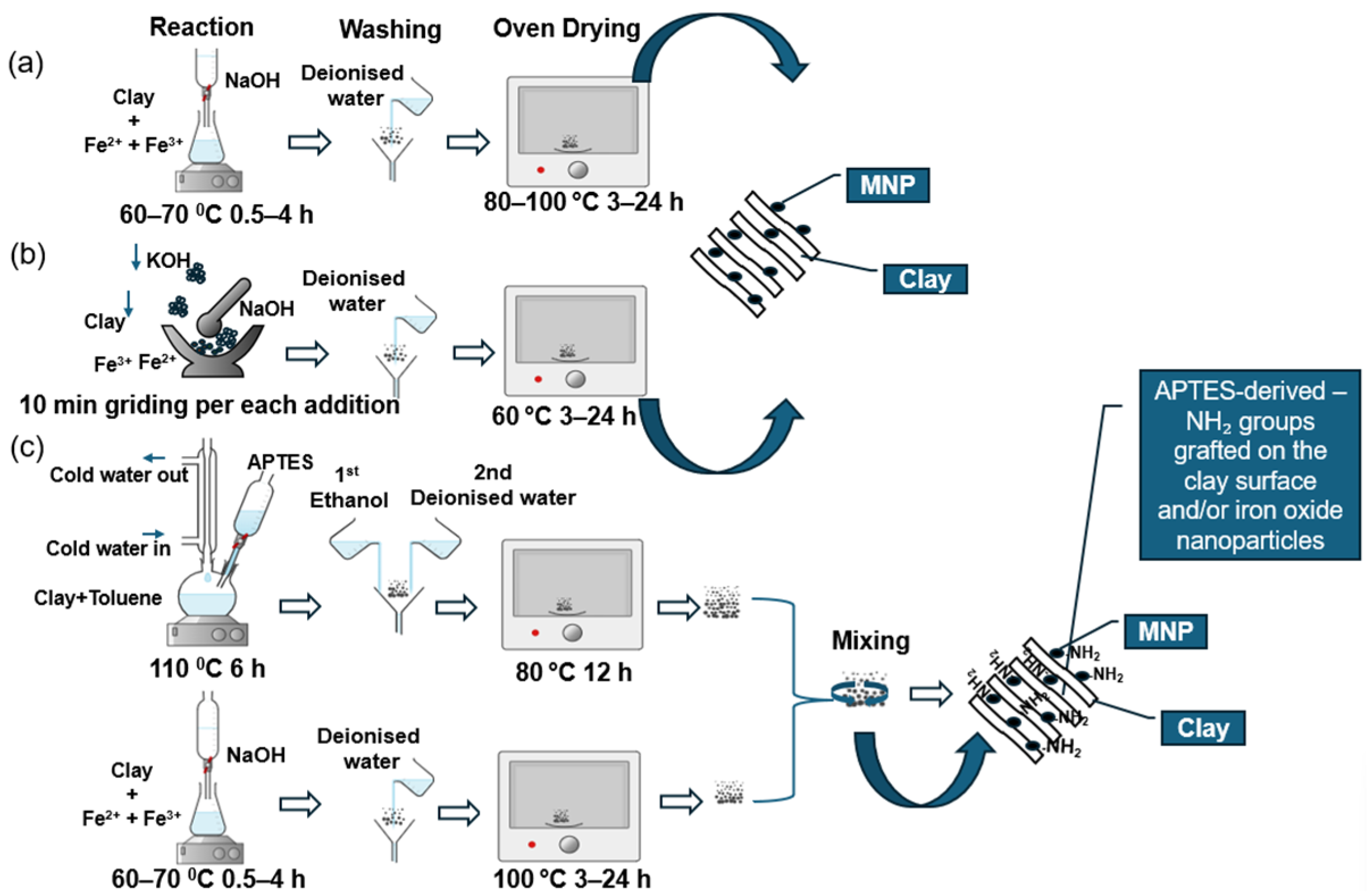
Instead of following the above co-precipitation method, Janacek et al. [60] reported preparing the magnetic halloysite nanocomposite using a mechanochemical synthesis procedure. Although their study focused on silver nanoparticle removal from aqueous solutions rather than dissolved silver or other heavy metal ion removal, the magnetic Fe3O4/clay composite they developed illustrates the potential of their synthetic procedure for nanocomposites designed for heavy metal adsorption applications, provided that the experimental conditions are adjusted for the specific metal ions. For this reason, their proposed procedure is included here. Briefly, the nanocomposite was obtained by mixing/grinding 1.35 g of FeCl3·6H2O, 0.50 g of FeCl2·4H2O and 4 g of NaCl in a mortar, at room temperature for 10 min. A total of 1 g of halloysite clay was then added, and the above process was continued for an additional 10 min. The final product was obtained by adding 1.22 g of powdered KOH and mixing/grinding for an additional 10 min. The obtained material was rinsed with deionized water and dried at 60 °C for 3–24 h. In a more recent study, combined Aminopropyltriethoxysilane (APTES) and iron oxide chemical modifications on iron-based natural smectite nano-clay (natively found in Peru and known as chak’o nano-clay) were used, aiming to produce a more efficient nanocomposite material via the incorporation of the amine (-NH2) functional groups, enhancing the removal of cationic metal ions through electrostatic interactions and complexation [61]. For the dual functionalization, first, the nano-clay underwent APTES treatment: 10 g of purified chak’o nano-clay was dispersed in 200 mL of anhydrous toluene, and 5% (v/v) APTES was added. The mixture was stirred and refluxed at 110 °C for 6 h. After cooling, the product was washed (first with ethanol and then with deionized water) and dried at 80 °C for 12 h. The APTES-modified clay was then combined with the iron oxide nanoparticles produced by co-precipitation. As an overview of the aforementioned synthetic approaches, co-precipitation is predominantly used due to its simplicity. Though the dual functionalization approach adds more steps and complexity, it offers the advantage of introducing specific binding sites and the potential for tailored selectivity towards targeted heavy metals. Mechanochemical synthesis may offer better control over the dispersion of iron oxide nanoparticles within the clay matrix, especially with high-energy milling, which enables atomic-level mixing of precursors, nucleation, and growth of new product phases [62], though further research is needed to optimize this approach for iron Fe3O4-clay systems that are synthesized specifically for heavy metal adsorption applications. Figure 1 graphically illustrates the above synthetic procedures. The magnetic particles are distributed both on the surface of the clay and in the spaces existing within the clay interlayers [21].

3. Adsorption Behavior of the Nanocomposites

3.1. Key Physicochemical Characteristics of Nanocomposites Influencing Adsorption

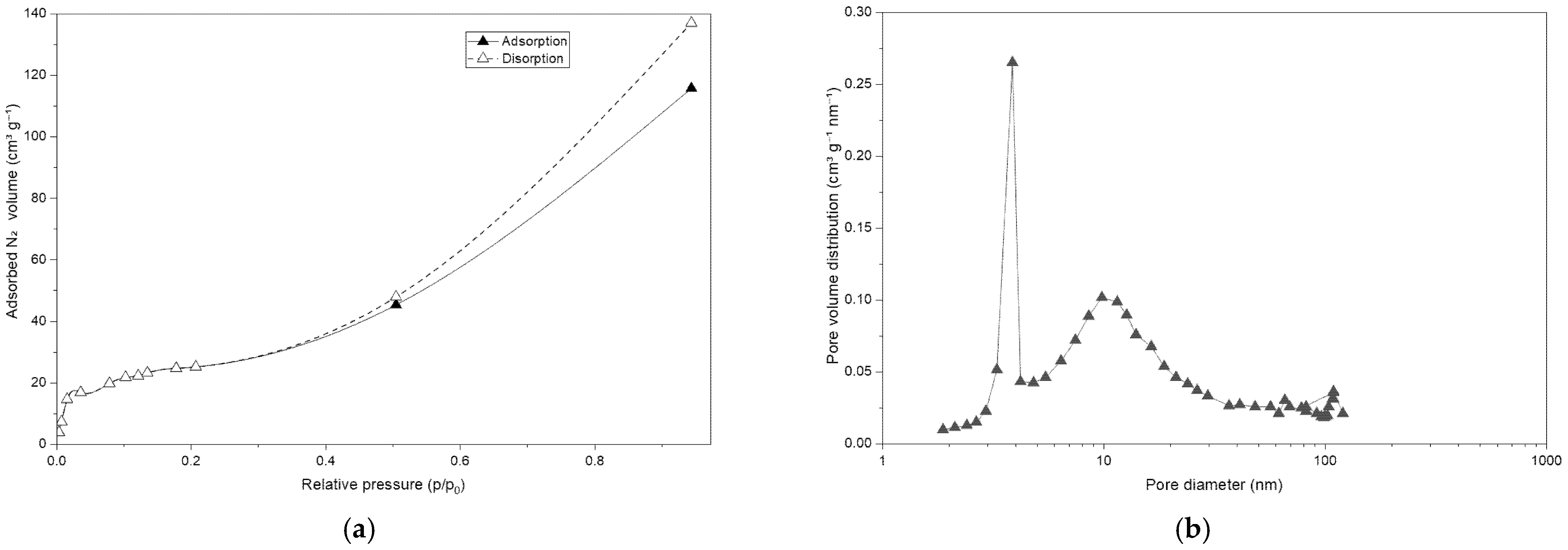
SEM (Scanning Electron Microscopy) and TEM (Transmission Electron Microscopy) analyses of Fe3O4 nanoparticles synthesized via the co-precipitation method have reported a mean diameter of 7–11 nm [53,54], supporting their classification as nanocomposites [59]. In clay composites, Fe3O4 nanoparticles are predominantly spherical. Although other morphologies—such as rod-like, cubic [63], hollow [64], raspberry-like [65], and flower-like [66] structures—have been synthesized for Fe3O4 and related iron oxides, there is no evidence of their direct incorporation into clay composites synthesized specifically for heavy metal adsorption applications. The spherical Fe3O4 nanoparticles were well-dispersed within and on the clay layers, with some aggregation observed due to Fe3O4’s magnetic nature [54]. The resulting nanocomposites exhibited saturation magnetization values, obtained by Vibrating Sample Magnetometer (VSM), sufficient for magnetic separation. An increase in the Fe3O4/bentonite molar ratio used in the synthesis corresponded to a decrease in the saturation magnetization, due to the presence of clay on the magnetite nanoparticles’ surfaces, which formed a non-magnetic layer. Thus, a saturation magnetization value of 5.8 emu/g was reported when a Fe3O4/clay weight molar ratio of 1:10 was used [59], and a value of 38.2 emu/g when a Fe3O4/clay weight molar ratio of 1:1 was used to create the respective nanocomposite [53]. The magnetic nanoparticles produced by the mechanochemical method had diameters of 26–31 nm and a saturation magnetization of 2.08 emu/g [60]. The obtained dual-modified (APTES + iron oxide) nanocomposite exhibited a magnetization value of 39 emu/g [62]. Values of the BET (Brunauer–Emmett–Teller) method, calculated from the N2 adsorption/desorption isotherm data, showed a surface area that ranged from 49 m2/g for magnetic halloysite nanocomposite [60], to 62.303–140.5 m2/g for magnetic bentonite nanocomposites [54,55,56] and reached the value of 350 m2/g for the dual-modified (APTES + iron oxide) chak’o nanocomposite [61]. Figure 2a shows a representative nitrogen adsorption–desorption isotherm of such nanocomposites, as reported by Orolinova et al. [54] for the Fe3O4/bentonite nanocomposite (SBET = 90.68 m2/g). As seen in Figure 2, such nanocomposites exhibit nitrogen isotherms that correspond to the Type IV isotherm with an H3 hysteresis loop, characteristic of mesopore structures with slit-like pores according to the IUPAC report [67], formed by layered clay particles and deposited Fe3O4 nanoparticles. The total pore volume, obtained from the BJH (Barret–Joyner–Halenda) method, varied from 0.178 to 0.6 cm3/g [56,58,61], and the obtained average pore diameter was in the range of 9.111–9.614 nm [56,58,61] for the single modified Fe3O4/clay nanocomposites, to 4.1 nm [62] for the dual modified APTES + iron oxide/clay nanocomposite. The pore volume distribution of such nanocomposites further confirms the mesoporous structure, with the most prominent part of the distribution typically in the 2–20 nm range, due to iron oxide nanoparticles deposited on the clay surfaces, as depicted in Figure 2b. The average pore diameter of 4.1 nm for the dual modified APTES + iron oxide/clay nanocomposite is particularly advantageous for heavy metal adsorption, as pores ~4 nm are on the lower end of mesopores, which is often ideal for adsorption of heavy metal ions as they present a hydrated ionic diameter in the range of ~0.1–0.5 nm [68]. In summary, incorporating iron oxide nanoparticles into the clay matrix decreases pore diameter while increasing overall pore volume and surface area, properties that enhance adsorption effectiveness in environmental applications, such as heavy-metal removal from water and wastewater. However, excessive loading of Fe3O4 may block pores and reduce pore accessibility, highlighting the need for further research on optimizing nanocomposites’ synthesis.
The zeta potential is another important parameter for the magnetic iron oxide/clay nanocomposites, as it reflects the surface charge of particles in suspension. This directly affects the nanocomposites’ adsorption efficiency for removing cationic heavy metals and their colloidal stability in aqueous media. However, in the literature, only a limited number of research articles report zeta potential values, possibly because the low particle concentration in the prepared dispersions for electrokinetic experiments makes it difficult to obtain representative and reliable results. Nevertheless, Orolinova et al. [54] reported that the electrokinetic response of the Fe3O4/bentonite nanocomposite displayed a net negative charge above-15 mV at all pHs, providing a good adsorption potential for cations (like heavy metals) and a moderate colloidal stability that can lead to aggregation of the nanocomposite’s particles. Dynamic light scattering (DLS), often measured alongside zeta potential in modern instruments, provides rapid, convenient information on the particle size distribution of synthesized nanocomposites. Yaulilahua-Huacho et al. [61] reported that the particle size distribution of the dual-modified (APTES + Fe3O4) nano-clay produces a primary peak at ~350 nm and a broad secondary peak approximately at 750 nm. Such an outcome was attributed to the formation of a thicker surface layer on the clay particles due to the combined functionalization effect. Furthermore, the broader distribution indicated higher particle aggregation, due to stronger interactions and magnetic attractions. Table 1 summarizes the key physicochemical properties influencing the adsorption efficiency of the nanocomposites for heavy metal removal in water/wastewater. The optimal values of the respective properties, along with key observations, are also presented.

3.2. Nanocomposites Adsorption Efficiency

Adsorption by the clay-supported iron oxide magnetic nanocomposites reached equilibrium rapidly, with reported optimal contact times ranging from 10 to 180 min. The adsorption process was most effective at pH 5–7, which is favorable for maintaining the nanocomposite’s stability and preventing precipitation of the targeted metal ions. The initial ion concentration was in the range of (0.5–800 mg/L). The tested adsorbent dosages varied from 0.25 to 5 g/L, with lower dosages yielding higher adsorption capacities per unit mass (mg/g) due to normalization by adsorbent mass. While most studies took place at an ambient temperature of 25 °C, when the temperature was increased, e.g., to 40 °C [57], or 60 °C [55], an increase in the feasibility of adsorption was reported. The adsorption was better described by the Langmuir isotherm and the pseudo-second-order (PSO) kinetic model, indicating monolayer adsorption and chemisorption, respectively, with the exception of Cr(III) adsorption onto Fe3O4/bentonite, which followed the pseudo-first-order (PFO) kinetic model, indicating that diffusion rather than chemical bonding was the rate-limiting step [11,57]. When thermodynamic studies were conducted, the analyses reported negative values of the Gibbs free energy change (ΔG°), indicating spontaneous adsorption under the studied conditions [55,57]. Table 2 presents the most efficient nanocomposite per heavy metal ion, in descending order of maximum adsorption capacity (qmax), as this is calculated from Langmuir’s isotherm. The isotherm can be represented by the following linearized equation [53]:
C e q e = 1 K L q e + C e q max
where qmax (mg/g) is the maximum adsorption capacity at complete monolayer coverage, KL (L/mg) is the Langmuir constant, related to the affinity of the nanocomposite towards the heavy metal ions, qe (mg/g) is the amount of the respective heavy metal adsorbed per unit mass of the nanocomposite at equilibrium, and Ce is the equilibrium concentration of the respective heavy metal in solution (mg/L). In addition to qmax, the Partition Coefficient (PC), as calculated from the following equation, is also presented in Table 2 [69].
PC = q max % R   C 0
In Equation (4), %R is the removal efficiency, and C0 is the initial metal concentration in mg/L [69].
As seen in Table 2, among the studied systems, the APTES + Fe3O4/chak’o nano-clay composite, due to its multi-functionality, demonstrated the highest adsorption efficiency, particularly for Pb(II) (225 mg/g) and As(V) (180 mg/g) [61]. Fe3O4/kaolinite showed a versatile adsorption, with adsorption capacities of metal ions following the order: Cr(VI) (100 mg/g) > Cu(II) (98 mg/g) > Cd(II) (97 mg/g) > Ni(II) (95.2 mg/g) [53]. The Fe3O4/bentonite composite demonstrated an adsorption capacity of 66.04 mg/g for Cr(III) [57]. While Co(II) adsorption on Fe3O4/bentonite showed the lowest reported capacity of 18.76 mg/g [55], attributed to the weak interaction between the divalent cobalt ions and the nanocomposite. Based on the literature, the adsorption capacities reported in Table 2 are among the highest for nanocomposite-based heavy metal adsorption from aqueous media. Commercially used adsorbents, such as activated carbons, in water/wastewater treatment usually exhibit lower adsorption capacities (mg/g) in the range of tens, not hundreds, of mg/g under real operating conditions [70,71,72]. This highlights the potential of the clay-supported iron oxide magnetic nanocomposites for real-world applications.
Although APTES + Fe3O4/chak’o nano-clay exhibited the highest Langmuir adsorption capacities, it was Fe3O4/kaolinite that produced the higher partition coefficients among the discussed nanocomposites, due to the lower initial concentration used for its evaluation. This confirms that adsorption capacity and partition coefficient reflect different aspects of adsorption performance, and that PC provides a more objective comparison of the nanocomposites’ adsorption performance, especially when initial concentrations and system conditions differ [73]. Table 2 presents qmax PC, textural properties, optimum experimental conditions, and best-fit kinetic model parameters for the discussed nanocomposites, providing a facile overall comparison of their adsorption efficiency.

3.3. Nanocomposites Adsorption Mechanism

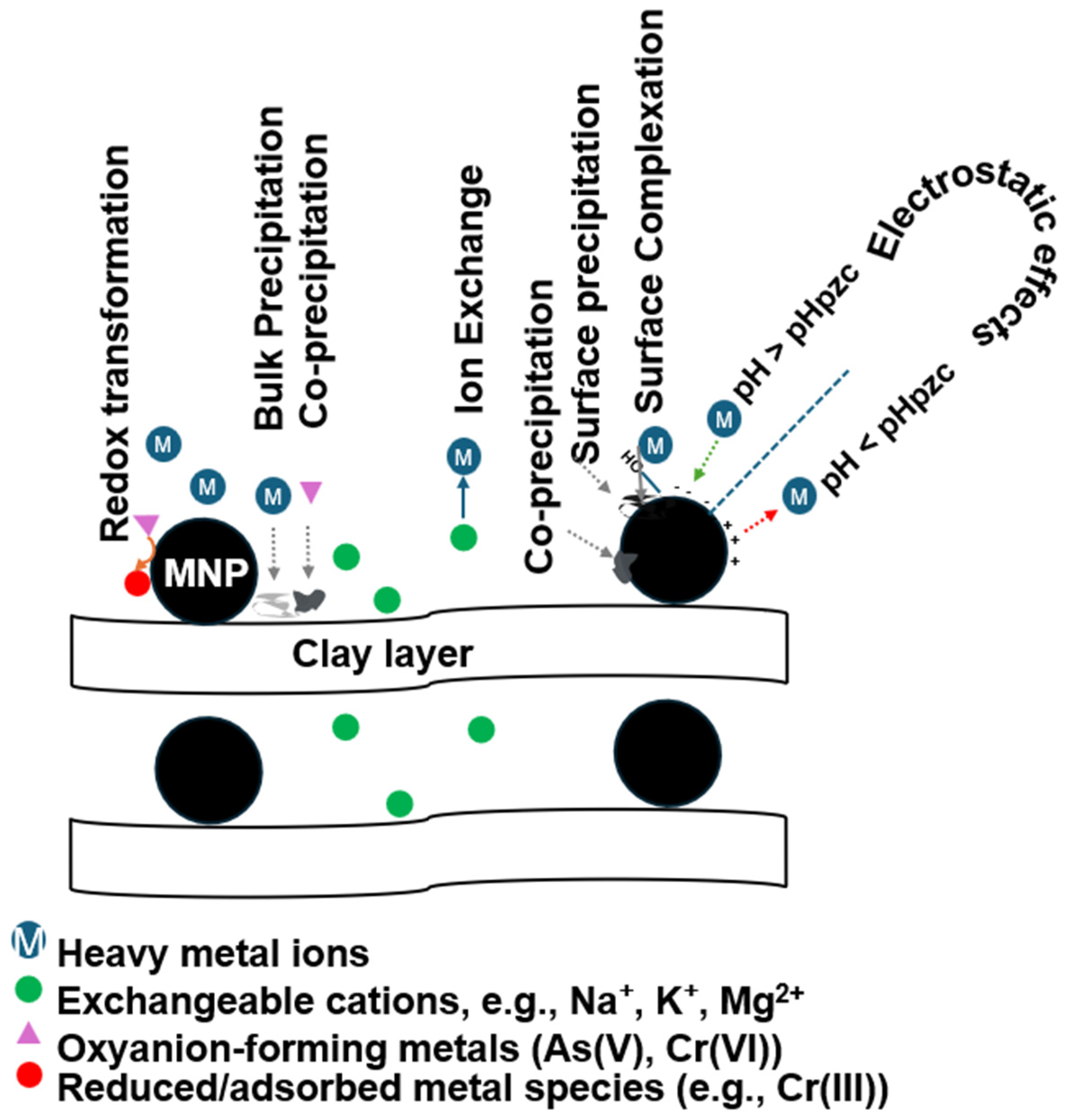
The adsorption mechanism pathway for heavy metal removal by clay-supported Fe2O4 magnetic nanocomposites from aqueous solutions involves ion exchange, electrostatic interactions, surface complexation, co-precipitation, and redox reactions, all of which contribute to the overall process. The high surface area of the clay-supported iron oxide magnetic nanocomposites provides the relevant active sites where physical adsorption via Van der Waals and chemical interactions via ionic bonding take place [54,56]. Exchangeable cations, such as, e.g., Na+, K+, Mg2+, present in particular in the interlayer spaces of the layered structured clays (bentonite, montmorillonite, Chak’o nano-clay) and, to a lesser extent, on the surfaces of the non-layered clays (kaolinite, halloysite, palygorskite), can be exchanged by the heavy metal cations present in the aqueous solution. The ion exchange mechanism occurs in a neutral to slightly acidic solution, where the metal ions remain soluble. Ion exchange proceeds rapidly due to the high mobility of interlayer cations. The exchanged cations (e.g., Na+, K+, Mg2+) do not cause water pollution [74]. The surface charge of the nanocomposites is important in determining their adsorption capacity and is also influenced by solution pH. The surface of the nanocomposites becomes positively charged in solution pH values below the pH of the point of zero charge (pHpzc) due to the protonation of the hydroxyl and silanol groups of the supported clays. Therefore, the positively charged heavy metal ions are electrostatically repelled from the nanocomposite’s surface. In contrast, cationic heavy metal ions are attracted and bind electrostatically to the nanocomposites’ surfaces at pH values above the pHpzc, when the nanocomposite surface becomes negatively charged [57]. Electrostatic interactions help bring the targeted metals closer to the nanocomposite’s surface, thereby providing the basis for complexation or precipitation mechanisms. The functional groups present on the surface of the nanocomposites, such as e.g., Fe–OH, Si–OH, and Al–OH, serve as active sites for the complexation with the metal ions to proceed [75,76]. Furthermore, co-precipitation may occur as the solution becomes saturated with metal hydroxides (e.g., when pH or iron oxides concentration is raised). Insoluble precipitates—either as pure or mixed iron-metal hydroxides—are formed, which may either settle or become embedded on or within the nanocomposite structure [58]. The co-precipitation has been reported for oxyanion-forming metals like As(V) and Cr(VI), as their anionic species can also bind or precipitate with iron oxides [57,77]. For Cr(VI), the redox mechanism may also occur; Fe2+ within Fe3O4 can reduce Cr(VI) species (e.g., CrO42−) to Cr(III) [78]. Figure 3 provides a graphical representation of the mechanisms involved in the removal of heavy metals by clay-supported Fe3O4 magnetic nanocomposites from aqueous solutions, occurring on iron oxide magnetic nanoparticle (MNP) surfaces, between the clay interlayers, and in the bulk solution.

3.4. Nanocomposites Reusability

To ensure the sustainability of clay-supported Fe3O4 magnetic nanocomposites for the removal of heavy metals from aqueous media, batch lab studies have focused on their regeneration and reuse, most commonly via chemical regeneration. The critical factors in determining the best chemical desorbing agent include the cost of the agent, the required process time, and the number of cycles that the nanocomposite can retain its adsorption capacity [79]. HCl and HNO3 have been the most efficient for desorbing the heavy metals from these adsorbents, due to their economic affordability and because the heavy metals are more favorably adsorbed by them under neutral to slightly alkaline pH conditions [80]. When 0.1 M of HCl was used as the desorption agent, a recycling capacity greater than 88% was reported after three subsequent cycles of adsorption–desorption (100 mg/L of metal was used at each adsorption cycle) [61]. Meanwhile, in another study, the employment of the stronger in acidity 0.5 M HNO3 managed to retain 100% of the initial adsorption capacity after five subsequent cycles of desorption–adsorption (100 mg/L of metal was used at each adsorption cycle) [53]. Table 3 summarizes the results of these two notable studies, where high or complete adsorption capacity was retained over 3–5 adsorption–desorption cycles, under acidic chemical regeneration conditions.

4. Summarized Discussion and Future Perspectives

This mini-review summarizes research on clay-supported Fe3O4 magnetic nanocomposites used as adsorbents for the removal of heavy metals from water and wastewater streams. The removal is achieved by a multi-mechanistic pathway, where adsorption is the primary process, while ion-exchange [74], electrostatic attraction [75], surface complexation [76], redox reactions [78], and co-precipitation [58] also take place. Optimum conditions for efficient heavy-metal removal include a pH range of 5 to 7. Equilibrium is reached within a time range of 30–180 min and at ambient temperature or at a temperature that does not exceed 60 °C [53,55,57,60,61]. Chemical regeneration of the nanocomposites, using common acids, and the reusability results that reach up to five subsequent cycles of adsorption–desorption [53,61] provide a solid foundation for their broader future applicability.
However, as all the results presented here come from batch adsorption studies at the laboratory scale, certain aspects need further investigation to enable process scaling and achieve effective, real-world industrial-scale applications in the water/wastewater treatment sector.
Most importantly, as the industry relies on continuous mode processes for removing heavy metals from wastewater streams, a step forward from batch-mode to continuous-mode studies is essential to further validate the adsorption results and lay the ground-work for subsequent industrial applications. Due to the feasibility of the nanocomposites and the optimum adsorption conditions obtained from the batch lab-scale experiments [81], scale-up is likely to be more feasible in reservoirs than in continuous-flow inside columns. This viewpoint is further supported by the unfavorable heavy metal ions adsorption rates reported in the limited studies using other types of magnetic nanocomposites, e.g., synthetic polymer/magnetic iron oxide [82] or carbon-based/magnetic iron oxide [83] in laboratory-scale continuous adsorption-mode column experiments.
Another important aspect of future research is the selectivity of the adsorbents towards various heavy metals. The reviewed studies focus on the removal of single metals, and this distances the clay-supported iron oxide magnetic nanocomposites from being ready for real-scale applications. Additional studies are required for assessing the efficiency of the adsorption not only in the presence of multiple heavy metals but also in the presence of the various contaminants that are present in industrial effluents, such as organic pollutants (e.g., dyes, pharmaceutical residues, pesticides, and herbicides) [84] and inorganic pollutants (e.g., nitrates and nitrites, phosphates, ammonia, cyanides, sulfates, chlorides) [85].
Moreover, the adsorption efficiency in the presence of microplastics demands further investigation, as microplastics can also adsorb heavy metals [86]. They can either compete or enhance the overall adsorption performance and are often present together with heavy metals in various industrial wastewater streams, including dyeing and metal plating effluents, as well as in urban runoffs from industrial areas [87]. In such cases, further assessment is needed on whether the adsorption should be coupled with the application of pre-treatment techniques, such as, for instance, sieving, filtration, or coagulation, which enable microplastics removal [88]. But when microplastics of less than 1 μm in diameter are present in the wastewater effluents, more advanced pretreatment processes (e.g., ultrafiltration, coagulation–flocculation) are needed before adsorption with the nanocomposites takes place [89]. Such additional steps not only make the process more time-consuming but also incur costs that need to be thoroughly evaluated for economic feasibility.
The alignment of the process with circular economy principles [90,91], zero-waste policies [92], and the broader environmental sustainability concept should not be overlooked. The regeneration of spent adsorbents represents a first step in this direction, but, again, all efforts remain limited to the lab-scale batch experimental level. Also, the proper reuse of the adsorbed heavy metals should be a matter of further concern.
When aiming towards full-scale applications, the issue of upscaling of the synthetic approach of the clay-supported iron oxide magnetic nanocomposites also needs to be addressed, and under the prism of the Green Chemistry principles [93,94]. Furthermore, developing an adequate magnetic separation system is another necessary issue that demands attention, since, till now, separation has been performed manually, by approaching a commercial magnet to the experimental vial in the laboratory setup.
Studies dedicated to life cycle assessment and economic assessment [94], e.g., via cost–benefit analysis of the process, could deal with the concerns regarding ecotoxicity [95] of the clay-supported Fe3O4 magnetic nanocomposites, especially when these nanocomposites reach the end of their life cycle and require proper disposal. Such analyses, which are currently very limited in the literature, will guide the necessary adjustments to achieve sustainability.
An overview of the key aspects this review has summarized and discussed, along with their strengths, limitations, and potential future perspectives, is provided in Table 4.

Author Contributions

C.P.: writing—original draft preparation; V.T. and G.B.: review and editing. All authors have read and agreed to the published version of the manuscript.

Funding

This research received no external funding.

Institutional Review Board Statement

Not applicable.

Informed Consent Statement

Not applicable.

Data Availability Statement

No new data were created or analyzed in this study.

Conflicts of Interest

The authors declare no conflicts of interest.

References

  1. Oloruntoba, A.; Omoniyi, A.O.; Shittu, Z.A.; Ajala, R.O.; Kolawole, S.A. Heavy Metal Contamination in Soils, Water, and Food in Nigeria from 2000–2019: A Systematic Review on Methods, Pollution Level and Policy Implications. Water Air Soil Pollut. 2024, 235, 586. [Google Scholar] [CrossRef] [Scilit]
  2. Saleem, M.; Sens, D.A.; Somji, S.; Pierce, D.; Wang, Y.; Leopold, A.; Haque, M.E.; Garrett, S.H. Contamination Assessment and Potential Human Health Risks of Heavy Metals in Urban Soils from Grand Forks, North Dakota, USA. Toxics 2023, 11, 132. [Google Scholar] [CrossRef] [Scilit] [PubMed]
  3. Saravanan, P.; Saravanan, V.; Rajeshkannan, R.; Arnica, G.; Rajasimman, M.; Baskar, G.; Pugazhendhi, A. Comprehensive Review on Toxic Heavy Metals in the Aquatic System: Sources, Identification, Treatment Strategies, and Health Risk Assessment. Environ. Res. 2024, 258, 119440. [Google Scholar] [CrossRef] [Scilit]
  4. Singh, V.; Ahmed, G.; Vedika, S.; Kumar, P.; Chaturvedi, S.K.; Rai, S.N.; Vamanu, E.; Kumar, A. Toxic Heavy Metal Ions Contamination in Water and Their Sustainable Reduction by Eco-Friendly Methods: Isotherms, Thermodynamics and Kinetics Study. Sci. Rep. 2024, 14, 7595. [Google Scholar] [CrossRef] [Scilit]
  5. Abdullah, N.; Yusof, N.; Lau, W.J.; Jaafar, J.; Ismail, A.F. Recent Trends of Heavy Metal Removal from Water/Wastewater by Membrane Technologies. J. Ind. Eng. Chem. 2019, 76, 17–38. [Google Scholar] [CrossRef] [Scilit]
  6. Wang, X.; Li, X.; Liu, G.; He, Y.; Chen, C.; Liu, X.; Li, G.; Gu, Y.; Zhao, Y. Mixed Heavy Metal Removal from Wastewater by Using Discarded Mushroom-Stick Biochar: Adsorption Properties and Mechanisms. Environ. Sci. Process. Impacts 2019, 21, 584–592. [Google Scholar] [CrossRef] [Scilit]
  7. Liu, X.; Ma, R.; Wang, X.; Ma, Y.; Yang, Y.; Zhuang, L.; Zhang, S.; Jehan, R.; Chen, J.; Wang, X. Graphene Oxide-Based Materials for Efficient Removal of Heavy Metal Ions from Aqueous Solution: A Review. Environ. Pollut. 2019, 252, 62–73. [Google Scholar] [CrossRef] [Scilit]
  8. Qi, Y.; Zhu, L.; Shen, X.; Sotto, A.; Gao, C.; Shen, J. Polythyleneimine-Modified Original Positive Charged Nanofiltration Membrane: Removal of Heavy Metal Ions and Dyes. Sep. Purif. Technol. 2019, 222, 117–124. [Google Scholar] [CrossRef] [Scilit]
  9. Fu, F.; Wang, Q. Removal of Heavy Metal Ions from Wastewaters: A Review. J. Environ. Manag. 2011, 92, 407–418. [Google Scholar] [CrossRef] [Scilit]
  10. Abdullah, N.H.; Shameli, K.; Abdullah, E.C.; Abdullah, L.C. Solid Matrices for Fabrication of Magnetic Iron Oxide Nanocomposites: Synthesis, Properties, and Application for the Adsorption of Heavy Metal Ions and Dyes. Compos. B Eng. 2019, 162, 538–568. [Google Scholar] [CrossRef] [Scilit]
  11. Ayalew, A.A. A Critical Review on Clay-Based Nanocomposite Particles for Application of Wastewater Treatment. Water Sci. Technol. 2022, 85, 3002–3022. [Google Scholar] [CrossRef] [Scilit]
  12. AlAqad, K.M.; Abdelnaby, M.M.; Tanimu, A.; Abdulazeez, I.; Elsharif, A.M. Adsorbent Materials for Water Treatment: A Review of Current Trends and Future Challenges. Environ. Pollut. Manag. 2025, 2, 1–13. [Google Scholar] [CrossRef] [Scilit]
  13. Cervera, M.L.; Arnal, M.C.; De La Guardia, M. Removal of Heavy Metals by Using Adsorption on Alumina or Chitosan. Anal. Bioanal. Chem. 2003, 375, 820–825. [Google Scholar] [CrossRef] [Scilit] [PubMed]
  14. Sargin, I.; Arslan, G.; Kaya, M. Efficiency of Chitosan–Algal Biomass Composite Microbeads at Heavy Metal Removal. React. Funct. Polym. 2016, 98, 38–47. [Google Scholar] [CrossRef] [Scilit]
  15. Singh, V.; Kumari, P.; Pandey, S.; Narayan, T. Removal of Chromium (VI) Using Poly(Methylacrylate) Functionalized Guar Gum. Bioresour. Technol. 2009, 100, 1977–1982. [Google Scholar] [CrossRef] [Scilit]
  16. Elkhatib, E.A.; Moharem, M.L.; Saad, A.F.; Attia, F.A. Novel Metal Based Nanocomposite for Rapid and Efficient Removal of Lead from Contaminated Wastewater Sorption Kinetics, Thermodynamics and Mechanisms. Sci. Rep. 2022, 12, 8412. [Google Scholar] [CrossRef] [Scilit]
  17. Hasanzadeh, R.; Moghadam, P.N.; Bahri-Laleh, N.; Sillanpää, M. Effective Removal of Toxic Metal Ions from Aqueous Solutions: 2-Bifunctional Magnetic Nanocomposite Base on Novel Reactive PGMA-MAn Copolymer@Fe3O4 Nanoparticles. J. Colloid Interface Sci. 2017, 490, 727–746. [Google Scholar] [CrossRef] [Scilit]
  18. Cai, X.; Gao, Y.; Sun, Q.; Chen, Z.; Megharaj, M.; Naidu, R. Removal of Co-Contaminants Cu (II) and Nitrate from Aqueous Solution Using Kaolin-Fe/Ni Nanoparticles. Chem. Eng. J. 2014, 244, 19–26. [Google Scholar] [CrossRef] [Scilit]
  19. Naseer, A. Role of Nanocomposites and Nano Adsorbents for Heavy Metals Removal and Dyes. An Overview. Desalination Water Treat. 2024, 320, 100662. [Google Scholar] [CrossRef] [Scilit]
  20. Khan, A.A.; Iqbal, J.; Bashir, M.T.; Amin, M.T.; Sikandar, M.A.; Rahman, M.M.; Arifuzzman, M. Synthesis, Characterization, and Performance of Nano-Metal-Oxide (Al2O3) Blended Biochar for the Removal of Iron from Contaminated Water for Enhanced Kinetic and Adsorption Studies. Processes 2023, 11, 3423. [Google Scholar] [CrossRef] [Scilit]
  21. Fadillah, G.; Perwira Yudha, S.; Sagadevan, S.; Fatimah, I.; Muraza, O. Magnetic Iron Oxide/Clay Nanocomposites for Adsorption and Catalytic Oxidation in Water Treatment Applications. Open Chem. 2020, 18, 1148–1166. [Google Scholar] [CrossRef] [Scilit]
  22. Fatimah, I.; Fadillah, G.; Yudha, S.P. Synthesis of Iron-Based Magnetic Nanocomposites: A Review. Arab. J. Chem. 2021, 14, 103301. [Google Scholar] [CrossRef] [Scilit]
  23. Tai, V.C.; Che, H.X.; Kong, X.Y.; Ho, K.C.; Ng, W.M. Decoding Iron Oxide Nanoparticles from Design and Development to Real World Application in Water Remediation. J. Ind. Eng. Chem. 2023, 127, 82–100. [Google Scholar] [CrossRef] [Scilit]
  24. Cornell, R.M.; Schwertmann, U. Book Review/The Iron Oxides: Structure, Properties, Reactions, Occurrence and Uses. Corros. Rev. 1997, 15, 533–559. [Google Scholar] [CrossRef] [Scilit]
  25. Chang, M.; Shih, Y. Synthesis and Application of Magnetic Iron Oxide Nanoparticles on the Removal of Reactive Black 5: Reaction Mechanism, Temperature and PH Effects. J. Environ. Manag. 2018, 224, 235–242. [Google Scholar] [CrossRef] [Scilit] [PubMed]
  26. Wu, W.; Wu, Z.; Yu, T.; Jiang, C.; Kim, W.S. Recent Progress on Magnetic Iron Oxide Nanoparticles: Synthesis, Surface Functional Strategies and Biomedical Applications. Sci. Technol. Adv. Mater. 2015, 16, 023501. [Google Scholar] [CrossRef] [Scilit] [PubMed]
  27. Cheng, Z.; Tan, A.L.K.; Tao, Y.; Shan, D.; Ting, K.E.; Yin, X.J. Synthesis and Characterization of Iron Oxide Nanoparticles and Applications in the Removal of Heavy Metals from Industrial Wastewater. Int. J. Photoenergy 2012, 2012, 608298. [Google Scholar] [CrossRef] [Scilit]
  28. Akhbarizadeh, R.; Shayestefar, M.R.; Darezereshki, E. Competitive Removal of Metals from Wastewater by Maghemite: A Comparison Between Simulated Wastewater and AMD. Mine Water Environ. 2014, 33, 89–96. [Google Scholar] [CrossRef]
  29. Luther, S.; Borgfeld, N.; Kim, J.; Parsons, J.G. Removal of Arsenic from Aqueous Solution: A Study of the Effects of PH and Interfering Ions Using Iron Oxide Nanomaterials. Microchem. J. 2012, 101, 30–36. [Google Scholar] [CrossRef] [Scilit]
  30. Lin, S.; Lu, D.; Liu, Z. Removal of Arsenic Contaminants with Magnetic γ-Fe2O3 Nanoparticles. Chem. Eng. J. 2012, 211–212, 46–52. [Google Scholar] [CrossRef] [Scilit]
  31. Nassar, N.N. Rapid Removal and Recovery of Pb(II) from Wastewater by Magnetic Nanoadsorbents. J. Hazard. Mater. 2010, 184, 538–546. [Google Scholar] [CrossRef] [Scilit] [PubMed]
  32. Jamali-Behnam, F.; Najafpoor, A.A.; Davoudi, M.; Rohani-Bastami, T.; Alidadi, H.; Esmaily, H.; Dolatabadi, M. Adsorptive Removal of Arsenic from Aqueous Solutions Using Magnetite Nanoparticles and Silica-Coated Magnetite Nanoparticles. Environ. Prog. Sustain. Energy 2018, 37, 951–960. [Google Scholar] [CrossRef] [Scilit]
  33. Grover, V.A.; Hu, J.; Engates, K.E.; Shipley, H.J. Adsorption and Desorption of Bivalent Metals to Hematite Nanoparticles. Environ. Toxicol. Chem. 2012, 31, 86–92. [Google Scholar] [CrossRef] [Scilit] [PubMed]
  34. Youssif, M.M.; El-Attar, H.G.; Hessel, V.; Wojnicki, M. Recent Developments in the Adsorption of Heavy Metal Ions from Aqueous Solutions Using Various Nanomaterials. Materials 2024, 17, 5141. [Google Scholar] [CrossRef] [Scilit]
  35. Chen, D.; Awut, T.; Liu, B.; Ma, Y.; Wang, T.; Nurulla, I. Functionalized Magnetic Fe3O4 Nanoparticles for Removal of Heavy Metal Ions from Aqueous Solutions. E-Polym. 2016, 16, 313–322. [Google Scholar] [CrossRef] [Scilit]
  36. Gao, F. An Overview of Surface-Functionalized Magnetic Nanoparticles: Preparation and Application for Wastewater Treatment. ChemistrySelect 2019, 4, 6805–6811. [Google Scholar] [CrossRef] [Scilit]
  37. Nguyen, M.D.; Tran, H.V.; Xu, S.; Lee, T.R. Fe3O4 Nanoparticles: Structures, Synthesis, Magnetic Properties, Surface Functionalization, and Emerging Applications. Appl. Sci. 2021, 11, 11301. [Google Scholar] [CrossRef] [Scilit]
  38. Keshta, B.E.; Gemeay, A.H.; Kumar Sinha, D.; Elsharkawy, S.; Hassan, F.; Rai, N.; Arora, C. State of the Art on the Magnetic Iron Oxide Nanoparticles: Synthesis, Functionalization, and Applications in Wastewater Treatment. Results Chem. 2024, 7, 101388. [Google Scholar] [CrossRef] [Scilit]
  39. Ashour, E.A.; Tony, M.A. Eco-Friendly Removal of Hexavalent Chromium from Aqueous Solution Using Natural Clay Mineral: Activation and Modification Effects. SN Appl. Sci. 2020, 2, 2042. [Google Scholar] [CrossRef] [Scilit]
  40. Karimi, L.; Salem, A. The Role of Bentonite Particle Size Distribution on Kinetic of Cation Exchange Capacity. J. Ind. Eng. Chem. 2011, 17, 90–95. [Google Scholar] [CrossRef] [Scilit]
  41. Fernández, A.M.; Marco, J.F.; Nieto, P.; León, F.J.; Robredo, L.M.; Clavero, M.Á.; Cardona, A.I.; Fernández, S.; Svensson, D.; Sellin, P. Characterization of Bentonites from the In Situ ABM5 Heater Experiment at Äspö Hard Rock Laboratory, Sweden. Minerals 2022, 12, 471. [Google Scholar] [CrossRef] [Scilit]
  42. Zhu, R.; Chen, Q.; Zhou, Q.; Xi, Y.; Zhu, J.; He, H. Adsorbents Based on Montmorillonite for Contaminant Removal from Water: A Review. Appl. Clay Sci. 2016, 123, 239–258. [Google Scholar] [CrossRef] [Scilit]
  43. Bhattacharyya, K.G.; Gupta, S. Sen Adsorptive Accumulation of Cd(II), Co(II), Cu(II), Pb(II) and Ni(II) Ions from Water onto Kaolinite: Influence of Acid Activation. Adsorpt. Sci. Technol. 2009, 27, 47–68. [Google Scholar] [CrossRef] [Scilit]
  44. Meroufel, B.; Benali, O.; Benyahia, M.; Zenasni, M.A.; Merlin, A.; George, B.; Meroufel, B.; Benali, O.; Benyahia, M.; Zenasni, M.A.; et al. Removal of Zn (II) from Aqueous Solution onto Kaolin by Batch Design. J. Water Resour. Prot. 2013, 5, 669–680. [Google Scholar] [CrossRef]
  45. De Pablo, L.; Chávez, M.L.; Abatal, M. Adsorption of Heavy Metals in Acid to Alkaline Environments by Montmorillonite and Ca-Montmorillonite. Chem. Eng. J. 2011, 171, 1276–1286. [Google Scholar] [CrossRef] [Scilit]
  46. Anna, B.; Kleopas, M.; Constantine, S.; Anestis, F.; Maria, B. Adsorption of Cd(II), Cu(II), Ni(II) and Pb(II) onto Natural Bentonite: Study in Mono- and Multi-Metal Systems. Environ. Earth Sci. 2015, 73, 5435–5444. [Google Scholar] [CrossRef] [Scilit]
  47. Cao, X.; Yan, B.; Huang, Y.; Zhang, Y.; Li, L.; Qiu, J.; Lyu, X. Use of Laponite as Adsorbents for Ni(II) Removal from Aqueous Solution. Environ. Prog. Sustain. Energy 2018, 37, 942–950. [Google Scholar] [CrossRef] [Scilit]
  48. Vhahangwele, M.; Mugera, G.W. The Potential of Ball-Milled South African Bentonite Clay for Attenuation of Heavy Metals from Acidic Wastewaters: Simultaneous Sorption of Co2+, Cu2+, Ni2+, Pb2+, and Zn2+ Ions. J. Environ. Chem. Eng. 2015, 3, 2416–2425. [Google Scholar] [CrossRef] [Scilit]
  49. El Mouden, A.; El Messaoudi, N.; El Guerraf, A.; Bouich, A.; Mehmeti, V.; Lacherai, A.; Jada, A.; Pinê Américo-Pinheiro, J.H. Removal of Cadmium and Lead Ions from Aqueous Solutions by Novel Dolomite-Quartz@Fe3O4 Nanocomposite Fabricated as Nanoadsorbent. Environ. Res. 2023, 225, 115606. [Google Scholar] [CrossRef] [Scilit]
  50. Chen, L.; Zhou, C.H.; Fiore, S.; Tong, D.S.; Zhang, H.; Li, C.S.; Ji, S.F.; Yu, W.H. Functional Magnetic Nanoparticle/Clay Mineral Nanocomposites: Preparation, Magnetism and Versatile Applications. Appl. Clay Sci. 2016, 127–128, 143–163. [Google Scholar] [CrossRef] [Scilit]
  51. Huang, R.; Wu, L.; Li, X.; Tang, N.; Wang, X.; Gao, L. Control the Growth of Fe3O4 on the Surface of Saponite and Its Redox Effect on Cr (VI). Prog. Nat. Sci. Mater. Int. 2023, 33, 701–709. [Google Scholar] [CrossRef] [Scilit]
  52. Kalantari, K.; Ahmad, M.B.; Masoumi, H.R.F.; Shameli, K.; Basri, M.; Khandanlou, R. Rapid Adsorption of Heavy Metals by Fe3O4/Talc Nanocomposite and Optimization Study Using Response Surface Methodology. Int. J. Mol. Sci. 2014, 15, 12913–12927. [Google Scholar] [CrossRef] [Scilit]
  53. Lasheen, M.R.; El-Sherif, I.Y.; Sabry, D.Y.; El-Wakeel, S.T.; El-Shahat, M.F. Adsorption of Heavy Metals from Aqueous Solution by Magnetite Nanoparticles and Magnetite-Kaolinite Nanocomposite: Equilibrium, Isotherm and Kinetic Study. Desalination Water Treat. 2016, 57, 17421–17429. [Google Scholar] [CrossRef] [Scilit]
  54. Orolínová, Z.; Mockovčiaková, A.; Škvarla, J. Sorption of Cadmium (II) from Aqueous Solution by Magnetic Clay Composite. Desalination Water Treat. 2010, 24, 284–292. [Google Scholar] [CrossRef] [Scilit]
  55. Hashemian, S.; Saffari, H.; Ragabion, S. Adsorption of Cobalt(II) from Aqueous Solutions by Fe3O4/Bentonite Nanocomposite. Water Air Soil Pollut. 2015, 226, 2212. [Google Scholar] [CrossRef] [Scilit]
  56. Mohammed, A.A.; Samaka, I.S. Bentonite Coated with Magnetite Fe3O4 Nanoparticles as a Novel Adsorbent for Copper (II) Ions Removal from Water/Wastewater. Environ. Technol. Innov. 2018, 10, 162–174. [Google Scholar] [CrossRef] [Scilit]
  57. Shah, K.H.; Ali, S.; Shah, F.; Waseem, M.; Ismail, B.; Khan, R.A.; Khan, A.M.; Khan, A.R. Magnetic Oxide Nanoparticles (Fe3O4) Impregnated Bentonite Clay as a Potential Adsorbent for Cr(III) Adsorption. Mater. Res. Express 2018, 5, 096102. [Google Scholar] [CrossRef] [Scilit]
  58. Ahmadi, F.; Esmaeili, H. Chemically Modified Bentonite/Fe3O4 Nanocomposite for Pb(II), Cd(II), and Ni(II) Removal from Synthetic Wastewater. Desalination Water Treat. 2018, 110, 154–167. [Google Scholar] [CrossRef] [Scilit]
  59. Elsayed, A.E.; Osman, D.I.; Attia, S.K.; Ahmed, H.M.; Shoukry, E.M.; Mahmoud, G.A.; Mostafa, Y.M.; Taman, A.R. Synthesis of Super Magnetite(Fe3O4)/Bentonite Nanocomposite for Efficient Remediation for Industrial Wastewater Effluents. Egypt. J. Chem. 2020, 63, 5011–5026. [Google Scholar] [CrossRef] [Scilit]
  60. Janacek, D.; Kvitek, L.; Karlikova, M.; Pospiskova, K.; Safarik, I. Removal of Silver Nanoparticles with Native and Magnetically Modified Halloysite. Appl. Clay Sci. 2018, 162, 10–14. [Google Scholar] [CrossRef] [Scilit]
  61. Yaulilahua-Huacho, R.; Sumarriva-Bustinza, L.A.; Huere-Peña, J.L.; Dueñas-Jurado, C.; Ccente-Chancha, E.J.; Ayuque-Rojas, J.C.; Castañeda-Campos, C.; Palacios-Mucha, M.L.; Garcia-Ticllacuri, R.; Rodas-Ccopa, H.; et al. Surface Engineering of Chak’o Nano-Clay with Iron Oxide and APTES for Enhanced Heavy Metal Adsorption in Water Treatment. F1000Research 2025, 14, 334. [Google Scholar] [CrossRef] [Scilit]
  62. Šepelák, V.; Harničárová, M.; Valíček, J.; Becker, K.D. One-Step Mechanochemical Synthesis of Nanostructured and Non-Equilibrium Complex Oxides. Encycl. Green Chem. 2025, 2, 473–482. [Google Scholar] [CrossRef] [Scilit]
  63. Sayed, F.N.; Polshettiwar, V. Facile and Sustainable Synthesis of Shaped Iron Oxide Nanoparticles: Effect of Iron Precursor Salts on the Shapes of Iron Oxides. Sci. Rep. 2015, 5, 9733. [Google Scholar] [CrossRef] [Scilit]
  64. Shi, L.; He, Y.; Hu, Y.; Wang, X.; Jiang, B.; Huang, Y. Synthesis of Size-Controlled Hollow Fe3O4 Nanospheres and Their Growth Mechanism. Particuology 2020, 49, 16–23. [Google Scholar] [CrossRef] [Scilit]
  65. Ranjan Sahu, S.; Jagannatham, M.; Gautam, R.; Rao Rikka, V.; Prakash, R.; Mallikarjunaiah, K.J.; Srinivas Reddy, G. A Facile Synthesis of Raspberry-Shaped Fe3O4 Nanoaggregate and Its Magnetic and Lithium-Ion Storage Properties. Mater. Sci. Eng. B 2022, 282, 115771. [Google Scholar] [CrossRef] [Scilit]
  66. Khosravi, M.; Azizian, S. Synthesis of Different Nanostructured Flower-like Iron Oxides and Study of Their Performance as Adsorbent. Adv. Powder Technol. 2014, 25, 1578–1584. [Google Scholar] [CrossRef] [Scilit]
  67. Thommes, M.; Kaneko, K.; Neimark, A.V.; Olivier, J.P.; Rodriguez-Reinoso, F.; Rouquerol, J.; Sing, K.S.W. Physisorption of Gases, with Special Reference to the Evaluation of Surface Area and Pore Size Distribution (IUPAC Technical Report). Pure Appl. Chem. 2015, 87, 1051–1069. [Google Scholar] [CrossRef] [Scilit]
  68. Brahmi, A. Recent Progress and Comprehensive Review of Hydroxyapatite-Based Materials for Adsorption, Photocatalysis, and Oil Separation from Wastewater. Next Mater. 2025, 9, 101203. [Google Scholar] [CrossRef] [Scilit]
  69. Zhang, S.; Kano, N.; Mishima, K.; Okawa, H. Adsorption and Desorption Mechanisms of Rare Earth Elements (REEs) by Layered Double Hydroxide (LDH) Modified with Chelating Agents. Appl. Sci. 2019, 9, 4805. [Google Scholar] [CrossRef] [Scilit]
  70. Rofikoh, V.; Zaman, B.; Samadikun, B.P. The Potential of Commercial Biomass-Based Activated Carbon to Remove Heavy Metals in Wastewater—A Review. J. Ilmu Lingkung. 2023, 22, 132–141. [Google Scholar] [CrossRef] [Scilit]
  71. Pet, I.; Sanad, M.N.; Farouz, M.; ElFaham, M.M.; El-Hussein, A.; El-sadek, M.S.A.; Althobiti, R.A.; Ioanid, A. Review: Recent Developments in the Implementation of Activated Carbon as Heavy Metal Removal Management. Water Conserv. Sci. Eng. 2024, 9, 62. [Google Scholar] [CrossRef] [Scilit]
  72. Lach, J.; Okoniewska, E. Equilibrium, Kinetic, and Diffusion Mechanism of Lead(II) and Cadmium(II) Adsorption onto Commercial Activated Carbons. Molecules 2024, 29, 2418. [Google Scholar] [CrossRef] [Scilit] [PubMed]
  73. Feng, S.; Du, X.; Bat-amgalan, M.; Zhang, H.; Miyamoto, N.; Kano, N. Adsorption of REEs from Aqueous Solution by EDTA-Chitosan Modified with Zeolite Imidazole Framework (ZIF-8). Int. J. Mol. Sci. 2021, 22, 3447. [Google Scholar] [CrossRef] [Scilit]
  74. Taher, A.M.; Jasim, L.S.; Mehmood, Z.; Zawar, M.D.; Haider, M.N.; Batool, M. Applications of Nano Composites for Heavy Metal Removal from Water by Adsorption: Mini Review. J. Nanostruct. 2024, 14, 1239–1251. [Google Scholar] [CrossRef]
  75. Chen, L.; Huang, Y.; Huang, L.; Liu, B.; Wang, G.; Yu, S. Characterization of Co(II) Removal from Aqueous Solution Using Bentonite/Iron Oxide Magnetic Composites. J. Radioanal. Nucl. Chem. 2011, 290, 675–684. [Google Scholar] [CrossRef] [Scilit]
  76. Salwana Izman, I.; Nor Atika Baharin, S.; Rusmin, R. Magnetic Kaolinite Composite for Lead Removal in Aqueous Solution. Malays. J. Anal. Sci. 2020, 24, 115–124. [Google Scholar]
  77. Weidner, E.; Ciesielczyk, F. Removal of Hazardous Oxyanions from the Environment Using Metal-Oxide-Based Materials. Materials 2019, 12, 927. [Google Scholar] [CrossRef] [Scilit]
  78. Meena, A.H.; Arai, Y. Effects of Common Groundwater Ions on Chromate Removal by Magnetite: Importance of Chromate Adsorption. Geochem. Trans. 2016, 17, 1. [Google Scholar] [CrossRef] [Scilit]
  79. Renu; Sithole, T. A Review on Regeneration of Adsorbent and Recovery of Metals: Adsorbent Disposal and Regeneration Mechanism. S. Afr. J. Chem. Eng. 2024, 50, 39–50. [Google Scholar] [CrossRef] [Scilit]
  80. Lata, S.; Singh, P.K.; Samadder, S.R. Regeneration of Adsorbents and Recovery of Heavy Metals: A Review. Int. J. Environ. Sci. Technol. 2015, 12, 1461–1478. [Google Scholar] [CrossRef] [Scilit]
  81. Kolluru, S.S.; Agarwal, S.; Sireesha, S.; Sreedhar, I.; Kale, S.R. Heavy Metal Removal from Wastewater Using Nanomaterials-Process and Engineering Aspects. Process Saf. Environ. Prot. 2021, 150, 323–355. [Google Scholar] [CrossRef] [Scilit]
  82. Beheshti, H.; Irani, M.; Hosseini, L.; Rahimi, A.; Aliabadi, M. Removal of Cr (VI) from Aqueous Solutions Using Chitosan/MWCNT/Fe3O4 Composite Nanofibers-Batch and Column Studies. Chem. Eng. J. 2016, 284, 557–564. [Google Scholar] [CrossRef] [Scilit]
  83. Imran, M.; Khan, Z.U.H.; Iqbal, M.M.; Iqbal, J.; Shah, N.S.; Munawar, S.; Ali, S.; Murtaza, B.; Naeem, M.A.; Rizwan, M. Effect of Biochar Modified with Magnetite Nanoparticles and HNO3 for Efficient Removal of Cr(VI) from Contaminated Water: A Batch and Column Scale Study. Environ. Pollut. 2020, 261, 114231. [Google Scholar] [CrossRef] [Scilit] [PubMed]
  84. Gong, Y.; Wang, Y.; Lin, N.; Wang, R.; Wang, M.; Zhang, X. Iron-Based Materials for Simultaneous Removal of Heavy Metal(Loid)s and Emerging Organic Contaminants from the Aquatic Environment: Recent Advances and Perspectives. Environ. Pollut. 2022, 299, 118871. [Google Scholar] [CrossRef] [Scilit] [PubMed]
  85. Kumar, V.; Sharma, M.; Sondhi, S.; Kaur, K.; Sharma, D.; Sharma, S.; Utreja, D. Removal of Inorganic Pollutants from Wastewater: Innovative Technologies and Toxicity Assessment. Sustainability 2023, 15, 16376. [Google Scholar] [CrossRef] [Scilit]
  86. Susanto Barus, B.; Ida Sunaryo Purwiyanto, A.; Suteja, Y. Microplastic and Heavy Metal Interactions (Adsorption and Desorption) at Different Salinities. BIO Web Conf. 2023, 74, 05004. [Google Scholar] [CrossRef] [Scilit]
  87. Matavos-Aramyan, S. Addressing the Microplastic Crisis: A Multifaceted Approach to Removal and Regulation. Environ. Adv. 2024, 17, 100579. [Google Scholar] [CrossRef] [Scilit]
  88. Jani, V.; Wu, S.; Venkiteshwaran, K. Advancements and Regulatory Situation in Microplastics Removal from Wastewater and Drinking Water: A Comprehensive Review. Microplastics 2024, 3, 98–123. [Google Scholar] [CrossRef] [Scilit]
  89. Wang, J.; Hu, M.; Zhang, Z.; Tong, S. Effective Removal of Microplastics Using a Process of Ozonation Followed by Flocculation with Aluminum Sulfate and Polyacrylamide. Separations 2025, 12, 179. [Google Scholar] [CrossRef] [Scilit]
  90. The European Commission. European Circular Economy Stakeholder Platform. Available online: https://circulareconomy.europa.eu/platform/en/european-commission (accessed on 23 October 2025).
  91. A New Circular Economy Action Plan—For a Cleaner and More Competitive Europe. Circular Cities and Regions Initiative. Available online: https://circular-cities-and-regions.ec.europa.eu/support-materials/eu-regulations-legislation/new-circular-economy-action-plan-cleaner-and-more (accessed on 23 October 2025).
  92. How Communities Have Defined Zero Waste. US EPA. Available online: https://www.epa.gov/transforming-waste-tool/how-communities-define (accessed on 23 October 2025).
  93. Anastas, P.T.; Warner, J.C. Green Chemistry: Theory and Practice; Oxford University Press: Oxford, UK, 2000; ISBN 9780197704059. [Google Scholar]
  94. Patiño-Ruiz, D.A.; Meramo-Hurtado, S.I.; González-Delgado, Á.D.; Herrera, A. Environmental Sustainability Evaluation of Iron Oxide Nanoparticles Synthesized via Green Synthesis and the Coprecipitation Method: A Comparative Life Cycle Assessment Study. ACS Omega 2021, 6, 12410–12423. [Google Scholar] [CrossRef] [Scilit]
  95. Guillén, A.; Ardila, Y.; Noguera, M.J.; Campaña, A.L.; Bejarano, M.; Akle, V.; Osma, J.F. Toxicity of Modified Magnetite-Based Nanocomposites Used for Wastewater Treatment and Evaluated on Zebrafish (Danio rerio) Model. Nanomaterials 2022, 12, 489. [Google Scholar] [CrossRef] [Scilit] [PubMed]
Figure 1. Graphical representation of three literature-reported synthesis procedures for clay-supported Fe3O4 magnetic nanocomposites adsorbents. (a) Co-precipitation [53], (b) mechanochemical [60], and (c) dual functionalization via APTES-modified clay combined with iron oxide nanoparticles [61].
Sustainability 18 01745 g001
Figure 2. Representative (a) nitrogen adsorption/desorption isotherms and (b) pore size distribution of the clay-supported Fe3O4 magnetic nanocomposite adsorbents, schematically created from the literature-reported data on Fe3O4/bentonite [54].
Sustainability 18 01745 g002
Figure 3. Graphical representation of the mechanism pathways involved in the heavy metal removal by clay-supported Fe3O4 magnetic nanocomposites from aqueous solutions.
Sustainability 18 01745 g003
Table 1. Key physicochemical properties influencing the adsorption efficiency of clay-supported Fe3O4 nanocomposites for heavy metal removal in water/wastewater. Optimal values of the respective properties, along with key observations, are also presented.
Key Physicochemical PropertyEffect on Heavy Metal Adsorption EfficiencyBest Reported ValuesKey-ObservationsRef.
Nanoparticles’ size Increased surface area/adsorption sites7–11 nmOptimal[53]
Saturation magnetization Facile magnetic separation38.2 emu/g Moderate to good[61]
Surface area Increased adsorption sites375 m2/gOptimal or near optimal
Pore volume Increased accessibility of adsorption sites0.6 cm3/gModerate to good
Pore diameter 4.1 nmOptimal Mesoporous Range
Zeta potential Modulating electrostatic interactions/Enhanced nanocomposites’ colloidal stability–15 (negative) mVModerate to low stability [54]
Table 2. Adsorption efficiency of clay-supported Fe3O4 magnetic nanocomposites for heavy metals removal. Ranked by descending order of maximum adsorption capacity (qmax), including optimal experimental conditions, Langmuir parameters, best-fit kinetic model parameters, partition coefficient (PC), and textural properties.
NanocompositeTextural Surface Properties Surface Area (m2/g), Pore Size (Å), Pore Volume (cm3/g)Heavy Metal IonBest-Fitted Model’s ParametersOptimal Experimental ConditionsPC (L/g)Ref.
Isotherm-LangmuirKinetics-Pseudo Second OrderInitial Ion Concentration (mg/L)pHTemp (°C)Removal Time (min)Adsorbent Dose (g/L)
qmax (mg/g)KL (L/mg)R2qe (mg/g)K2 (g/mg min)R2
APTES + Fe3O4/chak’o nano-clay375Pb(II)225NRNRNRNR0.9910076018052.23[61]
* NRAs(V)1801.86
0.6
Fe3O4/kaolinite68.25Cr(VI)1000.050.987.20.030.99205.52512025.32[53]
15.9Cu(II)987.70.0355.12
0.027Cd(II)970.046.40.045.33
Ni(II)95.260.045.17
Fe3O4/bentonite74.2Cr(III)66.040.010.96Kinetics-Pseudo first order K1 (min−1)
0.06
512.257401203.330.13[57]
NR
NR
Fe3O4/bentonite140.5Co(II)18.76NRNRNR8005601020.02[55]
NR
NR
* NR: Not reported in the respective literature.
Table 3. Chemical regeneration experimental conditions and reusability efficiency of clay-supported Fe3O4 magnetic nanocomposite adsorbents.
NanocompositeHeavy Metal Ion* Chemical Regeneration Experimental ConditionsReusability
Efficiency (%)
Ref.
APTES + Fe3O4/chak’o nano-clayPb(II), As(V), Cr(VI)0.1 Μ HCl, 5 g/L, 180 min, 25 °C >88% after 3 cycles[61]
Fe3O4/kaolinitePb(II), Cr(VI), Cu(II), Cd(II), Ni(II)5 M HNO3, 2 g/L, 120 min, 25 °C100% after 5 cycles[53]
* Before being used in each cycle of adsorption–desorption, the adsorbents were first rinsed with distilled water till neutral pH and then dried.
Table 4. Key aspects, limitations, and future perspectives of clay-supported Fe3O4 magnetic nanocomposite adsorbents for heavy metal removal in water/wastewater systems.
Key AspectStrengthsWeaknesses/LimitationsFuture PerspectivesRef.
SynthesisCo-precipitation is the most commonly used, offering simplicity.
Dual-functionalization provides specific binding sites for heavy metals.
Mechanochemical approaches may allow better control and distribution of iron oxide within the clay matrix.
Co-precipitation has potential for aggregation.
Dual-functionalization is more complex and involves more stages.
Mechanochemical synthesis of Fe3O4-clay nanocomposites for heavy metal adsorption applications is less studied.
Co-precipitation has the potential to scale up with further optimization of surface functionality, dispersibility, and adsorbent stability.
Mechanochemical synthesis may offer a potentially more environmentally friendly approach due to its minimal solvent use, but it needs further investigation/validation.
[53,60,61,82]
Adsorption
Performance
High removal efficiencies.
Mild experimental conditions.
Rapid adsorption kinetics.
Facile magnetic separation.
Adsorption performance is evaluated only in batch lab experiments, primarily in single-metal systems.Adsorption performance under real wastewater conditions requires further investigation/validation.[84,85,86]
ReusabilityReusability is reported for up to five adsorption–desorption cycles using common acids.Regeneration studies are limited to batch systems; long-term stability and metal recovery strategies are not yet addressed.Further research on efficient regeneration techniques is needed. [53,61]
Scalability-cost The adsorption efficiencies from batch lab-scale experiments are promising for real-world applications Absence of pilot-scale and industrial-scale validation studies.Development of a scalable, cost-effective process, likely more feasible in reservoirs rather than in continuous flow inside columns.[82,83]
Sustainability Regeneration aligns with circular economy and zero-waste concepts.
Potential for synthesis under Green Chemistry principles.
Possibility of recovery and reuse of adsorbed heavy metals.
Lack of comprehensive life cycle assessment, economic analysis, and ecotoxicity evaluation.
Upscaling of environmentally benign synthesis routes remains unproven.
End-of-life disposal and environmental risk assessment are insufficiently addressed.
Focus on eco-friendly scaling-up and addressing end-of-life disposal concerns.[91,92,93,94]
Disclaimer/Publisher’s Note: The statements, opinions and data contained in all publications are solely those of the individual author(s) and contributor(s) and not of MDPI and/or the editor(s). MDPI and/or the editor(s) disclaim responsibility for any injury to people or property resulting from any ideas, methods, instructions or products referred to in the content.