1. Introduction
In recent years, global efforts to combat climate change and achieve carbon neutrality have significantly increased the strategic importance of renewable energy sources and “green hydrogen.” Green hydrogen, which is produced through the electrolysis of water using renewable energy sources (e.g., wind and solar), is characterized by extremely low carbon emissions. Therefore, it is regarded as a cornerstone of the energy transition, strengthening energy security while promoting environmental sustainability.
Green hydrogen is regarded not only as an energy carrier but also as a critical intermediate input in industry, transportation, and energy storage systems. In particular, Proton Exchange Membrane Fuel Cells (PEMFCs) have emerged as one of the most common and typical end-use applications of hydrogen energy, being widely utilized in transportation and stationary energy systems due to their high efficiency, rapid start-up capability, and low-emission advantages [
1]. This situation further underscores the critical importance of the technical reliability and sustainability of the equipment used in hydrogen production. Among the key technologies used in green hydrogen production are different types of electrolyzers, such as Alkaline Water Electrolysis (AWE), Proton Exchange Membrane (PEM), and Solid Oxide Electrolysis Cells (SOEC). These technologies exhibit diverse performance profiles that require the evaluation of multidimensional criteria, including technical efficiency, economic cost, and environmental impact. For instance, studies have analyzed the technical and economic performance of AWE and PEM electrolyzers using multi-criteria decision-making (MCDM) methods. These studies emphasize the importance of simultaneously evaluating technical, economic, environmental, and social criteria. Such an approach allows for the consideration of social criteria, including environmental impact and stakeholder acceptance, alongside technical and economic dimensions such as efficiency and cost-effectiveness [
2].
However, green hydrogen production is not merely a technical challenge related to equipment (e.g., electrolyzers); it also requires a strategic supplier selection process. When selecting supplier firms for the installation of hydrogen production facilities, decision-makers must evaluate multiple dimensions—such as technical performance, cost, safety, maintenance requirements, environmental certifications, and social acceptance—in a balanced manner. This process represents a complex multi-criteria decision-making (MCDM) problem, particularly due to the inherent uncertainty in expert judgments and the need to quantify linguistic evaluations.
Supplier selection has long been recognized as a critical component of supply chain management. In recent years, the increasing significance of environmental and social sustainability criteria has expanded the literature on green supplier selection. MCDM methods are widely applied in this field, as they enable the systematic assessment of trade-offs among economic, environmental, and social dimensions. A recent bibliometric analysis also indicates that MCDM-based sustainable supplier selection studies have experienced substantial growth in recent years [
3].
Fuzzy logic provides flexibility to the decision-making process in situations where expert opinions are imprecise or expressed in linguistic terms. In supplier selection problems, methods such as fuzzy AHP and fuzzy TOPSIS have been widely utilized. In recent years, advanced fuzzy approaches—such as intuitionistic fuzzy sets, Pythagorean fuzzy sets, and spherical fuzzy sets—have been developed to overcome the limitations of classical fuzzy sets, enabling a more comprehensive modeling of uncertainty. In particular, recent studies emphasize that the integration of fuzzy theory with multi-criteria decision-making (MCDM) methods provides more consistent and reliable outcomes in complex, uncertain, and expert-driven decision problems. In this context, contemporary research systematically addressing the methodological foundations and application domains of fuzzy-based MCDM approaches demonstrates that decision problems under uncertainty can be modeled more effectively [
1,
4]. For example, Tronnebati (2024) [
5] employed fuzzy AHP, fuzzy TOPSIS, and fuzzy WASPAS to evaluate green suppliers. Ransikarbum (2024) [
6] applied a two-stage MCDM framework based on Data Envelopment Analysis (DEA) to assess upstream processes in the green hydrogen supply chain, measuring the relative efficiency of provinces/locations and identifying the most suitable production and supply sites. Streimikis (2024) [
7] addressed the green supplier selection problem by using advanced MCDM techniques such as MULTIMOORA, integrating expert judgments with risk and ecological criteria to rank candidate suppliers. Additionally, Onat and Kaçtıoğlu (2020) [
8] examined a supplier selection problem in the retail sector by combining fuzzy AHP and fuzzy TOPSIS methods.
Classical fuzzy TOPSIS methods, while widely applied in managing uncertainty and fuzziness, consider membership and non-membership degrees together but do not allow the level of hesitancy to be treated as a separate component. This limitation can lead to information loss and hinder accurate modeling of uncertainty, particularly in complex decision problems where expert judgments are expressed through multidimensional and subjective perceptions. In environments with multiple decision-makers, and especially in multi-criteria applications such as supplier selection that require the simultaneous evaluation of social and environmental criteria, restricting uncertainty to the difference between membership and non-membership may not fully reflect user expectations. Spherical Fuzzy Sets (SFS) represent an advanced fuzzy set approach that enables decision-makers to independently and flexibly express their degrees of membership, non-membership, and hesitancy [
9]. Compared with various alternative fuzzy set structures, the spherical fuzzy framework offers broader representational flexibility, allowing subjective perceptions to be modeled more effectively across diverse applications. As a result, it has strong potential to yield structurally robust outcomes in complex evaluation scenarios where both qualitative and quantitative criteria coexist. In this context, several studies in the literature have highlighted the superiority of Spherical Fuzzy (SF) TOPSIS over classical fuzzy TOPSIS. For instance, in a comparative study conducted by Cevik et al. (2022) [
10], different fuzzy set-based TOPSIS extensions were applied to the same problem, demonstrating that the Spherical Fuzzy Set (SFS)-based TOPSIS produced more discriminative results in representing each alternative and capturing uncertainty more comprehensively compared to classical intuitionistic and other fuzzy TOPSIS models. In this study, interval-valued SFS-TOPSIS was evaluated alongside intuitionistic, Pythagorean, and picture fuzzy extensions, allowing for a thorough comparison. Similarly, Sharaf (2023) [
11] emphasized that SF-TOPSIS, due to its three-component set structure, can represent both uncertainty and hesitancy separately, unlike classical fuzzy and intuitionistic fuzzy TOPSIS. This capability enhances the consistency of alternative rankings and strengthens sensitivity analyses compared to conventional approaches. Additionally, Kutlu Gündoğdu and Kahraman (2019) [
9] highlighted that SF-TOPSIS overcomes the limitation of classical fuzzy TOPSIS, which considers membership and non-membership degrees jointly without separately modeling the hesitancy component. In SF-TOPSIS, membership, non-membership, and hesitancy degrees can be defined independently, allowing decision-makers’ perceptions to be represented more flexibly and in greater detail. Consequently, uncertainty in multi-criteria decision problems involving multidimensional and subjective data is modeled more accurately and representatively.
For these reasons, the present study adopts SF-TOPSIS. The proposed criteria set enables the simultaneous and effective modeling of multidimensional uncertainties across technical, economic, environmental, and social dimensions, representing decision-makers’ subjective judgments more completely than classical fuzzy TOPSIS and enhancing both the sensitivity and robustness of the decision outcomes.
In the field of hydrogen supply chains, studies employing MCDM approaches to support decision-making processes have also gained attention in the literature. Türkmen and Seçkiner (2025) [
12] utilized an AHP-based MCDM framework to evaluate green hydrogen production methods based on renewable energy sources. Such studies enable the parallel assessment of technical, economic, and environmental criteria in the selection of hydrogen technologies. In addition, research addressing green hydrogen strategies under uncertainty and incorporating dynamic market conditions has also emerged. For instance, Madsen et al. (2025) [
13] compared different “Power-to-X” strategies—referring to the conversion of electrical energy (primarily generated from renewable sources) into chemical energy or other energy carriers—using an integration of agent-based simulation and MCDM. These types of approaches allow for more realistic and flexible analyses in the strategic planning of hydrogen technologies.
Although the use of fuzzy methodologies in green supplier selection is widespread in the existing literature, applications of SF-TOPSIS remain limited. Moreover, supplier selection studies specifically tailored to the hydrogen supply chain are predominantly conducted using classical techniques (e.g., classical TOPSIS, AHP) or conventional fuzzy logic approaches (e.g., fuzzy AHP, TOPSIS, MOORA). However, studies employing spherical fuzzy methods, as well as intuitionistic and type-2 fuzzy approaches—which have gained popularity in recent years—remain relatively scarce in the context of hydrogen supplier selection. This highlights a significant research gap for studies capable of addressing uncertainties and linguistic assessments in a more comprehensive manner. Furthermore, MCDM analyses focusing on equipment suppliers for hydrogen production facilities (such as electrolyzers, compressors, and storage tanks) are limited in number, as most studies instead address hydrogen production technologies or energy policy issues. This presents a clear research opportunity for applying an SF-TOPSIS-based evaluation to the selection of equipment suppliers in sustainable hydrogen production systems.
The original contributions of this study to the literature can be summarized as follows:
The application of the SF-TOPSIS method to evaluate equipment suppliers that play a critical role in green hydrogen production facilities.
The establishment of a holistic evaluation framework that covers technical (efficiency, safety, durability), economic (cost, maintenance, delivery time), environmental (carbon footprint, certification), and social (domestic contribution, corporate reputation) criteria.
The geometric modeling of expert uncertainty (using spherical fuzzy numbers) and the quantification of decision-makers’ linguistic evaluations.
The analysis of supplier performance and the provision of strategic recommendations based on a practical scenario (international/domestic suppliers—such as Nel Hydrogen, Siemens Energy, Plug Power, ThyssenKrupp, and a domestic manufacturer).
The remainder of this study is structured as follows. In
Section 2, a comprehensive literature review on the use of the fuzzy TOPSIS method is presented.
Section 3 addresses the fundamental definitions of spherical fuzzy sets and the mathematical operations performed within these structures.
Section 4 provides a detailed explanation of the SF-TOPSIS method, elaborating on the mathematical structure, algorithmic steps, and evaluation procedures employed.
Section 5 presents the application of the SF-TOPSIS method to the equipment supplier selection problem in green hydrogen production and includes the sensitivity analysis conducted.
Section 6 offers the results and discussions based on the findings. Finally,
Section 7 discusses the recommendations, limitations, and future research directions of the study.
2. A Literature Review on Fuzzy TOPSIS
The TOPSIS method has been extended with various types of advanced fuzzy sets in order to model the increasing uncertainties encountered in decision-making processes more effectively. During this period, studies integrating three-dimensional or expanded fuzzy set structures—such as Pythagorean, q-rung orthopair, interval-valued, neutrosophic, and spherical fuzzy sets—into the TOPSIS method have garnered particular attention. The literature indicates that fuzzy set models have been systematically developed and applied to enhance the uncertainty-handling capacity of TOPSIS.
Within this context,
Table 1 summarizes TOPSIS studies adapted with advanced fuzzy set types that have been used at different times in multi-criteria decision-making problems. An examination of the table reveals that Pythagorean fuzzy TOPSIS, interval type-2 fuzzy TOPSIS, neutrosophic TOPSIS, and q-rung orthopair TOPSIS have been widely applied across a broad range of domains (such as energy, supply chain, logistics, healthcare, sustainability, and manufacturing). These studies demonstrate that different fuzzy set types enhance the flexibility of the TOPSIS method by increasing its ability to represent decision-maker uncertainty.
In recent years, SFSs in particular have begun to attract significant attention in the literature, as they allow the simultaneous and independent expression of membership, non-membership, and hesitancy degrees. Studies on spherical fuzzy set theory proposed by Kutlu Gündoğdu and Kahraman (2019) [
9] have pioneered the adaptation of many MCDM methods—including TOPSIS—to the spherical fuzzy environment. Consequently, new approaches enabling TOPSIS to operate within a broader uncertainty domain have emerged in the literature.
In this study, based on the developments in the current literature, we revisit the TOPSIS method under the spherical fuzzy set structure and apply it to the equipment supplier selection problem in sustainable hydrogen production. Thus, in addition to the fuzzy TOPSIS approaches developed with different fuzzy set types in various periods, we present a new application that benefits from the strong uncertainty-modeling capability of spherical fuzzy sets.
The existing literature has focused on integrating various fuzzy set types with the TOPSIS method to enhance its capacity for managing uncertainty. During the period 2015–2021, applications of Type-1, Interval Type-2, q-rung orthopair, and spherical fuzzy set-based TOPSIS facilitated the development of decision-support models across diverse fields such as energy, supply chain management, healthcare, and sustainability [
9,
14,
17,
21]. Between 2022 and 2025, a notable diversification and methodological deepening can be observed in the literature. For example, spherical fuzzy numbers and neutrosophic fuzzy sets have been applied particularly in sustainable supplier selection, hydrogen storage systems, and urban sustainability [
10,
24,
31]. During the same period, Pythagorean fuzzy TOPSIS applications and bipolar pqr spherical fuzzy approaches have enabled decision-makers to model both uncertainty and extreme hesitation more effectively [
28,
30,
34]. Analysis of these studies indicates that the 2022–2025 literature has seen substantial advancements in both methodological diversity and adaptability to complex uncertainty scenarios.
The novel contribution of this study lies in applying the TOPSIS method under a spherical fuzzy set structure to the problem of equipment supplier selection in sustainable hydrogen production, building upon the recent advancements in the literature. Unlike previous studies, this approach enables the modeling of expert judgments using independent spherical fuzzy numbers in a multidimensional decision problem encompassing technical, economic, environmental, and social criteria, thereby allowing uncertainties to be addressed in a more comprehensive manner. The study provides a practical application example compared to the 2022–2025 literature and demonstrates the flexibility of spherical fuzzy TOPSIS specifically in the energy sector. Consequently, in comparison with other fuzzy TOPSIS approaches developed during 2015–2025;
The use of spherical fuzzy sets, which can operate within a broader uncertainty domain,
The provision of an integrated application encompassing technical, economic, environmental, and social criteria in the decision-making process, and
The application of the method to a specific sector—sustainable green hydrogen production—highlights the distinct innovations and contributions of this study to the literature. This approach not only allows for direct comparison with existing studies but also demonstrates a practical application of SF-TOPSIS’s robust uncertainty modeling capabilities.
3. Operations in Spherical Fuzzy Sets
In this section, the fundamental properties of spherical fuzzy sets are presented, with a particular focus on union, intersection, and arithmetic operations. Spherical fuzzy sets overcome the limitations of traditional fuzzy sets by enabling a multidimensional and flexible representation of membership and uncertainty. In this context, union and intersection operations in spherical fuzzy sets play a critical role in determining relationships between sets and supporting comprehensive evaluations in multi-criteria decision-making processes. Furthermore, the arithmetic operations of spherical fuzzy numbers (addition, subtraction, multiplication, and division) and their use in decision-making techniques such as TOPSIS allow uncertainties and expert judgments to be handled numerically. The arithmetic and scalar operations defined on a spherical fuzzy number are presented below in sequential order.
The membership, non-membership, and hesitancy degrees of a spherical fuzzy set are expressed as given in Equation (1).
Addition Operation: For two spherical fuzzy numbers
and
, the membership (
), non-membership (
), and hesitancy (
) degrees are computed separately for each component of the numbers [
9].
Subtraction Operation: For two spherical fuzzy numbers
and
, the operation
is performed, and the membership (
), non-membership (
), and hesitancy (
) degrees are computed as follows:
Here, the conditions are:
.
Multiplication: For two spherical fuzzy numbers
and
, the multiplication operation is performed separately for the membership (
), non-membership (
), and hesitancy (
) degrees [
9].
Division Operation: For two spherical fuzzy numbers
and
, the division operation is performed separately for the membership (
), non-membership (
), and hesitancy (
) degrees. Here, from the definition
, the computation is carried out using
as illustrated in Equations (12)–(14).
Here, to ensure that
[0, 1] remains within the [0, 1] range, it is generally required that
. Otherwise,
may exceed 1, violating the conditions of a spherical fuzzy number.
Here, to ensure that the result remains within the [0, 1] range, the positive root is taken.
Multiplication by a Constant (
): The multiplication of a spherical fuzzy number
by a positive constant
is performed as shown in Equations (14)–(16) [
9].
Exponentiation: For a spherical fuzzy number
and a positive exponent
, the exponentiation of the spherical fuzzy number is calculated using Equations (17)–(19) [
9].
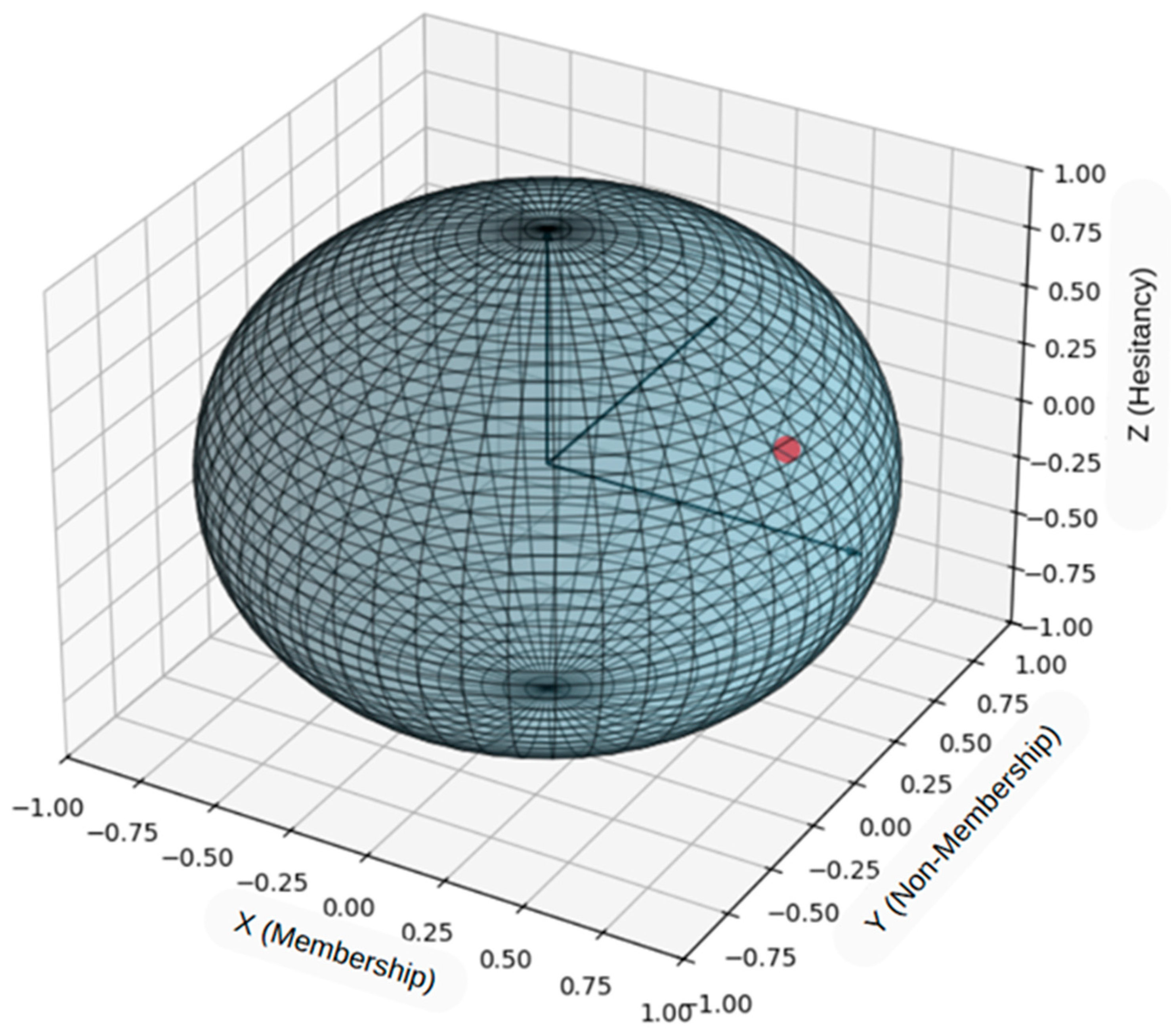
Geometric Representation of Spherical Fuzzy Numbers: A distinctive feature of SFSs is that the membership (
), non-membership (
), and hesitancy/indeterminacy (
) degrees can be geometrically represented in a three-dimensional space. This representation allows for an intuitive visualization of abstract concepts in fuzzy logic theory. A value such as
in spherical fuzzy sets is illustrated in
Figure 1 (see the red dot).
4. SF-TOPSIS Method Applied in the Present Study
In this section, the sequential operational steps of the SF-TOPSIS method are presented [
9,
13].
Step 1: Construction of the Decision Matrix for Criteria and Alternatives. In this step, a spherical fuzzy decision matrix will be constructed for mmm alternatives and nnn criteria within the scope of the study. The decision matrix is based on evaluations independently provided by each expert. A total of eight experts participated in the study, and each expert expressed their assessments in the form of spherical fuzzy numbers according to their technical and sectoral experience. While experts in classical fuzzy TOPSIS applications typically use linguistic terms, in this study, experts were allowed to directly determine the three components of spherical fuzzy numbers themselves to provide greater expressive freedom within the scope of their expertise and experience. Accordingly, experts were asked to provide their evaluations for each criterion and each criterion–alternative pair independently and directly in the form of spherical fuzzy numbers. This approach, referred to in the literature as direct fuzzy elicitation, allows experts to determine the membership, non-membership, and hesitancy degrees directly based on their technical knowledge and professional experience, while satisfying the spherical fuzzy set condition (
). By adopting this approach, uncertainties arising from the interpretation of linguistic terms are eliminated, enabling expert judgments to be modeled in a more flexible, transparent, and realistic manner. The direct spherical fuzzy elicitation mechanism adopted in this study is explained in detail in Step 1.1. Accordingly, each expert generated a spherical fuzzy evaluation for each alternative–criterion pair, as illustrated in Equation (20).
Here:
membership degree,
non-membership degree,
hesitancy degree,
expert index.
Using these evaluations, the decision matrix for each expert is constructed as shown in Equation (21).
Each cell in this matrix represents the spherical fuzzy evaluation provided by the corresponding expert.
Step 1.1: Evaluation of Criteria and the Direct Spherical Fuzzy Quantification Process. The evaluation criteria employed in this study encompass both quantitative and qualitative characteristics. However, within the decision-making process, all criteria were addressed using an expert-based direct spherical fuzzy evaluation approach. Unlike conventional fuzzy decision-making methods that rely on predefined linguistic terms, this approach allows experts to express their assessments directly in the form of spherical fuzzy numbers without being constrained by any intermediate linguistic scale.
In this context, the eight experts participating in the study provided their evaluations for each criterion and each criterion–alternative pair by directly specifying the degrees of membership (μ), non-membership (ν), and hesitation (π), based on their technical expertise and sectoral experience. All expert assessments were structured to satisfy the spherical fuzzy set condition ().
This approach, referred to in the literature as direct fuzzy elicitation, aims to eliminate uncertainties arising from the subjective interpretation of linguistic terms by different experts, particularly in complex and multidimensional decision-making problems. Consequently, expert judgments are incorporated into the decision-making model in a more flexible, transparent, and realistic manner, without the need for predefined scales or transformation procedures.
Step 2: Aggregation of Decision-Makers’ Evaluations. In this step, the spherical fuzzy evaluations provided by the eight experts for the alternatives and criteria are aggregated to represent a collective opinion. The Spherical Weighted Arithmetic Mean (SWAM) operator, as proposed in the literature, is an aggregation method specifically developed to accommodate the component structure of spherical fuzzy numbers (membership, non-membership, and hesitancy degrees). The SWAM operator allows the construction of a collective decision matrix by considering the weight of each expert’s evaluation. Here, the weight of each decision-maker,
, is derived from the coefficients
, which reflect the experts’ experience levels or their contribution to the study. Accordingly, the expert weights are normalized as shown in Equation (22).
Here,
represents the number of experts. Subsequently, for any alternative–criterion pair, if the spherical fuzzy evaluations of the decision-makers are denoted as
, their aggregation using the SWAM method is calculated as shown in Equation (23).
As a result of this process, a single spherical fuzzy number representing the integrated opinions of the experts is obtained for each alternative and criterion. In this way, the evaluation uncertainty across different experts is minimized, and the collective decision matrix, which will be used in the subsequent steps of the SF-TOPSIS method, is established.
Step 3: Construction of the Weighted Spherical Fuzzy Decision Matrix. As a result of Step 2, the aggregation of decision-makers’ evaluations using the SWAM method yielded a single spherical fuzzy number (
) for each criterion–alternative pair. In this step, a weighted spherical fuzzy decision matrix is constructed by applying the importance levels of the criteria to these values. Since the criterion weights are also expressed in the spherical fuzzy domain, the weighting operation is performed using a special aggregation operator for spherical fuzzy numbers rather than classical multiplication. In this study, the criterion weights are represented as spherical fuzzy numbers
, and the weighted values for each alternative–criterion pair are calculated using Equation (24).
Here:
Aggregated expert evaluation,
spherical fuzzy weight of the corresponding criterion,
spherical fuzzy aggregation operator used to apply the criterion weight to the evaluation.
Step 4: Calculation of Score Function Values. In this step, after obtaining the weighted spherical fuzzy decision matrix, the spherical fuzzy numbers for each alternative–criterion pair need to be made comparable. For this purpose, the score function values are calculated using Equation (25).
Step 5: Determination of Spherical Fuzzy Positive Ideal Solution (SF-PIS) and Spherical Fuzzy Negative Ideal Solution (SF-NIS) Values. In this step, after obtaining the weighted spherical fuzzy score matrix and the score function values, the spherical fuzzy ideal solutions representing the best and worst performance values for each criterion are determined. For each criterion
, the SF-PIS and SF-NIS values are calculated using Equations (26) and (27):
Here,
represents the weighted spherical fuzzy values, and
denotes the score function defined in Step 4. Subsequently, the distances of each alternative to the SF-PIS and SF-NIS are calculated. These distances are determined based on the Euclidean similarity between spherical fuzzy numbers using Equations (28) and (29):
Step 6: Determination of Maximum and Minimum Distances. In this step, after calculating the distances between each alternative and the SF-PIS and SF-NIS in the previous step, the maximum and minimum distances are identified to facilitate comparison among alternatives and to be used in the normalization process. These distances are defined as the maximum distance to the SF-NIS and the minimum distance to the SF-PIS, respectively, and are calculated as shown in Equations (29) and (30):
Step 7: Calculation of the Relative Closeness Coefficient. In this step, the relative performance of the alternatives is evaluated by considering both their closeness to the Spherical Fuzzy Positive Ideal Solution (SF-PIS) and their distance from the Spherical Fuzzy Negative Ideal Solution (SF-NIS). Using the SF-PIS and SF-NIS values calculated in Step 5, together with the maximum and minimum normalized distances obtained in Step 6, the relative closeness coefficients of the alternatives are computed as shown in Equation (32).
Here:
: The distance of the alternative to the SF-PIS,
: The distance of the alternative to the SF-NIS,
: The minimum distance to the SF-PIS among all alternatives,
: The maximum distance to the SF-NIS among all alternatives.
Step 8: Selection of the Best Alternative and Ranking of Alternatives. In this step, among the relative closeness coefficient values calculated using Equation (32), the alternative with the highest value is identified as the best alternative, and the remaining alternatives are ranked accordingly.
5. Application of the SF-TOPSIS Method
In this section, the SF-TOPSIS method is applied step by step using the defined set of criteria and alternatives for the equipment supplier selection problem in sustainable hydrogen production. A total of ten criteria covering technical, economic, environmental, and social dimensions have been defined in the study, and five supplier alternatives—Nel Hydrogen, Siemens Energy, Plug Power, ThyssenKrupp Nucera, and Biga Hidrojen—are evaluated.
5.1. Flowchart of the Procedural Steps of the SF-TOPSIS Method
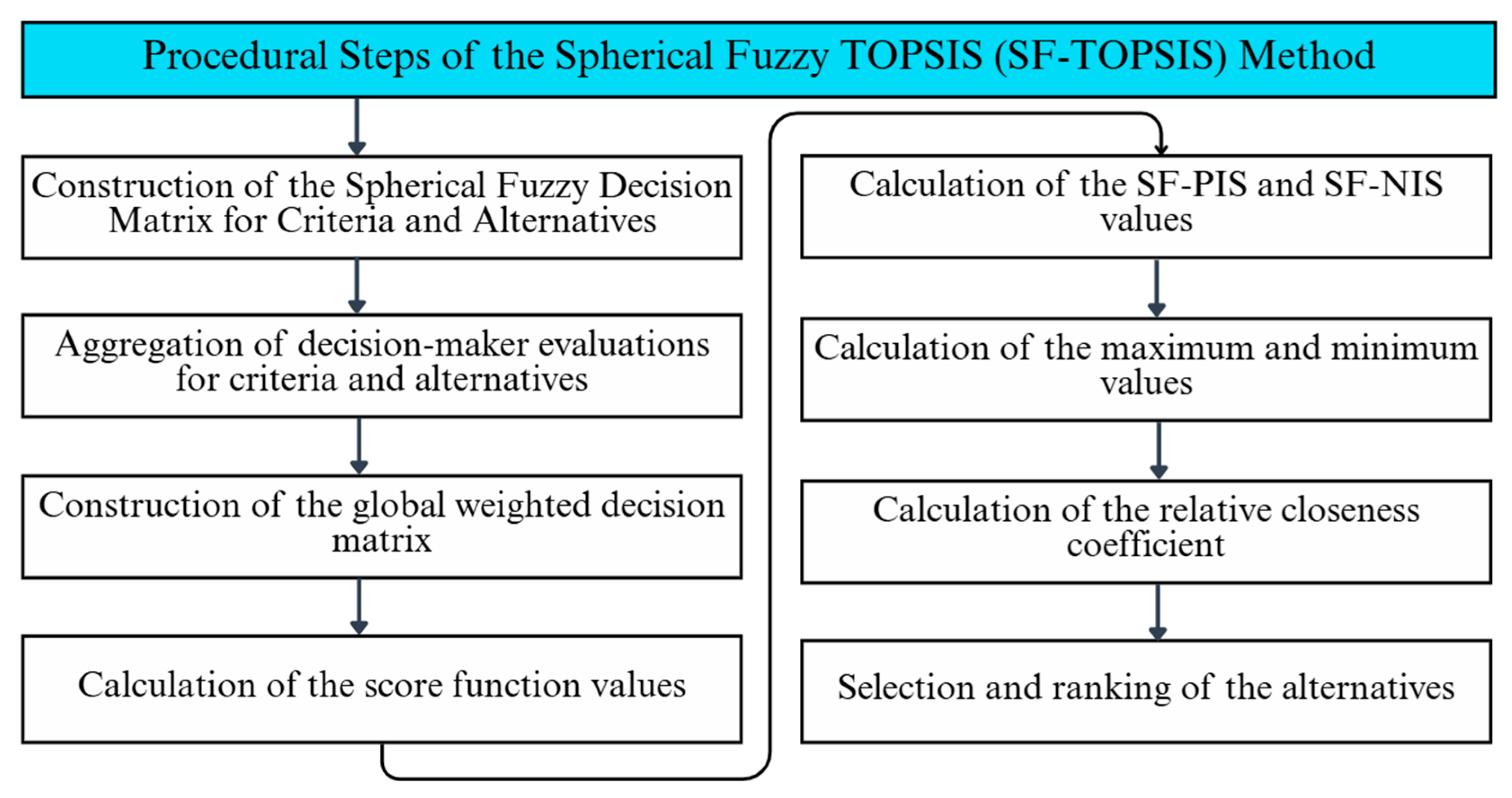
The flowchart of the SF-TOPSIS method employed in this study is presented in
Figure 2.
5.2. Information Regarding the Established Expert Committee
In this study, evaluations from an eight-member expert committee representing technical, economic, environmental, and social disciplines were employed to enhance the reliability and scientific validity of the SF-TOPSIS–based equipment supplier selection process for sustainable hydrogen production.
Technical Experts (3 members): Three experts specializing in hydrogen technologies, electrolyzer design, system integration, and safety participated in the evaluation process. Their average professional experience ranges between 11 and 15 years. These experts are actively involved in R&D centers, renewable energy integration projects, and studies focused on improving electrolyzer efficiency.
Economics and Supply Chain Experts (2 members): Two experts working on energy equipment procurement, cost analysis, maintenance–service planning, and delivery processes were included in the committee. These experts have 8–15 years of experience in energy economics and supply chain strategies. One of them works in the private sector in a supply management position, while the other is an academic specializing in energy investments.
Environmental and Sustainability Experts (2 members): Two participants with expertise in carbon footprint assessment, environmental impact analysis, life cycle assessment, and green certification contributed to the evaluations. These experts work on international standards (ISO 14001, EPD, LCA) and have more than 10 years of combined industrial and academic experience.
Social and Corporate Reputation Expert (1 member): One academic/researcher specializing in local stakeholder analysis, social acceptance, corporate sustainability, and environmental–social governance served on the committee. With approximately 12 years of experience, this expert conducts field studies on social acceptance processes in energy projects. Through this expert profile, technical performance, economic sustainability, environmental impacts, and social acceptance dimensions were evaluated in an integrated manner. Accordingly, the SF-TOPSIS analysis was designed to produce robust, balanced, and practically reliable results.
5.3. Characteristics of the Criteria and Alternatives Used in the Study
The characteristics of the criteria and alternatives evaluated within the scope of the study are presented in
Table 2 and
Table 3.
The ten defined criteria were determined to evaluate the performance of different electrolysis technologies, specifically in green hydrogen production. These criteria encompass key assessment dimensions such as technological competence, safety, cost, and social sustainability. As observed in the literature, multi-criteria evaluation approaches compare various hydrogen production methods by simultaneously considering higher-level criteria such as technical efficiency, environmental impact, economic cost, and social acceptance. This indicates that our set of criteria is suitable for general evaluation frameworks, independent of the specific technology type [
2].
5.4. Selection and Ranking of the Alternatives Using the SF-TOPSIS Method
In this section, the SF-TOPSIS method is applied to evaluate the five supplier alternatives based on the ten criteria defined for the selection of equipment to be used in hydrogen production. The criteria are grouped into four main dimensions—technical performance (C1–C4), economic conditions (C5–C7), environmental sustainability (C8), and social impacts (C9–C10)—and are described in detail in
Table 2. The supplier alternatives include both international and domestic manufacturers and are denoted as A1–A5 (see
Table 3). The selection of equipment suppliers for hydrogen production facilities is a complex multi-criteria decision-making (MCDM) problem, as it involves multidimensional factors such as efficiency, safety, cost, environmental impact, and social acceptance. Therefore, the SF-TOPSIS method, which is capable of handling decision-maker evaluations more effectively under uncertainty, is preferred in this study. The procedural steps of the SF-TOPSIS method employed in the analysis are presented sequentially below.
Step 1: Construction of the decision matrix for criteria and alternatives. In this step, the evaluations provided by the eight decision-making experts regarding the criteria and alternatives are presented in
Table 4 and
Table 5.
Step 2: Aggregation of the decision-makers’ evaluations. In this step, the evaluations provided by the decision-makers are aggregated using Equation (5). The aggregated values are presented in
Table 6 and
Table 7. Additionally, in this step, the relative importance coefficients of the experts were determined based on the assessment of their competency levels using a 1–5 importance scale, similar to the approach applied in the study by Mianabadi and Afshar (2008) [
54]. Accordingly, four categories were defined by considering the experts’ technical proficiency, years of experience, and level of contribution to the study, and each category was assigned an appropriate importance coefficient within the range of 1 to 5. In this context, technical experts were assigned a coefficient of 5, economic and supply-chain experts were assigned 4, environmental sustainability experts were assigned 3, and the social acceptance expert was assigned 2. The coefficients were normalized using Equation (22), and the final weights of the eight experts, denoted as w
i, were obtained as follows:
Step 3: Construction of the Weighted Spherical Fuzzy Decision Matrix. In this step, the weighted spherical fuzzy decision matrix is constructed using Equation (24), and the resulting values are presented in
Table 8.
Step 4: Calculation of the Score Function Values. In this step, the score function values calculated using Equation (25) are presented in
Table 9.
Step 5: Calculation of the Spherical Fuzzy Positive Ideal Solution (SF-PIS) and Spherical Fuzzy Negative Ideal Solution (SF-NIS). In this step, the SF-PIS and SF-NIS values calculated using Equations (26) and (27) are presented in
Table 10.
After calculating the spherical fuzzy SF-PIS and SF-NIS values, the distances of each alternative to the SF-PIS and SF-NIS were computed using Equations (28) and (29), and the resulting values are presented in
Table 11.
Step 6: Determination of the Maximum and Minimum Distances. In this step, using Equations (30) and (31), the maximum distance to the SF-NIS is found to be 0.0599, and the minimum distance to the SF-PIS is found to be 0.0193.
Steps 7–8: Calculation of the Relative Closeness Coefficient and Ranking of Alternatives. In this step, the relative closeness values of each alternative are calculated using Equation (32), and their corresponding rankings are presented in
Table 12.
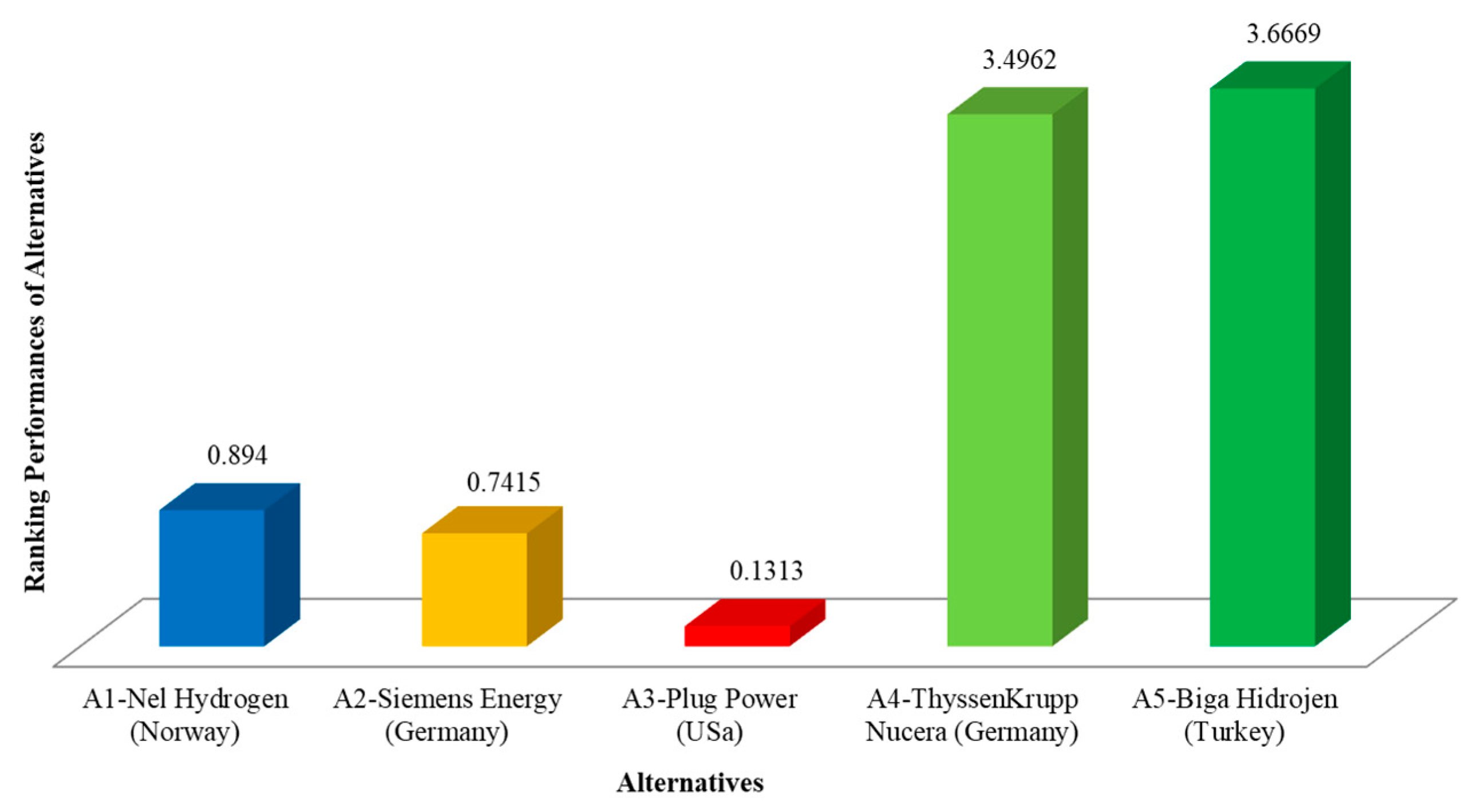
Based on the data presented in
Table 12, the ranking performances of the alternatives are illustrated in
Figure 3.
5.5. Sensitivity Analysis of the Proposed SF-TOPSIS Approach
Sensitivity analysis is employed to examine how sensitive the results obtained from MADM methods are to changes in decision parameters. This analysis is particularly important in situations involving fuzzy and uncertain data, as it investigates the impact of small variations in criteria weights or model parameters on the ranking of alternatives, providing decision-makers with crucial insights into the robustness of the proposed approach. In this study, a sensitivity analysis of the proposed SF-TOPSIS approach was conducted, and the stability of the resulting supplier rankings under different scenarios was evaluated. Accordingly, the reliability and practical applicability of the developed methodology were demonstrated.
In this study, the weight of C1 (Electrolyzer Efficiency/Technical Competence), identified as the most important criterion (see
Table 6), was systematically decreased and increased to create eight scenarios as outlined below. In each scenario, the weight of C1 was adjusted within a range of −20% to +20%, while the
values of the other criteria were proportionally re-normalized. These scenarios are summarized in
Table 13 below:
The normalized criteria weights corresponding to the scenario conditions presented in
Table 13 are provided in
Table 14.
The SF-TOPSIS relative closeness values (final scores) of the alternatives corresponding to the scenario conditions presented in
Table 14 are provided in
Table 15.
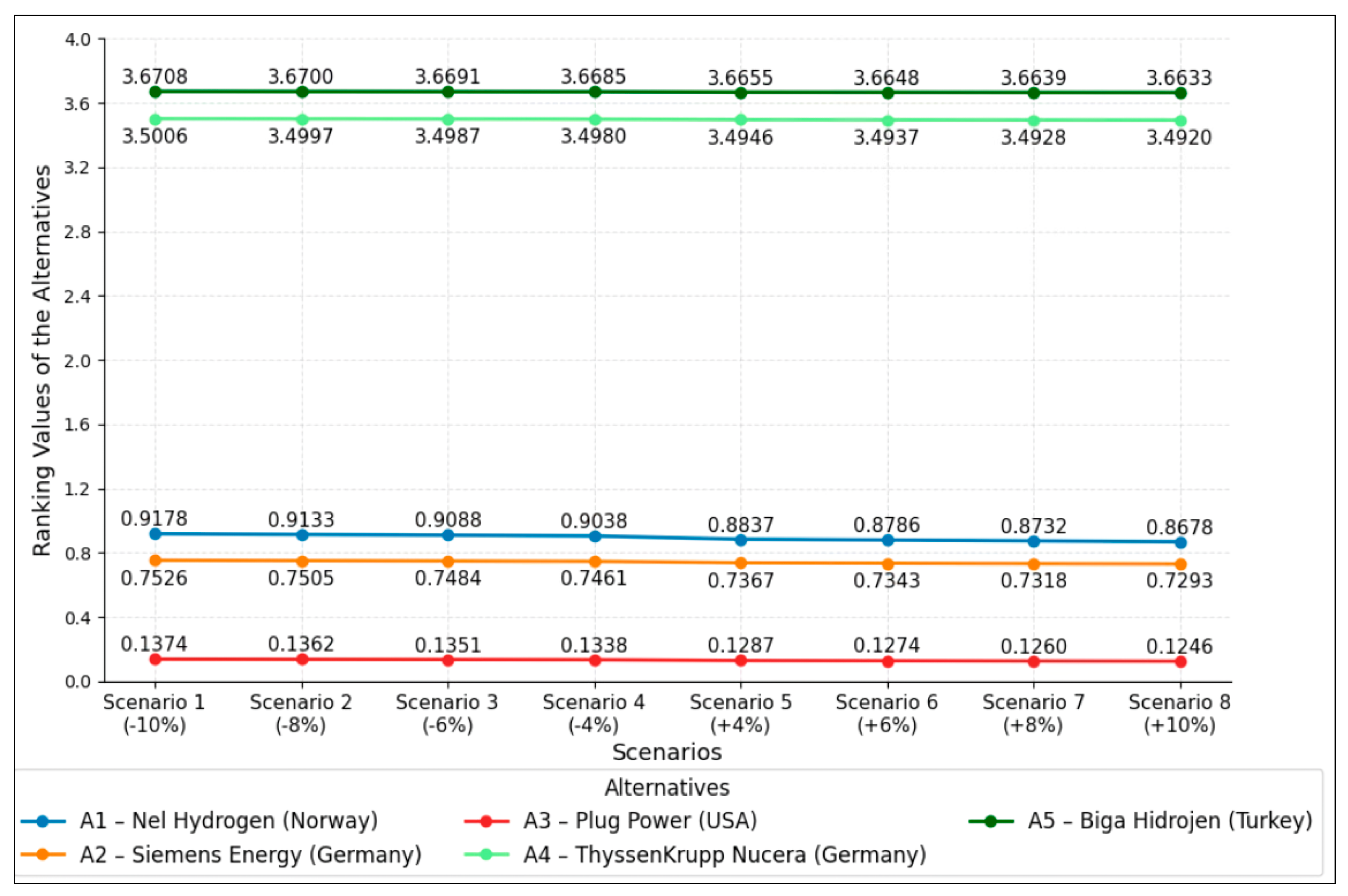
Changes in the final score values of the alternatives according to the scenario conditions are presented in
Figure 4.
The findings obtained from the sensitivity analysis indicate that the variations in the relative closeness values of the alternatives are limited, demonstrating a high degree of stability of the method. Overall, although minor fluctuations in the relative closeness values are observed across the scenarios, no changes in the ranking performance of the alternatives occur in any scenario. Therefore, even a ±10% variation in the criteria weights does not affect the results, highlighting that the method provides highly reliable outputs from a decision-maker’s perspective.
These results clearly demonstrate that the proposed SF-TOPSIS approach exhibits both robust and stable performance, and that reasonable levels of uncertainty in the criteria weights do not significantly impact the final decision. In this context, the model can be considered a practical and reliable tool for strategic decision-making processes, such as the selection of equipment suppliers in sustainable hydrogen production.
5.6. Sensitivity Analysis Based on Multi-Criteria Weight Perturbation
Single-criterion sensitivity analyses are useful for examining the method’s responsiveness to a dominant criterion; however, they may not fully reflect the model’s stability with respect to the overall weight structure. In particular, for multidimensional and complex decision problems, assessing the impact of simultaneous changes in the weights of multiple critical criteria on the ranking of alternatives allows for a more comprehensive testing of the robustness of the decision model.
Accordingly, to examine the sensitivity of the proposed SF-TOPSIS approach with respect to the global criteria weight distribution, the criteria with the most significant impact on the decision process and the highest weights—C1 (0.767), C2 (0.753), C10 (0.750), and C5 (0.737)—were considered simultaneously. These criteria represent critical dimensions for sustainable green hydrogen production, including electrolyzer efficiency/technical competence, hydrogen safety, societal acceptance, corporate reputation, and total cost.
In the constructed scenarios, the global fuzzy weights of these four criteria were systematically varied simultaneously within ±5% and ±10% ranges, while the global fuzzy weights of the remaining criteria were proportionally re-normalized to satisfy the total weight condition. This approach allowed for a comprehensive analysis of the effects not only of changes in a single criterion but also of potential uncertainties occurring simultaneously across multiple critical criteria on the relative closeness values and final rankings of the alternatives. Through this multi-criteria-based sensitivity analysis, the stability of the proposed SF-TOPSIS model against simultaneous weight fluctuations in multiple criteria was assessed, and the extent to which the resulting supplier rankings were preserved under different scenario conditions was examined. The re-normalized global fuzzy criterion weights according to the generated multi-criteria weight perturbation scenarios are presented in
Table 16.
The SF-TOPSIS relative closeness values (final scores) of the alternatives, based on the scenario conditions presented in
Table 16, are shown in
Table 17.
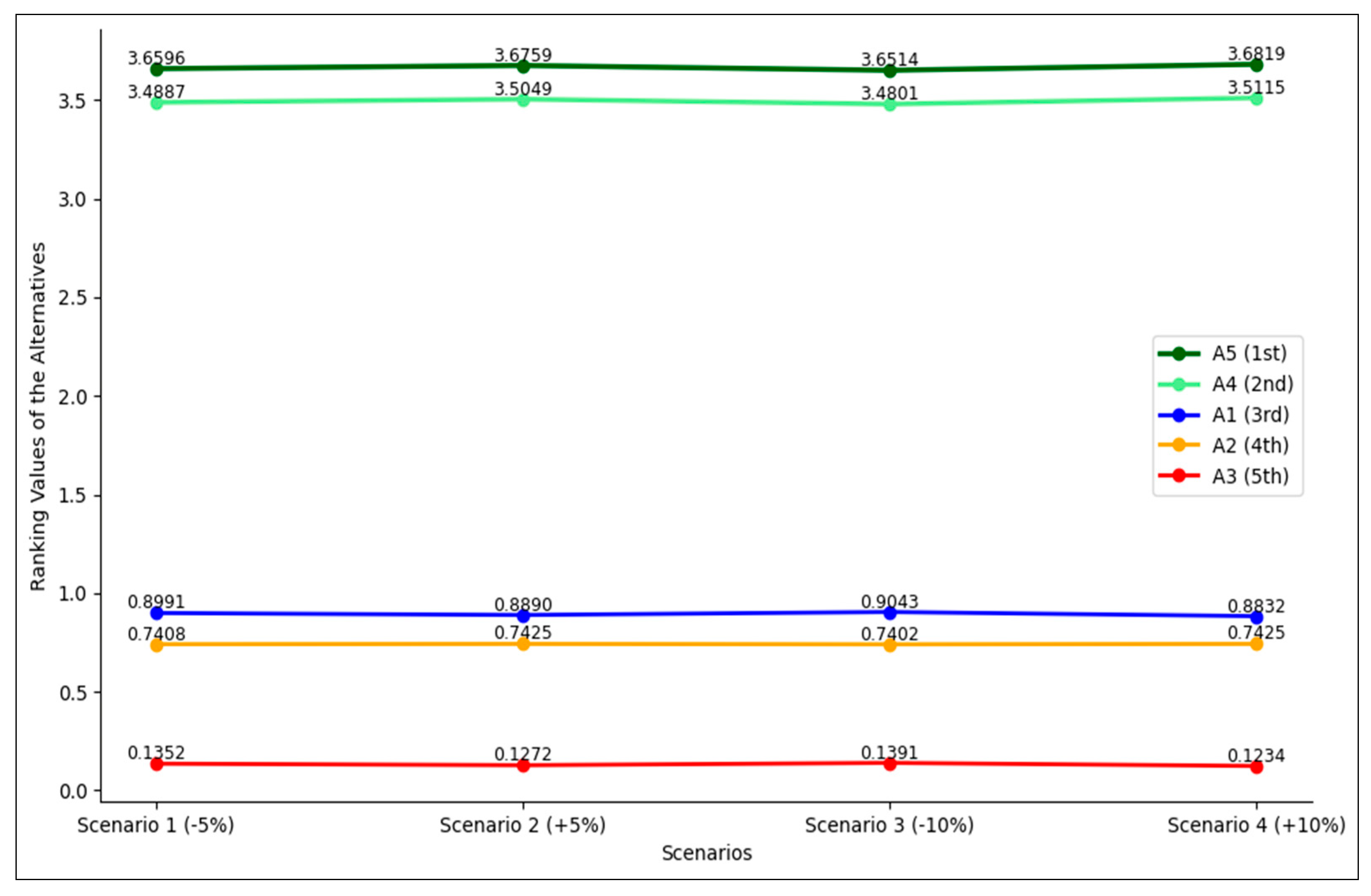
The changes in the final score values of the alternatives according to the scenario conditions in
Table 17 are presented in
Figure 5.
The sensitivity analysis based on multi-criteria weight perturbation evaluates the stability of the SF-TOPSIS model against simultaneous weight changes in multiple critical criteria. In the scenarios presented in
Table 16, the global fuzzy weights of C1, C2, C5, and C10 were systematically varied within ±5% and ±10% ranges, while the weights of the remaining criteria were re-normalized to maintain the total weight condition. As shown in
Table 17 and
Figure 5, the changes in the SF-TOPSIS relative closeness (final score) values of the alternatives were limited, indicating that the method exhibits a high degree of stability. Overall, although minor fluctuations in the relative closeness values were observed across scenarios, the ranking performance of the alternatives remained unchanged in all cases. These results demonstrate that the SF-TOPSIS approach provides reliable ranking outcomes not only for individual criteria but also under simultaneous weight uncertainties across multiple critical criteria. Consequently, the multi-criteria-based sensitivity analysis confirms that the proposed SF-TOPSIS model maintains the robustness of supplier rankings under different scenario conditions and can serve as a reliable decision-support tool for decision-makers.
6. Discussion and Conclusions
The selection of equipment suppliers in sustainable hydrogen production is of critical importance for ensuring the environmental, economic, and technical sustainability of the supply chain. The supplier selection process generally consists of three main stages: In the first stage, a pool of potential suppliers is identified. In the second stage, the multidimensional criteria for evaluation—such as technical competence, cost structure, environmental performance, and social acceptance—are defined. In the third stage, suppliers are assessed and ranked based on the established criteria. Considering the complex and multi-criteria nature of the decision-making process, the application of rational and systematic decision-making techniques is essential, rather than relying on intuitive approaches. Furthermore, replacing individual decisions with group evaluations from multiple experts can help reduce potential errors and biases. In this context, the proposed SF-TOPSIS approach aims to integrate the perspectives of experts from different disciplines, providing a reliable and balanced decision support tool for equipment supplier selection in sustainable hydrogen production. To enable a meaningful comparison of the obtained findings with existing studies, it is first necessary to present the relevant results from the literature.
The proposed evaluation framework in this study is built upon an extensive set of criteria encompassing technical, economic, environmental, and social performance dimensions. The literature includes studies analyzing the performance of hydrogen production technologies (alkaline, PEM, SOEC) using MCDM tools, and it has also demonstrated that such multidimensional criteria can be applied across different production scenarios [
2]. In this context, our ten-criterion framework provides a high-level assessment structure that extends beyond a specific technology and can be adapted to different production technologies through the recalculation of task weights. This flexibility indicates that the proposed SF-TOPSIS approach can be extended to evaluate other hydrogen production technologies. A review of the findings from studies addressing sustainable supplier selection reveals the following insights: Ransikarbum et al. (2023) [
55] identified policy/social acceptance and regulatory-environmental acceptance as the most critical criteria for green hydrogen suppliers. Janmontree et al. (2025) [
56] highlighted that sustainability performance and technical risk assessment constitute the most important criterion group in sustainable hydrogen supply chains. Türkmen and Seçkiner (2025) [
12] found that operational/technical efficiency and environmental sustainability are the key criteria in evaluating green hydrogen production methods. Muthuswamy and Ali (2023) [
57] reported that environmental performance, social responsibility, and economic sustainability are the primary criteria in sustainable supplier selection. Zandkarimkhani et al. (2022) [
58] indicated that environmental sustainability and social responsibility are the most significant criteria in sustainable supplier selection. Xie et al. (2022) [
59] also emphasized that environmental and social responsibility criteria are prioritized when selecting sustainable suppliers. Sahoo and Goswami (2024) [
60] determined that environmental and social criteria are the highest-priority criteria for green supplier selection. Coşkun et al. (2022) [
61] found that economic criteria are the most important in sustainable supplier selection, followed sequentially by social and environmental criteria. Karakoç et al. (2024) [
62] reported that technical, social, and environmental criteria are the key considerations in evaluating sustainable suppliers. Suraraksa and Shin (2019) [
63] identified technical criteria as the highest-priority supplier selection criteria. Karabayır and Botsalı (2022) [
64] emphasized technical competence as the most critical criterion in supplier selection. Öztürk (2025) [
4] considered environmental and technical criteria when evaluating alternative battery suppliers and found that technical competence emerged as the most important criterion. The superior representation capability of SF-TOPSIS, as evidenced in the literature [
9,
10,
11], was also found to be consistent with the robustness of the ranking results observed in this study.
In this study, the selection of equipment suppliers in sustainable hydrogen production was evaluated using the SF-TOPSIS approach based on 10 criteria and 5 alternatives. The criteria were defined to encompass technical, economic, environmental, and social dimensions, and the weights of each criterion were calculated using spherical fuzzy weights aggregated via the SWAM operator. According to the findings of this research (see
Table 12), the A5 alternative (Biga Hydrogen, Turkey) achieved the highest relative closeness value, ranking first. This was followed by A4 (ThyssenKrupp Nucera, Germany), A1 (Nel Hydrogen, Norway), A2 (Siemens Energy, Germany), and A3 (Plug Power, USA). This ranking indicates that the local producer stands out due to a balanced contribution in technical performance and sustainability criteria. According to the results obtained from the SF-TOPSIS analysis (see
Table 8 and
Table 12), the ranking of alternatives is not based on a single dominant criterion; rather, it is determined by the combined effect of technical, economic, environmental, and social performance levels evaluated through the weighted global fuzzy decision matrix. The top-ranked alternative, A5, demonstrated a balanced performance across high-weighted technical and social criteria. As shown in
Table 8, A5 exhibits competitive membership degrees in the technical dimensions considered the most influential according to the aggregated criterion weights, such as electrolyzer efficiency (C1), hydrogen safety (C2), and system robustness (C3) (see
Table 6). In addition, A5 also shows relatively strong performance in social and sustainability-oriented criteria, particularly local supplier contribution (C9) and societal acceptance and corporate reputation (C10). The top ranking of A5 is not solely due to its local presence; rather, it also demonstrates competitive performance against international rivals in technical criteria such as electrolyzer efficiency, safety, and system robustness, while offering relative advantages in social and sustainability-oriented criteria, including societal acceptance and local economic contribution (see
Table 8). This multidimensional performance increases A5’s relative closeness to the ideal solution while maximizing its distance from the negative ideal solution, resulting in the highest relative closeness value (
Table 12). In this context, the first-place ranking of A5 can be interpreted as an objective outcome derived from the multi-criteria structure of the decision model and the modeling of expert evaluations using independent global fuzzy numbers. Therefore, the obtained results are based on a balanced combination of technical and sustainability dimensions, independent of any pre-assigned “local preference” policy.
The second-ranked alternative, A4, exhibited generally stable but non-dominant performance across most criteria. While A4 maintains acceptable membership degrees in the technical criteria, its values for electrolyzer efficiency (C1), hydrogen safety (C2), and system robustness (C3) are consistently lower compared to the top-ranked alternatives, A5 and A1. Additionally, its relatively weaker performance in maintenance and service costs (C7) and social criteria (C9) limits its ability to surpass the first-ranked alternative. Nevertheless, the absence of any significant weaknesses and the balanced performance across all criteria allow A4 to maintain a high overall relative closeness, securing its position in second place.
The third-ranked alternative, A1, stands out particularly in the technical dimension. According to
Table 8, A1 achieved the highest membership degree for electrolyzer efficiency (C1) and also demonstrated strong performance in hydrogen safety (C2) and societal acceptance and corporate reputation (C10). However, its relatively lower performance in economic and operational criteria, such as delivery time and flexibility (C6) and maintenance and service costs (C7), reduced its overall closeness to the ideal solution. Consequently, despite its strong technical profile, A1 is positioned in third place due to imbalances in the non-technical criteria.
The fourth-ranked alternative, A2, demonstrated a distinct advantage in social and reputation-based criteria. A2 achieved the highest membership degrees in local supplier contribution (C9) and societal acceptance and corporate reputation (C10), reflecting its strong global brand value and corporate credibility. It also showed relatively high performance in the environmental certification (C8) criterion. However, A2 did not outperform the top-ranked alternatives in the most influential technical criteria (C1–C3), which play a decisive role in the overall ranking. This explains why, despite its strong social performance, A2 is positioned in fourth place.
Finally, the A3 alternative ranks fifth, primarily because it does not exhibit dominant performance in any of the high-weighted criteria. Although A3 provides moderate and balanced membership values across most criteria, it fails to achieve a leading position in any of the technical, economic, environmental, or social dimensions. In particular, its relatively weak performance in maintenance and service costs (C7) and operational flexibility (C6), along with the lack of a distinctive advantage in key technical criteria, results in the lowest relative closeness value among the alternatives.
Overall, these findings indicate that the proposed SF-TOPSIS framework enables transparent interpretation of alternative performance at the criterion level. The final ranking is derived not from predefined preferences for specific suppliers or regions, but from the holistic and objective aggregation of expert evaluations. The consistency observed among the weighted decision matrix (
Table 8), criterion weights (
Table 6), and the final ranking results (
Table 12) clearly demonstrates the robustness and explanatory power of the proposed decision-support model.
An examination of the criteria weights in
Table 6 reveals that the most important criteria are technically oriented, specifically C1 (Electrolyzer Efficiency/Technical Competence) and C2 (Hydrogen Safety). These are followed by the social criterion C10 (Social Acceptance and Corporate Reputation). The criterion with the lowest importance is the economic criterion C7 (Maintenance and Service Costs). The environmental and economic criteria weights are ranked as the third and fourth most significant criterion groups, respectively. When compared with findings from the literature, the results of this study show a strong alignment [
4,
12,
54,
55,
56,
58,
60,
62]. Thus, it is evident that in the selection of equipment suppliers for green hydrogen production, alternatives were primarily evaluated based on technical criteria, followed by social, environmental, and economic criteria.
The results of the sensitivity analysis indicate that the proposed SF-TOPSIS approach exhibits a high degree of stability against changes in decision parameters. A ±10% variation in the weight of the C1 criterion (Electrolyzer Efficiency/Technical Competence) did not affect the final ranking of the alternatives (see
Table 15). This demonstrates that the method is both robust and stable, providing decision-makers with a reliable analytical tool.
In conclusion, this study proposes an original SF-TOPSIS framework based on a spherical fuzzy group decision-making structure to address the equipment supplier selection problem in sustainable green hydrogen production, enabling the simultaneous consideration of multi-dimensional uncertainties arising from technical, economic, environmental, and social aspects. The proposed approach represents decision-makers’ subjective judgments more realistically through spherical fuzzy sets, which explicitly account for membership, non-membership, and hesitancy degrees, thereby allowing uncertainty and divergence in expert opinions to be systematically incorporated into the decision-making process. The comprehensive sensitivity analyses conducted in this study demonstrate that the proposed method maintains a high level of robustness under both single-criterion and multi-criteria weight perturbations, and that the resulting alternative rankings remain consistent across different scenario conditions. From a practical perspective, the presented decision-support framework offers a reliable quantitative tool for stakeholders investing in hydrogen projects, enabling them to balance technological performance with cost efficiency, environmental impacts, and social acceptance in an integrated manner. In this respect, the study is expected to provide meaningful methodological and practical contributions to strategic decision-making processes related to sustainable hydrogen investments.