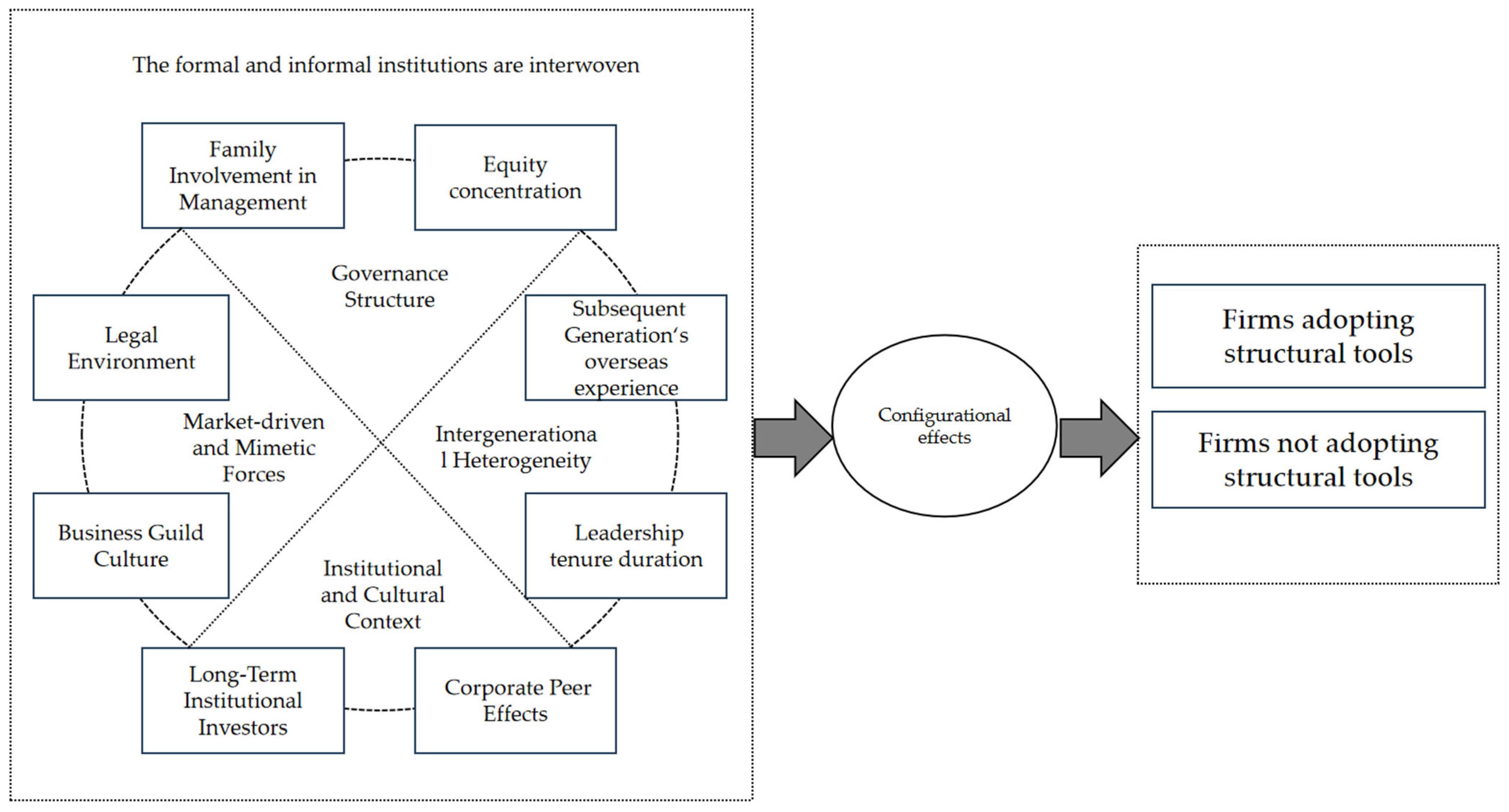
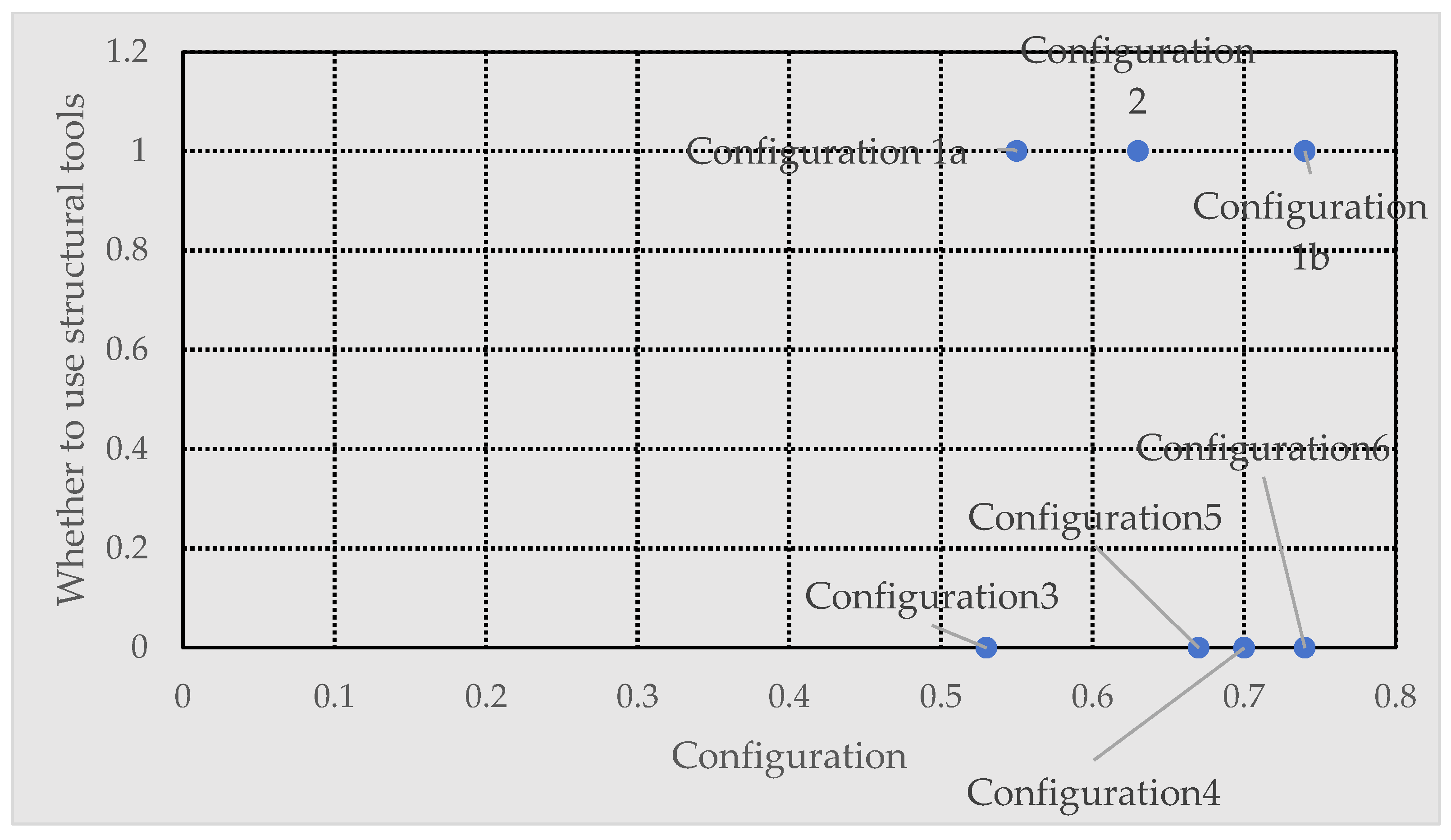
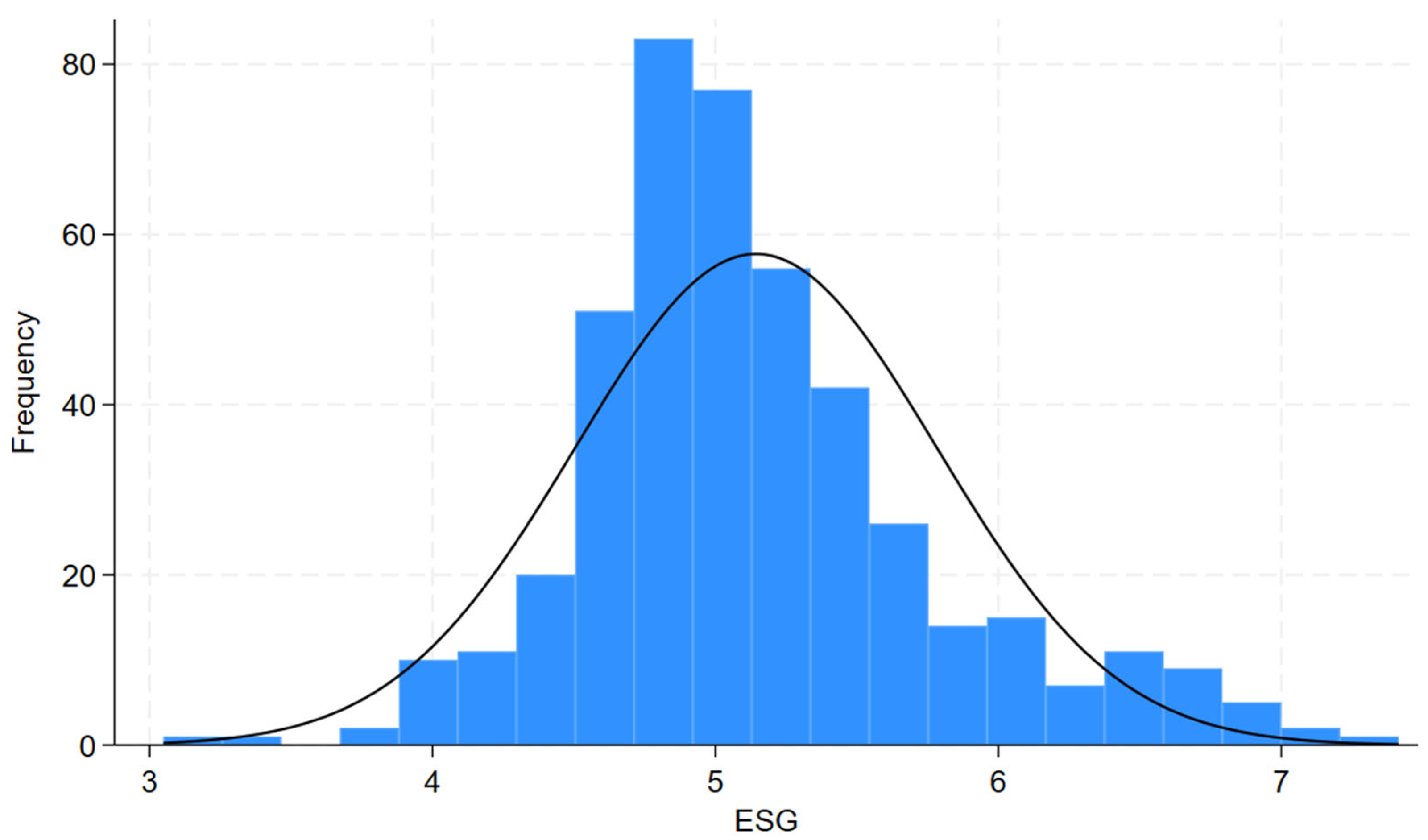
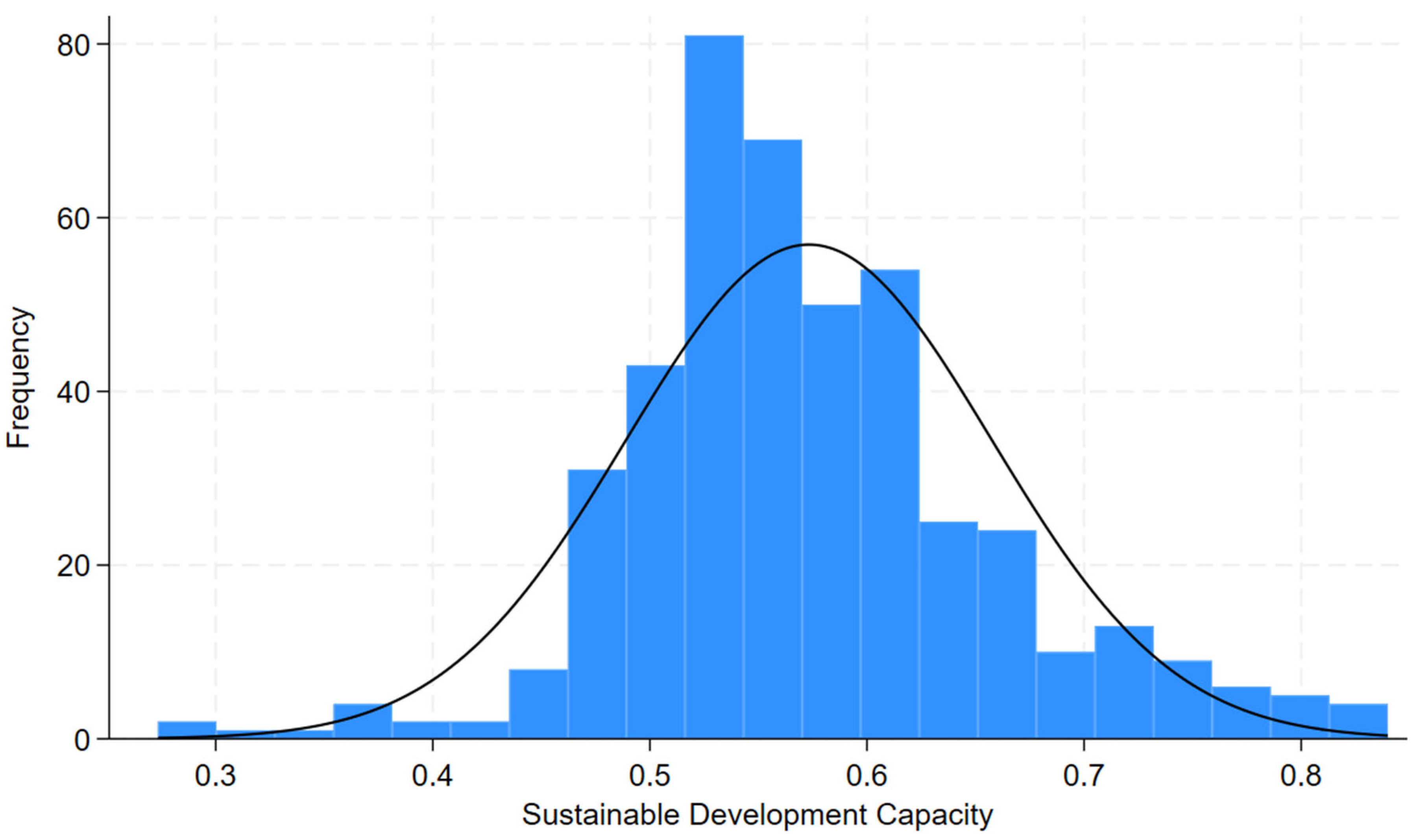
Achieving Sustainable Development Through Structural Tools: Institutional Configurations and Pathways
Abstract
1. Introduction
2. Theoretical Basis and Literature Review
2.1. Institutional Theory
2.2. Sustainable Development of Firms
2.3. Structural Tools
2.4. The Use of Structural Tools and Sustainable Development of Firms
2.5. Governance Structure and the Use of Structural Tools
2.6. Intergenerational Heterogeneity and the Use of Structural Tools
2.7. Institutional and Cultural Context and the Use of Structural Tools
2.8. Market-Driven Forces and Mimetic Forces and the Use of Structural Tools
3. Research Design
3.1. Selection of Research Method
3.2. Sample Selection and Data Sources
3.3. Variable Measurement
3.3.1. Outcome Variable
3.3.2. Condition Variable
- Equity concentration: This variable is measured by the proportion of shares held by the family controller relative to the total shareholding of all family members within the firm’s top ten shareholders. Specifically, we first sum the shareholding ratios of all family members among the top ten shareholders, and then divide the family controller’s shareholding by this total to obtain the family controller’s proportion within the family’s total shareholdings in the top ten shareholders. If this proportion is higher than the median value of all sample firms, it is coded as 1; otherwise, it is coded as 0 [2].
- Leadership tenure duration: The first generation’s tenure is measured by the total number of months they served as directors, supervisors, or senior management personnel in the company. If the first generation’s tenure exceeds the median tenure of the first generation in the sample firms, it is assigned a value of 1; otherwise, it is assigned a value of 0 [53,54].
- Subsequent generation’s overseas experience: The second generation’s overseas experience is measured by whether the successor has overseas experience, including overseas study or overseas work experience. If the successor has overseas experience, it is assigned a value of 1; otherwise, it is assigned a value of 0 [55,56].
- Legal environment: This is measured by the development of market intermediary organizations and the legal institutional environment in China’s Marketization Index. If the degree of marketization exceeds the median of all sample firms, it is assigned a value of 1; otherwise, it is assigned a value of 0 [57].
- Business guild culture: The degree of business guild culture influence is measured by the geographical distance between the enterprise’s location and the birthplaces of the ten major business guilds. Specifically, the minimum distance between the listed company’s office location and each business guild’s birthplace is calculated, and its opposite number is used as the variable value. A smaller value indicates that the enterprise is closer to the business guild’s birthplace and is more strongly influenced by business guild culture [58,59]. The fourth quartile (95%), median, and first quartile (5%) of the case sample are set as the three calibration points for full membership, crossover point, and full non-membership, respectively, to calibrate business guild culture.
- Long-term institutional investors: We use the trading behavior of institutional investors over the past four semi-annual periods as the criterion for distinguishing long-term investors from short-term investors. This paper defines them based on the turnover rate characteristics of institutional trading. The average turnover rate for each period is calculated based on the portfolio situation of institutional investors. Then, institutional investors are ranked by turnover rate and divided into three groups, with those having lower turnover rates defined as long-term investors. Finally, for each stock, the shareholding ratio of long-term institutional investors is calculated separately. This ratio is defined as the total number of shares held by long-term institutional investors in each period. It is divided by the total number of tradable shares in the same period [60,61]. The fourth quartile (95%), median, and first quartile (5%) of the case sample are set as the three calibration points for full membership, crossover point, and full non-membership, respectively, to calibrate institutional investors.
- Corporate peer effects: The degree of structural tool usage in the province where the enterprise is located is measured by the number of sample firms using structural tools in that province [41,62]. Specifically, it refers to the total number of sample firms in the same province that have adopted structural tools. To calibrate firm-level peer effects, three thresholds are used. The fourth quartile (95%) is set as the point of full membership, the median as the crossover point, and the first quartile (5%) as the point of full non-membership.
4. Empirical Results and Analysis
4.1. Variable Calibration
4.2. Necessity Analysis of Individual Conditions
4.3. Sufficiency Analysis
4.3.1. Driving Configurations for Firms’ Use of Structural Tools
4.3.2. Driving Configurations for Firms’ Non-Use of Structural Tools
4.4. Robustness Test
5. Further Test
5.1. Model Construction
5.2. Mean Difference Tests
5.2.1. Sustainable Development Capacity
5.2.2. ESG Performance
5.3. Two-Way Fixed Effects Regressions
5.4. Robustness Tests and Endogeneity Treatment for Two-Way Fixed Effects Regressions
5.4.1. Instrumental Variables (IV) Approach
5.4.2. Substitution of Dependent Variables
5.4.3. Alternative Model Specifications
6. Conclusions and Discussion
6.1. Research Conclusions
6.2. Practical Implications
Author Contributions
Funding
Institutional Review Board Statement
Informed Consent Statement
Data Availability Statement
Conflicts of Interest
References
- EcoVadis. A Comparison of CSR Performance: UN Global Compact Signatories vs. Non-Signatories; EcoVadis Research Report; EcoVadis: Paris, France, 2019; Available online: https://resources.ecovadis.com/sustainable-procurement/comparison-csr-performance-un-global-compact-signatories-non-signatories (accessed on 1 February 2026).
- Anderson, R.C.; Reeb, D.M. Board composition: Balancing family influence in S&P 500 firms. Adm. Sci. Q. 2004, 49, 209–237. [Google Scholar] [CrossRef] [Scilit]
- Aguilera, R.V.; Crespi-Cladera, R. Firm family firms: Current debates of corporate governance in family firms. J. Fam. Bus. Strategy 2012, 3, 66–69. [Google Scholar] [CrossRef] [Scilit]
- 20 Years of UN Global Compact: How Sustainability Ratings Help Companies Kick-Start the Decade of Action. Available online: https://ecovadis.com/blog/20-years-of-un-global-compact-how-sustainability-ratings-help-companies-kick-start-the-decade-of-action/ (accessed on 15 June 2020).
- Aguilera, R.V.; Crespi-Cladera, R. Global corporate governance: On the relevance of firms’ ownership structure. J. World Bus. 2016, 51, 50–57. [Google Scholar] [CrossRef] [Scilit]
- Aguilera, R.V.; Jackson, G. The cross-national diversity of corporate governance: Dimensions and determinants. Acad. Manag. Rev. 2003, 28, 447–465. [Google Scholar] [CrossRef] [Scilit]
- IKEA Invests EUR 1.5 Billion to Accelerate Phase out of Fossil Fuels. Available online: https://www.ingka.com/newsroom/ikea-invests-eur-1-5-billion-to-accelerate-phase-out-of-fossil-fuels/ (accessed on 14 November 2024).
- The Climate Footprint Across the IKEA Value Chain. Available online: https://www.ikea.com/global/en/our-business/sustainability/value-chain-climate-footprint/ (accessed on 13 December 2024).
- Ikea Reports 30% Emissions Reduction Since 2016. Available online: https://real-economy-progress.com/ikea-reports-30-emissions-reduction-since-2016/ (accessed on 31 January 2025).
- Yu, V.; Cheng, J. Legal Battle Among ‘Secret’ Family of Wahaha Founder Exposes China’s Wealth Succession Crisis. South China Morning Post, 9 September 2025. Available online: https://www.scmp.com/business/china-business/article/3324534/legal-battle-among-secret-family-wahaha-founder-exposes-chinas-wealth-succession-crisis (accessed on 1 February 2026).
- North, D.C. Institutions, Institutional Change and Economic Performance; Cambridge University Press: Cambridge, UK, 1990. [Google Scholar]
- Peng, M.W.; Sun, W.; Vlas, C.; Minichilli, A.; Corbetta, G. An institution-based view of large family firms: A recap and overview. Entrep. Theory Pract. 2018, 42, 187–205. [Google Scholar] [CrossRef] [Scilit]
- Fiss, P.C. Building better causal theories: A fuzzy set approach to typologies in organization research. Acad. Manag. J. 2011, 54, 393–420. [Google Scholar] [CrossRef] [Scilit]
- La Porta, R.; Lopez-De-Silanes, F.; Shleifer, A.; Vishny, R. Investor Protection and Corporate Valuation. J. Financ. 2002, 57, 1147–1170. [Google Scholar] [CrossRef] [Scilit]
- Helmke, G.; Levitsky, S. Informal Institutions and Comparative Politics: A Research Agenda; Edward Elgar Publishing: Cheltenham, UK, 2012. [Google Scholar]
- Nahapiet, J.; Ghoshal, S. Social capital, intellectual capital, and the organizational advantage. Acad. Manag. Rev. 1998, 23, 242–266. [Google Scholar] [CrossRef] [Scilit]
- Peng, M.W. Institutional transitions and strategic choices. Acad. Manag. Rev. 2003, 28, 275–296. [Google Scholar] [CrossRef] [Scilit]
- Furnari, S.; Misangyi, V.F.; Fiss, P.C.; Crilly, D.; Aguilera, R.V. Capturing causal complexity: Heuristics for configurational theorizing. Acad. Manag. Rev. 2021, 46, 778–799. [Google Scholar] [CrossRef] [Scilit]
- Williamson, O.E. The new institutional economics: Taking stock, looking ahead. J. Econ. Lit. 2000, 38, 595–613. [Google Scholar] [CrossRef] [Scilit]
- DiMaggio, P.; Powell, W.W. The iron cage revisited: Institutional isomorphism and collective rationality in organizational fields. Am. Sociol. Rev. 1983, 48, 147–160. [Google Scholar] [CrossRef] [Scilit]
- Pichault, F. The management of politics in technically related organizational change. Organ. Stud. 1995, 16, 449–476. [Google Scholar] [CrossRef] [Scilit]
- Berger, P.; Luckmann, T. The social construction of reality. In Social Theory Re-Wired; Routledge: New York, NY, USA, 2023; pp. 92–101. [Google Scholar]
- Gedajlovic, E.R.; Shapiro, D.M. Management and ownership effects: Evidence from five countries. Strateg. Manag. J. 1998, 19, 533–553. [Google Scholar] [CrossRef] [Scilit]
- Stafford, K.; Duncan, K.A.; Dane, S.; Winter, M. A research model of sustainable family businesses. Fam. Bus. Rev. 1999, 12, 197–208. [Google Scholar] [CrossRef] [Scilit]
- Sharma, P.; Chrisman, J.J.; Chua, J.H. Strategic management of the family business: Past research and future challenges. Fam. Bus. Rev. 1997, 10, 1–35. [Google Scholar] [CrossRef] [Scilit]
- Bennedsen, M.; Nielsen, K.M.; Pérez-González, F.; Wolfenzon, D. Inside the family firm: The role of families in succession decisions and performance. Q. J. Econ. 2007, 122, 647–691. [Google Scholar] [CrossRef] [Scilit]
- Chirico, F.; Salvato, C. Knowledge integration and dynamic organizational adaptation in family firms. Fam. Bus. Rev. 2008, 21, 169–181. [Google Scholar] [CrossRef] [Scilit]
- Suess, J. Family governance: Literature review and the development of a conceptual model. J. Fam. Bus. Strategy 2014, 5, 138–155. [Google Scholar] [CrossRef] [Scilit]
- Burch, G.F.; Batchelor, J.H.; Burch, J.J.; Heller, N.A. Rethinking family business education. J. Fam. Bus. Manag. 2015, 5, 277–293. [Google Scholar] [CrossRef] [Scilit]
- La Porta, R.; Lopez-De-Silanes, F.; Shleifer, A. Corporate ownership around the world. J. Financ. 1999, 54, 471–517. [Google Scholar] [CrossRef] [Scilit]
- Claessens, S.; Laeven, L. A Reader in International Corporate Finance, Vol. 2; World Bank Publications: Washington, DC, USA, 2006. [Google Scholar]
- Villalonga, B.; Amit, R. How do family ownership, control and management affect firm value? J. Financ. Econ. 2006, 80, 385–417. [Google Scholar] [CrossRef] [Scilit]
- Carney, M.; Gedajlovic, E.; Yang, X. Varieties of Asian capitalism: Toward an institutional theory of Asian enterprise. Asia Pac. J. Manag. 2009, 26, 361–380. [Google Scholar] [CrossRef] [Scilit]
- Allen, F.; Qian, J.; Qian, M. Law, finance, and economic growth in China. J. Financ. Econ. 2005, 77, 57–116. [Google Scholar] [CrossRef] [Scilit]
- Barbera, F.; Hasso, T.; Schwarz, T.V. Family governance and firm performance: Exploring the intermediate effects of family functioning and competitive advantage. J. Fam. Bus. Manag. 2023, 13, 1085–1103. [Google Scholar] [CrossRef] [Scilit]
- Berrone, P.; Cruz, C.; Gomez-Mejia, L.R.; Larraza, M. Socioemotional wealth and corporate responses to institutional pressures. Adm. Sci. Q. 2010, 55, 82–113. [Google Scholar] [CrossRef] [Scilit]
- Gómez-Mejía, L.R.; Haynes, K.T.; Núñez-Nickel, M.; Jacobson, K.J.L.; Moyano-Fuentes, J. Socioemotional wealth and business risks in family-controlled firms: Evidence from Spanish olive oil mills. Adm. Sci. Q. 2007, 52, 106–137. [Google Scholar] [CrossRef] [Scilit]
- Fama, E.F.; Jensen, M.C. Separation of ownership and control. J. Law Econ. 1983, 26, 301–325. [Google Scholar] [CrossRef] [Scilit]
- Djankov, S.; La Porta, R.; Lopez-De-Silanes, F.; Shleifer, A. The law and economics of self-dealing. J. Financ. Econ. 2008, 88, 430–465. [Google Scholar] [CrossRef] [Scilit]
- Greif, A. Contract enforceability and economic institutions in early trade. Am. Econ. Rev. 1993, 83, 525–548. [Google Scholar]
- Haunschild, P.R.; Miner, A.S. Modes of interorganizational imitation: The Effects of Outcome Salience and Uncertainty. Adm. Sci. Q. 1997, 42, 472–502. [Google Scholar] [CrossRef] [Scilit]
- Lieberman, M.B.; Asaba, S. Why do firms imitate each other? Acad. Manag. Rev. 2006, 31, 366–385. [Google Scholar] [CrossRef] [Scilit]
- Deephouse, D.L.; Carter, S.M. An Examination of Differences Between Organizational Legitimacy and Organizational Reputation. J. Manag. Stud. 2005, 42, 329–360. [Google Scholar] [CrossRef] [Scilit]
- Pappas, I.O.; Woodside, A.G. Fuzzy-set Qualitative Comparative Analysis (fsQCA): Guidelines for research practice in Information Systems and marketing. Int. J. Inf. Manag. 2021, 58, 102310. [Google Scholar] [CrossRef] [Scilit]
- Ragin, C.C. Redesigning Social Inquiry: Fuzzy Sets and Beyond; University of Chicago Press: Chicago, IL, USA, 2009. [Google Scholar]
- Misangyi, V.F.; Greckhamer, T.; Furnari, S.; Fiss, P.C.; Crilly, D.; Aguilera, R.V. Embracing Causal Complexity: The Emergence of a Neo-Configurational Perspective. J. Manag. 2017, 43, 255–282. [Google Scholar] [CrossRef] [Scilit]
- Gomez-Mejia, L.R.; Nunez-Nickel, M.; Gutierrez, I. The role of family ties in agency contracts. Acad. Manag. J. 2001, 44, 81–95. [Google Scholar] [CrossRef] [Scilit]
- Villalonga, B.; Amit, R. Family control of firms and industries. Financ. Manag. 2010, 39, 863–904. [Google Scholar] [CrossRef] [Scilit]
- Chua, J.H.; Chrisman, J.J.; Sharma, P. Defining the family business by behavior. Entrep. Theory Pract. 1999, 23, 19–39. [Google Scholar] [CrossRef] [Scilit]
- Basco, R.; Calabrò, A.; Campopiano, G. Transgenerational entrepreneurship around the world. J. Fam. Bus. Strategy 2019, 10, 100249. [Google Scholar] [CrossRef] [Scilit]
- Poza, E.J. Family Business, 3rd ed.; South-Western Cengage Learning: Boston, MA, USA, 2010. [Google Scholar]
- Arzubiaga, U.; Kotlar, J.; De Massis, A.; Maseda, A.; Iturralde, T. Entrepreneurial orientation and innovation in family SMEs: Unveiling the (actual) impact of the Board of Directors. J. Bus. Ventur. 2018, 33, 455–469. [Google Scholar] [CrossRef] [Scilit]
- Miller, D.; Minichilli, A.; Corbetta, G. Is family leadership always beneficial? Strateg. Manag. J. 2013, 34, 553–571. [Google Scholar] [CrossRef] [Scilit]
- Bennedsen, M.; Nielsen, K. The Family Behind the Family Firm; Working Paper; Copenhagen Business School (CBS): Frederiksberg, Denmark, 2004; Available online: https://swopec.hhs.se/cbsnow/abs/cbsnow2004_003.htm (accessed on 1 May 2025).
- Le Breton–Miller, I.; Miller, D. The Arts and Family Business: Linking Family Business Resources and Performance to Industry Characteristics. Entrep. Theory Pract. 2015, 39, 1349–1370. [Google Scholar] [CrossRef] [Scilit]
- Arregle, J.-L.; Chirico, F.; Kano, L.; Kundu, S.K.; Majocchi, A.; Schulze, W.S. Family firm internationalization. J. Int. Bus. Stud. 2021, 52, 1159–1198. [Google Scholar] [CrossRef] [Scilit]
- Fan, J.P.H.; Wong, T.J.; Zhang, T. Institutions and organizational structure. J. Law Econ. Organ. 2013, 29, 1217–1252. [Google Scholar] [CrossRef] [Scilit]
- Hilary, G.; Hui, K.W. Does religion matter in corporate decision making? J. Financ. Econ. 2009, 93, 455–473. [Google Scholar] [CrossRef] [Scilit]
- Kalnins, A.; Chung, W. Social Capital, Geography, and Survival: Gujarati Immigrant Entrepreneurs in the U.S. Lodging Industry. Manag. Sci. 2006, 52, 233–247. [Google Scholar] [CrossRef] [Scilit]
- Hagelin, N.; Holmén, M.; Pramborg, B. Family ownership, dual-class shares, and risk management. Glob. Financ. J. 2006, 16, 283–301. [Google Scholar] [CrossRef] [Scilit]
- Bushee, B.J. The influence of institutional investors on myopic R&D investment behavior. Account. Rev. 1998, 73, 305–333. [Google Scholar]
- Yang, M.; Hyland, M.A. Who do firms imitate? A multilevel approach to examining sources of imitation in the choice of mergers and acquisitions. J. Manag. 2006, 32, 381–399. [Google Scholar] [CrossRef] [Scilit]
- Greckhamer, T.; Furnari, S.; Fiss, P.C.; Aguilera, R.V. Studying configurations with qualitative comparative analysis: Best practices in strategy and organization research. Strateg. Organ. 2018, 16, 482–495. [Google Scholar] [CrossRef] [Scilit]
- Peng, M.W.; Sun, S.L.; Pinkham, B.; Chen, H. The institution-based view as a third leg for a strategy tripod. Acad. Manag. Perspect. 2009, 23, 63–81. [Google Scholar] [CrossRef] [Scilit]
- Arregle, J.; Duran, P.; Hitt, M.A.; Van Essen, M. Why is family firms’ internationalization unique? Entrep. Theory Pract. 2017, 41, 801–831. [Google Scholar] [CrossRef] [Scilit]
- Custódio, C.; Metzger, D. How do CEOs matter? The effect of industry expertise on acquisition returns. Rev. Financ. Stud. 2013, 26, 2008–2047. [Google Scholar] [CrossRef] [Scilit]
- Habbershon, T.G.; Williams, M.L. A resource-based framework for assessing the strategic advantages of family firms. Fam. Bus. Rev. 1999, 12, 1–25. [Google Scholar] [CrossRef] [Scilit]
- Schneider, C.Q.; Wagemann, C. Set-Theoretic Methods for the Social Sciences: A Guide to Qualitative Comparative Analysis; Cambridge University Press: Cambridge, UK, 2012. [Google Scholar]
- China Business Law Journal. Why Chinese Entrepreneurs Reject Family Trusts—Part II. 18 May 2022. Available online: https://law.asia/reject-family-trusts-2/ (accessed on 1 February 2026).
- China Development Brief. Gao Chuanjie: Charitable Trusts Are Not Exclusively for the Wealthy. 2018. Available online: https://chinadevelopmentbrief.org/reports/gao-chuanjie-charitable-trusts-are-not-exclusively-for-the-wealthy/ (accessed on 1 February 2026).
- Lewbel, A. Using heteroscedasticity to identify and estimate mismeasured and endogenous regressor models. J. Bus. Econ. Stat. 2012, 30, 67–80. [Google Scholar] [CrossRef] [Scilit]




| Variables | Full Non-Membership | Crossover Point | Full Membership | |||
|---|---|---|---|---|---|---|
| Condition Variables | Family Governance Structure | FIM | Family Involvement in Management | 0 | - | 1 |
| EC | Equity concentration | 0 | - | 1 | ||
| Intergenerational Heterogeneity | LTD | Leadership tenure duration | 0 | 1 | ||
| SGOE | Subsequent Generation’s overseas experience | 0 | - | 1 | ||
| Institutional and Cultural Context | LE | Legal Environment | 0 | - | 1 | |
| BGC | Business Guild Culture | 0.0084 | 0.0881 | 0.6154 | ||
| Market-driven and Mimetic Forces | LTII | Long-Term Institutional Investors | 0.0664 | 0.0051 | 0 | |
| CPE | Corporate Peer Effects | 0 | 16 | 77 | ||
| Outcome Variables | ST | Adoption of Structural Tools | 0 | - | 1 |
| Condition Variables | Firms Using Structural Tools | Firms Not Using Structural | ||
|---|---|---|---|---|
| Consistency | Coverage | Consistency | Coverage | |
| FIM | 0.882 | 0.491 | 0.886 | 0.509 |
| ~FIM | 0.118 | 0.5 | 0.114 | 0.5 |
| EC | 0.429 | 0.423 | 0.566 | 0.577 |
| ~EC | 0.571 | 0.56 | 0.434 | 0.44 |
| LTD | 0.462 | 0.519 | 0.416 | 0.481 |
| ~LTD | 0.538 | 0.471 | 0.584 | 0.53 |
| SGOE | 0.354 | 0.475 | 0.379 | 0.525 |
| ~SGOE | 0.646 | 0.502 | 0.621 | 0.498 |
| LE | 0.217 | 0.418 | 0.292 | 0.582 |
| ~LE | 0.783 | 0.517 | 0.708 | 0.483 |
| BGC | 0.533 | 0.48 | 0.56 | 0.521 |
| ~BGC | 0.467 | 0.507 | 0.44 | 0.493 |
| LTII | 0.417 | 0.5 | 0.404 | 0.5 |
| ~LTII | 0.583 | 0.486 | 0.596 | 0.514 |
| CPE | 0.426 | 0.46 | 0.484 | 0.54 |
| ~CPE | 0.574 | 0.519 | 0.516 | 0.481 |
| Condition Variables | Firms Using Structural Tools | Firms Not Using Structural Tools | |||||
|---|---|---|---|---|---|---|---|
| M1a | M1b | M2 | M3 | M4 | M5 | M6 | |
| FIM |  | |  | | | | |
| EC | | | |  | | | |
| LTD | | | | |  | | |
| SGOE | | | | | | | |
| LE | | | | | | | |
| BGC | | | | | | | |
| LTII | | | | | | | |
| CPE | | | | | | | |
| Raw Consistency | 0.9566 | 0.8423 | 1 | 0.8564 | 0.8537 | 0.9613 | 0.8241 |
| Coverage | 0.0187 | 0.0176 | 0.0069 | 0.0074 | 0.0115 | 0.0079 | 0.0075 |
| Unique Coverage | 0.0057 | 0.0046 | 0.0069 | 0.0074 | 0.0115 | 0.0055 | 0.0051 |
| Solution Consistency | 0.9015 | 0.8691 | |||||
| Solution Coverage | 0.03023 | 0.0318 | |||||
= core condition present; = core condition absent; = peripheral condition present; = peripheral condition absent; blank space presents condition may be present or absent. Core conditions appear in both intermediate and parsimonious solutions; peripheral conditions appear only in intermediate solutions.| Condition Variables | Firms Using Structural Tools | Firms Not Using Structural Tools | |||||
|---|---|---|---|---|---|---|---|
| M1a | M1b | M2 | M3 | M4 | M5 | M6 | |
| FIM | | | | | | | |
| EC | | | | | | | |
| LTD | | | | | | | |
| SGOE | | | | | | | |
| LE | | | | | | | |
| BGC | | | | | | | |
| LTII | | | | | | | |
| CPE | | | | | | | |
| Raw Consistency | 0.9566 | 0.8423 | 1 | 0.8564 | 0.8537 | 0.9613 | 0.8241 |
| Coverage | 0.0187 | 0.0176 | 0.0069 | 0.0074 | 0.0115 | 0.0079 | 0.0075 |
| Unique Coverage | 0.0057 | 0.0046 | 0.0069 | 0.0074 | 0.0115 | 0.0055 | 0.0051 |
| Solution Consistency | 0.9015 | 0.8691 | |||||
| Solution Coverage | 0.03023 | 0.0318 | |||||
= core condition present; = core condition absent; = peripheral condition present; = peripheral condition absent; blank space presents condition may be present or absent. Core conditions appear in both intermediate and parsimonious solutions; peripheral conditions appear only in intermediate solutions.| Condition Variables | Firms Using Structural Tools | Firms Not Using Structural Tools | |||||
|---|---|---|---|---|---|---|---|
| M1a | M1b | M2 | M3 | M4 | M5 | M6 | |
| FIM | | | | | | | |
| EC | | | | | | | |
| LTD | | | | | | | |
| SGOE | | | | | | | |
| LE | | | | | | | |
| BGC | | | | | | | |
| LTII | | | | | | | |
| CPE | | | | | | | |
| Raw Consistency | 0.9566 | 0.8423 | 1 | 0.8564 | 0.8537 | 0.9613 | 0.8241 |
| Coverage | 0.0187 | 0.0176 | 0.0069 | 0.0074 | 0.0115 | 0.0079 | 0.0075 |
| Unique Coverage | 0.0057 | 0.0046 | 0.0069 | 0.0074 | 0.0115 | 0.0055 | 0.0051 |
| Solution Consistency | 0.9015 | 0.8691 | |||||
| Solution Coverage | 0.03023 | 0.0318 | |||||
= core condition present; = core condition absent; = peripheral condition present; ⊗ = peripheral condition absent; blank space presents condition may be present or absent. Core conditions appear in both intermediate and parsimonious solutions; peripheral conditions appear only in intermediate solutions.| Variable Name | Indictor | Measurement Method | Weights of Each Indicator |
|---|---|---|---|
| Employee Quality | Highly Educated Employees | Highly Educated Employees Percentage of employees with postgraduate degrees or above | 0.0617 |
| Proportion of R&D Personnel | Ratio of R&D personnel to total employees | 0.0307 | |
| Management Quality | Digital Background of the Management Team | Whether the senior management team has a digital background | 0.2087 |
| Future Development Technological Labor Materials | Proportion of Fixed Assets | Fixed assets/total assets | 0.0324 |
| Robot Penetration Rate | Firm-level robot penetration rate | 0.0216 | |
| Enterprise Innovation Level | Ln (number of patent applications + 1) | 0.0469 | |
| Green Labor Materials | Proportion of Green Patents | Number of green patents applications/total patent applications | 0.2676 |
| Green Technology Level | Ln (number of green patents) applications + 1) | 0.1524 | |
| Digital Labor Materials | Level of Digitization | Ln (frequency of digital-related terms + 1) | 0.0979 |
| Proportion of Digital Assets | Digital-related assets/total intangible assets | 0.0469 | |
| Supply Chain | Supply Chain Transparency | The number of major suppliers and customers whose specific names are explicitly disclosed by the listed company in its annual report. | 0.0332 |
| Variable Name | Variable Type | Variable Symbol | Variable Description |
|---|---|---|---|
| Dependent Variable | Sustainable development capacity | SDC | For details, please refer to the above text. |
| ESG | ESG | 0.5 × Huazheng ESG rating + 0.5 × Wind ESG rating | |
| Independent Variable | Structural tools | ST | Assign a value of 1 when used and 0 when not used |
| Control Variables | Management shareholding ratio | Mashare | The number of shares held by directors, supervisors and senior management/The total number of shares |
| Current ratio | CR | Current assets/current liabilities | |
| Quick ratio | Quick | (Current Assets−Inventory)/Current liabilities | |
| Firmage | Firmage | Ln (Year of the current year−Year of company establishment + 1) | |
| Tobin’s Q value | TobinQ | (Market value of tradable shares + number of non-tradable shares×net asset value per share + book value of liabilities)/Total assets |
| Variable | Group | N | Mean | Std. Dev. | Std. Err. | 95% Conf. Interval |
|---|---|---|---|---|---|---|
| Not Using | 228 | 0.566 | 0.078 | 0.005 | [0.556, 0.576] | |
| Using | 216 | 0.581 ** | 0.090 | 0.006 | [0.569, 0.593] | |
| Combined | 444 | 0.573 | 0.084 | 0.004 | [0.565, 0.581] | |
| Difference | −0.015 | 0.008 | [−0.031, 0.001] |
| Variable | Group | N | Mean | Std. Dev. | Std. Err. | 95% Conf. Interval |
|---|---|---|---|---|---|---|
| Not Using | 228 | 5.094 | 0.613 | 0.041 | [5.014, 5.174] | |
| Using | 216 | 5.197 ** | 0.660 | 0.045 | [5.108, 5.285] | |
| Combined | 444 | 5.144 | 0.638 | 0.031 | [5.084, 5.203] | |
| Difference | −0.103 | 0.060 | [−0.222, 0.016] |
| Variables | Sustainable Development Capacity | ESG Performance | ||
|---|---|---|---|---|
| Structural Tools | 0.017 ** | 0.022 ** | 0.135 ** | 0.153 ** |
| (0.008) | (0.009) | (0.062) | (0.071) | |
| Control variables | No | Yes | No | Yes |
| Province fixed effects | Yes | Yes | Yes | Yes |
| Industry fixed effects | Yes | Yes | Yes | Yes |
| Constant | 0.565 *** | 0.567 *** | 5.079 *** | 4.950 *** |
| (0.005) | (0.048) | (0.037) | (0.394) | |
| Observations | 432 | 432 | 432 | 432 |
| R-squared | 0.214 | 0.224 | 0.219 | 0.225 |
| Variables | Instrumental Variables (IV) Approach | Substitution of Dependent Variables | Alternative Model Specifications | |||
|---|---|---|---|---|---|---|
| SDC | ESG | SDC | ESG | SDC | ESG | |
| Structural Tools | 0.026 * | 0.196 * | 0.237 * | 0.312 ** | 0.022 ** | 0.153 ** |
| (0.014) | (0.115) | (0.137) | (0.131) | (0.009) | (0.064) | |
| Control variables | Yes | Yes | Yes | Yes | Yes | Yes |
| Province fixed effects | Yes | Yes | Yes | Yes | Yes | Yes |
| Industry fixed effects | Yes | Yes | Yes | Yes | Yes | Yes |
| Constant | - | - | 2.376 *** | 1.805 ** | 0.541 *** | 5.089 *** |
| - | - | (0.710) | (0.764) | (0.067) | (0.558) | |
| Observations | 296 | 296 | 432 | 432 | 444 | 444 |
| R-squared | 0.028 | 0.024 | 0.242 | 0.250 | - | - |
| IV Diagnostic Statistics | Statistic |
|---|---|
| Kleibergen-Paap rk LM | 79.069 (p = 0.000) |
| Kleibergen-Paap rk Wald F | 62.403 |
| Hansen J | 5.401 (p = 0.1447) |
Disclaimer/Publisher’s Note: The statements, opinions and data contained in all publications are solely those of the individual author(s) and contributor(s) and not of MDPI and/or the editor(s). MDPI and/or the editor(s) disclaim responsibility for any injury to people or property resulting from any ideas, methods, instructions or products referred to in the content. |
© 2026 by the authors. Licensee MDPI, Basel, Switzerland. This article is an open access article distributed under the terms and conditions of the Creative Commons Attribution (CC BY) license.
Share and Cite
She, J.; Sun, M.; Yan, H. Achieving Sustainable Development Through Structural Tools: Institutional Configurations and Pathways. Sustainability 2026, 18, 1736. https://doi.org/10.3390/su18041736
She J, Sun M, Yan H. Achieving Sustainable Development Through Structural Tools: Institutional Configurations and Pathways. Sustainability. 2026; 18(4):1736. https://doi.org/10.3390/su18041736
Chicago/Turabian StyleShe, Jinghuai, Meng Sun, and Haoyu Yan. 2026. "Achieving Sustainable Development Through Structural Tools: Institutional Configurations and Pathways" Sustainability 18, no. 4: 1736. https://doi.org/10.3390/su18041736
APA StyleShe, J., Sun, M., & Yan, H. (2026). Achieving Sustainable Development Through Structural Tools: Institutional Configurations and Pathways. Sustainability, 18(4), 1736. https://doi.org/10.3390/su18041736