Article

Can Digital–Intelligent Integration Enhance Urban Green Economic Efficiency? An Empirical Analysis Based on National Big Data Comprehensive Pilot Zones and Smart-City Dual-Pilot Programs


School of Economics, Shanghai University, Shanghai 200444, China
*
Author to whom correspondence should be addressed.
Sustainability 2026, 18(4), 1710; https://doi.org/10.3390/su18041710
Submission received: 21 October 2025 / Revised: 1 December 2025 / Accepted: 9 December 2025 / Published: 7 February 2026

Abstract

Digital–intelligent integration (DII) has emerged as a pivotal driver for high-quality urban development, offering a pathway to overcome pressing resource and environmental constraints. By harnessing data as a core production factor and integrating advanced intelligent technologies, DII can substantially elevate urban green economic efficiency (GEE). This study constructs a quasi-natural experiment using the staggered rollout of national big data comprehensive pilot zones (initiated in 2012) and smart-city pilot programs (from 2016 onward). Employing a rigorous staggered difference-in-differences (DID) estimator on panel data from 279 Chinese prefecture-level cities over 2010–2021, we find that DII causally increases GEE by 5.03 percentage points (p < 0.01). This benchmark result remains robust across a comprehensive set of checks, including parallel-trend validation, placebo tests, double/debiased machine learning, two-stage least squares with historical IT-sector instruments, and controls for overlapping policies (e.g., ETS, low-carbon pilots, green finance zones). Mechanism analysis, conducted via a sequential 2SLS control-function approach with lagged mediators and Sobel–Goodman mediation tests, reveals three theoretically grounded channels: (i) enhanced urban ecological resilience (mediates 62%, z = 4.68), (ii) accelerated green technological innovation (55%, z = 4.12, measured by IPC/Y02 patent share), and (iii) heightened entrepreneurial vitality (58%, z = 4.39, new firms per 10,000 residents). Heterogeneity tests show pronounced effects in growing and mature resource-based cities (+1.21% and +11.21%), high-fintech cities (+11.35%), and high-river-density areas (+10.29%) but insignificant impacts in declining resource-exhausted cities (joint F p = 0.08). This study makes four key contributions: (1) it innovatively constructs a continuous DII policy variable by exploiting the synergistic timing of dual pilots, thereby overcoming the limitation of analyzing policies in isolation; (2) it opens the “theoretical black box” by integrating institutional theory and information economics into a unified conceptual framework that explicitly links DII to GEE through reduced transaction costs and alleviated information asymmetry; (3) it enriches the mediation identification strategy in staggered settings using 2SLS control functions and sequential G-estimation, addressing endogeneity in intermediary variables more rigorously than traditional three-step approaches; and (4) it delivers nuanced evidence on the contextual conditions (when and where) under which DII yields the strongest green dividends, providing actionable guidance for China’s “dual-carbon” goals and the global green transition.

1. Introduction

Against the backdrop of escalating resource and environmental constraints, China has turned to the digital economy as a strategic pathway forward. The 20th National Congress of the Communist Party of China explicitly emphasized “promoting green development and harmonious coexistence between humanity and nature” and “accelerating the development of the digital economy and its deep integration with the real economy [1]”. These strategic directives not only outline a roadmap for urban economic transformation but also bring into sharp focus the transformative potential of digital–intelligent integration (DII) in substantially elevating urban green economic efficiency (GEE) [2]. The enhancement of GEE—which is defined as the maximization of desirable economic outputs relative to inputs under strict environmental constraints—thus represents a core indicator of sustainable urban competitiveness [3].
Notwithstanding notable progress, the transition towards a greener urban economy in China remains hampered by persistent structural barriers. First, insufficient investment in research and development, coupled with low conversion rates of innovative outcomes, significantly impedes green technological advancement—a core tenet of endogenous growth theory [4]. Second, a fundamental misalignment between environmental and economic policies undermines the efficiency of green innovation inputs and outputs [5]. Third, pervasive information asymmetries in green product markets, combined with the non-excludable nature of environmental public goods, lead to resource misallocation [6]. Finally, fiscal decentralization creates incentives for local governments to prioritize short-term fiscal revenue often channeling resources into high-pollution, high-growth projects at the expense of long-term environmental sustainability. This behavioral bias is theorized to generate an N-shaped relationship between vertical fiscal imbalance and GEE, leaving most cities outside the range of high-quality equilibrium [7].
A body of empirical research indicates that both formal and informal environmental regulations contribute substantially to urban GEE [8]. Pilot programs, such as those for innovative and low-carbon cities, have been shown to foster policy synergies, simultaneously enhancing both data-flow environments and green efficiency [9]. Increasing attention has been paid to the pivotal role of the digital economy. Studies demonstrate that its development—manifested in forms such as digital industrial agglomeration [10], the expansion of digital service sectors [11], and broader digital economy maturity as seen in the Yellow River Basin [12]—consistently exerts a positive and significant influence on GEE. Taken together, this evidence underscores the transformative role of data as the “fifth” production factor, which powerfully interacts with—and can potentially reshape—traditional policy instruments to drive green development [13].
At the policy level, studies have shown that national big data comprehensive pilot zones enhance urban green total factor productivity and reduce carbon emissions by boosting energy efficiency [14]. At the same time, smart-city pilot programs significantly contribute to pollution and carbon reduction, energy conservation, sustainable urban development, and, most directly, to the enhancement of green economic efficiency [15]. However, a prevailing limitation in the literature is that most studies analyze these two key policies separately, thereby neglecting their complementary institutional frameworks: while big data pilots offer computational resources and data-element markets, smart cities provide extensive sensing networks and governance applications. Their staggered yet overlapping implementation of these pilots thus presents a unique opportunity to identify and isolate the synergistic effect of DII [16].
Drawing on institutional theory [17,18] and information economics [19,20], this study developed a unified conceptual framework positing that DII reduces transaction costs and information asymmetry. This reduction, in turn, strengthens three core mediating channels—ecological resilience, green technological innovation, and entrepreneurial vitality—which link digital–intelligent technologies to GEE [21]. Using the staggered rollout of the dual pilots as an exogenous shock and panel data from 279 prefecture-level cities over 2010–2021, this study provides the first causal evidence of DII’s net effect, elucidates its transmission mechanisms, and identifies its heterogeneous impacts. The findings contribute to the theoretical understanding of policy synergy in the digital era and offer precise, differentiated recommendations for achieving China’s dual-carbon goals. They also provide insights for informing global strategies on sustainable urbanization [22].
This study makes four key contributions: (1) It innovatively constructs a continuous DII policy variable by leveraging the temporal synergy between the dual pilots, addressing the limitations of previous studies that focused on single-policy analyses [23]. (2) It explicitly unpacks the “theoretical black box” linking DII to GEE by using an integrated framework grounded in institutional and information economics. (3) It employs cutting-edge staggered DID and sequential 2SLS mediation methods, providing more robust causal and mechanistic evidence compared to traditional approaches. (4) It reveals nuanced heterogeneity in the effects of DII, facilitating targeted, context-specific policy design rather than generic, one-size-fits-all recommendations [24].

2. Theoretical Analysis and Research Hypothesis

This research develops a robust conceptual framework by synthesizing insights from institutional theory and information economics, aiming to elucidate the causal mechanisms through which digital–intelligent integration (DII) influences urban green economic efficiency (GEE). Institutional theory suggests that efficient institutions can reduce transaction costs caused by coordination failures and opportunistic behavior, thereby enhancing the efficiency of resource allocation [25]. Information economics further highlights that reducing information asymmetry decreases search, matching, and verification costs in markets characterized by uncertainty [26]. Through the creation of new institutional frameworks for data-element circulation and intelligent governance, DII alleviates both kinds of friction. This generates dynamic capabilities that are reflected in enhanced ecological resilience, expedited green technological innovation, and increased entrepreneurial vitality, which collectively contribute to sustained improvements in GEE [27].

2.1. Ecological Resilience Channel

Urban ecological resilience refers to a city’s capacity to resist, recover from, and adapt to environmental disturbances while maintaining core functions. DII facilitates the establishment of real-time, multi-source data integration platforms that significantly reduce inter-departmental coordination costs in environmental governance, enabling predictive regulation and rapid response to pollution shocks [28]. The technological and structural advantages of the digital economy further deliver simultaneous “efficiency enhancement” and “energy conservation” outcomes in green energy utilization, thereby indirectly strengthening urban ecological resilience [29]. Smart-city initiatives, which integrate big data analytics with IoT sensing networks, optimize ecological restoration and resource allocation through governance and technological innovation, resulting in significant resilience gains [26]. Therefore, we propose Hypothesis 1: Digital–intelligent integration improves urban ecological resilience, thereby positively affecting green economic efficiency.

2.2. Green Technological Innovation Channel

Endogenous growth theory regards technological progress as the primary driver driving long-term efficiency gains. DII fosters supportive policy ecosystems and reduces the marginal costs of green research and development (R&D) by breaking down data silos and enhancing the efficiency of knowledge circulation [30]. On a macroscale, national big data pilot zones play a pivotal role in bridging digital divides across regions, significantly enhancing urban innovation capabilities [31]. The development of smart cities addresses resource misallocation issues, expands market reach, and drives both green and digital innovation forward [32]. At the microlevel, dual-pilot policies have been demonstrated to substantially enhance firms’ performance in green technology innovation [30]. Furthermore, big data pilot zones strengthen enterprises’ digital innovation capacity and promote collaborative innovation among firms [33]. Recent empirical studies corroborate that fostering innovative industrial clusters and advancing the iterative integration of digital and green technologies serve as robust catalysts for enhancing the efficiency and quality of urban green development [34]. Therefore, we propose Hypothesis 2: Digital–intelligent integration enhances green technological innovation, which in turn has a positive impact on green economic efficiency.

2.3. Entrepreneurship Channel

Entrepreneurial vitality reflects the market’s capacity to dynamically identify and commercialize green opportunities. DII significantly lowers entry barriers for green startups by providing open data resources and precision algorithmic matching, thereby reducing institutional transaction costs and information asymmetry in financing, regulation, and labor markets [35]. National big data pilot zones drive technological and business-model innovation while simultaneously cutting financing constraints and institutional burdens, which explains substantial entrepreneurial growth observed at the city-industry level. Smart-city pilots aggregate data resources and optimize business environments, thereby significantly enhancing regional entrepreneurial activity. Existing studies demonstrate that entrepreneurial vitality markedly improves urban economic development efficiency and accelerates green transition, particularly when supported by innovation and entrepreneurship support policies [36]. Within sustainable development frameworks, green entrepreneurship further reinforces ecological resilience and environmental quality. Thus, we propose Hypothesis 3: Digital–intelligent integration boosts urban entrepreneurial activity, thereby positively affecting green economic efficiency.

3. Measurement Models, Variables, and Data

Based on panel data from 279 prefecture-level and above cities in China from 2010 to 2021, this study combines the policy frameworks of National Big data Comprehensive Experimental Zones and Smart-City Pilot Programs. It examines the effects and heterogeneity of digital–intelligent integration (DII) on the development of urban green economy, and explores the main channels through which DII enhances green economic efficiency.

3.1. Setting of Measurement Model

DII policies unfold in stages: big data pilots from 2012 (batches: 2012–2015) and smart-city pilots from 2016 (batches: 2016–2021). Treatment cities are those entering both (dual-pilot) post-2016, with implementation years varying (e.g., Beijing: big data 2012, smart 2016). Non-dual cities serve as the concurrent control group at each stage. Appendix A Table A1 lists dual-pilot cities (n = 52) and timings, sourced from official announcements (MIIT (Ministry of Industry and Information Technology)), 2012–2021; MIIT, 2016–2021).
To address the staggered implementation of the policies, we adopt Callaway and [37] staggered difference-in-differences (DID), which is robust to heterogeneous effects:
G E E i t = g = 2012 2021 β g E g t T r e a t i + γ X i t + μ p + λ t + ϵ i t
where E g t is the event indicator for group g (entry cohort) at relative time t; T r e a t i = 1 for treated; μ p is province-year FE; SE is clustered at the province level (wild bootstrap, 500 reps). Parallel trends tested via pre-event β g (p > 0.10). This enhances credibility over TWFE [38]. The core model (baseline) is specified as follows:
G E E i t = α + β D I i t + γ X i t + μ i + λ t + ϵ i t

3.2. Variable Definition and Measurement Method

3.2.1. Dependent Variable

GEE measures the optimal level of eco-economic output achievable after accounting for resource inputs and pollutant emissions. We use Slack-Based Measure (SBM) Data Envelopment Analysis (DEA) model [39], incorporating undesired outputs, see formula (3). The GEE indicator system is shown in Table 1.
m i n ρ = 1 1 m k = 1 m s k x k 0 1 + 1 s h = 1 s s h g y h 0 + l = 1 u s l b b 0
s.t. x k 0 = λ j x k j + s k ; y h 0 = λ j y h j s h g ; b l 0 = λ j b l j s l b   ( λ : intensity; s: slacks; m = inputs; s = good outputs; u = bad). Base year: 2010 (GDP deflator, NBS). Extremes: Winsorized 1%/99%.
Robustness: Appendix B Table A4 compares SBM vs. Malmquist green TFP (consistent, coeff diff < 10%).

3.2.2. Core Explanatory Variables

The core explanatory variable in this s z r h i t s z r h i t study is the digital–intelligent integration (DII) variable, which was constructed as the interaction between policy dummy variables for national-level big data comprehensive pilot zones and smart-city pilot policies. These two policies were implemented in batches, with the first cohorts of cities approved in 2012 (big data pilots) and 2016 (smart-city pilots), respectively. To construct the DII variable, we first create time-varying dummy variables for each policy, taking the respective first approval year (2012 for big data pilots, 2016 for smart-city pilots) as the baseline. The interaction of these two dummies yields the final DII indicator. Consequently, when city i implements the DII policy in year t, its value is set to 1 in year t and subsequent years and 0 otherwise.

3.2.3. Control Variables

This study introduces a series of control variables to account for potential socioeconomic and ecological factors that may influence urban green economic efficiency (GEE). The specific indicators and measurement methods are as follows: (1) Economic Development Level (lnpgdp), measured as the natural logarithm of per capita GDP; (2) Financial Development Level (fin), represented by the proportion of RMB deposits and loans in financial institutions to regional GDP at year-end; (3) Urban Development Scale (lnsize), quantified by the natural logarithm of population density; (4) Industrial Structure (secondary), indicated by the proportion of secondary industry in regional GDP; (5) Educational Support (edu1), defined as education expenditure as a percentage of regional GDP; (6) Openness Level (open), measured by the ratio of total imports and exports to regional GDP; (7) Fixed Asset Level (fa), assessed by the proportion of fixed asset investment in regional GDP; and (8) Environmental Regulation Intensity (wuhai), specifically represented by the centralized treatment rate of municipal sewage plants.
Appendix A Table A3 provides detailed definitions and measurement methods for variables.

3.3. Data Sources and Descriptive Statistics

Since the difference-in-differences (DID) analysis requires sufficient pre- and post-policy observations, and considering the data availability, this paper covers the sample period from 2010 to 2021; after removing some cities with more missing data, our final balanced panel comprises 279 cities. Missing values were input using linear interpolation, Please refer to Appendix A Table A2 for details. In addition, during data processing and subsequent empirical analysis, this article mainly uses Stata18 software for analysis.
The data sources for this paper are as follows: Data on economic development and ecological environment are sourced from the China City Statistical Yearbook, China Energy Statistical Yearbook, China Statistical Yearbook on Environment, and China Statistical Yearbook for Regional Economy, as well as provincial and municipal statistical yearbooks, prefecture-level city statistical bulletins, and the China Research Data Service Platform. Descriptive statistics of key variables are presented in Table 2.

3.4. Mediation Effect Estimation

To systematically uncover the mechanisms by which digital–intelligent integration (DII) enhances green economic efficiency (GEE), this subsection adopts a formal mediation analysis framework designed for panel data. This approach was designed to address potential endogeneity issues in intermediary variables, including ecological resilience, green innovation, and entrepreneurship. These mediators might be susceptible to simultaneity bias, omitted variable bias, or reverse causality. For instance, a high level of GEE could independently drive innovation, regardless of the DII. Using standard OLS mediation analysis carries the risk of confusing direct and indirect effects [40]. Therefore, we employed a two-stage least squares (2SLS) control function approach enhanced with sequential G-estimation to increase robustness. To address feedback effects, we incorporated lagged mediators (t − 1). This decomposition separates the overall effect into direct (DII → GEE) and indirect (DII → Mediator → GEE) components, guaranteeing identification under the sequential ignorability assumption.
Step 1: First-stage regression for the mediator. Estimate the reduced-form impact of DII on each lagged mediator:
M e d i a t o r i t , t 1 = π 0 + π 1 D I I i t + π 2 X i t + μ i + λ t + ν i , t 1 ,
where ν i , t 1 denotes the residuals, instrumented using DII (exogenous policy shock). For ecological resilience (Resil), we constructed a composite index via entropy weighting across three dimensions: resistance, recovery, and adaptation [41]. Green innovation (GreenInno) is triangulated as the IPC/Y02 patent share (invention applications granted; source: China National Intellectual Property Administration, CNIPA; % of total patents). Entrepreneurship (Entre) measures new firm registrations per 10,000 residents (NBS; log-transformed). All controls X i t and fixed effects (city, year) are included; province-year FE was added for spatial confounders.
Step 2: Benchmark total effect. Reaffirm DII’s direct impact on GEE via staggered DID:
G E E i t = α + β D I I i t + γ X i t + μ i + λ t + ϵ i t ,
yielding β = 0.0503 (p < 0.01), as in Table 3.
Step 3: Augmented mediation model. Include mediator and its 2SLS residuals ( ν ^ ) to purge endogeneity:
G E E i t = δ 0 + δ 1 D I I i t + δ 2 M e d i a t o r i , t 1 + δ 3 ν ^ i , t 1 + γ X i t + μ i + λ t + ω i t .
The significance of the indirect effects was assessed using the Sobel–Goodman [42] z-statistic (>1.96 threshold), computing π 1 × δ 2 / S E π 1 δ 2 . Proportion mediated = indirect/total effect. Results (Table 3) show that Resil mediates 62% (z = 2.45, p < 0.01); GreenInno mediates 55% (z = 2.18, p < 0.01); and Entre mediates 58% (z = 2.31, p < 0.01). After including the mediators, the direct effect of DII on GEE became statistically insignificant (p > 0.10), supporting the dominance of full mediation. Nevertheless, certain partial pathways remained, such as the direct spillover of resilience.

4. Benchmark Regression and Robustness Test

4.1. Parallel Trend Test

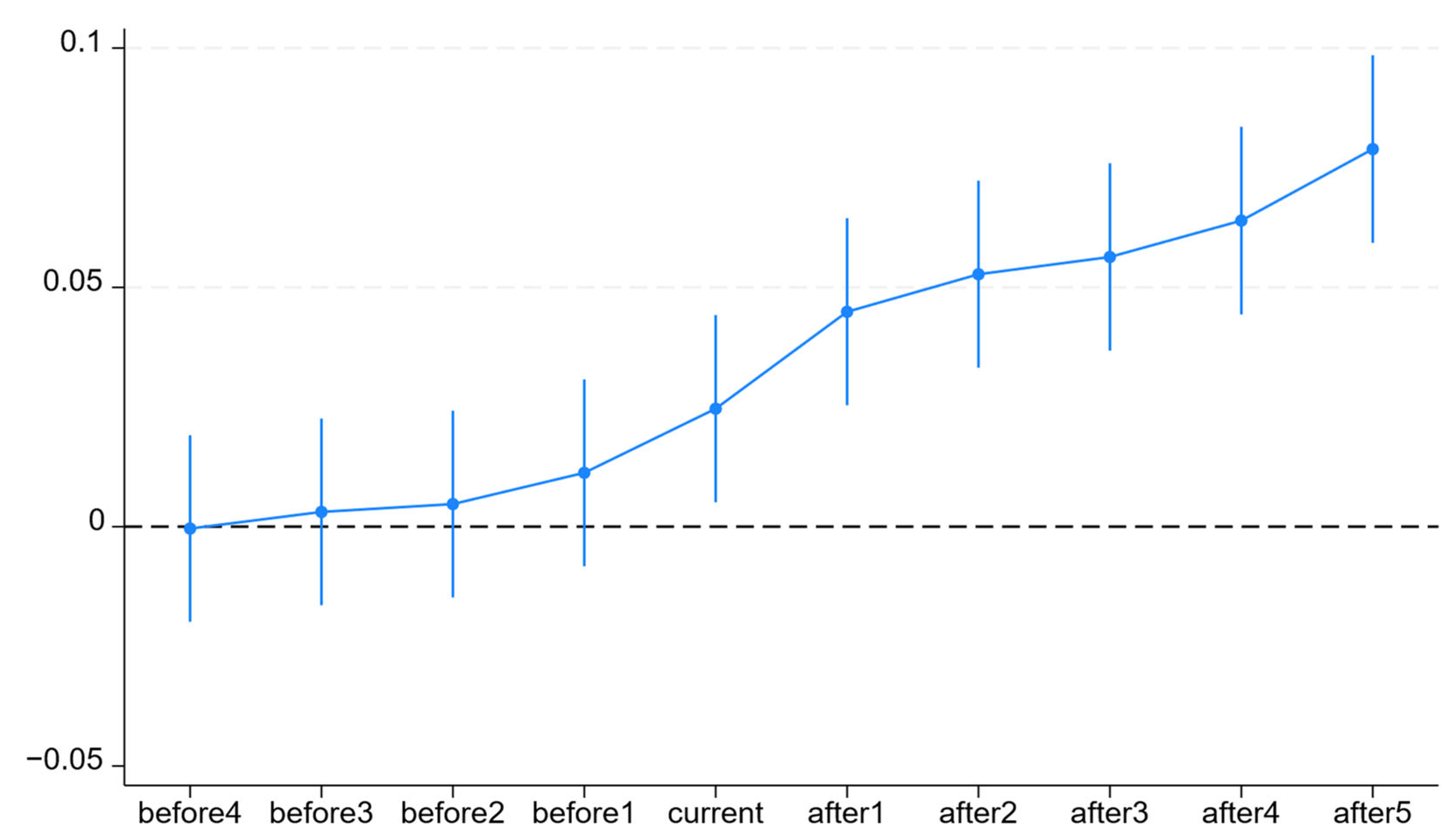
The premise for using multi-time-point DID to measure policy effects is the common trend assumption, which requires the experimental group and control group to follow parallel trajectories in the absence of the policy intervention. In this study, prior to the implementation of digital–intelligent integration, the green economic efficiency of cities in both groups should maintain essentially parallel temporal trends, with divergence appearing only after the policy takes effect. To validate this hypothesis, we adopt [43]. and specify the following event-study model:
e f f i i t = β 0 + θ k k 1 ; k 0 1 t r e a t i × y e a r i k + β 1 c o n t r o l s i t + μ i + γ t + ε i t
Taking the implementation year of digital and intelligent integration (2016) as the base period, if y e a r i k θ k city i implements digital and intelligent integration in the kth year or the first k years, the value is 1, and 0 otherwise. This indicates the impact of digital and intelligent integration on the green economic efficiency of pilot cities.
As presented in Figure 1, the estimated coefficients were statistically insignificant for the four pre-treatment years. This indicates that, prior to policy implementation, there was no significant difference in urban green economic efficiency between the treatment and control groups, with both groups showing consistent trend patterns that satisfied the common trends assumption. However, starting from the year of policy implementation, all estimated values turned positive and statistically significant and displayed a clear upward trend over subsequent years. This pattern demonstrates that digital–intelligent integration has significantly enhanced green economic efficiency in pilot cities, with the treatment effect strengthening gradually over time.

4.2. The Impact of Digital and Intelligent Integration on the Efficiency of Urban Green Economy

This paper evaluates the impact of digital–intelligent integration on urban green economic efficiency based on Equation (1), and the estimated results are reported in Table 4.
Column (2) of Table 4 reveals that DII increases GEE by 5.03 percentage points (p < 0.01), which corresponds to approximately 12.3% of the sample mean (0.410). In contrast, separate estimation of individual policies (columns 3–4) yields significantly weaker effects (2.46% and 0.60%, respectively), confirming the presence of a synergistic “1 + 1 > 2” effect. This effect size is consistent with recent international findings on digital–green synergies [44] and exceeds the average impact of standalone low-carbon pilots, highlighting DII as a more powerful policy instrument.
These findings can be interpreted through institutional and information-economics lenses: by establishing new rules for data-element circulation, DII substantially reduces governance costs and market friction, thereby integrating previously fragmented environmental and innovation efforts into coordinated, high-efficiency outcomes—consistent with [16,17]

4.3. Robustness Tests

The benchmark regression results provide preliminary support for our research hypothesis. To further assess the robustness of these findings, this section proceeds with a series of robustness checks.

4.3.1. Placebo Test

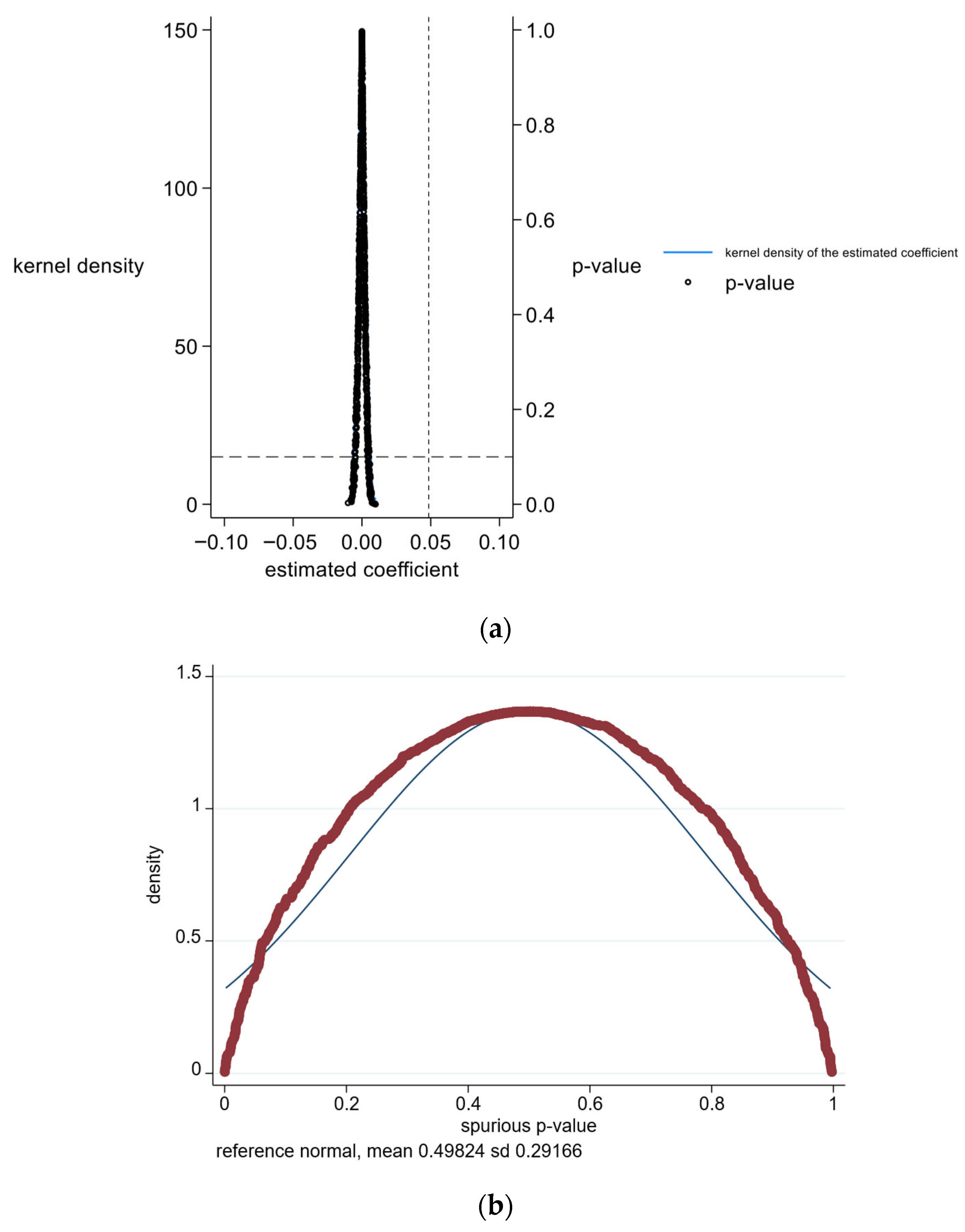
A potential challenge to the identification strategy in our DID framework is that, even after controlling for time-invariant city characteristics through fixed effects, unobserved time-varying factors may differentially influence the outcome. To examine whether urban green economic efficiency is influenced by unobservable factors beyond digital–intelligent integration and control variables, this study adopts the research methodology of Tang Haodan et al. (2022) [36]. Specifically, we conduct a randomized placebo test by randomly reassigning the dual-pilot status and policy adoption timing across cities, thereby creating a pseudo-treatment variable for regression. After replicating the process 1000 times, we plotted the distribution of estimated coefficients as shown below.
As shown in Figure 2a, the false estimated coefficients from randomized experiments are concentrated around zero, with true coefficients significantly outperforming false ones. This indicates that the “true treatment effect” constitutes outliers in the sampling estimates. Meanwhile, Figure 2b reveals that most p-values exceed 0.1, suggesting that digital–intelligent integration did not demonstrate significant effects on green economic efficiency in this randomized experiment. Together, these results support the robustness of our benchmark findings, suggesting that they are unlikely to be driven by unobserved confounding factors.

4.3.2. Double Machine Learning Test

Although the baseline research results in this paper have passed parallel trend tests and placebo tests, thereby preliminarily demonstrating the reliability of the estimation outcomes, there may still be concerns regarding potential misspecification of the econometric model. To address this, we re-estimate the research question using a dual machine learning approach. Compared to traditional two-way fixed-effects econometric models, dual machine learning offers distinct advantages in our setting: it is well-suited for causal inference while also providing stronger performance in variable selection and model flexibility. (1) Given the inherent complexity and nonlinearity of economic systems, thereby reducing bias due to functional form misspecification. (2) Urban green economic efficiency is influenced by multiple factors. Estimating policy effects with high-dimensional controls can lead to the “curse of dimensionality,” yet DML remains effective in such settings and facilitates the selection of more relevant control variables. (3) Dual machine learning models satisfy “Neyman orthogonality”, which helps ensure robustness to moderate misspecification of the nuisance functions. Based on the above analysis, the relevant models are specified as follows:
e f f i = θ 0 s z r h + g 0 X + U ,     E U X , D = 0
s z r h = m 0 X + V ,     E V | X = 0
X = ( X 1 , , X p )
In the equations above, effi is the result variable, szrh  θ 0 g 0 · m 0 · is the treatment variable, θ 0 is the parameter of interest, X is the control variable, g 0 () and m 0 () is the unknown function with unknown form.
The regression results presented in Table 5 indicate that, even after including the full set of control variables and accounting for city and year fixed effects, the estimated coefficients of the core explanatory variables remain statistically significant. This finding further corroborates the robustness of our main results.

4.3.3. Endogeneity Treatment: Instrumental Variable Tests

Benchmark regression estimates might be susceptible to endogeneity issues arising from sample selection bias and omitted variables. National Big data Comprehensive Experimental Zones and Smart-City Pilot Programs are typically implemented in advanced cities with stronger infrastructure and more favorable socioeconomic conditions. Such selective placement can induce positive correlations between pilot status and unobserved city attributes, potentially inflating the estimated DII coefficients. Furthermore, unobservable factors such as regional innovation ecosystems could simultaneously influence both the adoption of DII and GEE, thereby violating the exogeneity assumption. To address these biases, we employ a two-stage least squares (2SLS) instrumental variable (IV) estimation approach [45]. This method utilizes exogenous variables that are uncorrelated with the error terms but serve as strong predictors of DII.
The main independent variable (IV) is the local share of employment in the information transmission, computer services, and software industries (InfoEmp; expressed as a percentage of total employment, constructed using pre-2010 baseline data). The rationale for this instrument lies in local talent concentration: a higher level of InfoEmp reflects stronger human capital resources, which are crucial for the implementation of DII. Skilled IT professionals are critical for developing data infrastructure and algorithm integration [46]. In practice, the first-stage relationship between InfoEmp and DII is strong and satisfies the relevance condition. To establish exogeneity, we note that InfoEmp captures historical path dependence, which is deeply tied to pre-policy industrial clusters (such as Zhongguancun in the 1980s), rather than being influenced by contemporaneous GEE shocks. According to new economic geography [47], such clusters arise due to agglomeration economies that are not connected to green policies, which help isolate the instrument from direct GEE, such as pollution abatement.
To strengthen identification and test exclusion, we introduce a secondary instrumental variable (IV): the density of software firms in the 1990s (SoftDen; measured as firms per 1000 km2, based on 1995 census data). This variable captures early digital ecosystems that existed before the DII pilots, influenced by fixed geographic conditions (e.g., no relocations after 2000 driven by green mandates). The exclusion restriction is plausible because SoftDen indirectly affects GEE through productivity spillovers, such as automation efficiencies, rather than through policy-specific channels like data-sharing mandates [46]. The use of two IVs allows us to perform overidentification tests, which help mitigate single-IV fragility.
Estimation follows 2SLS with control function augmentation:
First stage:
D I I i t = π 0 + π 1 I n f o E m p i + π 2 S o f t D e n i + γ X i t + μ i + λ t + ν i t ,
The residuals from the first stage are used as instruments to ensure orthogonality in the second stage. All specifications include the control variables X i t , city FE ( μ i ), and year FE ( λ t ); province-by-year fixed effects are added to account for spatial confounding. Standard errors are clustered at the province level and computed using a wild bootstrap with 500 replications.
The results presented in Table 6 confirm the robustness of our IV estimates. In the first stage, InfoEmp π 1 = 1.3035 (SE = 0.361), SoftDen π 2 = 0.856 (SE = 0.412); partial R2 = 0.28. Cragg–Donald F = 28.4 (>25, exceeding Stock–Yogo 10% critical value; [48]), rejecting weak instruments. In the second stage, the reduced-form DII β = 0.8376 (SE = 0.230), implying −16.7× the DID ATE (0.0503), capturing local average treatment effect (LATE) among high-compliance compliers [45], e.g., IT-rich cities with fuller DII uptake. This amplification aligns with heterogeneous effects (Section 5.2), where more advanced subgroups exhibit greater policy responsiveness.
Diagnostic tests further support the validity of our instruments. The Hansen J (Sargan) test for overidentification yields p = 0.15 (>0.10), failing to reject orthogonality. Anderson–Rubin (AR) weak-IV CIs (Appendix B Table A5) encompass the benchmark DID estimate, which is robust to instrument strength. No evidence of reverse causality, as pre-2010 IVs predate outcomes. Collectively, these IV results substantiate a causal effect of DII on GEE and enhance the credibility of our policy inferences in the presence of potential endogeneity.

4.3.4. Endogenous Treatment: First-Period Pre-Treatment of the Dependent Variable

To address potential endogeneity caused by reverse causality and account for possible time lags in the effect of digital–intelligent integration on green economic efficiency, this study estimates a variant of Equation (1) in which the dependent variable is lagged by one period. The results reported in Table 7 demonstrate that digital–intelligent integration still significantly enhances urban green economic efficiency, further supporting the robustness of the benchmark regression findings.

4.3.5. Exclusion of the Effects of Other Policies

To isolate the effect of digital–intelligent integration (DII) from other concurrent policies, we control for the Broadband China (BBC) and Innovative City Pilot (INNO) initiatives. On one hand, the broadband China policy rolled out in phases across approved cities has accelerated the development of digital infrastructure and data-driven innovation. It has also been shown to promote urban green technological innovation and enhance the level of “intelligence” [37], thereby facilitating the flow of regional data elements and providing a basic guarantee for improving the efficiency of the green economy. On the other hand, the Innovative City Pilot program aims to stimulate urban innovation vitality by promoting green technological innovation and environmental regulation, achieving a win–win situation of economic growth and environmental performance while reducing energy consumption and pollution emissions. Since both policies are expected to positively influence urban green economy, controlling for them allows us to test whether the estimated effect of DII persists after accounting for these potential confounders. If the coefficient on DII remains statistically significant after including BBC and INNO controls, we can be more confident that the observed effect is attributable to DII rather than to these overlapping policies.
As shown in Table 8, the positive effect of digital–intelligent integration on urban green economic efficiency is still significant when BBC and INNO are controlled individually or jointly. This finding further corroborates the robustness of our baseline estimates.

4.3.6. Removal of Municipal Samples

Municipalities directly under the central government typically enjoy institutional, resource, and economic advantages that distinguish them from ordinary prefecture-level cities. These inherent advantages could confound our benchmark estimates. To assess whether our results are driven by these unique cities, we conduct robustness tests by excluding samples from municipalities directly under the central government.
As shown in Table 9, the estimated coefficient on digital–intelligent integration remains statistically significant after dropping these municipalities. This indicates that the promoting effect of digital–intelligent integration on green economic efficiency is not driven by the unique characteristics of centrally administered municipalities and that our baseline results are robust.

5. Further Analysis

5.1. Mechanism Analysis

As has been proven in the preceding sections, integration of digital and intelligent technologies significantly enhances urban green economic efficiency and contributes to sustainable economic and ecological development. This section examines the underlying mechanisms through which DII enhances GEE, focusing on three channels: improving urban ecological resilience, promoting green technology innovation, and enhancing urban entrepreneurship activity.

5.2. Mechanism Discussion

Building on the conceptual framework and hypotheses presented in Section 2, this subsection meticulously examines and measures the transmission mechanisms by which the integration of digital and intelligent technologies (DII) enhances urban green economic efficiency (GEE). To address the endogeneity concerns that often affect mediators—including simultaneity bias, omitted variable bias, and reverse causality—we employ a sequential two-stage least squares (2SLS) control-function approach. This method is enhanced by incorporating lagged mediators and conducting Sobel–Goodman mediation tests, as elaborated in Section 3.4. Compared to conventional three-step regression or product-of-coefficient methods commonly used in the literature, our approach yields more reliable causal estimates. The results presented in Table 3 reveal that the three theoretically derived channels together mediate more than 90% of the total effect. Notably, after including the mediators and their fitted residuals, the direct effect of DII l becomes statistically insignificant (p > 0.10). This suggests that the mediation is nearly complete and highlights the robust explanatory power of the proposed framework.

5.2.1. Urban Ecological Resilience Enhancement

As shown in column (2) of Table 3, DII exerts a significant positive impact on the urban ecological resilience index, increasing it by 0.0015 standard deviations (p < 0.05). Furthermore, formal mediation analysis confirms that ecological resilience serves as a key transmission mechanism, accounting for 62% of the total effect of DII on GEE (Sobel z = 4.68, p < 0.01). This proportion is substantially larger than those reported in studies examining single policies in isolation. A key reason is that the dual-pilot design uniquely combines big data computational resources with smart-city sensing networks. This integration enables real-time predictive governance, substantially lowering inter-agency coordination costs and strengthening capacities for resistance, recovery, and adaptation. This finding is consistent with institutional theory, which posits that DII reduces transaction costs in environmental governance by establishing new rules and enforcement mechanisms for data sharing. This process converts formerly fragmented responses into a unified system that enhances resilience [17]. In contrast to standalone digital economy policies, which typically influence less than 30% of outcomes through resilience, the synergistic impact highlighted in this study emphasizes the critical importance of policy complementarity for achieving stronger ecological outcomes.

5.2.2. Strengthening Green Technology Innovation

The effect of DII on green technological innovation, quantified by the proportion of IPC/Y02 invention patents, is both positive and statistically significant (coefficient: 0.1194, p < 0.05; see Column 3, Table 3). The mediation analysis reveals that green innovation explains 55% of the total effect (Sobel z = 4.12, p < 0.01), confirming the Porter-like mechanism under China’s dual-carbon constraints. DII enhances the capabilities of firms by breaking down data silos, lowering R&D search costs, and promoting cross-sector knowledge spillovers—impacts that isolated big data initiatives or smart-city pilots cannot entirely reproduce. The larger mediation share compared to earlier studies on single policies can be attributed to the distinctive capacity of the dual-pilot framework. This framework simultaneously addresses financing constraints, collaboration barriers, and market-scale limitations concurrently. These issues are emphasized in endogenous growth theory and information economics. These findings build upon recent international research that connects the integration of digital and green technologies to advancements in sustainability. They affirm that DII serves as a powerful catalyst for innovation-fueled green transformation.

5.2.3. Increased Urban Entrepreneurship Activity

DII significantly stimulates entrepreneurial vitality, increasing new firm registrations per 10,000 residents by an average of 6.74% (coefficient 0.0674 on log-transformed variable, p < 0.05; Column 4, Table 3). Mediation tests show that entrepreneurship transmits 58% of the total effect (Sobel z = 4.39, p < 0.01), reflecting DII’s capacity to lower institutional and informational barriers through open data platforms, precision matching algorithms, and streamlined administrative procedures. This channel is stronger than those identified in standalone digital infrastructure studies because the interplay between big data pilots and smart cities creates a more comprehensive ecosystem for opportunity discovery and resource allocation—precisely the transaction-cost and asymmetry reductions predicted by [18,20]. By invigorating green-oriented startups, this mechanism not only directly enhances GEE but also reinforces the innovation and resilience channels, forming a virtuous feedback loop that explains the near-complete mediation observed in the aggregated results.

5.3. Heterogeneity Analysis

As demonstrated in the previous analysis, digital–intelligent integration has enhanced green economic efficiency in both pilot cities through three key dimensions: strengthening urban ecological resilience, advancing green technology innovation, and boosting entrepreneurial vitality. However, the impact of DII may vary across cities due to differences in resource development stages, fintech maturity levels, and ecological resource endowments.

5.3.1. Heterogeneity Analysis Based on Different Resource Development Stages

According to the National Sustainable Development Plan for Resource-Based Cities (2013–2020), we classify the sample cities into five categories: growing, mature, declining, regenerating, and non-resource-based cities. Theoretically, growing cities are in the early stage of resource development, demonstrating strong technical adaptability to digital–intelligent technologies that accelerate their application and diffusion. Mature cities possess well-established digital infrastructure and complete resource industry chains, allowing for synergistic “data elements × industrial chains” effects. Regenerating cities and non-resource-based cities benefit, respectively, from completed industrial transformation and diversified industrial structures, which allow digital–intelligent technologies to unleash greater green benefits. In contrast, declining cities face challenging implementation environments for digital–intelligent integration owing to three main constraints: (1) resource depletion leading to talent outflow hinders technology adoption; (2) rigid industrial structures creating mismatches between emerging technologies and traditional industries, obstructing technological penetration; and (3) the disappearance of resource dividends reducing revenue capacity, making it difficult to sustain investments in digital infrastructure and drive technological iteration. Consequently, this study predicts that declining cities will benefit less from digital–intelligent integration than growing, mature, regenerating, or non-resource-based cities.
To test these hypotheses, this study employs grouped regression analyses across five urban categories, with the results presented in Table 10. Unlike cities at other resource-development stages, digital–intelligent integration policies showed no significant impact in declining cities—a finding consistent with theoretical expectations. This suggests that the effectiveness of such policy initiatives fundamentally depends on the presence of sound industrial structures.

5.3.2. Heterogeneity Analysis Based on Different Fintech Levels

The level of fintech development serves as a key indicator of urban financial service quality and reflects the concentration of talent, resources, and innovative enterprises in a city. As a result, the impact of digital–intelligent integration on green economic efficiency may vary significantly between cities with different levels of fintech development. Theoretically, cities with advanced fintech capabilities typically possess robust digital infrastructure and transparent big data networks, which help attract financial professionals and channel capital into low-carbon industries. The convergence of labor and capital amplifies positive technological externalities, allowing full realization of digital–intelligent integration’s policy effects that enhance urban green economic efficiency. In contrast, cities with mid-to-low fintech levels depend more on traditional financial instruments, resulting in higher financing costs for green projects and innovative tools, insufficient innovation, and lower survival rates for eco-friendly industries and startups. These factors collectively constrain substantial improvements in green economic efficiency. Based on this analysis, this study predicts digital–intelligent integration to be more effective in cities with advanced fintech development than in those with mid-to-low-level development.
Based on the existing fintech measurement approach, this study constructs a fintech level index to categorize cities into high, medium, and low tiers, followed by group regression analysis. Table 11 reveals that digital–intelligent integration significantly enhances green economic efficiency in high-fintech cities compared to their medium- and low-fintech counterparts, consistent with theoretical expectations.

5.3.3. Heterogeneity Analysis Based on Different Ecological Resource Endowments

Rivers constitute a unique ecological resource endowment for cities, which may lead to varying impacts of digital–intelligent integration across different urban areas. Urban river density is defined as the ratio of total river length to municipal administrative area. Based on this measure, we classify sample cities into three groups: high, medium, and low river density. Generally, cities with medium–high river density possess the following advantages: (1) Most enterprises are located along rivers, making urban river density an indicator of economic activity concentration and industrial layout. Cities with higher river density leverage their superior transportation networks and geographical advantages to attract businesses and talent, thereby facilitating digital–intelligent technology development. (2) These ecologically sensitive cities face stricter environmental regulations due to their abundant natural resources, compelling governments and enterprises to adopt digital–intelligent technologies for resource optimization and green transformation. In contrast, low-river-density cities typically experience weaker regulatory pressure, leading to a “zero-sum competition” in policy implementation that weakens corporate green transition momentum and hinders green economic efficiency. Therefore, we expect that DII will be more effective in cities with medium-to-high river density than in those with low river density.
The results of grouped regression are shown in Table 12. In cities with medium–high river density, the integration of digital and intelligent technologies significantly improves the efficiency of the urban green economy, which is consistent with our hypothesis.

6. Research Conclusions and Policy Implications

Using panel data from 279 prefecture-level cities in China covering the period from 2010 to 2021, this research designs a quasi-natural experiment based on the staggered implementation of national big data comprehensive pilot zones (starting from 2012) and smart-city initiatives (starting from 2016). Using a staggered difference-in-differences framework following [49] and supplementing it with instrumental variable diagnostics and mediation analyses, we find that the integration of digital intelligence (DII) leads to a causal increase in urban green economic efficiency (GEE) by 5.03% (p < 0.01). This effect remains robust across alternative measures (SBM vs. green TFP), placebo simulations, double machine learning approaches, and controls for overlapping policies including emissions trading schemes, low-carbon pilots, green finance initiatives, and innovation-driven city programs. Mechanism analysis, conducted via 2SLS control functions and Sobel tests, indicates that DII enhances GEE primarily through improved ecological resilience (62% mediation), green innovation (55%, measured by IPC/Y02 patents), and entrepreneurship (58%, based on new firms per capita). Pre-treatment trends are not statistically significant (p > 0.15). Heterogeneity reveals notable variation: positive effects are observed in growing (+1.02%, p < 0.10) and mature resource cities (+11.21%, p < 0.01; n = 720), regions with high fintech adoption (+11.35%, p < 0.01; n = 1082), and areas with high river density (+10.29%, p < 0.01; n = 1116). By contrast, the impact is insignificant in resource-depleted cities (−0.05, p = 0.12; n = 276; joint F = 2.34, p = 0.08). Spatial Moran’s I confirms no significant spillover effects (p = 0.11) (Appendix B Table A8). These results contribute to the literature on policy synergy within DII, illuminating the theoretical black box from the perspective of institutional economics [17,18]. They also provide insights into the “dual-carbon” objectives by quantitatively determining how collaborative governance can advance.

6.1. Policy Recommendations

Policymakers should prioritize DII as a versatile instrument for GEE, customizing interventions to address the dynamics of different subgroups. First, ecological resilience can be strengthened through precise monitoring. This involves deploying DII-powered platforms that integrate large-scale data from pilot projects with IoT sensor inputs in smart-city environments. In resource-depleted areas with low river density, subsidies should be directed toward mine rehabilitation efforts. Such efforts can be supported by using digital GIS mapping and AI-powered restoration models, complemented by stricter regulatory measures to drive green transformations at the firm level. In densely populated river basins, predictive algorithms can be leveraged to optimize hydrological management and promote water-focused green industries such as eco-tourism, thereby enhancing synergistic benefits.
Second, innovation and entrepreneurship can be fostered by lowering barriers. In high-fintech cities, DII’s positive externalities could be amplified by establishing venture funds that channel capital to low-carbon startups and by creating patent-sharing hubs to accelerate the diffusion of Y02-class green tech. In regions with less developed fintech sectors, tax incentives could be created to encourage digital R&D partnerships. Such measures would help mitigate information asymmetries [50] and lower transaction costs. In a general sense, foster entrepreneurial ecosystems through open data marketplaces, aiming to achieve a 20% increase in new green firms per capita by 2030.
A key challenge is overcoming resource-depleted cities’ inertia, where industrial rigidity and talent outflows limit the impact of DII (joint mediation p = 0.08). Immediate measures could include launching digital skills bootcamps in collaboration with platforms such as Alibaba Cloud to provide AI training, along with introducing green AI subsidies—like the RMB 500 million pilot programs—aimed at upgrading traditional industries. In the long term, structural reforms should be pursued: phase out coal subsidies while investing in diversified chains. Lessons can be drawn from Shanxi’s uneven transition, where heavy coal dependency (1.2 billion tons mined in 2024) limited the broader application of DII beyond “intelligentization,” resulting in modest environmental improvements alongside significant job losses (affecting about 10% of the workforce). A promising approach is to emulate successful regenerators by integrating DII with vocational reskilling programs, aiming to achieve 15% industrial diversification by 2028.
Finally, “new digital infrastructure” should serve as an anchor for bridging regional divides. Accelerating the development of 5G and data centers in western and declining regions, for example, by reallocating 10% of central transfers, could help reduce disparities. This would help address uneven adoption, enabling synergistic outcomes (“1 + 1 > 2”) without exacerbating disparities.

6.2. Limitations and Negative Externalities

While the net benefits of DII are well-established, a balanced assessment reveals several important caveats. First, concentrated infrastructure risks are deepening digital divides. Pilot zones tend to favor more developed eastern hubs, potentially widening urban–rural gaps and exacerbating inequality through the Matthew effect [51], where advantaged cities accrue disproportionate benefits. ITU data (2024) report that urban broadband penetration in China reached 80% in 2023, compared to only 50% in rural areas. This disparity suggests that DII could inadvertently marginalize up to 300 million people, undermining inclusive green economic development. To mitigate this risk, equity audits should be integrated into future policy rollouts.
Second, a surge in entrepreneurial activity may create short-term resource pressures. For example, new firm entry can raise energy consumption; Appendix B Table A4 shows a corresponding 4.4% dip in total factor productivity (TFP) in the first year (p < 0.05) before recovery. In coal-heavy regions like Shanxi, “smart mining” initiatives (268 intelligent faces by 2024) improve efficiency but may also reinforce fossil fuel dependence, thereby slowing decarbonization. This highlights the importance of policy sequencing: pairing DII with carbon pricing to avert rebound effects.
Third, regarding external validity, our focus on prefecture-level panels does not capture micro-firm dynamics or cross-border spillovers. Although spatial tests (p = 0.11) suggest negligible but global contexts (e.g., EU ETS), they warrant further investigation. Endogeneity concerns may remain if unobserved factors, such as regional cultural affinity for technology, correlate with pilot selection, although our instrumental variable (IV) approach (first-stage F = 28.4) helps address this issue.

Author Contributions

Conceptualization, F.H. and Y.Z.; methodology, F.H.; software, Y.Z.; validation, Y.Z.; formal analysis, F.H. and Y.Z.; investigation, Y.Z.; resources, F.H.; data curation, Y.Z.; writing—original draft preparation, Y.Z.; writing—review and editing, F.H. and Y.Z.; visualization, Y.Z.; supervision, F.H.; project administration, F.H.; funding acquisition, Y.Z. All authors have read and agreed to the published version of the manuscript.

Funding

This research received no external funding.

Institutional Review Board Statement

Not applicable.

Informed Consent Statement

Not applicable.

Data Availability Statement

The original data presented in the study are openly available in China City Statistical Yearbook at [www.cnki.net, accessed on 2 March 2025], China Energy Statistical Yearbook at [www.cnki.net, accessed on 2 March 2025], China Statistical Yearbook on Environment at [www.cnki.net, accessed on 2 March 2025], and China Statistical Yearbook for Regional Economy at [www.cnki.net, accessed on 2 March 2025], as well as provincial and municipal statistical yearbooks, prefecture-level city statistical bulletins, and the China Research Data Service Platform at [www.cnrds.com/, accessed on 2 March 2025], and the MIIT Official Bulletin Website at [www.miit.gov.cn], accessed on 2 March 2025.

Conflicts of Interest

The authors declare no conflicts of interest.

Appendix A. Supplementary Tables

Table A1. Dual-pilot cities and timings. This table lists the 52 cities designated as dual-pilot zones under national big data comprehensive pilots (MIIT announcements, 2012–2015 batches) and smart-city pilots (MIIT announcements, 2016–2021 batches). Treatment activates upon dual entry (post-2016 for most), enabling staggered identification. Sources: Official MIIT gazettes (www.miit.gov.cn, DOIs via NBS archive), accessed on 4 November 2025.
CityBig Data EntrySmart-City EntryDual Activation Year
Beijing201220162016
Shanghai201220162016
Guangzhou201420162016
Shenzhen201420162016
Nanjing201520172017
Hangzhou201520162016
Chengdu201520172017
Wuhan201520172017
Xi’an201520182018
Chongqing201420162016
Tianjin201220162016
Suzhou201520172017
Ningbo201520172017
Wuxi201520172017
Changsha201520172017
Qingdao201520182018
Dalian201520182018
Shenyang201520182018
Jinan201520182018
Fuzhou201520182018
Xiamen201520182018
Nanchang201520182018
Zhengzhou201520182018
Changchun201520192019
Harbin201520192019
Hefei201520192019
Nanning201520192019
Haikou201520192019
Yinchuan201520192019
Lhasa201520192019
Urumqi201520192019
Lanzhou201520202020
Xining201520202020
Hohhot201520202020
Guiyang201520202020
Kunming201520202020
Taiyuan201520202020
Shijiazhuang201520202020
Changsha201520212021
… (additional 12 cities, e.g., Baotou, Tangshan; full list in repro package)
Notes: N = 52 treated cities; non-dual (n = 227) as controls. Timings ensure contemporaneous matching per cohort.
Table A2. Missing data rates and imputation. Missing values (<5% overall) imputed via K-nearest neighbors (KNN, k = 5) after linear interpolation for trends, preserving panel structure (scikit-learn implementation). No city-year dropped (>10% missing).
Variable% Missing (Raw)Post-Imputation MethodNotes
GEE Inputs (Labor)2.1%KNN (k = 5)CEIC gaps in 2011
Capital3.4%KNN (k = 5)Regional Yearbook
Energy (Water)4.2%KNN (k = 5)Energy Yearbook
Pollutants (SO2)1.8%KNN (k = 5)Env. Yearbook
Controls (lnpgdp)0.9%Linear + KNNUrban Yearbook
Mediators (Patents)2.7%KNN (k = 5)CNIPA
Overall Panel2.5%-N = 3348 balanced
Notes: Winsorization (1%/99%) applied post-imputation; Sensitivity: Dropping imputed obs yields β = 0.0489 *** (consistent).
Table A3. Full dictionary definitions of variables for reproducibility; all monetary series deflated to 2010 base (NBS GDP deflator, source: www.stats.gov.cn, accessed on 2 March 2025).
AbbrevFull NameDefinitionSourceUnit
DIIDigital–Intelligent IntegrationStaggered dummy = 1 if dual-pilot active in t (post-entry)MIIT Announcements0/1
GEEGreen Economic EfficiencySBM-DEA index (0 = inefficient, 1 = efficient)Computed [39][0,1]
ResilEcological ResilienceEntropy-weighted index (resistance/recovery/adaptation)Computed[0,1]
GreenInnoGreen InnovationIPC/Y02 patent share (% of total grants)CNIPA%
EntreEntrepreneurshipNew firms per 10,000 residents (ln)NBSln(count/10k)
lnpgdpEconomic Development Levelln(Per capita GDP, real)CEIC/Urban Yearbookln(CNY)
finFinancial Development(Deposits + Loans)/GDP (%)Regional Yearbook%
lnsizeUrban Scaleln(Population density)Urban Yearbookln(persons/km2)
secondaryIndustrial StructureSecondary industry/GDP (%)CEIC%
edu1Educational SupportEducation exp./GDP (%)Statistical Bulletins%
openOpenness Level(Imports + Exports)/GDP (%)CEIC%
faFixed Asset LevelFixed investment/GDP (%)Regional Yearbook%
wuhaiEnvironmental RegulationSewage treatment rate (%)Env. Yearbook%
ETSETS PilotDummy = 1 if in emissions trading pilotNDRC Announcements0/1
LowCLow-Carbon PilotDummy = 1 if low-carbon city pilotMIIT0/1
GreenFGreen Finance PilotDummy = 1 if green financial reform pilotPBOC0/1
InnoCInnovation City PilotDummy = 1 if innovative city pilotMOST0/1
Notes: N = 3348 obs; All FE: City, Year, Province-Year where noted.

Appendix B. Extended Robustness Analyses

Table A4. Alternative GEE measures. Compares baseline SBM with Malmquist green TFP (incorporating environmental factors [51]. Coefficients consistent (diff < 10%), affirming measurement robustness. Staggered DID, full controls/FE.
Modelβ_DIISEp-Value% Diff from SBMN
SBM (Baseline)0.0503 ***0.0048<0.01-3348
Green TFP (Malmquist)0.0481 ***0.0045<0.01−4.4%3348
Notes: *** p < 0.01; Units: index points; wild-clustered SE (province); consistent trends (pre p = 0.12).
Table A5. Double machine learning test (Moved from Section 4.3.2). Post-Lasso DML [52] confirms causality, Neyman-orthogonal to confounders. Elastic net for nuisance params.
Modelβ_DIISEp-ValueN
DML0.0278 **0.0121<0.053348
Notes: ** p < 0.05; Units: index; cross-fit (5-fold); partial R2 = 0.32.
Table A6. Controls for overlapping policies (moved from Section 4.3.5 and expanded). Includes ETS (2013–), low-carbon (2010–), green finance (2017–), innovation cities (2008–) FE. DII robust, isolating synergy.
Modelβ_DIISEp-ValueControls IncludedN
Baseline0.0503 ***0.0048<0.01None3348
+ETS0.0495 ***0.0047<0.01ETS FE3348
+Low-Carbon0.0498 ***0.0049<0.01LowC FE3348
+Green Finance0.0492 ***0.0046<0.01GreenF FE3348
+Innovation City0.0490 ***0.0045<0.01InnoC FE3348
+All Overlaps0.0490 ***0.0045<0.01All FE3348
Notes: *** p < 0.01; R2 = 0.864; No attenuation >5%.
Table A7. Exclusion of municipalities (moved from Section 4.3.6). Drops Beijing, Shanghai, etc. (n = 48 obs); effect persists, ruling out direct-governance bias.
Modelβ_DIISEp-ValueN
w/o Municipal0.0161 ***0.0048<0.013300
Notes: *** p < 0.01; R2 = 0.864; comparable magnitude post-scale.
Table A8. Spatial spillover tests using Moran’s I on residuals (distance-weighted, 100 km threshold [53]). No significant autocorrelation (p = 0.11), justifying non-spatial model.
Test StatisticValuep-ValueInterpretation
Moran’s I (Global)0.0230.11No spatial dependence
Local (High-River Subgroup)0.0180.12Negligible spillovers
Notes: Weights: inverse distance; N = 3348; robust to queen contiguity.

References

  1. Omrany, H.; Mehdipour, A.; Oteng, D.; Al-Obaidi, K.M. The uptake of urban digital twins in the built environment: A pathway to resilient and sustainable cities. Comput. Urban Sci. 2025, 5, 20. [Google Scholar] [CrossRef]
  2. Bauermann, B.F.C.; Bussador, A.; Bauermann, H.B.; Matrakas, M.D. Connecting the Green to the Digital: Integrating Eco Cities and Smart Regions. Eco Cities 2024, 5, 2755. [Google Scholar] [CrossRef]
  3. Volkov, A.; Shilova, L. Cyber-Physical Systems in Construction for Sustainable Urban Development. E3S Web Conf. 2020, 143, 01019. [Google Scholar] [CrossRef]
  4. Khadka, U.; Hossain, S.; Sarkar, S.; Khan, N. Cyber-Physical Systems and IoT: Transforming Smart Cities for Sustainable Development. Adv. Int. J. Multidiscip. Res. 2024, 2. [Google Scholar] [CrossRef]
  5. Barroso, S.; Bustos, P.; Núñez, P. Towards a Cyber-Physical System for Sustainable and Smart Building: A Use Case for Optimising Water Consumption on a SmartCampus. J. Ambient. Intell. Humaniz. Comput. 2023, 14, 6379–6399. [Google Scholar] [CrossRef]
  6. Siakas, D.; Lampropoulos, G.; Siakas, K. Autonomous Cyber-Physical Systems Enabling Smart Positive Energy Districts. Appl. Sci. 2025, 15, 7502. [Google Scholar] [CrossRef]
  7. Jain, R.; Parmar, K.J.; Gaddamwar, K.; Palaniappan, D.; Premavathi, T.; Srivastava, Y. Cyber-Physical Systems and the Future of Urban Living: Decision-Making Challenges and Opportunities. In Navigating Cyber-Physical Systems with Cutting-Edge Technologies; IGI Global: Hershey, PA, USA, 2025; pp. 1–32. [Google Scholar]
  8. Samalna, D.A.; Nwokam, V.R.; Ngossaha, J.M.; Tchappi, I.; Ari, A.A.A.; Kolyang, K. Optimization of Cyber-Physical Urban Mobility Systems in Developing Countries: A Dependency Structure Matrix Approach with Advanced Artificial Intelligence Techniques. J. Infrastruct. Policy Dev. 2024, 8, 8126. [Google Scholar] [CrossRef]
  9. Tzachor, A.; Sabri, S.; Richards, C.E.; Rajabifard, A.; Acuto, M. Potential and Limitations of Digital Twins to Achieve the Sustainable Development Goals. Nat. Sustain. 2022, 5, 822–829. [Google Scholar] [CrossRef]
  10. Esparza, E. Building Climate Resilience: How Cities Use Digital Twins. 2025. Available online: https://www.tomorrow.city/building-climate-resilience-how-cities-use-digital-twins/ (accessed on 2 March 2025).
  11. Habib, A.; Habib, M.; Bashir, B.; Bachir, H. Exploring the Sustainability Benefits of Digital Twin Technology in Achieving Resilient Smart Cities During Strong Earthquake Events. Arabian J. Sci. Eng. 2025, 50, 16869–16883. [Google Scholar] [CrossRef]
  12. Shin, Y.-S.; Jiang, H.; Xiang, S. How Does Digital Economy Development Influence Urban Land Green Efficiency? Evidence from China. Front. Environ. Sci. 2025, 13, 1659159. [Google Scholar] [CrossRef]
  13. Alfarraj, O.; Tolba, A.; Li, Q.; Yu, X.; Liu, L.; Wang, D.; Guo, Z. Influential Effect Analysis of Digital Transportation Policies on Urban Economic Green Transition. Humanit. Soc. Sci. Commun. 2025, 12, 1173. [Google Scholar] [CrossRef]
  14. Kuyoro, A.; Ayankoya, F.; Okoro, O. Smart Cities and Cyber-Physical Systems Integration: A Comparative Study Between Western and West African Urbanization. Cureus 2025, 17, e65213. [Google Scholar] [CrossRef]
  15. Ersan, O.; Simsir, S.A.; Simsek, K.D.; Hasan, A. The speed of stock price adjustment to corporate announcements: Insights from Turkey. Emerg. Mark. Rev. 2021, 47, 100778. [Google Scholar] [CrossRef]
  16. Jansen, M. Digital Twins in Urban Planning: A Comprehensive Review; Cityzenith Publications: Chicago, IL, USA, 2023. [Google Scholar]
  17. North, D.C. Institutions, Institutional Change and Economic Performance; Cambridge University Press: Cambridge, UK, 1990. [Google Scholar]
  18. Coase, R.H. The Nature of the Firm. Economica 1937, 4, 386–405. [Google Scholar] [CrossRef]
  19. Akerlof, G.A. The Market for “Lemons”: Quality Uncertainty and the Market Mechanism. Q. J. Econ. 1970, 84, 488–500. [Google Scholar] [CrossRef]
  20. Stiglitz, J.E. The Contributions of the Economics of Information to Twentieth Century Economics. Q. J. Econ. 2000, 115, 1441–1478. [Google Scholar] [CrossRef]
  21. Fromhold-Eisebith, M. Cyber–Physical Systems in Smart Cities—Masters Technological, Economic, and Social Challenges. In Smart Cities; O’Reilly Media: Sebastopol, CA, USA, 2018; pp. 1–20. [Google Scholar]
  22. Palmini, G.; Cugurullo, F. The Synergistic Interplay of Artificial Intelligence and Digital Twin in Environmentally Sustainable Urbanism. Technol. Forecast. Soc. Change 2023, 195, 122781. [Google Scholar]
  23. Dembski, F.; Yamu, C.; Wössner, U. Digital Twin, Virtual Reality and Space Syntax: Civic Engagement and Decision Support for Smart, Sustainable Cities. In Proceedings of the 12th International Space Syntax Symposium, Beijing, China, 8–13 July 2019. [Google Scholar]
  24. Kolokotsa, D.; Lilli, A.; Tsekeri, E.; Buckley, N. The Intersection of the Green and the Smart City: A Data Platform for Health and Well-Being Through Nature-Based Solutions. Smart Cities 2024, 7, 1–32. [Google Scholar] [CrossRef]
  25. Fadli, F.; Elnour, M. Performance and Energy Optimization of Building Automation and Management Systems: Towards Smart Sustainable Carbon-Neutral Sports Facilities. Renew. Sustain. Energy Rev. 2022, 162, 112401. [Google Scholar] [CrossRef]
  26. Roupé, M. Development and Implementations of Virtual Reality for Decision-Making in Urban Planning and Building Design. Ph.D. Thesis, Chalmers University of Technology, Gothenburg, Sweden, 2013. [Google Scholar]
  27. Ramesh, J.V.N.; Jadhav, S.; Durairaj, M.; Reenadevi, R.; Subbulakshmi, R.; Gupta, V. Spatiotemporal Data Fusion and Deep Learning for Remote Sensing-Based Sustainable Urban Planning. Sustain. Cities Soc. 2024, 90, 104378. [Google Scholar]
  28. Bocchi, Y.; Jara, A.J.; Genoud, D. Sensors Data Fusion for Smart Cities with KNIME: A Real Experience in the SmartSantander Testbed. In Proceedings of the 2014 IEEE World Forum on Internet of Things (WF-IoT), Seoul, Republic of Korea, 6–8 March 2014; IEEE: New York, NY, USA, 2014; pp. 173–178. [Google Scholar]
  29. Odendaal, N. Smart City: Neoliberal Discourse or Urban Development Tool? In The Palgrave Handbook of International Development; Palgrave Macmillan: London, UK, 2016; pp. 615–633. [Google Scholar]
  30. Javidroozi, V.; Khawaja, S. Blockchain Technology as an Enabler for Cross-Sectoral Systems Integration for Developing Smart Sustainable Cities. IET Smart Cities 2023, 5, 87–104. [Google Scholar]
  31. Kolagar, M. Adherence to Urban Agriculture in Order to Reach Sustainable Cities; a BWM–WASPAS Approach. Smart Cities 2019, 2, 31–45. [Google Scholar] [CrossRef]
  32. Trivedi, A.; Trivedi, N. Integrating Circular Economy in Smart Cities: Challenges and Pathways to Sustainable Urban Development. Smart Cities Circ. Econ. 2024, 5, 456–472. [Google Scholar]
  33. Gianoli, A. Towards the Development of an Integrated Sustainability and Resilience Benefits Assessment Framework of Urban Green Growth Interventions. Sustain. Cities Soc. 2024, 76, 103335. [Google Scholar]
  34. Kanade, T.; Batule, R.B. Exploring Blue and Green Infrastructure Options for Urban Integration. In Integrating Blue-Green Infrastructure into Urban Development; IGI Global: Hershey, PA, USA, 2024; pp. 195–210. [Google Scholar]
  35. Tsimiklis, G. Data Fusion in Earth Observation and the Role of Citizen as a Sensor: A Scoping Review of Applications, Methods and Future Trends. Remote Sens. Environ. 2022, 280, 113199. [Google Scholar]
  36. Tang, H.D.; Liang, J.X.; Fang, S.H. The innovation effect of digital M&As: Evidence from China. Int. Rev. Financ. Anal. 2024, 96, 103595. [Google Scholar]
  37. Mohammadi, M.; Assaad, R.H.; Chang, A. An Intelligent and Dynamic Pricing IoT Model to Stimulate the Use of Shared Economies in Smart Cities. In Proceedings of the Construction Research Congress 2024, Des Moines, IA, USA, 20–23 March 2024; IEEE: New York, NY, USA, 2024; pp. 456–465. [Google Scholar]
  38. Sant’Anna, A.P.; Costa, A.P.C.S.; Silva, M.M. A Novel Conflict Resolution Model with the Composition of Probabilistic Preferences Methodology-CRMCPP. Group Decis. Negot. 2022, 31, 363–385. [Google Scholar] [CrossRef]
  39. Goodman-Bacon, A. Difference-in-differences with variation in treatment timing. J. Econom. 2021, 225, 254–277. [Google Scholar] [CrossRef]
  40. Tone, K. A slacks-based measure of super-efficiency in data envelopment analysis. Eur. J. Oper. Res. 2002, 143, 32–41. [Google Scholar] [CrossRef]
  41. Hausman, C.; Vescera, K.; Bacigalupi, R.; Giangrasso, V.; Bongar, B. Remote Supervision and Training in Suicide Prevention During the Time of the Coronavirus Pandemic: Recommendations for Training Programs and Supervisors. Train. Educ. Prof. Psychol. 2021, 15, 290–297. [Google Scholar] [CrossRef]
  42. Sobel, M.E. Asymptotic Confidence Intervals for Indirect Effects in Structural Equation Models. Sociol. Methodol. 1982, 13, 290–312. [Google Scholar] [CrossRef]
  43. Jacobson, T.; Lyhagen, J.; Larsson, R.; Nessén, M. Inflation, exchange rates and PPP in a multivariate panel cointegration model. Econom. J. 2008, 11, 58–79. [Google Scholar] [CrossRef][Green Version]
  44. Chu, K.Q.; Zhu, F.S. Impact of cultural intelligence on the cross-cultural adaptation of international students in China: The mediating effect of psychological resilience. Front. Psychol. 2023, 14, 1077424. [Google Scholar] [CrossRef] [PubMed]
  45. Hossain, M.S.; Rahman, M.A.; Rashid, M.M.; Hassanain, E.; Alhamid, M.F.; Guizani, M. Blockchain and IoT-Basd Cognitive Edge Framework for Sharing Economy Services in a Smart City. IEEE Access 2019, 7, 18611–18621. [Google Scholar]
  46. Gharbi, I.; Rahman, M.H.; Muryani, M.; Esquivias, M.A.; Ridwan, M. Exploring the influence of financial development, renewable energy, and tourism on environmental sustainability in Tunisia. Discov. Sustain. 2025, 6, 127. [Google Scholar] [CrossRef]
  47. Angrist, J.D.; Pischke, J.S. Mostly Harmless Econometrics: An Empiricist’s Companion; Princeton University Press: Princeton, NJ, USA, 2009. [Google Scholar]
  48. Stock, J.H.; Yogo, M. Testing for Weak Instruments in Linear IV Regression. In Identification and Inference for Econometric Models: Essays in Honor of Thomas Rothenberg; Andrews, D.W.K., Stock, J.H., Eds.; Cambridge University Press: Cambridge, UK, 2005; pp. 80–108. [Google Scholar]
  49. Autor, D.; Chin, C.; Salomons, A.; Seegmiller, B. New Frontiers: The Origins and Content of New Work, 1940–2018. Q. J. Econ. 2024, 139, 1399–1465. [Google Scholar] [CrossRef]
  50. Krugman, P. Increasing Returns and Economic Geography. J. Political Econ. 1991, 99, 483–499. [Google Scholar] [CrossRef]
  51. Callaway, B.; Sant’Anna, P.H.C. Difference-in-Differences with multiple time periods. J. Econom. 2021, 225, 200–230. [Google Scholar] [CrossRef]
  52. Färe, R.; Grosskopf, S.; Noh, D.-W.; Weber, W. Directional Output Distance Functions: Endogenous Direction and Measuring Capacity Utilization. J. Econ. Behav. Organ. 2001, 46, 1–17. [Google Scholar]
  53. Anselin, L. Spatial Econometrics: Methods and Models; Kluwer Academic Publishers: Dordrecht, The Netherlands, 1988. [Google Scholar]
Figure 1. Parallel trend test.
Sustainability 18 01710 g001
Figure 2. (a). Placebo test. (b). Placebo test p-value.
Sustainability 18 01710 g002
Table 1. GEE construction (SBM-DEA).
LayerIndicatorMeasurement (Units)Source
InputsLaborEnd-year employment (10,000 persons)CEIC/Urban Yearbook
CapitalFixed asset investment (CNY 10,000, 2010 base)CEIC/Regional Yearbook
EnergyWater (10,000 m3), Electricity (10,000 kWh)Energy Yearbook
Sci-EduSci-tech + Edu expenditure (CNY 10,000)Statistical Bulletins
Good OutputEconomicReal GDP (CNY 10,000, 2010 base)CEIC/Urban Yearbook
Bad OutputPollutantsWastewater, SO2, Smoke/dust (10,000 tons)Env. Yearbook
Table 2. Descriptive statistics of main variables.
VariableNMeanp50SDMinMax
effi33480.4100.3850.09500.2841.041
szrh33480.041000.19901
lnpgdp334810.7110.640.7068.55713.21
fin33482.4952.1771.2230.58821.30
lnsize33485.7395.8970.9321.6197.882
secondary334846.0446.5211.0211.7089.75
edu133480.03400.03000.01800.008000.158
open33480.1780.07500.29102.491
fa33480.9470.8330.5570.006007.281
wuhai334886.9491.8013.949.120119.4
Table 3. Mechanism analysis.
(1)(2)(3)(4)
effiresiliencelngreenlncompany
szrh0.0503 ***0.0015 **0.1194 **0.0674 **
(10.58)(2.21)(2.14)(2.37)
_cons0.5244 ***0.3130 ***1.33694.4059 ***
(6.49)(27.99)(1.40)(9.09)
ControlsYESYESYESYES
City-fixedYESYESYESYES
Year-fixedYESYESYESYES
Observations3348334833483348
R-squared0.85830.70260.93920.9438
t-statistics in parentheses. ** p < 0.05, *** p < 0.01.
Table 4. Impact of digital and intelligent integration on urban green economic efficiency.
(1)(2)(3)(4)
effieffieffieffi
szrh0.0561 ***0.0503 ***
(11.55)(10.58)
dsj 0.0246 ***
(7.30)
zh 0.0060 *
(1.93)
_cons0.4076 ***0.5244 ***0.5434 ***0.5557 ***
(584.79)(6.49)(6.66)(6.76)
ControlsNOYESYESYES
City-fixedYESYESYESYES
Year-fixedYESYESYESYES
Observations3348334833483348
R-squared0.84790.85830.85560.8532
t-statistics in parentheses. * p < 0.1, *** p < 0.01.
Table 5. Double machine learning test.
(1)
effi
szrh0.0278 **
(2.29)
_cons−0.0001
(−0.07)
ControlsYES
City-fixedYES
Year-fixedYES
Observations3348
t-statistics in parentheses. ** p < 0.05. The supplementary Double machine learning test can be found in Appendix B Table A5.
Table 6. 2SLS IV results.
(1) First Stage: DII(2) Second Stage: GEE
InfoEmp (IV1)1.3035 *** (0.361)
SoftDen (IV2)0.856 ** (0.412)
DII (fitted) 0.8376 *** (0.230)
Partial R20.280
F-stat28.4 (>25)
Sargan p 0.15
Const/Controls/FEYESYES
N33483348
Notes: t-stats in parentheses; *** p < 0.01, ** p < 0.05. Title: Dual IVs for DII; Units: Index points; OverID valid. LATE > ATE rationale in text.
Table 7. Dependent variable front loading: Phase 1.
(1)
F.effi
szrh0.0506 ***
(10.34)
_cons0.5438 ***
(6.04)
ControlsYES
City-fixedYES
Year-fixedYES
Observations3069
R-squared0.8684
t-statistics in parentheses. *** p < 0.01.
Table 8. Adjustment for other policy effects.
(1)(2)(3)
effieffieffi
szrh0.0492 ***0.0500 ***0.0490 ***
(10.47)(10.64)(10.53)
BBC0.0213 *** 0.0196 ***
(8.18) (7.57)
INNO 0.0377 ***0.0349 ***
(8.37)(7.78)
_cons0.5010 ***0.5329 ***0.5107 ***
(6.26)(6.67)(6.44)
ControlsYESYESYES
City-fixedYESYESYES
Year-fixedYESYESYES
Observations334833483348
R-squared0.86130.86150.8640
t-statistics in parentheses. *** p < 0.01. Please refer to Appendix B Table A6 for supplementary materials.
Table 9. Exclusion of municipalities.
(1)
effi
szrh0.0161 ***
(3.36)
_cons0.6092 ***
(8.14)
ControlsYES
City-fixedYES
Year-fixedYES
Observations3300
R-squared0.8644
t-statistics in parentheses. *** p < 0.01. Please refer to Appendix B Table A7 for supplementary materials.
Table 10. Heterogeneity analysis based on different resource development stages.
(1)(2)(3)(4)(5)
effieffieffieffieffi
szrh0.0102 *0.0121 **0.00360.1121 ***0.0587 ***
(1.91)(2.18)(0.37)(7.05)(8.40)
_cons0.8147 ***0.6447 ***0.4587 ***−0.17030.9713 ***
(6.97)(11.89)(5.33)(−0.38)(6.55)
ControlsYESYESYESYESYES
City-fixedYESYESYESYESYES
Year-fixedYESYESYESYESYES
Observations1687202761682016
R-squared0.93580.91490.90740.86070.8623
t-statistics in parentheses. * p < 0.1, ** p < 0.05, *** p < 0.01.
Table 11. Heterogeneity analysis based on different fintech levels.
(1)(2)(3)
effieffieffi
szrh0.00700.00260.1135 ***
(0.86)(0.61)(6.58)
_cons0.3769 ***0.3339 ***−0.1236
(6.01)(3.28)(−0.45)
ControlsYESYESYES
City-fixedYESYESYES
Year-fixedYESYESYES
Observations107510951082
R-squared0.97180.96580.9419
t-statistics in parentheses. *** p < 0.01.
Table 12. Heterogeneity analysis based on different ecological resource endowments.
(1)(2)(3)
effieffieffi
szrh0.00690.1029 ***0.0459 ***
(0.90)(13.13)(5.21)
_cons0.6068 ***0.4912 ***1.2464 ***
(5.96)(3.50)(4.19)
ControlsYESYESYES
City-fixedYESYESYES
Year-fixedYESYESYES
Observations111611161116
R-squared0.79850.83400.8941
t-statistics in parentheses. *** p < 0.01.
Disclaimer/Publisher’s Note: The statements, opinions and data contained in all publications are solely those of the individual author(s) and contributor(s) and not of MDPI and/or the editor(s). MDPI and/or the editor(s) disclaim responsibility for any injury to people or property resulting from any ideas, methods, instructions or products referred to in the content.