1. Introduction
In the global economy, the concept of sustainability has become an unavoidable requirement for corporate governance, driven by investor demands and societal pressures, rather than an optional choice for companies [
1]. ESG performance has become an important indicator not only for controlling non-financial risks, but also for improving companies’ ability to create value in the long term. International reporting systems such as the European Union’s Corporate Sustainability Reporting Directive (CSRD) [
2], the European Sustainability Standards (ESRS) [
3], and IFRS S1–S2 [
4,
5] require companies to provide verifiable, comparable, and transparent information on their environmental and social impacts. This change is becoming more important in areas where environmental impacts are intense and social hazards are clearly visible. The textile and apparel industry is classified as a “high-risk sector” in the sustainability literature due to environmental impacts such as water use, chemical use, carbon emissions, and waste generation, as well as social hazards such as occupational health and safety, human rights violations in the supply chain, and informal labor [
6]. Global brand audit processes, pressures from environmental regulations, and rising consumer awareness are forcing textile companies to improve their ESG performance and report it with a high level of transparency. Nevertheless, how to evaluate ESG performance remains a significant point of contention in the field. Because ESG indicators are inherently multifaceted, diverse, and largely context-dependent, it seems impossible to examine performance using only one metric [
7]. At the same time, there are significant methodological criticisms regarding the reliability of ESG scores generated by rating agencies; the fact that the same company can be scored with very different ESG scores by different agencies indicates a lack of a methodological standard in ESG assessment [
8]. One of the main reasons for these inconsistencies is that the weighting of the criteria is often based on individual expert assessments, and the models used are insufficient to capture the variability in company statements. Resources on sustainability reveal that companies measure their ESG success not only by the results of their work, but largely by how they report those results [
9,
10,
11].
Prior research also emphasizes that the quality of ESG disclosure reflects organizational commitment to sustainability governance and accountability mechanisms and shapes internal organizational processes [
10,
11].
In this context, it is important to evaluate ESG performance not only based on the results of companies’ sustainability activities, but also on the extent to which these activities are disclosed to the public in a transparent, comparable, and verifiable manner. Previous studies reveal that the individual scores and subjective weighting approaches used in ESG measurements can cause inconsistent results in inter-company comparisons, creating significant uncertainties for both investors and regulatory authorities [
8].
This study aims to bridge the existing methodological gap by evaluating the ESG disclosure-based performance of textile companies operating in Turkey using publicly available information and a fully objective weighted multi-criteria decision-making (MCDM) methodology. Determining criterion weights using the CRITIC method, obtaining performance rankings using the MABAC and COPRAS methods, and classifying companies according to their ESG profiles using k-means clustering analysis strengthens the methodological integrity and analytical robustness of the study. With these features, the study aims to contribute to both academic literature and practice by offering a multi-stage and holistic evaluation framework focused on ESG transparency and accountability [
7].
While ESG is often discussed in terms of implementation outcomes, this study adopts a disclosure-based perspective and evaluates firms according to the transparency and accountability of their publicly reported ESG practices rather than verified sustainability impacts. Accordingly, the analysis focuses on ESG disclosure performance as a proxy for organizational commitment to sustainability-related reporting and governance mechanisms.
Within this framework, the study addresses the following research questions:
RQ1: Do textile firms operating in Turkey exhibit significant differences in ESG disclosure-based performance from a transparency and accountability perspective?
RQ2: Which ESG dimensions and indicators play the most influential role in determining firms’ disclosure-based ESG performance?
RQ3: Can the integrated CRITIC–MABAC–COPRAS framework combined with k-means clustering reveal structural ESG profiles among firms?
By addressing these questions, the study aims to provide a systematic and replicable assessment of ESG disclosure practices and to offer a benchmarking framework for stakeholders, regulators, and practitioners in high-risk industrial sectors.
This study contributes to the ESG and multi-criteria decision-making literature in four main ways. First, it develops a disclosure-based ESG scoring framework using firm-level data obtained from the Public Disclosure Platform (KAP), providing a transparent and replicable decision matrix for sustainability benchmarking. Second, focusing on the Turkish textile industry, the study offers sector-specific insights from a high-impact manufacturing context that remains underexplored in ESG performance research. Third, it integrates the CRITIC, MABAC, and COPRAS methods with k-means clustering to construct a hybrid ranking–profiling framework that simultaneously evaluates relative performance and structural ESG disclosure patterns. Finally, by emphasizing ESG disclosure quality rather than verified sustainability outcomes, the study advances a transparency-oriented assessment perspective that supports comparative evaluation and stakeholder-oriented reporting analysis.
2. Literature Review
Table 1 summarizes the key characteristics of selected empirical studies that evaluate ESG and sustainability performance using multi-criteria decision-making (MCDM) approaches. As shown in
Table 1, existing studies predominantly rely on single-method or expert-based evaluation frameworks, while the integrated use of objective weighting, multiple ranking techniques, and clustering analysis remains limited in the ESG performance assessment literature.
The studies summarized in
Table 1 show that multi-criteria decision-making (MCDM) approaches are becoming increasingly common in evaluating ESG and sustainability performance. A significant portion of the current studies addresses ESG criteria in the context of investment decisions [
12,
17], sustainable business performance [
7,
15], or alignment with financial performance [
13], and presents relative rankings among firms. These studies reveal that the multidimensional nature of ESG cannot be represented by a single indicator and that MCDM approaches offer suitable tools for modeling this complex structure. However, many studies in the literature either treat ESG performance as a singular decision problem or rely on subjective weighting methods and expert opinions [
9,
18,
20]. Furthermore, studies integrating clustering analysis into ESG assessments are limited, and such analyses are mostly confined to profiling ESG scores [
16,
19]. From a transparency and accountability perspective, studies focusing on the systematic evaluation of publicly disclosed ESG information are relatively few; this context has been addressed more through empirical analyses examining the effects of stakeholder and regulatory pressures on disclosure levels [
14].
This study differs from the existing literature in several important respects. Firstly, ESG performance is examined through publicly disclosed indicators based on transparency and accountability, and the evaluation process is entirely based on an objective weighting approach. Secondly, the weights determined by the CRITIC method are analyzed using two different ranking techniques, MABAC and COPRAS, and the results are supported by K-means clustering analysis. This multi-stage structure not only ranks the relative performance of firms but also allows for the classification of firms with similar ESG profiles. Finally, by focusing on a single sector (textile sector), the study provides more in-depth and comparable findings in an area where ESG risks are high.
In this respect, the study offers both methodological and practical contributions to the ESG literature; rather than relying on predominantly one-dimensional approaches, it introduces a comprehensive evaluation framework that combines multiple methods and stages with an explicit focus on transparency.
3. Materials and Methods
3.1. Dataset
This study considers a total of 7 indicators from ESG practices for which complete data is available, from a perspective of transparency and accountability. Data related to the indicators were collected from the Public Disclosure Platform (Kamuyu Aydınlatma Platformu, KAP) [
22], taking into account the most recent available data. Codes were assigned to the 7 indicators for which data was collected, considering the availability of the data and the relevant literature.
Table 2 presents the indicators.
Table 2 presents the ESG dimensions and indicators used in the analysis, together with their codes and optimization directions. All indicators were constructed based on publicly disclosed information and reflect transparency and accountability practices of firms. Since higher levels of disclosure indicate stronger ESG transparency and reporting practices, all criteria were treated as benefit-type indicators and assigned a maximization direction.
The ESG indicators used in this study were operationalized through a disclosure-based scoring approach using publicly available information obtained from the Public Disclosure Platform (KAP). Each firm was evaluated based on the presence and quality of publicly disclosed ESG-related information corresponding to the seven indicators listed in
Table 2.
For each criterion, firms were assigned ordinal scores according to the level of disclosure: 0 indicates no publicly available disclosure; 1 represents partial or qualitative disclosure without standardized reporting; and 2 denotes comprehensive and structured disclosure aligned with recognized standards or formal documentation. Partial disclosures were coded conservatively to avoid overstating ESG transparency.
Data were collected from firms’ most recent annual reports, sustainability reports, corporate governance compliance reports, and ESG-related announcements available on KAP, using a unified cut-off date to ensure temporal consistency across companies. Specifically, all disclosures were collected based on information publicly available as of 31 December 2024. To enhance reliability, the coding process was conducted independently by two researchers, and discrepancies were resolved through consensus.
The resulting firm-by-criterion decision matrix constitutes the input for the CRITIC, MABAC, and COPRAS analyses.
3.2. Methodology
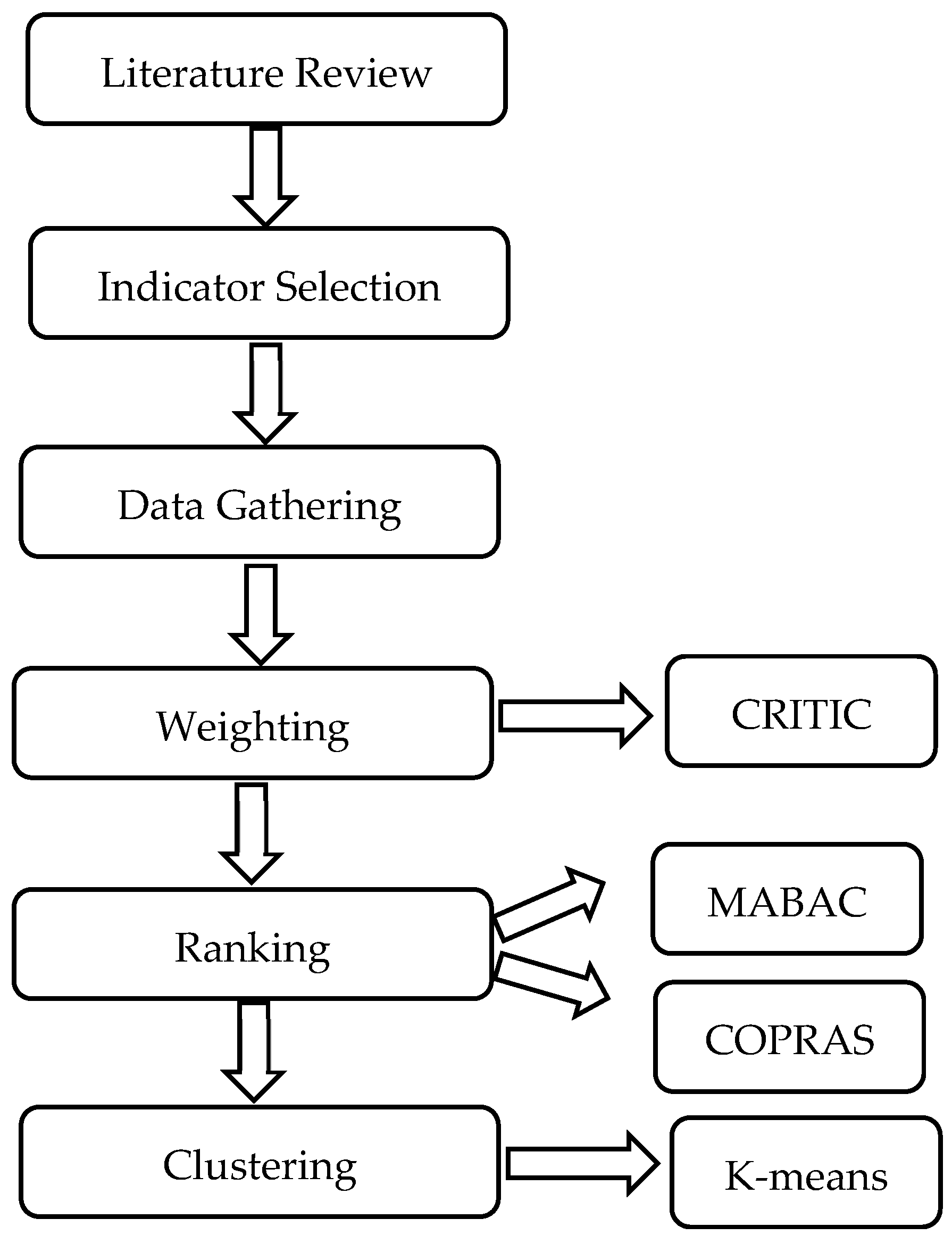
The study included 23 companies in the textile, clothing, and leather sectors that have data available on the KAP. In the study, the weighting of 7 indicators was calculated using the CRITIC method. The MABAC and COPRAS methods were used to rank the companies. In the final stage, businesses were classified using the K-means method. The methodology applied in the study includes the following stages (
Figure 1). This multi-stage methodological framework combines indicator weighting, multi-criteria ranking, and clustering analysis to enable objective evaluation of ESG implementation performance. The CRITIC method offers an objective weighting by considering variability and conflict between indicators, while the combined use of MABAC and COPRAS methods allows for more robust and comparable performance rankings. Furthermore, K-means clustering analysis enables the identification of businesses with similar ESG profiles, allowing for a structural interpretation of performance differences.
3.2.1. CRITIC Method
The CRITIC (Criteria Importance Through Intercriteria Correlation) method is a technique developed to determine the objective weights of criteria in multi-criteria decision-making problems. The method considers the standard deviations of the criteria and the correlation between them when determining their importance levels [
27]. The CRITIC procedure applied in this study follows the standard steps described in [
27].
Step 1: Creation of decision matrix
The decision matrix contains the criterion values corresponding to different alternatives. The decision matrix X is shown in Equation (1).
Step 2: Creation of normalized decision matrix
The decision matrix is normalized depending on whether the criteria are focused on maximization or minimization.
Step 3: Creation of correlation matrix
A correlation matrix is created using the data obtained from the normalized decision matrix (Equation (4)).
Step 4: Calculating the Cj value
is calculated using the standard deviations of the columns in the normalized decision matrix. Equation (5) is used for the
value, and Equation (6) is used for the
value.
Step 5: Determination of Criterion Weights
At this stage, the objective importance levels of the criteria are obtained using Equation (7).
3.2.2. MABAC Method
The MABAC (Multi-Attributive Border Approximation Area Comparison) method was developed by Pamucar and Cirovic [
28]. The fact that the MABAC method does not require defining positive and negative ideal solutions allows it to produce more stable results, especially in datasets containing outliers. The method’s ability to reflect criterion weights in a balanced manner in the model is a significant advantage. Calculating the distance between alternatives and the boundary area makes it possible to obtain very clear and interpretable differences between options. Limiting deviations that may arise from normalization steps and producing quick results on large datasets are other prominent strengths of the method [
28]. The MABAC method is implemented in this study following the procedure described in [
28].
Step 1: Creation of decision matrix
Step 2: Creation of normalized decision matrix
The decision matrix is normalized depending on whether the criteria are focused on maximization or minimization.
Step 3: Creating the weighted normalized decision matrix
Each normalized value is multiplied by its own weight.
Step 4: Calculation of Border Approximation Area (BAA)
is the border value for criteria j.
If is over the alternative border: advantageous.
If is under the alternative border: disadvantageous.
Step 5: Calculating the distances (D matrix) with respect to the border area.
If upper approximation area is the model performance is good. If upper approximation area is the model performance is not good.
Step 6: Calculation of the total performance of the alternatives
An increase in the value of refers to an increase in performance.
3.2.3. COPRAS Method
COPRAS (Complex Proportional Assessment), introduced by Zavadskas and Kaklauskas in 1996 [
29], is a proposal that allows for the ranking and evaluation of alternatives according to the usefulness and importance of criteria. It provides the possibility of ranking alternatives, offers the possibility of evaluating qualitative and quantitative criteria together, and allows programming by recording the desired criteria separately without minimizing the sections where the evaluation process is to be maximized [
30].
The COPRAS technique is applied in this study based on the methodological framework presented in [
31].
Step 1: Construction of the Decision Matrix
At this stage, the decision matrix
is formulated as presented in Equation (15).
Step 2: Creation of the normalized decision matrix
A normalized decision matrix is created to enable comparison of all criteria by obtaining dimensionless values of the different criteria (Equation (16)).
Step 3: Creation of the weighted decision matrix
The weighted decision matrix is obtained by multiplying the weights of the criteria by the columns of the normalized decision matrix (Equation (17)).
Step 4: Calculating Beneficial and Non-Beneficial Criteria
The sums of weighted normalized values are calculated for both beneficial and non-beneficial criteria. Beneficial criteria are those where high values represent the desired outcome in achieving the goal, while non-beneficial criteria are those where low values indicate a more appropriate outcome. The quality criterion can be given as an example of a beneficial criterion, and the price criterion as an example of a non-beneficial criterion.
Step 5: Calculation of relative importance of value
values are the relative importance values for each alternative (Equation (20)). The alternative with the highest relative importance value among the candidate alternatives is the best choice (Equation (21)).
Step 6: Calculation of Pi performance index value
Performance index scores are calculated for each alternative (Equation (22)).
3.2.4. Clustering Analysis
Clustering analysis is a statistical method that typically uses multivariate and quantitative measures to group objects or events based on their similarities [
32]. Among the widely applied clustering techniques, the k-means algorithm is one of the most frequently adopted approaches. K-means is an unsupervised machine learning method that aims to divide the observations in a dataset into K homogeneous subsets based on their similarities. First introduced by McQueen [
33] and later optimized by Lloyd [
34], the algorithm is widely used, particularly for its high computational efficiency in numerical data. Its strengths include fast performance on large datasets, ease of implementation and interpretation, and its ability to produce near-optimal results even when the data structure exhibits global and inter-cluster divisions.
The K-means algorithm consists of the following four steps [
33,
35]:
Determining the Number of K: The parameter K determines how many clusters will be created in the model.
Selecting the Initial Centers: K random observations from the dataset are assigned as cluster centers (centroids).
Assigning Observations: Each observation is assigned to the nearest centroid based on Euclidean distance, and provisional clusters are created.
Updating the Centers: A new centroid is updated for each cluster by averaging the observations within the cluster.
Steps 3 and 4 are repeated until the centroids remain unchanged or a stopping criterion is reached. This makes the clusters both internally homogeneous and distinct from each other [
36].
4. Findings
In this study, the criteria were first weighted using the CRITIC method, as summarized in
Table 3.
As shown in
Table 3, the criteria were weighted as follows: C7 > C6 > C2 > C1 > C4 > C3 > C5. Within the scope of corporate governance practices, the public reporting of firms’ social responsibility initiatives, awareness programs, and training activities (C7) was identified as the most influential indicator, followed by the public disclosure of adopted international reporting standards in ESG reporting (C6). In contrast, the prevention of workplace accidents and the public disclosure of accident statistics (C5) appeared as the least influential indicators.
The weights obtained using the CRITIC method were taken as inputs in the analyses using the MABAC and COPRAS methods and used in weighting the normalized matrices. In this study, the ranking of companies was obtained using the MABAC and COPRAS methods. The results obtained using MABAC and COPRAS are shown in
Table 4.
As shown in
Table 4, the MABAC and COPRAS methods produced quite similar ranking results, especially for firms at the upper and lower ends of the performance distribution. According to the MABAC and COPRAS methods, which use weights obtained from the CRITIC method, Kordsa Teknik Tekstil A.Ş. and Söktaş Tekstil Sanayi ve Ticaret A.Ş. are in the top positions. According to the findings, firms with relatively low performance according to ESG indicators in the context of transparency and accountability include Akın Tekstil A.Ş., Arsan Tekstil Ticaret ve Sanayi A.Ş., Artemis Halı A.Ş., and similar businesses.
To assess the agreement between the MABAC and COPRAS ranking outcomes, Spearman’s rank correlation coefficient was employed. The analysis revealed a strong and positive correlation between the MABAC and COPRAS rankings (ρ = 0.990, p < 0.001). This finding indicates that both methods evaluate firm performance similarly and that the ranking results corroborate each other. Despite having different calculation mechanisms, the overlapping ranking results demonstrate that the obtained ESG performance scores are consistent and reliable, regardless of the method. This agreement leads to the evaluation of companies’ relative performance similarly using different multi-criteria decision-making techniques, strengthening the robustness of the analysis findings.
Businesses were grouped according to their similar characteristics using the k-means algorithm. Clustering analysis was performed using the IBM SPSS Statistics 23.0 package program. To ensure methodological accuracy, the optimum number of clusters was verified using the elbow method, commonly used in clustering research. The measurement showed that a two-cluster solution provided the most consistent structure for the dataset. In addition, cluster validity was assessed using the average silhouette coefficient, which yielded a value of 0.695, indicating strong separation between clusters and high internal cohesion.
The number of businesses in each cluster obtained from the clustering analysis is shown in
Table 5.
As shown in
Table 5, most firms are concentrated in Cluster 1 (56.52%), while Cluster 2 comprises 43.47% of the sample.
The averages of the clusters according to ESG indicators are presented in
Table 6.
As shown in
Table 6, Cluster 2 has the highest values in all ESG indicators. Therefore, it represents the group of businesses with high performance according to ESG indicators. The public disclosure of the ISO 14001 [
23] standard certificate (C2), the establishment of a Corporate Human Rights and Employee Policy covering the Universal Declaration of Human Rights [
25] and ILO Conventions [
26] and the public disclosure of those responsible (C4), and the prevention of workplace accidents and the public disclosure of accident statistics (C5) demonstrate the strengths of Cluster 2.
The cluster memberships of firms and their distances from the cluster centers are presented in
Table 7.
As shown in
Table 7, firms in Cluster 1 exhibit a more heterogeneous structure, with distances ranging from 1.245 to 2.612, whereas Cluster 2 appears more homogeneous, with most distances concentrated around 0.231. Desa Deri Sanayi ve Ticaret A.Ş., Hateks Hatay Tekstil İşletmeleri A.Ş., Kordsa Teknik Tekstil A.Ş., Menderes Tekstil Sanayi ve Ticaret A.Ş., and Söktaş Tekstil Sanayi ve Ticaret A.Ş. are close to the cluster center. These companies are typical representatives of the first cluster. The distance values for the second cluster are mostly 0.231. The companies are closer to the cluster center. The first cluster has a more homogeneous structure compared to the second cluster.
The analysis revealed that the K-means algorithm generated two main clusters. The companies in the first cluster exhibited low and similar ESG performance. It is noteworthy that these companies also showed low performance in the MABAC and COPRAS results.
The companies in the second cluster, on the other hand, showed a higher and more heterogeneous structure in terms of ESG performance. Companies in this cluster, such as Kordsa, Söktaş, Bossa, and Sun Tekstil, also ranked highly in the MCDM rankings. Therefore, it is observed that the ranking results obtained from the K-means classification and the MABAC and COPRAS methods are consistent.
5. Discussion
The findings of this study offer important insights into ESG disclosure-based performance in the textile industry from a transparency and accountability perspective. Rather than evaluating verified sustainability outcomes, the analysis focuses on firms’ publicly reported ESG practices as a proxy for reporting maturity and governance commitment. The CRITIC-based weighting results indicate that indicators related to corporate governance and transparency play a dominant role in shaping disclosure-based ESG performance. In particular, the high importance assigned to public disclosures regarding social responsibility projects, awareness activities, and training practices highlights the central role of accountability-oriented reporting within ESG frameworks.
The findings of this study largely coincide with previous studies on the evaluation of ESG performance using multi-criteria decision-making approaches. In particular, the weighting of ESG indicators and the observation of inter-method consistency in firm rankings parallel previous studies emphasizing the holistic and multi-dimensional nature of ESG performance. However, while some studies report a more dominant environmental dimension, the prominence of transparency and governance-based indicators in this study can be explained by the reporting structure of the textile sector and the nature of the publicly available dataset. In this respect, the study provides a sectoral and data-driven perspective on the ESG literature, complementing existing findings.
The significant overlap in ranking results obtained using the MABAC and COPRAS methods indicates that the analysis findings reflect genuine performance differences among firms rather than a methodological coincidence. The similar results obtained from both methods, particularly for businesses at the upper and lower ends of the performance distribution, enhance the reliability of the rankings. The high rankings of Kordsa Teknik Tekstil A.Ş. and Söktaş Tekstil Sanayi ve Ticaret A.Ş. in both methods suggest that these companies demonstrate stronger and more consistent performance in terms of ESG indicators.
The high and statistically significant correlation coefficient of the calculated Spearman rank differences between the MABAC and COPRAS rankings confirms the stability of the obtained rankings across the methods. This finding demonstrates that the multi-criteria decision-making approaches used similarly evaluate ESG performance and supports the robustness of the analysis results.
In addition, the results of the k-means clustering analysis reveal that businesses are significantly and structurally differentiated based on their ESG performance. The clustering of high-performing businesses together, and the overlap of this cluster with top rankings in MABAC and COPRAS, indicates a strong agreement between the ranking and clustering results. This suggests that differences in ESG performance are not coincidental; rather, they are shaped by businesses’ strategic approaches to transparency and accountability.
Overall, the combined use of CRITIC-based weighting, MABAC and COPRAS ranking methods, and k-means clustering analysis in this study allows for a reliable assessment of ESG performance, both relatively and in terms of structural patterns. The findings demonstrate that integrated multi-criteria decision-making approaches offer an effective and robust analytical framework for measuring sustainability performance.
From a research question perspective, the findings provide clear answers to the proposed framework. Regarding RQ1, the MABAC–COPRAS rankings and k-means clustering reveal substantial differences in ESG disclosure-based performance among Turkish textile firms. With respect to RQ2, CRITIC-based weighting results indicate that corporate governance and transparency-related indicators exert the strongest influence on overall disclosure performance. Finally, in response to RQ3, the combined multi-criteria ranking and clustering approach successfully identifies structural ESG disclosure profiles, distinguishing firms with high reporting maturity from those exhibiting consistently low levels of transparency.
6. Conclusions
The study found that the most important indicator among the indicators is “companies’ public disclosure of their social responsibility projects, awareness activities, and training programs” within the scope of corporate governance principles. According to this dataset, the indicator with the least importance level is “prevention of workplace accidents and public disclosure of accident statistics” within the scope of social impacts. Weights obtained using the CRITTIC method, taking into account the standard deviation and correlations of the data, were used in the weighting of the decision matrices normalized in the MABAC and COPRAS methods. In the application of the MABAC and COPRAS methods, the performance of the companies within the scope of the indicators used in the study was calculated. Kordsa Teknik Tekstil A.Ş. and Söktaş Tekstil Sanayi ve Ticaret A.Ş. are ranked first in the list. Kordsa Teknik Tekstil A.Ş. and Söktaş Tekstil Sanayi ve Ticaret A.Ş. stand out in the rankings due to their high scores in the indicators that carry the most weight when compared to other businesses: “public disclosure of businesses’ social responsibility projects, awareness events, and training activities” and “public disclosure of adopted international reporting standards in ESG reporting within the scope of stakeholders, international standards, and initiatives.” Following the performance ranking carried out using MABAC and COPRAS methods, clustering analysis was conducted to group businesses with similar characteristics. Using K-means clustering analysis, businesses were grouped into 2 clusters. When the businesses within the groups created using the K-means algorithm are analyzed, it is revealed that businesses with similar scores in the rankings created with the CRITIC-weighted MABAC and COPRAS methods are grouped within the same clusters. The results of the ranking and clustering analysis performed using the MABAC and COPRAS methods are consistent. In the clustering analysis, the 13 companies forming the first cluster are those that received the lowest scores in the indicators and are among the lowest ranked companies evaluated for the analysis. The 10 companies in the second cluster are among the top 10 companies in both the MABAC and COPRAS rankings.
In future studies, it would be beneficial to examine the situation in different sectors or different countries comparatively and to use a broader set of indicators. In addition, the results can be compared using different multi-criteria decision-making methods such as TOPSIS, VIKOR, DEMATEL, MAUT, and artificial intelligence-based classification techniques.
6.1. Limitations
This study is subject to several limitations. First, the analysis relies exclusively on publicly disclosed ESG information and therefore reflects firms’ reporting transparency rather than verified sustainability outcomes. As a result, the findings should be interpreted as indicators of disclosure-based ESG maturity rather than direct measures of environmental or social impact.
Second, the scoring process involves structured qualitative judgment when translating narrative disclosures into ordinal values, which may introduce a degree of subjectivity despite the use of independent coders and consensus procedures. Third, the study focuses on a single high-risk sector within one national context, which may limit the generalizability of the results to other industries or institutional environments.
In addition, multi-criteria decision-making methods inherently depend on methodological assumptions regarding normalization, weighting, and aggregation, which may influence ranking outcomes. Finally, the cross-sectional design does not capture temporal dynamics in ESG disclosure practices. Future research incorporating longitudinal data and broader indicator sets may provide deeper insights into the evolution of ESG transparency over time.
6.2. Contributions of the Study
This study contributes to the literature by holistically evaluating the ESG implementation performance in the textile sector from a transparency and accountability perspective using multi-criteria decision-making methods. The objective weighting using the CRITIC method, the combined use of MABAC and COPRAS methods, and the support of the results with cluster analysis strengthen the methodological consistency in ESG performance measurement.
In sectoral perspective, the findings show businesses which indicators are more critical in ESG reporting; and guide policymakers and stakeholders in transparency-oriented sustainability assessments.,
6.3. Future Studies
Future studies are recommended to include comparative analyses of different sectors or countries, the use of broader indicator sets, and dynamic analyses incorporating the time dimension. Furthermore, comparing results using various multi-criteria decision-making methods such as TOPSIS, VIKOR, and DEMATEL, and AI-based classification techniques can further enhance the robustness of ESG performance measurements.




 ,
,