1. Introduction
Amid the global shipping industry’s transition toward greener and more sustainable operations, seafarers are not only a matter of compliance under labor law but also a critical component of corporate Environmental, Social, and Governance (ESG) strategies. International standards such as the Maritime Labour Convention, 2006 (MLC 2006), and the International Convention on Standards of Training, Certification and Watchkeeping for Seafarers, 1978 (STCW 1978), have established baselines for decent work and professional qualifications, providing normative guidance for national legislation and corporate practice [
1,
2]. However, as companies navigate global value chain restructuring and heightened ESG accountability, a key theoretical question remains: How can firms move beyond passive legal compliance to proactively protect seafarers’ rights, thereby building social legitimacy and a sustainable advantage?
Traditionally, academic discourse on this topic has been situated within labor and maritime law, focusing on contracts [
3], working hours [
4], and safety [
5]. While this legal lens is crucial for identifying compliance gaps, it often overlooks how firms, as active agents in social governance, strategically respond to broader stakeholder expectations [
6]. In contrast, existing CSR and ESG research, while demonstrating the link between social responsibility and corporate performance [
7,
8], has yet to offer a transferable framework for the high-risk, heavily regulated context of shipping [
9]. In particular, the question of how to operationalize, institutionalize, and measure the seafarers’ rights protection (SRP)—and how to align this social dimension with governance (G) and environmental (E) objectives—remains unresolved.
From an institutional perspective [
10], the issue involves a complex ecosystem of actors: governments defining legal baselines, industry associations facilitating self-regulation, and financial markets imposing external accountability. Internally, companies must balance these pressures with their own needs for cost control, operational safety, and human capital development [
11]. In this context, protecting seafarers’ rights becomes a key indicator of a firm’s governance capacity, organizational resilience, and potential for social value creation [
12]. By embedding this commitment within a corporate ESG strategy, firms can shift from reactive compliance to proactive legitimacy-building [
13]. This can be achieved through institutionalized mechanisms such as risk detection systems, competency-based crew deployment, digital fatigue management, occupational health and psychological support, and confidential grievance channels. In turn, this strategic approach helps accumulate reputational capital, attract skilled talent, improve safety, and reduce operational risks.
Responding to these practical challenges and theoretical gaps, this study builds a conceptual bridge between management and legal scholarship by proposing a theoretical model that links institutional pressure, ESG strategy, and the institutionalization of seafarers’ rights. Departing from the conventional compliance studies that follows a linear logical model from normative texts to enforcement challenges, this paper advances three key arguments. First, SRP should be recognized as a core social outcome of ESG strategy, institutionalized through governance mechanisms like board oversight and performance evaluation. Second, within a framework of polycentric governance, the paper explores the dynamic coupling between external accountability (from regulators and investors) and internal governance (from strategy and culture). Third, drawing on legitimacy theory, it examines how shipping companies navigate the processes of legitimacy acquisition and repair, particularly amid challenges like crew isolation and fragmented legal jurisdictions, transforming seafarers’ rights from a cost center into a source of strategic value. Crucially, to avoid conceptual ambiguity, this study distinguishes between ESG engagement as a strategic processing mechanism and SRP as an operational performance outcome. While reporting frameworks categorize labor rights under the “S” pillar, we argue that possessing an ESG policy does not automatically guarantee substantive rights protection. Therefore, we examine how the governance infrastructure of ESG translates external pressures into the tangible reality of seafarers’ rights.
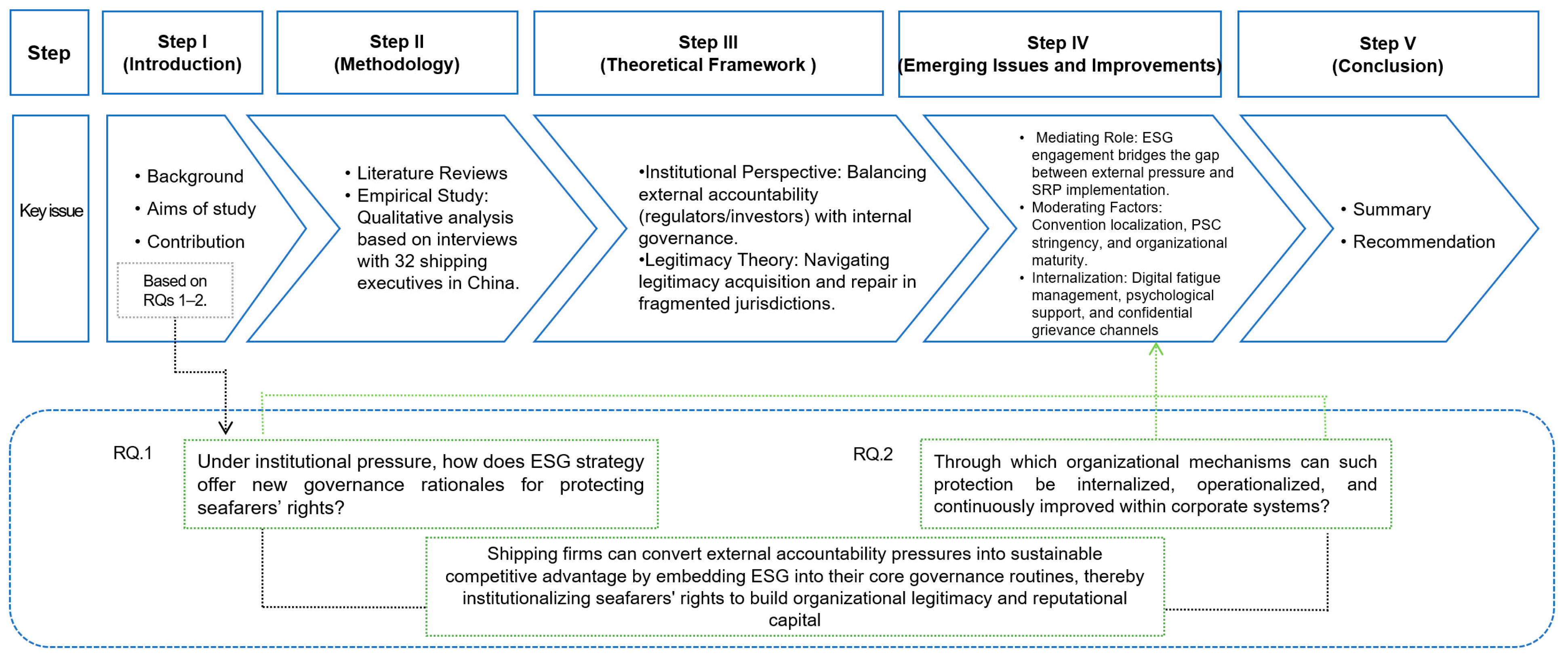
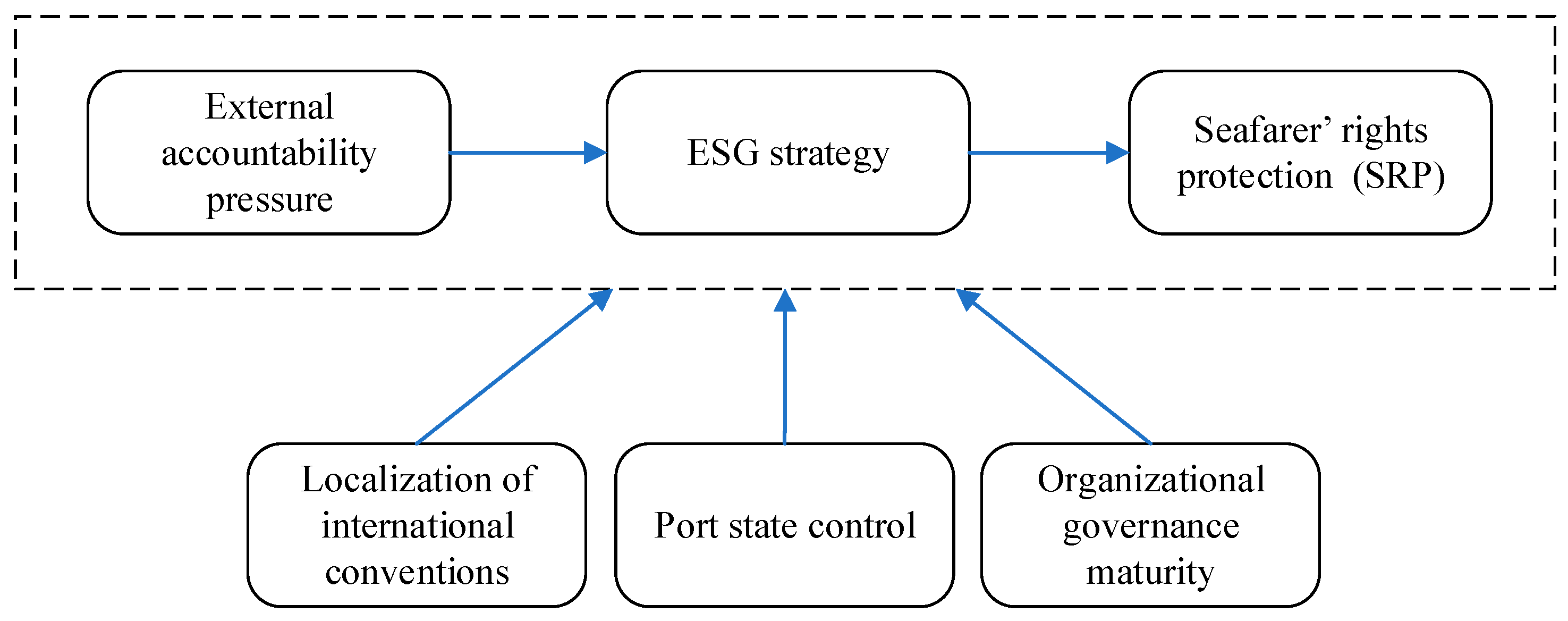
The study addresses two central research questions: (1) Under institutional pressure, how does ESG strategy offer new governance rationales for protecting seafarers’ rights? (2) Through which organizational mechanisms can such protection be internalized, operationalized, and continuously improved within corporate systems? To address the research question, we conducted a qualitative study within the context of China’s shipping industry. Drawing on interviews with 32 shipping executives and structured qualitative data analysis, we developed a theoretical model. In this model, external accountability pressure positively affects firms’ implementation of seafarers’ rights protection (SRP), with ESG engagement mediating this relationship. The model further incorporates three moderating factors: the localization of international conventions, the stringency of port state control, and the maturity of organizational governance. The research outline is presented in
Figure 1.
Our study addresses a critical theoretical gap at the intersection of maritime law and management. Existing legal scholarship predominantly focuses on the normative analysis of conventions (e.g., MLC 2006) and enforcement mechanisms [
3,
5], effectively treating the firm as a “black box” of compliance. Conversely, general CSR literature often lacks granularity regarding the high-risk, cross-jurisdictional constraints of shipping [
9]. Departing from these siloed perspectives, this study bridges legal compliance with managerial strategy. We argue that external institutional pressures do not directly mandate compliance; rather, they must be processed through an internal “governance translation” mechanism—specifically, ESG engagement. By explicating how firms convert macro-level legal obligations into micro-level organizational routines, we offer a novel theoretical lens that views Seafarers’ Rights Protection (SRP) not merely as a cost of compliance, but as a strategic organizational capability.
2. Literature Review
Research on seafarers’ rights from a social governance perspective can be broadly categorized into four main domains: (1) ESG and CSR paradigms; (2) stakeholder and legitimacy theories; (3) collaborative governance frameworks; and (4) the alignment of international maritime labor standards with domestic legal systems. However, these streams often remain fragmented. Legal scholarship primarily emphasizes normative analysis of statutory provisions and enforcement mechanisms; management studies focus on the economic outcomes of corporate social responsibility and its integration into governance structures; while public administration literature highlights multi-actor collaboration and the effectiveness of policy instruments. To build a cohesive theoretical foundation for this study, it is necessary to synthesize these perspectives.
2.1. ESG/CSR: From Compliance Obligations to Strategic and Institutional Integration
The study of corporate social responsibility (CSR) has evolved from focusing on philanthropic and moral obligations to addressing strategic alignment with corporate governance and engagement with capital markets [
14,
15]. In parallel, ESG has emerged as a framework for evaluating corporate sustainability through standardized disclosure and external accountability across environmental (E), social (S), and governance (G) dimensions [
16]. Empirical evidence suggests that investor interest in ESG information is significantly associated with outcomes such as capital allocation, financing costs, and analyst recommendations [
17]. Unlike traditional CSR narratives rooted in moral responsibility, ESG emphasizes institutionalization and measurability. It requires that social responsibility be systematically embedded into corporate governance—through board oversight, incentive systems, internal control, and auditing—and operational processes, such as risk identification, process management, and performance evaluation [
18]. This shift provides a pathway for reconfiguring SRP from a fragmented legal or HR concern into a strategically embedded component of corporate performance management.
Historically, CSR reflected a tripartite logic of moral duty, philanthropy, and legal compliance, portraying the firm’s social role. Over time, CSR evolved toward institutionalization and strategic integration as it became increasingly linked to governance mechanisms and financial markets [
19]. In tandem, ESG emerged as a framework capable of supporting comparability, auditability, and resource allocation, transforming the social dimension from aspirational rhetoric to a set of actionable governance and process requirements [
20]. In the maritime industry, core social dimension concerns include labor standards, occupational health and safety (notably fatigue management), training and skills development, grievance and remedy mechanisms, and cross-border compliance and supply chain governance. These elements form the substantive basis of the “S” in ESG. Research shows that credible disclosure and independent verification of the social dimension significantly influence investor behavior, analyst evaluations, and financing conditions [
21].
Nonetheless, assessing social performance remains challenging for several reasons. First, the variety of indicators and context-specific factors hinders reliable comparisons across firms and jurisdictions [
6]. Second, a mismatch often exists between formal policies and actual outcomes, leading to superficial compliance [
22]. Third, inconsistent standards in third-party assurance can undermine the credibility of ESG disclosures, allowing for performative compliance. These challenges indicate that corporate disclosures alone are insufficient to gauge a company’s genuine commitment to seafarers’ rights. A more accurate, evidence-based assessment requires a triangulated approach. Such an approach would integrate a company’s official ESG reports with other data sources, including regulatory records, incident and dispute data, input from labor unions and industry bodies, and the findings of independent audits.
In this study, SRP denotes tangible operational realities experienced by seafarers—the routinized practices and verifiable outcomes through which rights are protected (e.g., contract standardization, fatigue management, grievance and remedy mechanisms). By contrast, ESG engagement is conceptualized as an organizational governance and accountability infrastructure—board-level oversight arrangements, executive accountability chains, metrics and auditability, and disclosure frameworks that make social commitments monitorable and improvable. This distinction clarifies that ESG engagement operates as a processing mechanism that enables the institutionalization and continuous improvement of SRP, rather than being synonymous with SRP itself.
2.2. Stakeholder Theory and ESG
To understand why firms evolve from meeting compliance requirements to embracing strategic responsibility, stakeholder theory and legitimacy theory offer compelling frameworks. Stakeholder theory posits that companies must continually navigate the expectations of diverse groups, including shareholders, employees, customers, governments, and media [
23,
24]. In the shipping sector, seafarers are not only core internal stakeholders but also a form of scarce human capital whose well-being directly influences operational efficiency, risk, and corporate reputation [
4]. However, responding to stakeholder pressures does not automatically lead to internal change. This transformation requires a governance translation: an institutional infrastructure that converts external accountability demands into actionable internal governance [
25]. Examples include establishing board-level ESG committees, integrating human rights indicators into executive evaluations, embedding fatigue management into operational workflows, and using digital tools for closed-loop risk monitoring.
Legitimacy theory adds further depth by highlighting the dynamic nature of social acceptability [
13,
26]. Gaining legitimacy requires aligning commitments with practices; maintaining it depends on transparency and continuous improvement; and restoring it after a crisis involves accountability and structural reform [
27]. For shipping companies, the hazardous nature of maritime operations, compounded by jurisdictional complexity, renders their legitimacy both volatile and fragile. Embedding seafarers’ rights within the ESG strategy, particularly the governance pillar, is therefore a critical approach to mitigate risks of symbolic compliance. From a social governance perspective, protecting seafarers’ rights—a quasi-public good that enhances public safety and social welfare—cannot be achieved through unilateral, command-and-control approaches. Instead, it necessitates a polycentric system that integrates hard law, soft law, self-regulation, assurance mechanisms, and public scrutiny [
28].
At the institutional level, hard law provides enforceable minimum standards; soft law instruments such as the UN Guiding Principles on Business and Human Rights and the OECD Guidelines for Multinational Enterprises offer firms due diligence frameworks and pathways for improvement; industry associations and labor unions contribute through self-regulation and collective bargaining, helping to overcome information asymmetries; third-party audits and ESG ratings enhance the credibility of disclosures; and media and public oversight create reputational accountability [
29].
At the organizational level, these polycentric forces only yield consistent governance outcomes when firms achieve an integrated response [
30]—characterized by structural alignment, process integration, data transparency, and external coordination. Structurally, the board and dedicated ESG committees must establish and oversee clear accountability chains. Procedurally, fatigue management, grievance handling, and oversight of outsourced labor should be anchored in robust risk identification, early-warning, and corrective action systems. In terms of data, firms should disclose both process and outcome metrics and submit them to independent verification. In terms of collaboration, companies should build rapid-response partnerships with regulators, industry bodies, and legal aid organizations—especially to address challenges in cross-border disputes and evidence collection—thereby enabling more accessible, one-stop remedies for affected seafarers.
2.3. Regulatory Framework in the Shipping Sector
Governance mechanisms in the shipping industry are deeply integrated with the sector’s unique international regulatory architecture. The cornerstone of this architecture is the Maritime Labour Convention, 2006, it sets documented standards for working conditions, health and safety, and grievance procedures [
5]. These standards are enforced through a triadic system of flag state responsibility, port state control, and shipowner obligations, driving continuous improvement across the industry. This is complemented by the STCW 1978, which establishes a unified global framework for seafarer qualifications and professional standards. The 2010 Manila Amendments to the STCW 1978 further strengthened competencies in critical areas like fatigue management and emergency response, establishing foundational support for operational safety. In China, seafarers’ rights are governed by an interwoven legal system spanning labor, safety, and maritime domains [
31]. Key statutes include the Labor Law, Labor Contract Law, Social Insurance Law, and the Maritime Traffic Safety Law, alongside specialized administrative regulations for seafarer management.
Despite this comprehensive legal framework, several systemic challenges persist. These include: (1) jurisdictional conflicts, especially involving foreign or expatriate seafarers, flags of convenience, incidents in foreign waters, and overlaps with port state laws; (2) complex labor relations, often involving triangular employment structures among shipowners, management companies, and crew dispatch agencies; (3) evidentiary and enforcement difficulties, inherent in remote offshore operations; and (4) regulatory fragmentation, due to the segmented responsibilities of different governmental departments.
These challenges underscore that institutionalizing ESG at the firm level is necessity for overcoming structural enforcement barriers. Firms can address these issues by embedding human rights due diligence (HRDD) and supply chain responsibility into core operational workflows, strengthening compliance oversight of labor outsourcing and dispatch practices, enhancing transparency through third-party assurance to mitigate reputational opacity, and developing fast-response coordination mechanisms with maritime regulators, industry associations, and legal aid entities—particularly for addressing cross-border remediation and evidence collection bottlenecks.
3. Method
We employed a qualitative research approach, which is also recommended for theory building [
32]. Drawing on interviews with 32 entrepreneurs from the shipping industry, we aimed to examine how shipping firms develop ESG strategies in response to compliance pressures and how these strategies affect the protection of seafarers’ rights.
3.1. Institutional Context of China’s Shipping Industry
China’s shipping industry offers a theoretically rich context to examine seafarers’ rights due to its complex, dual-track regulatory structure. The first track comprises the ocean-going fleet, which operates in a hyper-globalized institutional environment. These firms, including both central SOEs and large private carriers, are subject to the strict enforcement of international conventions (e.g., MLC 2006, STCW 1978) via a global network of Port State Control (PSC). For these vessels, “localization” implies the rigorous transposition of international standards into corporate practice to avoid detention in foreign ports [
33]. The second track consists of the domestic coastal and riverine fleet. These vessels are governed primarily by domestic statutes, such as the Maritime Traffic Safety Law and the Regulation on Seamen Management. While domestic standards are increasingly aligning with international norms, interviewees noted that enforcement resources in the domestic sector—particularly for river transport—can be more fragmented compared to the international sector, creating a wider variance in compliance outcomes [
34]. In parallel, ESG diffusion has accelerated through disclosure guidelines, ratings, and sector handbooks, pushing boards and senior teams to formalize social-dimension policies, internal controls, and audit routines. Yet structural features of maritime work—jurisdictional mobility, shipboard isolation, and evidence-collection frictions—create gaps between formal policy and on-board practice, making SRP a salient and operationally consequential component of the Social pillar.
Within this setting, SRP concerns voiced in our fieldwork include contract standardization across owners/managers/dispatch agencies, fatigue management tied to manning and voyage schedules, timely wage payment and social insurance enrollment, medical access and psychological support during long rotations, safe repatriation and fair compensation after incidents, and effective, confidential complaint channels. Variation in ESG embedding and SRP institutionalization arises from firm type, cargo segment, route exposure, and governance capacity: large SOEs more often institutionalize board-level oversight and digital hours-of-rest monitoring; cost-constrained private carriers rely on SOPs, charterer-driven audits, and targeted training; charterers, insurers, and logistics platforms differentially intensify due diligence; and major hub ports provide stronger data interfaces than smaller coastal or river–sea nodes. Crewing agencies and manning centers amplify these differences depending on how procurement and audit clauses internalize SRP standards. This combination of strong exogenous pressures and uneven organizational capacities furnishes natural contrast for qualitative theory building, allowing us to trace how external accountability is translated into ESG embedding and, conditional on that embedding, how firms do—or do not—achieve meaningful, auditable institutionalization of SRP.
3.2. Data Collection
We drew on primary and secondary sources to capture how Chinese shipping firms translate compliance pressures into ESG strategies and how those strategies shape SRP. The primary dataset consists of semi-structured interviews with 32 entrepreneurs and senior founders/executives from Chinese shipping firms engaged in both domestic and overseas businesses. The interviews were conducted between December 2025 and January 2026, ensuring a contemporary reflection of the industry’s response to ESG pressures. Details of the interviews are presented in
Table 1.
We used purposive, then iterative sampling around firms’ market exposure and governance capacity. The interview guide covered perceived sources of compliance pressure (e.g., regulatory, market, and stakeholder scrutiny), processes of ESG strategy formation and embedding, and concrete practices related to SRP (contracting, hours-of-rest/fatigue management, medical and psychological support, grievance and redress). With participants’ consent, interviews were audio-recorded and transcribed verbatim; all identities were anonymized and firm-identifying details masked. Field notes were taken after each interview to document contextual cues and emerging themes.
To triangulate and enrich interview evidence, we assembled a secondary corpus comprising internal archival materials (where access was granted)—such as policy manuals, standard operating procedures, training records, and internal audit summaries—and publicly available internet media reports, including company announcements, ESG/CSR disclosures, regulator notices, and reputable news coverage related to seafarer labor, safety incidents, and Port State Control outcomes. These materials were used to reconstruct timelines, verify factual claims (e.g., the introduction of specific SRP practices), and cross-check discrepancies between formal policy and on-board practice. All documents were cataloged in a secure repository, with access logs and de-identification procedures aligned to research ethics standards.
3.3. Data Analysis
Based on the initial analysis, our interviews revealed three categories of frequently occurring issues that necessitate ESG intervention: (1) Fatigue and Rest Hours: Despite digital logging, “fake records” remain common. Executives noted that tight commercial voyage schedules often force captains to violate rest-hour rules, leading to cumulative fatigue that causes accidents; (2) Wage and Social Security Arrears: In the domestic fleet, complex sub-contracting chains often lead to disputes where seafarers are left unpaid when a sub-charterer goes bankrupt; and (3) Isolation and Mental Health: Extended contract durations and lack of shore leave (exacerbated by recent global health crises) were cited as frequent drivers of psychological breakdown, yet few firms have established formal support systems.
Then, we followed an open, inductive approach and iterated between data collection and analysis so that emerging insights could inform subsequent sampling and interview foci [
35,
36]. During the first wave of fieldwork, we conducted open coding, labeling discrete incident–action–outcome units in the verbatim transcripts and privileging in vivo terms to preserve participants’ meanings. We then moved to focused/axial coding, using constant comparison across interviews to merge conceptually similar first-order codes into more abstract second-order themes. Axial relations (causal conditions, context, strategies, and consequences) were used to probe each theme’s explanatory boundaries. Throughout, we wrote analytic memos to record naming rationales, disconfirming evidence, and unanswered questions; these memos fed directly into revised interview guides and follow-up sampling.
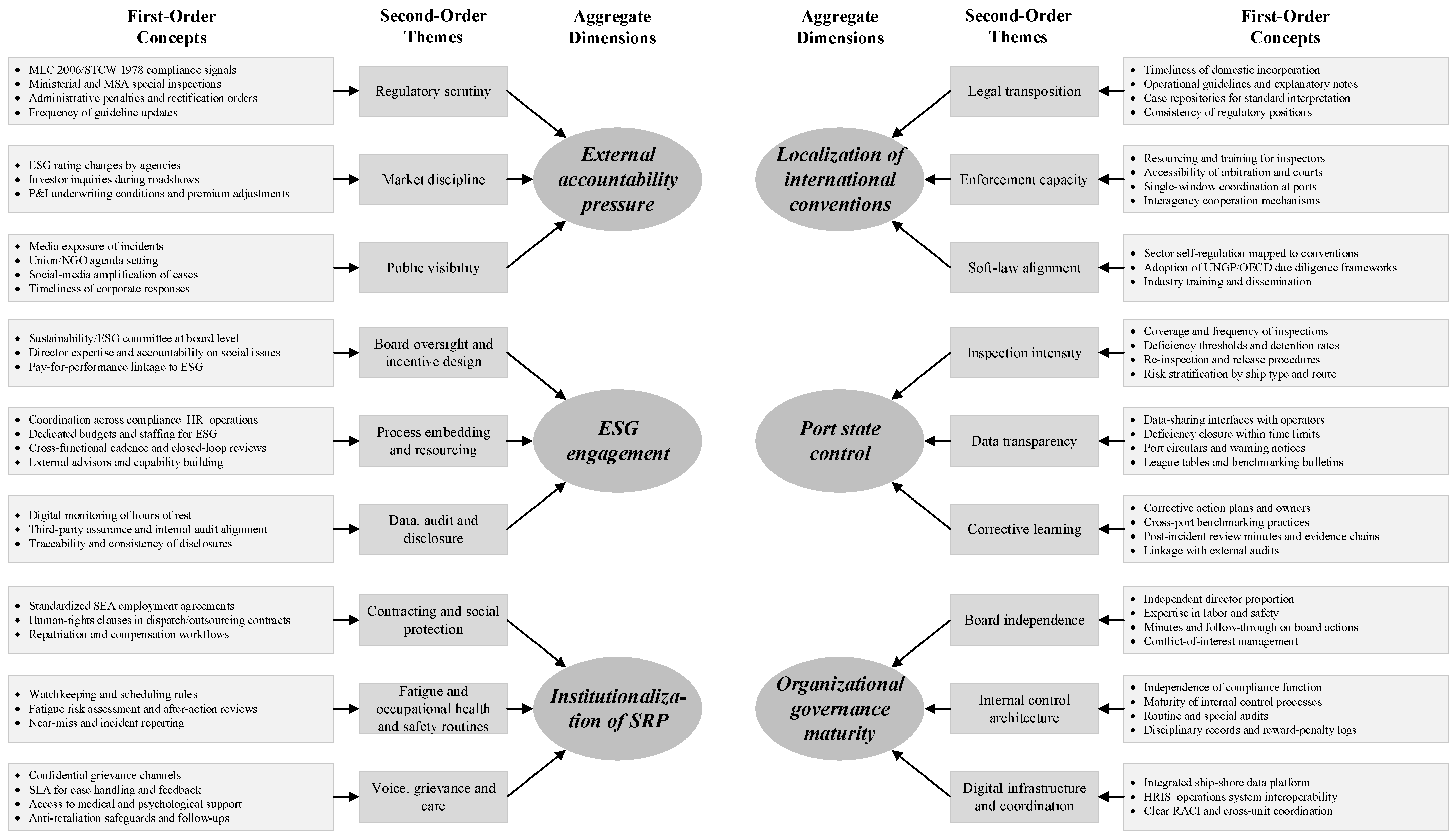
In the selective coding phase, we elevated second-order themes into aggregate theoretical dimensions. The analysis yielded six aggregate dimensions: external accountability pressure, ESG engagement, institutionalization of SRP, localization of international conventions, Port state control, and organizational governance maturity. Triangulation with secondary materials helped reconstruct timelines and verify claims beyond self-reports. To ensure reliability, team members cross-coded overlapping transcripts, discussed divergences to stabilize a shared codebook, and performed back-coding on earlier texts once categories were refined. The data structure is shown in
Figure 2.
In the final analytic step, we specified the causal architecture linking the aggregate dimensions into a coherent process model. External accountability pressure operates as the exogenous driver that shapes firms’ responses, but its effect on the institutionalization of SRP is not direct; rather, it is transmitted through the depth of ESG engagement—that is, the extent to which boards and senior management translate external expectations into governance structures, resource allocations, and auditable routines. The strength of this mediated pathway is conditioned by three contextual moderators: the localization of international conventions (which clarifies rules and lowers enforcement uncertainty), the intensity of Port State Control (which converts paper commitments into on-site verifications and sanctions), and organizational governance maturity (which enhances absorptive capacity and reduces translation losses between policy and practice).
4. Findings
Drawing on data analysis, we propose a conceptual model that delineates the influence of institutional pressure on SRP, with ESG engagement functioning as a mediating mechanism. Furthermore, we discuss the roles of international convention localization, Port state control, and the maturity of organizational governance as boundary conditions within this framework. The theoretical framework is shown in
Figure 3. The original statements of participants are indicated in italics, and the parentheses following the quotations denote the participant numbers.
4.1. The Impact of External Accountability on SRP Institutionalization
Our qualitative evidence shows that external accountability operates as a multifaceted, cumulative pressure system that orients firms toward the institutionalization of seafarers’ rights protection (SRP). Interviewees consistently described being pulled by international instruments (MLC 2006, STCW 1978), checked by port state control, and rated by capital markets and ESG agencies, with media visibility functioning as an amplifier that converts isolated incidents into reputational shocks. As one entrepreneur summarized, “The convention sets the floor, port state control makes it real, and investors keep asking what we actually do—not just what we write” (P03). This alignment of rule-based verification and market-facing scrutiny is especially salient when ships cross multiple jurisdictions within a single voyage. A founder of a mixed domestic–overseas operator noted: “We passed our internal audit, but in [a Northeast Asian port] the port state control officer drilled down into rest-hour anomalies. That detention cost us more than a year of ‘nice reporting’ could recover” (P17).
Yet the same pressure environment can produce divergent organizational responses. Several respondents noted that under conditions of inadequate governance mechanisms, there were periods of strategic or superficial compliance, such as the formulation of policies solely to satisfy disclosure requirements or short-term publicity efforts initiated in response to specific incidents. “After one media story, we ran a ‘100-day safety drive,’ posters everywhere, but the watch schedules didn’t change” (P12). Others described a transition from symbolic measures to routinized practices once SRP was reframed as a governed process. “When the board ESG committee began reviewing rest-hour dashboards quarterly, the discussion moved from slogans to root causes—manning, port calls, charter party terms” (P21).
Institutionalization, in our cases, entailed the migration of SRP from ad hoc responses toward auditable, data-driven routines that cut across compliance, HR, and operations. Managers pointed to concrete infrastructures: “We integrated HRIS with the fleet operations center; fatigue flags now trigger an automatic review before sailing” (P08). Another executive emphasized grievance closure: “Anonymous complaints have a 10-day SLA. HR and the DPA see the same case file, and retaliation checks are part of the close-out” (P25). Firms that rely on crewing agencies reported pushing SRP clauses downstream: “Our new dispatch contracts require proof of social insurance enrollment and allow unannounced spot checks” (P31). Importantly, respondents described SRP as iterative rather than a one-off compliance event: “Every port state control finding becomes a case in our lessons-learned library with a named owner and deadline” (P06).
Legitimacy dynamics were visible both in routine and crisis periods. During routine operations, transparent disclosure tethered to third-party assurance helped convert practices into credible signals. “Investors no longer accept narrative only; they ask for port state control data and grievance statistics” (P19). During crises, the speed and substance of response proved decisive: “After a fatigue-related incident, we published the timeline in 48 h, compensated the crew, and changed the rotation plan; the union publicly acknowledged it, which stabilized the situation” (P10). Over time, firms reported that such institutionalized routines accumulated reputational capital, lowering friction with regulators and counterparties and strengthening employer branding. “When seafarers compare offers, they ask about medical access and off-rotation length. Our systems are now part of the pitch” (P23).
Our analysis of accountability shifts the attribution of risk. While traditional views often blame accidents on “seafarer error” or excessive demands, our interviewees acknowledged that complaints regarding physical fatigue and psychological distress are frequently the result of corporate-level policy failures—specifically, under-manning and aggressive voyage scheduling that prioritize speed over safety. Therefore, effective ESG engagement requires firms to accept systemic responsibility, moving from blaming individuals to optimizing governance structures.
Taken together, the interviews substantiate a linkage between external accountability pressure and institutionalization of SRP: where external accountability is stronger and more verifiable (via convention-driven audits, port state control intensity, investor and rating scrutiny, and public visibility), firms are more likely to move beyond symbolic gestures and embed SRP as governed, auditable practice. Thus, we propose:
Proposition 1. Higher levels of external accountability pressure are associated with higher levels of institutionalization of SRP.
4.2. The Mediating Role of Corporate ESG Engagement
While external pressures set the direction for corporate change, their conversion into durable organizational routines hinges on a firm’s governance adaptation capacity—its ability to translate diffuse expectations into priorities, control systems, and daily behaviors. We conceptualize ESG engagement as this translational mechanism. Our data indicate that external accountability pressures only catalyze durable SRP routines when firms possess the ESG engagement. Across cases, engagement took the form of embedding social concerns into board agendas and cascading them into executive accountability, budgets, and operating procedures. Firms that created board-level sustainability committees with explicit remit over labor and safety, clarified cross-functional responsibility for seafarer welfare, and hard-wired social metrics (e.g., hours-of-rest conformance, grievance closure time) into performance reviews were far more likely to move beyond slogans to auditable practice. As one CEO put it, “Once the ESG committee owned rest-hour dashboards, it stopped being a poster and became a management topic” (P21). Another executive emphasized the budgeting effect: “We tied fatigue controls to voyage planning KPIs—now crewing and operations argue with numbers, not intentions” (P08). Where engagement remained disclosure-centric, changes were cosmetic: “We published a policy, but without data links nothing changed on the bridge” (P12). By contrast, in deeply engaged firms, grievance channels were confidential with anti-retaliation checks, and watchkeeping rules were parameterized in fleet systems: “Fatigue flags auto-trigger a hold before sailing, and closure requires sign-off from HR and the DPA” (P25).
We observe two micro-mechanisms that explain this mediation. Goal translation converts diffuse external signals into measurable targets that focus managerial attention and create decision rights. Capability enabling builds the routines and IT connectors that lower the transaction costs of acting on social objectives at scale. These mechanisms also account for cross-firm heterogeneity: shallow engagement (policies without pay, audits, or data) yields surface adaptations, whereas deep engagement (linked to incentives, audits, and SOPs) produces durable organizational change. Practically, engagement is observable via the authority of board committees, the share of executive compensation tied to social metrics, the scope of internal audits on labor and safety, and the maturity of digital monitoring for crew welfare. Boundary conditions sharpen this role: where rules are clearer and verification stronger (e.g., higher localization, stricter port state control), targets and feedback are unambiguous and engagement has more traction; internally, greater governance maturity reduces translation losses between policy and practice. As one founder summarized, “With independent oversight and real audits, the pressure turns into routines—otherwise it evaporates” (P03).
Finally, boundary conditions clarify this mediating role. The mechanism has more traction where rules are clear and verification is strong, as targets and feedback are unambiguous. Internally, governance maturity, characterized by independent oversight and credible controls, amplifies the effect by reducing translation losses between policy and practice. Thus, we propose:
Proposition 2. The integration of ESG engagement mediates the relationship between external accountability pressure and the institutionalization of SRP.
4.3. Contextual Boundaries: Localization, Enforcement, and Governance
The moderating effect of localization became visible wherever international norms were translated into clear domestic rules, inspectorate capacity, and soft-law alignment with industry practice and third-party assurance. Interviewees contrasted jurisdictions with detailed legal transposition, unified guidance, and accessible arbitration with those where rules were ambiguous and enforcement uneven. In the former, external signals were sharper and firms reported higher confidence that investments in SRP routines would pay off through fewer findings and faster case closures. One executive recalled a turning point after a ministry circular codified rest hour thresholds and published a checklist for shipboard audits: “Once the checklist arrived, we stopped debating interpretations and invested in digital logs and training, because we finally knew what would be inspected” (P07). Another manager emphasized remedy access: “With a dedicated maritime bench and a single window at the port, grievances no longer drift, so it makes sense to formalize our procedures” (P26). Where localization lagged, respondents described wait-and-see behavior, fragmented procedures with crewing agencies, and higher transaction costs for compliance, all of which diluted the impetus created by international conventions.
Our analysis further reveals that this moderation effect is shaped by the industry’s “dual-track” structure. For ocean-going fleets, localization is reinforced by a global network of strict enforcement (e.g., global PSC), creating a high-pressure environment for both SOEs and large private carriers. In contrast, for coastal and riverine fleets, “localization” depends entirely on the domestic enforcement of national statutes (e.g., the Maritime Traffic Safety Law). Interviewees from the river sector noted that while domestic regulations are improving, enforcement resources are more fragmented than in the international sector, leading to wider variance in compliance outcomes. These accounts support the expectation that stronger localization clarifies targets and feedback, strengthens the movement from institutional pressure to ESG embedding, and improves the conversion of engagement into institutionalized SRP. Thus, we propose:
Proposition 3. The degree of localization of international conventions positively moderates the causal chain from institutional pressure to ESG embedding and onward to the institutionalization of SRP.
Port State Control emerged in the data as the decisive on-site verification mechanism that turns formal obligations into observable events, corrective actions, and public records. Firms operating through ports with high inspection coverage, consistent deficiency thresholds, and transparent feedback reported a tighter coupling between external pressure and internal change. A founder with mixed domestic and overseas exposure noted the disciplining effect of data transparency: “In high-intensity ports they pull the rest logs, compare them with call times, and expect a corrective plan with evidence, which forces us to maintain the system, not just the policy” (P14). Another interviewee highlighted reputational stakes and market reactions to port state control findings: “Charterers asked for our last three inspection reports and what we changed, so we built a lessons-learned library and assigned owners for each action” (P09). In such environments, sanctions are more certain, learning cycles are faster, and ESG investments are easier to justify to boards and charterers, which strengthens the relation between pressure and embedding and facilitates the consolidation of SRP routines. Thus, we propose:
Proposition 4. The intensity of Port State Control positively moderates the causal chain from institutional pressure to ESG embedding and the institutionalization of SRP.
The third moderator concerns the firm’s internal capacity to absorb accountability signals and convert them into stable practice. Cases with mature governance featured independent and expert boards, dedicated committees for labor and safety, coherent internal control and audit programs, and digital infrastructures that connected human resources and fleet operations data. Participants described how these features reduced translation losses between policy and practice and turned engagement into a cross-functional program rather than a disclosure exercise. “When independent directors asked for grievance closure time and medical access on the dashboard, budgets followed and behaviors changed on board” (P03). Another manager stressed the role of data plumbing: “Without the link between HR and operations, fatigue rules were a poster, once the systems talked, alerts triggered reviews before sailing” (P18). In firms with lower governance maturity, respondents reported surface adaptations, metric gaming, and short campaigns that faded after scrutiny passed. The comparative pattern indicates that governance maturity amplifies the effect of institutional pressure on ESG embedding and improves the efficiency with which embedded practices consolidate into authentic and durable protections for seafarers. Thus, we propose:
Proposition 5. Organizational governance maturity positively moderates the causal chain from institutional pressure to ESG embedding and the institutionalization of SRP.
4.4. The Emergent Process Model of Seafarers’ Rights Protection
The emergent model integrates six aggregate dimensions into a coherent theoretical framework that explains how seafaring firms convert diffuse accountability pressures into institutionalization of SRP. The model begins with a field of signals [
37] that originate in international conventions, regulatory scrutiny, capital markets, industry associations, and public visibility. These signals create direction and urgency but do not by themselves guarantee organizational change. Change takes shape when firms develop an internal translation mechanism that we label ESG engagement. Through this mechanism, external expectations are reframed as priorities for boards and senior teams, assigned to accountable owners, resourced with budgets, and rendered auditable through data and review routines. Once translated in this way, SRP moves from episodic response to governed practice, which is the state we describe as institutionalization.
The model specifies a mediated core. Institutional pressure influences the institutionalization of SRP principally through the depth of ESG engagement. This engagement performs two functions that emerge repeatedly in the data. First is goal translation. External expectations become measurable targets, dashboards, and review cadences that bind managerial attention [
38] and empower decision making. Second is capability enabling. New routines, information links between human resources and fleet operations, and cross functional forums reduce the cost of acting on social objectives at scale [
39]. Where these functions are weak, firms tend to produce policy statements, campaigns, or isolated trainings that at best satisfy disclosure demands. Where these functions are strong, firms build systems for fatigue control, grievance handling, and crew welfare, and these systems generate verifiable traces that persist beyond the news cycle or a single inspection.
Our data suggest that the mediated mechanism articulated above is robust across ownership structures, although the dominant triggers and the organizational form of engagement differ. In large SOEs, accountability signals are often reinforced by hierarchical mandates and earlier access to board-level oversight and integrated digital control infrastructures, which can accelerate the translation of external expectations into ESG engagement and auditable SRP routines. In cost-constrained private carriers, by contrast, the most consequential pressures more frequently arrive through market-facing due diligence (e.g., charterers, insurers, financiers, and platform-based audits), and engagement tends to be organized through operational SOPs, targeted trainings, and audit-ready documentation. Despite these differences, in both contexts external pressure becomes consequential only when it is converted into ESG engagement—i.e., when expectations are assigned to accountable owners, resourced, and rendered reviewable—thereby enabling SRP to move from episodic responses to durable, evidence-generating institutionalization. Accordingly, ownership primarily shapes the ease, speed, and dominant pathway of translation, which we capture through the boundary condition of organizational governance maturity, rather than changing the existence of the core causal chain.
The three moderating variables serve as important contextual factors in the model. Localization of international conventions clarifies the rules of the game. When standards are incorporated into domestic law with detailed guidance, when inspectorates are trained, and when arbitration or court access is visible, firms face clear targets and predictable feedback [
40]. Port state control intensity strengthens verification at the point where ships meet ports. Frequent and consistent inspections, transparent findings, and required corrective plans convert formal obligations into observable events and learning cycles [
41]. Organizational governance maturity determines the absorptive capacity on the firm side [
42]. Independent oversight, coherent internal control, and interoperable data systems lower the loss that often occurs when policy language is converted into daily routines. Together these moderators sharpen signals, increase verification strength, and raise absorptive capacity, thereby strengthening the mediated pathway from pressure through engagement to institutionalization.
Our model allows for dynamic, equifinality and nonlinearity.
First, institutionalized practices generate outcome data that flow back into both the firm and its environment. Within the firm, incident reviews, grievance closure times, and rest hour conformance feed strategic reviews at board and executive levels and lead to recalibration of crewing plans, training, and supplier contracts [
4]. In the environment, credible disclosures supported by independent assurance enhance legitimacy and reputational capital [
13,
15], which reduces friction with authorities and counterparties and in turn improves the economics of continued investment in SRP. Episodes of failure also play a constitutive role [
43]. Rapid disclosure, compensation, and structural fixes can prevent legitimacy collapse and restore trust, while slow or symbolic responses can erase years of accumulated goodwill. The trajectory is therefore path dependent. Firms that institutionalize early tend to learn faster and face lower marginal costs for improvement, while firms that delay often encounter higher costs and deeper skepticism from stakeholders. We conceptualize “crisis-driven” change as an event-amplified instance of external accountability pressure rather than a distinct pathway. In routine periods, accountability is chronic and cumulative, which gradually pushes firms toward deeper ESG engagement and, consequently, SRP institutionalization. In crisis periods, salient incidents generate an acute spike in accountability and compress managerial response windows, thereby accelerating the same translation mechanism. Crucially, crisis does not bypass ESG engagement: rapid disclosure and structural fixes are feasible when goal translation and capability enabling are already in place.
Second, different configurations of pressure sources can catalyze engagement, and different sequences of capability building can lead to institutionalization [
44]. Some firms begin with board oversight and later digitize monitoring, while others start by integrating data flows and then revise governance. Threshold effects are likely. Engagement may not produce visible change until minimum levels of localization and Port State Control are reached, and the same engagement investments can have very different payoffs depending on governance maturity. These features explain the heterogeneity observed across firms that operate in similar markets.
By positioning ESG engagement as the bridge between institutional pressure and organizational SRP practice, the model clarifies how policy instruments and market scrutiny can be designed to encourage authentic routines rather than symbolic gestures. Clearer rules and stronger verification increase the value of engagement. Better governance inside the firm increases the efficiency with which engagement becomes practice. In combination, these elements describe a process through which the SRP can become a stable part of everyday operations rather than an occasional response to external scrutiny.
5. Discussion
5.1. Theoretical Contributions
This study makes three main theoretical contributions to the intersection of ESG, governance, and seafarers labor regulation.
First, we resolve the conceptual tension between ESG strategy and labor rights by framing them as distinct organizational constructs: the former as a governance translation mechanism and the latter as an operational outcome. While standard rating methodologies (e.g., GRI, SASB) categorize labor standards as sub-indicators of the “S” pillar [
6,
19], empirical reality often reveals a decoupling between policy disclosure and practice. By rigorously distinguishing between ESG engagement (the strategic infrastructure of boards, budgets, and controls) and SRP institutionalization (the routine execution of rights), our model avoids tautology. It demonstrates how ESG functions not merely as a label, but as the active processing mechanism that converts diffuse institutional pressures into specific, auditable operational routines [
4,
9]. This integrated framework advances beyond viewing rights protection as a compliance burden or cost center and repositions it as an organizational capability that can yield sustainable competitive advantage.
Second, we open the black box of compliance by identifying ESG engagement as the critical governance translation mechanism. Prior institutional theory research has extensively documented how external pressures (coercive, normative, mimetic) shape organizational fields [
10]. However, the internal micro-foundations of how these pressures are processed remain less understood in the maritime context. We extend prior research by delineating the specific governance infrastructure—such as board-level ESG committees and integrated HR-operations data systems—that is required to translate diffuse external accountability into specific, auditable behaviors. This refutes the assumption that legal mandates automatically result in organizational action. Without such engagement, organizations risk symbolic compliance [
45]; with it, they cultivate stable, auditable routines. This process perspective extends the current literature from a binary focus on either pressure or outcome to a dynamic model of pressure, governance and routine.
Third, we contribute to the polycentric governance literature by specifying the boundary conditions of “localized enforcement.” While existing studies acknowledge the role of multiple stakeholders [
28], they often treat regulatory pressure as uniform. Our findings regarding the “dual-track” structure of the Chinese shipping industry (international vs. domestic/riverine) and the role of Port State Control intensity clarify that the “pressure-response” relationship is highly contextual. We provide a more nuanced theoretical explanation for why global ESG norms penetrate some fleet segments effectively while failing in others, attributing this divergence to the moderating effects of regulatory localization and governance absorptive capacity.
5.2. Policy and Law Implications
The findings carry distinct, complementary implications for government, the legal/judicial system, industry-level coordination, and firms. Together, these layers can convert diffuse ESG expectations into routines for the institutionalization of SRP.
(1) For governments and regulatory authorities. Our findings indicate that regulatory ambiguity drives “wait-and-see” behavior, particularly in the domestic fleet. Authorities should immediately publish standardized PSC and Flag State Control checklists that explicitly interpret international conventions (MLC 2006/STCW 1978) for local enforcement. This offers a low-cost, high-impact method to reduce uncertainty. To address the challenge of cross-departmental fragmentation, a long-term pathway involves establishing an interagency data platform connecting maritime safety (MSA), labor, and judicial bodies. This would prevent “regulatory arbitrage” where bad actors exploit information silos between safety and labor authorities. Moreover, public authorities should transition from fragmented, ad hoc enforcement approaches to an integrated regulatory system that establishes a feedback loop connecting the domestic implementation of international conventions, operational enforcement protocols, and auditable compliance standards. This framework must be coherent and enforceable.
(2) For the legal and judicial system. A robust legal and judicial system is essential for transforming policy intentions into enforceable rights. To this end, policymakers should clarify jurisdictional rules in cross-border cases, such as those involving the flag state, port state, or contract venue, and facilitate inter-agency cooperation through memoranda of understanding or judicial mutual recognition mechanisms between maritime, labor, and judicial authorities to streamline access to remedies. Legal obligations for human rights due diligence should be introduced or enhanced across the maritime labor supply chain, especially during contracts involving seafarer dispatch or outsourced services. Specialized courts, such as maritime or labor courts, should be established or strengthened, with expedited procedures for handling seafarer wage claims, repatriation, and work-related injury compensation, supported by statutory case resolution timelines. Whistleblower protections and anti-retaliation clauses for seafarers and onboard representatives must also be codified in law. To strengthen upstream governance, model clauses should be developed for standardized seafarer employment agreements, dispatch contracts, and charter party agreements, embedding SRP-related obligations and verification mechanisms. Remedies and sanctions must be recalibrated to ensure that the expected cost of violations exceeds any potential benefit. Legal clarity and credible enforcement will improve the strategic return on ESG integration and reduce uncertainty in MRP implementation.
(3) For industry associations, unions, and intermediaries. To mitigate the high costs of individual compliance for smaller firms, associations should develop standardized “SRP-compliant” clauses for crew dispatch and charter party agreements. The success of polycentric governance depends on competent intermediary institutions. Industry associations should spearhead the development of context-specific practice guidelines, such as for coastal bulk shipping versus international liner operations, create enterprise assessment tools, and facilitate peer-learning networks for sharing best practices in fatigue management, grievance handling, and incident learning. They should also offer shared training programs and expert databases across medical, psychological, and audit domains, and pilot rapid mediation and arbitration mechanisms to resolve cross-border disputes efficiently. Unions and legal aid organizations can maintain confidential grievance channels, offer psychological support networks, and issue periodic risk monitoring reports to detect systemic issues early. ESG rating agencies and investors must strengthen the substantive evaluation of the social pillar by triangulating corporate disclosures with regulatory data, such as port state control outcomes and sanction histories, and assurance rigor, to distinguish between superficial declarations and verifiable practice. Furthermore, to operationalize health protection, firms must mandate advanced first aid and emergency medical training for senior officers beyond the STCW 1978 minimums. Regarding logistics, companies should establish pre-approved protocols for medical evacuation and visa processing in key hub ports. This ensures that when a crew member falls ill, the replacement process—often a bottleneck due to visa restrictions—is streamlined to prevent delays in medical access.
(4) For enterprises and corporate governance. Consistent with our finding that governance maturity moderates outcomes, firms must immediately elevate SRP from an HR function to a board-level ESG committee responsibility. This ensures that safety and labor metrics are reviewed alongside financial KPIs, preventing the “marginalization” of social issues. At the corporate level, the priority is to translate external ESG expectations into budgeted authority and auditable processes. Boards should establish ESG or sustainability committees with defined oversight of labor and safety matters, integrate social performance indicators (e.g., rest hour compliance rates, grievance resolution times, medical service accessibility) into executive performance and compensation schemes, and conduct regular board reviews using risk dashboards. Management should institutionalize a closed-loop control system spanning departments, including compliance, HR, and operations, that covers deviation detection, monitoring via digital logs, root cause investigation, and verification of corrective actions. Companies should develop digital infrastructure that integrates human resource information systems with fleet management systems to enable fatigue risk analysis, near-miss reporting, and geofenced verification of work/rest compliance. In procurement, SRP standards must be embedded throughout the supply chain via supplier codes of conduct, contract clauses granting audit rights, and escalation protocols for labor dispatch and maintenance contractors. Specifically, effective disclosure should move beyond qualitative statements to include quantitative key performance indicators such as: lost time injury frequency and medical evacuation rates; port state control deficiency rate related to MLC 2006 (labor) issues; crew retention rate and average contract length; grievance resolution metrics (e.g., number of complaints filed vs. resolved within 10 days). These examples provide verifiable data points for investors and stakeholders to assess true social performance.
5.3. Limitations and Prospects
Although this study proposes a theoretical framework linking institutional pressure, ESG engagement, and SRP based on in-depth qualitative analysis, the proposed causal relationships have not yet been tested through large-sample empirical research, and their generalizability remains to be established. Specifically, future studies should address the following four issues related to empirical operationalization:
First, at the measurement level, the social dimension exhibits significant contextual heterogeneity and dual attributes of process and outcome. Any single data source (such as annual report disclosures or ESG rating scores) may overestimate “paper compliance.” Future studies should pursue evidence triangulation across multiple data sources—combining port state control inspection records, labor arbitration and litigation data, third-party assurance reports, and frontline interview materials—to improve the reliability and validity of measurement.
Second, in terms of causal inference, there may be issues of bidirectional feedback and joint determination among external accountability, ESG embedding, and institutionalization. In particular, major incidents and media shocks can trigger episodic or campaign-style compliance. Future research can apply longitudinal panel data, event studies, regression discontinuity designs (RDD), or instrumental variable strategies. Leveraging natural experiments or regulatory differences across ports and jurisdictions could further strengthen the robustness of causal identification.
Third, in terms of external validity, the shipping industry’s characteristics—high risk, cross-jurisdictional operations, and strong regulatory oversight—make it a relatively special case. The applicability of this framework to other sectors (e.g., fisheries, offshore energy, or land-based logistics) remains to be tested. Future studies could conduct cross-industry comparisons to identify both shared mechanisms and sector-specific pathways in the transition from “baseline compliance” to “strategic governance.”
Fourth, at the organizational level, the conceptualization and operationalization of governance maturity require further refinement. Dimensions such as board expertise and independence, deliberation structures, internal control quality, data infrastructure robustness, and cross-departmental coordination capacity need to be more precisely defined. Additional mixed-method research—both qualitative and quantitative—is needed to calibrate the weights and boundaries of these components.
Fifth, as this study relies on the subjective perceptions of executives, the findings may reflect biases influenced by recent events or social desirability. Therefore, while our model provides a theoretical illustration, it should be treated as a starting point. Future research should aim to develop quantitative decision-making model tools that can test these relationships and aid policymakers even under conditions of uncertainty, moving beyond perception-based analysis.
6. Conclusions
This paper proposes a theoretical framework of external accountability pressure, ESG engagement and institutionalization of SRP through a qualitative approach, and demonstrates the positive moderating roles of international convention localization, port state control, and organizational governance maturity. The central argument is that external accountability pressures, from regulators, capital markets, and public opinion, can be transformed into stable, auditable, and continuously improvable governance routines when ESG is embedded into the strategic, structural, and procedural core of corporate governance. These routines then contribute to organizational legitimacy, reputational capital, and human capital strength key drivers of sustainable competitive advantage.
This study establishes a comprehensive theoretical framework to explain the institutionalization of SRP within Chinese shipping industry. This study integrates institutional, stakeholder, and legitimacy perspectives to analyze the drivers of seafarers’ rights. While external accountability pressure stems from international regulations, capital markets, and public visibility, it is insufficient on its own to secure these rights. The institutionalization of protection remains unattainable without the support of robust internal governance mechanisms. Instead, its impact is mediated through corporate ESG engagement, which serves as a critical governance translation mechanism. These diffuse external expectations are only converted into stable organizational practices when firms develop the internal capacity to translate them into strategic priorities and auditable routines. The effectiveness of this institutionalization process is positively moderated by three critical boundary conditions:
First, the effective transposition of international standards, such as MLC 2006 and STCW 1978, into clear and enforceable domestic laws—referred to as regulatory localization—reduces compliance uncertainty and provides firms with actionable targets.
Second, PSC intensity serves as a decisive verification mechanism; rigorous on-site inspections convert formal policy commitments into observable operational events, thereby accelerating organizational learning cycles and disciplining corporate behavior.
Third, organizational governance maturity determines a firm’s internal absorptive capacity. Characterized by independent board oversight and interoperable data systems, high maturity levels amplify a firm’s ability to process external signals and minimize translation losses between formal policy and daily practice
In conclusion, when shipping firms embed ESG into their strategic and procedural core, SRP evolves from an occasional, reactive response to a stable and auditable governance routine. These institutionalized practices not only ensure legal compliance but also contribute to the accumulation of reputational and human capital, ultimately driving a sustainable competitive advantage. Therefore, protecting seafarers’ rights should be repositioned from a mere compliance burden to a source of strategic value that enhances organizational resilience and social legitimacy in the global maritime sector.