Systematic Review

The Role of Climate-Induced Disaster in Multidimensional Poverty: A Systematic Review and the Multidimensional Climate–Poverty Dynamics (MCPD) Framework


1
Department of Sociology, Virginia Tech, Blacksburg, VA 24061, USA
2
Department of Sociology, Begum Rokeya University, Rangpur 5404, Bangladesh
3
Department of Journalism and Media Studies, Jahangirnagar University, Dhaka 1342, Bangladesh
4
Department of Sociology, University of Barishal, Barishal 8254, Bangladesh
*
Authors to whom correspondence should be addressed.
Sustainability 2026, 18(3), 1667; https://doi.org/10.3390/su18031667
Submission received: 11 November 2025 / Revised: 12 January 2026 / Accepted: 2 February 2026 / Published: 6 February 2026

Abstract

Climate change is a pressing issue that has far-reaching effects on the global ecosystem, societies, and economies. Climate-induced disasters exacerbate multidimensional poverty through economic, social, and environmental pathways. This study examines the relationship between climate-induced disasters and multidimensional poverty, applying a mixed-method design comprising a PRISMA-guided systematic review and thematic analysis. Articles published between 1999 and 2025 were retrieved from Scopus and Web of Science, yielding 3587 articles. After reference checking and screening for relevance and availability, we finally reviewed 17 articles. The results highlight that climate-induced disasters disrupt economic and livelihood activities, negatively impact GDP, slow financial development, reduce per capita expenditure ability, and harm agricultural production. Disasters also have negative impacts on health and well-being, education, gender, the natural environment, and culture; these disasters promote intergenerational poverty. Among all stressors, floods and droughts are the most pervasive, and they have different magnitudes and durations of impacts. The assessment identifies governance quality, gender inequality, education, social positions, and environmental degradation as the significant mediating systems influencing vulnerability and recovery. To cope with vulnerabilities, individuals employ a variety of strategies based on their socioeconomic status. Building on these insights, the study develops the Multidimensional Climate–Poverty Dynamics (MCPD) Framework to conceptually capture climate–poverty as a socially constructed and institutionally mediated process. The study contributes theoretically to environmental sociology and empirically to climate policy by framing adaptation as a social process of transformation rather than as solely a survival mechanism.

1. Introduction

One of the factors amplifying adverse outcomes of poverty and vulnerability in developing nations is climate change [1]. The impact of climate change is evident in every facet of the global economy and ecology [2], as the number of climate-induced disasters has increased nearly threefold over the past four decades, largely due to rising hydrometeorological hazards [3]. The earth is experiencing rising sea levels, increasing loss of snow cover, more frequent heat waves and droughts, stronger hurricanes, and a steady and rapid rise in temperature because of climate change [4,5,6]. Regarding all climate-related disasters, 905 and 183 were reported globally in 2011 and 2012, respectively, including storms, tornadoes, hurricanes, floods, and wildfires [7]. In general, there are three primary categories into which climate-related disasters can be divided: (1) meteorological hazards, which include storms of all kinds such as snow storms, thunderstorms, hurricanes, and tornadoes; (2) hydrological hazards, which include floods, droughts, and avalanches and hydrological processes controls these hazards; and (3) climatological hazards, which are associated with extreme temperature related hazards such as heat waves, cold waves, and wildfires [8].
Climate-induced disasters increasingly exacerbate multidimensional poverty, as natural hazards disproportionately affect poorer populations who often reside in high-risk areas and depend heavily on climate-sensitive livelihoods such as agriculture [8,9]. In 2025, an estimated 831 million people were living in extreme poverty, and, on average, trying to survive on less than $3 per day [10]. This sizable portion of the global population is especially susceptible to shocks from the natural environment, including climate-related hazards such as floods and droughts. These disasters can destroy houses and productive capital, and such disasters can reduce household income. For instance, impoverished households in Bangladesh suffered a loss of income equal to or greater than twice that of non-poor households following the 2004 floods [11]. The above feature demonstrates the ongoing discovery [12] that impoverished people are more susceptible to disaster events. By vulnerability, we mean that those who are poor are more likely to experience flooding; for example, they may lose a more significant portion of their wealth in the event of a natural disaster or have a higher chance of dying from it [13]. They may also find it more challenging to deal with the aftermath. Due to their limited access to social protection, savings, and borrowing options, they are more feeble to handle shocks than households that are not impoverished [14].
Natural catastrophes are among the leading causes of vulnerable households falling into and remaining in poverty [15]. More significantly, exposure to natural disasters may lessen the incentives for saving and investing since it decreases the appeal of these actions when one might lose animals in a drought or a home in a flood [16]. Because of the potential effects of climate change on the frequency, severity, and geographic distribution of floods and droughts, the susceptibility of the impoverished to the danger of natural disasters [17] is especially concerning [18]. Consequently, future climate change might seriously challenge poverty [17].
It is estimated that, if climate-related disasters could be avoided in the coming year, the number of people living in extreme poverty would decline by approximately 26 million, ranging from 7 million under the most optimistic assumptions to as many as 77 million under the most pessimistic scenarios [17]. Natural disasters disproportionately affect low-income populations because poorer households typically have fewer resources to manage risks or recover from shocks. Consequently, even modest losses to assets or consumption can threaten immediate survival and undermine long-term livelihood prospects [8].
Poverty and hunger are intertwined, which are the outcomes of climatic disasters [19]. Temperature increases of one to three degrees Celsius in mid- to high-latitude regions are expected to have minor but advantageous effects on the major cereal crops, including maize, wheat, and rice. The adverse effects may worsen if global temperature rises above this threshold. Declining yields for these cereals are likely to occur even with minor temperature increases in the low-latitude regions where most developing countries are located [20]. By 2080, nations including Sudan, Nigeria, Somalia, Ethiopia, Zimbabwe, and Chad may lose their ability to produce cereal. By the 2020s, rice yields in Latin America will generally decline, while cereal yields in South Asia will drop by as much as 30% by the year 2050. By 2080, climate change may cause a GDP drop of roughly 1.5% in many emerging nations, especially those near the tropics [21].
In this review, multidimensional poverty is defined following the Alkire–Foster framework as the experience of simultaneous deprivations across multiple non-income domains such as health, education, living standards, food and water security, and overall well-being, rather than income shortfalls alone [22,23]. Prior systematic and synthesis reviews of climate vulnerability and the disaster–poverty nexus have largely emphasized economic losses, livelihood impacts, or sector-specific outcomes such as income shocks, food security, and asset damage, often treating poverty primarily as a monetary condition or an indirect outcome of vulnerability [17,24,25]. UNICEF’s Children’s Climate Risk Index (CCRI) explicitly identifies poverty and deprivation as core pillars of climate vulnerability, particularly for children, reinforcing the multidimensional poverty framework adopted in this review and its policy relevance for climate risk assessment [26].
Different biophysical effects of climate change may have an impact on fisheries. A temperature increase of 1.5 to 2.0 degrees Celsius may cause the fisheries in East African lakes and Northwest Africa to become less productive. The two primary implications of climate change on tuna fishing in the small island nations are an eastward movement of the stock and a loss in the overall stock, both of which will alter harvests [27]. Changes in ocean circulation in a warmer environment will probably result in less primary production in the tropical oceans of the Asia-Pacific area, which produces most of the world’s fish [28]. With that said, this region will have some opportunities as a result of global warming. A certain amount of mild warming in some areas of Asia will help economically valuable fisheries, such as herring and cod.
The availability, accessibility, and consumption of food all affect food security. These three pillars of food security could be impacted by climate change, either directly or indirectly. Approximately 768 million people are predicted to be undernourished in 2080 [21]. Most undernourished people will live in developing nations, especially in South Asia and Sub-Saharan Africa, where food production is expected to drop significantly. A total of 10 million people could face starvation if the production of maize, wheat, and rice in Africa is reduced by 2 to 3 percent by 2030. The population of the more than 80 countries that currently experience food insecurity will rise from roughly 4.2 billion to approximately 6.8 billion by 2080 [20].
Recent systematic reviews further emphasize that climate change is a structural amplifier of poverty and vulnerability, though they approach this relationship from different analytical perspectives. Evidence from South Africa shows that disadvantaged groups, like poor, rural, Black people, women, and seniors, are affected by climate risks through increased negative impacts on healthcare inequalities, food insecurity, and access to healthcare services, and that government adaptation plans are not enough to mitigate mental and occupational healthcare [29]. A study extends this perspective globally, arguing that climate change erodes livelihood and human dignity in the Global South, where poverty and inequality are perpetuated through inherent power asymmetries of governance and inefficient climate adaptation planning and implementation [30]. Focusing on a poverty-prioritizing approach, a non-systematic review [8] frame climate disasters and poverty as mutually entropic processes that form a self-reinforcing poverty and disaster feedback loop, where impoverished people have larger exposure risks, greater relative loss risks, and reduced potential recovery efforts to such risks. At a conceptual level, studies emphasize that vulnerability is socially produced and methodologically fragmented [24,31].
Although prior systematic reviews have examined climate change and conflict-related vulnerability [32], vulnerability to climate risk dynamics [33], vulnerability in the place of three high-poverty climate change hot spots [34], the effect of climate change on vulnerable populations in the global south [30], and the relationship between poverty and natural disasters [35], limited systematic attention has been given specifically to how climate-induced disasters translate into poverty outcomes over time. Existing reviews rarely synthesize evidence on the mechanisms and mediating factors through which such disasters shape poverty trajectories. To address this gap, the present study seeks to answer the following research questions: (a) What are the impacts of climate-induced disasters on poverty? (b) Which socioeconomic factors mediate the effects of climate-induced disasters on poverty? (c) How do affected populations adopt adaptive strategies to enhance resilience and reduce poverty risks?
This paper is organized as follows: Section 2 presents the methodological approach; it gives an overview of the search strategy, describes the selection criteria and analytical procedures. Section 3 presents the results of the systematic review by synthesizing evidence regarding the links between climate-induced disasters and multidimensional poverty. The main findings and their implications are discussed in Section 4. In Section 5, limitations of this study and avenues for future research are presented along with concluding remarks.

2. Materials and Methods

2.1. Research Design

This study employed a systematic review methodology, which involved creating a protocol to identify and extract crucial information from existing literature systematically. Systematic literature review is a meticulous, precise, exhaustive, and reproducible approach to discovering, evaluating, and synthesizing available knowledge for researchers, scholars, and practitioners [36]. The approach to data collection in this research followed the PRISMA (Preferred Reporting Items for Systematic Reviews and Meta-Analyses) framework, a common set of guidelines used in environmental management. There are three primary advantages of the PRISMA protocol: (1) It operationalizes the research questions in a way that is amenable to systematic analysis; (2) It declares precise inclusion and exclusion criteria; and (3) It helps facilitate the task of reviewing a large body of scientific literature [37]. This review was not registered in PROSPERO or any other registry. No prior protocol was published, but the procedures followed the PRISMA 2020 guidelines (Table S1) for transparency and reproducibility.

2.2. Search Strategy

A colleague with experience in conducting systematic reviews contributed to the development of the search strategies (see Acknowledgments). The study explores global literature from 1999 to 2025, and the primary focus is on English-language peer-reviewed journal articles. The search was conducted in two phases. Our search utilized two major academic databases: Web of Science and Scopus. We used the following search string:
(“Climate change” OR “Climate variability” OR “Extreme weather events” OR “Natural disasters”) AND (“Poverty” OR “Multidimensional poverty” OR “Vulnerable communities” OR “Vulnerable regions”) AND (“Socioeconomic impact” OR “Resilience” OR “Disaster risk reduction” OR “Adaptation strategies” OR “Sustainable development goals” OR “Global South” OR “Economic vulnerability” OR “Social vulnerability” OR “Environmental vulnerability” OR “Humanitarian crises” OR “Community resilience” OR “Disaster management”).

2.3. Inclusion and Exclusion

A broad set of inclusion criteria was established to capture the relevant literature aligned with the study’s objectives, given the growing policy and scholarly interest in the relationship between climate-induced disasters and multidimensional poverty. Studies were included if they were published between 1999 and September 2025. This literature search covered only studies from 1999 because the latter half of the 1990s represents a turning point in poverty research from an income-alone approach to a multidimensional approach, but was formalized only in the Alkire and Foster [22] methodology somewhat later. Simultaneously, research on climate change started to address development and poverty issues after the formation of the IPCC’s Third Assessment cycle in 2001 of research activity Climate-Related Vulnerability; (2) were peer-reviewed journal articles; (3) were written in English with full texts available; (4) explicitly examined the relationship between climate-induced disasters and poverty; and (5) focused on any geographic region globally.
Studies were excluded if they: (1) fell outside the specified time frame; (2) were published in languages other than English; (3) consisted of dissertations, books or book chapters, working papers, technical reports, discussion papers, conference proceedings, reviews, editorials, letters, or opinion pieces; and (4) did not assess the relationship between climate-induced disasters and poverty. Articles that discussed drivers of vulnerability without directly analyzing the link between climate-induced disasters and poverty were also excluded.

2.4. Data Extraction and Methodological Quality Assessment

Records retrieved from the databases were imported into a CSV file and initially screened by title to remove duplicate entries. Abstracts were subsequently reviewed to assess relevance, followed by full-text screening of potentially eligible studies. Studies meeting the inclusion criteria were retained for data extraction. At each screening stage (title/abstract and full text), all records were independently reviewed by at least two reviewers. Disagreements were resolved through discussion and consensus, with arbitration by the lead author when necessary. As summarized in Table 1, data were extracted on authorship, year of publication, country, study characteristics, study design, data collection methods, study setting, objectives, types of climate-induced disasters, and methodological quality. Extracted primary outcomes included multidimensional poverty indicators, such as income or expenditure loss, food and water insecurity, health deprivation, educational disruption, and psychosocial well-being. Secondary data items included study design, country, disaster type, mediating variables (governance, gender, education, livelihood), and adaptation strategies. Where definitions of outcomes differed, we adhered to the operationalization according to each study and recorded any inconsistencies.
To evaluate the methodological rigor and potential risk of bias of the included studies, two complementary appraisal instruments were applied in accordance with established evidence-synthesis standards. We used the Joanna Briggs Institute (JBI) Critical Appraisal Checklists for quantitative and mixed-methods research. This assessed sampling adequacy, measurement reliability, control of confounding, and analytic transparency [38]. For qualitative research, we used the JBI Qualitative Assessment and Review Instrument (JBIQARI) to explore congruity between research methodology and philosophical position; researcher reflexivity; representation of participant voices; and reliability of interpretation [39].
Table 1 highlights that the studies were independently appraised. Methodological quality was graded as high (8–10 points); medium (5–7 points); or low (<4 points) based on the scoring system applied in past systematic reviews [40]. Resolution of disagreements involved consensus and discussion among the research team. Table 1 summarizes the methodological quality of included studies using JBI appraisal tools. Of the 17 studies, 9 were rated high quality, and 8 were medium. Most studies showed clear objectives, appropriate sampling, and valid analytical methods, though some lacked detail on participant selection and confounding control.
Table 1. Characteristics and methodological quality of included studies.
Author (Year) [Ref]Study Design and Data CollectionSample CharacteristicsStudy SettingStudy ObjectivesTypes of Climates Induced DisasterAssessment
Outcome
De Silva & Kawasaki (2018) [41] Quantitative cross-sectional household survey, regression analysis2000 households across districtsSri LankaAssess socioeconomic vulnerability to floods/droughts using PAR and Access modelsFloods, droughtsMedium (JBI Cross-sectional = 6/8)
Gentle & Maraseni (2012) [42]Qualitative participatory: CVCA, FGDs, well-being ranking, key informant interviewsLocal households, community groupsNepal (Himalayan villages)Explore climate change impacts on livelihoods and community adaptation strategiesClimate variability (multiple hazards)Medium (JBIQARI = 7/10)
Daoud, Halleröd & Guha-Sapir (2016) [43]Quantitative: cross-national, DHS & MICS data sets, regressionNationally representative child/household surveys across 83 countriesGlobal (83 developing countries)Examine how disasters and governance affect child povertyMultiple disastersHigh (JBI Cross-sectional = 7/8)
Hlahla & Hill (2018) [44]Mixed methods:
household questionnaire, perceptions survey, descriptive stats
378 householdsSouth Africa (urban poor communities)Investigating household coping with climate variabilityClimate variabilityMedium (JBI Cross-sectional = 5/8)
Ali et al. (2017) [45]Quantitative econometrics: household survey, probit, and PSM models500 smallholder farmersPakistan (Punjab and Sindh)Examine weather shocks and smallholder adaptationWeather shocksHigh (JBI Cross-sectional = 7/8)
Hien et al. (2023) [46]Quantitative panel: household panel data (TVSEP), IV methodsMultiple waves of rural householdsVietnam (rural areas)Study the impacts of climate variation on poverty and rural livelihoodsClimate variationHigh (JBI Cohort = 9/10)
Cidade et al. (2020) [47]Qualitative participatory: FGDs79 participants across 7 focus groupsBrazil (Northeast and South)Explore impacts of climate change on rural poverty and livelihoodsClimate change impactsMedium (JBIQARI = 7/10)
Lee & Tang (2019) [48]Quantitative time-series: secondary macro data (FAO, WB), Granger causality testsMacro-level national datasetsPhilippines (national level)Examine climate variability and food security linkagesClimate variabilityMedium (JBI Cross-sectional = 6/8)
Barua et al. (2014) [49]Mixed methods: FGDs, household survey, MPI with AHP weighting2753 households in Namthang block (purposive sampling)India (Sikkim, Himalaya)Assess multidimensional poverty in relation to climate changeClimate variabilityMedium (JBIQARI = 7/10)
Urama et al. (2019) [50]Quantitative case study: panel household survey, covariance modelNational household survey (2011–2013)Nigeria (national, 2012 flood context)Investigating the impacts of the 2012 flood on poverty and inequalityFloodsHigh (JBI Cohort = 9/10)
Hajra et al. (2017) [51]Quantitative household survey: logistic and multinomial regression783 householdsIndia (Sundarban Delta)Explore poverty traps in hazard-prone areasRecurrent hazardsMedium (JBI Cross-sectional = 6/8)
Dung (2024) [52]Quantitative household surveyRural householdsVietnamExamine the impact of natural disasters on multidimensional povertyFlood, drought, stormHigh (JBI = 9/10)
Ahmad & Afzal (2025) [53]quantitative cross-sectional research design:
combining primary and secondary data
Flood-affected rural householdsPakistanAssess post-flood agricultural and non-agricultural economic lossesFloodsHigh (JBI = 8/10)
Gambo et al. (2023) [54]Quantitative spatial analysis: flood risk mapping and MPI computationRural households in Jigawa StateNigeriaModel flood risk and multidimensional poverty determinantsFloodsHigh (JBI = 8/10)
Açci et al. (2024) [55]Quantitative panel: machine-learning (autoencoder) climate index and econometric analysisUnderdeveloped countries (cross-national)GlobalExamine climate change, food prices, and poverty dynamicsClimate variability (temp & rainfall)High (JBI = 9/10)
Asare & Forkuor (2024) [56]Qualitative case study: interviews + FGDsRural farming households and adolescent girlsGhana (Northern region)Examine climate-induced poverty and early girl-child marriage as an adaptationDrought, rainfall variabilityMedium (JBIQARI = 7/10)
Singh-Peterson et al. (2025) [57]Qualitative ethnographic: Talanoa discussions and semi-structured interviewsIndigenous iTaukei communitiesFijiExamine cultural and gendered aspects of climate-induced non-economic lossCyclones, floods, landslidesHigh (JBIQARI = 9/10)
Although all the studies included in the review met the minimum standards of quality in terms of the methodological quality requirements as per the JBI tools of appraisal, differing study designs posed certain 243–248 to the comparison and synthesis of the findings. Whereas the quantitative study informed the magnitude of the association and the impact in estimations, the qualitative study informed the non-economic components of poverty in the context; the mixed study acted as the bridging mechanism.

2.5. Data Analysis

Given the heterogeneity of study designs and outcome measures, no quantitative meta-analysis was performed. Instead, an inductive thematic synthesis was used to identify patterns across studies. The procedure was recursive and involved reading the retained studies so we could become familiar with their content. Open coding was first applied to the results and discussion sections to identify recurring concepts related to climate hazards, poverty dimensions, mediating factors, and coping responses (e.g., income and asset loss, food insecurity, education disruption, governance capacity, and maladaptive coping). These codes were then grouped into areas of conceptual similarity through constant comparison, generating higher-order categories and potential themes. Missing or unclear information was handled narratively. No sensitivity analysis or statistical heterogeneity assessment was conducted, as data were not suitable for quantitative pooling.

3. Results

3.1. Document Selection

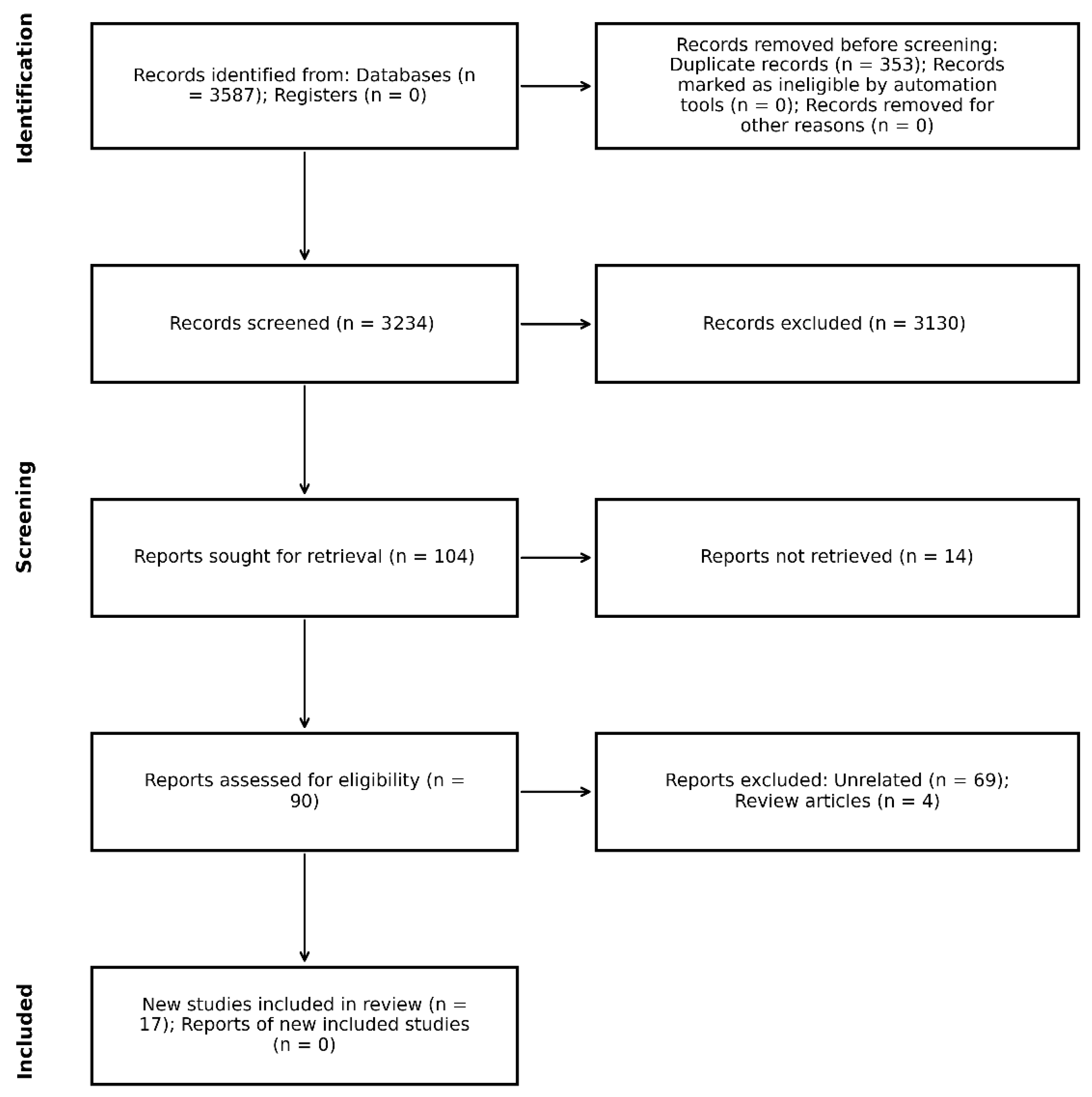
The document selection process outlined in Figure 1 adheres to the PRISMA Protocol [58]. For the Identification phase, 2088 documents were gathered from Scopus and 1499 documents from Web of Science (Total 3587), resulting in 3234 raw search results after removing duplicates. During the screening phase, we excluded 3130 documents after the abstract screening. Subsequently, the authors omitted 14 papers due to the unavailability of all the texts. After these stages, we obtained 90 documents as refined search results. At the eligibility stage, we excluded 69 out of the 90 items as they did not specifically address the impact of climate-induced disasters on poverty, and excluded four review articles. Ultimately, the literature evaluation process focused on the remaining 17 documents. After reference checking, abstract screening, screening the specificity of the articles related to disasters and poverty, and availability of the documents, we reviewed 17 research articles.

3.2. Overview of the Empirical Studies on Climate-Induced Disasters and Poverty

Literature reviewed shows an extensive methodological range, geographical scope, and risk-specificity in investigating the link between climate disasters and poverty in Africa, Asia, Latin America, and the Pacific. Table 2 shows that half of the research (9 out of 17, 53%) was quantitative in nature, employing econometric and statistical model estimation in measuring the effects of floods, drought, cyclones, and heatwaves on incomes, well-being, and multidimensional poverty. For instance, a study applied panel analysis of Nigeria’s General Household Surveys when estimating flood impacts on poverty [50] and another study applied vector autoregression and Granger causality in research on the macroeconomic effects of tropical storms in the Philippines [48]. In Vietnam, studies [46,52] used data at the household level in examining the effect of drought and flood on consumption and multidimensional poverty, whereas a study [53] used the same for Pakistan with the application of the Livelihood Vulnerability and Multidimensional Poverty Indices. A study [43] also compared 67 countries across nations and linked disaster magnitude and governance insufficiency with the expansion of child poverty, while studies in Sri Lanka [41] and in the Indian Sundarban [51] found that floods, droughts, and tidal waves disproportionately affect poor families. A study in Pakistan [45] documented how climatic uncertainty divests farm incomes, and another study in South Africa [44] documented how poor urban vulnerable communities perceive and cope with multiple climate stresses. Other than these econometric estimates, there were studies that used qualitative, mixed-method, and advanced modeling approaches to document social, spatial, and non-economic aspects of vulnerability.
Four (24%) studies [42,47,56,57] conducted in Nepal [42], Brazil [47], Ghana [56], and Fiji [57] applied qualitative, participatory approaches, interviews, and focus groups, narrating the story of climatic interruptions re-making livelihoods, gender roles, and cultural identity. Research in India [49] applied mixed methods using surveys, focus group discussions, and statistical models collectively to develop vulnerability indices and demonstrated that women, children, and old are most vulnerable to floods and livelihood insecurity. Two studies [54,55] applied machine learning and geospatial methods.
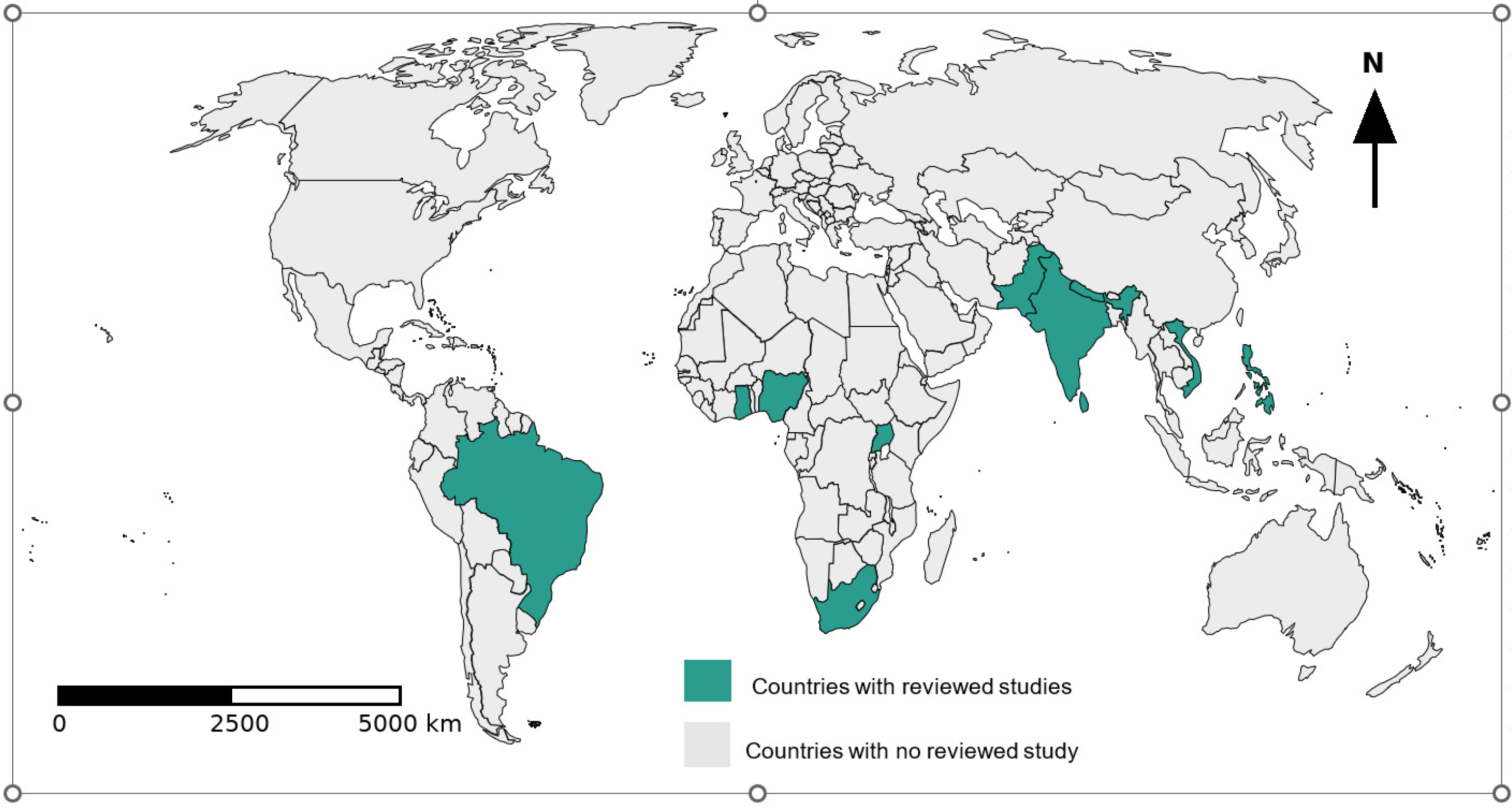
Table 2 shows that, among 17 studies examined, the majority were conducted in Asia (Vietnam, Nepal, India, Sri Lanka, Pakistan, Philippines) and Africa (Nigeria, Ghana, South Africa, Uganda), with some from Latin America (Brazil) and cross-regional analyses of developing countries. There is one study from Fiji that extends the examination to Oceania, capturing the unique cultural and psychosocial losses among Indigenous Island populations. However, as Figure 2 shows, no European or North American studies were found, leaving a broad geographical gap in the global literature.
This limited representation from studies in Europe and North America most likely reflects structural and conceptual factors rather than an absence of climate-related impacts, including a tendency to frame the effects of disasters through the lens of insurance losses or infrastructure damage and risk management, rather than multidimensional poverty outcomes, along with stronger social protection and institutional response systems that buffer short-term poverty transitions.

3.3. Impacts of Climate Events on Different Dimensions of Poverty

3.3.1. Livelihood and Economic Dimensions

The most frequently reported economic and livelihood impacts were effects of poverty across the reviewed literature. Table 3 shows that, out of 17 examined reports, 13 [41,42,44,45,46,47,49,50,52,53,54,55] dealt directly with ways climate disasters undermine employment, income, and subsistence foundations in households. In the farming economies of Vietnam, Nepal, and Pakistan, drought and rainfall volatility reduce farming productivity by a significant amount, causing income reduction, food poverty, and wealth erosion [42,45,46,52]. Crop failure and food shortages led to debt cycles and long-term livelihood vulnerability [42] resonate with studies on climate change impacts on agriculture [59,60] These works emphasize the vulnerability of food systems to climate variability and extremes. Flooding did the same in Nigeria and Pakistan, as devastated agricultural land, destroyed infrastructure, and market disruption reduced per-capita consumption and employment opportunities [50,53,54]. In Brazil’s Northeast drought region, livelihoods collapsed as citizens lost crops, incurred debt, and had to “take it out of their mouths to buy water” [47], whereas in Sri Lanka, poor farming households lost up to one-third of their annual income following floods and droughts [41]. These findings were supported by cross-country studies that showed that climate variability raises food prices and constrains financial development, aggravating poverty indirectly [48,55]. The evidence highlights that climate catastrophes erode the economic foundation of livelihoods, draining assets and productive capacity and saddling households with debt and coping reliant on resources.
Broader international literature also supports and validates these results. For example, El Niño-forced droughts in Bolivia’s Altiplano caused extensive crop loss, vegetation depletion, and rural livelihood destruction, illustrating that drought still encompasses the most pervasive livelihood risk in agrarian economies [61]. The findings of prior microeconomic research demonstrate how climatic shocks in Bangladesh, Honduras, and Ethiopia push households to a level of recovery and lead to traps of poverty in the long term [12]. The macro–micro analyses corroborate these findings by showing how climate and drought-induced yield reduction slows GDP growth and degrades jobs in the poor countries [62,63].
Although Table 3 summarizes key findings across studies, the calculation of summary numerical indicators, such as average income loss or probabilities of falling into poverty, was not possible due to considerable heterogeneity in terms of outcome measures, the definition of poverty, spatial scale, and study designs (qualitative, cross-sectional, panel, and spatial). Quantitative pooling or aggregation across such diverse studies would risk misleading cross-regional comparisons.

3.3.2. Food, Water, and Health Security

Table 4 shows that water, food, and health insecurity were common themes of climate-related poverty across 13 of the 17 studies [41,42,43,44,46,47,49,50,51,52,53,54,56] considered here, demonstrating the way environmental stressors directly erode the foundation of human well-being. Droughts were the most prevalent and sustained hazard across agricultural systems, progressively deteriorating food quality, diet diversity, and access to clean water. In Nepal and Vietnam, protracted drought phases tightened farm yields and consumption at household levels, resulting in food shortages and chronic undernutrition [42,46,52]. Evidence in Ethiopia confirms the same trend. A study [64] also concluded that seasonal drought lowers caloric and dietary consumption at the household level substantially during the seasons of scarcity, as documented in the same cyclical cycle of nutritional shortage by other studies [47,52]. In Northeast Brazil’s semiarid northeast, families subsisted on “coffee and flour,” [47] whereas in Sikkim, India, low water levels compelled women to travel long distances to access water, and, as a consequence, there was a compromise to nutrition and health [49]. This concurs with global evidence in the Lancet Countdown on Health and Climate Change [63], which warned that rising temperatures, water shortage, and crop yields are propagating malnutrition and disease burden in poor settings. Floods, on the other hand, caused mostly health and sanitation emergencies, revealing vulnerabilities in water and health infrastructure. Floodwaters washed away infrastructure in Pakistan, Nigeria, and Sri Lanka, contaminated drinking water, and it was difficult to access healthcare facilities, leading to outbreaks of waterborne diseases, such as cholera and diarrhea [41,50,53,54]. These national-level observations are consistent with more extensive epidemiological evidence that extreme flooding increases the prevalence of infectious diseases and hospitalization rates, particularly in high-density and poorly managed populations [63,65]. In the Sundarban Delta of South Africa and India, several climate stressors—flooding, heat waves, and salinization—also aggravated malnutrition and water pollution, with secondary impacts on health [44,51]. A study estimated that one quarter of children across the globe live in acute food deprivation, while those who reside in areas with extreme climate conditions are 50% probable to be exposed to life-threatening malnutrition—a reflection of South Asia and Sub-Saharan Africa’s deprivations at the household level [65]. Springmann et al.’s (2016) model of global nutrition suggests that climate-damage-induced crop yield losses could result in 529,000 additional deaths annually by 2050 [66]. These findings supplement the household studies presented here to show how climate stress impacts the quantity and quality of food while weakening health systems and access to water.

3.3.3. Human Capital and Education

Human capital loss and education expenditure were significant but often indirect impacts of climate disasters, referenced in 10 of the 17 studies reviewed [41,42,43,46,49,50,52,53,54,56]. Household income shock and loss of livelihood in South and Southeast Asia caused households to cut back on school expenditures; remove children, especially girls, from school; or divert labor to survival activities. As Table 5 shows, in Vietnam, lower earnings due to drought caused rural families to reduce expenditures on training and education [46,52], while in Nigeria and Pakistan, floods devastated schools and forced children to evacuate homes, directly impacting learning and skill acquisition [53,54]. Water collection and food shortages caused diversion from schools in India and Nepal, but girls were disproportionately hit [42,49]. A study reported gendered extreme expression of deprivation in education in Ghana, where early marriage is a coping strategy against drought [56]. They mirror global evidence show that climate-related danger distracts from education for an estimated 40 million children every year, by destroying schools, relocating people, and interfering with family livelihoods [67]. Moreover, a cross-national study confirmed that disaster exposure deepens child deprivation in education and health, exacerbating intergenerational transmission of poverty [43]. In totality, the reviewed studies herein indicate that climate shocks damage not just physical welfare but also human capability formation—undermining future prospects of resilience, employment opportunities, and social mobility in hazard-prone and low-adaptive-capacity regions.

3.3.4. Social Vulnerability and Gender Inequality

Social vulnerability and gender inequality were pervasive and reinforcing features of climate poverty, explored in 12 of the 17 studies reviewed [36,37,39,40,42,44,45,47,48,49,51]. Disproportionately, disasters harmed women, female-headed households, and marginalized groups within regions, thereby illustrating that vulnerability is equally a product of social hierarchy as exposure to environmental hazards. As Table 6 shows, female-headed or poor households typically had greater economic vulnerability based on unequal access to credit, land, and productive resources. This was most prevalent in Nigeria and Uganda, where women’s limited land rights directed urban growth toward flood-prone locations, increased flood damage, and longer recovery times [50]. Women’s dependence on forest products grew in Pakistan’s Himalayan province with decreased household income, extending their susceptibility to degradation [45]. In Ghana’s Bongo District, worsening drought and food scarcity forced families to marry off girls as an indirect adjustment strategy to reduce household pressures [56]. In India’s mountainous region, girls were taken out of school to assist with household chores during climate-induced shortages in resources [49]. Across South Africa, Nepal, and Brazil, climate stress extended the unpaid care and labor work of women under the conditions of droughts and heat waves [42,44,47]. Women mainly undertook water collection, food preparation, and care for the sick, with little time left for income-generating activities and adaptation planning. Similarly, in Nigeria and Pakistan, flooding decreased women’s and female-headed household income and asset holding, and captured structural inequalities in land tenure and recovery support [50,53,54]. Women assumed the tasks of water gathering, cooking, and nursing the ill, which limited time for work that earns income and agency in adaptation planning. Similarly, in Pakistan and Nigeria, floods lowered the income of women and female-headed households and reduced property ownership, reflecting structural gender and class disparities in land ownership and recovery support [50,53,54]. Males’ out-migration, as manifested in Nepal, Sri Lanka, and Vietnam, placed the responsibility for survival at the household level on women and the elderly [41,42,52]. Although migration transitorily relieved suffering in the form of remittances, it contributed to women’s workload and loneliness and intensified gendered inequalities. In Fiji, cyclones, floods, and sea-level rise eroded kinship forms, ritual roles, and cultural identity, especially for women whose status within their community was tied to ritual participation and communal living [57].
Heightened anxiety, depression, and fatalism among women facing chronic drought and urban poverty are critical but under-measured aspects of gendered vulnerability [44,47]. Weak institutional inclusion—limited female participation in disaster committees, credit programs, or community forest groups—was a recurring barrier to resilience in Nepal, Nigeria, and South Asia [42,50,53]. Gender norms and governance gaps jointly restricted access to adaptation resources and decision-making, confirming that vulnerability is not purely environmental but socially constructed.
These findings align with global evidence from United Nation Women (2023) and the Intergovernmental Panel on Climate Change (IPCC) Sixth Assessment Report (2022), both of which affirm that gendered labor segmentation, unequal access to resources, and social exclusion heighten vulnerability to climate shocks [28,68]. Poverty under climate stress is not just economic but intersectional, rooted in gendered social structures, cultural roles, and institutional exclusions that constrain women’s agency and compound multidimensional poverty.

3.3.5. Environmental Dependence and Resource Degradation

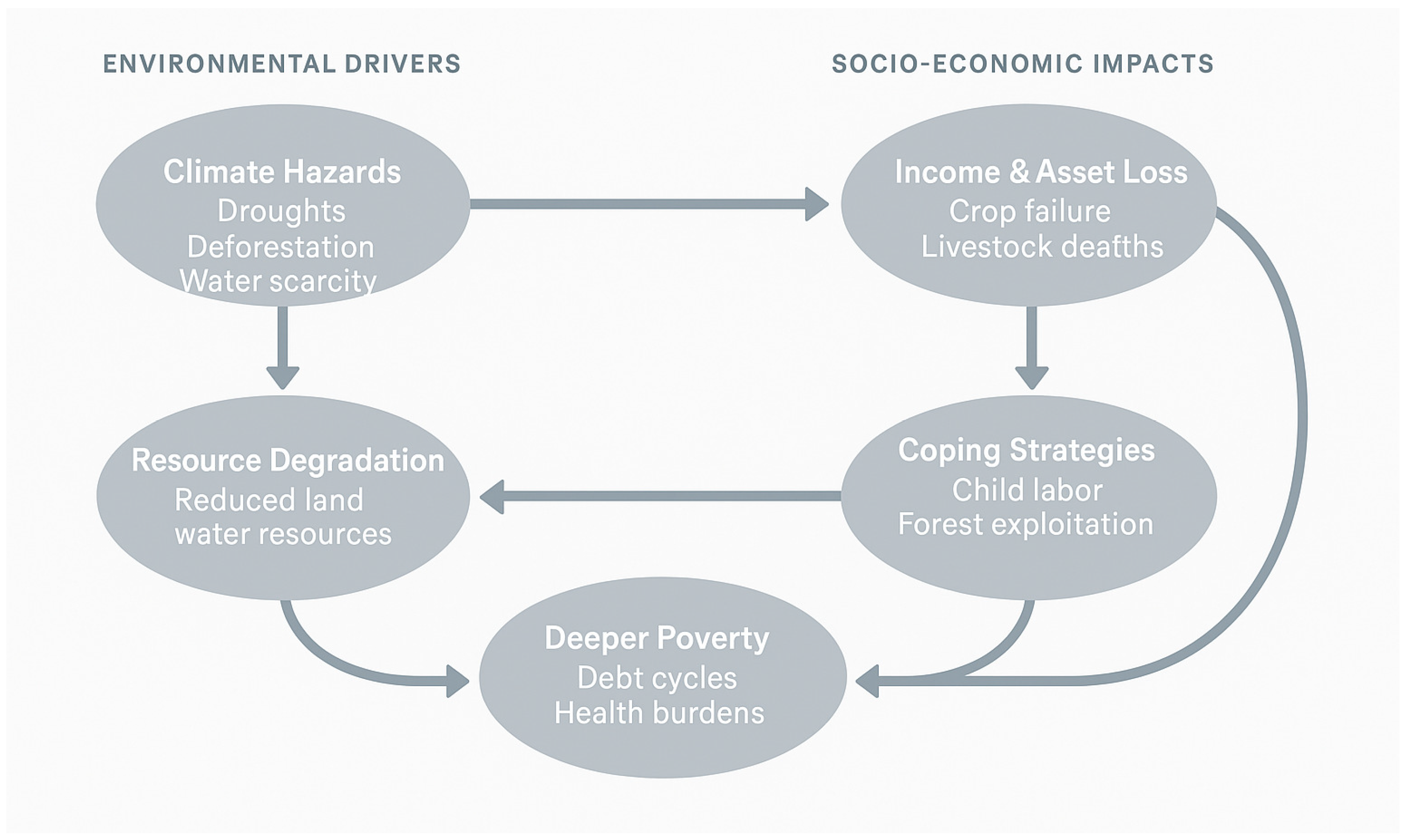
Environmental dependence and resource degradation were also central but often neglected dimensions of the literature on climate-induced poverty, which were dealt with by nine [41,42,45,46,47,49,50,51,52] of the seventeen studies examined. They explained a vicious circle where deteriorating environmental resources such as land, forest, and water are causes and results of poverty. Seasonal droughts and excessive rain reduced the output of crops, irrigation level, and soil quality in Nepal, Pakistan, and Vietnam’s mountain and agricultural landscapes, forcing the poor to cut remaining forest and land cover to utilize for survival [42,45,46,52]. These measures of adjustment expressed themselves in unsustainable forest cover and non-timber product extraction that encouraged deforestation and ecosystem degradation. Sporadic rain and absence of water in the Indian state of Sikkim resulted in erosion of soil and depletion of water resources for springs, thereby increasing the burden on women and reducing agricultural production [49]. These same kinds of feedback loops have also been seen in Northeast Brazil, with a semi-arid environment, and the Indian Sundarban Delta, where long-term drought exacerbated by salinization and erosion destroyed farm plots, contaminated streams, and disrupted fisheries—trapping families into environmental and economic insecurity [47,51]. Nigeria and Sri Lanka suffered floods and recurrent land degradation, compromising soil condition and recovery capacity, particularly for poor farmers [41,50]. In Figure 3, there is a reinforcing causal loop that shows how Climate shocks influence the degradation of livelihood assets and income, leading to Multidimensional poverty, Lack of access to capital, and subsequently informing adaptive responses like forest degradation and child labor. The effect is increased vulnerability and exposure levels due to continued climate shocks.

3.3.6. Cultural and Psychological Well-Being

A less numerous but theoretically significant subset of five studies [42,44,47,51,57] highlighted the manner in which climate-induced disasters extend beyond poverty and material deprivation to undermine social attachment, cultural affiliation, and psychological health. These studies clearly indicate that the impacts of disaster extend beyond income, food, or infrastructure loss to encompass non-economic losses like trauma, fatalism, and disconnection from culture. As Table 7 shows, in Fiji, the study documented how persistent cyclones and floods dismantled Indigenous iTaukei kinship ties and destroyed sacred places, which led to “loss of social life and connectedness” and diminished agency and self-determination [57]. The same psychic exhaustion and fatalism were observed in Brazil’s deserts, where families reported living on “coffee and flour” and stated, “we have to wait for God’s will,” [47] which conveyed continued desperation against the backdrop of prolonged shortages. In South Africa, floods and extreme temperatures were read as God’s wrath, generating spiritual fear and eroding collective morale [44]. As such, in Nepal and India’s Sundarban Delta, serial droughts, salinization, and displacement instilled fear, dependency, and social isolation as households lost cultural lands and livelihoods [42,51]. These studies demonstrate how climate stress degrades not only material well-being but also psychosocial and cultural resilience, destabilizing the symbolic and relational foundations of human security. These findings are consistent with other studies, which emphasize that “non-economic loss and damage” are most significant in shaping vulnerability and recovery [28,69].

3.3.7. Child and Intergenerational Poverty

Six of the seventeen studies [42,43,49,52,54,56] highlighted how climate-related disasters exacerbate child and intergenerational poverty, demonstrating how environmental shocks not only menace existing welfare but also human capital and social mobility in the future. A cross-country study [43] of 67 low- and middle-income nations found that disaster exposure substantially increased absolute poverty among children, with rural children being thirty-four times more likely to suffer deprivation than their urban counterparts—a clear sign of long-term structural exposure [43]. At the micro level, studies in South and West Asia revealed how droughts, floods, and resource poverty had direct impacts on children’s education and well-being. In Vietnam and Nigeria, floods and droughts truncated household revenues, leading to a reduction in children’s schooling and diet, or to extended school closures during emergencies [52,54]. The same patterns were observed in India and Nepal, where household distress and farm loss caused poor families to withdraw children—mostly girls—to engage in work or domestic chores, extending gendered poverty cycles [42,49]. In Ghana, climate-related food insecurity compelled families into early girl-child marriage as an adaptation strategy, locking families into intergenerational poverty [56]. These results are consistent with the UNICEF (2021) reports, warning that climate shocks are increasing among the primary causes of intergenerational poverty transmission [26].

3.4. Variation in the Impacts of Floods, Droughts, and Other Climate Stressors on Multidimensional Poverty

Table 8 shows the drastic contrasts in the duration, intensity, and multidimensionality of poverty effects induced by climate hazards. While perpetuating deprivation, floods, droughts, and other climate stressors (e.g., heat waves, salinization, and cyclones) affect poverty through various channels. Droughts proved to be the most protracted and multidimensional force that strikes income, food security, health, and water access simultaneously. Evidence from Vietnam, Nepal, Pakistan, and Brazil shows that recurring droughts reduce agricultural productivity by 8–10%, raise the likelihood of poverty by nearly one-fifth, and drive households into poverty traps for extended periods through asset sale, migration, and environmental degradation [42,45,46,47,52]. By contrast, floods produced acute but relatively short-term impacts, destroying farmland, homes, and schools while triggering temporary multidimensional poverty in Nigeria, Pakistan, and Sri Lanka [41,50,53,54]. However, recovery was faster where infrastructure and social support systems were stronger. This variation is supported by regression analysis results, which show that in the case of droughts, panel and lagged anomaly specifications report consistent, negative effects on productivity and welfare [46], whereas flood studies using a panel analysis of the PANCOVA model identify large but time-bounded losses concentrated around the disaster period [50].
Slow-onset and cumulative stressors such as heat waves, salinization, and cyclones produced non-material but enduring forms of deprivation. In Fiji, repeated cyclones destabilized kinship and eroded cultural identity [57], while in South Africa and India, heat waves and water scarcity added to gendered labor, food insecurity, and psychosocial distress [44,49]. These results give us a hazard-based ordering: droughts are impoverished in their structure, floods are damaging but reversible, and compound stressors undermine psychological and cultural well-being.

3.5. Mediating Factors Conditioning the Relationship Between Climate-Induced Disasters and Multidimensional Poverty

The relationship between climate-induced disasters and multidimensional poverty is nonlinear and conditioned by a set of social, institutional, and structural factors. Table 9 presents, across the reviewed 17 studies, six mediating factors were consistently determinants of climate shock impulsion into poverty outcomes: (1) institutional quality and governance; (2) social protection and access to credit; (3) livelihood diversification and environmental dependence; (4) education and human capital; (5) gender and household dynamics; and (6) social and cultural capital.
Institutional quality and governance, specifically government effectiveness, control of corruption, rule of law, institutional access, and policy effectiveness, continued to appear as pivotal mediators of vulnerability and recovery. One study revealed that while good governance reduces baseline poverty, the impact of a disaster typically supersedes institutional capacity, engendering prolonged deprivation [43]. Weak local planning, inadequate early warning, and fragmentation of agencies’ coordination in Pakistan and Nigeria worsened flood-induced poverty [53,54]. Conversely, in the case of more adaptable government systems, for instance, selective schooling and vocational training in Vietnam [52], poverty intensity reduced faster. Social protection and credit access fulfilled equally crucial cushioning roles. The research showed that monetary assistance and social assistance helped Vietnamese households recover from flooding but less so from prolonged drought, where chronic shortage limited relief coverage [52]. Similar findings were observed in Sri Lanka [41] and Nigeria [50], where insurance, microcredit, and remittances coverage facilitated faster income return.
Livelihood diversification and environmental dependence emerged as another major determinant. Studies reported that households relying solely on natural resources were more disproportionately exposed to income shocks because of deforestation and drought, while diversified livelihoods improved resilience [42,45]. In Brazil, water scarcity and lower agricultural sustainability compelled rural people to over-harvest forests and ruin landbases, demonstrating how environmental dependence can result in adaptive coping becoming ecological and economic vulnerability [47].
Human capital and education allowed for the ability to plan ahead and rebound later. More educated Indian and Vietnamese families were able to access information, income diversification, and adaptive agrotechnologies more easily [46,49,52]. Conversely, low literacy and the removal of children, especially girls, from school during climatic stress, as documented in Nepal and Ghana [42,56], perpetuated intergenerational poverty through the limitation of future adaptive capacity. Gender and household dynamics also shaped exposure, coping, and recovery. In Ghana, Uganda, and Fiji, studies demonstrated that women’s insecure access to land, finance, and decision-making heightened exposure to floods and droughts [44,56,57]. Gendered divisions of labor, child marriage, and caregiving responsibilities limited women’s access to alternate livelihoods or community adaptation planning. Social and cultural capital, such as the strength of kin groups, community trust, and cultural identity, mediated how communities cushioned shocks and reconstructed meaning after loss. Displacement and repeated droughts fractured social ties and created psychosocial disturbance in Fiji and Brazil [47,57]. Where collective mobilization was robust, as in some Nepali and Indian villages, communities were more resilient despite material loss [42,49].
By using geospatial methods of cluster analysis, a study [54] has shown the positive correlation between flood vulnerability and various poverty determinants. Those locations that are vulnerable to flooding have lower levels of income, education, and health, and fewer household assets. Notably, the results map areas of high overlap between flood vulnerability and multidimensional poverty, demonstrating that vulnerability is non-random in its geographical distribution. In addition to the above geographical results, machine-learning tests of causality [55] provide further insight, illustrating that, instead of being a direct cause of multidimensional poverty, climate change is a highly significant force in shaping food prices at various lag orders.
Collectively, these mediating systems demonstrate that the magnitude of multidimensional poverty under climate hardship is more dependent on social, institutional, and cultural systems that construct vulnerability and recovery than on the hazard itself. Adaptive governance, access to education and credit, gender equality, and quality social networks can protect individuals from climate effects, whereas institutional weakness, inequality, and dependence on resources exacerbate them. This illuminates the new framework’s central argument: poverty due to climate is not environmentally driven, but socially mediated, and that transformative adaptation will therefore need to include mediating systems that reproduce exposure.

3.6. Coping Mechanisms Under Climate-Driven Disasters

Table 10 shows that livelihood communities and households subject to climate-driven disasters employ a broad variety of coping and adaptation strategies in attempts to mitigate livelihood shocks and well-being deterioration. Short-term survival measures typically entail selling of assets, borrowing, and cutbacks in consumption. In Sri Lanka, poor farming households sold farm animals and borrowed at high interest rates following floods and droughts, increasing indebtedness and extending recovery times [41]. Similarly, drought-stricken families in Brazil’s semi-arid Northeast survived on “taking food out of their mouths to buy water,” depicting the trade-off between subsistence requirements and economic sustainability [47]. As Table 9 shows, community solidarity still acts as a buffer. In Nepal, extended families supplied labour, credit, and provisions to sustain agriculture during drought [42]. In the same way, community reconstruction and kinship networking supplied psychological and physical relief after cyclones and floods in Nigeria and Fiji [54,57]. But social support networks were frequently overstretched, particularly when the disasters recurred, such that returns began to decrease and people became reliant on external aid. Households also diversified livelihoods and substitute resources. Farmers in Pakistan’s Himalaya reacted to variability in rainfall by increasing timber and non-timber foresting [45], while people in India’s Sikkim Himalaya changed crop choices and engaged in wage labor during drought periods [49]. Although such types of strategies reduced loss of livelihood in the short run, they were likely to exacerbate environmental degradation and exposure in the long run.
Gender roles make an important contribution to coping behavior. In northern Ghana, poverty resulting from drought propelled early girl-child marriage as an informal coping mechanism to reduce the burden of household consumption [56]. In South Africa, in the event of climate shocks, female-headed households take on workloads, and income insecurity escalates, and women take multiple informal employments to sustain families [44]. These coping mechanisms, while adaptive in the short run, perpetuate gender inequality and intergenerational poverty.
Religious and cultural coping strategies foster affect resilience in ecological chronic stress environments. Brazilians in rural areas rely on fatalistic resignation, such as “we have to wait for God’s will,” [47] while Fijian villagers employed ritual and congregating as a coping strategy after resettlement [57]. Where there are organized support systems in place, social protection, credit, and educational programs significantly speed up recovery. Government aid in Vietnam lessened flood damage to health and housing, but was not as effective with prolonged droughts [52]. Access to microcredit, insurance, and disaster-preparedness programs reduced Nigeria’s and Pakistan’s income loss [50,53]. These institutional mechanisms illustrate how adaptive governance can transform reactive coping into proactive adaptation.

3.7. Reporting Bias and Certainty of Evidence

Formal assessment of reporting bias, such as funnel plots, was not possible due to the diversity in study designs and qualitative data. There could be potential publication bias since most of the included studies were published in English and indexed in major databases. The certainty of evidence was appraised narratively regarding methodological rigor and consistency across contexts. On the whole, given the consistent trends across diverse geographies and methodologies, the certainty of evidence was moderate.

4. Discussion

Despite some limitations associated with varying research designs in the sample, the examination employed the JBI tools of appraisal. In this way, the analysis fulfilled the minimum standards of quality with respect to methodological quality requirements. The combination of qualitative studies (which supported understanding of the non-economic components of poverty) and quantitative studies (which informed the magnitude of the association and the impact in estimations) served to connect critical components of the review.

4.1. Climate-Induced Disasters, Dimensions of Poverty, and Coping Strategies

This systematic review compiled evidence from seventeen empirical studies in Asia, Africa, Latin America, and Oceania to determine how climate-related disasters impact multidimensional poverty. The findings indicate that poverty outcomes in response to climate stress extend far beyond income loss, and encompass health, education, gender, psychosocial, and environmental dimensions. Disasters ranging from floods and droughts to cold and heat waves, extreme weather events, water shortages, temperature variations, rainfall fluctuations, wind changes, hailstorms, and landslides significantly affect livelihood status. The research indicates droughts and floods are pivotal contributors directly shaping household poverty dynamics, but their impacts vary in duration and intensity. Droughts produce chronic, long-term livelihood and food insecurity, while floods produce short-term but recurrent shocks that erode assets and well-being. Together, these risks create interlocking and compounding pathways that reinforce structural inequality and poverty. To capture these interdependencies, the research proposes the Multidimensional Climate–Poverty Dynamics (MCPD) Framework that conceptualizes climate-induced poverty as an active system shaped by feedback among climatic stressors, intervening systems, coping strategies, and multidimensional well-being outcomes. The framework connects fragmented theoretical traditions and provides a single framework for analyzing how climate stress continues or reconfigures poverty across contexts.
The most concrete and common processes through which climate disasters perpetuate poverty are economic and livelihood loss. Fifteen of the seventeen studies reviewed listed income loss, crop loss, or livelihood disruption as the most common processes through which climate risks contribute to impoverishment. This is consistent with the Sustainable Livelihoods Framework, which shows that natural and financial capital shocks diminish livelihood sustainability overall [70]. Other studies validate this finding, stating that persistent climate shocks push individuals below recovery levels, inducing poverty traps in the long run [12,17]. The impact of these climate-induced disasters extends beyond the immediate affected areas, exerting a discernible influence on a country’s Gross Domestic Product (GDP). The cumulative effects of these disasters not only heighten poverty levels in the directly impacted regions but also contribute to an overall escalation in the poverty level of the entire country [71,72]. The economic burden is heavily placed on people by the need to purchase water, food, and other necessities [17,19] in the context of climate disasters.
Climatic risks pose threats to human sustenance and health security. Drought reduced food variety and agricultural yields, while floods and salinization contaminated water for drinking and health centers. These results support the Capability Approach [73], in which poverty is defined by the absence of fundamental human functioning, such as health and sustenance. Qualitative evidence from Brazil, India, and Vietnam suggests that food insecurity and water scarcity are mediating variables through which disasters entrench multidimensional poverty. The Lancet Commission on Climate Change and Health [63,74] and Springmann et al. (2016) [66] provide international confirmation that climate-related undernutrition and disease burden are on the rise, particularly for poor income groups. This intersection testifies that health insecurity is not a discrete effect but an integral part of climate-induced poverty. Under drought conditions, purchasing drinking water exacerbates food insecurity. Similarly, floods also lead to food insecurity since they necessitate homes purchase water and food, which is extremely costly. The case for water scarcity and its implications in the context of drought and floods is supported by studies, which emphasize the linkages among scarcity of water resources, social conflict, and climate change [75,76]. Climate stressors also negatively impact cultural and psychosocial well-being and generate intergenerational loss. Climate displacement in Fiji marred family and lost spiritual connection to place and created “loss of social life and connectedness.” This is supported by other studies, which set non-economic loss and damage as a central but under-quantified axis of climate vulnerability [69,77], and examined the psychosocial well-being of exposed populations [78,79].
Climatic catastrophes affect human capital in direct and indirect ways. Nigeria and Pakistan floods closed schools and interrupted secondary school studies, whereas drought-induced loss of livelihood in Vietnam and Sri Lanka compelled families to cut spending on education. These findings are consistent with Human Capital Theory [80], which suggests that climate shocks constrain long-run adaptive capacity via a reduction in access to schooling and skill acquisition. Girls were more exposed to being taken out of school or married off early during crises, consistent with global evidence on gendered education risk [26,81].
Gender and social injustices emerged as primary mediating factors that controlled exposure and response to climate threats. Women in Nigeria, Uganda, Ghana, and Fiji research carried the disproportionate burdens because they had limited access to land, credit, and seats at the decision-making table. Forced marriage, unpaid domestic work, and gender-based violence emerged as adaptation measures against economic crisis and indicated how social norms convert climate shocks into structural disadvantages. These results confirm Feminist Political Ecology [82], which connects environmental risk and social power asymmetries. The evidence underscores that vulnerability is socially constructed and, therefore, resilience must be conceptualized not only by environmental insights, but by intersectional factors, as well.
The reviewed literature examined both immediate and long-term consequences. In the short term (from months to one year), the effects of a disaster fall largely within the realm of economics, such as loss of income, destruction of assets, loss of food security, and lower levels of consumption, which appear prominently in studies of floods and cyclones. From a medium-term (between one and three years), disaster effects become obvious because of a coping strategy like the sale of assets, lower levels of education expenditure, or labor reallocation, which result in lower levels of human capital and higher levels of indebtedness. From a long-term perspective (more than three years), particularly in the context of drought, poverty manifests through persistent livelihood decline, educational disruption, psychosocial stress, and the intergenerational transmission of disadvantage.
The feedback loop between environmental degradation and poverty is also evident in studies reviewed for this research. Forest decline in Pakistan and drought in Nepal forced poor households to resort to forests for economic benefits and firewood, accelerating environmental degradation. This vicious cycle supports the Poverty–Environment Nexus paradigm [83], which claims that resource dependency by households renders them victims and agents of deterioration under stress. The facts as reviewed confirm that environmental degradation is both a cause and an effect of poverty, creating a constant cycle of vulnerability that destroys adaptive capacity in the long run.
Recent quantitative approaches further support these patterns by operationalizing livelihood impacts through socio-economic proxies and spatial indicators. For example, studies [84,85,86] demonstrate how mobile phone activity, geospatial clustering, and remotely sensed data can capture disruptions in livelihoods, mobility, and access to services following flood events. Although these studies are not included in the systematic sample, they illustrate complementary quantitative methods that can enhance future analyses of climate-induced livelihood vulnerability and multidimensional poverty.

4.2. Social Construction of Climate-Induced Poverty

The relation between climate-induced disasters and multidimensional poverty is not linear; it is essentially institutionally mediated and socially constructed. The studies presented show that vulnerability and recovery are socially structured by power, access to resources, and social differentiation, underpinning the sociological argument that disasters highlight and exacerbate, as opposed to creating, inequality [87]. Climate poverty occurs where social institutions, governance systems, and relations of class transform environmental shocks into persistent social disadvantages. For example, governance systems and institutional quality shape the conversion of climate hazards into poverty. In contexts such as Vietnam, Pakistan, and Nigeria, educational attainment, access to credit, and social protection diminished poverty impacts [50,52,53]. Conversely, in Nepal and Brazil, the breakdown of institutions and fragmented adaptation policies resulted in long-term deprivation in the form of debt, food insecurity, and loss of the environment [42,47]. This result affirms Giddens’ (1984) structuration theory, which argues that social systems both enable and constrain action [88].
The intersection of class location and livelihood exposure is another social basis for poverty due to climate change. Poor, agriculture-dependent households suffer a disproportionate share of floods and drought since they have no savings, insurance, or credit [89,90]. Sri Lankan and Vietnamese experiences demonstrate that remittance-receiving exposure, education, and income diversification at the household level helped them recover relatively rapidly from climatic shocks [41,46]. People caught in agrarian dependency and informal labor markets, on the other hand, were afflicted by cyclical impoverishment. This supports Bourdieu’s (1986) theory of capital, which argues that deficiencies in economic, social, and cultural capital indicate a lack of adaptive capacities [91]. Climate vulnerability, therefore, mirrors pre-existing class stratifications. Women-headed households suffer more during and after a disaster because women have less access to land and credit, and they bear the fear of social stigma. Spatiality and temporality also indicate the social construction of poverty because of the climate. Floods cause quick and spectacular losses, while droughts provide a long time for humans to adjust [92,93]. However, the capacity to anticipate or respond to such events is dependent on already established early warning systems, public investment, and social trust [94]. Rural peripheries and slums, ordered outside of infrastructure and support, suffer the brunt of the costs.

4.3. Theoretical Contribution: Towards a Multidimensional Climate–Poverty Dynamics (MCPD) Framework

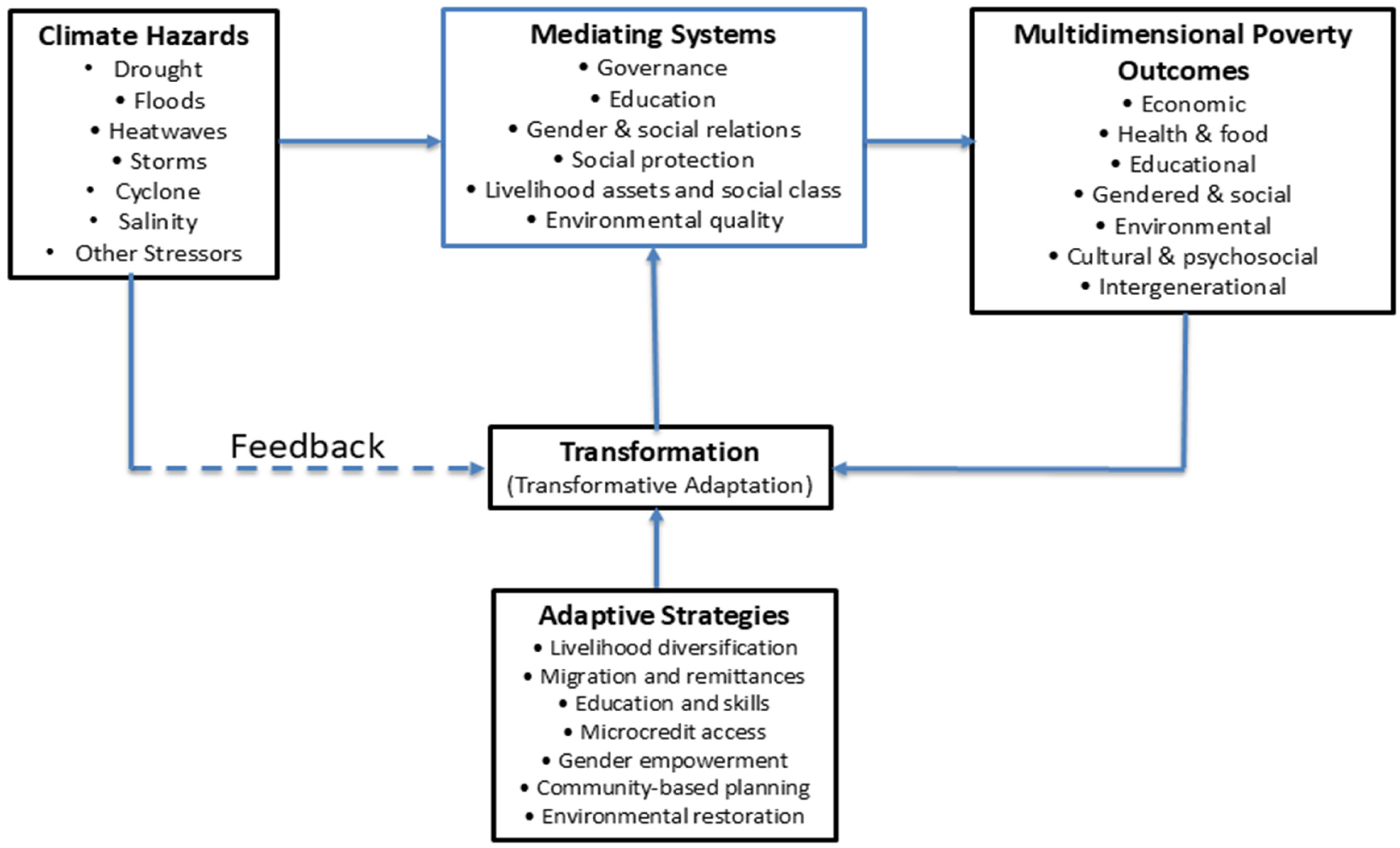
This study contributes theoretically to sociological and multidisciplinary conceptualizations of climate-poverty by integrating 17 studies’ empirical observations into the Multidimensional Climate–Poverty Dynamics (MCPD) Framework. Contrary to positing poverty as a unidimensional outcome of environmental pressure, the MCPD theorizes it as a socially mediated, institutionally patterned, and culturally embedded process due to the interactions among climate hazards, mediating systems, and multidimensional outcomes. Figure 4 illustrates how climate-induced hazards such as droughts, floods, storms, and heatwaves act as initiator triggers that derail livelihoods and harm human health. Their effects are indirect but mediated by a chain of systems, governance, education, social and gender relations, livelihood assets, social protection, and environmental management, which influence the extent and form of vulnerability. Two forms of dynamic feedback are recognized in the diagram: structural reproduction, under which poverty assures future exposure, and transformative adaptation, by means of which inclusive governance and fair institutions can overcome it. Adaptive strategies (e.g., diversification of livelihood, migration, education, gender empowerment, and environmental renewal) implement transformation under such a process.
The MCPD Framework draws on and synthesizes some prevailing theoretical traditions. Drawing on the Sustainable Livelihoods Approach [70], it retains the focus on assets, capabilities, and vulnerability but extends these concepts to include social and institutional contexts usually excluded from economic reasoning. From the Capability Approach [73], it uses the concern for human freedom and the conversion of resources into well-being, placing stress on climate as a constraint on capabilities. Based on Feminist Political Ecology [82], this framework explains how social hierarchies gendered mediate adaptive capacity through power relations. Households respond to climate shocks by using coping strategies (e.g., migration, disposal of assets, use of forests), which, while adaptive in the short term, lead to increased structural vulnerability and environmental degradation. This feedback loop dynamic is an echo of Barbier’s (2010) Poverty–Environment Nexus [83], but a more extended one that MCPD demonstrates by exemplifying how social inequity and institutional failure amplify such feedback loops. MCPD therefore recasts “vulnerability” not as an environmental condition but as a social relation, which is determined by one’s inclusion in governance, access to capital, and symbolic power [91].
Three theoretical contributions set the MCPD Framework apart. For the first time, it theorizes climate-poverty linkages as systemic and multidimensional. Economic, health, social, and environmental deprivations are examined as interlinked, producing reinforcing feedback loops with each reinforcing the other to increase vulnerability over time. Vietnam, Nepal, and Pakistan evidence shows how income loss, food insecurity, and truncated schooling feed into each other, testifying that climate shocks rarely affect one dimension in isolation. Second, the model specifies mediating systems such as governance quality, institutional inclusion, education, and environmental management to be determinative of whether or not climate shocks result in temporary setbacks or poverty traps. Evidence from Pakistan, Sri Lanka, and Nigeria shows that access to credit, social protection, and public infrastructure reduce loss, whereas institutional neglect increases loss. Such attention to mediation crosses conventional paradigms of vulnerability by locating poverty outcomes in structural and policy realms.

4.4. Policy Implications

According to this initial version of the MCPD framework, effective policy interventions need to cross sectors to address social, economic, and governance contexts supporting vulnerability. Policies for material recovery or short-term resilience taken in isolation disempower to reinforce the same feedback that lock multidimensional poverty. A multidimensional agenda that extends to include livelihood security, human development, gender equality, and conservation of the environment is required instead to reframe climate–poverty relationships into fair and sustainable trajectories. Translation of climate shock into poverty effects was ascertained by the key mediating systems of governance, education, social protection, and gender inclusivity. Based on the information provided in this preliminary review, strengthening these systems needs to be the cornerstone of poverty reduction strategies in climate-vulnerable regions. Findings showed that most coping mechanisms, such as child marriage, migration, and forest decline, are maladaptive and reactive, and have a propensity towards overreliance in creating future vulnerability. Considerations for policy implications should address the possibility of shifting agendas from crisis management for the short-term to transformational adaptation interventions that alter the social and institutional settings driving vulnerability. Based on the findings of this version of the MCPD Framework, there is strong feedback between environmental degradation and poverty. In the regions examined in this study, policies must therefore respond to environmental rehabilitation as a natural necessity and social investment in poverty reduction. Additional research is needed to determine whether this is the case in other regions of the world. Lastly, reducing multidimensional poverty due to climate change demands a shift in paradigms, which should be away from adaptive resilience and toward transformative social change. The MCPD conceptual framework reflects that transformation is possible when mediating systems such as governance, education, gender, and environmental management work inclusively and equitably. Decision-makers should be encouraged to reimagine climate adaptation as a social justice agenda, promoting equity, participation, and cultural well-being at the heart of resilience planning.

5. Conclusions

This systematic review employed evidence from seventeen Asian, African, and Latin American empirical studies to examine the impacts of climate-related disasters on multidimensional poverty. Despite the limited number of articles available for consideration, there are some key takeaways that should help to guide future research to support the advancement of the proposed Multidimensional Climate–Poverty Dynamics MCPD Framework. Climate-related disasters such as floods and droughts, among others, are central to defining poverty outcomes at the household level. The adverse effects spill over to financial aspects, including psychological well-being, health, environment, and gender. Food insecurity is aggravated due to water and sanitation problems, with far-reaching cost implications for affected households. Crop loss and farming challenges are the causes of chronic food scarcity that extend to both human beings and animals. Impacts of such catastrophes are experienced beyond immediate areas, affecting the total Gross Domestic Product (GDP) of a nation and increasing the extent of poverty at the national level. Findings demonstrate that poverty and climate stress are socially intermediate, with their relationship operating through education, social and gender inequality, governance quality, environmental degradation, and livelihood diversification. Unequal access to adaptive resources and weak institutions drive the effects of floods, droughts, and other extreme events. Hence, climate-stressed poverty presents itself as a social and structural problem and not solely an economic or environmental one.
These initial findings encourage further exploration of climate–poverty dynamics as a recursive and dynamic process that is shaped by mediating systems—the MCPD Framework. The model is informed by advanced interdisciplinary and sociological theory (i.e., the Sustainable Livelihoods Framework, Sen’s Capability Approach, Feminist Political Ecology, and the Poverty–Environment Nexus) to make sense of how environmental shocks intersect with social structure and institutional arrangements. It currently identifies two pathways: (1) structural reproduction, where deprivation reinforces vulnerability, and (2) transformative adaptation, where education, equitable governance, and social protection have the potential to end or ameliorate the climate–poverty trap. Notably, there might be other pathways that emerge from research in different parts of the world.
This research strongly suggests that maladaptive and reactive coping strategies, such as natural resource use, child marriage, and migration, are contributors to future, extended vulnerability. Nevertheless, the current iteration of the MCPD Framework indicates that where there is robust governance, education, and environmental management, households can move from coping to adaptive recovery. Findings highlight that the reduction of climate poverty must target the social basis of vulnerability, not merely its material outcomes. Theoretically, the introduction of the MCPD approach adds depth to environmental sociology inasmuch as it locates climate poverty in circuits of social reproduction and inequality. In practice, it has the potential to entail policy interventions that blend climate adaptation, poverty reduction, and social justice. Climate poverty therefore requires something more than resilience building. It requires transformation of the institutional and structural drivers that leave some groups of people disproportionately vulnerable to climate change.

5.1. Limitations

While this review provides increased understanding of the nexus between climate-induced disasters and multidimensional poverty, the limited number of publications cited in this investigation suggests a strong need for further research on this topic. This also presents some limitations regarding the interpretation of the findings. First, most of the empirical evidence comes from Asia, Latin America, and Africa, hence the likelihood of limiting global generalizability due to heterogeneity and geographic specificity. Second, being based on papers obtained from Web of Science and Scopus databases may lead to selection bias. This approach excludes policy-relevant gray literature—particularly reports produced by institutions such as UNDP, the World Bank, and ODI—which play a significant role in documenting climate–poverty dynamics in Global South contexts. Third, emphasizing only climate-induced disaster and poverty risks reduction might oversimplify the overall dynamics between socioeconomic and environmental factors. Fourth, in bringing together studies based on different methodologies and climate-induced disasters, it is challenging to synthesize the findings. Finally, restricting the review to English-language publications might have introduced language bias, potentially underrepresenting locally grounded evidence published in regional or national languages.

5.2. The Future Research Direction

As previously noted, future research needs to be conducted to operationalize and test the current MCPD Framework through empirical studies across different geographical and socio-political contexts. Longitudinal, as well as mixed-method study designs, would need to be utilized in order to follow the cascading impacts of climate shocks into multidimensional poverty over time and show how governance, gender relations, and livelihood diversification might mediate such impacts. Comparative analysis can compare usage of the framework in urban and rural settings, and quantitative modeling can integrate environmental and social indicators into multi-dimensional poverty indicators.

Supplementary Materials

The following supporting information can be downloaded at: https://www.mdpi.com/article/10.3390/su18031667/s1, Table S1: PRISMA 2020 Checklist.

Author Contributions

Conceptualization, A.B.M.N.; methodology, A.B.M.N.; software, A.B.M.N.; validation, A.B.M.N., L.R. and S.I.; formal analysis, A.B.M.N., S.I., H.-O.-R. and N.S.; investigation, A.B.M.N.; resources, A.B.M.N. and L.R.; data curation, A.B.M.N., L.R. and S.I.; writing—original draft preparation, A.B.M.N.; writing—review and editing, A.B.M.N., L.R., S.I., H.-O.-R. and N.S.; visualization, A.B.M.N.; supervision, L.R.; project administration, A.B.M.N.; funding acquisition, L.R. All authors have read and agreed to the published version of the manuscript.

Funding

The research was funded by Virginia Polytechnic Institute and State University, College of Liberal Arts and Human Sciences.

Institutional Review Board Statement

Not applicable.

Informed Consent Statement

Not applicable.

Data Availability Statement

Data will be made available on request.

Acknowledgments

We extend our gratitude to Abu Reza Md. Towfiqul Islam from Begum Rokeya University, Bangladesh, for providing valuable guidance throughout the conceptualization and development of search strategy for this research. The authors also express their sincere gratitude to the anonymous reviewers and the editorial team of Sustainability for their insightful comments and thoughtful suggestions, which significantly enhanced the quality of the manuscript.

Conflicts of Interest

The authors declare no conflict of interest.

References

  1. Mutabazi, K.D.; Amjath-Babu, T.S.; Sieber, S. Influence of Livelihood Resources on Adaptive Strategies to Enhance Climatic Resilience of Farm Households in Morogoro, Tanzania: An Indicator-Based Analysis. Reg. Environ. Change 2015, 15, 1259–1268. [Google Scholar] [CrossRef]
  2. Weerasekara, S.; Wilson, C.; Lee, B.; Hoang, V.-N.; Managi, S.; Rajapaksa, D. The Impacts of Climate Induced Disasters on the Economy: Winners and Losers in Sri Lanka. Ecol. Econ. 2021, 185, 107043. [Google Scholar] [CrossRef]
  3. UNDRR; CRED. The Human Cost of Disasters: An Overview of the Last 20 Years (2000–2019)|UNDRR. Available online: https://www.undrr.org/publication/human-cost-disasters-overview-last-20-years-2000-2019 (accessed on 26 October 2025).
  4. Lindsey, R. Climate Change: Global Sea Level|NOAA Climate.Gov. Available online: https://www.climate.gov/news-features/understanding-climate/climate-change-global-sea-level (accessed on 26 October 2025).
  5. USGS. How Can Climate Change Affect Natural Disasters?|U.S. Geological Survey. Available online: https://www.usgs.gov/faqs/how-can-climate-change-affect-natural-disasters (accessed on 26 October 2025).
  6. NOAA Hurricanes|National Oceanic and Atmospheric Administration. Available online: https://www.noaa.gov/education/resource-collections/weather-atmosphere/hurricanes (accessed on 26 October 2025).
  7. Haggag, M.; Siam, A.S.; El-Dakhakhni, W.; Coulibaly, P.; Hassini, E. A Deep Learning Model for Predicting Climate-Induced Disasters. Nat. Hazards 2021, 107, 1009–1034. [Google Scholar] [CrossRef]
  8. Hallegatte, S.; Vogt-Schilb, A.; Rozenberg, J.; Bangalore, M.; Beaudet, C. From Poverty to Disaster and Back: A Review of the Literature. Econ. Disasters Clim. Change 2020, 4, 223–247. [Google Scholar] [CrossRef]
  9. Hallegatte, S.; Fay, M.; Barbier, E.B. Poverty and Climate Change: Introduction. Environ. Dev. Econ. 2018, 23, 217–233. [Google Scholar] [CrossRef]
  10. World Bank Group. Overview. Available online: https://www.worldbank.org/en/topic/poverty/overview (accessed on 6 November 2025).
  11. Brouwer, R.; Akter, S.; Brander, L.; Haque, E. Socioeconomic Vulnerability and Adaptation to Environmental Risk: A Case Study of Climate Change and Flooding in Bangladesh. Risk Anal. 2007, 27, 313–326. [Google Scholar] [CrossRef]
  12. Carter, M.R.; Little, P.D.; Mogues, T.; Negatu, W. Poverty Traps and Natural Disasters in Ethiopia and Honduras. World Dev. 2007, 35, 835–856. [Google Scholar] [CrossRef]
  13. Jongman, B.; Winsemius, H.C.; Aerts, J.C.J.H.; Coughlan De Perez, E.; Van Aalst, M.K.; Kron, W.; Ward, P.J. Declining Vulnerability to River Floods and the Global Benefits of Adaptation. Proc. Natl. Acad. Sci. USA 2015, 112, E2271–E2280. [Google Scholar] [CrossRef]
  14. Highfield, W.E.; Peacock, W.G.; Van Zandt, S. Mitigation Planning: Why Hazard Exposure, Structural Vulnerability, and Social Vulnerability Matter. J. Plan. Educ. Res. 2014, 34, 287–300. [Google Scholar] [CrossRef]
  15. Krishna, A. Pathways out of and into Poverty in 36 Villages of Andhra Pradesh, India. World Dev. 2006, 34, 271–288. [Google Scholar] [CrossRef]
  16. Cole, S.; Giné, X.; Vickery, J. How Does Risk Management Influence Production Decisions? The World Bank: Washington, DC, USA, 2013. [Google Scholar]
  17. Hallegatte, S.; Bangalore, M.; Bonzanigo, L.; Kane, T.; Fay, M.; Narloch, U.; Treguer, D.; Rozenberg, J.; Vogt-Schilb, A. Shock Waves: Managing the Impacts of Climate Change on Poverty; World Bank: Washington, DC, USA, 2016; ISBN 978-1-4648-0673-5. [Google Scholar]
  18. Intergovernmental Panel on Climate Change (IPCC). Managing the Risks of Extreme Events and Disasters to Advance Climate Change Adaptation: Special Report of the Intergovernmental Panel on Climate Change; Cambridge University Press: Cambridge, UK, 2012; ISBN 978-1-107-02506-6. [Google Scholar]
  19. Odeku, K.O. Climate Induced Poverty: Impediment to Poverty Alleviation in Developing Countries. Mediterr. J. Soc. Sci. 2014, 5, 672–677. [Google Scholar] [CrossRef][Green Version]
  20. Mearns, R.; Norton, A. New Frontiers of Social Policy; The World Bank: Washington, DC, USA, 2010. [Google Scholar]
  21. Fischer, G.; Shah, M.; Tubiello, F.N.; van Velhuizen, H. Socio-Economic and Climate Change Impacts on Agriculture: An Integrated Assessment, 1990–2080. Philos. Trans. R. Soc. B Biol. Sci. 2005, 360, 2067–2083. [Google Scholar] [CrossRef] [PubMed]
  22. Alkire, S.; Foster, J. Counting and Multidimensional Poverty Measurement. J. Public Econ. 2011, 95, 476–487. [Google Scholar] [CrossRef]
  23. Alkire, S. Multidimensional Poverty Neasurement and Analysis, 1st ed.; Oxford University Press: Oxford, UK, 2015; ISBN 978-0-19-179374-5. [Google Scholar]
  24. Crane, T.A.; Delaney, A.; Tamás, P.A.; Chesterman, S.; Ericksen, P. A Systematic Review of Local Vulnerability to Climate Change in Developing Country Agriculture. WIREs Clim. Change 2017, 8, e464. [Google Scholar] [CrossRef]
  25. Hallegatte, S.; Rozenberg, J. Climate Change through a Poverty Lens. Nature Clim. Change 2017, 7, 250–256. [Google Scholar] [CrossRef]
  26. Arora, A. The Climate Crisis Is a Child Rights Crisis: Introducing the Children’s Climate Risk Index; Unicef Data: Florence, Italy, 2021. [Google Scholar]
  27. Lehodey, P.; Chai, F.; Hampton, J. Modelling Climate-related Variability of Tuna Populations from a Coupled Ocean–Biogeochemical-populations Dynamics Model. Fish. Oceanogr. 2003, 12, 483–494. [Google Scholar] [CrossRef]
  28. Calvin, K.; Dasgupta, D.; Krinner, G.; Mukherji, A.; Thorne, P.W.; Trisos, C.; Romero, J.; Aldunce, P.; Barrett, K.; Blanco, G.; et al. IPCC, 2023: Climate Change 2023: Synthesis Report. Contribution of Working Groups I, II and III to the Sixth Assessment Report of the Intergovernmental Panel on Climate Change; Core Writing Team, Lee, H., Romero, J., Eds.; Intergovernmental Panel on Climate Change (IPCC): Geneva, Switzerland, 2023. [Google Scholar]
  29. Khine, M.M.; Langkulsen, U. The Implications of Climate Change on Health among Vulnerable Populations in South Africa: A Systematic Review. Int. J. Environ. Res. Public Health 2023, 20, 3425. [Google Scholar] [CrossRef]
  30. Ngcamu, B.S. Climate Change Effects on Vulnerable Populations in the Global South: A Systematic Review. Nat. Hazards 2023, 118, 977–991. [Google Scholar] [CrossRef]
  31. Birkmann, J.; Cardona, O.D.; Carreño, M.L.; Barbat, A.H.; Pelling, M.; Schneiderbauer, S.; Kienberger, S.; Keiler, M.; Alexander, D.; Zeil, P.; et al. Framing Vulnerability, Risk and Societal Responses: The MOVE Framework. Nat. Hazards 2013, 67, 193–211. [Google Scholar] [CrossRef]
  32. Nagano, T.; Sekiyama, T. Review of Vulnerability Factors Linking Climate Change and Conflict. Climate 2023, 11, 104. [Google Scholar] [CrossRef]
  33. Jurgilevich, A.; Räsänen, A.; Groundstroem, F.; Juhola, S. A Systematic Review of Dynamics in Climate Risk and Vulnerability Assessments. Environ. Res. Lett. 2017, 12, 013002. [Google Scholar] [CrossRef]
  34. Tucker, J.; Daoud, M.; Oates, N.; Few, R.; Conway, D.; Mtisi, S.; Matheson, S. Social Vulnerability in Three High-Poverty Climate Change Hot Spots: What Does the Climate Change Literature Tell Us? Reg. Environ. Change 2015, 15, 783–800. [Google Scholar] [CrossRef]
  35. Sarker, M.N.I. Livelihood Resilience of Climate-Induced Displaced People in South Asia: Implications for Bangladesh. In Disaster, Displacement and Resilient Livelihoods: Perspectives from South Asia; Islam, M.R., Ed.; Emerald Publishing Limited: Leeds, UK, 2023; pp. 81–98. ISBN 978-1-80455-449-4. [Google Scholar]
  36. Fink, A. Conducting Research Literature Reviews: From the Internet to Paper; Sage Publications: Thousand Oaks, CA, USA, 2019. [Google Scholar]
  37. Sierra-Correa, P.C.; Cantera Kintz, J.R. Ecosystem-Based Adaptation for Improving Coastal Planning for Sea-Level Rise: A Systematic Review for Mangrove Coasts. Mar. Policy 2015, 51, 385–393. [Google Scholar] [CrossRef]
  38. Aromataris, E.; Lockwood, C.; Porritt, K.; Pilla, B.; Jordan, Z. (Eds.) JBI Manual for Evidence Synthesis, 2024 ed.; JBI: Adelaide, Australia, 2024; ISBN 978-0-6488488-0-6. [Google Scholar]
  39. Lockwood, C.; Munn, Z.; Porritt, K. Qualitative Research Synthesis: Methodological Guidance for Systematic Reviewers Utilizing Meta-Aggregation. Int. J. Evid.-Based Healthc. 2015, 13, 179–187. [Google Scholar] [CrossRef] [PubMed]
  40. Kamara, J.; Akombi, B.; Agho, K.; Renzaho, A. Resilience to Climate-Induced Disasters and Its Overall Relationship to Well-Being in Southern Africa: A Mixed-Methods Systematic Review. Int. J. Environ. Res. Public Health 2018, 15, 2375. [Google Scholar] [CrossRef]
  41. De Silva, M.M.G.T.; Kawasaki, A. Socioeconomic Vulnerability to Disaster Risk: A Case Study of Flood and Drought Impact in a Rural Sri Lankan Community. Ecol. Econ. 2018, 152, 131–140. [Google Scholar] [CrossRef]
  42. Gentle, P.; Maraseni, T.N. Climate Change, Poverty and Livelihoods: Adaptation Practices by Rural Mountain Communities in Nepal. Environ. Sci. Policy 2012, 21, 24–34. [Google Scholar] [CrossRef]
  43. Daoud, A.; Halleröd, B.; Guha-Sapir, D. What Is the Association between Absolute Child Poverty, Poor Governance, and Natural Disasters? A Global Comparison of Some of the Realities of Climate Change. PLoS ONE 2016, 11, e0153296. [Google Scholar] [CrossRef]
  44. Hlahla, S.; Hill, T.R. Responses to Climate Variability in Urban Poor Communities in Pietermaritzburg, KwaZulu-Natal, South Africa. Sage Open 2018, 8, 2158244018800914. [Google Scholar] [CrossRef]
  45. Ali, A.; Rahut, D.B.; Mottaleb, K.A.; Erenstein, O. Impacts of Changing Weather Patterns on Smallholder Well-Being: Evidence from the Himalayan Region of Northern Pakistan. Int. J. Clim. Change Strateg. Manag. 2017, 9, 225–240. [Google Scholar] [CrossRef]
  46. Hien, N.M.; Kien, N.D.; Koji, K. Impacts of Climate Variation on Rural Populations: Evidence from Vietnam. Dev. Stud. Res. 2023, 10, 2202823. [Google Scholar] [CrossRef]
  47. Cidade, E.C.; Junior, J.F.M.; Ximenes, V.M. Impacts of Climate Change on Rural Poverty in the Brazilian Northeast and South. Community Psychol. Glob. Perspect. 2020, 6, 125–139. [Google Scholar]
  48. Lee, C.-Y.; Tang, C.F. How Do Natural Disasters Influence the Rate of Poverty? J. Poverty 2019, 23, 478–486. [Google Scholar] [CrossRef]
  49. Barua, A.; Katyaini, S.; Mili, B.; Gooch, P. Climate Change and Poverty: Building Resilience of Rural Mountain Communities in South Sikkim, Eastern Himalaya, India. Reg. Environ. Change 2014, 14, 267–280. [Google Scholar] [CrossRef]
  50. Urama, N.E.; Eboh, E.C.; Onyekuru, A. Impact of Extreme Climate Events on Poverty in Nigeria: A Case of the 2012 Flood. Clim. Dev. 2019, 11, 27–34. [Google Scholar] [CrossRef]
  51. Hajra, R.; Szabo, S.; Tessler, Z.; Ghosh, T.; Matthews, Z.; Foufoula-Georgiou, E. Unravelling the Association between the Impact of Natural Hazards and Household Poverty: Evidence from the Indian Sundarban Delta. Sustain. Sci. 2017, 12, 453–464. [Google Scholar] [CrossRef]
  52. Dung, N.Q.; Thi Hue, H.; Thanh, T.P. The Impact of Natural Disaster on Multidimensional Poverty of Rural Households in Vietnam: The Regulating Role of Social Assistance. Poverty Public Policy 2024, 16, 213–231. [Google Scholar] [CrossRef]
  53. Ahmad, D.; Khurshid, S.; Afzal, M. Climate Change Vulnerability and Multidimensional Poverty in Flood Prone Rural Areas of Punjab, Pakistan: An Application of Multidimensional Poverty Index and Livelihood Vulnerability Index. Environ. Dev. Sustain. 2024, 26, 13325–13352. [Google Scholar] [CrossRef]
  54. Gambo, J.; Binti Roslan, S.N.A.; Zulhaidi Mohd Shafri, H.; Che Ya, N.N.; Ahmed Yusuf, Y.; Ang, Y. Unveiling and Modelling the Flood Risk and Multidimensional Poverty Determinants Using Geospatial Multi-Criteria Approach: Evidence from Jigawa, Nigeria. Int. J. Disaster Risk Reduct. 2024, 106, 104400. [Google Scholar] [CrossRef]
  55. Açci, Y.; Uçar, E.; Uçar, M.; Açci, R.C. Evaluating the Relationship between Climate Change, Food Prices, and Poverty: Empirical Evidence from Underdeveloped Countries. Environ. Dev. Sustain. 2024, 27, 28061. [Google Scholar] [CrossRef]
  56. Asare, L.A.; Forkuor, J.B. The Social Consequences of Climate Change: A Qualitative Analysis of Early Girl Child Marriage as an Informal Adaptation Strategy among Rural Communities in Northern Ghana. Cogent Soc. Sci. 2024, 10, 2319703. [Google Scholar] [CrossRef]
  57. Singh-Peterson, L.; Iranacolaivalu, M.; Lomavatu, M.F. Accounting for Culture in Evaluations of Climate-Induced Noneconomic Losses and Damages: Case Studies with Three Indigenous Communities from Rural Fiji. Rural. Sociol. 2025, 90, e70023. [Google Scholar] [CrossRef]
  58. Haddaway, N.R.; Page, M.J.; Pritchard, C.C.; McGuinness, L.A. PRISMA2020: An R Package and Shiny App for Producing PRISMA 2020-compliant Flow Diagrams, with Interactivity for Optimised Digital Transparency and Open Synthesis. Campbell Syst. Rev. 2022, 18, e1230. [Google Scholar] [CrossRef]
  59. Chandio, A.A.; Jiang, Y.; Amin, A.; Ahmad, M.; Akram, W.; Ahmad, F. Climate Change and Food Security of South Asia: Fresh Evidence from a Policy Perspective Using Novel Empirical Analysis. J. Environ. Plan. Manag. 2023, 66, 169–190. [Google Scholar] [CrossRef]
  60. De Haen, H.; Hemrich, G. The Economics of Natural Disasters: Implications and Challenges for Food Security. Agric. Econ. 2007, 37, 31–45. [Google Scholar] [CrossRef]
  61. Canedo-Rosso, C.; Hochrainer-Stigler, S.; Pflug, G.; Condori, B.; Berndtsson, R. Drought Impact in the Bolivian Altiplano Agriculture Associated with the El Niño–Southern Oscillation Using Satellite Imagery Data. Nat. Hazards Earth Syst. Sci. 2021, 21, 995–1010. [Google Scholar] [CrossRef]
  62. Hansen, J.; Sato, M.; Ruedy, R. Perception of Climate Change. Proc. Natl. Acad. Sci. USA 2012, 109, E2415–E2423. [Google Scholar] [CrossRef] [PubMed]
  63. Watts, N.; Adger, W.N.; Agnolucci, P.; Blackstock, J.; Byass, P.; Cai, W.; Chaytor, S.; Colbourn, T.; Collins, M.; Cooper, A.; et al. Health and Climate Change: Policy Responses to Protect Public Health. Lancet 2015, 386, 1861–1914. [Google Scholar] [CrossRef]
  64. Hirvonen, K.; Taffesse, A.S.; Worku Hassen, I. Seasonality and Household Diets in Ethiopia. Public Health Nutr. 2016, 19, 1723–1730. [Google Scholar] [CrossRef]
  65. Otorkpa, O.J.; Yusuf, A.M.; Aborode, A.T. Climate and Conflict-Induced Child Nutrition Crisis in Sub-Saharan Africa. Confl. Health 2024, 18, 59. [Google Scholar] [CrossRef]
  66. Springmann, M.; Mason-D’Croz, D.; Robinson, S.; Garnett, T.; Godfray, H.C.J.; Gollin, D.; Rayner, M.; Ballon, P.; Scarborough, P. Global and Regional Health Effects of Future Food Production under Climate Change: A Modelling Study. Lancet 2016, 387, 1937–1946. [Google Scholar] [CrossRef]
  67. GEM Report UNESCO. Education and Climate Change: Learning to Act for People and Planet; GEM Report UNESCO: Paris, France; MECCE: Saskatoon, SK, Canada; University of Saskatchewan: Saskatoon, SK, Canada, 2024; ISBN 978-92-3-100686-9. [Google Scholar]
  68. Turquet, L.; Tabbush, C.; Staab, S.; Williams, L.; Howell, B. Feminist Climate Justice: A Framework for Action; United Nations Entity for Gender Equality and the Empowerment of Women (UN Women): New York, NY, USA, 2023; ISBN 978-92-1-002991-9. [Google Scholar]
  69. Tschakert, P.; Ellis, N.R.; Anderson, C.; Kelly, A.; Obeng, J. One Thousand Ways to Experience Loss: A Systematic Analysis of Climate-Related Intangible Harm from around the World. Glob. Environ. Change 2019, 55, 58–72. [Google Scholar] [CrossRef]
  70. Chambers, R.; Conway, G. Sustainable Rural Livelihoods: Practical Concepts for the 21st Century; Institute of Development Studies: Falmer, UK, 1991. [Google Scholar]
  71. Noy, I. The Macroeconomic Consequences of Disasters. J. Dev. Econ. 2009, 88, 221–231. [Google Scholar] [CrossRef]
  72. Skidmore, M.; Toya, H. Do Natural Disasters Promote Long-Run Growth? Econ. Inq. 2002, 40, 664–687. [Google Scholar] [CrossRef]
  73. Sen, A. Development as Freedom; Alfred A. Knopf, Inc.: New York, NY, USA, 1999; ISBN 978-0-19-829012-4. [Google Scholar]
  74. Romanello, M.; Napoli, C.D.; Green, C.; Kennard, H.; Lampard, P.; Scamman, D.; Walawender, M.; Ali, Z.; Ameli, N.; Ayeb-Karlsson, S.; et al. The 2023 Report of the Lancet Countdown on Health and Climate Change: The Imperative for a Health-Centred Response in a World Facing Irreversible Harms. Lancet 2023, 402, 2346–2394. [Google Scholar] [CrossRef]
  75. Intergovernmental Panel On Climate Change (IPCC). Climate Change 2022—Impacts, Adaptation and Vulnerability: Working Group II Contribution to the Sixth Assessment Report of the Intergovernmental Panel on Climate Change, 1st ed.; Cambridge University Press: Cambridge, UK, 2023; ISBN 978-1-009-32584-4. [Google Scholar]
  76. Gleick, P.H. Water, Drought, Climate Change, and Conflict in Syria. Weather. Clim. Soc. 2014, 6, 331–340. [Google Scholar] [CrossRef]
  77. Warner, K.; Geest, K.V.D. Loss and Damage from Climate Change: Local-Level Evidence from Nine Vulnerable Countries. Int. J. Glob. Warm. 2013, 5, 367. [Google Scholar] [CrossRef]
  78. Norris, F.H.; Stevens, S.P.; Pfefferbaum, B.; Wyche, K.F.; Pfefferbaum, R.L. Community Resilience as a Metaphor, Theory, Set of Capacities, and Strategy for Disaster Readiness. Am. J. Community Psychol. 2008, 41, 127–150. [Google Scholar] [CrossRef]
  79. Lowe, S.R.; Rhodes, J.E.; Waters, M.C. Understanding Resilience and Other Trajectories of Psychological Distress: A Mixed-Methods Study of Low-Income Mothers Who Survived Hurricane Katrina. Curr. Psychol. 2015, 34, 537–550. [Google Scholar] [CrossRef]
  80. Schultz, T.W. Investment in Human Capital. Am. Econ. Rev. 1961, 51, 1–17. [Google Scholar]
  81. Bos, M.S.; Schwartz, L. Education and Climate Change: How to Develop Skills for Climate Action at School Age? Inter-American Development Bank: Washington, DC, USA, 2023. [Google Scholar]
  82. Rocheleau, D.; Nirmal, P. Feminist Political Ecologies. In The Oxford Handbook of Transnational Feminist Movements; Oxford University Press: Oxford, UK, 2015. [Google Scholar]
  83. Barbier, E.B. Poverty, Development, and Environment. Environ. Dev. Econ. 2010, 15, 635–660. [Google Scholar] [CrossRef]
  84. Pastor-Escuredo, D.; Torres, Y.; Martínez-Torres, M.; Zufiria, P.J. Rapid Multi-Dimensional Impact Assessment of Floods. Sustainability 2020, 12, 4246. [Google Scholar] [CrossRef]
  85. Pastor-Escuredo, D.; Morales-Guzman, A.; Torres-Fernandez, Y.; Bauer, J.-M.; Wadhwa, A.; Castro-Correa, C.; Romanoff, L.; Lee, J.G.; Rutherford, A.; Frias-Martinez, V.; et al. Flooding through the Lens of Mobile Phone Activity. In Proceedings of the IEEE Global Humanitarian Technology Conference (GHTC 2014); IEEE: San Jose, CA, USA, 2014; pp. 279–286. [Google Scholar]
  86. Zufiria, P.J.; Pastor-Escuredo, D.; Úbeda-Medina, L.; Hernandez-Medina, M.A.; Barriales-Valbuena, I.; Morales, A.J.; Jacques, D.C.; Nkwambi, W.; Diop, M.B.; Quinn, J.; et al. Identifying Seasonal Mobility Profiles from Anonymized and Aggregated Mobile Phone Data. Application in Food Security. PLoS ONE 2018, 13, e0195714. [Google Scholar] [CrossRef]
  87. Tierney, K. The Social Roots of Risk: Producing Disasters, Promoting Resilience; Stanford University Press: Redwood City, CA, USA, 2014; ISBN 978-0-8047-9139-7. [Google Scholar]
  88. Giddens, A. The Constitution of Society: Outline of the Theory of Structuration. Political Geogr. Q. 1984, 5, 288–289. [Google Scholar] [CrossRef]
  89. Legg, S. IPCC, 2021: Climate Change 2021—The Physical Science Basis. Interaction 2021, 49, 44–45. [Google Scholar]
  90. Füssel, H.-M. Vulnerability: A Generally Applicable Conceptual Framework for Climate Change Research. Glob. Environ. Change 2007, 17, 155–167. [Google Scholar] [CrossRef]
  91. Bourdieu, P. The Forms of Capital. In Handbook of Theory and Research for the Sociology of Education; Greenwood: Westport, CT, USA, 1986; pp. 241–258. [Google Scholar]
  92. Cutter, S.L.; Boruff, B.J.; Shirley, W.L. Social Vulnerability to Environmental Hazards. Soc. Sci. Q. 2003, 84, 242–261. [Google Scholar] [CrossRef]
  93. Adger, W.N.; Brown, I.; Surminski, S. Advances in Risk Assessment for Climate Change Adaptation Policy. Philos. Trans. A Math. Phys. Eng. Sci. 2018, 376, 20180106. [Google Scholar] [CrossRef]
  94. O’Brien, K.; Eriksen, S.; Nygaard, L.P.; Schjolden, A. Why Different Interpretations of Vulnerability Matter in Climate Change Discourses. Clim. Policy 2007, 7, 73–88. [Google Scholar] [CrossRef]
Figure 1. PRISMA Flow Diagram.
Sustainability 18 01667 g001
Figure 2. (Source: Authors). Geographic Distribution of Reviewed Studies on Climate-Induced Disasters and Poverty.
Sustainability 18 01667 g002
Figure 3. (Source: Authors). Poverty Environment Feedback Loop.
Sustainability 18 01667 g003
Figure 4. Conceptual Structure of the Multidimensional Climate–Poverty Dynamics (MCPD) Framework.
Sustainability 18 01667 g004
Table 2. Distribution of Reviewed Studies by Method and Continent.
MethodsAsiaAfricaLatin
America
OceaniaGlobalTotal
QuantitativeDe Silva & Kawasaki (2018) [41]
Ali et al. (2017) [45]
Hien et al. (2023) [46]
Lee and Tang (2019) [48]
Hajra et al. (2017) [51]
Dung (2024) [52]
Ahmad and Afzal (2025) [53]
Urama et al. (2019) [50]--Daoud et al. (2016) [43]9
QualitativeGentle and Maraseni (2012) [42]Asare and Forkuor (2024) [56]Cidade et al. (2020) [47]Singh-Peterson et al. (2025) [57]-4
MixedBarua et al. (2013) [49]Hlahla & Hill (2018) [44]---2
Machine learning/geospatial -Gambo et al. (2023) [54]--Açci et al. (2024) [55]2
Total9411217
Table 3. Thematic Categorization of Economic and Livelihood Impacts of Climate-Induced Disasters by Hazard Type, Region, and Key Findings.
Thematic CategoryClimate Hazard(s)Country/
Region
Key Findings on Economic and Livelihood Impacts
Agricultural Productivity Loss and Income DeclineDroughts, floodsVietnamDrought reduced agricultural productivity and income, lowering household consumption and increasing multidimensional poverty [52].
DroughtVietnamRice productivity declined by 8.6%, per capita consumption dropped 12.4%, and poverty probability rose by nearly 19% [46].
Temperature and rainfall variabilityPakistan (Himalayan region)Climate variability reduced income by PKR 10,000–15,000 annually and increased reliance on natural resources [45].
Droughts, rainfall variabilityNepal (Jumla District)Crop failure and food shortages led to debt cycles and long-term livelihood vulnerability [42].
Water scarcity, erratic rainfallIndia (South Sikkim)Declining yields and soil erosion undermined subsistence farming, forcing borrowing and food purchase [49].
Flood-Induced Market and Employment DisruptionFloodsPakistan (Punjab)Flooding caused loss of assets and employment, and worsening poverty, especially among low-education households [53].
FloodsNigeria2012 floods reduced per-capita expenditure by ₦5000; agricultural households were most affected [50].
FloodsNigeria (Jigawa)Floods destroyed farmland, disrupted markets, and increased unemployment and food insecurity [54].
Floods, droughtsSri LankaPoor households lost 27–35% of annual income and took 8–10 months to recover; high agricultural dependency prolonged impacts [41].
Droughts, floods, heat wavesSouth Africa (Pietermaritzburg)Extreme weather damaged crops and reduced informal income sources [44].
Debt, Asset DepletionDroughts and floodsBrazil (Northeast and South)Crop failure and unemployment caused severe indebtedness and water scarcity, leading to distress purchasing and hunger [47].
DroughtNepalResource scarcity forced borrowing at high interest and the selling of assets, deepening rural poverty [42].
Price Inflation and Macro-Level Economic SlowdownClimate variabilityGlobal panel (developing countries)Rising temperatures and rainfall shocks increased food prices, indirectly elevating poverty [55].
Typhoons, floods, earthquakesPhilippinesNatural disasters curtailed financial development and GDP growth, constraining employment and savings [48].
Table 4. Thematic Categorization of Health, Food, and Water Security Dimensions of Climate-Induced Poverty.
Thematic CategoryCountry/
Region
Climate
Hazard(s)
Key Findings
Food Insecurity and Nutritional DeprivationVietnamDroughts, floodsDroughts caused severe food shortages, reduced consumption, and increased illness risk; floods affected local food supply chains [52].
VietnamDroughtDrought lowered rice yields and reduced household food consumption by 12.4%, worsening nutrition and welfare [46].
Nepal (Jumla District)Droughts, rainfall variabilityCrop failures and declining irrigation caused chronic food shortages and undernutrition [42].
Brazil (Northeast and South)Droughts and floodsProlonged droughts led to hunger—households survived on “coffee and flour”; widespread food and emotional stress reported [47].
Sri LankaFloods, droughtsAgricultural loss and income decline caused malnutrition and food insecurity among poor households [41].
Ghana (Bongo District)Drought, erratic rainfallFood scarcity drove early girl-child marriage as a coping mechanism; household nutrition indirectly affected [56].
Water Scarcity, Contamination, and Access ConstraintsIndia (South Sikkim)Water scarcity, erratic rainfallSprings became seasonal, forcing women to walk long distances for water; linked to poor nutrition and health vulnerability [49].
India (Sundarban Delta)Cyclones, salinization, tidal surgesSalinization of soil and groundwater contaminated drinking water; worsened disease and agricultural productivity decline [51].
VietnamDroughtsDrought reduced water access, heightening disease exposure and sanitation challenges [52].
Disease Outbreaks and Public Health CrisesPakistan (Punjab)FloodsFloods caused stagnant water and displacement, increasing exposure to waterborne diseases and sanitation deprivation [53].
Nigeria (Jigawa)FloodsFloods isolated health centers and triggered outbreaks of waterborne disease; reduced food availability [54].
NigeriaFloodsFlood exposure decreased spending on health and nutrition; increased disease prevalence in rural areas [50].
South Africa (Pietermaritzburg)Droughts, floods, heat wavesClimate stress caused crop loss, food insecurity, and health problems (skin rashes, respiratory illness, heat-related symptoms) [44].
Intergenerational Health Deprivation67 LMICs (cross-national)Natural disasters (aggregate)Disaster exposure significantly increased child poverty and health deprivation; lack of clean water and nutrition were primary mediators [43].
Table 5. Thematic Categorization of Education and Human Capital Dimensions of Climate-Induced Poverty.
Thematic CategoryCountry/RegionClimate
Hazard(s)
Key Findings on Education and Human Capital
Income Shock and Reduced Educational InvestmentVietnamDroughts, floodsIncome loss from drought led households to cut spending on schooling and vocational training; floods caused short-term school closures [52].
VietnamDroughtDecline in income and consumption constrained educational investment and skill development in rural households [46].
Sri LankaFloods, droughtsEconomic losses forced families to redirect resources from education to basic survival needs [41].
Pakistan (Punjab)FloodsFlooding increased multidimensional poverty, including educational deprivation among low-income households [53].
School Disruption and Physical InaccessibilityNigeria (Jigawa)FloodsFloods damaged infrastructure and forced school closures during the 2022 disaster, halting secondary education [54].
NigeriaFloodsFlood exposure indirectly reduced school continuation through loss of income and child labor dependency [50].
Child Labor and Household Coping StrategiesNepal (Jumla District)Droughts, rainfall variabilityFood shortages and livelihood pressures pushed children into agricultural and domestic labor, reducing school attendance [42].
Gendered Educational Deprivation and Early MarriageIndia (South Sikkim)Water scarcity, erratic rainfallGirls withdrawn from school to assist with household work and water collection during resource stress [49].
Ghana (Bongo District)Drought, erratic rainfallClimate-induced poverty encouraged early girl-child marriage as an adaptation, eliminating girls’ access to education [56].
Cross-National Deprivation and Intergenerational Impact67 LMICs (cross-national)Natural disasters (aggregate)Disaster exposure increased child deprivation in both education and health, highlighting intergenerational transmission of poverty [43].
Table 6. Gendered Pathways of Social Vulnerability to Climate-Induced Poverty.
LevelKey ElementsReferences
Structural Drivers (Macro-Level)
-
Unequal land tenure and property rights
-
Weak governance and institutional exclusion
-
Gender norms and social hierarchies
[42,50,53]
Mediating Gendered Mechanisms (Meso-Level)
-
Limited access to credit and education
-
Unpaid care work burden
-
Male outmigration increasing women’s workload
-
Early girl-child marriage and school withdrawal
[41,49,52,56]
Immediate Impacts (Micro-Level)
-
Reduced income and asset ownership
-
Food and water insecurity
-
Psychosocial stress and anxiety
-
Erosion of cultural identity
[44,47,57]
Outcome Loop (Feedback)
-
Reinforces gender inequality and social vulnerability
-
Limits women’s adaptive capacity
-
Entrenches multidimensional poverty
All reviewed studies collectively reinforce this cycle
Table 7. Key Findings on Cultural and Psychological Well-being Dimension of Climate-Induced Poverty.
Country/RegionClimate Hazard(s)Key Findings on Cultural and Psychological Well-being
Fiji (Indigenous iTaukei communities)Cyclones, floods, landslidesDisplacement fractured kinship networks and sacred landscapes; loss of rituals, totem species, and communal identity led to anxiety, loss of agency, and dependency [57].
Brazil (Northeast and South)Droughts, floodsExtreme droughts produced hunger, hopelessness, and fatalism—residents said, “we have to wait for God’s will”; emotional exhaustion compounded material poverty [47].
South Africa (Pietermaritzburg)Droughts, floods, heat wavesHouseholds expressed spiritual and emotional distress, linking disasters to divine punishment; climate stress worsened mental health and community cohesion [44].
Nepal (Jumla District)Droughts, rainfall variabilityChronic food and resource insecurity caused feelings of helplessness and dependency; social exclusion reinforced psychosocial vulnerability [42].
India (Sundarban Delta)Cyclones, salinization, erosionDisplacement and livelihood loss generated psychological strain, fear, and uncertainty; migration separated families and eroded social belonging [51].
Table 8. Variation of Poverty Dimensions Based on Hazard Types.
Hazard TypeDominant Impact PathwaysMost Affected Poverty DimensionsReferencesDuration/Recovery Pattern
DroughtCrop failure, income loss, food insecurity, migration, forest extractionIncome, health, water, education[42,45,46,47,52]Long-term, slow recovery; cumulative impacts
FloodHousing and infrastructure damage, school closure, disease outbreak, loss of assetsHousing, education, health, income[41,50,51,53,54]Short-term shock; partial recovery with aid
Compound/Other StressorsCultural displacement, salinization, heat stress, erosion, loss of ritualsCultural well-being, gender equality, psychosocial health[44,49,57]Prolonged, identity-altering, difficult to reverse
Table 9. Mediating Factors Influencing Climate–Poverty Linkages Across Reviewed Studies.
Mediating FactorsMechanism of InfluenceReferences
Institutional Quality and Governance (government effectiveness, control of corruption, rule of law, institutional access, and policy effectiveness)These factors Determine preparedness, relief efficiency, and policy inclusion. Weak governance amplifies hazard impacts.[43,53,54]
Social Protection and Credit AccessFinancial aid, insurance, and remittances buffer income shocks and aid recovery.[41,50,52]
Livelihood Diversification and Resource DependenceDiverse income sources enhance adaptation; dependence on natural resources heightens vulnerability.[42,45,47]
Education and Human CapitalKnowledge, skills, and awareness improve adaptive capacity and recover potential.[46,49,52]
Gender and Household DynamicsGender inequality, care burdens, and patriarchal norms constrain adaptation.[44,56,57]
Social and Cultural CapitalCollective identity, trust, and cultural cohesion buffer psychosocial and material losses[42,47,57]
Table 10. Typology of Coping Mechanisms Under Climate-Induced Disasters.
Coping TypeExamples from Reviewed StudiesEffectiveness/Outcome
Economic CopingAsset sales, borrowing, reduced food intake [41,47]Short-term relief; increases debt and insecurity
Social and Kinship SupportLabor sharing, remittances, collective rebuilding [42,54,57]Moderately effective; depends on network strength
Environmental and Livelihood AdaptationForest extraction, crop switching, wage labor [45,49]Temporarily stabilizing; risks ecological degradation
Gendered/Informal StrategiesEarly marriage, female multi-employment [44,56]Maladaptive; reinforces inequality
Psychological and Cultural CopingFaith, rituals, collective mourning [47,57]Strengthens emotional resilience; may limit agency
Institutional and Policy-SupportedCash transfers, credit, training [50,52,53]Most effective; dependent on inclusiveness and continuity
Disclaimer/Publisher’s Note: The statements, opinions and data contained in all publications are solely those of the individual author(s) and contributor(s) and not of MDPI and/or the editor(s). MDPI and/or the editor(s) disclaim responsibility for any injury to people or property resulting from any ideas, methods, instructions or products referred to in the content.