Article

A Study on the Optimal Temperature-Control Mechanism for Eradicating Bradysia odoriphaga in Protected Horticulture Using Soil Flame Disinfection (SFD)

1
Information Technology Research Center, Beijing Academy of Agriculture and Forestry Sciences, Beijing 100097, China
2
Intelligent Equipment Technology Research Center, Beijing Academy of Agriculture and Forestry Sciences, Beijing 100097, China
*
Authors to whom correspondence should be addressed.
These authors contributed equally to this work.
Sustainability 2026, 18(3), 1670; https://doi.org/10.3390/su18031670
Submission received: 6 November 2025 / Revised: 28 November 2025 / Accepted: 14 December 2025 / Published: 6 February 2026

Abstract

This study developed a heat transfer model and systematically simulated heat conduction behavior during flame disinfection to optimize surface flame disinfection (SFD) technology targeting Bradysia odoriphaga larvae. By determining pest mortality rates at various temperatures, we identified 40 °C as the critical threshold. When temperature increased from 30 °C to 65 °C, the time required to achieve 50% (LT50, median lethal time, represents the baseline threshold for control efficacy) mortality dropped sharply from 131 s to merely 6 s, while the time to reach 95% mortality (LT95, i.e., 95% lethal time, represents the standard for complete control in the field) decreased from 279 s to 12 s. The model demonstrated that higher surface temperatures enabled heat to penetrate deeper into the soil. For every 20 °C increase in temperature, lethal depth increased by 2.1 cm, and heat conduction depth increased by 1.2 cm. Soil thickness exhibited a dual effect; although deeper soil could increase lethal depth, it also created thermal resistance that slowed heat penetration. In practical applications, heating a 20 cm thick soil layer to 163 °C could achieve effective pest control at a depth of 32.5 cm. This framework provides support for achieving precise flame disinfection and promotes sustainable pest management with reduced chemical pesticide use.

1. Introduction

In greenhouse horticulture, soil-transmitted pests, which inhabit or pass through certain life stages in the soil, can cause severe damage to crops. Bradysia odoriphaga (Diptera: Sciaridae), commonly known as the chive maggot, is a devastating pest of protected horticulture in China. It attacks 20–30% of chive fields, causing yield losses exceeding 50% in severely infested areas, with some reports documenting losses of 30–80% [1]. The pest’s larvae feed on roots, bulbs, and pseudostems of over 30 plant species across seven families, with a strong preference for Allium crops (Chinese chive, garlic, onion) plus cucumber, lettuce, and mushrooms [2]. In greenhouse systems, B. odoriphaga reproduces year-round due to favorable temperature and humidity, leading to escalating economic damage [2]. Consequently, the above-ground leaves yellow, wilt, and collapse, leading to the eventual death of the plant [1]. This pest has become a major biotic constraint to protected agriculture, and its management is crucial for achieving sustainable agriculture.
The concealment, persistence, and difficulty in controlling soil-borne pests represent a critical challenge to agricultural productivity. Although chemical pesticides are the primary control strategy, supported by physical, biological, and agricultural methods, these approaches are constrained by shortcomings such as protracted treatment cycles and environmental pollution risks [3]. By contrast, SFD, which leverages high temperatures to sterilize soil-borne pathogens, has become a compelling alternative for soil-borne disease management [4]. Temperature, a pivotal environmental factor, significantly impacts soil-borne pest survival and mortality. High temperatures can restrict pests’ physiological metabolism, growth, reproduction, and behavior [5]. For example, fruit fly pupae exposed to 40.5 °C for 35 min develop wing abnormalities in emerging adults [6]. The red flour beetle’s activities are inhibited between 40 and 45 °C, with mortality spiking at 50 °C [7]. The rice weevil faces 100% mortality at 50 °C for 4 min and a sharp survival rate drop above 35 °C [8]. Studies have shown that the cyst nematode (Heterodera glycines) thrives optimally within a temperature range of 25–30 °C and its development is significantly inhibited when temperatures fall below 15 °C or exceed 35 °C, resulting in reduced population growth rates [9]. Although these studies established a benchmark framework for insect thermal response, the precise lethal parameters for B. odoriphaga, a soil-borne pest, remain unknown in the relevant literature. Research on the thermal tolerance of B. odoriphaga has made significant advances in recent years. Cheng et al. (2025) first characterized the differential expression patterns of hsp20 and hsp70 genes under heat stress of 35–45 °C, identifying 40 °C as the critical threshold for heat shock protein activation [10]. Shi et al. (2024) systematically assessed the impacts of sub-lethal temperatures (30–40 °C) on larval survival, developmental duration, and fecundity, confirming significant physiological damage above 35 °C [11]. While these studies have elucidated the basis of thermal sensitivity in this pest, they lack a precise model quantifying the temperature-time-lethal relationship. This study aims to address this critical knowledge gap. Although the aforementioned studies established thermal tolerance benchmarks for other insects, the thermal lethal parameters for B. odoriphaga, a representative soil-borne pest, remain unknown in the relevant literature. This knowledge gap highlights the necessity of quantifying the temperature-time lethal relationship for this specific pest and also constitutes the rationale for our hypothesis that flame disinfection parameters can be optimized. Soil flame disinfection (SFD) offers high efficiency, chemical-free operation, and broad applicability. The three-stage mechanism—soil fragmentation by tillage, instantaneous flame heating of lifted particles, and residual heat conduction to deeper layers—effectively eliminates soilborne pests and organic residues while preserving nutrient composition [12]. In recent years, SFD technology has been widely applied in protected agriculture and can effectively control the harmful effects of soil-borne diseases, pests, and weeds [13]. For instance, the utilization of SFD in greenhouse cultivation of cucumber and chili significantly enhances crop yield, reduces soil-borne phytopathogens and weed populations, and lowers the incidence of root-knot nematodes [14]. Flame disinfection is effective in controlling sweet potato stem nematodes, root rot disease, and weed infestations, achieving a control efficacy of 100% against sweet potato stem nematodes [15]. However, a fundamental consideration in soil disinfection lies in maintaining the balance between pathogenic and beneficial microorganisms [16]. As a non-selective thermal treatment, flame disinfection not only eliminates pathogenic microbes and pests but also inevitably affects soil organic matter and beneficial microbial communities to varying degrees [16]. Studies have shown that flame sterilization of soil can effectively control pests, increase soil nutrients and conductivity, but it reduces soil organic matter content and some beneficial microorganisms [13]. Furthermore, these shortcomings can be mitigated by incorporating biological agents post-treatment, thereby enhancing the beneficial role of soil microorganisms in plant growth and development [16]. Concurrently, the lack of research on temperature distribution patterns within the soil imposes certain limitations on SFD. Although SFD can effectively eradicate surface pathogens, its control efficacy against subsurface pests (such as B. odoriphaga larvae) is severely constrained by thermal heterogeneity, which exists both horizontally across the field and vertically through the soil profile [17]. This leads to spatially variable insecticidal efficacy: areas with insufficient heating allow pests to survive, while over-heated areas waste fuel and may cause irreversible degradation of soil organic matter. Existing flame disinfection methods lack investigation into various parameters that influence soil temperature distribution patterns, making temperature distribution a major unresolved bottleneck that limits the precision, energy efficiency, and widespread adoption of SFD technology [18]. This dual impact currently constrains the widespread adoption of flame-based soil disinfection technologies. Recent numerical simulations of soil disinfection processes, particularly involving microwave and steam heating, have yielded valuable insights. For instance, Ma et al. developed an electrothermal coupled model using COMSOL (6.3) and illustrated that at 10% soil moisture content, the temperature at a depth of 4 cm could reach 99 °C, offering optimal inactivation of weed seeds and Fusarium [19]. Zhai et al. reviewed the penetration characteristics of 915 MHz and 2450 MHz microwaves in soil, noting that high-power generator design and intelligent control strategies are key technical bottlenecks [20]. Yang et al. showed through heat transfer tests that soil particle size significantly impacts heat transfer uniformity [21]. Zhang et al. used CFD-DEM coupled simulation to propose a zigzag moving bed structure, doubling particle residence time and greatly improving thermal efficiency [22]. Although flame disinfection studies have documented some temperature attenuation patterns, no research has yet systematically modeled the post-treatment heat conduction phase—the process wherein residual heat from tilled, disinfected soil transfers to underlying untilled layers. This is crucial for controlling subterranean pests such as B. odoriphaga, which require sustained lethal temperatures at depths of 5–35 cm. This study addresses this gap by, for the first time, integrating porous media heat transfer simulation with pest-specific lethal thresholds (LT50/LT95). Our model uniquely quantifies the moderating effect of tilled layer thickness—a key operational parameter—on heat penetration depth, with predictions validated against biological lethal data. This combined simulation-experimental approach provides, for the first time, a predictive framework for optimizing flame disinfection, enabling targeted pest eradication while minimizing energy waste and non-target impacts on soil.
This study aims to address the following objectives. (1) Simulate temperature distribution: Construct a heat conduction model for flame disinfection in soil to quantify temperature dynamics under varying surface temperatures, soil thicknesses, and treatment durations. (2) Correlate with pest mortality: Using B. odoriphaga larvae as the target pest, couple simulated data with biological lethal thresholds (LT50/LT95) to validate the relationship between heat conduction depth and pest inactivation efficacy. (3) Optimize key parameters: Employ multi-parameter scanning for sensitivity analysis to identify primary factors affecting heat penetration efficiency and optimize the energy efficiency ratio of combinations of tilled layer thickness and temperature. (4) Establish an application framework: Integrate model predictions with experimental validation to provide a theoretical basis and technical parameters for the precision application of flame disinfection technology in protected agriculture, thereby promoting the development of green and efficient pest management methods.

2. Materials and Methods

2.1. Experimental Design of Temperature Tolerance

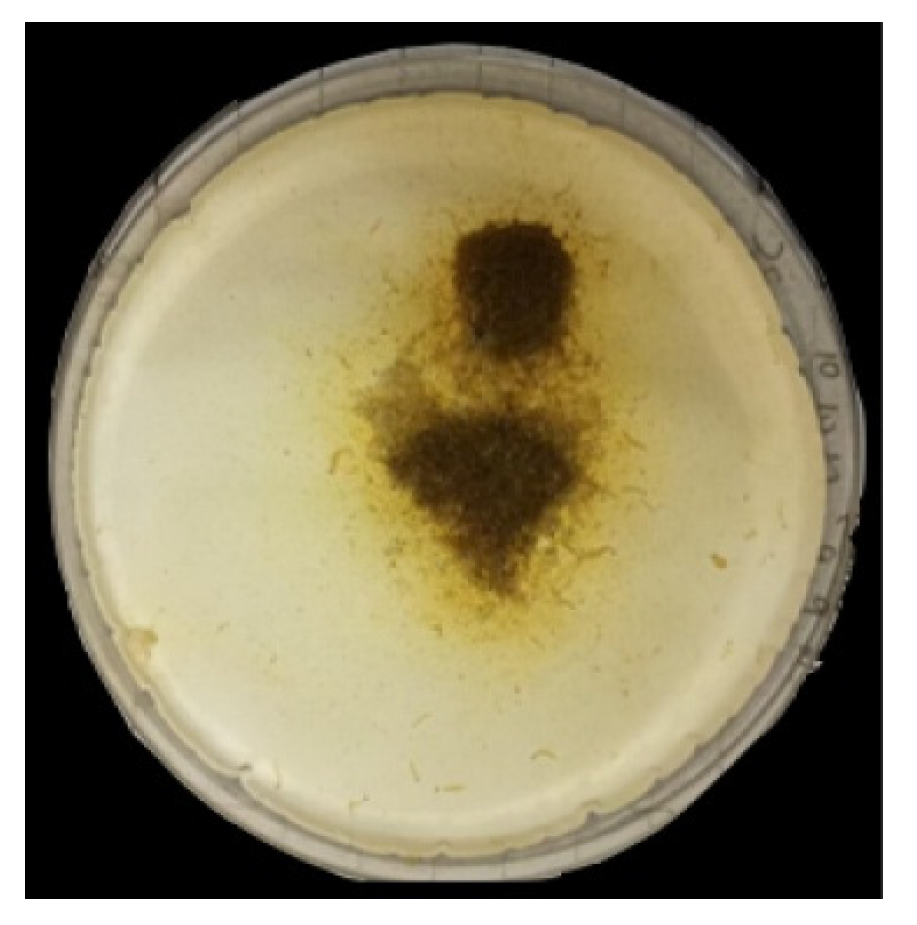
This experiment was conducted at the Institute of Plant Protection, Chinese Academy of Agricultural Sciences. Third-instar larvae of B. odoriphaga (the most destructive stage) were obtained from a laboratory colony reared on autoclaved chive bulbs at 25 ± 1 °C, 70 ± 5% relative humidity, and a 14:10 L/D photoperiod. Prior to heat treatment, larvae underwent a 24 h starvation period on moist filter paper to reduce metabolic variability and standardize initial physiological state (Figure 1). Five independent replicates were prepared for each temperature-time combination, with 10 larvae per replicate placed in thin-walled PCR tubes (10 mm diameter × 80 mm height) for subsequent water bath heat treatment, yielding a total sample size of 150 larvae per treatment group. The PCR tubes with B. odoriphaga were placed in a water bath device and exposed to different temperature gradients (30 °C, 35 °C, 40 °C, 50 °C, 60 °C, 65 °C) and time gradients (1, 3, 5, 10, 20, 40, 50, 60, 70, 90, 100, 120, 150, 180, 200 s) for heating treatment, based on preliminary trials and field equipment operational speeds. After heating, the tubes were allowed to cool naturally to room temperature. Each combination of temperature and time was subjected to three replicates. Survival of the B. odoriphaga was determined by observing whether the cuticle showed spontaneous contraction and whether avoidance responses occurred in response to fine needle stimulation. Maggots meeting both criteria were considered alive, while those failing to meet either or both criteria were considered dead. The water bath experiment provided us with precise data on the basic thermotolerance of pests and clarified the temperature-time threshold for their thermal death. This result serves as an important theoretical basis for assessing the feasibility of heat treatment technology. Therefore, we utilized laboratory data as a critical starting point for guiding field experiment design and parameter optimization, providing foundational data for simulation modeling.

2.2. Heat Transfer Model in Porous Media

2.2.1. Simulation of Soil Temperature Field During Flame Sterilization Landing Phase

During this simulation study, the focus is on the evolution of the temperature field over time and depth. Key target parameters include the effective heat transfer depth, the duration of effective temperature maintenance, and the uniformity of temperature distribution along the depth direction. Given that the tilled and overturned soil covers the original soil layer with a fixed geometric morphology, the structure can be considered symmetric. Therefore, under given initial conditions, the model is reasonably simplified into a two-dimensional heat transfer problem characterized by temperature–time–depth relationships. This simplification not only effectively captures the vertically dominant heat conduction mechanism but also significantly improves computational efficiency due to the reduction in mesh elements and degrees of freedom, making it particularly suitable for parameter sweep studies and enabling efficient comparative analysis of multi-parameter coupling.
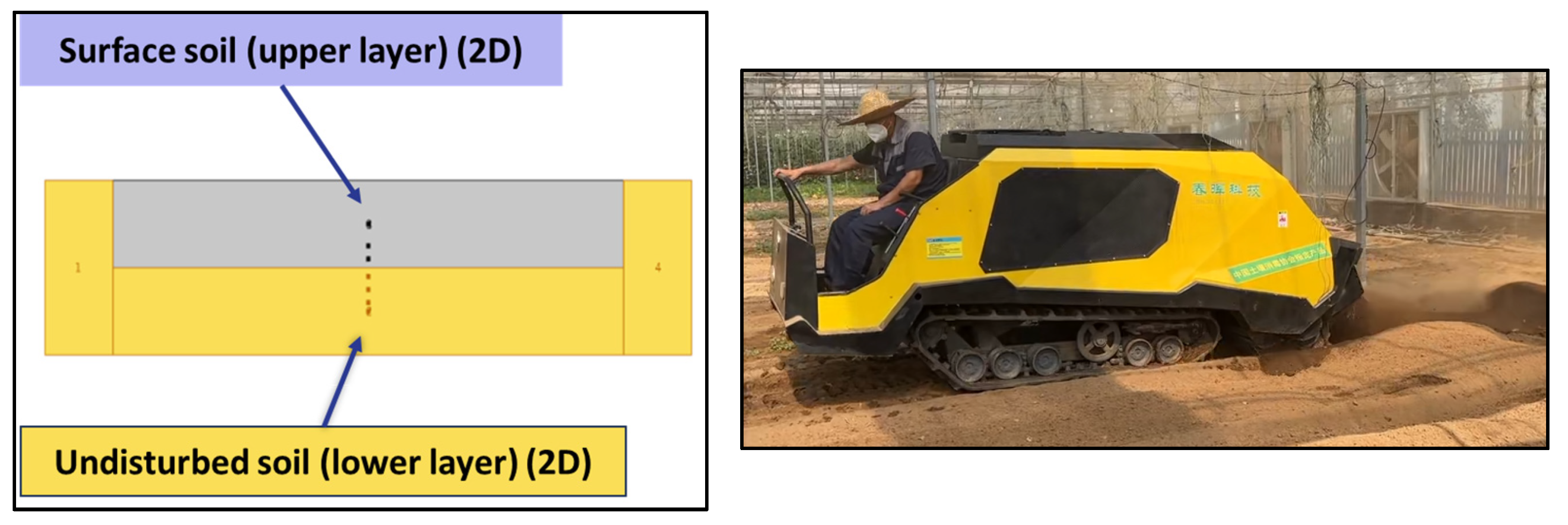
Although a 2D geometric simplification is adopted, the “Heat Transfer in Porous Media” interface in COMSOL Multiphysics 6.3 inherently assigns a unit thickness (1 m) in the out-of-plane direction. This allows the model to maintain 2D computational efficiency while retaining full 3D physical significance. Even within the simplified 2D framework, the calculation of key parameters such as heat flux still adheres to the complete three-dimensional governing equations, thereby ensuring the accuracy of critical physical parameter calculations while preserving computational efficiency. This study employs a 2D model for simulation analysis, with the geometric structure illustrated in Figure 2.
The soil simulation model is structured as a rectangle 150 cm in width and 40 cm in depth. The upper soil layer, with a thickness denoted as H_shang, represents the landed soil—that is, soil that has been finely tilled, lifted, and subjected to instantaneous heating before deposition. The lower soil layer, with a thickness denoted as H_xia, constitutes the original in situ soil. As illustrated in Figure 2, the yellow sections on both sides also represent undisturbed in situ soil that has not undergone fine tilling. The porous medium consists of a solid matrix and pore air, and soil moisture content is incorporated into the model.
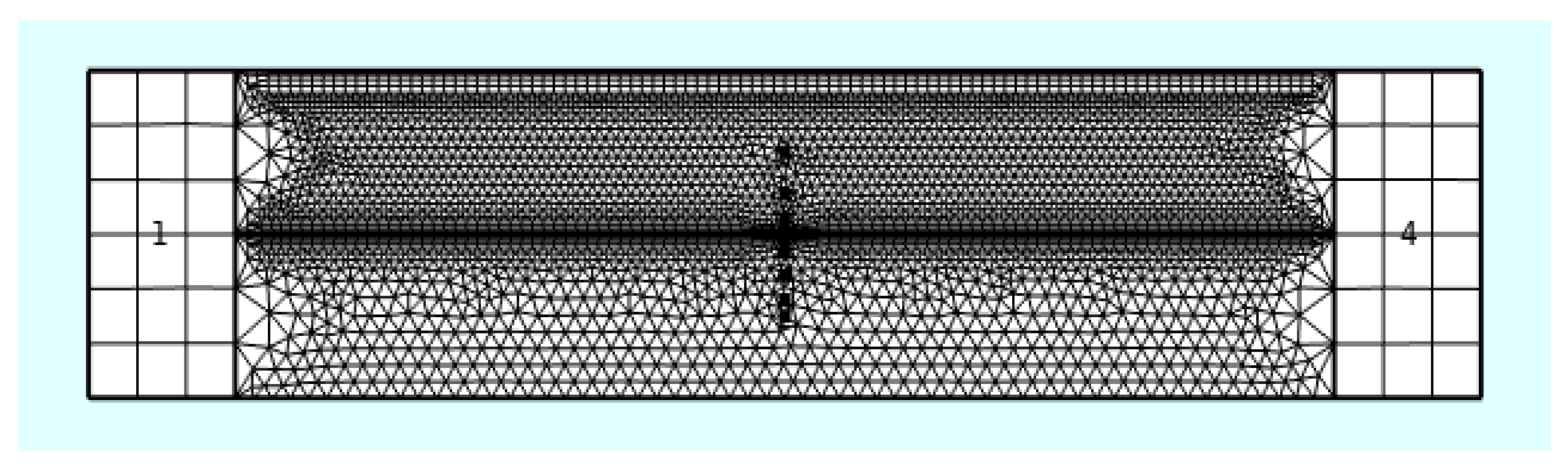
Figure 3 shows the meshing of the heat transfer model in porous media. In regions 1 and 4, a mapped mesh is adopted to ensure structured element distribution and mesh orthogonality, which is beneficial for subsequent numerical convergence and result accuracy. For the upper and lower soil domains, a free triangular mesh is used to accommodate complex geometries and local refinement requirements. Given the significant temperature gradients in the upper soil during the flame sterilization stacking phase, the mesh density in the upper soil domain is much higher than that in the lower soil, following the local refinement principle to enhance the resolution accuracy in high-gradient areas. For the boundary layer mesh settings, boundary layer elements are placed at the interface between the upper soil and the external air to precisely resolve the near-wall temperature gradients associated with convection and radiation heat transfer. Additionally, boundary layer elements are arranged at the contact interface between the upper and lower soils to capture the strong temperature gradient changes at the conductive heat transfer interface between the soil layers. The model comprises a total of 4654 elements, including 3454 triangular and 1200 quadrilateral elements. The minimum element quality is 0.1876, the average element quality is 0.7844, and the element area ratio is 0.002585.

2.2.2. Theoretical Derivation

The governing equation for heat transfer in porous media is derived from the energy conservation equation [23]:
( ρ c p ) e f f T t + ρ c p u · T + · q = ρ w h f g θ w t
The symbols ρ   ( k g / m 3 ) , C p   ( J / ( k g · K ) ) , T   ( K ) , and t   ( s ) represent the soil density, specific heat at constant pressure, temperature, and time, respectively. The velocity vector u (m/s) and heat flux density [24] q   ( W / m 2 ) are also defined. The heat source term Q on the right-hand side represents the latent heat of evaporation, where ρ w (kg/m3) is the liquid water density, h f g (J/kg) is the latent heat of vaporization of water, and θ w is the volumetric water content. The effective volumetric heat capacity [25] is denoted by ρ c p e f f (J/(m3·K)).
ρ c p e f f = ϕ ρ f c p f + 1 ϕ ρ s c p s
Among them, ϕ is the porosity (volume fraction of fluid), ρ f is the fluid phase density, c p f is the fluid phase heat capacity at constant pressure, ρ s is the solid phase density, and c p s is the solid phase heat capacity at constant pressure.
q = k e f f T
In the context of heat transfer in porous media, k e f f denotes the effective thermal conductivity [26].
k e f f = ϕ k f + 1 ϕ k s
In the context of heat transfer in porous media, k f represents the thermal conductivity of the fluid phase, while k s denotes the thermal conductivity of the solid phase.
The first term on the left-hand side of Equation (1) represents the transient phase, characterizing the heat storage capacity of the porous medium. It reflects the rate of temperature change over time and is determined by the effective volumetric heat capacity given in Equation (2). The second term is the convective term, which accounts for the impact of fluid motion within the pores on heat transfer. The third term is the conductive heat diffusion term, which describes the energy changes caused by heat conduction and follows Fourier’s Law of heat conduction as stated in Equation (3). Equation (4) provides the formula for calculating the effective thermal conductivity, illustrating the relationship between the effective thermal conductivity and the porosity of the medium. The source term on the right-hand side is a negative heat source that characterizes the energy absorbed during the evaporation of liquid water in the soil. This latent heat effect is crucial for accurately predicting the temperature field during Soil Flame Disinfection.

2.2.3. Simulation Conditions and Assumptions

The simulation assumptions are as follows. (1) The soil is treated as a porous medium, consisting of a solid matrix and pore air, with a defined moisture content. (2) The porous medium is in a state of local thermal equilibrium, and the effective thermal conductivity is isotropic. (3) The process of soil deposition during the forward movement of the disinfection machine is neglected; the upper soil layer is directly assigned a uniform initial temperature upon deposition. (4) Convective heat transfer occurs between the upper soil surface and the ambient air. The bottom boundary of the model is set as an adiabatic condition with fixed temperature, while the left and right boundaries are set as symmetric temperature boundaries. (5) The study employed varying time step sizes to optimize the computational cost and result reliability of the porous media heat transfer simulations. (6) To investigate soil-temperature distribution patterns under various conditions, a transient solver was employed with a relative tolerance of 0.005, a tolerance factor of 0.1, and a maximum of 10 iterations per time step. The time-step sizes were set to 0.5, 1, 5, 10 and 30 min. Table 1 presents the key parameters that require manual configuration during the simulation process.

2.3. Temperature Data Acquisition

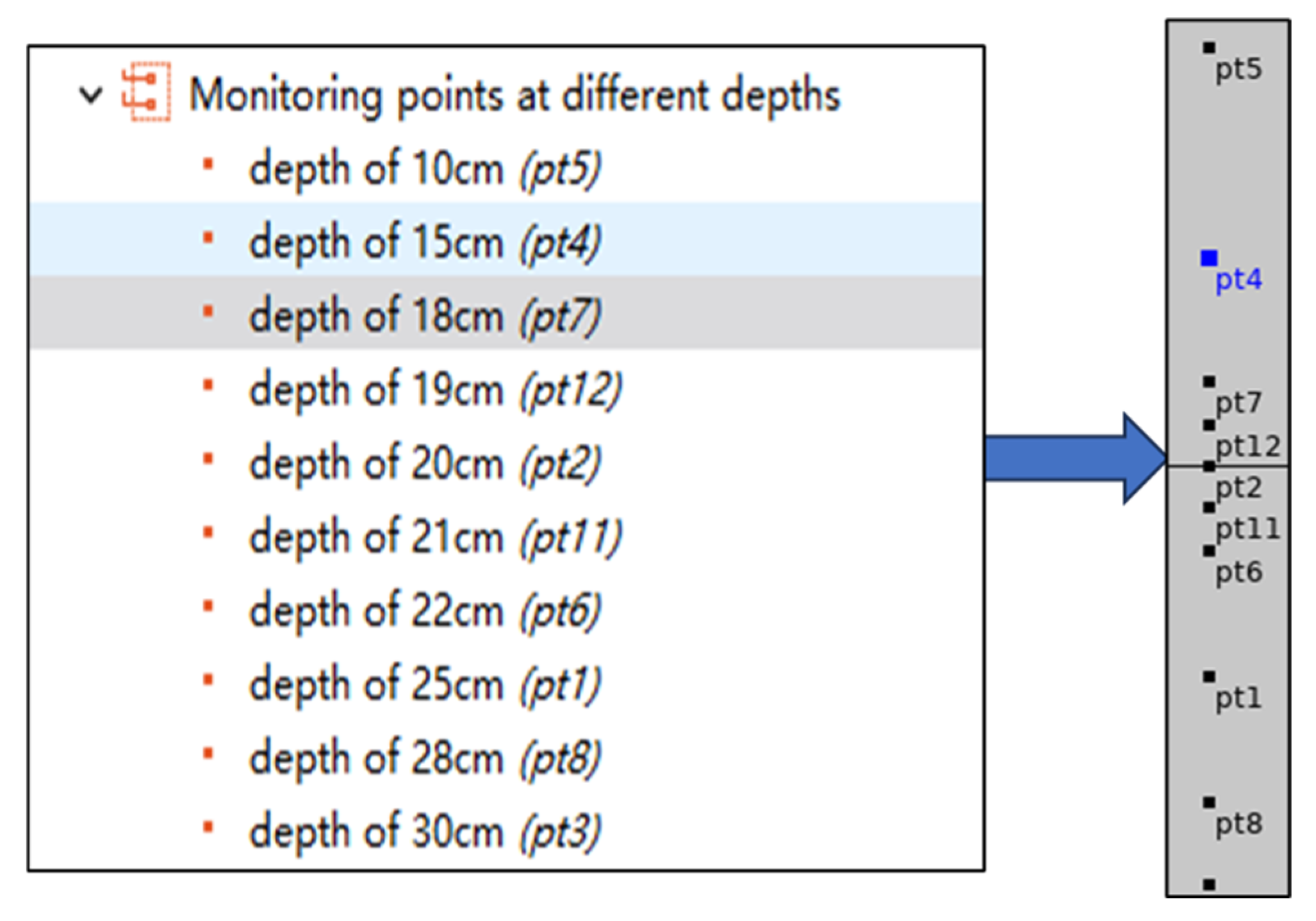
Soil temperature monitoring was carried out using customized armored K-type thermocouple sensors, which simultaneously collected temperature data from five depth points in a single insertion. Based on the structural characteristics of the soil profile, the sensors were arranged in a “cross-pattern” spatial configuration across different layers; in the 0–20 cm plow layer, sensors were vertically implanted at depths of 10, 15, 18, 19, and 20 cm after soil disinfection. For the undisturbed soil layer below 20 cm, sensors were pre-embedded at depths of 21, 22, 25, 28, and 30 cm to characterize the differences in heat conduction properties between the loose surface layer and the compact subsoil. All sensors were disinfected with a 75% ethanol solution before installation to strictly control the risk of microbial cross-contamination. Temperature signals were transmitted in real-time to a terminal system via a 16-channel data acquisition module. A/D conversion and data storage were performed using Smacq|M Console V0.6 software, ensuring the complete capture of dynamic changes in the soil temperature field.

2.4. Data Analysis

The study used SPSS 26.0 for regression analysis of the relationship between lethal temperatures and treatment time for B. odoriphaga. GraphPad Prism 9.0 was used to create charts and graphs of the results. Predictions of B. odoriphaga lethal times at different temperatures were visualized and statistically analyzed using the MASS package in R software. Mortality data were analyzed using probit regression with the drc package in R software (v4.3.1). LT50 and LT95 values were obtained through maximum likelihood estimation, with 95% confidence intervals and standard errors calculated. Model goodness-of-fit was evaluated using R2 and residual standard error; all fits achieved R2 ≥ 0.88, indicating good model fit. Differences among groups were assessed using one-way analysis of variance (ANOVA) followed by Tukey’s HSD multiple comparison test (p < 0.05). Adobe Illustrator CS6 was finally used for all chart layouts.

3. Results

3.1. The Relationship Between Time-to-Death and Mortality Rate of B. odoriphaga Under Different Temperatures

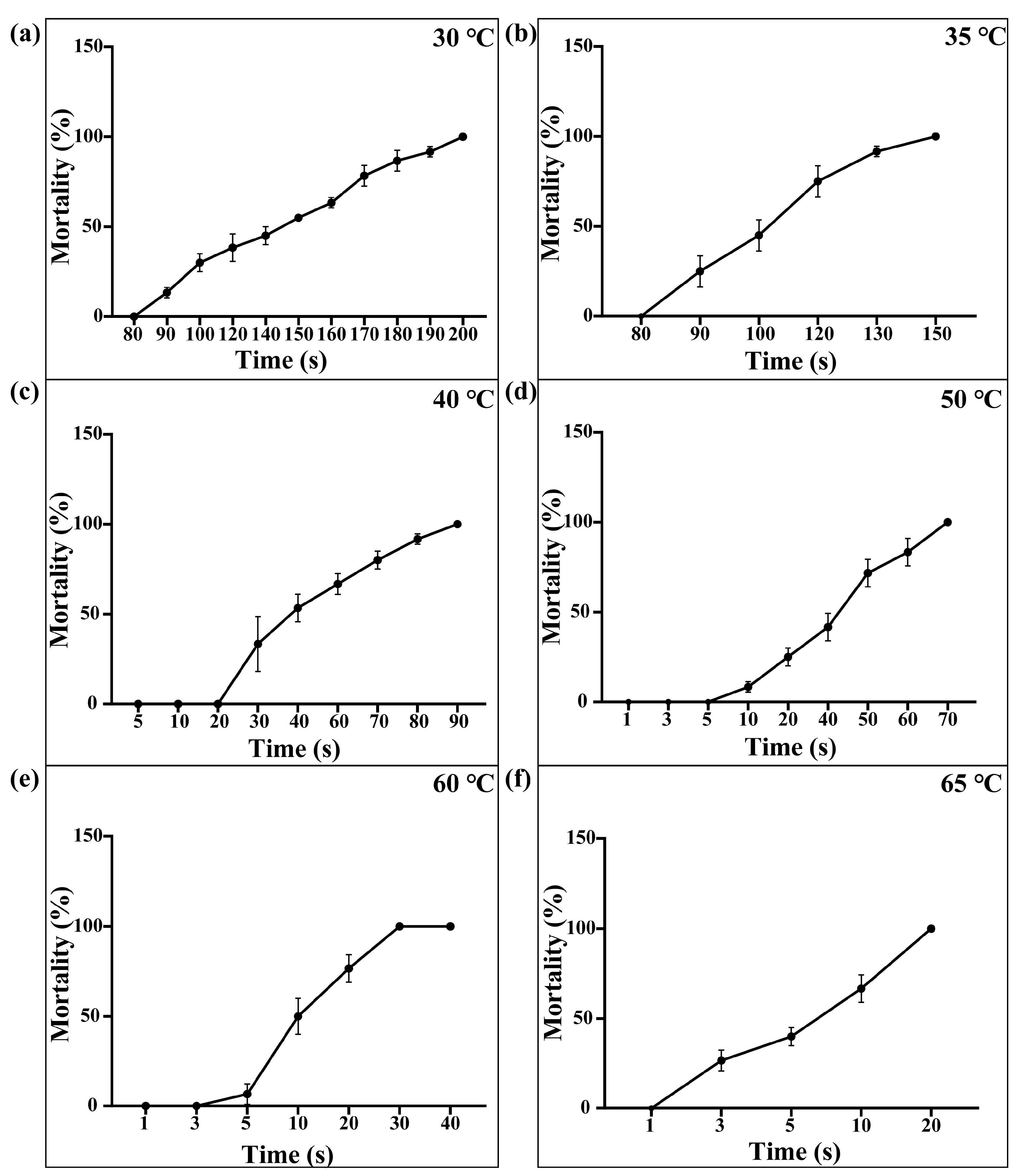
Temperature significantly regulated the mortality dynamics of B. odoriphaga larvae (Figure 4). At sub-lethal temperatures (30–35 °C), mortality only began after 80 s and gradually reached 100% at 200 s. A distinct inflection point emerged at 40 °C; larvae started dying within 20 s, with mortality surging by 33.3% between 20 and 30 s, indicative of a breakdown in their physiological stress defense mechanisms. This pattern intensified at higher temperatures—at 50 °C, mortality commenced at 5 s and peaked between 40 and 50 s; while at 65 °C, lethal effects occurred instantaneously, achieving 100% mortality within 20 s. Notably, the duration of the mortality acceleration phase progressively compressed from 50 s at 30 °C to merely 10 s at 65 °C, reflecting an exponential loss of thermotolerance. These data identify 40–50 °C as the critical temperature range where flame disinfection can achieve rapid pest eradication with minimal energy input.

3.2. Predicted Time for Mortality Probability of B. odoriphaga at Different Temperatures

As shown in Table 2, temperature and time to death are negatively correlated. The time needed to reach the same lethal probability decreases as the temperature increases. At a lethal probability of 50%, it takes 6 s at 65 °C compared to 131 s at 30 °C. At a lethal probability of 95%, it takes 12 s at 65 °C versus 279 s at 30 °C. When the temperature is below 40 °C, it takes 101–131 s to reach a 50% lethal probability and 215–279 s for a 95% probability. However, when the temperature is above 40 °C, it takes only 6–43 s to reach a 50% lethal probability and 12–91 s for a 95% probability.

3.3. Soil Simulation Heat Transfer Research

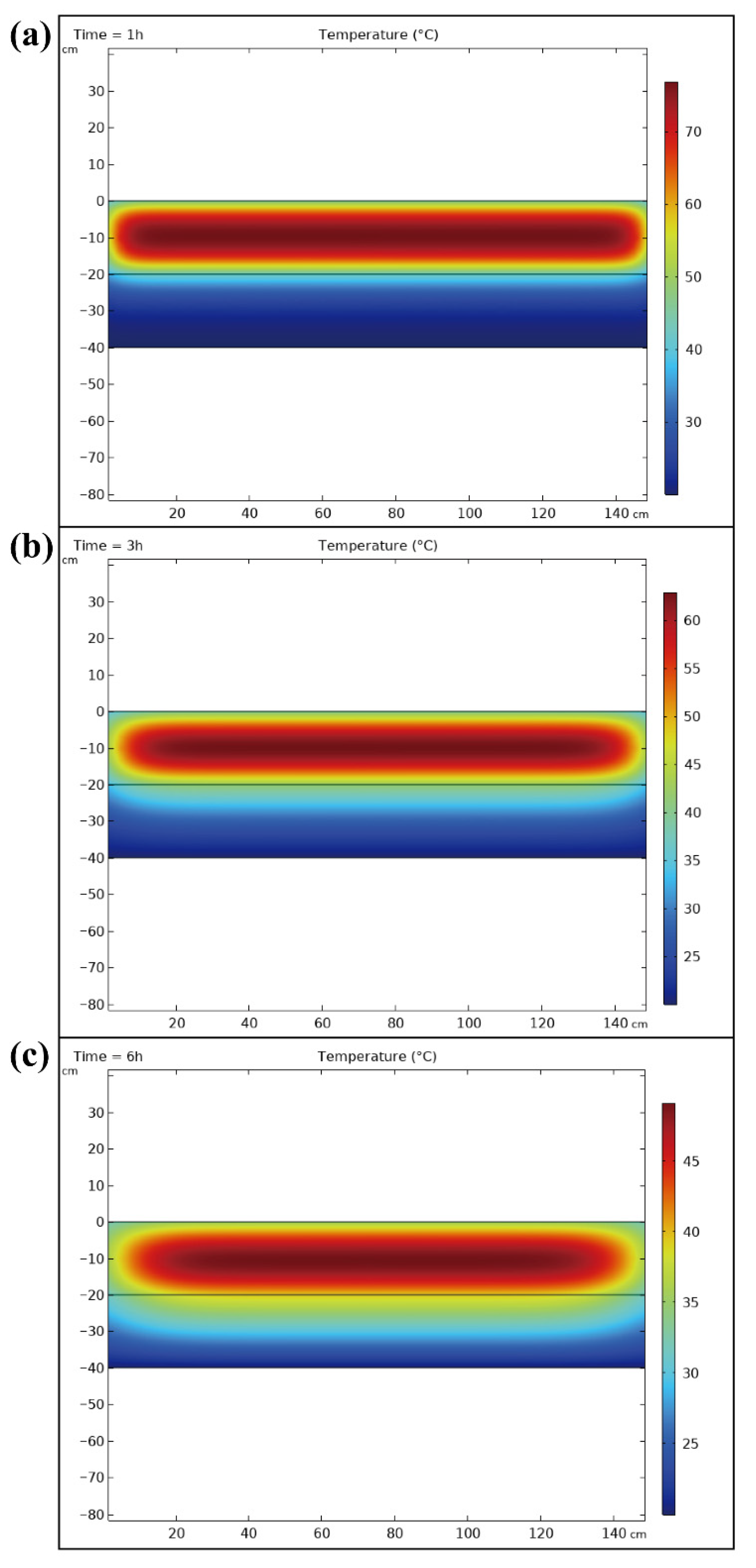
To analyze the relationship between soil temperature, depth, and time, ten probes were placed in the soil at depths of 10–30 cm in the porous medium heat transfer model. When the landing layer soil was 20 cm deep, the probe density at 20 cm was higher than that away from this depth. This allowed more temperature data to be collected near the interface between the landing and original soils, facilitating temperature variation analysis (Figure 5). Figure 6a shows that at 1 h, the steepest temperature gradient is between 0 and 20 cm depths, with the temperature at 20 cm being around 50 °C and the surface temperature reaching 70 °C. Heat is predominantly concentrated in the surface layer, with minimal conduction to deeper soil layers. Figure 6b indicates that by 3 h, the temperature gradient gradually becomes more linear, the thermal diffusion coefficient stabilizes, and aligns with predictions from Fourier’s Law. Figure 6c shows that after 6 h, the soil temperature at a depth of approximately 35 cm has risen from an initial 20 °C to about 30 °C, while the peak temperature in the surface layer (e.g., at about 10 cm depth) has decreased to approximately 45 °C. This indicates that a thermal disequilibrium persists even after 6 h, with heat continuing to conduct into the original soil layer.
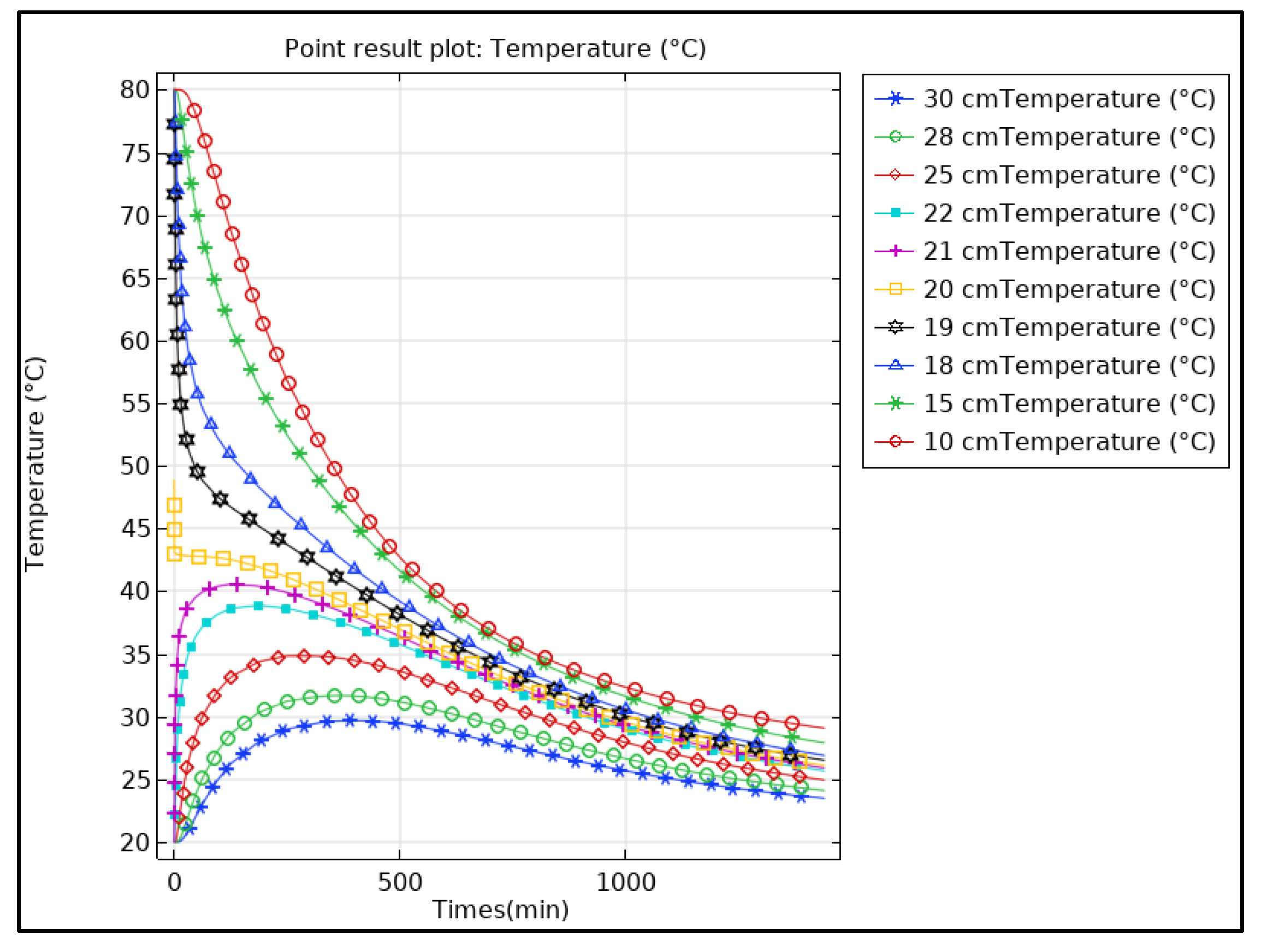
The thermal diffusion process in soil is slow. Within 6 h, the maximum temperature dropped from 70 °C to 45 °C, and the depth of heat conduction extended from 20 cm to 40 cm, indicating a gradual decrease in the rate of heat conduction over time (Figure 7). When the temperature of the land soil was 80 °C and its thickness was 20 cm, the maximum temperature and the time to reach it in the original soil layer varied with depth. Table 3 shows that the maximum temperature in the original soil decreased monotonically with depth, from 40.23 °C at 21 cm to 29.26 °C at 30 cm, with an average temperature drop of about 1.2 °C per additional centimeter of depth. Meanwhile, the time to reach the peak temperature was delayed, increasing linearly from 2.48 h to 8.17 h. This indicates that the rate of heat conduction downward was relatively constant, in line with the one-dimensional heat conduction temperature rise lagging law (Table 3).

3.4. The Influence of Various Factors on the Maximum Effective Killing Depth

3.4.1. Killing Time, Ground Temperature, and Lethal Temperature Duration

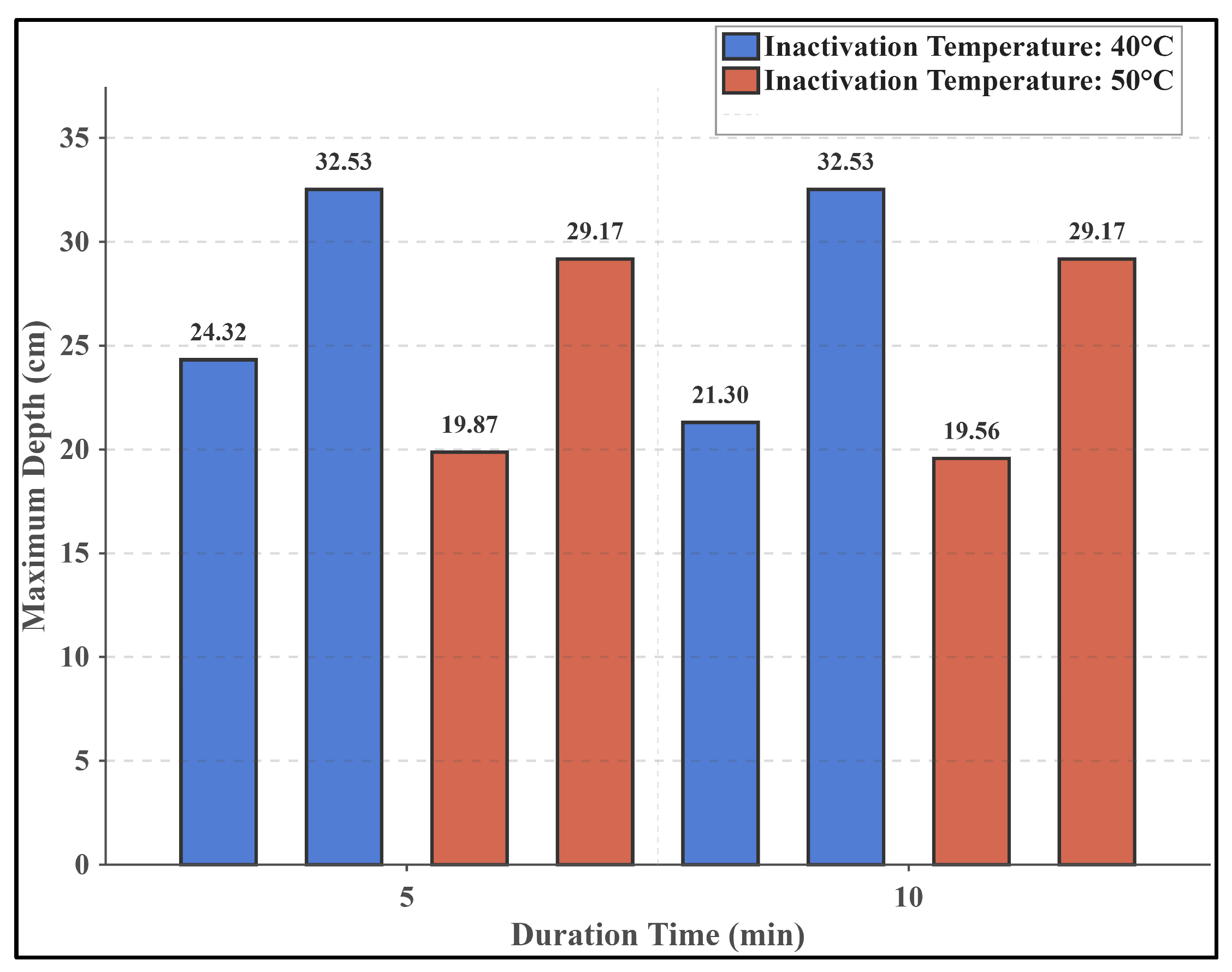
In SFD, the inactivation temperature is defined as the minimum threshold required for effective pest and pathogen eradication. Elevating this parameter necessitates achieving higher temperatures at the target soil depth; consequently, under a fixed exposure duration, the maximum attainable inactivation depth decreases correspondingly. To systematically evaluate the combined effects of inactivation temperature and duration on thermal efficacy, Figure 8 illustrates their interdependent influence on maximum inactivation depth (where “deposition temperature” denotes the initial temperature of the upper soil layer).
Figure 8 illustrates the impact of inactivation temperature and duration time on the maximum inactivation depth. The blue bars represent the maximum inactivation depth at an inactivation temperature of 40 °C, while the red bars represent that at 50 °C. The x-axis indicates duration time, with values of 5 and 10 min. As illustrated in Figure 8, the analysis reveals two principal findings. Firstly, at a fixed duration, an increase in inactivation temperature reduces the maximum inactivation depth; at 5 min, the depth decreases from 24.32 cm at 40 °C to 19.87 cm at 50 °C (a reduction of 4.45 cm), while at 10 min, it declines from 21.30 cm to 19.56 cm (a reduction of 1.74 cm). Secondly, at a fixed inactivation temperature, prolonging the duration exerts limited and inconsistent effects on the depth; at 40 °C, extending the duration from 5 to 10 min reduces the depth from 24.32 cm to 21.30 cm (a reduction of 3.02 cm), while at 50 °C, it decreases from 19.87 cm to 19.56 cm (a marginal reduction of 0.31 cm). In summary, the maximum inactivation depth demonstrates greater sensitivity to variations in inactivation temperature than to changes in duration.
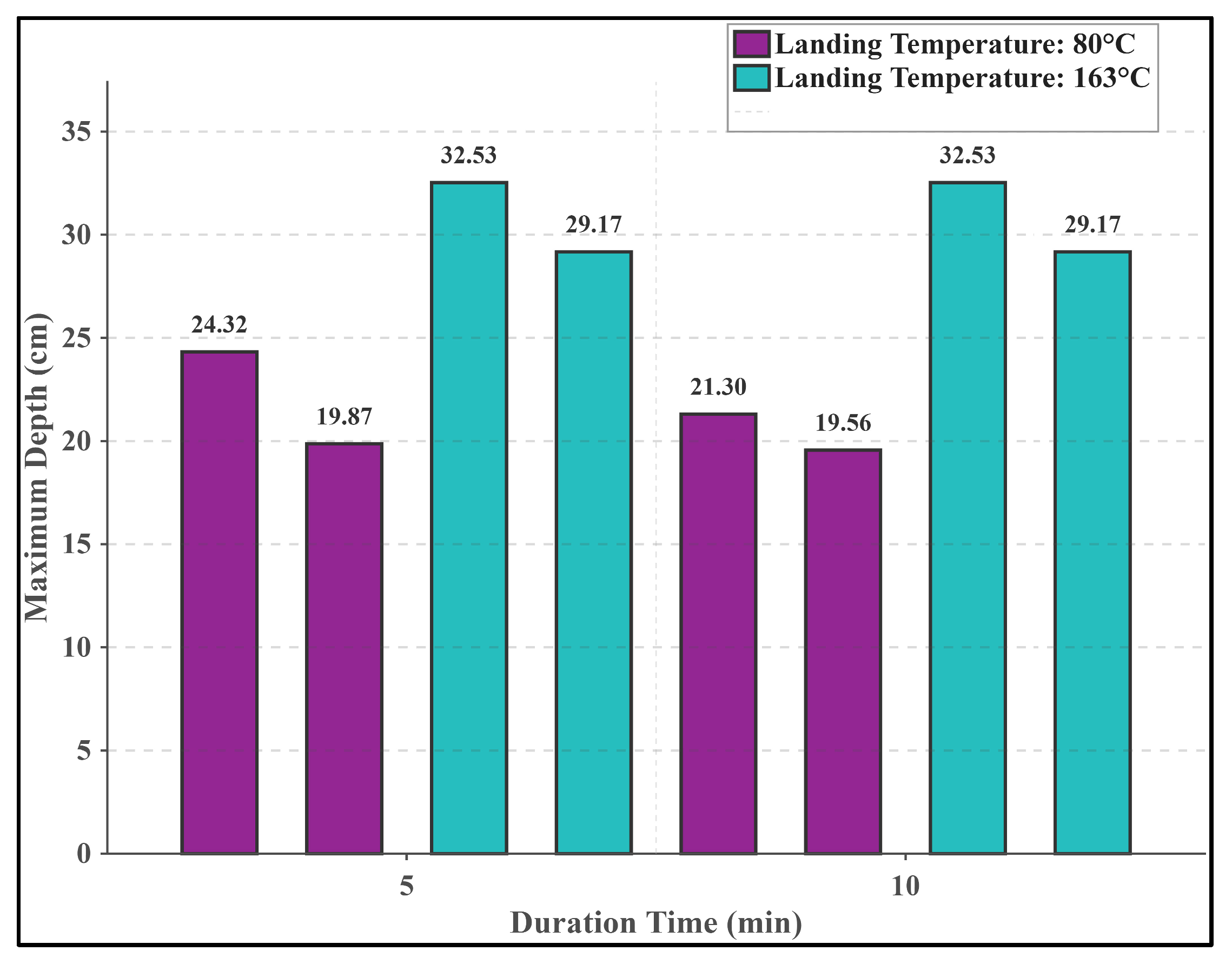
Figure 9 illustrates the impact of different landing temperatures (80 °C and 163 °C) and duration times (5 and 10 min) on the maximum inactivation depth. The purple bars represent the landing temperature of 80 °C, while the cyan bars represent the landing temperature of 163 °C. As shown in Figure 9, a higher landing temperature (163 °C) significantly increases the maximum inactivation depth compared to a lower landing temperature (80 °C). With a 5 min duration, the inactivation depth at 80 °C is 24.32 cm, while at 163 °C it is 32.53 cm, a difference of 8.21 cm. When the duration is extended to 10 min, the inactivation depth at 80 °C is 21.30 cm, while at 163 °C it is 32.53 cm, a difference of 11.23 cm. This indicates that raising the landing temperature is an effective way to increase the inactivation depth. Additionally, extending the duration has a relatively small effect on the inactivation depth; from 5 to 10 min, the inactivation depth at 80 °C increases by only 1.57 cm, while at 163 °C it increases by only 0.36 cm. Therefore, prolonging the duration is not an effective strategy for increasing the inactivation depth.
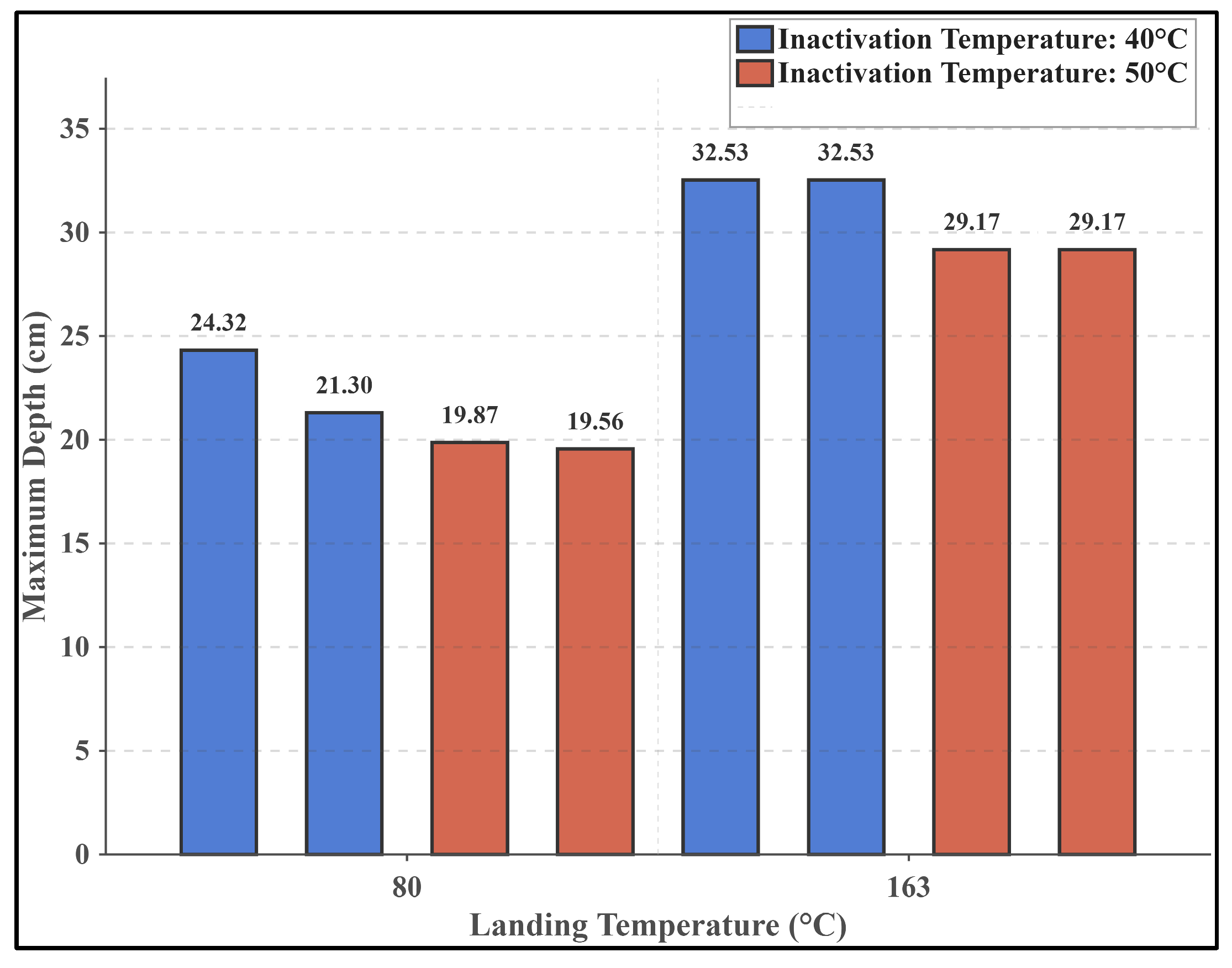
Figure 10 illustrates the impact of different landing temperatures (80 °C and 163 °C) and inactivation temperatures (40 °C and 50 °C) on the maximum inactivation depth. The blue bars represent the inactivation temperature of 40 °C, while the red bars represent the inactivation temperature of 50 °C. As shown in Figure 10, a higher landing temperature (163 °C) significantly increases the maximum inactivation depth compared to a lower landing temperature (80 °C). At an inactivation temperature of 40 °C, the inactivation depth at 80 °C is 21.30 cm, while at 163 °C it is 32.53 cm, a difference of 11.23 cm. At an inactivation temperature of 50 °C, the inactivation depth at 80 °C is 19.87 cm, while at 163 °C it is 29.17 cm, a difference of 9.30 cm. This indicates that raising the landing temperature is an effective way to increase the inactivation depth.
Based on the integrated analysis of Figure 8, Figure 9 and Figure 10, the maximum kill depth is most sensitive to landing temperature, moderately sensitive to lethal temperature, and least sensitive to exposure duration. Specifically, increasing the landing temperature from 80 °C to 163 °C consistently enhances the depth by 8–18 cm, with this beneficial effect being more pronounced at higher lethal temperatures. In contrast, elevating the lethal temperature from 40 °C to 50 °C generally reduces the depth by 3–13 cm, although this reduction diminishes as the landing temperature increases, necessitating a trade-off with energy consumption. Extending the exposure time from 5 to 10 min results in minimal depth changes—typically less than 3 cm—with no observable gain under some parameter combinations. Therefore, from an engineering standpoint, priority should be given to increasing the landing temperature.
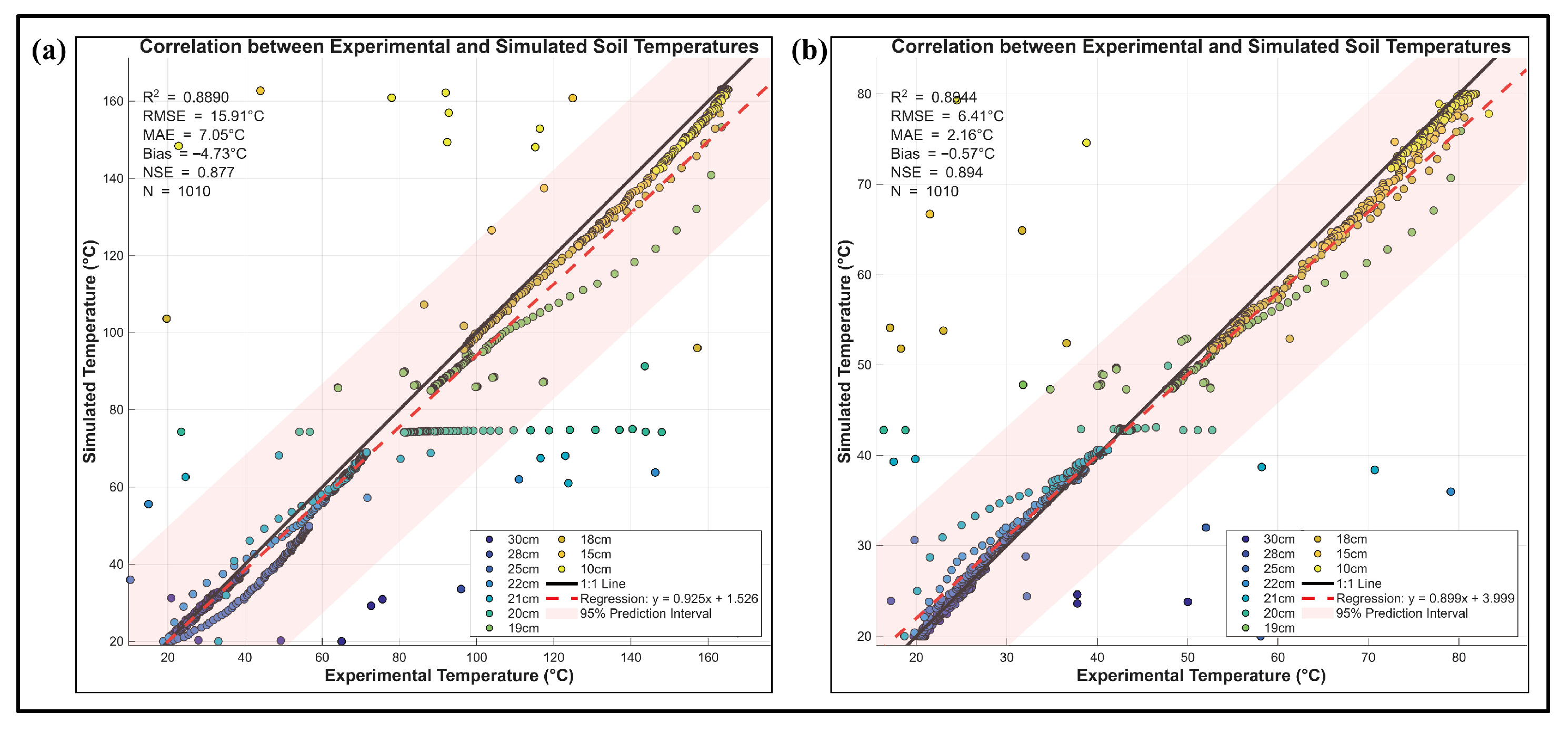
Figure 11 depicts the correlation distribution and fitting results between experimental and simulated soil temperatures under high-temperature (163 °C) and low-temperature (80 °C) conditions. Under the high-temperature scenario of 163 °C, the coefficient of determination between simulated and measured values is R 2 = 0.88 while under the low-temperature condition of 80 °C, it is R 2 = 0.89 The findings indicate that the simulation model performs better at the initial temperature of 80 °C. These statistical metrics collectively confirm the reliability of the model in characterizing soil heat transfer behavior during the flame disinfection process. To further enhance model accuracy, subsequent efforts should involve parameter sensitivity analysis, data collection and calibration, and iterative optimization of the simulation model.
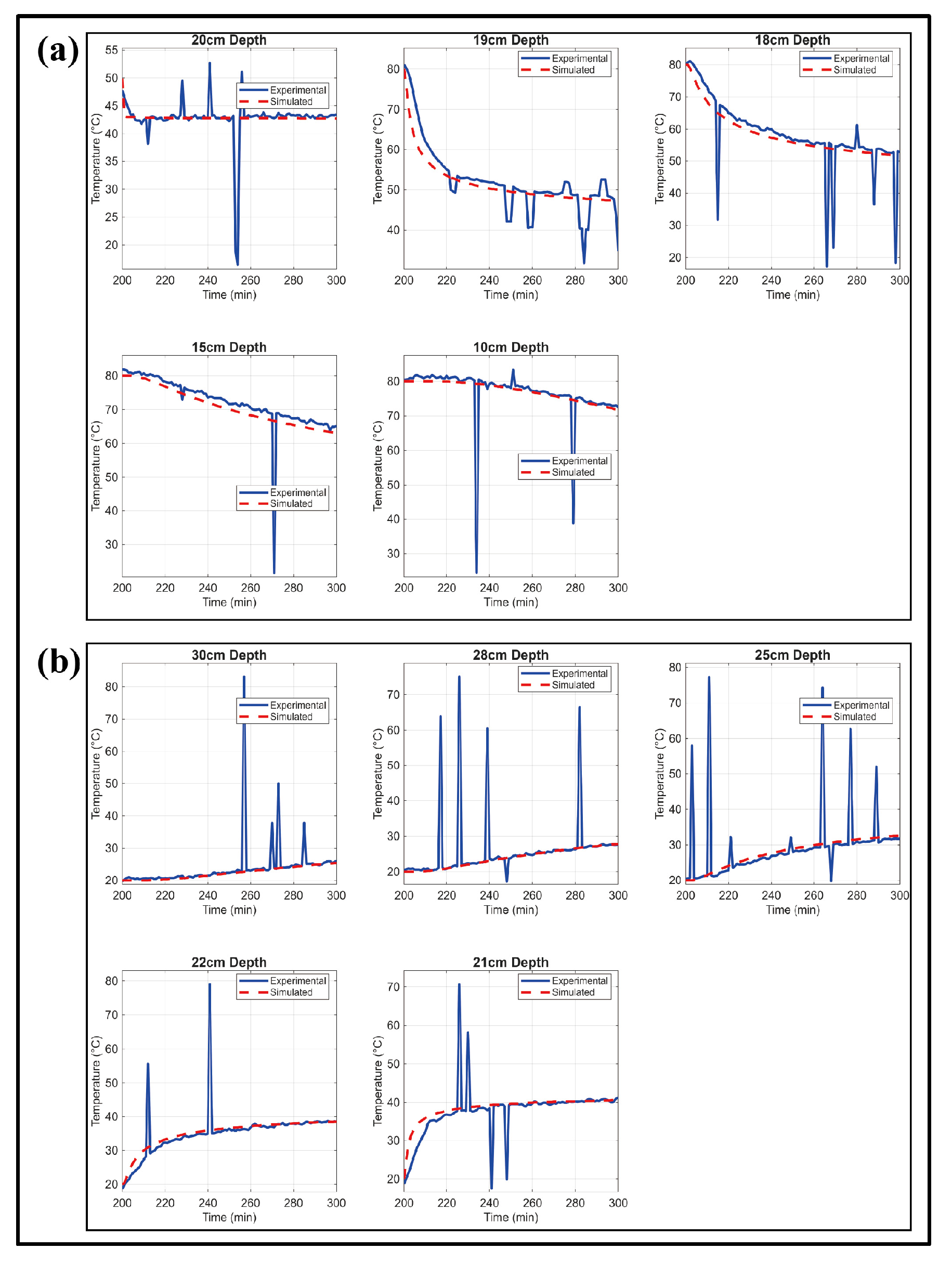
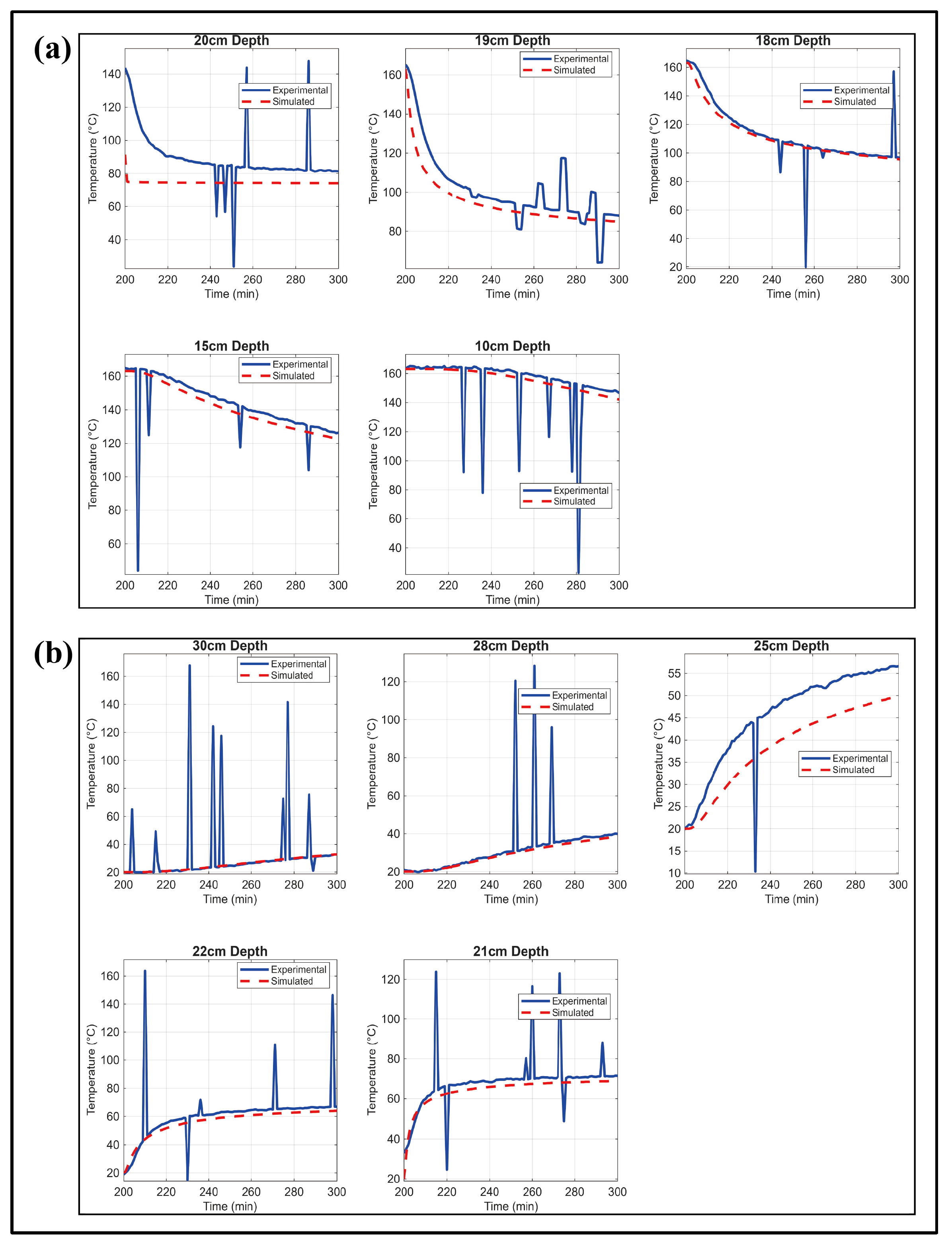
Figure 12 illustrates the temperature dynamics at multiple soil depths (15–36 cm) over time (200–300 min) under an initial temperature of 80 °C. The simulated data (red dashed line) displays a smooth cooling trend in upper layers and a warming trend in lower layers, with reduced thermal gradients at greater depths, aligning with heat conduction behavior in a homogeneous porous medium. In contrast, the experimental data (blue solid line) exhibits significant fluctuations, particularly pronounced near the 20 cm depth interface, manifesting as irregular peaks and troughs. These fluctuations can be attributed to soil heterogeneity at the interface (e.g., variations in texture, porosity, moisture content), moisture migration and phase changes (e.g., latent heat release/absorption from evaporation/condensation), and potential measurement artifacts (e.g., sensor placement sensitivity or environmental noise). Although the simulation generally captures the overall temperature trends with reasonable accuracy (R2 ≈ 0.88–0.89), meeting basic practical requirements, its failure to replicate the interface fluctuations highlights key limitations, such as neglecting depth-dependent soil property variations, moisture transport, vapor movement, and phase changes, thereby underestimating actual thermal dynamics and reducing predictive precision at boundaries.
Figure 13 confirms the significant fluctuations in the experimental data, most pronounced at the 20–25 cm soil layer interface. A critical new observation is the marked discrepancy at 25 cm depth, where the model’s smooth warming trend substantially diverges from the strong dynamic variability in field measurements. This highlights the role of this zone as a critical heterogeneity interface; the higher initial temperature of 163 °C intensifies moisture evaporation and vapor movement, likely making the 20–25 cm zone a vapor trapping and condensation front where latent heat exchange causes the observed peaks and troughs. Furthermore, this depth often corresponds to the root zone in protected horticulture, where decomposing organic matter creates localized microenvironments with distinct thermal properties. Consequently, while the model performs well in the upper layer (10–21 cm), demonstrating the highest prediction accuracy and meeting basic requirements, its performance deteriorates in the critical lower layer (20–30 cm) where biological control is determined, systematically underestimating the actual heat penetration dynamics in field conditions. The results from Figure 12 and Figure 13 indicate that heat transfer in the upper zone (10–21 cm) is primarily dictated by the initial temperature. Consequently, this layer exhibits the highest prediction accuracy.

3.4.2. The Impact of Landing Soil Thickness

Soil thickness, a key parameter for heat conduction efficiency, influences heat conduction depth and temperature attenuation by altering thermal storage and conduction path length. Table 4 presents the depth of heat transfer downward, independent of landing thickness. Under low temperatures (≤80 °C), a 20 cm landing layer, with its larger thermal capacity and sustained interfacial temperature differences, increases heat transfer depth ( Δ d ) by 3–4 cm compared to a 15 cm thickness, compensating for weak thermal drive. However, when the target temperature reaches 50 °C, Δ d drops to near 0 cm, showing that thickness gain is limited by the lethal threshold. Under high temperatures (≥163 °C), the thickness effect vanishes, with Δd differences between 15 cm and 20 cm, less than 1 cm. Here, the heat conduction rate dominates, and a thinner layer is slightly better. Duration extension does not significantly affect Δ d .
Analysis of variance (Table 5) shows that Landing temperature is the dominant driver of Δd, accounting for ~90% of the total variance ( η 2     0.90 ). Inactivation temperature, although statistically significant, explains only 4–5% ( η 2   =   0.04 0.05 ), and neither duration nor any interaction involving duration was significant. The sole meaningful interaction, Landing × Inactivation ( η 2     0.04 0.05 ), indicates that the suppressive effect of inactivation temperature is modulated by the landing temperature level. Thus, raising the landing temperature is the most effective strategy for increasing heat-penetration depth, whereas inactivation temperature provides a secondary, moderate regulation.
Integrating Table 4 and Table 5, within the tested range, elevating landing temperature remains the primary pathway for enhancing Δd; soil-thickness optimization is beneficial only under low-temperature conditions (≤80 °C), and prolonging exposure beyond 5 min offers no practical gain. Future work should therefore fix the duration at 5 min and focus on systematically optimizing the combination of landing temperature and soil thickness to achieve an optimal balance between energy efficiency and sterilization efficacy.

4. Discussion

4.1. Temperature Effect on Soil Biota

Soil-borne pests, a major biotic stress to crop health and yield, are regulated by multiple environmental factors, with temperature as a key abiotic driver of their physiology, development, and behavior [23,27]. Our study shows that under laboratory water bath conditions, the target pest reaches 100% mortality after 90 s at 40 °C. However, achieving the same effect in field soil requires about 2 h, which is a significant difference compared to the laboratory conditions. This phenomenon occurs due to the fact that under water bath conditions, temperature can rapidly affect pests. In facility agriculture, the soil thickness and structural characteristics reduce thermal conductivity, thereby prolonging the time required to eliminate pests [28]. Research indicates that B. odoriphaga at different developmental stages have varying heat tolerances, which increase from adult flies to eggs, larvae, to pupae. Higher temperatures result in shorter lethal times. At 40 °C, adults survive no more than 1.5 h, eggs about 2 h, while larvae and pupae, with stronger heat tolerance, die completely within 3 and 4 h, respectively [29]. This phenomenon is closely associated with the heat stress response mechanism of B. odoriphaga. High temperatures can disrupt cell membrane integrity, induce protein denaturation, and interfere with mitochondrial energy metabolism, ultimately leading to physiological collapse [30]. Under high temperatures, click beetle larvae migrate to deeper soil (15–20 cm) to escape heat, but prolonged surface temperatures > 35 °C exhaust their energy reserves, impair heat-avoidance ability, and cause mortality, highlighting the dual stress effects on pest behavior and energy metabolism [5]. This behavioral adaptation is closely linked to the vertical distribution of soil temperature and determines the distribution patterns of pests in different soil layers. When soil temperatures range from 30 to 40 °C, soil-borne pests enter a state of heat stress, and their physiological functions begin to make adaptive adjustments [31]. Soil-dwelling pests (leek maggot, root-knot nematode, cutworm) feed on underground crop parts; exposing root-knot nematode J2s (second-stage juveniles) to 35 °C for 24 h increases superoxide dismutase activity while decreasing catalase by 32%, causing ROS accumulation and oxidative damage [32]. Though the nematodes survive, their metabolic efficiency declines, and their developmental cycle lengthens. Meanwhile, under 38 °C conditions, the feeding amount of cutworm (Agrotis ypsilon) larvae decreases by 45%, and their body weight growth rate drops by 60%, creating conditions for subsequent heat-induced mortality [33]. When temperatures rise, cell membrane fluidity increases, destabilizing the membrane structure and causing cellular content leakage [34]. This is particularly evident when temperatures exceed 50 °C, significantly reducing the LT50 of B. odoriphaga to 35 s (Figure 4c). Studies have shown that the loss of digestive enzyme function at high temperatures can disrupt nutrient absorption and energy production in B. odoriphaga, ultimately leading to their death [35]. Under heat stress, the soluble protein content in root-knot nematodes decreases by 58%, and the activity of mitochondrial respiratory chain complexes drops by 72%, halting ATP synthesis completely [36]. This study indicates that 40 °C is a critical temperature threshold for B. odoriphaga. When temperatures are below 40 °C, the time it takes to reach the semi-lethal probability is significantly longer compared to when temperatures are above 40 °C. The cell membrane is another primary target of high-temperature lethality. Temperatures above 40 °C can disrupt the fluidity of the lipid bilayer of membranes, increasing membrane permeability [37]. Flame disinfection’s soil impact depends on operation intensity. While improper high temperatures harm soil health, benefits are maximized by precisely controlling temperature, duration, and depth to kill targets while minimizing exposure to protect soil organic matter and microorganisms [38]. Research has shown that flame disinfection cannot maintain a long-term reduction in the abundance of Acidobacteria in soil, but merely inhibits it [39]. Acidobacteria often accumulate in nutrient-rich soil environments, promoting soil nutrient cycling and ecosystem improvement [40]. It also suggests that flame sterilization of soil does not have destructive effects on soil microbial communities. Research has demonstrated that, following flame disinfection, although the composition of bacterial communities undergoes changes, nitrifying and nitrogen-fixing bacteria, which are related to the nitrogen cycle, show an increasing trend by the fourth year [41].

4.2. Effects of Different Parameter Combinations on the Temperature Distribution

Based on a porous media heat transfer model, this study systematically elucidates the heat conduction mechanism during the post-treatment phase of flame disinfection, with particular emphasis on the regulatory effects of the combined interaction between initial deposition temperature and deposition thickness on disinfection efficacy. Compared to microwave disinfection (2.45 GHz band) and steam disinfection technologies, flame disinfection achieves deep soil heating (>20 cm) through the stable thermal driving force generated by a high-temperature soil layer (≥163 °C), attaining an inactivation depth of 32.5 cm and demonstrating significant technical advantages [42]. The research reveals a significant interactive effect between initial deposition temperature and deposition thickness, showing an effect reversal at a critical temperature (approximately 120 ° C ) [43]. Under low-temperature conditions (80 °C), the inactivation depth at 20 cm deposition thickness (18.52 cm) was 30.4% greater than that at 15 cm thickness, which can be attributed to the lower soil thermal conduction rate at reduced temperatures, where increased thickness compensates for insufficient thermal driving force by extending heat retention time [44]. However, when the deposition temperature rises to 163 °C, the inactivation depth at 15 cm thickness (32.5 cm) becomes 18.9% greater than that at 20 cm thickness. This reversal mechanism results from the heat-loss-dominated regime under high-temperature conditions; increased thickness amplifies the surface area for heat dissipation to the environment ( Δ Q = h A Δ T ), while reduced thickness enhances conduction efficiency by shortening the heat loss path ( Q 1 / d ) [45]. This combined effect is consistent with the “soil thermal resistance-pore structure” coupling model proposed by Yang et al. (2020), where at low temperatures, small pores (<2 mm) in the 20 cm thickness form continuous heat conduction paths through matrix flow, reducing thermal resistance by 22%, while at high temperatures, large pores (>5 mm) in the 15 cm thickness minimize vapor escape losses [46].
In terms of model application, the model employed in this study simplifies computation by relying on the assumptions of local thermal equilibrium and isotropy. This limitation may lead to systematic deviations of 5–7 °C between simulated and measured values. Within the critical thermal disinfection temperature range (e.g., 55–65 °C), such deviations can significantly affect the determination of lethal depth boundaries. To improve prediction accuracy, subsequent research could adopt the methodology introduced that incorporates CT-scanned pore structure data to control thermal parameter identification errors within 5%, combined with thermal response testing for model validation and optimization [47]. Sensitivity analysis indicates that deposition temperature has the greatest influence on inactivation depth. When the temperature increases from 80 °C to 163 °C, the inactivation depth shows a remarkable increase of 18 cm. Flame disinfection demonstrates substantial technical advantages in deep soil treatment, achieving inactivation depth gains (8–18 cm) far exceeding those of microwave (20 cm/1000 W) and solar-steam (15 cm/120 °C) technologies [48]. Optimization using response surface methodology yields preliminary parameter combination recommendations: employing 20 ± 2 cm thickness at low temperatures (<120 °C) and 15 ± 2 cm thickness at high temperatures (>120 °C). This strategy improves inactivation depth stability by 25% [47]. The adjustable soil-spreading mechanism proposed by Zhang Yijie et al. (2023), featuring intelligent “thicker at low temperature-thinner at high temperature” switching capability, provides new directions for engineering implementation of this strategy [49]. In conclusion, flame disinfection exhibits unique technical advantages in deep soil treatment. The identified temperature–thickness interaction effects and parameter sensitivity patterns provide a theoretical foundation for developing intelligent equipment with adaptive thickness adjustment. Future research should further investigate coupled multiphysics simulations and heat transfer mechanisms in heterogeneous soils to promote innovative development of soil disinfection technologies.

5. Conclusions

This study validated a porous media heat transfer model for SFD, identifying surface temperature and tilled soil thickness as key drivers of lethal depth (+2.1 cm per 20 °C increase) and heat conduction. From a practical horticultural perspective, the optimized parameters (20 cm soil layer, 163 °C) achieved a lethal depth of 32.5 cm in the soil system. This model can assist in selecting optimal parameter combinations to enhance tillage efficiency while reducing disinfection costs. Study limitations include validation under controlled simulation conditions with a single pest species; future research should conduct field-scale trials across different crops and soil types to confirm broad applicability. Nevertheless, this framework provides theoretical guidance for balancing SFD efficacy with environmental sustainability in intensive horticulture.

Author Contributions

Y.Z. (Yunhe Zhang): data compilation, drafting the original manuscript, revising the draft for publication, review and editing, as well as the procurement of funding; J.W.: data compilation, drafting the original manuscript, and revising the draft for publication (co-first author); Y.Z. (Yu Zhang): data compilation, drafting the original manuscript, investigation and data correction; Y.W.: data compilation, investigation and data correction; Z.J.: investigation and data correction. All authors have read and agreed to the published version of the manuscript.

Funding

National Key R&D Program of China (grant number: 2024YFD2001100), Beijing Smart Agriculture Innovation Consortium Project (No. BAIC10-2026).

Institutional Review Board Statement

This article does not contain any studies with human participants performed by any of the authors.

Informed Consent Statement

This study does not involve human participants, their data, or biological material. Therefore, no ethical approval or informed consent was required.

Data Availability Statement

The data that supports the findings of this study are available in request from the corresponding author; upon reasonable request.

Conflicts of Interest

The authors declare that they have no conflict of interest.

References

  1. Wang, Y.; Wan, K.; Wang, R.; Wu, J.; Hou, R.; Zhao, K.; Cheng, D. Enhanced Control of the Fungus Gnat Bradysia odoriphaga (Diptera: Sciaridae) by Co-Application of Clothianidin and Hexaflumuron. Insects 2021, 12, 571. [Google Scholar] [CrossRef]
  2. Zhang, C.; Liu, R.; Chen, X.; Du, X.; Tang, S.; Dai, W. Contribution of UDP-glycosyltransferases to clothianidin resistance in Bradysia odoriphaga. Pestic. Biochem. Physiol. 2025, 209, 106349. [Google Scholar] [CrossRef] [PubMed]
  3. Cao, A.C.; Zhang, D.Q.; Fang, W.S.; Song, Z.X.; Ren, L.R.; Li, Q.J.; Hao, Z. Progresses and challenges in soil-borne disease prevention and control technology. Plant Prot. 2023, 49, 260–269. [Google Scholar]
  4. Qiu, W.; Liu, Y.; Liu, Q.; Hao, Y.; Chen, J.; Lei, R.; Wang, X. Design and experiment of a greenhouse precision rotary flame soil disinfection and ridging integrated machine. Trans. Chin. Soc. Agric. Eng. 2025, 41, 1–10. (In Chinese) [Google Scholar]
  5. Li, H.; Hao, D.; Xu, T.; Dai, L. The effects of heat stress on herbivorous insects: An overview and future directions. J. Nanjing For. Univ. 2022, 46, 215. [Google Scholar]
  6. Williams, K.D.; Helin, A.B.; Posluszny, J.; Roberts, S.P.; Feder, M.E. Effect of Heat Shock, Pretreatment and Hsp70 Copy Number on Wing Development in Drosophila Melanogaster. Mol. Ecol. 2003, 12, 1165–1177. [Google Scholar] [CrossRef]
  7. Sales, K.; Vasudeva, R.; Gage, M.J.G. Fertility and Mortality Impacts of Thermal Stress from Experimental Heatwaves on Different Life Stages and Their Recovery in a Model Insect. R. Soc. Open Sci. 2021, 8, 201717. [Google Scholar] [CrossRef]
  8. Yan, R.; Huang, Z.; Zhu, H.; Johnson, J.A.; Wang, S. Thermal Death Kinetics of Adult Sitophilus Oryzae and Effects of Heating Rate on Thermotolerance. J. Stored Prod. Res. 2014, 59, 231–236. [Google Scholar] [CrossRef]
  9. Niblack, T.L. Soybean Cyst Nematode Management Reconsidered. Plant Dis. 2005, 89, 1020–1026. [Google Scholar] [CrossRef]
  10. Cheng, J.; Zheng, H.; Feng, S.; Cao, W.; Wu, Q.; Song, J. Implication of Two Small Heat Shock Proteins in the Thermotolerance of Bradysia odoriphaga (Diptera: Sciaridae) Yang et Zhang. Insects 2025, 16, 1107. [Google Scholar] [CrossRef]
  11. Shi, C.; Zhang, S.; Hu, J.; Zhang, Y. Effects of non-lethal high-temperature stress on Bradysia odoriphaga (Diptera: Sciaridae) larval development and offspring. Insects 2020, 11, 159. [Google Scholar] [CrossRef] [PubMed]
  12. Castello, I.; D’Emilio, A.; Baglieri, A.; Polizzi, G.; Vitale, A.; Castello, I.; D’Emilio, A.; Baglieri, A.; Polizzi, G.; Vitale, A. Management of Chrysanthemum Verticillium Wilt through VIF Soil Mulching Combined with Fumigation at Label and Reduced Rates. Agriculture 2022, 12, 141. [Google Scholar] [CrossRef]
  13. Wang, X.; Cao, A.; Yan, D.; Wang, Q.; Huang, B.; Zhu, J.; Wang, Q.; Li, Y.; Ouyang, C.; Guo, M.; et al. Evaluation of Soil Flame Disinfestation (SFD) for Controlling Weeds, Nematodes and Fungi. J. Integr. Agric. 2020, 19, 164–172. [Google Scholar] [CrossRef]
  14. Yue, J.; Yang, J.; Yang, W.; Zhang, G.; Dong, J.; Wang, P.; Yuan, Z. Study on control technology of stem nematode, root rot and weed damage in sweet potato by self-propelled precision rotary flame soil disinfection machine. Anhui Agric. Sci. Bull. 2018, 24, 60+98. (In Chinese) [Google Scholar]
  15. Kalembasa, S.J.; Jenkinson, D.S. A comparative study of titrimetric and gravimetric methods for the determination of organic carbon in soil. J. Sci. Food Agric. 1973, 24, 1085–1090. [Google Scholar] [CrossRef]
  16. Wang, L.; Li, X. Steering soil microbiome to enhance soil system resilience. Crit. Rev. Microbiol. 2019, 45, 743–753. [Google Scholar] [CrossRef]
  17. Zhou, Z.Y.; Xin, L.I.; Huang, J.H.; Yang, D.S.; Lin, J.Q.; Jiang, R. Experiment on Weed Seed Germination Rate in Soil under Different Flame Temperature Conditions before Sowing of Direct-seeded Rice. Nongye Jixie Xuebao/Trans. Chin. Soc. Agric. Mach. 2024, 55, 134–144. (In Chinese) [Google Scholar]
  18. Robichaud, P.R.; Massman, W.J.; Bova, A.; Girona-García, A.; Alfaro-Leranoz, A.; Gibson, N.E. Comparing modeled soil temperature and moisture dynamics during prescribed fires, slash-pile burns and wildfires. Int. J. Wildland Fire 2025, 34, WF22082. [Google Scholar] [CrossRef]
  19. Ma, S.; Jin, H.; Zhao, Y.; Hu, H.; Hu, X. Establishment of a soil simulation model for microwave heating and its efficacy in weed control and disinfection. J. Northwest AF Univ. (Nat. Sci. Ed.) 2022, 50, 146–154. (In Chinese) [Google Scholar]
  20. Zhai, C.Y.; Jiang, Z.W.; Zhang, C.F.; Li, S.; Wang, Z.C.; Dou, H.J.; Chen, L.P. Research progress on microwave soil disinfection technology and equipment. Trans. Chin. Soc. Agric. Eng. 2025, 41, 14–25+352. (In Chinese) [Google Scholar]
  21. Yang, Z.; Wang, D.; Muhammad, A.; Chen, J.; Zeng, Z.; Sun, Z.; Wang, D.; Qian, Z.; Zhang, Y. Influence of Pore Structure on Steam Disinfection Heat and Mass Transfer in Yunnan Red Loam. Therm. Sci. Eng. Prog. 2024, 47, 102312. [Google Scholar] [CrossRef]
  22. Chen, Z.; Jiang, L.; Qiu, M.; Chen, M.; Liu, R.; Liu, M.; Chen, Z.; Jiang, L.; Qiu, M.; Chen, M.; et al. CFD-DEM Simulation of Spouted Bed Dynamics under High Temperature with an Adhesive Model. Energies 2021, 14, 2276. [Google Scholar] [CrossRef]
  23. Guo, Y.; Xiong, C.; Yu, W.; Li, J.; Ma, J.; Du, C. Coupling dynamic response of saturated soil with anisotropic thermal conductivity under fractional order thermoelastic theory. PLoS ONE 2024, 19, e0297651. [Google Scholar] [CrossRef] [PubMed]
  24. Qin, X.; Zhou, Y.; Sasmito, A.P. An effective thermal conductivity model for fractal porous media with rough surfaces. Adv. Geo-Energy Res. 2019, 3, 149–155. [Google Scholar] [CrossRef]
  25. Nassar, I.N.; Horton, R. Simultaneous Transfer of Heat, Water, and Solute in Porous Media: I. Theoretical Development. Soil Sci. Soc. Am. J. 1992, 56, 1350–1356. [Google Scholar] [CrossRef]
  26. Zimmer, T.; de Arruda Souza, V.; Romio, L.C.; Buligon, L.; Veeck, G.P.; Stefanello, M.B.; Roberti, D.R. Estimation of Soil Thermal Properties Using Conduction and Conduction–Convection Heat Transfer Equations in the Brazilian Pampa Biome. Agric. For. Meteorol. 2023, 338, 109517. [Google Scholar] [CrossRef]
  27. Shrestha, S. Effects of climate change in agricultural insect pest. Acta Sci. Agric. 2019, 3, 74–80. [Google Scholar] [CrossRef]
  28. Malek, K.; Khanmohammadi, F. Response of soil thermal conductivity to various soil properties. Int. Commun. Heat Mass Transf. 2021, 127, 105516. [Google Scholar] [CrossRef]
  29. Luo, Y.; Zhu, G.D.; Sun, X.; Wang, X.H.; Xue, M. Lethal effects of heat stress on Bradysia difformis and Bradysia odoriphaga and its subsequent effects on development and fecundity. Chin. J. Appl. Entomol. 2017, 54, 990–998. (In Chinese) [Google Scholar]
  30. Qiu, L.F.; Zhong, L.; Shao, J.L.; Che, S.C.; Li, G.; Wang, J.H.; Wei, J.R. Effects of environmental temperature and body size on mortality and fecundity of adult Dastarcus helophoroides. Chin. J. Appl. Entomol. 2021, 58, 959–965. (In Chinese) [Google Scholar]
  31. Wang, X.D.; Lin, Z.K.; Ji, S.X.; Bi, S.Y.; Liu, W.X.; Zhang, G.F.; Wan, F.H.; Lü, Z.C. Molecular Characterization of TRPA Subfamily Genes and Function in Temperature Preference in Tuta Absoluta (Meyrick) (Lepidoptera: Gelechiidae). Int. J. Mol. Sci. 2021, 22, 7157. [Google Scholar] [CrossRef]
  32. Yang, Y.X.; Wu, C.; Ahammed, G.J.; Wu, C.; Yang, Z.; Wan, C.; Chen, J. Red Light-Induced Systemic Resistance Against Root-Knot Nematode Is Mediated by a Coordinated Regulation of Salicylic Acid, Jasmonic Acid and Redox Signaling in Watermelon. Front. Plant Sci. 2018, 9, 899. [Google Scholar] [CrossRef]
  33. Fand, B.B.; Sul, N.T.; Bal, S.K.; Minhas, P.S. Temperature impacts the development and survival of common cutworm (Spodoptera litura): Simulation and visualization of potential population growth in India under warmer temperatures through life cycle modelling and spatial mapping. PLoS ONE 2015, 10, e0124682. [Google Scholar] [CrossRef] [PubMed]
  34. Stewart, M.P.; Langer, R.; Jensen, K.F. Intracellular delivery by membrane disruption: Mechanisms, strategies, and concepts. Chem. Rev. 2018, 118, 7409–7531. [Google Scholar] [CrossRef] [PubMed]
  35. González-Tokman, D.; Córdoba-Aguilar, A.; Dáttilo, W.; Lira-Noriega, A.; Sánchez-Guillén, R.A.; Villalobos, F. Insect re-sponses to heat: Physiological mechanisms, evolution and ecological implications in a warming world. Biol. Rev. 2020, 95, 802–821. [Google Scholar] [CrossRef]
  36. Ul Haq, S.; Khan, A.; Ali, M.; Khattak, A.M.; Gai, W.X.; Zhang, H.X.; Wei, A.M.; Gong, Z.H. Heat Shock Proteins: Dynamic Biomolecules to Counter Plant Biotic and Abiotic Stresses. Int. J. Mol. Sci. 2019, 20, 5321. [Google Scholar] [CrossRef] [PubMed]
  37. Blicher, A.; Wodzinska, K.; Fidorra, M.; Winterhalter, M.; Heimburg, T. The Temperature Dependence of Lipid Membrane Permeability, Its Quantized Nature, and the Influence of Anesthetics. Biophys. J. 2009, 96, 4581–4591. [Google Scholar] [CrossRef]
  38. Zhai, C.Y.; Jiang, Z.W.; Zhang, C.F.; Li, S.; Wang, Z.C.; Dou, H.J.; Chen, L.P. Development of Microwave Soil Disinfection Technology and Equipment. Trans. Chin. Soc. Agric. Eng. 2025, 41, 14–25. [Google Scholar]
  39. Han, X.; Wang, L.; Li, R.; Han, Q.; Han, X.; Wang, L.; Li, R.; Han, Q. The Effect of Flame Sterilization on the Microorganisms in Continuously Cultivated Soil and the Yield and Quality of Tobacco Leaves. Agriculture 2024, 14, 1868. [Google Scholar] [CrossRef]
  40. Sun, X.; Cao, X.; Zhao, D.; Zeng, J.; Huang, R.; Duan, M.; Yu, Z. The Pattern of Sedimentary Bacterial Communities Varies with Latitude within a Large Eutrophic Lake. Limnologica 2021, 87, 125860. [Google Scholar] [CrossRef]
  41. Pinto, R.; Ansola, G.; Calvo, L.; Sáenz de Miera, L.E. Medium-Term Response of Soil Bacterial Communities to Two Post-Fire Management Strategies after a Large Wildfire. J. Environ. Manag. 2025, 395, 127714. [Google Scholar] [CrossRef]
  42. Sun, X.; Zhao, C.; Yang, S.; Ma, H.; Zhai, C. Simulations and Experiments of Soil Temperature Distribution after 2.45 GHz Long-Term Microwave Treatment. Agriculture 2022, 12, 909. [Google Scholar] [CrossRef]
  43. Sturm, G.S.J.; van der Wurff, A.; Linnenbank, S.; Bonnet, J.; Koppert, A. Numerical parametric study of radio wave soil treatment for pathogen suppression. Comput. Electron. Agric. 2024, 222, 108998. [Google Scholar] [CrossRef]
  44. Xu, Y.F. Design and Experiment of Spike-hoodSoil Steam Weeding and Disinfection Device; Northwest A&F University: Xianyang, China, 2020. [Google Scholar]
  45. Xing, C.; Huang, X.; Wang, J.; Zhu, H.; Cheng, C.; Chow, W. Heat Transfer from the Wall-Attached Flame to the Sidewall Composed of Different Materials. Int. J. Therm. Sci. 2023, 184, 107918. [Google Scholar] [CrossRef]
  46. Yang, Z.; Abbas, A.; Wang, X.; Ameen, M.; Yang, H.; Ahmed Soomro, S. Influence of Soil Particle Size on the Temperature Field and Energy Consumption of Injected Steam Soil Disinfection. Processes 2020, 8, 241. [Google Scholar] [CrossRef]
  47. Zhang, X.; Han, Z.; Ji, Q.; Zhang, H.; Li, X. Thermal Response Tests for the Identification of Soil Thermal Parameters: A Review. Renew. Energy 2021, 173, 1123–1135. [Google Scholar] [CrossRef]
  48. Castañeda-Escobar, L.A.; Hernández-Orduña, M.G.; Lara-Capistrán, L.; Pulido-Herrera, V.; Castañeda-Escobar, L.A.; Hernández-Orduña, M.G.; Lara-Capistrán, L.; Pulido-Herrera, V. Analysis of Disinfection in Greenhouse Soils with Medium-Temperature Steam Produced by Solar Energy. Appl. Sci. 2023, 13, 11055. [Google Scholar] [CrossRef]
  49. Zhang, Y.; Song, Y.; Yang, Z.; Yang, W.; Ameen, M.; Jin, C.; Wang, D.; Huang, G. Effects of steam disinfection pipe structure parameters on the heating efficiency of red loam steam disinfection. Trans. Chin. Soc. Agric. Eng. 2023, 39, 112–121. [Google Scholar]
Figure 1. Chive fly larva breeding diagram.
Sustainability 18 01670 g001
Figure 2. Geometric model of heat transfer in porous media and site photo. The surface soil layer (upper layer) is defined as the soil that has undergone precision tillage and been subjected to instantaneous heating by a flame disinfection apparatus before being deposited onto the ground. This layer is characterized by high temperatures, fine particle sizes, high porosity, and low moisture content. The term “soil landing thickness” mentioned henceforth refers to the depth of this particular soil layer. In contrast, the undisturbed soil layer (lower layer), which has not been affected by tillage, receives heat exclusively through thermal conduction from the overlying soil layer, exhibiting lower temperatures, larger particle sizes, reduced porosity, and higher moisture content. Theoretically, both the upper and lower soil strata can be regarded as being uniformly distributed spatially.
Sustainability 18 01670 g002
Figure 3. Mesh generation of the heat transfer model in porous media.
Sustainability 18 01670 g003
Figure 4. Relationship between the mortality rate and time to death of B. odoriphaga under different temperature treatments. The error bars in the figure represent the standard deviation. (a) The mortality rate changes at 30 °C from 80 to 200 s. (b) The mortality rate changes at 35 °C from 80 to 150 s. (c) The mortality rate changes at 40 °C from 5 to 90 s. (d) The mortality rate changes at 50 °C from 1 to 70 s. (e) The mortality rate changes at 60 °C from 1 to 40 s. (f) The mortality rate changes at 65 °C from 1 to 20 s.
Sustainability 18 01670 g004
Figure 5. Distribution of probes at ten different depth points.
Sustainability 18 01670 g005
Figure 6. Temperature distribution at different heat conduction time intervals. (a) Temperature distribution after 1 h of heat conduction. (b) Temperature distribution after 3 h of heat conduction. (c) Temperature distribution after 6 h of heat conduction.
Sustainability 18 01670 g006
Figure 7. Temperature-time curves at different depths after 24 h of heat conduction.
Sustainability 18 01670 g007
Figure 8. Variation in maximum inactivation depth with inactivation temperature and duration time. “Inactivation temperature Duration (Duration time)” indicates the length of time the temperature is maintained to achieve a 95% mortality rate of Bradysia odoriphaga. “Inactivation temperature” indicates the temperature required to achieve a 95% mortality rate of Bradysia odoriphaga during the maintenance period.
Sustainability 18 01670 g008
Figure 9. Variation in maximum inactivation depth with duration time and landing temperature.
Sustainability 18 01670 g009
Figure 10. Variation in maximum inactivation depth with inactivation temperature and landing temperature.
Sustainability 18 01670 g010
Figure 11. Correlation between experimental and simulated soil temperatures. (a) On the left is the temperature distribution and fitting at an initial temperature of 163 °C. (b) On the right is the temperature distribution and fitting at an initial temperature of 80 °C.
Sustainability 18 01670 g011
Figure 12. Comparison of experimental and simulated soil temperatures at 80 °C over 200–300 min at various depths: (a) upper layer; (b) lower layer.
Sustainability 18 01670 g012
Figure 13. Comparison of experimental and simulated soil temperatures at 163 °C over 200–300 min at various depths: (a) upper layer; (b) lower layer.
Sustainability 18 01670 g013
Table 1. Key parameters of the simulation model.
Parameter CategoryParameter NameUnitLanding SoilIn Situ Soil
Thermal PropertiesThermal Conductivity W / ( m · K ) 0.81.2
Specific Heat Capacity (Cp) J / ( k g · K ) 15001580
Initial Temperature (High)°C4020
Initial Temperature (Low)°C60-
Physical PropertiesParticle Densitykg/m323002650
Porosity-0.60.3
Soil Moisture Content-0.10.3
Surface Emissivity-0.92-
Simulation ParametersMinimum Mesh Sizecm0.0570.087
Maximum Mesh Growth Rate-1.21.25
Thickness Range/Valuecm0~2020
Table 2. Predicted time for 50% and 95% mortality probability of B. odoriphaga under different treatments. Values are LT50/LT95 (95% CI) ± SE, estimated via probit regression (R 4.3, drc package, n = 50 larvae per temperature, 5 replicates). Model fit: R2 = 0.89, residual SE = 0.08, p < 0.001 (Likelihood Ratio Test).
Temperature30 °C35 °C40 °C50 °C60 °C65 °C
Mortality
Probability
50%131 (121–141) s ± 5.1101 (91–111) s ± 5.143 (38–47) s ± 2.335 (30–40) s ± 2.611 (10–13) s ± 0.86 (5–7) s ± 0.5
95%279 (249–323) s ± 18.9215 (189–253) s ± 16.391 (80–106) s ± 6.675 (65–86) s ± 5.424 (20–29) s ± 2.312 (11–15) s ± 1.0
Table 3. Distribution of maximum temperatures at different soil depths.
Depth (cm)Time (min/h)Maximum Temperature (°C)
21149/2.4840.34 ± 0.18
22245/4.0838.65 ± 0.17
25367/7.7834.61 ± 0.17
28490/8.1731.39 ± 0.21
30490/8.1729.38 ± 0.22
Table 4. Depth of downward heat conduction.
Landing Temperature (°C)Inactivation
Temperature (°C)
Duration Time (min)Depth of Downward Transmission (20 cm)Depth of Downward Transmission (15 cm)
804054.32 ± 0.431.11 ± 0.12
8040101.30 ± 0.151.11 ± 0.10
80505−0.13 ± 0.060 ± 0.04
805010−0.44 ± 0.050 ± 0.06
16340512.53 ± 1.3213.36 ± 1.28
163401012.53 ± 1.1813.36 ± 1.41
1635059.17 ± 0.878.33 ± 0.89
16350109.17 ± 0.988.31 ± 0.79
Note: In Table 4, “20 cm” and “15 cm” refer to the upper soil layer thickness set in the flame disinfection simulation model, specifically the depth of soil that is tilled and directly heated.
Table 5. Three-way ANOVA of factors affecting downward heat-transfer depth under different soil thicknesses.
SourceDepth of Downward Transmission (20cm)Depth of Downward Transmission (15cm)
FPη2FPη2
Landing
temperature (L)
408.3<0.0010.89482.3<0.0010.904
Inactivation
temperature (I)
170.0030.03728.9<0.0010.054
Duration Time (D)0.390.550.00080.010.92<0.0001
L × I170.0030.03728.9<0.0010.054
L × D0.390.550.00080.010.92<0.0001
I × D0.020.89<0.00010.010.92<0.0001
Disclaimer/Publisher’s Note: The statements, opinions and data contained in all publications are solely those of the individual author(s) and contributor(s) and not of MDPI and/or the editor(s). MDPI and/or the editor(s) disclaim responsibility for any injury to people or property resulting from any ideas, methods, instructions or products referred to in the content.