Conducting Fiscal Incidence Analysis for Sustainability: The Case of Government Infrastructure Spending †

Abstract
1. Introduction
2. How Do Fiscal Policies Affect the Distribution of Income? Tax Incidence Studies and Benefit Incidence Studies
2.1. Tax Incidence Studies (TISs)
- Define and specify the income of the household unit using household survey data.
- Determine the allocators for each tax instrument using the theory of tax incidence.
- Calculate the resulting tax burden by household unit.
2.2. Benefit Incidence Studies (BISs) and Their Complications
- Cash transfers, including social insurance programs;
- Publicly provided private goods, or goods that are provided by government but that are also available in the private sector (including in-kind transfers such as education and health);
- Public goods (and mixed public goods and externalities), or goods that are either non-rival or non-exclusive or both.
- Calculate spending per recipient/beneficiary of the government expenditure program using overall budget data and recipient/beneficiary data.
- Using household survey data, estimate the distribution of recipients/beneficiaries by the relevant population group (e.g., by income, gender, ethnicity, geographic location, and so on).
- Allocate the public spending that accrues to each relevant population group for the government expenditure program (and calculate measures of each group’s benefit from the government expenditure program—by income, gender, ethnicity, geographic location, and so on).
- Do we include capital as well as recurrent spending on the service?
- How do we incorporate administrative spending?
- How is cost recovery treated?
- Where do we get data on service use—from official administrative data, household surveys, or other sources (e.g., field experiments)?
- Should we take into account regional and other variations in unit costs?
- How do we deal with biases in the data arising from self-reporting?
- How do we match data sources (e.g., information in the household survey does not always match public expenditure data)?
- How do we aggregate users into groups?
- Should the effects of government spending (especially construction and other similar capital projects) on the income of construction workers (including multiplier effects) be considered as a benefit?
- Should the indirect effects of government spending (again, construction and capital projects) on product prices (e.g., water and sanitation) and so on worker productivity be considered as a benefit?
- Communicable disease prevention;
- Public order and safety;
- The judiciary;
- Public awareness programs (e.g., family planning);
- Cultural programs;
- Environmental protection;
- National defense.
2.3. The Special Case of Government Infrastructure Investments
3. Adding Government Infrastructure Spending to Benefit Incidence Studies
3.1. The Standard BIS Approach to Infrastructure Spending: The “Access Indicators Approach”
- Colombia [20]: Water and sanitation infrastructure, allocated by household payments.
- Malaysia [21]: Water and sanitation infrastructure, allocated by household in proportion to household income.
- Colombia [39]: Water and sanitation infrastructure, allocated by household payments.
- Tanzania [40]: Water and sanitation infrastructure, allocated by household payments and by region (urban versus rural).
- The Philippines [41]: Water and sanitation infrastructure, allocated by region and by household in proportion to household income and also in proportion to household members.
3.2. Valuing and Allocating the Benefits from Transport Infrastructure Spending: A “Time-Savings Approach” for BIS Analysis of Transportation Infrastructure Spending
- Which individuals are employed in the sectors that benefit the most from transport infrastructure;
- Which individuals own capital employed in the productive sectors that benefit the most;
- Which individuals own land in areas where the firms benefitting the most are located;
- Whether labor will see higher real wages, whether capital (including land) will see a higher real rate of return, or whether consumer prices will experience a real decrease.
4. Application 1: The Distributional Effects of Road Infrastructure Investments in Indonesia
4.1. Data
4.2. Methods
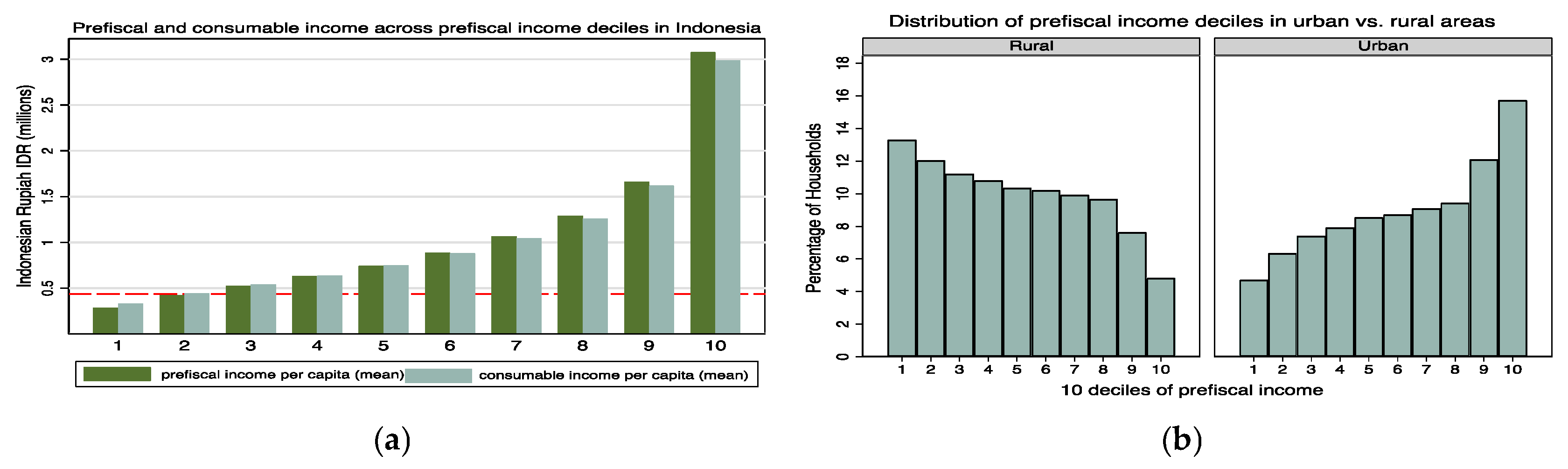
4.3. Results: Distribution of Income
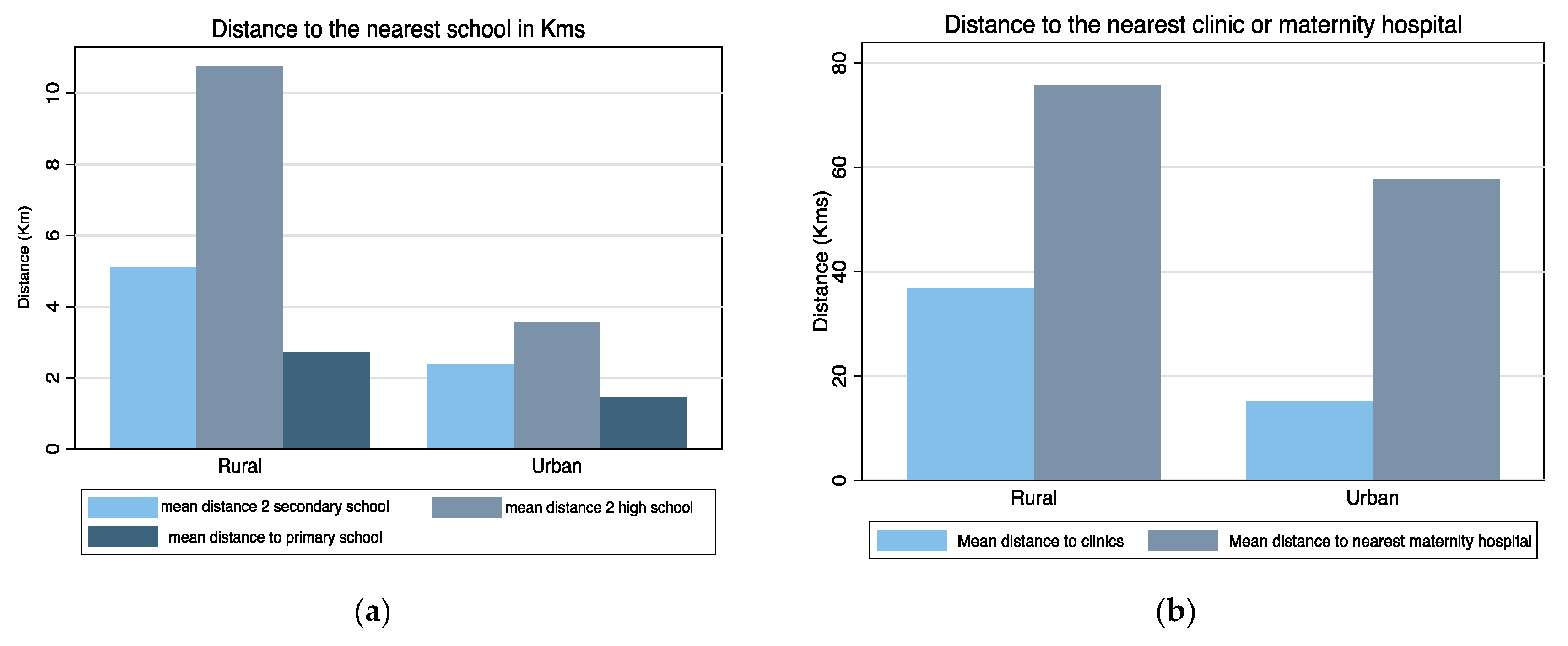
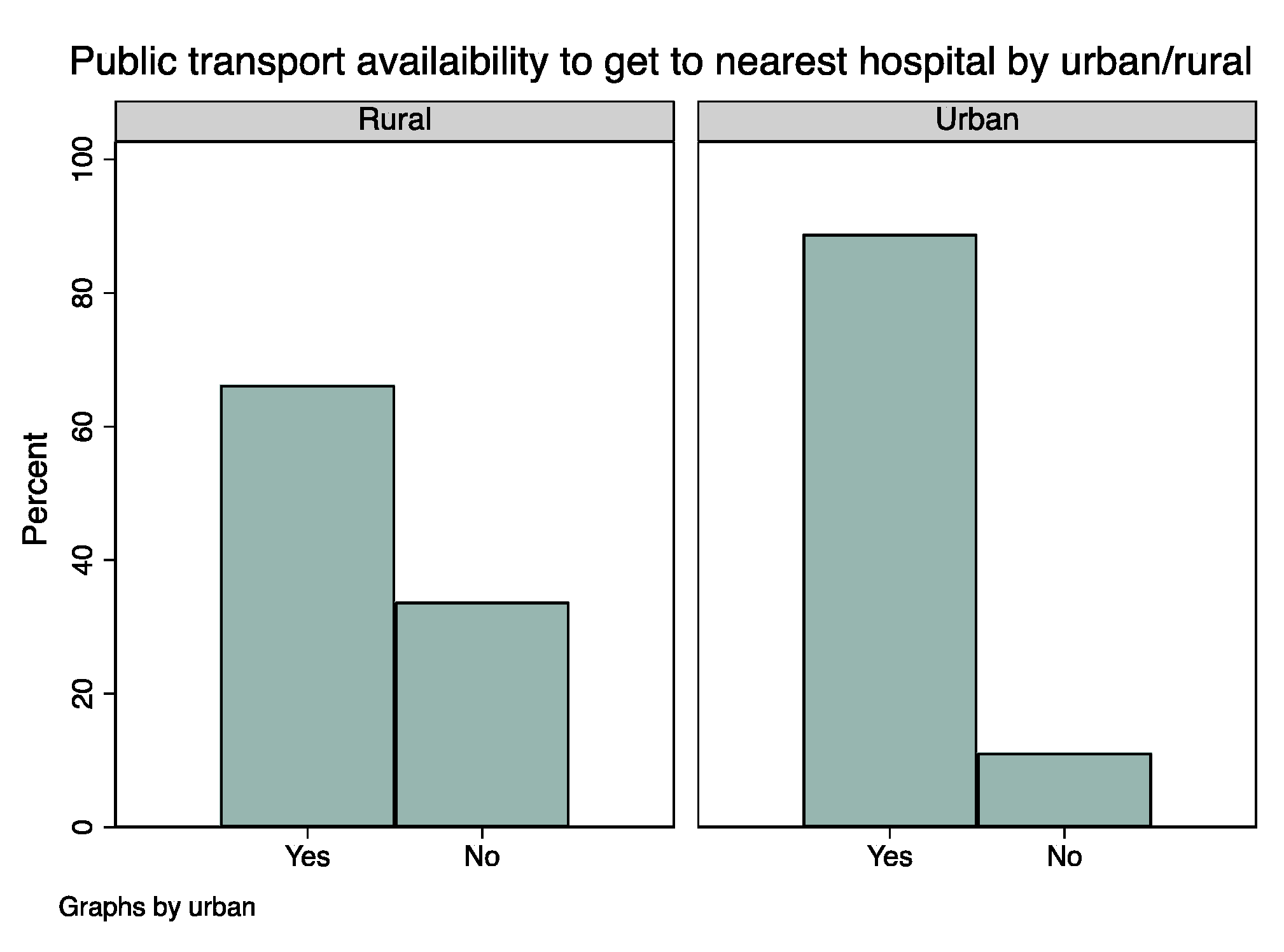
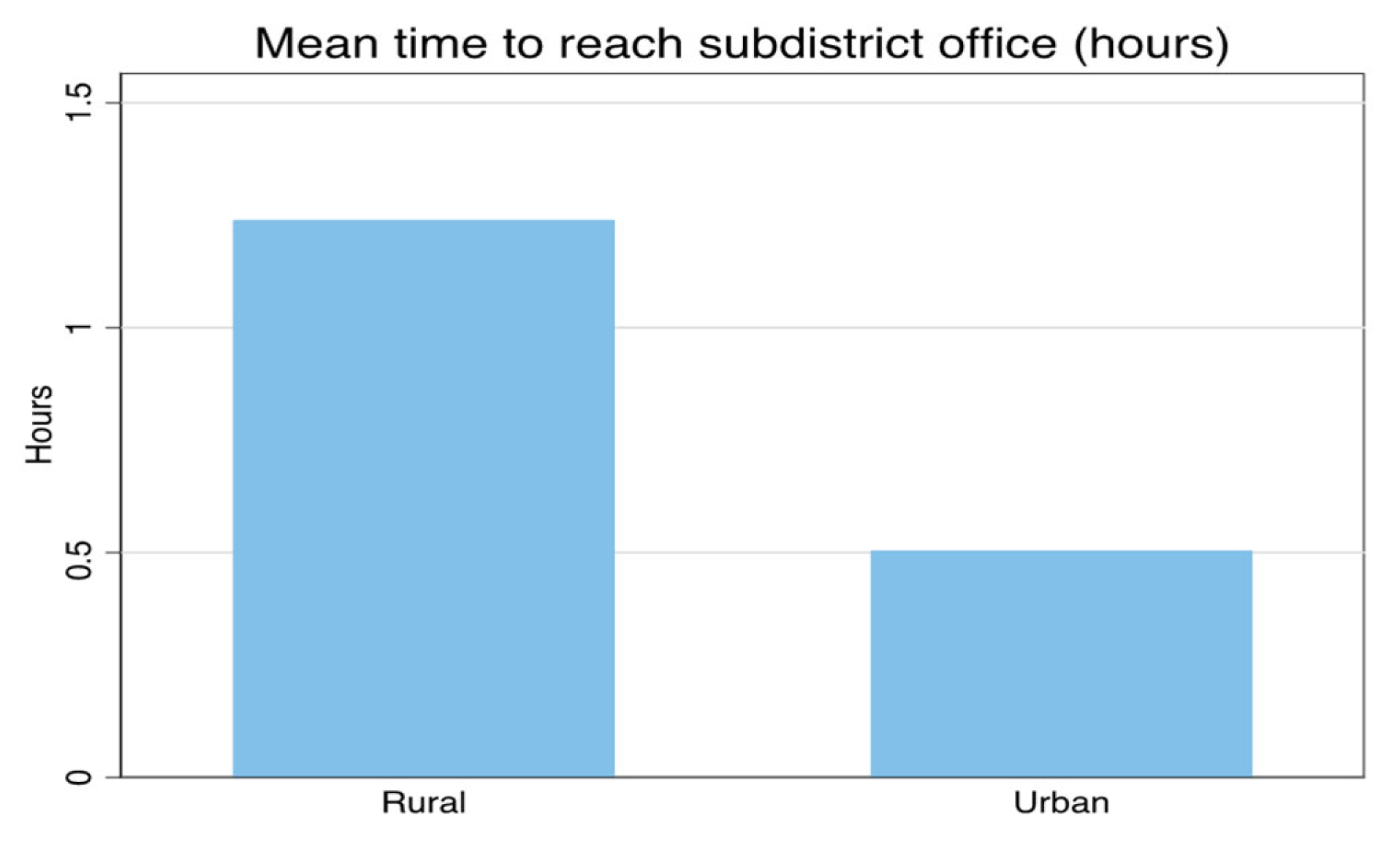
4.4. Results: Access Indicators Approach
4.5. Results: Time-Savings Approach
- How does a transportation infrastructure project reduce travel times for households?
- How are these time savings valued by households?
4.6. Summary: Indonesia
5. Application 2: The Distributional Effects of Road Infrastructure Investments in Zambezia, Mozambique
5.1. Data
5.2. Methods
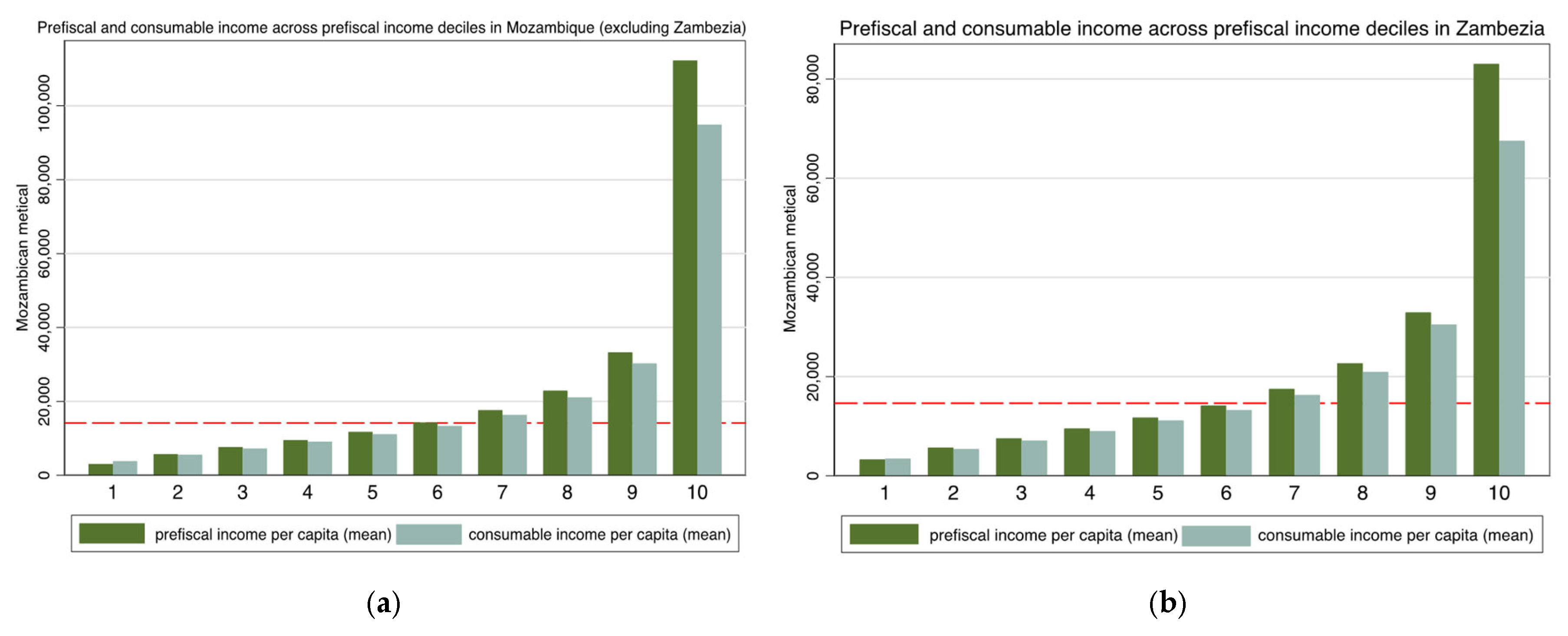
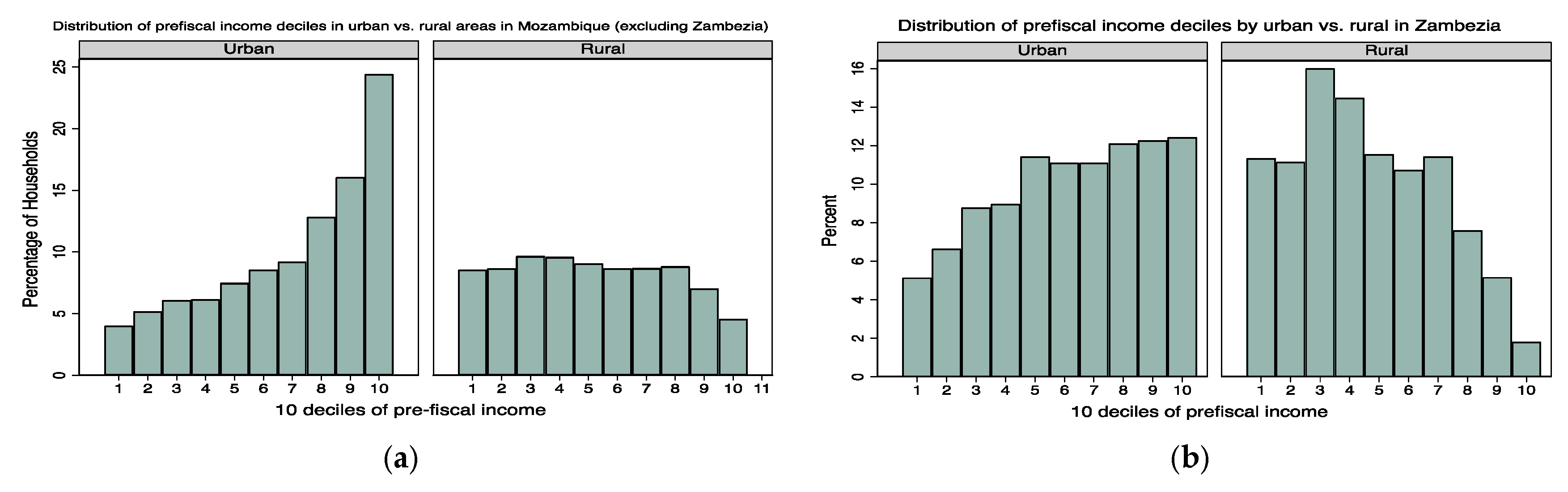
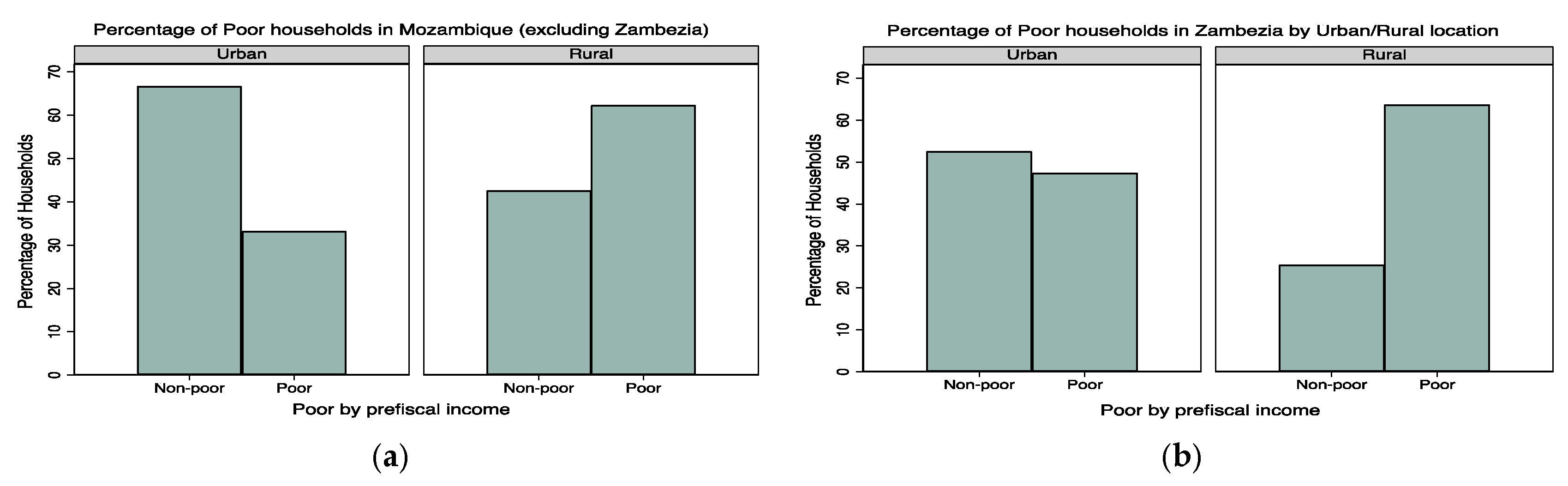
5.3. Results: Distribution of Income
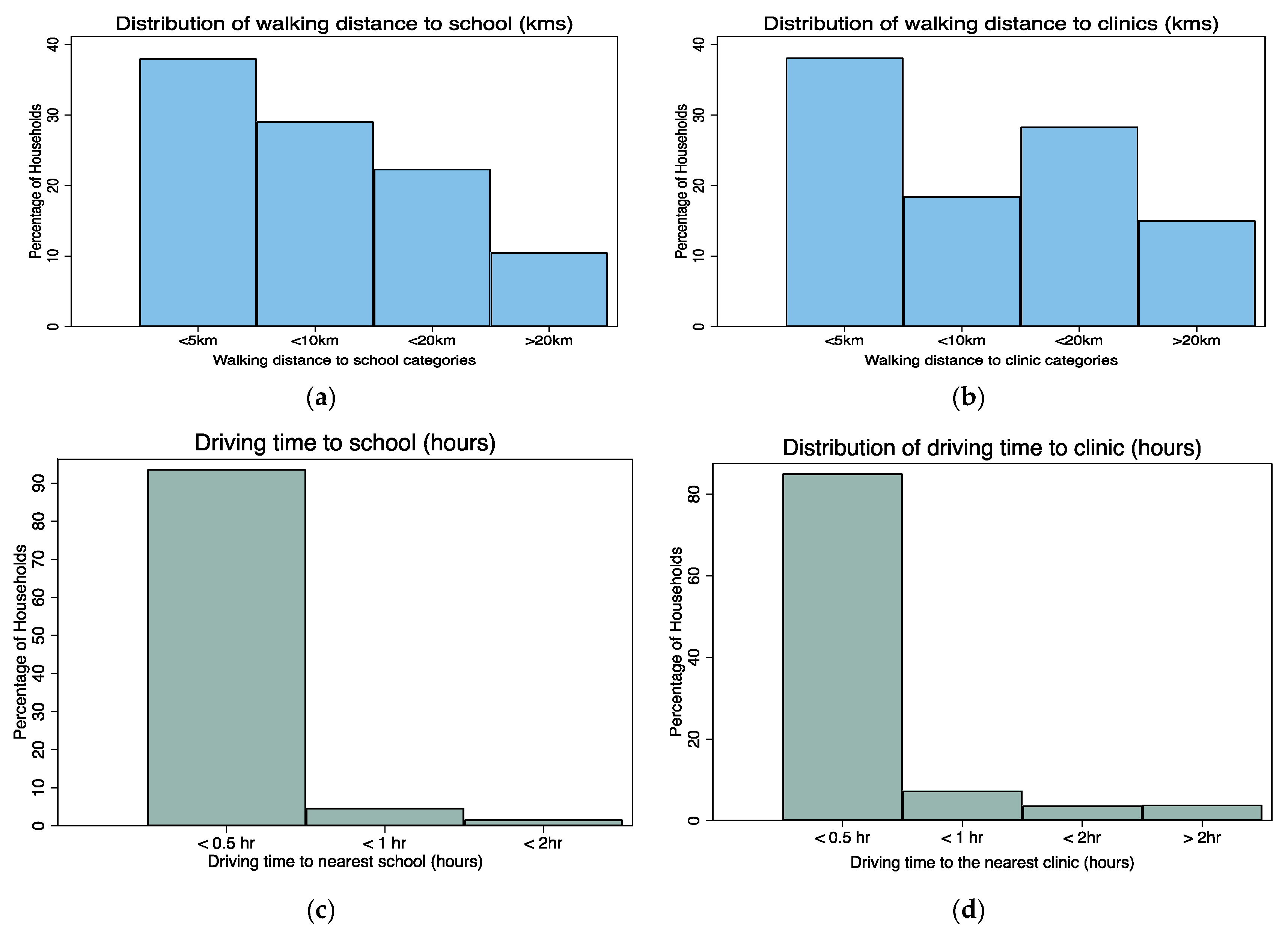
5.4. Results: Access Indicators Approach
5.5. Results: Time-Savings Approach
5.6. Summary: Zambezia
6. Next Steps
7. Conclusions
Author Contributions
Funding
Data Availability Statement
Conflicts of Interest
References
- Harberger, A.C. The Incidence of the Corporation Income Tax. J. Political Econ. 1962, 70, 215–240. [Google Scholar] [CrossRef]
- Lustig, N. (Ed.) Commitment to Equity Handbook: Estimating the Impact of Fiscal Policy on Inequality and Poverty, Volume I (Fiscal Incidence Analysis: Methodology, Implementation, and Applications) and Volume II (Methodological Frontiers in Fiscal Incidence Analysis), 2nd ed.; Brookings Institution Press: Washington, DC, USA; CEQ Institute, Tulane University: New Orleans, LA, USA, 2022. [Google Scholar]
- McLure, C.E., Jr. General Equilibrium Incidence Analysis. J. Public Econ. 1975, 4, 125–161. [Google Scholar] [CrossRef]
- Kotlikoff, L.J.; Summers, L.H. Tax Incidence. In Handbook of Public Economics; Auerbach, A.J., Feldstein, M., Eds.; Elsevier B. V. North-Holland: Amsterdam, The Netherlands, 1987; Volume 2, pp. 1043–1092. [Google Scholar]
- Fullerton, D.; Metcalf, G.E. Tax Incidence. In Handbook of Public Economics; Auerbach, A.J., Feldstein, M., Eds.; Elsevier B. V. North-Holland: Amsterdam, The Netherlands, 2002; Volume 4, pp. 1787–1872. [Google Scholar]
- Pechman, J.A. Who Paid the Taxes, 1966–1985? The Brookings Institution: Washington, DC, USA, 1986. [Google Scholar]
- Fullerton, D.; Rogers, D.L. Who Bears the Lifetime Tax Burden? The Brookings Institution: Washington, DC, USA, 1993. [Google Scholar]
- Revoredo-Giha, C.; Toma, L.; Akaichi, F. An Analysis of the Tax Incidence of VAT to Milk in Malawi. Sustainability 2020, 12, 8003. [Google Scholar] [CrossRef]
- Gupta, S.; Tovar, J. Do Tax Reforms Affect Income Distribution? Evidence from Developing Countries. Econ. Model. 2022, 110, 105804. [Google Scholar] [CrossRef]
- Kumar, R.R.; Stauvermann, P.J. Environmental Injustice: The Effects of Environmental Taxes on Income Distribution in an Oligopolistic General Equilibrium Model. Sustainability 2024, 16, 4142. [Google Scholar] [CrossRef]
- Abeysekera, I. The Influence of Fiscal, Monetary, and Public Policies on Sustainable Development in Sri Lanka. Sustainability 2024, 16, 580. [Google Scholar] [CrossRef]
- Boadway, R.W.; Bruce, N. Welfare Economics; Basil Blackwell Inc.: New York, NY, USA, 1984. [Google Scholar]
- Cornes, R.; Sandler, T. The Theory of Externalities, Public Goods, and Club Goods; Cambridge University Press: New York, NY, USA, 1986. [Google Scholar]
- Barr, N.A. The Economics of the Welfare State, 6th ed.; Oxford University Press: Oxford, UK, 2020. [Google Scholar]
- Stauffacher, C. The Effects of Government Expenditures and Tax Withdrawals upon Income Distribution, 1930–1939. In Public Policy: A Yearbook of the Graduate School of Public Policy, Volume II; Friedrich, C.J., Mason, E.S., Eds.; Harvard University Press: Cambridge, MA, USA, 1941; pp. 232–261. [Google Scholar]
- Gillespie, W.I. Effect of Public Expenditure on the Distribution of Income. In Essays in Fiscal Federalism; Musgrave, R.A., Ed.; The Brookings Institution: Washington, DC, USA, 1965; pp. 122–186. [Google Scholar]
- Tax Foundation. Tax Burdens and Benefits of Government Expenditures by Income Class, 1961 and 1965; Tax Foundation, Inc.: New York, NY, USA, 1967. [Google Scholar]
- Musgrave, R.A.; Case, K.E.; Leonard, H. The Distribution of Fiscal Burdens and Benefits. Public Financ. Q. 1974, 2, 259–311. [Google Scholar] [CrossRef]
- Reynolds, M.; Smolensky, E. Public Expenditures, Taxes, and the Distribution of Income: The United States, 1950, 1961, 1970; Academic Press, Inc.: New York, NY, USA, 1977. [Google Scholar]
- Selowsky, M. Who Benefits from Government Expenditures? The World Bank and Oxford University Press: Washington, DC, USA, 1979. [Google Scholar]
- Meerman, J. Public Expenditure in Malaysia: Who Benefits and Why? Oxford University Press: New York, NY, USA, 1979. [Google Scholar]
- Aaron, H.J.; McGuire, M.C. Public Goods and Income Distribution. Econometrica 1970, 38, 907–920. [Google Scholar] [CrossRef]
- Martinez-Vazquez, J. Fiscal Incidence at the Local Level. Econometrica 1982, 50, 1207–1218. [Google Scholar] [CrossRef]
- Hausmann, R.; Rigobon, R. (Eds.) Government Spending and Income Distribution in Latin America; The Inter-American Development Bank: Washington, DC, USA, 1993. [Google Scholar]
- Sahn, D.E.; Younger, S.D. Expenditure Incidence in Africa: Microeconomic Evidence. Fisc. Stud. 2000, 21, 329–347. [Google Scholar] [CrossRef]
- Castro-Leal, F.; Dayton, J.; Demery, L.; Mehra, K. Public Spending on Health Care in Africa: Do the Poor Benefit? Bull. World Health Organ. 2000, 78, 56–74. [Google Scholar]
- Younger, S.D.; Myamba, F.; Mdadila, K. Fiscal Incidence in Tanzania. Afr. Dev. Rev. 2016, 28, 264–276. [Google Scholar] [CrossRef]
- Younger, S.D.; Osei-Assibey, E.; Oppong, F. Fiscal Incidence in Ghana. Rev. Dev. Econ. 2017, 21, e47–e66. [Google Scholar] [CrossRef]
- van de Walle, D. Assessing the Welfare Impacts of Public Spending. World Dev. 1998, 26, 365–379. [Google Scholar] [CrossRef]
- Demery, L. Analyzing the Incidence of Public Spending. In The Impact of Economic Policies on Poverty and Income Distribution; Bourguignon, F., da Silva, L.A.P., Eds.; The World Bank and Oxford University Press: New York, NY, USA, 2003; pp. 41–68. [Google Scholar]
- Martinez-Vazquez, J. The Impact of Budgets on the Poor: Tax and Expenditure Incidence; International Studies Program Working Paper No. 01–10; Georgia State University, Andrew Young School of Policy Studies: Atlanta, GA, USA, 2001. [Google Scholar]
- Demery, L. Benefit Incidence: A Practitioner’s Guide; World Bank Working Paper 35117; The World Bank: Washington, DC, USA, 2000. [Google Scholar]
- Henke, I.; Cartenì, A.; Di Francesco, L. A Sustainable Evaluation Process for Investments in the Transport Sector: A Combined Multi-Criteria and Cost-Benefit Analysis for a New Highway in Italy. Sustainability 2020, 12, 9854. [Google Scholar] [CrossRef]
- Halámek, P.; Matuszková, R.; Radimský, M. Modernisation of Regional Roads Evaluated Using Ex-Post CBA. Sustainability 2021, 13, 1849. [Google Scholar] [CrossRef]
- Schläpfer, F. Inadequate Standards in the Valuation of Public Goods and Ecosystem Services: Why Economists, Environmental Scientists, and Policymakers Should Care. Sustainability 2021, 13, 393. [Google Scholar] [CrossRef]
- Awuzie, B.; Monyane, T.G. Conceptualizing Sustainability Governance Implementation for Infrastructure Delivery Systems in Developing Countries: Success Factors. Sustainability 2020, 12, 961. [Google Scholar] [CrossRef]
- Selden, T.M.; Wasylenko, M.J. Benefit Incidence Analysis in Developing Countries; World Bank Policy Research Working Papers (Public Economics) No. 1015; World Bank: Washington, DC, USA, 1992. [Google Scholar]
- van de Walle, D.; Nead, K. (Eds.) Public Spending the Poor: Theory and Evidence; The Johns Hopkins University Press: Baltimore, MD, USA, 1995. [Google Scholar]
- World Bank. Colombia: Poverty Assessment Report; Country Department, III; Latin America the Caribbean Regional Office Report Report No. 12673-CO; The World Bank: Washington DC, USA, 1994. [Google Scholar]
- Grosh, M.; Forgy, L. Incidence of Selected Social Services in Tanzania; World Bank Social Sector Review Working Paper; The World Bank: Washington, DC, USA, 1996. [Google Scholar]
- Devarajan, S.; Hossain, S.I. The Combined Incidence of Taxes and Public Expenditures in the Philippines. World Dev. 1998, 26, 963–977. [Google Scholar] [CrossRef]
- Soares, S. The Market Value of Owner-occupied Housing and Public Infrastructure Services. In Commitment to Equity Handbook: Estimating the Impact of Fiscal Policy on Inequality and Poverty, Volume II (Methodological Frontiers in Fiscal Incidence Analysis), Chapter 4, 2nd ed.; Lustig, N., Ed.; Brookings Institution Press: Washington, DC, USA; CEQ Institute, Tulane University: New Orleans, LA, USA, 2022; pp. 116–133. [Google Scholar]
- Soares, S. The Market Value of Public Education: A Comparison of Three Valuation Methods. In Commitment to Equity Handbook: Estimating the Impact of Fiscal Policy on Inequality and Poverty, Volume II (Methodological Frontiers in Fiscal Incidence Analysis), Chapter 2, 2nd ed.; Lustig, N., Ed.; Brookings Institution Press: Washington, DC, USA; CEQ Institute, Tulane University: New Orleans, LA, USA, 2022; pp. 52–67. [Google Scholar]
- Fogel, R.W. Railroads and American Economic Growth: Essays in Econometric History; Johns Hopkins University Press: Baltimore, MD, USA, 1964. [Google Scholar]
- Fishlow, A. American Railroads and the Transformation of the Antebellum Economy; Harvard University Press: Cambridge, MA, USA, 1965. [Google Scholar]
- Chandra, A.; Thompson, E. Does Public Infrastructure Affect Economic Activity? Evidence from the Rural Interstate Highway System. Reg. Sci. Urban Econ. 2000, 30, 457–490. [Google Scholar] [CrossRef]
- Duranton, G.; Turner, M.A. Urban Growth and Transportation. Rev. Econ. Stud. 2012, 79, 1407–1440. [Google Scholar] [CrossRef]
- Duranton, G.; Morrow, P.M.; Turner, M.A. Roads and Trade: Evidence from the US. Rev. Econ. Stud. 2014, 81, 681–724. [Google Scholar] [CrossRef]
- Atack, J.; Bateman, F.; Haines, M.; Margo, R.A. Did Railroads Induce or Follow Economic Growth? Urbanization and Population Growth in the American Midwest, 1850–1860. Soc. Sci. Hist. 2010, 34, 171–197. [Google Scholar] [CrossRef]
- Donaldson, D.; Richard, H. Railroads and American Economic Growth: A Market Access Approach. Q. J. Econ. 2016, 131, 799–858. [Google Scholar] [CrossRef]
- Martincus, C.V.; Carballo, J.; Cusolitoc, A. Roads, Exports, and Employment: Evidence from a Developing Country. J. Dev. Econ. 2017, 125, 21–39. [Google Scholar] [CrossRef]
- Zhang, Y.-F.; Ji, S. Does Infrastructure Have a Transitory or Longer-term Impact? Evidence from China. Econ. Model. 2018, 73, 195–207. [Google Scholar] [CrossRef]
- Banerjee, A.; Duflo, E.; Qian, N. On the Road: Access to Transportation Infrastructure and Economic Growth in China. J. Dev. Econ. 2020, 145, 102442. [Google Scholar] [CrossRef]
- Kong, D.; Liu, L.; Yang, Z. High-speed Rails and Rural-Urban Migrants Wages. Econ. Model. 2021, 94, 1030–1042. [Google Scholar] [CrossRef]
- Chatterjee, S.; Lebesmuehlbacher, T.; Narayanan, A. How Productive Is Public Investment? Evidence from Formal and Informal Production in India. J. Dev. Econ. 2021, 151, 102625. [Google Scholar] [CrossRef]
- Asher, S.; Novosad, P. Rural Roads and Local Economic Development. Am. Econ. Rev. 2020, 110, 797–823. [Google Scholar] [CrossRef]
- Jedwab, R.; Storeygard, A. The Average and Heterogeneous Effects of Transportation Investments: Evidence from Sub-Saharan Africa 1960–2010. J. Eur. Econ. Assoc. 2021, 20, 1–38. [Google Scholar] [CrossRef]
- Chaurey, R.; Le, D.T. Infrastructure Maintenance and Rural Economic Activity: Evidence from India. J. Public Econ. 2022, 214, 104725. [Google Scholar] [CrossRef]
- Abu-Qarn, A.; Lichtman-Sadot, S. Can Greater Access to Secondary Health Care Decrease Health Inequality? Evidence from Bus Line Introduction to Arab Towns in Israel. Econ. Model. 2022, 106, 105695. [Google Scholar] [CrossRef]
- Jalan, J.; Ravallion, M. Geographic Poverty Traps? A Micro Model of Consumption Growth in Rural China. J. Appl. Econom. 2002, 17, 329–346. [Google Scholar] [CrossRef]
- Gibson, J.; Rozelle, S. Poverty and Access to Roads in Papua New Guinea. Econ. Dev. Cult. Change 2003, 52, 159–185. [Google Scholar] [CrossRef]
- Fan, S.; Nyange, D.; Rao, N. Public Investment and Poverty Reduction in Tanzania: Evidence from Household Survey Data; DSGD Discussion Papers No. 18; International Food Policy Research Institute IFPRI; IFPRI: Washington, DC, USA, 2005. [Google Scholar]
- Mu, R.; van de Walle, D. Rural Roads and Local Market Development in Vietnam; The World Bank: Washington, DC, USA, 2007. [Google Scholar]
- Okwi, P.O.; Ndeng’e, G.; Kristjanson, P.; Arunga, M.; Notenbaert, A.; Omolo, A.; Henninger, N.; Benson, T.; Kariuki, P.; Owuor, J. Spatial Determinants of Poverty in Rural Kenya. Proc. Natl. Acad. Sci. USA 2007, 104, 16769–16774. [Google Scholar] [CrossRef]
- Dercon, S.; Gilligan, D.O.; Hoddinott, J.; Woldehanna, T. The Impact of Agricultural Extension and Roads on Poverty and Consumption Growth in Fifteen Ethiopian Villages. Am. J. Agric. Econ. 2009, 91, 1007–1021. [Google Scholar] [CrossRef]
- Jacoby, H.; Minten, B. On Measuring the Benefits of Lower Transport Costs. J. Dev. Econ. 2009, 89, 28–38. [Google Scholar] [CrossRef]
- Khandker, S.R.; Bakht, Z.; Koolwal, B. The Poverty Impact of Rural Roads: Evidence from Bangladesh. Econ. Dev. Cult. Change 2009, 57, 685–722. [Google Scholar] [CrossRef]
- Rammelt, C. Infrastructures as Catalysts: Precipitating Uneven Patterns of Development from Large-Scale Infrastructure Investments. Sustainability 2018, 10, 1286. [Google Scholar] [CrossRef]
- Sewell, S.J.; Desai, S.A.; Mutsaa, E.; Lottering, R.T. A Comparative Study of Community Perceptions Regarding the Role of Roads as a Poverty Alleviation Strategy in Rural Areas. J. Rural. Stud. 2019, 71, 73–84. [Google Scholar] [CrossRef]
- Gachassin, M.; Najman, B.; Raballand, G. The Impact of Roads on Poverty Reduction: A Case Study of Cameroon; The World Bank: Washington, DC, USA, 2010. [Google Scholar]
- Ma, L.; Tang, Y. The Distributional Impacts of Transportation Networks in China; Research Collection School of Economics Working Paper; Singapore Management University: Singapore, 2022. [Google Scholar]
- Fiorini, M.; Sanfilippo, M.; Sundaram, A. Trade Liberalization, Roads and Firm Productivity. J. Dev. Econ. 2021, 153, 102712. [Google Scholar] [CrossRef]
- Perra, E.; Sanfilippo, M.; Sundaram, A. Roads, Competition, and the Informal Sector; Department of Economics and Statistics Working Paper Series; University of Turin: Turin, Italy, 2022. [Google Scholar]
- Lucas, K.; Mattioli, G.; Verlinghieri, E.; Guzman, A. Transport Poverty and Its Adverse Social Consequences. Transport 2016, 169, 353–365. [Google Scholar] [CrossRef]
- El-Geneidy, A.; Levinson, D.; Boisjoly, G.; Verbich, D.; Loong, C.; Diab, E. The Cost of Equity: Assessing Transit Accessibility and Social Disparity Using Total Travel Cost. Transp. Res. Part A Policy Pract. 2016, 91, 302–316. [Google Scholar] [CrossRef]
- Robinson, R.; Thagesen, B. (Eds.) Road Engineering for Development, 2nd ed.; Spon Press: London, UK, 2004. [Google Scholar]
- Glick, P.; Saha, R.; Younger, S.D. Integrating Gender into Benefit Incidence and Demand Analysis; Cornell Food and Nutrition Policy Program Working Paper No. 167; Cornell University: Ithaca, NY, USA, 2004. [Google Scholar]
- Feiken, D.R.; Nguyen, L.M.; Adazu, K.; Ombok, M.; Audi, A.; Slutsker, L.; Lindblade, K.A. The Impact of Distance of Residence from a Peripheral Health Facility on Pediatric Health Utilisation in Rural Western Kenya. Trop. Med. Int. Health 2009, 14, 54–61. [Google Scholar] [CrossRef] [PubMed]
- İlkkaracan, İ.; Kim, K.; Kaya, T. The Impact of Public Investment in Social Care Services on Employment, Gender Equality, and Poverty: The Turkish Case; Working Paper; İstanbul Technical University, Women’s Studies Center in Science, Engineering and Technology: Istanbul, Turkey; The Levy Economics Institute of Bard College: Annandale-On-Hudson, NY, USA, 2015. [Google Scholar]
- Fabrizio, S.; Fruttero, A.; Gurara, D.; Kolovich, L.; Malta, V.; Tavares, M.M.; Tchelishvili, N. Women in the Labor Force: The Role of Fiscal Policies; IMF Strategy, Policy, and Review Department Working Paper; International Monetary Fund: Washington, DC, USA, 2020. [Google Scholar]
- World Bank. Badan Kebijakan Fiskal (BKF) of the Ministry of Finance of Indonesia Revisiting the Impact of Government Spending & Taxes on Poverty & Inequality in Indonesia; The World Bank: Jakarta, Indonesia; Washington, DC, USA, 2021. [Google Scholar]
- Maryati, S.; Firman, T.; Humaira, A.N.S.; Febriani, Y.T. Benefit Distribution of Community-Based Infrastructure: Agricultural Roads in Indonesia. Sustainability 2020, 12, 2085. [Google Scholar] [CrossRef]
- Sun, Y.; Thakuriah, P. Public Transport Availability Inequalities and Transport Poverty Risk Across England. Environ. Plan. B 2021, 48, 2775–2789. [Google Scholar] [CrossRef]
- Abley, S. Measuring Accessibility and Providing Transport Choice; Unpublished Report; Abley Transportation Consultants: Christchurch, New Zealand, 2010. [Google Scholar]
- Sovacool, B.K.; Del Rio, D.D.F. ‘We’re Not Dead Yet!’ Extreme Energy and Transport Poverty, Perpetual Peripheralization, and Spatial Justice Among Gypsies and Travellers in Northern Ireland. Renew. Sustain. Energy Rev. 2022, 160, 112262. [Google Scholar] [CrossRef]
- Simcock, N.; Jenkins, K.E.H.; Lacey-Barnacle, M.; Martiskainen, M.; Mattioli, G.; Hopkins, D. Identifying Double Energy Vulnerability: A Systematic and Narrative Review of Groups At-risk of Energy and Transport Poverty in the Global North. Energy Res. Soc. Sci. 2021, 82, 102351. [Google Scholar] [CrossRef]
- Benevenuto, R.; Caulfield, B. Measuring Access to Urban Centres in Rural Northeast Brazil: A Spatial Accessibility Poverty Index. J. Transp. Geogr. 2020, 82, 102553. [Google Scholar] [CrossRef]
- Verhorst, T.; Fu, X.; van Lierop, D. Definitions Matter: Investigating Indicators for Transport Poverty Using Different Measurement Tools. Eur. Transp. Res. Rev. 2023, 15, 21–37. [Google Scholar] [CrossRef]
- Mahesh, S.; Ramadurai, G. Analysis of Driving Characteristics and Estimation of Pollutant Emissions from Intra-city Buses. Transp. Res. Procedia 2017, 27, 1211–1218. [Google Scholar] [CrossRef]
- World Bank. How Do Taxes and Transfers Affect Poverty and Inequality in Mozambique? Policy Note; The World Bank: Washington, DC, USA, 2024. [Google Scholar]
- Deacon, R.T.; Sonstelie, J. Rationing by Waiting and the Value of Time: Results from a Natural Experiment. J. Political Econ. 1985, 93, 627–647. [Google Scholar] [CrossRef]
- Mohring, H.; Schroeter, J.; Wiboonchutikula, P. The Values of Waiting Time, Travel Time, and a Seat on a Bus. Rand J. Econ. 1987, 18, 40–56. [Google Scholar] [CrossRef]
- Smith, V.K.; Mansfield, C. Buying Time: Real and Hypothetical Offers. J. Environ. Econ. Manag. 1998, 36, 209–224. [Google Scholar] [CrossRef]
- Goldszmidt, A.; List, J.A.; Metcalfe, R.D.; Muir, I.; Smith, V.K.; Wang, J. The Value of Time in the United States: Estimates from Nationwide Natural Field Experiments; NBER Working Paper 28208; National Bureau of Economic Research: Cambridge, MA, USA, 2020. [Google Scholar]
- Mrozek, J.R.; Taylor, L.O. What Determines the Value of a Life: A Meta-Analysis. J. Policy Anal. Manag. 2002, 21, 253–270. [Google Scholar] [CrossRef]
- Viscusi, W.K.; Aldy, J.E. The Value of a Statistical Life: A Critical Review of Market Estimates Throughout the World. J. Risk Uncertain. 2003, 27, 5–76. [Google Scholar] [CrossRef]
- Robinson, L.A.; Hammitt, J.K. Skills of the Trade: Valuing Health Risk Reductions in Benefit-Cost Analysis. J. Benefit-Cost Anal. 2013, 4, 107–130. [Google Scholar] [CrossRef]
- Robinson, L.A.; Hammitt, J.K.; O’Keeffe, L. Valuing Mortality Risk Reductions in Global Benefit-Cost Analysis. J. Benefit-Cost Anal. 2019, 10, 15–50. [Google Scholar] [CrossRef]
- Boardman, A.E.; Greenberg, D.H.; Vining, A.R.; Weimer, D.L. Cost-Benefit Analysis: Concepts and Practice, 5th ed.; Cambridge University Press: Cambridge, UK, 2018. [Google Scholar]
- Alm, J. What Drives Economic Policy Choices? In Tax in Politics, Politics in Tax—A Dialogue on the Political Economy of Tax Laws; Lind, Y., Alm, J., Eds.; Edinburgh University Press: Edinburgh, UK, 2026. [Google Scholar]



| Category | Driving Time (hrs) | Walking Distance (kms) |
|---|---|---|
| 1 | Less than 30 min | Less than 5 kms |
| 2 | Less than 1 hr but more than 30 min | Less than 10 kms but more than 5 kms |
| 3 | Less than 2 hrs but more than 1 hr | Less than 20 kms but more than 10 kms |
| 4 | Over 2 hrs | Over 20 kms |
| Category | Walking Distance (kms) | Assumed Distance (kms) | Walking Time (hrs) | Assumed Reduction in Walking Time (5–10 min per km) |
|---|---|---|---|---|
| 1 | Less than 5 kms | 3.5 kms | 0.73 hrs | 0.44 hrs (reduce 5 min per km) |
| 2 | Less than 10 kms but more than 5 kms | 7 kms | 1.56 hrs | 0.98 hrs (reduce 5 min per km) |
| 3 | Less than 20 kms but more than 10 kms | 15 kms | 3 hrs | 0.5 hrs (reduce 10 min per km) |
| 4 | Over 20 kms | 23 kms | 5 hrs | 1.16 hrs (reduce 10 min per km) |
Disclaimer/Publisher’s Note: The statements, opinions and data contained in all publications are solely those of the individual author(s) and contributor(s) and not of MDPI and/or the editor(s). MDPI and/or the editor(s) disclaim responsibility for any injury to people or property resulting from any ideas, methods, instructions or products referred to in the content. |
© 2026 by the authors. Licensee MDPI, Basel, Switzerland. This article is an open access article distributed under the terms and conditions of the Creative Commons Attribution (CC BY) license.
Share and Cite
Alm, J.; Khan, F. Conducting Fiscal Incidence Analysis for Sustainability: The Case of Government Infrastructure Spending. Sustainability 2026, 18, 1584. https://doi.org/10.3390/su18031584
Alm J, Khan F. Conducting Fiscal Incidence Analysis for Sustainability: The Case of Government Infrastructure Spending. Sustainability. 2026; 18(3):1584. https://doi.org/10.3390/su18031584
Chicago/Turabian StyleAlm, James, and Farah Khan. 2026. "Conducting Fiscal Incidence Analysis for Sustainability: The Case of Government Infrastructure Spending" Sustainability 18, no. 3: 1584. https://doi.org/10.3390/su18031584
APA StyleAlm, J., & Khan, F. (2026). Conducting Fiscal Incidence Analysis for Sustainability: The Case of Government Infrastructure Spending. Sustainability, 18(3), 1584. https://doi.org/10.3390/su18031584