Article

Combined Effects of Coagulation and Ozonation Treatment on Landfill Leachate DOM Biodegradability

1
College of Environmental Chemistry and Engineering, Shanghai University of Electric Power, Shanghai 200090, China
2
Shanghai Engineering Research Center of Solid Waste Treatment and Resource Recovery, School of Environmental Science and Engineering, Shanghai Jiao Tong University, Shanghai 200240, China
3
Center for Water Technology (WATEC) & Department of Biological and Chemical Engineering, Aarhus University, 8000 Aarhus C, Denmark
4
Sichuan Research Institute, Shanghai Jiao Tong University, Chengdu 610218, China
5
Advanced Materials Institute, Qilu University of Technology (Shandong Academy of Sciences), Jinan 250014, China
6
Shanghai Environment Group Co., Ltd., Shanghai 200120, China
7
China-UK Low Carbon College, Shanghai Jiao Tong University, Shanghai 201306, China
8
China Institute for Urban Governance, Shanghai Jiao Tong University, Shanghai 200240, China
*
Author to whom correspondence should be addressed.
Sustainability 2026, 18(3), 1530; https://doi.org/10.3390/su18031530
Submission received: 10 June 2025 / Revised: 29 July 2025 / Accepted: 8 September 2025 / Published: 3 February 2026
(This article belongs to the Section Sustainable Chemical Engineering and Technology)

Abstract

Coagulation significantly alters molecular characteristics and oxidizability of dissolved organic matters (DOM), while the linkage between DOM molecular characteristics and fragmentation pathways were unclear for the following processes. Here, four typical coagulation processes were employed to improve DOM molecular properties in leachate, and their subsequent impact on oxidizability in ozonation was identified. The results indicate that Polyaluminum chloride (PAC), Polyferric sulfate (PFS), Polyaluminium ferric chloride (PAFC) and Polymerized aluminum ferric silicate (PSAF) can all reduce the COD and TOC levels of the leachate concentrate through coagulation and precipitation, with PAC achieving the highest removal efficiency. PAC-ozonation effectively removes aromatic and unsaturated compounds, significantly improving DOM composition and enhancing conditions for subsequent oxidation. In contrast, PFS shows the poorest removal of aromatics (2.92%) and polycyclic aromatics (9.81%), along with the highest NOSC (−0.5036) and lowest (DBE-O)/C (−0.0051), indicating greater oxidation resistance. Only 11% of COD was further removed by ozonation after PFS treatment, suggesting limited reactivity of the residual DOM. Machine learning analysis of molecular transformation networks further confirmed that PFS treatment produced the fewest conversion pathways following ozonation. This indicates the choice rules and relationship between coagulation and ozonation for landfill leachate. This work provides an effective strategy to enhance leachate treatability and reduce energy and reagent consumption in subsequent processes, thereby contributing to more sustainable and cost-effective landfill leachate management.

1. Introduction

Landfill leachate constitutes a complex effluent generated by the percolation of precipitation through solid waste, leading to the accumulation of diverse dissolved and suspended contaminants. It poses a considerable environmental risk due to its high concentrations of organic pollutants, ammonia nitrogen, heavy metals, and persistent compounds like humic acids and aromatic compounds [1,2]. Leachate can contaminate both surface and groundwater sources, posing risks to ecosystems and human health without proper treatment [3]. Given the increasing volume of municipal solid waste and the limited availability of safe landfill space, sustainable leachate management has become a critical environmental priority. Therefore, the development of effective treatment methods for landfill leachate is essential for minimizing its environmental impact.
The coagulation-precipitation process is a straightforward physicochemical method that transfers contaminants from the liquid phase to the solid phase as sludge, and it is commonly employed in both pretreatment and final treatment stages [4]. The coagulation process is effective in removing organic pollutants and heavy metals while reducing turbidity. Additionally, coagulation pretreatment transforms the composition of dissolved organic matter, which can affect the efficiency of subsequent advanced treatment processes [5]. The coagulants predominantly utilized in engineering encompass inorganic low molecular weight coagulants (such as ferric chloride, aluminum sulfate, iron sulfate, and magnesium salts), inorganic polymer coagulants (such as polyferric sulfate, polyaluminum chloride, and polyaluminum iron sulfate), organic coagulants (such as polyacrylamide and ammoniated products of polyvinyl alcohol), as well as various composite coagulants [6]. The selection of suitable coagulants is particularly important and should be based on the specific water quality characteristics of the wastewater. For landfill leachate treatment, iron- and aluminum-based coagulants are the most widely utilized [7].
Advanced Oxidation Processes (AOPs), commonly referred to as deep oxidation, involve the application of external influences such as ultrasonic waves, ultraviolet radiation, electrical stimulation, elevated temperatures and pressures, and catalysis to generate hydroxyl free radicals (·OH) [8]. These highly reactive species interact with organic compounds, facilitating the breakdown of recalcitrant macromolecular pollutants in leachate concentrates into smaller molecules. The process also promotes the conversion of complex substances into simpler forms, ultimately resulting in the mineralization of organic matter [9]. Among these processes, ozone oxidation exhibits excellent oxidation capacity and effectively degrades pollutants in wastewater [10]. At the same time, this technology has notable advantages in removing color, odor, and achieving sterilization [11,12,13]. While ozone alone achieves high pollutant removal efficiency, it typically requires substantial ozone input, resulting in significant investment costs and high energy consumption. Due to the relatively high cost of AOPs, many researchers integrate coagulation with oxidation to treat persistent organic compounds in specialized wastewater [14,15]. By improving the efficiency of ozonation through pretreatment, the combined coagulation–ozonation strategy offers a more sustainable approach that can reduce energy consumption and chemical usage in the overall treatment process.
Most existing studies focus on coagulation or ozonation alone. Few have examined their combined effects on DOM transformation in fresh landfill leachate or evaluated how these pretreatment strategies influence subsequent biological treatment performance. This is significant as fresh leachate is typically sent to biological treatment units, where the presence of refractory compounds can impede the biodegradation process. This study explores a combined treatment process in which fresh leachate undergoes coagulation followed by ozonation before entering biological treatment. The purpose is to demonstrate the applicability and effectiveness of this pretreatment system for improving biodegradability prior to biological treatment. Four typical coagulants—PSAF, PAFC, PAC, and PFS—were tested for their effects on the molecular composition and redox state of DOM. FT-ICR-MS was employed to analyze DOM characteristics and monitor changes in molecular structure and oxidation potential. The impact of these changes on ozonation efficiency and biodegradability was assessed. By identifying the optimal coagulant and clarifying transformation pathways, this study not only provides a basis for improving pretreatment strategies but also contributes to the sustainable management of landfill leachate and the broader application of green technologies in complex wastewater treatment.

2. Materials and Methods

2.1. Samples

The leachate concentrate used in this study was collected from a municipal waste transfer station located in Nicheng, Lingang, Shanghai. As the waste had not been landfilled or stored for extended periods, the collected leachate is characterized as fresh leachate, which typically contains higher concentrations of low molecular weight organic compounds, proteins, amino acids, and volatile fatty acids. These components result in higher biodegradability and lower degrees of humification compared to aged leachate, which is generally characterized by high molecular weight humic substances, recalcitrant organics, and strong coloration. This distinction is critical, as the aim of this study is to explore how coagulation–ozonation pretreatment influences the molecular characteristics and oxidation behavior of dissolved organic matter (DOM), with the ultimate goal of enhancing the biodegradability of leachate before conventional biological treatment. The use of fresh leachate allows for a more representative assessment of pretreatment strategies commonly applied at the early stages of landfill operation or leachate generation at transfer stations. Immediately after collection, the leachate was refrigerated at 4 °C for 24 h, followed by filtration through stainless steel meshes with sizes of 6 mesh, 18 mesh, 40 mesh, and 100 mesh. The filtered leachate was then sealed and stored in a dark refrigerator at 4 °C until further use. The basic physicochemical properties of the leachate are presented in Table S1.

2.2. Optimization of Coagulation and Ozonation Processes

A static single-factor experiment was conducted using beaker stirring. First, 150 mL of leachate was added and then positioned on six separate stirrers. The coagulant was introduced into each beaker, and the solution was rapidly stirred at 200 rpm for 2 min. Subsequently, the stirring speed was reduced to 100 rpm for 1 min, during which the flocculant (PAM) was added, and then stirred at 60 rpm for 17 min. After stirring, the samples were left to settle for 30 min, and the supernatant was then carefully collected for further testing and analysis. The optimal coagulation conditions determined from preliminary single-factor experiments are as follows: PSAF (5 g/L, 15 mg/L PAM, no pH adjustment), PAFC (4 g/L, 10 mg/L PAM, pH 9), PAC (4 g/L, 6 mg/L PAM, pH 7), and PFS (4 g/L, 15 mg/L PAM, no pH adjustment). Detailed optimization data are provided in the Supporting Information (Table S2).
A plexiglass reaction column was used for ozonation with a volume of 1 L. The pH of the supernatant after coagulation was adjusted to 9.00 ± 0.02 using 5M NaOH, yielding the coagulated leachate. Ozone was introduced at a concentration of 80 mg/L, with a gas flow rate of 1 L/min. Samples were collected from the time points at 0, 5, 15, 30, 60, 90, and 120 min to monitor the reaction progress.

2.3. DOM Signature Analysis Using FT ICR-MS

Solid-phase extraction was employed to extract organic compounds from leachate samples [16]. Prior to extraction, the 0.45 μm membrane-filtered sample was diluted to 500 mL (with the dilution ratio determined by TOC concentration), and its pH was adjusted to 2.0 using a 1:1 hydrochloric acid solution. The C18 column (500 mg, 6 mL, CNW) was activated with 5 mL of formaldehyde and 10 mL of hydrochloric acid solution (pH 2.0). The acidified sample was then pumped through the pre-activated C18 column at a rate of 2 mL/min. After adsorption, the column was rinsed with 20 mL of hydrochloric acid solution to remove residual salts, and DOM compounds were eluted using 10 mL of HPLC-grade formaldehyde. The eluent was evaporated to a final volume of 1 mL under nitrogen gas and stored in a dark refrigerator at 4 °C until analysis.
Fourier transform ion cyclotron resonance mass spectrometry (FT ICR-MS), equipped with a 7 T superconducting magnet and an ESI source, was employed. Samples extracted in methanol were continuously injected into the ESI source using an injection pump at a rate of 180 μL/h and analyzed in negative ionization mode. The ESI capillary inlet voltage was set to 3.9 kV, and the mass range was established at m/z 150–1000 Da.

2.4. Network-Based Fragmentation Pathways

To further analyze FT-ICR-MS data, the Graph-DOM code developed by Deenys Leyva was modified for machine learning analysis of molecular transformation networks [17,18,19]. The Graph-DOM molecular transformation network was identified using a conceptual model based on fragmentation pathways.
P = NL 1 + NL 2 + + NL n + C
where P is the chemical formula of the precursor at nominal mass, and NL is the neutral species loss during the fragmentation of the precursor and fragment ions. Here, C, CH4, CH2, C2H2, C2H4, C2H6, C3H6, CO, CO2, CH2O, CH4O, C2H2O, O, H2O, H2, NH, NH2, CONH, NO2, N2, S, SH2, SO3, and SO2 were considered as potential neutral losses of precursors according to the one-step DOM reaction pathways. The relationship between identified products and their corresponding precursors was visualized using Gephi 0.9/2 and Python 3.11. An organic connection network diagram was generated, depicting neutral loss. In this diagram, both precursors and products are represented as nodes, while lost neutral species are described as edges.

2.5. Mass Calibration and Data Analysis

The element formula of each peak in the quality scale was assigned by MATLAB 2021b, and the element combination was set to 12C0-501H0-10016O0-3014N0-532S0-331P0-2. The relative mass error of molecular formula assignment is <0.001, and the absolute mass error is >1 ppm. The equivalent double bond number (DBE) represents the total number of rings and double bonds in organic matter, and the modified aromatics Index (AI mod) represents aromaticity of organic matter; the normal oxidation state of carbon (NOSC) can reflect the redox potential of a given molecular formula, which is calculated as follows [20]:
DBE   =   1 +   ( 2 c     h   +   n   +   p / 2 )  
AI mod   =   DBE AI   / C AI   = [ 1 + 2 c     0.5 o     s     0.5   ( h + n + p ) ] / c     0.5 o     n     s     p  
NOSC = 4     ( 4 c + h     3 n     2 o     2 s + 5 p / c )
where c, h, o, n, s and p are the stoichiometric numbers of carbon atom, hydrogen atom, nitrogen atom, oxygen atom, sulfur atom and phosphorus atom, respectively.

3. Results

3.1. Organic Matter Degradation in Ozonation After Coagulation

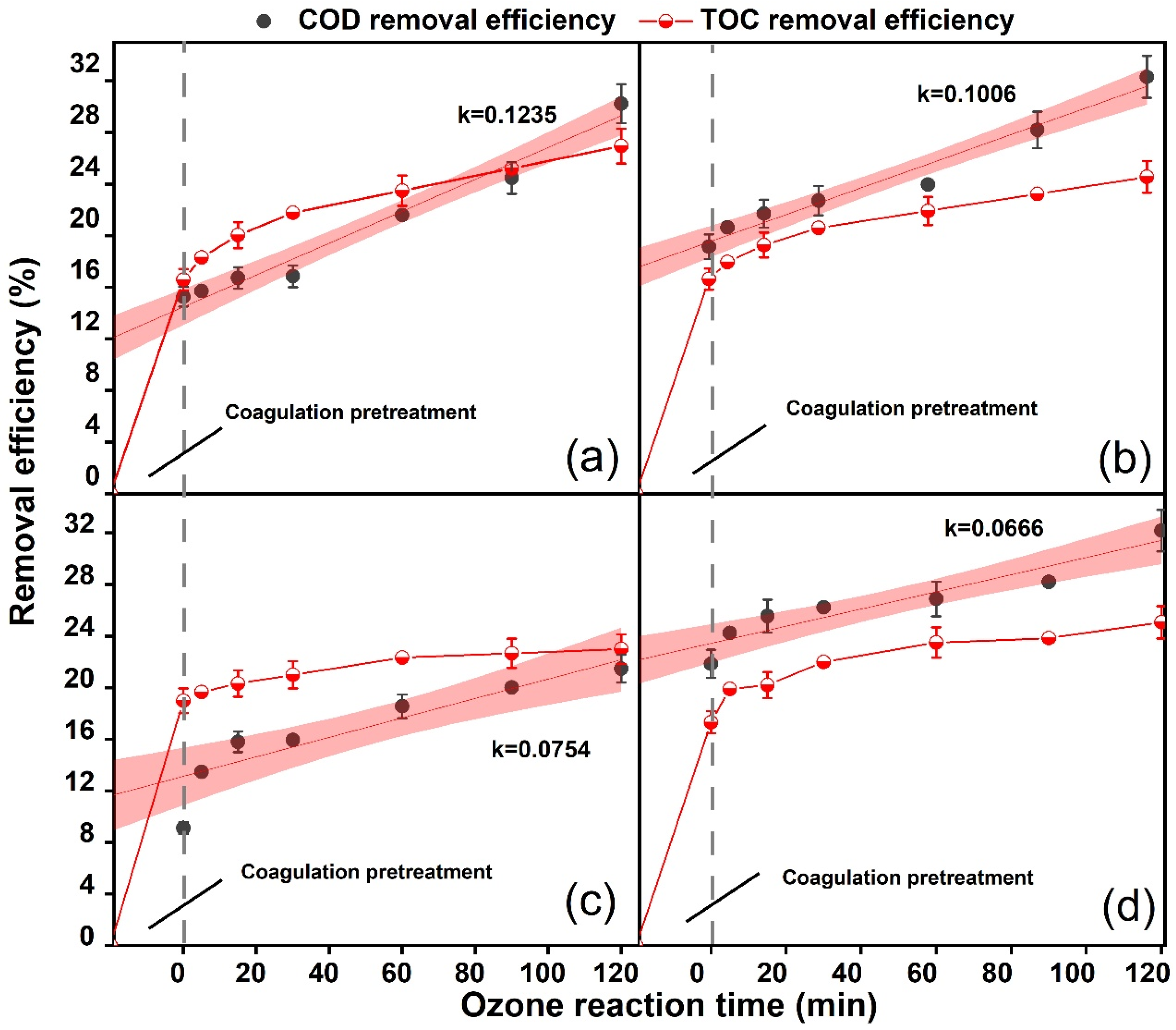
COD and TOC removal efficiency in landfill leachate showed a large difference during different coagulation pretreatment (Figure 1). The dosage of coagulant (PSAF, PAFC, PAC, and PFS) and flocculant (PAM) were investigated, and the optimal reaction conditions were shown in Figure S1 and Table S2. PSAF exhibited the highest removal efficiencies for COD, achieving reductions of 21.84%, followed by PAFC (19.15%), PAC (15.27%), and PFS (9.10%). The final COD removal rates were nearly identical when PSAF (30.57%), PAFC (30.71%), and PAC (30.71%) were combined with ozonation. The highest reaction constant k in terms of COD removal rate was achieved in PAC-ozonation process, while only k = 0.067 and k = 0.075 were obtained in PFAS-ozonation and PFS-ozonation, respectively, indicating that the residual organic matter after PFAS and PFS coagulation was less susceptible to oxidation and decomposition during the ozonation process. Meanwhile, PAC-ozonation achieved the highest TOC removal efficiency, with a final rate of approximately 26.96% among the four coagulants evaluated. The degradation rates and extents of organic matter during ozonation varied depending on the pretreatment with different coagulants, highlighting the significant impact of coagulants on the oxidizability and degradation pathways of organic matter. For PFS-ozonation, the reduced reactivity can be attributed to the lower selectivity of the PFS coagulant during the pretreatment stage, which led to a higher proportion of coagulation-resistant organic substances that were challenging to oxidize [21]. These residual compounds may consist of highly aromatic substances or organic species with oxidation-resistant functional groups. Their relatively high redox states of these compounds, along with complex and stable molecular structures, further reduced their reactivity during ozonation [22].

3.2. Overall Identification of DOM Residues in Leachate After Different Coagulations

3.2.1. DOM Molecular Classification and Element Composition

A total of 8020 molecular formulas were identified in the raw leachate, significantly exceeding the number found in mature landfill leachate and other types of wastewaters [23,24,25]. The relative abundances of organic molecular classification and element compositions in the raw leachate were presented in the Supporting Information (SI Figure S4). The organic matters in the raw leachate were predominantly lignin and protein/lipid compounds (45.16% and 38.03%, respectively), which were consistent with previous research findings [26]. Due to the negligible proportion of phosphorus-containing organic matter in the leachate, four major elements (C, H, O, and N) were considered for element compositions. As depicted in Figure S4, CHO and CHON organic compounds were the most abundant in the raw leachate (39.09% and 35.31%, respectively), followed by CHONS and CHOS compounds (14.74% and 10.86%, respectively). Overall, the raw leachate contained a large proportion of CHO organic compounds lacking heteroatoms, and N-containing compounds were more prevalent than S-containing compounds. The points representing CHONS are predominantly distributed in the low H/C region, suggesting that the CHONS compounds in the leachate sample are primarily heteroatom-rich molecules [27,28,29].
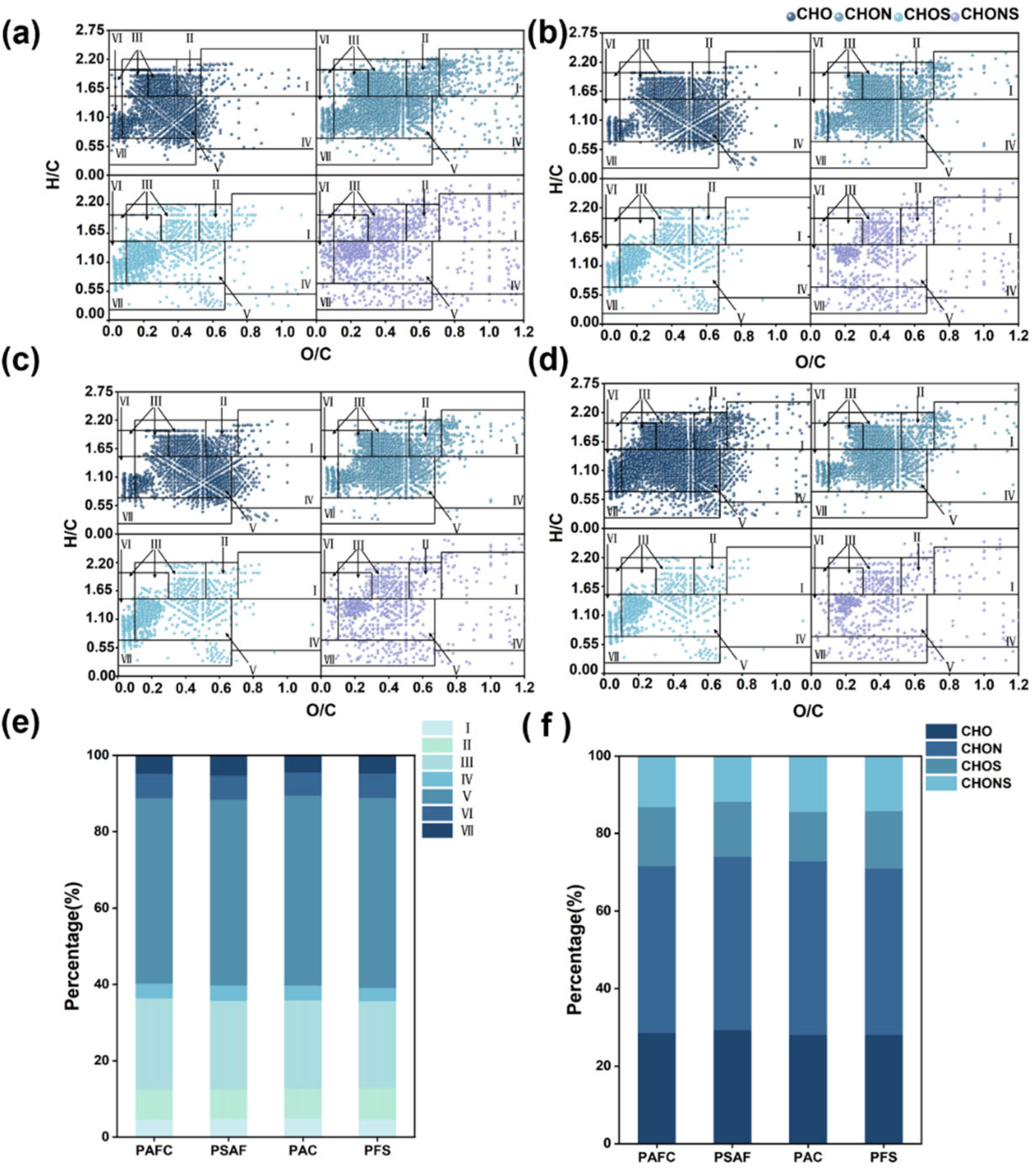
Figure 2 presents the Van Krevelen diagram after pretreatment with different coagulants. Compared to the raw leachate (Figure S4), DOM was significantly decomposed after coagulation, with 10,133, 10,267, 9731, and 9603 molecular formulas detected for PAC, PAFC, PFS, and PSAF treatments, respectively. The distribution of CHO and CHON organics concentrated in the protein/lipid region was significantly reduced, indicating that coagulant pretreatment played a certain role in the degradation of organic matter in raw leachate. After PAC, PAFC, and PSAF treatments, the proportion of protein/lipid organics was approximately 23%, whereas PFS treatment resulted in a slightly lower proportion of 22%. The proportions of carbohydrate and amino carbohydrate organic compounds increased post-treatment, reaching 4.97% and 7.83% (PAC), 4.59% and 7.93% (PAFC), 4.59% and 8.27% (PFS), and 4.83% and 7.73% (PSAF), respectively. These results suggest that PFS more effectively converts protein-based organic compounds into amino sugars, demonstrating superior degradation effects on simpler organic compounds. Coagulants effectively remove certain types of organic matter during wastewater treatment. These compounds, which often contain hydrophilic and hydrophobic groups, interact with coagulants to form larger flocs, facilitating their removal via sedimentation. The significant reduction of CHO and CHON organics indicates that these compounds are easily captured and removed by the coagulation process, likely due to their molecular structure, molecular weight, solubility, and charge properties [30,31].

3.2.2. Aromaticity of DOM Residues After Different Coagulations

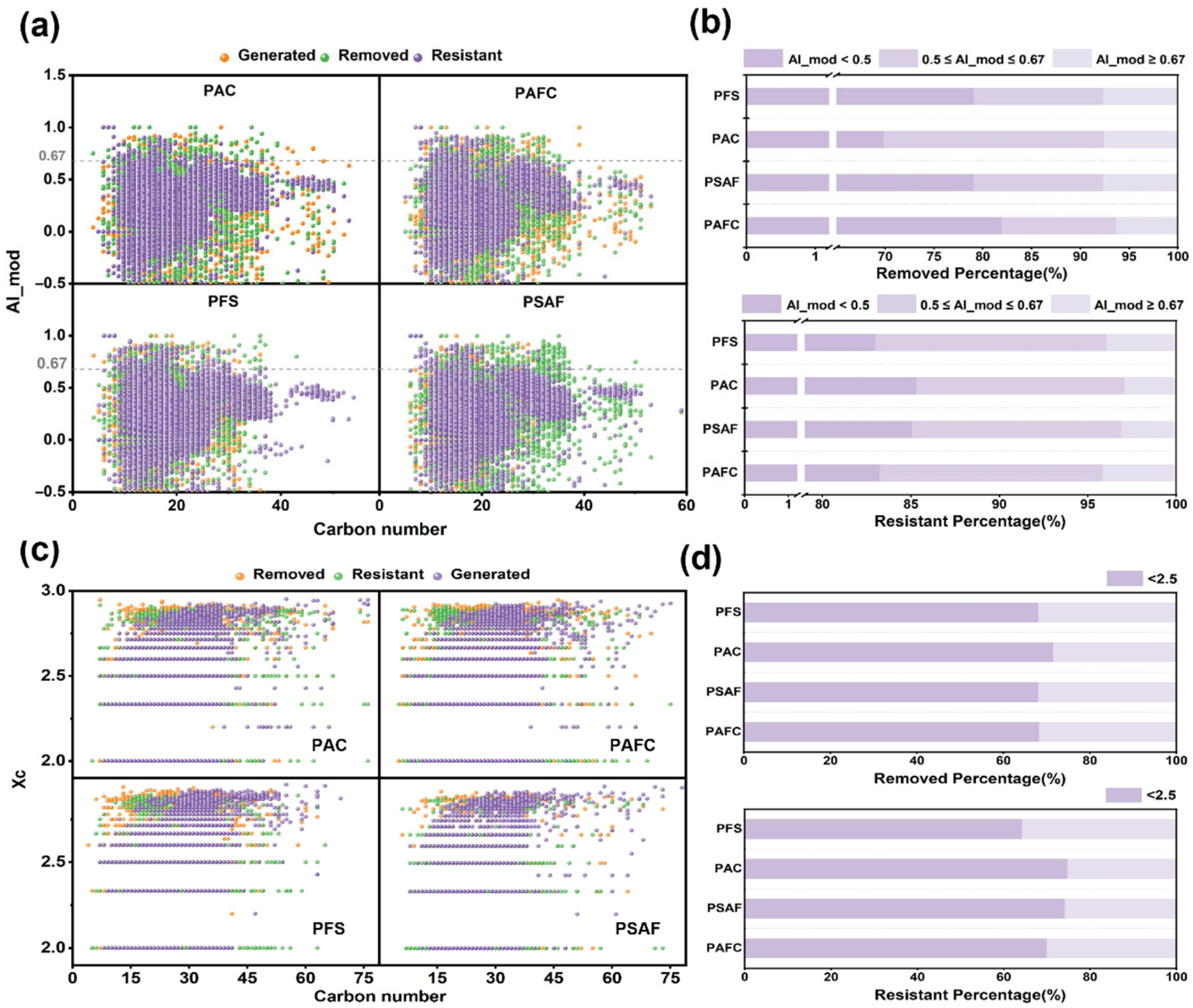
The modified aromaticity index (AI mod) reflected the degree of aromaticity of organic molecules based on their molecular formula [32,33]. The organic matters could be categorized into aromatic (AI mod > 0.5), polycyclic aromatic hydrocarbons (PAHs, AI mod > 0.67), and non-aromatic (AI mod < 0.5). Figure 3a illustrates the relationship between the aromaticity index and carbon number of DOM residues after different coagulations. Approximately 80% of aromatic compounds were removed across the four coagulants. Among the coagulants, PAC demonstrated the highest efficiency, removing 7.65% of PAHs and 22.6% of aromatic hydrocarbons (Figure 3b). The residual non-aromatic compounds accounted for 85.30%, suggesting that PAC preferentially removed aromatic and unsaturated compounds, resulting in a composition more favorable for subsequent oxidation processes. PSAF and PAFC showed moderate levels of performance, with aromatic compound removal rates of 7.55% and 7.64%, and PAH removal rates of 13.3% and 10.69%, respectively. The residual non-aromatic fractions were 85.06% and 83.24%, placing their performance slightly below that of PAC. In contrast, PFS exhibited the lowest removal rates for aromatic hydrocarbons and PAHs, at only 6.38% and 11.67%, respectively. PFS exhibited the lowest overall performance, with non-aromatic compounds comprising 82.99% of the residual DOM. This suggested that a substantial proportion of aromatic and PAH remained, reflecting the reduced ability of PFS to modify the unsaturation and oxidation potential of the residual organic matter [34]. Consequently, the final COD removal rate for PFS after coagulation-ozone treatment was approximately 11% lower than that of the other coagulants, highlighting its reduced ability to treat complex DOM and remove coagulation-resistant components that are more challenging to oxidize and decompose [21].
Aromaticity equivalent (Xc) was another important index to characterize the aromaticity of organic matter, which reflected the potential number of benzene rings present in each molecule [35]. Figure 3c shows the relationship between the Xc and carbon number of organic residues after different coagulations. The Xc values of organic residues revealed notable differences in the distribution of aromatic compounds after different coagulations. An Xc value of 2.5 and 2.71 indicated the presence of one benzene ring and two benzene rings in the molecule, meaning that the aromaticity and structural complexity of organic matter increased as the Xc value increased. Conversely, organic compounds with Xc values below 2.5 lacked aromatic structures and exhibited lower degrees of unsaturation. After PAC treatment, the relative abundance of unsaturated organic residues (Xc < 2.5) was the highest, at 74.78%. The residual rates of PSAF and PAFC were comparable, measured at 74.16% and 69.96%, respectively. In contrast, PFS showed the lowest residual rate, at 64.17%, indicating that it removed fewer aromatic structures while retaining more non-aromatic compounds. This retention of less reactive compounds may reduce its effectiveness in subsequent oxidation processes [36].

3.2.3. Unsaturation and Molecular Chain Characteristics

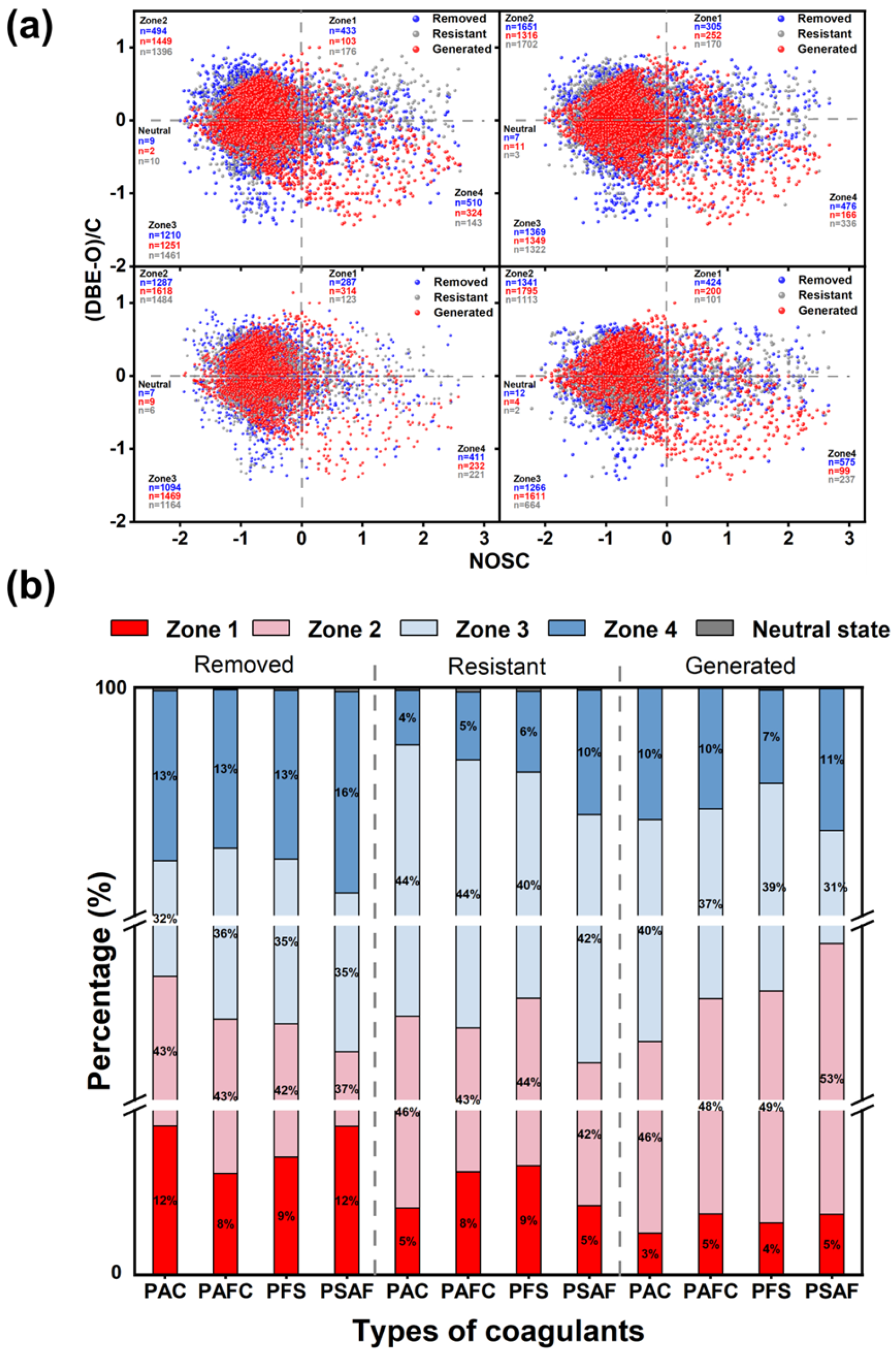
The nominal oxidation state of carbon (NOSC) represents the oxidized/reduced state of the DOM [37], and the oxygen subtracted double bond equivalent per carbon (i.e., (DBE-O)/C) can be used to determine the saturated/unsaturated characteristic [38]. Figure 4 shows the unsaturation and molecular chain changes in DOM in leachate after coagulation and precipitation of four kinds of coagulants, respectively. The carbon number and equivalent double bond distribution range after the coagulation reaction for all four coagulants remained closely, though their specific relative abundances varied. The weighted mean values of NOSC and (DBE-O)/C in the raw leachate were −0.4837 and 0.0201. After treatment with the four different coagulants, the NOSC values for PAC, PSAF, PFAC, and PFS were −0.5801, −0.5641, −0.5579, and −0.5036, respectively. A lower NOSC value indicated that the substance composition was more reduced and more easily oxidized [39]. The (DBE-O)/C values were −0.0256, −0.0241, −0.0189, and −0.0051, respectively, indicating that saturation decreased after treatment. A lower (DBE-O)/C value suggested increased difficulty in oxidation. Therefore, after flocculation, the DOM exhibited a highly reduced state and moderate saturation.
Figure 4 illustrates the four components of DOM and their respective proportions, while Table S3 offers a detailed breakdown and description of these regions. During the coagulation process, the DOM predominantly resides in zones 2 and 3, indicating that these compounds are low-oxygen, unsaturated environments. Although unsaturated compounds can be removed by coagulation treatment, some remain in low-oxygen environments after coagulation, which highlights the limitation of the efficiency of coagulation process. As shown in Figure 4b, DOM in zones 2 and 3 constitutes the largest proportion of residual substances following PAC treatment, at 48.40% and 45.86%, respectively. These low-oxygen DOM fractions are more susceptible to oxidation during subsequent advanced oxidation processes. Low-reactivity DOM primarily concentrates in zones 1 and 4, consisting predominantly of saturated, high-oxygen compounds. Generally, these compounds are classified as refractory DOM during the coagulation process. After PAC coagulation treatment, the DOM proportions in zones 1 and 4 were 5.52% and 4.49%, respectively.
The proportions of zone 1 were 5.39%, 8.15%, and 8.62%, respectively, after PSAF, PAFC, and PFS treatments, while the proportions of zone 4 were 9.67%, 5.37%, and 6.37%. Following PAC treatment, the residual organic matter content in zones 2 and 3 was the highest, suggesting that PAC efficiently removed high-oxidation-state organic matter. The residual organic matter exhibited enhanced reducibility, facilitating subsequent advanced oxidation processes. In contrast, PFS demonstrated lower efficiency in altering the molecular properties of organic matter.

3.2.4. The Oxidizability of DOM with the Molecular Weight Distribution

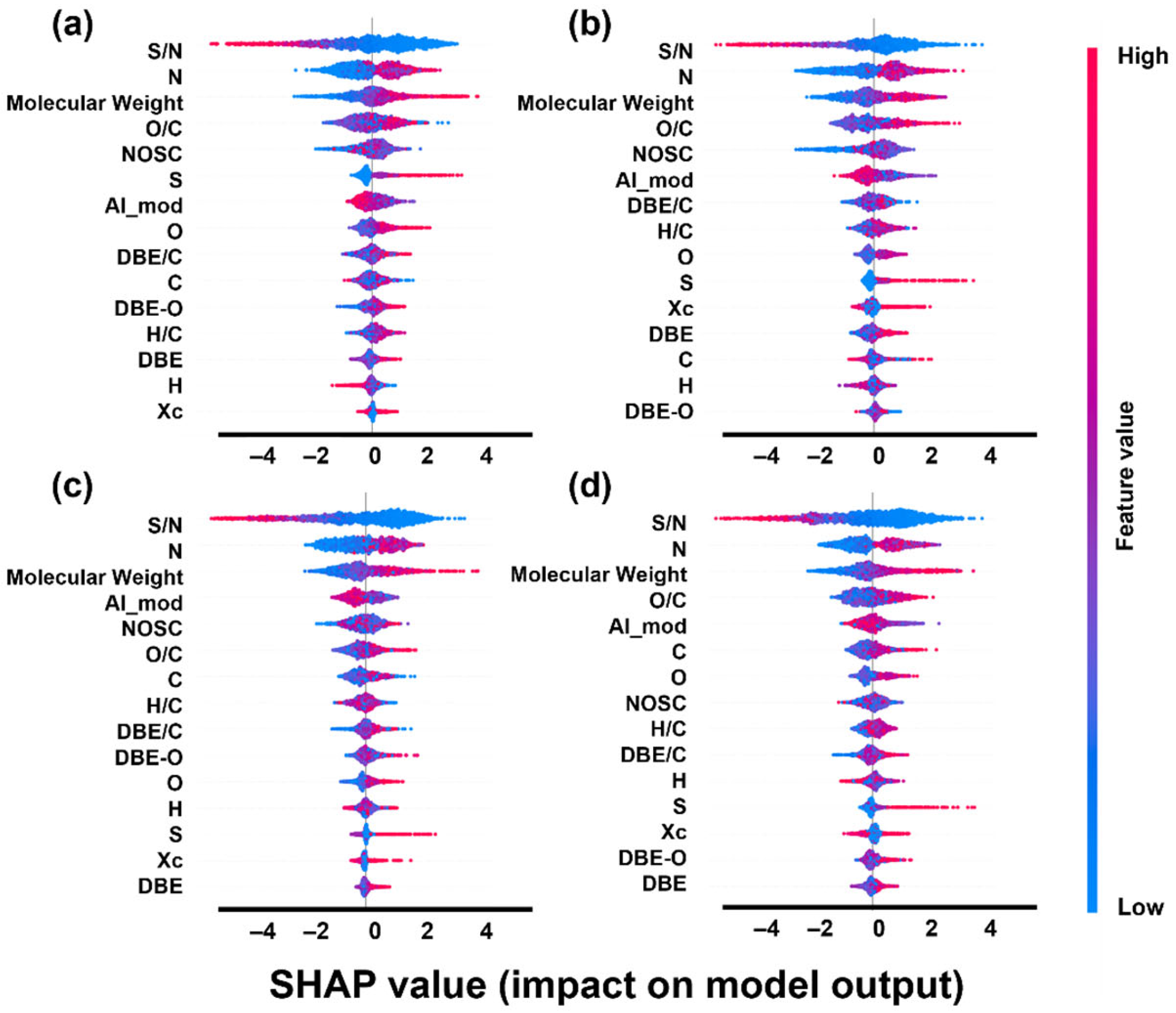
The oxidizability of DOM is fundamentally influenced by its molecular properties. To better understand how molecular features influence DOM degradation, a random forest model was employed to rank the significance of these properties in determining DOM oxidation during the coagulation-ozonation process (Figure 5) [40]. Additionally, a SHAP model was applied to visualize the contribution of individual data points to the predictive framework. DOM compounds are classified as “reactive” precursors (labeled as 1) or “non-reactive” resistant compounds (labeled as 0). Both models achieved a prediction accuracy exceeding 80%.
The SHAP value analysis highlights the significance of molecular properties in determining DOM oxidation during various coagulation processes. Molecular characteristics, including molecular weight, S/N ratio, nitrogen content (N), and oxygen-to-carbon ratio (O/C), are identified as critical factors influencing DOM oxidation, aligning with findings from previous studies [41,42]. The SHAP value analysis underscores the critical role of molecular properties in influencing DOM oxidation across various coagulation processes. Key molecular properties, including molecular weight, S/N ratio, nitrogen content (N), and oxygen-to-carbon ratio (O/C), have been identified as strongly associated with DOM oxidation, corroborating earlier research findings [37,43].
Following coagulation pretreatment and ozonation, the S/N ratio emerged as the most influential factor in the reaction. The significant role of nitrogen (N) in DOM degradation can be attributed to the selective reactivity of Cl• and ClO• radicals with nitrogenous DOM [41,44]. The relative importance of other factors varies depending on the specific coagulant used [29]. The importance ranking of the SHAP model highlights variations in the pathways through which different coagulants influence changes in organic structure during subsequent oxidation treatment. The other three coagulants tend to retain organic matter with higher O/C ratios, thereby enhancing their oxidation potential. PFS retained more aromatic molecules with high AI mod values, leading to distinct structural reaction mechanisms during subsequent oxidation.

3.3. Effect of DOM Composition on the Oxidation Pathways

3.3.1. Mechanism of DOM Oxidation Pathways in Ozonation

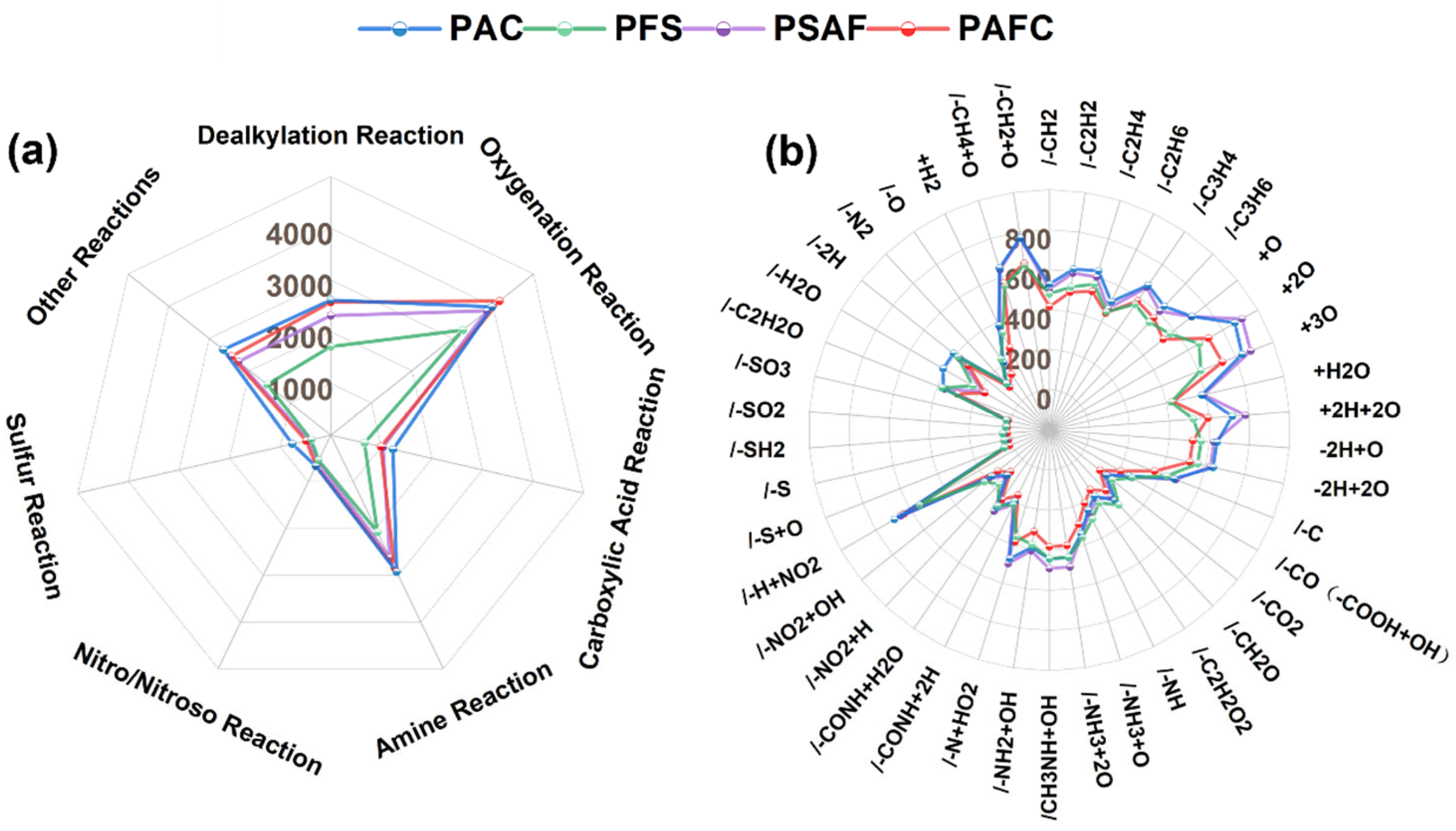
Figure 6, respectively, depicts eight types of conversion reactions and 42 potential reaction pathways that may occur in the coagulated leachate after ozonation. It was observed that different types of coagulants do not fundamentally alter the ozone reaction mechanism. The type of reaction with the largest number of conversion paths in the sample is the oxygen-adding reaction. The number of reaction pairs exceeded 4000, representing 29.41% of the total. The pathway involving the addition of three oxygen atoms (+3O) is the most frequent, with 812 pairs (5.74%). In addition, reactions involving the addition of two oxygen atoms (+2O), oxidation of carbon double bonds (+2H+2O), and methylation to carboxylic acid/amine to nitro group (-2H+2O) were also observed in several conversion paths. Amine reactions (20.01%) and dealkylation reactions (17.62%) were also prominent in the sample, with 2833 and 2573 reaction pairs, respectively (Figure 6a). Figure 6b illustrates that oxidative deamination (-NH3+2O) and demethylamine conversion to hydroxyl (-CH3NH+OH) are the two most frequent amine reaction pathways, with oxidative deamination involving deamination to ketone followed by oxidation. Notably, the observed nitrification reaction (-H+NO2) may account for the increase in Chon-like organics following the ozonation (Figure 6b).

3.3.2. Network-Based Fragmentation Pathways

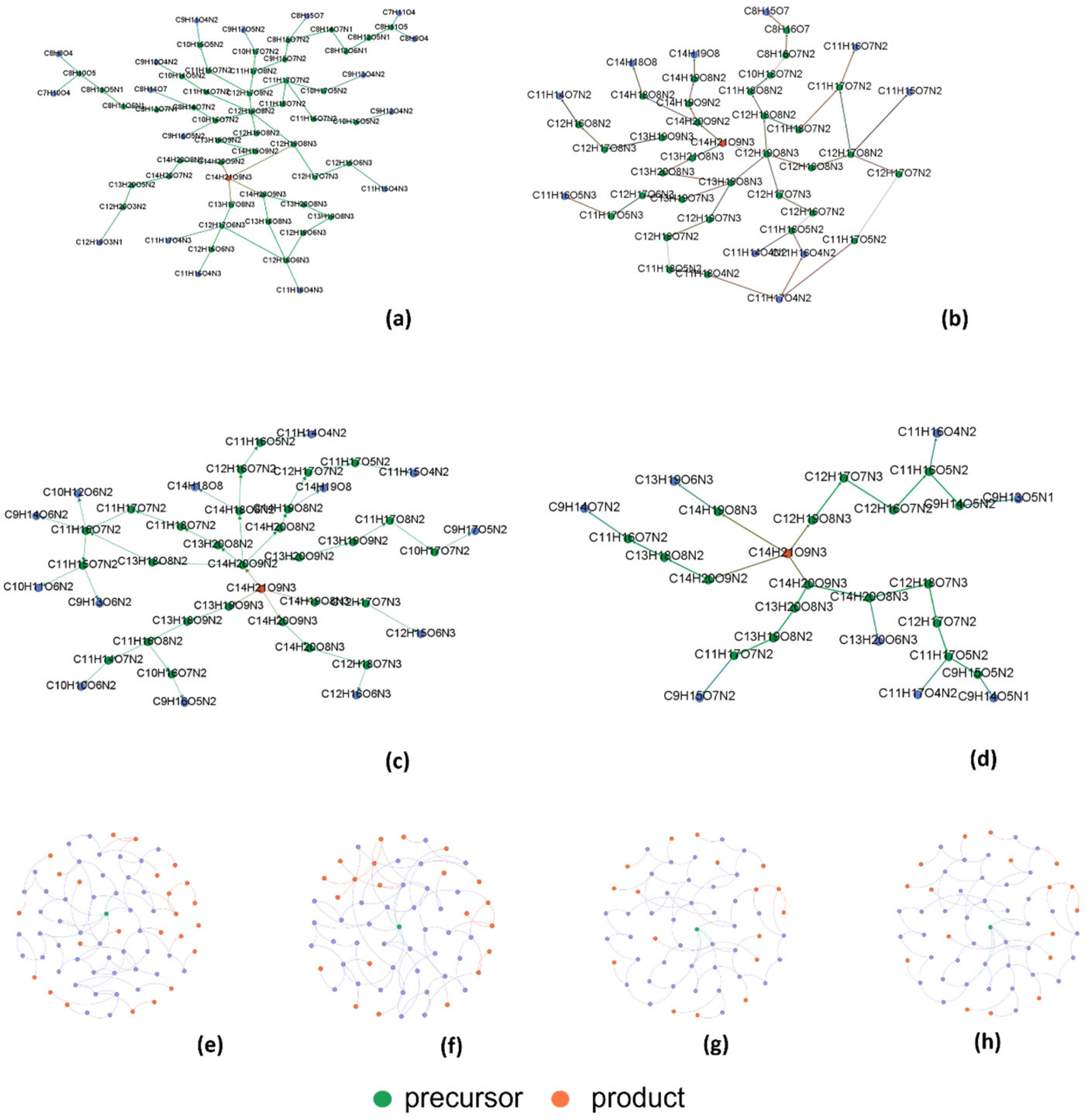
The molecular transformation networks of organic compounds in leachate, following pretreatment and ozonation with four coagulants, were analyzed using machine learning techniques [17]. The transformation network provides a detailed understanding of how various molecular structures evolve throughout the oxidation process, highlighting the complexity and integrity of the degradation pathway. The results of the molecular transformation analysis indicated significant differences in both the number and diversity of transformation pathways observed after treatment with different coagulants. It is worth noting that the molecular transformation pathways of leachate pretreated with PSAF are the most, indicating that ozonation degradation process is more complex and extensive (Figure 7). The higher number of conversion pathways indicates that organic compounds in PSAF-treated leachate undergo more thorough oxidation, leading to a greater variety of intermediates and greater overall mineralization. In contrast, leachate pretreated with PFS exhibited fewer conversion pathways, indicating that the oxidation process is incomplete.
C14H21O9N3 was employed as the representative compound to illustrate the degradation pathway of organic matter under various coagulant pretreatments. Gephi software was utilized to visualize the organic degradation pathway. Notably, 22, 21, 18, and 8 fragmentation pathways were observed in the products treated with PSAF, PAC, PAFC, and PFS, respectively (Figure 7). The results indicated that PSAF pretreatment facilitated the highest number of conversion pathways and yielded the most diverse degradation products in comparison to the other coagulants. The abundance of conversion pathways observed in PSAF-treated leachate can be attributed to the capacity of coagulants to modify the structure of organic compounds, rendering them more susceptible to subsequent ozonation. By facilitating the breakdown of complex molecules into smaller, more reactive intermediates, PSAF pretreatment enhances the efficiency of the oxidation process [17,45]. In summary, PFS pretreatment results in fewer transformation pathways during ozonation, leading to less complete oxidation of leachate organics. These findings further underscore the significance of coagulant selection in improving subsequent advanced oxidation processes.

3.4. Biodegradable Potential Assessment of DOM After Coagulation-Ozonation Combined

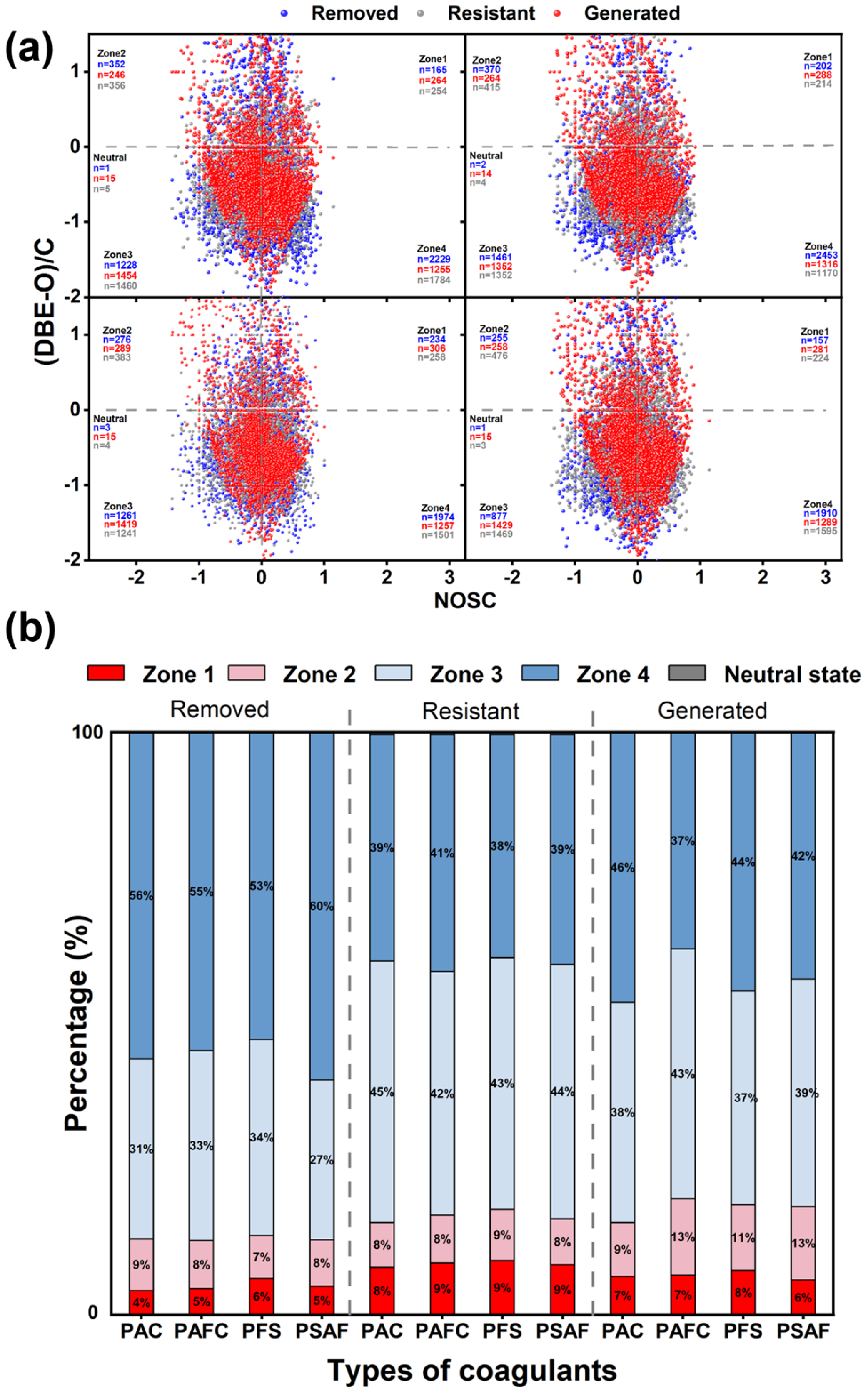
The effects of coagulation-ozonation on the oxidation status and biodegradation potential of DOM were examined in leachate. As outlined in Section 3.2.3, the NOSC-(DBE-O)/C diagram was employed for the analysis (Figure 8). The results demonstrated that organic matter shifted from zones 2 and 3 to zones 3 and 4 after coagulation-ozonation, suggesting significant degradation of the unsaturated compounds in zone 2. Further comparison of the four coagulants (PAC, PAFC, PSAF, and PFS) revealed that PAC-treated leachate exhibited the highest proportion of organic matter in zones 3 and 4, reflecting enhanced oxidation and increased biodegradation potential. PAFC and PSAF demonstrated moderate improvements, while PFS exhibited the least effective treatment, with a higher proportion of organic residues remaining in the less oxidized zones. These results indicate that PAC coagulation-ozone treatment enhanced the oxidation state of organic matter, creating more favorable conditions for subsequent biological treatment.

4. Conclusions

Four typical coagulants (PSAF, PAFC, PAC, PFS) were employed on the subsequent ozonation of landfill leachate, and the molecular composition and transformation pathways of organic compounds were investigated to identify the relationship between coagulation and oxidation processes on DOM variations in leachate utilizing machine learning to map molecular transformation networks. PAC was found to be the most effective coagulant in enhancing the susceptibility of organic matter to ozonation, promoting more complete oxidation and mineralization. These insights could contribute to the development of more efficient wastewater treatment strategies, particularly in the context of integrating coagulation and advanced oxidation processes. This combined coagulation–ozonation approach is particularly suitable for treating fresh leachate with high concentrations of COD (≈28,000 mg/L), TOC (≈9600 mg/L), and ammonia nitrogen (≈400 mg/L), as demonstrated in this study. Machine learning models provide valuable insights into transformation pathways; the complexity of organic matter in leachate means that not all reactions or intermediates may be fully captured or understood. Further research is needed to validate these findings in large-scale systems and to explore the long-term stability and environmental impact of the remaining organic fractions following treatment.

Supplementary Materials

The following supporting information can be downloaded at https://www.mdpi.com/article/10.3390/su18031530/s1, Figure S1: Effect of dosage of four coagulants on COD and turbidity in leachate (a,b) PAC; (c,d) PAFC; (e,f) PFS; (g,h) PSAF; Figure S2: Effect of flocculant dosage on COD and turbidity in leachate (a) PSAF; (b) PAFC; (c) PAC; (d) PFS; Figure S3: Influence of initial pH of leachate on coagulation effect (a) PSAF; (b) PAFC; (c) PAC; (d) PFS; Figure S4: Van Krevelen diagrams representing the four elemental compositions of organic matter in fresh leachate are shown: (a) CHO, (b) CHON, (c) CHOS, and (d) CHONS; Table S1: Characteristics of fresh leachate; Table S2: Optimum reaction conditions of four coagulants; Table S3: Classification and description of four zones in NOSC vs. (DBE-O)/C plot.

Author Contributions

Conceptualization, S.Z.; Formal analysis, S.Z.; Funding acquisition, W.L., Y.Z. and C.W.; Methodology, S.Z.; Resources, Y.X. and C.W.; Supervision, Y.X., M.S., L.Y. and L.W.; Validation, S.Z.; Writing—original draft, S.Z.; Writing—review and editing, H.W. and Z.L. All authors have read and agreed to the published version of the manuscript.

Funding

This work was supported by the International Cooperation and Exchange of the National Natural Science Foundation of China (no. 72261147460), the Shanghai Jiao Tong University Sichuan Research Institute (no. G2022037007L), Organization Department of Sichuan Providence, Department of Human Resources and Social Security of Sichuan Providence, Shanghai Jiao Tong University Inner Mongolia Research Institute (no. SA1600213), Shanghai Rising-Star Program (no. 22QB1403100), and the Jinan City Talent Development Project in 2021 (no. 2021GXRC067).

Institutional Review Board Statement

Not applicable.

Informed Consent Statement

Not applicable.

Data Availability Statement

The data presented in this study are available on request from the corresponding author.

Conflicts of Interest

Author Chuan Wang was employed by the company Shanghai Environment Group Co., Ltd. The remaining authors declare that the research was conducted in the absence of any commercial or financial relationships that could be construed as a potential conflict of interest.

References

  1. Zhang, Q.-Q.; Tian, B.-H.; Zhang, X.; Ghulam, A.; Fang, C.-R.; He, R. Investigation on characteristics of leachate and concentrated leachate in three landfill leachate treatment plants. Waste Manag. 2013, 33, 2277–2286. [Google Scholar] [CrossRef]
  2. Li, H.; Zhou, S.; Sun, Y.; Lv, J. Application of response surface methodology to the advanced treatment of biologically stabilized landfill leachate using Fenton’s reagent. Waste Manag. 2010, 30, 2122–2129. [Google Scholar] [CrossRef]
  3. Mohan, S.; Gokul, D. Treatment of Leachate from Open Dumpsite of Municipal Solid Waste by Ozone Based Advanced Oxidation Process. Ozone-Sci. Eng. 2022, 44, 250–264. [Google Scholar] [CrossRef]
  4. Monje-Ramirez, I.; Orta de Velásquez, M.T. Removal and transformation of recalcitrant organic matter from stabilized saline landfill leachates by coagulation–ozonation coupling processes. Water Res. 2004, 38, 2359–2367. [Google Scholar] [CrossRef] [PubMed]
  5. Zhang, H.; Lin, H.; Li, Q.; Cheng, C.; Shen, H.; Zhang, Z.; Zhang, Z.; Wang, H. Removal of refractory organics in wastewater by coagulation/flocculation with green chlorine-free coagulants. Sci. Total Environ. 2021, 787, 147654. [Google Scholar] [CrossRef] [PubMed]
  6. Moradi, M.; Ghanbari, F. Application of response surface method for coagulation process in leachate treatment as pretreatment for Fenton process: Biodegradability improvement. J. Water Process Eng. 2014, 4, 67–73. [Google Scholar] [CrossRef]
  7. Wang, H.; Xiao, W.; Zhang, C.; Sun, Y.; Wang, Y.-N.; Gong, Z.; Zhan, M.; Fu, Y.; Liu, K. Effective removal of refractory organic contaminants from reverse osmosis concentrated leachate using PFS-nZVI/PMS/O3 process. Waste Manag. 2021, 128, 55–63. [Google Scholar] [CrossRef]
  8. Wang, J.L.; Xu, L.J. Advanced Oxidation Processes for Wastewater Treatment: Formation of Hydroxyl Radical and Application. Crit. Rev. Environ. Sci. Technol. 2012, 42, 251–325. [Google Scholar] [CrossRef]
  9. Ribeiro, A.R.; Nunes, O.C.; Pereira, M.F.; Silva, A.M. An overview on the advanced oxidation processes applied for the treatment of water pollutants defined in the recently launched Directive 2013/39/EU. Environ. Int. 2015, 75, 33–51. [Google Scholar] [CrossRef]
  10. Meyerstein, D. Re-examining Fenton and Fenton-like reactions. Nat. Rev. Chem. 2021, 5, 595–597. [Google Scholar] [CrossRef]
  11. Poblete, R.; Oller, I.; Maldonado, M.I.; Cortes, E. Improved landfill leachate quality using ozone, UV solar radiation, hydrogen peroxide, persulfate and adsorption processes. J. Environ. Manag. 2019, 232, 45–51. [Google Scholar] [CrossRef]
  12. Fu, L.; Wu, C.; Zhou, Y.; Zuo, J.; Song, G.; Tan, Y. Ozonation reactivity characteristics of dissolved organic matter in secondary petrochemical wastewater by single ozone, ozone/H2O2, and ozone/catalyst. Chemosphere 2019, 233, 34–43. [Google Scholar] [CrossRef] [PubMed]
  13. Ghahrchi, M.; Rezaee, A. Electro-catalytic ozonation for improving the biodegradability of mature landfill leachate. J. Environ. Manag. 2020, 254, 109811. [Google Scholar] [CrossRef] [PubMed]
  14. Ying, D.; Peng, J.; Xu, X.; Li, K.; Wang, Y.; Jia, J. Treatment of mature landfill leachate by internal micro-electrolysis integrated with coagulation: A comparative study on a novel sequencing batch reactor based on zero valent iron. J. Hazard. Mater. 2012, 229–230, 426–433. [Google Scholar] [CrossRef] [PubMed]
  15. Kausley, S.B.; Malhotra, C.P.; Pandit, A.B. Treatment and reuse of shale gas wastewater: Electrocoagulation system for enhanced removal of organic contamination and scale causing divalent cations. J. Water Process Eng. 2017, 16, 149–162. [Google Scholar] [CrossRef]
  16. Liu, X.; Liu, R.; Zhu, B.; Ruan, T.; Jiang, G. Characterization of Carbonyl Disinfection By-Products During Ozonation, Chlorination, and Chloramination of Dissolved Organic Matters. Environ. Sci. Technol. 2020, 54, 2218–2227. [Google Scholar] [CrossRef]
  17. Leyva, D.; Tariq, M.U.; Jaffé, R.; Saeed, F.; Lima, F.F. Unsupervised Structural Classification of Dissolved Organic Matter Based on Fragmentation Pathways. Environ. Sci. Technol. 2022, 56, 1458–1468. [Google Scholar] [CrossRef]
  18. Wang, H.; Wang, L.; Seviour, T.W.; Yang, C.; Xiang, Y.; Zhu, Y.; Palocz-Andresen, M.; Wei, Z.; Lou, Z. Network-Based Methods for Deciphering the Oxidizability of Complex Leachate DOM with •OH/O3 via Molecular Signatures. Environ. Sci. Technol. 2025, 59, 2266–2275. [Google Scholar] [CrossRef]
  19. Wang, L.; Wang, H.; Ning, C.; Yang, C.; Huang, Q.; Zhou, Q.; Zhu, Y.; Zhang, R.; Palocz-Andresen, M.; Wang, L.; et al. Mapping Fragmentation Pathways: Assessing Degradation Potential of Individual Organic Fractions in Concentrated Leachate Using E+/Ozonation. ACS EST Water 2024, 5, 109811. [Google Scholar] [CrossRef]
  20. Fu, Q.-L.; Fujii, M.; Riedel, T. Development and comparison of formula assignment algorithms for ultrahigh-resolution mass spectra of natural organic matter. Anal. Chim. Acta 2020, 1125, 247–257. [Google Scholar] [CrossRef]
  21. Chen, W.; Gu, Z.; Wen, P.; Li, Q. Degradation of refractory organic contaminants in membrane concentrates from landfill leachate by a combined coagulation-ozonation process. Chemosphere 2019, 217, 411–422. [Google Scholar] [CrossRef]
  22. Chen, W.; Gu, Z.; He, C.; Li, Q. Molecular-level transformation of refractory organic matter during flocculation-ultraviolet/peroxymonosulfate treatment of MBR-treated landfill leachate. J. Hazard. Mater. 2023, 443, 130086. [Google Scholar] [CrossRef]
  23. Chen, W.; Zhuo, X.; He, C.; Shi, Q.; Li, Q. Molecular investigation into the transformation of dissolved organic matter in mature landfill leachate during treatment in a combined membrane bioreactor-reverse osmosis process. J. Hazard. Mater. 2020, 397, 122759. [Google Scholar] [CrossRef]
  24. Maizel, A.C.; Remucal, C.K. The effect of advanced secondary municipal wastewater treatment on the molecular composition of dissolved organic matter. Water Res. 2017, 122, 42–52. [Google Scholar] [CrossRef] [PubMed]
  25. Zhang, B.; Shan, C.; Hao, Z.; Liu, J.; Wu, B.; Pan, B. Transformation of dissolved organic matter during full-scale treatment of integrated chemical wastewater: Molecular composition correlated with spectral indexes and acute toxicity. Water Res. 2019, 157, 472–482. [Google Scholar] [CrossRef] [PubMed]
  26. Shao, L.; Deng, Y.; Qiu, J.; Zhang, H.; Liu, W.; Bazienė, K.; Lü, F.; He, P. DOM chemodiversity pierced performance of each tandem unit along a full-scale “MBR plus NF” process for mature landfill leachate treatment. Water Res. 2021, 195, 117000. [Google Scholar] [CrossRef] [PubMed]
  27. Chen, W.; He, C.; Zhuo, X.; Wang, F.; Li, Q. Comprehensive evaluation of dissolved organic matter molecular transformation in municipal solid waste incineration leachate. Chem. Eng. J. 2020, 400, 126003. [Google Scholar] [CrossRef]
  28. Yuan, Z.; He, C.; Shi, Q.; Xu, C.; Li, Z.; Wang, C.; Zhao, H.; Ni, J. Molecular Insights into the Transformation of Dissolved Organic Matter in Landfill Leachate Concentrate during Biodegradation and Coagulation Processes Using ESI FT-ICR MS. Environ. Sci. Technol. 2017, 51, 8110–8118. [Google Scholar] [CrossRef]
  29. Wang, H.; Cheng, Z.; Sun, Z.; Zhu, N.; Yuan, H.; Lou, Z.; Chen, X. Molecular insight into variations of dissolved organic matters in leachates along China’s largest A/O-MBR-NF process to improve the removal efficiency. Chemosphere 2020, 243, 125354. [Google Scholar] [CrossRef]
  30. Cabaniss, S.E. Forward Modeling of Metal Complexation by NOM: II. Prediction of Binding Site Properties. Environ. Sci. Technol. 2011, 45, 3202–3209. [Google Scholar] [CrossRef]
  31. Sudoh, R.; Islam, S.; Sazawa, K.; Okazaki, T.; Hata, N.; Taguchi, S.; Kuramitz, H. Removal of dissolved humic acid from water by coagulation method using polyaluminum chloride (PAC) with calcium carbonate as neutralizer and coagulant aid. J. Environ. Chem. Eng. 2015, 3, 770–774. [Google Scholar] [CrossRef]
  32. Zherebker, A.; Rukhovich, G.D.; Sarycheva, A.; Lechtenfeld, O.J.; Nikolaev, E.N. Aromaticity Index with Improved Estimation of Carboxyl Group Contribution for Biogeochemical Studies. Environ. Sci. Technol. 2022, 56, 2729–2737. [Google Scholar] [CrossRef] [PubMed]
  33. Zherebker, A.Y.; Lechtenfeld, O.J.; Sarycheva, A.; Kostyukevich, Y.I.; Kharybin, O.; Fedoros, E.I.; Nikolaev, E.N. Refinement of Compound Aromaticity in Complex Organic Mixtures by Stable Isotope Label Assisted Ultrahigh-Resolution Mass Spectrometry. Anal. Chem. 2020, 92, 9032–9038. [Google Scholar] [CrossRef] [PubMed]
  34. Cheng, W.P.; Chi, F.H. A study of coagulation mechanisms of polyferric sulfate reacting with humic acid using a fluorescence-quenching method. Water Res. 2002, 36, 4583–4591. [Google Scholar] [CrossRef] [PubMed]
  35. Li, X.; Li, P.; Tao, J.; Lin, J.; He, C.; Shi, Q.; Zhang, C.L. Stratification of dissolved organic matter in the upper 2000 m water column at the Mariana Trench. Sci. Total Environ. 2019, 668, 1222–1231. [Google Scholar] [CrossRef]
  36. Lan, W.; Qiu, H.; Zhang, J.; Yu, Y.; Yang, K.; Liu, Z.; Ding, G. Characteristic of a novel composite inorganic polymer coagulant–PFAC prepared by hydrochloric pickle liquor. J. Hazard. Mater. 2009, 162, 174–179. [Google Scholar] [CrossRef]
  37. Zhang, B.; Shan, C.; Wang, S.; Fang, Z.; Pan, B. Unveiling the transformation of dissolved organic matter during ozonation of municipal secondary effluent based on FT-ICR-MS and spectral analysis. Water Res. 2021, 188, 116484. [Google Scholar] [CrossRef]
  38. Phungsai, P.; Kurisu, F.; Kasuga, I.; Furumai, H. Changes in Dissolved Organic Matter Composition and Disinfection Byproduct Precursors in Advanced Drinking Water Treatment Processes. Environ. Sci. Technol. 2018, 52, 3392–3401. [Google Scholar] [CrossRef]
  39. Gu, Z.; Chen, W.; He, C.; Li, Q. Molecular insights into the transformation of refractory organic matter in landfill leachate nanofiltration concentrates during a flocculation and O3/H2O2 treatment. J. Hazard. Mater. 2022, 435, 128973. [Google Scholar] [CrossRef]
  40. Wen, L.; Yang, F.; Li, X.; Liu, S.; Lin, Y.; Hu, E.; Gao, L.; Li, M. Composition of dissolved organic matter (DOM) in wastewater treatment plants influent affects the efficiency of carbon and nitrogen removal. Sci. Total Environ. 2023, 857, 159541. [Google Scholar] [CrossRef]
  41. Wang, F.; Wang, W.; Wang, H.; Zhao, Z.; Zhou, T.; Jiang, C.; Li, J.; Zhang, X.; Liang, T.; Dong, W. Experiments and machine learning-based modeling for haloacetic acids rejection by nanofiltration: Influence of solute properties and operating conditions. Sci. Total Environ. 2023, 883, 163610. [Google Scholar] [CrossRef]
  42. Wang, H.; Ge, D.; Cheng, Z.; Zhu, N.; Yuan, H.; Lou, Z. Improved understanding of dissolved organic matter transformation in concentrated leachate induced by hydroxyl radicals and reactive chlorine species. J. Hazard. Mater. 2020, 387, 121702. [Google Scholar] [CrossRef]
  43. Wang, H.; Xiang, Y.; Liu, W.; Li, J.; Zhu, N.; Lou, Z. Low-molecular-weight dissolved organic nitrogen transformation behavior in concentrated leachate by O3 and •OH: Partition, molecular insight, and potential precursor-product relationship. J. Environ. Manag. 2022, 324, 116287. [Google Scholar] [CrossRef]
  44. Xiao, G.; Xu, T.; Faheem, M.; Xi, Y.; Zhou, T.; Moryani, H.T.; Bao, J.; Du, J. Evolution of Singlet Oxygen by Activating Peroxydisulfate and Peroxymonosulfate: A Review. Int. J. Environ. Res. Public Health 2021, 18, 3344. [Google Scholar] [CrossRef]
  45. Witt, M.; Fuchser, J.; Koch, B.P. Fragmentation Studies of Fulvic Acids Using Collision Induced Dissociation Fourier Transform Ion Cyclotron Resonance Mass Spectrometry. Anal. Chem. 2009, 81, 2688–2694. [Google Scholar] [CrossRef]
Figure 1. Removal efficiencies of COD and TOC during ozone treatment after pretreatment with different coagulants PAC (a), PAFC (b), PFS (c), and PSAF (d).
Sustainability 18 01530 g001
Figure 2. Van Krevelen diagrams of DOM molecules in leachate concentrates after coagulation with (a) PAC, (b) PAFC, (c) PFS, and (d) PSAF. Axes represent atomic ratios (O/C vs. H/C) calculated from FT-ICR-MS-derived molecular formulas; each point corresponds to an individual organic molecule. The variety of DOM during different coagulations with different molecular composition (e) and elemental composition (f). Values in (e,f) are expressed as percentages. (I) Carbohydrates, H/C = 1.5–2.4, O/C = 0.71–1.2; (II) Amino sugar, H/C = 1.5–2.2, O/C = 0.52–0.71; (III) protein, H/C = 1.5–2.2, O/C = 0.10–1.52, lipid, H/C = 1.5–2.0, O/C = 0–0.3; (IV) Tannic acid, H/C = 0.50–1.5, O/C = 0.67–1.2; (V) Lignin, H/C = 0.7–1.5, O/C = 0.10–0.67; (VI) Unsaturated hydrocarbons, H/C = 0.7–1.5, O/C = 0–0.1; (VII) Polycyclic aromatic hydrocarbons, H/C = 0.2–0.7, O/C = 0–0.67.
Sustainability 18 01530 g002
Figure 3. The relationship between carbon number and the aromaticity of organic substances. (a) The relationship between AI mod and carbon number in leachate treated with four distinct coagulants, (b) The percentage of different AI mod values in removed portion and resistant, (c) The relationship between Xc and carbon number in leachate treated with four distinct coagulants, (d) The percentage of different Xc values in removed portion and resistant.
Sustainability 18 01530 g003
Figure 4. (a) Nominal oxidation state of carbon (NOSC) vs. (DBE–O)/C plots of DOM molecules after coagulation treatment with PAC, PAFC, PFS, and PSAF. Each point represents a distinct molecular formula identified by FT-ICR-MS. (b) Proportions of DOM compounds categorized as completely removed, resistant, or generated after ozonation, based on FT-ICR-MS data. Organic compounds were classified into four zones based on the distribution of NOSC and (DBE–O)/C values: Zone 1 (oxidized–unsaturated), Zone 2 (reduced–unsaturated), Zone 3 (reduced–saturated), Zone 4 (oxidized–saturated), and a Neutral state. Classification details are provided in Table S3. All values are expressed as percentages.
Sustainability 18 01530 g004
Figure 5. The importance of molecular properties in determining DOM oxidizability using machine learning (a) PAC, (b) PAFC, (c) PFS, and (d) PSAF. The vertical axis represents the order of the sum of SHAP values of all sample features, and the horizontal axis represents the influence of features on the model output. Positive and negative SHAP values are contributions to the DOM. Red represents positive influence, blue represents negative influence.
Sustainability 18 01530 g005
Figure 6. Radar map of the number of possible conversion paths between organic matter removed and generated during ozone reactions. (a) Seven major transformation types: nitration/nitrosation, oxidation, carboxylation, amination, dealkylation, sulfur reactions, and others. (b) Detailed classification into 42 specific molecular transformation pathways based on FT-ICR-MS analysis.
Sustainability 18 01530 g006
Figure 7. Diagram of the conversion relationship network of a precursor with m/z of 375 after different coagulation-ozone treatments. (a) PAC-ozonation, (b) PAFC-ozonation, (c) PFS-ozonation, (d) PSAF-ozonation; Subnetwork around C14H21O9N3 after different coagulation-ozone treatments. (e) PAC-ozonation, (f) PAFC-ozonation, (g) PFS-ozonation (h) PSAF-ozonation.
Sustainability 18 01530 g007
Figure 8. Nominal oxidation state of carbon vs. (DBE-O)/C plots and proportion of completely removed, resistant and generated of DOM after coagulation-ozonation Treatment. (a) Nominal oxidation state of carbon (NOSC) vs. (DBE–O)/C plots of DOM molecules after coagulation-ozone treatment with PAC, PAFC, PFS, and PSAF. Each point represents a distinct molecular formula identified by FT-ICR-MS. (b) Proportions of DOM compounds cate-gorized as completely removed, resistant, or generated after ozonation, based on FT-ICR-MS data.
Sustainability 18 01530 g008
Disclaimer/Publisher’s Note: The statements, opinions and data contained in all publications are solely those of the individual author(s) and contributor(s) and not of MDPI and/or the editor(s). MDPI and/or the editor(s) disclaim responsibility for any injury to people or property resulting from any ideas, methods, instructions or products referred to in the content.